EP3899074B1 - New use of a nickel-based alloy - Google Patents
New use of a nickel-based alloy Download PDFInfo
- Publication number
- EP3899074B1 EP3899074B1 EP18829878.0A EP18829878A EP3899074B1 EP 3899074 B1 EP3899074 B1 EP 3899074B1 EP 18829878 A EP18829878 A EP 18829878A EP 3899074 B1 EP3899074 B1 EP 3899074B1
- Authority
- EP
- European Patent Office
- Prior art keywords
- nickel
- based alloy
- max
- alloy
- use according
- Prior art date
- Legal status (The legal status is an assumption and is not a legal conclusion. Google has not performed a legal analysis and makes no representation as to the accuracy of the status listed.)
- Active
Links
Images


Classifications
-
- C—CHEMISTRY; METALLURGY
- C22—METALLURGY; FERROUS OR NON-FERROUS ALLOYS; TREATMENT OF ALLOYS OR NON-FERROUS METALS
- C22C—ALLOYS
- C22C19/00—Alloys based on nickel or cobalt
- C22C19/03—Alloys based on nickel or cobalt based on nickel
- C22C19/05—Alloys based on nickel or cobalt based on nickel with chromium
-
- C—CHEMISTRY; METALLURGY
- C22—METALLURGY; FERROUS OR NON-FERROUS ALLOYS; TREATMENT OF ALLOYS OR NON-FERROUS METALS
- C22C—ALLOYS
- C22C19/00—Alloys based on nickel or cobalt
- C22C19/03—Alloys based on nickel or cobalt based on nickel
- C22C19/05—Alloys based on nickel or cobalt based on nickel with chromium
- C22C19/051—Alloys based on nickel or cobalt based on nickel with chromium and Mo or W
- C22C19/056—Alloys based on nickel or cobalt based on nickel with chromium and Mo or W with the maximum Cr content being at least 10% but less than 20%
Definitions
- WO2017/198831 A1 discloses the use of an object in environments having a high nitrogen concentration and a low oxygen partial pressure and high temperature such as sintering furnaces and muffle furnaces.
- the object comprising a pre-oxidized nickel-based alloy comprising by weight (wt-%) C 0.05-0.2; Si max 1.5; Mn max 0.5; Cr 15-20; Al 4-6; Fe 15-25; Co max 5; N 0.03-0.15; 0 max 0.5; one or more elements selected from the group consisting of Ta, Zr, Hf, Ti and b 0.25-2.2; one or more elements selected from the group consisting of the rare earth metals (REM) max 0.5; balance Ni and normally occurring impurities.
- REM rare earth metals
- the present disclosure also relates to a method for improving corrosion properties of a component, the method comprising: exposing the component to a molten carbonate salt mixture environment, wherein the component contains a dispersion strengthened nickel-based alloy comprising the following in weight% (wt%): C 0.05-0.2; Si max 1.5; Mn max 0.5; Cr 15-20; Al 3-6; Fe 15-25; Co max 10; N 0.03-0.15; O max 0.5;
- the elementary composition of the nickel-based alloy is generally as defined hereinabove or hereinafter and the function of each alloying element is further described below. However, the listing of functions and effects of the respective alloying elements is not to be seen as complete, but there may be further functions and effects of said alloying elements.
- the terms weight% and wt% are used interchangeably.
- the nickel-based alloy consists of all the elements mentioned hereinabove or hereinafter in the ranges mentioned hereinabove or hereinafter.
- Silicon can be present in the present nickel-based alloy in a content up to 1.5 wt%. Silicon will, in too high contents, lead to an increased risk for precipitations of nickel silicides, which have an embrittling effect on this type of alloys. Results from creep testing of similar alloys have shown that the creep life time, i.e. the time to creep fracture, is reduced with Si contents close to 1.5 wt%. The reason for this is however not known. Because of this, the Si content should preferably be maximally 1 wt%. According to one embodiment, the nickel-based alloy as defined hereinabove or hereinafter only comprises impurity content of Si, i.e. up to 0.3 wt%.
- the nickel-based alloy as defined hereinabove or hereinafter may be manufactured according to conventional methods, e.g. casting followed by hot working and/or cold working and optional additional heat treatment.
- the nickel-based alloy as defined hereinabove or hereinafter may also be produced as a powder product.
- the process used for manufacturing a component thereof may then be for example hot isostatic pressure process (HIP).
- HIP hot isostatic pressure process
Landscapes
- Chemical & Material Sciences (AREA)
- Engineering & Computer Science (AREA)
- Materials Engineering (AREA)
- Mechanical Engineering (AREA)
- Metallurgy (AREA)
- Organic Chemistry (AREA)
- Powder Metallurgy (AREA)
- Treatment Of Steel In Its Molten State (AREA)
- Manufacture Of Alloys Or Alloy Compounds (AREA)
Description
- The present disclosure relates to a use of a component manufactured from a nickel-based alloy in a molten salt mixture environment, especially a carbonate salt mixture environment.
- Within the field of reusable energy, concentrated solar power, CSP, has stayed in development compared with, for example, photovoltaic methods. This is mostly due to the difficulties of obtaining good enough energy efficiency and the lack of supply of a good heat storage medium. Research has however shown that a salt melt could function as a good heat storage medium and one of the proposed medias is sodium-potassium nitrate salt mixtures, commonly known as "solar salts". The most severe problem with these solar salts are that they will decompose at temperatures above about 550 °C, which in turn will lead to corrosion of the components used in the equipment. Due to these corrosion issues, other salt mixtures have recently been developed. These salt mixtures are more stable and are based on carbonate salts, usually lithium- sodium - and potassium carbonates (LiNaK; Li2CO3-Na2CO3-K2CO3). Even though these salt mixtures are more stable, it has been shown that they are even more corrosive and the studies regarding corrosion performed so far with these salt mixtures have not provided any promising results.
-
US2011/067398 A1 discloses containers for holding thermal storage fluids ("solar salts"), i.e. molten salt, made of alloys on the base of iron, chromium, nickel, molybdenum and manganese, typically made of stainless steel or Inconel. -
WO2017/198831 A1 discloses the use of an object in environments having a high nitrogen concentration and a low oxygen partial pressure and high temperature such as sintering furnaces and muffle furnaces. The object comprising a pre-oxidized nickel-based alloy comprising by weight (wt-%) C 0.05-0.2; Si max 1.5; Mn max 0.5; Cr 15-20; Al 4-6; Fe 15-25; Co max 5; N 0.03-0.15; 0 max 0.5; one or more elements selected from the group consisting of Ta, Zr, Hf, Ti and b 0.25-2.2; one or more elements selected from the group consisting of the rare earth metals (REM) max 0.5; balance Ni and normally occurring impurities. - The aspect of the present disclosure is therefore to provide a solution to the above-mentioned problems or to at least reduce them.
- The present disclosure relates to a use of a component manufactured from a dispersion strengthened nickel-based alloy comprising in weight% (wt%):
C 0.05-0.2; Si max 1.5; Mn max 0.5; Cr 15-20; Al 3-6; Fe 15-25 Co max 10; N 0.03-0.15; O max 0.5; - one or more elements selected from the group consisting of Ta, Zr, Hf, Ti and Nb 0.25-2.5;
- one or more elements selected from the group consisting of REM
max 0.5; - balance Ni and normally occurring impurities in a molten carbonate salt mixture environment.
- The present inventors have surprisingly found that a component manufactured by an aluminium oxide forming nickel-based alloy comprising certain elements in certain ranges will have corrosion properties superior to other materials in a molten carbonate salt mixture environment, even in temperatures up to 750 °C.
-
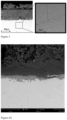
- Figure 1
- shows a cross-section of sample A after exposure. The cross-section shows the surface layer with the bulk material below. Sample A is an alloy according to the present disclosure;
- Figure 2
- shows a cross-section of sample B after exposure. The cross-section shows the surface layer of the sample with the bulk material below;
- Figure 3
- shows a cross-section of sample C after exposure. The cross-section shows the surface layer of the sample with the bulk material below;
- Figure 4A
- shows a cross-section of sample D after exposure. The cross-section shows the surface layer of the sample with the bulk material below;
- Figure 4B
- shows a cross-section of sample D after exposure The cross-section shows the zone with precipitates in the sample under the surface.
- It has surprisingly been found that a component comprising certain nickel-based alloys which are alloyed with aluminium will not corrode in a salt melt mixture comprising carbonate salts. Hence, the present nickel-based alloy as defined hereinabove or hereinafter is an alumina forming nickel-base alloy which has been proven to be able to form and maintain a protective alumina oxide in a molten carbonate salt mixture, for example a LiNaK carbonate salt mixture under pure CO2 at a temperature of 750°C.
- The nickel-based alloy has the following composition in weight% (wt%):
C 0.05-0.2; Si max 1.5; Mn max 0.5; Cr 15-25; Al 3-6; Fe 15-25; Co max 10; N 0.03-0.15; O 0.03-0.15; - one or more elements selected from the group consisting of Ta, Zr, Hf, Ti and Nb 0.25-2.5;
- one or more elements selected from the group consisting of the rare-earth metals (REM) max 0.5;
- balance Ni and normally occurring impurities.
- As stated above, it is very surprising that a component comprising the present nickel-based alloy is resistant against corrosion in a molten carbonate salt mixture environment because firstly the temperature in these environments is too low for the formation of aluminum oxide and secondly this environment has proven to be very corrosive to other similar alloys as shown in the SERI-report SERIIPR-255-2561 entitled "The Corrosion of Selected Alloys in eutectic Lithium-Sodium-Potassium Carbonate at 900°C".
- It is believed, without being bound to any theory, that the impact of high creep resistance of the nickel-based alloy as defined hereinabove or hereinafter and the surprising formation of a protective aluminium oxide layer are the keys for this corrosion resistance.
- The present disclosure also relates to a method for storing heat, the method comprises
- Providing a salt melt mixture comprising carbonate salts as defined hereinabove ir hereinafter;
- Providing a component comprising a dispersion strengthened nickel-based alloy as defined hereinabove or hereiafter.
- The component could for example be used for storing the salt melt mixture.
- Hence, the present disclosure relates to a component containing a dispersion strengthened nickel-based alloy, the dispersion strengthened nickel-based alloy comprising the following in weight% (wt%):
C 0.05-0.2; Si max 1.5; Mn max 0.5; Cr 15-20; Al 3-6; Fe 15-25; Co max 10; N 0.03-0.15; O max 0.5; - one or more elements selected from the group consisting of Ta, Zr, Hf, Ti and Nb 0.25-2.5;
- one or more elements selected from the group consisting of REM max 0.5;
- balance Ni and normally occurring impurities.
- Furthermore, the present disclosure relates to a method for corrosion resistance, the method comprising:
installing a component in a location to be exposed to a molten carbonate salt mixture environment,
wherein the component contains a dispersion strengthened nickel-based alloy comprising the following in weight% (wt%):C 0.05-0.2; Si max 1.5; Mn max 0.5; Cr 15-20; Al 3-6; Fe 15-25; Co max 10; N 0.03-0.15; O max 0.5; - one or more elements selected from the group consisting of Ta, Zr, Hf, Ti and Nb 0.25-2.5;
- one or more elements selected from the group consisting of REM
max 0.5; - balance Ni and normally occurring impurities; and
- The present disclosure also relates to a method for improving corrosion properties of a component, the method comprising:
exposing the component to a molten carbonate salt mixture environment,
wherein the component contains a dispersion strengthened nickel-based alloy comprising the following in weight% (wt%):C 0.05-0.2; Si max 1.5; Mn max 0.5; Cr 15-20; Al 3-6; Fe 15-25; Co max 10; N 0.03-0.15; O max 0.5; - one or more elements selected from the group consisting of Ta, Zr, Hf, Ti and Nb 0.25-2.5;
- one or more elements selected from the group consisting of REM max 0.5;
- balance Ni and normally occurring impurities; and
- According to one embodiment, the component which is exposed to the molten carbonate salt mixture environment will form an outer layer of aluminum oxide on the component.
- According to another embodiment, the component is preoxidating prior to exposing the component to the molten carbonate salt mixture environment, wherein preoxidating forms an outer layer of aluminum oxide on the component.
- The elementary composition of the nickel-based alloy is generally as defined hereinabove or hereinafter and the function of each alloying element is further described below. However, the listing of functions and effects of the respective alloying elements is not to be seen as complete, but there may be further functions and effects of said alloying elements. The terms weight% and wt% are used interchangeably. According to one embodiment, the nickel-based alloy consists of all the elements mentioned hereinabove or hereinafter in the ranges mentioned hereinabove or hereinafter.
- Carbon in free form will take interstitial locations in the crystal structure and thereby lock the mobility of dislocations at temperatures up to approximately 400-500°C. Carbon will also form carbides with other elements in the present nickel-based alloy such as Ta, Ti, Hf, Zr and Nb. In a microstructure with finely dispersed carbides, these carbides provide obstacles for the dislocation movement and have effect even at higher temperatures. Carbon is an essential element to improve the present nickel-based alloy's creep strength since the dislocation mobility is the mechanism that generates creep elongation. Too high content of C will however lead to that the present nickel-based alloy will become difficult to cold work due to deteriorated ductility at lower temperatures, such as below 300°C. The present nickel-based alloy therefore comprises 0.05-0.2 wt% C.
- Silicon can be present in the present nickel-based alloy in a content up to 1.5 wt%. Silicon will, in too high contents, lead to an increased risk for precipitations of nickel silicides, which have an embrittling effect on this type of alloys. Results from creep testing of similar alloys have shown that the creep life time, i.e. the time to creep fracture, is reduced with Si contents close to 1.5 wt%. The reason for this is however not known. Because of this, the Si content should preferably be maximally 1 wt%. According to one embodiment, the nickel-based alloy as defined hereinabove or hereinafter only comprises impurity content of Si, i.e. up to 0.3 wt%.
- Manganese is present in the nickel-based alloy as defined hereinabove or hereinafter as an impurity. It is likely that up to 0.5 wt% Mn can be allowed without negatively influencing the properties of the present nickel-based alloy, whereby the alloy comprises maximally 0.5 wt% Mn. According to one embodiment, the nickel-based alloy as defined hereinabove or hereinafter only comprises an impurity content of Mn, i.e. up to 0.2 wt%.
- Chromium is an element which during a long period of time has been the leading element when it comes to creating a dense and protective oxide scale. Less than 15 wt% Cr in an austenitic structure tends to render an oxide which is not entirely covering the surface and which is not dense and consequently render an insufficient oxidation resistance to the alloy. There is also a risk that the material closest to the oxide is depleted of Cr such that possible damages to the oxide cannot heal since there is not sufficient Cr to form new oxide.
- A nickel-based alloy as the present alloy comprising at least 3 wt% Al, such as at least 4 wt% Al should however not comprise more than about 20 wt% Cr as higher contents increase the risk of formation of γ' and β phases. Therefore, in order to minimise the presence of γ' and β phases, the nickel-based alloy as defined hereinabove or hereinafter comprises max 20 wt% Cr. At too high Cr contents, there may also be a risk of formation of other unwanted phases, such as σ-phase and chromium rich ferrite and furthermore Cr may also, at high contents, stabilise nickel aluminides. Thus, the alloy as defined hereinabove or hereinafter comprises 15-20 wt% Cr, such as 17-20 wt% Cr, such as 17-19 wt% Cr.
- Aluminium is an element that generates a much denser and more protective oxide scale compared to Cr. Aluminium can however not replace Cr since the formation of the aluminium oxide is slower than the chromium oxide at lower temperatures. The alloy comprises at least 3 wt% Al, such as at least 4 wt% Al, which will ensure a sufficient oxidation resistance at high temperatures and that the oxide covers the surface entirely. The relatively high content of Al provides excellent oxidation resistance even at temperatures of about 1100 °C. At Al contents above 6 wt%, there is a risk of formation of such an amount of intermetallic phases in a nickel-based matrix that the ductility of the material is considerably deteriorated. The alloy should therefore comprise 3-6 wt% Al, such as 3.5-5.5 wt%, such as 4 - 5.5 wt% Al.
- It has been shown in accordance with the present disclosure that relatively high contents of Fe in an aluminium oxide forming nickel-based alloy can have positive effects. Additions of Fe generate a metallic structure which is energetically unfavourable for the formation of embrittling γ', which in turn leads to that the risk of the alloy becoming hard and brittle is reducing considerably. Consequently, the workability is improved. Therefore, the present nickel-based alloy comprises at least 15 wt% Fe. High contents of iron may however lead to formation of unwanted phases. Therefore, the present nickel-based alloy shall not comprise more than 25 wt% Fe.
- Moreover, for certain alloys within the ranges as defined hereinabove or hereinafter, a Fe content over approximately 21-22 wt% may increase the risk of formation of a β-phase (NiAl), which in some cases can be embrittling. According to one embodiment, the present alloy may therefore comprise 16-21.5 wt% Fe. According to another embodiment, the present alloy comprises 17-21 wt% Fe.
- The alloy according to the present disclosure is a nickel-based alloy. Nickel is an element which stabilises the austenitic structure in present alloys and thereby counteracts the formation of some brittle intermetallic phases, such as σ-phase. The austenitic structure of the present alloy is beneficial, for example, when it comes to welding. The austenitic structure has also shown to contribute to a good creep strength for the present alloy at high temperatures. According to one embodiment, the alloy comprises 52-62 wt% Ni, such as 52-60wt% Ni.
- In some commercial alloys, a part of the content of Ni may be substituted with Co in order to increase the mechanical strength of the alloy, this may also be done for the present nickel-based alloy. Hence, a part of the Ni content of the present alloy may be replaced with an equal amount of Co. This Co addition must however be balanced against the oxidation properties since the presence of NiAl will reduce the activity of Al and thereby deteriorate the ability to form aluminium oxide. The Co content shall, however, not exceed 10 wt%. According to one embodiment, the Co content does not exceed 8 wt%. According to another embodiment, the Co content does not exceed 5 wt%, according to yet another embodiment, the Co content is less than 1 wt%
- In the same way as C, free N takes interstitial locations in the crystal structure and thereby locks the dislocation mobility at temperatures up to approximately 400-500°C. Nitrogen also forms nitrides and/or carbon nitrides with other elements in the present nickel-based alloy such as Ta, Ti, Hf, Zr and Nb. In a microstructure where these particles are finely dispersed, they will confer obstacles for the dislocation mobility, especially at higher temperatures. Therefore, N is added in order to improve the creep strength of the present nickel base alloy. However, when adding N to aluminium alloyed alloys, the risk is high for formation of secondary aluminium nitrides and the present nickel-based alloy therefore has a very limited N content. The present alloy comprises 0.03-0.15 wt% N, such as 0.05-0.15 wt% N, such as 0.05-0.10 wt% N.
- Oxygen may be present in the present nickel-based alloy either in the form of an impurity, or as an active addition up to 0.5 wt%. Oxygen may contribute to increasing the creep strength of the present alloy by forming small oxide dispersions together with Zr, Hf, Ta and Ti, which, when they are finely distributed in the alloy, improves its creep strength. These oxide dispersions have higher dissolution temperature than corresponding carbides and nitrides, whereby oxygen is a preferred addition for use at high temperatures. Oxygen may also form dispersions with Al, the elements in group 3 of the periodic table, Sc, Y and La as well as the fourteen lanthanides, and in the same manner as with the above identified elements thereby contribute to higher creep strength of the present alloy. According to one embodiment, the alloy comprises 10 - 2000 ppm O, According to another embodiment, 20 - 2000 ppm O. According to another embodiment, the alloy comprises 10-200 ppm, 200-2000 ppm O or 400-1000 ppm O.
- The elements in the group consisting of Ta, Hf and Zr forms very small and stable particles with carbon and nitrogen. It is these particles which, if they are finely dispersed in the structure, will help to lock dislocation movement and thereby increase the creep strength, i.e. provides the dispersion strengthening. It is also possible to accomplish this effect with addition of Ti. Additions of Ti can, however, sometimes lead to problems, especially during powder metallurgical production of the alloy, since it will form carbides and nitrides already in the melt before atomisation, which in turn may clog the orifice during the atomisation. Niobium also forms stable dispersions with C and or N and can therefore suitably be added to the present nickel-based alloy.
- The alloy comprises one or more elements selected from the group consisting of Ta, Zr, Hf, Ti and Nb in an amount of 0.25-2.2 wt%, such as 0.3-1.5 wt%, such as 0.6-1.5 wt%.
- The alloy may also comprise such an amount of the elements Ta, Zr, Hf, Ti and Nb that essentially all C and N is bound to these elements. This ensures that for example the risk of formation of chromium carbides during high temperature use of the alloy is significantly reduced.
- According to a preferred embodiment, the nickel-based alloy as defined hereinabove or hereinafter comprises 0.1-0.5wt% Hf. According to another embodiment, the present nickel-based alloy comprises 0.05-0.35 wt% Zr. According to yet another embodiment, the present nickel-based alloy comprises 0.05-0.5 wt% Ta. According to yet another embodiment, the present nickel-based alloy comprises 0.05-0.4 wt% Ti. According to yet another embodiment, the present nickel-based alloy comprises 0.1-0.8 wt% Nb.
- Rare earth metals (REM) relates in this context to the elements of group three of the periodic table, Sc, Y, and La as well as the fourteen lanthanides. REM affects the oxidation properties by doping of the formed oxide. Excess alloying of these elements often gives an oxide which tends to spall of the surface and a too low addition of these elements tends to give an oxide with weaker adhesion to the metal surface. The present nickel-based alloy may comprise one or more elements from the group consisting of REM in a content of up to 0.5 wt% in total, such as 0.05-0.25 wt%. According to a one embodiment, yttrium is added to the alloy as defined hereinabove or hereinafter in an amount of 0.05-0.25 wt%.
- The nickel-based alloy as defined hereinabove or hereinafter may also comprise normally occurring impurities as a result of the raw material used or the selected manufacturing process. Examples of impurities but not limiting to are Ca, S and P. Furthermore, other alloying elements, which will not affect the properties of the alloy may optionally be added in amounts up to 1 wt%.
- When the term "max" is used, the skilled person knows that the lower limit of the range is 0 wt% unless another value is specifically stated.
- The nickel-based alloy as defined hereinabove or hereinafter may be manufactured according to conventional methods, e.g. casting followed by hot working and/or cold working and optional additional heat treatment. The nickel-based alloy as defined hereinabove or hereinafter may also be produced as a powder product. The process used for manufacturing a component thereof may then be for example hot isostatic pressure process (HIP).
- According to the present disclosure, a component may be a tube, a strip, a plate or a wire. It should be noted that the component may also have any shape depending on where and how it will be used. The component could also be a coating which in turn protects another material, e.g. the present nickel-based alloy is a coating on a component manufactured form a stainless steel.
- According to one embodiment of the present disclosure, the component comprising the nickel-based alloy may be preoxidated before use.
- The present disclosure is further illustrated by the following non-limiting examples.
- The present example was performed in order to investigate the impact of molten salt mixtures on chromia and alumina (i.e. chromium oxide respectively aluminium oxide) forming alloys. The samples (A-D) used is shown in Table 1. The investigation was carried out by isothermal and long-term cyclic exposures up to 750 h and in temperatures up to 750 °C.
- The sample materials were cut into coupons, ground to a 1200 grit finish with SiC paper, cleaned, weighed and placed into alumina crucibles, which were filled with salt mixture. The salt mixtures were prepared freshly for each exposure cycle by careful mixing of the components, LiCO3, NaCO3 and KCOs, in equal amounts using a mortar. The prepared crucibles were placed into a heat constant zone of a horizontal tube furnace. After adjusting the atmosphere and purging with CO2 for at least 8 h, the heating of the crucibles was activated. Once a week the crucibles were checked and refilled with the salt mixture. After the targeted dwell time, the furnace was cooled down before removing the crucibles.
- After removing the crucibles from the furnace, the exposed samples were washed with warm water (60°C) and were then treated by using ultrasonic treatment.
- The exposed samples were studied by using optical microscopy and Scanning Electron Microscopy, SEM. SEM was used for identifying surface species, oxide scale formation and internal corrosion processes. The cross-section images from the SEM investigation are shown in
figures 1-4 for sample A, B, C and D. -
Figure 1 shows that a thin protective oxide layer has been formed on Sample A, which is a sample of the present nickel-based alloy as defined hereinabove or hereinafter. The formed oxide layer was adherent, had good surface coverage and was only a few microns thick after the exposures. Furthermore, SEM investigations showed that the bulk material under the surface layer was not affected by the molten carbonate salt mixture exposure. -
Figure 2 shows a cross-section image for sample B, which is a typical FeCrAl-alloy. The surface oxide formed was not completely protective. The oxide was relatively thick and not dense. -
Figure 3 shows a cross-section image for sample C, which is a high temperature stainless steel. The formed surface oxide was both thick and porous and non-adherent. Furthermore, SEM investigations showed that the bulk material under the surface had been affected in a zone extending more than 100 microns into the sample. -
Figure 4A shows a cross-section image for sample D, which is an example of a nickel base alloy containing silicon. On this sample, a thick porous and non-adherent oxide was formed on the surface. Closer examination of the bulk material by using SEM showed that the bulk was affected in a zone which extended more than 100 microns into the sample. In this zone, it was found that large number of precipices had been formed as shown infigure 4B . - Thus, as shown by the results and by
Figures 1 to 4 , sample A, which is the present nickel-based alloy, had superior corrosion resistance in this aggressive molten carbonate salt mixture environment. The surface oxide formed was thin, dense and adherent and protective. Further, the microstructure of the bulk material under the surface had not been affected by the exposure. - As has been discussed before, this is a very surprising result, especially if referring to IERI-report SERIIPR-255-2561 entitled "The Corrosion of Selected Alloys in eutectic Lithium-Sodium-Potassium Carbonate at 900°C". This report describes the exposure of various alloys in molten carbonate. The samples exposed are an alumina forming alloy, Cabot 214 (see sample F in Table 1), and a chromia forming alloy, Cabot 800H (see sample E in Table 1). The results of the exposures are that the Cabot 214 coupons had swollen to the extent that they could not be removed from the sample holder after 9 days (216 h) of exposure. The Cabot 800H coupons had after 14 days swollen so much that they could not be removed from the sample holder. Hence, the results of this study indicate that alumina forming alloys will not work in molten LiNaK-carbonates in oxygen free atmosphere (e.g. pure CO2). This is to be compared with the result of the present disclosure which has shown that certain alumina forming nickel-based alloy (i.e. the alloy according to the present disclosure) will have very good corrosion properties in these carbonate salt melt mixtures, up to 750 °C in pure CO2.
Table 1. Alloy used Alloy Al Cr Fe Ni Mn Ti Co Other Sample A Present nickel-based alloy Bal Sample B FeCrAl-alloy 5 21 Bal -- 0.5 -- -- Y 0.1 Sample C High temperature stainless steel with UNS34700 (347H) -- 17.5 Bal 10 1.7 -- -- Nb 0.7 Sample D A nickel base alloy containing silicon 0.7 22 32 Bal -- -- -- Si 1.7 Sample E Cabot 800H 0.4 21 Bal 32 1.5 0.4 2 Sample F Cabot 214 4.5 16 2.5 77
Claims (12)
- Use of a component containing a dispersion strengthened nickel-based alloy comprising the following in weight% (wt%):
C 0.05-0.2; Si max 1.5; Mn max 0.5; Cr 15-20; Al 3-6; Fe 15-25 Co max 10; N 0.03-0.15; O max 0.5; one or more elements selected from the group consisting of Ta, Zr, Hf, Ti and Nb 0.25-2.5;one or more elements selected from the group consisting of REM
max 0.5;balance Ni and normally occurring impurities in a molten carbonate salt mixture environment. - The use according to claim 1, wherein the nickel-based alloy comprises 16-21.5 wt% Fe.
- The use according to any preceding claims, wherein the nickel-based alloy comprises 17-20 wt% Cr.
- The use according to any preceding claims, wherein the nickel-based alloy comprises max 0.3 wt% Si.
- The use according to any preceding claims, wherein the nickel-based alloy comprises one or more elements selected from the group consisting of REM in a total content of 0.05-0.25 wt%.
- The use according to any preceding claims, wherein the nickel-based alloy comprises one or more elements selected from the group consisting of Ta, Zr, Hf, Ti and Nb in a total content of 0.3-1.5 wt%.
- The use according to any preceding claims, wherein the nickel-based alloy comprises 52-62 wt% Ni.
- The use according to any preceding claims, wherein the nickel-based alloy is manufactured from conventional metallurgical processes or from powder technology.
- The use according to any preceding claims, wherein the carbonate salt mixture is a LiNaK or a Li2CO3-Na2CO3-K2CO3 salt mixture.
- The use according to any preceding claims, wherein the atmosphere of the environment consists of pure CO2.
- The use according to any preceding claims, wherein the component is selected from a tube, a strip, a plate, a wire or a coating.
- The use according to any preceding claims, wherein the component has any shape depending on where and how it will be used.
Applications Claiming Priority (1)
| Application Number | Priority Date | Filing Date | Title |
|---|---|---|---|
| PCT/EP2018/086751 WO2020126053A1 (en) | 2018-12-21 | 2018-12-21 | New use of a nickel-based alloy |
Publications (2)
| Publication Number | Publication Date |
|---|---|
| EP3899074A1 EP3899074A1 (en) | 2021-10-27 |
| EP3899074B1 true EP3899074B1 (en) | 2023-04-26 |
Family
ID=64949305
Family Applications (1)
| Application Number | Title | Priority Date | Filing Date |
|---|---|---|---|
| EP18829878.0A Active EP3899074B1 (en) | 2018-12-21 | 2018-12-21 | New use of a nickel-based alloy |
Country Status (4)
| Country | Link |
|---|---|
| US (1) | US20220074026A1 (en) |
| EP (1) | EP3899074B1 (en) |
| CN (1) | CN113195758B (en) |
| WO (1) | WO2020126053A1 (en) |
Families Citing this family (1)
| Publication number | Priority date | Publication date | Assignee | Title |
|---|---|---|---|---|
| CN112322939A (en) * | 2020-11-04 | 2021-02-05 | 中国科学院上海应用物理研究所 | A kind of nickel-based superalloy and preparation method thereof |
Family Cites Families (11)
| Publication number | Priority date | Publication date | Assignee | Title |
|---|---|---|---|---|
| DE4111821C1 (en) * | 1991-04-11 | 1991-11-28 | Vdm Nickel-Technologie Ag, 5980 Werdohl, De | |
| KR100339795B1 (en) * | 2000-01-25 | 2002-06-07 | 박호군 | Direct Internal Reforming Molten Carbonate Fuel Cell with Membrane for Intercepting Carbonate Vapor |
| US20040156737A1 (en) * | 2003-02-06 | 2004-08-12 | Rakowski James M. | Austenitic stainless steels including molybdenum |
| DE102006019590A1 (en) * | 2006-04-27 | 2007-10-31 | Degussa Gmbh | Reaction container, useful for preparing hydrogen sulfide by reacting sulfur and hydrogen, comprises optionally connecting device, armature, measuring- and regulating- device containing a material having aluminum |
| KR101646296B1 (en) * | 2008-11-19 | 2016-08-05 | 산드빅 인터렉츄얼 프로퍼티 에이비 | Aluminium oxide forming nickel based alloy |
| US9488386B2 (en) * | 2009-09-18 | 2016-11-08 | Massachusetts Institute Of Technology | Concentrated solar power system receiver |
| CN103966476B (en) * | 2013-02-01 | 2017-07-07 | 中国科学院金属研究所 | A kind of nickel base superalloy of the anti-fused salt corrosion of excellent performance |
| RU2613805C1 (en) * | 2016-02-17 | 2017-03-21 | Дмитрий Леонидович Михайлов | Corrosion-resistant nickel-based alloy |
| US20190292631A1 (en) * | 2016-05-20 | 2019-09-26 | Sandvik Intellectual Property Ab | An object comprising a pre-oxidized nickel-based alloy |
| CN107034386B (en) * | 2017-04-14 | 2018-11-27 | 中国科学院上海应用物理研究所 | A kind of anti-fused salt corrosion high-temperature composite material and molten salt reactor core structure part |
| CN108458182A (en) * | 2018-04-23 | 2018-08-28 | 上海冀晟能源科技有限公司 | The sealing element and its manufacturing method of high temperature resistant melt salt corrosion |
-
2018
- 2018-12-21 EP EP18829878.0A patent/EP3899074B1/en active Active
- 2018-12-21 WO PCT/EP2018/086751 patent/WO2020126053A1/en not_active Ceased
- 2018-12-21 US US17/415,197 patent/US20220074026A1/en not_active Abandoned
- 2018-12-21 CN CN201880100401.0A patent/CN113195758B/en not_active Expired - Fee Related
Also Published As
| Publication number | Publication date |
|---|---|
| EP3899074A1 (en) | 2021-10-27 |
| CN113195758A (en) | 2021-07-30 |
| CN113195758B (en) | 2022-08-23 |
| WO2020126053A1 (en) | 2020-06-25 |
| US20220074026A1 (en) | 2022-03-10 |
Similar Documents
| Publication | Publication Date | Title |
|---|---|---|
| CN113166855B (en) | Nickel-base superalloy | |
| US11718897B2 (en) | Precipitation hardenable cobalt-nickel base superalloy and article made therefrom | |
| EP2367963B1 (en) | Aluminium oxide forming nickel based alloy | |
| EP4083554A1 (en) | Nickel-base alloy, heat-resistant and corrosion resistant component, and component for heat-treatment furnace | |
| EP1469095B1 (en) | Precipitation-strengthened nickel-iron-chromium alloy and process therefor | |
| EP1857561A1 (en) | Titanium alloy material having superior hydrogen absorption resistance | |
| KR101601207B1 (en) | super heat resistant alloy and the manufacturing method thereof | |
| US20190292631A1 (en) | An object comprising a pre-oxidized nickel-based alloy | |
| US20220074026A1 (en) | New use of a nickel-based alloy | |
| JPS6128746B2 (en) | ||
| JP6927418B2 (en) | Titanium alloy and its manufacturing method | |
| JPH09228008A (en) | Iron-chromium-aluminium steel tube excellent in high temperature shape stability | |
| JP2012031475A (en) | HIGH STRENGTH α+β TYPE TITANIUM ALLOY PLATE EXCELLENT IN BENDABILITY AND BENDING ANISOTROPY AND METHOD OF MANUFACTURING THE SAME | |
| JP2003013174A (en) | Steel material with less decrease in toughness due to plastic deformation and method for producing the same | |
| CN120265803B (en) | Nickel-based alloys | |
| JP4953371B2 (en) | Ni-based alloy excellent in nitric acid corrosion resistance and method for producing the same | |
| CN111172429B (en) | Ni-Fe-Si series alloy resisting corrosion of molten chloride and preparation method thereof | |
| JPS6353234A (en) | Structural member having heat resistance and high strength | |
| Shahi et al. | via Varying Ti/Nb Ratios on the Pitting | |
| Bazin et al. | 5/6 Scores d’évaluation de la sédation et de l’analgésie | |
| CN119351903A (en) | Microalloyed high corrosion resistant iron-based amorphous alloy and preparation method thereof | |
| CN120945251A (en) | A nickel-based NS600R alloy resistant to sulfuric acid corrosion and its preparation method | |
| JP2020117813A (en) | Nickel-based alloy | |
| JPH11140570A (en) | High strength and high corrosion resistance nickel alloy and method for producing the same |
Legal Events
| Date | Code | Title | Description |
|---|---|---|---|
| STAA | Information on the status of an ep patent application or granted ep patent |
Free format text: STATUS: UNKNOWN |
|
| STAA | Information on the status of an ep patent application or granted ep patent |
Free format text: STATUS: THE INTERNATIONAL PUBLICATION HAS BEEN MADE |
|
| PUAI | Public reference made under article 153(3) epc to a published international application that has entered the european phase |
Free format text: ORIGINAL CODE: 0009012 |
|
| STAA | Information on the status of an ep patent application or granted ep patent |
Free format text: STATUS: REQUEST FOR EXAMINATION WAS MADE |
|
| 17P | Request for examination filed |
Effective date: 20210721 |
|
| AK | Designated contracting states |
Kind code of ref document: A1 Designated state(s): AL AT BE BG CH CY CZ DE DK EE ES FI FR GB GR HR HU IE IS IT LI LT LU LV MC MK MT NL NO PL PT RO RS SE SI SK SM TR |
|
| RAP1 | Party data changed (applicant data changed or rights of an application transferred) |
Owner name: KANTHAL AB |
|
| DAV | Request for validation of the european patent (deleted) | ||
| DAX | Request for extension of the european patent (deleted) | ||
| GRAP | Despatch of communication of intention to grant a patent |
Free format text: ORIGINAL CODE: EPIDOSNIGR1 |
|
| STAA | Information on the status of an ep patent application or granted ep patent |
Free format text: STATUS: GRANT OF PATENT IS INTENDED |
|
| INTG | Intention to grant announced |
Effective date: 20220819 |
|
| GRAJ | Information related to disapproval of communication of intention to grant by the applicant or resumption of examination proceedings by the epo deleted |
Free format text: ORIGINAL CODE: EPIDOSDIGR1 |
|
| STAA | Information on the status of an ep patent application or granted ep patent |
Free format text: STATUS: REQUEST FOR EXAMINATION WAS MADE |
|
| GRAP | Despatch of communication of intention to grant a patent |
Free format text: ORIGINAL CODE: EPIDOSNIGR1 |
|
| STAA | Information on the status of an ep patent application or granted ep patent |
Free format text: STATUS: GRANT OF PATENT IS INTENDED |
|
| INTC | Intention to grant announced (deleted) | ||
| INTG | Intention to grant announced |
Effective date: 20230111 |
|
| GRAS | Grant fee paid |
Free format text: ORIGINAL CODE: EPIDOSNIGR3 |
|
| GRAA | (expected) grant |
Free format text: ORIGINAL CODE: 0009210 |
|
| STAA | Information on the status of an ep patent application or granted ep patent |
Free format text: STATUS: THE PATENT HAS BEEN GRANTED |
|
| AK | Designated contracting states |
Kind code of ref document: B1 Designated state(s): AL AT BE BG CH CY CZ DE DK EE ES FI FR GB GR HR HU IE IS IT LI LT LU LV MC MK MT NL NO PL PT RO RS SE SI SK SM TR |
|
| REG | Reference to a national code |
Ref country code: GB Ref legal event code: FG4D |
|
| REG | Reference to a national code |
Ref country code: CH Ref legal event code: EP |
|
| REG | Reference to a national code |
Ref country code: DE Ref legal event code: R096 Ref document number: 602018048962 Country of ref document: DE |
|
| REG | Reference to a national code |
Ref country code: AT Ref legal event code: REF Ref document number: 1562860 Country of ref document: AT Kind code of ref document: T Effective date: 20230515 |
|
| REG | Reference to a national code |
Ref country code: IE Ref legal event code: FG4D |
|
| REG | Reference to a national code |
Ref country code: SE Ref legal event code: TRGR |
|
| REG | Reference to a national code |
Ref country code: LT Ref legal event code: MG9D |
|
| REG | Reference to a national code |
Ref country code: NL Ref legal event code: MP Effective date: 20230426 |
|
| REG | Reference to a national code |
Ref country code: AT Ref legal event code: MK05 Ref document number: 1562860 Country of ref document: AT Kind code of ref document: T Effective date: 20230426 |
|
| PG25 | Lapsed in a contracting state [announced via postgrant information from national office to epo] |
Ref country code: NL Free format text: LAPSE BECAUSE OF FAILURE TO SUBMIT A TRANSLATION OF THE DESCRIPTION OR TO PAY THE FEE WITHIN THE PRESCRIBED TIME-LIMIT Effective date: 20230426 |
|
| PG25 | Lapsed in a contracting state [announced via postgrant information from national office to epo] |
Ref country code: PT Free format text: LAPSE BECAUSE OF FAILURE TO SUBMIT A TRANSLATION OF THE DESCRIPTION OR TO PAY THE FEE WITHIN THE PRESCRIBED TIME-LIMIT Effective date: 20230828 Ref country code: NO Free format text: LAPSE BECAUSE OF FAILURE TO SUBMIT A TRANSLATION OF THE DESCRIPTION OR TO PAY THE FEE WITHIN THE PRESCRIBED TIME-LIMIT Effective date: 20230726 Ref country code: ES Free format text: LAPSE BECAUSE OF FAILURE TO SUBMIT A TRANSLATION OF THE DESCRIPTION OR TO PAY THE FEE WITHIN THE PRESCRIBED TIME-LIMIT Effective date: 20230426 Ref country code: AT Free format text: LAPSE BECAUSE OF FAILURE TO SUBMIT A TRANSLATION OF THE DESCRIPTION OR TO PAY THE FEE WITHIN THE PRESCRIBED TIME-LIMIT Effective date: 20230426 |
|
| PG25 | Lapsed in a contracting state [announced via postgrant information from national office to epo] |
Ref country code: RS Free format text: LAPSE BECAUSE OF FAILURE TO SUBMIT A TRANSLATION OF THE DESCRIPTION OR TO PAY THE FEE WITHIN THE PRESCRIBED TIME-LIMIT Effective date: 20230426 Ref country code: PL Free format text: LAPSE BECAUSE OF FAILURE TO SUBMIT A TRANSLATION OF THE DESCRIPTION OR TO PAY THE FEE WITHIN THE PRESCRIBED TIME-LIMIT Effective date: 20230426 Ref country code: LV Free format text: LAPSE BECAUSE OF FAILURE TO SUBMIT A TRANSLATION OF THE DESCRIPTION OR TO PAY THE FEE WITHIN THE PRESCRIBED TIME-LIMIT Effective date: 20230426 Ref country code: LT Free format text: LAPSE BECAUSE OF FAILURE TO SUBMIT A TRANSLATION OF THE DESCRIPTION OR TO PAY THE FEE WITHIN THE PRESCRIBED TIME-LIMIT Effective date: 20230426 Ref country code: IS Free format text: LAPSE BECAUSE OF FAILURE TO SUBMIT A TRANSLATION OF THE DESCRIPTION OR TO PAY THE FEE WITHIN THE PRESCRIBED TIME-LIMIT Effective date: 20230826 Ref country code: HR Free format text: LAPSE BECAUSE OF FAILURE TO SUBMIT A TRANSLATION OF THE DESCRIPTION OR TO PAY THE FEE WITHIN THE PRESCRIBED TIME-LIMIT Effective date: 20230426 Ref country code: GR Free format text: LAPSE BECAUSE OF FAILURE TO SUBMIT A TRANSLATION OF THE DESCRIPTION OR TO PAY THE FEE WITHIN THE PRESCRIBED TIME-LIMIT Effective date: 20230727 |
|
| PG25 | Lapsed in a contracting state [announced via postgrant information from national office to epo] |
Ref country code: FI Free format text: LAPSE BECAUSE OF FAILURE TO SUBMIT A TRANSLATION OF THE DESCRIPTION OR TO PAY THE FEE WITHIN THE PRESCRIBED TIME-LIMIT Effective date: 20230426 |
|
| PG25 | Lapsed in a contracting state [announced via postgrant information from national office to epo] |
Ref country code: SK Free format text: LAPSE BECAUSE OF FAILURE TO SUBMIT A TRANSLATION OF THE DESCRIPTION OR TO PAY THE FEE WITHIN THE PRESCRIBED TIME-LIMIT Effective date: 20230426 |
|
| PGFP | Annual fee paid to national office [announced via postgrant information from national office to epo] |
Ref country code: GB Payment date: 20231102 Year of fee payment: 6 |
|
| REG | Reference to a national code |
Ref country code: DE Ref legal event code: R097 Ref document number: 602018048962 Country of ref document: DE |
|
| PG25 | Lapsed in a contracting state [announced via postgrant information from national office to epo] |
Ref country code: SM Free format text: LAPSE BECAUSE OF FAILURE TO SUBMIT A TRANSLATION OF THE DESCRIPTION OR TO PAY THE FEE WITHIN THE PRESCRIBED TIME-LIMIT Effective date: 20230426 Ref country code: SK Free format text: LAPSE BECAUSE OF FAILURE TO SUBMIT A TRANSLATION OF THE DESCRIPTION OR TO PAY THE FEE WITHIN THE PRESCRIBED TIME-LIMIT Effective date: 20230426 Ref country code: RO Free format text: LAPSE BECAUSE OF FAILURE TO SUBMIT A TRANSLATION OF THE DESCRIPTION OR TO PAY THE FEE WITHIN THE PRESCRIBED TIME-LIMIT Effective date: 20230426 Ref country code: EE Free format text: LAPSE BECAUSE OF FAILURE TO SUBMIT A TRANSLATION OF THE DESCRIPTION OR TO PAY THE FEE WITHIN THE PRESCRIBED TIME-LIMIT Effective date: 20230426 Ref country code: DK Free format text: LAPSE BECAUSE OF FAILURE TO SUBMIT A TRANSLATION OF THE DESCRIPTION OR TO PAY THE FEE WITHIN THE PRESCRIBED TIME-LIMIT Effective date: 20230426 Ref country code: CZ Free format text: LAPSE BECAUSE OF FAILURE TO SUBMIT A TRANSLATION OF THE DESCRIPTION OR TO PAY THE FEE WITHIN THE PRESCRIBED TIME-LIMIT Effective date: 20230426 |
|
| PGFP | Annual fee paid to national office [announced via postgrant information from national office to epo] |
Ref country code: SE Payment date: 20231110 Year of fee payment: 6 Ref country code: FR Payment date: 20231122 Year of fee payment: 6 Ref country code: DE Payment date: 20231031 Year of fee payment: 6 |
|
| PLBE | No opposition filed within time limit |
Free format text: ORIGINAL CODE: 0009261 |
|
| STAA | Information on the status of an ep patent application or granted ep patent |
Free format text: STATUS: NO OPPOSITION FILED WITHIN TIME LIMIT |
|
| 26N | No opposition filed |
Effective date: 20240129 |
|
| PG25 | Lapsed in a contracting state [announced via postgrant information from national office to epo] |
Ref country code: SI Free format text: LAPSE BECAUSE OF FAILURE TO SUBMIT A TRANSLATION OF THE DESCRIPTION OR TO PAY THE FEE WITHIN THE PRESCRIBED TIME-LIMIT Effective date: 20230426 |
|
| PG25 | Lapsed in a contracting state [announced via postgrant information from national office to epo] |
Ref country code: SI Free format text: LAPSE BECAUSE OF FAILURE TO SUBMIT A TRANSLATION OF THE DESCRIPTION OR TO PAY THE FEE WITHIN THE PRESCRIBED TIME-LIMIT Effective date: 20230426 Ref country code: IT Free format text: LAPSE BECAUSE OF FAILURE TO SUBMIT A TRANSLATION OF THE DESCRIPTION OR TO PAY THE FEE WITHIN THE PRESCRIBED TIME-LIMIT Effective date: 20230426 |
|
| REG | Reference to a national code |
Ref country code: CH Ref legal event code: PL |
|
| PG25 | Lapsed in a contracting state [announced via postgrant information from national office to epo] |
Ref country code: LU Free format text: LAPSE BECAUSE OF NON-PAYMENT OF DUE FEES Effective date: 20231221 |
|
| PG25 | Lapsed in a contracting state [announced via postgrant information from national office to epo] |
Ref country code: MC Free format text: LAPSE BECAUSE OF FAILURE TO SUBMIT A TRANSLATION OF THE DESCRIPTION OR TO PAY THE FEE WITHIN THE PRESCRIBED TIME-LIMIT Effective date: 20230426 |
|
| REG | Reference to a national code |
Ref country code: BE Ref legal event code: MM Effective date: 20231231 |
|
| PG25 | Lapsed in a contracting state [announced via postgrant information from national office to epo] |
Ref country code: MC Free format text: LAPSE BECAUSE OF FAILURE TO SUBMIT A TRANSLATION OF THE DESCRIPTION OR TO PAY THE FEE WITHIN THE PRESCRIBED TIME-LIMIT Effective date: 20230426 Ref country code: LU Free format text: LAPSE BECAUSE OF NON-PAYMENT OF DUE FEES Effective date: 20231221 |
|
| REG | Reference to a national code |
Ref country code: IE Ref legal event code: MM4A |
|
| PG25 | Lapsed in a contracting state [announced via postgrant information from national office to epo] |
Ref country code: IE Free format text: LAPSE BECAUSE OF NON-PAYMENT OF DUE FEES Effective date: 20231221 |
|
| PG25 | Lapsed in a contracting state [announced via postgrant information from national office to epo] |
Ref country code: BE Free format text: LAPSE BECAUSE OF NON-PAYMENT OF DUE FEES Effective date: 20231231 |
|
| PG25 | Lapsed in a contracting state [announced via postgrant information from national office to epo] |
Ref country code: CH Free format text: LAPSE BECAUSE OF NON-PAYMENT OF DUE FEES Effective date: 20231231 |
|
| PG25 | Lapsed in a contracting state [announced via postgrant information from national office to epo] |
Ref country code: IE Free format text: LAPSE BECAUSE OF NON-PAYMENT OF DUE FEES Effective date: 20231221 Ref country code: CH Free format text: LAPSE BECAUSE OF NON-PAYMENT OF DUE FEES Effective date: 20231231 Ref country code: BE Free format text: LAPSE BECAUSE OF NON-PAYMENT OF DUE FEES Effective date: 20231231 |
|
| PG25 | Lapsed in a contracting state [announced via postgrant information from national office to epo] |
Ref country code: BG Free format text: LAPSE BECAUSE OF FAILURE TO SUBMIT A TRANSLATION OF THE DESCRIPTION OR TO PAY THE FEE WITHIN THE PRESCRIBED TIME-LIMIT Effective date: 20230426 |
|
| PG25 | Lapsed in a contracting state [announced via postgrant information from national office to epo] |
Ref country code: BG Free format text: LAPSE BECAUSE OF FAILURE TO SUBMIT A TRANSLATION OF THE DESCRIPTION OR TO PAY THE FEE WITHIN THE PRESCRIBED TIME-LIMIT Effective date: 20230426 |
|
| REG | Reference to a national code |
Ref country code: DE Ref legal event code: R119 Ref document number: 602018048962 Country of ref document: DE |
|
| PG25 | Lapsed in a contracting state [announced via postgrant information from national office to epo] |
Ref country code: CY Free format text: LAPSE BECAUSE OF FAILURE TO SUBMIT A TRANSLATION OF THE DESCRIPTION OR TO PAY THE FEE WITHIN THE PRESCRIBED TIME-LIMIT; INVALID AB INITIO Effective date: 20181221 |
|
| REG | Reference to a national code |
Ref country code: SE Ref legal event code: EUG |
|
| PG25 | Lapsed in a contracting state [announced via postgrant information from national office to epo] |
Ref country code: HU Free format text: LAPSE BECAUSE OF FAILURE TO SUBMIT A TRANSLATION OF THE DESCRIPTION OR TO PAY THE FEE WITHIN THE PRESCRIBED TIME-LIMIT; INVALID AB INITIO Effective date: 20181221 |
|
| GBPC | Gb: european patent ceased through non-payment of renewal fee |
Effective date: 20241221 |
|
| PG25 | Lapsed in a contracting state [announced via postgrant information from national office to epo] |
Ref country code: DE Free format text: LAPSE BECAUSE OF NON-PAYMENT OF DUE FEES Effective date: 20250701 |
|
| PG25 | Lapsed in a contracting state [announced via postgrant information from national office to epo] |
Ref country code: GB Free format text: LAPSE BECAUSE OF NON-PAYMENT OF DUE FEES Effective date: 20241221 |
|
| PG25 | Lapsed in a contracting state [announced via postgrant information from national office to epo] |
Ref country code: FR Free format text: LAPSE BECAUSE OF NON-PAYMENT OF DUE FEES Effective date: 20241231 |
|
| PG25 | Lapsed in a contracting state [announced via postgrant information from national office to epo] |
Ref country code: TR Free format text: LAPSE BECAUSE OF FAILURE TO SUBMIT A TRANSLATION OF THE DESCRIPTION OR TO PAY THE FEE WITHIN THE PRESCRIBED TIME-LIMIT Effective date: 20230426 |