EP3897494B1 - Tampons und verfahren zur herstellung von tampons - Google Patents
Tampons und verfahren zur herstellung von tampons Download PDFInfo
- Publication number
- EP3897494B1 EP3897494B1 EP19839030.4A EP19839030A EP3897494B1 EP 3897494 B1 EP3897494 B1 EP 3897494B1 EP 19839030 A EP19839030 A EP 19839030A EP 3897494 B1 EP3897494 B1 EP 3897494B1
- Authority
- EP
- European Patent Office
- Prior art keywords
- primary absorbent
- absorbent member
- primary
- absorbent pad
- pad
- Prior art date
- Legal status (The legal status is an assumption and is not a legal conclusion. Google has not performed a legal analysis and makes no representation as to the accuracy of the status listed.)
- Active
Links
Images



Classifications
-
- A—HUMAN NECESSITIES
- A61—MEDICAL OR VETERINARY SCIENCE; HYGIENE
- A61F—FILTERS IMPLANTABLE INTO BLOOD VESSELS; PROSTHESES; DEVICES PROVIDING PATENCY TO, OR PREVENTING COLLAPSING OF, TUBULAR STRUCTURES OF THE BODY, e.g. STENTS; ORTHOPAEDIC, NURSING OR CONTRACEPTIVE DEVICES; FOMENTATION; TREATMENT OR PROTECTION OF EYES OR EARS; BANDAGES, DRESSINGS OR ABSORBENT PADS; FIRST-AID KITS
- A61F13/00—Bandages or dressings; Absorbent pads
- A61F13/15—Absorbent pads, e.g. sanitary towels, swabs or tampons for external or internal application to the body; Supporting or fastening means therefor; Tampon applicators
- A61F13/20—Tampons, e.g. catamenial tampons; Accessories therefor
- A61F13/2082—Apparatus or processes of manufacturing
- A61F13/2085—Catamenial tampons
- A61F13/2088—Catamenial tampons shaping the tampon by compressing
-
- A—HUMAN NECESSITIES
- A61—MEDICAL OR VETERINARY SCIENCE; HYGIENE
- A61F—FILTERS IMPLANTABLE INTO BLOOD VESSELS; PROSTHESES; DEVICES PROVIDING PATENCY TO, OR PREVENTING COLLAPSING OF, TUBULAR STRUCTURES OF THE BODY, e.g. STENTS; ORTHOPAEDIC, NURSING OR CONTRACEPTIVE DEVICES; FOMENTATION; TREATMENT OR PROTECTION OF EYES OR EARS; BANDAGES, DRESSINGS OR ABSORBENT PADS; FIRST-AID KITS
- A61F13/00—Bandages or dressings; Absorbent pads
- A61F13/15—Absorbent pads, e.g. sanitary towels, swabs or tampons for external or internal application to the body; Supporting or fastening means therefor; Tampon applicators
- A61F13/15203—Properties of the article, e.g. stiffness or absorbency
-
- A—HUMAN NECESSITIES
- A61—MEDICAL OR VETERINARY SCIENCE; HYGIENE
- A61F—FILTERS IMPLANTABLE INTO BLOOD VESSELS; PROSTHESES; DEVICES PROVIDING PATENCY TO, OR PREVENTING COLLAPSING OF, TUBULAR STRUCTURES OF THE BODY, e.g. STENTS; ORTHOPAEDIC, NURSING OR CONTRACEPTIVE DEVICES; FOMENTATION; TREATMENT OR PROTECTION OF EYES OR EARS; BANDAGES, DRESSINGS OR ABSORBENT PADS; FIRST-AID KITS
- A61F13/00—Bandages or dressings; Absorbent pads
- A61F13/15—Absorbent pads, e.g. sanitary towels, swabs or tampons for external or internal application to the body; Supporting or fastening means therefor; Tampon applicators
- A61F13/20—Tampons, e.g. catamenial tampons; Accessories therefor
- A61F13/2051—Tampons, e.g. catamenial tampons; Accessories therefor characterised by the material or the structure of the inner absorbing core
- A61F13/2054—Tampons, e.g. catamenial tampons; Accessories therefor characterised by the material or the structure of the inner absorbing core made by compressing a not-rolled web or pledged
-
- A—HUMAN NECESSITIES
- A61—MEDICAL OR VETERINARY SCIENCE; HYGIENE
- A61F—FILTERS IMPLANTABLE INTO BLOOD VESSELS; PROSTHESES; DEVICES PROVIDING PATENCY TO, OR PREVENTING COLLAPSING OF, TUBULAR STRUCTURES OF THE BODY, e.g. STENTS; ORTHOPAEDIC, NURSING OR CONTRACEPTIVE DEVICES; FOMENTATION; TREATMENT OR PROTECTION OF EYES OR EARS; BANDAGES, DRESSINGS OR ABSORBENT PADS; FIRST-AID KITS
- A61F13/00—Bandages or dressings; Absorbent pads
- A61F13/15—Absorbent pads, e.g. sanitary towels, swabs or tampons for external or internal application to the body; Supporting or fastening means therefor; Tampon applicators
- A61F13/20—Tampons, e.g. catamenial tampons; Accessories therefor
- A61F13/2051—Tampons, e.g. catamenial tampons; Accessories therefor characterised by the material or the structure of the inner absorbing core
- A61F13/206—Tampons made of rolled-up material
-
- A—HUMAN NECESSITIES
- A61—MEDICAL OR VETERINARY SCIENCE; HYGIENE
- A61F—FILTERS IMPLANTABLE INTO BLOOD VESSELS; PROSTHESES; DEVICES PROVIDING PATENCY TO, OR PREVENTING COLLAPSING OF, TUBULAR STRUCTURES OF THE BODY, e.g. STENTS; ORTHOPAEDIC, NURSING OR CONTRACEPTIVE DEVICES; FOMENTATION; TREATMENT OR PROTECTION OF EYES OR EARS; BANDAGES, DRESSINGS OR ABSORBENT PADS; FIRST-AID KITS
- A61F13/00—Bandages or dressings; Absorbent pads
- A61F13/15—Absorbent pads, e.g. sanitary towels, swabs or tampons for external or internal application to the body; Supporting or fastening means therefor; Tampon applicators
- A61F13/20—Tampons, e.g. catamenial tampons; Accessories therefor
- A61F13/2051—Tampons, e.g. catamenial tampons; Accessories therefor characterised by the material or the structure of the inner absorbing core
- A61F13/2068—Tampons made from several layers
-
- A—HUMAN NECESSITIES
- A61—MEDICAL OR VETERINARY SCIENCE; HYGIENE
- A61F—FILTERS IMPLANTABLE INTO BLOOD VESSELS; PROSTHESES; DEVICES PROVIDING PATENCY TO, OR PREVENTING COLLAPSING OF, TUBULAR STRUCTURES OF THE BODY, e.g. STENTS; ORTHOPAEDIC, NURSING OR CONTRACEPTIVE DEVICES; FOMENTATION; TREATMENT OR PROTECTION OF EYES OR EARS; BANDAGES, DRESSINGS OR ABSORBENT PADS; FIRST-AID KITS
- A61F13/00—Bandages or dressings; Absorbent pads
- A61F13/15—Absorbent pads, e.g. sanitary towels, swabs or tampons for external or internal application to the body; Supporting or fastening means therefor; Tampon applicators
- A61F13/20—Tampons, e.g. catamenial tampons; Accessories therefor
- A61F13/208—Tampons, e.g. catamenial tampons; Accessories therefor having means for avoiding leakage, e.g. liquid impermeable withdrawal end
-
- A—HUMAN NECESSITIES
- A61—MEDICAL OR VETERINARY SCIENCE; HYGIENE
- A61F—FILTERS IMPLANTABLE INTO BLOOD VESSELS; PROSTHESES; DEVICES PROVIDING PATENCY TO, OR PREVENTING COLLAPSING OF, TUBULAR STRUCTURES OF THE BODY, e.g. STENTS; ORTHOPAEDIC, NURSING OR CONTRACEPTIVE DEVICES; FOMENTATION; TREATMENT OR PROTECTION OF EYES OR EARS; BANDAGES, DRESSINGS OR ABSORBENT PADS; FIRST-AID KITS
- A61F13/00—Bandages or dressings; Absorbent pads
- A61F13/15—Absorbent pads, e.g. sanitary towels, swabs or tampons for external or internal application to the body; Supporting or fastening means therefor; Tampon applicators
- A61F13/20—Tampons, e.g. catamenial tampons; Accessories therefor
- A61F13/2082—Apparatus or processes of manufacturing
- A61F13/2085—Catamenial tampons
- A61F13/2094—Catamenial tampons rolling a web material to form a tampon
-
- A—HUMAN NECESSITIES
- A61—MEDICAL OR VETERINARY SCIENCE; HYGIENE
- A61F—FILTERS IMPLANTABLE INTO BLOOD VESSELS; PROSTHESES; DEVICES PROVIDING PATENCY TO, OR PREVENTING COLLAPSING OF, TUBULAR STRUCTURES OF THE BODY, e.g. STENTS; ORTHOPAEDIC, NURSING OR CONTRACEPTIVE DEVICES; FOMENTATION; TREATMENT OR PROTECTION OF EYES OR EARS; BANDAGES, DRESSINGS OR ABSORBENT PADS; FIRST-AID KITS
- A61F13/00—Bandages or dressings; Absorbent pads
- A61F13/15—Absorbent pads, e.g. sanitary towels, swabs or tampons for external or internal application to the body; Supporting or fastening means therefor; Tampon applicators
- A61F13/15577—Apparatus or processes for manufacturing
- A61F13/15707—Mechanical treatment, e.g. notching, twisting, compressing, shaping
Definitions
- the present disclosure relates to tampons and methods for manufacturing tampons, and more particularly, to tampons and methods for making tampons that include primary absorbent members and secondary absorbent members.
- absorbent catamenial tampons have been known in the art. Some currently commercially available tampons are made from absorbent material configured as an absorbent member which has been compressed into a substantially cylindrical form. Prior to compression, the absorbent member may be rolled, spirally wound, folded, or assembled as a rectangular pad of absorbent material. Conventional catamenial tampons may also be provided with a withdrawal cord connected with the absorbent member. During use, the withdrawal cord may extend out of a user's body following tampon insertion to allow for retrieval and disposal of the used tampon.
- absorbent members may be formed from batts larger in size than a vaginal orifice. The batts are then compressed to a size with a corresponding increase in rigidity in order to facilitate insertion. As fluid is absorbed, these compressed tampons are configured to re-expand toward an original pre-compressed size, and to eventually become large enough to effectively cover the vaginal cavity and prevent fluid leakage. However, some compressed tampons may not always re-expand sufficiently, or fast enough, to provide a desired coverage against leakage. As such, suppliers of tampons have recognized various mechanisms by which tampons might fail to deliver superior performance. One such mechanism is often referred to in the art as "bypass" failure. Bypass failure occurs when menses travels along the length of the vagina without contacting the tampon, wherein the tampon fails to intercept the flowing menses.
- some tampons may be constructed with a secondary absorbent material in addition to a compressed primary absorbent material.
- Advantages of such a secondary absorbent material may include an ability of the tampon to absorb bypass flow in the early stages of wear, as well as an ability of the tampon to absorb residual fluid which may have been "squeezed out" of a prior tampon during removal.
- the secondary absorbent material may be made from material such as, for example, fibrous materials formed by a carding process.
- Various methods and apparatuses may be used to integrate such fibrous secondary absorbent material into assembled tampons.
- Some manufacturers have utilized the assembly process of withdrawal cords, such as mentioned above, to integrate the secondary absorbent material into the tampon assembly process.
- withdrawal cords may be constructed by advancing one or more strings through a tubular weaver.
- manufacturers of tampons with secondary absorbent material have utilized the tubular weaving process to incorporate the secondary absorbent material into the withdrawal cord construction.
- fleeces of secondary absorbent material may be intermittently combined with the advancing string upstream of the weaver.
- the string and intermittent lengths of secondary absorbent material advance through the weaver to create a continuous composite yarn wherein the withdrawal cord material and secondary absorbent material are interwoven. Discrete lengths of secondary absorbent material are intermittently formed on the continuous composite yarn.
- the continuous composite yarn may then be attached to the primary absorbent material during the assembly process with the discrete length of secondary absorbent material connected with the primary absorbent member in a desired location.
- tampon assembly operations may present various challenges and/or limitations.
- some tampon manufacturing lines may operate at relatively high speeds.
- the weaving process discussed above may be a relatively slow process with a relatively low throughput.
- relatively numerous weaving operations may be required to produce sufficient quantities of composite yarn required by the relatively high speed tampon assembly processes. Requiring numerous weaving operations can result in higher costs and complexities for tampon manufacturers.
- composite yarn assembly may necessitate intertwining two materials with different properties.
- the string used to construct the withdrawal cord may be hydrophobic whereas the secondary absorbent material may be hydrophilic.
- the composite yarn may be assembled such that some portions are constructed with hydrophilic and hydrophobic materials woven together.
- Such interwoven hydrophilic and hydrophobic materials function in divergent fashions, which in turn, may have a negative effect on the overall performance of the tampon.
- some withdrawal cords made with a woven construction may be relatively more prone to frayed ends as compared to withdrawal cords constructed differently. Utilizing the above composite yarn assembly process limits the withdrawal cord and/or secondary absorbent material to a woven construction in circumstances wherein it may be preferable to construct the withdrawal cord and/or secondary absorbent material in different ways.
- withdrawal cord and the secondary absorbent material may be desirable to construct as separate parts, as opposed to the integrated construction discussed above.
- further manufacturing challenges and/or limitations can be encountered when utilizing separately constructed withdrawal cords and secondary absorbent material.
- the introduction of a separately constructed secondary absorbent material into an existing tampon assembly process may require a manufacturer to add new, relatively complex and slow assembly operations, such as stitching, in order to secure the secondary absorbent material to other tampon components.
- Document US 2005/0055003 A1 refers to a catamenial tampon comprising a primary absorbent member constructed from an absorbent material compressed to a self-sustaining form and a secondary absorbent member, which is fixedly attached to the outer surface of the primary absorbent member proximate to the withdrawal end of the primary absorbent member.
- Document US 3,811,445 refers to a tampon with an absorbent material including at least two united constituents, one of which contains filaments with a portion of such filaments transferred through openings in the other constituent.
- the two constituents may be selected from one or more absorbent pads and/ or absorbent composites comprising several layers.
- Document WO 2016/207242 A1 discusses a tampon and a method for producing a tampon comprising at least one absorbent body, a withdrawal means connected to the absorbent body and a cover made of a nonwoven.
- primary absorbent members may be constructed by rolling a pad onto itself or placing discrete pads together in a crossing configuration.
- the invention provides a method for making a tampon as defined in the claims.
- Tampon refers to any type of absorbent structure which is inserted into the vaginal canal or other body cavities for the absorption of fluid therefrom. Tampons are constructed from an absorbent material that may be compressed into a generally cylindrical configuration in the radial direction, axially along a longitudinal axis or in both the radial and axial directions to provide a tampon which is of a size and stability to allow insertion within the vagina or other body cavity. A tampon which has been so compressed is referred to herein as a "self-sustaining" form.
- Tampons have an insertion end, withdrawal end, a length, a width, a longitudinal axis and a radial axis.
- the tampon's length can be measured from the insertion end to the withdrawal end along the longitudinal axis.
- a compressed tampon for human use may have length within a range from about 30 mm to about 60 mm.
- a tampon may be straight or non-linear in shape, such as curved along the longitudinal axis.
- a compressed tampon is within a range from about 8 mm to about 20 mm wide.
- the width of a tampon corresponds to the distance across the largest cross-section, along the length of the tampon and perpendicular to the longitudinal axis of the tampon.
- stabilized refers to a tampon in a self-sustaining state wherein it has overcome the natural tendency to re-expand to the original size, shape and volume of the absorbent material and overwrap, which comprise the pledget.
- tampon pledget As used herein the terms “pledget” or “tampon pledget” are intended to be interchangeable and refer to a construction of absorbent material prior to the compression of such construction into a tampon as described above. Tampon pledgets are sometimes referred to as a tampon blank, or a softwind, and the term “pledget” is intended to include such terms as well.
- vaginal cavity As used herein the terms “vaginal cavity,” “within the vagina” and “vaginal interior,” are intended to be synonymous and refer to the internal genitalia of the human female in the pudendal region of the body.
- vaginal cavity as used herein is intended to refer to the space located between the introitus of the vagina (sometimes referred to as the sphincter of the vagina) and the cervix and is not intended to include the interlabial space, including the floor of vestibule.
- the externally visible genitalia generally is not included within the term “vaginal cavity” as used herein.
- joind encompasses configurations whereby an element is directly secured to another element by affixing the element directly to the other element, and configurations whereby an element is indirectly secured to another element by affixing the element to intermediate member(s) which in turn are affixed to the other element.
- nonwoven refers herein to a material made from continuous (long) filaments (fibers) and/or discontinuous (short) filaments (fibers) by processes such as spunbonding, meltblowing, carding, and the like. Nonwovens do not have a woven or knitted filament pattern.
- machine direction is used herein to refer to the direction of material flow through a process.
- relative placement and movement of material can be described as flowing in the machine direction through a process from upstream in the process to downstream in the process.
- cross direction is used herein to refer to a direction that is generally perpendicular to the machine direction.
- aspects of the present disclosure relate to methods for manufacturing tampons, and more particularly, to methods for making tampons including primary absorbent members and secondary absorbent members.
- the tampons herein may be constructed with a primary absorbent member formed by a primary absorbent pad in a rolled configuration.
- the tampons herein may be constructed with a primary absorbent member formed by first and second primary absorbent pads positioned in a crossing configuration.
- a primary absorbent pad may be provided that includes a first side edge and a second side edge separated from each other to define a width, and a first end edge and a second end edge separated from other to define a length.
- a secondary absorbent member may be positioned on the primary absorbent pad such that a first portion of the secondary absorbent member extends outward from the first side edge of the primary absorbent pad and a second portion of the secondary absorbent member extends from the first side edge toward the second side edge of the primary absorbent pad.
- the primary absorbent pad is rolled into a generally cylindrically shaped primary absorbent member including a first end region and an opposing second end region, wherein the first portion of the secondary absorbent member extends outward from the first end region of the primary absorbent member and wherein second portion of the secondary absorbent member is enveloped by the primary absorbent member.
- a withdrawal cord may also be connected with the primary absorbent pad in different ways. For example, in some configurations, the withdrawal cord may loop around the first side edge and the second side edge of the primary absorbent pad. In other examples, the withdrawal cord may be inserted through the primary absorbent pad and the second portion of the secondary absorbent member.
- a first primary absorbent pad is overlaid with a second primary absorbent pad in a crossing configuration, wherein first and second end regions of the first and second primary absorbent pads do not overlap each other.
- a secondary absorbent member is positioned on a central region of the first primary absorbent pad.
- a first portion of the secondary absorbent member is then be inserted through central regions of the first primary absorbent pad and the second primary absorbent pad.
- the first portion of the secondary absorbent member extends outward from the second primary absorbent pad, and a second portion of the secondary absorbent member extends outward from the first primary absorbent pad.
- the first and second primary absorbent pads are then compressed into a generally cylindrically shaped primary absorbent member that envelops the second portion of the secondary absorbent member.
- a withdrawal cord is then connected with the primary absorbent member, wherein the withdrawal cord may also be inserted through the first primary absorbent pad, the second primary absorbent pad, and the secondary absorbent member.
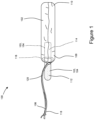
- Figure 1 shows an example of a tampon 100 that may be assembled in accordance with the methods and apparatuses disclosed herein.
- the tampon 100 may include a primary absorbent member 102, a flexible member 103, and a withdrawal cord 106.
- the primary absorbent member 102 of the tampon 100 includes a withdrawal end 108 and an insertion end 110.
- the primary absorbent member 102 can be compressed into a generally cylindrical configuration in the radial direction, the axial direction, or in both the radial and axial directions.
- While the primary absorbent member 102 may be compressed into a substantially cylindrical configuration as shown for example in Figure 1 , other shapes are also possible. Such shapes may include shapes having a cross section that may be described as oval, rectangular, triangular, trapezoidal, semi-circular, hourglass, serpentine, or other suitable shapes.
- the primary absorbent member 102 may be formed from one or more primary absorbent pads in various shapes and sizes and may be formed with various materials and structures.
- the primary absorbent member 102 may also be formed as a unitary member structure or a laminate structure which includes discrete layers.
- the primary absorbent member may include various additional structures and materials such as described for example in U.S. Patent No. 6,258,075 and U.S. Patent Publication No. 2004/0019317A1 .
- the discrete layers may include different materials (or same materials if desired).
- one layer may include primarily rayon, while another layer (or layers) may include primarily cotton.
- an outer layer may be a batt formed by a rayon material which is available from Acordis Fibers Ltd. as Galaxy rayon, while an intermediate layer may be a batt formed by a cotton material which is available from Acordis Fibers Ltd.
- the primary absorbent member 102 may be constructed from a wide variety of liquid-absorbing materials used in absorbent articles, such as rayon, cotton, and comminuted wood pulp, which may be generally referred to as airfelt.
- additional absorbent materials include creped cellulose wadding; meltblown polymers including coform; chemically stiffened, modified or cross-linked cellulosic fibers; synthetic fibers such as crimped polyester fibers; peat moss; foam; tissue including tissue wraps and tissue laminates; or any equivalent material or combinations of materials, or mixtures thereof.
- Absorbent materials may also comprise cotton, rayon (including tri-lobal and conventional rayon fibers, and needle punched rayon), folded tissues, and woven or nonwoven materials of synthetic and/or natural fibers.
- the primary absorbent member 102 may include a single material or combinations of such materials.
- primary absorbent member 102 may include a uniform material of a unitary material of rayon or cotton, or a blended material of rayon and cotton.
- superabsorbent materials such as superabsorbent polymers or absorbent gelling materials may be incorporated into the primary absorbent member 102.
- the absorbent material of the primary absorbent member 102 may be surrounded with a liquid permeable overlap material.
- Such overlap materials may comprise rayon, cotton, bicomponent fibers, or other natural or synthetic fibers known in the art.
- the primary absorbent member 102 may be formed of a soft absorbent material such as rayon, cotton (including either long fiber cotton or cotton linters) or other suitable natural or synthetic fibers or sheeting.
- the materials for primary absorbent member 102 may be either a fabric, web, or batt that is formed by any suitable process known in the art such as airlaying, carding, wetlaying, hydroentangling, and other known techniques. Rayon material may be any suitable material used in disposable absorbent articles known in the art.
- Cotton material may also be used in the primary absorbent member 102. Such cotton material may include, long fiber cotton, short fiber cotton, cotton linters, T-fiber cotton, card strips, and comber cotton. Cotton materials may also be a scoured and bleached cotton absorbent with a glycerin finish, a leomin finish, or other suitable finish.
- the primary absorbent member 102 may include various sizes and thicknesses suitable for compression into a tampon having a size which facilitates insertion.
- the primary absorbent member 102 may be about 9 cm in longitudinal length and about 4.5 cm in lateral width.
- the lengths and widths of the primary absorbent member 102 may be configured in various ranges to facilitate width-wise expansion of the tampon in use.
- the primary absorbent member 102 may be configured with various oval basis weights.
- the overall basis weight of the primary absorbent member 102 may be from about 150 g/m2 to about 750 g/m2.
- a first portion 112 of the flexible member 103 may extend outward from the withdrawal end 108 of the primary absorbent member 102.
- the flexible member 103 may be formed in various shapes and sizes and may be formed with various materials and structures.
- the flexible member 103 may be constructed to be hydrophobic, hydrophilic, absorbent, fibrous, and may comprise capillaries and/or open cell foam structures.
- the flexible member 103 may be arranged in a wide variety of shapes and configurations and may be generally cylindrical, spherical, semi-spherical, disc-like, planar, rectangular, "skirt-like” in shape, or may comprise "tufts" or whips of absorbent elements.
- the size of the flexible member 103 may vary according to its shape.
- the flexible member 103 may be generally cylindrical and elongated.
- the flexible member 103 may also be configured with a longitudinal length that is the same as, less than, or greater than the longitudinal length of the primary absorbent member 102.
- the primary absorbent member may comprise a first fibrous material composition and the flexible member may comprise a second fibrous material composition, wherein the first fibrous material composition is different from the second fibrous material composition.
- the first fibrous material composition may be selected from the group consisting of: cotton, rayon, and combinations thereof, and the second fibrous material composition may comprise spun synthetic fibers comprising polypropylene.
- the flexible member may comprise either carded fibers or tow fibers.
- the material used to form the flexible member 103 may be tinted or pigmented in a color that visibly contrasts with the one or more colors of the materials forming the primary absorbent member 102 and/or the withdrawal cord 106.
- a color contrast may provide a visual suggestion to a user that a differing material is present in the flexible member 103, which in turn, may suggest a functionality distinct from that of the withdrawal cord 106.
- tinting or pigmenting may provide a reminder to the user that the flexible member 103 is present and/or may provide supplemental protection against leakage.
- the flexible member 103 may be configured as a secondary absorbent member 104 that may be constructed from any of the materials described above for suitable as use in the primary absorbent member 102, such as rayon and cotton for example. In some configurations, the same materials are used in the construction of the secondary absorbent member 104 as are used in the primary absorbent member 102.
- the secondary absorbent member 104 may also include a suitable nonwoven structure, such as described above. In some configurations, the secondary absorbent member 104 is hydrophilic. In some embodiments, the secondary absorbent material 104 may have an advancing contact angle greater than the advancing contact angle of the primary absorbent member 102 and/or the withdrawal cord 106 (or other withdrawal mechanism), such that fluid is preferentially directed toward and absorbed by the primary absorbent member 102.
- the secondary absorbent member 104 may be treated to make it less absorbent than the primary absorbent member 102.
- the secondary absorbent member 104 may include various materials such, as described for example in U.S. Patent No. 6,258,075 and U.S. Patent Publication No. 2004/0019317A1 .
- the secondary absorbent member 104 may optionally be provided with a mechanism to preferentially direct acquired fluid toward the primary absorbent member 102.
- a mechanism to preferentially direct acquired fluid toward the primary absorbent member 102 examples include the use of a hydrophilicity gradient.
- Other mechanisms may include a density or capilarity gradient, or an osmotic driving force.
- the secondary absorbent member 104 may be provided with loose fiber ends to add a textured surface to the material. Capillary channel fibers may optionally be incorporated into the secondary absorbent material 104 in order to provide the driving force for acquired fluid.
- some or all of the surrounding edges of the secondary absorbent member 104 may be fused and/or pressure bonded together.
- fibrous materials from which the secondary absorbent member 104 may be constructed may be fused and/or bonded together, wherein such fusing and/or bonding may help reduce the appearance of loose fibrous ends and/or fraying of the secondary absorbent member 104.
- End edges of the secondary absorbent member 104 may be straight or curved so as to define a concave or convex shape. Examples of such edge configurations of the secondary absorbent member 104 are disclosed in U.S. Patent Application No. 62/780,388 .
- the withdrawal cord 106 may be connected with the primary absorbent member 102 in various ways. As discussed in more detail below, in some configurations, the withdrawal cord 106 may be connected with and/or inserted through both the primary absorbent member 102 and the secondary absorbent member 104. The withdrawal cord 106 may be connected in various locations with the primary absorbent member 102 and/or the secondary absorbent member 104. The withdrawal cord 106 may also be positioned relative to the primary absorbent member 102 and the secondary absorbent member 104 so as to define a length having a proximal portion 116, a distal portion 118, and a central portion 120 between the proximal portion 116 and the distal portion 118.
- the proximal portion 116 and the central portion 120 may be connected with the primary absorbent member 102 and/or the secondary absorbent member 104.
- the distal portion 118 of the withdrawal cord 106 may not be connected with the primary absorbent member 102 and the secondary absorbent member 104 and may be used to withdraw the tampon 100 after use.
- the withdrawal cord 106 may be configured in various ways and from different types of materials with various properties, such as polyester.
- the withdrawal cord 106 may be formed from one or more continuous strings that are twisted or braided.
- the withdrawal cord may be configured as a ribbon, loop, tab, or the like.
- the withdrawal cord 106 may not have uniform properties throughout its length.
- the proximal portion 116 and central portion 120 of the withdrawal cord 106 may be absorbent while the distal portion 118 may be non-absorbent.
- Other properties such as wicking ability, hydrophilicity, density, capillary size, width, thickness, and the like can also vary along the length of the withdrawal cord 106.
- the density of material which comprises the withdrawal cord 106 may be lower than the density of the primary absorbent member 102.
- the secondary absorbent member 104 may be more hydrophilic than the withdrawal cord 106.
- the withdrawal cord 106 may be made substantially hydrophobic. If the entire withdrawal cord 106 is not less hydrophilic than the secondary absorbent member 104, then at least potions of the withdrawal cord 106 (such as along the location of attachment with the secondary absorbent member 104) may be less hydrophilic than the secondary absorbent member 104.
- the withdrawal cord 106 may be configured to be absorbent at locations along the central portion 120 and proximal portion 116, whereas the withdrawal cord 106 may be configured to be non-absorbent along the distal portion 118.
- non-absorbent refers to a structure that does not retain a significant portion of deposited fluid in its structure.
- the entire length of the withdrawal cord 106 may configured to non-absorbent.
- the materials comprising the withdrawal cord 106 may be inherently non-wettable or hydrophobic or may be treated to provide such properties. For example, a coating of wax may be applied to the withdrawal cord 106 to decrease or eliminate absorbency.
- the withdrawal cord 106 does not necessarily need to be non-wicking, even if a non-absorbent withdrawal cord is desired.
- the withdrawal cord 106 may be provided with a wicking mechanism to preferentially direct or wick acquired fluid toward the primary absorbent member 102.
- a driving force is produced by a hydrophilicity gradient.
- Other examples of the wicking mechanisms include a density gradient, a capillary gradient, and an osmotic driving force.
- Capillary channel fibers can optionally be incorporated into the withdrawal cord 106 in order to provide the driving force for acquired fluid described herein.
- An example wicking mechanism which preferentially directs acquired fluid toward the body of the primary absorbent member 102 is disclosed in the PCT Patent Publication No. WO 00/61052 .
- Figures 2-15 show views of tampon components in various stages of assembly and illustrate various method steps that may be used to assemble tampons 100 with a secondary absorbent member 104 and a primary absorbent member 102.
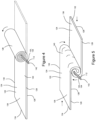
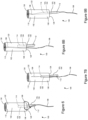
- Figures 2-9A illustrate various methods of assembling tampons 100 not according to the claimed invention with a secondary absorbent member 104, wherein the primary absorbent member 102 may be constructed from at least one primary absorbent pad 122 in a "rolled" configuration.
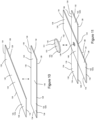
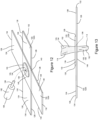
- Figures 10-15 illustrate various methods of assembling tampons 100 with a secondary absorbent member 104, wherein the primary absorbent member 102 may be constructed from primary absorbent pads 122 in a "crossing" configuration.
- a primary absorbent pad 122 is provided, wherein the primary absorbent pad 122 includes a first surface 124 and an opposing second surface 126.
- the primary absorbent pad 122 includes a first side edge 128 and a second side edge 130 separated from the first side edge 128 to define a width, W1.
- the primary absorbent pad 122 also includes a first end edge 132 and a second end edge 134 separated from the first end edge 132 to define a length, L1.
- the primary absorbent pad 122 also includes a first end region 136 and a second end region 138 separated from the first end region 136 by a central region 140.
- a flexible member 103 that may be in the form of a secondary absorbent member 104 may be provided.
- the periphery of the secondary absorbent member 104 may be defined by a first end edge 142 and an opposing second end edge 144 separated by and connected with a first longitudinal side edge 146 and a second longitudinal side edge 148.
- the secondary absorbent member 104 may also comprise a first surface 150 and an opposing second surface 152 extending between the first end edge 142 and the second end edge 144 and extending between the first longitudinal side edge 146 and the second longitudinal side edge 148.
- the secondary absorbent member 104 may be provided in various shapes and sizes relative to the primary absorbent pad 122.
- the secondary absorbent member 104 may define a length L2 extending between the first end edge 142 and the second end edge 144 and may define a width W2 extending between the first longitudinal side edge 146 and the second longitudinal side edge 148, wherein the length L2 may be greater than the width W2.
- the length L1 of the primary absorbent pad 122 may be greater than the length L2 and the width W2 of the secondary absorbent member 104.
- the length L2 of the secondary absorbent member 104 may be greater than, less than, or equal to the width W1 of the primary absorbent pad 122.
- the secondary absorbent member 104 is positioned on the central region 140 of the primary absorbent pad 122.
- the second surface 152 of the secondary absorbent member 104 may be positioned in direct contact with and in a facing relationship with the first surface 124 of the primary absorbent pad 122.
- the secondary absorbent member 104 may be positioned such that the entire width W2 of the secondary absorbent member 104 extends along a portion of the length L1 of the primary absorbent pad 122, and the length L2 of the secondary absorbent member 104 extends partially along the width W1 of the primary absorbent pad 122.
- the secondary absorbent member 104 is positioned on the primary absorbent pad 122 such that a first portion 112 of the secondary absorbent member 104 extends outward from the first side edge 128 of the primary absorbent pad 122, and a second portion 114 of the secondary absorbent member 104 extends from the first side edge 128 toward the second side edge 130 of the primary absorbent pad 122.
- the primary absorbent pad 122 may be rolled into a generally cylindrically shaped primary absorbent member 102 having an insertion end 110 and a withdrawal end 108.
- the first side edge 128 of the rolled primary absorbent pad 122 may define the withdrawal end 108 of the primary absorbent member 102
- the second side edge 130 of the rolled primary absorbent pad 122 may define the insertion end 110 of the primary absorbent member 102.
- the primary absorbent member 102 envelops the second portion 114 of the secondary absorbent member 104.
- the first portion 112 of the secondary absorbent member 104 extends outward from the withdrawal end 108 of the primary absorbent member 102, and the second portion 114 of the secondary absorbent member 104 is enveloped by the rolled primary absorbent pad 122.
- the second end edge 144 of the secondary absorbent member 104 may also be enveloped by the primary absorbent member 102.
- the second end edge 144 of the secondary absorbent member 104 may extend to the insertion end 110 of the primary absorbent member 102 and may not be enveloped thereby.
- the primary absorbent pad 122 is formed into the primary absorbent member 102 of the tampon 100, and thus, may be constructed from the same materials and/or may include the same fluid handling properties as the primary absorbent member 102 described above. It is also to be appreciated that the primary absorbent pads 122 discussed herein may be formed as a single layer substrate or may be formed as a laminate of two or more substrate layers.
- the primary absorbent pad 122 may be rolled in various ways to form the primary absorbent member 102. It is also to be appreciated that the secondary absorbent member 104 may be placed in various positions relative to the length L1 of the primary absorbent member 102 prior to rolling the primary absorbent pad 122. For example not according to the claimed invention, as shown in Figures 3 and 4 , the secondary absorbent member 104 may be positioned adjacent the first end edge 132 of the primary absorbent pad 122 prior to rolling. The primary absorbent pad 122 may then be rolled onto itself beginning at the first end edge 132 and ending with the second end edge 134. Thus, the first edge 132 may be located in a radially inward position of the primary absorbent member 102, and the second edge 134 may be located in a radially outward position of the primary absorbent member 102.
- the secondary absorbent member 104 may be positioned in the central region 140 of the primary absorbent pad 122 prior to rolling.
- the primary absorbent pad 122 may also be rolled onto itself beginning in the central region 140.
- the first end edge 132 and the second end edge 134 may be located in a radially outward position of the primary absorbent member 102 relative to the central region 140 of the rolled primary absorbent pad 122 and/or radially outward relative to the secondary absorbent member 104.
- the tampons 100 herein may include a withdrawal cord 106 connected with the primary absorbent member 102.
- the withdrawal cord 106 may be inserted through the primary absorbent pad 122 in the rolled configuration not according to the claimed invention.
- the withdrawal cord 106 may also be inserted through the second portion 114 of the secondary absorbent member 104 that is enveloped by the primary absorbent member 102 not according to the claimed invention.
- the withdrawal cord 106 may be used to connect the primary absorbent pad 122 and the secondary absorbent member 104 together.
- the withdrawal cord 106 may also be tied to itself in various ways and in various locations.
- the withdrawal cord 106 may also be connected with the primary absorbent pad 122 before or during the primary absorbent pad rolling process in various ways along with the secondary absorbent member 104.
- the withdrawal cord 106, the secondary absorbent member 104, and the primary absorbent pad 122 may be sewn together with one or more threads 154.
- the withdrawal cord 106 and the secondary absorbent member 104 may be sewn to the primary absorbent pad 122 in the same location or in separate locations on the primary absorbent pad 122 prior to rolling the primary absorbent pad 122.
- the withdrawal cord 106 may extend along the first surface 150 of the second portion 114 of the secondary absorbent member 104 and the first surface 124 of the primary absorbent pad 122. In some configurations, the withdrawal cord 106 may be positioned between the second surface 152 of the secondary absorbent member 104 and the first surface 124 of the primary absorbent pad 122 prior being sewn together with the primary absorbent pad 122.
- Various manners of stitching may be used, such as disclosed for example disclosed in U.S. Patent No. 6,887,226 .
- the withdrawal cord 106 may be stitched with the thread 154 according to the stitching manner called "Double Ring Stitching" which is described in the Japanese Industrial Standards (JIS) No. B 9070.
- the withdrawal cord 106 may be connected with the primary absorbent member 102 by looping the withdrawal cord 106 around the primary absorbent pad 122.
- the withdrawal cord 106 may be looped around the first side edge 128 and the second side edge of the primary absorbent pad before rolling the primary absorbent pad 122 to form the primary absorbent member 102.
- the looped withdrawal cord 106 and the secondary absorbent member 104 may be positioned together or in separate locations along the length of the primary absorbent pad 122.
- the secondary absorbent member 104 may be made from material that is integrated with the withdrawal cord material during construction of the withdrawal cord 106 and secondary absorbent member 104 by advancing both materials through a tubular weaver.
- the withdrawal cord 106 may include intermittent lengths of interwoven secondary absorbent material, such as disclose for example in U.S. Patent No. 6,258,074 and U.S. Patent Publication No. U.S. 2004/0019317A1 .
- the withdrawal cord 106 and integrated secondary absorbent member 104 may be connected with the primary absorbent pad 122 prior to the rolling process.
- the withdrawal cord 106 and integrated secondary absorbent member 104 may be connected with the primary absorbent pad 122 by looping around the first side edge 128 and the second side edge 130 of the primary absorbent pad 122. In addition to or instead of looping, the withdrawal cord 106 and integrated secondary absorbent member 104 may be sewn to the primary absorbent pad 122.
- the primary absorbent pad 122 may also be rolled onto itself in such a way that the secondary absorbent member 102 is not also rolled onto itself, but rather is enveloped between neighboring layers of the rolled primary absorbent pad 122.
- the entirety of outer periphery of the first portion 112 of the secondary absorbent member 104 defined by first surface 150 and second surface 152 between the first side edge 146 and second side edge 148 may be in direct contact with and in facing relationship with the first surface 124 and/or second surface 126 of the primary absorbent pad 122.
- the secondary absorbent member 104 may be folded or wrapped around the withdrawal cord 106 while the primary absorbent pad 122 is rolled such that the secondary absorbent member 104 fully envelops a discrete length of the withdrawal cord 106.
- tampons 100 are constructed with a secondary absorbent member 104 and a primary absorbent member 102 constructed from primary absorbent pads 122 in a crossing configuration.
- a first primary absorbent pad 122a and a second primary absorbent pad 122b are provided.
- the first primary absorbent pad 122a and the second primary absorbent pad 122b may include the features described above with reference to the primary absorbent pad 122 in Figures 2 and 3 .
- the first primary absorbent pad 122a and the second primary absorbent pad 122b of Figure 10 may each include a first surface 124 and an opposing second surface 126.
- the first primary absorbent pad also includes a first end region 136 and a second end region 138 separated from the first end region 136 by a central region 140.
- the second primary absorbent pad 122b also includes a first end region 136 and a second end region 138 separated from the first end region 136 by a central region 140.
- the first primary absorbent pad 122a and/or the second primary absorbent pad 122b may be placed such that the second surface 126 of the first primary absorbent pad 122a is positioned in direct contact with and in facing relationship with the first surface 124 of the second primary absorbent pad 122b.
- the central region 140 of the first primary absorbent pad 122a overlays the central region 140 of the second primary absorbent pad 122b in a crossing configuration, wherein the first end regions 136 and the second end regions 138 of the first primary absorbent pad 122a and second primary absorbent pad 122b do not overlap each other.
- apertures 156 are formed in the central region 140 of the first primary absorbent pad 122a and the central region 140 of the second primary absorbent pad 122b.
- the apertures 156 may be formed while first and second primary absorbent pads 122a, 122b are in the overlapping configuration, and thus may be aligned to define a continuous aperture 156 extending through both the first primary absorbent pad 122a and the second primary absorbent pad 122b.
- a secondary absorbent member 104 is provided.
- the secondary absorbent member 104 may also include a first surface 150 and an opposing second surface 152. It is to be appreciated that the secondary absorbent member 104 may be provided in various shapes and sizes.
- the secondary absorbent member is placed on the central region 140 of the first primary absorbent pad 122a.
- the second surface 152 of the secondary absorbent member 104 may be positioned in direct contact with and in a facing relationship with the first surface 124 of the first primary absorbent pad 122a such that the aperture 156 is covered by the secondary absorbent member 104.
- a first portion 112 of the secondary absorbent member 104 is inserted through the aperture 156 extending through the central regions 140 of the first primary absorbent pad 122a and the second primary absorbent pad 122b.
- the first portion 112 of the secondary absorbent member 104 extends outward from second surface 126 of the second primary absorbent pad 122b
- a second portion 114 of the secondary absorbent member 104 extends outward from the first surface 124 of the first primary absorbent pad 122a.
- the secondary absorbent member 104 may be configured in various shapes and sizes.
- the secondary absorbent member 104 may be circular shaped, and as such, may define an outer circumferential region 151 surrounding an inner radial region 153.
- the central region may comprise the first portion 112 of the secondary absorbent member 104.
- the inner radial region 153 may comprise the first portion 112 of the secondary absorbent member 104, and the outer circumferential region 151 may comprise the second portion 114.
- the secondary absorbent member 104 may be rectangular or square shaped, and as such, may comprise a first end region and a second end region separated from the first end region by a central region.
- first portion 112 of the secondary absorbent member 104 may be inserted through the central regions 140 of the first and second primary absorbent pads 122a, 122b in various ways.
- an insertion tool 158 such as shown in Figure 12 may be used to force the first portion 112 of the secondary absorbent member 104 through the first and second primary absorbent members 122a, 122b.
- the tool 158 may include an insertion end region 160 connected with an extending from a base end region 162.
- the insertion end region 160 may define a perimeter that is smaller than a perimeter of the base end region 162.
- the insertion end region 160 may be sized such that the insertion end region 160 and the first portion 112 of the secondary absorbent member 104 can be forced through the apertures 156 in the first and second primary absorbent members 122, 122b, whereas the base end region 158 may be too large to pass through the aperture 158.
- some assembly operations not according to the claimed invention may not include a step of creating an aperture 156 extending through the first and second primary absorbent pads 122a, 122b prior to inserting the secondary absorbent member 104 therethrough.
- the first portion 112 of the secondary absorbent member 104 may be forced through the first and second primary absorbent pads 122a, 122b while simultaneously piercing the central regions 140 of the first and second primary absorbent pads 122a, 122b, such as with a punch press type operation.
- the first primary absorbent pad 122a and the second primary absorbent pad 122b are formed and compressed into a generally cylindrically shaped primary absorbent member 102, such as shown in Figures 14 and 15 .
- the first and second primary absorbent pads 122a, 122b may be formed to completely envelope the second portion 114 of the secondary absorbent member 104.
- the primary absorbent member 102 envelops the second portion 114 of the secondary absorbent member 104.
- first and second primary absorbent pads 122a, 112b may be combined to form the primary absorbent member 102, and thus, may be constructed from the same materials and/or may include the same fluid handling properties as the primary absorbent member 102 described above. It is also to be appreciated that the first and second primary absorbent pads 122a, 122b discussed herein may be formed as a single layer substrate or may be formed as a laminate of two or more substrate layers.
- a withdrawal cord 106 is connected with the primary absorbent member.
- the withdrawal cord 106 may be inserted through the primary absorbent member 102 and tied to itself. As such, the withdrawal cord 106 may extend through the first primary absorbent pad 122a and the second primary absorbent pad 122b.
- the withdrawal cord 106 may also be inserted through the second portion 114 of the secondary absorbent member 104 that is enveloped by the primary absorbent member 102. As such, the withdrawal cord 106 may be used to connect the first primary absorbent pad 122a, the second absorbent pad 122b, and the secondary absorbent member 104 together.
- the assembly processes herein may be configured in various ways to assemble tampons 100 with various component configurations.
- the primary absorbent member 102 may be surrounded with a liquid permeable overwrap material.
- overwrap materials may comprise rayon, cotton, bicomponent fibers, or other suitable natural or synthetic fibers known in the art.
- the assembly process may be configured to apply the overwrap material to the primary absorbent member 102 before being combined with the secondary absorbent member 104.
- the assembly process may be configured to apply the overwrap material to the primary absorbent member 102 and possibly the secondary absorbent member 104 after the primary absorbent member 102 and the secondary absorbent member 104 are combined.
Landscapes
- Health & Medical Sciences (AREA)
- Engineering & Computer Science (AREA)
- Vascular Medicine (AREA)
- Epidemiology (AREA)
- Biomedical Technology (AREA)
- Heart & Thoracic Surgery (AREA)
- Life Sciences & Earth Sciences (AREA)
- Animal Behavior & Ethology (AREA)
- General Health & Medical Sciences (AREA)
- Public Health (AREA)
- Veterinary Medicine (AREA)
- Manufacturing & Machinery (AREA)
- Absorbent Articles And Supports Therefor (AREA)
Claims (5)
- Verfahren zum Herstellen eines Tampons (100), das Verfahren umfassend die Schritte:Bereitstellen einer ersten primären absorbierenden Einlage (122a), umfassend einen ersten Endbereich (136) und einen zweiten Endbereich (138), der von dem ersten Endbereich (136) über einen Zentralbereich (140) getrennt ist;Bereitstellen einer zweiten primären absorbierenden Einlage (122b), umfassend einen ersten Endbereich und einen zweiten Endbereich, der von dem ersten Endbereich über einen Zentralbereich getrennt ist;Überlagern des Zentralbereichs (140) der ersten primären absorbierenden Einlage (122a) an dem Zentralbereich der zweiten primären absorbierenden Einlage (122b) in einer Kreuzungskonfiguration, wobei der erste (136) und der zweite End(138)bereich der ersten (122a) und der zweiten (122b) primären absorbierenden Einlage einander nicht überlappen;Ausbilden von Öffnungen in den Zentralbereichen der ersten primären absorbierenden Einlage (122a) und der zweiten primären absorbierenden Einlage (122b);Anordnen eines elastischen Elements (103) an dem Zentralbereich (140) der ersten primären absorbierenden Einlage (122a);wobei das elastische Element (103) ein sekundäres absorbierendes Element (104) umfasst;Zwingen eines ersten Abschnitts (112) des elastischen Elements (103) durch den Zentralbereich (140) der ersten primären absorbierenden Einlage (122a) und den Zentralbereich der zweiten primären absorbierenden Einlage (122b), wobei der erste Abschnitt (112) des elastischen Elements (103) durch die Öffnungen eingesetzt wird und sich der erste Abschnitt (112) des elastischen Elements (103) von der zweiten primären absorbierenden Einlage (122b) nach außen erstreckt und sich ein zweiter Abschnitt des sekundären absorbierenden Elements von der ersten primären absorbierenden Einlage (122a) nach außen erstreckt;Komprimieren der ersten primären absorbierenden Einlage (122a) und der zweiten primären absorbierenden Einlage (122b) in ein im Allgemeinen zylindrisch geformtes primäres absorbierendes Element (102), das den zweiten Abschnitt des elastischen Elements (103) umhüllt; undVerbinden einer Entnahmeschnur (106) mit der primären absorbierenden Einlage (102).
- Verfahren nach Anspruch 1, wobei der Schritt des Verbindens der Entnahmeschnur (106) ferner ein Einsetzen der Entnahmeschnur (106) durch die erste primäre absorbierende Einlage (122a), die zweite primäre absorbierende Einlage (122b) und das elastische Element (103) umfasst.
- Verfahren nach Anspruch 1, wobei der Schritt des Ausbildens von Öffnungen ferner ein Stanzpressen des ersten Abschnitts des sekundären absorbierenden Elements (104) durch die erste (122a) und die zweite (122b) primäre absorbierende Einlage umfasst.
- Verfahren nach einem der Ansprüche 1 bis 3, wobei das elastische Element (103) einen ersten Endbereich und einen zweiten Endbereich, der von dem ersten Endbereich über einen Zentralbereich getrennt ist, umfasst und wobei der Zentralbereich den ersten Abschnitt (112) des elastischen Elements (103) umfasst.
- Verfahren nach einem der Ansprüche 1 bis 4, wobei das elastische Element (103) einen äußeren Umfangsbereich, der einen inneren radialen Bereich umgibt, umfasst, wobei der innere radiale Bereich den ersten Abschnitt (112) des elastischen Elements (103) umfasst und wobei der äußere Umfangsbereich den zweiten Abschnitt umfasst.
Priority Applications (1)
| Application Number | Priority Date | Filing Date | Title |
|---|---|---|---|
| EP23208447.5A EP4316439A3 (de) | 2018-12-17 | 2019-12-17 | Tampons und verfahren zur herstellung von tampons |
Applications Claiming Priority (3)
| Application Number | Priority Date | Filing Date | Title |
|---|---|---|---|
| US201862780388P | 2018-12-17 | 2018-12-17 | |
| US201962834427P | 2019-04-16 | 2019-04-16 | |
| PCT/US2019/066695 WO2020131773A1 (en) | 2018-12-17 | 2019-12-17 | Tampons and methods for making tampons |
Related Child Applications (2)
| Application Number | Title | Priority Date | Filing Date |
|---|---|---|---|
| EP23208447.5A Division EP4316439A3 (de) | 2018-12-17 | 2019-12-17 | Tampons und verfahren zur herstellung von tampons |
| EP23208447.5A Division-Into EP4316439A3 (de) | 2018-12-17 | 2019-12-17 | Tampons und verfahren zur herstellung von tampons |
Publications (2)
| Publication Number | Publication Date |
|---|---|
| EP3897494A1 EP3897494A1 (de) | 2021-10-27 |
| EP3897494B1 true EP3897494B1 (de) | 2024-04-03 |
Family
ID=69173432
Family Applications (2)
| Application Number | Title | Priority Date | Filing Date |
|---|---|---|---|
| EP19839030.4A Active EP3897494B1 (de) | 2018-12-17 | 2019-12-17 | Tampons und verfahren zur herstellung von tampons |
| EP23208447.5A Pending EP4316439A3 (de) | 2018-12-17 | 2019-12-17 | Tampons und verfahren zur herstellung von tampons |
Family Applications After (1)
| Application Number | Title | Priority Date | Filing Date |
|---|---|---|---|
| EP23208447.5A Pending EP4316439A3 (de) | 2018-12-17 | 2019-12-17 | Tampons und verfahren zur herstellung von tampons |
Country Status (3)
| Country | Link |
|---|---|
| US (2) | US12186169B2 (de) |
| EP (2) | EP3897494B1 (de) |
| WO (1) | WO2020131773A1 (de) |
Families Citing this family (9)
| Publication number | Priority date | Publication date | Assignee | Title |
|---|---|---|---|---|
| EP3897494B1 (de) | 2018-12-17 | 2024-04-03 | The Procter & Gamble Company | Tampons und verfahren zur herstellung von tampons |
| WO2020131348A1 (en) | 2018-12-17 | 2020-06-25 | The Procter & Gamble Company | Method and apparatus for making tampons |
| CN115869130A (zh) | 2018-12-17 | 2023-03-31 | 宝洁公司 | 具有芯吸构件和改善的可制造性的棉塞 |
| US12414880B2 (en) * | 2021-03-04 | 2025-09-16 | The Procter & Gamble Company | Tampon with wicking member adapted for improved manufacturability and wicking performance |
| US12232936B2 (en) | 2021-09-20 | 2025-02-25 | The Procter & Gamble Company | Tampon with applicator substantially free of components derived from petroleum |
| US20250352406A1 (en) | 2024-05-15 | 2025-11-20 | The Procter & Gamble Company | Tampon including secondary absorbent |
| US20250352405A1 (en) | 2024-05-15 | 2025-11-20 | The Procter & Gamble Company | Tampon including secondary absorbent |
| US20250352404A1 (en) | 2024-05-15 | 2025-11-20 | The Procter & Gamble Company | Tampon including secondary absorbent |
| US20250352403A1 (en) | 2024-05-15 | 2025-11-20 | The Procter & Gamble Company | Tampon including secondary absorbent |
Family Cites Families (59)
| Publication number | Priority date | Publication date | Assignee | Title |
|---|---|---|---|---|
| US1932383A (en) * | 1931-01-28 | 1933-10-24 | Frederick S Richardson | Catamenial plug |
| US2123750A (en) * | 1934-05-19 | 1938-07-12 | United Drug Company | Catamenial tampon |
| US2391343A (en) | 1942-01-29 | 1945-12-18 | Popper Otto | Vaginal obturator |
| US2412391A (en) * | 1943-10-19 | 1946-12-10 | Harry Radzinsky | Tampon |
| US2412861A (en) | 1944-07-31 | 1946-12-17 | Beadle George William | Catamenial device |
| US2499414A (en) | 1947-04-15 | 1950-03-07 | Miriam E Rabell | Tampon |
| US3397695A (en) | 1965-06-28 | 1968-08-20 | Joseph A. Voss | Catamenial tampon and method of making |
| US3811445A (en) * | 1970-01-22 | 1974-05-21 | Int Playtex Corp | Absorbent material and methods of making the same |
| US3732866A (en) * | 1971-02-18 | 1973-05-15 | L Accavallo | Catamenial device |
| US3731687A (en) | 1971-07-16 | 1973-05-08 | J Glassman | Catamenial tampon |
| USRE27677E (en) | 1971-12-22 | 1973-06-19 | Catamenial tampon | |
| US4200101A (en) | 1977-04-11 | 1980-04-29 | Glassman Jacob A | Catamenial tampon |
| US4335720A (en) | 1980-04-09 | 1982-06-22 | Glassman Jacob A | Catamenial tampon with hollow core |
| US4318407A (en) | 1980-08-28 | 1982-03-09 | Kimberly-Clark Corporation | Folded tampon pledget |
| DE3302193A1 (de) | 1983-01-24 | 1984-07-26 | Henkel KGaA, 4000 Düsseldorf | Verfahren zum herstellen eines wattetampons |
| US4714466A (en) | 1985-01-25 | 1987-12-22 | Kao Corporation | Absorbent member for tampon |
| CA2127144A1 (en) * | 1994-04-15 | 1995-10-16 | Tammy Jo Rentmeester | Tampon having a protective finger sheath and a method of forming |
| US5964689A (en) | 1996-08-30 | 1999-10-12 | The Procter & Gamble Company | Method of making an absorbent interlabial device with a central groove |
| US6258075B1 (en) | 1999-04-08 | 2001-07-10 | The Procter & Gamble Company | Tampon with enhanced leakage protection |
| US6186995B1 (en) * | 1999-08-30 | 2001-02-13 | John M. Tharpe, Jr. | Vaginal tampon and method for fabrication thereof |
| US6258074B1 (en) | 1999-09-24 | 2001-07-10 | Lisa K. Prazak | Interlabial absorbent device |
| JP3933839B2 (ja) | 2000-03-07 | 2007-06-20 | ユニ・チャーム株式会社 | 吸収性物品 |
| US7799966B2 (en) | 2000-04-14 | 2010-09-21 | Playtex Products, Inc. | Fibrous absorbent articles having malodor counteractant ability and method of making same |
| JP2004528870A (ja) * | 2001-01-25 | 2004-09-24 | ザ プロクター アンド ギャンブル カンパニー | 引き抜きコードとして複合糸を使用する月経用タンポン |
| WO2002058614A1 (en) | 2001-01-25 | 2002-08-01 | The Procter & Gamble Company | Catamenial tampon employing composite yarn as withdrawal code |
| US6601706B2 (en) | 2001-04-19 | 2003-08-05 | Kimberly-Clark Worldwide, Inc. | Package for absorbent articles |
| US20030055393A1 (en) | 2001-09-10 | 2003-03-20 | The Procter & Gamble Company | Consumer product lines and products comprising commonly packaged tampons which have varying absorbent capacities |
| US20040019317A1 (en) | 2001-09-14 | 2004-01-29 | The Procter & Gamble Company | Catamenial tampon employing composite yarn as withdrawal code |
| US6840927B2 (en) | 2001-11-16 | 2005-01-11 | The Proctor & Gamble Company | Tampon with fluid wicking overwrap with skirt portion |
| AU2002343727A1 (en) | 2001-11-16 | 2003-06-10 | The Procter And Gamble Company | Tampon with non-aggressive, fluid wicking overwrap |
| US6887226B2 (en) | 2002-05-31 | 2005-05-03 | The Procter & Gamble Company | Sewn digital tampon |
| US6662644B1 (en) | 2002-06-28 | 2003-12-16 | Edm Systems Usa | Formation fluid sampling and hydraulic testing tool |
| US20050055003A1 (en) | 2003-09-05 | 2005-03-10 | The Procter & Gamble Company | Absorbent tampon comprising a secondary absorbent member attached to the outer surface |
| US20050096619A1 (en) | 2003-10-31 | 2005-05-05 | Rogerio Costa | Hygienic tampon and an absorbent body used in the formation of a tampon |
| SE0303559D0 (sv) | 2003-12-30 | 2003-12-30 | Sca Hygiene Prod Ab | A tampon |
| US8864640B2 (en) * | 2004-05-14 | 2014-10-21 | Mcneil-Ppc, Inc. | Methods of packaging intravaginal device |
| US8480833B2 (en) | 2004-05-14 | 2013-07-09 | Mcneil-Ppc, Inc. | Intravaginal device with fluid transport plates and methods of making |
| US7618403B2 (en) | 2004-05-14 | 2009-11-17 | Mcneil-Ppc, Inc. | Fluid management device with fluid transport element for use within a body |
| US20060025742A1 (en) | 2004-07-30 | 2006-02-02 | The Procter & Gamble Company | Absorbent article with color surfaces |
| US20070016156A1 (en) | 2005-07-15 | 2007-01-18 | The Procter & Gamble Company | Absorbent tampon comprising a visually distinct withdrawal member |
| US8827974B2 (en) * | 2005-12-30 | 2014-09-09 | Kimberly-Clark Worldwide, Inc. | Absorbent tampon for feminine hygiene |
| EP2079422A4 (de) | 2006-11-08 | 2011-09-07 | Playtex Products Inc | Wattestopfen für verbesserten bypass-leckageschutz |
| US8597267B2 (en) | 2007-04-18 | 2013-12-03 | The Procter & Gamble Company | Tampon having at least one physical discontinuity |
| US20080275411A1 (en) | 2007-05-03 | 2008-11-06 | Jeanne Marie Hughes | Tampon having a visual indicator |
| JP5255235B2 (ja) | 2007-06-11 | 2013-08-07 | ユニ・チャーム株式会社 | タンポン |
| HUE027166T2 (en) | 2008-11-26 | 2016-08-29 | Mcneil Ppc Inc | Tamponcsomagolás |
| JP5566617B2 (ja) | 2009-02-27 | 2014-08-06 | ユニ・チャーム株式会社 | 生理用タンポン |
| US9107775B2 (en) | 2009-04-15 | 2015-08-18 | Eveready Battery Company, Inc. | Tampon pledget with improved by-pass leakage protection |
| US8034991B2 (en) | 2009-04-29 | 2011-10-11 | Johnson & Johnson Ind. E Com. Ltda | Absorbent article including a plurality of longitudinally extending channels |
| KR100940223B1 (ko) * | 2009-07-06 | 2010-02-04 | (주)태봉 | 의료용 및 생리용 흡수체. |
| US9452093B2 (en) | 2011-04-26 | 2016-09-27 | The Procter & Gamble Company | Absorbent members having density profile |
| US8916015B2 (en) * | 2011-12-21 | 2014-12-23 | Kimberly-Clark Worldwide, Inc. | Tampon method of manufacture |
| US20150157511A1 (en) | 2013-12-10 | 2015-06-11 | The Procter & Gamble Company | Feminine hygiene device with withdrawal member |
| US20150374558A1 (en) | 2014-06-26 | 2015-12-31 | The Procter & Gamble Company | Method of cutting a thread between two substrates |
| AT517380A1 (de) * | 2015-06-25 | 2017-01-15 | Ruggli Projects Ag | Verfahren zur Herstellung eines Tampons |
| US11497656B2 (en) * | 2016-11-07 | 2022-11-15 | The Procter & Gamble Company | Tampon and method for making the same |
| WO2020131348A1 (en) | 2018-12-17 | 2020-06-25 | The Procter & Gamble Company | Method and apparatus for making tampons |
| EP3897494B1 (de) | 2018-12-17 | 2024-04-03 | The Procter & Gamble Company | Tampons und verfahren zur herstellung von tampons |
| CN115869130A (zh) | 2018-12-17 | 2023-03-31 | 宝洁公司 | 具有芯吸构件和改善的可制造性的棉塞 |
-
2019
- 2019-12-17 EP EP19839030.4A patent/EP3897494B1/de active Active
- 2019-12-17 US US16/716,556 patent/US12186169B2/en active Active
- 2019-12-17 WO PCT/US2019/066695 patent/WO2020131773A1/en not_active Ceased
- 2019-12-17 EP EP23208447.5A patent/EP4316439A3/de active Pending
-
2024
- 2024-03-08 US US18/599,355 patent/US12274603B2/en active Active
Also Published As
| Publication number | Publication date |
|---|---|
| US20240207104A1 (en) | 2024-06-27 |
| EP3897494A1 (de) | 2021-10-27 |
| US20200188190A1 (en) | 2020-06-18 |
| EP4316439A3 (de) | 2024-05-01 |
| US12186169B2 (en) | 2025-01-07 |
| EP4316439A2 (de) | 2024-02-07 |
| WO2020131773A1 (en) | 2020-06-25 |
| US12274603B2 (en) | 2025-04-15 |
Similar Documents
| Publication | Publication Date | Title |
|---|---|---|
| US12274603B2 (en) | Tampons and methods for making tampons | |
| US12376998B2 (en) | Method and apparatus for making tampons | |
| EP1171072B1 (de) | Tampon mit einer erhöhten lecksicherung | |
| EP2704678B1 (de) | Saugfähiger tampon | |
| US20080010963A1 (en) | Catamenial tampon employing composite yarn as withdrawal cord | |
| EP1372555A2 (de) | Menstruationstampon mit verbundgarn als rückholfaden | |
| WO2005044165A1 (en) | Tampon with enhanced leakage protection | |
| WO2002058614A1 (en) | Catamenial tampon employing composite yarn as withdrawal code | |
| AU2003271375A1 (en) | Tampon with enhanced leakage protection | |
| ZA200107828B (en) | Tampon with enhanced leakage protection. | |
| AU2002235473A1 (en) | Catamenial tampon employing composite yarn as withdrawal cord |
Legal Events
| Date | Code | Title | Description |
|---|---|---|---|
| STAA | Information on the status of an ep patent application or granted ep patent |
Free format text: STATUS: UNKNOWN |
|
| STAA | Information on the status of an ep patent application or granted ep patent |
Free format text: STATUS: THE INTERNATIONAL PUBLICATION HAS BEEN MADE |
|
| PUAI | Public reference made under article 153(3) epc to a published international application that has entered the european phase |
Free format text: ORIGINAL CODE: 0009012 |
|
| STAA | Information on the status of an ep patent application or granted ep patent |
Free format text: STATUS: REQUEST FOR EXAMINATION WAS MADE |
|
| 17P | Request for examination filed |
Effective date: 20210623 |
|
| AK | Designated contracting states |
Kind code of ref document: A1 Designated state(s): AL AT BE BG CH CY CZ DE DK EE ES FI FR GB GR HR HU IE IS IT LI LT LU LV MC MK MT NL NO PL PT RO RS SE SI SK SM TR |
|
| DAV | Request for validation of the european patent (deleted) | ||
| DAX | Request for extension of the european patent (deleted) | ||
| STAA | Information on the status of an ep patent application or granted ep patent |
Free format text: STATUS: EXAMINATION IS IN PROGRESS |
|
| 17Q | First examination report despatched |
Effective date: 20230327 |
|
| P01 | Opt-out of the competence of the unified patent court (upc) registered |
Effective date: 20230429 |
|
| GRAP | Despatch of communication of intention to grant a patent |
Free format text: ORIGINAL CODE: EPIDOSNIGR1 |
|
| STAA | Information on the status of an ep patent application or granted ep patent |
Free format text: STATUS: GRANT OF PATENT IS INTENDED |
|
| INTG | Intention to grant announced |
Effective date: 20231103 |
|
| GRAS | Grant fee paid |
Free format text: ORIGINAL CODE: EPIDOSNIGR3 |
|
| GRAA | (expected) grant |
Free format text: ORIGINAL CODE: 0009210 |
|
| STAA | Information on the status of an ep patent application or granted ep patent |
Free format text: STATUS: THE PATENT HAS BEEN GRANTED |
|
| AK | Designated contracting states |
Kind code of ref document: B1 Designated state(s): AL AT BE BG CH CY CZ DE DK EE ES FI FR GB GR HR HU IE IS IT LI LT LU LV MC MK MT NL NO PL PT RO RS SE SI SK SM TR |
|
| REG | Reference to a national code |
Ref country code: CH Ref legal event code: EP |
|
| REG | Reference to a national code |
Ref country code: IE Ref legal event code: FG4D |
|
| REG | Reference to a national code |
Ref country code: DE Ref legal event code: R096 Ref document number: 602019049684 Country of ref document: DE |
|
| REG | Reference to a national code |
Ref country code: LT Ref legal event code: MG9D |
|
| REG | Reference to a national code |
Ref country code: NL Ref legal event code: MP Effective date: 20240403 |
|
| REG | Reference to a national code |
Ref country code: AT Ref legal event code: MK05 Ref document number: 1671440 Country of ref document: AT Kind code of ref document: T Effective date: 20240403 |
|
| PG25 | Lapsed in a contracting state [announced via postgrant information from national office to epo] |
Ref country code: NL Free format text: LAPSE BECAUSE OF FAILURE TO SUBMIT A TRANSLATION OF THE DESCRIPTION OR TO PAY THE FEE WITHIN THE PRESCRIBED TIME-LIMIT Effective date: 20240403 |
|
| PG25 | Lapsed in a contracting state [announced via postgrant information from national office to epo] |
Ref country code: NL Free format text: LAPSE BECAUSE OF FAILURE TO SUBMIT A TRANSLATION OF THE DESCRIPTION OR TO PAY THE FEE WITHIN THE PRESCRIBED TIME-LIMIT Effective date: 20240403 |
|
| PG25 | Lapsed in a contracting state [announced via postgrant information from national office to epo] |
Ref country code: IS Free format text: LAPSE BECAUSE OF FAILURE TO SUBMIT A TRANSLATION OF THE DESCRIPTION OR TO PAY THE FEE WITHIN THE PRESCRIBED TIME-LIMIT Effective date: 20240803 |
|
| PG25 | Lapsed in a contracting state [announced via postgrant information from national office to epo] |
Ref country code: BG Free format text: LAPSE BECAUSE OF FAILURE TO SUBMIT A TRANSLATION OF THE DESCRIPTION OR TO PAY THE FEE WITHIN THE PRESCRIBED TIME-LIMIT Effective date: 20240403 |
|
| PG25 | Lapsed in a contracting state [announced via postgrant information from national office to epo] |
Ref country code: HR Free format text: LAPSE BECAUSE OF FAILURE TO SUBMIT A TRANSLATION OF THE DESCRIPTION OR TO PAY THE FEE WITHIN THE PRESCRIBED TIME-LIMIT Effective date: 20240403 Ref country code: FI Free format text: LAPSE BECAUSE OF FAILURE TO SUBMIT A TRANSLATION OF THE DESCRIPTION OR TO PAY THE FEE WITHIN THE PRESCRIBED TIME-LIMIT Effective date: 20240403 |
|
| PG25 | Lapsed in a contracting state [announced via postgrant information from national office to epo] |
Ref country code: GR Free format text: LAPSE BECAUSE OF FAILURE TO SUBMIT A TRANSLATION OF THE DESCRIPTION OR TO PAY THE FEE WITHIN THE PRESCRIBED TIME-LIMIT Effective date: 20240704 |
|
| PG25 | Lapsed in a contracting state [announced via postgrant information from national office to epo] |
Ref country code: PT Free format text: LAPSE BECAUSE OF FAILURE TO SUBMIT A TRANSLATION OF THE DESCRIPTION OR TO PAY THE FEE WITHIN THE PRESCRIBED TIME-LIMIT Effective date: 20240805 |
|
| PG25 | Lapsed in a contracting state [announced via postgrant information from national office to epo] |
Ref country code: ES Free format text: LAPSE BECAUSE OF FAILURE TO SUBMIT A TRANSLATION OF THE DESCRIPTION OR TO PAY THE FEE WITHIN THE PRESCRIBED TIME-LIMIT Effective date: 20240403 |
|
| PG25 | Lapsed in a contracting state [announced via postgrant information from national office to epo] |
Ref country code: CZ Free format text: LAPSE BECAUSE OF FAILURE TO SUBMIT A TRANSLATION OF THE DESCRIPTION OR TO PAY THE FEE WITHIN THE PRESCRIBED TIME-LIMIT Effective date: 20240403 |
|
| PG25 | Lapsed in a contracting state [announced via postgrant information from national office to epo] |
Ref country code: AT Free format text: LAPSE BECAUSE OF FAILURE TO SUBMIT A TRANSLATION OF THE DESCRIPTION OR TO PAY THE FEE WITHIN THE PRESCRIBED TIME-LIMIT Effective date: 20240403 |
|
| PG25 | Lapsed in a contracting state [announced via postgrant information from national office to epo] |
Ref country code: PL Free format text: LAPSE BECAUSE OF FAILURE TO SUBMIT A TRANSLATION OF THE DESCRIPTION OR TO PAY THE FEE WITHIN THE PRESCRIBED TIME-LIMIT Effective date: 20240403 |
|
| PG25 | Lapsed in a contracting state [announced via postgrant information from national office to epo] |
Ref country code: LV Free format text: LAPSE BECAUSE OF FAILURE TO SUBMIT A TRANSLATION OF THE DESCRIPTION OR TO PAY THE FEE WITHIN THE PRESCRIBED TIME-LIMIT Effective date: 20240403 |
|
| PG25 | Lapsed in a contracting state [announced via postgrant information from national office to epo] |
Ref country code: PT Free format text: LAPSE BECAUSE OF FAILURE TO SUBMIT A TRANSLATION OF THE DESCRIPTION OR TO PAY THE FEE WITHIN THE PRESCRIBED TIME-LIMIT Effective date: 20240805 Ref country code: PL Free format text: LAPSE BECAUSE OF FAILURE TO SUBMIT A TRANSLATION OF THE DESCRIPTION OR TO PAY THE FEE WITHIN THE PRESCRIBED TIME-LIMIT Effective date: 20240403 Ref country code: NO Free format text: LAPSE BECAUSE OF FAILURE TO SUBMIT A TRANSLATION OF THE DESCRIPTION OR TO PAY THE FEE WITHIN THE PRESCRIBED TIME-LIMIT Effective date: 20240703 Ref country code: LV Free format text: LAPSE BECAUSE OF FAILURE TO SUBMIT A TRANSLATION OF THE DESCRIPTION OR TO PAY THE FEE WITHIN THE PRESCRIBED TIME-LIMIT Effective date: 20240403 Ref country code: IS Free format text: LAPSE BECAUSE OF FAILURE TO SUBMIT A TRANSLATION OF THE DESCRIPTION OR TO PAY THE FEE WITHIN THE PRESCRIBED TIME-LIMIT Effective date: 20240803 Ref country code: HR Free format text: LAPSE BECAUSE OF FAILURE TO SUBMIT A TRANSLATION OF THE DESCRIPTION OR TO PAY THE FEE WITHIN THE PRESCRIBED TIME-LIMIT Effective date: 20240403 Ref country code: GR Free format text: LAPSE BECAUSE OF FAILURE TO SUBMIT A TRANSLATION OF THE DESCRIPTION OR TO PAY THE FEE WITHIN THE PRESCRIBED TIME-LIMIT Effective date: 20240704 Ref country code: FI Free format text: LAPSE BECAUSE OF FAILURE TO SUBMIT A TRANSLATION OF THE DESCRIPTION OR TO PAY THE FEE WITHIN THE PRESCRIBED TIME-LIMIT Effective date: 20240403 Ref country code: ES Free format text: LAPSE BECAUSE OF FAILURE TO SUBMIT A TRANSLATION OF THE DESCRIPTION OR TO PAY THE FEE WITHIN THE PRESCRIBED TIME-LIMIT Effective date: 20240403 Ref country code: CZ Free format text: LAPSE BECAUSE OF FAILURE TO SUBMIT A TRANSLATION OF THE DESCRIPTION OR TO PAY THE FEE WITHIN THE PRESCRIBED TIME-LIMIT Effective date: 20240403 Ref country code: BG Free format text: LAPSE BECAUSE OF FAILURE TO SUBMIT A TRANSLATION OF THE DESCRIPTION OR TO PAY THE FEE WITHIN THE PRESCRIBED TIME-LIMIT Effective date: 20240403 Ref country code: AT Free format text: LAPSE BECAUSE OF FAILURE TO SUBMIT A TRANSLATION OF THE DESCRIPTION OR TO PAY THE FEE WITHIN THE PRESCRIBED TIME-LIMIT Effective date: 20240403 Ref country code: RS Free format text: LAPSE BECAUSE OF FAILURE TO SUBMIT A TRANSLATION OF THE DESCRIPTION OR TO PAY THE FEE WITHIN THE PRESCRIBED TIME-LIMIT Effective date: 20240703 |
|
| REG | Reference to a national code |
Ref country code: DE Ref legal event code: R097 Ref document number: 602019049684 Country of ref document: DE |
|
| PG25 | Lapsed in a contracting state [announced via postgrant information from national office to epo] |
Ref country code: DK Free format text: LAPSE BECAUSE OF FAILURE TO SUBMIT A TRANSLATION OF THE DESCRIPTION OR TO PAY THE FEE WITHIN THE PRESCRIBED TIME-LIMIT Effective date: 20240403 |
|
| PG25 | Lapsed in a contracting state [announced via postgrant information from national office to epo] |
Ref country code: EE Free format text: LAPSE BECAUSE OF FAILURE TO SUBMIT A TRANSLATION OF THE DESCRIPTION OR TO PAY THE FEE WITHIN THE PRESCRIBED TIME-LIMIT Effective date: 20240403 |
|
| PG25 | Lapsed in a contracting state [announced via postgrant information from national office to epo] |
Ref country code: SK Free format text: LAPSE BECAUSE OF FAILURE TO SUBMIT A TRANSLATION OF THE DESCRIPTION OR TO PAY THE FEE WITHIN THE PRESCRIBED TIME-LIMIT Effective date: 20240403 Ref country code: RO Free format text: LAPSE BECAUSE OF FAILURE TO SUBMIT A TRANSLATION OF THE DESCRIPTION OR TO PAY THE FEE WITHIN THE PRESCRIBED TIME-LIMIT Effective date: 20240403 |
|
| PG25 | Lapsed in a contracting state [announced via postgrant information from national office to epo] |
Ref country code: SM Free format text: LAPSE BECAUSE OF FAILURE TO SUBMIT A TRANSLATION OF THE DESCRIPTION OR TO PAY THE FEE WITHIN THE PRESCRIBED TIME-LIMIT Effective date: 20240403 |
|
| PG25 | Lapsed in a contracting state [announced via postgrant information from national office to epo] |
Ref country code: SM Free format text: LAPSE BECAUSE OF FAILURE TO SUBMIT A TRANSLATION OF THE DESCRIPTION OR TO PAY THE FEE WITHIN THE PRESCRIBED TIME-LIMIT Effective date: 20240403 Ref country code: SK Free format text: LAPSE BECAUSE OF FAILURE TO SUBMIT A TRANSLATION OF THE DESCRIPTION OR TO PAY THE FEE WITHIN THE PRESCRIBED TIME-LIMIT Effective date: 20240403 Ref country code: RO Free format text: LAPSE BECAUSE OF FAILURE TO SUBMIT A TRANSLATION OF THE DESCRIPTION OR TO PAY THE FEE WITHIN THE PRESCRIBED TIME-LIMIT Effective date: 20240403 Ref country code: EE Free format text: LAPSE BECAUSE OF FAILURE TO SUBMIT A TRANSLATION OF THE DESCRIPTION OR TO PAY THE FEE WITHIN THE PRESCRIBED TIME-LIMIT Effective date: 20240403 Ref country code: DK Free format text: LAPSE BECAUSE OF FAILURE TO SUBMIT A TRANSLATION OF THE DESCRIPTION OR TO PAY THE FEE WITHIN THE PRESCRIBED TIME-LIMIT Effective date: 20240403 |
|
| PLBE | No opposition filed within time limit |
Free format text: ORIGINAL CODE: 0009261 |
|
| STAA | Information on the status of an ep patent application or granted ep patent |
Free format text: STATUS: NO OPPOSITION FILED WITHIN TIME LIMIT |
|
| 26N | No opposition filed |
Effective date: 20250106 |
|
| PG25 | Lapsed in a contracting state [announced via postgrant information from national office to epo] |
Ref country code: SI Free format text: LAPSE BECAUSE OF FAILURE TO SUBMIT A TRANSLATION OF THE DESCRIPTION OR TO PAY THE FEE WITHIN THE PRESCRIBED TIME-LIMIT Effective date: 20240403 |
|
| PG25 | Lapsed in a contracting state [announced via postgrant information from national office to epo] |
Ref country code: MC Free format text: LAPSE BECAUSE OF FAILURE TO SUBMIT A TRANSLATION OF THE DESCRIPTION OR TO PAY THE FEE WITHIN THE PRESCRIBED TIME-LIMIT Effective date: 20240403 |
|
| REG | Reference to a national code |
Ref country code: CH Ref legal event code: PL |
|
| PG25 | Lapsed in a contracting state [announced via postgrant information from national office to epo] |
Ref country code: LU Free format text: LAPSE BECAUSE OF NON-PAYMENT OF DUE FEES Effective date: 20241217 |
|
| PG25 | Lapsed in a contracting state [announced via postgrant information from national office to epo] |
Ref country code: SE Free format text: LAPSE BECAUSE OF FAILURE TO SUBMIT A TRANSLATION OF THE DESCRIPTION OR TO PAY THE FEE WITHIN THE PRESCRIBED TIME-LIMIT Effective date: 20240403 |
|
| REG | Reference to a national code |
Ref country code: BE Ref legal event code: MM Effective date: 20241231 |
|
| PG25 | Lapsed in a contracting state [announced via postgrant information from national office to epo] |
Ref country code: BE Free format text: LAPSE BECAUSE OF NON-PAYMENT OF DUE FEES Effective date: 20241231 |
|
| PG25 | Lapsed in a contracting state [announced via postgrant information from national office to epo] |
Ref country code: CH Free format text: LAPSE BECAUSE OF NON-PAYMENT OF DUE FEES Effective date: 20241231 |
|
| PG25 | Lapsed in a contracting state [announced via postgrant information from national office to epo] |
Ref country code: IE Free format text: LAPSE BECAUSE OF NON-PAYMENT OF DUE FEES Effective date: 20241217 |
|
| PGFP | Annual fee paid to national office [announced via postgrant information from national office to epo] |
Ref country code: DE Payment date: 20251104 Year of fee payment: 7 |
|
| PGFP | Annual fee paid to national office [announced via postgrant information from national office to epo] |
Ref country code: GB Payment date: 20251030 Year of fee payment: 7 |
|
| PGFP | Annual fee paid to national office [announced via postgrant information from national office to epo] |
Ref country code: FR Payment date: 20251110 Year of fee payment: 7 |
|
| PG25 | Lapsed in a contracting state [announced via postgrant information from national office to epo] |
Ref country code: IT Free format text: LAPSE BECAUSE OF FAILURE TO SUBMIT A TRANSLATION OF THE DESCRIPTION OR TO PAY THE FEE WITHIN THE PRESCRIBED TIME-LIMIT Effective date: 20240403 |