EP3895749B1 - Insufflation stabilization system - Google Patents
Insufflation stabilization system Download PDFInfo
- Publication number
- EP3895749B1 EP3895749B1 EP21169881.6A EP21169881A EP3895749B1 EP 3895749 B1 EP3895749 B1 EP 3895749B1 EP 21169881 A EP21169881 A EP 21169881A EP 3895749 B1 EP3895749 B1 EP 3895749B1
- Authority
- EP
- European Patent Office
- Prior art keywords
- pressure
- insufflation
- conditioning apparatus
- surgical site
- pouch
- Prior art date
- Legal status (The legal status is an assumption and is not a legal conclusion. Google has not performed a legal analysis and makes no representation as to the accuracy of the status listed.)
- Active
Links
Images


Classifications
-
- A—HUMAN NECESSITIES
- A61—MEDICAL OR VETERINARY SCIENCE; HYGIENE
- A61M—DEVICES FOR INTRODUCING MEDIA INTO, OR ONTO, THE BODY; DEVICES FOR TRANSDUCING BODY MEDIA OR FOR TAKING MEDIA FROM THE BODY; DEVICES FOR PRODUCING OR ENDING SLEEP OR STUPOR
- A61M13/00—Insufflators for therapeutic or disinfectant purposes, i.e. devices for blowing a gas, powder or vapour into the body
- A61M13/003—Blowing gases other than for carrying powders, e.g. for inflating, dilating or rinsing
-
- A—HUMAN NECESSITIES
- A61—MEDICAL OR VETERINARY SCIENCE; HYGIENE
- A61B—DIAGNOSIS; SURGERY; IDENTIFICATION
- A61B17/00—Surgical instruments, devices or methods
- A61B17/34—Trocars; Puncturing needles
- A61B17/3417—Details of tips or shafts, e.g. grooves, expandable, bendable; Multiple coaxial sliding cannulas, e.g. for dilating
- A61B17/3421—Cannulas
- A61B17/3423—Access ports, e.g. toroid shape introducers for instruments or hands
-
- A—HUMAN NECESSITIES
- A61—MEDICAL OR VETERINARY SCIENCE; HYGIENE
- A61B—DIAGNOSIS; SURGERY; IDENTIFICATION
- A61B17/00—Surgical instruments, devices or methods
- A61B17/34—Trocars; Puncturing needles
- A61B17/3474—Insufflating needles, e.g. Veress needles
-
- A—HUMAN NECESSITIES
- A61—MEDICAL OR VETERINARY SCIENCE; HYGIENE
- A61B—DIAGNOSIS; SURGERY; IDENTIFICATION
- A61B17/00—Surgical instruments, devices or methods
- A61B17/00234—Surgical instruments, devices or methods for minimally invasive surgery
- A61B2017/00238—Type of minimally invasive operation
- A61B2017/00278—Transorgan operations, e.g. transgastric
-
- A—HUMAN NECESSITIES
- A61—MEDICAL OR VETERINARY SCIENCE; HYGIENE
- A61B—DIAGNOSIS; SURGERY; IDENTIFICATION
- A61B17/00—Surgical instruments, devices or methods
- A61B2017/00743—Type of operation; Specification of treatment sites
- A61B2017/00818—Treatment of the gastro-intestinal system
-
- A—HUMAN NECESSITIES
- A61—MEDICAL OR VETERINARY SCIENCE; HYGIENE
- A61B—DIAGNOSIS; SURGERY; IDENTIFICATION
- A61B17/00—Surgical instruments, devices or methods
- A61B2017/00831—Material properties
- A61B2017/00862—Material properties elastic or resilient
-
- A—HUMAN NECESSITIES
- A61—MEDICAL OR VETERINARY SCIENCE; HYGIENE
- A61B—DIAGNOSIS; SURGERY; IDENTIFICATION
- A61B17/00—Surgical instruments, devices or methods
- A61B17/34—Trocars; Puncturing needles
- A61B17/3417—Details of tips or shafts, e.g. grooves, expandable, bendable; Multiple coaxial sliding cannulas, e.g. for dilating
- A61B17/3421—Cannulas
- A61B2017/3445—Cannulas used as instrument channel for multiple instruments
- A61B2017/3447—Linked multiple cannulas
-
- A—HUMAN NECESSITIES
- A61—MEDICAL OR VETERINARY SCIENCE; HYGIENE
- A61M—DEVICES FOR INTRODUCING MEDIA INTO, OR ONTO, THE BODY; DEVICES FOR TRANSDUCING BODY MEDIA OR FOR TAKING MEDIA FROM THE BODY; DEVICES FOR PRODUCING OR ENDING SLEEP OR STUPOR
- A61M2202/00—Special media to be introduced, removed or treated
- A61M2202/02—Gases
- A61M2202/0225—Carbon oxides, e.g. Carbon dioxide
-
- A—HUMAN NECESSITIES
- A61—MEDICAL OR VETERINARY SCIENCE; HYGIENE
- A61M—DEVICES FOR INTRODUCING MEDIA INTO, OR ONTO, THE BODY; DEVICES FOR TRANSDUCING BODY MEDIA OR FOR TAKING MEDIA FROM THE BODY; DEVICES FOR PRODUCING OR ENDING SLEEP OR STUPOR
- A61M2205/00—General characteristics of the apparatus
- A61M2205/33—Controlling, regulating or measuring
- A61M2205/3331—Pressure; Flow
- A61M2205/3334—Measuring or controlling the flow rate
-
- A—HUMAN NECESSITIES
- A61—MEDICAL OR VETERINARY SCIENCE; HYGIENE
- A61M—DEVICES FOR INTRODUCING MEDIA INTO, OR ONTO, THE BODY; DEVICES FOR TRANSDUCING BODY MEDIA OR FOR TAKING MEDIA FROM THE BODY; DEVICES FOR PRODUCING OR ENDING SLEEP OR STUPOR
- A61M2205/00—General characteristics of the apparatus
- A61M2205/33—Controlling, regulating or measuring
- A61M2205/3331—Pressure; Flow
- A61M2205/3341—Pressure; Flow stabilising pressure or flow to avoid excessive variation
-
- A—HUMAN NECESSITIES
- A61—MEDICAL OR VETERINARY SCIENCE; HYGIENE
- A61M—DEVICES FOR INTRODUCING MEDIA INTO, OR ONTO, THE BODY; DEVICES FOR TRANSDUCING BODY MEDIA OR FOR TAKING MEDIA FROM THE BODY; DEVICES FOR PRODUCING OR ENDING SLEEP OR STUPOR
- A61M2205/00—General characteristics of the apparatus
- A61M2205/33—Controlling, regulating or measuring
- A61M2205/3331—Pressure; Flow
- A61M2205/3344—Measuring or controlling pressure at the body treatment site
-
- A—HUMAN NECESSITIES
- A61—MEDICAL OR VETERINARY SCIENCE; HYGIENE
- A61M—DEVICES FOR INTRODUCING MEDIA INTO, OR ONTO, THE BODY; DEVICES FOR TRANSDUCING BODY MEDIA OR FOR TAKING MEDIA FROM THE BODY; DEVICES FOR PRODUCING OR ENDING SLEEP OR STUPOR
- A61M2205/00—General characteristics of the apparatus
- A61M2205/33—Controlling, regulating or measuring
- A61M2205/3331—Pressure; Flow
- A61M2205/3355—Controlling downstream pump pressure
-
- A—HUMAN NECESSITIES
- A61—MEDICAL OR VETERINARY SCIENCE; HYGIENE
- A61M—DEVICES FOR INTRODUCING MEDIA INTO, OR ONTO, THE BODY; DEVICES FOR TRANSDUCING BODY MEDIA OR FOR TAKING MEDIA FROM THE BODY; DEVICES FOR PRODUCING OR ENDING SLEEP OR STUPOR
- A61M2210/00—Anatomical parts of the body
- A61M2210/10—Trunk
- A61M2210/1042—Alimentary tract
- A61M2210/1067—Anus
Definitions
- the present disclosure relates to a surgical insufflation system with pressure conditioning apparatus to act to maintain a substantially constant pressure at a surgical site despite pulsing or discontinuous insufflation supply and leakage and absorption at the surgical site.
- an insufflation machine is used to inflate the rectum with an insufflation gas such as carbon dioxide (CO 2 ).
- CO 2 carbon dioxide
- the inflation allows room for a surgeon to perform a surgical procedure using laparoscopic instruments and techniques.
- Many insufflation machines provide CO 2 in pulses, alternating pressurization pulses with pressure measurements.
- the colorectal system is not a sealed volume and CO 2 continuously leaks from the inflated surgical area causing the pressure to drop. Additionally, CO 2 is readily absorbed by the walls of the colorectal system thereby exacerbating the loss of pressure caused by the leakage.
- CO 2 can leak from the system through a variety of leak paths, ranging from the length of the colorectal system, absorption by the intestine/colorectal walls, and through the surgical instruments and tools used to gain access.
- a smoke evacuation port is constantly open in order to encourage the flow of CO 2 , forcing out smoke generated by electrocautery.
- the multitude of leak paths leads to a loss of pressure and pulsed insufflation flow manifests itself as billowing of the rectal walls.
- the billowing follows the pressure cycle from the insufflation machine: when the machine is providing CO 2 pressure the rectal walls expand and when the insufflation machine is not supplying pressure (measuring the pressure) the rectal walls contract.
- the movement of the rectal walls can make laparoscopic surgery more difficult during a TAMIS, or other transanal procedure, which can require manipulation of and treatment of growths on the rectal walls.
- Patent Applications bearing publication numbers EP2329774A1 , WO2014/077806A1 and US2013/245381 A1 disclose known examples of insufflation systems.
- the apparatuses described herein can significantly reduce tissue billowing of an open-ended body conduit such as a rectal cavity that is insufflated by a pulsing insufflation pump.
- the apparatuses can condition a pulsed or discontinuous insufflation gas flow to provide a substantially continuous insufflation gas flow that can have a flow rate that varies responsive to pressure losses at an inlet from a zero pressure differential state between pulses of an insufflation pump and backpressure reduction at an outlet due to leakage and absorption by tissue at a surgical site in an open-ended body conduit.
- a gas insufflation pressure conditioning apparatus can be fluidly coupled to a pulsing insufflation machine to alleviate billowing of a body conduit and reduce or eliminate the movement of the rectum walls when using the pulsing insufflation machine in a TAMIS procedure.
- the pressure conditioning apparatus can be configured to maintain a substantially constant pressure and flow in the body conduit despite leakage and absorption from the body conduit at the surgical site and a pulsing insufflation gas flow profile. Additionally, billowing can be further alleviated through provision of a body conduit sealing or closure device to create a closed volume within the rectal cavity to minimize the pressure lost while eliminating the movement of the rectum walls.
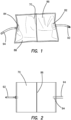
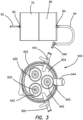
- the pressure conditioning apparatus 70 comprises a gas flow path extending from a segment of inlet gas tubing 92 through an elastomeric film pouch to a segment of outlet gas tubing 94.
- the elastomeric film pouch provides pressure conditioning functions of pressure storage, insufflation gas volume accumulation, and flow restriction to maintain a substantially consistent insufflation gas flow at a surgical site despite a discontinuous, pulsatile flow from an insufflator.
- the film pouch 86 can be formed of a sheet of polymeric film that is folded upon itself and welded to seal edges 88 and create an enclosed volume. With the pouch 86 in a deflated condition, the pouch has a generally rectangular shape with relatively long width and a relatively shorter height. It is contemplated that, the pouch can be formed in other shapes to achieve desired product packaging, aesthetic, or gas flow considerations.
- an inlet port 82 and an outlet port 84 to create a gas flow path through the pouch.
- the inlet port 82 and outlet port 84 are positioned on opposite sides of the pouch 86 to provide a relatively direct flow path along a longitudinal axis of the width of the pouch 86. It is contemplated that other positions of the inlet port 84 and outlet port 86 can be used to vary the gas flow characteristics of the pressure conditioning apparatus.
- the inlet port 82 and outlet port 84 can be positioned adjacent one another along one edge or can be positioned on opposite edges with respect to the height of the pouch 86 such that the pressure conditioning apparatus can have attributes of a side branch attenuator.
- the inlet port 82 and outlet port 84 can each comprise a bag port having a barbed fitting, such as are commercially available from Value Plastics, Inc.
- the pressure conditioning apparatus can further comprise a segment of inlet tubing 92 coupled to the barbed fitting of the inlet port 82 and a segment of outlet tubing 94 coupled to the barbed fitting of the outlet port 84.
- the outlet port 84 could instead be coupled directly to insufflation tubing, or the outlet port 84 and outlet tubing 94 can be formed as a single component.
- the inlet tubing 92 can have a fitting end configured to be coupled to an insufflator or to insufflation tubing from an insufflator.
- the outlet tubing 94 can have a fitting end configured to be coupled to insufflation tubing fluidly coupled to a surgical access port.
- a pressure conditioning apparatus can include only a single length of tubing, or can be provided solely with ports.
- a pressure conditioning apparatus can include an inlet port 82 at an upstream end and an outlet tubing 94 at a downstream end.
- a desired length of inlet tubing can be associated with an insufflator.
- a pressure conditioning apparatus can include an inlet port 82 at an upstream end and an outlet port 84 at a downstream end such that inlet and outlet tubing can be associated with an insufflator and a surgical access port.
- one or both of the inlet and outlet ports can include a luer fitting rather than a barbed fitting such that at least one of the inlet port and the outlet port comprises a luer port. At least one of the inlet port and the outlet port can be heat sealed to the pouch.
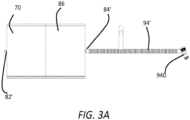
- Figure 3A illustrates a pressure conditioning apparatus 70 having a film pouch 86 with an inlet port 82' having a luer fitting, and an outlet port 84' coupled to a length of outlet tubing 94' that is coupled to an insufflation trocar 940.
- the outlet tubing 94' is a segment of corrugated tubing, which can be desirable in insufflation systems to reduce kinking of the tubing and the potential for related fluid flow disruptions.
- the pouch 86 can be sized and configured to provide pressure conditioning aspects of a separate pressure storage component and accumulator of pressure conditioning devices disclosed herein.
- the pouch can be formed of a polymeric material having predetermined thickness and elasticity properties to provide the desired pressure storage.
- the pouch 86 can be formed of a polyurethane film that can expand and contract responsive to insufflation pressure. It is contemplated that other film materials and/or thicknesses can be used in a pressure conditioning apparatus to achieve the desired pressure storage.
- the pouch 86 can be sized to stabilize the volume of an open-ended body conduit at a surgical site location supplied with pulsed insufflation. As further described with respect to Figures 2 , 3 , and 6-16 , a pouch 86 can be sized to provide a desired pressure conditioning profile for a TAMIS procedure. Desirably, the pouch 86 can have a volume of at least approximately 6.5 liters, between approximately 6.5 and approximately 8 liters, orof approximately 7.4 liters. Where the pouch has a pouch volume that is undesirably small for the surgical site, there can be insufficient pressure storage and accumulated volume to condition pulse cycles of an insufflation pump.
- the pouch is undesirably large for the surgical site, there can be an insufflation lag time as pulse cycles of the insufflator can be influenced by pressure fluctuations of the relatively large pouch volume rather than the surgical site.
- the pouch can be configured with a different pouch volume than the range discussed above for use in patients having particularly small or particularly large colorectal volume.
- the pouch can have a different pouch volume if it is desired to use the pressure conditioning apparatus 70 to condition insufflation pressure pulses at a different surgical site.
- the pressure conditioning apparatus 70 comprises an elastomeric film pouch 86 or bag that can have an inlet port 82 and an outlet port 84 that create a gas flow path through the pouch.
- the pressure conditioning apparatus can further comprise an inlet fluid conduit such as a length of inlet gas tubing 92 and an outlet fluid conduit such as a length of outlet gas tubing 94.
- the inlet gas tubing 92 can include a fitting or coupling to be fluidly coupled to an insufflation pump.
- the inlet gas tubing 92 and outlet gas tubing 94 can be sized relative to one another to provide a desired pressure conditioning profile, where the inlet tubing 92 has a first inner diameter and the outlet tubing 94 can have a second inner diameter larger than the first inner diameter.
- a pressure conditioning apparatus 70 as described herein can be included in a surgical site access system 900 such as a surgical access port 902 having a port surface 904 such as an artificial body wall defined by a gel surface of a surgical access port sold under the trademarks GELPORT and GELPOINT.
- the pressure conditioning apparatus 70 as described herein can be included in a surgical site access system configured for application in a natural orifice entry site surgical procedure such as a TAMIS procedure such as a surgical access port sold as a GELPOINT path system.
- the surgical site access system 900 can comprise a pressure conditioning apparatus 70, a surgical access port 902 having a port surface 904, and a plurality of trocars 930, 940 configured to be advanced through the port surface 904 and to sealingly engage surgical instruments inserted therethrough.
- the surgical access port 902 can comprise at least one insufflation port 910, 920 with the pressure conditioning apparatus 70 can be fluidly coupled to one of the insufflation ports 910, 920.
- the other of the insufflation ports 910, 920 can then either be left free and remain closed with a stopcock valve or other closure device, be coupled to another source of gas, or be selectively opened to provide smoke evacuation for electrosurgical procedures.
- the surgical site access system 900 can further comprise an insufflation trocar 940.
- the pressure conditioning apparatus 70 can be fluidly coupled to the insufflation trocar 940 and the trocar 940 advanced through the artificial body 904 wall to provide insufflation gas flow to the surgical site.
- the insufflation trocar 940 can comprise an instrument access channel 942 and an insufflation port 944.
- the insufflation port 944 of the insufflation trocar 940 can have a relatively large diameter relative to the insufflation ports 910, 920 of the surgical access port 902.
- the insufflation port 944 of the insufflation trocar 940 can comprise a barbed fitting to receive the outlet gas tubing 94 of the pressure conditioning apparatus 70. Accordingly, the insufflation trocar 940 can desirably accommodate insufflation gas flow rates of a fluid coupling such as outlet tubing 94 of a pressure conditioning apparatus 70 having a relatively large inner diameter, such as shown in Figure 2 .
- the pressure conditioning apparatus 70 can be sized and configured to provide a desirable pressure conditioning profile for a surgical site at an open body conduit. For example, it can be desirable for the pressure conditioning apparatus to provide an insufflation gas flow having a relatively small lag time, and a relatively small pressure deviation.
- the lag time represents a time delay between activation of an insufflation pump fluidly coupled to the surgical site access system and reaching a desired insufflation pressure at the surgical site.
- the pressure deviation represents a pressure difference between a high pressure peak and a low pressure peak if insufflation pressure at the surgical site is plotted over time.
- the pressure conditioning apparatus be relatively compact such that it does not require a significant amount of operating room space.
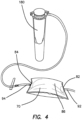
- the insufflation gas pressure conditioning apparatus 70 of Figure 1 is illustrated coupled to a test fixture including a distended simulated body conduit 180.
- the pressure conditioning apparatus 70 is illustrated with the pouch 86 in an inflated condition and a gas flow path (arrows showing flow direction) indicated from the inlet tube segment 92, through the pouch 86, through the outlet tube segment 94 and to the simulated body conduit 180.
- a simulated body conduit 180 can be used to assess the conditioned pressure profile performance of various pressure conditioning apparatus 70 film pouch materials, thicknesses, volumes, and geometries as further discussed with reference to Figures 6-16 .
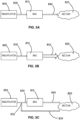
- the pressure conditioning apparatuses 810 described herein is fluidly coupled to an insufflation pump 800 and fluidly coupled to an open-ended body conduit such as a patient's rectum 820 to define a surgical system configured to maintain a desired insufflation pressure profile.
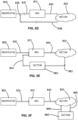
- Figures 19A-19F label the pressure conditioning apparatuses 810 as 'BAG', the surgical system schematically illustrated incorporates the pouch-based pressure conditioning apparatus described with respect to Figures 1-4 , or another pressure conditioning apparatuses configured to maintain a desired insufflation pressure profile.
- the illustrated embodiment of surgical system comprises a pressure conditioning apparatus 810 fluidly coupled to an insufflation pump 800 by a first fluid coupling 830 and fluidly coupled to a body conduit by a second fluid coupling 840.
- the first fluid coupling 830 and the second fluid coupling 840 can each comprise a segment of gas flow tubing such as are illustrated in Figure 4 .
- the second fluid coupling 840 can be coupled to the body conduit at an insufflation port of a surgical access port such as a cannula or directly through an artificial body wall defined by a gel surface of a surgical access port sold under the trademarks GELPORT and GELPOINT.
- the serial fluid coupling of the pressure conditioning apparatus 810 to the body conduit provided by the first fluid coupling 830 and second fluid coupling 840 of the surgical system result in mitigated pulsing or billowing of the body conduit despite pulsatile operation of the insufflation pump 800.
- the illustrated surgical system also generates a relatively lower pressure at the body conduit as compared with an insufflation pump directly coupled to a body conduit. This relatively low pressure results from the insufflation pump 800 sensing back pressure of the pressure conditioning apparatus 810 at the first fluid coupling 830.
- insufflation pumps 800 are configured to provide a pulsed insufflation profile responsive to pressure variations at a directly-coupled surgical site.
- the system volume added by the pressure conditioning apparatus 810 serially fluidly coupled to the body conduit and the insufflation pump 800 cause the insufflation pump 800 to generate a pulsatile pressure flow response to pressure variations at the first fluid coupling 830 of the system, which may differ from pressure at the body conduit.
- an insufflation system comprises a pressure conditioning apparatus 810 fluidly coupled to an insufflation pump 800 by a first fluid coupling 830 and fluidly coupled to a body conduit by a second fluid coupling 842.
- the second fluid coupling 842 has a thicker cross sectional profile defined by a relatively large inner diameter compared to standard insufflation tubing, which typically has a 6 mm (0.25 inch) inner diameter. This relatively large inner diameter of the second fluid coupling 842 increases the flow rate of insufflation gas from the pressure conditioning apparatus 810 to the body conduit, maintaining a relatively higher pressure in the body conduit than that of the embodiment of Figure 5A .
- an insufflation system in accordance with the present invention comprises a pressure conditioning apparatus 810 fluidly coupled to an insufflation pump 800 by a first fluid coupling 830 and fluidly coupled to a body conduit by a second fluid coupling 840.
- the first fluid coupling 830 comprises a flow splitter such as a y-junction or y-valve to provide a dual lumen insufflation gas delivery pathway having a third fluid coupling 834 providing a parallel fluid flow path from the insufflation pump 800 to the body conduit.
- This dual lumen insufflation gas delivery pathway increases the flow rate of insufflation gas from the insufflation pump 800 to the body conduit, maintaining a relatively higher pressure in the body conduit than that of the embodiment of Figure 5A .
- an insufflation system in accordance with the present invention comprises a pressure conditioning apparatus 810 fluidly coupled to an insufflation pump 800 by a first fluid coupling 830 and fluidly coupled to a body conduit by a second fluid coupling 840.
- the first fluid coupling 830 comprises a one-way valve 836 coupled to a parallel return lumen 838 that is fluidly coupled to the body conduit.
- This one-way valve 836 and return lumen 838 configuration provides backpressure feedback to the insufflation pump 800 while an insufflation gas delivery pathway is provided from the insufflation pump 800 through the pressure conditioning apparatus 810 to the body conduit, thus maintaining a relatively higher pressure in the body conduit than that of the embodiment of Figure 5A .
- an insufflation system in accordance with the present invention comprises a pressure conditioning apparatus 810 fluidly coupled to an insufflation pump 800 by a first fluid coupling 830 and fluidly coupled to a body conduit by a second fluid coupling 840.
- the surgical system further comprises a suction device 860 fluidly coupled to the body conduit by a first return conduit 862 and to the pressure conditioning apparatus 810 by a second return conduit 864, defining an insufflation gas return pathway.
- the gas return pathway can further comprise an in-line filter to prevent hazardous materials from re-entering the body conduit.
- This suction device 860 and return pathway can compensate for insufflation gas loss thus maintaining a desired pressure in the body conduit.
- the surgical system further comprises a suction device 860 fluidly coupled to the body conduit by a first return conduit 866 and a reintroducing conduit 868, defining an insufflation gas return pathway that directly returns insufflation gas to the body conduit.
- the gas return pathway can further comprise an in-line filter to prevent hazardous materials from re-entering the body conduit.
- This suction device 860 and return pathway can compensate for insufflation gas loss thus maintaining a desired pressure in the body conduit.
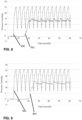
- Figure 6 illustrates an exemplary observed pressure (in mmHg) at the simulated surgical site over time (in seconds).
- the baseline pressure plot 950 fluctuated between approximately 6mmHg and approximately 25 mmHg, representing a pressure deviation of 19mmHg. This fluctuation results in undesirable billowing of internal walls of the simulated body conduit.
- a pressure plot 960 for a pressure conditioning apparatus including a reservoir having a volume of 3 L is plotted in comparison to the baseline pressure plot 950. As illustrated, the addition of the 3L bag reduced the high to low pressure peak (deviation) to approximately 5mmHg.
- a pressure plot 962 for a pressure conditioning apparatus including a reservoir having a volume of 5.5 L is plotted in comparison to the baseline pressure plot 950. As illustrated, the addition of the 5.5L reservoir reduced the pressure deviation to approximately 3mmHg.
- a pressure plot 964 for a pressure conditioning apparatus including a reservoir having a volume of 6.7 L is plotted in comparison to the baseline pressure plot 950.
- the addition of the 6.7L reservoir reduced the pressure deviation to approximately 2.5mmHg.
- a pressure plot 966 for a pressure conditioning apparatus including a reservoir having a volume of 9 L is plotted in comparison to the baseline pressure plot 950.
- the addition of the 9L reservoir reduced the pressure deviation down to approximately 2mmHg.
- the increased reservoir volume desirably reduced the pressure deviation of the conditioned insufflation gas flow
- the increased reservoir volume also tended to increase the lag time for the surgical site to achieve a desired insufflation pressure.
- the observed lag times ranged from approximately 12 seconds ( Figure 7 ) to approximately 30 seconds ( Figure 10 ).
- the reservoir be sized to provide a relatively low pressure deviation and a relatively low lag time.
- the reservoir be sized for ease of positioning and use in a surgical work environment. Accordingly, in some embodiments, the reservoir can have an internal volume between 5.5 and 8 liters.
- the reservoir can have an internal volume of at least approximately 6.5 liters. In certain embodiments, the reservoir can have an internal volume of approximately 7.4 liters. Desirably, this range of volumes can provide a pressure deviation of under 3 mmHg, a lag time of under 30 seconds, and allow the bag to be positioned relatively easily in a surgical work environment.
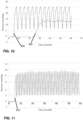
- a pressure conditioning profile of a surgical site access system having a pressure conditioning apparatus with a reservoir having an internal volume of 6.5 liters was further verified on a human cadaver.
- a stopcock on the surgical access port was opened to create a 7L/min leak
- the insufflator was set to a flow rate of 9L/min
- insufflation pressure was set at 15mmHg.
- the rectal pressure fluctuated between 2mmHg to 9mmHg (pressure deviation of 7mmHg).
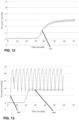
- the control pressure plot 970 representing observed pressure at the simulated surgical site plotted over time, is illustrated in Figure 11 .
- the addition of the pressure conditioning apparatus having a reservoir with a volume of 6.5 liters reduced the pressure deviation to approximately 1mmHg.
- Figure 12 illustrates a pressure plot 972 for the surgical site access system with the pressure conditioning apparatus.
- FIG. 13-16 various embodiments of pressure conditioning apparatus having a reservoir with a volume of 6.5 liters were evaluated such that an inner diameter of an outlet tubing or fluid coupling can be sized and configured to provide a desirable pressure conditioning profile.
- the experimental setup included a simulated, silicone rectum, a GELPOINT Path surgical access system, a pressure conditioning apparatus having a reservoir such as is schematically illustrated in Figure 2 , and a pulsatile insufflator.
- the reservoir of the pressure conditioning apparatus used was 6.5 L in volume.
- the outlet tubing of the pressure conditioning apparatus was coupled to an insufflation trocar positioned through the surgical access system.
- a pressure sensor was inserted into the simulated rectum to measure the internal pressure of the system.
- a GELPOINT Path stopcock was opened approximately half-way to create a leak rate of 10L/min, simulating insufflation gas losses and absorption from an open body conduit.
- the leak rate was kept consistent for all of the embodiments of the pressure conditioning apparatus.
- the insufflator was set at 15mmHg, high flow. The insufflator turned on after 5 seconds. Outlet tubing of varying inner diameter sizes were tested, ranging from 2.5 mm to 13 mm (0.1 inches to 0.5 inches).
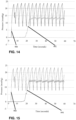
- Figures 13-16 illustrate simulated surgical site pressure conditioning profiles for embodiments of pressure conditioning apparatus having different outlet tubing inner diameters.
- a pressure plot 990 of a pressure conditioning apparatus having an outlet tubing with an inner diameter of 2.5 mm (0.1 inches) is illustrated in comparison to a baseline pressure plot 980 of the setup with no pressure conditioning apparatus.
- This embodiment of pressure conditioning apparatus maintained a pressure at the simulated surgical site of approximately 9 mmHg.
- the resulting pressure conditioning profile has a relatively high pressure drop, defined by the difference between the set pressure of the insufflator and the observed pressure at the surgical site.
- the pressure conditioning profile has relatively small pressure deviation.
- a pressure plot 992 of a pressure conditioning apparatus having an outlet tubing with an inner diameter of 4 mm (0.15 inches) is illustrated in comparison to a baseline pressure plot 980.
- the pressure conditioning profile maintains a pressure of approximately 13 mmHg, with a pressure deviation of approximately 1 mmHg.
- a pressure plot 994 of a pressure conditioning apparatus having an outlet tubing with an inner diameter of 6.3 mm (0.25 inches) is illustrated in comparison to a baseline pressure plot 980.
- the pressure conditioning profile maintains a pressure of approximately 14 mmHg, with a pressure deviation of approximately 1.5 mmHg.
- a pressure plot 996 of a pressure conditioning apparatus having an outlet tubing with an inner diameter of 13 mm (0.5 inches) is illustrated in comparison to a baseline pressure plot 980.
- the pressure conditioning profile maintains a pressure of approximately 14.5 mmHg, with a pressure deviation of approximately 2 mmHg.
- comparing the pressure conditioning profiles of various embodiments of pressure conditioning apparatus indicates that the smaller the outlet tubing inner diameter, the greater overall colorectal system pressure drop, but the smaller the pressure differential.
- a relatively larger tubing inner diameter tends to yield a pressure conditioning profile with minimized colorectal system pressure drop and a relatively larger pressure differential.
- the outlet tubing can have an inner diameter that is desirably in the range of from approximately 6 mm (0.25 inches) to approximately 13 mm (0.5 inches). In certain embodiments, the outlet tubing can have an inner diameter of approximately 13 mm (0.5 inches).
- a 13 mm (0.5 inches) inner diameter tubing has a relatively small pressure drop and a clinically acceptable pressure differential. In a cadaver lab, a pressure differential of 2mmHg was not visually noticeable. Therefore, the pressure differential caused a 13 mm (0.5 inches) inner diameter tubing is acceptable.
- Insufflation tubing such as the inlet tubing coupling the pressure conditioning apparatus to an insufflation pump can typically have an inner diameter of approximately 6 mm (0.25 inches). Thus, it is desirable that the outlet tubing has a larger inner diameter than the inlet tubing. In the embodiment of pressure conditioning apparatus having an outlet tube with a 13 mm (0.5 inches) inner diameter, the inner diameter of the outlet tubing can be at least twice the inner diameter of the inlet tubing.
Landscapes
- Health & Medical Sciences (AREA)
- Life Sciences & Earth Sciences (AREA)
- Public Health (AREA)
- Engineering & Computer Science (AREA)
- Biomedical Technology (AREA)
- Heart & Thoracic Surgery (AREA)
- General Health & Medical Sciences (AREA)
- Veterinary Medicine (AREA)
- Animal Behavior & Ethology (AREA)
- Surgery (AREA)
- Hematology (AREA)
- Anesthesiology (AREA)
- Medical Informatics (AREA)
- Molecular Biology (AREA)
- Pathology (AREA)
- Nuclear Medicine, Radiotherapy & Molecular Imaging (AREA)
- Surgical Instruments (AREA)
- Infusion, Injection, And Reservoir Apparatuses (AREA)
- Physics & Mathematics (AREA)
- Biophysics (AREA)
- Optics & Photonics (AREA)
- Radiology & Medical Imaging (AREA)
- Paper (AREA)
- Endoscopes (AREA)
Priority Applications (2)
| Application Number | Priority Date | Filing Date | Title |
|---|---|---|---|
| EP24161170.6A EP4353167A3 (en) | 2015-09-30 | 2016-09-30 | Insufflation stabilization system |
| EP22214324.0A EP4169556B1 (en) | 2015-09-30 | 2016-09-30 | Insufflation stabilization system |
Applications Claiming Priority (5)
| Application Number | Priority Date | Filing Date | Title |
|---|---|---|---|
| US201562235128P | 2015-09-30 | 2015-09-30 | |
| US201662327941P | 2016-04-26 | 2016-04-26 | |
| PCT/US2016/054955 WO2017059335A1 (en) | 2015-09-30 | 2016-09-30 | Insufflation stabilization system |
| EP16781637.0A EP3355974B1 (en) | 2015-09-30 | 2016-09-30 | Insufflation stabilization system |
| EP20151520.2A EP3656428B1 (en) | 2015-09-30 | 2016-09-30 | Insufflation stabilization system |
Related Parent Applications (3)
| Application Number | Title | Priority Date | Filing Date |
|---|---|---|---|
| EP20151520.2A Division EP3656428B1 (en) | 2015-09-30 | 2016-09-30 | Insufflation stabilization system |
| EP20151520.2A Division-Into EP3656428B1 (en) | 2015-09-30 | 2016-09-30 | Insufflation stabilization system |
| EP16781637.0A Division EP3355974B1 (en) | 2015-09-30 | 2016-09-30 | Insufflation stabilization system |
Related Child Applications (3)
| Application Number | Title | Priority Date | Filing Date |
|---|---|---|---|
| EP22214324.0A Division EP4169556B1 (en) | 2015-09-30 | 2016-09-30 | Insufflation stabilization system |
| EP22214324.0A Division-Into EP4169556B1 (en) | 2015-09-30 | 2016-09-30 | Insufflation stabilization system |
| EP24161170.6A Division EP4353167A3 (en) | 2015-09-30 | 2016-09-30 | Insufflation stabilization system |
Publications (2)
| Publication Number | Publication Date |
|---|---|
| EP3895749A1 EP3895749A1 (en) | 2021-10-20 |
| EP3895749B1 true EP3895749B1 (en) | 2023-02-22 |
Family
ID=57133448
Family Applications (5)
| Application Number | Title | Priority Date | Filing Date |
|---|---|---|---|
| EP21169881.6A Active EP3895749B1 (en) | 2015-09-30 | 2016-09-30 | Insufflation stabilization system |
| EP22214324.0A Active EP4169556B1 (en) | 2015-09-30 | 2016-09-30 | Insufflation stabilization system |
| EP24161170.6A Pending EP4353167A3 (en) | 2015-09-30 | 2016-09-30 | Insufflation stabilization system |
| EP20151520.2A Active EP3656428B1 (en) | 2015-09-30 | 2016-09-30 | Insufflation stabilization system |
| EP16781637.0A Active EP3355974B1 (en) | 2015-09-30 | 2016-09-30 | Insufflation stabilization system |
Family Applications After (4)
| Application Number | Title | Priority Date | Filing Date |
|---|---|---|---|
| EP22214324.0A Active EP4169556B1 (en) | 2015-09-30 | 2016-09-30 | Insufflation stabilization system |
| EP24161170.6A Pending EP4353167A3 (en) | 2015-09-30 | 2016-09-30 | Insufflation stabilization system |
| EP20151520.2A Active EP3656428B1 (en) | 2015-09-30 | 2016-09-30 | Insufflation stabilization system |
| EP16781637.0A Active EP3355974B1 (en) | 2015-09-30 | 2016-09-30 | Insufflation stabilization system |
Country Status (8)
| Country | Link |
|---|---|
| US (4) | US9956358B2 (enExample) |
| EP (5) | EP3895749B1 (enExample) |
| JP (5) | JP6800220B2 (enExample) |
| KR (2) | KR20240067912A (enExample) |
| AU (4) | AU2016331945B2 (enExample) |
| CA (2) | CA3000663C (enExample) |
| ES (4) | ES2941887T3 (enExample) |
| WO (1) | WO2017059335A1 (enExample) |
Families Citing this family (10)
| Publication number | Priority date | Publication date | Assignee | Title |
|---|---|---|---|---|
| US9956358B2 (en) * | 2015-09-30 | 2018-05-01 | Applied Medical Resources Corporation | Insufflation stabilization system |
| WO2019148346A1 (zh) * | 2018-01-31 | 2019-08-08 | 三雷斯医疗科技(深圳)有限公司 | 一种手术通路系统 |
| WO2019244161A2 (en) * | 2018-06-20 | 2019-12-26 | Yissum Research Development Company Of The Hebrew University Of Jerusalem Ltd. | Methods, devices, kits and systems for delivery of large volume of pressurized gas by inhalation |
| WO2020040651A1 (en) * | 2018-08-23 | 2020-02-27 | Fisher & Paykel Healthcare Limited | Supplementary continuous gas supply source for delivery to surgical cavities |
| KR102138120B1 (ko) * | 2018-09-21 | 2020-07-27 | 국립암센터 | 기체주입 안정화 장치 |
| KR102320826B1 (ko) * | 2018-12-10 | 2021-11-02 | 주식회사 인코아 | 복강 내압 유지 장치 |
| CN111412869B (zh) * | 2020-04-17 | 2021-04-20 | 大连理工大学 | 一种基于气体泄漏率测定的承压壳体壁裂缝尺度的检测装置及方法 |
| EP4355396A4 (en) * | 2021-09-30 | 2025-04-16 | Duke University | Devices, systems, and methods for distributing multiport pneumo-operitoneum and high-flow smoke evacuation |
| JP7503323B2 (ja) * | 2022-03-17 | 2024-06-20 | 株式会社八光 | 手術腔内圧安定化リザーバー |
| CN118615050B (zh) * | 2024-08-13 | 2024-10-11 | 德州贺家机械设备有限公司 | 一种畜牧灌药器 |
Family Cites Families (41)
| Publication number | Priority date | Publication date | Assignee | Title |
|---|---|---|---|---|
| US3858572A (en) * | 1972-10-27 | 1975-01-07 | Kendall & Co | Insufflation device |
| FR2326734A1 (fr) | 1975-10-04 | 1977-04-29 | Wolf Gmbh Richard | Appareil d'insufflation de gaz applicable notamment au remplissage d'une cavite du corps |
| DE3413631A1 (de) | 1984-04-11 | 1985-10-24 | Semm, Kurt, Prof. Dr.Med., 2300 Kiel | Monofile vorrichtung zum insufflieren von gas |
| DE3718717A1 (de) | 1987-06-04 | 1988-12-22 | Wolf Gmbh Richard | Geraet zum insufflieren von gas in eine koerperhoehle |
| DE3739003A1 (de) | 1987-11-17 | 1989-05-24 | Wolf Gmbh Richard | Insufflationsgeraet fuer endoskopische eingriffe |
| AU678367B2 (en) | 1992-07-07 | 1997-05-29 | 544456 B.C. Ltd. | Apparatus and method for improved insufflation |
| US5322070A (en) * | 1992-08-21 | 1994-06-21 | E-Z-Em, Inc. | Barium enema insufflation system |
| US5505305A (en) * | 1992-10-21 | 1996-04-09 | Minnesota Mining And Manufacturing Company | Moisture-proof resealable pouch and container |
| US5439441A (en) | 1993-10-12 | 1995-08-08 | Snowden-Pencer, Inc. | Surgical insufflation system with improved determination of body cavity pressure |
| US5800381A (en) * | 1994-02-25 | 1998-09-01 | Ognier; Jean-François | Medical gas insufflator with automatic gas flow control |
| US5569205A (en) * | 1994-07-14 | 1996-10-29 | Hart; Charles C. | Multiport trocar |
| DE19510710C2 (de) * | 1995-03-15 | 2001-11-22 | Dmv Medizintechnik Gmbh | Insufflationsgas-Konditionierungsvorrichtung |
| US6458093B1 (en) | 1999-02-05 | 2002-10-01 | Storz Endoskop Gmbh | Apparatus for insufflating gas into a corporeal cavity of a human or animal body |
| US6402714B1 (en) | 1999-11-12 | 2002-06-11 | Karl Storz Gmbh & Co., Kg | Apparatus and method for controlling high flow insufflation |
| JP2002204829A (ja) * | 2000-09-08 | 2002-07-23 | Pall Corp | カニューレアセンブリ |
| DE10233861A1 (de) | 2002-07-19 | 2004-02-12 | Storz Endoskop Produktions Gmbh | Vorrichtung, Insufflationsvorrichtung, Messvorrichtung und Verfahren zur Insufflation einer Körperhöhle mit einem Insufflationsgas |
| US20040049114A1 (en) * | 2002-08-30 | 2004-03-11 | Ethox Corporation | Enclosure for a blood pressure cuff |
| EP1556121B1 (en) * | 2002-10-28 | 2016-06-01 | Northgate Technologies Incorporated | Insufflation system with a multi-capacity tube |
| US7854724B2 (en) | 2003-04-08 | 2010-12-21 | Surgiquest, Inc. | Trocar assembly with pneumatic sealing |
| US7285112B2 (en) * | 2003-04-08 | 2007-10-23 | Surgiquest, Incorporated | Gas flow trocar arrangement |
| US20060247516A1 (en) * | 2005-04-08 | 2006-11-02 | Hess Christopher J | Tissue marker and method for use |
| US7806850B2 (en) | 2005-10-24 | 2010-10-05 | Bracco Diagnostics Inc. | Insufflating system, method, and computer program product for controlling the supply of a distending media to an endoscopic device |
| US20070208300A1 (en) * | 2006-03-01 | 2007-09-06 | Applied Medical Resources Corporation | Gas insufflation and suction/irrigation tubing |
| EP2329774B1 (en) * | 2006-09-08 | 2012-07-25 | SurgiQuest, Incorporated | Trocar assembly with pneumatic sealing |
| US8715219B2 (en) * | 2008-10-10 | 2014-05-06 | Surgiquest, Inc. | System and method for improved gas recirculation in surgical trocars with pneumatic sealing |
| CA2662417C (en) | 2006-09-08 | 2015-02-10 | Surgiquest, Incorporated | Trocar assembly with pneumatic sealing |
| KR20090118927A (ko) | 2007-02-12 | 2009-11-18 | 디에스엠 아이피 어셋츠 비.브이. | 중합체 조성물 및 이로부터 제조된 플라스틱 튜브 |
| US9381312B1 (en) * | 2009-03-18 | 2016-07-05 | Douglas E. Ott | Insufflation apparatus |
| US8366667B2 (en) * | 2010-02-11 | 2013-02-05 | Baxter International Inc. | Flow pulsatility dampening devices |
| US9421032B2 (en) * | 2010-06-16 | 2016-08-23 | Covidien Lp | Seal port with blood collector |
| US9289115B2 (en) * | 2010-10-01 | 2016-03-22 | Applied Medical Resources Corporation | Natural orifice surgery system |
| ES2743503T3 (es) | 2010-10-01 | 2020-02-19 | Applied Med Resources | Sistema quirúrgico para orificio natural |
| WO2012075487A2 (en) | 2010-12-03 | 2012-06-07 | Minimally Invasive Devices, Llc | Devices, systems, and methods for performing endoscopic surgical procedures |
| US20120150051A1 (en) * | 2010-12-09 | 2012-06-14 | Welch Allyn, Inc. | Blood pressure cuff |
| JP5384548B2 (ja) * | 2011-03-28 | 2014-01-08 | 富士フイルム株式会社 | 内視鏡送気システム |
| EP2704650A2 (en) * | 2011-05-02 | 2014-03-12 | Applied Medical Resources Corporation | Low-profile surgical universal access port |
| WO2013142150A1 (en) * | 2012-03-22 | 2013-09-26 | Genii, Inc. | Gas flow control apparatus and related methods |
| JP5566544B2 (ja) * | 2012-06-27 | 2014-08-06 | オリンパスメディカルシステムズ株式会社 | 送気システム、手術システム、及び、送気方法 |
| WO2014077806A1 (en) * | 2012-11-14 | 2014-05-22 | Rudolf Albert | Disposable insufflation device |
| US10406301B2 (en) * | 2012-12-24 | 2019-09-10 | Lexion Medical, Llc | Fail-safe insufflators |
| US9956358B2 (en) * | 2015-09-30 | 2018-05-01 | Applied Medical Resources Corporation | Insufflation stabilization system |
-
2016
- 2016-09-30 US US15/282,781 patent/US9956358B2/en active Active
- 2016-09-30 AU AU2016331945A patent/AU2016331945B2/en active Active
- 2016-09-30 CA CA3000663A patent/CA3000663C/en active Active
- 2016-09-30 ES ES21169881T patent/ES2941887T3/es active Active
- 2016-09-30 KR KR1020247011333A patent/KR20240067912A/ko active Pending
- 2016-09-30 CA CA3253906A patent/CA3253906A1/en active Pending
- 2016-09-30 EP EP21169881.6A patent/EP3895749B1/en active Active
- 2016-09-30 WO PCT/US2016/054955 patent/WO2017059335A1/en not_active Ceased
- 2016-09-30 ES ES16781637T patent/ES2784727T3/es active Active
- 2016-09-30 EP EP22214324.0A patent/EP4169556B1/en active Active
- 2016-09-30 ES ES20151520T patent/ES2883823T3/es active Active
- 2016-09-30 EP EP24161170.6A patent/EP4353167A3/en active Pending
- 2016-09-30 KR KR1020187012339A patent/KR102656617B1/ko active Active
- 2016-09-30 JP JP2018516424A patent/JP6800220B2/ja active Active
- 2016-09-30 EP EP20151520.2A patent/EP3656428B1/en active Active
- 2016-09-30 ES ES22214324T patent/ES2981294T3/es active Active
- 2016-09-30 EP EP16781637.0A patent/EP3355974B1/en active Active
-
2018
- 2018-03-21 US US15/927,477 patent/US10493219B2/en active Active
-
2019
- 2019-11-01 US US16/671,587 patent/US11648359B2/en active Active
-
2020
- 2020-11-24 JP JP2020194533A patent/JP7027511B2/ja active Active
-
2021
- 2021-05-14 AU AU2021203095A patent/AU2021203095B2/en active Active
-
2022
- 2022-02-16 JP JP2022022252A patent/JP7386274B2/ja active Active
-
2023
- 2023-04-05 US US18/296,200 patent/US20230321369A1/en active Pending
- 2023-07-04 AU AU2023204299A patent/AU2023204299B2/en active Active
- 2023-11-13 JP JP2023192857A patent/JP7614298B2/ja active Active
-
2024
- 2024-12-26 JP JP2024230531A patent/JP2025039597A/ja active Pending
-
2025
- 2025-09-10 AU AU2025230709A patent/AU2025230709A1/en active Pending
Also Published As
Similar Documents
| Publication | Publication Date | Title |
|---|---|---|
| EP3895749B1 (en) | Insufflation stabilization system | |
| JP6661650B2 (ja) | 煙排出モードを有する多モード外科用ガス送給システムのために用いられる内部ガスシールを伴うフィルタカートリッジ | |
| JP7322092B2 (ja) | 体腔内で吸引が用いられる時に安定した体腔圧を維持するように構成されたマルチモード外科用ガス送達システム | |
| US12214120B2 (en) | Medical device with improved desufflation | |
| JP2018507084A (ja) | 多モード外科用ガス送給システムのために用いられる一体化されたガスシールを伴うフィルタカートリッジ |
Legal Events
| Date | Code | Title | Description |
|---|---|---|---|
| PUAI | Public reference made under article 153(3) epc to a published international application that has entered the european phase |
Free format text: ORIGINAL CODE: 0009012 |
|
| STAA | Information on the status of an ep patent application or granted ep patent |
Free format text: STATUS: REQUEST FOR EXAMINATION WAS MADE |
|
| 17P | Request for examination filed |
Effective date: 20210422 |
|
| AC | Divisional application: reference to earlier application |
Ref document number: 3355974 Country of ref document: EP Kind code of ref document: P Ref document number: 3656428 Country of ref document: EP Kind code of ref document: P |
|
| AK | Designated contracting states |
Kind code of ref document: A1 Designated state(s): AL AT BE BG CH CY CZ DE DK EE ES FI FR GB GR HR HU IE IS IT LI LT LU LV MC MK MT NL NO PL PT RO RS SE SI SK SM TR |
|
| B565 | Issuance of search results under rule 164(2) epc |
Effective date: 20210830 |
|
| STAA | Information on the status of an ep patent application or granted ep patent |
Free format text: STATUS: EXAMINATION IS IN PROGRESS |
|
| 17Q | First examination report despatched |
Effective date: 20220706 |
|
| GRAP | Despatch of communication of intention to grant a patent |
Free format text: ORIGINAL CODE: EPIDOSNIGR1 |
|
| STAA | Information on the status of an ep patent application or granted ep patent |
Free format text: STATUS: GRANT OF PATENT IS INTENDED |
|
| RIC1 | Information provided on ipc code assigned before grant |
Ipc: A61B 17/34 20060101ALN20220831BHEP Ipc: A61M 13/00 20060101AFI20220831BHEP |
|
| INTG | Intention to grant announced |
Effective date: 20220916 |
|
| RIC1 | Information provided on ipc code assigned before grant |
Ipc: A61B 17/34 20060101ALN20220906BHEP Ipc: A61M 13/00 20060101AFI20220906BHEP |
|
| GRAS | Grant fee paid |
Free format text: ORIGINAL CODE: EPIDOSNIGR3 |
|
| GRAA | (expected) grant |
Free format text: ORIGINAL CODE: 0009210 |
|
| STAA | Information on the status of an ep patent application or granted ep patent |
Free format text: STATUS: THE PATENT HAS BEEN GRANTED |
|
| AC | Divisional application: reference to earlier application |
Ref document number: 3355974 Country of ref document: EP Kind code of ref document: P Ref document number: 3656428 Country of ref document: EP Kind code of ref document: P |
|
| AK | Designated contracting states |
Kind code of ref document: B1 Designated state(s): AL AT BE BG CH CY CZ DE DK EE ES FI FR GB GR HR HU IE IS IT LI LT LU LV MC MK MT NL NO PL PT RO RS SE SI SK SM TR |
|
| REG | Reference to a national code |
Ref country code: GB Ref legal event code: FG4D |
|
| REG | Reference to a national code |
Ref country code: CH Ref legal event code: EP |
|
| REG | Reference to a national code |
Ref country code: NL Ref legal event code: FP |
|
| REG | Reference to a national code |
Ref country code: DE Ref legal event code: R096 Ref document number: 602016078023 Country of ref document: DE |
|
| REG | Reference to a national code |
Ref country code: AT Ref legal event code: REF Ref document number: 1549114 Country of ref document: AT Kind code of ref document: T Effective date: 20230315 Ref country code: IE Ref legal event code: FG4D |
|
| REG | Reference to a national code |
Ref country code: ES Ref legal event code: FG2A Ref document number: 2941887 Country of ref document: ES Kind code of ref document: T3 Effective date: 20230526 |
|
| REG | Reference to a national code |
Ref country code: LT Ref legal event code: MG9D |
|
| P01 | Opt-out of the competence of the unified patent court (upc) registered |
Effective date: 20230524 |
|
| REG | Reference to a national code |
Ref country code: AT Ref legal event code: MK05 Ref document number: 1549114 Country of ref document: AT Kind code of ref document: T Effective date: 20230222 |
|
| PG25 | Lapsed in a contracting state [announced via postgrant information from national office to epo] |
Ref country code: RS Free format text: LAPSE BECAUSE OF FAILURE TO SUBMIT A TRANSLATION OF THE DESCRIPTION OR TO PAY THE FEE WITHIN THE PRESCRIBED TIME-LIMIT Effective date: 20230222 Ref country code: PT Free format text: LAPSE BECAUSE OF FAILURE TO SUBMIT A TRANSLATION OF THE DESCRIPTION OR TO PAY THE FEE WITHIN THE PRESCRIBED TIME-LIMIT Effective date: 20230622 Ref country code: NO Free format text: LAPSE BECAUSE OF FAILURE TO SUBMIT A TRANSLATION OF THE DESCRIPTION OR TO PAY THE FEE WITHIN THE PRESCRIBED TIME-LIMIT Effective date: 20230522 Ref country code: LV Free format text: LAPSE BECAUSE OF FAILURE TO SUBMIT A TRANSLATION OF THE DESCRIPTION OR TO PAY THE FEE WITHIN THE PRESCRIBED TIME-LIMIT Effective date: 20230222 Ref country code: LT Free format text: LAPSE BECAUSE OF FAILURE TO SUBMIT A TRANSLATION OF THE DESCRIPTION OR TO PAY THE FEE WITHIN THE PRESCRIBED TIME-LIMIT Effective date: 20230222 Ref country code: HR Free format text: LAPSE BECAUSE OF FAILURE TO SUBMIT A TRANSLATION OF THE DESCRIPTION OR TO PAY THE FEE WITHIN THE PRESCRIBED TIME-LIMIT Effective date: 20230222 Ref country code: AT Free format text: LAPSE BECAUSE OF FAILURE TO SUBMIT A TRANSLATION OF THE DESCRIPTION OR TO PAY THE FEE WITHIN THE PRESCRIBED TIME-LIMIT Effective date: 20230222 |
|
| PG25 | Lapsed in a contracting state [announced via postgrant information from national office to epo] |
Ref country code: SE Free format text: LAPSE BECAUSE OF FAILURE TO SUBMIT A TRANSLATION OF THE DESCRIPTION OR TO PAY THE FEE WITHIN THE PRESCRIBED TIME-LIMIT Effective date: 20230222 Ref country code: PL Free format text: LAPSE BECAUSE OF FAILURE TO SUBMIT A TRANSLATION OF THE DESCRIPTION OR TO PAY THE FEE WITHIN THE PRESCRIBED TIME-LIMIT Effective date: 20230222 Ref country code: IS Free format text: LAPSE BECAUSE OF FAILURE TO SUBMIT A TRANSLATION OF THE DESCRIPTION OR TO PAY THE FEE WITHIN THE PRESCRIBED TIME-LIMIT Effective date: 20230622 Ref country code: GR Free format text: LAPSE BECAUSE OF FAILURE TO SUBMIT A TRANSLATION OF THE DESCRIPTION OR TO PAY THE FEE WITHIN THE PRESCRIBED TIME-LIMIT Effective date: 20230523 Ref country code: FI Free format text: LAPSE BECAUSE OF FAILURE TO SUBMIT A TRANSLATION OF THE DESCRIPTION OR TO PAY THE FEE WITHIN THE PRESCRIBED TIME-LIMIT Effective date: 20230222 |
|
| PG25 | Lapsed in a contracting state [announced via postgrant information from national office to epo] |
Ref country code: SM Free format text: LAPSE BECAUSE OF FAILURE TO SUBMIT A TRANSLATION OF THE DESCRIPTION OR TO PAY THE FEE WITHIN THE PRESCRIBED TIME-LIMIT Effective date: 20230222 Ref country code: RO Free format text: LAPSE BECAUSE OF FAILURE TO SUBMIT A TRANSLATION OF THE DESCRIPTION OR TO PAY THE FEE WITHIN THE PRESCRIBED TIME-LIMIT Effective date: 20230222 Ref country code: EE Free format text: LAPSE BECAUSE OF FAILURE TO SUBMIT A TRANSLATION OF THE DESCRIPTION OR TO PAY THE FEE WITHIN THE PRESCRIBED TIME-LIMIT Effective date: 20230222 Ref country code: DK Free format text: LAPSE BECAUSE OF FAILURE TO SUBMIT A TRANSLATION OF THE DESCRIPTION OR TO PAY THE FEE WITHIN THE PRESCRIBED TIME-LIMIT Effective date: 20230222 Ref country code: CZ Free format text: LAPSE BECAUSE OF FAILURE TO SUBMIT A TRANSLATION OF THE DESCRIPTION OR TO PAY THE FEE WITHIN THE PRESCRIBED TIME-LIMIT Effective date: 20230222 |
|
| REG | Reference to a national code |
Ref country code: DE Ref legal event code: R097 Ref document number: 602016078023 Country of ref document: DE |
|
| PG25 | Lapsed in a contracting state [announced via postgrant information from national office to epo] |
Ref country code: SK Free format text: LAPSE BECAUSE OF FAILURE TO SUBMIT A TRANSLATION OF THE DESCRIPTION OR TO PAY THE FEE WITHIN THE PRESCRIBED TIME-LIMIT Effective date: 20230222 |
|
| PLBE | No opposition filed within time limit |
Free format text: ORIGINAL CODE: 0009261 |
|
| STAA | Information on the status of an ep patent application or granted ep patent |
Free format text: STATUS: NO OPPOSITION FILED WITHIN TIME LIMIT |
|
| 26N | No opposition filed |
Effective date: 20231123 |
|
| PG25 | Lapsed in a contracting state [announced via postgrant information from national office to epo] |
Ref country code: SI Free format text: LAPSE BECAUSE OF FAILURE TO SUBMIT A TRANSLATION OF THE DESCRIPTION OR TO PAY THE FEE WITHIN THE PRESCRIBED TIME-LIMIT Effective date: 20230222 |
|
| REG | Reference to a national code |
Ref country code: CH Ref legal event code: PL |
|
| PG25 | Lapsed in a contracting state [announced via postgrant information from national office to epo] |
Ref country code: LU Free format text: LAPSE BECAUSE OF NON-PAYMENT OF DUE FEES Effective date: 20230930 |
|
| REG | Reference to a national code |
Ref country code: BE Ref legal event code: MM Effective date: 20230930 |
|
| PG25 | Lapsed in a contracting state [announced via postgrant information from national office to epo] |
Ref country code: LU Free format text: LAPSE BECAUSE OF NON-PAYMENT OF DUE FEES Effective date: 20230930 Ref country code: MC Free format text: LAPSE BECAUSE OF FAILURE TO SUBMIT A TRANSLATION OF THE DESCRIPTION OR TO PAY THE FEE WITHIN THE PRESCRIBED TIME-LIMIT Effective date: 20230222 |
|
| PG25 | Lapsed in a contracting state [announced via postgrant information from national office to epo] |
Ref country code: CH Free format text: LAPSE BECAUSE OF NON-PAYMENT OF DUE FEES Effective date: 20230930 |
|
| PG25 | Lapsed in a contracting state [announced via postgrant information from national office to epo] |
Ref country code: CH Free format text: LAPSE BECAUSE OF NON-PAYMENT OF DUE FEES Effective date: 20230930 |
|
| PG25 | Lapsed in a contracting state [announced via postgrant information from national office to epo] |
Ref country code: BE Free format text: LAPSE BECAUSE OF NON-PAYMENT OF DUE FEES Effective date: 20230930 |
|
| PG25 | Lapsed in a contracting state [announced via postgrant information from national office to epo] |
Ref country code: BG Free format text: LAPSE BECAUSE OF FAILURE TO SUBMIT A TRANSLATION OF THE DESCRIPTION OR TO PAY THE FEE WITHIN THE PRESCRIBED TIME-LIMIT Effective date: 20230222 |
|
| PG25 | Lapsed in a contracting state [announced via postgrant information from national office to epo] |
Ref country code: BG Free format text: LAPSE BECAUSE OF FAILURE TO SUBMIT A TRANSLATION OF THE DESCRIPTION OR TO PAY THE FEE WITHIN THE PRESCRIBED TIME-LIMIT Effective date: 20230222 |
|
| PGFP | Annual fee paid to national office [announced via postgrant information from national office to epo] |
Ref country code: ES Payment date: 20241001 Year of fee payment: 9 |
|
| PG25 | Lapsed in a contracting state [announced via postgrant information from national office to epo] |
Ref country code: CY Free format text: LAPSE BECAUSE OF FAILURE TO SUBMIT A TRANSLATION OF THE DESCRIPTION OR TO PAY THE FEE WITHIN THE PRESCRIBED TIME-LIMIT; INVALID AB INITIO Effective date: 20160930 |
|
| PG25 | Lapsed in a contracting state [announced via postgrant information from national office to epo] |
Ref country code: HU Free format text: LAPSE BECAUSE OF FAILURE TO SUBMIT A TRANSLATION OF THE DESCRIPTION OR TO PAY THE FEE WITHIN THE PRESCRIBED TIME-LIMIT; INVALID AB INITIO Effective date: 20160930 |
|
| PGFP | Annual fee paid to national office [announced via postgrant information from national office to epo] |
Ref country code: DE Payment date: 20250929 Year of fee payment: 10 |
|
| PGFP | Annual fee paid to national office [announced via postgrant information from national office to epo] |
Ref country code: IT Payment date: 20250919 Year of fee payment: 10 Ref country code: NL Payment date: 20250926 Year of fee payment: 10 |
|
| PGFP | Annual fee paid to national office [announced via postgrant information from national office to epo] |
Ref country code: GB Payment date: 20250929 Year of fee payment: 10 |
|
| PGFP | Annual fee paid to national office [announced via postgrant information from national office to epo] |
Ref country code: FR Payment date: 20250925 Year of fee payment: 10 |
|
| PGFP | Annual fee paid to national office [announced via postgrant information from national office to epo] |
Ref country code: IE Payment date: 20250929 Year of fee payment: 10 |
|
| PG25 | Lapsed in a contracting state [announced via postgrant information from national office to epo] |
Ref country code: TR Free format text: LAPSE BECAUSE OF FAILURE TO SUBMIT A TRANSLATION OF THE DESCRIPTION OR TO PAY THE FEE WITHIN THE PRESCRIBED TIME-LIMIT Effective date: 20230222 |