EP3894832B1 - Verfahren zum betreiben eines sensors zur detektion von teilchen in einem messgas - Google Patents
Verfahren zum betreiben eines sensors zur detektion von teilchen in einem messgas Download PDFInfo
- Publication number
- EP3894832B1 EP3894832B1 EP19794931.6A EP19794931A EP3894832B1 EP 3894832 B1 EP3894832 B1 EP 3894832B1 EP 19794931 A EP19794931 A EP 19794931A EP 3894832 B1 EP3894832 B1 EP 3894832B1
- Authority
- EP
- European Patent Office
- Prior art keywords
- sensor
- electrode
- voltage
- current
- measurement
- Prior art date
- Legal status (The legal status is an assumption and is not a legal conclusion. Google has not performed a legal analysis and makes no representation as to the accuracy of the status listed.)
- Active
Links
Images
Classifications
-
- F—MECHANICAL ENGINEERING; LIGHTING; HEATING; WEAPONS; BLASTING
- F02—COMBUSTION ENGINES; HOT-GAS OR COMBUSTION-PRODUCT ENGINE PLANTS
- F02D—CONTROLLING COMBUSTION ENGINES
- F02D41/00—Electrical control of supply of combustible mixture or its constituents
- F02D41/02—Circuit arrangements for generating control signals
- F02D41/04—Introducing corrections for particular operating conditions
- F02D41/06—Introducing corrections for particular operating conditions for engine starting or warming up
- F02D41/062—Introducing corrections for particular operating conditions for engine starting or warming up for starting
- F02D41/064—Introducing corrections for particular operating conditions for engine starting or warming up for starting at cold start
-
- F—MECHANICAL ENGINEERING; LIGHTING; HEATING; WEAPONS; BLASTING
- F02—COMBUSTION ENGINES; HOT-GAS OR COMBUSTION-PRODUCT ENGINE PLANTS
- F02D—CONTROLLING COMBUSTION ENGINES
- F02D41/00—Electrical control of supply of combustible mixture or its constituents
- F02D41/02—Circuit arrangements for generating control signals
- F02D41/14—Introducing closed-loop corrections
- F02D41/1438—Introducing closed-loop corrections using means for determining characteristics of the combustion gases; Sensors therefor
- F02D41/1444—Introducing closed-loop corrections using means for determining characteristics of the combustion gases; Sensors therefor characterised by the characteristics of the combustion gases
- F02D41/1466—Introducing closed-loop corrections using means for determining characteristics of the combustion gases; Sensors therefor characterised by the characteristics of the combustion gases the characteristics being a soot concentration or content
-
- F—MECHANICAL ENGINEERING; LIGHTING; HEATING; WEAPONS; BLASTING
- F02—COMBUSTION ENGINES; HOT-GAS OR COMBUSTION-PRODUCT ENGINE PLANTS
- F02D—CONTROLLING COMBUSTION ENGINES
- F02D41/00—Electrical control of supply of combustible mixture or its constituents
- F02D41/02—Circuit arrangements for generating control signals
- F02D41/14—Introducing closed-loop corrections
- F02D41/1438—Introducing closed-loop corrections using means for determining characteristics of the combustion gases; Sensors therefor
- F02D41/1493—Details
- F02D41/1494—Control of sensor heater
-
- F—MECHANICAL ENGINEERING; LIGHTING; HEATING; WEAPONS; BLASTING
- F02—COMBUSTION ENGINES; HOT-GAS OR COMBUSTION-PRODUCT ENGINE PLANTS
- F02D—CONTROLLING COMBUSTION ENGINES
- F02D41/00—Electrical control of supply of combustible mixture or its constituents
- F02D41/22—Safety or indicating devices for abnormal conditions
- F02D41/222—Safety or indicating devices for abnormal conditions relating to the failure of sensors or parameter detection devices
-
- G—PHYSICS
- G01—MEASURING; TESTING
- G01M—TESTING STATIC OR DYNAMIC BALANCE OF MACHINES OR STRUCTURES; TESTING OF STRUCTURES OR APPARATUS, NOT OTHERWISE PROVIDED FOR
- G01M15/00—Testing of engines
- G01M15/04—Testing internal-combustion engines
- G01M15/10—Testing internal-combustion engines by monitoring exhaust gases or combustion flame
- G01M15/102—Testing internal-combustion engines by monitoring exhaust gases or combustion flame by monitoring exhaust gases
-
- G—PHYSICS
- G01—MEASURING; TESTING
- G01N—INVESTIGATING OR ANALYSING MATERIALS BY DETERMINING THEIR CHEMICAL OR PHYSICAL PROPERTIES
- G01N15/00—Investigating characteristics of particles; Investigating permeability, pore-volume or surface-area of porous materials
- G01N15/06—Investigating concentration of particle suspensions
- G01N15/0656—Investigating concentration of particle suspensions using electric, e.g. electrostatic methods or magnetic methods
-
- G—PHYSICS
- G01—MEASURING; TESTING
- G01R—MEASURING ELECTRIC VARIABLES; MEASURING MAGNETIC VARIABLES
- G01R19/00—Arrangements for measuring currents or voltages or for indicating presence or sign thereof
- G01R19/165—Indicating that current or voltage is either above or below a predetermined value or within or outside a predetermined range of values
- G01R19/16566—Circuits and arrangements for comparing voltage or current with one or several thresholds and for indicating the result not covered by subgroups G01R19/16504, G01R19/16528, G01R19/16533
-
- F—MECHANICAL ENGINEERING; LIGHTING; HEATING; WEAPONS; BLASTING
- F02—COMBUSTION ENGINES; HOT-GAS OR COMBUSTION-PRODUCT ENGINE PLANTS
- F02D—CONTROLLING COMBUSTION ENGINES
- F02D41/00—Electrical control of supply of combustible mixture or its constituents
- F02D41/02—Circuit arrangements for generating control signals
- F02D41/14—Introducing closed-loop corrections
- F02D41/1438—Introducing closed-loop corrections using means for determining characteristics of the combustion gases; Sensors therefor
- F02D41/1444—Introducing closed-loop corrections using means for determining characteristics of the combustion gases; Sensors therefor characterised by the characteristics of the combustion gases
- F02D41/1446—Introducing closed-loop corrections using means for determining characteristics of the combustion gases; Sensors therefor characterised by the characteristics of the combustion gases the characteristics being exhaust temperatures
-
- G—PHYSICS
- G01—MEASURING; TESTING
- G01N—INVESTIGATING OR ANALYSING MATERIALS BY DETERMINING THEIR CHEMICAL OR PHYSICAL PROPERTIES
- G01N15/00—Investigating characteristics of particles; Investigating permeability, pore-volume or surface-area of porous materials
- G01N2015/0042—Investigating dispersion of solids
- G01N2015/0046—Investigating dispersion of solids in gas, e.g. smoke
Definitions
- soot particles such as soot or dust particles
- the soot particles are deposited between the electrodes due to electrostatic forces and over time form electrically conductive bridges between the electrodes. The more of these bridges there are, the more the measured current increases. This creates an increasing short circuit between the electrodes.
- the sensor element is periodically regenerated by heating it to at least 700°C using an integrated heating element, which burns away the soot deposits.
- Such sensors are used, for example, in the exhaust system of an internal combustion engine, such as a diesel-type combustion engine. These sensors are usually located downstream of the exhaust valve or the soot particle filter.
- the ceramic sensor element is sensitive to incoming moisture and susceptible to hydrothermal aging. Various damage mechanisms to the sensor element caused by water or condensate are known and reliable detection of drying of the electrodes has not yet been possible.
- Such sensors and associated operating procedures are known, for example, from DE 10 2011 086 148 A1 , the EP 1 898 205 A2 , the US 2018/313 739 A1 , the US 2011/107 815 A1 , the US 2012/031 168 A1 and the DE 10 2015 215 848 A1 .
- a method for operating a sensor for detecting particles, in particular soot particles is proposed, which at least largely avoids the disadvantages of known operating methods and in particular allows the detection of moisture in the electrode area and does not depend solely on the dew point data in order to conclude that there is moisture in the sensor element.
- a method for operating a sensor for detecting particles, in particular soot particles, in a measuring gas, in particular in the exhaust gas of an internal combustion engine wherein the sensor has a sensor element, wherein the sensor element has at least one electrically insulating element substrate, a first electrode and a second electrode, wherein the first electrode and the second electrode are arranged on the electrically insulating element, the first electrode and the second electrode carry out a current and/or voltage measurement.
- the sensor is operated in at least one measuring phase. During the measuring phase, a first electrical voltage is applied to the first electrode and the second electrode. During a predetermined period of time outside the measuring phase, a second electrical voltage is applied to the first electrode and the second electrode. The second electrical voltage is less than a decomposition voltage for water (1.23 V). The presence of water on the sensor element is concluded if the current and/or voltage measurement with the second electrical voltage applied results in a value that exceeds a threshold value for an electrical current.
- the operating strategy proposed here makes it possible to detect moisture that short-circuits the electrodes and thus prevent regeneration or switching on the measuring voltage. Both moisture during regeneration and the application of the measuring voltage to the moist sensor element would damage the sensor element. This would result in chipping and platinum embrittlement.
- the method allows moisture to be determined whenever the sensor is not being used for particle measurement. The method is therefore used, among other things, for actively determining moisture on a sensor for particle measurement.
- regeneration of the sensor or a change to the measuring phase is prevented if the current and/or voltage measurement with a second electrical voltage applied results in a value that exceeds a first threshold value for an electrical current. If an electrical current is measured due to the comparatively low second electrical voltage, it is clear that the sensor is wetted by moisture and, to protect the sensor element, regeneration or measuring phase is prevented or blocked.
- regeneration of the sensor or a change to the measuring phase is enabled if the value of the current and/or voltage measurement falls below a second threshold for an electrical current after exceeding the first threshold.
- the first threshold and the second threshold can be different or identical. If an electrical current is measured using the comparatively low second electrical voltage, it is clear that the sensor is wetted by moisture and, to protect the sensor element, regeneration or a measuring phase is only carried out after the current at the electrodes has dropped. This provides additional protection for the electrodes. Applying this very low voltage to the electrodes prevents the electrodes from being damaged by electrolysis and thus actively protects the electrodes.
- a regeneration of the sensor or a change to the measuring phase is enabled after a predetermined time after the second threshold value is undershot.
- a modification of the method thus provides It is recommended to wait a certain amount of time after the current at the electrodes has subsided due to moisture in order to ensure that moisture has been safely removed from the deeper ceramic layers of the sensor element before the sensor element is regenerated or connected to a measuring voltage.
- a regeneration of the sensor or a change to the measuring phase is released if the sensor receives an end of dew point release from an external source, preferably a control unit. This means that the release for a regeneration of the sensor or a change to the measuring phase only occurs if no more moisture is detected on the sensor element and an end of dew point release is also present.
- the senor is heated during the predetermined period outside the measuring phase. This heating is also referred to as protective heating.
- the sensor is operated with a protective heating strategy to prevent further accumulation of moisture and to dry the sensor element.
- the senor is heated to a temperature whose level depends on the value of the current and/or voltage measurement when a second electrical voltage is applied.
- the level of the current is thus evaluated during the application of the second electrical voltage and during the protective heating and the protective heating temperature is adjusted to dry the sensor element more quickly or to dry the sensor element more gently.
- the senor is arranged in an exhaust tract of an internal combustion engine, wherein the predetermined period of time outside the measuring phase is after a cold start of the internal combustion engine, in the absence of dew point end release by an engine control unit of the internal combustion engine and/or when a predetermined temperature in the exhaust tract is undershot.
- a further modification of the method involves lowering the protective heating temperature significantly to unheated and using the inactive times of the sensor to connect the electrodes with 1V and to determine moisture in the exhaust tract based on the current flowing through it and to To provide additional information to the engine control unit or to determine the dew point by measurement and not to have to rely on models.
- the second electrical voltage has a value in a range from 0.005 V to 1.2 V and preferably 0.05 V to 1.0 V.
- a computer program comprising instructions which cause an electronic control unit connected to a sensor for detecting particles to carry out each step of the method according to the invention.
- an electronic storage medium is proposed on which such a computer program is stored.
- an electronic control device which comprises such an electronic storage medium.
- a particle in the sense of the present invention is understood to mean a particle, in particular an electrically conductive particle, such as soot or dust particles.
- an electrode is understood to be a component that is suitable for measuring current and/or voltage.
- first and second electrode are used in the context of the present invention merely to conceptually differentiate the electrodes, but are not intended to indicate a specific order or weighting of these components.
- the electrodes can be designed as interdigital electrodes.
- interdigital electrodes are understood to mean electrodes that are arranged in such a way that they engage with one another, in particular in a comb-like manner.
- a current and/or voltage measurement is understood to mean a measurement of an electrical current and/or an electrical voltage. The measurement is carried out between two electrodes or between an electrode and a reference potential. A specific electrical voltage can be applied to the electrodes and a current flow between the electrodes measured, or an electrical current can be applied to the electrodes and a voltage between the electrodes measured. A current and/or voltage measurement can in particular be a resistance measurement, whereby a resistance of the structure formed by the electrodes and the substrate can be measured. For example, a voltage-controlled or voltage-regulated measurement and/or a current-controlled and/or current-regulated measurement can be carried out.
- the application of the current and/or the electrical voltage can be in the form of a continuous signal and/or in the form of a pulsed signal.
- a direct voltage and/or a direct current can be applied and a current response or a voltage response can be recorded.
- a pulsed voltage and/or a pulsed current can be applied and a current response or a voltage response can be recorded.
- a resistance of the electrodes or its reciprocal can also be used as a measurement variable. It can also be useful to integrate a charge quantity from a momentary current flow. It is also possible to apply a high voltage to an electrode and measure an electrical current, such as a discharge current, at a counter electrode or an electrical ground.
- a measuring phase is understood to mean a period of time in which a voltage or voltage form applied to the electrodes is selected in such a way that it enables the resistance or impedance and thus the particle load of the sensor to be determined as accurately as possible.
- the voltage during the measuring phase does not have to be suitable or optimized for collecting particles from the measuring gas.
- a substrate is understood to mean an object with a plate-shaped, cube-shaped, cuboid-shaped or any other geometric configuration, which has at least one flat surface and is made of a ceramic material, metallic material, semiconductor material or combinations thereof.
- a decomposition voltage for water is understood to mean the minimum difference between the electrode potentials of the anode and cathode required to carry out an electrolysis of water. At this voltage, the decomposition of the electrolyte begins due to electrical forces of attraction that act between the electrodes on the one hand and the oppositely charged anions or cations on the other. Electrolysis is a process in which electrical current forces a redox reaction. Electrolysis requires a direct voltage source that supplies the electrical energy and drives the chemical reactions. Part of the electrical energy is converted into chemical energy. For water, the decomposition voltage in the context of the present invention is 1.23 V.
- a basic idea of the present invention is to apply a voltage below the decomposition voltage of water to the electrodes during protective heating in order to detect moisture through the short circuit caused by water on the electrodes. If an electric current is measured through this low voltage, it is clear that the sensor is wetted by moisture and, to protect the sensor element, a regeneration or measuring phase is only released after the dew point has been released and the current at the electrodes has dropped. This allows the electrodes to be additionally protected. Applying this very low voltage to the electrodes prevents the electrodes from being damaged by electrolysis and thus actively protects the electrodes.
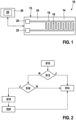
- Figure 1 shows a top view of a sensor 10 for detecting particles in a measuring gas according to an embodiment of the present invention.
- the sensor 10 is designed in particular for detecting soot particles in a gas flow, such as an exhaust gas flow, of an internal combustion engine and for installation in an exhaust system of a motor vehicle.
- the sensor 10 is designed as a soot sensor and can be arranged downstream or upstream of a soot particle filter of a motor vehicle with a diesel combustion engine.
- the measuring gas is exhaust gas from an internal combustion engine.
- the sensor 10 is designed as a resistive particle sensor.
- the sensor 10 comprises a sensor element 12.
- the sensor element 12 comprises an electrically insulating element 14.
- the electrically insulating element 14 is a substrate.
- the substrate is, for example, a silicon wafer. Alternatively, the substrate is made of a ceramic material.
- the electrically insulating element 14 is essentially cuboid-shaped.
- the sensor element 10 further comprises a first electrode 16, a second electrode 18, a first supply line 20 and a second supply line 22.
- the first electrode 16, the second electrode 18, the first supply line 20 and the second supply line 22 are arranged on an upper side 24 of the substrate 14.
- the first electrode 16 and the second electrode 18 are designed as interdigital electrodes.
- the first electrode 16 is connected to the first supply line 20.
- the second electrode 18 is connected to the second supply line 22.
- the first supply line 20 and the second supply line 22 represent connection contacts which are designed to electrically contact the first electrode 16 and the second electrode 18.
- the first electrode 16 and the second electrode 18 are designed to carry out a current and/or voltage measurement.
- the sensor 10 can optionally have further components, such as a protective tube and/or a heating element, which are not shown in detail.
- the sensor is operated in at least one measuring phase. During the measuring phase, the first electrode 16 and the second electrode 18 a first electrical voltage of, for example, 45 V is applied,
- the sensor 10 is connected to an electronic control unit 26.
- the electronic control unit 26 is, for example, an engine control unit of the internal combustion engine.
- the electronic control unit has an electronic storage medium 28, such as a chip, on which a computer program is stored.
- the computer program contains instructions for carrying out a method for operating the sensor 10. Such a method is described in more detail below.
- FIG. 2 shows a flow chart of a method for operating a sensor 10 for detecting particles according to an embodiment of the present invention, such as the method described in Figure 1 shown sensor 10.
- step S10 the internal combustion engine is started.
- step S12 a check is made as to whether the sensor 10 is in a period outside the measuring phase.
- the period outside the measuring phase is, for example, a cold start of the internal combustion engine, a lack of dew point end release by an engine control unit of the internal combustion engine and/or if a predetermined temperature in the exhaust tract is undershot. If the check in step S12 shows that it is not a cold start, that dew point end release is present and/or that the predetermined temperature in the exhaust tract is exceeded, the presence of moisture on the sensor element 12 can be ruled out. In this case, the method proceeds to step S14, where it switches to the measuring phase.
- step S16 a predetermined period of time outside the measuring phase is determined and the method proceeds to step S16.
- step S16 during the predetermined period of time outside the measuring phase, a second electrical voltage is applied to the first electrode 16 and the second electrode 18, wherein the second electrical voltage is less than a decomposition voltage for water.
- the second electrical voltage is a value in a range from 0.005 V to 1.2 V and preferably 0.05 V to 1.0 V, for example 0.8 V or 1.0 V.
- the sensor 10 is checked separately for possible presence of water on the sensor element 12.
- the sensor 10 is heated during the predetermined period of time outside the measuring phase. If the current and/or voltage measurement with the second electrical voltage applied results in a value that exceeds a threshold value for an electrical current, it is concluded that water is present on the sensor element 12.
- the first threshold value is, for example, 0 A. If the current and/or voltage measurement with the second electrical voltage applied in step S16 results in a value that exceeds a first threshold value for an electrical current, the method proceeds to step S18 and regeneration of the sensor 10 or a change to the measuring phase is prevented. If the first threshold value is not exceeded, water or moisture can be excluded and the method proceeds to step S14 and the measurement phase is changed to.
- Step S18 is followed by step S20, in which a regeneration of the sensor or a change to the measuring phase is enabled if the value of the current and/or voltage measurement falls below a second threshold value for an electrical current after exceeding the first threshold value.
- the second threshold value can be identical to the first threshold value or different from it. Thus, the release only takes place after the current at the electrodes 16, 18 has decreased. The method then proceeds to step S14 and the measurement phase is switched to.
- a regeneration of the sensor 10 or a change to the measuring phase is enabled after a predetermined time after the second threshold value has been undershot. In other words, after a current at the electrodes has subsided due to moisture, a certain amount of time is waited for in order to have safely removed moisture from the deeper ceramic layers of the sensor element 12 before the sensor element 12 is regenerated or connected to the measuring voltage.
- a regeneration of the sensor 10 or a change to the measuring phase is enabled if, in addition to the drop in current at the electrodes 16, 18, the sensor 10 receives an end of dew point release from an external source, such as the control unit 26. The sensor is heated to a temperature, the level of which depends on the value of the current and/or voltage measurement when the second electrical voltage is applied.
- the level of the current is evaluated by the connection to the second electrical voltage during the protective heating in order to determine the protective heating temperature for faster drying of the sensor element or for more gentle drying of the sensor element.
- a further modification of the method involves lowering the protective heating temperature significantly to unheated and using the inactive times of the sensor to connect the electrodes 16, 18 with 1V and to determine the moisture in the exhaust tract based on the current flowing through it and to make this additional information available to the engine control unit, or to determine the end of the dew point by measurement and not to rely on models.
Landscapes
- Engineering & Computer Science (AREA)
- Chemical & Material Sciences (AREA)
- Combustion & Propulsion (AREA)
- General Physics & Mathematics (AREA)
- Physics & Mathematics (AREA)
- Mechanical Engineering (AREA)
- General Engineering & Computer Science (AREA)
- Life Sciences & Earth Sciences (AREA)
- Analytical Chemistry (AREA)
- Biochemistry (AREA)
- General Health & Medical Sciences (AREA)
- Health & Medical Sciences (AREA)
- Immunology (AREA)
- Pathology (AREA)
- Dispersion Chemistry (AREA)
- Investigating Or Analyzing Materials By The Use Of Electric Means (AREA)
Description
- Aus dem Stand der Technik sind zahlreiche Verfahren und Vorrichtungen zur Detektion von Teilchen, wie beispielsweise Ruß- oder Staubpartikeln, bekannt.
- Die Erfindung wird im Folgenden, ohne Beschränkung weiterer Ausführungsformen und -anwendungen, insbesondere unter Bezugnahme auf Sensoren zur Detektion von Teilchen, insbesondere von Rußpartikeln in einem Abgasstrom einer Brennkraftmaschine, beschrieben.
- Es ist aus der Praxis bekannt, mittels zwei Elektroden, die auf einer Keramik angeordnet sind, eine Konzentration von Teilchen, wie beispielsweise Ruß- oder Staubpartikeln, in einem Abgas zu messen. Dies kann beispielsweise durch eine Messung des elektrischen Widerstands des die beiden Elektroden trennenden keramischen Werkstoffs erfolgen. Genauer wird der elektrische Strom gemessen, der beim Anlegen einer elektrischen Spannung an die Elektroden zwischen diesen fließt. Die Rußpartikel lagern sich aufgrund elektrostatischer Kräfte zwischen den Elektroden ab und bilden mit der Zeit elektrisch leitfähige Brücken zwischen den Elektroden. Je mehr dieser Brücken vorhanden sind, umso mehr steigt der gemessene Strom. Es bildet sich somit ein zunehmender Kurzschluss der Elektroden. Das Sensorelement wird periodisch regeneriert, in dem er durch ein integriertes Heizelement auf mindestens 700°C gebracht wird, wodurch die Rußablagerungen wegbrennen.
- Derartige Sensoren werden beispielsweise in einem Abgasstrang einer Brennkraftmaschine, wie beispielsweise einem Verbrennungsmotor der Dieselbauart eingesetzt. Üblicherweise befinden sich diese Sensoren stromabwärts des Auslassventils bzw. des Rußpartikelfilters.
- Trotz der zahlreichen Vorteile der aus dem Stand der Technik bekannten Vorrichtungen zur Detektion von Teilchen beinhalten diese noch Verbesserungspotenzial. Das keramische Sensorelement ist empfindlich gegenüber ankommender Feuchte bzw. anfällig für hydrothermale Alterung. Verschiedenste Schädigungsmechanismen am Sensorelement durch Wasser oder Kondensat sind bekannt und eine zuverlässige Erkennung der Trocknung der Elektroden bisher nicht möglich.
- Derartige Sensoren und zugehörige Betriebsverfahren sind beispielsweise bekannt aus der
DE 10 2011 086 148 A1 , derEP 1 898 205 A2 , derUS 2018/313 739 A1 , derUS 2011/107 815 A1 , derUS 2012/031 168 A1 und derDE 10 2015 215 848 A1 . - Es wird daher gemäß Anspruch 1 ein Verfahren zum Betreiben eines Sensors zur Detektion von Teilchen, insbesondere von Rußpartikeln vorgeschlagen, welches die Nachteile bekannter Betriebsverfahren zumindest weitgehend vermeidet und insbesondere die Erkennung von Feuchtigkeit im Elektroden-Bereich erlaubt und nicht allein von der Taupunktendebedatung abhängig zu sein, um auf Feuchte im Sensorelement zu schließen.
- Bei einem erfindungsgemäßen Verfahren zum Betreiben eines Sensors zur Detektion von Teilchen, insbesondere von Rußpartikeln, in einem Messgas, insbesondere im Abgas einer Brennkraftmaschine, wobei der Sensor ein Sensorelement aufweist, wobei das Sensorelement mindestens ein elektrisch isolierendes Element Substrat, eine erste Elektrode und eine zweite Elektrode aufweist, wobei die erste Elektrode und die zweite Elektrode an dem elektrisch isolierenden Element angeordnet sind, führen die erste Elektrode und die zweite Elektrode eine Strom- und/oder Spannungsmessung durch. Der Sensor wird in mindestens einer Messphase betrieben. Während der Messphase wird an die erste Elektrode und die zweite Elektrode eine erste elektrische Spannung angelegt. Während eines vorbestimmten Zeitraums außerhalb der Messphase wird an die erste Elektrode und die zweite Elektrode eine zweite elektrische Spannung angelegt. Die zweite elektrische Spannung ist kleiner als eine Zersetzungsspannung für Wasser (1,23 V). Dabei wird auf das Vorhandensein von Wasser auf dem Sensorelement geschlossen, falls die Strom- und/oder Spannungsmessung bei angelegter zweiter elektrischer Spannung einen Wert ergibt, der einen Schwellwert für einen elektrischen Strom überschreitet.
- Die hier vorgeschlagene Betriebsstrategie ermöglicht es, Feuchte, welche die Elektroden kurzschließt, zu erkennen und somit eine Regeneration oder das Einschalten der Messspannung zu verhindern. Sowohl Feuchte während der Regeneration als auch das Anlegen der Messspannung am feuchten Sensorelement würden das Sensorelement schädigen. Abplatzer und Platinversprödung wären die Folge. Insbesondere erlaubt das Verfahren die Bestimmung von Feuchte immer dann, wenn der Sensor nicht zur Partikelmessung verwendet wird. Das Verfahren dient somit unter anderem zur aktiven Feuchtebestimmung an einem Sensor zur Partikelmessung.
- Bei einer Weiterbildung wird eine Regeneration des Sensors oder ein Wechsel in die Messphase verhindert, falls die Strom- und/oder Spannungsmessung bei angelegter zweiter elektrischer Spannung einen Wert ergibt, der einen ersten Schwellwert für einen elektrischen Strom überschreitet. Wird durch die vergleichsweise geringe zweite elektrische Spannung ein elektrischer Strom gemessen, ist klar, dass der Sensor durch Feuchte benetzt ist, und zum Schutz des Sensorelementes wird eine Regeneration oder Messphase verhindert bzw. blockiert.
- Bei einer Weiterbildung wird eine Regeneration des Sensors oder ein Wechsel in die Messphase freigegeben, falls der Wert der Strom- und/oder Spannungsmessung nach dem Überschreiten des ersten Schwellwerts einen zweiten Schwellwert für einen elektrischen Strom unterschreitet. Der erste Schwellwert und der zweite Schwellwert können sich voneinander unterscheiden oder identisch sein. Wird durch die vergleichsweise geringe zweite elektrische Spannung ein elektrischer Strom gemessen, ist klar, dass der Sensor durch Feuchte benetzt ist, und zum Schutz des Sensorelementes wird eine Regeneration oder Messphase nur nach einem Rückgang des Stromes an den Elektroden. So können die Elektroden zusätzlich geschützt werden. Durch das Anlegen dieser sehr geringen Spannung an die Elektroden wird verhindert, dass durch Elektrolyse die Elektroden geschädigt werden, und so werden die Elektroden aktiv geschützt.
- Bei einer Weiterbildung wird eine Regeneration des Sensors oder ein Wechsel in die Messphase nach einer vorbestimmten Zeit nach einem Unterschreiten des zweiten Schwellwerts freigegeben. Eine Abwandlung des Verfahrens sieht somit vor, nach Abklingen eines Stromes an den Elektroden durch Feuchte noch eine gewisse Zeit zu warten, um Feuchte aus den tieferen Keramikschichten des Sensorelements auch sicher ausgetragen zu haben, bevor das Sensorelement regeneriert oder mit Messspannung beschalten wird.
- Bei einer Weiterbildung wird eine Regeneration des Sensors oder ein Wechsel in die Messphase freigegeben, falls der Sensor von extern, bevorzugt einem Steuergerät, eine Taupunktendefreigabe erhält. Somit erfolgt die Freigabe für eine Regeneration des Sensors oder ein Wechsel in die Messphase nur, falls keine Feuchte am Sensorelement (mehr) erfasst wird und zusätzlich eine Taupunktendefreigabe vorliegt.
- Bei einer Weiterbildung der Sensor während des vorbestimmten Zeitraums außerhalb der Messphase beheizt wird. Diese Heizen wird auch als Schutzheizen bezeichnet. Somit wird zum Schutz des keramischen Sensorelementes der Sensor mit einer Schutzheizstrategie betrieben, um weiteres Anlagern von Feuchte zu verhindern und um das Sensorelement zu trocknen.
- Bei einer Weiterbildung wird der Sensor auf eine Temperatur beheizt, deren Höhe von dem Wert der Strom- und/oder Spannungsmessung bei angelegter zweiter elektrischer Spannung abhängt. Somit wird die Höhe des Stromes während des Anlegens der zweiten elektrischen Spannung und während des Schutzheizens ausgewertet und die Schutzheiztemperatur zur schnelleren Trocknung des Sensorelementes oder zur schonenderen Trocknung des Sensorelementes angepasst.
- Bei einer Weiterbildung ist der Sensor in einem Abgastrakt einer Brennkraftmaschine angeordnet, wobei der vorbestimmte Zeitraum außerhalb der Messphase nach einem Kaltstart der Brennkraftmaschine, bei fehlender Taupunktendefreigabe durch ein Motorsteuergerät der Brennkraftmaschine und/oder bei Unterschreiten einer vorbestimmten Temperatur im Abgastrakt ist.
- Eine weitere Abwandlung des Verfahrens sieht vor, die Schutzheiztemperatur stark abzusenken bis zu unbeheizt und die inaktiven Zeiten des Sensors zu nutzen, um mit 1V die Elektroden zu beschalten und anhand des dadurch fließenden Stromes Feuchtigkeit im Abgastrakt zu bestimmen und diese Zusatzinformation dem Motorsteuergerät zur Verfügung zu stellen, bzw. Taupunktende durch Messung zu bestimmen und nicht auf Modelle angewiesen zu sein.
- Bei einer Weiterbildung ist die zweite elektrische Spannung einen Wert in einem Bereich von 0,005 V bis 1,2 V und bevorzugt 0,05 V bis 1,0 V.
- Es wird weiterhin gemäß Anspruch 10 ein Computerprogramm umfassend Befehle vorgeschlagen, welche bewirken, dass ein mit einem Sensor zur Detektion von Partikeln verbundenes elektronisches Steuergerät jeden Schritt des erfindungsgemäßen Verfahrens durchführt.
- Es wird weiterhin gemäß Anspruch 11 ein elektronisches Speichermedium vorgeschlagen, auf welchem ein solches Computerprogramm gespeichert ist.
- Es wird weiterhin gemäß Anspruch 12 ein elektronisches Steuergerät vorgeschlagen, welches ein solches elektronisches Speichermedium umfasst.
- Unter einem Teilchen im Sinne der vorliegenden Erfindung ist ein Partikel, insbesondere ein elektrisch leitfähiges Teilchen, zu verstehen, wie beispielsweise Ruß- oder Staubpartikel.
- Unter einer Elektrode ist im Rahmen der vorliegenden Erfindung ein Bauteil zu verstehen, das für eine Strom- und/oder Spannungsmessung geeignet ist. Die Angaben erste und zweite Elektrode werden im Rahmen der vorliegenden Erfindung lediglich verwendet, um die Elektroden begrifflich zu unterscheiden, sollen aber keine bestimmte Reihenfolge oder Gewichtung dieser Bauteile angeben.
- Im Rahmen der vorliegenden Erfindung können die Elektroden als Interdigitalelektroden ausgebildet sein. Unter Interdigitalelektroden sind im Rahmen der vorliegenden Erfindung Elektroden zu verstehen, die so angeordnet sind, dass sie ineinander eingreifen, insbesondere kammförmig ineinander eingreifen.
- Unter einer Strom- und/oder Spannungsmessung ist im Rahmen der vorliegenden Erfindung eine Messung eines elektrischen Stroms und/oder einer elektrischen Spannung zu verstehen. Die Messung erfolgt dabei zwischen zwei Elektroden bzw. einer Elektrode und einem Bezugspotential. Dabei kann an die Elektroden eine bestimmte elektrische Spannung angelegt werden und ein Stromfluss zwischen den Elektroden gemessen werden oder an die Elektroden ein elektrischer Strom angelegt werden und eine Spannung zwischen den Elektroden gemessen werden. Eine Strom- und/oder Spannungsmessung kann insbesondere eine Widerstandsmessung sein, wobei ein Widerstand des durch die Elektroden und das Substrat gebildeten Aufbaus gemessen werden kann. Es kann beispielsweise eine spannungsgesteuerte oder spannungsgeregelte Messung und/oder eine stromgesteuerte und/oder stromgeregelte Messung erfolgen. Das Anlegen des Stroms und/oder der elektrischen Spannung kann in Form eines kontinuierlichen Signals und/oder auch in Form eines gepulsten Signals erfolgen. So kann beispielsweise eine Gleichspannung und/oder ein Gleichstrom angelegt werden und eine Stromantwort bzw. eine Spannungsantwort erfasst werden. Alternativ kann eine gepulste Spannung und/oder ein gepulster Strom angelegt werden und eine Stromantwort bzw. eine Spannungsantwort erfasst werden. Statt des momentanen Stromflusses durch die Elektroden kann auch ein Widerstand der Elektroden bzw. dessen Kehrwert (=Leitwert) als Messgröße verwendet werden. Auch kann es sinnvoll sein, aus einem momentanen Stromfluss eine Ladungsmenge zu integrieren. Weiterhin ist es möglich eine Hochspannung an eine Elektrode anzulegen und an einer Gegenelektrode oder einer elektrischen Masse einen elektrischen Strom, wie beispielsweise einem Entladestrom, zu messen.
- Unter einer Messphase ist im Rahmen der vorliegenden Erfindung ein Zeitraum zu verstehen, in dem eine an die Elektroden angelegte Spannung oder Spannungsform derart gewählt ist, dass sie eine möglichst genaue Bestimmung des Widerstandes beziehungsweise der Impedanz und somit der Partikelbeladung des Sensors ermöglicht. Die Spannung während der Messphase muss dabei nicht für das Sammeln von Partikeln aus dem Messgas geeignet oder optimiert sein.
- Unter einem Substrat ist im Rahmen der vorliegenden Erfindung ein Gegenstand mit einer plattenförmigen, würfelförmigen, quaderförmigen oder jeglichen anderen geometrischen Ausbildung zu verstehen, der mindestens eine ebene Oberfläche aufweist und aus einem keramischen Material, metallischen Material, Halbleitermaterial oder Kombinationen derselben hergestellt ist.
- Unter einer Zersetzungsspannung für Wasser ist im Rahmen der vorliegenden Erfindung die zur Durchführung einer Elektrolyse von Wasser mindestens benötigte Differenz der Elektrodenpotentiale von Anode und Kathode zu verstehen. Bei dieser Spannung beginnt die Zersetzung des Elektrolyten durch elektrische Anziehungskräfte, die zwischen den Elektroden einerseits und den jeweils entgegengesetzt geladenen Anionen bzw. Kationen andererseits wirken. Elektrolyse nennt man einen Prozess, bei dem elektrischer Strom eine Redoxreaktion erzwingt. Eine Elektrolyse erfordert eine Gleichspannungsquelle, welche die elektrische Energie liefert und die chemischen Umsetzungen vorantreibt. Ein Teil der elektrischen Energie wird in chemische Energie umgewandelt. Für Wasser ist die Zersetzungsspannung im Rahmen der vorliegenden Erfindung 1,23 V.
- Ein Grundgedanke der vorliegenden Erfindung ist, eine Spannung unterhalb der Zersetzungsspannung von Wasser an die Elektroden während des Schutzheizens anzulegen, um durch den Kurzschluss durch Wasser auf den Elektroden Feuchte zu erkennen. Wird durch diese geringe Spannung ein elektrischer Strom gemessen, ist klar, dass der Sensor durch Feuchte benetzt ist, und zum Schutz des Sensorelementes wird eine Regeneration oder Messphase nur freigegeben nach Taupunktfreigabe und Rückgang des Stromes an den Elektroden. So können die Elektroden zusätzlich geschützt werden. Durch das Anlegen dieser sehr geringen Spannung an die Elektroden wird verhindert, dass durch Elektrolyse die Elektroden geschädigt werden, und so werden die Elektroden aktiv geschützt.
- Weitere optionale Einzelheiten und Merkmale der Erfindung ergeben sich aus der nachfolgenden Beschreibung bevorzugter Ausführungsbeispiele, welche in den Figuren schematisch dargestellt sind.
- Es zeigen:
-
Figur 1 eine Draufsicht auf einen Sensor zur Detektion von Teilchen gemäß einer Ausführungsform der vorliegenden Erfindung und -
Figur 2 ein Flussdiagramm eines Verfahrens zum Betreiben eines Sensors zur Detektion von Teilchen gemäß einer Ausführungsform der vorliegenden Erfindung. -
Figur 1 zeigt eine Draufsicht auf einen Sensor 10 zur Detektion von Teilchen in einem Messgas gemäß einer Ausführungsform der vorliegenden Erfindung. Der Sensor 10 ist insbesondere zur Detektion von Rußpartikeln in einem Gasstrom, wie beispielsweise einem Abgasstrom, einer Brennkraftmaschine und zum Einbau in einem Abgasstrang eines Kraftfahrzeugs ausgebildet. Beispielsweise ist der Sensor 10 als Rußsensor ausgebildet und lässt sich stromabwärts oder stromaufwärts eines Rußpartikelfilters eines Kraftfahrzeugs mit einem Dieselverbrennungsmotor anordnen. Bei dem gezeigten Beispiel handelt es sich bei dem Messgas um Abgas einer Brennkraftmaschine. Der Sensor 10 ist bei dem gezeigten Ausführungsbeispiel als resistiver Partikelsensor ausgebildet. - Der Sensor 10 umfasst ein Sensorelement 12. Das Sensorelement 12 umfasst ein elektrisch isolierendes Element 14. Das elektrisch isolierende Element 14 ist ein Substrat. Das Substrat ist beispielsweise ein Siliziumwafer. Alternativ ist das Substrat aus einem keramischen Material hergestellt. Das elektrisch isolierende Element 14 ist im Wesentlichen quaderförmig ausgebildet. Das Sensorelement 10 umfasst weiterhin eine erste Elektrode 16, eine zweite Elektrode 18, eine erste Zuleitung 20 und eine zweite Zuleitung 22. Die erste Elektrode 16, die zweite Elektrode 18, die erste Zuleitung 20 und die zweite Zuleitung 22 sind auf einer Oberseite 24 des Substrats 14 angeordnet. Die erste Elektrode 16 und die zweite Elektrode 18 sind als Interdigitalelektroden ausgebildet. Die erste Elektrode 16 ist mit der ersten Zuleitung 20 verbunden. Die zweite Elektrode 18 ist mit der zweiten Zuleitung 22 verbunden. Die erste Zuleitung 20 und die zweite Zuleitung 22 stellen Anschlusskontakte dar, die zum elektrischen Kontaktieren der ersten Elektrode 16 und der zweiten Elektrode 18 ausgebildet sind. Die erste Elektrode 16 und die zweite Elektrode 18 sind zum Durchführen einer Strom- und/oder Spannungsmessung ausgebildet. Der Sensor 10 kann optional weitere Bauteile aufweisen, wie beispielsweise ein Schutzrohr und/oder ein Heizelement, die nicht näher dargestellt sind. Der Sensor wird in mindestens einer Messphase betrieben. Während der Messphase wird an die erste Elektrode 16 und die zweite Elektrode 18 eine erste elektrische Spannung von beispielsweise 45 V angelegt,
- Der Sensor 10 ist mit einem elektronischen Steuergerät 26 verbunden. Das elektronische Steuergerät 26 ist beispielsweise ein Motorsteuergerät der Brennkraftmaschine. Das elektronische Steuergerät weist ein elektronisches Speichermedium 28, wie beispielsweise einen Chip, auf, auf dem ein Computerprogramm gespeichert ist. Das Computerprogramm enthält Anweisungen zum Durchführen eines Verfahrens zum Betreiben des Sensors 10. Ein solches Verfahren wird nachstehend ausführlicher beschrieben.
-
Figur 2 zeigt ein Flussdiagramm eines Verfahrens zum Betreiben eines Sensors 10 zur Detektion von Teilchen gemäß einer Ausführungsform der vorliegenden Erfindung, wie beispielsweise des inFigur 1 dargestellten Sensors 10. In Schritt S10 wird die Brennkraftmaschine gestartet. In Schritt S12 wird geprüft, ob sich der Sensor 10 sich in einem Zeitraum außerhalb der Messphase befindet. Um den Zeitraum außerhalb der Messphase handelt es sich beispielsweise bei einem Kaltstart der Brennkraftmaschine, fehlender Taupunktendefreigabe durch ein Motorsteuergerät der Brennkraftmaschine und/oder bei Unterschreiten einer vorbestimmten Temperatur im Abgastrakt. Ergibt die Prüfung in Schritt S12, dass es sich nicht um einen Kaltstart handelt, eine Taupunktendefreigabe vorliegt und/oder die vorbestimmte Temperatur im Abgastrakt überschritten ist, kann das Vorhandensein von Feuchte an dem Sensorelement 12 ausgeschlossen werden. In diesem Fall schreitet das Verfahren zu Schritt S14 fort, bei dem in die Messphase gewechselt wird. - Ergibt die Prüfung in Schritt S12, dass es sich um einen Kaltstart handelt, eine Taupunktendefreigabe nicht vorliegt und/oder die vorbestimmte Temperatur im Abgastrakt unterschritten ist, wird ein vorbestimmter Zeitraum außerhalb der Messphase bestimmt und das Verfahren schreitet zu Schritt S16 fort. In Schritt S16 wird während des vorbestimmten Zeitraums außerhalb der Messphase an die erste Elektrode 16 und die zweite Elektrode 18 eine zweite elektrische Spannung angelegt, wobei die zweite elektrische Spannung kleiner als eine Zersetzungsspannung für Wasser ist. Die zweite elektrische Spannung ist ein Wert in einem Bereich von 0,005 V bis 1,2 V und bevorzugt 0,05 V bis 1,0 V, beispielsweise 0,8 V oder 1,0 V. Zusätzlich zu potentiellen Freigaben von außerhalb des Sensors 10, erfolgt eine eigene Überprüfung des Sensors 10 auf mögliches Vorhandensein von Wasser auf dem Sensorelement12. Der Sensor 10 wird während des vorbestimmten Zeitraums außerhalb der Messphase beheizt. Falls die Strom- und/oder Spannungsmessung bei angelegter zweiter elektrischer Spannung einen Wert ergibt, der einen Schwellwert für einen elektrischen Strom überschreitet, wird auf das Vorhandensein von Wasser auf dem Sensorelement 12 geschlossen. Der erste Schwellwert ist beispielsweise 0 A. Falls die Strom- und/oder Spannungsmessung bei angelegter zweiter elektrischer Spannung in Schritt S16 einen Wert ergibt, der einen ersten Schwellwert für einen elektrischen Strom überschreitet, schreitet das Verfahren zu Schritt S18 fort und eine Regeneration des Sensors 10 oder ein Wechsel in die Messphase wird verhindert. Wird der erste Schwellwert nicht überschritten, kann Wasser bzw. Feuchte ausgeschlossen werden und das Verfahren schreitet zu Schritt S14 fort und es wird in die Messphase gewechselt. Im Anschluss an Schritt S18 folgt Schritt S20, bei dem eine Regeneration des Sensors oder ein Wechsel in die Messphase freigegeben wird, falls der Wert der Strom- und/oder Spannungsmessung nach dem Überschreiten des ersten Schwellwerts einen zweiten Schwellwert für einen elektrischen Strom unterschreitet. Der zweite Schwellwert kann identisch zu dem ersten Schwellwert sein oder sich davon unterscheiden. Somit erfolgt die Freigabe erst nach Rückgang des Stromes an den Elektroden 16, 18. Das Verfahren schreitet dann zu Schritt S14 fort und es wird in die Messphase gewechselt.
- Das Verfahren kann wie folgt modifiziert werden. Eine Regeneration des Sensors 10 oder ein Wechsel in die Messphase wird nach einer vorbestimmten Zeit nach einem Unterschreiten des zweiten Schwellwerts freigegeben. Mit anderen Worten wird nach Abklingen eines Stromes an den Elektroden durch Feuchte noch eine gewisse Zeit gewartet, um Feuchte aus den tieferen Keramikschichten des Sensorelements 12 auch sicher ausgetragen zu haben, bevor das Sensorelement 12 regeneriert oder mit Messspannung beschalten wird. Eine Regeneration des Sensors 10 oder ein Wechsel in die Messphase wird freigegeben, falls zusätzlich zu dem Rückgang des Stroms an den Elektroden 16, 18 der Sensor 10 von extern, wie beispielsweise dem Steuergerät 26, eine Taupunktendefreigabe erhält. Der Sensor wird auf eine Temperatur beheizt, deren Höhe von dem Wert der Strom- und/oder Spannungsmessung bei angelegter zweiter elektrischer Spannung abhängt. Mit anderen Worten wird die Höhe des Stroms durch die Beschaltung mit der zweiten elektrischen Spannung während des Schutzheizens ausgewertet, um die Schutzheiztemperatur zur schnelleren Trocknung des Sensorelementes oder zur schonenderen Trocknung des Sensorelementes anzupassen. Eine weitere Abwandlung des Verfahrens sieht vor, die Schutzheiztemperatur stark abzusenken bis zu unbeheizt und die inaktiven Zeiten des Sensors zu nutzen, um mit 1V die Elektroden 16, 18 zu beschalten und anhand des dadurch fließenden Stroms Feuchtigkeit im Abgastrakt zu bestimmen und diese Zusatzinformation dem Motorsteuergerät zur Verfügung zu stellen, bzw. Taupunktende durch Messung zu bestimmen und nicht auf Modelle angewiesen zu sein.
Claims (12)
- Verfahren zum Betreiben eines Sensors (10) zur Detektion von Teilchen, insbesondere von Rußpartikeln, in einem Messgas, insbesondere im Abgas einer Brennkraftmaschine, wobei der Sensor (10) ein Sensorelement (12) umfasst, wobei das Sensorelement (12) mindestens ein elektrisch isolierendes Element (14), eine erste Elektrode (16) und eine zweite Elektrode (18) aufweist, wobei die erste Elektrode (16) und die zweite Elektrode (18) an dem elektrisch isolierenden Element (14) angeordnet sind, wobei die erste Elektrode (16) und die zweite Elektrode (18) eine Strom- und/oder Spannungsmessung durchführen, wobei der Sensor (10) in mindestens einer Messphase betrieben wird, wobei während der Messphase an die erste Elektrode (16) und die zweite Elektrode (18) eine erste elektrische Spannung angelegt wird, wobei während eines vorbestimmten Zeitraums außerhalb der Messphase an die erste Elektrode (16) und die zweite Elektrode (18) eine zweite elektrische Spannung angelegt wird, ist; wobei auf das Vorhandensein von Wasser auf dem Sensorelement (12) geschlossen wird, falls die Strom- und/oder Spannungsmessung bei angelegter zweiter elektrischer Spannung einen Wert ergibt, der einen Schwellwert für einen elektrischen Strom überschreitet, dadurch gekennzeichnet, dass die zweite elektrische Spannung kleiner ist als eine Zersetzungsspannung für Wasser, welche 1,23 V beträgt.
- Verfahren nach Anspruch 1, wobei eine Regeneration des Sensors (10) oder ein Wechsel in die Messphase verhindert wird, falls die Strom- und/oder Spannungsmessung bei angelegter zweiter elektrischer Spannung einen Wert ergibt, der einen ersten Schwellwert für einen elektrischen Strom überschreitet.
- Verfahren nach Anspruch 2, wobei eine Regeneration des Sensors (10) oder ein Wechsel in die Messphase freigegeben wird, falls der Wert der Strom- und/oder Spannungsmessung nach dem Überschreiten des ersten Schwellwerts einen zweiten Schwellwert für einen elektrischen Strom unterschreitet.
- Verfahren nach Anspruch 3, wobei eine Regeneration des Sensors (10) oder ein Wechsel in die Messphase nach einer vorbestimmten Zeit nach einem Unterschreiten des zweiten Schwellwerts freigegeben wird.
- Verfahren nach einem der Ansprüche 2 bis 4, wobei eine Regeneration des Sensors (10) oder ein Wechsel in die Messphase freigegeben wird, falls der Sensor (10) von extern, bevorzugt einem Steuergerät (26), eine Taupunktendefreigabe erhält.
- Verfahren nach einem der Ansprüche 1 bis 5, wobei der Sensor (10) während des vorbestimmten Zeitraums außerhalb der Messphase beheizt wird.
- Verfahren nach Anspruch 6, wobei der Sensor (10) auf eine Temperatur beheizt wird, deren Höhe von dem Wert der Strom- und/oder Spannungsmessung bei angelegter zweiter elektrischer Spannung abhängt.
- Verfahren nach einem der Ansprüche 1 bis 7, wobei der Sensor (10) in einem Abgastrakt einer Brennkraftmaschine angeordnet ist, wobei der vorbestimmte Zeitraum außerhalb der Messphase nach einem Kaltstart der Brennkraftmaschine, bei fehlender Taupunktendefreigabe durch ein Motorsteuergerät der Brennkraftmaschine und/oder bei Unterschreiten einer vorbestimmten Temperatur im Abgastrakt ist.
- Verfahren nach einem der Ansprüche 1 bis 8, wobei die zweite elektrische Spannung einen Wert in einem Bereich von 0,005 V bis 1,2 V und bevorzugt 0,05 V bis 1,0 V ist.
- Computerprogramm, umfassend Befehle, welche bewirken, dass ein mit einem Sensor zur Detektion von Partikeln verbundenes elektronisches Steuergerät jeden Schritt des Verfahrens nach einem der Ansprüche 1 bis 9 durchführt.
- Elektronisches Speichermedium (28), auf welchem ein Computerprogramm nach Anspruch 10 gespeichert ist.
- Elektronisches Steuergerät (26), welches ein elektronisches Speichermedium (28) nach Anspruch 11 umfasst.
Applications Claiming Priority (2)
| Application Number | Priority Date | Filing Date | Title |
|---|---|---|---|
| DE102018221567.7A DE102018221567A1 (de) | 2018-12-12 | 2018-12-12 | Verfahren zum Betreiben eines Sensors zur Detektion von Teilchen in einem Messgas |
| PCT/EP2019/078670 WO2020119985A1 (de) | 2018-12-12 | 2019-10-22 | Verfahren zum betreiben eines sensors zur detektion von teilchen in einem messgas |
Publications (2)
| Publication Number | Publication Date |
|---|---|
| EP3894832A1 EP3894832A1 (de) | 2021-10-20 |
| EP3894832B1 true EP3894832B1 (de) | 2024-12-11 |
Family
ID=68382406
Family Applications (1)
| Application Number | Title | Priority Date | Filing Date |
|---|---|---|---|
| EP19794931.6A Active EP3894832B1 (de) | 2018-12-12 | 2019-10-22 | Verfahren zum betreiben eines sensors zur detektion von teilchen in einem messgas |
Country Status (6)
| Country | Link |
|---|---|
| US (1) | US20220026335A1 (de) |
| EP (1) | EP3894832B1 (de) |
| KR (1) | KR20210100110A (de) |
| CN (1) | CN113167711B (de) |
| DE (1) | DE102018221567A1 (de) |
| WO (1) | WO2020119985A1 (de) |
Families Citing this family (2)
| Publication number | Priority date | Publication date | Assignee | Title |
|---|---|---|---|---|
| DE102020205944A1 (de) * | 2020-05-12 | 2021-11-18 | Robert Bosch Gesellschaft mit beschränkter Haftung | Sensor zur Erfassung mindestens einer Eigenschaft eines Messgases |
| DE102021208577A1 (de) * | 2021-08-06 | 2023-02-09 | Robert Bosch Gesellschaft mit beschränkter Haftung | Verfahren zum Betreiben eines Abgassensors in einem Abgastrakt einer Brennkraftmaschine eines Kraftfahrzeugs |
Citations (2)
| Publication number | Priority date | Publication date | Assignee | Title |
|---|---|---|---|---|
| DE102010011635A1 (de) * | 2010-03-16 | 2011-09-22 | Continental Automotive Gmbh | Betriebsverfahren eines Rußsensors mit einer Kammstruktur |
| DE102011006923A1 (de) * | 2011-04-07 | 2012-10-11 | Robert Bosch Gmbh | Vorrichtung und Verfahren zur Diagnose der Funktion eines Partikelsensors |
Family Cites Families (9)
| Publication number | Priority date | Publication date | Assignee | Title |
|---|---|---|---|---|
| DE102006042508B4 (de) * | 2006-09-07 | 2016-05-12 | Abb Ag | Sensoranordnung, Vorrichtung und Verfahren zur vorausschauenden Ermittlung verschmutzungsbedingter Störfälle einer Schaltanlage, sowie demgemäße Schaltanlage |
| DE102007014761B4 (de) * | 2007-03-28 | 2022-05-12 | Robert Bosch Gmbh | Verfahren zum Betreiben eines sammelnden Partikelsensors und Vorrichtung zur Durchführung des Verfahrens |
| US8230716B2 (en) * | 2009-11-09 | 2012-07-31 | Delphi Technologies, Inc. | Method and system for diagnostics of a particulate matter sensor |
| JP5408069B2 (ja) * | 2010-08-06 | 2014-02-05 | 株式会社デンソー | センサ制御装置及びこれを備える排気処理システム |
| DE102011086148A1 (de) * | 2011-11-11 | 2013-05-16 | Robert Bosch Gmbh | Verfahren und Vorrichtung zum Betreiben eines resistiven Sensors im Abgaskanal einer Brennkraftmaschine |
| DE102012210525A1 (de) * | 2012-06-21 | 2013-12-24 | Robert Bosch Gmbh | Verfahren zur Funktionskontrolle eines Sensors zur Detektion von Teilchen und Sensor zur Detektion von Teilchen |
| DE102013202980A1 (de) * | 2013-02-22 | 2014-08-28 | Robert Bosch Gmbh | Verfahren und Vorrichtung zur Regeneration eines Partikelsensors |
| DE102015215848B4 (de) * | 2015-08-19 | 2019-09-05 | Continental Automotive Gmbh | Verfahren zur Funktionsüberwachung eines elektrostatischen Rußsensors |
| JP6365501B2 (ja) * | 2015-10-21 | 2018-08-01 | 株式会社デンソー | 粒子状物質検出装置 |
-
2018
- 2018-12-12 DE DE102018221567.7A patent/DE102018221567A1/de active Pending
-
2019
- 2019-10-22 WO PCT/EP2019/078670 patent/WO2020119985A1/de not_active Ceased
- 2019-10-22 US US17/299,603 patent/US20220026335A1/en not_active Abandoned
- 2019-10-22 EP EP19794931.6A patent/EP3894832B1/de active Active
- 2019-10-22 KR KR1020217017980A patent/KR20210100110A/ko not_active Ceased
- 2019-10-22 CN CN201980082374.3A patent/CN113167711B/zh active Active
Patent Citations (2)
| Publication number | Priority date | Publication date | Assignee | Title |
|---|---|---|---|---|
| DE102010011635A1 (de) * | 2010-03-16 | 2011-09-22 | Continental Automotive Gmbh | Betriebsverfahren eines Rußsensors mit einer Kammstruktur |
| DE102011006923A1 (de) * | 2011-04-07 | 2012-10-11 | Robert Bosch Gmbh | Vorrichtung und Verfahren zur Diagnose der Funktion eines Partikelsensors |
Also Published As
| Publication number | Publication date |
|---|---|
| CN113167711A (zh) | 2021-07-23 |
| WO2020119985A1 (de) | 2020-06-18 |
| EP3894832A1 (de) | 2021-10-20 |
| US20220026335A1 (en) | 2022-01-27 |
| CN113167711B (zh) | 2025-02-25 |
| DE102018221567A1 (de) | 2020-06-18 |
| KR20210100110A (ko) | 2021-08-13 |
Similar Documents
| Publication | Publication Date | Title |
|---|---|---|
| DE102009028239B4 (de) | Verfahren zur Eigendiagnose eines Partikelsensors | |
| EP2864757B1 (de) | Verfahren zur funktionskontrolle eines sensors zur detektion von teilchen und sensor zur detektion von teilchen | |
| DE102010030634A1 (de) | Verfahren und Vorrichtung zum Betreiben eines Partikelsensors | |
| WO2020030324A1 (de) | Verfahren zum betreiben eines sensors zur detektion von teilchen in einem messgas | |
| EP3894832B1 (de) | Verfahren zum betreiben eines sensors zur detektion von teilchen in einem messgas | |
| EP3391024B1 (de) | Elektrostatischer russsensor | |
| EP3204750B1 (de) | Verfahren zur funktionskontrolle eines sensors zur detektion von teilchen, computerprogramm, elektronisches speichermedium und elektronisches steuergerät | |
| DE102015225739B4 (de) | Verfahren zum Betreiben eines elektrostatischen Rußsensors | |
| DE102007031767A1 (de) | Beheizbarer Abgassensor mit verbesserter Erkennung von Wasser an einer Oberfläche des Abgassensors | |
| WO2021228565A1 (de) | Sensor zur erfassung mindestens einer eigenschaft eines messgases und verfahren zum betreiben eines sensors | |
| EP4007903A1 (de) | Sensorelement zur erfassung von partikeln eines messgases in einem messgasraum | |
| DE102016220835A1 (de) | Sensorelement zur Erfassung von Partikeln eines Messgases in einem Messgasraum | |
| DE102021208577A1 (de) | Verfahren zum Betreiben eines Abgassensors in einem Abgastrakt einer Brennkraftmaschine eines Kraftfahrzeugs | |
| WO2017029074A1 (de) | VERFAHREN ZUR FUNKTIONSÜBERWACHUNG EINES ELEKTROSTATISCHEN RUßSENSORS | |
| DE102013216227A1 (de) | Kapazitive Eigendiagnose des Elektrodensystems eines Partikelsensors | |
| DE102017209392A1 (de) | Sensorelement zur Erfassung von Partikeln eines Messgases in einem Messgasraum | |
| DE102018222616A1 (de) | Verfahren zum Betreiben eines Sensors zur Detektion von Teilchen in einem Messgas | |
| DE102022203057A1 (de) | Verfahren zum Betreiben eines Sensors zur Erfassung mindestens einer Eigenschaft eines Messgases | |
| EP3586102B1 (de) | Verfahren zum betreiben eines elektrostatischen partikelsensors und elektrostatischer partikelsensor | |
| WO2018077615A1 (de) | Sensorelement zur erfassung von partikeln eines messgases in einem messgasraum | |
| DE102020212231A1 (de) | Verfahren zur Überwachung eines in einem Abgasbereich einer Brennkraftmaschine angeordneten Sensors | |
| DE102014208736A1 (de) | Sensor zur Detektion von Teilchen | |
| WO2019120790A1 (de) | Sensoranordnung zur erfassung von partikeln eines messgases in einem messgasraum und verfahren zur erfassung von partikeln eines messgases in einem messgasraum |
Legal Events
| Date | Code | Title | Description |
|---|---|---|---|
| STAA | Information on the status of an ep patent application or granted ep patent |
Free format text: STATUS: UNKNOWN |
|
| STAA | Information on the status of an ep patent application or granted ep patent |
Free format text: STATUS: THE INTERNATIONAL PUBLICATION HAS BEEN MADE |
|
| PUAI | Public reference made under article 153(3) epc to a published international application that has entered the european phase |
Free format text: ORIGINAL CODE: 0009012 |
|
| STAA | Information on the status of an ep patent application or granted ep patent |
Free format text: STATUS: REQUEST FOR EXAMINATION WAS MADE |
|
| 17P | Request for examination filed |
Effective date: 20210712 |
|
| AK | Designated contracting states |
Kind code of ref document: A1 Designated state(s): AL AT BE BG CH CY CZ DE DK EE ES FI FR GB GR HR HU IE IS IT LI LT LU LV MC MK MT NL NO PL PT RO RS SE SI SK SM TR |
|
| DAV | Request for validation of the european patent (deleted) | ||
| DAX | Request for extension of the european patent (deleted) | ||
| STAA | Information on the status of an ep patent application or granted ep patent |
Free format text: STATUS: EXAMINATION IS IN PROGRESS |
|
| 17Q | First examination report despatched |
Effective date: 20230929 |
|
| REG | Reference to a national code |
Ref country code: DE Ref legal event code: R079 Free format text: PREVIOUS MAIN CLASS: G01N0015060000 Ipc: F02D0041220000 Ref document number: 502019012655 Country of ref document: DE |
|
| GRAP | Despatch of communication of intention to grant a patent |
Free format text: ORIGINAL CODE: EPIDOSNIGR1 |
|
| STAA | Information on the status of an ep patent application or granted ep patent |
Free format text: STATUS: GRANT OF PATENT IS INTENDED |
|
| RIC1 | Information provided on ipc code assigned before grant |
Ipc: F02D 41/14 20060101ALN20240723BHEP Ipc: F02D 41/06 20060101ALN20240723BHEP Ipc: G01N 15/06 20060101ALI20240723BHEP Ipc: F02D 41/22 20060101AFI20240723BHEP |
|
| RIC1 | Information provided on ipc code assigned before grant |
Ipc: F02D 41/14 20060101ALN20240731BHEP Ipc: F02D 41/06 20060101ALN20240731BHEP Ipc: G01N 15/06 20060101ALI20240731BHEP Ipc: F02D 41/22 20060101AFI20240731BHEP |
|
| INTG | Intention to grant announced |
Effective date: 20240808 |
|
| GRAS | Grant fee paid |
Free format text: ORIGINAL CODE: EPIDOSNIGR3 |
|
| GRAA | (expected) grant |
Free format text: ORIGINAL CODE: 0009210 |
|
| STAA | Information on the status of an ep patent application or granted ep patent |
Free format text: STATUS: THE PATENT HAS BEEN GRANTED |
|
| AK | Designated contracting states |
Kind code of ref document: B1 Designated state(s): AL AT BE BG CH CY CZ DE DK EE ES FI FR GB GR HR HU IE IS IT LI LT LU LV MC MK MT NL NO PL PT RO RS SE SI SK SM TR |
|
| REG | Reference to a national code |
Ref country code: GB Ref legal event code: FG4D Free format text: NOT ENGLISH |
|
| REG | Reference to a national code |
Ref country code: CH Ref legal event code: EP |
|
| REG | Reference to a national code |
Ref country code: IE Ref legal event code: FG4D Free format text: LANGUAGE OF EP DOCUMENT: GERMAN |
|
| REG | Reference to a national code |
Ref country code: DE Ref legal event code: R096 Ref document number: 502019012655 Country of ref document: DE |
|
| REG | Reference to a national code |
Ref country code: LT Ref legal event code: MG9D |
|
| PG25 | Lapsed in a contracting state [announced via postgrant information from national office to epo] |
Ref country code: HR Free format text: LAPSE BECAUSE OF FAILURE TO SUBMIT A TRANSLATION OF THE DESCRIPTION OR TO PAY THE FEE WITHIN THE PRESCRIBED TIME-LIMIT Effective date: 20241211 |
|
| PG25 | Lapsed in a contracting state [announced via postgrant information from national office to epo] |
Ref country code: FI Free format text: LAPSE BECAUSE OF FAILURE TO SUBMIT A TRANSLATION OF THE DESCRIPTION OR TO PAY THE FEE WITHIN THE PRESCRIBED TIME-LIMIT Effective date: 20241211 |
|
| PG25 | Lapsed in a contracting state [announced via postgrant information from national office to epo] |
Ref country code: BG Free format text: LAPSE BECAUSE OF FAILURE TO SUBMIT A TRANSLATION OF THE DESCRIPTION OR TO PAY THE FEE WITHIN THE PRESCRIBED TIME-LIMIT Effective date: 20241211 |
|
| REG | Reference to a national code |
Ref country code: NL Ref legal event code: MP Effective date: 20241211 |
|
| PG25 | Lapsed in a contracting state [announced via postgrant information from national office to epo] |
Ref country code: ES Free format text: LAPSE BECAUSE OF FAILURE TO SUBMIT A TRANSLATION OF THE DESCRIPTION OR TO PAY THE FEE WITHIN THE PRESCRIBED TIME-LIMIT Effective date: 20241211 |
|
| PG25 | Lapsed in a contracting state [announced via postgrant information from national office to epo] |
Ref country code: NO Free format text: LAPSE BECAUSE OF FAILURE TO SUBMIT A TRANSLATION OF THE DESCRIPTION OR TO PAY THE FEE WITHIN THE PRESCRIBED TIME-LIMIT Effective date: 20250311 |
|
| PG25 | Lapsed in a contracting state [announced via postgrant information from national office to epo] |
Ref country code: GR Free format text: LAPSE BECAUSE OF FAILURE TO SUBMIT A TRANSLATION OF THE DESCRIPTION OR TO PAY THE FEE WITHIN THE PRESCRIBED TIME-LIMIT Effective date: 20250312 Ref country code: LV Free format text: LAPSE BECAUSE OF FAILURE TO SUBMIT A TRANSLATION OF THE DESCRIPTION OR TO PAY THE FEE WITHIN THE PRESCRIBED TIME-LIMIT Effective date: 20241211 |
|
| PG25 | Lapsed in a contracting state [announced via postgrant information from national office to epo] |
Ref country code: RS Free format text: LAPSE BECAUSE OF FAILURE TO SUBMIT A TRANSLATION OF THE DESCRIPTION OR TO PAY THE FEE WITHIN THE PRESCRIBED TIME-LIMIT Effective date: 20250311 |
|
| PG25 | Lapsed in a contracting state [announced via postgrant information from national office to epo] |
Ref country code: NL Free format text: LAPSE BECAUSE OF FAILURE TO SUBMIT A TRANSLATION OF THE DESCRIPTION OR TO PAY THE FEE WITHIN THE PRESCRIBED TIME-LIMIT Effective date: 20241211 |
|
| PG25 | Lapsed in a contracting state [announced via postgrant information from national office to epo] |
Ref country code: SM Free format text: LAPSE BECAUSE OF FAILURE TO SUBMIT A TRANSLATION OF THE DESCRIPTION OR TO PAY THE FEE WITHIN THE PRESCRIBED TIME-LIMIT Effective date: 20241211 |
|
| PG25 | Lapsed in a contracting state [announced via postgrant information from national office to epo] |
Ref country code: PL Free format text: LAPSE BECAUSE OF FAILURE TO SUBMIT A TRANSLATION OF THE DESCRIPTION OR TO PAY THE FEE WITHIN THE PRESCRIBED TIME-LIMIT Effective date: 20241211 |
|
| PG25 | Lapsed in a contracting state [announced via postgrant information from national office to epo] |
Ref country code: IS Free format text: LAPSE BECAUSE OF FAILURE TO SUBMIT A TRANSLATION OF THE DESCRIPTION OR TO PAY THE FEE WITHIN THE PRESCRIBED TIME-LIMIT Effective date: 20250411 |
|
| PG25 | Lapsed in a contracting state [announced via postgrant information from national office to epo] |
Ref country code: PT Free format text: LAPSE BECAUSE OF FAILURE TO SUBMIT A TRANSLATION OF THE DESCRIPTION OR TO PAY THE FEE WITHIN THE PRESCRIBED TIME-LIMIT Effective date: 20250411 |
|
| PG25 | Lapsed in a contracting state [announced via postgrant information from national office to epo] |
Ref country code: EE Free format text: LAPSE BECAUSE OF FAILURE TO SUBMIT A TRANSLATION OF THE DESCRIPTION OR TO PAY THE FEE WITHIN THE PRESCRIBED TIME-LIMIT Effective date: 20241211 |
|
| PG25 | Lapsed in a contracting state [announced via postgrant information from national office to epo] |
Ref country code: RO Free format text: LAPSE BECAUSE OF FAILURE TO SUBMIT A TRANSLATION OF THE DESCRIPTION OR TO PAY THE FEE WITHIN THE PRESCRIBED TIME-LIMIT Effective date: 20241211 |
|
| PG25 | Lapsed in a contracting state [announced via postgrant information from national office to epo] |
Ref country code: SK Free format text: LAPSE BECAUSE OF FAILURE TO SUBMIT A TRANSLATION OF THE DESCRIPTION OR TO PAY THE FEE WITHIN THE PRESCRIBED TIME-LIMIT Effective date: 20241211 |
|
| PG25 | Lapsed in a contracting state [announced via postgrant information from national office to epo] |
Ref country code: CZ Free format text: LAPSE BECAUSE OF FAILURE TO SUBMIT A TRANSLATION OF THE DESCRIPTION OR TO PAY THE FEE WITHIN THE PRESCRIBED TIME-LIMIT Effective date: 20241211 |
|
| PG25 | Lapsed in a contracting state [announced via postgrant information from national office to epo] |
Ref country code: IT Free format text: LAPSE BECAUSE OF FAILURE TO SUBMIT A TRANSLATION OF THE DESCRIPTION OR TO PAY THE FEE WITHIN THE PRESCRIBED TIME-LIMIT Effective date: 20241211 |
|
| PG25 | Lapsed in a contracting state [announced via postgrant information from national office to epo] |
Ref country code: SE Free format text: LAPSE BECAUSE OF FAILURE TO SUBMIT A TRANSLATION OF THE DESCRIPTION OR TO PAY THE FEE WITHIN THE PRESCRIBED TIME-LIMIT Effective date: 20241211 |
|
| REG | Reference to a national code |
Ref country code: DE Ref legal event code: R097 Ref document number: 502019012655 Country of ref document: DE |
|
| PG25 | Lapsed in a contracting state [announced via postgrant information from national office to epo] |
Ref country code: DK Free format text: LAPSE BECAUSE OF FAILURE TO SUBMIT A TRANSLATION OF THE DESCRIPTION OR TO PAY THE FEE WITHIN THE PRESCRIBED TIME-LIMIT Effective date: 20241211 |
|
| PLBE | No opposition filed within time limit |
Free format text: ORIGINAL CODE: 0009261 |
|
| STAA | Information on the status of an ep patent application or granted ep patent |
Free format text: STATUS: NO OPPOSITION FILED WITHIN TIME LIMIT |
|
| 26N | No opposition filed |
Effective date: 20250912 |
|
| PGFP | Annual fee paid to national office [announced via postgrant information from national office to epo] |
Ref country code: DE Payment date: 20251209 Year of fee payment: 7 |
|
| PGFP | Annual fee paid to national office [announced via postgrant information from national office to epo] |
Ref country code: FR Payment date: 20251027 Year of fee payment: 7 |