EP3894280B1 - Lightweight rear bumper beam - Google Patents
Lightweight rear bumper beam Download PDFInfo
- Publication number
- EP3894280B1 EP3894280B1 EP19813327.4A EP19813327A EP3894280B1 EP 3894280 B1 EP3894280 B1 EP 3894280B1 EP 19813327 A EP19813327 A EP 19813327A EP 3894280 B1 EP3894280 B1 EP 3894280B1
- Authority
- EP
- European Patent Office
- Prior art keywords
- center
- section
- bumper beam
- bumper
- end portion
- Prior art date
- Legal status (The legal status is an assumption and is not a legal conclusion. Google has not performed a legal analysis and makes no representation as to the accuracy of the status listed.)
- Active
Links
Images



Classifications
-
- B—PERFORMING OPERATIONS; TRANSPORTING
- B60—VEHICLES IN GENERAL
- B60R—VEHICLES, VEHICLE FITTINGS, OR VEHICLE PARTS, NOT OTHERWISE PROVIDED FOR
- B60R19/00—Wheel guards; Radiator guards, e.g. grilles; Obstruction removers; Fittings damping bouncing force in collisions
- B60R19/02—Bumpers, i.e. impact receiving or absorbing members for protecting vehicles or fending off blows from other vehicles or objects
- B60R19/03—Bumpers, i.e. impact receiving or absorbing members for protecting vehicles or fending off blows from other vehicles or objects characterised by material, e.g. composite
-
- B—PERFORMING OPERATIONS; TRANSPORTING
- B60—VEHICLES IN GENERAL
- B60R—VEHICLES, VEHICLE FITTINGS, OR VEHICLE PARTS, NOT OTHERWISE PROVIDED FOR
- B60R19/00—Wheel guards; Radiator guards, e.g. grilles; Obstruction removers; Fittings damping bouncing force in collisions
- B60R19/02—Bumpers, i.e. impact receiving or absorbing members for protecting vehicles or fending off blows from other vehicles or objects
- B60R19/023—Details
-
- B—PERFORMING OPERATIONS; TRANSPORTING
- B60—VEHICLES IN GENERAL
- B60R—VEHICLES, VEHICLE FITTINGS, OR VEHICLE PARTS, NOT OTHERWISE PROVIDED FOR
- B60R19/00—Wheel guards; Radiator guards, e.g. grilles; Obstruction removers; Fittings damping bouncing force in collisions
- B60R19/02—Bumpers, i.e. impact receiving or absorbing members for protecting vehicles or fending off blows from other vehicles or objects
- B60R19/18—Bumpers, i.e. impact receiving or absorbing members for protecting vehicles or fending off blows from other vehicles or objects characterised by the cross-section; Means within the bumper to absorb impact
- B60R2019/1806—Structural beams therefor, e.g. shock-absorbing
- B60R2019/1833—Structural beams therefor, e.g. shock-absorbing made of plastic material
- B60R2019/184—Blow moulded
-
- B—PERFORMING OPERATIONS; TRANSPORTING
- B60—VEHICLES IN GENERAL
- B60R—VEHICLES, VEHICLE FITTINGS, OR VEHICLE PARTS, NOT OTHERWISE PROVIDED FOR
- B60R19/00—Wheel guards; Radiator guards, e.g. grilles; Obstruction removers; Fittings damping bouncing force in collisions
- B60R19/02—Bumpers, i.e. impact receiving or absorbing members for protecting vehicles or fending off blows from other vehicles or objects
- B60R19/18—Bumpers, i.e. impact receiving or absorbing members for protecting vehicles or fending off blows from other vehicles or objects characterised by the cross-section; Means within the bumper to absorb impact
- B60R2019/1806—Structural beams therefor, e.g. shock-absorbing
- B60R2019/1833—Structural beams therefor, e.g. shock-absorbing made of plastic material
- B60R2019/1846—Structural beams therefor, e.g. shock-absorbing made of plastic material comprising a cellular structure
Definitions
- the present invention relates to a lightweight rear bumper beam. Furthermore, the invention relates to a vehicle comprising such a lightweight rear bumper beam.
- a bumper beam in particular a rear bumper beam, is part of every motor vehicle for protection against low speed vehicle collision condition.
- Such bumper beam assemblies are designed in such a way that they absorb a large portion of the energy during collision.
- the rear bumper beam typically extends transversely across the rear end of the motor vehicle.
- Thermoplastic beam solutions are already available for rear beams, as described in international patent publications WO2018/109211 and WO2017/021856 , but the novel features proposed in the present application would potentially make the beam up to 25% lighter compared to existing thermoplastic beams and up to 40% lighter compared to steel beams, while meeting performance requirements.
- a bumper beam having a reversed cross section is described in WO2016/084020A1 .
- a bumper beam according to claim 1 comprising:
- Varying performance requirements for vehicles have been established by organizations such as the United States Department of Transportation National Highway Traffic Safety Administration (NHTSA), Insurance Institute for Highway Safety (IIHS), the Research Council for Automobile Repairs (R-CAR), and the Economic Commission for Europe (ECE). Regulations governing the low-speed damageability requirements for automobiles across the globe are different. For example, in Europe and the Pacific region, vehicles have to meet ECE-R42 and R-CAR standards at both the front and rear of the vehicle. In the U.S., vehicles have to pass other deformable barrier impact tests such as those set by NHTSA and IIHS.
- Bumper beams are designed in such a way that the impactor penetration is limited to the extent that the bumper beam is still spaced at least 10-15 mm from the back panel of the body-in-white (BIW) after the impact but at the same time absorbing the maximum amount of energy.
- R-CAR Research Council for Automobile Repair
- the Research Council for Automobile Repair (herein "R-CAR”) test program is used by several test houses and institutes in Europe, Asia, and South America and specifies that front and rear bumper systems of a vehicle meet certain criteria under standardized test conditions.
- R-CAR assessment of bumper performance is aimed at encouraging manufacturers to design bumper systems that meet a variety of goals, including systems that protect vehicle corners at low speed impact and that have desirable energy absorption.
- the R-CAR test impacts the bumper member with a solid barrier at a designated speed and seeks a non-destructive bending of the bumper beam along with prevention of damage to the underlying vehicle.
- bumper systems can be subject to the Economic Commission for Europe Regulation Number 42 (“ECE-R42”), which specifies that a car's safety systems should continue to operate normally after the car has been impacted by a pendulum or moving barrier under simulated collisions at certain speeds and at certain locations on the bumper assembly. It has been discovered that in order to satisfy R-CAR and ECE-R42 criteria, a rear beam having high stiffness at the corners and high stiffness in the center can be desirable.
- ECE-R42 Economic Commission for Europe Regulation Number 42
- the first end portion and the second end portion may each comprise a crash can.
- the design of the beam can be subcategorized in to two main features, being a crush box at the ends for corner impact and R-CAR bumper test, and a beam connecting the crush boxes for center impact in ECE-R42.
- Bumper systems incorporating beams of the present disclosure can conform to desired space constraints while meeting ECE-R42 and/or R-CAR standards and specifications.
- Bumper systems including beams of the present disclosure can satisfy R-CAR, including for example low speed damageability insurance tests such as R-CAR Section 0031, and/or ECE-R42 criteria, such as low speed damageability regulation ECE-R42 Section 0031.
- a bumper system including a beam of the present disclosure can absorb a corner impact at 2.5 kilometers per hour (kph) when coupled to a vehicle weighing 500 to 2,000 kilograms (kg), for example, 900 to 1,600 kg, with an intrusion of less than or equal to 140 millimeters (mm), where intrusion refers to the amount the beam intrudes into the passenger compartment of the vehicle.
- the beams of the present disclosure can have higher stiffness than conventional beams, and can have lower levels of intrusion.
- a bumper system including a beam of the present disclosure can absorb a center pendulum impact at 4 kph when coupled to a vehicle weighing 500 to 2,000 kg, for example, 900 to 1,600 kg, with an intrusion of less than or equal to 140 mm.
- a bumper system including a beam of the present disclosure can absorb an outboard impact at 4 kph when coupled to a vehicle weighing 500 to 2,000 kg, for example, 900 to 1,600 kg, with an intrusion of less than or equal to 140 mm.
- This invention talks about novel design features and their manufacturing for a rear bumper beam (also known as cross member) of an automobile.
- Light weighting auto-parts is one of the prime requirement of the car manufacturers and they always push the limit for designing and engineering to get the lightest possible design without affecting the performance and styling.
- the primary function of rear bumper beam is to reduce the low speed damageability of a car.
- a traditional steel solution is not only bulky but also made of several parts, increasing the part counts and complexity in installation.
- Several injection moldable thermoplastic solution are also available for rear bumper beam.
- ECE-R42 pendulum impact requirement for the beam.
- One of the most critical requirement for ECE-R42 (or GB17354) standard is center pendulum impact.
- center pendulum impact the beam is being hit by a relatively rigid pendulum at the center with a speed of 4km/hr.
- the center of the pendulum bumper should be at height of 458mm (or 18 inches) from the ground for ECE-R42 standard and it should be at a height of 445mm from the ground for GB17354.
- the height of the center of the pendulum with respect to the ground is called the ground clearance.
- the first idea is to improve the bumper beam design to enhance crash performance.
- the beam region is the critical region responsible for transferring the load to the fixation location.
- the region on the beam contributing to the stiffness is the center section of the center beam.
- the center pendulum impact forms a load path from the front face of the center section of the center beam to the back face of the end sections of the center beam, as shown in Figure 1 .
- variable section of the beam For putting the maximum amount of material in the load transfer region. This can be improved by flipping the section at the ends so that the cross section at the end of the beam is mirror image of cross section at the center of the beam. A cross section of the center section is reversed with respect to a cross section of the respective end sections, such that a load transfer path is created along the center beam from the center section via the end sections to the end portions.
- the front face of the center section may comprise a first base from which multiple horizontal ribs extend towards the back face of the center section, thus forming one or more cavities at the back face of the center section, and wherein the back face of each end section comprises a second base from which multiple horizontal ribs extend towards the front face of the end section, thus forming one or more cavities at the front face of the end section and wherein the first and second base are connected through a diagonally oriented rib.
- the cross section of the center beam is shaped as two U-shapes connected with a vertical flange at neighboring legs.
- variable height of the beam To keep thicker section with lower height at the center avoiding local bucking and thereby optimizing the material usage for maximum stiffness of the beam.
- a height of the center section is less with respect to the height of the end portions, such that a first side edge of the bumper beam at the center portion is offset with respect to a second side edge of the bumper beam at an adjacent end portion, creating an offset distance between the respective side edges.
- the first side edge of the center portion and the second side edge of the end section and/or end portion form a pair of side edges, and wherein the offset distance between opposite pairs of side edges is equal or different.
- a distance between opposite first side edges of the center section at a central axis of the bumper beam is less than a distance between opposite second side edges of the end sections and/or the end portions.
- the first and second side edges form a single smooth side edge of the center beam and/or bumper beam.
- the height of the beam should be maximum near the ends, and at the center it should be such that it has maximum overlap with the pendulum. Height of the beam at the center does not need to be more than the height of the impactor. However, in deciding the height of the beam we need to consider manufacturability of the beam also.
- the change in beam height can be gradual from maximum at the ends to optimal (for maximum overlap) at the center, keeping tangency with the horizontal plane for smooth stress flow. This also allows us to remove material away from load transfer path without complicating the injection-molding tool.
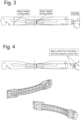
- Figures 3 and 4 show an example of how the beam height should vary.
- the beam will be predominantly in bending mode and Rectangular ribs are sufficient for good bending stiffness. But if the beam is NOT centered with the impactor as shown in Figure 5 , because of the offset (eccentricity), the beam will also experience a twisting moment and regular rectangular ribs have very low stiffness to withstand the twisting moment. The same can be observed in the deformed shape of the beam in Fig. 5 .
- Adding cross (oblique or diagonal) ribs To improve torsional stiffness of the beam for situation when the overlap between the impactor and the beam is small due the aggressive styling of the bumper fascia. For such cases, oblique or cross ribs towards the end of the beam can significantly improve the torsional stiffness.
- Diagonally oriented ribs are provided in at least a portion of the center beam and wherein the diagonally oriented ribs extend between the vertical and/or horizontal ribs.
- the angle between the longitudinal axis of the bumper beam and the diagonally oriented ribs may be more than 0 degrees and less than 90 degrees, preferable between 20 and 70 degrees, more preferably between 30 and 60 degrees, most preferably between 40 and 50 degrees, or any combination thereof.
- the diagonally oriented ribs are provided in the end sections of the center beam.
- the beam should have sufficient stiffness to transfer the load from impactor at limited design space (intrusion) and at the same time, it should have the lowest mass to keep the car lightweight.
- the invention also relates to a vehicle according to claim 7, comprising a bumper beam according to any of the preceding claims.
- the invention relates to a method of manufacturing a bumper beam as described above, the method comprising:
- the method may further comprise adding one or more mold inserts into the mold before injection plastic material, wherein the mold insert has a higher thermal conductivity than the mold.
- the beam or part may contain many ribs and deep pockets or cavities on both sides. However, there are no sliders or lifters required for the beam.
- the surface area of geometry shrinking to mould is calculated to determine what side will shrink more strongly on mould. That side is set as movable side.
- a sequential gating method is proposed to ensure no critical weld lines will occur inside the beam portion of the part. Starting from the center will ensure proper filling of the central beam portion even with reduced beam height.
- the beam or part may contain many deep, narrow pockets or cavities.
- the material around such deep narrow pockets is typically difficult to cool inside an injection moulded part. This is especially true when dealing with relatively large and thick walls getting connected together or crossing, which is the case for the present beam.
- the time it takes to produce a single piece (the cycle time) will be largely determined by the cooling time for one single part. Efficient cooling will thus have a great impact when producing this part in larger numbers. Removal of heat from the depth of the pocket will be a primary concern to reduce cycle time. A long cooling time increases a risk of a longer cycle time, thus increasing the part manufacturing cost, and/or reduced product quality contributed to introduction of uncontrolled shrinkage, voids, uncontrolled warpage, and/or large sink marks.
- the heat removal efficiency of the cooling system may be increased at the pockets that are difficult to cool.
- This solution can be applied to every pocket along the height with alternating pockets along the length. It can also be used in the critical areas. The principle is illustrated in Figure 8 . This solution may place a lower limit on the size of a pocket, to ensure standard mould components can still be used, and enough mould material 'skin' is available around the cooling channel.
- the cross section of the center beam may be made more efficient to cool by moving the central base plane or base towards an interior of the U-shape, i.e. U-shape may be shifted to an H-shape, or similar. This reduces the depth of a pocket or cavity, thereby decreasing the amount of heat that needs to be extracted from a pocket. This is illustrated in Figure 9 .
- top edge of the transverse or vertical ribs inside the U-shape will likely not be loaded mechanically.
- Making a cut-out in the top of the rib i.e. a cut out at the edge of the rib opposite of the base, for instance a semi-circular cut-out extending from the edge towards the base, effectively reduces the depth of the pockets or cavities, bringing more cooling capacity closer to the deepest portions of said pocket. This is illustrated in Figure 10 .
- mould inserts with higher thermal conductivity may be used in certain strategic locations.
- the higher conductivity effectively takes away heat more quickly.
- This strategy could also be applied for making the bumper beam of this application, especially when no space is available for intensive local cooling, for instance because of hot runner drops or ejectors blocking potential cooling channels from entering a pocket.
- any reference to standards, regulations, testing methods and the like, such as RCAR and ECE-R42 refer to the standard, regulation, guidance or method that is in force at the time of filing of the present application.
Landscapes
- Engineering & Computer Science (AREA)
- Mechanical Engineering (AREA)
- Moulds For Moulding Plastics Or The Like (AREA)
- Body Structure For Vehicles (AREA)
Description
- The present invention relates to a lightweight rear bumper beam. Furthermore, the invention relates to a vehicle comprising such a lightweight rear bumper beam.
- A bumper beam, in particular a rear bumper beam, is part of every motor vehicle for protection against low speed vehicle collision condition. Such bumper beam assemblies are designed in such a way that they absorb a large portion of the energy during collision. The rear bumper beam typically extends transversely across the rear end of the motor vehicle.
- Traditional bumpers are made from metals, because of their high rigidity. These bumpers are usually made by assembling a plurality of metal parts to form the bumper beam. However, due to recent regulations and to increased fuel efficiency, recent focus has been on reducing the weight of the vehicle while maintaining reduced damage to vehicles in low-speed collisions. In the case of low-speed collisions, energy absorbing assemblies can be used in bumpers and can absorb collision energy to reduce vehicle damage. Injection molded thermoplastic beams offer both light weighting and part count reduction. Thermoplastic beam solutions are already available for rear beams, as described in international patent publications
WO2018/109211 andWO2017/021856 , but the novel features proposed in the present application would potentially make the beam up to 25% lighter compared to existing thermoplastic beams and up to 40% lighter compared to steel beams, while meeting performance requirements. A bumper beam having a reversed cross section is described inWO2016/084020A1 . - According to the invention, there is provided a bumper beam according to
claim 1, comprising: - a first end portion and a second end portion,
- a center beam contiguous with and oriented between the first end portion and the second end portion, wherein the center beam comprises a front face and a back face;
- wherein the center beam has a center section and end sections at opposite ends of the center section, the end sections being adjacent to the end portions, respectively,
- wherein the center beam comprises horizontal and vertical ribs extending from the front face and the back face and/or between the front face and the back face,
- wherein the bumper beam is made of a plastic material.
- Varying performance requirements for vehicles have been established by organizations such as the United States Department of Transportation National Highway Traffic Safety Administration (NHTSA), Insurance Institute for Highway Safety (IIHS), the Research Council for Automobile Repairs (R-CAR), and the Economic Commission for Europe (ECE). Regulations governing the low-speed damageability requirements for automobiles across the globe are different. For example, in Europe and the Pacific region, vehicles have to meet ECE-R42 and R-CAR standards at both the front and rear of the vehicle. In the U.S., vehicles have to pass other deformable barrier impact tests such as those set by NHTSA and IIHS.
- To validate the structural performance of any rear bumper beam, a test is conducted wherein the rear of the vehicle at its middle axis is subjected to an impact against a fixed 7-inch diameter pole, at a speed of 4 km/h (kilometers per hour). Bumper beams are designed in such a way that the impactor penetration is limited to the extent that the bumper beam is still spaced at least 10-15 mm from the back panel of the body-in-white (BIW) after the impact but at the same time absorbing the maximum amount of energy.
- The Research Council for Automobile Repair (herein "R-CAR") test program is used by several test houses and institutes in Europe, Asia, and South America and specifies that front and rear bumper systems of a vehicle meet certain criteria under standardized test conditions. R-CAR assessment of bumper performance is aimed at encouraging manufacturers to design bumper systems that meet a variety of goals, including systems that protect vehicle corners at low speed impact and that have desirable energy absorption. The R-CAR test impacts the bumper member with a solid barrier at a designated speed and seeks a non-destructive bending of the bumper beam along with prevention of damage to the underlying vehicle. In addition, bumper systems can be subject to the Economic Commission for Europe Regulation Number 42 ("ECE-R42"), which specifies that a car's safety systems should continue to operate normally after the car has been impacted by a pendulum or moving barrier under simulated collisions at certain speeds and at certain locations on the bumper assembly. It has been discovered that in order to satisfy R-CAR and ECE-R42 criteria, a rear beam having high stiffness at the corners and high stiffness in the center can be desirable.
- The first end portion and the second end portion may each comprise a crash can. To understand the features of the beam, the design of the beam can be subcategorized in to two main features, being a crush box at the ends for corner impact and R-CAR bumper test, and a beam connecting the crush boxes for center impact in ECE-R42. Bumper systems incorporating beams of the present disclosure can conform to desired space constraints while meeting ECE-R42 and/or R-CAR standards and specifications.
- Bumper systems including beams of the present disclosure can satisfy R-CAR, including for example low speed damageability insurance tests such as R-CAR Section 0031, and/or ECE-R42 criteria, such as low speed damageability regulation ECE-R42 Section 0031. In an embodiment, a bumper system including a beam of the present disclosure can absorb a corner impact at 2.5 kilometers per hour (kph) when coupled to a vehicle weighing 500 to 2,000 kilograms (kg), for example, 900 to 1,600 kg, with an intrusion of less than or equal to 140 millimeters (mm), where intrusion refers to the amount the beam intrudes into the passenger compartment of the vehicle. The beams of the present disclosure can have higher stiffness than conventional beams, and can have lower levels of intrusion. In an embodiment, a bumper system including a beam of the present disclosure can absorb a center pendulum impact at 4 kph when coupled to a vehicle weighing 500 to 2,000 kg, for example, 900 to 1,600 kg, with an intrusion of less than or equal to 140 mm. In an embodiment, a bumper system including a beam of the present disclosure can absorb an outboard impact at 4 kph when coupled to a vehicle weighing 500 to 2,000 kg, for example, 900 to 1,600 kg, with an intrusion of less than or equal to 140 mm.
- This invention talks about novel design features and their manufacturing for a rear bumper beam (also known as cross member) of an automobile. Light weighting auto-parts is one of the prime requirement of the car manufacturers and they always push the limit for designing and engineering to get the lightest possible design without affecting the performance and styling. The primary function of rear bumper beam is to reduce the low speed damageability of a car. A traditional steel solution is not only bulky but also made of several parts, increasing the part counts and complexity in installation. Several injection moldable thermoplastic solution are also available for rear bumper beam. In this invention disclosure, we are proposing three unique design features for rear beams harvesting the design freedom of an injection molding process to achieve lighter beams with equal or better performance.
- In this invention, we are addressing ECE-R42 pendulum impact requirement for the beam. One of the most critical requirement for ECE-R42 (or GB17354) standard is center pendulum impact. In center pendulum impact, the beam is being hit by a relatively rigid pendulum at the center with a speed of 4km/hr. The center of the pendulum bumper should be at height of 458mm (or 18 inches) from the ground for ECE-R42 standard and it should be at a height of 445mm from the ground for GB17354. The height of the center of the pendulum with respect to the ground is called the ground clearance.
- The first idea is to improve the bumper beam design to enhance crash performance. For the center pendulum impact, the beam region is the critical region responsible for transferring the load to the fixation location. For center pendulum impact, the region on the beam contributing to the stiffness is the center section of the center beam. The center pendulum impact forms a load path from the front face of the center section of the center beam to the back face of the end sections of the center beam, as shown in
Figure 1 . For a constant cross section beam design, there is sufficient material at the center of the beam but the available material at the ends is relatively less. - The variable section of the beam: For putting the maximum amount of material in the load transfer region. This can be improved by flipping the section at the ends so that the cross section at the end of the beam is mirror image of cross section at the center of the beam. A cross section of the center section is reversed with respect to a cross section of the respective end sections, such that a load transfer path is created along the center beam from the center section via the end sections to the end portions.
- The front face of the center section may comprise a first base from which multiple horizontal ribs extend towards the back face of the center section, thus forming one or more cavities at the back face of the center section, and wherein the back face of each end section comprises a second base from which multiple horizontal ribs extend towards the front face of the end section, thus forming one or more cavities at the front face of the end section and wherein the first and second base are connected through a diagonally oriented rib. Moreover, the cross section of the center beam is shaped as two U-shapes connected with a vertical flange at neighboring legs.
- The variable height of the beam: To keep thicker section with lower height at the center avoiding local bucking and thereby optimizing the material usage for maximum stiffness of the beam. A height of the center section is less with respect to the height of the end portions, such that a first side edge of the bumper beam at the center portion is offset with respect to a second side edge of the bumper beam at an adjacent end portion, creating an offset distance between the respective side edges. The first side edge of the center portion and the second side edge of the end section and/or end portion form a pair of side edges, and wherein the offset distance between opposite pairs of side edges is equal or different. A distance between opposite first side edges of the center section at a central axis of the bumper beam is less than a distance between opposite second side edges of the end sections and/or the end portions. The first and second side edges form a single smooth side edge of the center beam and/or bumper beam.
- The height of the beam should be maximum near the ends, and at the center it should be such that it has maximum overlap with the pendulum. Height of the beam at the center does not need to be more than the height of the impactor. However, in deciding the height of the beam we need to consider manufacturability of the beam also. The change in beam height can be gradual from maximum at the ends to optimal (for maximum overlap) at the center, keeping tangency with the horizontal plane for smooth stress flow. This also allows us to remove material away from load transfer path without complicating the injection-molding tool.
Figures 3 and 4 show an example of how the beam height should vary. - If the beam is centered with the impactor as shown in
Figure 4 , the beam will be predominantly in bending mode and Rectangular ribs are sufficient for good bending stiffness. But if the beam is NOT centered with the impactor as shown inFigure 5 , because of the offset (eccentricity), the beam will also experience a twisting moment and regular rectangular ribs have very low stiffness to withstand the twisting moment. The same can be observed in the deformed shape of the beam inFig. 5 . - Adding cross (oblique or diagonal) ribs: To improve torsional stiffness of the beam for situation when the overlap between the impactor and the beam is small due the aggressive styling of the bumper fascia. For such cases, oblique or cross ribs towards the end of the beam can significantly improve the torsional stiffness.
- Diagonally oriented ribs are provided in at least a portion of the center beam and wherein the diagonally oriented ribs extend between the vertical and/or horizontal ribs. The angle between the longitudinal axis of the bumper beam and the diagonally oriented ribs may be more than 0 degrees and less than 90 degrees, preferable between 20 and 70 degrees, more preferably between 30 and 60 degrees, most preferably between 40 and 50 degrees, or any combination thereof. The diagonally oriented ribs are provided in the end sections of the center beam.
- The above described measures of varying the cross section of the center beam, varying the height of the center beam in the longitudinal direction, and adding cross ribs to part of the center beam have been used to design an embodiment of the beam according to the invention. The resulting design and deformation of the beam for the center pendulum impact is shown in
Figure 6 . - In addition to the above embodiments, we are also proposing novel techniques to address potential issue with manufacturability of such beam using injection-molding process. These techniques include efficient design of injection molding tool and minor modification in the part geometry to improve manufacturability. Designing a lighter weight rear beam (or cross member) for a car that meets low speed damageability criterion (European ECE-R42 and Chinese GB17354).
- As per the requirement, the beam should have sufficient stiffness to transfer the load from impactor at limited design space (intrusion) and at the same time, it should have the lowest mass to keep the car lightweight. These two requirements are contradictory in nature posing significant challenge in designing the beam. On the other hand, injection-molding process offers design freedom over conventional metal forming. Devised unique and novel design feature (independent of material) will not only make the beam lighter compared to existing designs but also reduce the low speed damageability of the vehicle.
- Comparing load vs. intrusion performance of new design with the baseline design, it shows (in
Figure 7 ) that there is a 20% increase in load bearing capacity, a 10% reduction in intrusion level, and/or a 10% lower mass with respect to a comparative base line plastic bumper beam. The invention allows for a design of rear beams with efficient crash performance for vehicles with limited design space. - The invention also relates to a vehicle according to claim 7, comprising a bumper beam according to any of the preceding claims.
- Furthermore, the invention relates to a method of manufacturing a bumper beam as described above, the method comprising:
- injection molding plastic material into a mold;
- locally cooling the injection molded material using baffles and coolant.
- The method may further comprise adding one or more mold inserts into the mold before injection plastic material, wherein the mold insert has a higher thermal conductivity than the mold.
- The beam or part may contain many ribs and deep pockets or cavities on both sides. However, there are no sliders or lifters required for the beam. Thus to determine the most logical orientation of the part (determining the stationary and movable side of the part in the mould), the surface area of geometry shrinking to mould is calculated to determine what side will shrink more strongly on mould. That side is set as movable side. A sequential gating method is proposed to ensure no critical weld lines will occur inside the beam portion of the part. Starting from the center will ensure proper filling of the central beam portion even with reduced beam height.
- The beam or part may contain many deep, narrow pockets or cavities. The material around such deep narrow pockets is typically difficult to cool inside an injection moulded part. This is especially true when dealing with relatively large and thick walls getting connected together or crossing, which is the case for the present beam. The time it takes to produce a single piece (the cycle time) will be largely determined by the cooling time for one single part. Efficient cooling will thus have a great impact when producing this part in larger numbers. Removal of heat from the depth of the pocket will be a primary concern to reduce cycle time. A long cooling time increases a risk of a longer cycle time, thus increasing the part manufacturing cost, and/or reduced product quality contributed to introduction of uncontrolled shrinkage, voids, uncontrolled warpage, and/or large sink marks.
- The following adjustments can be used to address potential manufacturing issues for the bumper beam according to the invention.
- By using protruded cooling channels and equipping them with baffles and coolant, the heat removal efficiency of the cooling system may be increased at the pockets that are difficult to cool. This solution can be applied to every pocket along the height with alternating pockets along the length. It can also be used in the critical areas. The principle is illustrated in
Figure 8 . This solution may place a lower limit on the size of a pocket, to ensure standard mould components can still be used, and enough mould material 'skin' is available around the cooling channel. - The cross section of the center beam may be made more efficient to cool by moving the central base plane or base towards an interior of the U-shape, i.e. U-shape may be shifted to an H-shape, or similar. This reduces the depth of a pocket or cavity, thereby decreasing the amount of heat that needs to be extracted from a pocket. This is illustrated in
Figure 9 . - The top edge of the transverse or vertical ribs inside the U-shape will likely not be loaded mechanically. Making a cut-out in the top of the rib, i.e. a cut out at the edge of the rib opposite of the base, for instance a semi-circular cut-out extending from the edge towards the base, effectively reduces the depth of the pockets or cavities, bringing more cooling capacity closer to the deepest portions of said pocket. This is illustrated in
Figure 10 . - Where standard injection moulds may be made of steel or another suitable material, mould inserts with higher thermal conductivity may be used in certain strategic locations. The higher conductivity effectively takes away heat more quickly. This strategy could also be applied for making the bumper beam of this application, especially when no space is available for intensive local cooling, for instance because of hot runner drops or ejectors blocking potential cooling channels from entering a pocket.
- Unless otherwise specified herein, any reference to standards, regulations, testing methods and the like, such as RCAR and ECE-R42 refer to the standard, regulation, guidance or method that is in force at the time of filing of the present application.
Claims (9)
- Bumper beam comprising:- a first end portion and a second end portion,- a center beam contiguous with and oriented between the first end portion and the second end portion, wherein the center beam comprises a front face and a back face;wherein the center beam has a center section and end sections at opposite ends of the center section, the end sections being adjacent to the end portions, respectively,wherein the center beam comprises horizontal and vertical ribs extending from the front face and the back face and/or between the front face and the back face,wherein the bumper beam is made of a plastic materialwherein a cross section of the center section is reversed with respect to a cross section of the respective end sections, so that the cross section at the end of the beam is mirror image of the cross section at the center of the beam, such that a load transfer path is created along the center beam from the center section via the end sections to the end portionscharacterised in that a height of the center section is less with respect to the height of the end portions, such that a first side edge of the bumper beam at the center portion is offset with respect to a second side edge of the bumper beam at an adjacent end portion, creating an offset distance between the respective side edgeswherein a distance between opposite first side edges of the center section at a central axis of the bumper beam is less than a distance between opposite second side edges of the end sections and/or the end portionswherein the first and second side edges form a single smooth side edge of the center beam and/or bumper beamwherein diagonally oriented ribs are provided in at least a portion of the center beam and wherein the diagonally oriented ribs extend between the vertical and/or horizontal ribswherein the diagonally oriented ribs are provided in the end sections of the center beam.
- Bumper beam of claim 1, wherein the first side edge of the center portion and the second side edge of the end section and/or end portion form a pair of side edges, and wherein the offset distance between opposite pairs of side edges is equal or different.
- Bumper beam of any of the preceding claims, wherein the first end portion and the second end portion each comprise a crash can.
- Bumper beam of any of the preceding claims, wherein the angle between the longitudinal axis of the bumper beam and the diagonally oriented ribs is more than 0 degrees and less than 90 degrees, preferable between 20 and 70 degrees, more preferably between 30 and 60 degrees, most preferably between 40 and 50 degrees, or any combination thereof.
- Bumper beam of any of the preceding claims, wherein the front face of the center section comprises a first base from which multiple horizontal ribs extend towards the back face of the center section, thus forming one or more cavities at the back face of the center section, and wherein the back face of each end section comprises a second base from which multiple horizontal ribs extend towards the front face of the end section, thus forming one or more cavities at the front face of the end section and wherein the first and second base are connected through a diagonally oriented rib.
- Bumper beam of any of the preceding claims, wherein the cross section of the center beam is shaped as two U-shapes connected with a vertical flange at neighboring legs.
- Vehicle comprising a bumper beam according to any of the preceding claims.
- Method of manufacturing a bumper beam of any of claims 1-7, the method comprising:- injection molding plastic material into a mold;- locally cooling the injection molded material using baffles and coolant.
- Method of claim 8, comprising adding one or more mold inserts into the mold before injection plastic material, wherein the mold insert has a higher thermal conductivity than the mold.
Applications Claiming Priority (2)
| Application Number | Priority Date | Filing Date | Title |
|---|---|---|---|
| EP18212267 | 2018-12-13 | ||
| PCT/EP2019/083380 WO2020120213A1 (en) | 2018-12-13 | 2019-12-03 | Lightweight rear bumper beam |
Publications (2)
| Publication Number | Publication Date |
|---|---|
| EP3894280A1 EP3894280A1 (en) | 2021-10-20 |
| EP3894280B1 true EP3894280B1 (en) | 2025-02-05 |
Family
ID=64901844
Family Applications (1)
| Application Number | Title | Priority Date | Filing Date |
|---|---|---|---|
| EP19813327.4A Active EP3894280B1 (en) | 2018-12-13 | 2019-12-03 | Lightweight rear bumper beam |
Country Status (4)
| Country | Link |
|---|---|
| US (1) | US12024105B2 (en) |
| EP (1) | EP3894280B1 (en) |
| CN (1) | CN113165590B (en) |
| WO (1) | WO2020120213A1 (en) |
Families Citing this family (1)
| Publication number | Priority date | Publication date | Assignee | Title |
|---|---|---|---|---|
| DE102021102365B4 (en) * | 2021-02-02 | 2023-03-09 | Benteler Automobiltechnik Gmbh | Bumper assembly with additional support |
Citations (1)
| Publication number | Priority date | Publication date | Assignee | Title |
|---|---|---|---|---|
| WO2017021856A1 (en) * | 2015-07-31 | 2017-02-09 | Sabic Global Technologies B.V. | Beam with torsional deformation and multi-geometry cross-section |
Family Cites Families (23)
| Publication number | Priority date | Publication date | Assignee | Title |
|---|---|---|---|---|
| JP3979480B2 (en) | 1998-08-07 | 2007-09-19 | 住友化学株式会社 | Bumper reinforcement member |
| US6286879B1 (en) * | 1999-02-24 | 2001-09-11 | Azdel, Inc. | I-Section automotive bumper formed from mineral-filled glass mat thermoplastic (GMT) composite |
| DE10157481A1 (en) * | 2001-11-23 | 2003-06-12 | Daimler Chrysler Ag | Bumper holder, bumper and motor vehicle with bumper |
| SE527380C2 (en) * | 2003-06-06 | 2006-02-21 | Gestamp Hardtech Ab | Bumper beam for vehicles |
| SE0501173L (en) * | 2005-05-25 | 2006-04-04 | Gestamp Hardtech Ab | Bumper beam |
| FR2895341B1 (en) * | 2005-12-23 | 2008-04-04 | Plastic Omnium Cie | ENERGY ABSORPTION SYSTEM FOR A MOTOR VEHICLE |
| FR2952329B1 (en) | 2009-11-12 | 2013-11-29 | Faurecia Bloc Avant | FRONT ASSEMBLY OF A MOTOR VEHICLE COMPRISING A FRONT BUMPER SHIELD CONTAINING MEANS FOR FASTENING AT LEAST ONE AUXILIARY EQUIPMENT OF THE MOTOR VEHICLE |
| FR2952875B1 (en) | 2009-11-20 | 2012-05-11 | Faurecia Bloc Avant | BUMPER SHIELD FOR MOTOR VEHICLE |
| DE102009056841A1 (en) * | 2009-12-03 | 2011-06-09 | GM Global Technology Operations LLC, ( n. d. Ges. d. Staates Delaware ), Detroit | Front part for a motor vehicle body |
| FR2959707B1 (en) * | 2010-05-05 | 2013-03-15 | Faurecia Bloc Avant | REAR FACE AND REAR FACE ELEMENT FOR MOTOR VEHICLE |
| KR101746222B1 (en) * | 2010-09-20 | 2017-06-20 | 포리시 블로 아반 | Front assembly for a motor vehicle comprising a front bumper shield |
| US20130115399A1 (en) * | 2010-10-27 | 2013-05-09 | Richard W. Roberts | In-situ foam core articles |
| US8851539B2 (en) * | 2012-01-06 | 2014-10-07 | Sabic Innovative Plastics Ip B.V. | Energy absorbing assembly |
| KR20150145356A (en) * | 2014-06-18 | 2015-12-30 | 현대자동차주식회사 | Bumper back beam for vehicle |
| DE102014009941A1 (en) * | 2014-07-04 | 2016-01-07 | GM Global Technology Operations LLC (n. d. Ges. d. Staates Delaware) | Bumper assembly for a motor vehicle |
| US10300873B2 (en) * | 2014-11-25 | 2019-05-28 | Sabic Global Technologies B.V. | Modular bumper beam |
| KR102374629B1 (en) | 2015-06-05 | 2022-03-15 | 사빅 글로벌 테크놀러지스 비.브이. | Energy absorbing assembly and method of making and using same |
| US9598033B1 (en) * | 2015-11-09 | 2017-03-21 | United States Council For Automotive Research, Llc | Joining and reinforcing a composite bumper beam and a composite crush can for a vehicle |
| US10065587B2 (en) * | 2015-11-23 | 2018-09-04 | Flex|N|Gate Corporation | Multi-layer energy absorber |
| EP3254905A1 (en) * | 2016-06-08 | 2017-12-13 | Constellium Singen GmbH | Bumper for a motor vehicle and method for its production |
| US11130525B2 (en) * | 2016-09-07 | 2021-09-28 | Thunder Power New Energy Vehicle Development Company Limited | Rear crash safety profile |
| EP3554866A1 (en) | 2016-12-16 | 2019-10-23 | SABIC Global Technologies B.V. | Hybrid towing bumper beam assembly |
| KR102194218B1 (en) * | 2017-11-29 | 2020-12-22 | 롯데케미칼 주식회사 | Bumfer beam of vehicle |
-
2019
- 2019-12-03 CN CN201980079919.5A patent/CN113165590B/en active Active
- 2019-12-03 US US17/294,783 patent/US12024105B2/en active Active
- 2019-12-03 WO PCT/EP2019/083380 patent/WO2020120213A1/en not_active Ceased
- 2019-12-03 EP EP19813327.4A patent/EP3894280B1/en active Active
Patent Citations (1)
| Publication number | Priority date | Publication date | Assignee | Title |
|---|---|---|---|---|
| WO2017021856A1 (en) * | 2015-07-31 | 2017-02-09 | Sabic Global Technologies B.V. | Beam with torsional deformation and multi-geometry cross-section |
Also Published As
| Publication number | Publication date |
|---|---|
| CN113165590A (en) | 2021-07-23 |
| CN113165590B (en) | 2025-02-25 |
| EP3894280A1 (en) | 2021-10-20 |
| WO2020120213A1 (en) | 2020-06-18 |
| US12024105B2 (en) | 2024-07-02 |
| US20220009434A1 (en) | 2022-01-13 |
Similar Documents
| Publication | Publication Date | Title |
|---|---|---|
| CN103189237B (en) | Unitary energy absorbing assembly and method of manufacture | |
| US8251437B2 (en) | Front assembly for a motor vehicle comprising a front bumper shield | |
| EP2237991B1 (en) | Tray energy absorber and bumper system | |
| RU2675424C2 (en) | Air duct for front surface of motor vehicle containing mechanical weakness areas | |
| EP2599668B1 (en) | Crash box for a vehicle | |
| MX2010012319A (en) | Front end assembly of a motor vehicle comprising a front end bumper with fixing means of at least one auxiliary equipment of the motor vehicle. | |
| MX2010012646A (en) | Bumper structure for automotive vehicle. | |
| JP2011230592A (en) | Bumper structure | |
| US20180056906A1 (en) | Frontal shield system for enhanced vehicle compatibility performance | |
| US9211857B2 (en) | Bumper beam assembly system | |
| CN103359028A (en) | Vehicle body front structure | |
| EP3894280B1 (en) | Lightweight rear bumper beam | |
| CN113263996A (en) | Bumper of motor vehicle | |
| EP2318237B1 (en) | Impact beam and a method for making same | |
| CN112384411A (en) | Motor vehicle air guide made of an expanded polymer material and comprising a crash absorption zone | |
| CN102963323A (en) | Automobile bumper internally provided with multiple buffer and energy-absorbing barriers | |
| US12054114B2 (en) | Retractable aerodynamic underbody flap with force absorption by the lower support | |
| CN112660052B (en) | Front anti-collision beam assembly with collision compatibility and vehicle | |
| KR20070122301A (en) | Bumper of car | |
| KR101375497B1 (en) | Bumper Beam Assembly System | |
| CN112590700A (en) | Integrated multi-stage buffer automobile lower guard plate device and protection method | |
| CN120493398A (en) | Passive safety design method and structure of vehicle body and vehicle | |
| Yusof et al. | Impact Analysis of Bumper through Computational Design and Analysis Method: Politeknik Sultan Azlan Shah, Perak | |
| KR20080054303A (en) | Bumper Back Beam for Cars | |
| KR19990005785U (en) | Bumper backbeam of car |
Legal Events
| Date | Code | Title | Description |
|---|---|---|---|
| STAA | Information on the status of an ep patent application or granted ep patent |
Free format text: STATUS: UNKNOWN |
|
| STAA | Information on the status of an ep patent application or granted ep patent |
Free format text: STATUS: THE INTERNATIONAL PUBLICATION HAS BEEN MADE |
|
| PUAI | Public reference made under article 153(3) epc to a published international application that has entered the european phase |
Free format text: ORIGINAL CODE: 0009012 |
|
| STAA | Information on the status of an ep patent application or granted ep patent |
Free format text: STATUS: REQUEST FOR EXAMINATION WAS MADE |
|
| 17P | Request for examination filed |
Effective date: 20210614 |
|
| AK | Designated contracting states |
Kind code of ref document: A1 Designated state(s): AL AT BE BG CH CY CZ DE DK EE ES FI FR GB GR HR HU IE IS IT LI LT LU LV MC MK MT NL NO PL PT RO RS SE SI SK SM TR |
|
| DAV | Request for validation of the european patent (deleted) | ||
| DAX | Request for extension of the european patent (deleted) | ||
| STAA | Information on the status of an ep patent application or granted ep patent |
Free format text: STATUS: EXAMINATION IS IN PROGRESS |
|
| 17Q | First examination report despatched |
Effective date: 20220615 |
|
| GRAP | Despatch of communication of intention to grant a patent |
Free format text: ORIGINAL CODE: EPIDOSNIGR1 |
|
| STAA | Information on the status of an ep patent application or granted ep patent |
Free format text: STATUS: GRANT OF PATENT IS INTENDED |
|
| GRAS | Grant fee paid |
Free format text: ORIGINAL CODE: EPIDOSNIGR3 |
|
| INTG | Intention to grant announced |
Effective date: 20241108 |
|
| GRAA | (expected) grant |
Free format text: ORIGINAL CODE: 0009210 |
|
| STAA | Information on the status of an ep patent application or granted ep patent |
Free format text: STATUS: THE PATENT HAS BEEN GRANTED |
|
| AK | Designated contracting states |
Kind code of ref document: B1 Designated state(s): AL AT BE BG CH CY CZ DE DK EE ES FI FR GB GR HR HU IE IS IT LI LT LU LV MC MK MT NL NO PL PT RO RS SE SI SK SM TR |
|
| REG | Reference to a national code |
Ref country code: GB Ref legal event code: FG4D |
|
| REG | Reference to a national code |
Ref country code: CH Ref legal event code: EP |
|
| REG | Reference to a national code |
Ref country code: IE Ref legal event code: FG4D |
|
| REG | Reference to a national code |
Ref country code: DE Ref legal event code: R096 Ref document number: 602019065630 Country of ref document: DE |
|
| REG | Reference to a national code |
Ref country code: NL Ref legal event code: MP Effective date: 20250205 |
|
| P01 | Opt-out of the competence of the unified patent court (upc) registered |
Free format text: CASE NUMBER: APP_24316/2025 Effective date: 20250521 |
|
| PG25 | Lapsed in a contracting state [announced via postgrant information from national office to epo] |
Ref country code: RS Free format text: LAPSE BECAUSE OF FAILURE TO SUBMIT A TRANSLATION OF THE DESCRIPTION OR TO PAY THE FEE WITHIN THE PRESCRIBED TIME-LIMIT Effective date: 20250505 |
|
| PG25 | Lapsed in a contracting state [announced via postgrant information from national office to epo] |
Ref country code: FI Free format text: LAPSE BECAUSE OF FAILURE TO SUBMIT A TRANSLATION OF THE DESCRIPTION OR TO PAY THE FEE WITHIN THE PRESCRIBED TIME-LIMIT Effective date: 20250205 |
|
| PG25 | Lapsed in a contracting state [announced via postgrant information from national office to epo] |
Ref country code: PL Free format text: LAPSE BECAUSE OF FAILURE TO SUBMIT A TRANSLATION OF THE DESCRIPTION OR TO PAY THE FEE WITHIN THE PRESCRIBED TIME-LIMIT Effective date: 20250205 |
|
| PG25 | Lapsed in a contracting state [announced via postgrant information from national office to epo] |
Ref country code: ES Free format text: LAPSE BECAUSE OF FAILURE TO SUBMIT A TRANSLATION OF THE DESCRIPTION OR TO PAY THE FEE WITHIN THE PRESCRIBED TIME-LIMIT Effective date: 20250205 |
|
| REG | Reference to a national code |
Ref country code: LT Ref legal event code: MG9D |
|
| PG25 | Lapsed in a contracting state [announced via postgrant information from national office to epo] |
Ref country code: IS Free format text: LAPSE BECAUSE OF FAILURE TO SUBMIT A TRANSLATION OF THE DESCRIPTION OR TO PAY THE FEE WITHIN THE PRESCRIBED TIME-LIMIT Effective date: 20250605 Ref country code: NO Free format text: LAPSE BECAUSE OF FAILURE TO SUBMIT A TRANSLATION OF THE DESCRIPTION OR TO PAY THE FEE WITHIN THE PRESCRIBED TIME-LIMIT Effective date: 20250505 |
|
| PG25 | Lapsed in a contracting state [announced via postgrant information from national office to epo] |
Ref country code: NL Free format text: LAPSE BECAUSE OF FAILURE TO SUBMIT A TRANSLATION OF THE DESCRIPTION OR TO PAY THE FEE WITHIN THE PRESCRIBED TIME-LIMIT Effective date: 20250205 |
|
| PG25 | Lapsed in a contracting state [announced via postgrant information from national office to epo] |
Ref country code: HR Free format text: LAPSE BECAUSE OF FAILURE TO SUBMIT A TRANSLATION OF THE DESCRIPTION OR TO PAY THE FEE WITHIN THE PRESCRIBED TIME-LIMIT Effective date: 20250205 |
|
| PG25 | Lapsed in a contracting state [announced via postgrant information from national office to epo] |
Ref country code: PT Free format text: LAPSE BECAUSE OF FAILURE TO SUBMIT A TRANSLATION OF THE DESCRIPTION OR TO PAY THE FEE WITHIN THE PRESCRIBED TIME-LIMIT Effective date: 20250605 Ref country code: LV Free format text: LAPSE BECAUSE OF FAILURE TO SUBMIT A TRANSLATION OF THE DESCRIPTION OR TO PAY THE FEE WITHIN THE PRESCRIBED TIME-LIMIT Effective date: 20250205 |
|
| PG25 | Lapsed in a contracting state [announced via postgrant information from national office to epo] |
Ref country code: BG Free format text: LAPSE BECAUSE OF FAILURE TO SUBMIT A TRANSLATION OF THE DESCRIPTION OR TO PAY THE FEE WITHIN THE PRESCRIBED TIME-LIMIT Effective date: 20250205 Ref country code: GR Free format text: LAPSE BECAUSE OF FAILURE TO SUBMIT A TRANSLATION OF THE DESCRIPTION OR TO PAY THE FEE WITHIN THE PRESCRIBED TIME-LIMIT Effective date: 20250506 |
|
| REG | Reference to a national code |
Ref country code: AT Ref legal event code: MK05 Ref document number: 1764841 Country of ref document: AT Kind code of ref document: T Effective date: 20250205 |
|
| PG25 | Lapsed in a contracting state [announced via postgrant information from national office to epo] |
Ref country code: SE Free format text: LAPSE BECAUSE OF FAILURE TO SUBMIT A TRANSLATION OF THE DESCRIPTION OR TO PAY THE FEE WITHIN THE PRESCRIBED TIME-LIMIT Effective date: 20250205 |
|
| PG25 | Lapsed in a contracting state [announced via postgrant information from national office to epo] |
Ref country code: SM Free format text: LAPSE BECAUSE OF FAILURE TO SUBMIT A TRANSLATION OF THE DESCRIPTION OR TO PAY THE FEE WITHIN THE PRESCRIBED TIME-LIMIT Effective date: 20250205 |
|
| PG25 | Lapsed in a contracting state [announced via postgrant information from national office to epo] |
Ref country code: DK Free format text: LAPSE BECAUSE OF FAILURE TO SUBMIT A TRANSLATION OF THE DESCRIPTION OR TO PAY THE FEE WITHIN THE PRESCRIBED TIME-LIMIT Effective date: 20250205 |
|
| PG25 | Lapsed in a contracting state [announced via postgrant information from national office to epo] |
Ref country code: IT Free format text: LAPSE BECAUSE OF FAILURE TO SUBMIT A TRANSLATION OF THE DESCRIPTION OR TO PAY THE FEE WITHIN THE PRESCRIBED TIME-LIMIT Effective date: 20250205 |
|
| PG25 | Lapsed in a contracting state [announced via postgrant information from national office to epo] |
Ref country code: AT Free format text: LAPSE BECAUSE OF FAILURE TO SUBMIT A TRANSLATION OF THE DESCRIPTION OR TO PAY THE FEE WITHIN THE PRESCRIBED TIME-LIMIT Effective date: 20250205 |
|
| PG25 | Lapsed in a contracting state [announced via postgrant information from national office to epo] |
Ref country code: EE Free format text: LAPSE BECAUSE OF FAILURE TO SUBMIT A TRANSLATION OF THE DESCRIPTION OR TO PAY THE FEE WITHIN THE PRESCRIBED TIME-LIMIT Effective date: 20250205 Ref country code: CZ Free format text: LAPSE BECAUSE OF FAILURE TO SUBMIT A TRANSLATION OF THE DESCRIPTION OR TO PAY THE FEE WITHIN THE PRESCRIBED TIME-LIMIT Effective date: 20250205 |
|
| PG25 | Lapsed in a contracting state [announced via postgrant information from national office to epo] |
Ref country code: RO Free format text: LAPSE BECAUSE OF FAILURE TO SUBMIT A TRANSLATION OF THE DESCRIPTION OR TO PAY THE FEE WITHIN THE PRESCRIBED TIME-LIMIT Effective date: 20250205 |
|
| PG25 | Lapsed in a contracting state [announced via postgrant information from national office to epo] |
Ref country code: SK Free format text: LAPSE BECAUSE OF FAILURE TO SUBMIT A TRANSLATION OF THE DESCRIPTION OR TO PAY THE FEE WITHIN THE PRESCRIBED TIME-LIMIT Effective date: 20250205 |
|
| REG | Reference to a national code |
Ref country code: DE Ref legal event code: R097 Ref document number: 602019065630 Country of ref document: DE |
|
| PLBE | No opposition filed within time limit |
Free format text: ORIGINAL CODE: 0009261 |
|
| STAA | Information on the status of an ep patent application or granted ep patent |
Free format text: STATUS: NO OPPOSITION FILED WITHIN TIME LIMIT |
|
| PGFP | Annual fee paid to national office [announced via postgrant information from national office to epo] |
Ref country code: GB Payment date: 20251229 Year of fee payment: 7 |
|
| 26N | No opposition filed |
Effective date: 20251106 |
|
| PGFP | Annual fee paid to national office [announced via postgrant information from national office to epo] |
Ref country code: FR Payment date: 20251226 Year of fee payment: 7 |
|
| PGFP | Annual fee paid to national office [announced via postgrant information from national office to epo] |
Ref country code: DE Payment date: 20251229 Year of fee payment: 7 |