EP3892510A1 - Processing device and processing method for saddle-type vehicle warning system, saddle-type vehicle warning system, and saddle-type vehicle - Google Patents
Processing device and processing method for saddle-type vehicle warning system, saddle-type vehicle warning system, and saddle-type vehicle Download PDFInfo
- Publication number
- EP3892510A1 EP3892510A1 EP19817814.7A EP19817814A EP3892510A1 EP 3892510 A1 EP3892510 A1 EP 3892510A1 EP 19817814 A EP19817814 A EP 19817814A EP 3892510 A1 EP3892510 A1 EP 3892510A1
- Authority
- EP
- European Patent Office
- Prior art keywords
- type vehicle
- straddle
- processor
- warning
- surrounding environment
- Prior art date
- Legal status (The legal status is an assumption and is not a legal conclusion. Google has not performed a legal analysis and makes no representation as to the accuracy of the status listed.)
- Granted
Links
Images
Classifications
-
- B—PERFORMING OPERATIONS; TRANSPORTING
- B60—VEHICLES IN GENERAL
- B60W—CONJOINT CONTROL OF VEHICLE SUB-UNITS OF DIFFERENT TYPE OR DIFFERENT FUNCTION; CONTROL SYSTEMS SPECIALLY ADAPTED FOR HYBRID VEHICLES; ROAD VEHICLE DRIVE CONTROL SYSTEMS FOR PURPOSES NOT RELATED TO THE CONTROL OF A PARTICULAR SUB-UNIT
- B60W30/00—Purposes of road vehicle drive control systems not related to the control of a particular sub-unit, e.g. of systems using conjoint control of vehicle sub-units
- B60W30/08—Active safety systems predicting or avoiding probable or impending collision or attempting to minimise its consequences
- B60W30/095—Predicting travel path or likelihood of collision
- B60W30/0956—Predicting travel path or likelihood of collision the prediction being responsive to traffic or environmental parameters
-
- B—PERFORMING OPERATIONS; TRANSPORTING
- B60—VEHICLES IN GENERAL
- B60W—CONJOINT CONTROL OF VEHICLE SUB-UNITS OF DIFFERENT TYPE OR DIFFERENT FUNCTION; CONTROL SYSTEMS SPECIALLY ADAPTED FOR HYBRID VEHICLES; ROAD VEHICLE DRIVE CONTROL SYSTEMS FOR PURPOSES NOT RELATED TO THE CONTROL OF A PARTICULAR SUB-UNIT
- B60W50/00—Details of control systems for road vehicle drive control not related to the control of a particular sub-unit, e.g. process diagnostic or vehicle driver interfaces
- B60W50/08—Interaction between the driver and the control system
- B60W50/14—Means for informing the driver, warning the driver or prompting a driver intervention
- B60W50/16—Tactile feedback to the driver, e.g. vibration or force feedback to the driver on the steering wheel or the accelerator pedal
-
- B—PERFORMING OPERATIONS; TRANSPORTING
- B60—VEHICLES IN GENERAL
- B60W—CONJOINT CONTROL OF VEHICLE SUB-UNITS OF DIFFERENT TYPE OR DIFFERENT FUNCTION; CONTROL SYSTEMS SPECIALLY ADAPTED FOR HYBRID VEHICLES; ROAD VEHICLE DRIVE CONTROL SYSTEMS FOR PURPOSES NOT RELATED TO THE CONTROL OF A PARTICULAR SUB-UNIT
- B60W30/00—Purposes of road vehicle drive control systems not related to the control of a particular sub-unit, e.g. of systems using conjoint control of vehicle sub-units
- B60W30/08—Active safety systems predicting or avoiding probable or impending collision or attempting to minimise its consequences
-
- B—PERFORMING OPERATIONS; TRANSPORTING
- B60—VEHICLES IN GENERAL
- B60W—CONJOINT CONTROL OF VEHICLE SUB-UNITS OF DIFFERENT TYPE OR DIFFERENT FUNCTION; CONTROL SYSTEMS SPECIALLY ADAPTED FOR HYBRID VEHICLES; ROAD VEHICLE DRIVE CONTROL SYSTEMS FOR PURPOSES NOT RELATED TO THE CONTROL OF A PARTICULAR SUB-UNIT
- B60W40/00—Estimation or calculation of non-directly measurable driving parameters for road vehicle drive control systems not related to the control of a particular sub unit, e.g. by using mathematical models
- B60W40/08—Estimation or calculation of non-directly measurable driving parameters for road vehicle drive control systems not related to the control of a particular sub unit, e.g. by using mathematical models related to drivers or passengers
-
- B—PERFORMING OPERATIONS; TRANSPORTING
- B60—VEHICLES IN GENERAL
- B60W—CONJOINT CONTROL OF VEHICLE SUB-UNITS OF DIFFERENT TYPE OR DIFFERENT FUNCTION; CONTROL SYSTEMS SPECIALLY ADAPTED FOR HYBRID VEHICLES; ROAD VEHICLE DRIVE CONTROL SYSTEMS FOR PURPOSES NOT RELATED TO THE CONTROL OF A PARTICULAR SUB-UNIT
- B60W50/00—Details of control systems for road vehicle drive control not related to the control of a particular sub-unit, e.g. process diagnostic or vehicle driver interfaces
- B60W50/0097—Predicting future conditions
-
- B—PERFORMING OPERATIONS; TRANSPORTING
- B60—VEHICLES IN GENERAL
- B60W—CONJOINT CONTROL OF VEHICLE SUB-UNITS OF DIFFERENT TYPE OR DIFFERENT FUNCTION; CONTROL SYSTEMS SPECIALLY ADAPTED FOR HYBRID VEHICLES; ROAD VEHICLE DRIVE CONTROL SYSTEMS FOR PURPOSES NOT RELATED TO THE CONTROL OF A PARTICULAR SUB-UNIT
- B60W50/00—Details of control systems for road vehicle drive control not related to the control of a particular sub-unit, e.g. process diagnostic or vehicle driver interfaces
- B60W50/08—Interaction between the driver and the control system
- B60W50/14—Means for informing the driver, warning the driver or prompting a driver intervention
-
- G—PHYSICS
- G06—COMPUTING OR CALCULATING; COUNTING
- G06V—IMAGE OR VIDEO RECOGNITION OR UNDERSTANDING
- G06V20/00—Scenes; Scene-specific elements
- G06V20/50—Context or environment of the image
- G06V20/59—Context or environment of the image inside of a vehicle, e.g. relating to seat occupancy, driver state or inner lighting conditions
- G06V20/597—Recognising the driver's state or behaviour, e.g. attention or drowsiness
-
- B—PERFORMING OPERATIONS; TRANSPORTING
- B60—VEHICLES IN GENERAL
- B60W—CONJOINT CONTROL OF VEHICLE SUB-UNITS OF DIFFERENT TYPE OR DIFFERENT FUNCTION; CONTROL SYSTEMS SPECIALLY ADAPTED FOR HYBRID VEHICLES; ROAD VEHICLE DRIVE CONTROL SYSTEMS FOR PURPOSES NOT RELATED TO THE CONTROL OF A PARTICULAR SUB-UNIT
- B60W40/00—Estimation or calculation of non-directly measurable driving parameters for road vehicle drive control systems not related to the control of a particular sub unit, e.g. by using mathematical models
- B60W40/08—Estimation or calculation of non-directly measurable driving parameters for road vehicle drive control systems not related to the control of a particular sub unit, e.g. by using mathematical models related to drivers or passengers
- B60W2040/0818—Inactivity or incapacity of driver
-
- B—PERFORMING OPERATIONS; TRANSPORTING
- B60—VEHICLES IN GENERAL
- B60W—CONJOINT CONTROL OF VEHICLE SUB-UNITS OF DIFFERENT TYPE OR DIFFERENT FUNCTION; CONTROL SYSTEMS SPECIALLY ADAPTED FOR HYBRID VEHICLES; ROAD VEHICLE DRIVE CONTROL SYSTEMS FOR PURPOSES NOT RELATED TO THE CONTROL OF A PARTICULAR SUB-UNIT
- B60W50/00—Details of control systems for road vehicle drive control not related to the control of a particular sub-unit, e.g. process diagnostic or vehicle driver interfaces
- B60W50/08—Interaction between the driver and the control system
- B60W50/14—Means for informing the driver, warning the driver or prompting a driver intervention
- B60W2050/143—Alarm means
-
- B—PERFORMING OPERATIONS; TRANSPORTING
- B60—VEHICLES IN GENERAL
- B60W—CONJOINT CONTROL OF VEHICLE SUB-UNITS OF DIFFERENT TYPE OR DIFFERENT FUNCTION; CONTROL SYSTEMS SPECIALLY ADAPTED FOR HYBRID VEHICLES; ROAD VEHICLE DRIVE CONTROL SYSTEMS FOR PURPOSES NOT RELATED TO THE CONTROL OF A PARTICULAR SUB-UNIT
- B60W50/00—Details of control systems for road vehicle drive control not related to the control of a particular sub-unit, e.g. process diagnostic or vehicle driver interfaces
- B60W50/08—Interaction between the driver and the control system
- B60W50/14—Means for informing the driver, warning the driver or prompting a driver intervention
- B60W2050/146—Display means
-
- B—PERFORMING OPERATIONS; TRANSPORTING
- B60—VEHICLES IN GENERAL
- B60W—CONJOINT CONTROL OF VEHICLE SUB-UNITS OF DIFFERENT TYPE OR DIFFERENT FUNCTION; CONTROL SYSTEMS SPECIALLY ADAPTED FOR HYBRID VEHICLES; ROAD VEHICLE DRIVE CONTROL SYSTEMS FOR PURPOSES NOT RELATED TO THE CONTROL OF A PARTICULAR SUB-UNIT
- B60W2300/00—Indexing codes relating to the type of vehicle
- B60W2300/36—Cycles; Motorcycles; Scooters
-
- B—PERFORMING OPERATIONS; TRANSPORTING
- B60—VEHICLES IN GENERAL
- B60W—CONJOINT CONTROL OF VEHICLE SUB-UNITS OF DIFFERENT TYPE OR DIFFERENT FUNCTION; CONTROL SYSTEMS SPECIALLY ADAPTED FOR HYBRID VEHICLES; ROAD VEHICLE DRIVE CONTROL SYSTEMS FOR PURPOSES NOT RELATED TO THE CONTROL OF A PARTICULAR SUB-UNIT
- B60W2420/00—Indexing codes relating to the type of sensors based on the principle of their operation
- B60W2420/40—Photo, light or radio wave sensitive means, e.g. infrared sensors
- B60W2420/403—Image sensing, e.g. optical camera
-
- B—PERFORMING OPERATIONS; TRANSPORTING
- B60—VEHICLES IN GENERAL
- B60W—CONJOINT CONTROL OF VEHICLE SUB-UNITS OF DIFFERENT TYPE OR DIFFERENT FUNCTION; CONTROL SYSTEMS SPECIALLY ADAPTED FOR HYBRID VEHICLES; ROAD VEHICLE DRIVE CONTROL SYSTEMS FOR PURPOSES NOT RELATED TO THE CONTROL OF A PARTICULAR SUB-UNIT
- B60W2420/00—Indexing codes relating to the type of sensors based on the principle of their operation
- B60W2420/40—Photo, light or radio wave sensitive means, e.g. infrared sensors
- B60W2420/408—Radar; Laser, e.g. lidar
-
- B—PERFORMING OPERATIONS; TRANSPORTING
- B60—VEHICLES IN GENERAL
- B60W—CONJOINT CONTROL OF VEHICLE SUB-UNITS OF DIFFERENT TYPE OR DIFFERENT FUNCTION; CONTROL SYSTEMS SPECIALLY ADAPTED FOR HYBRID VEHICLES; ROAD VEHICLE DRIVE CONTROL SYSTEMS FOR PURPOSES NOT RELATED TO THE CONTROL OF A PARTICULAR SUB-UNIT
- B60W2540/00—Input parameters relating to occupants
- B60W2540/223—Posture, e.g. hand, foot, or seat position, turned or inclined
-
- B—PERFORMING OPERATIONS; TRANSPORTING
- B60—VEHICLES IN GENERAL
- B60W—CONJOINT CONTROL OF VEHICLE SUB-UNITS OF DIFFERENT TYPE OR DIFFERENT FUNCTION; CONTROL SYSTEMS SPECIALLY ADAPTED FOR HYBRID VEHICLES; ROAD VEHICLE DRIVE CONTROL SYSTEMS FOR PURPOSES NOT RELATED TO THE CONTROL OF A PARTICULAR SUB-UNIT
- B60W2540/00—Input parameters relating to occupants
- B60W2540/225—Direction of gaze
-
- B—PERFORMING OPERATIONS; TRANSPORTING
- B60—VEHICLES IN GENERAL
- B60W—CONJOINT CONTROL OF VEHICLE SUB-UNITS OF DIFFERENT TYPE OR DIFFERENT FUNCTION; CONTROL SYSTEMS SPECIALLY ADAPTED FOR HYBRID VEHICLES; ROAD VEHICLE DRIVE CONTROL SYSTEMS FOR PURPOSES NOT RELATED TO THE CONTROL OF A PARTICULAR SUB-UNIT
- B60W2540/00—Input parameters relating to occupants
- B60W2540/227—Position in the vehicle
-
- B—PERFORMING OPERATIONS; TRANSPORTING
- B60—VEHICLES IN GENERAL
- B60W—CONJOINT CONTROL OF VEHICLE SUB-UNITS OF DIFFERENT TYPE OR DIFFERENT FUNCTION; CONTROL SYSTEMS SPECIALLY ADAPTED FOR HYBRID VEHICLES; ROAD VEHICLE DRIVE CONTROL SYSTEMS FOR PURPOSES NOT RELATED TO THE CONTROL OF A PARTICULAR SUB-UNIT
- B60W2540/00—Input parameters relating to occupants
- B60W2540/229—Attention level, e.g. attentive to driving, reading or sleeping
-
- B—PERFORMING OPERATIONS; TRANSPORTING
- B60—VEHICLES IN GENERAL
- B60W—CONJOINT CONTROL OF VEHICLE SUB-UNITS OF DIFFERENT TYPE OR DIFFERENT FUNCTION; CONTROL SYSTEMS SPECIALLY ADAPTED FOR HYBRID VEHICLES; ROAD VEHICLE DRIVE CONTROL SYSTEMS FOR PURPOSES NOT RELATED TO THE CONTROL OF A PARTICULAR SUB-UNIT
- B60W2554/00—Input parameters relating to objects
- B60W2554/40—Dynamic objects, e.g. animals, windblown objects
- B60W2554/404—Characteristics
- B60W2554/4047—Attentiveness, e.g. distracted by mobile phone
-
- B—PERFORMING OPERATIONS; TRANSPORTING
- B60—VEHICLES IN GENERAL
- B60W—CONJOINT CONTROL OF VEHICLE SUB-UNITS OF DIFFERENT TYPE OR DIFFERENT FUNCTION; CONTROL SYSTEMS SPECIALLY ADAPTED FOR HYBRID VEHICLES; ROAD VEHICLE DRIVE CONTROL SYSTEMS FOR PURPOSES NOT RELATED TO THE CONTROL OF A PARTICULAR SUB-UNIT
- B60W2554/00—Input parameters relating to objects
- B60W2554/40—Dynamic objects, e.g. animals, windblown objects
- B60W2554/404—Characteristics
- B60W2554/4048—Field of view, e.g. obstructed view or direction of gaze
-
- B—PERFORMING OPERATIONS; TRANSPORTING
- B60—VEHICLES IN GENERAL
- B60W—CONJOINT CONTROL OF VEHICLE SUB-UNITS OF DIFFERENT TYPE OR DIFFERENT FUNCTION; CONTROL SYSTEMS SPECIALLY ADAPTED FOR HYBRID VEHICLES; ROAD VEHICLE DRIVE CONTROL SYSTEMS FOR PURPOSES NOT RELATED TO THE CONTROL OF A PARTICULAR SUB-UNIT
- B60W2554/00—Input parameters relating to objects
- B60W2554/80—Spatial relation or speed relative to objects
- B60W2554/803—Relative lateral speed
Definitions
- the present invention relates to a processor and a processing method for a warning system that determines necessity of warning operation to a rider by using a surrounding environment detector provided to a straddle-type vehicle and performs warning operation when necessary, a warning system including the processor, and a straddle-type vehicle including the warning system.
- a warning system that acquires surrounding environment information about the straddle-type vehicle during travel by using a surrounding environment detector provided to the straddle-type vehicle and warns a rider according to the surrounding environment information has been known (for example, see Patent Literature 1).
- the rider's body is exposed on the straddle-type vehicle, and the straddle-type vehicle falls at the slightest of opportunities. Accordingly, compared to the other vehicles (the automobile and the like), there are many situations where such surrounding environment that the rider should be given a warning occurs. However, in the case where warning operation is simply performed in all of those situations, the rider's comfort is deteriorated.
- the present invention has been made with the above-described problem as the background and therefore obtains a processor and a processing method capable of improving both the rider's safety and the rider's comfort.
- the present invention also obtains a warning system that includes the processor.
- the present invention further obtains a straddle-type vehicle that includes the warning system.
- a processor is a processor for a warning system of a straddle-type vehicle, and includes: an acquisition section that acquires surrounding environment information corresponding to output of a surrounding environment detector provided to the straddle-type vehicle during travel of the straddle-type vehicle; a determination section that determines necessity of warning operation provided to a rider and generated by the warning system on the basis of output of the acquisition section; and a control section that makes an alarm perform the warning operation in the case where the determination section determines that the warning operation is necessary.
- the acquisition section further acquires helmet posture direction information corresponding to output of a helmet posture direction detector during the travel of the straddle-type vehicle.
- the determination section determines the necessity of the warning operation on the basis of the surrounding environment information and the helmet posture direction information.
- a warning system includes the above processor, the surrounding environment detector, and the helmet posture direction detector.
- a straddle-type vehicle according to the present invention includes the above warning system.
- a processing method is a processing method for a warning system of a straddle-type vehicle, and includes: an acquisition step of acquiring surrounding environment information, which corresponds to output of a surrounding environment detector provided to the straddle-type vehicle, by an acquisition section of a processor for the warning system during travel of the straddle-type vehicle; a determination step of determining necessity of warning operation, which is provided to a rider and generated by the warning system, by a determination section of the processor on the basis of output of the acquisition section; and a control step of making an alarm perform the warning operation by a control section of the processor in the case where the determination section determines that the warning operation is necessary.
- the acquisition section further acquires helmet posture direction information corresponding to output of a helmet posture direction detector during the travel of the straddle-type vehicle.
- the determination section determines necessity of the warning operation on the basis of the surrounding environment information and the helmet posture direction information.
- the necessity of the warning operation is determined on the basis of the surrounding environment information and the helmet posture direction information.
- the warning system according to the present invention is used for a two-wheeled motor vehicle.
- the warning system according to the present invention may be used for the straddle-type vehicle other than the two-wheeled motor vehicle.
- the straddle-type vehicle means a vehicle in general that a rider straddles.
- the straddle-type vehicles include motorcycles (the two-wheeled motor vehicle and a three-wheeled motor vehicle), an all-terrain vehicle, a pedal-driven vehicle, and the like.
- the motorcycle includes: the two-wheeled motor vehicle or the three-wheeled motor vehicle that has an engine as a propelling source; the two-wheeled motor vehicle or the three-wheeled motor vehicle that has a motor as the propelling source; and the like, and includes a motorcycle, a scooter, an electric scooter, and the like, for example.
- the pedal-driven vehicle means a vehicle in general that can travel forward on a road by a depressing force applied to pedals by the rider.
- the pedal-driven vehicle includes a normal pedal-driven vehicle, an electrically-assisted pedal-driven vehicle, an electric pedal-driven vehicle, and the like.
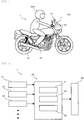
- Fig. 1 is a view of a mounted state of the warning system according to the embodiment of the present invention on the straddle-type vehicle.
- Fig. 2 is a system configuration diagram of the warning system according to the embodiment of the present invention.
- a warning system 1 is mounted on a straddle-type vehicle 100.
- the warning system 1 at least includes: a surrounding environment detector 11 that detects surrounding environment ahead of the straddle-type vehicle 100; a travel state detector 12 that detects a travel state of the straddle-type vehicle 100; a helmet posture direction detector 13 that detects a posture direction state of a helmet 101 worn by a rider; a processor (ECU) 20; and an alarm 30.
- the warning system 1 plays a role of recognizing a collision possibility ahead of the traveling straddle-type vehicle 100 by using the surrounding environment detector 11 and outputting a warning to the rider by using the alarm 30.
- the processor 20 acquires output of the surrounding environment detector 11, output of the travel state detector 12, and output of the helmet posture direction detector 13 and outputs a control command to the alarm 30.
- the processor 20 also receives output of various detectors (not illustrated) for detecting other information (for example, information on a brake operation state by the rider, information on an accelerator operation state by the rider, and the like) .
- Each section of the warning system 1 may exclusively be used for the warning system 1, or may be shared with another system.
- the surrounding environment detector 11 is a radar, a Lidar sensor, an ultrasonic sensor, a camera, or the like, for example, and continuously detects a distance and a direction of an object within a detection range from the straddle-type vehicle 100 during travel of the straddle-type vehicle 100.
- the surrounding environment detector 11 is preferably fixed to a portion of the straddle-type vehicle 100 that does not turn with a handlebar.
- the object may be an obstacle (for example, a vehicle, a guardrail, a wall, a person, or the like) or may be a vehicle that travels on the same lane.
- the travel state detector 12 is a vehicle wheel speed sensor, an inertia sensor (IMU), or the like, for example, and detects a speed, acceleration, a roll angle, or the like generated on the straddle-type vehicle 100, for example, during the travel of the straddle-type vehicle 100.
- IMU inertia sensor
- the helmet posture direction detector 13 is a radar, a Lidar sensor, an ultrasonic sensor, a camera, or the like, for example, and detects a posture direction of the helmet 101 during the travel of the straddle-type vehicle 100.
- the helmet posture direction detector 13 is preferably fixed to the portion of the straddle-type vehicle 100 that does not turn with the handlebar.
- the helmet posture direction detector 13 is preferably the camera, the Lidar sensor, or the like, and in such a case, can easily detect the posture direction of the helmet 101 by extracting a characteristic portion (a shield edge or the like) of the helmet 101 through an image analysis.
- the helmet posture direction detector 13 may be provided to the helmet 101.
- the helmet posture direction detector 13 may be an inertia sensor (IMU) that is provided to the helmet 101. Even in such a case, it is possible to detect the posture direction of the helmet 101 by deriving a difference of a detection value of the inertia sensor (IMU) from a detection value of the inertia sensor (IMU) as the travel state detector 12.
- IMU inertia sensor
- the processor 20 includes an acquisition section 21, a determination section 22, and a control section 23.
- the sections of the processor 20 may collectively be provided in a single casing or may separately be provided in multiple casings.
- the processor 20 may partially or entirely be constructed of a microcomputer, a microprocessor unit, or the like, may be constructed of a member in which firmware or the like can be updated, or may be a program module or the like that is executed by a command from a CPU or the like, for example.
- the acquisition section 21 acquires surrounding environment information, which is information on the surrounding environment ahead of the straddle-type vehicle 100, on the basis of the output of the surrounding environment detector 11. During the travel of the straddle-type vehicle 100, the acquisition section 21 also acquires travel state information, which is information on the travel state of the straddle-type vehicle 100, on the basis of the output of the travel state detector 12. During the travel of the straddle-type vehicle 100, the acquisition section 21 further acquires helmet posture direction information, which is information corresponding to displacement of the helmet 101 from a reference state of the posture direction thereof, on the basis of the output of the helmet posture direction detector 13.
- the determination section 22 specifies an advancing direction of the straddle-type vehicle 100 from the travel state information acquired by the acquisition section 21, and specifies an object, which is located in the advancing direction, and, a collision possibility of which should be determined, from the surrounding environment information acquired by the acquisition section 21. Then, the determination section 22 derives an index value I of the collision possibility of the straddle-type vehicle 100 against the object per the specified object. The determination section 22 determines per the object whether the derived index value I exceeds a reference value, and thereby determines whether there is the object with the high collision possibility in the advancing direction of the straddle-type vehicle 100.
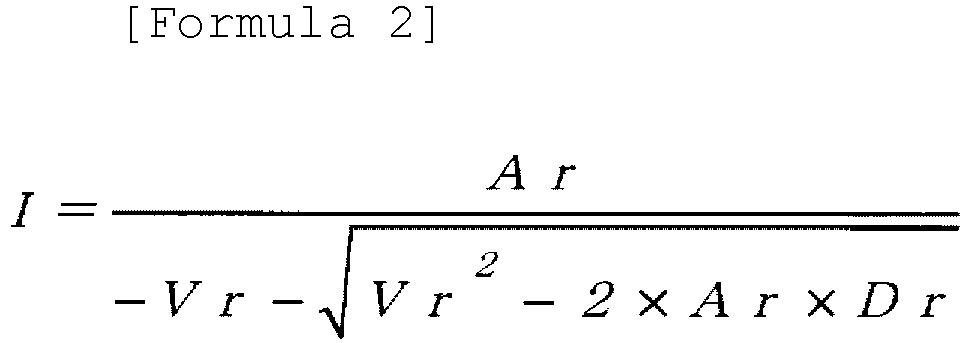
- the index value I may be a reciprocal of a relative distance Dr of the object to the straddle-type vehicle 100, may be a relative speed Vr of the object to the straddle-type vehicle 100, may be relative acceleration Ar of the object to the straddle-type vehicle 100, or a combination of those.
- the index value I is a value that is defined by following Formula 1 or Formula 2.
- the index value I may be a degree of a fluctuation of the relative distance Dr in a situation where the reciprocal of the relative distance Dr is large.
- the degree of the fluctuation may be duration in which a fluctuation amount of the relative distance Dr is kept to be equal to or smaller than a reference amount, or may be the fluctuation amount of the relative distance Dr in reference duration.
- the determination section 22 may simply specify the object, which is located within the detection range of the surrounding environment detector 11, that is, ahead of the straddle-type vehicle 100, and, the collision possibility of which should be determined, without specifying the advancing direction of the straddle-type vehicle 100, and may derive the index value I of the collision possibility against the object. That is, "ahead” in the present invention is defined as a whole area of the detection range of the surrounding environment detector 11.
- a determination on necessity of warning operation by using the "collision possibility of the straddle-type vehicle against the object ahead" in the present invention is defined as a concept that includes the determination on the necessity of the warning operation by using the collision possibility of the straddle-type vehicle 100 against the object located in the advancing direction.
- the determination section 22 also determines whether the displacement of the posture direction of the helmet 101 from the reference state exceeds a reference amount and/or determines whether duration of the state exceeds reference duration from the helmet posture direction information acquired by the acquisition section 21, so as to determine whether the rider's appropriate attention to the advancing direction lacks.
- the reference state is defined as the posture direction of the helmet 101 in a state where the rider's face is oriented in the advancing direction.
- the reference state may be set and stored in advance in the processor 20 or may be learned by and stored in the processor 20 during the travel of the straddle-type vehicle 100.
- the determination section 22 may determine whether the rider's attention to the front lacks. In such a case, the reference state is defined as the posture direction of the helmet 101 in a state where the rider' s face is oriented to the front.
- the displacement may be defined as a displaced angle in a vehicle width direction of the straddle-type vehicle 100, may be defined as a displaced angle in a vehicle height direction of the straddle-type vehicle 100, or may be a combination of those.
- the displacement in a global coordinate system may be derived by using the travel state information (for example, a roll angle, a pitch angle, or the like generated on the straddle-type vehicle 100) acquired by the acquisition section 21, and the displacement may be compared to the reference amount.
- the determination section 22 determines that the warning operation is necessary. On the other hand, in the case where at least one of them is not satisfied, the determination section 22 determines that the warning operation is unnecessary. When the determination section 22 determines that the warning operation is necessary, the control section 23 makes the alarm 30 perform the warning operation.
- the alarm 30 may warn the rider by sound (that is, a sensation through an auditory organ as a sensory organ), may warn the rider by a display (that is, a sensation through a visual organ as the sensory organ), may warn the rider by vibrations (that is, a sensation through a tactile organ as the sensory organ), or may warn the rider by a combination of those.
- the alarm 30 is a speaker, a display, a lamp, a vibrator, or the like, may be provided to the straddle-type vehicle 100, or may be provided to an accessory such as the helmet 101 that is associated with the straddle-type vehicle 100.
- the alarm 30 may be constructed of a single output device or may be constructed of multiple output devices of the same type or different types. The multiple output devices may be provided integrally or may be provided separately.
- the control section 23 changes initiation timing thereof in accordance with the helmet posture direction information. For example, the control section 23 expedites the initiation timing as the displacement of the posture direction of the helmet 101 from the reference state is increased. Alternatively, for example, the control section 23 expedites the initiation timing as the duration of the state where the displacement exceeds the reference amount extends.
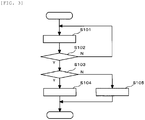
- Fig. 3 is a chart of an operation flow of the processor for the warning system according to the embodiment of the present invention.
- the processor 20 repeatedly executes the operation flow illustrated in Fig. 3 during the travel of the straddle-type vehicle 100.
- step S101 the acquisition section 21 acquires the surrounding environment information that corresponds to the output of the surrounding environment detector 11.
- the acquisition section 21 also acquires the travel state information that corresponds to the output of the travel state detector 12.
- the acquisition section 21 further acquires the helmet posture direction information that corresponds to the output of the helmet posture direction detector 13.
- step S102 the determination section 22 determines whether there is the object with the high collision possibility in the advancing direction or in front of the straddle-type vehicle 100 on the basis of the information acquired in step S101. If Yes, the processing proceeds to step S103. If No, the processing returns to step S101.
- step S103 the determination section 22 determines whether the rider's attention to the advancing direction or the front lacks on the basis of the information acquired in step S101. If Yes, the processing proceeds to step S104. If No, the processing proceeds to step S105.
- step S104 the control section 23 makes the alarm 30 perform the warning operation.
- step S105 the control section 23 does not actuate the alarm 30.
- step S105 notification operation to which the rider is less sensitive than to the warning operation performed in step S104 may be performed.
- the notification operation is preferably notification operation of such extent that the rider's comfort is not deteriorated.
- the less intense sound, display, vibration, or the like than the warning operation performed in step S104 may be output, the sound, the display, the vibration, or the like may be output in a longer cycle than that of the warning operation performed in step S104, or the notification operation to the different tactile organ with less sensitivity than that in the warning operation performed in step S104 may be performed.
- the processor 20 includes: the acquisition section 21 that acquires the surrounding environment information corresponding to the output of the surrounding environment detector 11 during the travel of the straddle-type vehicle 100; the determination section 22 that determines the necessity of the warning operation, which is performed by the warning system 1, to the rider on the basis of the output of the acquisition section 21; and the control section 23 that makes the alarm 30 perform the warning operation in the case where the determination section 22 determines that the warning operation is necessary.
- the acquisition section 21 further acquires the helmet posture direction information that corresponds to the output of the helmet posture direction detector 13 during the travel of the straddle-type vehicle 100.
- the determination section 22 determines the necessity of the warning operation on the basis of the surrounding environment information and the helmet posture direction information.
- the surrounding environment information includes the surrounding environment information ahead of the straddle-type vehicle 100
- the determination section 22 determines the necessity of the warning operation by using the index value I of the collision possibility of the straddle-type vehicle 100 against the object that is located ahead of the straddle-type vehicle 100.
- the rider is more likely to pay attention to the front than to a side, rear, and the like.
- the above-described configuration is particularly useful in the situation where the collision against the object located ahead is warned.
- the index value I is preferably a value that is changed according to at least one of the relative distance Dr, the relative speed Vr, and the relative acceleration Ar of the straddle-type vehicle 100 to the object located ahead of the straddle-type vehicle 100.
- the helmet posture direction information is preferably information that corresponds to the displacement of the posture direction of the helmet 101, which is worn by the rider, from the reference state.
- the determination section 22 preferably determines the necessity of the warning operation on the basis of the duration of the state where the displacement exceeds the reference amount. For example, in the case where the duration falls below the reference duration, the determination section 22 determines that the warning operation is unnecessary. With such a configuration, the determination on the necessity of the warning operation is simplified.
- the control section 23 does not actuate the alarm 30.
- the improvement in the rider's comfort is promoted.
- the control section 23 makes the alarm 30 perform the notification operation to which the rider is less sensitive than to the warning operation.
- the rider can easily recognize that the warning system 1 functions without any problem, and the rider thus can have a sense of safety.
- control section 23 changes the initiation timing of the warning operation in accordance with the helmet posture direction information.
- the rider can be warned at the appropriate timing that corresponds to the state of the attention paid by the rider. Therefore, it is possible to promote both of the improvement in the safety and the improvement in the comfort of the rider.
- the helmet posture direction detector 13 includes the camera.
- the helmet posture direction detector 13 preferably includes the LIDAR sensor. With such a configuration, detection accuracy of the posture direction of the helmet 101 is improved.
- the object located in a different direction (on the side, at the rear, or the like) of the straddle-type vehicle 100 may be recognized by using the surrounding environment detector 11, which detects the surrounding environment in the different direction (on the side, at the rear, or the like) of the straddle-type vehicle 100, and the necessity of the warning operation about the object may be determined.
- the determination section 22 determines the necessity of the warning operation only on the basis of the surrounding environment information and the helmet posture direction information.
- the determination section 22 may take different information from those into consideration to determine the necessity of the warning operation.
- the different information may be the information on the brake operation state by the rider.
- the different information may be the information on the travel state (the speed, deceleration, or the like) of the straddle-type vehicle 100.
- the different information may be information on an eye direction of the rider that is acquired according to output of an eye direction detector (not illustrated) provided to the helmet 101.
- the different information may be the information on the eye direction of the rider that is acquired according to the output of the helmet posture direction detector 13, and the determination section 22 may determine the necessity of the warning operation by appropriately using the information on the eye direction of the rider and the helmet posture direction information, which is acquired according to the output of the helmet posture direction detector 13, differently.
- determination criteria used for the determination in the determination section 22 are set in advance.
- the determination criteria may be set manually by the rider.
- step S102 may be executed after step S103. That is, only in the case where it is determined that the rider's appropriate attention lacks, it may be determined whether the object, the collision possibility of which is high, is present.
Landscapes
- Engineering & Computer Science (AREA)
- Automation & Control Theory (AREA)
- Transportation (AREA)
- Mechanical Engineering (AREA)
- Human Computer Interaction (AREA)
- Physics & Mathematics (AREA)
- Mathematical Physics (AREA)
- General Physics & Mathematics (AREA)
- Multimedia (AREA)
- Theoretical Computer Science (AREA)
- Traffic Control Systems (AREA)
Abstract
Description
- The present invention relates to a processor and a processing method for a warning system that determines necessity of warning operation to a rider by using a surrounding environment detector provided to a straddle-type vehicle and performs warning operation when necessary, a warning system including the processor, and a straddle-type vehicle including the warning system.
- As a technique related to a straddle-type vehicle, a warning system that acquires surrounding environment information about the straddle-type vehicle during travel by using a surrounding environment detector provided to the straddle-type vehicle and warns a rider according to the surrounding environment information has been known (for example, see Patent Literature 1).
- PTL 1:
JP-A-2009-116882 - Differing from other vehicles (an automobile and the like), the rider's body is exposed on the straddle-type vehicle, and the straddle-type vehicle falls at the slightest of opportunities. Accordingly, compared to the other vehicles (the automobile and the like), there are many situations where such surrounding environment that the rider should be given a warning occurs. However, in the case where warning operation is simply performed in all of those situations, the rider's comfort is deteriorated.
- The present invention has been made with the above-described problem as the background and therefore obtains a processor and a processing method capable of improving both the rider's safety and the rider's comfort. The present invention also obtains a warning system that includes the processor. The present invention further obtains a straddle-type vehicle that includes the warning system. Solution to Problem
- A processor according to the present invention is a processor for a warning system of a straddle-type vehicle, and includes: an acquisition section that acquires surrounding environment information corresponding to output of a surrounding environment detector provided to the straddle-type vehicle during travel of the straddle-type vehicle; a determination section that determines necessity of warning operation provided to a rider and generated by the warning system on the basis of output of the acquisition section; and a control section that makes an alarm perform the warning operation in the case where the determination section determines that the warning operation is necessary. The acquisition section further acquires helmet posture direction information corresponding to output of a helmet posture direction detector during the travel of the straddle-type vehicle. The determination section determines the necessity of the warning operation on the basis of the surrounding environment information and the helmet posture direction information.
- A warning system according to the present invention includes the above processor, the surrounding environment detector, and the helmet posture direction detector.
- A straddle-type vehicle according to the present invention includes the above warning system.
- A processing method according to the present invention is a processing method for a warning system of a straddle-type vehicle, and includes: an acquisition step of acquiring surrounding environment information, which corresponds to output of a surrounding environment detector provided to the straddle-type vehicle, by an acquisition section of a processor for the warning system during travel of the straddle-type vehicle; a determination step of determining necessity of warning operation, which is provided to a rider and generated by the warning system, by a determination section of the processor on the basis of output of the acquisition section; and a control step of making an alarm perform the warning operation by a control section of the processor in the case where the determination section determines that the warning operation is necessary. In the acquisition step, the acquisition section further acquires helmet posture direction information corresponding to output of a helmet posture direction detector during the travel of the straddle-type vehicle. In the determination step, the determination section determines necessity of the warning operation on the basis of the surrounding environment information and the helmet posture direction information.
- In the processor, the warning system, the straddle-type vehicle, and the processing method according to the present invention, the necessity of the warning operation is determined on the basis of the surrounding environment information and the helmet posture direction information. Thus, in the case where it can be estimated that the rider appropriately pays attention in a situation where such surrounding environment that the rider should be given a warning occurs, it is possible not to perform the warning operation. Therefore, it is possible to achieve both of improvement in safety and improvement in comfort of the rider. Brief Description of Drawings
-
-
Fig. 1 is a view of a mounted state of a warning system according to an embodiment of the present invention on a straddle-type vehicle. -
Fig. 2 is a system configuration diagram of the warning system according to the embodiment of the present invention. -
Fig. 3 is a chart of an operation flow of a processor for the warning system according to the embodiment of the present invention. - A description will hereinafter be made on a processor, a warning system, a straddle-type vehicle, and a processing method according to the present invention with reference to the drawings.
- Note that each of a configuration, operation, and the like, which will be described below, is merely one example, and the processor, the warning system, the straddle-type vehicle, and the processing method according to the present invention are not limited to a case with such a configuration, such operation, and the like.
- For example, a description will hereinafter be made on a case where the warning system according to the present invention is used for a two-wheeled motor vehicle. However, the warning system according to the present invention may be used for the straddle-type vehicle other than the two-wheeled motor vehicle. The straddle-type vehicle means a vehicle in general that a rider straddles. The straddle-type vehicles include motorcycles (the two-wheeled motor vehicle and a three-wheeled motor vehicle), an all-terrain vehicle, a pedal-driven vehicle, and the like. The motorcycle includes: the two-wheeled motor vehicle or the three-wheeled motor vehicle that has an engine as a propelling source; the two-wheeled motor vehicle or the three-wheeled motor vehicle that has a motor as the propelling source; and the like, and includes a motorcycle, a scooter, an electric scooter, and the like, for example. The pedal-driven vehicle means a vehicle in general that can travel forward on a road by a depressing force applied to pedals by the rider. The pedal-driven vehicle includes a normal pedal-driven vehicle, an electrically-assisted pedal-driven vehicle, an electric pedal-driven vehicle, and the like.
- The same or similar description will appropriately be simplified or will not be made below. In the drawings, the same or similar portions will be denoted by the same reference signs. In addition, a detailed structure will appropriately be depicted in a simplified manner or will not be depicted.
- A description will hereinafter be made on a warning system according to an embodiment.
- A description will be made on a configuration of the warning system according to the embodiment.
-
Fig. 1 is a view of a mounted state of the warning system according to the embodiment of the present invention on the straddle-type vehicle.Fig. 2 is a system configuration diagram of the warning system according to the embodiment of the present invention. - As illustrated in
Fig. 1 and Fig. 2 , awarning system 1 is mounted on a straddle-type vehicle 100. Thewarning system 1 at least includes: a surroundingenvironment detector 11 that detects surrounding environment ahead of the straddle-type vehicle 100; atravel state detector 12 that detects a travel state of the straddle-type vehicle 100; a helmetposture direction detector 13 that detects a posture direction state of ahelmet 101 worn by a rider; a processor (ECU) 20; and analarm 30. - The
warning system 1 plays a role of recognizing a collision possibility ahead of the traveling straddle-type vehicle 100 by using the surroundingenvironment detector 11 and outputting a warning to the rider by using thealarm 30. Theprocessor 20 acquires output of the surroundingenvironment detector 11, output of thetravel state detector 12, and output of the helmetposture direction detector 13 and outputs a control command to thealarm 30. Theprocessor 20 also receives output of various detectors (not illustrated) for detecting other information (for example, information on a brake operation state by the rider, information on an accelerator operation state by the rider, and the like) . Each section of thewarning system 1 may exclusively be used for thewarning system 1, or may be shared with another system. - The surrounding
environment detector 11 is a radar, a Lidar sensor, an ultrasonic sensor, a camera, or the like, for example, and continuously detects a distance and a direction of an object within a detection range from the straddle-type vehicle 100 during travel of the straddle-type vehicle 100. The surroundingenvironment detector 11 is preferably fixed to a portion of the straddle-type vehicle 100 that does not turn with a handlebar. The object may be an obstacle (for example, a vehicle, a guardrail, a wall, a person, or the like) or may be a vehicle that travels on the same lane. - The
travel state detector 12 is a vehicle wheel speed sensor, an inertia sensor (IMU), or the like, for example, and detects a speed, acceleration, a roll angle, or the like generated on the straddle-type vehicle 100, for example, during the travel of the straddle-type vehicle 100. - The helmet
posture direction detector 13 is a radar, a Lidar sensor, an ultrasonic sensor, a camera, or the like, for example, and detects a posture direction of thehelmet 101 during the travel of the straddle-type vehicle 100. The helmetposture direction detector 13 is preferably fixed to the portion of the straddle-type vehicle 100 that does not turn with the handlebar. In particular, the helmetposture direction detector 13 is preferably the camera, the Lidar sensor, or the like, and in such a case, can easily detect the posture direction of thehelmet 101 by extracting a characteristic portion (a shield edge or the like) of thehelmet 101 through an image analysis. Alternatively, the helmetposture direction detector 13 may be provided to thehelmet 101. For example, the helmetposture direction detector 13 may be an inertia sensor (IMU) that is provided to thehelmet 101. Even in such a case, it is possible to detect the posture direction of thehelmet 101 by deriving a difference of a detection value of the inertia sensor (IMU) from a detection value of the inertia sensor (IMU) as thetravel state detector 12. - The
processor 20 includes anacquisition section 21, adetermination section 22, and acontrol section 23. The sections of theprocessor 20 may collectively be provided in a single casing or may separately be provided in multiple casings. Theprocessor 20 may partially or entirely be constructed of a microcomputer, a microprocessor unit, or the like, may be constructed of a member in which firmware or the like can be updated, or may be a program module or the like that is executed by a command from a CPU or the like, for example. - During the travel of the straddle-
type vehicle 100, theacquisition section 21 acquires surrounding environment information, which is information on the surrounding environment ahead of the straddle-type vehicle 100, on the basis of the output of the surroundingenvironment detector 11. During the travel of the straddle-type vehicle 100, theacquisition section 21 also acquires travel state information, which is information on the travel state of the straddle-type vehicle 100, on the basis of the output of thetravel state detector 12. During the travel of the straddle-type vehicle 100, theacquisition section 21 further acquires helmet posture direction information, which is information corresponding to displacement of thehelmet 101 from a reference state of the posture direction thereof, on the basis of the output of the helmetposture direction detector 13. - The
determination section 22 specifies an advancing direction of the straddle-type vehicle 100 from the travel state information acquired by theacquisition section 21, and specifies an object, which is located in the advancing direction, and, a collision possibility of which should be determined, from the surrounding environment information acquired by theacquisition section 21. Then, thedetermination section 22 derives an index value I of the collision possibility of the straddle-type vehicle 100 against the object per the specified object. Thedetermination section 22 determines per the object whether the derived index value I exceeds a reference value, and thereby determines whether there is the object with the high collision possibility in the advancing direction of the straddle-type vehicle 100. - The index value I may be a reciprocal of a relative distance Dr of the object to the straddle-
type vehicle 100, may be a relative speed Vr of the object to the straddle-type vehicle 100, may be relative acceleration Ar of the object to the straddle-type vehicle 100, or a combination of those. For example, the index value I is a value that is defined by followingFormula 1 or Formula 2. Alternatively, for example, the index value I may be a degree of a fluctuation of the relative distance Dr in a situation where the reciprocal of the relative distance Dr is large. The degree of the fluctuation may be duration in which a fluctuation amount of the relative distance Dr is kept to be equal to or smaller than a reference amount, or may be the fluctuation amount of the relative distance Dr in reference duration. Here, it means that the collision possibility becomes higher as the index value I is increased.
- The
determination section 22 may simply specify the object, which is located within the detection range of the surroundingenvironment detector 11, that is, ahead of the straddle-type vehicle 100, and, the collision possibility of which should be determined, without specifying the advancing direction of the straddle-type vehicle 100, and may derive the index value I of the collision possibility against the object. That is, "ahead" in the present invention is defined as a whole area of the detection range of the surroundingenvironment detector 11. A determination on necessity of warning operation by using the "collision possibility of the straddle-type vehicle against the object ahead" in the present invention is defined as a concept that includes the determination on the necessity of the warning operation by using the collision possibility of the straddle-type vehicle 100 against the object located in the advancing direction. - The
determination section 22 also determines whether the displacement of the posture direction of thehelmet 101 from the reference state exceeds a reference amount and/or determines whether duration of the state exceeds reference duration from the helmet posture direction information acquired by theacquisition section 21, so as to determine whether the rider's appropriate attention to the advancing direction lacks. The reference state is defined as the posture direction of thehelmet 101 in a state where the rider's face is oriented in the advancing direction. The reference state may be set and stored in advance in theprocessor 20 or may be learned by and stored in theprocessor 20 during the travel of the straddle-type vehicle 100. Thedetermination section 22 may determine whether the rider's attention to the front lacks. In such a case, the reference state is defined as the posture direction of thehelmet 101 in a state where the rider' s face is oriented to the front. - The displacement may be defined as a displaced angle in a vehicle width direction of the straddle-
type vehicle 100, may be defined as a displaced angle in a vehicle height direction of the straddle-type vehicle 100, or may be a combination of those. Alternatively, the displacement in a global coordinate system may be derived by using the travel state information (for example, a roll angle, a pitch angle, or the like generated on the straddle-type vehicle 100) acquired by theacquisition section 21, and the displacement may be compared to the reference amount. - In the case where the object, the collision possibility of which is high, is present in the advancing direction of the straddle-
type vehicle 100 and where the rider's appropriate attention lacks, thedetermination section 22 determines that the warning operation is necessary. On the other hand, in the case where at least one of them is not satisfied, thedetermination section 22 determines that the warning operation is unnecessary. When thedetermination section 22 determines that the warning operation is necessary, thecontrol section 23 makes thealarm 30 perform the warning operation. - The
alarm 30 may warn the rider by sound (that is, a sensation through an auditory organ as a sensory organ), may warn the rider by a display (that is, a sensation through a visual organ as the sensory organ), may warn the rider by vibrations (that is, a sensation through a tactile organ as the sensory organ), or may warn the rider by a combination of those. More specifically, thealarm 30 is a speaker, a display, a lamp, a vibrator, or the like, may be provided to the straddle-type vehicle 100, or may be provided to an accessory such as thehelmet 101 that is associated with the straddle-type vehicle 100. Furthermore, thealarm 30 may be constructed of a single output device or may be constructed of multiple output devices of the same type or different types. The multiple output devices may be provided integrally or may be provided separately. - When making the
alarm 30 perform the warning operation, thecontrol section 23 changes initiation timing thereof in accordance with the helmet posture direction information. For example, thecontrol section 23 expedites the initiation timing as the displacement of the posture direction of thehelmet 101 from the reference state is increased. Alternatively, for example, thecontrol section 23 expedites the initiation timing as the duration of the state where the displacement exceeds the reference amount extends. - A description will be made on operation of the warning system according to the embodiment.
-
Fig. 3 is a chart of an operation flow of the processor for the warning system according to the embodiment of the present invention. - The
processor 20 repeatedly executes the operation flow illustrated inFig. 3 during the travel of the straddle-type vehicle 100. - In step S101, the
acquisition section 21 acquires the surrounding environment information that corresponds to the output of the surroundingenvironment detector 11. Theacquisition section 21 also acquires the travel state information that corresponds to the output of thetravel state detector 12. Theacquisition section 21 further acquires the helmet posture direction information that corresponds to the output of the helmetposture direction detector 13. - In step S102, the
determination section 22 determines whether there is the object with the high collision possibility in the advancing direction or in front of the straddle-type vehicle 100 on the basis of the information acquired in step S101. If Yes, the processing proceeds to step S103. If No, the processing returns to step S101. - In step S103, the
determination section 22 determines whether the rider's attention to the advancing direction or the front lacks on the basis of the information acquired in step S101. If Yes, the processing proceeds to step S104. If No, the processing proceeds to step S105. - In step S104, the
control section 23 makes thealarm 30 perform the warning operation. In step S105, thecontrol section 23 does not actuate thealarm 30. - In step S105, notification operation to which the rider is less sensitive than to the warning operation performed in step S104 may be performed. The notification operation is preferably notification operation of such extent that the rider's comfort is not deteriorated. For example, in step S105, the less intense sound, display, vibration, or the like than the warning operation performed in step S104 may be output, the sound, the display, the vibration, or the like may be output in a longer cycle than that of the warning operation performed in step S104, or the notification operation to the different tactile organ with less sensitivity than that in the warning operation performed in step S104 may be performed.
- A description will be made on effects of the warning system according to the embodiment.
- The
processor 20 includes: theacquisition section 21 that acquires the surrounding environment information corresponding to the output of the surroundingenvironment detector 11 during the travel of the straddle-type vehicle 100; thedetermination section 22 that determines the necessity of the warning operation, which is performed by thewarning system 1, to the rider on the basis of the output of theacquisition section 21; and thecontrol section 23 that makes thealarm 30 perform the warning operation in the case where thedetermination section 22 determines that the warning operation is necessary. Theacquisition section 21 further acquires the helmet posture direction information that corresponds to the output of the helmetposture direction detector 13 during the travel of the straddle-type vehicle 100. Thedetermination section 22 determines the necessity of the warning operation on the basis of the surrounding environment information and the helmet posture direction information. Thus, in the case where it can be estimated that the rider appropriately pays the attention in a situation where such surrounding environment that the rider should be given a warning occurs, it is possible not to perform the warning operation. Therefore, it is possible to achieve both of improvement in safety and improvement in the comfort of the rider. - Preferably, the surrounding environment information includes the surrounding environment information ahead of the straddle-
type vehicle 100, and thedetermination section 22 determines the necessity of the warning operation by using the index value I of the collision possibility of the straddle-type vehicle 100 against the object that is located ahead of the straddle-type vehicle 100. The rider is more likely to pay attention to the front than to a side, rear, and the like. Thus, in regard to the collision against the object that is located ahead, a situation where the rider does not need the warning operation is likely to occur. Therefore, the above-described configuration is particularly useful in the situation where the collision against the object located ahead is warned. - In particular, the index value I is preferably a value that is changed according to at least one of the relative distance Dr, the relative speed Vr, and the relative acceleration Ar of the straddle-
type vehicle 100 to the object located ahead of the straddle-type vehicle 100. With such a configuration, the necessity of the warning operation is reliably determined. - In particular, the helmet posture direction information is preferably information that corresponds to the displacement of the posture direction of the
helmet 101, which is worn by the rider, from the reference state. Thedetermination section 22 preferably determines the necessity of the warning operation on the basis of the duration of the state where the displacement exceeds the reference amount. For example, in the case where the duration falls below the reference duration, thedetermination section 22 determines that the warning operation is unnecessary. With such a configuration, the determination on the necessity of the warning operation is simplified. - Preferably, in the case where the
determination section 22 determines that the warning operation is unnecessary, thecontrol section 23 does not actuate thealarm 30. With such a configuration, the improvement in the rider's comfort is promoted. - Preferably, in the case where the
determination section 22 determines that the warning operation is unnecessary, thecontrol section 23 makes thealarm 30 perform the notification operation to which the rider is less sensitive than to the warning operation. With such a configuration, the rider can easily recognize that thewarning system 1 functions without any problem, and the rider thus can have a sense of safety. - Preferably, the
control section 23 changes the initiation timing of the warning operation in accordance with the helmet posture direction information. With such a configuration, the rider can be warned at the appropriate timing that corresponds to the state of the attention paid by the rider. Therefore, it is possible to promote both of the improvement in the safety and the improvement in the comfort of the rider. - Preferably, the helmet
posture direction detector 13 includes the camera. In addition, the helmetposture direction detector 13 preferably includes the LIDAR sensor. With such a configuration, detection accuracy of the posture direction of thehelmet 101 is improved. - The description has been made so far on the embodiment. However, the present invention is not limited to the description of the embodiment. That is, the present invention includes modified versions of the embodiment that has been described so far.
- For example, the description has been made so far on the case where the object located ahead of the straddle-
type vehicle 100 is recognized by using the surroundingenvironment detector 11, which detects the surrounding environment ahead of the straddle-type vehicle 100, and the necessity of the warning operation about the object is determined. However, the object located in a different direction (on the side, at the rear, or the like) of the straddle-type vehicle 100 may be recognized by using the surroundingenvironment detector 11, which detects the surrounding environment in the different direction (on the side, at the rear, or the like) of the straddle-type vehicle 100, and the necessity of the warning operation about the object may be determined. - For example, the description has been made so far on the case where the
determination section 22 determines the necessity of the warning operation only on the basis of the surrounding environment information and the helmet posture direction information. However, in addition to the surrounding environment information and the helmet posture direction information, thedetermination section 22 may take different information from those into consideration to determine the necessity of the warning operation. For example, the different information may be the information on the brake operation state by the rider. Alternatively, for example, the different information may be the information on the travel state (the speed, deceleration, or the like) of the straddle-type vehicle 100. Further alternatively, for example, the different information may be information on an eye direction of the rider that is acquired according to output of an eye direction detector (not illustrated) provided to thehelmet 101. For example, the different information may be the information on the eye direction of the rider that is acquired according to the output of the helmetposture direction detector 13, and thedetermination section 22 may determine the necessity of the warning operation by appropriately using the information on the eye direction of the rider and the helmet posture direction information, which is acquired according to the output of the helmetposture direction detector 13, differently. - For example, the description has been made on the case where determination criteria used for the determination in the
determination section 22 are set in advance. However, the determination criteria may be set manually by the rider. - For example, the description has been made on the case where step S102 is executed prior to step S103. However, step S102 may be executed after step S103. That is, only in the case where it is determined that the rider's appropriate attention lacks, it may be determined whether the object, the collision possibility of which is high, is present.
-
- 1:
- Warning system
- 11:
- Surrounding environment detector
- 12:
- Travel state detector
- 13:
- Helmet posture direction detector
- 20:
- Processor
- 21:
- Acquisition section
- 22:
- Determination section
- 23:
- Control section
- 30:
- Alarm
- 100:
- Straddle-type vehicle
- 101:
- Helmet
Claims (14)
- A processor (20) for a warning system (1) of a straddle-type vehicle (100), the processor (20) comprising:an acquisition section (21) that acquires surrounding environment information corresponding to output of a surrounding environment detector (11) provided to the straddle-type vehicle (100) during travel of the straddle-type vehicle (100);a determination section (22) that determines necessity of warning operation provided to a rider and generated by the warning system (1) on the basis of output of the acquisition section (21); anda control section (23) that makes an alarm (30) perform the warning operation in the case where the determination section (22) determines that the warning operation is necessary, whereinthe acquisition section (21) further acquires helmet posture direction information corresponding to output of a helmet posture direction detector (13) during the travel of the straddle-type vehicle (100), andthe determination section (22) determines the necessity of the warning operation on the basis of the surrounding environment information and the helmet posture direction information.
- The processor (20) according to claim 1, whereinthe surrounding environment information includes information on surrounding environment ahead of the straddle-type vehicle (100), andthe determination section (22) determines the necessity of the warning operation by using an index value (I) of a collision possibility of the straddle-type vehicle (100) against an object located ahead of the straddle-type vehicle (100) .
- The processor (20) according to claim 2, wherein
the index value (I) is a value that is changed according to at least one of a relative distance (Dr), a relative speed (Vr), and relative acceleration (Ar) of the straddle-type vehicle (100) to the object. - The processor (20) according to claim 2 or 3, wherein the helmet posture direction information is information that corresponds to displacement of a posture direction of a helmet (101) worn by the rider from a reference state.
- The processor (20) according to claim 4, wherein
the determination section (22) determines the necessity of the warning operation on the basis of duration of a state where the displacement exceeds a reference amount. - The processor (20) according to claim 5, wherein
the determination section (22) determines that the warning operation is unnecessary in the case where the duration falls below the reference duration. - The processor (20) according to any one of claims 1 to 6, wherein
the control section (23) does not actuate the alarm (30) in the case where the determination section (22) determines that the warning operation is unnecessary. - The processor (20) according to any one of claims 1 to 6, wherein
the control section (23) makes the alarm (30) perform notification operation to which the rider is less sensitive than to the warning operation, in the case where the determination section (22) determines that the warning operation is unnecessary. - The processor (20) according to any one of claims 1 to 8, wherein
the control section (23) changes initiation timing of the warning operation according to the helmet posture direction information. - A warning system (1) for a straddle-type vehicle (100) comprising:the processor (20) according to any one of claims 1 to 9;the surrounding environment detector (11); andthe helmet posture direction detector (13).
- The warning system (1) according to claim 10, wherein the helmet posture direction detector (13) includes a camera.
- The warning system (1) according to claim 10 or 11, wherein
the helmet posture direction detector (13) includes a LIDAR sensor. - A straddle-type vehicle (100) comprising:
the warning system (1) according to any one of claims 10 to 12. - A processing method for a warning system (1) of a straddle-type vehicle (100), the processing method comprising:an acquisition step (S101) of acquiring surrounding environment information, which corresponds to output of a surrounding environment detector (11) provided to the straddle-type vehicle (100), by an acquisition section (21) of a processor (20) for the warning system (1) during travel of the straddle-type vehicle (100);a determination step (S102, 103) of determining necessity of warning operation, which is provided to a rider and generated by the warning system (1), by a determination section (22) of the processor (20) on the basis of output of the acquisition section (21); anda control step (S104, 105) of making an alarm (30) perform the warning operation by a control section (23) of the processor (20) in the case where the determination section (22) determines that the warning operation is necessary, whereinin the acquisition step (S101), the acquisition section (21) further acquires helmet posture direction information corresponding to output of a helmet posture direction detector (13) during the travel of the straddle-type vehicle (100), andin the determination step (S102, 103), the determination section (22) determines necessity of the warning operation on the basis of the surrounding environment information and the helmet posture direction information.
Applications Claiming Priority (2)
| Application Number | Priority Date | Filing Date | Title |
|---|---|---|---|
| JP2018228676A JP2020090202A (en) | 2018-12-06 | 2018-12-06 | Saddle-type vehicle warning system, processing device and method, saddle-type vehicle warning system, and saddle-type vehicle |
| PCT/IB2019/060026 WO2020115596A1 (en) | 2018-12-06 | 2019-11-21 | Processing device and processing method for saddle-type vehicle warning system, saddle-type vehicle warning system, and saddle-type vehicle |
Publications (2)
| Publication Number | Publication Date |
|---|---|
| EP3892510A1 true EP3892510A1 (en) | 2021-10-13 |
| EP3892510B1 EP3892510B1 (en) | 2026-01-07 |
Family
ID=68841160
Family Applications (1)
| Application Number | Title | Priority Date | Filing Date |
|---|---|---|---|
| EP19817814.7A Active EP3892510B1 (en) | 2018-12-06 | 2019-11-21 | Processing device and processing method for straddle-type vehicle warning system, straddle-type vehicle warning system, and straddle-type vehicle |
Country Status (4)
| Country | Link |
|---|---|
| US (1) | US11634151B2 (en) |
| EP (1) | EP3892510B1 (en) |
| JP (2) | JP2020090202A (en) |
| WO (1) | WO2020115596A1 (en) |
Cited By (1)
| Publication number | Priority date | Publication date | Assignee | Title |
|---|---|---|---|---|
| WO2024052036A1 (en) * | 2022-09-06 | 2024-03-14 | Bayerische Motoren Werke Aktiengesellschaft | System for increasing driving safety when driving a motorcycle and method for increasing the driving safety of a motorcycle |
Families Citing this family (5)
| Publication number | Priority date | Publication date | Assignee | Title |
|---|---|---|---|---|
| JP2020091672A (en) * | 2018-12-06 | 2020-06-11 | ロベルト・ボッシュ・ゲゼルシャフト・ミト・ベシュレンクテル・ハフツングRobert Bosch Gmbh | Saddle-type vehicle rider assistance system processing device and processing method, saddle-ride vehicle rider assistance system, and saddle-ride vehicle |
| JP7636171B2 (en) * | 2020-12-17 | 2025-02-26 | ロベルト・ボッシュ・ゲゼルシャフト・ミト・ベシュレンクテル・ハフツング | Control device and control method |
| JP7587673B2 (en) * | 2021-03-02 | 2024-11-20 | 本田技研工業株式会社 | Computing device and vehicle |
| JP2023093987A (en) * | 2021-12-23 | 2023-07-05 | ロベルト・ボッシュ・ゲゼルシャフト・ミト・ベシュレンクテル・ハフツング | Control device and control method |
| CN116142364B (en) * | 2023-02-17 | 2024-07-12 | 昆明理工大学 | An electric bicycle turning anti-skid warning system |
Citations (2)
| Publication number | Priority date | Publication date | Assignee | Title |
|---|---|---|---|---|
| DE102014213392A1 (en) * | 2014-07-10 | 2016-01-14 | Robert Bosch Gmbh | Retrofit driver assistance system for a two-wheeler |
| DE202017107397U1 (en) * | 2017-12-05 | 2017-12-20 | Hochschule Für Technik Und Wirtschaft Des Saarlandes | Device for warning a two-wheeled driver of a collision with another vehicle |
Family Cites Families (9)
| Publication number | Priority date | Publication date | Assignee | Title |
|---|---|---|---|---|
| DE102007053274B4 (en) | 2007-11-08 | 2020-12-10 | Robert Bosch Gmbh | Driver assistance system for especially motorized two-wheelers |
| DE102011084367A1 (en) | 2011-10-12 | 2013-04-18 | Bayerische Motoren Werke Aktiengesellschaft | Method for determining driver-side perception of e.g. pedestrian provided in surrounding of motor car by driver assistance system, involves determining perception based on frequency of view of driver striking same object per time unit |
| US20140115759A1 (en) * | 2012-10-29 | 2014-05-01 | Helmet HALO Technologies, LLC | Electronic Device for Impact Sport Head Protectors |
| JP5997675B2 (en) * | 2013-10-02 | 2016-09-28 | ヤマハ発動機株式会社 | Driving skill evaluation method, driving skill evaluation program, driving skill evaluation apparatus, and vehicle equipped with the same |
| DE102014218577A1 (en) * | 2014-09-16 | 2016-03-17 | Robert Bosch Gmbh | Safety device for motorcyclists, Method of operating a safety device for motorcyclists |
| JP5972332B2 (en) * | 2014-09-26 | 2016-08-17 | 本田技研工業株式会社 | Approach notification device for saddle riding type vehicles |
| DE102014223114A1 (en) * | 2014-11-12 | 2016-05-12 | Robert Bosch Gmbh | A method for generating a warning signal for a motor vehicle driver |
| DE102014225625A1 (en) * | 2014-12-11 | 2016-06-16 | Bayerische Motoren Werke Aktiengesellschaft | A method of assisting a driver of a single-track motor vehicle to safely drive a turn |
| US10029683B1 (en) * | 2017-01-25 | 2018-07-24 | Harley-Davidson Motor Company Group, LLC | Saddle-ride vehicle with autonomous braking and method of operating same |
-
2018
- 2018-12-06 JP JP2018228676A patent/JP2020090202A/en active Pending
-
2019
- 2019-11-21 US US17/311,453 patent/US11634151B2/en active Active
- 2019-11-21 JP JP2020559047A patent/JP7364592B2/en active Active
- 2019-11-21 WO PCT/IB2019/060026 patent/WO2020115596A1/en not_active Ceased
- 2019-11-21 EP EP19817814.7A patent/EP3892510B1/en active Active
Patent Citations (2)
| Publication number | Priority date | Publication date | Assignee | Title |
|---|---|---|---|---|
| DE102014213392A1 (en) * | 2014-07-10 | 2016-01-14 | Robert Bosch Gmbh | Retrofit driver assistance system for a two-wheeler |
| DE202017107397U1 (en) * | 2017-12-05 | 2017-12-20 | Hochschule Für Technik Und Wirtschaft Des Saarlandes | Device for warning a two-wheeled driver of a collision with another vehicle |
Non-Patent Citations (1)
| Title |
|---|
| See also references of WO2020115596A1 * |
Cited By (1)
| Publication number | Priority date | Publication date | Assignee | Title |
|---|---|---|---|---|
| WO2024052036A1 (en) * | 2022-09-06 | 2024-03-14 | Bayerische Motoren Werke Aktiengesellschaft | System for increasing driving safety when driving a motorcycle and method for increasing the driving safety of a motorcycle |
Also Published As
| Publication number | Publication date |
|---|---|
| EP3892510B1 (en) | 2026-01-07 |
| JP2020090202A (en) | 2020-06-11 |
| US11634151B2 (en) | 2023-04-25 |
| JPWO2020115596A1 (en) | 2021-09-27 |
| WO2020115596A1 (en) | 2020-06-11 |
| US20220024480A1 (en) | 2022-01-27 |
| JP7364592B2 (en) | 2023-10-18 |
Similar Documents
| Publication | Publication Date | Title |
|---|---|---|
| US11634151B2 (en) | Processor and processing method for warning system of straddle-type vehicle, warning system of straddle-type vehicle, and straddle-type vehicle | |
| EP3893219B1 (en) | Processing device and processing method for rider support system for saddle-ride type vehicle, rider support system for saddle-ride type vehicle, and saddle-ride type vehicle | |
| EP3893218B1 (en) | Processing apparatus and processing method for saddle-type vehicle rider assistance system, saddle-type vehicle rider assistance system, and saddle-type vehicle | |
| US10220777B2 (en) | Method for warning a driver of a single-track motor vehicle of leaving the traffic lane | |
| US12110036B2 (en) | Controller for rider-assistance system, rider-assistance system, and control method for rider-assistance system | |
| EP4012682A1 (en) | Leaning vehicle comprising fcw control device | |
| CN116685512A (en) | Control device and control method for rider assistance system | |
| JP7168431B2 (en) | PROCESSING APPARATUS AND PROCESSING METHOD FOR WARNING SYSTEM FOR Saddle-riding VEHICLE, WARNING SYSTEM FOR Saddle-riding VEHICLE, AND Saddle-riding VEHICLE | |
| EP4331937B1 (en) | Control device and control method for rider assistance system | |
| US20230106686A1 (en) | Driving support device, method, storage medium, and vehicle | |
| JP7261866B2 (en) | CONTROL DEVICE AND CONTROL METHOD FOR CONTROLLING MOTORCYCLE OPERATION | |
| EP4454964B1 (en) | Control device and control method for lean vehicle | |
| JP7758754B2 (en) | Control device and control method for saddle-ride type vehicle | |
| JP2020090204A (en) | Saddle-type vehicle rider protection system processing device and processing method, saddle-ride type vehicle rider protection system, and saddle-ride type vehicle |
Legal Events
| Date | Code | Title | Description |
|---|---|---|---|
| STAA | Information on the status of an ep patent application or granted ep patent |
Free format text: STATUS: UNKNOWN |
|
| STAA | Information on the status of an ep patent application or granted ep patent |
Free format text: STATUS: THE INTERNATIONAL PUBLICATION HAS BEEN MADE |
|
| PUAI | Public reference made under article 153(3) epc to a published international application that has entered the european phase |
Free format text: ORIGINAL CODE: 0009012 |
|
| STAA | Information on the status of an ep patent application or granted ep patent |
Free format text: STATUS: REQUEST FOR EXAMINATION WAS MADE |
|
| 17P | Request for examination filed |
Effective date: 20210706 |
|
| AK | Designated contracting states |
Kind code of ref document: A1 Designated state(s): AL AT BE BG CH CY CZ DE DK EE ES FI FR GB GR HR HU IE IS IT LI LT LU LV MC MK MT NL NO PL PT RO RS SE SI SK SM TR |
|
| DAV | Request for validation of the european patent (deleted) | ||
| DAX | Request for extension of the european patent (deleted) | ||
| STAA | Information on the status of an ep patent application or granted ep patent |
Free format text: STATUS: EXAMINATION IS IN PROGRESS |
|
| 17Q | First examination report despatched |
Effective date: 20231211 |
|
| GRAP | Despatch of communication of intention to grant a patent |
Free format text: ORIGINAL CODE: EPIDOSNIGR1 |
|
| STAA | Information on the status of an ep patent application or granted ep patent |
Free format text: STATUS: GRANT OF PATENT IS INTENDED |
|
| INTG | Intention to grant announced |
Effective date: 20250731 |
|
| GRAS | Grant fee paid |
Free format text: ORIGINAL CODE: EPIDOSNIGR3 |
|
| GRAA | (expected) grant |
Free format text: ORIGINAL CODE: 0009210 |
|
| STAA | Information on the status of an ep patent application or granted ep patent |
Free format text: STATUS: THE PATENT HAS BEEN GRANTED |
|
| AK | Designated contracting states |
Kind code of ref document: B1 Designated state(s): AL AT BE BG CH CY CZ DE DK EE ES FI FR GB GR HR HU IE IS IT LI LT LU LV MC MK MT NL NO PL PT RO RS SE SI SK SM TR |
|
| REG | Reference to a national code |
Ref country code: CH Ref legal event code: F10 Free format text: ST27 STATUS EVENT CODE: U-0-0-F10-F00 (AS PROVIDED BY THE NATIONAL OFFICE) Effective date: 20260107 Ref country code: GB Ref legal event code: FG4D |
|
| REG | Reference to a national code |
Ref country code: DE Ref legal event code: R096 Ref document number: 602019080161 Country of ref document: DE |
|
| REG | Reference to a national code |
Ref country code: IE Ref legal event code: FG4D |