EP3888959B1 - Verbundlenker einer gekoppelten verbundlenkerachse - Google Patents
Verbundlenker einer gekoppelten verbundlenkerachse Download PDFInfo
- Publication number
- EP3888959B1 EP3888959B1 EP20197723.8A EP20197723A EP3888959B1 EP 3888959 B1 EP3888959 B1 EP 3888959B1 EP 20197723 A EP20197723 A EP 20197723A EP 3888959 B1 EP3888959 B1 EP 3888959B1
- Authority
- EP
- European Patent Office
- Prior art keywords
- internal
- external
- section
- skirt portions
- torsion beam
- Prior art date
- Legal status (The legal status is an assumption and is not a legal conclusion. Google has not performed a legal analysis and makes no representation as to the accuracy of the status listed.)
- Active
Links
Images



Classifications
-
- B—PERFORMING OPERATIONS; TRANSPORTING
- B60—VEHICLES IN GENERAL
- B60G—VEHICLE SUSPENSION ARRANGEMENTS
- B60G21/00—Interconnection systems for two or more resiliently-suspended wheels, e.g. for stabilising a vehicle body with respect to acceleration, deceleration or centrifugal forces
- B60G21/02—Interconnection systems for two or more resiliently-suspended wheels, e.g. for stabilising a vehicle body with respect to acceleration, deceleration or centrifugal forces permanently interconnected
- B60G21/04—Interconnection systems for two or more resiliently-suspended wheels, e.g. for stabilising a vehicle body with respect to acceleration, deceleration or centrifugal forces permanently interconnected mechanically
- B60G21/05—Interconnection systems for two or more resiliently-suspended wheels, e.g. for stabilising a vehicle body with respect to acceleration, deceleration or centrifugal forces permanently interconnected mechanically between wheels on the same axle but on different sides of the vehicle, i.e. the left and right wheel suspensions being interconnected
- B60G21/051—Trailing arm twist beam axles
-
- B—PERFORMING OPERATIONS; TRANSPORTING
- B60—VEHICLES IN GENERAL
- B60G—VEHICLE SUSPENSION ARRANGEMENTS
- B60G21/00—Interconnection systems for two or more resiliently-suspended wheels, e.g. for stabilising a vehicle body with respect to acceleration, deceleration or centrifugal forces
- B60G21/02—Interconnection systems for two or more resiliently-suspended wheels, e.g. for stabilising a vehicle body with respect to acceleration, deceleration or centrifugal forces permanently interconnected
- B60G21/04—Interconnection systems for two or more resiliently-suspended wheels, e.g. for stabilising a vehicle body with respect to acceleration, deceleration or centrifugal forces permanently interconnected mechanically
- B60G21/05—Interconnection systems for two or more resiliently-suspended wheels, e.g. for stabilising a vehicle body with respect to acceleration, deceleration or centrifugal forces permanently interconnected mechanically between wheels on the same axle but on different sides of the vehicle, i.e. the left and right wheel suspensions being interconnected
- B60G21/051—Trailing arm twist beam axles
- B60G21/052—Mounting means therefor
- B60G21/053—Mounting means therefor adjustable
-
- B—PERFORMING OPERATIONS; TRANSPORTING
- B60—VEHICLES IN GENERAL
- B60G—VEHICLE SUSPENSION ARRANGEMENTS
- B60G2200/00—Indexing codes relating to suspension types
- B60G2200/20—Semi-rigid axle suspensions
- B60G2200/23—Trailing arms connected by a U-shaped torsion bar
-
- B—PERFORMING OPERATIONS; TRANSPORTING
- B60—VEHICLES IN GENERAL
- B60G—VEHICLE SUSPENSION ARRANGEMENTS
- B60G2202/00—Indexing codes relating to the type of spring, damper or actuator
- B60G2202/10—Type of spring
- B60G2202/13—Torsion spring
- B60G2202/136—Twist-beam type arrangement
- B60G2202/1362—Twist-beam type arrangement including a second torsional element, e.g. second beam, stabiliser bar or tube
-
- B—PERFORMING OPERATIONS; TRANSPORTING
- B60—VEHICLES IN GENERAL
- B60G—VEHICLE SUSPENSION ARRANGEMENTS
- B60G2204/00—Indexing codes related to suspensions per se or to auxiliary parts
- B60G2204/10—Mounting of suspension elements
- B60G2204/12—Mounting of springs or dampers
- B60G2204/122—Mounting of torsion springs
-
- B—PERFORMING OPERATIONS; TRANSPORTING
- B60—VEHICLES IN GENERAL
- B60G—VEHICLE SUSPENSION ARRANGEMENTS
- B60G2206/00—Indexing codes related to the manufacturing of suspensions: constructional features, the materials used, procedures or tools
- B60G2206/01—Constructional features of suspension elements, e.g. arms, dampers, springs
- B60G2206/012—Hollow or tubular elements
-
- B—PERFORMING OPERATIONS; TRANSPORTING
- B60—VEHICLES IN GENERAL
- B60G—VEHICLE SUSPENSION ARRANGEMENTS
- B60G2206/00—Indexing codes related to the manufacturing of suspensions: constructional features, the materials used, procedures or tools
- B60G2206/01—Constructional features of suspension elements, e.g. arms, dampers, springs
- B60G2206/20—Constructional features of semi-rigid axles, e.g. twist beam type axles
-
- B—PERFORMING OPERATIONS; TRANSPORTING
- B60—VEHICLES IN GENERAL
- B60G—VEHICLE SUSPENSION ARRANGEMENTS
- B60G2206/00—Indexing codes related to the manufacturing of suspensions: constructional features, the materials used, procedures or tools
- B60G2206/01—Constructional features of suspension elements, e.g. arms, dampers, springs
- B60G2206/20—Constructional features of semi-rigid axles, e.g. twist beam type axles
- B60G2206/202—Constructional features of semi-rigid axles, e.g. twist beam type axles with a radially deformed tube as a cross member
-
- B—PERFORMING OPERATIONS; TRANSPORTING
- B60—VEHICLES IN GENERAL
- B60G—VEHICLE SUSPENSION ARRANGEMENTS
- B60G2206/00—Indexing codes related to the manufacturing of suspensions: constructional features, the materials used, procedures or tools
- B60G2206/01—Constructional features of suspension elements, e.g. arms, dampers, springs
- B60G2206/70—Materials used in suspensions
- B60G2206/72—Steel
- B60G2206/722—Plates
-
- B—PERFORMING OPERATIONS; TRANSPORTING
- B60—VEHICLES IN GENERAL
- B60G—VEHICLE SUSPENSION ARRANGEMENTS
- B60G2206/00—Indexing codes related to the manufacturing of suspensions: constructional features, the materials used, procedures or tools
- B60G2206/01—Constructional features of suspension elements, e.g. arms, dampers, springs
- B60G2206/80—Manufacturing procedures
- B60G2206/81—Shaping
- B60G2206/8102—Shaping by stamping
-
- B—PERFORMING OPERATIONS; TRANSPORTING
- B60—VEHICLES IN GENERAL
- B60G—VEHICLE SUSPENSION ARRANGEMENTS
- B60G2206/00—Indexing codes related to the manufacturing of suspensions: constructional features, the materials used, procedures or tools
- B60G2206/01—Constructional features of suspension elements, e.g. arms, dampers, springs
- B60G2206/80—Manufacturing procedures
- B60G2206/82—Joining
- B60G2206/8201—Joining by welding
Definitions
- the present invention relates to a torsion beam of a coupled torsion beam axle that satisfies durability performance without increasing a weight of a component through structural improvement of the torsion beam.
- a suspension of a vehicle is an apparatus that prevents damage to a vehicle body or cargo and improves riding comfort by connecting an axle and the vehicle body to prevent vibration or shock received from a road surface from being directly transmitted to the vehicle body when driving, and is classified into a front suspension and a rear suspension.
- CBA coupled torsion beam axle
- the coupled torsion beam axle When pitching occurs in the vehicle body while driving, the coupled torsion beam axle absorbs the pitching through a torsional elastic force of a member.
- the coupled torsion beam axle is configured to secure turning stability.
- a high performance vehicle may secure fast responsiveness in terms of handling due to high roll rigidity characteristics, and in small and medium-sized high performance vehicles, a high rigidity coupled torsion beam axle is essential because a coupled torsion beam axle is applied to the rear wheel.
- the high rigidity coupled torsion beam axle has a problem in that the durability/strength performance deteriorates as an input load increases, and has a side effect of increasing the weight of the components when the components are increased to increase the rigidity. Accordingly, there is a demand for a lightweight, high rigidity, coupled torsion beam axle structure which may satisfy durability performance without significantly increasing the weight of the components.
- WO 2014/172437 A1 discloses a twist beam for a rear suspension assembly that includes an outer beam part and an inner beam part which are each stamped from a sheet of steel or steel alloy.
- CN 108 944 331 A discloses an automobile torsion beam shortening reconstruction technique method.
- US 2007/069496 A1 discloses a torsion beam suspension member.
- the invention provides a torsion beam according to claim 1. Further embodiments are described in the dependent claims.
- the torsion beam satisfies durability performance without increasing a weight of a component through structural improvement of the torsion beam.
- the external surface of the internal skirt portion and the internal surface of the external skirt portion may be welding-bonded at regular intervals in the longitudinal direction of the internal skirt portion and the external skirt portion.
- the external surface of the internal skirt portion and the internal surface of the external skirt portion may be welding-bonded at regular intervals in upper and lower portions in the longitudinal direction of the internal skirt portion and the external skirt portion, and are bonded so that welded positions of the upper and lower portions are staggered with each other.
- FIG. 1 is a view exemplarily illustrating a coupled torsion beam axle according to various exemplary embodiments of the present invention.
- a torsion beam 1 is formed in a 'U'-shaped cross-section open downward, so that both end portions of the torsion beam 1 are configured to be disposed in the left and right directions of a vehicle body, a pair of trailing arms 2 are respectively coupled to both end portions of the torsion beam 1, and both end portions of the trailing arms 2 are configured to be disposed in the front and rear direction of the vehicle body.
- a rear wheel is coupled to the outside of a rear end portion of the trailing arm 2, and a lower end portion of a shock absorber is coupled to the interior of the rear end portion of the trailing arm 2.
- the torsion beam 1 of the coupled torsion beam axle of the present invention is configured to include an external beam 10 and an internal beam 20.
- FIG. 2 is a view separately illustrating shapes of an external beam 10 and an internal beam 20 according to various exemplary embodiments of the present invention
- FIG. 3 is a view exemplarily illustrating a cross-sectional shape in which the external beam 10 and the internal beam 20 according to various exemplary embodiments of the present invention are coupled to each other.
- the external beam 10 is formed in a cross-sectional shape in which an external protrusion 12 of a middle end portion thereof is formed to protrude toward upward in a longitudinal direction of the external beam, and external skirt portions 14 are extended in a vertically longitudinal direction at both end portions of the external protrusion 12.
- the external protrusion 12 is formed in a cup shape in which an upper end portion thereof is horizontal and both horizontal end portions are inclined downwardly in an outward direction thereof, and is formed in a cross-sectional structure in which the external skirt portions 14 are formed in a straight line in a lower direction at a front end portion and a rear end portion of the external protrusion 12.
- the internal beam 20 is formed in a cross-sectional shape in which an internal protrusion 22 of a middle end portion thereof is inserted into the external beam 10 to face the external protrusion 12, and internal skirt portions 24 are extended in a vertical direction at both end portions of the internal protrusion 22. Therefore, an external surface of the internal skirt portion 24 and an internal surface of the external skirt portion 14 are surface-bonded in a mutually matched state.
- the internal protrusion 22 is also formed in a cup shape in which a cross section protrudes upward, and is formed to a structure in which the internal skirt portions 24 are formed in the straight line in the lower direction at a front end portion and a rear end portion of the internal protrusion 22.
- a gap g is formed between the external surface of the internal protrusion 22 and the internal surface of the external protrusion 12 to form a space of a closed cross-section between the external beam 10 and the internal beam 20.
- the external beam 10 and the internal beam 20 are separately provided through press molding of a plate material, and the internal protrusion 22 of the internal beam 20 is bonded in a form to be fitted into the external protrusion 12 of the external beam 10.
- a gap g is formed along the external surface of the internal protrusion 22 and the internal surface of the external protrusion 12 to form a space of a closed cross-section between the external beam 10 and the internal beam 20. Furthermore, the external surface of the internal skirt portion 24 is bonded to the internal surface of the external skirt in a surface-contact state, increasing a bonding area between the external beam 10 and the internal beam 20.
- a rigidity of the torsion beam 1 may be increased to secure a high roll rigidity equivalent to that of a multi-link, and furthermore, by increasing the bonding area between the external beam 10 and the internal beam 20, it is possible to secure durability performance of the torsion beam 1.
- the structure with increased durability and rigidity is not due to a structure with increased weight such as adding the torsion beam 1 or increasing the thickness of the torsion beam 1, a low weight design of the CTBA is also possible.
- the internal beam 20 and the external beam 10 may be bonded by a linear welding bonding W1, and may also be bonded by applying a plug welding bonding W2 method together with the linear welding bonding W1.
- the welding bonding W1 is linearly performed along the end portion of the internal skirt portion 24 and the internal surface of the external skirt portion 14 contacting with the end portion of the internal skirt portion 24.
- the external surface of the internal skirt portion 24 and the internal surface of the external skirt portion 14 may be patterned in the longitudinal direction and be additionally partial welding-bonded W2.
- the welding may be performed in a state in which the surface matching between the external skirt portion 14 and the internal skirt portion 24 is not properly performed due to press molding tolerances, depending on production conditions.
- the plug welding in which the bonding is partially performed is added to secure the surface matching between the external skirt portion 14 and the internal skirt portion 24, and as a result, it is possible to secure a quality of the welded portion, and since a vertical length of the external skirt portion 14 and the internal skirt portion 24 is increased to form a welded surface, it is possible to secure additional rigidity.
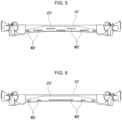
- FIG. 4 , FIG. 5 , FIG. 6 and FIG. 7 are views illustrating examples of the plug welding in which patterns of a portion where the external beam 10 and the internal beam 20 according to various exemplary embodiments of the present invention are bonded are different, and the presence or absence, position and length of the plug welding may be set by diversifying according to target rigidity and durability weakness.
- FIG. 4 is a view for describing a first example of the plug welding, and the internal skirt portion 24 and the external skirt portion 14 are welding-bonded W2 at regular intervals in the longitudinal direction of the internal skirt portion 24 and the external skirt portion 14.
- This may be a basic plug welding method of the external beam 10 and the internal beam 20.
- FIG. 5 is a view for describing a second example of the plug welding, and the internal skirt portion 24 and the external skirt portion 14 are welding-bonded W2 at regular intervals in upper and lower portions in the longitudinal direction of the internal skirt portion 24 and the external skirt portion 14 and may be bonded in a form in which welded positions of the upper and lower portions are staggered with each other.
- FIG. 6 is a view for describing a third example of the plug welding, and the internal skirt portion 24 and the external skirt portion 14 are welding-bonded W2 in the longitudinal direction of the internal skirt portion 24 and the external skirt portion 14 and may be bonded so that welded range of a center portion is longer than other welded ranges on both sides of the center portion of the torsion beam.
- the present reinforces a portion where durability may be weakened by configuring the center portion of the torsion beam 1 to have large resistance against the torsion.
- FIG. 7 is a view for describing a fourth example of the plug welding, and the internal skirt portion 24 and the external skirt portion 14 are welding-bonded W2 in the longitudinal direction of the internal skirt portion 24 and the external skirt portion 14 and may not be welded at the center portion of the torsion beam, but be welding-bonded W2 only at both sides of the center portion of the torsion beam.
- the degree of deformation by plug welding heat is different depending on a thickness of the torsion beam 1, the degree of deformation by plug welding heat is different.
- the internal beam 20 and the external beam 10 are molded by use of a thin plate material to reduce the weight of the torsion beam 1, since the welding is not performed at the center portion of the torsion beam 1, it is possible to minimize thermal deformation.
- a gap g may be formed by offsetting the cross section of the internal protrusion 22 into a shape corresponding to the cross section of the external protrusion 12.
- the gap g is formed between the entire external surface section of the internal protrusion 22 and the entire internal surface section of the external protrusion 12, and this may be applicable to a middle portion of the external beam 10 and the internal beam 20 (the same cross-sectional section to be described later) based on the left and right directions of the vehicle body.
- the roll rigidity may be improved by regulating an offset amount of the gap g formed in the center portion of the torsion beam.
- a concave inflection portion R in which a direction of bending thereof changes toward an internal side of the internal beam 20 is formed at a point where the external surface of the internal protrusion 22 and the external surface of the internal skirt portion 24 are connected.
- an upper end portion of the inflection portion R is connected to the lower end portion of the internal protrusion 22
- a lower end portion of the inflection portion R is connected to an upper end portion of the internal skirt portion 24, and a middle portion of the inflection portion R is formed in a shape dug toward the internal side of the internal beam 20.
- the gap g between the inflection portion R and the internal surface of the external beam 10 is increased to additionally secure the rigidity of the torsion beam 1, as well as to secure coating flowability, improving the coating performance.
- the inflection portion R may be formed to have a predetermined curvature.
- FIG. 8 is a view for describing a state in which a shape of a closed cross-section formed between the external beam 10 and the internal beam 20 according to various exemplary embodiments of the present invention is changed.
- the same cross-sectional section L1 formed by maintaining the same shape of the closed cross-section is formed at the center portion of the external beam 10 and the internal beam 20 formed along the left and right directions of the vehicle body, and variable cross-sectional sections formed by varying the shape of the closed cross-section are formed at both sides of the same cross-sectional section L1.
- the center portion in which deformation is most likely to occur forms and maintains the same cross-sectional shape of the closed cross-sectional structure, and the variable cross-sections of the closed cross-sectional structure are formed to improve bonding property with the trailing arms 2 at both sides of the center portion of the torsion beam.
- variable cross-sectional section are classified into a first variable section L2 and a second variable section L3, and the first variable section L2 is configured so that one side thereof is connected to a side portion of the same cross-sectional section L1, and the upper end portion of the internal beam 20 is gradually inclined downward to gradually increase a vertical height of the closed cross-section.
- the second variable section L3 is configured so that one side thereof is connected to the other side of the first variable section L2, the upper end portion of the external beam 10 and the upper end portion of the internal beam 20 are formed in a horizontal cross-sectional shape having a width of a predetermined length or more, and the other side thereof is connected to the side surfaces of the trailing arms 2.
- the end portions of the external beam 10 and the internal beam 20 are formed in a shape surrounding a portion of the side surfaces of the trailing arms 2, and an upper end portion of the end portion of the external beam 10 is bonded to the upper surfaces of the trailing arms 2.
- an upper end portion of the end portion of the internal beam 20 is bonded to bottom surfaces of the trailing arms 2.
- the same cross-sectional section L1 is the maximum torsion point of the torsion beam 1, and the torsional rigidity of the torsion beam 1 is secured by maintaining the shape and area of the closed cross-section between the internal beam 20 and the external beam 10 the same.
- the length of the lower end portion of the external skirt portion 14 may be formed to extend downward while molding the upper end portion of the external protrusion 12 upward, and the length of the lower end portion of the internal skirt portion 24 may be formed to extend downward while forming the upper end portion of the internal protrusion 22 downward.
- the internal beam 20 and the external beam 10 in the second variable section L3 have a horizontal cross-sectional shape of the upper end portions formed wider than the internal beam 20 and the external beam 10 in the first variable section L2, the area to be bonded to the upper and lower surfaces of the trailing arms 2 is widened, improving welding robustness with the trailing arms 2.
- a jig hole 16 may be formed in a variable cross-sectional section adjacent to the same cross-sectional section L1 of the upper end portion of the external beam 10, and the jig hole 16 may be formed at a position where the first variable section L2 starts in the same cross-sectional section L1.
- a seating surface 26 may be formed on the upper end portion of the internal beam 20 facing the jig hole 16 in a direction perpendicular to an axial direction of the jig hole 16.
- the jig hole 16 it is possible not only to perform fixing during welding, but also to measure a gap between the external beam 10 and the internal beam 20.
- the deformation in the same cross-sectional section L1 is the largest, and therefore, when the jig hole 16 is positioned in the same cross-sectional section L1, there is a possibility that a durability crack occurs in the jig hole 16. Therefore, by forming the jig hole 16 while avoiding the same cross-sectional section L1, it is possible to measure the gap between the external beam 10 and the internal beam 20 while preventing the crack of the torsion beam 1.
- the rigidity of the CTBA may be increased to secure the high roll rigidity equivalent to that of the multi-link, and furthermore, by increasing the bonding area between the external beam 10 and the internal beam 20, it is possible to secure the manufacturability and durability performance of the torsion beam 1.
- the structure with increased durability and rigidity is not due to a structure with increased weight such as adding the torsion beam 1 or increasing the thickness of the torsion beam 1, the low weight design of the CTBA is also possible.
Landscapes
- Engineering & Computer Science (AREA)
- Mechanical Engineering (AREA)
- Vehicle Body Suspensions (AREA)
- Closing And Opening Devices For Wings, And Checks For Wings (AREA)
- Springs (AREA)
Claims (14)
- Torsionsbalken (1) für eine Verbundlenkerachse, wobei der Torsionsbalken (1) aufweist:einen äußeren Balken (10), der einen ersten Querschnitt hat, in dem ein äußerer Vorsprung (12) eines mittleren Endabschnitts des äußeren Balkens (10) ausgebildet ist, um nach oben hin in einer Längsrichtung des äußeren Balkens (10) vorzustehen, und sich äußere Schürzenabschnitte (14) vertikal entlang der Längsrichtung an einem ersten Endabschnitt und einem zweiten Endabschnitt des äußeren Vorsprungs (12) erstrecken, undeinen inneren Balken (20), der einen zweiten Querschnitt hat, in dem ein innerer Vorsprung (22) eines mittleren Endabschnitts in dem inneren Balken (20) in den äußeren Balken (10) eingesetzt ist, um dem äußeren Vorsprung (12) des äußeren Balkens (10) gegenüberzuliegen, und sich innere Schürzenabschnitte (24) vertikal an einem ersten Endabschnitt und einem zweiten Endabschnitt des inneren Vorsprungs (22) erstrecken und jede Außenfläche der inneren Schürzenabschnitte (24) und jede Innenfläche der äußeren Schürzenabschnitte (14) in einem Wechselseitig-Angepasst-Zustand oberflächenverbunden sind,wobei ein Spalt (g) zwischen einer Außenfläche des inneren Vorsprungs (22) und einer Innenfläche des äußeren Vorsprungs (12) gebildet ist, um einen geschlossenen Querschnitt zwischen der Außenfläche des inneren Vorsprungs (22) und der Innenfläche des äußeren Vorsprungs (12) zu bilden,wobei ein konkaver Wendeabschnitt (R) an einem Punkt gebildet ist, an dem die Außenfläche des inneren Vorsprungs (22) und jede Außenfläche der inneren Schürzenabschnitte (24) verbunden sind, undwobei sich eine Biegerichtung des konkaven Wendeabschnitts (R), ausgehend von den inneren Schürzenabschnitten (24), zu einer Innenseite des inneren Balkens (20) hin ändert und sich danach zu einer Außenseite des inneren Balkens (20) hin ändert.
- Torsionsbalken (1) gemäß Anspruch 1, wobei eine Schweißverbindung entlang jedes Endabschnitts der inneren Schürzenabschnitte (24) und jeder Innenfläche der äußeren Schürzenabschnitte (14), die mit jedem Endabschnitt des inneren Schürzenabschnitts (24) in Kontakt stehen, linear durchgeführt ist.
- Torsionsbalken (1) gemäß Anspruch 1 oder 2, wobei jede Außenfläche der inneren Schürzenabschnitte (24) und jede Innenfläche der äußeren Schürzenabschnitte (14) in der Längsrichtung teilweise verschweißt sind.
- Torsionsbalken (1) gemäß einem der Ansprüche 1-3, wobei jede Außenfläche der inneren Schürzenabschnitte (24) und jede Innenfläche der äußeren Schürzenabschnitte (14) in vorbestimmten Intervallen in der Längsrichtung der inneren Schürzenabschnitte (24) und der äußeren Schürzenabschnitte (14) verschweißt sind.
- Torsionsbalken (1) gemäß einem der Ansprüche 1-4, wobei jede Außenfläche der inneren Schürzenabschnitte (24) und jede Innenfläche der äußeren Schürzenabschnitte (14) in vorbestimmten Intervallen in einem oberen und einem unteren Abschnitt des äußeren Schürzenabschnitts (14) und des inneren Schürzenabschnitts (24) in einer Längsrichtung der inneren Schürzenabschnitte (24) und in einer Längsrichtung der äußeren Schürzenabschnitte (14) verschweißt sind und so verbunden sind, dass verschweißte Positionen des oberen und des unteren Abschnitts zueinander versetzt sind.
- Torsionsbalken (1) gemäß Anspruch 5, wobei der obere und der untere Abschnitt des äußeren Schürzenabschnitts (14) und des inneren Schürzenabschnitts (24) in einer Zick-Zack-Reihenfolge in dem oberen und dem unteren Abschnitt verbunden sind.
- Torsionsbalken (1) gemäß einem der Ansprüche 1 bis 6, wobei jede Außenfläche der inneren Schürzenabschnitte (24) und jede Innenfläche der äußeren Schürzenabschnitte (14) in Längsrichtungen der inneren Schürzenabschnitte (24) und der äußeren Schürzenabschnitte (14) verschweißt sind und so verbunden sind, dass ein verschweißter Bereich eines Mittelabschnitts des Torsionsbalkens (1) länger ist als andere verschweißte Bereiche an einer ersten Endseite und einer zweiten Endseite des Mittelabschnitts des Torsionsbalkens (1).
- Torsionsbalken (1) gemäß einem der Ansprüche 1-7, wobei jede Außenfläche der inneren Schürzenabschnitte (24) und jede Innenfläche der äußeren Schürzenabschnitte (14) in Längsrichtungen der inneren Schürzenabschnitte (24) und der äußeren Schürzenabschnitte (14) verschweißt sind und am Mittelabschnitt des Torsionsbalkens (1) nicht verschweißt sind, sondern an einer ersten Endseite und einer zweiten Endseite des Mittelabschnitts des Torsionsbalkens (1) verschweißt sind.
- Torsionsbalken (1) gemäß einem der Ansprüche 1-8, wobei der Spalt (g) durch Versetzen eines Querschnitts des inneren Vorsprungs (22) in eine Form, die mit einem Querschnitt des äußeren Vorsprungs (12) korrespondiert, gebildet ist.
- Torsionsbalken (1) gemäß einem der Ansprüche 1-9, wobei der Spalt (g) zwischen einem gesamten äußeren Flächenbereich des inneren Vorsprungs (22) und einem gesamten inneren Flächenbereich des äußeren Vorsprungs (12) gebildet ist.
- Torsionsbalken (1) gemäß einem der Ansprüche 1-10, wobei eine vordere Fläche jeder Außenfläche der inneren Schürzenabschnitte (24) in Kontakt mit jeder Innenfläche der äußeren Schürzenabschnitte (14) ist.
- Torsionsbalken (1) gemäß einem der Ansprüche 1-11,wobei ein Gleicher-Querschnitt-Bereich, der durch Beibehalten einer gleichen Form eines geschlossenen Querschnitts gebildet ist, an einem Mittelabschnitt des äußeren Balkens (10) und des inneren Balkens (20) gebildet ist, undwobei Variabler-Querschnitt-Bereiche, die durch Variieren einer Form des geschlossenen Querschnitts gebildet sind, an einer ersten Endseite und einer zweiten Endseite des Gleicher-Querschnitt-Bereichs gebildet sind.
- Torsionsbalken (1) gemäß Anspruch 12, wobei die Variabler-Querschnitt-Bereiche aufweisen:einen ersten variablen Bereich, wobei eine erste Seite des ersten variablen Bereichs mit einem Seitenabschnitt des Gleicher-Querschnitt-Bereichs verbunden ist und ein oberer Endabschnitt des inneren Balkens (20) nach unten hin geneigt ist, um eine vertikale Höhe des geschlossenen Querschnitts zu vergrößern,einen zweiten variablen Bereich, wobei eine erste Seite des zweiten variablen Bereichs mit einer zweiten Seite des ersten variablen Bereichs verbunden ist, ein oberer Endabschnitt des äußeren Balkens (10) und der obere Endabschnitt des inneren Balkens (20) in einer horizontalen Querschnittsform, die eine Breite von einer vorbestimmten Länge oder mehr hat, ausgebildet sind und eine zweite Seite des zweiten variablen Bereichs mit Seitenflächen von nachlaufenden Armen (2) verbunden ist,wobei Endabschnitte des äußeren Balkens (10) und des inneren Balkens (20) in einer Form ausgebildet sind, die einen Abschnitt der Seitenflächen der nachlaufenden Arme (2) umgibt,wobei ein oberer Endabschnitt des Endabschnitts des äußeren Balkens (10) mit oberen Flächen der nachlaufenden Arme (2) verbunden ist, undwobei ein oberer Endabschnitt des Endabschnitts des inneren Balkens (20) mit unteren Flächen der nachlaufenden Arme (2) verbunden ist.
- Torsionsbalken (1) gemäß Anspruch 12 oder 13, wobei ein Lehre-Loch in einem Variabler-Querschnitt-Bereich von den Variabler-Querschnitt-Bereichen ausgebildet ist, der angrenzend an den Gleicher-Querschnitt-Bereich des oberen Endabschnitts des äußeren Balkens (10) ist, und
wobei eine Sitzfläche an einem oberen Endabschnitt des inneren Balkens (20) ausgebildet ist, dem Lehre-Loch zugewandt in einer Richtung senkrecht zu einer axialen Richtung des Lehre-Lochs.
Applications Claiming Priority (1)
| Application Number | Priority Date | Filing Date | Title |
|---|---|---|---|
| KR1020200038812A KR102775077B1 (ko) | 2020-03-31 | 2020-03-31 | 커플드 토션빔 액슬의 토션빔 |
Publications (2)
| Publication Number | Publication Date |
|---|---|
| EP3888959A1 EP3888959A1 (de) | 2021-10-06 |
| EP3888959B1 true EP3888959B1 (de) | 2023-05-10 |
Family
ID=72615742
Family Applications (1)
| Application Number | Title | Priority Date | Filing Date |
|---|---|---|---|
| EP20197723.8A Active EP3888959B1 (de) | 2020-03-31 | 2020-09-23 | Verbundlenker einer gekoppelten verbundlenkerachse |
Country Status (5)
| Country | Link |
|---|---|
| US (1) | US11305605B2 (de) |
| EP (1) | EP3888959B1 (de) |
| KR (1) | KR102775077B1 (de) |
| CN (1) | CN113459758B (de) |
| ES (1) | ES2948305T3 (de) |
Families Citing this family (2)
| Publication number | Priority date | Publication date | Assignee | Title |
|---|---|---|---|---|
| USD1103851S1 (en) * | 2022-09-08 | 2025-12-02 | Harbinger Motors Inc. | Beam axle |
| DE102023127934B3 (de) * | 2023-10-12 | 2025-04-03 | Benteler Automobiltechnik Gmbh | Verbundlenkerachse |
Citations (1)
| Publication number | Priority date | Publication date | Assignee | Title |
|---|---|---|---|---|
| KR20010046885A (ko) * | 1999-11-16 | 2001-06-15 | 류정열 | 액슬 빔식 서스펜션의 크로스 빔 보강장치 |
Family Cites Families (16)
| Publication number | Priority date | Publication date | Assignee | Title |
|---|---|---|---|---|
| US4165098A (en) * | 1977-11-28 | 1979-08-21 | Chrysler Corporation | Rear suspension apparatus for a motor vehicle |
| DE10139661C1 (de) * | 2001-08-11 | 2003-02-13 | Linde & Pullman Ag Zuerich | Blechprofilträger, insbesondere für den Fahrzeugbau und Verfahren zu dessen Herstellung |
| KR20050043203A (ko) * | 2003-11-05 | 2005-05-11 | 주식회사화신 | 자동차 현가계용 토션빔의 횡방향 빔 구조 |
| DE102004003152A1 (de) * | 2004-01-21 | 2005-08-11 | Volkswagen Ag | Verbundlenkerachse für ein Kraftfahrzeug und Verfahren zur Einstellung der Torsionssteifigkeit an einer solchen |
| DE102004055100B4 (de) * | 2004-11-15 | 2011-07-14 | Benteler Automobiltechnik GmbH, 33102 | Achskonstruktion für ein Kraftfahrzeug |
| US20070069496A1 (en) * | 2005-09-27 | 2007-03-29 | Rinehart Ronald A | Torsion beam suspension member |
| WO2012011482A1 (ja) * | 2010-07-23 | 2012-01-26 | 本田技研工業株式会社 | トーションビーム式サスペンション装置 |
| KR20120057143A (ko) | 2010-11-26 | 2012-06-05 | 현대자동차주식회사 | 자동차용 커플드 토션빔 액슬 타입 리어 현가장치 |
| CN102795071B (zh) * | 2012-09-04 | 2015-01-07 | 中国长安汽车集团股份有限公司四川建安车桥分公司 | 汽车后扭转梁半独立悬架 |
| JP2016515064A (ja) * | 2013-03-14 | 2016-05-26 | マグナ インターナショナル インコーポレイテッド | 膨出中間セクションを備えたリア・ツイストビーム |
| CA2909707A1 (en) * | 2013-04-16 | 2014-10-23 | Magna International Inc. | Twist beam with joined inner and outer parts |
| CN107405950A (zh) * | 2015-02-20 | 2017-11-28 | 麦格纳国际公司 | 车辆扭转车桥组件 |
| DE102016210458B4 (de) * | 2015-06-30 | 2022-03-31 | Ford Global Technologies, Llc | Torsionsquerträger, insbesondere für eine Verbundlenkerachse und Kraftfahrzeug aufweisend den Torsionsquerträger |
| KR20170099676A (ko) * | 2016-02-24 | 2017-09-01 | 주식회사 디케이오스텍 | 토션빔 액슬용 트레일링 암의 제조방법 |
| CA3030672A1 (en) * | 2016-07-15 | 2018-01-18 | Magna International Inc. | Vehicle twist axle assembly |
| CN108944331B (zh) * | 2018-07-12 | 2020-05-29 | 安徽江淮汽车集团股份有限公司 | 一种汽车扭力梁缩短改制工艺方法 |
-
2020
- 2020-03-31 KR KR1020200038812A patent/KR102775077B1/ko active Active
- 2020-09-22 US US17/028,671 patent/US11305605B2/en active Active
- 2020-09-23 EP EP20197723.8A patent/EP3888959B1/de active Active
- 2020-09-23 ES ES20197723T patent/ES2948305T3/es active Active
- 2020-10-14 CN CN202011096320.3A patent/CN113459758B/zh active Active
Patent Citations (1)
| Publication number | Priority date | Publication date | Assignee | Title |
|---|---|---|---|---|
| KR20010046885A (ko) * | 1999-11-16 | 2001-06-15 | 류정열 | 액슬 빔식 서스펜션의 크로스 빔 보강장치 |
Also Published As
| Publication number | Publication date |
|---|---|
| US11305605B2 (en) | 2022-04-19 |
| KR102775077B1 (ko) | 2025-03-05 |
| ES2948305T3 (es) | 2023-09-08 |
| KR20210122388A (ko) | 2021-10-12 |
| US20210300142A1 (en) | 2021-09-30 |
| CN113459758A (zh) | 2021-10-01 |
| EP3888959A1 (de) | 2021-10-06 |
| CN113459758B (zh) | 2025-10-03 |
Similar Documents
| Publication | Publication Date | Title |
|---|---|---|
| US8167325B2 (en) | Control arm of multilink suspension system for vehicle | |
| US7665752B2 (en) | Torsion beam of suspension | |
| US8210508B2 (en) | Bump stopper for suspension system | |
| US10081044B2 (en) | Method for producing a chassis link | |
| US20120038126A1 (en) | Suspension arm for a motor vehicle wheel suspension and method for manufacturing same | |
| US10315484B2 (en) | Vehicle twist axle assembly | |
| KR20110074976A (ko) | 중공 샤프트 결합 장치 | |
| EP3888959B1 (de) | Verbundlenker einer gekoppelten verbundlenkerachse | |
| US11548340B2 (en) | Toe correction bushing and rear suspension device | |
| US9579947B2 (en) | Coupled torsion beam axle for vehicles | |
| US9579946B2 (en) | Trailing arm bush for coupled torsion beam axle | |
| US11027586B2 (en) | Vehicle suspension member | |
| CN101072696A (zh) | 包括梯形横截面横梁的挠性轴、相应的横梁、车辆以及制造方法 | |
| CN100457481C (zh) | 多联杆后悬架系统 | |
| CN109664709B (zh) | 管式扭转梁 | |
| JP3816729B2 (ja) | リヤサスペンション | |
| JP2008201307A (ja) | スタビライザ装置 | |
| KR20250159768A (ko) | 스태빌라이저 바 유닛 | |
| CN107074013A (zh) | 车辆扭力轴组件 | |
| US12605979B2 (en) | Lower arm for vehicle suspension | |
| KR20230020533A (ko) | 자동차를 위한 후방 하부 제어 아암 | |
| JP2008511497A (ja) | 横揺れ防止機能を組み入れた横梁を含む自動車のフレキシブルアクスルと、対応する横梁および自動車の製造方法 | |
| JP4889634B2 (ja) | アクスルの縦アームとアンチロールバーとの間に設けられる補強された接続部品、アクスル、自動車及び対応する製造方法 | |
| EP3939810B1 (de) | Federlenker für eine fahrzeugaufhängung | |
| KR100902836B1 (ko) | 자동차의 후륜 현가장치용 튜브형 토션 빔 |
Legal Events
| Date | Code | Title | Description |
|---|---|---|---|
| PUAI | Public reference made under article 153(3) epc to a published international application that has entered the european phase |
Free format text: ORIGINAL CODE: 0009012 |
|
| STAA | Information on the status of an ep patent application or granted ep patent |
Free format text: STATUS: THE APPLICATION HAS BEEN PUBLISHED |
|
| AK | Designated contracting states |
Kind code of ref document: A1 Designated state(s): AL AT BE BG CH CY CZ DE DK EE ES FI FR GB GR HR HU IE IS IT LI LT LU LV MC MK MT NL NO PL PT RO RS SE SI SK SM TR |
|
| STAA | Information on the status of an ep patent application or granted ep patent |
Free format text: STATUS: REQUEST FOR EXAMINATION WAS MADE |
|
| 17P | Request for examination filed |
Effective date: 20220406 |
|
| RBV | Designated contracting states (corrected) |
Designated state(s): AL AT BE BG CH CY CZ DE DK EE ES FI FR GB GR HR HU IE IS IT LI LT LU LV MC MK MT NL NO PL PT RO RS SE SI SK SM TR |
|
| GRAP | Despatch of communication of intention to grant a patent |
Free format text: ORIGINAL CODE: EPIDOSNIGR1 |
|
| STAA | Information on the status of an ep patent application or granted ep patent |
Free format text: STATUS: GRANT OF PATENT IS INTENDED |
|
| INTG | Intention to grant announced |
Effective date: 20221223 |
|
| GRAS | Grant fee paid |
Free format text: ORIGINAL CODE: EPIDOSNIGR3 |
|
| GRAA | (expected) grant |
Free format text: ORIGINAL CODE: 0009210 |
|
| STAA | Information on the status of an ep patent application or granted ep patent |
Free format text: STATUS: THE PATENT HAS BEEN GRANTED |
|
| AK | Designated contracting states |
Kind code of ref document: B1 Designated state(s): AL AT BE BG CH CY CZ DE DK EE ES FI FR GB GR HR HU IE IS IT LI LT LU LV MC MK MT NL NO PL PT RO RS SE SI SK SM TR |
|
| REG | Reference to a national code |
Ref country code: GB Ref legal event code: FG4D |
|
| REG | Reference to a national code |
Ref country code: AT Ref legal event code: REF Ref document number: 1566355 Country of ref document: AT Kind code of ref document: T Effective date: 20230515 Ref country code: CH Ref legal event code: EP |
|
| REG | Reference to a national code |
Ref country code: DE Ref legal event code: R096 Ref document number: 602020010669 Country of ref document: DE |
|
| REG | Reference to a national code |
Ref country code: IE Ref legal event code: FG4D |
|
| P01 | Opt-out of the competence of the unified patent court (upc) registered |
Effective date: 20230505 |
|
| REG | Reference to a national code |
Ref country code: LT Ref legal event code: MG9D |
|
| REG | Reference to a national code |
Ref country code: ES Ref legal event code: FG2A Ref document number: 2948305 Country of ref document: ES Kind code of ref document: T3 Effective date: 20230908 |
|
| REG | Reference to a national code |
Ref country code: NL Ref legal event code: MP Effective date: 20230510 |
|
| REG | Reference to a national code |
Ref country code: AT Ref legal event code: MK05 Ref document number: 1566355 Country of ref document: AT Kind code of ref document: T Effective date: 20230510 |
|
| PG25 | Lapsed in a contracting state [announced via postgrant information from national office to epo] |
Ref country code: SE Free format text: LAPSE BECAUSE OF FAILURE TO SUBMIT A TRANSLATION OF THE DESCRIPTION OR TO PAY THE FEE WITHIN THE PRESCRIBED TIME-LIMIT Effective date: 20230510 Ref country code: PT Free format text: LAPSE BECAUSE OF FAILURE TO SUBMIT A TRANSLATION OF THE DESCRIPTION OR TO PAY THE FEE WITHIN THE PRESCRIBED TIME-LIMIT Effective date: 20230911 Ref country code: NO Free format text: LAPSE BECAUSE OF FAILURE TO SUBMIT A TRANSLATION OF THE DESCRIPTION OR TO PAY THE FEE WITHIN THE PRESCRIBED TIME-LIMIT Effective date: 20230810 Ref country code: NL Free format text: LAPSE BECAUSE OF FAILURE TO SUBMIT A TRANSLATION OF THE DESCRIPTION OR TO PAY THE FEE WITHIN THE PRESCRIBED TIME-LIMIT Effective date: 20230510 Ref country code: AT Free format text: LAPSE BECAUSE OF FAILURE TO SUBMIT A TRANSLATION OF THE DESCRIPTION OR TO PAY THE FEE WITHIN THE PRESCRIBED TIME-LIMIT Effective date: 20230510 |
|
| PG25 | Lapsed in a contracting state [announced via postgrant information from national office to epo] |
Ref country code: RS Free format text: LAPSE BECAUSE OF FAILURE TO SUBMIT A TRANSLATION OF THE DESCRIPTION OR TO PAY THE FEE WITHIN THE PRESCRIBED TIME-LIMIT Effective date: 20230510 Ref country code: PL Free format text: LAPSE BECAUSE OF FAILURE TO SUBMIT A TRANSLATION OF THE DESCRIPTION OR TO PAY THE FEE WITHIN THE PRESCRIBED TIME-LIMIT Effective date: 20230510 Ref country code: LV Free format text: LAPSE BECAUSE OF FAILURE TO SUBMIT A TRANSLATION OF THE DESCRIPTION OR TO PAY THE FEE WITHIN THE PRESCRIBED TIME-LIMIT Effective date: 20230510 Ref country code: LT Free format text: LAPSE BECAUSE OF FAILURE TO SUBMIT A TRANSLATION OF THE DESCRIPTION OR TO PAY THE FEE WITHIN THE PRESCRIBED TIME-LIMIT Effective date: 20230510 Ref country code: IS Free format text: LAPSE BECAUSE OF FAILURE TO SUBMIT A TRANSLATION OF THE DESCRIPTION OR TO PAY THE FEE WITHIN THE PRESCRIBED TIME-LIMIT Effective date: 20230910 Ref country code: HR Free format text: LAPSE BECAUSE OF FAILURE TO SUBMIT A TRANSLATION OF THE DESCRIPTION OR TO PAY THE FEE WITHIN THE PRESCRIBED TIME-LIMIT Effective date: 20230510 Ref country code: GR Free format text: LAPSE BECAUSE OF FAILURE TO SUBMIT A TRANSLATION OF THE DESCRIPTION OR TO PAY THE FEE WITHIN THE PRESCRIBED TIME-LIMIT Effective date: 20230811 |
|
| PG25 | Lapsed in a contracting state [announced via postgrant information from national office to epo] |
Ref country code: SK Free format text: LAPSE BECAUSE OF FAILURE TO SUBMIT A TRANSLATION OF THE DESCRIPTION OR TO PAY THE FEE WITHIN THE PRESCRIBED TIME-LIMIT Effective date: 20230510 |
|
| PG25 | Lapsed in a contracting state [announced via postgrant information from national office to epo] |
Ref country code: SM Free format text: LAPSE BECAUSE OF FAILURE TO SUBMIT A TRANSLATION OF THE DESCRIPTION OR TO PAY THE FEE WITHIN THE PRESCRIBED TIME-LIMIT Effective date: 20230510 Ref country code: SK Free format text: LAPSE BECAUSE OF FAILURE TO SUBMIT A TRANSLATION OF THE DESCRIPTION OR TO PAY THE FEE WITHIN THE PRESCRIBED TIME-LIMIT Effective date: 20230510 Ref country code: RO Free format text: LAPSE BECAUSE OF FAILURE TO SUBMIT A TRANSLATION OF THE DESCRIPTION OR TO PAY THE FEE WITHIN THE PRESCRIBED TIME-LIMIT Effective date: 20230510 Ref country code: EE Free format text: LAPSE BECAUSE OF FAILURE TO SUBMIT A TRANSLATION OF THE DESCRIPTION OR TO PAY THE FEE WITHIN THE PRESCRIBED TIME-LIMIT Effective date: 20230510 Ref country code: DK Free format text: LAPSE BECAUSE OF FAILURE TO SUBMIT A TRANSLATION OF THE DESCRIPTION OR TO PAY THE FEE WITHIN THE PRESCRIBED TIME-LIMIT Effective date: 20230510 Ref country code: CZ Free format text: LAPSE BECAUSE OF FAILURE TO SUBMIT A TRANSLATION OF THE DESCRIPTION OR TO PAY THE FEE WITHIN THE PRESCRIBED TIME-LIMIT Effective date: 20230510 |
|
| REG | Reference to a national code |
Ref country code: DE Ref legal event code: R097 Ref document number: 602020010669 Country of ref document: DE |
|
| PLBE | No opposition filed within time limit |
Free format text: ORIGINAL CODE: 0009261 |
|
| STAA | Information on the status of an ep patent application or granted ep patent |
Free format text: STATUS: NO OPPOSITION FILED WITHIN TIME LIMIT |
|
| 26N | No opposition filed |
Effective date: 20240213 |
|
| REG | Reference to a national code |
Ref country code: CH Ref legal event code: PL |
|
| PG25 | Lapsed in a contracting state [announced via postgrant information from national office to epo] |
Ref country code: SI Free format text: LAPSE BECAUSE OF FAILURE TO SUBMIT A TRANSLATION OF THE DESCRIPTION OR TO PAY THE FEE WITHIN THE PRESCRIBED TIME-LIMIT Effective date: 20230510 |
|
| PG25 | Lapsed in a contracting state [announced via postgrant information from national office to epo] |
Ref country code: LU Free format text: LAPSE BECAUSE OF NON-PAYMENT OF DUE FEES Effective date: 20230923 |
|
| REG | Reference to a national code |
Ref country code: BE Ref legal event code: MM Effective date: 20230930 |
|
| PG25 | Lapsed in a contracting state [announced via postgrant information from national office to epo] |
Ref country code: SI Free format text: LAPSE BECAUSE OF FAILURE TO SUBMIT A TRANSLATION OF THE DESCRIPTION OR TO PAY THE FEE WITHIN THE PRESCRIBED TIME-LIMIT Effective date: 20230510 Ref country code: LU Free format text: LAPSE BECAUSE OF NON-PAYMENT OF DUE FEES Effective date: 20230923 Ref country code: MC Free format text: LAPSE BECAUSE OF FAILURE TO SUBMIT A TRANSLATION OF THE DESCRIPTION OR TO PAY THE FEE WITHIN THE PRESCRIBED TIME-LIMIT Effective date: 20230510 |
|
| REG | Reference to a national code |
Ref country code: IE Ref legal event code: MM4A |
|
| PG25 | Lapsed in a contracting state [announced via postgrant information from national office to epo] |
Ref country code: IE Free format text: LAPSE BECAUSE OF NON-PAYMENT OF DUE FEES Effective date: 20230923 |
|
| PG25 | Lapsed in a contracting state [announced via postgrant information from national office to epo] |
Ref country code: CH Free format text: LAPSE BECAUSE OF NON-PAYMENT OF DUE FEES Effective date: 20230930 |
|
| PG25 | Lapsed in a contracting state [announced via postgrant information from national office to epo] |
Ref country code: IE Free format text: LAPSE BECAUSE OF NON-PAYMENT OF DUE FEES Effective date: 20230923 Ref country code: CH Free format text: LAPSE BECAUSE OF NON-PAYMENT OF DUE FEES Effective date: 20230930 |
|
| PG25 | Lapsed in a contracting state [announced via postgrant information from national office to epo] |
Ref country code: BE Free format text: LAPSE BECAUSE OF NON-PAYMENT OF DUE FEES Effective date: 20230930 |
|
| PG25 | Lapsed in a contracting state [announced via postgrant information from national office to epo] |
Ref country code: BG Free format text: LAPSE BECAUSE OF FAILURE TO SUBMIT A TRANSLATION OF THE DESCRIPTION OR TO PAY THE FEE WITHIN THE PRESCRIBED TIME-LIMIT Effective date: 20230510 |
|
| PG25 | Lapsed in a contracting state [announced via postgrant information from national office to epo] |
Ref country code: BG Free format text: LAPSE BECAUSE OF FAILURE TO SUBMIT A TRANSLATION OF THE DESCRIPTION OR TO PAY THE FEE WITHIN THE PRESCRIBED TIME-LIMIT Effective date: 20230510 |
|
| PG25 | Lapsed in a contracting state [announced via postgrant information from national office to epo] |
Ref country code: FI Free format text: LAPSE BECAUSE OF FAILURE TO SUBMIT A TRANSLATION OF THE DESCRIPTION OR TO PAY THE FEE WITHIN THE PRESCRIBED TIME-LIMIT Effective date: 20230510 |
|
| PG25 | Lapsed in a contracting state [announced via postgrant information from national office to epo] |
Ref country code: CY Free format text: LAPSE BECAUSE OF FAILURE TO SUBMIT A TRANSLATION OF THE DESCRIPTION OR TO PAY THE FEE WITHIN THE PRESCRIBED TIME-LIMIT; INVALID AB INITIO Effective date: 20200923 |
|
| PG25 | Lapsed in a contracting state [announced via postgrant information from national office to epo] |
Ref country code: HU Free format text: LAPSE BECAUSE OF FAILURE TO SUBMIT A TRANSLATION OF THE DESCRIPTION OR TO PAY THE FEE WITHIN THE PRESCRIBED TIME-LIMIT; INVALID AB INITIO Effective date: 20200923 |
|
| PGFP | Annual fee paid to national office [announced via postgrant information from national office to epo] |
Ref country code: DE Payment date: 20250820 Year of fee payment: 6 |
|
| PGFP | Annual fee paid to national office [announced via postgrant information from national office to epo] |
Ref country code: IT Payment date: 20250822 Year of fee payment: 6 |
|
| PGFP | Annual fee paid to national office [announced via postgrant information from national office to epo] |
Ref country code: GB Payment date: 20250820 Year of fee payment: 6 |
|
| PGFP | Annual fee paid to national office [announced via postgrant information from national office to epo] |
Ref country code: FR Payment date: 20250821 Year of fee payment: 6 |
|
| PG25 | Lapsed in a contracting state [announced via postgrant information from national office to epo] |
Ref country code: TR Free format text: LAPSE BECAUSE OF FAILURE TO SUBMIT A TRANSLATION OF THE DESCRIPTION OR TO PAY THE FEE WITHIN THE PRESCRIBED TIME-LIMIT Effective date: 20230510 |
|
| PGFP | Annual fee paid to national office [announced via postgrant information from national office to epo] |
Ref country code: ES Payment date: 20251007 Year of fee payment: 6 |