EP3887331B1 - Bioaktive silikatgläser - Google Patents
Bioaktive silikatgläser Download PDFInfo
- Publication number
- EP3887331B1 EP3887331B1 EP19817892.3A EP19817892A EP3887331B1 EP 3887331 B1 EP3887331 B1 EP 3887331B1 EP 19817892 A EP19817892 A EP 19817892A EP 3887331 B1 EP3887331 B1 EP 3887331B1
- Authority
- EP
- European Patent Office
- Prior art keywords
- glass
- antibacterial composition
- examples
- composition
- cao
- Prior art date
- Legal status (The legal status is an assumption and is not a legal conclusion. Google has not performed a legal analysis and makes no representation as to the accuracy of the status listed.)
- Active
Links
Images

Classifications
-
- A—HUMAN NECESSITIES
- A61—MEDICAL OR VETERINARY SCIENCE; HYGIENE
- A61L—METHODS OR APPARATUS FOR STERILISING MATERIALS OR OBJECTS IN GENERAL; DISINFECTION, STERILISATION OR DEODORISATION OF AIR; CHEMICAL ASPECTS OF BANDAGES, DRESSINGS, ABSORBENT PADS OR SURGICAL ARTICLES; MATERIALS FOR BANDAGES, DRESSINGS, ABSORBENT PADS OR SURGICAL ARTICLES
- A61L26/00—Chemical aspects of, or use of materials for, wound dressings or bandages in liquid, gel or powder form
- A61L26/0004—Chemical aspects of, or use of materials for, wound dressings or bandages in liquid, gel or powder form containing inorganic materials
-
- A—HUMAN NECESSITIES
- A61—MEDICAL OR VETERINARY SCIENCE; HYGIENE
- A61L—METHODS OR APPARATUS FOR STERILISING MATERIALS OR OBJECTS IN GENERAL; DISINFECTION, STERILISATION OR DEODORISATION OF AIR; CHEMICAL ASPECTS OF BANDAGES, DRESSINGS, ABSORBENT PADS OR SURGICAL ARTICLES; MATERIALS FOR BANDAGES, DRESSINGS, ABSORBENT PADS OR SURGICAL ARTICLES
- A61L27/00—Materials for grafts or prostheses or for coating grafts or prostheses
- A61L27/02—Inorganic materials
- A61L27/10—Ceramics or glasses
-
- A—HUMAN NECESSITIES
- A61—MEDICAL OR VETERINARY SCIENCE; HYGIENE
- A61L—METHODS OR APPARATUS FOR STERILISING MATERIALS OR OBJECTS IN GENERAL; DISINFECTION, STERILISATION OR DEODORISATION OF AIR; CHEMICAL ASPECTS OF BANDAGES, DRESSINGS, ABSORBENT PADS OR SURGICAL ARTICLES; MATERIALS FOR BANDAGES, DRESSINGS, ABSORBENT PADS OR SURGICAL ARTICLES
- A61L31/00—Materials for other surgical articles, e.g. stents, stent-grafts, shunts, surgical drapes, guide wires, materials for adhesion prevention, occluding devices, surgical gloves, tissue fixation devices
- A61L31/02—Inorganic materials
- A61L31/026—Ceramic or ceramic-like structures, e.g. glasses
-
- C—CHEMISTRY; METALLURGY
- C03—GLASS; MINERAL OR SLAG WOOL
- C03C—CHEMICAL COMPOSITION OF GLASSES, GLAZES OR VITREOUS ENAMELS; SURFACE TREATMENT OF GLASS; SURFACE TREATMENT OF FIBRES OR FILAMENTS MADE FROM GLASS, MINERALS OR SLAGS; JOINING GLASS TO GLASS OR OTHER MATERIALS
- C03C3/00—Glass compositions
- C03C3/04—Glass compositions containing silica
- C03C3/076—Glass compositions containing silica with 40% to 90% silica, by weight
- C03C3/097—Glass compositions containing silica with 40% to 90% silica, by weight containing phosphorus, niobium or tantalum
-
- C—CHEMISTRY; METALLURGY
- C03—GLASS; MINERAL OR SLAG WOOL
- C03C—CHEMICAL COMPOSITION OF GLASSES, GLAZES OR VITREOUS ENAMELS; SURFACE TREATMENT OF GLASS; SURFACE TREATMENT OF FIBRES OR FILAMENTS MADE FROM GLASS, MINERALS OR SLAGS; JOINING GLASS TO GLASS OR OTHER MATERIALS
- C03C4/00—Compositions for glass with special properties
- C03C4/0007—Compositions for glass with special properties for biologically-compatible glass
- C03C4/0021—Compositions for glass with special properties for biologically-compatible glass for dental use
-
- C—CHEMISTRY; METALLURGY
- C03—GLASS; MINERAL OR SLAG WOOL
- C03C—CHEMICAL COMPOSITION OF GLASSES, GLAZES OR VITREOUS ENAMELS; SURFACE TREATMENT OF GLASS; SURFACE TREATMENT OF FIBRES OR FILAMENTS MADE FROM GLASS, MINERALS OR SLAGS; JOINING GLASS TO GLASS OR OTHER MATERIALS
- C03C2204/00—Glasses, glazes or enamels with special properties
- C03C2204/02—Antibacterial glass, glaze or enamel
Definitions
- the disclosure relates to bioactive glasses for use in biomedical applications.
- the glasses described herein are silicate glasses that show fast filling rates of dentin tubules and have advantageous release rates of metal ions, which provide advantages in antibacterial applications and wound healing.
- Bioactive glasses are a group of glass and glass ceramic materials that have shown biocompatibility or bioactivity, which has allowed them to be incorporated into human or animal physiology.
- a number of these materials exist on the market already, such as Bioglass 8625, a soda-lime glass used for encapsulation of implanted devices, and Bioglass 45S5, a bioactive glass composition used in bone repair.
- Bioglass 8625 a soda-lime glass used for encapsulation of implanted devices
- Bioglass 45S5 a bioactive glass composition used in bone repair.
- US 2005/064193 A1 , US 7141520 B2 , US 7074730 B2 are directed, inter alia, to powdered glass with antimicrobial properties.
- WO 96/21628 A1 relates to bioactive glass fibers for use in the medical field, in particular for tissue bonding purposes.
- US 4171544 A relates to glass material deposited on a surface for bonding to the bone.
- the invention relates to an antibacterial composition, comprising: a silicate-based glass material being a fiber and having a composition of: 60-70 wt.% SiO 2 , 0-10 wt.% B 2 O 3 , 3-18 wt.% P 2 O 5 , 0-10 wt.% Al 2 O 3 , 0-5 wt.% Li 2 O, 20-30 wt.% Na 2 O, 0-15 wt.% K 2 O, 0-10 wt.% MgO, 1-15 wt.% CaO, 2-20 wt.% MO, and 20-35 wt.% R 2 O, wherein MO is the sum of MgO, CaO, SrO, and BaO, wherein R 2 O is the sum of Na 2 O, K 2 O, Li 2 O, and Rb 2 O, and wherein the silicate-based glass material is configured to achieve a 6-log kill rate of at least one of E. coli , P. gingivalis , or
- the term “about” means that amounts, sizes, formulations, parameters, and other quantities and characteristics are not and need not be exact, but may be approximate and/or larger or smaller, as desired, reflecting tolerances, conversion factors, rounding off, measurement error and the like, and other factors known to those of skill in the art. It is noted that the terms “substantially” may be utilized herein to represent the inherent degree of uncertainty that may be attributed to any quantitative comparison, value, measurement, or other representation. These terms are also utilized herein to represent the degree by which a quantitative representation may vary from a stated reference without resulting in a change in the basic function of the subject matter at issue.
- a glass that is "free” or “essentially free” of Al 2 O 3 is one in which Al 2 O 3 is not actively added or batched into the glass, but may be present in very small amounts as a contaminant (e.g., 500, 400, 300, 200, or 100 parts per million (ppm) or less or).
- a contaminant e.g., 500, 400, 300, 200, or 100 parts per million (ppm) or less or).
- glass compositions are expressed in terms of wt% amounts of particular components included therein on an oxide bases unless otherwise indicated. Any component having more than one oxidation state may be present in a glass composition in any oxidation state. However, concentrations of such component are expressed in terms of the oxide in which such component is at its lowest oxidation state unless otherwise indicated.
- CTE coefficients of thermal expansion
- the CTE can be determined, for example, using the procedure described in ASTM E228 "Standard Test Method for Linear Thermal Expansion of Solid Materials with a Push-Rod Dilatometer” or ISO 7991:1987 “Glass -- Determination of coefficient of mean linear thermal expansion.”
- the density in terms of grams/cm 3 was measured via the Archimedes method (ASTM C693). Young's modulus, shear modulus, and Poisson's Ratio were measured via the ASTM C623 standard.
- Bioactive glasses are a group of glass and glass ceramic materials that have shown biocompatibility or bioactivity, which has allowed them to be incorporated into human or animal physiology.
- the biocompatibility and in vivo properties of the glass are influenced by the glass composition.
- SiO 2 serves as the primary glass-forming oxide in combination with the bioactive oxides of calcium and phosphorous.
- the glass comprises a combination of SiO 2 , Na 2 O, P 2 O 5 , and CaO.
- the glass further comprises Al 2 O 3 , B 2 O 3 , K 2 O, and/or Li 2 O.
- the glass comprises a glass composition comprising, in wt.%: 60-70 SiO 2 , 0-10 B 2 O 3 , 3-18 P 2 O 5 , 0-10 Al 2 O 3 , 0-5 Li 2 O, 20-30 Na 2 O, 0-15 K 2 O, 0-10 MgO, 1-15 CaO, 2-20 MO, and 20-35 R 2 O, wherein MO is the sum of MgO, CaO, SrO, and BaO, R 2 O is the sum of Na 2 O, K 2 O, Li 2 O, and Rb 2 O.
- the glass composition comprises 5-15 wt.% P 2 O 5 .
- the glass composition additionally comprises >0-8 wt.% ZnO.
- the silicate glasses disclosed herein are particularly suitable for biomedical
- Silicon dioxide which is the major oxide component of the embodied glasses, may be included to provide high temperature stability and chemical durability.
- the glass comprises 60-70 wt.% SiO 2 .
- the glass can comprise 60-65 wt.%, or 65-70 wt.% SiO 2 .
- the glass comprises 60, 61, 62, 63, 64, 65, 66, 67, 68, 69, 70 wt.% SiO 2 .
- the glass comprises 0-10 wt.% B 2 O 3 .
- the glass can comprise >0-10 wt.% B 2 O 3 .
- the glass can comprise 0-5 wt.% B 2 O 3 .
- the glass can comprise from >0-10 wt.%, 2-10 wt.%, 5-10 wt.%, 0-8 wt.%, >0-8 wt.%, 2-8 wt.%, 5-8 wt.%, 0-5 wt.%, >0-5 wt.%, or 2-5 wt.% B 2 O 3 .
- the glass can comprise 0, >0, 1, 2, 3, 4, 5, 6, 7, 8, 9, or 10 wt.% B 2 O 3 .
- Alumina may influence the structure of the glass and, additionally, lower the liquidus temperature and coefficient of thermal expansion, or enhance the strain point.
- Al 2 O 3 and ZrO 2 ) help improve the chemical durability in silicate glass while having no toxicity concerns.
- the glass comprises 0-10 wt.% Al 2 O 3 .
- the glass can comprise from 0 to 8 wt.%, 0 to 6 wt.%, 0 to 4 wt.%, 0 to 2 wt.%, >0 to 10 wt.%, >0 to 8 wt.%, >0 to 6 wt.%, >0 to 4 wt.%, >0 to 2 wt.%, 1 to 10 wt.%, 1 to 8 wt.%, 1 to 6 wt.%, 1 to 4 wt.%, 1 to 2 wt.%, 3 to 8 wt.%, 3 to 6 wt.%, 3 to 10 wt.%, 5 to 8 wt.%, 5 to 10 wt.%, 7 to 10 wt.%, or 8 to 10 wt.% Al 2 O 3 .
- the glass can comprise 0, >0, 1, 2, 3, 4, 5, 6, 7, 8, 9, or 10 wt.% Al 2 O 3 .
- Phosphorus pentoxide also serves as a network former. Furthermore, the liberation of phosphate ions to the surface of bioactive glasses contributes to the formation of apatite. The inclusion of phosphate ions in the bioactive glass increases apatite formation rate and the binding capacity of the bone tissue. In addition, P 2 O 5 increases the viscosity of the glass, which in turn expands the range of operating temperatures, and is therefore an advantage to the manufacture and formation of the glass. Tthe glass comprises 3-18 wt.% P 2 O 5 .
- the glass can comprise 3-15 wt.%, 3-12 wt.%, 3-10 wt.%, 3-8 wt.%, 3-5 wt.%, 5-18 wt.%, 5-15 wt.%, 5-12 wt.%, 5-10 wt.%, 5-8 wt.%, 8-18 wt.%, 8-15 wt.%, 8-12 wt.%, 8-10 wt.%, 10-18 wt.%, 10-15 wt.%, 10-12 wt.%, 12-18 wt.%, or 12-15 wt.% P 2 O 5 .
- the glass can comprise about 3, 4, 5, 6, 7, 8, 9, 10, 11, 12, 13, 14, 15, 16, 17, or 18 wt.% P 2 O 5 .
- Alkali oxides serve as aids in achieving low melting temperature and low liquidus temperatures. Meanwhile, the addition of alkali oxides can improve bioactivity. Further, Na 2 O and K 2 O may influence the coefficient of thermal expansion, especially at low temperatures.
- the glass comprises from 20-30 wt.% Na 2 O. In some examples, the glass can comprise 20-25 wt.% Na 2 O. In some examples, the glass can comprise from 20-28 wt.%, 20-25 wt.%, or 25-30 wt.% Na 2 O. In some examples, the glass can comprise 20, 21, 22, 23, 24, 25, 26, 27, 28, 29, or 30 wt.% Na 2 O.
- the glass comprises from 0-15 wt.% K 2 O. In some examples, the glass can comprise 0-10 wt.% K 2 O. In some examples, the glass can comprise >0-5 wt.% K 2 O. In some examples, the glass can comprise >0-15 wt.%, 2-15 wt.%, 5-15 wt.%, 8-15 wt.%, 10-15 wt.%, 0-10 wt.%, >0-10 wt.%, 2-10 wt.%, 5-10 wt.%, 0-8 wt.%, >0-8 wt.%, 2-8 wt.%, 5-8 wt.%, 0-5 wt.%, >0-5 wt.%, or 2-5 wt.% K 2 O. In some examples, the glass can comprise 0, >0, 1, 2, 3, 4, 5, 6, 7, 8, 9, 10, 11, 12, 13, 14, or 15 wt.% K 2 O. In some examples, the glass can comprise 0, >0, 1, 2, 3,
- the total amount of Na 2 O and K 2 O is important to the properties of the glass.
- the glass can comprise a total of 20-35 wt.% Na 2 O and K 2 O combined.
- the glass comprises from 0-5 wt.% Li 2 O. In some examples, the glass can comprise from >0-5 wt.% Li 2 O. In some examples, the glass can comprise from about >0-3.5 wt.% Li 2 O. In some examples, the glass can comprise from 1-4 wt.% Li 2 O. In some examples, the glass can comprise from 0-4 wt.%, 0-3 wt.%, 0-2 wt.%, >0 to 5 wt.%, >0 to 4 wt.%, >0 to 3 wt.%, >0 to 2 wt.%, 1 to 5 wt.%, 1 to 4 wt.%, or 1 to 3 wt.% Li 2 O. In some examples, the glass can comprise about 0, >0, 1, 2, 3, 4, or 5 wt.% Li 2 O.
- the glass can comprise 12-35 wt.% R 2 O, wherein R 2 O is the sum or Li 2 O, Na 2 O, and K 2 O. In some examples, the glass can comprise 20-35 wt.% R 2 O. In some examples, the glass can comprise from 20-30 wt.%, 20-28 wt.%, 20-25 wt.%, 22-35 wt.%, 22-30 wt.%, 22-28 wt.%, 25-35 wt.%, or 25-30 wt.% R 2 O. In some examples, the glass can comprise 20, 21, 22, 23, 24, 25, 26, 27, 28, 29, 30, 31, 32, 33, 34, or 35 wt.% R 2 O.
- Divalent cation oxides also improve the melting behavior and the bioactivity of the glass.
- CaO is found to be able to react with P 2 O 5 to form apatite when immersed in a simulated body fluid (SBF) or in vivo.
- SBF simulated body fluid
- the release of Ca 2+ ions from the surface of the glass contributes to the formation of a layer rich in calcium phosphate.
- the glass comprises 1-15 wt.% CaO. In some examples, the glass can comprise 1-10 wt.% CaO. In some examples, the glass can comprise from 1-12 wt.%, 1-10 wt.%, 1-8 wt.%, 3-15 wt.%, 3-12 wt.%, 3-10 wt.%, 3-8 wt.%, 5-15 wt.%, 5-12 wt.%, 3-10 wt.%, 5-8 wt.%, 8-15 wt.%, 8-12 wt.%, 8-10 wt.%, or 10-15 wt.% CaO. In some examples, the glass can comprise 1, 2, 3, 4, 5, 6, 7, 8, 9, 10, 11, 12, 13, 14, or 15 wt.% CaO.
- the combination of P 2 O 5 and CaO may provide advantageous compositions for bioactive glasses.
- the glass compositions comprise P 2 O 5 and CaO with the sum of P 2 O 5 and CaO being from 6-25 wt.%, 8-20 wt.% or 8-15 wt.%.
- the glass comprises 0-10 wt.% MgO. In some examples, the glass can comprise from 0 to 5 wt.% MgO. In some examples, the glass can comprise from >0 to 10 wt.%, 3 to 10 wt.%, or 3 to 8 wt.% MgO.
- the glass can comprise from 0 to 8 wt.%, 0 to 6 wt.%, 0 to 4 wt.%, 0 to 2 wt.%, >0 to 10 wt.%, >0 to 8 wt.%, >0 to 6 wt.%, >0 to 4 wt.%, >0 to 2 wt.%,1 to 10 wt.%, 1 to 8 wt.%, 1 to 6 wt.%, 1 to 4 wt.%, 1 to 2 wt.%, 3 to 8 wt.%, 3 to 6 wt.%, 3 to 10 wt.%, 5 to 8 wt.%, 5 to 10 wt.%, 7 to 10 wt.%, or 8 to 10 wt.% MgO. In some examples, the glass can comprise about 0, >0, 1, 2, 3, 4, 5, 6, 7, 8, 9, or 10 wt.% MgO.
- Strontium oxide may be present in some embodiments and in such examples, the glass can comprise from 0 to 10 wt.% SrO. In some examples, the glass can comprise from >0 to 10 wt.% SrO. In some examples, the glass can comprise from 3 to 10 wt.%, 5 to 10 wt.%, 5 to 8 wt.% SrO.
- the glass can comprise from 0 to 10 wt.%, 0 to 8 wt.%, 0 to 6 wt.%, 0 to 4 wt.%, 0 to 2 wt.%, >0 to 10 wt.%, >0 to 8 wt.%, >0 to 6 wt.%, >0 to 4 wt.%, >0 to 2 wt.%, 1 to 10 wt.%, 1 to 8 wt.%, 1 to 6 wt.%, 1 to 4 wt.%, 1 to 2 wt.%, 3 to 8 wt.%, 3 to 6 wt.%, 3 to 10 wt.%, 5 to 8 wt.%, 5 to 10 wt.%, 7 to 10 wt.%, or 8 to 10 wt.% SrO. In some examples, the glass can comprise about >0, 1, 2, 3, 4, 5, 6, 7, 8, 9, or 10 wt.% SrO.
- Barium oxide (BaO) may be present in some examples and in such examples, the glass can comprise from 0 to 15 wt.% BaO. In some examples, the glass can comprise from 0 to 10 wt.%, >0 to 5 wt.%, 6 to 13 wt.%, 5 to 15 wt.%, 7 to 13 wt.%, 7 to 11 wt.%, 8 to 12 wt.% BaO.
- the glass can comprise from 0 to 15 wt.%, 0 to 13 wt.%, 0 to 11 wt.%, 0 to 9 wt.%, 0 to 7 wt.%, 0 to 5 wt.%, >0 to 15 wt.%, >0 to 13 wt.%, >0 to 11 wt.%, >0 to 9 wt.%, >0 to 7 wt.%, >0 to 5 wt.%, 1 to 15 wt.%, 1 to 13 wt.%, 1 to 11 wt.%, 1 to 9 wt.%, 1 to 7 wt.%, 1 to 5 wt.%, 3 to 15 wt.%, 3 to 13 wt.%, 3 to 11 wt.%, 3 to 9 wt.%, 3 to 7 wt.%, 3 to 5 wt.%, 5 to 15 wt.%, 5 to 13 wt.%, 3 to 15
- Alkaline earth oxides may improve other desirable properties in the materials, including influencing the Young's modulus and the coefficient of thermal expansion.
- the glass comprises from 2-20 wt.% MO (2 wt.% ⁇ MO ⁇ 20 wt.%), where M is the sum of the alkaline earth metals Mg, Ca, Sr, and Ba, in the glass.
- the glass can comprise from 2 to 15 wt.% MO.
- the glass can comprise about 2, 3, 4, 5, 6, 7, 8, 9, 10, 11, 12, 13, 14, 15, 16, 17, 18, 19, or 20 wt.% MO.
- the glasses comprise ZnO. In some examples, the glass can comprise 0-10 wt.% ZnO. In some examples, the glass can comprise from 0 to 5 wt.% ZnO. In some examples, the glass can comprise from >0 to 10 wt.%, 3 to 10 wt.%, or 3 to 8 wt.% ZnO.
- the glass can comprise from 0 to 10 wt.%, 0 to 8 wt.%, 0 to 6 wt.%, 0 to 4 wt.%, 0 to 2 wt.%, >0 to 10 wt.%, >0 to 8 wt.%, >0 to 6 wt.%, >0 to 4 wt.%, >0 to 2 wt.%,1 to 10 wt.%, 1 to 8 wt.%, 1 to 6 wt.%, 1 to 4 wt.%, 1 to 2 wt.%, 3 to 8 wt.%, 3 to 6 wt.%, 3 to 10 wt.%, 5 to 8 wt.%, 5 to 10 wt.%, 7 to 10 wt.%, or 8 to 10 wt.% ZnO. In some examples, the glass can comprise about 0, >0, 1, 2, 3, 4, 5, 6, 7, 8, 9, or 10 wt.% ZnO.
- the glass may comprise one or more compounds useful as ultraviolet radiation absorbers.
- the glass can comprise 3 wt.% or less ZnO, TiO 2 , CeO, MnO, Nb 2 O 5 , MoOs, Ta 2 O 5 , WO 3 , SnO 2 , Fe 2 O 3 , As 2 O 3 , Sb 2 O 3 , Cl, Br, or combinations thereof.
- the glass can comprise from 0 to about 3 wt.%, 0 to about 2 wt.%, 0 to about 1 wt.%, 0 to 0.5 wt.%, 0 to 0.1 wt.%, 0 to 0.05 wt.%, or 0 to 0.01 wt.% ZnO, TiO 2 , CeO, MnO, NbzOs, MoO 3 , Ta 2 O 5 , WO 3 , SnO 2 , Fe 2 O 3 , As 2 O 3 , Sb 2 O 3 , Cl, Br, or combinations thereof.
- the glasses can also include various contaminants associated with batch materials and/or introduced into the glass by the melting, fining, and/or forming equipment used to produce the glass.
- the glass can comprise from 0 to about 3 wt.%, 0 to about 2 wt.%, 0 to about 1 wt.%, 0 to about 0.5 wt.%, 0 to about 0.1 wt.%, 0 to about 0.05 wt.%, or 0 to about 0.01 wt.% SnO 2 or Fe 2 O 3 , or combinations thereof.
- Non-limiting examples of amounts of precursor oxides for forming the embodied glasses are listed in Table 1, along with the properties of the resulting glasses.
- Table 1 Oxide (wt%) 1 2 3 4 5 6 7 SiO 2 65.5 64.3 64.3 63.2 62.1 64.3 63.2 B 2 O 3 0.0 0.0 0.0 0.0 0.0 0.0 0.0 0.0 0.0 P 2 O 5 7.4 9.1 7.3 7.1 7.0 7.3 7.1 Al 2 O 3 0.0 0.0 0.0 0.0 0.0 0.0 0.0 0.0 0.0 Li 2 O 0.0 0.0 0.0 0.0 0.0 0.0 0.0 Li 2 O 0.0 0.0 0.0 0.0 0.0 0.0 0.0 0.0 0.0 0.0 0.0 Na 2 O 22.5 22.1 22.1 21.7 21.3 22.1 21.7 K 2 O 0.0 0.0 1.8 3.6 5.3 0.0 0.0 MgO 0.0 0.0 0.0 0.0 0.0 1.8 3.6 CaO 4.6 4.5 4.5 4.4 4.3 4.4 ZnO 0.0 0.0 0.0 0.0 0.0 0.0 0.0
- the glass compositions disclosed herein can be in any form that is useful for the medical and dental processes disclosed.
- the compositions are in the form of, fibers.
- the precursor glasses can be formed by thoroughly mixing the requisite batch materials (for example, using a turbular mixer) in order to secure a homogeneous melt, and subsequently placing into silica and/or platinum crucibles.
- the crucibles can be placed into a furnace and the glass batch melted and maintained at temperatures ranging from 1250-1650°C for times ranging from about 6-16 hours.
- the melts can thereafter be poured into steel molds to yield glass slabs. Subsequently, those slabs can be transferred immediately to an annealer operating at about 500-650°C, where the glass is held at temperature for about 1 hour and subsequently cooled overnight.
- precursor glasses are prepared by dry blending the appropriate oxides and mineral sources for a time sufficient to thoroughly mix the ingredients.
- the glasses are melted in platinum crucibles at temperatures ranging from about 1100°C to about 1650°C and held at temperature for about 16 hours.
- the resulting glass melts are then poured onto a steel table to cool.
- the precursor glasses are then annealed at appropriate temperatures.
- the embodied glass compositions can be ground into fine particles in the range of 1-10 microns ( ⁇ m) by air jet milling or short fibers.
- FIG. 1 illustrates a particle size distribution of Example Composition 5 after air jet milling.
- the particle size can be varied in the range of 1-100 ⁇ m using attrition milling or ball milling of glass frits.
- these glasses can be processed into short fibers using different methods. Short fibers are made by melt spinning or electric spinning. Glasses of desired forms can be used to support cell growth, soft and hard tissue regeneration, stimulation of gene expression or angiogenesis.
- Fibers can be easily drawn from the claimed composition using processes known in the art.
- fibers can be formed using a directly heated (electricity passing directly through) platinum bushing. Glass cullet is loaded into the bushing, heated up until the glass can melt. Temperatures are set to achieve a desired glass viscosity (usually ⁇ 1000 poise) allowing a drip to form on the orifice in the bushing (Bushing size is selected to create a restriction that influences possible fiber diameter ranges). The drip is pulled by hand to begin forming a fiber. Once a fiber is established it is connected to a rotating pulling/collection drum to continue the pulling process at a consistent speed.
- Fiber diameter can be manipulated - in general the faster the pull speed, the smaller the fiber diameter.
- Glass fibers with diameters in the range of 1-100 ⁇ m can be drawn continuously from a glass melt. Fibers can also be created using an updraw process. In this process, fibers are pulled from a glass melt surface sitting in a box furnace. By controlling the viscosity of the glass, a quartz rod is used to pull glass from the melt surface to form a fiber. The fiber can be continuously pulled upward to increase the fiber length. The velocity that the rod is pulled up determines the fiber thickness along with the viscosity of the glass.
- compositions or matrices containing embodied bioactive glass compositions can be a toothpaste, mouthwash, rinse, spray, ointment, salve, cream, bandage, polymer film, oral formulation, pill, capsule, transdermal formulation, and the like.
- the bioactive glass compositions claimed can be physically or chemically attached to matrices or other matrix components, or simply mixed in.
- the methods of using the glass-containing matrices to treat a medical condition can be simply like the use of matrix as normally applied.
- Glass particles comprising the compositions disclosed herein may demonstrate strong antimicrobial effectiveness against E. coli bacteria.
- a minimal inhibitory concentration (MIC, corresponding to a 6-log kill rate) as low as 10 mg/mL was determined for Example Composition 5 from Table 1, which is lower than conventional glass particles, such as those with CuNO 3 -IOX'd soda lime silicate glass compositions.
- Table 2 describes the MIC of Example Composition 5 and CuNO 3 -IOX'd soda lime silicate glass, both as particles, required to exhibit strong antimicrobial effectiveness against E. coli bacteria.
- Table 2 Particle Example Composition 5 CuNO 3 -IOX'd soda lime silicate glass MIC (mg/mL) 10 20
- E. coli kill rate was determined by first culturing the test bacteria in a suitable medium for 16 to 18 hrs till a saturation point and calculating bacteria concentration by spectrophotometer. Thereafter, the E. coli bacteria (107 live E. coli ) medium is infused with varying concentrations of glass particles.
- each broth comprises approximately 5 mL of E. coli bacteria medium and 0.5, 1, 10, 20, 50, or 200 mg of glass particles per mL of broth, respectively.
- a separate broth comprises E. coli bacteria medium without glass particles.
- the inoculation of the bacteria/glass is cultured for 24 hrs and thereafter, 10 ⁇ L bacteria/broth is plated and cultured for an additional 16 hrs on Agar plates. After culturing, the E. coli colony number for each condition (glass types, concentrations) is counted.
- MIC may vary from 10 to 50 mg/mL.
- antimicrobial effectiveness is associated with alkali and alkali earth ion release from the glass particles. This release may be suggested by pH changes of the broth during testing.
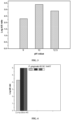
- FIG. 3 illustrates a bar graph plot of kill rate of E. coli as a function of pH change of a culture medium, according to some embodiments.
- Antibacterial effectiveness may also be demonstrated against other bacteria, such as P. gingivalis and S. mutans, which are two representative oral bacteria in dental applications.
- P. gingivalis is associated with chronic periodontitis
- S. mutans is associated with oral cavity.
- All disclosed compositions demonstrated a 6-log kill rate after 7 days in medium containing either P. gingivalis or S. mutans bacteria.
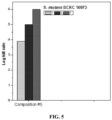
- FIGS. 4 and 5 illustrate bar graph plots of the kill rate of P. Gingivalis and S . Mutans, respectively, after 1, 2 and 7 days of incubation with Example Composition 5, according to some embodiments.
- Example Composition 5 showed a 4-log kill rate to both bacteria after one day of testing, at least a 5-log kill rate to both bacteria after two days of testing, and a 6-log kill rate to both bacteria after seven days of testing.
- the antibacterial effectiveness against at least these two representative oral bacteria implies the potential improvement to human oral care using the disclosed glass compositions.
- compositions (1) show little to no coloring effects of the bacteria-containing medium after soaking for up to 24 hrs or (2) do not contain silver (Ag)- or copper (Cu)-based materials, the compositions are particularly attractive food, water treatment, and paint industry applications.
Landscapes
- Chemical & Material Sciences (AREA)
- Health & Medical Sciences (AREA)
- Life Sciences & Earth Sciences (AREA)
- Engineering & Computer Science (AREA)
- Materials Engineering (AREA)
- Ceramic Engineering (AREA)
- Chemical Kinetics & Catalysis (AREA)
- General Chemical & Material Sciences (AREA)
- Geochemistry & Mineralogy (AREA)
- Organic Chemistry (AREA)
- Public Health (AREA)
- Inorganic Chemistry (AREA)
- Veterinary Medicine (AREA)
- Epidemiology (AREA)
- Animal Behavior & Ethology (AREA)
- General Health & Medical Sciences (AREA)
- Oral & Maxillofacial Surgery (AREA)
- Molecular Biology (AREA)
- Transplantation (AREA)
- Dermatology (AREA)
- Heart & Thoracic Surgery (AREA)
- Surgery (AREA)
- Vascular Medicine (AREA)
- Medicinal Chemistry (AREA)
- Glass Compositions (AREA)
Claims (15)
- Antibakterielle Zusammensetzung, umfassend:ein Glasmaterial auf Silikatbasis, das eine Faser ist und eine Zusammensetzung aus Folgendem aufweist:60-70 Gew.-% SiO2,0-10 Gew.-% B2O3,3-18 Gew.-% P2O5,0-10 Gew.-% Al2O3,0-5 Gew.-% Li2O,20-30 Gew.-% Na2O,0-15 Gew.-% K2O,0-10 Gew.-% MgO,1-15 Gew.-% CaO,2-20 Gew.-% MO und20-35 Gew.-% R2O,wobei MO die Summe aus MgO, CaO, SrO und BaO ist,wobei R2O die Summe aus Na2O, K2O, Li2O und Rb2O ist undwobei das Glasmaterial auf Silikatbasis dazu konfiguriert ist, eine 6-log-Abtötungsrate von mindestens einem von den Bakterien E. coli, P. gingivalis oder S. mutans zu erreichen.
- Antibakterielle Zusammensetzung nach Anspruch 1, wobei das Glasmaterial mindestens eine Größenabmessung in einem Bereich von 1-100 µm aufweist.
- Antibakterielle Zusammensetzung nach Anspruch 1, wobei das Glasmaterial mindestens eine Größenabmessung in einem Bereich von 1-10 µm aufweist.
- Antibakterielle Zusammensetzung nach einem der vorhergehenden Ansprüche, wobei das Glasmaterial eine minimale Hemmkonzentration (MIC) von höchstens 10 mg/ml in der Zusammensetzung aufweist.
- Antibakterielle Zusammensetzung nach einem der vorhergehenden Ansprüche, wobei das Glasmaterial eine minimale Hemmkonzentration (MIC) in einem Bereich von 10 bis 50 mg/ml in der Zusammensetzung aufweist.
- Antibakterielle Zusammensetzung nach einem der vorhergehenden Ansprüche, ferner umfassend:
ein Kulturmedium mit einem pH-Wert im Bereich von 7 bis 11. - Antibakterielle Zusammensetzung nach einem der vorhergehenden Ansprüche, wobei die antibakterielle Zusammensetzung keine Materialien auf Basis von Silber (Ag) oder Kupfer (Cu) umfasst.
- Antibakterielle Zusammensetzung nach einem der vorhergehenden Ansprüche, wobei die antibakterielle Zusammensetzung farblos oder im Wesentlichen farblos ist.
- Antibakterielle Zusammensetzung nach einem der vorhergehenden Ansprüche, wobei die antibakterielle Zusammensetzung mindestens eines von Folgenden umfasst:
5-15 Gew.-% P2O5, 20-25 Gew.-% Na2O, 0-8 Gew.-% K2O, 1-10 Gew.-% CaO, 0-5 Gew.-% MgO oder >0-8 Gew.-% ZnO. - Antibakterielle Zusammensetzung nach Anspruch 1, wobei die antibakterielle Zusammensetzung Folgendes umfasst:
5-15 Gew.-% P2O5; und 1-10 Gew.-% CaO. - Antibakterielle Zusammensetzung nach Anspruch 1, wobei die antibakterielle Zusammensetzung Folgendes umfasst:
1-10 Gew.-% CaO; und im Wesentlichen frei von Al2O3 ist. - Antibakterielle Zusammensetzung nach Anspruch 1, wobei die antibakterielle Zusammensetzung Folgendes umfasst:
1-10 Gew.-% CaO; und im Wesentlichen frei von B2O3 ist. - Antibakterielle Zusammensetzung nach einem der vorhergehenden Ansprüche, wobei die antibakterielle Zusammensetzung ferner Folgendes umfasst:
0-5 Gew.-% ZrO2. - Antibakterielle Zusammensetzung nach einem der vorhergehenden Ansprüche, wobei die antibakterielle Zusammensetzung im Wesentlichen frei von Li2O ist oder 1 Gew.-% oder weniger davon umfasst.
- Antibakterielle Zusammensetzung nach Anspruch 1, wobei die antibakterielle Zusammensetzung im Wesentlichen frei von B2O3, Al2O3 und Li2O ist oder 1 Gew.-% oder weniger davon umfasst.
Applications Claiming Priority (3)
| Application Number | Priority Date | Filing Date | Title |
|---|---|---|---|
| US201862771341P | 2018-11-26 | 2018-11-26 | |
| US201962796859P | 2019-01-25 | 2019-01-25 | |
| PCT/US2019/061988 WO2020112404A1 (en) | 2018-11-26 | 2019-11-18 | Bioactive silicate glasses |
Publications (2)
| Publication Number | Publication Date |
|---|---|
| EP3887331A1 EP3887331A1 (de) | 2021-10-06 |
| EP3887331B1 true EP3887331B1 (de) | 2024-08-14 |
Family
ID=68841234
Family Applications (1)
| Application Number | Title | Priority Date | Filing Date |
|---|---|---|---|
| EP19817892.3A Active EP3887331B1 (de) | 2018-11-26 | 2019-11-18 | Bioaktive silikatgläser |
Country Status (5)
| Country | Link |
|---|---|
| US (1) | US20220009822A1 (de) |
| EP (1) | EP3887331B1 (de) |
| CN (1) | CN113165948A (de) |
| TW (1) | TW202035325A (de) |
| WO (1) | WO2020112404A1 (de) |
Families Citing this family (3)
| Publication number | Priority date | Publication date | Assignee | Title |
|---|---|---|---|---|
| KR102549414B1 (ko) * | 2021-02-10 | 2023-06-28 | 엘지전자 주식회사 | 살균 및 탈취성 무기 이온용액, 이를 제조하기 위한 살균 및 탈취성 조성물 및 이를 이용하는 가전기기 |
| US20240140854A1 (en) * | 2021-03-04 | 2024-05-02 | Corning Incorporated | Bioactive glass compositions |
| KR102952282B1 (ko) * | 2022-12-08 | 2026-04-14 | 연세대학교 산학협력단 | 항균 효과를 가지는 치과용 복합레진 조성물 및 이의 제조방법 |
Family Cites Families (11)
| Publication number | Priority date | Publication date | Assignee | Title |
|---|---|---|---|---|
| US4171544A (en) * | 1978-04-05 | 1979-10-23 | Board Of Regents, For And On Behalf Of The University Of Florida | Bonding of bone to materials presenting a high specific area, porous, silica-rich surface |
| FI101129B (sv) * | 1995-01-13 | 1998-04-30 | Vivoxid Oy | Nya bioaktiva glas och deras användning |
| EP1272144A4 (de) * | 2000-03-27 | 2006-04-26 | Schott Ag | NEUES KOSMETISCHES KöRPERREINIGUNGSMITTEL UND NAHRUNGSMITTELERGäNZUNGEN ENTHALTEND BIOAKTIVES GLAS UND METHODEN ZUR HERSTELLUNG UND VERWENDUNG DERSELBEN |
| DE10293767B4 (de) * | 2001-08-22 | 2017-06-08 | Schott Ag | Desinfektionsglaspulver mit antimikrobieller, entzündungshemmender, wundheilender Wirkung und dessen Verwendung |
| WO2003018496A1 (de) * | 2001-08-22 | 2003-03-06 | Schott Glas | Antimikrobielles, entzündungshemmendes, wundheilendes glaspulver und dessen verwendung |
| AU2002363868A1 (en) * | 2001-12-12 | 2003-06-23 | Schott Glas | Antimicrobial alkali-silicate glass ceramic and the use thereof |
| WO2003050053A2 (de) * | 2001-12-12 | 2003-06-19 | Schott Glas | Verwendung einer antimikrobiellen glaskeramik für zahnpflege, mundhygiene |
| BRPI0300644B8 (pt) * | 2003-02-20 | 2022-04-26 | Fundacao Univ Federal De Sao Carlos | Processo de preparação de biosilicatos particulados, bioativos e reabsorvíveis, composições para preparar ditos biosilicatos e biosilicatos particulados bioativos e reabsorvíveis. |
| DE10307646B3 (de) * | 2003-02-21 | 2004-10-21 | Ivoclar Vivadent Ag | Bioaktive Rhenanit-Glaskeramik, Verfahren zu ihrer Herstellung und ihre Verwendung |
| WO2011005935A2 (en) * | 2009-07-10 | 2011-01-13 | Bio2 Technologies, Inc. | Devices and methods for tissue engineering |
| US9707153B2 (en) * | 2013-04-24 | 2017-07-18 | Corning Incorporated | Delamination resistant pharmaceutical glass containers containing active pharmaceutical ingredients |
-
2019
- 2019-11-18 EP EP19817892.3A patent/EP3887331B1/de active Active
- 2019-11-18 CN CN201980077450.1A patent/CN113165948A/zh active Pending
- 2019-11-18 US US17/296,086 patent/US20220009822A1/en not_active Abandoned
- 2019-11-18 WO PCT/US2019/061988 patent/WO2020112404A1/en not_active Ceased
- 2019-11-25 TW TW108142685A patent/TW202035325A/zh unknown
Also Published As
| Publication number | Publication date |
|---|---|
| US20220009822A1 (en) | 2022-01-13 |
| EP3887331A1 (de) | 2021-10-06 |
| WO2020112404A1 (en) | 2020-06-04 |
| TW202035325A (zh) | 2020-10-01 |
| CN113165948A (zh) | 2021-07-23 |
Similar Documents
| Publication | Publication Date | Title |
|---|---|---|
| US11724957B2 (en) | Bioactive borate glasses | |
| US20190160201A1 (en) | Chemically strengthened bioactive glass-ceramics | |
| EP3887331B1 (de) | Bioaktive silikatgläser | |
| US20220274866A1 (en) | Bioactive glass compositions | |
| EP3778506B1 (de) | Bioaktive glaszusammensetzungen | |
| US12358833B2 (en) | Bioactive glass compositions | |
| US12565444B2 (en) | Glass-ceramic compositions and methods of making thereof | |
| US20220009821A1 (en) | Bioactive phosphate glasses | |
| US20240140854A1 (en) | Bioactive glass compositions | |
| US11384009B2 (en) | High liquidus viscosity bioactive glass | |
| TW202333642A (zh) | 具有改進的生物活性的玻璃組成物 | |
| US12617710B2 (en) | Glass compositions with improved bioactivity |
Legal Events
| Date | Code | Title | Description |
|---|---|---|---|
| STAA | Information on the status of an ep patent application or granted ep patent |
Free format text: STATUS: UNKNOWN |
|
| STAA | Information on the status of an ep patent application or granted ep patent |
Free format text: STATUS: THE INTERNATIONAL PUBLICATION HAS BEEN MADE |
|
| PUAI | Public reference made under article 153(3) epc to a published international application that has entered the european phase |
Free format text: ORIGINAL CODE: 0009012 |
|
| STAA | Information on the status of an ep patent application or granted ep patent |
Free format text: STATUS: REQUEST FOR EXAMINATION WAS MADE |
|
| 17P | Request for examination filed |
Effective date: 20210610 |
|
| AK | Designated contracting states |
Kind code of ref document: A1 Designated state(s): AL AT BE BG CH CY CZ DE DK EE ES FI FR GB GR HR HU IE IS IT LI LT LU LV MC MK MT NL NO PL PT RO RS SE SI SK SM TR |
|
| DAV | Request for validation of the european patent (deleted) | ||
| DAX | Request for extension of the european patent (deleted) | ||
| STAA | Information on the status of an ep patent application or granted ep patent |
Free format text: STATUS: EXAMINATION IS IN PROGRESS |
|
| 17Q | First examination report despatched |
Effective date: 20230310 |
|
| GRAP | Despatch of communication of intention to grant a patent |
Free format text: ORIGINAL CODE: EPIDOSNIGR1 |
|
| STAA | Information on the status of an ep patent application or granted ep patent |
Free format text: STATUS: GRANT OF PATENT IS INTENDED |
|
| INTG | Intention to grant announced |
Effective date: 20240319 |
|
| P01 | Opt-out of the competence of the unified patent court (upc) registered |
Effective date: 20240524 |
|
| GRAS | Grant fee paid |
Free format text: ORIGINAL CODE: EPIDOSNIGR3 |
|
| GRAA | (expected) grant |
Free format text: ORIGINAL CODE: 0009210 |
|
| STAA | Information on the status of an ep patent application or granted ep patent |
Free format text: STATUS: THE PATENT HAS BEEN GRANTED |
|
| AK | Designated contracting states |
Kind code of ref document: B1 Designated state(s): AL AT BE BG CH CY CZ DE DK EE ES FI FR GB GR HR HU IE IS IT LI LT LU LV MC MK MT NL NO PL PT RO RS SE SI SK SM TR |
|
| REG | Reference to a national code |
Ref country code: GB Ref legal event code: FG4D |
|
| REG | Reference to a national code |
Ref country code: CH Ref legal event code: EP |
|
| REG | Reference to a national code |
Ref country code: DE Ref legal event code: R096 Ref document number: 602019057094 Country of ref document: DE |
|
| REG | Reference to a national code |
Ref country code: IE Ref legal event code: FG4D |
|
| REG | Reference to a national code |
Ref country code: LT Ref legal event code: MG9D |
|
| REG | Reference to a national code |
Ref country code: NL Ref legal event code: MP Effective date: 20240814 |
|
| PGFP | Annual fee paid to national office [announced via postgrant information from national office to epo] |
Ref country code: DE Payment date: 20241010 Year of fee payment: 6 |
|
| PG25 | Lapsed in a contracting state [announced via postgrant information from national office to epo] |
Ref country code: NO Free format text: LAPSE BECAUSE OF FAILURE TO SUBMIT A TRANSLATION OF THE DESCRIPTION OR TO PAY THE FEE WITHIN THE PRESCRIBED TIME-LIMIT Effective date: 20241114 |
|
| REG | Reference to a national code |
Ref country code: AT Ref legal event code: MK05 Ref document number: 1713197 Country of ref document: AT Kind code of ref document: T Effective date: 20240814 |
|
| PG25 | Lapsed in a contracting state [announced via postgrant information from national office to epo] |
Ref country code: NL Free format text: LAPSE BECAUSE OF FAILURE TO SUBMIT A TRANSLATION OF THE DESCRIPTION OR TO PAY THE FEE WITHIN THE PRESCRIBED TIME-LIMIT Effective date: 20240814 Ref country code: FI Free format text: LAPSE BECAUSE OF FAILURE TO SUBMIT A TRANSLATION OF THE DESCRIPTION OR TO PAY THE FEE WITHIN THE PRESCRIBED TIME-LIMIT Effective date: 20240814 Ref country code: GR Free format text: LAPSE BECAUSE OF FAILURE TO SUBMIT A TRANSLATION OF THE DESCRIPTION OR TO PAY THE FEE WITHIN THE PRESCRIBED TIME-LIMIT Effective date: 20241115 Ref country code: PL Free format text: LAPSE BECAUSE OF FAILURE TO SUBMIT A TRANSLATION OF THE DESCRIPTION OR TO PAY THE FEE WITHIN THE PRESCRIBED TIME-LIMIT Effective date: 20240814 Ref country code: PT Free format text: LAPSE BECAUSE OF FAILURE TO SUBMIT A TRANSLATION OF THE DESCRIPTION OR TO PAY THE FEE WITHIN THE PRESCRIBED TIME-LIMIT Effective date: 20241216 |
|
| PGFP | Annual fee paid to national office [announced via postgrant information from national office to epo] |
Ref country code: GB Payment date: 20241010 Year of fee payment: 6 |
|
| PG25 | Lapsed in a contracting state [announced via postgrant information from national office to epo] |
Ref country code: BG Free format text: LAPSE BECAUSE OF FAILURE TO SUBMIT A TRANSLATION OF THE DESCRIPTION OR TO PAY THE FEE WITHIN THE PRESCRIBED TIME-LIMIT Effective date: 20240814 |
|
| PG25 | Lapsed in a contracting state [announced via postgrant information from national office to epo] |
Ref country code: LV Free format text: LAPSE BECAUSE OF FAILURE TO SUBMIT A TRANSLATION OF THE DESCRIPTION OR TO PAY THE FEE WITHIN THE PRESCRIBED TIME-LIMIT Effective date: 20240814 |
|
| PG25 | Lapsed in a contracting state [announced via postgrant information from national office to epo] |
Ref country code: AT Free format text: LAPSE BECAUSE OF FAILURE TO SUBMIT A TRANSLATION OF THE DESCRIPTION OR TO PAY THE FEE WITHIN THE PRESCRIBED TIME-LIMIT Effective date: 20240814 Ref country code: IS Free format text: LAPSE BECAUSE OF FAILURE TO SUBMIT A TRANSLATION OF THE DESCRIPTION OR TO PAY THE FEE WITHIN THE PRESCRIBED TIME-LIMIT Effective date: 20241214 |
|
| PG25 | Lapsed in a contracting state [announced via postgrant information from national office to epo] |
Ref country code: HR Free format text: LAPSE BECAUSE OF FAILURE TO SUBMIT A TRANSLATION OF THE DESCRIPTION OR TO PAY THE FEE WITHIN THE PRESCRIBED TIME-LIMIT Effective date: 20240814 |
|
| PG25 | Lapsed in a contracting state [announced via postgrant information from national office to epo] |
Ref country code: RS Free format text: LAPSE BECAUSE OF FAILURE TO SUBMIT A TRANSLATION OF THE DESCRIPTION OR TO PAY THE FEE WITHIN THE PRESCRIBED TIME-LIMIT Effective date: 20241114 Ref country code: ES Free format text: LAPSE BECAUSE OF FAILURE TO SUBMIT A TRANSLATION OF THE DESCRIPTION OR TO PAY THE FEE WITHIN THE PRESCRIBED TIME-LIMIT Effective date: 20240814 |
|
| PG25 | Lapsed in a contracting state [announced via postgrant information from national office to epo] |
Ref country code: RS Free format text: LAPSE BECAUSE OF FAILURE TO SUBMIT A TRANSLATION OF THE DESCRIPTION OR TO PAY THE FEE WITHIN THE PRESCRIBED TIME-LIMIT Effective date: 20241114 Ref country code: PT Free format text: LAPSE BECAUSE OF FAILURE TO SUBMIT A TRANSLATION OF THE DESCRIPTION OR TO PAY THE FEE WITHIN THE PRESCRIBED TIME-LIMIT Effective date: 20241216 Ref country code: PL Free format text: LAPSE BECAUSE OF FAILURE TO SUBMIT A TRANSLATION OF THE DESCRIPTION OR TO PAY THE FEE WITHIN THE PRESCRIBED TIME-LIMIT Effective date: 20240814 Ref country code: NO Free format text: LAPSE BECAUSE OF FAILURE TO SUBMIT A TRANSLATION OF THE DESCRIPTION OR TO PAY THE FEE WITHIN THE PRESCRIBED TIME-LIMIT Effective date: 20241114 Ref country code: NL Free format text: LAPSE BECAUSE OF FAILURE TO SUBMIT A TRANSLATION OF THE DESCRIPTION OR TO PAY THE FEE WITHIN THE PRESCRIBED TIME-LIMIT Effective date: 20240814 Ref country code: LV Free format text: LAPSE BECAUSE OF FAILURE TO SUBMIT A TRANSLATION OF THE DESCRIPTION OR TO PAY THE FEE WITHIN THE PRESCRIBED TIME-LIMIT Effective date: 20240814 Ref country code: IS Free format text: LAPSE BECAUSE OF FAILURE TO SUBMIT A TRANSLATION OF THE DESCRIPTION OR TO PAY THE FEE WITHIN THE PRESCRIBED TIME-LIMIT Effective date: 20241214 Ref country code: HR Free format text: LAPSE BECAUSE OF FAILURE TO SUBMIT A TRANSLATION OF THE DESCRIPTION OR TO PAY THE FEE WITHIN THE PRESCRIBED TIME-LIMIT Effective date: 20240814 Ref country code: GR Free format text: LAPSE BECAUSE OF FAILURE TO SUBMIT A TRANSLATION OF THE DESCRIPTION OR TO PAY THE FEE WITHIN THE PRESCRIBED TIME-LIMIT Effective date: 20241115 Ref country code: FI Free format text: LAPSE BECAUSE OF FAILURE TO SUBMIT A TRANSLATION OF THE DESCRIPTION OR TO PAY THE FEE WITHIN THE PRESCRIBED TIME-LIMIT Effective date: 20240814 Ref country code: ES Free format text: LAPSE BECAUSE OF FAILURE TO SUBMIT A TRANSLATION OF THE DESCRIPTION OR TO PAY THE FEE WITHIN THE PRESCRIBED TIME-LIMIT Effective date: 20240814 Ref country code: BG Free format text: LAPSE BECAUSE OF FAILURE TO SUBMIT A TRANSLATION OF THE DESCRIPTION OR TO PAY THE FEE WITHIN THE PRESCRIBED TIME-LIMIT Effective date: 20240814 Ref country code: AT Free format text: LAPSE BECAUSE OF FAILURE TO SUBMIT A TRANSLATION OF THE DESCRIPTION OR TO PAY THE FEE WITHIN THE PRESCRIBED TIME-LIMIT Effective date: 20240814 |
|
| PG25 | Lapsed in a contracting state [announced via postgrant information from national office to epo] |
Ref country code: DK Free format text: LAPSE BECAUSE OF FAILURE TO SUBMIT A TRANSLATION OF THE DESCRIPTION OR TO PAY THE FEE WITHIN THE PRESCRIBED TIME-LIMIT Effective date: 20240814 Ref country code: RO Free format text: LAPSE BECAUSE OF FAILURE TO SUBMIT A TRANSLATION OF THE DESCRIPTION OR TO PAY THE FEE WITHIN THE PRESCRIBED TIME-LIMIT Effective date: 20240814 Ref country code: SM Free format text: LAPSE BECAUSE OF FAILURE TO SUBMIT A TRANSLATION OF THE DESCRIPTION OR TO PAY THE FEE WITHIN THE PRESCRIBED TIME-LIMIT Effective date: 20240814 |
|
| PG25 | Lapsed in a contracting state [announced via postgrant information from national office to epo] |
Ref country code: EE Free format text: LAPSE BECAUSE OF FAILURE TO SUBMIT A TRANSLATION OF THE DESCRIPTION OR TO PAY THE FEE WITHIN THE PRESCRIBED TIME-LIMIT Effective date: 20240814 |
|
| PG25 | Lapsed in a contracting state [announced via postgrant information from national office to epo] |
Ref country code: CZ Free format text: LAPSE BECAUSE OF FAILURE TO SUBMIT A TRANSLATION OF THE DESCRIPTION OR TO PAY THE FEE WITHIN THE PRESCRIBED TIME-LIMIT Effective date: 20240814 |
|
| PG25 | Lapsed in a contracting state [announced via postgrant information from national office to epo] |
Ref country code: IT Free format text: LAPSE BECAUSE OF FAILURE TO SUBMIT A TRANSLATION OF THE DESCRIPTION OR TO PAY THE FEE WITHIN THE PRESCRIBED TIME-LIMIT Effective date: 20240814 Ref country code: SK Free format text: LAPSE BECAUSE OF FAILURE TO SUBMIT A TRANSLATION OF THE DESCRIPTION OR TO PAY THE FEE WITHIN THE PRESCRIBED TIME-LIMIT Effective date: 20240814 |
|
| REG | Reference to a national code |
Ref country code: DE Ref legal event code: R097 Ref document number: 602019057094 Country of ref document: DE |
|
| PLBE | No opposition filed within time limit |
Free format text: ORIGINAL CODE: 0009261 |
|
| STAA | Information on the status of an ep patent application or granted ep patent |
Free format text: STATUS: NO OPPOSITION FILED WITHIN TIME LIMIT |
|
| REG | Reference to a national code |
Ref country code: CH Ref legal event code: PL |
|
| PG25 | Lapsed in a contracting state [announced via postgrant information from national office to epo] |
Ref country code: MC Free format text: LAPSE BECAUSE OF FAILURE TO SUBMIT A TRANSLATION OF THE DESCRIPTION OR TO PAY THE FEE WITHIN THE PRESCRIBED TIME-LIMIT Effective date: 20240814 |
|
| PG25 | Lapsed in a contracting state [announced via postgrant information from national office to epo] |
Ref country code: LU Free format text: LAPSE BECAUSE OF NON-PAYMENT OF DUE FEES Effective date: 20241118 |
|
| REG | Reference to a national code |
Ref country code: CH Ref legal event code: PL |
|
| 26N | No opposition filed |
Effective date: 20250515 |
|
| PG25 | Lapsed in a contracting state [announced via postgrant information from national office to epo] |
Ref country code: CH Free format text: LAPSE BECAUSE OF NON-PAYMENT OF DUE FEES Effective date: 20241130 |
|
| REG | Reference to a national code |
Ref country code: BE Ref legal event code: MM Effective date: 20241130 |
|
| PG25 | Lapsed in a contracting state [announced via postgrant information from national office to epo] |
Ref country code: SE Free format text: LAPSE BECAUSE OF FAILURE TO SUBMIT A TRANSLATION OF THE DESCRIPTION OR TO PAY THE FEE WITHIN THE PRESCRIBED TIME-LIMIT Effective date: 20240814 |
|
| PG25 | Lapsed in a contracting state [announced via postgrant information from national office to epo] |
Ref country code: BE Free format text: LAPSE BECAUSE OF NON-PAYMENT OF DUE FEES Effective date: 20241130 |
|
| PG25 | Lapsed in a contracting state [announced via postgrant information from national office to epo] |
Ref country code: FR Free format text: LAPSE BECAUSE OF NON-PAYMENT OF DUE FEES Effective date: 20241130 |
|
| PG25 | Lapsed in a contracting state [announced via postgrant information from national office to epo] |
Ref country code: IE Free format text: LAPSE BECAUSE OF NON-PAYMENT OF DUE FEES Effective date: 20241118 |
|
| PG25 | Lapsed in a contracting state [announced via postgrant information from national office to epo] |
Ref country code: HU Free format text: LAPSE BECAUSE OF FAILURE TO SUBMIT A TRANSLATION OF THE DESCRIPTION OR TO PAY THE FEE WITHIN THE PRESCRIBED TIME-LIMIT; INVALID AB INITIO Effective date: 20191118 |
|
| PG25 | Lapsed in a contracting state [announced via postgrant information from national office to epo] |
Ref country code: CY Free format text: LAPSE BECAUSE OF FAILURE TO SUBMIT A TRANSLATION OF THE DESCRIPTION OR TO PAY THE FEE WITHIN THE PRESCRIBED TIME-LIMIT; INVALID AB INITIO Effective date: 20191118 |