EP3886131B1 - Wippschalter, schaltereinheit und verfahren zum auswählen eines zustands eines verschiedene zustände aufweisenden beleuchtungssystems - Google Patents
Wippschalter, schaltereinheit und verfahren zum auswählen eines zustands eines verschiedene zustände aufweisenden beleuchtungssystems Download PDFInfo
- Publication number
- EP3886131B1 EP3886131B1 EP20166134.5A EP20166134A EP3886131B1 EP 3886131 B1 EP3886131 B1 EP 3886131B1 EP 20166134 A EP20166134 A EP 20166134A EP 3886131 B1 EP3886131 B1 EP 3886131B1
- Authority
- EP
- European Patent Office
- Prior art keywords
- switch
- paddle
- lighting system
- state
- rocker switch
- Prior art date
- Legal status (The legal status is an assumption and is not a legal conclusion. Google has not performed a legal analysis and makes no representation as to the accuracy of the status listed.)
- Active
Links
Images
Classifications
-
- H—ELECTRICITY
- H01—ELECTRIC ELEMENTS
- H01H—ELECTRIC SWITCHES; RELAYS; SELECTORS; EMERGENCY PROTECTIVE DEVICES
- H01H23/00—Tumbler or rocker switches, i.e. switches characterised by being operated by rocking an operating member in the form of a rocker button
- H01H23/02—Details
- H01H23/025—Light-emitting indicators
-
- B—PERFORMING OPERATIONS; TRANSPORTING
- B60—VEHICLES IN GENERAL
- B60K—ARRANGEMENT OR MOUNTING OF PROPULSION UNITS OR OF TRANSMISSIONS IN VEHICLES; ARRANGEMENT OR MOUNTING OF PLURAL DIVERSE PRIME-MOVERS IN VEHICLES; AUXILIARY DRIVES FOR VEHICLES; INSTRUMENTATION OR DASHBOARDS FOR VEHICLES; ARRANGEMENTS IN CONNECTION WITH COOLING, AIR INTAKE, GAS EXHAUST OR FUEL SUPPLY OF PROPULSION UNITS IN VEHICLES
- B60K35/00—Instruments specially adapted for vehicles; Arrangement of instruments in or on vehicles
- B60K35/10—Input arrangements, i.e. from user to vehicle, associated with vehicle functions or specially adapted therefor
-
- B—PERFORMING OPERATIONS; TRANSPORTING
- B60—VEHICLES IN GENERAL
- B60K—ARRANGEMENT OR MOUNTING OF PROPULSION UNITS OR OF TRANSMISSIONS IN VEHICLES; ARRANGEMENT OR MOUNTING OF PLURAL DIVERSE PRIME-MOVERS IN VEHICLES; AUXILIARY DRIVES FOR VEHICLES; INSTRUMENTATION OR DASHBOARDS FOR VEHICLES; ARRANGEMENTS IN CONNECTION WITH COOLING, AIR INTAKE, GAS EXHAUST OR FUEL SUPPLY OF PROPULSION UNITS IN VEHICLES
- B60K35/00—Instruments specially adapted for vehicles; Arrangement of instruments in or on vehicles
- B60K35/20—Output arrangements, i.e. from vehicle to user, associated with vehicle functions or specially adapted therefor
- B60K35/21—Output arrangements, i.e. from vehicle to user, associated with vehicle functions or specially adapted therefor using visual output, e.g. blinking lights or matrix displays
- B60K35/22—Display screens
-
- B—PERFORMING OPERATIONS; TRANSPORTING
- B60—VEHICLES IN GENERAL
- B60K—ARRANGEMENT OR MOUNTING OF PROPULSION UNITS OR OF TRANSMISSIONS IN VEHICLES; ARRANGEMENT OR MOUNTING OF PLURAL DIVERSE PRIME-MOVERS IN VEHICLES; AUXILIARY DRIVES FOR VEHICLES; INSTRUMENTATION OR DASHBOARDS FOR VEHICLES; ARRANGEMENTS IN CONNECTION WITH COOLING, AIR INTAKE, GAS EXHAUST OR FUEL SUPPLY OF PROPULSION UNITS IN VEHICLES
- B60K35/00—Instruments specially adapted for vehicles; Arrangement of instruments in or on vehicles
- B60K35/60—Instruments characterised by their location or relative disposition in or on vehicles
-
- B—PERFORMING OPERATIONS; TRANSPORTING
- B60—VEHICLES IN GENERAL
- B60K—ARRANGEMENT OR MOUNTING OF PROPULSION UNITS OR OF TRANSMISSIONS IN VEHICLES; ARRANGEMENT OR MOUNTING OF PLURAL DIVERSE PRIME-MOVERS IN VEHICLES; AUXILIARY DRIVES FOR VEHICLES; INSTRUMENTATION OR DASHBOARDS FOR VEHICLES; ARRANGEMENTS IN CONNECTION WITH COOLING, AIR INTAKE, GAS EXHAUST OR FUEL SUPPLY OF PROPULSION UNITS IN VEHICLES
- B60K2360/00—Indexing scheme associated with groups B60K35/00 or B60K37/00 relating to details of instruments or dashboards
- B60K2360/126—Rotatable input devices for instruments
-
- B—PERFORMING OPERATIONS; TRANSPORTING
- B60—VEHICLES IN GENERAL
- B60K—ARRANGEMENT OR MOUNTING OF PROPULSION UNITS OR OF TRANSMISSIONS IN VEHICLES; ARRANGEMENT OR MOUNTING OF PLURAL DIVERSE PRIME-MOVERS IN VEHICLES; AUXILIARY DRIVES FOR VEHICLES; INSTRUMENTATION OR DASHBOARDS FOR VEHICLES; ARRANGEMENTS IN CONNECTION WITH COOLING, AIR INTAKE, GAS EXHAUST OR FUEL SUPPLY OF PROPULSION UNITS IN VEHICLES
- B60K2360/00—Indexing scheme associated with groups B60K35/00 or B60K37/00 relating to details of instruments or dashboards
- B60K2360/20—Optical features of instruments
- B60K2360/33—Illumination features
- B60K2360/332—Light emitting diodes
-
- B—PERFORMING OPERATIONS; TRANSPORTING
- B60—VEHICLES IN GENERAL
- B60K—ARRANGEMENT OR MOUNTING OF PROPULSION UNITS OR OF TRANSMISSIONS IN VEHICLES; ARRANGEMENT OR MOUNTING OF PLURAL DIVERSE PRIME-MOVERS IN VEHICLES; AUXILIARY DRIVES FOR VEHICLES; INSTRUMENTATION OR DASHBOARDS FOR VEHICLES; ARRANGEMENTS IN CONNECTION WITH COOLING, AIR INTAKE, GAS EXHAUST OR FUEL SUPPLY OF PROPULSION UNITS IN VEHICLES
- B60K2360/00—Indexing scheme associated with groups B60K35/00 or B60K37/00 relating to details of instruments or dashboards
- B60K2360/20—Optical features of instruments
- B60K2360/33—Illumination features
- B60K2360/34—Backlit symbols
-
- H—ELECTRICITY
- H01—ELECTRIC ELEMENTS
- H01H—ELECTRIC SWITCHES; RELAYS; SELECTORS; EMERGENCY PROTECTIVE DEVICES
- H01H2219/00—Legends
- H01H2219/036—Light emitting elements
- H01H2219/039—Selective or different modes of illumination
Definitions
- the invention relates to a rocker switch for selecting a state of a lighting system of a motor vehicle that has at least two different states, having at least one manually operable rocker switch.
- the invention relates to a switch unit for selecting a state of a lighting system of a motor vehicle that has at least two different states, comprising at least two rocker switches, each with a rocker switch, the rocker switches having rocker axes arranged parallel to one another.
- the invention further relates to a method for selecting a state of a lighting system of a motor vehicle that has at least two different states.
- EP 2 657 949 A1 discloses a rocker switch for selecting a state of a system having at least two different states, comprising at least one manually operable rocker switch.
- the invention is based on the object of making it possible to select a state of a lighting system of a motor vehicle that has at least two different states using at least one rocker switch that can be produced inexpensively and has a high-quality appearance.
- a rocker switch with the features of claim 1, wherein at least two actuation surfaces for selectively manually actuating the rocker switch and at least two display sections arranged between the actuation surfaces are arranged on a surface of the rocker switch, the display sections being assigned to different states of the lighting system and each have at least one lighting element and the lighting elements can be alternately activated individually by manually actuating the rocker switch.
- both the actuation surfaces and the display sections arranged between the actuation surfaces are formed by the individual rocker switch of the rocker switch, so that there are no two or more movably arranged switch components that would have to be separated from one another via gaps. Instead, there is only a single or continuous component, namely the rocker switch.
- the rocker switch according to the invention has a more modern and high-quality appearance compared to a conventional switch strip or functional unit, in which several components are arranged leaving intermediate gaps.
- the rocker switch according to the invention has no capacitive switching elements, so that it can be produced more cost-effectively than a conventional switch strip or functional unit with capacitive switching elements.
- rocker switch according to the invention Another advantage of the rocker switch according to the invention is that the two actuation surfaces are arranged so far apart from each other by the display sections arranged between them that unintentional incorrect operation of the rocker switch can be ruled out.
- the rocker switch according to the invention is also associated with a functionally better utilization of the available installation space.
- the lighting elements of the individual display sections can be activated individually.
- the rocker switch By manually actuating one actuating surface of the rocker switch, the rocker switch is displaced and at least one switching contact of the rocker switch is closed, whereby a currently activated lighting element of a display section is deactivated and, at the same time or with a time delay, a currently deactivated lighting element of a further display section is activated.
- Each manual actuation of this actuation surface changes the activation of the lighting elements in a specific order of the display sections.
- the activation of the lighting elements changes in a reverse order of the display sections. Only the lighting elements of a single display section are always activated.
- a display section can also have two or more lighting elements. Three or more display sections can also be arranged between the actuation surfaces on the surface of the rocker switch.
- the assignment according to the invention of the display sections to different states of the lighting system makes it possible to select a specific state of the lighting system of the motor vehicle.
- at least one symbol can be arranged on each display section, which symbolizes the state of the lighting system that is selected by means of the rocker switch according to the invention when the lighting element of the respective display section is activated.
- the symbols preferably correspond to standardized symbols, such as a symbol for a low beam state of the lighting system, a symbol for a light assistance state of the lighting system, a symbol for a parking light state of the lighting system, a symbol for an off state of the lighting system and the like.
- a light assistance state is to be understood as meaning a state of the lighting system in which the lighting system can automatically switch a low beam on and off depending on signals from at least one light sensor.
- the symbol can be part of the lighting element of the respective display section, so that the respective symbol can light up.
- Symbols can also be arranged on the operating surfaces.
- such symbols can be used to indicate the way in which the individual display sections or their lighting elements are changed by manual actuation of the respective actuation surface.
- the symbols can be designed as arrows, for example. These symbols can also be designed as a lighting element or not.
- the rocker switch according to the invention can have electronics that activate or deactivate the respective lighting element depending on the manual actuation of the actuating surfaces.
- the rocker switch of the rocker switch is preferably arranged and mounted in such a way that it returns to a non-tilted central starting position after manual actuation of an actuation surface.
- the rocker switch can have at least one spring element that is elastically deformed by manual actuation of an actuation surface to generate a restoring force.
- the spring element can, for example, be designed as a shaped silicone mat which is arranged between the rocker switch and at least one further component of the rocker switch.
- the rocker switch can be shifted around an imaginary axis (rocker axis) when the rocker switch is actuated, which can also shift when the rocker switch is actuated.
- the rocker switch can be arranged on the rocker switch so that it can be moved in three dimensions.
- the further actuation surfaces can each have at least one lighting element, which can be activated individually by manually actuating the rocker switch.
- the display sections are arranged in a row between the operating surfaces. This is the rocker switch Elongated and each has an actuating surface at its end sections in the longitudinal direction. This means that manual incorrect operation of the rocker switch can be prevented even better, since the actuating surfaces are even further apart from one another.
- the arrangement of the display sections in a row between the actuation surfaces is also accompanied by an intuitive operability of the rocker switch or an intuitive selectability of a state of the lighting system.
- a further advantageous embodiment provides that four display sections are arranged on the surface of the rocker switch between the actuation surfaces, with a display section being assigned to a low beam state of the lighting system, a display section to a light assistance state of the lighting system, a display section to a parking light state of the lighting system and a display section to an off state of the lighting system is. If the four display sections are also arranged in a row between the actuation surfaces, the actuation surfaces are arranged relatively far apart from one another, which reliably prevents unwanted incorrect operation of the rocker switch.
- rocker switch The advantages mentioned above with regard to the rocker switch are correspondingly associated with the switch unit.
- the further rocker switch of the switch unit can also be designed according to one of the above-mentioned configurations or a combination of at least two of these configurations with one another.
- the additional rocker switch can be designed differently.
- the rocker axes of the rocker switches can be imaginary axes, which can also shift when the respective rocker switch is actuated.
- actuation surfaces on a surface of the rocker switch of a further rocker switch of the switch unit for selectively manually actuating the rocker switch of the further rocker switch and at least one opening arranged between the actuation surfaces, the actuation surfaces being assigned to different states of the lighting system and each having at least one lighting element, the lighting elements being alternately individually activated by manual actuation of the rocker switch and the further rocker switch having at least one through the opening accessible selection wheel of a headlight range control of the lighting system.
- the switching rocker of the further rocker switch which is preferably designed in one piece, therefore has the actuating surfaces or actuating sections providing them at the end and intermediate sections connecting the actuating sections to one another, the opening being arranged on the one hand between the actuating sections and on the other hand between the intermediate sections.
- the switch unit has a more modern and high-quality appearance compared to a conventional switch strip or functional unit, in which several components are arranged leaving intermediate gaps.
- the switch unit has no capacitive switching elements, so that it can be produced more cost-effectively than a conventional switch strip or functional unit with capacitive switching elements.
- the two actuating surfaces of the rocker switch of the further rocker switch are arranged so far apart from one another through the opening arranged between them that unintentional incorrect operation of the further rocker switch can be ruled out.
- the rocker switch By manually actuating one actuating surface of the rocker switch of the further rocker switch, the rocker switch is displaced and at least one switching contact of the further rocker switch is closed, whereby the currently deactivated lighting element on the manually operated actuation surface can be activated or the currently activated lighting element on the manually operated actuation surface can be deactivated .
- the same can happen when the other one is operated manually Actuating surface can be realized.
- An actuation surface can also have two or more lighting elements.
- At least one symbol can be arranged on each actuation surface, which symbolizes the state of the lighting system that is selected by means of the further rocker switch when the lighting element of the respective actuation surface is activated.
- the symbols preferably correspond to standardized symbols, such as a symbol for a fog front light state of the lighting system, a symbol for a rear fog light state of the lighting system, and the like.
- the symbol can be part of the lighting element of the respective actuation surface, so that the respective symbol can light up.
- the further rocker switch can have electronics which activates or deactivates the respective lighting element depending on the manual actuation of the actuating surfaces of the rocker switch of the further rocker switch.
- the rocker switch of the further rocker switch is preferably arranged and mounted in such a way that it returns to a non-tilted central starting position after manual actuation of an actuation surface.
- the further rocker switch can have at least one spring element that is elastically deformed by manual actuation of an actuation surface to generate a restoring force.
- the above object is further achieved by a method with the features of claim 6, according to which the respective state of the lighting system is determined using a rocker switch according to one of the above-mentioned embodiments or a combination of at least two of these embodiments with one another or using a switch unit according to one of the The above-mentioned embodiments or a combination of at least two of these embodiments are selected together.
- rocker switch or the switch unit are correspondingly associated with the method.
- the rocker switch according to one of the above-mentioned embodiments or a combination of at least two of these embodiments with each other or the switch unit according to one of the above-mentioned embodiments or a combination of at least two of these configurations can be used together to carry out the method.
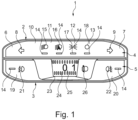
- Fig. 1 shows a schematic representation of an exemplary embodiment of a switch unit 1 according to the invention for selecting a state of a lighting system, not shown, of a motor vehicle, not shown, which has several different states.
- the switch unit 1 has two rocker switches 2 and 3, each with a manually operable rocker switch 4 and 5, respectively, the rocker switches 4 and 5 having imaginary rocker axes, not shown, which are arranged parallel to one another.
- actuating surfaces 6 and 7 are arranged for selective manual actuation of the rocker switch 4.
- a symbol 8 or 9 in the form of an arrow is arranged on each actuating surface 6 or 7. Symbols 8 and 9 can be illuminated or backlit. The arrows point in opposite directions, particularly away from each other.
- display sections 10 to 13 are arranged on the surface of the rocker switch 4, arranged in a row between the actuating surfaces 6 and 7, which are assigned to different states of the lighting system and each have a lighting element 14.
- the display section 10 is assigned to a low beam state of the lighting system, the display section 11 to a light assistance state of the lighting system, the display section 12 to a parking light state of the lighting system and the display section 13 to an off state of the lighting system.
- the display sections 10 to 13 are included for this purpose corresponding symbols 15 to 18.
- the symbols 15 to 18 can be illuminated or backlit and the order of the symbols 15 to 18 can vary.
- the lighting elements 14 can be activated individually by manually operating the rocker switch 4.
- the switch unit 1 shown In the state of the switch unit 1 shown, only the lighting element 14 of the display section 11 is activated, while the remaining lighting elements 14 are deactivated. A light assistance state of the lighting system is therefore activated.
- the lighting element 14 of the display section 11 is deactivated and the lighting element 14 of the display section 12 is activated.
- the activation of the lighting elements 14 changes gradually to the right in the plane of the drawing in accordance with the symbol 9 on the actuating surface 7.
- the activation of the lighting elements 14 changes gradually to the left in the plane of the drawing in accordance with the symbol 8 on the actuating surface 6.
- actuation surfaces 19 and 20 are arranged for selectively manually actuating the rocker switch 5 of the further rocker switch 3.
- a symbol 21 or 22 is arranged on each actuating surface 19 or 20, the symbol 21 symbolizing a fog front light state of the lighting system and the symbol 22 symbolizing a rear fog light state of the lighting system.
- the actuation surfaces 19 and 20 are therefore assigned to different states of the lighting system.
- the symbols 21 and 22 can be illuminated or backlit.
- Each actuation surface 19 or 20 has a lighting element 14.
- an opening 23 arranged between the actuating surfaces 19 and 20 is arranged on the surface of the rocker switch 5 of the further rocker switch 3.
- the further rocker switch 3 has a selection wheel 24 for a headlight range control of the lighting system, which is accessible through the opening 23.
- 24 number symbols 25 are arranged on the selection wheel.
- a symbol 26 is arranged on the rocker switch 5, which symbolizes the headlight range regulation.
- the lighting elements 14 can be activated individually by manually operating the rocker switch 5.
- the in Fig. 1 In the state of the switch unit 1 shown, only the lighting element 14 of the actuation surface 19 is activated, while the lighting element 14 of the actuation surface 20 is deactivated. So the front fog lights of the motor vehicle are switched on, while a rear fog light of the motor vehicle is switched off.
- the lighting element 14 of the actuating surface 19 By manually actuating the actuating surface 19, starting from the in Fig. 1 shown state of the switch unit 1, the lighting element 14 of the actuating surface 19 is deactivated.
- the lighting element 14 of the actuating surface 20 is activated.
Landscapes
- Engineering & Computer Science (AREA)
- Chemical & Material Sciences (AREA)
- Combustion & Propulsion (AREA)
- Transportation (AREA)
- Mechanical Engineering (AREA)
- Lighting Device Outwards From Vehicle And Optical Signal (AREA)
Description
- Die Erfindung betrifft einen Wippschalter zum Auswählen eines Zustands eines wenigstens zwei verschiedene Zustände aufweisenden Beleuchtungssystems eines Kraftwagens, aufweisend wenigstens eine manuell betätigbare Schaltwippe. Zudem betrifft die Erfindung eine Schaltereinheit zum Auswählen eines Zustands eines wenigstens zwei verschiedene Zustände aufweisenden Beleuchtungssystems eines Kraftwagens, aufweisend wenigstens zwei Wippschalter mit jeweils einer Schaltwippe, wobei die Schaltwippen parallel zueinander angeordnete Wippachsen aufweisen. Ferner betrifft die Erfindung ein Verfahren zum Auswählen eines Zustands eines wenigstens zwei verschiedene Zustände aufweisenden Beleuchtungssystems eines Kraftwagens.
- Bei einer Entwicklung einer Schalterleiste mit manuell betätigbaren und bewegbar angeordneten Betätigungselementen und bei einer Integration solcher Betätigungselemente in eine Funktionseinheit eines Fahrzeuginterieurs besteht die Notwendigkeit, für jedes Betätigungselement eine Einzelgeometrie vorzusehen, damit sich das jeweilige Betätigungselement auf seinem Betätigungsweg bewegen kann, wenn es manuell betätigt wird. Hierzu ist es erforderlich, einen das jeweilige Betätigungselement umgebenden Spalt an der Schalterleiste bzw. Funktionseinheit vorzusehen, der die Bewegbarkeit des jeweiligen Betätigungselements gewährleistet.
- Um einer Schalterleiste bzw. Funktionseinheit eine zeitgemäßere und hochwertigere Anmutung zu verleihen, ist es bekannt, statt der bewegbaren Betätigungselemente kapazitive Schaltelemente zu verwenden, die ohne Spalte zwischen Schaltelementen verbaut werden können, da sie bei ihrer Betätigung nicht bewegt werden müssen. Allerdings ist diese Technik relativ kostenintensiv und daher bislang nicht weit verbreitet und lediglich in hochpreisigen Fahrzeugen zu finden.
-
EP 2 657 949 A1 offenbart einen Wippschalter zum Auswählen eines Zustands eines wenigstens zwei verschiedene Zustände aufweisenden Systems, aufweisend wenigstens eine manuell betätigbare Schaltwippe. - Der Erfindung liegt die Aufgabe zugrunde, ein Auswählen eines Zustands eines wenigstens zwei verschiedene Zustände aufweisenden Beleuchtungssystems eines Kraftwagens unter Verwendung von wenigstens einem kostengünstig herstellbaren Wippschalter mit hochwertiger Anmutung zu ermöglichen.
- Erfindungsgemäß wird die Aufgabe durch einen Wippschalter mit den Merkmalen des Anspruchs 1 gelöst, wobei an einer Oberfläche der Schaltwippe wenigstens zwei Betätigungsflächen zum wahlweisen manuellen Betätigen der Schaltwippe und wenigstens zwei zwischen den Betätigungsflächen angeordnete Anzeigeabschnitte angeordnet sind, wobei die Anzeigeabschnitte verschiedenen Zuständen des Beleuchtungssystems zugeordnet sind und jeweils wenigstens ein Leuchtelement aufweisen und die Leuchtelemente durch eine manuelle Betätigung der Schaltwippe wechselweise einzeln aktivierbar sind.
- Es ist darauf hinzuweisen, dass die in der nachfolgenden Beschreibung einzeln aufgeführten Merkmale sowie Maßnahmen in beliebiger technisch sinnvoller Weise miteinander kombiniert werden können und weitere Ausgestaltungen der Erfindung aufzeigen. Die Beschreibung charakterisiert und spezifiziert die Erfindung insbesondere im Zusammenhang mit der Figur zusätzlich.
- Erfindungsgemäß werden durch die einzelne Schaltwippe des Wippschalters sowohl die Betätigungsflächen, als auch die zwischen den Betätigungsflächen angeordneten Anzeigeabschnitte gebildet, so dass hierzu nicht zwei oder mehr bewegbar angeordnete Schalterkomponenten vorhanden sind, die über Spalte voneinander getrennt werden müssten. Stattdessen ist lediglich ein einziges bzw. durchgehendes Bauteil vorhanden, nämlich die Schaltwippe. Hierdurch weist der erfindungsgemäße Wippschalter im Vergleich zu einer herkömmlichen Schalterleiste bzw. Funktionseinheit, bei der mehrere Komponenten unter Belassung von Zwischenspalten angeordnet sind, eine modernere und hochwertigere Anmutung auf. Zudem weist der erfindungsgemäße Wippschalter keine kapazitiven Schaltelemente auf, so dass er kostengünstiger herstellbar ist als eine herkömmliche Schalterleiste bzw. Funktionseinheit mit kapazitiven Schaltelementen.
- Von Vorteil ist bei dem erfindungsgemäßen Wippschalter zudem, dass die beiden Betätigungsflächen durch die dazwischen angeordneten Anzeigeabschnitte derart weit voneinander entfernt angeordnet sind, dass eine ungewollte Fehlbedienung des Wippschalters ausgeschlossen werden kann. Der erfindungsgemäße Wippschalter ist zudem mit einer funktional besseren Ausnutzung eines vorhandenen Bauraums verbunden.
- Durch eine manuelle Betätigung der Schaltwippe sind die Leuchtelemente der einzelnen Anzeigeabschnitte wechselweise einzeln aktivierbar. Durch eine manuelle Betätigung der einen Betätigungsfläche der Schaltwippe wird die Schaltwippe verlagert und wenigstens ein Schaltkontakt des Wippschalters geschlossen, wodurch ein momentan aktiviertes Leuchtelement eines Anzeigeabschnitts deaktiviert und gleichzeitig oder zeitverzögert ein momentan deaktiviertes Leuchtelement eines weiteren Anzeigeabschnitts aktiviert wird. Durch jede manuelle Betätigung dieser Betätigungsfläche wechselt so die Aktivierung der Leuchtelemente in einer bestimmten Reihenfolge der Anzeigeabschnitte. Durch eine manuelle Betätigung der anderen Betätigungsfläche der Schaltwippe wechselt die Aktivierung der Leuchtelemente in einer hierzu umgekehrten Reihenfolge der Anzeigeabschnitte. Es ist immer nur das Leuchtelemente von einem einzigen Anzeigeabschnitt aktiviert. Ein Anzeigeabschnitt kann auch zwei oder mehr Leuchtelemente aufweisen. An der Oberfläche der Schaltwippe können auch drei oder mehr Anzeigeabschnitte zwischen den Betätigungsflächen angeordnet sein.
- Durch die erfindungsgemäße Zuordnung der Anzeigeabschnitte zu verschiedenen Zuständen des Beleuchtungssystems ist so eine Auswahl eines bestimmten Zustands des Beleuchtungssystems des Kraftwagens möglich. Hierzu kann an jedem Anzeigeabschnitt jeweils wenigstens ein Symbol angeordnet sein, das denjenigen Zustand des Beleuchtungssystems symbolisiert, der mittels des erfindungsgemäßen Wippschalters ausgewählt ist, wenn das Leuchtelement des jeweiligen Anzeigeabschnitts aktiviert ist. Die Symbole entsprechen vorzugsweise genormten Symbolen, wie beispielsweise einem Symbol für einen Abblendlichtzustand des Beleuchtungssystems, ein Symbol für einen Lichtassistenzzustand des Beleuchtungssystems, ein Symbol für einen Standlichtzustand des Beleuchtungssystems, ein Symbol für einen Auszustand des Beleuchtungssystems und dergleichen. Unter einem Lichtassistenzzustand ist ein Zustand des Beleuchtungssystems zu verstehen, in dem das Beleuchtungssystem ein Abblendlicht in Abhängigkeit von Signalen von wenigstens einem Lichtsensor automatisch ein- und ausschalten kann. Das Symbol kann ein Teil des Leuchtelements des jeweiligen Anzeigeabschnitts sein, so dass das jeweilige Symbol leuchten kann.
- Auch an den Betätigungsflächen können Symbole angeordnet sein. Beispielsweise kann durch solche Symbole angezeigt werden, auf welche Weise durch eine manuelle Betätigung der jeweiligen Betätigungsfläche zwischen den einzelnen Anzeigeabschnitten bzw. deren Leuchtelementen gewechselt wird. Hierzu können die Symbole beispielsweise als Pfeile ausgebildet sein. Auch diese Symbole können als Leuchtelement ausgebildet sein oder nicht.
- Der erfindungsgemäße Wippschalter kann eine Elektronik aufweisen, die in Abhängigkeit der manuellen Betätigung der Betätigungsflächen das jeweilige Leuchtelement aktiviert bzw. deaktiviert. Die Schaltwippe des Wippschalters ist vorzugsweise derart angeordnet und gelagert, dass sie nach einer manuellen Betätigung einer Betätigungsfläche wieder in eine nicht gekippte mittlere Ausgangsstellung zurückkehrt. Hierzu kann der Wippschalter wenigstens ein Federelement aufweisen, dass durch eine manuelle Betätigung einer Betätigungsfläche unter Erzeugung einer Rückstellkraft elastisch verformt wird. Das Federelement kann beispielsweise als geformte Silikonmatte ausgebildet sein, die zwischen der Schaltwippe und wenigstens einem weiteren Bauteil des Wippschalters angeordnet ist. Die Schaltwippe kann durch ihre Betätigung um eine gedachte Achse (Wippachse) verlagert werden, die sich zudem bei einer Betätigung der Schaltwippe verlagern kann.
- An der Oberfläche der Schaltwippe können zwei Betätigungsflächen zum wahlweisen manuellen Betätigen der Schaltwippe und wenigstens zwei zwischen den Betätigungsflächen angeordnete Anzeigeabschnitte und zusätzlich zwei weitere Betätigungsflächen, die jeweils benachbart zu einer der beiden Betätigungsflächen angeordnet sind und zum wahlweisen manuellen Betätigen der Schaltwippe dienen, und entweder wenigstens eine zwischen den weiteren Betätigungsflächen angeordnete Durchbrechung oder wenigstens zwei zwischen den weiteren Betätigungsflächen angeordnete Anzeigeabschnitte angeordnet sein. Hierbei kann die Schaltwippe dreidimensional verlagerbar an dem Wippschalter angeordnet sein. Die weiteren Betätigungsflächen können jeweils wenigstens ein Leuchtelement aufweisen, die durch eine manuelle Betätigung der Schaltwippe einzeln aktivierbar sind.
- Die Anzeigeabschnitte sind in einer Reihe zwischen den Betätigungsflächen angeordnet. Hierdurch ist die Schaltwippe langgestreckt ausgebildet und weist an ihren in Längsrichtung gegebenen Endabschnitten jeweils eine Betätigungsfläche auf. Dadurch kann eine manuelle Fehlbedienung des Wippschalters noch besser verhindert werden, da die Betätigungsflächen noch weiter voneinander beabstandet sind. Die Anordnung der Anzeigeabschnitte in einer Reihe zwischen den Betätigungsflächen geht zudem mit einer intuitiven Bedienbarkeit des Wippschalters bzw. einer intuitiven Auswählbarkeit eines Zustands des Beleuchtungssystems einher.
- Eine weitere vorteilhafte Ausgestaltung sieht vor, dass an der Oberfläche der Schaltwippe vier Anzeigeabschnitte zwischen den Betätigungsflächen angeordnet sind, wobei ein Anzeigeabschnitt einem Abblendlichtzustand des Beleuchtungssystems, ein Anzeigeabschnitt einem Lichtassistenzzustand des Beleuchtungssystems, ein Anzeigeabschnitt einem Standlichtzustand des Beleuchtungssystems und ein Anzeigeabschnitt einem Auszustand des Beleuchtungssystems zugeordnet ist. Wenn die vier Anzeigeabschnitte zudem in einer Reihe zwischen den Betätigungsflächen angeordnet sind, sind die Betätigungsflächen relativ weit voneinander entfernt angeordnet, was eine ungewollte Fehlbedienung des Wippschalters zuverlässig verhindert.
- Die obige Aufgabe wird zudem durch eine Schaltereinheit mit den Merkmalen des Anspruchs 4 gelöst, bei der wenigstens ein Wippschalter nach einer der oben genannten Ausgestaltungen oder einer Kombination von wenigstens zwei dieser Ausgestaltungen miteinander ausgebildet ist.
- Mit der Schaltereinheit sind die oben mit Bezug auf den Wippschalter genannten Vorteile entsprechend verbunden. Der weitere Wippschalter der Schaltereinheit kann ebenfalls nach einer der oben genannten Ausgestaltungen oder einer Kombination von wenigstens zwei dieser Ausgestaltungen miteinander ausgebildet sein. Alternativ kann der weitere Wippschalter anders ausgebildet sein. Die Wippachsen der Schaltwippen können gedachte Achsen sein, die sich zudem bei einer Betätigung der jeweiligen Schaltwippe verlagern können.
- Gemäß einer vorteilhaften Ausgestaltung sind an einer Oberfläche der Schaltwippe eines weiteren Wippschalters der Schaltereinheit wenigstens zwei Betätigungsflächen zum wahlweisen manuellen Betätigen der Schaltwippe des weiteren Wippschalters und wenigstens eine zwischen den Betätigungsflächen angeordnete Durchbrechung angeordnet, wobei die Betätigungsflächen verschiedenen Zuständen des Beleuchtungssystems zugeordnet sind und jeweils wenigstens ein Leuchtelement aufweisen, wobei die Leuchtelemente durch eine manuelle Betätigung der Schaltwippe wechselweise einzeln aktivierbar sind und wobei der weitere Wippschalter wenigstens ein durch die Durchbrechung hindurch zugänglich angeordnetes Auswahlrad einer Leuchtweitenregulierung des Beleuchtungssystems aufweist.
- Die vorzugsweise einstückig ausgebildete Schaltwippe des weiteren Wippschalters weist also endseitig die Betätigungsflächen bzw. diese bereitstellende Betätigungsabschnitte und die Betätigungsabschnitte miteinander verbindende Zwischenabschnitte auf, wobei die Durchbrechung einerseits zwischen den Betätigungsabschnitten und andererseits zwischen den Zwischenabschnitten angeordnet ist. Hierdurch sind nicht zwei separate Betätigungselemente vorhanden, die über Spalte voneinander getrennt werden müssten. Stattdessen ist lediglich ein einziges bzw. durchgehendes Bauteil vorhanden, nämlich die weitere Schaltwippe. Hierdurch weist die Schaltereinheit im Vergleich zu einer herkömmlichen Schalterleiste bzw. Funktionseinheit, bei der mehrere Komponenten unter Belassung von Zwischenspalten angeordnet sind, eine modernere und hochwertigere Anmutung auf. Zudem weist die Schaltereinheit keine kapazitiven Schaltelemente auf, so dass sie kostengünstiger herstellbar ist als eine herkömmliche Schalterleiste bzw. Funktionseinheit mit kapazitiven Schaltelementen.
- Von Vorteil ist zudem, dass die beiden Betätigungsflächen der Schaltwippe des weiteren Wippschalters durch die dazwischen angeordnete Durchbrechung derart weit voneinander entfernt angeordnet sind, dass eine ungewollte Fehlbedienung des weiteren Wippschalters ausgeschlossen werden kann.
- Durch eine manuelle Betätigung der einen Betätigungsfläche der Schaltwippe des weiteren Wippschalters wird die Schaltwippe verlagert und wenigstens ein Schaltkontakt des weiteren Wippschalters geschlossen, wodurch das momentan deaktivierte Leuchtelement an dem manuell betätigten Betätigungsfläche aktiviert bzw. das momentan aktivierte Leuchtelement an dem manuell betätigten Betätigungsfläche deaktiviert werden kann. Gleiches kann bei einer manuellen Betätigung der anderen Betätigungsfläche realisiert sein. Eine Betätigungsfläche kann auch zwei oder mehr Leuchtelemente aufweisen.
- An jeder Betätigungsfläche kann jeweils wenigstens ein Symbol angeordnet sein, das denjenigen Zustand des Beleuchtungssystems symbolisiert, der mittels des weiteren Wippschalters ausgewählt ist, wenn das Leuchtelement der jeweiligen Betätigungsfläche aktiviert ist. Die Symbole entsprechen vorzugsweise genormten Symbolen, wie beispielsweise einem Symbol für einen Nebelfrontlichtzustand des Beleuchtungssystems, ein Symbol für einen Nebelschlusslichtzustand des Beleuchtungssystems und dergleichen. Das Symbol kann ein Teil des Leuchtelements der jeweiligen Betätigungsfläche sein, so dass das jeweilige Symbol leuchten kann.
- Der weitere Wippschalter kann eine Elektronik aufweisen, die in Abhängigkeit der manuellen Betätigung der Betätigungsflächen der Schaltwippe des weiteren Wippschalters das jeweilige Leuchtelement aktiviert bzw. deaktiviert. Die Schaltwippe des weiteren Wippschalters ist vorzugsweise derart angeordnet und gelagert, dass sie nach einer manuellen Betätigung einer Betätigungsfläche wieder in eine nicht gekippte mittlere Ausgangsstellung zurückkehrt. Hierzu kann der weitere Wippschalter wenigstens ein Federelement aufweisen, dass durch eine manuelle Betätigung einer Betätigungsfläche unter Erzeugung einer Rückstellkraft elastisch verformt wird.
- Die obige Aufgabe wird ferner durch ein Verfahren mit den Merkmalen des Anspruchs 6 gelöst, gemäß dem der jeweilige Zustand des Beleuchtungssystems unter Verwendung eines Wippschalters nach einer der oben genannten Ausgestaltungen oder einer Kombination von wenigstens zwei dieser Ausgestaltungen miteinander oder unter Verwendung einer Schaltereinheit nach einer der oben genannten Ausgestaltungen oder einer Kombination von wenigstens zwei dieser Ausgestaltungen miteinander ausgewählt wird.
- Mit dem Verfahren sind die oben mit Bezug auf den Wippschalter bzw. die Schaltereinheit genannten Vorteile entsprechend verbunden. Insbesondere kann der Wippschalter gemäß einer der oben genannten Ausgestaltungen oder einer Kombination von wenigstens zwei dieser Ausgestaltungen miteinander oder die Schaltereinheit gemäß einer der oben genannten Ausgestaltungen oder einer Kombination von wenigstens zwei dieser Ausgestaltungen miteinander zur Durchführung des Verfahrens verwendet werden.
- Weitere vorteilhafte Ausgestaltungen der Erfindung sind in den Unteransprüchen und der folgenden Figurenbeschreibung offenbart. Es zeigt
- Fig. 1
- eine schematische Darstellung eines Ausführungsbeispiels für eine erfindungsgemäße Schaltereinheit.
-
Fig. 1 zeigt eine schematische Darstellung eines Ausführungsbeispiels für eine erfindungsgemäße Schaltereinheit 1 zum Auswählen eines Zustands eines mehrere verschiedene Zustände aufweisenden, nicht gezeigten Beleuchtungssystems eines nicht gezeigten Kraftwagens. - Die Schaltereinheit 1 weist zwei Wippschalter 2 und 3 mit jeweils einer manuell betätigbaren Schaltwippe 4 bzw. 5 auf, wobei die Schaltwippen 4 und 5 parallel zueinander angeordnete, nicht gezeigte gedachte Wippachsen aufweisen.
- An einer dem Betrachter von
Fig. 1 zugewandten Oberfläche der Schaltwippe 4 sind zwei Betätigungsflächen 6 und 7 zum wahlweisen manuellen Betätigen der Schaltwippe 4 angeordnet. An jeder Betätigungsfläche 6 bzw. 7 ist ein Symbol 8 bzw. 9 in Form eines Pfeils angeordnet. Die Symbole 8 und 9 können beleuchtet bzw. hinterleuchtet sein. Die Pfeile weisen in entgegengesetzte Richtungen, insbesondere voneinander weg. - Zudem sind an der Oberfläche der Schaltwippe 4 vier in einer Reihe zwischen den Betätigungsflächen 6 und 7 angeordnete Anzeigeabschnitte 10 bis 13 angeordnet, die verschiedenen Zuständen des Beleuchtungssystems zugeordnet sind und jeweils ein Leuchtelement 14 aufweisen. Der Anzeigeabschnitt 10 ist einem Abblendlichtzustand des Beleuchtungssystems, der Anzeigeabschnitt 11 einem Lichtassistenzzustand des Beleuchtungssystems, der Anzeigeabschnitt 12 einem Standlichtzustand des Beleuchtungssystems und der Anzeigeabschnitt 13 einem Auszustand des Beleuchtungssystems zugeordnet. Hierzu sind die Anzeigeabschnitte 10 bis 13 mit entsprechenden Symbolen 15 bis 18 versehen. Die Symbole 15 bis 18 können beleuchtet bzw. hinterleuchtet sein und die Reihenfolge der Symbole 15 bis 18 kann variieren.
- Die Leuchtelemente 14 sind durch eine manuelle Betätigung der Schaltwippe 4 wechselweise einzeln aktivierbar. In dem in
Fig. 1 gezeigten Zustand der Schaltereinheit 1 ist allein das Leuchtelement 14 des Anzeigeabschnitts 11 aktiviert, während die übrigen Leuchtelemente 14 deaktiviert sind. Es ist also ein Lichtassistenzzustand des Beleuchtungssystems aktiviert. Durch eine manuelle Betätigung der Betätigungsfläche 7 wird ausgehend von dem inFig. 1 gezeigten Zustand der Schaltereinheit 1 das Leuchtelement 14 des Anzeigeabschnitts 11 deaktiviert und das Leuchtelement 14 des Anzeigeabschnitts 12 aktiviert. Durch eine manuelle Betätigung der Betätigungsfläche 7 wechselt die Aktivierung der Leuchtelemente 14 schrittweise entsprechend dem Symbol 9 an der Betätigungsfläche 7 in der Zeichnungsebene nach rechts. Durch eine manuelle Betätigung der Betätigungsfläche 6 wechselt die Aktivierung der Leuchtelemente 14 schrittweise entsprechend dem Symbol 8 an der Betätigungsfläche 6 in der Zeichnungsebene nach links. - An einer dem Betrachter von
Fig. 1 zugewandten Oberfläche der Schaltwippe 5 des weiteren Wippschalters 3 der Schaltereinheit 1 sind zwei Betätigungsflächen 19 und 20 zum wahlweisen manuellen Betätigen der Schaltwippe 5 des weiteren Wippschalters 3 angeordnet. An jeder Betätigungsfläche 19 bzw. 20 ist ein Symbol 21 bzw. 22 angeordnet, wobei das Symbol 21 einen Nebelfrontlichtzustand des Beleuchtungssystems und das Symbol 22 einen Nebelschlusslichtzustand des Beleuchtungssystems symbolisiert. Die Betätigungsflächen 19 und 20 sind also verschiedenen Zuständen des Beleuchtungssystems zugeordnet. Die Symbole 21 und 22 können beleuchtet bzw. hinterleuchtet sein. Jede Betätigungsfläche 19 bzw. 20 weist jeweils ein Leuchtelement 14 auf. - Zudem ist an der Oberfläche der Schaltwippe 5 des weiteren Wippschalters 3 eine zwischen den Betätigungsflächen 19 und 20 angeordnete Durchbrechung 23 angeordnet. Der weitere Wippschalter 3 weist ein durch die Durchbrechung 23 hindurch zugänglich angeordnetes Auswahlrad 24 einer Leuchtweitenregulierung des Beleuchtungssystems auf. Hierzu sind an dem Auswahlrad 24 Zahlensymbole 25 angeordnet. Zudem ist an der Schaltwippe 5 ein Symbol 26 angeordnet, dass die Leuchtweitenregulierung symbolisiert.
- Die Leuchtelemente 14 sind durch eine manuelle Betätigung der Schaltwippe 5 wechselweise einzeln aktivierbar. In dem in
Fig. 1 gezeigten Zustand der Schaltereinheit 1 ist allein das Leuchtelement 14 der Betätigungsfläche 19 aktiviert, während das Leuchtelement 14 der Betätigungsfläche 20 deaktiviert ist. Es sind also frontseitige Nebelscheinwerfer des Kraftwagens eingeschaltet, während eine Nebelschlussleuchte des Kraftwagens ausgeschaltet ist. Durch eine manuelle Betätigung der Betätigungsfläche 19 wird ausgehend von dem inFig. 1 gezeigten Zustand der Schaltereinheit 1 das Leuchtelement 14 der Betätigungsfläche 19 deaktiviert. Durch eine manuelle Betätigung der Betätigungsfläche 20 wird ausgehend von dem inFig. 1 gezeigten Zustand der Schaltereinheit 1 das Leuchtelement 14 der Betätigungsfläche 20 aktiviert. -
- 1
- Schaltereinheit
- 2
- Wippschalter
- 3
- Wippschalter
- 4
- Schaltwippe
- 5
- Schaltwippe
- 6
- Betätigungsfläche an 2
- 7
- Betätigungsfläche an 2
- 8
- Symbol an 6
- 9
- Symbol an 7
- 10
- Anzeigeabschnitt
- 11
- Anzeigeabschnitt
- 12
- Anzeigeabschnitt
- 13
- Anzeigeabschnitt
- 14
- Leuchtelement
- 15
- Symbol an 10
- 16
- Symbol an 11
- 17
- Symbol an 12
- 18
- Symbol an 13
- 19
- Betätigungsfläche an 5
- 20
- Betätigungsfläche an 5
- 21
- Symbol an 19
- 22
- Symbol an 20
- 23
- Durchbrechung an 5
- 24
- Auswahlrad
- 25
- Zahlensymbol an 24
- 26
- Symbol an 5
Claims (5)
- Wippschalter (2) zum Auswählen eines Zustands eines wenigstens zwei verschiedene Zustände aufweisenden Beleuchtungssystems eines Kraftwagens, aufweisend wenigstens eine manuell betätigbare Schaltwippe (4), wobei an einer Oberfläche der Schaltwippe (4) wenigstens zwei Betätigungsflächen (6, 7) zum wahlweisen manuellen Betätigen der Schaltwippe (4) angeordnet sind,
gekennzeichnet durch
wenigstens zwei in Reihe zwischen den Betätigungsflächen (6, 7) angeordnete Anzeigeabschnitte (10, 11, 12, 13), wobei die Anzeigeabschnitte (10, 11, 12, 13) verschiedenen Zuständen des Beleuchtungssystems zugeordnet sind und jeweils wenigstens ein Leuchtelement (14) aufweisen und die Leuchtelemente (14) durch eine manuelle Betätigung der Schaltwippe (4) wechselweise einzeln aktivierbar sind. - Wippschalter (2) nach Anspruch 1,
dadurch gekennzeichnet, dass
an der Oberfläche der Schaltwippe (4) vier Anzeigeabschnitte (10, 11, 12, 13) zwischen den Betätigungsflächen (6, 7) angeordnet sind, wobei ein Anzeigeabschnitt (10) einem Abblendlichtzustand des Beleuchtungssystems, ein Anzeigeabschnitt (11) einem Lichtassistenzzustand des Beleuchtungssystems, ein Anzeigeabschnitt (12) einem Standlichtzustand des Beleuchtungssystems und ein Anzeigeabschnitt (13) einem Auszustand des Beleuchtungssystems zugeordnet ist. - Schaltereinheit (1) zum Auswählen eines Zustands eines wenigstens zwei verschiedene Zustände aufweisenden Beleuchtungssystems eines Kraftwagens, aufweisend wenigstens zwei Wippschalter (2, 3) mit jeweils einer Schaltwippe (4, 5), wobei die Schaltwippen (4, 5) parallel zueinander angeordnete Wippachsen aufweisen,
dadurch gekennzeichnet, dass
wenigstens ein Wippschalter (2) nach einem der vorhergehenden Ansprüche ausgebildet ist. - Schaltereinheit (1) nach Anspruch 3,
dadurch gekennzeichnet, dass
an einer Oberfläche der Schaltwippe (5) eines weiteren Wippschalters (3) der Schaltereinheit (1) wenigstens zwei Betätigungsflächen (19, 20) zum wahlweisen manuellen Betätigen der Schaltwippe (5) des weiteren Wippschalters (3) und wenigstens eine zwischen den Betätigungsflächen (19, 20) angeordnete Durchbrechung (23) angeordnet sind, wobei die Betätigungsflächen (19, 20) verschiedenen Zuständen des Beleuchtungssystems zugeordnet sind und jeweils wenigstens ein Leuchtelement (14) aufweisen, wobei die Leuchtelemente (14) durch eine manuelle Betätigung der Schaltwippe (5) wechselweise einzeln aktivierbar sind und wobei der weitere Wippschalter (3) wenigstens ein durch die Durchbrechung (23) hindurch zugänglich angeordnetes Auswahlrad (24) einer Leuchtweitenregulierung des Beleuchtungssystems aufweist. - Verfahren zum Auswählen eines Zustands eines wenigstens zwei verschiedene Zustände aufweisenden Beleuchtungssystems eines Kraftwagens,
dadurch gekennzeichnet, dass
der jeweilige Zustand des Beleuchtungssystems unter Verwendung eines Wippschalters (2) nach einem der Ansprüche 1 oder 2 oder unter Verwendung einer Schaltereinheit (1) nach Anspruch 3 oder 4 ausgewählt wird.
Priority Applications (1)
| Application Number | Priority Date | Filing Date | Title |
|---|---|---|---|
| EP20166134.5A EP3886131B1 (de) | 2020-03-27 | 2020-03-27 | Wippschalter, schaltereinheit und verfahren zum auswählen eines zustands eines verschiedene zustände aufweisenden beleuchtungssystems |
Applications Claiming Priority (1)
| Application Number | Priority Date | Filing Date | Title |
|---|---|---|---|
| EP20166134.5A EP3886131B1 (de) | 2020-03-27 | 2020-03-27 | Wippschalter, schaltereinheit und verfahren zum auswählen eines zustands eines verschiedene zustände aufweisenden beleuchtungssystems |
Publications (2)
| Publication Number | Publication Date |
|---|---|
| EP3886131A1 EP3886131A1 (de) | 2021-09-29 |
| EP3886131B1 true EP3886131B1 (de) | 2024-03-13 |
Family
ID=70056830
Family Applications (1)
| Application Number | Title | Priority Date | Filing Date |
|---|---|---|---|
| EP20166134.5A Active EP3886131B1 (de) | 2020-03-27 | 2020-03-27 | Wippschalter, schaltereinheit und verfahren zum auswählen eines zustands eines verschiedene zustände aufweisenden beleuchtungssystems |
Country Status (1)
| Country | Link |
|---|---|
| EP (1) | EP3886131B1 (de) |
Family Cites Families (3)
| Publication number | Priority date | Publication date | Assignee | Title |
|---|---|---|---|---|
| DE102010009329A1 (de) * | 2010-02-25 | 2011-08-25 | Schneider Electric Industries Sas | Leuchteinsatz und elektrischer Installationsschalter |
| DE102012008460A1 (de) * | 2012-04-26 | 2013-10-31 | Abb Ag | Elektro-Installationsgerät, insbesondere Installationsschalter, mit Funktionshinweis |
| JP6378735B2 (ja) * | 2016-11-09 | 2018-08-22 | 本田技研工業株式会社 | スイッチユニット |
-
2020
- 2020-03-27 EP EP20166134.5A patent/EP3886131B1/de active Active
Also Published As
| Publication number | Publication date |
|---|---|
| EP3886131A1 (de) | 2021-09-29 |
Similar Documents
| Publication | Publication Date | Title |
|---|---|---|
| DE602004010753T2 (de) | Tastatur mit versenkbaren Tasten und Taste einer solchen Tastatur besonders geeignet für das Armaturenbrett eines Fahrzeugs | |
| DE10206985B4 (de) | Getriebeschalteinrichtung | |
| EP1809928B1 (de) | Betätigungseinrichtung mit drehschalter | |
| DE19828039B4 (de) | Bedienvorrichtung | |
| DE102015203409B4 (de) | Fahrzeug mit einem Automatikgetriebe und einem von Hand betätigbaren Wählelement | |
| DE102012113126A1 (de) | Elektronische Schaltvorrichtung eines Fahrzeugs | |
| DE102014011118B4 (de) | Verfahren zum Bedienen einer Lichtfunktion von Kraftfahrzeugscheinwerfern und Kraftfahrzeug mit einer Anzeigeeinrichtung und einem Bedienelement für eine Bedienung der Lichtfunktion der Kraftfahrzeugscheinwerfer | |
| DE102016006751A1 (de) | Betätigungseinheit für ein Schaltgetriebe eines schaltbaren Antriebsstranges | |
| DE102012018290B4 (de) | Bedienvorrichtung für einen Kraftwagen und Verfahren zum Betreiben einer Bedienvorrichtung für einen Kraftwagen | |
| DE19910240A1 (de) | Bedienvorrichtung | |
| EP3886131B1 (de) | Wippschalter, schaltereinheit und verfahren zum auswählen eines zustands eines verschiedene zustände aufweisenden beleuchtungssystems | |
| EP0300233B1 (de) | Verfahren und Vorrichtung zum Rangieren eines Fahrzeugs | |
| DE102008007691A1 (de) | Schaltvorrichtung für ein Schaltgetriebe | |
| DE19808510A1 (de) | Vorrichtung zur Betätigung einer Anlage, insbesondere zur Heizung, Belüftung und/oder Klimatisierung eines Kraftfahrzeugs, mit einem einzigen Betätigungsorgan | |
| EP3378701A1 (de) | Verfahren und vorrichtung zur ansteuerung von fernlichtfunktionen eines kraftfahrzeuges | |
| DE102019211691A1 (de) | Verkleidungseinrichtung und Verkleidungsanordnung | |
| EP3478534B1 (de) | Verfahren und vorrichtung zum steuern der klimatisierung eines fahrzeugsitzes | |
| DE10231518A1 (de) | Vorrichtung und Verfahren zur Steuerung eines automatisierten Schaltgetriebes eines Kraftfahrzeuges | |
| DE102010053481B4 (de) | Bedieneinrichtung für Verfahren eines Fahrzeugs | |
| DE102008028381B4 (de) | Multifunktionsschalter zur Ansteuerung der Außenrückspiegel eines Kraftfahrzeugs und Kraftfahrzeug | |
| DE102016213658A1 (de) | Handbetätigungseinrichtung und Gangwahlanordnung | |
| DE10056665C5 (de) | Lenkstockschalter, insbesondere für Fahrzeuge | |
| DE102007042129B4 (de) | Mehrfachbedienelement | |
| DE102019129120B3 (de) | Bedienelement für ein Kraftfahrzeug mit einer Anzeigevorrichtung | |
| EP1410939A1 (de) | Mehrfachschalter |
Legal Events
| Date | Code | Title | Description |
|---|---|---|---|
| PUAI | Public reference made under article 153(3) epc to a published international application that has entered the european phase |
Free format text: ORIGINAL CODE: 0009012 |
|
| STAA | Information on the status of an ep patent application or granted ep patent |
Free format text: STATUS: THE APPLICATION HAS BEEN PUBLISHED |
|
| AK | Designated contracting states |
Kind code of ref document: A1 Designated state(s): AL AT BE BG CH CY CZ DE DK EE ES FI FR GB GR HR HU IE IS IT LI LT LU LV MC MK MT NL NO PL PT RO RS SE SI SK SM TR |
|
| STAA | Information on the status of an ep patent application or granted ep patent |
Free format text: STATUS: REQUEST FOR EXAMINATION WAS MADE |
|
| 17P | Request for examination filed |
Effective date: 20220329 |
|
| RBV | Designated contracting states (corrected) |
Designated state(s): AL AT BE BG CH CY CZ DE DK EE ES FI FR GB GR HR HU IE IS IT LI LT LU LV MC MK MT NL NO PL PT RO RS SE SI SK SM TR |
|
| P01 | Opt-out of the competence of the unified patent court (upc) registered |
Effective date: 20230620 |
|
| GRAP | Despatch of communication of intention to grant a patent |
Free format text: ORIGINAL CODE: EPIDOSNIGR1 |
|
| STAA | Information on the status of an ep patent application or granted ep patent |
Free format text: STATUS: GRANT OF PATENT IS INTENDED |
|
| RIC1 | Information provided on ipc code assigned before grant |
Ipc: B60Q 1/00 20060101ALN20231213BHEP Ipc: B60K 37/00 20060101ALN20231213BHEP Ipc: H01H 23/02 20060101AFI20231213BHEP |
|
| INTG | Intention to grant announced |
Effective date: 20240103 |
|
| GRAS | Grant fee paid |
Free format text: ORIGINAL CODE: EPIDOSNIGR3 |
|
| GRAA | (expected) grant |
Free format text: ORIGINAL CODE: 0009210 |
|
| STAA | Information on the status of an ep patent application or granted ep patent |
Free format text: STATUS: THE PATENT HAS BEEN GRANTED |
|
| AK | Designated contracting states |
Kind code of ref document: B1 Designated state(s): AL AT BE BG CH CY CZ DE DK EE ES FI FR GB GR HR HU IE IS IT LI LT LU LV MC MK MT NL NO PL PT RO RS SE SI SK SM TR |
|
| REG | Reference to a national code |
Ref country code: GB Ref legal event code: FG4D Free format text: NOT ENGLISH |
|
| REG | Reference to a national code |
Ref country code: CH Ref legal event code: EP |
|
| REG | Reference to a national code |
Ref country code: DE Ref legal event code: R096 Ref document number: 502020007295 Country of ref document: DE |
|
| REG | Reference to a national code |
Ref country code: IE Ref legal event code: FG4D Free format text: LANGUAGE OF EP DOCUMENT: GERMAN |
|
| PG25 | Lapsed in a contracting state [announced via postgrant information from national office to epo] |
Ref country code: LT Free format text: LAPSE BECAUSE OF FAILURE TO SUBMIT A TRANSLATION OF THE DESCRIPTION OR TO PAY THE FEE WITHIN THE PRESCRIBED TIME-LIMIT Effective date: 20240313 |
|
| REG | Reference to a national code |
Ref country code: LT Ref legal event code: MG9D |
|
| PG25 | Lapsed in a contracting state [announced via postgrant information from national office to epo] |
Ref country code: GR Free format text: LAPSE BECAUSE OF FAILURE TO SUBMIT A TRANSLATION OF THE DESCRIPTION OR TO PAY THE FEE WITHIN THE PRESCRIBED TIME-LIMIT Effective date: 20240614 |
|
| REG | Reference to a national code |
Ref country code: NL Ref legal event code: MP Effective date: 20240313 |
|
| PG25 | Lapsed in a contracting state [announced via postgrant information from national office to epo] |
Ref country code: HR Free format text: LAPSE BECAUSE OF FAILURE TO SUBMIT A TRANSLATION OF THE DESCRIPTION OR TO PAY THE FEE WITHIN THE PRESCRIBED TIME-LIMIT Effective date: 20240313 Ref country code: RS Free format text: LAPSE BECAUSE OF FAILURE TO SUBMIT A TRANSLATION OF THE DESCRIPTION OR TO PAY THE FEE WITHIN THE PRESCRIBED TIME-LIMIT Effective date: 20240613 |
|
| PG25 | Lapsed in a contracting state [announced via postgrant information from national office to epo] |
Ref country code: ES Free format text: LAPSE BECAUSE OF FAILURE TO SUBMIT A TRANSLATION OF THE DESCRIPTION OR TO PAY THE FEE WITHIN THE PRESCRIBED TIME-LIMIT Effective date: 20240313 |
|
| PG25 | Lapsed in a contracting state [announced via postgrant information from national office to epo] |
Ref country code: RS Free format text: LAPSE BECAUSE OF FAILURE TO SUBMIT A TRANSLATION OF THE DESCRIPTION OR TO PAY THE FEE WITHIN THE PRESCRIBED TIME-LIMIT Effective date: 20240613 Ref country code: NO Free format text: LAPSE BECAUSE OF FAILURE TO SUBMIT A TRANSLATION OF THE DESCRIPTION OR TO PAY THE FEE WITHIN THE PRESCRIBED TIME-LIMIT Effective date: 20240613 Ref country code: LT Free format text: LAPSE BECAUSE OF FAILURE TO SUBMIT A TRANSLATION OF THE DESCRIPTION OR TO PAY THE FEE WITHIN THE PRESCRIBED TIME-LIMIT Effective date: 20240313 Ref country code: HR Free format text: LAPSE BECAUSE OF FAILURE TO SUBMIT A TRANSLATION OF THE DESCRIPTION OR TO PAY THE FEE WITHIN THE PRESCRIBED TIME-LIMIT Effective date: 20240313 Ref country code: GR Free format text: LAPSE BECAUSE OF FAILURE TO SUBMIT A TRANSLATION OF THE DESCRIPTION OR TO PAY THE FEE WITHIN THE PRESCRIBED TIME-LIMIT Effective date: 20240614 Ref country code: FI Free format text: LAPSE BECAUSE OF FAILURE TO SUBMIT A TRANSLATION OF THE DESCRIPTION OR TO PAY THE FEE WITHIN THE PRESCRIBED TIME-LIMIT Effective date: 20240313 Ref country code: ES Free format text: LAPSE BECAUSE OF FAILURE TO SUBMIT A TRANSLATION OF THE DESCRIPTION OR TO PAY THE FEE WITHIN THE PRESCRIBED TIME-LIMIT Effective date: 20240313 Ref country code: BG Free format text: LAPSE BECAUSE OF FAILURE TO SUBMIT A TRANSLATION OF THE DESCRIPTION OR TO PAY THE FEE WITHIN THE PRESCRIBED TIME-LIMIT Effective date: 20240313 |
|
| PG25 | Lapsed in a contracting state [announced via postgrant information from national office to epo] |
Ref country code: SE Free format text: LAPSE BECAUSE OF FAILURE TO SUBMIT A TRANSLATION OF THE DESCRIPTION OR TO PAY THE FEE WITHIN THE PRESCRIBED TIME-LIMIT Effective date: 20240313 Ref country code: LV Free format text: LAPSE BECAUSE OF FAILURE TO SUBMIT A TRANSLATION OF THE DESCRIPTION OR TO PAY THE FEE WITHIN THE PRESCRIBED TIME-LIMIT Effective date: 20240313 |
|
| PG25 | Lapsed in a contracting state [announced via postgrant information from national office to epo] |
Ref country code: NL Free format text: LAPSE BECAUSE OF FAILURE TO SUBMIT A TRANSLATION OF THE DESCRIPTION OR TO PAY THE FEE WITHIN THE PRESCRIBED TIME-LIMIT Effective date: 20240313 |
|
| PG25 | Lapsed in a contracting state [announced via postgrant information from national office to epo] |
Ref country code: NL Free format text: LAPSE BECAUSE OF FAILURE TO SUBMIT A TRANSLATION OF THE DESCRIPTION OR TO PAY THE FEE WITHIN THE PRESCRIBED TIME-LIMIT Effective date: 20240313 |
|
| PG25 | Lapsed in a contracting state [announced via postgrant information from national office to epo] |
Ref country code: IS Free format text: LAPSE BECAUSE OF FAILURE TO SUBMIT A TRANSLATION OF THE DESCRIPTION OR TO PAY THE FEE WITHIN THE PRESCRIBED TIME-LIMIT Effective date: 20240713 |
|
| PG25 | Lapsed in a contracting state [announced via postgrant information from national office to epo] |
Ref country code: SM Free format text: LAPSE BECAUSE OF FAILURE TO SUBMIT A TRANSLATION OF THE DESCRIPTION OR TO PAY THE FEE WITHIN THE PRESCRIBED TIME-LIMIT Effective date: 20240313 Ref country code: PT Free format text: LAPSE BECAUSE OF FAILURE TO SUBMIT A TRANSLATION OF THE DESCRIPTION OR TO PAY THE FEE WITHIN THE PRESCRIBED TIME-LIMIT Effective date: 20240715 |
|
| PG25 | Lapsed in a contracting state [announced via postgrant information from national office to epo] |
Ref country code: EE Free format text: LAPSE BECAUSE OF FAILURE TO SUBMIT A TRANSLATION OF THE DESCRIPTION OR TO PAY THE FEE WITHIN THE PRESCRIBED TIME-LIMIT Effective date: 20240313 Ref country code: CZ Free format text: LAPSE BECAUSE OF FAILURE TO SUBMIT A TRANSLATION OF THE DESCRIPTION OR TO PAY THE FEE WITHIN THE PRESCRIBED TIME-LIMIT Effective date: 20240313 |
|
| PG25 | Lapsed in a contracting state [announced via postgrant information from national office to epo] |
Ref country code: PL Free format text: LAPSE BECAUSE OF FAILURE TO SUBMIT A TRANSLATION OF THE DESCRIPTION OR TO PAY THE FEE WITHIN THE PRESCRIBED TIME-LIMIT Effective date: 20240313 |
|
| PG25 | Lapsed in a contracting state [announced via postgrant information from national office to epo] |
Ref country code: SK Free format text: LAPSE BECAUSE OF FAILURE TO SUBMIT A TRANSLATION OF THE DESCRIPTION OR TO PAY THE FEE WITHIN THE PRESCRIBED TIME-LIMIT Effective date: 20240313 |
|
| PG25 | Lapsed in a contracting state [announced via postgrant information from national office to epo] |
Ref country code: SM Free format text: LAPSE BECAUSE OF FAILURE TO SUBMIT A TRANSLATION OF THE DESCRIPTION OR TO PAY THE FEE WITHIN THE PRESCRIBED TIME-LIMIT Effective date: 20240313 Ref country code: SK Free format text: LAPSE BECAUSE OF FAILURE TO SUBMIT A TRANSLATION OF THE DESCRIPTION OR TO PAY THE FEE WITHIN THE PRESCRIBED TIME-LIMIT Effective date: 20240313 Ref country code: RO Free format text: LAPSE BECAUSE OF FAILURE TO SUBMIT A TRANSLATION OF THE DESCRIPTION OR TO PAY THE FEE WITHIN THE PRESCRIBED TIME-LIMIT Effective date: 20240313 Ref country code: PT Free format text: LAPSE BECAUSE OF FAILURE TO SUBMIT A TRANSLATION OF THE DESCRIPTION OR TO PAY THE FEE WITHIN THE PRESCRIBED TIME-LIMIT Effective date: 20240715 Ref country code: PL Free format text: LAPSE BECAUSE OF FAILURE TO SUBMIT A TRANSLATION OF THE DESCRIPTION OR TO PAY THE FEE WITHIN THE PRESCRIBED TIME-LIMIT Effective date: 20240313 Ref country code: IS Free format text: LAPSE BECAUSE OF FAILURE TO SUBMIT A TRANSLATION OF THE DESCRIPTION OR TO PAY THE FEE WITHIN THE PRESCRIBED TIME-LIMIT Effective date: 20240713 Ref country code: EE Free format text: LAPSE BECAUSE OF FAILURE TO SUBMIT A TRANSLATION OF THE DESCRIPTION OR TO PAY THE FEE WITHIN THE PRESCRIBED TIME-LIMIT Effective date: 20240313 Ref country code: CZ Free format text: LAPSE BECAUSE OF FAILURE TO SUBMIT A TRANSLATION OF THE DESCRIPTION OR TO PAY THE FEE WITHIN THE PRESCRIBED TIME-LIMIT Effective date: 20240313 |
|
| REG | Reference to a national code |
Ref country code: CH Ref legal event code: PL |
|
| PG25 | Lapsed in a contracting state [announced via postgrant information from national office to epo] |
Ref country code: LU Free format text: LAPSE BECAUSE OF NON-PAYMENT OF DUE FEES Effective date: 20240327 |
|
| PG25 | Lapsed in a contracting state [announced via postgrant information from national office to epo] |
Ref country code: LU Free format text: LAPSE BECAUSE OF NON-PAYMENT OF DUE FEES Effective date: 20240327 |
|
| PG25 | Lapsed in a contracting state [announced via postgrant information from national office to epo] |
Ref country code: IT Free format text: LAPSE BECAUSE OF FAILURE TO SUBMIT A TRANSLATION OF THE DESCRIPTION OR TO PAY THE FEE WITHIN THE PRESCRIBED TIME-LIMIT Effective date: 20240313 |
|
| REG | Reference to a national code |
Ref country code: DE Ref legal event code: R097 Ref document number: 502020007295 Country of ref document: DE Ref country code: BE Ref legal event code: MM Effective date: 20240331 |
|
| PG25 | Lapsed in a contracting state [announced via postgrant information from national office to epo] |
Ref country code: IT Free format text: LAPSE BECAUSE OF FAILURE TO SUBMIT A TRANSLATION OF THE DESCRIPTION OR TO PAY THE FEE WITHIN THE PRESCRIBED TIME-LIMIT Effective date: 20240313 |
|
| PG25 | Lapsed in a contracting state [announced via postgrant information from national office to epo] |
Ref country code: MC Free format text: LAPSE BECAUSE OF FAILURE TO SUBMIT A TRANSLATION OF THE DESCRIPTION OR TO PAY THE FEE WITHIN THE PRESCRIBED TIME-LIMIT Effective date: 20240313 |
|
| PG25 | Lapsed in a contracting state [announced via postgrant information from national office to epo] |
Ref country code: DK Free format text: LAPSE BECAUSE OF FAILURE TO SUBMIT A TRANSLATION OF THE DESCRIPTION OR TO PAY THE FEE WITHIN THE PRESCRIBED TIME-LIMIT Effective date: 20240313 |
|
| PG25 | Lapsed in a contracting state [announced via postgrant information from national office to epo] |
Ref country code: BE Free format text: LAPSE BECAUSE OF NON-PAYMENT OF DUE FEES Effective date: 20240331 |
|
| PLBE | No opposition filed within time limit |
Free format text: ORIGINAL CODE: 0009261 |
|
| STAA | Information on the status of an ep patent application or granted ep patent |
Free format text: STATUS: NO OPPOSITION FILED WITHIN TIME LIMIT |
|
| PG25 | Lapsed in a contracting state [announced via postgrant information from national office to epo] |
Ref country code: IE Free format text: LAPSE BECAUSE OF NON-PAYMENT OF DUE FEES Effective date: 20240327 |
|
| PG25 | Lapsed in a contracting state [announced via postgrant information from national office to epo] |
Ref country code: MC Free format text: LAPSE BECAUSE OF FAILURE TO SUBMIT A TRANSLATION OF THE DESCRIPTION OR TO PAY THE FEE WITHIN THE PRESCRIBED TIME-LIMIT Effective date: 20240313 Ref country code: IE Free format text: LAPSE BECAUSE OF NON-PAYMENT OF DUE FEES Effective date: 20240327 Ref country code: DK Free format text: LAPSE BECAUSE OF FAILURE TO SUBMIT A TRANSLATION OF THE DESCRIPTION OR TO PAY THE FEE WITHIN THE PRESCRIBED TIME-LIMIT Effective date: 20240313 Ref country code: BE Free format text: LAPSE BECAUSE OF NON-PAYMENT OF DUE FEES Effective date: 20240331 Ref country code: CH Free format text: LAPSE BECAUSE OF NON-PAYMENT OF DUE FEES Effective date: 20240331 |
|
| 26N | No opposition filed |
Effective date: 20241216 |
|
| PG25 | Lapsed in a contracting state [announced via postgrant information from national office to epo] |
Ref country code: SI Free format text: LAPSE BECAUSE OF FAILURE TO SUBMIT A TRANSLATION OF THE DESCRIPTION OR TO PAY THE FEE WITHIN THE PRESCRIBED TIME-LIMIT Effective date: 20240313 |
|
| PGFP | Annual fee paid to national office [announced via postgrant information from national office to epo] |
Ref country code: AT Payment date: 20250417 Year of fee payment: 5 |
|
| PG25 | Lapsed in a contracting state [announced via postgrant information from national office to epo] |
Ref country code: CY Free format text: LAPSE BECAUSE OF FAILURE TO SUBMIT A TRANSLATION OF THE DESCRIPTION OR TO PAY THE FEE WITHIN THE PRESCRIBED TIME-LIMIT; INVALID AB INITIO Effective date: 20200327 |
|
| PG25 | Lapsed in a contracting state [announced via postgrant information from national office to epo] |
Ref country code: HU Free format text: LAPSE BECAUSE OF FAILURE TO SUBMIT A TRANSLATION OF THE DESCRIPTION OR TO PAY THE FEE WITHIN THE PRESCRIBED TIME-LIMIT; INVALID AB INITIO Effective date: 20200327 |
|
| PGFP | Annual fee paid to national office [announced via postgrant information from national office to epo] |
Ref country code: GB Payment date: 20260211 Year of fee payment: 7 |
|
| PGFP | Annual fee paid to national office [announced via postgrant information from national office to epo] |
Ref country code: DE Payment date: 20260213 Year of fee payment: 7 |
|
| PGFP | Annual fee paid to national office [announced via postgrant information from national office to epo] |
Ref country code: FR Payment date: 20260209 Year of fee payment: 7 |
|
| PGFP | Annual fee paid to national office [announced via postgrant information from national office to epo] |
Ref country code: TR Payment date: 20260223 Year of fee payment: 7 |