EP3885774B1 - Power calculation apparatus and power calculation method - Google Patents
Power calculation apparatus and power calculation method Download PDFInfo
- Publication number
- EP3885774B1 EP3885774B1 EP21164603.9A EP21164603A EP3885774B1 EP 3885774 B1 EP3885774 B1 EP 3885774B1 EP 21164603 A EP21164603 A EP 21164603A EP 3885774 B1 EP3885774 B1 EP 3885774B1
- Authority
- EP
- European Patent Office
- Prior art keywords
- power
- vehicles
- amounts
- measuring instruments
- detected
- Prior art date
- Legal status (The legal status is an assumption and is not a legal conclusion. Google has not performed a legal analysis and makes no representation as to the accuracy of the status listed.)
- Active
Links
Images

Classifications
-
- G—PHYSICS
- G01—MEASURING; TESTING
- G01R—MEASURING ELECTRIC VARIABLES; MEASURING MAGNETIC VARIABLES
- G01R21/00—Arrangements for measuring electric power or power factor
- G01R21/133—Arrangements for measuring electric power or power factor by using digital technique
-
- G—PHYSICS
- G01—MEASURING; TESTING
- G01R—MEASURING ELECTRIC VARIABLES; MEASURING MAGNETIC VARIABLES
- G01R21/00—Arrangements for measuring electric power or power factor
- G01R21/06—Arrangements for measuring electric power or power factor by measuring current and voltage
-
- B—PERFORMING OPERATIONS; TRANSPORTING
- B60—VEHICLES IN GENERAL
- B60L—PROPULSION OF ELECTRICALLY-PROPELLED VEHICLES; SUPPLYING ELECTRIC POWER FOR AUXILIARY EQUIPMENT OF ELECTRICALLY-PROPELLED VEHICLES; ELECTRODYNAMIC BRAKE SYSTEMS FOR VEHICLES IN GENERAL; MAGNETIC SUSPENSION OR LEVITATION FOR VEHICLES; MONITORING OPERATING VARIABLES OF ELECTRICALLY-PROPELLED VEHICLES; ELECTRIC SAFETY DEVICES FOR ELECTRICALLY-PROPELLED VEHICLES
- B60L53/00—Methods of charging batteries, specially adapted for electric vehicles; Charging stations or on-board charging equipment therefor; Exchange of energy storage elements in electric vehicles
- B60L53/60—Monitoring or controlling charging stations
- B60L53/62—Monitoring or controlling charging stations in response to charging parameters, e.g. current, voltage or electrical charge
-
- B—PERFORMING OPERATIONS; TRANSPORTING
- B60—VEHICLES IN GENERAL
- B60L—PROPULSION OF ELECTRICALLY-PROPELLED VEHICLES; SUPPLYING ELECTRIC POWER FOR AUXILIARY EQUIPMENT OF ELECTRICALLY-PROPELLED VEHICLES; ELECTRODYNAMIC BRAKE SYSTEMS FOR VEHICLES IN GENERAL; MAGNETIC SUSPENSION OR LEVITATION FOR VEHICLES; MONITORING OPERATING VARIABLES OF ELECTRICALLY-PROPELLED VEHICLES; ELECTRIC SAFETY DEVICES FOR ELECTRICALLY-PROPELLED VEHICLES
- B60L55/00—Arrangements for supplying energy stored within a vehicle to a power network, i.e. vehicle-to-grid [V2G] arrangements
-
- B—PERFORMING OPERATIONS; TRANSPORTING
- B60—VEHICLES IN GENERAL
- B60L—PROPULSION OF ELECTRICALLY-PROPELLED VEHICLES; SUPPLYING ELECTRIC POWER FOR AUXILIARY EQUIPMENT OF ELECTRICALLY-PROPELLED VEHICLES; ELECTRODYNAMIC BRAKE SYSTEMS FOR VEHICLES IN GENERAL; MAGNETIC SUSPENSION OR LEVITATION FOR VEHICLES; MONITORING OPERATING VARIABLES OF ELECTRICALLY-PROPELLED VEHICLES; ELECTRIC SAFETY DEVICES FOR ELECTRICALLY-PROPELLED VEHICLES
- B60L58/00—Methods or circuit arrangements for monitoring or controlling batteries or fuel cells, specially adapted for electric vehicles
- B60L58/10—Methods or circuit arrangements for monitoring or controlling batteries or fuel cells, specially adapted for electric vehicles for monitoring or controlling batteries
- B60L58/12—Methods or circuit arrangements for monitoring or controlling batteries or fuel cells, specially adapted for electric vehicles for monitoring or controlling batteries responding to state of charge [SoC]
-
- G—PHYSICS
- G01—MEASURING; TESTING
- G01R—MEASURING ELECTRIC VARIABLES; MEASURING MAGNETIC VARIABLES
- G01R31/00—Arrangements for testing electric properties; Arrangements for locating electric faults; Arrangements for electrical testing characterised by what is being tested not provided for elsewhere
- G01R31/005—Testing of electric installations on transport means
- G01R31/006—Testing of electric installations on transport means on road vehicles, e.g. automobiles or trucks
- G01R31/007—Testing of electric installations on transport means on road vehicles, e.g. automobiles or trucks using microprocessors or computers
-
- G—PHYSICS
- G01—MEASURING; TESTING
- G01R—MEASURING ELECTRIC VARIABLES; MEASURING MAGNETIC VARIABLES
- G01R31/00—Arrangements for testing electric properties; Arrangements for locating electric faults; Arrangements for electrical testing characterised by what is being tested not provided for elsewhere
- G01R31/36—Arrangements for testing, measuring or monitoring the electrical condition of accumulators or electric batteries, e.g. capacity or state of charge [SoC]
- G01R31/367—Software therefor, e.g. for battery testing using modelling or look-up tables
-
- G—PHYSICS
- G01—MEASURING; TESTING
- G01R—MEASURING ELECTRIC VARIABLES; MEASURING MAGNETIC VARIABLES
- G01R31/00—Arrangements for testing electric properties; Arrangements for locating electric faults; Arrangements for electrical testing characterised by what is being tested not provided for elsewhere
- G01R31/36—Arrangements for testing, measuring or monitoring the electrical condition of accumulators or electric batteries, e.g. capacity or state of charge [SoC]
- G01R31/385—Arrangements for measuring battery or accumulator variables
-
- H—ELECTRICITY
- H02—GENERATION; CONVERSION OR DISTRIBUTION OF ELECTRIC POWER
- H02J—ELECTRIC POWER NETWORKS; CIRCUIT ARRANGEMENTS OR SYSTEMS FOR SUPPLYING OR DISTRIBUTING ELECTRIC POWER; SYSTEMS FOR STORING ELECTRIC ENERGY
- H02J13/00—Circuit arrangements for providing remote monitoring or remote control of equipment in a power distribution network
- H02J13/13—Circuit arrangements for providing remote monitoring or remote control of equipment in a power distribution network characterised by the transmission of data to equipment in the power network
- H02J13/1321—Circuit arrangements for providing remote monitoring or remote control of equipment in a power distribution network characterised by the transmission of data to equipment in the power network using a wired telecommunication network or a data transmission bus
-
- H—ELECTRICITY
- H02—GENERATION; CONVERSION OR DISTRIBUTION OF ELECTRIC POWER
- H02J—ELECTRIC POWER NETWORKS; CIRCUIT ARRANGEMENTS OR SYSTEMS FOR SUPPLYING OR DISTRIBUTING ELECTRIC POWER; SYSTEMS FOR STORING ELECTRIC ENERGY
- H02J3/00—Circuit arrangements for AC mains or AC distribution networks
- H02J3/28—Arrangements for balancing of the load in networks by storage of energy
- H02J3/32—Arrangements for balancing of the load in networks by storage of energy using batteries or super capacitors with converting means
- H02J3/322—Arrangements for balancing of the load in networks by storage of energy using batteries or super capacitors with converting means the battery being on-board an electric or hybrid vehicle, e.g. vehicle to grid arrangements [V2G], power aggregation, use of the battery for network load balancing, coordinated or cooperative battery charging
-
- H—ELECTRICITY
- H02—GENERATION; CONVERSION OR DISTRIBUTION OF ELECTRIC POWER
- H02J—ELECTRIC POWER NETWORKS; CIRCUIT ARRANGEMENTS OR SYSTEMS FOR SUPPLYING OR DISTRIBUTING ELECTRIC POWER; SYSTEMS FOR STORING ELECTRIC ENERGY
- H02J7/00—Circuit arrangements for charging or discharging batteries or for supplying loads from batteries
- H02J7/40—Circuit arrangements for charging or discharging batteries or for supplying loads from batteries characterised by the exchange of charge or discharge related data
-
- H—ELECTRICITY
- H02—GENERATION; CONVERSION OR DISTRIBUTION OF ELECTRIC POWER
- H02J—ELECTRIC POWER NETWORKS; CIRCUIT ARRANGEMENTS OR SYSTEMS FOR SUPPLYING OR DISTRIBUTING ELECTRIC POWER; SYSTEMS FOR STORING ELECTRIC ENERGY
- H02J7/00—Circuit arrangements for charging or discharging batteries or for supplying loads from batteries
- H02J7/50—Circuit arrangements for charging or discharging batteries or for supplying loads from batteries acting upon multiple batteries simultaneously or sequentially
-
- H—ELECTRICITY
- H02—GENERATION; CONVERSION OR DISTRIBUTION OF ELECTRIC POWER
- H02J—ELECTRIC POWER NETWORKS; CIRCUIT ARRANGEMENTS OR SYSTEMS FOR SUPPLYING OR DISTRIBUTING ELECTRIC POWER; SYSTEMS FOR STORING ELECTRIC ENERGY
- H02J13/00—Circuit arrangements for providing remote monitoring or remote control of equipment in a power distribution network
- H02J13/13—Circuit arrangements for providing remote monitoring or remote control of equipment in a power distribution network characterised by the transmission of data to equipment in the power network
- H02J13/1331—Circuit arrangements for providing remote monitoring or remote control of equipment in a power distribution network characterised by the transmission of data to equipment in the power network using wireless data transmission
-
- H—ELECTRICITY
- H02—GENERATION; CONVERSION OR DISTRIBUTION OF ELECTRIC POWER
- H02J—ELECTRIC POWER NETWORKS; CIRCUIT ARRANGEMENTS OR SYSTEMS FOR SUPPLYING OR DISTRIBUTING ELECTRIC POWER; SYSTEMS FOR STORING ELECTRIC ENERGY
- H02J2105/00—Networks for supplying or distributing electric power characterised by their spatial reach or by the load
- H02J2105/30—Networks for supplying or distributing electric power characterised by their spatial reach or by the load the load networks being external to vehicles, i.e. exchanging power with vehicles
- H02J2105/33—Networks for supplying or distributing electric power characterised by their spatial reach or by the load the load networks being external to vehicles, i.e. exchanging power with vehicles exchanging power with road vehicles
- H02J2105/37—Networks for supplying or distributing electric power characterised by their spatial reach or by the load the load networks being external to vehicles, i.e. exchanging power with vehicles exchanging power with road vehicles exchanging power with electric vehicles [EV] or with hybrid electric vehicles [HEV]
-
- Y—GENERAL TAGGING OF NEW TECHNOLOGICAL DEVELOPMENTS; GENERAL TAGGING OF CROSS-SECTIONAL TECHNOLOGIES SPANNING OVER SEVERAL SECTIONS OF THE IPC; TECHNICAL SUBJECTS COVERED BY FORMER USPC CROSS-REFERENCE ART COLLECTIONS [XRACs] AND DIGESTS
- Y02—TECHNOLOGIES OR APPLICATIONS FOR MITIGATION OR ADAPTATION AGAINST CLIMATE CHANGE
- Y02B—CLIMATE CHANGE MITIGATION TECHNOLOGIES RELATED TO BUILDINGS, e.g. HOUSING, HOUSE APPLIANCES OR RELATED END-USER APPLICATIONS
- Y02B70/00—Technologies for an efficient end-user side electric power management and consumption
- Y02B70/30—Systems integrating technologies related to power network operation and communication or information technologies for improving the carbon footprint of the management of residential or tertiary loads, i.e. smart grids as climate change mitigation technology in the buildings sector, including also the last stages of power distribution and the control, monitoring or operating management systems at local level
-
- Y—GENERAL TAGGING OF NEW TECHNOLOGICAL DEVELOPMENTS; GENERAL TAGGING OF CROSS-SECTIONAL TECHNOLOGIES SPANNING OVER SEVERAL SECTIONS OF THE IPC; TECHNICAL SUBJECTS COVERED BY FORMER USPC CROSS-REFERENCE ART COLLECTIONS [XRACs] AND DIGESTS
- Y02—TECHNOLOGIES OR APPLICATIONS FOR MITIGATION OR ADAPTATION AGAINST CLIMATE CHANGE
- Y02B—CLIMATE CHANGE MITIGATION TECHNOLOGIES RELATED TO BUILDINGS, e.g. HOUSING, HOUSE APPLIANCES OR RELATED END-USER APPLICATIONS
- Y02B90/00—Enabling technologies or technologies with a potential or indirect contribution to GHG emissions mitigation
- Y02B90/20—Smart grids as enabling technology in buildings sector
-
- Y—GENERAL TAGGING OF NEW TECHNOLOGICAL DEVELOPMENTS; GENERAL TAGGING OF CROSS-SECTIONAL TECHNOLOGIES SPANNING OVER SEVERAL SECTIONS OF THE IPC; TECHNICAL SUBJECTS COVERED BY FORMER USPC CROSS-REFERENCE ART COLLECTIONS [XRACs] AND DIGESTS
- Y02—TECHNOLOGIES OR APPLICATIONS FOR MITIGATION OR ADAPTATION AGAINST CLIMATE CHANGE
- Y02E—REDUCTION OF GREENHOUSE GAS [GHG] EMISSIONS, RELATED TO ENERGY GENERATION, TRANSMISSION OR DISTRIBUTION
- Y02E60/00—Enabling technologies; Technologies with a potential or indirect contribution to GHG emissions mitigation
-
- Y—GENERAL TAGGING OF NEW TECHNOLOGICAL DEVELOPMENTS; GENERAL TAGGING OF CROSS-SECTIONAL TECHNOLOGIES SPANNING OVER SEVERAL SECTIONS OF THE IPC; TECHNICAL SUBJECTS COVERED BY FORMER USPC CROSS-REFERENCE ART COLLECTIONS [XRACs] AND DIGESTS
- Y02—TECHNOLOGIES OR APPLICATIONS FOR MITIGATION OR ADAPTATION AGAINST CLIMATE CHANGE
- Y02T—CLIMATE CHANGE MITIGATION TECHNOLOGIES RELATED TO TRANSPORTATION
- Y02T90/00—Enabling technologies or technologies with a potential or indirect contribution to GHG emissions mitigation
- Y02T90/10—Technologies relating to charging of electric vehicles
- Y02T90/14—Plug-in electric vehicles
-
- Y—GENERAL TAGGING OF NEW TECHNOLOGICAL DEVELOPMENTS; GENERAL TAGGING OF CROSS-SECTIONAL TECHNOLOGIES SPANNING OVER SEVERAL SECTIONS OF THE IPC; TECHNICAL SUBJECTS COVERED BY FORMER USPC CROSS-REFERENCE ART COLLECTIONS [XRACs] AND DIGESTS
- Y02—TECHNOLOGIES OR APPLICATIONS FOR MITIGATION OR ADAPTATION AGAINST CLIMATE CHANGE
- Y02T—CLIMATE CHANGE MITIGATION TECHNOLOGIES RELATED TO TRANSPORTATION
- Y02T90/00—Enabling technologies or technologies with a potential or indirect contribution to GHG emissions mitigation
- Y02T90/10—Technologies relating to charging of electric vehicles
- Y02T90/16—Information or communication technologies improving the operation of electric vehicles
-
- Y—GENERAL TAGGING OF NEW TECHNOLOGICAL DEVELOPMENTS; GENERAL TAGGING OF CROSS-SECTIONAL TECHNOLOGIES SPANNING OVER SEVERAL SECTIONS OF THE IPC; TECHNICAL SUBJECTS COVERED BY FORMER USPC CROSS-REFERENCE ART COLLECTIONS [XRACs] AND DIGESTS
- Y04—INFORMATION OR COMMUNICATION TECHNOLOGIES HAVING AN IMPACT ON OTHER TECHNOLOGY AREAS
- Y04S—SYSTEMS INTEGRATING TECHNOLOGIES RELATED TO POWER NETWORK OPERATION, COMMUNICATION OR INFORMATION TECHNOLOGIES FOR IMPROVING THE ELECTRICAL POWER GENERATION, TRANSMISSION, DISTRIBUTION, MANAGEMENT OR USAGE, i.e. SMART GRIDS
- Y04S20/00—Management or operation of end-user stationary applications or the last stages of power distribution; Controlling, monitoring or operating thereof
- Y04S20/20—End-user application control systems
- Y04S20/221—General power management systems
-
- Y—GENERAL TAGGING OF NEW TECHNOLOGICAL DEVELOPMENTS; GENERAL TAGGING OF CROSS-SECTIONAL TECHNOLOGIES SPANNING OVER SEVERAL SECTIONS OF THE IPC; TECHNICAL SUBJECTS COVERED BY FORMER USPC CROSS-REFERENCE ART COLLECTIONS [XRACs] AND DIGESTS
- Y04—INFORMATION OR COMMUNICATION TECHNOLOGIES HAVING AN IMPACT ON OTHER TECHNOLOGY AREAS
- Y04S—SYSTEMS INTEGRATING TECHNOLOGIES RELATED TO POWER NETWORK OPERATION, COMMUNICATION OR INFORMATION TECHNOLOGIES FOR IMPROVING THE ELECTRICAL POWER GENERATION, TRANSMISSION, DISTRIBUTION, MANAGEMENT OR USAGE, i.e. SMART GRIDS
- Y04S40/00—Systems for electrical power generation, transmission, distribution or end-user application management characterised by the use of communication or information technologies, or communication or information technology specific aspects supporting them
- Y04S40/12—Systems for electrical power generation, transmission, distribution or end-user application management characterised by the use of communication or information technologies, or communication or information technology specific aspects supporting them characterised by data transport means between the monitoring, controlling or managing units and monitored, controlled or operated electrical equipment
- Y04S40/124—Systems for electrical power generation, transmission, distribution or end-user application management characterised by the use of communication or information technologies, or communication or information technology specific aspects supporting them characterised by data transport means between the monitoring, controlling or managing units and monitored, controlled or operated electrical equipment using wired telecommunication networks or data transmission busses
-
- Y—GENERAL TAGGING OF NEW TECHNOLOGICAL DEVELOPMENTS; GENERAL TAGGING OF CROSS-SECTIONAL TECHNOLOGIES SPANNING OVER SEVERAL SECTIONS OF THE IPC; TECHNICAL SUBJECTS COVERED BY FORMER USPC CROSS-REFERENCE ART COLLECTIONS [XRACs] AND DIGESTS
- Y04—INFORMATION OR COMMUNICATION TECHNOLOGIES HAVING AN IMPACT ON OTHER TECHNOLOGY AREAS
- Y04S—SYSTEMS INTEGRATING TECHNOLOGIES RELATED TO POWER NETWORK OPERATION, COMMUNICATION OR INFORMATION TECHNOLOGIES FOR IMPROVING THE ELECTRICAL POWER GENERATION, TRANSMISSION, DISTRIBUTION, MANAGEMENT OR USAGE, i.e. SMART GRIDS
- Y04S40/00—Systems for electrical power generation, transmission, distribution or end-user application management characterised by the use of communication or information technologies, or communication or information technology specific aspects supporting them
- Y04S40/12—Systems for electrical power generation, transmission, distribution or end-user application management characterised by the use of communication or information technologies, or communication or information technology specific aspects supporting them characterised by data transport means between the monitoring, controlling or managing units and monitored, controlled or operated electrical equipment
- Y04S40/126—Systems for electrical power generation, transmission, distribution or end-user application management characterised by the use of communication or information technologies, or communication or information technology specific aspects supporting them characterised by data transport means between the monitoring, controlling or managing units and monitored, controlled or operated electrical equipment using wireless data transmission
Definitions
- This invention relates to a power calculation apparatus and a power calculation method calculating an amount of power input and output via a power grid.
- a conventionally known apparatus calculates the amount of power input to and output from factories or various facilities (for example, WO2015/019585A1 ).
- the apparatus described in WO2015/019585A1 calculates the amount of power with measuring instruments such as ammeters and voltmeters provided in factories and various facilities.
- US 2019/061535 A1 discloses a power calculation apparatus calculating amounts of power input to and output from a plurality of vehicles each including a battery, the power calculation apparatus comprising: a power-amount acquisition unit configured to acquire a power amount information regarding amounts of power input to and output from the plurality of vehicles, the amounts of power being detected by a plurality of measuring instruments provided in the plurality of vehicles or interposed between a power grid and the plurality of vehicles; a group setting unit configured to classify the plurality of measuring instruments based on an error information regarding errors processed by the plurality of measuring instruments to set a plurality of measuring instrument groups each including equal to or more than a predetermined number of measuring instruments, the errors being measured in advance; and a power-amount calculation unit configured to calculate a total power input and output in each of the measuring instrument groups set by the group setting unit, based on the power amount information regarding amounts of power detected by equal to or more than the predetermined number of measuring instruments belonging to each of the measuring instrument groups, wherein the group setting unit sets the plurality of measuring
- the present invention provides a power calculation apparatus according to claim 1 and a power calculation method according to claim 6.
- a power calculation apparatus is provided between a vehicle such as an electric vehicle (EV) and a power grid, and calculates power for transfer between a battery mounted on the vehicle and the power grid.
- a vehicle such as an electric vehicle (EV)
- a power grid may be simply referred to as a grid.
- the vehicle when simply expressed as a vehicle, the vehicle means an EV.
- V2G Vehicle to Grid
- the EVs not only receive power supply from the grid to charge the batteries, but also supply the power stored in the batteries to the grid, resulting in making the batteries function as if the batteries were one of the power storage facilities in a commercial power grid.
- the V2G system not only one-way power supply from the power grid to the EVs, but also two-way power transfer including power supply from the EVs to the power grid are performed.
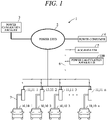
- FIG. 1 schematically illustrates a power system including the V2G system to which the power calculation apparatus according to the present embodiment is applied.
- a power system 1 to which a power calculation apparatus 100 is applied includes a power grid 2, a power generation facility 3 for supplying generated power to the power grid 2, and a power consumer 4 such as factories or various facilities supplied with power from the power grid 2.
- the power system 1 also includes EVs 10_1 to 10_n each transfer power between the EV 10 and the power grid 2, and pieces of connection equipment (electric vehicle supply equipment as abbreviated to EVSE) 11_1 to 11_n each interposed between the power grid 2 and the corresponding EV 10.
- the power system 1 further includes a server device (hereinafter, referred to as an aggregator) 5 for centrally managing power for input and output between the power grid 2 and each EV 10.
- the power calculation apparatus 100 is disposed between the pieces of EVSE 11 and the aggregator 5. As illustrated in FIG. 1 , the power calculation apparatus 100, each piece of EVSE 11, and the aggregator 5 are connected via a wired or wireless communication network 6 and are communicable with each other.
- Each piece of EVSE 11 and the corresponding EV 10 can be connected by a charging cable 7. Each piece of EVSE 11 and the corresponding EV 10 are capable of power transfer therebetween via the charging cable 7. In the present embodiment, each piece of EVSE 11 supplies power supplied from the power grid 2 to the corresponding EV 10 to charge the battery mounted on the EV 10. Each piece of EVSE 11 also supplies power from the corresponding EV 10 to the power grid 2 to make the battery mounted on the EV 10 function as one of the power storage facilities in the power grid 2.
- the aggregator 5 In response to reception of a power adjustment request from the electric power company managing the power generation facility 3, the aggregator 5 causes the battery mounted on each EV to charge and discharge, based on the amount of surplus power or the amount of shortage power between the power generation facility 3 and the power consumer 4, and adjusts the supply-and-demand balance of the entire power system 1.
- the aggregator 5 is in connection with the electric power company managing the power generation facility 3 by a communication network (not illustrated).
- the aggregator 5 receives the power adjustment request from the electric power company and acquires information related to the amount of surplus power or the amount of shortage power via the communication network.
- the aggregator 5 causes the batteries of EVs 10 to discharge such that the EVs 10 compensate for the amount of shortage power. Specifically, the aggregator 5 transmits a command for causing the battery of each EV 10 to discharge, to the corresponding piece of EVSE 11. Each piece of EVSE 11 having received this command causes the battery of the corresponding EV 10 to discharge, so that the power from each battery is supplied to the power grid 2.
- the aggregator 5 adjusts the amount of power for transfer between the power grid 2 and each EV 10 so as to maintain the supply-and-demand balance in the power system 1.
- the power system 1 may also include a plurality of power generation facilities and a plurality of power consumers.
- the aggregator 5 in order for the aggregator 5 to perform such control of the supply-and-demand balance as above, it needs to grasp accurately, that is, with predetermined accuracy, the amount of power input and output between the power grid 2 and each EV 10 (hereinafter, referred to as the amount of EV input-and-output power).
- the measuring instruments such as an ammeter and a voltmeter mounted on each EV 10, however, are inexpensive and simple, and thus are difficult to detect the amount of power with the accuracy required by the aggregator 5.
- Such a high-accuracy measuring instrument is expensive and thus its implementation is difficult due to an increase in the vehicle price.
- the power calculation apparatus 100 calculates the amount of EV input-and-output power by the following method such that the amount of EV input-and-output power can be calculated with the accuracy required by the aggregator 5 by using a simple measuring instrument provided in each EV 10.
- the amount of power detected from the measuring instrument provided in each EV 10 typically includes a plus or minus error to the true value.
- the amount of detected power typically includes a plus or minus error to the true value.
- FIG. 3 is a graph conceptually illustrating the relationship between the number n when the amounts of detected power of the n number of measuring instruments are added together and the error E to the true value of the total value.
- the graph of FIG. 3 illustrates the relationship between the number n and the error E of each of a plurality of EV groups (groups A to D). As illustrated in FIG. 3 , it is estimated that in each group, the error E converges to zero as the number n for adding together the amounts of detected power is increased.
- the power calculation apparatus 100 obtains the number m that enables the error E of the total value to fall within the error range ⁇ Ae corresponding to the accuracy required by the aggregator 5. Then, the power calculation apparatus 100 adds together the amounts of detected power of the measuring instruments one-to-one provided in the EVs, for each group of the EVs including at least the m number of EVs, and notifies the aggregator 5 of the total value as the amount of EV input-and-output power. In the present embodiment, the power calculation apparatus 100 calculates the amount of EV input-and-output power with the accuracy required by the aggregator 5, in such a manner.
- a method of determining m will now be described.
- P pieces (for example, 1000) of measuring instruments that are the number of all measuring instruments for shipment
- p pieces (for example, 100) of measuring instruments are extracted as samples, and data indicating the distribution of the respective errors possessed by extracted measuring instruments, that is, the read values is derived.
- the mean value x and the standard deviation s are derived as the data indicating the error distribution.
- FIG. 2 is a diagram illustrating an exemplary functional configuration of the power calculation apparatus 100.
- the power calculation apparatus 100 includes a processing unit 110 such as a central processing unit (CPU) (microprocessor), read only memory (ROM), random access memory (RAM), and a memory (storage unit) 120 such as a hard disk.
- the processing unit 110 executes a program stored in the storage unit 120 to function as a power-amount acquisition unit 111, a group setting unit 112, a power-amount calculation unit 113, and a power-amount transmitting unit 114.
- the power-amount acquisition unit 111 acquires, from each EV 10, information indicating the amount of power input to and output from the EV 10 detected by the measuring instrument of the EV 10 (hereinafter, referred to as detected-power-amount information).
- the amount of power referred to here is the amount of achievement power per predetermined duration (for example, 30 minutes).
- the amount of power input to and output from each EV 10 may be detected by a measuring instrument provided in the corresponding piece of EVSE 11. In this case, it is sufficient if the power-amount acquisition unit 111 acquires the detected-power-amount information from the piece of EVSE 11.
- the group setting unit 112 determines a predetermined number m by the above determination method, based on information indicating the error possessed by the measuring instrument of each EV 10 (hereinafter, referred to as measuring-instrument error information or simply referred to as error information) and Expression (i). Then, the group setting unit 112 sets a plurality of groups each including equal to or more than the predetermined number m of measuring instruments, for the measuring instruments of the EVs 10_1 to 10_n. As a result, the measuring instruments of the EVs 10_1 to 10_n are classified into the plurality of groups.
- the error possessed by the measuring instrument of an EV 10 is measured in advance. Specifically, at the time of factory shipment of the measuring instruments, errors possessed by at least equal to or more than the predetermined number m of measuring instruments are measured and then the measuring-instrument error information including the measurement result is stored in advance in the storage unit 120.
- the predetermined number m may be calculated in advance based on the measuring-instrument error information and Expression (i), and information indicating the predetermined number m may be stored in advance in the storage unit 120. In this case, it is sufficient if the group setting unit 112 performs group setting in accordance with the predetermined number m indicated by the information stored in the storage unit 120.
- the group setting unit 112 groups each EV 10 such that the predetermined number m is larger, in comparison with a case where the amount of power input to and output from each EV 10 is detected by the measuring instrument of the corresponding piece of EVSE 11.
- the reason for the grouping is that the measuring instruments of pieces of EVSE 11 are each originally designed for power input and output applications, and thus are often considered to have higher accuracy than those of the EVs 10.
- the group setting unit 112 determines the predetermined number m by the above determination method, based on the information indicating the error possessed by the measuring instrument of the piece of EVSE 11 and Expression (i). Similarly to the case of measuring the error possessed by the measuring instrument of each EV 10, it is sufficient if the error possessed by the measuring instrument of the piece of EVSE 11 is measured at the time of factory shipment of the measuring instrument.
- the power-amount acquisition unit 111 may set whether the amount of power detected by the measuring instrument of each EV 10 is acquired or the amount of power detected by the measuring instrument of the corresponding piece of EVSE 11 is acquired, to the power calculation apparatus 100 via the communication network 6 from the aggregator 5 or an external device.
- the aggregator 5 or the external device inputs an instruction related to the above setting, to the power-amount acquisition unit 111. Then, in response to the instructed setting details, the power-amount acquisition unit 111 acquires the amount of power detected by the measuring instrument of each EV 10 or the amount of power detected by the measuring instrument of the piece of EVSE 11.
- the group setting unit 112 determines the predetermined number m in accordance with the instructed setting details.
- the power-amount calculation unit 113 for each group of measuring instruments set by the group setting unit 112, adds together the amount of power indicated by the detected-power-amount information acquired by the power-amount acquisition unit 111 and calculates the total amount of power input and output. Thus, the amount of EV input-and-output power of each group is calculated.
- the power-amount transmitting unit 114 transmits the amount of EV input-and-output power of each group calculated by the power-amount calculation unit 113, to the aggregator 5. Thus, the amount of EV input-and-output power of each group is notified to the aggregator 5. Note that the power-amount transmitting unit 114 may notify the aggregator 5 of the amount of EV input-and-output power of the whole of the EVs 10_1 to 10_n obtained by adding together the respective amounts of EV input-and-output power of the groups.
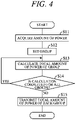
- FIG. 4 is a flowchart illustrating an exemplary operation of the power calculation apparatus 100.
- the processing illustrated in FIG. 4 is performed in response to a start request instruction from the aggregator 5.
- the aggregator 5 outputs an instruction for requesting to start calculating power, to the power calculation apparatus 100.
- Step S11 the power-amount acquisition unit 111 requests each piece of EVSE 11 to provide detected-power-amount information.
- each piece of EVSE 11 transmits the detected-power-amount information of the EV in connection with this piece of EVSE 11, to the power calculation apparatus 100.
- any piece of EVSE 11 that no EV 10 is in connection therewith does not transmit any detected-power-amount information to the power calculation apparatus 100.
- each EV 10 detects, with the measuring instrument, the amount of power input to and output from the power grid 2 via the EVSE 11 at a predetermined cycle. Then, every predetermined duration (for example, 30 minutes), each EV 10 transmits information indicating the amount of achievement power detected over the predetermined duration, to the corresponding piece of EVSE 11, as the detected-power-amount information.
- PLC power line communication
- Each EV 10 may also be wirelessly communicable with the corresponding piece of EVSE 11.
- Step S12 the group setting unit 112 determines the predetermined number m, based on the measuring-instrument error information stored in the storage unit 120 and Expression (i). Then, the group setting unit 112 classifies the measuring instruments of the EVs one-to-one in connection with the pieces of EVSE 11_1 to 11_n into a plurality of groups each including equal to or more than a predetermined number m of measuring instruments. Thus, the plurality of groups are set.
- Step S13 the power-amount calculation unit 113 selects one group as the calculation target of the total amount of power, from the plurality of groups set in Step S12. At this time, the power-amount calculation unit 113 does not select a group for which the total amount of power has already been calculated.
- the power-amount calculation unit 113 calculates the total amount of power input and output by the selected group, that is, the amount of EV input-and-output power, based on the detected-power-amount information of all the measuring instruments belonging to the selected group.
- Step S14 the power-amount calculation unit 113 determines whether or not the amount of EV input-and-output power has been calculated for all the plurality of groups set in Step S12. In a case where the determination is negative in Step S14, the processing returns to Step S13.
- Step S15 the power-amount transmitting unit 114 transmits, to the aggregator 5, information indicating the amount of EV input-and-output power of each group calculated by the power-amount calculation unit 113.
- the power-amount transmitting unit 114 may transmit information indicating the total value of the amount of EV input-and-output power of each group, to the aggregator 5.
- the power calculation apparatus 100 that calculates amounts of power input to and output from a plurality of vehicles each including a battery.
- the power calculation apparatus 100 includes: a power-amount acquisition unit 111 configured to acquire the power amount information regarding amounts of power that are amounts of power input to and output from the EVs 10_1 to 10_n, the amounts of power being detected by the plurality of measuring instruments that is provided one-to-one in the EVs 10_1 to 10_n or is each interposed between the power grid 2 and the corresponding one of the EVs 10_1 to 10_n; a group setting unit 112 configured to classify the plurality of measuring instruments based on the error information regarding errors possessed by the plurality of measuring instruments to set a plurality of measuring instrument groups each including equal to or more than the predetermined number m of measuring instruments, the errors being measured in advance; and a power-amount calculation unit 113 configured to calculate total power input and output in each of measuring instrument groups set by the group setting unit 112, based on the power amount information regarding the amounts of power
- the aggregator 5 can suitably control a supply-and-demand balance of a power system 1 even when each EV 10 is in connection with the power grid 2. As a result, the EVs is allowed to participate in a power transaction.
- the group setting unit 112 varies the predetermined number m between in a case where the amounts of power input to and output from the EVs 10_1 to 10_n are detected by the measuring instruments provided one-to-one in the EVs 10_1 to 10_n and in a case where the amounts of power input to and output from the EVs 10_1 to 10_n are detected by the corresponding pieces of EVSE 11_1 to 11_n.
- the total amount of power of the power input and output between the power grid 2 and each EV 10 can be calculated with the accuracy required by the aggregator 5.
- the power calculation apparatus 100 further includes a storage unit 120 configured to store the information regarding the respective errors possessed by the measuring instruments provided one-to-one in the EVs 10_1 to 10_n or the measuring instruments provided one-to-one in the pieces of EVSE 11_1 to 11_n, the errors being measured in advance. Then, the group setting unit 112 determines the predetermined number m, based on data indicating an error distribution obtained from the information regarding the errors stored in the storage unit 120.
- the determination of the predetermined number m based on the data indicating the error distribution enables reliably calculation of the total amount of power of the power input and output between the power grid 2 and each EV 10 with the accuracy required by the aggregator 5.
- the group setting unit 112 varies the predetermined number m in accordance with an area where the EVs 10_1 to 10_n are in connection with the power grid 2.
- the predetermined number m can be determined suitably for each area.
- the group setting unit 112 makes the predetermined number m larger as the accuracy required by the aggregator 5 is higher such that the error E of the total value of amounts of detected power is further smaller.
- the total amount of power of the power input and output between the power grid 2 and each EV 10 can be calculated with the accuracy required by the aggregator 5 regardless of the area managed by the aggregator 5.
- the above embodiment may be modified variously. Such modifications will be described below.
- the power calculation apparatus 100 is disposed between the pieces of EVSE 11 and the aggregator 5; however, a power calculation apparatus may be included inside an aggregator.
- the power-amount calculation unit 113 calculates the amounts of EV input-and-output power of all the groups (Steps S13, S14), and then the power-amount transmitting unit 114 transmits the information indicating the amount of EV input-and-output power of each group to the aggregator 5 (Step S15).
- a power-amount transmitting unit may transmit information indicating the amount of EV input-and-output power of the group to the aggregator.
- one aggregator 5 is provided in the power system 1.
- a power management apparatus may be disposed between each aggregator and the corresponding EV group.
- each EV 10 is in connection with the aggregator 5.
- An aggregator may be in connection with a fixed battery fixed and provided to a house or the like, such as a battery for storing power by solar power generation. Note that in a case where both such a fixed battery and an EV are in connection with the aggregator, a power calculation apparatus calculates the power of the fixed battery and the power of the EV separately.
- the amount of power input and output via a power grid can be calculated accurately.
Landscapes
- Engineering & Computer Science (AREA)
- Power Engineering (AREA)
- Physics & Mathematics (AREA)
- General Physics & Mathematics (AREA)
- Transportation (AREA)
- Mechanical Engineering (AREA)
- Computer Hardware Design (AREA)
- Combustion & Propulsion (AREA)
- Life Sciences & Earth Sciences (AREA)
- Sustainable Development (AREA)
- Sustainable Energy (AREA)
- Chemical & Material Sciences (AREA)
- Microelectronics & Electronic Packaging (AREA)
- Supply And Distribution Of Alternating Current (AREA)
- Remote Monitoring And Control Of Power-Distribution Networks (AREA)
- Management, Administration, Business Operations System, And Electronic Commerce (AREA)
- Electric Propulsion And Braking For Vehicles (AREA)
Description
- This invention relates to a power calculation apparatus and a power calculation method calculating an amount of power input and output via a power grid.
- As such an apparatus of this type, a conventionally known apparatus calculates the amount of power input to and output from factories or various facilities (for example,
WO2015/019585A1 ). The apparatus described inWO2015/019585A1 calculates the amount of power with measuring instruments such as ammeters and voltmeters provided in factories and various facilities. - Meanwhile, in recent years, considered has been allowing battery-mounted vehicles such as electric vehicles (EVs) to participate in a power transaction via a power grid. The ammeter and voltmeter included in a vehicle such as an EV, however, have lower accuracy than those provided in factories and various facilities. Thus, if the amount of power is simply calculated with the ammeter or the voltmeter similarly to the apparatus described in
WO2015/019585A1 , it is likely to fail in accurate calculation of the amount of power output from or input to the vehicle. The similar applies to a piece of connection equipment for connecting a vehicle to a power grid. -
US 2019/061535 A1 discloses a power calculation apparatus calculating amounts of power input to and output from a plurality of vehicles each including a battery, the power calculation apparatus comprising: a power-amount acquisition unit configured to acquire a power amount information regarding amounts of power input to and output from the plurality of vehicles, the amounts of power being detected by a plurality of measuring instruments provided in the plurality of vehicles or interposed between a power grid and the plurality of vehicles; a group setting unit configured to classify the plurality of measuring instruments based on an error information regarding errors processed by the plurality of measuring instruments to set a plurality of measuring instrument groups each including equal to or more than a predetermined number of measuring instruments, the errors being measured in advance; and a power-amount calculation unit configured to calculate a total power input and output in each of the measuring instrument groups set by the group setting unit, based on the power amount information regarding amounts of power detected by equal to or more than the predetermined number of measuring instruments belonging to each of the measuring instrument groups, wherein the group setting unit sets the plurality of measuring instrument groups such that a standard deviation under a normal distribution of errors of amounts of power detected by equal to or more than the predetermined number of measuring instruments belonging to a same measuring instrument groups is a predetermined value or less. - The present invention provides a power calculation apparatus according to
claim 1 and a power calculation method according toclaim 6. - The objects, features, and advantages of the present invention will become clearer from the following description of embodiments in relation to the attached drawings, in which:
-
FIG. 1 is a diagram schematically showing a power system to which a power calculation apparatus according to the present embodiment is applied; -
FIG. 2 is a diagram showing an exemplary functional configuration of the power calculation apparatus according to the present embodiment; -
FIG. 3 is a graph conceptually showing a relationship between the number of measuring instruments when the amounts of detected power are added together and an error to a true value of a total value; and -
FIG. 4 is a flowchart showing an exemplary operation of the power calculation apparatus according to the present embodiment. - An embodiment of the present invention will be described below with reference to
FIGS. 1 to 4 . A power calculation apparatus according to the embodiment of the present invention is provided between a vehicle such as an electric vehicle (EV) and a power grid, and calculates power for transfer between a battery mounted on the vehicle and the power grid. Hereinafter, the power grid may be simply referred to as a grid. In addition, in the following, when simply expressed as a vehicle, the vehicle means an EV. - Recently, the effective utilization of renewable energy has been promoted due to the increase in greenhouse gas emissions. As one of the effective utilization, a Vehicle to Grid (V2G) system has been proposed, in which EVs are connected to a power grid and the energy stored in the batteries mounted on the EVs is utilized effectively.
- In such a V2G system, the EVs not only receive power supply from the grid to charge the batteries, but also supply the power stored in the batteries to the grid, resulting in making the batteries function as if the batteries were one of the power storage facilities in a commercial power grid. As described above, in the V2G system, not only one-way power supply from the power grid to the EVs, but also two-way power transfer including power supply from the EVs to the power grid are performed.
-
FIG. 1 schematically illustrates a power system including the V2G system to which the power calculation apparatus according to the present embodiment is applied. As illustrated inFIG. 1 , apower system 1 to which apower calculation apparatus 100 is applied includes apower grid 2, apower generation facility 3 for supplying generated power to thepower grid 2, and apower consumer 4 such as factories or various facilities supplied with power from thepower grid 2. - The
power system 1 also includes EVs 10_1 to 10_n each transfer power between the EV 10 and thepower grid 2, and pieces of connection equipment (electric vehicle supply equipment as abbreviated to EVSE) 11_1 to 11_n each interposed between thepower grid 2 and the corresponding EV 10. Thepower system 1 further includes a server device (hereinafter, referred to as an aggregator) 5 for centrally managing power for input and output between thepower grid 2 and each EV 10. - The
power calculation apparatus 100 is disposed between the pieces of EVSE 11 and theaggregator 5. As illustrated inFIG. 1 , thepower calculation apparatus 100, each piece of EVSE 11, and theaggregator 5 are connected via a wired orwireless communication network 6 and are communicable with each other. - Each piece of EVSE 11 and the corresponding EV 10 can be connected by a
charging cable 7. Each piece of EVSE 11 and the corresponding EV 10 are capable of power transfer therebetween via thecharging cable 7. In the present embodiment, each piece of EVSE 11 supplies power supplied from thepower grid 2 to the corresponding EV 10 to charge the battery mounted on the EV 10. Each piece of EVSE 11 also supplies power from the corresponding EV 10 to thepower grid 2 to make the battery mounted on the EV 10 function as one of the power storage facilities in thepower grid 2. - In response to reception of a power adjustment request from the electric power company managing the
power generation facility 3, theaggregator 5 causes the battery mounted on each EV to charge and discharge, based on the amount of surplus power or the amount of shortage power between thepower generation facility 3 and thepower consumer 4, and adjusts the supply-and-demand balance of theentire power system 1. Theaggregator 5 is in connection with the electric power company managing thepower generation facility 3 by a communication network (not illustrated). Theaggregator 5 receives the power adjustment request from the electric power company and acquires information related to the amount of surplus power or the amount of shortage power via the communication network. - For example, in a case where the amount of power supply of the
power generation facility 3 is shortage for the amount of power demand of thepower consumer 4, theaggregator 5 causes the batteries of EVs 10 to discharge such that the EVs 10 compensate for the amount of shortage power. Specifically, theaggregator 5 transmits a command for causing the battery of each EV 10 to discharge, to the corresponding piece of EVSE 11. Each piece of EVSE 11 having received this command causes the battery of the corresponding EV 10 to discharge, so that the power from each battery is supplied to thepower grid 2. - As described above, the
aggregator 5 adjusts the amount of power for transfer between thepower grid 2 and each EV 10 so as to maintain the supply-and-demand balance in thepower system 1. - Note that a plurality of aggregators may be present in the
power system 1; however, for the sake of simplicity, it is assumed in the present embodiment that oneaggregator 5 performs control such that the supply-and-demand balance of theentire power system 1 is maintained. Thepower system 1 may also include a plurality of power generation facilities and a plurality of power consumers. - Meanwhile, in order for the
aggregator 5 to perform such control of the supply-and-demand balance as above, it needs to grasp accurately, that is, with predetermined accuracy, the amount of power input and output between thepower grid 2 and each EV 10 (hereinafter, referred to as the amount of EV input-and-output power). - The measuring instruments such as an ammeter and a voltmeter mounted on each EV 10, however, are inexpensive and simple, and thus are difficult to detect the amount of power with the accuracy required by the
aggregator 5. On the other hand, it is conceivable to mount, on each EV 10, a measuring instrument satisfying the accuracy required by theaggregator 5. Such a high-accuracy measuring instrument, however, is expensive and thus its implementation is difficult due to an increase in the vehicle price. - Therefore, the
power calculation apparatus 100 according to the present embodiment calculates the amount of EV input-and-output power by the following method such that the amount of EV input-and-output power can be calculated with the accuracy required by theaggregator 5 by using a simple measuring instrument provided in each EV 10. - The amount of power detected from the measuring instrument provided in each EV 10 (hereinafter, referred to as the amount of detected power) typically includes a plus or minus error to the true value. Thus, it is estimated that such an error is canceled if a plurality of amounts of detected power is added together and that the error converges to zero as the number of amounts of detected power for adding together is increased. Therefore, it is considered that the total value having predetermined accuracy can be obtained by adding together equal to or more than a predetermined number of amounts of detected power.
-
FIG. 3 is a graph conceptually illustrating the relationship between the number n when the amounts of detected power of the n number of measuring instruments are added together and the error E to the true value of the total value. The graph ofFIG. 3 illustrates the relationship between the number n and the error E of each of a plurality of EV groups (groups A to D). As illustrated inFIG. 3 , it is estimated that in each group, the error E converges to zero as the number n for adding together the amounts of detected power is increased. - However, in order to make the error E of the total value zero, it is necessary to add together a considerable number of amounts of detected power, and thus it is assumed that the number is much larger than that of EVs managed by the
aggregator 5. Nevertheless, referring toFIG. 3 , it can be seen that the error E of the total value falls within a predetermined range by adding together the amounts of detected power for a certain number. - Therefore, in the present embodiment, the
power calculation apparatus 100 obtains the number m that enables the error E of the total value to fall within the error range ± Ae corresponding to the accuracy required by theaggregator 5. Then, thepower calculation apparatus 100 adds together the amounts of detected power of the measuring instruments one-to-one provided in the EVs, for each group of the EVs including at least the m number of EVs, and notifies theaggregator 5 of the total value as the amount of EV input-and-output power. In the present embodiment, thepower calculation apparatus 100 calculates the amount of EV input-and-output power with the accuracy required by theaggregator 5, in such a manner. - A method of determining m will now be described. First, from P pieces (for example, 1000) of measuring instruments that are the number of all measuring instruments for shipment, p pieces (for example, 100) of measuring instruments are extracted as samples, and data indicating the distribution of the respective errors possessed by extracted measuring instruments, that is, the read values is derived. Here, the mean value x and the standard deviation s are derived as the data indicating the error distribution.
- Assuming that the standard deviation of the errors of the population (P pieces of measuring instruments) estimated from the standard deviation s of the errors of the p pieces is σ, the average µ of the errors of the P pieces is calculated from the following Expression (i):

- Then, while varying the value of p, p is searched such that µ calculated by Expression (i), that is, the mean value of the errors of the population falls within the error range ± Ae corresponding to the accuracy required by the
aggregator 5. Then, p obtained as the result of the search is determined to be m. - Next, the configuration of the
power calculation apparatus 100 according to the present embodiment will be described.FIG. 2 is a diagram illustrating an exemplary functional configuration of thepower calculation apparatus 100. As illustrated inFIG. 2 , thepower calculation apparatus 100 includes aprocessing unit 110 such as a central processing unit (CPU) (microprocessor), read only memory (ROM), random access memory (RAM), and a memory (storage unit) 120 such as a hard disk. Theprocessing unit 110 executes a program stored in thestorage unit 120 to function as a power-amount acquisition unit 111, agroup setting unit 112, a power-amount calculation unit 113, and a power-amount transmitting unit 114. - The power-
amount acquisition unit 111 acquires, from each EV 10, information indicating the amount of power input to and output from the EV 10 detected by the measuring instrument of the EV 10 (hereinafter, referred to as detected-power-amount information). The amount of power referred to here is the amount of achievement power per predetermined duration (for example, 30 minutes). Note that the amount of power input to and output from each EV 10 may be detected by a measuring instrument provided in the corresponding piece of EVSE 11. In this case, it is sufficient if the power-amount acquisition unit 111 acquires the detected-power-amount information from the piece of EVSE 11. - The
group setting unit 112 determines a predetermined number m by the above determination method, based on information indicating the error possessed by the measuring instrument of each EV 10 (hereinafter, referred to as measuring-instrument error information or simply referred to as error information) and Expression (i). Then, thegroup setting unit 112 sets a plurality of groups each including equal to or more than the predetermined number m of measuring instruments, for the measuring instruments of the EVs 10_1 to 10_n. As a result, the measuring instruments of the EVs 10_1 to 10_n are classified into the plurality of groups. - Note that it is assumed that the error possessed by the measuring instrument of an EV 10 is measured in advance. Specifically, at the time of factory shipment of the measuring instruments, errors possessed by at least equal to or more than the predetermined number m of measuring instruments are measured and then the measuring-instrument error information including the measurement result is stored in advance in the
storage unit 120. Note that the predetermined number m may be calculated in advance based on the measuring-instrument error information and Expression (i), and information indicating the predetermined number m may be stored in advance in thestorage unit 120. In this case, it is sufficient if thegroup setting unit 112 performs group setting in accordance with the predetermined number m indicated by the information stored in thestorage unit 120. - In a case where the amount of power input to and output from each EV 10 is detected by the measuring instrument of the EV 10, the
group setting unit 112 groups each EV 10 such that the predetermined number m is larger, in comparison with a case where the amount of power input to and output from each EV 10 is detected by the measuring instrument of the corresponding piece of EVSE 11. The reason for the grouping is that the measuring instruments of pieces of EVSE 11 are each originally designed for power input and output applications, and thus are often considered to have higher accuracy than those of the EVs 10. - Note that in a case where the amount of power input to and output from each EV 10 is detected by the measuring instrument of the corresponding piece of EVSE 11, it is sufficient if the
group setting unit 112 determines the predetermined number m by the above determination method, based on the information indicating the error possessed by the measuring instrument of the piece of EVSE 11 and Expression (i). Similarly to the case of measuring the error possessed by the measuring instrument of each EV 10, it is sufficient if the error possessed by the measuring instrument of the piece of EVSE 11 is measured at the time of factory shipment of the measuring instrument. - Furthermore, the power-
amount acquisition unit 111 may set whether the amount of power detected by the measuring instrument of each EV 10 is acquired or the amount of power detected by the measuring instrument of the corresponding piece of EVSE 11 is acquired, to thepower calculation apparatus 100 via thecommunication network 6 from theaggregator 5 or an external device. - For example, via a communication interface (not illustrated) included in the
power calculation apparatus 100, theaggregator 5 or the external device inputs an instruction related to the above setting, to the power-amount acquisition unit 111. Then, in response to the instructed setting details, the power-amount acquisition unit 111 acquires the amount of power detected by the measuring instrument of each EV 10 or the amount of power detected by the measuring instrument of the piece of EVSE 11. Thegroup setting unit 112 determines the predetermined number m in accordance with the instructed setting details. - The power-
amount calculation unit 113, for each group of measuring instruments set by thegroup setting unit 112, adds together the amount of power indicated by the detected-power-amount information acquired by the power-amount acquisition unit 111 and calculates the total amount of power input and output. Thus, the amount of EV input-and-output power of each group is calculated. - The power-
amount transmitting unit 114 transmits the amount of EV input-and-output power of each group calculated by the power-amount calculation unit 113, to theaggregator 5. Thus, the amount of EV input-and-output power of each group is notified to theaggregator 5. Note that the power-amount transmitting unit 114 may notify theaggregator 5 of the amount of EV input-and-output power of the whole of the EVs 10_1 to 10_n obtained by adding together the respective amounts of EV input-and-output power of the groups. - Next, the operation of the
power calculation apparatus 100 according to the present embodiment will be described.FIG. 4 is a flowchart illustrating an exemplary operation of thepower calculation apparatus 100. The processing illustrated inFIG. 4 is performed in response to a start request instruction from theaggregator 5. For example, in response to reception of the above power adjustment request from the electric power company managing thepower generation facility 3, theaggregator 5 outputs an instruction for requesting to start calculating power, to thepower calculation apparatus 100. - First, in Step S11, the power-
amount acquisition unit 111 requests each piece of EVSE 11 to provide detected-power-amount information. In response to reception of the request from the power-amount acquisition unit 111, each piece of EVSE 11 transmits the detected-power-amount information of the EV in connection with this piece of EVSE 11, to thepower calculation apparatus 100. At this time, any piece of EVSE 11 that no EV 10 is in connection therewith does not transmit any detected-power-amount information to thepower calculation apparatus 100. - In the present embodiment, during connection with each piece of EVSE 11 by the charging
cable 7, the corresponding EV 10 detects, with the measuring instrument, the amount of power input to and output from thepower grid 2 via the EVSE 11 at a predetermined cycle. Then, every predetermined duration (for example, 30 minutes), each EV 10 transmits information indicating the amount of achievement power detected over the predetermined duration, to the corresponding piece of EVSE 11, as the detected-power-amount information. Note that it is assumed that each EV 10 is communicable with the corresponding piece of EVSE 11 by power line communication (PLC) via the chargingcable 7. Each EV 10 may also be wirelessly communicable with the corresponding piece of EVSE 11. - Next, in Step S12, the
group setting unit 112 determines the predetermined number m, based on the measuring-instrument error information stored in thestorage unit 120 and Expression (i). Then, thegroup setting unit 112 classifies the measuring instruments of the EVs one-to-one in connection with the pieces of EVSE 11_1 to 11_n into a plurality of groups each including equal to or more than a predetermined number m of measuring instruments. Thus, the plurality of groups are set. - Next, in Step S13, the power-
amount calculation unit 113 selects one group as the calculation target of the total amount of power, from the plurality of groups set in Step S12. At this time, the power-amount calculation unit 113 does not select a group for which the total amount of power has already been calculated. The power-amount calculation unit 113 calculates the total amount of power input and output by the selected group, that is, the amount of EV input-and-output power, based on the detected-power-amount information of all the measuring instruments belonging to the selected group. - In Step S14, the power-
amount calculation unit 113 determines whether or not the amount of EV input-and-output power has been calculated for all the plurality of groups set in Step S12. In a case where the determination is negative in Step S14, the processing returns to Step S13. - In a case where the determination is positive in Step S14, in Step S15, the power-
amount transmitting unit 114 transmits, to theaggregator 5, information indicating the amount of EV input-and-output power of each group calculated by the power-amount calculation unit 113. Thus, the amount of EV input-and-output power of each group is notified to theaggregator 5. Note that the power-amount transmitting unit 114 may transmit information indicating the total value of the amount of EV input-and-output power of each group, to theaggregator 5. - According to the embodiment of the present invention, the following functions and effects can be obtained.
- (1) The
power calculation apparatus 100 that calculates amounts of power input to and output from a plurality of vehicles each including a battery. Thepower calculation apparatus 100 includes: a power-amount acquisition unit 111 configured to acquire the power amount information regarding amounts of power that are amounts of power input to and output from the EVs 10_1 to 10_n, the amounts of power being detected by the plurality of measuring instruments that is provided one-to-one in the EVs 10_1 to 10_n or is each interposed between thepower grid 2 and the corresponding one of the EVs 10_1 to 10_n; agroup setting unit 112 configured to classify the plurality of measuring instruments based on the error information regarding errors possessed by the plurality of measuring instruments to set a plurality of measuring instrument groups each including equal to or more than the predetermined number m of measuring instruments, the errors being measured in advance; and a power-amount calculation unit 113 configured to calculate total power input and output in each of measuring instrument groups set by thegroup setting unit 112, based on the power amount information regarding the amounts of power detected by equal to or more than the predetermined number m of measuring instruments belonging to each of the measuring instrument groups set by thegroup setting unit 112, among the power amount information regarding the amounts of power acquired by the power-amount acquisition unit 111. Thegroup setting unit 112 sets the plurality of groups such that the mean value of the errors of results of the detection by equal to or more than the predetermined number m of measuring instruments belonging to the same group is a predetermined value or less. - Thus, even in a case where the plurality of measuring instruments includes a measuring instrument that is difficult to detect the amount of power with detection accuracy required by an
aggregator 5, total amount of power of the power input and output between thepower grid 2 and each EV 10 can be calculated with the accuracy required by theaggregator 5. Therefore, theaggregator 5 can suitably control a supply-and-demand balance of apower system 1 even when each EV 10 is in connection with thepower grid 2. As a result, the EVs is allowed to participate in a power transaction. - (2) The
group setting unit 112 varies the predetermined number m between in a case where the amounts of power input to and output from the EVs 10_1 to 10_n are detected by the measuring instruments provided one-to-one in the EVs 10_1 to 10_n and in a case where the amounts of power input to and output from the EVs 10_1 to 10_n are detected by the corresponding pieces of EVSE 11_1 to 11_n. - Thus, even in a case where the measuring instrument of each EV 10 is different in accuracy from that of the measuring instrument of the corresponding piece of EVSE 11, the total amount of power of the power input and output between the
power grid 2 and each EV 10 can be calculated with the accuracy required by theaggregator 5. - (3) The
power calculation apparatus 100 further includes astorage unit 120 configured to store the information regarding the respective errors possessed by the measuring instruments provided one-to-one in the EVs 10_1 to 10_n or the measuring instruments provided one-to-one in the pieces of EVSE 11_1 to 11_n, the errors being measured in advance. Then, thegroup setting unit 112 determines the predetermined number m, based on data indicating an error distribution obtained from the information regarding the errors stored in thestorage unit 120. - Thus, the determination of the predetermined number m based on the data indicating the error distribution enables reliably calculation of the total amount of power of the power input and output between the
power grid 2 and each EV 10 with the accuracy required by theaggregator 5. - (4) The
group setting unit 112 varies the predetermined number m in accordance with an area where the EVs 10_1 to 10_n are in connection with thepower grid 2. Thus, in a case where the accuracy required by theaggregator 5 is different depending on an area managed by theaggregator 5, the predetermined number m can be determined suitably for each area. For example, thegroup setting unit 112 makes the predetermined number m larger as the accuracy required by theaggregator 5 is higher such that the error E of the total value of amounts of detected power is further smaller. Thus, the total amount of power of the power input and output between thepower grid 2 and each EV 10 can be calculated with the accuracy required by theaggregator 5 regardless of the area managed by theaggregator 5. - The above embodiment may be modified variously. Such modifications will be described below. There has been exemplified in the above embodiment that the
power calculation apparatus 100 is disposed between the pieces of EVSE 11 and theaggregator 5; however, a power calculation apparatus may be included inside an aggregator. - In addition, there has been exemplified in the above embodiment that the power-
amount calculation unit 113 calculates the amounts of EV input-and-output power of all the groups (Steps S13, S14), and then the power-amount transmitting unit 114 transmits the information indicating the amount of EV input-and-output power of each group to the aggregator 5 (Step S15). However, each time a power-amount calculation unit calculates the amount of EV input-and-output power of each group, a power-amount transmitting unit may transmit information indicating the amount of EV input-and-output power of the group to the aggregator. - In addition, there has been exemplified in the above embodiment that one
aggregator 5 is provided in thepower system 1. However, in a case where a plurality of aggregators is provided in thepower system 1 and the aggregators manage one-to-one EV groups different from each other, a power management apparatus may be disposed between each aggregator and the corresponding EV group. - There has been further exemplified in the present embodiment that each EV 10 is in connection with the
aggregator 5. An aggregator, however, may be in connection with a fixed battery fixed and provided to a house or the like, such as a battery for storing power by solar power generation. Note that in a case where both such a fixed battery and an EV are in connection with the aggregator, a power calculation apparatus calculates the power of the fixed battery and the power of the EV separately. - The above embodiment can be combined as desired with one or more of the above modifications. The modifications can also be combined with one another.
- According to the present invention, the amount of power input and output via a power grid can be calculated accurately.
- Above, while the present invention has been described with reference to the preferred embodiments thereof, it will be understood, by those skilled in the art, that various changes and modifications may be made thereto without departing from the scope of the appended claims.
Claims (6)
- A power calculation apparatus (100) calculating amounts of power input to and output from a plurality of vehicles (10) each including a battery, the power calculation apparatus (100) comprising:a power-amount acquisition unit (111) configured to acquire a power amount information regarding amounts of power input to and output from the plurality of vehicles (10), the amounts of power being detected by a plurality of measuring instruments provided in the plurality of vehicles (10) or interposed between a power grid (2) and the plurality of vehicles ( 10);a group setting unit (112) configured to classify the plurality of measuring instruments based on an error information regarding errors possessed by the plurality of measuring instruments to set a plurality of measuring instrument groups each including equal to or more than a predetermined number of measuring instruments, the errors being measured in advance; anda power-amount calculation unit (113) configured to calculate a total power input and output in each of the measuring instrument groups set by the group setting unit (112), based on the power amount information regarding amounts of power detected by equal to or more than the predetermined number of measuring instruments belonging to each of the measuring instrument groups, whereinthe group setting unit (112) sets the plurality of measuring instrument groups such that a mean value of errors of amounts of power detected by equal to or more than the predetermined number of measuring instruments belonging to a same measuring instrument groups is a predetermined value or less, and characterized in thatthe power-amount acquisition unit (111) acquires a first power amount information regarding the amounts of power detected by the plurality of measuring instruments provided in the plurality of vehicles (10) or a second power information regarding the amounts of power detected by the plurality of measuring instruments interposed between the power grid (2) and the plurality of vehicles (10) according to a setting for determining whether the first power amount information or the second power amount information is acquired when an instruction regarding the setting is input.
- The power calculation apparatus according to claim 1, wherein
the group setting unit (112) varies the predetermined number between in a case where the amounts of power input to and output from the plurality of vehicles (10) are detected by the measuring instruments provided in the plurality of vehicles (10) and in a case where the amounts of power input to and output from the plurality of vehicles (10) are detected by the plurality of the measuring instruments interposed between the power grid (2) and the plurality of vehicles (10). - The power calculation apparatus according to claim 2, wherein
the group setting unit (112) sets the predetermined number to a larger number when the amounts of power input to and output from the plurality of vehicles (10) are detected by the measuring instruments provided in the plurality of vehicles (10) than when the amounts of power input to and output from the plurality of vehicles (10) are detected by the plurality of the measuring instruments interposed between the power grid (2) and the plurality of vehicles (10). - The power calculation apparatus according to any one of claims 1 to 3, further comprisinga memory (120) configured to store the error information regarding the errors possessed by the measuring instruments provided in the plurality of vehicles (10) or interposed between the power grid (2) and the plurality of vehicles (10), the errors being measured in advance, whereinthe group setting unit (112) sets determines the predetermined number, according to a data indicating an error distribution obtained based on the error information stored in the memory (120).
- The power calculation apparatus according to any one of claims 1 to 4, wherein
the group setting unit (113) varies the predetermined number according to an area where the plurality of vehicles (10) are in connection with the power grid (2). - A power calculation method calculating amounts of power input to and output from a plurality of vehicles (10) each including a battery, the power calculation method comprising:acquiring a power amount information regarding amounts of power input to and output from the plurality of vehicles (10), the amounts of power being detected by a plurality of measuring instruments provided in the plurality of vehicles (10) or interposed between a power grid (2) and the plurality of vehicles (10);classifying the plurality of measuring instruments based on an error information regarding errors possessed by the plurality of measuring instruments to set a plurality of measuring instrument groups each including equal to or more than a predetermined number of measuring instruments, the errors being measured in advance; andcalculating a total power input and output in each of the measuring instrument groups, based on the power amount information regarding amounts of power detected by equal to or more than the predetermined number of measuring instruments belonging to each of the measuring instrument groups, whereinthe setting the plurality of measuring instrument groups includes setting the plurality of measuring instrument groups such that a mean value of errors of amounts of power detected by equal to or more than the predetermined number of measuring instruments belonging to a same measuring instrument groups is a predetermined value or less, and characterized in thatthe acquiring includes acquiring a first power amount information regarding the amounts of power detected by the plurality of measuring instruments provided in the plurality of vehicles (10) or a second power information regarding the amounts of power detected by the plurality of measuring instruments interposed between the power grid (2) and the plurality of vehicles (10) according to a setting for determining whether the first power amount information or the second power amount information is acquired when an instruction regarding the setting is input.
Applications Claiming Priority (1)
| Application Number | Priority Date | Filing Date | Title |
|---|---|---|---|
| JP2020058020A JP7369655B2 (en) | 2020-03-27 | 2020-03-27 | power calculation device |
Publications (2)
| Publication Number | Publication Date |
|---|---|
| EP3885774A1 EP3885774A1 (en) | 2021-09-29 |
| EP3885774B1 true EP3885774B1 (en) | 2022-10-12 |
Family
ID=75203214
Family Applications (1)
| Application Number | Title | Priority Date | Filing Date |
|---|---|---|---|
| EP21164603.9A Active EP3885774B1 (en) | 2020-03-27 | 2021-03-24 | Power calculation apparatus and power calculation method |
Country Status (3)
| Country | Link |
|---|---|
| US (1) | US11796575B2 (en) |
| EP (1) | EP3885774B1 (en) |
| JP (1) | JP7369655B2 (en) |
Families Citing this family (3)
| Publication number | Priority date | Publication date | Assignee | Title |
|---|---|---|---|---|
| JP7347401B2 (en) * | 2020-11-24 | 2023-09-20 | トヨタ自動車株式会社 | Charging control system, charging control device and charging control program |
| US20230316433A1 (en) * | 2022-04-05 | 2023-10-05 | Toyota Motor North America, Inc. | Future energy transfer |
| CN117507868B (en) * | 2024-01-04 | 2024-03-08 | 南京轶诺科技有限公司 | New energy automobile power sharing and distributing method and system |
Family Cites Families (9)
| Publication number | Priority date | Publication date | Assignee | Title |
|---|---|---|---|---|
| US20080040296A1 (en) * | 2006-08-10 | 2008-02-14 | V2 Green Inc. | Electric Resource Power Meter in a Power Aggregation System for Distributed Electric Resources |
| JP2010246367A (en) | 2009-03-18 | 2010-10-28 | Tdk Corp | Core member of rotating machine, and rotating machine |
| US20110010043A1 (en) * | 2009-03-31 | 2011-01-13 | Gridpoint, Inc. | Vehicle communication systems and methods for electric vehicle power management |
| JP6512503B2 (en) | 2013-08-09 | 2019-05-15 | パナソニックIpマネジメント株式会社 | Power adjustment device, power adjustment method, program |
| US9960637B2 (en) * | 2015-07-04 | 2018-05-01 | Sunverge Energy, Inc. | Renewable energy integrated storage and generation systems, apparatus, and methods with cloud distributed energy management services |
| US10254870B2 (en) * | 2015-12-01 | 2019-04-09 | Apple Inc. | Force sensor-based motion or orientation determination in a device |
| JP6421954B2 (en) * | 2017-01-19 | 2018-11-14 | 三菱重工業株式会社 | Demand response request device |
| JP6963397B2 (en) * | 2017-03-03 | 2021-11-10 | 株式会社日立製作所 | Aggregation control system, aggregation control method and control device |
| JP6839277B2 (en) | 2017-05-29 | 2021-03-03 | 京セラ株式会社 | Management method and management device |
-
2020
- 2020-03-27 JP JP2020058020A patent/JP7369655B2/en active Active
-
2021
- 2021-03-24 EP EP21164603.9A patent/EP3885774B1/en active Active
- 2021-03-24 US US17/211,282 patent/US11796575B2/en active Active
Also Published As
| Publication number | Publication date |
|---|---|
| US11796575B2 (en) | 2023-10-24 |
| EP3885774A1 (en) | 2021-09-29 |
| JP2021157579A (en) | 2021-10-07 |
| JP7369655B2 (en) | 2023-10-26 |
| US20210302480A1 (en) | 2021-09-30 |
Similar Documents
| Publication | Publication Date | Title |
|---|---|---|
| EP3306735B1 (en) | Device for estimating degree of battery degradation, and estimation method | |
| US11796575B2 (en) | Power calculation apparatus and power calculation method | |
| CN104422892B (en) | Degradation Estimation Method and System for High Voltage Batteries | |
| US10913373B2 (en) | Charging system and method for operating a charging system | |
| JP6234946B2 (en) | Battery state estimation device | |
| CN111048859A (en) | Battery condition determination | |
| CN112034408A (en) | BMS current acquisition precision testing system and method and readable storage medium | |
| CN109541479A (en) | A kind of predictor method and device of battery remaining power | |
| CN109061497A (en) | A kind of battery dump energy metering system and method | |
| JP6393559B2 (en) | Power storage system, management device, and DC / DC converter | |
| CN116945969B (en) | New energy bus charging monitoring method, device, equipment and storage medium | |
| CN107005079B (en) | Management of charging and discharging device | |
| CN120691534B (en) | Energy storage monitoring method, system, electronic equipment and storage medium | |
| JP2017130417A (en) | Micro battery, power storage device and micro battery system | |
| Syafii et al. | Design of battery state of charge monitoring and control system using coulomb counting method based | |
| CN114386841B (en) | Space-time resource scheduling system based on big data | |
| US20240369640A1 (en) | Battery management system, battery management method, and battery management program | |
| EP3886033B1 (en) | Bid management apparatus and bid management method in a power transaction market | |
| CN114649565B (en) | Control method and system for lithium battery formation component equipment | |
| JP7695966B2 (en) | Method for controlling charging and discharging of charging and discharging elements, and device for controlling charging and discharging of charging and discharging elements | |
| CN117885530A (en) | Abnormal identification method, device and electronic equipment of battery management system | |
| CN110861496B (en) | Battery SOH value adjusting method and system | |
| KR101839994B1 (en) | Wear cost modeling method of battery using wear density function and method for controlling battery wear cost model using thereof | |
| CN115656856A (en) | Calculation method and calculation system for health state of power battery | |
| US11486931B2 (en) | Battery capacity estimation device, battery capacity estimation method, and computer program product |
Legal Events
| Date | Code | Title | Description |
|---|---|---|---|
| PUAI | Public reference made under article 153(3) epc to a published international application that has entered the european phase |
Free format text: ORIGINAL CODE: 0009012 |
|
| STAA | Information on the status of an ep patent application or granted ep patent |
Free format text: STATUS: REQUEST FOR EXAMINATION WAS MADE |
|
| 17P | Request for examination filed |
Effective date: 20210324 |
|
| AK | Designated contracting states |
Kind code of ref document: A1 Designated state(s): AL AT BE BG CH CY CZ DE DK EE ES FI FR GB GR HR HU IE IS IT LI LT LU LV MC MK MT NL NO PL PT RO RS SE SI SK SM TR |
|
| GRAP | Despatch of communication of intention to grant a patent |
Free format text: ORIGINAL CODE: EPIDOSNIGR1 |
|
| STAA | Information on the status of an ep patent application or granted ep patent |
Free format text: STATUS: GRANT OF PATENT IS INTENDED |
|
| RIC1 | Information provided on ipc code assigned before grant |
Ipc: H02J 13/00 20060101ALI20220503BHEP Ipc: H02J 7/00 20060101ALI20220503BHEP Ipc: B60L 55/00 20190101ALI20220503BHEP Ipc: G01R 21/06 20060101AFI20220503BHEP |
|
| INTG | Intention to grant announced |
Effective date: 20220519 |
|
| GRAS | Grant fee paid |
Free format text: ORIGINAL CODE: EPIDOSNIGR3 |
|
| GRAA | (expected) grant |
Free format text: ORIGINAL CODE: 0009210 |
|
| STAA | Information on the status of an ep patent application or granted ep patent |
Free format text: STATUS: THE PATENT HAS BEEN GRANTED |
|
| AK | Designated contracting states |
Kind code of ref document: B1 Designated state(s): AL AT BE BG CH CY CZ DE DK EE ES FI FR GB GR HR HU IE IS IT LI LT LU LV MC MK MT NL NO PL PT RO RS SE SI SK SM TR |
|
| REG | Reference to a national code |
Ref country code: GB Ref legal event code: FG4D |
|
| REG | Reference to a national code |
Ref country code: CH Ref legal event code: EP |
|
| REG | Reference to a national code |
Ref country code: DE Ref legal event code: R096 Ref document number: 602021000535 Country of ref document: DE |
|
| REG | Reference to a national code |
Ref country code: IE Ref legal event code: FG4D |
|
| REG | Reference to a national code |
Ref country code: AT Ref legal event code: REF Ref document number: 1524476 Country of ref document: AT Kind code of ref document: T Effective date: 20221115 |
|
| REG | Reference to a national code |
Ref country code: LT Ref legal event code: MG9D |
|
| REG | Reference to a national code |
Ref country code: NL Ref legal event code: MP Effective date: 20221012 |
|
| REG | Reference to a national code |
Ref country code: AT Ref legal event code: MK05 Ref document number: 1524476 Country of ref document: AT Kind code of ref document: T Effective date: 20221012 |
|
| PG25 | Lapsed in a contracting state [announced via postgrant information from national office to epo] |
Ref country code: NL Free format text: LAPSE BECAUSE OF FAILURE TO SUBMIT A TRANSLATION OF THE DESCRIPTION OR TO PAY THE FEE WITHIN THE PRESCRIBED TIME-LIMIT Effective date: 20221012 |
|
| PG25 | Lapsed in a contracting state [announced via postgrant information from national office to epo] |
Ref country code: SE Free format text: LAPSE BECAUSE OF FAILURE TO SUBMIT A TRANSLATION OF THE DESCRIPTION OR TO PAY THE FEE WITHIN THE PRESCRIBED TIME-LIMIT Effective date: 20221012 Ref country code: PT Free format text: LAPSE BECAUSE OF FAILURE TO SUBMIT A TRANSLATION OF THE DESCRIPTION OR TO PAY THE FEE WITHIN THE PRESCRIBED TIME-LIMIT Effective date: 20230213 Ref country code: NO Free format text: LAPSE BECAUSE OF FAILURE TO SUBMIT A TRANSLATION OF THE DESCRIPTION OR TO PAY THE FEE WITHIN THE PRESCRIBED TIME-LIMIT Effective date: 20230112 Ref country code: LT Free format text: LAPSE BECAUSE OF FAILURE TO SUBMIT A TRANSLATION OF THE DESCRIPTION OR TO PAY THE FEE WITHIN THE PRESCRIBED TIME-LIMIT Effective date: 20221012 Ref country code: FI Free format text: LAPSE BECAUSE OF FAILURE TO SUBMIT A TRANSLATION OF THE DESCRIPTION OR TO PAY THE FEE WITHIN THE PRESCRIBED TIME-LIMIT Effective date: 20221012 Ref country code: ES Free format text: LAPSE BECAUSE OF FAILURE TO SUBMIT A TRANSLATION OF THE DESCRIPTION OR TO PAY THE FEE WITHIN THE PRESCRIBED TIME-LIMIT Effective date: 20221012 Ref country code: AT Free format text: LAPSE BECAUSE OF FAILURE TO SUBMIT A TRANSLATION OF THE DESCRIPTION OR TO PAY THE FEE WITHIN THE PRESCRIBED TIME-LIMIT Effective date: 20221012 |
|
| PG25 | Lapsed in a contracting state [announced via postgrant information from national office to epo] |
Ref country code: RS Free format text: LAPSE BECAUSE OF FAILURE TO SUBMIT A TRANSLATION OF THE DESCRIPTION OR TO PAY THE FEE WITHIN THE PRESCRIBED TIME-LIMIT Effective date: 20221012 Ref country code: PL Free format text: LAPSE BECAUSE OF FAILURE TO SUBMIT A TRANSLATION OF THE DESCRIPTION OR TO PAY THE FEE WITHIN THE PRESCRIBED TIME-LIMIT Effective date: 20221012 Ref country code: LV Free format text: LAPSE BECAUSE OF FAILURE TO SUBMIT A TRANSLATION OF THE DESCRIPTION OR TO PAY THE FEE WITHIN THE PRESCRIBED TIME-LIMIT Effective date: 20221012 Ref country code: IS Free format text: LAPSE BECAUSE OF FAILURE TO SUBMIT A TRANSLATION OF THE DESCRIPTION OR TO PAY THE FEE WITHIN THE PRESCRIBED TIME-LIMIT Effective date: 20230212 Ref country code: HR Free format text: LAPSE BECAUSE OF FAILURE TO SUBMIT A TRANSLATION OF THE DESCRIPTION OR TO PAY THE FEE WITHIN THE PRESCRIBED TIME-LIMIT Effective date: 20221012 Ref country code: GR Free format text: LAPSE BECAUSE OF FAILURE TO SUBMIT A TRANSLATION OF THE DESCRIPTION OR TO PAY THE FEE WITHIN THE PRESCRIBED TIME-LIMIT Effective date: 20230113 |
|
| REG | Reference to a national code |
Ref country code: DE Ref legal event code: R097 Ref document number: 602021000535 Country of ref document: DE |
|
| PG25 | Lapsed in a contracting state [announced via postgrant information from national office to epo] |
Ref country code: SM Free format text: LAPSE BECAUSE OF FAILURE TO SUBMIT A TRANSLATION OF THE DESCRIPTION OR TO PAY THE FEE WITHIN THE PRESCRIBED TIME-LIMIT Effective date: 20221012 Ref country code: RO Free format text: LAPSE BECAUSE OF FAILURE TO SUBMIT A TRANSLATION OF THE DESCRIPTION OR TO PAY THE FEE WITHIN THE PRESCRIBED TIME-LIMIT Effective date: 20221012 Ref country code: EE Free format text: LAPSE BECAUSE OF FAILURE TO SUBMIT A TRANSLATION OF THE DESCRIPTION OR TO PAY THE FEE WITHIN THE PRESCRIBED TIME-LIMIT Effective date: 20221012 Ref country code: DK Free format text: LAPSE BECAUSE OF FAILURE TO SUBMIT A TRANSLATION OF THE DESCRIPTION OR TO PAY THE FEE WITHIN THE PRESCRIBED TIME-LIMIT Effective date: 20221012 Ref country code: CZ Free format text: LAPSE BECAUSE OF FAILURE TO SUBMIT A TRANSLATION OF THE DESCRIPTION OR TO PAY THE FEE WITHIN THE PRESCRIBED TIME-LIMIT Effective date: 20221012 |
|
| PLBE | No opposition filed within time limit |
Free format text: ORIGINAL CODE: 0009261 |
|
| STAA | Information on the status of an ep patent application or granted ep patent |
Free format text: STATUS: NO OPPOSITION FILED WITHIN TIME LIMIT |
|
| PG25 | Lapsed in a contracting state [announced via postgrant information from national office to epo] |
Ref country code: SK Free format text: LAPSE BECAUSE OF FAILURE TO SUBMIT A TRANSLATION OF THE DESCRIPTION OR TO PAY THE FEE WITHIN THE PRESCRIBED TIME-LIMIT Effective date: 20221012 Ref country code: AL Free format text: LAPSE BECAUSE OF FAILURE TO SUBMIT A TRANSLATION OF THE DESCRIPTION OR TO PAY THE FEE WITHIN THE PRESCRIBED TIME-LIMIT Effective date: 20221012 |
|
| 26N | No opposition filed |
Effective date: 20230713 |
|
| PG25 | Lapsed in a contracting state [announced via postgrant information from national office to epo] |
Ref country code: MC Free format text: LAPSE BECAUSE OF FAILURE TO SUBMIT A TRANSLATION OF THE DESCRIPTION OR TO PAY THE FEE WITHIN THE PRESCRIBED TIME-LIMIT Effective date: 20221012 |
|
| PG25 | Lapsed in a contracting state [announced via postgrant information from national office to epo] |
Ref country code: SI Free format text: LAPSE BECAUSE OF FAILURE TO SUBMIT A TRANSLATION OF THE DESCRIPTION OR TO PAY THE FEE WITHIN THE PRESCRIBED TIME-LIMIT Effective date: 20221012 |
|
| REG | Reference to a national code |
Ref country code: BE Ref legal event code: MM Effective date: 20230331 |
|
| PG25 | Lapsed in a contracting state [announced via postgrant information from national office to epo] |
Ref country code: LU Free format text: LAPSE BECAUSE OF NON-PAYMENT OF DUE FEES Effective date: 20230324 |
|
| REG | Reference to a national code |
Ref country code: IE Ref legal event code: MM4A |
|
| PG25 | Lapsed in a contracting state [announced via postgrant information from national office to epo] |
Ref country code: IE Free format text: LAPSE BECAUSE OF NON-PAYMENT OF DUE FEES Effective date: 20230324 Ref country code: FR Free format text: LAPSE BECAUSE OF NON-PAYMENT OF DUE FEES Effective date: 20230331 |
|
| PG25 | Lapsed in a contracting state [announced via postgrant information from national office to epo] |
Ref country code: BE Free format text: LAPSE BECAUSE OF NON-PAYMENT OF DUE FEES Effective date: 20230331 |
|
| PG25 | Lapsed in a contracting state [announced via postgrant information from national office to epo] |
Ref country code: IT Free format text: LAPSE BECAUSE OF FAILURE TO SUBMIT A TRANSLATION OF THE DESCRIPTION OR TO PAY THE FEE WITHIN THE PRESCRIBED TIME-LIMIT Effective date: 20221012 |
|
| REG | Reference to a national code |
Ref country code: CH Ref legal event code: PL |
|
| PG25 | Lapsed in a contracting state [announced via postgrant information from national office to epo] |
Ref country code: BG Free format text: LAPSE BECAUSE OF FAILURE TO SUBMIT A TRANSLATION OF THE DESCRIPTION OR TO PAY THE FEE WITHIN THE PRESCRIBED TIME-LIMIT Effective date: 20221012 |
|
| PG25 | Lapsed in a contracting state [announced via postgrant information from national office to epo] |
Ref country code: BG Free format text: LAPSE BECAUSE OF FAILURE TO SUBMIT A TRANSLATION OF THE DESCRIPTION OR TO PAY THE FEE WITHIN THE PRESCRIBED TIME-LIMIT Effective date: 20221012 |
|
| PG25 | Lapsed in a contracting state [announced via postgrant information from national office to epo] |
Ref country code: CH Free format text: LAPSE BECAUSE OF NON-PAYMENT OF DUE FEES Effective date: 20240331 |
|
| REG | Reference to a national code |
Ref country code: DE Ref legal event code: R084 Ref document number: 602021000535 Country of ref document: DE |
|
| PG25 | Lapsed in a contracting state [announced via postgrant information from national office to epo] |
Ref country code: CY Free format text: LAPSE BECAUSE OF FAILURE TO SUBMIT A TRANSLATION OF THE DESCRIPTION OR TO PAY THE FEE WITHIN THE PRESCRIBED TIME-LIMIT; INVALID AB INITIO Effective date: 20210324 |
|
| PG25 | Lapsed in a contracting state [announced via postgrant information from national office to epo] |
Ref country code: HU Free format text: LAPSE BECAUSE OF FAILURE TO SUBMIT A TRANSLATION OF THE DESCRIPTION OR TO PAY THE FEE WITHIN THE PRESCRIBED TIME-LIMIT; INVALID AB INITIO Effective date: 20210324 |
|
| REG | Reference to a national code |
Ref country code: GB Ref legal event code: 746 Effective date: 20250826 |
|
| REG | Reference to a national code |
Ref country code: DE Ref legal event code: R084 Ref document number: 602021000535 Country of ref document: DE |
|
| PG25 | Lapsed in a contracting state [announced via postgrant information from national office to epo] |
Ref country code: TR Free format text: LAPSE BECAUSE OF FAILURE TO SUBMIT A TRANSLATION OF THE DESCRIPTION OR TO PAY THE FEE WITHIN THE PRESCRIBED TIME-LIMIT Effective date: 20221012 |
|
| PGFP | Annual fee paid to national office [announced via postgrant information from national office to epo] |
Ref country code: GB Payment date: 20260219 Year of fee payment: 6 |
|
| PGFP | Annual fee paid to national office [announced via postgrant information from national office to epo] |
Ref country code: DE Payment date: 20260219 Year of fee payment: 6 |