EP3884584B1 - Lernen in kommunikationssystemen - Google Patents
Lernen in kommunikationssystemen Download PDFInfo
- Publication number
- EP3884584B1 EP3884584B1 EP18807967.7A EP18807967A EP3884584B1 EP 3884584 B1 EP3884584 B1 EP 3884584B1 EP 18807967 A EP18807967 A EP 18807967A EP 3884584 B1 EP3884584 B1 EP 3884584B1
- Authority
- EP
- European Patent Office
- Prior art keywords
- trainable
- receiver
- updating
- weights
- module
- Prior art date
- Legal status (The legal status is an assumption and is not a legal conclusion. Google has not performed a legal analysis and makes no representation as to the accuracy of the status listed.)
- Active
Links
Images




Classifications
-
- G—PHYSICS
- G06—COMPUTING OR CALCULATING; COUNTING
- G06N—COMPUTING ARRANGEMENTS BASED ON SPECIFIC COMPUTATIONAL MODELS
- G06N3/00—Computing arrangements based on biological models
- G06N3/02—Neural networks
- G06N3/04—Architecture, e.g. interconnection topology
- G06N3/045—Combinations of networks
-
- H—ELECTRICITY
- H04—ELECTRIC COMMUNICATION TECHNIQUE
- H04B—TRANSMISSION
- H04B1/00—Details of transmission systems, not covered by a single one of groups H04B3/00 - H04B13/00; Details of transmission systems not characterised by the medium used for transmission
- H04B1/06—Receivers
- H04B1/16—Circuits
-
- G—PHYSICS
- G06—COMPUTING OR CALCULATING; COUNTING
- G06N—COMPUTING ARRANGEMENTS BASED ON SPECIFIC COMPUTATIONAL MODELS
- G06N3/00—Computing arrangements based on biological models
- G06N3/02—Neural networks
- G06N3/04—Architecture, e.g. interconnection topology
- G06N3/0495—Quantised networks; Sparse networks; Compressed networks
-
- G—PHYSICS
- G06—COMPUTING OR CALCULATING; COUNTING
- G06N—COMPUTING ARRANGEMENTS BASED ON SPECIFIC COMPUTATIONAL MODELS
- G06N3/00—Computing arrangements based on biological models
- G06N3/02—Neural networks
- G06N3/04—Architecture, e.g. interconnection topology
- G06N3/0499—Feedforward networks
-
- G—PHYSICS
- G06—COMPUTING OR CALCULATING; COUNTING
- G06N—COMPUTING ARRANGEMENTS BASED ON SPECIFIC COMPUTATIONAL MODELS
- G06N3/00—Computing arrangements based on biological models
- G06N3/02—Neural networks
- G06N3/06—Physical realisation, i.e. hardware implementation of neural networks, neurons or parts of neurons
- G06N3/063—Physical realisation, i.e. hardware implementation of neural networks, neurons or parts of neurons using electronic means
-
- G—PHYSICS
- G06—COMPUTING OR CALCULATING; COUNTING
- G06N—COMPUTING ARRANGEMENTS BASED ON SPECIFIC COMPUTATIONAL MODELS
- G06N3/00—Computing arrangements based on biological models
- G06N3/02—Neural networks
- G06N3/08—Learning methods
- G06N3/088—Non-supervised learning, e.g. competitive learning
-
- G—PHYSICS
- G06—COMPUTING OR CALCULATING; COUNTING
- G06N—COMPUTING ARRANGEMENTS BASED ON SPECIFIC COMPUTATIONAL MODELS
- G06N3/00—Computing arrangements based on biological models
- G06N3/02—Neural networks
- G06N3/08—Learning methods
- G06N3/09—Supervised learning
-
- G—PHYSICS
- G06—COMPUTING OR CALCULATING; COUNTING
- G06N—COMPUTING ARRANGEMENTS BASED ON SPECIFIC COMPUTATIONAL MODELS
- G06N3/00—Computing arrangements based on biological models
- G06N3/02—Neural networks
- G06N3/08—Learning methods
- G06N3/092—Reinforcement learning
-
- H—ELECTRICITY
- H04—ELECTRIC COMMUNICATION TECHNIQUE
- H04B—TRANSMISSION
- H04B1/00—Details of transmission systems, not covered by a single one of groups H04B3/00 - H04B13/00; Details of transmission systems not characterised by the medium used for transmission
- H04B1/0003—Software-defined radio [SDR] systems, i.e. systems wherein components typically implemented in hardware, e.g. filters or modulators/demodulators, are implented using software, e.g. by involving an AD or DA conversion stage such that at least part of the signal processing is performed in the digital domain
-
- G—PHYSICS
- G06—COMPUTING OR CALCULATING; COUNTING
- G06N—COMPUTING ARRANGEMENTS BASED ON SPECIFIC COMPUTATIONAL MODELS
- G06N3/00—Computing arrangements based on biological models
- G06N3/004—Artificial life, i.e. computing arrangements simulating life
- G06N3/006—Artificial life, i.e. computing arrangements simulating life based on simulated virtual individual or collective life forms, e.g. social simulations or particle swarm optimisation [PSO]
-
- G—PHYSICS
- G06—COMPUTING OR CALCULATING; COUNTING
- G06N—COMPUTING ARRANGEMENTS BASED ON SPECIFIC COMPUTATIONAL MODELS
- G06N3/00—Computing arrangements based on biological models
- G06N3/02—Neural networks
- G06N3/04—Architecture, e.g. interconnection topology
- G06N3/047—Probabilistic or stochastic networks
Definitions
- the present specification relates to learning in communication systems.
- a simple communications system includes a transmitter, a transmission channel, and a receiver. Signals for transmission may be encoded and modulated for transmission. Similarly, received signals may be demodulated and decoded. Such functions can be computationally complex.
- EP 3 393 083 A1 discloses a method and a system for configuring a data transmission and processing system using a machine learning model which specifies at least a transmitter model including a transmitter neural network, a channel model, and a receiver and application model including a receiver and application neural network.
- the communication system is modelled as an autoencoder comprising a trainable transmitter consisting of an embedding followed by a feedforward NN, a trainable receiver consisting of a transformation from complex to real values followed by a feedforward NN, and a stochastic channel model.
- this specification describes an apparatus comprising: means for initialising trainable parameters of a receiver of a transmission system (the transmission system may have a transmitter, a channel and the receiver), wherein the receiver comprises a demodulation module for demodulating received symbols (e.g.
- a quantization module for generating quantized versions of the demodulated symbols and a decoder for generating a decoded output derived from the quantized versions of the demodulated symbols, wherein the demodulation module has at least some trainable weights and the quantization module has at least some trainable weights; means for receiving a first training sequence of messages at the receiver; means for obtaining or generating a loss function; and means for updating at least some of the trainable parameters of the receiver based on the loss function, wherein said means for updating at least some of the trainable parameters of the receiver comprises means for updating at least some of the trainable weights of the demodulation module and means for updating at least some of the trainable weights of the quantization module.
- the means for initialising the trainable parameters may provide a random initialisation, but this is not essential to all embodiments.
- Alternative approaches include basing the initialisation on an initial solution (e.g. on a previous solution) such that the training seeks to provide an improvement to the initial/previous solution.
- the decoder may have at least some trainable weights and said means for updating at least some of the trainable parameters of the receiver may comprise means for updating at least some of the trainable weights of the decoder.
- the initial decoder may be an existing (e.g. known) decoder with the trainable weight enabling the initial decoder to be adjusted. In alternative embodiments, the decoder may be fixed.
- the demodulation module may comprises means for generating a log-likelihood ratio estimate for received data bits, wherein each log-likelihood ratio is indicative of the probability that the respective bit, as transmitted, had a particular value.
- one or more of the trainable weights of the demodulation module may comprise one or more trainable weights of the log-likelihood ratio estimate generation means.
- the quantization module may comprise an approximation of a step function, wherein the trainable weights of the quantization module include one or more weights relating to the degree of approximation of the step function (e.g. how closely the approximation of the step function matches a hard staircase function).
- the means for updating at least some of the trainable weights of the quantization module may comprise means for optimising a codebook of the quantization module.
- Some embodiments may further comprise means for generating perturbed versions of the quantized versions of the demodulated symbols, wherein the decoder generates the decoded output derived from the perturbed versions of the quantized versions of the demodulated symbols.
- the perturbations may, for example, be zero-mean Gaussian perturbations.
- the means for generating perturbed versions of the quantized versions of the demodulated symbols may make use of a distribution to generate perturbations to be applied to the quantized versions of the demodulated symbols.
- Some embodiments may further comprise means for repeating the updating of at least some of the trainable parameters of the receiver until a first condition is reached.
- the first condition may, for example, be a defined number of iterations and/or a defined performance level.
- the loss function may be generated based on the first training sequence of messages received at the receiver and knowledge of the training sequence. Alternatively, or in addition, the loss function may be related to one or more of block error rate, bit error rate and categorical cross-entropy.
- said at least some trainable parameters of the receiver may be trained using stochastic gradient descent or reinforcement learning.
- the demodulation module may comprise a demodulator neural network (or some other differentiable parametric function).
- the quantization module may comprise a quantization neural network (or some other differentiable parametric function).
- the decoder may comprise a decoder neural network (or some other differentiable parametric function).
- the said means may comprise: at least one processor; and at least one memory including computer program code, the at least one memory and the computer program configured, with the at least one processor, to cause the performance of the apparatus.
- this specification describes a method comprising: initialising trainable parameters of a receiver of a transmission system (e.g. a random initialisation), wherein the receiver comprises a demodulation module for demodulating received symbols, a quantization module for generating quantized versions of the demodulated symbols and a decoder for generating a decoded output derived from the quantized versions of the demodulated symbols, wherein the demodulation module has at least some trainable weights and the quantization module has at least some trainable weights; receiving a first training sequence of messages at the receiver; obtaining or generating a loss function; and updating at least some of the trainable parameters of the receiver based on the loss function, wherein updating at least some of the trainable parameters of the receiver comprises updating at least some of the trainable weights of the demodulation module and updating at least some of the trainable weights of the quantization module.
- a transmission system e.g. a random initialisation
- the decoder may have at least some trainable weights and the method may further comprise updating at least some of the trainable parameters trainable weights of the decoder.
- the demodulation module may generate a log-likelihood ratio estimate for received data bits, wherein each log-likelihood ratio is indicative of the probability that the respective bit, as transmitted, had a particular value.
- Some embodiments may further comprise generating perturbed versions of the quantized versions of the demodulated symbols, wherein the decoder generates the decoded output derived from the perturbed versions of the quantized versions of the demodulated symbols.
- the loss function may be generated based on the first training sequence of messages received at the receiver and knowledge of the training sequence. Alternatively, or in addition, the loss function may be related to one or more of block error rate, bit error rate and categorical cross-entropy.
- this specification describes any apparatus configured to perform any method as described with reference to the second aspect.
- this specification describes computer-readable instructions which, when executed by computing apparatus, cause the computing apparatus to perform any method as described with reference to the second aspect.
- this specification describes a computer program comprising instructions for causing an apparatus to perform at least the following: initialise trainable parameters of a receiver of a transmission system (e.g. a random initialisation), wherein the receiver comprises a demodulation module for demodulating received symbols, a quantization module for generating quantized versions of the demodulated symbols and a decoder for generating a decoded output derived from the quantized versions of the demodulated symbols, wherein the demodulation module has at least some trainable weights and the quantization module has at least some trainable weights; receive a first training sequence of messages at the receiver; obtain or generate a loss function; and update at least some of the trainable parameters of the receiver based on the loss function, wherein updating at least some of the trainable parameters of the receiver comprises updating at least some of the trainable weights of the demodulation module and updating at least some of the trainable weights of the quantization module.
- initialise trainable parameters of a receiver of a transmission system e.g. a random
- this specification describes a computer-readable medium (such as a non-transitory computer readable medium) comprising program instructions stored thereon for performing at least the following: initialising trainable parameters of a receiver of a transmission system (e.g.
- the receiver comprises a demodulation module for demodulating received symbols, a quantization module for generating quantized versions of the demodulated symbols and a decoder for generating a decoded output derived from the quantized versions of the demodulated symbols, wherein the demodulation module has at least some trainable weights and the quantization module has at least some trainable weights; receiving a first training sequence of messages at the receiver; obtaining or generating a loss function; and updating at least some of the trainable parameters of the receiver based on the loss function, wherein updating at least some of the trainable parameters of the receiver comprises updating at least some of the trainable weights of the demodulation module and updating at least some of the trainable weights of the quantization module.
- this specification describes an apparatus comprising: at least one processor; and at least one memory including computer program code which, when executed by the at least one processor, causes the apparatus to: initialise trainable parameters of a receiver of a transmission system, wherein the receiver comprises a demodulation module for demodulating received symbols, a quantization module for generating quantized versions of the demodulated symbols and a decoder for generating a decoded output derived from the quantized versions of the demodulated symbols, wherein the demodulation module has at least some trainable weights and the quantization module has at least some trainable weights; receive a first training sequence of messages at the receiver; obtain or generate a loss function; and update at least some of the trainable parameters of the receiver based on the loss function, wherein updating at least some of the trainable parameters of the receiver comprises updating at least some of the trainable weights of the demodulation module and updating at least some of the trainable weights of the quantization module.
- this specification describes an apparatus comprising: an initialisation module for initialising trainable parameters of a receiver of a transmission system (the transmission system may have a transmitter, a channel and the receiver), wherein the receiver comprises a demodulation module for demodulating received symbols (e.g.
- a quantization module for generating quantized versions of the demodulated symbols and a decoder for generating a decoded output derived from the quantized versions of the demodulated symbols, wherein the demodulation module has at least some trainable weights and the quantization module has at least some trainable weights; a receiver input for receiving a first training sequence of messages at the receiver; a loss function module for obtaining or generating a loss function; and a control module for updating at least some of the trainable parameters of the receiver based on the loss function, wherein said control module is configured to update at least some of the trainable weights of the demodulation module and to update at least some of the trainable weights of the quantization module.
- FIG. 1 is a block diagram of an example end-to-end communication system, indicated generally by the reference numeral 10.
- the system 10 includes a transmitter 12, a channel 14 and a receiver 16. Viewed at a system level, the system 1 converts information bits u received at the input to the transmitter 12 into an output h at the output of the receiver 16.
- FIG.2 is a block diagram of an example transmitter 20.
- the transmitter is an example implementation of the transmitter 12 of the system 10 described above with reference to FIG. 1 .
- the transmitter 20 comprises an encoder 22 and a modulator 24.
- the encoder 22 may also perform scrambling and/or interleaving of the coded bits.
- the modulator 24 converts blocks of bits into symbols x (e.g. constellations points) for transmission (for example over the channel 14).
- BPSK binary phase-shift keying
- QPSK quadrature phase-shift keying
- QAM quadrature amplitude modulation
- Higher order modulation formats, that is N>1, may also be possible.
- the transmission through the channel may further comprise one or more of pulse-shaping, Gray coding, precoding for transmission with multiple antennas for multiple-input multiple-output (MIMO) systems, mapping to orthogonal frequencydivision multiplexing (OFDM) or other multicarrier waveforms, digital-to-analog conversion (DAC), and mixing on a radio carrier.
- pulse-shaping Gray coding
- MIMO multiple-input multiple-output
- OFDM orthogonal frequencydivision multiplexing
- DAC digital-to-analog conversion
- the symbols x are sent through the channel 14, and the channel provides symbols y ⁇ C Nn M to the input of the decoder 16.
- the channel 14 may perform one or more steps for obtaining such observation, where the one or more steps may comprise analog-to-digital conversion (ADC), down-mixing to the baseband, synchronisation, filtering, OFDM demodulation (or demodulation of other waveforms), channel estimation, receive combining for MIMO systems, equalization, and/or the like. These steps are captured by the relation between symbols x and y .
- ADC analog-to-digital conversion
- OFDM demodulation or demodulation of other waveforms
- channel estimation receive combining for MIMO systems, equalization, and/or the like.
- FIG. 3 is a block diagram of an example receiver 30.
- the receiver 30 is an example implementation of the receiver 16 of the system 10 described above with reference to FIG. 1 .
- the receiver 16 comprises a demodulator 32 and a decoder 34.
- the demodulator 32 receives symbols y and provides outputs l indicative of the probability that particular bits have particular values (as discussed further below).
- the decoder maps the demodulator outputs l to estimates h of all coded bits.
- LLRs log-likelihood ratios
- the demapper may be based on an assumption of an additive white Gaussian noise (AWGN) channel and perfect equalization of the channel, which may not be feasible in a practical system.
- the computational complexity of the LLRs may depend on the size of the constellation
- 2 M .
- a reduced-complexity version of the exact demapper may be as illustrated in equation 2, which may be implemented as a lookup table (LUT).
- y Pr c j 1
- y , j 1 , ... , n
- a decoding function may be denoted as d: d : R n ⁇ R n .
- the LLRs may be used to compute hard decisions c ⁇ ⁇ B n of the transmitted coded bits according to equation 4.
- a decoder (such as a log-domain belief propagation (BP) decoder) is provided for a low-density parity-check (LDPC) code.
- H ⁇ B k ⁇ n may be a parity check matrix of such a LDPC code.
- H i,j 1 ⁇ is a set of edges. Sets of outgoing edges may be defined for each check and variable node according to equations 5 and 6 respectively.
- a i j ⁇ V
- H i , j 1 , j ⁇ V
- the iterative message exchanges may be stopped after a maximum number of iterations t max is reached or whenever computation of h (as provided in equation 9) corresponds to a valid codeword.
- the output of equation 9 may alternatively or additionally be evaluated for every iteration by replacing t max by t .
- LLRs log-likelihood ratios
- channel decoding algorithms such as belief propagation
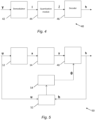
- FIG. 4 is a block diagram of a receiver, indicated generally by the reference numeral 40, for use in an end-to-end communication system in accordance with an example embodiment.
- the receiver 40 comprises a demodulator 42, a quantization module 44 and a decoder 46.
- the demodulator 42 may be provided for demodulating received symbols (e.g. constellation points) received from a transmitter (such as the transmitter 12)
- the quantization module 44 may be provided for generating quantized versions of the demodulated symbols
- the decoder 46 may be provided for generating a decoded output derived from the quantized versions of the demodulated symbols.
- One or more of the demodulator 42, quantization module 44 and decoder 46 may be trainable (e.g. including at least some trainable weights).
- the trainable weights of the demodulator 42, quantization module 44 and decoder 46 may be given by ⁇ f , ⁇ g and ⁇ d respectively.
- one or more of the demodulator 42, the quantization module 44 and the decoder 46 may include a neural network (or some other differentiable parametric function).
- the demodulator 42 may be implemented using a neural network (or another differentiable parametric function) f ⁇ f : C N ⁇ R M which maps the channel output y i to an M -dimensional real-valued vector.
- ⁇ f are trainable parameters of the neural network in this example.
- l i f ⁇ f (y i ).
- the observation y ⁇ C N may be received over multiple antennas, such that the demodulator 42 implicitly carries out some form of MIMO demodulation.
- the quantization module 44 may, for example, quantize vector l i , by implementing a soft staircase function, where a quantized vector l l is computed according to equation 10.
- l i j g ⁇ g l i j ⁇ ⁇ l ⁇ L l exp ⁇ l ⁇ l i j 2 ⁇ ⁇ l ⁇ L exp ⁇ l ⁇ l i j 2 ⁇
- l i ⁇ ⁇ l ⁇ L * l exp ⁇ l ⁇ l i j 2 ⁇ ⁇ l ⁇ L * exp ⁇ l ⁇ l i j 2 ⁇
- ⁇ g ( ⁇ ).
- the function g ⁇ g may be applied simultaneously on all elements of l i . This may be compactly written as illustrated in equation 12.
- l l ⁇ g ⁇ g l i
- the example embodiments may work for all decoding functions d .
- the training procedure may differ based on whether d is differentiable or not, such that if d is differentiable, it is differentiable with respect to its inputs. Some examples include sum-product, max-product, or the Viterbi algorithm.
- An example for LDPC codes is provided below.
- the iterative message exchange may be stopped after a maximum number of iterations t max is reached or whenever computation of h (as provided in equation 9) corresponds to a valid codeword.
- the final output of this algorithm is illustrated in equation 15.
- t ⁇ 0 t max , i ⁇ C , j ⁇ V . If all trainable parameters are set equal to one, the original BP algorithm as described in equations 5-9 is recovered. In some examples, the parameters are not indexed by the iteration ( t ) number and hence re-used in each iteration, such that ⁇ d ⁇ v j ,w i,j
- FIG. 5 is a block diagram of an example training system, indicated generally by the reference numeral 50, in accordance with an example embodiment.
- the training system 50 comprises the transmitter 12 and the channel 14 of the system 10 described above and further comprises the receiver 40 described above.
- the training system 50 further comprises a loss function module 52 and a learning algorithm module 54.
- the learning algorithm module 54 is used to update trainable parameters of the receiver 40.
- the demodulation module 42 may comprise means for generating a log-likelihood ratio (LLR) estimate for received data bits, wherein each log-likelihood ratio is indicative of the probability that the respective bit, as transmitted, had a particular value.
- LLR log-likelihood ratio
- One or more of the trainable weights of the demodulation module 42 may comprise one or more trainable weights of the log-likelihood ratio estimate generation means.
- the quantization module 44 may comprise an approximation of a step function.
- One or more of the trainable weights of the quantization module may include one or more weights relating to the degree of approximation of the step function.
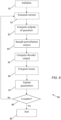
- FIG. 6 is a flow chart showing an algorithm, indicated generally by the reference numeral 60, in accordance with an example embodiment.
- the algorithm 60 may be implemented using the system 50.
- the algorithm 60 starts at operation 61, where parameters of the receiver 40 of a transmission system (e.g. including the transmitter 12, channel 14 and receiver 40) are initialised.
- the initialisation at operation 61 may take many forms, including a random (or pseudo-random) initialisation, or using (or being based on) a previously known receiver configuration.
- a set of training vectors are transmitted by the transmitter 12.
- the corresponding vectors of encoded bits are denoted c ( b ) .
- h b h ⁇ y b
- a loss function L ( ⁇ ) is obtained or generated.
- the loss function may be generated based on the first training sequence of messages as received at the loss function module 52 and knowledge of the training sequence as received at the loss function module 52.
- the loss function may, for example, be related to one or more of block error rate, bit error rate and categorical cross-entropy.
- the loss function is generated based on mean-squared error, as illustrated in equation 18.
- the loss function may be generated based on cross-entropy (CE), as illustrated in equation 19.
- CE cross-entropy
- At operation 65 at least some of the trainable parameters of receiver are updated based on the loss function, for example using stochastic gradient descent or reinforcement learning (e.g. updating at least some of the trainable weights of the demodulation module and/or at least some of the trainable weights of the quantization module and/or at least some of the trainable weights of the decoder).
- stochastic gradient descent e.g. updating at least some of the trainable weights of the demodulation module and/or at least some of the trainable weights of the quantization module and/or at least some of the trainable weights of the decoder.
- SGD stochastic gradient descent
- the operation 65 may involve updated the parameters ⁇ as illustrated in equation 20.
- ⁇ ⁇ ⁇ ⁇ ⁇ L ⁇
- ⁇ > 0 the learning rate
- L ( ⁇ ) is a loss function, such as the mean squared error (MSE).
- the operation 66 may determine that the algorithm is complete in a number of ways, such as after a number of interactions of the operations 62 to 66 have been completed, if the loss has reached or is below a certain value, if the loss has not decreased over a fixed number of iterations etc.
- the decoder has at least some trainable weights.
- the trainable weights of the demodulator 42, quantization module 44 and decoder 46 can be trained together. This is not essential to all embodiments. Indeed, in some embodiments, the decoder 46 is fixed (and may not be differentiable).
- FIG. 7 is a block diagram of an example training system, indicated generally by the reference numeral 70, in accordance with an example embodiment.
- the training system 70 has many similarities with the training system 50 described above.
- the training system 70 comprises the transmitter 12 and the channel 14 of the system 10 described above and further comprises a receiver 72.
- the receiver 72 comprises a demodulator 73, a quantization module 74, a decoder 75 and a summing module 76.
- the demodulator 73 may be provided for demodulating received symbols (e.g. constellation points) received from a transmitter (such as the transmitter 12)
- the quantization module 74 may be provided for generating quantized versions of the demodulated symbols
- the decoder 75 may be provided for generating a decoded output derived from the quantized versions of the demodulated symbols.
- the demodulator 73 and the quantization module 74 may be trainable (e.g. including at least some trainable weights).
- the trainable weights of the demodulator and the quantization module may be given by ⁇ f and ⁇ g respectively.
- the demodulator 73 and/or the quantization module 74 may include a neural network (or some other differentiable parametric function).
- the training system 70 further comprises a loss function module 78 and a learning algorithm module 79 that are similar to the loss function module 52 and learning algorithm module 54 described above.
- the training system 70 also comprises a perturbation module 77.
- the output of the quantization module 74 is provided to the input of the summing module 76, together with perturbation vectors provided by the random perturbation module 77.
- the summing module 76 provides the output of the quantization module, summed with a random noise input (the output of the perturbation module 77), as the input of the decoder 75.
- the perturbation vectors may, for example, take the form of zero mean Gaussian perturbations.
- FIG. 8 is a flow chart showing an algorithm, indicated generally by the reference numeral 80, in accordance with an example embodiment.
- the algorithm 80 has a number of similarities with the algorithm 60 described above.
- the algorithm 80 starts at operation 81, where parameters of the receiver 72 are initialised.
- the initialisation at operation 81 may take many forms, including a random (or pseudo-random) initialisation, or using (or being based on) a previously known receiver configuration.
- a set of training vectors are transmitted by the transmitter 12.
- the corresponding vectors of encoded bits are denoted c ( b ) .
- l ⁇ b g ⁇ g ( f ⁇ f y b
- a loss function r ( b ) is obtained or generated for each output.
- the loss function may be generated based on the first training sequence of messages as received at the loss function module 78 and knowledge of the training sequence as received at the loss function module 78.
- the loss function may, for example, be related to one or more of block error rate, bit error rate and categorical cross-entropy.
- the loss function is generated based on mean-squared error, as illustrated in equation 22.
- r MSE b ⁇ c b ⁇ h b ⁇ 2 2
- the loss function may be generated based on cross-entropy (CE), as illustrated in equation 23.
- CE cross-entropy
- At operation 87 at least some of the trainable parameters of receiver are updated based on the loss function, for example using stochastic gradient descent or reinforcement learning (e.g. updating at least some of the trainable weights of the demodulation module and/or at least some of the trainable weights of the quantization module).
- stochastic gradient descent e.g. updating at least some of the trainable weights of the demodulation module and/or at least some of the trainable weights of the quantization module.
- SGD stochastic gradient descent
- the Gaussian policy is given by equation 25.
- l ⁇ b 1 2 ⁇ 2 n exp ⁇ 1 2 ⁇ 2 ⁇ l ′ b ⁇ l ⁇ b ⁇ 2 2 .
- ⁇ ⁇ L( ⁇ ) is known as a policy gradient in the field of reinforcement learning and p ( l ' ( b )
- the losses r ( b ) are considered as constant with respect to the gradient calculation.
- the operation 88 may determine that the algorithm is complete in a number of ways, such as after a number of interactions of the operations 82 to 88 have been completed, if the loss has reached or is below a certain value, if the loss has not decreased over a fixed number of iterations etc.
- the means for updating at least some of the trainable weights of the quantization module described herein may comprise means for optimising a codebook of the quantization module.
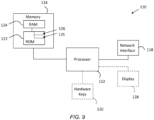
- FIG. 9 is a schematic diagram of components of one or more of the modules described previously (e.g. the transmitter or receiver neural networks), which hereafter are referred to generically as processing systems 110.
- a processing system 110 may have a processor 112, a memory 114 closely coupled to the processor and comprised of a RAM 124 and ROM 122, and, optionally, hardware keys 120 and a display 128.
- the processing system 110 may comprise one or more network interfaces 118 for connection to a network, e.g. a modem which may be wired or wireless.
- the processor 112 is connected to each of the other components in order to control operation thereof.
- the memory 114 may comprise a non-volatile memory, a hard disk drive (HDD) or a solid state drive (SSD).
- the ROM 122 of the memory 114 stores, amongst other things, an operating system 125 and may store software applications 126.
- the RAM 124 of the memory 114 is used by the processor 112 for the temporary storage of data.
- the operating system 125 may contain code which, when executed by the processor, implements aspects of the algorithms 60 and 80.
- the processor 112 may take any suitable form. For instance, it may be a microcontroller, plural microcontrollers, a processor, or plural processors.
- the processing system 110 may be a standalone computer, a server, a console, or a network thereof.
- the processing system 110 may also be associated with external software applications. These may be applications stored on a remote server device and may run partly or exclusively on the remote server device. These applications may be termed cloud-hosted applications.
- the processing system 110 may be in communication with the remote server device in order to utilize the software application stored there.
- FIGS. 10a and 10b show tangible media, respectively a removable memory unit 165 and a compact disc (CD) 168, storing computer-readable code which when run by a computer may perform methods according to embodiments described above.
- the removable memory unit 165 may be a memory stick, e.g. a USB memory stick, having internal memory 166 storing the computer-readable code.
- the memory 166 may be accessed by a computer system via a connector 167.
- the CD 168 may be a CD-ROM or a DVD or similar. Other forms of tangible storage media may be used.
- Embodiments of the present invention may be implemented in software, hardware, application logic or a combination of software, hardware and application logic.
- the software, application logic and/or hardware may reside on memory, or any computer media.
- the application logic, software or an instruction set is maintained on any one of various conventional computer-readable media.
- a "memory" or “computer-readable medium” may be any non-transitory media or means that can contain, store, communicate, propagate or transport the instructions for use by or in connection with an instruction execution system, apparatus, or device, such as a computer.
- references to, where relevant, "computer-readable storage medium”, “computer program product”, “tangibly embodied computer program” etc., or a “processor” or “processing circuitry” etc. should be understood to encompass not only computers having differing architectures such as single/multi-processor architectures and sequencers/parallel architectures, but also specialised circuits such as field programmable gate arrays FPGA, application specify circuits ASIC, signal processing devices and other devices.
- References to computer program, instructions, code etc. should be understood to express software for a programmable processor firmware such as the programmable content of a hardware device as instructions for a processor or configured or configuration settings for a fixed function device, gate array, programmable logic device, etc.
- circuitry refers to all of the following: (a) hardware-only circuit implementations (such as implementations in only analogue and/or digital circuitry) and (b) to combinations of circuits and software (and/or firmware), such as (as applicable): (i) to a combination of processor(s) or (ii) to portions of processor(s)/software (including digital signal processor(s)), software, and memory(ies) that work together to cause an apparatus, such as a server, to perform various functions) and (c) to circuits, such as a microprocessor(s) or a portion of a microprocessor(s), that require software or firmware for operation, even if the software or firmware is not physically present.
Landscapes
- Engineering & Computer Science (AREA)
- Physics & Mathematics (AREA)
- Theoretical Computer Science (AREA)
- Health & Medical Sciences (AREA)
- Life Sciences & Earth Sciences (AREA)
- Biomedical Technology (AREA)
- Biophysics (AREA)
- General Health & Medical Sciences (AREA)
- General Physics & Mathematics (AREA)
- Evolutionary Computation (AREA)
- Computational Linguistics (AREA)
- Molecular Biology (AREA)
- Computing Systems (AREA)
- General Engineering & Computer Science (AREA)
- Data Mining & Analysis (AREA)
- Mathematical Physics (AREA)
- Software Systems (AREA)
- Artificial Intelligence (AREA)
- Computer Networks & Wireless Communication (AREA)
- Signal Processing (AREA)
- Neurology (AREA)
- Compression, Expansion, Code Conversion, And Decoders (AREA)
- Error Detection And Correction (AREA)
Claims (15)
- Vorrichtung, die Folgendes umfasst:Mittel zum Initialisieren von trainierbaren Parametern eines Empfängers (40, 72) eines Übertragungssystems, wobei der Empfänger ein Demodulationsmodul (42, 73) zum Demodulieren von empfangenen Symbolen, ein Quantisierungsmodul (44, 74) zum Erzeugen von quantisierten Versionen der demodulierten Symbole und einen Decodierer (46, 75) zum Erzeugen einer decodierten Ausgabe, die von den quantisierten Version der demodulierten Symbole abgeleitet wird, umfasst, wobei das Demodulationsmodul mindestens einige trainierbare Gewichtungen aufweist und das Quantisierungsmodul mindestens einige trainierbare Gewichtungen aufweist;Mittel zum Empfangen einer ersten Trainingssequenz von Nachrichten am Empfänger;Mittel (52, 78) zum Erhalten oder Erzeugen einer Verlustfunktion; undMittel (54, 79) zum Aktualisieren von mindestens einigen der trainierbaren Parameter des Empfängers auf Basis der Verlustfunktion, wobei die Mittel zum Aktualisieren von mindestens einigen der trainierbaren Parameter des Empfängers Mittel zum Aktualisieren von mindestens einigen der trainierbaren Gewichtungen des Demodulationsmoduls und Mittel zum Aktualisieren von mindestens einigen der trainierbaren Gewichtungen des Quantisierungsmoduls umfassen.
- Vorrichtung nach Anspruch 1, wobei:der Decodierer (46) mindestens einige trainierbare Gewichtungen aufweist; unddie Mittel (52) zum Aktualisieren von mindestens einigen der trainierbaren Parameter des Empfängers Mittel zum Aktualisieren von mindestens einigen der trainierbaren Gewichtungen des Decodierers (46) umfassen.
- Vorrichtung nach Anspruch 1 oder Anspruch 2, wobei das Demodulationsmodul (42, 73) Mittel zum Erzeugen einer Protokollwahrscheinlichkeitsverhältnisschätzung für empfangene Datenbits umfasst, wobei jedes Protokollwahrscheinlichkeitsverhältnis die Wahrscheinlichkeit anzeigt, dass ein jeweiliges Bit, wie übertragen, einen speziellen Wert aufweist.
- Vorrichtung nach Anspruch 3, wobei eine oder mehrere der trainierbaren Gewichtungen des Demodulationsmoduls eine oder mehrere trainierbare Gewichtungen der Protokollwahrscheinlichkeitsverhältnisschätzungserzeugungsmitt el umfassen.
- Vorrichtung nach einem der vorhergehenden Ansprüche, wobei das Quantisierungsmodul (44, 74) eine Approximation einer Schrittfunktion umfasst, wobei die trainierbaren Gewichtungen des Quantisierungsmoduls eine oder mehrere Gewichtungen beinhalten, die den Approximationsgrad der Schrittfunktion betreffen.
- Vorrichtung nach einem der vorhergehenden Ansprüche, wobei die Mittel zum Aktualisieren von mindestens einigen der trainierbaren Gewichtungen des Quantisierungsmoduls Mittel zum Optimieren eines Codebuchs des Quantisierungsmoduls umfassen.
- Vorrichtung nach einem der vorhergehenden Ansprüche, die ferner Mittel zum Erzeugen von gestörten Versionen der quantifizierten Versionen der demodulierten Symbole umfasst, wobei der Decodierer (75) die decodierte Ausgabe erzeugt, die von den gestörten Versionen der quantisierten Versionen der demodulierten Symbole abgeleitet wird.
- Vorrichtung nach Anspruch 7, wobei die Mittel zum Erzeugen von gestörten Versionen der quantisierten Versionen der demodulierten Symbole eine Verteilung nutzt, um Störungen zu erzeugen, die auf die quantisierten Versionen der demodulierten Symbole anzuwenden sind.
- Vorrichtung nach einem der vorhergehenden Ansprüche, die ferner Mittel zum Wiederholen des Aktualisierens von mindestens einigen der trainierbaren Parameter des Empfängers, bis ein erster Zustand erreicht ist, umfasst.
- Vorrichtung nach einem der vorhergehenden Ansprüche, wobei die Verlustfunktion auf Basis der ersten Trainingssequenz von Nachrichten, die am Empfänger empfangen werden, und einer Kenntnis der Trainingssequenz erzeugt wird.
- Vorrichtung nach einem der vorhergehenden Ansprüche, wobei die Verlustfunktion eines oder mehreres von einer Blockfehlerrate, einer Bitfehlerrate und einer kategorischen Kreuzentropie betrifft.
- Vorrichtung nach einem der vorhergehenden Ansprüche, wobei die mindestens einigen trainierbaren Parameter des Empfängers unter Verwendung eines stochastischen Gradientenabstiegs oder eines Verstärkungslernens trainiert werden.
- Vorrichtung nach einem der vorhergehenden Ansprüche, wobei:das Demodulationsmodul ein neuronales Demodulatornetzwerk umfasst; und/oderdas Quantisierungsmodul ein neuronales Quantisierungsnetzwerk umfasst; und/oderder Decodierer ein neuronales Decodierernetzwerk umfasst.
- Vorrichtung nach einem der vorhergehenden Ansprüche, wobei die Mittel Folgendes umfassen:mindestens einen Prozessor; undmindestens einen Speicher, der einen Computerprogrammcode beinhaltet, wobei der mindestens eine Speicher und das Computerprogramm dazu ausgelegt sind, die Vorrichtung mit dem mindestens einen Prozessor zu Folgendem zu veranlassen:Initialisieren von trainierbaren Parametern eines Empfängers eines Übertragungssystems, wobei der Empfänger ein Demodulationsmodul zum Demodulieren von empfangenen Symbolen, ein Quantisierungsmodul zum Erzeugen von quantisierten Versionen der demodulierten Symbole und einen Decodierer zum Erzeugen einer decodierten Ausgabe, die von den quantisierten Version der demodulierten Symbole abgeleitet wird, umfasst, wobei das Demodulationsmodul mindestens einige trainierbare Gewichtungen aufweist und das Quantisierungsmodul mindestens einige trainierbare Gewichtungen aufweist;Empfangen einer ersten Trainingssequenz von Nachrichten am Empfänger;Erhalten oder Erzeugen einer Verlustfunktion; undAktualisieren von mindestens einigen der trainierbaren Parameter des Empfängers auf Basis der Verlustfunktion, wobei das Aktualisieren von mindestens einigen der trainierbaren Parameter des Empfängers das Aktualisieren von mindestens einigen der trainierbaren Gewichtungen des Demodulationsmoduls und das Aktualisieren von mindestens einigen der trainierbaren Gewichtungen des Quantisierungsmoduls umfasst.
- Verfahren, das Folgendes umfasst:Initialisieren (61, 81) von trainierbaren Parametern eines Empfängers (40, 72) eines Übertragungssystems, wobei der Empfänger ein Demodulationsmodul (42, 73) zum Demodulieren von empfangenen Symbolen, ein Quantisierungsmodul (44, 74) zum Erzeugen von quantisierten Versionen der demodulierten Symbole und einen Decodierer (46, 75) zum Erzeugen einer decodierten Ausgabe, die von den quantisierten Version der demodulierten Symbole abgeleitet wird, umfasst, wobei das Demodulationsmodul mindestens einige trainierbare Gewichtungen aufweist und das Quantisierungsmodul mindestens einige trainierbare Gewichtungen aufweist;Empfangen (62, 82) einer ersten Trainingssequenz von Nachrichten am Empfänger;Erhalten oder Erzeugen (64, 86) einer Verlustfunktion; undAktualisieren (65, 87) von mindestens einigen der trainierbaren Parameter des Empfängers auf Basis der Verlustfunktion, wobei das Aktualisieren von mindestens einigen der trainierbaren Parameter des Empfängers das Aktualisieren von mindestens einigen der trainierbaren Gewichtungen des Demodulationsmoduls und das Aktualisieren von mindestens einigen der trainierbaren Gewichtungen des Quantisierungsmoduls umfasst.
Applications Claiming Priority (1)
| Application Number | Priority Date | Filing Date | Title |
|---|---|---|---|
| PCT/EP2018/082270 WO2020104036A1 (en) | 2018-11-22 | 2018-11-22 | Learning in communication systems |
Publications (2)
| Publication Number | Publication Date |
|---|---|
| EP3884584A1 EP3884584A1 (de) | 2021-09-29 |
| EP3884584B1 true EP3884584B1 (de) | 2024-04-17 |
Family
ID=64456994
Family Applications (1)
| Application Number | Title | Priority Date | Filing Date |
|---|---|---|---|
| EP18807967.7A Active EP3884584B1 (de) | 2018-11-22 | 2018-11-22 | Lernen in kommunikationssystemen |
Country Status (4)
| Country | Link |
|---|---|
| US (1) | US12124937B2 (de) |
| EP (1) | EP3884584B1 (de) |
| CN (1) | CN113169752B (de) |
| WO (1) | WO2020104036A1 (de) |
Families Citing this family (11)
| Publication number | Priority date | Publication date | Assignee | Title |
|---|---|---|---|---|
| EP3642961A1 (de) * | 2017-06-22 | 2020-04-29 | Telefonaktiebolaget LM Ericsson (Publ) | Neuronale netze zur decodierung von vorwärtsfehlerkorrektur |
| EP3824606A1 (de) * | 2018-07-20 | 2021-05-26 | Nokia Technologies Oy | Lernen in kommunikationssystemen durch aktualisierung von parametern in einem empfangsalgorithmus |
| US11804860B2 (en) * | 2018-11-23 | 2023-10-31 | Nokia Technologies Oy | End-to-end learning in communication systems |
| WO2020145430A1 (ko) * | 2019-01-09 | 2020-07-16 | 엘지전자 주식회사 | Ldpc (low density parity check) 코딩된 신호를 디코딩하는 방법 및 이를 위한 단말 |
| US12217139B2 (en) | 2019-10-15 | 2025-02-04 | Siemens Aktiengesellschaft | Transforming a trained artificial intelligence model into a trustworthy artificial intelligence model |
| US11455531B2 (en) * | 2019-10-15 | 2022-09-27 | Siemens Aktiengesellschaft | Trustworthy predictions using deep neural networks based on adversarial calibration |
| CN113824453B (zh) * | 2020-06-19 | 2022-09-09 | 意法半导体有限公司 | 用于在无线电频率传输中接收数据的设备和方法 |
| EP4205036A1 (de) * | 2020-08-27 | 2023-07-05 | Nokia Technologies Oy | Funkempfänger, sender und system für pilotlose ofdm-kommunikation |
| EP4009597B1 (de) | 2020-12-03 | 2025-12-10 | Nokia Technologies Oy | Demapping empfangener daten |
| CN113537403B (zh) * | 2021-08-14 | 2024-08-13 | 北京达佳互联信息技术有限公司 | 图像处理模型的训练方法和装置及预测方法和装置 |
| CN115242271B (zh) * | 2022-07-27 | 2023-06-16 | 南京邮电大学 | 一种强化学习辅助的大规模MIMO的Damped-BP检测方法 |
Family Cites Families (7)
| Publication number | Priority date | Publication date | Assignee | Title |
|---|---|---|---|---|
| CN101933268B (zh) | 2008-01-30 | 2014-01-29 | 京瓷株式会社 | 无线通信系统、无线通信设备和通信控制方法 |
| US20180075347A1 (en) | 2016-09-15 | 2018-03-15 | Microsoft Technology Licensing, Llc | Efficient training of neural networks |
| US12190231B2 (en) * | 2016-10-19 | 2025-01-07 | Samsung Electronics Co., Ltd | Method and apparatus for neural network quantization |
| ES2895925T3 (es) * | 2017-04-20 | 2022-02-23 | Nokia Technologies Oy | Procedimiento y dispositivo para configurar un sistema de transmisión y procesamiento de datos |
| EP3616198B1 (de) | 2017-04-24 | 2024-10-16 | Virginia Tech Intellectual Properties, Inc. | Funksignalidentifikation, identifikationssystemlernen und identifikatoreinsatz |
| US10510358B1 (en) * | 2017-09-29 | 2019-12-17 | Amazon Technologies, Inc. | Resolution enhancement of speech signals for speech synthesis |
| US11270187B2 (en) * | 2017-11-07 | 2022-03-08 | Samsung Electronics Co., Ltd | Method and apparatus for learning low-precision neural network that combines weight quantization and activation quantization |
-
2018
- 2018-11-22 EP EP18807967.7A patent/EP3884584B1/de active Active
- 2018-11-22 WO PCT/EP2018/082270 patent/WO2020104036A1/en not_active Ceased
- 2018-11-22 CN CN201880099701.1A patent/CN113169752B/zh active Active
- 2018-11-22 US US17/295,296 patent/US12124937B2/en active Active
Also Published As
| Publication number | Publication date |
|---|---|
| WO2020104036A1 (en) | 2020-05-28 |
| US20220004848A1 (en) | 2022-01-06 |
| CN113169752A (zh) | 2021-07-23 |
| CN113169752B (zh) | 2022-09-13 |
| EP3884584A1 (de) | 2021-09-29 |
| US12124937B2 (en) | 2024-10-22 |
Similar Documents
| Publication | Publication Date | Title |
|---|---|---|
| EP3884584B1 (de) | Lernen in kommunikationssystemen | |
| Cammerer et al. | Trainable communication systems: Concepts and prototype | |
| EP3369226B1 (de) | Verfahren und empfänger zur decodierung von symbolen, die über einen kanal gesendet wurden | |
| Guillén i Fàbregas et al. | Bit-interleaved coded modulation | |
| US10135460B2 (en) | Apparatus and method for multilevel coding (MLC) with binary alphabet polar codes | |
| CN105075210B (zh) | 无线通信系统中用于频率和正交幅度调制的编码和解码的方法和装置 | |
| CN105518995B (zh) | 用于低密度签名调制的低复杂度接收器和方法 | |
| JP4627317B2 (ja) | 通信装置および復号方法 | |
| KR100804793B1 (ko) | 저밀도 패러티 검사 복호기에서의 검사 노드 갱신 방법 | |
| US9614548B1 (en) | Systems and methods for hybrid message passing and bit flipping decoding of LDPC codes | |
| EP3451539A1 (de) | Optischer empfänger, optische übertragungsvorrichtung und verfahren für einen optischen empfänger | |
| US20170288811A1 (en) | Low-complexity llr computation for nonuniform qam constellations | |
| CN101136639B (zh) | 用于降低复杂性的低密度奇偶校验解码的系统和方法 | |
| CN113748626B (zh) | 通信系统中的迭代检测 | |
| KR102535853B1 (ko) | Ofdm 색인 변조를 위한 저복잡도의 ldpc 디코딩 장치 및 방법 | |
| Emran et al. | Generalized simplified variable-scaled min sum LDPC decoder for irregular LDPC codes | |
| US9531577B2 (en) | Bit-likelihood calculating apparatus and bit-likelihood calculating method | |
| US9225468B1 (en) | Systems and methods for detecting data in a received multiple-input-multiple-output (MIMO) signal | |
| CN119676040B (zh) | 简化的迭代检测译码方法、装置、电子设备及存储介质 | |
| JP2008153874A (ja) | 軟判定復号装置、軟判定復号方法および軟判定復号プログラム | |
| Li et al. | Notice of Violation of IEEE Publication Principles: Channel Decoding Based on Complex-valued Convolutional Neural Networks | |
| CN101626281A (zh) | 噪声估计方法及装置 | |
| CN116961709A (zh) | 信号处理方法、非易失性存储介质及计算机设备 | |
| Schilling | Design and FPGA prototyping of an advanced receiver based on expectation propagation | |
| Song et al. | Polar Code Construction for Gaussian Channels Based on Approximated Error Evolution |
Legal Events
| Date | Code | Title | Description |
|---|---|---|---|
| STAA | Information on the status of an ep patent application or granted ep patent |
Free format text: STATUS: UNKNOWN |
|
| STAA | Information on the status of an ep patent application or granted ep patent |
Free format text: STATUS: THE INTERNATIONAL PUBLICATION HAS BEEN MADE |
|
| PUAI | Public reference made under article 153(3) epc to a published international application that has entered the european phase |
Free format text: ORIGINAL CODE: 0009012 |
|
| STAA | Information on the status of an ep patent application or granted ep patent |
Free format text: STATUS: REQUEST FOR EXAMINATION WAS MADE |
|
| 17P | Request for examination filed |
Effective date: 20210622 |
|
| AK | Designated contracting states |
Kind code of ref document: A1 Designated state(s): AL AT BE BG CH CY CZ DE DK EE ES FI FR GB GR HR HU IE IS IT LI LT LU LV MC MK MT NL NO PL PT RO RS SE SI SK SM TR |
|
| DAV | Request for validation of the european patent (deleted) | ||
| DAX | Request for extension of the european patent (deleted) | ||
| GRAP | Despatch of communication of intention to grant a patent |
Free format text: ORIGINAL CODE: EPIDOSNIGR1 |
|
| STAA | Information on the status of an ep patent application or granted ep patent |
Free format text: STATUS: GRANT OF PATENT IS INTENDED |
|
| INTG | Intention to grant announced |
Effective date: 20240111 |
|
| GRAS | Grant fee paid |
Free format text: ORIGINAL CODE: EPIDOSNIGR3 |
|
| GRAA | (expected) grant |
Free format text: ORIGINAL CODE: 0009210 |
|
| STAA | Information on the status of an ep patent application or granted ep patent |
Free format text: STATUS: THE PATENT HAS BEEN GRANTED |
|
| AK | Designated contracting states |
Kind code of ref document: B1 Designated state(s): AL AT BE BG CH CY CZ DE DK EE ES FI FR GB GR HR HU IE IS IT LI LT LU LV MC MK MT NL NO PL PT RO RS SE SI SK SM TR |
|
| REG | Reference to a national code |
Ref country code: GB Ref legal event code: FG4D |
|
| REG | Reference to a national code |
Ref country code: CH Ref legal event code: EP |
|
| REG | Reference to a national code |
Ref country code: IE Ref legal event code: FG4D Ref country code: DE Ref legal event code: R096 Ref document number: 602018068255 Country of ref document: DE |
|
| REG | Reference to a national code |
Ref country code: LT Ref legal event code: MG9D |
|
| REG | Reference to a national code |
Ref country code: NL Ref legal event code: MP Effective date: 20240417 |
|
| REG | Reference to a national code |
Ref country code: AT Ref legal event code: MK05 Ref document number: 1678246 Country of ref document: AT Kind code of ref document: T Effective date: 20240417 |
|
| PG25 | Lapsed in a contracting state [announced via postgrant information from national office to epo] |
Ref country code: NL Free format text: LAPSE BECAUSE OF FAILURE TO SUBMIT A TRANSLATION OF THE DESCRIPTION OR TO PAY THE FEE WITHIN THE PRESCRIBED TIME-LIMIT Effective date: 20240417 |
|
| PG25 | Lapsed in a contracting state [announced via postgrant information from national office to epo] |
Ref country code: NL Free format text: LAPSE BECAUSE OF FAILURE TO SUBMIT A TRANSLATION OF THE DESCRIPTION OR TO PAY THE FEE WITHIN THE PRESCRIBED TIME-LIMIT Effective date: 20240417 |
|
| PG25 | Lapsed in a contracting state [announced via postgrant information from national office to epo] |
Ref country code: IS Free format text: LAPSE BECAUSE OF FAILURE TO SUBMIT A TRANSLATION OF THE DESCRIPTION OR TO PAY THE FEE WITHIN THE PRESCRIBED TIME-LIMIT Effective date: 20240817 |
|
| PG25 | Lapsed in a contracting state [announced via postgrant information from national office to epo] |
Ref country code: BG Free format text: LAPSE BECAUSE OF FAILURE TO SUBMIT A TRANSLATION OF THE DESCRIPTION OR TO PAY THE FEE WITHIN THE PRESCRIBED TIME-LIMIT Effective date: 20240417 |
|
| PG25 | Lapsed in a contracting state [announced via postgrant information from national office to epo] |
Ref country code: HR Free format text: LAPSE BECAUSE OF FAILURE TO SUBMIT A TRANSLATION OF THE DESCRIPTION OR TO PAY THE FEE WITHIN THE PRESCRIBED TIME-LIMIT Effective date: 20240417 Ref country code: FI Free format text: LAPSE BECAUSE OF FAILURE TO SUBMIT A TRANSLATION OF THE DESCRIPTION OR TO PAY THE FEE WITHIN THE PRESCRIBED TIME-LIMIT Effective date: 20240417 |
|
| PG25 | Lapsed in a contracting state [announced via postgrant information from national office to epo] |
Ref country code: GR Free format text: LAPSE BECAUSE OF FAILURE TO SUBMIT A TRANSLATION OF THE DESCRIPTION OR TO PAY THE FEE WITHIN THE PRESCRIBED TIME-LIMIT Effective date: 20240718 |
|
| PG25 | Lapsed in a contracting state [announced via postgrant information from national office to epo] |
Ref country code: PT Free format text: LAPSE BECAUSE OF FAILURE TO SUBMIT A TRANSLATION OF THE DESCRIPTION OR TO PAY THE FEE WITHIN THE PRESCRIBED TIME-LIMIT Effective date: 20240819 |
|
| PG25 | Lapsed in a contracting state [announced via postgrant information from national office to epo] |
Ref country code: ES Free format text: LAPSE BECAUSE OF FAILURE TO SUBMIT A TRANSLATION OF THE DESCRIPTION OR TO PAY THE FEE WITHIN THE PRESCRIBED TIME-LIMIT Effective date: 20240417 |
|
| PG25 | Lapsed in a contracting state [announced via postgrant information from national office to epo] |
Ref country code: AT Free format text: LAPSE BECAUSE OF FAILURE TO SUBMIT A TRANSLATION OF THE DESCRIPTION OR TO PAY THE FEE WITHIN THE PRESCRIBED TIME-LIMIT Effective date: 20240417 |
|
| PG25 | Lapsed in a contracting state [announced via postgrant information from national office to epo] |
Ref country code: PL Free format text: LAPSE BECAUSE OF FAILURE TO SUBMIT A TRANSLATION OF THE DESCRIPTION OR TO PAY THE FEE WITHIN THE PRESCRIBED TIME-LIMIT Effective date: 20240417 |
|
| PG25 | Lapsed in a contracting state [announced via postgrant information from national office to epo] |
Ref country code: LV Free format text: LAPSE BECAUSE OF FAILURE TO SUBMIT A TRANSLATION OF THE DESCRIPTION OR TO PAY THE FEE WITHIN THE PRESCRIBED TIME-LIMIT Effective date: 20240417 |
|
| PG25 | Lapsed in a contracting state [announced via postgrant information from national office to epo] |
Ref country code: PT Free format text: LAPSE BECAUSE OF FAILURE TO SUBMIT A TRANSLATION OF THE DESCRIPTION OR TO PAY THE FEE WITHIN THE PRESCRIBED TIME-LIMIT Effective date: 20240819 Ref country code: PL Free format text: LAPSE BECAUSE OF FAILURE TO SUBMIT A TRANSLATION OF THE DESCRIPTION OR TO PAY THE FEE WITHIN THE PRESCRIBED TIME-LIMIT Effective date: 20240417 Ref country code: NO Free format text: LAPSE BECAUSE OF FAILURE TO SUBMIT A TRANSLATION OF THE DESCRIPTION OR TO PAY THE FEE WITHIN THE PRESCRIBED TIME-LIMIT Effective date: 20240717 Ref country code: LV Free format text: LAPSE BECAUSE OF FAILURE TO SUBMIT A TRANSLATION OF THE DESCRIPTION OR TO PAY THE FEE WITHIN THE PRESCRIBED TIME-LIMIT Effective date: 20240417 Ref country code: IS Free format text: LAPSE BECAUSE OF FAILURE TO SUBMIT A TRANSLATION OF THE DESCRIPTION OR TO PAY THE FEE WITHIN THE PRESCRIBED TIME-LIMIT Effective date: 20240817 Ref country code: HR Free format text: LAPSE BECAUSE OF FAILURE TO SUBMIT A TRANSLATION OF THE DESCRIPTION OR TO PAY THE FEE WITHIN THE PRESCRIBED TIME-LIMIT Effective date: 20240417 Ref country code: GR Free format text: LAPSE BECAUSE OF FAILURE TO SUBMIT A TRANSLATION OF THE DESCRIPTION OR TO PAY THE FEE WITHIN THE PRESCRIBED TIME-LIMIT Effective date: 20240718 Ref country code: FI Free format text: LAPSE BECAUSE OF FAILURE TO SUBMIT A TRANSLATION OF THE DESCRIPTION OR TO PAY THE FEE WITHIN THE PRESCRIBED TIME-LIMIT Effective date: 20240417 Ref country code: ES Free format text: LAPSE BECAUSE OF FAILURE TO SUBMIT A TRANSLATION OF THE DESCRIPTION OR TO PAY THE FEE WITHIN THE PRESCRIBED TIME-LIMIT Effective date: 20240417 Ref country code: BG Free format text: LAPSE BECAUSE OF FAILURE TO SUBMIT A TRANSLATION OF THE DESCRIPTION OR TO PAY THE FEE WITHIN THE PRESCRIBED TIME-LIMIT Effective date: 20240417 Ref country code: AT Free format text: LAPSE BECAUSE OF FAILURE TO SUBMIT A TRANSLATION OF THE DESCRIPTION OR TO PAY THE FEE WITHIN THE PRESCRIBED TIME-LIMIT Effective date: 20240417 Ref country code: RS Free format text: LAPSE BECAUSE OF FAILURE TO SUBMIT A TRANSLATION OF THE DESCRIPTION OR TO PAY THE FEE WITHIN THE PRESCRIBED TIME-LIMIT Effective date: 20240717 |
|
| PG25 | Lapsed in a contracting state [announced via postgrant information from national office to epo] |
Ref country code: DK Free format text: LAPSE BECAUSE OF FAILURE TO SUBMIT A TRANSLATION OF THE DESCRIPTION OR TO PAY THE FEE WITHIN THE PRESCRIBED TIME-LIMIT Effective date: 20240417 |
|
| REG | Reference to a national code |
Ref country code: DE Ref legal event code: R097 Ref document number: 602018068255 Country of ref document: DE |
|
| PG25 | Lapsed in a contracting state [announced via postgrant information from national office to epo] |
Ref country code: EE Free format text: LAPSE BECAUSE OF FAILURE TO SUBMIT A TRANSLATION OF THE DESCRIPTION OR TO PAY THE FEE WITHIN THE PRESCRIBED TIME-LIMIT Effective date: 20240417 |
|
| PG25 | Lapsed in a contracting state [announced via postgrant information from national office to epo] |
Ref country code: CZ Free format text: LAPSE BECAUSE OF FAILURE TO SUBMIT A TRANSLATION OF THE DESCRIPTION OR TO PAY THE FEE WITHIN THE PRESCRIBED TIME-LIMIT Effective date: 20240417 |
|
| PG25 | Lapsed in a contracting state [announced via postgrant information from national office to epo] |
Ref country code: SK Free format text: LAPSE BECAUSE OF FAILURE TO SUBMIT A TRANSLATION OF THE DESCRIPTION OR TO PAY THE FEE WITHIN THE PRESCRIBED TIME-LIMIT Effective date: 20240417 Ref country code: RO Free format text: LAPSE BECAUSE OF FAILURE TO SUBMIT A TRANSLATION OF THE DESCRIPTION OR TO PAY THE FEE WITHIN THE PRESCRIBED TIME-LIMIT Effective date: 20240417 |
|
| PG25 | Lapsed in a contracting state [announced via postgrant information from national office to epo] |
Ref country code: SM Free format text: LAPSE BECAUSE OF FAILURE TO SUBMIT A TRANSLATION OF THE DESCRIPTION OR TO PAY THE FEE WITHIN THE PRESCRIBED TIME-LIMIT Effective date: 20240417 |
|
| PG25 | Lapsed in a contracting state [announced via postgrant information from national office to epo] |
Ref country code: SM Free format text: LAPSE BECAUSE OF FAILURE TO SUBMIT A TRANSLATION OF THE DESCRIPTION OR TO PAY THE FEE WITHIN THE PRESCRIBED TIME-LIMIT Effective date: 20240417 Ref country code: SK Free format text: LAPSE BECAUSE OF FAILURE TO SUBMIT A TRANSLATION OF THE DESCRIPTION OR TO PAY THE FEE WITHIN THE PRESCRIBED TIME-LIMIT Effective date: 20240417 Ref country code: RO Free format text: LAPSE BECAUSE OF FAILURE TO SUBMIT A TRANSLATION OF THE DESCRIPTION OR TO PAY THE FEE WITHIN THE PRESCRIBED TIME-LIMIT Effective date: 20240417 Ref country code: EE Free format text: LAPSE BECAUSE OF FAILURE TO SUBMIT A TRANSLATION OF THE DESCRIPTION OR TO PAY THE FEE WITHIN THE PRESCRIBED TIME-LIMIT Effective date: 20240417 Ref country code: DK Free format text: LAPSE BECAUSE OF FAILURE TO SUBMIT A TRANSLATION OF THE DESCRIPTION OR TO PAY THE FEE WITHIN THE PRESCRIBED TIME-LIMIT Effective date: 20240417 Ref country code: CZ Free format text: LAPSE BECAUSE OF FAILURE TO SUBMIT A TRANSLATION OF THE DESCRIPTION OR TO PAY THE FEE WITHIN THE PRESCRIBED TIME-LIMIT Effective date: 20240417 |
|
| PG25 | Lapsed in a contracting state [announced via postgrant information from national office to epo] |
Ref country code: IT Free format text: LAPSE BECAUSE OF FAILURE TO SUBMIT A TRANSLATION OF THE DESCRIPTION OR TO PAY THE FEE WITHIN THE PRESCRIBED TIME-LIMIT Effective date: 20240417 |
|
| PLBE | No opposition filed within time limit |
Free format text: ORIGINAL CODE: 0009261 |
|
| STAA | Information on the status of an ep patent application or granted ep patent |
Free format text: STATUS: NO OPPOSITION FILED WITHIN TIME LIMIT |
|
| 26N | No opposition filed |
Effective date: 20250120 |
|
| PG25 | Lapsed in a contracting state [announced via postgrant information from national office to epo] |
Ref country code: SI Free format text: LAPSE BECAUSE OF FAILURE TO SUBMIT A TRANSLATION OF THE DESCRIPTION OR TO PAY THE FEE WITHIN THE PRESCRIBED TIME-LIMIT Effective date: 20240417 |
|
| REG | Reference to a national code |
Ref country code: CH Ref legal event code: PL |
|
| PG25 | Lapsed in a contracting state [announced via postgrant information from national office to epo] |
Ref country code: MC Free format text: LAPSE BECAUSE OF FAILURE TO SUBMIT A TRANSLATION OF THE DESCRIPTION OR TO PAY THE FEE WITHIN THE PRESCRIBED TIME-LIMIT Effective date: 20240417 |
|
| PG25 | Lapsed in a contracting state [announced via postgrant information from national office to epo] |
Ref country code: LU Free format text: LAPSE BECAUSE OF NON-PAYMENT OF DUE FEES Effective date: 20241122 |
|
| REG | Reference to a national code |
Ref country code: CH Ref legal event code: PL |
|
| PG25 | Lapsed in a contracting state [announced via postgrant information from national office to epo] |
Ref country code: CH Free format text: LAPSE BECAUSE OF NON-PAYMENT OF DUE FEES Effective date: 20241130 |
|
| REG | Reference to a national code |
Ref country code: BE Ref legal event code: MM Effective date: 20241130 |
|
| PG25 | Lapsed in a contracting state [announced via postgrant information from national office to epo] |
Ref country code: SE Free format text: LAPSE BECAUSE OF FAILURE TO SUBMIT A TRANSLATION OF THE DESCRIPTION OR TO PAY THE FEE WITHIN THE PRESCRIBED TIME-LIMIT Effective date: 20240417 |
|
| PG25 | Lapsed in a contracting state [announced via postgrant information from national office to epo] |
Ref country code: BE Free format text: LAPSE BECAUSE OF NON-PAYMENT OF DUE FEES Effective date: 20241130 |
|
| PGFP | Annual fee paid to national office [announced via postgrant information from national office to epo] |
Ref country code: FR Payment date: 20250930 Year of fee payment: 8 |
|
| PG25 | Lapsed in a contracting state [announced via postgrant information from national office to epo] |
Ref country code: IE Free format text: LAPSE BECAUSE OF NON-PAYMENT OF DUE FEES Effective date: 20241122 |
|
| PGFP | Annual fee paid to national office [announced via postgrant information from national office to epo] |
Ref country code: DE Payment date: 20250930 Year of fee payment: 8 |
|
| PGFP | Annual fee paid to national office [announced via postgrant information from national office to epo] |
Ref country code: GB Payment date: 20251001 Year of fee payment: 8 |
|
| PG25 | Lapsed in a contracting state [announced via postgrant information from national office to epo] |
Ref country code: HU Free format text: LAPSE BECAUSE OF FAILURE TO SUBMIT A TRANSLATION OF THE DESCRIPTION OR TO PAY THE FEE WITHIN THE PRESCRIBED TIME-LIMIT; INVALID AB INITIO Effective date: 20181122 |