EP3883702B1 - Improved method of running a cold rolling mill - Google Patents
Improved method of running a cold rolling mill Download PDFInfo
- Publication number
- EP3883702B1 EP3883702B1 EP19794566.0A EP19794566A EP3883702B1 EP 3883702 B1 EP3883702 B1 EP 3883702B1 EP 19794566 A EP19794566 A EP 19794566A EP 3883702 B1 EP3883702 B1 EP 3883702B1
- Authority
- EP
- European Patent Office
- Prior art keywords
- stand
- rolling
- passes
- mill
- entry
- Prior art date
- Legal status (The legal status is an assumption and is not a legal conclusion. Google has not performed a legal analysis and makes no representation as to the accuracy of the status listed.)
- Active
Links
Images
Classifications
-
- B—PERFORMING OPERATIONS; TRANSPORTING
- B21—MECHANICAL METAL-WORKING WITHOUT ESSENTIALLY REMOVING MATERIAL; PUNCHING METAL
- B21B—ROLLING OF METAL
- B21B1/00—Metal-rolling methods or mills for making semi-finished products of solid or profiled cross-section; Sequence of operations in milling trains; Layout of rolling-mill plant, e.g. grouping of stands; Succession of passes or of sectional pass alternations
- B21B1/22—Metal-rolling methods or mills for making semi-finished products of solid or profiled cross-section; Sequence of operations in milling trains; Layout of rolling-mill plant, e.g. grouping of stands; Succession of passes or of sectional pass alternations for rolling plates, strips, bands or sheets of indefinite length
- B21B1/30—Metal-rolling methods or mills for making semi-finished products of solid or profiled cross-section; Sequence of operations in milling trains; Layout of rolling-mill plant, e.g. grouping of stands; Succession of passes or of sectional pass alternations for rolling plates, strips, bands or sheets of indefinite length in a non-continuous process
- B21B1/32—Metal-rolling methods or mills for making semi-finished products of solid or profiled cross-section; Sequence of operations in milling trains; Layout of rolling-mill plant, e.g. grouping of stands; Succession of passes or of sectional pass alternations for rolling plates, strips, bands or sheets of indefinite length in a non-continuous process in reversing single stand mills, e.g. with intermediate storage reels for accumulating work
- B21B1/36—Metal-rolling methods or mills for making semi-finished products of solid or profiled cross-section; Sequence of operations in milling trains; Layout of rolling-mill plant, e.g. grouping of stands; Succession of passes or of sectional pass alternations for rolling plates, strips, bands or sheets of indefinite length in a non-continuous process in reversing single stand mills, e.g. with intermediate storage reels for accumulating work by cold-rolling
-
- B—PERFORMING OPERATIONS; TRANSPORTING
- B21—MECHANICAL METAL-WORKING WITHOUT ESSENTIALLY REMOVING MATERIAL; PUNCHING METAL
- B21B—ROLLING OF METAL
- B21B1/00—Metal-rolling methods or mills for making semi-finished products of solid or profiled cross-section; Sequence of operations in milling trains; Layout of rolling-mill plant, e.g. grouping of stands; Succession of passes or of sectional pass alternations
- B21B1/22—Metal-rolling methods or mills for making semi-finished products of solid or profiled cross-section; Sequence of operations in milling trains; Layout of rolling-mill plant, e.g. grouping of stands; Succession of passes or of sectional pass alternations for rolling plates, strips, bands or sheets of indefinite length
-
- B—PERFORMING OPERATIONS; TRANSPORTING
- B21—MECHANICAL METAL-WORKING WITHOUT ESSENTIALLY REMOVING MATERIAL; PUNCHING METAL
- B21B—ROLLING OF METAL
- B21B2267/00—Roll parameters
- B21B2267/10—Roughness of roll surface
-
- B—PERFORMING OPERATIONS; TRANSPORTING
- B21—MECHANICAL METAL-WORKING WITHOUT ESSENTIALLY REMOVING MATERIAL; PUNCHING METAL
- B21B—ROLLING OF METAL
- B21B35/00—Drives for metal-rolling mills, e.g. hydraulic drives
- B21B35/06—Drives for metal-rolling mills, e.g. hydraulic drives for non-continuously-operating mills or for single stands
- B21B35/08—Drives for metal-rolling mills, e.g. hydraulic drives for non-continuously-operating mills or for single stands for reversing rolling mills
-
- B—PERFORMING OPERATIONS; TRANSPORTING
- B21—MECHANICAL METAL-WORKING WITHOUT ESSENTIALLY REMOVING MATERIAL; PUNCHING METAL
- B21B—ROLLING OF METAL
- B21B39/00—Arrangements for moving, supporting, or positioning work, or controlling its movement, combined with or arranged in, or specially adapted for use in connection with, metal-rolling mills
- B21B39/02—Feeding or supporting work; Braking or tensioning arrangements, e.g. threading arrangements
- B21B39/12—Arrangement or installation of roller tables in relation to a roll stand
Definitions
- the present invention relates to the field of cold rolling mills and strip processing lines, in particular to flexible cold rolling mills as new solutions for enhancing competitiveness. More specifically, the present invention relates to rolling method improvements in a reversible rolling mill such as a single stand or two stand reversing mill.
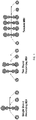
- the most used cold rolling mills are the single stand reversing mill (RCM) with an annual production typically lower than 500,000 t, the two stand reversing mill (also called “twin mill”) with an annual production typically lower than 900,000 t and the tandem mill (TCM) with an annual production greater than 1,000,000 t, as illustrated in FIG. 1 .
- a tandem mill is a modern rolling mill having a larger production capacity (and a higher number of stands), which can be either a coil-to-coil mill or a continuous mill, and where rolling is performed in one pass in several stands, typically from 2 to 6 and where reductions take place successively.
- cold strip producers firstly invest in a single stand rolling mill. When their market grows and they want to increase their production, they have the opportunity to invest in a second single stand rolling mill. However, two single stand rolling mills are less effective and more expensive than a twin stand mill.
- twin stand mill is low investment costs (CAPEX) and low operative costs (OPEX) as compared to two single stands and tandem mill.
- CAEX low investment costs
- OPEX operative costs
- a conventional reversing cold rolling mill typically comprises mainly one or more stands (mill proper) as well as an unwinding machine called pay-off reel (POR), an entry winding machine called entry tension reel (ETR) and a delivery winding machine called delivery tension reel (DTR).
- POR pay-off reel
- ETR entry tension reel
- DTR delivery tension reel
- a coil is inserted into the POR, the head end is threaded into the DTR and put under tension, and specified reduction force is applied to the cylinders of the mill. Thereafter rolling of the first pass is carried out.
- the tension becomes lost when the coil tail is taken out of the POR, defining off-gauge length of strip.
- the latter can be reduced or minimized for example by continuing to apply tension thanks to a friction force using a strip press.
- the second pass (reversed) can then be started, the tail end of the strip being threaded into the ETR and the process continues as in the first pass. Rolling is repeated a number of times until the final thickness gauge of the product is attained.
- the number of rolling passes can be even (2, 4, 6, etc.) or odd (1, 3, 5, etc.).
- a portion that is not rolled remains at each end of the product coil (length of strip head between the mill and the DTR when threading the strip to the DTR and at most length of strip tail between the mill and the POR).
- the off-gauge length on the outer part of the coil can be cut out by means of a shearing machine usually located on the delivery side and is taken from the ETR or DTR (depending on the number of passes) as a small coil called pup coil to be disposed.
- the off-gauge portion in the inner of the product coil should be disposed in the following line or by an end user.
- the cold rolling mill includes at least two tandem four-high reversing mills with at least one tension reel on each side of the tandem mills.
- the rolling mill comprises two winding reels and two mill stands.
- Another rolling mill stand can be placed upstream of the aforementioned stands (this extra rolling mill being erected at the same time as the two first mill stands), and configured to be open during the odd rolling step and closed during the even rolling step. In this way, two rolling steps are performed with a total of 5 (2 + 3) thickness reductions.
- the rollers of this additional stand may be provided with roughness greater than that of the other stands in order to provide a rolling surface with controlled roughness during the last rolling step.
- the present invention aims to overcome some drawbacks of prior art of cold rolling mill running.
- the invention particularly aims at increasing flexibility and productivity of a cold rolling mill.
- An additional goal of the invention is to provide an innovative pass sequence calculation for optimizing the whole cost of a reversing cold mill.
- the present invention relates to an improved rolling method of a metal strip in a reversible rolling mill according to claim 1.
- the improved rolling method also comprises one or a suitable combination of the following characteristics :
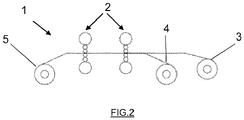
- the present invention starts from the general design for a cold reversible rolling mill 1, as depicted in FIG. 2 , comprising for example two rolling stands 2.
- the reversible rolling mill 1 further comprises an uncoiling device also called pay-off reel (POR) 3, a first recoiling device also called entry tension reel (ETR) 4 and a second recoiling device also called delivery tension reel (DTR) 5.
- POR pay-off reel
- ETR entry tension reel
- DTR delivery tension reel
- the inventors have shown by calculation that a rolling method involving an even number of passes strategy can be advantageously adapted.
- the new strategy allows 2, 4 or 6 passes, for the same total reduction.
- Table 1 shows a realistic rolling example with an even-passes-only strategy compared to the regular strategy, in the case of 6 passes maximum, in the following conditions : 5MW power per stand, 1800T of rolling force, maximum speed of 1400m/min.
- the regular strategy shows the production data (tonnes, hours) obtained with a succession of different passes in a non-reversible rolling mill or in a reversible rolling mill adapted to accommodate odd and pair passes.
- the even-passes-only strategy shows the production data for 2, 4 and 6 passes in a reversible rolling mill.
- the total production in this example is 500000 tonnes in 5479.5 hours in the regular strategy against 500000 tonnes in 5441.0 hours in the even-passes strategy. The productivity is thus a little bit higher in the latter case (91.9 tonnes/hour against 91.2 tonnes/hour).
Landscapes
- Engineering & Computer Science (AREA)
- Mechanical Engineering (AREA)
- Metal Rolling (AREA)
Description
- The present invention relates to the field of cold rolling mills and strip processing lines, in particular to flexible cold rolling mills as new solutions for enhancing competitiveness. More specifically, the present invention relates to rolling method improvements in a reversible rolling mill such as a single stand or two stand reversing mill.
- In the recent years, while the global steel market shows a declining tendency and overcapacity, regional differences are observed and Asia, in particular Southeast Asia, is still an expanding market, even considerably in some countries. Thus steel producers and equipment suppliers are not only faced with quality, sustainability or digitalization challenges but also with an important need for flexibility.
- In this context arises the question of upgrading mill equipment in function of the evolution of annual production. The most used cold rolling mills are the single stand reversing mill (RCM) with an annual production typically lower than 500,000 t, the two stand reversing mill (also called "twin mill") with an annual production typically lower than 900,000 t and the tandem mill (TCM) with an annual production greater than 1,000,000 t, as illustrated in
FIG. 1 . A tandem mill is a modern rolling mill having a larger production capacity (and a higher number of stands), which can be either a coil-to-coil mill or a continuous mill, and where rolling is performed in one pass in several stands, typically from 2 to 6 and where reductions take place successively. - Generally, cold strip producers firstly invest in a single stand rolling mill. When their market grows and they want to increase their production, they have the opportunity to invest in a second single stand rolling mill. However, two single stand rolling mills are less effective and more expensive than a twin stand mill.
- Indeed, the advantages of the twin stand mill are low investment costs (CAPEX) and low operative costs (OPEX) as compared to two single stands and tandem mill. The flexibility and the wide range of product mix are also an advantage.
- There is therefore currently a strong need to be able to upgrade mill capacities, for example, to step up from a single stand rolling mill into a twin stand mill or from a twin stand mill into a tandem mill. Flexibility of the equipment is the basis for the option to adapt to future market requirements.
- Document "Cold rolling Mills by SMS group - flexible plant concepts tailored to the demand of emerging markets" by T. SEEGER and F. TOPFER, 2018, SEAISI Conference & Exhibition, Jakarta, Indonesia, June 2018, comes to the same topic, that is to offer flexible equipment in the field of rolling mills. Upgrading flexibility requires that the design of single stand reversing mills and two stand mills be compatible in order to easily turning a RCM into a two stand mill. Among the proposed solutions to upgrade a single stand reversing cold mill into a two stand reversing cold mill is reduction of the civil works thanks to a very compact mill and foundation design prepared for a second stand, with an emulsion compact unit helping reducing cellar size besides its own advantages (reduction of piping efforts, and energy consumption). Similarly, the twin stand mill can also be converted into a TCM.
- However, these transformations have the drawback to take a shutdown time of approximately two months until the mill starts operation again.
- A conventional reversing cold rolling mill typically comprises mainly one or more stands (mill proper) as well as an unwinding machine called pay-off reel (POR), an entry winding machine called entry tension reel (ETR) and a delivery winding machine called delivery tension reel (DTR).
- In operation, a coil is inserted into the POR, the head end is threaded into the DTR and put under tension, and specified reduction force is applied to the cylinders of the mill. Thereafter rolling of the first pass is carried out. The tension becomes lost when the coil tail is taken out of the POR, defining off-gauge length of strip. The latter can be reduced or minimized for example by continuing to apply tension thanks to a friction force using a strip press. The second pass (reversed) can then be started, the tail end of the strip being threaded into the ETR and the process continues as in the first pass. Rolling is repeated a number of times until the final thickness gauge of the product is attained. The number of rolling passes can be even (2, 4, 6, etc.) or odd (1, 3, 5, etc.).
- A portion that is not rolled (off-gauge portion) remains at each end of the product coil (length of strip head between the mill and the DTR when threading the strip to the DTR and at most length of strip tail between the mill and the POR). The off-gauge length on the outer part of the coil can be cut out by means of a shearing machine usually located on the delivery side and is taken from the ETR or DTR (depending on the number of passes) as a small coil called pup coil to be disposed. The off-gauge portion in the inner of the product coil should be disposed in the following line or by an end user. Some techniques are known in the art to reduce these unrolled portions in order to improve productivity (see New rolling method of reversing cold rolling mill, Y. Kannaka et al., JP Steel Plantech, METEC 2015, Düsseldorf, Germany).
- The Applicant and its competitors have many references of twin stand mills currently in operation with a so-called regular strategy, which consists in performing as few passes as possible, which are, as the case may be, generally 1 to 4, and sometimes up to 6 passes.
- Document
US 5,706,690 A discloses a cold rolling mill and a method for cold rolling. The cold rolling mill includes at least two tandem four-high reversing mills with at least one tension reel on each side of the tandem mills. - Document
WO 2016/055972 A1 , forming the basis for the preamble ofclaim 1, relates to a combined pickling and rolling installation. The rolling mill comprises two winding reels and two mill stands. Another rolling mill stand can be placed upstream of the aforementioned stands (this extra rolling mill being erected at the same time as the two first mill stands), and configured to be open during the odd rolling step and closed during the even rolling step. In this way, two rolling steps are performed with a total of 5 (2 + 3) thickness reductions. Furthermore, the rollers of this additional stand may be provided with roughness greater than that of the other stands in order to provide a rolling surface with controlled roughness during the last rolling step. - The present invention aims to overcome some drawbacks of prior art of cold rolling mill running.
- The invention particularly aims at increasing flexibility and productivity of a cold rolling mill.
- An additional goal of the invention is to provide an innovative pass sequence calculation for optimizing the whole cost of a reversing cold mill.
- The present invention relates to an improved rolling method of a metal strip in a reversible rolling mill according to
claim 1. - According to preferred embodiments of the invention, the improved rolling method also comprises one or a suitable combination of the following characteristics :
- it is performed in a reversible cold rolling mill having at least two rolling stands ;
- it is performed in a reversible cold rolling mill having a single stand ;
- as a current coil winding is performed at the first recoiling device, the threading, winding and rolling of a next coil is performed at the pay-off reel without need of waiting for removal of the current coil ;
- it is used with higher torque and more reduction at the stand(s) other than the entry/delivery stand, thanks to different gear ratios and/or different motor characteristics, said motor characteristics being base speed, maximum speed or power;
- it is used with higher roll roughness at the entry/delivery stand than in the other stand(s) ;
- it is used with less oil concentration at the entry/delivery stand than in the other stand(s) ;
- the metal strip is rolled on almost 100% of the whole length, by increasing the number of passes up to four or more, thereby reducing off gauge product and suppressing the need for pup coil disposal.
-
-
FIG. 1 schematically represents a comparison of a single stand reversing mill, a two stand reversing mill and a tandem mill respectively. -
FIG. 2 schematically represents a detailed embodiment of a two stand rolling mill suitable for implementing the method according to the present invention. - The present invention starts from the general design for a cold reversible rolling
mill 1, as depicted inFIG. 2 , comprising for example tworolling stands 2. The reversible rollingmill 1 further comprises an uncoiling device also called pay-off reel (POR) 3, a first recoiling device also called entry tension reel (ETR) 4 and a second recoiling device also called delivery tension reel (DTR) 5. - As opposed to the so-called operation regular strategy (see above), the inventors have shown by calculation that a rolling method involving an even number of passes strategy can be advantageously adapted. The new strategy allows 2, 4 or 6 passes, for the same total reduction.
- In such a case, for example for products usually rolled in one pass, two passes are actually performed but with less reduction at each pass, while maintaining a same total reduction. Of course the same principle applies with 4 passes instead of 3 passes, 6 passes instead of 5 passes, etc.
- Table 1 shows a realistic rolling example with an even-passes-only strategy compared to the regular strategy, in the case of 6 passes maximum, in the following conditions : 5MW power per stand, 1800T of rolling force, maximum speed of 1400m/min. The regular strategy shows the production data (tonnes, hours) obtained with a succession of different passes in a non-reversible rolling mill or in a reversible rolling mill adapted to accommodate odd and pair passes. The even-passes-only strategy shows the production data for 2, 4 and 6 passes in a reversible rolling mill. The total production in this example is 500000 tonnes in 5479.5 hours in the regular strategy against 500000 tonnes in 5441.0 hours in the even-passes strategy. The productivity is thus a little bit higher in the latter case (91.9 tonnes/hour against 91.2 tonnes/hour).
- The present invention using an even-number of passes strategy has a number of advantages :
- Less equipment is required, as the exit of the product is always at the same location (on the entry side). No exit equipment is necessary/provided for uneven passes. Simplified equipment is also required at the so-called delivery side (DTR) only for remedying possible troubleshooting, while only one shape measurement device (called shapemeter) and one selective spraying device (called selective cooling) are necessary. This represents for example approximately 4-5% of the sale price of the two stand mill. That also means less maintenance and less investment cost (CAPEX) ;
- Higher productivity (e.g. gain up to 3%) as the next coil is started earlier because the winding is effected at the ETR and the DTR is available for new threading and winding (without waiting for the removal of the previous coil) ;
- Optimizing roll roughness (i.e. different roughness at different stands) : higher roughness at
stand 1 helps for threading and final roughness transfer at last pass (as last reduction is always at stand 1), while lower roughness atstand 2 provides better reduction capability ; - Operational practice is easier as exit side is always the same (standardization of product logistics) ;
- Different gear ratios and/or motor characteristics for
stands stand 2 and render the pre-mill suitable for future upgrade (to tandem mill or PLTCM) ; - Rolling hard products is less difficult;
- As productivity is higher with an even pass strategy (see above), time saving, as compared to conventional strategy with even/odd passes, provides a Δt which can be used to completely roll the strip, even with four passes or more, leading to less off gauge (or less out of thickness tolerance) and thus no need for pup coil disposal;
- Possible use of two different oil concentrations (low concentration on
stand 1 and high concentration on stand 2), in order to have clean coils for batch annealing ; - More than 95% of the product mix is usually covered in 2 or 4 passes.
-
- 1
- initial cold reversible rolling mill
- 2
- rolling stand(s)
- 3
- pay-off reel (POR)
- 4
- entry tension reel (ETR)
- 5
- delivery tension reel (DTR)
| NUMBER OF PASSES | TONNES PER | ||||||||
| 1 | 2 | 3 | 4 | 5 | 6 | TOTAL | |||
| REGULAR STRATEGY | TONNES | 69,100 | 365,900 | 13,000 | 36,200 | 14,200 | 1,600 | 500,000 | 91.2 |
| HOURS | 496.5 | 4,089.6 | 191.2 | 473.1 | 201.1 | 28.0 | 5,479.5 | ||
| EVEN PASSES ONLY | TONNES | 448,000 | 36,200 | 15,800 | 500,000 | 91.9 | |||
| HOURS | 4,743.8 | 468.1 | 229.1 | 5,441.0 | |||||
Claims (8)
- An improved rolling method of a metal strip in a reversible rolling mill (1), said reversible rolling mill (1) comprising:- at least one rolling stand (2);- an uncoiling device or pay-off reel (3) and a first recoiling device or entry tension reel (4) on a first side or entry side of the stand (2);- a second recoiling device or delivery tension reel (5) on a second side or delivery side of the stand (2);characterised in that:
the reversible rolling mill (1) is run with an even-number of rolling passes strategy, that is according to a method in which a rolling sequence normally carried out in N passes, with N odd integer ≠ 0, each with a given reduction rate is replaced by a rolling in N+1 passes or in N-1 passes if N ≠ 1, the individual reduction rates being calculated to provide in all the same reduction rate as with N passes, the even number of passes inducing that the first side of the stand (2) serves as both sides, entry side and delivery side, of the rolled strip. - The method according to claim 1, wherein it is performed in a reversible cold rolling mill (1) having at least two rolling stands (2).
- The method according to claim 1, wherein it is performed in a reversible cold rolling mill (1) having a single stand (2).
- The method according to claim 1, wherein, as a current coil winding is performed at the first recoiling device (4), the threading, winding and rolling of a next coil is performed from the pay-off reel (3) and the second recoiling device (5), without need of waiting for removal of the current coil.
- The method according to claim 2, wherein it is used with higher torque and more reduction at the stand(s) other than the entry/delivery stand, thanks to different gear ratios and/or different motor characteristics, said motor characteristics being base speed, maximum speed or power.
- The method according to claim 2, wherein it is used with higher roll roughness at the entry/delivery stand than in the other stand(s).
- The method according to claim 2, wherein it is used with less oil concentration at the entry/delivery stand than in the other stand(s).
- The method according to claim 1, wherein the metal strip is rolled on almost 100% of its whole length, by increasing the number of passes up to four or more, thereby reducing off gauge waste and suppressing the need for pup coil disposal.
Applications Claiming Priority (2)
| Application Number | Priority Date | Filing Date | Title |
|---|---|---|---|
| EP18208131 | 2018-11-23 | ||
| PCT/EP2019/079517 WO2020104150A1 (en) | 2018-11-23 | 2019-10-29 | Improved method of running a cold rolling mill |
Publications (2)
| Publication Number | Publication Date |
|---|---|
| EP3883702A1 EP3883702A1 (en) | 2021-09-29 |
| EP3883702B1 true EP3883702B1 (en) | 2022-10-19 |
Family
ID=64456888
Family Applications (2)
| Application Number | Title | Priority Date | Filing Date |
|---|---|---|---|
| EP19731700.1A Active EP3883701B1 (en) | 2018-11-23 | 2019-06-14 | Flexible cold rolling mill and method for converting the same |
| EP19794566.0A Active EP3883702B1 (en) | 2018-11-23 | 2019-10-29 | Improved method of running a cold rolling mill |
Family Applications Before (1)
| Application Number | Title | Priority Date | Filing Date |
|---|---|---|---|
| EP19731700.1A Active EP3883701B1 (en) | 2018-11-23 | 2019-06-14 | Flexible cold rolling mill and method for converting the same |
Country Status (9)
| Country | Link |
|---|---|
| US (1) | US11400497B2 (en) |
| EP (2) | EP3883701B1 (en) |
| JP (1) | JP2022510137A (en) |
| CN (1) | CN112969540B (en) |
| CA (1) | CA3116608A1 (en) |
| ES (2) | ES2935469T3 (en) |
| MX (1) | MX2020014126A (en) |
| PL (2) | PL3883701T3 (en) |
| WO (2) | WO2020104078A1 (en) |
Families Citing this family (1)
| Publication number | Priority date | Publication date | Assignee | Title |
|---|---|---|---|---|
| CN117587848A (en) * | 2023-10-17 | 2024-02-23 | 中建科工集团有限公司 | A construction structure and construction method for the foundation of an aluminum foil rolling mill |
Citations (11)
| Publication number | Priority date | Publication date | Assignee | Title |
|---|---|---|---|---|
| DE2855983A1 (en) | 1978-12-23 | 1980-07-10 | Schloemann Siemag Ag | Rolling mill train for mfg. rod or small sections - where one motor uses two longitudinal shafts to drive row of stands via min. number of helical bevel gears |
| DE46423T1 (en) | 1980-08-18 | 1983-03-17 | Societe Des Forges De Basse-Indre, 92100 Boulogne-Sur Seine | ROLLING METHOD FOR REGULATED RE-ROLLING OF STEEL STRIP SOFTED IN THE OPERATING STOVE. |
| FR2533467A1 (en) | 1981-04-30 | 1984-03-30 | Sumitomo Metal Ind | Method for producing clean, cold-rolled strip |
| JPH03151106A (en) | 1989-11-08 | 1991-06-27 | Kawasaki Steel Corp | Method for controlling forward slip ratio in cold rolling |
| DE602004003734T2 (en) | 2003-04-11 | 2007-10-04 | Vai Clecim | Method and device for regulating the thickness of a rolled product |
| WO2008043605A2 (en) | 2006-10-12 | 2008-04-17 | Siemens Aktiengesellschaft | Rolling mill and method for controlling a rolling mill |
| JP2009160650A (en) | 2008-01-10 | 2009-07-23 | Jfe Steel Corp | Plate rolling method and plate rolling pass schedule planning system |
| JP4507946B2 (en) | 2005-03-30 | 2010-07-21 | 住友金属工業株式会社 | Manufacturing method and apparatus for manufacturing thick steel plate |
| US8424353B2 (en) | 2007-10-20 | 2013-04-23 | Jp Steel Plantech Co. | Welder for metal rolling system, metal rolling system, and metal rolling method |
| WO2016055972A1 (en) | 2014-10-10 | 2016-04-14 | Danieli & C. Officine Meccaniche S.P.A. | Combined pickling and rolling plant for pickling and rolling metal strips |
| WO2018167710A1 (en) | 2017-03-15 | 2018-09-20 | Danieli & C. Officine Meccaniche S.P.A. | Combined continuous casting and metal strip hot-rolling plant |
Family Cites Families (26)
| Publication number | Priority date | Publication date | Assignee | Title |
|---|---|---|---|---|
| US3592035A (en) * | 1969-03-17 | 1971-07-13 | Bucciconi Eng Co | Strip transfer device |
| BE787636A (en) * | 1971-11-04 | 1973-02-19 | Timken Co | TAPE MATERIAL LAMINATOR |
| US4138074A (en) * | 1977-03-25 | 1979-02-06 | Loewy Robertson Engineering Co., Ltd. | Frangible strip threading apparatus for rolling mill |
| DE3621612A1 (en) * | 1986-06-27 | 1988-01-14 | Aluminium Walzwerke Singen | METHOD AND DEVICE FOR REMOVING REMAINING BANDS IN ROLLING MILLS |
| IT210790Z2 (en) * | 1986-10-06 | 1989-01-11 | Danieli Off Mecc | MODULO LAMINATION CAGE. |
| DE4041206C2 (en) * | 1990-12-21 | 2003-04-17 | Sms Demag Ag | Process and plant for the production of hot-rolled steel strip, in particular for stainless steels from continuously cast primary material |
| DE4310063A1 (en) * | 1993-03-27 | 1994-09-29 | Schloemann Siemag Ag | Reversing compact system for the cold rolling of strip-shaped rolling stock |
| US5746081A (en) * | 1993-03-27 | 1998-05-05 | Sms Schloemann-Siegmag Aktiengesellschaft | Reversing compact installation for cold rolling strip-shaped rolling material |
| US5467519A (en) * | 1994-01-10 | 1995-11-21 | Tippins Incorporated | Intermediate thickness twin slab caster and inline hot strip and plate line |
| DE4426930A1 (en) * | 1994-07-29 | 1996-02-01 | Schloemann Siemag Ag | Fine steel rolling mill, especially wire rolling mill |
| US5706690A (en) * | 1995-03-02 | 1998-01-13 | Tippins Incorporated | Twin stand cold reversing mill |
| JP3539036B2 (en) * | 1996-02-07 | 2004-06-14 | 株式会社日立製作所 | Cold rolling equipment and cold rolling method |
| JP3624619B2 (en) * | 1997-03-19 | 2005-03-02 | 石川島播磨重工業株式会社 | Rolling method and rolling control device for reversible cold rolling mill |
| AU2003293825A1 (en) * | 2002-12-14 | 2004-07-09 | Sms Demag Aktiengesellschaft | Method and installation for hot-rolling strips using a steckel rolling frame |
| DE102004052395A1 (en) * | 2004-03-25 | 2005-10-13 | Sms Demag Ag | Insertion process of machine units in a production line |
| CN100438997C (en) * | 2005-05-20 | 2008-12-03 | 中冶东方工程技术有限公司 | Production process of compact medium and wide band steel |
| CN1883833A (en) * | 2005-06-21 | 2006-12-27 | 王宇 | Multi-roller multi-frame reversing cold mill and rolling method therefor |
| DE102006011937A1 (en) * | 2006-03-15 | 2007-09-20 | Siemens Ag | Operating method for a reversing mill |
| BR112012010890A2 (en) * | 2009-11-09 | 2020-08-25 | Mitsubishi-Hitachi Metals Machinery, Inc | reversible cold rolling method and equipment |
| BR112012014342A2 (en) * | 2009-12-15 | 2016-06-07 | Mitsubishi Hitachi Metals | reversible cold rolling method and equipment |
| EP2644291A1 (en) * | 2012-03-29 | 2013-10-02 | Cockerill Maintenance & Ingenierie S.A. | Entry section of a pickling line, of a continuous tandem cold mill (tcm) or of a pickling line coupled to tandem cold mill (pl/tcm) installation |
| CN203565468U (en) * | 2013-12-03 | 2014-04-30 | 中冶赛迪工程技术股份有限公司 | Combined profile steel universal rolling production line |
| WO2017063932A1 (en) * | 2015-10-14 | 2017-04-20 | Cockerill Maintenance & Ingenierie S.A. | Device for detection of defects in strips |
| CN107442574A (en) * | 2016-05-31 | 2017-12-08 | 本钢板材股份有限公司 | A kind of five Stands Cold Tandem Mills group automated system gets rid of the control method of frame rolling |
| CN106345820B (en) * | 2016-09-06 | 2018-05-25 | 山东泰山钢铁集团有限公司 | Cold continuous rolling equipment eliminates the operating method that volume is taken the lead in start |
| CN107745010A (en) * | 2017-09-29 | 2018-03-02 | 深圳市中创镁工程技术有限公司 | A kind of magnesium alloy furnace rolling making sheet, the conllinear unit of volume and machining production line |
-
2019
- 2019-06-14 EP EP19731700.1A patent/EP3883701B1/en active Active
- 2019-06-14 US US17/295,085 patent/US11400497B2/en active Active
- 2019-06-14 CA CA3116608A patent/CA3116608A1/en active Pending
- 2019-06-14 PL PL19731700.1T patent/PL3883701T3/en unknown
- 2019-06-14 CN CN201980069015.4A patent/CN112969540B/en active Active
- 2019-06-14 JP JP2021528418A patent/JP2022510137A/en active Pending
- 2019-06-14 WO PCT/EP2019/065764 patent/WO2020104078A1/en not_active Ceased
- 2019-06-14 ES ES19731700T patent/ES2935469T3/en active Active
- 2019-10-29 MX MX2020014126A patent/MX2020014126A/en unknown
- 2019-10-29 PL PL19794566.0T patent/PL3883702T3/en unknown
- 2019-10-29 EP EP19794566.0A patent/EP3883702B1/en active Active
- 2019-10-29 ES ES19794566T patent/ES2934488T3/en active Active
- 2019-10-29 WO PCT/EP2019/079517 patent/WO2020104150A1/en not_active Ceased
Patent Citations (11)
| Publication number | Priority date | Publication date | Assignee | Title |
|---|---|---|---|---|
| DE2855983A1 (en) | 1978-12-23 | 1980-07-10 | Schloemann Siemag Ag | Rolling mill train for mfg. rod or small sections - where one motor uses two longitudinal shafts to drive row of stands via min. number of helical bevel gears |
| DE46423T1 (en) | 1980-08-18 | 1983-03-17 | Societe Des Forges De Basse-Indre, 92100 Boulogne-Sur Seine | ROLLING METHOD FOR REGULATED RE-ROLLING OF STEEL STRIP SOFTED IN THE OPERATING STOVE. |
| FR2533467A1 (en) | 1981-04-30 | 1984-03-30 | Sumitomo Metal Ind | Method for producing clean, cold-rolled strip |
| JPH03151106A (en) | 1989-11-08 | 1991-06-27 | Kawasaki Steel Corp | Method for controlling forward slip ratio in cold rolling |
| DE602004003734T2 (en) | 2003-04-11 | 2007-10-04 | Vai Clecim | Method and device for regulating the thickness of a rolled product |
| JP4507946B2 (en) | 2005-03-30 | 2010-07-21 | 住友金属工業株式会社 | Manufacturing method and apparatus for manufacturing thick steel plate |
| WO2008043605A2 (en) | 2006-10-12 | 2008-04-17 | Siemens Aktiengesellschaft | Rolling mill and method for controlling a rolling mill |
| US8424353B2 (en) | 2007-10-20 | 2013-04-23 | Jp Steel Plantech Co. | Welder for metal rolling system, metal rolling system, and metal rolling method |
| JP2009160650A (en) | 2008-01-10 | 2009-07-23 | Jfe Steel Corp | Plate rolling method and plate rolling pass schedule planning system |
| WO2016055972A1 (en) | 2014-10-10 | 2016-04-14 | Danieli & C. Officine Meccaniche S.P.A. | Combined pickling and rolling plant for pickling and rolling metal strips |
| WO2018167710A1 (en) | 2017-03-15 | 2018-09-20 | Danieli & C. Officine Meccaniche S.P.A. | Combined continuous casting and metal strip hot-rolling plant |
Non-Patent Citations (1)
| Title |
|---|
| DEY SOURAJYOTI, ET AL: "Tinplate as a Sustainable Packaging Material: Recent Innovation and Developments to Remain Environment Friendly and Cost Effective", INTERNATIONAL JOURNAL OF RESEARCH IN IT, MANAGEMENT AND ENGINEERING, vol. 6, no. 8, 1 August 2016 (2016-08-01), pages 9 - 22, XP093067545, ISSN: 2249-1619 |
Also Published As
| Publication number | Publication date |
|---|---|
| JP2022510137A (en) | 2022-01-26 |
| EP3883701A1 (en) | 2021-09-29 |
| CN112969540A (en) | 2021-06-15 |
| ES2934488T3 (en) | 2023-02-22 |
| EP3883702A1 (en) | 2021-09-29 |
| US20210354181A1 (en) | 2021-11-18 |
| PL3883701T3 (en) | 2023-01-30 |
| MX2020014126A (en) | 2022-07-19 |
| EP3883701B1 (en) | 2022-10-19 |
| CN112969540B (en) | 2023-11-03 |
| CA3116608A1 (en) | 2020-05-28 |
| WO2020104150A1 (en) | 2020-05-28 |
| ES2935469T3 (en) | 2023-03-07 |
| PL3883702T3 (en) | 2023-01-16 |
| US11400497B2 (en) | 2022-08-02 |
| WO2020104078A1 (en) | 2020-05-28 |
Similar Documents
| Publication | Publication Date | Title |
|---|---|---|
| AU770085B2 (en) | Working method and installation for the flexible and economical pickling and cold-rolling of metal strips | |
| US5636543A (en) | Hot steel plate rolling mill system and rolling method | |
| KR101099868B1 (en) | Method for increasing the production range of metal products rolling equipment and equipment for the method | |
| AU729977B2 (en) | Method for the continuous rolling of plate and/or strip and the relative continuous rolling line | |
| CN103180061B (en) | The milling method of flat product and relevant rolling line | |
| US6216516B1 (en) | Reversing compact installation for cold rolling strip-shaped rolling material | |
| CN102066015B (en) | Method for changing a roller in a roll mill for a continuously running steel strip | |
| CA2119957C (en) | Reversing compact installation for cold rolling strip-shaped rolling material | |
| RU2357813C2 (en) | Rolling mill for hot rolling of metal, particularly aluminium, and procedure of hot rolling | |
| EP3883702A1 (en) | Improved method of running a cold rolling mill | |
| CN1840251A (en) | Continuous production line for metal strip | |
| JP5768468B2 (en) | Cold rolling mill and cold rolling method for metal strip | |
| CN118847719A (en) | A control method for reducing the deviation and breakage of non-oriented silicon steel in UCM rolling mill | |
| JPH10156413A (en) | Hot rolling method and equipment therefor | |
| RU2201820C1 (en) | Continuous cold rolling mill operation method | |
| JP3156462B2 (en) | Hot rolling equipment | |
| JPS63177904A (en) | Continuous hot finish rolling equipment | |
| JP3385684B2 (en) | Hot rolling equipment and hot rolling method | |
| JP3316934B2 (en) | Finishing rolling mill row of hot rolling equipment | |
| JPH11207402A (en) | Hot strip rolling equipment and rolling method | |
| CN113811402A (en) | Hot rolling with flexible configuration of rolling stands | |
| JP2003145202A (en) | Hot thin plate manufacturing equipment | |
| JP2005246407A (en) | Cold rolling method without edge drop |
Legal Events
| Date | Code | Title | Description |
|---|---|---|---|
| STAA | Information on the status of an ep patent application or granted ep patent |
Free format text: STATUS: UNKNOWN |
|
| STAA | Information on the status of an ep patent application or granted ep patent |
Free format text: STATUS: THE INTERNATIONAL PUBLICATION HAS BEEN MADE |
|
| PUAI | Public reference made under article 153(3) epc to a published international application that has entered the european phase |
Free format text: ORIGINAL CODE: 0009012 |
|
| STAA | Information on the status of an ep patent application or granted ep patent |
Free format text: STATUS: REQUEST FOR EXAMINATION WAS MADE |
|
| 17P | Request for examination filed |
Effective date: 20210503 |
|
| AK | Designated contracting states |
Kind code of ref document: A1 Designated state(s): AL AT BE BG CH CY CZ DE DK EE ES FI FR GB GR HR HU IE IS IT LI LT LU LV MC MK MT NL NO PL PT RO RS SE SI SK SM TR |
|
| DAV | Request for validation of the european patent (deleted) | ||
| DAX | Request for extension of the european patent (deleted) | ||
| RAP3 | Party data changed (applicant data changed or rights of an application transferred) |
Owner name: JOHN COCKERILL S.A. |
|
| GRAP | Despatch of communication of intention to grant a patent |
Free format text: ORIGINAL CODE: EPIDOSNIGR1 |
|
| STAA | Information on the status of an ep patent application or granted ep patent |
Free format text: STATUS: GRANT OF PATENT IS INTENDED |
|
| INTG | Intention to grant announced |
Effective date: 20220607 |
|
| GRAS | Grant fee paid |
Free format text: ORIGINAL CODE: EPIDOSNIGR3 |
|
| GRAA | (expected) grant |
Free format text: ORIGINAL CODE: 0009210 |
|
| STAA | Information on the status of an ep patent application or granted ep patent |
Free format text: STATUS: THE PATENT HAS BEEN GRANTED |
|
| AK | Designated contracting states |
Kind code of ref document: B1 Designated state(s): AL AT BE BG CH CY CZ DE DK EE ES FI FR GB GR HR HU IE IS IT LI LT LU LV MC MK MT NL NO PL PT RO RS SE SI SK SM TR |
|
| REG | Reference to a national code |
Ref country code: GB Ref legal event code: FG4D |
|
| REG | Reference to a national code |
Ref country code: CH Ref legal event code: EP |
|
| REG | Reference to a national code |
Ref country code: IE Ref legal event code: FG4D |
|
| REG | Reference to a national code |
Ref country code: DE Ref legal event code: R096 Ref document number: 602019020878 Country of ref document: DE |
|
| REG | Reference to a national code |
Ref country code: AT Ref legal event code: REF Ref document number: 1525242 Country of ref document: AT Kind code of ref document: T Effective date: 20221115 |
|
| REG | Reference to a national code |
Ref country code: LT Ref legal event code: MG9D |
|
| REG | Reference to a national code |
Ref country code: NL Ref legal event code: MP Effective date: 20221019 Ref country code: ES Ref legal event code: FG2A Ref document number: 2934488 Country of ref document: ES Kind code of ref document: T3 Effective date: 20230222 |
|
| REG | Reference to a national code |
Ref country code: AT Ref legal event code: MK05 Ref document number: 1525242 Country of ref document: AT Kind code of ref document: T Effective date: 20221019 |
|
| PG25 | Lapsed in a contracting state [announced via postgrant information from national office to epo] |
Ref country code: NL Free format text: LAPSE BECAUSE OF FAILURE TO SUBMIT A TRANSLATION OF THE DESCRIPTION OR TO PAY THE FEE WITHIN THE PRESCRIBED TIME-LIMIT Effective date: 20221019 |
|
| PG25 | Lapsed in a contracting state [announced via postgrant information from national office to epo] |
Ref country code: SE Free format text: LAPSE BECAUSE OF FAILURE TO SUBMIT A TRANSLATION OF THE DESCRIPTION OR TO PAY THE FEE WITHIN THE PRESCRIBED TIME-LIMIT Effective date: 20221019 Ref country code: PT Free format text: LAPSE BECAUSE OF FAILURE TO SUBMIT A TRANSLATION OF THE DESCRIPTION OR TO PAY THE FEE WITHIN THE PRESCRIBED TIME-LIMIT Effective date: 20230220 Ref country code: NO Free format text: LAPSE BECAUSE OF FAILURE TO SUBMIT A TRANSLATION OF THE DESCRIPTION OR TO PAY THE FEE WITHIN THE PRESCRIBED TIME-LIMIT Effective date: 20230119 Ref country code: LT Free format text: LAPSE BECAUSE OF FAILURE TO SUBMIT A TRANSLATION OF THE DESCRIPTION OR TO PAY THE FEE WITHIN THE PRESCRIBED TIME-LIMIT Effective date: 20221019 Ref country code: FI Free format text: LAPSE BECAUSE OF FAILURE TO SUBMIT A TRANSLATION OF THE DESCRIPTION OR TO PAY THE FEE WITHIN THE PRESCRIBED TIME-LIMIT Effective date: 20221019 Ref country code: AT Free format text: LAPSE BECAUSE OF FAILURE TO SUBMIT A TRANSLATION OF THE DESCRIPTION OR TO PAY THE FEE WITHIN THE PRESCRIBED TIME-LIMIT Effective date: 20221019 |
|
| PG25 | Lapsed in a contracting state [announced via postgrant information from national office to epo] |
Ref country code: RS Free format text: LAPSE BECAUSE OF FAILURE TO SUBMIT A TRANSLATION OF THE DESCRIPTION OR TO PAY THE FEE WITHIN THE PRESCRIBED TIME-LIMIT Effective date: 20221019 Ref country code: LV Free format text: LAPSE BECAUSE OF FAILURE TO SUBMIT A TRANSLATION OF THE DESCRIPTION OR TO PAY THE FEE WITHIN THE PRESCRIBED TIME-LIMIT Effective date: 20221019 Ref country code: IT Free format text: LAPSE BECAUSE OF NON-PAYMENT OF DUE FEES Effective date: 20221029 Ref country code: IS Free format text: LAPSE BECAUSE OF FAILURE TO SUBMIT A TRANSLATION OF THE DESCRIPTION OR TO PAY THE FEE WITHIN THE PRESCRIBED TIME-LIMIT Effective date: 20230219 Ref country code: HR Free format text: LAPSE BECAUSE OF FAILURE TO SUBMIT A TRANSLATION OF THE DESCRIPTION OR TO PAY THE FEE WITHIN THE PRESCRIBED TIME-LIMIT Effective date: 20221019 Ref country code: GR Free format text: LAPSE BECAUSE OF FAILURE TO SUBMIT A TRANSLATION OF THE DESCRIPTION OR TO PAY THE FEE WITHIN THE PRESCRIBED TIME-LIMIT Effective date: 20230120 |
|
| REG | Reference to a national code |
Ref country code: CH Ref legal event code: PL |
|
| PG25 | Lapsed in a contracting state [announced via postgrant information from national office to epo] |
Ref country code: LU Free format text: LAPSE BECAUSE OF NON-PAYMENT OF DUE FEES Effective date: 20221029 |
|
| REG | Reference to a national code |
Ref country code: DE Ref legal event code: R026 Ref document number: 602019020878 Country of ref document: DE |
|
| PLBI | Opposition filed |
Free format text: ORIGINAL CODE: 0009260 |
|
| PLAX | Notice of opposition and request to file observation + time limit sent |
Free format text: ORIGINAL CODE: EPIDOSNOBS2 |
|
| PG25 | Lapsed in a contracting state [announced via postgrant information from national office to epo] |
Ref country code: SM Free format text: LAPSE BECAUSE OF FAILURE TO SUBMIT A TRANSLATION OF THE DESCRIPTION OR TO PAY THE FEE WITHIN THE PRESCRIBED TIME-LIMIT Effective date: 20221019 Ref country code: RO Free format text: LAPSE BECAUSE OF FAILURE TO SUBMIT A TRANSLATION OF THE DESCRIPTION OR TO PAY THE FEE WITHIN THE PRESCRIBED TIME-LIMIT Effective date: 20221019 Ref country code: MC Free format text: LAPSE BECAUSE OF FAILURE TO SUBMIT A TRANSLATION OF THE DESCRIPTION OR TO PAY THE FEE WITHIN THE PRESCRIBED TIME-LIMIT Effective date: 20221019 Ref country code: LI Free format text: LAPSE BECAUSE OF NON-PAYMENT OF DUE FEES Effective date: 20221031 Ref country code: EE Free format text: LAPSE BECAUSE OF FAILURE TO SUBMIT A TRANSLATION OF THE DESCRIPTION OR TO PAY THE FEE WITHIN THE PRESCRIBED TIME-LIMIT Effective date: 20221019 Ref country code: DK Free format text: LAPSE BECAUSE OF FAILURE TO SUBMIT A TRANSLATION OF THE DESCRIPTION OR TO PAY THE FEE WITHIN THE PRESCRIBED TIME-LIMIT Effective date: 20221019 Ref country code: CZ Free format text: LAPSE BECAUSE OF FAILURE TO SUBMIT A TRANSLATION OF THE DESCRIPTION OR TO PAY THE FEE WITHIN THE PRESCRIBED TIME-LIMIT Effective date: 20221019 Ref country code: CH Free format text: LAPSE BECAUSE OF NON-PAYMENT OF DUE FEES Effective date: 20221031 |
|
| 26 | Opposition filed |
Opponent name: PRIMETALS TECHNOLOGIES AUSTRIA GMBH Effective date: 20230718 |
|
| PG25 | Lapsed in a contracting state [announced via postgrant information from national office to epo] |
Ref country code: SK Free format text: LAPSE BECAUSE OF FAILURE TO SUBMIT A TRANSLATION OF THE DESCRIPTION OR TO PAY THE FEE WITHIN THE PRESCRIBED TIME-LIMIT Effective date: 20221019 Ref country code: AL Free format text: LAPSE BECAUSE OF FAILURE TO SUBMIT A TRANSLATION OF THE DESCRIPTION OR TO PAY THE FEE WITHIN THE PRESCRIBED TIME-LIMIT Effective date: 20221019 |
|
| PG25 | Lapsed in a contracting state [announced via postgrant information from national office to epo] |
Ref country code: IE Free format text: LAPSE BECAUSE OF NON-PAYMENT OF DUE FEES Effective date: 20221029 |
|
| PLBB | Reply of patent proprietor to notice(s) of opposition received |
Free format text: ORIGINAL CODE: EPIDOSNOBS3 |
|
| PG25 | Lapsed in a contracting state [announced via postgrant information from national office to epo] |
Ref country code: SI Free format text: LAPSE BECAUSE OF FAILURE TO SUBMIT A TRANSLATION OF THE DESCRIPTION OR TO PAY THE FEE WITHIN THE PRESCRIBED TIME-LIMIT Effective date: 20221019 |
|
| PG25 | Lapsed in a contracting state [announced via postgrant information from national office to epo] |
Ref country code: IT Free format text: LAPSE BECAUSE OF NON-PAYMENT OF DUE FEES Effective date: 20221029 |
|
| PGRI | Patent reinstated in contracting state [announced from national office to epo] |
Ref country code: IT Effective date: 20221031 |
|
| PG25 | Lapsed in a contracting state [announced via postgrant information from national office to epo] |
Ref country code: CY Free format text: LAPSE BECAUSE OF FAILURE TO SUBMIT A TRANSLATION OF THE DESCRIPTION OR TO PAY THE FEE WITHIN THE PRESCRIBED TIME-LIMIT Effective date: 20221019 |
|
| PG25 | Lapsed in a contracting state [announced via postgrant information from national office to epo] |
Ref country code: MK Free format text: LAPSE BECAUSE OF FAILURE TO SUBMIT A TRANSLATION OF THE DESCRIPTION OR TO PAY THE FEE WITHIN THE PRESCRIBED TIME-LIMIT Effective date: 20221019 Ref country code: HU Free format text: LAPSE BECAUSE OF FAILURE TO SUBMIT A TRANSLATION OF THE DESCRIPTION OR TO PAY THE FEE WITHIN THE PRESCRIBED TIME-LIMIT; INVALID AB INITIO Effective date: 20191029 |
|
| GBPC | Gb: european patent ceased through non-payment of renewal fee |
Effective date: 20231029 |
|
| PG25 | Lapsed in a contracting state [announced via postgrant information from national office to epo] |
Ref country code: GB Free format text: LAPSE BECAUSE OF NON-PAYMENT OF DUE FEES Effective date: 20231029 |
|
| PG25 | Lapsed in a contracting state [announced via postgrant information from national office to epo] |
Ref country code: GB Free format text: LAPSE BECAUSE OF NON-PAYMENT OF DUE FEES Effective date: 20231029 Ref country code: BG Free format text: LAPSE BECAUSE OF FAILURE TO SUBMIT A TRANSLATION OF THE DESCRIPTION OR TO PAY THE FEE WITHIN THE PRESCRIBED TIME-LIMIT Effective date: 20221019 |
|
| PG25 | Lapsed in a contracting state [announced via postgrant information from national office to epo] |
Ref country code: MT Free format text: LAPSE BECAUSE OF FAILURE TO SUBMIT A TRANSLATION OF THE DESCRIPTION OR TO PAY THE FEE WITHIN THE PRESCRIBED TIME-LIMIT Effective date: 20221019 |
|
| APBP | Date of receipt of notice of appeal recorded |
Free format text: ORIGINAL CODE: EPIDOSNNOA2O |
|
| APAH | Appeal reference modified |
Free format text: ORIGINAL CODE: EPIDOSCREFNO |
|
| APBQ | Date of receipt of statement of grounds of appeal recorded |
Free format text: ORIGINAL CODE: EPIDOSNNOA3O |
|
| PGFP | Annual fee paid to national office [announced via postgrant information from national office to epo] |
Ref country code: DE Payment date: 20251020 Year of fee payment: 7 |
|
| PGFP | Annual fee paid to national office [announced via postgrant information from national office to epo] |
Ref country code: IT Payment date: 20251031 Year of fee payment: 7 |
|
| PGFP | Annual fee paid to national office [announced via postgrant information from national office to epo] |
Ref country code: FR Payment date: 20251027 Year of fee payment: 7 |
|
| PGFP | Annual fee paid to national office [announced via postgrant information from national office to epo] |
Ref country code: TR Payment date: 20251024 Year of fee payment: 7 Ref country code: BE Payment date: 20251022 Year of fee payment: 7 |
|
| PGFP | Annual fee paid to national office [announced via postgrant information from national office to epo] |
Ref country code: PL Payment date: 20251016 Year of fee payment: 7 |
|
| PGFP | Annual fee paid to national office [announced via postgrant information from national office to epo] |
Ref country code: ES Payment date: 20251114 Year of fee payment: 7 |