EP3883683B1 - High-capacity dispensable getter, use thereof and method to control the level of contaminants using said getter - Google Patents
High-capacity dispensable getter, use thereof and method to control the level of contaminants using said getter Download PDFInfo
- Publication number
- EP3883683B1 EP3883683B1 EP21703935.3A EP21703935A EP3883683B1 EP 3883683 B1 EP3883683 B1 EP 3883683B1 EP 21703935 A EP21703935 A EP 21703935A EP 3883683 B1 EP3883683 B1 EP 3883683B1
- Authority
- EP
- European Patent Office
- Prior art keywords
- dispensable
- getter
- getter composition
- sorber
- moisture
- Prior art date
- Legal status (The legal status is an assumption and is not a legal conclusion. Google has not performed a legal analysis and makes no representation as to the accuracy of the status listed.)
- Active
Links
Images

Classifications
-
- B—PERFORMING OPERATIONS; TRANSPORTING
- B01—PHYSICAL OR CHEMICAL PROCESSES OR APPARATUS IN GENERAL
- B01J—CHEMICAL OR PHYSICAL PROCESSES, e.g. CATALYSIS OR COLLOID CHEMISTRY; THEIR RELEVANT APPARATUS
- B01J20/00—Solid sorbent compositions or filter aid compositions; Sorbents for chromatography; Processes for preparing, regenerating or reactivating thereof
- B01J20/02—Solid sorbent compositions or filter aid compositions; Sorbents for chromatography; Processes for preparing, regenerating or reactivating thereof comprising inorganic material
- B01J20/06—Solid sorbent compositions or filter aid compositions; Sorbents for chromatography; Processes for preparing, regenerating or reactivating thereof comprising inorganic material comprising oxides or hydroxides of metals not provided for in group B01J20/04
-
- B—PERFORMING OPERATIONS; TRANSPORTING
- B01—PHYSICAL OR CHEMICAL PROCESSES OR APPARATUS IN GENERAL
- B01D—SEPARATION
- B01D53/00—Separation of gases or vapours; Recovering vapours of volatile solvents from gases; Chemical or biological purification of waste gases, e.g. engine exhaust gases, smoke, fumes, flue gases, aerosols
- B01D53/02—Separation of gases or vapours; Recovering vapours of volatile solvents from gases; Chemical or biological purification of waste gases, e.g. engine exhaust gases, smoke, fumes, flue gases, aerosols by adsorption, e.g. preparative gas chromatography
-
- B—PERFORMING OPERATIONS; TRANSPORTING
- B01—PHYSICAL OR CHEMICAL PROCESSES OR APPARATUS IN GENERAL
- B01D—SEPARATION
- B01D53/00—Separation of gases or vapours; Recovering vapours of volatile solvents from gases; Chemical or biological purification of waste gases, e.g. engine exhaust gases, smoke, fumes, flue gases, aerosols
- B01D53/26—Drying gases or vapours
- B01D53/261—Drying gases or vapours by adsorption
-
- B—PERFORMING OPERATIONS; TRANSPORTING
- B01—PHYSICAL OR CHEMICAL PROCESSES OR APPARATUS IN GENERAL
- B01D—SEPARATION
- B01D53/00—Separation of gases or vapours; Recovering vapours of volatile solvents from gases; Chemical or biological purification of waste gases, e.g. engine exhaust gases, smoke, fumes, flue gases, aerosols
- B01D53/26—Drying gases or vapours
- B01D53/28—Selection of materials for use as drying agents
-
- B—PERFORMING OPERATIONS; TRANSPORTING
- B01—PHYSICAL OR CHEMICAL PROCESSES OR APPARATUS IN GENERAL
- B01J—CHEMICAL OR PHYSICAL PROCESSES, e.g. CATALYSIS OR COLLOID CHEMISTRY; THEIR RELEVANT APPARATUS
- B01J20/00—Solid sorbent compositions or filter aid compositions; Sorbents for chromatography; Processes for preparing, regenerating or reactivating thereof
- B01J20/02—Solid sorbent compositions or filter aid compositions; Sorbents for chromatography; Processes for preparing, regenerating or reactivating thereof comprising inorganic material
- B01J20/10—Solid sorbent compositions or filter aid compositions; Sorbents for chromatography; Processes for preparing, regenerating or reactivating thereof comprising inorganic material comprising silica or silicate
- B01J20/16—Alumino-silicates
- B01J20/18—Synthetic zeolitic molecular sieves
-
- B—PERFORMING OPERATIONS; TRANSPORTING
- B01—PHYSICAL OR CHEMICAL PROCESSES OR APPARATUS IN GENERAL
- B01J—CHEMICAL OR PHYSICAL PROCESSES, e.g. CATALYSIS OR COLLOID CHEMISTRY; THEIR RELEVANT APPARATUS
- B01J20/00—Solid sorbent compositions or filter aid compositions; Sorbents for chromatography; Processes for preparing, regenerating or reactivating thereof
- B01J20/22—Solid sorbent compositions or filter aid compositions; Sorbents for chromatography; Processes for preparing, regenerating or reactivating thereof comprising organic material
- B01J20/26—Synthetic macromolecular compounds
- B01J20/262—Synthetic macromolecular compounds obtained otherwise than by reactions only involving carbon to carbon unsaturated bonds, e.g. obtained by polycondensation
-
- B—PERFORMING OPERATIONS; TRANSPORTING
- B01—PHYSICAL OR CHEMICAL PROCESSES OR APPARATUS IN GENERAL
- B01J—CHEMICAL OR PHYSICAL PROCESSES, e.g. CATALYSIS OR COLLOID CHEMISTRY; THEIR RELEVANT APPARATUS
- B01J20/00—Solid sorbent compositions or filter aid compositions; Sorbents for chromatography; Processes for preparing, regenerating or reactivating thereof
- B01J20/28—Solid sorbent compositions or filter aid compositions; Sorbents for chromatography; Processes for preparing, regenerating or reactivating thereof characterised by their form or physical properties
- B01J20/28002—Solid sorbent compositions or filter aid compositions; Sorbents for chromatography; Processes for preparing, regenerating or reactivating thereof characterised by their form or physical properties characterised by their physical properties
- B01J20/28004—Sorbent size or size distribution, e.g. particle size
-
- B—PERFORMING OPERATIONS; TRANSPORTING
- B01—PHYSICAL OR CHEMICAL PROCESSES OR APPARATUS IN GENERAL
- B01J—CHEMICAL OR PHYSICAL PROCESSES, e.g. CATALYSIS OR COLLOID CHEMISTRY; THEIR RELEVANT APPARATUS
- B01J20/00—Solid sorbent compositions or filter aid compositions; Sorbents for chromatography; Processes for preparing, regenerating or reactivating thereof
- B01J20/28—Solid sorbent compositions or filter aid compositions; Sorbents for chromatography; Processes for preparing, regenerating or reactivating thereof characterised by their form or physical properties
- B01J20/28014—Solid sorbent compositions or filter aid compositions; Sorbents for chromatography; Processes for preparing, regenerating or reactivating thereof characterised by their form or physical properties characterised by their form
- B01J20/28026—Particles within, immobilised, dispersed, entrapped in or on a matrix, e.g. a resin
-
- B—PERFORMING OPERATIONS; TRANSPORTING
- B01—PHYSICAL OR CHEMICAL PROCESSES OR APPARATUS IN GENERAL
- B01J—CHEMICAL OR PHYSICAL PROCESSES, e.g. CATALYSIS OR COLLOID CHEMISTRY; THEIR RELEVANT APPARATUS
- B01J20/00—Solid sorbent compositions or filter aid compositions; Sorbents for chromatography; Processes for preparing, regenerating or reactivating thereof
- B01J20/28—Solid sorbent compositions or filter aid compositions; Sorbents for chromatography; Processes for preparing, regenerating or reactivating thereof characterised by their form or physical properties
- B01J20/28014—Solid sorbent compositions or filter aid compositions; Sorbents for chromatography; Processes for preparing, regenerating or reactivating thereof characterised by their form or physical properties characterised by their form
- B01J20/2803—Sorbents comprising a binder, e.g. for forming aggregated, agglomerated or granulated products
-
- H—ELECTRICITY
- H10—SEMICONDUCTOR DEVICES; ELECTRIC SOLID-STATE DEVICES NOT OTHERWISE PROVIDED FOR
- H10W—GENERIC PACKAGES, INTERCONNECTIONS, CONNECTORS OR OTHER CONSTRUCTIONAL DETAILS OF DEVICES COVERED BY CLASS H10
- H10W42/00—Arrangements for protection of devices
-
- B—PERFORMING OPERATIONS; TRANSPORTING
- B01—PHYSICAL OR CHEMICAL PROCESSES OR APPARATUS IN GENERAL
- B01D—SEPARATION
- B01D2253/00—Adsorbents used in seperation treatment of gases and vapours
- B01D2253/10—Inorganic adsorbents
- B01D2253/106—Silica or silicates
- B01D2253/108—Zeolites
-
- B—PERFORMING OPERATIONS; TRANSPORTING
- B01—PHYSICAL OR CHEMICAL PROCESSES OR APPARATUS IN GENERAL
- B01D—SEPARATION
- B01D2253/00—Adsorbents used in seperation treatment of gases and vapours
- B01D2253/10—Inorganic adsorbents
- B01D2253/112—Metals or metal compounds not provided for in B01D2253/104 or B01D2253/106
- B01D2253/1124—Metal oxides
-
- B—PERFORMING OPERATIONS; TRANSPORTING
- B01—PHYSICAL OR CHEMICAL PROCESSES OR APPARATUS IN GENERAL
- B01D—SEPARATION
- B01D2253/00—Adsorbents used in seperation treatment of gases and vapours
- B01D2253/25—Coated, impregnated or composite adsorbents
-
- B—PERFORMING OPERATIONS; TRANSPORTING
- B01—PHYSICAL OR CHEMICAL PROCESSES OR APPARATUS IN GENERAL
- B01D—SEPARATION
- B01D2257/00—Components to be removed
- B01D2257/10—Single element gases other than halogens
- B01D2257/108—Hydrogen
-
- B—PERFORMING OPERATIONS; TRANSPORTING
- B01—PHYSICAL OR CHEMICAL PROCESSES OR APPARATUS IN GENERAL
- B01D—SEPARATION
- B01D2257/00—Components to be removed
- B01D2257/70—Organic compounds not provided for in groups B01D2257/00 - B01D2257/602
- B01D2257/708—Volatile organic compounds V.O.C.'s
-
- B—PERFORMING OPERATIONS; TRANSPORTING
- B01—PHYSICAL OR CHEMICAL PROCESSES OR APPARATUS IN GENERAL
- B01D—SEPARATION
- B01D2257/00—Components to be removed
- B01D2257/80—Water
-
- B—PERFORMING OPERATIONS; TRANSPORTING
- B01—PHYSICAL OR CHEMICAL PROCESSES OR APPARATUS IN GENERAL
- B01D—SEPARATION
- B01D2259/00—Type of treatment
- B01D2259/45—Gas separation or purification devices adapted for specific applications
- B01D2259/4525—Gas separation or purification devices adapted for specific applications for storage and dispensing systems
-
- B—PERFORMING OPERATIONS; TRANSPORTING
- B01—PHYSICAL OR CHEMICAL PROCESSES OR APPARATUS IN GENERAL
- B01J—CHEMICAL OR PHYSICAL PROCESSES, e.g. CATALYSIS OR COLLOID CHEMISTRY; THEIR RELEVANT APPARATUS
- B01J2220/00—Aspects relating to sorbent materials
- B01J2220/40—Aspects relating to the composition of sorbent or filter aid materials
- B01J2220/42—Materials comprising a mixture of inorganic materials
-
- B—PERFORMING OPERATIONS; TRANSPORTING
- B01—PHYSICAL OR CHEMICAL PROCESSES OR APPARATUS IN GENERAL
- B01J—CHEMICAL OR PHYSICAL PROCESSES, e.g. CATALYSIS OR COLLOID CHEMISTRY; THEIR RELEVANT APPARATUS
- B01J2220/00—Aspects relating to sorbent materials
- B01J2220/40—Aspects relating to the composition of sorbent or filter aid materials
- B01J2220/46—Materials comprising a mixture of inorganic and organic materials
-
- H—ELECTRICITY
- H10—SEMICONDUCTOR DEVICES; ELECTRIC SOLID-STATE DEVICES NOT OTHERWISE PROVIDED FOR
- H10W—GENERIC PACKAGES, INTERCONNECTIONS, CONNECTORS OR OTHER CONSTRUCTIONAL DETAILS OF DEVICES COVERED BY CLASS H10
- H10W76/00—Containers; Fillings or auxiliary members therefor; Seals
- H10W76/40—Fillings or auxiliary members in containers, e.g. centering rings
- H10W76/42—Fillings
- H10W76/48—Fillings including materials for absorbing or reacting with moisture or other undesired substances
Definitions
- the present invention relates to a high-capacity dispensable moisture and hydrogen getter composition to be used to control the level of these substances for example in electronic or optoelectronic devices, to the use of said dispensable getter composition for obtaining a cured consolidated getter deposited on a support surface and to a method to control the level of contaminants inside a sensitive device by dispensing and curing said dispensable getter composition.
- the white paper "Reliability Issues for Optical Transceivers" by DfR Solutions highlights corrosion due to trapped hydrogen in metallized Kovar packages and device component moisture sensitivity for optical transceivers. Also components that appear largely and mainly affected from hydrogen, such as optical fibers cable, benefit from the presence of a combined hydrogen and moisture absorber, as moisture itself can be the hydrogen source in the cable see, for example, the 2004 white paper WP9007: "The Impact of Hydrogen on Optical Fiber” by Corning with regards to the detrimental role of hydrogen, and Ohnishi et al. "Loss stability assurance against hydrogen for submarine optical cable", Journal of Lightwave Technology, issue 2 (1988 ).
- Thin film transistors are also reported like a type of devices where the combined effect of moisture and hydrogen can induce a fast degradation of electrical properties.
- Nam et al. reported in RCS Adv. 2018, 8, 5622-5628 that hydrogen impurities affect the electrical properties of TFTs based on amorphous oxide semiconductors.
- Lee and Jeong described for the same type of devices a severe decreasing of field-effect mobility when exposed to high-humidity conditions ( IEEE Journal of the Electron Devices Society (2019, 7, 26-32 ).
- getters in form of tablet are unsuitable for electronic devices, especially for the newly developed devices such as, for example, communication chips for the latest standards (5G) described in WO2019/066987 .
- US 5,888,925 describes a hydrogen and moisture getter suggesting the use of a binder, e.g. vulcanized silicone, to hold the getter and conform to certain shapes, but again without tackling the problem of maximizing the amount of getter material which can be included in a dispensable solution.
- a binder e.g. vulcanized silicone
- compositions which scavenge water and/or hydrogen generally referred to in the art and herein as “getters” allowing for an easy distribution of adequate amounts of getter material and an easy integration thereof in the manufacturing process of the above-mentioned devices.
- the term “dispensable” means also "spreadable” and it is used to indicate a composition which can be easily dispensed, spread, distributed or deposited onto a variety of surfaces and/or into a variety of shapes and which can also easily be integrated into devices of the type herein described.
- the term dispensable composition, according to the present invention can also mean composition having a viscosity, before curing, comprised between 40 Pa.s (40.000 cP) and 90 Pa.s (90.000 cP) at 50 sec -1 shear rates.
- the advantage of the getter composition of the present invention is its dispensable feature, allowing for its easy integration, and at the same time a high sorption capacity ensuring its advantageous employ in the most demanding devices, also in light of new standard communication adoption (5G) and associated new technical requirement and constrains.
- Exemplary devices where the use of the solution of present invention is particularly beneficial are optical transceivers, with particular reference to so called high-speed optical transceivers (i.e. device with data transfer speed reaching more than 100 Gbps), optical receivers, microwave GaAs-based modules.
- Dispensable getter compositions have been known in the art for a long time, see for example US 5,244,707 generally disclosing the use of powders dispersed in a suitable matrix, US 5,997,829 disclosing a mix of metal oxides and adsorbent particles dispersed in a suitable matrix or US 9,845,416 , in the applicant's name, describing a dispensable adhesive based on an epoxy resin with no active material contained therein.
- One purpose of the present invention is thus to overcome the limits of getter-based solutions known in the art by providing a dispensable high-capacity moisture and hydrogen getter.
- the present invention is defined in the appended claims 1 to 17.
- a first aspect of the present invention is a dispensable getter composition
- a binder comprising a binder, a moisture sorber and a hydrogen sorber, wherein:
- the dispensable composition of the invention may comprise also getters for other impurities, such as volatile organic compounds (VOCs) in any case within the 10 wt% limit, 9 wt% or less in the preferred case of a curing agent in an amount equal or higher than 1 wt%.
- VOCs volatile organic compounds
- Most common VOCs are benzene, toluene, xylene, heptene, heptane, dodecane, undecane, their alkyl (e.g.
- the getter compositions of the present invention are capable to achieve a moisture capacity comprised between 8 and 15 wt% and a hydrogen capacity comprised between 20 and 60 torr liter/grams, and at the same time maintain the feature of being dispensable by the most common technique and equipment, i.e. their viscosity is comprised between 40 Pa.s (40.000 cP) and 90 Pa.s (90.000 cP) at 50 sec -1 shear rates.
- the invention is not limited to a specific thermal curing agents, but any curing agent compatible with a bisphenol resin may be used, such as primary and secondary amines (aliphatic, alicyclic and aromatic), organic anhydrides, or polyamides. It is to be underlined that the choice of a suitable curing agent is an information that is readily available to a person of ordinary skill in the art, and can be easily retrieved, see for example the 1980 book "FRP Technology Fibre Reinforced Resin Systems" by R.G. Weatherhead, Applied Science Publishers LTD London Editor with particular reference to its chapter 12 "Curing agents for epoxide resins", from page 266 to 283 .
- curing agent is analogous to crosslinking element.
- Suitable curing agents/crosslinking elements are, for example, polyfunctional amines, acid anhydrides, phenols, alcohols and thiols.
- the inventors have surprisingly found that even with the addition of a cumulative high amount of moisture and hydrogen getter (no less than 40 wt%) by using specific bisphenol resins, chosen between F, S or mixtures thereof, a proper viscosity is achieved allowing the getter of the present invention to be supplied in syringes to be mounted and used in standard dispensing equipment. This is possible as the dispensable getter of present invention typically has a viscosity (obviously before curing) comprised between 40 Pa.s (40.000 cP) and 90 Pa.s (90.000 cP) at 50 sec -1 shear rates. This result was not foreseeable a priori as per comparative example illustrated later on.
- the composite getter does not envision the use of environmentally hazardous solvents; it could be dispensed in air with no significant hampering of its hydrogen capacity and only a partial saturation of moisture capacity (50% loss after 10 min air exposure for a dispensed getter layer); moisture sorption capacity can be completely restored through a thermal process such as, for example, heating at 100°C-150°C for 1-3 hours.
- the moisture sorber is a zeolite and preferably is a Linde Type A zeolite (LTA), and in a further embodiment said LTA zeolite is combined with at least one zeolite selected in a group consisting of Faujasite, MFI and Mordenite.
- LTA Linde Type A zeolite
- the moisture sorber can be in the form of particles with a size (diameter) less than 10 ⁇ m for at least 90% of the particles; as the dispensable getter composition is highly uniform, the above sizing condition can be verified over any 1 g of dispensable getter composition according to any of the embodiments herein disclosed.
- the hydrogen sorber is palladium metal oxide in the form of particles with a size (diameter) less than 15 ⁇ m for at least 90% of the particles; as the dispensable getter composition is highly uniform, the above sizing condition can be verified over any 1 g of dispensable getter composition.
- the particles may not be perfectly spherical their diameter is intended as the diameter of the enclosing sphere, in order to determine the equivalent spherical diameter.
- the distribution is to be assessed in number and any suitable technique, such as the use of commercially available laser diffraction instruments can be employed.
- dispensable getter compositions of present invention are most usefully adopted in hermetic devices, they can also usefully be adopted in the so-called semi-hermetic devices.
- Hermetic devices are defined according to standard TM 1014.11 based on their leak rate, more in details are hermetic devices those who have:
- composition according to any one of the embodiments disclosed above can be used to seal or fill a device, preferably an electronic or optoelectronic device, and/or to control the level of contaminants such as, for example, hydrogen and moisture within said device.
- the composition according to any one of the embodiments disclosed above can be used to obtain a deposit of getter over a support surface, the support being advantageously used, for example, as part of the device package or enclosure. Therefore, disclosed herein is the use of the composition according to any one of the embodiments disclosed therein to seal or fill a device, preferably an electronic or optoelectronic device, or to provide a getter deposited support or support surface to be included therein, thereby controlling the level of contaminants within the device.
- dispensable getter composition of the present invention can be used within hermetic devices, for example, as active deposit or even as filler, and/or as a (active) sealant in semi-hermetic devices.
- the invention covers the use of a dispensable getter composition
- a dispensable getter composition comprising a binder, a moisture sorber and a hydrogen sorber, wherein:
- the dispensed getter composition shall present only a negligible amount of unreacted curing agent.
- the bisphenol will transform into an epoxy resin with very limited flowing characteristics, namely with a viscosity being no less than 500 Pa.s (500.000 cP) at 50 sec -1 shear rates.
- the getter can be, for example, deposited over a surface of the support (the one that will be exposed to the inner part of the device). Therefore, herein disclosed is a support or support surface covered with or having thereon the getter composition according to any one of the embodiments disclosed therein.
- Suitable surface supports materials are for example, silicon, glass, polyamide, polyimide, polyethylene naphthalate, cyclic olefin copolymers and other polymer substrate or metals with suitable thermal stability.
- Preferable metallic or metallized supports are Kovar, gold plated Kovar, gold plated iron, nickel plated iron. In some embodiments the whole support is made with the above listed materials, in other its bulk is made with a different material and only its surface where the getter is to be deposited is made with the above listed materials.
- Most useful formats for the cured getter deposit are the ones having an average thickness comprised between 100 ⁇ m and 300 ⁇ m, whereas the area is a parameter strongly linked to the sensitive device and its dimension and it is not a characterizing feature of the invention but of the device itself.
- the support with the consolidated deposit of getter material is used or is part of the device lid.
- a support coated with or having a cured dispensable getter composition according to the present invention is advantageous as it allows the device manufacturer to just integrate the support in the manufacturing process of the device, and therefore does not need dispensing and curing equipment (off-line getter integration).
- a support with the cured dispensable getter can thus be seen as a semi-finished product to be shipped to the device manufacturer, in this regards the dispensable feature (before curing) is still an interesting feature as it allows to easily manufacture different formats for integration in different types of devices or devices having different size or different requirements in amounts of material.
- the present invention covers a method to control the level of contaminants inside a sensitive device with a dispensable getter composition comprising an organic binder, a moisture sorber and a hydrogen sorber, wherein:
- sensitive devices indicates an electronic or optoelectronic device whose performances or lifetime are impaired by the presence of relatively high level of moisture or hydrogen, such as level higher than 5000 ppm (parts per million) for moisture or higher than 1000 ppm for hydrogen.
- exemplary devices are optical transceivers, transmitters, receivers, amplifiers, laser diodes, multiplexers, photodiodes, RF devices, microwave modules or hybrid modules.
- Disclosed herein is also a method which envisions the use of the dispensable getter as active sealant and/or filler for the device or as getter inside the device with no particular adhesion function, i.e. the sorption function is taken care by the dispensable getter of present invention and is de-coupled from the sealing function.
- a method to seal or fill a device preferably a hermetic or a semi-hermetic device.
- Another object of the present invention is to control the level of contaminants inside a sensitive device, comprising
- the cured getter composition is isolated from the environment outside of the electronic device and has an average thickness comprised between 100 ⁇ m and 300 ⁇ m or wherein the cured dispensable getter composition is in contact with the environment outside the electronic device and has an average thickness comprised between 1 mm and 4 mm.
- sealant refers to the disposition of the dispensable getter composition in the electronic devices package, namely as element interposed between the inner volume of the sensitive device and the external environment.
- sealant may be in direct contact with the outside of the device or could be in contact with another element, such a getter less sealant as described in the already mentioned US 9,845,416 in the applicant's name.
- the high-capacity dispensable moisture and hydrogen getter of the present invention is usually supplied in syringes and dispensed by means of a needle dispensing tool and then subjected to a curing process, typically by thermal curing, with temperatures ranging from 100°C up to 250°C for durations comprised between 0,5 hours and 4 hours, obviously the lowest the temperature the higher the duration of the curing process. Also other dispensing techniques such as doctor blading, bar coating, slot die coating, screen printing may be usually employed.
- the dispensable composition of the present invention after curing has the form of a continuous deposit of material with average thickness preferably comprised between 100 and 300 ⁇ m and an area scaling with the sensitive device dimension; whereas when used as active sealant the average thickness is preferable comprised between 1 and 4 mm.
- One of the advantages of the dispensable getter composition and of the method of controlling the level of contaminants by its use is that it allows the possibility to choose the best way to integrate the getter, by a semi-finished product (deposited support) if the device manufacturer does not have the required equipment (off-line solution), or with a dispensable solution easily implementable through standard dispensing equipment (in-line solution).
- 10 grams of dispensable getter composition according to the present invention were prepared adding 1,5 grams of palladium oxide particles with diameter less than 10 ⁇ m (90% in number) and 4,5 grams of LTA type zeolites particles, with diameter less than 10 ⁇ m (90% in number) to a bisphenol F matrix containing 0,4 grams of cyanate ester as curing agent.
- the dispensable getter composition was then subject to a speed mixing process for getting a homogenous composition/particle distribution, later on subjected to a mill rolling process.
- Part of the dispensable getter composition is then inserted into a 3 cc syringe and deposited onto an aluminum foil as a series of ten 9 x 5 mm rectangles having an average height of 100 ⁇ m and another part kept for rheology property testing.
- the foil is then subjected to curing by a two-step heating process first one heating at 150°C for 1 hour followed to a final one of 200°C for 1 hour.
- the foil is then cut into samples each containing a single getter deposit activated at high temperature, 100°C for 3 hours under vacuum. This further step of activation to remove the phisysorbed water by zeolites during the sample preparations.
- dispensable getter composition outside the scope of present invention were prepared adding 0,4 grams of palladium oxide particles with diameter less than 10 ⁇ m (90% in number) and 3,0 grams of LTA type zeolites particles, with diameter less than 10 ⁇ m (90% in number) to a bisphenolAdiglycidylether and methylphthalic anhydride epoxy resin.
- the dispensable getter composition was then subject to a speed mixing process for getting a homogenous composition/particle distribution, later on subjected to a mill rolling process.
- dispensable getter composition outside the scope of present invention were prepared adding 0,4 grams of palladium oxide particles with diameter less than 10 ⁇ m (90% in number) and 1,5 grams of LTA type zeolites particles, with diameter less than 10 ⁇ m (90% in number) to a bisphenolAdiglycidylether and methylphthalic anhydride epoxy resin.
- the dispensable getter composition was then subject to a speed mixing process for getting a homogenous composition/particle distribution, later on subjected to a mill rolling process.
- Figure 1 shows the results of the above test, with t1 indicating the starting time of the exposure to the 5 mbar moisture pressure.
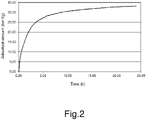
- FIG. 2 shows the results of the above test.
- sample S1 made according to present invention made using Bisphenol F
- comparative examples C1 and C2 both made using Bisphenol A
- Table 1 reports the sample loading of sorber materials and the measured rheological properties.
- Table 1 Sample PdO (%wt) LTA zeolites (%wt) Viscosity (cP) at 50 sec -1 S1 15 45 60.000 C1 4 30 190.000 C2 4 15 110.000
- sample S1 presents a good viscosity with a high amount of moisture and hydrogen getter, respect to comparative examples C1 and C2, characterized by high viscosity with a low getter loading.
Landscapes
- Chemical & Material Sciences (AREA)
- Chemical Kinetics & Catalysis (AREA)
- Analytical Chemistry (AREA)
- Organic Chemistry (AREA)
- General Chemical & Material Sciences (AREA)
- Oil, Petroleum & Natural Gas (AREA)
- Engineering & Computer Science (AREA)
- Inorganic Chemistry (AREA)
- Dispersion Chemistry (AREA)
- Solid-Sorbent Or Filter-Aiding Compositions (AREA)
- Sealing Material Composition (AREA)
- Electroluminescent Light Sources (AREA)
- Drying Of Gases (AREA)
- Common Detailed Techniques For Electron Tubes Or Discharge Tubes (AREA)
Description
- The present invention relates to a high-capacity dispensable moisture and hydrogen getter composition to be used to control the level of these substances for example in electronic or optoelectronic devices, to the use of said dispensable getter composition for obtaining a cured consolidated getter deposited on a support surface and to a method to control the level of contaminants inside a sensitive device by dispensing and curing said dispensable getter composition.
- The presence of moisture and hydrogen even at low levels (in general amounts as low as 5000 ppm of moisture and 1000 ppm of hydrogen are considered critical) is detrimental for the operation of most hermetically sealed devices. Their concentration inside the devices increases over time due to external contributions such as permeation from the external environment into the devices through the case/sealing element, as a perfect hermeticity is an ideal and a non-achievable condition, and to internal contribution, mainly outgassing from device components.
- Various literature references describe the detrimental role of hydrogen and moisture in hermetically sealed devices. For example, Albarghouti et al. "Moisture and Hydrogen Release in Optoelectronic Hermetic Packages", Journal of Microelectronics and Electronic Packaging (2014) 11, 75-79 disclose that one unfavorable moisture effect in optoelectronic hermetic packages is the penetration and dwelling of moisture in microcracks, which causes a hermeticity problem when this moisture freezes and expands. Moreover, hydrogen, with its affinity to oxygen, can react with surface oxides inside hermetic packages and cause the formation of moisture. The white paper "Reliability Issues for Optical Transceivers" by DfR Solutions highlights corrosion due to trapped hydrogen in metallized Kovar packages and device component moisture sensitivity for optical transceivers. Also components that appear largely and mainly affected from hydrogen, such as optical fibers cable, benefit from the presence of a combined hydrogen and moisture absorber, as moisture itself can be the hydrogen source in the cable see, for example, the 2004 white paper WP9007: "The Impact of Hydrogen on Optical Fiber" by Corning with regards to the detrimental role of hydrogen, and Ohnishi et al. "Loss stability assurance against hydrogen for submarine optical cable", Journal of Lightwave Technology, issue 2 (1988).
- Thin film transistors (TFTs) are also reported like a type of devices where the combined effect of moisture and hydrogen can induce a fast degradation of electrical properties. Nam et al. reported in RCS Adv. 2018, 8, 5622-5628 that hydrogen impurities affect the electrical properties of TFTs based on amorphous oxide semiconductors. Moreover, Lee and Jeong described for the same type of devices a severe decreasing of field-effect mobility when exposed to high-humidity conditions (IEEE Journal of the Electron Devices Society (2019, 7, 26-32).
- Another type of devices where the concurrent presence of hydrogen and moisture is detrimental are spatial light modulators as described in
US 6,958,846 . - The negative effects of hydrogen and moisture also on microwave modules or hybrid modules are explained in the technical pages reported at the links https://www.microwaves101.com/encyclopedias/hybrid-modules and https://www.microwaves101.com/encyclopedias/hermeticity.
- The problems linked to the hydrogen and moisture presence in sealed electronic devices and components are described in
US 2016/0175805 that discloses the addition of a suitable binder to consolidate the composite getter in a tablet form. - One of the critical aspects to take into account is also the amount of getter to be added to ensure the required device lifetime, because getter capacity is clearly linked to the amount of getter material. However, in view of the constant miniaturization trend, decreasing the available space, getters in form of tablet are unsuitable for electronic devices, especially for the newly developed devices such as, for example, communication chips for the latest standards (5G) described in
WO2019/066987 . -
US 5,888,925 describes a hydrogen and moisture getter suggesting the use of a binder, e.g. vulcanized silicone, to hold the getter and conform to certain shapes, but again without tackling the problem of maximizing the amount of getter material which can be included in a dispensable solution. - Therefore, in the manufacturing of hermetically sealed devices, it would be very useful to have compositions which scavenge water and/or hydrogen, generally referred to in the art and herein as "getters" allowing for an easy distribution of adequate amounts of getter material and an easy integration thereof in the manufacturing process of the above-mentioned devices. In the context of the present invention, the term "dispensable" means also "spreadable" and it is used to indicate a composition which can be easily dispensed, spread, distributed or deposited onto a variety of surfaces and/or into a variety of shapes and which can also easily be integrated into devices of the type herein described. The term dispensable composition, according to the present invention, can also mean composition having a viscosity, before curing, comprised between 40 Pa.s (40.000 cP) and 90 Pa.s (90.000 cP) at 50 sec-1 shear rates.
- The advantage of the getter composition of the present invention is its dispensable feature, allowing for its easy integration, and at the same time a high sorption capacity ensuring its advantageous employ in the most demanding devices, also in light of new standard communication adoption (5G) and associated new technical requirement and constrains. Exemplary devices where the use of the solution of present invention is particularly beneficial are optical transceivers, with particular reference to so called high-speed optical transceivers (i.e. device with data transfer speed reaching more than 100 Gbps), optical receivers, microwave GaAs-based modules.
- Dispensable getter compositions have been known in the art for a long time, see for example
US 5,244,707 generally disclosing the use of powders dispersed in a suitable matrix,US 5,997,829 disclosing a mix of metal oxides and adsorbent particles dispersed in a suitable matrix orUS 9,845,416 - One purpose of the present invention is thus to overcome the limits of getter-based solutions known in the art by providing a dispensable high-capacity moisture and hydrogen getter. The present invention is defined in the appended claims 1 to 17.
- Therefore, a first aspect of the present invention is a dispensable getter composition comprising a binder, a moisture sorber and a hydrogen sorber, wherein:
- the hydrogen sorber is palladium oxide in an amount comprised between 5 wt% and 25 wt% of the weight of the dispensable getter composition;
- the moisture sorber is a zeolite in an amount comprised between 35 wt% and 55 wt% of the weight of the dispensable getter composition; and
- the organic binder is in an amount comprised between 30 wt% and 50 wt% of the weight of the dispensable getter composition,
- up to 10 wt% and preferably up to 5 wt% of additional materials such as thermal curing agents, pigments, and stabilizers, preferably the thermal curing agent amount being no less than 1 wt%,
- characterized in that said organic binder is a bisphenol resin chosen from type F, type S or their combination.
- The dispensable composition of the invention may comprise also getters for other impurities, such as volatile organic compounds (VOCs) in any case within the 10 wt% limit, 9 wt% or less in the preferred case of a curing agent in an amount equal or higher than 1 wt%. Most common VOCs are benzene, toluene, xylene, heptene, heptane, dodecane, undecane, their alkyl (e.g. methyl) derivatives, ethylene glycol and other ethers, aldehydes, formaldehyde, ketones, amines, methylene chloride, tetrachloroethylene, 1,3-butadiene and other conjugated dienes, silanols and their alkyl derivatives.
- The getter compositions of the present invention are capable to achieve a moisture capacity comprised between 8 and 15 wt% and a hydrogen capacity comprised between 20 and 60 torr liter/grams, and at the same time maintain the feature of being dispensable by the most common technique and equipment, i.e. their viscosity is comprised between 40 Pa.s (40.000 cP) and 90 Pa.s (90.000 cP) at 50 sec-1 shear rates.
- The invention is not limited to a specific thermal curing agents, but any curing agent compatible with a bisphenol resin may be used, such as primary and secondary amines (aliphatic, alicyclic and aromatic), organic anhydrides, or polyamides. It is to be underlined that the choice of a suitable curing agent is an information that is readily available to a person of ordinary skill in the art, and can be easily retrieved, see for example the 1980 book "FRP Technology Fibre Reinforced Resin Systems" by R.G. Weatherhead, Applied Science Publishers LTD London Editor with particular reference to its chapter 12 "Curing agents for epoxide resins", from page 266 to 283.
- It is also to be underlined that the term curing agent is analogous to crosslinking element. Suitable curing agents/crosslinking elements are, for example, polyfunctional amines, acid anhydrides, phenols, alcohols and thiols.
- The invention will be further illustrated with the help of the following figures where:
-
Figure 1 is a chart showing the result of a moisture capacity test for a dispensable getter sample made according to the present invention, and -
Figure 2 is a chart showing the result of a hydrogen capacity test for a dispensable getter sample made according to the present invention. - The inventors have surprisingly found that even with the addition of a cumulative high amount of moisture and hydrogen getter (no less than 40 wt%) by using specific bisphenol resins, chosen between F, S or mixtures thereof, a proper viscosity is achieved allowing the getter of the present invention to be supplied in syringes to be mounted and used in standard dispensing equipment. This is possible as the dispensable getter of present invention typically has a viscosity (obviously before curing) comprised between 40 Pa.s (40.000 cP) and 90 Pa.s (90.000 cP) at 50 sec-1 shear rates. This result was not foreseeable a priori as per comparative example illustrated later on.
- Other additional advantages of present invention are: the composite getter does not envision the use of environmentally hazardous solvents; it could be dispensed in air with no significant hampering of its hydrogen capacity and only a partial saturation of moisture capacity (50% loss after 10 min air exposure for a dispensed getter layer); moisture sorption capacity can be completely restored through a thermal process such as, for example, heating at 100°C-150°C for 1-3 hours.
- The moisture sorber is a zeolite and preferably is a Linde Type A zeolite (LTA), and in a further embodiment said LTA zeolite is combined with at least one zeolite selected in a group consisting of Faujasite, MFI and Mordenite. According to the invention the moisture sorber can be in the form of particles with a size (diameter) less than 10 µm for at least 90% of the particles; as the dispensable getter composition is highly uniform, the above sizing condition can be verified over any 1 g of dispensable getter composition according to any of the embodiments herein disclosed.
- The hydrogen sorber is palladium metal oxide in the form of particles with a size (diameter) less than 15 µm for at least 90% of the particles; as the dispensable getter composition is highly uniform, the above sizing condition can be verified over any 1 g of dispensable getter composition.
- As the particles may not be perfectly spherical their diameter is intended as the diameter of the enclosing sphere, in order to determine the equivalent spherical diameter. The distribution is to be assessed in number and any suitable technique, such as the use of commercially available laser diffraction instruments can be employed.
- It is to be underlined that although the dispensable getter compositions of present invention are most usefully adopted in hermetic devices, they can also usefully be adopted in the so-called semi-hermetic devices.
- Hermetic devices are defined according to standard TM 1014.11 based on their leak rate, more in details are hermetic devices those who have:
- Less than 5∗10-8 atm cc/s air for volumes of 0,01 cc or less
- Less than 1∗10-7 atm cc/s air for volumes of 0,01 cc to 0.4 cc
- Less than 1∗10-6 atm cc/s air for volumes of 0,4 cc or greater
- Whereas, although a rigorous definition of semi-hermetic devices does not exist, for the purpose of present invention they can be considered as devices with an air leak rate being no more than two orders of magnitude higher with respect to hermetic devices.
- The composition according to any one of the embodiments disclosed above, can be used to seal or fill a device, preferably an electronic or optoelectronic device, and/or to control the level of contaminants such as, for example, hydrogen and moisture within said device. Alternatively, the composition according to any one of the embodiments disclosed above can be used to obtain a deposit of getter over a support surface, the support being advantageously used, for example, as part of the device package or enclosure. Therefore, disclosed herein is the use of the composition according to any one of the embodiments disclosed therein to seal or fill a device, preferably an electronic or optoelectronic device, or to provide a getter deposited support or support surface to be included therein, thereby controlling the level of contaminants within the device.
- In particular, the dispensable getter composition of the present invention can be used within hermetic devices, for example, as active deposit or even as filler, and/or as a (active) sealant in semi-hermetic devices.
- In a second aspect thereof, the invention covers the use of a dispensable getter composition comprising a binder, a moisture sorber and a hydrogen sorber, wherein:
- the hydrogen sorber is palladium oxide in an amount comprised between 5 wt% and 25 wt% of the weight of the dispensable getter composition,
- the moisture sorber is a zeolite in an amount comprised between 35 wt% and 55 wt% of the weight of the dispensable getter composition
- the organic binder is in an amount comprised between 30 wt% and 50 wt% of the weight of the dispensable getter composition,
- the organic binder is a bisphenol resin chosen from 4,4'-methylenediphenol (bisphenol type F), 4,4'-sulfonyldiphenol (bisphenol type S) or mixtures thereof, -up to 10 wt% and preferably up to 5 wt% of additional materials such as thermal curing agents, pigments, stabilizers, the thermal curing agent amount being preferably no less than 1 wt%,
- to obtain a a consolidated cured getter with a viscosity equal to or higher than 500 Pa.s (500.000 cP) at 50 sec-1 shear rates deposited over a support surface, the support being advantageously used as part of the device enclosure.
- Obviously after curing, the dispensed getter composition shall present only a negligible amount of unreacted curing agent. As a consequence of the curing process the bisphenol will transform into an epoxy resin with very limited flowing characteristics, namely with a viscosity being no less than 500 Pa.s (500.000 cP) at 50 sec-1 shear rates.
- The getter can be, for example, deposited over a surface of the support (the one that will be exposed to the inner part of the device). Therefore, herein disclosed is a support or support surface covered with or having thereon the getter composition according to any one of the embodiments disclosed therein. Suitable surface supports materials are for example, silicon, glass, polyamide, polyimide, polyethylene naphthalate, cyclic olefin copolymers and other polymer substrate or metals with suitable thermal stability. Preferable metallic or metallized supports are Kovar, gold plated Kovar, gold plated iron, nickel plated iron. In some embodiments the whole support is made with the above listed materials, in other its bulk is made with a different material and only its surface where the getter is to be deposited is made with the above listed materials.
- Most useful formats for the cured getter deposit are the ones having an average thickness comprised between 100 µm and 300 µm, whereas the area is a parameter strongly linked to the sensitive device and its dimension and it is not a characterizing feature of the invention but of the device itself.
- Preferably the support with the consolidated deposit of getter material is used or is part of the device lid.
- The use of a support coated with or having a cured dispensable getter composition according to the present invention is advantageous as it allows the device manufacturer to just integrate the support in the manufacturing process of the device, and therefore does not need dispensing and curing equipment (off-line getter integration).
- A support with the cured dispensable getter can thus be seen as a semi-finished product to be shipped to the device manufacturer, in this regards the dispensable feature (before curing) is still an interesting feature as it allows to easily manufacture different formats for integration in different types of devices or devices having different size or different requirements in amounts of material.
- In a third aspect thereof, the present invention covers a method to control the level of contaminants inside a sensitive device with a dispensable getter composition comprising an organic binder, a moisture sorber and a hydrogen sorber, wherein:
- the hydrogen sorber is palladium oxide in an amount comprised between 5 wt% and 25 wt% of the weight of the dispensable getter composition,
- the moisture sorber is a zeolite in an amount comprised between 35 wt% and 55 wt% of the weight of the dispensable getter composition
- the organic binder is in an amount comprised between 30 wt% and 50 wt% of the weight of the dispensable getter composition,
- the organic binder is a bisphenol resin chosen from 4,4'-methylenediphenol (bisphenol type F), 4,4'-sulfonyldiphenol (bisphenol type S) or mixtures therof,
- up to 10 wt% and preferably up to 5 wt% of additional materials such as thermal curing agents, pigments, stabilizers, the thermal curing agent amount being preferably no less than 1 wt%.
- The term "sensitive devices" indicates an electronic or optoelectronic device whose performances or lifetime are impaired by the presence of relatively high level of moisture or hydrogen, such as level higher than 5000 ppm (parts per million) for moisture or higher than 1000 ppm for hydrogen. Exemplary devices are optical transceivers, transmitters, receivers, amplifiers, laser diodes, multiplexers, photodiodes, RF devices, microwave modules or hybrid modules.
- Disclosed herein is also a method which envisions the use of the dispensable getter as active sealant and/or filler for the device or as getter inside the device with no particular adhesion function, i.e. the sorption function is taken care by the dispensable getter of present invention and is de-coupled from the sealing function.
- Therefore, herein disclosed is a method to seal or fill a device, preferably a hermetic or a semi-hermetic device. Another object of the present invention is to control the level of contaminants inside a sensitive device, comprising
- dispensing the dispensable getter composition, according to any one of the embodiments herein disclosed, over one or more surfaces of the device, inside the device, and/or onto a support or support surface to be included in said device; and then
- subjecting to curing the device, the support or the surfaces thereof, respectively.
- According to an embodiment of the invention, the cured getter composition is isolated from the environment outside of the electronic device and has an average thickness comprised between 100 µm and 300 µm or wherein the cured dispensable getter composition is in contact with the environment outside the electronic device and has an average thickness comprised between 1 mm and 4 mm.
- When applied as dispensable getter sealant, the term sealant refers to the disposition of the dispensable getter composition in the electronic devices package, namely as element interposed between the inner volume of the sensitive device and the external environment. In this regard, it is important to underline that the sealant according to the present invention may be in direct contact with the outside of the device or could be in contact with another element, such a getter less sealant as described in the already mentioned
US 9,845,416 - The high-capacity dispensable moisture and hydrogen getter of the present invention is usually supplied in syringes and dispensed by means of a needle dispensing tool and then subjected to a curing process, typically by thermal curing, with temperatures ranging from 100°C up to 250°C for durations comprised between 0,5 hours and 4 hours, obviously the lowest the temperature the higher the duration of the curing process. Also other dispensing techniques such as doctor blading, bar coating, slot die coating, screen printing may be usually employed.
- When the method envisions the use as a getter (no sealing function), the dispensable composition of the present invention after curing has the form of a continuous deposit of material with average thickness preferably comprised between 100 and 300 µm and an area scaling with the sensitive device dimension; whereas when used as active sealant the average thickness is preferable comprised between 1 and 4 mm.
- One of the advantages of the dispensable getter composition and of the method of controlling the level of contaminants by its use is that it allows the possibility to choose the best way to integrate the getter, by a semi-finished product (deposited support) if the device manufacturer does not have the required equipment (off-line solution), or with a dispensable solution easily implementable through standard dispensing equipment (in-line solution).
- The invention will be further illustrated with the help of the following non-limiting examples.
- 10 grams of dispensable getter composition according to the present invention were prepared adding 1,5 grams of palladium oxide particles with diameter less than 10 µm (90% in number) and 4,5 grams of LTA type zeolites particles, with diameter less than 10 µm (90% in number) to a bisphenol F matrix containing 0,4 grams of cyanate ester as curing agent.
- The dispensable getter composition was then subject to a speed mixing process for getting a homogenous composition/particle distribution, later on subjected to a mill rolling process.
- Part of the dispensable getter composition is then inserted into a 3 cc syringe and deposited onto an aluminum foil as a series of ten 9 x 5 mm rectangles having an average height of 100 µm and another part kept for rheology property testing.
- The foil is then subjected to curing by a two-step heating process first one heating at 150°C for 1 hour followed to a final one of 200°C for 1 hour. The foil is then cut into samples each containing a single getter deposit activated at high temperature, 100°C for 3 hours under vacuum. This further step of activation to remove the phisysorbed water by zeolites during the sample preparations.
- 10 grams of dispensable getter composition outside the scope of present invention were prepared adding 0,4 grams of palladium oxide particles with diameter less than 10 µm (90% in number) and 3,0 grams of LTA type zeolites particles, with diameter less than 10 µm (90% in number) to a bisphenolAdiglycidylether and methylphthalic anhydride epoxy resin. The dispensable getter composition was then subject to a speed mixing process for getting a homogenous composition/particle distribution, later on subjected to a mill rolling process.
- 10 grams of dispensable getter composition outside the scope of present invention were prepared adding 0,4 grams of palladium oxide particles with diameter less than 10 µm (90% in number) and 1,5 grams of LTA type zeolites particles, with diameter less than 10 µm (90% in number) to a bisphenolAdiglycidylether and methylphthalic anhydride epoxy resin. The dispensable getter composition was then subject to a speed mixing process for getting a homogenous composition/particle distribution, later on subjected to a mill rolling process.
- 4 out of the 10 samples were concurrently tested in a microbalance kept under dynamic condition exposing them, at room temperature, to a 5 mbar partial pressure up to saturation regime, achieving an overall capacity of 12 wt%.
-
Figure 1 shows the results of the above test, with t1 indicating the starting time of the exposure to the 5 mbar moisture pressure. - 4 out of the 10 samples were concurrently tested at room temperature in a volumetric bench at constant 8 torr pressure of pure hydrogen, up to saturation regime, and the overall capacity of the tested samples was 33 torr liter/grams, corresponding to a relative weight increase in the composite getter of 0,36 wt%.
-
Figure 2 shows the results of the above test. - The much lesser weight increase due to hydrogen capture with respect to moisture is linked to the lower molecular weight of the hydrogen as well as to the sorbers ratio chosen for the preparation of sample S1.
- Rheological properties of sample S1 made according to present invention (made using Bisphenol F) are compared with comparative examples C1 and C2 (both made using Bisphenol A). Following table 1 reports the sample loading of sorber materials and the measured rheological properties.
Table 1 Sample PdO (%wt) LTA zeolites (%wt) Viscosity (cP) at 50 sec-1 S1 15 45 60.000 C1 4 30 190.000 C2 4 15 110.000 - Samples reported in Table 1 are tested by rheological analysis to determine the viscosity at 50 sec-1 shear rates. Typically, dispensing techniques, such as needle dispensing, require a materials viscosity ranging from 10 Pa.s (10.000 cP) up to 90 Pa.s (90.000 cP) at 50 sec-1 shear rates. As evident from the results, sample S1 presents a good viscosity with a high amount of moisture and hydrogen getter, respect to comparative examples C1 and C2, characterized by high viscosity with a low getter loading.
- It is possible to observe that even with a reduced loading of sorber material, for both the hydrogen and moisture sorbers, the comparative samples C1 and C2 where both outside the above-mentioned range useful for the most common dispensing techniques.
Claims (17)
- A dispensable getter composition comprising an organic binder, a moisture sorber and a hydrogen sorber, wherein:- the hydrogen sorber is palladium oxide in an amount comprised between 5 wt% and 25 wt% of the weight of the dispensable getter composition,- the moisture sorber is a zeolite in an amount comprised between 35 wt% and 55 wt% of the weight of the dispensable getter composition- the organic binder is in an amount comprised between 30 wt% and 50 wt% of the weight of the dispensable getter composition,the dispensable getter composition further including up to 10 wt%, preferably up to 5 wt%, of additional materials such as thermal curing agents, pigments, stabilizers, the thermal curing agent being preferably no less than 1 wt%,characterized in that said organic binder is a bisphenol resin chosen from type F, type S or mixtures thereof.
- A dispensable getter composition according to claim 1, wherein the additional materials include up to 9 wt% of a volatile organic compounds getter.
- A dispensable getter composition according to any of the previous claims, wherein the moisture sorber is a LTA zeolite.
- A dispensable getter composition according to claim 3, wherein the LTA zeolite is combined with at least one zeolite selected in a group consisting of Faujasite, MFI and Mordenite.
- A dispensable getter according to any of the previous claims, wherein the moisture sorber is in the form of particles, with a size less than 10 µm for at least 90% of the particles.
- A dispensable getter according to any of the previous claims , wherein the palladium oxide is in the form of particles, with a size less than 15 µm for at least 90% of the particles.
- Use of a dispensable getter composition comprising an organic binder, a moisture sorber and a hydrogen sorber, wherein:- the hydrogen sorber is palladium oxide in an amount comprised between 5 wt% and 25 wt% of the weight of the dispensable getter composition,- the moisture sorber is a zeolite in an amount comprised between 35 wt% and 55 wt% of the weight of the dispensable getter composition- the organic binder is in an amount comprised between 30 wt% and 50 wt% of the weight of the dispensable getter composition,the dispensable getter composition further including up to 10 wt%, preferably up to 5 wt%, of additional materials such as thermal curing agents, pigments, stabilizers, the thermal curing agent being preferably no less than 1 wt%,to obtain a consolidated cured getter with a viscosity equal to or higher than 500 Pa.s (500.000 cP) at 50 sec-1 shear rates deposited over a support surface, characterized in that said organic binder is a bisphenol resin chosen from type F, type S or mixtures thereof.
- Use of a dispensable getter composition according to claim 7, wherein the getter deposit support surface is made with silicon, metal, glass, polyamide, polyimide, polyethylene naphthalate, cyclic olefin copolymers.
- Use of a dispensable getter composition according to claim 8, wherein said metal is chosen from Kovar, gold plated Kovar, gold plated iron, nickel plated iron.
- Use of a dispensable getter composition according to claims 8 or 9, wherein the average thickness of the consolidated getter deposit is comprised between 100 µm and 300 µm.
- Use of a dispensable getter composition according to any of claims 8 to 10, wherein the support is used as part of an electronic/optoelectronic device enclosure.
- Use of a dispensable getter composition according to claim 11, wherein the support is the device enclosure lid.
- Method to control the level of contaminants inside a sensitive device by dispensing and curing a dispensable getter composition comprising an organic binder, a moisture sorber and a hydrogen sorber, wherein:- the hydrogen sorber is palladium oxide in an amount comprised between 5 wt% and 25 wt% of the weight of the dispensable getter composition,- the moisture sorber is a zeolite in an amount comprised between 35 wt% and 55 wt% of the weight of the dispensable getter composition- the organic binder is in an amount comprised between 30 wt% and 50 wt% of the weight of the dispensable getter composition,- the organic binder is a bisphenol resin chosen from type F, type S or mixtures thereof,
the dispensable getter composition further including up to 10 wt%, preferably up to 5 wt%, of additional materials such as thermal curing agents, pigments, stabilizers, the thermal curing agent amount being preferably no less than 1 wt%. - Method according to claim 13, wherein the cured dispensable getter composition is isolated from the environment outside of the electronic device and has an average thickness comprised between 100 µm and 300 µm.
- Method according to claim 13, wherein the cured dispensable getter composition is in contact with the environment outside the electronic device and has an average thickness comprised between 1 mm and 4 mm.
- Method according to any of claims 13 to 15, wherein the device is a hermetic or a semi-hermetic device.
- Method according to claim 16, wherein the device is chosen from optical transceivers, with particular reference to high-speed optical transceivers, optical receivers, microwave GaAs-based modules.
Applications Claiming Priority (2)
| Application Number | Priority Date | Filing Date | Title |
|---|---|---|---|
| IT102020000002758A IT202000002758A1 (en) | 2020-02-12 | 2020-02-12 | High capacity distributable getter |
| PCT/EP2021/053111 WO2021160622A1 (en) | 2020-02-12 | 2021-02-09 | High-capacity dispensable getter |
Publications (2)
| Publication Number | Publication Date |
|---|---|
| EP3883683A1 EP3883683A1 (en) | 2021-09-29 |
| EP3883683B1 true EP3883683B1 (en) | 2022-05-04 |
Family
ID=70295956
Family Applications (1)
| Application Number | Title | Priority Date | Filing Date |
|---|---|---|---|
| EP21703935.3A Active EP3883683B1 (en) | 2020-02-12 | 2021-02-09 | High-capacity dispensable getter, use thereof and method to control the level of contaminants using said getter |
Country Status (8)
| Country | Link |
|---|---|
| US (1) | US11331647B2 (en) |
| EP (1) | EP3883683B1 (en) |
| JP (1) | JP7568731B2 (en) |
| KR (1) | KR102720875B1 (en) |
| CN (1) | CN115087497A (en) |
| IT (1) | IT202000002758A1 (en) |
| TW (1) | TWI869540B (en) |
| WO (1) | WO2021160622A1 (en) |
Family Cites Families (17)
| Publication number | Priority date | Publication date | Assignee | Title |
|---|---|---|---|---|
| US4405487A (en) * | 1982-04-29 | 1983-09-20 | Harrah Larry A | Combination moisture and hydrogen getter |
| US5244707A (en) | 1992-01-10 | 1993-09-14 | Shores A Andrew | Enclosure for electronic devices |
| KR100227582B1 (en) | 1995-05-26 | 2000-03-02 | 이사오 우치가사키 | Environment purifying material |
| AU7376996A (en) | 1995-09-28 | 1997-04-17 | Allied-Signal Inc. | Hydrogen and moisture getter and absorber for sealed devices |
| JPH10330717A (en) * | 1997-05-27 | 1998-12-15 | Nippon Kayaku Co Ltd | Adhesive composition, substrate and liquid crystal panel |
| WO2002055625A1 (en) | 2001-01-15 | 2002-07-18 | Sekisui Chemical Co., Ltd. | Photoreactive hot-melt adhesive composition |
| US6958846B2 (en) | 2002-11-26 | 2005-10-25 | Reflectivity, Inc | Spatial light modulators with light absorbing areas |
| US7438829B2 (en) | 2003-11-13 | 2008-10-21 | E.I. Du Pont De Nemours And Company | Thick film getter paste compositions for use in moisture control |
| GB0427647D0 (en) * | 2004-12-17 | 2005-01-19 | Johnson Matthey Plc | Hydrogen getter |
| DE102006029849A1 (en) * | 2006-06-27 | 2008-01-03 | Nanoscape Ag | Coated molecular sieve |
| EP2561917A4 (en) * | 2010-04-22 | 2017-06-21 | Mitsubishi Plastics, Inc. | Adsorptive member and device using same |
| ITMI20120601A1 (en) * | 2012-04-13 | 2013-10-14 | Getters Spa | DRIING COMPOSITION FOR HUMIDITY SENSITIVE ELECTRONIC DEVICES |
| GB201313850D0 (en) | 2013-08-02 | 2013-09-18 | Johnson Matthey Plc | Getter composition |
| JP6153175B2 (en) * | 2013-11-21 | 2017-06-28 | エルジー・ケム・リミテッド | Getter material and hygroscopic film containing the same |
| ITUB20154910A1 (en) | 2015-10-19 | 2017-04-19 | Getters Spa | Curable adhesive compositions for flexible substrates Curable adhesive curable compositions for flexible substrates |
| CN106810982B (en) | 2017-01-18 | 2021-08-03 | 安徽益东惠电子科技有限公司 | Getter slurry for absorbing harmful gas of airtight packaged device, preparation method thereof and coating obtained by getter slurry |
| WO2019066987A1 (en) | 2017-09-30 | 2019-04-04 | Intel Corporation | Dimension tolerant multi-material stack |
-
2020
- 2020-02-12 IT IT102020000002758A patent/IT202000002758A1/en unknown
-
2021
- 2021-02-08 TW TW110104705A patent/TWI869540B/en active
- 2021-02-09 WO PCT/EP2021/053111 patent/WO2021160622A1/en not_active Ceased
- 2021-02-09 US US17/440,826 patent/US11331647B2/en active Active
- 2021-02-09 KR KR1020227027454A patent/KR102720875B1/en active Active
- 2021-02-09 CN CN202180013961.4A patent/CN115087497A/en active Pending
- 2021-02-09 EP EP21703935.3A patent/EP3883683B1/en active Active
- 2021-02-09 JP JP2022548770A patent/JP7568731B2/en active Active
Also Published As
| Publication number | Publication date |
|---|---|
| JP7568731B2 (en) | 2024-10-16 |
| WO2021160622A1 (en) | 2021-08-19 |
| IT202000002758A1 (en) | 2021-08-12 |
| US20220088565A1 (en) | 2022-03-24 |
| KR102720875B1 (en) | 2024-10-25 |
| TW202146111A (en) | 2021-12-16 |
| TWI869540B (en) | 2025-01-11 |
| JP2023523671A (en) | 2023-06-07 |
| US11331647B2 (en) | 2022-05-17 |
| EP3883683A1 (en) | 2021-09-29 |
| KR20220134755A (en) | 2022-10-05 |
| CN115087497A (en) | 2022-09-20 |
Similar Documents
| Publication | Publication Date | Title |
|---|---|---|
| US6692986B1 (en) | Method for encapsulating components | |
| KR101234895B1 (en) | Thermosetting composition for organic EL device sealing | |
| US20100137530A1 (en) | Photocurable resin composition for sealing organic el device | |
| EP2336230A1 (en) | Resin composition for encapsulating optical semiconductor element and optical semiconductor device | |
| JPH06322350A (en) | Conductive adhesive, its production and method for bonding semiconductor chip | |
| WO1997011905A1 (en) | Hydrogen and moisture getter and absorber for sealed devices | |
| KR20220152583A (en) | Resin composition for sealing, electronic component device and method for producing electronic component device | |
| US10053604B2 (en) | Composite material for the protection of H2O sensitive devices based on surface functionalized nanozeolites dispersed in a polymeric matrix | |
| US11331647B2 (en) | High-capacity dispensable getter | |
| JP5397243B2 (en) | Manufacturing method of semiconductor device and adhesive sheet for connecting circuit member | |
| KR20190111911A (en) | Adhesive sheet for semiconductor device manufacture and manufacturing method of semiconductor device using same | |
| CN114891470B (en) | Epoxy sealant and preparation method thereof | |
| EP3763709B1 (en) | Adhesive composition for connecting semiconductor circuit, and adhesive film comprising same | |
| JPH11145337A (en) | Electronic component sealing package | |
| JP2005302401A (en) | Organic el element sealing material | |
| KR102758115B1 (en) | Adhesive sheet for manufacturing semiconductor devices and method for manufacturing semiconductor devices using the same | |
| KR101374370B1 (en) | An adhesive film for organic EL device, a composition for the same, and organic EL display device comprising the same | |
| JP2011184639A (en) | Resin composition for sealing electronic component and lid for sealing electronic component using the same | |
| KR102264247B1 (en) | Epoxy resin composition for molding semiconductor, molding film and semiconductor package using the same | |
| Shi et al. | Development of the wafer level compressive-flow underfill process and its involved materials | |
| JP2983867B2 (en) | Resin composition for sealing electronic parts | |
| JP4395505B2 (en) | Adhesive composition and method of using the composition | |
| EP1077243A2 (en) | Film adhesive composition for electronic packaging | |
| WO2026055282A1 (en) | Non-conductive films for electronic devices and encapsulation applications | |
| JPH03174434A (en) | Epoxy resin composition for sealing semiconductor |
Legal Events
| Date | Code | Title | Description |
|---|---|---|---|
| STAA | Information on the status of an ep patent application or granted ep patent |
Free format text: STATUS: UNKNOWN |
|
| STAA | Information on the status of an ep patent application or granted ep patent |
Free format text: STATUS: THE INTERNATIONAL PUBLICATION HAS BEEN MADE |
|
| PUAI | Public reference made under article 153(3) epc to a published international application that has entered the european phase |
Free format text: ORIGINAL CODE: 0009012 |
|
| STAA | Information on the status of an ep patent application or granted ep patent |
Free format text: STATUS: REQUEST FOR EXAMINATION WAS MADE |
|
| 17P | Request for examination filed |
Effective date: 20210525 |
|
| AK | Designated contracting states |
Kind code of ref document: A1 Designated state(s): AL AT BE BG CH CY CZ DE DK EE ES FI FR GB GR HR HU IE IS IT LI LT LU LV MC MK MT NL NO PL PT RO RS SE SI SK SM TR |
|
| GRAP | Despatch of communication of intention to grant a patent |
Free format text: ORIGINAL CODE: EPIDOSNIGR1 |
|
| STAA | Information on the status of an ep patent application or granted ep patent |
Free format text: STATUS: GRANT OF PATENT IS INTENDED |
|
| RIC1 | Information provided on ipc code assigned before grant |
Ipc: H01L 23/00 20060101ALI20220113BHEP Ipc: H01L 23/26 20060101ALI20220113BHEP Ipc: B01D 53/28 20060101ALI20220113BHEP Ipc: B01D 53/26 20060101ALI20220113BHEP Ipc: B01D 53/02 20060101ALI20220113BHEP Ipc: B01J 20/28 20060101ALI20220113BHEP Ipc: B01J 20/18 20060101ALI20220113BHEP Ipc: B01J 20/06 20060101AFI20220113BHEP |
|
| DAV | Request for validation of the european patent (deleted) | ||
| DAX | Request for extension of the european patent (deleted) | ||
| INTG | Intention to grant announced |
Effective date: 20220131 |
|
| GRAS | Grant fee paid |
Free format text: ORIGINAL CODE: EPIDOSNIGR3 |
|
| GRAA | (expected) grant |
Free format text: ORIGINAL CODE: 0009210 |
|
| STAA | Information on the status of an ep patent application or granted ep patent |
Free format text: STATUS: THE PATENT HAS BEEN GRANTED |
|
| AK | Designated contracting states |
Kind code of ref document: B1 Designated state(s): AL AT BE BG CH CY CZ DE DK EE ES FI FR GB GR HR HU IE IS IT LI LT LU LV MC MK MT NL NO PL PT RO RS SE SI SK SM TR |
|
| REG | Reference to a national code |
Ref country code: GB Ref legal event code: FG4D |
|
| REG | Reference to a national code |
Ref country code: CH Ref legal event code: EP |
|
| REG | Reference to a national code |
Ref country code: AT Ref legal event code: REF Ref document number: 1488431 Country of ref document: AT Kind code of ref document: T Effective date: 20220515 |
|
| REG | Reference to a national code |
Ref country code: IE Ref legal event code: FG4D Ref country code: DE Ref legal event code: R096 Ref document number: 602021000087 Country of ref document: DE |
|
| REG | Reference to a national code |
Ref country code: FI Ref legal event code: FGE |
|
| REG | Reference to a national code |
Ref country code: SE Ref legal event code: TRGR |
|
| REG | Reference to a national code |
Ref country code: NL Ref legal event code: FP |
|
| REG | Reference to a national code |
Ref country code: LT Ref legal event code: MG9D |
|
| REG | Reference to a national code |
Ref country code: AT Ref legal event code: MK05 Ref document number: 1488431 Country of ref document: AT Kind code of ref document: T Effective date: 20220504 |
|
| PG25 | Lapsed in a contracting state [announced via postgrant information from national office to epo] |
Ref country code: PT Free format text: LAPSE BECAUSE OF FAILURE TO SUBMIT A TRANSLATION OF THE DESCRIPTION OR TO PAY THE FEE WITHIN THE PRESCRIBED TIME-LIMIT Effective date: 20220905 Ref country code: NO Free format text: LAPSE BECAUSE OF FAILURE TO SUBMIT A TRANSLATION OF THE DESCRIPTION OR TO PAY THE FEE WITHIN THE PRESCRIBED TIME-LIMIT Effective date: 20220804 Ref country code: LT Free format text: LAPSE BECAUSE OF FAILURE TO SUBMIT A TRANSLATION OF THE DESCRIPTION OR TO PAY THE FEE WITHIN THE PRESCRIBED TIME-LIMIT Effective date: 20220504 Ref country code: HR Free format text: LAPSE BECAUSE OF FAILURE TO SUBMIT A TRANSLATION OF THE DESCRIPTION OR TO PAY THE FEE WITHIN THE PRESCRIBED TIME-LIMIT Effective date: 20220504 Ref country code: GR Free format text: LAPSE BECAUSE OF FAILURE TO SUBMIT A TRANSLATION OF THE DESCRIPTION OR TO PAY THE FEE WITHIN THE PRESCRIBED TIME-LIMIT Effective date: 20220805 Ref country code: BG Free format text: LAPSE BECAUSE OF FAILURE TO SUBMIT A TRANSLATION OF THE DESCRIPTION OR TO PAY THE FEE WITHIN THE PRESCRIBED TIME-LIMIT Effective date: 20220804 Ref country code: AT Free format text: LAPSE BECAUSE OF FAILURE TO SUBMIT A TRANSLATION OF THE DESCRIPTION OR TO PAY THE FEE WITHIN THE PRESCRIBED TIME-LIMIT Effective date: 20220504 |
|
| PG25 | Lapsed in a contracting state [announced via postgrant information from national office to epo] |
Ref country code: RS Free format text: LAPSE BECAUSE OF FAILURE TO SUBMIT A TRANSLATION OF THE DESCRIPTION OR TO PAY THE FEE WITHIN THE PRESCRIBED TIME-LIMIT Effective date: 20220504 Ref country code: PL Free format text: LAPSE BECAUSE OF FAILURE TO SUBMIT A TRANSLATION OF THE DESCRIPTION OR TO PAY THE FEE WITHIN THE PRESCRIBED TIME-LIMIT Effective date: 20220504 Ref country code: LV Free format text: LAPSE BECAUSE OF FAILURE TO SUBMIT A TRANSLATION OF THE DESCRIPTION OR TO PAY THE FEE WITHIN THE PRESCRIBED TIME-LIMIT Effective date: 20220504 Ref country code: IS Free format text: LAPSE BECAUSE OF FAILURE TO SUBMIT A TRANSLATION OF THE DESCRIPTION OR TO PAY THE FEE WITHIN THE PRESCRIBED TIME-LIMIT Effective date: 20220904 |
|
| PG25 | Lapsed in a contracting state [announced via postgrant information from national office to epo] |
Ref country code: SM Free format text: LAPSE BECAUSE OF FAILURE TO SUBMIT A TRANSLATION OF THE DESCRIPTION OR TO PAY THE FEE WITHIN THE PRESCRIBED TIME-LIMIT Effective date: 20220504 Ref country code: SK Free format text: LAPSE BECAUSE OF FAILURE TO SUBMIT A TRANSLATION OF THE DESCRIPTION OR TO PAY THE FEE WITHIN THE PRESCRIBED TIME-LIMIT Effective date: 20220504 Ref country code: RO Free format text: LAPSE BECAUSE OF FAILURE TO SUBMIT A TRANSLATION OF THE DESCRIPTION OR TO PAY THE FEE WITHIN THE PRESCRIBED TIME-LIMIT Effective date: 20220504 Ref country code: ES Free format text: LAPSE BECAUSE OF FAILURE TO SUBMIT A TRANSLATION OF THE DESCRIPTION OR TO PAY THE FEE WITHIN THE PRESCRIBED TIME-LIMIT Effective date: 20220504 Ref country code: EE Free format text: LAPSE BECAUSE OF FAILURE TO SUBMIT A TRANSLATION OF THE DESCRIPTION OR TO PAY THE FEE WITHIN THE PRESCRIBED TIME-LIMIT Effective date: 20220504 Ref country code: DK Free format text: LAPSE BECAUSE OF FAILURE TO SUBMIT A TRANSLATION OF THE DESCRIPTION OR TO PAY THE FEE WITHIN THE PRESCRIBED TIME-LIMIT Effective date: 20220504 Ref country code: CZ Free format text: LAPSE BECAUSE OF FAILURE TO SUBMIT A TRANSLATION OF THE DESCRIPTION OR TO PAY THE FEE WITHIN THE PRESCRIBED TIME-LIMIT Effective date: 20220504 |
|
| REG | Reference to a national code |
Ref country code: DE Ref legal event code: R097 Ref document number: 602021000087 Country of ref document: DE |
|
| PLBE | No opposition filed within time limit |
Free format text: ORIGINAL CODE: 0009261 |
|
| STAA | Information on the status of an ep patent application or granted ep patent |
Free format text: STATUS: NO OPPOSITION FILED WITHIN TIME LIMIT |
|
| PG25 | Lapsed in a contracting state [announced via postgrant information from national office to epo] |
Ref country code: AL Free format text: LAPSE BECAUSE OF FAILURE TO SUBMIT A TRANSLATION OF THE DESCRIPTION OR TO PAY THE FEE WITHIN THE PRESCRIBED TIME-LIMIT Effective date: 20220504 |
|
| 26N | No opposition filed |
Effective date: 20230207 |
|
| P01 | Opt-out of the competence of the unified patent court (upc) registered |
Effective date: 20230515 |
|
| PG25 | Lapsed in a contracting state [announced via postgrant information from national office to epo] |
Ref country code: MC Free format text: LAPSE BECAUSE OF FAILURE TO SUBMIT A TRANSLATION OF THE DESCRIPTION OR TO PAY THE FEE WITHIN THE PRESCRIBED TIME-LIMIT Effective date: 20220504 |
|
| REG | Reference to a national code |
Ref country code: BE Ref legal event code: MM Effective date: 20230228 |
|
| PG25 | Lapsed in a contracting state [announced via postgrant information from national office to epo] |
Ref country code: LU Free format text: LAPSE BECAUSE OF NON-PAYMENT OF DUE FEES Effective date: 20230209 |
|
| PG25 | Lapsed in a contracting state [announced via postgrant information from national office to epo] |
Ref country code: BE Free format text: LAPSE BECAUSE OF NON-PAYMENT OF DUE FEES Effective date: 20230228 |
|
| PG25 | Lapsed in a contracting state [announced via postgrant information from national office to epo] |
Ref country code: BG Free format text: LAPSE BECAUSE OF FAILURE TO SUBMIT A TRANSLATION OF THE DESCRIPTION OR TO PAY THE FEE WITHIN THE PRESCRIBED TIME-LIMIT Effective date: 20220504 |
|
| PG25 | Lapsed in a contracting state [announced via postgrant information from national office to epo] |
Ref country code: BG Free format text: LAPSE BECAUSE OF FAILURE TO SUBMIT A TRANSLATION OF THE DESCRIPTION OR TO PAY THE FEE WITHIN THE PRESCRIBED TIME-LIMIT Effective date: 20220504 |
|
| PG25 | Lapsed in a contracting state [announced via postgrant information from national office to epo] |
Ref country code: CY Free format text: LAPSE BECAUSE OF FAILURE TO SUBMIT A TRANSLATION OF THE DESCRIPTION OR TO PAY THE FEE WITHIN THE PRESCRIBED TIME-LIMIT; INVALID AB INITIO Effective date: 20210209 |
|
| PG25 | Lapsed in a contracting state [announced via postgrant information from national office to epo] |
Ref country code: HU Free format text: LAPSE BECAUSE OF FAILURE TO SUBMIT A TRANSLATION OF THE DESCRIPTION OR TO PAY THE FEE WITHIN THE PRESCRIBED TIME-LIMIT; INVALID AB INITIO Effective date: 20210209 |
|
| PG25 | Lapsed in a contracting state [announced via postgrant information from national office to epo] |
Ref country code: TR Free format text: LAPSE BECAUSE OF FAILURE TO SUBMIT A TRANSLATION OF THE DESCRIPTION OR TO PAY THE FEE WITHIN THE PRESCRIBED TIME-LIMIT Effective date: 20220504 |
|
| PG25 | Lapsed in a contracting state [announced via postgrant information from national office to epo] |
Ref country code: SI Free format text: LAPSE BECAUSE OF FAILURE TO SUBMIT A TRANSLATION OF THE DESCRIPTION OR TO PAY THE FEE WITHIN THE PRESCRIBED TIME-LIMIT Effective date: 20220504 |
|
| REG | Reference to a national code |
Ref country code: CH Ref legal event code: U11 Free format text: ST27 STATUS EVENT CODE: U-0-0-U10-U11 (AS PROVIDED BY THE NATIONAL OFFICE) Effective date: 20260301 |
|
| PGFP | Annual fee paid to national office [announced via postgrant information from national office to epo] |
Ref country code: NL Payment date: 20260218 Year of fee payment: 6 |
|
| PGFP | Annual fee paid to national office [announced via postgrant information from national office to epo] |
Ref country code: SE Payment date: 20260218 Year of fee payment: 6 |
|
| PGFP | Annual fee paid to national office [announced via postgrant information from national office to epo] |
Ref country code: GB Payment date: 20260219 Year of fee payment: 6 |
|
| PGFP | Annual fee paid to national office [announced via postgrant information from national office to epo] |
Ref country code: IE Payment date: 20260218 Year of fee payment: 6 Ref country code: DE Payment date: 20260217 Year of fee payment: 6 |
|
| PGFP | Annual fee paid to national office [announced via postgrant information from national office to epo] |
Ref country code: FI Payment date: 20260217 Year of fee payment: 6 Ref country code: IT Payment date: 20260227 Year of fee payment: 6 |
|
| PGFP | Annual fee paid to national office [announced via postgrant information from national office to epo] |
Ref country code: FR Payment date: 20260219 Year of fee payment: 6 |
|
| PGFP | Annual fee paid to national office [announced via postgrant information from national office to epo] |
Ref country code: CH Payment date: 20260301 Year of fee payment: 6 |