EP3882318A1 - Organic-inorganic composite coating composition, and zinc-plated steel sheet surface-treated using same - Google Patents
Organic-inorganic composite coating composition, and zinc-plated steel sheet surface-treated using same Download PDFInfo
- Publication number
- EP3882318A1 EP3882318A1 EP19884664.4A EP19884664A EP3882318A1 EP 3882318 A1 EP3882318 A1 EP 3882318A1 EP 19884664 A EP19884664 A EP 19884664A EP 3882318 A1 EP3882318 A1 EP 3882318A1
- Authority
- EP
- European Patent Office
- Prior art keywords
- organic
- steel sheet
- inorganic composite
- compound
- zinc
- Prior art date
- Legal status (The legal status is an assumption and is not a legal conclusion. Google has not performed a legal analysis and makes no representation as to the accuracy of the status listed.)
- Withdrawn
Links
- 229910000831 Steel Inorganic materials 0.000 title claims abstract description 75
- 239000010959 steel Substances 0.000 title claims abstract description 75
- 239000002131 composite material Substances 0.000 title description 59
- 239000008199 coating composition Substances 0.000 title description 38
- -1 silane compound Chemical class 0.000 claims abstract description 66
- 239000002952 polymeric resin Substances 0.000 claims abstract description 39
- 229920003002 synthetic resin Polymers 0.000 claims abstract description 38
- 239000000203 mixture Substances 0.000 claims abstract description 37
- 229910000077 silane Inorganic materials 0.000 claims abstract description 21
- 239000011248 coating agent Substances 0.000 claims abstract description 18
- 238000000576 coating method Methods 0.000 claims abstract description 18
- 239000000805 composite resin Substances 0.000 claims abstract description 16
- 239000003795 chemical substances by application Substances 0.000 claims abstract description 14
- 239000011247 coating layer Substances 0.000 claims description 51
- 150000001875 compounds Chemical class 0.000 claims description 24
- 239000002270 dispersing agent Substances 0.000 claims description 11
- 229910001512 metal fluoride Inorganic materials 0.000 claims description 11
- 125000002524 organometallic group Chemical group 0.000 claims description 9
- 229920005989 resin Polymers 0.000 claims description 9
- 239000011347 resin Substances 0.000 claims description 9
- GYZLOYUZLJXAJU-UHFFFAOYSA-N diglycidyl ether Chemical compound C1OC1COCC1CO1 GYZLOYUZLJXAJU-UHFFFAOYSA-N 0.000 claims description 6
- 230000009477 glass transition Effects 0.000 claims description 5
- 229920002554 vinyl polymer Polymers 0.000 claims description 5
- 150000007942 carboxylates Chemical class 0.000 claims description 4
- KTWOOEGAPBSYNW-UHFFFAOYSA-N ferrocene Chemical compound [Fe+2].C=1C=C[CH-]C=1.C=1C=C[CH-]C=1 KTWOOEGAPBSYNW-UHFFFAOYSA-N 0.000 claims description 4
- 229920005749 polyurethane resin Polymers 0.000 claims description 4
- 229910003638 H2SiF6 Inorganic materials 0.000 claims description 3
- 229910003708 H2TiF6 Inorganic materials 0.000 claims description 3
- 229910003899 H2ZrF6 Inorganic materials 0.000 claims description 3
- 229910004713 HPF6 Inorganic materials 0.000 claims description 3
- 229910016079 MPF6 Inorganic materials 0.000 claims description 3
- CERQOIWHTDAKMF-UHFFFAOYSA-M Methacrylate Chemical compound CC(=C)C([O-])=O CERQOIWHTDAKMF-UHFFFAOYSA-M 0.000 claims description 3
- 229910004074 SiF6 Inorganic materials 0.000 claims description 3
- VGBAECKRTWHKHC-UHFFFAOYSA-N cyclopenta-1,3-diene;1-ethenylcyclopenta-1,3-diene;iron(2+) Chemical compound [Fe+2].C=1C=C[CH-]C=1.[CH2-]C=C1C=CC=C1 VGBAECKRTWHKHC-UHFFFAOYSA-N 0.000 claims description 3
- 229920001225 polyester resin Polymers 0.000 claims description 3
- 239000004645 polyester resin Substances 0.000 claims description 3
- ZEFWRWWINDLIIV-UHFFFAOYSA-N tetrafluorosilane;dihydrofluoride Chemical compound F.F.F[Si](F)(F)F ZEFWRWWINDLIIV-UHFFFAOYSA-N 0.000 claims description 3
- 125000000391 vinyl group Chemical group [H]C([*])=C([H])[H] 0.000 claims description 3
- XLYOFNOQVPJJNP-UHFFFAOYSA-N water Substances O XLYOFNOQVPJJNP-UHFFFAOYSA-N 0.000 description 47
- 230000007797 corrosion Effects 0.000 description 28
- 238000005260 corrosion Methods 0.000 description 28
- 238000001723 curing Methods 0.000 description 26
- 238000011156 evaluation Methods 0.000 description 26
- 238000006243 chemical reaction Methods 0.000 description 20
- 230000000052 comparative effect Effects 0.000 description 16
- 238000002845 discoloration Methods 0.000 description 16
- 239000010410 layer Substances 0.000 description 13
- ZWEHNKRNPOVVGH-UHFFFAOYSA-N 2-Butanone Chemical compound CCC(C)=O ZWEHNKRNPOVVGH-UHFFFAOYSA-N 0.000 description 12
- 238000012545 processing Methods 0.000 description 12
- 238000004132 cross linking Methods 0.000 description 10
- 230000000694 effects Effects 0.000 description 10
- 230000003647 oxidation Effects 0.000 description 10
- 238000007254 oxidation reaction Methods 0.000 description 10
- 239000003513 alkali Substances 0.000 description 8
- 239000011230 binding agent Substances 0.000 description 8
- 230000006866 deterioration Effects 0.000 description 8
- 230000008859 change Effects 0.000 description 7
- 238000000034 method Methods 0.000 description 7
- 229920002635 polyurethane Polymers 0.000 description 7
- 239000004814 polyurethane Substances 0.000 description 7
- JOYRKODLDBILNP-UHFFFAOYSA-N Ethyl urethane Chemical compound CCOC(N)=O JOYRKODLDBILNP-UHFFFAOYSA-N 0.000 description 6
- 239000000839 emulsion Substances 0.000 description 6
- 230000007774 longterm Effects 0.000 description 6
- 238000004519 manufacturing process Methods 0.000 description 6
- 239000000126 substance Substances 0.000 description 6
- 238000001879 gelation Methods 0.000 description 5
- 230000000704 physical effect Effects 0.000 description 5
- RMAQACBXLXPBSY-UHFFFAOYSA-N silicic acid Chemical compound O[Si](O)(O)O RMAQACBXLXPBSY-UHFFFAOYSA-N 0.000 description 5
- 239000007787 solid Substances 0.000 description 5
- 239000004698 Polyethylene Substances 0.000 description 4
- 239000000654 additive Substances 0.000 description 4
- 150000001718 carbodiimides Chemical class 0.000 description 4
- 229920000642 polymer Polymers 0.000 description 4
- 239000002904 solvent Substances 0.000 description 4
- 238000003860 storage Methods 0.000 description 4
- 125000000022 2-aminoethyl group Chemical group [H]C([*])([H])C([H])([H])N([H])[H] 0.000 description 3
- LVNLBBGBASVLLI-UHFFFAOYSA-N 3-triethoxysilylpropylurea Chemical compound CCO[Si](OCC)(OCC)CCCNC(N)=O LVNLBBGBASVLLI-UHFFFAOYSA-N 0.000 description 3
- VYPSYNLAJGMNEJ-UHFFFAOYSA-N Silicium dioxide Chemical compound O=[Si]=O VYPSYNLAJGMNEJ-UHFFFAOYSA-N 0.000 description 3
- 230000000903 blocking effect Effects 0.000 description 3
- 238000001035 drying Methods 0.000 description 3
- 125000000524 functional group Chemical group 0.000 description 3
- 229910010272 inorganic material Inorganic materials 0.000 description 3
- 230000005012 migration Effects 0.000 description 3
- 238000013508 migration Methods 0.000 description 3
- 230000035515 penetration Effects 0.000 description 3
- 229920000573 polyethylene Polymers 0.000 description 3
- 238000002360 preparation method Methods 0.000 description 3
- 239000011342 resin composition Substances 0.000 description 3
- BPSIOYPQMFLKFR-UHFFFAOYSA-N trimethoxy-[3-(oxiran-2-ylmethoxy)propyl]silane Chemical compound CO[Si](OC)(OC)CCCOCC1CO1 BPSIOYPQMFLKFR-UHFFFAOYSA-N 0.000 description 3
- LMDZBCPBFSXMTL-UHFFFAOYSA-N 1-ethyl-3-(3-dimethylaminopropyl)carbodiimide Chemical compound CCN=C=NCCCN(C)C LMDZBCPBFSXMTL-UHFFFAOYSA-N 0.000 description 2
- XDLMVUHYZWKMMD-UHFFFAOYSA-N 3-trimethoxysilylpropyl 2-methylprop-2-enoate Chemical compound CO[Si](OC)(OC)CCCOC(=O)C(C)=C XDLMVUHYZWKMMD-UHFFFAOYSA-N 0.000 description 2
- LFQSCWFLJHTTHZ-UHFFFAOYSA-N Ethanol Chemical compound CCO LFQSCWFLJHTTHZ-UHFFFAOYSA-N 0.000 description 2
- BLRPTPMANUNPDV-UHFFFAOYSA-N Silane Chemical compound [SiH4] BLRPTPMANUNPDV-UHFFFAOYSA-N 0.000 description 2
- HCHKCACWOHOZIP-UHFFFAOYSA-N Zinc Chemical compound [Zn] HCHKCACWOHOZIP-UHFFFAOYSA-N 0.000 description 2
- 230000000996 additive effect Effects 0.000 description 2
- 230000032683 aging Effects 0.000 description 2
- QVGXLLKOCUKJST-UHFFFAOYSA-N atomic oxygen Chemical compound [O] QVGXLLKOCUKJST-UHFFFAOYSA-N 0.000 description 2
- 230000015572 biosynthetic process Effects 0.000 description 2
- 239000002415 cerumenolytic agent Substances 0.000 description 2
- ZCDOYSPFYFSLEW-UHFFFAOYSA-N chromate(2-) Chemical compound [O-][Cr]([O-])(=O)=O ZCDOYSPFYFSLEW-UHFFFAOYSA-N 0.000 description 2
- 230000007423 decrease Effects 0.000 description 2
- 230000009977 dual effect Effects 0.000 description 2
- 238000002474 experimental method Methods 0.000 description 2
- 239000010408 film Substances 0.000 description 2
- 230000007062 hydrolysis Effects 0.000 description 2
- 238000006460 hydrolysis reaction Methods 0.000 description 2
- 150000002466 imines Chemical class 0.000 description 2
- 150000002484 inorganic compounds Chemical class 0.000 description 2
- 230000007246 mechanism Effects 0.000 description 2
- 229910052751 metal Inorganic materials 0.000 description 2
- 239000002184 metal Substances 0.000 description 2
- 239000001301 oxygen Substances 0.000 description 2
- 229910052760 oxygen Inorganic materials 0.000 description 2
- 230000008569 process Effects 0.000 description 2
- 125000001436 propyl group Chemical group [H]C([*])([H])C([H])([H])C([H])([H])[H] 0.000 description 2
- 230000001681 protective effect Effects 0.000 description 2
- JXUKBNICSRJFAP-UHFFFAOYSA-N triethoxy-[3-(oxiran-2-ylmethoxy)propyl]silane Chemical compound CCO[Si](OCC)(OCC)CCCOCC1CO1 JXUKBNICSRJFAP-UHFFFAOYSA-N 0.000 description 2
- 238000004804 winding Methods 0.000 description 2
- 229910052725 zinc Inorganic materials 0.000 description 2
- 239000011701 zinc Substances 0.000 description 2
- JCZPMGDSEAFWDY-SQOUGZDYSA-N (2r,3s,4r,5r)-2,3,4,5,6-pentahydroxyhexanamide Chemical compound NC(=O)[C@H](O)[C@@H](O)[C@H](O)[C@H](O)CO JCZPMGDSEAFWDY-SQOUGZDYSA-N 0.000 description 1
- HOBIHBQJHORMMP-UHFFFAOYSA-N 1,3-bis(3-triethoxysilylpropyl)urea Chemical compound CCO[Si](OCC)(OCC)CCCNC(=O)NCCC[Si](OCC)(OCC)OCC HOBIHBQJHORMMP-UHFFFAOYSA-N 0.000 description 1
- BDNKZNFMNDZQMI-UHFFFAOYSA-N 1,3-diisopropylcarbodiimide Chemical compound CC(C)N=C=NC(C)C BDNKZNFMNDZQMI-UHFFFAOYSA-N 0.000 description 1
- URDOJQUSEUXVRP-UHFFFAOYSA-N 3-triethoxysilylpropyl 2-methylprop-2-enoate Chemical compound CCO[Si](OCC)(OCC)CCCOC(=O)C(C)=C URDOJQUSEUXVRP-UHFFFAOYSA-N 0.000 description 1
- LVACOMKKELLCHJ-UHFFFAOYSA-N 3-trimethoxysilylpropylurea Chemical compound CO[Si](OC)(OC)CCCNC(N)=O LVACOMKKELLCHJ-UHFFFAOYSA-N 0.000 description 1
- MGGVALXERJRIRO-UHFFFAOYSA-N 4-[2-(2,3-dihydro-1H-inden-2-ylamino)pyrimidin-5-yl]-2-[2-oxo-2-(2,4,6,7-tetrahydrotriazolo[4,5-c]pyridin-5-yl)ethyl]-1H-pyrazol-5-one Chemical compound C1C(CC2=CC=CC=C12)NC1=NC=C(C=N1)C=1C(=NN(C=1)CC(=O)N1CC2=C(CC1)NN=N2)O MGGVALXERJRIRO-UHFFFAOYSA-N 0.000 description 1
- PRKPGWQEKNEVEU-UHFFFAOYSA-N 4-methyl-n-(3-triethoxysilylpropyl)pentan-2-imine Chemical compound CCO[Si](OCC)(OCC)CCCN=C(C)CC(C)C PRKPGWQEKNEVEU-UHFFFAOYSA-N 0.000 description 1
- DEXFNLNNUZKHNO-UHFFFAOYSA-N 6-[3-[4-[2-(2,3-dihydro-1H-inden-2-ylamino)pyrimidin-5-yl]piperidin-1-yl]-3-oxopropyl]-3H-1,3-benzoxazol-2-one Chemical compound C1C(CC2=CC=CC=C12)NC1=NC=C(C=N1)C1CCN(CC1)C(CCC1=CC2=C(NC(O2)=O)C=C1)=O DEXFNLNNUZKHNO-UHFFFAOYSA-N 0.000 description 1
- 241001163841 Albugo ipomoeae-panduratae Species 0.000 description 1
- 229920000742 Cotton Polymers 0.000 description 1
- QOSSAOTZNIDXMA-UHFFFAOYSA-N Dicylcohexylcarbodiimide Chemical compound C1CCCCC1N=C=NC1CCCCC1 QOSSAOTZNIDXMA-UHFFFAOYSA-N 0.000 description 1
- YCKRFDGAMUMZLT-UHFFFAOYSA-N Fluorine atom Chemical compound [F] YCKRFDGAMUMZLT-UHFFFAOYSA-N 0.000 description 1
- 229910000576 Laminated steel Inorganic materials 0.000 description 1
- 229920000877 Melamine resin Polymers 0.000 description 1
- 229920003171 Poly (ethylene oxide) Polymers 0.000 description 1
- 239000004721 Polyphenylene oxide Substances 0.000 description 1
- RTAQQCXQSZGOHL-UHFFFAOYSA-N Titanium Chemical compound [Ti] RTAQQCXQSZGOHL-UHFFFAOYSA-N 0.000 description 1
- 238000005299 abrasion Methods 0.000 description 1
- 230000001133 acceleration Effects 0.000 description 1
- 230000003666 anti-fingerprint Effects 0.000 description 1
- 230000004888 barrier function Effects 0.000 description 1
- 239000004202 carbamide Substances 0.000 description 1
- 150000001733 carboxylic acid esters Chemical class 0.000 description 1
- 239000003054 catalyst Substances 0.000 description 1
- 239000013522 chelant Substances 0.000 description 1
- 239000003153 chemical reaction reagent Substances 0.000 description 1
- 239000010960 cold rolled steel Substances 0.000 description 1
- 238000006482 condensation reaction Methods 0.000 description 1
- BAAAEEDPKUHLID-UHFFFAOYSA-N decyl(triethoxy)silane Chemical compound CCCCCCCCCC[Si](OCC)(OCC)OCC BAAAEEDPKUHLID-UHFFFAOYSA-N 0.000 description 1
- 238000005238 degreasing Methods 0.000 description 1
- 238000005237 degreasing agent Methods 0.000 description 1
- 239000004205 dimethyl polysiloxane Substances 0.000 description 1
- HLXCYTXLQJWQFG-UHFFFAOYSA-N diphenyl(2-triethoxysilylethyl)phosphane Chemical compound C=1C=CC=CC=1P(CC[Si](OCC)(OCC)OCC)C1=CC=CC=C1 HLXCYTXLQJWQFG-UHFFFAOYSA-N 0.000 description 1
- KPUWHANPEXNPJT-UHFFFAOYSA-N disiloxane Chemical class [SiH3]O[SiH3] KPUWHANPEXNPJT-UHFFFAOYSA-N 0.000 description 1
- 238000009713 electroplating Methods 0.000 description 1
- 238000010828 elution Methods 0.000 description 1
- 230000007613 environmental effect Effects 0.000 description 1
- 150000002148 esters Chemical class 0.000 description 1
- 238000009501 film coating Methods 0.000 description 1
- 239000011737 fluorine Substances 0.000 description 1
- 229910052731 fluorine Inorganic materials 0.000 description 1
- ZZUFCTLCJUWOSV-UHFFFAOYSA-N furosemide Chemical compound C1=C(Cl)C(S(=O)(=O)N)=CC(C(O)=O)=C1NCC1=CC=CO1 ZZUFCTLCJUWOSV-UHFFFAOYSA-N 0.000 description 1
- 238000007429 general method Methods 0.000 description 1
- RSKGMYDENCAJEN-UHFFFAOYSA-N hexadecyl(trimethoxy)silane Chemical compound CCCCCCCCCCCCCCCC[Si](OC)(OC)OC RSKGMYDENCAJEN-UHFFFAOYSA-N 0.000 description 1
- CZWLNMOIEMTDJY-UHFFFAOYSA-N hexyl(trimethoxy)silane Chemical compound CCCCCC[Si](OC)(OC)OC CZWLNMOIEMTDJY-UHFFFAOYSA-N 0.000 description 1
- 230000003301 hydrolyzing effect Effects 0.000 description 1
- 230000006872 improvement Effects 0.000 description 1
- 238000005461 lubrication Methods 0.000 description 1
- 239000000463 material Substances 0.000 description 1
- JDSHMPZPIAZGSV-UHFFFAOYSA-N melamine Chemical compound NC1=NC(N)=NC(N)=N1 JDSHMPZPIAZGSV-UHFFFAOYSA-N 0.000 description 1
- 238000002844 melting Methods 0.000 description 1
- 230000008018 melting Effects 0.000 description 1
- RMBYJMVHGICGMN-UHFFFAOYSA-N n',n'-bis(3-trimethoxysilylpropyl)ethane-1,2-diamine Chemical compound CO[Si](OC)(OC)CCCN(CCN)CCC[Si](OC)(OC)OC RMBYJMVHGICGMN-UHFFFAOYSA-N 0.000 description 1
- PHQOGHDTIVQXHL-UHFFFAOYSA-N n'-(3-trimethoxysilylpropyl)ethane-1,2-diamine Chemical compound CO[Si](OC)(OC)CCCNCCN PHQOGHDTIVQXHL-UHFFFAOYSA-N 0.000 description 1
- ICRFXIKCXYDMJD-UHFFFAOYSA-N n'-benzyl-n'-ethenyl-n-(3-trimethoxysilylpropyl)ethane-1,2-diamine Chemical compound CO[Si](OC)(OC)CCCNCCN(C=C)CC1=CC=CC=C1 ICRFXIKCXYDMJD-UHFFFAOYSA-N 0.000 description 1
- ASCJVQUJOIYDBI-UHFFFAOYSA-N n,n'-bis(2-methoxyphenyl)methanediimine Chemical compound COC1=CC=CC=C1N=C=NC1=CC=CC=C1OC ASCJVQUJOIYDBI-UHFFFAOYSA-N 0.000 description 1
- KSVMTHKYDGMXFJ-UHFFFAOYSA-N n,n'-bis(trimethylsilyl)methanediimine Chemical compound C[Si](C)(C)N=C=N[Si](C)(C)C KSVMTHKYDGMXFJ-UHFFFAOYSA-N 0.000 description 1
- XLDBGFGREOMWSL-UHFFFAOYSA-N n,n'-bis[2,6-di(propan-2-yl)phenyl]methanediimine Chemical compound CC(C)C1=CC=CC(C(C)C)=C1N=C=NC1=C(C(C)C)C=CC=C1C(C)C XLDBGFGREOMWSL-UHFFFAOYSA-N 0.000 description 1
- CMESPBFFDMPSIY-UHFFFAOYSA-N n,n'-diphenylmethanediimine Chemical compound C1=CC=CC=C1N=C=NC1=CC=CC=C1 CMESPBFFDMPSIY-UHFFFAOYSA-N 0.000 description 1
- ZLDHYRXZZNDOKU-UHFFFAOYSA-N n,n-diethyl-3-trimethoxysilylpropan-1-amine Chemical compound CCN(CC)CCC[Si](OC)(OC)OC ZLDHYRXZZNDOKU-UHFFFAOYSA-N 0.000 description 1
- SLYCYWCVSGPDFR-UHFFFAOYSA-N octadecyltrimethoxysilane Chemical compound CCCCCCCCCCCCCCCCCC[Si](OC)(OC)OC SLYCYWCVSGPDFR-UHFFFAOYSA-N 0.000 description 1
- MSRJTTSHWYDFIU-UHFFFAOYSA-N octyltriethoxysilane Chemical compound CCCCCCCC[Si](OCC)(OCC)OCC MSRJTTSHWYDFIU-UHFFFAOYSA-N 0.000 description 1
- 229920000620 organic polymer Polymers 0.000 description 1
- 239000003960 organic solvent Substances 0.000 description 1
- 229920000435 poly(dimethylsiloxane) Polymers 0.000 description 1
- 229920000570 polyether Polymers 0.000 description 1
- 229920001451 polypropylene glycol Polymers 0.000 description 1
- 229920001296 polysiloxane Polymers 0.000 description 1
- 230000002265 prevention Effects 0.000 description 1
- 238000013441 quality evaluation Methods 0.000 description 1
- 150000003839 salts Chemical class 0.000 description 1
- 239000000523 sample Substances 0.000 description 1
- 239000000377 silicon dioxide Substances 0.000 description 1
- 239000002356 single layer Substances 0.000 description 1
- 239000007921 spray Substances 0.000 description 1
- 239000002345 surface coating layer Substances 0.000 description 1
- 238000010301 surface-oxidation reaction Methods 0.000 description 1
- 238000001029 thermal curing Methods 0.000 description 1
- 239000010409 thin film Substances 0.000 description 1
- XROWMBWRMNHXMF-UHFFFAOYSA-J titanium tetrafluoride Chemical compound [F-].[F-].[F-].[F-].[Ti+4] XROWMBWRMNHXMF-UHFFFAOYSA-J 0.000 description 1
- AVYKQOAMZCAHRG-UHFFFAOYSA-N triethoxy(3,3,4,4,5,5,6,6,7,7,8,8,8-tridecafluorooctyl)silane Chemical compound CCO[Si](OCC)(OCC)CCC(F)(F)C(F)(F)C(F)(F)C(F)(F)C(F)(F)C(F)(F)F AVYKQOAMZCAHRG-UHFFFAOYSA-N 0.000 description 1
- MLXDKRSDUJLNAB-UHFFFAOYSA-N triethoxy(3,3,4,4,5,5,6,6,7,7,8,8,9,9,10,10,10-heptadecafluorodecyl)silane Chemical compound CCO[Si](OCC)(OCC)CCC(F)(F)C(F)(F)C(F)(F)C(F)(F)C(F)(F)C(F)(F)C(F)(F)C(F)(F)F MLXDKRSDUJLNAB-UHFFFAOYSA-N 0.000 description 1
- OSAJVUUALHWJEM-UHFFFAOYSA-N triethoxy(8-triethoxysilyloctyl)silane Chemical compound CCO[Si](OCC)(OCC)CCCCCCCC[Si](OCC)(OCC)OCC OSAJVUUALHWJEM-UHFFFAOYSA-N 0.000 description 1
- FZMJEGJVKFTGMU-UHFFFAOYSA-N triethoxy(octadecyl)silane Chemical compound CCCCCCCCCCCCCCCCCC[Si](OCC)(OCC)OCC FZMJEGJVKFTGMU-UHFFFAOYSA-N 0.000 description 1
- HHPPHUYKUOAWJV-UHFFFAOYSA-N triethoxy-[4-(oxiran-2-yl)butyl]silane Chemical compound CCO[Si](OCC)(OCC)CCCCC1CO1 HHPPHUYKUOAWJV-UHFFFAOYSA-N 0.000 description 1
- QQQSFSZALRVCSZ-UHFFFAOYSA-N triethoxysilane Chemical compound CCO[SiH](OCC)OCC QQQSFSZALRVCSZ-UHFFFAOYSA-N 0.000 description 1
- MBIWXZXQMMLFAB-UHFFFAOYSA-N trimethoxy(9-trimethoxysilylnonyl)silane Chemical compound CO[Si](OC)(OC)CCCCCCCCC[Si](OC)(OC)OC MBIWXZXQMMLFAB-UHFFFAOYSA-N 0.000 description 1
- RKLXSINPXIQKIB-UHFFFAOYSA-N trimethoxy(oct-7-enyl)silane Chemical compound CO[Si](OC)(OC)CCCCCCC=C RKLXSINPXIQKIB-UHFFFAOYSA-N 0.000 description 1
- NMEPHPOFYLLFTK-UHFFFAOYSA-N trimethoxy(octyl)silane Chemical compound CCCCCCCC[Si](OC)(OC)OC NMEPHPOFYLLFTK-UHFFFAOYSA-N 0.000 description 1
- HQYALQRYBUJWDH-UHFFFAOYSA-N trimethoxy(propyl)silane Chemical compound CCC[Si](OC)(OC)OC HQYALQRYBUJWDH-UHFFFAOYSA-N 0.000 description 1
- DQZNLOXENNXVAD-UHFFFAOYSA-N trimethoxy-[2-(7-oxabicyclo[4.1.0]heptan-4-yl)ethyl]silane Chemical compound C1C(CC[Si](OC)(OC)OC)CCC2OC21 DQZNLOXENNXVAD-UHFFFAOYSA-N 0.000 description 1
- PZJJKWKADRNWSW-UHFFFAOYSA-N trimethoxysilicon Chemical compound CO[Si](OC)OC PZJJKWKADRNWSW-UHFFFAOYSA-N 0.000 description 1
- 238000004383 yellowing Methods 0.000 description 1
Images




Classifications
-
- C—CHEMISTRY; METALLURGY
- C09—DYES; PAINTS; POLISHES; NATURAL RESINS; ADHESIVES; COMPOSITIONS NOT OTHERWISE PROVIDED FOR; APPLICATIONS OF MATERIALS NOT OTHERWISE PROVIDED FOR
- C09D—COATING COMPOSITIONS, e.g. PAINTS, VARNISHES OR LACQUERS; FILLING PASTES; CHEMICAL PAINT OR INK REMOVERS; INKS; CORRECTING FLUIDS; WOODSTAINS; PASTES OR SOLIDS FOR COLOURING OR PRINTING; USE OF MATERIALS THEREFOR
- C09D5/00—Coating compositions, e.g. paints, varnishes or lacquers, characterised by their physical nature or the effects produced; Filling pastes
- C09D5/24—Electrically-conducting paints
-
- H—ELECTRICITY
- H01—ELECTRIC ELEMENTS
- H01B—CABLES; CONDUCTORS; INSULATORS; SELECTION OF MATERIALS FOR THEIR CONDUCTIVE, INSULATING OR DIELECTRIC PROPERTIES
- H01B1/00—Conductors or conductive bodies characterised by the conductive materials; Selection of materials as conductors
- H01B1/02—Conductors or conductive bodies characterised by the conductive materials; Selection of materials as conductors mainly consisting of metals or alloys
-
- B—PERFORMING OPERATIONS; TRANSPORTING
- B05—SPRAYING OR ATOMISING IN GENERAL; APPLYING FLUENT MATERIALS TO SURFACES, IN GENERAL
- B05D—PROCESSES FOR APPLYING FLUENT MATERIALS TO SURFACES, IN GENERAL
- B05D7/00—Processes, other than flocking, specially adapted for applying liquids or other fluent materials to particular surfaces or for applying particular liquids or other fluent materials
- B05D7/14—Processes, other than flocking, specially adapted for applying liquids or other fluent materials to particular surfaces or for applying particular liquids or other fluent materials to metal, e.g. car bodies
-
- B—PERFORMING OPERATIONS; TRANSPORTING
- B05—SPRAYING OR ATOMISING IN GENERAL; APPLYING FLUENT MATERIALS TO SURFACES, IN GENERAL
- B05D—PROCESSES FOR APPLYING FLUENT MATERIALS TO SURFACES, IN GENERAL
- B05D7/00—Processes, other than flocking, specially adapted for applying liquids or other fluent materials to particular surfaces or for applying particular liquids or other fluent materials
- B05D7/24—Processes, other than flocking, specially adapted for applying liquids or other fluent materials to particular surfaces or for applying particular liquids or other fluent materials for applying particular liquids or other fluent materials
-
- C—CHEMISTRY; METALLURGY
- C08—ORGANIC MACROMOLECULAR COMPOUNDS; THEIR PREPARATION OR CHEMICAL WORKING-UP; COMPOSITIONS BASED THEREON
- C08G—MACROMOLECULAR COMPOUNDS OBTAINED OTHERWISE THAN BY REACTIONS ONLY INVOLVING UNSATURATED CARBON-TO-CARBON BONDS
- C08G59/00—Polycondensates containing more than one epoxy group per molecule; Macromolecules obtained by polymerising compounds containing more than one epoxy group per molecule using curing agents or catalysts which react with the epoxy groups
- C08G59/18—Macromolecules obtained by polymerising compounds containing more than one epoxy group per molecule using curing agents or catalysts which react with the epoxy groups ; e.g. general methods of curing
- C08G59/40—Macromolecules obtained by polymerising compounds containing more than one epoxy group per molecule using curing agents or catalysts which react with the epoxy groups ; e.g. general methods of curing characterised by the curing agents used
- C08G59/4007—Curing agents not provided for by the groups C08G59/42 - C08G59/66
- C08G59/4014—Nitrogen containing compounds
- C08G59/4042—Imines; Imides
-
- C—CHEMISTRY; METALLURGY
- C09—DYES; PAINTS; POLISHES; NATURAL RESINS; ADHESIVES; COMPOSITIONS NOT OTHERWISE PROVIDED FOR; APPLICATIONS OF MATERIALS NOT OTHERWISE PROVIDED FOR
- C09D—COATING COMPOSITIONS, e.g. PAINTS, VARNISHES OR LACQUERS; FILLING PASTES; CHEMICAL PAINT OR INK REMOVERS; INKS; CORRECTING FLUIDS; WOODSTAINS; PASTES OR SOLIDS FOR COLOURING OR PRINTING; USE OF MATERIALS THEREFOR
- C09D163/00—Coating compositions based on epoxy resins; Coating compositions based on derivatives of epoxy resins
-
- C—CHEMISTRY; METALLURGY
- C09—DYES; PAINTS; POLISHES; NATURAL RESINS; ADHESIVES; COMPOSITIONS NOT OTHERWISE PROVIDED FOR; APPLICATIONS OF MATERIALS NOT OTHERWISE PROVIDED FOR
- C09D—COATING COMPOSITIONS, e.g. PAINTS, VARNISHES OR LACQUERS; FILLING PASTES; CHEMICAL PAINT OR INK REMOVERS; INKS; CORRECTING FLUIDS; WOODSTAINS; PASTES OR SOLIDS FOR COLOURING OR PRINTING; USE OF MATERIALS THEREFOR
- C09D167/00—Coating compositions based on polyesters obtained by reactions forming a carboxylic ester link in the main chain; Coating compositions based on derivatives of such polymers
-
- C—CHEMISTRY; METALLURGY
- C09—DYES; PAINTS; POLISHES; NATURAL RESINS; ADHESIVES; COMPOSITIONS NOT OTHERWISE PROVIDED FOR; APPLICATIONS OF MATERIALS NOT OTHERWISE PROVIDED FOR
- C09D—COATING COMPOSITIONS, e.g. PAINTS, VARNISHES OR LACQUERS; FILLING PASTES; CHEMICAL PAINT OR INK REMOVERS; INKS; CORRECTING FLUIDS; WOODSTAINS; PASTES OR SOLIDS FOR COLOURING OR PRINTING; USE OF MATERIALS THEREFOR
- C09D175/00—Coating compositions based on polyureas or polyurethanes; Coating compositions based on derivatives of such polymers
- C09D175/04—Polyurethanes
-
- C—CHEMISTRY; METALLURGY
- C09—DYES; PAINTS; POLISHES; NATURAL RESINS; ADHESIVES; COMPOSITIONS NOT OTHERWISE PROVIDED FOR; APPLICATIONS OF MATERIALS NOT OTHERWISE PROVIDED FOR
- C09D—COATING COMPOSITIONS, e.g. PAINTS, VARNISHES OR LACQUERS; FILLING PASTES; CHEMICAL PAINT OR INK REMOVERS; INKS; CORRECTING FLUIDS; WOODSTAINS; PASTES OR SOLIDS FOR COLOURING OR PRINTING; USE OF MATERIALS THEREFOR
- C09D5/00—Coating compositions, e.g. paints, varnishes or lacquers, characterised by their physical nature or the effects produced; Filling pastes
- C09D5/02—Emulsion paints including aerosols
- C09D5/022—Emulsions, e.g. oil in water
-
- C—CHEMISTRY; METALLURGY
- C09—DYES; PAINTS; POLISHES; NATURAL RESINS; ADHESIVES; COMPOSITIONS NOT OTHERWISE PROVIDED FOR; APPLICATIONS OF MATERIALS NOT OTHERWISE PROVIDED FOR
- C09D—COATING COMPOSITIONS, e.g. PAINTS, VARNISHES OR LACQUERS; FILLING PASTES; CHEMICAL PAINT OR INK REMOVERS; INKS; CORRECTING FLUIDS; WOODSTAINS; PASTES OR SOLIDS FOR COLOURING OR PRINTING; USE OF MATERIALS THEREFOR
- C09D5/00—Coating compositions, e.g. paints, varnishes or lacquers, characterised by their physical nature or the effects produced; Filling pastes
- C09D5/08—Anti-corrosive paints
- C09D5/082—Anti-corrosive paints characterised by the anti-corrosive pigment
-
- C—CHEMISTRY; METALLURGY
- C09—DYES; PAINTS; POLISHES; NATURAL RESINS; ADHESIVES; COMPOSITIONS NOT OTHERWISE PROVIDED FOR; APPLICATIONS OF MATERIALS NOT OTHERWISE PROVIDED FOR
- C09D—COATING COMPOSITIONS, e.g. PAINTS, VARNISHES OR LACQUERS; FILLING PASTES; CHEMICAL PAINT OR INK REMOVERS; INKS; CORRECTING FLUIDS; WOODSTAINS; PASTES OR SOLIDS FOR COLOURING OR PRINTING; USE OF MATERIALS THEREFOR
- C09D7/00—Features of coating compositions, not provided for in group C09D5/00; Processes for incorporating ingredients in coating compositions
- C09D7/40—Additives
-
- C—CHEMISTRY; METALLURGY
- C09—DYES; PAINTS; POLISHES; NATURAL RESINS; ADHESIVES; COMPOSITIONS NOT OTHERWISE PROVIDED FOR; APPLICATIONS OF MATERIALS NOT OTHERWISE PROVIDED FOR
- C09D—COATING COMPOSITIONS, e.g. PAINTS, VARNISHES OR LACQUERS; FILLING PASTES; CHEMICAL PAINT OR INK REMOVERS; INKS; CORRECTING FLUIDS; WOODSTAINS; PASTES OR SOLIDS FOR COLOURING OR PRINTING; USE OF MATERIALS THEREFOR
- C09D7/00—Features of coating compositions, not provided for in group C09D5/00; Processes for incorporating ingredients in coating compositions
- C09D7/40—Additives
- C09D7/60—Additives non-macromolecular
- C09D7/61—Additives non-macromolecular inorganic
-
- C—CHEMISTRY; METALLURGY
- C09—DYES; PAINTS; POLISHES; NATURAL RESINS; ADHESIVES; COMPOSITIONS NOT OTHERWISE PROVIDED FOR; APPLICATIONS OF MATERIALS NOT OTHERWISE PROVIDED FOR
- C09D—COATING COMPOSITIONS, e.g. PAINTS, VARNISHES OR LACQUERS; FILLING PASTES; CHEMICAL PAINT OR INK REMOVERS; INKS; CORRECTING FLUIDS; WOODSTAINS; PASTES OR SOLIDS FOR COLOURING OR PRINTING; USE OF MATERIALS THEREFOR
- C09D7/00—Features of coating compositions, not provided for in group C09D5/00; Processes for incorporating ingredients in coating compositions
- C09D7/40—Additives
- C09D7/60—Additives non-macromolecular
- C09D7/63—Additives non-macromolecular organic
-
- C—CHEMISTRY; METALLURGY
- C09—DYES; PAINTS; POLISHES; NATURAL RESINS; ADHESIVES; COMPOSITIONS NOT OTHERWISE PROVIDED FOR; APPLICATIONS OF MATERIALS NOT OTHERWISE PROVIDED FOR
- C09D—COATING COMPOSITIONS, e.g. PAINTS, VARNISHES OR LACQUERS; FILLING PASTES; CHEMICAL PAINT OR INK REMOVERS; INKS; CORRECTING FLUIDS; WOODSTAINS; PASTES OR SOLIDS FOR COLOURING OR PRINTING; USE OF MATERIALS THEREFOR
- C09D7/00—Features of coating compositions, not provided for in group C09D5/00; Processes for incorporating ingredients in coating compositions
- C09D7/40—Additives
- C09D7/65—Additives macromolecular
-
- B—PERFORMING OPERATIONS; TRANSPORTING
- B05—SPRAYING OR ATOMISING IN GENERAL; APPLYING FLUENT MATERIALS TO SURFACES, IN GENERAL
- B05D—PROCESSES FOR APPLYING FLUENT MATERIALS TO SURFACES, IN GENERAL
- B05D2202/00—Metallic substrate
- B05D2202/10—Metallic substrate based on Fe
-
- B—PERFORMING OPERATIONS; TRANSPORTING
- B05—SPRAYING OR ATOMISING IN GENERAL; APPLYING FLUENT MATERIALS TO SURFACES, IN GENERAL
- B05D—PROCESSES FOR APPLYING FLUENT MATERIALS TO SURFACES, IN GENERAL
- B05D2503/00—Polyurethanes
-
- B—PERFORMING OPERATIONS; TRANSPORTING
- B05—SPRAYING OR ATOMISING IN GENERAL; APPLYING FLUENT MATERIALS TO SURFACES, IN GENERAL
- B05D—PROCESSES FOR APPLYING FLUENT MATERIALS TO SURFACES, IN GENERAL
- B05D2504/00—Epoxy polymers
-
- C—CHEMISTRY; METALLURGY
- C08—ORGANIC MACROMOLECULAR COMPOUNDS; THEIR PREPARATION OR CHEMICAL WORKING-UP; COMPOSITIONS BASED THEREON
- C08G—MACROMOLECULAR COMPOUNDS OBTAINED OTHERWISE THAN BY REACTIONS ONLY INVOLVING UNSATURATED CARBON-TO-CARBON BONDS
- C08G2150/00—Compositions for coatings
- C08G2150/90—Compositions for anticorrosive coatings
-
- C—CHEMISTRY; METALLURGY
- C08—ORGANIC MACROMOLECULAR COMPOUNDS; THEIR PREPARATION OR CHEMICAL WORKING-UP; COMPOSITIONS BASED THEREON
- C08K—Use of inorganic or non-macromolecular organic substances as compounding ingredients
- C08K3/00—Use of inorganic substances as compounding ingredients
- C08K3/16—Halogen-containing compounds
-
- C—CHEMISTRY; METALLURGY
- C08—ORGANIC MACROMOLECULAR COMPOUNDS; THEIR PREPARATION OR CHEMICAL WORKING-UP; COMPOSITIONS BASED THEREON
- C08K—Use of inorganic or non-macromolecular organic substances as compounding ingredients
- C08K5/00—Use of organic ingredients
- C08K5/16—Nitrogen-containing compounds
- C08K5/29—Compounds containing one or more carbon-to-nitrogen double bonds
-
- C—CHEMISTRY; METALLURGY
- C08—ORGANIC MACROMOLECULAR COMPOUNDS; THEIR PREPARATION OR CHEMICAL WORKING-UP; COMPOSITIONS BASED THEREON
- C08K—Use of inorganic or non-macromolecular organic substances as compounding ingredients
- C08K5/00—Use of organic ingredients
- C08K5/54—Silicon-containing compounds
- C08K5/544—Silicon-containing compounds containing nitrogen
- C08K5/5445—Silicon-containing compounds containing nitrogen containing at least one Si-N bond
-
- C—CHEMISTRY; METALLURGY
- C08—ORGANIC MACROMOLECULAR COMPOUNDS; THEIR PREPARATION OR CHEMICAL WORKING-UP; COMPOSITIONS BASED THEREON
- C08K—Use of inorganic or non-macromolecular organic substances as compounding ingredients
- C08K5/00—Use of organic ingredients
- C08K5/56—Organo-metallic compounds, i.e. organic compounds containing a metal-to-carbon bond
Definitions
- the present invention relates to a self-crosslinking organic-inorganic composite coating composition having excellent electrical conductivity and a composite coated steel sheet whose surface is treated using the same.
- a zinc-plated steel sheet used as a panel, mainly an inner plate, of a home appliance it is necessary for the zinc-plated steel sheet to have corrosion resistance so as to be used in various corrosive environments. It is necessary for most zinc-plated steel sheets to include a coating layer having corrosion resistance to protect a material in corrosive environments during transportation until it is delivered to a customer after manufacturing, during a processing process for manufacturing a product, and until the product is discarded after the product is used by a customer. Second, it is necessary for the zinc-plated steel sheet to have surface electrical conductivity. Electromagnetic waves generated when operating a home appliance are absorbed and removed by a surface of the steel sheet.
- the zinc-plated steel sheet it is necessary for the zinc-plated steel sheet to have sufficient surface electrical conductivity.
- the zinc-plated steel sheet is subjected to degreasing with an alkali solution after processing of the parts, or when the surface of the zinc-plated steel sheet is washed using various organic solvents such as ethanol, methyl ethyl ketone (MEK), and thinner, stability of the coating layer is necessary. In addition, it is necessary to prevent discoloration caused by deterioration of the coating layer due to heat generated inside a device during long-term use.
- MEK methyl ethyl ketone
- the surface of the zinc-plated steel sheet is easily contaminated and is easily oxidized when exposed to the external environment because the plated layer may be soft.
- coating of an organic-inorganic compound protective film is performed.
- the steel sheet is transported in a wound coil state during transportation until being used by a customer.
- discoloration occurs frequently due to oxidation of the plated layer in the wrapped coil during long-term transportation and storage in a region with a high-temperature and high-humidity environment. It is known that such a phenomenon causes yellowing or blackening due to local galvanic oxidation of the zinc-plated layer in a limited oxygen and moisture atmosphere.
- a method of coating a thick protective film or coating a double-layer is used.
- the oxidation discoloration problem may be solved, but it is difficult to secure surface electrical conductivity for securing electromagnetic wave blocking properties necessary in the electric and electronic field.
- undercoating and top coating are performed. Therefore, it is necessary to perform not only a sophisticated thin film coating process to secure surface electrical conductivity but also mechanical double-layer coating.
- an organic-inorganic composite resin coated steel sheet is mainly used as a panel of an electronic device, and discoloration often occurs due to deterioration of the coating layer due to heat generated inside the device. In this case, a performance of the coating layer is deteriorated, and an appearance of the device is thus deteriorated, resulting in customer complaints.
- a composition containing no aromatic ring compound causing discoloration due to deterioration is often used, but it is not effective.
- the present invention in order to solve the oxidation discoloration problem in a high-temperature and high-humidity region, electrical conductivity is imparted to the coating layer by binding a ferrocene derivative to a polymer resin through coating of a single layer, oxidation of zinc metal is prevented, and penetration of corrosive factors such as moisture is effectively prevented, without equipment restrictions.
- An aspect of the present invention is to provide an organic-inorganic composite coating composition formed of an organic-inorganic binder compound capable of implementing excellent basic physical properties such as electrical conductivity, corrosion resistance, and processability of a surface coating layer applied to a panel for a home appliance, implementing excellent oxidation resistance of a plated layer by effectively preventing penetration of corrosive factors such as oxygen and moisture in a high-temperature and high-humidity environment, and preventing discoloration of a coating layer due to heat generated in an electronic device, a carbodiimide curing agent compound having excellent solution stability and workability, and an additive having excellent corrosion resistance, and a self-crosslinking organic-inorganic composite coated steel sheet formed of the composition.
- an organic-inorganic composite resin composition for coating a surface of a zinc-plated steel sheet contains: 5 to 25 wt% of a polymer resin; 4 to 20 wt% of a silane compound; 3 to 10 wt% of a curing agent; and 0.1 to 2 wt% of a ferrocene compound.
- the ferrocene compound may be one or a mixture of two or more selected from the group consisting of ferrocene, vinylferrocene, ferrocenyl glycidyl ether, vinyl ferrocenyl glycidyl ether, ferrocenylmethyl methacrylate, 2-(methacryloyloxy)ethyl ferrocene carboxylate, and 2-(acryloyloxy)ethyl ferrocene carboxylate.
- the polymer resin may be one or a mixture of two more selected from the group consisting of a polyurethane resin, a polyester resin, and a polyepoxy resin.
- a glass transition temperature (Tg) of the polymer resin may be -30 to 10°C, and a number average molecular weight of the polymer resin may be 20,000 to 100,000.
- the curing agent may be a carbodiimide compound.
- the organic-inorganic composite resin composition may further contain 2 to 10 wt% of a metal fluoride compound.
- the organic-inorganic composite resin composition may further contain an organometallic oxide, a dispersant, or wax.
- a zinc-plated steel sheet includes a coating layer formed by applying the organic-inorganic composite resin composition, wherein a dry thickness of the coating layer is 0.1 to 1.0 ⁇ m.
- the present invention provides a zinc-plated steel sheet having excellent electrical conductivity of a coating layer by forming, on a zinc-plated steel sheet, a self-crosslinking organic-inorganic composite coating layer containing a polymer bound to a ferrocene compound, and having excellent corrosion resistance and blackening resistance of a processed portion, and excellent corrosion resistance and heat resistance in a high-temperature and high-humidity atmosphere.
- the organic-inorganic composite coating composition of the present invention has a low curing temperature by a double curing mechanism due to an organic binder and a curing agent, and a self-crosslinking reaction of an inorganic binder compound, and having excellent processability by implementing a high hardness in the coating layer even in an ultra-thin coating. Therefore, the present invention provides a composite coated steel sheet capable of being transported in a wound coil state and having excellent corrosion resistance of the plated layer even during long-term storage in a high-temperature and high-humidity environment.
- characteristics of the zinc-plated steel sheet have been mainly secured through the polymer resin coating, corresponding quality characteristics have been insufficient due to environmental damage of a chromate compound.
- corrosion resistance is obtained by a barrier effect and a self-healing mechanism of a coating layer.
- a chromate coating layer has excellent properties in comparison to a polymer resin coating layer.
- a method of increasing a coating amount of a polymer resin is introduced to secure excellent corrosion resistance, but there is a problem in electromagnetic wave blocking properties of a home appliance due to insufficient surface electrical conductivity.
- a content of the polymer resin is increased or a polymer having a high glass transition temperature (Tg) is used in order to improve press processability, a surface hardness is improved to secure lubricity; however, it is difficult to obtain satisfactory physical properties other than the surface hardness.
- Tg glass transition temperature
- a dual curing system using a curing reaction of an organic binder compound and a self-crosslinking reaction of an inorganic binder compound is introduced.
- a polymer resin having excellent flexibility and a low Tg is used to improve processability, which causes blackening after processing due to a movement phenomenon of the coating layer during press processing.
- processability is improved by a method of preparing an organic-inorganic binder system by introducing a curing reaction between an organic polymer resin having a low Tg and an imine compound and an inorganic compound capable of crosslinking such as hydrolyzed silane.
- flexibility of the coating layer is secured by a curing reaction between the polymer resin having a low Tg and an imine curing agent, and the improvement of the surface hardness of the coating layer is also secured by a crosslinking reaction of an inorganic silane compound, such that processability and chemical resistance, and denseness of the coating layer are secured.
- an organic-inorganic composite coating composition for coating a surface of a zinc-plated steel sheet, the organic-inorganic composite coating composition containing a polymer resin, a silane compound, a curing agent, and a ferrocene compound.
- the organic-inorganic composite coating composition may further contain a metal fluoride compound, an organometallic oxide, a dispersant, or wax.
- the polymer resin is not particularly limited, but one or a mixture of two or more selected from the group consisting of a polyurethane resin, a polyester resin, and a polyepoxy resin may be used, and a polyurethane resin may be preferably used.
- a content of the polymer resin in the organic-inorganic composite coating composition may be 5 to 25 wt% with respect to a total weight of the organic-inorganic composite coating composition.
- the content of the polymer resin is less than 5 wt%, it is difficult to obtain ductility necessary for processing due to a relatively large content of silane, and when the content of the polymer resin exceeds 25 wt%, processability may be excellent, but heat resistance and corrosion resistance in a high-temperature and high-humidity environment may be deteriorated, which is not preferable.
- a polymer resin having a glass transition temperature (Tg) of -30 to 10°C may be used as the polymer resin.
- Tg glass transition temperature
- the Tg of the polymer resin is lower than -30°C, the hardness of the coating layer is too low, resulting in deterioration of processability.
- the Tg of the polymer resin is higher than 10°C, the hardness of the coating layer is increased due to a dual curing reaction with the silane compound, resulting in brittleness.
- a number average molecular weight of the polymer resin is preferably 20,000 to 100,000.
- a curing degree of the coating layer is increased, resulting in deterioration of processability.
- the coating layer may be brittle and solution stability may also be deteriorated.
- a silane compound and/or a hydrolysis compound thereof is used as the inorganic binder.
- the hydrolysis compound of the silane compound refers to a compound obtained by hydrolyzing a silane compound or an oligomer obtained by forming a siloxane bond by a condensation reaction.
- a content of the silane compound in the organic-inorganic composite coating composition may be 4 to 20 wt% with respect to the total weight of the organic-inorganic composite coating composition.
- the content of the silane compound is less than 4 wt%, the effect of improving corrosion resistance and processability is insufficient, and when the content of the silane compound exceeds 20 wt%, solution stability is deteriorated and it is difficult to prepare the resin composition.
- the silane compound is not particular limited, but it is possible to use, for example, one or a mixture of two or more selected from the group consisting of 3-aminopropyltrithoxysilane, 3-glycidoxypropyltrimethoxysilane, 3-methaglycodoxypropyltrimethoxysilane, N-(1,3-dimethylbutylidene)-3-(triethoxysilyl)-1-propylamine, N,N-bis[3-(trimethoxysilyl)propyl]ethylenediamine, N- ⁇ (aminoethyl)- ⁇ -aminopropyltrimethoxysilane, N- ⁇ (aminoethyl)- ⁇ -aminopropyltriethoxysilane, N- ⁇ (aminoethyl)- ⁇ -aminopropylmethyltriethoxysilane, N-( ⁇ -aminoethyl)- ⁇ -aminopropyltri
- the coating layer has excellent thermal stability by using the inorganic compound such as the silane compound, and discoloration due to deterioration of the coating layer is thus prevented. Therefore, heat resistance of the steel sheet is excellent.
- the polymer resin coating layer is porous, it is difficult to completely prevent penetration of corrosive factors such as air and moisture.
- the dense crosslinking property of the silane compound is effective in blocking a migration path of the corrosive factors through bonding with the polymer. Accordingly, it is possible to prevent a discoloration phenomenon due to surface oxidation, which is problematic during long-term transportation or storage of a winding coil in a tropical region with high-temperature and high-humidity.
- a carbodiimide compound having excellent solution stability and workability may be used as the curing agent.
- a yield strength of the steel sheet is increased due to a thermal curing phenomenon, which makes the press processing difficult.
- a polymer resin coated steel sheet is subjected to formation of a coating layer through drying and curing at 170°C or higher.
- the yield strength (Yp) is increased by 5% or more, which greatly affects the steel sheet during press processing.
- the carbodiimide compound is used, a urea bond is formed by a reaction with a carboxylic group of the polymer resin to form a crosslinking bond. In this case, the curing reaction may proceed rapidly at room temperature or a low temperature, and solution stability and workability are excellent.
- a content of the carbodiimide compound in the organic-inorganic composite coating composition may be 3 to 10 wt% with respect to the total weight of the organic-inorganic composite coating composition.
- the content of the carbodiimide compound is less than 3 wt%, the effect of improving corrosion resistance and processability is insufficient, and when the content of the carbodiimide compound exceeds 10 wt%, the curing reaction is not complete, and physical properties of the coating layer such as chemical resistance are deteriorated, which is not preferable.
- the carbodiimide compound is not particularly limited, but it is possible to use, for example, one or a mixture of two or more selected from the group consisting of N,N'-diisopropylcarbodiimide, 1-ethyl-3-(3-dimethylaminopropyl)carbodiimide, bis(trimethylsilyl)carbodiimide, dicyclohexylcarbodiimide, bis(o-methoxyphenyl) carbodiimide, diphenylcarbodiimide, N-(3-dimethylaminopropyl)-N'-ethylcarbonate, bis(2,6-diisopropylphenyl)carbodiimide, and Silia Bond ® Carbodiimide (trade name) (SiliCycle Inc.).
- the ferrocene compound is added to improve electrical conductivity of the composite coating composition and binds to a polymer network through a reaction with a functional group of the polymer resin during the curing reaction of the composite coating composition, thereby imparting electrical conductivity to the coating layer.
- the ferrocene compound is thermally stable and acts as an electron donor to form an electron migration channel in the coating layer. Therefore, electrical conductivity may be exhibited and the ferrocene compound may also serve to prevent oxidation of the zinc-plated layer even though a thickness of the coating layer is increased, unlike a general coating layer.
- the ferrocene compound is not particularly limited, but it is possible to use, for example, one or a mixture of two or more selected from the group consisting of ferrocene (a), vinylferrocene (b), ferrocenyl glycidyl ether (c), vinyl ferrocenyl glycidyl ether (d), ferrocenylmethyl methacrylate (e), 2-(methacryloyloxy)ethyl ferrocenecarboxylate) (f), and 2- (acryloyloxy) ethyl ferrocenecarboxylate (g), as shown in the following Formula 1.
- a content of the ferrocene compound in the organic-inorganic composite coating composition may be 0.1 to 2 wt% with respect to the total weight of the organic-inorganic composite coating composition.
- the content of the ferrocene compound is less than 0.1 wt%, the reaction with the functional group of the polymer resin is small, which decreases the effect of improving the electrical conductivity.
- the content of the ferrocene compound exceeds 2 wt%, the color of the coating layer is deteriorated, which is not preferable.
- a metal fluoride compound may be additionally contained to improve corrosion resistance of the composite coating composition.
- the metal fluoride compound serves to improve the corrosion resistance through bonding between the composite coating composition and the steel sheet or a reaction with the polymer resin according to the embodiment.
- the content of the metal fluoride compound in the organic-inorganic composite coating composition may be 2 to 10 wt% with respect to the total weight of the organic-inorganic composite coating composition.
- the content of the metal fluoride compound is less than 2 wt%, the reaction with the functional group of the polymer resin is deteriorated, which decreases the effect of improving corrosion resistance.
- the resin composition according to the embodiment may further selectively contain an organometallic oxide, a dispersant, wax, and the like.
- the organometallic oxide may serve as a catalyst to improve a binding ability of the silane compound and forms a chelate compound to improve corrosion resistance itself, and also has the effect of improving weldability because the organometallic oxide contains metal components.
- One or more selected from organic titanate and organic zirconate may be used as the organometallic oxide.
- a content of the organometallic oxide in the composite coating composition is preferably 2 wt% or less with respect to the total weight of the composite coating composition. This is because the effect of improving a silica binding ability and the effect of improving corrosion resistance are insufficient even when the content of the organometallic oxide to be added exceeds 2 wt%, gelation of a resin composition solution may occur, and the cost increases significantly.
- a dispersant may be contained to improve wettability of the composite coating composition solution and dispersibility of amorphous silica.
- the dispersant may be one or more selected from a siloxane (polyether modified polydimethylsiloxane) compound and an ester (hydro functional carboxylic acid ester) compound.
- a content of the dispersant in the composite coating composition is 2 wt% or less.
- the content of the dispersant exceeds 2 wt%, the wettability of the solution is too increased. Therefore, it may be difficult to adjust an adhesion amount when forming the coating layer.
- wax may be added to prevent the coating layer from being delaminated during press processing of the composite coated steel sheet.
- the wax is surface-modified polyethylene or fluorine-based polyethylene wax, and is added in an amount of 2 wt% or less with respect to the total weight of the composite coating composition. This is because even when the wax is added in an amount of more than 2 wt%, an effect of lowering friction force is insufficient and the corrosive factors easily penetrate due to elution of the wax component to the surface during drying of the coating layer, resulting in deterioration of corrosion resistance.
- wax having a melting point of 100°C or higher in terms of work convenience.
- a composite coated steel sheet including a coating layer formed by applying the composite coating composition on a zinc-plated steel sheet.
- the coating layer is formed by applying the composite coating composition in an adhesion amount of 500 to 1,500 mg/m 2 and drying the composite coating composition at a temperature of 150°C.
- a thickness of the dried coating layer may be 0.1 to 1.0 ⁇ m, and a steel sheet having improved electrical conductivity may be obtained by forming an electron migration channel in the coating layer by electron donating properties of the ferrocene compound.
- a zinc-plated layer having a zinc adhesion amount of 20 g/m 2 was formed on a cold-rolled steel sheet through electroplating.
- a polyurethane emulsion resin having a glass transition temperature of -28°C and a number average molecular weight of 50,000 and hydrolyzed ureidopropyltriethoxysilane as main compounds, a carbodiimide compound (Silia Bond ® Carbodiimide, SiliCycle Inc.) as a curing agent, a titanium fluoride compound and a ferrocene compound (Vinyl Ferrocene, Aldrich Chemical Co.) as additives, a polysiloxane-based dispersant, surface-modified polyethylene wax (PE WAX), and the balance of pure water were sequentially added with compositions shown in Table 1, and aging was performed for 24 hours, thereby preparing an organic-inorganic composite coating composition having a pH of 5 ⁇ 0.5.
- the prepared composition was applied onto the zinc-plated steel sheet using a roll coater, and the steel sheet was baked and dried so that the temperature of the steel sheet was 150°C, thereby manufacturing a coated steel sheet having an adhesion amount of the coating layer of 0.5 to 1.5 g/m 2 .
- an organic-inorganic composite coating composition was prepared by sequentially adding components with compositions shown in Table 2 and performing aging for 24 hours.
- an organotitanium compound and silica sol were used as additives.
- the prepared composition was applied onto the zinc-plated steel sheet using a roll coater, and the steel sheet was baked and dried so that the temperature of the steel sheet was 180°C, thereby manufacturing a coated steel sheet having an adhesion amount of the coating layer of 1.0 g/m 2 .
- ⁇ D ⁇ was 3 to less than 5% or gelation was not observed with the naked eye
- the composite coated steel sheet was cut into a size of 70 mm x 150 mm (width x length) to prepare a specimen, salt water having a concentration of 5% and a temperature of 35°C was evenly sprayed to the specimen at a spray pressure of 1 kg/cm 2 , and then, a time until a white rust having an area corresponding to 5% of a total area was formed on the surface of the steel sheet was measured.
- the corrosion resistance of the flat portion was evaluated by the following method. The evaluation results of the corrosion resistance are shown in Tables 3 and 4 and FIG. 2 .
- the composite coated steel sheet was cut into a size of 70 mm x 70 mm (width x length) to prepare a specimen, a lubrication free roller was reciprocated on the specimen at a pressure of 0.25 kgf/mm 2 30 times, a discoloration degree of the processed portion was observed with the naked eye, and the evaluation was carried out by comparing the observation results with the standard plates for evaluation of FIG. 3 .
- the evaluation results of the blackening resistance of the processed portion are shown in Tables 3 and 4 and FIG. 4 .
- the composite coated steel sheet was cut into a size of 70 mm x 150 mm (width x length) to prepare a specimen, the specimen was reciprocally rubbed 10 times with a cotton gauze soaked with a methyl ethyl ketone (MEK) reagent at a load of 1 Kg, and a color difference ( ⁇ E) was measured by comparing the results with the original steel sheet.
- MEK methyl ethyl ketone
- the composite coated steel sheet was cut into a size of 300 mm x 300 mm (width x length) to prepare a specimen, surface resistance was measured 10 times at 10 points of the specimen using a 4-probe Loresta-GP (manufactured by Mitsubishi Chemical Analytech Co., Ltd.) surface resistance measuring device. The measured results were evaluated according to the following evaluation criteria. The results are shown in Tables 3 and 4.
- the composite coated steel sheet was cut into a size of 70 mm x 70 mm (width x length) to prepare a specimen, the specimen was left in a dry oven at a temperature of 250°C for 1 hour, the specimen was cooled, and then, a color difference ( ⁇ E) was measured by comparing the results with the original steel sheet.
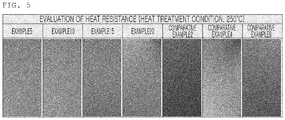
- the measured color difference was evaluated according to the following evaluation criteria. The results are shown in Tables 3 and 4 and FIG. 5 .
- ⁇ E The color difference
- the coated steel sheets were laminated as illustrated in FIG. 6 , the laminated steel sheet was closely wrapped with a wrapping paper, and then, the high-temperature and high-humidity evaluation was carried out by pressurizing the coated steel sheet at a pressure similar to the coil winding pressure.
- the composite coated steel sheet was cut into a size of 70 mm x 70 mm (width x length) to prepare a specimen, 10 sheets of the specimens were laminated so that the coating surfaces faced each other, the specimen was closely wrapped with a coil wrapping paper for export and then pressurized at a pressure of 1 ton, the pressurized specimen was left under a constant temperature and humidity condition (65°C, 95% relative humidity condition) for 192 hours, and then, an average color difference ( ⁇ E) was measured by comparing the results with the original steel sheet. The measured color difference was evaluated according to the following evaluation criteria. The results are shown in Tables 3 and 4 and FIG. 7 .
- ⁇ E The average color difference
- ⁇ E The average color difference
- the composite coated steel sheet was cut into a size of 150 mm x 70 mm (width x length) to prepare a specimen, strong alkali degreasing agents (manufactured by DAE HAN PARKERIZING CO., LTD.) DP FC-L4460A and DP FC-L4460B were dissolved in amounts of 20 g and 10 g, respectively, in 1 L pure water, the specimen was immersed therein at a temperature of 60°C for 20 minutes, and then, an average color difference ( ⁇ E) was measured by comparing the results with the original steel sheet. The measured color difference was evaluated according to the following evaluation criteria. The results are shown in Tables 3 and 4 and FIG. 8 .
- ⁇ E The average color difference
- ⁇ E The average color difference
- a yield strength was measured by stretching the specimen at a speed of 10 mm/min using a tensile tester and using a value of the tensile strength at a 0.2% yield point.
- a change value of the yield strength ( ⁇ yp, Mpa) measured after manufacture of the coated steel sheet is a yield strength difference after and before the composite resin coating. The measured change values of the yield strength are shown in Tables 3 and 4.
- the coating layer was formed by applying each of the compositions of Examples 1 to 36 on the zinc-plated steel sheet, processability was excellent due to the double curing reaction and the surface abrasion resistance was improved, resulting in significant prevention of the surface blackening phenomenon.
- the heat resistance and the high-temperature and high-humidity properties were improved by the crosslinking reaction of the inorganic silane compound, and thus, the oxidation of the plated layer was prevented during long-term transportation in the wound coil state and during long-term storage in the high-temperature and high-humidity environment. Since the ferrocene compound was added, the electrical conductivity was improved, and oxidation and discoloration resistance of the zinc-plated layer was improved.
- the curing was performed at a temperature of 150°C, which was relatively low, and the measured change in yield strength was 3 MPa or less. This is an excellent result as compared to the case where the change in yield strength is 10 MPa or more in each of Comparative Examples, and shows excellent press formability.
Landscapes
- Chemical & Material Sciences (AREA)
- Life Sciences & Earth Sciences (AREA)
- Wood Science & Technology (AREA)
- Engineering & Computer Science (AREA)
- Organic Chemistry (AREA)
- Materials Engineering (AREA)
- Inorganic Chemistry (AREA)
- Chemical Kinetics & Catalysis (AREA)
- Oil, Petroleum & Natural Gas (AREA)
- Dispersion Chemistry (AREA)
- Polymers & Plastics (AREA)
- Medicinal Chemistry (AREA)
- Health & Medical Sciences (AREA)
- Other Surface Treatments For Metallic Materials (AREA)
- Laminated Bodies (AREA)
- Paints Or Removers (AREA)
Abstract
Description
- The present invention relates to a self-crosslinking organic-inorganic composite coating composition having excellent electrical conductivity and a composite coated steel sheet whose surface is treated using the same.
- It is necessary for a zinc-plated steel sheet used as a panel, mainly an inner plate, of a home appliance to have the following key quality characteristics. First, it is necessary for the zinc-plated steel sheet to have corrosion resistance so as to be used in various corrosive environments. It is necessary for most zinc-plated steel sheets to include a coating layer having corrosion resistance to protect a material in corrosive environments during transportation until it is delivered to a customer after manufacturing, during a processing process for manufacturing a product, and until the product is discarded after the product is used by a customer. Second, it is necessary for the zinc-plated steel sheet to have surface electrical conductivity. Electromagnetic waves generated when operating a home appliance are absorbed and removed by a surface of the steel sheet. Therefore, it is necessary for the zinc-plated steel sheet to have sufficient surface electrical conductivity. Third, it is necessary for the zinc-plated steel sheet to have excellent press processability necessary for processing parts. A zinc-plated layer is damaged by a die during press processing because it is soft. Therefore, it is necessary for the coating layer to be treated on the zinc-plated layer to have processability and lubricity to prevent the damage. Forth, it is necessary for the zinc-plated steel sheet to have chemical resistance. When the zinc-plated steel sheet is subjected to degreasing with an alkali solution after processing of the parts, or when the surface of the zinc-plated steel sheet is washed using various organic solvents such as ethanol, methyl ethyl ketone (MEK), and thinner, stability of the coating layer is necessary. In addition, it is necessary to prevent discoloration caused by deterioration of the coating layer due to heat generated inside a device during long-term use.
- In general, the surface of the zinc-plated steel sheet is easily contaminated and is easily oxidized when exposed to the external environment because the plated layer may be soft. In order to make up for such a disadvantage, coating of an organic-inorganic compound protective film is performed. In addition, in order to protect the surface of the steel sheet, the steel sheet is transported in a wound coil state during transportation until being used by a customer. However, discoloration occurs frequently due to oxidation of the plated layer in the wrapped coil during long-term transportation and storage in a region with a high-temperature and high-humidity environment. It is known that such a phenomenon causes yellowing or blackening due to local galvanic oxidation of the zinc-plated layer in a limited oxygen and moisture atmosphere.
- In order to solve such an oxidation discoloration problem, a method of coating a thick protective film or coating a double-layer is used. In the case of the former, the oxidation discoloration problem may be solved, but it is difficult to secure surface electrical conductivity for securing electromagnetic wave blocking properties necessary in the electric and electronic field. In the case of the latter, undercoating and top coating are performed. Therefore, it is necessary to perform not only a sophisticated thin film coating process to secure surface electrical conductivity but also mechanical double-layer coating.
- Meanwhile, an organic-inorganic composite resin coated steel sheet is mainly used as a panel of an electronic device, and discoloration often occurs due to deterioration of the coating layer due to heat generated inside the device. In this case, a performance of the coating layer is deteriorated, and an appearance of the device is thus deteriorated, resulting in customer complaints. In general, a composition containing no aromatic ring compound causing discoloration due to deterioration is often used, but it is not effective.
- In the present invention, in order to solve the oxidation discoloration problem in a high-temperature and high-humidity region, electrical conductivity is imparted to the coating layer by binding a ferrocene derivative to a polymer resin through coating of a single layer, oxidation of zinc metal is prevented, and penetration of corrosive factors such as moisture is effectively prevented, without equipment restrictions.
- An aspect of the present invention is to provide an organic-inorganic composite coating composition formed of an organic-inorganic binder compound capable of implementing excellent basic physical properties such as electrical conductivity, corrosion resistance, and processability of a surface coating layer applied to a panel for a home appliance, implementing excellent oxidation resistance of a plated layer by effectively preventing penetration of corrosive factors such as oxygen and moisture in a high-temperature and high-humidity environment, and preventing discoloration of a coating layer due to heat generated in an electronic device, a carbodiimide curing agent compound having excellent solution stability and workability, and an additive having excellent corrosion resistance, and a self-crosslinking organic-inorganic composite coated steel sheet formed of the composition.
- According to an aspect of the present invention, an organic-inorganic composite resin composition for coating a surface of a zinc-plated steel sheet, contains: 5 to 25 wt% of a polymer resin; 4 to 20 wt% of a silane compound; 3 to 10 wt% of a curing agent; and 0.1 to 2 wt% of a ferrocene compound.
- The ferrocene compound may be one or a mixture of two or more selected from the group consisting of ferrocene, vinylferrocene, ferrocenyl glycidyl ether, vinyl ferrocenyl glycidyl ether, ferrocenylmethyl methacrylate, 2-(methacryloyloxy)ethyl ferrocene carboxylate, and 2-(acryloyloxy)ethyl ferrocene carboxylate.
- The polymer resin may be one or a mixture of two more selected from the group consisting of a polyurethane resin, a polyester resin, and a polyepoxy resin. A glass transition temperature (Tg) of the polymer resin may be -30 to 10°C, and a number average molecular weight of the polymer resin may be 20,000 to 100,000.
- The curing agent may be a carbodiimide compound.
- The organic-inorganic composite resin composition may further contain 2 to 10 wt% of a metal fluoride compound. The metal fluoride compound may be HPF6, H2TiF6, H2ZrF6, H2SiF6, MPF6, M2TiF6, M2ZrF6, or M2SiF6 (M = Li, Na, or K) .
- The organic-inorganic composite resin composition may further contain an organometallic oxide, a dispersant, or wax.
- According to another aspect of the present invention, a zinc-plated steel sheet includes a coating layer formed by applying the organic-inorganic composite resin composition, wherein a dry thickness of the coating layer is 0.1 to 1.0 µm.
- The present invention provides a zinc-plated steel sheet having excellent electrical conductivity of a coating layer by forming, on a zinc-plated steel sheet, a self-crosslinking organic-inorganic composite coating layer containing a polymer bound to a ferrocene compound, and having excellent corrosion resistance and blackening resistance of a processed portion, and excellent corrosion resistance and heat resistance in a high-temperature and high-humidity atmosphere.
- In addition, the organic-inorganic composite coating composition of the present invention has a low curing temperature by a double curing mechanism due to an organic binder and a curing agent, and a self-crosslinking reaction of an inorganic binder compound, and having excellent processability by implementing a high hardness in the coating layer even in an ultra-thin coating. Therefore, the present invention provides a composite coated steel sheet capable of being transported in a wound coil state and having excellent corrosion resistance of the plated layer even during long-term storage in a high-temperature and high-humidity environment.
-
-
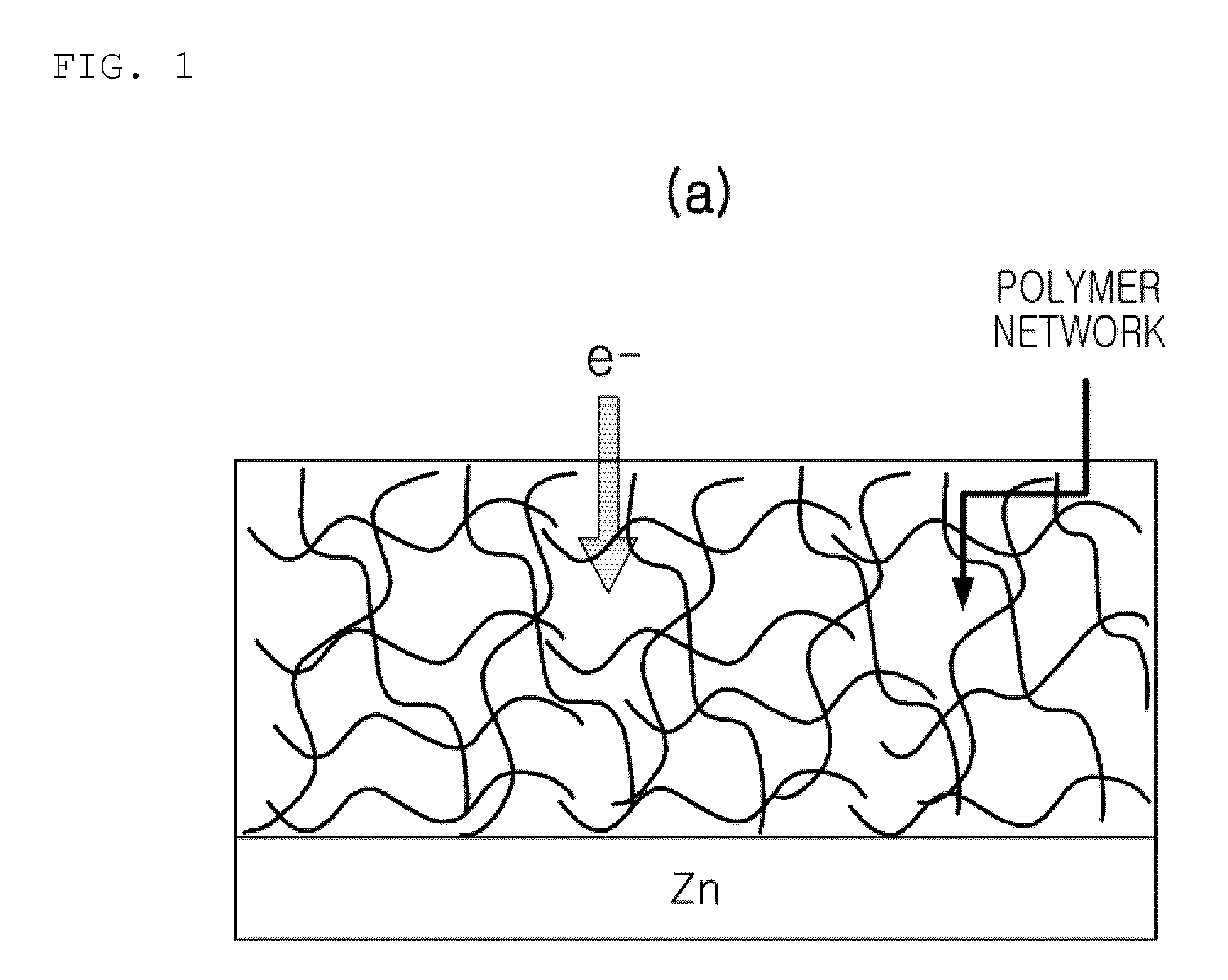
FIG. 1 is a conceptual view of a coating layer of a composite coated steel sheet of the present invention, in which (a) illustrates a comparative example and (b) illustrates an example. -
FIG. 2 illustrates results of evaluating corrosion resistance of the composite coated steel sheet. -
FIG. 3 illustrates standard plates for evaluating blackening resistance of a processed portion of the composite coated steel sheet. -
FIG. 4 illustrates results of evaluating the blackening resistance of the processed portion of the composite coated steel sheet. -
FIG. 5 illustrates results of evaluating heat resistance of the composite coated steel sheet. -
FIG. 6 is a schematic view illustrating coated steel sheets laminated to evaluate high-temperature and high-humidity properties of the composite coated steel sheet. -
FIG. 7 illustrates results of evaluating the high-temperature and high-humidity properties of the composite coated steel sheet. -
FIG. 8 illustrates results of evaluating alkali resistance of the composite coated steel sheet. - Hereinafter, preferred embodiments of the present invention will be described. However, the embodiments of the present invention may be modified in several other forms, and the scope of the present invention is not limited to embodiments to be described below.
- Historically, corrosion resistance and functionality of a zinc-plated steel sheet for a panel of a home appliance are secured by performing polymer resin coating on a coating layer subjected to a chromate chemical conversion treatment. However, since characteristics of the zinc-plated steel sheet have been mainly secured through the polymer resin coating, corresponding quality characteristics have been insufficient due to environmental damage of a chromate compound. In particular, corrosion resistance is obtained by a barrier effect and a self-healing mechanism of a coating layer. A chromate coating layer has excellent properties in comparison to a polymer resin coating layer. As a general method, a method of increasing a coating amount of a polymer resin is introduced to secure excellent corrosion resistance, but there is a problem in electromagnetic wave blocking properties of a home appliance due to insufficient surface electrical conductivity. In addition, in a case where a content of the polymer resin is increased or a polymer having a high glass transition temperature (Tg) is used in order to improve press processability, a surface hardness is improved to secure lubricity; however, it is difficult to obtain satisfactory physical properties other than the surface hardness.
- In order to solve the above problem, in the present invention, a dual curing system using a curing reaction of an organic binder compound and a self-crosslinking reaction of an inorganic binder compound is introduced. A polymer resin having excellent flexibility and a low Tg is used to improve processability, which causes blackening after processing due to a movement phenomenon of the coating layer during press processing. In order to solve such problems, processability is improved by a method of preparing an organic-inorganic binder system by introducing a curing reaction between an organic polymer resin having a low Tg and an imine compound and an inorganic compound capable of crosslinking such as hydrolyzed silane. That is, flexibility of the coating layer is secured by a curing reaction between the polymer resin having a low Tg and an imine curing agent, and the improvement of the surface hardness of the coating layer is also secured by a crosslinking reaction of an inorganic silane compound, such that processability and chemical resistance, and denseness of the coating layer are secured.
- According to an embodiment of the present invention, there is provided an organic-inorganic composite coating composition for coating a surface of a zinc-plated steel sheet, the organic-inorganic composite coating composition containing a polymer resin, a silane compound, a curing agent, and a ferrocene compound. The organic-inorganic composite coating composition may further contain a metal fluoride compound, an organometallic oxide, a dispersant, or wax.
- In the embodiment, the polymer resin is not particularly limited, but one or a mixture of two or more selected from the group consisting of a polyurethane resin, a polyester resin, and a polyepoxy resin may be used, and a polyurethane resin may be preferably used.
- A content of the polymer resin in the organic-inorganic composite coating composition may be 5 to 25 wt% with respect to a total weight of the organic-inorganic composite coating composition. When the content of the polymer resin is less than 5 wt%, it is difficult to obtain ductility necessary for processing due to a relatively large content of silane, and when the content of the polymer resin exceeds 25 wt%, processability may be excellent, but heat resistance and corrosion resistance in a high-temperature and high-humidity environment may be deteriorated, which is not preferable.
- A polymer resin having a glass transition temperature (Tg) of -30 to 10°C may be used as the polymer resin. When the Tg of the polymer resin is lower than -30°C, the hardness of the coating layer is too low, resulting in deterioration of processability. When the Tg of the polymer resin is higher than 10°C, the hardness of the coating layer is increased due to a dual curing reaction with the silane compound, resulting in brittleness.
- In addition, a number average molecular weight of the polymer resin is preferably 20,000 to 100,000. When the number average molecular weight of the polymer resin is less than 20,000, a curing degree of the coating layer is increased, resulting in deterioration of processability. When the number average molecular weight of the polymer resin exceeds 100,000, the coating layer may be brittle and solution stability may also be deteriorated.
- In the embodiment, a silane compound and/or a hydrolysis compound thereof is used as the inorganic binder. Here, the hydrolysis compound of the silane compound refers to a compound obtained by hydrolyzing a silane compound or an oligomer obtained by forming a siloxane bond by a condensation reaction.
- A content of the silane compound in the organic-inorganic composite coating composition may be 4 to 20 wt% with respect to the total weight of the organic-inorganic composite coating composition. In this case, when the content of the silane compound is less than 4 wt%, the effect of improving corrosion resistance and processability is insufficient, and when the content of the silane compound exceeds 20 wt%, solution stability is deteriorated and it is difficult to prepare the resin composition.
- The silane compound is not particular limited, but it is possible to use, for example, one or a mixture of two or more selected from the group consisting of 3-aminopropyltrithoxysilane, 3-glycidoxypropyltrimethoxysilane, 3-methaglycodoxypropyltrimethoxysilane, N-(1,3-dimethylbutylidene)-3-(triethoxysilyl)-1-propylamine, N,N-bis[3-(trimethoxysilyl)propyl]ethylenediamine, N-β(aminoethyl)-γ-aminopropyltrimethoxysilane, N-β(aminoethyl)-γ-aminopropyltriethoxysilane, N-β(aminoethyl)-γ-aminopropylmethyltriethoxysilane, N-(β-aminoethyl)-γ-aminopropyltrimethoxysilane, γ-glycidoxypropyltriethoxysilane, γ-glycidoxypropyltrimethoxysilane, 2-(3,4-epoxycyclohexyl)ethyltrimethoxysilane, γ-methacryloxypropyltrimethoxysilane, γ-methacryloxypropyltrimethoxysilane, N-[2-(vinylbenzylamino)ethyl]-3-aminopropyltrimethoxysilane, N-decyltriethoxysilane, 2-(methoxy(polyethyleneoxy)propyl)trimethoxysilane, 7-octenyltrimethoxysilane, 2-(N-allylamino)propyl trimethoxysilane, bis-[(3-methyldimethoxysilyl)propyl] polypropylene oxide, 1,9-bis(trimethoxysilyl)nonane, bis(triethoxysilyl)octane, bis[(3-triethoxysilyl)propyl] urea, di-s-buthoxyaluminoxy triethoxysilane, (N,N'-diethyl-3-aminopropyl) trimethoxysilane, dodesylmethyldiethoxysilane, 2-(diphenylphosphino)ethyl triethoxysilane, dodesyltriethoxysilane, 5,6-epoxyhexyltriethoxysilane, (3-glycidoxypropyl)trimethoxysilane, (3-glycidoxypropyl)triethoxysilane, (heptadecafluoro-1,1,2,2-tetrahydrodecyl)triethoxysilane, hexadecyltrimethoxysilane, hexyltrimethoxysilane, methacryloxypropyl triethoxysilane, n-octadecyltriethoxysilane, n-octadecyltrimethoxysilane, n-octyltriethoxysilane, n-octyltrimethoxysilane, (tridecafluoro-1,1,2,2-tetrahydrooctyl) triethoxysilane, triethoxysilylpropyl)gluconamide, N-(triethoxysilylpropyl-o-polyethylene oxide urethane, ureidopropyltriethoxysilane, ureidopropyltrimethoxysilane, and o-(vinyloxymethyl)-N-(triethoxysilylpropyl) urethane.
- The coating layer has excellent thermal stability by using the inorganic compound such as the silane compound, and discoloration due to deterioration of the coating layer is thus prevented. Therefore, heat resistance of the steel sheet is excellent. In addition, in general, since the polymer resin coating layer is porous, it is difficult to completely prevent penetration of corrosive factors such as air and moisture. In order to solve such a problem, the dense crosslinking property of the silane compound is effective in blocking a migration path of the corrosive factors through bonding with the polymer. Accordingly, it is possible to prevent a discoloration phenomenon due to surface oxidation, which is problematic during long-term transportation or storage of a winding coil in a tropical region with high-temperature and high-humidity.
- In the embodiment, a carbodiimide compound having excellent solution stability and workability may be used as the curing agent. In general, when a steel sheet is processed at a high temperature, a yield strength of the steel sheet is increased due to a thermal curing phenomenon, which makes the press processing difficult. In general, a polymer resin coated steel sheet is subjected to formation of a coating layer through drying and curing at 170°C or higher. In this case, usually, the yield strength (Yp) is increased by 5% or more, which greatly affects the steel sheet during press processing. However, when the carbodiimide compound is used, a urea bond is formed by a reaction with a carboxylic group of the polymer resin to form a crosslinking bond. In this case, the curing reaction may proceed rapidly at room temperature or a low temperature, and solution stability and workability are excellent.
- A content of the carbodiimide compound in the organic-inorganic composite coating composition may be 3 to 10 wt% with respect to the total weight of the organic-inorganic composite coating composition. In this case, when the content of the carbodiimide compound is less than 3 wt%, the effect of improving corrosion resistance and processability is insufficient, and when the content of the carbodiimide compound exceeds 10 wt%, the curing reaction is not complete, and physical properties of the coating layer such as chemical resistance are deteriorated, which is not preferable.
- The carbodiimide compound is not particularly limited, but it is possible to use, for example, one or a mixture of two or more selected from the group consisting of N,N'-diisopropylcarbodiimide, 1-ethyl-3-(3-dimethylaminopropyl)carbodiimide, bis(trimethylsilyl)carbodiimide, dicyclohexylcarbodiimide, bis(o-methoxyphenyl) carbodiimide, diphenylcarbodiimide, N-(3-dimethylaminopropyl)-N'-ethylcarbonate, bis(2,6-diisopropylphenyl)carbodiimide, and SiliaBond® Carbodiimide (trade name) (SiliCycle Inc.).
- In the embodiment, the ferrocene compound is added to improve electrical conductivity of the composite coating composition and binds to a polymer network through a reaction with a functional group of the polymer resin during the curing reaction of the composite coating composition, thereby imparting electrical conductivity to the coating layer.
- The ferrocene compound is thermally stable and acts as an electron donor to form an electron migration channel in the coating layer. Therefore, electrical conductivity may be exhibited and the ferrocene compound may also serve to prevent oxidation of the zinc-plated layer even though a thickness of the coating layer is increased, unlike a general coating layer.
- The ferrocene compound is not particularly limited, but it is possible to use, for example, one or a mixture of two or more selected from the group consisting of ferrocene (a), vinylferrocene (b), ferrocenyl glycidyl ether (c), vinyl ferrocenyl glycidyl ether (d), ferrocenylmethyl methacrylate (e), 2-(methacryloyloxy)ethyl ferrocenecarboxylate) (f), and 2- (acryloyloxy) ethyl ferrocenecarboxylate (g), as shown in the following
Formula 1.

- A content of the ferrocene compound in the organic-inorganic composite coating composition may be 0.1 to 2 wt% with respect to the total weight of the organic-inorganic composite coating composition. When the content of the ferrocene compound is less than 0.1 wt%, the reaction with the functional group of the polymer resin is small, which decreases the effect of improving the electrical conductivity. On the other hand, when the content of the ferrocene compound exceeds 2 wt%, the color of the coating layer is deteriorated, which is not preferable.
- A metal fluoride compound may be additionally contained to improve corrosion resistance of the composite coating composition. HPF6, H2TiF6, H2ZrF6, H2SiF6, MPF6,M2TiF6, M2ZrF6, M2SiF6 (M = Li, Na, or K), and the like may be used as the metal fluoride compound.
- The metal fluoride compound serves to improve the corrosion resistance through bonding between the composite coating composition and the steel sheet or a reaction with the polymer resin according to the embodiment. The content of the metal fluoride compound in the organic-inorganic composite coating composition may be 2 to 10 wt% with respect to the total weight of the organic-inorganic composite coating composition. When the content of the metal fluoride compound is less than 2 wt%, the reaction with the functional group of the polymer resin is deteriorated, which decreases the effect of improving corrosion resistance. When the content of the metal fluoride compound exceeds 10 wt%, an entanglement phenomenon occurs by acceleration of a self-reaction of the polymer resin composition, resulting in deterioration of solution stability and difficulty in implementing adhesion of the coating layer.
- The resin composition according to the embodiment may further selectively contain an organometallic oxide, a dispersant, wax, and the like.
- The organometallic oxide may serve as a catalyst to improve a binding ability of the silane compound and forms a chelate compound to improve corrosion resistance itself, and also has the effect of improving weldability because the organometallic oxide contains metal components.
- One or more selected from organic titanate and organic zirconate may be used as the organometallic oxide. A content of the organometallic oxide in the composite coating composition is preferably 2 wt% or less with respect to the total weight of the composite coating composition. This is because the effect of improving a silica binding ability and the effect of improving corrosion resistance are insufficient even when the content of the organometallic oxide to be added exceeds 2 wt%, gelation of a resin composition solution may occur, and the cost increases significantly.
- A dispersant may be contained to improve wettability of the composite coating composition solution and dispersibility of amorphous silica. The dispersant may be one or more selected from a siloxane (polyether modified polydimethylsiloxane) compound and an ester (hydro functional carboxylic acid ester) compound.
- A content of the dispersant in the composite coating composition is 2 wt% or less. When the content of the dispersant exceeds 2 wt%, the wettability of the solution is too increased. Therefore, it may be difficult to adjust an adhesion amount when forming the coating layer.
- Meanwhile, wax may be added to prevent the coating layer from being delaminated during press processing of the composite coated steel sheet. The wax is surface-modified polyethylene or fluorine-based polyethylene wax, and is added in an amount of 2 wt% or less with respect to the total weight of the composite coating composition. This is because even when the wax is added in an amount of more than 2 wt%, an effect of lowering friction force is insufficient and the corrosive factors easily penetrate due to elution of the wax component to the surface during drying of the coating layer, resulting in deterioration of corrosion resistance. In addition, when lubricity is imparted after formation of the coating layer and the composite coating composition solution is prepared, it is preferable to use wax having a melting point of 100°C or higher, in terms of work convenience.
- According to another embodiment of the present invention, there is provided a composite coated steel sheet including a coating layer formed by applying the composite coating composition on a zinc-plated steel sheet.
- The coating layer is formed by applying the composite coating composition in an adhesion amount of 500 to 1,500 mg/m2 and drying the composite coating composition at a temperature of 150°C. A thickness of the dried coating layer may be 0.1 to 1.0 µm, and a steel sheet having improved electrical conductivity may be obtained by forming an electron migration channel in the coating layer by electron donating properties of the ferrocene compound.
- Hereinafter, Examples of the present invention will be described in detail. However, the following Examples are provided only for assisting in the understanding of the present invention, but are not intended to limit the present invention.
- A zinc-plated layer having a zinc adhesion amount of 20 g/m2 was formed on a cold-rolled steel sheet through electroplating.
- In preparation of a composite coating composition, a polyurethane emulsion resin having a glass transition temperature of -28°C and a number average molecular weight of 50,000 and hydrolyzed ureidopropyltriethoxysilane as main compounds, a carbodiimide compound (SiliaBond® Carbodiimide, SiliCycle Inc.) as a curing agent, a titanium fluoride compound and a ferrocene compound (Vinyl Ferrocene, Aldrich Chemical Co.) as additives, a polysiloxane-based dispersant, surface-modified polyethylene wax (PE WAX), and the balance of pure water were sequentially added with compositions shown in Table 1, and aging was performed for 24 hours, thereby preparing an organic-inorganic composite coating composition having a pH of 5 ± 0.5.
- Thereafter, the prepared composition was applied onto the zinc-plated steel sheet using a roll coater, and the steel sheet was baked and dried so that the temperature of the steel sheet was 150°C, thereby manufacturing a coated steel sheet having an adhesion amount of the coating layer of 0.5 to 1.5 g/m2.
[Table 1] Classification Composition of solution composition (wt%) Polyurethane Silane compound Carbodiimide curing agent Titanium fluoride Ferrocene compound Dispersant Wax Solvent Example 1 5 10 3 2 0.1 0.3 0.1 Balance of pure water Example 2 5 10 3 4 0.5 0.3 0.1 Balance of pure water Example 3 5 10 5 2 1.0 0.3 0.1 Balance of pure water Example 4 5 10 5 4 0.1 0.3 0.1 Balance of pure water Example 5 5 7 3 2 0.5 0.3 0.1 Balance of pure water Example 6 5 7 3 4 1.0 0.3 0.1 Balance of pure water Example 7 5 7 5 2 0.1 0.3 0.1 Balance of pure water Example 8 5 7 5 4 0.5 0.3 0.1 Balance of pure water Example 9 5 4 3 2 1.0 0.3 0.1 Balance of pure water Example 10 5 4 3 4 0.1 0.3 0.1 Balance of pure water Example 11 5 4 5 2 0.5 0.3 0.1 Balance of pure water Example 12 5 4 5 4 1.0 0.3 0.1 Balance of pure water Example 13 10 10 3 2 0.1 0.3 0.1 Balance of pure water Example 14 10 10 3 4 0.5 0.3 0.1 Balance of pure water Example 15 10 10 5 2 1.0 0.3 0.1 Balance of pure water Example 16 10 10 5 4 0.1 0.3 0.1 Balance of pure water Example 17 10 7 3 2 0.5 0.3 0.1 Balance of pure water Example 18 10 7 3 4 1.0 0.3 0.1 Balance of pure water Example 19 10 7 5 2 0.1 0.3 0.1 Balance of pure water Example 20 10 7 5 4 0.5 0.3 0.1 Balance of pure water Example 21 10 4 3 2 1.0 0.3 0.1 Balance of pure water Example 22 10 4 3 4 0.1 0.3 0.1 Balance of pure water Example 23 10 4 5 2 0.5 0.3 0.1 Balance of pure water Example 24 10 4 5 4 1.0 0.3 0.1 Balance of pure water Example 25 15 10 3 2 0.1 0.3 0.1 Balance of pure water Example 26 15 10 3 4 0.5 0.3 0.1 Balance of pure water Example 27 15 10 5 2 1.0 0.3 0.1 Balance of pure water Example 28 15 10 5 4 0.1 0.3 0.1 Balance of pure water Example 29 15 7 3 2 0.5 0.3 0.1 Balance of pure water Example 30 15 7 3 4 1.0 0.3 0.1 Balance of pure water Example 31 15 7 5 2 0.1 0.3 0.1 Balance of pure water Example 32 15 7 5 4 0.5 0.3 0.1 Balance of pure water Example 33 15 4 3 2 1.0 0.3 0.1 Balance of pure water Example 34 15 4 3 4 0.1 0.3 0.1 Balance of pure water Example 35 15 4 5 2 0.5 0.3 0.1 Balance of pure water Example 36 15 4 5 4 1.0 0.3 0.1 Balance of pure water - In preparation of a composite coating composition, an organic-inorganic composite coating composition was prepared by sequentially adding components with compositions shown in Table 2 and performing aging for 24 hours. In the composition in each of Comparative Examples, an organotitanium compound and silica sol were used as additives.
- Thereafter, the prepared composition was applied onto the zinc-plated steel sheet using a roll coater, and the steel sheet was baked and dried so that the temperature of the steel sheet was 180°C, thereby manufacturing a coated steel sheet having an adhesion amount of the coating layer of 1.0 g/m2.
[Table 2] Classification Composition of solution composition (wt%) Polymer resin Inorganic binder Melamine curing agent Additive Ferrocene compound Dispersant Wax Solvent Comparative Example 1 Polyurethane emulsion resin 12 - 3 2 - 0.3 0.1 Balance of pure water Comparative Example 2 Polyurethane emulsion resin 12 - 5 2 - 0.3 0.1 Balance of pure water Comparative Example 3 Polyacryl-mo dified urethane 12 Silica sol 23 2 - 0.3 0.1 Balance of pure water Comparative Example 4 Polyacryl-mo dified urethane 13 Silica sol 25 2 - 0.3 0.1 Balance of pure water Comparative Example 5 Polyurethane emulsion resin 12 - 3 2 - 0.3 0.1 Balance of pure water Comparative Example 6 Polyurethane emulsion resin 13 - 5 2 - 0.3 0.1 Balance of pure water Comparative Example 7 Polyacryl-mo dified urethane 15 Silica sol 23 2 - 0.3 0.1 Balance of pure water Comparative Example 8 Polyacryl-mo dified urethane 15 Silica sol 25 2 - 0.3 0.1 Balance of pure water - As for the quality evaluation of the coated steel sheet, physical properties necessary for a chrome-free anti-fingerprint steel sheet, such as solution stability, corrosion resistance, processing blackening, chemical resistance, electrical conductivity, heat resistance, and high-temperature and high-humidity properties were evaluated. Each of the physical properties was measured by the following method.
- In order to measure solution stability of the composite coating composition solution, immediately after the preparation of the solution, an initial viscosity (ηi) was measured. After the solution was left in an oven at a temperature of 50°C for 5 days, the solution was cooled to room temperature and then stirred at room temperature for 10 days, a later viscosity (ηf) was measured to calculate a change value, and then the evaluation was carried out according to the evaluation criteria. The evaluation results of the solution stability are shown in Tables 3 and 4.

- Ⓞ: Dη was less than 1.5% or gelation was not observed with the naked eye
- o: Dη was 1.5 to less than 3% or gelation was not observed with the naked eye
- Δ: Dη was 3 to less than 5% or gelation was not observed with the naked eye
- X: Dη was 5% or more or gelation was observed with the naked eye
- 1 g of the composite coating composition solution was collected and then left at a temperature of 150°C for 30 minutes, the composite coating composition solution was cooled to room temperature, and a weight thereof was measured and expressed as a percentage. The evaluation results of the solid content are shown in Tables 3 and 4.
- In order to evaluate corrosion resistance of a flat portion, the composite coated steel sheet was cut into a size of 70 mm x 150 mm (width x length) to prepare a specimen, salt water having a concentration of 5% and a temperature of 35°C was evenly sprayed to the specimen at a spray pressure of 1 kg/cm2, and then, a time until a white rust having an area corresponding to 5% of a total area was formed on the surface of the steel sheet was measured. In addition, after the specimen was subjected to 7 mm Erichsen processing, the corrosion resistance of the flat portion was evaluated by the following method. The evaluation results of the corrosion resistance are shown in Tables 3 and 4 and
FIG. 2 . - Ⓞ: 96 hours in flat portion and 72 hours or longer in processed portion
- o: 72 hours or longer and shorter than 96 hours in flat portion and 48 hours or longer and shorter than 72 hours in processed portion
- Δ: 48 hours or longer and shorter than 72 hours in flat portion and 24 hours or longer and shorter than 48 hours in processed portion
- X: shorter than 48 hours in flat portion or shorter than 24 hours in processed portion
- The composite coated steel sheet was cut into a size of 70 mm x 70 mm (width x length) to prepare a specimen, a lubrication free roller was reciprocated on the specimen at a pressure of 0.25 kgf/mm2 30 times, a discoloration degree of the processed portion was observed with the naked eye, and the evaluation was carried out by comparing the observation results with the standard plates for evaluation of
FIG. 3 . The evaluation results of the blackening resistance of the processed portion are shown in Tables 3 and 4 andFIG. 4 . - Ⓞ: The discoloration degree of the processed portion was level 0 to
level 1 - ○: The discoloration degree of the processed portion was higher than
level 1 and lower thanlevel 2 - Δ: The discoloration degree of the processed portion was higher than
level 2 and lower thanlevel 3 - X: The discoloration degree of the processed portion was higher than
level 3 and lower thanlevel 4 - The composite coated steel sheet was cut into a size of 70 mm x 150 mm (width x length) to prepare a specimen, the specimen was reciprocally rubbed 10 times with a cotton gauze soaked with a methyl ethyl ketone (MEK) reagent at a load of 1 Kg, and a color difference (ΔE) was measured by comparing the results with the original steel sheet. The evaluation results of the solvent resistance are shown in Tables 3 and 4.
- Ⓞ: The color difference was 0 to 0.50
- ○: The color difference was more than 0.50 and 1.0 or less
- Δ: The color difference was more than 1.0 and 1.5 or less
- X: The color difference was more than 1.5
- The composite coated steel sheet was cut into a size of 300 mm x 300 mm (width x length) to prepare a specimen, surface resistance was measured 10 times at 10 points of the specimen using a 4-probe Loresta-GP (manufactured by Mitsubishi Chemical Analytech Co., Ltd.) surface resistance measuring device. The measured results were evaluated according to the following evaluation criteria. The results are shown in Tables 3 and 4.
- Ⓞ: The reference resistance value of 0.1 mΩ or less was observed 10 times
- ○: The reference resistance value of 0.1 mΩ or less was observed 8 or 9 times
- Δ: The reference resistance value of 0.1 mΩ or less was observed 6 or 7 times
- X: The reference resistance value of 0.1 mΩ or less was observed less than 6 times
- The composite coated steel sheet was cut into a size of 70 mm x 70 mm (width x length) to prepare a specimen, the specimen was left in a dry oven at a temperature of 250°C for 1 hour, the specimen was cooled, and then, a color difference (ΔE) was measured by comparing the results with the original steel sheet. The measured color difference was evaluated according to the following evaluation criteria. The results are shown in Tables 3 and 4 and
FIG. 5 . - Ⓞ: The color difference (ΔE) was less than 7
- ○: The color difference (ΔE) was 7 or more and less than 9
- Δ: The color difference (ΔE) was 9 or more and less than 12
- X: The color difference (ΔE) was 12 or more
- 8. High-temperature and high-humidity properties
- In order to simulate a wound coil state, the coated steel sheets were laminated as illustrated in
FIG. 6 , the laminated steel sheet was closely wrapped with a wrapping paper, and then, the high-temperature and high-humidity evaluation was carried out by pressurizing the coated steel sheet at a pressure similar to the coil winding pressure. The composite coated steel sheet was cut into a size of 70 mm x 70 mm (width x length) to prepare a specimen, 10 sheets of the specimens were laminated so that the coating surfaces faced each other, the specimen was closely wrapped with a coil wrapping paper for export and then pressurized at a pressure of 1 ton, the pressurized specimen was left under a constant temperature and humidity condition (65°C, 95% relative humidity condition) for 192 hours, and then, an average color difference (ΔE) was measured by comparing the results with the original steel sheet. The measured color difference was evaluated according to the following evaluation criteria. The results are shown in Tables 3 and 4 andFIG. 7 . - Ⓞ: The average color difference (ΔE) was less than 1.5
- ○: The average color difference (ΔE) was 1.5 or more and less than 2
- Δ: The average color difference (ΔE) was 2 or more and less than 3
- X: The average color difference (ΔE) was 3 or more
- As for the alkali resistance evaluation, the composite coated steel sheet was cut into a size of 150 mm x 70 mm (width x length) to prepare a specimen, strong alkali degreasing agents (manufactured by DAE HAN PARKERIZING CO., LTD.) DP FC-L4460A and DP FC-L4460B were dissolved in amounts of 20 g and 10 g, respectively, in 1 L pure water, the specimen was immersed therein at a temperature of 60°C for 20 minutes, and then, an average color difference (ΔE) was measured by comparing the results with the original steel sheet. The measured color difference was evaluated according to the following evaluation criteria. The results are shown in Tables 3 and 4 and
FIG. 8 . - Ⓞ: The average color difference (ΔE) was less than 1.5
- ○: The average color difference (ΔE) was 1.5 or more and less than 2
- Δ: The average color difference (ΔE) was 2 or more and less than 2.5
- X: The average color difference (ΔE) was 3 or more
- A yield strength was measured by stretching the specimen at a speed of 10 mm/min using a tensile tester and using a value of the tensile strength at a 0.2% yield point. A change value of the yield strength (Δyp, Mpa) measured after manufacture of the coated steel sheet is a yield strength difference after and before the composite resin coating. The measured change values of the yield strength are shown in Tables 3 and 4.
[Table 3] Results of experiments in Examples 1 to 36 Classification Coating amount (g/m2) Solution stability Solid content (wt%) Corrosion resistance Blackening resistance of processed portion Solvent resistance Surface electrical conductivity Heat resistance High-temperature and high-humidity properties Alkali resistance Change in yield strength Example 1 0.5 Ⓞ 14 Ⓞ ○ Ⓞ Ⓞ Ⓞ Ⓞ Ⓞ ≤ 3 Example 2 1.0 Ⓞ 16 Ⓞ Ⓞ Ⓞ Ⓞ Ⓞ Ⓞ Ⓞ ≤ 3 Example 3 1.5 Ⓞ 16 Ⓞ Ⓞ Ⓞ Ⓞ Ⓞ Ⓞ Ⓞ ≤ 3 Example 4 0.5 Ⓞ 17 Ⓞ ○ Ⓞ Ⓞ Ⓞ Ⓞ Ⓞ ≤ 3 Example 5 1.0 Ⓞ 12 Ⓞ Ⓞ Ⓞ Ⓞ Ⓞ Ⓞ Ⓞ ≤ 3 Example 6 1.5 Ⓞ 14 Ⓞ Ⓞ Ⓞ Ⓞ Ⓞ Ⓞ Ⓞ ≤ 3 Example 7 0.5 Ⓞ 14 Ⓞ ○ Ⓞ Ⓞ Ⓞ Ⓞ Ⓞ ≤ 3 Example 8 1.0 Ⓞ 15 Ⓞ Ⓞ Ⓞ Ⓞ Ⓞ Ⓞ Ⓞ ≤ 3 Example 9 1.5 Ⓞ 10 Ⓞ Ⓞ Ⓞ Ⓞ Ⓞ Ⓞ Ⓞ ≤ 3 Example 10 0.5 Ⓞ 11 Ⓞ Ⓞ Ⓞ Ⓞ Ⓞ Ⓞ Ⓞ ≤ 3 Example 11 1.0 Ⓞ 11 Ⓞ Ⓞ Ⓞ Ⓞ Ⓞ Ⓞ Ⓞ ≤ 3 Example 12 1.5 Ⓞ 13 Ⓞ Ⓞ Ⓞ Ⓞ Ⓞ Ⓞ Ⓞ ≤ 3 Example 13 0.5 Ⓞ 18 Ⓞ ○ Ⓞ Ⓞ Ⓞ Ⓞ Ⓞ ≤ 3 Example 14 1.0 Ⓞ 19 Ⓞ Ⓞ Ⓞ Ⓞ Ⓞ Ⓞ Ⓞ ≤ 3 Example 15 1.5 Ⓞ 19 Ⓞ Ⓞ Ⓞ Ⓞ Ⓞ Ⓞ Ⓞ ≤ 3 Example 16 0.5 Ⓞ 21 Ⓞ ○ Ⓞ Ⓞ Ⓞ Ⓞ Ⓞ ≤ 3 Example 17 1.0 Ⓞ 16 Ⓞ Ⓞ Ⓞ Ⓞ Ⓞ Ⓞ Ⓞ ≤ 3 Example 18 1.5 Ⓞ 17 Ⓞ Ⓞ Ⓞ Ⓞ Ⓞ Ⓞ Ⓞ ≤ 3 Example 19 0.5 Ⓞ 17 Ⓞ ○ Ⓞ Ⓞ Ⓞ Ⓞ Ⓞ ≤ 3 Example 20 1.0 Ⓞ 18 Ⓞ Ⓞ Ⓞ Ⓞ Ⓞ Ⓞ Ⓞ ≤ 3 Example 21 1.5 Ⓞ 14 Ⓞ Ⓞ Ⓞ Ⓞ Ⓞ Ⓞ Ⓞ ≤ 3 Example 22 0.5 Ⓞ 15 Ⓞ ○ Ⓞ Ⓞ Ⓞ Ⓞ Ⓞ ≤ 3 Example 23 1.0 Ⓞ 15 Ⓞ Ⓞ Ⓞ Ⓞ Ⓞ Ⓞ Ⓞ ≤ 3 Example 24 1.5 Ⓞ 16 Ⓞ Ⓞ Ⓞ Ⓞ Ⓞ Ⓞ Ⓞ ≤ 3 Example 25 0.5 Ⓞ 21 Ⓞ ○ Ⓞ Ⓞ Ⓞ Ⓞ Ⓞ ≤ 3 Example 26 1.0 Ⓞ 23 Ⓞ Ⓞ Ⓞ Ⓞ Ⓞ Ⓞ Ⓞ ≤ 3 Example 27 1.5 Ⓞ 23 Ⓞ Ⓞ Ⓞ Ⓞ Ⓞ Ⓞ Ⓞ ≤ 3 Example 28 0.5 Ⓞ 24 Ⓞ ○ Ⓞ Ⓞ Ⓞ Ⓞ Ⓞ ≤ 3 Example 29 1.0 Ⓞ 19 Ⓞ Ⓞ Ⓞ Ⓞ Ⓞ Ⓞ Ⓞ ≤ 3 Example 30 1.5 Ⓞ 21 Ⓞ Ⓞ Ⓞ Ⓞ Ⓞ Ⓞ Ⓞ ≤ 3 Example 31 0.5 Ⓞ 21 Ⓞ ○ Ⓞ Ⓞ Ⓞ Ⓞ Ⓞ ≤ 3 Example 32 1.0 Ⓞ 22 Ⓞ Ⓞ Ⓞ Ⓞ Ⓞ Ⓞ Ⓞ ≤ 3 Example 33 1.5 Ⓞ 17 Ⓞ Ⓞ Ⓞ Ⓞ Ⓞ Ⓞ Ⓞ ≤ 3 Example 34 0.5 Ⓞ 18 Ⓞ ○ Ⓞ Ⓞ Ⓞ Ⓞ Ⓞ ≤ 3 Example 35 1.0 Ⓞ 18 Ⓞ Ⓞ Ⓞ Ⓞ Ⓞ Ⓞ Ⓞ ≤ 3 Example 36 1.5 Ⓞ 20 Ⓞ Ⓞ Ⓞ Ⓞ Ⓞ Ⓞ Ⓞ ≤ 3 [Table 4] Results of experiments in Comparative Examples 1 to 8 Classification Coating amount (g/m2) Solution stability Solid content (wt%) Corrosion resistance Blackening resistance of processed portion Solvent resistance Surface electrical conductivity Heat resistance High-temperature and high-humidity properties Alkali resistance Change in yield strength Example 1 0.5 ○ 11 ○ Δ ○ Δ ○ Δ Δ ≥ 10 Example 2 1.0 ○ 12 ○ Δ ○ Δ ○ Δ Δ ≥ 10 Example 3 1.5 ○ 14 ○ Δ ○ Δ Δ Δ Δ ≥ 10 Example 4 0.5 ○ 16 ○ Δ ○ Δ Δ Δ Δ ≥ 10 Example 5 1.0 ○ 14 ○ Δ ○ Δ ○ Δ Δ ≥ 10 Example 6 1.5 ○ 16 ○ Δ ○ Δ ○ Δ Δ ≥ 10 Example 7 0.5 ○ 16 ○ Δ ○ Δ ○ Δ Δ ≥ 10 Example 8 1.0 ○ 17 ○ Δ ○ Δ ○ Δ Δ ≥ 10 - In the cases of the composite coating compositions of Examples 1 to 36, each containing a polyurethane emulsion resin, ureidopropyltriethoxysilane, a carbodiimide curing agent, titanium fluoride, and vinyl ferrocene in appropriate ranges, the solution stability of the composition solution was excellent, and the solid content was high as compared to those in Comparative Examples.
- In addition, in the case where the coating layer was formed by applying each of the compositions of Examples 1 to 36 on the zinc-plated steel sheet, processability was excellent due to the double curing reaction and the surface abrasion resistance was improved, resulting in significant prevention of the surface blackening phenomenon. In addition, the heat resistance and the high-temperature and high-humidity properties were improved by the crosslinking reaction of the inorganic silane compound, and thus, the oxidation of the plated layer was prevented during long-term transportation in the wound coil state and during long-term storage in the high-temperature and high-humidity environment. Since the ferrocene compound was added, the electrical conductivity was improved, and oxidation and discoloration resistance of the zinc-plated layer was improved.
- On the other hand, in the cases of Comparative Examples 1 to 8, the silane compound was not contained, the double curing reaction did not occur. Therefore, the corrosion resistance and the blackening resistance of the processed portion were significantly deteriorated, and the color differences were large in the evaluations of the heat resistance, the high-temperature and high-humidity properties, and the alkali resistance, as compared to those in Examples 1 to 36. In addition, since the ferrocene compound was not contained, the electrical conductivity of the coating layer was low.
- In the evaluation of the yield strength of the coated steel sheet, in the cases of Examples 1 to 36, the curing was performed at a temperature of 150°C, which was relatively low, and the measured change in yield strength was 3 MPa or less. This is an excellent result as compared to the case where the change in yield strength is 10 MPa or more in each of Comparative Examples, and shows excellent press formability.
Claims (9)
- An organic-inorganic composite resin composition for coating a surface of a zinc-plated steel sheet, comprising:5 to 25 wt% of a polymer resin;4 to 20 wt% of a silane compound;3 to 10 wt% of a curing agent; and0.1 to 2 wt% of a ferrocene compound.
- The organic-inorganic composite resin composition of claim 1, wherein the ferrocene compound is one or a mixture of two or more selected from the group consisting of ferrocene, vinylferrocene, ferrocenyl glycidyl ether, vinyl ferrocenyl glycidyl ether, ferrocenylmethyl methacrylate, 2-(methacryloyloxy)ethyl ferrocene carboxylate, and 2-(acryloyloxy)ethyl ferrocene carboxylate.
- The organic-inorganic composite resin composition of claim 1, wherein the polymer resin is one or a mixture of two more selected from the group consisting of a polyurethane resin, a polyester resin, and a polyepoxy resin.
- The organic-inorganic composite resin composition of claim 1, wherein a glass transition temperature (Tg) of the polymer resin is -30 to 10°C, and a number average molecular weight of the polymer resin is 20,000 to 100,000.
- The organic-inorganic composite resin composition of claim 1, wherein the curing agent is a carbodiimide compound.
- The organic-inorganic composite resin composition of claim 1, further comprising 2 to 10 wt% of a metal fluoride compound.
- The organic-inorganic composite resin composition of claim 6, wherein the metal fluoride compound is HPF6, H2TiF6, H2ZrF6, H2SiF6, MPF6, M2TiF6, M2ZrF6, or M2SiF6 (M = Li, Na, or K) .
- The organic-inorganic composite resin composition of claim 1, further comprising an organometallic oxide, a dispersant, or wax.
- A zinc-plated steel sheet comprising a coating layer formed by applying the organic-inorganic composite resin composition of any one of claims 1 to 8,
wherein a dry thickness of the coating layer is 0.1 to 1.0 µm.
Applications Claiming Priority (2)
| Application Number | Priority Date | Filing Date | Title |
|---|---|---|---|
| KR1020180137954A KR20200054551A (en) | 2018-11-12 | 2018-11-12 | Composition for organic-inorganic complex resin and surface treated zinc plated steel sheet using the same |
| PCT/KR2019/015177 WO2020101284A1 (en) | 2018-11-12 | 2019-11-08 | Organic-inorganic composite coating composition, and zinc-plated steel sheet surface-treated using same |
Publications (2)
| Publication Number | Publication Date |
|---|---|
| EP3882318A1 true EP3882318A1 (en) | 2021-09-22 |
| EP3882318A4 EP3882318A4 (en) | 2022-01-05 |
Family
ID=70730326
Family Applications (1)
| Application Number | Title | Priority Date | Filing Date |
|---|---|---|---|
| EP19884664.4A Withdrawn EP3882318A4 (en) | 2018-11-12 | 2019-11-08 | Organic-inorganic composite coating composition, and zinc-plated steel sheet surface-treated using same |
Country Status (6)
| Country | Link |
|---|---|
| US (1) | US20220010147A1 (en) |
| EP (1) | EP3882318A4 (en) |
| JP (1) | JP7216355B2 (en) |
| KR (1) | KR20200054551A (en) |
| CN (1) | CN113015770A (en) |
| WO (1) | WO2020101284A1 (en) |
Families Citing this family (3)
| Publication number | Priority date | Publication date | Assignee | Title |
|---|---|---|---|---|
| CN112301341A (en) * | 2020-07-02 | 2021-02-02 | 上海兴赛尔表面材料有限公司 | Chromium-free passivation composition capable of being dried at medium and low temperature for galvanized steel and manufacturing and using method thereof |
| CN114958450B (en) * | 2022-04-29 | 2023-06-13 | 浙江大学 | A low-migration ferrocenyl glycidyl ether burning rate catalyst and its preparation method |
| CN116855943B (en) * | 2023-08-24 | 2024-08-09 | 宁波硕强环保新材料有限公司 | Enamel coating with pearlescent metallic luster effect and preparation method thereof |
Family Cites Families (20)
| Publication number | Priority date | Publication date | Assignee | Title |
|---|---|---|---|---|
| DE10224380A1 (en) * | 2002-06-01 | 2003-12-18 | Basf Coatings Ag | Coating material, process for its production and its use for the production of adhesive coatings |
| JP4773825B2 (en) * | 2003-07-22 | 2011-09-14 | ライプニッツ−インスティトゥート フィア ノイエ マテリアーリエン ゲマインニュッツィゲ ゲゼルシャフト ミット ベシュレンクタ ハフトゥンク | Liquid repellent, alkali resistant coating composition and coating suitable for pattern formation |
| US20060178495A1 (en) * | 2005-01-31 | 2006-08-10 | Van Ooij William J | Integral resin-silane coating system |
| WO2007013761A1 (en) * | 2005-07-25 | 2007-02-01 | Posco | Pre-sealed steel sheet with improved anti- corrosion and weldability and preparing method thereof |
| JP4840966B2 (en) | 2005-09-05 | 2011-12-21 | 日本カーリット株式会社 | Conductive polymer coated metal material |
| WO2008047583A1 (en) * | 2006-09-29 | 2008-04-24 | Zeon Corporation | Curable resin composition, composite body, molded body, laminate and multilayer circuit board |
| KR101543790B1 (en) * | 2008-12-31 | 2015-08-11 | 주식회사 포스코 | Composition for Magnesium Alloy Surface Treatment and Magnesium Alloy Surface Treating Method using the Same |
| CN102373453B (en) * | 2010-08-05 | 2014-05-07 | 攀钢集团钢铁钒钛股份有限公司 | Chromium-free passivation solution and hot-dip galvanized metal material |
| CA2809940C (en) * | 2010-09-02 | 2014-07-08 | Nippon Steel & Sumitomo Metal Corporation | Precoated metal sheet excellent in conductivity and corrosion resistance |
| KR101223817B1 (en) * | 2010-12-28 | 2013-01-17 | 주식회사 포스코 | Resin Composition for Organic and Inorganic Complex Film and Surface Treated Steel Sheet |
| KR101081431B1 (en) * | 2011-03-17 | 2011-11-09 | (주)엔지텍 | Manufacturing method of organic-inorganic hybrid hard coating |
| KR101410058B1 (en) * | 2011-12-16 | 2014-06-23 | 주식회사 유니코정밀화학 | Environment friendly heat-dissipating resin composition having excellent heat-dissipating property and steel sheet using the same |
| CA2873339C (en) * | 2012-05-16 | 2021-06-01 | Universite De Haute-Alsace | Radiation curable composition, and method for preparing a hybrid sol-gel layer on a surface of a substrate using said composition |
| CN103102807A (en) * | 2012-11-13 | 2013-05-15 | 铜陵祥云消防科技有限责任公司 | Gas-phase corrosion inhibition antirust agent containing modified montmorillonite powder |
| CN102993803B (en) * | 2012-11-13 | 2016-04-20 | 合肥市田源精铸有限公司 | A kind of metal rust-proofing wax containing modified soluble nano silicone colloidal sol and preparation method thereof |
| KR101560929B1 (en) * | 2013-12-20 | 2015-10-15 | 주식회사 포스코 | Surface treatment composition for Zn coated steel sheet with excellent corrosion resistance, and surface treated Zn coated steel sheet using the same |
| KR101568589B1 (en) * | 2014-06-25 | 2015-11-12 | 주식회사 포스코 | High-strength galvanized steel sheet having graphene layer and method for mafacturing the same |
| CN104312272A (en) * | 2014-11-10 | 2015-01-28 | 合肥宏图彩印有限公司 | Rustproof type special conductive printing ink and preparation method thereof |
| KR101726095B1 (en) * | 2015-12-24 | 2017-04-12 | 주식회사 포스코 | Chromium-free coating composition, producing method of chromium-free coating steel sheet using the same and chromium-free coating steel sheet produced thereby |
| CN105838208A (en) * | 2016-06-03 | 2016-08-10 | 苏州市奎克力电子科技有限公司 | Low-temperature-resistant insulating paint |
-
2018
- 2018-11-12 KR KR1020180137954A patent/KR20200054551A/en not_active Ceased
-
2019
- 2019-11-08 JP JP2021525089A patent/JP7216355B2/en active Active
- 2019-11-08 US US17/292,915 patent/US20220010147A1/en not_active Abandoned
- 2019-11-08 WO PCT/KR2019/015177 patent/WO2020101284A1/en not_active Ceased
- 2019-11-08 EP EP19884664.4A patent/EP3882318A4/en not_active Withdrawn
- 2019-11-08 CN CN201980074707.8A patent/CN113015770A/en active Pending
Also Published As
| Publication number | Publication date |
|---|---|
| US20220010147A1 (en) | 2022-01-13 |
| EP3882318A4 (en) | 2022-01-05 |
| WO2020101284A1 (en) | 2020-05-22 |
| JP7216355B2 (en) | 2023-02-01 |
| CN113015770A (en) | 2021-06-22 |
| JP2022509926A (en) | 2022-01-25 |
| KR20200054551A (en) | 2020-05-20 |
Similar Documents
| Publication | Publication Date | Title |
|---|---|---|
| EP2540865B1 (en) | Surface-treating agent for zinc-plated steel sheet, and zinc-plated steel sheet and process for production thereof | |
| US20100272991A1 (en) | Chrome-free coating compositions for surface-treating steel sheet including carbon nanotube, methods for surface-treating steel sheet and surface-treated steel sheets using the same | |
| TWI445842B (en) | Surface treatment composition | |
| US9593391B2 (en) | Strip, sheet or blank suitable for hot forming and process for the production thereof | |
| EP2800103B1 (en) | Insulation coating composition for non-oriented electrical steel sheet, method for manufacturing same, and non-oriented electrical steel sheet upon which the insulation coating composition is applied | |
| EP2752503B1 (en) | Electromagnetic steel sheet having insulating coating | |
| JP5249925B2 (en) | Water-based emulsion paint and coated steel plate using the same | |
| CN102070966A (en) | Organic and inorganic mixed fingerprint-resistance coating and preparation method thereof | |
| EP1997935A1 (en) | Composition for metal surface treatment, metal surface treatment method, and metal material | |
| US20220010147A1 (en) | Organic-inorganic composite coating composition, and zinc-plated steel sheet surface-treated using same | |
| JPWO2007148684A1 (en) | Inorganic / organic hybrid composition and use thereof | |
| CN101258206A (en) | Pre-sealed steel sheet with improved corrosion resistance and weldability and method of manufacturing the same | |
| KR101903868B1 (en) | Chain | |
| KR101546158B1 (en) | Electrolytic galvanized iron with excellent anit-corrosion and anti-finger and mehtod of mamufacturing the same | |
| KR20190046950A (en) | Surface-treated metal plate, and method of manufacturing surface-treated metal plate | |
| CN107053779A (en) | A kind of slim half overlay film television set metal backing | |
| EP1967611A1 (en) | Electromagnetic steel sheet having insulating coating film and method for producing same | |
| EP2880108B1 (en) | Organic-inorganic hybrid coating solution composition and organic-inorganic hybrid coated steel sheet | |
| WO2006073067A1 (en) | Resin composition excelling in anticorrosive and/or conductive performance and member coated with resin composition | |
| EP4071219A1 (en) | Surface treatment composition for ternary hot-dip galvannealed steel sheet, providing excellent corrosion resistance and surface color, ternary hot-dip galvannealed steel sheet surface-treated using same, and manufacturing method therefor | |
| KR20210006493A (en) | Composition for organic-inorganic complex resin and surface treated zinc plated steel sheet using the same | |
| TW201132799A (en) | Conductive precoated aluminum alloy sheet | |
| CN107000381B (en) | Water system two-layer coating handles metallic plate | |
| CN109825826B (en) | Chromium-free insulating coating liquid, preparation method thereof and oriented silicon steel plate | |
| JP4905382B2 (en) | Electrical steel sheet with insulating coating |
Legal Events
| Date | Code | Title | Description |
|---|---|---|---|
| STAA | Information on the status of an ep patent application or granted ep patent |
Free format text: STATUS: THE INTERNATIONAL PUBLICATION HAS BEEN MADE |
|
| PUAI | Public reference made under article 153(3) epc to a published international application that has entered the european phase |
Free format text: ORIGINAL CODE: 0009012 |
|
| STAA | Information on the status of an ep patent application or granted ep patent |
Free format text: STATUS: REQUEST FOR EXAMINATION WAS MADE |
|
| 17P | Request for examination filed |
Effective date: 20210525 |
|
| AK | Designated contracting states |
Kind code of ref document: A1 Designated state(s): AL AT BE BG CH CY CZ DE DK EE ES FI FR GB GR HR HU IE IS IT LI LT LU LV MC MK MT NL NO PL PT RO RS SE SI SK SM TR |
|
| A4 | Supplementary search report drawn up and despatched |
Effective date: 20211206 |
|
| RIC1 | Information provided on ipc code assigned before grant |
Ipc: B05D 7/24 20060101ALI20211130BHEP Ipc: B05D 7/14 20060101ALI20211130BHEP Ipc: C09D 7/61 20180101ALI20211130BHEP Ipc: C09D 163/00 20060101ALI20211130BHEP Ipc: C09D 167/00 20060101ALI20211130BHEP Ipc: C09D 175/04 20060101ALI20211130BHEP Ipc: C09D 7/40 20180101ALI20211130BHEP Ipc: C09D 7/63 20180101AFI20211130BHEP |
|
| DAV | Request for validation of the european patent (deleted) | ||
| DAX | Request for extension of the european patent (deleted) | ||
| STAA | Information on the status of an ep patent application or granted ep patent |
Free format text: STATUS: THE APPLICATION HAS BEEN WITHDRAWN |
|
| RAP3 | Party data changed (applicant data changed or rights of an application transferred) |
Owner name: POSCO HOLDINGS INC. |
|
| 18W | Application withdrawn |
Effective date: 20221114 |
|
| RAP1 | Party data changed (applicant data changed or rights of an application transferred) |
Owner name: POSCO HOLDINGS INC. |