EP3882262A1 - Modified activin a - Google Patents
Modified activin a Download PDFInfo
- Publication number
- EP3882262A1 EP3882262A1 EP19884923.4A EP19884923A EP3882262A1 EP 3882262 A1 EP3882262 A1 EP 3882262A1 EP 19884923 A EP19884923 A EP 19884923A EP 3882262 A1 EP3882262 A1 EP 3882262A1
- Authority
- EP
- European Patent Office
- Prior art keywords
- amino acid
- activin
- acid sequence
- seq
- protease
- Prior art date
- Legal status (The legal status is an assumption and is not a legal conclusion. Google has not performed a legal analysis and makes no representation as to the accuracy of the status listed.)
- Pending
Links
- 239000000488 activin Substances 0.000 title description 14
- 102000005606 Activins Human genes 0.000 title 1
- 108010059616 Activins Proteins 0.000 title 1
- 108010023082 activin A Proteins 0.000 claims abstract description 233
- 150000001413 amino acids Chemical group 0.000 claims description 258
- 102000035195 Peptidases Human genes 0.000 claims description 75
- 108091005804 Peptidases Proteins 0.000 claims description 75
- 239000004365 Protease Substances 0.000 claims description 75
- 229940024606 amino acid Drugs 0.000 claims description 70
- 235000001014 amino acid Nutrition 0.000 claims description 70
- 102000004961 Furin Human genes 0.000 claims description 39
- 108090001126 Furin Proteins 0.000 claims description 39
- 102000006437 Proprotein Convertases Human genes 0.000 claims description 39
- 108010044159 Proprotein Convertases Proteins 0.000 claims description 39
- 239000013598 vector Substances 0.000 claims description 35
- DHMQDGOQFOQNFH-UHFFFAOYSA-N Glycine Chemical compound NCC(O)=O DHMQDGOQFOQNFH-UHFFFAOYSA-N 0.000 claims description 34
- 230000015556 catabolic process Effects 0.000 claims description 32
- 238000006731 degradation reaction Methods 0.000 claims description 32
- 239000002157 polynucleotide Substances 0.000 claims description 23
- 108091033319 polynucleotide Proteins 0.000 claims description 23
- 102000040430 polynucleotide Human genes 0.000 claims description 23
- 125000006850 spacer group Chemical group 0.000 claims description 22
- 239000004471 Glycine Substances 0.000 claims description 16
- QNAYBMKLOCPYGJ-REOHCLBHSA-N L-alanine Chemical compound C[C@H](N)C(O)=O QNAYBMKLOCPYGJ-REOHCLBHSA-N 0.000 claims description 14
- 235000004279 alanine Nutrition 0.000 claims description 14
- 238000004519 manufacturing process Methods 0.000 claims description 14
- MTCFGRXMJLQNBG-REOHCLBHSA-N (2S)-2-Amino-3-hydroxypropansäure Chemical compound OC[C@H](N)C(O)=O MTCFGRXMJLQNBG-REOHCLBHSA-N 0.000 claims description 11
- MTCFGRXMJLQNBG-UHFFFAOYSA-N Serine Natural products OCC(N)C(O)=O MTCFGRXMJLQNBG-UHFFFAOYSA-N 0.000 claims description 11
- ROHFNLRQFUQHCH-YFKPBYRVSA-N L-leucine Chemical compound CC(C)C[C@H](N)C(O)=O ROHFNLRQFUQHCH-YFKPBYRVSA-N 0.000 claims description 9
- ROHFNLRQFUQHCH-UHFFFAOYSA-N Leucine Natural products CC(C)CC(N)C(O)=O ROHFNLRQFUQHCH-UHFFFAOYSA-N 0.000 claims description 9
- AGPKZVBTJJNPAG-WHFBIAKZSA-N L-isoleucine Chemical compound CC[C@H](C)[C@H](N)C(O)=O AGPKZVBTJJNPAG-WHFBIAKZSA-N 0.000 claims description 8
- KZSNJWFQEVHDMF-BYPYZUCNSA-N L-valine Chemical compound CC(C)[C@H](N)C(O)=O KZSNJWFQEVHDMF-BYPYZUCNSA-N 0.000 claims description 8
- KZSNJWFQEVHDMF-UHFFFAOYSA-N Valine Natural products CC(C)C(N)C(O)=O KZSNJWFQEVHDMF-UHFFFAOYSA-N 0.000 claims description 8
- AGPKZVBTJJNPAG-UHFFFAOYSA-N isoleucine Natural products CCC(C)C(N)C(O)=O AGPKZVBTJJNPAG-UHFFFAOYSA-N 0.000 claims description 8
- 229960000310 isoleucine Drugs 0.000 claims description 8
- 239000004474 valine Substances 0.000 claims description 8
- 241000196324 Embryophyta Species 0.000 description 64
- 238000000034 method Methods 0.000 description 60
- 108090000623 proteins and genes Proteins 0.000 description 43
- 102000004169 proteins and genes Human genes 0.000 description 35
- 235000018102 proteins Nutrition 0.000 description 22
- 239000003337 fertilizer Substances 0.000 description 21
- 210000004027 cell Anatomy 0.000 description 17
- 239000007788 liquid Substances 0.000 description 16
- 239000000243 solution Substances 0.000 description 15
- 241000589158 Agrobacterium Species 0.000 description 14
- 230000000694 effects Effects 0.000 description 14
- 230000004069 differentiation Effects 0.000 description 13
- PEDCQBHIVMGVHV-UHFFFAOYSA-N Glycerine Chemical compound OCC(O)CO PEDCQBHIVMGVHV-UHFFFAOYSA-N 0.000 description 12
- HNDVDQJCIGZPNO-UHFFFAOYSA-N histidine Natural products OC(=O)C(N)CC1=CN=CN1 HNDVDQJCIGZPNO-UHFFFAOYSA-N 0.000 description 10
- 239000000203 mixture Substances 0.000 description 10
- 241000700159 Rattus Species 0.000 description 9
- BFNBIHQBYMNNAN-UHFFFAOYSA-N ammonium sulfate Chemical compound N.N.OS(O)(=O)=O BFNBIHQBYMNNAN-UHFFFAOYSA-N 0.000 description 9
- 238000001262 western blot Methods 0.000 description 9
- 102000004190 Enzymes Human genes 0.000 description 8
- 108090000790 Enzymes Proteins 0.000 description 8
- 241000699666 Mus <mouse, genus> Species 0.000 description 8
- 230000007613 environmental effect Effects 0.000 description 8
- 229940088598 enzyme Drugs 0.000 description 8
- 230000001939 inductive effect Effects 0.000 description 8
- 239000000126 substance Substances 0.000 description 8
- 241000207746 Nicotiana benthamiana Species 0.000 description 7
- 108010076504 Protein Sorting Signals Proteins 0.000 description 7
- FAPWRFPIFSIZLT-UHFFFAOYSA-M Sodium chloride Chemical compound [Na+].[Cl-] FAPWRFPIFSIZLT-UHFFFAOYSA-M 0.000 description 7
- 229910052921 ammonium sulfate Inorganic materials 0.000 description 7
- 235000011130 ammonium sulphate Nutrition 0.000 description 7
- 230000014509 gene expression Effects 0.000 description 7
- HWTAKVLMACWHLD-UHFFFAOYSA-N 2-(9h-carbazol-1-yl)ethanamine Chemical compound C12=CC=CC=C2NC2=C1C=CC=C2CCN HWTAKVLMACWHLD-UHFFFAOYSA-N 0.000 description 6
- ZHNUHDYFZUAESO-UHFFFAOYSA-N Formamide Chemical compound NC=O ZHNUHDYFZUAESO-UHFFFAOYSA-N 0.000 description 6
- RAXXELZNTBOGNW-UHFFFAOYSA-N imidazole Natural products C1=CNC=N1 RAXXELZNTBOGNW-UHFFFAOYSA-N 0.000 description 6
- 230000035772 mutation Effects 0.000 description 6
- 210000003924 normoblast Anatomy 0.000 description 6
- 239000002773 nucleotide Substances 0.000 description 6
- 125000003729 nucleotide group Chemical group 0.000 description 6
- 102000004196 processed proteins & peptides Human genes 0.000 description 6
- 108090000765 processed proteins & peptides Proteins 0.000 description 6
- 238000009331 sowing Methods 0.000 description 6
- XUJNEKJLAYXESH-REOHCLBHSA-N L-Cysteine Chemical compound SC[C@H](N)C(O)=O XUJNEKJLAYXESH-REOHCLBHSA-N 0.000 description 5
- QIVBCDIJIAJPQS-VIFPVBQESA-N L-tryptophane Chemical compound C1=CC=C2C(C[C@H](N)C(O)=O)=CNC2=C1 QIVBCDIJIAJPQS-VIFPVBQESA-N 0.000 description 5
- OUYCCCASQSFEME-QMMMGPOBSA-N L-tyrosine Chemical compound OC(=O)[C@@H](N)CC1=CC=C(O)C=C1 OUYCCCASQSFEME-QMMMGPOBSA-N 0.000 description 5
- 102000004887 Transforming Growth Factor beta Human genes 0.000 description 5
- 108090001012 Transforming Growth Factor beta Proteins 0.000 description 5
- QIVBCDIJIAJPQS-UHFFFAOYSA-N Tryptophan Natural products C1=CC=C2C(CC(N)C(O)=O)=CNC2=C1 QIVBCDIJIAJPQS-UHFFFAOYSA-N 0.000 description 5
- XUJNEKJLAYXESH-UHFFFAOYSA-N cysteine Natural products SCC(N)C(O)=O XUJNEKJLAYXESH-UHFFFAOYSA-N 0.000 description 5
- 235000018417 cysteine Nutrition 0.000 description 5
- 208000015181 infectious disease Diseases 0.000 description 5
- 238000000746 purification Methods 0.000 description 5
- ZRKFYGHZFMAOKI-QMGMOQQFSA-N tgfbeta Chemical compound C([C@H](NC(=O)[C@H](C(C)C)NC(=O)CNC(=O)[C@H](CCC(O)=O)NC(=O)[C@H](CCCNC(N)=N)NC(=O)[C@H](CC(N)=O)NC(=O)[C@H](CC(C)C)NC(=O)[C@H]([C@@H](C)O)NC(=O)[C@H](CCC(O)=O)NC(=O)[C@H]([C@@H](C)O)NC(=O)[C@H](CC(C)C)NC(=O)CNC(=O)[C@H](C)NC(=O)[C@H](CO)NC(=O)[C@H](CCC(N)=O)NC(=O)[C@@H](NC(=O)[C@H](C)NC(=O)[C@H](C)NC(=O)[C@@H](NC(=O)[C@H](CC(C)C)NC(=O)[C@@H](N)CCSC)C(C)C)[C@@H](C)CC)C(=O)N[C@@H]([C@@H](C)O)C(=O)N[C@@H](C(C)C)C(=O)N[C@@H](CC=1C=CC=CC=1)C(=O)N[C@@H](C)C(=O)N1[C@@H](CCC1)C(=O)N[C@@H]([C@@H](C)O)C(=O)N[C@@H](CC(N)=O)C(=O)N[C@@H](CCC(O)=O)C(=O)N[C@@H](C)C(=O)N[C@@H](CC=1C=CC=CC=1)C(=O)N[C@@H](CCCNC(N)=N)C(=O)N[C@@H](C)C(=O)N[C@@H](CC(C)C)C(=O)N1[C@@H](CCC1)C(=O)N1[C@@H](CCC1)C(=O)N[C@@H](CCCNC(N)=N)C(=O)N[C@@H](CCC(O)=O)C(=O)N[C@@H](CCCNC(N)=N)C(=O)N[C@@H](CO)C(=O)N[C@@H](CCCNC(N)=N)C(=O)N[C@@H](CC(C)C)C(=O)N[C@@H](CC(C)C)C(O)=O)C1=CC=C(O)C=C1 ZRKFYGHZFMAOKI-QMGMOQQFSA-N 0.000 description 5
- OUYCCCASQSFEME-UHFFFAOYSA-N tyrosine Natural products OC(=O)C(N)CC1=CC=C(O)C=C1 OUYCCCASQSFEME-UHFFFAOYSA-N 0.000 description 5
- 239000004475 Arginine Substances 0.000 description 4
- DCXYFEDJOCDNAF-UHFFFAOYSA-N Asparagine Natural products OC(=O)C(N)CC(N)=O DCXYFEDJOCDNAF-UHFFFAOYSA-N 0.000 description 4
- JOYRKODLDBILNP-UHFFFAOYSA-N Ethyl urethane Chemical compound CCOC(N)=O JOYRKODLDBILNP-UHFFFAOYSA-N 0.000 description 4
- DCXYFEDJOCDNAF-REOHCLBHSA-N L-asparagine Chemical compound OC(=O)[C@@H](N)CC(N)=O DCXYFEDJOCDNAF-REOHCLBHSA-N 0.000 description 4
- ZDXPYRJPNDTMRX-VKHMYHEASA-N L-glutamine Chemical compound OC(=O)[C@@H](N)CCC(N)=O ZDXPYRJPNDTMRX-VKHMYHEASA-N 0.000 description 4
- FFEARJCKVFRZRR-BYPYZUCNSA-N L-methionine Chemical compound CSCC[C@H](N)C(O)=O FFEARJCKVFRZRR-BYPYZUCNSA-N 0.000 description 4
- COLNVLDHVKWLRT-QMMMGPOBSA-N L-phenylalanine Chemical compound OC(=O)[C@@H](N)CC1=CC=CC=C1 COLNVLDHVKWLRT-QMMMGPOBSA-N 0.000 description 4
- AYFVYJQAPQTCCC-GBXIJSLDSA-N L-threonine Chemical compound C[C@@H](O)[C@H](N)C(O)=O AYFVYJQAPQTCCC-GBXIJSLDSA-N 0.000 description 4
- 241000208125 Nicotiana Species 0.000 description 4
- 244000061176 Nicotiana tabacum Species 0.000 description 4
- AYFVYJQAPQTCCC-UHFFFAOYSA-N Threonine Natural products CC(O)C(N)C(O)=O AYFVYJQAPQTCCC-UHFFFAOYSA-N 0.000 description 4
- 239000004473 Threonine Substances 0.000 description 4
- 241000723873 Tobacco mosaic virus Species 0.000 description 4
- 238000001261 affinity purification Methods 0.000 description 4
- ODKSFYDXXFIFQN-UHFFFAOYSA-N arginine Natural products OC(=O)C(N)CCCNC(N)=N ODKSFYDXXFIFQN-UHFFFAOYSA-N 0.000 description 4
- 235000009582 asparagine Nutrition 0.000 description 4
- 229960001230 asparagine Drugs 0.000 description 4
- 238000007796 conventional method Methods 0.000 description 4
- 238000005194 fractionation Methods 0.000 description 4
- ZDXPYRJPNDTMRX-UHFFFAOYSA-N glutamine Natural products OC(=O)C(N)CCC(N)=O ZDXPYRJPNDTMRX-UHFFFAOYSA-N 0.000 description 4
- 230000008595 infiltration Effects 0.000 description 4
- 238000001764 infiltration Methods 0.000 description 4
- 229930182817 methionine Natural products 0.000 description 4
- COLNVLDHVKWLRT-UHFFFAOYSA-N phenylalanine Natural products OC(=O)C(N)CC1=CC=CC=C1 COLNVLDHVKWLRT-UHFFFAOYSA-N 0.000 description 4
- 229920001184 polypeptide Polymers 0.000 description 4
- 239000011780 sodium chloride Substances 0.000 description 4
- 239000000725 suspension Substances 0.000 description 4
- 238000002054 transplantation Methods 0.000 description 4
- 239000013603 viral vector Substances 0.000 description 4
- JKMHFZQWWAIEOD-UHFFFAOYSA-N 2-[4-(2-hydroxyethyl)piperazin-1-yl]ethanesulfonic acid Chemical compound OCC[NH+]1CCN(CCS([O-])(=O)=O)CC1 JKMHFZQWWAIEOD-UHFFFAOYSA-N 0.000 description 3
- -1 Aliphatic amino acids Chemical class 0.000 description 3
- 241000894006 Bacteria Species 0.000 description 3
- 241000283690 Bos taurus Species 0.000 description 3
- 102000004127 Cytokines Human genes 0.000 description 3
- 108090000695 Cytokines Proteins 0.000 description 3
- 241000282326 Felis catus Species 0.000 description 3
- WHUUTDBJXJRKMK-UHFFFAOYSA-N Glutamic acid Natural products OC(=O)C(N)CCC(O)=O WHUUTDBJXJRKMK-UHFFFAOYSA-N 0.000 description 3
- 239000007995 HEPES buffer Substances 0.000 description 3
- ONIBWKKTOPOVIA-BYPYZUCNSA-N L-Proline Chemical compound OC(=O)[C@@H]1CCCN1 ONIBWKKTOPOVIA-BYPYZUCNSA-N 0.000 description 3
- ODKSFYDXXFIFQN-BYPYZUCNSA-P L-argininium(2+) Chemical compound NC(=[NH2+])NCCC[C@H]([NH3+])C(O)=O ODKSFYDXXFIFQN-BYPYZUCNSA-P 0.000 description 3
- CKLJMWTZIZZHCS-REOHCLBHSA-N L-aspartic acid Chemical compound OC(=O)[C@@H](N)CC(O)=O CKLJMWTZIZZHCS-REOHCLBHSA-N 0.000 description 3
- WHUUTDBJXJRKMK-VKHMYHEASA-N L-glutamic acid Chemical compound OC(=O)[C@@H](N)CCC(O)=O WHUUTDBJXJRKMK-VKHMYHEASA-N 0.000 description 3
- HNDVDQJCIGZPNO-YFKPBYRVSA-N L-histidine Chemical compound OC(=O)[C@@H](N)CC1=CN=CN1 HNDVDQJCIGZPNO-YFKPBYRVSA-N 0.000 description 3
- KDXKERNSBIXSRK-YFKPBYRVSA-N L-lysine Chemical compound NCCCC[C@H](N)C(O)=O KDXKERNSBIXSRK-YFKPBYRVSA-N 0.000 description 3
- KDXKERNSBIXSRK-UHFFFAOYSA-N Lysine Natural products NCCCCC(N)C(O)=O KDXKERNSBIXSRK-UHFFFAOYSA-N 0.000 description 3
- 239000004472 Lysine Substances 0.000 description 3
- 241001465754 Metazoa Species 0.000 description 3
- 235000002637 Nicotiana tabacum Nutrition 0.000 description 3
- 240000007594 Oryza sativa Species 0.000 description 3
- 235000007164 Oryza sativa Nutrition 0.000 description 3
- ONIBWKKTOPOVIA-UHFFFAOYSA-N Proline Natural products OC(=O)C1CCCN1 ONIBWKKTOPOVIA-UHFFFAOYSA-N 0.000 description 3
- 102000004139 alpha-Amylases Human genes 0.000 description 3
- 108090000637 alpha-Amylases Proteins 0.000 description 3
- 229940024171 alpha-amylase Drugs 0.000 description 3
- 235000003704 aspartic acid Nutrition 0.000 description 3
- OQFSQFPPLPISGP-UHFFFAOYSA-N beta-carboxyaspartic acid Natural products OC(=O)C(N)C(C(O)=O)C(O)=O OQFSQFPPLPISGP-UHFFFAOYSA-N 0.000 description 3
- 239000000872 buffer Substances 0.000 description 3
- 239000003153 chemical reaction reagent Substances 0.000 description 3
- 230000000593 degrading effect Effects 0.000 description 3
- 238000011161 development Methods 0.000 description 3
- 238000004520 electroporation Methods 0.000 description 3
- 238000005516 engineering process Methods 0.000 description 3
- 238000000605 extraction Methods 0.000 description 3
- 239000011536 extraction buffer Substances 0.000 description 3
- 230000004907 flux Effects 0.000 description 3
- 235000013922 glutamic acid Nutrition 0.000 description 3
- 239000004220 glutamic acid Substances 0.000 description 3
- 230000002209 hydrophobic effect Effects 0.000 description 3
- 239000003501 hydroponics Substances 0.000 description 3
- 238000003780 insertion Methods 0.000 description 3
- 230000037431 insertion Effects 0.000 description 3
- 210000003716 mesoderm Anatomy 0.000 description 3
- 230000000243 photosynthetic effect Effects 0.000 description 3
- 239000002244 precipitate Substances 0.000 description 3
- 239000004334 sorbic acid Substances 0.000 description 3
- 238000010186 staining Methods 0.000 description 3
- 238000006467 substitution reaction Methods 0.000 description 3
- 238000012360 testing method Methods 0.000 description 3
- 241000700199 Cavia porcellus Species 0.000 description 2
- 241000282693 Cercopithecidae Species 0.000 description 2
- 108020004414 DNA Proteins 0.000 description 2
- 241000233866 Fungi Species 0.000 description 2
- 108010043121 Green Fluorescent Proteins Proteins 0.000 description 2
- 102000004144 Green Fluorescent Proteins Human genes 0.000 description 2
- 102100034343 Integrase Human genes 0.000 description 2
- 108010061833 Integrases Proteins 0.000 description 2
- 241000862464 Nicotiana excelsior Species 0.000 description 2
- 241000283973 Oryctolagus cuniculus Species 0.000 description 2
- 229940124158 Protease/peptidase inhibitor Drugs 0.000 description 2
- 108700008625 Reporter Genes Proteins 0.000 description 2
- 240000004808 Saccharomyces cerevisiae Species 0.000 description 2
- 244000061456 Solanum tuberosum Species 0.000 description 2
- 230000002378 acidificating effect Effects 0.000 description 2
- 238000007792 addition Methods 0.000 description 2
- 238000001042 affinity chromatography Methods 0.000 description 2
- 125000000539 amino acid group Chemical group 0.000 description 2
- 230000001580 bacterial effect Effects 0.000 description 2
- 210000004748 cultured cell Anatomy 0.000 description 2
- 238000010828 elution Methods 0.000 description 2
- 238000011067 equilibration Methods 0.000 description 2
- 230000002449 erythroblastic effect Effects 0.000 description 2
- 239000013604 expression vector Substances 0.000 description 2
- 150000002333 glycines Chemical class 0.000 description 2
- 239000005090 green fluorescent protein Substances 0.000 description 2
- 239000001963 growth medium Substances 0.000 description 2
- 239000003550 marker Substances 0.000 description 2
- 238000010369 molecular cloning Methods 0.000 description 2
- 239000000137 peptide hydrolase inhibitor Substances 0.000 description 2
- 239000008363 phosphate buffer Substances 0.000 description 2
- 230000026447 protein localization Effects 0.000 description 2
- 235000009566 rice Nutrition 0.000 description 2
- 238000004088 simulation Methods 0.000 description 2
- 238000002415 sodium dodecyl sulfate polyacrylamide gel electrophoresis Methods 0.000 description 2
- GEHJYWRUCIMESM-UHFFFAOYSA-L sodium sulfite Chemical compound [Na+].[Na+].[O-]S([O-])=O GEHJYWRUCIMESM-UHFFFAOYSA-L 0.000 description 2
- 238000001228 spectrum Methods 0.000 description 2
- 239000006228 supernatant Substances 0.000 description 2
- XLYOFNOQVPJJNP-UHFFFAOYSA-N water Substances O XLYOFNOQVPJJNP-UHFFFAOYSA-N 0.000 description 2
- 108091032973 (ribonucleotides)n+m Proteins 0.000 description 1
- QKNYBSVHEMOAJP-UHFFFAOYSA-N 2-amino-2-(hydroxymethyl)propane-1,3-diol;hydron;chloride Chemical compound Cl.OCC(N)(CO)CO QKNYBSVHEMOAJP-UHFFFAOYSA-N 0.000 description 1
- FWMNVWWHGCHHJJ-SKKKGAJSSA-N 4-amino-1-[(2r)-6-amino-2-[[(2r)-2-[[(2r)-2-[[(2r)-2-amino-3-phenylpropanoyl]amino]-3-phenylpropanoyl]amino]-4-methylpentanoyl]amino]hexanoyl]piperidine-4-carboxylic acid Chemical compound C([C@H](C(=O)N[C@H](CC(C)C)C(=O)N[C@H](CCCCN)C(=O)N1CCC(N)(CC1)C(O)=O)NC(=O)[C@H](N)CC=1C=CC=CC=1)C1=CC=CC=C1 FWMNVWWHGCHHJJ-SKKKGAJSSA-N 0.000 description 1
- 101150073246 AGL1 gene Proteins 0.000 description 1
- 102000002260 Alkaline Phosphatase Human genes 0.000 description 1
- 108020004774 Alkaline Phosphatase Proteins 0.000 description 1
- UXVMQQNJUSDDNG-UHFFFAOYSA-L Calcium chloride Chemical compound [Cl-].[Cl-].[Ca+2] UXVMQQNJUSDDNG-UHFFFAOYSA-L 0.000 description 1
- 108020004705 Codon Proteins 0.000 description 1
- 241000723655 Cowpea mosaic virus Species 0.000 description 1
- 229920002307 Dextran Polymers 0.000 description 1
- 238000002965 ELISA Methods 0.000 description 1
- 241000588724 Escherichia coli Species 0.000 description 1
- 241000227166 Harrimanella hypnoides Species 0.000 description 1
- 108010093488 His-His-His-His-His-His Proteins 0.000 description 1
- 241000282412 Homo Species 0.000 description 1
- 240000005979 Hordeum vulgare Species 0.000 description 1
- 235000007340 Hordeum vulgare Nutrition 0.000 description 1
- 238000012218 Kunkel's method Methods 0.000 description 1
- 240000008415 Lactuca sativa Species 0.000 description 1
- 235000003228 Lactuca sativa Nutrition 0.000 description 1
- 108060001084 Luciferase Proteins 0.000 description 1
- 239000005089 Luciferase Substances 0.000 description 1
- 241000699670 Mus sp. Species 0.000 description 1
- 101710135898 Myc proto-oncogene protein Proteins 0.000 description 1
- 102100038895 Myc proto-oncogene protein Human genes 0.000 description 1
- 125000001429 N-terminal alpha-amino-acid group Chemical group 0.000 description 1
- 229930193140 Neomycin Natural products 0.000 description 1
- 108091028043 Nucleic acid sequence Proteins 0.000 description 1
- 241000195887 Physcomitrella patens Species 0.000 description 1
- 108091034057 RNA (poly(A)) Proteins 0.000 description 1
- 235000002595 Solanum tuberosum Nutrition 0.000 description 1
- 241000282887 Suidae Species 0.000 description 1
- NINIDFKCEFEMDL-UHFFFAOYSA-N Sulfur Chemical compound [S] NINIDFKCEFEMDL-UHFFFAOYSA-N 0.000 description 1
- 244000138620 Talinum patens Species 0.000 description 1
- 108010022394 Threonine synthase Proteins 0.000 description 1
- 101710150448 Transcriptional regulator Myc Proteins 0.000 description 1
- 239000007983 Tris buffer Substances 0.000 description 1
- 102000006668 UniProt protein families Human genes 0.000 description 1
- 108020004729 UniProt protein families Proteins 0.000 description 1
- 241000723854 Zucchini yellow mosaic virus Species 0.000 description 1
- 239000008351 acetate buffer Substances 0.000 description 1
- 208000021841 acute erythroid leukemia Diseases 0.000 description 1
- 239000000654 additive Substances 0.000 description 1
- 125000003368 amide group Chemical group 0.000 description 1
- 238000003277 amino acid sequence analysis Methods 0.000 description 1
- 229960000723 ampicillin Drugs 0.000 description 1
- AVKUERGKIZMTKX-NJBDSQKTSA-N ampicillin Chemical compound C1([C@@H](N)C(=O)N[C@H]2[C@H]3SC([C@@H](N3C2=O)C(O)=O)(C)C)=CC=CC=C1 AVKUERGKIZMTKX-NJBDSQKTSA-N 0.000 description 1
- 230000004071 biological effect Effects 0.000 description 1
- 239000001110 calcium chloride Substances 0.000 description 1
- 229910001628 calcium chloride Inorganic materials 0.000 description 1
- 239000001506 calcium phosphate Substances 0.000 description 1
- 229910000389 calcium phosphate Inorganic materials 0.000 description 1
- 235000011010 calcium phosphates Nutrition 0.000 description 1
- 230000005754 cellular signaling Effects 0.000 description 1
- 238000004587 chromatography analysis Methods 0.000 description 1
- 238000003776 cleavage reaction Methods 0.000 description 1
- 238000010367 cloning Methods 0.000 description 1
- 230000000295 complement effect Effects 0.000 description 1
- 239000007857 degradation product Substances 0.000 description 1
- 238000012217 deletion Methods 0.000 description 1
- 230000037430 deletion Effects 0.000 description 1
- 238000010217 densitometric analysis Methods 0.000 description 1
- 108010048367 enhanced green fluorescent protein Proteins 0.000 description 1
- 239000003623 enhancer Substances 0.000 description 1
- 238000011156 evaluation Methods 0.000 description 1
- 238000002474 experimental method Methods 0.000 description 1
- 108091006047 fluorescent proteins Proteins 0.000 description 1
- 102000034287 fluorescent proteins Human genes 0.000 description 1
- 238000010230 functional analysis Methods 0.000 description 1
- 238000001641 gel filtration chromatography Methods 0.000 description 1
- 125000000487 histidyl group Chemical group [H]N([H])C(C(=O)O*)C([H])([H])C1=C([H])N([H])C([H])=N1 0.000 description 1
- 239000000710 homodimer Substances 0.000 description 1
- 238000009396 hybridization Methods 0.000 description 1
- 125000002887 hydroxy group Chemical group [H]O* 0.000 description 1
- 238000003018 immunoassay Methods 0.000 description 1
- 238000012405 in silico analysis Methods 0.000 description 1
- 238000004255 ion exchange chromatography Methods 0.000 description 1
- 230000014759 maintenance of location Effects 0.000 description 1
- 238000004949 mass spectrometry Methods 0.000 description 1
- 230000001404 mediated effect Effects 0.000 description 1
- 239000002609 medium Substances 0.000 description 1
- 238000000520 microinjection Methods 0.000 description 1
- 238000012986 modification Methods 0.000 description 1
- 230000004048 modification Effects 0.000 description 1
- 231100000350 mutagenesis Toxicity 0.000 description 1
- 229960004927 neomycin Drugs 0.000 description 1
- 238000007857 nested PCR Methods 0.000 description 1
- 230000007935 neutral effect Effects 0.000 description 1
- 235000015097 nutrients Nutrition 0.000 description 1
- 238000005457 optimization Methods 0.000 description 1
- 239000003002 pH adjusting agent Substances 0.000 description 1
- 239000002245 particle Substances 0.000 description 1
- 238000005192 partition Methods 0.000 description 1
- 150000002978 peroxides Chemical class 0.000 description 1
- 239000000546 pharmaceutical excipient Substances 0.000 description 1
- 230000000704 physical effect Effects 0.000 description 1
- 239000013600 plasmid vector Substances 0.000 description 1
- 239000002243 precursor Substances 0.000 description 1
- 238000002360 preparation method Methods 0.000 description 1
- 238000011160 research Methods 0.000 description 1
- 238000004366 reverse phase liquid chromatography Methods 0.000 description 1
- 230000007017 scission Effects 0.000 description 1
- 238000012216 screening Methods 0.000 description 1
- 238000002741 site-directed mutagenesis Methods 0.000 description 1
- 239000001488 sodium phosphate Substances 0.000 description 1
- 229910000162 sodium phosphate Inorganic materials 0.000 description 1
- 235000010265 sodium sulphite Nutrition 0.000 description 1
- 238000003756 stirring Methods 0.000 description 1
- 239000011593 sulfur Substances 0.000 description 1
- 229910052717 sulfur Inorganic materials 0.000 description 1
- 230000009466 transformation Effects 0.000 description 1
- 230000001131 transforming effect Effects 0.000 description 1
- 230000010474 transient expression Effects 0.000 description 1
- QORWJWZARLRLPR-UHFFFAOYSA-H tricalcium bis(phosphate) Chemical compound [Ca+2].[Ca+2].[Ca+2].[O-]P([O-])([O-])=O.[O-]P([O-])([O-])=O QORWJWZARLRLPR-UHFFFAOYSA-H 0.000 description 1
- LENZDBCJOHFCAS-UHFFFAOYSA-N tris Chemical compound OCC(N)(CO)CO LENZDBCJOHFCAS-UHFFFAOYSA-N 0.000 description 1
- RYFMWSXOAZQYPI-UHFFFAOYSA-K trisodium phosphate Chemical compound [Na+].[Na+].[Na+].[O-]P([O-])([O-])=O RYFMWSXOAZQYPI-UHFFFAOYSA-K 0.000 description 1
- 230000003612 virological effect Effects 0.000 description 1
- 238000005406 washing Methods 0.000 description 1
Images
Classifications
-
- C—CHEMISTRY; METALLURGY
- C07—ORGANIC CHEMISTRY
- C07K—PEPTIDES
- C07K14/00—Peptides having more than 20 amino acids; Gastrins; Somatostatins; Melanotropins; Derivatives thereof
- C07K14/435—Peptides having more than 20 amino acids; Gastrins; Somatostatins; Melanotropins; Derivatives thereof from animals; from humans
- C07K14/52—Cytokines; Lymphokines; Interferons
-
- C—CHEMISTRY; METALLURGY
- C07—ORGANIC CHEMISTRY
- C07K—PEPTIDES
- C07K14/00—Peptides having more than 20 amino acids; Gastrins; Somatostatins; Melanotropins; Derivatives thereof
- C07K14/435—Peptides having more than 20 amino acids; Gastrins; Somatostatins; Melanotropins; Derivatives thereof from animals; from humans
- C07K14/475—Growth factors; Growth regulators
- C07K14/495—Transforming growth factor [TGF]
-
- A—HUMAN NECESSITIES
- A01—AGRICULTURE; FORESTRY; ANIMAL HUSBANDRY; HUNTING; TRAPPING; FISHING
- A01H—NEW PLANTS OR NON-TRANSGENIC PROCESSES FOR OBTAINING THEM; PLANT REPRODUCTION BY TISSUE CULTURE TECHNIQUES
- A01H5/00—Angiosperms, i.e. flowering plants, characterised by their plant parts; Angiosperms characterised otherwise than by their botanic taxonomy
- A01H5/12—Leaves
-
- C—CHEMISTRY; METALLURGY
- C12—BIOCHEMISTRY; BEER; SPIRITS; WINE; VINEGAR; MICROBIOLOGY; ENZYMOLOGY; MUTATION OR GENETIC ENGINEERING
- C12N—MICROORGANISMS OR ENZYMES; COMPOSITIONS THEREOF; PROPAGATING, PRESERVING, OR MAINTAINING MICROORGANISMS; MUTATION OR GENETIC ENGINEERING; CULTURE MEDIA
- C12N15/00—Mutation or genetic engineering; DNA or RNA concerning genetic engineering, vectors, e.g. plasmids, or their isolation, preparation or purification; Use of hosts therefor
- C12N15/09—Recombinant DNA-technology
- C12N15/63—Introduction of foreign genetic material using vectors; Vectors; Use of hosts therefor; Regulation of expression
- C12N15/79—Vectors or expression systems specially adapted for eukaryotic hosts
- C12N15/82—Vectors or expression systems specially adapted for eukaryotic hosts for plant cells, e.g. plant artificial chromosomes (PACs)
- C12N15/8241—Phenotypically and genetically modified plants via recombinant DNA technology
- C12N15/8242—Phenotypically and genetically modified plants via recombinant DNA technology with non-agronomic quality (output) traits, e.g. for industrial processing; Value added, non-agronomic traits
- C12N15/8257—Phenotypically and genetically modified plants via recombinant DNA technology with non-agronomic quality (output) traits, e.g. for industrial processing; Value added, non-agronomic traits for the production of primary gene products, e.g. pharmaceutical products, interferon
-
- C—CHEMISTRY; METALLURGY
- C12—BIOCHEMISTRY; BEER; SPIRITS; WINE; VINEGAR; MICROBIOLOGY; ENZYMOLOGY; MUTATION OR GENETIC ENGINEERING
- C12N—MICROORGANISMS OR ENZYMES; COMPOSITIONS THEREOF; PROPAGATING, PRESERVING, OR MAINTAINING MICROORGANISMS; MUTATION OR GENETIC ENGINEERING; CULTURE MEDIA
- C12N9/00—Enzymes; Proenzymes; Compositions thereof; Processes for preparing, activating, inhibiting, separating or purifying enzymes
- C12N9/14—Hydrolases (3)
- C12N9/48—Hydrolases (3) acting on peptide bonds (3.4)
- C12N9/50—Proteinases, e.g. Endopeptidases (3.4.21-3.4.25)
- C12N9/64—Proteinases, e.g. Endopeptidases (3.4.21-3.4.25) derived from animal tissue
- C12N9/6421—Proteinases, e.g. Endopeptidases (3.4.21-3.4.25) derived from animal tissue from mammals
- C12N9/6424—Serine endopeptidases (3.4.21)
- C12N9/6454—Dibasic site splicing serine proteases, e.g. kexin (3.4.21.61); furin (3.4.21.75) and other proprotein convertases
-
- C—CHEMISTRY; METALLURGY
- C12—BIOCHEMISTRY; BEER; SPIRITS; WINE; VINEGAR; MICROBIOLOGY; ENZYMOLOGY; MUTATION OR GENETIC ENGINEERING
- C12P—FERMENTATION OR ENZYME-USING PROCESSES TO SYNTHESISE A DESIRED CHEMICAL COMPOUND OR COMPOSITION OR TO SEPARATE OPTICAL ISOMERS FROM A RACEMIC MIXTURE
- C12P21/00—Preparation of peptides or proteins
- C12P21/06—Preparation of peptides or proteins produced by the hydrolysis of a peptide bond, e.g. hydrolysate products
-
- C—CHEMISTRY; METALLURGY
- C12—BIOCHEMISTRY; BEER; SPIRITS; WINE; VINEGAR; MICROBIOLOGY; ENZYMOLOGY; MUTATION OR GENETIC ENGINEERING
- C12Y—ENZYMES
- C12Y304/00—Hydrolases acting on peptide bonds, i.e. peptidases (3.4)
- C12Y304/21—Serine endopeptidases (3.4.21)
- C12Y304/21075—Furin (3.4.21.75)
-
- C—CHEMISTRY; METALLURGY
- C07—ORGANIC CHEMISTRY
- C07K—PEPTIDES
- C07K2319/00—Fusion polypeptide
- C07K2319/50—Fusion polypeptide containing protease site
Definitions
- the present invention relates to activin A comprising a modified amino acid sequence.
- Activin A is a cytokine belonging to the TGF ⁇ (transforming growth factor- ⁇ ) superfamily. Activin A is a physiologically and industrially useful protein that is involved in development and differentiation as an erythroid differentiation factor and a mesoderm-inducing factor and regulates diverse functions in various cells.
- TGF ⁇ transforming growth factor- ⁇
- Non Patent Literature 1 Sainsbury et al., Curr. Opin. Plant Biol., 19, 1-7, 2014
- Patent Literature 1 JP Laid-Open Publication No. 2005-501558
- Non Patent Literature 2 Mandal MK. et al., Front Plant Sci., 7, 267, 2015 .
- Non Patent Literature 3 Pillary P. et al., Bioengineered, 5: 1, 15-20, 2014
- the site of the target protein recognized by a protease varies depending on the type of protein, and thus, it is difficult to predict the site.
- Known methods to address these problems include a method of changing protein localization by using a protein sorting signal and a method of coexpressing a protease inhibitor in a plant (Non Patent Literature 2 and Non Patent Literature 3).
- Non Patent Literature 4 Wang X. et al., Nat. Commun. 2016 Jul 4; 7: 12052 .
- the structural information about the site recognized by a protease other than a proprotein convertase (Furin) is unknown.
- Patent Literature 1 JP Laid-Open Publication No. 2005-501558
- activin A As for activin A, conventionally known methods have not yet solved the problem of degradation by a protease other than a proprotein convertase (Furin) (hereinafter, may be simply referred to as "protease”). Accordingly, a novel activin A that is hard to be degraded by the above described protease (has resistance to degradation by the above described protease) is needed.
- the present inventors conducted dedicated research to solve the above described problems and have found an unknown recognition site for proteases on activin A. Furthermore, the present inventors modified the amino acid sequence of a proregion of activin A, thereby successfully generating a modified activin A that is hard to be degraded by the protease, and thus, have accomplished the present invention.
- embodiments of the present invention are as follows:
- the modified activin A of the present invention allows for improving the yield of activin A in producing the activin A in the presence of the protease other than a proprotein convertase (Furin) (for example, in planta), compared to a wild type activin A that is not modified.
- Furin proprotein convertase
- Activin A is a cytokine belonging to the TGF ⁇ superfamily. Activin A is a physiologically and industrially useful protein that is involved in development and differentiation as an erythroid differentiation factor and a mesoderm-inducing factor and regulates diverse functions in various cells.
- An exemplary method for producing a target protein is a method of producing the protein by transiently expressing the same in a plant.
- a target protein is expressed in a plant
- the expressed target protein is degraded by a protease other than a proprotein convertase (Furin) (for example, an endogenous plant protease), causing the problem of a reduced yield.
- Furin proprotein convertase
- the abundance of endogenous proteases in apoplast is a major obstacle to expression of the target protein in the apoplast.
- the site of the target protein recognized by a protease varies depending on the type of protein, and thus, it is difficult to predict the site.
- the present inventors have found an unknown recognition site for proteases on activin A; and modified the amino acid sequence of a proregion (also referred to herein as "prodomain") of activin A, thereby successfully generating a modified activin A that is hard to be degraded by a protease other than a proprotein convertase (Furin) (has resistance to degradation by the protease).
- the present inventors have accomplished the present invention.
- the present invention provides a modified activin A that is hard to be degraded by the protease, by modifying the amino acid sequence of the proregion of activin A.
- the present inventors have found that activin A becomes hard to be degraded by the protease by modifying an amino acid sequence of a proregion of the activin A without modifying an amino acid sequence of a mature region of the activin A that is physiologically active.
- the modified activin A of the present invention allows for improving the yield of activin A in producing the activin A in the presence of the protease other than a proprotein convertase (Furin) (for example, in planta), compared to an unmodified wild type activin A.
- the modified activin A of the present invention is highly useful.
- Activin A is a cytokine belonging to the TGF ⁇ (transforming growth factor- ⁇ ) superfamily. Activin A is a protein that is involved in development and differentiation as an erythroid differentiation factor and a mesoderm-inducing factor and regulates diverse functions in various cells.
- TGF ⁇ transforming growth factor- ⁇
- the present invention provides activin A that is hard to be degraded by a protease other than a proprotein convertase (Furin) (has resistance to degradation by the above protease), by modifying the amino acid sequence of a proregion of activin A.
- Such activin A allows for improving the yield of activin A in producing the same in the presence of the protease, compared to a wild type activin A that is unmodified.
- activin A refers to both or either one of pro-activin A and mature activin A.
- activin A may be a mixture of pro-activin A and mature activin A or may be either protein.
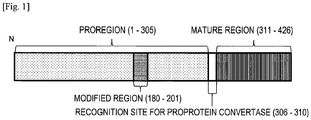
- Pro-activin A is a precursor of mature activin A and is a protein comprising a proregion, a recognition region for a proprotein converting enzyme, and a mature region ( Figure 1 ).
- examples of the amino acid sequence of pro-activin A include, but not limited to, an amino acid sequence set forth in SEQ ID NO: 1 (human), SEQ ID NO: 2 (mouse), and SEQ ID NO: 3 (rat).
- examples of the amino acid sequence of the proregion include, but not limited to, an amino acid sequence set forth in SEQ ID NO: 4 (human), SEQ ID NO: 5 (mouse), and SEQ ID NO: 6 (rat).
- the amino acid sequence of the recognition region for a proprotein converting enzyme is an amino acid sequence set forth in SEQ ID NO: 7, and the amino acid sequence of the mature region (mature activin A) is an amino acid sequence set forth in SEQ ID NO: 8.
- human pro-activin A has GenBank accession number NP_002183.1 and PDB accession number 5HLY.
- Mature activin A is a protein comprising a mature region, the protein being generated when pro-activin A is cleaved by a proprotein converting enzyme (Furin).
- Mature activin A is a homodimer formed by linking 116-amino acid residue ⁇ A chains by a disulfide bond.
- the type of animals from which activin A is derived is not limited.
- the animals include a human, a mouse, a rat, a guinea pig, a rabbit, a cat, a dog, a pig, a monkey, and a cow.
- the animal is a human.
- the amino acid sequences of the mature region of activin A have 100% homology among humans, mice, rats, cats, pigs, and cows.
- the present invention provides activin A that has resistance to degradation by a protease other than a proprotein convertase (Furin).
- a "protease other than a proprotein convertase (Furin)” is not limited, as long as the protease has the activity of degrading (for example, cleaving) activin A.
- the protease in the present invention may be an endogenous protease comprised in a transformant of a host such as a plant, a non-human mammal and a cell derived therefrom, a bacterium, a yeast, and a fungus, or may be an exogenous protease, which is found outside the transformant.
- the protease is preferably an endogenous plant protease or an exogenous plant protease, and more preferably an endogenous plant protease.
- an endogenous plant protease there are abundant proteases having various spectra (ranges) of specificities in a plant body (for example, apoplast) ( Pillary P. et al., Bioengineered, 5: 1, 15-20, 2014 ), and thus, the endogenous plant protease is not limited, as long as the protease has the activity of degrading activin A.
- the phrase "have resistance to degradation by a protease other than a proprotein convertase (Furin)” means that, in particular, when pro-activin A was expressed in a transformant, extracted, and purified as necessary and then the resulting protein was analyzed, the percentage of pro-activin A content relative to the total resulting protein is usually 70% or more, preferably 80% or more, and more preferably 84% or more. This phrase does not necessarily mean that the percentage of the pro-activin A content has to be 100% (not necessarily mean that degradation has to be suppressed by 100%).
- the amount or percentage of pro-activin A content can be measured by Western blotting as described in Examples.
- those skilled in the art can determine whether the modified activin A has resistance to degradation by a protease other than a proprotein convertase (Furin) by measuring the amount or percentage of the pro-activin A content relative to the total protein by Western blotting.
- a protease other than a proprotein convertase Fran
- protease other than a proprotein convertase (Furin) may be expressed as “protease (excluding a proprotein convertase (Furin).”
- a modified proregion is a proregion in which a sequence expected as a loop region is modified, and is preferably a proregion in which, among loop regions in the proregion, at least one sequence expected as a loop region has been deleted.
- the loop region is a part having a loop structure, and more specifically, a part from position 182 to 199 of an amino acid sequence set forth in any of SEQ ID NOs: 4 to 6.
- the amino acid sequence of the modified proregion comprises an amino acid sequence in which at least one amino acid is deleted, substituted and/or added in an amino acid sequence from position 180 to 201 of an amino acid sequence set forth in any of SEQ ID NOs: 4 to 6 (activin A comprising a modified proregion is also referred to herein as "modified activin A").
- the present invention also provides activin A comprising a modified proregion, wherein the amino acid sequence of the modified proregion comprises an amino acid sequence in which at least one amino acid is deleted, substituted and/or added in an amino acid sequence from position 180 to 201 of an amino acid sequence set forth in any of SEQ ID NOs: 4 to 6, and the activin A has resistance to degradation by a protease other than a proprotein convertase (Furin).
- the amino acid sequence of the modified proregion comprises an amino acid sequence in which at least one amino acid is deleted, substituted and/or added in an amino acid sequence from position 180 to 201 of an amino acid sequence set forth in any of SEQ ID NOs: 4 to 6, and the activin A has resistance to degradation by a protease other than a proprotein convertase (Furin).
- amino acid sequence of the modified proregion examples include, but not limited to, the following amino acid sequences (a) to (d):
- amino acid sequence of the modified proregion include, but not limited to, amino acid sequences which are the following amino acid sequences (a) to (d) and wherein activin A comprising the amino acid sequence has resistance to degradation by a protease other than a proprotein convertase (Furin),
- the above described amino acid sequence (a) is the amino acid sequence set forth in any of SEQ ID NO: 9 (human), SEQ ID NO: 10 (mouse), and SEQ ID NO: 11 (rat).
- a "spacer sequence” is an amino acid sequence consisting of 1 to 10 amino acids.
- the amino acid constituting the spacer sequence is at least one selected from glycine, alanine, and serine.
- the spacer sequence may be an amino acid sequence composed of only one type of amino acid, such as only glycine or only alanine; or may be an amino acid sequence composed of two or more types of amino acids, for example: glycine and alanine; glycine and alanine and leucine.
- the number of amino acids in the spacer sequence is 1 to 10, preferably 1 to 5, more preferably 1 to 4, and even more preferably 1 to 3.
- spacer sequence examples include -G-, -GG-, -GGG-, and -GGGG-.
- spacer sequence when a spacer consists of one amino acid residue, "spacer sequence” may also be referred to as "spacer residue.”
- a substructure can be inserted instead of the spacer sequence, provided that the substructure is registered in PDB, has ends whose relative coordinates correspond to the coordinates of an insertion site on activin A, can form a peptide bond, and does not cause a steric hindrance after insertion.
- Examples of the above described amino acid sequence (b) include, but not limited to, an amino acid sequence set forth in any of SEQ ID NO: 12 (human), SEQ ID NO: 13 (mouse), and SEQ ID NO: 14 (rat) that comprises one glycine as the spacer sequence; an amino acid sequence set forth in any of SEQ ID NO: 15 (human), SEQ ID NO: 16 (mouse), and SEQ ID NO: 17 (rat) that comprises two glycines as the spacer sequence; and an amino acid sequence set forth in any of SEQ ID NO: 18 (human), SEQ ID NO: 19 (mouse), and SEQ ID NO: 20 (rat) that comprises three glycines as the spacer sequence.
- a "different amino acid” is not limited as long as the amino acid does not cause a steric hindrance in activin A. Examples thereof include alanine, serine, glycine, valine, leucine, and isoleucine.
- the amino acid to be inserted is not limited as long as the amino acid does not cause a steric hindrance in activin A.
- Examples thereof include alanine, serine, glycine, valine, leucine, and isoleucine.
- amino acid sequence of the modified proregion in addition to the above described amino acid sequence set forth in any of SEQ ID NOs: 9 to 20, the following amino acid sequences can be used as an amino acid sequence of the modified proregion:
- amino acid sequence (f) examples of an amino acid sequence in which one or several amino acids are deleted, substituted or added in set forth in any of SEQ ID NOs: 9 to 20 include the following amino acid sequences:
- examples of the amino acid sequence having 80% or more homology with an amino acid sequence set forth in any of SEQ ID NOs: 9 to 20 include an amino acid sequence having 80% or more, 90% or more, 95% or more, 98% or more, or 99% or more homology with an amino acid sequence set forth in any of SEQ ID NOs: 9 to 20.
- “resistance to degradation by a protease other than a proprotein convertase (Furin)” means the property that makes activin A hard to be degraded by a protease other than a proprotein convertase (Furin).
- the phrase “have resistance to degradation by a protease other than a proprotein convertase (Furin)” in the present invention means that, in particular, when pro-activin A was expressed in a transformant, extracted, and purified as necessary and then the resulting protein was analyzed, the percentage of pro-activin A content relative to the total resulting protein is usually 70% or more, preferably 80% or more, and more preferably 84% or more.
- This phrase does not necessarily mean that the percentage of the pro-activin A content has to be 100% (not necessarily mean that degradation has to be suppressed by 100%).
- Those skill in the art can determine whether a modified activin A has resistance to degradation by a protease other than a proprotein convertase (Furin) by measuring the amount or percentage of the pro-activin A content relative to the total protein by Western blotting, as described in Examples.
- the present invention also provides activin A comprising a modified proregion, wherein the amino acid sequence of the modified proregion comprises an amino acid sequence in which at least one amino acid has been deleted, substituted and/or added in an amino acid sequence from position 180 to 201 of an amino acid sequence set forth in any of SEQ ID NOs: 4 to 6, and wherein the activin A has the activity of inducing differentiation into an erythroblast when cleaved by a proprotein converting enzyme.
- Examples of the amino acid sequence of the modified proregion include, but not limited to, the below described amino acid sequences (a) to (g).
- Examples of the activin A comprising a modified proregion include, but not limited to, the activin A comprising any of the below described amino acid sequences (a) to (g) and having the activity of inducing differentiation into an erythroblast when cleaved by a proprotein converting enzyme.
- a proprotein converting enzyme has the activity of inducing differentiation of any erythroblastic cultured cell (for example, a F5-5 cell and a K562 cell) into an erythroblast.
- test activin A a test polypeptide
- AEC aminoethylcarbazole
- examples of the amino acid sequence of activin A comprising a modified proregion include, but not limited to, amino acid sequences of activin A comprising each of the amino acid sequences set forth in SEQ ID NOs: 9 to 20 (amino acid sequences set forth in SEQ ID NOs: 21 to 32).
- the conformation of activin A with modification can be analyzed and simulated by using molecular visualization software that displays the structure of a protein in a 3D image based on data in PDB or the like.
- molecular visualization software that displays the structure of a protein in a 3D image based on data in PDB or the like.
- Examples of such software include Chimera and PyMOL.
- the above amino acid sequence (a) in which the amino acid sequence from position 182 to 199 has been deleted and no spacer sequence has been inserted, can be subjected to simulation based on an in silico analysis using Chimera to find out whether a steric hindrance occurs.
- the above software can be used to search for the type and number of amino acids or amino acid sequence candidates that constitute the spacer sequence.
- amino acid sequences (c) and (d) can be subjected to simulation to find out whether a steric hindrance or the like occurs when substitution or insertion by a different amino acid was introduced in the amino acid sequence from position 182 to 199.
- those skilled in the art can select appropriately an amino acid residue that causes no steric hindrance when being deleted, substituted and/or added in activin A by using such molecular visualization software.
- amino acids polar/non-polar, acidic/basic, hydrophilic/ hydrophobic, side chain size, and the like.
- Those skilled in the art can appropriately select an amino acid to be deleted, substituted, and/or added on the basis of these properties. Substitution between amino acids that have similar structures or properties is predicted to be hard to substantially inhibit the biological activity of a polypeptide.
- the nucleotide sequence of a polynucleotide of the present invention is not limited as long as the sequence is DNA or RNA encoding a modified activin A of the present invention.
- Those skilled in the art can optimize codons for the polynucleotide depending on the type of host in which activin A is expressed. This optimization can improve the amount of the modified activin A expressed in the host.
- Examples of the polynucleotide encoding the modified activin A of the present invention include, but not limited to, a polynucleotide comprising or consisting of a nucleotide sequence set forth in any of SEQ ID NOs: 33 to 36 (all thereof are human nucleotide sequences).
- a polynucleotide described below can be used as the polynucleotide of the present invention.
- a polynucleotide is a polynucleotide that hybridizes with a polynucleotide consisting of a nucleotide sequence complementary to a nucleotide sequence set forth in any of SEQ ID NOs: 33 to 36 under stringent conditions and encodes activin A having resistance to degradation by a protease other than a proprotein convertase (Furin).
- a "stringent condition” may be either a low stringency condition, a moderate stringency condition, or a high stringency condition.
- a “low stringency condition” is, for example, the following condition: 5 ⁇ SSC, 5 ⁇ Denhardt's solution, 0.5% SDS, 50% formamide, and 32°C.
- a “medium stringency condition” is, for example, the following condition: 5 ⁇ SSC, 5 ⁇ Denhardt's solution, 0.5% SDS, 50% formamide, and 42°C.
- a “high stringency condition” is, for example, the following condition: 5 ⁇ SSC, 5 ⁇ Denhardt's solution, 0.5% SDS, 50% formamide, and 50°C.
- a polynucleotide that has 50% or more, 60% or more, 70% or more, 80% or more, 90% or more, 95% or more, 98% or more, or 99% or more homology with the nucleotide sequence set forth in any of SEQ ID NOs: 33 to 36, and encodes activin A having resistance to degradation by a protease other than a proprotein convertase (Furin) can also be used.
- Methods for introducing a mutation into a polynucleotide are known.
- those skilled in the art can introduce a mutation into the polynucleotide of the present invention by using a known method including a site-directed mutagenesis strategy such as the Kunkel method and the Gapped duplex method, the overlap extension PCR method and the QuikChange method.
- the amino acid sequence of activin A can be modified by introducing a mutation into the polynucleotide of the present invention.
- an affinity tag can be added to activin A for affinity-purifying activin A.
- affinity tags include, but not limited to, a histidine tag (an amino acid sequence consisting of contiguous histidine residues), a GST tag, a FLAG tag, and a c-myc tag.
- Methods for adding a histidine tag are known and those skilled in the art can readily add a histidine tag to the N-terminus of the activin A of the present invention by using a known method.
- One example of the amino acid sequences of activin A with a histidine tag added to the N-terminus thereof is set forth in SEQ ID NO: 37.
- a signal sequence can also be added to activin A.
- the signal sequence include a KDEL signal.
- Methods for adding a signal sequence are known.
- a sequence optimized for expression thereof in a plant cell can be used.
- a "vector” is not limited as long as the vector comprises the polynucleotide of the present invention described in the above (1).
- a plasmid vector, a viral vector, an Agrobacterium bacterium, or the like can be used.
- a plant viral vector, an Agrobacterium bacterium, or the like can be used as the vector.
- a TMV-based vector, a PVX-based vector, a CPMV-based vector, a CMV-based vector, a PPV-based vector, an AIMV-based vector, a ZYMV-based vector, or the like can be used.
- the vector used in the present invention may be either a vector for transient expression or a vector for constitutive expression. Those skilled in the art can appropriately select a vector to be used depending on the type of host into which the vector is introduced and the purpose.
- an additional sequence may be linked to the polynucleotide of the present invention, as desired.
- the additional sequence include a cis element such as an enhancer, a splicing signal, a poly(A) addition signal, a ribosome binding sequence (SD sequence), a selective marker gene, and a reporter gene.
- the selective marker gene include a dihydrofolate reductase gene, an ampicillin-resistant gene, and a neomycin-resistant gene.
- the reporter gene include genes for green fluorescent protein (GFP) or variants thereof (fluorescent proteins such as EGFP, BFP, and YFP), luciferase, alkaline phosphatase, and LacZ.
- a transformant can be obtained by introducing the vector described in the above (2) into a host.
- a "transformant" is a non-human transformant.
- a "host” is an organism into which the vector of the present invention is introduced and in which a modified activin A of interest is expressed.
- the host is not limited as long as the host expresses the modified activin A of the present invention.
- a plant, a non-human mammal and a cell derived therefrom, a bacterium, a yeast, a fungus, or the like can be used, and a plant is preferred.
- Examples of the plant include a Nicotiana plant, a moss plant (for example, Physcomitrella patens (P. patens)), a potato (for example, S. tuberosum), a gramineous plant (for example, O. sativa), a cruciferous plant, and lettuce; and a Nicotiana plant is preferred.
- Examples of the Nicotiana plant include, but not limited to, Nicotiana benthamiana (N. benthamiana), Nicotiana tabacum (N. tabacum), and Nicotiana excelsior (N. excelsior).
- non-human mammal examples include, but not limited to, a mouse, a rat, a guinea pig, a rabbit, a cat, a dog, a pig, a monkey, and a cow, and a cell derived therefrom.
- examples of the bacterium include, but not limited to, E. coli.
- Introduction of a vector into a host can be performed by using a known method.
- the known gene introduction method include a method using a viral vector, an agroinfection method, a calcium phosphate method, a microinjection method, a particle gun method, a DEAE-dextran method, electroporation, and a cationic lipid-mediated method.
- the host is a plant
- the method using a viral plant vector and the agroinfection method are preferred.
- the vectors that can be used in these methods are as described in the above (2) as "a vector when a plant is used as a host.”
- the plant when a plant is used as a host, the plant is cultivated before transformation.
- a method for cultivating plants is as described below.
- seeds are sown on a seedling tray supplemented with a fertilizer, and the plant after sowing is grown for several days in an artificial climate chamber with a controlled light cycle.
- a liquid fertilizer is used as the fertilizer
- a urethane mat for hydroponics can be impregnated with the liquid fertilizer, and then placed in the seedling tray.
- the grown plant body is transplanted to a panel for cultivation (first period), the panel after transplantation is placed in the artificial climate chamber, and cultivation is performed for several days by, for example, a deep flow technique (DFT system).
- DFT system deep flow technique
- the plant body is taken out from the panel for cultivation (first period) and planted on a panel for cultivation (second period).
- the panel for cultivation (second period) after transplantation is placed in the artificial climate chamber and cultivation is performed for several days by the DFT system to obtain the plant body.
- a liquid fertilizer can be used as the fertilizer, but the fertilizer is not limited thereto.
- the urethane mat for hydroponics can be impregnated with the liquid fertilizer, and then placed in the seedling tray.
- liquid fertilizers are not limited, and commercially available liquid fertilizers can be used in appropriate combinations.
- the liquid fertilizer can be dissolved in dechlorinated water.
- the electric conductivity and pH of the liquid fertilizer can be adjusted before use. Those skilled in the art can adjust these by a known method.
- examples of the environmental condition include, but not limited to, a condition with a temperature of 10 to 40°C (for example, 28°C), a relative humidity of 60 to 80%, a CO 2 concentration of 300 to 5000 ppm (for example, 400 ppm or 500 ppm), and the number of days of cultivation for the first period of 0 to 35 days (for example, 9 days) and that for the second period of 0 to 35 days (for example, 7 days).
- a condition with a temperature of 10 to 40°C for example, 28°C
- a relative humidity of 60 to 80% for example, a CO 2 concentration of 300 to 5000 ppm (for example, 400 ppm or 500 ppm)
- the number of days of cultivation for the first period of 0 to 35 days for example, 9 days
- that for the second period of 0 to 35 days for example, 7 days.
- Those skilled in the art can adjust these parameters as appropriate depending on, for example, the growth status of the plant.
- the deep flow technique DFT system
- NFT system a nutrient film technique
- the method using a plant viral vector and the agroinfection method can be used. These methods are well known to those skilled in the art. By way of example, a brief description of the agroinfection method is as follows.
- the vector of the present invention described in the above (2) is introduced into an Agrobacterium bacterium by electroporation, thereby transforming the Agrobacterium bacterium.
- Agrobacterium bacterium that can be used in the present invention include, but not limited to, the GV3101 strain, the LBA4404 strain, the EHA101 strain, the EHA105 strain, and the AGL1 strain.
- plant leaves or the like are infected with the transformed Agrobacterium bacterium.
- methods for infecting a plant with an Agrobacterium bacterium include a vacuum infiltration method, a syringe infiltration method, a leaf disc method, and a foliar application method.
- An exemplary procedure for using the vacuum infiltration method is as follows. First, the cultivated plant is turned upside down and immersed in the bacterial suspension of Agrobacterium bacteria in a beaker such that all the leaves are completely immersed in the suspension. Subsequently, the beaker is placed in a vacuum desiccator and allowed to stand for several minutes (for example, one minute) under reduced pressure. Then, the valve is fully opened to restore pressure.
- the plant After completing pressure restoration, the plant is returned to an upright position and planted in the artificial climate chamber. After infection, the plant is cultivated for 1 to 14 days (for example, 6 days) in the artificial climate chamber by, for example, the DFT system.
- the environmental condition is similar to that described above, and those skilled in the art can adjust these parameters as appropriate depending on, for example, the growth status of the plant.
- Agrobacterium bacteria comprising a vector other than the vector of the present invention may be used in combination.
- examples of such vector include a vector comprising a signal peptide of a barley ⁇ -amylase or a rice ⁇ -amylase, and a PhiC31 integrase expression vector.
- Transformants from other hosts can also be generated readily by those skilled in the art by a known method described in, for example, " Molecular Cloning, A Laboratory Manual (4th edition)” (Cold Spring Harbor Laboratory Press (2012 )).
- activin A can be produced by recovering activin A from the transformant of the present invention described in the above section 3. Furthermore, in the method of the present invention, a mature region of activin A in which a proregion is removed (mature activin A) can be obtained by purifying the recovered activin A (pro-activin A) and treating the purified pro-activin A with a proprotein convertase (for example, Furin).
- a proprotein convertase for example, Furin
- the type of transformant used in the method for producing activin A is not limited.
- the method for producing activin A is as described below.
- leaves are collected from the transformed plant body that was cultivated for 1 to 14 days (for example, 6 days) after infection with Agrobacterium bacterium, and activin A (pro-activin A) is extracted by using an extraction buffer.
- the quantity of leaves of the plant body to be collected depends on the type of plant body.
- the leaves can be frozen and stored at -80°C before extraction.
- the extraction buffer include, but not limited to, phosphate buffer, Tris buffer, and acetate buffer.
- the pH is usually adjusted to a range between pH 2 and 11, including the range in which the above described buffers work properly.
- activin A comprised in the extract is purified.
- Purification can be performed by using conventional methods alone or in appropriate combinations.
- the conventional methods are, for example, aqueous two-phase partition, ammonium sulfate fractionation, affinity chromatography, ion exchange chromatography, gel filtration chromatography, hydrophobic chromatography, or reverse-phase chromatography.
- mature activin A in which a proregion is removed (mature activin A) can be obtained by treating the purified pro-activin A with a proprotein convertase (Furin).
- Furin proprotein convertase
- the activity of the obtained mature activin A can be evaluated, for example by cultivating a F5-5 cell line (Friend erythroblastic leukemia cell line) in a culture medium supplemented with the mature activin A, then staining the cells with AEC (aminoethylcarbazole), and measuring the ED 50 value (indicating the concentration of mature activin A at which the differentiation rate is 50%) of the mature activin A for the differentiation rate.
- F5-5 cell line Friend erythroblastic leukemia cell line
- AEC aminoethylcarbazole
- composition Comprising Activin A
- the present invention can provide a composition comprising a modified activin A of the present invention.
- the composition of the present invention may comprise known additives such as saline, buffer, and an excipient, in addition to the modified activin A.
- pro-activin A which was transiently expressed by a plant
- a plurality of unexpected degradation products was found.
- a plurality of sequences to induce site-specific mutations was designed and mutations were induced by using QuikChange (Agilent Technologies, Inc.).
- the mutated protein was overexpressed and examined in the same way as the above described original sequence. As a result, it was confirmed that the degradation was reduced in more than one sequences.
- the sequences were a sequence from which Pro182-Gly192 was removed.
- the Pro182-Gly192 was predicted to be a loop region of the prodomain.
- the modified activin A was produced by a below described method.
- a vector for expressing pro-activin A in which a histidine tag (HHHHHH) was added to the N-terminus thereof was generated as described below.
- a gene encoding pro-activin A in which a histidine tag was added to the N-terminus thereof was inserted into a Bsa I site of a tobacco mosaic virus (TMV) 3'-provector (pICH31070, NOMAD Bioscience GmbH) by Golden Gate cloning method (Engler et al., 2008), thereby generating a pN-His-Pro-activin.
- TMV tobacco mosaic virus
- a TMV 3'-provector that expresses a gene encoding a modified pro-activin A was generated as described below.
- PCR was carried out by using QuikChange Lightning Kit (Agilent Technologies, Inc.) with the pN-His-Pro-activin as a template and the following primers for mutation introduction, thereby generating a pMut3-1.
- Nicotiana benthamiana which is a Nicotiana plant, was used as a host plant.
- a urethane mat for hydroponics (Ematsu Kasei; (W)587.5 mm ⁇ (D)282 mm ⁇ (H)28 mm; 12 ⁇ 2 blocks; hole diameter ( ⁇ ): 9 mm) was impregnated with a liquid fertilizer for sowing (0.78 g/L Otsuka House No. S1 (Otsuka AgriTechno Co., Ltd.) and 0.25 g/L Otsuka House No. 2 (Otsuka AgriTechno Co., Ltd.); pH 5.0) and placed in a seedling tray ((W)600 mm ⁇ (D)300 mm ⁇ (H)300 mm). Then, seeds of Nicotiana benthamiana were sown on the mat.
- a liquid fertilizer for sowing (0.78 g/L Otsuka House No. S1 (Otsuka AgriTechno Co., Ltd.) and 0.25 g/L Otsuka House No
- NC-410HC Natural climate chamber
- the urethane mat used for raising seedlings was divided into each block and transplanted to a panel for cultivation (first period) ((W)600 mm ⁇ (D)300 mm, 30 holes).
- the panel for cultivation (first period) after transplantation was placed in the artificial climate chamber (LH-410SP) (Nippon Medical & Chemical Instruments Co., Ltd.) and cultivation was performed for 9 days by a deep flow technique (DFT system).
- LH-410SP artificial climate chamber
- DFT system deep flow technique
- Fertilizer liquid A 150 g/L Otsuka House No. S1 and 2.5 g/L Otsuka House No. 5 (Otsuka AgriTechno Co., Ltd.)) and fertilizer liquid B (100 g/L Otsuka House No. 2) were dissolved individually in dechlorinated water and these solutions were mixed in equal proportions. The resulting mixture was used as the liquid fertilizer.
- a pH adjuster "Down" (Otsuka AgriTechno Co., Ltd.) and 4% aqueous KOH solution were used to adjust pH.
- the electrical conductivity (EC) and the pH of the liquid fertilizer were adjusted to an EC of 2.3 mS/cm and pH 6.0, respectively, by using "Easy Fertilizer Controller RAKU-RAKU 3" (CEM Corporation).
- the plant body was taken out from the panel for cultivation (first period) and planted on a panel for cultivation (second period) ((W)600 mm ⁇ (D)300 mm, 6 holes).
- the panel for cultivation (second period) after transplantation was placed in the artificial climate chamber (LH-410SP) (Nippon Medical & Chemical Instruments Co., Ltd.) and cultivation was performed for 7 days by the DFT system (for 28 days after sowing).
- Environmental conditions were controlled as described below.
- the vectors of the present invention generated in the above "1.” were individually introduced into an Agrobacterium GV3101 strain by electroporation. Then, agroinfiltration was used to coinfect Nicotiana benthamiana with each of the obtained GV3101 strains: a GV3101 strain carrying a 5'-provector comprising a signal peptide of rice ⁇ -amylase (pICH20155, NOMAD Bioscience GmbH) and a GV3101 strain carrying a PhiC31 integrase expression vector (pICH14011, NOMAD Bioscience GmbH).
- the Nicotiana benthamiana obtained on Day 28 after sowing in the above section "2.(1)" was turned upside down and immersed in the bacterial suspension of Agrobacterium bacteria in a beaker such that all the leaves were completely submerged in the suspension.
- the beaker was placed in a vacuum desiccator (FV-3P) (Tokyo Glass Kikai Co., Ltd.) and allowed to stand for one minute under reduced pressure at -0.09 MPa. Then, the valve was fully opened to restore pressure.
- V-3P vacuum desiccator
- Cultivation after infection was performed by using the artificial climate chamber (LH-410SP) (Nippon Medical & Chemical Instruments Co., Ltd.). Cultivation was performed for six days by the DFT system. Environmental conditions were controlled as described below.
- Tobacco leaves were harvested from the transformed Nicotiana benthamiana six days after infection. The leaves were frozen and stored at -80°C until extraction.
- a buffer comprising 0.1 M sodium phosphate, 0.5 M arginine, and 5 mM sodium sulfite, pH 8.0 (or a phosphate buffer) was used as an extraction buffer.
- Ammonium sulfate was added to the supernatant collected by the above described method to produce a 35% saturated ammonium sulfate solution. After stirring the mixture at room temperature for one hour, the mixture was centrifuged at 15,000 ⁇ g for 15 minutes at room temperature to collect the supernatant of 35% ammonium sulfate fractionation. Subsequently, ammonium sulfate was added thereto to produce a 60% saturated ammonium sulfate solution and stirred at room temperature for one hour. This solution was centrifuged at 15,000 ⁇ g for 15 minutes to collect precipitates of the 60 to 90% ammonium sulfate fractionation.
- a proprotein convertase (Furin) was added to the modified pro-activin A obtained by the above described method (Mut3-1, Mut3-2, Mut3-3, and Mut3-4 (comprising the amino acid sequences of SEQ ID NOs: 9, 12, 15, and 18, respectively)) under conditions of 25 mM Tris-HCl, pH 8.0, 10% glycerol, and 1 mM CaCl 2 to obtain a mature activin A.
- activin A in which an amino acid sequence of a proregion was modified (a modified pro-activin A and a mature activin A) was successfully produced.
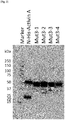
- the purified modified pro-activin A obtained in "3. Production of Modified Pro-activin A" of Example 2 was analyzed by Western blotting to determine how a plant endogenous protease degraded the protein. Specifically, Penta-His Antibody HRP Conjugate (QIAGEN) was used as an antibody and the samples comprising each modified pro-activin A were subjected to Western blotting. LumiGLO Reagent and Peroxide (Cell Signaling Technology, Inc.) was used as a luminescent reagent and was detected by ImageQuant LAS 500 (GE Healthcare). The obtained Western blotting image is shown in Figure 2 .
- Wild-type Activin A (N-His-Activin A in the figure) (SEQ ID NO: 37) was used as a control. Densitometric analysis was also performed by using analysis software ImageJ and the results are shown in Table 1.
- “other polypeptides” are peptides resulting from degradation of the expressed proteins by the plant endogenous protease.
- modified activin A of the present invention had the property of being hard to be degraded by a protease (resistance to degradation by a protease).
- modified activin A of the present invention was extremely useful in producing activin A in the presence of a protease, which is present in a host for expression, in a purification step, in a reagent and/or culture medium to be used, and the like. The reason for this is that the modified activin A of the present invention allows for improving the amount of expression thereof and/or the yield thereof compared to the nonmodified activin A.
- the activity of the mature activin A obtained in "4. Production of Mature Activin A" of Example 2 was evaluated. F5-5 cells cultured in an incubator (37°C, 5% CO 2 ) were seeded in a 96 well plate and cultured in the incubator after adding each mature activin A. Then, the differentiation rate of the cells was determined by staining the cells with AEC (aminoethylcarbazole, Tokyo Chemical Industry Co., Ltd.), according to the method described in Non Patent Literature 5 ( Koretz K. et al., Histochemistry, 86: 5, 471-8, 1987 ).
- AEC aminoethylcarbazole
- Table 2 shows the ED 50 value of the mature activin A derived from the wild type activin A (N-His-Activin A) and the mature activin A derived from the modified activin A (Mut3-1 to Mut3-4). [Table 2] Expressed protein ED 50 ng/mL N-His-Activin A ⁇ 5 Mut3-1 ⁇ 5 Mut3-2 ⁇ 5 Mut3-3 ⁇ 5 Mut3-4 ⁇ 5
- the ED 50 values of the mature activin A derived from the modified activin A were all less than 5 ng/mL, which were comparable to those of the mature activin A derived from the wild-type activin A ("N-His-Activin A" in Table 2).
- modified activin A of the present invention allows for improving the yield of activin A in producing the same in the presence of a protease.
Landscapes
- Health & Medical Sciences (AREA)
- Life Sciences & Earth Sciences (AREA)
- Genetics & Genomics (AREA)
- Chemical & Material Sciences (AREA)
- Organic Chemistry (AREA)
- Engineering & Computer Science (AREA)
- Zoology (AREA)
- Molecular Biology (AREA)
- Wood Science & Technology (AREA)
- Bioinformatics & Cheminformatics (AREA)
- General Engineering & Computer Science (AREA)
- General Health & Medical Sciences (AREA)
- Biochemistry (AREA)
- Biotechnology (AREA)
- Biomedical Technology (AREA)
- Medicinal Chemistry (AREA)
- Biophysics (AREA)
- Microbiology (AREA)
- Proteomics, Peptides & Aminoacids (AREA)
- Gastroenterology & Hepatology (AREA)
- Cell Biology (AREA)
- Physics & Mathematics (AREA)
- Pharmacology & Pharmacy (AREA)
- Plant Pathology (AREA)
- Toxicology (AREA)
- Physiology (AREA)
- General Chemical & Material Sciences (AREA)
- Chemical Kinetics & Catalysis (AREA)
- Botany (AREA)
- Developmental Biology & Embryology (AREA)
- Environmental Sciences (AREA)
- Peptides Or Proteins (AREA)
- Breeding Of Plants And Reproduction By Means Of Culturing (AREA)
- Preparation Of Compounds By Using Micro-Organisms (AREA)
- Medicines That Contain Protein Lipid Enzymes And Other Medicines (AREA)
- Micro-Organisms Or Cultivation Processes Thereof (AREA)
Abstract
Description
- The present invention relates to activin A comprising a modified amino acid sequence.
- Activin A is a cytokine belonging to the TGFβ (transforming growth factor-β) superfamily. Activin A is a physiologically and industrially useful protein that is involved in development and differentiation as an erythroid differentiation factor and a mesoderm-inducing factor and regulates diverse functions in various cells.
- Examples of known methods for producing protein include a production method by transiently expressing a protein of interest in a plant (Non Patent Literature 1: Sainsbury et al., Curr. Opin. Plant Biol., 19, 1-7, 2014) and a method of expressing a target protein in apoplast (Patent Literature 1:
JP Laid-Open Publication No. 2005-501558 - However, it has been reported that when a target protein is expressed in a plant, the expressed target protein is degraded by an endogenous plant protease, causing the problem of a reduced yield (Non Patent Literature 2: Mandal MK. et al., Front Plant Sci., 7, 267, 2015). In particular, there are abundant proteases having various spectra (ranges) of specificities in apoplast (Non Patent Literature 3: Pillary P. et al., Bioengineered, 5: 1, 15-20, 2014). Furthermore, the site of the target protein recognized by a protease varies depending on the type of protein, and thus, it is difficult to predict the site. Known methods to address these problems include a method of changing protein localization by using a protein sorting signal and a method of coexpressing a protease inhibitor in a plant (Non Patent Literature 2 and Non Patent Literature 3).
- Some conformations of activin A have been reported (Non Patent Literature 4: Wang X. et al., Nat. Commun. 2016 Jul 4; 7: 12052). The structural information about the site recognized by a protease other than a proprotein convertase (Furin) is unknown.
- [Patent Literature 1]
JP Laid-Open Publication No. 2005-501558 -
- [Non Patent Literature 1] Sainsbury et al., Curr. Opin. Plant Biol., 19, 1-7, 2014
- [Non Patent Literature 2] Mandal MK. et al., Front Plant Sci., 7, 267, 2015
- [Non Patent Literature 3] Pillary P. etal., Bioengineered, 5: 1, 15-20, 2014
- [Non Patent Literature 4] Wang X. et al., Nat. Commun. 2016 Jul 4;7: 12052
- [Non Patent Literature 5] Koretz K. et al., Histochemistry, 86: 5, 471-8, 1987
- As for activin A, conventionally known methods have not yet solved the problem of degradation by a protease other than a proprotein convertase (Furin) (hereinafter, may be simply referred to as "protease"). Accordingly, a novel activin A that is hard to be degraded by the above described protease (has resistance to degradation by the above described protease) is needed.
- The present inventors conducted dedicated research to solve the above described problems and have found an unknown recognition site for proteases on activin A. Furthermore, the present inventors modified the amino acid sequence of a proregion of activin A, thereby successfully generating a modified activin A that is hard to be degraded by the protease, and thus, have accomplished the present invention.
- Specifically, embodiments of the present invention are as follows:
- (1) Activin A having resistance to degradation by a protease other than a proprotein convertase (Furin).
- (2) The activin A according to the above described (1), wherein the protease other than a proprotein convertase (Furin) is an endogenous plant protease.
- (3) The activin A according to the above described (1) or (2), wherein the activin A comprises a modified proregion.
- (4) The activin A according to the above described (3), wherein the amino acid sequence of the modified proregion comprises an amino acid sequence in which at least one amino acid is deleted, substituted and/or added in an amino acid sequence from
position 180 to 201 of an amino acid sequence set forth in any of SEQ ID NOs: 4 to 6. - (5) Activin A comprising a modified proregion, wherein the amino acid sequence of the modified proregion comprises an amino acid sequence in which at least one amino acid is deleted, substituted and/or added in the amino acid sequence from
position 180 to 201 of an amino acid sequence set forth in any of SEQ ID NOs: 4 to 6. - (6) The activin A according to the above described (5), wherein the amino acid sequence of the modified proregion comprises any amino acid sequence selected from the following (a) to (d):
- (a) an amino acid sequence in which an amino acid sequence from position 182 to 199 of an amino acid sequence set forth in any of SEQ ID NOs: 4 to 6 is deleted;
- (b) an amino acid sequence in which an amino acid sequence from position 182 to 199 of an amino acid sequence set forth in any of SEQ ID NOs: 4 to 6 is substituted with a spacer sequence consisting of 1 to 10 amino acids;
- (c) an amino acid sequence in which at least one of amino acids from position 182 to 199 of an amino acid sequence set forth in any of SEQ ID NOs: 4 to 6 is substituted with a different amino acid; and
- (d) an amino acid sequence in which an amino acid sequence from
position 180 to 201 of an amino acid sequence set forth in any of SEQ ID NOs: 4 to 6 has at least one amino acid inserted therein.
- (7) The activin A according to the above described (6), wherein the amino acid constituting the spacer sequence in the above (b) is at least one amino acid selected from glycine, alanine, and serine.
- (8) The activin A according to the above described (6), wherein the different amino acid in the above (c) is one selected from alanine, serine, glycine, valine, leucine, and isoleucine.
- (9) The activin A according to any of the above described (5) to (8), wherein the activin A has resistance to degradation by a protease other than a proprotein convertase (Furin). Herein, the protease other than a proprotein convertase (Furin) is, for example, an endogenous plant protease.
- (10) The activin A according to the above described (5), wherein the amino acid sequence of the modified proregion comprises any of amino acid sequences selected from the following (e) to (g):
- (e) an amino acid sequence set forth in any of SEQ ID NOs: 9 to 20;
- (f) an amino acid sequence in which one or several amino acids are deleted, substituted or added in an amino acid sequence set forth in any of SEQ ID NOs: 9 to 20, and activin A comprising the amino acid sequence has resistance to degradation by a protease other than a proprotein convertase (Furin); and
- (g) an amino acid sequence having 80% or more homology with an amino acid sequence set forth in any of SEQ ID NOs: 9 to 20, and activin A comprising the amino acid sequence has resistance to degradation by a protease other than a proprotein convertase (Furin).
- (11) A polynucleotide encoding the activin A according to any of the above described (1) to (10).
- (12) A vector comprising the polynucleotide according to the above described (11).
- (13) A transformant expressing the activin A according to any of the above described (1) to (10).
- (14) The transformant according to the above described (13), wherein the transformant is a plant.
- (15) The transformant according to the above described (14), wherein the transformant expresses the activin A in apoplast.
- (16) A method for producing activin A, comprising the step of recovering the activin A expressed in the transformant according to any of the above described (13) to (15).
- (17) A method for producing activin A, comprising the following steps:
- (a) recovering the activin A expressed in the transformant according to any of the above described (13) to (15); and
- (b) treating the obtained activin A with a proprotein convertase.
- The modified activin A of the present invention allows for improving the yield of activin A in producing the activin A in the presence of the protease other than a proprotein convertase (Furin) (for example, in planta), compared to a wild type activin A that is not modified.
-
- [
Figure 1] Figure 1 is a schematic figure showing the structure of a human activin A. - [
Figure 2] Figure 2 is an image demonstrating that degradation of a modified activin A by proteases was suppressed. - Hereinbelow, the present invention will be described in detail. The following embodiment is illustrated to describe the present invention and is not intended to limit the present invention to this embodiment. The present invention may be carried out in various modes without departing from the spirits of the present invention. This specification also encompasses the contents described in the specification and drawings of the Japanese patent application (
Japanese Patent Application No. 2018-214630) filed on November 15, 2018 - Activin A is a cytokine belonging to the TGFβ superfamily. Activin A is a physiologically and industrially useful protein that is involved in development and differentiation as an erythroid differentiation factor and a mesoderm-inducing factor and regulates diverse functions in various cells.
- An exemplary method for producing a target protein is a method of producing the protein by transiently expressing the same in a plant. However, it has been reported that when a target protein is expressed in a plant, the expressed target protein is degraded by a protease other than a proprotein convertase (Furin) (for example, an endogenous plant protease), causing the problem of a reduced yield. In particular, the abundance of endogenous proteases in apoplast is a major obstacle to expression of the target protein in the apoplast. Furthermore, the site of the target protein recognized by a protease varies depending on the type of protein, and thus, it is difficult to predict the site.
- To address these problems, a method of changing protein localization by using a protein sorting signal and a method of coexpressing a protease inhibitor in a plant have been used in the conventional art. However, the problem of degradation by a protease still remains unsolved for activin A.
- Under such circumstances, the present inventors have found an unknown recognition site for proteases on activin A; and modified the amino acid sequence of a proregion (also referred to herein as "prodomain") of activin A, thereby successfully generating a modified activin A that is hard to be degraded by a protease other than a proprotein convertase (Furin) (has resistance to degradation by the protease). Thus, the present inventors have accomplished the present invention. The present invention provides a modified activin A that is hard to be degraded by the protease, by modifying the amino acid sequence of the proregion of activin A. The present inventors have found that activin A becomes hard to be degraded by the protease by modifying an amino acid sequence of a proregion of the activin A without modifying an amino acid sequence of a mature region of the activin A that is physiologically active.
- The modified activin A of the present invention allows for improving the yield of activin A in producing the activin A in the presence of the protease other than a proprotein convertase (Furin) (for example, in planta), compared to an unmodified wild type activin A. In this respect, the modified activin A of the present invention is highly useful.
- Activin A is a cytokine belonging to the TGFβ (transforming growth factor-β) superfamily. Activin A is a protein that is involved in development and differentiation as an erythroid differentiation factor and a mesoderm-inducing factor and regulates diverse functions in various cells.
- The present invention provides activin A that is hard to be degraded by a protease other than a proprotein convertase (Furin) (has resistance to degradation by the above protease), by modifying the amino acid sequence of a proregion of activin A. Such activin A allows for improving the yield of activin A in producing the same in the presence of the protease, compared to a wild type activin A that is unmodified.
- In the present invention, "activin A" refers to both or either one of pro-activin A and mature activin A. As the term "activin A" is used in the present invention, activin A may be a mixture of pro-activin A and mature activin A or may be either protein. Pro-activin A is a precursor of mature activin A and is a protein comprising a proregion, a recognition region for a proprotein converting enzyme, and a mature region (
Figure 1 ). - In the present invention, examples of the amino acid sequence of pro-activin A include, but not limited to, an amino acid sequence set forth in SEQ ID NO: 1 (human), SEQ ID NO: 2 (mouse), and SEQ ID NO: 3 (rat). In the present invention, examples of the amino acid sequence of the proregion include, but not limited to, an amino acid sequence set forth in SEQ ID NO: 4 (human), SEQ ID NO: 5 (mouse), and SEQ ID NO: 6 (rat). The amino acid sequence of the recognition region for a proprotein converting enzyme is an amino acid sequence set forth in SEQ ID NO: 7, and the amino acid sequence of the mature region (mature activin A) is an amino acid sequence set forth in SEQ ID NO: 8. Those skilled in the art can readily obtain these amino acid sequences and conformational information from known databases such as GenBank and UniProt Protein Data Bank (PDB). For example, human pro-activin A has GenBank accession number NP_002183.1 and PDB accession number 5HLY.
- Mature activin A is a protein comprising a mature region, the protein being generated when pro-activin A is cleaved by a proprotein converting enzyme (Furin). Mature activin A is a homodimer formed by linking 116-amino acid residue βA chains by a disulfide bond.
- In the present invention, the type of animals from which activin A is derived is not limited. Examples of the animals include a human, a mouse, a rat, a guinea pig, a rabbit, a cat, a dog, a pig, a monkey, and a cow. Preferably, the animal is a human. The amino acid sequences of the mature region of activin A have 100% homology among humans, mice, rats, cats, pigs, and cows.
- The present invention provides activin A that has resistance to degradation by a protease other than a proprotein convertase (Furin). In the present invention, a "protease other than a proprotein convertase (Furin)" is not limited, as long as the protease has the activity of degrading (for example, cleaving) activin A. The protease in the present invention may be an endogenous protease comprised in a transformant of a host such as a plant, a non-human mammal and a cell derived therefrom, a bacterium, a yeast, and a fungus, or may be an exogenous protease, which is found outside the transformant. The protease is preferably an endogenous plant protease or an exogenous plant protease, and more preferably an endogenous plant protease. Specifically, there are abundant proteases having various spectra (ranges) of specificities in a plant body (for example, apoplast) (Pillary P. et al., Bioengineered, 5: 1, 15-20, 2014), and thus, the endogenous plant protease is not limited, as long as the protease has the activity of degrading activin A.
- Those skilled in the art can determine whether a specific protease has the activity of degrading activin A by using a known method such as SDS-PAGE and Western blotting.
- In the present invention, the phrase "have resistance to degradation by a protease other than a proprotein convertase (Furin)" means that, in particular, when pro-activin A was expressed in a transformant, extracted, and purified as necessary and then the resulting protein was analyzed, the percentage of pro-activin A content relative to the total resulting protein is usually 70% or more, preferably 80% or more, and more preferably 84% or more. This phrase does not necessarily mean that the percentage of the pro-activin A content has to be 100% (not necessarily mean that degradation has to be suppressed by 100%). The amount or percentage of pro-activin A content can be measured by Western blotting as described in Examples. Thus, those skilled in the art can determine whether the modified activin A has resistance to degradation by a protease other than a proprotein convertase (Furin) by measuring the amount or percentage of the pro-activin A content relative to the total protein by Western blotting.
- In the present invention, "protease other than a proprotein convertase (Furin)" may be expressed as "protease (excluding a proprotein convertase (Furin)."
- One embodiment of the present invention is activin A comprising a modified proregion. A modified proregion is a proregion in which a sequence expected as a loop region is modified, and is preferably a proregion in which, among loop regions in the proregion, at least one sequence expected as a loop region has been deleted. Herein, the loop region is a part having a loop structure, and more specifically, a part from position 182 to 199 of an amino acid sequence set forth in any of SEQ ID NOs: 4 to 6.
- In the present invention, the amino acid sequence of the modified proregion comprises an amino acid sequence in which at least one amino acid is deleted, substituted and/or added in an amino acid sequence from
position 180 to 201 of an amino acid sequence set forth in any of SEQ ID NOs: 4 to 6 (activin A comprising a modified proregion is also referred to herein as "modified activin A"). - The present invention also provides activin A comprising a modified proregion, wherein the amino acid sequence of the modified proregion comprises an amino acid sequence in which at least one amino acid is deleted, substituted and/or added in an amino acid sequence from
position 180 to 201 of an amino acid sequence set forth in any of SEQ ID NOs: 4 to 6, and the activin A has resistance to degradation by a protease other than a proprotein convertase (Furin). - Examples of the amino acid sequence of the modified proregion include, but not limited to, the following amino acid sequences (a) to (d):
- (a) an amino acid sequence in which an amino acid sequence from position 182 to 199 of an amino acid sequence set forth in any of SEQ ID NOs: 4 to 6 is deleted;
- (b) an amino acid sequence in which an amino acid sequence from position 182 to 199 of an amino acid sequence set forth in any of SEQ ID NOs: 4 to 6 is substituted with a spacer sequence consisting of 1 to 10 amino acids;
- (c) an amino acid sequence in which at least one of amino acids from position 182 to 199 of an amino acid sequence set forth in any of SEQ ID NOs: 4 to 6 is substituted with a different amino acid; and
- (d) an amino acid sequence in which an amino acid sequence from
position 180 to 201 of an amino acid sequence set forth in any of SEQ ID NOs: 4 to 6 has at least one amino acid inserted therein. - Furthermore, examples of the amino acid sequence of the modified proregion include, but not limited to, amino acid sequences which are the following amino acid sequences (a) to (d) and wherein activin A comprising the amino acid sequence has resistance to degradation by a protease other than a proprotein convertase (Furin),
- (a) an amino acid sequence in which an amino acid sequence from position 182 to 199 of an amino acid sequence set forth in any of SEQ ID NOs: 4 to 6 is deleted;
- (b) an amino acid sequence in which an amino acid sequence from position 182 to 199 of an amino acid sequence set forth in any of SEQ ID NOs: 4 to 6 is substituted with a spacer sequence consisting of 1 to 10 amino acids;
- (c) an amino acid sequence in which at least one of amino acids from position 182 to 199 of an amino acid sequence set forth in any of SEQ ID NOs: 4 to 6 is substituted with a different amino acid; and
- (d) an amino acid sequence in which an amino acid sequence from
position 180 to 201 of an amino acid sequence set forth in any of SEQ ID NOs: 4 to 6 has at least one amino acid inserted therein. - The above described amino acid sequence (a) is the amino acid sequence set forth in any of SEQ ID NO: 9 (human), SEQ ID NO: 10 (mouse), and SEQ ID NO: 11 (rat).
- In the amino acid sequence (b), a "spacer sequence" is an amino acid sequence consisting of 1 to 10 amino acids. The amino acid constituting the spacer sequence is at least one selected from glycine, alanine, and serine. Specifically, the spacer sequence may be an amino acid sequence composed of only one type of amino acid, such as only glycine or only alanine; or may be an amino acid sequence composed of two or more types of amino acids, for example: glycine and alanine; glycine and alanine and leucine. The number of amino acids in the spacer sequence is 1 to 10, preferably 1 to 5, more preferably 1 to 4, and even more preferably 1 to 3. More specifically, examples of the spacer sequence include -G-, -GG-, -GGG-, and -GGGG-. In the present invention, when a spacer consists of one amino acid residue, "spacer sequence" may also be referred to as "spacer residue."
- Those skilled in the art can search for the type and number of amino acid candidates as well as amino acid sequence candidates that constitute the spacer sequence by using molecular visualization software described below. Furthermore, in the present invention, a substructure can be inserted instead of the spacer sequence, provided that the substructure is registered in PDB, has ends whose relative coordinates correspond to the coordinates of an insertion site on activin A, can form a peptide bond, and does not cause a steric hindrance after insertion.
- Examples of the above described amino acid sequence (b) include, but not limited to, an amino acid sequence set forth in any of SEQ ID NO: 12 (human), SEQ ID NO: 13 (mouse), and SEQ ID NO: 14 (rat) that comprises one glycine as the spacer sequence; an amino acid sequence set forth in any of SEQ ID NO: 15 (human), SEQ ID NO: 16 (mouse), and SEQ ID NO: 17 (rat) that comprises two glycines as the spacer sequence; and an amino acid sequence set forth in any of SEQ ID NO: 18 (human), SEQ ID NO: 19 (mouse), and SEQ ID NO: 20 (rat) that comprises three glycines as the spacer sequence.
- In the above amino acid sequence (c), a "different amino acid" is not limited as long as the amino acid does not cause a steric hindrance in activin A. Examples thereof include alanine, serine, glycine, valine, leucine, and isoleucine.
- In the above amino acid sequence (d), the amino acid to be inserted is not limited as long as the amino acid does not cause a steric hindrance in activin A. Examples thereof include alanine, serine, glycine, valine, leucine, and isoleucine.
- In the present invention, in addition to the above described amino acid sequence set forth in any of SEQ ID NOs: 9 to 20, the following amino acid sequences can be used as an amino acid sequence of the modified proregion:
- (f) an amino acid sequence in which one or several amino acids are deleted, substituted or added in an amino acid sequence set forth in any of SEQ ID NOs: 9 to 20, and activin A comprising the amino acid sequence has resistance to degradation by a protease other than a proprotein convertase (Furin); and
- (g) an amino acid sequence having 80% or more homology with an amino acid sequence set forth in any of SEQ ID NOs: 9 to 20, and activin A comprising the amino acid sequence has resistance to degradation by a protease other than a proprotein convertase (Furin).
- In the above amino acid sequence (f), examples of an amino acid sequence in which one or several amino acids are deleted, substituted or added in set forth in any of SEQ ID NOs: 9 to 20 include the following amino acid sequences:
- (i) an amino acid sequence in which 1 to 10 (for example, 1 to 5, preferably 1 to 3, more preferably 1 to 2, and even more preferably 1) amino acids of an amino acid sequence set forth in any of SEQ ID NOs: 9 to 20 is deleted;
- (ii) an amino acid sequence in which 1 to 10 (for example, 1 to 5, preferably 1 to 3, more preferably 1 to 2, and even more preferably 1) amino acids of an amino acid sequence set forth in any of SEQ ID NOs: 9 to 20 is substituted with a different amino acid;
- (iii) an amino acid sequence in which 1 to 10 (for example, 1 to 5, preferably 1 to 3, more preferably 1 to 2, and even more preferably 1) amino acids are added to an amino acid sequence set forth in any of SEQ ID NOs: 9 to 20; and
- (iv) an amino acid sequence mutated by a combination of the above described (i) to (iii).
- In the above amino acid sequence (g), examples of the amino acid sequence having 80% or more homology with an amino acid sequence set forth in any of SEQ ID NOs: 9 to 20 include an amino acid sequence having 80% or more, 90% or more, 95% or more, 98% or more, or 99% or more homology with an amino acid sequence set forth in any of SEQ ID NOs: 9 to 20.
- Those skilled in the art can readily examine homology among amino acid sequences by using a known database such as FASTA or BLAST.
- In the present invention, "resistance to degradation by a protease other than a proprotein convertase (Furin)" means the property that makes activin A hard to be degraded by a protease other than a proprotein convertase (Furin). Furthermore, as described above, the phrase "have resistance to degradation by a protease other than a proprotein convertase (Furin)" in the present invention means that, in particular, when pro-activin A was expressed in a transformant, extracted, and purified as necessary and then the resulting protein was analyzed, the percentage of pro-activin A content relative to the total resulting protein is usually 70% or more, preferably 80% or more, and more preferably 84% or more. This phrase does not necessarily mean that the percentage of the pro-activin A content has to be 100% (not necessarily mean that degradation has to be suppressed by 100%). Those skill in the art can determine whether a modified activin A has resistance to degradation by a protease other than a proprotein convertase (Furin) by measuring the amount or percentage of the pro-activin A content relative to the total protein by Western blotting, as described in Examples.
- The present invention also provides activin A comprising a modified proregion, wherein the amino acid sequence of the modified proregion comprises an amino acid sequence in which at least one amino acid has been deleted, substituted and/or added in an amino acid sequence from
position 180 to 201 of an amino acid sequence set forth in any of SEQ ID NOs: 4 to 6, and wherein the activin A has the activity of inducing differentiation into an erythroblast when cleaved by a proprotein converting enzyme. - Examples of the amino acid sequence of the modified proregion include, but not limited to, the below described amino acid sequences (a) to (g). Examples of the activin A comprising a modified proregion include, but not limited to, the activin A comprising any of the below described amino acid sequences (a) to (g) and having the activity of inducing differentiation into an erythroblast when cleaved by a proprotein converting enzyme.
- (a) an amino acid sequence in which an amino acid sequence from position 182 to 199 of an amino acid sequence set forth in any of SEQ ID NOs: 4 to 6 is deleted;
- (b) an amino acid sequence in which an amino acid sequence from position 182 to 199 of an amino acid sequence set forth in any of SEQ ID NOs: 4 to 6 is substituted with a spacer sequence consisting of 1 to 10 amino acids;
- (c) an amino acid sequence in which at least one of amino acids from position 182 to 199 of an amino acid sequence set forth in any of SEQ ID NOs: 4 to 6 is substituted with a different amino acid;
- (d) an amino acid sequence in which an amino acid sequence from
position 180 to 201 of an amino acid sequence set forth in any of SEQ ID NOs: 4 to 6 has at least one amino acid inserted therein; - (e) an amino acid sequence set forth in any of SEQ ID NOs: 9 to 20;
- (f) an amino acid sequence in which one or several amino acids are deleted, substituted or added in an amino acid sequence set forth in any of SEQ ID NOs: 9 to 20; and
- (g) an amino acid sequence having 80% or more homology with an amino acid sequence set forth in any of SEQ ID NOs: 9 to 20.
- In the present invention, "has the activity of inducing differentiation into an erythroblast when cleaved by a proprotein converting enzyme" means that activin A resulting from cleavage by a proprotein converting enzyme (a mixture of pro-activin A and mature activin A or mature activin A) has the activity of inducing differentiation of any erythroblastic cultured cell (for example, a F5-5 cell and a K562 cell) into an erythroblast.
- The activity of inducing differentiation into an erythroblast can be evaluated by a known method. An exemplary method comprises adding a test polypeptide (test activin A) to the culture solution of erythroblastic cultured cells, staining the cells after cultivation with aminoethylcarbazole (AEC) or the like, and measuring the ED50 value of the test activin A to determine the differentiation rate.
- In the present invention, examples of the amino acid sequence of activin A comprising a modified proregion include, but not limited to, amino acid sequences of activin A comprising each of the amino acid sequences set forth in SEQ ID NOs: 9 to 20 (amino acid sequences set forth in SEQ ID NOs: 21 to 32).
- The conformation of activin A with modification (deletion, substitution, addition, or a combination thereof) can be analyzed and simulated by using molecular visualization software that displays the structure of a protein in a 3D image based on data in PDB or the like. Examples of such software include Chimera and PyMOL. For example, the above amino acid sequence (a), in which the amino acid sequence from position 182 to 199 has been deleted and no spacer sequence has been inserted, can be subjected to simulation based on an in silico analysis using Chimera to find out whether a steric hindrance occurs. For the above amino acid sequence (b), the above software can be used to search for the type and number of amino acids or amino acid sequence candidates that constitute the spacer sequence. Similarly, the above amino acid sequences (c) and (d) can be subjected to simulation to find out whether a steric hindrance or the like occurs when substitution or insertion by a different amino acid was introduced in the amino acid sequence from position 182 to 199. Thus, those skilled in the art can select appropriately an amino acid residue that causes no steric hindrance when being deleted, substituted and/or added in activin A by using such molecular visualization software.
- Furthermore, the chemical property or physical property of amino acids (polar/non-polar, acidic/basic, hydrophilic/ hydrophobic, side chain size, and the like) is known. Those skilled in the art can appropriately select an amino acid to be deleted, substituted, and/or added on the basis of these properties. Substitution between amino acids that have similar structures or properties is predicted to be hard to substantially inhibit the biological activity of a polypeptide.
- 1) Polar amino acids: lysine, arginine, histidine, aspartic acid, glutamic acid, serine, threonine, asparagine, glutamine, tyrosine, and cysteine;
- 2) Nonpolar amino acids: glycine, alanine, valine, leucine, isoleucine, phenylalanine, tryptophan, methionine, and proline;
- 3) Acidic amino acids: aspartic acid and glutamic acid;
- 4) Basic amino acids: lysine, arginine, and histidine;
- 5) Neutral amino acids: glycine, alanine, valine, leucine, isoleucine, phenylalanine, tyrosine, tryptophan, serine, threonine, asparagine, glutamine, methionine, cysteine, and proline;
- 6) Aliphatic amino acids: glycine, alanine, valine, leucine, and isoleucine;
- 7) Aromatic amino acids: phenylalanine, tyrosine, and tryptophan;
- 8) Amino acids having a hydroxyl group: serine and threonine;
- 9) Amino acids having an amido group: asparagine and glutamine;
- 10) Sulfur-containing amino acids: methionine and cysteine;
- 11) Hydrophobic amino acids: glycine, alanine, valine, leucine, isoleucine, phenylalanine, tyrosine, tryptophan, methionine, cysteine, and proline (it is noted that glycine, tyrosine, tryptophan, and cysteine may be classified as hydrophilic amino acids);
- 12) Hydrophilic amino acids: lysine, arginine, histidine, aspartic acid, glutamic acid, asparagine, glutamine, serine, and threonine.
- The nucleotide sequence of a polynucleotide of the present invention is not limited as long as the sequence is DNA or RNA encoding a modified activin A of the present invention. Those skilled in the art can optimize codons for the polynucleotide depending on the type of host in which activin A is expressed. This optimization can improve the amount of the modified activin A expressed in the host. Examples of the polynucleotide encoding the modified activin A of the present invention include, but not limited to, a polynucleotide comprising or consisting of a nucleotide sequence set forth in any of SEQ ID NOs: 33 to 36 (all thereof are human nucleotide sequences).
- In addition to the polynucleotide comprising or consisting of a nucleotide sequence set forth in any of SEQ ID NOs: 33 to 36, a polynucleotide described below can be used as the polynucleotide of the present invention. Such a polynucleotide is a polynucleotide that hybridizes with a polynucleotide consisting of a nucleotide sequence complementary to a nucleotide sequence set forth in any of SEQ ID NOs: 33 to 36 under stringent conditions and encodes activin A having resistance to degradation by a protease other than a proprotein convertase (Furin). In the present invention, a "stringent condition" may be either a low stringency condition, a moderate stringency condition, or a high stringency condition. A "low stringency condition" is, for example, the following condition: 5 × SSC, 5 × Denhardt's solution, 0.5% SDS, 50% formamide, and 32°C. A "medium stringency condition" is, for example, the following condition: 5 × SSC, 5 × Denhardt's solution, 0.5% SDS, 50% formamide, and 42°C. A "high stringency condition" is, for example, the following condition: 5 × SSC, 5 × Denhardt's solution, 0.5% SDS, 50% formamide, and 50°C. For a detailed procedure of a hybridization method, one can refer to "Molecular Cloning, A Laboratory Manual (4th edition)" (Cold Spring Harbor Laboratory Press (2012)), and the like.
- As the polynucleotide of the present invention, a polynucleotide that has 50% or more, 60% or more, 70% or more, 80% or more, 90% or more, 95% or more, 98% or more, or 99% or more homology with the nucleotide sequence set forth in any of SEQ ID NOs: 33 to 36, and encodes activin A having resistance to degradation by a protease other than a proprotein convertase (Furin) can also be used.
- Methods for introducing a mutation into a polynucleotide are known. For example, those skilled in the art can introduce a mutation into the polynucleotide of the present invention by using a known method including a site-directed mutagenesis strategy such as the Kunkel method and the Gapped duplex method, the overlap extension PCR method and the QuikChange method. The amino acid sequence of activin A can be modified by introducing a mutation into the polynucleotide of the present invention.
- In the present invention, an affinity tag can be added to activin A for affinity-purifying activin A. Examples of usable affinity tags include, but not limited to, a histidine tag (an amino acid sequence consisting of contiguous histidine residues), a GST tag, a FLAG tag, and a c-myc tag. Methods for adding a histidine tag are known and those skilled in the art can readily add a histidine tag to the N-terminus of the activin A of the present invention by using a known method. One example of the amino acid sequences of activin A with a histidine tag added to the N-terminus thereof is set forth in SEQ ID NO: 37.
- In the present invention, a signal sequence can also be added to activin A. Examples of the signal sequence include a KDEL signal. Methods for adding a signal sequence are known. A sequence optimized for expression thereof in a plant cell can be used.
- In the present invention, a "vector" is not limited as long as the vector comprises the polynucleotide of the present invention described in the above (1). For example, a plasmid vector, a viral vector, an Agrobacterium bacterium, or the like can be used. When a plant is used as a host, for example, a plant viral vector, an Agrobacterium bacterium, or the like can be used as the vector. More specifically, for example, a TMV-based vector, a PVX-based vector, a CPMV-based vector, a CMV-based vector, a PPV-based vector, an AIMV-based vector, a ZYMV-based vector, or the like can be used. The vector used in the present invention may be either a vector for transient expression or a vector for constitutive expression. Those skilled in the art can appropriately select a vector to be used depending on the type of host into which the vector is introduced and the purpose.
- In the vector of the present invention, an additional sequence may be linked to the polynucleotide of the present invention, as desired. Examples of the additional sequence include a cis element such as an enhancer, a splicing signal, a poly(A) addition signal, a ribosome binding sequence (SD sequence), a selective marker gene, and a reporter gene. Examples of the selective marker gene include a dihydrofolate reductase gene, an ampicillin-resistant gene, and a neomycin-resistant gene. Examples of the reporter gene include genes for green fluorescent protein (GFP) or variants thereof (fluorescent proteins such as EGFP, BFP, and YFP), luciferase, alkaline phosphatase, and LacZ.
- In the present invention, a transformant can be obtained by introducing the vector described in the above (2) into a host. In the present invention, a "transformant" is a non-human transformant. In the present invention, a "host" is an organism into which the vector of the present invention is introduced and in which a modified activin A of interest is expressed. The host is not limited as long as the host expresses the modified activin A of the present invention. For example, a plant, a non-human mammal and a cell derived therefrom, a bacterium, a yeast, a fungus, or the like can be used, and a plant is preferred. Examples of the plant include a Nicotiana plant, a moss plant (for example, Physcomitrella patens (P. patens)), a potato (for example, S. tuberosum), a gramineous plant (for example, O. sativa), a cruciferous plant, and lettuce; and a Nicotiana plant is preferred. Examples of the Nicotiana plant include, but not limited to, Nicotiana benthamiana (N. benthamiana), Nicotiana tabacum (N. tabacum), and Nicotiana excelsior (N. excelsior). Examples of the non-human mammal include, but not limited to, a mouse, a rat, a guinea pig, a rabbit, a cat, a dog, a pig, a monkey, and a cow, and a cell derived therefrom. Examples of the bacterium include, but not limited to, E. coli.
- Introduction of a vector into a host can be performed by using a known method. Examples of the known gene introduction method include a method using a viral vector, an agroinfection method, a calcium phosphate method, a microinjection method, a particle gun method, a DEAE-dextran method, electroporation, and a cationic lipid-mediated method. When the host is a plant, the method using a viral plant vector and the agroinfection method are preferred. The vectors that can be used in these methods are as described in the above (2) as "a vector when a plant is used as a host."
- In the present invention, when a plant is used as a host, the plant is cultivated before transformation. A method for cultivating plants is as described below.
- First, seeds are sown on a seedling tray supplemented with a fertilizer, and the plant after sowing is grown for several days in an artificial climate chamber with a controlled light cycle. When a liquid fertilizer is used as the fertilizer, a urethane mat for hydroponics can be impregnated with the liquid fertilizer, and then placed in the seedling tray.
- Then, the grown plant body is transplanted to a panel for cultivation (first period), the panel after transplantation is placed in the artificial climate chamber, and cultivation is performed for several days by, for example, a deep flow technique (DFT system).
- Subsequently, the plant body is taken out from the panel for cultivation (first period) and planted on a panel for cultivation (second period). The panel for cultivation (second period) after transplantation is placed in the artificial climate chamber and cultivation is performed for several days by the DFT system to obtain the plant body.
- In the above described method, a liquid fertilizer can be used as the fertilizer, but the fertilizer is not limited thereto. When a liquid fertilizer is used, the urethane mat for hydroponics can be impregnated with the liquid fertilizer, and then placed in the seedling tray.
- In the present invention, liquid fertilizers are not limited, and commercially available liquid fertilizers can be used in appropriate combinations. The liquid fertilizer can be dissolved in dechlorinated water. Furthermore, the electric conductivity and pH of the liquid fertilizer can be adjusted before use. Those skilled in the art can adjust these by a known method.
- In the present invention, examples of the environmental condition include, but not limited to, a condition with a temperature of 10 to 40°C (for example, 28°C), a relative humidity of 60 to 80%, a CO2 concentration of 300 to 5000 ppm (for example, 400 ppm or 500 ppm), and the number of days of cultivation for the first period of 0 to 35 days (for example, 9 days) and that for the second period of 0 to 35 days (for example, 7 days). Those skilled in the art can adjust these parameters as appropriate depending on, for example, the growth status of the plant.
- In the present invention, as hydroponic techniques, the deep flow technique (DFT system) and a nutrient film technique (NFT system) can be mainly used.
- As described above, when the host is a plant, the method using a plant viral vector and the agroinfection method can be used. These methods are well known to those skilled in the art. By way of example, a brief description of the agroinfection method is as follows.
- First, the vector of the present invention described in the above (2) is introduced into an Agrobacterium bacterium by electroporation, thereby transforming the Agrobacterium bacterium. Examples of Agrobacterium bacterium that can be used in the present invention include, but not limited to, the GV3101 strain, the LBA4404 strain, the EHA101 strain, the EHA105 strain, and the AGL1 strain.
- Then, plant leaves or the like are infected with the transformed Agrobacterium bacterium. Examples of methods for infecting a plant with an Agrobacterium bacterium include a vacuum infiltration method, a syringe infiltration method, a leaf disc method, and a foliar application method. An exemplary procedure for using the vacuum infiltration method is as follows. First, the cultivated plant is turned upside down and immersed in the bacterial suspension of Agrobacterium bacteria in a beaker such that all the leaves are completely immersed in the suspension. Subsequently, the beaker is placed in a vacuum desiccator and allowed to stand for several minutes (for example, one minute) under reduced pressure. Then, the valve is fully opened to restore pressure. After completing pressure restoration, the plant is returned to an upright position and planted in the artificial climate chamber. After infection, the plant is cultivated for 1 to 14 days (for example, 6 days) in the artificial climate chamber by, for example, the DFT system. The environmental condition is similar to that described above, and those skilled in the art can adjust these parameters as appropriate depending on, for example, the growth status of the plant.
- In this way, a transformant of the plant can be generated. In infecting a plant with the Agrobacterium bacterium, the plant may be coinfected with multiple types of Agrobacterium bacteria, each comprising a different vector. In this case, Agrobacterium bacteria comprising a vector other than the vector of the present invention may be used in combination. Examples of such vector include a vector comprising a signal peptide of a barley α-amylase or a rice α-amylase, and a PhiC31 integrase expression vector.
- Transformants from other hosts can also be generated readily by those skilled in the art by a known method described in, for example, "Molecular Cloning, A Laboratory Manual (4th edition)" (Cold Spring Harbor Laboratory Press (2012)).
- In the present invention, activin A can be produced by recovering activin A from the transformant of the present invention described in the above section 3. Furthermore, in the method of the present invention, a mature region of activin A in which a proregion is removed (mature activin A) can be obtained by purifying the recovered activin A (pro-activin A) and treating the purified pro-activin A with a proprotein convertase (for example, Furin).
- The type of transformant used in the method for producing activin A is not limited. By way of example, when the transformant is a plant, the method for producing activin A is as described below.
- First, leaves are collected from the transformed plant body that was cultivated for 1 to 14 days (for example, 6 days) after infection with Agrobacterium bacterium, and activin A (pro-activin A) is extracted by using an extraction buffer. The quantity of leaves of the plant body to be collected depends on the type of plant body. The leaves can be frozen and stored at -80°C before extraction. Examples of the extraction buffer include, but not limited to, phosphate buffer, Tris buffer, and acetate buffer. The pH is usually adjusted to a range between pH 2 and 11, including the range in which the above described buffers work properly.
- Next, activin A comprised in the extract is purified. Purification can be performed by using conventional methods alone or in appropriate combinations. The conventional methods are, for example, aqueous two-phase partition, ammonium sulfate fractionation, affinity chromatography, ion exchange chromatography, gel filtration chromatography, hydrophobic chromatography, or reverse-phase chromatography.
- Conventional methods can be used to confirm that the resulting purified substance is the target protein, activin A. Examples of the conventional methods include SDS-polyacrylamide gel electrophoresis, N-terminal amino acid sequence analysis, Western blotting, enzyme immunoassay (ELISA), and mass spectrometry.
- In this way, purified activin A (pro-activin A) can be obtained.
- Furthermore, the mature region of activin A in which a proregion is removed (mature activin A) can be obtained by treating the purified pro-activin A with a proprotein convertase (Furin). A mixture of the proregion and the mature activin A may also be used for experiments.
- The activity of the obtained mature activin A (or the mixture of the proregion and the mature activin A) can be evaluated, for example by cultivating a F5-5 cell line (Friend erythroblastic leukemia cell line) in a culture medium supplemented with the mature activin A, then staining the cells with AEC (aminoethylcarbazole), and measuring the ED50 value (indicating the concentration of mature activin A at which the differentiation rate is 50%) of the mature activin A for the differentiation rate.
- The present invention can provide a composition comprising a modified activin A of the present invention. The composition of the present invention may comprise known additives such as saline, buffer, and an excipient, in addition to the modified activin A.
- Hereinbelow, the present invention will be described in detail by way of examples, but the present invention is not limited to these examples.
- In this example, a sequence from which a specific sequence of a proregion was removed was designed.
- When pro-activin A, which was transiently expressed by a plant, was extracted and then subjected to Western blotting, a plurality of unexpected degradation products was found. Thus, a plurality of sequences to induce site-specific mutations was designed and mutations were induced by using QuikChange (Agilent Technologies, Inc.). The mutated protein was overexpressed and examined in the same way as the above described original sequence. As a result, it was confirmed that the degradation was reduced in more than one sequences. The sequences were a sequence from which Pro182-Gly192 was removed. The Pro182-Gly192 was predicted to be a loop region of the prodomain. PDB 5HLY was used to adjust the dihedral angle between H181 and E200 and these residues were linked by a peptide bond. As a result, it was found not to cause a steric hindrance, and thus, this protein was designed as Mut3-1. Furthermore, an appropriate linker sequence was introduced between the above H181 and E200. A sequence into which (Gly)n (n = 1 to 4) was introduced was designed to perform expression screening. Based on SuperLooper (http://bioinf-applied.charite.de/superlooper/description.php), the above linkers (Gly)n (n = 2 or 3) that have the relative position coordinates of the residues, H181 and E200 for linker introduction were extracted from the registered PDB structure information (3DZM, 2VK3, and 5AA5 having GG, and 4GNO having GGG). Thus, sequences of Mut3-2 (n=1), Mut3-3 (n=2), and Mut3-4 (n=3) were designed.
- On the basis of the information of the modified activin A designed in Example 1, the modified activin A was produced by a below described method.
- A vector for expressing pro-activin A in which a histidine tag (HHHHHH) was added to the N-terminus thereof was generated as described below. A gene encoding pro-activin A in which a histidine tag was added to the N-terminus thereof was inserted into a Bsa I site of a tobacco mosaic virus (TMV) 3'-provector (pICH31070, NOMAD Bioscience GmbH) by Golden Gate cloning method (Engler et al., 2008), thereby generating a pN-His-Pro-activin.
- Next, a TMV 3'-provector that expresses a gene encoding a modified pro-activin A was generated as described below. PCR was carried out by using QuikChange Lightning Kit (Agilent Technologies, Inc.) with the pN-His-Pro-activin as a template and the following primers for mutation introduction, thereby generating a pMut3-1.
- 5'-CCAACAGCAGAAGCACGAGAGATCTGAGTTGC-3' (SEQ ID NO: 38)
- 5'-GCAACTCAGATCTCTCGTGCTTCTGCTGTTGG-3 (SEQ ID NO: 39)
- In this example, Nicotiana benthamiana, which is a Nicotiana plant, was used as a host plant.
- A urethane mat for hydroponics (Ematsu Kasei; (W)587.5 mm × (D)282 mm × (H)28 mm; 12 × 2 blocks; hole diameter (φ): 9 mm) was impregnated with a liquid fertilizer for sowing (0.78 g/L Otsuka House No. S1 (Otsuka AgriTechno Co., Ltd.) and 0.25 g/L Otsuka House No. 2 (Otsuka AgriTechno Co., Ltd.); pH 5.0) and placed in a seedling tray ((W)600 mm × (D)300 mm × (H)300 mm). Then, seeds of Nicotiana benthamiana were sown on the mat.
- The plant after sowing was grown in an artificial climate chamber (NC-410HC) (Nippon Medical & Chemical Instruments Co., Ltd.) at a room temperature of 28°C with a light cycle of 16 hours of light and 8 hours of darkness for 12 days.
- The urethane mat used for raising seedlings was divided into each block and transplanted to a panel for cultivation (first period) ((W)600 mm × (D)300 mm, 30 holes). The panel for cultivation (first period) after transplantation was placed in the artificial climate chamber (LH-410SP) (Nippon Medical & Chemical Instruments Co., Ltd.) and cultivation was performed for 9 days by a deep flow technique (DFT system). The environmental conditions and the liquid fertilizer conditions were controlled as follows.
-
- Temperature: 28°C
- Relative humidity: 40 to 60%
- CO2 concentration: 400 ppm
- Lighting: average photosynthetic photon flux density (PPFD): 140 µmol·m-2·sec-1, 24 hours continuous lighting, a three band fluorescent lamp "Rupika Line" (Mitsubishi Electric Corporation)
- Fertilizer liquid A (150 g/L Otsuka House No. S1 and 2.5 g/L Otsuka House No. 5 (Otsuka AgriTechno Co., Ltd.)) and fertilizer liquid B (100 g/L Otsuka House No. 2) were dissolved individually in dechlorinated water and these solutions were mixed in equal proportions. The resulting mixture was used as the liquid fertilizer. A pH adjuster "Down" (Otsuka AgriTechno Co., Ltd.) and 4% aqueous KOH solution were used to adjust pH. The electrical conductivity (EC) and the pH of the liquid fertilizer were adjusted to an EC of 2.3 mS/cm and pH 6.0, respectively, by using "Easy Fertilizer Controller RAKU-RAKU 3" (CEM Corporation).
- The plant body was taken out from the panel for cultivation (first period) and planted on a panel for cultivation (second period) ((W)600 mm × (D)300 mm, 6 holes). The panel for cultivation (second period) after transplantation was placed in the artificial climate chamber (LH-410SP) (Nippon Medical & Chemical Instruments Co., Ltd.) and cultivation was performed for 7 days by the DFT system (for 28 days after sowing). Environmental conditions were controlled as described below.
-
- Temperature: 28°C
- Relative humidity: 60 to 80%
- CO2 concentration: 500 ppm
- Lighting: average photosynthetic photon flux density (PPFD): 140 µmol·m-2·sec-1, 24 hours continuous lighting, a three band fluorescent lamp "Rupika Line" (Mitsubishi Electric Corporation)
- The vectors of the present invention generated in the above "1." were individually introduced into an Agrobacterium GV3101 strain by electroporation. Then, agroinfiltration was used to coinfect Nicotiana benthamiana with each of the obtained GV3101 strains: a GV3101 strain carrying a 5'-provector comprising a signal peptide of rice α-amylase (pICH20155, NOMAD Bioscience GmbH) and a GV3101 strain carrying a PhiC31 integrase expression vector (pICH14011, NOMAD Bioscience GmbH).
- Specifically, the Nicotiana benthamiana obtained on Day 28 after sowing in the above section "2.(1)" was turned upside down and immersed in the bacterial suspension of Agrobacterium bacteria in a beaker such that all the leaves were completely submerged in the suspension.
- Subsequently, the beaker was placed in a vacuum desiccator (FV-3P) (Tokyo Glass Kikai Co., Ltd.) and allowed to stand for one minute under reduced pressure at -0.09 MPa. Then, the valve was fully opened to restore pressure.
- After completing pressure restoration, the plant was returned to an upright position and planted in the artificial climate chamber (LH-410SP) (Nippon Medical & Chemical Instruments Co., Ltd.).
- Cultivation after infection was performed by using the artificial climate chamber (LH-410SP) (Nippon Medical & Chemical Instruments Co., Ltd.). Cultivation was performed for six days by the DFT system. Environmental conditions were controlled as described below.
-
- Temperature: 28°C
- Relative humidity: 60 to 80%
- CO2 concentration: 500 ppm
- Lighting: average photosynthetic photon flux density (PPFD): 140 µmol·m-2·sec-1, 24 hours continuous lighting, a three band fluorescent lamp "Rupika Line" (Mitsubishi Electric Corporation)
- Tobacco leaves were harvested from the transformed Nicotiana benthamiana six days after infection. The leaves were frozen and stored at -80°C until extraction.
- A buffer comprising 0.1 M sodium phosphate, 0.5 M arginine, and 5 mM sodium sulfite, pH 8.0 (or a phosphate buffer) was used as an extraction buffer.
- Ammonium sulfate was added to the supernatant collected by the above described method to produce a 35% saturated ammonium sulfate solution. After stirring the mixture at room temperature for one hour, the mixture was centrifuged at 15,000 ×g for 15 minutes at room temperature to collect the supernatant of 35% ammonium sulfate fractionation. Subsequently, ammonium sulfate was added thereto to produce a 60% saturated ammonium sulfate solution and stirred at room temperature for one hour. This solution was centrifuged at 15,000 ×g for 15 minutes to collect precipitates of the 60 to 90% ammonium sulfate fractionation.
- To 50 g of precipitates of the 60 to 90% ammonium sulfate fractionation from activin A-expressing tobacco leaves, 10 mL of equilibration solution for histidine (His)-tag affinity purification (20 mM HEPES, 150 mM NaCl, 10% (w/v) glycerol, pH 8.0) was added, and the precipitate was dissolved. This solution was passed through a HisTrap HP ImL column (GE Healthcare) equilibrated with the equilibration solution for His-tag affinity purification at a speed to achieve retention time of 3 minutes. Then, the column was washed with a washing solution for His-tag affinity purification (20 mM HEPES, 150 mM NaCl, 20 mM imidazole, 10% (w/v) glycerol, pH 8.0). Lastly, an elution solution for His-tag affinity purification (20 mM HEPES, 150 mM NaCl, 200 mM imidazole, 10% (w/v) glycerol, pH 8.0) was passed through the column and the elution peak was collected to obtain a modified pro-activin A.
- A proprotein convertase (Furin) was added to the modified pro-activin A obtained by the above described method (Mut3-1, Mut3-2, Mut3-3, and Mut3-4 (comprising the amino acid sequences of SEQ ID NOs: 9, 12, 15, and 18, respectively)) under conditions of 25 mM Tris-HCl, pH 8.0, 10% glycerol, and 1 mM CaCl2 to obtain a mature activin A.
- In this example, activin A in which an amino acid sequence of a proregion was modified (a modified pro-activin A and a mature activin A) was successfully produced.
- The purified modified pro-activin A obtained in "3. Production of Modified Pro-activin A" of Example 2 was analyzed by Western blotting to determine how a plant endogenous protease degraded the protein. Specifically, Penta-His Antibody HRP Conjugate (QIAGEN) was used as an antibody and the samples comprising each modified pro-activin A were subjected to Western blotting. LumiGLO Reagent and Peroxide (Cell Signaling Technology, Inc.) was used as a luminescent reagent and was detected by ImageQuant LAS 500 (GE Healthcare). The obtained Western blotting image is shown in
Figure 2 . Wild-type Activin A (N-His-Activin A in the figure) (SEQ ID NO: 37) was used as a control. Densitometric analysis was also performed by using analysis software ImageJ and the results are shown in Table 1. In Table 1, "other polypeptides" are peptides resulting from degradation of the expressed proteins by the plant endogenous protease.[Table 1] Expressed protein N-His-Activin A Mut3-1 Mut3-2 Mut3-3 Mut3-4 Pro-activin A 63% 87% 84% 86% 89% Other polypeptides 37% 13% 16% 14% 11% - The results indicate that degradation of the modified activin A of the present invention by the plant endogenous protease was significantly suppressed compared to the nonmodified activin A (N-His-Activin A, which is the wild type activin A) (
Figure 2 ). - This example demonstrated that the modified activin A of the present invention had the property of being hard to be degraded by a protease (resistance to degradation by a protease). This example also demonstrated that the modified activin A of the present invention was extremely useful in producing activin A in the presence of a protease, which is present in a host for expression, in a purification step, in a reagent and/or culture medium to be used, and the like. The reason for this is that the modified activin A of the present invention allows for improving the amount of expression thereof and/or the yield thereof compared to the nonmodified activin A.
- The activity of the mature activin A obtained in "4. Production of Mature Activin A" of Example 2 was evaluated. F5-5 cells cultured in an incubator (37°C, 5% CO2) were seeded in a 96 well plate and cultured in the incubator after adding each mature activin A. Then, the differentiation rate of the cells was determined by staining the cells with AEC (aminoethylcarbazole, Tokyo Chemical Industry Co., Ltd.), according to the method described in Non Patent Literature 5 (Koretz K. et al., Histochemistry, 86: 5, 471-8, 1987). Table 2 shows the ED50 value of the mature activin A derived from the wild type activin A (N-His-Activin A) and the mature activin A derived from the modified activin A (Mut3-1 to Mut3-4).
[Table 2] Expressed protein ED50 ng/mL N-His-Activin A < 5 Mut3-1 < 5 Mut3-2 < 5 Mut3-3 < 5 Mut3-4 < 5 - As shown in Table 2, the ED50 values of the mature activin A derived from the modified activin A ("Mut3-1" to "Mut3-4" in Table 2) were all less than 5 ng/mL, which were comparable to those of the mature activin A derived from the wild-type activin A ("N-His-Activin A" in Table 2).
- These results indicated that the mature activin A obtained by treating the modified activin A with Furin had an ability to induce differentiation of the F5-5 cell into an erythroblast, with the same level of the wild-type activin A, and thus, it had an activity as mature activin A with same level of the activity of the wild-type activin A.
- Use of the modified activin A of the present invention allows for improving the yield of activin A in producing the same in the presence of a protease.
-
- SEQ ID NOs: 9 to 32 and 37: synthetic peptides
- SEQ ID NOs: 33 to 36, 38, and 39: synthetic DNA




Claims (17)
- Activin A having resistance to degradation by a protease other than a proprotein convertase (Furin).
- The activin A according to claim 1, wherein the protease other than a proprotein convertase (Furin) is an endogenous plant protease.
- The activin A according to claim 1 or 2, wherein the activin A comprises a modified proregion.
- The activin A according to claim 3, wherein the amino acid sequence of the modified proregion comprises an amino acid sequence in which at least one amino acid is deleted, substituted and/or added in an amino acid sequence from position 180 to 201 of an amino acid sequence set forth in any of SEQ ID NOs: 4 to 6.
- Activin A comprising a modified proregion, wherein the amino acid sequence of the modified proregion comprises an amino acid sequence in which at least one amino acid is deleted, substituted and/or added in an amino acid sequence from position 180 to 201 of an amino acid sequence set forth in any of SEQ ID NOs: 4 to 6.
- The activin A according to claim 5, wherein the amino acid sequence of the modified proregion comprises any amino acid sequence selected from the following (a) to (d):(a) an amino acid sequence in which an amino acid sequence from position 182 to 199 of an amino acid sequence set forth in any of SEQ ID NOs: 4 to 6 is deleted;(b) an amino acid sequence in which an amino acid sequence from position 182 to 199 of an amino acid sequence set forth in any of SEQ ID NOs: 4 to 6 is substituted with a spacer sequence consisting of 1 to 10 amino acids;(c) an amino acid sequence in which at least one of amino acids from position 182 to 199 of an amino acid sequence set forth in any of SEQ ID NOs: 4 to 6 is substituted with a different amino acid; and(d) an amino acid sequence in which an amino acid sequence from position 180 to 201 of an amino acid sequence set forth in any of SEQ ID NOs: 4 to 6 has at least one amino acid inserted therein.
- The activin A according to claim 6, wherein the amino acid constituting the spacer sequence in the above (b) is at least one amino acid selected from glycine, alanine, and serine.
- The activin A according to claim 6, wherein the different amino acid in the above (c) is selected from alanine, serine, glycine, valine, leucine, and isoleucine.
- The activin A according to any one of claims 5 to 8, wherein the activin A has resistance to degradation by a protease other than a proprotein convertase (Furin).
- The activin A according to claim 5, wherein the amino acid sequence of the modified proregion comprises any of amino acid sequences selected from the following (e) to (g):(e) an amino acid sequence set forth in any of SEQ ID NOs: 9 to 20;(f) an amino acid sequence in which one or several amino acids are deleted, substituted or added in an amino acid sequence set forth in any of SEQ ID NOs: 9 to 20, and activin A comprising the amino acid sequence has resistance to degradation by a protease other than a proprotein convertase (Furin); and(g) an amino acid sequence having 80% or more homology with an amino acid sequence set forth in any of SEQ ID NOs: 9 to 20, and activin A comprising the amino acid sequence has resistance to degradation by a protease other than a proprotein convertase (Furin).
- A polynucleotide encoding the activin A according to any one of claims 1 to 10.
- A vector comprising the polynucleotide according to claim 11.
- A transformant expressing the activin A according to any one of claims 1 to 10.
- The transformant according to claim 13, wherein the transformant is a plant.
- The transformant according to claim 14, wherein the transformant expresses the activin A in apoplast.
- A method for producing activin A, comprising the step of recovering the activin A expressed in the transformant according to any one of claims 13 to 15.
- A method for producing activin A, comprising the following steps:(a) recovering the activin A expressed in the transformant according to any one of claims 13 to 15; and(b) treating the obtained activin A with a proprotein convertase.
Applications Claiming Priority (2)
| Application Number | Priority Date | Filing Date | Title |
|---|---|---|---|
| JP2018214630 | 2018-11-15 | ||
| PCT/JP2019/044744 WO2020100993A1 (en) | 2018-11-15 | 2019-11-14 | Modified activin a |
Publications (3)
| Publication Number | Publication Date |
|---|---|
| EP3882262A1 true EP3882262A1 (en) | 2021-09-22 |
| EP3882262A8 EP3882262A8 (en) | 2021-11-17 |
| EP3882262A4 EP3882262A4 (en) | 2022-03-30 |
Family
ID=70731620
Family Applications (1)
| Application Number | Title | Priority Date | Filing Date |
|---|---|---|---|
| EP19884923.4A Pending EP3882262A4 (en) | 2018-11-15 | 2019-11-14 | MODIFIED ACTIVIN A |
Country Status (5)
| Country | Link |
|---|---|
| US (1) | US12291554B2 (en) |
| EP (1) | EP3882262A4 (en) |
| JP (1) | JP7462907B2 (en) |
| CN (1) | CN113015743B (en) |
| WO (1) | WO2020100993A1 (en) |
Families Citing this family (1)
| Publication number | Priority date | Publication date | Assignee | Title |
|---|---|---|---|---|
| CN119638820B (en) * | 2025-01-07 | 2025-09-30 | 中国海洋大学 | Japanese eel Activin A recombinant protein and expression method and application thereof |
Family Cites Families (7)
| Publication number | Priority date | Publication date | Assignee | Title |
|---|---|---|---|---|
| JPH02131515A (en) | 1988-11-11 | 1990-05-21 | Kubota Ltd | Pull-out apparatus for ginger |
| CA2451765A1 (en) | 2001-06-05 | 2002-12-12 | Karen K. Oishi | Gene expression and production of tgf-b proteins including bioactive mullerian inhibiting substance from plants |
| DE10143205A1 (en) | 2001-09-04 | 2003-03-20 | Icon Genetics Ag | Process for protein production in plants |
| EP2040964B1 (en) * | 2006-07-11 | 2012-10-31 | Continental Teves AG & Co. oHG | Motor vehicle brake system having a low pressure accumulator |
| KR20110031951A (en) | 2008-06-26 | 2011-03-29 | 악셀레론 파마 인코포레이티드 | Antagonists of Activin-ACCRIIA and their use to increase red blood cell levels |
| US11230583B2 (en) * | 2015-11-26 | 2022-01-25 | Hudson Institute of Medical Research | Inhibin analogs |
| JP7325722B2 (en) * | 2018-03-22 | 2023-08-15 | 味の素株式会社 | recombinant activin A precursor protein |
-
2019
- 2019-11-14 JP JP2020556175A patent/JP7462907B2/en active Active
- 2019-11-14 EP EP19884923.4A patent/EP3882262A4/en active Pending
- 2019-11-14 CN CN201980074789.6A patent/CN113015743B/en active Active
- 2019-11-14 WO PCT/JP2019/044744 patent/WO2020100993A1/en not_active Ceased
-
2021
- 2021-05-14 US US17/321,049 patent/US12291554B2/en active Active
Also Published As
| Publication number | Publication date |
|---|---|
| US20210269495A1 (en) | 2021-09-02 |
| EP3882262A8 (en) | 2021-11-17 |
| EP3882262A4 (en) | 2022-03-30 |
| US12291554B2 (en) | 2025-05-06 |
| JPWO2020100993A1 (en) | 2021-10-21 |
| JP7462907B2 (en) | 2024-04-08 |
| WO2020100993A1 (en) | 2020-05-22 |
| CN113015743A (en) | 2021-06-22 |
| CN113015743B (en) | 2025-06-24 |
Similar Documents
| Publication | Publication Date | Title |
|---|---|---|
| Yang et al. | A small heat shock protein, GmHSP17. 9, from nodule confers symbiotic nitrogen fixation and seed yield in soybean | |
| CN108728420B (en) | A gene for regulating crop dwarfing and yield and its application | |
| US9115367B2 (en) | Stomata-increasing agent, polypeptide, method for increasing number and/or density of stomata in plant, and method for increasing yield of plant | |
| AU2015327578A1 (en) | New rice high temperature resistance gene and use in crop breeding resistance to high temperature thereof | |
| Wieghaus et al. | Loss of function mutation of the Rapid Alkalinization Factor (RALF1)-like peptide in the dandelion Taraxacum koksaghyz entails a high-biomass taproot phenotype | |
| US20130104262A1 (en) | Drought Responsive Genes In Plants And Methods of Their Use | |
| US12291554B2 (en) | Modified activin A | |
| CN107326035B (en) | A deubiquitinase gene UBP5 that regulates grain shape and leaf color in rice and its application | |
| CN113242906B (en) | Application of TPST gene in regulation and control of plant traits | |
| CN113227383A (en) | Role of HAK gene in regulating and controlling plant traits | |
| CN103421104A (en) | Application of OsLEA3-2 in improvement of stress resistance of crop | |
| CN109517814B (en) | Mutant of organophosphorus degrading enzyme and application thereof | |
| KR101285631B1 (en) | Arabidopsis transgenic plant harboring AtPP5 mutated gene construct for enhancing thermotolerance | |
| JP2020156412A (en) | Activin A containing a modified protease cleavage sequence | |
| CN101962656B (en) | Application of TT1 gene in improving saline alkali tolerance of plants | |
| CN116606358A (en) | Application of GmTLP8 protein and encoding gene thereof in regulation and control of stress tolerance of plants | |
| CN108410888B (en) | A kind of apple MdCEPR1 gene and its preparation method and application | |
| CN113249351A (en) | Herbicide-resistant gene, polypeptide and application thereof in plant breeding | |
| JP2023136614A (en) | Method for producing hedgehog protein using plant | |
| JP2023136613A (en) | signal peptide | |
| KR20120125581A (en) | SUMO-modified proteins in Arabidopsis resistant to heat stress | |
| CN121182854A (en) | Application of OsPP2C60 mutant protein in low-cadmium rice breeding | |
| CN119931996A (en) | Application of MsUBP13.3 gene in improving plant salt stress resistance | |
| CN120519468A (en) | Application of NIB1 gene in plant disease and insect resistance | |
| WO2026086079A1 (en) | Use of c-terminal motif of rice d3 protein and biomaterial thereof in regulating rice tillering |
Legal Events
| Date | Code | Title | Description |
|---|---|---|---|
| STAA | Information on the status of an ep patent application or granted ep patent |
Free format text: STATUS: THE INTERNATIONAL PUBLICATION HAS BEEN MADE |
|
| PUAI | Public reference made under article 153(3) epc to a published international application that has entered the european phase |
Free format text: ORIGINAL CODE: 0009012 |
|
| STAA | Information on the status of an ep patent application or granted ep patent |
Free format text: STATUS: REQUEST FOR EXAMINATION WAS MADE |
|
| 17P | Request for examination filed |
Effective date: 20210527 |
|
| AK | Designated contracting states |
Kind code of ref document: A1 Designated state(s): AL AT BE BG CH CY CZ DE DK EE ES FI FR GB GR HR HU IE IS IT LI LT LU LV MC MK MT NL NO PL PT RO RS SE SI SK SM TR |
|
| DAV | Request for validation of the european patent (deleted) | ||
| DAX | Request for extension of the european patent (deleted) | ||
| A4 | Supplementary search report drawn up and despatched |
Effective date: 20220228 |
|
| RIC1 | Information provided on ipc code assigned before grant |
Ipc: C12N 15/63 20060101ALI20220222BHEP Ipc: C12N 15/19 20060101ALI20220222BHEP Ipc: A01H 5/00 20180101ALI20220222BHEP Ipc: C12P 21/02 20060101ALI20220222BHEP Ipc: C07K 14/52 20060101AFI20220222BHEP |