EP3880263B1 - Implantat mit kontrollierter porosität aus einem mit osteoinduktivem nährstoff dotierten hybridmaterial - Google Patents
Implantat mit kontrollierter porosität aus einem mit osteoinduktivem nährstoff dotierten hybridmaterial Download PDFInfo
- Publication number
- EP3880263B1 EP3880263B1 EP19801886.3A EP19801886A EP3880263B1 EP 3880263 B1 EP3880263 B1 EP 3880263B1 EP 19801886 A EP19801886 A EP 19801886A EP 3880263 B1 EP3880263 B1 EP 3880263B1
- Authority
- EP
- European Patent Office
- Prior art keywords
- bioactive glass
- solvent
- biodegradable polymer
- implant
- bone
- Prior art date
- Legal status (The legal status is an assumption and is not a legal conclusion. Google has not performed a legal analysis and makes no representation as to the accuracy of the status listed.)
- Active
Links
Images


Classifications
-
- A—HUMAN NECESSITIES
- A61—MEDICAL OR VETERINARY SCIENCE; HYGIENE
- A61L—METHODS OR APPARATUS FOR STERILISING MATERIALS OR OBJECTS IN GENERAL; DISINFECTION, STERILISATION OR DEODORISATION OF AIR; CHEMICAL ASPECTS OF BANDAGES, DRESSINGS, ABSORBENT PADS OR SURGICAL ARTICLES; MATERIALS FOR BANDAGES, DRESSINGS, ABSORBENT PADS OR SURGICAL ARTICLES
- A61L27/00—Materials for grafts or prostheses or for coating grafts or prostheses
- A61L27/40—Composite materials, i.e. containing one material dispersed in a matrix of the same or different material
- A61L27/44—Composite materials, i.e. containing one material dispersed in a matrix of the same or different material having a macromolecular matrix
- A61L27/446—Composite materials, i.e. containing one material dispersed in a matrix of the same or different material having a macromolecular matrix with other specific inorganic fillers other than those covered by A61L27/443 or A61L27/46
-
- A—HUMAN NECESSITIES
- A61—MEDICAL OR VETERINARY SCIENCE; HYGIENE
- A61K—PREPARATIONS FOR MEDICAL, DENTAL OR TOILETRY PURPOSES
- A61K31/00—Medicinal preparations containing organic active ingredients
- A61K31/045—Hydroxy compounds, e.g. alcohols; Salts thereof, e.g. alcoholates
- A61K31/05—Phenols
-
- A—HUMAN NECESSITIES
- A61—MEDICAL OR VETERINARY SCIENCE; HYGIENE
- A61K—PREPARATIONS FOR MEDICAL, DENTAL OR TOILETRY PURPOSES
- A61K31/00—Medicinal preparations containing organic active ingredients
- A61K31/33—Heterocyclic compounds
- A61K31/335—Heterocyclic compounds having oxygen as the only ring hetero atom, e.g. fungichromin
- A61K31/35—Heterocyclic compounds having oxygen as the only ring hetero atom, e.g. fungichromin having six-membered rings with one oxygen as the only ring hetero atom
- A61K31/352—Heterocyclic compounds having oxygen as the only ring hetero atom, e.g. fungichromin having six-membered rings with one oxygen as the only ring hetero atom condensed with carbocyclic rings, e.g. methantheline
- A61K31/353—3,4-Dihydrobenzopyrans, e.g. chroman, catechin
-
- A—HUMAN NECESSITIES
- A61—MEDICAL OR VETERINARY SCIENCE; HYGIENE
- A61L—METHODS OR APPARATUS FOR STERILISING MATERIALS OR OBJECTS IN GENERAL; DISINFECTION, STERILISATION OR DEODORISATION OF AIR; CHEMICAL ASPECTS OF BANDAGES, DRESSINGS, ABSORBENT PADS OR SURGICAL ARTICLES; MATERIALS FOR BANDAGES, DRESSINGS, ABSORBENT PADS OR SURGICAL ARTICLES
- A61L27/00—Materials for grafts or prostheses or for coating grafts or prostheses
- A61L27/50—Materials characterised by their function or physical properties, e.g. injectable or lubricating compositions, shape-memory materials, surface modified materials
- A61L27/54—Biologically active materials, e.g. therapeutic substances
-
- A—HUMAN NECESSITIES
- A61—MEDICAL OR VETERINARY SCIENCE; HYGIENE
- A61L—METHODS OR APPARATUS FOR STERILISING MATERIALS OR OBJECTS IN GENERAL; DISINFECTION, STERILISATION OR DEODORISATION OF AIR; CHEMICAL ASPECTS OF BANDAGES, DRESSINGS, ABSORBENT PADS OR SURGICAL ARTICLES; MATERIALS FOR BANDAGES, DRESSINGS, ABSORBENT PADS OR SURGICAL ARTICLES
- A61L27/00—Materials for grafts or prostheses or for coating grafts or prostheses
- A61L27/50—Materials characterised by their function or physical properties, e.g. injectable or lubricating compositions, shape-memory materials, surface modified materials
- A61L27/56—Porous materials, e.g. foams or sponges
-
- B—PERFORMING OPERATIONS; TRANSPORTING
- B29—WORKING OF PLASTICS; WORKING OF SUBSTANCES IN A PLASTIC STATE IN GENERAL
- B29B—PREPARATION OR PRETREATMENT OF THE MATERIAL TO BE SHAPED; MAKING GRANULES OR PREFORMS; RECOVERY OF PLASTICS OR OTHER CONSTITUENTS OF WASTE MATERIAL CONTAINING PLASTICS
- B29B7/00—Mixing; Kneading
- B29B7/80—Component parts, details or accessories; Auxiliary operations
- B29B7/88—Adding charges, i.e. additives
- B29B7/90—Fillers or reinforcements, e.g. fibres
-
- B—PERFORMING OPERATIONS; TRANSPORTING
- B29—WORKING OF PLASTICS; WORKING OF SUBSTANCES IN A PLASTIC STATE IN GENERAL
- B29C—SHAPING OR JOINING OF PLASTICS; SHAPING OF MATERIAL IN A PLASTIC STATE, NOT OTHERWISE PROVIDED FOR; AFTER-TREATMENT OF THE SHAPED PRODUCTS, e.g. REPAIRING
- B29C67/00—Shaping techniques not covered by groups B29C39/00 - B29C65/00, B29C70/00 or B29C73/00
- B29C67/20—Shaping techniques not covered by groups B29C39/00 - B29C65/00, B29C70/00 or B29C73/00 for porous or cellular articles, e.g. of foam plastics, coarse-pored
- B29C67/202—Shaping techniques not covered by groups B29C39/00 - B29C65/00, B29C70/00 or B29C73/00 for porous or cellular articles, e.g. of foam plastics, coarse-pored comprising elimination of a solid or a liquid ingredient
-
- A—HUMAN NECESSITIES
- A61—MEDICAL OR VETERINARY SCIENCE; HYGIENE
- A61L—METHODS OR APPARATUS FOR STERILISING MATERIALS OR OBJECTS IN GENERAL; DISINFECTION, STERILISATION OR DEODORISATION OF AIR; CHEMICAL ASPECTS OF BANDAGES, DRESSINGS, ABSORBENT PADS OR SURGICAL ARTICLES; MATERIALS FOR BANDAGES, DRESSINGS, ABSORBENT PADS OR SURGICAL ARTICLES
- A61L2300/00—Biologically active materials used in bandages, wound dressings, absorbent pads or medical devices
- A61L2300/20—Biologically active materials used in bandages, wound dressings, absorbent pads or medical devices containing or releasing organic materials
- A61L2300/216—Biologically active materials used in bandages, wound dressings, absorbent pads or medical devices containing or releasing organic materials with other specific functional groups, e.g. aldehydes, ketones, phenols, quaternary phosphonium groups
-
- A—HUMAN NECESSITIES
- A61—MEDICAL OR VETERINARY SCIENCE; HYGIENE
- A61L—METHODS OR APPARATUS FOR STERILISING MATERIALS OR OBJECTS IN GENERAL; DISINFECTION, STERILISATION OR DEODORISATION OF AIR; CHEMICAL ASPECTS OF BANDAGES, DRESSINGS, ABSORBENT PADS OR SURGICAL ARTICLES; MATERIALS FOR BANDAGES, DRESSINGS, ABSORBENT PADS OR SURGICAL ARTICLES
- A61L2430/00—Materials or treatment for tissue regeneration
- A61L2430/02—Materials or treatment for tissue regeneration for reconstruction of bones; weight-bearing implants
-
- B—PERFORMING OPERATIONS; TRANSPORTING
- B29—WORKING OF PLASTICS; WORKING OF SUBSTANCES IN A PLASTIC STATE IN GENERAL
- B29K—INDEXING SCHEME ASSOCIATED WITH SUBCLASSES B29B, B29C OR B29D, RELATING TO MOULDING MATERIALS OR TO MATERIALS FOR MOULDS, REINFORCEMENTS, FILLERS OR PREFORMED PARTS, e.g. INSERTS
- B29K2105/00—Condition, form or state of moulded material or of the material to be shaped
- B29K2105/0005—Condition, form or state of moulded material or of the material to be shaped containing compounding ingredients
- B29K2105/0035—Medical or pharmaceutical agents
-
- B—PERFORMING OPERATIONS; TRANSPORTING
- B29—WORKING OF PLASTICS; WORKING OF SUBSTANCES IN A PLASTIC STATE IN GENERAL
- B29K—INDEXING SCHEME ASSOCIATED WITH SUBCLASSES B29B, B29C OR B29D, RELATING TO MOULDING MATERIALS OR TO MATERIALS FOR MOULDS, REINFORCEMENTS, FILLERS OR PREFORMED PARTS, e.g. INSERTS
- B29K2509/00—Use of inorganic materials not provided for in groups B29K2503/00 - B29K2507/00, as filler
- B29K2509/08—Glass
-
- B—PERFORMING OPERATIONS; TRANSPORTING
- B29—WORKING OF PLASTICS; WORKING OF SUBSTANCES IN A PLASTIC STATE IN GENERAL
- B29K—INDEXING SCHEME ASSOCIATED WITH SUBCLASSES B29B, B29C OR B29D, RELATING TO MOULDING MATERIALS OR TO MATERIALS FOR MOULDS, REINFORCEMENTS, FILLERS OR PREFORMED PARTS, e.g. INSERTS
- B29K2995/00—Properties of moulding materials, reinforcements, fillers, preformed parts or moulds
- B29K2995/0037—Other properties
- B29K2995/0059—Degradable
- B29K2995/006—Bio-degradable, e.g. bioabsorbable, bioresorbable or bioerodible
-
- B—PERFORMING OPERATIONS; TRANSPORTING
- B29—WORKING OF PLASTICS; WORKING OF SUBSTANCES IN A PLASTIC STATE IN GENERAL
- B29L—INDEXING SCHEME ASSOCIATED WITH SUBCLASS B29C, RELATING TO PARTICULAR ARTICLES
- B29L2031/00—Other particular articles
- B29L2031/753—Medical equipment; Accessories therefor
- B29L2031/7532—Artificial members, protheses
Definitions
- the invention relates to an implant material for the filling of bone defects, bone regeneration and bone tissue engineering, an implant comprising this material and a method of manufacturing such an implant material.
- the implanted material is not simply intended to passively compensate for bone loss while remaining as inert as possible, but on the contrary it must stimulate and actively participate in the bone regeneration mechanism. This is particularly important in the case of large bone defects, for which the self-healing mechanism no longer works.
- bioactive materials used as bone substitutes are bioactive “ceramics”, such as calcium phosphates, and bioactive glasses, also called “biglasses”.
- the first bioactive ceramics were developed by LL Hench ( LL Hench et al., J. Biomed. Mater. Res. 1971, 2, 117-141 ; LL Hench et al., J. Biomed. Mater. Res. 1973, 7, 25-42 ).
- the first bioactive glasses were prepared from SiO 2 , P 2 O 5 , CaO and Na 2 O.
- Silicon and phosphorus oxides are network formers which contribute to the cohesion of the vitreous network.
- Alkalines and alkaline earths such as sodium and calcium do not have this capacity and modify the vitreous network by introducing chain breaks which are the cause of the low melting temperature of these glasses associated with increased structural disorder. .
- Their presence results in greater reactivity of the bioactive glasses, in particular through their corrosion in an aqueous environment. This reactivity allows the formation of hydroxyapatite in a physiological medium and therefore promotes bone reconstruction.
- Bioglass ® The most studied bioglass is a soda-silico-phosphocalcic glass called Bioglass ® or Bioverre de Hench. Its basic composition is 45% SiO 2 - 24.5% CaO - 24.5% Na 2 O - 6% P 2 O 5 , by mass relative to the total mass of the composition. The remarkable bioactive properties of this material no longer need to be demonstrated. Bioglass ® currently remains one of the most interesting bioactive materials (inducing a specific cell response).
- bioactive glasses Many developments have been made in the field of bioactive glasses since their discovery ( M. Vallet-Regi et al., Eur. J. Inorg. Chem. 2003, 1029-1042 ), such as the incorporation of different atoms or the incorporation of active principles.
- the compositions of the bioactive glasses have been optimized to promote the proliferation of osteoblasts and the formation of bone tissue ( WO 02/04606 ).
- the incorporation of silver has been proposed in particular to confer antibacterial properties on bioactive glasses ( WO 00/76486 ).
- Requirement WO 2009/027594 describes a bioactive glass in which strontium is introduced in quantities of between 0.1 and 10% of the total weight of the bioactive glass.
- bioactive materials have the characteristic of being both biocompatible, capable of binding spontaneously to bone tissue, of promoting the adhesion of bone cells and, finally, of being bioresorbable, being gradually replaced by newly formed bone tissue as as bone regrowth progresses.
- This material consists of a matrix comprising the hybrid material, this matrix having at least 70% by number of pores having the shape of spheres or spherical polyhedra inscribed in a sphere, the diameter of the spheres being between 100 and 900 ⁇ m, preferably between 200 and 800 ⁇ m, limits included, with a difference between the diameter of the smallest or largest sphere being at most 70%, preferably at most 50%, more preferably at most 30%, with respect to the arithmetic mean diameter of all the spheres of the implant and the interconnections between the pores having their smallest dimension between 25 ⁇ m and 250 ⁇ m, limits included, at least 70% by number of these pores having at least an interconnection with another pore.
- the implants obtained from this material have mechanical properties close to bone tissue, and a specific morphology inspired by trabecular bone, namely a highly porous structure consisting of a three-dimensional network of interconnected macropores of several hundred microns. . Indeed, in the case of large bone defects, bone cells need an extracellular "support" matrix capable of guiding and stimulating cell adhesion, proliferation and differentiation, while being compatible with process of vascularization and tissue invasion.
- Such a macroporous structure is also required for the new applications envisaged in bone tissue engineering: it is a question, from cells taken from the patient, of manufacturing new bone tissue in the laboratory that can be re-implanted a posteriori in the patient. To be carried out optimally, this tissue culture must again be based on porous three-dimensional supports allowing good cell adhesion, differentiation into mature cells as well as the manufacture of the tissue and in particular biomineralization.
- osteoinductive nature of this material may not be sufficient to stimulate bone tissue regrowth in some patients with bone metabolism disorders, such as elderly patients or patients with osteoporosis.
- Osteoinductive nutrients to stimulate the regrowth of bone tissue are known.
- osteoinductive nutrients are vitamin D (vitamin D2 (ergocalciferol), vitamin D3 (cholicalciferol)), derivatives and precursors of vitamin D, vitamin K1, vitamin K2, omega-3 fatty acids, punicic acid, ⁇ -lipoic acid, anthocyanins, polyphenols, flavonols, procyanidins, tyrosol, oleuropein, naringenin, punicalagin, ellagic acid, phycocyanin, and hydrolyzed collagen.
- vitamin D2 ergocalciferol
- vitamin D3 cholicalciferol
- osteoinductive nutrients are generally used as dietary supplements, in particular polyphenols, phenolic compounds, and more particularly fisetin and hydroxytyrosol.
- Fisetin is a polyphenol naturally present in many fruits and vegetables such as strawberries, apples and cucumbers, and hydroxytyrosol is a phenolic compound naturally present in olives.
- osteoinductive nutrients used as dietary supplements suffer from several disadvantages;
- bioavailability the ingested nutrient must pass the digestive epithelium and only a fraction of the ingested quantity reaches the bloodstream.
- oral administration leads to dilution of the nutrient in the whole bloodstream.
- the low bioavailability and the dilution of the ingested nutrient imply substantial doses of nutrient to be administered orally.
- Implants made of biodegradable polymer or even of polysaccharides into the network of which a drug, a biological molecule, a growth factor, etc., has been introduced, are known.
- implants onto which a drug or other compound is adsorbed for delivery directly to the site of interest are known.
- adsorption does not make it possible to obtain a slow and prolonged release of the compound or of the drug.
- the release occurs with a “burst” phenomenon, that is to say a sudden and short release.
- Implants made of biodegradable polymer or even of polysaccharides into the network of which a drug, a biological molecule, a growth factor, etc., has been introduced, are known.
- the invention aims to provide an implant material made of a hybrid biodegradable polymer-bioactive glass material releasing in a prolonged and regular manner over time an osteoinductive nutrient usually used orally.
- the invention provides an implant material as defined in claim 1.
- the biodegradable polymer P/bioactive glass M weight ratio is between 20/80 and 80/20, limits included, and the osteoinductive nutrient N is present in an amount between 0.1 and 10%, preferably between 0.1 and 5%, most preferably 1%, by mass relative to the total mass (bioactive glass M + biodegradable polymer P + nutrient N).
- the implant material of the invention consists of a matrix comprising the hybrid material doped with an osteoinductive nutrient N, this matrix having at least 70% by number of pores having the shape of spheres or polyhedrons in a sphere, the diameter of the spheres being between 100 and 900 ⁇ m, preferably between 200 and 800 ⁇ m, limits included, with a difference between the diameter of the smallest or largest sphere being at most 70%, preferably at most 50%, more preferably at most 30%, with respect to the arithmetic average diameter of all the spheres of the implant and the interconnections between the pores having their smallest dimension comprised between 25 ⁇ m and 250 ⁇ m , inclusive, at least 70% by number of pores having at least one interconnection with at least one other pore.
- the hybrid material doped with an osteoinductive nutrient comprises 30% by mass of bioactive glass M based on SiO 2 and CaO, relative to the total mass (glass bioactive M + biodegradable polymer P + nutrient N), 69% by mass of poly(caprolactone), relative to the total mass (bioactive glass M + biodegradable polymer P + nutrient N), and 1% by mass of fisetin and/or of hydroxytyrosol, relative to the total mass (bioactive glass M + biodegradable polymer P + nutrient N).
- the hybrid material doped with an osteoinductive nutrient comprises 40% by mass of bioactive glass M based on SiO 2 and CaO, relative to the total mass (glass bioactive M + biodegradable polymer P + nutrient N), 59% by mass of poly(caprolactone), relative to the total mass (bioactive glass M + biodegradable polymer P + nutrient N), and 1% by mass of fisetin and/or of hydroxytyrosol, relative to the total mass (bioactive glass M + biodegradable polymer P + nutrient N).
- the implant material of the invention preferably consists of a matrix comprising the hybrid material doped with an osteoinductive nutrient N, this matrix having at least 70% by number of pores having the shape of spheres or polyhedrons inscribed in a sphere, the diameter of the spheres being between 100 and 900 ⁇ m, preferably between 200 and 800 ⁇ m, limits included, with a difference between the diameter of the smallest or largest sphere being at most 70%, preferably at most 50%, more preferably at most 30%, relative to the arithmetic mean diameter of all the spheres of the implant and the interconnections between the pores having their smallest dimension between 25 ⁇ m and 250 ⁇ m, limits included, at least 70% by number of pores having at least one interconnection with at least one other pore.
- the invention also proposes an implant made of a hybrid material for the filling of bone defects, bone regeneration and tissue engineering of the bone, which comprises an implant material according to the invention.
- the biodegradable polymer P/bioactive glass M weight ratio is between 20/80 and 80/20, limits included, and the osteoinductive nutrient N is present in an amount between 0.1 and 10%, preferably between 0.1 and 5%, most preferably 1%, by mass relative to the total mass of the material obtained in step k).
- the bioactive glass M is a glass based on SiO 2 and CaO
- the biodegradable polymer P is poly(caprolactone)
- the osteoinductive nutrient N is fisetin and/or hydroxytyrosol
- the material of the blowing agent microspheres A is paraffin
- the solvent S is cyclohexane
- the solvent S1 is identical to the solvent S2 and is tetrahydrofuran (THF).
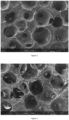
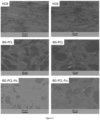
- Implant material for the filling of bone defects, bone regeneration and tissue engineering of bone will be described in connection with the figures 1 and 2 .
- the implant material of the invention comprises a matrix made of a bioactive glass M-biodegradable polymer P hybrid material doped with an osteoinductive nutrient N introduced into the network of the hybrid material.
- This configuration makes it possible to obtain a release of the osteoinductive nutrient N directly at the site of interest, in a prolonged and regular manner, that is to say without a “burst” effect. Because the osteoinductive nutrient N is evenly distributed throughout the mass of the hybrid material and is released as the latter degrades.
- the osteoinductive nutrient N is not degraded here and the total quantity of this osteoinductive nutrient N therefore reaches the site of interest.
- the matrix of the implant material of the invention has a particular porosity which is that shown in picture 2 .
- the implant material of the invention comprising a matrix made of a biodegradable polymer-bioactive glass hybrid material doped with an osteoinductive nutrient represented in picture 2 has identical morphology to the prior art undoped biodegradable polymer-bioactive glass hybrid material implant material shown in figure 1 .
- It comprises a matrix made of a material which comprises an organic part and an inorganic part and an osteoinductive nutrient, which is itself preferably organic.
- This material is biocompatible, bioactive, bioabsorbable and as seen on the figures 1 and 2 , it has a very regular morphology, in terms of pore distribution, and in terms of pore shape.
- this material has pores, in the form of spheres, the diameter of which is either identical at all points, or in the form of spheres, the ratio of the smallest diameter to the largest diameter of which is 0.9 ⁇ 0.1, at most, or in the form of polyhedra forming part of such a sphere, the differences between the diameters at different points of the polyhedron forming part of this sphere being at most ⁇ 15% of the diameter of the sphere in which they are register.
- the implant materials of the invention can have pore sizes lying in a very wide range of 100 to 900 ⁇ m, preferably 200 ⁇ m to 800 ⁇ m, limits included, with a difference between the diameter of the largest sphere smallest or the largest being at most 70%, preferably at most 50%, more preferably at most 30%, with respect to the arithmetic average diameter of all the spheres of the implant in association with interconnections between pores whose smallest dimension is between 25 ⁇ m and 250 ⁇ m, limits included.
- At least 70% by number of these pores has at least one interconnection with another pore.
- the matrix consists of an organic phase, an inorganic phase and an osteoinductive nutrient to increase the osteoinductive potential of the prior art implant material.
- the inorganic phase is the bioactive glass M.
- Bioactive ceramics and bioactive glasses are well known to those skilled in the art and are described in particular in LL Hench et al., J. Biomed. Mater. Res. 1971, 2, 117-141 ; LL Hench et al., J. Biomed. Mater. Res. 1973, 7, 25-42 for bioactive ceramics and in M. Vallet-Regi et al., Eur. J. Inorg. Chem. 2003, 1029-1042 And WO 02/04606 , WO 00/76486 And WO 2009/027594 , especially. In the invention, only a bioactive glass is used.
- the organic part of the implant material of the invention comprises the biodegradable polymer P and the osteoinductive nutrient N.
- the osteoinductive nutrient is an organic molecule.
- the biodegradable polymer P is soluble in at least one solvent S1 and insoluble in at least one solvent S.
- solvents can be water, an aqueous medium or even an organic solvent.
- the osteoinductive nutrient N is soluble in at least one solvent S2 miscible with the solvent S1, and insoluble in the solvent S.
- the solvent S2 must not degrade the properties of the final implant material: it must not lead to a separation of the organic and inorganic phases, nor modify the homogeneity of these phases in the final material. It must also not lead to a loss of the mechanical properties of the final implant material: the latter must remain manipulable, for example in order to be able to be possibly shaped and desired size for the final implant, so that the implant made with this material can be manipulated by the surgeon who will implant it.
- the osteoinductive nutrient N is chosen from vitamin D2 (ergocalciferol), vitamin D3 (cholicalciferol), their derivatives and precursors, vitamin K1, vitamin K2, omega-3 fatty acids, punicic acid, ⁇ -lipoic acid, anthocyanins, flavonols, procyanidins, tyrosol, oleuropein, naringenin, punicalagin, ellagic acid and phycocyanin.
- vitamin D2 ergocalciferol
- vitamin D3 cholicalciferol
- their derivatives and precursors vitamin K1, vitamin K2, omega-3 fatty acids, punicic acid, ⁇ -lipoic acid, anthocyanins, flavonols, procyanidins, tyrosol, oleuropein, naringenin, punicalagin, ellagic acid and phycocyanin.
- the matrix of the implant material of the invention consists of the bioactive glass M and the biodegradable polymer P, which form a hybrid material, that is to say forming a single phase and in which the osteoinductive nutrient N is incorporated.
- the hybrid material doped with an osteinductive nutrient comprises 30% by mass of bioactive glass M based on SiO 2 and CaO, relative to the total mass (bioactive glass M + biodegradable polymer P + osteoinductive nutrient N), 69% by mass of poly(caprolactone), relative to the total mass (bioactive glass M + biodegradable polymer P + osteoinductive nutrient N), and 1% by mass of fisetin and/or hydroxytyrosol, relative to the total mass (bioactive glass M + biodegradable polymer P + osteoinductive nutrient N).
- the hybrid material doped with an osteinductive nutrient comprises 40% by mass of bioactive glass M based on SiO 2 and CaO, relative to the total mass (bioactive glass M + biodegradable polymer P + osteoinductive nutrient N), 59% by mass of poly(caprolactone), relative to the total mass (bioactive glass M + biodegradable polymer P + osteoinductive nutrient N), and 1% by mass of fisetin and/or hydroxytyrosol, relative to the total mass (bioactive glass M + biodegradable polymer P + osteoinductive nutrient N).
- the hybrid material used in the invention is obtained by a process which is also an object of the invention.
- This process comprises the formation of a sol containing all the alkoxide precursors of the bioactive glass, the solubilization of the biodegradable polymer P in the solvent S1, the solubilization of the osteoinductive nutrient N in the solvent S2, the addition of the solution of osteoinductive nutrient N in the polymer solution biodegradable polymer P and mixing them until a uniform mixture is obtained, that is to say without phase separation, the addition of this biodegradable polymer mixture P- osteoinductive nutrient N in the soil containing all the alkoxide precursors of the bioactive glass and the gelling of the solution thus obtained by a succession of polymerization reactions (sol-gel polymerization of the inorganic phase) (condensation of the alkoxides). A hybrid mixture is then obtained intimately combining the mineral phase and the organic phase.
- the hybrid material is therefore distinguished from the composite material by an intimate entanglement between the two organic and inorganic phases, these two phases being indistinguishable (except at the molecular scale) in the case of a hybrid mixture.
- the implant material of the invention is obtained by a process using a pore-forming agent A which consists of microspheres made of a polymer soluble in at least one solvent S in which the biodegradable polymer P and the osteoinductive nutrient N are not soluble.
- the solvent S2 used to solubilize the osteoinductive nutrient N must not solubilize the pore-forming agent A or degrade it. It must also not degrade the biodegradable polymer P or the bioactive glass M. Moreover, it must be miscible with the solvent S1.
- the solvent S2 is identical to the solvent S1.
- the process of the invention consists in stacking microspheres of pore-forming agent A in a polymer material, different from the biodegradable polymer P, in a mold having the shape and the size corresponding to the geometry of the bone defect to be filled or of the defect where bone regeneration is desired.
- microspheres of pore-forming agent A make it possible to obtain in the end pores whose size and distribution will correspond negatively to the stack of microspheres.
- the material intended to constitute the matrix will then be infiltrated into the stack of beads of microspheres of pore-forming agents A, then solidified in order to be able to be unmolded without changing the shape and size of the stack of the desired implant.
- the pore-forming agent A will then be eliminated, allowing the implant material of the invention to be obtained.
- this process does not use any heat treatment at high temperature to sinter the bioactive glass M, the only temperature necessary being the evaporation temperature of the solvent S used.
- the proteins are cited as usable biodegradable polymers, in the invention the proteins are not part of the usable biodegradable polymers P, because of the difficulty in solubilizing them in the presence of the osteoinductive nutrients proposed above: they are insoluble or practically insoluble in many organic solvents such as alcohol, tetrahydrofuran, etc. and they are poorly soluble in water.
- Examples of materials for the pore-forming agent A are biodegradable polymers which are insoluble in an aqueous medium and soluble in the at least one solvent S, preferably chosen from poly(C 1 to C 4 ) alkyl methacrylates, preferably poly(methacrylate) of methyl or polybutyl methacrylate, polyurethane, polyglycolic acid, various forms of polylactic acids, lactic-coglycolic acid copolymers, poly(caprolactone), polypropylene fumarate, paraffin and naphthalene, or acrylonitrile butadiene styrene (ABS).
- poly(C 1 to C 4 ) alkyl methacrylates preferably poly(methacrylate) of methyl or polybutyl methacrylate
- polyurethane polyglycolic acid
- various forms of polylactic acids lactic-coglycolic acid copolymers
- poly(caprolactone) polypropylene fumarate
- the solvents S are in particular acetone, ethanol, chloroform, dichloromethane, hexane, cyclohexane, benzene, diethyl ether, hexafluoroisopropanol, and tetrahydrofuran (THF).
- osteoinductive nutrients N are vitamin D (vitamin D2 (ergocalciferol) and vitamin D3 (cholicalciferol), its derivatives and precursors, vitamin K1, vitamin K2, omega-3 fatty acids, punicic acid, ⁇ -lipoic acid, anthocyanins, flavonols, procyanidins, tyrosol, oleuropein, naringenin, punicalagin, ellagic acid and phycocyanin.
- Hydrolyzed collagen is not part of the osteoinductive nutrients that can be used in the invention.
- the implant material made of a poly(caprolactone)-bioactive glass-hydrolyzed collagen hybrid material does not have sufficient mechanical strength, due to the need to use a THF-acetic acid solvent to solubilize the PCL-hydrolyzed collagen mixture.
- the biodegradable polymer P is poly(caprolactone) (PCL)
- the microspheres of pore-forming agent A are made of paraffin
- the solvent S is cyclohexane
- the osteoinductive nutrient N is fisetin and/or or hydroxytyrosol
- solvent S1 is identical to solvent S2 and is tetrahydrofuran (THF).
- the introduction of the microspheres into the mold can be done before the introduction of the mixture of the alkoxide precursors of the bioactive glass M, of the biodegradable polymer P and of the osteoinductive nutrient N .
- the quantity of pore-forming agent A introduced into the biodegradable polymer P-bioactive glass M mixture must represent at least 60% by volume of the total volume of the biodegradable polymer P-bioactive glass M-osteoinductive nutrient N-pore-forming agent A mixture introduced into the mould.
- the size of the interconnections is related to the size of the point of contact between the spheres of pore-forming agent A in the stack of spheres produced.
- the increase in the size of the interconnections generated, with a constant pore diameter, is possible by adding a step consisting of a partial melting of the pore-forming spheres in the stack initially produced, so as to increase the size of their point of deposition. contact.
- microspheres of pore-forming agent A must form a compact stack, when placed in the mold with, in the invention, the sol of the alkoxide precursors of the bioactive glass M, the biodegradable polymer P and the osteoinductive nutrient N.
- the volume of pore-forming agent A relative to the total volume of the biodegradable polymer mixture P-precursors of the bioactive glass M-pore-forming agent A-osteoinductive nutrient N, must be at least 60%, preferably at least minus 70%.
- the biopolymer P/bioactive glass M mass ratio it may be between 10/90 and 90/10.
- it will be between 20/80 and 80/20, the best mechanical strength (easy handling without deformations or loss of material) being obtained with a 70/30 ratio.
- the amount of osteoinductive nutrient N can vary between 0.1% and 10%, preferably between 0.1% and 5%, by mass relative to the total mass (bioactive glass M+biodegradable polymer P+osteoinductive nutrient N).
- the first step was the stacking of the microspheres of pore-forming agent A in paraffin in a mold having the desired geometry for the implant.
- the volume of pore-forming agent A microspheres represented 70% of the total volume of the pore-forming agent A-biodegradable polymer P-precursors of bioactive glass M mixture.
- the pore-forming agent was in the form of spherical particles, namely with a diameter of between 400 and 600 ⁇ m.
- the diameters can be chosen between several tens to several hundreds of microns, depending on the applications.
- the porosity of the implant material of the invention which will finally be obtained can be controlled on these two points; firstly the diameter of the pores which will be obtained depends directly on the diameter of the initial pore-forming particles. It is therefore sufficient to adjust the particle size of the initial paraffin microspheres in order to very simply obtain the desired porosity.
- the size of the interconnections between pores depends directly on the size of the contact zone between the polymer beads in the initial stack. The size of this contact zone can be modified by causing the initial polymer particles to fuse together, by means of a solvent S, or by a preliminary heat treatment.
- the poly(caprolactone) was dissolved in tetrahydrofuran (THF).
- the poly(caprolactone) solution was poured into the sol containing the alkoxide precursors of the bioactive glass.
- composition of the bioactive glass was 75% SiO 2 and 25% CaO, by mass, relative to the total mass of the bioactive glass obtained in the end.
- the above hybrid mixture was poured into the mold containing the stack of paraffin microspheres.
- Centrifugation or pressure infiltration or vacuum infiltration can be used to help the hybrid mixture fill the interstices between the paraffin microspheres.
- the hybrid material was obtained by a sol-gel process.
- a sol containing all the alkoxide precursors of the bioactive glass and the biodegradable polymer in solution is brought to gel by a succession of polymerization reactions.
- This gelation is carried out at a temperature of between 0° C. and 60° C., inclusive, so as not to degrade the hybrid material matrix obtained.
- the implant material containing the paraffin microspheres is demolded, and the paraffin blowing agent microspheres are washed away with cyclohexane.
- the initial imprint of the paraffin microspheres is completely eliminated and the final material is obtained, in the form of a hybrid macroporous bioactive glass/poly(caprolactone) block.
- An implant material was obtained consisting of 70% by mass of poly(caprolactone) and 30% by mass of bioactive glass and having at least 70%, by number of pores having at least one interconnection with another pore.
- the structure obtained can be washed without any damage in ethanol baths, in order to eliminate possible undesirable residues, such as chlorides, THF, etc.
- Example 2 (according to the invention) Manufacture of an implant material with a hybrid material matrix doped with osteoinductive nutrient in which the biodegradable polymer P is poly(caprolactone), the bioactive glass M consists of 75% SiO 2 and 25% CaO, by mass, relative to the total mass of the glass and the osteoinductive nutrient N is fisetin.
- the biodegradable polymer P is poly(caprolactone)
- the bioactive glass M consists of 75% SiO 2 and 25% CaO, by mass, relative to the total mass of the glass and the osteoinductive nutrient N is fisetin.
- the first step was the stacking of the microspheres of pore-forming agent A in paraffin in a mold having the desired geometry for the implant.
- the volume of the microspheres of pore-forming agent A represented 70% of the total volume of the pore-forming agent A-biodegradable polymer P-osteoinductive nutrient N-precursor mixture of bioactive glass M, as in Example 1.
- the pore-forming agent was in the form of spherical particles, namely with a diameter of between 400 and 600 ⁇ m, as in Example 1.
- the poly(caprolactone) was dissolved in tetrahydrofuran (THF), as in example 1.
- fisetin was dissolved in the poly(caprolactone) solution thus obtained. This is possible because fisetin is soluble in THF. The mixture is stirred until a homogeneous solution is obtained, that is to say without phase separation.
- fisetin introduced was such that its mass in the final implant material was 1% of the mass (bioactive glass plus poly(caprolactone) plus fisetin).
- the resulting solution has a red tint due to the presence of fisetin.
- the poly(caprolactone)-fisetin solution was poured into the sol containing the alkoxide precursors of the bioactive glass.
- the alkoxide precursors of the bioactive glass were the same as those used in example 1 and in the same quantities as in example 1.
- the above hybrid mixture was poured into the mold containing the stack of paraffin microspheres.
- Centrifugation or pressure infiltration or vacuum infiltration can be used to help the hybrid mixture fill the interstices between the paraffin microspheres.
- Gelation is carried out at a temperature between 0° C. and 60° C., inclusive, so as not to degrade the hybrid material matrix obtained.
- the implant material containing the paraffin microspheres is demolded, and the paraffin blowing agent microspheres are washed away with cyclohexane.
- the initial imprint of the paraffin microspheres is completely eliminated and the final material is obtained, in the form of a hybrid macroporous block of bioactive glass/poly(caprolactone)/fisetin.
- An implant material of reddish color, consisting of 69% by mass of poly(caprolactone), 30% by mass of bioactive glass and 1% by mass of fisetin, and having 70%, by number of pores having at least one interconnection with another pore.
- the structure obtained can be washed without any damage in ethanol baths, in order to eliminate possible undesirable residues, such as chlorides, THF, etc.
- Example 3 (according to the invention) Manufacture of an implant material with a hybrid material matrix doped with osteoinductive nutrient in which the biodegradable polymer P is poly(caprolactone), the bioactive glass M consists of 75% SiO 2 and 25% CaO, by mass, relative to the total mass of the glass and the osteoinductive nutrient N is hydroxytyrosol.
- the biodegradable polymer P is poly(caprolactone)
- the bioactive glass M consists of 75% SiO 2 and 25% CaO, by mass, relative to the total mass of the glass and the osteoinductive nutrient N is hydroxytyrosol.
- the solution obtained during the solubilization of the hydroxytyrosol in the poly(caprolactone) solution, as well as the implant material obtained in the end, has a yellow tint due to the presence of the hydroxytyrosol.
- Example 4 (comparative) Manufacture of a matrix implant material in a hybrid material in which the biodegradable polymer P is hydrolyzed collagen and the bioactive glass M consists of 75% SiO 2 and 25% CaO, in mass, relative to the total mass of the glass.
- Hydrolyzed collagen does not swell on contact with physiological fluids.
- hydrolyzed collagen has amino acid sequences that serve as integrin receptors and thereby promote cell adhesion.
- Hydrolyzed collagen is produced from collagen.
- Collagen is a protein made up of three polypeptide chains, linked together by hydrogen bonds and covalent bonds. It is usually extracted from pork or beef skin. Partial collagen hydrolysis breaks intermolecular bonds and leads to strand dissociation; gelatin is then obtained. The advanced hydrolysis of gelatin then leads to the breaking of peptide bonds, and the strands initially made up of more than a thousand amino acids are broken down into peptides of about twenty amino acids; hydrolyzed collagen is thus obtained.
- Hydrolyzed collagen is dissolved in water and then mixed with bioglass soil.
- the resulting hybrid sol contains white particles which give it a white color and an opaque appearance.
- the hybrid sol is poured onto a stack of paraffin beads and the whole is then centrifuged at 3900 rpm for 3 min. This centrifugation does not allow infiltration of the hydrolyzed collagen-biglass hybrid sol. Indeed, a white deposit is observed on the stack of balls, above which floats a clear solution.
- the hydrolyzed collagen is then dissolved at a concentration of 0.30 g/mL in an acetic acid-water mixture containing 90% by volume of acetic acid. Then the bioglass sol is added so as to reach a mass composition of 70% polymer 30% bioglass.
- the hybrid solution obtained is clear. It is then poured onto the stack of balls and centrifuged.
- Gelation is carried out at a temperature between 0° C. and 60° C., inclusive, so as not to degrade the hybrid material matrix obtained.
- the implant material containing the paraffin microspheres is demolded, and the paraffin blowing agent microspheres are washed away with cyclohexane.
- the fabricated implant material has weak mechanical properties and dissolves quickly in water. It is indeed necessary to handle it with delicacy, otherwise it tends to break. As a result, the doping of bioglass presented here with hydrolyzed collagen is not suitable for bone filling.
- Example 5 Manufacture of a matrix implant material in a hybrid material doped with osteoinductive nutrient in which the biodegradable polymer P is poly(caprolactone), the bioactive glass M consists of 75% SiO 2 and 25% CaO, by mass, relative to the total glass mass and the osteoinductive nutrient N is hydrolyzed collagen.
- the biodegradable polymer P is poly(caprolactone)
- the bioactive glass M consists of 75% SiO 2 and 25% CaO, by mass, relative to the total glass mass and the osteoinductive nutrient N is hydrolyzed collagen.
- hydrolyzed collagen stimulates the activity of osteoblasts, improves the absorption of calcium and has anti-inflammatory and antioxidant properties.
- hydrolyzed collagen is substituted for PCL.
- PCL-colH a mass composition of 60% PCL, 10% hydrolyzed collagen and 30% bioglass SiO2-CaO, denoted PCL-colH.
- acetic acid as a common solvent for PCL and hydrolyzed collagen (cf. example 4).
- the acetic acid allows the dissolution of the organic constituents in a homogeneous way and the realization of the hybrid soil, but after dissolution of the paraffin beads (porogen) the implant materials disintegrate.
- Implant materials are then manufactured using as common solvent poly(caprolactone) and hydrolyzed collagen mixtures of composition by volume 80% acetic acid-20% THF. They do not disintegrate and have well-defined pores and interconnections with diameters identical to those of undoped PCL-biglass hybrid scaffolds.
- the release of hydrolyzed collagen is studied through a semi-dynamic interaction in the SBF (Simulated Body Fluid) at a rate of 1 mL per mg of material.
- the SBF is renewed every 2 days and the interacted SBF is analyzed with a BioAssay kit in order to determine the concentration of hydrolyzed collagen.
- the study has 6 consecutive interactions of 2 days.
- the analyzes reveal a release of 40% of the hydrolyzed collagen in the SBF after the first interaction, then the concentration of hydrolyzed collagen in the SBF is below the detection threshold for the following interactions.
- the osteoinductive potential of the PCL-colH implant material is evaluated in vitro and compared to that of the non-doped hybrid (PCL-BV) and bovine trabecular bone (OTB).
- Implant materials are seeded with primary rat osteoblasts and ALP (alkaline phosphatase) activity is determined after 7 days and 14 days in cell culture.
- ALP activity is significantly greater with PCL-colH after 7 days, then it is similar for PCL-colH and PCL-BV after 14 days.
- THE hydrolyzed collagen therefore stimulates the mineralization process, but this effect is limited to short times as expected. Knowing that the SBF is renewed every 2 to 3 days in this experiment, it is possible that after 7 days of cell culture (i.e.
- the PCL-colH implant materials are ultimately implanted into the mouse calvaria. After 3 months of implantation, the bone has not regenerated in the PCL-colH implant materials, whereas bone regrowth is well advanced in the non-doped implant materials. This observation is correlated with low osteoblast activity in the PCL-colH implantation zone illustrated by the absence of ALP.
- the PCL-colH material does not seem suitable for bone filling, unlike the PCL-BV hybrid, even undoped, as evidenced by the in vivo performance.
- Example 6 Evaluation of the mechanical properties of the implant materials obtained in Examples 1 to 3.
- the manipulation of the implant materials obtained in Examples 1 to 3 shows that the doped implant materials obtained in Examples 2 and 3 have mechanical properties identical to those of the implant material of the prior art obtained in example 1: they have good mechanical strength, they are both slightly elastic and sufficiently rigid to allow their manipulation. Their scalpel cutting is simple and clean. From the macroscopic point of view it is not possible to differentiate the doped materials from the non-doped material, except by the color. Scanning electron microscope examination shows no difference in morphology and surface condition. As illustrated in figures 1 and 2 , the undoped implant material has a structure identical to that of the doped implant materials, with well-defined and strongly interconnected pores, micrometric roughness on the surface of the walls and micrometric porosity inside the walls.
- Example 7 In vitro evaluation of the implants obtained in examples 1 to 3.
- Implant materials are seeded with primary rat osteoblasts and ALP activity is determined after 7 days and 14 days in cell culture. ALP activity is normalized with the relative amount of GAPDH present in each sample. The culture is carried out with orbital shaking (10 rpm).
- fisetin and hydroxytyrosol enhance the hybrid's osteoinductive potential.
- the use of these antioxidants as constituents of a biomaterial represents a much more interesting strategy compared to the ingestion of post-operative food supplements.
- Many osteoinductive organic compounds can also be considered for the organic doping of the PCL-biglass hybrid, in particular in the family of polyphenols (oleuropein, hesperidin, naringin, resveratrol).
- Example 8 In vivo evaluation of the implants obtained in Examples 1 and 2.
- mice were purchased from Janvier Labs (Le Genest Saint Isle, France). They were housed at 22 ⁇ 2°C with a 12-hour day/night cycle, and ad libitum access to water and food in the building of the Department of Orofacial Pathologies, Imaging and Biotherapies of the Descartes University, Montrouge. , France.
- mice (12 weeks old, about 30g) were anesthetized by intraperitoneal injection of ketamine (80 mg/kg) and xylazine (10 mg/kg), both from Centravet Alfort, Maisons Alfort, France.
- the scalp skin was incised and the periosteum was pushed aside to visualize the skull.
- a critical size defect of 3.5 mm in diameter of the skull cap was created on each side of the parietal bone using a Tissue ® punch (from Kir l'Instrumentiste, France) linked to a handpiece with slow speed running at 1500rpm, under sterile saline irrigation.
- the defects were filled with the implant made of the fisetin-doped hybrid material (BG-PCL-Fis) obtained in example 2 or the undoped implant of example 1 (BG-PCL).
- BG-PCL-Fis fisetin-doped hybrid material
- micro-CT X-ray micro-tomography
- the samples were fixed in 70% v/v ethanol (24h at 4°C), then dehydrated in ethanol solutions comprising increasing %, by volume, of ethanol to eliminate all traces of water. , and coated at -20°C in a methyl methacrylate resin (Merck) without decalcification.
- Resin coated skull bone samples were cut (5 mm thick) using a Jung Polycut E® microtome (Leica) with hard tissue blades (Leica).
- Sections were rehydrated using ethanol solution of decreasing concentrations for subsequent procedures.
- mice were anesthetized (isoflurane, 3-4% induction under 0.8-1.5 L/min airflow; 1.5-2% under 400-800mL/min after) at baseline , day 30, day 60, and day 90, and were analyzed using a computed tomography X-ray device (Quantum FX Caliper ® , Life Sciences, Perkin Elmer, Waltham, MA) from the PIV Platform , EA2496, Montrouge, France.
- a computed tomography X-ray device Quantum FX Caliper ® , Life Sciences, Perkin Elmer, Waltham, MA
- the X-ray source was set at 90kV and 160 ⁇ A.
- Three-dimensional images were acquired with an isotropic voxel size of 20 ⁇ m.
- High resolution 3D raw data was obtained by rotating both the X-ray source and the flat panel detector 360° around the sample (3 min scan time).
- a global volume of interest was plotted by interpolation of the 2D region of interest over consecutive sections to isolate the area of the initial defect.
- the resulting interpolated VOI included only the remodeled bone defect area.
- a global threshold was interactively determined for bone selection and background noise removal.
- FIG. 4 shows in graph form the cell viability results of primary rat osteoblasts in the presence of a control (100%), BG-PCL and BG-PCL-Fis.
- the cell activity viability measurement is based on the XTT activity after 7 days of culture.
- mitochondrial activity is expressed as a percentage of control status (CTRL).
- Human cortical bone slices were used as a control.
- the bone volume reached about 15% in the controls while more than 30% of the bone defects are repaired using BG-PCL implants.
Landscapes
- Health & Medical Sciences (AREA)
- Chemical & Material Sciences (AREA)
- Medicinal Chemistry (AREA)
- Life Sciences & Earth Sciences (AREA)
- Veterinary Medicine (AREA)
- Epidemiology (AREA)
- Animal Behavior & Ethology (AREA)
- General Health & Medical Sciences (AREA)
- Public Health (AREA)
- Engineering & Computer Science (AREA)
- Dermatology (AREA)
- Oral & Maxillofacial Surgery (AREA)
- Transplantation (AREA)
- Pharmacology & Pharmacy (AREA)
- Mechanical Engineering (AREA)
- Biomedical Technology (AREA)
- Molecular Biology (AREA)
- Inorganic Chemistry (AREA)
- Composite Materials (AREA)
- Materials Engineering (AREA)
- Dispersion Chemistry (AREA)
- Materials For Medical Uses (AREA)
Claims (8)
- Implantatmaterial für die Auffüllung von Knochendefekten, die Knochenregeneration und die Knochengewebezüchtung,
dadurch gekennzeichnet, dass
es ein Hybridmaterial umfasst, das Folgendes umfasst:• ein bioaktives Glas M auf Basis von SiO2 und CaO, das wahlweise P2O5 enthält und/oder wahlweise mit Strontium dopiert ist, und• ein biologisch abbaubares Polymer P, das ausgewählt ist aus:und dadurch, dass dieses Hybridmaterial mit einem osteoinduktiven Nährstoff N dopiert ist, der aus Vitamin D2 (Ergocalciferol), Vitamin D3 (Cholicalciferol), Vitamin K1, Vitamin K2, Omega-3-Fettsäuren, Punicinsäure, α-Liponsäure, Anthocyaninen, Flavonolen, Procyanidinen, Tyrosol, Oleuropein, Naringenin, Punicalagin, Ellagsäure und Phycocyanin ausgewählt ist.- biologisch resorbierbaren Polysacchariden, vorzugsweise ausgewählt aus Dextran, Hyaluronsäure, Agar, Chitosan, Alginsäure, Natrium- oder Kaliumalginat, Galactomannan, Carrageen, Pektin,- biologisch resorbierbare Polyestern, vorzugsweise Polyvinylalkohol oder Polymilchsäure, und- biologisch abbaubaren synthetischen Polymeren, vorzugsweise einem Polyethylenglykol, Polycaprolacton, - Implantatmaterial für die Auffüllung von Knochendefekten, die Knochenregeneration und die Knochengewebezüchtung nach Anspruch 1, dadurch gekennzeichnet, dass das Hybridmaterial, das mit einem osteoinduktiven Nährstoff dopiert ist, in Bezug auf die Gesamtmasse (bioaktives Glas M + biologisch abbaubares Polymer P + osteoinduktiver Nährstoff N) 30 Massen-% bioaktives Glas M auf Basis von SiO2 und CaO, in Bezug auf die Gesamtmasse (bioaktives Glas M + biologisch abbaubares Polymer P + osteoinduktiver Nährstoff N) 69 Massen-% Polycaprolacton, und in Bezug auf die Gesamtmasse (bioaktives Glas M + biologisch abbaubares Polymer P + osteoinduktiver Nährstoff N) 1% Massen-% Fisetin und/oder Hydroxytyrosol umfasst.
- Implantatmaterial für die Auffüllung von Knochendefekten, die Knochenregeneration und die Knochengewebezüchtung nach Anspruch 1, dadurch gekennzeichnet, dass das Hybridmaterial, das mit einem osteoinduktiven Nährstoff dopiert ist, in Bezug auf die Gesamtmasse (bioaktives Glas M + biologisch abbaubares Polymer P + osteoinduktiver Nährstoff N) 40 Massen-% bioaktives Glas M auf Basis von SiO2 und CaO, in Bezug auf die Gesamtmasse (bioaktives Glas M + biologisch abbaubares Polymer P + osteoinduktiver Nährstoff N) 59 Massen-% Polycaprolacton, und in Bezug auf die Gesamtmasse (bioaktives Glas M + biologisch abbaubares Polymer P + osteoinduktiver Nährstoff N) 1% Massen-% Fisetin und/oder Hydroxytyrosol umfasst.
- Implantat aus einem Hybridmaterial für die Auffüllung von Knochendefekten, die Knochenregeneration und die Knochengewebezüchtung, dadurch gekennzeichnet, dass es ein Material nach einem der vorstehenden Ansprüche umfasst.
- Verfahren zur Herstellung eines Implantats aus einem Hybridmaterial für die Auffüllung von Knochendefekten, die Knochenregeneration und die Knochengewebezüchtung, dadurch gekennzeichnet, dass es die folgenden Schritte umfasst:a) Auswahl eines bioaktiven Glases M auf Basis von SiO2 und CaO, das wahlweise P2O5 enthält und/oder wahlweise mit Strontium dopiert ist,b) Auswahl eines biologisch abbaubaren Polymers P, das in mindestens einem Lösemittel S1 löslich und in mindestens einem Lösemittel S unlöslich ist, ausgewählt aus:- biologisch resorbierbaren Polysacchariden, vorzugsweise ausgewählt aus Dextran, Hyaluronsäure, Agar, Chitosan, Alginsäure, Natrium- oder Kaliumalginat, Galactomannan, Carrageen, Pektin,- biologisch resorbierbaren Polyestern, vorzugsweise Polyvinylalkohol oder Polymilchsäure, und- biologisch abbaubaren synthetischen Polymeren, vorzugsweise einem Polyethylenglykol oder Polycaprolactonc) Auswahl von Mikrosphären eines Porenbildners A, die Durchmesser und Größen aufweisen, die den angestrebten Durchmessern und Größen der Poren im Material entsprechen, das das herzustellende Implantat konstituiert, wobei dieser Porenbildner A:- in einem Polymer vorliegt, das in dem mindestens einen Lösemittel S1 unlöslich ist und in dem mindestens einen Lösemittel S löslich ist,d) Auswahl mindestens eines osteoinduktiven Nährstoffs N:- der in mindestens einem Lösemittel S2 löslich ist, das mit dem Lösemittel S1 identisch ist oder sich von diesem unterscheidet, jedoch mit dem Lösemittel S1 mischbar ist, der das biologisch abbaubare Polymer P nicht abbaut, der das biologisch abbaubare Glas M nicht abbaut und in dem die Mikrosphären des Porenbildners A nicht löslich sind, und- der im Lösemittel S unlöslich ist,- ausgewählt aus Vitamin D2 (Ergocalciferol), Vitamin D3 (Cholicalciferol) und Vitamin K1, Vitamin K2, Omega-3-Fettsäuren, Punicinsäure, α-Liponsäure, Anthocyaninen, Flavonolen, Procyanidinen, Tyrosol, Oleuropein, Naringenin, Punicalagin, Ellagsäure und Phycocyanin,e) Einführung der Mikrosphären des Porenbildners A in eine Gussform, die die angestrebte Form und Größe für das Implantat aufweist, wobei diese Mikrosphären eine kompakte Packung bilden, die der Form und der Größe der Poren entspricht, die im Implantatmaterial zu erhalten sind, und in Bezug auf das Gesamtvolumen des Gemischs von Porenbildner A, biologisch abbaubarem Polymer P, Alkoxidvorläufern des bioaktiven Glases M, osteoinduktivem Nährstoff N mindestens 60 Volumen-%, vorzugsweise 70 Volumen-% darstellt,f) Einführung des osteoinduktiven Nährstoffs N, in Lösung im Lösemittel S2, in das biologisch abbaubare Polymer P in Lösung im Lösemittel S1 und Gemisch,g) Einführung des im Schritt f) erhaltenen Gemischs in die Alkoxidvorläufer des bioaktiven Glases M,h) Einführung des im Schritt g) erhaltenen Gemischs in die Gussform,i) Verfestigung des in der Gussform nach dem Schritt h) enthaltenen Gemischs,j) Entnahme des im Schritt i) erhaltenen Gemischs aus der Gussform,k) Eliminierung der Mikrosphären von Porenbildner A durch Spülung mit dem Lösemittel S.
- Verfahren nach Anspruch 5,dadurch gekennzeichnet, dass das Material des Porenbildners A aus biologisch abbaubaren Polymeren ausgewählt ist, die in dem mindestens einen Lösemittel S1 und dem mindestens einen Lösemittel S2 unlöslich sind und in dem mindestens einen Lösemittel S löslich sind, vorzugsweise ausgewählt aus Alkylpolymethacrylaten mit C1 bis C4, vorzugsweise Methylpolymethacrylat oder Butylpolymethacrylat, Polyurethan, Polyglycolsäure, unterschiedlichen Formen von Polymilchsäuren, Milchsäure-Coglycolsäure-Copolymeren, Polycaprolacton, Fumaratpolypropylen, Paraffin und Naphtalen, oder Acrylonitril-Butadien-Styrol (ABS),wobei sich der Porenbildner A von dem biologisch abbaubaren Polymer P unterscheidet.
- Verfahren nach Anspruch 5 oder 6, dadurch gekennzeichnet, dass das Gewichtsverhältnis von biologisch abbaubarem Polymer P / bioaktivem Glas M zwischen 20/80 und 80/20, Grenzwerte inbegriffen, beträgt, und dadurch, dass der osteoinduktive Nährstoff N in Bezug auf die Gesamtmenge des im Schritt k) erhaltenen Materials in einer Menge zwischen 0,1 und 10%, vorzugsweise zwischen 0,1% und 5%, bevorzugter von 1% vorliegt.
- Verfahren nach einem der Ansprüche 5 bis 7, dadurch gekennzeichnet, dass:- das bioaktive Glas M ein Glas auf Basis von SiO2 und von CaO ist,- das biologisch abbaubare Polymer P Polycaprolacton ist,- der osteoinduktive Nährstoff N Fisetin und/oder Hydroxytyrosol ist,- das Material der Mikrosphären von Porenbildner A Paraffin ist,- das Lösemittel S Cyclohexan ist,- das Lösemittel S1 mit dem Lösemittel S2 identisch ist und Tetrahydrofuran (THF) ist.
Applications Claiming Priority (2)
| Application Number | Priority Date | Filing Date | Title |
|---|---|---|---|
| FR1860557A FR3088550B1 (fr) | 2018-11-15 | 2018-11-15 | Implant a porosite controlee en un materiau hybride dope en nutriment osteoinducteur |
| PCT/EP2019/081383 WO2020099588A1 (fr) | 2018-11-15 | 2019-11-14 | Implant a porosite controlee en un materiau hybride dope en nutriment osteoinducteur |
Publications (2)
| Publication Number | Publication Date |
|---|---|
| EP3880263A1 EP3880263A1 (de) | 2021-09-22 |
| EP3880263B1 true EP3880263B1 (de) | 2023-02-15 |
Family
ID=66041546
Family Applications (1)
| Application Number | Title | Priority Date | Filing Date |
|---|---|---|---|
| EP19801886.3A Active EP3880263B1 (de) | 2018-11-15 | 2019-11-14 | Implantat mit kontrollierter porosität aus einem mit osteoinduktivem nährstoff dotierten hybridmaterial |
Country Status (9)
| Country | Link |
|---|---|
| US (1) | US20220008619A1 (de) |
| EP (1) | EP3880263B1 (de) |
| JP (1) | JP2022507372A (de) |
| CN (1) | CN113164654A (de) |
| AU (1) | AU2019382262A1 (de) |
| BR (1) | BR112021009243A2 (de) |
| CA (1) | CA3119519A1 (de) |
| FR (1) | FR3088550B1 (de) |
| WO (1) | WO2020099588A1 (de) |
Families Citing this family (9)
| Publication number | Priority date | Publication date | Assignee | Title |
|---|---|---|---|---|
| CN114873921A (zh) * | 2022-03-16 | 2022-08-09 | 苏州延生堂医疗器械科技有限公司 | 一种含有机聚合物的多孔生物玻璃陶瓷可降解骨创材料及其制备方法 |
| WO2023222704A1 (en) * | 2022-05-17 | 2023-11-23 | Société des Produits Nestlé S.A. | Compositions and methods using a combination of oleuropein and fisetin for use in cartilage degeneration |
| CN115006602A (zh) * | 2022-06-10 | 2022-09-06 | 杭州昊莱生物科技有限公司 | 一种高钙磷含量的骨修复材料及应用 |
| CN116650717B (zh) * | 2023-04-26 | 2025-09-23 | 吉林大学 | 自增强促进骨再生的可注射双网络水凝胶及其制备方法 |
| CN117159799A (zh) * | 2023-09-22 | 2023-12-05 | 西北大学 | 用于治疗感染性骨缺损的可注射水凝胶的制备方法 |
| AU2024385565A1 (en) * | 2023-11-22 | 2026-05-14 | Société des Produits Nestlé S.A. | Compositions comprising a combination of fisetin and oleuropein for use in treating bone disorders |
| KR20250090470A (ko) * | 2023-12-12 | 2025-06-20 | 단국대학교 천안캠퍼스 산학협력단 | 뼈 연골 재생 촉진을 위한 스트론튬 방출 3d 프린팅 스캐폴드 및 이의 제조방법 |
| CN118121774B (zh) * | 2024-05-08 | 2024-08-20 | 四川大学 | 掺锶生物活性玻璃/明胶纳米纤维微球及制备方法和应用 |
| US12350400B1 (en) | 2024-07-03 | 2025-07-08 | Imam Mohammad Ibn Saud Islamic University | Biodegradable nanocomposite surgical screw containing bone nanoparticles |
Family Cites Families (14)
| Publication number | Priority date | Publication date | Assignee | Title |
|---|---|---|---|---|
| AU5485200A (en) | 1999-06-14 | 2001-01-02 | Imperial College Innovations | Silver-containing, sol-gel derived bioglass compositions |
| AU2001280507A1 (en) | 2000-07-11 | 2002-01-21 | Imperial College Innovations | Use of bioactive glass compositions to stimulate osteoblast production |
| JP2004210675A (ja) * | 2002-12-27 | 2004-07-29 | Toyo Shinyaku:Kk | 骨量改善組成物 |
| CN101091805A (zh) * | 2006-06-20 | 2007-12-26 | 华东理工大学 | 双孔块状生物支架材料及其制备方法 |
| FR2918658B1 (fr) | 2007-07-09 | 2010-12-03 | Centre Nat Rech Scient | Verres bioactifs dopes en strontium. |
| JP2009227616A (ja) * | 2008-03-24 | 2009-10-08 | Toin Gakuen | オレウロペイン及び/又はヒドロキシチロソールを有効成分として含有する骨形成促進剤 |
| US10525168B2 (en) * | 2010-10-20 | 2020-01-07 | 206 Ortho, Inc. | Method and apparatus for treating bone fractures, and/or for fortifying and/or augmenting bone, including the provision and use of composite implants, and novel composite structures which may be used for medical and non-medical applications |
| CN102604146A (zh) * | 2012-03-20 | 2012-07-25 | 中国科学院力学研究所 | 无机生物活性材料与聚合物多孔复合材料的制备方法 |
| AU2014247122B2 (en) * | 2013-04-05 | 2018-12-06 | Société des Produits Nestlé S.A. | Compositions for use in stimulating bone growth |
| CN104140551A (zh) * | 2013-05-10 | 2014-11-12 | 北京化工大学 | 一类骨组织工程用有机/无机复合多孔支架材料的制备方法 |
| FR3005419B1 (fr) * | 2013-05-13 | 2015-09-04 | Agronomique Inst Nat Rech | Utilisation d'une association de deux composes pour le traitement et/ou la prevention de troubles osseux |
| FR3006195B1 (fr) | 2013-06-03 | 2018-03-02 | Centre National De La Recherche Scientifique | Implant a porosite controlee |
| FR3026309B1 (fr) * | 2014-09-29 | 2017-11-24 | Univ Blaise Pascal-Clermont-Ferrand Ii | Implant a porosite variable en un materiau hybride |
| WO2016088915A1 (ko) * | 2014-12-03 | 2016-06-09 | 한국기계연구원 | 골다공증 치료용 유효성분을 함유하는 경조직 재생용 지지체 및 이의 제조방법 |
-
2018
- 2018-11-15 FR FR1860557A patent/FR3088550B1/fr not_active Expired - Fee Related
-
2019
- 2019-11-14 US US17/293,868 patent/US20220008619A1/en not_active Abandoned
- 2019-11-14 WO PCT/EP2019/081383 patent/WO2020099588A1/fr not_active Ceased
- 2019-11-14 AU AU2019382262A patent/AU2019382262A1/en not_active Abandoned
- 2019-11-14 EP EP19801886.3A patent/EP3880263B1/de active Active
- 2019-11-14 CA CA3119519A patent/CA3119519A1/fr active Pending
- 2019-11-14 BR BR112021009243-9A patent/BR112021009243A2/pt not_active Application Discontinuation
- 2019-11-14 JP JP2021526246A patent/JP2022507372A/ja active Pending
- 2019-11-14 CN CN201980079094.7A patent/CN113164654A/zh active Pending
Also Published As
| Publication number | Publication date |
|---|---|
| CA3119519A1 (fr) | 2020-05-22 |
| WO2020099588A1 (fr) | 2020-05-22 |
| FR3088550A1 (fr) | 2020-05-22 |
| FR3088550B1 (fr) | 2021-02-26 |
| AU2019382262A1 (en) | 2021-06-24 |
| JP2022507372A (ja) | 2022-01-18 |
| CN113164654A (zh) | 2021-07-23 |
| BR112021009243A2 (pt) | 2021-08-10 |
| EP3880263A1 (de) | 2021-09-22 |
| US20220008619A1 (en) | 2022-01-13 |
Similar Documents
| Publication | Publication Date | Title |
|---|---|---|
| EP3880263A1 (de) | Implantat mit kontrollierter porosität aus einem mit osteoinduktivem nährstoff dotierten hybridmaterial | |
| Lanao et al. | Bone response to fast-degrading, injectable calcium phosphate cements containing PLGA microparticles | |
| Chang et al. | Bone morphogenetic protein-2 loaded poly (D, L-lactide-co-glycolide) microspheres enhance osteogenic potential of gelatin/hydroxyapatite/β-tricalcium phosphate cryogel composite for alveolar ridge augmentation | |
| EP3003414B1 (de) | Implantat mit kontrollierter porosität aus einem hybridmaterial | |
| EP3200842B1 (de) | Hybridmaterialimplantat mit variabler porosität | |
| Iooss et al. | A new injectable bone substitute combining poly (ε-caprolactone) microparticles with biphasic calcium phosphate granules | |
| CN102973982B (zh) | 应用于软硬组织修复与再生的生物医学材料 | |
| EP1587556B1 (de) | Injizierbare implantate auf keramikbasis zur füllung von weichgewebe | |
| WO2002041928A1 (fr) | Biomateriaux polymeres poreux, procede de preparation et utilisations | |
| EP2307060B1 (de) | Kombination aus blut und biphasischen calciumphosphat-keramikpartikeln | |
| Feng et al. | Experimental study on the biocompatibility and osteogenesis induction ability of PLLA/DDM scaffolds | |
| CA3247241A1 (fr) | Gel comprenant un hydrogel et de la graisse ou un derive de graisse sous forme d'emulsion | |
| US11904070B2 (en) | Tissue scaffold and scaffold composition | |
| Fuentes et al. | Mandibular dental implant placement using demineralized bone matrix (DBM) | |
| Aikawa et al. | Organic-inorganic hybrid carbonate apatite capsules combining environment-responsive drug release and osteogenic induction for bone regeneration | |
| EP4041329B1 (de) | Verfahren zur mineralisierung einer biopolymermembran und resultierende membranen | |
| EP4295870A1 (de) | Biomaterial mit fisch- und chitosan-coproduktpulver, herstellungsverfahren und verwendung als implantat zur knochenrekonstruktion | |
| Lopes | Characterization of a Nano-Hydroxyapatite/Chitosan Scaffold for Bone Regeneration | |
| Lin et al. | Hao-Chieh Chang, Connie Yang, Fang Feng c, d | |
| WO2014009674A1 (fr) | Composition de substitut osseux | |
| FR2902013A1 (fr) | Procede de fabrication d'un materiau biocompatible implantable a reseau mixte pseudo-cristallin et materiau susceptible d'etre obtenu par un tel procede | |
| Kim et al. | Injectable chitosan carrier for demineralized bone matrix |
Legal Events
| Date | Code | Title | Description |
|---|---|---|---|
| STAA | Information on the status of an ep patent application or granted ep patent |
Free format text: STATUS: UNKNOWN |
|
| STAA | Information on the status of an ep patent application or granted ep patent |
Free format text: STATUS: THE INTERNATIONAL PUBLICATION HAS BEEN MADE |
|
| PUAI | Public reference made under article 153(3) epc to a published international application that has entered the european phase |
Free format text: ORIGINAL CODE: 0009012 |
|
| STAA | Information on the status of an ep patent application or granted ep patent |
Free format text: STATUS: REQUEST FOR EXAMINATION WAS MADE |
|
| 17P | Request for examination filed |
Effective date: 20210609 |
|
| AK | Designated contracting states |
Kind code of ref document: A1 Designated state(s): AL AT BE BG CH CY CZ DE DK EE ES FI FR GB GR HR HU IE IS IT LI LT LU LV MC MK MT NL NO PL PT RO RS SE SI SK SM TR |
|
| DAV | Request for validation of the european patent (deleted) | ||
| DAX | Request for extension of the european patent (deleted) | ||
| GRAP | Despatch of communication of intention to grant a patent |
Free format text: ORIGINAL CODE: EPIDOSNIGR1 |
|
| STAA | Information on the status of an ep patent application or granted ep patent |
Free format text: STATUS: GRANT OF PATENT IS INTENDED |
|
| INTG | Intention to grant announced |
Effective date: 20220914 |
|
| GRAS | Grant fee paid |
Free format text: ORIGINAL CODE: EPIDOSNIGR3 |
|
| GRAA | (expected) grant |
Free format text: ORIGINAL CODE: 0009210 |
|
| STAA | Information on the status of an ep patent application or granted ep patent |
Free format text: STATUS: THE PATENT HAS BEEN GRANTED |
|
| AK | Designated contracting states |
Kind code of ref document: B1 Designated state(s): AL AT BE BG CH CY CZ DE DK EE ES FI FR GB GR HR HU IE IS IT LI LT LU LV MC MK MT NL NO PL PT RO RS SE SI SK SM TR |
|
| REG | Reference to a national code |
Ref country code: CH Ref legal event code: EP Ref country code: GB Ref legal event code: FG4D Free format text: NOT ENGLISH |
|
| REG | Reference to a national code |
Ref country code: DE Ref legal event code: R096 Ref document number: 602019025334 Country of ref document: DE |
|
| REG | Reference to a national code |
Ref country code: AT Ref legal event code: REF Ref document number: 1547919 Country of ref document: AT Kind code of ref document: T Effective date: 20230315 Ref country code: IE Ref legal event code: FG4D Free format text: LANGUAGE OF EP DOCUMENT: FRENCH |
|
| REG | Reference to a national code |
Ref country code: LT Ref legal event code: MG9D |
|
| REG | Reference to a national code |
Ref country code: NL Ref legal event code: MP Effective date: 20230215 |
|
| REG | Reference to a national code |
Ref country code: AT Ref legal event code: MK05 Ref document number: 1547919 Country of ref document: AT Kind code of ref document: T Effective date: 20230215 |
|
| PG25 | Lapsed in a contracting state [announced via postgrant information from national office to epo] |
Ref country code: RS Free format text: LAPSE BECAUSE OF FAILURE TO SUBMIT A TRANSLATION OF THE DESCRIPTION OR TO PAY THE FEE WITHIN THE PRESCRIBED TIME-LIMIT Effective date: 20230215 Ref country code: PT Free format text: LAPSE BECAUSE OF FAILURE TO SUBMIT A TRANSLATION OF THE DESCRIPTION OR TO PAY THE FEE WITHIN THE PRESCRIBED TIME-LIMIT Effective date: 20230615 Ref country code: NO Free format text: LAPSE BECAUSE OF FAILURE TO SUBMIT A TRANSLATION OF THE DESCRIPTION OR TO PAY THE FEE WITHIN THE PRESCRIBED TIME-LIMIT Effective date: 20230515 Ref country code: NL Free format text: LAPSE BECAUSE OF FAILURE TO SUBMIT A TRANSLATION OF THE DESCRIPTION OR TO PAY THE FEE WITHIN THE PRESCRIBED TIME-LIMIT Effective date: 20230215 Ref country code: LV Free format text: LAPSE BECAUSE OF FAILURE TO SUBMIT A TRANSLATION OF THE DESCRIPTION OR TO PAY THE FEE WITHIN THE PRESCRIBED TIME-LIMIT Effective date: 20230215 Ref country code: LT Free format text: LAPSE BECAUSE OF FAILURE TO SUBMIT A TRANSLATION OF THE DESCRIPTION OR TO PAY THE FEE WITHIN THE PRESCRIBED TIME-LIMIT Effective date: 20230215 Ref country code: HR Free format text: LAPSE BECAUSE OF FAILURE TO SUBMIT A TRANSLATION OF THE DESCRIPTION OR TO PAY THE FEE WITHIN THE PRESCRIBED TIME-LIMIT Effective date: 20230215 Ref country code: ES Free format text: LAPSE BECAUSE OF FAILURE TO SUBMIT A TRANSLATION OF THE DESCRIPTION OR TO PAY THE FEE WITHIN THE PRESCRIBED TIME-LIMIT Effective date: 20230215 Ref country code: AT Free format text: LAPSE BECAUSE OF FAILURE TO SUBMIT A TRANSLATION OF THE DESCRIPTION OR TO PAY THE FEE WITHIN THE PRESCRIBED TIME-LIMIT Effective date: 20230215 |
|
| PG25 | Lapsed in a contracting state [announced via postgrant information from national office to epo] |
Ref country code: SE Free format text: LAPSE BECAUSE OF FAILURE TO SUBMIT A TRANSLATION OF THE DESCRIPTION OR TO PAY THE FEE WITHIN THE PRESCRIBED TIME-LIMIT Effective date: 20230215 Ref country code: PL Free format text: LAPSE BECAUSE OF FAILURE TO SUBMIT A TRANSLATION OF THE DESCRIPTION OR TO PAY THE FEE WITHIN THE PRESCRIBED TIME-LIMIT Effective date: 20230215 Ref country code: IS Free format text: LAPSE BECAUSE OF FAILURE TO SUBMIT A TRANSLATION OF THE DESCRIPTION OR TO PAY THE FEE WITHIN THE PRESCRIBED TIME-LIMIT Effective date: 20230615 Ref country code: GR Free format text: LAPSE BECAUSE OF FAILURE TO SUBMIT A TRANSLATION OF THE DESCRIPTION OR TO PAY THE FEE WITHIN THE PRESCRIBED TIME-LIMIT Effective date: 20230516 Ref country code: FI Free format text: LAPSE BECAUSE OF FAILURE TO SUBMIT A TRANSLATION OF THE DESCRIPTION OR TO PAY THE FEE WITHIN THE PRESCRIBED TIME-LIMIT Effective date: 20230215 |
|
| PG25 | Lapsed in a contracting state [announced via postgrant information from national office to epo] |
Ref country code: SM Free format text: LAPSE BECAUSE OF FAILURE TO SUBMIT A TRANSLATION OF THE DESCRIPTION OR TO PAY THE FEE WITHIN THE PRESCRIBED TIME-LIMIT Effective date: 20230215 Ref country code: RO Free format text: LAPSE BECAUSE OF FAILURE TO SUBMIT A TRANSLATION OF THE DESCRIPTION OR TO PAY THE FEE WITHIN THE PRESCRIBED TIME-LIMIT Effective date: 20230215 Ref country code: EE Free format text: LAPSE BECAUSE OF FAILURE TO SUBMIT A TRANSLATION OF THE DESCRIPTION OR TO PAY THE FEE WITHIN THE PRESCRIBED TIME-LIMIT Effective date: 20230215 Ref country code: DK Free format text: LAPSE BECAUSE OF FAILURE TO SUBMIT A TRANSLATION OF THE DESCRIPTION OR TO PAY THE FEE WITHIN THE PRESCRIBED TIME-LIMIT Effective date: 20230215 Ref country code: CZ Free format text: LAPSE BECAUSE OF FAILURE TO SUBMIT A TRANSLATION OF THE DESCRIPTION OR TO PAY THE FEE WITHIN THE PRESCRIBED TIME-LIMIT Effective date: 20230215 |
|
| REG | Reference to a national code |
Ref country code: DE Ref legal event code: R097 Ref document number: 602019025334 Country of ref document: DE |
|
| PG25 | Lapsed in a contracting state [announced via postgrant information from national office to epo] |
Ref country code: SK Free format text: LAPSE BECAUSE OF FAILURE TO SUBMIT A TRANSLATION OF THE DESCRIPTION OR TO PAY THE FEE WITHIN THE PRESCRIBED TIME-LIMIT Effective date: 20230215 |
|
| PLBE | No opposition filed within time limit |
Free format text: ORIGINAL CODE: 0009261 |
|
| STAA | Information on the status of an ep patent application or granted ep patent |
Free format text: STATUS: NO OPPOSITION FILED WITHIN TIME LIMIT |
|
| PGFP | Annual fee paid to national office [announced via postgrant information from national office to epo] |
Ref country code: GB Payment date: 20231123 Year of fee payment: 5 |
|
| 26N | No opposition filed |
Effective date: 20231116 |
|
| PG25 | Lapsed in a contracting state [announced via postgrant information from national office to epo] |
Ref country code: SI Free format text: LAPSE BECAUSE OF FAILURE TO SUBMIT A TRANSLATION OF THE DESCRIPTION OR TO PAY THE FEE WITHIN THE PRESCRIBED TIME-LIMIT Effective date: 20230215 |
|
| PGFP | Annual fee paid to national office [announced via postgrant information from national office to epo] |
Ref country code: IE Payment date: 20231117 Year of fee payment: 5 Ref country code: FR Payment date: 20231120 Year of fee payment: 5 Ref country code: DE Payment date: 20231120 Year of fee payment: 5 Ref country code: CH Payment date: 20231202 Year of fee payment: 5 |
|
| PG25 | Lapsed in a contracting state [announced via postgrant information from national office to epo] |
Ref country code: IT Free format text: LAPSE BECAUSE OF FAILURE TO SUBMIT A TRANSLATION OF THE DESCRIPTION OR TO PAY THE FEE WITHIN THE PRESCRIBED TIME-LIMIT Effective date: 20230215 |
|
| PG25 | Lapsed in a contracting state [announced via postgrant information from national office to epo] |
Ref country code: MC Free format text: LAPSE BECAUSE OF FAILURE TO SUBMIT A TRANSLATION OF THE DESCRIPTION OR TO PAY THE FEE WITHIN THE PRESCRIBED TIME-LIMIT Effective date: 20230215 |
|
| PG25 | Lapsed in a contracting state [announced via postgrant information from national office to epo] |
Ref country code: LU Free format text: LAPSE BECAUSE OF NON-PAYMENT OF DUE FEES Effective date: 20231114 |
|
| PG25 | Lapsed in a contracting state [announced via postgrant information from national office to epo] |
Ref country code: MC Free format text: LAPSE BECAUSE OF FAILURE TO SUBMIT A TRANSLATION OF THE DESCRIPTION OR TO PAY THE FEE WITHIN THE PRESCRIBED TIME-LIMIT Effective date: 20230215 Ref country code: LU Free format text: LAPSE BECAUSE OF NON-PAYMENT OF DUE FEES Effective date: 20231114 |
|
| REG | Reference to a national code |
Ref country code: BE Ref legal event code: MM Effective date: 20231130 |
|
| PG25 | Lapsed in a contracting state [announced via postgrant information from national office to epo] |
Ref country code: BE Free format text: LAPSE BECAUSE OF NON-PAYMENT OF DUE FEES Effective date: 20231130 |
|
| PG25 | Lapsed in a contracting state [announced via postgrant information from national office to epo] |
Ref country code: BE Free format text: LAPSE BECAUSE OF NON-PAYMENT OF DUE FEES Effective date: 20231130 |
|
| PG25 | Lapsed in a contracting state [announced via postgrant information from national office to epo] |
Ref country code: BG Free format text: LAPSE BECAUSE OF FAILURE TO SUBMIT A TRANSLATION OF THE DESCRIPTION OR TO PAY THE FEE WITHIN THE PRESCRIBED TIME-LIMIT Effective date: 20230215 |
|
| PG25 | Lapsed in a contracting state [announced via postgrant information from national office to epo] |
Ref country code: BG Free format text: LAPSE BECAUSE OF FAILURE TO SUBMIT A TRANSLATION OF THE DESCRIPTION OR TO PAY THE FEE WITHIN THE PRESCRIBED TIME-LIMIT Effective date: 20230215 |
|
| REG | Reference to a national code |
Ref country code: DE Ref legal event code: R119 Ref document number: 602019025334 Country of ref document: DE |
|
| REG | Reference to a national code |
Ref country code: CH Ref legal event code: PL |
|
| REG | Reference to a national code |
Ref country code: CH Ref legal event code: PL |
|
| GBPC | Gb: european patent ceased through non-payment of renewal fee |
Effective date: 20241114 |
|
| PG25 | Lapsed in a contracting state [announced via postgrant information from national office to epo] |
Ref country code: CH Free format text: LAPSE BECAUSE OF NON-PAYMENT OF DUE FEES Effective date: 20241130 |
|
| PG25 | Lapsed in a contracting state [announced via postgrant information from national office to epo] |
Ref country code: CY Free format text: LAPSE BECAUSE OF FAILURE TO SUBMIT A TRANSLATION OF THE DESCRIPTION OR TO PAY THE FEE WITHIN THE PRESCRIBED TIME-LIMIT; INVALID AB INITIO Effective date: 20191114 |
|
| PG25 | Lapsed in a contracting state [announced via postgrant information from national office to epo] |
Ref country code: HU Free format text: LAPSE BECAUSE OF FAILURE TO SUBMIT A TRANSLATION OF THE DESCRIPTION OR TO PAY THE FEE WITHIN THE PRESCRIBED TIME-LIMIT; INVALID AB INITIO Effective date: 20191114 |
|
| PG25 | Lapsed in a contracting state [announced via postgrant information from national office to epo] |
Ref country code: DE Free format text: LAPSE BECAUSE OF NON-PAYMENT OF DUE FEES Effective date: 20250603 |
|
| PG25 | Lapsed in a contracting state [announced via postgrant information from national office to epo] |
Ref country code: GB Free format text: LAPSE BECAUSE OF NON-PAYMENT OF DUE FEES Effective date: 20241114 |
|
| PG25 | Lapsed in a contracting state [announced via postgrant information from national office to epo] |
Ref country code: FR Free format text: LAPSE BECAUSE OF NON-PAYMENT OF DUE FEES Effective date: 20241130 |
|
| PG25 | Lapsed in a contracting state [announced via postgrant information from national office to epo] |
Ref country code: IE Free format text: LAPSE BECAUSE OF NON-PAYMENT OF DUE FEES Effective date: 20241114 |
|
| PG25 | Lapsed in a contracting state [announced via postgrant information from national office to epo] |
Ref country code: TR Free format text: LAPSE BECAUSE OF FAILURE TO SUBMIT A TRANSLATION OF THE DESCRIPTION OR TO PAY THE FEE WITHIN THE PRESCRIBED TIME-LIMIT Effective date: 20230215 |