EP3878981B1 - Apparatus and method for dry-manufacturing recycled leather - Google Patents
Apparatus and method for dry-manufacturing recycled leather Download PDFInfo
- Publication number
- EP3878981B1 EP3878981B1 EP19881285.1A EP19881285A EP3878981B1 EP 3878981 B1 EP3878981 B1 EP 3878981B1 EP 19881285 A EP19881285 A EP 19881285A EP 3878981 B1 EP3878981 B1 EP 3878981B1
- Authority
- EP
- European Patent Office
- Prior art keywords
- fibers
- leather
- general
- machine
- blending
- Prior art date
- Legal status (The legal status is an assumption and is not a legal conclusion. Google has not performed a legal analysis and makes no representation as to the accuracy of the status listed.)
- Active
Links
Images


Classifications
-
- C—CHEMISTRY; METALLURGY
- C14—SKINS; HIDES; PELTS; LEATHER
- C14B—MECHANICAL TREATMENT OR PROCESSING OF SKINS, HIDES OR LEATHER IN GENERAL; PELT-SHEARING MACHINES; INTESTINE-SPLITTING MACHINES
- C14B7/00—Special leathers and their manufacture
- C14B7/02—Composite leathers
- C14B7/04—Composite leathers by cementing or pressing together leather pieces, strips or layers, Reinforcing or stiffening leather by means of reinforcing layers
-
- B—PERFORMING OPERATIONS; TRANSPORTING
- B29—WORKING OF PLASTICS; WORKING OF SUBSTANCES IN A PLASTIC STATE IN GENERAL
- B29C—SHAPING OR JOINING OF PLASTICS; SHAPING OF MATERIAL IN A PLASTIC STATE, NOT OTHERWISE PROVIDED FOR; AFTER-TREATMENT OF THE SHAPED PRODUCTS, e.g. REPAIRING
- B29C43/00—Compression moulding, i.e. applying external pressure to flow the moulding material; Apparatus therefor
- B29C43/006—Pressing and sintering powders, granules or fibres
-
- C—CHEMISTRY; METALLURGY
- C14—SKINS; HIDES; PELTS; LEATHER
- C14B—MECHANICAL TREATMENT OR PROCESSING OF SKINS, HIDES OR LEATHER IN GENERAL; PELT-SHEARING MACHINES; INTESTINE-SPLITTING MACHINES
- C14B1/00—Manufacture of leather; Machines or devices therefor
- C14B1/58—Drying
-
- C—CHEMISTRY; METALLURGY
- C14—SKINS; HIDES; PELTS; LEATHER
- C14B—MECHANICAL TREATMENT OR PROCESSING OF SKINS, HIDES OR LEATHER IN GENERAL; PELT-SHEARING MACHINES; INTESTINE-SPLITTING MACHINES
- C14B13/00—Shredding hides or leather
-
- C—CHEMISTRY; METALLURGY
- C14—SKINS; HIDES; PELTS; LEATHER
- C14B—MECHANICAL TREATMENT OR PROCESSING OF SKINS, HIDES OR LEATHER IN GENERAL; PELT-SHEARING MACHINES; INTESTINE-SPLITTING MACHINES
- C14B3/00—Milling leather
-
- C—CHEMISTRY; METALLURGY
- C14—SKINS; HIDES; PELTS; LEATHER
- C14B—MECHANICAL TREATMENT OR PROCESSING OF SKINS, HIDES OR LEATHER IN GENERAL; PELT-SHEARING MACHINES; INTESTINE-SPLITTING MACHINES
- C14B7/00—Special leathers and their manufacture
-
- D—TEXTILES; PAPER
- D04—BRAIDING; LACE-MAKING; KNITTING; TRIMMINGS; NON-WOVEN FABRICS
- D04H—MAKING TEXTILE FABRICS, e.g. FROM FIBRES OR FILAMENTARY MATERIAL; FABRICS MADE BY SUCH PROCESSES OR APPARATUS, e.g. FELTS, NON-WOVEN FABRICS; COTTON-WOOL; WADDING ; NON-WOVEN FABRICS FROM STAPLE FIBRES, FILAMENTS OR YARNS, BONDED WITH AT LEAST ONE WEB-LIKE MATERIAL DURING THEIR CONSOLIDATION
- D04H1/00—Non-woven fabrics formed wholly or mainly of staple fibres or like relatively short fibres
- D04H1/40—Non-woven fabrics formed wholly or mainly of staple fibres or like relatively short fibres from fleeces or layers composed of fibres without existing or potential cohesive properties
- D04H1/42—Non-woven fabrics formed wholly or mainly of staple fibres or like relatively short fibres from fleeces or layers composed of fibres without existing or potential cohesive properties characterised by the use of certain kinds of fibres insofar as this use has no preponderant influence on the consolidation of the fleece
- D04H1/4266—Natural fibres not provided for in group D04H1/425
-
- D—TEXTILES; PAPER
- D04—BRAIDING; LACE-MAKING; KNITTING; TRIMMINGS; NON-WOVEN FABRICS
- D04H—MAKING TEXTILE FABRICS, e.g. FROM FIBRES OR FILAMENTARY MATERIAL; FABRICS MADE BY SUCH PROCESSES OR APPARATUS, e.g. FELTS, NON-WOVEN FABRICS; COTTON-WOOL; WADDING ; NON-WOVEN FABRICS FROM STAPLE FIBRES, FILAMENTS OR YARNS, BONDED WITH AT LEAST ONE WEB-LIKE MATERIAL DURING THEIR CONSOLIDATION
- D04H1/00—Non-woven fabrics formed wholly or mainly of staple fibres or like relatively short fibres
- D04H1/40—Non-woven fabrics formed wholly or mainly of staple fibres or like relatively short fibres from fleeces or layers composed of fibres without existing or potential cohesive properties
- D04H1/42—Non-woven fabrics formed wholly or mainly of staple fibres or like relatively short fibres from fleeces or layers composed of fibres without existing or potential cohesive properties characterised by the use of certain kinds of fibres insofar as this use has no preponderant influence on the consolidation of the fleece
- D04H1/4274—Rags; Fabric scraps
-
- D—TEXTILES; PAPER
- D04—BRAIDING; LACE-MAKING; KNITTING; TRIMMINGS; NON-WOVEN FABRICS
- D04H—MAKING TEXTILE FABRICS, e.g. FROM FIBRES OR FILAMENTARY MATERIAL; FABRICS MADE BY SUCH PROCESSES OR APPARATUS, e.g. FELTS, NON-WOVEN FABRICS; COTTON-WOOL; WADDING ; NON-WOVEN FABRICS FROM STAPLE FIBRES, FILAMENTS OR YARNS, BONDED WITH AT LEAST ONE WEB-LIKE MATERIAL DURING THEIR CONSOLIDATION
- D04H1/00—Non-woven fabrics formed wholly or mainly of staple fibres or like relatively short fibres
- D04H1/40—Non-woven fabrics formed wholly or mainly of staple fibres or like relatively short fibres from fleeces or layers composed of fibres without existing or potential cohesive properties
- D04H1/44—Non-woven fabrics formed wholly or mainly of staple fibres or like relatively short fibres from fleeces or layers composed of fibres without existing or potential cohesive properties the fleeces or layers being consolidated by mechanical means, e.g. by rolling
- D04H1/46—Non-woven fabrics formed wholly or mainly of staple fibres or like relatively short fibres from fleeces or layers composed of fibres without existing or potential cohesive properties the fleeces or layers being consolidated by mechanical means, e.g. by rolling by needling or like operations to cause entanglement of fibres
- D04H1/492—Non-woven fabrics formed wholly or mainly of staple fibres or like relatively short fibres from fleeces or layers composed of fibres without existing or potential cohesive properties the fleeces or layers being consolidated by mechanical means, e.g. by rolling by needling or like operations to cause entanglement of fibres by fluid jet
-
- D—TEXTILES; PAPER
- D04—BRAIDING; LACE-MAKING; KNITTING; TRIMMINGS; NON-WOVEN FABRICS
- D04H—MAKING TEXTILE FABRICS, e.g. FROM FIBRES OR FILAMENTARY MATERIAL; FABRICS MADE BY SUCH PROCESSES OR APPARATUS, e.g. FELTS, NON-WOVEN FABRICS; COTTON-WOOL; WADDING ; NON-WOVEN FABRICS FROM STAPLE FIBRES, FILAMENTS OR YARNS, BONDED WITH AT LEAST ONE WEB-LIKE MATERIAL DURING THEIR CONSOLIDATION
- D04H1/00—Non-woven fabrics formed wholly or mainly of staple fibres or like relatively short fibres
- D04H1/70—Non-woven fabrics formed wholly or mainly of staple fibres or like relatively short fibres characterised by the method of forming fleeces or layers, e.g. reorientation of fibres
- D04H1/72—Non-woven fabrics formed wholly or mainly of staple fibres or like relatively short fibres characterised by the method of forming fleeces or layers, e.g. reorientation of fibres the fibres being randomly arranged
- D04H1/732—Non-woven fabrics formed wholly or mainly of staple fibres or like relatively short fibres characterised by the method of forming fleeces or layers, e.g. reorientation of fibres the fibres being randomly arranged by fluid current, e.g. air-lay
Definitions
- the present invention relates to a dry manufacturing apparatus for recycled leather that is provided with an airlaid machine(s), a dry manufacturing method for recycled leather, and recycled leather manufactured using the dry manufacturing method.
- Natural leather is made of hard skin of animals, and according to excellent physical properties thereof, the natural leather is widely used in the industrial fields of manufacturing various products like bags, shoes, furniture, and so on.
- the natural leather is separated from the animal body and then made into a product through chemical and physical processes, and among the processes, in this case, a cutting process is necessarily carried out according to the desired design of the product. Through the cutting process, however, a large amount of leather waste is produced, and most of leather waste is burnt or buried, thereby undesirably causing serious environmental problems.
- US5958554 and US2589008 are other examples of an apparatus for dry manufacturing of recycled leather.
- the recycled leather sheet manufactured according to the conventional method has high elongation because it has textures generated by carding, so that it may be elongated well, and besides, the recycled leather sheet has weak bonding among fibers to cause a tensile strength or tear strength to be low.
- the present inventors have made many studies so as to solve the above problems and as a result, they have found that if the recycled leather is manufactured by replacing carding with airlaid processes, the recycled leather has low elongation because it has no textures and further has strong bonding among fibers to ensure a high tensile strength or tear strength.
- a dry manufacturing apparatus for recycled leather according to the present invention is claimed in claim 1.
- a dry manufacturing method for recycled leather according to the present invention is claimed in claim 10.
- a dry manufacturing apparatus for recycled leather includes: a leather fiber separation unit for separating leather fibers from leather waste; a blending unit for blending the separated leather fibers with general fibers; and a molding unit for molding the blended leather fibers and general fibers to the recycled leather, wherein the molding unit has an airlaid machines for molding the blended leather fibers and general fibers.
- the leather fiber separation unit includes: a leather crushing machine for breaking bonding among the leather fibers of the leather waste; and a leather scutching machine for separating the leather fibers from the leather waste in which the bonding among the leather fibers is broken.
- the blending unit includes: a leather fiber injection machine for injecting the leather fibers; a general fiber injection machine for injecting the general fibers; a leather fiber weight measuring machine for measuring the weight of the leather fibers injected through the leather fiber injection machine; a general fiber weight measuring machine for measuring the weight of the general fibers injected through the general fiber injection machine; and a blending machine(s) for blending the leather fibers and the general fibers, and the leather fiber weight measuring machine is connected to the general fiber weight measuring machine by means of a conveyor belt, so that the general fibers are injected by a given weight with respect to the weight of the leather fibers measured through the leather fiber weight measuring machine into the general fiber weight measuring machine through the general fiber injection machine, and the leather fibers injected into the leather fiber weight measuring machine are moved to the general fiber weight measuring machine through the conveyor belt and blended with the general fibers injected through the general fiber injection machine.
- the general fibers injected into the general fiber weight measuring machine are present in an amount within the range of 5 to 40 parts by weight with respect to 100 parts by weight of the leather fibers injected into the leather fiber weight measuring machine.
- the blending machines include a first blending machine and a second blending machine(s), the first blending machine serving to blend the leather fibers with the general fibers through a mixer and the second blending machine(s) having a fine opener(s) serving to blow air thereinto to blend the leather fibers with the general fibers, so that the leather fibers and general fibers blended through the first blending machine are consistently blended through the second blending machine(s).
- the second blending machine(s) has plural fine openers, so that 30 to 70% of the leather fibers and the general fibers are blended in the first blending machine and 90 to 100% of the leather fibers and the general fibers are blended in the second blending machine(s).
- the airlaid machines are plurally provided so that the blended leather fibers and general fibers are fed to upper portions of the airlaid machines and then molded on the lower portions of the airlaid machines.
- the airlaid machines each include rollers, an air supplier, and/or a mixer.
- the drop speeds of the leather fibers and the general fibers to the lower portions of the airlaid machines from the upper portions thereof are in the range of 10 to 500 m/min.
- the molded leather fibers and general fibers discharged from the lower portions of the airlaid machines are stacked on conveyor belts, the conveyor belts being connected to each other, so that the molded leather fibers and general fibers discharged from any one of the airlaid machines are moved sequentially to the other airlaid machine through the conveyor belts, and the moved leather fibers and general fibers are stacked sequentially onto the molded leather fibers and general fibers discharged from the other airlaid machine.
- the dry manufacturing apparatus further includes a press machine adapted to compress the molded recycled leather, together with heat.
- a dry manufacturing method for recycled leather as disclosed includes the steps of: separating leather fibers from leather waste; blending the separated leather fibers with general fibers; and molding the blended leather fibers and general fibers to the recycled leather, wherein the molding step is carried out to mold the blended leather fibers and general fibers by using airlaid machines.
- recycled leather manufactured by the dry manufacturing method as mentioned above.
- the recycled leather has elongation of 20 to 80%.
- the recycled leather has a tensile strength of 5 to 20 N/mm 2 .
- the dry manufacturing apparatus for recycled leather as disclosed molds the blended leather fibers and general fibers by using the airlaid machines, thereby requiring no conventional carding. Further, the recycled leather molded through the airlaid machines does not have any textures because no carding is applied, and accordingly, the recycled leather with low elongation does not stretch well, so that it has the inherent properties hard leather has.
- the dry manufacturing apparatus for recycled leather is provided with the plurality of airlaid machines, so that the molded leather fibers and general fibers are stacked on another molded leather fibers and general fibers, and through strong bonding among the fibers, further, a bonding force between the layers becomes increased, thereby enhancing the tensile strength or tear strength of the recycled leather manufactured.
- the dry manufacturing apparatus for recycled leather can manufacture the recycled leather in a dry manner, without using any water, unlike the conventional recycled leather manufacturing apparatus using a very large amount of water, thereby achieving the reduction of manufacturing cost.
- Bonding among leather fibers of leather waste was broken by using a leather crushing machine, and leather fibers with the length of 2.7 cm were separated from the crushed leather fibers by using a leather scutching machine.
- the separated leather fibers were primarily stirred with 150g of polyester fibers and were then blended with the polyester fibers two times in a fine opener.
- the blended leather fibers were injected and molded in airlaid machines, and after the molded leather fibers passed through a pre-heater, a press machine, a cooler, a calendar machine, a buffing machine, and a winder, they were made into recycled leather.
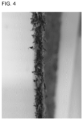
- FIGS.3 and 4 Photographs for top and cross section of the recycled leather manufactured in the embodiment as mentioned above are shown in FIGS.3 and 4 . As shown in FIGS.3 and 4 , it can be checked that the recycled leather has layers and there is no texture on the recycled leather.
- Example 2 Measuring tensile strength of recycled leather
- the recycled leather has the tear strength of about 100 N/mm and the tensile strength of about 17 N/mm 2 , so that it can be found that the recycled leather has the properties of hard leather.
- a a dry manufacturing apparatus for recycled leather that includes: a leather fiber separation unit for separating leather fibers from leather waste; a blending unit for blending the separated leather fibers with general fibers; and a molding unit for molding the blended leather fibers and general fibers to the recycled leather, wherein the molding unit has airlaid machines for molding the blended leather fibers and general fibers.
- a dry manufacturing apparatus 101 for recycled leather includes a leather fiber separation unit 110 for separating leather fibers from leather waste.
- the leather fiber separation unit 110 serves to separate only leather fibers from leather waste and to do this, the leather fiber separation unit 110 includes a leather crushing machine 120 for breaking bonding among the leather fibers of the leather waste and a leather scutching machine 140 for separating the leather fibers from the leather waste in which the bonding among the leather fibers is broken.
- the leather crushing machine 120 may crush the leather waste to break bonding among the leather fibers of the leather waste.
- the crushing is carried out by using a known crushing method, but of course, a crushing method capable of breaking bonding among the leather fibers of the leather waste has to be adopted.
- the scutching machine 140 serves to separate the leather fibers from the leather waste in which the bonding among the leather fibers is broken. For example, the separation is carried out by using heavy weights of the leather fibers.
- the dry manufacturing apparatus 101 for recycled leather includes a blending unit 200 for blending the separated leather fibers with general fibers.
- the blending unit 200 serves to blend the separated leather fibers with general fibers so as to manufacture the recycled leather.
- the general fibers are filaments or staple fibers. If the general fibers are filaments, the manufactured recycled leather has strong durability, and if the general fibers are staple fibers, the manufactured recycled leather becomes soft.
- the general fibers are fibers selected from the group consisting of natural cellulose fibers, natural protein fibers, mineral fibers, artificial cellulose fibers, artificial protein fibers, rubber fibers, inorganic fibers, acetate fibers, polyamide fibers, polyester fibers, polyurethane fibers, polyurea fibers, polyacrylic fibers, polyvinyl alcohol fibers, polyvinyl chloride fibers, polypropylene fibers, polyethylene fibers, polystyrene fibers, polyfluoro ethylene fibers, and combinations thereof.
- the general fibers are fibers selected from the group consisting of kapok, linen, ramie, hemp, jute, manila, abaca, sisal linen, coir, wool, goat hair, cashmere wool, camel wool, alpaca wool, rabbit hair, vicuna wool, lama wool, cultivated silk, tussah silk, asbestors, metal fibers, glass fibers, rock fibers, slag fibers, carbon fibers, rayon, lanital, soybean protein fibers, groundnut fibers, corn protein fibers, casein fibers, acetate, acetylated acetate fibers, chlorinated rubber, hydrochlorinated rubber, nylon, amilan, rilsan, perlon L, terylene, tetron, dacron, kodel, vycron, spandex, lycra, vyrene, perlon U, urilon, yurilon, orlon, acrilan,
- an anti-static agent and/or oils and fats are added to allow the blending to be more gently carried out. Only if the anti-static agent serves to perform an anti-static function, it is not limited particularly in kind thereof, and the oils and fats may be freely selected from animal and vegetable oils and fats.
- the blending unit 200 includes: a leather fiber injection machine 210 for injecting the leather fibers; a general fiber injection machine 220 for injecting the general fibers; a leather fiber weight measuring machine (not shown) for measuring the weight of the leather fibers injected through the leather fiber injection machine 210; a general fiber weight measuring machine (not shown) for measuring the weight of the general fibers injected through the general fiber injection machine 220; and a blending machine(s) for blending the leather fibers and the general fibers.
- the leather fiber weight measuring machine is connected to the general fiber weight measuring machine by means of a conveyor belt, and accordingly, the general fibers are injected by a given weight with respect to the weight of the leather fibers measured through the leather fiber weight measuring machine into the general fiber weight measuring machine through the general fiber injection machine 220.
- the leather fibers injected into the leather fiber weight measuring machine are moved to the general fiber weight measuring machine through the conveyor belt and thus blended with the general fibers injected through the general fiber injection machine 220.
- the leather fibers and the general fibers may be each injected onto the conveyor belt, and the weights of the leather fibers and the general fibers may be measured through the weight measuring machines connected to the conveyor belt.
- the general fibers injected into the general fiber weight measuring machine are present in an amount within the range of 5 to 40 parts by weight, desirably within the range of 10 to 30 parts by weight, with respect to 100 parts by weight of the leather fibers injected into the leather fiber weight measuring machine. If the content of the general fibers is less than 5 parts by weight with respect to 100 parts by weight of the leather fibers, the general fibers are not blended well with the leather fibers due to a small amount thereof, and contrarily, if the content of the general fibers is greater than 40 parts by weight with respect to 100 parts by weight of the leather fibers, the recycled leather manufactured cannot exhibit leather textures well due to a large amount thereof.
- the blending machines include a first blending machine 230 and second blending machines 240 and 250.
- the first blending machine 230 serves to blend the leather fibers with the general fibers through a mixer
- the second blending machines 240 and 250 include fine openers serving to blow air thereinto to blend the leather fibers with the general fibers.
- the leather fibers and general fibers blended through the first blending machine 230 are consistently blended through the second blending machines 240 and 250. That is, as shown in FIGS.1 and 2 , the leather fibers and general fibers primarily blended through the first blending machine 230 are transferred to the second blending machines 240 and 250 connected to the first blending machine 230 and then blended with one another.
- the first blending machine 230 serves to blend the leather fibers and the general fibers through the general mixer. Further, the fine openers of the second blending machines 240 and 250 blow the air from the bottom thereof, and through the air blown, the leather fibers and the general fibers are blown and mixed with one another through the fine openers.
- the fine openers of the second blending machines 240 and 250 are provided plurally. First, 30 to 70% of the leather fibers and general fibers are blended in the first blending machine 230, and next, 90 to 100% of the leather fibers and general fibers are blended in the second blending machines 240 and 250. That is, as shown in FIGS.1 and 2 , the two second blending machines 240 and 250 are provided, and in this case, each second blending machine is provided with the fine opener. If there are the two second blending machines 240 and 250, the leather fibers and general fibers blended in the second blending machine 240 are transferred directly to the molding unit 300, and otherwise, after they are blended one more time in the other second blending machine 250, they are transferred to the molding unit 300.
- the dry manufacturing apparatus 101 for recycled leather includes: the molding unit 300 for molding the blended leather fibers and general fibers to the recycled leather.
- the molding unit 300 has airlaid machines 320 and 340 for molding the blended leather fibers and general fibers.
- the airlaid machines 320 and 340 each include rollers, an air supplier, and/or a mixer, desirably rollers and an air supplier.
- the airlaid machines 320 and 340 perform the process corresponding to existing carding to allow the leather fibers and general fibers with a short form fed to the upper portions thereof to be entangled with one another and thus molded to the recycled leather with a long form, and accordingly, it is important to allow the leather fibers and the general fibers to be entangled with one another for long time. Because of the heavy properties of the leather fibers, however, the leather fibers and the general fibers may be dropped into the lower portions of the airlaid machines 320 and 340 before they are sufficiently entangled with one another. Through the air suppliers, accordingly, air is blown to the lower portions of the airlaid machines 320 and 340 to allow the drop time of the leather fibers and the general fibers to be extended, and the rollers each have protrusions formed on the surface thereof.
- the drop speeds of the leather fibers and the general fibers to the lower portions of the airlaid machines 320 and 340 from the upper portions thereof are in the range of 10 to 500 m/min, desirably 10 to 300 m/min, more desirably 10 to 100 m/min. Since the drop speeds of the leather fibers and the general fibers are slow, accordingly, the leather fibers and the general fibers are sufficiently entangled with one another and thus molded to the recycled leather.
- the leather fibers and general fibers molded through one airlaid machine 320 are moved to the other airlaid machine 340 through the conveyor belts, and next, the molded leather fibers and general fibers discharged from the lower portion of the other airlaid machine 340 is stacked on the moved leather fibers and general fibers.
- just two airlaid machines 320 and 340 are provided, but of course, two or more airlaid machines 320 and 340 may be provided. However, if the number of airlaid machines is less than two, the manufactured recycled leather may be torn and have irregular thicknesses.
- the cooler 430 serves to cool the molded leather fibers and general fibers coupled by the heat applied from the press machine 420 by means of a refrigerant.
- the calendar machine 440 serves to compress the recycled leather to a given thickness to maintain the smoothness of the recycled leather
- the buffing machine 450 serves to perform napping on the surface of the recycled leather.
- the winder 460 serves to wind up the recycled leather to a given unit, while side cutting for the recycled leather is being performed.
- the dry manufacturing apparatus 101 for recycled leather does not use water. That is, the conventional recycled leather manufacturing apparatus uses a very large amount of water, thereby undesirably increasing economical load, but the dry manufacturing apparatus 101 for recycled leather according to the present invention can manufacture the recycled leather, without using any water, thereby achieving the reduction of manufacturing cost.
- the leather waste indicates all types of leather waste that are not reused, excepting the existing shaving scraps, and for example, the leather waste includes cut waste (industrial waste) produced by cutting unmarketable portions having neck wrinkles, scars, and the like generated during leather processing in general leather production plants, waste after the leather products are cut, and municipal leather waste collected by separating only the leather of leather waste products.
- cut waste industrial waste
- the leather waste includes cut waste (industrial waste) produced by cutting unmarketable portions having neck wrinkles, scars, and the like generated during leather processing in general leather production plants, waste after the leather products are cut, and municipal leather waste collected by separating only the leather of leather waste products.
- a dry manufacturing method for recycled leather including the steps of: separating leather fibers from leather waste; blending the separated leather fibers with general fibers; and molding the blended leather fibers and general fibers to the recycled leather, wherein the molding step is carried out to mold the blended leather fibers and general fibers through airlaid processes.
- the dry manufacturing method for recycled leather includes the step of separating leather fibers from leather waste.
- the step of separating leather fibers from leather waste is carried out by separating only leather fibers from leather waste, and particularly includes the steps of: breaking bonding among the leather fibers of the leather waste; and separating the leather fibers from the leather waste in which the bonding among the leather fibers is broken.
- the dry manufacturing method for recycled leather includes the step of blending the separated leather fibers with general fibers.
- the step of blending the separated leather fibers with general fibers is carried out by blending the separated leather fibers with general fibers so as to manufacture the recycled leather.
- the general fibers are filaments or staple fibers. If the general fibers are filaments, the manufactured recycled leather has strong durability, and if the general fibers are staple fibers, the manufactured recycled leather becomes soft.
- an anti-static agent and/or oils and fats are added to allow the blending to be more gently carried out. Only if the anti-static agent serves to perform an anti-static function, it is not limited particularly in kind thereof, and the oils and fats may be freely selected from animal and vegetable oils and fats.
- the general fibers blended with the leather fibers are present in an amount within the range of 5 to 40 parts by weight, desirably within the range of 10 to 30 parts by weight, with respect to 100 parts by weight of the leather fibers. If the content of the general fibers is less than 5 parts by weight with respect to 100 parts by weight of the leather fibers, the general fibers are not blended well with the leather fibers due to a small amount thereof, and contrarily, if the content of the general fibers is greater than 40 parts by weight with respect to 100 parts by weight of the leather fibers, the recycled leather manufactured cannot exhibit leather textures well due to a large amount thereof.
- the blending is carried out through first blending and second blending.
- the first blending serves to blend the leather fibers with the general fibers through a mixer, and the second blending serve to blow air thereinto through fine openers to blend the leather fibers with the general fibers.
- the leather fibers and general fibers blended through the first blending are consistently blended through the second blending.
- the second blending is carried out through the plurality of fine openers. First, 30 to 70% of the leather fibers and the general fibers are blended through the first blending, and next, 90 to 100% of the leather fibers and the general fibers are blended through the second blending.
- the dry manufacturing method for recycled leather includes the step of molding the blended leather fibers and general fibers to the recycled leather.
- the molding step is carried out to mold the blended leather fibers and general fibers through an airlaid machines.
- the number of airlaid machines may be plurally provided.
- the blended leather fibers and general fibers are fed to upper portions of the airlaid machines, and they are molded on the lower portions of the airlaid machines. That is, the airlaid machines serve to mold the blended leather fibers and general fibers.
- the airlaid machines each include rollers, an air supplier, and/or a mixer, desirably rollers and an air supplier.
- the airlaid machines perform the process corresponding to existing carding to allow the leather fibers and general fibers with a short form fed to the upper portions thereof to be entangled with one another and thus molded to the recycled leather with a long form, and accordingly, it is important to allow the leather fibers and the general fibers to be entangled with one another for long time. Because of the heavy properties of the leather fibers, however, the leather fibers and the general fibers may be dropped into the lower portions of the airlaid machines before they are sufficiently entangled with one another.
- each roller has protrusions formed on the surface thereof. Further, each roller has a rotational speed of 10 to 500 rpm.
- the leather fibers and the general fibers are sufficiently entangled with one another and thus molded to the recycled leather.
- the molded leather fibers and general fibers discharged from the lower portions of the airlaid machines are stacked on conveyor belts, and the conveyor belts are connected to each other.
- the molded leather fibers and general fibers discharged from any one of the airlaid machines may be moved sequentially to the other airlaid machine through the conveyor belts, and next, the moved leather fibers and general fibers are stacked sequentially onto the molded leather fibers and general fibers discharged from the other airlaid machine.
- the molded leather fibers and general fibers have a thickness of 2 to 3 cm, and a laminated body of the molded leather fibers and general fibers, each layer of which has the thickness as mentioned above, is compressed against rollers, together with other additives.
- the recycled leather includes two or more layers of recycled leather with the leather fibers and the general fibers.
- the recycled leather has a sectional shape of a web having no texture, and because there is no texture, the recycled leather has elongation of 20 to 80%, desirably 20 to 50%, more desirably 20 to 30%. Accordingly, the recycled leather can have the inherent properties the hard leather has, without stretching. Further, the recycled leather has a tensile strength of 5 to 20 N/mm 2 . The reason why the recycled leather has a high tensile strength is because it has the sectional shape of the web having no texture and the high bonding force between the layers through strong fiber bonding. Accordingly, the recycled leather may be not easily damaged by external friction.
- the recycled leather is not limited in shape, but for example, the recycled leather may have the shape of a sheet.
- the dry manufacturing apparatus for recycled leather can mold the blended leather fibers and general fibers through the airlaid machines, thereby requiring no conventional carding. Further, the recycled leather molded through the airlaid machines does not have any texture because no carding is applied, and accordingly, the recycled leather has low elongation, so that it has the inherent properties the hard leather has, without stretching.
- the dry manufacturing apparatus for recycled leather is provided with the plurality of airlaid machines, so that the molded leather fibers and general fibers are stacked on another molded leather fibers and general fibers, and further, the recycled leather has a high bonding force between the layers through strong fiber bonding, thereby increasing the tensile strength or tear strength thereof.
- the dry manufacturing apparatus for recycled leather can manufacture the recycled leather in a dry manner, without using any water, unlike the conventional recycled leather manufacturing apparatus using a very large amount of water, thereby achieving the reduction of manufacturing cost.
Landscapes
- Engineering & Computer Science (AREA)
- Chemical & Material Sciences (AREA)
- Mechanical Engineering (AREA)
- Organic Chemistry (AREA)
- Manufacturing & Machinery (AREA)
- Textile Engineering (AREA)
- Composite Materials (AREA)
- Nonwoven Fabrics (AREA)
- Treatment And Processing Of Natural Fur Or Leather (AREA)
Description
- The present invention relates to a dry manufacturing apparatus for recycled leather that is provided with an airlaid machine(s), a dry manufacturing method for recycled leather, and recycled leather manufactured using the dry manufacturing method.
- Natural leather is made of hard skin of animals, and according to excellent physical properties thereof, the natural leather is widely used in the industrial fields of manufacturing various products like bags, shoes, furniture, and so on. The natural leather is separated from the animal body and then made into a product through chemical and physical processes, and among the processes, in this case, a cutting process is necessarily carried out according to the desired design of the product. Through the cutting process, however, a large amount of leather waste is produced, and most of leather waste is burnt or buried, thereby undesirably causing serious environmental problems.
- So as to recycle the leather waste to be burnt or buried, many studies have been made, and to do this, accordingly, a new technology, in which leather waste is crushed into fibers and the fibers are then mixed with synthetic resin based adhesives to manufacture man-made leather, has been developed. A conventional technology related thereto is disclosed in
Korean Patent No.10-1022828 (entitled 'Dry manufacturing method and system for synthetic leather and dry synthetic leather manufactured using the same and issued on March 9, 2011 - According to the conventional technology in which the leather waste is crushed into fibers and the fibers are then mixed with synthetic resin based adhesives to manufacture man-made leather, however, toxic gas is produced in the steps of hardening, heating and rolling the synthetic resin adhesives, thereby still causing environmental pollution.
- Accordingly, there is a need for development of a method for manufacturing a recycled leather sheet so that environmental pollution can be minimized, and so as to solve the conventional problems, the present inventors have developed a method for manufacturing a recycled leather sheet, through which environmental pollution can be minimized, as filed (which is disclosed in
Korean Patent No.10-1752176 -
- However, the recycled leather sheet manufactured according to the conventional method has high elongation because it has textures generated by carding, so that it may be elongated well, and besides, the recycled leather sheet has weak bonding among fibers to cause a tensile strength or tear strength to be low.
- Accordingly, the present inventors have made many studies so as to solve the above problems and as a result, they have found that if the recycled leather is manufactured by replacing carding with airlaid processes, the recycled leather has low elongation because it has no textures and further has strong bonding among fibers to ensure a high tensile strength or tear strength.
- It is an object of the present invention to provide recycled leather.
- It is another object of the present invention to provide a dry manufacturing apparatus for recycled leather that is provided with an airlaid machines.
- It is still another object of the present invention to provide a dry manufacturing method for recycled leather that is carried out by using airlaid processes.
- The technical problems to be achieved through the present invention are not limited as mentioned above, and other technical problems not mentioned herein will be obviously understood by one of ordinary skill in the art through the following description.
- A dry manufacturing apparatus for recycled leather according to the present invention is claimed in claim 1.
- A dry manufacturing method for recycled leather according to the present invention is claimed in claim 10.
- A dry manufacturing apparatus for recycled leather as disclosed, includes: a leather fiber separation unit for separating leather fibers from leather waste; a blending unit for blending the separated leather fibers with general fibers; and a molding unit for molding the blended leather fibers and general fibers to the recycled leather, wherein the molding unit has an airlaid machines for molding the blended leather fibers and general fibers.
- The leather fiber separation unit includes: a leather crushing machine for breaking bonding among the leather fibers of the leather waste; and a leather scutching machine for separating the leather fibers from the leather waste in which the bonding among the leather fibers is broken.
- According to the present invention, the blending unit includes: a leather fiber injection machine for injecting the leather fibers; a general fiber injection machine for injecting the general fibers; a leather fiber weight measuring machine for measuring the weight of the leather fibers injected through the leather fiber injection machine; a general fiber weight measuring machine for measuring the weight of the general fibers injected through the general fiber injection machine; and a blending machine(s) for blending the leather fibers and the general fibers, and the leather fiber weight measuring machine is connected to the general fiber weight measuring machine by means of a conveyor belt, so that the general fibers are injected by a given weight with respect to the weight of the leather fibers measured through the leather fiber weight measuring machine into the general fiber weight measuring machine through the general fiber injection machine, and the leather fibers injected into the leather fiber weight measuring machine are moved to the general fiber weight measuring machine through the conveyor belt and blended with the general fibers injected through the general fiber injection machine.
- The general fibers injected into the general fiber weight measuring machine are present in an amount within the range of 5 to 40 parts by weight with respect to 100 parts by weight of the leather fibers injected into the leather fiber weight measuring machine.
- The blending machines include a first blending machine and a second blending machine(s), the first blending machine serving to blend the leather fibers with the general fibers through a mixer and the second blending machine(s) having a fine opener(s) serving to blow air thereinto to blend the leather fibers with the general fibers, so that the leather fibers and general fibers blended through the first blending machine are consistently blended through the second blending machine(s).
- The second blending machine(s) has plural fine openers, so that 30 to 70% of the leather fibers and the general fibers are blended in the first blending machine and 90 to 100% of the leather fibers and the general fibers are blended in the second blending machine(s).
- The airlaid machines are plurally provided so that the blended leather fibers and general fibers are fed to upper portions of the airlaid machines and then molded on the lower portions of the airlaid machines.
- The airlaid machines each include rollers, an air supplier, and/or a mixer.
- The drop speeds of the leather fibers and the general fibers to the lower portions of the airlaid machines from the upper portions thereof are in the range of 10 to 500 m/min.
- The molded leather fibers and general fibers discharged from the lower portions of the airlaid machines are stacked on conveyor belts, the conveyor belts being connected to each other, so that the molded leather fibers and general fibers discharged from any one of the airlaid machines are moved sequentially to the other airlaid machine through the conveyor belts, and the moved leather fibers and general fibers are stacked sequentially onto the molded leather fibers and general fibers discharged from the other airlaid machine.
- The dry manufacturing apparatus further includes a press machine adapted to compress the molded recycled leather, together with heat.
- The recycled leather is manufactured without water.
- A dry manufacturing method for recycled leather as disclosed, includes the steps of: separating leather fibers from leather waste; blending the separated leather fibers with general fibers; and molding the blended leather fibers and general fibers to the recycled leather, wherein the molding step is carried out to mold the blended leather fibers and general fibers by using airlaid machines.
- To accomplish the above-mentioned objects, there is provided recycled leather manufactured by the dry manufacturing method as mentioned above.
- The recycled leather has elongation of 20 to 80%.
- The recycled leather has a tensile strength of 5 to 20 N/mm2.
- The dry manufacturing apparatus for recycled leather as disclosed molds the blended leather fibers and general fibers by using the airlaid machines, thereby requiring no conventional carding. Further, the recycled leather molded through the airlaid machines does not have any textures because no carding is applied, and accordingly, the recycled leather with low elongation does not stretch well, so that it has the inherent properties hard leather has.
- In addition, the dry manufacturing apparatus for recycled leather is provided with the plurality of airlaid machines, so that the molded leather fibers and general fibers are stacked on another molded leather fibers and general fibers, and through strong bonding among the fibers, further, a bonding force between the layers becomes increased, thereby enhancing the tensile strength or tear strength of the recycled leather manufactured.
- Moreover, the dry manufacturing apparatus for recycled leather can manufacture the recycled leather in a dry manner, without using any water, unlike the conventional recycled leather manufacturing apparatus using a very large amount of water, thereby achieving the reduction of manufacturing cost.
- The effects of the invention are not limited as mentioned above, and it should be understood that the effects of the invention include all effects inferable from the detailed description and claims of the present invention.
-
-
FIG.1 is a schematic diagram showing a process flow of a dry manufacturing apparatus for recycled leather according to the present invention. -
FIG.2 is a diagram showing a specific process flow of the dry manufacturing apparatus for recycled leather according to the present invention. -
FIG.3 is a photograph showing top of recycled leather according to the present invention. -
FIG.4 is a photograph showing a cross section of the recycled leather according to the present invention. - Hereinafter, embodiments of the present invention as will be discussed later will be in detail described so that they may be carried out easily by those having ordinary skill in the art. Of course, it is to be understood that the disclosed embodiments are merely exemplary of the invention, which can be embodied in various forms.
- Bonding among leather fibers of leather waste was broken by using a leather crushing machine, and leather fibers with the length of 2.7 cm were separated from the crushed leather fibers by using a leather scutching machine. The separated leather fibers were primarily stirred with 150g of polyester fibers and were then blended with the polyester fibers two times in a fine opener. The blended leather fibers were injected and molded in airlaid machines, and after the molded leather fibers passed through a pre-heater, a press machine, a cooler, a calendar machine, a buffing machine, and a winder, they were made into recycled leather.
- Photographs for top and cross section of the recycled leather manufactured in the embodiment as mentioned above are shown in
FIGS.3 and4 . As shown inFIGS.3 and4 , it can be checked that the recycled leather has layers and there is no texture on the recycled leather. - Tensile strength and tear strength of the recycled leather manufactured in the embodiment as mentioned above were measured by using equipment of Korea Apparel Testing and Research Institute (KATRI), and the measured results are suggested in Table 1.
[Table 1] Test requirement Test results Tear strength(ST-02) 30 N Length of 114.8 N/mm Width of 94.1 N/mm Tensile strength(ST-03) Min 11 MPa Length of 14.6 N/mm2 Width of 19.3 N/mm2 - As appreciated from Table 1, the recycled leather has the tear strength of about 100 N/mm and the tensile strength of about 17 N/mm2, so that it can be found that the recycled leather has the properties of hard leather.
-
- 101:
- dry manufacturing apparatus for recycled leather
- 110:
- leather fiber separation unit
- 120:
- leather crushing machine
- 140:
- leather scutching machine
- 200:
- blending unit
- 210:
- leather fiber injection machine
- 220:
- general fiber injection machine
- 230:
- first blending machine
- 240, 250:
- second blending machine
- 300:
- molding unit
- 320, 340:
- airlaid machine
- 400:
- post-processing unit
- 410:
- pre-heater
- 420:
- press machine
- 430:
- cooler
- 440:
- calendar machine
- 450:
- buffing machine
- 460:
- winder
- Hereinafter, the embodiments of the present invention will be in specific explained. However, they are not intended to be exhaustive or to limit the invention to the precise forms disclosed, and it is therefore intended that the scope of the invention be limited not by this detailed description, but rather by the claims appended hereto.
- Further, terms used in this application are used to only describe specific exemplary embodiments and are not intended to restrict the present invention. An expression referencing a singular value additionally refers to a corresponding expression of the plural number, unless explicitly limited otherwise by the context. In the description, when it is said that one portion is described as "includes" any component, one element further may include other components unless no specific description is suggested.
- A a dry manufacturing apparatus for recycled leather that includes: a leather fiber separation unit for separating leather fibers from leather waste; a blending unit for blending the separated leather fibers with general fibers; and a molding unit for molding the blended leather fibers and general fibers to the recycled leather, wherein the molding unit has airlaid machines for molding the blended leather fibers and general fibers.
- Now, the dry manufacturing apparatus for recycled leather will be in detail explained with reference to
FIGS.1 and2 . - A
dry manufacturing apparatus 101 for recycled leather includes a leatherfiber separation unit 110 for separating leather fibers from leather waste. The leatherfiber separation unit 110 serves to separate only leather fibers from leather waste and to do this, the leatherfiber separation unit 110 includes aleather crushing machine 120 for breaking bonding among the leather fibers of the leather waste and aleather scutching machine 140 for separating the leather fibers from the leather waste in which the bonding among the leather fibers is broken. - The
leather crushing machine 120 may crush the leather waste to break bonding among the leather fibers of the leather waste. In this case, the crushing is carried out by using a known crushing method, but of course, a crushing method capable of breaking bonding among the leather fibers of the leather waste has to be adopted. - The scutching
machine 140 serves to separate the leather fibers from the leather waste in which the bonding among the leather fibers is broken. For example, the separation is carried out by using heavy weights of the leather fibers. - The
dry manufacturing apparatus 101 for recycled leather includes ablending unit 200 for blending the separated leather fibers with general fibers. Theblending unit 200 serves to blend the separated leather fibers with general fibers so as to manufacture the recycled leather. In this case, the general fibers are filaments or staple fibers. If the general fibers are filaments, the manufactured recycled leather has strong durability, and if the general fibers are staple fibers, the manufactured recycled leather becomes soft. - The general fibers are fibers selected from the group consisting of natural cellulose fibers, natural protein fibers, mineral fibers, artificial cellulose fibers, artificial protein fibers, rubber fibers, inorganic fibers, acetate fibers, polyamide fibers, polyester fibers, polyurethane fibers, polyurea fibers, polyacrylic fibers, polyvinyl alcohol fibers, polyvinyl chloride fibers, polypropylene fibers, polyethylene fibers, polystyrene fibers, polyfluoro ethylene fibers, and combinations thereof.
- The general fibers are fibers selected from the group consisting of kapok, linen, ramie, hemp, jute, manila, abaca, sisal linen, coir, wool, goat hair, cashmere wool, camel wool, alpaca wool, rabbit hair, vicuna wool, lama wool, cultivated silk, tussah silk, asbestors, metal fibers, glass fibers, rock fibers, slag fibers, carbon fibers, rayon, lanital, soybean protein fibers, groundnut fibers, corn protein fibers, casein fibers, acetate, acetylated acetate fibers, chlorinated rubber, hydrochlorinated rubber, nylon, amilan, rilsan, perlon L, terylene, tetron, dacron, kodel, vycron, spandex, lycra, vyrene, perlon U, urilon, yurilon, orlon, acrilan, creslan, exlan, vonnel, cashmilon, verel, dynel, kanekalon, vinylon, vinyon, teviron, peche, saran, kurehalon, herculon, pyrene, revon, hizex, alkyl, sialon, teflon, and combinations thereof.
- An anti-static agent and/or oils and fats are added to allow the blending to be more gently carried out. Only if the anti-static agent serves to perform an anti-static function, it is not limited particularly in kind thereof, and the oils and fats may be freely selected from animal and vegetable oils and fats.
- The
blending unit 200 according to the invention includes: a leatherfiber injection machine 210 for injecting the leather fibers; a generalfiber injection machine 220 for injecting the general fibers; a leather fiber weight measuring machine (not shown) for measuring the weight of the leather fibers injected through the leatherfiber injection machine 210; a general fiber weight measuring machine (not shown) for measuring the weight of the general fibers injected through the generalfiber injection machine 220; and a blending machine(s) for blending the leather fibers and the general fibers. - The leather fiber weight measuring machine is connected to the general fiber weight measuring machine by means of a conveyor belt, and accordingly, the general fibers are injected by a given weight with respect to the weight of the leather fibers measured through the leather fiber weight measuring machine into the general fiber weight measuring machine through the general
fiber injection machine 220. The leather fibers injected into the leather fiber weight measuring machine are moved to the general fiber weight measuring machine through the conveyor belt and thus blended with the general fibers injected through the generalfiber injection machine 220. Before the leather fibers injected into the leather fiber weight measuring machine are moved to the general fiber weight measuring machine through the conveyor belt, that is, the general fibers are not injected. Further, the leather fibers and the general fibers may be each injected onto the conveyor belt, and the weights of the leather fibers and the general fibers may be measured through the weight measuring machines connected to the conveyor belt. - The general fibers injected into the general fiber weight measuring machine are present in an amount within the range of 5 to 40 parts by weight, desirably within the range of 10 to 30 parts by weight, with respect to 100 parts by weight of the leather fibers injected into the leather fiber weight measuring machine. If the content of the general fibers is less than 5 parts by weight with respect to 100 parts by weight of the leather fibers, the general fibers are not blended well with the leather fibers due to a small amount thereof, and contrarily, if the content of the general fibers is greater than 40 parts by weight with respect to 100 parts by weight of the leather fibers, the recycled leather manufactured cannot exhibit leather textures well due to a large amount thereof.
- The blending machines include a
first blending machine 230 andsecond blending machines first blending machine 230 serves to blend the leather fibers with the general fibers through a mixer, and thesecond blending machines first blending machine 230 are consistently blended through thesecond blending machines FIGS.1 and2 , the leather fibers and general fibers primarily blended through thefirst blending machine 230 are transferred to thesecond blending machines first blending machine 230 and then blended with one another. In this case, thefirst blending machine 230 serves to blend the leather fibers and the general fibers through the general mixer. Further, the fine openers of thesecond blending machines - The fine openers of the
second blending machines first blending machine 230, and next, 90 to 100% of the leather fibers and general fibers are blended in thesecond blending machines FIGS.1 and2 , the twosecond blending machines second blending machines second blending machine 240 are transferred directly to themolding unit 300, and otherwise, after they are blended one more time in the othersecond blending machine 250, they are transferred to themolding unit 300. - TThe
dry manufacturing apparatus 101 for recycled leather includes: themolding unit 300 for molding the blended leather fibers and general fibers to the recycled leather. Themolding unit 300 hasairlaid machines - The two
airlaid machines FIGS.1 and2 , but of course, the number of airlaid machines may be greater than the twoairlaid machines airlaid machines airlaid machines airlaid machines blending unit 200. - The
airlaid machines airlaid machines airlaid machines airlaid machines - The drop speeds of the leather fibers and the general fibers to the lower portions of the
airlaid machines - The molded leather fibers and general fibers discharged from the lower portions of the
airlaid machines airlaid machines airlaid machine airlaid machine FIGS.1 and2 , for example, if the twoairlaid machines airlaid machine 320 are moved to the otherairlaid machine 340 through the conveyor belts, and next, the molded leather fibers and general fibers discharged from the lower portion of the otherairlaid machine 340 is stacked on the moved leather fibers and general fibers. As shown inFIGS.1 and2 , just twoairlaid machines airlaid machines - The molded leather fibers and general fibers have a thickness of 2 to 3 cm, and a laminated body of the molded leather fibers and general fibers, each layer of which has the thickness as mentioned above, is compressed against rollers, together with other additives.
- The
dry manufacturing apparatus 101 for recycled leather further includes apost-processing unit 400 for performing the post-processing for the molded leather fibers and general fibers. - The
post-processing unit 400 includes a pre-heater 410, apress machine 420, a cooler 430, acalendar machine 440, a buffingmachine 450, and awinder 460. Of course, each component of thepost-processing unit 400 may be provided plurally, and otherwise, only some of the components thereof may be provided. - The pre-heater 410 serves to apply low-temperature heat to the molded leather fibers and general fibers before the molded leather fibers and general fibers are moved to the
press machine 420 operating at a high temperature. As the low-temperature heat is applied to the molded leather fibers and general fibers, the heat can be deeply transmitted to the molded leather fibers and general fibers moved to thepress machine 420 operating at a high temperature, thereby allowing the fibers to be well coupled to one another. - The
press machine 420 serves to compressedly heat the molded leather fibers and general fibers to thus enhance bonding among the molded leather fibers and general fibers, and thepress machine 420 has a temperature of 50 to 250°C. Of course, a plurality ofpress machines 420 may be provided. - In an embodiment of the present invention, the cooler 430 serves to cool the molded leather fibers and general fibers coupled by the heat applied from the
press machine 420 by means of a refrigerant. Further, thecalendar machine 440 serves to compress the recycled leather to a given thickness to maintain the smoothness of the recycled leather, and the buffingmachine 450 serves to perform napping on the surface of the recycled leather. Also, thewinder 460 serves to wind up the recycled leather to a given unit, while side cutting for the recycled leather is being performed. - In an embodiment of the present invention, the
dry manufacturing apparatus 101 for recycled leather does not use water. That is, the conventional recycled leather manufacturing apparatus uses a very large amount of water, thereby undesirably increasing economical load, but thedry manufacturing apparatus 101 for recycled leather according to the present invention can manufacture the recycled leather, without using any water, thereby achieving the reduction of manufacturing cost. - In an embodiment of the present invention, the leather waste indicates all types of leather waste that are not reused, excepting the existing shaving scraps, and for example, the leather waste includes cut waste (industrial waste) produced by cutting unmarketable portions having neck wrinkles, scars, and the like generated during leather processing in general leather production plants, waste after the leather products are cut, and municipal leather waste collected by separating only the leather of leather waste products.
- A dry manufacturing method for recycled leather including the steps of: separating leather fibers from leather waste; blending the separated leather fibers with general fibers; and molding the blended leather fibers and general fibers to the recycled leather, wherein the molding step is carried out to mold the blended leather fibers and general fibers through airlaid processes.
- A specific explanation of the corresponding parts to the parts as described according to the first aspect of the present invention will be avoided, but the description according to the first aspect of the present invention may be applied in the same manner as above to that according to the second aspect of the present invention even if not suggested herein.
- Hereinafter, a dry manufacturing method for recycled leather will be specifically described.
- The dry manufacturing method for recycled leather includes the step of separating leather fibers from leather waste.
- The step of separating leather fibers from leather waste is carried out by separating only leather fibers from leather waste, and particularly includes the steps of: breaking bonding among the leather fibers of the leather waste; and separating the leather fibers from the leather waste in which the bonding among the leather fibers is broken.
- The dry manufacturing method for recycled leather includes the step of blending the separated leather fibers with general fibers.
- The step of blending the separated leather fibers with general fibers is carried out by blending the separated leather fibers with general fibers so as to manufacture the recycled leather. In this case, the general fibers are filaments or staple fibers. If the general fibers are filaments, the manufactured recycled leather has strong durability, and if the general fibers are staple fibers, the manufactured recycled leather becomes soft.
- An anti-static agent and/or oils and fats are added to allow the blending to be more gently carried out. Only if the anti-static agent serves to perform an anti-static function, it is not limited particularly in kind thereof, and the oils and fats may be freely selected from animal and vegetable oils and fats.
- The general fibers blended with the leather fibers are present in an amount within the range of 5 to 40 parts by weight, desirably within the range of 10 to 30 parts by weight, with respect to 100 parts by weight of the leather fibers. If the content of the general fibers is less than 5 parts by weight with respect to 100 parts by weight of the leather fibers, the general fibers are not blended well with the leather fibers due to a small amount thereof, and contrarily, if the content of the general fibers is greater than 40 parts by weight with respect to 100 parts by weight of the leather fibers, the recycled leather manufactured cannot exhibit leather textures well due to a large amount thereof.
- The blending is carried out through first blending and second blending. The first blending serves to blend the leather fibers with the general fibers through a mixer, and the second blending serve to blow air thereinto through fine openers to blend the leather fibers with the general fibers. The leather fibers and general fibers blended through the first blending are consistently blended through the second blending.
- The second blending is carried out through the plurality of fine openers. First, 30 to 70% of the leather fibers and the general fibers are blended through the first blending, and next, 90 to 100% of the leather fibers and the general fibers are blended through the second blending.
- Next, the dry manufacturing method for recycled leather includes the step of molding the blended leather fibers and general fibers to the recycled leather.
- The molding step is carried out to mold the blended leather fibers and general fibers through an airlaid machines.
- The number of airlaid machines may be plurally provided. The blended leather fibers and general fibers are fed to upper portions of the airlaid machines, and they are molded on the lower portions of the airlaid machines. That is, the airlaid machines serve to mold the blended leather fibers and general fibers.
- In an embodiment of the present invention, the airlaid machines each include rollers, an air supplier, and/or a mixer, desirably rollers and an air supplier. The airlaid machines perform the process corresponding to existing carding to allow the leather fibers and general fibers with a short form fed to the upper portions thereof to be entangled with one another and thus molded to the recycled leather with a long form, and accordingly, it is important to allow the leather fibers and the general fibers to be entangled with one another for long time. Because of the heavy properties of the leather fibers, however, the leather fibers and the general fibers may be dropped into the lower portions of the airlaid machines before they are sufficiently entangled with one another. Through the air suppliers, accordingly, air is blown to the lower portions of the airlaid machines to allow the drop time of the leather fibers and the general fibers to be extended, and the rollers each have protrusions formed on the surface thereof. Further, each roller has a rotational speed of 10 to 500 rpm.
- In an embodiment of the present invention, since the drop speeds of the leather fibers and the general fibers are slow, accordingly, the leather fibers and the general fibers are sufficiently entangled with one another and thus molded to the recycled leather.
- In an embodiment of the present invention, the molded leather fibers and general fibers discharged from the lower portions of the airlaid machines are stacked on conveyor belts, and the conveyor belts are connected to each other. Of course, the molded leather fibers and general fibers discharged from any one of the airlaid machines may be moved sequentially to the other airlaid machine through the conveyor belts, and next, the moved leather fibers and general fibers are stacked sequentially onto the molded leather fibers and general fibers discharged from the other airlaid machine.
- In an embodiment of the present invention, the molded leather fibers and general fibers have a thickness of 2 to 3 cm, and a laminated body of the molded leather fibers and general fibers, each layer of which has the thickness as mentioned above, is compressed against rollers, together with other additives.
- it is also disclosed a recycled leather manufactured according to the dry manufacturing method for recycled leather according to the second aspect of the present invention.
- Hereinafter, the recycled leather will be specifically described.
- The recycled leather includes two or more layers of recycled leather with the leather fibers and the general fibers.
- The recycled leather has a sectional shape of a web having no texture, and because there is no texture, the recycled leather has elongation of 20 to 80%, desirably 20 to 50%, more desirably 20 to 30%. Accordingly, the recycled leather can have the inherent properties the hard leather has, without stretching. Further, the recycled leather has a tensile strength of 5 to 20 N/mm2. The reason why the recycled leather has a high tensile strength is because it has the sectional shape of the web having no texture and the high bonding force between the layers through strong fiber bonding. Accordingly, the recycled leather may be not easily damaged by external friction.
- The recycled leather is not limited in shape, but for example, the recycled leather may have the shape of a sheet.
- According to the present invention, the dry manufacturing apparatus for recycled leather can mold the blended leather fibers and general fibers through the airlaid machines, thereby requiring no conventional carding. Further, the recycled leather molded through the airlaid machines does not have any texture because no carding is applied, and accordingly, the recycled leather has low elongation, so that it has the inherent properties the hard leather has, without stretching.
- In addition, the dry manufacturing apparatus for recycled leather is provided with the plurality of airlaid machines, so that the molded leather fibers and general fibers are stacked on another molded leather fibers and general fibers, and further, the recycled leather has a high bonding force between the layers through strong fiber bonding, thereby increasing the tensile strength or tear strength thereof.
- Moreover, the dry manufacturing apparatus for recycled leather can manufacture the recycled leather in a dry manner, without using any water, unlike the conventional recycled leather manufacturing apparatus using a very large amount of water, thereby achieving the reduction of manufacturing cost.
- The effects of the invention are not limited as mentioned above, and it should be understood that the effects of the invention include all effects inferable from the detailed description and claims of the present invention.
Claims (10)
- A dry manufacturing apparatus (101) for recycled leather, comprising:a leather fiber separation unit (110) for separating leather fibers from leather waste;a blending unit (200) for blending the separated leather fibers with general fibers; anda molding unit (300) for molding the blended leather fibers and general fibers to the recycled leather,wherein the molding unit (300) has at least two airlaid machines (320, 340) for molding the blended leather fibers and general fibers,characterized in thatthe airlaid machines (320, 340) each comprise an air supplier,wherein the blended leather fibers and general fibers are fed to upper portions of the airlaid machines (320, 340) and then molded on the lower portions of the airlaid machines (320, 340),wherein the airlaid machines (320, 340) are configured to control that the drop speeds of the blendedleather fibers and the general fibers to the lower portions of the airlaid machines (320, 340) from the upper portions thereof are in the range of 6-1 m/s to 50 * 6-1 m/s (10 to 500 m/min) by blowing air to the lower portions of the airlaid machines (320, 340) through each air supplier.
- The dry manufacturing apparatus according to claim 1, wherein the blending unit (200) comprises:a leather fiber injection machine (210) for injecting said leather fibers;a general fiber injection machine (220) for injecting said general fibers;a leather fiber weight measuring machine for measuring the weight of the leather fibers injected through the leather fiber injection machine (210);a general fiber weight measuring machine for measuring the weight of the general fibers injected through the general fiber injection machine (220); anda blending machine(s) (230, 240, 250) for blending the leather fibers and the general fibers, andthe leather fiber weight measuring machine is connected to the general fiber weight measuring machine by means of a conveyor belt, so that the general fibers are injected by a given weight with respect to the weight of the leather fibers measured through the leather fiber weight measuring machine into the general fiber weight measuring machine through the general fiber injection machine (220), and the leather fibers injected into the leather fiber weight measuring machine are moved to the general fiber weight measuring machine through the conveyor belt and blended with the general fibers injected through the general fiber injection machine(220).
- The dry manufacturing apparatus according to claim 2, wherein the general fibers injected into the general fiber weight measuring machine are present in an amount within the range of 5 to 40 parts by weight with respect to 100 parts by weight of the leather fibers injected into the leather fiber weight measuring machine.
- The dry manufacturing apparatus according to claim 2, wherein the blending machines comprise a first blending machine (230) and at least one second blending machine (240, 250), the first blending machine (230) serving to blend the leather fibers with the general fibers through a mixer and the at least one second blending machine (240, 250) having at least one fine opener serving to blow air thereinto to blend the leather fibers with the general fibers, so that the leather fibers and general fibers blended through the first blending machine (230) are consistently blended through the at least one second blending machine (240, 250).
- The dry manufacturing apparatus according to claim 4, wherein the at least one second blending machine (240, 250) has plural fine openers, so that 30% to 70% of the leather fibers and the general fibers are blended in the first blending machine (230) and 90% to 100% of the leather fibers and the general fibers are blended in the at least one second blending machine (240, 250).
- The dry manufacturing apparatus according to claim 5, wherein the airlaid machines (320, 340) further comprise rollers and/or a mixer.
- The dry manufacturing apparatus according to claim 5, wherein the molded leather fibers and general fibers discharged from the lower portions of the airlaid machines (320, 340) are stacked on conveyor belts, the conveyor belts being connected to each other, so that the molded leather fibers and general fibers discharged from any one of the airlaid machines (320, 340) are moved sequentially to the other airlaid machine (320, 340) through the conveyor belts, and the moved leather fibers and general fibers are stacked sequentially onto the molded leather fibers and general fibers discharged from the other airlaid machine (320, 340).
- The dry manufacturing apparatus according to claim 1, further comprising a press machine (420) adapted to compress the molded recycled leather, together with heat.
- The dry manufacturing apparatus according to claim 1, wherein the recycled leather is manufactured without water.
- A dry manufacturing method for recycled leather, comprising the steps of:separating leather fibers from leather waste;blending the separated leather fibers with general fibers; andmolding the blended leather fibers and general fibers to the recycled leather,wherein the molding step is carried out to mold the blended leather fibers and general fibers through at least two airlaid machines (320, 340),characterized in thatthe airlaid machines (320, 340) each comprise an air supplier,wherein the blended leather fibers and general fibers are fed to upper portions of the airlaid machines (320, 340) and then molded on the lower portions of the airlaid machines (320, 340),wherein the airlaid machines (320, 340) are configured to control that the drop speeds of the leather fibers and the general fibers to the lower portions of the airlaid machines (320, 340) from the upper portions thereof are in the range of 6-1 m/s to 50 * 6-1 m/s (10 to 500 m/min) by blowing air to the lower portions of the airlaid machines (32, 340) through each air supplier.
Applications Claiming Priority (2)
| Application Number | Priority Date | Filing Date | Title |
|---|---|---|---|
| KR1020180134450A KR101997601B1 (en) | 2018-11-05 | 2018-11-05 | Recycling leather and recycling leather dry manufacturing apparatus |
| PCT/KR2019/005988 WO2020096149A1 (en) | 2018-11-05 | 2019-05-20 | Recycled leather, and apparatus for dry-manufacturing recycled leather |
Publications (3)
| Publication Number | Publication Date |
|---|---|
| EP3878981A1 EP3878981A1 (en) | 2021-09-15 |
| EP3878981A4 EP3878981A4 (en) | 2021-12-29 |
| EP3878981B1 true EP3878981B1 (en) | 2025-05-07 |
Family
ID=67256570
Family Applications (1)
| Application Number | Title | Priority Date | Filing Date |
|---|---|---|---|
| EP19881285.1A Active EP3878981B1 (en) | 2018-11-05 | 2019-05-20 | Apparatus and method for dry-manufacturing recycled leather |
Country Status (4)
| Country | Link |
|---|---|
| US (1) | US12018339B2 (en) |
| EP (1) | EP3878981B1 (en) |
| KR (1) | KR101997601B1 (en) |
| WO (1) | WO2020096149A1 (en) |
Families Citing this family (4)
| Publication number | Priority date | Publication date | Assignee | Title |
|---|---|---|---|---|
| KR101997601B1 (en) * | 2018-11-05 | 2019-07-08 | (주)아코플레닝 | Recycling leather and recycling leather dry manufacturing apparatus |
| IT202100009206A1 (en) * | 2021-04-13 | 2022-10-13 | Chiorino Tech S P A | NON-WOVEN FABRIC FROM WASTE OF TANNED LEATHER AND METHOD FOR ITS PRODUCTION |
| IT202200006764A1 (en) * | 2022-04-06 | 2023-10-06 | Resta Srl | PLANT FOR THE RECYCLING OF FABRICS, LEATHER, PADDINGS, FIBERS AND SIMILAR |
| TWI879059B (en) * | 2023-08-31 | 2025-04-01 | 簡單綠能股份有限公司 | Plant leather embossing method |
Family Cites Families (21)
| Publication number | Priority date | Publication date | Assignee | Title |
|---|---|---|---|---|
| US2589008A (en) * | 1947-07-03 | 1952-03-11 | Owens Corning Fiberglass Corp | Apparatus for forming fibrous mats |
| US3179342A (en) * | 1957-01-08 | 1965-04-20 | Swift & Co | Method for producing leather fiber slurry |
| US3505161A (en) * | 1965-10-27 | 1970-04-07 | Armstrong Cork Co | Shoe upper laminate |
| US6264879B1 (en) * | 1996-06-05 | 2001-07-24 | Mat, Inc. | Reconstituted leather product and process |
| US5958554A (en) * | 1996-06-05 | 1999-09-28 | Mat, Inc. | Reconstituted leather product and process |
| JP2000144565A (en) * | 1999-01-01 | 2000-05-26 | Kanebo Ltd | Nonwoven fabric and its production, production device used for the production |
| KR100339263B1 (en) * | 2000-05-17 | 2002-06-03 | 김상걸 | Process for preparing two layer laid non-woven cloth |
| GB0412380D0 (en) * | 2004-06-03 | 2004-07-07 | B & H Res Ltd | Formation of leather sheet material using hydroentanglement |
| WO2008013206A1 (en) | 2006-07-27 | 2008-01-31 | Tradik Co., Ltd. | Synthetic leather, base to be used in the leather, and processes for production of both |
| KR101022828B1 (en) | 2008-03-19 | 2011-03-17 | 정연개발 주식회사 | Method for manufacturing dry synthetic leather, manufacturing system and dry synthetic leather fabricated thereby |
| KR101022838B1 (en) | 2009-10-06 | 2011-03-18 | 에스디 바이오센서 주식회사 | Blood glucose measurement device employing sensor strip with resistance electrode for autocoding |
| CN102812176A (en) * | 2010-03-31 | 2012-12-05 | 可乐丽股份有限公司 | Leather-like sheet |
| PL2798107T3 (en) * | 2011-12-30 | 2018-07-31 | 3M Innovative Properties Company | Methods and apparatus for producing nonwoven fibrous webs |
| US9822481B2 (en) * | 2012-12-18 | 2017-11-21 | North Carolina State University | Methods of forming an artificial leather substrate from leather waste and products therefrom |
| KR101584171B1 (en) * | 2013-07-19 | 2016-01-11 | (주)아코플레닝 | Method of making sheet material for fashion based on recycling leather using wet-dry making method |
| KR101752176B1 (en) * | 2016-03-10 | 2017-07-04 | (주)아코플레닝 | Manufacturing method of recycling leather sheet using fiber of leather |
| KR101840731B1 (en) * | 2017-06-21 | 2018-03-22 | (주)아코플레닝 | Manufacturing method of breathable hybrid-leather |
| KR101804099B1 (en) * | 2017-06-21 | 2017-12-01 | (주)아코플레닝 | Apparatus for treating waste leather |
| KR101997601B1 (en) * | 2018-11-05 | 2019-07-08 | (주)아코플레닝 | Recycling leather and recycling leather dry manufacturing apparatus |
| KR102034218B1 (en) * | 2019-05-09 | 2019-10-18 | (주)아코플레닝 | A method for preparing leather fiber spun yarn using leather fiber and a leather fiber spun yarn prepared using the thereof |
| US11993869B2 (en) * | 2020-01-13 | 2024-05-28 | Atko Planning Inc. | Leather fiber for spun yarn |
-
2018
- 2018-11-05 KR KR1020180134450A patent/KR101997601B1/en active Active
-
2019
- 2019-05-20 US US17/291,519 patent/US12018339B2/en active Active
- 2019-05-20 EP EP19881285.1A patent/EP3878981B1/en active Active
- 2019-05-20 WO PCT/KR2019/005988 patent/WO2020096149A1/en not_active Ceased
Also Published As
| Publication number | Publication date |
|---|---|
| US20220002825A1 (en) | 2022-01-06 |
| EP3878981A1 (en) | 2021-09-15 |
| WO2020096149A1 (en) | 2020-05-14 |
| KR101997601B1 (en) | 2019-07-08 |
| EP3878981A4 (en) | 2021-12-29 |
| US12018339B2 (en) | 2024-06-25 |
Similar Documents
| Publication | Publication Date | Title |
|---|---|---|
| US12018339B2 (en) | Recycled leather, and apparatus for dry-manufacturing recycled leather | |
| CN105401334B (en) | A kind of preparation method of needle punched non-woven fabrics | |
| US10221510B2 (en) | Non-woven fabric and method and apparatus of manufacturing the same | |
| US8987151B2 (en) | Fiber-based carpet cushion with added resilience from vertically oriented fiber construction | |
| US11066761B2 (en) | Yarn manufactured from recycled clothing fibers and process for making same | |
| US20020124366A1 (en) | System and method for reconstituting fibers from recyclable waste material | |
| EP3967800A1 (en) | Method for preparing spun leather yarn using leather fiber, and spun leather yarn prepared according to preparation method | |
| KR101525731B1 (en) | Method of producing ball-type fiber filler formed by mixed fibers of wool fibers and synthetic fibers, ball-type fiber filler produced thereby and clothing for cold weather using thereof | |
| CN101591860A (en) | Scratch-resistant treatment of indefinite island microfiber suede | |
| CN101671918B (en) | Process for producing full nylon leather base fabric | |
| CN101628998A (en) | Environment friendly low calorific value and heat preservation master batch, membrane master batch and composite membrane | |
| US20130323456A1 (en) | Eco-friendly tufted carpet for vehicle having improved abrasion resistance | |
| KR20080104700A (en) | Fiber sheet using hemp fiber and method of manufacturing the same | |
| US20250010599A1 (en) | Planar Structure of a Polymer Matrix and Textile Particles Embedded Therein | |
| US20220162784A1 (en) | Layered product obtained from pre-consumption waste originating from products based on camel and/or cashmere and/or alpaca and/or mohair and/or wool and/or yak and method for providing the product | |
| CN111826802A (en) | Hot rolling process for processing non-woven fabric | |
| TW200837232A (en) | Staple fiber yarn, textile fabric comprising the staple fiber yarn and articles comprising the textile fabric | |
| US20230002964A1 (en) | Innovative leather and manufacturing method thereof | |
| CN101402755A (en) | Process for producing composite non-woven fabric, finished product of fabric and process for producing the finished product of fabric | |
| EP4163399A1 (en) | Leather fiber for leather spun yarn having improved physical properties | |
| JP2003328233A (en) | Polyolefin-based drawn conjugate fiber and nonwoven fabric obtained therefrom | |
| EP2990513A1 (en) | Nonwovens obtained from banana plant outer sheath fibre | |
| EP4379066A1 (en) | Product material leather fabrics physically extracted from cowhide | |
| KR102264017B1 (en) | High-strength spun yarn having improved cut resistance | |
| CN112981708B (en) | Degradable hybrid fiber breathable felt, preparation method and drying method thereof |
Legal Events
| Date | Code | Title | Description |
|---|---|---|---|
| STAA | Information on the status of an ep patent application or granted ep patent |
Free format text: STATUS: THE INTERNATIONAL PUBLICATION HAS BEEN MADE |
|
| PUAI | Public reference made under article 153(3) epc to a published international application that has entered the european phase |
Free format text: ORIGINAL CODE: 0009012 |
|
| STAA | Information on the status of an ep patent application or granted ep patent |
Free format text: STATUS: REQUEST FOR EXAMINATION WAS MADE |
|
| 17P | Request for examination filed |
Effective date: 20210604 |
|
| AK | Designated contracting states |
Kind code of ref document: A1 Designated state(s): AL AT BE BG CH CY CZ DE DK EE ES FI FR GB GR HR HU IE IS IT LI LT LU LV MC MK MT NL NO PL PT RO RS SE SI SK SM TR |
|
| A4 | Supplementary search report drawn up and despatched |
Effective date: 20211125 |
|
| RIC1 | Information provided on ipc code assigned before grant |
Ipc: C14B 13/00 20060101ALI20211119BHEP Ipc: C14B 7/00 20060101ALI20211119BHEP Ipc: D04H 1/732 20120101ALI20211119BHEP Ipc: C14B 3/00 20060101ALI20211119BHEP Ipc: C14B 1/58 20060101ALI20211119BHEP Ipc: C14B 7/04 20060101AFI20211119BHEP |
|
| DAV | Request for validation of the european patent (deleted) | ||
| DAX | Request for extension of the european patent (deleted) | ||
| STAA | Information on the status of an ep patent application or granted ep patent |
Free format text: STATUS: EXAMINATION IS IN PROGRESS |
|
| 17Q | First examination report despatched |
Effective date: 20230904 |
|
| REG | Reference to a national code |
Ref country code: DE Free format text: PREVIOUS MAIN CLASS: C14B0007040000 Ref country code: DE Ref legal event code: R079 Ref document number: 602019069781 Country of ref document: DE Free format text: PREVIOUS MAIN CLASS: C14B0007040000 Ipc: D04H0001426600 |
|
| RIC1 | Information provided on ipc code assigned before grant |
Ipc: C14B 13/00 20060101ALI20241023BHEP Ipc: C14B 3/00 20060101ALI20241023BHEP Ipc: C14B 1/58 20060101ALI20241023BHEP Ipc: C14B 7/04 20060101ALI20241023BHEP Ipc: C14B 7/00 20060101ALI20241023BHEP Ipc: D04H 1/732 20120101ALI20241023BHEP Ipc: D04H 1/4274 20120101ALI20241023BHEP Ipc: D04H 1/4266 20120101AFI20241023BHEP |
|
| GRAP | Despatch of communication of intention to grant a patent |
Free format text: ORIGINAL CODE: EPIDOSNIGR1 |
|
| STAA | Information on the status of an ep patent application or granted ep patent |
Free format text: STATUS: GRANT OF PATENT IS INTENDED |
|
| INTG | Intention to grant announced |
Effective date: 20241204 |
|
| GRAS | Grant fee paid |
Free format text: ORIGINAL CODE: EPIDOSNIGR3 |
|
| GRAA | (expected) grant |
Free format text: ORIGINAL CODE: 0009210 |
|
| STAA | Information on the status of an ep patent application or granted ep patent |
Free format text: STATUS: THE PATENT HAS BEEN GRANTED |
|
| AK | Designated contracting states |
Kind code of ref document: B1 Designated state(s): AL AT BE BG CH CY CZ DE DK EE ES FI FR GB GR HR HU IE IS IT LI LT LU LV MC MK MT NL NO PL PT RO RS SE SI SK SM TR |
|
| REG | Reference to a national code |
Ref country code: GB Ref legal event code: FG4D |
|
| REG | Reference to a national code |
Ref country code: CH Ref legal event code: EP |
|
| REG | Reference to a national code |
Ref country code: DE Ref legal event code: R096 Ref document number: 602019069781 Country of ref document: DE |
|
| REG | Reference to a national code |
Ref country code: IE Ref legal event code: FG4D |
|
| PGFP | Annual fee paid to national office [announced via postgrant information from national office to epo] |
Ref country code: FR Payment date: 20250619 Year of fee payment: 7 |
|
| REG | Reference to a national code |
Ref country code: NL Ref legal event code: MP Effective date: 20250507 |
|
| PG25 | Lapsed in a contracting state [announced via postgrant information from national office to epo] |
Ref country code: FI Free format text: LAPSE BECAUSE OF FAILURE TO SUBMIT A TRANSLATION OF THE DESCRIPTION OR TO PAY THE FEE WITHIN THE PRESCRIBED TIME-LIMIT Effective date: 20250507 Ref country code: PT Free format text: LAPSE BECAUSE OF FAILURE TO SUBMIT A TRANSLATION OF THE DESCRIPTION OR TO PAY THE FEE WITHIN THE PRESCRIBED TIME-LIMIT Effective date: 20250908 Ref country code: ES Free format text: LAPSE BECAUSE OF FAILURE TO SUBMIT A TRANSLATION OF THE DESCRIPTION OR TO PAY THE FEE WITHIN THE PRESCRIBED TIME-LIMIT Effective date: 20250507 |
|
| REG | Reference to a national code |
Ref country code: LT Ref legal event code: MG9D |
|
| PG25 | Lapsed in a contracting state [announced via postgrant information from national office to epo] |
Ref country code: GR Free format text: LAPSE BECAUSE OF FAILURE TO SUBMIT A TRANSLATION OF THE DESCRIPTION OR TO PAY THE FEE WITHIN THE PRESCRIBED TIME-LIMIT Effective date: 20250808 Ref country code: NO Free format text: LAPSE BECAUSE OF FAILURE TO SUBMIT A TRANSLATION OF THE DESCRIPTION OR TO PAY THE FEE WITHIN THE PRESCRIBED TIME-LIMIT Effective date: 20250807 |
|
| PG25 | Lapsed in a contracting state [announced via postgrant information from national office to epo] |
Ref country code: NL Free format text: LAPSE BECAUSE OF FAILURE TO SUBMIT A TRANSLATION OF THE DESCRIPTION OR TO PAY THE FEE WITHIN THE PRESCRIBED TIME-LIMIT Effective date: 20250507 Ref country code: PL Free format text: LAPSE BECAUSE OF FAILURE TO SUBMIT A TRANSLATION OF THE DESCRIPTION OR TO PAY THE FEE WITHIN THE PRESCRIBED TIME-LIMIT Effective date: 20250507 |
|
| REG | Reference to a national code |
Ref country code: AT Ref legal event code: MK05 Ref document number: 1792555 Country of ref document: AT Kind code of ref document: T Effective date: 20250507 |
|
| PG25 | Lapsed in a contracting state [announced via postgrant information from national office to epo] |
Ref country code: BG Free format text: LAPSE BECAUSE OF FAILURE TO SUBMIT A TRANSLATION OF THE DESCRIPTION OR TO PAY THE FEE WITHIN THE PRESCRIBED TIME-LIMIT Effective date: 20250507 |
|
| PG25 | Lapsed in a contracting state [announced via postgrant information from national office to epo] |
Ref country code: HR Free format text: LAPSE BECAUSE OF FAILURE TO SUBMIT A TRANSLATION OF THE DESCRIPTION OR TO PAY THE FEE WITHIN THE PRESCRIBED TIME-LIMIT Effective date: 20250507 |
|
| PG25 | Lapsed in a contracting state [announced via postgrant information from national office to epo] |
Ref country code: AT Free format text: LAPSE BECAUSE OF FAILURE TO SUBMIT A TRANSLATION OF THE DESCRIPTION OR TO PAY THE FEE WITHIN THE PRESCRIBED TIME-LIMIT Effective date: 20250507 |
|
| PG25 | Lapsed in a contracting state [announced via postgrant information from national office to epo] |
Ref country code: RS Free format text: LAPSE BECAUSE OF FAILURE TO SUBMIT A TRANSLATION OF THE DESCRIPTION OR TO PAY THE FEE WITHIN THE PRESCRIBED TIME-LIMIT Effective date: 20250807 |
|
| PG25 | Lapsed in a contracting state [announced via postgrant information from national office to epo] |
Ref country code: IS Free format text: LAPSE BECAUSE OF FAILURE TO SUBMIT A TRANSLATION OF THE DESCRIPTION OR TO PAY THE FEE WITHIN THE PRESCRIBED TIME-LIMIT Effective date: 20250907 |
|
| PG25 | Lapsed in a contracting state [announced via postgrant information from national office to epo] |
Ref country code: LV Free format text: LAPSE BECAUSE OF FAILURE TO SUBMIT A TRANSLATION OF THE DESCRIPTION OR TO PAY THE FEE WITHIN THE PRESCRIBED TIME-LIMIT Effective date: 20250507 |
|
| REG | Reference to a national code |
Ref country code: DE Ref legal event code: R119 Ref document number: 602019069781 Country of ref document: DE |
|
| REG | Reference to a national code |
Ref country code: CH Ref legal event code: H13 Free format text: ST27 STATUS EVENT CODE: U-0-0-H10-H13 (AS PROVIDED BY THE NATIONAL OFFICE) Effective date: 20251223 |
|
| PG25 | Lapsed in a contracting state [announced via postgrant information from national office to epo] |
Ref country code: DK Free format text: LAPSE BECAUSE OF FAILURE TO SUBMIT A TRANSLATION OF THE DESCRIPTION OR TO PAY THE FEE WITHIN THE PRESCRIBED TIME-LIMIT Effective date: 20250507 Ref country code: SM Free format text: LAPSE BECAUSE OF FAILURE TO SUBMIT A TRANSLATION OF THE DESCRIPTION OR TO PAY THE FEE WITHIN THE PRESCRIBED TIME-LIMIT Effective date: 20250507 |
|
| PG25 | Lapsed in a contracting state [announced via postgrant information from national office to epo] |
Ref country code: LU Free format text: LAPSE BECAUSE OF NON-PAYMENT OF DUE FEES Effective date: 20250520 |
|
| PG25 | Lapsed in a contracting state [announced via postgrant information from national office to epo] |
Ref country code: CH Free format text: LAPSE BECAUSE OF NON-PAYMENT OF DUE FEES Effective date: 20250531 |
|
| PG25 | Lapsed in a contracting state [announced via postgrant information from national office to epo] |
Ref country code: CZ Free format text: LAPSE BECAUSE OF FAILURE TO SUBMIT A TRANSLATION OF THE DESCRIPTION OR TO PAY THE FEE WITHIN THE PRESCRIBED TIME-LIMIT Effective date: 20250507 |
|
| PG25 | Lapsed in a contracting state [announced via postgrant information from national office to epo] |
Ref country code: EE Free format text: LAPSE BECAUSE OF FAILURE TO SUBMIT A TRANSLATION OF THE DESCRIPTION OR TO PAY THE FEE WITHIN THE PRESCRIBED TIME-LIMIT Effective date: 20250507 |
|
| PG25 | Lapsed in a contracting state [announced via postgrant information from national office to epo] |
Ref country code: SK Free format text: LAPSE BECAUSE OF FAILURE TO SUBMIT A TRANSLATION OF THE DESCRIPTION OR TO PAY THE FEE WITHIN THE PRESCRIBED TIME-LIMIT Effective date: 20250507 Ref country code: RO Free format text: LAPSE BECAUSE OF FAILURE TO SUBMIT A TRANSLATION OF THE DESCRIPTION OR TO PAY THE FEE WITHIN THE PRESCRIBED TIME-LIMIT Effective date: 20250507 |
|
| PG25 | Lapsed in a contracting state [announced via postgrant information from national office to epo] |
Ref country code: IT Free format text: LAPSE BECAUSE OF FAILURE TO SUBMIT A TRANSLATION OF THE DESCRIPTION OR TO PAY THE FEE WITHIN THE PRESCRIBED TIME-LIMIT Effective date: 20250507 |
|
| REG | Reference to a national code |
Ref country code: BE Ref legal event code: MM Effective date: 20250531 |
|
| PG25 | Lapsed in a contracting state [announced via postgrant information from national office to epo] |
Ref country code: MC Free format text: LAPSE BECAUSE OF FAILURE TO SUBMIT A TRANSLATION OF THE DESCRIPTION OR TO PAY THE FEE WITHIN THE PRESCRIBED TIME-LIMIT Effective date: 20250507 |
|
| PLBE | No opposition filed within time limit |
Free format text: ORIGINAL CODE: 0009261 |
|
| STAA | Information on the status of an ep patent application or granted ep patent |
Free format text: STATUS: NO OPPOSITION FILED WITHIN TIME LIMIT |
|
| REG | Reference to a national code |
Ref country code: CH Ref legal event code: L10 Free format text: ST27 STATUS EVENT CODE: U-0-0-L10-L00 (AS PROVIDED BY THE NATIONAL OFFICE) Effective date: 20260318 |
|
| PG25 | Lapsed in a contracting state [announced via postgrant information from national office to epo] |
Ref country code: IE Free format text: LAPSE BECAUSE OF NON-PAYMENT OF DUE FEES Effective date: 20250520 Ref country code: DE Free format text: LAPSE BECAUSE OF NON-PAYMENT OF DUE FEES Effective date: 20251202 |
|
| 26N | No opposition filed |
Effective date: 20260210 |
|
| PG25 | Lapsed in a contracting state [announced via postgrant information from national office to epo] |
Ref country code: BE Free format text: LAPSE BECAUSE OF NON-PAYMENT OF DUE FEES Effective date: 20250531 |
|
| GBPC | Gb: european patent ceased through non-payment of renewal fee |
Effective date: 20250807 |