EP3877562B1 - 2xxx aluminum lithium alloys - Google Patents
2xxx aluminum lithium alloys Download PDFInfo
- Publication number
- EP3877562B1 EP3877562B1 EP19882996.2A EP19882996A EP3877562B1 EP 3877562 B1 EP3877562 B1 EP 3877562B1 EP 19882996 A EP19882996 A EP 19882996A EP 3877562 B1 EP3877562 B1 EP 3877562B1
- Authority
- EP
- European Patent Office
- Prior art keywords
- alloy
- another embodiment
- new
- version
- aluminum alloy
- Prior art date
- Legal status (The legal status is an assumption and is not a legal conclusion. Google has not performed a legal analysis and makes no representation as to the accuracy of the status listed.)
- Active
Links
Images


Classifications
-
- B—PERFORMING OPERATIONS; TRANSPORTING
- B22—CASTING; POWDER METALLURGY
- B22D—CASTING OF METALS; CASTING OF OTHER SUBSTANCES BY THE SAME PROCESSES OR DEVICES
- B22D21/00—Casting non-ferrous metals or metallic compounds so far as their metallurgical properties are of importance for the casting procedure; Selection of compositions therefor
- B22D21/002—Castings of light metals
- B22D21/007—Castings of light metals with low melting point, e.g. Al 659 degrees C, Mg 650 degrees C
-
- B—PERFORMING OPERATIONS; TRANSPORTING
- B33—ADDITIVE MANUFACTURING TECHNOLOGY
- B33Y—ADDITIVE MANUFACTURING, i.e. MANUFACTURING OF THREE-DIMENSIONAL [3D] OBJECTS BY ADDITIVE DEPOSITION, ADDITIVE AGGLOMERATION OR ADDITIVE LAYERING, e.g. BY 3D PRINTING, STEREOLITHOGRAPHY OR SELECTIVE LASER SINTERING
- B33Y70/00—Materials specially adapted for additive manufacturing
-
- C—CHEMISTRY; METALLURGY
- C22—METALLURGY; FERROUS OR NON-FERROUS ALLOYS; TREATMENT OF ALLOYS OR NON-FERROUS METALS
- C22C—ALLOYS
- C22C21/00—Alloys based on aluminium
- C22C21/12—Alloys based on aluminium with copper as the next major constituent
- C22C21/14—Alloys based on aluminium with copper as the next major constituent with silicon
-
- C—CHEMISTRY; METALLURGY
- C22—METALLURGY; FERROUS OR NON-FERROUS ALLOYS; TREATMENT OF ALLOYS OR NON-FERROUS METALS
- C22C—ALLOYS
- C22C21/00—Alloys based on aluminium
- C22C21/12—Alloys based on aluminium with copper as the next major constituent
- C22C21/16—Alloys based on aluminium with copper as the next major constituent with magnesium
-
- C—CHEMISTRY; METALLURGY
- C22—METALLURGY; FERROUS OR NON-FERROUS ALLOYS; TREATMENT OF ALLOYS OR NON-FERROUS METALS
- C22C—ALLOYS
- C22C21/00—Alloys based on aluminium
- C22C21/12—Alloys based on aluminium with copper as the next major constituent
- C22C21/18—Alloys based on aluminium with copper as the next major constituent with zinc
-
- C—CHEMISTRY; METALLURGY
- C22—METALLURGY; FERROUS OR NON-FERROUS ALLOYS; TREATMENT OF ALLOYS OR NON-FERROUS METALS
- C22F—CHANGING THE PHYSICAL STRUCTURE OF NON-FERROUS METALS AND NON-FERROUS ALLOYS
- C22F1/00—Changing the physical structure of non-ferrous metals or alloys by heat treatment or by hot or cold working
- C22F1/04—Changing the physical structure of non-ferrous metals or alloys by heat treatment or by hot or cold working of aluminium or alloys based thereon
- C22F1/057—Changing the physical structure of non-ferrous metals or alloys by heat treatment or by hot or cold working of aluminium or alloys based thereon of alloys with copper as the next major constituent
-
- B—PERFORMING OPERATIONS; TRANSPORTING
- B22—CASTING; POWDER METALLURGY
- B22F—WORKING METALLIC POWDER; MANUFACTURE OF ARTICLES FROM METALLIC POWDER; MAKING METALLIC POWDER; APPARATUS OR DEVICES SPECIALLY ADAPTED FOR METALLIC POWDER
- B22F10/00—Additive manufacturing of workpieces or articles from metallic powder
- B22F10/20—Direct sintering or melting
- B22F10/28—Powder bed fusion, e.g. selective laser melting [SLM] or electron beam melting [EBM]
-
- Y—GENERAL TAGGING OF NEW TECHNOLOGICAL DEVELOPMENTS; GENERAL TAGGING OF CROSS-SECTIONAL TECHNOLOGIES SPANNING OVER SEVERAL SECTIONS OF THE IPC; TECHNICAL SUBJECTS COVERED BY FORMER USPC CROSS-REFERENCE ART COLLECTIONS [XRACs] AND DIGESTS
- Y02—TECHNOLOGIES OR APPLICATIONS FOR MITIGATION OR ADAPTATION AGAINST CLIMATE CHANGE
- Y02P—CLIMATE CHANGE MITIGATION TECHNOLOGIES IN THE PRODUCTION OR PROCESSING OF GOODS
- Y02P10/00—Technologies related to metal processing
- Y02P10/25—Process efficiency
Definitions
- the present disclosure relates to 2xxx aluminum lithium alloys and products made therefrom.
- Aluminum alloys are useful in a variety of applications. However, improving one property of an aluminum alloy without degrading another property often proves elusive. For example, it is difficult to increase the strength of an alloy without decreasing the toughness of an alloy.
- Other properties of interest for aluminum alloys include corrosion resistance and fatigue crack growth rate resistance, to name two.
- WO2017093680 discloses a rolled and/or forged product made of an aluminum-based alloy comprising Cu, Li, Zn, Mg, Zr, Mn and at least one element from Ti, Se, Cr, Hf and V.
- EP3635146 discloses a 2XXX alloy comprising from 0.05 to 1.9% by weight of Li and from 0.005 to 0.045% by weight of Cr and/or V.
- the present patent application relates to new 2xxx aluminum lithium alloys.
- the new 2xxx aluminum lithium alloys comprise (and some instances consist essentially of or consist of) from 2.5 to 3.9 wt. % Cu, from 0.82 to 1.20 wt. 9% Li, from 0.75 to 2.0 wt. % Zn, from 0.10 to 0.60 wt. % Mn, from 0.05 to 0.35 wt. % Mg; from 0.05 to 0.50 wt. % of at least one grain structure control element, wherein the at least one grain structure control element is selected from the group consisting of Zr, Sc, Cr, V, Hf, other rare earth elements, and combinations thereof, up to 0.22 wt. % Ag, up to 0.15 wt.
- Products incorporating such alloy compositions may achieve an improved combination of, for instance, two or more of strength, elongation, fracture toughness and stress corrosion cracking resistance.
- copper (Cu) is included in the new alloy in the range of from 2.5 wt. % to 3.9 wt. % Cu. More specific embodiments relating to copper are provided near the end of this section.
- lithium (Li) is included in the alloy from 0.82 wt. % to 1.20 wt. %.
- a new alloy includes at least 0.85 wt. % Li.
- a new alloy includes at least 0.875 wt. % Li.
- a new alloy includes at least 0.90 wt. % Li.
- a new alloy includes at least 0.925 wt. % Li.
- a new alloy includes at least 0.95 wt. % Li.
- a new alloy includes not greater than 1.15 wt. % Li.
- a new alloy includes not greater than 1.10 wt. % Li.
- a new alloy includes not greater than 1.075 wt. % Li. In another embodiment, a new alloy includes not greater than 1.050 wt. % Li. In yet another embodiment, a new alloy includes not greater than 1.025 wt. % Li. In another embodiment, a new alloy includes not greater than 1.000 wt. % Li. In yet another embodiment, a new alloy includes not greater than 0.980 wt. % Li.
- Zinc (Zn) is included in the new alloy, and in the range of from 0.75 wt. % Zn to 2.0 wt. % Zn. More specific embodiments relating to zinc are provided near the end of this section.
- the weight ratio of copper-to-zinc in the alloy may be related to its improved properties (e.g., its quench sensitivity).
- a new 2xxx aluminum alloy realizes a copper-to-zinc weight ratio of not greater than 4.25:1 (Cu:Zn).
- a new alloy includes at least 0.125 wt. % Mn. In another embodiment, a new alloy includes at least 0.15 wt. % Mn. In yet another embodiment, a new alloy includes at least 0.175 wt. % Mn. In another embodiment, a new alloy includes at least 0.20 wt. % Mn. In another embodiment, a new alloy includes at least 0.225 wt. % Mn. In yet another embodiment, a new alloy includes at least 0.25 wt. % Mn. In another embodiment, a new alloy includes at least 0.27 wt.
- a new alloy includes not greater than 0.55 wt. % Mn. In another embodiment, a new alloy includes not greater than 0.50 wt. % Mn. In yet another embodiment, a new alloy includes not greater than 0.45 wt. % Mn. In another embodiment, a new alloy includes not greater than 0.425 wt. % Mn. In yet another embodiment, a new alloy includes not greater than 0.40 wt. % Mn. In another embodiment, a new alloy includes not greater than 0.375 wt. % Mn. In yet another embodiment, a new alloy includes not greater than 0.35 wt. % Mn. In another embodiment, a new alloy includes not greater than 0.325 wt.
- a new alloy includes not greater than 0.30 wt. % Mn.
- manganese may be considered both an alloying ingredient and a grain structure control element -- the manganese retained in solid solution may enhance a mechanical property of the alloy (e.g., strength and/or toughness), while the manganese in particulate form (e.g., as Al 6 Mn, Al 12 Mn 3 Si 2 , Al 20 Cu 2 Mn 3 -- sometimes referred to as dispersoids) may assist with grain structure control and may also improve damage tolerance properties, such as fracture toughness.
- Mn is separately defined with its own composition limits in the present patent application, it is not within the definition of "grain structure control element" (described below) for the purposes of the present patent application.
- Magnesium (Mg) is included in the new alloy, and in the range of from 0.05 wt. % to 0.35 wt. % Mg. More specific embodiments relating to magnesium are provided near the end of this section.
- the alloy includes 0.05 to 0.50 wt. % of at least one grain structure control element selected from the group consisting of zirconium (Zr), scandium (Sc), chromium (Cr), vanadium (V) and/or hafnium (Hf), and/or other rare earth elements, and such that the utilized grain structure control element(s) is/are maintained below maximum solubility.
- grain structure control element means elements or compounds that are deliberate alloying additions with the goal of forming second phase particles, usually in the solid state, to control solid state grain structure changes during thermal processes, such as recovery and recrystallization.
- grain structure control elements include Zr, Sc, Cr, V, Hf, and other rare earth elements, to name a few, but excludes Mn.
- the amount of grain structure control material utilized in an alloy is generally dependent on the type of material utilized for grain structure control and/or the alloy production process.
- the grain structure control element is Zr
- the alloy includes from 0.05 wt. % to 0.20 wt. % Zr.
- the aluminum alloy includes at least 0.06 wt. % Zr.
- the aluminum alloy includes at least 0.07 wt. % Zr.
- the aluminum alloy includes at least 0.08 wt. % Zr.
- the aluminum alloy includes not greater than 0.18 wt. % Zr.
- the aluminum alloy includes not greater than 0.16 wt. % Zr.
- the aluminum alloy includes not greater than 0.15 wt. % Zr. In yet another embodiment, the aluminum alloy includes not greater than 0.14 wt. % Zr. In another embodiment, the aluminum alloy includes not greater than 0.13 wt. % Zr. In one embodiment, the alloy includes from 0.05 wt. % to 0.15 wt. % Zr. In another embodiment, the alloy includes from 0.07 wt. % to 0.14 wt. % Zr. In another embodiment, the alloy includes from 0.08 wt. % to 0.13 wt. % Zr.
- the alloy may include up to 0.15 wt. % Ti cumulatively for grain refining and/or other purposes.
- Grain refiners are inoculants or nuclei to seed new grains during solidification of the alloy.
- An example of a grain refiner is a 9.525 mm rod comprising 96% aluminum, 3% titanium (Ti) and 1% boron (B) (all in weight percent), where virtually all boron is present as finely dispersed TiB 2 particles.
- a grain refining rod may be fed in-line into the molten alloy flowing into the casting pit at a controlled rate.
- the amount of grain refiner included in the alloy is generally dependent on the type of material utilized for grain refining and the alloy production process.
- grain refiners examples include Ti combined with B (e.g., TiB 2 ) or carbon (TiC), although other grain refiners, such as Al-Ti master alloys may be utilized.
- B e.g., TiB 2
- TiC carbon
- grain refiners are added in an amount ranging from 0.0003 wt. % to 0.005 wt. % to the alloy, depending on the desired as-cast grain size.
- Ti may be separately added to the alloy in an amount up to 0.15 wt. %, depending on product form, to increase the effectiveness of grain refiner, and typically in the range of 0.005 to 0.15 wt. % Ti.
- Ti is included in the alloy, it is generally present in an amount of from 0.01 to 0.10 wt. %.
- a new alloy includes at least 0.005 wt. % Ti. In another embodiment, a new alloy includes at least 0.01 wt. % Ti. In yet another embodiment, a new alloy includes at least 0.015 wt. % Ti. In another embodiment, a new alloy includes at least 0.020 wt. % Ti. In one embodiment, a new alloy includes not greater than 0.10 wt. % Ti. In another embodiment, a new alloy includes not greater than 0.08 wt. % Ti. In yet another embodiment, a new alloy includes not greater than 0.07 wt. % Ti. In another embodiment, a new alloy includes not greater than 0.06 wt. % Ti.
- a new alloy includes not greater than 0.05 wt. % Ti.
- the aluminum alloy includes a grain refiner, and the grain refiner is at least one of TiB 2 and TiC, where the wt. % of Ti in the alloy is from 0.01 to 0.06 wt. %, or from 0.01 to 0.03 wt. %.
- the new aluminum alloy may include iron (Fe).
- the iron content of the new alloy should not exceed 0.15 wt. %.
- a new alloy may include at least 0.01 wt. % Fe.
- a new alloy includes not greater than 0.12 wt. % Fe.
- a new alloy includes not greater than 0.10 wt. % Fe.
- a new alloy includes not greater than 0.08 wt. % Fe.
- a new alloy includes not greater than 0.06 wt. % Fe.
- a new alloy includes not greater than 0.04 wt. % Fe.
- the new aluminum alloy may include silicon (Si).
- the silicon content of the new alloy should not exceed 0.12 wt. %.
- a new alloy may include at least 0.01 wt. % Si.
- a new alloy includes not greater than 0.10 wt. % Si.
- a new alloy includes not greater than 0.08 wt. % Si.
- a new alloy includes not greater than 0.06 wt. % Si.
- a new alloy includes not greater than 0.04 wt. % Si.
- the new aluminum alloy may optionally include silver and in an amount of up to 0.22 wt. %.
- a new alloy includes not greater than 0.20 wt. % Ag.
- a new alloy includes not greater than 0.15 wt. % Ag.
- a new alloy includes not greater than 0.10 wt. % Ag.
- a new alloy includes not greater than 0.05 wt. % Ag.
- a new alloy includes not greater than 0.01 wt. % Ag.
- a new alloy includes not greater than 0.005 wt. % Ag and/or is not detectable in a new alloy.
- the new alloys generally include the stated alloying ingredients, the balance being aluminium and impurities.
- One or more incidental elements may be added to the alloy during casting to reduce or restrict (and is some instances eliminate) ingot cracking due to, for example, oxide fold, pit and oxide patches. These types of incidental elements are referred to herein as deoxidizers. Examples of some deoxidizers include Ca, Sr, and Be. When calcium (Ca) is included in the alloy, it is present in an amount of up to about 0.05 wt. %, or up to about 0.03 wt. %. In some embodiments, Ca is included in the alloy in an amount of about 0.001-0.03 wt % or about 0.05 wt.
- Strontium (Sr) may be included in the alloy as a substitute for Ca (in whole or in part), and thus may be included in the alloy in the same or similar amounts as Ca.
- beryllium (Be) additions have helped to reduce the tendency of ingot cracking, though for environmental, health and safety reasons, some embodiments of the alloy are substantially Befree. When Be is included in the alloy, it is present in an amount of up to about 20 ppm.
- the new 2xxx aluminum alloys contain low amounts of impurities.
- the new 2xxx aluminum alloy includes not greater than 0.15 wt. %, in total, of the impurities, and not greater than 0.05 wt. % of each of the impurities.
- a new 2xxx aluminum alloy includes not greater than 0.10 wt. %, in total, of the impurities, and wherein the 2xxx aluminum alloy includes not greater than 0.03 wt. % of each of the impurities.
- a first version of the new 2xxx aluminum alloy includes first tailored amounts of copper, magnesium and zinc.
- the first version includes from 3.1 to 3.8 wt. % copper, from 0.5 to 2.0 wt. % Zn, (the range 0.50 up to 0.75 wt%Zn is out of the scope of the invention, as defined by the claims), and from 0.05 to 0.35 wt. % Mg.
- the first version includes at least 3.2 wt. % Cu. In another embodiment, the first version includes at least 3.3 wt. % Cu. In one embodiment, the first version includes not greater than 3.75 wt. % Cu. In another embodiment, the first version includes not greater than 3.7 wt. % Cu. In one embodiment, the first version includes not greater than 3.65 wt. % Cu. In another embodiment, the first version includes not greater than 3.6 wt. % Cu.
- the first version includes at least 0.6 wt. % Zn. In another embodiment, also not part of the scope of the present invention, the first version includes at least 0.7 wt. % Zn. In yet another embodiment, the first version includes at least 0.75 wt. % Zn. In another embodiment, the first version includes at least 0.8 wt. % Zn. In yet another embodiment, the first version includes at least 0.85 wt. % Zn. In another embodiment, the first version includes at least 0.9 wt. % Zn. In yet another embodiment, the first version includes at least 0.95 wt. % Zn. In one embodiment, the first version includes not greater than 1.8 wt.
- the first version includes not greater than 1.6 wt. % Zn. In yet another embodiment, the first version includes not greater that 1.4 wt. % Zn. In another embodiment, the first version includes not greater than 1.3 wt. % Zn. In yet another embodiment, the first version includes not greater that 1.2 wt. % Zn. In another embodiment, the first version includes not greater than 1.1 wt. % Zn. In yet another embodiment, the first version includes not greater that 1.05 wt. % Zn.
- the weight ratio of copper-to-zinc in the alloy may be related to its improved properties (e.g., its quench sensitivity).
- the first version realizes a copper-to-zinc (weight) ratio of not greater than 4.25:1 (Cu:Zn), i.e., (wt. % Cu) / (wt. % Zn) of the alloy is not greater than 4.25.
- the first version realizes a copper-to-zinc (weight) ratio of not greater than 4.10:1.
- the first version realizes a copper-to-zinc (weight) ratio of not greater than 4.00:1.
- the first version realizes a copper-to-zinc (weight) ratio of not greater than 3.90:1. In yet another embodiment, the first version realizes a copper-to-zinc (weight) ratio of not greater than 3.80:1. In another embodiment, the first version realizes a copper-to-zinc (weight) ratio of not greater than 3.78:1.
- the first version includes at least 0.10 wt. % Mg. In another embodiment, the first version includes at least 0.125 wt. % Mg. In yet another embodiment, the first version includes at least 0.15 wt. % Mg. In another embodiment, the first version includes at least 0.175 wt. % Mg. In yet another embodiment, the first version includes at least 0.20 wt. % Mg. In another embodiment, the first version includes at least 0.21 wt. % Mg. In yet another embodiment, the first version includes at least 0.22 wt. % Mg. In one embodiment, the first version includes not greater than 0.325 wt. % Mg. In another embodiment, the first version includes not greater than 0.30 wt. % Mg. In yet another embodiment, the first version includes not greater than 0.29 wt. % Mg. In another embodiment, the first version includes not greater than 0.28 wt. % Mg.
- Alloys 1V-1, 1V-2 and 1V-3 are not within the claimed scope in the whole range due to the Zn content, which has to be from 0.75 to 2.0 wt.% according to the claims.
- a first version includes 3.2 - 3.7 wt. % Cu, 0.85 - 1.15 wt. % Li, 0.75 - 1.25 wt. % Zn, wherein Cu:Zn (weight ratio) is ⁇ 4.25:1, 0.15 - 0.29 wt. % Mg, (X1, X2, X3, X4 or X5) wt. % Mn, ⁇ 0.005 wt. % Ag, 0.05 - 0.15 wt. % Zr, ⁇ 0.10 wt. % Fe, ⁇ 0.08 wt. % Si, 0.01 - 0.10 wt.
- X1 is 0.15 - 0.40 (i.e., X1 wt. % Mn is 0.15 - 0.40 wt. % Mn), wherein X2 is 0.15-0.30, wherein X3 is 0.15 - 0.25, wherein X4 is 0.20 - 0.40, and wherein X5 is 0.25 - 0.35.
- a second version of the new 2xxx aluminum alloy includes second tailored amounts of copper, magnesium and zinc.
- the second version includes from 2.5 to 3.4 wt. % copper, from 0.5 to 2.0 wt. % Zn, (the range 0.50 up to 0.75 wt%Zn is out of the scope of the invention, as defined by the claims), and from 0.05 to 0.35 wt. % Mg.
- the second version includes at least 2.6 wt. % Cu. In another embodiment, the second version includes at least 2.7 wt. % Cu. In yet another embodiment, the second version includes at least 2.8 wt. % Cu. In another embodiment, the second version includes at least 2.85 wt. % Cu. In one embodiment, the second version includes not greater than 3.35 wt. % Cu. In another embodiment, the second version includes not greater than 3.3 wt. % Cu. In one embodiment, the second version includes not greater than 3.25 wt. % Cu. In another embodiment, the second version includes not greater than 3.2 wt. % Cu. In another embodiment, the second version includes not greater than 3.15 wt. % Cu.
- the second version includes at least 0.6 wt. % Zn. In another embodiment, the second version includes at least 0.8 wt. % Zn. In yet another embodiment, the second version includes at least 1.0 wt. % Zn. In another embodiment, the second version includes at least 1.1 wt. % Zn. In yet another embodiment, the second version includes at least 1.2 wt. % Zn. In another embodiment, the second version includes at least 1.3 wt. % Zn. In one embodiment, the second version includes not greater than 1.9 wt. % Zn. In another embodiment, the second version includes not greater than 1.8 wt. % Zn.
- the second version includes not greater that 1.7 wt. % Zn. In another embodiment, the second version includes not greater than 1.6 wt. % Zn. In yet another embodiment, the second version includes not greater that 1.5 wt. % Zn.
- the weight ratio of copper-to-zinc in the alloy may be related to its improved properties (e.g., its quench sensitivity).
- the second version realizes a copper-to-zinc (weight) ratio of not greater than 4.25:1 (Cu:Zn), i.e., (wt. % Cu) / (wt. % Zn) of the alloy is not greater than 4.00:1.
- the second version realizes a copper-to-zinc (weight) ratio of not greater than 3.75:1.
- the second version realizes a copper-to-zinc (weight) ratio of not greater than 3.50:1.
- the second version realizes a copper-to-zinc (weight) ratio of not greater than 3.30:1. In yet another embodiment, the second version realizes a copper-to-zinc (weight) ratio of not greater than 3.10:1. In another embodiment, the second version realizes a copper-to-zinc (weight) ratio of not greater than 2.95:1. In yet another embodiment, the second version realizes a copper-to-zinc (weight) ratio of not greater than 2.90:1. In another embodiment, the second version realizes a copper-to-zinc (weight) ratio of not greater than 2.75:1. In another embodiment, the second version realizes a copper-to-zinc (weight) ratio of not greater than 2.67:1. In another embodiment, the second version realizes a copper-to-zinc (weight) ratio of not greater than 2.50:1. In another embodiment, the second version realizes a copper-to-zinc (weight) ratio of not greater than 2.42:1.
- the second version includes at least 0.10 wt. % Mg. In another embodiment, the second version includes at least 0.12 wt. % Mg. In yet another embodiment, the second version includes at least 0.13 wt. % Mg. In another embodiment, the second version includes at least 0.14 wt. % Mg. In yet another embodiment, the second version includes at least 0.15 wt. % Mg. In another embodiment, the second version includes at least 0.16 wt. % Mg. In yet another embodiment, the second version includes at least 0.17 wt. % Mg. In one embodiment, the second version includes not greater than 0.30 wt. % Mg. In another embodiment, the second version includes not greater than 0.275 wt.
- the second version includes not greater than 0.25 wt. % Mg. In another embodiment, the second version includes not greater than 0.24 wt. % Mg. In yet another embodiment, the second version includes not greater than 0.23 wt. % Mg.
- Alloys 2V-1 and 2V-2 are not within the claimed scope in the whole range of Zn, which has to be from 0.75 to 2.0 wt.% according to the claims.
- a second version includes 2.7 - 3.3 wt. % Cu, 0.85 - 1.15 wt. % Li, 1.2 - 1.6 wt. % Zn, wherein Cu:Zn (weight ratio) is ⁇ 4.25:1, 0.15 - 0.30 wt. % Mg, (Y1, Y2, Y3, Y4 or Y5) wt. % Mn, ⁇ 0.005 wt. % Ag, 0.05 - 0.15 wt. % Zr, ⁇ 0.10 wt. % Fe, ⁇ 0.08 wt. % Si, 0.01 - 0.10 wt.
- Y1 is 0.15 - 0.40 (i.e., Y1 wt. % Mn is 0.15 - 0.40 wt. % Mn), wherein Y2 is 0.15-0.30, wherein Y3 is 0.15 - 0.25, wherein Y4 is 0.20 - 0.40, and wherein Y5 is 0.25 - 0.35.
- the new alloys may be useful in a variety of product forms, including ingot or billet, wrought product forms (plate, forgings and extrusions), shape castings, additively manufactured products, and powder metallurgy products, for instance.
- a new 2xxx aluminum alloy is in the form of a thick wrought product.
- Thick wrought aluminum alloy products are those wrought products having a crosssectional thickness of at least 12.7 mm.
- the wrought products may be rolled products, forged products or extruded products.
- a thick wrought aluminum alloy product has a thickness of at least 25.4 mm.
- a thick wrought aluminum alloy product has a thickness of at least 50.8 mm.
- a thick wrought aluminum alloy product has a thickness of at least 76.2 mm.
- a thick wrought aluminum alloy product has a thickness of at least 101.6 mm.
- a thick wrought aluminum alloy product has a thickness of at least 126.0 mm. In another embodiment, a thick wrought aluminum alloy product has a thickness of at least 152.4 mm. The improved properties described herein may be achieved with thick wrought products having a thickness of up to 304.8 mm. In one embodiment, a thick wrought aluminum alloy product has a thickness of not greater than 254.0 mm. In another embodiment, a thick wrought aluminum alloy product has a thickness of not greater than 203.2 mm. In yet another embodiment, a thick wrought aluminum alloy product has a thickness of not greater than 177.8 mm. As used in this paragraph, thickness refers to the minimum thickness of the product, realizing that some portions of the product may realize slightly larger thicknesses than the minimum stated.
- the new alloy can be prepared into wrought form, and in the appropriate temper, by more or less conventional practices, including direct chill (DC) casting the aluminum alloy into ingot form.
- DC direct chill
- these ingots may be further processed by hot working the product.
- the product may then be optionally cold worked, optionally annealed, solution heat treated, quenched, and final cold worked (e.g., by stretching or compression of from 0.5% to 10%).
- final cold worked e.g., by stretching or compression of from 0.5% to 10%
- the product may be artificially aged.
- the products may be produced in a T3 or T8 temper.
- other T tempers may be used (e.g., any of a T1, T2, T4, T5, T6, T7 or T9 temper). T tempers are defined in ANSI H35.1 (2009).
- the new 2xxx aluminum lithium alloys generally realize an improved combination of at least two of strength, elongation, fracture toughness, and stress corrosion cracking resistance.
- a new 2xxx aluminum lithium alloy has a thickness of at least 80 mm and realizes a tensile yield strength (ST) of at least 440 MPa in the T8 temper.
- a new 2xxx aluminum lithium alloy has a thickness of at least 80 mm and realizes a tensile yield strength (ST) of at least 450 MPa in the T8 temper.
- a new 2xxx aluminum lithium alloy has a thickness of at least 80 mm and realizes a tensile yield strength (ST) of at least 460 MPa in the T8 temper.
- a new 2xxx aluminum lithium alloy has a thickness of at least 80 mm and realizes a tensile yield strength (ST) of at least 470 MPa in the T8 temper.
- a new 2xxx aluminum lithium alloy has a thickness of at least 80 mm and realizes a tensile yield strength (ST) of at least 480 MPa, or more, in the T8 temper.
- ST tensile yield strength
- the above strength properties may be realized in products having a thickness of at least 100 mm, or at least 125 mm, or at least 150 mm, or higher.
- a new 2xxx aluminum lithium alloy has a thickness of at least 80 mm and realizes a plane-strain (K IC ) fracture toughness (S-L) of at least 20 MPa-sqrt-m in the T8 temper.
- a new 2xxx aluminum lithium alloy has a thickness of at least 80 mm and realizes a plane-strain (K IC ) fracture toughness (S-L) of at least 21 MPa-sqrt-m in the T8 temper.
- a new 2xxx aluminum lithium alloy has a thickness of at least 80 mm and realizes a plane-strain (K IC ) fracture toughness (S-L) of at least 22 MPa-sqrt-m in the T8 temper.
- a new 2xxx aluminum lithium alloy has a thickness of at least 80 mm and realizes a plane-strain (K IC ) fracture toughness (S-L) of at least 23 MPa-sqrt-m in the T8 temper.
- a new 2xxx aluminum lithium alloy has a thickness of at least 80 mm and realizes a plane-strain (K IC ) fracture toughness (S-L) of at least 24 MPa-sqrt-m in the T8 temper.
- a new 2xxx aluminum lithium alloy has a thickness of at least 80 mm and realizes a plane-strain (K IC ) fracture toughness (S-L) of at least 25 MPa-sqrt-m in the T8 temper.
- a new 2xxx aluminum lithium alloy has a thickness of at least 80 mm and realizes a plane-strain (K IC ) fracture toughness (S-L) of at least 26 MPa-sqrt-m, or more, in the T8 temper.
- K IC plane-strain
- S-L fracture toughness
- the above fracture toughness properties may be realized in products having a thickness of at least 100 mm, or at least 125 mm, or at least 150 mm, or higher.
- a new 2xxx aluminum lithium alloy has a thickness of at least 80 mm and realizes an elongation (ST) of at least 1.5% in the T8 temper. In another embodiment, a new 2xxx aluminum lithium alloy has a thickness of at least 80 mm and realizes an elongation (ST) of at least 2.0% in the T8 temper. In yet another embodiment, a new 2xxx aluminum lithium alloy has a thickness of at least 80 mm and realizes an elongation (ST) of at least 2.5% in the T8 temper. In one embodiment, a new 2xxx aluminum lithium alloy has a thickness of at least 80 mm and realizes an elongation (ST) of at least 3.0%, or more, in the T8 temper.
- the above elongation properties may be realized in products having a thickness of at least 100 mm, or at least 125 mm, or at least 150 mm, or higher.
- a new 2xxx aluminum lithium alloy has a thickness of at least 80 mm and is stress corrosion cracking resistant (defined below) in the T8 temper.
- the above stress corrosion cracking resistance properties may be realized in products having a thickness of at least 100 mm, or at least 125 mm, or at least 150 mm, or higher.
- a new 2xxx aluminum lithium alloy realizes at least 3.0 MPa-sqrt-m (MPa ⁇ m) higher plane strain (K IC ) fracture toughness as compared to a standard 2070 aluminum alloy product, where both products processed to the same product form, gauge, yield strength and temper.
- both a new 2xxx aluminum lithium alloy and a 2070 alloy are produced as 150 mm plate in the T8 temper (with the same amount of stretch or compression, e.g., within 0.5% stretch/compression of each other), and if both alloys are artificially aged to about the same tensile yield strength (e.g., within 5 MPa of one another), then, in this approach, the K IC fracture toughness of the new 2xxx aluminum lithium alloy would be at least 3 MPa-sqrt-m higher than the 2070 alloy.
- a new 2xxx aluminum lithium alloy realizes at least 4.0 MPa-sqrt-m higher plane strain (K IC ) fracture toughness as compared to a standard 2070 aluminum alloy product, where both products processed to the same product form, gauge, yield strength and temper.
- a new 2xxx aluminum lithium alloy realizes at least 5.0 MPa-sqrt-m higher plane strain (K IC ) fracture toughness as compared to a standard 2070 aluminum alloy product, where both products processed to the same product form, gauge, yield strength and temper.
- a standard 2070 aluminum alloy product nominally includes (targets) 3.5 wt. % Cu, 0.30 wt. % Mn, 0.22 wt. % Mg, 0.30 wt.
- % Zn 1.15 wt. % Li, 0.30 wt. % Zn, 0.11 wt. % Zr, ⁇ 0.04 wt. % Si, ⁇ 0.06 wt. % Fe, ⁇ 0.03 wt. % Ti, not greater than 0.10 wt. %, in total, of impurities, and not greater than 0.03 wt. % of each of impurities, the balance being aluminum.
- 2xxx aluminum alloys are aluminum alloys compositions having copper as the major alloying element as per the Aluminum Association definition provided in " International Alloy Designations and Chemical Composition Limits for Wrought Aluminum and Wrought Aluminum Alloys," page 28 (2015 ).
- 2xxx aluminum alloy compositions may be used in non-wrought products, such as in shape castings, ingot/billet, and additively manufactured products, among others.
- “Wrought aluminum alloy product” means an aluminum alloy product that is hot worked after casting, and includes rolled products (sheet or plate), forged products, and extruded products.
- Formged aluminum alloy product means a wrought aluminum alloy product that is either die forged or hand forged.
- Solution heat treating means exposure of an aluminum alloy to elevated temperature for the purpose of placing solute(s) into solid solution.
- “Hot working” means working the aluminum alloy product at elevated temperature, generally at least 121.1°C (250°F).
- Cold working means working the aluminum alloy product at temperatures that are not considered hot working temperatures, generally below about 121.1°C (250°F) (e.g., at ambient).
- “Artificially aging” means exposure of an aluminum alloy to elevated temperature for the purpose of precipitating solute(s). Artificial aging may occur in one or a plurality of steps, which can include varying temperatures and/or exposure times.
- Fracture toughness is measured in accordance with ASTM E399.
- Stress corrosion cracking resistant means that all specimens of a 2xxx aluminum alloy product do not fail after 30 days of alternate immersion testing at a net stress of 379 MPa in accordance with ASTM G44/G47, and with at least 5 specimens being required for testing. In one embodiment, all specimens of a 2xxx aluminum alloy product do not fail after 60 days of alternate immersion testing at a net stress of 379 MPa in accordance with ASTM G44/G47, and with at least 5 specimens being required for testing. In another embodiment, all specimens of a 2xxx aluminum alloy product do not fail after 90 days of alternate immersion testing at a net stress of 379 MPa in accordance with ASTM G44/G47, and with at least 5 specimens being required for testing. SCC test specimens are extracted so as to be centered at the mid-plane and oriented in the ST direction relative to the original alloy product.
- additive manufacturing means “a process of joining materials to make objects from 3D model data, usually layer upon layer, as opposed to subtractive manufacturing methodologies", as defined in ASTM F2792-12a entitled “Standard Terminology for Additively Manufacturing Technologies”.
- additive manufacturing processes useful in producing aluminum alloy products include, for instance, DMLS (direct metal laser sintering), SLM (selective laser melting), SLS (selective laser sintering), and EBM (electron beam melting), among others.
- Any suitable feedstocks made from the above new 2xxx aluminum alloys may be used, including one or more powders, one or more wires, one or more sheets, and combinations thereof.
- the additive manufacturing feedstock is comprised of one or more powders comprising the new 2xxx aluminum alloys. Shavings are types of particles.
- the additive manufacturing feedstock is comprised of one or more wires comprising the new 2xxx aluminum alloys.
- a ribbon is a type of wire.
- the additive manufacturing feedstock is comprised of one or more sheets comprising the new 2xxx aluminum alloys. Foil is a type of sheet.
- the term “or” is an inclusive “or” operator, and is equivalent to the term “and/or,” unless the context clearly dictates otherwise (e.g., "X1, X2, X3, X4 or X5" does not mean “and/or” herein because all of X1-X5 are unique and distinct from one another).
- the term “based on” is not exclusive and allows for being based on additional factors not described, unless the context clearly dictates otherwise.
- the meaning of "a,” “an,” and “the” include plural references, unless the context clearly dictates otherwise.
- the meaning of “in” includes “in” and “on”, unless the context clearly dictates otherwise.
- Al-Li alloys were cast as ingot and homogenized. The composition of each ingot is shown in Table 3a, below. Alloys A and B are invention alloys. Alloy C and the 2070 alloy are non-invention alloys. The 2070 alloy is described in, for instance, commonly-owned U.S. Patent Application Publication No. 2012/0225271 .
- each alloy was aluminum, incidental elements and impurities, with no one impurity exceeding 0.05 wt. %, and with the total amount of impurities not exceeding 0.15 wt. %.
- the alloys were hot rolled to final gauge, solution heat treated, quenched and stretched about 6%. Approximate final gauges are provided in Table 3b, below.
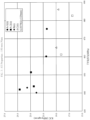
- the new alloys generally realize improved fracture toughness at equivalent strength.
- invention alloy A-1 realizes about 3 MPa-sqrt-m higher strength over the 2070 alloy at about equivalent strength (at 30 hours of aging).
- Invention alloy A-2 also is improved over the 2070 alloy, and the A-2 alloy would be expected to achieve results similar to that of the Alloy A-1 if the silicon content of the A-2 alloy were reduced to 0.02 wt. %.
- Invention alloy B realizes very high fracture toughness at reduced strength levels, but would be expected to achieve results at least as good as A-1, if aged to equivalent strength. The improved properties are even more pronounced at 150 mm, where all of the invention alloys realized much better fracture toughness at equivalent strength.
- the invention alloys include less magnesium than non-invention alloy C.
- the invention alloys also have a Cu:Zn ratio (weight) of not greater than 4.25:1, whereas the non-invention alloys realize higher Cu:Zn ratios.
- the invention alloys also have more zinc than alloy C and non-invention alloy 2070.
- SCC stress corrosion cracking resistance properties of many of the alloys were tested in the ST direction and in accordance with ASTM G44/G47. All of the invention alloys at all aging conditions realized, or were expected to realize, no failures at net stresses of 310 MPa and 379 MPa over a period of 30 days of testing (some alloys are still in test). Conversely, alloy C realized multiple failures at net stresses of 310 MPa and 379 MPa within the 30 day period and under the same testing conditions. This may be due to the fact that alloy C includes high magnesium, which may make alloy C prone to stress corrosion cracking. Alloy C could be aged further to improve corrosion, but its already poor fracture toughness would decrease. Conversely, invention alloys A and B achieve a good combination of four properties: strength, elongation, fracture toughness and stress corrosion cracking resistance.
- the alloys were cooled to room temperature between aging steps.
- Alloys 1-2 having a thickness of about 60 mm, realize an excellent combination of strength and fracture toughness.
- Alloy 3 realizes a similar strengthtoughness trend as the 100 mm alloys of Example 1.
- SCC stress corrosion cracking
Landscapes
- Chemical & Material Sciences (AREA)
- Engineering & Computer Science (AREA)
- Mechanical Engineering (AREA)
- Materials Engineering (AREA)
- Metallurgy (AREA)
- Organic Chemistry (AREA)
- Physics & Mathematics (AREA)
- Thermal Sciences (AREA)
- Crystallography & Structural Chemistry (AREA)
- Manufacturing & Machinery (AREA)
- Cell Electrode Carriers And Collectors (AREA)
Description
- The present disclosure relates to 2xxx aluminum lithium alloys and products made therefrom.
- Aluminum alloys are useful in a variety of applications. However, improving one property of an aluminum alloy without degrading another property often proves elusive. For example, it is difficult to increase the strength of an alloy without decreasing the toughness of an alloy. Other properties of interest for aluminum alloys include corrosion resistance and fatigue crack growth rate resistance, to name two.
WO2017093680 discloses a rolled and/or forged product made of an aluminum-based alloy comprising Cu, Li, Zn, Mg, Zr, Mn and at least one element from Ti, Se, Cr, Hf and V.EP3635146 discloses a 2XXX alloy comprising from 0.05 to 1.9% by weight of Li and from 0.005 to 0.045% by weight of Cr and/or V. - Broadly, the present patent application relates to new 2xxx aluminum lithium alloys. The new 2xxx aluminum lithium alloys comprise (and some instances consist essentially of or consist of) from 2.5 to 3.9 wt. % Cu, from 0.82 to 1.20 wt. 9% Li, from 0.75 to 2.0 wt. % Zn, from 0.10 to 0.60 wt. % Mn, from 0.05 to 0.35 wt. % Mg; from 0.05 to 0.50 wt. % of at least one grain structure control element, wherein the at least one grain structure control element is selected from the group consisting of Zr, Sc, Cr, V, Hf, other rare earth elements, and combinations thereof, up to 0.22 wt. % Ag, up to 0.15 wt. % Fe, up to 0.12 wt. % Si, and up to 0.15 wt. % Ti, up to 0.05 wt.% in total of Ca and Sr , up to 20 ppm of Be, the balance being aluminum and impurities. Products incorporating such alloy compositions may achieve an improved combination of, for instance, two or more of strength, elongation, fracture toughness and stress corrosion cracking resistance.
- As noted above, copper (Cu) is included in the new alloy in the range of from 2.5 wt. % to 3.9 wt. % Cu. More specific embodiments relating to copper are provided near the end of this section.
- As noted above, lithium (Li) is included in the alloy from 0.82 wt. % to 1.20 wt. %. In one embodiment, a new alloy includes at least 0.85 wt. % Li. In another embodiment, a new alloy includes at least 0.875 wt. % Li. In yet another embodiment, a new alloy includes at least 0.90 wt. % Li. In another embodiment, a new alloy includes at least 0.925 wt. % Li. In another embodiment, a new alloy includes at least 0.95 wt. % Li. In one embodiment, a new alloy includes not greater than 1.15 wt. % Li. In another embodiment, a new alloy includes not greater than 1.10 wt. % Li. In yet another embodiment, a new alloy includes not greater than 1.075 wt. % Li. In another embodiment, a new alloy includes not greater than 1.050 wt. % Li. In yet another embodiment, a new alloy includes not greater than 1.025 wt. % Li. In another embodiment, a new alloy includes not greater than 1.000 wt. % Li. In yet another embodiment, a new alloy includes not greater than 0.980 wt. % Li.
- Zinc (Zn) is included in the new alloy, and in the range of from 0.75 wt. % Zn to 2.0 wt. % Zn. More specific embodiments relating to zinc are provided near the end of this section.
- The weight ratio of copper-to-zinc in the alloy may be related to its improved properties (e.g., its quench sensitivity). In one embodiment, a new 2xxx aluminum alloy realizes a copper-to-zinc weight ratio of not greater than 4.25:1 (Cu:Zn).
- Manganese (Mn) is included in the new alloy, and in the range of from 0.10 wt. % to 0.60 wt. % Mn. In one embodiment, a new alloy includes at least 0.125 wt. % Mn. In another embodiment, a new alloy includes at least 0.15 wt. % Mn. In yet another embodiment, a new alloy includes at least 0.175 wt. % Mn. In another embodiment, a new alloy includes at least 0.20 wt. % Mn. In another embodiment, a new alloy includes at least 0.225 wt. % Mn. In yet another embodiment, a new alloy includes at least 0.25 wt. % Mn. In another embodiment, a new alloy includes at least 0.27 wt. % Mn. In one embodiment, a new alloy includes not greater than 0.55 wt. % Mn. In another embodiment, a new alloy includes not greater than 0.50 wt. % Mn. In yet another embodiment, a new alloy includes not greater than 0.45 wt. % Mn. In another embodiment, a new alloy includes not greater than 0.425 wt. % Mn. In yet another embodiment, a new alloy includes not greater than 0.40 wt. % Mn. In another embodiment, a new alloy includes not greater than 0.375 wt. % Mn. In yet another embodiment, a new alloy includes not greater than 0.35 wt. % Mn. In another embodiment, a new alloy includes not greater than 0.325 wt. % Mn. In another embodiment, a new alloy includes not greater than 0.30 wt. % Mn. In the alloying industry, manganese may be considered both an alloying ingredient and a grain structure control element -- the manganese retained in solid solution may enhance a mechanical property of the alloy (e.g., strength and/or toughness), while the manganese in particulate form (e.g., as Al6Mn, Al12Mn3Si2, Al20Cu2Mn3 -- sometimes referred to as dispersoids) may assist with grain structure control and may also improve damage tolerance properties, such as fracture toughness. However, since Mn is separately defined with its own composition limits in the present patent application, it is not within the definition of "grain structure control element" (described below) for the purposes of the present patent application.
- Magnesium (Mg) is included in the new alloy, and in the range of from 0.05 wt. % to 0.35 wt. % Mg. More specific embodiments relating to magnesium are provided near the end of this section.
- The alloy includes 0.05 to 0.50 wt. % of at least one grain structure control element selected from the group consisting of zirconium (Zr), scandium (Sc), chromium (Cr), vanadium (V) and/or hafnium (Hf), and/or other rare earth elements, and such that the utilized grain structure control element(s) is/are maintained below maximum solubility. As used herein, "grain structure control element" means elements or compounds that are deliberate alloying additions with the goal of forming second phase particles, usually in the solid state, to control solid state grain structure changes during thermal processes, such as recovery and recrystallization. For purposes of the present patent application, grain structure control elements include Zr, Sc, Cr, V, Hf, and other rare earth elements, to name a few, but excludes Mn.
- The amount of grain structure control material utilized in an alloy is generally dependent on the type of material utilized for grain structure control and/or the alloy production process. In one approach, the grain structure control element is Zr, and the alloy includes from 0.05 wt. % to 0.20 wt. % Zr. In one embodiment, the aluminum alloy includes at least 0.06 wt. % Zr. In another embodiment, the aluminum alloy includes at least 0.07 wt. % Zr. In yet another embodiment, the aluminum alloy includes at least 0.08 wt. % Zr. In one embodiment, the aluminum alloy includes not greater than 0.18 wt. % Zr. In another embodiment, the aluminum alloy includes not greater than 0.16 wt. % Zr. In another embodiment, the aluminum alloy includes not greater than 0.15 wt. % Zr. In yet another embodiment, the aluminum alloy includes not greater than 0.14 wt. % Zr. In another embodiment, the aluminum alloy includes not greater than 0.13 wt. % Zr. In one embodiment, the alloy includes from 0.05 wt. % to 0.15 wt. % Zr. In another embodiment, the alloy includes from 0.07 wt. % to 0.14 wt. % Zr. In another embodiment, the alloy includes from 0.08 wt. % to 0.13 wt. % Zr.
- The alloy may include up to 0.15 wt. % Ti cumulatively for grain refining and/or other purposes. Grain refiners are inoculants or nuclei to seed new grains during solidification of the alloy. An example of a grain refiner is a 9.525 mm rod comprising 96% aluminum, 3% titanium (Ti) and 1% boron (B) (all in weight percent), where virtually all boron is present as finely dispersed TiB2 particles. During casting, a grain refining rod may be fed in-line into the molten alloy flowing into the casting pit at a controlled rate. The amount of grain refiner included in the alloy is generally dependent on the type of material utilized for grain refining and the alloy production process. Examples of grain refiners include Ti combined with B (e.g., TiB2) or carbon (TiC), although other grain refiners, such as Al-Ti master alloys may be utilized. Generally, grain refiners are added in an amount ranging from 0.0003 wt. % to 0.005 wt. % to the alloy, depending on the desired as-cast grain size. In addition, Ti may be separately added to the alloy in an amount up to 0.15 wt. %, depending on product form, to increase the effectiveness of grain refiner, and typically in the range of 0.005 to 0.15 wt. % Ti. When Ti is included in the alloy, it is generally present in an amount of from 0.01 to 0.10 wt. %. In one embodiment, a new alloy includes at least 0.005 wt. % Ti. In another embodiment, a new alloy includes at least 0.01 wt. % Ti. In yet another embodiment, a new alloy includes at least 0.015 wt. % Ti. In another embodiment, a new alloy includes at least 0.020 wt. % Ti. In one embodiment, a new alloy includes not greater than 0.10 wt. % Ti. In another embodiment, a new alloy includes not greater than 0.08 wt. % Ti. In yet another embodiment, a new alloy includes not greater than 0.07 wt. % Ti. In another embodiment, a new alloy includes not greater than 0.06 wt. % Ti. In yet another embodiment, a new alloy includes not greater than 0.05 wt. % Ti. In one embodiment, the aluminum alloy includes a grain refiner, and the grain refiner is at least one of TiB2 and TiC, where the wt. % of Ti in the alloy is from 0.01 to 0.06 wt. %, or from 0.01 to 0.03 wt. %.
- The new aluminum alloy may include iron (Fe). The iron content of the new alloy should not exceed 0.15 wt. %. In one embodiment, a new alloy may include at least 0.01 wt. % Fe. In one embodiment, a new alloy includes not greater than 0.12 wt. % Fe. In another embodiment, a new alloy includes not greater than 0.10 wt. % Fe. In yet another embodiment, a new alloy includes not greater than 0.08 wt. % Fe. In another embodiment, a new alloy includes not greater than 0.06 wt. % Fe. In yet another embodiment, a new alloy includes not greater than 0.04 wt. % Fe.
- The new aluminum alloy may include silicon (Si). The silicon content of the new alloy should not exceed 0.12 wt. %. In one embodiment, a new alloy may include at least 0.01 wt. % Si. In one embodiment, a new alloy includes not greater than 0.10 wt. % Si. In another embodiment, a new alloy includes not greater than 0.08 wt. % Si. In yet another embodiment, a new alloy includes not greater than 0.06 wt. % Si. In another embodiment, a new alloy includes not greater than 0.04 wt. % Si.
- As noted above, the new aluminum alloy may optionally include silver and in an amount of up to 0.22 wt. %. In one embodiment, a new alloy includes not greater than 0.20 wt. % Ag. In another embodiment, a new alloy includes not greater than 0.15 wt. % Ag. In yet another embodiment, a new alloy includes not greater than 0.10 wt. % Ag. In another embodiment, a new alloy includes not greater than 0.05 wt. % Ag. In yet another embodiment, a new alloy includes not greater than 0.01 wt. % Ag. In another embodiment, a new alloy includes not greater than 0.005 wt. % Ag and/or is not detectable in a new alloy.
- As noted above, the new alloys generally include the stated alloying ingredients, the balance being aluminium and impurities. One or more incidental elements may be added to the alloy during casting to reduce or restrict (and is some instances eliminate) ingot cracking due to, for example, oxide fold, pit and oxide patches. These types of incidental elements are referred to herein as deoxidizers. Examples of some deoxidizers include Ca, Sr, and Be. When calcium (Ca) is included in the alloy, it is present in an amount of up to about 0.05 wt. %, or up to about 0.03 wt. %. In some embodiments, Ca is included in the alloy in an amount of about 0.001-0.03 wt % or about 0.05 wt. %, such as 0.001-0.008 wt. % (or 10 to 80 ppm). Strontium (Sr) may be included in the alloy as a substitute for Ca (in whole or in part), and thus may be included in the alloy in the same or similar amounts as Ca. Traditionally, beryllium (Be) additions have helped to reduce the tendency of ingot cracking, though for environmental, health and safety reasons, some embodiments of the alloy are substantially Befree. When Be is included in the alloy, it is present in an amount of up to about 20 ppm.
- The new 2xxx aluminum alloys contain low amounts of impurities. The new 2xxx aluminum alloy includes not greater than 0.15 wt. %, in total, of the impurities, and not greater than 0.05 wt. % of each of the impurities. In another embodiment, a new 2xxx aluminum alloy includes not greater than 0.10 wt. %, in total, of the impurities, and wherein the 2xxx aluminum alloy includes not greater than 0.03 wt. % of each of the impurities.
- In one embodiment, a first version of the new 2xxx aluminum alloy includes first tailored amounts of copper, magnesium and zinc. In one approach, the first version includes from 3.1 to 3.8 wt. % copper, from 0.5 to 2.0 wt. % Zn, (the range 0.50 up to 0.75 wt%Zn is out of the scope of the invention, as defined by the claims), and from 0.05 to 0.35 wt. % Mg.
- In one embodiment, the first version includes at least 3.2 wt. % Cu. In another embodiment, the first version includes at least 3.3 wt. % Cu. In one embodiment, the first version includes not greater than 3.75 wt. % Cu. In another embodiment, the first version includes not greater than 3.7 wt. % Cu. In one embodiment, the first version includes not greater than 3.65 wt. % Cu. In another embodiment, the first version includes not greater than 3.6 wt. % Cu.
- In one embodiment, not part of the scope of the present invention, the first version includes at least 0.6 wt. % Zn. In another embodiment, also not part of the scope of the present invention, the first version includes at least 0.7 wt. % Zn. In yet another embodiment, the first version includes at least 0.75 wt. % Zn. In another embodiment, the first version includes at least 0.8 wt. % Zn. In yet another embodiment, the first version includes at least 0.85 wt. % Zn. In another embodiment, the first version includes at least 0.9 wt. % Zn. In yet another embodiment, the first version includes at least 0.95 wt. % Zn. In one embodiment, the first version includes not greater than 1.8 wt. % Zn. In another embodiment, the first version includes not greater than 1.6 wt. % Zn. In yet another embodiment, the first version includes not greater that 1.4 wt. % Zn. In another embodiment, the first version includes not greater than 1.3 wt. % Zn. In yet another embodiment, the first version includes not greater that 1.2 wt. % Zn. In another embodiment, the first version includes not greater than 1.1 wt. % Zn. In yet another embodiment, the first version includes not greater that 1.05 wt. % Zn.
- As noted above, the weight ratio of copper-to-zinc in the alloy may be related to its improved properties (e.g., its quench sensitivity). In one embodiment, the first version realizes a copper-to-zinc (weight) ratio of not greater than 4.25:1 (Cu:Zn), i.e., (wt. % Cu) / (wt. % Zn) of the alloy is not greater than 4.25. In another embodiment, the first version realizes a copper-to-zinc (weight) ratio of not greater than 4.10:1. In yet another embodiment, the first version realizes a copper-to-zinc (weight) ratio of not greater than 4.00:1. In another embodiment, the first version realizes a copper-to-zinc (weight) ratio of not greater than 3.90:1. In yet another embodiment, the first version realizes a copper-to-zinc (weight) ratio of not greater than 3.80:1. In another embodiment, the first version realizes a copper-to-zinc (weight) ratio of not greater than 3.78:1.
- In one embodiment, the first version includes at least 0.10 wt. % Mg. In another embodiment, the first version includes at least 0.125 wt. % Mg. In yet another embodiment, the first version includes at least 0.15 wt. % Mg. In another embodiment, the first version includes at least 0.175 wt. % Mg. In yet another embodiment, the first version includes at least 0.20 wt. % Mg. In another embodiment, the first version includes at least 0.21 wt. % Mg. In yet another embodiment, the first version includes at least 0.22 wt. % Mg. In one embodiment, the first version includes not greater than 0.325 wt. % Mg. In another embodiment, the first version includes not greater than 0.30 wt. % Mg. In yet another embodiment, the first version includes not greater than 0.29 wt. % Mg. In another embodiment, the first version includes not greater than 0.28 wt. % Mg.
- Various first version embodiments of the 2xxx alloy are provided below. Alloys 1V-1, 1V-2 and 1V-3 are not within the claimed scope in the whole range due to the Zn content, which has to be from 0.75 to 2.0 wt.% according to the claims.
TABLE 1a - EXEMPLARY FIRST VERSION ALLOYS (In weight percent) Alloy Cu Li Zn Mn Mg Ag 1V-1 3.1 - 3.8 0.82 - 1.20 0.5 - 2.0 0.10 - 0.60 0.05 - 0.35 ≤ 0.22 1V-2 3.2-3.75 0.85 - 1.15 0.6 - 1.8 0.15 - 0.55 0.10 - 0.325 ≤ 0.005 1V-3 3.2 - 3.7 0.875 - 1.10 0.7 - 1.6 0.20-0.45 0.125 - 0.30 ≤ 0.005 1V-4 3.3 - 3.7 0.90 - 1.075 0.75 - 1.4 0.20 - 0.425 0.15 - 0.29 ≤ 0.005 1V-5 3.3 - 3.65 0.90 - 1.050 0.8 - 1.3 0.225 - 0.40 0.175 - 0.29 ≤ 0.005 1V-6 3.3 - 3.6 0.90 - 1.025 0.85 - 1.2 0.225 - 0.375 0.20-0.29 ≤ 0.005 1V-7 3.3 - 3.6 0.90 - 1.000 0.9 - 1.1 0.25 - 0.35 0.21-0.28 ≤ 0.005 1V-8 3.3 - 3.6 0.90 - 1.000 0.95 - 1.05 0.27 - 0.325 0.22-0.28 ≤ 0.005 TABLE 1b - EXEMPLARY FIRST VERSION ALLOYS (In weight percent) (cont.) Alloy Cu:Zn GSC* Fe Si Ti Impurities (Each/Total) Balance** 1V-1 ≤ 4.25:1 0.05-0.20 Zr ≤ 0.15 ≤ 0.12 ≤ 0.15 ≤ 0.05 / ≤ 0.15 Al and Opt. Incid. El. 1V-2 ≤ 4.25:1 0.05-0.18 Zr ≤ 0.12 ≤ 0.10 0.01-0.10 ≤ 0.05 / ≤ 0.15 Al and Opt. Incid. El. 1V-3 ≤ 4.25:1 0.05-0.16 Zr ≤ 0.10 ≤ 0.08 0.01-0.10 ≤ 0.05 / ≤ 0.15 Al and Opt. Incid. El. 1V-4 ≤ 4.25:1 0.05-0.15 Zr ≤ 0.08 ≤ 0.06 0.01 - 0.10 ≤ 0.05 / ≤ 0.15 Al and Opt. Incid. El. 1V-5 ≤ 4.25:1 0.05-0.15 Zr ≤ 0.08 ≤ 0.06 0.01 - 0.10 ≤ 0.05 / ≤ 0.15 Al and Opt. Incid. El. 1V-6 ≤ 4.10:1 0.05-0.15 Zr ≤ 0.08 ≤ 0.06 0.01 - 0.10 ≤ 0.03 / ≤ 0.10 Al and Opt. Incid. El. 1V-7 ≤ 4.00:1 0.05-0.15 Zr ≤ 0.08 ≤ 0.06 0.01 - 0.10 ≤ 0.03 / ≤ 0.10 Al and Opt. Incid. El. 1V-8 ≤ 3.78:1 0.05-0.15 Zr ≤ 0.06 ≤ 0.04 0.01 - 0.10 ≤ 0.03 / ≤ 0.10 Al and Opt. Incid. El. * GSC = grain structure control
** Op. Incid. El. = Optional Incidental Elements - In one embodiment, a first version includes 3.2 - 3.7 wt. % Cu, 0.85 - 1.15 wt. % Li, 0.75 - 1.25 wt. % Zn, wherein Cu:Zn (weight ratio) is ≤ 4.25:1, 0.15 - 0.29 wt. % Mg, (X1, X2, X3, X4 or X5) wt. % Mn, ≤ 0.005 wt. % Ag, 0.05 - 0.15 wt. % Zr, ≤ 0.10 wt. % Fe, ≤ 0.08 wt. % Si, 0.01 - 0.10 wt. % Ti, the balance being aluminum, optional incidental elements, and impurities, wherein X1 is 0.15 - 0.40 (i.e., X1 wt. % Mn is 0.15 - 0.40 wt. % Mn), wherein X2 is 0.15-0.30, wherein X3 is 0.15 - 0.25, wherein X4 is 0.20 - 0.40, and wherein X5 is 0.25 - 0.35.
- In one embodiment, a second version of the new 2xxx aluminum alloy includes second tailored amounts of copper, magnesium and zinc. In one approach, the second version includes from 2.5 to 3.4 wt. % copper, from 0.5 to 2.0 wt. % Zn, (the range 0.50 up to 0.75 wt%Zn is out of the scope of the invention, as defined by the claims), and from 0.05 to 0.35 wt. % Mg.
- In one embodiment, the second version includes at least 2.6 wt. % Cu. In another embodiment, the second version includes at least 2.7 wt. % Cu. In yet another embodiment, the second version includes at least 2.8 wt. % Cu. In another embodiment, the second version includes at least 2.85 wt. % Cu. In one embodiment, the second version includes not greater than 3.35 wt. % Cu. In another embodiment, the second version includes not greater than 3.3 wt. % Cu. In one embodiment, the second version includes not greater than 3.25 wt. % Cu. In another embodiment, the second version includes not greater than 3.2 wt. % Cu. In another embodiment, the second version includes not greater than 3.15 wt. % Cu.
- In one embodiment, not part of the scope of the present invention, the second version includes at least 0.6 wt. % Zn. In another embodiment, the second version includes at least 0.8 wt. % Zn. In yet another embodiment, the second version includes at least 1.0 wt. % Zn. In another embodiment, the second version includes at least 1.1 wt. % Zn. In yet another embodiment, the second version includes at least 1.2 wt. % Zn. In another embodiment, the second version includes at least 1.3 wt. % Zn. In one embodiment, the second version includes not greater than 1.9 wt. % Zn. In another embodiment, the second version includes not greater than 1.8 wt. % Zn. In yet another embodiment, the second version includes not greater that 1.7 wt. % Zn. In another embodiment, the second version includes not greater than 1.6 wt. % Zn. In yet another embodiment, the second version includes not greater that 1.5 wt. % Zn.
- As noted above, the weight ratio of copper-to-zinc in the alloy may be related to its improved properties (e.g., its quench sensitivity). In one embodiment, the second version realizes a copper-to-zinc (weight) ratio of not greater than 4.25:1 (Cu:Zn), i.e., (wt. % Cu) / (wt. % Zn) of the alloy is not greater than 4.00:1. In another embodiment, the second version realizes a copper-to-zinc (weight) ratio of not greater than 3.75:1. In yet another embodiment, the second version realizes a copper-to-zinc (weight) ratio of not greater than 3.50:1. In another embodiment, the second version realizes a copper-to-zinc (weight) ratio of not greater than 3.30:1. In yet another embodiment, the second version realizes a copper-to-zinc (weight) ratio of not greater than 3.10:1. In another embodiment, the second version realizes a copper-to-zinc (weight) ratio of not greater than 2.95:1. In yet another embodiment, the second version realizes a copper-to-zinc (weight) ratio of not greater than 2.90:1. In another embodiment, the second version realizes a copper-to-zinc (weight) ratio of not greater than 2.75:1. In another embodiment, the second version realizes a copper-to-zinc (weight) ratio of not greater than 2.67:1. In another embodiment, the second version realizes a copper-to-zinc (weight) ratio of not greater than 2.50:1. In another embodiment, the second version realizes a copper-to-zinc (weight) ratio of not greater than 2.42:1.
- In one embodiment, the second version includes at least 0.10 wt. % Mg. In another embodiment, the second version includes at least 0.12 wt. % Mg. In yet another embodiment, the second version includes at least 0.13 wt. % Mg. In another embodiment, the second version includes at least 0.14 wt. % Mg. In yet another embodiment, the second version includes at least 0.15 wt. % Mg. In another embodiment, the second version includes at least 0.16 wt. % Mg. In yet another embodiment, the second version includes at least 0.17 wt. % Mg. In one embodiment, the second version includes not greater than 0.30 wt. % Mg. In another embodiment, the second version includes not greater than 0.275 wt. % Mg. In yet another embodiment, the second version includes not greater than 0.25 wt. % Mg. In another embodiment, the second version includes not greater than 0.24 wt. % Mg. In yet another embodiment, the second version includes not greater than 0.23 wt. % Mg.
- Various second version embodiments of the new 2xxx alloy are provided below. Alloys 2V-1 and 2V-2 are not within the claimed scope in the whole range of Zn, which has to be from 0.75 to 2.0 wt.% according to the claims.
TABLE 2a - EXEMPLARY SECOND VERSION ALLOYS (In weight percent) Alloy Cu Li Zn Mn Mg Ag 2V-1 2.5 - 3.4 0.82 - 1.20 0.5 - 2.0 0.10 - 0.60 0.05 - 0.35 ≤ 0.22 2V-2 2.6 - 3.4 0.85 - 1.15 0.6 - 1.9 0.15 -0.55 0.10 - 0.30 ≤ 0.005 2V-3 2.6 - 3.35 0.875 - 1.15 0.8 - 1.8 0.20 - 0.45 0.12 - 0.275 ≤ 0.005 2V-4 2.7 - 3.35 0.90 - 1.10 1.0 - 1.7 0.20 - 0.425 0.13 - 0.25 ≤ 0.005 2V-5 2.7 - 3.3 0.90 - 1.10 1.1 - 1.7 0.225 - 0.40 0.14 - 0.25 ≤ 0.005 2V-6 2.8 - 3.25 0.90 -1.075 1.1-1.6 0.225 - 0.375 0.15 - 0.24 ≤ 0.005 2V-7 2.8 - 3.2 0.925 - 1.05 1.2 - 1.5 0.25 - 0.35 0.16 - 0.24 ≤ 0.005 2V-8 2.85 - 3.15 0.95 - 1.05 1.3 - 1.5 0.27 - 0.325 0.17 - 0.23 ≤ 0.005 TABLE 2b - EXEMPLARY SECOND VERSION ALLOYS (In weight percent) (cont.) Alloy Cu:Zn GSC* Fe Si Ti Impurities (Each/Total) Balance** 2V-1 ≤ 4.25:1 0.05-0.20 Zr ≤ 0.15 ≤ 0.12 ≤ 0.15 ≤ 0.05 / ≤ 0.15 Al and Opt. Incid. El. 2V-2 ≤ 4.00:1 0.05-0.18 Zr ≤ 0.12 ≤ 0.10 0.01 - 0.10 ≤ 0.05 / ≤ 0.15 Al and Opt. Incid. El. 2V-3 ≤ 4.00:1 0.05-0.16 Zr ≤ 0.10 ≤ 0.08 0.01 - 0.10 ≤ 0.05 / ≤ 0.15 Al and Opt. Incid. El. 2V-4 ≤ 3.30:1 0.05-0.15 Zr ≤ 0.08 ≤ 0.06 0.01 - 0.10 ≤ 0.05 / ≤ 0.15 Al and Opt. Incid. El. 2V-5 ≤ 2.95:1 0.05-0.15 Zr ≤ 0.08 ≤ 0.06 0.01 - 0.10 ≤ 0.05 / ≤ 0.15 Al and Opt. Incid. El. 2V-6 ≤ 2.90:1 0.05-0.15 Zr ≤ 0.08 ≤ 0.06 0.01 - 0.10 ≤ 0.03 / ≤ 0.10 Al and Opt. Incid. El. 2V-7 ≤ 2.67:1 0.05-0.15 Zr ≤ 0.08 ≤ 0.06 0.01 - 0.10 ≤ 0.03 / ≤ 0.10 Al and Opt. Incid. El. 2V-8 ≤ 2.42:1 0.05-0.15 Zr ≤ 0.06 ≤ 0.04 0.01 - 0.10 ≤ 0.03 / ≤ 0.10 Al and Opt. Incid. El. * GSC = grain structure control
** Op. Incid. El. = Optional Incidental Elements - In one embodiment, a second version includes 2.7 - 3.3 wt. % Cu, 0.85 - 1.15 wt. % Li, 1.2 - 1.6 wt. % Zn, wherein Cu:Zn (weight ratio) is ≤ 4.25:1, 0.15 - 0.30 wt. % Mg, (Y1, Y2, Y3, Y4 or Y5) wt. % Mn, ≤ 0.005 wt. % Ag, 0.05 - 0.15 wt. % Zr, ≤ 0.10 wt. % Fe, ≤ 0.08 wt. % Si, 0.01 - 0.10 wt. % Ti, the balance being aluminum, optional incidental elements, and impurities, wherein Y1 is 0.15 - 0.40 (i.e., Y1 wt. % Mn is 0.15 - 0.40 wt. % Mn), wherein Y2 is 0.15-0.30, wherein Y3 is 0.15 - 0.25, wherein Y4 is 0.20 - 0.40, and wherein Y5 is 0.25 - 0.35.
- The new alloys may be useful in a variety of product forms, including ingot or billet, wrought product forms (plate, forgings and extrusions), shape castings, additively manufactured products, and powder metallurgy products, for instance.
- In one embodiment, a new 2xxx aluminum alloy is in the form of a thick wrought product. Thick wrought aluminum alloy products are those wrought products having a crosssectional thickness of at least 12.7 mm. The wrought products may be rolled products, forged products or extruded products. In one embodiment, a thick wrought aluminum alloy product has a thickness of at least 25.4 mm. In another embodiment, a thick wrought aluminum alloy product has a thickness of at least 50.8 mm. In yet another embodiment, a thick wrought aluminum alloy product has a thickness of at least 76.2 mm. In another embodiment, a thick wrought aluminum alloy product has a thickness of at least 101.6 mm. In yet another embodiment, a thick wrought aluminum alloy product has a thickness of at least 126.0 mm. In another embodiment, a thick wrought aluminum alloy product has a thickness of at least 152.4 mm. The improved properties described herein may be achieved with thick wrought products having a thickness of up to 304.8 mm. In one embodiment, a thick wrought aluminum alloy product has a thickness of not greater than 254.0 mm. In another embodiment, a thick wrought aluminum alloy product has a thickness of not greater than 203.2 mm. In yet another embodiment, a thick wrought aluminum alloy product has a thickness of not greater than 177.8 mm. As used in this paragraph, thickness refers to the minimum thickness of the product, realizing that some portions of the product may realize slightly larger thicknesses than the minimum stated.
- The new alloy can be prepared into wrought form, and in the appropriate temper, by more or less conventional practices, including direct chill (DC) casting the aluminum alloy into ingot form. After conventional scalping, lathing or peeling (if needed) and homogenization, which homogenization may be completed before or after scalping, these ingots may be further processed by hot working the product. The product may then be optionally cold worked, optionally annealed, solution heat treated, quenched, and final cold worked (e.g., by stretching or compression of from 0.5% to 10%). After the final cold working step, the product may be artificially aged. Thus, in some embodiments, the products may be produced in a T3 or T8 temper. In other embodiments, other T tempers may be used (e.g., any of a T1, T2, T4, T5, T6, T7 or T9 temper). T tempers are defined in ANSI H35.1 (2009).
- The new 2xxx aluminum lithium alloys generally realize an improved combination of at least two of strength, elongation, fracture toughness, and stress corrosion cracking resistance.
- In one embodiment, a new 2xxx aluminum lithium alloy has a thickness of at least 80 mm and realizes a tensile yield strength (ST) of at least 440 MPa in the T8 temper. In another embodiment, a new 2xxx aluminum lithium alloy has a thickness of at least 80 mm and realizes a tensile yield strength (ST) of at least 450 MPa in the T8 temper. In yet another embodiment, a new 2xxx aluminum lithium alloy has a thickness of at least 80 mm and realizes a tensile yield strength (ST) of at least 460 MPa in the T8 temper. In another embodiment, a new 2xxx aluminum lithium alloy has a thickness of at least 80 mm and realizes a tensile yield strength (ST) of at least 470 MPa in the T8 temper. In yet another embodiment, a new 2xxx aluminum lithium alloy has a thickness of at least 80 mm and realizes a tensile yield strength (ST) of at least 480 MPa, or more, in the T8 temper. The above strength properties may be realized in products having a thickness of at least 100 mm, or at least 125 mm, or at least 150 mm, or higher.
- In one embodiment, a new 2xxx aluminum lithium alloy has a thickness of at least 80 mm and realizes a plane-strain (KIC) fracture toughness (S-L) of at least 20 MPa-sqrt-m in the T8 temper. In another embodiment, a new 2xxx aluminum lithium alloy has a thickness of at least 80 mm and realizes a plane-strain (KIC) fracture toughness (S-L) of at least 21 MPa-sqrt-m in the T8 temper. In yet another embodiment, a new 2xxx aluminum lithium alloy has a thickness of at least 80 mm and realizes a plane-strain (KIC) fracture toughness (S-L) of at least 22 MPa-sqrt-m in the T8 temper. In another embodiment, a new 2xxx aluminum lithium alloy has a thickness of at least 80 mm and realizes a plane-strain (KIC) fracture toughness (S-L) of at least 23 MPa-sqrt-m in the T8 temper. In yet another embodiment, a new 2xxx aluminum lithium alloy has a thickness of at least 80 mm and realizes a plane-strain (KIC) fracture toughness (S-L) of at least 24 MPa-sqrt-m in the T8 temper. In another embodiment, a new 2xxx aluminum lithium alloy has a thickness of at least 80 mm and realizes a plane-strain (KIC) fracture toughness (S-L) of at least 25 MPa-sqrt-m in the T8 temper. In yet another embodiment, a new 2xxx aluminum lithium alloy has a thickness of at least 80 mm and realizes a plane-strain (KIC) fracture toughness (S-L) of at least 26 MPa-sqrt-m, or more, in the T8 temper. The above fracture toughness properties may be realized in products having a thickness of at least 100 mm, or at least 125 mm, or at least 150 mm, or higher.
- In one embodiment, a new 2xxx aluminum lithium alloy has a thickness of at least 80 mm and realizes an elongation (ST) of at least 1.5% in the T8 temper. In another embodiment, a new 2xxx aluminum lithium alloy has a thickness of at least 80 mm and realizes an elongation (ST) of at least 2.0% in the T8 temper. In yet another embodiment, a new 2xxx aluminum lithium alloy has a thickness of at least 80 mm and realizes an elongation (ST) of at least 2.5% in the T8 temper. In one embodiment, a new 2xxx aluminum lithium alloy has a thickness of at least 80 mm and realizes an elongation (ST) of at least 3.0%, or more, in the T8 temper. The above elongation properties may be realized in products having a thickness of at least 100 mm, or at least 125 mm, or at least 150 mm, or higher.
- In one embodiment, a new 2xxx aluminum lithium alloy has a thickness of at least 80 mm and is stress corrosion cracking resistant (defined below) in the T8 temper. The above stress corrosion cracking resistance properties may be realized in products having a thickness of at least 100 mm, or at least 125 mm, or at least 150 mm, or higher.
- In one approach, a new 2xxx aluminum lithium alloy realizes at least 3.0 MPa-sqrt-m (MPa√m) higher plane strain (KIC) fracture toughness as compared to a standard 2070 aluminum alloy product, where both products processed to the same product form, gauge, yield strength and temper. For instance, if both a new 2xxx aluminum lithium alloy and a 2070 alloy are produced as 150 mm plate in the T8 temper (with the same amount of stretch or compression, e.g., within 0.5% stretch/compression of each other), and if both alloys are artificially aged to about the same tensile yield strength (e.g., within 5 MPa of one another), then, in this approach, the KIC fracture toughness of the new 2xxx aluminum lithium alloy would be at least 3 MPa-sqrt-m higher than the 2070 alloy. In one embodiment, a new 2xxx aluminum lithium alloy realizes at least 4.0 MPa-sqrt-m higher plane strain (KIC) fracture toughness as compared to a standard 2070 aluminum alloy product, where both products processed to the same product form, gauge, yield strength and temper. In another embodiment, a new 2xxx aluminum lithium alloy realizes at least 5.0 MPa-sqrt-m higher plane strain (KIC) fracture toughness as compared to a standard 2070 aluminum alloy product, where both products processed to the same product form, gauge, yield strength and temper. A standard 2070 aluminum alloy product nominally includes (targets) 3.5 wt. % Cu, 0.30 wt. % Mn, 0.22 wt. % Mg, 0.30 wt. % Zn, 1.15 wt. % Li, 0.30 wt. % Zn, 0.11 wt. % Zr, ≤ 0.04 wt. % Si, ≤ 0.06 wt. % Fe, ≤ 0.03 wt. % Ti, not greater than 0.10 wt. %, in total, of impurities, and not greater than 0.03 wt. % of each of impurities, the balance being aluminum.
- While the above properties generally relate to thick plate products, similar properties may also be realized in thick forged product and thick extruded products. Further, many of the above properties may be realized in combination, as shown by the below examples.
- Unless otherwise indicated, the following definitions apply to the present application:
- "2xxx aluminum alloys" are aluminum alloys compositions having copper as the major alloying element as per the Aluminum Association definition provided in " International Alloy Designations and Chemical Composition Limits for Wrought Aluminum and Wrought Aluminum Alloys," page 28 (2015). For purposes of this patent application, 2xxx aluminum alloy compositions may be used in non-wrought products, such as in shape castings, ingot/billet, and additively manufactured products, among others.
- "Wrought aluminum alloy product" means an aluminum alloy product that is hot worked after casting, and includes rolled products (sheet or plate), forged products, and extruded products.
- "Forged aluminum alloy product" means a wrought aluminum alloy product that is either die forged or hand forged.
- "Solution heat treating" means exposure of an aluminum alloy to elevated temperature for the purpose of placing solute(s) into solid solution.
- "Hot working" means working the aluminum alloy product at elevated temperature, generally at least 121.1°C (250°F).
- "Cold working" means working the aluminum alloy product at temperatures that are not considered hot working temperatures, generally below about 121.1°C (250°F) (e.g., at ambient).
- "Artificially aging" means exposure of an aluminum alloy to elevated temperature for the purpose of precipitating solute(s). Artificial aging may occur in one or a plurality of steps, which can include varying temperatures and/or exposure times.
- Strength and elongation are measured in accordance with ASTM E8 and B557.
- Fracture toughness is measured in accordance with ASTM E399.
- "Stress corrosion cracking resistant" means that all specimens of a 2xxx aluminum alloy product do not fail after 30 days of alternate immersion testing at a net stress of 379 MPa in accordance with ASTM G44/G47, and with at least 5 specimens being required for testing. In one embodiment, all specimens of a 2xxx aluminum alloy product do not fail after 60 days of alternate immersion testing at a net stress of 379 MPa in accordance with ASTM G44/G47, and with at least 5 specimens being required for testing. In another embodiment, all specimens of a 2xxx aluminum alloy product do not fail after 90 days of alternate immersion testing at a net stress of 379 MPa in accordance with ASTM G44/G47, and with at least 5 specimens being required for testing. SCC test specimens are extracted so as to be centered at the mid-plane and oriented in the ST direction relative to the original alloy product.
- As used herein, "additive manufacturing" means "a process of joining materials to make objects from 3D model data, usually layer upon layer, as opposed to subtractive manufacturing methodologies", as defined in ASTM F2792-12a entitled "Standard Terminology for Additively Manufacturing Technologies". Non-limiting examples of additive manufacturing processes useful in producing aluminum alloy products include, for instance, DMLS (direct metal laser sintering), SLM (selective laser melting), SLS (selective laser sintering), and EBM (electron beam melting), among others. Any suitable feedstocks made from the above new 2xxx aluminum alloys may be used, including one or more powders, one or more wires, one or more sheets, and combinations thereof. In some embodiments the additive manufacturing feedstock is comprised of one or more powders comprising the new 2xxx aluminum alloys. Shavings are types of particles. In some embodiments, the additive manufacturing feedstock is comprised of one or more wires comprising the new 2xxx aluminum alloys. A ribbon is a type of wire. In some embodiments, the additive manufacturing feedstock is comprised of one or more sheets comprising the new 2xxx aluminum alloys. Foil is a type of sheet.
- These and other aspects, advantages, and novel features of this new technology are set forth in part in the description that follows and will become apparent to those skilled in the art upon examination of the following description and figures, or may be learned by practicing one or more embodiments of the technology provided for by the present disclosure.
- The figures constitute a part of this specification and include illustrative embodiments of the present disclosure and illustrate various objects and features thereof. In addition, any measurements, specifications and the like shown in the figures are intended to be illustrative, and not restrictive. Therefore, specific structural and functional details disclosed herein are not to be interpreted as limiting, but merely as a representative basis for teaching one skilled in the art to variously employ the present invention.
- Among those benefits and improvements that have been disclosed, other objects and advantages of this invention will become apparent from the following description taken in conjunction with the accompanying figures. Detailed embodiments of the present invention are disclosed herein; however, it is to be understood that the disclosed embodiments are merely illustrative of the invention that may be embodied in various forms. In addition, each of the examples given in connection with the various embodiments of the invention is intended to be illustrative, and not restrictive.
- Throughout the specification and claims, the following terms take the meanings explicitly associated herein, unless the context clearly dictates otherwise. The phrases "in one embodiment" and "in some embodiments" as used herein do not necessarily refer to the same embodiment(s), though they may. Furthermore, the phrases "in another embodiment" and "in some other embodiments" as used herein do not necessarily refer to a different embodiment, although they may. Thus, various embodiments of the invention may be readily combined, without departing from the scope of the claims.
- In addition, as used herein, the term "or" is an inclusive "or" operator, and is equivalent to the term "and/or," unless the context clearly dictates otherwise (e.g., "X1, X2, X3, X4 or X5" does not mean "and/or" herein because all of X1-X5 are unique and distinct from one another). The term "based on" is not exclusive and allows for being based on additional factors not described, unless the context clearly dictates otherwise. In addition, throughout the specification, the meaning of "a," "an," and "the" include plural references, unless the context clearly dictates otherwise. The meaning of "in" includes "in" and "on", unless the context clearly dictates otherwise.
- While a number of embodiments of the present invention have been described, it is understood that these embodiments are illustrative only, and not restrictive, and that many modifications may become apparent to those of ordinary skill in the art. Further still, unless the context clearly requires otherwise, the various steps may be carried out in any desired order, and any applicable steps may be added and/or eliminated.
-
-
FIGS. 1-2 are graphs illustrating the performance of various aluminum alloy products of Example 1. -
FIG. 3 is a graph illustrating the performance of various aluminum alloys products of Example 2. - Various Al-Li alloys were cast as ingot and homogenized. The composition of each ingot is shown in Table 3a, below. Alloys A and B are invention alloys. Alloy C and the 2070 alloy are non-invention alloys. The 2070 alloy is described in, for instance, commonly-owned
U.S. Patent Application Publication No. 2012/0225271 .TABLE 3a - COMPOSITION OF ALLOYS Alloy Si Fe Cu Mn Mg Zn Li Zr Ti A-1 0.02 0.03 3.57 0.29 0.24 0.94 0.92 0.10 0.02 A-2 0.05 0.03 3.46 0.32 0.27 1.00 0.94 0.10 0.02 B 0.04 0.04 2.96 0.32 0.21 1.42 0.98 0.09 0.02 C 0.05 0.04 3.70 0.33 0.38 0.84 0.97 0.10 0.02 2070 0.02 0.03 3.48 0.30 0.22 0.36 1.13 0.10 0.02 - The balance of each alloy was aluminum, incidental elements and impurities, with no one impurity exceeding 0.05 wt. %, and with the total amount of impurities not exceeding 0.15 wt. %. After homogenization, the alloys were hot rolled to final gauge, solution heat treated, quenched and stretched about 6%. Approximate final gauges are provided in Table 3b, below.
TABLE 3b - ALLOYS AND FINAL GAUGE Alloy Final Gauge (mm) Final Gauge (in.) A-1(i) 100 3.94 A-1(ii) 150 5.91 A-2(i) 100 3.94 A-2(ii) 150 5.91 B(i) 100 3.94 B(ii) 150 5.91 C(i) 100 3.94 C(ii) 150 5.91 2070(i) 100 3.94 2070(ii) 120 4.72 - Various two-step artificial aging practices are completed on the alloys, the first step being completed at 290°F (143.3°C) for various times, as provided in Table 4, below, the second step being 12 hours at 225°F (107.2°C). Various mechanical properties of the aged aluminum alloy plates are measured in accordance with ASTM E8 and B557. Fracture toughness properties of some samples were also measured and in accordance with ASTM E399. As shown by the below data and corresponding
FIG. 1-2 , the invention alloys realized an improved combination of properties in the short transverse direction.TABLE 4 - Mechanical Properties (Short Transverse Direction) Alloy 1st Step Age Time (hrs) TYS(ST) (MPa) UTS(ST) (MPa) Elong. (ST)(%) KIC (S-L) (MPa-sqrt-m) A-1(i) 25 461.3 526.0 3.2 21.6 A-1(i) 30 466.1 531.9 3.7 23.1 A-1(i) 50 482.6 543.3 3.1 20.9 A-2(i) 25 466.0 529.0 4.7 21.2 A-2(i) 30 484.0 543.0 3.8 19.1 B(i) 40 446.1 509.5 3.7 25.9 B(i) 60 451.3 511.6 4.1 24.7 C(i) 25 473.3 538.5 2.8 19.7 C(i) 45 497.5 555.0 2.1 19.2 2070(i) 30 467.8 535.0 3.3 20.5 2070(i) 50 489.5 548.8 2.4 15.8 A-1(ii) 30 460.2 515.7 3.1 20.5 A-1(ii) 50 475.4 521.2 2.0 20.4 A-2(ii) 25 442.0 496.0 3.6 24.7 A-2(ii) 25 443.8 495.0 3.0 22.5 A-2(ii) 30 451.5 504.0 3.0 22.9 B(ii) 40 440.2 484.0 2.8 22.1 B(ii) 60 443.0 489.5 2.5 23.5 C(ii) 25 465.1 517.5 2.7 19.0 C(ii) 45 486.1 534.0 2.2 18.7 2070(ii) (120mm) 30 461.3 527.4 3.4 18.2* 2070(ii) (120mm) 50 482.6 538.1 2.7 16.5* * = KQ value - At 100 mm, the new alloys generally realize improved fracture toughness at equivalent strength. For instance, invention alloy A-1 realizes about 3 MPa-sqrt-m higher strength over the 2070 alloy at about equivalent strength (at 30 hours of aging). Invention alloy A-2 also is improved over the 2070 alloy, and the A-2 alloy would be expected to achieve results similar to that of the Alloy A-1 if the silicon content of the A-2 alloy were reduced to 0.02 wt. %. Invention alloy B realizes very high fracture toughness at reduced strength levels, but would be expected to achieve results at least as good as A-1, if aged to equivalent strength. The improved properties are even more pronounced at 150 mm, where all of the invention alloys realized much better fracture toughness at equivalent strength. Notably, the invention alloys include less magnesium than non-invention alloy C. The invention alloys also have a Cu:Zn ratio (weight) of not greater than 4.25:1, whereas the non-invention alloys realize higher Cu:Zn ratios. The invention alloys also have more zinc than alloy C and non-invention alloy 2070.
- The stress corrosion cracking (SCC) resistance properties of many of the alloys were tested in the ST direction and in accordance with ASTM G44/G47. All of the invention alloys at all aging conditions realized, or were expected to realize, no failures at net stresses of 310 MPa and 379 MPa over a period of 30 days of testing (some alloys are still in test). Conversely, alloy C realized multiple failures at net stresses of 310 MPa and 379 MPa within the 30 day period and under the same testing conditions. This may be due to the fact that alloy C includes high magnesium, which may make alloy C prone to stress corrosion cracking. Alloy C could be aged further to improve corrosion, but its already poor fracture toughness would decrease. Conversely, invention alloys A and B achieve a good combination of four properties: strength, elongation, fracture toughness and stress corrosion cracking resistance.
- Three additional Al-Li alloys (all invention) were cast as ingot and homogenized, the compositions of which are shown in Table 5, below.
Table 5 - Compositions of Example 2 Alloys Alloy Si Fe Cu Mn Mg Zn Ag Li Zr Ti 1 0.04 0.04 3.46 0.27 0.26 0.98 -- 0.96 0.10 0.03 2 0.07 0.07 3.63 0.27 0.26 0.97 -- 0.96 0.09 0.02 3 0.06 0.04 3.50 0.26 0.22 0.96 -- 0.97 0.09 0.02 - The balance of each alloy was aluminum, incidental elements and impurities, with no one impurity exceeding 0.05 wt. %, and with the total amount of impurities not exceeding 0.15 wt. %. After homogenization, the alloys were hot rolled to final gauge, solution heat treated, quenched and then stretched about 6%. The alloys were then artificially aged at various times and temperatures. The aging conditions are shown in Table 6.
Table 6- Aging Conditions for Example 2 Alloys Condition First Step Second Step A 20 hours at 143.3°C (290°F) 12 hours at 107.2°C (225°F) B 30 hours at 143.3°C (290°F) c 40 hours at 143.3°C (290°F) - The alloys were cooled to room temperature between aging steps.
- The through-thickness mechanical properties of the alloys were then tested, the results of which are shown in Table 7, below.
Table 7- Mechanical Properties of Example 2 Alloys Alloy Final Gauge (mm) Aging Condition ST TYS (MPa) ST UTS (MPa) ST Elong. (%) S-L KIC (MPa√m) 1 59.8 A 455 535 7.8 27.3 B 464 542 7.3 23.9 C 473 548 8.5 22.7 2 60.8 A 454 523 7.8 22.7 B 464 532 7.0 21.8 C 468 538 5.3 21.3 3 107.4 A 443 510 6.0 22.7 B 460 524 5.8 22.0 C 463 523 5.0 22.3 - As shown in
FIG. 3 , Alloys 1-2, having a thickness of about 60 mm, realize an excellent combination of strength and fracture toughness. Alloy 3 realizes a similar strengthtoughness trend as the 100 mm alloys of Example 1. - The stress corrosion cracking (SCC) resistance properties of many of the alloys were also tested in the ST direction as per Example 1 at a net stress of 310 MPa. The results are provided in Table 8, below.
Table 8 - SCC test results (days in test) Alloy Final Gauge (mm) Aging Condition Sample 1 Sample 2Sample 3 1 59.8 A T T T B T T T 2 60.8 A T T T B T T T 3 107.4 A T T T B T T T T = still had not failed after 20 days in test. - While various embodiments of the present disclosure have been described in detail, it is apparent that modifications and adaptations of those embodiments within the scope of the claims will occur to those skilled in the art.
Claims (15)
- A 2xxx aluminum alloy comprising:2.5 - 3.9 wt. % Cu;0.82 - 1.20 wt. % Li;0.75 - 2.0 wt. % Zn;0.10 - 0.60 wt. % Mn;0.05 - 0.35 wt. % Mg;from 0.05 to 0.50 wt. % of at least one grain structure control element,wherein the at least one grain structure control element is selected from the group consisting of Zr, Sc, Cr, V, Hf, other rare earth elements, and combinations thereof;up to 0.22 wt. % Ag;up to 0.15 wt. % Fe;up to 0.12 wt. % Si;up to 0.15 wt. % Ti;up to 0.05 wt. % in total of Ca and Sr; andup to 20 ppm of Be;the balance being aluminum and impurities,
wherein the impurities are limited to up to 0.15 wt. % in total of impurities and not greater than 0.05 wt. % of any one impurity. - The 2xxx aluminum alloy of claim 1, wherein the 2xxx aluminum alloy includes not greater than 0.20 wt. % Ag, or not greater than 0.15 wt. % Ag, or not greater than 0.10 wt. % Ag, or not greater than 0.05 wt. % Ag, or not greater than 0.01 wt. % Ag, or not greater than 0.005 wt. % Ag.
- The 2xxx aluminum alloy of any of the preceding claims, wherein the 2xxx aluminum alloy includes at least 0.85 wt. % Li, or at least 0.875 wt. % Li, or at least 0.900 wt. % Li, or at least 0.925 wt. % Li, or at least 0.950 wt. % Li.
- The 2xxx aluminum alloy of any of the preceding claims, wherein the 2xxx aluminum alloy includes not greater than 1.15 wt. % Li, or not greater than 1.10 wt. % Li, or not greater than 1.075 wt. % Li, or not greater than 1.050 wt. % Li, or not greater than 1.025 wt. % Li, or not greater than 1.000 wt. % Li, or not greater than 0.980 wt. % Li.
- The 2xxx aluminum alloy of any of the preceding claims, wherein (wt. % Cu) / (wt. % Zn) is not greater than 4.25.
- The 2xxx aluminum alloy of any of the preceding claims, wherein the 2xxx aluminum alloy includes from 3.1 - 3.8 wt. % Cu.
- The 2xxx aluminum alloy of claim 6, wherein the 2xxx aluminum alloy includes at least 0.80 wt. % Zn, or at least 0.85 wt. % Zn, or at least 0.9 wt. % Zn, or at least 0.95 wt. % Zn.
- The 2xxx aluminum alloy of any of claims 6-7, wherein the 2xxx aluminum alloy includes not greater than 1.8 wt. % Zn, or not greater than 1.6 wt. % Zn, or not greater than 1.4 wt. % Zn, or not greater than 1.3 wt. % Zn, or not greater than 1.2 wt. % Zn, or not greater than 1.1 wt. % Zn, or not greater than 1.05 wt. % Zn.
- The 2xxx aluminum alloy of any of claims 6-8, wherein the 2xxx aluminum alloy includes at least 0.10 wt. % Mg or at least 0.125 wt. % Mg, or at least 0.15 wt. % Mg, or at least 0.175 wt. % Mg or at least 0.20 wt. % Mg, or at least 0.21 wt. % Mg, or at least 0.22 wt. % Mg.
- The 2xxx aluminum alloy of any of claims 6-9, wherein the 2xxx aluminum alloy includes not greater than 0.325 wt. % Mg, or not greater than 0.30 wt. % Mg, or not greater than 0.29 wt. % Mg, or not greater than 0.28 wt. % Mg.
- The 2xxx aluminum alloy of any of claims 6-10, wherein (wt. % Cu) / (wt. % Zn) is not greater than 4.10, or not greater than 4.00, or not greater than 3.90, or not greater than 3.80, or not greater than 3.78.
- The 2xxx aluminum alloy of any claims 1-5, wherein the 2xxx aluminum alloy includes from 2.5 - 3.4 wt. % Cu.
- The 2xxx aluminum alloy of claim 12, wherein the 2xxx aluminum alloy includes at least 0.8 wt. % Zn, or at least 1.0 wt. % Zn, or at least 1.1 wt. % Zn, or at least 1.2 wt. % Zn, or at least 1.3 wt. % Zn.
- The 2xxx aluminum alloy of any of claims 12-13, wherein the 2xxx aluminum alloy includes not greater than 1.9 wt. % Zn, or not greater than 1.8 wt. % Zn, or not greater than 1.7 wt. % Zn, or not greater than 1.6 wt. % Zn, or not greater than 1.5 wt. % Zn.
- The 2xxx aluminum alloy of any of claims 12-14, wherein the 2xxx aluminum alloy includes at least 0.10 wt. % Mg or at least 0.12 wt. % Mg, or at least 0.13 wt. % Mg, or at least 0.14 wt. % Mg or at least 0.15 wt. % Mg, or at least 0.16 wt. % Mg, or at least 0.17 wt. % Mg.
Applications Claiming Priority (2)
| Application Number | Priority Date | Filing Date | Title |
|---|---|---|---|
| US201862756963P | 2018-11-07 | 2018-11-07 | |
| PCT/US2019/060016 WO2020097169A1 (en) | 2018-11-07 | 2019-11-06 | 2xxx aluminum lithium alloys |
Publications (3)
| Publication Number | Publication Date |
|---|---|
| EP3877562A1 EP3877562A1 (en) | 2021-09-15 |
| EP3877562A4 EP3877562A4 (en) | 2022-08-10 |
| EP3877562B1 true EP3877562B1 (en) | 2025-04-02 |
Family
ID=70612347
Family Applications (1)
| Application Number | Title | Priority Date | Filing Date |
|---|---|---|---|
| EP19882996.2A Active EP3877562B1 (en) | 2018-11-07 | 2019-11-06 | 2xxx aluminum lithium alloys |
Country Status (6)
| Country | Link |
|---|---|
| US (1) | US12194529B2 (en) |
| EP (1) | EP3877562B1 (en) |
| JP (1) | JP7621248B2 (en) |
| CN (1) | CN113039303A (en) |
| CA (1) | CA3117862C (en) |
| WO (1) | WO2020097169A1 (en) |
Families Citing this family (4)
| Publication number | Priority date | Publication date | Assignee | Title |
|---|---|---|---|---|
| FR3083479B1 (en) * | 2018-07-09 | 2021-08-13 | C Tec Constellium Tech Center | METHOD OF MANUFACTURING AN ALUMINUM ALLOY PART |
| EP3927860A4 (en) | 2019-02-20 | 2022-11-23 | Howmet Aerospace Inc. | Improved aluminum-magnesium-zinc aluminum alloys |
| CN117845110A (en) * | 2022-09-30 | 2024-04-09 | 西安铂力特增材技术股份有限公司 | Al-Li aluminum alloy powder for laser selective melting |
| CN122406130A (en) * | 2026-06-18 | 2026-07-17 | 湖南大学 | High-performance ultra-light cast aluminum alloy heat treatment method |
Citations (5)
| Publication number | Priority date | Publication date | Assignee | Title |
|---|---|---|---|---|
| US5462712A (en) | 1988-08-18 | 1995-10-31 | Martin Marietta Corporation | High strength Al-Cu-Li-Zn-Mg alloys |
| WO2009036953A1 (en) | 2007-09-21 | 2009-03-26 | Aleris Aluminum Koblenz Gmbh | Al-cu-li alloy product suitable for aerospace application |
| WO2011130180A1 (en) | 2010-04-12 | 2011-10-20 | Alcoa Inc. | 2xxx series aluminum lithium alloys having low strength differential |
| US20120225271A1 (en) | 2011-02-17 | 2012-09-06 | Alcoa Inc. | 2xxx series aluminum lithium alloys |
| WO2017093680A1 (en) | 2015-12-04 | 2017-06-08 | Constellium Issoire | Aluminium-copper-lithium alloy having improved mechanical strength and improved toughness |
Family Cites Families (105)
| Publication number | Priority date | Publication date | Assignee | Title |
|---|---|---|---|---|
| US5455003A (en) * | 1988-08-18 | 1995-10-03 | Martin Marietta Corporation | Al-Cu-Li alloys with improved cryogenic fracture toughness |
| JPH03107440A (en) * | 1989-09-20 | 1991-05-07 | Showa Alum Corp | Aluminum alloy for load cell |
| US5211910A (en) * | 1990-01-26 | 1993-05-18 | Martin Marietta Corporation | Ultra high strength aluminum-base alloys |
| JP3078874B2 (en) * | 1991-05-10 | 2000-08-21 | 株式会社アリシウム | Method for producing high-strength Al-Li alloy with excellent SCC resistance |
| US5665306A (en) | 1995-03-22 | 1997-09-09 | Aluminum Company Of America | Aerospace structural member made from a substantially vanadium-free aluminum alloy |
| US5800927A (en) | 1995-03-22 | 1998-09-01 | Aluminum Company Of America | Vanadium-free, lithium-free, aluminum alloy suitable for sheet and plate aerospace products |
| US5652063A (en) | 1995-03-22 | 1997-07-29 | Aluminum Company Of America | Sheet or plate product made from a substantially vanadium-free aluminum alloy |
| US5630889A (en) | 1995-03-22 | 1997-05-20 | Aluminum Company Of America | Vanadium-free aluminum alloy suitable for extruded aerospace products |
| US5879475A (en) | 1995-03-22 | 1999-03-09 | Aluminum Company Of America | Vanadium-free, lithium-free aluminum alloy suitable for forged aerospace products |
| US5863359A (en) | 1995-06-09 | 1999-01-26 | Aluminum Company Of America | Aluminum alloy products suited for commercial jet aircraft wing members |
| EP0892077A1 (en) | 1997-07-18 | 1999-01-20 | Aluminum Company Of America | Cast aluminium alloy and components produced thereof |
| WO2000037696A1 (en) | 1998-12-18 | 2000-06-29 | Corus Aluminium Walzprodukte Gmbh | Method for the manufacturing of an aluminium-magnesium-lithium alloy product |
| US6783730B2 (en) | 2001-12-21 | 2004-08-31 | Alcoa Inc. | Al-Ni-Mn casting alloy for automotive and aerospace structural components |
| US6773666B2 (en) | 2002-02-28 | 2004-08-10 | Alcoa Inc. | Al-Si-Mg-Mn casting alloy and method |
| US20050167012A1 (en) | 2004-01-09 | 2005-08-04 | Lin Jen C. | Al-Si-Mn-Mg alloy for forming automotive structural parts by casting and T5 heat treatment |
| US7087125B2 (en) | 2004-01-30 | 2006-08-08 | Alcoa Inc. | Aluminum alloy for producing high performance shaped castings |
| US20050238528A1 (en) | 2004-04-22 | 2005-10-27 | Lin Jen C | Heat treatable Al-Zn-Mg-Cu alloy for aerospace and automotive castings |
| US7449073B2 (en) | 2004-07-15 | 2008-11-11 | Alcoa Inc. | 2000 Series alloys with enhanced damage tolerance performance for aerospace applications |
| US7625454B2 (en) | 2004-07-28 | 2009-12-01 | Alcoa Inc. | Al-Si-Mg-Zn-Cu alloy for aerospace and automotive castings |
| US8157932B2 (en) | 2005-05-25 | 2012-04-17 | Alcoa Inc. | Al-Zn-Mg-Cu-Sc high strength alloy for aerospace and automotive castings |
| US20060289093A1 (en) | 2005-05-25 | 2006-12-28 | Howmet Corporation | Al-Zn-Mg-Ag high-strength alloy for aerospace and automotive castings |
| US8083871B2 (en) | 2005-10-28 | 2011-12-27 | Automotive Casting Technology, Inc. | High crashworthiness Al-Si-Mg alloy and methods for producing automotive casting |
| US20080066833A1 (en) | 2006-09-19 | 2008-03-20 | Lin Jen C | HIGH STRENGTH, HIGH STRESS CORROSION CRACKING RESISTANT AND CASTABLE Al-Zn-Mg-Cu-Zr ALLOY FOR SHAPE CAST PRODUCTS |
| US8840737B2 (en) | 2007-05-14 | 2014-09-23 | Alcoa Inc. | Aluminum alloy products having improved property combinations and method for artificially aging same |
| US8118950B2 (en) | 2007-12-04 | 2012-02-21 | Alcoa Inc. | Aluminum-copper-lithium alloys |
| WO2010060021A1 (en) | 2008-11-24 | 2010-05-27 | Alcoa Inc. | Fusion weldable filler alloys |
| US8349462B2 (en) | 2009-01-16 | 2013-01-08 | Alcoa Inc. | Aluminum alloys, aluminum alloy products and methods for making the same |
| RU2524288C2 (en) | 2009-01-22 | 2014-07-27 | Алкоа Инк. | Perfected aluminium-copper alloys containing vanadium |
| US20100276108A1 (en) | 2009-04-29 | 2010-11-04 | Israel Stol | 7xxx weld filler alloys and methods of using the same |
| WO2012033954A2 (en) | 2010-09-08 | 2012-03-15 | Alcoa Inc. | Improved 6xxx aluminum alloys, and methods for producing the same |
| CN101967588B (en) * | 2010-10-27 | 2012-08-29 | 中国航空工业集团公司北京航空材料研究院 | Damage-resistant aluminum-lithium alloy and preparation method thereof |
| FR2971793B1 (en) | 2011-02-18 | 2017-12-22 | Alcan Rhenalu | IMPROVED MICROPOROSITY ALUMINUM ALLOY SEMI-PRODUCT AND METHOD OF MANUFACTURING THE SAME |
| US10174409B2 (en) | 2011-10-28 | 2019-01-08 | Alcoa Usa Corp. | High performance AlSiMgCu casting alloy |
| CN104284745A (en) | 2012-03-07 | 2015-01-14 | 美铝公司 | Improved 6xxx aluminum alloys, and methods for producing the same |
| WO2013172912A2 (en) | 2012-03-07 | 2013-11-21 | Alcoa Inc. | Improved aluminum-lithium alloys, and methods for producing the same |
| EP2823075A4 (en) | 2012-03-07 | 2016-01-27 | Alcoa Inc | IMPROVED 7XXX SERIES ALUMINUM ALLOYS AND PROCESSES FOR PRODUCING THEM |
| AU2013204114B2 (en) | 2012-03-07 | 2016-04-14 | Arconic Inc. | Improved 2XXX aluminum alloys, and methods for producing the same |
| US9458528B2 (en) | 2012-05-09 | 2016-10-04 | Alcoa Inc. | 2xxx series aluminum lithium alloys |
| US9890443B2 (en) | 2012-07-16 | 2018-02-13 | Arconic Inc. | 6XXX aluminum alloys, and methods for producing the same |
| US20140050936A1 (en) | 2012-08-17 | 2014-02-20 | Alcoa Inc. | 2xxx series aluminum lithium alloys |
| US9587298B2 (en) | 2013-02-19 | 2017-03-07 | Arconic Inc. | Heat treatable aluminum alloys having magnesium and zinc and methods for producing the same |
| US20140366997A1 (en) | 2013-02-21 | 2014-12-18 | Alcoa Inc. | Aluminum alloys containing magnesium, silicon, manganese, iron, and copper, and methods for producing the same |
| US9315885B2 (en) | 2013-03-09 | 2016-04-19 | Alcoa Inc. | Heat treatable aluminum alloys having magnesium and zinc and methods for producing the same |
| US9249487B2 (en) | 2013-03-14 | 2016-02-02 | Alcoa Inc. | Methods for artificially aging aluminum-zinc-magnesium alloys, and products based on the same |
| FR3004197B1 (en) * | 2013-04-03 | 2015-03-27 | Constellium France | THIN ALUMINUM-COPPER-LITHIUM ALLOY SHEETS FOR THE MANUFACTURE OF AIRCRAFT FUSELAGES. |
| KR20160047541A (en) | 2013-09-06 | 2016-05-02 | 알코아 인코포레이티드 | Aluminum alloy products and methods for producing same |
| FR3014904B1 (en) | 2013-12-13 | 2016-05-06 | Constellium France | PRODUCTS FILES FOR PLASTER FLOORS IN LITHIUM COPPER ALLOY |
| FR3014905B1 (en) | 2013-12-13 | 2015-12-11 | Constellium France | ALUMINUM-COPPER-LITHIUM ALLOY PRODUCTS WITH IMPROVED FATIGUE PROPERTIES |
| CN105874090A (en) | 2013-12-20 | 2016-08-17 | 美铝公司 | High performance AlSiMgCu casting alloy |
| CN106255771B (en) | 2014-04-30 | 2019-11-12 | 美铝美国公司 | Improved 7XX aluminium casting alloys and methods of making the same |
| RU2560485C1 (en) | 2014-06-10 | 2015-08-20 | Федеральное государственное унитарное предприятие "Всероссийский научно-исследовательский институт авиационных материалов" (ФГУП "ВИАМ") | High-strength heat-treatable aluminium alloy and article made thereof |
| DE112015003865T5 (en) | 2014-08-27 | 2017-08-03 | Arconic Inc. | Improved cast aluminum alloys with manganese, zinc and zirconium |
| US20160107265A1 (en) | 2014-10-15 | 2016-04-21 | Alcoa Inc. | Method of fusion welding |
| US20160138400A1 (en) | 2014-11-17 | 2016-05-19 | Alcoa Inc. | Aluminum alloys having iron, silicon, vanadium and copper |
| EP3268154A4 (en) | 2015-03-12 | 2018-12-05 | Arconic Inc. | Aluminum alloy products, and methods of making the same |
| EP3268155A4 (en) | 2015-03-12 | 2018-12-19 | Arconic Inc. | Aluminum alloy products, and methods of making the same |
| ES2734736T3 (en) | 2015-03-13 | 2019-12-11 | Novelis Inc | Aluminum alloys for highly shaped packaging products and their manufacturing methods |
| RU2752487C2 (en) | 2015-05-11 | 2021-07-28 | Арконик Текнолоджиз ЭлЭлСи | Improved thick wrought aluminium 7xxx alloys and methods for production thereof |
| US20160348224A1 (en) * | 2015-06-01 | 2016-12-01 | Kaiser Aluminum Fabricated Products, Llc | High Strength 7xxx Series Aluminum Alloy Products and Methods of Making Such Products |
| CA2995250A1 (en) | 2015-08-13 | 2017-02-16 | Alcoa Usa Corp. | Improved 3xx aluminum casting alloys, and methods for making the same |
| HUE063975T2 (en) | 2015-10-29 | 2024-02-28 | Howmet Aerospace Inc | Improved wrought 7xxx aluminum alloys, and methods for making the same |
| US20180305795A1 (en) | 2015-11-25 | 2018-10-25 | Otto Fuchs Kommanditgesellschaft | Tube for Use in Conjunction with a Deep Drilled Hole |
| WO2017106654A2 (en) | 2015-12-18 | 2017-06-22 | Novelis Inc. | High-strength 6xxx aluminum alloys and methods of making the same |
| US10513766B2 (en) | 2015-12-18 | 2019-12-24 | Novelis Inc. | High strength 6XXX aluminum alloys and methods of making the same |
| TWI581455B (en) | 2016-01-29 | 2017-05-01 | 友達光電股份有限公司 | Light emitting device and method of manufacturing the same |
| CN109072358A (en) | 2016-02-09 | 2018-12-21 | 爱励轧制产品德国有限责任公司 | Al-Cu-Li-Mg-Mn-Zn alloy forging product |
| JP2019513896A (en) | 2016-04-07 | 2019-05-30 | アーコニック インコーポレイテッドArconic Inc. | Aluminum alloy with iron, silicon, vanadium and copper and large volume of internal ceramic phase |
| CA3017247A1 (en) | 2016-04-20 | 2017-10-26 | Howmet Aerospace Inc. | Hcp materials of aluminum, titanium, and zirconium, and products made therefrom |
| CA3017248A1 (en) | 2016-04-20 | 2017-10-26 | Arconic Inc. | Fcc materials of aluminum, cobalt, chromium, and nickel, and products made therefrom |
| WO2017184778A1 (en) | 2016-04-20 | 2017-10-26 | Arconic Inc. | Fcc materials of aluminum, cobalt and nickel, and products made therefrom |
| KR20180118798A (en) | 2016-04-20 | 2018-10-31 | 아르코닉 인코포레이티드 | FCC materials of aluminum, cobalt, nickel and titanium, and products made therefrom |
| CA3016761A1 (en) | 2016-04-20 | 2017-10-26 | Arconic Inc. | Fcc materials of aluminum, cobalt, iron and nickel, and products made therefrom |
| RU2729569C2 (en) | 2016-04-25 | 2020-08-07 | Хаумет Аэроспейс Инк. | Materials with a body-centered cubic arrangement based on titanium, aluminum, vanadium and iron and articles made therefrom |
| RU2018140065A (en) | 2016-04-25 | 2020-05-26 | Арконик Инк. | BCC MATERIALS FROM TITANIUM, ALUMINUM, NIOBIUM, VANADIUM AND MOLYBDENUM AND PRODUCTS PRODUCED FROM THEM |
| CN109072345A (en) | 2016-04-25 | 2018-12-21 | 奥科宁克有限公司 | Alpha-beta titanium alloys with aluminum and molybdenum and products made therefrom |
| MX2018013091A (en) | 2016-05-02 | 2019-01-24 | Novelis Inc | Aluminum alloys with enhanced formability and associated methods. |
| US20170326690A1 (en) | 2016-05-16 | 2017-11-16 | Arconic Inc. | Multi-component alloy products, and methods of making and using the same |
| WO2018005442A1 (en) | 2016-06-28 | 2018-01-04 | Novelis Inc. | Anodized-quality aluminum alloys and related products and methods |
| WO2018049051A1 (en) | 2016-09-09 | 2018-03-15 | Arconic Inc. | Aluminum alloy products, and methods of making the same |
| CA3035360A1 (en) | 2016-09-30 | 2018-05-31 | Zhi Tang | Nickel-iron-aluminum-chromium based alloys, and products made therefrom |
| WO2018119283A1 (en) * | 2016-12-21 | 2018-06-28 | Arconic Inc. | Aluminum alloy products having fine eutectic-type structures, and methods for making the same |
| EP3568250A1 (en) | 2017-01-16 | 2019-11-20 | Arconic Inc. | Methods of preparing alloys having tailored crystalline structures, and products relating to the same |
| WO2018148216A1 (en) | 2017-02-07 | 2018-08-16 | Arconic Inc. | Consumer electronics devices and methods of making the same |
| WO2018157159A1 (en) | 2017-02-27 | 2018-08-30 | Arconic Inc. | Aluminum alloy compositions, products and methods of making the same |
| JP6639635B2 (en) * | 2017-03-03 | 2020-02-05 | ノベリス・インコーポレイテッドNovelis Inc. | High strength corrosion resistant aluminum alloy for use as finstock and method of making the same |
| WO2018191695A1 (en) | 2017-04-13 | 2018-10-18 | Arconic Inc. | Aluminum alloys having iron and rare earth elements |
| FR3067044B1 (en) | 2017-06-06 | 2019-06-28 | Constellium Issoire | ALUMINUM ALLOY COMPRISING LITHIUM WITH IMPROVED FATIGUE PROPERTIES |
| US10704128B2 (en) | 2017-07-10 | 2020-07-07 | Novelis Inc. | High-strength corrosion-resistant aluminum alloys and methods of making the same |
| TWI641169B (en) | 2017-07-26 | 2018-11-11 | Au Optronics Corp. | Double-sided display and method of manufacturing same |
| WO2019055630A1 (en) | 2017-09-13 | 2019-03-21 | Arconic Inc. | Additively manufactured alloy products and methods of making the same |
| WO2019055623A1 (en) | 2017-09-13 | 2019-03-21 | Arconic Inc. | Aluminum alloy products, and methods of making the same |
| US20200115780A1 (en) | 2017-10-12 | 2020-04-16 | Arconic Inc. | Thick wrought 7xxx aluminum alloys, and methods for making the same |
| WO2019084045A1 (en) | 2017-10-23 | 2019-05-02 | Arconic Inc. | Electrolytic-based methods for recycling titanium particles |
| WO2019089736A1 (en) | 2017-10-31 | 2019-05-09 | Arconic Inc. | Improved aluminum alloys, and methods for producing the same |
| WO2019099719A1 (en) | 2017-11-16 | 2019-05-23 | Arconic Inc. | Cobalt-chromium-aluminum alloys, and methods for producing the same |
| WO2019161137A1 (en) | 2018-02-14 | 2019-08-22 | Arconic Inc. | Aluminum alloy products and methods for producing the same |
| WO2019191056A1 (en) | 2018-03-29 | 2019-10-03 | Arconic Inc. | Additively manufactured aluminum alloy products having nanoscale grain refiners |
| US20190376165A1 (en) | 2018-06-12 | 2019-12-12 | Novelis Inc. | Aluminum alloys and methods of manufacture |
| WO2019245720A1 (en) | 2018-06-20 | 2019-12-26 | Arconic Inc. | Aluminum alloys having iron, silicon, and manganese and methods for making the same |
| WO2019245922A1 (en) | 2018-06-20 | 2019-12-26 | Arconic Inc. | Feedstocks for additively manufacturing aluminum alloy products and additively manufactured products made from the same |
| WO2019245784A1 (en) | 2018-06-20 | 2019-12-26 | Arconic Inc. | Improved aluminum alloy products and methods for making the same |
| WO2020081150A1 (en) | 2018-10-17 | 2020-04-23 | Arconic Inc. | Aluminum alloys having iron and rare earth elements |
| WO2020081157A1 (en) | 2018-10-17 | 2020-04-23 | Arconic Inc. | Improved aluminum alloy products and methods for making the same |
| WO2020081255A1 (en) | 2018-10-17 | 2020-04-23 | Arconic Inc. | Aluminum alloys having iron and rare earth elements |
| CN113015816A (en) | 2018-11-14 | 2021-06-22 | 奥科宁克技术有限责任公司 | Improved 7XXX aluminum alloys |
-
2019
- 2019-11-06 WO PCT/US2019/060016 patent/WO2020097169A1/en not_active Ceased
- 2019-11-06 CN CN201980071897.8A patent/CN113039303A/en active Pending
- 2019-11-06 EP EP19882996.2A patent/EP3877562B1/en active Active
- 2019-11-06 JP JP2021523951A patent/JP7621248B2/en active Active
- 2019-11-06 CA CA3117862A patent/CA3117862C/en active Active
-
2021
- 2021-05-04 US US17/307,453 patent/US12194529B2/en active Active
Patent Citations (5)
| Publication number | Priority date | Publication date | Assignee | Title |
|---|---|---|---|---|
| US5462712A (en) | 1988-08-18 | 1995-10-31 | Martin Marietta Corporation | High strength Al-Cu-Li-Zn-Mg alloys |
| WO2009036953A1 (en) | 2007-09-21 | 2009-03-26 | Aleris Aluminum Koblenz Gmbh | Al-cu-li alloy product suitable for aerospace application |
| WO2011130180A1 (en) | 2010-04-12 | 2011-10-20 | Alcoa Inc. | 2xxx series aluminum lithium alloys having low strength differential |
| US20120225271A1 (en) | 2011-02-17 | 2012-09-06 | Alcoa Inc. | 2xxx series aluminum lithium alloys |
| WO2017093680A1 (en) | 2015-12-04 | 2017-06-08 | Constellium Issoire | Aluminium-copper-lithium alloy having improved mechanical strength and improved toughness |
Also Published As
| Publication number | Publication date |
|---|---|
| EP3877562A1 (en) | 2021-09-15 |
| WO2020097169A1 (en) | 2020-05-14 |
| US20210404038A1 (en) | 2021-12-30 |
| CA3117862A1 (en) | 2020-05-14 |
| EP3877562A4 (en) | 2022-08-10 |
| JP2022506542A (en) | 2022-01-17 |
| BR112021008230A2 (en) | 2021-08-03 |
| CN113039303A (en) | 2021-06-25 |
| JP7621248B2 (en) | 2025-01-24 |
| CA3117862C (en) | 2025-05-06 |
| US12194529B2 (en) | 2025-01-14 |
Similar Documents
| Publication | Publication Date | Title |
|---|---|---|
| EP2558564B1 (en) | 2xxx series aluminum lithium alloys having low strength differential | |
| US12194529B2 (en) | 2XXX aluminum lithium alloys | |
| EP3833794B1 (en) | 7xxx-series aluminium alloy product | |
| EP3187603B1 (en) | 2xxx series aluminum lithium alloys | |
| EP2664687B1 (en) | Improved free-machining wrought aluminium alloy product and manufacturing process thereof | |
| EP2847361B1 (en) | 2xxx series aluminum lithium alloys | |
| US20210340656A1 (en) | 7xxx aluminum alloys | |
| US20210262065A1 (en) | 2xxx aluminum alloys | |
| US20140050936A1 (en) | 2xxx series aluminum lithium alloys | |
| CN109072358A (en) | Al-Cu-Li-Mg-Mn-Zn alloy forging product | |
| WO2022107065A1 (en) | Method of manufacturing 2xxx-series aluminum alloy products | |
| JP5522692B2 (en) | High strength copper alloy forging | |
| JP7140892B1 (en) | Aluminum alloy extruded material and manufacturing method thereof | |
| RU2815234C2 (en) | Alloys based on aluminium and lithium of 2xxx series | |
| BR112021008230B1 (en) | ALUMINUM ALLOY 2XXX | |
| EP4656753A1 (en) | Aluminum-scandium alloy and method for manufacturing same |
Legal Events
| Date | Code | Title | Description |
|---|---|---|---|
| STAA | Information on the status of an ep patent application or granted ep patent |
Free format text: STATUS: THE INTERNATIONAL PUBLICATION HAS BEEN MADE |
|
| TPAC | Observations filed by third parties |
Free format text: ORIGINAL CODE: EPIDOSNTIPA |
|
| PUAI | Public reference made under article 153(3) epc to a published international application that has entered the european phase |
Free format text: ORIGINAL CODE: 0009012 |
|
| STAA | Information on the status of an ep patent application or granted ep patent |
Free format text: STATUS: REQUEST FOR EXAMINATION WAS MADE |
|
| 17P | Request for examination filed |
Effective date: 20210427 |
|
| AK | Designated contracting states |
Kind code of ref document: A1 Designated state(s): AL AT BE BG CH CY CZ DE DK EE ES FI FR GB GR HR HU IE IS IT LI LT LU LV MC MK MT NL NO PL PT RO RS SE SI SK SM TR |
|
| DAV | Request for validation of the european patent (deleted) | ||
| DAX | Request for extension of the european patent (deleted) | ||
| A4 | Supplementary search report drawn up and despatched |
Effective date: 20220707 |
|
| RIC1 | Information provided on ipc code assigned before grant |
Ipc: C22F 1/057 20060101ALI20220701BHEP Ipc: C22C 21/18 20060101ALI20220701BHEP Ipc: C22C 21/16 20060101ALI20220701BHEP Ipc: C22C 1/04 20060101ALI20220701BHEP Ipc: B22F 10/20 20210101ALI20220701BHEP Ipc: B22D 21/00 20060101ALI20220701BHEP Ipc: B33Y 70/00 20200101ALI20220701BHEP Ipc: B22D 21/04 20060101ALI20220701BHEP Ipc: C22C 21/12 20060101AFI20220701BHEP |
|
| P01 | Opt-out of the competence of the unified patent court (upc) registered |
Effective date: 20230517 |
|
| STAA | Information on the status of an ep patent application or granted ep patent |
Free format text: STATUS: EXAMINATION IS IN PROGRESS |
|
| 17Q | First examination report despatched |
Effective date: 20241025 |
|
| GRAP | Despatch of communication of intention to grant a patent |
Free format text: ORIGINAL CODE: EPIDOSNIGR1 |
|
| STAA | Information on the status of an ep patent application or granted ep patent |
Free format text: STATUS: GRANT OF PATENT IS INTENDED |
|
| GRAS | Grant fee paid |
Free format text: ORIGINAL CODE: EPIDOSNIGR3 |
|
| INTG | Intention to grant announced |
Effective date: 20250124 |
|
| GRAA | (expected) grant |
Free format text: ORIGINAL CODE: 0009210 |
|
| STAA | Information on the status of an ep patent application or granted ep patent |
Free format text: STATUS: THE PATENT HAS BEEN GRANTED |
|
| AK | Designated contracting states |
Kind code of ref document: B1 Designated state(s): AL AT BE BG CH CY CZ DE DK EE ES FI FR GB GR HR HU IE IS IT LI LT LU LV MC MK MT NL NO PL PT RO RS SE SI SK SM TR |
|
| REG | Reference to a national code |
Ref country code: GB Ref legal event code: FG4D |
|
| REG | Reference to a national code |
Ref country code: CH Ref legal event code: EP |
|
| REG | Reference to a national code |
Ref country code: DE Ref legal event code: R096 Ref document number: 602019068237 Country of ref document: DE |
|
| REG | Reference to a national code |
Ref country code: IE Ref legal event code: FG4D |
|
| REG | Reference to a national code |
Ref country code: NL Ref legal event code: MP Effective date: 20250402 |
|
| PG25 | Lapsed in a contracting state [announced via postgrant information from national office to epo] |
Ref country code: NL Free format text: LAPSE BECAUSE OF FAILURE TO SUBMIT A TRANSLATION OF THE DESCRIPTION OR TO PAY THE FEE WITHIN THE PRESCRIBED TIME-LIMIT Effective date: 20250402 |
|
| PG25 | Lapsed in a contracting state [announced via postgrant information from national office to epo] |
Ref country code: FI Free format text: LAPSE BECAUSE OF FAILURE TO SUBMIT A TRANSLATION OF THE DESCRIPTION OR TO PAY THE FEE WITHIN THE PRESCRIBED TIME-LIMIT Effective date: 20250402 Ref country code: PT Free format text: LAPSE BECAUSE OF FAILURE TO SUBMIT A TRANSLATION OF THE DESCRIPTION OR TO PAY THE FEE WITHIN THE PRESCRIBED TIME-LIMIT Effective date: 20250804 Ref country code: ES Free format text: LAPSE BECAUSE OF FAILURE TO SUBMIT A TRANSLATION OF THE DESCRIPTION OR TO PAY THE FEE WITHIN THE PRESCRIBED TIME-LIMIT Effective date: 20250402 |
|
| REG | Reference to a national code |
Ref country code: LT Ref legal event code: MG9D |
|
| PG25 | Lapsed in a contracting state [announced via postgrant information from national office to epo] |
Ref country code: NO Free format text: LAPSE BECAUSE OF FAILURE TO SUBMIT A TRANSLATION OF THE DESCRIPTION OR TO PAY THE FEE WITHIN THE PRESCRIBED TIME-LIMIT Effective date: 20250702 Ref country code: GR Free format text: LAPSE BECAUSE OF FAILURE TO SUBMIT A TRANSLATION OF THE DESCRIPTION OR TO PAY THE FEE WITHIN THE PRESCRIBED TIME-LIMIT Effective date: 20250703 |
|
| PG25 | Lapsed in a contracting state [announced via postgrant information from national office to epo] |
Ref country code: PL Free format text: LAPSE BECAUSE OF FAILURE TO SUBMIT A TRANSLATION OF THE DESCRIPTION OR TO PAY THE FEE WITHIN THE PRESCRIBED TIME-LIMIT Effective date: 20250402 |
|
| PG25 | Lapsed in a contracting state [announced via postgrant information from national office to epo] |
Ref country code: BG Free format text: LAPSE BECAUSE OF FAILURE TO SUBMIT A TRANSLATION OF THE DESCRIPTION OR TO PAY THE FEE WITHIN THE PRESCRIBED TIME-LIMIT Effective date: 20250402 |
|
| PG25 | Lapsed in a contracting state [announced via postgrant information from national office to epo] |
Ref country code: HR Free format text: LAPSE BECAUSE OF FAILURE TO SUBMIT A TRANSLATION OF THE DESCRIPTION OR TO PAY THE FEE WITHIN THE PRESCRIBED TIME-LIMIT Effective date: 20250402 |
|
| PG25 | Lapsed in a contracting state [announced via postgrant information from national office to epo] |
Ref country code: RS Free format text: LAPSE BECAUSE OF FAILURE TO SUBMIT A TRANSLATION OF THE DESCRIPTION OR TO PAY THE FEE WITHIN THE PRESCRIBED TIME-LIMIT Effective date: 20250702 |
|
| PG25 | Lapsed in a contracting state [announced via postgrant information from national office to epo] |
Ref country code: IS Free format text: LAPSE BECAUSE OF FAILURE TO SUBMIT A TRANSLATION OF THE DESCRIPTION OR TO PAY THE FEE WITHIN THE PRESCRIBED TIME-LIMIT Effective date: 20250802 |
|
| PG25 | Lapsed in a contracting state [announced via postgrant information from national office to epo] |
Ref country code: LV Free format text: LAPSE BECAUSE OF FAILURE TO SUBMIT A TRANSLATION OF THE DESCRIPTION OR TO PAY THE FEE WITHIN THE PRESCRIBED TIME-LIMIT Effective date: 20250402 |
|
| REG | Reference to a national code |
Ref country code: DE Ref legal event code: R026 Ref document number: 602019068237 Country of ref document: DE |
|
| PLBI | Opposition filed |
Free format text: ORIGINAL CODE: 0009260 |
|
| REG | Reference to a national code |
Ref country code: CH Ref legal event code: L10 Free format text: ST27 STATUS EVENT CODE: U-0-0-L10-L00 (AS PROVIDED BY THE NATIONAL OFFICE) Effective date: 20251231 |
|
| PGFP | Annual fee paid to national office [announced via postgrant information from national office to epo] |
Ref country code: DE Payment date: 20251022 Year of fee payment: 7 |
|
| PGFP | Annual fee paid to national office [announced via postgrant information from national office to epo] |
Ref country code: GB Payment date: 20251023 Year of fee payment: 7 |
|
| PG25 | Lapsed in a contracting state [announced via postgrant information from national office to epo] |
Ref country code: SM Free format text: LAPSE BECAUSE OF FAILURE TO SUBMIT A TRANSLATION OF THE DESCRIPTION OR TO PAY THE FEE WITHIN THE PRESCRIBED TIME-LIMIT Effective date: 20250402 Ref country code: DK Free format text: LAPSE BECAUSE OF FAILURE TO SUBMIT A TRANSLATION OF THE DESCRIPTION OR TO PAY THE FEE WITHIN THE PRESCRIBED TIME-LIMIT Effective date: 20250402 |
|
| PGFP | Annual fee paid to national office [announced via postgrant information from national office to epo] |
Ref country code: AT Payment date: 20251024 Year of fee payment: 7 |
|
| PGFP | Annual fee paid to national office [announced via postgrant information from national office to epo] |
Ref country code: FR Payment date: 20251023 Year of fee payment: 7 |
|
| PLAX | Notice of opposition and request to file observation + time limit sent |
Free format text: ORIGINAL CODE: EPIDOSNOBS2 |
|
| PG25 | Lapsed in a contracting state [announced via postgrant information from national office to epo] |
Ref country code: CZ Free format text: LAPSE BECAUSE OF FAILURE TO SUBMIT A TRANSLATION OF THE DESCRIPTION OR TO PAY THE FEE WITHIN THE PRESCRIBED TIME-LIMIT Effective date: 20250402 |
|
| PG25 | Lapsed in a contracting state [announced via postgrant information from national office to epo] |
Ref country code: EE Free format text: LAPSE BECAUSE OF FAILURE TO SUBMIT A TRANSLATION OF THE DESCRIPTION OR TO PAY THE FEE WITHIN THE PRESCRIBED TIME-LIMIT Effective date: 20250402 |
|
| PG25 | Lapsed in a contracting state [announced via postgrant information from national office to epo] |
Ref country code: SK Free format text: LAPSE BECAUSE OF FAILURE TO SUBMIT A TRANSLATION OF THE DESCRIPTION OR TO PAY THE FEE WITHIN THE PRESCRIBED TIME-LIMIT Effective date: 20250402 Ref country code: RO Free format text: LAPSE BECAUSE OF FAILURE TO SUBMIT A TRANSLATION OF THE DESCRIPTION OR TO PAY THE FEE WITHIN THE PRESCRIBED TIME-LIMIT Effective date: 20250402 |
|
| 26 | Opposition filed |
Opponent name: C-TEC CONSTELLIUM TECHNOLOGY CENTER/CONSTELLIUMISSOIRE Effective date: 20251219 |
|
| PG25 | Lapsed in a contracting state [announced via postgrant information from national office to epo] |
Ref country code: IT Free format text: LAPSE BECAUSE OF FAILURE TO SUBMIT A TRANSLATION OF THE DESCRIPTION OR TO PAY THE FEE WITHIN THE PRESCRIBED TIME-LIMIT Effective date: 20250402 |
|
| REG | Reference to a national code |
Ref country code: AT Ref legal event code: UEP Ref document number: 1781327 Country of ref document: AT Kind code of ref document: T Effective date: 20250402 |
|
| PLBB | Reply of patent proprietor to notice(s) of opposition received |
Free format text: ORIGINAL CODE: EPIDOSNOBS3 |
|
| REG | Reference to a national code |
Ref country code: CH Ref legal event code: H13 Free format text: ST27 STATUS EVENT CODE: U-0-0-H10-H13 (AS PROVIDED BY THE NATIONAL OFFICE) Effective date: 20260623 |
|
| PG25 | Lapsed in a contracting state [announced via postgrant information from national office to epo] |
Ref country code: LT Free format text: LAPSE BECAUSE OF FAILURE TO SUBMIT A TRANSLATION OF THE DESCRIPTION OR TO PAY THE FEE WITHIN THE PRESCRIBED TIME-LIMIT Effective date: 20250402 |
|
| PG25 | Lapsed in a contracting state [announced via postgrant information from national office to epo] |
Ref country code: MC Free format text: LAPSE BECAUSE OF FAILURE TO SUBMIT A TRANSLATION OF THE DESCRIPTION OR TO PAY THE FEE WITHIN THE PRESCRIBED TIME-LIMIT Effective date: 20250402 |
|
| PG25 | Lapsed in a contracting state [announced via postgrant information from national office to epo] |
Ref country code: CH Free format text: LAPSE BECAUSE OF NON-PAYMENT OF DUE FEES Effective date: 20251130 Ref country code: LU Free format text: LAPSE BECAUSE OF NON-PAYMENT OF DUE FEES Effective date: 20251106 |
|
| PG25 | Lapsed in a contracting state [announced via postgrant information from national office to epo] |
Ref country code: SE Free format text: LAPSE BECAUSE OF FAILURE TO SUBMIT A TRANSLATION OF THE DESCRIPTION OR TO PAY THE FEE WITHIN THE PRESCRIBED TIME-LIMIT Effective date: 20250402 |