EP3876888B1 - Assembly containing shelf-stable formulation for decontaminating skin exposed to toxic compounds and method of manufacturing the assembly - Google Patents
Assembly containing shelf-stable formulation for decontaminating skin exposed to toxic compounds and method of manufacturing the assembly Download PDFInfo
- Publication number
- EP3876888B1 EP3876888B1 EP19762580.9A EP19762580A EP3876888B1 EP 3876888 B1 EP3876888 B1 EP 3876888B1 EP 19762580 A EP19762580 A EP 19762580A EP 3876888 B1 EP3876888 B1 EP 3876888B1
- Authority
- EP
- European Patent Office
- Prior art keywords
- diacetylmonoxime
- sponge
- polyethylene glycol
- dam
- solvent
- Prior art date
- Legal status (The legal status is an assumption and is not a legal conclusion. Google has not performed a legal analysis and makes no representation as to the accuracy of the status listed.)
- Active
Links
Images










Classifications
-
- A—HUMAN NECESSITIES
- A62—LIFE-SAVING; FIRE-FIGHTING
- A62D—CHEMICAL MEANS FOR EXTINGUISHING FIRES OR FOR COMBATING OR PROTECTING AGAINST HARMFUL CHEMICAL AGENTS; CHEMICAL MATERIALS FOR USE IN BREATHING APPARATUS
- A62D3/00—Processes for making harmful chemical substances harmless or less harmful, by effecting a chemical change in the substances
- A62D3/30—Processes for making harmful chemical substances harmless or less harmful, by effecting a chemical change in the substances by reacting with chemical agents
-
- A—HUMAN NECESSITIES
- A61—MEDICAL OR VETERINARY SCIENCE; HYGIENE
- A61K—PREPARATIONS FOR MEDICAL, DENTAL OR TOILETRY PURPOSES
- A61K9/00—Medicinal preparations characterised by special physical form
- A61K9/0012—Galenical forms characterised by the site of application
- A61K9/0014—Skin, i.e. galenical aspects of topical compositions
-
- A—HUMAN NECESSITIES
- A61—MEDICAL OR VETERINARY SCIENCE; HYGIENE
- A61M—DEVICES FOR INTRODUCING MEDIA INTO, OR ONTO, THE BODY; DEVICES FOR TRANSDUCING BODY MEDIA OR FOR TAKING MEDIA FROM THE BODY; DEVICES FOR PRODUCING OR ENDING SLEEP OR STUPOR
- A61M35/00—Devices for applying media, e.g. remedies, on the human body
- A61M35/003—Portable hand-held applicators having means for dispensing or spreading integral media
- A61M35/006—Portable hand-held applicators having means for dispensing or spreading integral media using sponges, foams, absorbent pads or swabs as spreading means
-
- B—PERFORMING OPERATIONS; TRANSPORTING
- B65—CONVEYING; PACKING; STORING; HANDLING THIN OR FILAMENTARY MATERIAL
- B65D—CONTAINERS FOR STORAGE OR TRANSPORT OF ARTICLES OR MATERIALS, e.g. BAGS, BARRELS, BOTTLES, BOXES, CANS, CARTONS, CRATES, DRUMS, JARS, TANKS, HOPPERS, FORWARDING CONTAINERS; ACCESSORIES, CLOSURES, OR FITTINGS THEREFOR; PACKAGING ELEMENTS; PACKAGES
- B65D81/00—Containers, packaging elements, or packages, for contents presenting particular transport or storage problems, or adapted to be used for non-packaging purposes after removal of contents
- B65D81/32—Containers, packaging elements, or packages, for contents presenting particular transport or storage problems, or adapted to be used for non-packaging purposes after removal of contents for packaging two or more different materials which must be maintained separate prior to use in admixture
- B65D81/3261—Flexible containers having several compartments
- B65D81/3266—Flexible containers having several compartments separated by a common rupturable seal, a clip or other removable fastening device
-
- A—HUMAN NECESSITIES
- A62—LIFE-SAVING; FIRE-FIGHTING
- A62D—CHEMICAL MEANS FOR EXTINGUISHING FIRES OR FOR COMBATING OR PROTECTING AGAINST HARMFUL CHEMICAL AGENTS; CHEMICAL MATERIALS FOR USE IN BREATHING APPARATUS
- A62D2101/00—Harmful chemical substances made harmless, or less harmful, by effecting chemical change
- A62D2101/02—Chemical warfare substances, e.g. cholinesterase inhibitors
-
- A—HUMAN NECESSITIES
- A62—LIFE-SAVING; FIRE-FIGHTING
- A62D—CHEMICAL MEANS FOR EXTINGUISHING FIRES OR FOR COMBATING OR PROTECTING AGAINST HARMFUL CHEMICAL AGENTS; CHEMICAL MATERIALS FOR USE IN BREATHING APPARATUS
- A62D2101/00—Harmful chemical substances made harmless, or less harmful, by effecting chemical change
- A62D2101/20—Organic substances
- A62D2101/26—Organic substances containing nitrogen or phosphorus
Definitions
- the present invention relates to improving the shelf life and storage stability of key components of a formulation for treating skin that has been exposed to toxic compounds.
- RSDL Reactive Skin Decontaminating Lotion
- DAM diacetylmonoxime
- KBDO potassium 2, 3-butanedione monoxime
- DAM and KBDO can serve as active ingredients for skin decontamination, along with polyethylene glycol monomethyl ether (MPEG) and water as a solvent/emollient system.
- MPEG polyethylene glycol monomethyl ether
- RSDL is primarily effective against organophosphoruous (OP) nerve agents.
- OP organophosphoruous
- RSDL When skin is exposed to a suspected organophosphoruous compound, RSDL is applied by tearing open the pouch, removing the sponge and scrubbing the exposed skin with the saturated sponge. The RSDL is left on the skin to allow the active ingredients to react with the OP nerve agents and penetrate into the skin tissue. The RSDL is ultimately removed by washing.
- RSDL skin exposed to organophosphoruous compounds must be treated immediately. Therefore, military personnel must store and carry RSDL so that the RSDL is readily available.
- RSDL is water sensitive. DAM is postulated to degrade into dimethylglyoxime (DMG) in the presence of water via hydrolysis and oximation mechanisms. See Figure 1 of the non-patent literature to Bogan et al. ("Chemical stability of reactive skin decontamination lotion (RSDL®) "), which is incorporated herein by reference.
- RSDL will degrade over time and has a shelf life at 30°C of only four years. Furthermore, if the RSDL is kept outside of that temperature range for even a short period of time, the material will be substantially degraded.
- the present invention relates to an assembly containing a shelf-stable formulation, for decontaminating skin exposed to toxic compounds such as nerve agents, located in a package formed with a first chamber and a second chamber.
- Water is located in the first chamber and potassium bicarbonate may be added to the water; and a dry sponge, polyethylene glycol (PEG), and diacetylmonoxime (DAM) are located in the second chamber.
- PEG polyethylene glycol
- DAM diacetylmonoxime
- the package is formed of a transparent or metallized flexible packaging material.
- the package further comprises a barrier between the first chamber and second chamber, which is configured to be rapidly removed, when needed, to enable the water (and optionally potassium bicarbonate) to enter the second chamber.
- the package is also configured to be easily opened so one can remove the sponge after the sponge has been exposed to the water and potassium bicarbonate and use the sponge to apply the DAM to exposed skin.
- the package is made of plastic or metallized plastic and the barrier is either a mechanical clamp or a thermoformed seal.
- a ratio of potassium bicarbonate to water, by weight is less than 1 to 3.6 and the ratio of DAM to PEG, by weight, is approximately 2.25.
- the resulting package has a projected shelf life of, at least 6 years at 50°C and can withstand short-term thermal excursions of up to 70°C without significantly impacting performance.
- the invention also relates to a method of making the assembly comprising placing water and potassium bicarbonate in a first chamber of a package; mixing the DAM with PEG to form a DAM:PEG mixture; infusing the sponge with the DAM:PEG mixture to distribute DAM within the sponge and placing the sponge, DAM and PEG in a second chamber of the package.
- Infusing the sponge includes solubilizing the DAM:PEG mixture in a solvent with a low boiling point, such as ethanol, to form an ethanol-DAM-PEG solution and applying the ethanol-DAM-PEG solution evenly to the sponge.
- the ethanol-DAM-PEG solution may be applied to the sponge in different ways such as dipping the sponge in the ethanol-DAM-PEG solution or brushing or spraying the ethanol-DAM-PEG solution on to the sponge or applying the ethanol-DAM-PEG solution with a syringe.
- the ethanol-DAM-PEG solution contains the ethanol and the DAM:PEG mixture at a ratio of 2.25 and the PEG has a molar mass of 200g/mol (PEG 200). PEG with other g/mol molar masses are also effective.
- the ethanol is anhydrous ethanol and is removed by applying heat and/or vacuum to the sponge. After the application of heat or vacuum, the next step is to verify that the ethanol has been removed and then to seal the second chamber.
- any reference to direction or orientation is merely intended for convenience of description and is not intended in any way to limit the scope of the present invention.
- Relative terms such as “lower,” “upper,” “horizontal,” “vertical,”, “above,” “below,” “up,” “down,” “top” and “bottom” as well as derivative thereof (e.g., “horizontally,” “downwardly,” “upwardly,” etc.) should be construed to refer to the orientation as then described or as shown in the drawing under discussion. These relative terms are for convenience of description only and do not require that the apparatus be constructed or operated in a particular orientation.
- any ranges disclosed herein are used as shorthand for describing each and every value that is within the range. Any value within the range can be selected as the terminus of the range. All percentages are by weight unless otherwise indicated.
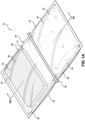
- Assembly 10 containing a shelf-stable formulation 12 for decontaminating skin exposed to nerve agents.
- Assembly 10 includes a bi-pack package 20 forming a first chamber 24 and a second chamber 26. Water 28 and potassium bicarbonate 30 are located in first chamber 24.
- a sponge 32, polyethylene glycol (PEG) 34, and diacetylmonoxime (DAM) 36 are located in second chamber.
- package 20 may contain additional additives which will not react with DAM. For example, fragrances, moisturizers and surfactants may be added.
- Package 20 is preferably formed with a bottom sheet 42 and a top sheet 44 that are connected at an outer periphery by a seal 46.
- a clamp 48 compresses bottom sheet 42 and top sheet 44 along a line extending across package 20 to form first chamber 24 and second chamber 26.
- Clamp 48 prevents water 28 and potassium bicarbonate 30 from entering second chamber 26 during storage and transport of package 20.
- top sheet 44 is formed from clear plastic so that sponge 32 and water can be seen there through.
- Clamp 48 is preferably configured to be easily broken or removed to allow water 28 and potassium bicarbonate 30 to enter second chamber 26.
- Cutouts 50 are provided in both top and bottom sheets 44, 42 in seal 46 so as to allow package 20 to be easily torn open by a user to access sponge 32 so that sponge 32 may be removed. Clear plastic allows for a user to clearly see the progression of water 28 and potassium bicarbonate 30 into sponge 32 so the user can keep shaking package 20 until sponge 32 is completely wet before tearing cutouts 50.
- Potassium bicarbonate 30 is present in water 28 as a solution.
- DAM 36 and PEG 34 are distributed uniformly throughout sponge 32 and are relatively dry.
- DAM 36 is an active ingredient and comprises 2, 3, butanedione monoxime, which is also referred to as diacetyl monoxime.
- Derivatives of DAM 36 may also be used wherein the alkyl group includes four to six carbon atoms.
- DAM 36 and its derivatives will react with targeted toxic compounds such as chemical/nerve agents to cause the toxic compounds to decompose into non-toxic components.
- DAM 36 is also effective against toxic industrial chemicals, and acids. More details about DAM and its derivatives are discussed in U.S. Patent No. 9,604,085 .
- assembly 10 may be stored for relatively long periods of time.
- Package 20 is carried by military personnel or first responders. When skin is exposed to a chemical nerve agent, clamp 48 is removed and package 20 is shaken to move water 28 and potassium bicarbonate 30 into sponge 32. Once sponge 32 is wet, package 20 is torn open at cutouts 50. Sponge 32 is then removed and wiped on the exposed skin to spread DAM 36 over the affected area to neutralize the nerve agent.
- PEG 34 acts as a carrier to aid in applying DAM 36 to skin. Preferably, PEG 34 has a molar weight of 200 although other molar weights are acceptable.
- DAM 36 is applied by scrubbing the exposed area with sponge 32. DAM 36 and PEG 34 are preferably allowed to stay on the affected area of skin for several minutes before removal. DAM 36 and PEG 34 are then reapplied.
- a preferred composition of the ingredients, by weight percent, in each chamber of the assembly is as follows: Chamber 1 Water 78.3% 14.4(g) Potassium Bicarbonate 21.7% 4.0(g) Chamber 2 DAM 58.5% 3.61(g) PEG 22.5% 1.39(g) Ethanol 19.0% 1.17(g) Sponge -% 1.54(g)
- the above formulations were developed for chambers 24, 26 of assembly 10.
- the ingredients can be varied up or down by ten percent.
- Potassium bicarbonate can be removed entirely leaving only water in first chamber 24.
- the water can range from about 70% to about 100% and is preferably present from 76% to about 80% and, most preferably 78.3%.
- the potassium bicarbonate is present from about 0% to 30% and more preferably, 24% to 20% and, most preferably, 21.7%.
- Other inert ingredients may be present in first chamber 24.
- Preferably substantially all of the ethanol is removed in processing and may vary between 0 and 20%.
- the ratio of DAM to PEG should be 2.25 and maintained within the 10% variation.
- Ethanol is included in the formulation to solubilize the DAM and PEG. Once infused into the sponge, the ethanol is removed via vacuum and is not present in Chamber 2, as discussed in more detail below. While ethanol is described, other low boiling point solvents may be employed.
- FIG. 2A , 2B and 3 another embodiment of the invention is shown wherein clamp 48 has been replaced by a thermal seal 68.
- Thermal seal 68 separates first chamber 24 from second chamber 26 in a similar manner to clamp 48.
- Thermal seal 68 has an advantage over clamp 48 since it cannot be dislodged during transport of package 20 while clamp 48 can be easily removed when compared to thermal seal 68.
- thermal seal 68 is broken to allow water 28 to enter second chamber 26, and then package 20 is shaken before being torn open at cutouts 50.
- FIG 4 there is shown another embodiment of the invention, wherein top and bottom sheets are made of a metallized material.
- the metallized material serves to protect the DAM 36 and PEG 34 and extend the shelf life of package 20.
- the potassium bicarbonate is optional and therefore is not shown in this embodiment such that only water is in the first chamber.
- DAM was aged under a variety of conditions. DAM was tested neat (as a standalone component) at 30°C, 50°C and 70°C. DAM neat is a stable compound and showed little propensity to age after 6-7 weeks at 70°C. DAM was also tested with PEG 200 again at 30°C, 50°C and 70°C. Some changes were seen at high temperatures of 70°C after two weeks. Next, DAM was tested in water again at 30°C, 50°C and 70°C.
- the rate kinetics of DAM degradation into dimethylglyoxime (DMG) were then studied.
- DMG dimethylglyoxime
- an empirical rate law with a mass action kinematics model was developed for DAM aging in water.
- the empirical data is shown in graph 500 in Figure 5A .
- graph 500 includes data showing how measured DAM concentration in water changes over time.
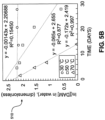
- the empirical data fits a first order mass action reaction kinetics model as shown in graph 510 in Figure 5B . Based on DAM's postulated degradation mechanism, the model is likely pseudo first order and largely dependent on the hydrolysis step, since water is present in excess and the concentration of water can be considered constant.
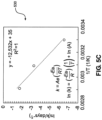
- Rate constants were derived from the linearized 1 st order reaction model shown in Figure 5B and used to derive an Arrhenius Thermal model 530 (for reaction constant versus temperature) as shown in Figure 5C .
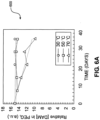
- FIG. 600 An empirical rate law with a mass action kinematics model was then produced for DAM in PEG 200.
- the empirical data is shown in graph 600 in Figure 6A .
- graph 600 includes data showing how measured DAM concentration in PEG 200 changes over time.
- the empirical data fits a first order reaction model as shown in graph 610 of Figure 6B .
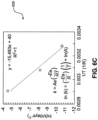
- Rate constants were derived from the linearized 1 st order reaction model shown in Figure 6B and used to derive an Arrhenius Thermal model 630 (for reaction constant versus temperature) as shown in Figure 6C .
- Figure 7 shows Half-life projections for 10% DAM in PEG (plot 750) and for 10% DAM in water (plot 760) and indicates that separating the DAM component from water substantially improves the degradation kinetics of the decontaminating formulation.
- DAM stored with PEG has a projected room temperature half-life of hundreds of years.
- DAM stored in water has a projected room temperature half-life of 2.5 years.
- the temperature corresponding to a 4-year shelf life increases from 20°C to 50°C when the water and DAM are separated.
- the shelf life is increased by an order of magnitude (factor of 17), from 4 days to 68 days. This will allow short term excursions to higher temperatures to be experienced by the product more often with minimal impact.
- Figure 8 is an NMR spectra 800 showing the degradation of DAM when placed in a bi-pack package 20. Degradation of DAM into degradation products shows as peak 810 in the curve 820 as early as 2 weeks with DAM in water but no degradation is present in the bipack with DAM in PEG curve 830 as shown by the lack of peaks at 840.
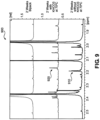
- Figure 9 is an NMR spectra 900 showing the impact of adding potassium bicarbonate. The degradation without Potassium Bicarbonate, as shown by peaks 910, is more than with Potassium Bicarbonate as shown by peaks 920.
- assembly 10 is made in the following manner, as shown in chart 1000.
- First DAM 36 is mixed, at 1010, with PEG 34 to form a thick mixture.
- Ethanol or another low boiling point solvent is used to solubilize DAM 36 and PEG 34 at 1020 which is then applied to sponge 32 at 1030.
- Ethanol is removed by heat or vacuum at the time of preparation at 1040.
- the sponge is placed in first chamber 24 of the package at 1050.
- Water and potassium bicarbonate are mixed at 1060 and placed in second chamber 26 of the package, at 1050.
- Package 20 is then sealed at 1070 with a heat sealer.
- assembly 10 is made as shown in chart 2000.
- First DAM is mixed with ethanol or another low boiling point solvent, at 2010.
- PEG is added to form a DAM-PEG-Solvent(Ethanol) mixture that is applied to sponge 32 at 2030.
- Ethanol is removed by heat or vacuum at the time of preparation at 2040.
- the sponge is placed in first chamber 24 of the package at 2050.
- Water and potassium bicarbonate are mixed at 2060 and placed in second chamber 26 of the package, at 2050.
- Package 20 is then sealed at 2070 with a heat sealer.
- assembly 10 is made as shown in chart 3000.
- First PEG is mixed with ethanol or another low boiling point solvent, at 3010.
- DAM is added to form a DAM-PEG-Solvent(Ethanol) mixture that is applied to sponge 32 at 3030.
- Ethanol is removed by heat or vacuum at the time of preparation at 3040.
- the sponge is placed in first chamber 24 of the package at 3050.
- Water and potassium bicarbonate are mixed at 3060 and placed in second chamber 26 of the package, at 3050.
- Package 20 is then sealed at 3070 with a heat sealer.
- the DAM, PEG and solvent could also be mixed in any order, in one step or multiple steps, so long as a DAM-PEG-Solvent(Ethanol) mixture is produced.
- DAM and PEG are mixed with water the resulting solution can easily be infused into a sponge.
- a relatively thick mixture is formed. The mixture is difficult to work with and cannot be easily supplied to a sponge.
- DAM and PEG are mixed with a low boiling point solvent such as ethanol, surprisingly the resulting solution is easily infused into a sponge and the ethanol can be removed without damaging the sponge, DAM or PEG resulting in a relatively dry sponge infused with DAM and PEG that has a long shelf life.
- the DAM and PEG are preferably diffused throughout sponge 32. However, the DAM and PEG need only achieve 5% -50% penetration into sponge 32 to still be effective.
- the addition of potassium bicarbonate is optional and mixing in water only at steps 1060 and 2060 represent a further preferred embodiment of the invention.
- the resulting assembly meets the needs in the art of having a device that can be used to counter the effects of chemical warfare nerve agents even after being stored for years.
Landscapes
- Health & Medical Sciences (AREA)
- General Health & Medical Sciences (AREA)
- Chemical & Material Sciences (AREA)
- Engineering & Computer Science (AREA)
- Toxicology (AREA)
- Chemical Kinetics & Catalysis (AREA)
- General Chemical & Material Sciences (AREA)
- Business, Economics & Management (AREA)
- Emergency Management (AREA)
- Mechanical Engineering (AREA)
- Life Sciences & Earth Sciences (AREA)
- Public Health (AREA)
- Veterinary Medicine (AREA)
- Animal Behavior & Ethology (AREA)
- Anesthesiology (AREA)
- Pharmacology & Pharmacy (AREA)
- Medicinal Chemistry (AREA)
- Epidemiology (AREA)
- Biomedical Technology (AREA)
- Heart & Thoracic Surgery (AREA)
- Hematology (AREA)
- Dermatology (AREA)
- Packages (AREA)
- Cosmetics (AREA)
Description
- The present invention relates to improving the shelf life and storage stability of key components of a formulation for treating skin that has been exposed to toxic compounds.
- Various types of chemical weapons have been developed. Most of these chemical weapons are effective when their active ingredients come in contact with skin. Military personnel are most likely to require a defense against such weapons. In response, the United States Department of Defense (DoD) has developed numerous ways to counter chemical weapons, including detectors, specialized clothing and products designed to decontaminate skin exposed to such weapons. Unfortunately, with the threat of terrorism increasing, first responders are also in need of protection against chemical weapons. Chemical weapon attacks are not frequent such that any products designed to decontaminate skin must be stored for relatively long periods of time between potential attacks. In addition, there are certain agrichemicals such as pesticides that work in a similar manner to the active ingredients in chemical weapons such that there is also a need to protect or treat workers in industrial settings.
- One product used to decontaminate skin is Reactive Skin Decontaminating Lotion (RSDL) which is a skin decontaminating lotion used by the DoD to treat people who have been exposed to toxic compounds such as chemical or nerve agents. RSDL contains diacetylmonoxime (DAM) which can complex with potassium bicarbonate to form
potassium 2, 3-butanedione monoxime (KBDO). Both DAM and KBDO can serve as active ingredients for skin decontamination, along with polyethylene glycol monomethyl ether (MPEG) and water as a solvent/emollient system. RSDL is primarily effective against organophosphoruous (OP) nerve agents. Military personnel are issued pouches, each containing a sponge that is soaked with RSDL. When skin is exposed to a suspected organophosphoruous compound, RSDL is applied by tearing open the pouch, removing the sponge and scrubbing the exposed skin with the saturated sponge. The RSDL is left on the skin to allow the active ingredients to react with the OP nerve agents and penetrate into the skin tissue. The RSDL is ultimately removed by washing. - Skin exposed to organophosphoruous compounds must be treated immediately. Therefore, military personnel must store and carry RSDL so that the RSDL is readily available. RSDL is water sensitive. DAM is postulated to degrade into dimethylglyoxime (DMG) in the presence of water via hydrolysis and oximation mechanisms. See
Figure 1 of the non-patent literature to Bogan et al. ("Chemical stability of reactive skin decontamination lotion (RSDL®)"), which is incorporated herein by reference. Currently, RSDL will degrade over time and has a shelf life at 30°C of only four years. Furthermore, if the RSDL is kept outside of that temperature range for even a short period of time, the material will be substantially degraded. Therefore, there exists a need for a treatment of exposure to OP compounds and nerve agents that has a long shelf life (i.e. greater than 5 years at 50°C) but which can also be readily applied to exposed skin when needed. Specifically, DoD personnel in the field and civil first responders need decontamination product formulations and packaging that have enhanced shelf lives and performances over time compared to current decontamination products. A package containing a liquid component and a solid component, separated by a frangible barrier, is disclosed inUS 2012/179085 A1 . - The present invention relates to an assembly containing a shelf-stable formulation, for decontaminating skin exposed to toxic compounds such as nerve agents, located in a package formed with a first chamber and a second chamber. Water is located in the first chamber and potassium bicarbonate may be added to the water; and a dry sponge, polyethylene glycol (PEG), and diacetylmonoxime (DAM) are located in the second chamber. The DAM and PEG are distributed within the sponge. Preferably, the package is formed of a transparent or metallized flexible packaging material. The package further comprises a barrier between the first chamber and second chamber, which is configured to be rapidly removed, when needed, to enable the water (and optionally potassium bicarbonate) to enter the second chamber. The package is also configured to be easily opened so one can remove the sponge after the sponge has been exposed to the water and potassium bicarbonate and use the sponge to apply the DAM to exposed skin. The package is made of plastic or metallized plastic and the barrier is either a mechanical clamp or a thermoformed seal. Preferably, a ratio of potassium bicarbonate to water, by weight, is less than 1 to 3.6 and the ratio of DAM to PEG, by weight, is approximately 2.25. The resulting package has a projected shelf life of, at least 6 years at 50°C and can withstand short-term thermal excursions of up to 70°C without significantly impacting performance.
- The invention also relates to a method of making the assembly comprising placing water and potassium bicarbonate in a first chamber of a package; mixing the DAM with PEG to form a DAM:PEG mixture; infusing the sponge with the DAM:PEG mixture to distribute DAM within the sponge and placing the sponge, DAM and PEG in a second chamber of the package. Infusing the sponge includes solubilizing the DAM:PEG mixture in a solvent with a low boiling point, such as ethanol, to form an ethanol-DAM-PEG solution and applying the ethanol-DAM-PEG solution evenly to the sponge.
- The ethanol-DAM-PEG solution may be applied to the sponge in different ways such as dipping the sponge in the ethanol-DAM-PEG solution or brushing or spraying the ethanol-DAM-PEG solution on to the sponge or applying the ethanol-DAM-PEG solution with a syringe. Preferably the ethanol-DAM-PEG solution contains the ethanol and the DAM:PEG mixture at a ratio of 2.25 and the PEG has a molar mass of 200g/mol (PEG 200). PEG with other g/mol molar masses are also effective. Preferably, the ethanol is anhydrous ethanol and is removed by applying heat and/or vacuum to the sponge. After the application of heat or vacuum, the next step is to verify that the ethanol has been removed and then to seal the second chamber.
- The preceding summary is provided to facilitate an understanding of some of the innovative features unique to the present disclosure and is not intended to be a full description. A full appreciation of the disclosure can be gained by taking the entire specification, claims, drawings, and abstract as a whole.
- The disclosure may be more completely understood in consideration of the following description of various illustrative embodiments in connection with the accompanying drawings.
-
Figure 1A is a perspective view of an assembly with a clear package with a physical barrier between the two chambers. -
Figure 1B is a cross sectional view of the assembly ofFigure 1A . -
Figure 1C is a cross sectional view of the sponge removed from the package ofFigure 1A . -
Figure 2A is a perspective view of an assembly with a clear package with a thermal seal between the two chambers. -
Figure 2B is a cross sectional view of the assembly ofFigure 2A . -
Figure 3 is a top view of an assembly with a metalized package with a thermal seal between two chambers. -
Figure 4 is a top view of an assembly with a clear package with a physical barrier between two chambers. -
Figures 5A-5C are graphs showing the reaction kinetics of DAM in water. -
Figures 6A-6C are graphs showing the reaction kinetics of DAM in PEG200. -
Figure 7 is a graph showing half-life projections of the amount of DAM over time using the Arrhenius model parameters. -
Figure 8 is a series of NMR spectra showing the chemical effects of aging the DAM in a Bi-Pack over time. -
Figure 9 is a series of NMR spectra showing the chemical effects of aging the DAM with potassium bicarbonate in a Bi-Pack over time. -
Figure 10A is a flow chart showing a method of manufacturing the package and contents of the assembly shown inFigure 1 . -
Figure 10B is a flow chart showing an alternative method of manufacturing the package and contents of the assembly shown inFigure 1 . -
Figure 10C is a flow chart showing yet another alternative method of manufacturing the package and contents of the assembly shown inFigure 1 . - The following detailed description should be read with reference to the drawings in which similar elements in different drawings are numbered the same. The detailed description and the drawings, which are not necessarily to scale, depict illustrative embodiments and are not intended to limit the scope of the disclosure. The illustrative embodiments depicted are intended only as exemplary. Selected features of any illustrative embodiment may be incorporated into an additional embodiment unless clearly stated to the contrary. While the disclosure is amenable to various modifications and alternative forms, specifics thereof have been shown by way of example in the drawings and will be described in detail. It should be understood, however, that the intention is not to limit aspects of the disclosure to the particular illustrative embodiments described.
- As used in this specification and the appended claims, the singular forms "a", "an" and "the" include plural referents unless the content clearly dictates otherwise. As used in this specification and the appended claims, the term "or" is generally employed in its sense including "and/or" unless the content clearly dictates otherwise.
- In the description of embodiments disclosed herein, any reference to direction or orientation is merely intended for convenience of description and is not intended in any way to limit the scope of the present invention. Relative terms such as "lower," "upper," "horizontal," "vertical,", "above," "below," "up," "down," "top" and "bottom" as well as derivative thereof (e.g., "horizontally," "downwardly," "upwardly," etc.) should be construed to refer to the orientation as then described or as shown in the drawing under discussion. These relative terms are for convenience of description only and do not require that the apparatus be constructed or operated in a particular orientation. Terms such as "attached," "affixed," "connected," "coupled," "interconnected," and similar refer to a relationship wherein structures are secured or attached to one another either directly or indirectly through intervening structures, as well as both movable or rigid attachments or relationships, unless expressly described otherwise.
- As used throughout, any ranges disclosed herein are used as shorthand for describing each and every value that is within the range. Any value within the range can be selected as the terminus of the range. All percentages are by weight unless otherwise indicated.
- With reference to
Figures 1A and1B there is shown anassembly 10 containing a shelf-stable formulation 12 for decontaminating skin exposed to nerve agents.Assembly 10 includes abi-pack package 20 forming afirst chamber 24 and asecond chamber 26.Water 28 andpotassium bicarbonate 30 are located infirst chamber 24. Asponge 32, polyethylene glycol (PEG) 34, and diacetylmonoxime (DAM) 36 are located in second chamber. In addition toPEG 34,package 20 may contain additional additives which will not react with DAM. For example, fragrances, moisturizers and surfactants may be added. -
Package 20 is preferably formed with abottom sheet 42 and atop sheet 44 that are connected at an outer periphery by aseal 46. Aclamp 48 compressesbottom sheet 42 andtop sheet 44 along a line extending acrosspackage 20 to formfirst chamber 24 andsecond chamber 26.Clamp 48 preventswater 28 andpotassium bicarbonate 30 from enteringsecond chamber 26 during storage and transport ofpackage 20. Preferably,top sheet 44 is formed from clear plastic so thatsponge 32 and water can be seen there through.Clamp 48 is preferably configured to be easily broken or removed to allowwater 28 andpotassium bicarbonate 30 to entersecond chamber 26.Cutouts 50 are provided in both top andbottom sheets seal 46 so as to allowpackage 20 to be easily torn open by a user to accesssponge 32 so thatsponge 32 may be removed. Clear plastic allows for a user to clearly see the progression ofwater 28 andpotassium bicarbonate 30 intosponge 32 so the user can keep shakingpackage 20 untilsponge 32 is completely wet before tearingcutouts 50. -
Potassium bicarbonate 30 is present inwater 28 as a solution.DAM 36 andPEG 34 are distributed uniformly throughoutsponge 32 and are relatively dry.DAM 36 is an active ingredient and comprises 2, 3, butanedione monoxime, which is also referred to as diacetyl monoxime. Derivatives ofDAM 36 may also be used wherein the alkyl group includes four to six carbon atoms.DAM 36 and its derivatives will react with targeted toxic compounds such as chemical/nerve agents to cause the toxic compounds to decompose into non-toxic components.DAM 36 is also effective against toxic industrial chemicals, and acids. More details about DAM and its derivatives are discussed inU.S. Patent No. 9,604,085 - In use,
assembly 10 may be stored for relatively long periods of time.Package 20 is carried by military personnel or first responders. When skin is exposed to a chemical nerve agent, clamp 48 is removed andpackage 20 is shaken to movewater 28 andpotassium bicarbonate 30 intosponge 32. Oncesponge 32 is wet,package 20 is torn open atcutouts 50.Sponge 32 is then removed and wiped on the exposed skin to spreadDAM 36 over the affected area to neutralize the nerve agent.PEG 34 acts as a carrier to aid in applyingDAM 36 to skin. Preferably,PEG 34 has a molar weight of 200 although other molar weights are acceptable.DAM 36 is applied by scrubbing the exposed area withsponge 32.DAM 36 andPEG 34 are preferably allowed to stay on the affected area of skin for several minutes before removal.DAM 36 andPEG 34 are then reapplied. - A preferred composition of the ingredients, by weight percent, in each chamber of the assembly is as follows:
Chamber 1Water 78.3% 14.4(g) Potassium Bicarbonate 21.7% 4.0(g)
Chamber 2DAM 58.5% 3.61(g) PEG 22.5% 1.39(g) Ethanol 19.0% 1.17(g) Sponge -% 1.54(g) - The above formulations were developed for
chambers assembly 10. The ingredients can be varied up or down by ten percent. Potassium bicarbonate can be removed entirely leaving only water infirst chamber 24. The water can range from about 70% to about 100% and is preferably present from 76% to about 80% and, most preferably 78.3%. The potassium bicarbonate is present from about 0% to 30% and more preferably, 24% to 20% and, most preferably, 21.7%. Other inert ingredients may be present infirst chamber 24. Preferably substantially all of the ethanol is removed in processing and may vary between 0 and 20%. The ratio of DAM to PEG should be 2.25 and maintained within the 10% variation. Ethanol is included in the formulation to solubilize the DAM and PEG. Once infused into the sponge, the ethanol is removed via vacuum and is not present inChamber 2, as discussed in more detail below. While ethanol is described, other low boiling point solvents may be employed. - As best seen in
Figures 2A ,2B and3 , another embodiment of the invention is shown whereinclamp 48 has been replaced by athermal seal 68.Thermal seal 68 separatesfirst chamber 24 fromsecond chamber 26 in a similar manner to clamp 48.Thermal seal 68 has an advantage overclamp 48 since it cannot be dislodged during transport ofpackage 20 whileclamp 48 can be easily removed when compared tothermal seal 68. Whenassembly 10 is to be used,thermal seal 68 is broken to allowwater 28 to entersecond chamber 26, and then package 20 is shaken before being torn open atcutouts 50. Turning now toFigure 4 there is shown another embodiment of the invention, wherein top and bottom sheets are made of a metallized material. The metallized material serves to protect theDAM 36 andPEG 34 and extend the shelf life ofpackage 20. It should be noted that the potassium bicarbonate is optional and therefore is not shown in this embodiment such that only water is in the first chamber. - Several experiments and investigations were conducted to show the effectiveness of the preferred embodiments. The prior art arrangement using RSDL was shown to have a projected shelf life of 4 years at 30°C and that short term excursions above that temperature range can substantially degrade the active material. DAM was aged under a variety of conditions. DAM was tested neat (as a standalone component) at 30°C, 50°C and 70°C. DAM neat is a stable compound and showed little propensity to age after 6-7 weeks at 70°C. DAM was also tested with
PEG 200 again at 30°C, 50°C and 70°C. Some changes were seen at high temperatures of 70°C after two weeks. Next, DAM was tested in water again at 30°C, 50°C and 70°C. DAM in the presence of water rapidly aged after 1 week at 70°C. Aging was monitored using 1H nuclear magnetic resonance (NMR) spectra. This aging was retarded somewhat by the presence of potassium bicarbonate. The results for DAM withPEG 200 are intermediate to those of DAM neat and DAM with water and potassium bicarbonate and showed some changes at high temperatures (70°C) after 2 weeks. - The rate kinetics of DAM degradation into dimethylglyoxime (DMG) were then studied. First, an empirical rate law with a mass action kinematics model was developed for DAM aging in water. The empirical data is shown in
graph 500 inFigure 5A . Specifically,graph 500 includes data showing how measured DAM concentration in water changes over time. The empirical data fits a first order mass action reaction kinetics model as shown ingraph 510 inFigure 5B . Based on DAM's postulated degradation mechanism, the model is likely pseudo first order and largely dependent on the hydrolysis step, since water is present in excess and the concentration of water can be considered constant. Rate constants were derived from the linearized 1st order reaction model shown inFigure 5B and used to derive an Arrhenius Thermal model 530 (for reaction constant versus temperature) as shown inFigure 5C .

- The parameters from the Arrhenius model were used to predict the rate constant and half-life at room temperature for DAM in water at various storage temperatures. See table 1. At 20°C the half-life is >4 years, which is consistent with the stated product shelf life.
TABLE 1 Temperature 20° C 30° C 50° C 70°C k (days-1) = 0.000447 0.00143 0.0374 0.172 t1/2 (days) = 1585 485 18.5 4.03 t1/2 (years) = 4.34 1.33 0.0507 0.0111 - An empirical rate law with a mass action kinematics model was then produced for DAM in
PEG 200. The empirical data is shown ingraph 600 inFigure 6A . Specifically,graph 600 includes data showing how measured DAM concentration inPEG 200 changes over time. The empirical data fits a first order reaction model as shown ingraph 610 ofFigure 6B . Rate constants were derived from the linearized 1st order reaction model shown inFigure 6B and used to derive an Arrhenius Thermal model 630 (for reaction constant versus temperature) as shown inFigure 6C .

- The parameters from the Arrhenius model were used to predict the rate constant and half-life at room temperature of DAM in
PEG 200 at various storage temperatures. See table 2. At 20°C the half-life is >539 years, which constitutes an expectedly long time.TABLE 2 Temperature 20° C 30° C 50° C 70°C k (days-1) = 3.52E-06 2.54E-05 0.000290 0.0101 t1/2 (days) = 196700 27255 2392 68.4 t1/2 (years) = 539 74.7 6.55 0.187 -
Figure 7 shows Half-life projections for 10% DAM in PEG (plot 750) and for 10% DAM in water (plot 760) and indicates that separating the DAM component from water substantially improves the degradation kinetics of the decontaminating formulation. DAM stored with PEG has a projected room temperature half-life of hundreds of years. DAM stored in water has a projected room temperature half-life of 2.5 years. The temperature corresponding to a 4-year shelf life increases from 20°C to 50°C when the water and DAM are separated. At 70°C, the shelf life is increased by an order of magnitude (factor of 17), from 4 days to 68 days. This will allow short term excursions to higher temperatures to be experienced by the product more often with minimal impact. -
Figure 8 is anNMR spectra 800 showing the degradation of DAM when placed in abi-pack package 20. Degradation of DAM into degradation products shows aspeak 810 in thecurve 820 as early as 2 weeks with DAM in water but no degradation is present in the bipack with DAM inPEG curve 830 as shown by the lack of peaks at 840.Figure 9 is anNMR spectra 900 showing the impact of adding potassium bicarbonate. The degradation without Potassium Bicarbonate, as shown bypeaks 910, is more than with Potassium Bicarbonate as shown bypeaks 920. - As shown in
Figures 1 and10A ,assembly 10 is made in the following manner, as shown inchart 1000.First DAM 36 is mixed, at 1010, withPEG 34 to form a thick mixture. Ethanol or another low boiling point solvent is used to solubilizeDAM 36 andPEG 34 at 1020 which is then applied tosponge 32 at 1030. Ethanol is removed by heat or vacuum at the time of preparation at 1040. The sponge is placed infirst chamber 24 of the package at 1050. Water and potassium bicarbonate are mixed at 1060 and placed insecond chamber 26 of the package, at 1050.Package 20 is then sealed at 1070 with a heat sealer. - In alternative embodiment shown in
Figure 10B ,assembly 10 is made as shown inchart 2000. First DAM is mixed with ethanol or another low boiling point solvent, at 2010. Then, at 2020 PEG is added to form a DAM-PEG-Solvent(Ethanol) mixture that is applied tosponge 32 at 2030. Ethanol is removed by heat or vacuum at the time of preparation at 2040. The sponge is placed infirst chamber 24 of the package at 2050. Water and potassium bicarbonate are mixed at 2060 and placed insecond chamber 26 of the package, at 2050.Package 20 is then sealed at 2070 with a heat sealer. - In an alternative embodiment shown in
Figure 10C ,assembly 10 is made as shown inchart 3000. First PEG is mixed with ethanol or another low boiling point solvent, at 3010. Then, at 3020 DAM is added to form a DAM-PEG-Solvent(Ethanol) mixture that is applied tosponge 32 at 3030. Ethanol is removed by heat or vacuum at the time of preparation at 3040. The sponge is placed infirst chamber 24 of the package at 3050. Water and potassium bicarbonate are mixed at 3060 and placed insecond chamber 26 of the package, at 3050.Package 20 is then sealed at 3070 with a heat sealer. The DAM, PEG and solvent could also be mixed in any order, in one step or multiple steps, so long as a DAM-PEG-Solvent(Ethanol) mixture is produced. - It should be noted that if DAM and PEG are mixed with water the resulting solution can easily be infused into a sponge. Surprisingly, if DAM and PEG are mixed without water, a relatively thick mixture is formed. The mixture is difficult to work with and cannot be easily supplied to a sponge. If DAM and PEG are mixed with a low boiling point solvent such as ethanol, surprisingly the resulting solution is easily infused into a sponge and the ethanol can be removed without damaging the sponge, DAM or PEG resulting in a relatively dry sponge infused with DAM and PEG that has a long shelf life. The DAM and PEG are preferably diffused throughout
sponge 32. However, the DAM and PEG need only achieve 5% -50% penetration intosponge 32 to still be effective. The addition of potassium bicarbonate is optional and mixing in water only atsteps - Having thus described several illustrative embodiments of the present disclosure, those of skill in the art will readily appreciate that yet other embodiments may be made and used within the scope of the claims hereto attached. Numerous advantages of the disclosure covered by this document have been set forth in the foregoing description. It will be understood, however, that this disclosure is, in many respect, only illustrative. Changes may be made in details, particularly in matters of shape, size, and arrangement of parts without exceeding the scope of the disclosure. The disclosure's scope is, of course, defined in the language in which the appended claims are expressed.
Claims (11)
- An assembly (10) containing a shelf-stable formulation (12) for decontaminating skin exposed to toxic compounds comprising:a package (20) forming a first chamber (24) and a second chamber (26);water (28) located in the first chamber (24); anda dry sponge (32), polyethylene glycol (34), and diacetylmonoxime (36) or derivatives thereof, located in the second chamber (26), wherein the polyethylene glycol (34) and the diacetylmonoxime (36) are distributed within the sponge (32).
- The assembly (10) of claim 1, further comprising potassium bicarbonate (30) in the water (28).
- The assembly (10) of claim 1, wherein the package (20) further comprises a barrier between the first chamber (24) and second chamber (26) that is configured to be rapidly removed to enable the water (28) to contact the sponge (32) and wherein the package (20) is made of plastic and the barrier is a thermoformed seal and the package (20) is configured to be torn open to allow for removal of the sponge (32).
- The assembly (10) of claim 1, wherein a ratio of potassium bicarbonate (30) to the water (28) by weight is less than 1 to 3.6.
- The assembly (10) of claim 1, wherein a ratio of the diacetylmonoxime (36) to the polyethylene glycol (34) by weight ranges from about 2.25 to about 2.59.
- The assembly (10) of claim 1, wherein the package (20) has a shelf life of at least 5 years at 50°C.
- A method of making an assembly (10) containing a shelf-stable formulation (12) for decontaminating skin exposed to toxic compounds, the method comprising:placing water (28) in a first chamber (24) of a package (20);mixing diacetylmonoxime (36) or derivatives thereof with polyethylene glycol (34) to form a diacetylmonoxime-polyethylene glycol mixture;infusing a sponge (32) with the diacetylmonoxime-polyethylene glycol mixture to distribute diacetylmonoxime (36) within the sponge (32); andplacing the sponge (32), polyethylene glycol (34), and diacetylmonoxime (36) or derivatives thereof in a second chamber (26) of the package (20).
- The method of claim 7, further comprising:adding a solvent to form a solvent-diacetylmonoxime-polyethylene-glycol solution,wherein the infusing the sponge (32) with the diacetylmonoxime-polyethylene glycol mixture comprises infusing the sponge (32) with the solvent-diacetylmonoxime-polyethylene glycol solution to distribute the diacetylmonoxime (36) within the sponge (32).
- The method of claim 7, further comprising:adding a solvent, whereinthe mixing the diacetylmonoxime (36) with the polyethylene glycol (34) comprises mixing the diacetylmonoxime (36) or the polyethylene-glycol (34) with a solvent and then adding the diacetylmonoxime (36) or the polyethylene-glycol to form a solvent-diacetylmonoxime-polyethylene-glycol solution, andthe infusing the sponge (32) with the diacetylmonoxime-polyethylene glycol mixture comprises infusing the sponge (32) with the solvent-diacetylmonoxime-polyethylene glycol solution to distribute the diacetylmonoxime (36) within the sponge (32).
- The method of claim 7, further comprising:adding a solvent, whereinthe mixing the diacetylmonoxime (36) with the polyethylene glycol (34) comprises mixing the diacetylmonoxime (36) with the polyethylene glycol (34) and a solvent in any order to form a solvent-diacetylmonoxime-polyethylene-glycol solution, andthe infusing the sponge (32) with the diacetylmonoxime-polyethylene glycol mixture comprises infusing the sponge (32) with the solvent-diacetylmonoxime-polyethylene glycol solution to distribute the diacetylmonoxime (36) within the sponge (32).
- The method of claim 10, wherein the infusing the sponge (32) with the solvent-diacetylmonoxime-polyethylene glycol solution includes dipping the sponge (32) in the solvent-diacetylmonoxime-polyethylene glycol solution to distribute the solvent-diacetylmonoxime-polyethylene glycol solution throughout the sponge (32).
Applications Claiming Priority (3)
| Application Number | Priority Date | Filing Date | Title |
|---|---|---|---|
| US16/186,059 US10369396B1 (en) | 2018-11-09 | 2018-11-09 | Assembly for decontaminating and method of manufacturing the assembly |
| US16/511,561 US10512810B1 (en) | 2018-11-09 | 2019-07-15 | Method for decontaminating skin exposed to toxic compounds |
| PCT/US2019/047275 WO2020096676A1 (en) | 2018-11-09 | 2019-08-20 | Assembly containing shelf-stable formulation for decontaminating skin exposed to toxic compounds and method of manufacturing the assembly |
Publications (2)
| Publication Number | Publication Date |
|---|---|
| EP3876888A1 EP3876888A1 (en) | 2021-09-15 |
| EP3876888B1 true EP3876888B1 (en) | 2023-10-04 |
Family
ID=67477413
Family Applications (1)
| Application Number | Title | Priority Date | Filing Date |
|---|---|---|---|
| EP19762580.9A Active EP3876888B1 (en) | 2018-11-09 | 2019-08-20 | Assembly containing shelf-stable formulation for decontaminating skin exposed to toxic compounds and method of manufacturing the assembly |
Country Status (3)
| Country | Link |
|---|---|
| US (2) | US10369396B1 (en) |
| EP (1) | EP3876888B1 (en) |
| WO (1) | WO2020096676A1 (en) |
Families Citing this family (1)
| Publication number | Priority date | Publication date | Assignee | Title |
|---|---|---|---|---|
| US10369396B1 (en) * | 2018-11-09 | 2019-08-06 | Battelle Memorial Institute | Assembly for decontaminating and method of manufacturing the assembly |
Family Cites Families (22)
| Publication number | Priority date | Publication date | Assignee | Title |
|---|---|---|---|---|
| CA1321949C (en) | 1983-11-22 | 1993-09-07 | Robert Alexandre Brock Bannard | Metal phenoxide/polyethylene glycols chemical decontaminant system |
| CA1321948C (en) | 1983-11-22 | 1993-09-07 | Robert Alexander Brock Bannard | Broad spectrum chemical decontaminant system |
| JP2548032B2 (en) | 1989-02-17 | 1996-10-30 | 日本ポリウレタン工業株式会社 | Method for producing polyurethane elastomer for sealing material and binding material |
| EP0611301B1 (en) | 1990-04-26 | 2003-06-11 | The Procter & Gamble Company | Chelator compositions comprising oxime compounds |
| CA2300698C (en) | 1999-02-19 | 2003-10-07 | J. Garfield Purdon | Broad spectrum decontamination formulation and method of use |
| US6211243B1 (en) * | 1999-09-22 | 2001-04-03 | B. Ron Johnson | Methods for treating cold sores with anti-infective compositions |
| DE10010373C1 (en) | 2000-03-02 | 2002-02-21 | Bundesrep Deutschland | Skin decontaminant against chemical skin and nerve warfare agents, comprises a silicone-based emulsion of chloramine, alkaline oxime salt and emulsifiers, and a separate acid glycerol-based dispersion containing diacetyl monoxime |
| US8022265B2 (en) | 2002-09-20 | 2011-09-20 | Sandia Corporation | Reduced weight decontamination formulation utilizing a solid peracid compound for neutralization of chemical and biological warfare agents |
| WO2004080543A2 (en) | 2003-03-12 | 2004-09-23 | Queen's University At Kingston | Method of decomposing organophosphorus compounds |
| US9334098B1 (en) | 2004-03-26 | 2016-05-10 | Kenneth D. Hughes | Reactive materials packaging |
| US7662759B1 (en) | 2005-01-28 | 2010-02-16 | Sandia Corporation | Decontamination formulation with additive for enhanced mold remediation |
| CA2645191C (en) | 2006-03-09 | 2014-05-06 | Kyorin Pharmaceutical Co., Ltd. | Process for producing 3,4-disubstituted pyrrolidine derivative and production intermediate thereof |
| US9700644B2 (en) | 2006-08-15 | 2017-07-11 | American Sterilizer Company | One part, solids containing decontamination blend composition |
| US20090187060A1 (en) | 2008-01-22 | 2009-07-23 | E-Z-Em, Inc. | Method and Formulation for Neutralizing Toxic Chemicals and Materials |
| US8518941B2 (en) | 2010-08-19 | 2013-08-27 | American Sterilizer Company | Extreme temperature aqueous decontamination composition |
| US20120179085A1 (en) * | 2011-01-10 | 2012-07-12 | Richards James C | Device and Process for Creation of Active Antimicrobial Iodine from Inactive Iodine |
| US9399027B2 (en) | 2011-09-08 | 2016-07-26 | Virginia Commonwealth University | Organ protection solution and its method of use |
| GB201206190D0 (en) | 2012-04-05 | 2012-05-23 | Health Prot Agency | Decontaminant product and method |
| CA3153463A1 (en) | 2012-10-29 | 2014-05-08 | The University Of North Carolina At Chapel Hill | Methods and compositions for treating mucosal tissue disorders |
| EP3237021B1 (en) * | 2014-12-22 | 2020-12-23 | Flexible Medical Packaging Ltd. | Sanitising device |
| WO2017053594A1 (en) | 2015-09-23 | 2017-03-30 | The Regents Of The University Of California | Compositions and methods of using the same for decontamination of skin |
| US10369396B1 (en) * | 2018-11-09 | 2019-08-06 | Battelle Memorial Institute | Assembly for decontaminating and method of manufacturing the assembly |
-
2018
- 2018-11-09 US US16/186,059 patent/US10369396B1/en active Active
-
2019
- 2019-07-15 US US16/511,561 patent/US10512810B1/en active Active
- 2019-08-20 WO PCT/US2019/047275 patent/WO2020096676A1/en not_active Ceased
- 2019-08-20 EP EP19762580.9A patent/EP3876888B1/en active Active
Also Published As
| Publication number | Publication date |
|---|---|
| WO2020096676A1 (en) | 2020-05-14 |
| US10512810B1 (en) | 2019-12-24 |
| US10369396B1 (en) | 2019-08-06 |
| EP3876888A1 (en) | 2021-09-15 |
Similar Documents
| Publication | Publication Date | Title |
|---|---|---|
| KR101657605B1 (en) | Method and formulation for neutralizing toxic chemicals and materials | |
| US10512810B1 (en) | Method for decontaminating skin exposed to toxic compounds | |
| CA1321948C (en) | Broad spectrum chemical decontaminant system | |
| HUP0100959A2 (en) | Aqueous agents for combating parasitic insects and acarina in human beings | |
| SU694047A3 (en) | Insecticide | |
| WO1997003057A1 (en) | Cyclic amides and derivatives thereof | |
| US5071877A (en) | Metal oximate/polyethylene glycols chemicals decontaminant system | |
| CN102920617B (en) | Liquid type deet composition and preparation thereof | |
| GB1581205A (en) | Fungicidal composition | |
| EP0729702B1 (en) | Communication disruptant for controlling pandemis heparana | |
| US2191259A (en) | Insecticide | |
| CA1323573C (en) | Use of 2, 4-monofufurylidene-sorbitol and its tetraalkyl derivatives in cosmetics and dermatology | |
| US5077316A (en) | Metal phenoxide/polyethylene glycols chemical decontaminant system | |
| RU2242967C1 (en) | Acaricide agent for treatment of clothes against ticks | |
| US7172995B1 (en) | Method for minimizing absorption of and effecting removal of contaminant chemicals | |
| EP0555208A1 (en) | METAL OXIMATE / POLYETHYLENE GLYCOLIC CHEMICAL DECONTAMINATION SYSTEM. | |
| DE1128219B (en) | Pest repellent with insecticidal and acaricidal effects | |
| JPS63239204A (en) | Insecticidal emulsion composition | |
| US2567200A (en) | Insect repellent | |
| Barakat et al. | The persistence and activity of permethrin and chlorpyrifos-methyl sprays on jute and woven polypropylene bags | |
| JPH04210605A (en) | Sublimable insect-proofing and insecticidal agent composition | |
| JPH0930902A (en) | Insect repellent composition | |
| AU2012233058B2 (en) | Method and formulation for neutralizing toxic chemicals and materials | |
| SU445183A1 (en) | Insectoacaricide | |
| JPH0273001A (en) | Dust improved in fast-acting property against insect pest |
Legal Events
| Date | Code | Title | Description |
|---|---|---|---|
| STAA | Information on the status of an ep patent application or granted ep patent |
Free format text: STATUS: UNKNOWN |
|
| STAA | Information on the status of an ep patent application or granted ep patent |
Free format text: STATUS: THE INTERNATIONAL PUBLICATION HAS BEEN MADE |
|
| PUAI | Public reference made under article 153(3) epc to a published international application that has entered the european phase |
Free format text: ORIGINAL CODE: 0009012 |
|
| STAA | Information on the status of an ep patent application or granted ep patent |
Free format text: STATUS: REQUEST FOR EXAMINATION WAS MADE |
|
| 17P | Request for examination filed |
Effective date: 20210514 |
|
| AK | Designated contracting states |
Kind code of ref document: A1 Designated state(s): AL AT BE BG CH CY CZ DE DK EE ES FI FR GB GR HR HU IE IS IT LI LT LU LV MC MK MT NL NO PL PT RO RS SE SI SK SM TR |
|
| DAV | Request for validation of the european patent (deleted) | ||
| DAX | Request for extension of the european patent (deleted) | ||
| STAA | Information on the status of an ep patent application or granted ep patent |
Free format text: STATUS: EXAMINATION IS IN PROGRESS |
|
| 17Q | First examination report despatched |
Effective date: 20220407 |
|
| GRAP | Despatch of communication of intention to grant a patent |
Free format text: ORIGINAL CODE: EPIDOSNIGR1 |
|
| STAA | Information on the status of an ep patent application or granted ep patent |
Free format text: STATUS: GRANT OF PATENT IS INTENDED |
|
| INTG | Intention to grant announced |
Effective date: 20230503 |
|
| GRAS | Grant fee paid |
Free format text: ORIGINAL CODE: EPIDOSNIGR3 |
|
| GRAA | (expected) grant |
Free format text: ORIGINAL CODE: 0009210 |
|
| STAA | Information on the status of an ep patent application or granted ep patent |
Free format text: STATUS: THE PATENT HAS BEEN GRANTED |
|
| AK | Designated contracting states |
Kind code of ref document: B1 Designated state(s): AL AT BE BG CH CY CZ DE DK EE ES FI FR GB GR HR HU IE IS IT LI LT LU LV MC MK MT NL NO PL PT RO RS SE SI SK SM TR |
|
| REG | Reference to a national code |
Ref country code: GB Ref legal event code: FG4D |
|
| REG | Reference to a national code |
Ref country code: CH Ref legal event code: EP |
|
| REG | Reference to a national code |
Ref country code: IE Ref legal event code: FG4D |
|
| REG | Reference to a national code |
Ref country code: DE Ref legal event code: R096 Ref document number: 602019038691 Country of ref document: DE |
|
| REG | Reference to a national code |
Ref country code: LT Ref legal event code: MG9D |
|
| REG | Reference to a national code |
Ref country code: NL Ref legal event code: MP Effective date: 20231004 |
|
| REG | Reference to a national code |
Ref country code: AT Ref legal event code: MK05 Ref document number: 1616961 Country of ref document: AT Kind code of ref document: T Effective date: 20231004 |
|
| PG25 | Lapsed in a contracting state [announced via postgrant information from national office to epo] |
Ref country code: NL Free format text: LAPSE BECAUSE OF FAILURE TO SUBMIT A TRANSLATION OF THE DESCRIPTION OR TO PAY THE FEE WITHIN THE PRESCRIBED TIME-LIMIT Effective date: 20231004 |
|
| PG25 | Lapsed in a contracting state [announced via postgrant information from national office to epo] |
Ref country code: GR Free format text: LAPSE BECAUSE OF FAILURE TO SUBMIT A TRANSLATION OF THE DESCRIPTION OR TO PAY THE FEE WITHIN THE PRESCRIBED TIME-LIMIT Effective date: 20240105 |
|
| PG25 | Lapsed in a contracting state [announced via postgrant information from national office to epo] |
Ref country code: IS Free format text: LAPSE BECAUSE OF FAILURE TO SUBMIT A TRANSLATION OF THE DESCRIPTION OR TO PAY THE FEE WITHIN THE PRESCRIBED TIME-LIMIT Effective date: 20240204 |
|
| PG25 | Lapsed in a contracting state [announced via postgrant information from national office to epo] |
Ref country code: LT Free format text: LAPSE BECAUSE OF FAILURE TO SUBMIT A TRANSLATION OF THE DESCRIPTION OR TO PAY THE FEE WITHIN THE PRESCRIBED TIME-LIMIT Effective date: 20231004 |
|
| PG25 | Lapsed in a contracting state [announced via postgrant information from national office to epo] |
Ref country code: AT Free format text: LAPSE BECAUSE OF FAILURE TO SUBMIT A TRANSLATION OF THE DESCRIPTION OR TO PAY THE FEE WITHIN THE PRESCRIBED TIME-LIMIT Effective date: 20231004 |
|
| PG25 | Lapsed in a contracting state [announced via postgrant information from national office to epo] |
Ref country code: ES Free format text: LAPSE BECAUSE OF FAILURE TO SUBMIT A TRANSLATION OF THE DESCRIPTION OR TO PAY THE FEE WITHIN THE PRESCRIBED TIME-LIMIT Effective date: 20231004 |
|
| PG25 | Lapsed in a contracting state [announced via postgrant information from national office to epo] |
Ref country code: LT Free format text: LAPSE BECAUSE OF FAILURE TO SUBMIT A TRANSLATION OF THE DESCRIPTION OR TO PAY THE FEE WITHIN THE PRESCRIBED TIME-LIMIT Effective date: 20231004 Ref country code: IS Free format text: LAPSE BECAUSE OF FAILURE TO SUBMIT A TRANSLATION OF THE DESCRIPTION OR TO PAY THE FEE WITHIN THE PRESCRIBED TIME-LIMIT Effective date: 20240204 Ref country code: GR Free format text: LAPSE BECAUSE OF FAILURE TO SUBMIT A TRANSLATION OF THE DESCRIPTION OR TO PAY THE FEE WITHIN THE PRESCRIBED TIME-LIMIT Effective date: 20240105 Ref country code: ES Free format text: LAPSE BECAUSE OF FAILURE TO SUBMIT A TRANSLATION OF THE DESCRIPTION OR TO PAY THE FEE WITHIN THE PRESCRIBED TIME-LIMIT Effective date: 20231004 Ref country code: BG Free format text: LAPSE BECAUSE OF FAILURE TO SUBMIT A TRANSLATION OF THE DESCRIPTION OR TO PAY THE FEE WITHIN THE PRESCRIBED TIME-LIMIT Effective date: 20240104 Ref country code: AT Free format text: LAPSE BECAUSE OF FAILURE TO SUBMIT A TRANSLATION OF THE DESCRIPTION OR TO PAY THE FEE WITHIN THE PRESCRIBED TIME-LIMIT Effective date: 20231004 Ref country code: PT Free format text: LAPSE BECAUSE OF FAILURE TO SUBMIT A TRANSLATION OF THE DESCRIPTION OR TO PAY THE FEE WITHIN THE PRESCRIBED TIME-LIMIT Effective date: 20240205 |
|
| PG25 | Lapsed in a contracting state [announced via postgrant information from national office to epo] |
Ref country code: SE Free format text: LAPSE BECAUSE OF FAILURE TO SUBMIT A TRANSLATION OF THE DESCRIPTION OR TO PAY THE FEE WITHIN THE PRESCRIBED TIME-LIMIT Effective date: 20231004 Ref country code: RS Free format text: LAPSE BECAUSE OF FAILURE TO SUBMIT A TRANSLATION OF THE DESCRIPTION OR TO PAY THE FEE WITHIN THE PRESCRIBED TIME-LIMIT Effective date: 20231004 Ref country code: PL Free format text: LAPSE BECAUSE OF FAILURE TO SUBMIT A TRANSLATION OF THE DESCRIPTION OR TO PAY THE FEE WITHIN THE PRESCRIBED TIME-LIMIT Effective date: 20231004 Ref country code: NO Free format text: LAPSE BECAUSE OF FAILURE TO SUBMIT A TRANSLATION OF THE DESCRIPTION OR TO PAY THE FEE WITHIN THE PRESCRIBED TIME-LIMIT Effective date: 20240104 Ref country code: LV Free format text: LAPSE BECAUSE OF FAILURE TO SUBMIT A TRANSLATION OF THE DESCRIPTION OR TO PAY THE FEE WITHIN THE PRESCRIBED TIME-LIMIT Effective date: 20231004 Ref country code: HR Free format text: LAPSE BECAUSE OF FAILURE TO SUBMIT A TRANSLATION OF THE DESCRIPTION OR TO PAY THE FEE WITHIN THE PRESCRIBED TIME-LIMIT Effective date: 20231004 |
|
| REG | Reference to a national code |
Ref country code: DE Ref legal event code: R097 Ref document number: 602019038691 Country of ref document: DE |
|
| PG25 | Lapsed in a contracting state [announced via postgrant information from national office to epo] |
Ref country code: DK Free format text: LAPSE BECAUSE OF FAILURE TO SUBMIT A TRANSLATION OF THE DESCRIPTION OR TO PAY THE FEE WITHIN THE PRESCRIBED TIME-LIMIT Effective date: 20231004 |
|
| PG25 | Lapsed in a contracting state [announced via postgrant information from national office to epo] |
Ref country code: CZ Free format text: LAPSE BECAUSE OF FAILURE TO SUBMIT A TRANSLATION OF THE DESCRIPTION OR TO PAY THE FEE WITHIN THE PRESCRIBED TIME-LIMIT Effective date: 20231004 |
|
| PG25 | Lapsed in a contracting state [announced via postgrant information from national office to epo] |
Ref country code: SK Free format text: LAPSE BECAUSE OF FAILURE TO SUBMIT A TRANSLATION OF THE DESCRIPTION OR TO PAY THE FEE WITHIN THE PRESCRIBED TIME-LIMIT Effective date: 20231004 |
|
| PG25 | Lapsed in a contracting state [announced via postgrant information from national office to epo] |
Ref country code: SM Free format text: LAPSE BECAUSE OF FAILURE TO SUBMIT A TRANSLATION OF THE DESCRIPTION OR TO PAY THE FEE WITHIN THE PRESCRIBED TIME-LIMIT Effective date: 20231004 Ref country code: SK Free format text: LAPSE BECAUSE OF FAILURE TO SUBMIT A TRANSLATION OF THE DESCRIPTION OR TO PAY THE FEE WITHIN THE PRESCRIBED TIME-LIMIT Effective date: 20231004 Ref country code: RO Free format text: LAPSE BECAUSE OF FAILURE TO SUBMIT A TRANSLATION OF THE DESCRIPTION OR TO PAY THE FEE WITHIN THE PRESCRIBED TIME-LIMIT Effective date: 20231004 Ref country code: IT Free format text: LAPSE BECAUSE OF FAILURE TO SUBMIT A TRANSLATION OF THE DESCRIPTION OR TO PAY THE FEE WITHIN THE PRESCRIBED TIME-LIMIT Effective date: 20231004 Ref country code: EE Free format text: LAPSE BECAUSE OF FAILURE TO SUBMIT A TRANSLATION OF THE DESCRIPTION OR TO PAY THE FEE WITHIN THE PRESCRIBED TIME-LIMIT Effective date: 20231004 Ref country code: DK Free format text: LAPSE BECAUSE OF FAILURE TO SUBMIT A TRANSLATION OF THE DESCRIPTION OR TO PAY THE FEE WITHIN THE PRESCRIBED TIME-LIMIT Effective date: 20231004 Ref country code: CZ Free format text: LAPSE BECAUSE OF FAILURE TO SUBMIT A TRANSLATION OF THE DESCRIPTION OR TO PAY THE FEE WITHIN THE PRESCRIBED TIME-LIMIT Effective date: 20231004 |
|
| PLBE | No opposition filed within time limit |
Free format text: ORIGINAL CODE: 0009261 |
|
| STAA | Information on the status of an ep patent application or granted ep patent |
Free format text: STATUS: NO OPPOSITION FILED WITHIN TIME LIMIT |
|
| 26N | No opposition filed |
Effective date: 20240705 |
|
| PG25 | Lapsed in a contracting state [announced via postgrant information from national office to epo] |
Ref country code: SI Free format text: LAPSE BECAUSE OF FAILURE TO SUBMIT A TRANSLATION OF THE DESCRIPTION OR TO PAY THE FEE WITHIN THE PRESCRIBED TIME-LIMIT Effective date: 20231004 |
|
| PG25 | Lapsed in a contracting state [announced via postgrant information from national office to epo] |
Ref country code: SI Free format text: LAPSE BECAUSE OF FAILURE TO SUBMIT A TRANSLATION OF THE DESCRIPTION OR TO PAY THE FEE WITHIN THE PRESCRIBED TIME-LIMIT Effective date: 20231004 |
|
| REG | Reference to a national code |
Ref country code: CH Ref legal event code: PL |
|
| PG25 | Lapsed in a contracting state [announced via postgrant information from national office to epo] |
Ref country code: LU Free format text: LAPSE BECAUSE OF NON-PAYMENT OF DUE FEES Effective date: 20240820 |
|
| PG25 | Lapsed in a contracting state [announced via postgrant information from national office to epo] |
Ref country code: MC Free format text: LAPSE BECAUSE OF FAILURE TO SUBMIT A TRANSLATION OF THE DESCRIPTION OR TO PAY THE FEE WITHIN THE PRESCRIBED TIME-LIMIT Effective date: 20231004 Ref country code: CH Free format text: LAPSE BECAUSE OF NON-PAYMENT OF DUE FEES Effective date: 20240831 |
|
| REG | Reference to a national code |
Ref country code: BE Ref legal event code: MM Effective date: 20240831 |
|
| PG25 | Lapsed in a contracting state [announced via postgrant information from national office to epo] |
Ref country code: BE Free format text: LAPSE BECAUSE OF NON-PAYMENT OF DUE FEES Effective date: 20240831 |
|
| PG25 | Lapsed in a contracting state [announced via postgrant information from national office to epo] |
Ref country code: IE Free format text: LAPSE BECAUSE OF NON-PAYMENT OF DUE FEES Effective date: 20240820 |
|
| PG25 | Lapsed in a contracting state [announced via postgrant information from national office to epo] |
Ref country code: FI Free format text: LAPSE BECAUSE OF FAILURE TO SUBMIT A TRANSLATION OF THE DESCRIPTION OR TO PAY THE FEE WITHIN THE PRESCRIBED TIME-LIMIT Effective date: 20231004 |
|
| PGFP | Annual fee paid to national office [announced via postgrant information from national office to epo] |
Ref country code: DE Payment date: 20250709 Year of fee payment: 7 |
|
| PGFP | Annual fee paid to national office [announced via postgrant information from national office to epo] |
Ref country code: GB Payment date: 20250710 Year of fee payment: 7 |
|
| PGFP | Annual fee paid to national office [announced via postgrant information from national office to epo] |
Ref country code: FR Payment date: 20250709 Year of fee payment: 7 |
|
| PG25 | Lapsed in a contracting state [announced via postgrant information from national office to epo] |
Ref country code: CY Free format text: LAPSE BECAUSE OF FAILURE TO SUBMIT A TRANSLATION OF THE DESCRIPTION OR TO PAY THE FEE WITHIN THE PRESCRIBED TIME-LIMIT; INVALID AB INITIO Effective date: 20190820 |
|
| PG25 | Lapsed in a contracting state [announced via postgrant information from national office to epo] |
Ref country code: HU Free format text: LAPSE BECAUSE OF FAILURE TO SUBMIT A TRANSLATION OF THE DESCRIPTION OR TO PAY THE FEE WITHIN THE PRESCRIBED TIME-LIMIT; INVALID AB INITIO Effective date: 20190820 |
|
| PG25 | Lapsed in a contracting state [announced via postgrant information from national office to epo] |
Ref country code: TR Free format text: LAPSE BECAUSE OF FAILURE TO SUBMIT A TRANSLATION OF THE DESCRIPTION OR TO PAY THE FEE WITHIN THE PRESCRIBED TIME-LIMIT Effective date: 20231004 |