EP3876382B1 - Charging control circuit, charging circuit and charging control method - Google Patents
Charging control circuit, charging circuit and charging control method Download PDFInfo
- Publication number
- EP3876382B1 EP3876382B1 EP19880248.0A EP19880248A EP3876382B1 EP 3876382 B1 EP3876382 B1 EP 3876382B1 EP 19880248 A EP19880248 A EP 19880248A EP 3876382 B1 EP3876382 B1 EP 3876382B1
- Authority
- EP
- European Patent Office
- Prior art keywords
- voltage
- circuit
- communications interface
- control
- charging
- Prior art date
- Legal status (The legal status is an assumption and is not a legal conclusion. Google has not performed a legal analysis and makes no representation as to the accuracy of the status listed.)
- Active
Links
Images



Classifications
-
- H—ELECTRICITY
- H02—GENERATION; CONVERSION OR DISTRIBUTION OF ELECTRIC POWER
- H02J—ELECTRIC POWER NETWORKS; CIRCUIT ARRANGEMENTS OR SYSTEMS FOR SUPPLYING OR DISTRIBUTING ELECTRIC POWER; SYSTEMS FOR STORING ELECTRIC ENERGY
- H02J7/00—Circuit arrangements for charging or discharging batteries or for supplying loads from batteries
-
- H—ELECTRICITY
- H02—GENERATION; CONVERSION OR DISTRIBUTION OF ELECTRIC POWER
- H02J—ELECTRIC POWER NETWORKS; CIRCUIT ARRANGEMENTS OR SYSTEMS FOR SUPPLYING OR DISTRIBUTING ELECTRIC POWER; SYSTEMS FOR STORING ELECTRIC ENERGY
- H02J7/00—Circuit arrangements for charging or discharging batteries or for supplying loads from batteries
- H02J7/60—Circuit arrangements for charging or discharging batteries or for supplying loads from batteries including safety or protection arrangements
- H02J7/685—Circuit arrangements for charging or discharging batteries or for supplying loads from batteries including safety or protection arrangements using connection detecting circuits
-
- H—ELECTRICITY
- H02—GENERATION; CONVERSION OR DISTRIBUTION OF ELECTRIC POWER
- H02J—ELECTRIC POWER NETWORKS; CIRCUIT ARRANGEMENTS OR SYSTEMS FOR SUPPLYING OR DISTRIBUTING ELECTRIC POWER; SYSTEMS FOR STORING ELECTRIC ENERGY
- H02J7/00—Circuit arrangements for charging or discharging batteries or for supplying loads from batteries
- H02J7/90—Regulation of charging or discharging current or voltage
- H02J7/96—Regulation of charging or discharging current or voltage in response to battery voltage
-
- H—ELECTRICITY
- H02—GENERATION; CONVERSION OR DISTRIBUTION OF ELECTRIC POWER
- H02J—ELECTRIC POWER NETWORKS; CIRCUIT ARRANGEMENTS OR SYSTEMS FOR SUPPLYING OR DISTRIBUTING ELECTRIC POWER; SYSTEMS FOR STORING ELECTRIC ENERGY
- H02J7/00—Circuit arrangements for charging or discharging batteries or for supplying loads from batteries
- H02J7/80—Circuit arrangements for charging or discharging batteries or for supplying loads from batteries including monitoring or indicating arrangements
-
- H—ELECTRICITY
- H02—GENERATION; CONVERSION OR DISTRIBUTION OF ELECTRIC POWER
- H02J—ELECTRIC POWER NETWORKS; CIRCUIT ARRANGEMENTS OR SYSTEMS FOR SUPPLYING OR DISTRIBUTING ELECTRIC POWER; SYSTEMS FOR STORING ELECTRIC ENERGY
- H02J2105/00—Networks for supplying or distributing electric power characterised by their spatial reach or by the load
- H02J2105/40—Networks for supplying or distributing electric power characterised by their spatial reach or by the load characterised by the loads connecting to the networks or being supplied by the networks
- H02J2105/44—Portable electronic devices
-
- H—ELECTRICITY
- H02—GENERATION; CONVERSION OR DISTRIBUTION OF ELECTRIC POWER
- H02J—ELECTRIC POWER NETWORKS; CIRCUIT ARRANGEMENTS OR SYSTEMS FOR SUPPLYING OR DISTRIBUTING ELECTRIC POWER; SYSTEMS FOR STORING ELECTRIC ENERGY
- H02J2207/00—Details of circuit arrangements for charging or discharging batteries or supplying loads from batteries
- H02J2207/30—Charge provided using DC bus or data bus of a computer
Definitions
- the present disclosure relates to the field of communications technologies, and in particular, to a charging control circuit, a charging circuit, and a charging control method.
- a charging control circuit of a mobile power supply includes an automatic charging control circuit and a manual charging control circuit.
- a switch is generally disposed on the manual charging control circuit.
- a user may manually control closing of the switch to manually enable power output.
- the automatic charging control circuit may automatically detect a load and enable power output.
- the automatic charging control circuit may be implemented by an integrated circuit (Integrated Circuit, IC) or a detection circuit built by a discrete device. Because a related charging control circuit implemented by the integrated circuit IC or the detection circuit built by the discrete device is relatively complex, reliability of the related charging control circuit is relatively poor.
- WO2014149809A2 discloses a multi-port power switch device may intelligently detect whether a portable electronic device is connected to one of the output ports provided.
- the output ports can automatically be switched on and off as needed depending on whether they are connected to a portable electronic device.
- CN207705816U discloses an improved mobile power charging interface
- the charging interface is a USB interface, which comprises: a plastic seat and a metal shell wrapped around the plastic seal).
- the plastic seat extends to form a tongue plate, and four terminals are evenly disposed on the upper surface of the tongue plate, and a jumper terminal is disposed on the lower surface of the tongue plate, and the jumper terminal has an outwardly convex elasticity.
- the jumper terminal will be in contact with the metal housing of the USB plug to form a conduction.
- CN202978308U discloses a portable power source device, and it comprises: USB female seat, MCU; described portable power source device also comprises: the priority detecting unit; the input of described priority detecting unit connects described USB female seat, the output of described priority detecting unit connects the priority detection signal input of described MCU, and described priority detecting unit detects when described USB female seat has the input of external power supply voltage and exports a detection signal to described MCU; the shell fragment peripheral clearance that arranges on described USB female seat arranges at least one fixed contact, described shell fragment forms a normal open switch and detects input with the switch of described MCU with described fixed contact and is connected, described shell fragment is in electrical contact with described fixed contact when public mouthful of USB inserts described USB female seat, described normal open switch is closed be incorporated in described switch detection input generation one level variable signal; when detecting input, the switch of described MCU receives described level variable signal, and when described MCU received from the detection signal of described priority detecting unit, described MCU controlled the external power supply voltage that described portable power source device is accepted
- Embodiments of the present disclosure provide a charging control circuit, a charging circuit, and a charging control method, to resolve a problem of relatively poor reliability of a related charging control circuit.
- an embodiment of the present disclosure provides a charging control circuit, including:
- an embodiment of the present disclosure further provides a charging circuit, including: the foregoing charging control circuit and a power supply apparatus electrically connected to a communications interface of the charging control circuit.
- an embodiment of the present disclosure further provides an electronic device, including the foregoing charging circuit.
- an embodiment of the present disclosure further provides a charging control method applied to the foregoing charging circuit.
- the method includes: when it is detected that a voltage of a first conductive part changes from a first voltage to a second voltage, controlling starting of a power supply apparatus electrically connected to a communications interface, so that the power supply apparatus provides a charging voltage to the communications interface.
- a charging control circuit includes: a communications interface housing, a communications interface, and a control sub-circuit, where the communications interface housing includes a first conductive part, a second conductive part, and an insulating part, and the insulating part is disposed between the first conductive part and the second conductive part , and insulates the first conductive part from the second conductive part; the first conductive part is connected to a first voltage terminal, and the first voltage terminal is configured to access a first voltage; the second conductive part is connected to a second voltage terminal, the second voltage terminal is configured to access a second voltage, and the first voltage is greater than the second voltage; and the control sub-circuit is connected to the first conductive part and the communications interface, and is configured to control, when it is detected that a voltage of the first conductive part changes from the first voltage to the second voltage, starting of a power supply apparatus electrically connected to the communications interface, wherein the voltage of the first conductive part changes from the first voltage to the second voltage when the
- FIG. 1 is a schematic diagram of a charging control circuit according to an embodiment of the present disclosure.
- the charging control circuit 100 includes a communications interface housing 102, a communications interface 103, and a control sub-circuit 101, where the communications interface housing 102 includes a first conductive part 1021, a second conductive part 1023, and an insulating part 1022, and the insulating part 1022 is disposed between the first conductive part 1021 and the second conductive part 1023; the first conductive part 1021 is connected to a first voltage terminal, and the first voltage terminal is configured to access a first voltage; the second conductive part 1023 is connected to a second voltage terminal, and the second voltage terminal is configured to input a second voltage; and the control sub-circuit 101 is connected to the first conductive part 1021 and the communications interface 103, and is configured to control, when it is detected that a voltage of the first conductive part 1021 changes from the first voltage to the second voltage, starting of a power supply apparatus
- the power supply apparatus may be a mobile power supply apparatus including a power supply control chip and a charging power supply.
- the communications interface may include a universal serial bus (Universal Serial Bus, USB) interface, and the communications interface housing may be a USB interface housing.
- USB Universal Serial Bus
- the first conductive part 1021 and the second conductive part 1023 are in a disconnected state.
- the voltage accessed by the first conductive part 1021 is the first voltage.
- the communications interface 103 accesses a load, the accessed load may conduct the first conductive part 1021 with the second conductive part 1023, so that the voltage of the first conductive part 1021 changes from the first voltage to the second voltage.
- the accessed load may be a mobile terminal, such as a mobile phone or a tablet computer.
- a charging control circuit includes a communications interface housing, a communications interface, and a control sub-circuit, where the communications interface housing includes a first conductive part, a second conductive part, and an insulating part, and the insulating part is disposed between the first conductive part and the second conductive part , and insulates the first conductive part from the second conductive part; the first conductive part is connected to a first voltage terminal, and the first voltage terminal is configured to access a first voltage; the second conductive part is connected to a second voltage terminal, the second voltage terminal is configured to access a second voltage, and the first voltage is greater than the second voltage; and the control sub-circuit is connected to the first conductive part and the communications interface, and is configured to control, when it is detected that a voltage of the first conductive part changes from the first voltage to the second voltage, starting of a power supply apparatus electrically connected to the communications interface, so that the power supply apparatus provides a charging voltage to the communications interface, wherein the voltage of the
- the load detection control signal is used to trigger the load detection sub-circuit 104 to detect whether the communications interface 103 is electrically connected to the load. For example, after the load detection sub-circuit 104 receives the load detection control signal, whether the communications interface 103 is electrically connected to the load may be detected based on whether there is a current on the communications interface 103. If the current on the communications interface 103 exceeds a first preset current threshold, it is determined that the communications interface 103 is electrically connected to the load, and if the current on the communications interface 103 is less than the first preset current threshold, it is determined that the communications interface 103 is not electrically connected to the load.
- the charging control circuit shown in FIG. 2 further includes a current-limiting resistor 106.
- the first conductive part 1021 is electrically connected to the current-limiting resistor 106, and the first voltage is accessed to the first conductive part 1021 through one terminal of the current-limiting resistor 106.
- the second voltage is accessed to the second conductive part 1023, and the first voltage is greater than the second voltage.
- the second conductive part 1023 may be grounded. In this case, the second voltage is 0.
- the first conductive part 1021 and the second conductive part 1023 are in a conductive state.
- the power supply apparatus may be controlled to stop providing the charging voltage to the communications interface, so that a risk of short circuiting of the charging control circuit can be reduced.
- control sub-circuit 101 is further configured to: control, after the signal indicating that the load is not accessed is received, starting of the power supply apparatus at an interval of a preset time, so that the power supply apparatus provides the charging voltage to the communications interface 103; and send the load detection control signal to the load detection sub-circuit 104.
- control sub-circuit 101 includes a control unit 1011 and a switch unit 1012, the control unit 1011 is connected to the first conductive part 1021 and a control terminal of the switch unit 1012, a first output terminal of the switch unit 1012 is connected to the communications interface 103, and a second output terminal of the switch unit 1012 is connected to a load detection sub-circuit 104; and the control unit 1011 is configured to: after the signal indicating that the load is not accessed is received, input a high-level signal to the control terminal of the switch unit 1012, conduct the switch unit 1012, and send a power-off control signal to the power supply apparatus through the communications interface 103, where the power-off control signal is used to control the power supply apparatus to stop providing the charging voltage to the communications interface 103.
- control terminal of the switch unit 1012 is also connected to a pull-down resistor 105, and the pull-down resistor 105 may prevent the switch unit 1012 from being damaged by the high voltage.
- control unit 1011 controls conduction of the switch unit 1012, and sends the power-off control signal to the power supply apparatus.
- the power supply apparatus may be controlled to stop providing the charging voltage to the communications interface 103, so that a risk of short circuiting of the charging control circuit can be reduced.
- the switch transistor includes a metal oxide MOS field effect transistor.
- the MOS field effect transistor may be a negative-channel metal oxide semiconductor (Negative channel-Metal-Oxide-Semiconductor, NMOS) field effect transistor.
- NMOS negative-channel metal oxide semiconductor
- the switch transistor is the NMOS field effect transistor, a gate electrode of the NMOS field effect transistor is connected to the control unit 1011, a source electrode of the NMOS field effect transistor is connected to the load detection sub-circuit 104, and a drain electrode of the NMOS field effect transistor is connected to the communications interface 103.
- the NMOS field effect transistor has the advantages of a low cost and a simple circuit structure.
- contacts of the communications interface 103 may include a power cable VBUS contact, a ground cable GND contact, a positive data cable contact D+, and a negative data cable contact D-.
- the drain electrode of the NMOS field effect transistor is connected to the power cable VBUS contact of the communications interface 103.
- the load detection sub-circuit 104 includes a load detection unit 1041, a jumper resistor 1042, a current detection resistor 1043, and a filter capacitor 1044, the load detection unit 1041 is connected to the control unit 1011, and is connected to a first terminal of the jumper resistor 1042, a second terminal of the jumper resistor 1042 and a first terminal of the current detection resistor 1043 are connected to the third electrode of the switch transistor, a first terminal of the filter capacitor 1044 is connected to a first terminal of the jumper resistor 1042, a second terminal of the filter capacitor 1044 is connected to a second terminal of the current detection resistor 1043, and a second terminal of the current detection resistor 1043 is grounded; and the load detection unit 1041 is configured to detect, after the load detection control signal input by the control unit 1011 is received, whether the communications interface 103 is electrically connected to a load, and send, to the control unit 1011 when it is detected that the communications interface 103 is not electrically connected to the load,
- whether the communications interface 103 is electrically connected to the load may be detected based on whether there is a current on the communications interface 103. If the current on the communications interface 103 exceeds a first preset current threshold, it is determined that the communications interface 103 is electrically connected to the load, and if the current on the communications interface 103 is less than the first preset current threshold, it is determined that the communications interface 103 is not electrically connected to the load.
- control unit 1011 and the load detection unit 1041 may be different logic circuits integrated in a micro control unit. In this way, the circuits may be simplified.
- the jumper resistor 1042 may be a zero-ohm resistor. The zero-ohm resistor can improve a protection function and is easy to connect during a debugging process.
- FIG. 3 is a first structural diagram of a communications interface housing according to an embodiment of the present disclosure.
- the communications interface housing 300 includes a first conductive part 301, a second conductive part 302, and an insulating part
- the insulating part includes a first strip-shaped insulating part 3031 and a second strip-shaped insulating part 3032
- a first side face of the first conductive part 301 and a first side face of the second conductive part 302 are connected through the first strip-shaped insulating part 3031
- a second side face of the first conductive part 301 and a second side face of the second conductive part 302 are connected through the second strip-shaped insulating part 3032.
- a communications interface housing whose insulating part is disposed between a first conductive part and a second conductive part may be provided.
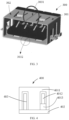
- FIG. 4 is a first structural diagram of a communications interface housing according to an embodiment of the present disclosure.
- the communications interface housing 400 includes a housing body, a spring plate 403 independent of the housing body, and an insulating base 402,
- the housing body includes a first spring plate 4012, a connecting part 4013, and a base part 4011
- the first spring plate 4012 is connected to base part 4011 through the connecting part 4013
- the first spring plate 4012, the connecting part 4013, the base part 4011, and the spring plate 403 are made of a conductive material
- the spring plate 403 is used as a first conductive part
- the housing body is used as a second conductive part
- an insulating medium between the housing body and the spring plate is used as an insulating part.
- the housing body may be made of metal
- the spring plate 403 may be made of metal
- a communications interface housing whose insulating part is disposed between a first conductive part and a second conductive part may be provided.
- FIG. 5 is a schematic diagram of a charging circuit according to an embodiment of the present disclosure.
- the charging circuit includes a charging control circuit 500 and a power supply apparatus 504, where the charging control circuit 500 includes a communications interface housing 502, a communications interface 503, and a control sub-circuit 501;
- the communications interface housing 502 includes a first conductive part 5021, a second conductive part 5023, and an insulating part 5022, and the insulating part 5022 is disposed between the first conductive part 5021 and the second conductive part 5023;
- the first conductive part 5021 is connected to a first voltage terminal, and the first voltage terminal is configured to access a first voltage;
- the second conductive part 5023 is connected to a second voltage terminal, and the second voltage terminal is configured to input a second voltage;
- the control sub-circuit 501 is connected to the first conductive part 5021 and the communications interface 503, and is configured to control, when it is detected that a voltage of the first conductive part 5021 changes from the first voltage
- the power supply apparatus includes a charging power supply and a power supply control chip; and the control sub-circuit 501 is configured to send, when it is detected that the voltage of the first conductive part 5021 changes from the first voltage to the second voltage, a power-on control signal to the power supply control chip 5042 through the communications interface 503, to control the power supply control chip 5042 to start the charging power supply 5041, so that the charging power supply 5041 provides a charging voltage to the communications interface 503.
- the charging control circuit 500 provided in this embodiment has the same functions as those of the charging control circuit 100 shown in FIG. 1 and FIG.2 . To avoid repetition, details are not described herein again.
- An embodiment of the present disclosure further provides an electronic device.
- the electronic device includes the foregoing charging circuit.
- the foregoing electronic device may be any terminal device including dual cameras, for example, a mobile phone, a tablet computer, a laptop computer, a personal digital assistant (personal digital assistant, PDA), a mobile Internet device (Mobile Internet Device, MID), or a wearable device.
- a mobile phone for example, a mobile phone, a tablet computer, a laptop computer, a personal digital assistant (personal digital assistant, PDA), a mobile Internet device (Mobile Internet Device, MID), or a wearable device.
- PDA personal digital assistant
- MID mobile Internet Device
- the electronic device uses a communications interface housing, so that components required by a charging control circuit may be reduced, the charging control circuit may be simplified, and reliability of a charging control process may be improved.
- FIG. 6 is a flowchart of a charging control method according to an embodiment of the present disclosure. As shown in FIG. 6 , the method is applied to the charging circuit in the foregoing embodiment. The method includes the following step: Step 601: When it is detected that a voltage of a first conductive part changes from a first voltage to a second voltage, control starting of a power supply apparatus electrically connected to a communications interface, so that the power supply apparatus provides a charging voltage to the communications interface.
- the power supply apparatus may be a mobile power supply apparatus including a power supply control chip and a charging power supply.
- the communications interface may include a universal serial bus (Universal Serial Bus, USB) interface, and the communications interface housing may be a USB interface housing.
- USB Universal Serial Bus
- the first conductive part and the second conductive part are in a disconnected state.
- the voltage accessed by the first conductive part is the first voltage.
- the communications interface accesses a load
- the accessed load may conduct the first conductive part with the second conductive part, so that the voltage of the first conductive part changes from the first voltage to the second voltage.
- a control sub-circuit When a control sub-circuit detects that the voltage of the first conductive part changes from the first voltage to the second voltage, it indicates that a charging wire is accessed onto the communications interface, and the charging voltage needs to be provided to the communications interface. Therefore, when it is detected that the first conductive part accesses the first voltage, the control sub-circuit controls starting of the power supply apparatus, so that the power supply apparatus provides the charging voltage to the communications interface.
- the control sub-circuit controls starting of the power supply apparatus, so that the power supply apparatus provides the charging voltage to the communications interface.
- the communications interface housing components required by the charging control circuit may be reduced, the charging control circuit may be simplified, and reliability of a charging process may be improved.
- FIG. 7 is a flowchart of a charging control method according to an embodiment of the present disclosure. As shown in FIG. 7 , the method is applied to the charging circuit in the foregoing embodiment. The method includes the following steps.
- Step 701 When it is detected that a voltage of a first conductive part changes from a first voltage to a second voltage, control starting of a power supply apparatus electrically connected to a communications interface, so that the power supply apparatus provides a charging voltage to the communications interface.
- Step 702 After it is detected that the voltage of the first conductive part changes from the first voltage to the second voltage, a control sub-circuit sends a load detection control signal to a load detection sub-circuit.
- the load detection control signal is used to trigger the load detection sub-circuit 104 to detect whether the communications interface 103 is electrically connected to the load.
- Step 703 When the load detection control signal is received, the load detection sub-circuit detects whether the communications interface is electrically connected to a load, and sends, to the control sub-circuit when it is detected that the communications interface is not electrically connected to the load, a signal indicating that the load is not accessed.
- whether the communications interface 103 is electrically connected to the load may be detected based on whether there is a current on the communications interface 103. If the current on the communications interface 103 exceeds a first preset current threshold, it is determined that the communications interface 103 is electrically connected to the load, and if the current on the communications interface 103 is less than the first preset current threshold, it is determined that the communications interface 103 is not electrically connected to the load.
- Step 704 After the signal indicating that the load is not accessed is received, control the power supply apparatus to stop providing the charging voltage to the communications interface.
- the control sub-circuit 101 when the communications interface 103 is not electrically connected to the load, it indicates that the charging voltage does not need to be provided, and needs to be turned off. Therefore, after the signal indicating that the load is not accessed is received, the control sub-circuit 101 sends a power-off control signal to a power supply control chip, to control the power supply control chip to turn off the power supply apparatus.
- the method may further include the following steps: after the signal indicating that the load is not accessed is received, controlling, by the control sub-circuit, starting of the power supply apparatus at an interval of a preset time, so that the power supply apparatus provides the charging voltage to the communications interface; and sending the load detection control signal to the load detection sub-circuit.
- the power supply apparatus is started again at the interval of the preset time to provide the charging voltage to the communications interface, the load detection control signal is sent to the load detection sub-circuit, and whether the load is accessed may be detected again automatically based on the load detection control signal, so that safety of a charging process is ensured, and in addition, power consumption is reduced, and a use duration of the power supply apparatus is guaranteed.
- a control sub-circuit when it is detected that a voltage of a first conductive part changes from a first voltage to a second voltage, starting of a power supply apparatus electrically connected to a communications interface is controlled, so that the power supply apparatus provides a charging voltage to the communications interface; after it is detected that the voltage of the first conductive part changes from the first voltage to the second voltage, a control sub-circuit sends a load detection control signal to a load detection sub-circuit; when the load detection control signal is received, the load detection sub-circuit detects whether the communications interface is electrically connected to a load, and sends, to the control sub-circuit when it is detected that the communications interface is not electrically connected to the load, a signal indicating that the load is not accessed; and after the signal indicating that the load is not accessed is received, the power supply apparatus is controlled to stop providing the charging voltage to the communications interface.
- the communications interface housing components required by the charging control circuit may be reduced, the charging control circuit may
- FIG. 8 is a flowchart of a charging control method according to an embodiment of the present disclosure. As shown in FIG. 8 , the method is applied to the charging circuit in the foregoing embodiment.
- a communications interface in the charging circuit is specifically a USB interface
- a communications interface housing is specifically a USB interface housing
- the USB interface housing includes a first conductive part, a second conductive part, and an insulating part, and the insulating part is disposed between the first conductive part and the second conductive part
- the first conductive part is connected to a first voltage terminal, and the first voltage terminal is configured to access a first voltage
- the second conductive part is connected to a second voltage terminal, the second voltage terminal is configured to access a second voltage, and the first voltage is greater than the second voltage
- a charging power supply is connected to the communications interface through a power supply control chip
- a control sub-circuit is connected to the first conductive part and the communications interface
- a load detection sub-circuit is connected to the
- the load may be a mobile terminal, such as a mobile phone or a tablet computer.
- a load such as a mobile phone may be accessed to the USB interface through a USB cable.
- Step 802 may include the following steps: when it is detected that a voltage of the first conductive part changes from the first voltage to the second voltage, controlling, by the control sub-circuit, starting of a power supply apparatus, so that the power supply apparatus provides the charging voltage to the USB interface; and detecting, by the load detection sub-circuit, the current value of the USB interface.
- Step 803 The detected current value exceeds a second preset current threshold.
- the second preset current threshold may be set. When the detected current value exceeds the second preset current threshold, it is determined that the detected current value is over-current.
- Step 804 Stop providing the charging voltage to the USB interface.
- Step 804 may include the following steps: sending, by the control sub-circuit, a power-off control signal to the power supply control chip, to control the power supply control chip to turn off the charging power supply; and stopping providing the charging voltage to the USB interface.
- Step 805 The detected current value is a normal current value.
- the normal current value may be preset.
- the normal current value is a current value when the load is normally charged through the USB interface, and may be a current value range.
- Step 806 Continue to monitor the current value of the USB interface, and stop providing the charging voltage to the USB interface after the load is fully charged.
- Step 807 The detected current value is lower than a third preset current threshold.
- the third preset current threshold may be preset.
- the third preset current threshold may be a relatively small current value, or may be 0. If the detected current value is lower than the third preset current threshold, it indicates that the load is not accessed to the USB interface.
- Step 808 Stop providing the charging voltage to the USB interface, provide the charging voltage to the USB interface at an interval of a preset time, and detect the current value of the USB interface.
- Step 809 may include the following steps: sending, by the control sub-circuit, the power-off control signal to the power supply control chip, to control the power supply control chip to turn off the charging power supply; and stopping providing the charging voltage to the USB interface.
- the program may be stored in a computer readable storage medium.
- the foregoing storage medium may include: a magnetic disk, an optical disc, a read-only memory (Read-Only Memory, ROM), a random access memory (Random Access Memory, RAM), or the like.
- the processing unit may be implemented in one or more application specific integrated circuits (Application Specific Integrated Circuit, ASIC), a digital signal processor (Digital Signal Processor, DSP), a digital signal processing device (DSP Device, DSPD), a programmable logic device (Programmable Logic Device, PLD), a field-programmable gate array (Field-Programmable Gate Array, FPGA), a general-purpose processor, a controller, a microcontroller, a microprocessor, another electronic unit for implementing the functions of the present disclosure, or a combination thereof.
- ASIC Application Specific Integrated Circuit
- DSP Digital Signal Processor
- DSP Device digital signal processing device
- PLD programmable logic device
- FPGA Field-Programmable Gate Array
- a general-purpose processor a controller, a microcontroller, a microprocessor, another electronic unit for implementing the functions of the present disclosure, or a combination thereof.
Landscapes
- Engineering & Computer Science (AREA)
- Power Engineering (AREA)
- Charge And Discharge Circuits For Batteries Or The Like (AREA)
- Direct Current Feeding And Distribution (AREA)
Description
- This application claims priority to
Chinese Patent Application No. 201811284768.0 filed in China on October 31, 2018 - The present disclosure relates to the field of communications technologies, and in particular, to a charging control circuit, a charging circuit, and a charging control method.
- Currently, a charging control circuit of a mobile power supply includes an automatic charging control circuit and a manual charging control circuit. A switch is generally disposed on the manual charging control circuit. A user may manually control closing of the switch to manually enable power output. After the mobile power supply is inserted into a charging device, the automatic charging control circuit may automatically detect a load and enable power output. The automatic charging control circuit may be implemented by an integrated circuit (Integrated Circuit, IC) or a detection circuit built by a discrete device. Because a related charging control circuit implemented by the integrated circuit IC or the detection circuit built by the discrete device is relatively complex, reliability of the related charging control circuit is relatively poor.
- It can be learned that the related charging control circuit has a problem of relatively poor reliability.
-
WO2014149809A2 discloses a multi-port power switch device may intelligently detect whether a portable electronic device is connected to one of the output ports provided. The output ports can automatically be switched on and off as needed depending on whether they are connected to a portable electronic device. -
US2018301918A1 discloses a power source resident in furniture provides power to at least one charging port or socket used to provide power to an electronic device. The furniture may be an articulated furniture having at least one motor. The furniture may have at least one type of switch that manages the power to the charging port. The switch may reduce wasted energy consumption due to heat lost at the charging port. -
EP3171481A1 discloses a power saving device with power supply, comprising a charger power circuit, a receptacle, a plug detection unit, an ON/OFF control circuit and a power output enable circuit. The plug detection unit uses a mechanical or electrical detection apparatus to detect whether a plug-in device is inserted or not. When there is no plug-in device in the receptacle, the power output enable circuit will cut off the power to the charger power circuit. -
CN207705816U discloses an improved mobile power charging interface, the charging interface is a USB interface, which comprises: a plastic seat and a metal shell wrapped around the plastic seal).The plastic seat extends to form a tongue plate, and four terminals are evenly disposed on the upper surface of the tongue plate, and a jumper terminal is disposed on the lower surface of the tongue plate, and the jumper terminal has an outwardly convex elasticity. In the contact portion, when the charging interface is plugged into an external USB plug, the jumper terminal will be in contact with the metal housing of the USB plug to form a conduction. -
CN202978308U discloses a portable power source device, and it comprises: USB female seat, MCU; described portable power source device also comprises: the priority detecting unit; the input of described priority detecting unit connects described USB female seat, the output of described priority detecting unit connects the priority detection signal input of described MCU, and described priority detecting unit detects when described USB female seat has the input of external power supply voltage and exports a detection signal to described MCU; the shell fragment peripheral clearance that arranges on described USB female seat arranges at least one fixed contact, described shell fragment forms a normal open switch and detects input with the switch of described MCU with described fixed contact and is connected, described shell fragment is in electrical contact with described fixed contact when public mouthful of USB inserts described USB female seat, described normal open switch is closed be incorporated in described switch detection input generation one level variable signal; when detecting input, the switch of described MCU receives described level variable signal, and when described MCU received from the detection signal of described priority detecting unit, described MCU controlled the external power supply voltage that described portable power source device is accepted described USB female seat access; when described MCU received only described level variable signal, described MCU controlled described portable power source device and discharges self supply voltage by described USB female seat. - Embodiments of the present disclosure provide a charging control circuit, a charging circuit, and a charging control method, to resolve a problem of relatively poor reliability of a related charging control circuit.
- To resolve the foregoing technical problem, the present disclosure is implemented as follows:
- According to a first aspect, an embodiment of the present disclosure provides a charging control circuit, including:
- a communications interface housing, a communications interface, and a control sub-circuit, where
- the communications interface housing includes a first conductive part, a second conductive part, and an insulating part, and the insulating part is disposed between the first conductive part and the second conductive part, and insulates the first conductive part from the second conductive part;
- the first conductive part is connected to a first voltage terminal, and the first voltage terminal is configured to access a first voltage;
- the second conductive part is connected to a second voltage terminal, the second voltage terminal is configured to access a second voltage, and the first voltage is greater than the second voltage; and
- the control sub-circuit is connected to the first conductive part and the communications interface, and is configured to control, when it is detected that a voltage of the first conductive part changes from the first voltage to the second voltage, starting of a power supply apparatus electrically connected to the communications interface, so that the power supply apparatus provides a charging voltage to the communications interface; wherein
- the voltage of the first conductive part changes from the first voltage to the second voltage when the communications interface accesses a load which conducts the first conductive part with the second conductive part.
- According to a second aspect, an embodiment of the present disclosure further provides a charging circuit, including:
the foregoing charging control circuit and a power supply apparatus electrically connected to a communications interface of the charging control circuit. - According to a third aspect, an embodiment of the present disclosure further provides an electronic device, including the foregoing charging circuit.
- According to a fourth aspect, an embodiment of the present disclosure further provides a charging control method applied to the foregoing charging circuit. The method includes:
when it is detected that a voltage of a first conductive part changes from a first voltage to a second voltage, controlling starting of a power supply apparatus electrically connected to a communications interface, so that the power supply apparatus provides a charging voltage to the communications interface. - In the embodiments of the present disclosure, a charging control circuit includes: a communications interface housing, a communications interface, and a control sub-circuit, where the communications interface housing includes a first conductive part, a second conductive part, and an insulating part, and the insulating part is disposed between the first conductive part and the second conductive part , and insulates the first conductive part from the second conductive part; the first conductive part is connected to a first voltage terminal, and the first voltage terminal is configured to access a first voltage; the second conductive part is connected to a second voltage terminal, the second voltage terminal is configured to access a second voltage, and the first voltage is greater than the second voltage; and the control sub-circuit is connected to the first conductive part and the communications interface, and is configured to control, when it is detected that a voltage of the first conductive part changes from the first voltage to the second voltage, starting of a power supply apparatus electrically connected to the communications interface, wherein the voltage of the first conductive part changes from the first voltage to the second voltage when the communications interface accesses a load which conducts the first conductive part with the second conductive part, so that the power supply apparatus provides a charging voltage to the communications interface. In this way, by using the communications interface housing, components required by the charging control circuit may be reduced, the charging control circuit may be simplified, and reliability of a charging control process may be improved.
- To describe the technical solutions in the embodiments of the present disclosure more clearly, the following briefly describes the accompanying drawings required in the embodiments of the present disclosure. Apparently, the accompanying drawings in the following descriptions show merely some embodiments of the present disclosure, and a person of ordinary skill in the art may still derive other drawings from these accompanying drawings without creative efforts.
-
FIG. 1 is a first schematic diagram of a charging control circuit according to an embodiment of the present disclosure; -
FIG. 2 is a second schematic diagram of a charging control circuit according to an embodiment of the present disclosure; -
FIG. 3 is a first structural diagram of a communications interface housing according to an embodiment of the present disclosure; -
FIG. 4 is a second structural diagram of a communications interface housing according to an embodiment of the present disclosure; -
FIG. 5 is a schematic diagram of a charging circuit according to an embodiment of the present disclosure; -
FIG. 6 is a first flowchart of a charging control method according to an embodiment of the present disclosure; -
FIG. 7 is a second flowchart of a charging control method according to an embodiment of the present disclosure; and -
FIG. 8 is a third flowchart of a charging control method according to an embodiment of the present disclosure. - The following clearly and completely describes the technical solutions in the embodiments of the present disclosure with reference to the accompanying drawings in the embodiments of the present disclosure. Apparently, the described embodiments are some but not all of the embodiments of the present disclosure. All other embodiments obtained by a person of ordinary skill in the art based on the embodiments of the present disclosure without creative efforts shall fall within the protection scope of the present disclosure.
- Referring to
FIG. 1, FIG. 1 is a schematic diagram of a charging control circuit according to an embodiment of the present disclosure. As shown inFIG. 1 , thecharging control circuit 100 includes acommunications interface housing 102, acommunications interface 103, and acontrol sub-circuit 101, where thecommunications interface housing 102 includes a firstconductive part 1021, a secondconductive part 1023, and aninsulating part 1022, and theinsulating part 1022 is disposed between the firstconductive part 1021 and the secondconductive part 1023; the firstconductive part 1021 is connected to a first voltage terminal, and the first voltage terminal is configured to access a first voltage; the secondconductive part 1023 is connected to a second voltage terminal, and the second voltage terminal is configured to input a second voltage; and thecontrol sub-circuit 101 is connected to the firstconductive part 1021 and thecommunications interface 103, and is configured to control, when it is detected that a voltage of the firstconductive part 1021 changes from the first voltage to the second voltage, starting of a power supply apparatus (not shown in the figure) electrically connected to thecommunications interface 103, so that the power supply apparatus provides a charging voltage to thecommunications interface 103. - In this embodiment, the power supply apparatus may be a mobile power supply apparatus including a power supply control chip and a charging power supply. The communications interface may include a universal serial bus (Universal Serial Bus, USB) interface, and the communications interface housing may be a USB interface housing.
- Because the
insulating part 1022 is disposed between the firstconductive part 1021 and the secondconductive part 1023, without assistance of another object, the firstconductive part 1021 and the secondconductive part 1023 are in a disconnected state. In this case, the voltage accessed by the firstconductive part 1021 is the first voltage. When thecommunications interface 103 accesses a load, the accessed load may conduct the firstconductive part 1021 with the secondconductive part 1023, so that the voltage of the firstconductive part 1021 changes from the first voltage to the second voltage. The accessed load may be a mobile terminal, such as a mobile phone or a tablet computer. - When the
control sub-circuit 101 detects that the voltage of the firstconductive part 1021 changes from the first voltage to the second voltage, it indicates that a charging wire used to charge the load is accessed onto thecommunications interface 103, and the charging voltage needs to be provided to thecommunications interface 103. Therefore, when it is detected that the voltage of the firstconductive part 1021 changes from the first voltage to the second voltage, thecontrol sub-circuit 101 controls starting of the power supply apparatus, so that the power supply apparatus provides the charging voltage to thecommunications interface 103. - According to an embodiment of the present disclosure, a charging control circuit includes a communications interface housing, a communications interface, and a control sub-circuit, where the communications interface housing includes a first conductive part, a second conductive part, and an insulating part, and the insulating part is disposed between the first conductive part and the second conductive part , and insulates the first conductive part from the second conductive part; the first conductive part is connected to a first voltage terminal, and the first voltage terminal is configured to access a first voltage; the second conductive part is connected to a second voltage terminal, the second voltage terminal is configured to access a second voltage, and the first voltage is greater than the second voltage; and the control sub-circuit is connected to the first conductive part and the communications interface, and is configured to control, when it is detected that a voltage of the first conductive part changes from the first voltage to the second voltage, starting of a power supply apparatus electrically connected to the communications interface, so that the power supply apparatus provides a charging voltage to the communications interface, wherein the voltage of the first conductive part changes from the first voltage to the second voltage when the communications interface accesses a load which conducts the first conductive part with the second conductive part. In this way, by using the communications interface housing, components required by the charging control circuit may be reduced, the charging control circuit may be simplified, and reliability of a charging control process may be improved.
- Referring to
FIG. 2, FIG. 2 is a schematic diagram of a charging control circuit according to an embodiment of the present disclosure. As shown inFIG. 2 , the chargingcontrol circuit 100 includes acommunications interface housing 102, acommunications interface 103, acontrol sub-circuit 101, and aload detection sub-circuit 104, where thecommunications interface housing 102 includes a firstconductive part 1021, a secondconductive part 1023, and aninsulating part 1022, and the insulatingpart 1022 is disposed between the firstconductive part 1021 and the secondconductive part 1023; the firstconductive part 1021 is connected to a first voltage terminal, and the first voltage terminal is configured to access a first voltage; the secondconductive part 1023 is connected to a second voltage terminal, and the second voltage terminal is configured to input a second voltage; and thecontrol sub-circuit 101 is connected to the firstconductive part 1021 and thecommunications interface 103, and is configured to control, when it is detected that a voltage of the firstconductive part 1021 changes from the first voltage to the second voltage, starting of a power supply apparatus (not shown in the figure) electrically connected to thecommunications interface 103, so that the power supply apparatus provides a charging voltage to thecommunications interface 103. - The
load detection sub-circuit 104 is connected to the control sub-circuit 101 and thecommunications interface 103; thecontrol sub-circuit 101 is also configured to send, after it is detected that the voltage of the firstconductive part 1021 changes from the first voltage to the second voltage, a load detection control signal to theload detection sub-circuit 104; theload detection sub-circuit 104 is configured to detect, when the load detection control signal is received, whether thecommunications interface 103 is electrically connected to a load, and send, to thecontrol sub-circuit 101 when it is detected that thecommunications interface 103 is not electrically connected to the load, a signal indicating that the load is not accessed; and thecontrol sub-circuit 101 is further configured to control, after the signal indicating that the load is not accessed is received, the power supply apparatus to stop providing the charging voltage to thecommunications interface 103. - In this embodiment, the load detection control signal is used to trigger the
load detection sub-circuit 104 to detect whether thecommunications interface 103 is electrically connected to the load. For example, after theload detection sub-circuit 104 receives the load detection control signal, whether thecommunications interface 103 is electrically connected to the load may be detected based on whether there is a current on thecommunications interface 103. If the current on thecommunications interface 103 exceeds a first preset current threshold, it is determined that thecommunications interface 103 is electrically connected to the load, and if the current on thecommunications interface 103 is less than the first preset current threshold, it is determined that thecommunications interface 103 is not electrically connected to the load. When thecommunications interface 103 is not electrically connected to the load, it indicates that the charging voltage does not need to be provided, and needs to be turned off. Therefore, after the signal indicating that the load is not accessed is received, thecontrol sub-circuit 101 controls the power supply apparatus to stop providing the charging voltage to thecommunications interface 103. - It should be supplemented that the charging control circuit shown in
FIG. 2 further includes a current-limitingresistor 106. The firstconductive part 1021 is electrically connected to the current-limitingresistor 106, and the first voltage is accessed to the firstconductive part 1021 through one terminal of the current-limitingresistor 106. When the firstconductive part 1021 and the secondconductive part 1023 are both in a disconnected state, the second voltage is accessed to the secondconductive part 1023, and the first voltage is greater than the second voltage. In a special case, the secondconductive part 1023 may be grounded. In this case, the second voltage is 0. When a charging wire is accessed onto thecommunications interface 103, the firstconductive part 1021 and the secondconductive part 1023 are in a conductive state. Because a resistance of the current-limitingresistor 106 is relatively large, a current-limiting function can be played. In this case, the voltage of the firstconductive part 1021 changes from the first voltage to the second voltage, and thecontrol sub-circuit 101 may detect that the voltage of the firstconductive part 1021 changes from the first voltage to the second voltage. - In this way, when the communications interface is not electrically connected to the load, the power supply apparatus may be controlled to stop providing the charging voltage to the communications interface, so that a risk of short circuiting of the charging control circuit can be reduced.
- Optionally, the
control sub-circuit 101 is further configured to: control, after the signal indicating that the load is not accessed is received, starting of the power supply apparatus at an interval of a preset time, so that the power supply apparatus provides the charging voltage to thecommunications interface 103; and send the load detection control signal to theload detection sub-circuit 104. - In this way, after the signal indicating that the load is not accessed is received, the power supply apparatus is started again at the interval of the preset time to provide the charging voltage to the communications interface, and the load detection control signal is sent to the load detection sub-circuit. After it is detected that the load is not accessed, whether the load is accessed may be detected again automatically at an interval of a preset time, so that safety of a charging process is ensured, and in addition, power consumption is reduced, and a use duration of the power supply apparatus is guaranteed.
- Optionally, the
control sub-circuit 101 includes acontrol unit 1011 and aswitch unit 1012, thecontrol unit 1011 is connected to the firstconductive part 1021 and a control terminal of theswitch unit 1012, a first output terminal of theswitch unit 1012 is connected to thecommunications interface 103, and a second output terminal of theswitch unit 1012 is connected to aload detection sub-circuit 104; and thecontrol unit 1011 is configured to: after the signal indicating that the load is not accessed is received, input a high-level signal to the control terminal of theswitch unit 1012, conduct theswitch unit 1012, and send a power-off control signal to the power supply apparatus through thecommunications interface 103, where the power-off control signal is used to control the power supply apparatus to stop providing the charging voltage to thecommunications interface 103. - It should be supplemented that the control terminal of the
switch unit 1012 is also connected to a pull-down resistor 105, and the pull-down resistor 105 may prevent theswitch unit 1012 from being damaged by the high voltage. - In this way, the
control unit 1011 controls conduction of theswitch unit 1012, and sends the power-off control signal to the power supply apparatus. The power supply apparatus may be controlled to stop providing the charging voltage to thecommunications interface 103, so that a risk of short circuiting of the charging control circuit can be reduced. - Optionally, the
switch unit 1012 includes a switch transistor, a first electrode of the switch transistor is connected to thecontrol unit 1011, a second electrode of the switch transistor is connected to thecommunications interface 103, and a third electrode of the switch transistor is connected to theload detection sub-circuit 104. - In this embodiment, the switch transistor includes a metal oxide MOS field effect transistor. For example, the MOS field effect transistor may be a negative-channel metal oxide semiconductor (Negative channel-Metal-Oxide-Semiconductor, NMOS) field effect transistor. For example, if the switch transistor is the NMOS field effect transistor, a gate electrode of the NMOS field effect transistor is connected to the
control unit 1011, a source electrode of the NMOS field effect transistor is connected to theload detection sub-circuit 104, and a drain electrode of the NMOS field effect transistor is connected to thecommunications interface 103. As the switch transistor, the NMOS field effect transistor has the advantages of a low cost and a simple circuit structure. - Specifically, contacts of the
communications interface 103 may include a power cable VBUS contact, a ground cable GND contact, a positive data cable contact D+, and a negative data cable contact D-. In this embodiment, the drain electrode of the NMOS field effect transistor is connected to the power cable VBUS contact of thecommunications interface 103. - In this embodiment, the
load detection sub-circuit 104 includes aload detection unit 1041, ajumper resistor 1042, acurrent detection resistor 1043, and afilter capacitor 1044, theload detection unit 1041 is connected to thecontrol unit 1011, and is connected to a first terminal of thejumper resistor 1042, a second terminal of thejumper resistor 1042 and a first terminal of thecurrent detection resistor 1043 are connected to the third electrode of the switch transistor, a first terminal of thefilter capacitor 1044 is connected to a first terminal of thejumper resistor 1042, a second terminal of thefilter capacitor 1044 is connected to a second terminal of thecurrent detection resistor 1043, and a second terminal of thecurrent detection resistor 1043 is grounded; and theload detection unit 1041 is configured to detect, after the load detection control signal input by thecontrol unit 1011 is received, whether thecommunications interface 103 is electrically connected to a load, and send, to thecontrol unit 1011 when it is detected that thecommunications interface 103 is not electrically connected to the load, a signal indicating that the load is not accessed. For example, after theload detection unit 1041 receives the load detection control signal, whether thecommunications interface 103 is electrically connected to the load may be detected based on whether there is a current on thecommunications interface 103. If the current on thecommunications interface 103 exceeds a first preset current threshold, it is determined that thecommunications interface 103 is electrically connected to the load, and if the current on thecommunications interface 103 is less than the first preset current threshold, it is determined that thecommunications interface 103 is not electrically connected to the load. - In this embodiment, the
control unit 1011 and theload detection unit 1041 may be different logic circuits integrated in a micro control unit. In this way, the circuits may be simplified. Thejumper resistor 1042 may be a zero-ohm resistor. The zero-ohm resistor can improve a protection function and is easy to connect during a debugging process. - Referring to
FIG. 3, FIG. 3 is a first structural diagram of a communications interface housing according to an embodiment of the present disclosure. As shown inFIG. 3 , thecommunications interface housing 300 includes a firstconductive part 301, a secondconductive part 302, and an insulating part, the insulating part includes a first strip-shaped insulatingpart 3031 and a second strip-shaped insulatingpart 3032, a first side face of the firstconductive part 301 and a first side face of the secondconductive part 302 are connected through the first strip-shaped insulatingpart 3031, and a second side face of the firstconductive part 301 and a second side face of the secondconductive part 302 are connected through the second strip-shaped insulatingpart 3032. - In this way, distinguished from a related communications interface housing, a communications interface housing whose insulating part is disposed between a first conductive part and a second conductive part may be provided.
- Referring to
FIG. 4, FIG. 4 is a first structural diagram of a communications interface housing according to an embodiment of the present disclosure. - As shown in
FIG. 4 , thecommunications interface housing 400 includes a housing body, aspring plate 403 independent of the housing body, and aninsulating base 402, the housing body includes afirst spring plate 4012, a connectingpart 4013, and abase part 4011, thefirst spring plate 4012 is connected to basepart 4011 through the connectingpart 4013, thefirst spring plate 4012, the connectingpart 4013, thebase part 4011, and thespring plate 403 are made of a conductive material, thespring plate 403 is used as a first conductive part, the housing body is used as a second conductive part, and an insulating medium between the housing body and the spring plate is used as an insulating part. - For example, the housing body may be made of metal, and the
spring plate 403 may be made of metal. - In this way, distinguished from a related communications interface housing, a communications interface housing whose insulating part is disposed between a first conductive part and a second conductive part may be provided.
- Referring to
FIG. 5, FIG. 5 is a schematic diagram of a charging circuit according to an embodiment of the present disclosure. The charging circuit includes a chargingcontrol circuit 500 and apower supply apparatus 504, where the chargingcontrol circuit 500 includes acommunications interface housing 502, acommunications interface 503, and acontrol sub-circuit 501; thecommunications interface housing 502 includes a firstconductive part 5021, a secondconductive part 5023, and aninsulating part 5022, and the insulatingpart 5022 is disposed between the firstconductive part 5021 and the secondconductive part 5023; the firstconductive part 5021 is connected to a first voltage terminal, and the first voltage terminal is configured to access a first voltage; the secondconductive part 5023 is connected to a second voltage terminal, and the second voltage terminal is configured to input a second voltage; and thecontrol sub-circuit 501 is connected to the firstconductive part 5021 and thecommunications interface 503, and is configured to control, when it is detected that a voltage of the firstconductive part 5021 changes from the first voltage to the second voltage, starting of thepower supply apparatus 504 electrically connected to thecommunications interface 503, so that thepower supply apparatus 504 provides a charging voltage to thecommunications interface 503. - Optionally, the power supply apparatus includes a charging power supply and a power supply control chip; and the
control sub-circuit 501 is configured to send, when it is detected that the voltage of the firstconductive part 5021 changes from the first voltage to the second voltage, a power-on control signal to the powersupply control chip 5042 through thecommunications interface 503, to control the powersupply control chip 5042 to start the chargingpower supply 5041, so that the chargingpower supply 5041 provides a charging voltage to thecommunications interface 503. - The charging
control circuit 500 provided in this embodiment has the same functions as those of the chargingcontrol circuit 100 shown inFIG. 1 and FIG.2 . To avoid repetition, details are not described herein again. - In this embodiment, by using the communications interface housing, components required by the charging control circuit may be reduced, the charging control circuit may be simplified, and reliability of a charging control process may be improved.
- An embodiment of the present disclosure further provides an electronic device. The electronic device includes the foregoing charging circuit.
- In this embodiment of the present disclosure, the foregoing electronic device may be any terminal device including dual cameras, for example, a mobile phone, a tablet computer, a laptop computer, a personal digital assistant (personal digital assistant, PDA), a mobile Internet device (Mobile Internet Device, MID), or a wearable device.
- In this embodiment, the electronic device uses a communications interface housing, so that components required by a charging control circuit may be reduced, the charging control circuit may be simplified, and reliability of a charging control process may be improved.
- Referring to
FIG. 6, FIG. 6 is a flowchart of a charging control method according to an embodiment of the present disclosure. As shown inFIG. 6 , the method is applied to the charging circuit in the foregoing embodiment. The method includes the following step:
Step 601: When it is detected that a voltage of a first conductive part changes from a first voltage to a second voltage, control starting of a power supply apparatus electrically connected to a communications interface, so that the power supply apparatus provides a charging voltage to the communications interface. - In this embodiment, the power supply apparatus may be a mobile power supply apparatus including a power supply control chip and a charging power supply. The communications interface may include a universal serial bus (Universal Serial Bus, USB) interface, and the communications interface housing may be a USB interface housing.
- Because an insulating part is disposed between the first conductive part and a second conductive part, without assistance of another object, the first conductive part and the second conductive part are in a disconnected state. In this case, the voltage accessed by the first conductive part is the first voltage. When the communications interface accesses a load, the accessed load may conduct the first conductive part with the second conductive part, so that the voltage of the first conductive part changes from the first voltage to the second voltage.
- When a control sub-circuit detects that the voltage of the first conductive part changes from the first voltage to the second voltage, it indicates that a charging wire is accessed onto the communications interface, and the charging voltage needs to be provided to the communications interface. Therefore, when it is detected that the first conductive part accesses the first voltage, the control sub-circuit controls starting of the power supply apparatus, so that the power supply apparatus provides the charging voltage to the communications interface.
- According to the charging control method in this embodiment of the present disclosure, when it is detected that the voltage of the first conductive part changes from the first voltage to the second voltage, the control sub-circuit controls starting of the power supply apparatus, so that the power supply apparatus provides the charging voltage to the communications interface. In this way, by using the communications interface housing, components required by the charging control circuit may be reduced, the charging control circuit may be simplified, and reliability of a charging process may be improved.
- Referring to
FIG. 7, FIG. 7 is a flowchart of a charging control method according to an embodiment of the present disclosure. As shown inFIG. 7 , the method is applied to the charging circuit in the foregoing embodiment. The method includes the following steps. - Step 701: When it is detected that a voltage of a first conductive part changes from a first voltage to a second voltage, control starting of a power supply apparatus electrically connected to a communications interface, so that the power supply apparatus provides a charging voltage to the communications interface.
- For implementation processes and beneficial effects of this step, refer to the description in
Step 601. Details are not described herein again. - Step 702: After it is detected that the voltage of the first conductive part changes from the first voltage to the second voltage, a control sub-circuit sends a load detection control signal to a load detection sub-circuit.
- In this embodiment, the load detection control signal is used to trigger the
load detection sub-circuit 104 to detect whether thecommunications interface 103 is electrically connected to the load. - Step 703: When the load detection control signal is received, the load detection sub-circuit detects whether the communications interface is electrically connected to a load, and sends, to the control sub-circuit when it is detected that the communications interface is not electrically connected to the load, a signal indicating that the load is not accessed.
- For example, after the
load detection sub-circuit 104 receives the load detection control signal, whether thecommunications interface 103 is electrically connected to the load may be detected based on whether there is a current on thecommunications interface 103. If the current on thecommunications interface 103 exceeds a first preset current threshold, it is determined that thecommunications interface 103 is electrically connected to the load, and if the current on thecommunications interface 103 is less than the first preset current threshold, it is determined that thecommunications interface 103 is not electrically connected to the load. - Step 704: After the signal indicating that the load is not accessed is received, control the power supply apparatus to stop providing the charging voltage to the communications interface.
- In this embodiment, when the
communications interface 103 is not electrically connected to the load, it indicates that the charging voltage does not need to be provided, and needs to be turned off. Therefore, after the signal indicating that the load is not accessed is received, thecontrol sub-circuit 101 sends a power-off control signal to a power supply control chip, to control the power supply control chip to turn off the power supply apparatus. - It should be supplemented that after
step 704, the method may further include the following steps:
after the signal indicating that the load is not accessed is received, controlling, by the control sub-circuit, starting of the power supply apparatus at an interval of a preset time, so that the power supply apparatus provides the charging voltage to the communications interface; and sending the load detection control signal to the load detection sub-circuit. - In this way, after the signal indicating that the load is not accessed is received, the power supply apparatus is started again at the interval of the preset time to provide the charging voltage to the communications interface, the load detection control signal is sent to the load detection sub-circuit, and whether the load is accessed may be detected again automatically based on the load detection control signal, so that safety of a charging process is ensured, and in addition, power consumption is reduced, and a use duration of the power supply apparatus is guaranteed.
- According to the charging control method in this embodiment of the present disclosure, when it is detected that a voltage of a first conductive part changes from a first voltage to a second voltage, starting of a power supply apparatus electrically connected to a communications interface is controlled, so that the power supply apparatus provides a charging voltage to the communications interface; after it is detected that the voltage of the first conductive part changes from the first voltage to the second voltage, a control sub-circuit sends a load detection control signal to a load detection sub-circuit; when the load detection control signal is received, the load detection sub-circuit detects whether the communications interface is electrically connected to a load, and sends, to the control sub-circuit when it is detected that the communications interface is not electrically connected to the load, a signal indicating that the load is not accessed; and after the signal indicating that the load is not accessed is received, the power supply apparatus is controlled to stop providing the charging voltage to the communications interface. In this way, by using the communications interface housing, components required by the charging control circuit may be reduced, the charging control circuit may be simplified, and reliability and safety of a charging control process may be improved.
- Referring to
FIG. 8, FIG. 8 is a flowchart of a charging control method according to an embodiment of the present disclosure. As shown inFIG. 8 , the method is applied to the charging circuit in the foregoing embodiment. It should be supplemented that a communications interface in the charging circuit is specifically a USB interface, and a communications interface housing is specifically a USB interface housing; the USB interface housing includes a first conductive part, a second conductive part, and an insulating part, and the insulating part is disposed between the first conductive part and the second conductive part; the first conductive part is connected to a first voltage terminal, and the first voltage terminal is configured to access a first voltage; the second conductive part is connected to a second voltage terminal, the second voltage terminal is configured to access a second voltage, and the first voltage is greater than the second voltage; a charging power supply is connected to the communications interface through a power supply control chip; a control sub-circuit is connected to the first conductive part and the communications interface; and a load detection sub-circuit is connected to the control sub-circuit and the USB interface. The method includes the following steps. - Step 801: Insert a load into the USB interface.
- In this embodiment, the load may be a mobile terminal, such as a mobile phone or a tablet computer. For example, a load such as a mobile phone may be accessed to the USB interface through a USB cable.
- Step 802: Provide a charging voltage to the USB interface, and detect a current value of the USB interface.
- Step 802 may include the following steps: when it is detected that a voltage of the first conductive part changes from the first voltage to the second voltage, controlling, by the control sub-circuit, starting of a power supply apparatus, so that the power supply apparatus provides the charging voltage to the USB interface; and detecting, by the load detection sub-circuit, the current value of the USB interface.
- Step 803: The detected current value exceeds a second preset current threshold.
- In this embodiment, the second preset current threshold may be set. When the detected current value exceeds the second preset current threshold, it is determined that the detected current value is over-current.
- Step 804: Stop providing the charging voltage to the USB interface.
- Step 804 may include the following steps:
sending, by the control sub-circuit, a power-off control signal to the power supply control chip, to control the power supply control chip to turn off the charging power supply; and stopping providing the charging voltage to the USB interface. - Step 805: The detected current value is a normal current value.
- In this embodiment, the normal current value may be preset. The normal current value is a current value when the load is normally charged through the USB interface, and may be a current value range.
- Step 806: Continue to monitor the current value of the USB interface, and stop providing the charging voltage to the USB interface after the load is fully charged.
- In this way, safety of a charging process may be ensured, and power consumption may be reduced.
- Step 807: The detected current value is lower than a third preset current threshold.
- In this embodiment, the third preset current threshold may be preset. The third preset current threshold may be a relatively small current value, or may be 0. If the detected current value is lower than the third preset current threshold, it indicates that the load is not accessed to the USB interface.
- Step 808: Stop providing the charging voltage to the USB interface, provide the charging voltage to the USB interface at an interval of a preset time, and detect the current value of the USB interface.
- Step 808 may include the following steps: sending, by the control sub-circuit, a power-off control signal to the power supply control chip, to control the power supply control chip to turn off the charging power supply; stopping providing the charging voltage to the USB interface; sending, by the control sub-circuit, a power-on control signal to the power supply control chip through the USB interface at the interval of the preset time, to control the power supply control chip to start the charging power supply, so that the charging power supply provides the charging voltage to the communications interface; sending a load detection control signal to the load detection sub-circuit; and detecting, by the load detection sub-circuit, the current value of the USB interface.
- Step 809: Stop providing the charging voltage to the USB interface after the load is fully charged.
- In this embodiment,
Step 809 may include the following steps: sending, by the control sub-circuit, the power-off control signal to the power supply control chip, to control the power supply control chip to turn off the charging power supply; and stopping providing the charging voltage to the USB interface. - According to the charging control method in this embodiment of the present disclosure, the charging power supply is started again at the interval of the preset time to provide the charging voltage to the USB interface, the current value of the USB interface is detected, and whether the load is accessed to the USB interface may be detected again automatically, so that safety of a charging process is ensured, and in addition, power consumption is reduced, and a use duration of the charging power supply is guaranteed.
- An embodiment of the present disclosure further provides a computer readable storage medium, where the computer readable storage medium stores a computer program, when the computer program is executed by the processor, the processes of the foregoing embodiments of the charging control method are implemented, and the same technical effects can be achieved. To avoid repetition, details are not described herein again. The computer readable storage medium may be a read-only memory (Read-Only Memory, ROM for short), a random access memory (Random Access Memory, RAM for short), a magnetic disk, a compact disc, or the like.
- It should be noted that in this specification, the terms "comprise", "include" and any other variants thereof are intended to cover non-exclusive inclusion, so that a process, a method, an article, or an apparatus that includes a series of elements not only includes these very elements, but may also include other elements not expressly listed, or also include elements inherent to this process, method, article, or apparatus. Without being subject to further limitations, an element defined by a phrase "including a ..." does not exclude presence of other identical elements in the process, method, article, or apparatus that includes the very element.
- By means of the foregoing description of the embodiments, a person skilled in the art may clearly understand that the method in the foregoing embodiments may be implemented by software with a necessary general hardware platform. Certainly, the method in the foregoing embodiments may also be implemented by hardware. However, in many cases, the former is a preferred embodiment. Based on such an understanding, the technical solutions of the present disclosure essentially, or the part contributing to the related technologies may be implemented in a form of a computer software product. The computer software product is stored in a storage medium (for example, a ROM/RAM, a magnetic disk, or a compact disc), and includes a plurality of instructions for instructing a terminal (which may be a mobile phone, a computer, a server, an air conditioner, a network device, or the like) to perform the method described in the embodiments of the present disclosure.
- A person of ordinary skill in the art may be aware that, in combination with the examples described in the embodiments disclosed in this specification, units and algorithm steps may be implemented by electronic hardware or a combination of computer software and electronic hardware. Whether the functions are performed by hardware or software depends on particular applications and design constraint conditions of the technical solutions. A person skilled in the art may use different methods to implement the described functions for each particular application, but it should not be considered that the implementation goes beyond the scope of the present disclosure.
- A person skilled in the art can clearly understand that to describe conveniently and concisely, for a specific working process of the system, apparatus, and unit described above, refer to the corresponding process in the foregoing method embodiments. Details are not described herein again.
- In the embodiments provided in this application, it should be understood that the disclosed apparatus and method may be implemented in other manners. For example, the described apparatus embodiment is merely an example. For example, the unit division is merely logical function division and may be other division in actual implementation. For example, a plurality of units or components may be combined or integrated into another system, or some features may be ignored or not performed. In addition, the displayed or discussed mutual couplings or direct couplings or communication connections may be implemented by using some interfaces. The indirect couplings or communication connections between the apparatuses or units may be implemented in electronic, mechanical, or other forms.
- The units described as separate parts may or may not be physically separate, and parts displayed as units may or may not be physical units, may be located in one position, or may be distributed on a plurality of network units. Some or all of the units may be selected based on actual requirements to achieve the objectives of the solutions of the embodiments.
- In addition, function units in the embodiments of the present disclosure may be integrated into one processing unit, or each of the units may exist alone physically, or two or more units are integrated into one unit.
- When the functions are implemented in a form of a software function unit and sold or used as an independent product, the functions may be stored in a computer readable storage medium. Based on such an understanding, the technical solutions of the present disclosure essentially, or the part contributing to the prior art, or some of the technical solutions may be implemented in a form of a software product. The computer software product is stored in a storage medium, and includes a plurality of instructions for instructing a computer device (which may be a personal computer, a server, or a network device) to perform all or some of the steps of the methods described in the embodiments of the present disclosure. The foregoing storage medium includes: any medium that can store program code, such as a USB flash drive, a removable hard disk, a ROM, a RAM, a magnetic disk, or an optical disc.
- A person of ordinary skill in the art may understand that all or some of the processes of the methods in the foregoing embodiments may be implemented by a computer program controlling related hardware. The program may be stored in a computer readable storage medium. When the program runs, the processes of the methods in the embodiments are performed. The foregoing storage medium may include: a magnetic disk, an optical disc, a read-only memory (Read-Only Memory, ROM), a random access memory (Random Access Memory, RAM), or the like.
- It can be understood that those embodiments described in the embodiments of the present disclosure can be implemented by hardware, software, firmware, middleware, microcode, or a combination thereof. For implementation by hardware, the processing unit may be implemented in one or more application specific integrated circuits (Application Specific Integrated Circuit, ASIC), a digital signal processor (Digital Signal Processor, DSP), a digital signal processing device (DSP Device, DSPD), a programmable logic device (Programmable Logic Device, PLD), a field-programmable gate array (Field-Programmable Gate Array, FPGA), a general-purpose processor, a controller, a microcontroller, a microprocessor, another electronic unit for implementing the functions of the present disclosure, or a combination thereof.
- For implementation by software, technologies described in the embodiments of the present disclosure may be implemented by executing function modules (for example, a process and a function) in the embodiments of the present disclosure. Software codes may be stored in the memory and executed by the processor. The memory may be implemented inside or outside the processor.
- The embodiments of the present disclosure are described above with reference to the accompanying drawings, but the present disclosure is not limited to the foregoing specific implementations. The foregoing specific implementations are merely schematic instead of restrictive. Under enlightenment of the present disclosure, a person of ordinary skills in the art may make many forms without departing from the protection scope of the invention which is defined by the appended claims.
Claims (14)
- A charging control circuit (100, 500), characterized by comprising a communications interface housing (102, 502, 300, 400), a communications interface (103, 503), and a control sub-circuit (101, 501), whereinthe communications interface housing (102, 502, 300, 400) comprises a first conductive part (1021, 5021, 301), a second conductive part (1023, 5023, 302), and an insulating part (1022, 5022), and the insulating part (1022, 5022) is disposed between the first conductive part (1021, 5021, 301) and the second conductive part (1023, 5023, 302), and insulates the first conductive part (1021, 5021, 301) from the second conductive part (1023, 5023, 302);the first conductive part (1021, 5021, 301) is connected to a first voltage terminal, and the first voltage terminal is configured to access a first voltage;the second conductive part (1023, 5023, 302) is connected to a second voltage terminal, the second voltage terminal is configured to access a second voltage, and the first voltage is greater than the second voltage; andthe control sub-circuit (101, 501) is connected to the first conductive part (1021, 5021, 301) and the communications interface (103, 503), and is configured to control, when it is detected that a voltage of the first conductive part (1021, 5021, 301) changes from the first voltage to the second voltage, starting of a power supply apparatus (504) electrically connected to the communications interface (103, 503), so that the power supply apparatus (504) provides a charging voltage to the communications interface (103, 503); whereinthe voltage of the first conductive part (1021, 5021, 301) changes from the first voltage to the second voltage when the communications interface (103, 503) accesses a load which conducts the first conductive part (1021, 5021, 301) with the second conductive part (1023, 5023, 302).
- The charging control circuit (100) according to claim 1, further comprising a load detection sub-circuit (104), wherein the load detection sub-circuit (104) is connected to the control sub-circuit (101) and the communications interface (103), whereinthe control sub-circuit (101) is further configured to send, after it is detected that the voltage of the first conductive part (1021) changes from the first voltage to the second voltage, a load detection control signal to the load detection sub-circuit (104);the load detection sub-circuit (104) is configured to detect, when the load detection control signal is received, whether the communications interface (103) is electrically connected to a load, and send, to the control sub-circuit (101) when it is detected that the communications interface (103) is not electrically connected to the load, a signal indicating that the load is not accessed; andthe control sub-circuit (101) is further configured to control, after the signal indicating that the load is not accessed is received, the power supply apparatus to stop providing the charging voltage to the communications interface (103).
- The charging control circuit (100) according to claim 2, wherein the control sub-circuit (101) is further configured to: control, after the signal indicating that the load is not accessed is received, starting of the power supply apparatus at an interval of a preset time, so that the power supply apparatus provides the charging voltage to the communications interface (103); and send the load detection control signal to the load detection sub-circuit (104).
- The charging control circuit (100) according to claim 2, wherein the control sub-circuit (101) comprises a control unit (1011) and a switch unit (1012), the control unit (1011) is connected to the first conductive part (1021) and a control terminal of the switch unit (1012), a first output terminal of the switch unit (1012) is connected to the communications interface (103), and a second output terminal of the switch unit (1012) is connected to a load detection sub-circuit (104); and
the control unit (1011) is configured to: after the signal indicating that the load is not accessed is received, input a high-level signal to the control terminal of the switch unit (1012), so that the switch unit (1012) is conducted; and send a power-off control signal to the power supply apparatus through the communications interface (103), wherein the power-off control signal is used to control the power supply apparatus to stop providing the charging voltage to the communications interface (103). - The charging control circuit (100) according to claim 4, wherein the switch unit (1012) comprises a switch transistor, a first electrode of the switch transistor is connected to the control unit (1011), a second electrode of the switch transistor is connected to the communications interface (103), and a third electrode of the switch transistor is connected to the load detection sub-circuit (104).
- The charging control circuit (100) according to claim 5, wherein the load detection sub-circuit (104) comprises a load detection unit (1041), a jumper resistor (1042), a current detection resistor (1043), and a filter capacitor (1044), the load detection unit (1041) is connected to the control unit (1011), and is also connected to a first terminal of the jumper resistor (1042), a second terminal of the jumper resistor (1042) and a first terminal of the current detection resistor (1043) are connected to the third electrode of the switch transistor, a first terminal of the filter capacitor (1044) is connected to the first terminal of the jumper resistor (1042), a second terminal of the filter capacitor (1044) is connected to the second terminal of the current detection resistor (1043), and a second terminal of the current detection resistor (1043) is grounded; and
the load detection unit (1041) is configured to detect, after the load detection control signal input by the control unit (1011) is received, whether the communications interface (103) is electrically connected to a load, and send, to the control unit (1011) when it is detected that the communications interface (103) is not electrically connected to the load, a signal indicating that the load is not accessed. - The charging control circuit (100) according to claim 1, wherein the insulating part comprises a first strip-shaped insulating part (3031) and a second strip-shaped insulating part (3032), wherein a first side face of the first conductive part (301) and a first side face of the second conductive part (302) are connected through the first strip-shaped insulating part (3031), and a second side face of the first conductive part (301) and a second side face of the second conductive part (302) are connected through the second strip-shaped insulating part (3032).
- The charging control circuit (100, 500) according to claim 1, wherein the communications interface housing (400) comprises a housing body and a spring plate (403) independent of the housing body, the spring plate (403) is used as the first conductive part (1021, 5021, 301), the housing body is used as the second conductive part (1023, 5023, 302), and an insulating medium between the housing body and the spring plate (403) is used as the insulating part.
- A charging circuit, comprising the charging control circuit (100, 500) according to any one of claims 1 to 8 and a power supply apparatus (504) electrically connected to a communications interface (103, 503) of the charging control circuit (100, 500).
- The charging circuit according to claim 9, wherein the power supply apparatus (504) comprises a charging power supply (5041) and a power supply control chip (5042);the charging power supply (5041) is electrically connected to the communications interface (503) through the power supply control chip (5042); andthe control sub-circuit (501) is configured to send, when it is detected that a voltage of a first conductive part (5021) changes from a first voltage to a second voltage, a power-on control signal to the power supply control chip (5042) through the communications interface (503), to control the power supply control chip (5042) to start the charging power supply (5041), so that the charging power supply (5041) provides a charging voltage to the communications interface (503).
- An electronic device, comprising the charging circuit according to claim 9 or 10.
- A charging control method, applied to the charging circuit according to claim 9, and comprising:
when it is detected that a voltage of a first conductive part (1021, 5021) changes from a first voltage to a second voltage, controlling (601, 701) starting of a power supply apparatus electrically connected to a communications interface (103, 503), so that the power supply apparatus (504) provides a charging voltage to the communications interface (103, 503). - The charging control method according to claim 12, further comprising:after it is detected that the voltage of the first conductive part (1021, 5021) changes from the first voltage to the second voltage, sending (702), by a control sub-circuit (101, 501), a load detection control signal to a load detection sub-circuit (104);when the load detection control signal is received, detecting, by the load detection sub-circuit (104), whether the communications interface (103, 503) is electrically connected to a load, and sending (703), by the load detection sub-circuit (104), to the control sub-circuit (101, 501) when it is detected that the communications interface (103, 503) is not electrically connected to the load, a signal indicating that the load is not accessed; andafter the signal indicating that the load is not accessed is received, controlling (704) the power supply apparatus (504) to stop providing the charging voltage to the communications interface (103, 503).
- The charging control method according to claim 13, further comprising:
after the signal indicating that the load is not accessed is received, controlling, by the control sub-circuit (101, 501), starting of the power supply apparatus (504) at an interval of a preset time, so that the power supply apparatus (504) provides the charging voltage to the communications interface (103, 503); and sending, by the load detection sub-circuit (104), the load detection control signal to the load detection sub-circuit (104).
Applications Claiming Priority (2)
| Application Number | Priority Date | Filing Date | Title |
|---|---|---|---|
| CN201811284768.0A CN109167420B (en) | 2018-10-31 | 2018-10-31 | A charging control circuit, charging circuit and charging control method |
| PCT/CN2019/113593 WO2020088388A1 (en) | 2018-10-31 | 2019-10-28 | Charging control circuit, charging circuit and charging control method |
Publications (3)
| Publication Number | Publication Date |
|---|---|
| EP3876382A1 EP3876382A1 (en) | 2021-09-08 |
| EP3876382A4 EP3876382A4 (en) | 2021-12-01 |
| EP3876382B1 true EP3876382B1 (en) | 2025-07-09 |
Family
ID=64875529
Family Applications (1)
| Application Number | Title | Priority Date | Filing Date |
|---|---|---|---|
| EP19880248.0A Active EP3876382B1 (en) | 2018-10-31 | 2019-10-28 | Charging control circuit, charging circuit and charging control method |
Country Status (5)
| Country | Link |
|---|---|
| US (1) | US11742684B2 (en) |
| EP (1) | EP3876382B1 (en) |
| CN (1) | CN109167420B (en) |
| ES (1) | ES3037440T3 (en) |
| WO (1) | WO2020088388A1 (en) |
Families Citing this family (4)
| Publication number | Priority date | Publication date | Assignee | Title |
|---|---|---|---|---|
| CN109167420B (en) * | 2018-10-31 | 2020-11-03 | 维沃移动通信有限公司 | A charging control circuit, charging circuit and charging control method |
| CN110601303B (en) * | 2019-09-25 | 2022-04-08 | 维沃移动通信有限公司 | Charging circuit, charging protection method and mobile terminal |
| CN110867068B (en) * | 2019-11-21 | 2021-05-07 | 重庆川宏电子有限公司 | Contact charging control method for wearable equipment |
| CN114649843B (en) * | 2020-12-21 | 2025-08-26 | 艾科微电子(深圳)有限公司 | Universal serial bus charging system and method |
Family Cites Families (30)
| Publication number | Priority date | Publication date | Assignee | Title |
|---|---|---|---|---|
| US6037749A (en) * | 1995-06-21 | 2000-03-14 | Batteryguard Limited | Battery monitor |
| US7166987B2 (en) * | 2003-10-10 | 2007-01-23 | R. F. Tech Co., Ltd | Portable charger for mobile phone |
| US8482260B2 (en) * | 2007-06-05 | 2013-07-09 | Genesys Logic, Inc. | Power management system having charging control unit and power switching control unit |
| KR20090021518A (en) * | 2007-08-27 | 2009-03-04 | 삼성전자주식회사 | Multi charging device and method |
| CN201270319Y (en) * | 2008-10-06 | 2009-07-08 | 黄金富 | Super-USB 3.3 connector equipped with three groups of electric power terminals |
| CN201563242U (en) * | 2009-07-23 | 2010-08-25 | 深圳市同洲电子股份有限公司 | Identifier for mobile communication terminal chargers |
| CN202333926U (en) * | 2011-12-14 | 2012-07-11 | 深圳市速达盛世光电科技有限公司 | Mobile power supply |
| CN102570545B (en) * | 2011-12-24 | 2014-01-15 | 鸿富锦精密工业(深圳)有限公司 | Charge control circuit |
| CN103187738B (en) * | 2011-12-28 | 2017-07-25 | 海洋王照明科技股份有限公司 | A kind of charging circuit and charger |
| TWM428569U (en) * | 2012-01-09 | 2012-05-01 | Tuton Technology Co Ltd | Connector with built-in charging integrated circuit |
| CN103378524B (en) | 2012-04-26 | 2018-11-30 | 恩智浦美国有限公司 | The electric connector of power supply adaptor and power supply adaptor |
| CN202978308U (en) * | 2012-08-31 | 2013-06-05 | 深圳市中远航科技有限公司 | Movable power supply device |
| CN202978310U (en) * | 2012-08-31 | 2013-06-05 | 深圳市中远航科技有限公司 | Movable power supply device |
| US20140312691A1 (en) * | 2013-03-15 | 2014-10-23 | Cooper Technologies Company | Smart power strip with automatic device connection detection |
| JP2014212658A (en) * | 2013-04-19 | 2014-11-13 | パナソニックインテレクチュアル プロパティ コーポレーション オブアメリカPanasonic Intellectual Property Corporation of America | Battery charger, electronic apparatus and electronic apparatus system |
| CN203261075U (en) * | 2013-05-07 | 2013-10-30 | 深圳市德朗能电池有限公司 | Portable mobile power supply |
| CN203301196U (en) * | 2013-06-07 | 2013-11-20 | 长沙市博巨兴电子科技有限公司 | Mobile power supply with load detection circuit |
| TWI508411B (en) * | 2014-04-21 | 2015-11-11 | 鴻海精密工業股份有限公司 | Universal serial bus adaptor and universal serial bus cable |
| JP6516135B2 (en) * | 2014-07-01 | 2019-05-22 | パナソニックIpマネジメント株式会社 | Electric tool |
| CN104767270B (en) * | 2015-03-25 | 2017-05-24 | 矽力杰半导体技术(杭州)有限公司 | Mobile charging source with load detection function |
| US10355497B2 (en) * | 2015-05-15 | 2019-07-16 | Apple Inc. | Protection of parallel connected cells in battery packs |
| CN106712155A (en) * | 2015-11-18 | 2017-05-24 | 光宝电子(广州)有限公司 | Power saving device for embedded power supply |
| CN105576766B (en) * | 2016-02-18 | 2018-05-29 | 矽力杰半导体技术(杭州)有限公司 | It loads automatic detection circuit and applies its mobile power |
| KR102675073B1 (en) * | 2016-07-12 | 2024-06-14 | 삼성전자주식회사 | Electronic device supporting usb interface and control method for the usb interface |
| US11374412B2 (en) * | 2017-04-14 | 2022-06-28 | Parker House Mfg. Co., Inc. | Furniture power management system |
| CN207705816U (en) * | 2017-10-30 | 2018-08-07 | 深圳市鑫嘉恒科技有限公司 | A kind of modified mobile power charging interface |
| CN107863797B (en) * | 2017-11-01 | 2020-10-27 | 深圳市贝兰德科技有限公司 | Self-activation method of wireless mobile power supply |
| CN108465545A (en) * | 2018-05-07 | 2018-08-31 | 浙江帅康电气股份有限公司 | The garbage pulverator of work functions is automatically stopped with zero load |
| CN109215978B (en) | 2018-09-29 | 2021-01-08 | 维沃移动通信有限公司 | Wireless charging coil and terminal equipment |
| CN109167420B (en) * | 2018-10-31 | 2020-11-03 | 维沃移动通信有限公司 | A charging control circuit, charging circuit and charging control method |
-
2018
- 2018-10-31 CN CN201811284768.0A patent/CN109167420B/en active Active
-
2019
- 2019-10-28 EP EP19880248.0A patent/EP3876382B1/en active Active
- 2019-10-28 WO PCT/CN2019/113593 patent/WO2020088388A1/en not_active Ceased
- 2019-10-28 ES ES19880248T patent/ES3037440T3/en active Active
-
2021
- 2021-04-27 US US17/241,939 patent/US11742684B2/en active Active
Also Published As
| Publication number | Publication date |
|---|---|
| CN109167420B (en) | 2020-11-03 |
| CN109167420A (en) | 2019-01-08 |
| ES3037440T3 (en) | 2025-10-02 |
| EP3876382A1 (en) | 2021-09-08 |
| EP3876382A4 (en) | 2021-12-01 |
| US11742684B2 (en) | 2023-08-29 |
| WO2020088388A1 (en) | 2020-05-07 |
| US20210249887A1 (en) | 2021-08-12 |
Similar Documents
| Publication | Publication Date | Title |
|---|---|---|
| EP3876382B1 (en) | Charging control circuit, charging circuit and charging control method | |
| EP3093945B1 (en) | Electronic device, charger within the electronic device, and detecting method for detecting abnormal status of connector of electronic device | |
| EP3200311B1 (en) | Method and device for controlling charging and electronic device | |
| CN107834657B (en) | Charging method, terminal equipment and power adapter | |
| CN106505660B (en) | A charging protection method, charging protector and terminal | |
| CN107332208B (en) | A protection circuit, a main board protection method and a terminal | |
| CN106230077B (en) | A power supply control circuit, power supply control method, and power management module of a mobile terminal | |
| CN104505890B (en) | Mobile terminal | |
| US8816644B2 (en) | Interrupting the charging status of a rechargeable battery | |
| TWI612750B (en) | Electronic device and charging method thereof | |
| CN101853970A (en) | A method and device for charging through a universal serial bus interface | |
| CN105911891B (en) | Control method of protection function and battery management system | |
| CN204966916U (en) | Can switch USB port connector of charge protection function | |
| CN108123509A (en) | A kind of charge control method and its relevant apparatus | |
| CN106356952A (en) | Charging cable, charger and charging control method | |
| CN113113959A (en) | A charger | |
| CN105576753A (en) | Information processing method and electronic equipment | |
| CN102314194B (en) | Portable computer | |
| WO2026008019A1 (en) | Multifunctional charging apparatus supporting bidirectional blind insertion | |
| CN106356913A (en) | Electronic equipment charging control method and device | |
| CN204376457U (en) | A kind of mobile terminal | |
| TW201322589A (en) | Smart electric power storage device | |
| TWI876421B (en) | Electronic device with hybrid power and charging method | |
| CN215870736U (en) | Guards and Headphone Cases | |
| CN109766289B (en) | Method for electronic equipment to identify accessed USB Type C equipment |
Legal Events
| Date | Code | Title | Description |
|---|---|---|---|
| STAA | Information on the status of an ep patent application or granted ep patent |
Free format text: STATUS: THE INTERNATIONAL PUBLICATION HAS BEEN MADE |
|
| PUAI | Public reference made under article 153(3) epc to a published international application that has entered the european phase |
Free format text: ORIGINAL CODE: 0009012 |
|
| STAA | Information on the status of an ep patent application or granted ep patent |
Free format text: STATUS: REQUEST FOR EXAMINATION WAS MADE |
|
| 17P | Request for examination filed |
Effective date: 20210525 |
|
| AK | Designated contracting states |
Kind code of ref document: A1 Designated state(s): AL AT BE BG CH CY CZ DE DK EE ES FI FR GB GR HR HU IE IS IT LI LT LU LV MC MK MT NL NO PL PT RO RS SE SI SK SM TR |
|
| A4 | Supplementary search report drawn up and despatched |
Effective date: 20211029 |
|
| RIC1 | Information provided on ipc code assigned before grant |
Ipc: H02J 7/00 20060101AFI20211025BHEP |
|
| DAV | Request for validation of the european patent (deleted) | ||
| DAX | Request for extension of the european patent (deleted) | ||
| GRAP | Despatch of communication of intention to grant a patent |
Free format text: ORIGINAL CODE: EPIDOSNIGR1 |
|
| STAA | Information on the status of an ep patent application or granted ep patent |
Free format text: STATUS: GRANT OF PATENT IS INTENDED |
|
| INTG | Intention to grant announced |
Effective date: 20250415 |
|
| GRAS | Grant fee paid |
Free format text: ORIGINAL CODE: EPIDOSNIGR3 |
|
| GRAA | (expected) grant |
Free format text: ORIGINAL CODE: 0009210 |
|
| STAA | Information on the status of an ep patent application or granted ep patent |
Free format text: STATUS: THE PATENT HAS BEEN GRANTED |
|
| AK | Designated contracting states |
Kind code of ref document: B1 Designated state(s): AL AT BE BG CH CY CZ DE DK EE ES FI FR GB GR HR HU IE IS IT LI LT LU LV MC MK MT NL NO PL PT RO RS SE SI SK SM TR |
|
| REG | Reference to a national code |
Ref country code: GB Ref legal event code: FG4D |
|
| REG | Reference to a national code |
Ref country code: CH Ref legal event code: EP |
|
| REG | Reference to a national code |
Ref country code: IE Ref legal event code: FG4D |
|
| REG | Reference to a national code |
Ref country code: DE Ref legal event code: R096 Ref document number: 602019072446 Country of ref document: DE |
|
| REG | Reference to a national code |
Ref country code: NL Ref legal event code: FP |
|
| REG | Reference to a national code |
Ref country code: ES Ref legal event code: FG2A Ref document number: 3037440 Country of ref document: ES Kind code of ref document: T3 Effective date: 20251002 |
|
| PGFP | Annual fee paid to national office [announced via postgrant information from national office to epo] |
Ref country code: NL Payment date: 20250912 Year of fee payment: 7 Ref country code: IT Payment date: 20250922 Year of fee payment: 7 |
|
| PGFP | Annual fee paid to national office [announced via postgrant information from national office to epo] |
Ref country code: GB Payment date: 20250904 Year of fee payment: 7 |
|
| PGFP | Annual fee paid to national office [announced via postgrant information from national office to epo] |
Ref country code: FR Payment date: 20250908 Year of fee payment: 7 |
|
| PG25 | Lapsed in a contracting state [announced via postgrant information from national office to epo] |
Ref country code: PT Free format text: LAPSE BECAUSE OF FAILURE TO SUBMIT A TRANSLATION OF THE DESCRIPTION OR TO PAY THE FEE WITHIN THE PRESCRIBED TIME-LIMIT Effective date: 20251110 |
|
| REG | Reference to a national code |
Ref country code: AT Ref legal event code: MK05 Ref document number: 1812810 Country of ref document: AT Kind code of ref document: T Effective date: 20250709 |
|
| PG25 | Lapsed in a contracting state [announced via postgrant information from national office to epo] |
Ref country code: IS Free format text: LAPSE BECAUSE OF FAILURE TO SUBMIT A TRANSLATION OF THE DESCRIPTION OR TO PAY THE FEE WITHIN THE PRESCRIBED TIME-LIMIT Effective date: 20251109 |
|
| PGFP | Annual fee paid to national office [announced via postgrant information from national office to epo] |
Ref country code: DE Payment date: 20250902 Year of fee payment: 7 |
|
| PG25 | Lapsed in a contracting state [announced via postgrant information from national office to epo] |
Ref country code: NO Free format text: LAPSE BECAUSE OF FAILURE TO SUBMIT A TRANSLATION OF THE DESCRIPTION OR TO PAY THE FEE WITHIN THE PRESCRIBED TIME-LIMIT Effective date: 20251009 |
|
| REG | Reference to a national code |
Ref country code: LT Ref legal event code: MG9D |
|
| PG25 | Lapsed in a contracting state [announced via postgrant information from national office to epo] |
Ref country code: AT Free format text: LAPSE BECAUSE OF FAILURE TO SUBMIT A TRANSLATION OF THE DESCRIPTION OR TO PAY THE FEE WITHIN THE PRESCRIBED TIME-LIMIT Effective date: 20250709 |
|
| PG25 | Lapsed in a contracting state [announced via postgrant information from national office to epo] |
Ref country code: FI Free format text: LAPSE BECAUSE OF FAILURE TO SUBMIT A TRANSLATION OF THE DESCRIPTION OR TO PAY THE FEE WITHIN THE PRESCRIBED TIME-LIMIT Effective date: 20250709 |
|
| PG25 | Lapsed in a contracting state [announced via postgrant information from national office to epo] |
Ref country code: HR Free format text: LAPSE BECAUSE OF FAILURE TO SUBMIT A TRANSLATION OF THE DESCRIPTION OR TO PAY THE FEE WITHIN THE PRESCRIBED TIME-LIMIT Effective date: 20250709 |
|
| PG25 | Lapsed in a contracting state [announced via postgrant information from national office to epo] |
Ref country code: GR Free format text: LAPSE BECAUSE OF FAILURE TO SUBMIT A TRANSLATION OF THE DESCRIPTION OR TO PAY THE FEE WITHIN THE PRESCRIBED TIME-LIMIT Effective date: 20251010 |
|
| PG25 | Lapsed in a contracting state [announced via postgrant information from national office to epo] |
Ref country code: SE Free format text: LAPSE BECAUSE OF FAILURE TO SUBMIT A TRANSLATION OF THE DESCRIPTION OR TO PAY THE FEE WITHIN THE PRESCRIBED TIME-LIMIT Effective date: 20250709 |
|
| PG25 | Lapsed in a contracting state [announced via postgrant information from national office to epo] |
Ref country code: LV Free format text: LAPSE BECAUSE OF FAILURE TO SUBMIT A TRANSLATION OF THE DESCRIPTION OR TO PAY THE FEE WITHIN THE PRESCRIBED TIME-LIMIT Effective date: 20250709 |
|
| PG25 | Lapsed in a contracting state [announced via postgrant information from national office to epo] |
Ref country code: BG Free format text: LAPSE BECAUSE OF FAILURE TO SUBMIT A TRANSLATION OF THE DESCRIPTION OR TO PAY THE FEE WITHIN THE PRESCRIBED TIME-LIMIT Effective date: 20250709 Ref country code: PL Free format text: LAPSE BECAUSE OF FAILURE TO SUBMIT A TRANSLATION OF THE DESCRIPTION OR TO PAY THE FEE WITHIN THE PRESCRIBED TIME-LIMIT Effective date: 20250709 |
|
| PG25 | Lapsed in a contracting state [announced via postgrant information from national office to epo] |
Ref country code: RS Free format text: LAPSE BECAUSE OF FAILURE TO SUBMIT A TRANSLATION OF THE DESCRIPTION OR TO PAY THE FEE WITHIN THE PRESCRIBED TIME-LIMIT Effective date: 20251009 |
|
| PGFP | Annual fee paid to national office [announced via postgrant information from national office to epo] |
Ref country code: ES Payment date: 20251104 Year of fee payment: 7 |
|
| PG25 | Lapsed in a contracting state [announced via postgrant information from national office to epo] |
Ref country code: RO Free format text: LAPSE BECAUSE OF FAILURE TO SUBMIT A TRANSLATION OF THE DESCRIPTION OR TO PAY THE FEE WITHIN THE PRESCRIBED TIME-LIMIT Effective date: 20250709 |
|
| PG25 | Lapsed in a contracting state [announced via postgrant information from national office to epo] |
Ref country code: SM Free format text: LAPSE BECAUSE OF FAILURE TO SUBMIT A TRANSLATION OF THE DESCRIPTION OR TO PAY THE FEE WITHIN THE PRESCRIBED TIME-LIMIT Effective date: 20250709 |
|
| PG25 | Lapsed in a contracting state [announced via postgrant information from national office to epo] |
Ref country code: DK Free format text: LAPSE BECAUSE OF FAILURE TO SUBMIT A TRANSLATION OF THE DESCRIPTION OR TO PAY THE FEE WITHIN THE PRESCRIBED TIME-LIMIT Effective date: 20250709 |
|
| PG25 | Lapsed in a contracting state [announced via postgrant information from national office to epo] |
Ref country code: CZ Free format text: LAPSE BECAUSE OF FAILURE TO SUBMIT A TRANSLATION OF THE DESCRIPTION OR TO PAY THE FEE WITHIN THE PRESCRIBED TIME-LIMIT Effective date: 20250709 |
|
| PG25 | Lapsed in a contracting state [announced via postgrant information from national office to epo] |
Ref country code: EE Free format text: LAPSE BECAUSE OF FAILURE TO SUBMIT A TRANSLATION OF THE DESCRIPTION OR TO PAY THE FEE WITHIN THE PRESCRIBED TIME-LIMIT Effective date: 20250709 Ref country code: SK Free format text: LAPSE BECAUSE OF FAILURE TO SUBMIT A TRANSLATION OF THE DESCRIPTION OR TO PAY THE FEE WITHIN THE PRESCRIBED TIME-LIMIT Effective date: 20250709 |