EP3875075A1 - Zubereitung zur magnetisierung von nierensteinen und nierensteinfragmenten und kit zur entfernung von nierensteinen und nierensteinfragmenten - Google Patents
Zubereitung zur magnetisierung von nierensteinen und nierensteinfragmenten und kit zur entfernung von nierensteinen und nierensteinfragmenten Download PDFInfo
- Publication number
- EP3875075A1 EP3875075A1 EP20160490.7A EP20160490A EP3875075A1 EP 3875075 A1 EP3875075 A1 EP 3875075A1 EP 20160490 A EP20160490 A EP 20160490A EP 3875075 A1 EP3875075 A1 EP 3875075A1
- Authority
- EP
- European Patent Office
- Prior art keywords
- preparation
- kidney
- magnetic particles
- stones
- stone fragments
- Prior art date
- Legal status (The legal status is an assumption and is not a legal conclusion. Google has not performed a legal analysis and makes no representation as to the accuracy of the status listed.)
- Granted
Links
Images

Classifications
-
- A—HUMAN NECESSITIES
- A61—MEDICAL OR VETERINARY SCIENCE; HYGIENE
- A61K—PREPARATIONS FOR MEDICAL, DENTAL OR TOILETRY PURPOSES
- A61K33/00—Medicinal preparations containing inorganic active ingredients
-
- A—HUMAN NECESSITIES
- A61—MEDICAL OR VETERINARY SCIENCE; HYGIENE
- A61K—PREPARATIONS FOR MEDICAL, DENTAL OR TOILETRY PURPOSES
- A61K9/00—Medicinal preparations characterised by special physical form
- A61K9/0002—Galenical forms characterised by the drug release technique; Application systems commanded by energy
- A61K9/0009—Galenical forms characterised by the drug release technique; Application systems commanded by energy involving or responsive to electricity, magnetism or acoustic waves; Galenical aspects of sonophoresis, iontophoresis, electroporation or electroosmosis
-
- A—HUMAN NECESSITIES
- A61—MEDICAL OR VETERINARY SCIENCE; HYGIENE
- A61K—PREPARATIONS FOR MEDICAL, DENTAL OR TOILETRY PURPOSES
- A61K33/00—Medicinal preparations containing inorganic active ingredients
- A61K33/14—Alkali metal chlorides; Alkaline earth metal chlorides
-
- A—HUMAN NECESSITIES
- A61—MEDICAL OR VETERINARY SCIENCE; HYGIENE
- A61K—PREPARATIONS FOR MEDICAL, DENTAL OR TOILETRY PURPOSES
- A61K33/00—Medicinal preparations containing inorganic active ingredients
- A61K33/24—Heavy metals; Compounds thereof
- A61K33/26—Iron; Compounds thereof
-
- A—HUMAN NECESSITIES
- A61—MEDICAL OR VETERINARY SCIENCE; HYGIENE
- A61K—PREPARATIONS FOR MEDICAL, DENTAL OR TOILETRY PURPOSES
- A61K33/00—Medicinal preparations containing inorganic active ingredients
- A61K33/42—Phosphorus; Compounds thereof
-
- A—HUMAN NECESSITIES
- A61—MEDICAL OR VETERINARY SCIENCE; HYGIENE
- A61K—PREPARATIONS FOR MEDICAL, DENTAL OR TOILETRY PURPOSES
- A61K47/00—Medicinal preparations characterised by the non-active ingredients used, e.g. carriers or inert additives; Targeting or modifying agents chemically bound to the active ingredient
- A61K47/02—Inorganic compounds
-
- A—HUMAN NECESSITIES
- A61—MEDICAL OR VETERINARY SCIENCE; HYGIENE
- A61K—PREPARATIONS FOR MEDICAL, DENTAL OR TOILETRY PURPOSES
- A61K47/00—Medicinal preparations characterised by the non-active ingredients used, e.g. carriers or inert additives; Targeting or modifying agents chemically bound to the active ingredient
- A61K47/50—Medicinal preparations characterised by the non-active ingredients used, e.g. carriers or inert additives; Targeting or modifying agents chemically bound to the active ingredient the non-active ingredient being chemically bound to the active ingredient, e.g. polymer-drug conjugates
- A61K47/51—Medicinal preparations characterised by the non-active ingredients used, e.g. carriers or inert additives; Targeting or modifying agents chemically bound to the active ingredient the non-active ingredient being chemically bound to the active ingredient, e.g. polymer-drug conjugates the non-active ingredient being a modifying agent
- A61K47/54—Medicinal preparations characterised by the non-active ingredients used, e.g. carriers or inert additives; Targeting or modifying agents chemically bound to the active ingredient the non-active ingredient being chemically bound to the active ingredient, e.g. polymer-drug conjugates the non-active ingredient being a modifying agent the modifying agent being an organic compound
- A61K47/549—Sugars, nucleosides, nucleotides or nucleic acids
-
- A—HUMAN NECESSITIES
- A61—MEDICAL OR VETERINARY SCIENCE; HYGIENE
- A61K—PREPARATIONS FOR MEDICAL, DENTAL OR TOILETRY PURPOSES
- A61K47/00—Medicinal preparations characterised by the non-active ingredients used, e.g. carriers or inert additives; Targeting or modifying agents chemically bound to the active ingredient
- A61K47/50—Medicinal preparations characterised by the non-active ingredients used, e.g. carriers or inert additives; Targeting or modifying agents chemically bound to the active ingredient the non-active ingredient being chemically bound to the active ingredient, e.g. polymer-drug conjugates
- A61K47/51—Medicinal preparations characterised by the non-active ingredients used, e.g. carriers or inert additives; Targeting or modifying agents chemically bound to the active ingredient the non-active ingredient being chemically bound to the active ingredient, e.g. polymer-drug conjugates the non-active ingredient being a modifying agent
- A61K47/62—Medicinal preparations characterised by the non-active ingredients used, e.g. carriers or inert additives; Targeting or modifying agents chemically bound to the active ingredient the non-active ingredient being chemically bound to the active ingredient, e.g. polymer-drug conjugates the non-active ingredient being a modifying agent the modifying agent being a protein, peptide or polyamino acid
-
- A—HUMAN NECESSITIES
- A61—MEDICAL OR VETERINARY SCIENCE; HYGIENE
- A61K—PREPARATIONS FOR MEDICAL, DENTAL OR TOILETRY PURPOSES
- A61K9/00—Medicinal preparations characterised by special physical form
- A61K9/08—Solutions
-
- A—HUMAN NECESSITIES
- A61—MEDICAL OR VETERINARY SCIENCE; HYGIENE
- A61K—PREPARATIONS FOR MEDICAL, DENTAL OR TOILETRY PURPOSES
- A61K9/00—Medicinal preparations characterised by special physical form
- A61K9/10—Dispersions; Emulsions
-
- A—HUMAN NECESSITIES
- A61—MEDICAL OR VETERINARY SCIENCE; HYGIENE
- A61K—PREPARATIONS FOR MEDICAL, DENTAL OR TOILETRY PURPOSES
- A61K9/00—Medicinal preparations characterised by special physical form
- A61K9/14—Particulate form, e.g. powders, Processes for size reducing of pure drugs or the resulting products, Pure drug nanoparticles
-
- A—HUMAN NECESSITIES
- A61—MEDICAL OR VETERINARY SCIENCE; HYGIENE
- A61P—SPECIFIC THERAPEUTIC ACTIVITY OF CHEMICAL COMPOUNDS OR MEDICINAL PREPARATIONS
- A61P13/00—Drugs for disorders of the urinary system
- A61P13/12—Drugs for disorders of the urinary system of the kidneys
-
- A—HUMAN NECESSITIES
- A61—MEDICAL OR VETERINARY SCIENCE; HYGIENE
- A61P—SPECIFIC THERAPEUTIC ACTIVITY OF CHEMICAL COMPOUNDS OR MEDICINAL PREPARATIONS
- A61P41/00—Drugs used in surgical methods, e.g. surgery adjuvants for preventing adhesion or for vitreum substitution
-
- A—HUMAN NECESSITIES
- A61—MEDICAL OR VETERINARY SCIENCE; HYGIENE
- A61K—PREPARATIONS FOR MEDICAL, DENTAL OR TOILETRY PURPOSES
- A61K41/00—Medicinal preparations obtained by treating materials with wave energy or particle radiation ; Therapies using these preparations
Definitions
- the present invention relates to a preparation for magnetizing kidney stones or kidney stone fragments which enables kidney stones or kidney stone fragments to be easily removed from the kidney of a human body.
- the invention also relates to a kit for removing kidney stones or kidney stone fragments.
- Kidney stones are crystalline deposits that can form in the kidney and also in the urinary tract of a mammal.
- Current studies show that around 12% of the world's population suffers from kidney stones, which is very painful and can lead to consequential damage.
- the disadvantage of this method is that smaller kidney stone fragments can easily be overlooked, which leads to renewed crystal growth and the formation of further kidney stones.
- a kit for removing kidney stones which comprises magnetic or magnetizable particles, a crosslinkable polymer and a crosslinking agent.
- the magnetic or magnetizable particles bind to the kidney stones and the crosslinkable polymer through cross-linking with the cross-linking agent forms a kind of gel that binds the kidney stones magnetized by the magnetic or magnetizable particles so that they can be expelled from the body.
- the disadvantage here is that the provision of this kit is very cost-intensive.
- the preparation for removing the kidney stones contains fewer physiological components, such as the crosslinking polymer and the crosslinking agent, which can lead to intolerance and damage to the kidney.
- the use of the crosslinking polymer also requires a very low pH of around 3.5, which makes handling of the preparation difficult for the user.
- kidney stones or kidney stone fragments which enables kidney stones or kidney stone fragments to be safely and easily removed from the kidney of a human body, avoids consequential damage and secondary diseases and is good for the user is manageable.
- Another object of the invention is to provide a kit which is simple and safe to use and with which both kidney stones and kidney stone fragments can be removed easily and completely.
- the object is achieved by a preparation for magnetizing kidney stones or kidney stone fragments, the magnetic particles, at least one salt selected from the group consisting of: chlorides, perchlorates and phosphates of lithium (Li), sodium (Na), potassium (K), Ammonium (NH 4 + ), magnesium (Mg) and calcium (Ca), such as in particular LiCl, NaCl, KCl, NH 4 Cl, MgCl 2 and CaCl 2 , and at least one solvent.
- the preparation is in the form of a solution, a suspension or a dispersion.
- kidney stones and kidney stone fragments are summarized below under the term "kidney stones"
- the kidney stones to be magnetized by means of the preparation according to the invention are not detailed limited and it can be, for example, calcium oxalates, calcium phosphates, struvite stones (ammonium magnesium phosphate), urine stones or cystine stones.
- magnetic particles are understood to mean particles which can be attracted by a magnet due to magnetic interaction.
- the individual particles used according to the invention are not restricted here and can have different chemical compositions.
- kidney stones and, among them, in particular also very small fragments can be completely removed by using at least one of the aforementioned salts or mixtures of two or more of the salts.
- the salt prevents or suppresses the electrostatic repulsion of the magnetic particles, so that there is an improved particle aggregation of the kidney stones magnetized by the magnetic particles.
- the kidney stones can thus be completely removed from a kidney very safely and easily.
- the magnetized kidney stones do not tend to distribute themselves in the kidney, but rather aggregate completely by reducing the repulsive interactions between the magnetic particles, without the need for chemical aggregating agents such as crosslinking polymers.
- the preparation according to the invention is thus distinguished by very good tolerability, simple and safe handling and an inexpensive composition. Due to the salt used, the preparation in the form of a solution, suspension or dispersion is also possible without a preservative and simplifies application, since the preparation does not need to be laboriously prepared. The preparation can thus be made available as required.
- the magnetic particles are preferably ferromagnetic particles and in particular selected from iron, nickel, cobalt, AlNiCo, SmCo, Nd 2 Fe 14 B, Ni 80 Fe 20 , NiFeCo, ferrites, Fe 3 O 4 , gamma-Fe 2 O 3 , mixed phases of Fe 3 O 4 and gamma-Fe 2 O 3 and mixtures thereof.
- Ferrites, Fe 3 O 4 , gamma-Fe 2 O 3 , mixed phases of Fe 3 O 4 and gamma-Fe 2 O 3 and mixtures of these iron oxides are particularly preferred because they have very high magnetizations in magnetic fields and thus are very easy to attract magnetically.
- these magnetic particles are inexpensive particles that are available in any particle sizes and are characterized by good compatibility, that is, they are not significantly toxic.
- mixtures of metallic particles such as iron, nickel, cobalt, AlNiCo, SmCo, Nd 2 Fe 14 B, Ni 80 Fe 20 and NiFeCo, with one or more of the above-mentioned metal oxides can also be used.
- the primary particle size of the magnetic particles is 2 to 100 nm, in particular 4 to 20 nm and in particular 5 to 15 nm.
- this also has the disadvantage that aggregation can be difficult.
- the primary particle size of the magnetic particles is preferably 5 to 15 nm.
- the primary particle size is determined by means of transmission electron microscopy.
- the magnetic particles have a specific surface area of 80 to 150 m 2 / g and in particular 90 to 120 m 2 / g. This improves binding to the kidney stones.
- the magnetic particles surround the kidney stones and thus facilitate their aggregation.
- the specific surface is here by means of Gas adsorption isotherms determined by the BET method using nitrogen at 77 K.
- the concentration of the magnetic particles, based on the preparation is 2 to 40 g / L and in particular 4 to 20 g / L.
- the concentration of the salt in the preparation is preferably at least 100 mmol, in particular 100 to 2000 mmol and in particular 200 to 1000 mmol.
- a concentration in the range from 200 to 1000 millimolar is particularly preferred for reasons of physiological compatibility and also for reasons of cost.
- the solvent is preferably water.
- the use of alcohol or mixtures of water and alcohol can be advantageous in the light of improved aggregation, since binding of the kidney stones to the magnetic particles is facilitated by the OH groups of the alcohol or alcohols.
- the alcohol is not specifically restricted, but ethanol and glycerol are particularly preferred.
- the preparation also contains at least one sugar and / or at least one protein and / or at least one physiological buffer.
- An addition of sugar and / or protein has the advantageous effect that the viscosity of the preparation is increased, so that the aggregation of magnetized kidney stones and their discharge from the kidney are facilitated.
- the pH of the preparation is preferably in a range from 5 to 8 and in particular from 6 to 7. This is particularly important possible because the preparation according to the invention, due to its simple chemical composition, can dispense with other auxiliaries which require an acidic or basic pH value, such as, for example, surfactants, aggregating agents and the like.
- the preparation is essentially free of film-forming and crosslinking polymers. This means that no crosslinking polymers or crosslinking agents for these polymers are added to the preparation.
- a kit for removing kidney stones or kidney stone fragments is also described according to the invention.
- the kit comprises the preparation disclosed above and a magnetic or magnetizable device by means of which the kidney stones or kidney stone fragments magnetized by the preparation according to the invention can be attracted and removed from a patient's kidney.
- Particularly suitable devices are magnetic needles which comprise a permanent magnetic material or an electromagnetic material with which the magnetized and aggregated kidney stones interact and can be reversibly bound.
- a complete removal of kidney stones from a patient's kidney is very safe and easy.
- a preparation 1 contained in a vessel 2 for magnetizing kidney stones or kidney stone fragments Shows in detail Figure 1 a preparation 1 contained in a vessel 2 for magnetizing kidney stones or kidney stone fragments.
- the preparation 1 can be used, for example, in a surgical procedure in which the preparation 1 is introduced into the kidney of a patient.
- the preparation 1 is, for example, in the form of a suspension and thus contains a solvent 5 and contained therein magnetic particles 3 and a salt 4, which is selected from the group consisting of: chlorides, perchlorates and phosphates of Li, Na, K, ammonium, Mg and Ca, such as in particular LiCl, NaCl, KCl, NH 4 Cl, MgCl 2 and CaCl 2 , is selected.
- the salt 4 used is preferably NaCl, which is usually present in dissolved form in the solvent 5, which is preferably water. However, since Figure 1 is an illustrative representation, the salt 4 is shown in particulate form.
- the magnetic particles 3 are homogeneously distributed in the preparation 1. There are only slight repulsive interactions between the magnetic particles 3. The repulsive interactions are suppressed by the salt 4. Rather, the magnetic particles 3 are spatially held together by the electrostatic interaction with the salt 4, but without clumping.
- Preparation 1 is characterized by high long-term stability, is safe to use and, as in FIG Figure 2 shown schematically, a magnetization of kidney stones and kidney stone fragments. In addition, no further aggregating agents are required to enable kidney stones and even very small kidney stone fragments to be completely discharged from a kidney.
- Figure 2 shows how the magnetic particles 3 bind to the kidney stone 10.
- This bond is in particular covalent, but can also be of a physical nature.
- the magnetic particles 3 As soon as the magnetic particles 3 by means of the preparation 1 in the vicinity of a kidney stone 10 arrive, the magnetic particles 3 bind to the surface of the kidney stone 10, so that the kidney stone 10 is "magnetized".
- An aggregation of several kidney stones 10 magnetized in this way is achieved by the presence of the salt 4, which reduces or even suppresses the repulsive interactions acting between the magnetic particles 3 and thus enables the magnetized kidney stones 10 to be electrostatically attracted.
- the magnetized kidney stones 10 can very easily be attracted and removed from the kidney by a magnetic device that can also be introduced into the kidney.
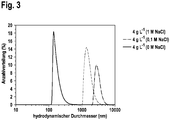
- FIG. 3 is a diagram illustrating the hydrodynamic diameter of magnetic particles as a function of the concentration of NaCl.
- the hydrodynamic diameter is a measure of the ability of the magnetic particles to aggregate. The larger the hydrodynamic diameter, the better the aggregation ability and the easier it is for kidney stones to be magnetized and removed from a kidney after aggregation.
- Particles of Fe 3 O 4 were used as the magnetic particles.
- the nanoparticles used here were produced in a co-precipitation of iron (II) chloride and iron (III) chloride with sodium hydroxide using the massart process (see, for example: Roth et al. Https://doi.org/10.1016/j.jmmm. 2014.10.074).
- the particles were washed with deionized water and then freeze-dried for X-ray diffraction, nitrogen adsorption isotherms according to the BET method and magnetometry.
- the TEM measurements showed an average particle diameter of 10 nm and the X-ray diffraction pattern verified magnetite as the main structure of the particles.
- the samples were dropped in a concentration of approx. 0.01 g / L onto TEM grids from Quantifoil (10 ⁇ L), which had previously been hydrophilized with the aid of air plasma for 30 s.
- the samples were dried with a cold air dryer and measured after a further day in a JEOL JEM 1400Plus transmission electron microscope.
- the TEM was calibrated using the diffraction pattern of a catalase crystal.
- At least 5 recordings were made of each of the iron oxide samples and used for statistical analysis of the particle size, at least 30 particles per image were measured using the image processing program ImageJ. With X-ray diffraction, a primary particle diameter of 9 nm could be determined with the help of the Scherrer method.
- the magnetometric measurements showed a saturation magnetization of 75 Am 2 / kg in a field of 50,000 Oe.
- no remanence and therefore superparamagnetic behavior could be determined in the particles.
- the specific surface of the particles according to the BET method with nitrogen at 77 K was 100 m 2 / g.
- a Gemini VII from Micromeritics was used for this and 9 points between 0.05 and 0.25 p / P 0 were measured.
- the dead volume of the sample was previously determined with helium at 77 K.
- the particles had a hydrodynamic diameter of 180 nm and an isoelectric point at pH 6. These magnetic particles were dispersed in a concentration of 4 g / L in water as a solvent.
- the diagram shows that the hydrodynamic diameter increases with increasing NaCl concentration.
- the ability of kidney stones magnetized by means of the preparation to aggregate also increases, since the repulsive interaction between the magnetic particles is reduced.
Landscapes
- Health & Medical Sciences (AREA)
- Chemical & Material Sciences (AREA)
- Life Sciences & Earth Sciences (AREA)
- Public Health (AREA)
- Pharmacology & Pharmacy (AREA)
- Veterinary Medicine (AREA)
- General Health & Medical Sciences (AREA)
- Medicinal Chemistry (AREA)
- Animal Behavior & Ethology (AREA)
- Epidemiology (AREA)
- Inorganic Chemistry (AREA)
- Bioinformatics & Cheminformatics (AREA)
- Engineering & Computer Science (AREA)
- Dispersion Chemistry (AREA)
- Organic Chemistry (AREA)
- Nuclear Medicine, Radiotherapy & Molecular Imaging (AREA)
- General Chemical & Material Sciences (AREA)
- Chemical Kinetics & Catalysis (AREA)
- Urology & Nephrology (AREA)
- Surgery (AREA)
- Proteomics, Peptides & Aminoacids (AREA)
- Biochemistry (AREA)
- Molecular Biology (AREA)
- Soft Magnetic Materials (AREA)
- Materials For Medical Uses (AREA)
- Hard Magnetic Materials (AREA)
- Medicinal Preparation (AREA)
- Pharmaceuticals Containing Other Organic And Inorganic Compounds (AREA)
- Water Treatment By Electricity Or Magnetism (AREA)
Abstract
Description
- Die vorliegende Erfindung betrifft eine Zubereitung zur Magnetisierung von Nierensteinen oder Nierensteinfragmenten, die ein einfaches Entfernen von Nierensteinen oder Nierensteinfragmenten aus der Niere eines menschlichen Körpers ermöglicht. Des Weiteren betrifft die Erfindung auch ein Kit zur Entfernung von Nierensteinen oder Nierensteinfragmenten.
- Nierensteine sind kristalline Ablagerungen, die sich in der Niere und auch im Harntrakt eines Säugetiers bilden können. Aktuelle Studien belegen, dass etwa 12% der Weltbevölkerung an Nierensteinen erkrankt, was sehr schmerzhaft ist und zu Folgeschäden führen kann. Oftmals bleibt kein anderer Weg, als die Nierensteine operativ zu entfernen, wobei die Nierensteine vor dem Entfernen je nach Größe zunächst zerkleinert werden, beispielsweise unter Verwendung von Laserpulsen. Die zerkleinerten Nierensteine werden sodann mittels einer Schlinge durch den Harnleiter extrahiert. Nachteilig an diesem Verfahren ist, dass leicht kleinere Nierensteinfragmente übersehen werden können, was zu erneutem Kristallwachstum und Bildung weiterer Nierensteine führt. Aus
US 9,925,311 B2 - Ausgehend von diesem Stand der Technik ist es eine Aufgabe der vorliegenden Erfindung eine Zubereitung zur Magnetisierung von Nierensteinen oder Nierensteinfragmenten bereitzustellen, die ein sicheres und einfaches Entfernen von Nierensteinen oder Nierensteinfragmenten aus der Niere eines menschlichen Körpers ermöglicht, Folgeschäden und Folgeerkrankungen vermeidet und für den Anwender gut handhabbar ist. Eine weitere Aufgabe der Erfindung liegt in der Bereitstellung eines Kits, das einfach und sicher in der Anwendung ist und mit dem sowohl Nierensteine als auch Nierensteinfragmente einfach und vollständig entfernt werden können.
- Die Aufgabe wird gelöst durch eine Zubereitung zur Magnetisierung von Nierensteinen oder Nierensteinfragmenten, die magnetische Partikel, mindestens ein Salz, ausgewählt aus der Gruppe bestehend aus: Chloriden, Perchloraten und Phosphaten von Lithium (Li), Natrium (Na), Kalium (K), Ammonium (NH4 +), Magnesium (Mg) und Calcium (Ca), wie insbesondere LiCI, NaCl, KCI, NH4Cl, MgCl2 und CaCl2, und mindestens ein Lösungsmittel enthält. Hierbei liegt die Zubereitung in Form einer Lösung, einer Suspension oder einer Dispersion vor. Die Verwendung von magnetischen Partikeln ermöglicht bei Anwendung der erfindungsgemäßen Zubereitung eine Magnetisierung der Nierensteine oder Nierensteinfragmente (im Folgenden werden Nierensteine und Nierensteinfragmente unter dem Begriff "Nierensteine" zusammengefasst), so dass diese beispielsweise mittels einer Magnetnadel aus der Niere eines Patienten entfernt werden können. Die mittels der erfindungsgemäßen Zubereitung zu magnetisierenden Nierensteine sind im Einzelnen nicht beschränkt und es kann sich z.B. um Calciumoxalate, Calciumphosphate, Struvitsteine (Ammoniummagnesiumphosphat), Urinsteine oder Cystinsteine handeln.
- Unter magnetischen Partikeln werden im Sinne der vorliegenden Erfindung Partikel verstanden, die durch einen Magneten aufgrund magnetischer Wechselwirkung angezogen werden können. Hierbei sind die erfindungsgemäß verwendeten Partikel im Einzelnen nicht beschränkt und können unterschiedliche chemische Zusammensetzungen aufweisen. Bevorzugte magnetische Partikel sind dabei Magnetite, Maghemite und Ferrite, wobei unter Ferriten insbesondere Verbindungen vom Typ XFe2O3 mit X = Co, Cu, Ni, Zn, Mn, Ba, Sr und Mg, verstanden werden.
- Es wurde überraschend gefunden, dass die Nierensteine und hierunter insbesondere auch sehr kleine Fragmente, vollständig dadurch entfernt werden können, dass mindestens eines der vorstehend genannten Salze oder auch Mischungen von zwei oder mehreren der Salze, zur Anwendung kommt. Das Salz verhindert bzw. unterdrückt hierbei die elektrostatische Abstoßung der magnetischen Partikel, so dass es zu einer verbesserten Partikelaggregation der durch die magnetischen Partikel magnetisierten Nierensteine kommt. Die Nierensteine können somit sehr sicher und einfach vollständig aus einer Niere entfernt werden. Die magnetisierten Nierensteine tendieren somit nicht dazu sich in der Niere zu verteilen, sondern aggregieren vollständig durch Reduktion der repulsiven Wechselwirkungen zwischen den magnetischen Partikeln, ohne dass es chemischer Aggregierungsmittel, wie z.B. vernetzende Polymere, bedarf.
- Somit zeichnet sich die erfindungsgemäße Zubereitung durch eine sehr gute Verträglichkeit, einfache und sichere Handhabung sowie eine kostengünstige Zusammensetzung aus. Die Bereitstellung in Form einer Lösung, Suspension oder Dispersion ist aufgrund des verwendeten Salzes auch ohne Konservierungsmittel möglich und erleichtert die Anwendung, da es keiner aufwendigen Bereitstellung der Zubereitung bedarf. Die Zubereitung kann somit bedarfsgerecht bereitgestellt werden.
- Die Unteransprüche haben bevorzugte Ausführungsformen und Weiterbildungen der Erfindung zum Inhalt.
- Aufgrund der sehr guten Verfügbarkeit sind die magnetischen Partikel vorzugsweise ferromagnetische Partikel und insbesondere ausgewählt aus Eisen, Nickel, Cobalt, AINiCo, SmCo, Nd2Fe14B, Ni80Fe20, NiFeCo, Ferriten, Fe3O4, gamma-Fe2O3, Mischphasen aus Fe3O4 und gamma-Fe2O3 und Mischungen daraus. Besonders bevorzugt kommen Ferrite, Fe3O4, gamma-Fe2O3, Mischphasen aus Fe3O4 und gamma-Fe2O3 und Mischungen aus diesen Eisenoxiden zur Anwendung, da sie über sehr hohe Magnetisierungen in magnetischen Feldern verfügen und damit sehr einfach magnetisch anziehbar sind. Zudem handelt es sich bei diesen magnetischen Partikeln um günstige Partikel, die in beliebigen Partikelgrößen erhältlich sind und sich durch eine gute Verträglichkeit, also keinen nennenswert toxischen Charakter, auszeichnen. Insbesondere können auch Mischungen von metallischen Partikeln, wie z.B. Eisen, Nickel, Cobalt, AINiCo, SmCo, Nd2Fe14B, Ni80Fe20 und NiFeCo mit einem oder mehreren der o.g. Metalloxide eingesetzt werden.
- Aufgrund der sehr guten Verteilbarkeit in der erfindungsgemäßen Zubereitung beträgt die Primärpartikelgröße der magnetischen Partikel 2 bis 100 nm, insbesondere 4 bis 20 nm und insbesondere 5 bis 15 nm. Je kleiner die Partikelgröße ist, desto besser ist die Verteilbarkeit der magnetischen Partikel in der Zubereitung und somit auch in der Niere eines Patienten. Dies hat jedoch auch den Nachteil, dass eine Aggregation erschwert sein kann. Unter den vorstehend genannten Gesichtspunkten beträgt die Primärpartikelgröße der magnetischen Partikel vorzugsweise 5 bis 15 nm. Die Primärpartikelgröße wird hierbei mittels Transmissionselektronenmikroskopie bestimmt.
- Gemäß einer weiteren bevorzugten Weiterbildung weisen die magnetischen Partikel eine spezifische Oberfläche von 80 bis 150 m2/g und insbesondere von 90 bis 120 m2/g auf. Hierdurch wird ein Binden an die Nierensteine verbessert. Die magnetischen Partikel umgeben die Nierensteine und erleichtern damit die Aggregation derselben. Die spezifische Oberfläche wird hierbei mittels Gasadsorptionsisothermen nach dem BET-Verfahren unter Verwendung von Stickstoff bei 77 K bestimmt.
- Zur Verbesserung der Langzeitstabilität der Zubereitung und zur Erleichterung der Verteilung der Zubereitung in der Niere eines Patienten unter Anwendung herkömmlicher Injektionsvorrichtungen, beträgt die Konzentration der magnetischen Partikel, bezogen auf die Zubereitung 2 bis 40 g/L und insbesondere 4 bis 20 g/L.
- Die repulsive Wechselwirkung zwischen den magnetischen Partikeln kann besonders gut dadurch reduziert und sogar nahezu vollständig unterdrückt werden, dass die Konzentration des Salzes in der Zubereitung vorzugsweise mindestens 100 mmol, insbesondere 100 bis 2000 mmol und insbesondere 200 bis 1000 mmol beträgt. Eine Konzentration im Bereich von 200 bis 1000 millimolar ist dabei aus Gründen der physiologischen Verträglichkeit und auch aus Kostengründen besonders bevorzugt.
- Ebenfalls aus Kostengründen sowie aus Gründen einer sehr guten Verträglichkeit, ist das Lösungsmittel vorzugsweise Wasser. Die Verwendung von Alkohol oder Mischungen aus Wasser und Alkohol kann dabei vorteilhaft im Lichte einer verbesserten Aggregation sein, da durch die OH-Gruppen des Alkohols oder der Alkohole ein Binden der Nierensteine an die magnetischen Partikel erleichtert wird. Der Alkohol ist im Einzelnen nicht beschränkt, wobei jedoch Ethanol und Glycerin besonders bevorzugt sind.
- Eine weitere vorteilhafte Weiterbildung sieht vor, dass die Zubereitung ferner mindestens einen Zucker und/oder mindestens ein Protein und/oder mindestens einen physiologischen Puffer enthält. Ein Zusatz von Zucker und/oder Protein wirkt sich vorteilhaft dahingehend aus, dass die Viskosität der Zubereitung erhöht wird, so dass die Aggregation von magnetisierten Nierensteinen sowie deren Ausschleusung aus der Niere erleichtert werden.
- Aus Gründen der physiologischen Verträglichkeit sowie aus Gründen der Anwendersicherheit liegt der pH-Wert der Zubereitung vorzugsweise in einem Bereich von 5 bis 8 und insbesondere von 6 bis 7. Dies wird insbesondere dadurch möglich, dass die erfindungsgemäße Zubereitung aufgrund ihrer einfachen chemischen Zusammensetzung auf anderweitige, einen sauren oder basischen pH-Wert erfordernde Hilfsstoffe, wie z.B. Tenside, Aggregierungsmittel und dergleichen, verzichten kann.
- Insbesondere ist die Zubereitung aus Gründen der Kostenersparnis und physiologischen Verträglichkeit im Wesentlichen frei von filmbildenden und vernetzenden Polymeren. Dies bedeutet, dass der Zubereitung keine vernetzenden Polymere oder auch Vernetzungsmittel für diese Polymere zugesetzt werden.
- Ebenfalls erfindungsgemäß wird auch ein Kit zur Entfernung von Nierensteinen oder Nierensteinfragmenten beschrieben. Das Kit umfasst die vorstehend offenbarte Zubereitung sowie eine magnetische oder magnetisierbare Vorrichtung, mittels der die durch die erfindungsgemäße Zubereitung magnetisierten Nierensteine oder Nierensteinfragmente angezogen und aus der Niere eines Patienten entfernt werden können. Besonders geeignete Vorrichtungen sind Magnetnadeln, die ein permanentmagnetisches Material oder ein elektromagnetisches Material umfassen, mit dem die magnetisierten und aggregierten Nierensteine in Wechselwirkung treten und reversibel gebunden werden können. Ein vollständiges Entfernen von Nierensteinen aus der Niere eines Patienten ist damit sehr sicher und einfach möglich.
- Weitere Einzelheiten, Merkmale und Vorteile der Erfindung ergeben sich aus der nachfolgenden Beschreibung und den Figuren. Es zeigen:
- Figur 1
- eine schematische Ansicht einer Zubereitung gemäß einer Ausführungsform der Erfindung,
- Figur 2
- eine schematische Schnittansicht eines mittels der Zubereitung aus
Figur 1 behandelten Nierensteins und - Figur 3
- ein Diagramm, veranschaulichend den hydrodynamischen Durchmesser von magnetischen Partikeln in Abhängigkeit der Konzentration von NaCl.
- In den Figuren sind nur die wesentlichen Merkmale der vorliegenden Erfindung gezeigt. Alle übrigen Merkmale sind der Übersichtlichkeit halber weggelassen. Zudem beziffern gleiche Bezugszeichen gleiche Komponenten.
- Im Detail zeigt
Figur 1 eine in einem Gefäß 2 enthaltene Zubereitung 1 zur Magnetisierung von Nierensteinen oder Nierensteinfragmenten. Die Zubereitung 1 kann beispielsweise in einem chirurgischen Eingriff verwendet werden, bei dem die Zubereitung 1 in die Niere eines Patienten eingeleitet wird. - Die Zubereitung 1 liegt beispielhaft in Form einer Suspension vor und enthält damit ein Lösungsmittel 5 und darin enthaltend magnetische Partikel 3 und ein Salz 4, das aus der Gruppe bestehend aus: Chloriden, Perchloraten und Phosphaten von Li, Na, K, Ammonium, Mg und Ca, wie insbesondere LiCI, NaCl, KCl, NH4Cl, MgCl2 und CaCl2, ausgewählt ist. Als Salz 4 wird vorzugsweise NaCl verwendet, das üblicherweise in dem Lösungsmittel 5, welches vorzugsweise Wasser ist, in gelöster Form vorliegt. Da es sich jedoch bei
Figur 1 um eine illustrative Darstellung handelt, ist das Salz 4 in partikulärer Form dargestellt. - Wie
Figur 1 zeigt, sind die magnetischen Partikel 3 homogen in der Zubereitung 1 verteilt. Zwischen den magnetischen Partikeln 3 sind lediglich geringe repulsive Wechselwirkungen vorhanden. Die repulsiven Wechselwirkungen werden durch das Salz 4 unterdrückt. Vielmehr werden die magnetischen Partikel 3 durch die elektrostatische Wechselwirkung mit dem Salz 4 räumlich zusammengehalten ohne jedoch zu verklumpen. - Die Zubereitung 1 zeichnet sich durch eine hohe Langzeitstabilität aus, ist sicher in der Anwendung und ermöglicht, wie in
Figur 2 schematisch gezeigt, eine Magnetisierung von Nierensteinen und Nierensteinfragmenten. Zudem werden keine weiteren Aggregierungsmittel benötigt, um ein vollständiges Ausschleusen von Nierensteinen und selbst sehr kleinen Nierensteinfragmenten aus einer Niere zu ermöglichen. -
Figur 2 zeigt, wie die magnetischen Partikel 3 an den Nierenstein 10 binden. Diese Bindung ist insbesondere kovalent, kann aber auch physikalischer Natur sein. Sobald die magnetischen Partikel 3 mittels der Zubereitung 1 in die Nähe eines Nierensteins 10 gelangen, binden die magnetischen Partikel 3 an die Oberfläche des Nierensteins 10, so dass der Nierenstein 10 "magnetisiert" wird. Eine Aggregation von mehreren, auf dieser Weise magnetisierten Nierensteinen 10 wird durch das Vorhandensein des Salzes 4 erzielt, das die zwischen den magnetischen Partikeln 3 wirkenden repulsiven Wechselwirkungen reduziert oder sogar unterdrückt und damit eine elektrostatische Anziehung der magnetisierten Nierensteine 10 ermöglicht. Somit können die magnetisierten Nierensteine 10 sehr einfach durch eine ebenfalls in die Niere einführbare magnetische Vorrichtung angezogen und aus der Niere entfernt werden. -
Figur 3 ist ein Diagramm, das den hydrodynamischen Durchmesser von magnetischen Partikeln in Abhängigkeit der Konzentration von NaCl veranschaulicht. Der hydrodynamische Durchmesser ist dabei ein Maß für die Aggregierfähigkeit der magnetischen Partikel. Je größer der hydrodynamische Durchmesser ist, desto besser ist die Aggregierfähigkeit und desto leichter können Nierensteine magnetisiert und nach Aggregation aus einer Niere ausgeschleust werden. - Als magnetische Partikel wurden Partikel von Fe3O4 verwendet. Die hier verwendeten Nanopartikel wurden in einer Co-Fällung von Eisen(II)chlorid und Eisen(III)chlorid mit Natronlauge nach dem Massartprozess hergestellt (siehe z.B.: Roth et al. https://doi.org/10.1016/j.jmmm.2014.10.074). Die Partikel wurden mit vollentsalztem Wasser gewaschen und anschließend für die Röntgenbeugung, Stickstoffadsorptionsisothermen nach dem BET Verfahren und Magnetometrie gefriergetrocknet. Die TEM Messungen ergaben einen durchschnittlichen Partikeldurchmesser von 10 nm und das Röntgenbeugungsbild verifizierte Magnetit als Hauptstruktur der Partikel. Für die Transmissionselektronenmikroskopie wurden die Proben in einer Konzentration von ca. 0.01 g/L auf TEM Grids von Quantifoil getropft (10 µL), die zuvor mit Hilfe von Luftplasma für 30 s hydrophilisiert wurden. Die Proben wurden mit einem Kaltluftfön getrocknet und nach einem weiteren Tag in einem JEOL JEM 1400Plus Transmissionselektronenmikroskop vermessen. Das TEM wurde mit Hilfe des Beugungsmusters eines Katalasekristalls kalibriert. Von den Eisenoxidproben wurden jeweils mindestens 5 Aufnahmen gemacht und zur statistischen Analyse der Partikelgröße wurden pro Bild mindestens 30 Partikel mit Hilfe des Bildbearbeitungsprogramms ImageJ vermessen. Mit Röntgenbeugung konnte mit Hilfe des Scherrerverfahrens ein Primärpartikeldurchmesser von 9 nm ermittelt werden. Die magnetometrischen Messungen ergaben eine Sättigungsmagnetisierung von 75 Am2/kg in einem Feld von 50000 Oe. Zudem konnte bei den Partikeln keine Remanenz und daher superparamagnetisches Verhalten festgestellt werden. Die spezifische Oberfläche der Partikel gemäß dem BET Verfahren mit Stickstoff bei 77 K betrug 100 m2/g. Es wurde hierfür ein Gemini VII von Micromeritics genutzt und 9 Punkte zwischen 0,05 und 0,25 p/P0 vermessen. Das Totvolumen der Probe wurde zuvor mit Helium bei 77 K ermittelt.
- Die Partikel wiesen einen hydrodynamischen Durchmesser von 180 nm und einen isoelektrischen Punkt bei pH 6 auf. Diese magnetischen Partikel wurden in einer Konzentration von 4 g/L in Wasser als Lösungsmittel dispergiert.
- Auf diese Weise wurden drei Suspensionen hergestellt, die in jeweils ein Gefäß abgefüllt wurden. Gefäß 1 wurde kein NaCl als Salz zugefügt (Konzentration an NaCl: 0 M). Gefäß 2 wurde NaCl zugefügt, so dass die Konzentration an NaCl in der Zubereitung 0,1 M war. Gefäß 2 wurde NaCl zugefügt, so dass die Konzentration an NaCl in der Zubereitung 1 M war.
- Das Diagramm zeigt, dass der hydrodynamische Durchmesser mit zunehmender NaCI-Konzentration steigt. Somit steigt auch die Aggregierfähigkeit von mittels der Zubereitung magnetisierten Nierensteinen, da die repulsive Wechselwirkung zwischen den magnetischen Partikeln reduziert ist.
-
- 1
- Zubereitung
- 2
- Gefäß
- 3
- magnetische Partikel
- 4
- Salz
- 5
- Lösungsmittel
- 10
- Nierenstein
Claims (11)
- Zubereitung (1) zur Magnetisierung von Nierensteinen (10) oder Nierensteinfragmenten enthaltend:- magnetische Partikel (3),- mindestens ein Salz (4), ausgewählt aus der Gruppe bestehend aus: Chloriden, Perchloraten und Phosphaten von Li, Na, K, Ammonium, Mg und Ca und- mindestens ein Lösungsmittel (5),wobei die Zubereitung (1) in Form einer Lösung, einer Suspension oder Dispersion vorliegt.
- Zubereitung (1) nach Anspruch 1, wobei die magnetischen Partikel (3) ferromagnetische Partikel und insbesondere ausgewählt sind aus Eisen, Nickel, Cobalt, AINiCo, SmCo, Nd2Fe14B, Ni80Fe20, NiFeCo, Ferriten, Fe3O4, gamma-Fe2O3, Mischphasen aus Fe3O4 und gamma-Fe2O3 und Mischungen daraus.
- Zubereitung (1) nach Anspruch 1 oder 2, wobei die magnetischen Partikel (3) eine Primärpartikelgröße von 2 bis 100 nm, insbesondere von 4 bis 20 nm und insbesondere von 5 bis 15 nm aufweisen.
- Zubereitung (1) nach einem der vorhergehenden Ansprüche, wobei die magnetischen Partikel (3) eine spezifische Oberfläche von 80 bis 150 m2/g, insbesondere von 90 bis 120 m2/g aufweisen.
- Zubereitung (1) nach einem der vorhergehenden Ansprüche, wobei die Konzentration der magnetischen Partikel (3), bezogen auf die Zubereitung 2 bis 40 g/L und insbesondere 4 bis 20 g/L beträgt.
- Zubereitung (1) nach einem der vorhergehenden Ansprüche, wobei die Konzentration des Salzes (4) in der Zubereitung mindestens 100 mmol, insbesondere 100 bis 2000 mmol und insbesondere 200 bis 1000 mmol beträgt.
- Zubereitung (1) nach einem der vorhergehenden Ansprüche, wobei das Lösungsmittel (5) ausgewählt ist aus Wasser, Alkohol und Mischungen daraus.
- Zubereitung (1) nach einem der vorhergehenden Ansprüche, ferner enthaltend mindestens einen Zucker und/oder mindestens ein Protein und/oder mindestens einen physiologischen Puffer.
- Zubereitung (1) nach einem der vorhergehenden Ansprüche, wobei der pH-Wert der Zubereitung (1) in einem Bereich von 5 bis 8, insbesondere von 6 bis 7 liegt.
- Zubereitung (1) nach einem der vorhergehenden Ansprüche, wobei die Zubereitung (1) im Wesentlichen frei ist von filmbildenden und vernetzenden Polymeren.
- Kit zur Entfernung von Nierensteinen (10) oder Nierensteinfragmenten umfassend die Zubereitung (1) nach einem der vorhergehenden Ansprüche und eine magnetische oder magnetisierbare Vorrichtung, insbesondere eine Magnetnadel, zur Entfernung von durch die Zubereitung magnetisierten Nierensteinen oder Nierensteinfragmenten.
Priority Applications (8)
| Application Number | Priority Date | Filing Date | Title |
|---|---|---|---|
| EP20160490.7A EP3875075B1 (de) | 2020-03-02 | 2020-03-02 | Zubereitung zur magnetisierung von nierensteinen und nierensteinfragmenten und kit zur entfernung von nierensteinen und nierensteinfragmenten |
| US17/802,655 US20230149450A1 (en) | 2020-03-02 | 2021-02-23 | Preparation for magnetizing kidney stones and kidney stone fragments and kit for removing kidney stones and kidney stone fragments |
| CA3168407A CA3168407A1 (en) | 2020-03-02 | 2021-02-23 | Preparation for magnetizing kidney stones and kidney stone fragments and kit for removing kidney stones and kidney stone fragments |
| CN202180018918.7A CN115243671A (zh) | 2020-03-02 | 2021-02-23 | 用于磁化肾结石和肾结石碎片的制剂以及用于去除肾结石和肾结石碎片的试剂盒 |
| PCT/EP2021/054434 WO2021175660A1 (de) | 2020-03-02 | 2021-02-23 | Zubereitung zur magnetisierung von nierensteinen und nierensteinfragmenten und kit zur entfernung von nierensteinen und nierensteinfragmenten |
| KR1020227032209A KR20220143098A (ko) | 2020-03-02 | 2021-02-23 | 신장 결석 및 신장 결석 조각의 자화를 위한 제제 및 신장 결석 및 신장 결석 제거용 키트 |
| JP2022552845A JP7454292B2 (ja) | 2020-03-02 | 2021-02-23 | 腎臓結石及び腎臓結石片を磁化するための調合液、並びに腎臓結石及び腎臓結石片を除去するためのキット。 |
| AU2021229560A AU2021229560A1 (en) | 2020-03-02 | 2021-02-23 | Preparation for magnetizing kidney stones and kidney stone fragments and kit for removing kidney stones and kidney stone fragments |
Applications Claiming Priority (1)
| Application Number | Priority Date | Filing Date | Title |
|---|---|---|---|
| EP20160490.7A EP3875075B1 (de) | 2020-03-02 | 2020-03-02 | Zubereitung zur magnetisierung von nierensteinen und nierensteinfragmenten und kit zur entfernung von nierensteinen und nierensteinfragmenten |
Publications (2)
| Publication Number | Publication Date |
|---|---|
| EP3875075A1 true EP3875075A1 (de) | 2021-09-08 |
| EP3875075B1 EP3875075B1 (de) | 2023-05-17 |
Family
ID=69743184
Family Applications (1)
| Application Number | Title | Priority Date | Filing Date |
|---|---|---|---|
| EP20160490.7A Active EP3875075B1 (de) | 2020-03-02 | 2020-03-02 | Zubereitung zur magnetisierung von nierensteinen und nierensteinfragmenten und kit zur entfernung von nierensteinen und nierensteinfragmenten |
Country Status (8)
| Country | Link |
|---|---|
| US (1) | US20230149450A1 (de) |
| EP (1) | EP3875075B1 (de) |
| JP (1) | JP7454292B2 (de) |
| KR (1) | KR20220143098A (de) |
| CN (1) | CN115243671A (de) |
| AU (1) | AU2021229560A1 (de) |
| CA (1) | CA3168407A1 (de) |
| WO (1) | WO2021175660A1 (de) |
Citations (2)
| Publication number | Priority date | Publication date | Assignee | Title |
|---|---|---|---|---|
| EP3090750A1 (de) * | 2013-12-30 | 2016-11-09 | Hanwha Chemical Corporation | Pharmazeutische zusammensetzung zur prävention oder behandlung von eisenmangel mit eisenoxidnanopartikeln |
| US9925311B2 (en) | 2013-04-23 | 2018-03-27 | Fraunhofer-Gesellschaft zur Förderung der angewandten Forschung e.V. | Kit for producing a crosslinked gel for surrounding urinary calculi and/or fragments thereof |
Family Cites Families (4)
| Publication number | Priority date | Publication date | Assignee | Title |
|---|---|---|---|---|
| WO1996002060A1 (en) * | 1994-07-07 | 1996-01-25 | Chiron Diagnostics Corporation | Highly disperse magnetic metal oxide particles, processes for their preparation and their use |
| US20090136594A1 (en) * | 2007-11-27 | 2009-05-28 | Board Of Regents, The University Of Texas System | Functionalization of Micro-And Nano Particles for Selective Attachment to Calcium Biomineral Surfaces |
| US20150140595A1 (en) * | 2012-05-22 | 2015-05-21 | Joseph Gerard Utermohlen | Formulations for the synthesis of paramagnetic particles and methods that utilize the particles for biochemical applications |
| DK2796100T3 (en) | 2013-04-23 | 2016-08-01 | Fraunhofer Ges Forschung | Gel-forming system for the removal of kidney stone fragments |
-
2020
- 2020-03-02 EP EP20160490.7A patent/EP3875075B1/de active Active
-
2021
- 2021-02-23 AU AU2021229560A patent/AU2021229560A1/en not_active Abandoned
- 2021-02-23 US US17/802,655 patent/US20230149450A1/en not_active Abandoned
- 2021-02-23 WO PCT/EP2021/054434 patent/WO2021175660A1/de not_active Ceased
- 2021-02-23 KR KR1020227032209A patent/KR20220143098A/ko not_active Ceased
- 2021-02-23 CA CA3168407A patent/CA3168407A1/en active Pending
- 2021-02-23 JP JP2022552845A patent/JP7454292B2/ja active Active
- 2021-02-23 CN CN202180018918.7A patent/CN115243671A/zh active Pending
Patent Citations (2)
| Publication number | Priority date | Publication date | Assignee | Title |
|---|---|---|---|---|
| US9925311B2 (en) | 2013-04-23 | 2018-03-27 | Fraunhofer-Gesellschaft zur Förderung der angewandten Forschung e.V. | Kit for producing a crosslinked gel for surrounding urinary calculi and/or fragments thereof |
| EP3090750A1 (de) * | 2013-12-30 | 2016-11-09 | Hanwha Chemical Corporation | Pharmazeutische zusammensetzung zur prävention oder behandlung von eisenmangel mit eisenoxidnanopartikeln |
Also Published As
| Publication number | Publication date |
|---|---|
| AU2021229560A1 (en) | 2022-09-01 |
| CN115243671A (zh) | 2022-10-25 |
| EP3875075B1 (de) | 2023-05-17 |
| JP2023516703A (ja) | 2023-04-20 |
| US20230149450A1 (en) | 2023-05-18 |
| JP7454292B2 (ja) | 2024-03-22 |
| KR20220143098A (ko) | 2022-10-24 |
| CA3168407A1 (en) | 2021-09-10 |
| WO2021175660A1 (de) | 2021-09-10 |
Similar Documents
| Publication | Publication Date | Title |
|---|---|---|
| DE69026949T2 (de) | Resuspendierbare beschichtete magnetische teilchen und stabile magnetische teilchensuspensionen | |
| US4260523A (en) | Magnetized active carbon composition | |
| US10577254B2 (en) | Iron oxide nanoparticles doped with alkali metals or alkali earth metals capable of gigantic AC magnetic self-heating in biocompatible AC magnetic field and method of preparing the same | |
| Pandhare et al. | Polyol-assisted chitosan-coated MnFe 2 O 4 nanoparticles: assessing magneto-hyperthermia efficacy and toxicological effects on Garra mcclellandi fish | |
| Hadjipanayis | Magnetic hardening in Zr‐substituted 2: 17 rare‐earth permanent magnets | |
| Hanini et al. | Nanotoxicological study of polyol-made cobalt-zinc ferrite nanoparticles in rabbit | |
| EP3875075B1 (de) | Zubereitung zur magnetisierung von nierensteinen und nierensteinfragmenten und kit zur entfernung von nierensteinen und nierensteinfragmenten | |
| Nasrin et al. | Preparation and analysis of Mn1-xZnxFe2O4 nanoparticles coated with chitosan for use as a heating agent and MRI contrast agent in biomedical applications | |
| DE10154016B4 (de) | Magnetflüssigkeit und Verfahren zur ihrer Herstellung | |
| DE102008015365A1 (de) | Magnetische Nanopartikel und Verfahren zu deren Herstellung | |
| Kekutia et al. | A new method for the synthesis of nanoparticles for biomedical applications | |
| Pardo et al. | Analysis of the influence of synthetic paramaters on the structure and physico-chemical properties of non-spherical iron oxide nanocrystals and their biological stability and compatibility | |
| CH716222B1 (de) | Verfahren zur Herstellung eines R2M17-Magneten. | |
| Park et al. | Magnetization reversals in magnetosome linear-chain assemblies extracted from magnetotactic bacteria: an experimental and micromagnetic simulation study | |
| DE102020116096A1 (de) | Vorrichtung und Verfahren zum Erzeugen eines inhomogenen Magnetfeldes | |
| Rodrigues et al. | Magnetoliposomes for dual cancer therapy | |
| Kumari | Magnetic properties of iron-oxide nanoparticles and methods for their characterization | |
| Hinrichs | Synthesis and characterization of anisotropic iron oxides and their incorporation into a thermoresponsive matrix | |
| WO2008049537A1 (de) | Verwendung von magnetischen cs -kapseln und/oder mikrokapseln für die behandlung von aneurysmen | |
| EP0262534A2 (de) | Feinteilige, sphärische, zweischichtige Feststoffteilchen | |
| DE102008008812A1 (de) | Ferro- oder ferrimagnetische Magnesiumlegierung, deren Herstellung und Verwendungen | |
| DE10237742A1 (de) | Verfahren zur Herstellung magnetischer Polymerpartikel | |
| EP2365353A1 (de) | Halbach Magnet für die magnetische Resonanz, der sich ohne Kraftaufwand öffnen und schliessen lässt | |
| AT214157B (de) | Permanentmagnetischer Körper und Verfahren zur Herstellung der Teilchen, aus welchen der Körper aufgebaut ist | |
| DE202013100234U1 (de) | Bausatz mit mindestens zwei eingeschränkt koppelbaren Bauteilen, deren Koppelbarkeit magnetisch kodiert ist |
Legal Events
| Date | Code | Title | Description |
|---|---|---|---|
| PUAI | Public reference made under article 153(3) epc to a published international application that has entered the european phase |
Free format text: ORIGINAL CODE: 0009012 |
|
| STAA | Information on the status of an ep patent application or granted ep patent |
Free format text: STATUS: THE APPLICATION HAS BEEN PUBLISHED |
|
| AK | Designated contracting states |
Kind code of ref document: A1 Designated state(s): AL AT BE BG CH CY CZ DE DK EE ES FI FR GB GR HR HU IE IS IT LI LT LU LV MC MK MT NL NO PL PT RO RS SE SI SK SM TR |
|
| RIN1 | Information on inventor provided before grant (corrected) |
Inventor name: WENGLER, MICHAEL Inventor name: TOLOZA, CAMILO Inventor name: SOLVIE, LAURA ANNABELLE Inventor name: SRINIVASAN, SHYAM Inventor name: SCHWAMINGER, SEBASTIAN PATRICK |
|
| STAA | Information on the status of an ep patent application or granted ep patent |
Free format text: STATUS: REQUEST FOR EXAMINATION WAS MADE |
|
| 17P | Request for examination filed |
Effective date: 20220216 |
|
| RBV | Designated contracting states (corrected) |
Designated state(s): AL AT BE BG CH CY CZ DE DK EE ES FI FR GB GR HR HU IE IS IT LI LT LU LV MC MK MT NL NO PL PT RO RS SE SI SK SM TR |
|
| GRAP | Despatch of communication of intention to grant a patent |
Free format text: ORIGINAL CODE: EPIDOSNIGR1 |
|
| STAA | Information on the status of an ep patent application or granted ep patent |
Free format text: STATUS: GRANT OF PATENT IS INTENDED |
|
| RIC1 | Information provided on ipc code assigned before grant |
Ipc: A61K 33/42 20060101ALI20221104BHEP Ipc: A61K 33/14 20060101ALI20221104BHEP Ipc: A61K 47/02 20060101ALI20221104BHEP Ipc: A61K 9/10 20060101ALI20221104BHEP Ipc: A61K 9/08 20060101ALI20221104BHEP Ipc: A61K 9/00 20060101AFI20221104BHEP |
|
| INTG | Intention to grant announced |
Effective date: 20221121 |
|
| GRAS | Grant fee paid |
Free format text: ORIGINAL CODE: EPIDOSNIGR3 |
|
| GRAA | (expected) grant |
Free format text: ORIGINAL CODE: 0009210 |
|
| STAA | Information on the status of an ep patent application or granted ep patent |
Free format text: STATUS: THE PATENT HAS BEEN GRANTED |
|
| AK | Designated contracting states |
Kind code of ref document: B1 Designated state(s): AL AT BE BG CH CY CZ DE DK EE ES FI FR GB GR HR HU IE IS IT LI LT LU LV MC MK MT NL NO PL PT RO RS SE SI SK SM TR |
|
| REG | Reference to a national code |
Ref country code: GB Ref legal event code: FG4D Free format text: NOT ENGLISH |
|
| REG | Reference to a national code |
Ref country code: DE Ref legal event code: R096 Ref document number: 502020003277 Country of ref document: DE |
|
| REG | Reference to a national code |
Ref country code: CH Ref legal event code: EP |
|
| REG | Reference to a national code |
Ref country code: IE Ref legal event code: FG4D Free format text: LANGUAGE OF EP DOCUMENT: GERMAN |
|
| REG | Reference to a national code |
Ref country code: AT Ref legal event code: REF Ref document number: 1568143 Country of ref document: AT Kind code of ref document: T Effective date: 20230615 |
|
| REG | Reference to a national code |
Ref country code: LT Ref legal event code: MG9D |
|
| REG | Reference to a national code |
Ref country code: NL Ref legal event code: MP Effective date: 20230517 |
|
| PG25 | Lapsed in a contracting state [announced via postgrant information from national office to epo] |
Ref country code: SE Free format text: LAPSE BECAUSE OF FAILURE TO SUBMIT A TRANSLATION OF THE DESCRIPTION OR TO PAY THE FEE WITHIN THE PRESCRIBED TIME-LIMIT Effective date: 20230517 Ref country code: PT Free format text: LAPSE BECAUSE OF FAILURE TO SUBMIT A TRANSLATION OF THE DESCRIPTION OR TO PAY THE FEE WITHIN THE PRESCRIBED TIME-LIMIT Effective date: 20230918 Ref country code: NO Free format text: LAPSE BECAUSE OF FAILURE TO SUBMIT A TRANSLATION OF THE DESCRIPTION OR TO PAY THE FEE WITHIN THE PRESCRIBED TIME-LIMIT Effective date: 20230817 Ref country code: NL Free format text: LAPSE BECAUSE OF FAILURE TO SUBMIT A TRANSLATION OF THE DESCRIPTION OR TO PAY THE FEE WITHIN THE PRESCRIBED TIME-LIMIT Effective date: 20230517 Ref country code: ES Free format text: LAPSE BECAUSE OF FAILURE TO SUBMIT A TRANSLATION OF THE DESCRIPTION OR TO PAY THE FEE WITHIN THE PRESCRIBED TIME-LIMIT Effective date: 20230517 |
|
| PG25 | Lapsed in a contracting state [announced via postgrant information from national office to epo] |
Ref country code: RS Free format text: LAPSE BECAUSE OF FAILURE TO SUBMIT A TRANSLATION OF THE DESCRIPTION OR TO PAY THE FEE WITHIN THE PRESCRIBED TIME-LIMIT Effective date: 20230517 Ref country code: PL Free format text: LAPSE BECAUSE OF FAILURE TO SUBMIT A TRANSLATION OF THE DESCRIPTION OR TO PAY THE FEE WITHIN THE PRESCRIBED TIME-LIMIT Effective date: 20230517 Ref country code: LV Free format text: LAPSE BECAUSE OF FAILURE TO SUBMIT A TRANSLATION OF THE DESCRIPTION OR TO PAY THE FEE WITHIN THE PRESCRIBED TIME-LIMIT Effective date: 20230517 Ref country code: LT Free format text: LAPSE BECAUSE OF FAILURE TO SUBMIT A TRANSLATION OF THE DESCRIPTION OR TO PAY THE FEE WITHIN THE PRESCRIBED TIME-LIMIT Effective date: 20230517 Ref country code: IS Free format text: LAPSE BECAUSE OF FAILURE TO SUBMIT A TRANSLATION OF THE DESCRIPTION OR TO PAY THE FEE WITHIN THE PRESCRIBED TIME-LIMIT Effective date: 20230917 Ref country code: HR Free format text: LAPSE BECAUSE OF FAILURE TO SUBMIT A TRANSLATION OF THE DESCRIPTION OR TO PAY THE FEE WITHIN THE PRESCRIBED TIME-LIMIT Effective date: 20230517 Ref country code: GR Free format text: LAPSE BECAUSE OF FAILURE TO SUBMIT A TRANSLATION OF THE DESCRIPTION OR TO PAY THE FEE WITHIN THE PRESCRIBED TIME-LIMIT Effective date: 20230818 |
|
| PG25 | Lapsed in a contracting state [announced via postgrant information from national office to epo] |
Ref country code: FI Free format text: LAPSE BECAUSE OF FAILURE TO SUBMIT A TRANSLATION OF THE DESCRIPTION OR TO PAY THE FEE WITHIN THE PRESCRIBED TIME-LIMIT Effective date: 20230517 |
|
| PG25 | Lapsed in a contracting state [announced via postgrant information from national office to epo] |
Ref country code: SK Free format text: LAPSE BECAUSE OF FAILURE TO SUBMIT A TRANSLATION OF THE DESCRIPTION OR TO PAY THE FEE WITHIN THE PRESCRIBED TIME-LIMIT Effective date: 20230517 |
|
| PG25 | Lapsed in a contracting state [announced via postgrant information from national office to epo] |
Ref country code: SM Free format text: LAPSE BECAUSE OF FAILURE TO SUBMIT A TRANSLATION OF THE DESCRIPTION OR TO PAY THE FEE WITHIN THE PRESCRIBED TIME-LIMIT Effective date: 20230517 Ref country code: SK Free format text: LAPSE BECAUSE OF FAILURE TO SUBMIT A TRANSLATION OF THE DESCRIPTION OR TO PAY THE FEE WITHIN THE PRESCRIBED TIME-LIMIT Effective date: 20230517 Ref country code: RO Free format text: LAPSE BECAUSE OF FAILURE TO SUBMIT A TRANSLATION OF THE DESCRIPTION OR TO PAY THE FEE WITHIN THE PRESCRIBED TIME-LIMIT Effective date: 20230517 Ref country code: EE Free format text: LAPSE BECAUSE OF FAILURE TO SUBMIT A TRANSLATION OF THE DESCRIPTION OR TO PAY THE FEE WITHIN THE PRESCRIBED TIME-LIMIT Effective date: 20230517 Ref country code: DK Free format text: LAPSE BECAUSE OF FAILURE TO SUBMIT A TRANSLATION OF THE DESCRIPTION OR TO PAY THE FEE WITHIN THE PRESCRIBED TIME-LIMIT Effective date: 20230517 Ref country code: CZ Free format text: LAPSE BECAUSE OF FAILURE TO SUBMIT A TRANSLATION OF THE DESCRIPTION OR TO PAY THE FEE WITHIN THE PRESCRIBED TIME-LIMIT Effective date: 20230517 |
|
| REG | Reference to a national code |
Ref country code: DE Ref legal event code: R097 Ref document number: 502020003277 Country of ref document: DE |
|
| PLBE | No opposition filed within time limit |
Free format text: ORIGINAL CODE: 0009261 |
|
| STAA | Information on the status of an ep patent application or granted ep patent |
Free format text: STATUS: NO OPPOSITION FILED WITHIN TIME LIMIT |
|
| 26N | No opposition filed |
Effective date: 20240220 |
|
| PGFP | Annual fee paid to national office [announced via postgrant information from national office to epo] |
Ref country code: DE Payment date: 20240325 Year of fee payment: 5 Ref country code: GB Payment date: 20240322 Year of fee payment: 5 |
|
| PG25 | Lapsed in a contracting state [announced via postgrant information from national office to epo] |
Ref country code: SI Free format text: LAPSE BECAUSE OF FAILURE TO SUBMIT A TRANSLATION OF THE DESCRIPTION OR TO PAY THE FEE WITHIN THE PRESCRIBED TIME-LIMIT Effective date: 20230517 |
|
| PG25 | Lapsed in a contracting state [announced via postgrant information from national office to epo] |
Ref country code: SI Free format text: LAPSE BECAUSE OF FAILURE TO SUBMIT A TRANSLATION OF THE DESCRIPTION OR TO PAY THE FEE WITHIN THE PRESCRIBED TIME-LIMIT Effective date: 20230517 Ref country code: IT Free format text: LAPSE BECAUSE OF FAILURE TO SUBMIT A TRANSLATION OF THE DESCRIPTION OR TO PAY THE FEE WITHIN THE PRESCRIBED TIME-LIMIT Effective date: 20230517 |
|
| PGFP | Annual fee paid to national office [announced via postgrant information from national office to epo] |
Ref country code: FR Payment date: 20240320 Year of fee payment: 5 |
|
| REG | Reference to a national code |
Ref country code: CH Ref legal event code: PL |
|
| PG25 | Lapsed in a contracting state [announced via postgrant information from national office to epo] |
Ref country code: BG Free format text: LAPSE BECAUSE OF FAILURE TO SUBMIT A TRANSLATION OF THE DESCRIPTION OR TO PAY THE FEE WITHIN THE PRESCRIBED TIME-LIMIT Effective date: 20230517 |
|
| PG25 | Lapsed in a contracting state [announced via postgrant information from national office to epo] |
Ref country code: LU Free format text: LAPSE BECAUSE OF NON-PAYMENT OF DUE FEES Effective date: 20240302 |
|
| PG25 | Lapsed in a contracting state [announced via postgrant information from national office to epo] |
Ref country code: MC Free format text: LAPSE BECAUSE OF FAILURE TO SUBMIT A TRANSLATION OF THE DESCRIPTION OR TO PAY THE FEE WITHIN THE PRESCRIBED TIME-LIMIT Effective date: 20230517 |
|
| PG25 | Lapsed in a contracting state [announced via postgrant information from national office to epo] |
Ref country code: MC Free format text: LAPSE BECAUSE OF FAILURE TO SUBMIT A TRANSLATION OF THE DESCRIPTION OR TO PAY THE FEE WITHIN THE PRESCRIBED TIME-LIMIT Effective date: 20230517 Ref country code: LU Free format text: LAPSE BECAUSE OF NON-PAYMENT OF DUE FEES Effective date: 20240302 Ref country code: BG Free format text: LAPSE BECAUSE OF FAILURE TO SUBMIT A TRANSLATION OF THE DESCRIPTION OR TO PAY THE FEE WITHIN THE PRESCRIBED TIME-LIMIT Effective date: 20230517 |
|
| REG | Reference to a national code |
Ref country code: BE Ref legal event code: MM Effective date: 20240331 |
|
| PG25 | Lapsed in a contracting state [announced via postgrant information from national office to epo] |
Ref country code: BE Free format text: LAPSE BECAUSE OF NON-PAYMENT OF DUE FEES Effective date: 20240331 |
|
| PG25 | Lapsed in a contracting state [announced via postgrant information from national office to epo] |
Ref country code: IE Free format text: LAPSE BECAUSE OF NON-PAYMENT OF DUE FEES Effective date: 20240302 |
|
| PG25 | Lapsed in a contracting state [announced via postgrant information from national office to epo] |
Ref country code: IE Free format text: LAPSE BECAUSE OF NON-PAYMENT OF DUE FEES Effective date: 20240302 Ref country code: BE Free format text: LAPSE BECAUSE OF NON-PAYMENT OF DUE FEES Effective date: 20240331 Ref country code: CH Free format text: LAPSE BECAUSE OF NON-PAYMENT OF DUE FEES Effective date: 20240331 |
|
| PGFP | Annual fee paid to national office [announced via postgrant information from national office to epo] |
Ref country code: AT Payment date: 20250417 Year of fee payment: 5 |
|
| PG25 | Lapsed in a contracting state [announced via postgrant information from national office to epo] |
Ref country code: CY Free format text: LAPSE BECAUSE OF FAILURE TO SUBMIT A TRANSLATION OF THE DESCRIPTION OR TO PAY THE FEE WITHIN THE PRESCRIBED TIME-LIMIT; INVALID AB INITIO Effective date: 20200302 |
|
| PG25 | Lapsed in a contracting state [announced via postgrant information from national office to epo] |
Ref country code: HU Free format text: LAPSE BECAUSE OF FAILURE TO SUBMIT A TRANSLATION OF THE DESCRIPTION OR TO PAY THE FEE WITHIN THE PRESCRIBED TIME-LIMIT; INVALID AB INITIO Effective date: 20200302 |
|
| REG | Reference to a national code |
Ref country code: DE Ref legal event code: R119 Ref document number: 502020003277 Country of ref document: DE |
|
| GBPC | Gb: european patent ceased through non-payment of renewal fee |
Effective date: 20250302 |
|
| PG25 | Lapsed in a contracting state [announced via postgrant information from national office to epo] |
Ref country code: TR Free format text: LAPSE BECAUSE OF FAILURE TO SUBMIT A TRANSLATION OF THE DESCRIPTION OR TO PAY THE FEE WITHIN THE PRESCRIBED TIME-LIMIT Effective date: 20230517 |
|
| PG25 | Lapsed in a contracting state [announced via postgrant information from national office to epo] |
Ref country code: DE Free format text: LAPSE BECAUSE OF NON-PAYMENT OF DUE FEES Effective date: 20251001 |
|
| PG25 | Lapsed in a contracting state [announced via postgrant information from national office to epo] |
Ref country code: GB Free format text: LAPSE BECAUSE OF NON-PAYMENT OF DUE FEES Effective date: 20250302 |
|
| PG25 | Lapsed in a contracting state [announced via postgrant information from national office to epo] |
Ref country code: FR Free format text: LAPSE BECAUSE OF NON-PAYMENT OF DUE FEES Effective date: 20250331 |