EP3872210A1 - Cryogenic austenitic high-manganese steel having excellent shape, and manufacturing method therefor - Google Patents
Cryogenic austenitic high-manganese steel having excellent shape, and manufacturing method therefor Download PDFInfo
- Publication number
- EP3872210A1 EP3872210A1 EP19875536.5A EP19875536A EP3872210A1 EP 3872210 A1 EP3872210 A1 EP 3872210A1 EP 19875536 A EP19875536 A EP 19875536A EP 3872210 A1 EP3872210 A1 EP 3872210A1
- Authority
- EP
- European Patent Office
- Prior art keywords
- steel
- less
- present disclosure
- rolling
- excellent shape
- Prior art date
- Legal status (The legal status is an assumption and is not a legal conclusion. Google has not performed a legal analysis and makes no representation as to the accuracy of the status listed.)
- Pending
Links
Images
Classifications
-
- C—CHEMISTRY; METALLURGY
- C21—METALLURGY OF IRON
- C21D—MODIFYING THE PHYSICAL STRUCTURE OF FERROUS METALS; GENERAL DEVICES FOR HEAT TREATMENT OF FERROUS OR NON-FERROUS METALS OR ALLOYS; MAKING METAL MALLEABLE, e.g. BY DECARBURISATION OR TEMPERING
- C21D9/00—Heat treatment, e.g. annealing, hardening, quenching or tempering, adapted for particular articles; Furnaces therefor
- C21D9/46—Heat treatment, e.g. annealing, hardening, quenching or tempering, adapted for particular articles; Furnaces therefor for sheet metals
-
- C—CHEMISTRY; METALLURGY
- C22—METALLURGY; FERROUS OR NON-FERROUS ALLOYS; TREATMENT OF ALLOYS OR NON-FERROUS METALS
- C22C—ALLOYS
- C22C38/00—Ferrous alloys, e.g. steel alloys
- C22C38/18—Ferrous alloys, e.g. steel alloys containing chromium
- C22C38/38—Ferrous alloys, e.g. steel alloys containing chromium with more than 1.5% by weight of manganese
-
- C—CHEMISTRY; METALLURGY
- C21—METALLURGY OF IRON
- C21D—MODIFYING THE PHYSICAL STRUCTURE OF FERROUS METALS; GENERAL DEVICES FOR HEAT TREATMENT OF FERROUS OR NON-FERROUS METALS OR ALLOYS; MAKING METAL MALLEABLE, e.g. BY DECARBURISATION OR TEMPERING
- C21D1/00—General methods or devices for heat treatment, e.g. annealing, hardening, quenching or tempering
- C21D1/02—Hardening articles or materials formed by forging or rolling, with no further heating beyond that required for the formation
-
- C—CHEMISTRY; METALLURGY
- C21—METALLURGY OF IRON
- C21D—MODIFYING THE PHYSICAL STRUCTURE OF FERROUS METALS; GENERAL DEVICES FOR HEAT TREATMENT OF FERROUS OR NON-FERROUS METALS OR ALLOYS; MAKING METAL MALLEABLE, e.g. BY DECARBURISATION OR TEMPERING
- C21D6/00—Heat treatment of ferrous alloys
-
- C—CHEMISTRY; METALLURGY
- C21—METALLURGY OF IRON
- C21D—MODIFYING THE PHYSICAL STRUCTURE OF FERROUS METALS; GENERAL DEVICES FOR HEAT TREATMENT OF FERROUS OR NON-FERROUS METALS OR ALLOYS; MAKING METAL MALLEABLE, e.g. BY DECARBURISATION OR TEMPERING
- C21D6/00—Heat treatment of ferrous alloys
- C21D6/002—Heat treatment of ferrous alloys containing Cr
-
- C—CHEMISTRY; METALLURGY
- C21—METALLURGY OF IRON
- C21D—MODIFYING THE PHYSICAL STRUCTURE OF FERROUS METALS; GENERAL DEVICES FOR HEAT TREATMENT OF FERROUS OR NON-FERROUS METALS OR ALLOYS; MAKING METAL MALLEABLE, e.g. BY DECARBURISATION OR TEMPERING
- C21D6/00—Heat treatment of ferrous alloys
- C21D6/005—Heat treatment of ferrous alloys containing Mn
-
- C—CHEMISTRY; METALLURGY
- C21—METALLURGY OF IRON
- C21D—MODIFYING THE PHYSICAL STRUCTURE OF FERROUS METALS; GENERAL DEVICES FOR HEAT TREATMENT OF FERROUS OR NON-FERROUS METALS OR ALLOYS; MAKING METAL MALLEABLE, e.g. BY DECARBURISATION OR TEMPERING
- C21D8/00—Modifying the physical properties of ferrous metals or ferrous alloys by deformation combined with, or followed by, heat treatment
- C21D8/02—Modifying the physical properties of ferrous metals or ferrous alloys by deformation combined with, or followed by, heat treatment during manufacturing of plates or strips
-
- C—CHEMISTRY; METALLURGY
- C21—METALLURGY OF IRON
- C21D—MODIFYING THE PHYSICAL STRUCTURE OF FERROUS METALS; GENERAL DEVICES FOR HEAT TREATMENT OF FERROUS OR NON-FERROUS METALS OR ALLOYS; MAKING METAL MALLEABLE, e.g. BY DECARBURISATION OR TEMPERING
- C21D8/00—Modifying the physical properties of ferrous metals or ferrous alloys by deformation combined with, or followed by, heat treatment
- C21D8/02—Modifying the physical properties of ferrous metals or ferrous alloys by deformation combined with, or followed by, heat treatment during manufacturing of plates or strips
- C21D8/0221—Modifying the physical properties of ferrous metals or ferrous alloys by deformation combined with, or followed by, heat treatment during manufacturing of plates or strips characterised by the working steps
- C21D8/0226—Hot rolling
-
- C—CHEMISTRY; METALLURGY
- C21—METALLURGY OF IRON
- C21D—MODIFYING THE PHYSICAL STRUCTURE OF FERROUS METALS; GENERAL DEVICES FOR HEAT TREATMENT OF FERROUS OR NON-FERROUS METALS OR ALLOYS; MAKING METAL MALLEABLE, e.g. BY DECARBURISATION OR TEMPERING
- C21D8/00—Modifying the physical properties of ferrous metals or ferrous alloys by deformation combined with, or followed by, heat treatment
- C21D8/02—Modifying the physical properties of ferrous metals or ferrous alloys by deformation combined with, or followed by, heat treatment during manufacturing of plates or strips
- C21D8/0221—Modifying the physical properties of ferrous metals or ferrous alloys by deformation combined with, or followed by, heat treatment during manufacturing of plates or strips characterised by the working steps
- C21D8/0231—Warm rolling
-
- C—CHEMISTRY; METALLURGY
- C21—METALLURGY OF IRON
- C21D—MODIFYING THE PHYSICAL STRUCTURE OF FERROUS METALS; GENERAL DEVICES FOR HEAT TREATMENT OF FERROUS OR NON-FERROUS METALS OR ALLOYS; MAKING METAL MALLEABLE, e.g. BY DECARBURISATION OR TEMPERING
- C21D8/00—Modifying the physical properties of ferrous metals or ferrous alloys by deformation combined with, or followed by, heat treatment
- C21D8/02—Modifying the physical properties of ferrous metals or ferrous alloys by deformation combined with, or followed by, heat treatment during manufacturing of plates or strips
- C21D8/0247—Modifying the physical properties of ferrous metals or ferrous alloys by deformation combined with, or followed by, heat treatment during manufacturing of plates or strips characterised by the heat treatment
- C21D8/0263—Modifying the physical properties of ferrous metals or ferrous alloys by deformation combined with, or followed by, heat treatment during manufacturing of plates or strips characterised by the heat treatment following hot rolling
-
- C—CHEMISTRY; METALLURGY
- C22—METALLURGY; FERROUS OR NON-FERROUS ALLOYS; TREATMENT OF ALLOYS OR NON-FERROUS METALS
- C22C—ALLOYS
- C22C38/00—Ferrous alloys, e.g. steel alloys
- C22C38/02—Ferrous alloys, e.g. steel alloys containing silicon
-
- C—CHEMISTRY; METALLURGY
- C22—METALLURGY; FERROUS OR NON-FERROUS ALLOYS; TREATMENT OF ALLOYS OR NON-FERROUS METALS
- C22C—ALLOYS
- C22C38/00—Ferrous alloys, e.g. steel alloys
- C22C38/06—Ferrous alloys, e.g. steel alloys containing aluminium
-
- C—CHEMISTRY; METALLURGY
- C22—METALLURGY; FERROUS OR NON-FERROUS ALLOYS; TREATMENT OF ALLOYS OR NON-FERROUS METALS
- C22C—ALLOYS
- C22C38/00—Ferrous alloys, e.g. steel alloys
- C22C38/18—Ferrous alloys, e.g. steel alloys containing chromium
- C22C38/20—Ferrous alloys, e.g. steel alloys containing chromium with copper
-
- C—CHEMISTRY; METALLURGY
- C22—METALLURGY; FERROUS OR NON-FERROUS ALLOYS; TREATMENT OF ALLOYS OR NON-FERROUS METALS
- C22C—ALLOYS
- C22C38/00—Ferrous alloys, e.g. steel alloys
- C22C38/18—Ferrous alloys, e.g. steel alloys containing chromium
- C22C38/32—Ferrous alloys, e.g. steel alloys containing chromium with boron
-
- C—CHEMISTRY; METALLURGY
- C21—METALLURGY OF IRON
- C21D—MODIFYING THE PHYSICAL STRUCTURE OF FERROUS METALS; GENERAL DEVICES FOR HEAT TREATMENT OF FERROUS OR NON-FERROUS METALS OR ALLOYS; MAKING METAL MALLEABLE, e.g. BY DECARBURISATION OR TEMPERING
- C21D2211/00—Microstructure comprising significant phases
- C21D2211/001—Austenite
Definitions
- the present disclosure relates to an austenitic high-manganese steel and a manufacturing method therefor, and more particularly, to a cryogenic austenitic high-manganese steel having excellent cryogenic toughness and an excellent shape and a manufacturing method therefor.
- An austenitic high-manganese steel has a high toughness by stabilizing austenite even at room temperature or cryogenic environment by adjustment of contents of manganese (Mn) and carbon (C) which are elements increasing stability of austenite, and thus, has physical properties particularly appropriate for materials of a cryogenic structure such as an LNG storage tank or an LNG transport tank.
- Mn manganese
- C carbon
- a high-manganese (Mn) steel has deformation resistance at a high temperature, and particularly in the case of a thin sheet, it is currently difficult to secure a uniform shape in a length direction depending on a rolling pass, a reduction in thickness, and the like.
- a shape of a hot rolled material is inferior, cooling stability is lowered and there is a possibility that equipment damage and the like may be caused in the process such as transport.
- a shape of the hot rolled material in a length direction is inferior, a subsequent operation such as a shape correction operation should be involved, and thus, it is not preferable in terms of economic feasibility and productivity.
- a high-manganese steel having excellent shape uniformity without involving an additional operation such as shape fixation and a manufacturing method therefor are demanded.
- Patent Document 1 Korean Patent Laid-Open Publication. No. 10-1994-0002370 (published on February 17, 1994 )
- An aspect of the present disclosure is to provide a cryogenic austenitic high-manganese steel having an excellent shape and a manufacturing method therefor.
- a cryogenic austenitic high-manganese steel having an excellent shape includes: 0.2 to 0.5 wt% of C, 23 to 28 wt% of Mn, 0.05 to 0.5 wt% of Si, 0.03 wt% or less of P, 0.005 wt% or less of S, 0.5 wt% or less of Al, 2.5 to 4.5 wt% or Cr, and 0.0005 to 0.01 wt% of B, with a remainder of Fe and other unavoidable impurities, and 95% by area or more of austenite as a microstructure, wherein a Charpy impact toughness at -196°C is 30 J or more (based on a thickness of 5 mm), and a maximum difference in height between a crest and a trough formed within an area of 2 m along a direction of rolling is 10 mm or less.
- the austenite may have a grain size of 5 to 150 ⁇ m.
- the steel may have a yield strength of 350 MPa or more, a tensile strength of 700 MPa or more, and an elongation of 30% or more.
- a manufacturing method of a cryogenic austenitic high-manganese steel having an excellent shape includes: subjecting a slab including: 0.2 to 0.5 wt% of C, 23 to 28 wt% of Mn, 0.05 to 0.5 wt% of Si, 0.03 wt% or less of P, 0.005 wt% or less of S, 0.5 wt% or less of Al, 2.5 to 4.5 wt% or Cr, and 0.0005 to 0.01 wt% of B, with a remainder of Fe and other unavoidable impurities to primary heating in a temperature range of 1050 to 1300°C, subjecting the heated slab to primary hot rolling at a total pressing amount of 35 to 80% at a finish rolling temperature of 800 to 1100°C to provide an intermediate material, subjecting the intermediate material to secondary heating in a temperature range of 1050 to 1300°C, subjecting the secondarily heated intermediate material to secondary hot rolling at a finish rolling temperature of (Tnr-
- the hot rolled material after the cooling may have a maximum difference in height between a crest and a trough formed within an area of 2 m along a direction of rolling of 10 mm or less.
- an austenitic high-manganese steel having excellent cryogenic toughness and an excellent shape, and a manufacturing method therefor may be provided.
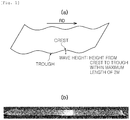
- FIG. 1 is (a) a drawing for understanding of a crest and a trough formed in a steel in the present disclosure and (b) a photograph of a steel according to an exemplary embodiment of the present disclosure.
- the present disclosure relates to a cryogenic austenitic high-manganese steel having an excellent shape and a manufacturing method therefor, and hereinafter, preferable exemplary embodiments of the present disclosure will be described.
- the exemplary embodiments of the present disclosure may be modified in various forms, and the scope of the disclosure should not be interpreted to be limited to the exemplary embodiments set forth below.
- the present exemplary embodiments are provided for describing the present disclosure in more detail to those with ordinary skill in the art to which the present disclosure pertains.
- a cryogenic austenitic high-manganese steel having an excellent shape according to an exemplary embodiment of the present disclosure may include: 0.2 to 0.5% of C, 23 to 28% of Mn, 0.05 to 0.5% of Si, 0.03% or less of P, 0.005% or less of S, 0.5% or less of Al, 2.5 to 4.5% or Cr, and 0.0005 to 0.01% of B, with a remainder of Fe and other unavoidable impurities.
- Carbon (C) is not only an element for stabilizing austenite but also an element effective in securing strength by enhanced solid solubility. Therefore, in the present disclosure, a lower limit of a content of carbon (C) may be limited to 0.2%, for securing low temperature toughness and strength. That is because when the content of carbon (C) is less than 0.2%, stability of austenite is insufficient so that stable austenite may not be obtained at a cryogenic temperature, and strain induced transformation into ⁇ -martensite and ⁇ '-martensite may be easily caused by external stress to decrease the toughness and the strength of the steel.
- the content of carbon (C) of the present disclosure may be 0.2 to 0.5%, a preferable content of carbon (C) may be 0.3 to 0.5%, and a more preferable content of carbon (C) may be 0.3 to 0.45%.
- a lower limit of a content of manganese (Mn) may be limited to 23% for achieving the effect as such in the present disclosure. That is, since 23% or more manganese (Mn) is included in the present disclosure, a stability degree of austenite may be effectively increased, and thus, formation of ferrite, ⁇ -martensite, and ⁇ '-martensite is suppressed to effectively secure the cryogenic toughness of steel.
- the content of manganese (Mn) of the present disclosure exceeds a certain range, the effect of increasing austenite stability is saturated, while manufacturing costs are greatly increased, and internal oxidation may occur excessively during hot rolling to deteriorate surface quality, and thus, an upper limit of the content of manganese (Mn) may be limited to 28% in the present disclosure. Therefore, the content of manganese (Mn) may be 23 to 28%, and a more preferable content of manganese (Mn) may be 23 to 25%.
- Silicon (Si) is an element which is essentially added in a small amount as a deoxidizer like aluminum (Al).
- Al aluminum
- an upper limit of silicon (Si) may be limited to 0.5% in the present disclosure.
- a lower limit of silicon (Si) may be limited to 0.05% in the present disclosure. Therefore, the content of silicon (Si) may be 0.05 to 0.5% in the present disclosure.
- Phosphorus (P) which is an inevitably introduced impurity element and also an easily segregated element, is also an element causing crack occurrence during casting or deteriorating weldability. Therefore, an upper limit of a content of phosphorus (P) may be limited to 0.03% for preventing castability deterioration and a weldability decrease in the present disclosure.
- S is not only an essentially introduced impurity element but also an element causing hot brittleness defects by formation of inclusions. Therefore, an upper limit of a content of sulfur (S) may be limited to 0.005% for suppressing occurrence of hot brittleness in the present disclosure.
- Aluminum (Al) is a representative element added as a deoxidizer. However, since aluminum (Al) may react with carbon (C) and nitrogen (N) to form precipitates and hot processability may be deteriorated by the precipitates, an upper limit of a content of aluminum (Al) may be limited to 0.5% in the present disclosure. A more preferable content of aluminum (Al) may be 0.05 to 0.5%.
- Chromium (Cr) is an element which stabilizes austenite in a range of an appropriate addition amount to contribute to improvement of impact toughness at a low temperature and is solid-solubilized in austenite to increase the strength of steel.
- chromium is an element improving corrosion resistance of steel. Therefore, 2.5% or more of chromium (Cr) may be added for achieving the effect as such in the present disclosure.
- chromium (C) is an element forming carbides and is also an element forming carbides in an austenite grain boundary to decrease low-temperature impact
- an upper limit of a content of chromium (Cr) may be limited to 4.5% in the present disclosure, considering the relationship with the contents of carbon (C) and other elements added together. Therefore, the content of chromium (Cr) may be 2.5 to 4.5%, and a more preferable content of chromium (Cr) may be 3 to 4%.
- Boron (B) is a grain boundary strengthening element which strengthens an austenite grain boundary and is an element which may strengthen the austenite grain boundary even with addition of a small amount to effectively lower high temperature cracking sensitivity of steel. Therefore, a lower limit of a content of boron (B) may be limited to 0.0005% in the present disclosure, for achieving the effect as such. However, when the content of boron (B) exceeds a certain range, segregation is caused in the austenite grain boundary to increase the high temperature cracking sensitivity of steel, so that surface quality of steel may be deteriorated, and thus, an upper limit of the content of boron (B) may be limited to 0.01% in the present disclosure. Therefore, the content of boron (B) may be 0.0005 to 0.01%, and a more preferable content of boron (B) may be 0.002 to 0.006%.
- the cryogenic austenitic high-manganese steel having an excellent shape may include a remainder of Fe and other unavoidable impurities in addition to the above components.
- the impurities since in a common manufacturing process, unintended impurities may be inevitably incorporated from raw materials or the surrounding environment, the impurities may not be excluded. Since these impurities are known to any person with ordinary knowledge in the art, the entire contents thereof will not be particularly mentioned in the present specification. In addition of effective components other than the above composition is not excluded.
- the cryogenic austenitic high-manganese steel having an excellent shape may include 95% by area or more of austenite as a microstructure, and thus, the cryogenic toughness of steel may be effectively secured.
- the austenite may have an average grain size of 5 to 150 ⁇ m.
- the average grain size of austenite which may be implemented in a manufacturing process may be 5 ⁇ m or more, and when the average grain size is greatly increased, a decrease in strength of steel is concerned, and thus, the grain size of austenite may be limited to 150 ⁇ m or less.
- the cryogenic austenitic high-manganese steel having an excellent shape may include a carbide and/or ⁇ -martensite as a structure which may exist other than austenite.
- a fraction of carbide and/or ⁇ -martensite exceeds a certain level, the toughness and ductility of steel may be rapidly decreased, and thus, the fraction of carbide and/or ⁇ -martensite may be limited to 5% by area or less in the present disclosure.
- the cryogenic austenitic high-manganese steel having an excellent shape according to an exemplary embodiment of the present disclosure may be provided with a yield strength of 350 MPa or more, a tensile strength of 700 MPa or more, and an elongation of 30% or more.
- the cryogenic austenitic high-manganese steel having an excellent shape according to an exemplary embodiment of the present disclosure has a Charpy impact toughness at -196°C of 30 J or more (based on a thickness of 5 mm), excellent cryogenic physical properties may be provided.
- FIG. 1 is (a) a drawing for understanding of a crest and a trough formed in a steel in the present disclosure and (b) a photograph of a steel according to an exemplary embodiment of the present disclosure.
- the cryogenic austenitic high-manganese steel having an excellent shape may be manufactured by subjecting a slab including: 0.2 to 0.5 wt% of C, 23 to 28 wt% of Mn, 0.05 to 0.5 wt% of Si, 0.03 wt% or less of P, 0.005 wt% or less of S, 0.5 wt% or less of Al, 2.5 to 4.5 wt% or Cr, and 0.0005 to 0.01 wt% of B, with a remainder of Fe and other unavoidable impurities to primary heating in a temperature range of 1050 to 1300°C, subjecting the heated slab to primary hot rolling at a total pressing amount of 35 to 80% at a finish rolling temperature of 800 to 1100°C to provide an intermediate material, subjecting the intermediate material to secondary heating in a temperature range of 1050 to 1300°C, subjecting the secondarily heated intermediate material to secondary hot rolling at a finish rolling temperature of (Tnr-120) to
- a composition of the slab provided in the manufacturing method of the present disclosure corresponds to the steel composition of the austenitic high-manganese steel described above
- description of the steel composition of the slab will be replaced by the description of the steel composition of the austenitic high-manganese steel described above.
- the slab provided to have the steel composition described above may be subjected to primary heating in a temperature range of 1050 to 1300°C.
- a primary heating temperature is lower than a certain range, an excessive rolling load may be applied during the primary hot rolling or alloy component may not be sufficiently solid-solubilized, and thus, a lower limit of the primary heating temperature range may be limited to 1050°C in the present disclosure.
- crystal grains excessively grow to lower strength or a hot rolling property of the steel may be deteriorated by heating to higher than a solidus temperature of the steel, and thus, an upper limit of a temperature range of the primary heating of the slab may be limited to 1300°C.
- a primary hot rolling process includes a coarse rolling process and a finish rolling process, and the slab after the primary heating may be sized-rolled in the primary hot rolling to be provided as an intermediate material.
- a total pressing amount of the primary hot rolling may be 35 to 80%, and it is preferable that the finish rolling of the primary hot rolling is carried out in a temperature range of 800 to 1100°C. It is because when the finish rolling temperature of the primary hot rolling is lower than a certain range, an excessive rolling load due to a rolling load increase may be problematic, and when the finish rolling temperature of the primary hot rolling exceeds a certain range, crystal grains grow coarsely so that a target strength may not be obtained.
- the intermediate material may be cut into an appropriate length depending on a thickness of the intermediate material for being charged into a heating furnace, and may be cut into preferably a length of 1500 to 4000 mm. It is because when the length of the intermediate material is less than 1500 mm, tracking in the heating furnace is difficult, and when the length of the intermediate material is more than 4000 mm, bending along a length direction may occur.
- the intermediate material may be subjected to secondary heating in a temperature range of 1050 to 1300°C.
- a secondary heating temperature is lower than a certain range, an excessive rolling load may be applied during the secondary hot rolling or alloy component may not be sufficiently solid-solubilized, and thus, a lower limit of the secondary heating temperature range may be limited to 1050°C in the present disclosure.
- the secondary heating temperature exceeds a certain range, crystal grains excessively grow to lower strength or a hot rolling property of the steel may be deteriorated by heating to higher than a solidus temperature of the steel, and thus, an intermediate material limit of a temperature range of the secondary heating of the intermediate material may be limited to 1300°C.
- a secondary hot rolling process includes a coarse rolling process and a finish rolling process, and the intermediate material after the secondary reheating may be provided as the intermediate material by the secondary hot rolling.
- the finish rolling is carried out in a temperature range of (Tnr-120) to Tnr°C.
- the finish rolling temperature of the secondary hot rolling is lower than (Tnr-120)°C, the strength is rapidly increased so that impact toughness tends to be inferior, and when the finish rolling temperature of the second hot rolling is higher than Tnr°C, a decrease in strength due to crustal grain growth is concerned, and thus, the finish rolling temperature of the second hot rolling may be limited to a range of (Tnr-120) to Tnr°C in the present disclosure.
- the total pressing amount of the intermediate material in the temperature range of (Tnr-120) to Tnr°C during the second hot rolling may be controlled to 5 to 25% in the present disclosure. It is because when the total pressing amount of the intermediate material in the temperature range of (Tnr-120) to Tnr°C is less than 5%, a shape correction effect to be desired may not be achieved, and the total pressing amount of the intermediate material in the temperature range of (Tnr-120) to Tnr°C is more than 25%, a decrease in impact toughness due to excessive pressing is concerned.
- the hot rolled material after the secondary hot rolling may be subjected to accelerated cooling down to a cooling stop temperature of 600°C or lower at a cooling rate of 1 to 100°C/s.
- a cooling rate is less than a certain range, a decreased ductility of the steel and deterioration of wear resistance may occur by carbides precipitated in the grain boundary during the cooling, and thus, the cooling rate of the hot rolled material may be limited to 1°C/s or more in the present disclosure.
- a lower limit of a preferable cooling rate may be 10°C/s, and a cooling method may be accelerated cooling.
- an upper limit of the cooling rate may be limited to 100°C/s in the present disclosure.
- the cooling stop temperature may be limited to 600°C or lower in the present disclosure.
- the austenitic high-manganese steel manufactured as described above includes 95% or more by area of austenite and may be provided with a yield strength of 350 MPa or more, a tensile strength of 700 MPa or more, an elongation of 30% or more, and a Charpy impact toughness at -196°C of 30 J or more (based on a thickness of 5 mm).
- the austenitic high-manganese steel manufactured as described above has a height difference between a crest and a trough formed in the steel within an area of 2 m along a length direction of the steel of 10 mm or less, and thus, may secure excellent shape uniformity.
- the shape uniformity was described by measuring a maximum difference in height between a crest and a trough formed in a range of 2 m along a direction of rolling of the specimen.
- a test for the tensile properties was performed at room temperature in accordance with ASTM A370, and the impact toughness was measured at -196°C after an impact specimen having a thickness of 5 mm was processed in accordance with the condition of the same specification.
Landscapes
- Chemical & Material Sciences (AREA)
- Engineering & Computer Science (AREA)
- Mechanical Engineering (AREA)
- Materials Engineering (AREA)
- Metallurgy (AREA)
- Organic Chemistry (AREA)
- Physics & Mathematics (AREA)
- Thermal Sciences (AREA)
- Crystallography & Structural Chemistry (AREA)
- Heat Treatment Of Steel (AREA)
Abstract
Description
- The present disclosure relates to an austenitic high-manganese steel and a manufacturing method therefor, and more particularly, to a cryogenic austenitic high-manganese steel having excellent cryogenic toughness and an excellent shape and a manufacturing method therefor.
- An austenitic high-manganese steel has a high toughness by stabilizing austenite even at room temperature or cryogenic environment by adjustment of contents of manganese (Mn) and carbon (C) which are elements increasing stability of austenite, and thus, has physical properties particularly appropriate for materials of a cryogenic structure such as an LNG storage tank or an LNG transport tank.
- However, a high-manganese (Mn) steel has deformation resistance at a high temperature, and particularly in the case of a thin sheet, it is currently difficult to secure a uniform shape in a length direction depending on a rolling pass, a reduction in thickness, and the like. When a shape of a hot rolled material is inferior, cooling stability is lowered and there is a possibility that equipment damage and the like may be caused in the process such as transport. In addition, when a shape of the hot rolled material in a length direction is inferior, a subsequent operation such as a shape correction operation should be involved, and thus, it is not preferable in terms of economic feasibility and productivity. In addition, since there is technical limitation to secure a uniform shape even by the additional shape correction operation after cooling, a high-manganese steel having excellent shape uniformity without involving an additional operation such as shape fixation and a manufacturing method therefor are demanded.
- (Patent Document 1)
Korean Patent Laid-Open Publication. No. 10-1994-0002370 (published on February 17, 1994 - An aspect of the present disclosure is to provide a cryogenic austenitic high-manganese steel having an excellent shape and a manufacturing method therefor.
- An object of the present disclosure is not limited to the above description. A person skilled in the art will have no difficulty in understanding further objects of the present disclosure from the overall descriptions of the present specification.
- According to an aspect of the present disclosure, a cryogenic austenitic high-manganese steel having an excellent shape includes: 0.2 to 0.5 wt% of C, 23 to 28 wt% of Mn, 0.05 to 0.5 wt% of Si, 0.03 wt% or less of P, 0.005 wt% or less of S, 0.5 wt% or less of Al, 2.5 to 4.5 wt% or Cr, and 0.0005 to 0.01 wt% of B, with a remainder of Fe and other unavoidable impurities, and 95% by area or more of austenite as a microstructure, wherein a Charpy impact toughness at -196°C is 30 J or more (based on a thickness of 5 mm), and a maximum difference in height between a crest and a trough formed within an area of 2 m along a direction of rolling is 10 mm or less.
- The austenite may have a grain size of 5 to 150 µm.
- The steel may have a yield strength of 350 MPa or more, a tensile strength of 700 MPa or more, and an elongation of 30% or more.
- According to another aspect of the present disclosure, a manufacturing method of a cryogenic austenitic high-manganese steel having an excellent shape includes: subjecting a slab including: 0.2 to 0.5 wt% of C, 23 to 28 wt% of Mn, 0.05 to 0.5 wt% of Si, 0.03 wt% or less of P, 0.005 wt% or less of S, 0.5 wt% or less of Al, 2.5 to 4.5 wt% or Cr, and 0.0005 to 0.01 wt% of B, with a remainder of Fe and other unavoidable impurities to primary heating in a temperature range of 1050 to 1300°C, subjecting the heated slab to primary hot rolling at a total pressing amount of 35 to 80% at a finish rolling temperature of 800 to 1100°C to provide an intermediate material, subjecting the intermediate material to secondary heating in a temperature range of 1050 to 1300°C, subjecting the secondarily heated intermediate material to secondary hot rolling at a finish rolling temperature of (Tnr-120) to Tnr°C to provide a hot rolled material, and cooling the hot rolled material down to a temperature range of 600°C or less at a cooling rate of 1 to 100°C/s, wherein the total pressing amount of the intermediate material in a temperature range of (Tnr-120) to Tnr°C during the secondary hot rolling is controlled to 5 to 25%.
- The hot rolled material after the cooling may have a maximum difference in height between a crest and a trough formed within an area of 2 m along a direction of rolling of 10 mm or less.
- The means for solving the above problems are not a list of all features of the present disclosure and various features of the present disclosure and advantages and effects therefrom will be understood in more detail with reference to the following specific exemplary embodiments.
- As set forth above, according to an exemplary embodiment in the present disclosure, an austenitic high-manganese steel having excellent cryogenic toughness and an excellent shape, and a manufacturing method therefor may be provided.
-
FIG. 1 is (a) a drawing for understanding of a crest and a trough formed in a steel in the present disclosure and (b) a photograph of a steel according to an exemplary embodiment of the present disclosure. - The present disclosure relates to a cryogenic austenitic high-manganese steel having an excellent shape and a manufacturing method therefor, and hereinafter, preferable exemplary embodiments of the present disclosure will be described. The exemplary embodiments of the present disclosure may be modified in various forms, and the scope of the disclosure should not be interpreted to be limited to the exemplary embodiments set forth below. The present exemplary embodiments are provided for describing the present disclosure in more detail to those with ordinary skill in the art to which the present disclosure pertains.
- Hereinafter, the steel composition of the present disclosure will be described in more detail. Hereinafter, % representing a content of each element is by weight, unless otherwise particularly indicated.
- A cryogenic austenitic high-manganese steel having an excellent shape according to an exemplary embodiment of the present disclosure may include: 0.2 to 0.5% of C, 23 to 28% of Mn, 0.05 to 0.5% of Si, 0.03% or less of P, 0.005% or less of S, 0.5% or less of Al, 2.5 to 4.5% or Cr, and 0.0005 to 0.01% of B, with a remainder of Fe and other unavoidable impurities.
- Carbon (C) is not only an element for stabilizing austenite but also an element effective in securing strength by enhanced solid solubility. Therefore, in the present disclosure, a lower limit of a content of carbon (C) may be limited to 0.2%, for securing low temperature toughness and strength. That is because when the content of carbon (C) is less than 0.2%, stability of austenite is insufficient so that stable austenite may not be obtained at a cryogenic temperature, and strain induced transformation into ε-martensite and α'-martensite may be easily caused by external stress to decrease the toughness and the strength of the steel. However, when the content of carbon (C) exceeds a certain range, the toughness of steel may be rapidly deteriorated due to precipitation of carbides and the strength of steel may be excessively increased to significantly deteriorate of the processability of steel, and thus, a upper limit of the content of carbon (C) may be limited to 0.5% in the present disclosure. Therefore, the content of carbon (C) of the present disclosure may be 0.2 to 0.5%, a preferable content of carbon (C) may be 0.3 to 0.5%, and a more preferable content of carbon (C) may be 0.3 to 0.45%.
- Since manganese (Mn) is an element effectively contributing austenite stabilization, a lower limit of a content of manganese (Mn) may be limited to 23% for achieving the effect as such in the present disclosure. That is, since 23% or more manganese (Mn) is included in the present disclosure, a stability degree of austenite may be effectively increased, and thus, formation of ferrite, ε-martensite, and α'-martensite is suppressed to effectively secure the cryogenic toughness of steel. However, when the content of manganese (Mn) of the present disclosure exceeds a certain range, the effect of increasing austenite stability is saturated, while manufacturing costs are greatly increased, and internal oxidation may occur excessively during hot rolling to deteriorate surface quality, and thus, an upper limit of the content of manganese (Mn) may be limited to 28% in the present disclosure. Therefore, the content of manganese (Mn) may be 23 to 28%, and a more preferable content of manganese (Mn) may be 23 to 25%.
- Silicon (Si) is an element which is essentially added in a small amount as a deoxidizer like aluminum (Al). However, when silicon (Si) is excessively added, oxides may be formed in a grain boundary to decrease high temperature ductility and cause cracks and the like to deteriorate surface quality, and thus, an upper limit of silicon (Si) may be limited to 0.5% in the present disclosure. However, since excessive costs are required for decreasing a content of Si in steel, a lower limit of silicon (Si) may be limited to 0.05% in the present disclosure. Therefore, the content of silicon (Si) may be 0.05 to 0.5% in the present disclosure.
- Phosphorus (P), which is an inevitably introduced impurity element and also an easily segregated element, is also an element causing crack occurrence during casting or deteriorating weldability. Therefore, an upper limit of a content of phosphorus (P) may be limited to 0.03% for preventing castability deterioration and a weldability decrease in the present disclosure.
- Sulfur (S) is not only an essentially introduced impurity element but also an element causing hot brittleness defects by formation of inclusions. Therefore, an upper limit of a content of sulfur (S) may be limited to 0.005% for suppressing occurrence of hot brittleness in the present disclosure.
- Aluminum (Al) is a representative element added as a deoxidizer. However, since aluminum (Al) may react with carbon (C) and nitrogen (N) to form precipitates and hot processability may be deteriorated by the precipitates, an upper limit of a content of aluminum (Al) may be limited to 0.5% in the present disclosure. A more preferable content of aluminum (Al) may be 0.05 to 0.5%.
- Chromium (Cr) is an element which stabilizes austenite in a range of an appropriate addition amount to contribute to improvement of impact toughness at a low temperature and is solid-solubilized in austenite to increase the strength of steel. In addition, chromium is an element improving corrosion resistance of steel. Therefore, 2.5% or more of chromium (Cr) may be added for achieving the effect as such in the present disclosure. However, since chromium (C) is an element forming carbides and is also an element forming carbides in an austenite grain boundary to decrease low-temperature impact, an upper limit of a content of chromium (Cr) may be limited to 4.5% in the present disclosure, considering the relationship with the contents of carbon (C) and other elements added together. Therefore, the content of chromium (Cr) may be 2.5 to 4.5%, and a more preferable content of chromium (Cr) may be 3 to 4%.
- Boron (B) is a grain boundary strengthening element which strengthens an austenite grain boundary and is an element which may strengthen the austenite grain boundary even with addition of a small amount to effectively lower high temperature cracking sensitivity of steel. Therefore, a lower limit of a content of boron (B) may be limited to 0.0005% in the present disclosure, for achieving the effect as such. However, when the content of boron (B) exceeds a certain range, segregation is caused in the austenite grain boundary to increase the high temperature cracking sensitivity of steel, so that surface quality of steel may be deteriorated, and thus, an upper limit of the content of boron (B) may be limited to 0.01% in the present disclosure. Therefore, the content of boron (B) may be 0.0005 to 0.01%, and a more preferable content of boron (B) may be 0.002 to 0.006%.
- The cryogenic austenitic high-manganese steel having an excellent shape according to an exemplary embodiment of the present disclosure may include a remainder of Fe and other unavoidable impurities in addition to the above components. However, since in a common manufacturing process, unintended impurities may be inevitably incorporated from raw materials or the surrounding environment, the impurities may not be excluded. Since these impurities are known to any person with ordinary knowledge in the art, the entire contents thereof will not be particularly mentioned in the present specification. In addition, addition of effective components other than the above composition is not excluded.
- The cryogenic austenitic high-manganese steel having an excellent shape according to an exemplary embodiment of the present disclosure may include 95% by area or more of austenite as a microstructure, and thus, the cryogenic toughness of steel may be effectively secured. The austenite may have an average grain size of 5 to 150 µm. The average grain size of austenite which may be implemented in a manufacturing process may be 5 µm or more, and when the average grain size is greatly increased, a decrease in strength of steel is concerned, and thus, the grain size of austenite may be limited to 150 µm or less.
- The cryogenic austenitic high-manganese steel having an excellent shape according to an exemplary embodiment of the present disclosure may include a carbide and/or ε-martensite as a structure which may exist other than austenite. When a fraction of carbide and/or ε-martensite exceeds a certain level, the toughness and ductility of steel may be rapidly decreased, and thus, the fraction of carbide and/or ε-martensite may be limited to 5% by area or less in the present disclosure.
- The cryogenic austenitic high-manganese steel having an excellent shape according to an exemplary embodiment of the present disclosure may be provided with a yield strength of 350 MPa or more, a tensile strength of 700 MPa or more, and an elongation of 30% or more. In addition, since the cryogenic austenitic high-manganese steel having an excellent shape according to an exemplary embodiment of the present disclosure has a Charpy impact toughness at -196°C of 30 J or more (based on a thickness of 5 mm), excellent cryogenic physical properties may be provided.
- Since the cryogenic austenitic high-manganese steel having an excellent shape according to an exemplary embodiment of the present disclosure may have a height difference between a crest and a trough formed in the steel within an area of 2 m to a direction of rolling of 10 mm or less even without carrying out a separate correction operation or the like after manufacturing a steel, excellent shape uniformity may be secured.
FIG. 1 is (a) a drawing for understanding of a crest and a trough formed in a steel in the present disclosure and (b) a photograph of a steel according to an exemplary embodiment of the present disclosure. - Hereinafter, the manufacturing method of the present disclosure will be described in detail.
- The cryogenic austenitic high-manganese steel having an excellent shape according to an exemplary embodiment of the present disclosure may be manufactured by subjecting a slab including: 0.2 to 0.5 wt% of C, 23 to 28 wt% of Mn, 0.05 to 0.5 wt% of Si, 0.03 wt% or less of P, 0.005 wt% or less of S, 0.5 wt% or less of Al, 2.5 to 4.5 wt% or Cr, and 0.0005 to 0.01 wt% of B, with a remainder of Fe and other unavoidable impurities to primary heating in a temperature range of 1050 to 1300°C, subjecting the heated slab to primary hot rolling at a total pressing amount of 35 to 80% at a finish rolling temperature of 800 to 1100°C to provide an intermediate material, subjecting the intermediate material to secondary heating in a temperature range of 1050 to 1300°C, subjecting the secondarily heated intermediate material to secondary hot rolling at a finish rolling temperature of (Tnr-120) to Tnr°C to provide a hot rolled material, and cooling the hot rolled material down to a temperature range of 600°C or lower at a cooling rate of 1 to 100°C/s, wherein the total pressing amount of the intermediate material in a temperature range of (Tnr-120) to Tnr°C during the secondary hot rolling is controlled to 5 to 25%.
- Since a composition of the slab provided in the manufacturing method of the present disclosure corresponds to the steel composition of the austenitic high-manganese steel described above, description of the steel composition of the slab will be replaced by the description of the steel composition of the austenitic high-manganese steel described above.
- The slab provided to have the steel composition described above may be subjected to primary heating in a temperature range of 1050 to 1300°C. When a primary heating temperature is lower than a certain range, an excessive rolling load may be applied during the primary hot rolling or alloy component may not be sufficiently solid-solubilized, and thus, a lower limit of the primary heating temperature range may be limited to 1050°C in the present disclosure. However, when the primary heating temperature exceeds a certain range, crystal grains excessively grow to lower strength or a hot rolling property of the steel may be deteriorated by heating to higher than a solidus temperature of the steel, and thus, an upper limit of a temperature range of the primary heating of the slab may be limited to 1300°C.
- A primary hot rolling process includes a coarse rolling process and a finish rolling process, and the slab after the primary heating may be sized-rolled in the primary hot rolling to be provided as an intermediate material. A total pressing amount of the primary hot rolling may be 35 to 80%, and it is preferable that the finish rolling of the primary hot rolling is carried out in a temperature range of 800 to 1100°C. It is because when the finish rolling temperature of the primary hot rolling is lower than a certain range, an excessive rolling load due to a rolling load increase may be problematic, and when the finish rolling temperature of the primary hot rolling exceeds a certain range, crystal grains grow coarsely so that a target strength may not be obtained.
- The intermediate material may be cut into an appropriate length depending on a thickness of the intermediate material for being charged into a heating furnace, and may be cut into preferably a length of 1500 to 4000 mm. It is because when the length of the intermediate material is less than 1500 mm, tracking in the heating furnace is difficult, and when the length of the intermediate material is more than 4000 mm, bending along a length direction may occur.
- The intermediate material may be subjected to secondary heating in a temperature range of 1050 to 1300°C. When a secondary heating temperature is lower than a certain range, an excessive rolling load may be applied during the secondary hot rolling or alloy component may not be sufficiently solid-solubilized, and thus, a lower limit of the secondary heating temperature range may be limited to 1050°C in the present disclosure. However, when the secondary heating temperature exceeds a certain range, crystal grains excessively grow to lower strength or a hot rolling property of the steel may be deteriorated by heating to higher than a solidus temperature of the steel, and thus, an intermediate material limit of a temperature range of the secondary heating of the intermediate material may be limited to 1300°C.
- A secondary hot rolling process includes a coarse rolling process and a finish rolling process, and the intermediate material after the secondary reheating may be provided as the intermediate material by the secondary hot rolling. Here, it is preferable that the finish rolling is carried out in a temperature range of (Tnr-120) to Tnr°C. Here, Tnr may be derived by the following Equation 1:

- When the finish rolling temperature of the secondary hot rolling is lower than (Tnr-120)°C, the strength is rapidly increased so that impact toughness tends to be inferior, and when the finish rolling temperature of the second hot rolling is higher than Tnr°C, a decrease in strength due to crustal grain growth is concerned, and thus, the finish rolling temperature of the second hot rolling may be limited to a range of (Tnr-120) to Tnr°C in the present disclosure.
- In addition, the total pressing amount of the intermediate material in the temperature range of (Tnr-120) to Tnr°C during the second hot rolling may be controlled to 5 to 25% in the present disclosure. It is because when the total pressing amount of the intermediate material in the temperature range of (Tnr-120) to Tnr°C is less than 5%, a shape correction effect to be desired may not be achieved, and the total pressing amount of the intermediate material in the temperature range of (Tnr-120) to Tnr°C is more than 25%, a decrease in impact toughness due to excessive pressing is concerned.
- The hot rolled material after the secondary hot rolling may be subjected to accelerated cooling down to a cooling stop temperature of 600°C or lower at a cooling rate of 1 to 100°C/s. When the cooling rate is less than a certain range, a decreased ductility of the steel and deterioration of wear resistance may occur by carbides precipitated in the grain boundary during the cooling, and thus, the cooling rate of the hot rolled material may be limited to 1°C/s or more in the present disclosure. A lower limit of a preferable cooling rate may be 10°C/s, and a cooling method may be accelerated cooling. As the cooling rate is increased, an effect of suppressing carbide precipitation is advantageous, but considering the situation that it is difficult to implement a cooling rate more than 100°C/s in common cooling due to the characteristic of equipment, an upper limit of the cooling rate may be limited to 100°C/s in the present disclosure.
- In addition, even in the case in which the hot rolled material is cooled by applying the cooling rate of 10°C/s or more, when the cooling is stopped at a high temperature, carbides are highly likely to be produced and grow, and thus, the cooling stop temperature may be limited to 600°C or lower in the present disclosure.
- The austenitic high-manganese steel manufactured as described above includes 95% or more by area of austenite and may be provided with a yield strength of 350 MPa or more, a tensile strength of 700 MPa or more, an elongation of 30% or more, and a Charpy impact toughness at -196°C of 30 J or more (based on a thickness of 5 mm).
- In addition, the austenitic high-manganese steel manufactured as described above has a height difference between a crest and a trough formed in the steel within an area of 2 m along a length direction of the steel of 10 mm or less, and thus, may secure excellent shape uniformity.
- Hereinafter, the present disclosure will be described through the following Examples in more detail. However, it should be noted that the following Examples are only for embodying the present disclosure by illustration, and it is not intended to limit the right scope of the present disclosure.
- Slabs having an alloy composition as shown in the following Table 1 and having a thickness of 250 mm were manufactured. Each slab was subjected to primary heating in a temperature range of 1200°C and then subjected to primary hot rolling at a total pressing amount of 50 to 60% at a finish rolling temperature of 1000°C to prepare an intermediate material. Each intermediate material was subjected to secondary heating and secondary hot rolling under the conditions of Table 2 to manufacture a hot rolled material specimen, and a yield strength, a tensile strength, an elongation, a Charpy impact toughness at -196°C, and shape uniformity for each specimen were measured and are shown in the following Table 3. Here, the shape uniformity was described by measuring a maximum difference in height between a crest and a trough formed in a range of 2 m along a direction of rolling of the specimen. Here, a test for the tensile properties was performed at room temperature in accordance with ASTM A370, and the impact toughness was measured at -196°C after an impact specimen having a thickness of 5 mm was processed in accordance with the condition of the same specification.
[Table 1] Classification Alloy composition (wt%) C Mn Si P S Al Cr B Steel grade 1 0.41 24.5 0.28 0.016 0.0031 0.27 3.21 0.0015 Steel grade 2 0.46 25.9 0.24 0.015 0.0029 0.31 3.62 0.0015 Steel grade 3 0.61 26.9 0.25 0.016 0.0033 0.28 3.91 0.0021 [Table 2] Steel grade Classif ication Heating furnace temperature (°C) Extractio n temperatu re (°C) Final width (mm) Tnr (°C) Tnr-120 (°C) Secondary rolling termination temperature (°C) Total pressing amount at Tnr or lower (%) Steel grade 1 1-1 1205 1192 2410 960 840 955 4 1-2 780 20 1-3 880 22 1-4 920 16 Steel grade 2 2-1 1190 1180 2410 974 854 806 27 2-2 980 0 2-3 880 20 2-4 915 18 Steel grade 3 3-1 1220 1210 2510 1000 880 988 4 3-2 940 8.8 3-3 825 25 [Table 3] Steel grade Classification Wave height (mm) YS (MPa) Ts (MPa) El (%) Impact toughness (J, @-196°C) Classification Steel grade 1 1-1 18 368 822 68 46 Comparative Example 1-2 4 334 692 40 31 1-3 3 465 842 52 40 Inventive Example 1-4 6 456 856 54 44 Steel grade 2 2-1 3.5 585 954 40 25 Comparative Example 2-2 13 344 737 69 49 2-3 6 472 861 56 45 Inventive Example 2-4 8 456 848 59 47 Steel grade 3 3-1 19 504 928 39 21 Comparative Example 3-2 6 584 969 45 19 3-3 5 625 977 38 15 - As shown in Tables 2 and 3, it was confirmed that in the Inventive Example which satisfied the alloy composition and the manufacturing process of the present disclosure, the physical properties and the shape uniformity to be desired in the present disclosure were secured, while in the Comparative Example which did not satisfy the alloy composition and the manufacturing process of the present disclosure, the physical properties and the shape uniformity to be desired in the present disclosure were not secured.
- Hereinabove, the present disclosure has been described in detail by the exemplary embodiments, but other exemplary embodiments having different forms are possible. Therefore, the technical spirit and scope of the claims set forth below are not limited by the exemplary embodiments.
Claims (5)
- A cryogenic austenitic high-manganese steel having an excellent shape comprising:0.2 to 0.5 wt% of C, 23 to 28 wt% of Mn, 0.05 to 0.5 wt% of Si, 0.03 wt% or less of P, 0.005 wt% or less of S, 0.5 wt% or less of Al, 2.5 to 4.5 wt% or Cr, and 0.0005 to 0.01 wt% of B, with a remainder of Fe and other unavoidable impurities, and 95% by area or more of austenite as a microstructure,wherein a Charpy impact toughness at -196°C is 30 J or more (based on a thickness of 5 mm), anda maximum difference in height between a crest and a trough formed within an area of 2 m along a direction of rolling is 10 mm or less.
- The cryogenic austenitic high-manganese steel having an excellent shape of claim 1, wherein the austenite has a grain size of 5 to 150 µm.
- The cryogenic austenitic high-manganese steel having an excellent shape of claim 1, wherein the steel has a yield strength of 350 MPa, a tensile strength of 700 MPa or more, and an elongation of 30% or more.
- A manufacturing method of a cryogenic austenitic high-manganese steel having an excellent shape, the method comprising:subjecting a slab including: 0.2 to 0.5 wt% of C, 23 to 28 wt% of Mn, 0.05 to 0.5 wt% of Si, 0.03 wt% or less of P, 0.005 wt% or less of S, 0.5 wt% or less of Al, 2.5 to 4.5 wt% or Cr, and 0.0005 to 0.01 wt% of B, with a remainder of Fe and other unavoidable impurities to primary heating in a temperature range of 1050 to 1300°C,subjecting the heated slab to primary hot rolling at a total pressing amount of 35 to 80% at a finish rolling temperature of 800 to 1100°C to provide an intermediate material,subjecting the intermediate material to secondary heating in a temperature range of 1050 to 1300°C,subjecting the intermediate material after the secondary heating to secondary hot rolling at a finish rolling temperature of (Tnr-120) to Tnr°C to provide a hot rolled material, andcooling the hot rolled material to a temperature range of 600°C or lower at a cooling rate of 1 to 100°C/s,wherein the total pressing amount of the intermediate material in the temperature range of (Tnr-120) to Tnr°C during the secondary hot rolling is 5 to 25%.
- The manufacturing method of a cryogenic austenitic high-manganese steel having an excellent shape of claim 4, wherein the hot rolled material after the cooling has a maximum difference in height between a crest and a trough formed within an area of 2 m along a direction of rolling is 10 mm or less.
Applications Claiming Priority (3)
| Application Number | Priority Date | Filing Date | Title |
|---|---|---|---|
| KR20180128504 | 2018-10-25 | ||
| KR1020190118924A KR102255825B1 (en) | 2018-10-25 | 2019-09-26 | Ultra-low temperature austenitic high manganese steel having excellent shape and manufacturing method for the same |
| PCT/KR2019/014188 WO2020085858A1 (en) | 2018-10-25 | 2019-10-25 | Cryogenic austenitic high-manganese steel having excellent shape, and manufacturing method therefor |
Publications (2)
| Publication Number | Publication Date |
|---|---|
| EP3872210A4 EP3872210A4 (en) | 2021-09-01 |
| EP3872210A1 true EP3872210A1 (en) | 2021-09-01 |
Family
ID=70733247
Family Applications (2)
| Application Number | Title | Priority Date | Filing Date |
|---|---|---|---|
| EP19876795.6A Active EP3872216B1 (en) | 2018-10-25 | 2019-10-25 | Cryogenic austenitic high-manganese steel having excellent shape, and manufacturing method therefor |
| EP19875536.5A Pending EP3872210A1 (en) | 2018-10-25 | 2019-10-25 | Cryogenic austenitic high-manganese steel having excellent shape, and manufacturing method therefor |
Family Applications Before (1)
| Application Number | Title | Priority Date | Filing Date |
|---|---|---|---|
| EP19876795.6A Active EP3872216B1 (en) | 2018-10-25 | 2019-10-25 | Cryogenic austenitic high-manganese steel having excellent shape, and manufacturing method therefor |
Country Status (3)
| Country | Link |
|---|---|
| EP (2) | EP3872216B1 (en) |
| KR (2) | KR102255826B1 (en) |
| CN (2) | CN112912529A (en) |
Families Citing this family (3)
| Publication number | Priority date | Publication date | Assignee | Title |
|---|---|---|---|---|
| JP7338792B2 (en) * | 2021-02-08 | 2023-09-05 | Jfeスチール株式会社 | Steel material and manufacturing method thereof, tank and manufacturing method thereof |
| WO2023121221A1 (en) * | 2021-12-21 | 2023-06-29 | 주식회사 포스코 | Austenitic steel having excellent ultra-low temperature toughness in weld heat-affected zone, and manufacturing method therefor |
| CN116121493B (en) * | 2023-01-09 | 2025-02-11 | 中北大学 | A heat treatment method for high-strength, light-weight, wear-resistant high-manganese steel castings |
Family Cites Families (12)
| Publication number | Priority date | Publication date | Assignee | Title |
|---|---|---|---|---|
| KR940007374B1 (en) | 1992-07-24 | 1994-08-16 | 포항종합제철 주식회사 | Method of manufacturing austenite stainless steel |
| JP4529872B2 (en) | 2005-11-04 | 2010-08-25 | 住友金属工業株式会社 | High Mn steel material and manufacturing method thereof |
| US10655196B2 (en) * | 2011-12-27 | 2020-05-19 | Posco | Austenitic steel having excellent machinability and ultra-low temperature toughness in weld heat-affected zone, and method of manufacturing the same |
| KR101344640B1 (en) * | 2012-01-31 | 2013-12-26 | 현대제철 주식회사 | High strength steel plate and method for manufacturing the same |
| WO2017111510A1 (en) * | 2015-12-23 | 2017-06-29 | 주식회사 포스코 | Non-magnetic steel material having excellent hot workability and manufacturing method therefor |
| CN106222554A (en) * | 2016-08-23 | 2016-12-14 | 南京钢铁股份有限公司 | A kind of economical steel used at ultra-low temperature and preparation method thereof |
| KR101940874B1 (en) * | 2016-12-22 | 2019-01-21 | 주식회사 포스코 | High manganese steel with superior low temperature toughness and yield strength and method for manufacturing the same |
| KR101899692B1 (en) * | 2016-12-23 | 2018-09-17 | 주식회사 포스코 | Low temperature austenitic high manganese steel and method for manufacturing the same |
| CN107177786B (en) * | 2017-05-19 | 2018-12-21 | 东北大学 | A kind of design and its manufacturing method of the high manganese cut deal of LNG storage tank |
| CN107881432A (en) * | 2017-10-13 | 2018-04-06 | 舞阳钢铁有限责任公司 | Inexpensive ultralow temperature steel heavy plate for pressure vessels and its production method |
| CN107620010A (en) | 2017-10-18 | 2018-01-23 | 舞阳钢铁有限责任公司 | A kind of low yield strength ratio high tenacity high manganese steel sheet and its production method |
| CN108570541B (en) * | 2018-05-14 | 2020-07-10 | 东北大学 | A kind of high temperature heat treatment method of high manganese medium and thick plate for LNG storage tank |
-
2019
- 2019-09-26 KR KR1020190118925A patent/KR102255826B1/en active Active
- 2019-09-26 KR KR1020190118924A patent/KR102255825B1/en active Active
- 2019-10-25 CN CN201980068654.9A patent/CN112912529A/en active Pending
- 2019-10-25 CN CN201980069717.2A patent/CN112930415A/en active Pending
- 2019-10-25 EP EP19876795.6A patent/EP3872216B1/en active Active
- 2019-10-25 EP EP19875536.5A patent/EP3872210A1/en active Pending
Also Published As
| Publication number | Publication date |
|---|---|
| KR102255825B1 (en) | 2021-05-26 |
| KR20200047318A (en) | 2020-05-07 |
| EP3872216B1 (en) | 2025-02-26 |
| KR102255826B1 (en) | 2021-05-26 |
| KR20200047317A (en) | 2020-05-07 |
| CN112930415A (en) | 2021-06-08 |
| EP3872216A4 (en) | 2021-09-01 |
| EP3872216A1 (en) | 2021-09-01 |
| EP3872210A4 (en) | 2021-09-01 |
| EP3872216C0 (en) | 2025-02-26 |
| CN112912529A (en) | 2021-06-04 |
Similar Documents
| Publication | Publication Date | Title |
|---|---|---|
| EP3859041A1 (en) | High-strength cold rolled steel sheet having high hole expansion ratio, high-strength hot-dip galvanized steel sheet, and manufacturing methods therefor | |
| US20080110533A1 (en) | High strength seamless steel pipe and its manufacturing method | |
| EP3561111B1 (en) | Thick steel sheet having excellent cryogenic impact toughness and manufacturing method therefor | |
| EP2940172A1 (en) | High strength steel sheet having excellent cryogenic temperature toughness and low yield ratio properties, and method for manufacturing same | |
| KR102389019B1 (en) | High manganese austenitic steel having high yield strength | |
| EP3395992B1 (en) | Super strength hot-rolled steel sheet excellent ductility and manufacturing therefor | |
| EP3889305B1 (en) | High-strength steel plate having excellent low-temperature fracture toughness and elongation ratio, and manufacturing method therefor | |
| EP3964600A1 (en) | Ultra-high strength steel sheet having excellent shear workability and method for manufacturing same | |
| EP4386103A1 (en) | High strength hot-rolled steel sheet having excellent formability, and manufacturing method therefor | |
| EP3872217A1 (en) | Cryogenic austenitic high manganese steel having excellent surface quality and manufacturing method therefor | |
| EP4265782A1 (en) | High-yield-ratio ultra-high-strength steel sheet having excellent thermal stability, and manufacturing method therefor | |
| EP3872216B1 (en) | Cryogenic austenitic high-manganese steel having excellent shape, and manufacturing method therefor | |
| EP3730653A1 (en) | High-strength steel having excellent low-yield-ratio characteristics, and manufacturing method therefor | |
| CN113840933A (en) | Thick steel plate and method for producing same | |
| EP4438761A1 (en) | Hot-rolled steel sheet and method for manufacturing same | |
| KR102002301B1 (en) | Light weight steel with high corrosion resistance and specific yield stress and the method | |
| KR101977467B1 (en) | Wire rod having excellent strength and cold forging characteristics and method for manufacturing same | |
| EP4234743A1 (en) | High-strength steel sheet having excellent thermal stability, and method for manufacturing same | |
| KR102321270B1 (en) | Wear resistant steel sheet and manufacturing method thereof | |
| EP3872214A1 (en) | High manganese steel having excellent oxygen cutting properties, and manufacturing method therefor | |
| EP3988684A2 (en) | High strength steel for structure with excellent corrosion resistance and manufacturing method for same | |
| KR101736601B1 (en) | Wire rod having excellent impact toughness and method for manafacturing the same | |
| KR101377890B1 (en) | High strength hot-rolled steel sheet and method of manufacturing the same | |
| KR101412372B1 (en) | Hot-rolled steel sheet and method of manufacturing the hot-rolled steel sheet | |
| KR101572353B1 (en) | Steel and method of manufacturing the same |
Legal Events
| Date | Code | Title | Description |
|---|---|---|---|
| STAA | Information on the status of an ep patent application or granted ep patent |
Free format text: STATUS: THE INTERNATIONAL PUBLICATION HAS BEEN MADE |
|
| PUAI | Public reference made under article 153(3) epc to a published international application that has entered the european phase |
Free format text: ORIGINAL CODE: 0009012 |
|
| STAA | Information on the status of an ep patent application or granted ep patent |
Free format text: STATUS: REQUEST FOR EXAMINATION WAS MADE |
|
| 17P | Request for examination filed |
Effective date: 20210518 |
|
| A4 | Supplementary search report drawn up and despatched |
Effective date: 20210617 |
|
| AK | Designated contracting states |
Kind code of ref document: A1 Designated state(s): AL AT BE BG CH CY CZ DE DK EE ES FI FR GB GR HR HU IE IS IT LI LT LU LV MC MK MT NL NO PL PT RO RS SE SI SK SM TR |
|
| DAV | Request for validation of the european patent (deleted) | ||
| DAX | Request for extension of the european patent (deleted) | ||
| RAP3 | Party data changed (applicant data changed or rights of an application transferred) |
Owner name: POSCO HOLDINGS INC. |
|
| RAP1 | Party data changed (applicant data changed or rights of an application transferred) |
Owner name: POSCO CO., LTD |