EP3870481B1 - Dispositif de realignement vertical - Google Patents
Dispositif de realignement vertical Download PDFInfo
- Publication number
- EP3870481B1 EP3870481B1 EP19787297.1A EP19787297A EP3870481B1 EP 3870481 B1 EP3870481 B1 EP 3870481B1 EP 19787297 A EP19787297 A EP 19787297A EP 3870481 B1 EP3870481 B1 EP 3870481B1
- Authority
- EP
- European Patent Office
- Prior art keywords
- trim
- eccentric
- door
- motor vehicle
- disposed
- Prior art date
- Legal status (The legal status is an assumption and is not a legal conclusion. Google has not performed a legal analysis and makes no representation as to the accuracy of the status listed.)
- Active
Links
Images




Classifications
-
- B—PERFORMING OPERATIONS; TRANSPORTING
- B60—VEHICLES IN GENERAL
- B60R—VEHICLES, VEHICLE FITTINGS, OR VEHICLE PARTS, NOT OTHERWISE PROVIDED FOR
- B60R13/00—Elements for body-finishing, identifying, or decorating; Arrangements or adaptations for advertising purposes
- B60R13/02—Internal Trim mouldings ; Internal Ledges; Wall liners for passenger compartments; Roof liners
- B60R13/0206—Arrangements of fasteners and clips specially adapted for attaching inner vehicle liners or mouldings
-
- B—PERFORMING OPERATIONS; TRANSPORTING
- B60—VEHICLES IN GENERAL
- B60R—VEHICLES, VEHICLE FITTINGS, OR VEHICLE PARTS, NOT OTHERWISE PROVIDED FOR
- B60R13/00—Elements for body-finishing, identifying, or decorating; Arrangements or adaptations for advertising purposes
- B60R13/02—Internal Trim mouldings ; Internal Ledges; Wall liners for passenger compartments; Roof liners
- B60R13/0237—Side or rear panels
- B60R13/0243—Doors
-
- F—MECHANICAL ENGINEERING; LIGHTING; HEATING; WEAPONS; BLASTING
- F16—ENGINEERING ELEMENTS AND UNITS; GENERAL MEASURES FOR PRODUCING AND MAINTAINING EFFECTIVE FUNCTIONING OF MACHINES OR INSTALLATIONS; THERMAL INSULATION IN GENERAL
- F16B—DEVICES FOR FASTENING OR SECURING CONSTRUCTIONAL ELEMENTS OR MACHINE PARTS TOGETHER, e.g. NAILS, BOLTS, CIRCLIPS, CLAMPS, CLIPS OR WEDGES; JOINTS OR JOINTING
- F16B19/00—Bolts without screw-thread; Pins, including deformable elements; Rivets
- F16B19/02—Bolts or sleeves for positioning of machine parts, e.g. notched taper pins, fitting pins, sleeves, eccentric positioning rings
-
- B—PERFORMING OPERATIONS; TRANSPORTING
- B60—VEHICLES IN GENERAL
- B60Y—INDEXING SCHEME RELATING TO ASPECTS CROSS-CUTTING VEHICLE TECHNOLOGY
- B60Y2200/00—Type of vehicle
- B60Y2200/10—Road Vehicles
- B60Y2200/11—Passenger cars; Automobiles
-
- F—MECHANICAL ENGINEERING; LIGHTING; HEATING; WEAPONS; BLASTING
- F16—ENGINEERING ELEMENTS AND UNITS; GENERAL MEASURES FOR PRODUCING AND MAINTAINING EFFECTIVE FUNCTIONING OF MACHINES OR INSTALLATIONS; THERMAL INSULATION IN GENERAL
- F16B—DEVICES FOR FASTENING OR SECURING CONSTRUCTIONAL ELEMENTS OR MACHINE PARTS TOGETHER, e.g. NAILS, BOLTS, CIRCLIPS, CLAMPS, CLIPS OR WEDGES; JOINTS OR JOINTING
- F16B5/00—Joining sheets or plates, e.g. panels, to one another or to strips or bars parallel to them
- F16B5/02—Joining sheets or plates, e.g. panels, to one another or to strips or bars parallel to them by means of fastening members using screw-thread
- F16B5/0216—Joining sheets or plates, e.g. panels, to one another or to strips or bars parallel to them by means of fastening members using screw-thread the position of the plates to be connected being adjustable
- F16B5/0225—Joining sheets or plates, e.g. panels, to one another or to strips or bars parallel to them by means of fastening members using screw-thread the position of the plates to be connected being adjustable allowing for adjustment parallel to the plane of the plates
Definitions
- the invention concerns the field of automobile doors and more particularly the position of the trim on said door relative to the dashboard.
- the dashboard has lines that continue onto the door trim, so it is necessary to be sure of its geometry to avoid a visible defect between the two front doors and the dashboard. It is therefore important to have a sufficiently precise adjustment.
- Each part constituting the door and the dashboard has manufacturing tolerances and when they are assembled, these tolerances can add up and cause more or less significant offsets between the mounted elements.
- the assembly of the trim on the door box is carried out before the assembly of the door on the body of the vehicle.
- the assembly of the geometry of the doors is done in relation to the body and prioritizing the external clearances seen by the customer because this is what he sees first when he walks around the vehicle at the dealership.
- the interior where the trim is placed may then have a significant gap which gives the customer the impression of a lack of finish. This difference is all the more visible when there is a decoration with a change of color, a vertical shift in the line is immediately identifiable.
- An aim of the present invention is to respond to the drawbacks of the document of the prior art mentioned above and in particular, to propose an eccentric, a door and a method making it possible to adjust the height of the trim once this door is mounted on the body of the vehicle at the end of the chain.
- a first aspect of the invention relates to an eccentric comprising a first fixed part and a second rotating part arranged in the first fixed part, the second rotating part having on one side a hollow cavity with axis A and the another a cylindrical point of axis B, the axes A and B being parallel and separated by a non-zero distance d, the second rotating part comprising two opposite arms characterized in that each of the arms is provided with two teeth at one end and cooperates with notches arranged on the first fixed part and the end of the arms is elastically deformable.
- the eccentric can thus be turned with a tool such as a "torx" tool and thus allow height adjustment when placed in the door trim, while not protruding from the trim.
- the elastically deformable end of the arms makes it possible to release the teeth from the notches by pressure and to lock them on a notch automatically by returning the end to rest and, thereby, blocking the rotation of the second part in the desired position.
- the distance d is equal to 3mm. This distance of 3 mm allows a height adjustment of ⁇ 2mm of the trim.
- the second rotating part is in one piece and includes a seal.
- the seal is thus attached to the rotating part and makes it possible to guarantee noise-tightness of the eccentric on the door box when it is mounted.
- the elastic deformation of the arm is obtained by a through recess disposed at the end.
- This recess gives a spring effect to the end of the arm.
- the notches of the fixed part are arranged on either side of the rotating part with a pitch of one mm, one side measuring from 0 to ⁇ 2mm and the other side from ⁇ 0.5 to ⁇ 1, 5mm.
- the rotation of the second part can thus be done with a step of 0.5mm, the fixing of the teeth on the notches being done on one side for whole millimeters and on the other for half-millimeters.
- the invention relates to an automobile door comprising a trim with a front fixing hole arranged in the upper part near a finishing zone to be adjusted with the dashboard and a fixing hole in the rear part, a door box with holes equipped with a grooved molar intended to receive a fixing screw, this fixing screw connecting the trim to the box by said fixing molar, it is characterized in that the box comprises a buttonhole arranged in a corner top and front of the door and opposite a cylindrical hole of an intermediate piece of the trim in which an eccentric is inserted with at least one of the previous characteristics.
- the position of the eccentric at the front of the door allows the front of the trim to be straightened or lowered so as to align it with the dashboard.
- the adjustment by notches allows for homogeneity in the adjustment and saves execution time regardless of the operator on the assembly line.
- the oblong front fixing hole is 8mm from axis to axis and 16mm in diameter. This allows the trim to be positioned more or less high on the box.
- the front fixing hole is 50mm from the buttonhole.
- the proximity of the buttonhole fixing hole allows more precise adjustment and facilitates the operator's work.
- the door includes a shutter.
- the shutter allows the adjustment and fixation area to be hidden from the customer's view.
- the method comprises a step of dismantling a shutter covering the screw before fixing and a step of reassembling said shutter.
- the eccentric moves the packing by ⁇ 2mm.
- the adjustment range allows the dashboard to be aligned with the box without a defect appearing at the door window.
- the method includes a step of checking the adjustment of the height of the trim relative to a dashboard by closing the door. Once a first adjustment has been made, the operator closes the door to check the alignment of the box with the dashboard, if it is good, the adjustment is completed otherwise, he starts the operation again.
- the invention also relates to a motor vehicle comprising two doors with at least one of the preceding characteristics.
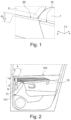
- a vertical offset will be considered as a Z defect along the Z axis, a depth offset or a space between the trim and the dashboard as an X+Y defect along the X and Y axes, such as illustrated figure 1 . Only the Z fault is considered.
- the trim 1 is positioned in a vertical direction on the box 3 of the door by two fingers 5 and 19 housed in a first hole 13 and a second hole (not visible in the figures). These fingers are placed between 50 and 160mm from the top 100 of the packing 1.
- the finger 5 is equipped with an eccentric system.
- the rear finger 19 remains fixed and serves as an axis of rotation of the trim 1 to lower or raise it at the front in order to align it with the dashboard 2 when the adjustment is made with the finger 5 equipped with eccentric system.
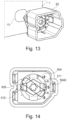
- the trim 1 includes a removable obturator 11 which covers a front screw 12 screwed into a fixing hole 14 and a molar 15 housed in a buttonhole 13 (cf. Figure 13 ).
- This shutter 11 is placed inside a line 101 covering the dashboard 2 on the trim 1 when the door 4 is closed. This entire area 101 is therefore not visible in the driving position and does not alter the aesthetics of the passenger compartment.
- the fixing hole 14 is placed in a recess 17 of the gasket 1. In the example illustrated an eccentric 5, with axis of rotation A, is placed near and below the fixing hole 14.
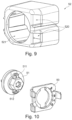
- the eccentric 5 comprises a first fixed part 50 ( figures 7 and 8 ) and a second rotating part 51 ( figures 5 and 6 ). We will consider that the front face of the eccentric is oriented towards the interior of the vehicle in the mounted position on the door.
- the second rotating part 51 has 510 on its front face (cf. figure 5 ) a recess 513 intended to receive a tool, in this example a "torx" impression and two arms 511 and 512 arranged on either side of an axis of rotation A.
- the recess 513 is in an excrescence 516 of the front face 510, this protrusion 516 includes cut sides 5160, here 6 which can be used to turn the rotating part 51 with a pipe wrench.
- a cylindrical shape 517 is arranged between the front face 510 and the protrusion 516.
- the eccentric 5 On its rear side (cf. Figure 6 ), the eccentric 5 comprises a conical tip 514 located in the extension of a cylinder 518 of axis B offset by a distance d relative to the axis A.
- the conical tip 514 has a section in the shape of a cross to facilitate its manufacture.
- a seal 515 is placed on the periphery of the rotating part 51 and is integral with the rotating part 51.
- the first fixed part 50 comprises a cylindrical hole 501 bordered on its front face 500 by two flat surfaces 502 and 503, each surface 502 and 503 is provided with notches 504 and 505 in relief distributed with a pitch of 15°.
- the cylindrical hole 501 is opened by two diametrically opposed notches 5010 and 5011.
- One of the notches, here the top notch 5011 has on either side on the front face 500, two stops 5012 and 5013.
- One of the two sides 5014 of the notch is refined, up to 1mm thick, and separated from the support face 503 along its length to give it flexibility and allow its elastic deformation to allow the rotating part 51 to pass.
- the cylindrical hole 501 is of diameter and thickness substantially equal to the shape of cylindrical 517 in order to be able to receive it.
- the fixed part 50 extends at the rear by a cylindrical surface 507 coaxial with the cylindrical hole 501.
- the first fixed part 50 also includes clips 506 on either side so that it can be clipped onto an interface 53. In the example illustrated, there are 3 of them.
- the fixed part 50 is beveled on one side 508 to facilitate its error-free assembly on trim 1, as a key.
- the intermediate part 52 comprises three lateral openings 520 cooperating with the clips 506 of the fixed part 50 and a cylindrical hole 521 intended to receive the cylindrical surface 507 of the fixed part 50.
- the intermediate part 52 has a profile complementary to the fixed part 50 This interface 52 is preferably not an independent part added but a predefined technical zone added during the design of the door trim or to a structural part provided in the desired area of the trim.
- the eccentric 5 is then mounted on the intermediate part 52 by clipping in a known manner.
- This assembly is then positioned vertically on the box 3 by a buttonhole 13.
- the buttonhole 13 is preferably of horizontal oblong shape.
- Adjustment of eccentric 5 is done from position 0, illustrated Figure 14 .
- the variations per millimeter are done on the arm 511 while the variations at 0.5mm are done with the arm 512. So if we want to raise or lower the trim by one millimeter we block the arm 511 on a notch 504, if we wants to go up or down by a value per half millimeter (position in dotted lines on the Figure 14 ) close the arm 512 is blocked on a notch 505.
- the stops 5012 and 5013 limit the rotation of the eccentric 5, and prevent the second rotating part 51 from leaving the fixed part 50.
- each arm (here 511) is provided with two teeth 5111 forming a fork and allowing the arm 51 to be blocked on the notch 504 (here the zero position notch 5040).
- the arm 511 is pierced behind the teeth 5111 with an elongated hole 5110 to allow the elastic deformation of the end of the arm 511 and allow the blocking and unblocking of the teeth 5111 from the notches 504.
- the arm 512 is equipped with two teeth 5111 and pierced with a hole 5110 allowing the blocking and unlocking of the teeth of the notches 505.
Landscapes
- Engineering & Computer Science (AREA)
- Mechanical Engineering (AREA)
- General Engineering & Computer Science (AREA)
- Vehicle Interior And Exterior Ornaments, Soundproofing, And Insulation (AREA)
- Elevator Door Apparatuses (AREA)
Description
- L'invention concerne le domaine des portières automobiles et plus particulièrement la position de la garniture sur la dite portière par rapport à la planche de bord.
- Aujourd'hui, la planche de bord présente des lignes qui se poursuivent sur la garniture de portière, il est donc nécessaire d'être sûr de sa géométrique pour éviter un défaut visible entre les deux portières avant et la planche de bord. Il est donc important d'avoir un réglage suffisamment précis. Chaque pièce constituant la portière et la planche de bord présente des tolérances de fabrication et lorsqu'on les monte ces tolérances peuvent s'additionner et entraîner des décalages plus ou moins important entre les éléments montés. D'autre part, le montage de la garniture sur le caisson de la portière est réalisé avant le montage de la portière sur la caisse du véhicule. Le montage en géométrie des portières est fait par rapport à la caisse et en priorisant les jeux extérieurs vus par le client car c'est ce qu'il voit en premier quand il fait le tour du véhicule en concession. L'intérieur où est placée la garniture peut alors présenter un écart important qui donne une impression de manque de finition au client. Cet écart est d'autant plus visible quand il y a un décor avec changement de couleur, un décrochement vertical de la ligne est immédiatement identifiable.
- Un moyen de réglage selon l'art antérieur est connu de
DE 10 2011 1131 79 A . - Un but de la présente invention est de répondre aux inconvénients du document de l'art antérieur mentionné ci-dessus et en particulier, de proposer un excentrique, une portière et un procédé permettant de régler la hauteur de la garniture une fois cette portière montée sur la caisse du véhicule en fin de chaîne.
- Pour cela, un premier aspect de l'invention concerne un excentrique comprenant une première pièce fixe et une deuxième pièce rotative disposée dans la première pièce fixe, la deuxième pièce rotative ayant d'un côté une empreinte creuse d'axe A et de l'autre une pointe cylindrique d'axe B, les axes A et B étant parallèles et distants d'une distance d non nulle, la deuxième pièce rotative comprenant deux bras opposés caractérisé en ce que chacun des bras est pourvu de deux dents à une extrémité et coopère avec des crans disposés sur la première pièce fixe et que l'extrémité des bras est déformable élastiquement. L'excentrique peut ainsi être tourné avec un outil tel qu'un outil "torx" et permettre ainsi un réglage en hauteur lorsqu'il est placé dans la garniture de portière, tout en ne dépassant pas de la garniture. L'extrémité déformable élastiquement des bras permet libérer les dents des crans par pression et de les bloquer sur un cran automatiquement par retour au repos de l'extrémité et, par-là, bloquer la rotation de la deuxième pièce dans la position désirée.
- Avantageusement, la distance d est égale à 3mm. Cette distance de 3 mm permet un réglage en hauteur de ±2mm de la garniture.
- Avantageusement, la deuxième pièce rotative est monobloc et comprend un joint d'étanchéité. Le joint d'étanchéité est ainsi solidaire de la pièce rotative et permet de garantir l'étanchéité au bruit de l'excentrique sur le caisson de porte quand elle est montée.
- Avantageusement, la déformation élastique du bras est obtenue par un évidement traversant disposé à l'extrémité. Cet évidement donne un effet ressort à l'extrémité du bras.
- Avantageusement, les crans de la pièce fixe sont disposés de part et d'autre de la pièce rotative avec un pas d'un mm, un côté mesurant de 0 à ±2mm et l'autre côté de ±0,5 à ±1,5mm. La rotation de la deuxième pièce peut ainsi être faite avec un pas de 0,5mm, la fixation des dents sur les crans se faisant d'un côté pour les millimètres entiers et de l'autre pour les demi-millimètres.
- Selon un deuxième aspect, l'invention concerne une portière automobile comprenant une garniture avec un trou avant de fixation disposés en partie haute à proximité d'une zone de finition à régler avec la planche de bord et un trou de fixation en partie arrière, un caisson de portière avec des trous équipés d'une molaire rainurée destinée à recevoir une vis de fixation, cette vis de fixation reliant la garniture au caisson par ladite molaire de fixation, elle est caractérisée en ce que le caisson comprend une boutonnière disposée dans un coin haut et avant de la portière et en vis-à-vis d'un trou cylindrique d'une pièce intermédiaire de la garniture dans laquelle est insérée un excentrique avec au moins une des caractéristiques précédentes. La position de l'excentrique à l'avant de la portière permet de redresser ou de descendre l'avant de la garniture de façon à l'aligner sur la planche de bord. Le réglage par crans permet d'avoir une homogénéité dans le réglage et de gagner du temps d'exécution quel que soit l'opérateur sur la chaîne de montage.
- Avantageusement, le trou avant de fixation oblong est de 8mm d'axe à axe et de diamètre 16mm. Cela permet de pouvoir positionner plus ou moins haut la garniture sur le caisson.
- Avantageusement, le trou avant de fixation est à 50mm de la boutonnière. La proximité du trou de fixation de la boutonnière permet un réglage plus précis et facilite le travail de l'opérateur.
- Avantageusement, la portière comprend un obturateur. L'obturateur permet de cacher la zone de réglage et de fixation de la vue du client.
- Selon un troisième aspect, l'invention concerne un procédé de réglage en hauteur d'une garniture de portière automobile sur un caisson, il est caractérisé en ce qu'il comprend les étapes suivantes:
- retirer une vis de fixation d'un trou avant de fixation de la garniture dans un coin haut et avant du caisson,
- tourner un excentrique avec au moins une des caractéristiques précédentes, d'une valeur multiple d'un demi-millimètre,
- revisser la vis de fixation.
- Avantageusement, le procédé comprend une étape de démontage d'un obturateur couvrant la vis avant de fixation et une étape de remontage dudit obturateur.
- Avantageusement, l'excentrique fait bouger la garniture de ±2mm. La plage de réglage permet d'aligner la planche de bord avec le caisson sans qu'un défaut apparaisse au niveau de la fenêtre de la portière.
- Avantageusement, le procédé comprend une étape de vérification de l'ajustement de la hauteur de la garniture par rapport à une planche de bord en fermant la portière. Une fois un premier réglage effectué, l'opérateur ferme la portière pour vérifier l'alignement du caisson avec la planche de bord, si celui est bon, le réglage est terminé sinon, il recommence l'opération.
- L'invention porte également sur un véhicule automobile comprenant deux portières avec au moins une des caractéristiques précédentes.
- D'autres caractéristiques et avantages de la présente invention apparaîtront plus clairement à la lecture de la description détaillée qui suit d'un mode de réalisation de l'invention donné à titre d'exemple nullement limitatif et illustré par les dessins annexés, dans lesquels :
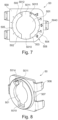
- [
Fig. 1 ] représente une vue d'un mauvais raccord entre la planche de bord et la garniture de porte ; - [
Fig. 2 ] est une vue intérieure d'une portière; - [
Fig.3 ] est une vue intérieure d'un détail de la portière; - [
Fig. 4 ] montre l'étape de dévissage de la garniture selon procédé; - [
Fig.5 ] est une vue de face de la pièce rotative d'une excentrique selon l'invention; - [
Fig.6 ] est une vue de dos de la pièce rotative de lafigure 5 ; - [
Fig.7 ] est une vue de face de la pièce fixe d'une excentrique selon l'invention; - [
Fig. 8 ] est une perspective de la pièce fixe de lafigure 7 ; - [
Fig. 9 ] est une perspective d'une pièce d'interface; - [
Fig. 10 ] illustre le montage de la pièce rotative sur la pièce fixe; - [
Fig. 11 ] illustre la mise à zéro de la pièce rotative sur la pièce fixe; - [
Fig. 12 ] illustre le montage de l'excentrique sur la pièce d'interface; - [
Fig. 13 ] illustre le montage de l'ensemble de lafigure 12 sur le caisson de la portière; - [
Fig. 14 ] montre le réglage de la hauteur par l'excentrique; - [
Fig. 15 ] est le détail du blocage du bras de la pièce rotative sur la pièce fixe. - [
Fig. 16 ] est une vue de détail du mécanisme de réglage avec la molaire de fixation. - On considérera dans la suite de la description que l'avant correspond à l'avant du véhicule et l'arrière à l'arrière dudit véhicule. De la même façon, le haut correspond au haut du véhicule et l'intérieur à l'intérieur du véhicule. De façon conventionnelle, un décalage vertical sera considéré comme un défaut Z selon l'axe Z, un décalage en profondeur ou un espace entre la garniture et la planche de bord comme un défaut X+Y selon les axes X et Y, tels qu'illustrés
figure 1 . Seul le défaut Z est considéré. - On voit sur la
figure 1 que lorsque la garniture 1 est montée sur le caisson 3 de la portière 4 et que la portière 4 est fermée, la ligne 20 de la planche de bord 2 et la ligne 10 de la garniture 1 ne sont pas toujours alignées, on constate ici un décalage d1 en Z de plusieurs millimètres vers le bas. - La garniture 1 est positionnée selon une direction verticale sur le caisson 3 de la portière par deux doigts 5 et 19 se logeant dans un premier trou 13 et un deuxième trou (non visible sur les figures).Ces doigts sont placés entre 50 et 160mm du haut 100 de la garniture 1. Le doigt 5 est équipé d'un système d'excentrique. Le doigt arrière 19 quant à lui reste fixe et sert d'axe de rotation de la garniture 1 pour la baisser ou la relever à l'avant afin de l'aligner sur la planche de bord 2 quand le réglage est fait avec le doigt 5 équipé du système d'excentrique.
- La garniture 1 comprend un obturateur 11 démontable qui couvre une vis avant 12 vissée dans un trou de fixation 14 et une molaire 15 logée dans une boutonnière 13 (cf.
figure 13 ). Cet obturateur 11 est placé à l'intérieur d'une ligne 101 de recouvrement de la planche de bord 2 sur la garniture 1 quand la portière 4 est fermée. Toute cette zone 101 n'est donc pas visible en position de conduite et n'altère pas l'esthétique de l'habitacle. Le trou de fixation 14 est disposé dans un renfoncement 17 de la garniture 1. Dans l'exemple illustré un excentrique 5, d'axe de rotation A, est placé à proximité et en dessous du trou de fixation 14. - L'excentrique 5 comprend une première pièce fixe 50 (
figures 7 et 8 ) et une deuxième pièce rotative 51 (figures 5 et 6 ). On considérera que la face avant de l'excentrique est orientée vers l'intérieur du véhicule en position montée sur la portière. - La deuxième pièce rotative 51 présente sur sa face avant 510 (cf.
figure 5 ) un évidement 513 destiné à recevoir un outil, dans cet exemple une empreinte "torx" et deux bras 511 et 512 disposés de part et d'autre d'un axe de rotation A. L'évidement 513 est dans une excroissance 516 de la face avant 510, cette excroissance 516 comprend des pans coupés 5160, ici 6 qui peuvent servir pour tourner la pièce rotative 51 avec une clé à pipe. Une forme cylindrique 517 est disposée entre la face avant 510 et l'excroissance 516. - Sur sa face arrière (cf.
figure 6 ), l'excentrique 5 comporte une pointe conique 514 située dans le prolongement d'un cylindre 518 d'axe B décalé d'une distance d par rapport à l'axe A. Dans l'exemple illustré la pointe conique 514 a une section en forme de croix afin de faciliter sa fabrication. Un joint 515 est placé sur la périphérie de la pièce rotative 51 et est solidaire de la pièce rotative 51. - La première pièce fixe 50 comprend un trou cylindrique 501 bordé sur sa face avant 500 de deux surfaces planes 502 et 503, chaque surface 502 et 503 est pourvue de crans 504 et 505 en relief répartis avec un pas de 15°. Le trou cylindrique 501 est ouvert par deux encoches 5010 et 5011 diamétralement opposées. Une des encoches, ici l'encoche 5011 du haut présente de part et d'autre sur la face avant 500, deux butées 5012 et 5013. Un des deux coté 5014 de l'encoche est affiné, jusqu'à 1mm d'épaisseur, et séparé de la face support 503 sur sa longueur pour lui donner de la souplesse et permettre sa déformation élastique pour laisser passer la pièce rotative 51. Le trou cylindrique 501 est de diamètre et d'épaisseur sensiblement égaux à la forme de cylindrique 517 afin de pouvoir la recevoir.
- La pièce fixe 50 se prolonge à l'arrière par une surface cylindrique 507 coaxiale au trou cylindrique 501.
- La première pièce fixe 50 comprend également des clips 506 de part et d'autre afin de pouvoir être clipsée sur une interface 53. Dans l'exemple illustré, ils sont au nombre de 3. La pièce fixe 50 est biseautée sur un coté 508 pour faciliter son montage sans erreur sur la garniture 1, comme détrompeur.
- La pièce intermédiaire 52 comprend trois ouvertures latérales 520 coopérant avec les clips 506 de la pièce fixe 50 et un trou cylindrique 521 destiné à recevoir la surface cylindrique 507 de la pièce fixe 50. La pièce intermédiaire 52 a un profil complémentaire de la pièce fixe 50. Cette interface 52 n'est, de préférence, pas une pièce indépendante rajoutée mais une zone technique prédéfinie ajouté lors de la conception de la garniture de portière ou à une pièce de structure prévue dans la zone souhaitée de la garniture.
- L'excentrique 5 se monte de la façon suivante:
- les deux bras 511 et 512 sont chacun disposés en vis-à-vis d'une des encoches 5010 et 5011,
- la pièce rotative 51 est insérée dans la pièce fixe jusqu'à ce que la surface avant 510 entre en contact avec la surface cylindrique 507,
- la pièce rotative 51 est tournée vers le coté 5014 qui va se déformer pour laisser passer le bras (ici 511) au-dessus de la butée 5013 et va servir de rampe d'engagement,
- le bras (ici 511) est tourné jusqu'au cran 5040 correspondant à la position 0.
- L'excentrique 5 est ensuite montée sur la pièce intermédiaire 52 par clipsage de façon connue. Cet ensemble est ensuite positionné verticalement sur le caisson 3 par une boutonnière 13. La boutonnière 13 est de préférence de forme oblongue horizontale.
- Le réglage de l'excentrique 5 se fait à partir de la position 0, illustré
figure 14 . Les variations par millimètre se fait sur le bras 511 tandis que les variations au 0,5mm se fait avec le bras 512. Ainsi si on veut monter ou descendre la garniture d'un millimètre on bloque le bras 511 sur un cran 504, si on veut la monter au descendre d'une valeur au demi millimètre (position en traits pointillés sur lafigure 14 ) près on bloque le bras 512 sur un cran 505. Les butées 5012 et 5013 limitent la rotation de l'excentrique 5, et éviter à la deuxième pièce rotative 51 de sortir de la pièce fixe 50. - On voit sur le détail de la
figure 5 que chaque bras (ici 511) est pourvu de deux dents 5111 formant une fourchette et permettant le blocage du bras 51 sur le cran 504 (ici le cran de position nulle 5040). Le bras 511 est percé derrière les dents 5111 d'un trou 5110 allongé pour autoriser la déformation élastique de l'extrémité du bras 511 et permettre le blocage et le déblocage des dents 5111 des crans 504. De la même façon, le bras 512 est équipé de deux dents 5111 et percé d'un trou 5110 permettant le blocage et le déblocage des dents des crans 505. En effet, pour que le changement de cran se fasse de façon fluide et sans dégradation des crans en particulier si elles sont en plastique, on constitue une lame de ressort en créant le trou 5110 lors de l'injection de la pièce rotative 51. On peut aussi combiner des matières tels que du PP 6-6 ou POM avec différentes forme de trou 5110. - Nous allons maintenant décrire le réglage de la garniture 1 sur la portière 4. Lorsque l'opérateur constate, porte fermée, un décalage en Z entre la garniture 1 et la planche de bord 2, il ouvre la portière, retire l'obturateur 11 s'il y en a un, dévisse la vis avant 12, introduit un outil tel qu'une clé à pipe sur les pans 5160, par exemple un outil "torx" dans l'évidement 513 de l'excentrique 5 ou sur les pans 5160. Il fait tourner l'excentrique en + ou - selon s'il veut faire remonter la partie avant de la garniture 1, ou la faire descendre. Une fois le niveau souhaité atteint, l'opérateur revisse la vis avant 12. Il referme ensuite la portière 4 pour s'assurer que la planche de bord est bien alignée avec la garniture 1. Si ce n'est pas le cas, il recommence l'opération jusqu'à obtenir l'alignement désiré. S'il existe, il remonte ensuite l'obturateur 11.
- L'invention permet un réglage homogène de la pièce de garniture quel que soit l'opérateur.
On comprendra que diverses modifications et/ou améliorations évidentes pour l'homme du métier peuvent être apportées aux différents modes de réalisation de l'invention décrits dans la présente description sans sortir du cadre de l'invention défini par les revendications annexées.
Claims (14)
- Excentrique (5) comprenant une première pièce fixe (50) et une deuxième pièce rotative (51) disposée dans la première pièce fixe (50), la deuxième pièce rotative (51) ayant d'un côté une empreinte creuse (513) d'axe A et de l'autre une pointe cylindrique (514) d'axe B, les axes A et B étant parallèles et distants d'une distance d non nulle, la deuxième pièce rotative (51) comprenant deux bras (511, 512) opposés, caractérisé en ce que chacun des bras est pourvu de deux dents (5111) à une extrémité et coopère avec des crans (504, 505) disposés sur la première pièce fixe (50) et que l'extrémité des bras (511, 512) est déformable élastiquement.
- Excentrique (5) selon la revendication 1 caractérisée en ce que la distance d est égale à 3mm.
- Excentrique (5) selon une des revendications 1 ou 2, caractérisée en ce que la deuxième pièce rotative (51) est monobloc et comprend un joint d'étanchéité (515).
- Excentrique (5) selon une des revendications précédentes caractérisées en ce que la déformation élastique du bras (511, 512) est obtenue par un évidement (5110) traversant disposé à l'extrémité.
- Excentrique (5) selon une des revendications précédentes caractérisées en ce que les crans (504, 505) de la pièce fixe (50) sont disposés de part et d'autre de la pièce rotative avec un pas d'un mm, un côté mesurant de 0 à ±2mm et l'autre côté de ±0,5 à ±1,5mm.
- Portière (4) automobile comprenant une garniture (1) avec un trou avant de fixation (14) disposés en partie haute à proximité d'une zone de finition à régler avec une planche de bord et un trou de fixation en partie arrière, un caisson (3) de portière avec des trous équipés d'une molaire rainurée (15) destinée à recevoir une vis de fixation, cette vis de fixation (12) reliant la garniture (1) au caisson (3) par ladite molaire (15) de fixation, caractérisée en ce que le caisson (3) comprend une boutonnière (13) disposée dans un coin haut et avant de la portière (4) et en vis-à-vis d'un trou cylindrique (521) d'une pièce intermédiaire (52) de la garniture (1) dans laquelle est insérée un excentrique (5) selon une des revendications précédentes.
- Portière (4) automobile selon la revendication précédente, caractérisée en ce que le trou avant de fixation (14) oblong est de 8mm d'axe à axe et de diamètre 16mm.
- Portière (4) automobile selon une des revendications 6 ou 7, caractérisée en ce que le trou avant de fixation (14) est à 50mm de la boutonnière (13).
- Portière (4) automobile selon une des revendications 6 à 8, caractérisée en ce qu'elle comprend un obturateur (11).
- Procédé de réglage en hauteur d'une garniture (1) de portière automobile sur un caisson (3), caractérisé en ce qu'il comprend les étapes suivantes:- retirer une vis de fixation (12) d'un trou avant (14) de fixation de la garniture (1) dans un coin haut et avant du caisson (3),- tourner un excentrique selon une des revendications 1 à 5, d'une valeur multiple d'un demi-millimètre,- revisser la vis de fixation (12a).
- Procédé selon la revendication précédente, caractérisé en ce qu'il comprend une étape de démontage d'un obturateur (11) couvrant la vis avant de fixation (12) et une étape de remontage dudit obturateur (11).
- Procédé selon un des revendications 10 ou 11, caractérisé en ce que l'excentrique fait bouger la garniture (1) de ±2mm.
- Procédé selon un des revendications 10 à 12, caractérisé en ce qu'il comprend une étape de vérification de l'ajustement de la hauteur de la garniture (1) par rapport à une planche de bord (2) en fermant la portière (4).
- Véhicule automobile comprenant deux portières (4) selon une des revendications 6 à 9.
Applications Claiming Priority (2)
| Application Number | Priority Date | Filing Date | Title |
|---|---|---|---|
| FR1871259A FR3087507B1 (fr) | 2018-10-23 | 2018-10-23 | Dispositif de realignement vertical |
| PCT/EP2019/078714 WO2020083903A1 (fr) | 2018-10-22 | 2019-10-22 | Dispositif de realignement vertical |
Publications (2)
| Publication Number | Publication Date |
|---|---|
| EP3870481A1 EP3870481A1 (fr) | 2021-09-01 |
| EP3870481B1 true EP3870481B1 (fr) | 2024-07-31 |
Family
ID=66166096
Family Applications (1)
| Application Number | Title | Priority Date | Filing Date |
|---|---|---|---|
| EP19787297.1A Active EP3870481B1 (fr) | 2018-10-23 | 2019-10-22 | Dispositif de realignement vertical |
Country Status (5)
| Country | Link |
|---|---|
| EP (1) | EP3870481B1 (fr) |
| KR (1) | KR20210076131A (fr) |
| CN (1) | CN113165581B (fr) |
| FR (1) | FR3087507B1 (fr) |
| WO (1) | WO2020083903A1 (fr) |
Families Citing this family (2)
| Publication number | Priority date | Publication date | Assignee | Title |
|---|---|---|---|---|
| US11654986B2 (en) * | 2020-11-13 | 2023-05-23 | GM Global Technology Operations LLC | Compound dowel for positioning components in vehicle structures |
| CN116080545B (zh) * | 2022-12-23 | 2026-04-28 | 小米汽车科技有限公司 | 调节组件、车门和车辆 |
Family Cites Families (14)
| Publication number | Priority date | Publication date | Assignee | Title |
|---|---|---|---|---|
| EP0026018B1 (fr) * | 1979-09-19 | 1984-05-30 | Constructions Electro-Mecaniques D'amiens | Machine à laver et à essorer le linge à entraînement du tambour par courroie immergée |
| ES2246681B1 (es) * | 2004-01-26 | 2007-03-16 | I.T.W. España, S.A. | Dispositivo de fijacion entre un panel y un soporte. |
| DE102007058755A1 (de) * | 2007-12-06 | 2009-06-10 | Daimler Ag | Verfahren und Vorrichtung zur lagegenauen Befestigung einer Innenverkleidung an der Tür eines Kraftfahrzeugs |
| DE102009059663A1 (de) * | 2009-12-19 | 2011-06-22 | Dr. Ing. h.c. F. Porsche Aktiengesellschaft, 70435 | Kraftfahrzeugtür |
| DE102011113179A1 (de) * | 2011-09-10 | 2013-03-14 | Audi Ag | Zierblende für eine Fahrzeugtür |
| FR2985495B1 (fr) * | 2012-01-11 | 2014-03-07 | Coutier Ind | Bati de montage de portiere de vehicule |
| JP2015511295A (ja) * | 2012-01-17 | 2015-04-16 | マグナ クロージャーズ インコーポレイテッド | ファスナ保持デバイス |
| DE102012105575B4 (de) * | 2012-06-26 | 2022-10-20 | Adient Us Llc | Lagerungseinheit |
| DE102013226182A1 (de) * | 2013-01-07 | 2014-07-10 | Ford Global Technologies, Llc | Anordnung zur Befestigung eines Innenverkleidungsteils an einer Fahrzeugkarosserie |
| CN106837964B (zh) * | 2015-08-20 | 2020-10-30 | 特迈驰公司 | 具有可捏缩-移除帽的紧固件夹具组件 |
| DE102015013882A1 (de) * | 2015-10-28 | 2016-04-14 | Daimler Ag | Verkleidungsanordnung für einen Kraftwagen und Verfahren zum Verkleiden einer Innenseite eines Türblechs eines Kraftwagens |
| GB2533038B (en) * | 2015-11-27 | 2020-07-29 | Bentley Motors Ltd | Door casing adjustment mechanism |
| JP6585015B2 (ja) * | 2016-07-25 | 2019-10-02 | トヨタ紡織株式会社 | 乗物用内装材 |
| JP6794276B2 (ja) * | 2017-01-18 | 2020-12-02 | 日本プラスト株式会社 | 係止装置 |
-
2018
- 2018-10-23 FR FR1871259A patent/FR3087507B1/fr active Active
-
2019
- 2019-10-22 CN CN201980076551.7A patent/CN113165581B/zh active Active
- 2019-10-22 KR KR1020217015303A patent/KR20210076131A/ko active Pending
- 2019-10-22 EP EP19787297.1A patent/EP3870481B1/fr active Active
- 2019-10-22 WO PCT/EP2019/078714 patent/WO2020083903A1/fr not_active Ceased
Also Published As
| Publication number | Publication date |
|---|---|
| FR3087507A1 (fr) | 2020-04-24 |
| CN113165581A (zh) | 2021-07-23 |
| FR3087507B1 (fr) | 2021-01-08 |
| EP3870481A1 (fr) | 2021-09-01 |
| KR20210076131A (ko) | 2021-06-23 |
| CN113165581B (zh) | 2024-12-10 |
| WO2020083903A1 (fr) | 2020-04-30 |
Similar Documents
| Publication | Publication Date | Title |
|---|---|---|
| WO2015055921A1 (fr) | Dispositif de tampon à butée auto ajustable | |
| EP3870481B1 (fr) | Dispositif de realignement vertical | |
| EP2125498B1 (fr) | Organe de positionnement d'une piece de carrosserie sur un vehicule automobile | |
| EP1854706A1 (fr) | Fixation glissante d'une aile à une caisse en blanc de véhicule automobile et procédé de fixation utilisant une telle fixation | |
| EP3184379B1 (fr) | Capuchon et bras d'entrainement pour un dispositif d'essuyage pour vehicule automobile | |
| EP2911803B1 (fr) | Paumelles pour montage provisoire d'une portiere sur un chassis de vehicule | |
| EP2692598B1 (fr) | Dispositif de connexion entre un bras d'essuyage et un balai d'essuyage | |
| EP1957733B1 (fr) | Ensemble de verrouillage provisoire | |
| EP3081439B1 (fr) | Embout d extremite pour balai d essuyage | |
| FR3021253A1 (fr) | Dispositif vitre affleurant pour porte de vehicule a panneau mobile reglable, porte et vehicule automobile correspondants. | |
| EP2048379A1 (fr) | Garniture pour glace, ouvrant équipé d'une telle garniture et procédé de positionnement associé | |
| FR3089485A1 (fr) | Dispositif de realignement vertical | |
| EP3512743B1 (fr) | Adaptateur pour la connexion d'un balai d'essuyage a un bras d'entrainement d'un systeme d'essuyage pour vehicule automobile | |
| EP2017408B1 (fr) | Dispositif de prépositionnement d'une gâche destinée à coopérer avec une serrure d'un ouvrant de véhicule automobile et véhicule automobile comportant au moins un tel dispositif | |
| EP1244585B1 (fr) | Procede de montage d'ouvrant de vehicule automobile et dispositif intervenant dans ce montage | |
| FR2794787A1 (fr) | Dispositif de renvoi de fouillot | |
| EP1032510B1 (fr) | Appareil d'eclairage ou de signalisation equipe de moyens de montage reglable perfectionnes, et element de structure associe pour vehicule automobile | |
| FR2897908A1 (fr) | Agencement de fixation | |
| FR2861439A1 (fr) | Dispositif de fixation avec jeux d'une premiere piece a une seconde piece | |
| EP1449993A1 (fr) | Poignée de véhicule automobile comportant des moyens élastiques de blocage d'un élément externe. | |
| EP3815980B1 (fr) | Agrafe de retenue d'un bandeau de garniture de porte d'un véhicule automobile | |
| EP1369970B1 (fr) | Dispositif de fixation d'un coffret électrique sur une surface de support | |
| EP4534781A1 (fr) | Dispositif de commande de ferrure de verrouillage pour menuiserie de type porte ou fenêtre | |
| WO2008119898A1 (fr) | Dispositif de positionnement d'une garniture dans une gorge de joint de porte de vehicule | |
| FR2857040A1 (fr) | Dispositif pour l'assemblage d'elements profiles de menuiserie |
Legal Events
| Date | Code | Title | Description |
|---|---|---|---|
| STAA | Information on the status of an ep patent application or granted ep patent |
Free format text: STATUS: UNKNOWN |
|
| STAA | Information on the status of an ep patent application or granted ep patent |
Free format text: STATUS: THE INTERNATIONAL PUBLICATION HAS BEEN MADE |
|
| PUAI | Public reference made under article 153(3) epc to a published international application that has entered the european phase |
Free format text: ORIGINAL CODE: 0009012 |
|
| STAA | Information on the status of an ep patent application or granted ep patent |
Free format text: STATUS: REQUEST FOR EXAMINATION WAS MADE |
|
| 17P | Request for examination filed |
Effective date: 20210505 |
|
| AK | Designated contracting states |
Kind code of ref document: A1 Designated state(s): AL AT BE BG CH CY CZ DE DK EE ES FI FR GB GR HR HU IE IS IT LI LT LU LV MC MK MT NL NO PL PT RO RS SE SI SK SM TR |
|
| DAV | Request for validation of the european patent (deleted) | ||
| DAX | Request for extension of the european patent (deleted) | ||
| RAP3 | Party data changed (applicant data changed or rights of an application transferred) |
Owner name: RENAULT S.A.S |
|
| RAP3 | Party data changed (applicant data changed or rights of an application transferred) |
Owner name: RENAULT S.A.S |
|
| P01 | Opt-out of the competence of the unified patent court (upc) registered |
Effective date: 20230608 |
|
| GRAP | Despatch of communication of intention to grant a patent |
Free format text: ORIGINAL CODE: EPIDOSNIGR1 |
|
| STAA | Information on the status of an ep patent application or granted ep patent |
Free format text: STATUS: GRANT OF PATENT IS INTENDED |
|
| INTG | Intention to grant announced |
Effective date: 20231016 |
|
| GRAS | Grant fee paid |
Free format text: ORIGINAL CODE: EPIDOSNIGR3 |
|
| GRAA | (expected) grant |
Free format text: ORIGINAL CODE: 0009210 |
|
| STAA | Information on the status of an ep patent application or granted ep patent |
Free format text: STATUS: THE PATENT HAS BEEN GRANTED |
|
| AK | Designated contracting states |
Kind code of ref document: B1 Designated state(s): AL AT BE BG CH CY CZ DE DK EE ES FI FR GB GR HR HU IE IS IT LI LT LU LV MC MK MT NL NO PL PT RO RS SE SI SK SM TR |
|
| REG | Reference to a national code |
Ref country code: CH Ref legal event code: EP Ref country code: GB Ref legal event code: FG4D Free format text: NOT ENGLISH |
|
| REG | Reference to a national code |
Ref country code: DE Ref legal event code: R096 Ref document number: 602019056171 Country of ref document: DE |
|
| REG | Reference to a national code |
Ref country code: IE Ref legal event code: FG4D Free format text: LANGUAGE OF EP DOCUMENT: FRENCH |
|
| REG | Reference to a national code |
Ref country code: LT Ref legal event code: MG9D |
|
| REG | Reference to a national code |
Ref country code: NL Ref legal event code: MP Effective date: 20240731 |
|
| PG25 | Lapsed in a contracting state [announced via postgrant information from national office to epo] |
Ref country code: PT Free format text: LAPSE BECAUSE OF FAILURE TO SUBMIT A TRANSLATION OF THE DESCRIPTION OR TO PAY THE FEE WITHIN THE PRESCRIBED TIME-LIMIT Effective date: 20241202 |
|
| REG | Reference to a national code |
Ref country code: AT Ref legal event code: MK05 Ref document number: 1708174 Country of ref document: AT Kind code of ref document: T Effective date: 20240731 |
|
| PG25 | Lapsed in a contracting state [announced via postgrant information from national office to epo] |
Ref country code: PT Free format text: LAPSE BECAUSE OF FAILURE TO SUBMIT A TRANSLATION OF THE DESCRIPTION OR TO PAY THE FEE WITHIN THE PRESCRIBED TIME-LIMIT Effective date: 20241202 |
|
| PG25 | Lapsed in a contracting state [announced via postgrant information from national office to epo] |
Ref country code: NO Free format text: LAPSE BECAUSE OF FAILURE TO SUBMIT A TRANSLATION OF THE DESCRIPTION OR TO PAY THE FEE WITHIN THE PRESCRIBED TIME-LIMIT Effective date: 20241031 |
|
| PG25 | Lapsed in a contracting state [announced via postgrant information from national office to epo] |
Ref country code: NL Free format text: LAPSE BECAUSE OF FAILURE TO SUBMIT A TRANSLATION OF THE DESCRIPTION OR TO PAY THE FEE WITHIN THE PRESCRIBED TIME-LIMIT Effective date: 20240731 Ref country code: FI Free format text: LAPSE BECAUSE OF FAILURE TO SUBMIT A TRANSLATION OF THE DESCRIPTION OR TO PAY THE FEE WITHIN THE PRESCRIBED TIME-LIMIT Effective date: 20240731 Ref country code: GR Free format text: LAPSE BECAUSE OF FAILURE TO SUBMIT A TRANSLATION OF THE DESCRIPTION OR TO PAY THE FEE WITHIN THE PRESCRIBED TIME-LIMIT Effective date: 20241101 Ref country code: PL Free format text: LAPSE BECAUSE OF FAILURE TO SUBMIT A TRANSLATION OF THE DESCRIPTION OR TO PAY THE FEE WITHIN THE PRESCRIBED TIME-LIMIT Effective date: 20240731 |
|
| PG25 | Lapsed in a contracting state [announced via postgrant information from national office to epo] |
Ref country code: BG Free format text: LAPSE BECAUSE OF FAILURE TO SUBMIT A TRANSLATION OF THE DESCRIPTION OR TO PAY THE FEE WITHIN THE PRESCRIBED TIME-LIMIT Effective date: 20240731 |
|
| PG25 | Lapsed in a contracting state [announced via postgrant information from national office to epo] |
Ref country code: LV Free format text: LAPSE BECAUSE OF FAILURE TO SUBMIT A TRANSLATION OF THE DESCRIPTION OR TO PAY THE FEE WITHIN THE PRESCRIBED TIME-LIMIT Effective date: 20240731 |
|
| PG25 | Lapsed in a contracting state [announced via postgrant information from national office to epo] |
Ref country code: IS Free format text: LAPSE BECAUSE OF FAILURE TO SUBMIT A TRANSLATION OF THE DESCRIPTION OR TO PAY THE FEE WITHIN THE PRESCRIBED TIME-LIMIT Effective date: 20241130 Ref country code: AT Free format text: LAPSE BECAUSE OF FAILURE TO SUBMIT A TRANSLATION OF THE DESCRIPTION OR TO PAY THE FEE WITHIN THE PRESCRIBED TIME-LIMIT Effective date: 20240731 |
|
| PG25 | Lapsed in a contracting state [announced via postgrant information from national office to epo] |
Ref country code: HR Free format text: LAPSE BECAUSE OF FAILURE TO SUBMIT A TRANSLATION OF THE DESCRIPTION OR TO PAY THE FEE WITHIN THE PRESCRIBED TIME-LIMIT Effective date: 20240731 |
|
| PG25 | Lapsed in a contracting state [announced via postgrant information from national office to epo] |
Ref country code: ES Free format text: LAPSE BECAUSE OF FAILURE TO SUBMIT A TRANSLATION OF THE DESCRIPTION OR TO PAY THE FEE WITHIN THE PRESCRIBED TIME-LIMIT Effective date: 20240731 Ref country code: RS Free format text: LAPSE BECAUSE OF FAILURE TO SUBMIT A TRANSLATION OF THE DESCRIPTION OR TO PAY THE FEE WITHIN THE PRESCRIBED TIME-LIMIT Effective date: 20241031 |
|
| PG25 | Lapsed in a contracting state [announced via postgrant information from national office to epo] |
Ref country code: RS Free format text: LAPSE BECAUSE OF FAILURE TO SUBMIT A TRANSLATION OF THE DESCRIPTION OR TO PAY THE FEE WITHIN THE PRESCRIBED TIME-LIMIT Effective date: 20241031 Ref country code: PL Free format text: LAPSE BECAUSE OF FAILURE TO SUBMIT A TRANSLATION OF THE DESCRIPTION OR TO PAY THE FEE WITHIN THE PRESCRIBED TIME-LIMIT Effective date: 20240731 Ref country code: NO Free format text: LAPSE BECAUSE OF FAILURE TO SUBMIT A TRANSLATION OF THE DESCRIPTION OR TO PAY THE FEE WITHIN THE PRESCRIBED TIME-LIMIT Effective date: 20241031 Ref country code: NL Free format text: LAPSE BECAUSE OF FAILURE TO SUBMIT A TRANSLATION OF THE DESCRIPTION OR TO PAY THE FEE WITHIN THE PRESCRIBED TIME-LIMIT Effective date: 20240731 Ref country code: LV Free format text: LAPSE BECAUSE OF FAILURE TO SUBMIT A TRANSLATION OF THE DESCRIPTION OR TO PAY THE FEE WITHIN THE PRESCRIBED TIME-LIMIT Effective date: 20240731 Ref country code: IS Free format text: LAPSE BECAUSE OF FAILURE TO SUBMIT A TRANSLATION OF THE DESCRIPTION OR TO PAY THE FEE WITHIN THE PRESCRIBED TIME-LIMIT Effective date: 20241130 Ref country code: HR Free format text: LAPSE BECAUSE OF FAILURE TO SUBMIT A TRANSLATION OF THE DESCRIPTION OR TO PAY THE FEE WITHIN THE PRESCRIBED TIME-LIMIT Effective date: 20240731 Ref country code: GR Free format text: LAPSE BECAUSE OF FAILURE TO SUBMIT A TRANSLATION OF THE DESCRIPTION OR TO PAY THE FEE WITHIN THE PRESCRIBED TIME-LIMIT Effective date: 20241101 Ref country code: FI Free format text: LAPSE BECAUSE OF FAILURE TO SUBMIT A TRANSLATION OF THE DESCRIPTION OR TO PAY THE FEE WITHIN THE PRESCRIBED TIME-LIMIT Effective date: 20240731 Ref country code: ES Free format text: LAPSE BECAUSE OF FAILURE TO SUBMIT A TRANSLATION OF THE DESCRIPTION OR TO PAY THE FEE WITHIN THE PRESCRIBED TIME-LIMIT Effective date: 20240731 Ref country code: BG Free format text: LAPSE BECAUSE OF FAILURE TO SUBMIT A TRANSLATION OF THE DESCRIPTION OR TO PAY THE FEE WITHIN THE PRESCRIBED TIME-LIMIT Effective date: 20240731 Ref country code: AT Free format text: LAPSE BECAUSE OF FAILURE TO SUBMIT A TRANSLATION OF THE DESCRIPTION OR TO PAY THE FEE WITHIN THE PRESCRIBED TIME-LIMIT Effective date: 20240731 |
|
| PG25 | Lapsed in a contracting state [announced via postgrant information from national office to epo] |
Ref country code: RO Free format text: LAPSE BECAUSE OF FAILURE TO SUBMIT A TRANSLATION OF THE DESCRIPTION OR TO PAY THE FEE WITHIN THE PRESCRIBED TIME-LIMIT Effective date: 20240731 Ref country code: DK Free format text: LAPSE BECAUSE OF FAILURE TO SUBMIT A TRANSLATION OF THE DESCRIPTION OR TO PAY THE FEE WITHIN THE PRESCRIBED TIME-LIMIT Effective date: 20240731 Ref country code: SM Free format text: LAPSE BECAUSE OF FAILURE TO SUBMIT A TRANSLATION OF THE DESCRIPTION OR TO PAY THE FEE WITHIN THE PRESCRIBED TIME-LIMIT Effective date: 20240731 |
|
| PG25 | Lapsed in a contracting state [announced via postgrant information from national office to epo] |
Ref country code: EE Free format text: LAPSE BECAUSE OF FAILURE TO SUBMIT A TRANSLATION OF THE DESCRIPTION OR TO PAY THE FEE WITHIN THE PRESCRIBED TIME-LIMIT Effective date: 20240731 |
|
| PG25 | Lapsed in a contracting state [announced via postgrant information from national office to epo] |
Ref country code: CZ Free format text: LAPSE BECAUSE OF FAILURE TO SUBMIT A TRANSLATION OF THE DESCRIPTION OR TO PAY THE FEE WITHIN THE PRESCRIBED TIME-LIMIT Effective date: 20240731 |
|
| PG25 | Lapsed in a contracting state [announced via postgrant information from national office to epo] |
Ref country code: SK Free format text: LAPSE BECAUSE OF FAILURE TO SUBMIT A TRANSLATION OF THE DESCRIPTION OR TO PAY THE FEE WITHIN THE PRESCRIBED TIME-LIMIT Effective date: 20240731 Ref country code: IT Free format text: LAPSE BECAUSE OF FAILURE TO SUBMIT A TRANSLATION OF THE DESCRIPTION OR TO PAY THE FEE WITHIN THE PRESCRIBED TIME-LIMIT Effective date: 20240731 |
|
| REG | Reference to a national code |
Ref country code: DE Ref legal event code: R097 Ref document number: 602019056171 Country of ref document: DE |
|
| REG | Reference to a national code |
Ref country code: CH Ref legal event code: PL |
|
| PLBE | No opposition filed within time limit |
Free format text: ORIGINAL CODE: 0009261 |
|
| STAA | Information on the status of an ep patent application or granted ep patent |
Free format text: STATUS: NO OPPOSITION FILED WITHIN TIME LIMIT |
|
| PG25 | Lapsed in a contracting state [announced via postgrant information from national office to epo] |
Ref country code: MC Free format text: LAPSE BECAUSE OF FAILURE TO SUBMIT A TRANSLATION OF THE DESCRIPTION OR TO PAY THE FEE WITHIN THE PRESCRIBED TIME-LIMIT Effective date: 20240731 |
|
| 26N | No opposition filed |
Effective date: 20250501 |
|
| PG25 | Lapsed in a contracting state [announced via postgrant information from national office to epo] |
Ref country code: BE Free format text: LAPSE BECAUSE OF NON-PAYMENT OF DUE FEES Effective date: 20241031 Ref country code: LU Free format text: LAPSE BECAUSE OF NON-PAYMENT OF DUE FEES Effective date: 20241022 |
|
| PG25 | Lapsed in a contracting state [announced via postgrant information from national office to epo] |
Ref country code: CH Free format text: LAPSE BECAUSE OF NON-PAYMENT OF DUE FEES Effective date: 20241031 |
|
| REG | Reference to a national code |
Ref country code: BE Ref legal event code: MM Effective date: 20241031 |
|
| PG25 | Lapsed in a contracting state [announced via postgrant information from national office to epo] |
Ref country code: SE Free format text: LAPSE BECAUSE OF FAILURE TO SUBMIT A TRANSLATION OF THE DESCRIPTION OR TO PAY THE FEE WITHIN THE PRESCRIBED TIME-LIMIT Effective date: 20240731 |
|
| PG25 | Lapsed in a contracting state [announced via postgrant information from national office to epo] |
Ref country code: IE Free format text: LAPSE BECAUSE OF NON-PAYMENT OF DUE FEES Effective date: 20241022 |
|
| PGFP | Annual fee paid to national office [announced via postgrant information from national office to epo] |
Ref country code: DE Payment date: 20251021 Year of fee payment: 7 |
|
| PGFP | Annual fee paid to national office [announced via postgrant information from national office to epo] |
Ref country code: GB Payment date: 20251022 Year of fee payment: 7 |
|
| PGFP | Annual fee paid to national office [announced via postgrant information from national office to epo] |
Ref country code: FR Payment date: 20251030 Year of fee payment: 7 |
|
| PG25 | Lapsed in a contracting state [announced via postgrant information from national office to epo] |
Ref country code: CY Free format text: LAPSE BECAUSE OF FAILURE TO SUBMIT A TRANSLATION OF THE DESCRIPTION OR TO PAY THE FEE WITHIN THE PRESCRIBED TIME-LIMIT; INVALID AB INITIO Effective date: 20191022 |
|
| PG25 | Lapsed in a contracting state [announced via postgrant information from national office to epo] |
Ref country code: HU Free format text: LAPSE BECAUSE OF FAILURE TO SUBMIT A TRANSLATION OF THE DESCRIPTION OR TO PAY THE FEE WITHIN THE PRESCRIBED TIME-LIMIT; INVALID AB INITIO Effective date: 20191022 |