EP3868667B1 - Nacelle d'aeronef comportant une rampe de soufflante avec des volets articules - Google Patents
Nacelle d'aeronef comportant une rampe de soufflante avec des volets articules Download PDFInfo
- Publication number
- EP3868667B1 EP3868667B1 EP21157737.4A EP21157737A EP3868667B1 EP 3868667 B1 EP3868667 B1 EP 3868667B1 EP 21157737 A EP21157737 A EP 21157737A EP 3868667 B1 EP3868667 B1 EP 3868667B1
- Authority
- EP
- European Patent Office
- Prior art keywords
- nacelle
- flap
- cowl
- deflectors
- mounting base
- Prior art date
- Legal status (The legal status is an assumption and is not a legal conclusion. Google has not performed a legal analysis and makes no representation as to the accuracy of the status listed.)
- Active
Links
Images
Classifications
-
- B—PERFORMING OPERATIONS; TRANSPORTING
- B64—AIRCRAFT; AVIATION; COSMONAUTICS
- B64D—EQUIPMENT FOR FITTING IN OR TO AIRCRAFT; FLIGHT SUITS; PARACHUTES; ARRANGEMENT OR MOUNTING OF POWER PLANTS OR PROPULSION TRANSMISSIONS IN AIRCRAFT
- B64D29/00—Power-plant nacelles, fairings or cowlings
- B64D29/02—Power-plant nacelles, fairings or cowlings associated with wings
-
- B—PERFORMING OPERATIONS; TRANSPORTING
- B64—AIRCRAFT; AVIATION; COSMONAUTICS
- B64D—EQUIPMENT FOR FITTING IN OR TO AIRCRAFT; FLIGHT SUITS; PARACHUTES; ARRANGEMENT OR MOUNTING OF POWER PLANTS OR PROPULSION TRANSMISSIONS IN AIRCRAFT
- B64D29/00—Power-plant nacelles, fairings or cowlings
-
- B—PERFORMING OPERATIONS; TRANSPORTING
- B64—AIRCRAFT; AVIATION; COSMONAUTICS
- B64C—AEROPLANES; HELICOPTERS
- B64C9/00—Adjustable control surfaces or members, e.g. rudders
- B64C9/14—Adjustable control surfaces or members, e.g. rudders forming slots
- B64C9/16—Adjustable control surfaces or members, e.g. rudders forming slots at the rear of the wing
- B64C9/20—Adjustable control surfaces or members, e.g. rudders forming slots at the rear of the wing by multiple flaps
-
- B—PERFORMING OPERATIONS; TRANSPORTING
- B64—AIRCRAFT; AVIATION; COSMONAUTICS
- B64D—EQUIPMENT FOR FITTING IN OR TO AIRCRAFT; FLIGHT SUITS; PARACHUTES; ARRANGEMENT OR MOUNTING OF POWER PLANTS OR PROPULSION TRANSMISSIONS IN AIRCRAFT
- B64D33/00—Arrangement in aircraft of power plant parts or auxiliaries not otherwise provided for
- B64D33/02—Arrangement in aircraft of power plant parts or auxiliaries not otherwise provided for of combustion air intakes
-
- F—MECHANICAL ENGINEERING; LIGHTING; HEATING; WEAPONS; BLASTING
- F02—COMBUSTION ENGINES; HOT-GAS OR COMBUSTION-PRODUCT ENGINE PLANTS
- F02K—JET-PROPULSION PLANTS
- F02K1/00—Plants characterised by the form or arrangement of the jet pipe or nozzle; Jet pipes or nozzles peculiar thereto
- F02K1/54—Nozzles having means for reversing jet thrust
- F02K1/56—Reversing jet main flow
- F02K1/62—Reversing jet main flow by blocking the rearward discharge by means of flaps
- F02K1/625—Reversing jet main flow by blocking the rearward discharge by means of flaps the aft end of the engine cowling being movable to uncover openings for the reversed flow
-
- F—MECHANICAL ENGINEERING; LIGHTING; HEATING; WEAPONS; BLASTING
- F02—COMBUSTION ENGINES; HOT-GAS OR COMBUSTION-PRODUCT ENGINE PLANTS
- F02K—JET-PROPULSION PLANTS
- F02K1/00—Plants characterised by the form or arrangement of the jet pipe or nozzle; Jet pipes or nozzles peculiar thereto
- F02K1/54—Nozzles having means for reversing jet thrust
- F02K1/64—Reversing fan flow
- F02K1/70—Reversing fan flow using thrust reverser flaps or doors mounted on the fan housing
- F02K1/72—Reversing fan flow using thrust reverser flaps or doors mounted on the fan housing the aft end of the fan housing being movable to uncover openings in the fan housing for the reversed flow
-
- B—PERFORMING OPERATIONS; TRANSPORTING
- B64—AIRCRAFT; AVIATION; COSMONAUTICS
- B64D—EQUIPMENT FOR FITTING IN OR TO AIRCRAFT; FLIGHT SUITS; PARACHUTES; ARRANGEMENT OR MOUNTING OF POWER PLANTS OR PROPULSION TRANSMISSIONS IN AIRCRAFT
- B64D33/00—Arrangement in aircraft of power plant parts or auxiliaries not otherwise provided for
- B64D33/02—Arrangement in aircraft of power plant parts or auxiliaries not otherwise provided for of combustion air intakes
- B64D2033/0266—Arrangement in aircraft of power plant parts or auxiliaries not otherwise provided for of combustion air intakes specially adapted for particular type of power plants
- B64D2033/0286—Arrangement in aircraft of power plant parts or auxiliaries not otherwise provided for of combustion air intakes specially adapted for particular type of power plants for turbofan engines
-
- F—MECHANICAL ENGINEERING; LIGHTING; HEATING; WEAPONS; BLASTING
- F05—INDEXING SCHEMES RELATING TO ENGINES OR PUMPS IN VARIOUS SUBCLASSES OF CLASSES F01-F04
- F05D—INDEXING SCHEME FOR ASPECTS RELATING TO NON-POSITIVE-DISPLACEMENT MACHINES OR ENGINES, GAS-TURBINES OR JET-PROPULSION PLANTS
- F05D2240/00—Components
- F05D2240/10—Stators
- F05D2240/12—Fluid guiding means, e.g. vanes
- F05D2240/129—Cascades, i.e. assemblies of similar profiles acting in parallel
Definitions
- the present invention relates to an aircraft nacelle comprising a fan ramp with hinged flaps, as well as an aircraft comprising at least one such nacelle.
- the Fig. 4 shows a nacelle 400 of an aircraft of the state of the art, in particular a nacelle 400 for a turbofan engine.
- a nacelle 400 surrounds the engine represented here by its engine casing 402 and the nacelle 400 delimits with the engine casing 402, a secondary stream 404 in which an air flow 406 flows from the front to the rear.
- the secondary duct 404 is at the rear of a fan which drives the airflow 406 and which is inside a fan casing 408 which generally takes the form of a cylinder and which is fixed on a fixed structure of the 400 nacelle.
- the nacelle 400 also includes a fixed cowl 410 secured to the fixed structure and a movable cowl 412 mounted movable in translation on the fixed structure.
- the fixed cowl 410 and the movable cowl 412 generally take the form of cylinders.
- Fixed cowl 410 is around fan casing 408.
- the movable cowl 412 is movable between an advanced position in which the movable cowl 412 extends the fixed cowl 410 at the rear of the latter, and a retracted position in which the movable cowl 412 is separated from the fixed cowl 410 to open between them a opening 414 which provides fluid communication between the secondary vein 404 and the exterior of the nacelle 400.
- the turbojet engine also includes reversing gates 416 where each is movable between a retracted position in which it does not block the secondary stream 404 and a deployed position ( Fig. 4 ) in which it closes the secondary stream 404 to direct the air flow 406 towards the opening 414 and thus ensure a thrust reversal of the turbojet engine.
- deflectors 418 are arranged across the opening 414.
- the nacelle 400 comprises a fan ramp 420 which is an aerodynamic structure fixed to the fan casing 408 just upstream of the opening 414.
- the fan ramp 420 comprises a domed area 422 attached to the rear of the fan casing 408 and oriented towards the opening 414 and a straight zone 424 attached to the rear of the domed zone 422 and oriented generally radially just in front of the deflectors 418.
- An object of the present invention is to provide a nacelle with a fan ramp equipped with hinged flaps which retract when the rear cover is moved forward and makes it possible to reduce the thickness of the aerodynamic lines.
- each flap is fixed to the base via two joints.
- each articulation consists of a yoke secured to the shutter, a counter-clevis secured to the base and an axis passing through the yoke and the counter-clevis.
- each return element is a torsion spring fitted onto the shaft, one end of which is constrained against the flap and the other end of which is constrained against the base.
- the invention also proposes an aircraft comprising an engine and a nacelle according to one of the preceding variants where the engine is surrounded by the nacelle.
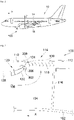
- the Fig. 1 shows an aircraft 10 comprising a nacelle 100 which is supported by a mast 16 fixed under a wing 14.
- the longitudinal axis of the nacelle 100 is called X, which is parallel to the longitudinal axis of the aircraft 10, oriented positively in the direction of advance of the aircraft 10.
- X the longitudinal axis of the nacelle 100 which is parallel to the longitudinal axis of the aircraft 10, oriented positively in the direction of advance of the aircraft 10.
- Y the transverse axis of the nacelle 100 which is horizontal when the aircraft 10 is on the ground
- Z the vertical axis or vertical height when the aircraft 10 is on the ground
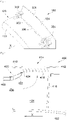
- the Fig. 2 shows an axial section of the nacelle 100 according to the invention which is similar to the nacelle 400 of the state of the art, except with regard to the fan ramp.
- the nacelle 100 is implemented within the framework of a turbofan engine and it surrounds an engine represented here by its engine casing 102.
- the turbojet engine comprises a fan which drives a flow of air from the front to the rear and which is surrounded by a fan casing 108 which is fixed to a fixed structure of the nacelle 100 around the engine casing 102.
- the fan casing 108 and the engine casing 102 delimit between them a secondary stream 104 in which the air flow 106 flows.
- the nacelle 100 also comprises a fixed cowl 110 secured to the fixed structure and a movable cowl 112 mounted movable in translation on the fixed structure.
- the fixed cowl 110 is around the fan casing 108.
- the secondary vein 104 extends at the rear of the fan casing 108 between the cowls 110 and 112 and the engine casing 102.
- the movable cowl 112 is movable between an advanced position in which the movable cowl 112 extends the fixed cowl 110 at the rear of the latter, and a retracted position in which the movable cowl 112 is separated from the fixed cowl 110 towards the rear to open between them an opening 114 which provides fluid communication between the secondary stream 104 and the exterior of the nacelle 100.
- skilled in the art such as slides, cylinders, motors, etc.
- the turbojet engine also includes reversing gates 116 where each is movable between a retracted position in which it does not block the secondary stream 104 and a deployed position ( Fig. 2 ) in which it closes the secondary stream 104 to direct the airflow 106 towards the opening 114 then the outside and thus ensure a thrust reversal of the turbojet engine.
- reversing gates 116 where each is movable between a retracted position in which it does not block the secondary stream 104 and a deployed position ( Fig. 2 ) in which it closes the secondary stream 104 to direct the airflow 106 towards the opening 114 then the outside and thus ensure a thrust reversal of the turbojet engine.
- the displacement of the inversion doors 116 is ensured by any appropriate means known to those skilled in the art, such as for example slides, jacks, motors, etc.
- the nacelle 100 comprises deflectors 118 (also called “cascades”) which are movable in translation with the movable cowl 112, where in the advanced position, the deflectors 118 are positioned around the fan casing 108, between said fan casing 108 and the fixed cowl 110, and where in the retracted position, the deflectors 118 are arranged across the opening 114 to better guide the flow of air 106 into the opening 114 and outwards.
- deflectors 118 also called “cascades” which are movable in translation with the movable cowl 112, where in the advanced position, the deflectors 118 are positioned around the fan casing 108, between said fan casing 108 and the fixed cowl 110, and where in the retracted position, the deflectors 118 are arranged across the opening 114 to better guide the flow of air 106 into the opening 114 and outwards.
- the nacelle 100 comprises a fan ramp 120 which comprises a base 122 and flaps 124 and which is arranged just upstream of the opening 114 and just upstream of the deflectors 118 when they are in the retracted position.
- the base 122 takes the form of a crown which is fixed to the rear of the fan casing 108 and which here has a domed shape oriented towards the opening 114 and the secondary vein 104. This base 122 makes it possible to widen the vein secondary 104 towards the opening 114.
- the base 122 can be an integral part of the fan casing 108.
- flaps 124 are rotatably mounted on the base 122 around an axis of rotation 302 generally tangential to the base 122.
- each flap 124 is mounted articulated on the base 122 via two joints 304.
- the flaps 124 are arranged one after the other around the base 122 and the number of flaps 124 and the angular extent of each flap 124 depend, among other things, on the diameter of the base 122.
- Each flap 124 has a downstream edge 306 which is rotatable on the base 122 and an upstream edge 308 which is the edge opposite the downstream edge 306 and which is therefore the free edge of the flap 124.
- Each flap 124 is movable between a retracted position and a deployed position.
- the flap 124 folds down towards the base 122, here towards the outer surface of the base 122.
- This retracted position is shown in phantom on the Fig. 2 .
- the upstream edge 308 then projects forward from the nacelle 100.
- the retracted position allows the deflectors 118 to pass around the flaps 124.
- the flap 124 In the deployed position, the flap 124 is generally oriented along a plane perpendicular to the longitudinal axis X, and it is therefore detached from the base 122. This deployed position is shown in continuous lines on the Fig. 2 .
- the upstream edge 308 then projects outwards from the nacelle 100, through the opening 114, and the flap 124 then comes in place of the right zone 424 of the state of the art.
- the passage from the deployed position to the retracted position is effected by a rotation of the flap 124 towards the front of the nacelle 100.
- the fan ramp 120 also includes a return element 312 which forces the flap 124 into the deployed position.
- the deflectors 118 comprise a stop 130 which comes into contact with the rear of each flap 124 and pushes each of them towards its retracted position, when the movable cowl 112 moves from the retracted position to the advanced position.
- the diameter of the nacelle 100 that is to say of the fixed cowl 110 and of the movable cowl 112 is reduced, at the same time reducing the thickness of the aerodynamic lines while retaining the guidance of the air flow 106 outwards in the retracted position.
- each articulation 304 is made up of a clevis integral with the flap 124, of a counter-clevis integral with the base 122 and of an axis passing through the clevis and the counter-clevis.
- Each return element 312 is for example a torsion spring which is fitted onto the shaft, one end of which is constrained against the flap 124 and the other end of which is constrained against the base 122.
- a return element 312 per joint 304 there is a return element 312 per joint 304.
Landscapes
- Engineering & Computer Science (AREA)
- Chemical & Material Sciences (AREA)
- Combustion & Propulsion (AREA)
- Aviation & Aerospace Engineering (AREA)
- Mechanical Engineering (AREA)
- General Engineering & Computer Science (AREA)
- Structures Of Non-Positive Displacement Pumps (AREA)
Description
- La présente invention concerne une nacelle d'aéronef comportant une rampe de soufflante avec des volets articulés, ainsi qu'un aéronef comportant au moins une telle nacelle.
- Les documents
FR-A-3 068 080 FR-A-3 059 646 WO-A-2015/019007 etEP-A-3 587 784 divulguent des nacelles de l'état de la technique. - La
Fig. 4 montre une nacelle 400 d'un aéronef de l'état de la technique, en particulier une nacelle 400 pour un turboréacteur double flux. Une telle nacelle 400 entoure le moteur représenté ici par son carter moteur 402 et la nacelle 400 délimite avec le carter moteur 402, une veine secondaire 404 dans laquelle un flux d'air 406 s'écoule de l'avant vers l'arrière. - La veine secondaire 404 se trouve à l'arrière d'une soufflante qui entraîne le flux d'air 406 et qui se trouve à l'intérieur d'un carter de soufflante 408 qui prend globalement la forme d'un cylindre et qui est fixée sur une structure fixe de la nacelle 400.
- La nacelle 400 comporte également un capot fixe 410 solidaire de la structure fixe et un capot mobile 412 monté mobile en translation sur la structure fixe. Le capot fixe 410 et le capot mobile 412 prennent globalement la forme de cylindres. Le capot fixe 410 est autour du carter de soufflante 408.
- Le capot mobile 412 est mobile entre une position avancée dans laquelle le capot mobile 412 prolonge le capot fixe 410 à l'arrière de ce dernier, et une position reculée dans laquelle le capot mobile 412 est écarté du capot fixe 410 pour ouvrir entre eux une ouverture 414 qui assure la communication fluidique entre la veine secondaire 404 et l'extérieur de la nacelle 400.
- Le turboréacteur comporte également des portes d'inversion 416 où chacune est mobile entre une position escamotée dans laquelle elle n'obture pas la veine secondaire 404 et une position déployée (
Fig. 4 ) dans laquelle elle obture la veine secondaire 404 pour diriger le flux d'air 406 vers l'ouverture 414 et assurer ainsi une inversion de poussée du turboréacteur. - Pour guider au mieux le flux d'air 406 dans l'ouverture 414 et vers l'extérieur, des déflecteurs 418 sont disposés en travers de l'ouverture 414.
- Pour assurer le guidage du flux d'air 406 vers les déflecteurs 418, la nacelle 400 comporte une rampe de soufflante 420 qui est une structure aérodynamique fixée au carter de soufflante 408 juste en amont de l'ouverture 414. La rampe de soufflante 420 comporte une zone bombée 422 fixée à l'arrière du carter de soufflante 408 et orientée vers l'ouverture 414 et une zone droite 424 fixée à l'arrière de la zone bombée 422 et orientée globalement radialement juste devant les déflecteurs 418.
- Bien que cette installation donne de bons résultats, la forme particulière de la rampe de soufflante 420, et en particulier la présence de la zone droite 424, entraîne le besoin d'accroître le diamètre de la nacelle 400 pour englober la rampe de soufflante 420, ce qui peut induire une traînée importante en vol.
- Un objet de la présente invention est de proposer une nacelle avec une rampe de soufflante équipée de volets articulés qui s'escamotent lorsque le capot arrière est avancé et permet de réduire l'épaisseur des lignes aérodynamiques.
- À cet effet, est proposée une nacelle pour un aéronef, ladite nacelle comportant :
- un carter de soufflante délimitant une veine secondaire,
- un capot fixe disposé autour du carter de soufflante,
- un capot mobile qui est mobile entre une position avancée dans laquelle le capot mobile prolonge le capot fixe à l'arrière et une position reculée dans laquelle le capot mobile est écarté du capot fixe pour ouvrir entre eux une ouverture qui assure la communication fluidique entre la veine secondaire et l'extérieur de la nacelle,
- des déflecteurs solidaires du capot mobile où en position avancée, les déflecteurs sont autour du carter de soufflante et où en position reculée, les déflecteurs sont disposés en travers de l'ouverture,
- une rampe de soufflante comportant un socle et des volets où le socle prend la forme d'une couronne fixée à l'arrière du carter de soufflante, et où chaque volet comporte un bord aval et un bord amont opposé au bord aval, et est mobile en rotation sur le socle entre une position escamotée dans laquelle le bord amont se projette alors vers l'avant de la nacelle et une position déployée dans laquelle le bord amont se projette alors vers l'extérieur de la nacelle à travers l'ouverture et en amont des déflecteurs en position reculée,
- Ainsi, en position avancée, les volets sont repliés et leur encombrement est réduit. Avantageusement, chaque volet est fixé au socle par l'intermédiaire de deux articulations. Avantageusement, chaque articulation est constituée d'une chape solidaire du volet, d'une contre-chape solidaire du socle et d'un axe traversant la chape et la contre-chape. Avantageusement, chaque élément de rappel est un ressort de torsion emmanché sur l'axe, dont une des extrémités est contrainte contre le volet et dont une autre extrémité est contrainte contre le socle.
- L'invention propose également un aéronef comportant un moteur et une nacelle selon l'une des variantes précédentes où le moteur est entouré par la nacelle.
- Les caractéristiques de l'invention mentionnées ci-dessus, ainsi que d'autres, apparaîtront plus clairement à la lecture de la description suivante d'un exemple de réalisation, ladite description étant faite en relation avec les dessins joints, parmi lesquels :
-
Fig. 1 est une vue de côté d'un aéronef comportant une nacelle selon l'invention, -
Fig. 2 est une représentation schématique et en coupe par un plan axial d'une nacelle selon l'invention, -
Fig. 3 est une vue en perspective d'une rampe de soufflante selon l'invention, et -
Fig. 4 est une représentation schématique et en coupe par un plan axial d'une nacelle de l'état de la technique. - La
Fig. 1 montre un aéronef 10 comportant une nacelle 100 qui est supportée par un mât 16 fixé sous une aile 14. - Dans la description qui suit, les termes relatifs à une position sont pris en référence à un aéronef en position d'avancement, c'est-à-dire comme il est représenté sur la
Fig. 1 où la flèche F montre le sens d'avancement de l'aéronef 10. - Dans la description qui suit, et par convention, on appelle X l'axe longitudinal de la nacelle 100 qui est parallèle à l'axe longitudinal de l'aéronef 10, orienté positivement dans le sens d'avancement de l'aéronef 10, on appelle Y l'axe transversal de la nacelle 100 qui est horizontal lorsque l'aéronef 10 est au sol, et Z l'axe vertical ou hauteur verticale lorsque l'aéronef 10 est au sol, ces trois directions X, Y et Z étant orthogonales entre elles.
- La
Fig. 2 montre une coupe axiale de la nacelle 100 selon l'invention qui est similaire à la nacelle 400 de l'état de la technique, sauf en ce qui concerne la rampe de soufflante. - La nacelle 100 est mise en œuvre dans le cadre d'un turboréacteur double flux et elle entoure un moteur représenté ici par son carter moteur 102.
- Le turboréacteur comporte une soufflante qui entraîne un flux d'air de l'avant vers l'arrière et qui est entourée d'un carter de soufflante 108 qui est fixé sur une structure fixe de la nacelle 100 autour du carter moteur 102.
- Le carter de soufflante 108 et le carter moteur 102 délimitent entre eux une veine secondaire 104 dans laquelle le flux d'air 106 s'écoule.
- La nacelle 100 comporte également un capot fixe 110 solidaire de la structure fixe et un capot mobile 112 monté mobile en translation sur la structure fixe. Dans le mode de réalisation de l'invention présenté ici, le capot fixe 110 est autour du carter de soufflante 108.
- La veine secondaire 104 se prolonge à l'arrière du carter de soufflante 108 entre les capots 110 et 112 et le carter moteur 102.
- Le capot mobile 112 est mobile entre une position avancée dans laquelle le capot mobile 112 prolonge le capot fixe 110 à l'arrière de ce dernier, et une position reculée dans laquelle le capot mobile 112 est écarté du capot fixe 110 vers l'arrière pour ouvrir entre eux une ouverture 114 qui assure la communication fluidique entre la veine secondaire 104 et l'extérieur de la nacelle 100. Comme pour l'état de la technique, le déplacement du capot mobile 112 est assuré par tous moyens appropriés et connus de l'homme du métier, comme par exemple des glissières, des vérins, des moteurs, etc.
- Le turboréacteur comporte également des portes d'inversion 116 où chacune est mobile entre une position escamotée dans laquelle elle n'obture pas la veine secondaire 104 et une position déployée (
Fig. 2 ) dans laquelle elle obture la veine secondaire 104 pour diriger le flux d'air 106 vers l'ouverture 114 puis l'extérieur et assurer ainsi une inversion de poussée du turboréacteur. Comme pour l'état de la technique, le déplacement des portes d'inversion 116 est assuré par tous moyens appropriés et connus de l'homme du métier, comme par exemple des glissières, des vérins, des moteurs, etc. - La nacelle 100 comporte des déflecteurs 118 (également appelés « cascades ») qui sont mobiles en translation avec le capot mobile 112, où en position avancée, les déflecteurs 118 se positionnent autour du carter de soufflante 108, entre ledit carter de soufflante 108 et le capot fixe 110, et où en position reculée, les déflecteurs 118 sont disposés en travers de l'ouverture 114 pour guider au mieux le flux d'air 106 dans l'ouverture 114 et vers l'extérieur.
- Pour assurer le guidage du flux d'air 106 vers l'ouverture 114 et les déflecteurs 118, la nacelle 100 comporte une rampe de soufflante 120 qui comporte un socle 122 et des volets 124 et qui est disposée juste en amont de l'ouverture 114 et juste en amont des déflecteurs 118 lorsqu'ils sont en position reculée.
- Le socle 122 prend la forme d'une couronne qui est fixée à l'arrière du carter de soufflante 108 et qui présente ici une forme bombée orientée vers l'ouverture 114 et la veine secondaire 104. Ce socle 122 permet d'élargir la veine secondaire 104 vers l'ouverture 114. Bien sûr, le socle 122 peut être partie intégrante du carter de soufflante 108.
- Comme le montre la
Fig. 3 , plusieurs volets 124 sont montés mobiles en rotation sur le socle 122 autour d'un axe de rotation 302 globalement tangentiel au socle 122. - Ici, chaque volet 124 est monté articulé sur le socle 122 par l'intermédiaire de deux articulations 304.
- Les volets 124 sont disposés les uns à la suite des autres autour du socle 122 et le nombre de volets 124 et l'étendue angulaire de chaque volet 124 dépendent, entre autres, du diamètre du socle 122.
- Chaque volet 124 comporte un bord aval 306 qui est mobile en rotation sur le socle 122 et un bord amont 308 qui est le bord opposé au bord aval 306 et qui est donc le bord libre du volet 124.
- Chaque volet 124 est mobile entre une position escamotée et une position déployée.
- En position escamotée, le volet 124 se rabat vers le socle 122, ici vers la surface extérieure du socle 122. Cette position escamotée est représentée en traits mixtes sur la
Fig. 2 . Le bord amont 308 se projette alors vers l'avant de la nacelle 100. La position escamotée permet le passage des déflecteurs 118 autour des volets 124. - En position déployée, le volet 124 est globalement orienté selon un plan perpendiculaire à l'axe longitudinal X, et il est donc décollé du socle 122. Cette position déployée est représentée en traits continus sur la
Fig. 2 . Le bord amont 308 se projette alors vers l'extérieur de la nacelle 100, à travers l'ouverture 114, et le volet 124 vient alors en lieu et place de la zone droite 424 de l'état de la technique. Le passage de la position déployée à la position escamotée s'effectue par une rotation du volet 124 vers l'avant de la nacelle 100. - Pour chaque volet 124, la rampe de soufflante 120 comporte également un élément de rappel 312 qui contraint le volet 124 dans la position déployée.
- Pour chaque volet 124, les déflecteurs 118 comportent une butée 130 qui vient en contact avec l'arrière de chaque volet 124 et repousse chacun d'eux vers sa position escamotée, lorsque le capot mobile 112 passe de la position reculée à la position avancée.
- Ainsi, par mise en place de volets 124 escamotables, le diamètre de la nacelle 100, c'est-à-dire du capot fixe 110 et du capot mobile 112, est réduit, réduisant en même temps l'épaisseur des lignes aérodynamiques tout en conservant le guidage du flux d'air 106 vers l'extérieur en position reculée.
- Ici chaque articulation 304 est constituée d'une chape solidaire du volet 124, d'une contre-chape solidaire du socle 122 et d'un axe traversant la chape et la contre-chape.
- Chaque élément de rappel 312 est par exemple un ressort de torsion qui est emmanché sur l'axe, dont une des extrémités est contrainte contre le volet 124 et dont une autre extrémité est contrainte contre le socle 122. Ici il y a un élément de rappel 312 par articulation 304.
Claims (5)
- Nacelle (100) pour un aéronef (10), ladite nacelle (100) comportant :- un carter de soufflante (108) délimitant une veine secondaire (104),- un capot fixe (110) disposé autour du carter de soufflante (108),- un capot mobile (112) mobile entre une position avancée dans laquelle le capot mobile (112) prolonge le capot fixe (110) à l'arrière et une position reculée dans laquelle le capot mobile (112) est écarté du capot fixe (110) pour ouvrir entre eux une ouverture (114) qui assure la communication fluidique entre la veine secondaire (104) et l'extérieur de la nacelle (100),- des déflecteurs (118) solidaires du capot mobile (112) où en position avancée, les déflecteurs (118) sont autour du carter de soufflante (108) et où en position reculée, les déflecteurs (118) sont disposés en travers de l'ouverture (114), et- une rampe de soufflante (120) comportant un socle (122) et des volets (124) où le socle (122) prend la forme d'une couronne fixée à l'arrière du carter de soufflante (108), et où chaque volet (124) comporte un bord aval (306) et un bord amont (308) opposé au bord aval (306),la nacelle (100) étant caractérisée en ce que chaque volet (124) est mobile en rotation sur le socle (122) entre une position escamotée dans laquelle le bord amont (308) se projette alors vers l'avant de la nacelle (100) et une position déployée dans laquelle le bord amont (308) se projette alors vers l'extérieur de la nacelle (100) à travers l'ouverture (114) et en amont des déflecteurs (118) en position reculée, et en ce quepour chaque volet (124), la rampe de soufflante (120) comporte un élément de rappel (312) qui contraint le volet (124) dans la position déployée et en ce que pour chaque volet (124), les déflecteurs (118) comportent une butée (130) qui vient en contact avec l'arrière dudit volet (124) lorsque le capot mobile (112) passe de la position reculée à la position avancée.
- Nacelle (100) selon la revendication 1, caractérisée en ce que chaque volet (124) est fixé au socle (122) par l'intermédiaire de deux articulations (304).
- Nacelle (100) selon la revendication 2, caractérisée en ce que chaque articulation (304) est constituée d'une chape solidaire du volet (124), d'une contre-chape solidaire du socle (122) et d'un axe traversant la chape et la contre-chape.
- Nacelle (100) selon la revendication 3, caractérisée en ce que chaque élément de rappel (312) est un ressort de torsion emmanché sur l'axe, dont une des extrémités est contrainte contre le volet (124) et dont une autre extrémité est contrainte contre le socle (122).
- Aéronef (10) comportant un moteur (102) et une nacelle (100) selon l'une des revendications précédentes où le moteur (102) est entouré par la nacelle (100).
Applications Claiming Priority (1)
| Application Number | Priority Date | Filing Date | Title |
|---|---|---|---|
| FR2001792A FR3107509A1 (fr) | 2020-02-24 | 2020-02-24 | Nacelle d’aeronef comportant une rampe de soufflante avec des volets articules |
Publications (2)
| Publication Number | Publication Date |
|---|---|
| EP3868667A1 EP3868667A1 (fr) | 2021-08-25 |
| EP3868667B1 true EP3868667B1 (fr) | 2022-10-26 |
Family
ID=71784141
Family Applications (1)
| Application Number | Title | Priority Date | Filing Date |
|---|---|---|---|
| EP21157737.4A Active EP3868667B1 (fr) | 2020-02-24 | 2021-02-18 | Nacelle d'aeronef comportant une rampe de soufflante avec des volets articules |
Country Status (4)
| Country | Link |
|---|---|
| US (1) | US11577849B2 (fr) |
| EP (1) | EP3868667B1 (fr) |
| CN (1) | CN113291476B (fr) |
| FR (1) | FR3107509A1 (fr) |
Families Citing this family (1)
| Publication number | Priority date | Publication date | Assignee | Title |
|---|---|---|---|---|
| FR3107509A1 (fr) * | 2020-02-24 | 2021-08-27 | Airbus Operations | Nacelle d’aeronef comportant une rampe de soufflante avec des volets articules |
Family Cites Families (18)
| Publication number | Priority date | Publication date | Assignee | Title |
|---|---|---|---|---|
| FR2804474B1 (fr) * | 2000-01-27 | 2002-06-28 | Hispano Suiza Sa | Inverseur de poussee a grilles aubagees de deviation a structure arriere fixe |
| US8316632B2 (en) * | 2009-02-25 | 2012-11-27 | Spirit Aerosystems, Inc. | Thrust reverser configuration for a short fan duct |
| FR2978802B1 (fr) * | 2011-08-05 | 2017-07-14 | Aircelle Sa | Inverseur a grilles mobiles et tuyere variable par translation |
| FR3009584B1 (fr) | 2013-08-07 | 2018-03-30 | Safran Nacelles | Inverseur a volets integres |
| US9765729B2 (en) * | 2013-10-17 | 2017-09-19 | Rohr, Inc. | Thrust reverser fan ramp with blocker door pocket |
| US20150107222A1 (en) * | 2013-10-18 | 2015-04-23 | Rohr, Inc. | Thrust reverser fan ramp partially formed on aft end of fan case |
| US20150108248A1 (en) * | 2013-10-22 | 2015-04-23 | Rohr, Inc. | Thrust reverser fan ramp with noise suppression |
| DE102015203219A1 (de) * | 2015-02-23 | 2016-08-25 | Rolls-Royce Deutschland Ltd & Co Kg | Triebwerksverkleidung einer Gasturbine mit Schubumkehrvorrichtung und im Querschnitt verstellbarer Ausströmdüse |
| US10184426B2 (en) * | 2015-06-22 | 2019-01-22 | Rohr, Inc. | Thrust reverser with forward positioned blocker doors |
| US10655564B2 (en) * | 2016-05-13 | 2020-05-19 | Rohr, Inc. | Thrust reverser system with hidden blocker doors |
| FR3057618A1 (fr) * | 2016-10-17 | 2018-04-20 | Airbus | Nacelle d'un turboreacteur comportant un volet inverseur |
| FR3059646B1 (fr) | 2016-12-07 | 2019-05-17 | Safran Nacelles | Nacelle pour turboreacteur d’aeronef equipee d’un dispositif de detection de deformation de sa structure mobile |
| FR3068080B1 (fr) * | 2017-06-21 | 2019-08-16 | Airbus Operations | Nacelle d'aeronef comportant un volet inverseur et un joint |
| FR3073571A1 (fr) * | 2017-11-10 | 2019-05-17 | Safran Nacelles | Inverseur de poussee pour nacelle de turboreacteur d'aeronef et nacelle associee |
| FR3078951B1 (fr) * | 2018-03-13 | 2020-02-28 | Airbus Operations | Turboreacteur comportant une nacelle equipee d'un carter de soufflante et d'une structure fixe |
| FR3082889A1 (fr) | 2018-06-26 | 2019-12-27 | Airbus Operations | Turboreacteur comportant une nacelle equipee de volets inverseurs pourvus de moyens pour generer des tourbillons |
| US11073105B2 (en) * | 2018-10-02 | 2021-07-27 | Rohr, Inc. | Acoustic torque box |
| FR3107509A1 (fr) * | 2020-02-24 | 2021-08-27 | Airbus Operations | Nacelle d’aeronef comportant une rampe de soufflante avec des volets articules |
-
2020
- 2020-02-24 FR FR2001792A patent/FR3107509A1/fr not_active Ceased
-
2021
- 2021-02-18 EP EP21157737.4A patent/EP3868667B1/fr active Active
- 2021-02-22 US US17/181,577 patent/US11577849B2/en active Active
- 2021-02-23 CN CN202110203130.5A patent/CN113291476B/zh active Active
Also Published As
| Publication number | Publication date |
|---|---|
| EP3868667A1 (fr) | 2021-08-25 |
| CN113291476B (zh) | 2025-05-02 |
| US11577849B2 (en) | 2023-02-14 |
| CN113291476A (zh) | 2021-08-24 |
| FR3107509A1 (fr) | 2021-08-27 |
| US20210284350A1 (en) | 2021-09-16 |
Similar Documents
| Publication | Publication Date | Title |
|---|---|---|
| EP2078152B1 (fr) | Inverseur de poussée à grilles pour moteur à réaction | |
| EP3421771B1 (fr) | Turboréacteur comportant une nacelle équipée de volets inverseurs | |
| EP2433864B1 (fr) | Dispositif de décharge d'air pour turboréacteur d'avion à double flux | |
| EP0281455B1 (fr) | Groupe moto-propulseur d'avion du type à ventilateur capoté équipé d'un inverseur de poussée à portes | |
| EP0806563B1 (fr) | Inverseur de poussée de turboréacteur à portes munies d'aubes deflectrices | |
| EP3325792B1 (fr) | Ensemble propulsif pour aéronef comportant un inverseur de poussée | |
| EP1020631B1 (fr) | Tuyère d'éjection de turboréacteur à reverse intégrée | |
| CA2267550A1 (fr) | Inverseur de poussee de turboreacteur a portes formant ecopes associees a un capotage externe articule | |
| CA2286381A1 (fr) | Inverseur de poussee de turboreacteur a obstacles aval | |
| EP0877155B1 (fr) | Système d'admission d'air dans une veine de turbomachine | |
| EP3868667B1 (fr) | Nacelle d'aeronef comportant une rampe de soufflante avec des volets articules | |
| FR2596809A1 (fr) | Perfectionnements de tuyeres orientables pour aeronefs | |
| EP0690217B1 (fr) | Inverseur de poussée de turboréacteur à double flux à obstacles lies au capot primaire | |
| EP3379068B1 (fr) | Nacelle d'un turboréacteur comportant un volet inverseur | |
| EP2640952A2 (fr) | Nacelle pour un turboréacteur double flux d'un aéronef | |
| FR2962765A1 (fr) | Turboreacteur avec un element de nacelle fixe au carter intermediaire | |
| FR2651536A1 (fr) | Charniere de tuyere d'echappement et moteur a turbine a gaz comportant une tuyere equipee d'une telle charniere. | |
| EP3693593B1 (fr) | Turboréacteur comportant un mécanisme d'entrainement d'un inverseur de poussée | |
| EP3670883B1 (fr) | Nacelle d'un turboreacteur comportant un volet inverseur et un systeme de deploiement a retardement | |
| FR2993932A1 (fr) | Dispositif d'entrainement de volets notamment pour tuyere adaptative | |
| EP3696088B1 (fr) | Nacelle d'un turboreacteur comportant une porte de blocage et un systeme de deploiement de la porte de blocage | |
| EP3461744A1 (fr) | Turboreacteur double flux pour un aeronef avec une ouverture amelioree | |
| FR3089206A1 (fr) | Nacelle d’un turboreacteur comportant un volet inverseur et un systeme de deploiement a retardement | |
| EP4607020A1 (fr) | Turboréacteur comportant une nacelle équipée de volets inverseurs | |
| FR3095016A1 (fr) | TURBOREACTEUR DOUBLE FLUX COMPORTANT UNE PORTE DE BLOCAGE MISE EN MOUVEMENT PAR UNE BIELLE TRAVERSANT une veine SECONDAIRE |
Legal Events
| Date | Code | Title | Description |
|---|---|---|---|
| PUAI | Public reference made under article 153(3) epc to a published international application that has entered the european phase |
Free format text: ORIGINAL CODE: 0009012 |
|
| STAA | Information on the status of an ep patent application or granted ep patent |
Free format text: STATUS: THE APPLICATION HAS BEEN PUBLISHED |
|
| AK | Designated contracting states |
Kind code of ref document: A1 Designated state(s): AL AT BE BG CH CY CZ DE DK EE ES FI FR GB GR HR HU IE IS IT LI LT LU LV MC MK MT NL NO PL PT RO RS SE SI SK SM TR |
|
| STAA | Information on the status of an ep patent application or granted ep patent |
Free format text: STATUS: REQUEST FOR EXAMINATION WAS MADE |
|
| 17P | Request for examination filed |
Effective date: 20220203 |
|
| RBV | Designated contracting states (corrected) |
Designated state(s): AL AT BE BG CH CY CZ DE DK EE ES FI FR GB GR HR HU IE IS IT LI LT LU LV MC MK MT NL NO PL PT RO RS SE SI SK SM TR |
|
| GRAP | Despatch of communication of intention to grant a patent |
Free format text: ORIGINAL CODE: EPIDOSNIGR1 |
|
| STAA | Information on the status of an ep patent application or granted ep patent |
Free format text: STATUS: GRANT OF PATENT IS INTENDED |
|
| RIC1 | Information provided on ipc code assigned before grant |
Ipc: F02K 1/62 20060101ALI20220511BHEP Ipc: F02K 1/72 20060101ALI20220511BHEP Ipc: B64D 29/00 20060101AFI20220511BHEP |
|
| INTG | Intention to grant announced |
Effective date: 20220527 |
|
| GRAS | Grant fee paid |
Free format text: ORIGINAL CODE: EPIDOSNIGR3 |
|
| GRAA | (expected) grant |
Free format text: ORIGINAL CODE: 0009210 |
|
| STAA | Information on the status of an ep patent application or granted ep patent |
Free format text: STATUS: THE PATENT HAS BEEN GRANTED |
|
| AK | Designated contracting states |
Kind code of ref document: B1 Designated state(s): AL AT BE BG CH CY CZ DE DK EE ES FI FR GB GR HR HU IE IS IT LI LT LU LV MC MK MT NL NO PL PT RO RS SE SI SK SM TR |
|
| REG | Reference to a national code |
Ref country code: GB Ref legal event code: FG4D Free format text: NOT ENGLISH |
|
| REG | Reference to a national code |
Ref country code: CH Ref legal event code: EP |
|
| REG | Reference to a national code |
Ref country code: AT Ref legal event code: REF Ref document number: 1526887 Country of ref document: AT Kind code of ref document: T Effective date: 20221115 |
|
| REG | Reference to a national code |
Ref country code: DE Ref legal event code: R096 Ref document number: 602021000613 Country of ref document: DE |
|
| REG | Reference to a national code |
Ref country code: IE Ref legal event code: FG4D Free format text: LANGUAGE OF EP DOCUMENT: FRENCH |
|
| REG | Reference to a national code |
Ref country code: LT Ref legal event code: MG9D |
|
| REG | Reference to a national code |
Ref country code: NL Ref legal event code: MP Effective date: 20221026 |
|
| REG | Reference to a national code |
Ref country code: AT Ref legal event code: MK05 Ref document number: 1526887 Country of ref document: AT Kind code of ref document: T Effective date: 20221026 |
|
| PG25 | Lapsed in a contracting state [announced via postgrant information from national office to epo] |
Ref country code: NL Free format text: LAPSE BECAUSE OF FAILURE TO SUBMIT A TRANSLATION OF THE DESCRIPTION OR TO PAY THE FEE WITHIN THE PRESCRIBED TIME-LIMIT Effective date: 20221026 |
|
| PG25 | Lapsed in a contracting state [announced via postgrant information from national office to epo] |
Ref country code: SE Free format text: LAPSE BECAUSE OF FAILURE TO SUBMIT A TRANSLATION OF THE DESCRIPTION OR TO PAY THE FEE WITHIN THE PRESCRIBED TIME-LIMIT Effective date: 20221026 Ref country code: PT Free format text: LAPSE BECAUSE OF FAILURE TO SUBMIT A TRANSLATION OF THE DESCRIPTION OR TO PAY THE FEE WITHIN THE PRESCRIBED TIME-LIMIT Effective date: 20230227 Ref country code: NO Free format text: LAPSE BECAUSE OF FAILURE TO SUBMIT A TRANSLATION OF THE DESCRIPTION OR TO PAY THE FEE WITHIN THE PRESCRIBED TIME-LIMIT Effective date: 20230126 Ref country code: LT Free format text: LAPSE BECAUSE OF FAILURE TO SUBMIT A TRANSLATION OF THE DESCRIPTION OR TO PAY THE FEE WITHIN THE PRESCRIBED TIME-LIMIT Effective date: 20221026 Ref country code: FI Free format text: LAPSE BECAUSE OF FAILURE TO SUBMIT A TRANSLATION OF THE DESCRIPTION OR TO PAY THE FEE WITHIN THE PRESCRIBED TIME-LIMIT Effective date: 20221026 Ref country code: ES Free format text: LAPSE BECAUSE OF FAILURE TO SUBMIT A TRANSLATION OF THE DESCRIPTION OR TO PAY THE FEE WITHIN THE PRESCRIBED TIME-LIMIT Effective date: 20221026 Ref country code: AT Free format text: LAPSE BECAUSE OF FAILURE TO SUBMIT A TRANSLATION OF THE DESCRIPTION OR TO PAY THE FEE WITHIN THE PRESCRIBED TIME-LIMIT Effective date: 20221026 |
|
| PG25 | Lapsed in a contracting state [announced via postgrant information from national office to epo] |
Ref country code: RS Free format text: LAPSE BECAUSE OF FAILURE TO SUBMIT A TRANSLATION OF THE DESCRIPTION OR TO PAY THE FEE WITHIN THE PRESCRIBED TIME-LIMIT Effective date: 20221026 Ref country code: PL Free format text: LAPSE BECAUSE OF FAILURE TO SUBMIT A TRANSLATION OF THE DESCRIPTION OR TO PAY THE FEE WITHIN THE PRESCRIBED TIME-LIMIT Effective date: 20221026 Ref country code: LV Free format text: LAPSE BECAUSE OF FAILURE TO SUBMIT A TRANSLATION OF THE DESCRIPTION OR TO PAY THE FEE WITHIN THE PRESCRIBED TIME-LIMIT Effective date: 20221026 Ref country code: IS Free format text: LAPSE BECAUSE OF FAILURE TO SUBMIT A TRANSLATION OF THE DESCRIPTION OR TO PAY THE FEE WITHIN THE PRESCRIBED TIME-LIMIT Effective date: 20230226 Ref country code: HR Free format text: LAPSE BECAUSE OF FAILURE TO SUBMIT A TRANSLATION OF THE DESCRIPTION OR TO PAY THE FEE WITHIN THE PRESCRIBED TIME-LIMIT Effective date: 20221026 Ref country code: GR Free format text: LAPSE BECAUSE OF FAILURE TO SUBMIT A TRANSLATION OF THE DESCRIPTION OR TO PAY THE FEE WITHIN THE PRESCRIBED TIME-LIMIT Effective date: 20230127 |
|
| REG | Reference to a national code |
Ref country code: DE Ref legal event code: R097 Ref document number: 602021000613 Country of ref document: DE |
|
| PG25 | Lapsed in a contracting state [announced via postgrant information from national office to epo] |
Ref country code: SM Free format text: LAPSE BECAUSE OF FAILURE TO SUBMIT A TRANSLATION OF THE DESCRIPTION OR TO PAY THE FEE WITHIN THE PRESCRIBED TIME-LIMIT Effective date: 20221026 Ref country code: RO Free format text: LAPSE BECAUSE OF FAILURE TO SUBMIT A TRANSLATION OF THE DESCRIPTION OR TO PAY THE FEE WITHIN THE PRESCRIBED TIME-LIMIT Effective date: 20221026 Ref country code: EE Free format text: LAPSE BECAUSE OF FAILURE TO SUBMIT A TRANSLATION OF THE DESCRIPTION OR TO PAY THE FEE WITHIN THE PRESCRIBED TIME-LIMIT Effective date: 20221026 Ref country code: DK Free format text: LAPSE BECAUSE OF FAILURE TO SUBMIT A TRANSLATION OF THE DESCRIPTION OR TO PAY THE FEE WITHIN THE PRESCRIBED TIME-LIMIT Effective date: 20221026 Ref country code: CZ Free format text: LAPSE BECAUSE OF FAILURE TO SUBMIT A TRANSLATION OF THE DESCRIPTION OR TO PAY THE FEE WITHIN THE PRESCRIBED TIME-LIMIT Effective date: 20221026 |
|
| PG25 | Lapsed in a contracting state [announced via postgrant information from national office to epo] |
Ref country code: SK Free format text: LAPSE BECAUSE OF FAILURE TO SUBMIT A TRANSLATION OF THE DESCRIPTION OR TO PAY THE FEE WITHIN THE PRESCRIBED TIME-LIMIT Effective date: 20221026 Ref country code: AL Free format text: LAPSE BECAUSE OF FAILURE TO SUBMIT A TRANSLATION OF THE DESCRIPTION OR TO PAY THE FEE WITHIN THE PRESCRIBED TIME-LIMIT Effective date: 20221026 |
|
| PLBE | No opposition filed within time limit |
Free format text: ORIGINAL CODE: 0009261 |
|
| STAA | Information on the status of an ep patent application or granted ep patent |
Free format text: STATUS: NO OPPOSITION FILED WITHIN TIME LIMIT |
|
| PG25 | Lapsed in a contracting state [announced via postgrant information from national office to epo] |
Ref country code: MC Free format text: LAPSE BECAUSE OF FAILURE TO SUBMIT A TRANSLATION OF THE DESCRIPTION OR TO PAY THE FEE WITHIN THE PRESCRIBED TIME-LIMIT Effective date: 20221026 |
|
| 26N | No opposition filed |
Effective date: 20230727 |
|
| REG | Reference to a national code |
Ref country code: BE Ref legal event code: MM Effective date: 20230228 |
|
| PG25 | Lapsed in a contracting state [announced via postgrant information from national office to epo] |
Ref country code: LU Free format text: LAPSE BECAUSE OF NON-PAYMENT OF DUE FEES Effective date: 20230218 |
|
| PG25 | Lapsed in a contracting state [announced via postgrant information from national office to epo] |
Ref country code: SI Free format text: LAPSE BECAUSE OF FAILURE TO SUBMIT A TRANSLATION OF THE DESCRIPTION OR TO PAY THE FEE WITHIN THE PRESCRIBED TIME-LIMIT Effective date: 20221026 |
|
| REG | Reference to a national code |
Ref country code: IE Ref legal event code: MM4A |
|
| PG25 | Lapsed in a contracting state [announced via postgrant information from national office to epo] |
Ref country code: IE Free format text: LAPSE BECAUSE OF NON-PAYMENT OF DUE FEES Effective date: 20230218 |
|
| PG25 | Lapsed in a contracting state [announced via postgrant information from national office to epo] |
Ref country code: BE Free format text: LAPSE BECAUSE OF NON-PAYMENT OF DUE FEES Effective date: 20230228 |
|
| PG25 | Lapsed in a contracting state [announced via postgrant information from national office to epo] |
Ref country code: IT Free format text: LAPSE BECAUSE OF FAILURE TO SUBMIT A TRANSLATION OF THE DESCRIPTION OR TO PAY THE FEE WITHIN THE PRESCRIBED TIME-LIMIT Effective date: 20221026 |
|
| REG | Reference to a national code |
Ref country code: CH Ref legal event code: PL |
|
| PG25 | Lapsed in a contracting state [announced via postgrant information from national office to epo] |
Ref country code: CH Free format text: LAPSE BECAUSE OF NON-PAYMENT OF DUE FEES Effective date: 20240229 |
|
| PG25 | Lapsed in a contracting state [announced via postgrant information from national office to epo] |
Ref country code: CH Free format text: LAPSE BECAUSE OF NON-PAYMENT OF DUE FEES Effective date: 20240229 |
|
| PG25 | Lapsed in a contracting state [announced via postgrant information from national office to epo] |
Ref country code: BG Free format text: LAPSE BECAUSE OF FAILURE TO SUBMIT A TRANSLATION OF THE DESCRIPTION OR TO PAY THE FEE WITHIN THE PRESCRIBED TIME-LIMIT Effective date: 20221026 |
|
| PG25 | Lapsed in a contracting state [announced via postgrant information from national office to epo] |
Ref country code: BG Free format text: LAPSE BECAUSE OF FAILURE TO SUBMIT A TRANSLATION OF THE DESCRIPTION OR TO PAY THE FEE WITHIN THE PRESCRIBED TIME-LIMIT Effective date: 20221026 |
|
| PG25 | Lapsed in a contracting state [announced via postgrant information from national office to epo] |
Ref country code: CY Free format text: LAPSE BECAUSE OF FAILURE TO SUBMIT A TRANSLATION OF THE DESCRIPTION OR TO PAY THE FEE WITHIN THE PRESCRIBED TIME-LIMIT; INVALID AB INITIO Effective date: 20210218 |
|
| PG25 | Lapsed in a contracting state [announced via postgrant information from national office to epo] |
Ref country code: HU Free format text: LAPSE BECAUSE OF FAILURE TO SUBMIT A TRANSLATION OF THE DESCRIPTION OR TO PAY THE FEE WITHIN THE PRESCRIBED TIME-LIMIT; INVALID AB INITIO Effective date: 20210218 |
|
| PG25 | Lapsed in a contracting state [announced via postgrant information from national office to epo] |
Ref country code: TR Free format text: LAPSE BECAUSE OF FAILURE TO SUBMIT A TRANSLATION OF THE DESCRIPTION OR TO PAY THE FEE WITHIN THE PRESCRIBED TIME-LIMIT Effective date: 20221026 |
|
| PGFP | Annual fee paid to national office [announced via postgrant information from national office to epo] |
Ref country code: GB Payment date: 20260220 Year of fee payment: 6 |
|
| PGFP | Annual fee paid to national office [announced via postgrant information from national office to epo] |
Ref country code: DE Payment date: 20260218 Year of fee payment: 6 |
|
| PGFP | Annual fee paid to national office [announced via postgrant information from national office to epo] |
Ref country code: FR Payment date: 20260218 Year of fee payment: 6 |