EP3867309B1 - Silanolzusammensetzungen und verfahren zur verwendung - Google Patents
Silanolzusammensetzungen und verfahren zur verwendung Download PDFInfo
- Publication number
- EP3867309B1 EP3867309B1 EP19787466.2A EP19787466A EP3867309B1 EP 3867309 B1 EP3867309 B1 EP 3867309B1 EP 19787466 A EP19787466 A EP 19787466A EP 3867309 B1 EP3867309 B1 EP 3867309B1
- Authority
- EP
- European Patent Office
- Prior art keywords
- silanol
- compound
- water
- solution
- silanol compound
- Prior art date
- Legal status (The legal status is an assumption and is not a legal conclusion. Google has not performed a legal analysis and makes no representation as to the accuracy of the status listed.)
- Active
Links
Classifications
-
- C—CHEMISTRY; METALLURGY
- C09—DYES; PAINTS; POLISHES; NATURAL RESINS; ADHESIVES; COMPOSITIONS NOT OTHERWISE PROVIDED FOR; APPLICATIONS OF MATERIALS NOT OTHERWISE PROVIDED FOR
- C09D—COATING COMPOSITIONS, e.g. PAINTS, VARNISHES OR LACQUERS; FILLING PASTES; CHEMICAL PAINT OR INK REMOVERS; INKS; CORRECTING FLUIDS; WOODSTAINS; PASTES OR SOLIDS FOR COLOURING OR PRINTING; USE OF MATERIALS THEREFOR
- C09D183/00—Coating compositions based on macromolecular compounds obtained by reactions forming in the main chain of the macromolecule a linkage containing silicon, with or without sulfur, nitrogen, oxygen, or carbon only; Coating compositions based on derivatives of such polymers
- C09D183/14—Coating compositions based on macromolecular compounds obtained by reactions forming in the main chain of the macromolecule a linkage containing silicon, with or without sulfur, nitrogen, oxygen, or carbon only; Coating compositions based on derivatives of such polymers in which at least two but not all the silicon atoms are connected by linkages other than oxygen atoms
-
- C—CHEMISTRY; METALLURGY
- C07—ORGANIC CHEMISTRY
- C07F—ACYCLIC, CARBOCYCLIC OR HETEROCYCLIC COMPOUNDS CONTAINING ELEMENTS OTHER THAN CARBON, HYDROGEN, HALOGEN, OXYGEN, NITROGEN, SULFUR, SELENIUM OR TELLURIUM
- C07F7/00—Compounds containing elements of Groups 4 or 14 of the Periodic Table
- C07F7/02—Silicon compounds
- C07F7/08—Compounds having one or more C—Si linkages
- C07F7/0834—Compounds having one or more O-Si linkage
- C07F7/0836—Compounds with one or more Si-OH or Si-O-metal linkage
-
- C—CHEMISTRY; METALLURGY
- C07—ORGANIC CHEMISTRY
- C07F—ACYCLIC, CARBOCYCLIC OR HETEROCYCLIC COMPOUNDS CONTAINING ELEMENTS OTHER THAN CARBON, HYDROGEN, HALOGEN, OXYGEN, NITROGEN, SULFUR, SELENIUM OR TELLURIUM
- C07F9/00—Compounds containing elements of Groups 5 or 15 of the Periodic Table
- C07F9/02—Phosphorus compounds
- C07F9/06—Phosphorus compounds without P—C bonds
- C07F9/08—Esters of oxyacids of phosphorus
- C07F9/09—Esters of phosphoric acids
- C07F9/091—Esters of phosphoric acids with hydroxyalkyl compounds with further substituents on alkyl
- C07F9/092—Esters of phosphoric acids with hydroxyalkyl compounds with further substituents on alkyl substituted by B, Si or a metal
-
- C—CHEMISTRY; METALLURGY
- C07—ORGANIC CHEMISTRY
- C07F—ACYCLIC, CARBOCYCLIC OR HETEROCYCLIC COMPOUNDS CONTAINING ELEMENTS OTHER THAN CARBON, HYDROGEN, HALOGEN, OXYGEN, NITROGEN, SULFUR, SELENIUM OR TELLURIUM
- C07F9/00—Compounds containing elements of Groups 5 or 15 of the Periodic Table
- C07F9/02—Phosphorus compounds
- C07F9/28—Phosphorus compounds with one or more P—C bonds
- C07F9/38—Phosphonic acids [RP(=O)(OH)2]; Thiophosphonic acids ; [RP(=X1)(X2H)2(X1, X2 are each independently O, S or Se)]
- C07F9/3804—Phosphonic acids [RP(=O)(OH)2]; Thiophosphonic acids ; [RP(=X1)(X2H)2(X1, X2 are each independently O, S or Se)] not used, see subgroups
- C07F9/3808—Acyclic saturated acids which can have further substituents on alkyl
- C07F9/3817—Acids containing the structure (RX)2P(=X)-alk-N...P (X = O, S, Se)
-
- C—CHEMISTRY; METALLURGY
- C07—ORGANIC CHEMISTRY
- C07F—ACYCLIC, CARBOCYCLIC OR HETEROCYCLIC COMPOUNDS CONTAINING ELEMENTS OTHER THAN CARBON, HYDROGEN, HALOGEN, OXYGEN, NITROGEN, SULFUR, SELENIUM OR TELLURIUM
- C07F9/00—Compounds containing elements of Groups 5 or 15 of the Periodic Table
- C07F9/02—Phosphorus compounds
- C07F9/28—Phosphorus compounds with one or more P—C bonds
- C07F9/38—Phosphonic acids [RP(=O)(OH)2]; Thiophosphonic acids ; [RP(=X1)(X2H)2(X1, X2 are each independently O, S or Se)]
- C07F9/3804—Phosphonic acids [RP(=O)(OH)2]; Thiophosphonic acids ; [RP(=X1)(X2H)2(X1, X2 are each independently O, S or Se)] not used, see subgroups
- C07F9/3839—Polyphosphonic acids
- C07F9/3873—Polyphosphonic acids containing nitrogen substituent, e.g. N.....H or N-hydrocarbon group which can be substituted by halogen or nitro(so), N.....O, N.....S, N.....C(=X)- (X =O, S), N.....N, N...C(=X)...N (X =O, S)
-
- C—CHEMISTRY; METALLURGY
- C08—ORGANIC MACROMOLECULAR COMPOUNDS; THEIR PREPARATION OR CHEMICAL WORKING-UP; COMPOSITIONS BASED THEREON
- C08G—MACROMOLECULAR COMPOUNDS OBTAINED OTHERWISE THAN BY REACTIONS ONLY INVOLVING UNSATURATED CARBON-TO-CARBON BONDS
- C08G77/00—Macromolecular compounds obtained by reactions forming a linkage containing silicon with or without sulfur, nitrogen, oxygen or carbon in the main chain of the macromolecule
- C08G77/48—Macromolecular compounds obtained by reactions forming a linkage containing silicon with or without sulfur, nitrogen, oxygen or carbon in the main chain of the macromolecule in which at least two but not all the silicon atoms are connected by linkages other than oxygen atoms
- C08G77/54—Nitrogen-containing linkages
-
- C—CHEMISTRY; METALLURGY
- C08—ORGANIC MACROMOLECULAR COMPOUNDS; THEIR PREPARATION OR CHEMICAL WORKING-UP; COMPOSITIONS BASED THEREON
- C08J—WORKING-UP; GENERAL PROCESSES OF COMPOUNDING; AFTER-TREATMENT NOT COVERED BY SUBCLASSES C08B, C08C, C08F, C08G or C08H
- C08J7/00—Chemical treatment or coating of shaped articles made of macromolecular substances
- C08J7/04—Coating
- C08J7/042—Coating with two or more layers, where at least one layer of a composition contains a polymer binder
- C08J7/0423—Coating with two or more layers, where at least one layer of a composition contains a polymer binder with at least one layer of inorganic material and at least one layer of a composition containing a polymer binder
-
- C—CHEMISTRY; METALLURGY
- C08—ORGANIC MACROMOLECULAR COMPOUNDS; THEIR PREPARATION OR CHEMICAL WORKING-UP; COMPOSITIONS BASED THEREON
- C08J—WORKING-UP; GENERAL PROCESSES OF COMPOUNDING; AFTER-TREATMENT NOT COVERED BY SUBCLASSES C08B, C08C, C08F, C08G or C08H
- C08J7/00—Chemical treatment or coating of shaped articles made of macromolecular substances
- C08J7/04—Coating
- C08J7/06—Coating with compositions not containing macromolecular substances
-
- C—CHEMISTRY; METALLURGY
- C09—DYES; PAINTS; POLISHES; NATURAL RESINS; ADHESIVES; COMPOSITIONS NOT OTHERWISE PROVIDED FOR; APPLICATIONS OF MATERIALS NOT OTHERWISE PROVIDED FOR
- C09D—COATING COMPOSITIONS, e.g. PAINTS, VARNISHES OR LACQUERS; FILLING PASTES; CHEMICAL PAINT OR INK REMOVERS; INKS; CORRECTING FLUIDS; WOODSTAINS; PASTES OR SOLIDS FOR COLOURING OR PRINTING; USE OF MATERIALS THEREFOR
- C09D5/00—Coating compositions, e.g. paints, varnishes or lacquers, characterised by their physical nature or the effects produced; Filling pastes
-
- C—CHEMISTRY; METALLURGY
- C03—GLASS; MINERAL OR SLAG WOOL
- C03C—CHEMICAL COMPOSITION OF GLASSES, GLAZES OR VITREOUS ENAMELS; SURFACE TREATMENT OF GLASS; SURFACE TREATMENT OF FIBRES OR FILAMENTS MADE FROM GLASS, MINERALS OR SLAGS; JOINING GLASS TO GLASS OR OTHER MATERIALS
- C03C17/00—Surface treatment of glass, not in the form of fibres or filaments, by coating
- C03C17/28—Surface treatment of glass, not in the form of fibres or filaments, by coating with organic material
- C03C17/30—Surface treatment of glass, not in the form of fibres or filaments, by coating with organic material with silicon-containing compounds
-
- C—CHEMISTRY; METALLURGY
- C03—GLASS; MINERAL OR SLAG WOOL
- C03C—CHEMICAL COMPOSITION OF GLASSES, GLAZES OR VITREOUS ENAMELS; SURFACE TREATMENT OF GLASS; SURFACE TREATMENT OF FIBRES OR FILAMENTS MADE FROM GLASS, MINERALS OR SLAGS; JOINING GLASS TO GLASS OR OTHER MATERIALS
- C03C2217/00—Coatings on glass
- C03C2217/70—Properties of coatings
- C03C2217/76—Hydrophobic and oleophobic coatings
-
- C—CHEMISTRY; METALLURGY
- C03—GLASS; MINERAL OR SLAG WOOL
- C03C—CHEMICAL COMPOSITION OF GLASSES, GLAZES OR VITREOUS ENAMELS; SURFACE TREATMENT OF GLASS; SURFACE TREATMENT OF FIBRES OR FILAMENTS MADE FROM GLASS, MINERALS OR SLAGS; JOINING GLASS TO GLASS OR OTHER MATERIALS
- C03C2218/00—Methods for coating glass
- C03C2218/10—Deposition methods
- C03C2218/11—Deposition methods from solutions or suspensions
- C03C2218/111—Deposition methods from solutions or suspensions by dipping, immersion
-
- C—CHEMISTRY; METALLURGY
- C03—GLASS; MINERAL OR SLAG WOOL
- C03C—CHEMICAL COMPOSITION OF GLASSES, GLAZES OR VITREOUS ENAMELS; SURFACE TREATMENT OF GLASS; SURFACE TREATMENT OF FIBRES OR FILAMENTS MADE FROM GLASS, MINERALS OR SLAGS; JOINING GLASS TO GLASS OR OTHER MATERIALS
- C03C2218/00—Methods for coating glass
- C03C2218/10—Deposition methods
- C03C2218/11—Deposition methods from solutions or suspensions
- C03C2218/112—Deposition methods from solutions or suspensions by spraying
-
- C—CHEMISTRY; METALLURGY
- C03—GLASS; MINERAL OR SLAG WOOL
- C03C—CHEMICAL COMPOSITION OF GLASSES, GLAZES OR VITREOUS ENAMELS; SURFACE TREATMENT OF GLASS; SURFACE TREATMENT OF FIBRES OR FILAMENTS MADE FROM GLASS, MINERALS OR SLAGS; JOINING GLASS TO GLASS OR OTHER MATERIALS
- C03C2218/00—Methods for coating glass
- C03C2218/10—Deposition methods
- C03C2218/11—Deposition methods from solutions or suspensions
- C03C2218/119—Deposition methods from solutions or suspensions by printing
Definitions
- the present invention relates to a silanol compound for coating onto a surface having a reactive capability, to an article comprising a cleanable surface, the article comprising the silanol compound reacted on a reactive surface, and to the use of a silanol composition comprising the silanol compound to make an article comprising a cleanable surface.
- dry erase surfaces have led to broad market adoption of dry erase technology. Yet some dry erase surfaces remain associated with issues of poor cleanability and/or poor durability to multiple cleaning/rewriting cycles.
- Conventional glass and porcelain surfaces are easily marked with specially formulated "dry erase markers” which may then be easily wiped away (e.g. with a cloth or a "dry eraser” for erasing dry erase marker ink) without the use of a solvent soon after marking, such as after one day.
- dry erase markers e.g. with a cloth or a "dry eraser” for erasing dry erase marker ink
- Non-vitreous dry erase board surfaces are formed from a variety of materials including films, coatings, coated films, film laminates, and coated film laminates; and combinations of these with one or more support layers of e.g. paper or cardboard, metal such as aluminum or steel, or thermoplastic/thermoset materials such as melamine.
- the one or more support layers are designed and adapted to provide robustness and stiffness sufficient to facilitate writing actions.
- so-called "permanent" marker ink tends to adhere quickly and tightly to both vitreous and non-vitreous surfaces. This is commensurate with the stated purpose of such ink. Dry erase surfaces marked with permanent ink - which frequently occurs by accident - may be permanently stained or may require the use of solvents such as isopropanol to remove the ink. Isopropanol and other VOCs are presently being replaced with aqueous formulations in the marketplace.
- cleaning compositions for dry erase boards may include water and surfactants, often with a minor amount of a water miscible solvent having a vapor pressure that is lower than the vapor pressure of water.
- Such cleaners are preferable from an environmental, health, and safety standpoint but are usually much less effective at cleaning the dry erase surface compared to solvents such as isopropanol. Further, such cleaners are often ineffective for removing permanent marker ink from dry erase boards.
- compositions and methods for coating, particularly protecting, and optionally cleaning and protecting, metallic surfaces include a silicate, a non-zwitterionic anionic silane, and optionally a zwitterionic silane.
- WO 2011/084661 A2 describes a method of treating a surface, the method comprising contacting a primed surface having -OH groups thereon with a sulfonate-functional coating composition, wherein the sulfonate-functional coating composition includes a zwitterionic compound having sulfonate-functional groups and alkoxysilane groups and/or silanol-functional groups.
- WO 2013/102099 A1 describes a method for making a cleanable article, comprising (a) providing a body member having a front surface wherein at least a portion of said front surface is siloxane-bondable; (b) applying an overcoat composition to at least a portion of a siloxane-bondable surface, said overcoating composition comprising a siloxane-bondable component; and (c) curing said overcoat composition to form a hydrophilic overcoat having a siloxane bond to said surface.
- WO 2011/163175 A1 describes a method of treating a writing surface, which includes applying a hydrophilic coating composition to the surface to bond to the -OH groups on the surface, wherein the hydrophilic coating composition includes alkoxysilane groups and/or silanol-functional groups bonded to a zwitterion, anion, cation, carbohydrate, or a hydrophilic polymeric moiety.
- WO 2014/209832 A1 describes articles with silanol coatings and methods of making the articles. The silanol coatings adhere to the surface of the substrate but are not covalently bonded to the substrate. The silanol coatings provide anti-fogging characteristics to the articles.
- WO 2011/094342 A1 describes a dry erase article having a writing surface.
- the writing member comprises a coating or film formed from a radiation curable coating which incorporates acrylate monomers and other polymerizable monomers or polymers and at least one polymerizable low surface energy monomer, oligomer, or polymer.
- WO 01/66820 A1 describes an article comprising a substrate, and a film deposited on at least a portion of the substrate, the film comprising a diamond-like glass comprising on a hydrogen-free basis at least 30 atomic percent carbon, at least 25 atomic percent silicon, and less than or equal to 45 atomic percent oxygen.
- the inventors of the present disclosure have discovered that there is a continuing need for cleanable, rewritable surfaces that exhibit excellent receptivity to writing with a variety of writing instruments under a variety of conditions while also providing robust, durable dry erase performance. There is a need for such surfaces to have improved cleanability and low ghosting properties.
- the inventors of the present disclosure recognized that it would be advantageous to formulate dry erase coatings or materials that employ water as a solvent instead of an alkanol for environmental as well as health and safety reasons. In particular it would be advantageous to avoid the use of methanol as a solvent due to its toxicity. And there is a need to form such surfaces using compounds that are stable in aqueous solutions or dispersions to enable aqueous storage.
- R 1 is hydrogen. In some embodiments, all or substantially all R 1 are hydrogen. In some embodiments, R 2 is methyl. In some embodiments, R 3 is hydrogen. In some embodiments, R 3 is alkyl, aryl, or alkaryl group having 1 to 8 carbons. In some embodiments, R 4 is an electron pair that is coordinated to a hydrogen atom. In some embodiments, m is 2 or 3. In some embodiments, p and q both have values between 1 and 10. In some embodiments, p and q both have a value of between 1 and 5. In some embodiments, the ratio of p:q is between 2:1 and 1:2 or between 1:1 and 12. In some embodiments, p is 1 and q is 1.
- the structure Y p -X-Z q includes at least one covalent bond between X and one Y; and at least one covalent bond between X and one Z.
- more than one Y is bonded covalently to X; in some embodiments, all Y are bonded covalently to X.
- more than one Z is bonded covalently to X; in some embodiments, all Z are bonded covalently to X.
- more than one Y and more than one Z are bonded covalently to X; in some embodiments, all Y and all Z are bonded covalently to X.
- there is exactly one Y and exactly one Z bound to X can be suitably employed in the aqueous solutions herein to provide one or more cleanable surfaces.
- linking group X is a hydrocarbyl group having 1 to 20 carbons.
- X further includes one or more oxygen or nitrogen atoms.
- the one or more oxygen atoms most often interrupt the hydrocarbyl group, are present as pendant hydroxy groups, or both.
- the present invention also relates to the use of a silanol composition comprising water and the above silanol compound, as defined in claim 15.
- one or more silanol compounds are present in a silanol composition at about 100 ppm to about 50 % total by weight of the composition.
- the compositions further comprise an adjuvant such as, for example, a silicate.
- the present invention also provides an article comprising a cleanable surface, as defined in claim 14.
- the reactive surface comprises a diamond-like glass.
- the terms “comprise(s),” “include(s),” “having,” “has,” “can,” “contain(s),” and variants thereof, as used herein, are intended to be open-ended transitional phrases, terms, or words that do not preclude the possibility of additional acts or structures.
- the singular forms “a,” “and” and “the” include plural references unless the context clearly dictates otherwise.
- the present disclosure also contemplates other embodiments “comprising,” “consisting of and “consisting essentially of,” the embodiments or elements presented herein, whether explicitly set forth or not.
- the term "optional” or “optionally” means that the subsequently described event or circumstance may but need not occur, and that the description includes instances where the event or circumstance occurs and instances in which it does not.
- the term “substantially” means “consisting essentially of”, as that term is construed in U.S. patent law, and includes “consisting of” as that term is construed in U.S. patent law.
- a solution that is "substantially free” of a specified compound or material may be free of that compound or material, or may have a minor amount of that compound or material present, such as through unintended contamination, side reactions, or incomplete purification.
- a “minor amount” may be a trace, an unmeasurable amount, an amount that does not interfere with a value or property, or some other amount as provided in context.
- a composition that has "substantially only” a provided list of components may consist of only those components, or have a trace amount of some other component present, or have one or more additional components that do not materially affect the properties of the composition.
- “substantially” modifying, for example, the type or quantity of an ingredient in a composition, a property, a measurable quantity, a method, a value, or a range, employed in describing the embodiments of the disclosure refers to a variation that does not affect the overall recited composition, property, quantity, method, value, or range thereof in a manner that negates an intended composition, property, quantity, method, value, or range.
- the claims appended hereto include equivalents according to this definition.
- element E when used to describe an element, the term "independently" means that the identity of each instance of the element is unrelated to the identity of other instances of the element.
- element E-E may be A-A, A-B, B-A, or B-B.
- silanol is used to include both compounds having one or more Si-OH moieties as well those having Si-OAlk (wherein Alk is alkyl) moiety, such as Si-O-methyl, Si-O-ethyl, and the like, that are readily hydrolysable into Si-OH moieties in aqueous fluid having a pH appropriate for such hydrolysis.
- one or more silanol compounds have a structure corresponding to one of the following exemplary but non-limiting structures 1-21, or a partially or fully protonated form thereof, or a salt thereof (Compounds 10 to 13 are not within the claims):
- the one or more Y moieties [(R 1 O) i R 2 j Si] of the silanol compound are characterized as silanol moieties.
- each silanol compound includes at least one R 1 that is hydrogen.
- each of p moieties Y include at least one R 1 that is hydrogen.
- all or substantially all R 1 are hydrogen.
- one or more R 1 are methyl or ethyl.
- one or more Y moieties are selected such that j is 1 or 2.
- one or more R 2 is methyl.
- i is 3, and j is 0; in other embodiments, i is 2, and j is 1.
- p is an integer between 1 and 1000, such as between 1 and 500, or between 1 and 200, or between 1 and 100, or between 1 and 90, or between 1 and 80, or between 1 and 70, or between 1 and 60, or between 1 and 50, or between 1 and 40, or between 1 and 30, or between 1 and 20, or between 1 and 10, or between 1 and 9, or between 1 and 8, or between 1 and 7, or between 1 and 6, or between 1 and 5, or between 2 and 100, or between 3 and 100, or between 5 and 100, or between 10 and 100, or between 10 and 1000; or p is 1, 2, 3, 4, 5, 6, 7, 8, 9, 10, 11, 12, 13, 14, 15, 16, 17, 18, 19, 20, or more up to 1000.
- the one or more Z moieties are characterized as amino acidic moieties, meaning that each Z moiety contains an amine moiety and an acidic moiety.
- the acidic moiety need not be a carboxylic acid; on the other hand, the identity of the acidic moiety depends on the identity of the b number of G moieties.
- b is 1 and a is 2.
- b is 3 and a is 0.
- p is 1.
- q is 1.
- both p and q are 1.
- one or more R 4 is an electron pair that is uncoordinated. In some embodiments, all R 4 are uncoordinated electron pairs. In some embodiments, one or more R 4 is an electron pair that is coordinated to a hydrogen atom. In some embodiments, all R 4 are electron pairs that are each coordinated to a hydrogen atom.
- one or more m is an integer between 2 and 10. In some embodiments, all m are integers between 2 and 10, wherein each m is individually selected. In some embodiments, one or more m is 2, 3, 4, 5, 6, 7, 8, 9, or 10. In some embodiments, one or more m is 2. In some embodiments, all m are 2. In some embodiments, one or more m is 3. In some embodiments, all m are 3.
- the silanol compounds are characterized as acid functional amino moieties. As such, there are q acid functional amino moieties Z in each silanol compound, wherein q is at least 1 and is up to 1000.
- R 3 is independently selected to be hydrogen or an alkyl, aryl, or alkaryl group having 1 to 18 carbons. In some embodiments, one or more R 3 is hydrogen. In some embodiments, all R 3 are hydrogen. In some embodiments, one or more R 3 is a hydrocarbyl group having 1 to 8 carbons. In some embodiments, all R 3 are hydrocarbyl groups having 1 to 8 carbons. In some embodiments, one or more R 3 is an alkyl, aryl, or alkaryl group having 1 to 8 carbons. In some embodiments, all R 3 are alkyl, aryl, or alkaryl groups having 1 to 8 carbons.
- one or more R 3 is selected to be hydrogen, methyl, ethyl, n -propyl, i -propyl, n -butyl, i -butyl, t -butyl, phenyl, or an alkylated phenyl such as tolyl or benzyl.
- the silanol compounds do not contain a quaternary amine.
- at least one R 4 is an uncoordinated electron pair. This is applicable to all embodiments disclosed herein; use of a quaternary amine would result in a zwitterionic compound, and compounds that are not zwitterionic may have certain properties that are more desirable than zwitterionic compounds.
- At least one of the b G 2 moieties is a conjugate base of one of a sulfonic acid moiety, and ester sulfonic acid moiety, a phosphonic acid moiety, or a carboxylic acid moiety.
- the unpaired electrons of the conjugate base are coordinated to a hydrogen atom.
- the conjugate base is a salt comprising a counterion.
- the silanol compound further comprises a counterion.
- the counterion is a cation.
- the counterion is a monovalent cation such as Na + , Li + , or NH 4 + .
- the counterion is a multivalent cation such as Mg 2+ , Ca 2+ , Al 3+ , or Zn 2+ .
- the silanol compound may be represented as [Y p -X-Z q ] c I c+ , wherein I is the counterion and c is the valency of the counterion.
- At least one of the a G 1 moieties is a hydroxyl moiety. Most particularly, and most commonly, this occurs when each of the b G 2 moieties is a PO 3 moiety, or a protonated or salt form thereof.
- q is an integer between 1 and 1000, such as between 1 and 500, or between 1 and 200, or between 1 and 100, or between 1 and 90, or between 1 and 80, or between 1 and 70, or between 1 and 60, or between 1 and 50, or between 1 and 40, or between 1 and 30, or between 1 and 20, or between 1 and 10, or between 1 and 9, or between 1 and 8, or between 1 and 7, or between 1 and 6, or between 1 and 5, or between 2 and 100, or between 3 and 100, or between 5 and 100, or between 10 and 100, or between 10 and 1000; or q is 1, 2, 3, 4, 5, 6, 7, 8, 9, 10, or any integer up to 1000.
- both p and q are between 1 and 1000, such as between 1 and 500, or between 1 and 200, or between 1 and 100, or between 1 and 90, or between 1 and 80, or between 1 and 70, or between 1 and 60, or between 1 and 50, or between 1 and 40, or between 1 and 30, or between 1 and 20, or between 1 and 10, or between 1 and 9, or between 1 and 8, or between 1 and 7, or between 1 and 6, or between 1 and 5, or between 2 and 100, or between 3 and 100, or between 5 and 100, or between 10 and 100, or between 10 and 1000.
- the ratio of p:q is between 2:1 and 1: 10.
- the silanol compound must include at least as many aminosulfonate groups as silanol groups.
- the silanol compound includes more aminosulfonate groups than silanol groups.
- the ratio ofp:q is 2:1, or 1:1, or 1:2, or 1:3, or 1:4, or 1:5, or 1:6, or 1:7, or 1:8, or 1:9, or 1:10.
- the ratio of p:q is between 2:1 and 1:1, such as 4:3 or 3:2; or is between 1:1 and 1:2, such as 2:3 or 3:4.
- the silanol compound Y p -X-Z q includes at least one covalent bond between X and one Y; and at least one covalent bond between X and one Z.
- more than one Y is bonded covalently to X; in some embodiments, all Y are bonded covalently to X.
- more than one more than one Z is bonded covalently to X; in some embodiments, all Z are bonded covalently to X.
- more than one Y and more than one Z are bonded covalently to X; in some embodiments, all Y and all Z are bonded covalently to X.
- Linking group X is selected from saturated or unsaturated, straight chain, branched, or cyclic organic groups.
- linking group X is a hydrocarbyl group having 1 to 20 carbons.
- linking group X includes one or more heteroatoms.
- the heteroatoms are selected from O, N, P, and S, and combinations of these.
- X includes one or more heteroatoms selected from oxygen and nitrogen.
- linking group X includes one or more carbonyl groups, urethane groups, urea groups.
- Suitable linking groups X include alkylene groups, cycloalkylene groups, alkyl-substituted cycloalkylene groups, hydroxy-substituted alkylene groups, hydroxy-substituted mono-oxa alkylene groups, divalent hydrocarbon groups having mono-oxa backbone substitution, divalent hydrocarbon groups having mono-thia backbone substitution, divalent hydrocarbon groups having monooxo-thia backbone substitution, divalent hydrocarbon groups having dioxo-thia backbone substitution, arylene groups, arylalkylene groups, alkylarylene groups and substituted alkylarylene groups.
- X includes one or more oxygen atoms, that interrupt the hydrocarbyl group to form an ether group, one or more oxygen atoms that are present as hydroxy groups, or both.
- X has the structure -R 5 -O-CH(G 3 ) k - wherein R 5 is a hydrocarbyl group that is also covalently bound to the Si atom of Y, G 3 is H, alkyl, or hydroxyl, k is 0 or 1, and the carbon atom of the CH(G 3 ) k - moiety is also bound to the nitrogen atom of Z.
- at least one of R 3 and R 4 are H, and typically one of R 3 and R 4 are H and the other of R 3 and R 4 is an electron pair.
- any one or more of the foregoing silanol compounds are suitably formed and stored in aqueous solutions as described below.
- synthesis of the any one or more of the silanol compounds described herein is suitably carried out in aqueous solution, and the resulting aqueous silanol solution is both stable and sufficiently concentrated for economical storage purposes without further need to concentrate or purify the reaction product.
- aqueous methodologies are usefully employed to dilute, coat, and dry/cure any one or more of the silanol compounds.
- any one or more of the silanol compounds described herein are usefully coated onto a surface and dried/cured thereon to result in a silanol treated surface characterized by excellent cleanability and durability.
- Synthesis of the any one or more of the silanol compounds described herein is suitably carried out in aqueous solution.
- the synthetic methodology useful to form the silanol compounds is not particularly limited. Any of the silanol compounds described herein may be advantageously synthesized using methodology described herein, but other synthetic methods may also be employed depending on selection and resources available for synthesis, as will be recognized by one of skill upon reading the present disclosures.
- a method of making the silanol compounds comprises or consists essentially of combining a water source and an aminosilane coupling agent to form an aminosilane solution.
- the aminosilane coupling agent can then be contacted with a heterocyclic compound in order to open the heterocyclic ring and form the silanol compound.
- the silanol compound is present as an aqueous solution thereof at the end of such syntheses.
- the aminosilane coupling agent includes at least one primary or secondary amino moiety and at least one silane moiety. While it may be possible in principle to use a tertiary amino moiety, tertiary amino moieties are typically not used in the context of this disclosure, because use of a tertiary amino moiety would result in a zwitterionic product having a quaternary ammonium moiety; as discussed above, zwitterionic products are not preferred embodiments in this disclosure.
- the one or more silane moieties comprise, consist essentially of, or consist of a trialkoxysilane, such as a trimethoxysilane, triethoxysilane, or a mixture thereof; in other embodiments the silane comprises, consists essentially of, or consists of a silanol moiety such as silanetriol; in still other embodiments, the silane comprises, consists essentially of, or consists of a mixture of alkoxy and hydroxy moieties bonded to the one or more silicon atoms of the one or more silane moieties.
- Nonlimiting examples of useful aminosilanes include 3-aminopropyl trimethoxysilane, 3-aminopropyl triethoxysilane, 3-aminopropylsilanetriol, N-methylaminopropyl trimethoxysilane, N-methylaminopropyl triethoxysilane, N -methylaminopropylsilane triol, (3-( N -ethylamino)isobutyl) trimethoxysilane, N- butylaminopropyl trimethoxysilane, N -phenylaminopropyl trimethoxysilane, N -(2-aminoethyl)-3-aminopropyltrimethoxysilane, (3-trimethoxysilylpropyl) diethylenetriamine, N,N ' -bis [(3-trimethoxysilyl)] propyl]ethylenediamine, and the like.
- Suitable water sources comprise, consist essentially of, or consist of deionized water, distilled water, tap water, well water, or a municipal water source.
- the aminosilane is added to the water source to form an aminosilane solution that is about 10 wt% and as much as about 80 wt% aminosilane based on the weight of the solution, for example about 15 wt% to 80 wt%, or about 20 wt% to 80 wt%, or about 25 wt% to 80 wt%, or about 30 wt% to 80 wt%, or about 35 wt% to 80 wt%, or about 40 wt% to 80 wt%, or about 45 wt% to 80 wt%, or about 50 wt% to 80 wt%, or about 10 wt% to 75 wt%, or about 10 wt% to 70 wt%, or about 10 wt% to 65 wt%, or about 10 wt% to
- the aminosilane is an aminosilanetriol; that is, the aminosilyl compound comprises, consists essentially of, or consists of Si-OH moieties, that is, silanol moieties.
- the aminosilane is deliverable from water solution and is supplied this way, completely avoiding all organic solvents and VOCs during each and every synthetic step described in the type of methodology embodied in the present embodiments.
- the aminosilane is an alkoxylated aminosilane and the addition of the aminosilane to the water source is followed by allowing a period of time to pass to allow for hydrolysis of one or more alkoxy groups and concomitant formation of one or more silanol groups within the aminosilane solution.
- the hydrolysis period is suitably about 1 minute to about 60 hours, depending on the conditions employed.
- the hydrolysis period often results in formation of one or more silanetriol moieties.
- Heat is optionally added to or removed from the aminosilane solution during the hydrolysis period; for example, the water source may be adjusted to a temperature of about 10 °C to 50 °C prior to, during, or after addition of aminosilane thereto. In some embodiments, heat is added to the aminosilane solution after a portion of the hydrolysis period has passed, for example after about 10% to 90% of the hydrolysis period has passed, depending on the selection of an operator and species of aminosilane employed.
- the aminosilane solution is contacted with the heterocyclic compound under conditions suitable for reaction of the aminosilate with the heterocyclic compound in order to open the heterocyclic ring and form the silanol compound.
- the aminosilane is an aminosilanetriol
- no hydrolysis period is required, and the combining of aminosilane and water may be suitably followed immediately by the addition of the heterocyclic compound.
- the heterocyclic compound is a sultone.
- the use of sultones is particularly advantageous for making compounds of the type exemplified and illustrated by compounds 1-15, or other compounds wherein G 1 is H, G 2 is SO 3 , a is 2 and b is 1.
- the ring opening reaction of sultones by primary and secondary amines is well understood.
- the molar ratio of aminosilane to sultone contacted is determined by the number of primary and secondary amino moieties of the aminosilane, wherein about 1 molar equivalent of sultone is contacted with about 1 mole of primary or secondary amino moieties.
- an amount of sultone slightly greater than 1 molar equivalent is employed, for example 1.1 moles of sultone per mole of primary or secondary amino moieties. In other embodiments, an amount of sultone slightly less than 1 molar equivalent is employed, for example 0.9 moles of sultone mole of primary or secondary amino moieties.
- Nonlimiting examples of suitable sultones include 1,3-propanesultone, 1,4-butanesultone, 1,5-pentanesultone, and 1,6-hexanesultone as well as any one or more of these further functionalized with a C1-C4 hydrocarbyl group.
- Addition of sultone to the aminosilane reaction mixture is accomplished gradually or in a single addition. Such addition is suitable for continuous or batch type processes.
- the phosphorous analog of a sultone can in principle be used in substantially the same way as a sultone to form compounds wherein G 1 is H, G 2 is POsH, a is 2 and b is 1.
- Contacting the sultone with the aminosilane solution to form die aminosilane reaction mixture is optionally followed by allowing a first reaction period of about 1 minute to about 60 hours to pass, during which time the aminosilane reaction mixture is allowed to stand or is agitated or mixed.
- Heat is optionally further added to or removed from the aminosilane reaction mixture; for example, the aminosilane solution temperature may be adjusted to about 30 °C to 80 °C prior to, during, or after addition of sultone thereto.
- heat is added to the aminosilane reaction mixture after a portion of the first reaction period has passed, for example after about 10% to 90% of the first reaction period has passed, depending on the selection of an operator and species of aminosilane and sultone employed.
- a base such as lithium hydroxide (delivered as the monohydrate LiOH ⁇ H 2 O), sodium hydroxide, calcium hydroxide, magnesium hydroxide, or mixture of two or more thereof is added to the aminosilane reaction mixture to form a silanol reaction mixture.
- the base is added neat or in an aqueous silanol compound reaction mixture; and the addition is gradual or in a single aliquot. Such addition is suitable for continuous or batch type processes.
- the base is an hydroxide or an oxide.
- the base is a mixture of two or more compounds.
- the base comprises a mixture of cations.
- the base comprises a mixture of one or more monovalent cations and one or more multivalent cations.
- Suitable bases include, but are not limited to LiOH, NaOH, Ca(OH) 2 , Mg(OH) 2 , and Al(OH)s.
- the base is typically added to the aminosilane reaction mixture as an aqueous solution thereof, but it is not necessary to do so depending on the selection of the operator.
- Adding the base to the aminosilane reaction mixture to form the silanol reaction mixture is optionally followed by allowing a second reaction period to pass, wherein the second reaction period is about 1 minute to about 60 hours.
- Heat is optionally further added to or removed from the silanol reaction mixture; for example, the silanol reaction mixture temperature may be adjusted to about 30 °C to 80 °C prior to, during, or after addition of base to the aminosilane reaction mixture.
- heat is added to the silanol reaction mixture after a portion of the second reaction period has passed, for example after about 10% to 90% of the second reaction period has passed, depending on the selection of an operator and species of aminosilane, sultone, and base employed.
- the resulting aqueous solution comprises, consists essentially of, or consists of water and about 10 wt% to 80 wt% of one or more silanol compounds.
- the aqueous silanol compound solution may be used as-is to coat one or more substrates as will be described below.
- a silane compound is reacted with a compound having at least one primary or secondary amino moiety to form an aminosilane, which is then reacted with a sultone in similar fashion to the above described methods to result in a silanol compound solution.
- Michael addition or other 3,4-type addition reactions of an amino compound with a silane compound bearing an unsaturated moiety are methods that may be used to form one or more aminosilanes.
- 3-(trimethoxysilyl)propyl acrylate is suitably reacted with 3-aminopropyl trimethoxysilane, followed by addition of sultone to yield a silanol compound in aqueous solution.
- This type of embodiment provides excellent synthetic architectural flexibility to build multiple silane moieties Y and/or multiple aminosulfonate moieties Z into a single silanol compound, such as up to 1000 Y and/or 1000 Z moieties on a single molecule Y p -X-Z q .
- the aminosilane is an aminosilanol
- no organic solvents are necessary to use, and no organic solvents are generated in the synthetic processes described.
- the final silanol solution is free of organic solvent.
- a concentrated solution of the silanol is easily achieved.
- a silanol solution having more than 20 wt% of the silanol compound dissolved therein and as much as 80 wt% of the silanol compound dissolved therein, is achieved.
- the silanol solution is of suitable concentration for economical storage and transportation/distribution.
- an acidic compound bearing an amino group can be used as a starting material.
- the acidic group can be CO 2 , OSO 3 , PO 3 H, or C(PO 3 H) 2 OH, or SO 3 , or a protonated or salt form thereof.
- the acidic compound bearing an amine group can have 1-20 acidic groups, 1-10 acidic groups, 1-5 acidic groups, such as 1 acidic group, 2 acidic groups, 3 acidic groups, 4 acidic groups, or even 5 acidic groups.
- the acidic compound bearing an amino group can in principle have any number of amino groups, most commonly 1 to 50 amino groups, such as 1-20 amino groups, 1-10 amino groups, or 1-5 amino groups, such as 1 amino group 2, amino groups 3, amino groups 4, amino groups or even 5 amino groups. Most particularly, there is one amino group. Most commonly, the amino group is a primary amino group, although secondary amino groups can also be used. Thus, in particular embodiments, the amine group of the acidic compound bearing an amino group is a primary amine or a secondary amine. In most particular embodiments, the amine group of the acidic compound bearing an amino group is a primary amine.
- Tertiary amino groups are typically not used on as the amino group on the acidic compound bearing an amine group because use of a tertiary amine would produce a product with a quaternary ammonium moiety which, as discussed above, is not usually employed within the context of this disclosure.
- the amino group can be linked to the acidic group by way of a linking group.
- Typical linking groups are hydrocarbon groups, which can be cyclic, linear, or branched, and can be optionally interrupted by one or more oxygen or suffer atoms, or by a urethane, ester, amide, carbonyl groups, urethane groups, urea groups.
- the group is a hydrocarbon group having 1 to 20 carbon atoms, and more particularly 1-10 carbon atoms.
- the hydrocarbon group does not contain any ethylenically unsaturated bonds.
- the acidic compound bearing an amino group can be condensed with a silanol epoxide. Ring opening of epoxides with primary and secondary amines is understood in the art.
- the molar ratio of acidic compound bearing an amino group to the silanol epoxide is determined by the number of primary and secondary amino moieties of the acidic compound bearing the amino group, wherein about 1 molar equivalent of silanol epoxide is contacted with about 1 mole of primary or secondary amino moieties.
- an amount of silanol epoxide slightly greater than 1 molar equivalent is employed, for example 1.1 moles of silanol epoxide per mole of primary or secondary amino moieties.
- an amount of silanol epoxide slightly less than 1 molar equivalent is employed, for example 0.9 moles of silanol epoxide mole of primary or secondary amino moieties.
- any silanol epoxide can be employed so long as it does not contain any functional groups that would interfere with the ring opening of the epoxide moiety of the silane epoxide by the primary or secondary amine of the acidic compound containing an amino functional group.
- Some epoxides can have a directing group, such as an alkyl group or an ether group, in the alpha or beta position with respect to the epoxide. Such groups can ensure regioselective addition of the amine to the epoxide.
- silanol epoxide examples include for example, (3-Glycidoxypropyl) Trimethoxysilane, and 2-(3,4-Epoxycyclohexyl)ethyl trimethoxysilane available from Gelest, Inc., Morrisville, PA.
- the silanol solutions comprise or consist essentially of a silanol compound and water.
- Silanol solutions consisting essentially of a silanol compound and water are found to have a pH between 9 and 12, or between 9 and 11.5, or 9 and 11, or 9 and 10.5 depending on the specific silanol compound(s) in the solution.
- the pH may be modified by an operator if desired, but is it not necessary to modify pH in order to provide a stable silanol solution.
- the self-condensation of silane species commonly observed in both alkoxysilane and silanol-functional compounds, does not lead to apparent silanol solution instability.
- the resulting silanol treated surfaces provide consistently excellent cleanability and durability regardless of the storage period prior to coating and curing.
- the silanol compound solutions are stable in concentrated form: that is, the silanol compound solutions may be stored in an enclosed container sufficient to prevent substantial evaporation of water, for a storage period of about 1 week to about 10 years, or about 1 month to 10 years, or about 1 year to 10 years, or about 1 year to 5 years, or about 1 year to 3 years, or about 1 year to 2 years when stored at temperatures between about 10 °C and about 60 °C throughout the storage period.
- stable it is meant that the silanol compounds stored in the solutions provide, within experimental error, the same solution properties, the same coated/cured properties, or both before and after the storage period.
- silanol solutions are usefully employed to dilute, coat, and dry/cure any one or more of the silanol compounds disclosed herein on a surface. Synthetic methods such as those described above, and similar types of reaction methodologies lead to formation of silanol compounds in water, typically in concentrated solutions.
- These concentrated silanol solutions can be suitably diluted with water to concentration of about 1 ppm by weight to about 100,000 ppm by weight (10 wt%) to form a silanol coating composition, such as about 10 ppm to 10 wt%, or about 100 ppm to 10 wt%, or about 1000 ppm to 10 wt%, or about 0.1 wt% to 10 wt%, or about 1 wt% to 10 wt%, or about 2 wt% to 10 wt%, or about 5 wt% to 10 wt%, or about 1 wt% to 5 wt%, or about 2 wt% to 7 wt% to form the silanol coating composition.
- Any of the foregoing silanol compounds can be suitably diluted simply by adding a water source to a concentrated silanol solution to form a silanol coating composition.
- the silanol coating compositions comprise, consist essentially of, or consist of one or more silanol compounds and water.
- one or more adjuvants are suitably added to one or more silanol coating compositions.
- Adjuvants are one or more compounds added to the silanol coating composition to improve speed of silanol cure or improve the properties of the cured silanol compounds after coating and drying/curing on a surface such as cleanability, durability, or both.
- Adjuvants are suitably added to a concentrated silanol solution, followed by dilution to form a silanol coating composition; or are added directly to a silanol coating composition prior to coating in amounts ranging from 10:1 to 1:10 molar ratio of silanol compound to adjuvant, for example 10:1 to 1:5, or 10:1 to 1:2, or 10: 1 to 1:1, or 10:1 to 2:1, or 10:1 to 5:1, or 5:1 to 1:10, or 2:1 to 1:10, or 1:1 to 1:10, or 1:5 to 1:10, or 5:1 to 1:5, or 3:1 to 1:3, or 2:1 to 1:2.
- One exemplary useful adjuvant is a silicate, such as lithium silicate, sodium silicate, or lithium sodium silicate.
- any one or more of the silanol compounds described herein are usefully coated onto a surface and dried/cured thereon to result in a silanol treated surface characterized by excellent cleanability and durability.
- a surface is suitably coated with any one or more of the silanol coating compositions described above wherein the coating thickness applied prior to drying is about 1 micron to 500 microns thick on the surface.
- Coatings are suitably applied to any solid surface using conventional methods for coating thin aqueous layers. Such methods include gravure coating, die coating, wire-wrapped bar coating, notch bar coating, slot coating, spray coating, dip coating, flexographic printing, inkjet printing, screen printing, or any other such method.
- An article comprising a silanol treated surface, the article comprising a substrate having a reactive surface; and a residue of an inventive silanol compound reacted on the reactive surface is also provided by the present invention.
- silanol coating compositions are free of volatile organic compounds (VOCs)
- VOCs volatile organic compounds
- Suitable surfaces for coating the silanol coating compositions thereon to form a silanol treated surface include any solid substrate with a surface available for coating.
- Solid substrates include wood, glasses, plastics, and metals and substrates that are a combination of two or more of these.
- Suitable substrates include natural nonwovens such as paper or cardboard, polymeric films such as polyester (e.g., polyethylene terephthalate, polybutylene terephthalate), polyolefin (e.g., polypropylene, polyethylene, and copolymers of these), polyvinyl chloride, polycarbonates, allyldiglycol carbonates, polyacrylate esters such as polymethylmethacrylate, polystyrene, polysulfone, polyethersulfone, epoxy polymers including copolymers thereof with polydiamines or polydithiols, cellulose esters such as acetate and butyrate, polylactic acid, and blends thereof.
- polyester e.g., polyethylene terephthalate, polybutylene terephthalate
- polyolefin e.g., polypropylene, polyethylene, and copolymers of these
- polyvinyl chloride polycarbonates
- allyldiglycol carbonates polyacrylate esters such
- suitable solid substrates include fibers, sheets, foils, and woven or nonwoven fabrics formed from one or more fibers.
- the type, shape, and dimensions of the solid substrate are not particularly limited, and any solid substrate having a coatable surface may be suitably employed as the substrate, wherein a surface or a portion thereof is coated with one or more silanol coating compositions to form a silanol treated surface.
- At least a portion of the silanol treated surface is capable of forming Si-O-Si bonds (siloxane bonds) with one or more silanol compounds, such as those described herein; or alternatively with one or more conventional silane coupling agents such as a trialkoxysilane.
- This reactive capability may be an inherent characteristic of the substrate, or it may be imparted to a substrate surface by a treatment (such as corona treatment, plasma or flame etching, or the like) or by adding one or more reactive layers.
- Surfaces having inherently reactive capability include glass and ceramic surfaces.
- a reactive layer that may be added to a surface that does not inherently possess reactive capability is described in U.S. Pat. No. 6,696,157 (David et al.
- DLG diamond-like glass
- Illustrative diamond-like glass materials suitable for use herein comprise a carbon-rich diamond-like amorphous covalent system containing carbon, silicon, hydrogen and oxygen.
- the DLG is created by depositing a dense random covalently bonded system comprising carbon, silicon, hydrogen, and oxygen by ion bombardment using a powered electrode in a radio frequency (“RF") chemical reactor.
- RF radio frequency
- the silanol treated surface is cured by evaporating water from the coating, adding heat to the coated surface, or both. Drying and curing may be contemporaneous, depending on conditions employed.
- Drying and curing is accomplished using conventional methods for curing silane compounds or silanol compounds generally: such methods include applying ventilation, heating the substrate or a portion thereof to a temperature between about 50 °C and 200 °C, for example about 100 °C to 200 °C, or about 120 °C to 180 °C, or about 130 °C to 150 °C, for a curing period of about 1 second to about 5 hours, such as about 1 minute to 1 hour, or 1 minute to 30 minutes, or 1 minute to 10 minutes, or another period of time, depending on thickness of the coating, air flow facilitating evaporation of water, and temperature employed.
- the silanol treated surfaces are suitably formed employing any one or more of the silanol coating compositions described herein by coating on a surface of a substrate having reactive capability, followed by drying and curing.
- the silanol treated surfaces include a layer of the coated silanol compound that when dried and condensed (cured) is about 10 nm to 10 microns thick, such as 10 nm to 5 microns, or 10 nm to 3 microns, or 10 nm to 2 microns, or 10 nm to 1 micron, or 10 nm to 500 nm, or 10 nm to 300 nm, or 10 nm to 200 nm, or 50 nm to 500 nm, or 50 nm to 250 nm, or 100 nm to 300 nm thick.
- the silanol treated surface includes a layer of the coated silanol compound that when dried and condensed (cured) is greater than about 10 nm, or 20 nm, or 30 nm, or 40 nm, or 50 nm, or 60 nm, or 70 nm, or 80 nm, or 90 nm, or 100 nm thick. In some embodiments, the silanol treated surface includes a layer of the coated silanol compound that when dried and condensed (cured) is less than about 10 microns, or 5 microns, or 3 microns, or 2 microns, or 1 micron, or 500 nm, or 300 nm, or 250 nm, or 200 nm thick.
- the silanol treated surfaces are characterized by excellent cleanability and durability.
- permanent markers used to mark a silanol treated surface as described herein may be cleaned from a silanol treated surface by dry erase type action (rubbing the marked surface with a dry cloth or paper towel article) or by wet erase action (rubbing the marked surface with a dampened cloth or paper towel article) wherein the result of such cleaning after aging the marked surface at 50 °C for about 16 hours is a completely mark-free, ghost-free surface.
- Alendronic acid C 4 H 13 NO 7 P 2 obtained from TCI America, Portland, OR. (Aminomethyl)phosphonic acid NH 2 CH 2 P(O)(OH) 2 ; obtained from Alfa Aesar Chemical, Ward Hill, MA. (2-Aminoethyl)phosphonic acid NH 2 CH 2 CH 2 P(O)(OH) 2 ; obtained from Oakwood Chemical, Estill, SC. Glycine NH 2 CH 2 COOH; obtained from TCI America, Portland, OR. ⁇ -Alanine; 3-Aminopropionic acid NH 2 CH 2 CH 2 COOH; obtained from Alfa Aesar Chemical, Ward Hill, MA. Solium hydroxide pallet NaOH; obtained from Sigma-Aldrich Chemical Company; Milwaukee, WI.
- a total of 3 brands of permanent markers i.e., Sharpie fine tip, Avery Mark-A-lot, BIC fine tip, are used for evaluation. Two colors of marker from each brand are chosen, one black and the other red or blue. All fresh samples were cleaned by water and paper towels before testing. The samples are written on the brand name of each of the six permanent markers with the respective marker. The marker inks of the writings were allowed to age on the surface at 50 °C in a bench-top oven overnight. The sample was then placed on a flat lab bench. DI water was sprayed on the writing with a spray bottle in 2-3 short sprays. A visual test was performed after about 20 seconds to observe if water wets out the surface and covers all the marker inks.
- the writings were then wiped with a paper towel with moderate hand pressure.
- a visual test was performed to evaluate the percentage of the marker inks remained on the sample after 10 times of gentle wiping.
- the erasability performance was scored on a 1-5 scale, wherein, 5 represents premium erasability with all markers completely gone after 10 times of wiping, leaving no ghosting, remaining ink, or permanent staining; 4 represents generally good performance, with ⁇ 10% remaining ink after 10 times of wiping; 3 represents fairly good performance with ⁇ 25% ink remaining; 2 represents poor performance, meaning that the marker ink is relatively difficult to remove, with 50% ink remained on the sample after 10 times of wiping; 1 represents even worse performance, meaning that marker ink is extremely difficult to remove, with more than 75% of marker inks remained after 10 times of wiping.
- the film samples were aged by soaking in DI water for 24 hrs. Their performance was then evaluated by writing on the surface with permanent markers and removing with water using a Taber Abrader. Samples were given a score ranging from 0 to 30, with zero being the worst performance and 30 being the best performance. Specifically, samples of 2"x6" strips were placed in a water bath filled with about 1L of DI water, and were allowed to age in DI water at room temperature for 24 hrs. The samples were then removed from the bath, cleaned with paper towels, and dried for about 10 mins. The samples were then marked with 3 straight lines for each marker type in the following order: Sharpie black, sharpie red, BIC black, BIC blue, Avery black, Avery red.
- the marked samples were then placed in a bench-top oven and allowed to age at 50 °C for 1 hr.
- the erasability test was done on a single-arm linear mode Taber Abrader (Model 5750).
- the samples were wiped by the mechanical stylus of the Taber Abrader equipped with a 2" microfiber cloth as erasing medium for a total of 60 cycles, following a three-step-process: (1) 1mL water added to the microfiber cloth, 1kg weight on the stylus, abrading for 20 cycles; (2) 0.5 mL more water added to the microfiber cloth, 1kg weight on the stylus, abrading for 20 cycles; (3) no more water added, 2 kg weight on the stylus, abrading for 20 cycles.
- a transparent grid was then used to measure quantitatively the remaining ink after each step. Samples were given a score ranging from 0 to 30, with zero being the best performance and 30 being the worst performance. The percentage of remained ink was also recorded.
- the sample was then removed from the Taber Abraser stage, cleaned with water, and allowed to dry about 3 mins.
- the sample was then marked with a Sharpie Black permanent marker and allowed to sit for about 3 mins.
- the sample surface was then sprayed with DI water to remove permanent marker inks by wiping with paper towels using gentle hand pressure.
- a visual test was performed to observe water wettability and the unremoved stains on the surface. It is a pass if no permanent staining was observed; conversely, it is a failure when obvious permanent staining is observed.
- the above procedures were repeated, until the sample stains. The total number of cycles sample undergoes before staining is reported.
- the mechanical durability and scratch-resistance performance were tested using a Taber Abrader (Model 5750).
- the test apparatus was similar to the instrument described in standard test method ISO 1518-1:2011 "Paints and varnishes--Determination of scratch resistance--Part 1: Constant-loading method".
- the film samples were cut to 2"x6" rectangular size and taped on the Abrader stage.
- a piece of ScotchBrite ® non-damage blue pad with a 2" diameter was attached to the mechanical stylus of the Abrader.
- An auxiliary weight of 1.0kg was loaded on the stylus. Test parameters were set up the same for all samples (stoke length 3", speed 60 cycle/min, 3,500 cycles).
- the sample was taken out from the stage after abrasion for 3,500 cycles, cleaned with water and paper towels, and marked with a Sharpie Black permanent marker cross the whole sample.
- the marked sample was then placed in a bench-top oven and allowed to age at 50 °C for 1 hr.
- the sample surface was then sprayed with DI water to remove the Sharpie permanent marker inks, by wiping with paper towels using gentle hand pressure.
- a visual test was performed to observe water wettability and the unremoved inks or stains on the surface. It is a pass if no more than 3 obvious permanent stains (e.g., a line of scratch longer than 2") were found; conversely, it is a failure when more than 3 obvious permanent stains were found with reasonable certainty.
- MW 41.96; 4.20g; 0.100 mol
- MW 41.96; 0.84 g; 0.02 mol
- the compound could be made by using a hydrolyzed precursor, 7V-(2-aminoethyl)-3-aminopropylsilanetriol (25% in water), which is commercially available from Gelest, Inc.
- a hydrolyzed precursor 7V-(2-aminoethyl)-3-aminopropylsilanetriol (25% in water)
- the mixture was further stirred at 50 °C for about 1 hr to yield the final product as a yellowish aqueous solution. It is noteworthy that no organic solvent was used or generated in this reaction, resulting in the final product free of organic solvent.
- N N '-Bis[(3-trimethoxysilyl)] propyl]ethylenediamine
- MeOH 30 g
- the jar was subsequently heated up to 50 °C for 4 hrs to allow for hydrolysis of trimethoxysilane groups, resulting in the final product as an aqueous solution.
- the jar was heated up to 50 °C for 4 hrs to allow for hydrolysis of trimethoxysilane groups, resulting in the final product as an aqueous solution.
- the jar was heated up to 65 °C for 4 hrs to allow for hydrolysis of triethoxysilane groups, resulting in the final product as an aqueous solution.
- the jar was heated up to 65 °C for 4 hrs to allow for hydrolysis of triethoxysilane groups, resulting in the final product as an aqueous solution.
- the compound was prepared as described in Preparative Example 3 of U.S. Pat. No. 9,340,683 .
- Coating Composition 1 was prepared as a 4 wt % solution of Compound 1 in water by dilution.
- Coating Composition 2 was prepared as a 4 wt % solution of Compound 2 in water by dilution.
- Coating Composition 3 was prepared as a 4 wt % solution of a blend of Compound 1: LSS-75 (1:1 w/w) in water.
- Coating Composition 4 was prepared as a 4 wt % solution of a blend of Compound 1: LSS-75 (6:4 w/w) in water.
- Coating Composition 5 was prepared as a 4 wt % solution of a blend of Compound 2: LSS-75 (1:1 w/w) in water.
- Coating Composition 6 was prepared as a 4 wt % solution of a blend of Compound 2: LSS-75 (6:4 w/w) in water.
- Coating Composition 7 was prepared as a 4 wt % solution of Compound 3 in water by dilution.
- Coating Composition 8 was prepared as a 4 wt % solution of Compound 4 in water by dilution.
- Coating Composition 9 was prepared as a 4 wt % solution of a blend of Compound 4: LSS-75 (6:4 w/w) in water.
- Coating Composition 10 was prepared as a 4 wt % solution of a blend of Compound 5: LSS-75 (6:4 w/w) in water.
- Coating Composition 11 was prepared as a 4 wt % solution of a blend of Compound 6: LSS-75 (6:4 w/w) in water.
- Coating Composition 12 was prepared as a 4 wt % solution of a blend of Compound 7: LSS-75 (6:4 w/w) in water.
- Coating Composition 13 was prepared as a 2 wt % solution of a blend of Compound 8: LSS-75 (6:4 w/w) in water.
- Coating Composition 14 was prepared as a 2 wt % solution of a blend of Compound 9: LSS-75 (6:4 w/w) in water.
- Coating Composition 15 was prepared as a 2 wt % solution of Compound 10 in water by dilution (not within the claims).
- Coating Composition 16 was prepared as a 2 wt % solution of a blend of Compound 10: LSS-75 (6:4 w/w) in water (not within the claims).
- Coating Composition 17 was prepared as a 2 wt % solution of Compound 11 in water by dilution (not within the claims).
- Coating Composition 18 was prepared as a 2 wt % solution of a blend of Compound 11: LSS-75 (6:4 w/w) in water (not within the claims).
- Coating Composition 19 was prepared as a 2 wt % solution of Compound 12 in water by dilution (not within the claims).
- Coating Composition 20 was prepared as a 2 wt % solution of Compound 13 in water by dilution (not within the claims).
- Coating Composition 21 was prepared as a 2 wt % solution of Compound 14 in water by dilution.
- Coating Composition 22 was prepared as a 2 wt % solution of Compound 15 in water by dilution.
- Coating Composition 23 was prepared as a 4 wt % solution of a blend of Compound 15: LSS-75 (6:4 w/w) in water.
- Coating Composition 24 was prepared as a 2 wt % solution of Compound 16 in water by dilution.
- Coating Composition 25 was prepared as a 2 wt % solution of Compound 17 in water by dilution.
- Coating Composition 26 was prepared as a 2 wt % solution of Compound 18 in water by dilution.
- Coating Composition 27 was prepared as a 4 wt % solution of a blend of Compound 18: LSS-75 (6:4 w/w) in water.
- Coating Composition 28 was prepared as a 2 wt % solution of Compound 19 in water by dilution.
- Coating Composition 29 was prepared as a 2 wt % solution of Compound 20 in water by dilution.
- Coating Composition 30 was prepared as a 2 wt % solution of Compound 21 in water by dilution.
- Coating Composition 31 was prepared as a 4 wt % solution of a blend of Compound 21: LSS-75 (6:4 w/w) in water.
- Coating Composition 32 was prepared as a 4 wt % solution of a blend of Compound 22: LSS-75 (6:4 w/w) in water (Comparative Composition).
- All coating examples were prepared by applying the selected solution containing a silanol compound onto a flexible multi-layer substrate followed by thermal curing in a gas-driven oven.
- the substrate used herein consists of a bottom layer of PET, a middle layer of hard coating, and a top layer of diamond-like glass (DLG).
- the hard coating layer was prepared as generally described in WO 2011/094342 . Specifically, a hardcoat solution (35 wt % solid in ethyl acetate) of SR35 1LV: Nanosilica: MeFBSEA: Esacure One (47.5: 47.5: 2.5: 2.5, w/w) was coated onto a 7-mil-thick W54B white PET film, dried at 60 degrees C for about 30 seconds, and passed through a UV station and cured with an H bulb having a power 300 W lamp, at 20 ft/minute. The dry thickness of the hard coating on the PET film was about 9 microns.
- a DLG layer was deposited onto the cured hard coating surface of the hardcoated PET film prepared as described above using a 2-step web process, as described in U.S. Pat. No. 5,888,594 .
- a homebuilt plasma treatment system was used with some modifications: the width of the drum electrode was increased to 42.5 inches (108 cm) and the separation between the two compartments within the plasma system was removed so that all the pumping was carried out by means of the turbo-molecular pump and thus operating at a process pressure of around 10-50 mTorr (1.33-6.7 Pa).
- a roll of hardcoated polymeric film from above was mounted within the chamber, the film wrapping around the drum electrode and secured to the take up roll on the opposite side of the drum.
- the unwind and take-up tensions were maintained at 8 pounds (13.3 N) and 14 pounds (23.3 N) respectively.
- the chamber door was closed and the chamber was pumped down to a base pressure of 5x10⁻⁴ torr (6.7 Pa).
- hexamethyldisiloxane (HMDSO) and oxygen were introduced at a flow rate of 200 standard cm 3 /min and 1000 standard cm3/min respectively, and the operating pressure was nominally at 35 mTorr (4.67 Pa).
- Plasma was turned on at a power of 9500 watts by applying rf power to the drum and the drum rotation initiated so that the film was transported at a speed of 10 feet/min (3 m/min). The run was continued until the entire length of the film on the roll was completed.
- the rf power was disabled, the flow of HMDSO vapor was stopped, and the oxygen flow rate increased to 2000 standard cm3/min.
- plasma was reinitiated at 4000 watts, and the web transported in the opposite direction at a speed of 10 ft/min (3 m/min), with the pressure stabilizing nominally at 14 mTorr (1.87 Pa).
- This second plasma treatment step was to remove the methyl groups from the DLG film, and to replace them with oxygen containing functionalities, such as Si-OH groups, which facilitated the grafting of the silane compounds to the DLG film.
- the thickness of resulting DLG layer was about 100 nm.
- the porosity of this DLG layer is theoretically zero.
- the preparative silanol coating examples were made by applying the indicated silanol coating composition onto the DLG side of the substrate using a #5 Mayer rod, followed by thermally curing at 280 °F (138 °C) for about 3 min.
- the silanol coatings could be made on a roto coater, by applying the coating solution onto a moving web using a gravure roll with a volume factor of 12 BCM per square inch, followed by passing through a gas-driven oven at 280 °F (138 °C) to allow for drying and curing.
- the estimated dry thickness of the coating is 100-200 nm.
- Cleanability of the surfaces was assessed by testing for permanent marker removability, rating the removability scores on a 1-5 range, for various permanent marks aged at 50 °C overnight. The ratings are assessed with 5 as the best performance, and 1 as the poorest performance. Results are shown in Table 2. Table 2. Summary of permanent marker removability test results.
- Example 2 Compound 2 No scratch, no stain No scratch, no stain 13
- Example 22 Compound 15 No scratch, no stain N/A N/A
Landscapes
- Chemical & Material Sciences (AREA)
- Organic Chemistry (AREA)
- Life Sciences & Earth Sciences (AREA)
- Health & Medical Sciences (AREA)
- Chemical Kinetics & Catalysis (AREA)
- Materials Engineering (AREA)
- Biochemistry (AREA)
- General Health & Medical Sciences (AREA)
- Molecular Biology (AREA)
- Engineering & Computer Science (AREA)
- Medicinal Chemistry (AREA)
- Polymers & Plastics (AREA)
- Wood Science & Technology (AREA)
- Crystallography & Structural Chemistry (AREA)
- Geochemistry & Mineralogy (AREA)
- General Chemical & Material Sciences (AREA)
- Inorganic Chemistry (AREA)
Claims (15)
- Eine Silanolverbindung für eine Beschichtung auf einer Oberfläche, die eine reaktive Fähigkeit aufweist, wobei die Silanolverbindung die Struktur
Yp-X-Zq
aufweist, wobeiY [(R1O)i R2 j Si] ist, wobeijedes R1 unabhängig Wasserstoff, Methyl oder Ethyl ist,jedes R2 unabhängig eine Alkylgruppe ist, die 1 bis 6 Kohlenstoffatome aufweist,i eine ganze Zahl zwischen 1 und 3 ist,j eine ganze Zahl zwischen 0 und 2 ist, undi + j = 3;Z [N(R3)(R4)-(CH2)m-C(G1 a)-G2 b] ist, wobeijedes G1 unabhängig aus H und OH ausgewählt ist,jedes G2 unabhängig aus SO3, OSO3, PO3, CO2, oder einer protonierten oder Salzform davon ausgewählt ist,a 0 bis 2 ist, b 1-2 ist, und a + b = 3,R3 Wasserstoff oder eine Alkyl-, Aryl-, oder Alkarylgruppe ist, die 1 bis 18 Kohlenstoffatome aufweist,R4 ein Elektronenpaar ist, das unkoordiniert ist oder an ein Wasserstoffatom koordiniert ist, undm eine ganze Zahl zwischen 2 und 10 ist;p und q unabhängig ganze Zahlen sind, die einen Wert von 1 bis 1000 aufweisen, ferner wobei das Verhältnis von p : q zwischen 2 : 1 und 1 : 10 liegt;jede der p-Einheiten Y gleich oder verschieden ist und jede der q-Einheiten Z gleich oder verschieden ist; undX eine Verbindungsgruppe ist, umfassend kovalente Bindungen, die eine oder mehrere Einheiten Y mit einer oder mehreren Einheiten Z verbinden;oder eine Struktur, die einer der folgenden Strukturen 14 bis 21 entspricht, oder eine protonierte Form davon oder ein Salz davon:
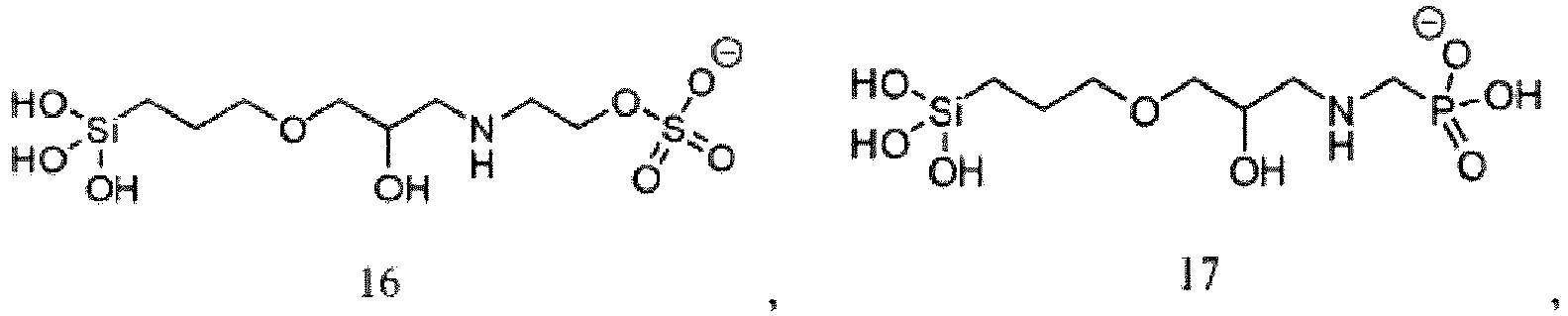


- Die Silanolverbindung nach Anspruch 1, wobei im Wesentlichen alle R1 Wasserstoff sind.
- Die Silanolverbindung nach einem der vorstehenden Ansprüche, wobei ein oder mehrere R4 ein Elektronenpaar ist, das an ein Wasserstoffatom koordiniert ist.
- Die Silanolverbindung nach einem der vorstehenden Ansprüche, wobei ein oder mehrere m 2 oder 3 ist.
- Die Silanolverbindung nach einem der vorstehenden Ansprüche, wobei mindestens ein G1 H ist.
- Die Silanolverbindung nach einem der vorstehenden Ansprüche, wobei a 2 ist.
- Die Silanolverbindung nach einem der vorstehenden Ansprüche, wobei mindestens ein G2 SO3 oder eine protonierte oder Salzform davon ist.
- Die Silanolverbindung nach einem der vorstehenden Ansprüche, wobei mindestens ein X Kohlenwasserstoffrest ist.
- Die Silanolverbindung nach einem der vorstehenden Ansprüche, wobei mindestens ein G2 POsH, CO2, OSO3, oder eine protonierte oder Salzform davon ist, und gegebenenfalls wobei jedes G2 POsH oder eine protonierte oder Salzform davon ist.
- Die Silanolverbindung nach einem der vorstehenden Ansprüche, wobei mindestens ein G1 OH ist, gegebenenfalls wobei genau ein G1 OH ist.
- Die Silanolverbindung nach einem der vorstehenden Ansprüche, wobei jedes X Kohlenwasserstoffrest ist.
- Die Silanolverbindung nach einem der vorstehenden Ansprüche, wobei mindestens ein X Kohlenwasserstoffrest ist, der durch ein O-Atom unterbrochen wird.
- Die Silanolverbindung nach einem der vorstehenden Ansprüche, wobei mindestens ein X die Einheit -OCH2CH(OH)-CH2- umfasst und wobei das CH2-Radikal an ein Stickstoffatom von Z kovalent gebunden ist.
- Ein Gegenstand, umfassend eine reinigbare Oberfläche, wobei der Gegenstand, umfassendein Substrat, das eine reaktive Oberfläche aufweist; undeinen Rest einer Silanolverbindung nach einem der vorstehenden Ansprüche, auf der reaktiven Oberfläche reagiert.
- Verwendung einer Silanolzusammensetzung, um einen Gegenstand herzustellen, umfassend eine reinigbare Oberfläche, durch Beschichten der Silanolzusammensetzung auf eine Oberfläche eines Substrats, das eine reaktive Fähigkeit aufweist, gefolgt von Trocknen und Aushärten, wobei die Silanolzusammensetzung Wasser und eine Silanolverbindung nach einem der Ansprüche 1 bis 13 umfasst.
Applications Claiming Priority (3)
| Application Number | Priority Date | Filing Date | Title |
|---|---|---|---|
| US201862747254P | 2018-10-18 | 2018-10-18 | |
| US201962902606P | 2019-09-19 | 2019-09-19 | |
| PCT/IB2019/058570 WO2020079530A1 (en) | 2018-10-18 | 2019-10-08 | Silanol compositions and methods of use |
Publications (2)
| Publication Number | Publication Date |
|---|---|
| EP3867309A1 EP3867309A1 (de) | 2021-08-25 |
| EP3867309B1 true EP3867309B1 (de) | 2024-07-17 |
Family
ID=68242802
Family Applications (1)
| Application Number | Title | Priority Date | Filing Date |
|---|---|---|---|
| EP19787466.2A Active EP3867309B1 (de) | 2018-10-18 | 2019-10-08 | Silanolzusammensetzungen und verfahren zur verwendung |
Country Status (5)
| Country | Link |
|---|---|
| US (1) | US12312495B2 (de) |
| EP (1) | EP3867309B1 (de) |
| CN (1) | CN113166485A (de) |
| TW (1) | TWI900470B (de) |
| WO (1) | WO2020079530A1 (de) |
Family Cites Families (24)
| Publication number | Priority date | Publication date | Assignee | Title |
|---|---|---|---|---|
| US5888594A (en) | 1996-11-05 | 1999-03-30 | Minnesota Mining And Manufacturing Company | Process for depositing a carbon-rich coating on a moving substrate |
| US6696157B1 (en) * | 2000-03-05 | 2004-02-24 | 3M Innovative Properties Company | Diamond-like glass thin films |
| CN102655953B (zh) | 2009-12-17 | 2015-09-16 | 3M创新有限公司 | 磺酸根官能涂层和方法 |
| JP5936552B2 (ja) | 2010-01-26 | 2016-06-22 | スリーエム イノベイティブ プロパティズ カンパニー | 低ゴースト発生の乾式消去物品及びその使用 |
| US20230183493A1 (en) * | 2010-06-22 | 2023-06-15 | 3M Innovative Properties Company | Articles with rewritable writing surfaces and methods for making and using same |
| WO2011163175A1 (en) | 2010-06-22 | 2011-12-29 | 3M Innovative Properties Company | Articles with rewritable writing surfaces and methods for making and using same |
| JP5790346B2 (ja) | 2011-02-10 | 2015-10-07 | 信越化学工業株式会社 | アミノ酸変性シラン化合物の製造方法 |
| EP2714653B1 (de) * | 2011-05-27 | 2017-05-03 | Fraunhofer Gesellschaft zur Förderung der angewandten Forschung E.V. | Verbindungen mit (meth)acrylat-resten und sulfonat- oder sulfatgruppen, polymere und kondensate daraus sowie verwendung der polymere und kondensate |
| DE202012013652U1 (de) * | 2011-12-29 | 2019-01-08 | 3M Innovative Properties Company | Reinigbare Gegenstände |
| CN102723528B (zh) * | 2012-06-06 | 2016-01-20 | 广州中科立新材料科技有限公司 | 两性离子液体电解质材料及其制备与在锂电池电解液中的应用 |
| WO2014209832A1 (en) * | 2013-06-28 | 2014-12-31 | 3M Innovative Properties Company | Article with silanol coating and method of making |
| SG11201604904XA (en) | 2013-12-16 | 2016-07-28 | 3M Innovative Properties Co | Detergent and rinse-aid compositions and methods |
| WO2015143262A1 (en) | 2014-03-21 | 2015-09-24 | 3M Innovative Properties Company | Method of coalescing a discontinuous oleophilic phase in aqueous mixtures |
| WO2015143163A1 (en) | 2014-03-21 | 2015-09-24 | 3M Innovative Properties Company | Coalescing a discontinuous oleophilic phase in aqueous mixtures with zwiterionic particles |
| CN106232696B (zh) | 2014-04-24 | 2020-06-05 | 3M创新有限公司 | 具有亲水表面的流体控制膜、其制造方法以及用于清洁结构化表面的方法 |
| EP3194517B1 (de) | 2014-09-18 | 2019-10-23 | 3M Innovative Properties Company | Wässrige zusammensetzungen zur beschichtung von metallischen oberflächen, verfahren und artikel |
| US9340562B1 (en) | 2014-10-29 | 2016-05-17 | Thermo Electron Manufacturing Limited | Chromatographic material and method for preparation thereof |
| BR112017019459A2 (pt) | 2015-03-13 | 2018-05-15 | 3M Innovative Properties Co | composição, método de proteção e de limpeza de um artigo e artigo |
| JP6733322B2 (ja) * | 2016-06-03 | 2020-07-29 | 株式会社成和化成 | 化粧品基材および該化粧品基材を含有する化粧料 |
| CA3026651A1 (en) * | 2016-06-09 | 2017-12-14 | Blinkbio, Inc. | Silanol based therapeutic payloads |
| EP3293233B1 (de) | 2016-09-13 | 2019-04-10 | 3M Innovative Properties Company | Wässrige schutzbeschichtungszusammensetzung für chromoberflächen |
| JP6531124B2 (ja) | 2016-10-07 | 2019-06-12 | 株式会社Kri | スルホベタイン系ケイ素系化合物の製造方法 |
| CN107987722B (zh) | 2017-11-30 | 2019-11-05 | 深圳南玻应用技术有限公司 | 有机硅杀菌液、有机硅杀菌剂、抗菌玻璃、其制备方法及应用 |
| CN108003327A (zh) * | 2017-12-27 | 2018-05-08 | 湖南辰砾新材料有限公司 | 一种阴离子型有机硅改性环氧树脂水性固化剂及其制备方法 |
-
2019
- 2019-10-08 EP EP19787466.2A patent/EP3867309B1/de active Active
- 2019-10-08 US US17/284,521 patent/US12312495B2/en active Active
- 2019-10-08 CN CN201980077656.4A patent/CN113166485A/zh not_active Withdrawn
- 2019-10-08 WO PCT/IB2019/058570 patent/WO2020079530A1/en not_active Ceased
- 2019-10-17 TW TW108137489A patent/TWI900470B/zh active
Also Published As
| Publication number | Publication date |
|---|---|
| US20210340404A1 (en) | 2021-11-04 |
| CN113166485A (zh) | 2021-07-23 |
| EP3867309A1 (de) | 2021-08-25 |
| WO2020079530A1 (en) | 2020-04-23 |
| TW202028213A (zh) | 2020-08-01 |
| US12312495B2 (en) | 2025-05-27 |
| TWI900470B (zh) | 2025-10-11 |
Similar Documents
| Publication | Publication Date | Title |
|---|---|---|
| JP5980205B2 (ja) | 再書き込み可能な書き込み表面を有する物品並びにその製造方法及び使用方法 | |
| RU2519258C2 (ru) | Покрытие на основе двуокиси кремния для повышенной гидрофильности | |
| EP1941075B1 (de) | Polymere organometallische schichten | |
| ES2736698T3 (es) | Proceso para producir un recubrimiento de reparación en una superficie metálica recubierta | |
| ES2226500T3 (es) | Composicion para formar sobre un sustrato un revestimiento resistente a la abrasion y que presenta una adherencia y resistencia a la formacion de grietas mejoradas. | |
| EP1955638A1 (de) | Chemische Lappen | |
| JP5631640B2 (ja) | 防曇剤組成物 | |
| EP3642271B1 (de) | Filme mit einer primerschicht mit kompositpartikeln mit einem organischen polymerteil und einem kieselsäureteil | |
| EP3867309B1 (de) | Silanolzusammensetzungen und verfahren zur verwendung | |
| WO2022074495A1 (en) | Hardcoat composition comprising methyl or ethyl trialkoxy silane, articles and methods | |
| JP4840899B2 (ja) | 親水防汚コーティング組成物、それを用いた被膜の形成方法及び用途 | |
| JPWO2007119805A1 (ja) | リン酸エステル化合物を含有する被膜形成用塗布液及び反射防止膜 | |
| US20230183493A1 (en) | Articles with rewritable writing surfaces and methods for making and using same | |
| JP2012194359A (ja) | 眼鏡レンズの製造方法 | |
| CN111801223A (zh) | 补充可书写可清洁制品的方法和套件 | |
| CN111041838B (zh) | 一种湿纸巾及其制备方法和应用 | |
| KR20140130207A (ko) | 수성 조성물 및 그의 용도 |
Legal Events
| Date | Code | Title | Description |
|---|---|---|---|
| STAA | Information on the status of an ep patent application or granted ep patent |
Free format text: STATUS: UNKNOWN |
|
| STAA | Information on the status of an ep patent application or granted ep patent |
Free format text: STATUS: THE INTERNATIONAL PUBLICATION HAS BEEN MADE |
|
| PUAI | Public reference made under article 153(3) epc to a published international application that has entered the european phase |
Free format text: ORIGINAL CODE: 0009012 |
|
| STAA | Information on the status of an ep patent application or granted ep patent |
Free format text: STATUS: REQUEST FOR EXAMINATION WAS MADE |
|
| 17P | Request for examination filed |
Effective date: 20210407 |
|
| AK | Designated contracting states |
Kind code of ref document: A1 Designated state(s): AL AT BE BG CH CY CZ DE DK EE ES FI FR GB GR HR HU IE IS IT LI LT LU LV MC MK MT NL NO PL PT RO RS SE SI SK SM TR |
|
| DAV | Request for validation of the european patent (deleted) | ||
| DAX | Request for extension of the european patent (deleted) | ||
| STAA | Information on the status of an ep patent application or granted ep patent |
Free format text: STATUS: EXAMINATION IS IN PROGRESS |
|
| 17Q | First examination report despatched |
Effective date: 20220502 |
|
| GRAP | Despatch of communication of intention to grant a patent |
Free format text: ORIGINAL CODE: EPIDOSNIGR1 |
|
| STAA | Information on the status of an ep patent application or granted ep patent |
Free format text: STATUS: GRANT OF PATENT IS INTENDED |
|
| INTG | Intention to grant announced |
Effective date: 20240220 |
|
| P01 | Opt-out of the competence of the unified patent court (upc) registered |
Effective date: 20240416 |
|
| GRAS | Grant fee paid |
Free format text: ORIGINAL CODE: EPIDOSNIGR3 |
|
| GRAA | (expected) grant |
Free format text: ORIGINAL CODE: 0009210 |
|
| STAA | Information on the status of an ep patent application or granted ep patent |
Free format text: STATUS: THE PATENT HAS BEEN GRANTED |
|
| AK | Designated contracting states |
Kind code of ref document: B1 Designated state(s): AL AT BE BG CH CY CZ DE DK EE ES FI FR GB GR HR HU IE IS IT LI LT LU LV MC MK MT NL NO PL PT RO RS SE SI SK SM TR |
|
| REG | Reference to a national code |
Ref country code: CH Ref legal event code: EP |
|
| REG | Reference to a national code |
Ref country code: DE Ref legal event code: R096 Ref document number: 602019055409 Country of ref document: DE |
|
| REG | Reference to a national code |
Ref country code: IE Ref legal event code: FG4D |
|
| REG | Reference to a national code |
Ref country code: LT Ref legal event code: MG9D |
|
| REG | Reference to a national code |
Ref country code: NL Ref legal event code: MP Effective date: 20240717 |
|
| PG25 | Lapsed in a contracting state [announced via postgrant information from national office to epo] |
Ref country code: PT Free format text: LAPSE BECAUSE OF FAILURE TO SUBMIT A TRANSLATION OF THE DESCRIPTION OR TO PAY THE FEE WITHIN THE PRESCRIBED TIME-LIMIT Effective date: 20241118 |
|
| REG | Reference to a national code |
Ref country code: AT Ref legal event code: MK05 Ref document number: 1704102 Country of ref document: AT Kind code of ref document: T Effective date: 20240717 |
|
| PG25 | Lapsed in a contracting state [announced via postgrant information from national office to epo] |
Ref country code: NL Free format text: LAPSE BECAUSE OF FAILURE TO SUBMIT A TRANSLATION OF THE DESCRIPTION OR TO PAY THE FEE WITHIN THE PRESCRIBED TIME-LIMIT Effective date: 20240717 |
|
| PG25 | Lapsed in a contracting state [announced via postgrant information from national office to epo] |
Ref country code: PT Free format text: LAPSE BECAUSE OF FAILURE TO SUBMIT A TRANSLATION OF THE DESCRIPTION OR TO PAY THE FEE WITHIN THE PRESCRIBED TIME-LIMIT Effective date: 20241118 Ref country code: NL Free format text: LAPSE BECAUSE OF FAILURE TO SUBMIT A TRANSLATION OF THE DESCRIPTION OR TO PAY THE FEE WITHIN THE PRESCRIBED TIME-LIMIT Effective date: 20240717 |
|
| PG25 | Lapsed in a contracting state [announced via postgrant information from national office to epo] |
Ref country code: NO Free format text: LAPSE BECAUSE OF FAILURE TO SUBMIT A TRANSLATION OF THE DESCRIPTION OR TO PAY THE FEE WITHIN THE PRESCRIBED TIME-LIMIT Effective date: 20241017 |
|
| PG25 | Lapsed in a contracting state [announced via postgrant information from national office to epo] |
Ref country code: GR Free format text: LAPSE BECAUSE OF FAILURE TO SUBMIT A TRANSLATION OF THE DESCRIPTION OR TO PAY THE FEE WITHIN THE PRESCRIBED TIME-LIMIT Effective date: 20241018 Ref country code: FI Free format text: LAPSE BECAUSE OF FAILURE TO SUBMIT A TRANSLATION OF THE DESCRIPTION OR TO PAY THE FEE WITHIN THE PRESCRIBED TIME-LIMIT Effective date: 20240717 Ref country code: PL Free format text: LAPSE BECAUSE OF FAILURE TO SUBMIT A TRANSLATION OF THE DESCRIPTION OR TO PAY THE FEE WITHIN THE PRESCRIBED TIME-LIMIT Effective date: 20240717 |
|
| PG25 | Lapsed in a contracting state [announced via postgrant information from national office to epo] |
Ref country code: BG Free format text: LAPSE BECAUSE OF FAILURE TO SUBMIT A TRANSLATION OF THE DESCRIPTION OR TO PAY THE FEE WITHIN THE PRESCRIBED TIME-LIMIT Effective date: 20240717 |
|
| PG25 | Lapsed in a contracting state [announced via postgrant information from national office to epo] |
Ref country code: LV Free format text: LAPSE BECAUSE OF FAILURE TO SUBMIT A TRANSLATION OF THE DESCRIPTION OR TO PAY THE FEE WITHIN THE PRESCRIBED TIME-LIMIT Effective date: 20240717 |
|
| PG25 | Lapsed in a contracting state [announced via postgrant information from national office to epo] |
Ref country code: AT Free format text: LAPSE BECAUSE OF FAILURE TO SUBMIT A TRANSLATION OF THE DESCRIPTION OR TO PAY THE FEE WITHIN THE PRESCRIBED TIME-LIMIT Effective date: 20240717 Ref country code: IS Free format text: LAPSE BECAUSE OF FAILURE TO SUBMIT A TRANSLATION OF THE DESCRIPTION OR TO PAY THE FEE WITHIN THE PRESCRIBED TIME-LIMIT Effective date: 20241117 |
|
| PG25 | Lapsed in a contracting state [announced via postgrant information from national office to epo] |
Ref country code: HR Free format text: LAPSE BECAUSE OF FAILURE TO SUBMIT A TRANSLATION OF THE DESCRIPTION OR TO PAY THE FEE WITHIN THE PRESCRIBED TIME-LIMIT Effective date: 20240717 |
|
| PG25 | Lapsed in a contracting state [announced via postgrant information from national office to epo] |
Ref country code: ES Free format text: LAPSE BECAUSE OF FAILURE TO SUBMIT A TRANSLATION OF THE DESCRIPTION OR TO PAY THE FEE WITHIN THE PRESCRIBED TIME-LIMIT Effective date: 20240717 Ref country code: RS Free format text: LAPSE BECAUSE OF FAILURE TO SUBMIT A TRANSLATION OF THE DESCRIPTION OR TO PAY THE FEE WITHIN THE PRESCRIBED TIME-LIMIT Effective date: 20241017 |
|
| PG25 | Lapsed in a contracting state [announced via postgrant information from national office to epo] |
Ref country code: RS Free format text: LAPSE BECAUSE OF FAILURE TO SUBMIT A TRANSLATION OF THE DESCRIPTION OR TO PAY THE FEE WITHIN THE PRESCRIBED TIME-LIMIT Effective date: 20241017 Ref country code: PL Free format text: LAPSE BECAUSE OF FAILURE TO SUBMIT A TRANSLATION OF THE DESCRIPTION OR TO PAY THE FEE WITHIN THE PRESCRIBED TIME-LIMIT Effective date: 20240717 Ref country code: NO Free format text: LAPSE BECAUSE OF FAILURE TO SUBMIT A TRANSLATION OF THE DESCRIPTION OR TO PAY THE FEE WITHIN THE PRESCRIBED TIME-LIMIT Effective date: 20241017 Ref country code: LV Free format text: LAPSE BECAUSE OF FAILURE TO SUBMIT A TRANSLATION OF THE DESCRIPTION OR TO PAY THE FEE WITHIN THE PRESCRIBED TIME-LIMIT Effective date: 20240717 Ref country code: IS Free format text: LAPSE BECAUSE OF FAILURE TO SUBMIT A TRANSLATION OF THE DESCRIPTION OR TO PAY THE FEE WITHIN THE PRESCRIBED TIME-LIMIT Effective date: 20241117 Ref country code: HR Free format text: LAPSE BECAUSE OF FAILURE TO SUBMIT A TRANSLATION OF THE DESCRIPTION OR TO PAY THE FEE WITHIN THE PRESCRIBED TIME-LIMIT Effective date: 20240717 Ref country code: GR Free format text: LAPSE BECAUSE OF FAILURE TO SUBMIT A TRANSLATION OF THE DESCRIPTION OR TO PAY THE FEE WITHIN THE PRESCRIBED TIME-LIMIT Effective date: 20241018 Ref country code: FI Free format text: LAPSE BECAUSE OF FAILURE TO SUBMIT A TRANSLATION OF THE DESCRIPTION OR TO PAY THE FEE WITHIN THE PRESCRIBED TIME-LIMIT Effective date: 20240717 Ref country code: ES Free format text: LAPSE BECAUSE OF FAILURE TO SUBMIT A TRANSLATION OF THE DESCRIPTION OR TO PAY THE FEE WITHIN THE PRESCRIBED TIME-LIMIT Effective date: 20240717 Ref country code: BG Free format text: LAPSE BECAUSE OF FAILURE TO SUBMIT A TRANSLATION OF THE DESCRIPTION OR TO PAY THE FEE WITHIN THE PRESCRIBED TIME-LIMIT Effective date: 20240717 Ref country code: AT Free format text: LAPSE BECAUSE OF FAILURE TO SUBMIT A TRANSLATION OF THE DESCRIPTION OR TO PAY THE FEE WITHIN THE PRESCRIBED TIME-LIMIT Effective date: 20240717 |
|
| PG25 | Lapsed in a contracting state [announced via postgrant information from national office to epo] |
Ref country code: RO Free format text: LAPSE BECAUSE OF FAILURE TO SUBMIT A TRANSLATION OF THE DESCRIPTION OR TO PAY THE FEE WITHIN THE PRESCRIBED TIME-LIMIT Effective date: 20240717 Ref country code: DK Free format text: LAPSE BECAUSE OF FAILURE TO SUBMIT A TRANSLATION OF THE DESCRIPTION OR TO PAY THE FEE WITHIN THE PRESCRIBED TIME-LIMIT Effective date: 20240717 Ref country code: SM Free format text: LAPSE BECAUSE OF FAILURE TO SUBMIT A TRANSLATION OF THE DESCRIPTION OR TO PAY THE FEE WITHIN THE PRESCRIBED TIME-LIMIT Effective date: 20240717 |
|
| REG | Reference to a national code |
Ref country code: DE Ref legal event code: R097 Ref document number: 602019055409 Country of ref document: DE |
|
| PG25 | Lapsed in a contracting state [announced via postgrant information from national office to epo] |
Ref country code: EE Free format text: LAPSE BECAUSE OF FAILURE TO SUBMIT A TRANSLATION OF THE DESCRIPTION OR TO PAY THE FEE WITHIN THE PRESCRIBED TIME-LIMIT Effective date: 20240717 |
|
| PG25 | Lapsed in a contracting state [announced via postgrant information from national office to epo] |
Ref country code: CZ Free format text: LAPSE BECAUSE OF FAILURE TO SUBMIT A TRANSLATION OF THE DESCRIPTION OR TO PAY THE FEE WITHIN THE PRESCRIBED TIME-LIMIT Effective date: 20240717 |
|
| PG25 | Lapsed in a contracting state [announced via postgrant information from national office to epo] |
Ref country code: SK Free format text: LAPSE BECAUSE OF FAILURE TO SUBMIT A TRANSLATION OF THE DESCRIPTION OR TO PAY THE FEE WITHIN THE PRESCRIBED TIME-LIMIT Effective date: 20240717 |
|
| PLBE | No opposition filed within time limit |
Free format text: ORIGINAL CODE: 0009261 |
|
| STAA | Information on the status of an ep patent application or granted ep patent |
Free format text: STATUS: NO OPPOSITION FILED WITHIN TIME LIMIT |
|
| REG | Reference to a national code |
Ref country code: CH Ref legal event code: PL |
|
| 26N | No opposition filed |
Effective date: 20250422 |
|
| GBPC | Gb: european patent ceased through non-payment of renewal fee |
Effective date: 20241017 |
|
| PG25 | Lapsed in a contracting state [announced via postgrant information from national office to epo] |
Ref country code: MC Free format text: LAPSE BECAUSE OF FAILURE TO SUBMIT A TRANSLATION OF THE DESCRIPTION OR TO PAY THE FEE WITHIN THE PRESCRIBED TIME-LIMIT Effective date: 20240717 |
|
| PG25 | Lapsed in a contracting state [announced via postgrant information from national office to epo] |
Ref country code: GB Free format text: LAPSE BECAUSE OF NON-PAYMENT OF DUE FEES Effective date: 20241017 |
|
| PG25 | Lapsed in a contracting state [announced via postgrant information from national office to epo] |
Ref country code: LU Free format text: LAPSE BECAUSE OF NON-PAYMENT OF DUE FEES Effective date: 20241008 Ref country code: BE Free format text: LAPSE BECAUSE OF NON-PAYMENT OF DUE FEES Effective date: 20241031 |
|
| PG25 | Lapsed in a contracting state [announced via postgrant information from national office to epo] |
Ref country code: FR Free format text: LAPSE BECAUSE OF NON-PAYMENT OF DUE FEES Effective date: 20241031 |
|
| PG25 | Lapsed in a contracting state [announced via postgrant information from national office to epo] |
Ref country code: CH Free format text: LAPSE BECAUSE OF NON-PAYMENT OF DUE FEES Effective date: 20241031 |
|
| REG | Reference to a national code |
Ref country code: BE Ref legal event code: MM Effective date: 20241031 |
|
| PG25 | Lapsed in a contracting state [announced via postgrant information from national office to epo] |
Ref country code: SE Free format text: LAPSE BECAUSE OF FAILURE TO SUBMIT A TRANSLATION OF THE DESCRIPTION OR TO PAY THE FEE WITHIN THE PRESCRIBED TIME-LIMIT Effective date: 20240717 |
|
| PG25 | Lapsed in a contracting state [announced via postgrant information from national office to epo] |
Ref country code: IE Free format text: LAPSE BECAUSE OF NON-PAYMENT OF DUE FEES Effective date: 20241008 |
|
| PGFP | Annual fee paid to national office [announced via postgrant information from national office to epo] |
Ref country code: DE Payment date: 20250923 Year of fee payment: 7 |
|
| PG25 | Lapsed in a contracting state [announced via postgrant information from national office to epo] |
Ref country code: IT Free format text: LAPSE BECAUSE OF FAILURE TO SUBMIT A TRANSLATION OF THE DESCRIPTION OR TO PAY THE FEE WITHIN THE PRESCRIBED TIME-LIMIT Effective date: 20240717 Ref country code: CY Free format text: LAPSE BECAUSE OF FAILURE TO SUBMIT A TRANSLATION OF THE DESCRIPTION OR TO PAY THE FEE WITHIN THE PRESCRIBED TIME-LIMIT; INVALID AB INITIO Effective date: 20191008 |
|
| PG25 | Lapsed in a contracting state [announced via postgrant information from national office to epo] |
Ref country code: HU Free format text: LAPSE BECAUSE OF FAILURE TO SUBMIT A TRANSLATION OF THE DESCRIPTION OR TO PAY THE FEE WITHIN THE PRESCRIBED TIME-LIMIT; INVALID AB INITIO Effective date: 20191008 |