EP3865320B1 - Tire abnormality detection device and its detection method - Google Patents
Tire abnormality detection device and its detection method Download PDFInfo
- Publication number
- EP3865320B1 EP3865320B1 EP21156775.5A EP21156775A EP3865320B1 EP 3865320 B1 EP3865320 B1 EP 3865320B1 EP 21156775 A EP21156775 A EP 21156775A EP 3865320 B1 EP3865320 B1 EP 3865320B1
- Authority
- EP
- European Patent Office
- Prior art keywords
- tire
- data value
- sensor
- abnormality detection
- module
- Prior art date
- Legal status (The legal status is an assumption and is not a legal conclusion. Google has not performed a legal analysis and makes no representation as to the accuracy of the status listed.)
- Active
Links
Images


Classifications
-
- B—PERFORMING OPERATIONS; TRANSPORTING
- B60—VEHICLES IN GENERAL
- B60C—VEHICLE TYRES; TYRE INFLATION; TYRE CHANGING; CONNECTING VALVES TO INFLATABLE ELASTIC BODIES IN GENERAL; DEVICES OR ARRANGEMENTS RELATED TO TYRES
- B60C23/00—Devices for measuring, signalling, controlling, or distributing tyre pressure or temperature, specially adapted for mounting on vehicles; Arrangement of tyre inflating devices on vehicles, e.g. of pumps or of tanks; Tyre cooling arrangements
- B60C23/06—Signalling devices actuated by deformation of the tyre, e.g. tyre mounted deformation sensors or indirect determination of tyre deformation based on wheel speed, wheel-centre to ground distance or inclination of wheel axle
- B60C23/064—Signalling devices actuated by deformation of the tyre, e.g. tyre mounted deformation sensors or indirect determination of tyre deformation based on wheel speed, wheel-centre to ground distance or inclination of wheel axle comprising tyre mounted deformation sensors, e.g. to determine road contact area
-
- B—PERFORMING OPERATIONS; TRANSPORTING
- B60—VEHICLES IN GENERAL
- B60C—VEHICLE TYRES; TYRE INFLATION; TYRE CHANGING; CONNECTING VALVES TO INFLATABLE ELASTIC BODIES IN GENERAL; DEVICES OR ARRANGEMENTS RELATED TO TYRES
- B60C23/00—Devices for measuring, signalling, controlling, or distributing tyre pressure or temperature, specially adapted for mounting on vehicles; Arrangement of tyre inflating devices on vehicles, e.g. of pumps or of tanks; Tyre cooling arrangements
- B60C23/02—Signalling devices actuated by tyre pressure
- B60C23/04—Signalling devices actuated by tyre pressure mounted on the wheel or tyre
- B60C23/0408—Signalling devices actuated by tyre pressure mounted on the wheel or tyre transmitting the signals by non-mechanical means from the wheel or tyre to a vehicle body mounted receiver
- B60C23/0474—Measurement control, e.g. setting measurement rate or calibrating of sensors; Further processing of measured values, e.g. filtering, compensating or slope monitoring
-
- B—PERFORMING OPERATIONS; TRANSPORTING
- B60—VEHICLES IN GENERAL
- B60C—VEHICLE TYRES; TYRE INFLATION; TYRE CHANGING; CONNECTING VALVES TO INFLATABLE ELASTIC BODIES IN GENERAL; DEVICES OR ARRANGEMENTS RELATED TO TYRES
- B60C23/00—Devices for measuring, signalling, controlling, or distributing tyre pressure or temperature, specially adapted for mounting on vehicles; Arrangement of tyre inflating devices on vehicles, e.g. of pumps or of tanks; Tyre cooling arrangements
- B60C23/02—Signalling devices actuated by tyre pressure
- B60C23/04—Signalling devices actuated by tyre pressure mounted on the wheel or tyre
- B60C23/0408—Signalling devices actuated by tyre pressure mounted on the wheel or tyre transmitting the signals by non-mechanical means from the wheel or tyre to a vehicle body mounted receiver
-
- B—PERFORMING OPERATIONS; TRANSPORTING
- B60—VEHICLES IN GENERAL
- B60C—VEHICLE TYRES; TYRE INFLATION; TYRE CHANGING; CONNECTING VALVES TO INFLATABLE ELASTIC BODIES IN GENERAL; DEVICES OR ARRANGEMENTS RELATED TO TYRES
- B60C23/00—Devices for measuring, signalling, controlling, or distributing tyre pressure or temperature, specially adapted for mounting on vehicles; Arrangement of tyre inflating devices on vehicles, e.g. of pumps or of tanks; Tyre cooling arrangements
-
- B—PERFORMING OPERATIONS; TRANSPORTING
- B60—VEHICLES IN GENERAL
- B60C—VEHICLE TYRES; TYRE INFLATION; TYRE CHANGING; CONNECTING VALVES TO INFLATABLE ELASTIC BODIES IN GENERAL; DEVICES OR ARRANGEMENTS RELATED TO TYRES
- B60C23/00—Devices for measuring, signalling, controlling, or distributing tyre pressure or temperature, specially adapted for mounting on vehicles; Arrangement of tyre inflating devices on vehicles, e.g. of pumps or of tanks; Tyre cooling arrangements
- B60C23/02—Signalling devices actuated by tyre pressure
-
- B—PERFORMING OPERATIONS; TRANSPORTING
- B60—VEHICLES IN GENERAL
- B60C—VEHICLE TYRES; TYRE INFLATION; TYRE CHANGING; CONNECTING VALVES TO INFLATABLE ELASTIC BODIES IN GENERAL; DEVICES OR ARRANGEMENTS RELATED TO TYRES
- B60C23/00—Devices for measuring, signalling, controlling, or distributing tyre pressure or temperature, specially adapted for mounting on vehicles; Arrangement of tyre inflating devices on vehicles, e.g. of pumps or of tanks; Tyre cooling arrangements
- B60C23/02—Signalling devices actuated by tyre pressure
- B60C23/04—Signalling devices actuated by tyre pressure mounted on the wheel or tyre
- B60C23/0486—Signalling devices actuated by tyre pressure mounted on the wheel or tyre comprising additional sensors in the wheel or tyre mounted monitoring device, e.g. movement sensors, microphones or earth magnetic field sensors
- B60C23/0488—Movement sensor, e.g. for sensing angular speed, acceleration or centripetal force
-
- B—PERFORMING OPERATIONS; TRANSPORTING
- B60—VEHICLES IN GENERAL
- B60C—VEHICLE TYRES; TYRE INFLATION; TYRE CHANGING; CONNECTING VALVES TO INFLATABLE ELASTIC BODIES IN GENERAL; DEVICES OR ARRANGEMENTS RELATED TO TYRES
- B60C23/00—Devices for measuring, signalling, controlling, or distributing tyre pressure or temperature, specially adapted for mounting on vehicles; Arrangement of tyre inflating devices on vehicles, e.g. of pumps or of tanks; Tyre cooling arrangements
- B60C23/02—Signalling devices actuated by tyre pressure
- B60C23/04—Signalling devices actuated by tyre pressure mounted on the wheel or tyre
- B60C23/0491—Constructional details of means for attaching the control device
- B60C23/0493—Constructional details of means for attaching the control device for attachment on the tyre
-
- B—PERFORMING OPERATIONS; TRANSPORTING
- B60—VEHICLES IN GENERAL
- B60C—VEHICLE TYRES; TYRE INFLATION; TYRE CHANGING; CONNECTING VALVES TO INFLATABLE ELASTIC BODIES IN GENERAL; DEVICES OR ARRANGEMENTS RELATED TO TYRES
- B60C23/00—Devices for measuring, signalling, controlling, or distributing tyre pressure or temperature, specially adapted for mounting on vehicles; Arrangement of tyre inflating devices on vehicles, e.g. of pumps or of tanks; Tyre cooling arrangements
- B60C23/20—Devices for measuring or signalling tyre temperature only
-
- B—PERFORMING OPERATIONS; TRANSPORTING
- B60—VEHICLES IN GENERAL
- B60W—CONJOINT CONTROL OF VEHICLE SUB-UNITS OF DIFFERENT TYPE OR DIFFERENT FUNCTION; CONTROL SYSTEMS SPECIALLY ADAPTED FOR HYBRID VEHICLES; ROAD VEHICLE DRIVE CONTROL SYSTEMS FOR PURPOSES NOT RELATED TO THE CONTROL OF A PARTICULAR SUB-UNIT
- B60W50/00—Details of control systems for road vehicle drive control not related to the control of a particular sub-unit, e.g. process diagnostic or vehicle driver interfaces
- B60W50/08—Interaction between the driver and the control system
- B60W50/14—Means for informing the driver, warning the driver or prompting a driver intervention
-
- G—PHYSICS
- G01—MEASURING; TESTING
- G01M—TESTING STATIC OR DYNAMIC BALANCE OF MACHINES OR STRUCTURES; TESTING OF STRUCTURES OR APPARATUS, NOT OTHERWISE PROVIDED FOR
- G01M17/00—Testing of vehicles
- G01M17/007—Wheeled or endless-tracked vehicles
- G01M17/06—Steering behaviour; Rolling behaviour
-
- G—PHYSICS
- G01—MEASURING; TESTING
- G01M—TESTING STATIC OR DYNAMIC BALANCE OF MACHINES OR STRUCTURES; TESTING OF STRUCTURES OR APPARATUS, NOT OTHERWISE PROVIDED FOR
- G01M3/00—Investigating fluid-tightness of structures
- G01M3/02—Investigating fluid-tightness of structures by using fluid or vacuum
- G01M3/04—Investigating fluid-tightness of structures by using fluid or vacuum by detecting the presence of fluid at the leakage point
Definitions
- the present invention relates to a tire abnormality detection device and a detection method thereof, and more particularly, to a tire abnormality detection device and a detection method thereof capable of lowering a possibility of accident by determining an abnormal state of a tire.
- a wireless system is used to measure internal information of a tire.
- Korean Patent Laid-Open Publication No. 2014-0067431 proposes a technology of embedding a piezoelectric sensor in a tire and determining a position of the piezoelectric sensor according to a deformation thereof. More specifically, an algorithm for generating a signal through a change in tensile force and determining a condition of a tire through a comparison table pre-stored in a memory in a circuit has been proposed.
- a method of comparing real-time measured data with a table and a method of using a peak value but correcting data with an average value and comparing the corrected data with a table have a time delay, and therefore are difficult to apply to an algorithm for determining an accident in real time.
- the method of using an average value may have reliability for one or two incorrect data, but has a disadvantage of causing a system error or an error that is recognized as an intermediate value when abnormal data repeatedly appears as the highest or lowest.
- Korean Patent Laid-Open Publication No. 2004-0026947 discloses a time delay algorithm that detects a vehicle height, performs monitoring for a certain period of time, and generates an error signal when exceeding a set value.
- the method may secure the reliability of the algorithm through the time delay, but has a disadvantage in that an alarm may be delayed due to the time delay in case of the unexpected accident and thus the determination on the accident may be delayed.
- the time delay algorithm is an algorithm for determining abnormality immediately after a stopped vehicle starts.
- the time delay may be applied, but there is a difference from an algorithm for determining an accident by comparing real-time data while actual running.
- Korean Patent Laid-Open Publication No. 2005-0013762 discloses a method of measuring air pressure using TPMS, storing the measured air pressure in data, comparing the data with previous data, and then comparing driving stages of a tire.
- Such method is not a method of storing real-time data, and is a method of storing the existing value and then not storing currently measured data if there is no difference from current data, and storing the currently measured data if there is a difference from the current data.
- the currently measured and the previous data are not stored because there is no significant difference over time, but a difference between initial data and data after several hours or tens of minutes may occur outside a critical range.
- the system may not be able to confirm that the air pressure of the tire is lowered by comparing the current data with the previous data.
- Korean Patent No. 10-1843256 proposed a method of determining an abnormal state of a tire, and proposed an algorithm for determining an abnormal state of a tire and checking the abnormal state of the tire again at regular intervals to determine whether it is a continuous accident or a temporary abnormality.
- Such a system can determine the abnormal state of the tire when there is an abnormality in all tires, but is difficult to determine a small abnormal state starting from some of the tires.
- EP 1 794 007 A1 describes a method and a system for determining a cornering angle of a tire fitted on a vehicle during a running of said vehicle on a rolling surface.
- the method comprises the steps of: determining the lateral acceleration of a portion of the tire tread spaced apart from the equatorial plane of said tire; determining a rotation speed of said tire; and determining said cornering angle from said lateral acceleration and said radial speed, by using characteristic curves of lateral acceleration amplitude versus predetermined values of cornering angle for at least one rotation speed.
- An object of the present invention is to provide a tire abnormality detection device and an abnormality detection method thereof capable of reducing a possibility of accident by determining an abnormal state of a tire.
- a tire abnormality detection device including: an MCU module that is located at a center of a surface of a tire inner liner; a first sensor module that is formed on one side of the MCU module in a width direction of the inner liner; and a second sensor module that is formed on the other side of the MCU module in the width direction of the inner liner, in which the first sensor module and the second sensor module are symmetrically located with respect to the MCU module.
- the MCU module compares a first data value measured by the first sensor module and a second data value measured by the second sensor module to determine whether the tire is abnormal.
- the first sensor module and the second sensor module may be provided to measure at least any one of internal air pressure, internal temperature, acceleration, vibration, and noise of the tire.
- the first sensor module may include: a first belt sensor that is attached to an end of a belt of the tire; a first filler sensor that is attached to an end of a bead filler of the tire; and a first bead sensor that is attached to an end portion of a bead wire of the tire.
- the second sensor module may include: a second belt sensor that is attached to an end of a belt of the tire; a second filler sensor that is attached to an end of a bead filler of the tire; and a second bead sensor that is attached to an end portion of a bead wire of the tire.
- the MCU module may be configured to determine that the abnormality occurred when a difference between the first data value and the second data value is 20% to 30% or more.
- the first sensor modules and second sensor modules may be provided in plurality to be spaced apart from each other along a running direction of the tire.
- the plurality of first sensor modules and second sensor modules may be provided to be spaced apart from each other by an interval of 10° to 120° along the running direction of the tire.
- an abnormality detection method of the tire abnormality detection device including: a) obtaining, by the MCU module a first data by measuring condition information of the tire using the first sensor module; b) obtaining, by the MCU module, a second data value by measuring condition information of the tire using the second sensor module; c) determining, by the MCU module, whether the tire is abnormal by comparing the obtained first data value and second data value; and d) taking a safety measure according to the difference between the first data value and the second data value when it is determined that the tire is abnormal.
- the condition information of the tire may include at least any one of internal air pressure, internal temperature, acceleration, vibration, and noise of the tire.
- step c) when a difference between a first data value measured by the first sensor module and a second data value measured by the second sensor module provided at a location symmetrical to the first sensor module exceeds a threshold value, it may be determined that the tire is abnormal.
- the threshold value may be a preset value from 20% to 30%.
- step d) when a difference between a first data value and a second data value exceeds the threshold value, an alarm may be provided to a driver, when the difference between the first data value and the second data value exceeds 50%, a risk of damage to the tire may be notified through a vehicle alarm, and when the difference between the first data value and the second data value exceeds 65%, a vehicle operation may decelerate and stop.
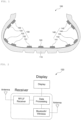
- FIG. 1 is an exemplary diagram of a tire abnormality detection device according to an embodiment of the present invention
- FIG. 2 is an exemplary diagram illustrating a configuration of an MCU module according to an embodiment of the present invention
- FIG. 3 is an exemplary view in which a first sensor module and a second sensor module are formed in one row according to an embodiment of the present invention.
- a tire abnormality detection device 100 includes an inner liner 110, an MCU module 120, a first sensor module 130, and a second sensor module 140, in which the first sensor module 130 and the second sensor module 140 are provided at locations symmetrical to each other with respect to the MCU module 120.
- the MCU module 120, the first sensor module 130, and the second sensor module 140 may be attached to a surface of the inner liner 110, and may be attached using an adhesive or a sticker.
- the MCU module 120 is located at a center of the surface of the tire inner liner 110.
- the MCU module 120 may be configured to include a radio frequency and low frequency receiver (RF/LF receiver), a data processing unit, Bluetooth, a power supply, an antenna, and an A/D converter.
- RF/LF receiver radio frequency and low frequency receiver
- the MCU module 120 is configured to receive condition information of a tire measured by the first sensor module 130 and the second sensor module 140, and is configured to determine an abnormality state according to the received condition information of the tire.
- the MCU module 120 is configured to compare a first data value measured by the first sensor module 130 and a second data value measured by the second sensor module 140 provided at a location symmetrical to the first sensor module 130 to determine whether the tire is abnormal.
- the MCU module 120 is configured to take measures accordingly.
- the first sensor module 130 may be formed on one side of the MCU module 120 in a width direction of the inner liner 110.
- the first sensor module 130 includes a first belt sensor 131, a first filler sensor 132, a first bead sensor 133, a first supplementary sensor 134, and a first additional sensor 135.
- the first belt sensor 131 may be attached to an end of a belt of the tire.
- the first filler sensor 132 may be attached to an end of a bead filler of the tire.
- the first bead sensor 133 may be attached to an end portion of a bead wire of the tire.
- the first supplementary sensor 134 and the first additional sensor 135 may be formed on one side of the first bead sensor 133 at intervals.
- the sensors of the first sensor module 130 may be provided to measure at least any one of internal air pressure, internal temperature, acceleration, vibration, and noise of a tire.
- the second sensor module 140 may be formed on the other side of the MCU module 120 in the width direction of the inner liner 110.
- the second sensor module 140 includes a second belt sensor 141, a second filler sensor 142, a second bead sensor 143, a second supplementary sensor 144, and a second additional sensor 145.
- the second belt sensor 141 may be attached to the end of the belt of the tire.
- the second filler sensor 142 may be attached to the end of the bead filler of the tire.
- the second bead sensor 143 may be attached to the end portion of the bead wire of the tire.
- the second supplementary sensor 144 and the second additional sensor 145 may be formed on the other side of the second bead sensor 143 at intervals.
- the sensors of the second sensor module 140 may be provided to measure at least any one of the internal air pressure, internal temperature, acceleration, vibration, and noise of the tire.
- the first sensor module 130 and the second sensor module 140 may include the sensors attached to the end of the belt, the end of the bead filler, and the end of the bead wire where the abnormality occurs the most.
- the MCU module 120 may be configured to determine that there is no abnormality.
- the difference criterion for determining the abnormality may be set in advance.
- the MCU module is configured to determine that the abnormality occurred when the difference between the first data value and the second data value for vibration and noise at the end of the belt is 20% to 30% or more.
- the MCU module may determine that the tire is abnormal.
- the MCU module 120 is configured to take safety measures accordingly when it is determined that the tire is abnormal.
- the MCU module 120 may be provided to provide an alarm to a driver when the difference between the first data value and the second data value for vibration and noise at the end of the belt exceeds a threshold value, notify damage to the tire through the vehicle alarm when the difference between the first data value and the second data value for vibration and noise at the end of the belt exceeds 50%, and decelerate and stop the vehicle operation when the difference between the first data value and the second data value for vibration and noise of the end of the belt exceeds 65%.
- FIG. 4 is an exemplary view in which the first sensor module and the second sensor module are formed in a plurality of rows according to an embodiment of the present disclosure.
- the plurality of first sensor modules 120 and second sensor modules 130 provided as illustrated in FIG. 4 may be provided to be spaced apart from each other along the running direction of the tire.
- the plurality of first sensor modules 120 and second sensor modules 130 may be provided to be spaced apart from each other by an interval of 10° to 120° along the running direction of the tire.
- the first sensor modules 120 and second sensor modules 130 provided in plurality to be spaced apart from each other along the running direction of the tire may be more accurately detect the abnormality of the tire.
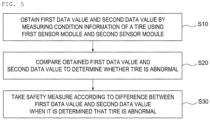
- FIG. 5 is a flowchart of a detection method of a tire abnormality detection device according to an embodiment of the present disclosure.
- the abnormality detection method of the tire abnormality detection device includes, first, step S10 of obtaining the first data value and the second data value by measuring the condition information of the tire using the first sensor module and the second sensor module.
- the first sensor module 130 and the second sensor module 140 may be provided to measure the condition information of the tire at locations symmetrical to each other with respect to the MCU module 120.
- condition information of the tire may include the internal air pressure, internal temperature, acceleration, vibration, and noise of the tire.
- the step S20 of determining whether the tire is abnormal by comparing the obtained first data value and second data value may be performed.
- step S20of determining whether the tire is abnormal by comparing the obtained first data value and second data value, when the difference between the first data value measured by the first sensor module 130 and the second data value measured by the second sensor module 130 provided at the location symmetrical to the first sensor module exceeds the threshold value, it may be determined that there is an abnormality.
- the first data value and the second data value may be values measured by the sensor modules provided at locations symmetrical to each other.
- the threshold value may be a preset value from 20% to 30%.
- the threshold value may be set in advance.
- the step S30 of taking the safety measures may be performed according to the difference between the first data value and the second data value.
- step S30 of taking the safety measures according to the difference between the first data value and the second data value when it is determined that the tire is abnormal when the difference between the first data value and the second data value for vibration and noise at the end of the belt exceeds the threshold value, it may be determined that separation has started at the end of the belt, and an alarm may be provided to the driver.
- step S30 of taking the safety measures according to the difference between the first data value and the second data value when it is determined that the tire is abnormal when the difference between the first data value and the second data value for vibration and noise at the end of the belt exceeds 50%, the risk of damage to the tire may be notified through the vehicle alarm.
- the vehicle operation may decelerate and stop.
- the present invention prepared in this way can not only detect the abnormal state of the tire, but also discern the risk and take safety measures accordingly.
- the effect of the present invention according to the above configuration can determine the abnormal state of the tire to give an alarm to the driver so as to stop the operation, thereby preventing the accidents.
Landscapes
- Engineering & Computer Science (AREA)
- Mechanical Engineering (AREA)
- Automation & Control Theory (AREA)
- Physics & Mathematics (AREA)
- General Physics & Mathematics (AREA)
- Human Computer Interaction (AREA)
- Transportation (AREA)
- Tires In General (AREA)
- Measuring Fluid Pressure (AREA)
Description
- The present invention relates to a tire abnormality detection device and a detection method thereof, and more particularly, to a tire abnormality detection device and a detection method thereof capable of lowering a possibility of accident by determining an abnormal state of a tire.
- In recent years, in order to measure pressure and temperature inside a tire, a technology of mounting a TPMS on a wheel valve side, measuring data using the TPMS, and wirelessly transmitting and receiving data using RF and the like and transmitting the data to a vehicle has been used.
- In order to measure acceleration inside a tire, a method of measuring data by attaching or embedding a sensor inside the tire rather than a valve has also been proposed, and a technology of wirelessly transmitting and receiving data and linking to a smartphone has also been proposed.
- As such, in recent years, a wireless system is used to measure internal information of a tire.
-
Korean Patent Laid-Open Publication No. 2014-0067431 - In addition, the method of using an average value may have reliability for one or two incorrect data, but has a disadvantage of causing a system error or an error that is recognized as an intermediate value when abnormal data repeatedly appears as the highest or lowest.
- In addition, there may be a lot of data entanglement in the process of checking data for each tire part from a plurality of piezoelectric sensors and the cost of upgrading the system's specifications to handle a lot of data.
-
Korean Patent Laid-Open Publication No. 2004-0026947 - In addition, the time delay algorithm is an algorithm for determining abnormality immediately after a stopped vehicle starts. In this case, the time delay may be applied, but there is a difference from an algorithm for determining an accident by comparing real-time data while actual running.
-
Korean Patent Laid-Open Publication No. 2005-0013762 - Such method is not a method of storing real-time data, and is a method of storing the existing value and then not storing currently measured data if there is no difference from current data, and storing the currently measured data if there is a difference from the current data. The currently measured and the previous data are not stored because there is no significant difference over time, but a difference between initial data and data after several hours or tens of minutes may occur outside a critical range. In addition, the system may not be able to confirm that the air pressure of the tire is lowered by comparing the current data with the previous data.
-
Korean Patent No. 10-1843256 -
EP 1 794 007 A1 describes a method and a system for determining a cornering angle of a tire fitted on a vehicle during a running of said vehicle on a rolling surface. The method comprises the steps of: determining the lateral acceleration of a portion of the tire tread spaced apart from the equatorial plane of said tire; determining a rotation speed of said tire; and determining said cornering angle from said lateral acceleration and said radial speed, by using characteristic curves of lateral acceleration amplitude versus predetermined values of cornering angle for at least one rotation speed. - An object of the present invention is to provide a tire abnormality detection device and an abnormality detection method thereof capable of reducing a possibility of accident by determining an abnormal state of a tire.
- This object is achieved by a tire abnormality detection device according to claim 1, and by an abnormality detection method according to claim 8.
- There is provided a tire abnormality detection device, including: an MCU module that is located at a center of a surface of a tire inner liner; a first sensor module that is formed on one side of the MCU module in a width direction of the inner liner; and a second sensor module that is formed on the other side of the MCU module in the width direction of the inner liner, in which the first sensor module and the second sensor module are symmetrically located with respect to the MCU module. The MCU module compares a first data value measured by the first sensor module and a second data value measured by the second sensor module to determine whether the tire is abnormal.
- The first sensor module and the second sensor module may be provided to measure at least any one of internal air pressure, internal temperature, acceleration, vibration, and noise of the tire.
- The first sensor module may include: a first belt sensor that is attached to an end of a belt of the tire; a first filler sensor that is attached to an end of a bead filler of the tire; and a first bead sensor that is attached to an end portion of a bead wire of the tire.
- The second sensor module may include: a second belt sensor that is attached to an end of a belt of the tire; a second filler sensor that is attached to an end of a bead filler of the tire; and a second bead sensor that is attached to an end portion of a bead wire of the tire.
- The MCU module may be configured to determine that the abnormality occurred when a difference between the first data value and the second data value is 20% to 30% or more.
- The first sensor modules and second sensor modules may be provided in plurality to be spaced apart from each other along a running direction of the tire.
- The plurality of first sensor modules and second sensor modules may be provided to be spaced apart from each other by an interval of 10° to 120° along the running direction of the tire.
- There is provided an abnormality detection method of the tire abnormality detection device, including: a) obtaining, by the MCU module a first data by measuring condition information of the tire using the first sensor module; b) obtaining, by the MCU module, a second data value by measuring condition information of the tire using the second sensor module; c) determining, by the MCU module, whether the tire is abnormal by comparing the obtained first data value and second data value; and d) taking a safety measure according to the difference between the first data value and the second data value when it is determined that the tire is abnormal.
- The condition information of the tire may include at least any one of internal air pressure, internal temperature, acceleration, vibration, and noise of the tire.
- In the step c), when a difference between a first data value measured by the first sensor module and a second data value measured by the second sensor module provided at a location symmetrical to the first sensor module exceeds a threshold value, it may be determined that the tire is abnormal.
- The threshold value may be a preset value from 20% to 30%.
- In the step d), when a difference between a first data value and a second data value exceeds the threshold value, an alarm may be provided to a driver, when the difference between the first data value and the second data value exceeds 50%, a risk of damage to the tire may be notified through a vehicle alarm, and when the difference between the first data value and the second data value exceeds 65%, a vehicle operation may decelerate and stop.
- There is provided a tire equipped with the tire abnormality detection device.
-
-
FIG. 1 is an exemplary diagram of a tire abnormality detection device according to an embodiment of the present invention. -
FIG. 2 is an exemplary diagram illustrating a configuration of an MCU module according to an embodiment of the present invention. -
FIG. 3 is an exemplary view in which a first sensor module and a second sensor module are formed in one row according to an embodiment of the present invention. -
FIG. 4 is an exemplary view in which the first sensor module and the second sensor module are formed in a plurality of rows according to an embodiment of the present invention. -
FIG. 5 is a flowchart of a detection method of a tire abnormality detection device according to an embodiment of the present invention. - Hereinafter, the present invention will be described with reference to the accompanying drawings. However, the present invention may be implemented in various different forms, and is not limited to exemplary embodiments described herein. In addition, in the drawings, portions unrelated to the description will be omitted to obviously describe the present invention, and similar reference numerals are attached to similar parts throughout the specification.
- Throughout the present specification, when any one part is referred to as being "connected (joined, contacted, and coupled) to" another part, it means that any one part and another part are "directly connected to" each other or are "indirectly connected to" each other with another part interposed therebetween. In addition, unless explicitly described to the contrary, "including" any component will be understood to imply the inclusion of other components rather than the exclusion of other components.
- The terms used in the present specification are only used to describe specific embodiments, and are not intended to limit the present invention. Singular forms are intended to include plural forms unless the context clearly indicates otherwise. It should be further understood that terms "include" or "have" used in the present specification specify the presence of features, numerals, steps, operations, components, parts, or combinations thereof mentioned in the present specification, but do not preclude the presence or addition of one or more other features, numerals, steps, operations, components, parts, or combinations thereof.
- Hereinafter, embodiments of the present invention will be described in detail with reference to the accompanying drawings.
-
FIG. 1 is an exemplary diagram of a tire abnormality detection device according to an embodiment of the present invention, -
FIG. 2 is an exemplary diagram illustrating a configuration of an MCU module according to an embodiment of the present invention, andFIG. 3 is an exemplary view in which a first sensor module and a second sensor module are formed in one row according to an embodiment of the present invention. - As illustrated in
FIGS. 1 to 3 , a tireabnormality detection device 100 includes aninner liner 110, anMCU module 120, afirst sensor module 130, and asecond sensor module 140, in which thefirst sensor module 130 and thesecond sensor module 140 are provided at locations symmetrical to each other with respect to theMCU module 120. - The
MCU module 120, thefirst sensor module 130, and thesecond sensor module 140 may be attached to a surface of theinner liner 110, and may be attached using an adhesive or a sticker. - The
MCU module 120 is located at a center of the surface of the tireinner liner 110. - The
MCU module 120 may be configured to include a radio frequency and low frequency receiver (RF/LF receiver), a data processing unit, Bluetooth, a power supply, an antenna, and an A/D converter. - The
MCU module 120 is configured to receive condition information of a tire measured by thefirst sensor module 130 and thesecond sensor module 140, and is configured to determine an abnormality state according to the received condition information of the tire. - In particular, the
MCU module 120 is configured to compare a first data value measured by thefirst sensor module 130 and a second data value measured by thesecond sensor module 140 provided at a location symmetrical to thefirst sensor module 130 to determine whether the tire is abnormal. - When the abnormality of the tire is detected, the
MCU module 120 is configured to take measures accordingly. - The
first sensor module 130 may be formed on one side of theMCU module 120 in a width direction of theinner liner 110. - Specifically, the
first sensor module 130 includes afirst belt sensor 131, afirst filler sensor 132, afirst bead sensor 133, a firstsupplementary sensor 134, and a firstadditional sensor 135. - The
first belt sensor 131 may be attached to an end of a belt of the tire. - The
first filler sensor 132 may be attached to an end of a bead filler of the tire. - The
first bead sensor 133 may be attached to an end portion of a bead wire of the tire. - The first
supplementary sensor 134 and the firstadditional sensor 135 may be formed on one side of thefirst bead sensor 133 at intervals. - The sensors of the
first sensor module 130 may be provided to measure at least any one of internal air pressure, internal temperature, acceleration, vibration, and noise of a tire. - The
second sensor module 140 may be formed on the other side of theMCU module 120 in the width direction of theinner liner 110. - Specifically, the
second sensor module 140 includes asecond belt sensor 141, asecond filler sensor 142, asecond bead sensor 143, a secondsupplementary sensor 144, and a secondadditional sensor 145. - The
second belt sensor 141 may be attached to the end of the belt of the tire. - The
second filler sensor 142 may be attached to the end of the bead filler of the tire. - The
second bead sensor 143 may be attached to the end portion of the bead wire of the tire. - The second
supplementary sensor 144 and the secondadditional sensor 145 may be formed on the other side of thesecond bead sensor 143 at intervals. - The sensors of the
second sensor module 140 may be provided to measure at least any one of the internal air pressure, internal temperature, acceleration, vibration, and noise of the tire. - As such, the
first sensor module 130 and thesecond sensor module 140 may include the sensors attached to the end of the belt, the end of the bead filler, and the end of the bead wire where the abnormality occurs the most. - When the difference between the first data value measured by the
first sensor module 130 and the second data value measured by thesecond sensor module 140 provided at a location symmetrical to thefirst sensor module 130 is in the range of 20% to 30%, theMCU module 120 may be configured to determine that there is no abnormality. - The difference criterion for determining the abnormality may be set in advance.
- In particular, the MCU module is configured to determine that the abnormality occurred when the difference between the first data value and the second data value for vibration and noise at the end of the belt is 20% to 30% or more.
- As an example, when the first data value for noise and vibration measured by the
first belt sensor 131 of thefirst sensor module 130 is referred to as a and the second data value for noise and vibration measured by thesecond belt sensor 141 provided at a location symmetrical to thefirst belt sensor 131 with respect to theMCU module 120 is referred to as b, if a difference between the values a and b are 35%, the MCU module may determine that the tire is abnormal. - The
MCU module 120 is configured to take safety measures accordingly when it is determined that the tire is abnormal. - Specifically, the
MCU module 120 may be provided to provide an alarm to a driver when the difference between the first data value and the second data value for vibration and noise at the end of the belt exceeds a threshold value, notify damage to the tire through the vehicle alarm when the difference between the first data value and the second data value for vibration and noise at the end of the belt exceeds 50%, and decelerate and stop the vehicle operation when the difference between the first data value and the second data value for vibration and noise of the end of the belt exceeds 65%. -
FIG. 4 is an exemplary view in which the first sensor module and the second sensor module are formed in a plurality of rows according to an embodiment of the present disclosure. - The plurality of
first sensor modules 120 andsecond sensor modules 130 provided as illustrated inFIG. 4 may be provided to be spaced apart from each other along the running direction of the tire. - More specifically, the plurality of
first sensor modules 120 andsecond sensor modules 130 may be provided to be spaced apart from each other by an interval of 10° to 120° along the running direction of the tire. - As such, the
first sensor modules 120 andsecond sensor modules 130 provided in plurality to be spaced apart from each other along the running direction of the tire may be more accurately detect the abnormality of the tire. -
FIG. 5 is a flowchart of a detection method of a tire abnormality detection device according to an embodiment of the present disclosure. - As illustrated in
FIG. 5 , the abnormality detection method of the tire abnormality detection device includes, first, step S10 of obtaining the first data value and the second data value by measuring the condition information of the tire using the first sensor module and the second sensor module. - In the step S10 of obtaining the first data value and the second data value by measuring the condition information of the tire using the first sensor module and the second sensor module, the
first sensor module 130 and thesecond sensor module 140 may be provided to measure the condition information of the tire at locations symmetrical to each other with respect to theMCU module 120. - Here, the condition information of the tire may include the internal air pressure, internal temperature, acceleration, vibration, and noise of the tire.
- After the step S10 of obtaining the first data value and the second data value by measuring the condition information of the tire using the first sensor module and the second sensor module, the step S20 of determining whether the tire is abnormal by comparing the obtained first data value and second data value may be performed.
- In the step S20of determining whether the tire is abnormal by comparing the obtained first data value and second data value, when the difference between the first data value measured by the
first sensor module 130 and the second data value measured by thesecond sensor module 130 provided at the location symmetrical to the first sensor module exceeds the threshold value, it may be determined that there is an abnormality. - Here, the first data value and the second data value may be values measured by the sensor modules provided at locations symmetrical to each other.
- In addition, the threshold value may be a preset value from 20% to 30%.
- That is, the more sensitively you want to determine whether the abnormality occurs, the smaller the threshold value may be set in advance.
- After the step S20 of comparing the obtained first data value and second data value to determine whether the tire is abnormal, when it is determined that the tire is abnormal, the step S30 of taking the safety measures may be performed according to the difference between the first data value and the second data value.
- Specifically, in the step S30 of taking the safety measures according to the difference between the first data value and the second data value when it is determined that the tire is abnormal, when the difference between the first data value and the second data value for vibration and noise at the end of the belt exceeds the threshold value, it may be determined that separation has started at the end of the belt, and an alarm may be provided to the driver.
- Specifically, in the step S30 of taking the safety measures according to the difference between the first data value and the second data value when it is determined that the tire is abnormal, when the difference between the first data value and the second data value for vibration and noise at the end of the belt exceeds 50%, the risk of damage to the tire may be notified through the vehicle alarm.
- In addition, in the step S30 of taking the safety measures according to the difference between the first data value and the second data value when it is determined that the tire is abnormal, when the difference between the first data value and the second data value for vibration and noise at the end of the belt exceeds 65%, the vehicle operation may decelerate and stop.
- The present invention prepared in this way can not only detect the abnormal state of the tire, but also discern the risk and take safety measures accordingly.
- The effect of the present invention according to the above configuration can determine the abnormal state of the tire to give an alarm to the driver so as to stop the operation, thereby preventing the accidents.
- The effect of the present invention is not limited to the above effects, and should be understood to include all effects that can be inferred from the detailed description of the present invention or the composition of the invention described in the claims.
- It can be understood that the above description of the invention is for illustrative purposes only. Therefore, it should be understood that the above-mentioned embodiments are exemplary in all aspects but are not limited thereto. For example, each component described as a single type may be implemented in a distributed manner, and similarly, components described as distributed may be implemented in a combined form.
- It is to be understood that the scope of the present invention will be defined by the claims rather than the above-mentioned description and all modifications and alternations derived from the claims are included in the scope of the present invention.
Claims (13)
- A tire abnormality detection device (100), comprising:an MCU module (120) that is located at a center of a surface of a tire inner liner (110);a first sensor module (130) that is formed on one side of the MCU module (120) in a width direction of the inner liner (110); anda second sensor module (140) that is formed on the other side of the MCU module (120) in the width direction of the inner liner (110),wherein the first sensor module (130) and the second sensor module (140) are symmetrically located with respect to the MCU module (120),characterized in thatthe MCU module (120) is configured to receive a first data value measured by the first sensor module (130) and a second data value measured by the second sensor module (140), andthe MCU module (120) is configured to compare the first data value and the second data value to determine whether the tire is abnormal.
- The tire abnormality detection device (100) of claim 1, wherein the first sensor module (130) and the second sensor module (140) are configured to measure at least any one of internal air pressure, internal temperature, acceleration, vibration, and noise of the tire.
- The tire abnormality detection device (100) of claim 1 or 2, wherein the first sensor module (130) includes:a first belt sensor (131) that is attached to an end of a belt of the tire;a first filler sensor (132) that is attached to an end of a bead filler of the tire; anda first bead sensor (133) that is attached to an end portion of a bead wire of the tire.
- The tire abnormality detection device (100) of one of claims 1 to 3, wherein the second sensor module (140) includes:a second belt sensor (141) that is attached to an end of a belt of the tire;a second filler sensor (142) that is attached to an end of a bead filler of the tire; anda second bead sensor (143) that is attached to an end portion of a bead wire of the tire.
- The tire abnormality detection device (100) of one of claims 1 to 4, wherein the MCU module (120) is configured to determine that the abnormality occurred when a difference between the first data value and the second data value is 20% to 30% or more.
- The tire abnormality detection device (100) of one of claims 1 to 5, wherein the first sensor modules (130) and second sensor modules (140) are provided in plurality to be spaced apart from each other along a running direction of the tire.
- The tire abnormality detection device (100) of claim 6, wherein the plurality of first sensor modules (130) and second sensor modules (140) are provided to be spaced apart from each other by an interval of 10° to 120° along the running direction of the tire.
- An abnormality detection method of the tire abnormality detection device (100) according to one of claims 1 to 7, characterized in that
the abnormality detection method comprises:a) obtaining, by the MCU module (120), a first data value by measuring condition information of the tire using the first sensor module (130);b) obtaining, by the MCU module (120), a second data value by measuring condition information of the tire using the second sensor module (140);c) determining, by the MCU module (120), whether the tire is abnormal by comparing the obtained first data value and second data value; andd) taking, by the MCU module (120), a safety measure according to the difference between the first data value and the second data value when it is determined that the tire is abnormal. - The abnormality detection method of claim 8, wherein the condition information of the tire includes at least any one of internal air pressure, internal temperature, acceleration, vibration, and noise of the tire.
- The abnormality detection method of claim 8 or 9, wherein in the step c), when a difference between a first data value measured by the first sensor module (130) and a second data value measured by the second sensor module (140) exceeds a threshold value, it is determined that the tire is abnormal.
- The abnormality detection method of claim 10, wherein the threshold value is a preset value from 20% to 30%.
- The abnormality detection method of claim 11, wherein in the step d),when a difference between a first data value and a second data value exceeds the threshold value, an alarm is provided to a driver,when the difference between the first data value and the second data value exceeds 50%, a risk of damage to the tire is notified through a vehicle alarm, andwhen the difference between the first data value and the second data value exceeds 65%, a vehicle operation decelerates and stops.
- A tire equipped with the tire abnormality detection device (100) of one of claims 1 to 7.
Applications Claiming Priority (1)
| Application Number | Priority Date | Filing Date | Title |
|---|---|---|---|
| KR1020200019158A KR102352446B1 (en) | 2020-02-17 | 2020-02-17 | Tire abnormality detection device and its detection mehtod |
Publications (2)
| Publication Number | Publication Date |
|---|---|
| EP3865320A1 EP3865320A1 (en) | 2021-08-18 |
| EP3865320B1 true EP3865320B1 (en) | 2023-07-19 |
Family
ID=74595114
Family Applications (1)
| Application Number | Title | Priority Date | Filing Date |
|---|---|---|---|
| EP21156775.5A Active EP3865320B1 (en) | 2020-02-17 | 2021-02-12 | Tire abnormality detection device and its detection method |
Country Status (4)
| Country | Link |
|---|---|
| US (1) | US11511574B2 (en) |
| EP (1) | EP3865320B1 (en) |
| KR (1) | KR102352446B1 (en) |
| CN (1) | CN113334996B (en) |
Families Citing this family (3)
| Publication number | Priority date | Publication date | Assignee | Title |
|---|---|---|---|---|
| KR102606332B1 (en) * | 2021-10-20 | 2023-11-29 | 넥센타이어 주식회사 | Tire noise reduction system and method for tire noise reduction |
| CN115843014A (en) * | 2022-11-30 | 2023-03-24 | 东风商用车有限公司 | Data conversion device and method for vehicle-mounted wireless radio frequency and Bluetooth |
| US20240416689A1 (en) * | 2023-06-14 | 2024-12-19 | The Goodyear Tire & Rubber Company | Tire with a set of printed sensors |
Family Cites Families (24)
| Publication number | Priority date | Publication date | Assignee | Title |
|---|---|---|---|---|
| KR19990020867A (en) | 1997-08-30 | 1999-03-25 | 양재신 | Vehicle Hazard Alarm System with Tire Pressure Detection |
| JP4270881B2 (en) * | 2001-05-28 | 2009-06-03 | 三菱電機株式会社 | Mobile device arrangement device |
| CN1307064C (en) * | 2002-03-28 | 2007-03-28 | 倍耐力轮胎公司 | A method and system for monitoring the condition of tires during operation of a motor vehicle |
| KR100482434B1 (en) | 2002-09-27 | 2005-04-14 | 현대자동차주식회사 | Alarm device in tire's air press falloff for automobile and its control method |
| KR100646464B1 (en) | 2003-07-29 | 2006-11-14 | 기아자동차주식회사 | Tire air pressure monitoring device to store air pressure warnings |
| US7552628B2 (en) * | 2003-10-24 | 2009-06-30 | Pirelli Pneumatici S.P.A. | Method and system for determining a cornering angle of a tyre during the running of a vehicle |
| JP2005212696A (en) * | 2004-01-30 | 2005-08-11 | Toyota Motor Corp | Tire abnormality detection device |
| JP4680532B2 (en) * | 2004-06-02 | 2011-05-11 | 株式会社ブリヂストン | Method and apparatus for estimating dynamic state of tire |
| DE602004012903T2 (en) * | 2004-09-29 | 2009-04-09 | Pirelli Tyre S.P.A. | METHOD AND SYSTEM FOR DETERMINING THE SCROLLING ANGLE OF A TIRE WHILE DRIVING A VEHICLE |
| JP3895347B2 (en) * | 2004-11-19 | 2007-03-22 | 横浜ゴム株式会社 | Tire deformation amount calculation method and tire deformation amount calculation device |
| JP4707642B2 (en) * | 2005-12-08 | 2011-06-22 | 住友ゴム工業株式会社 | Tire pressure abnormality detection device, method and program |
| JP2007170872A (en) * | 2005-12-19 | 2007-07-05 | Toyota Motor Corp | Vehicle state estimation device and vehicle state estimation method |
| KR20080046815A (en) * | 2006-11-23 | 2008-05-28 | 한국타이어 주식회사 | Drive that transmits tire internal temperature / pressure wirelessly |
| US7523656B1 (en) * | 2007-11-01 | 2009-04-28 | Infineon Technologies Ag | Tire sensor system and monitoring method |
| JP5012675B2 (en) * | 2008-06-04 | 2012-08-29 | 横浜ゴム株式会社 | Tire attitude control apparatus and method |
| DE102009044573A1 (en) * | 2009-11-18 | 2011-05-19 | Continental Reifen Deutschland Gmbh | A method of detecting a tire module detached from a tire interior for vehicles |
| KR20140067431A (en) * | 2012-11-26 | 2014-06-05 | 한국전자통신연구원 | Apparatus for warning of tire defect |
| US20160272017A1 (en) * | 2015-03-18 | 2016-09-22 | Ford Global Technologies Llc | Tire inflation-deflation response system |
| CN105172489B (en) * | 2015-07-28 | 2018-06-29 | 安徽工程大学 | Tire pressure detecting device based on annulus contact-type 3 D pressure sensor |
| DE102016203658A1 (en) * | 2016-03-07 | 2017-09-07 | Continental Reifen Deutschland Gmbh | Vehicle tire with a tire module |
| KR101843256B1 (en) | 2016-05-11 | 2018-03-28 | 한국타이어 주식회사 | A method of evaluating the state of tire and providing an alarm and a smart tire therewith it |
| KR101938235B1 (en) * | 2016-12-08 | 2019-01-14 | 현대오트론 주식회사 | Wheel speed abnormality detection and control system using acceleration sensor. |
| KR20190043689A (en) | 2017-10-19 | 2019-04-29 | 대덕대학산학협력단 | Apparatus and method for monitoring condition of vehicle tires |
| KR102127662B1 (en) * | 2018-07-25 | 2020-06-29 | 한국타이어앤테크놀로지 주식회사 | Multi-position system sensors for tires and tires having the sensor |
-
2020
- 2020-02-17 KR KR1020200019158A patent/KR102352446B1/en active Active
-
2021
- 2021-02-11 US US17/173,809 patent/US11511574B2/en active Active
- 2021-02-12 EP EP21156775.5A patent/EP3865320B1/en active Active
- 2021-02-18 CN CN202110190074.6A patent/CN113334996B/en active Active
Also Published As
| Publication number | Publication date |
|---|---|
| CN113334996B (en) | 2023-11-03 |
| EP3865320A1 (en) | 2021-08-18 |
| US20210252924A1 (en) | 2021-08-19 |
| KR20210104432A (en) | 2021-08-25 |
| KR102352446B1 (en) | 2022-01-19 |
| US11511574B2 (en) | 2022-11-29 |
| CN113334996A (en) | 2021-09-03 |
Similar Documents
| Publication | Publication Date | Title |
|---|---|---|
| EP3865320B1 (en) | Tire abnormality detection device and its detection method | |
| US8054169B2 (en) | Method of detecting a pressure loss of a tire, tire pressure monitoring system in a vehicle | |
| US8584517B2 (en) | Load based wheel position determination | |
| JP6312140B2 (en) | Method and apparatus for identifying the position of a vehicle wheel | |
| US20040019448A1 (en) | Method and system for registering identification of tire air pressure sensor device | |
| US7236892B2 (en) | Vehicle wheel state monitoring device and method | |
| US6400263B1 (en) | Tire pressure monitoring system | |
| CN110023111B (en) | Radio-oriented optimization method for wheel monitoring, wheel monitoring system and electronic wheel unit and control device thereof | |
| JP5380848B2 (en) | Tire pressure monitoring device | |
| US9950578B2 (en) | Tire air pressure detection device | |
| US7043973B2 (en) | Method of estimating the temperature of the air in the internal cavity of a tire and application to the detection of abnormal operating of a running-flat system | |
| US7576641B2 (en) | Identification information examination method and information obtaining apparatus | |
| US20130054079A1 (en) | Valve id registration system | |
| US10343468B2 (en) | Method for monitoring tire states and/or sensor states and a monitoring system therefor | |
| JP4207723B2 (en) | Wheel state detection device | |
| KR101965964B1 (en) | Tire & Wheel Contact Pressure Monitoring System | |
| JP4144521B2 (en) | Tire theft detection device | |
| US20090207009A1 (en) | Method and Device for Monitoring Pressure of Vehicle Tires | |
| JP2008024169A (en) | Tire pressure monitoring system | |
| EP4415983A1 (en) | Tire pressure monitoring in stationary vehicles | |
| JP2023066796A (en) | Tire abnormality determination system | |
| KR101839316B1 (en) | Tire Pressure Monitoring System for low power | |
| CN111561887A (en) | Device and method for detecting fetal skin thickness by sound and readable recording medium | |
| US20240377499A1 (en) | Wheel position identifying device, wheel position identifying system, and wheel position identifying method | |
| JP2007170872A (en) | Vehicle state estimation device and vehicle state estimation method |
Legal Events
| Date | Code | Title | Description |
|---|---|---|---|
| PUAI | Public reference made under article 153(3) epc to a published international application that has entered the european phase |
Free format text: ORIGINAL CODE: 0009012 |
|
| STAA | Information on the status of an ep patent application or granted ep patent |
Free format text: STATUS: REQUEST FOR EXAMINATION WAS MADE |
|
| 17P | Request for examination filed |
Effective date: 20210212 |
|
| AK | Designated contracting states |
Kind code of ref document: A1 Designated state(s): AL AT BE BG CH CY CZ DE DK EE ES FI FR GB GR HR HU IE IS IT LI LT LU LV MC MK MT NL NO PL PT RO RS SE SI SK SM TR |
|
| GRAP | Despatch of communication of intention to grant a patent |
Free format text: ORIGINAL CODE: EPIDOSNIGR1 |
|
| STAA | Information on the status of an ep patent application or granted ep patent |
Free format text: STATUS: GRANT OF PATENT IS INTENDED |
|
| INTG | Intention to grant announced |
Effective date: 20230131 |
|
| GRAS | Grant fee paid |
Free format text: ORIGINAL CODE: EPIDOSNIGR3 |
|
| GRAA | (expected) grant |
Free format text: ORIGINAL CODE: 0009210 |
|
| STAA | Information on the status of an ep patent application or granted ep patent |
Free format text: STATUS: THE PATENT HAS BEEN GRANTED |
|
| AK | Designated contracting states |
Kind code of ref document: B1 Designated state(s): AL AT BE BG CH CY CZ DE DK EE ES FI FR GB GR HR HU IE IS IT LI LT LU LV MC MK MT NL NO PL PT RO RS SE SI SK SM TR |
|
| REG | Reference to a national code |
Ref country code: GB Ref legal event code: FG4D |
|
| REG | Reference to a national code |
Ref country code: CH Ref legal event code: EP |
|
| REG | Reference to a national code |
Ref country code: DE Ref legal event code: R096 Ref document number: 602021003510 Country of ref document: DE |
|
| REG | Reference to a national code |
Ref country code: IE Ref legal event code: FG4D |
|
| REG | Reference to a national code |
Ref country code: LT Ref legal event code: MG9D |
|
| REG | Reference to a national code |
Ref country code: NL Ref legal event code: MP Effective date: 20230719 |
|
| REG | Reference to a national code |
Ref country code: AT Ref legal event code: MK05 Ref document number: 1589113 Country of ref document: AT Kind code of ref document: T Effective date: 20230719 |
|
| PG25 | Lapsed in a contracting state [announced via postgrant information from national office to epo] |
Ref country code: NL Free format text: LAPSE BECAUSE OF FAILURE TO SUBMIT A TRANSLATION OF THE DESCRIPTION OR TO PAY THE FEE WITHIN THE PRESCRIBED TIME-LIMIT Effective date: 20230719 |
|
| PG25 | Lapsed in a contracting state [announced via postgrant information from national office to epo] |
Ref country code: GR Free format text: LAPSE BECAUSE OF FAILURE TO SUBMIT A TRANSLATION OF THE DESCRIPTION OR TO PAY THE FEE WITHIN THE PRESCRIBED TIME-LIMIT Effective date: 20231020 |
|
| PG25 | Lapsed in a contracting state [announced via postgrant information from national office to epo] |
Ref country code: IS Free format text: LAPSE BECAUSE OF FAILURE TO SUBMIT A TRANSLATION OF THE DESCRIPTION OR TO PAY THE FEE WITHIN THE PRESCRIBED TIME-LIMIT Effective date: 20231119 |
|
| PG25 | Lapsed in a contracting state [announced via postgrant information from national office to epo] |
Ref country code: SE Free format text: LAPSE BECAUSE OF FAILURE TO SUBMIT A TRANSLATION OF THE DESCRIPTION OR TO PAY THE FEE WITHIN THE PRESCRIBED TIME-LIMIT Effective date: 20230719 Ref country code: RS Free format text: LAPSE BECAUSE OF FAILURE TO SUBMIT A TRANSLATION OF THE DESCRIPTION OR TO PAY THE FEE WITHIN THE PRESCRIBED TIME-LIMIT Effective date: 20230719 Ref country code: PT Free format text: LAPSE BECAUSE OF FAILURE TO SUBMIT A TRANSLATION OF THE DESCRIPTION OR TO PAY THE FEE WITHIN THE PRESCRIBED TIME-LIMIT Effective date: 20231120 Ref country code: NO Free format text: LAPSE BECAUSE OF FAILURE TO SUBMIT A TRANSLATION OF THE DESCRIPTION OR TO PAY THE FEE WITHIN THE PRESCRIBED TIME-LIMIT Effective date: 20231019 Ref country code: LV Free format text: LAPSE BECAUSE OF FAILURE TO SUBMIT A TRANSLATION OF THE DESCRIPTION OR TO PAY THE FEE WITHIN THE PRESCRIBED TIME-LIMIT Effective date: 20230719 Ref country code: LT Free format text: LAPSE BECAUSE OF FAILURE TO SUBMIT A TRANSLATION OF THE DESCRIPTION OR TO PAY THE FEE WITHIN THE PRESCRIBED TIME-LIMIT Effective date: 20230719 Ref country code: IS Free format text: LAPSE BECAUSE OF FAILURE TO SUBMIT A TRANSLATION OF THE DESCRIPTION OR TO PAY THE FEE WITHIN THE PRESCRIBED TIME-LIMIT Effective date: 20231119 Ref country code: HR Free format text: LAPSE BECAUSE OF FAILURE TO SUBMIT A TRANSLATION OF THE DESCRIPTION OR TO PAY THE FEE WITHIN THE PRESCRIBED TIME-LIMIT Effective date: 20230719 Ref country code: GR Free format text: LAPSE BECAUSE OF FAILURE TO SUBMIT A TRANSLATION OF THE DESCRIPTION OR TO PAY THE FEE WITHIN THE PRESCRIBED TIME-LIMIT Effective date: 20231020 Ref country code: FI Free format text: LAPSE BECAUSE OF FAILURE TO SUBMIT A TRANSLATION OF THE DESCRIPTION OR TO PAY THE FEE WITHIN THE PRESCRIBED TIME-LIMIT Effective date: 20230719 Ref country code: AT Free format text: LAPSE BECAUSE OF FAILURE TO SUBMIT A TRANSLATION OF THE DESCRIPTION OR TO PAY THE FEE WITHIN THE PRESCRIBED TIME-LIMIT Effective date: 20230719 |
|
| PG25 | Lapsed in a contracting state [announced via postgrant information from national office to epo] |
Ref country code: PL Free format text: LAPSE BECAUSE OF FAILURE TO SUBMIT A TRANSLATION OF THE DESCRIPTION OR TO PAY THE FEE WITHIN THE PRESCRIBED TIME-LIMIT Effective date: 20230719 |
|
| REG | Reference to a national code |
Ref country code: DE Ref legal event code: R097 Ref document number: 602021003510 Country of ref document: DE |
|
| PG25 | Lapsed in a contracting state [announced via postgrant information from national office to epo] |
Ref country code: ES Free format text: LAPSE BECAUSE OF FAILURE TO SUBMIT A TRANSLATION OF THE DESCRIPTION OR TO PAY THE FEE WITHIN THE PRESCRIBED TIME-LIMIT Effective date: 20230719 |
|
| PG25 | Lapsed in a contracting state [announced via postgrant information from national office to epo] |
Ref country code: SM Free format text: LAPSE BECAUSE OF FAILURE TO SUBMIT A TRANSLATION OF THE DESCRIPTION OR TO PAY THE FEE WITHIN THE PRESCRIBED TIME-LIMIT Effective date: 20230719 Ref country code: RO Free format text: LAPSE BECAUSE OF FAILURE TO SUBMIT A TRANSLATION OF THE DESCRIPTION OR TO PAY THE FEE WITHIN THE PRESCRIBED TIME-LIMIT Effective date: 20230719 Ref country code: ES Free format text: LAPSE BECAUSE OF FAILURE TO SUBMIT A TRANSLATION OF THE DESCRIPTION OR TO PAY THE FEE WITHIN THE PRESCRIBED TIME-LIMIT Effective date: 20230719 Ref country code: EE Free format text: LAPSE BECAUSE OF FAILURE TO SUBMIT A TRANSLATION OF THE DESCRIPTION OR TO PAY THE FEE WITHIN THE PRESCRIBED TIME-LIMIT Effective date: 20230719 Ref country code: DK Free format text: LAPSE BECAUSE OF FAILURE TO SUBMIT A TRANSLATION OF THE DESCRIPTION OR TO PAY THE FEE WITHIN THE PRESCRIBED TIME-LIMIT Effective date: 20230719 Ref country code: CZ Free format text: LAPSE BECAUSE OF FAILURE TO SUBMIT A TRANSLATION OF THE DESCRIPTION OR TO PAY THE FEE WITHIN THE PRESCRIBED TIME-LIMIT Effective date: 20230719 Ref country code: SK Free format text: LAPSE BECAUSE OF FAILURE TO SUBMIT A TRANSLATION OF THE DESCRIPTION OR TO PAY THE FEE WITHIN THE PRESCRIBED TIME-LIMIT Effective date: 20230719 |
|
| PLBE | No opposition filed within time limit |
Free format text: ORIGINAL CODE: 0009261 |
|
| STAA | Information on the status of an ep patent application or granted ep patent |
Free format text: STATUS: NO OPPOSITION FILED WITHIN TIME LIMIT |
|
| PG25 | Lapsed in a contracting state [announced via postgrant information from national office to epo] |
Ref country code: IT Free format text: LAPSE BECAUSE OF FAILURE TO SUBMIT A TRANSLATION OF THE DESCRIPTION OR TO PAY THE FEE WITHIN THE PRESCRIBED TIME-LIMIT Effective date: 20230719 |
|
| 26N | No opposition filed |
Effective date: 20240422 |
|
| PG25 | Lapsed in a contracting state [announced via postgrant information from national office to epo] |
Ref country code: SI Free format text: LAPSE BECAUSE OF FAILURE TO SUBMIT A TRANSLATION OF THE DESCRIPTION OR TO PAY THE FEE WITHIN THE PRESCRIBED TIME-LIMIT Effective date: 20230719 |
|
| PG25 | Lapsed in a contracting state [announced via postgrant information from national office to epo] |
Ref country code: MC Free format text: LAPSE BECAUSE OF FAILURE TO SUBMIT A TRANSLATION OF THE DESCRIPTION OR TO PAY THE FEE WITHIN THE PRESCRIBED TIME-LIMIT Effective date: 20230719 |
|
| REG | Reference to a national code |
Ref country code: CH Ref legal event code: PL |
|
| PG25 | Lapsed in a contracting state [announced via postgrant information from national office to epo] |
Ref country code: LU Free format text: LAPSE BECAUSE OF NON-PAYMENT OF DUE FEES Effective date: 20240212 |
|
| PG25 | Lapsed in a contracting state [announced via postgrant information from national office to epo] |
Ref country code: CH Free format text: LAPSE BECAUSE OF NON-PAYMENT OF DUE FEES Effective date: 20240229 |
|
| PG25 | Lapsed in a contracting state [announced via postgrant information from national office to epo] |
Ref country code: LU Free format text: LAPSE BECAUSE OF NON-PAYMENT OF DUE FEES Effective date: 20240212 Ref country code: CH Free format text: LAPSE BECAUSE OF NON-PAYMENT OF DUE FEES Effective date: 20240229 |
|
| PG25 | Lapsed in a contracting state [announced via postgrant information from national office to epo] |
Ref country code: BG Free format text: LAPSE BECAUSE OF FAILURE TO SUBMIT A TRANSLATION OF THE DESCRIPTION OR TO PAY THE FEE WITHIN THE PRESCRIBED TIME-LIMIT Effective date: 20230719 |
|
| PG25 | Lapsed in a contracting state [announced via postgrant information from national office to epo] |
Ref country code: BG Free format text: LAPSE BECAUSE OF FAILURE TO SUBMIT A TRANSLATION OF THE DESCRIPTION OR TO PAY THE FEE WITHIN THE PRESCRIBED TIME-LIMIT Effective date: 20230719 |
|
| REG | Reference to a national code |
Ref country code: BE Ref legal event code: MM Effective date: 20240229 |
|
| PG25 | Lapsed in a contracting state [announced via postgrant information from national office to epo] |
Ref country code: BE Free format text: LAPSE BECAUSE OF NON-PAYMENT OF DUE FEES Effective date: 20240229 |
|
| PG25 | Lapsed in a contracting state [announced via postgrant information from national office to epo] |
Ref country code: IE Free format text: LAPSE BECAUSE OF NON-PAYMENT OF DUE FEES Effective date: 20240212 |
|
| PG25 | Lapsed in a contracting state [announced via postgrant information from national office to epo] |
Ref country code: IE Free format text: LAPSE BECAUSE OF NON-PAYMENT OF DUE FEES Effective date: 20240212 Ref country code: BE Free format text: LAPSE BECAUSE OF NON-PAYMENT OF DUE FEES Effective date: 20240229 |
|
| PG25 | Lapsed in a contracting state [announced via postgrant information from national office to epo] |
Ref country code: CY Free format text: LAPSE BECAUSE OF FAILURE TO SUBMIT A TRANSLATION OF THE DESCRIPTION OR TO PAY THE FEE WITHIN THE PRESCRIBED TIME-LIMIT; INVALID AB INITIO Effective date: 20210212 |
|
| PG25 | Lapsed in a contracting state [announced via postgrant information from national office to epo] |
Ref country code: HU Free format text: LAPSE BECAUSE OF FAILURE TO SUBMIT A TRANSLATION OF THE DESCRIPTION OR TO PAY THE FEE WITHIN THE PRESCRIBED TIME-LIMIT; INVALID AB INITIO Effective date: 20210212 |
|
| GBPC | Gb: european patent ceased through non-payment of renewal fee |
Effective date: 20250212 |
|
| PG25 | Lapsed in a contracting state [announced via postgrant information from national office to epo] |
Ref country code: TR Free format text: LAPSE BECAUSE OF FAILURE TO SUBMIT A TRANSLATION OF THE DESCRIPTION OR TO PAY THE FEE WITHIN THE PRESCRIBED TIME-LIMIT Effective date: 20230719 |
|
| PG25 | Lapsed in a contracting state [announced via postgrant information from national office to epo] |
Ref country code: GB Free format text: LAPSE BECAUSE OF NON-PAYMENT OF DUE FEES Effective date: 20250212 |
|
| PGFP | Annual fee paid to national office [announced via postgrant information from national office to epo] |
Ref country code: DE Payment date: 20260120 Year of fee payment: 6 |
|
| PGFP | Annual fee paid to national office [announced via postgrant information from national office to epo] |
Ref country code: FR Payment date: 20260121 Year of fee payment: 6 |