EP3864584B1 - Bayessche abstimmung für quantenlogikgatter - Google Patents
Bayessche abstimmung für quantenlogikgatter Download PDFInfo
- Publication number
- EP3864584B1 EP3864584B1 EP19783805.5A EP19783805A EP3864584B1 EP 3864584 B1 EP3864584 B1 EP 3864584B1 EP 19783805 A EP19783805 A EP 19783805A EP 3864584 B1 EP3864584 B1 EP 3864584B1
- Authority
- EP
- European Patent Office
- Prior art keywords
- qubits
- quantum
- parameter values
- objective function
- fidelity
- Prior art date
- Legal status (The legal status is an assumption and is not a legal conclusion. Google has not performed a legal analysis and makes no representation as to the accuracy of the status listed.)
- Active
Links
Images


Classifications
-
- H—ELECTRICITY
- H03—ELECTRONIC CIRCUITRY
- H03K—PULSE TECHNIQUE
- H03K19/00—Logic circuits, i.e. having at least two inputs acting on one output; Inverting circuits
- H03K19/02—Logic circuits, i.e. having at least two inputs acting on one output; Inverting circuits using specified components
- H03K19/195—Logic circuits, i.e. having at least two inputs acting on one output; Inverting circuits using specified components using superconductive devices
-
- B—PERFORMING OPERATIONS; TRANSPORTING
- B82—NANOTECHNOLOGY
- B82Y—SPECIFIC USES OR APPLICATIONS OF NANOSTRUCTURES; MEASUREMENT OR ANALYSIS OF NANOSTRUCTURES; MANUFACTURE OR TREATMENT OF NANOSTRUCTURES
- B82Y10/00—Nanotechnology for information processing, storage or transmission, e.g. quantum computing or single electron logic
-
- G—PHYSICS
- G06—COMPUTING OR CALCULATING; COUNTING
- G06N—COMPUTING ARRANGEMENTS BASED ON SPECIFIC COMPUTATIONAL MODELS
- G06N10/00—Quantum computing, i.e. information processing based on quantum-mechanical phenomena
- G06N10/40—Physical realisations or architectures of quantum processors or components for manipulating qubits, e.g. qubit coupling or qubit control
-
- G—PHYSICS
- G06—COMPUTING OR CALCULATING; COUNTING
- G06N—COMPUTING ARRANGEMENTS BASED ON SPECIFIC COMPUTATIONAL MODELS
- G06N10/00—Quantum computing, i.e. information processing based on quantum-mechanical phenomena
- G06N10/70—Quantum error correction, detection or prevention, e.g. surface codes or magic state distillation
-
- G—PHYSICS
- G06—COMPUTING OR CALCULATING; COUNTING
- G06N—COMPUTING ARRANGEMENTS BASED ON SPECIFIC COMPUTATIONAL MODELS
- G06N20/00—Machine learning
-
- G—PHYSICS
- G06—COMPUTING OR CALCULATING; COUNTING
- G06N—COMPUTING ARRANGEMENTS BASED ON SPECIFIC COMPUTATIONAL MODELS
- G06N7/00—Computing arrangements based on specific mathematical models
- G06N7/01—Probabilistic graphical models, e.g. probabilistic networks
Definitions
- a quantum computer is a physical machine configured to execute logical operations based on or influenced by quantum-mechanical phenomena.
- logical operations may include, for example, mathematical computation.
- Current interest in quantum-computer technology is motivated by theoretical analysis suggesting that the computational efficiency of an appropriately configured quantum computer may surpass that of any non-quantum-mechanical computer, especially when applied to certain types of problems.
- problems include, for example, integer factorization, data searching, computer modeling of quantum phenomena, function optimization, and solution of systems of linear equations.
- it is widely predicted that continued miniaturization of conventional computer logic structures will ultimately lead to the development of nanoscale logic components that exhibit quantum effects, and must therefore be addressed according to quantum-computing principles.
- a quantum computer is configured to accept a series of inputs and to provide a series of outputs.
- the internal componentry linking the inputs to the outputs of a quantum computer may require adjustment, calibration, and/or tuning in order to ensure that appropriate outputs are provided pursuant to the inputs.
- Christopher Ferrie et al "Robust and efficient in situ quantum control", Physical Review A, 1 May 2015 , describes how precision control of quantum systems is the driving force for both quantum technology and the probing of physics at the quantum and nanoscale levels. They propose an implementation-independent method for in situ quantum control that leverages recent advances in the direct estimation of quantum gate fidelity. Their algorithm takes account of the stochasticity of the problem, is suitable for closed-loop control, and requires only a constant number of fidelity-estimating experiments per iteration independent of the dimension of the control space. It is efficient and robust to both statistical and technical noise.
- This disclosure describes, inter alia, an example method for tuning a quantum gate of a quantum computer.
- the method comprises interrogating one or more qubits of the quantum computer using stored control-parameter values and yielding new data.
- the method further comprises computing an objective function quantifying operational quality of the quantum gate at the stored control-parameter values, such computing employing the new data in addition to a prior distribution over features used to compute the objective function.
- the prior distribution may be obtained by previous adaptive or non-adaptive interrogation of the one or more qubits, for instance.
- the method further comprises updating the stored control-parameter values, expanding the prior distribution to incorporate uncertainty in the objective function at the updated control-paramter values, re-interrogating the one or more qubits using the updated control-parameter values, and re-computing the objective function using the expanded prior distribution.
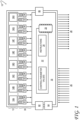
- FIG. 1 shows aspects of an example quantum computer 10 configured to execute quantum-logic operations ( vide infra ).
- quantum computer 10 of FIG. 1 includes at least one register 12 comprising an array of qubits 14.
- the illustrated register is eight qubits in length: registers comprising longer and shorter qubit arrays are also envisaged, as are quantum computers comprising two or more registers of any length.
- the qubits of register 12 may take various forms, depending on the desired architecture of quantum computer 10.
- Each qubit 14 may comprise: a superconducting Josephson junction, a trapped ion, a trapped atom coupled to a high-finesse cavity, an atom or molecule confined within a fullerene, an ion or neutral dopant atom confined within a host lattice, a quantum dot exhibiting discrete spatial- or spin-electronic states, electron holes in semiconductor junctions entrained via an electrostatic trap, a coupled quantum-wire pair, an atomic nucleus addressable by magnetic resonance, a free electron in helium, a molecular magnet, or a metal-like carbon nanosphere, as nonlimiting examples.
- each qubit 14 may comprise any particle or system of particles that can exist in two or more discrete quantum states that can be measured and manipulated experimentally.
- a qubit may also be implemented in the plural processing states corresponding to different modes of light propagation through linear optical elements (e.g ., mirrors, beam splitters and phase shifters), as well as in states accumulated within a Bose-Einstein condensate.
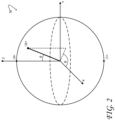
- FIG. 2 is an illustration of a Bloch sphere 16, which provides a graphical description of some quantum mechanical aspects of an individual qubit 14.
- the north and south poles of the Bloch sphere correspond to the standard basis vectors
- the set of points on the surface of the Bloch sphere comprise all possible pure states
- a mixed state of a given qubit may result from decoherence which may occur because of undesirable couplings to external degrees of freedom.
- quantum computer 10 includes a controller 18.
- the controller may comprise conventional electronic componentry, including at least one processor 20 and associated computer memory 22.
- the term 'conventional' is applied herein to any component that can be modeled as an ensemble of particles without considering the quantum state of any individual particle.
- Conventional electronic components include integrated, microlithographed transistors, resistors, and capacitors, for example.
- Computer memory 22 may be configured to hold program instructions 24 that cause processor 20 to execute any process described herein. Additional aspects of controller 18 are described hereinafter.
- Controller 18 of quantum computer 10 is configured to receive a plurality of inputs 26 and to provide a plurality of outputs 28.
- the inputs and outputs may each comprise digital and/or analog lines. At least some of the inputs and outputs may be data lines through which data is provided to and extracted from the quantum computer. Other inputs may comprise control lines via which the operation of the quantum computer may be adjusted or otherwise controlled.
- Controller 18 is operatively coupled to register 12 via interface 30.
- the interface is configured to exchange data bidirectionally with the controller.
- the interface is further configured to exchange signal corresponding to the data bidirectionally with the register.
- signal may include electrical, magnetic, and/or optical signal.
- the controller may interrogate and otherwise influence the quantum state held in the register, as defined by the collective quantum state of the array of qubits 14.
- the interface includes at least one modulator 32 and at least one demodulator 34, each coupled operatively to one or more qubits of register 12.
- Each modulator is configured to output a signal to the register based on modulation data received from the controller.
- Each demodulator is configured to sense a signal from the register and to output data to the controller based on the signal.
- the data received from the demodulator may, in some scenarios; be an estimate of an observable to the measurement of the quantum state held in the register.
- suitably configured signal from modulator 32 may interact physically with one or more qubits 14 of register 12 to trigger measurement of the quantum state held in one or more qubits.
- Demodulator 34 may then sense a resulting signal released by the one or more qubits pursuant to the measurement, and may furnish the data corresponding to the resulting signal to the controller.
- the demodulator may be configured to reveal, based on the signal received, an estimate of an observables reflecting the quantum state of one or more qubits of the register, and to furnish the estimate to controller 13.
- the modulator may provide, based on data from the controller, an appropriate voltage pulse or pulse train to an electrode of one or more qubits, to initiate a measurement.
- the demodulator may sense photon emission from the one or more qubits and may assert a corresponding digital voltage level on an interface line into the controller.
- any measurement of a quantum-mechanical state is defined by the operator ⁇ corresponding to the observable to be measured; the result R of the measurement is guaranteed to be one of the allowed eigenvalues of ⁇ .
- R is statistically related to the register state prior to the measurement, but is not uniquely determined by the register state.
- interface 30 may be further configured to implement one or more quantum-logic gates to operate on the quantum state held in register 12.
- quantum-logic gates to operate on the quantum state held in register 12.
- the function of each type of logic gate of a conventional computer system is described according to a corresponding truth table
- the function of each type of quantum gate is described by a corresponding operator matrix.
- the operator matrix operates on ( i.e ., multiplies) the complex vector representing the register state and effects a specified rotation of that vector in Hilbert space.
- the H gate acts on a single qubit; it maps the basis state
- the S gate leaves the basis state
- quantum gates and associated operator matrices are non-exhaustive, but is provided for ease of illustration.
- Other quantum gates include Pauli - X, - Y , and - Z gates, the NOT gate, additional phase-shift gates, the SW AP gate, controlled cX, cY, and cZ gates, and the Toffoli, Fredkin, Ising, and Deutsch gates, as nonlimiting examples.
- suitably configured signal from modulators 32 of interface 30 may interact physically with one or more qubits 14 of register 12 so as to assert any desired quantum-gate operation.
- the desired quantum-gate operations are specifically defined rotations of a complex vector representing the register state.
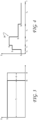
- one or more modulators of interface 30 may apply a predetermined signal level S i for a predetermined duration T i , as shown in FIG. 3 .
- plural signal levels may be applied for plural seqeunced or otherwise associated durations.
- the plural signal levels and durations are arranged to form a composite signal waveform 36, which may be applied to one or more qubits of the register.
- each signal level S i and each duration T i is a control parameter adjustable by appropriate programming of controller 18.
- different sets of adjustable control parameters may control the quantum operation applied to the register state.
- the desired values of the signal levels, signal durations, or other control parameters appropriate to effect a desired quantum-gate operation can only be estimated. Any error in the estimate may result in an errant rotation of the register state that differs from the desired rotation by an overrotation amount ⁇ (in FIG. 3 ).
- the overrotation ⁇ is made as small as practicable by optimization of the various control-parameter values. This process is referred to as 'tuning' a quantum gate.
- Tuning gates in quantum computers is a task of fundamental importance to building a quantum computer. Without tuning, most quantum computers would have insufficient accuracy to implement a simple algorithm, let alone achieve the stringent requirements on gate fidelity or other quality metrics necessary for quantum error correction. Historically, qubit tuning has largely been done with the aid of human intuition, with experimentalists attempting to set physical parameters of the quantum gates in order to calibrate their individual pulses. Recently, alternatives have been advanced that allow devices to be tuned algorithmically in order to improve performance based on real-world estimates of quantum-gate quality.
- overrotations for one or more quantum-gate operations are subsumed into an overall merit function over the set of adjustable parameters.
- the merit function is evaluated iteratively using different trial parameter values, in order to discover the optimal set.
- One example merit function is the average gate fidelity (AGF), defined hereinafter.
- AGF average gate fidelity
- Methods based on numerically optimizing the average gate fidelity are powerful, but present two issues. First, all such methods require substantial input data (i.e ., estimates of quantum-mechanical observables) in order to compute the AGF and to estimate its gradient. Second, no previously available method can use prior information to reduce the amount of required data.
- Bayesian Acronym tuning or BACRONYM
- SPSA simultaneous stochastic perturbative approximation
- the optimization used in ACRONYM involves varying each parameter slightly and applying the fidelity estimation protocol from scratch at every iteration.
- This feature is a disadvantage because accurate estimation of the merit function (e.g ., AGF) may require significant experimental data.
- the disadvantage is magnified because redundant evaluation is necessary at every iteration in order for a statistically meaningful distribution of data to be accumulated for each set of trial parameter values. This derives from the fact that measurement of any quantum observable reveals a distribution of allowed eigenvalues centered on an expectation value, as opposed to a unique value of the observable. Accordingly, execution of ACRONYM or other such procedures may introduce non-negligible latency to quantum-gate calibration.
- Bayesian methods allow prior information to be used for parameter estimation. These methods, specifically, can be used to yield estimates of the AGF based on prior beliefs about randomized benchmarking parameters as well as on evidence obtained experimentally. Bayesian methods begin by taking as input a probability distribution for the AGF as a function of the control-parameter values ⁇ , Pr(AGF
- the methods then output an approximation to the posterior probability distribution, which can be interpreted as the probability one should ascribe to the AGF taking a specific value conditioned on prior beliefs and on E .
- E ; ⁇ ) an estimate of AGF is extracted through either the mean of the distribution or through an estimate of the uncertainty in the AGF using the variance of the distribution.
- the uncertainty in parameters like AGF that occurs from transitioning from ⁇ ⁇ ⁇ ' in the optimization process is a continuous function of ⁇ ⁇ - ⁇ ' ⁇ , provided that the quantum channels that describe the underlying gates are continuous functions of the control parameters.
- This provides a rule that can be followed in order to assess how much uncertainty must be added to the posterior distribution Pr(AGF
- This feature provides a robust framework for Bayesian ACRONYM tuning of quantum logic gates. By reducing the latency of the tuning process through data reuse, the task of providing and maintaining proper tuning of quantum computer takes less operational time and leaves more time for the quantum computer to solve problems.
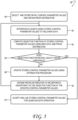
- FIG. 5 illustrates an example method 38 for tuning a quantum gate of a quantum computer.
- an initial set of control-parameter values is selected and stored, and an initial prior distribution (i.e ., probability distribution) is obtained over features that will be used to compute the objective function.
- the initial prior distribution may be obtained based on the initially selected control-parameter values.
- Bayesian methods are generally agnostic as to how to obtain an initial prior distribution. Nonlimiting examples may include an exhaustive study of faults in similar devices, a first-principles calculation of likely overrotation given hypothetical noise sources, or adoption of a conservative ( e.g ., uniform) prior over a plausible range of different fidelities.
- the distribution is over the figure of merit for a quantum-logic gate at the initial control parameters.
- the initial prior may be over some measure of agreement between a program as implemented on an actual quantum computer versus a hypothetical noiseless machine.
- one or more qubits of the quantum computer are interrogated using the stored control-parameter values. This action yields a set of new data providing an estimate of performance metrics of the quantum device.
- the one or more qubits may be interrogated according to an RB protocol, as described in further detail herein. Briefly, such interrogation may include subjecting the one or more qubits to a sequence of quantum gates. In some examples, that action may be followed by reversal of the applied quantum-gate sequence, followed further ray measurement of the quantum state of the one or more qubits.
- an objective function quantifying operational quality of the quantum gate at the stored control-parameter values is computed.
- the form of the objective function is not particularly limited in method 38, but may vary in relation to at least one overrotation of a quantum state of the one or more qubits when subjected to a quantum-gate operation.
- the objective function may represent the fidelity of a plurality of different quantum-gates, such that each of the plurality of different quantum gates is tuned via method 38.
- computing the objective function may include estimating an average gate fidelity over an ensemble of randomly selected quantum gates.
- Computation of the objective function may employ the newly measured data in addition to the prior distribution over the features used to compute the objective function, such features having been obtained by previous adaptive or non-adaptive interrogation of the qubits ( e.g ., using previous control-parameter values).
- the stored control-parameter values are updated based on a suitable optimization procedure.
- the control-parameter values may be updated according to a multivariable parameter-optimization algorithm, for example.
- SPSA may be used.
- the threshold operational quality may comprise a threshold quantum-gate fidelity determined, for instance, based on an estimate of a posterior uncertainty in the quantum-gate fidelity as quantified by the objective function.
- the prior distribution is expanded to incorporate uncertainty in the objective function at the updated control-parameter values. Execution of the method now returns to 42 for another evaluation of the objective function. If the objective function exceeds the threshold operational quality, then the stored control-parameter values, at 52, are accepted and used subsequently to enact the operation of the quantum gate.
- H C d be a finite-dimensional Hilbert space describing the states of a quantum system of interest, and let be the set of linear operators acting on .
- U( ) be the set of unitary operators acting on .
- ⁇ ⁇ ⁇ are of less concern than classical distributions over such states, which are described by density operators ⁇ ⁇ d( ) Herm( ) .
- G ⁇ V 0 ,..., V l-1 ⁇ U( ) be a group and a 2-design, such that G is appropriate for use in standard randomized benchmarking. Often, G will be the Clifford group acting on a Hilbert space of dimension d, but smaller twirling groups may be chosen in some circumstances.
- ⁇ V is the identity channel.
- ⁇ X ⁇ H H • ⁇ S S • ⁇ H H • H ⁇ S ⁇ H ⁇ • is the discrepancy channel describing the noise incurred upon implementation of X ⁇ as the sequence H ⁇ S ⁇ H ⁇ .
- Lemma Composition of Lipschitz continuous functions and channels. Let A, ⁇ : S -> be Lipschitz continuous in the trace distance with constants and M, respectively. Then, ( ⁇ ) : x ⁇ ⁇ ( x ) ⁇ ( x ) is Lipschitz continuous in the trace distance with constant + M.
- the lemmas above are used to show that AGF( ⁇ T ( ⁇ )) is Lipschitz continuous with constant when ⁇ T ( ⁇ ) is Lipschitz continuous in the trace distance with constant .
- FIG. 6 is a plot of the length of randomized benchmarking sequences, in terms of the number of generators in the sequence, as a function of the number of group elements m comprising the sequence.
- V i JL ⁇ since the channels are ideal and therefore independent of the control vector ⁇ ; these channels are Lipschitz continuous in the trace distance with constant 0. Further, each ⁇ V i 0 for i > 0; these channels are also Lipschitz continuous in the trace distance with constant 0. By assumption, ⁇ V 0 is Lipschitz continuous in the trace distance with constant . Hence, each factor in ⁇ U is Lipschitz continuous in the trace distance with constant or 0, as detailed above.
- ⁇ U is Lipschitz continuous in the trace distance with constant mL , where m counts the number of 0s in i (corresponding to the number of times the target gate occurs in the decomposition of U ).
- m counts the number of 0s in i (corresponding to the number of times the target gate occurs in the decomposition of U ).
- n Lipschitz continuous in the trace distance with constant nL.
- f ( ⁇ , y) is a Lipschitz continuous function of ⁇ with constant where y is a variable in a measurable set S with corresponding probability distribution on that set of Pr( y ) and for any function g :
- n for occurrences of T in decompositions of elements of G, in order to find the Lipschitz constant for F ( ⁇ ) in this example.
- Plot 54 of FIG. 7 shows how the objective function F( ⁇ ) and the AGF vary with the overrotation angle ⁇ for the example immediately above.
- the solid line represents F ( ⁇ ).
- the dashed line represents the AGF.
- Plot 56 of FIG. 7 shows how the RB parameters vary with 0 for the same example.
- the solid line represents A
- the dashed line represents p
- the dot-dashed line represents B .
- Numerical simulation can also be used to include the effect of noise in other generators.
- ⁇ H is a depolarizing channel with strength 0.5%.
- simulating F ( ⁇ ) for this case shows that F is Lipschitz continuous with a constant of approximately 1.48, as illustrated in FIG. 7 .
- the posterior probability distribution for the objective function F evaluated at parameters ⁇ be Pr ( F ( ⁇ )).
- the objective function F does not depend on the control parameters 0 provided that the RB parameters y are known exactly.
- the probability density Pr( y ) is an arbitrary distribution, but computation of the estimator (42) is in general intractable.
- SMC sequential Monte Carlo
- the SMC approximation allows approximate expectation values to be estimated over the probability distribution using a finite number of points, or particles, such that the expectation value of any continuous function can be approximated with arbitrary accuracy as N p ⁇ ⁇ .
- the estimator F ⁇ may be approximated within arbitrary accuracy.
- the posterior variance can be computed as the variance over the variable y induced from the sequential Monte Carlo approximation to the probability distribution, V F ⁇ ⁇ i w i F y i 2 ⁇ ⁇ i w i F y i 2 , where it is assumed that F ⁇ ⁇ y and that Pr( F
- c ( c p , c A , c B ) be a vector such that
- the convex hull Conv( D ) consists of a convex region of identical dimensions. Since the set is convex it then follows that c ⁇ Conv( D ). Put differently, the definitions of the Lipschitz functions and channels in terms of the Minkowski sum may now be expressed, such that y ⁇ T ⁇ + ⁇ ⁇ Conv y ⁇ T ⁇ + D .
- the solid line represents the true value for the survival probability, ( A - B ) + B, as a function of the sequence length
- the dashed line represents the estimate of the survival probability.
- the prior was set to be uniform for p and A on [0, 1] and the prior B was set to be the normal distribution (0.5, 0.05 2 ).
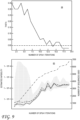
- FIG. 9 illustrates overrotation angle and objective function values for an overrotation model with a 0.35 radian overrotation initially with a target error of 0.005 in F as measured by the posterior standard-deviation.
- Left plot 58 shows, as the solid line, the overrotation angle as a function of number of iterations of SPSA taken, while the broken line shows the goal.
- Right plot 60 shows the estimated average gate infidelity as a function of the number of SPSA iterations and the total number of sequences used to achieve that level of infidelity.
- the dashed line shows the estimated F
- the solid line shows the true F
- the dot-dashed line gives the number of applied sequences.
- the shaded region represents a 70% credible region for the infidelity.
- Local search is implemented using SPSA with learning rate 0.05, a step of 0.05 used to compute approximate gradients and a maximum step size of 0.1. The method is repeated until the posterior variance in the average gate fidelity is less than 0.005 2 .
- a Lipshitz constant of 1.48 is used, which was numerically computed as a bound to give an appropriate amount of diffusion for the posterior distribution during an update.
- Bayesian inference is approximated using a particle filter with 256 000 particles and Liu-West resampling with a resample threshold of 1/256 as implemented by QInfer. Single shot experiments are used with a maximum number of sequences of 500 per set of parameters.
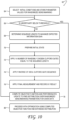
- FIG. 10 illustrates an example method 62 of applying a Bayesian-informed variant of randomized benchmarking (RB) to the problem of estimating the average gate fidelity of Clifford gates in a quantum computer.
- Method 62 is a more specific implementation of steps 42 and 44 of Bayesian tuning method 38 as illustrated in FIG. 5 .
- initial conditions and processing parameters are selected for RB and stored in computer memory 22.
- the initial conditions may include: initial control parameter values ⁇ 0 ; the number of measurements per sequence length n shots ; the required accuracy for F , defined as ⁇ req ; the SPSA1 parameter values ( a , b, s, t); the largest allowed step in ⁇ ; the target objective function value, F target ; the initial prior ⁇ 0 ; and the value L of the Lipschitz continuity assumed for F.
- the act of setting the initial conditions may include initially synthesizing the prior distribution as appropriate for the selected RB parameters.
- the AGF is a natural choice for the objective function.
- alternative objective functions - e.g ., a. diamond distance to an ideal channel-may be defined, evaluated, and used for the determination at 66. If the uncertainty is above the threshold, then at 68 an appropriate length of a sequence of Clifford gates usable for RB is determined. The length may be selected so as to maximize the information available from RB. For instance, the selected length may be one that increases a sensitvity on any new data of the fidelity as quantified by an appropriate objective function (e.g. , the average gate fidelity).
- an appropriate objective function e.g. , the average gate fidelity
- an initial state is prepared, where ⁇ ⁇ ⁇ 0 and ⁇ ⁇ ⁇ 0 . More specifically, one or more qubits of a register in the quantum computer may be manipulated in order to set the one or more qubits to an initial superposition of quantum states desirable for subsequent manipulations.
- the one or more qubits are now manipulated to effect on the one or more qubits a Clifford-gate sequence of the determined length, using stored control-parameter values.
- the Clifford gates in the sequence may be randomly chosen, whereas the length of the sequence is the length determined at 68.
- the sequence of Clifford gates applied at this stage may be interleaved with at least one non-Clifford gate.
- the one or more qubits are again manipulated using the stored control-parameter values, this time to reverse the Clifford-gate sequence applied at 72 on the same one or more qubits.
- the one or more qubits are interrogated in order to measure the quantum state therein, yielding new data that provides an estimate of performance metrics of the quantum device. In other words, a final measurement is applied, and a result of 0 or 1 is recorded. In particular, data is collected at 8 until Var F ⁇ ⁇ req 2 , and F ⁇ ⁇ E F ⁇ data , and i iter ⁇ 0.
- the main loop of method 62 may be expressible according to the following algorithm:
- the objective function is computed, which quantifies the fidelity (and conversely the uncertainty) of the reversed Clifford-gate sequence at the stored control-parameter values.
- This computation employs the new data in addition to the prior distribution obtained by prior interrogation of the one or more qubits using prior control-parameter values.
- a Bayesian update is performed in order to find the distribution over the randomized benchmarking parameters in view of the new data.
- the prior distribution is expanded to incorporate uncertainty in the objective function at the stored control-parameter values.
- Execution of the method then returns to 66, where the manipulating, interrogating, and computing steps are repeated, this time employing the expanded prior distribution. If the uncertainty quantified by the objective function is now below the threshold uncertainty, then the computed objective function and expanded distribution, at 80, are accepted and used for continued optimization of the control-parameter values.
- This disclosure demonstrates the efficient reuse of information gathered from tuning quantum gates in experiments that use nearby vectors of parameters.
- the method thereby reduces the amount of data needed to find the objective function, as well as to evaluate the gradients, relative to the approach in which the ojective function is evaluated afresh at every iteration.
- This strategy is here applied to ACRONYM tuning, which uses the average gate fidelity reported by randomized benchmarking as a figure of merit for optimization.
- the disclosed method is verified numerically, by showing that a model of a noisy qubit with a systematic overrotation error can be corrected to within an error of at most 0.05 percent using less than 1 kB of data.
- Bayesian methods can be used broadly to tune quantum devices. While the initial focus is on randomized benchmarking as a method to yield the objective function used for tuning, the present overall strategy is by no means limited to that implementation. Other figures of merit can also be estimated similarly. For example, an estimates returned by protocols such as gateset tomography or Hamiltonian learning may be used to provide the objective. Such extensions may be useful in order to optimize not only device performance but also to gain an understanding of why a device is performing poorly. Such an approaches could prove invaluable for calibrating near-term quantum devices that aim to demonstrate quantum advantage or error correction, which have rich control landscapes that may resist human intuition. By optimally using prior information between tuning steps, and potentially between devices, it may be possible to overcome these daunting control objectives, while also reducing the amount of data required to do so.
- FIG. 1 this drawing schematically shows a non-limiting embodiment of a computer system in the form of quantum computer 10, that can enact one or more of the methods and processes described above.
- the computer system is shown in simplified form.
- the computer system includes a processor 20 and associated computer memory 22.
- the computer system may optionally include a display device, input device, network device, and/or other components not shown in the drawings.
- Processor 20 includes one or more physical devices configured to execute instructions.
- the processor may be configured to execute instructions that are part of one or more applications, services, programs, routines, libraries, objects, components, data structures, or other logical constructs. Such instructions may be implemented to perform a task, implement a data type, transform the state of one or more components, achieve a technical effect, or otherwise arrive at a desired result.
- Processor 20 may include one or more individual processors configured to execute software instructions. Additionally or alternatively, the processor may include one or more hardware or firmware processors configured to execute hardware or firmware instructions. Processors may be single-core or multi-core, and the instructions executed thereon may be configured for sequential, parallel, and/or distributed processing.
- Individual components of the processor optionally may be distributed among two or more separate devices, which may be remotely located and/or configured for coor-dinated processing. Aspects of the processor may be virtualized and executed by remotely accessible, networked computing devices configured in a cloud-computing configuration.
- Computer memory 22 includes one or more physical devices configured to hold instructions executable by the processor to implement the methods and processes described herein. When such methods and processes are implemented, the state of computer memory 22 may be transformed-e.g., to hold different data.
- Computer memory 22 may include removable and/or built-in devices.
- Computer memory 22 may include optical memory (e.g., CD, DVD, HD-DVD, Blu-Ray Disc, etc .), semiconductor memory (e.g., RAM, ROM, EPROM, EEPROM, etc .), and/or magnetic memory (e.g., hard-disk drive, tape drive, MRAM, etc .), among others.
- Computer memory 22 may include volatile, nonvolatile, dynamic, static, read/write, read-only, random-access, sequential-access, location-addressable, file-addressable, and/or content-addressable devices. It will be appreciated that computer memory 22 includes one or more physical devices. However, aspects of the instructions described herein alternatively may be propagated by a communication medium (e.g., an electromagnetic signal, an optical signal, etc .) that is not held by a physical device for a finite duration.
- a communication medium e.g., an electromagnetic signal, an optical signal, etc .
- processor 20 and computer memory 22 may be integrated together into one or more hardware-logic components.
- hardware-logic components may include field-programmable gate arrays (FPGLAs), program- and application-specific integrated circuits (PASIC / ASICs), program- and application-specific standard products (PSSP / ASSPs), system-on-a-chip (SOC), and complex programmable logic devices (CPLDs), for example.
- FPGLAs field-programmable gate arrays
- PASIC / ASICs program- and application-specific integrated circuits
- PSSP / ASSPs program- and application-specific standard products
- SOC system-on-a-chip
- CPLDs complex programmable logic devices
- modules, programs, and/or engines may be instantiated via processor 20 executing instructions held by computer memory 22. It will be understood that different modules, programs, and/or engines may be instantiated from the same application, service, code block, object, library, routine, API, function, etc. Likewise, the same module, program, and/or engine may be instantiated by different applications, services, code blocks, objects, routines, APIs, functions, etc.
- the terms 'module,' 'program,' and 'engine' may encompass individual or groups of executable files, data files, libraries, drivers, scripts, database records, etc.
- a 'service' is an application program executable across multiple user sessions.
- a service may be available to one or more system components, programs, and/or other services.
- a service may run on one or more server-computing devices.
- a display device 82 may be used to present a visual representation of data held by computer memory 22.
- This visual representation may take the form of a graphical user interface (GUI).
- GUI graphical user interface
- an input device 84 may comprise or interface with one or more user-input components such as a keyboard, mouse, or touch screen.
- network device 86 may be configured to communicatively the couple computer system with one or more other computing devices.
- a network device may include wired and/or wireless communication components compatible with one or more different communication protocols.
- the network device may be configured for communication via a wireless telephone network, or a wired or wireless local- or wide-area network.
- the network device may allow computer system 10 to send and/or receive messages to and/or from other devices via a network such as the Internet.
- One aspect of this disclosure is directed to a method for tuning a quantum gate of a quantum computer.
- the method comprises: interrogating one or more qubits of the quantum computer using stored control-parameter values and yielding new data; computing an objective function quantifying operational quality of the quantum gate at the stored control-parameter values, such computing employing the new data in addition to a prior distribution over features used to compute the objective function, wherein the prior distribution is obtained by previous adaptive or non-adaptive interrogation of the one or more qubits; updating the stored control-parameter values; expanding the prior distribution to incorporate uncertainty in the objective function at the updated control-parameter values; re-interrogating the one or more qubits using the updated control-parameter values; and re-computing the objective function using the expanded prior distribution.
- the method further comprises accepting and subsequently using the stored control-parameter values for the quantum gate if the operational quality quantified by the objective function exceeds a threshold operational quality.
- the operational quality comprises a quantum-gate fidelity
- the threshold operational quality comprises a threshold quantum-gate fidelity
- the threshold quantum-gate fidelity is determined based on an estimate of a posterior uncertainty in the quantum-gate fidelity as quantified by the objective function.
- computing the objective function includes estimating an average gate fidelity over an ensemble of randomly selected quantum gates.
- interrogating the one or more qubits includes a randomized benchmarking protocol including subjecting the one or more qubits to a sequence of quantum gates and to an inverse of the sequence of quantum gates.
- updating the stored control-parameter values includes updating according to a multivariable parameter-optimization algorithm.
- the quantum gate is one of a plurality of different quantum gates represented in the objective function, and each of the plurality of different quantum gates is tuned via the method.
- the objective function varies in relation to at least one overrotation of the quantum state of the one or more qubits.
- Another aspect of this disclosure is directed to a method for tuning one or more quantum gates of a quantum computer.
- This method comprises: manipulating one or more qubits of the quantum computer to effect a Clifford-gate sequence on the one or more qubits using stored control-parameter values; manipulating the one or more qubits to reverse the Clifford-gate sequence on the one or more qubits using the stored control-parameter val-ties; interrogating the one or more qubits to measure a quantum-state of the one or more qubits, yielding new data; computing an objective function quantifying fidelity of the reversed Clifford-gate sequence at the stored control-parameter values , such computing employing the new data in addition to a prior distribution obtained by prior interrogation of the one or more qubits using prior control-parameter values; updating the stored control-parameter values; expanding the prior distribution to incorporate uncertainty in the objective function at the updated control-parameter values; and repeating said manipulating, interrogating, and computing the objective function employing the expanded prior distribution and the
- the method further comprises initially selecting the prior distribution for randomized benchmarking parameters. In some implementations, the method further comprises determining a length of the Clifford-gate sequence. In some implementations, the length of the Clifford-gate sequence is determined so as to increase sensitivity on the new data of the fidelity as quantified by the objective function. In some implementations, the method further comprises interleaving the Clifford-gate sequence with at least one non-Clifford gate. In some implementations, the method further comprises accepting and subsequently using the stored control-parameter values for the quantum gate if the fidelity quantified by the objective function exceeds a threshold fidelity. In some implementations, updating the stored control-parameter values includes updating according to a multivariable parameter-optimization algorithm. In some implementations, the objective function comprises an average gate fidelity or a diamond distance to an ideal channel.
- a quantum computer comprising: a register including a plurality of qubits; a modulator configured to implement a quantum-logic operation on the plurality of qubits according to stored control-parameter values; a demodulator configured to reveal data reflecting a quantum state of the plurality of qubits; a controller operatively coupled to the modulator and to the demodulator; and associated with the controller, computer memory holding the stored control-parameter values and holding instructions that cause the controller to: interrogate the plurality of qubits using stored control-parameter values and yielding new data, compute an objective function quantifying fidelity of the quantum-logic operation at the stored control-parameter values, such computing employing the new data in addition to a prior distribution over features used to compute the objective function, update the stored control-parameter values, expand the prior distribution to incorporate uncertainty in the objective function at the updated control-parameter values, re-interrogate the plurality of qubits using the updated control-parameter values, and re-compute the objective function using the
- the modulator is configured to transmit a signal to the plurality of qubits based on modulation data from the controller.
- the signal is one or more of electrical, optical, and magnetic.
- the demodulator is configured to receive a signal from the plurality of qubits and furnish the new data to the controller based on the signal.
Landscapes
- Engineering & Computer Science (AREA)
- Physics & Mathematics (AREA)
- Theoretical Computer Science (AREA)
- General Physics & Mathematics (AREA)
- Mathematical Physics (AREA)
- Computing Systems (AREA)
- General Engineering & Computer Science (AREA)
- Software Systems (AREA)
- Evolutionary Computation (AREA)
- Data Mining & Analysis (AREA)
- Artificial Intelligence (AREA)
- Pure & Applied Mathematics (AREA)
- Mathematical Analysis (AREA)
- Computational Mathematics (AREA)
- Mathematical Optimization (AREA)
- Condensed Matter Physics & Semiconductors (AREA)
- Chemical & Material Sciences (AREA)
- Nanotechnology (AREA)
- Computer Hardware Design (AREA)
- Crystallography & Structural Chemistry (AREA)
- Algebra (AREA)
- Computer Vision & Pattern Recognition (AREA)
- Medical Informatics (AREA)
- Probability & Statistics with Applications (AREA)
- Complex Calculations (AREA)
- Management, Administration, Business Operations System, And Electronic Commerce (AREA)
Claims (15)
- Verfahren (38, 62) zum Abstimmen eines oder mehrerer Quantengatter (30) eines Quantencomputers, wobei das Verfahren Folgendes umfasst:Manipulieren (72) eines oder mehrerer Qubits (14) des Quantencomputers, um eine Clifford-Gatter-Sequenz auf dem einen oder den mehreren Qubits unter Verwendung gespeicherter Steuerparameterwerte zu bewirken;Manipulieren (74) des einen oder der mehreren Qubits, um die Clifford-Gatter-Sequenz auf dem einen oder den mehreren Qubits unter Verwendung der gespeicherten Steuerparameterwerte umzukehren;Abfragen (76) des einen oder der mehreren Qubits, um einen Quantenzustand des einen oder der mehreren Qubits zu messen, was neue Daten liefert;Berechnen (78) einer Zielfunktion, die die Genauigkeit der umgekehrten Clifford-Gatter-Sequenz bei den gespeicherten Steuerparameterwerten quantifiziert, wobei dieses Berechnen die neuen Daten zusätzlich zu einer vorherigen Verteilung verwendet, die durch vorherige Abfrage des einen oder der mehreren Qubits unter Verwendung vorheriger Steuerparameterwerte erlangt wurde;Aktualisieren (48) der gespeicherten Steuerparameterwerte;Erweitern (50) der vorherigen Prioritätsverteilung, um die Unsicherheit in der Zielfunktion bei den aktualisierten Steuerparameterwerten einzubeziehen;Wiederholen des Manipulierens (72, 74), Abfragens (76) und Berechnens (78) der Zielfunktion unter Verwendung der erweiterten vorherigen Verteilung und der aktualisierten Steuerparameterwerte; undAkzeptieren und anschließendes Verwenden der gespeicherten Steuerparameterwerte für die Clifford-Gatter-Sequenz, wenn die von der Zielfunktion quantifizierte Genauigkeit einen Schwellenwert der Genauigkeit überschreitet, wobei der Schwellenwert der Genauigkeit basierend auf einer Schätzung einer nachträglichen Unsicherheit in der von der Zielfunktion quantifizierten Genauigkeit bestimmt wird.
- Verfahren nach Anspruch 1, ferner umfassend das anfängliche Auswählen der vorherigen Verteilung für randomisierte Benchmarking-Parameter.
- Verfahren nach Anspruch 1, ferner umfassend das Bestimmen einer Länge der Clifford-Gatter-Sequenz.
- Verfahren nach Anspruch 3, wobei die Länge der Clifford-Gatter-Sequenz so bestimmt wird, dass sie die Empfindlichkeit gegenüber den neuen Daten der Genauigkeit, wie sie durch die Zielfunktion quantifiziert wird, erhöht.
- Verfahren nach Anspruch 1, ferner umfassend das Verschachteln der Clifford-Gatter-Sequenz mit mindestens einem Nicht-Clifford-Gatter.
- Verfahren nach Anspruch 1, wobei das Aktualisieren der gespeicherten Steuerparameterwerte ein Aktualisieren nach einem Algorithmus zur Optimierung multivariabler Parameter einschließt.
- Verfahren nach Anspruch 1, wobei die Zielfunktion eine durchschnittliche Gatter-Genauigkeit oder einen Diamantabstand zu einem idealen Kanal umfasst.
- Verfahren nach Anspruch 1, wobei die Zielfunktion in Relation zu mindestens einer Überrotation des Quantenzustands des einen oder der mehreren Qubits variiert.
- Quantencomputer (10), umfassend:ein Register (12), das eine Vielzahl von Qubits (14) einschließt;einen Modulator (32) der konfiguriert ist zum Manipulieren (72) eines oder mehrerer Qubits (14) des Quantencomputers, um eine Clifford-Gatter-Sequenz auf dem einen oder den mehreren Qubits unter Verwendung gespeicherter Steuerparameterwerte zu bewirken und zum Manipulieren (74) des einen oder der mehreren Qubits, um die Clifford-Gatter-Sequenz auf dem einen oder den mehreren Qubits unter Verwendung der gespeicherten Steuerparameterwerte umzukehren;einen Demodulator (34), der konfiguriert ist zum Abfragen (76) des einen oder der mehreren Qubits, um einen Quantenzustand des einen oder der mehreren Qubits zu messen, was neue Daten liefert;eine Steuerung (18), die operativ mit dem Modulator und dem Demodulator gekoppelt ist; undeinen der Steuerung zugeordneten Computerspeicher (22), der die gespeicherten Steuerparameterwerte und Anweisungen enthält, die die Steuerung zu Folgendem veranlassen:Berechnen (44) einer Zielfunktion, die die Genauigkeit der umgekehrten Clifford-Gatter-Sequenz bei den gespeicherten Steuerparameterwerten quantifiziert, wobei dieses Berechnen die neuen Daten zusätzlich zu einer vorherigen Verteilung verwendet, die durch vorherige Abfrage des einen oder der mehreren Qubits unter Verwendung vorheriger Steuerparameterwerte erlangt,Aktualisieren (48) der gespeicherten Steuerparameterwerte,Erweitern (50) der vorherigen Prioritätsverteilung, um die Unsicherheit in der Zielfunktion bei den aktualisierten Steuerparameterwerten einzubeziehen,Wiederholen des Manipulierens (72, 74), Abfragens (76) und Berechnens (78) der Zielfunktion unter Verwendung der erweiterten vorherigen Verteilung und der aktualisierten Steuerparameterwerte; undAkzeptieren und anschließendes Verwenden der gespeicherten Steuerparameterwerte für die Clifford-Gatter-Sequenz, wenn die von der Zielfunktion quantifizierte Genauigkeit einen Schwellenwert der Genauigkeit überschreitet, wobei der Schwellenwert der Genauigkeit basierend auf einer Schätzung einer nachträglichen Unsicherheit in der von der Zielfunktion quantifizierten Genauigkeit bestimmt wird.
- Quantencomputer nach Anspruch 9, wobei der Modulator basierend auf Modulationsdaten der Steuerung ein Signal an die Vielzahl der Qubits überträgt.
- Quantencomputer nach Anspruch 10, wobei das Signal eines oder mehrere von elektrischen, optischen und magnetischen Signalen ist.
- Quantencomputer nach Anspruch 9, wobei der Demodulator so beschaffen ist, dass er ein Signal von der Vielzahl von Qubits empfängt und die neuen Daten basierend auf dem Signal an die Steuerung liefert.
- Quantencomputer nach Anspruch 9, wobei die Zielfunktion in Relation zu mindestens einer Überrotation des Quantenzustands der Vielzahl von Qubits variiert.
- Quantencomputer nach Anspruch 9, wobei die Anweisungen die Steuerung ferner zu Folgendem veranlassen:
Bestimmen einer Länge der Clifford-Gatter-Sequenz. - Quantencomputer nach Anspruch 14, wobei die Anweisungen die Steuerung zu Folgendem veranlassen:
Bestimmen der Länge der Clifford-Gatter-Sequenz derart, dass sie die Empfindlichkeit gegenüber den neuen Daten der Genauigkeit, wie sie durch die Zielfunktion quantifiziert wird, erhöht.
Applications Claiming Priority (2)
| Application Number | Priority Date | Filing Date | Title |
|---|---|---|---|
| US16/154,552 US10469087B1 (en) | 2018-10-08 | 2018-10-08 | Bayesian tuning for quantum logic gates |
| PCT/US2019/052539 WO2020076493A1 (en) | 2018-10-08 | 2019-09-24 | Bayesian tuning for quantum logic gates |
Publications (2)
| Publication Number | Publication Date |
|---|---|
| EP3864584A1 EP3864584A1 (de) | 2021-08-18 |
| EP3864584B1 true EP3864584B1 (de) | 2025-02-26 |
Family
ID=68165746
Family Applications (1)
| Application Number | Title | Priority Date | Filing Date |
|---|---|---|---|
| EP19783805.5A Active EP3864584B1 (de) | 2018-10-08 | 2019-09-24 | Bayessche abstimmung für quantenlogikgatter |
Country Status (3)
| Country | Link |
|---|---|
| US (1) | US10469087B1 (de) |
| EP (1) | EP3864584B1 (de) |
| WO (1) | WO2020076493A1 (de) |
Families Citing this family (27)
| Publication number | Priority date | Publication date | Assignee | Title |
|---|---|---|---|---|
| EP3718026B1 (de) | 2017-12-01 | 2023-11-29 | 1QB Information Technologies Inc. | Systeme und verfahren zur stochastischen optimierung eines robusten inferenzproblems |
| JP7713882B2 (ja) * | 2018-12-06 | 2025-07-28 | ワンキュービー インフォメーション テクノロジーズ インク. | 人工知能駆動型量子計算 |
| AU2020292425B2 (en) | 2019-06-14 | 2023-02-23 | Zapata Computing, Inc. | Hybrid quantum-classical computer for bayesian inference with engineered likelihood functions for robust amplitude estimation |
| US10970234B2 (en) * | 2019-07-16 | 2021-04-06 | International Business Machines Corporation | Optimizing time-dependent simulations of quantum computing architectures |
| CA3151055C (en) | 2019-09-27 | 2022-08-30 | Pierre-luc DALLAIRE-DEMERS | Computer systems and methods for computing the ground state of a fermi-hubbard hamiltonian |
| EP4042338A4 (de) * | 2019-11-20 | 2023-01-25 | Zapata Computing, Inc. | Quantenalgorithmus und konstruktion für eine quantenschaltkreisarchitektur zum simulieren von wechselwirkenden fermionen |
| US11562282B2 (en) * | 2020-03-05 | 2023-01-24 | Microsoft Technology Licensing, Llc | Optimized block encoding of low-rank fermion Hamiltonians |
| US11556832B2 (en) | 2020-05-12 | 2023-01-17 | International Business Machines Corporation | Randomized benchmarking by exploiting the structure of the Clifford group |
| WO2021247656A1 (en) | 2020-06-02 | 2021-12-09 | Zapata Computing, Inc. | Realizing controlled rotations by a function of input basis state of a quantum computer |
| US11544614B2 (en) * | 2020-06-05 | 2023-01-03 | International Business Machines Corporation | Sampling of an operator in a quantum system |
| CN112101561B (zh) * | 2020-08-24 | 2022-10-18 | 清华大学 | 一种实现量子逻辑门的方法及装置 |
| CN112000673B (zh) * | 2020-08-31 | 2024-06-14 | 本源量子计算科技(合肥)股份有限公司 | 一种利用量子线路查询交易元素的方法及装置 |
| US12045743B2 (en) * | 2020-09-24 | 2024-07-23 | Microsoft Technology Licensing, Llc | Mixing techniques for probabilistic quantum circuits with fallback |
| US12067458B2 (en) | 2020-10-20 | 2024-08-20 | Zapata Computing, Inc. | Parameter initialization on quantum computers through domain decomposition |
| CA3202572A1 (en) * | 2020-11-20 | 2022-05-27 | Goldman Sachs & Co. LLC | Methods of operating quantum computing systems for amplitude estimation |
| CN113177641A (zh) * | 2021-05-17 | 2021-07-27 | 山东浪潮科学研究院有限公司 | 一种量子比特控制脉冲的反馈优化方法 |
| US11941484B2 (en) | 2021-08-04 | 2024-03-26 | Zapata Computing, Inc. | Generating non-classical measurements on devices with parameterized time evolution |
| CN113609704B (zh) * | 2021-08-20 | 2023-08-01 | 四川元匠科技有限公司 | 基于不同测量方式的量子开放系统模拟方法、存储介质及终端 |
| US12001920B2 (en) | 2021-08-30 | 2024-06-04 | Red Hat, Inc. | Generating a global snapshot of a quantum computing device |
| US12210932B2 (en) | 2021-09-23 | 2025-01-28 | Microsoft Technology Licensing, Llc | Observational bayesian optimization of quantum-computing operations |
| US12547922B2 (en) * | 2021-10-20 | 2026-02-10 | IonQ, Inc. | Benchmark-driven automation for tuning quantum computers |
| ES3043611T3 (en) * | 2021-12-22 | 2025-11-25 | Multiverse Computing S L | Methods, devices and computer program products for setting a classifier with quantum computation |
| US11809839B2 (en) | 2022-01-18 | 2023-11-07 | Robert Lyden | Computer language and code for application development and electronic and optical communication |
| CN114492817B (zh) * | 2022-01-29 | 2024-07-09 | 中国科学技术大学 | 实验中标定并优化量子门的方法 |
| US20240004773A1 (en) * | 2022-05-31 | 2024-01-04 | Alibaba (China) Co., Ltd. | Benchmarking protocol for quantum gates |
| CN114897175B (zh) * | 2022-05-31 | 2024-07-12 | 北京百度网讯科技有限公司 | 量子测量设备的噪声消除方法及装置、电子设备和介质 |
| WO2024167659A2 (en) * | 2023-01-27 | 2024-08-15 | ColdQuanta, Inc. | Managing processing of quantum circuits |
Family Cites Families (3)
| Publication number | Priority date | Publication date | Assignee | Title |
|---|---|---|---|---|
| JP6873120B2 (ja) * | 2015-10-27 | 2021-05-19 | ディー−ウェイブ システムズ インコーポレイテッド | 量子プロセッサにおける縮退軽減のためのシステムと方法 |
| US11042811B2 (en) * | 2016-10-05 | 2021-06-22 | D-Wave Systems Inc. | Discrete variational auto-encoder systems and methods for machine learning using adiabatic quantum computers |
| US10483980B2 (en) * | 2017-06-19 | 2019-11-19 | Rigetti & Co, Inc. | Parametrically activated quantum logic gates |
-
2018
- 2018-10-08 US US16/154,552 patent/US10469087B1/en active Active
-
2019
- 2019-09-24 WO PCT/US2019/052539 patent/WO2020076493A1/en not_active Ceased
- 2019-09-24 EP EP19783805.5A patent/EP3864584B1/de active Active
Non-Patent Citations (3)
| Title |
|---|
| IAN HINCKS ET AL: "Bayesian Inference for Randomized Benchmarking Protocols", ARXIV.ORG, CORNELL UNIVERSITY LIBRARY, 201 OLIN LIBRARY CORNELL UNIVERSITY ITHACA, NY 14853, 1 February 2018 (2018-02-01), XP081214121 * |
| JOHN GAMBLE ET AL: "Bayesian ACRONYM Tuning", ARXIV.ORG, CORNELL UNIVERSITY LIBRARY, 201 OLIN LIBRARY CORNELL UNIVERSITY ITHACA, NY 14853, 15 February 2019 (2019-02-15), XP081029712 * |
| YANG C H ET AL: "Silicon qubit fidelities approaching stochastic noise limits via pulse optimisation", ARXIV.ORG, CORNELL UNIVERSITY LIBRARY, 201 OLIN LIBRARY CORNELL UNIVERSITY ITHACA, NY 14853, 25 July 2018 (2018-07-25), XP081118782 * |
Also Published As
| Publication number | Publication date |
|---|---|
| WO2020076493A1 (en) | 2020-04-16 |
| EP3864584A1 (de) | 2021-08-18 |
| US10469087B1 (en) | 2019-11-05 |
Similar Documents
| Publication | Publication Date | Title |
|---|---|---|
| EP3864584B1 (de) | Bayessche abstimmung für quantenlogikgatter | |
| US20230306286A1 (en) | Hybrid Quantum-Classical Computer for Bayesian Inference with Engineered Likelihood Functions for Robust Amplitude Estimation | |
| US10839306B2 (en) | Hardware-efficient variational quantum eigenvalue solver for quantum computing machines | |
| EP3931766A1 (de) | Training der relativen quantenentropie von boltzmann-maschinen | |
| US12321219B1 (en) | Reducing unitary error in a quantum computation system | |
| AU2019454816B2 (en) | Measuring quantum state purity | |
| EP4133427B1 (de) | Laufzeitquantenspeicherverwaltung | |
| JP2023550324A (ja) | 量子誤差軽減ための仮想抽出 | |
| EP3908989A1 (de) | Messreduktion über orbitalframezerlegungen auf quantenrechnern | |
| WO2021102344A1 (en) | Quantum algorithm and design for a quantum circuit architecture to simulate interacting fermions | |
| WO2023043996A1 (en) | Quantum-computing based method and apparatus for estimating ground-state properties | |
| Orsucci et al. | Faster quantum mixing for slowly evolving sequences of Markov chains | |
| CN117581242A (zh) | 用量子计算机和阴影断层摄影进行无偏费米子量子蒙特卡罗计算 | |
| Seifert et al. | Clapton: Clifford Assisted Problem Transformation for Error Mitigation in Variational Quantum Algorithms | |
| Watts et al. | Quantum semidefinite programming with thermal pure quantum states | |
| US20210365622A1 (en) | Noise mitigation through quantum state purification by classical ansatz training | |
| Ziman et al. | Process reconstruction: From unphysical to physical maps via maximum likelihood | |
| US20240046131A1 (en) | Methods and systems for patch-by-patch characterization of quantom processors | |
| Tong | Quantum Eigenstate Filtering and Its Applications | |
| Etter et al. | Operator augmentation for general noisy matrix systems | |
| US20250259091A1 (en) | Methods for generating a polynomial history state | |
| Nielsen | Efficient Scalable Tomography of Many-Qubit Quantum Processors | |
| US20230222374A1 (en) | Interval testing with reduced complexity | |
| WO2025216758A2 (en) | Methods for generating a polynomial history state | |
| Ke et al. | Fused $ L_ {1/2} $ prior for large scale linear inverse problem with Gibbs bouncy particle sampler |
Legal Events
| Date | Code | Title | Description |
|---|---|---|---|
| STAA | Information on the status of an ep patent application or granted ep patent |
Free format text: STATUS: UNKNOWN |
|
| STAA | Information on the status of an ep patent application or granted ep patent |
Free format text: STATUS: THE INTERNATIONAL PUBLICATION HAS BEEN MADE |
|
| PUAI | Public reference made under article 153(3) epc to a published international application that has entered the european phase |
Free format text: ORIGINAL CODE: 0009012 |
|
| STAA | Information on the status of an ep patent application or granted ep patent |
Free format text: STATUS: REQUEST FOR EXAMINATION WAS MADE |
|
| 17P | Request for examination filed |
Effective date: 20210323 |
|
| AK | Designated contracting states |
Kind code of ref document: A1 Designated state(s): AL AT BE BG CH CY CZ DE DK EE ES FI FR GB GR HR HU IE IS IT LI LT LU LV MC MK MT NL NO PL PT RO RS SE SI SK SM TR |
|
| RAP3 | Party data changed (applicant data changed or rights of an application transferred) |
Owner name: MICROSOFT TECHNOLOGY LICENSING, LLC |
|
| DAV | Request for validation of the european patent (deleted) | ||
| DAX | Request for extension of the european patent (deleted) | ||
| REG | Reference to a national code |
Ref country code: DE Ref legal event code: R079 Free format text: PREVIOUS MAIN CLASS: G06N0010000000 Ipc: G06N0010700000 Ref country code: DE Ref legal event code: R079 Ref document number: 602019066536 Country of ref document: DE Free format text: PREVIOUS MAIN CLASS: G06N0010000000 Ipc: G06N0010700000 |
|
| GRAP | Despatch of communication of intention to grant a patent |
Free format text: ORIGINAL CODE: EPIDOSNIGR1 |
|
| STAA | Information on the status of an ep patent application or granted ep patent |
Free format text: STATUS: GRANT OF PATENT IS INTENDED |
|
| RIC1 | Information provided on ipc code assigned before grant |
Ipc: B82Y 10/00 20110101ALN20240822BHEP Ipc: H03K 19/195 20060101ALI20240822BHEP Ipc: G06N 20/00 20190101ALI20240822BHEP Ipc: G06N 7/01 20230101ALI20240822BHEP Ipc: G06N 10/70 20220101AFI20240822BHEP |
|
| INTG | Intention to grant announced |
Effective date: 20240902 |
|
| RIC1 | Information provided on ipc code assigned before grant |
Ipc: B82Y 10/00 20110101ALN20240823BHEP Ipc: H03K 19/195 20060101ALI20240823BHEP Ipc: G06N 20/00 20190101ALI20240823BHEP Ipc: G06N 7/01 20230101ALI20240823BHEP Ipc: G06N 10/20 20220101ALI20240823BHEP Ipc: G06N 10/70 20220101AFI20240823BHEP |
|
| P01 | Opt-out of the competence of the unified patent court (upc) registered |
Free format text: CASE NUMBER: APP_55484/2024 Effective date: 20241009 |
|
| GRAS | Grant fee paid |
Free format text: ORIGINAL CODE: EPIDOSNIGR3 |
|
| GRAA | (expected) grant |
Free format text: ORIGINAL CODE: 0009210 |
|
| STAA | Information on the status of an ep patent application or granted ep patent |
Free format text: STATUS: THE PATENT HAS BEEN GRANTED |
|
| AK | Designated contracting states |
Kind code of ref document: B1 Designated state(s): AL AT BE BG CH CY CZ DE DK EE ES FI FR GB GR HR HU IE IS IT LI LT LU LV MC MK MT NL NO PL PT RO RS SE SI SK SM TR |
|
| REG | Reference to a national code |
Ref country code: GB Ref legal event code: FG4D |
|
| REG | Reference to a national code |
Ref country code: CH Ref legal event code: EP |
|
| REG | Reference to a national code |
Ref country code: DE Ref legal event code: R096 Ref document number: 602019066536 Country of ref document: DE |
|
| REG | Reference to a national code |
Ref country code: IE Ref legal event code: FG4D |
|
| REG | Reference to a national code |
Ref country code: NL Ref legal event code: FP |
|
| PG25 | Lapsed in a contracting state [announced via postgrant information from national office to epo] |
Ref country code: RS Free format text: LAPSE BECAUSE OF FAILURE TO SUBMIT A TRANSLATION OF THE DESCRIPTION OR TO PAY THE FEE WITHIN THE PRESCRIBED TIME-LIMIT Effective date: 20250526 |
|
| PG25 | Lapsed in a contracting state [announced via postgrant information from national office to epo] |
Ref country code: FI Free format text: LAPSE BECAUSE OF FAILURE TO SUBMIT A TRANSLATION OF THE DESCRIPTION OR TO PAY THE FEE WITHIN THE PRESCRIBED TIME-LIMIT Effective date: 20250226 |
|
| PG25 | Lapsed in a contracting state [announced via postgrant information from national office to epo] |
Ref country code: PL Free format text: LAPSE BECAUSE OF FAILURE TO SUBMIT A TRANSLATION OF THE DESCRIPTION OR TO PAY THE FEE WITHIN THE PRESCRIBED TIME-LIMIT Effective date: 20250226 |
|
| PG25 | Lapsed in a contracting state [announced via postgrant information from national office to epo] |
Ref country code: ES Free format text: LAPSE BECAUSE OF FAILURE TO SUBMIT A TRANSLATION OF THE DESCRIPTION OR TO PAY THE FEE WITHIN THE PRESCRIBED TIME-LIMIT Effective date: 20250226 |
|
| REG | Reference to a national code |
Ref country code: LT Ref legal event code: MG9D |
|
| PG25 | Lapsed in a contracting state [announced via postgrant information from national office to epo] |
Ref country code: NO Free format text: LAPSE BECAUSE OF FAILURE TO SUBMIT A TRANSLATION OF THE DESCRIPTION OR TO PAY THE FEE WITHIN THE PRESCRIBED TIME-LIMIT Effective date: 20250526 Ref country code: IS Free format text: LAPSE BECAUSE OF FAILURE TO SUBMIT A TRANSLATION OF THE DESCRIPTION OR TO PAY THE FEE WITHIN THE PRESCRIBED TIME-LIMIT Effective date: 20250626 |
|
| PG25 | Lapsed in a contracting state [announced via postgrant information from national office to epo] |
Ref country code: HR Free format text: LAPSE BECAUSE OF FAILURE TO SUBMIT A TRANSLATION OF THE DESCRIPTION OR TO PAY THE FEE WITHIN THE PRESCRIBED TIME-LIMIT Effective date: 20250226 |
|
| PG25 | Lapsed in a contracting state [announced via postgrant information from national office to epo] |
Ref country code: LV Free format text: LAPSE BECAUSE OF FAILURE TO SUBMIT A TRANSLATION OF THE DESCRIPTION OR TO PAY THE FEE WITHIN THE PRESCRIBED TIME-LIMIT Effective date: 20250226 Ref country code: PT Free format text: LAPSE BECAUSE OF FAILURE TO SUBMIT A TRANSLATION OF THE DESCRIPTION OR TO PAY THE FEE WITHIN THE PRESCRIBED TIME-LIMIT Effective date: 20250626 |
|
| PG25 | Lapsed in a contracting state [announced via postgrant information from national office to epo] |
Ref country code: GR Free format text: LAPSE BECAUSE OF FAILURE TO SUBMIT A TRANSLATION OF THE DESCRIPTION OR TO PAY THE FEE WITHIN THE PRESCRIBED TIME-LIMIT Effective date: 20250527 Ref country code: BG Free format text: LAPSE BECAUSE OF FAILURE TO SUBMIT A TRANSLATION OF THE DESCRIPTION OR TO PAY THE FEE WITHIN THE PRESCRIBED TIME-LIMIT Effective date: 20250226 |
|
| REG | Reference to a national code |
Ref country code: AT Ref legal event code: MK05 Ref document number: 1771395 Country of ref document: AT Kind code of ref document: T Effective date: 20250226 |
|
| PG25 | Lapsed in a contracting state [announced via postgrant information from national office to epo] |
Ref country code: SE Free format text: LAPSE BECAUSE OF FAILURE TO SUBMIT A TRANSLATION OF THE DESCRIPTION OR TO PAY THE FEE WITHIN THE PRESCRIBED TIME-LIMIT Effective date: 20250226 |
|
| PGFP | Annual fee paid to national office [announced via postgrant information from national office to epo] |
Ref country code: NL Payment date: 20250820 Year of fee payment: 7 |
|
| PG25 | Lapsed in a contracting state [announced via postgrant information from national office to epo] |
Ref country code: SM Free format text: LAPSE BECAUSE OF FAILURE TO SUBMIT A TRANSLATION OF THE DESCRIPTION OR TO PAY THE FEE WITHIN THE PRESCRIBED TIME-LIMIT Effective date: 20250226 |
|
| PG25 | Lapsed in a contracting state [announced via postgrant information from national office to epo] |
Ref country code: DK Free format text: LAPSE BECAUSE OF FAILURE TO SUBMIT A TRANSLATION OF THE DESCRIPTION OR TO PAY THE FEE WITHIN THE PRESCRIBED TIME-LIMIT Effective date: 20250226 |
|
| PGFP | Annual fee paid to national office [announced via postgrant information from national office to epo] |
Ref country code: DE Payment date: 20250820 Year of fee payment: 7 |
|
| PG25 | Lapsed in a contracting state [announced via postgrant information from national office to epo] |
Ref country code: IT Free format text: LAPSE BECAUSE OF FAILURE TO SUBMIT A TRANSLATION OF THE DESCRIPTION OR TO PAY THE FEE WITHIN THE PRESCRIBED TIME-LIMIT Effective date: 20250226 |
|
| PGFP | Annual fee paid to national office [announced via postgrant information from national office to epo] |
Ref country code: GB Payment date: 20250820 Year of fee payment: 7 |
|
| PG25 | Lapsed in a contracting state [announced via postgrant information from national office to epo] |
Ref country code: AT Free format text: LAPSE BECAUSE OF FAILURE TO SUBMIT A TRANSLATION OF THE DESCRIPTION OR TO PAY THE FEE WITHIN THE PRESCRIBED TIME-LIMIT Effective date: 20250226 |
|
| PGFP | Annual fee paid to national office [announced via postgrant information from national office to epo] |
Ref country code: FR Payment date: 20250820 Year of fee payment: 7 |
|
| PG25 | Lapsed in a contracting state [announced via postgrant information from national office to epo] |
Ref country code: EE Free format text: LAPSE BECAUSE OF FAILURE TO SUBMIT A TRANSLATION OF THE DESCRIPTION OR TO PAY THE FEE WITHIN THE PRESCRIBED TIME-LIMIT Effective date: 20250226 Ref country code: CZ Free format text: LAPSE BECAUSE OF FAILURE TO SUBMIT A TRANSLATION OF THE DESCRIPTION OR TO PAY THE FEE WITHIN THE PRESCRIBED TIME-LIMIT Effective date: 20250226 |
|
| PG25 | Lapsed in a contracting state [announced via postgrant information from national office to epo] |
Ref country code: RO Free format text: LAPSE BECAUSE OF FAILURE TO SUBMIT A TRANSLATION OF THE DESCRIPTION OR TO PAY THE FEE WITHIN THE PRESCRIBED TIME-LIMIT Effective date: 20250226 |
|
| PG25 | Lapsed in a contracting state [announced via postgrant information from national office to epo] |
Ref country code: SK Free format text: LAPSE BECAUSE OF FAILURE TO SUBMIT A TRANSLATION OF THE DESCRIPTION OR TO PAY THE FEE WITHIN THE PRESCRIBED TIME-LIMIT Effective date: 20250226 |
|
| REG | Reference to a national code |
Ref country code: DE Ref legal event code: R097 Ref document number: 602019066536 Country of ref document: DE |
|
| PLBE | No opposition filed within time limit |
Free format text: ORIGINAL CODE: 0009261 |
|
| STAA | Information on the status of an ep patent application or granted ep patent |
Free format text: STATUS: NO OPPOSITION FILED WITHIN TIME LIMIT |
|
| 26N | No opposition filed |
Effective date: 20251127 |