EP3863907B1 - Wheel assembly for a trolley comprising a mechanical brake allowing for a safe rocking pattern - Google Patents
Wheel assembly for a trolley comprising a mechanical brake allowing for a safe rocking pattern Download PDFInfo
- Publication number
- EP3863907B1 EP3863907B1 EP19870807.5A EP19870807A EP3863907B1 EP 3863907 B1 EP3863907 B1 EP 3863907B1 EP 19870807 A EP19870807 A EP 19870807A EP 3863907 B1 EP3863907 B1 EP 3863907B1
- Authority
- EP
- European Patent Office
- Prior art keywords
- trolley
- wheel
- motor
- assembly
- mechanical brake
- Prior art date
- Legal status (The legal status is an assumption and is not a legal conclusion. Google has not performed a legal analysis and makes no representation as to the accuracy of the status listed.)
- Active
Links
Images


Classifications
-
- B—PERFORMING OPERATIONS; TRANSPORTING
- B60—VEHICLES IN GENERAL
- B60L—PROPULSION OF ELECTRICALLY-PROPELLED VEHICLES; SUPPLYING ELECTRIC POWER FOR AUXILIARY EQUIPMENT OF ELECTRICALLY-PROPELLED VEHICLES; ELECTRODYNAMIC BRAKE SYSTEMS FOR VEHICLES IN GENERAL; MAGNETIC SUSPENSION OR LEVITATION FOR VEHICLES; MONITORING OPERATING VARIABLES OF ELECTRICALLY-PROPELLED VEHICLES; ELECTRIC SAFETY DEVICES FOR ELECTRICALLY-PROPELLED VEHICLES
- B60L7/00—Electrodynamic brake systems for vehicles in general
- B60L7/24—Electrodynamic brake systems for vehicles in general with additional mechanical or electromagnetic braking
-
- B—PERFORMING OPERATIONS; TRANSPORTING
- B60—VEHICLES IN GENERAL
- B60L—PROPULSION OF ELECTRICALLY-PROPELLED VEHICLES; SUPPLYING ELECTRIC POWER FOR AUXILIARY EQUIPMENT OF ELECTRICALLY-PROPELLED VEHICLES; ELECTRODYNAMIC BRAKE SYSTEMS FOR VEHICLES IN GENERAL; MAGNETIC SUSPENSION OR LEVITATION FOR VEHICLES; MONITORING OPERATING VARIABLES OF ELECTRICALLY-PROPELLED VEHICLES; ELECTRIC SAFETY DEVICES FOR ELECTRICALLY-PROPELLED VEHICLES
- B60L50/00—Electric propulsion with power supplied within the vehicle
- B60L50/50—Electric propulsion with power supplied within the vehicle using propulsion power supplied by batteries or fuel cells
-
- B—PERFORMING OPERATIONS; TRANSPORTING
- B60—VEHICLES IN GENERAL
- B60L—PROPULSION OF ELECTRICALLY-PROPELLED VEHICLES; SUPPLYING ELECTRIC POWER FOR AUXILIARY EQUIPMENT OF ELECTRICALLY-PROPELLED VEHICLES; ELECTRODYNAMIC BRAKE SYSTEMS FOR VEHICLES IN GENERAL; MAGNETIC SUSPENSION OR LEVITATION FOR VEHICLES; MONITORING OPERATING VARIABLES OF ELECTRICALLY-PROPELLED VEHICLES; ELECTRIC SAFETY DEVICES FOR ELECTRICALLY-PROPELLED VEHICLES
- B60L50/00—Electric propulsion with power supplied within the vehicle
- B60L50/50—Electric propulsion with power supplied within the vehicle using propulsion power supplied by batteries or fuel cells
- B60L50/60—Electric propulsion with power supplied within the vehicle using propulsion power supplied by batteries or fuel cells using power supplied by batteries
-
- B—PERFORMING OPERATIONS; TRANSPORTING
- B62—LAND VEHICLES FOR TRAVELLING OTHERWISE THAN ON RAILS
- B62B—HAND-PROPELLED VEHICLES, e.g. HAND CARTS OR PERAMBULATORS; SLEDGES
- B62B5/00—Accessories or details specially adapted for hand carts
- B62B5/0026—Propulsion aids
- B62B5/0033—Electric motors
- B62B5/0036—Arrangements of motors
- B62B5/0043—One motor drives one wheel
-
- B—PERFORMING OPERATIONS; TRANSPORTING
- B62—LAND VEHICLES FOR TRAVELLING OTHERWISE THAN ON RAILS
- B62B—HAND-PROPELLED VEHICLES, e.g. HAND CARTS OR PERAMBULATORS; SLEDGES
- B62B5/00—Accessories or details specially adapted for hand carts
- B62B5/0026—Propulsion aids
- B62B5/0069—Control
-
- B—PERFORMING OPERATIONS; TRANSPORTING
- B62—LAND VEHICLES FOR TRAVELLING OTHERWISE THAN ON RAILS
- B62B—HAND-PROPELLED VEHICLES, e.g. HAND CARTS OR PERAMBULATORS; SLEDGES
- B62B5/00—Accessories or details specially adapted for hand carts
- B62B5/04—Braking mechanisms; Locking devices against movement
- B62B5/0404—Braking mechanisms; Locking devices against movement automatic
-
- B—PERFORMING OPERATIONS; TRANSPORTING
- B62—LAND VEHICLES FOR TRAVELLING OTHERWISE THAN ON RAILS
- B62B—HAND-PROPELLED VEHICLES, e.g. HAND CARTS OR PERAMBULATORS; SLEDGES
- B62B5/00—Accessories or details specially adapted for hand carts
- B62B5/04—Braking mechanisms; Locking devices against movement
- B62B5/0404—Braking mechanisms; Locking devices against movement automatic
- B62B5/0414—Braking mechanisms; Locking devices against movement automatic dead man's brakes
-
- B—PERFORMING OPERATIONS; TRANSPORTING
- B62—LAND VEHICLES FOR TRAVELLING OTHERWISE THAN ON RAILS
- B62B—HAND-PROPELLED VEHICLES, e.g. HAND CARTS OR PERAMBULATORS; SLEDGES
- B62B5/00—Accessories or details specially adapted for hand carts
- B62B5/04—Braking mechanisms; Locking devices against movement
- B62B5/0457—Braking mechanisms; Locking devices against movement by locking in a braking position
-
- B—PERFORMING OPERATIONS; TRANSPORTING
- B62—LAND VEHICLES FOR TRAVELLING OTHERWISE THAN ON RAILS
- B62B—HAND-PROPELLED VEHICLES, e.g. HAND CARTS OR PERAMBULATORS; SLEDGES
- B62B5/00—Accessories or details specially adapted for hand carts
- B62B5/04—Braking mechanisms; Locking devices against movement
- B62B5/0457—Braking mechanisms; Locking devices against movement by locking in a braking position
- B62B5/0461—Braking mechanisms; Locking devices against movement by locking in a braking position with positive engagement
-
- B—PERFORMING OPERATIONS; TRANSPORTING
- B62—LAND VEHICLES FOR TRAVELLING OTHERWISE THAN ON RAILS
- B62B—HAND-PROPELLED VEHICLES, e.g. HAND CARTS OR PERAMBULATORS; SLEDGES
- B62B7/00—Carriages for children; Perambulators, e.g. dolls' perambulators
- B62B7/04—Carriages for children; Perambulators, e.g. dolls' perambulators having more than one wheel axis; Steering devices therefor
-
- B—PERFORMING OPERATIONS; TRANSPORTING
- B62—LAND VEHICLES FOR TRAVELLING OTHERWISE THAN ON RAILS
- B62B—HAND-PROPELLED VEHICLES, e.g. HAND CARTS OR PERAMBULATORS; SLEDGES
- B62B9/00—Accessories or details specially adapted for children's carriages or perambulators
- B62B9/08—Braking mechanisms; Locking devices against movement
-
- B—PERFORMING OPERATIONS; TRANSPORTING
- B62—LAND VEHICLES FOR TRAVELLING OTHERWISE THAN ON RAILS
- B62B—HAND-PROPELLED VEHICLES, e.g. HAND CARTS OR PERAMBULATORS; SLEDGES
- B62B9/00—Accessories or details specially adapted for children's carriages or perambulators
- B62B9/08—Braking mechanisms; Locking devices against movement
- B62B9/087—Braking mechanisms; Locking devices against movement by locking in a braking position
-
- B—PERFORMING OPERATIONS; TRANSPORTING
- B62—LAND VEHICLES FOR TRAVELLING OTHERWISE THAN ON RAILS
- B62B—HAND-PROPELLED VEHICLES, e.g. HAND CARTS OR PERAMBULATORS; SLEDGES
- B62B9/00—Accessories or details specially adapted for children's carriages or perambulators
- B62B9/22—Devices for rocking or oscillating
-
- H—ELECTRICITY
- H02—GENERATION; CONVERSION OR DISTRIBUTION OF ELECTRIC POWER
- H02K—DYNAMO-ELECTRIC MACHINES
- H02K1/00—Details of the magnetic circuit
- H02K1/06—Details of the magnetic circuit characterised by the shape, form or construction
- H02K1/12—Stationary parts of the magnetic circuit
- H02K1/14—Stator cores with salient poles
-
- H—ELECTRICITY
- H02—GENERATION; CONVERSION OR DISTRIBUTION OF ELECTRIC POWER
- H02K—DYNAMO-ELECTRIC MACHINES
- H02K11/00—Structural association of dynamo-electric machines with electric components or with devices for shielding, monitoring or protection
- H02K11/0094—Structural association with other electrical or electronic devices
-
- H—ELECTRICITY
- H02—GENERATION; CONVERSION OR DISTRIBUTION OF ELECTRIC POWER
- H02K—DYNAMO-ELECTRIC MACHINES
- H02K7/00—Arrangements for handling mechanical energy structurally associated with dynamo-electric machines, e.g. structural association with mechanical driving motors or auxiliary dynamo-electric machines
- H02K7/10—Structural association with clutches, brakes, gears, pulleys or mechanical starters
-
- B—PERFORMING OPERATIONS; TRANSPORTING
- B60—VEHICLES IN GENERAL
- B60L—PROPULSION OF ELECTRICALLY-PROPELLED VEHICLES; SUPPLYING ELECTRIC POWER FOR AUXILIARY EQUIPMENT OF ELECTRICALLY-PROPELLED VEHICLES; ELECTRODYNAMIC BRAKE SYSTEMS FOR VEHICLES IN GENERAL; MAGNETIC SUSPENSION OR LEVITATION FOR VEHICLES; MONITORING OPERATING VARIABLES OF ELECTRICALLY-PROPELLED VEHICLES; ELECTRIC SAFETY DEVICES FOR ELECTRICALLY-PROPELLED VEHICLES
- B60L15/00—Methods, circuits, or devices for controlling the traction-motor speed of electrically-propelled vehicles
- B60L15/20—Methods, circuits, or devices for controlling the traction-motor speed of electrically-propelled vehicles for control of the vehicle or its driving motor to achieve a desired performance, e.g. speed, torque, programmed variation of speed
-
- B—PERFORMING OPERATIONS; TRANSPORTING
- B60—VEHICLES IN GENERAL
- B60L—PROPULSION OF ELECTRICALLY-PROPELLED VEHICLES; SUPPLYING ELECTRIC POWER FOR AUXILIARY EQUIPMENT OF ELECTRICALLY-PROPELLED VEHICLES; ELECTRODYNAMIC BRAKE SYSTEMS FOR VEHICLES IN GENERAL; MAGNETIC SUSPENSION OR LEVITATION FOR VEHICLES; MONITORING OPERATING VARIABLES OF ELECTRICALLY-PROPELLED VEHICLES; ELECTRIC SAFETY DEVICES FOR ELECTRICALLY-PROPELLED VEHICLES
- B60L2200/00—Type of vehicles
- B60L2200/30—Trolleys
-
- B—PERFORMING OPERATIONS; TRANSPORTING
- B60—VEHICLES IN GENERAL
- B60L—PROPULSION OF ELECTRICALLY-PROPELLED VEHICLES; SUPPLYING ELECTRIC POWER FOR AUXILIARY EQUIPMENT OF ELECTRICALLY-PROPELLED VEHICLES; ELECTRODYNAMIC BRAKE SYSTEMS FOR VEHICLES IN GENERAL; MAGNETIC SUSPENSION OR LEVITATION FOR VEHICLES; MONITORING OPERATING VARIABLES OF ELECTRICALLY-PROPELLED VEHICLES; ELECTRIC SAFETY DEVICES FOR ELECTRICALLY-PROPELLED VEHICLES
- B60L2220/00—Electrical machine types; Structures or applications thereof
- B60L2220/40—Electrical machine applications
- B60L2220/44—Wheel Hub motors, i.e. integrated in the wheel hub
-
- B—PERFORMING OPERATIONS; TRANSPORTING
- B60—VEHICLES IN GENERAL
- B60L—PROPULSION OF ELECTRICALLY-PROPELLED VEHICLES; SUPPLYING ELECTRIC POWER FOR AUXILIARY EQUIPMENT OF ELECTRICALLY-PROPELLED VEHICLES; ELECTRODYNAMIC BRAKE SYSTEMS FOR VEHICLES IN GENERAL; MAGNETIC SUSPENSION OR LEVITATION FOR VEHICLES; MONITORING OPERATING VARIABLES OF ELECTRICALLY-PROPELLED VEHICLES; ELECTRIC SAFETY DEVICES FOR ELECTRICALLY-PROPELLED VEHICLES
- B60L2260/00—Operating Modes
- B60L2260/20—Drive modes; Transition between modes
- B60L2260/32—Auto pilot mode
-
- B—PERFORMING OPERATIONS; TRANSPORTING
- B60—VEHICLES IN GENERAL
- B60L—PROPULSION OF ELECTRICALLY-PROPELLED VEHICLES; SUPPLYING ELECTRIC POWER FOR AUXILIARY EQUIPMENT OF ELECTRICALLY-PROPELLED VEHICLES; ELECTRODYNAMIC BRAKE SYSTEMS FOR VEHICLES IN GENERAL; MAGNETIC SUSPENSION OR LEVITATION FOR VEHICLES; MONITORING OPERATING VARIABLES OF ELECTRICALLY-PROPELLED VEHICLES; ELECTRIC SAFETY DEVICES FOR ELECTRICALLY-PROPELLED VEHICLES
- B60L50/00—Electric propulsion with power supplied within the vehicle
- B60L50/50—Electric propulsion with power supplied within the vehicle using propulsion power supplied by batteries or fuel cells
- B60L50/51—Electric propulsion with power supplied within the vehicle using propulsion power supplied by batteries or fuel cells characterised by AC-motors
-
- B—PERFORMING OPERATIONS; TRANSPORTING
- B60—VEHICLES IN GENERAL
- B60T—VEHICLE BRAKE CONTROL SYSTEMS OR PARTS THEREOF; BRAKE CONTROL SYSTEMS OR PARTS THEREOF, IN GENERAL; ARRANGEMENT OF BRAKING ELEMENTS ON VEHICLES IN GENERAL; PORTABLE DEVICES FOR PREVENTING UNWANTED MOVEMENT OF VEHICLES; VEHICLE MODIFICATIONS TO FACILITATE COOLING OF BRAKES
- B60T7/00—Brake-action initiating means
- B60T7/12—Brake-action initiating means for automatic initiation; for initiation not subject to will of driver or passenger
-
- B—PERFORMING OPERATIONS; TRANSPORTING
- B62—LAND VEHICLES FOR TRAVELLING OTHERWISE THAN ON RAILS
- B62B—HAND-PROPELLED VEHICLES, e.g. HAND CARTS OR PERAMBULATORS; SLEDGES
- B62B5/00—Accessories or details specially adapted for hand carts
- B62B5/0026—Propulsion aids
- B62B5/0033—Electric motors
- B62B5/0036—Arrangements of motors
- B62B5/004—Arrangements of motors in wheels
-
- Y—GENERAL TAGGING OF NEW TECHNOLOGICAL DEVELOPMENTS; GENERAL TAGGING OF CROSS-SECTIONAL TECHNOLOGIES SPANNING OVER SEVERAL SECTIONS OF THE IPC; TECHNICAL SUBJECTS COVERED BY FORMER USPC CROSS-REFERENCE ART COLLECTIONS [XRACs] AND DIGESTS
- Y02—TECHNOLOGIES OR APPLICATIONS FOR MITIGATION OR ADAPTATION AGAINST CLIMATE CHANGE
- Y02T—CLIMATE CHANGE MITIGATION TECHNOLOGIES RELATED TO TRANSPORTATION
- Y02T10/00—Road transport of goods or passengers
- Y02T10/60—Other road transportation technologies with climate change mitigation effect
- Y02T10/64—Electric machine technologies in electromobility
-
- Y—GENERAL TAGGING OF NEW TECHNOLOGICAL DEVELOPMENTS; GENERAL TAGGING OF CROSS-SECTIONAL TECHNOLOGIES SPANNING OVER SEVERAL SECTIONS OF THE IPC; TECHNICAL SUBJECTS COVERED BY FORMER USPC CROSS-REFERENCE ART COLLECTIONS [XRACs] AND DIGESTS
- Y02—TECHNOLOGIES OR APPLICATIONS FOR MITIGATION OR ADAPTATION AGAINST CLIMATE CHANGE
- Y02T—CLIMATE CHANGE MITIGATION TECHNOLOGIES RELATED TO TRANSPORTATION
- Y02T10/00—Road transport of goods or passengers
- Y02T10/60—Other road transportation technologies with climate change mitigation effect
- Y02T10/70—Energy storage systems for electromobility, e.g. batteries
-
- Y—GENERAL TAGGING OF NEW TECHNOLOGICAL DEVELOPMENTS; GENERAL TAGGING OF CROSS-SECTIONAL TECHNOLOGIES SPANNING OVER SEVERAL SECTIONS OF THE IPC; TECHNICAL SUBJECTS COVERED BY FORMER USPC CROSS-REFERENCE ART COLLECTIONS [XRACs] AND DIGESTS
- Y02—TECHNOLOGIES OR APPLICATIONS FOR MITIGATION OR ADAPTATION AGAINST CLIMATE CHANGE
- Y02T—CLIMATE CHANGE MITIGATION TECHNOLOGIES RELATED TO TRANSPORTATION
- Y02T10/00—Road transport of goods or passengers
- Y02T10/60—Other road transportation technologies with climate change mitigation effect
- Y02T10/72—Electric energy management in electromobility
Definitions
- the present invention relates to a wheel assembly for a trolley, and in particular for a self-propelling or otherwise motorized trolley, such as a children's stroller or a transport trolley for liquid samples.
- Motorized trolleys are as such well-known, both for children's strollers and also for transport trolleys for liquid samples, such as for use within the medical or pharmaceutical industries.
- Such motorized trolleys may have various functions, such as a self-propelling function aiding a user in the manoeuvring of such trolley.
- a self-propulsion decreases the necessary pushing force on the part of the user, making it possible to push or pull such a trolley using less effort in general.
- trolleys to be arranged with a rocking function, for rocking a transported child or liquid samples - in the former case in order to soothe the child, in the latter for instance to keep the samples from settling.
- Prior art trolleys include US 8499898 B2 , disclosing a children's trolley with a speed control; WO 2014013482 A1 , disclosing a rocking functionality for use with a children's trolley; US 5937961 A and US8033348 B1 , disclosing a respective disconnectable motor for a trolley; and EP 2019016 A2 , showing a motor arranged at a driven shaft.
- EP3322630A1 discloses a trolley of the above type, featuring both a freewheeling pattern as well as a feedback assisted propulsion drive pattern and a rocking drive pattern. To achieve these, and potentially other, patterns in a convenient and efficient manner, a particular type of electric motor is devised.
- US 2018/0281838 A1 discloses a self-propelling trolley assembly having a rocking drive pattern.
- the present invention solves the problem of increasing security when using the rocking drive pattern of a trolley of the above described type.
- the invention is defined in independent claim 1 and relates to a wheel assembly for a self-propelling trolley, which wheel assembly is arranged to be mounted on said trolley and comprises a wheel; an electric rotary motor; an electric connector, arranged to connect the motor to a battery for powering the electric motor, which battery may or may not be comprised in the wheel assembly; and a mechanical brake comprising an engagement part associated with an engaged state, in which the mechanical brake is activated so that a rotational movement of the wheel is limited by the mechanical brake, and a disengaged state, in which the mechanical brake is inactivated so that the wheel can rotate freely, which electric motor is arranged to perform a rocking drive pattern of the trolley by the motor propelling the wheel such that the trolley moves backwards and forwards; which wheel assembly is characterised in that the mechanical brake is arranged so that, in said engaged state of the engagement part, the wheel can turn freely in relation to the trolley between a first rotary limit position and a second rotary limit position but not beyond said first and second limit positions, the first and
- FIG. 1 illustrates, in a simple overview, a trolley 100 according to the present invention.
- the trolley 100 comprises a wheel assembly 200 according to the invention, of the type discussed in further detail below.
- the trolley 100 may be a children's trolley or stroller, alternatively be a transport trolley for liquid samples, such as biological or chemical test tube samples for use within the medical, pharmaceutical or biochemical fields.
- a main body 120 of the trolley 100 may comprise a child's seat or bed; and in the latter case, the main body 120 may comprise compartments for essay tubes or similar.
- the trolley 100 constitutes a self-propelling trolley assembly, comprising a battery 156; at least one wheel axis 110 which is driven by at least one respective electric motor 151, 512, which electric motor(s) 151, 152 is or are powered by the battery 156.
- Figure 1 which is illustrated from the back of the trolley 100, only one wheel axis 110 is shown. It is realized, however, that typically two wheel axes will be present, each of which may be driven using one or two motors. Alternatively, one electric motor may also propel a whole axis 110.
- a motor propelling an axis to which only one wheel is connected may be arranged in connection to the propelled wheel in question; while an electric motor propelling an axis interconnecting two wheels, sharing one and the same axis, may be arranged between the wheels in question, as is exemplified in Figure 1 .
- a rotation position or velocity sensor (see Figure 4 ) is preferably installed in at least one of said motors 151, 152, preferably in each motor 151, 152 so as to measure the position or velocity individually in said motors 151, 152, and is arranged to sense the rotation position or rotation velocity of at least one trolley 100 wheel 111, 112 or axis 110.
- a user interface 153 preferably comprising a function switch 157, a dead man's switch 154 and a user velocity setting control 155, is preferably arranged on a handlebar 130 of the trolley 100.
- the dead man's switch 154 must preferably be held or pressed in for the trolley to be propelled using motor 151, 152 power, as described below.
- the velocity setting control 155 which may be a lever, a turnable handle or similar, is arranged to a allow the user to set a desired trolley 100 velocity, such as to a specific value within a continuous allowable interval or one value from a discreet set of predetermined such velocities.
- the trolley 100 also comprises said main body 120 and a chassis 101.
- a control unit 150 of the trolley 100 is arranged to regulate the electric motor 151, 152 based upon input from said user interface 153, so as to affect a rotation of said wheel or wheels 111, 112 according to particular one of a set of drive patterns, which drive patterns are preferably at least three of number.
- control unit 150 is arranged to implement a rocking drive pattern, as will be described below.
- the control unit 150 may also be arranged to implement a feedback assisted propulsion drive pattern, based upon information read from the said position or velocity sensor or sensor s 9; and/or a freewheeling drive pattern.
- a feedback assisted propulsion drive pattern based upon information read from the said position or velocity sensor or sensor s 9; and/or a freewheeling drive pattern.
- all of said drive patterns may be implemented by the control unit 150 by controlling a voltage pattern being supplied to the electric motor 151, 152 in question, so that different drive voltage patterns are provided to the electric motor 151, 152 for different drive patterns.
- Such drive voltage patterns are preferably implemented in software in a generally programmable hardware circuit arranged in the control unit 150, which hardware circuit comprises a memory, a micro processor and electrical communication means. It is realized that the control unit 150 communicates with user interface 153, motors 151, 152, and so on, using conventional communication means such as wireless or wired digital interfaces.
- the electric motor 151, 152 and in particularly all electric motors used to propel one or several of the trolley 100 wheels 111, 112, may preferably be of the below described type in which the stator comprises a number of stator poles which is not an integer multiple of a corresponding number of rotor poles and in which the stator poles are subdivided into at least three magnetically and electrically identical subsets that are mounted one after the other around the angular direction of the electric motor 151, 152.
- Such a trolley assembly offers a very simple and robust construction, which may still offer a flexible and broad flora of drive functionality and hence user comfort. At the same time, it is safe to use and can also easily be used as a conventional, non-driven trolley when so is desired.
- the motor 151, 152 does not require a gearbox, which is preferred.
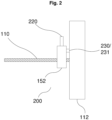
- Figure 2 illustrates a wheel assembly 200 for a self-propelling trolley 100 of the above described type, which wheel assembly 200 is arranged to be mounted on said trolley 100 and there constitute a driven wheel of the trolley 100 in question.
- the trolley 100 may comprise one; a pair; three or even four such wheel assemblies, while it may further comprise one or several additional, non-driven wheels.
- the trolley 100 may also comprise one or several driven wheels that are not part of a wheel assembly type as described herein.
- the mechanical brake described below may be applied to one or several of a set of one or several driven wheels, in addition to a set of zero or several non-driven wheels used on the trolley 100.
- the wheel assembly 200 comprises a wheel 112, arranged to allow the trolley 100 to roll forwards and backwards as is conventional as such.
- the wheel 112 is rigidly connected to said wheel axis 110, which in turn may be specific for the wheel 112 in question or which may be shared with another wheel in a wheel pair as described above.
- the wheel assembly 200 further comprises the electric motor 152, arranged to forcibly turn the wheel 112 about said wheel axis 110 so as to propel the trolley 100 in a forwards/backwards direction.
- the wheel assembly 200 comprises an electric connector 220, arranged to connect the electric motor 152 to the battery 156 for powering the electric motor 152.
- the battery 156 may be comprised in the wheel assembly 200, but may also not be a part of the wheel assembly 200 (the latter being illustrated in Figures 1 and 2 ).
- the wheel assembly 200 comprises a mechanical brake 230, which is arranged to mechanically interact with the wheel 112 by engagement. More particularly, the mechanical brake comprises an engagement part 231 associated with an engaged state, in which the mechanical brake 230 is activated so that a rotational movement of the wheel 112 is limited by the mechanical brake 230, and a disengaged state, in which the mechanical brake 230 is inactivated so that the wheel 112 can rotate freely.
- the electric motor 152 is arranged to perform a rocking drive pattern of the trolley 100.
- Mechanical brakes for use with electrically propelled trolleys 100 are known as such.
- the mechanical brake 230 is arranged so that, in said engaged state of the engagement part 231, the wheel 112 can turn freely in relation to the trolley 100. This freedom of rotary motion is then present between a first rotary limit position and a second rotary limit position, but not beyond said first and second limit positions.
- the wheel 112 is still allowed to rotate freely between said first and second rotary positions, in effect allowing the trolley 100 to roll forwards/backwards within a forwards/backwards displacement interval indirectly defined by said first and second rotary positions.
- the first and second rotary limit positions are arranged in relation to a radius of the wheel 112 so that the trolley 100 is allowed to move freely, in a forwards/backwards direction of the trolley 100, across a ground distance of between 5 and 20 cm, in preferred embodiments between 5 and 10 cm, in said engaged state of the engagement part 231.
- the engagement part 231 may comprise a pin (see Figure 3 ) which is arranged to be inserted into a corresponding cavity 232, such as a recession or a through hole, to achieve said engaged state.
- the cavity 232 may be formed in any suitable structural element.
- a stator of the electric motor 152 may be arranged to rotate with the wheel 112 while a rotor of the electric motor 152 may drive the axis 110.
- the cavity 232 may be arranged in a structure which is fixed in relation to the axis 110.
- the stator of the electric motor 152 is fixed to the rest of the trolley 100, and the rotor of the electric motor 152 is arranged to drive the wheel 112.
- the cavity 232 may be arranged in the wheel 112 structure, for instance as a part of a wheel 112 hub 113.
- the cavity 232 may in this latter case be arranged in some other structure rigidly connected to, and rotating with, the wheel 112.
- the wheel 112 hub 113 may be formed from a connected piece of plastic material, formed by extrusion or in any other suitable manner, in which the cavity 232 is an integrated part of the hub 113 structure.
- the cavity 232 may comprise a first side wall 232a, defining said first rotary limit position by its engagement with the pin in its engaged state, and a second side wall 232b, defining said second rotary limit position by its engagement with the pin 231 in its engaged state.
- the cavity 232 may comprise an elongated track 232c of circular arc shape, arranged to allow the said pin to, in said engaged state, travel along said track 232c between said first 232a and second 232b side walls.
- the elongated track 232c the circular arc length of which is defined by the side walls 232a, 232b, defines the above discussed rotary freedom of motion for the wheel 112 when the mechanical brake 230 is activated.
- the cavity 232 may comprise at least two, preferably between 4 and 8 (in Figure 3 , the preferred case of 6), elongated tracks of respective circular arc shape, arranged along one and the same circle which is concentric with the wheel 112 when the wheel 112 is mounted on the trolley 100.
- This will allow the mechanical brake 230 to be easily activatable irrespectively of a current rotary position of the wheel 112 in relation to the mechanical brake 230 - either the pin is located in front of one of the said sub cavities of the cavity 232, or a minor rotary alignment of the wheel 112, such as by pushing or pulling on the trolley only slightly, will align the pin with one of said sub cavities.
- the mechanical brake 230 may be arranged to only engage with a single one of the wheels 111, 112 of the trolley 100.
- the engagement part 231 comprises a first engagement means (such as the pin in Figure 3 ), arranged on a first wheel assembly 200 part which is stationary in relation to the trolley 100 when the wheel assembly 200 in question is mounted on the trolley 100, and a second engagement means (such as the cavity 232 in Figure 3 ), arranged on a second wheel assembly 200 part which is arranged to rotate with the wheel 112. Then, the first and second engagement means are arranged to cooperate so as to achieve said engaged and disengaged states.
- a first engagement means such as the pin in Figure 3
- a second engagement means such as the cavity 232 in Figure 3
- the first engagement means may then be arranged to be moved back and forth in a direction not parallel to a rotary plane of the wheel 112 when the wheel 112 is mounted on the trolley 100, so as to achieve said engaged and disengaged states.
- the pin illustrated in Figure 3 is arranged to move, into and out of engagement with the cavity 232, in a direction perpendicularly or at least substantially perpendicularly to a main plane of the wheel 112.
- the electric motor 152 is fixed to the first wheel assembly 200 part, and arranged to automatically move the first engagement means 231 in said direction.
- the force applied to the first engagement means 231 may then preferably be generated by the electric motor 152.
- the user does not have to apply any manual force so as to activate or deactivate the mechanical brake 230 in connection to operating the trolley 100 in the said rocking pattern.
- the mechanical brake 230 may be automatically activated, by imparting movement to the first engagement means 231, in connection to activating a rocking drive pattern, by the control unit 150.
- the rocking movement of the trolley 100 may preferably have a forwards/backwards trolley 100 rocking amplitude which is sufficiently long so that the pin will always be aligned with at least one of the sub cavities somewhere along the path of the pin in relation to the cavity 232 during such rocking movement.
- the control unit 150 may be arranged to detect the rotary movement limitations of the wheel 112 and adapt the rocking movement so as to fit completely within the rotary movement limitations as defined by the side walls 232a, 232b. Such adaptation may be made in a feedback manner based upon readings from position sensor 9.
- rocking drive pattern amplitude is smaller than a corresponding amplitude of the rotary freedom of movement, allowing the rocking drive pattern to be fully implemented without being limited by the activated mechanical brake 230.
- the present inventor has devised a braking function in which the mechanical brake 230 defines an outer limit for the amplitude of the rocking function, and in which the rocking function is implemented so that it does not interfere with the mechanical brake 230 during its operation. At the same time, the mechanical brake 230 is active to define a braking function operative in securing the position of the trolley 100.
- the wheel assembly 200 may comprise the electric motor 152 as well as the wheel 112 and the mechanical brake 230.
- the wheel assembly may be used to retrofit any manually operated trolley 100 to be electrically propelled, and in particular to be propelled using the drive patterns described herein, including the rocking drive pattern with full security automatically provided by the mechanical brake 230.
- the control unit 150 may be installed as a part of said retrofit, and connected in a suitable manner to the motor 152.
- the wheel assembly 200 may be provided as a self-contained package, which can be installed by simply mounting the wheel assembly 200 as a conventional wheel directly onto the wheel axis 110.
- the battery 156 may be integrated in the wheel assembly 200.
- the control unit 150 may also be integrated into the wheel assembly 200, and may for instance be arranged to communicate, wirelessly or by wire, with the interface 153, that may be mounted on the handle bar 130 or in any other suitable place.
- the control unit 150 may be arranged to communicate directly with a portable user device, such as a smartphone, via a suitable wireless interface such as Bluetooth ® or WiFi.
- the present invention may make use of a particular type of electrical motor, namely a brushless electric motor with a stator comprising a number of stator poles and a rotor comprising a number of rotor poles.
- the stator comprises a number of stator poles which is not an integer multiple of a corresponding number of rotor poles, and the stator poles are subdivided into at least three magnetically and electrically identical subsets that are mounted one after the other around the angular direction of the electric motor.
- the stator poles are equidistantly arranged along a stator periphery.
- the rotor poles are preferably equidistantly arranged along a rotor periphery.
- the motor 152 is arranged to directly drive a respective wheel 111, 112 of the trolley 100.
- the motor 156 can be mounted on a wheel axis 110 and drive a wheel 111, 112 in relation to said axis 110, in which case two, preferably substantially identical, motors can be mounted on either side of the axis 110, driving one respective wheel 111, 112 each.
- the herein-described feedback control mechanism is performed individually on each such driven wheel 111, 112, using position sensor 9 data pertaining to the respective wheel 111, 112 in question, providing adequate auto-propulsion also when turning the trolley 100.
- a motor 152 of said type can be mounted to drive a wheel axis 110 in turn propelling two wheels 111, 112 at the same time. Wheels 111, 112 on more than one wheel axis 110 may also be driven, in the corresponding manner.
- motors 151, 152 can be used with one trolley 100.
- all motors 151, 152 are controlled by, and communicate with, the same control unit 150. It is noted that, in each of these cases, each such electric motor 152 may be integrated as a part of a respective wheel assembly 200 of the present type.
- such a motor provides very low cogging of the motor, which provides for a smooth rotation of the wheel.
- the motor can be precisely controlled, based upon a feedback algorithm taking into consideration rotation positional feedback from the motor itself, across a broad spectrum of rotation velocities and patterns.
- the motor allows being used as a generator for motor braking the trolley while recharging the battery using the generated current.
- the motor also allows for a free-wheeling function of the present type.
- a motor 152 of said specific type is particularly well-suited for the various trolley functionality described herein, and provides a very simple yet robust construction with a minimum of movable parts and wear details.
- a motor of the above described type is, as such, known from EP 0996217 B1 , which is specifically referred to herein for information pertaining to the motor as such.
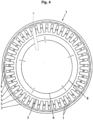
- Figure 2 of EP 0996217 B1 which is also shown, in an edited version, as Figure 4 of the present application, schematically illustrates such a motor 1, having a stator 2 and a rotor 3.
- the rotor 3 surrounds the stator 2, it is however realized that the situation can also be the reversed.
- the stator 2 is arranged with stator poles 7, and the rotor 3 is arranged with rotor poles 6. Between the poles 6, 7, there is a gap, such as an air gap, so that the poles 6, 7 do not physically come into contact with each other. This allows the motor 1 to turn substantially without friction.
- the rotor poles 7 are divided into pairs of alternate south pole 4 and north pole 5 rotor poles, preferably in the form of permanent magnets.
- the motor is preferably arranged to be fed with an alternating current, either using a motorinternal AC/DC converter or using such a converter arranged as a part of, or an external part controlled by, the control device (see below).
- the motor is a three-phase AC motor.
- stator poles 7 are fed, by said AC/DC converter (which may comprise phase-shifting circuitry), with DC voltage according to the following: Pole reference Phase A1, A3 0° A2 180° B1, B3 120° B2 300° C1, C3 240° C2 60°
- All poles with the same reference can be connected in series or, preferably, in parallel.
- the stator 2 comprises a number of stator poles 7 (in the present case 45 poles 7) which is not an integer multiple of a corresponding number of rotor poles 6 (in the present case 40 poles 6), and that the stator poles 7 are subdivided into at least three magnetically and electrically identical subsets 8, or coherent zones, that are mounted one after the other around the angular direction of the motor 1.
- This can also be expressed so that the stator 2 is arranged with a five-fold rotation symmetry with respect to its poles 7.
- the subsets 8 are five of number, but it is realized that they can be more or fewer, as long as they are at least three.
- the motor 1 supports using a hall position sensor 9, schematically illustrated in Figure 4 .
- the position sensor 9 may be arranged to sense the rotation position of the motor, or comprise logic so as to provide a value for the current rotation velocity directly.
- the position or velocity sensor 9 is a hall effect sensor, arranged to provide the control unit 150 with rotary motor position or velocity information.
- control unit 150 is arranged to implement a number of drive patterns of the trolley 100 by imparting forces to the trolley 100 wheels 111, 112 via said at least one electric motor 151, 152.
- One such drive pattern is a user settable speed drive pattern.
- the user sets, via control 155, a desired trolley speed or velocity.
- the control unit 150 When active, for instance by the said control 155 being set, and/or by a separate powercontrol being switched on, the control unit 150 will continuously measure a speed of the trolley 100, using sensor 9, and compare it to the said user-set speed by regulating a voltage supplied to the motor 151, 152 from the battery 156 according to a feedback loop so as to achieve said user-set speed or velocity.
- the user-set velocity may be specified using control 155 as a numerical value, such as "5 m/s", or by the user for instance selecting a value from "low”, “medium”, “fast”, which value is then translated into a specific trolley 100 velocity.
- This user settable speed drive pattern feedback loop preferably comprises raising the voltage supplied to each motor 151, 152 when the read velocity decreases and/or is below the user-set velocity and vice versa.
- a control loop such as a PID control loop
- a control loop is implemented by the above mentioned software implemented in the control unit 150, which control loop aims at maintaining a trolley 100 velocity as close to the user-set velocity as possible.
- the implementation of such a feedback loop can be conventional as such.
- control unit 150 controls the motor 151, 152 by controlling a voltage applied to each of the stator 2 poles 7 as described above, using a variable voltage with a phase difference applied to different poles, as described above. This provides for a smooth and continuously regulatable feedback control, resulting in an agreeable user experience.
- the user settable speed drive pattern feedback control loop further comprises a feedback loop regulating a motor 151, 152 power consumption based upon a detected present motor 151, 152 usage of electric current, so that an increased current usage results in an increased power consumption.
- This additional feedback control loop which as such may also be conventional, is preferably implemented in motor 151, 152 control circuitry within the motor 151, 152 itself.
- the control unit 150 continuously regulates the voltage supplied to the motor 151, 152 so as to achieve the user-set velocity.
- the motor 151, 152 current usage is monitored, and the instantaneous power consumption of the motor 151, 152 is regulated based upon the instantaneously used current.
- the combination of these two feedback control loops provide for a very efficient yet smooth control of the trolley 100 velocity. It is preferred that the latter feedback control loop, of the motor 151, 152 power consumption, is used also in other drive patterns so long as the motor 151, 152 power is active.
- the same motor current vs power feedback loop can, in fact, be active in the same way irrespectively of the type of drive pattern currently being implemented by the control unit 150.
- the user settable speed feedback control will automatically reach and maintain the user-set trolley 100 speed.
- the feedback control loop in said user settable speed drive pattern also comprises engaging an electrically working braking mechanism.
- This braking mechanism which is not the same as the mechanical brake 230, is preferably automatically activated when the user-set speed is exceeded by a predetermined relative or absolute value.
- the predetermined value may be the absolute value "zero", meaning that the braking mechanism is automatically activated as soon as the detected speed of the trolley 100 surpasses the user-set speed. It is realized that the trolley speed, again, can be read using sensor 9.
- the motor 151, 152 is arranged to be driven in a generator mode.
- This generator mode involves an active control by motor 151, 152 control circuitry arranged in connection to the motor 151, 152 and/or by the control unit 150, which active control involves the control unit 150 actively controlling the direction of induced currents due to the forced rotation of the motor 151, 152 rotor 3 in relation to the motor 151, 152 stator 2, and feeding said current to the battery 156 for recharging the battery 156.
- control unit 150 is arranged to set current directions to and from the stator 2 poles 7 in a pattern, as a function of the motor 151, 152 rotation, which corresponds to the supplied current when driving the motor 151, 152, so that a net current can be drawn from the stator 2 poles 7 and be supplied to the battery 156 for recharging the same.
- the said electric braking mechanism in this preferred case comprises the control unit 150 switching the motor 151, 152 into generator mode, and using the generated electric voltage to recharge the battery 156.
- the mechanical brake 230 may also be arranged to be activated by the control unit 150 so as to guarantee a standstill (within the said limited freedom of movement) of the trolley 100.
- a generator mode braking mechanism is combined with the mechanical brake 230, so that the mechanical brake 230 is activated in case the generator mode braking mechanism is active but the trolley 100 speed is still above a certain predetermined value, which value may be dependent upon the user-set speed.
- Another drive pattern is a free-wheeling drive pattern, in which the control unit 150 is arranged to not impart any propulsion force to the wheels 111, 112 and at the same time minimize the internal drive friction of the motor(s) 151, 152. Thereby, the trolley 100 behaves like a conventional non-motor propelled trolley.
- the free-wheeling drive pattern is preferably activated by the control unit 150 implementing to the motor(s) 151, 152 a corresponding freewheeling drive mode, preferably by simply switching off the voltage supplied to the motor 151, 152.
- the free-wheeling drive pattern is not initiated by mechanically disengaging any part, such as the motor 151, 152 itself.
- the rotor 3 is preferably arranged to rotate in relation to the stator 2 when the trolley 100 freewheels.
- the free-wheeling drive pattern is active as long as the main power to the control unit 150 is switched off. This is achieved by the motor being of the type described above, offering very low-friction free-wheeling when not supplied any pole 6, 7 voltage.
- the free-wheeling drive pattern may also be activated by actively manipulating a switch also when the general power to the control unit 150 is switched on. It is furthermore preferred that a feedback-assisted drive pattern is automatically activated as a result of the power to the drive unit 150 being switched on.
- control unit 150 is preferably arranged to apply at least one of said braking mechanisms to the trolley 100, so as to keep it from moving without either pushing or pulling with some force, or setting the user-set speed to a non-zero value.
- each such motor 151, 152 is individually controlled by the control unit 150 to maintain the said user-set speed for the wheel 111, 112 in question during the feedback-controlled propulsion mode.
- a minimum-speed drive pattern may also be implemented by the control unit 150, in a way corresponding to the above-described user-set speed drive pattern.
- a motor 151, 152 driving force, by control of the control unit 150 is applied based at least partly on a torque sensor providing information to the control unit 150 regarding a non-zero torque applied to a user control, such as a rotating handlebar, comprised in the interface 153.
- the control unit 150 controls the motor 151, 152 to apply a non-zero driving force as long as a non-zero torque is sensed.
- such an applied (by the user) torque is translated into a selected speed, by a translation algorithm in the control unit 150 which interprets a higher torque as a higher speed than the current rotation speed of the trolley 100.
- the user can control the set trolley speed, in relative terms as compared to a currently measured trolley speed, by applying more or less torque.
- a push force sensor such as arranged in the trolley 100 handlebar 130, may be arranged to directly sense a pushing force applied by the user to the trolley 100, and only allow the control unit 150 to apply a driving force to the wheels 111, 112, via motor(s) 151, 152, in case a non-zero such pushing force is applied by the user.
- the pushing force sensor may be the same as the dead man's switch, or be used instead of the latter.
- the above-described braking mechanism may also be activated in case no such torque or pushing force, of at least a predetermined minimum magnitude, is applied, as a safety mechanism when the trolley 100 is parked.
- the said torque sensor is arranged to discriminate between a backwards- and forwards directed torque, whereby the/each motor 151, 152 is arranged to be driven backwards or forwards during said feedback assisted propulsion drive pattern depending on the direction sensed by the torque sensor.
- control unit 150 may preferably be arranged to sense a rolling direction of the trolley 100 based upon information provided by said position or velocity sensor 9, and to implement said feedback assisted propulsion drive pattern in the said sensed rolling direction.
- the user settable feedback propulsion feedback pattern is implemented entirely or substantially identically for forward- or backward propulsion.
- the control unit 150 will automatically detect this change of rolling direction and instead regulate the motor 151, 152 with the aim of achieving and maintaining a backwards motion of the trolley 100.
- the aimed-for backwards motion speed may be the same as the user-set forwards speed, or a lower speed which may be predetermined or proportional to the user-set speed for the forwards propulsion case.
- the control unit 150 again automatically detects this and switches to a regulation again aiming at the user-set forward speed, as described above.
- the program switch 157 can be used by the user to switch between different drive patterns.
- One such drive pattern is also the above-mentioned rocking drive pattern, which is implemented by the control unit 150 controlling at least one motor 151, 152 to propel the trolley 100 backwards and forwards according to a predetermined rotation pattern as a function of time.
- each such rocking drive pattern preferably comprises driving the trolley 100 in one direction forwards or backwards a certain distance, then driving the trolley 100 in the opposite direction a certain distance, and so on, indefinitively or during a predetermined maximum time period until the user terminates the rocking drive pattern, such as using switch 157.
- different such rocking drive patterns comprise different combinations of driving distances in both directions, accelerations when switching driving directions and driving speeds.
- a series of rocking programs can be implemented, varying from a forwards/backwards motion of less than 5 cm up to a forwards/backwards motion of more than 10 cm, preferably with an associated decreasing rocking frequency and preferably also rolling speed between turns.
- the total trolley 100 forward/backward amplitude of the rocking drive pattern in question is smaller than a corresponding freedom of rotary movement amplitude defined by the mechanical brake 230, as discussed above.
- the distance the trolley can travel across the movement interval allowed by the mechanical brake 230 is at least 2 cm, preferably at least 5 cm, longer than the total rocking drive pattern amplitude, for all rocking drive patterns. This principle also applies to each individual wheel 111, 112 affected by the mechanical brake 230.
- a rocking driving pattern will normally comprise driving motions straight forward and backward of the trolley 100.
- at least one rocking driving pattern however comprises driving one wheel 151, or the wheels on one side of the trolley 100 in one direction, possibly while driving an opposite wheel 151 or wheels at another speed or in the other direction, so as to achieve a side-ways rotation motion, preferably in the form of a quick quirk of the trolley 100.
- Such side-ways rotations may be implemented as a rocking drive pattern in and of itself, but are preferably implemented as a part of another rocking drive pattern which is based upon a pure forwards/backwards motion.
- rocking drive patterns as is the case for all drive patterns described herein, as concerns the functionality difference between these programs, are implemented in software, preferably purely in software, and executed by the control unit 150 using the same hardware.
- the trolley 100 is preferably arranged with a dead man's switch 154.
- the control unit 150 is arranged to apply a braking mechanism of the said type in case the dead man's switch 154 is activated when the control unit 150 is powered and the information from said position or velocity sensor indicates that the trolley is currently moving.
- At least the battery 156 and the wheel assembly 200 can be encapsulated in an axis 110, which is then connected in a suitable way to an external user interface 153 for mounting on the handlebar 130. That way, the existing axis of an existing trolley can be replaced with an axis providing the functionality of the present invention. As a result, an existing trolley may easily be upgraded to become a trolley 100 according to the present invention.
- one drive pattern may, when activated, propel the trolley 100 a predetermined distance forward, and the stop.
- Dive patterns may be added to the trolley 100 by upgrading the software, in a way which may be conventional as such, such as wirelessly over a WiFi internet connection and using the control unit 150.
- rocking drive pattern is preferably always implemented during a maximum time period of not more than 30 minutes.
- the trolley 100 with interchangeable main bodies 120 on the same chassis 101, so as to allow a user to switch between a child's support main body 120 and a shopping carriage main body 120, without necessarily installing support for a different set of drive patterns.
Landscapes
- Engineering & Computer Science (AREA)
- Transportation (AREA)
- Mechanical Engineering (AREA)
- Chemical & Material Sciences (AREA)
- Combustion & Propulsion (AREA)
- Power Engineering (AREA)
- Health & Medical Sciences (AREA)
- Public Health (AREA)
- Life Sciences & Earth Sciences (AREA)
- Sustainable Development (AREA)
- Sustainable Energy (AREA)
- Electromagnetism (AREA)
- Physics & Mathematics (AREA)
- Handcart (AREA)
- Arrangement Or Mounting Of Propulsion Units For Vehicles (AREA)
- Electric Propulsion And Braking For Vehicles (AREA)
- Toys (AREA)
Description
- The present invention relates to a wheel assembly for a trolley, and in particular for a self-propelling or otherwise motorized trolley, such as a children's stroller or a transport trolley for liquid samples.
- Motorized trolleys are as such well-known, both for children's strollers and also for transport trolleys for liquid samples, such as for use within the medical or pharmaceutical industries. Such motorized trolleys may have various functions, such as a self-propelling function aiding a user in the manoeuvring of such trolley. A self-propulsion decreases the necessary pushing force on the part of the user, making it possible to push or pull such a trolley using less effort in general.
- Furthermore, it is known for trolleys to be arranged with a rocking function, for rocking a transported child or liquid samples - in the former case in order to soothe the child, in the latter for instance to keep the samples from settling.
- Prior art trolleys include
US 8499898 B2 , disclosing a children's trolley with a speed control;WO 2014013482 A1 , disclosing a rocking functionality for use with a children's trolley;US 5937961 A andUS8033348 B1 , disclosing a respective disconnectable motor for a trolley; andEP 2019016 A2 , showing a motor arranged at a driven shaft. - In particular,
EP3322630A1 discloses a trolley of the above type, featuring both a freewheeling pattern as well as a feedback assisted propulsion drive pattern and a rocking drive pattern. To achieve these, and potentially other, patterns in a convenient and efficient manner, a particular type of electric motor is devised. - However, in particular for the rocking drive pattern, security is an issue. It is difficult to control the behaviour of a rocking trolley when left unattended.
-
US 2018/0281838 A1 discloses a self-propelling trolley assembly having a rocking drive pattern. - The present invention solves the problem of increasing security when using the rocking drive pattern of a trolley of the above described type.
- Hence, the invention is defined in independent claim 1 and relates to a wheel assembly for a self-propelling trolley, which wheel assembly is arranged to be mounted on said trolley and comprises a wheel; an electric rotary motor; an electric connector, arranged to connect the motor to a battery for powering the electric motor, which battery may or may not be comprised in the wheel assembly; and a mechanical brake comprising an engagement part associated with an engaged state, in which the mechanical brake is activated so that a rotational movement of the wheel is limited by the mechanical brake, and a disengaged state, in which the mechanical brake is inactivated so that the wheel can rotate freely, which electric motor is arranged to perform a rocking drive pattern of the trolley by the motor propelling the wheel such that the trolley moves backwards and forwards; which wheel assembly is characterised in that the mechanical brake is arranged so that, in said engaged state of the engagement part, the wheel can turn freely in relation to the trolley between a first rotary limit position and a second rotary limit position but not beyond said first and second limit positions, the first and second rotary limit positions being arranged in relation to a radius of the wheel so that the trolley is allowed to move freely across a ground distance of between 5 and 20 cm in said engaged state of the engagement part.
- In the following, the invention will be described in detail, with reference to exemplifying embodiments of the invention and to the enclosed drawings, wherein:
-
Figure 1 is an overview of a trolley according to the invention; -
Figure 2 is an overview of a first exemplifying wheel assembly according to the invention, suitable for use in a trolley of the type illustrated inFigure 1 ; -
Figure 3 illustrates a second exemplifying wheel assembly according to the invention, also suitable for use in a trolley of the type illustrated inFigure 1 ; and -
Figure 4 is a schematic side view of an electric motor useful in a trolley assembly according to the invention. -
Figures 1-3 share the same reference numerals for the same or corresponding parts. -
Figure 1 illustrates, in a simple overview, atrolley 100 according to the present invention. Thetrolley 100 comprises awheel assembly 200 according to the invention, of the type discussed in further detail below. As mentioned above, thetrolley 100 may be a children's trolley or stroller, alternatively be a transport trolley for liquid samples, such as biological or chemical test tube samples for use within the medical, pharmaceutical or biochemical fields. It is realized that, in the former case, amain body 120 of thetrolley 100 may comprise a child's seat or bed; and in the latter case, themain body 120 may comprise compartments for essay tubes or similar. - The
trolley 100 constitutes a self-propelling trolley assembly, comprising abattery 156; at least onewheel axis 110 which is driven by at least one respectiveelectric motor 151, 512, which electric motor(s) 151, 152 is or are powered by thebattery 156. InFigure 1 , which is illustrated from the back of thetrolley 100, only onewheel axis 110 is shown. It is realized, however, that typically two wheel axes will be present, each of which may be driven using one or two motors. Alternatively, one electric motor may also propel awhole axis 110. A motor propelling an axis to which only one wheel is connected may be arranged in connection to the propelled wheel in question; while an electric motor propelling an axis interconnecting two wheels, sharing one and the same axis, may be arranged between the wheels in question, as is exemplified inFigure 1 . - A rotation position or velocity sensor (see
Figure 4 ) is preferably installed in at least one ofsaid motors motor motors trolley 100wheel axis 110. - A
user interface 153, preferably comprising afunction switch 157, a dead man'sswitch 154 and a uservelocity setting control 155, is preferably arranged on ahandlebar 130 of thetrolley 100. The dead man'sswitch 154 must preferably be held or pressed in for the trolley to be propelled usingmotor velocity setting control 155, which may be a lever, a turnable handle or similar, is arranged to a allow the user to set a desiredtrolley 100 velocity, such as to a specific value within a continuous allowable interval or one value from a discreet set of predetermined such velocities. - The
trolley 100 also comprises saidmain body 120 and achassis 101. - A
control unit 150 of thetrolley 100 is arranged to regulate theelectric motor user interface 153, so as to affect a rotation of said wheel orwheels - More precisely, the
control unit 150 is arranged to implement a rocking drive pattern, as will be described below. In addition to this rocking drive pattern, thecontrol unit 150 may also be arranged to implement a feedback assisted propulsion drive pattern, based upon information read from the said position or velocity sensor or sensor s 9; and/or a freewheeling drive pattern. There may also be further drive patterns, as exemplified below. - Furthermore, all of said drive patterns may be implemented by the
control unit 150 by controlling a voltage pattern being supplied to theelectric motor electric motor control unit 150, which hardware circuit comprises a memory, a micro processor and electrical communication means. It is realized that thecontrol unit 150 communicates withuser interface 153,motors - Importantly, the
electric motor trolley 100wheels electric motor - Such a trolley assembly offers a very simple and robust construction, which may still offer a flexible and broad flora of drive functionality and hence user comfort. At the same time, it is safe to use and can also easily be used as a conventional, non-driven trolley when so is desired. In particular, the
motor -
Figure 2 illustrates awheel assembly 200 for a self-propelling trolley 100 of the above described type, whichwheel assembly 200 is arranged to be mounted on saidtrolley 100 and there constitute a driven wheel of thetrolley 100 in question. Thetrolley 100 may comprise one; a pair; three or even four such wheel assemblies, while it may further comprise one or several additional, non-driven wheels. Thetrolley 100 may also comprise one or several driven wheels that are not part of a wheel assembly type as described herein. Hence, the mechanical brake described below may be applied to one or several of a set of one or several driven wheels, in addition to a set of zero or several non-driven wheels used on thetrolley 100. - As illustrated in
Figure 2 , thewheel assembly 200 comprises awheel 112, arranged to allow thetrolley 100 to roll forwards and backwards as is conventional as such. Thewheel 112 is rigidly connected to saidwheel axis 110, which in turn may be specific for thewheel 112 in question or which may be shared with another wheel in a wheel pair as described above. - The
wheel assembly 200 further comprises theelectric motor 152, arranged to forcibly turn thewheel 112 about saidwheel axis 110 so as to propel thetrolley 100 in a forwards/backwards direction. - Also, the
wheel assembly 200 comprises anelectric connector 220, arranged to connect theelectric motor 152 to thebattery 156 for powering theelectric motor 152. Thebattery 156 may be comprised in thewheel assembly 200, but may also not be a part of the wheel assembly 200 (the latter being illustrated inFigures 1 and2 ). - Moreover, the
wheel assembly 200 comprises amechanical brake 230, which is arranged to mechanically interact with thewheel 112 by engagement. More particularly, the mechanical brake comprises anengagement part 231 associated with an engaged state, in which themechanical brake 230 is activated so that a rotational movement of thewheel 112 is limited by themechanical brake 230, and a disengaged state, in which themechanical brake 230 is inactivated so that thewheel 112 can rotate freely. - As described above, the
electric motor 152 is arranged to perform a rocking drive pattern of thetrolley 100. - Mechanical brakes for use with electrically propelled
trolleys 100 are known as such. However, according to the present invention themechanical brake 230 is arranged so that, in said engaged state of theengagement part 231, thewheel 112 can turn freely in relation to thetrolley 100. This freedom of rotary motion is then present between a first rotary limit position and a second rotary limit position, but not beyond said first and second limit positions. In other words, despite the engagement of themechanical brake 230, thewheel 112 is still allowed to rotate freely between said first and second rotary positions, in effect allowing thetrolley 100 to roll forwards/backwards within a forwards/backwards displacement interval indirectly defined by said first and second rotary positions. - In particular, according to the invention the first and second rotary limit positions are arranged in relation to a radius of the
wheel 112 so that thetrolley 100 is allowed to move freely, in a forwards/backwards direction of thetrolley 100, across a ground distance of between 5 and 20 cm, in preferred embodiments between 5 and 10 cm, in said engaged state of theengagement part 231. - This provides full security while still achieving an efficient rocking function of the
trolley 100. In addition, the solution is simple and therefore inexpensive and possible to design in a way which is easy to manufacture. - In particular, the
engagement part 231 may comprise a pin (seeFigure 3 ) which is arranged to be inserted into acorresponding cavity 232, such as a recession or a through hole, to achieve said engaged state. - The
cavity 232 may be formed in any suitable structural element. For instance, a stator of theelectric motor 152 may be arranged to rotate with thewheel 112 while a rotor of theelectric motor 152 may drive theaxis 110. In this case, thecavity 232 may be arranged in a structure which is fixed in relation to theaxis 110. However, in the example illustrated inFigures 2 and3 , the stator of theelectric motor 152 is fixed to the rest of thetrolley 100, and the rotor of theelectric motor 152 is arranged to drive thewheel 112. In this case, thecavity 232 may be arranged in thewheel 112 structure, for instance as a part of awheel 112hub 113. Alternatively, thecavity 232 may in this latter case be arranged in some other structure rigidly connected to, and rotating with, thewheel 112. - In particular the case in which the
cavity 232 is arranged in thewheel 112hub 113, thewheel 112hub 113 may be formed from a connected piece of plastic material, formed by extrusion or in any other suitable manner, in which thecavity 232 is an integrated part of thehub 113 structure. - In particular, and as is illustrated in
Figure 3 , thecavity 232 may comprise afirst side wall 232a, defining said first rotary limit position by its engagement with the pin in its engaged state, and asecond side wall 232b, defining said second rotary limit position by its engagement with thepin 231 in its engaged state. - Moreover, the
cavity 232 may comprise anelongated track 232c of circular arc shape, arranged to allow the said pin to, in said engaged state, travel along saidtrack 232c between said first 232a and second 232b side walls. This way, theelongated track 232c, the circular arc length of which is defined by theside walls wheel 112 when themechanical brake 230 is activated. - Preferably, and as is illustrated in
Figure 3 , thecavity 232 may comprise at least two, preferably between 4 and 8 (inFigure 3 , the preferred case of 6), elongated tracks of respective circular arc shape, arranged along one and the same circle which is concentric with thewheel 112 when thewheel 112 is mounted on thetrolley 100. This will allow themechanical brake 230 to be easily activatable irrespectively of a current rotary position of thewheel 112 in relation to the mechanical brake 230 - either the pin is located in front of one of the said sub cavities of thecavity 232, or a minor rotary alignment of thewheel 112, such as by pushing or pulling on the trolley only slightly, will align the pin with one of said sub cavities. - In order to simplify its activation, the
mechanical brake 230 may be arranged to only engage with a single one of thewheels trolley 100. - In general, the
engagement part 231 comprises a first engagement means (such as the pin inFigure 3 ), arranged on afirst wheel assembly 200 part which is stationary in relation to thetrolley 100 when thewheel assembly 200 in question is mounted on thetrolley 100, and a second engagement means (such as thecavity 232 inFigure 3 ), arranged on asecond wheel assembly 200 part which is arranged to rotate with thewheel 112. Then, the first and second engagement means are arranged to cooperate so as to achieve said engaged and disengaged states. - Further generally, the first engagement means may then be arranged to be moved back and forth in a direction not parallel to a rotary plane of the
wheel 112 when thewheel 112 is mounted on thetrolley 100, so as to achieve said engaged and disengaged states. For instance, the pin illustrated inFigure 3 is arranged to move, into and out of engagement with thecavity 232, in a direction perpendicularly or at least substantially perpendicularly to a main plane of thewheel 112. - In particular in this latter case, it is preferred that the
electric motor 152 is fixed to thefirst wheel assembly 200 part, and arranged to automatically move the first engagement means 231 in said direction. The force applied to the first engagement means 231 may then preferably be generated by theelectric motor 152. This way, the user does not have to apply any manual force so as to activate or deactivate themechanical brake 230 in connection to operating thetrolley 100 in the said rocking pattern. For instance, themechanical brake 230 may be automatically activated, by imparting movement to the first engagement means 231, in connection to activating a rocking drive pattern, by thecontrol unit 150. In the preferred case with several sub cavities illustrated inFigure 3 , the rocking movement of thetrolley 100 may preferably have a forwards/backwards trolley 100 rocking amplitude which is sufficiently long so that the pin will always be aligned with at least one of the sub cavities somewhere along the path of the pin in relation to thecavity 232 during such rocking movement. Then, thecontrol unit 150 may be arranged to detect the rotary movement limitations of thewheel 112 and adapt the rocking movement so as to fit completely within the rotary movement limitations as defined by theside walls position sensor 9. - To any extent, the rocking drive pattern amplitude is smaller than a corresponding amplitude of the rotary freedom of movement, allowing the rocking drive pattern to be fully implemented without being limited by the activated
mechanical brake 230. - The present inventor has devised a braking function in which the
mechanical brake 230 defines an outer limit for the amplitude of the rocking function, and in which the rocking function is implemented so that it does not interfere with themechanical brake 230 during its operation. At the same time, themechanical brake 230 is active to define a braking function operative in securing the position of thetrolley 100. - As described above, the
wheel assembly 200 may comprise theelectric motor 152 as well as thewheel 112 and themechanical brake 230. In this case, the wheel assembly may be used to retrofit any manually operatedtrolley 100 to be electrically propelled, and in particular to be propelled using the drive patterns described herein, including the rocking drive pattern with full security automatically provided by themechanical brake 230. In this case, thecontrol unit 150 may be installed as a part of said retrofit, and connected in a suitable manner to themotor 152. - In particular, the
wheel assembly 200 may be provided as a self-contained package, which can be installed by simply mounting thewheel assembly 200 as a conventional wheel directly onto thewheel axis 110. In this case, thebattery 156 may be integrated in thewheel assembly 200. Furthermore, in this and other embodiments, thecontrol unit 150 may also be integrated into thewheel assembly 200, and may for instance be arranged to communicate, wirelessly or by wire, with theinterface 153, that may be mounted on thehandle bar 130 or in any other suitable place. As an alternative, thecontrol unit 150 may be arranged to communicate directly with a portable user device, such as a smartphone, via a suitable wireless interface such as Bluetooth® or WiFi. - In preferred embodiments, the present invention may make use of a particular type of electrical motor, namely a brushless electric motor with a stator comprising a number of stator poles and a rotor comprising a number of rotor poles. In this type of motor, the stator comprises a number of stator poles which is not an integer multiple of a corresponding number of rotor poles, and the stator poles are subdivided into at least three magnetically and electrically identical subsets that are mounted one after the other around the angular direction of the electric motor. Preferably, the stator poles are equidistantly arranged along a stator periphery. Correspondingly, the rotor poles are preferably equidistantly arranged along a rotor periphery.
- Preferably, the
motor 152 is arranged to directly drive arespective wheel trolley 100. For instance, themotor 156 can be mounted on awheel axis 110 and drive awheel axis 110, in which case two, preferably substantially identical, motors can be mounted on either side of theaxis 110, driving onerespective wheel wheel position sensor 9 data pertaining to therespective wheel trolley 100. Alternatively, amotor 152 of said type can be mounted to drive awheel axis 110 in turn propelling twowheels Wheels wheel axis 110 may also be driven, in the corresponding manner. Hence, it is foreseen that between 1 and at least 4motors trolley 100. Preferably, allmotors same control unit 150. It is noted that, in each of these cases, each suchelectric motor 152 may be integrated as a part of arespective wheel assembly 200 of the present type. - The use of such an
electric motor 152 for propelling atrolley 100 assembly of the present type achieves a number of advantages. - Firstly, such a motor provides very low cogging of the motor, which provides for a smooth rotation of the wheel.
- Secondly, the motor can be precisely controlled, based upon a feedback algorithm taking into consideration rotation positional feedback from the motor itself, across a broad spectrum of rotation velocities and patterns.
- Thirdly, the motor allows being used as a generator for motor braking the trolley while recharging the battery using the generated current.
- Fourthly, the motor also allows for a free-wheeling function of the present type.
- At the same time, there are many types of electrical motors that are as such in general suitable for use in a self-propelled trolley assembly, such as a conventional stepping motor or a conventional brushless motor of any other type. The present inventors have discovered that, in contrast thereto, a
motor 152 of said specific type is particularly well-suited for the various trolley functionality described herein, and provides a very simple yet robust construction with a minimum of movable parts and wear details. - A motor of the above described type is, as such, known from
EP 0996217 B1 , which is specifically referred to herein for information pertaining to the motor as such.Figure 2 ofEP 0996217 B1 , which is also shown, in an edited version, asFigure 4 of the present application, schematically illustrates such a motor 1, having a stator 2 and a rotor 3. InFigure 4 , the rotor 3 surrounds the stator 2, it is however realized that the situation can also be the reversed. - The stator 2 is arranged with
stator poles 7, and the rotor 3 is arranged with rotor poles 6. Between thepoles 6, 7, there is a gap, such as an air gap, so that thepoles 6, 7 do not physically come into contact with each other. This allows the motor 1 to turn substantially without friction. - The
rotor poles 7 are divided into pairs ofalternate south pole 4 and north pole 5 rotor poles, preferably in the form of permanent magnets. - The motor is preferably arranged to be fed with an alternating current, either using a motorinternal AC/DC converter or using such a converter arranged as a part of, or an external part controlled by, the control device (see below). In the exemplifying case shown in
figure 4 , the motor is a three-phase AC motor. - More precisely, the
stator poles 7 are fed, by said AC/DC converter (which may comprise phase-shifting circuitry), with DC voltage according to the following:Pole reference Phase A1, A3 0° A2 180° B1, B3 120° B2 300° C1, C3 240° C2 60° - In general, in the document
EP 0291219 A1 , to which specific reference is made herein regarding the details of the pole arrangement and power feeding to the poles of the motor 1, it is described how to select such phase values, the number ofstator poles 7 and the number of rotor poles 6. - All poles with the same reference (A1, A3, A2, etc.) can be connected in series or, preferably, in parallel.
- What is important for the present purposes is that the stator 2 comprises a number of stator poles 7 (in the present case 45 poles 7) which is not an integer multiple of a corresponding number of rotor poles 6 (in the present case 40 poles 6), and that the
stator poles 7 are subdivided into at least three magnetically and electrically identical subsets 8, or coherent zones, that are mounted one after the other around the angular direction of the motor 1. This can also be expressed so that the stator 2 is arranged with a five-fold rotation symmetry with respect to itspoles 7. InFigure 4 , the subsets 8 are five of number, but it is realized that they can be more or fewer, as long as they are at least three. - The combination of using such different numbers of
poles 6, 7, with arranging thestator poles 7 in such subsets 8, provides for low cogging in the motor 1 while supporting all the desired features of such a motor for the present purposes in a way which has proven very advantageous in practical tests by the inventors, especially in terms of efficiency, smoothness, noise levels and exactness. - Furthermore, the motor 1 supports using a
hall position sensor 9, schematically illustrated inFigure 4 . Theposition sensor 9 may be arranged to sense the rotation position of the motor, or comprise logic so as to provide a value for the current rotation velocity directly. - According to a preferred embodiment, the position or
velocity sensor 9 is a hall effect sensor, arranged to provide thecontrol unit 150 with rotary motor position or velocity information. - As described above, the
control unit 150 is arranged to implement a number of drive patterns of thetrolley 100 by imparting forces to thetrolley 100wheels electric motor - One such drive pattern is a user settable speed drive pattern. Preferably, in this pattern the user sets, via
control 155, a desired trolley speed or velocity. When active, for instance by the saidcontrol 155 being set, and/or by a separate powercontrol being switched on, thecontrol unit 150 will continuously measure a speed of thetrolley 100, usingsensor 9, and compare it to the said user-set speed by regulating a voltage supplied to themotor battery 156 according to a feedback loop so as to achieve said user-set speed or velocity. The user-set velocity may be specified usingcontrol 155 as a numerical value, such as "5 m/s", or by the user for instance selecting a value from "low", "medium", "fast", which value is then translated into aspecific trolley 100 velocity. - This user settable speed drive pattern feedback loop preferably comprises raising the voltage supplied to each
motor control unit 150, which control loop aims at maintaining atrolley 100 velocity as close to the user-set velocity as possible. The implementation of such a feedback loop can be conventional as such. - However, the
control unit 150 controls themotor poles 7 as described above, using a variable voltage with a phase difference applied to different poles, as described above. This provides for a smooth and continuously regulatable feedback control, resulting in an agreeable user experience. - In parallel or, preferably, in series with said voltage-controlling feedback control loop, such as downstream of said voltage-controlling feedback control loop, the user settable speed drive pattern feedback control loop further comprises a feedback loop regulating a
motor present motor - This additional feedback control loop, which as such may also be conventional, is preferably implemented in
motor motor - Hence, the
control unit 150 continuously regulates the voltage supplied to themotor motor motor trolley 100 velocity. It is preferred that the latter feedback control loop, of themotor motor control unit 150. - Hence, the user settable speed feedback control will automatically reach and maintain the user-set
trolley 100 speed. However, when the user tries to push thetrolley 100 faster than the user-set speed, or when travelling downhill and thetrolley 100 picks up speed above the user-set speed, it is preferred that the feedback control loop in said user settable speed drive pattern also comprises engaging an electrically working braking mechanism. This braking mechanism, which is not the same as themechanical brake 230, is preferably automatically activated when the user-set speed is exceeded by a predetermined relative or absolute value. In some embodiments, the predetermined value may be the absolute value "zero", meaning that the braking mechanism is automatically activated as soon as the detected speed of thetrolley 100 surpasses the user-set speed. It is realized that the trolley speed, again, can be read usingsensor 9. - In one preferred example of such electric braking mechanism, the
motor motor motor control unit 150, which active control involves thecontrol unit 150 actively controlling the direction of induced currents due to the forced rotation of themotor motor battery 156 for recharging thebattery 156. In other words, thecontrol unit 150 is arranged to set current directions to and from the stator 2poles 7 in a pattern, as a function of themotor motor poles 7 and be supplied to thebattery 156 for recharging the same. Hence, the said electric braking mechanism in this preferred case comprises thecontrol unit 150 switching themotor battery 156. - Of course, the
mechanical brake 230 may also be arranged to be activated by thecontrol unit 150 so as to guarantee a standstill (within the said limited freedom of movement) of thetrolley 100. - Preferably, a generator mode braking mechanism is combined with the
mechanical brake 230, so that themechanical brake 230 is activated in case the generator mode braking mechanism is active but thetrolley 100 speed is still above a certain predetermined value, which value may be dependent upon the user-set speed. - Another drive pattern is a free-wheeling drive pattern, in which the
control unit 150 is arranged to not impart any propulsion force to thewheels trolley 100 behaves like a conventional non-motor propelled trolley. The free-wheeling drive pattern is preferably activated by thecontrol unit 150 implementing to the motor(s) 151, 152 a corresponding freewheeling drive mode, preferably by simply switching off the voltage supplied to themotor - In particular, it is preferred that the free-wheeling drive pattern is not initiated by mechanically disengaging any part, such as the
motor trolley 100 freewheels. - According to a particularly preferred embodiment, the free-wheeling drive pattern is active as long as the main power to the
control unit 150 is switched off. This is achieved by the motor being of the type described above, offering very low-friction free-wheeling when not supplied anypole 6, 7 voltage. The free-wheeling drive pattern may also be activated by actively manipulating a switch also when the general power to thecontrol unit 150 is switched on. It is furthermore preferred that a feedback-assisted drive pattern is automatically activated as a result of the power to thedrive unit 150 being switched on. - In general, in case the user-set speed is set to zero, the
control unit 150 is preferably arranged to apply at least one of said braking mechanisms to thetrolley 100, so as to keep it from moving without either pushing or pulling with some force, or setting the user-set speed to a non-zero value. - Preferably, in case at least one
wheel axis 110 comprises onemotor wheel such axis 110, eachsuch motor control unit 150 to maintain the said user-set speed for thewheel - There may be different types of feedback-controlled propulsion drive patterns, for instance selectable using
control 157. For instance, a minimum-speed drive pattern may also be implemented by thecontrol unit 150, in a way corresponding to the above-described user-set speed drive pattern. - Furthermore, in a preferred embodiment a
motor control unit 150, is applied based at least partly on a torque sensor providing information to thecontrol unit 150 regarding a non-zero torque applied to a user control, such as a rotating handlebar, comprised in theinterface 153. In this case, thecontrol unit 150 controls themotor control unit 150 which interprets a higher torque as a higher speed than the current rotation speed of thetrolley 100. In other words, the user can control the set trolley speed, in relative terms as compared to a currently measured trolley speed, by applying more or less torque. - As an alternative or addition to this, a push force sensor, such as arranged in the
trolley 100handlebar 130, may be arranged to directly sense a pushing force applied by the user to thetrolley 100, and only allow thecontrol unit 150 to apply a driving force to thewheels trolley 100 is parked. - In one preferred embodiment, the said torque sensor is arranged to discriminate between a backwards- and forwards directed torque, whereby the/each
motor - Alternatively, or in addition thereto, the
control unit 150 may preferably be arranged to sense a rolling direction of thetrolley 100 based upon information provided by said position orvelocity sensor 9, and to implement said feedback assisted propulsion drive pattern in the said sensed rolling direction. - Preferably, the user settable feedback propulsion feedback pattern is implemented entirely or substantially identically for forward- or backward propulsion. Hence, if the user is conveying the
trolley 100 forward and, using a pulling force, brings thetrolley 100 to a halt and then pulls further to bring thetrolley 100 to a backwards motion, thecontrol unit 150 will automatically detect this change of rolling direction and instead regulate themotor trolley 100. The aimed-for backwards motion speed may be the same as the user-set forwards speed, or a lower speed which may be predetermined or proportional to the user-set speed for the forwards propulsion case. Correspondingly, when the user again brings thetrolley 100 to a halt and starts pushing it forward, thecontrol unit 150 again automatically detects this and switches to a regulation again aiming at the user-set forward speed, as described above. - It is preferred that the
program switch 157 can be used by the user to switch between different drive patterns. One such drive pattern is also the above-mentioned rocking drive pattern, which is implemented by thecontrol unit 150 controlling at least onemotor trolley 100 backwards and forwards according to a predetermined rotation pattern as a function of time. - Preferably, there are several such rocking drive patterns available, such as
selectable using switch 157 once thetrolley 100 has come to a standstill. Each such rocking drive pattern preferably comprises driving thetrolley 100 in one direction forwards or backwards a certain distance, then driving thetrolley 100 in the opposite direction a certain distance, and so on, indefinitively or during a predetermined maximum time period until the user terminates the rocking drive pattern, such as usingswitch 157. - Preferably, different such rocking drive patterns comprise different combinations of driving distances in both directions, accelerations when switching driving directions and driving speeds. According to one preferred embodiment, there are at least three different rocking drive patterns gradually varying from a smooth, slow rocking pattern, preferably with relatively longer driving distances in both directions, to a more harsh, fast and quirky rocking pattern, preferably with relatively short driving distances in both directions. Preferably, a series of rocking programs can be implemented, varying from a forwards/backwards motion of less than 5 cm up to a forwards/backwards motion of more than 10 cm, preferably with an associated decreasing rocking frequency and preferably also rolling speed between turns.
- For all rocking drive patterns, it is preferred that the
total trolley 100 forward/backward amplitude of the rocking drive pattern in question is smaller than a corresponding freedom of rotary movement amplitude defined by themechanical brake 230, as discussed above. - Preferably, the distance the trolley can travel across the movement interval allowed by the
mechanical brake 230 is at least 2 cm, preferably at least 5 cm, longer than the total rocking drive pattern amplitude, for all rocking drive patterns. This principle also applies to eachindividual wheel mechanical brake 230. - Namely, a rocking driving pattern will normally comprise driving motions straight forward and backward of the
trolley 100. According to one preferred embodiment, at least one rocking driving pattern however comprises driving onewheel 151, or the wheels on one side of thetrolley 100 in one direction, possibly while driving anopposite wheel 151 or wheels at another speed or in the other direction, so as to achieve a side-ways rotation motion, preferably in the form of a quick quirk of thetrolley 100. Such side-ways rotations may be implemented as a rocking drive pattern in and of itself, but are preferably implemented as a part of another rocking drive pattern which is based upon a pure forwards/backwards motion. For instance, every five forwards/backwards rockings, or at irregular intervals, one or several side-ways quirks will be imparted to thetrolley 100 by thecontrol unit 150. This provides a less predictable and uniform rocking function, which may be advantageous to both children, biological samples etc. - It is preferred that the said rocking drive patterns, as is the case for all drive patterns described herein, as concerns the functionality difference between these programs, are implemented in software, preferably purely in software, and executed by the
control unit 150 using the same hardware. - As described above, the
trolley 100 is preferably arranged with a dead man'sswitch 154. T thecontrol unit 150 is arranged to apply a braking mechanism of the said type in case the dead man'sswitch 154 is activated when thecontrol unit 150 is powered and the information from said position or velocity sensor indicates that the trolley is currently moving. - Above, preferred embodiments have been described. However, it is apparent to the skilled person that many modifications can be made to the disclosed embodiments without departing from the scope of the enclosed claims.
- For instance, much of the functionality described above, at least the
battery 156 and thewheel assembly 200, can be encapsulated in anaxis 110, which is then connected in a suitable way to anexternal user interface 153 for mounting on thehandlebar 130. That way, the existing axis of an existing trolley can be replaced with an axis providing the functionality of the present invention. As a result, an existing trolley may easily be upgraded to become atrolley 100 according to the present invention. - There may be many more drive patterns, apart from the above described. For instance, one drive pattern may, when activated, propel the trolley 100 a predetermined distance forward, and the stop. Dive patterns may be added to the
trolley 100 by upgrading the software, in a way which may be conventional as such, such as wirelessly over a WiFi internet connection and using thecontrol unit 150. - In order to keep the
trolley 100 from displacing too much from its parked position when implementing a rocking drive pattern, such rocking drive pattern is preferably always implemented during a maximum time period of not more than 30 minutes. - Furthermore, it is possible to arrange the
trolley 100 with interchangeablemain bodies 120 on thesame chassis 101, so as to allow a user to switch between a child's supportmain body 120 and a shopping carriagemain body 120, without necessarily installing support for a different set of drive patterns. - It is in general preferred that there is no torque sensor installed in the motor as such, for sensing a torque which is applied externally to the motor and for use in a propulsion feedback mechanism. The reason for this is that the above described motor current vs power feedback loop will effectively act as a feedback loop acting based upon an indirectly sensed externally applied motor torque, namely indirectly measured via the measured motor current.
- Hence, the invention is not limited to the described embodiments, but can be varied within the scope of the enclosed claims.
Claims (11)
- Wheel assembly (200) for a self-propelling trolley (100), which wheel assembly (200) is arranged to be mounted on said trolley (100) and comprisesa wheel (111,112);an electric rotary motor (151,152);an electric connector (220), arranged to connect the motor (151,152) to a battery (156) for powering the electric motor (151,152), which battery (156) may or may not be comprised in the wheel assembly (200); anda mechanical brake (230) comprising an engagement part (231) associated with an engaged state, in which the mechanical brake (230) is activated so that a rotational movement of the wheel (111,112) is limited by the mechanical brake (230), and a disengaged state, in which the mechanical brake (230) is inactivated so that the wheel (111,112) can rotate freely, which electric motor (151,152) is arranged to perform a rocking drive pattern of the trolley (100) by the motor (151,152) propelling the wheel (111,112) such that the trolley (100) moves backwards and forwards;characterised in that the mechanical brake (230) is arranged so that, in said engaged state of the engagement part (231), the wheel (111,112) can turn freely in relation to the trolley (100) between a first rotary limit position and a second rotary limit position but not beyond said first and second limit positions, the first and second rotary limit positions being arranged in relation to a radius of the wheel (111,112) so that the trolley (100) is allowed to move freely across a ground distance of between 5 and 20 cm in said engaged state of the engagement part, in that the engagement part (231) comprises a pin which is arranged to be inserted into a corresponding cavity (232) to achieve said engaged state, in that the cavity (232) comprises at least two elongated tracks (232c) of respective circular arc shape arranged along one and the same circle which circle is concentric with the wheel (111,112) when the wheel (111,112) is mounted on the trolley (100),in that each of said tracks (232c) comprises a respective first side wall (232a), defining said first rotary limit position, and a respective second side wall (232b), defining said second rotary limit position, and in that each of said tracks (232c) is arranged to allow said pin to, in said engaged state, travel along said track (232c) in question between said respective first (232a) and second (232b) side walls.
- Wheel assembly (200) according to claim 1, characterised in that the cavity (232) comprises between 4 and 8 of said elongated tracks (232c).
- Wheel assembly (200) according to claim 1 or 2, characterised in that said elongated tracks (232c) are in the form of a respective recession.
- Wheel assembly (200) according to claim 1 or 2, characterised in that said elongated tracks (232c) are in the form of a respective through hole.
- Self-propelling trolley assembly (100), comprising at least one wheel (111,112) which is driven by an electric motor (151,152;1), which electric motor (151,152;1) is powered by said battery (156); a rotation position or velocity sensor (9) arranged to sense a rotation position or rotation velocity of at least one trolley wheel (111,112); a user interface (153); and a control unit (150) arranged to regulate the electric motor (151,152;1) based upon input from said user interface (153) so as to affect a rotation of said wheel (111,112) according to particular drive patterns, characterised in that the said one wheel is a wheel assembly according to any one of the preceding claims, assembled on the trolley assembly (100).
- Self-propelling trolley assembly (100) according to claim 5, characterised in that the control unit (150) is arranged to implement at least a feedback assisted propulsion drive pattern, based upon information read from said position or velocity sensor (9); and/or a free-wheeling drive pattern; in addition to said rocking drive pattern, in that all of said drive patterns are implemented using different drive voltage patterns to said electric motor (151,152;1), and in that the electric motor (151,152;1) is of a type in which the stator (2) comprises a number of stator (2) poles (7) which is not an integer multiple of a corresponding number of rotor (3) poles (7) and in which the stator (2) poles (7) are subdivided into at least three magnetically and electrically identical subsets (8) that are mounted one after the other around the angular direction of the electric motor (151,152;1).
- Self-propelling trolley (100) assembly according to claim 5 or 6, characterised in that the trolley assembly (100) is a children's stroller or a transport trolley for liquid samples.
- Self-propelling trolley assembly (100) according to any one of claims 5-7, characterised in that the mechanical brake is arranged to be activated by the control unit (150).
- Self-propelling trolley assembly (100) according to any one of claims 5-8, characterised in that the motor (151,152;1) is arranged to be driven in a freewheeling mode, and in that the control unit (150) is arranged to activate said freewheeling mode during implementation of said free-wheeling drive pattern.
- Self-propelling trolley assembly (100) according to claim 9, characterised in that the free-wheeling mode is implemented by switching off the voltage supplied to the motor (151,152;1).
- Self-propelling trolley assembly (100) according to any one of claims 5-10, characterised in that the said rocking drive pattern is implemented by the control unit (150) controlling the motor (151,152;1) to propel the trolley assembly (100) backwards and forwards according to a predetermined rotation pattern as a function of time.
Applications Claiming Priority (2)
| Application Number | Priority Date | Filing Date | Title |
|---|---|---|---|
| SE1851237A SE542808C2 (en) | 2018-10-10 | 2018-10-10 | Wheel assembly for a self-propelling trolley comprising a mechanical brake allowing for a safe rocking pattern |
| PCT/SE2019/050980 WO2020076227A1 (en) | 2018-10-10 | 2019-10-08 | Wheel assembly for a trolley comprising a mechanical brake allowing for a safe rocking pattern |
Publications (5)
| Publication Number | Publication Date |
|---|---|
| EP3863907A1 EP3863907A1 (en) | 2021-08-18 |
| EP3863907A4 EP3863907A4 (en) | 2021-12-08 |
| EP3863907C0 EP3863907C0 (en) | 2023-06-07 |
| EP3863907B1 true EP3863907B1 (en) | 2023-06-07 |
| EP3863907B8 EP3863907B8 (en) | 2023-08-30 |
Family
ID=70163667
Family Applications (1)
| Application Number | Title | Priority Date | Filing Date |
|---|---|---|---|
| EP19870807.5A Active EP3863907B8 (en) | 2018-10-10 | 2019-10-08 | Wheel assembly for a trolley comprising a mechanical brake allowing for a safe rocking pattern |
Country Status (7)
| Country | Link |
|---|---|
| US (1) | US20210339787A1 (en) |
| EP (1) | EP3863907B8 (en) |
| JP (1) | JP2022504833A (en) |
| KR (1) | KR20210072766A (en) |
| CN (1) | CN112867655B (en) |
| SE (1) | SE542808C2 (en) |
| WO (1) | WO2020076227A1 (en) |
Families Citing this family (4)
| Publication number | Priority date | Publication date | Assignee | Title |
|---|---|---|---|---|
| US11511785B2 (en) * | 2019-04-30 | 2022-11-29 | Lg Electronics Inc. | Cart robot with automatic following function |
| US11585934B2 (en) * | 2019-04-30 | 2023-02-21 | Lg Electronics Inc. | Cart robot having auto-follow function |
| US20250145206A1 (en) * | 2021-04-30 | 2025-05-08 | Glüxkind Technologies Inc. | Carriage for guided autonomous locomotion |
| DE102021120796A1 (en) * | 2021-08-10 | 2023-02-16 | Cybex Gmbh | Stroller, frame and method for automatic rocking |
Family Cites Families (36)
| Publication number | Priority date | Publication date | Assignee | Title |
|---|---|---|---|---|
| JPS5890871U (en) * | 1981-12-15 | 1983-06-20 | 本田技研工業株式会社 | Stopper device for moving wheels |
| US4774428A (en) | 1987-05-15 | 1988-09-27 | Synektron Corporation | Compact three-phase permanent magnet rotary machine having low vibration and high performance |
| AU4216989A (en) * | 1988-09-08 | 1990-04-02 | Gines Canovas | Device for mechanically rocking young children |
| US5370408A (en) * | 1993-11-26 | 1994-12-06 | Eagan; Chris S. | Baby stroller or baby carriage brake systems |
| DE19526237A1 (en) * | 1995-07-18 | 1997-01-23 | Andreas Dipl Ing Jaksch | Movable conveyance esp. for infants |
| EP0760324B1 (en) * | 1995-08-25 | 1999-03-31 | Tolges Kunststoffverarbeitung GmbH & Co. KG | Braking device for locking small vehicles like perambulators, wheelchairs, cleaning trolleys, shopping carts, by using a pedal |
| US5937961A (en) | 1996-06-12 | 1999-08-17 | Davidson; Wayne | Stroller including a motorized wheel assembly |
| US6148942A (en) * | 1998-10-22 | 2000-11-21 | Mackert, Sr.; James M. | Infant stroller safely propelled by a DC electric motor having controlled acceleration and deceleration |
| DE19848909A1 (en) | 1998-10-23 | 2000-04-27 | Thomas Strothmann | Segmented electrical machine with reduced cogging forces or cogging torque |
| JP2001180494A (en) * | 1999-12-24 | 2001-07-03 | Nabco Ltd | Electric dolly |
| US6378663B1 (en) * | 2000-11-01 | 2002-04-30 | Apex Medical Corp. | Brake mechanism for a walker |
| DE10206785A1 (en) * | 2002-02-19 | 2003-10-30 | Putz Franz Josef | Automatic brake and wheel lock, at a baby carriage or trolley, has a brake cylinder with a spring-loaded bolt to lock the wheel, to be released by a bar at the handle through a pull cable |
| US7114730B2 (en) * | 2003-05-20 | 2006-10-03 | Erkie, Inc. | Golf bag with detachable wheel assembly |
| DE202007010454U1 (en) | 2007-07-25 | 2007-12-20 | Darmstädter, Jochen | stroller |
| US8033348B1 (en) | 2008-04-07 | 2011-10-11 | Hemin Parkhe | Self-propelled child stroller |
| EP2323889A4 (en) | 2008-09-05 | 2013-09-25 | Thorley Ind Llc | Collapsible stroller |
| JP5345035B2 (en) * | 2009-10-22 | 2013-11-20 | トックベアリング株式会社 | Braking device |
| DE202010000595U1 (en) * | 2010-01-04 | 2010-08-12 | Brockhaus, Rolf, Dr. | Baby carriage with wheel hub motor drive |
| DE202010009628U1 (en) * | 2010-06-29 | 2011-10-20 | Zawione Gmbh | Stroller with electric drive |
| US20120216347A1 (en) * | 2011-02-24 | 2012-08-30 | Tundo Vincent E | Reciprocating Rocking Device |
| CN202193108U (en) * | 2011-06-24 | 2012-04-18 | 中山市隆成日用制品有限公司 | Braking mechanism for baby carriage |
| AT513005B1 (en) * | 2012-05-24 | 2015-12-15 | Dumitru Florian Luca | Electric stroller |
| CN104661892B (en) * | 2012-07-16 | 2018-11-09 | 耶希勒·瓦什迪 | Device for automatically shaking cart |
| US20140196991A1 (en) * | 2013-01-11 | 2014-07-17 | Gregory Fite | Brake Device for Infant Stroller |
| WO2016035727A1 (en) * | 2014-09-03 | 2016-03-10 | 株式会社村田製作所 | Handcart |
| CN107206907B (en) * | 2014-11-24 | 2020-02-14 | 极步公司 | Apparatus and method for a motor vehicle wheel |
| JP2017024459A (en) * | 2015-07-16 | 2017-02-02 | 株式会社ミツバ | Power-assisted wheel unit and hand driving movable body including the same |
| SE540001C2 (en) * | 2016-04-05 | 2018-02-20 | Kyttinge Invest Ab | Self-propelling trolley assembly |
| EP3546317A4 (en) * | 2016-11-22 | 2020-07-29 | Young Bae You | Braking mechanism for transferring means for children |
| JP6886840B2 (en) * | 2017-02-28 | 2021-06-16 | ニューウェルブランズ・ジャパン合同会社 | baby carriage |
| GB2563573B (en) * | 2017-06-03 | 2020-06-03 | Kvarda Jaroslav | Pram with a pair of motors independent to each other |
| CN107521546A (en) * | 2017-08-28 | 2017-12-29 | 平湖市飞驰童车有限公司 | A kind of mechanism for making electric children vehicle possess swing function |
| CH716119A2 (en) * | 2019-04-26 | 2020-10-30 | Luca Ostini | Shopping cart. |
| CN114341531B (en) * | 2019-11-28 | 2024-02-06 | 加特可株式会社 | Parking locking mechanism |
| US11912326B2 (en) * | 2021-12-31 | 2024-02-27 | dbst products Inc. | Wheeled cart with braking system |
| US11541923B2 (en) * | 2020-10-14 | 2023-01-03 | Yuan Yoang Industrial Co., Ltd. | Wheel-at-rest automatic brake structure |
-
2018
- 2018-10-10 SE SE1851237A patent/SE542808C2/en not_active IP Right Cessation
-
2019
- 2019-10-08 KR KR1020217009857A patent/KR20210072766A/en not_active Ceased
- 2019-10-08 WO PCT/SE2019/050980 patent/WO2020076227A1/en not_active Ceased
- 2019-10-08 JP JP2021520299A patent/JP2022504833A/en not_active Ceased
- 2019-10-08 US US17/283,160 patent/US20210339787A1/en not_active Abandoned
- 2019-10-08 CN CN201980066826.9A patent/CN112867655B/en not_active Expired - Fee Related
- 2019-10-08 EP EP19870807.5A patent/EP3863907B8/en active Active
Also Published As
| Publication number | Publication date |
|---|---|
| JP2022504833A (en) | 2022-01-13 |
| US20210339787A1 (en) | 2021-11-04 |
| EP3863907A1 (en) | 2021-08-18 |
| WO2020076227A1 (en) | 2020-04-16 |
| CN112867655A (en) | 2021-05-28 |
| KR20210072766A (en) | 2021-06-17 |
| SE542808C2 (en) | 2020-07-14 |
| SE1851237A1 (en) | 2020-04-11 |
| EP3863907C0 (en) | 2023-06-07 |
| EP3863907B8 (en) | 2023-08-30 |
| CN112867655B (en) | 2022-10-28 |
| EP3863907A4 (en) | 2021-12-08 |
Similar Documents
| Publication | Publication Date | Title |
|---|---|---|
| EP3322630B1 (en) | Self-propelling trolley assembly | |
| EP3863907B1 (en) | Wheel assembly for a trolley comprising a mechanical brake allowing for a safe rocking pattern | |
| CN204092378U (en) | A kind of wheel chair capable of climbing stairway | |
| EP3858707B1 (en) | Cart and method for operating the same | |
| KR101440447B1 (en) | wheelchair with brake using eddy current | |
| EP2248501B1 (en) | Power assisting system and method | |
| HK40053362A (en) | Wheel assembly for a trolley comprising a mechanical brake allowing for a safe rocking pattern | |
| HK40053362B (en) | Wheel assembly for a trolley comprising a mechanical brake allowing for a safe rocking pattern | |
| US20040079567A1 (en) | Drive assembly | |
| WO2000025718A2 (en) | Power wheelchair having a brushless, gearless motor and utilizing a trapezoidal wave function drive controller | |
| JP3127472U (en) | Stroller with electric assist mechanism | |
| CA2469462A1 (en) | Braking apparatus for a patient support | |
| CN208659738U (en) | Rear Assist Smart Drive | |
| EP4438022A2 (en) | Advanced wheelchair | |
| CA2963403A1 (en) | Powered wheel assembly for an auger assembly | |
| WO2000028931A1 (en) | Wheel chairs | |
| KR200254842Y1 (en) | Drive Equipment and Controll of AC Servomotor for Wheel chair | |
| WO2025202401A1 (en) | A mobile wheeled device with a driven wheel | |
| WO2025202402A1 (en) | A swivel caster with a driven wheel | |
| IT202100000392U1 (en) | Kit for the electric movement of push-operated trolleys | |
| JP2000210352A (en) | Wheel device for walking aid and self-walking supporting machine provided with the same | |
| KR20130002988U (en) | Shopping Cart |
Legal Events
| Date | Code | Title | Description |
|---|---|---|---|
| STAA | Information on the status of an ep patent application or granted ep patent |
Free format text: STATUS: THE INTERNATIONAL PUBLICATION HAS BEEN MADE |
|
| PUAI | Public reference made under article 153(3) epc to a published international application that has entered the european phase |
Free format text: ORIGINAL CODE: 0009012 |
|
| STAA | Information on the status of an ep patent application or granted ep patent |
Free format text: STATUS: REQUEST FOR EXAMINATION WAS MADE |
|
| 17P | Request for examination filed |
Effective date: 20210503 |
|
| AK | Designated contracting states |
Kind code of ref document: A1 Designated state(s): AL AT BE BG CH CY CZ DE DK EE ES FI FR GB GR HR HU IE IS IT LI LT LU LV MC MK MT NL NO PL PT RO RS SE SI SK SM TR |
|
| A4 | Supplementary search report drawn up and despatched |
Effective date: 20211110 |
|
| RIC1 | Information provided on ipc code assigned before grant |
Ipc: B60L 50/50 20190101ALI20211104BHEP Ipc: B60L 7/24 20060101ALI20211104BHEP Ipc: H02K 7/10 20060101ALI20211104BHEP Ipc: B62B 5/00 20060101ALI20211104BHEP Ipc: B62B 9/22 20060101ALI20211104BHEP Ipc: B62B 9/08 20060101ALI20211104BHEP Ipc: B62B 7/04 20060101ALI20211104BHEP Ipc: B60L 50/51 20190101ALI20211104BHEP Ipc: B60L 15/20 20060101ALI20211104BHEP Ipc: B62B 5/04 20060101AFI20211104BHEP |
|
| DAV | Request for validation of the european patent (deleted) | ||
| DAX | Request for extension of the european patent (deleted) | ||
| GRAP | Despatch of communication of intention to grant a patent |
Free format text: ORIGINAL CODE: EPIDOSNIGR1 |
|
| STAA | Information on the status of an ep patent application or granted ep patent |
Free format text: STATUS: GRANT OF PATENT IS INTENDED |
|
| INTG | Intention to grant announced |
Effective date: 20221128 |
|
| GRAS | Grant fee paid |
Free format text: ORIGINAL CODE: EPIDOSNIGR3 |
|
| GRAA | (expected) grant |
Free format text: ORIGINAL CODE: 0009210 |
|
| STAA | Information on the status of an ep patent application or granted ep patent |
Free format text: STATUS: THE PATENT HAS BEEN GRANTED |
|
| AK | Designated contracting states |
Kind code of ref document: B1 Designated state(s): AL AT BE BG CH CY CZ DE DK EE ES FI FR GB GR HR HU IE IS IT LI LT LU LV MC MK MT NL NO PL PT RO RS SE SI SK SM TR |
|
| REG | Reference to a national code |
Ref country code: GB Ref legal event code: FG4D |
|
| REG | Reference to a national code |
Ref country code: CH Ref legal event code: EP Ref country code: AT Ref legal event code: REF Ref document number: 1574166 Country of ref document: AT Kind code of ref document: T Effective date: 20230615 |
|
| REG | Reference to a national code |
Ref country code: DE Ref legal event code: R096 Ref document number: 602019030772 Country of ref document: DE |
|
| GRAT | Correction requested after decision to grant or after decision to maintain patent in amended form |
Free format text: ORIGINAL CODE: EPIDOSNCDEC |
|
| U01 | Request for unitary effect filed |
Effective date: 20230706 |
|
| REG | Reference to a national code |
Ref country code: CH Ref legal event code: PK Free format text: BERICHTIGUNG B8 |
|
| RAP4 | Party data changed (patent owner data changed or rights of a patent transferred) |
Owner name: ELECTRO MOBILITY EUROPE AB |
|
| U07 | Unitary effect registered |
Designated state(s): AT BE BG DE DK EE FI FR IT LT LU LV MT NL PT SE SI Effective date: 20230721 |
|
| REG | Reference to a national code |
Ref country code: LT Ref legal event code: MG9D |
|
| REG | Reference to a national code |
Ref country code: NO Ref legal event code: T2 Effective date: 20230607 |
|
| PG25 | Lapsed in a contracting state [announced via postgrant information from national office to epo] |
Ref country code: ES Free format text: LAPSE BECAUSE OF FAILURE TO SUBMIT A TRANSLATION OF THE DESCRIPTION OR TO PAY THE FEE WITHIN THE PRESCRIBED TIME-LIMIT Effective date: 20230607 |
|
| PG25 | Lapsed in a contracting state [announced via postgrant information from national office to epo] |
Ref country code: RS Free format text: LAPSE BECAUSE OF FAILURE TO SUBMIT A TRANSLATION OF THE DESCRIPTION OR TO PAY THE FEE WITHIN THE PRESCRIBED TIME-LIMIT Effective date: 20230607 Ref country code: HR Free format text: LAPSE BECAUSE OF FAILURE TO SUBMIT A TRANSLATION OF THE DESCRIPTION OR TO PAY THE FEE WITHIN THE PRESCRIBED TIME-LIMIT Effective date: 20230607 Ref country code: GR Free format text: LAPSE BECAUSE OF FAILURE TO SUBMIT A TRANSLATION OF THE DESCRIPTION OR TO PAY THE FEE WITHIN THE PRESCRIBED TIME-LIMIT Effective date: 20230908 |
|
| PG25 | Lapsed in a contracting state [announced via postgrant information from national office to epo] |
Ref country code: SK Free format text: LAPSE BECAUSE OF FAILURE TO SUBMIT A TRANSLATION OF THE DESCRIPTION OR TO PAY THE FEE WITHIN THE PRESCRIBED TIME-LIMIT Effective date: 20230607 |
|
| PG25 | Lapsed in a contracting state [announced via postgrant information from national office to epo] |
Ref country code: IS Free format text: LAPSE BECAUSE OF FAILURE TO SUBMIT A TRANSLATION OF THE DESCRIPTION OR TO PAY THE FEE WITHIN THE PRESCRIBED TIME-LIMIT Effective date: 20231007 |
|
| PG25 | Lapsed in a contracting state [announced via postgrant information from national office to epo] |
Ref country code: SM Free format text: LAPSE BECAUSE OF FAILURE TO SUBMIT A TRANSLATION OF THE DESCRIPTION OR TO PAY THE FEE WITHIN THE PRESCRIBED TIME-LIMIT Effective date: 20230607 Ref country code: SK Free format text: LAPSE BECAUSE OF FAILURE TO SUBMIT A TRANSLATION OF THE DESCRIPTION OR TO PAY THE FEE WITHIN THE PRESCRIBED TIME-LIMIT Effective date: 20230607 Ref country code: RO Free format text: LAPSE BECAUSE OF FAILURE TO SUBMIT A TRANSLATION OF THE DESCRIPTION OR TO PAY THE FEE WITHIN THE PRESCRIBED TIME-LIMIT Effective date: 20230607 Ref country code: IS Free format text: LAPSE BECAUSE OF FAILURE TO SUBMIT A TRANSLATION OF THE DESCRIPTION OR TO PAY THE FEE WITHIN THE PRESCRIBED TIME-LIMIT Effective date: 20231007 Ref country code: CZ Free format text: LAPSE BECAUSE OF FAILURE TO SUBMIT A TRANSLATION OF THE DESCRIPTION OR TO PAY THE FEE WITHIN THE PRESCRIBED TIME-LIMIT Effective date: 20230607 |
|
| PG25 | Lapsed in a contracting state [announced via postgrant information from national office to epo] |
Ref country code: PL Free format text: LAPSE BECAUSE OF FAILURE TO SUBMIT A TRANSLATION OF THE DESCRIPTION OR TO PAY THE FEE WITHIN THE PRESCRIBED TIME-LIMIT Effective date: 20230607 |
|
| REG | Reference to a national code |
Ref country code: DE Ref legal event code: R097 Ref document number: 602019030772 Country of ref document: DE |
|
| PLBE | No opposition filed within time limit |
Free format text: ORIGINAL CODE: 0009261 |
|
| STAA | Information on the status of an ep patent application or granted ep patent |
Free format text: STATUS: NO OPPOSITION FILED WITHIN TIME LIMIT |
|
| 26N | No opposition filed |
Effective date: 20240308 |
|
| PG25 | Lapsed in a contracting state [announced via postgrant information from national office to epo] |
Ref country code: MC Free format text: LAPSE BECAUSE OF FAILURE TO SUBMIT A TRANSLATION OF THE DESCRIPTION OR TO PAY THE FEE WITHIN THE PRESCRIBED TIME-LIMIT Effective date: 20230607 |
|
| REG | Reference to a national code |
Ref country code: CH Ref legal event code: PL |
|
| GBPC | Gb: european patent ceased through non-payment of renewal fee |
Effective date: 20231008 |
|
| U90 | Renewal fees not paid: noting of loss of rights |
Free format text: RENEWAL FEE NOT PAID FOR YEAR 05 Effective date: 20240603 |
|
| PG25 | Lapsed in a contracting state [announced via postgrant information from national office to epo] |
Ref country code: GB Free format text: LAPSE BECAUSE OF NON-PAYMENT OF DUE FEES Effective date: 20231008 |
|
| PG25 | Lapsed in a contracting state [announced via postgrant information from national office to epo] |
Ref country code: CH Free format text: LAPSE BECAUSE OF NON-PAYMENT OF DUE FEES Effective date: 20231031 |
|
| PG25 | Lapsed in a contracting state [announced via postgrant information from national office to epo] |
Ref country code: NO Free format text: LAPSE BECAUSE OF NON-PAYMENT OF DUE FEES Effective date: 20231031 Ref country code: GB Free format text: LAPSE BECAUSE OF NON-PAYMENT OF DUE FEES Effective date: 20231008 Ref country code: CH Free format text: LAPSE BECAUSE OF NON-PAYMENT OF DUE FEES Effective date: 20231031 |
|
| PG25 | Lapsed in a contracting state [announced via postgrant information from national office to epo] |
Ref country code: IE Free format text: LAPSE BECAUSE OF NON-PAYMENT OF DUE FEES Effective date: 20231008 |
|
| U93 | Unitary patent lapsed |
Free format text: RENEWAL FEE NOT PAID Effective date: 20231031 |
|
| PG25 | Lapsed in a contracting state [announced via postgrant information from national office to epo] |
Ref country code: IE Free format text: LAPSE BECAUSE OF NON-PAYMENT OF DUE FEES Effective date: 20231008 |
|
| PG25 | Lapsed in a contracting state [announced via postgrant information from national office to epo] |
Ref country code: CY Free format text: LAPSE BECAUSE OF FAILURE TO SUBMIT A TRANSLATION OF THE DESCRIPTION OR TO PAY THE FEE WITHIN THE PRESCRIBED TIME-LIMIT; INVALID AB INITIO Effective date: 20191008 |
|
| PG25 | Lapsed in a contracting state [announced via postgrant information from national office to epo] |
Ref country code: HU Free format text: LAPSE BECAUSE OF FAILURE TO SUBMIT A TRANSLATION OF THE DESCRIPTION OR TO PAY THE FEE WITHIN THE PRESCRIBED TIME-LIMIT; INVALID AB INITIO Effective date: 20191008 |
|
| PG25 | Lapsed in a contracting state [announced via postgrant information from national office to epo] |
Ref country code: TR Free format text: LAPSE BECAUSE OF FAILURE TO SUBMIT A TRANSLATION OF THE DESCRIPTION OR TO PAY THE FEE WITHIN THE PRESCRIBED TIME-LIMIT Effective date: 20230607 |