EP3863744B1 - Verfahren zur reinigung von cannabinoiden - Google Patents
Verfahren zur reinigung von cannabinoiden Download PDFInfo
- Publication number
- EP3863744B1 EP3863744B1 EP19786300.4A EP19786300A EP3863744B1 EP 3863744 B1 EP3863744 B1 EP 3863744B1 EP 19786300 A EP19786300 A EP 19786300A EP 3863744 B1 EP3863744 B1 EP 3863744B1
- Authority
- EP
- European Patent Office
- Prior art keywords
- preliminary
- purification stage
- compounds
- stationary phase
- elution
- Prior art date
- Legal status (The legal status is an assumption and is not a legal conclusion. Google has not performed a legal analysis and makes no representation as to the accuracy of the status listed.)
- Active
Links
Images


Classifications
-
- A—HUMAN NECESSITIES
- A61—MEDICAL OR VETERINARY SCIENCE; HYGIENE
- A61K—PREPARATIONS FOR MEDICAL, DENTAL OR TOILETRY PURPOSES
- A61K31/00—Medicinal preparations containing organic active ingredients
- A61K31/33—Heterocyclic compounds
- A61K31/335—Heterocyclic compounds having oxygen as the only ring hetero atom, e.g. fungichromin
- A61K31/35—Heterocyclic compounds having oxygen as the only ring hetero atom, e.g. fungichromin having six-membered rings with one oxygen as the only ring hetero atom
- A61K31/352—Heterocyclic compounds having oxygen as the only ring hetero atom, e.g. fungichromin having six-membered rings with one oxygen as the only ring hetero atom condensed with carbocyclic rings, e.g. methantheline
-
- A—HUMAN NECESSITIES
- A61—MEDICAL OR VETERINARY SCIENCE; HYGIENE
- A61K—PREPARATIONS FOR MEDICAL, DENTAL OR TOILETRY PURPOSES
- A61K31/00—Medicinal preparations containing organic active ingredients
- A61K31/658—Medicinal preparations containing organic active ingredients o-phenolic cannabinoids, e.g. cannabidiol, cannabigerolic acid, cannabichromene or tetrahydrocannabinol
-
- A—HUMAN NECESSITIES
- A61—MEDICAL OR VETERINARY SCIENCE; HYGIENE
- A61K—PREPARATIONS FOR MEDICAL, DENTAL OR TOILETRY PURPOSES
- A61K36/00—Medicinal preparations of undetermined constitution containing material from algae, lichens, fungi or plants, or derivatives thereof, e.g. traditional herbal medicines
- A61K36/18—Magnoliophyta (angiosperms)
- A61K36/185—Magnoliopsida (dicotyledons)
-
- A—HUMAN NECESSITIES
- A61—MEDICAL OR VETERINARY SCIENCE; HYGIENE
- A61K—PREPARATIONS FOR MEDICAL, DENTAL OR TOILETRY PURPOSES
- A61K36/00—Medicinal preparations of undetermined constitution containing material from algae, lichens, fungi or plants, or derivatives thereof, e.g. traditional herbal medicines
- A61K36/18—Magnoliophyta (angiosperms)
- A61K36/185—Magnoliopsida (dicotyledons)
- A61K36/348—Cannabaceae
- A61K36/3482—Cannabis
-
- B—PERFORMING OPERATIONS; TRANSPORTING
- B01—PHYSICAL OR CHEMICAL PROCESSES OR APPARATUS IN GENERAL
- B01D—SEPARATION
- B01D15/00—Separating processes involving the treatment of liquids with solid sorbents; Apparatus therefor
- B01D15/08—Selective adsorption, e.g. chromatography
- B01D15/10—Selective adsorption, e.g. chromatography characterised by constructional or operational features
- B01D15/18—Selective adsorption, e.g. chromatography characterised by constructional or operational features relating to flow patterns
- B01D15/1807—Selective adsorption, e.g. chromatography characterised by constructional or operational features relating to flow patterns using counter-currents, e.g. fluidised beds
-
- B—PERFORMING OPERATIONS; TRANSPORTING
- B01—PHYSICAL OR CHEMICAL PROCESSES OR APPARATUS IN GENERAL
- B01D—SEPARATION
- B01D15/00—Separating processes involving the treatment of liquids with solid sorbents; Apparatus therefor
- B01D15/08—Selective adsorption, e.g. chromatography
- B01D15/10—Selective adsorption, e.g. chromatography characterised by constructional or operational features
- B01D15/18—Selective adsorption, e.g. chromatography characterised by constructional or operational features relating to flow patterns
- B01D15/1864—Selective adsorption, e.g. chromatography characterised by constructional or operational features relating to flow patterns using two or more columns
- B01D15/1871—Selective adsorption, e.g. chromatography characterised by constructional or operational features relating to flow patterns using two or more columns placed in series
-
- B—PERFORMING OPERATIONS; TRANSPORTING
- B01—PHYSICAL OR CHEMICAL PROCESSES OR APPARATUS IN GENERAL
- B01D—SEPARATION
- B01D15/00—Separating processes involving the treatment of liquids with solid sorbents; Apparatus therefor
- B01D15/08—Selective adsorption, e.g. chromatography
- B01D15/26—Selective adsorption, e.g. chromatography characterised by the separation mechanism
- B01D15/32—Bonded phase chromatography
- B01D15/322—Normal bonded phase
-
- C—CHEMISTRY; METALLURGY
- C07—ORGANIC CHEMISTRY
- C07D—HETEROCYCLIC COMPOUNDS
- C07D311/00—Heterocyclic compounds containing six-membered rings having one oxygen atom as the only hetero atom, condensed with other rings
- C07D311/02—Heterocyclic compounds containing six-membered rings having one oxygen atom as the only hetero atom, condensed with other rings ortho- or peri-condensed with carbocyclic rings or ring systems
- C07D311/78—Ring systems having three or more relevant rings
- C07D311/80—Dibenzopyrans; Hydrogenated dibenzopyrans
-
- C—CHEMISTRY; METALLURGY
- C07—ORGANIC CHEMISTRY
- C07K—PEPTIDES
- C07K1/00—General methods for the preparation of peptides, i.e. processes for the organic chemical preparation of peptides or proteins of any length
- C07K1/14—Extraction; Separation; Purification
- C07K1/16—Extraction; Separation; Purification by chromatography
- C07K1/22—Affinity chromatography or related techniques based upon selective absorption processes
-
- G—PHYSICS
- G01—MEASURING; TESTING
- G01N—INVESTIGATING OR ANALYSING MATERIALS BY DETERMINING THEIR CHEMICAL OR PHYSICAL PROPERTIES
- G01N30/00—Investigating or analysing materials by separation into components using adsorption, absorption or similar phenomena or using ion-exchange, e.g. chromatography or field flow fractionation
- G01N30/02—Column chromatography
-
- B—PERFORMING OPERATIONS; TRANSPORTING
- B01—PHYSICAL OR CHEMICAL PROCESSES OR APPARATUS IN GENERAL
- B01D—SEPARATION
- B01D15/00—Separating processes involving the treatment of liquids with solid sorbents; Apparatus therefor
- B01D15/08—Selective adsorption, e.g. chromatography
- B01D15/10—Selective adsorption, e.g. chromatography characterised by constructional or operational features
- B01D15/18—Selective adsorption, e.g. chromatography characterised by constructional or operational features relating to flow patterns
- B01D15/1814—Recycling of the fraction to be distributed
- B01D15/1821—Simulated moving beds
-
- G—PHYSICS
- G01—MEASURING; TESTING
- G01N—INVESTIGATING OR ANALYSING MATERIALS BY DETERMINING THEIR CHEMICAL OR PHYSICAL PROPERTIES
- G01N30/00—Investigating or analysing materials by separation into components using adsorption, absorption or similar phenomena or using ion-exchange, e.g. chromatography or field flow fractionation
- G01N30/02—Column chromatography
- G01N30/04—Preparation or injection of sample to be analysed
- G01N30/06—Preparation
- G01N2030/065—Preparation using different phases to separate parts of sample
Definitions
- the present invention relates to a method for purifying cannabinoids, the method comprising a step of putting an initial mixture containing at least one cannabinoid in contact with a silica-based stationary phase comprising amino and/or diol groups.
- cannabis has been considered to have medicinal properties for the treatment of various diseases and disorders such as cramps, migraines, convulsions, and attenuation of nausea and vomiting. Therefore, cannabis can be used for example to stimulate the appetite of a person suffering from HIV infection, to treat nausea and vomiting provoked by chemotherapy, or to reduce muscle cramps and spasms in patients suffering from multiple sclerosis.
- Cannabinoids are the major active constituents of the plant Cannabis sativa.
- the most important natural cannabinoids present in herbal cannabis are ⁇ 9 -tetrahydrocannabinolic acid ( ⁇ 9 -THCA) and cannabidiolic acid (CBDA) with small amounts of the corresponding neutral cannabinoids ⁇ 9 -tetrahydrocannabinol ( ⁇ 9 -THC) and cannabidiol (CBD).
- ⁇ 9 -THC is psychoactive
- CBD is a pharmaceutically active compound devoid of psychoactive activity.
- CBD cannabigerol
- CBN cannabinol
- CBND cannabinidiol
- CBC cannabichromene
- ⁇ 8 -tetrahydrocannabinol ⁇ 8 -THC
- Document US 8,895,078 relates to a method for producing an extract from cannabis plant matter, containing tetrahydrocannabinol, cannabidiol and optionally their corresponding carboxylic acids.
- the document also relates to the production of cannabidiol from the extract.
- Document WO 2013/165251 relates to a method for preparing a ⁇ 9 -THC isolate from a crude solvent extract of cannabis plant material.
- Document CN 108314608 describes an extraction and separation method of cannabidiol, wherein the water solubility of the cannabidiol is enhanced through adopting an alkaline solution and the cannabidiol is extracted and enriched by utilizing an organic solvent; then the cannabidiol is purified and enriched through a polyamide resin column, neutral aluminum oxide and a bonded silica gel column; then the cannabidiol is crystallized to obtain high-purity cannabidiol.
- There is still a need for an improved method for purifying cannabinoid compounds notably allowing separation between cannabinoid compounds and impurities such as phytosanitary substances, as well as allowing separation between the different cannabinoid compounds themselves.
- the at least one cannabinoid compound is selected from ⁇ 9 -tetrahydrocannabinol, cannabidiol, cannabinol, cannabigerol, cannabichromene, cannabidivarol, tetrahydrocannabidiol, tetrahydrocannabidivarol, ⁇ 8 -tetrahydrocannabinol, carboxylic acid precursors of the foregoing compounds, related naturally occurring compounds and their derivatives, and combinations thereof, and/or wherein the one or more additional compounds are selected from cannabinoid compounds, pesticides, plant growth regulators and combinations thereof.
- the method further comprises a preliminary purification stage before the main purification stage, said preliminary purification stage comprising the steps of:
- the preliminary stationary phase comprises silica particles comprising amino and/or diol groups.
- the preliminary purification stage comprises putting the preliminary mixture in contact with the preliminary stationary phase in a suspension solution, to form a suspension; filtering so as to collect a first fraction; optionally, resuspending the preliminary stationary phase in one or more further solutions, and filtering so as to collect one or more further fractions; the liquid fraction enriched in the at least one cannabinoid compound and the one or more additional compounds and depleted in the further compounds being at least one of the first and further fractions.
- the preliminary purification stage comprises putting in contact the preliminary mixture with the preliminary stationary phase by injecting the preliminary mixture onto the preliminary stationary phase; performing an elution with an elution solution, and collecting one or more preliminary elution fractions; and optionally washing the preliminary stationary phase with a washing solution and collecting one or more preliminary washing fractions; at least one of said preliminary elution fractions and/or preliminary washing fractions being the liquid fraction enriched in the at least one cannabinoid compound and the one or more additional compounds and depleted in the further compounds.
- the one or more further compounds are selected from cannabinoid compounds, pesticides, plant growth regulators and combinations thereof.
- the main purification stage is carried out in an installation chosen from a single column installation or a multi-column installation; or wherein the preliminary purification stage, if present, is carried out in an installation chosen from a single column installation or a multi-column installation and the main purification stage is carried out in a multi-column installation.
- the initial mixture or the preliminary mixture is a cannabis extract.
- the alcohol of the elution solution is independently selected from ethanol and methanol, and the alkane of the elution solution is independently selected from pentane, hexane, heptane and octane; and/or wherein the elution solution of the main purification stage has a volume ratio of alkane to alcohol from 99/1 to 50/50.
- each of the elution solution of the preliminary purification stage and the washing solution of the main purification stage, and optionally of the preliminary purification stage is a mixture of a polar solvent and a non-polar solvent; the polar solvent being preferably independently selected from ethanol, methanol and water, and the non-polar solvent being preferably independently selected from pentane, hexane, heptane and octane; and wherein the elution solution of the preliminary purification stage, preferably has a volume ratio of non-polar solvent to polar solvent from 99/1 to 50/50; and the washing solution of the main purification stage, and optionally of the preliminary purification stage, preferably has a volume ratio of non-polar solvent to polar solvent from 1/99 to 50/50.
- the method further comprises equilibrating the main stationary phase with an equilibration solution in order to equilibrate the main stationary phase for a further injection, the elution solution of the main purification stage and the equilibration solution preferably being the same.
- the main purification stage is carried out in an installation having a total bed length smaller than 100 cm; and wherein the preliminary purification stage, if present, is carried out in an installation having a total bed length smaller than 100cm.
- the method is carried out in an installation comprising one or more chromatographic columns having a diameter equal to or larger than 5 cm, and/or wherein the installation has a total dead volume lower than or equal to 30%, preferably lower than or equal to 20%, more preferably lower than or equal to 10% and even more preferably lower than or equal to 5% of the total volume of main stationary phase in the installation.
- the injection of the initial mixture is performed continuously or in a discontinuous way.
- the weight proportion of the purified at least one cannabinoid compound relative to the amount of the at least one cannabinoid compound present in the initial mixture is at least 95%, preferably at least 98%, more preferably at least 99%, and most preferably at least 99.5% or 99.9%, and/or wherein the at least one elution fraction or washing fraction containing the at least one cannabinoid compound purified from the one or more additional compounds further comprises a weight proportion of the one or more additional compounds which is less than 5%, preferably at least 2%, more preferably less than 1%, and most preferably less than 0.5% or less than 0.1%, relative to the amount of the one or more additional compounds present in the initial mixture.
- the present invention makes it possible to address the need mentioned above.
- the invention provides an improved method for purifying cannabinoid compounds, notably allowing separation between cannabinoid compounds and impurities such as phytosanitary substances as well as allowing separation between the different cannabinoid compounds themselves.
- silica particles which comprise amino and/or diol groups.
- the polarity of the silica is increased compared to bare silica, therefore improving separation not only between the cannabinoid compounds and impurities such as phytosanitary substances but also between different cannabinoid compounds present in the same initial mixture.
- the invention makes it possible to purify cannabinoid compounds in a more efficient manner, i.e. with increased yield and/or with increased selectivity and/or within a shorter time and/or with a lower consumption of solvent.
- An elution solution is thus a solution that can elute weakly and highly retained products.
- the eluent strength of the elution solution can be increased to decrease the retention times of some components
- a washing solution is a solution with a high elution strength that can remove strongly retained or fixed components from the stationary phase.
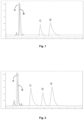
- Figures 1 to 5 are chromatograms obtained when implementing cannabinoid purification according to various embodiments of the invention, as described in further detail in the example section.
- the time (in minutes) is shown on the x-axis and the intensity of the signal is shown on the y-axis.
- the method of the invention comprises a main purification stage, wherein an initial mixture comprising at least one cannabinoid compound and one or more additional compounds (such as impurities or contaminants) is subjected to chromatographic separation using a main stationary phase comprising silica particles comprising amino and/or diol groups.
- the method of the invention may also comprise a preliminary purification stage, before the main purification stage, wherein the initial mixture is obtained, starting from a preliminary mixture containing the at least one cannabinoid compound, the one or more additional compounds as well as one or more further compounds.
- the starting material of the method of the invention is thus either the initial mixture or the preliminary mixture, depending on whether the preliminary purification stage is present or not.
- the at least one cannabinoid compound recovered in a purified form may be used in particular in a therapeutic composition, or in a recreational composition. It can in particular be formulated as an electronic cigarette composition.
- the starting material may notably comprise water or may be a water-based solution.
- the starting material may comprise or be based on a non-aqueous solvent.
- the starting material may be in the form of a dry extract.
- the starting material may comprise one or more cannabinoid compounds for example derived from a cannabis plant.
- cannabinoid compounds for example derived from a cannabis plant.
- the term "cannabis plant” refers to wild type Cannabis sativa and also variants thereof, including cannabis chemovars which naturally contain different amounts of individual cannabinoids, including also Cannabis sativa subspecies indica including the variants var. indica and var. kafiristanica, Cannabis indica as well as plants which are the result of genetic crosses, self-crosses or hybrids thereof.
- the starting material may comprise at least one cannabinoid compound selected from ⁇ 9 -tetrahydrocannabinol ( ⁇ 9 -THC), cannabidiol (CBD), cannabinol (CBN), cannabigerol (CBG), cannabichromene (CBC), cannabidivarol (CBDV), tetrahydrocannabidiol (THCBD), tetrahydrocannabidivarol (THCBDV), tetrahydrocannabigerol (THCBG), tetrahydrocannabichromene (THCBC), ⁇ 8 -tetrahydrocannabinol, carboxylic acid precursors of the foregoing compounds, related naturally occurring compounds and their derivatives.
- cannabinoid compound selected from ⁇ 9 -tetrahydrocannabinol ( ⁇ 9 -THC), cannabidiol (CBD), cannabinol (CBN), cannabigerol (CBG
- the starting material comprises a single cannabinoid compound.
- the starting material comprises more than one cannabinoid compound.
- the cannabinoids are sought to be purified.
- Others of the cannabinoid compounds may optionally be considered as impurities or contaminants (herein, "additional compounds” and/or “further compounds” ) and sought to be separated and removed.
- the starting material comprises at least ⁇ 9 -THC and/or CBD and/or CBN.
- the starting material may comprise from 5 to 100% of cannabinoid compounds, and preferably from 10 to 100% of cannabinoid compounds, based on the total dry weight of the starting material.
- the starting material may therefore comprise from 5 to 10%; or from 10 to 20%; or from 20 to 30%; or from 30 to 40%; or from 40 to 50%; or from 50 to 60%; or from 60 to 70%; or from 70 to 80%; or from 80 to 90%; or from 90 to 100% of cannabinoid compounds, based on the total dry weight of the starting material.
- the ⁇ 9 -THC can represent from 0.01 to 99.9%, and preferably from 0.1 to 95% of the total dry weight of the starting material.
- ⁇ 9 -THC can represent from 0.01 to 0.1%; or from 0.1 to 0.5%; or from 0.5 to 1%; or from 1 to 2%; or from 2 to 3%; or from 3 to 4%; or from 4 to 5%; or from 5 to 10%; or from 10 to 15%; or from 15 to 20%; or from 20 to 25%; or from 25 to 30%; or from 30 to 35%; or from 35 to 40%; or from 40 to 45%; or from 45 to 50%; or from 50 to 55%; or from 55 to 60%; or from 60 to 65%; or from 65 to 70%; or from 70 to 75%; or from 75 to 80%; or from 80 to 85%; or from 85 to 90%; or from 90 to 95%; from 95 to 99.9% of the total dry weight of the starting material.
- the CBD can represent from 0.01 to 9.9%, and preferably from 0.1 to 95% of the total dry weight of the starting material.
- CBD can represent from 0.01 to 0.1 %; or from 0.1 to 0.5%; or from 0.5 to 1%; or from 1 to 2%; or from 2 to 3%; or from 3 to 4%; or from 4 to 5%; or from 5 to 10%; or from 10 to 15%; or from 15 to 20%; or from 20 to 25%; or from 25 to 30%; or from 30 to 35%; or from 35 to 40%; or from 40 to 45%; or from 45 to 50%; or from 50 to 55%; or from 55 to 60%; or from 60 to 65%; or from 65 to 70%; or from 70 to 75%; or from 75 to 80%; or from 80 to 85%; or from 85 to 90%; or from 90 to 95%; from 95 to 99.9% of the total dry weight of the starting material.
- the starting material comprises one or more additional compounds and optionally further compounds, to be separated from the at least one cannabinoid compound.
- the additional compounds and/or further compounds may comprise or consist of cannabinoid compounds, which may in particular selected from the above list.
- the compound to be purified may be CBD, and the additional compounds and/or further compounds, to be separated from it, may comprise or consist of ⁇ 9 -THC and/or CBN.
- the compound to be purified may be CBN, and the additional compounds and/or further compounds, to be separated from it, may comprise or consist of ⁇ 9 -THC and/or CBD.
- the compound to be purified may be ⁇ 9 -THC, and the additional compounds and/or further compounds, to be separated from it, may comprise or consist of CBD and/or CBN.
- the additional compounds and/or further compounds may comprise or consist of pesticides and/or plant growth regulators.
- Pesticides are substances intended to repel, kill or control any species designated as " pest " , including weed, insects, rodents, fungi or other organisms. Pesticides include herbicides, insecticides, rodenticides, fungicides and bactericides.
- Plant growth regulators are substances or mixture of substances intended for accelerating or retarding the rate of growth or rate of maturation, or for otherwise altering the behavior of plants or the produce thereof. Plant nutrients, trace elements, nutritional chemicals, plant inoculants and soil amendments are not considered as plant growth regulators.
- pesticides and plant growth regulators examples include daminozide, neonicotinoids such as e.g. imidacloprid and thiamethoxam, strobilurins such as e.g. azoxystrobin and trifloxystrobin, triazoles such as myclobutanil, avermectin, etoxazole, bifenazate as well as their derivatives.
- the starting material comprises one single additional compound which is to be separated from the at least one cannabinoid compound.
- the starting material comprises several additional compounds and/or further compounds which are to be separated from the at least one cannabinoid compound.
- the additional compounds and/or further compounds comprise or consist of one or more cannabinoid compounds on the one hand, plus one or more pesticides and/or plant growth regulators on the other hand.
- the starting material may comprise from 0.01 to 50% of the one or more additional compounds and/or further compounds, and preferably from 0.1 to 50% of the one or more additional compounds and/or further compounds, based on the total dry weight of the starting material.
- the starting material may comprise from 0.01 to 0.1%; or from 0.1 to 0.5%; or from 0.5 to 1 %; or from 1 to 2%; or from 2 to 3%; or from 3 to 4%; or from 4 to 5%; or from 5 to 10%; or from 10 to 15%; or from 15 to 20%; or from 20 to 25%; or from 25 to 30%; or from 30 to 35%; or from 35 to 40%; or from 40 to 45%; or from 45 to 50% of the one or more additional compounds and/or further compounds.
- the starting material may comprise from 0.01 to 50% of one or more plant growth regulators and/or pesticides, and preferably from 0.1 to 50% of one or more plant growth regulators and/or pesticides, based on the total dry weight of the starting material.
- the starting material may comprise from 0.01 to 0.1%; or from 0.1 to 0.5%; or from 0.5 to 1%; or from 1 to 2%; or from 2 to 3%; or from 3 to 4%; or from 4 to 5%; or from 5 to 10%; or from 10 to 15%; or from 15 to 20%; or from 20 to 25%; or from 25 to 30%; or from 30 to 35%; or from 35 to 40%; or from 40 to 45%; or from 45 to 50% of one or more plant growth regulators and/or pesticides.
- One advantage of the present invention is that it makes it possible to separate cannabinoid compounds from chemicals such as plant growth regulators and/or pesticides which may be present in minute amounts in a starting material.
- the starting material may also comprise natural waxes, terpenes and flavonoids.
- the starting material may be an extract obtained from a cannabis plant.
- the cannabis plant may include different species including hemp and marijuana.
- the starting material can be a cannabis extract, notably a hemp extract, or a marijuana extract, or a mixture derived from one of those.
- marijuana extract is meant an extract wherein ⁇ 9 -THC is the major cannabinoid compound.
- hemp extract is meant an extract enriched in CBD, and/or wherein CBD is the major cannabinoid compound and wherein ⁇ 9 -THC is found in low levels.
- the starting material may be obtained by extracting cannabis flos with a non-polar solvent, an alcohol (such as ethanol) or liquid carbon dioxide, preferably with a non-polar solvent.
- a non-polar solvent an alcohol (such as ethanol) or liquid carbon dioxide
- Any non-polar solvent capable of solubilizing the cannabis plant can be used.
- Preferred non-polar solvent include liquid non-polar solvents comprising C5 to C12, preferably C5 to C8 straight chain or branched chain alkanes. More preferably the non-polar solvent is hexane or heptane.
- the starting material may be prepared by solubilizing a part of the cannabis plant in an extraction solvent, removing insoluble material from the resulting solution and removing the extraction solvent from the solution to form the initial mixture containing the at least one cannabinoid compound.
- a main stationary phase which comprises silica particles or preferably consists of silica particles.
- silica particles invention form a so-called silica gel when in solution. They comprise amino and/or diol groups on their surface. In other words, the silica particles comprise grafted functions of amines and/or diols. When used in a chromatographic installation, the silica particles form a normal phase, which means that the silica particles are mostly polar and separation between species is believed to mostly rely on polar interactions between the various species and the particles.
- the silica particles may in particular comprise groups of formula (I) on their surface: (I) -Si-R-NH 2 , wherein R is a linker group which may for instance comprise from 1 to 20 carbon atoms, preferably from 1 to 10 carbon atoms, more preferably from 1 to 4 carbon atoms, and optionally at least one heteroatom, preferably oxygen. R may in particular be (CH 2 -CH 2 ) or (CH 2 -CH 2 -CH 2 ).
- the silica particles may comprise groups of formula (II) on their surface: (II) -Si-R 1 (OH)-R 2 (OH), wherein R 1 and R 2 are linker groups, each of which may for instance comprise from 1 to 20 carbon atoms, preferably from 1 to 10 carbon atoms, more preferably from 1 to 6 carbon atoms, and optionally at least one heteroatom, preferably oxygen.
- R 2 may in particular be (CH 2 ) m wherein m is an integer preferably from 1 to 3, or from 1 to 2, and most preferably m is 1.
- the silica particles may preferably have an average volume diameter (Dv50) equal to or less than 200 ⁇ m, or 150 ⁇ m, or 100 ⁇ m, or 50 ⁇ m, or 20 ⁇ m.
- Dv50 average volume diameter
- the Dv50 of the silica particles is from 1 ⁇ m to 50 ⁇ m, preferably from 2 ⁇ m to 30 ⁇ m, or from 5 ⁇ m to 20 ⁇ m.
- Dv50 refers to the 50th percentile of the particle size distribution, i.e. 50 % of the particles have a size (corresponding to the diameter of the particles, when the particles are spherical) less than the Dv50 and 50 % have a size larger than the Dv50. This is the median of the volumetric distribution of silica particles.
- the distribution of the volume diameter of the particles of silica has only one peak (monodispersed distribution).
- the uniformity coefficient of this distribution may for example be less than or equal to 1.5, or less than or equal to 1.3, or less than or equal to 1.15.
- the particle size distribution of the silica particles may be determined by laser granulometry (NF 13320 standard).
- the at least one cannabinoid compound is substantially separated from the one or more additional compounds in a chromatographic installation.
- the initial mixture is put into contact with the main stationary phase comprising silica particles as described above, by injecting the initial mixture onto said main stationary phase.
- the initial mixture Before the initial mixture is put into contact with the main stationary phase, it may optionally be diluted or dissolved (if it is a dry extract) in a solvent, or alternatively be used as such.
- Solvents which can be used for dissolving the initial mixture include C5-C12 alkanes such as heptane and hexane, alcohols such as ethanol, or their mixtures. These solvents are preferably similar to the elution solution described below but not limited to it.
- an elution step is performed by passing an elution solution through the main stationary phase.
- a washing step which is performed by passing a washing solution through the main stationary phase.
- At least one fraction is collected at the elution step.
- washing step is carried out, at least one fraction is collected at the washing step.
- a single fraction is collected at the elution step. In other embodiments, at least two fractions are collected at the elution step.
- a single fraction is collected at the washing step. In other embodiments, at least two fractions are collected at the washing step.
- More than one fraction may be collected at different points in time in a given step.
- At least one of the collected fractions contains the at least one (desired) cannabinoid compound purified from the one or more additional compounds, which means that the fraction in enriched in the at least one cannabinoid compound and depleted in the one or more additional compounds.
- a fraction "enriched” in one species A and “depleted” in one species B it is meant that the ratio of species A/species B weight concentrations in the fraction is greater than that of the initial mixture (independently of the effects of concentration or overall dilution).
- the ratio may be greater by at least a factor of 10 or 100 or 1000 or 10000.
- the weight proportion of the purified at least one cannabinoid compound relative to the amount of the at least one cannabinoid compound present in the initial mixture may be at least 95%, preferably at least 98%, more preferably at least 99%, and most preferably at least 99.5% or 99.9%.
- the weight proportion of the one or more additional compounds recovered in the at least one elution fraction or washing fraction comprising the purified at least one cannabinoid compound relative to the amount present in the initial mixture may be less than 5%, preferably at least 2%, more preferably less than 1%, and most preferably less than 0.5% or less than 0.1%.
- the weight proportion of the one or more additional compounds relative to the purified at least one cannabinoid compound, in the at least one elution fraction or washing fraction comprising the purified at least one cannabinoid compound may in particular be less than 2%, preferably less than 1%, more preferably less than 0.5%, most preferably less than 0.1% or less than 0.05% or less than 0.01%.
- Other collected fractions may be enriched in one or several of the one or more additional compounds and depleted in the at least one (desired) cannabinoid compound.
- the weight proportion of the one or more additional compounds recovered in fractions other than the fraction containing the purified at least one cannabinoid compound, relative to the amount present in the initial mixture may be at least 95%, preferably at least 98%, more preferably at least 99%, and most preferably at least 99.5% or 99.9%.
- the fraction containing the purified at least one cannabinoid compound is obtained at the elution step.
- At least one fraction enriched in additional compound(s) may be obtained at the elution step.
- At least one fraction enriched in additional compound(s) may be obtained at the washing step.
- At least one fraction enriched in additional compound(s) may be obtained at the elution step and at least one fraction enriched in other additional compound(s) may be obtained at the washing step.
- At least part, and possibly all of the additional compounds present in the initial mixture have a stronger affinity for the main stationary phase than the at least one cannabinoid compound and are therefore retained on it, during the elution step (and optionally washed during the washing step).
- At least part, and possibly all of the additional compounds have a weaker affinity for the main stationary phase than the at least one cannabinoid compound and are therefore eluted during the elution step before the at least one cannabinoid compound, and collected separately.
- some of the additional compounds have a weaker affinity for the main stationary phase than the at least one cannabinoid compound and others of the additional compounds have a stronger affinity for the main stationary phase than the at least one cannabinoid compound.
- one first fraction containing a mixture of cannabinoid compounds (including for example ⁇ 9 -THC, CBD and CBN) is recovered, as well as one or more other fractions containing additional compounds (such as pesticides or plant growth regulators) which may for instance be more polar than the cannabinoid compounds.
- the first fraction is substantially free from these additional compounds.
- Neonicotinoids (such as thiamethoxam and imidacloprid) are examples of such additional compounds.
- Other additional compounds may be coeluted in the first fraction, and may be separated at another stage. Yet other additional compounds may remain bound to the main stationary phase and may be released and collected in a fraction during a subsequent washing step.
- two or more fractions containing cannabinoid compounds may be recovered, and optionally at least another fraction containing additional compounds (such as pesticides or plant growth regulators), which may for instance be non-polar, may be separately recovered. Strobilurins, such as trifloxystrobin are examples of such additional compounds.
- the fractions containing cannabinoid compounds may be for instance one fraction containing ⁇ 9 -THC on the one hand and another fraction containing CBD and CBN on the other hand; or one fraction containing ⁇ 9 -THC, one fraction containing CBD, and one fraction containing CBN.
- Each of the above fractions may be substantially free from the compounds indicated as being contained in another fraction. Further additional compounds may remain bound to the main stationary phase and may be released and collected in a fraction during a subsequent washing step.
- some or all of the additional compounds are eluted during the elution step, while the at least one cannabinoid compound remains bound to the main stationary phase.
- the at least one cannabinoid compound can then be collected during a subsequent washing step, as a fraction substantially free from the additional compounds eluted during the elution step.
- An elution solution may be a non-polar solvent.
- An elution solution can also, more preferably, be a mixture of a polar and a non-polar solvent.
- polar solvent is herein meant a solvent having a dielectric constant at a temperature of 20°C which is at least 15.
- non-polar solvent is herein meant a solvent having a dielectric constant at a temperature of 20°C which is less than 15.
- the polar solvent can in particular be an alcohol, such as ethanol or methanol, water and mixtures thereof.
- ethanol is used as a polar solvent.
- the non-polar solvent can in particular be an alkane, preferably a C5 to C10 alkane. More preferably, the non-polar solvent can be selected from pentane, hexane, heptane and octane. According to preferred embodiments, the non-polar solvent is hexane or heptane, more preferably heptane.
- the elution solution according to the claims is a mixture of an alkane and an alcohol.
- the elution may be performed in isocratic mode or gradient mode.
- the composition of the elution solution remains constant during the elution step.
- the gradient mode the composition of the elution solution varies during the elution step.
- the volume proportion of polar solvent to non-polar solvent in the elution solution may vary during the elution step.
- the volume proportion of polar solvent to non-polar solvent in the elution solution may increase during the elution step.
- the isocratic mode is however preferred.
- the elution solution can have a volume ratio of non-polar solvent to polar solvent from 99/1 to 50/50. More preferably, this volume ratio is from 98/2 to 60/40. Therefore, the volume ratio of non-polar solvent to polar solvent of the elution solution can be for instance from 99/1 to 90/10; or from 90/10 to 80/20; or from 80/20 to 70/30; or from 70/30 to 60/40; or from 60/40 to 50/50.
- the main stationary phase can be washed with a washing solution.
- compounds retained on the main stationary phase can be washed and optionally recovered, as one or more fractions.
- the washing solution may be a polar solvent.
- the washing solution can also, more preferably, be a mixture of a polar and a non-polar solvent.
- the polar solvent can in particular be an alcohol such as ethanol or methanol, water and mixtures thereof.
- ethanol is used as a polar solvent.
- the non-polar solvent in particular be an alkane, preferably a C5 to C10 alkane. More preferably, the non-polar solvent can be selected from pentane, hexane, heptane and octane. According to preferred embodiments, the non-polar solvent is hexane or heptane, heptane being more preferred.
- the washing solution can notably have a volume ratio of non-polar solvent to polar solvent from 1/99 to 50/50. More preferably, this volume ratio is from 2/98 to 40/60. Therefore, the volume ratio of non-polar solvent to polar solvent of the washing solution can be from 1/99 to 10/90; or from 10/90 to 20/80; or from 20/80 to 30/70; or from 30/70 to 40/60; or from 40/60 to 50/50.
- the washing solution is more polar (i.e. contains a larger relative proportion of polar solvent) than the elution solution.
- the washing may be performed in isocratic mode or gradient mode.
- the composition of the washing solution remains constant during the washing step.
- the gradient mode the composition of the washing solution varies during the washing step.
- the volume proportion of polar solvent to non-polar solvent in the washing solution may vary during the washing step.
- the volume proportion of polar solvent to non-polar solvent in the washing solution may increase during the washing step.
- the isocratic mode is however preferred.
- the main stationary phase can be equilibrated by putting it in contact with an equilibration solution. This step makes the adsorption sites of the main stationary phase available for another purification.
- the equilibration solution may be a non-polar solvent.
- the equilibration solution can also, more preferably, be a mixture of a polar and a non-polar solvent.
- the polar solvent can in particular be an alcohol such as ethanol or methanol, water and mixtures thereof.
- ethanol is used as a polar solvent.
- the non-polar solvent can in particular be an alkane, preferably a C5 to C10 alkane. More preferably, the non-polar solvent can be selected from pentane, hexane, heptane and octane. According to preferred embodiments, the non-polar solvent is hexane or heptane, heptane being more preferred.
- the equilibration solution can notably have a volume ratio of non-polar solvent to polar solvent from 99/1 to 50/50. More preferably, this volume ratio is from 98/2 to 60/40. Therefore, the volume ratio of non-polar solvent to polar solvent of the equilibration solution can be from 99/1 to 90/10; or from 90/10 to 80/20; or from 80/20 to 70/30; or from 70/30 to 60/40; or from 60/40 to 50/50.
- the equilibration solution is the same as the elution solution.
- the method of the invention may comprise two successive stages, a preliminary purification stage or pretreatment (described below) and a main purification stage (described above).
- the preliminary stage the initial mixture is prepared from a preliminary mixture corresponding to the starting material described above.
- this stage use is made of a preliminary stationary phase.
- the preliminary purification stage may be a stage of chromatographic purification.
- the preliminary stationary phase may be the same or different from the main stationary phase.
- the preliminary stationary phase may comprise silica particles.
- the preliminary stationary phrase may comprise or consist of silica particles comprising amino and/or diol groups, as described above.
- the preliminary and main stationary phases are the same, use may be made of two different beds of the same stationary phase, for instance in two different chromatographic installations.
- the preliminary and main stationary phases may be the same bed in the same chromatographic installation, successively used at different points in time.
- the preliminary stationary phase may comprise or consist of non-functionalized silica particles.
- the preliminary mixture is put in contact with the preliminary stationary phase by injecting the preliminary mixture onto the preliminary stationary phase.
- An elution is then carried out with an elution solution in order to collect one or more preliminary elution fractions, optionally followed by a washing step with a washing solution in order to collect one or more preliminary washing fractions.
- At least one preliminary elution fraction is collected at the elution step.
- washing step is carried out, at least one preliminary washing fraction is collected at the washing step.
- a single preliminary elution fraction is collected at the elution step. In other embodiments, at least two preliminary elution fractions are collected at the elution step.
- a single preliminary washing fraction is collected at the washing step. In other embodiments, at least two preliminary washing fractions are collected at the washing step.
- More than one preliminary fraction may be collected at different points in time in a given step.
- At least one of the preliminary elution fractions or the preliminary washing fractions is a liquid fraction enriched in the at least one cannabinoid compound and the one or more additional compounds and depleted in the further compounds. Said liquid fraction provides the initial mixture and is used in the main purification stage.
- Each elution step, each elution solution, each washing step and each washing solution may be as described in more detail above with respect to the main purification stage.
- the elution solution of the preliminary purification stage may be the same as the elution solution of the main purification stage, or preferably different.
- the elution solution of the main purification stage is more polar than the elution solution of the preliminary purification stage.
- the elution solution of the main purification stage is less polar than the elution solution of the preliminary purification stage.
- the elution solution of the preliminary purification stage is preferably a mixture of a polar and a non-polar solvent.
- the polar solvent can in particular be an alcohol, such as ethanol or methanol, water and mixtures thereof.
- ethanol is used as a polar solvent.
- the non-polar solvent can in particular be an alkane, preferably a C5 to C10 alkane. More preferably, the non-polar solvent can be selected from pentane, hexane, heptane and octane. According to preferred embodiments, the non-polar solvent is hexane or heptane, more preferably heptane.
- the elution solution of the preliminary purification stage can have a volume ratio of non-polar solvent to polar solvent from 99/1 to 50/50. More preferably, this volume ratio is from 98/2 to 60/40. Therefore, the volume ratio of non-polar solvent to polar solvent of the elution solution of the preliminary purification stage can be for instance from 99/1 to 90/10; or from 90/10 to 80/20; or from 80/20 to 70/30; or from 70/30 to 60/40; or from 60/40 to 50/50.
- the preliminary stationary phase may be equilibrated after the elution and optional washing of the preliminary purification stage, as described above with respect to the main purification stage. This is useful in particular if it is to be used again as the main stationary phase at the main purification stage.
- This variant may be advantageous in order to separate the at least one cannabinoid compound from several different compounds or groups of compounds.
- the at least one cannabinoid compound is separated from the further compounds but is substantially not separated from the additional compounds.
- the initial mixture provided by the preliminary purification stage is enriched in the at least one cannabinoid compound and the additional compounds and depleted in the further compounds, relative to the preliminary mixture.
- the ratio of the weight concentration of the at least one cannabinoid compound relative to the weight concentration of the further compounds is greater in the initial mixture than in the preliminary mixture, preferably by at least a factor of 10 or 100 or 1000 or 10000.
- the weight proportion of the at least one cannabinoid compound in the initial mixture relative to the amount of the at least one cannabinoid compound present in the preliminary mixture may be at least 95%, preferably at least 98%, more preferably at least 99%, and most preferably at least 99.5% or 99.9%.
- the weight proportion of the one or more further compounds recovered in the initial mixture relative to the amount present in the preliminary mixture may be less than 5%, preferably at least 2%, more preferably less than 1%, and most preferably less than 0.5% or less than 0.1%.
- the weight proportion of the one or more further compounds relative to the at least one cannabinoid compound in the initial mixture may in particular be less than 2%, preferably less than 1%, more preferably less than 0.5%, most preferably less than 0.1% or less than 0.05% or less than 0.01%.
- the at least one cannabinoid compound is separated from the additional compounds.
- a fraction is collected which is enriched in the at least one cannabinoid compound and depleted in the additional compounds (relative to the initial mixture obtained after the preliminary purification stage).
- the main benefits of a two-stage process are that the size of the columns and volumes of solvents can be adjusted to the specific separation of the at least one cannabinoid compound from the further compounds at the preliminary purification stage and to the specific separation of the at least one cannabinoid compound from the additional compounds at the main purification stage.
- the preliminary purification stage is designed to separate the at least one cannabinoid compound from strongly retained impurities (further compounds).
- the retention time differences being higher during the preliminary purification stage, a reduced amount of stationary phase and of solvents is required, compared to the main purification stage.
- the additional compounds may comprise non-polar plant growth regulators and/or pesticides (such as in particular strobilurins such as trifloxystrobin) and optionally cannabinoid compounds; and the further compounds may comprise polar plant growth regulators and/or pesticides (such as in particular neonicotinoids, e.g. imidacloprid and thiamethoxam and/or daminozide).
- non-polar plant growth regulators and/or pesticides such as in particular strobilurins such as trifloxystrobin
- cannabinoid compounds such as in particular neonicotinoids, e.g. imidacloprid and thiamethoxam and/or daminozide.
- one particular (desired) cannabinoid compound for instance selected from the group of CBN, CBD and ⁇ 9 -THC
- one or more other cannabinoid compounds for instance also selected from the group of CBN, CBD and ⁇ 9 -THC
- non-polar plant growth regulators and/or pesticides such as a strobilurin, e.g. trifloxystrobin
- the preliminary purification stage may also be conducted by putting the preliminary mixture in contact with the preliminary stationary phase, in a suspension solution to form a suspension.
- the preliminary stationary phase may be mixed with the preliminary mixture (and the suspension solution), in a tank provided with stirring elements.
- stirring elements can for example include one or more agitators, a recirculation pump or the like.
- the tank may be for example a fluidized bed reactor. After a given residence time, the suspension can be filtered, collecting a first fraction on the one hand and the preliminary stationary phase on the other hand.
- the preliminary stationary phase may be resuspended in a further solution, and filtered so as to collect a further fraction. This step can be repeated several times if needed.
- At least one of the first or the further fractions is a liquid fraction enriched in the at least one cannabinoid compound and the one or more additional compounds and depleted in the further compounds. Said liquid fraction provides the initial mixture and is used in the main purification stage.
- the preliminary stationary phase used in the suspension purification may be the same as the preliminary stationary phase used in the preliminary chromatographic purification, as described above.
- the preliminary stationary phase may comprise or consist of activated charcoal.
- the preliminary stationary phase may comprise or consist of one or more zeolites.
- the suspension solution may be an elution solution as described above in relation with the preliminary purification stage by chromatographic purification.
- the further solution used for the resuspension of the preliminary stationary phase can also be an elution solution as described above in relation with the preliminary purification stage by chromatographic purification.
- the first resuspension can be carried out with an elution solution as described above in relation with the preliminary purification stage by chromatographic purification, and the second resuspension can be carried out with a washing solution as described above in relation with the preliminary purification stage by chromatographic purification.
- the preliminary stationary phase can finally be suspended in an equilibration solution as described above in relation with the preliminary purification stage by chromatographic purification to achieve the equilibration of the preliminary stationary phase before reusing the preliminary stationary phase for another purification.
- the method according to the invention may be discontinuous (or batch), semi-continuous or continuous.
- the method according to the invention can be carried out at a constant temperature or at different successive temperatures.
- the temperature is substantially constant.
- the temperature at which the method is carried out may preferably range from 10 to 40°C, more preferably from 15 to 30°C and most preferably from 20 to 25°C.
- chromatographic purification stages refers to the main purification stage as well as the preliminary purification stage when carried out by a chromatographic purification.
- the chromatographic purification stages according to the invention are preferably carried out at a pressure from 1 to 100 bar and preferably from 10 to 40 bar.
- the chromatographic purification stages according to the invention may be implemented in a chromatographic installation having a static bed or preferably in a chromatographic installation with a non-static bed.
- the mixture of compounds to be separated percolates in a generally cylindrical enclosure (or column).
- the column contains a bed of porous material (stationary phase) which is permeable to fluids.
- the percolation rate of each compound in the mixture depends on the physical properties of the compound. The most retained compounds on the stationary phase percolate more slowly than the less retained compounds on the stationary phase.
- HPLC High Performance Liquid Chromatography
- CYCLOJET TM a system with recycling in the stationary state
- the CYCLOJET TM system is as described in document US 6,063,284 , to which reference is expressly made.
- This is a discontinuous chromatographic separation installation with a single column, in which the most retained species (i) and then the less retained species (ii) are collected separately at the outlet of the column, the non-separated portion of the chromatogram being recycled by the main pump, and the mixture to be separated being periodically injected by means of an injection loop essentially located in the middle of the recycled portion of the chromatogram. After several chromatographic cycles, the process reaches a periodical stationary state in which the amount of injected products is equal to the amount of separated products collected separately at the outlet of the column.
- An installation with a non-static bed is a multi-column installation, in which the relative positions of the stationary phase bed and of the injection or collecting points of the flows move over time.
- chromatographic installations with a non-static bed examples include the SMB (simulated moving bed), iSMB (improved simulated moving bed), SSMB (sequential simulated moving bed), AMB (actual moving bed), VARICOL TM , MODICON TM , POWERFEED TM , MCSGP or GSSR (multi column gradient chromatography) systems.
- An SMB system comprises a plurality of individual columns containing an adsorbent, which are connected in series.
- An eluent flow crosses the columns along a first direction.
- the injection points of the feed flow and of the eluent flow, as well as the points for collecting the separated compounds, are periodically and simultaneously shifted by means of a set of valves.
- the global effect is to simulate the operation of a single column containing a moving bed of solid adsorbent, the solid adsorbent moving in a counter current direction relatively to the eluent flow.
- an SMB system consists of columns which contain stationary beds of solid adsorbent through which the eluent passes, but the operation is such that a continuous moving bed as a counter current is simulated.
- SMB system The most conventional form of an SMB system is the SMB system with four zones. Other possible forms are the SMB systems with three zones and the SMB systems with two zones (as described in the article " Two Section Simulated Moving Bed Process” of Kwangnam Lee, in Separation Science and Technology 35(4):519-534, 2000 , to which reference is expressly made).
- An SSMB system divides the introductions and collections of the flows into subsequences applied periodically.
- SMB systems are: the SMB system varying over time and the POWERFEED TM system, as described in document US 5,102,553 and in the article " PowerFeed operation of simulated moving bed units: changing flow-rates during the switching interval", of Zhang et al. in Journal of Chromatography A, 1006:87-99, 2003 , to which reference is expressly made; the MODICON TM system as described in document US 7,479,228 , to which is reference is expressly made; and the SMB system with internal recirculation, as described in document US 8,282,831 , to which reference is expressly made.
- An AMB system has an operation similar to an SMB system. However, instead of displacing the feed flow and eluent injection points, as well as the collecting points, by means of a set of valves, a set of adsorption units (columns) are physically displaced relatively to the feed and collecting points. Again, the operation allows simulation of a continuous counter current moving bed.
- a VARICOL TM chromatography system is as described in documents US 6,136,198 , US 6,375,839 US 6,413,419 and US 6,712,973 , to which reference is expressly made.
- a VARICOL TM system comprises a plurality of individual columns containing an adsorbent, which are connected in series. An eluent is passed into the columns along a first direction. The injection points for the mixture to be separated and for the eluent and the points for collecting the separated compounds in the system are periodically displaced asynchronously, by means of a set of valves. The global effect is to generate separation zones with a variable length over time, thereby allocating the stationary phase dynamically in the zones where it is the most useful, and allowing a similar power of separation with less chromatographic separation units and increased productivity.
- the chromatographic purification stages of the present invention may be carried out in a single-column chromatographic installation.
- the chromatographic purification stages of the present invention may also be carried out in a multicolumn chromatographic installation with a discontinuous feed injection, such as but not limited to BioSC (as described in document EP 2040811 ) or DCC processing (as described in document EP 1912716 ).
- a discontinuous feed injection such as but not limited to BioSC (as described in document EP 2040811 ) or DCC processing (as described in document EP 1912716 ).
- the chromatographic purification stages of the present invention are preferably carried out in a high-pressure liquid chromatography installation.
- the method of the invention only comprises the main purification stage (without the preliminary purification stage) and it can be performed in a single column installation, or in a two or three-column installation chosen between MCSGP or GSSR or DCC, or in a four or five or six or seven or eight-column installation chosen between SMB, iSMB, SSMB, AMB, VARICOL TM , MODICON TM and POWERFEED TM .
- the total bed length for the stationary phase preferably ranges from 10 cm to 100 cm.
- the method of the present invention comprises the preliminary purification stage and the main purification stage and:
- the chromatographic purification stages of the present invention may be carried out in one or more installations comprising one or more chromatographic columns having a diameter (internal diameter) equal to or larger than 5 cm.
- the diameter of the one or more chromatographic columns can be from 5 to 10 cm; or from 10 to 20 cm; or from 20 to 30 cm; or from 30 to 40 cm; or from 40 to 50 cm; or from 50 to 100 cm; or from 100 to 150 cm; or from 150 to 200 cm.
- the chromatographic installation(s) used in the present invention may have a total dead volume lower than or equal to 30%, preferably lower than or equal to 20%, more preferably lower than or equal to 10% and even more preferably lower than or equal to 5% of the total volume of (main and/or preliminary) stationary phase in the installation ( i.e. the volume of the bed of stationary phase).
- discharge volume can be defined as the sum of:
- the velocity of the fluids at the entrance of the bed of (main and/or preliminary) stationary phase can be from 30 cm/hour to 5000 cm/hour, preferably from 100 to 4000 cm/hour, and more preferably from 200 to 3000 cm/hour.
- this velocity can be from 30 to 40 cm/hour; or from 40 to 50 cm/hour; or from 50 to 60 cm/hour; or from 60 to 70 cm/hour; or from 70 to 80 cm/hour; or from 80 to 90 cm/hour; or from 90 to 100 cm/hour; or from 100 to 250 cm/hour; or from 250 to 500 cm/hour; or from 500 to 750 cm/hour; or from 750 to 1000 cm/hour; or from 1000 to 1500 cm/hour; or from 1500 to 2000 cm/hour; or from 2000 to 3000 cm/hour; or from 3000 to 4000 cm/hour; or from 4000 to 5000 cm/hour.
- the velocity of the liquid can be constant over the various steps of one chromatographic stage (either the main purification stage or the preliminary purification stage carried out by chromatographic purification).
- the velocity of the liquid can vary during one chromatographic stage.
- the velocity of the initial mixture or the preliminary mixture can be lower than the velocity of the elution solution, and/or the velocity of the initial mixture or the preliminary mixture can be lower than the velocity of the washing solution, and/or the velocity of the initial mixture or the preliminary mixture can be lower than the velocity of the equilibration solution.
- the velocity of the initial mixture or the preliminary mixture can be higher than the velocity of the elution solution, and/or the velocity of the initial mixture or the preliminary mixture can be higher than the velocity of the washing solution, and/or the velocity of the initial mixture or the preliminary mixture can be higher than the velocity of the equilibration solution.
- the velocity of the elution solution, the washing solution and the equilibration solution may be different, lower or higher from one another.
- the starting material to be purified comprises ⁇ 9 -tetrahydrocannabinol, cannabidiol, cannabinol, daminozide, imidacloprid, thiamethoxam and trifloxystrobin.
- the invention is applied on a HPLC Agilent 1100.
- the stationary phase used is Amino 10 ⁇ m, M.S. Gel and a mixture of ethanol and heptane in a volume ratio of 60/40 heptane/ethanol is used as the mobile phase.
- the cannabinoid compounds ⁇ 9 -THC, CBD and CBN co-elute with trifloxystrobin (B), while imidacloprid (C) and thiamethoxam (D) are successfully separated. Furthermore, daminozide (not shown in Figure 1 ) remains retained in the stationary phase.
- This example is similar to example 1, expect that the stationary phase used is Daisogel Diol 10 ⁇ m. A mixture of ethanol and heptane in a volume ratio of 60/40 heptane/ethanol is still used as the mobile phase.
- the cannabinoid compounds ⁇ 9 -THC, CBD, and CBN co-elute with trifloxystrobin (B), while daminozide (C), imidacloprid (D) and thiamethoxam (E) are successfully separated.
- This example is similar to example 1, expect that a less polar mixture of ethanol and heptane in a volume ratio of 98/2 heptane/ethanol is used as the mobile phase.
- trifloxystrobin (A) and ⁇ 9 -THC (B) no longer co-elute, while CBD, and CBN (C) still elute together. Furthermore, daminozide, imidacloprid, and thiamethoxam (not shown in Figure 3 ) remain retained on the stationary phase.
- This example is similar to example 2, expect that a mixture of ethanol and heptane in a volume ratio of 98/2 heptane/ethanol is used as the mobile phase.
- trifloxystrobin, (A), ⁇ 9 -THC (B), CBN (C) and CBD (D) are successfully separated.
- Daminozide, imidacloprid, and thiamethoxam remain retained on the stationary phase.
- the invention is implemented on a High-Pressure Liquid Chromatography installation.
- the stationary phase used is Daisogel Diol 10 ⁇ m.
- the stationary phase is eluted with a mixture of ethanol and heptane in a volume ratio of 98/2 heptane/ethanol and as shown in Figure 5 .
- trifloxystrobin (A) ⁇ 9 -tetrahydrocannabinol
- B cannabinol
- D cannabidiol
- washing is performed with a more polar mixture of ethanol and heptane (volume ratio of 20/80 heptane/ethanol) in order to collect the more polar daminozide (E), imidacloprid (F), and thiamethoxam (G).
- the stationary phase used is Daisogel Diol 10 ⁇ m.
- the initial mixture is loaded in a HPLC Agilent 1100 and the stationary phase is eluted with a mixture of ethanol and heptane in a volume ratio of 98/2 heptane/ethanol.
- trifloxystrobin, ⁇ 9 -THC, CBN, and CBD are successfully purified.
Landscapes
- Chemical & Material Sciences (AREA)
- Health & Medical Sciences (AREA)
- Life Sciences & Earth Sciences (AREA)
- Analytical Chemistry (AREA)
- General Health & Medical Sciences (AREA)
- Organic Chemistry (AREA)
- Natural Medicines & Medicinal Plants (AREA)
- Medicinal Chemistry (AREA)
- Chemical Kinetics & Catalysis (AREA)
- Veterinary Medicine (AREA)
- Public Health (AREA)
- Pharmacology & Pharmacy (AREA)
- Epidemiology (AREA)
- Animal Behavior & Ethology (AREA)
- Biochemistry (AREA)
- Medical Informatics (AREA)
- Mycology (AREA)
- Microbiology (AREA)
- Botany (AREA)
- Biotechnology (AREA)
- Engineering & Computer Science (AREA)
- Alternative & Traditional Medicine (AREA)
- Pathology (AREA)
- Immunology (AREA)
- General Physics & Mathematics (AREA)
- Biophysics (AREA)
- Genetics & Genomics (AREA)
- Molecular Biology (AREA)
- Proteomics, Peptides & Aminoacids (AREA)
- Physics & Mathematics (AREA)
- Sustainable Development (AREA)
- Organic Low-Molecular-Weight Compounds And Preparation Thereof (AREA)
- Pharmaceuticals Containing Other Organic And Inorganic Compounds (AREA)
Claims (15)
- Verfahren zur chromatographischen Reinigung mindestens einer Cannabinoid-Verbindung, wobei das Verfahren eine Hauptreinigungsstufe umfasst, welche die folgenden Schritte umfasst:- Einspritzen einer anfänglichen Mischung, welche die mindestens eine Cannabinoid-Verbindung und eine oder mehrere zusätzliche Verbindungen umfasst, auf eine stationäre Hauptphase, die Siliziumdioxid-Partikel umfasst, wobei die Siliziumdioxid-Partikel Amino- und/oder Diol-Gruppen umfassen;- Durchführen einer Elution mit einer Elutionslösung und Sammeln einer oder mehrerer Elutionsfraktionen, wobei die Elutionslösung ein Gemisch aus einem Alkan und einem Alkohol ist; und- wahlweise Waschen der stationären Hauptphase mit einer Waschlösung und Sammeln einer oder mehrerer Waschfraktionen;wobei mindestens eine der Elutionsfraktionen oder Waschfraktionen die mindestens eine von der einen oder den mehreren zusätzlichen Verbindungen gereinigte Cannabinoid-Verbindung enthält.
- Verfahren nach Anspruch 1, wobei die mindestens eine Cannabinoid-Verbindung ausgewählt wird aus Δ9-Tetrahydrocannabinol, Cannabidiol, Cannabinol, Cannabigerol, Cannabichromen, Cannabidivarol, Tetrahhydrocannabidiol, Tetrahydrocannabidivarol, Δ8-Tetrahydrocannabinol, Carboxylsäure-Vorläufern der vorhergehenden Verbindungen, verwandten natürlich vorkommenden Verbindungen und ihren Derivaten und Kombinationen davon, und/oder wobei die eine oder mehreren zusätzlichen Verbindungen ausgewählt wird bzw. werden aus Cannabinoid-Verbindungen, Pestiziden, Pflanzenwuchsregulatoren und Kombinationen davon.
- Verfahren nach einem der Ansprüche 1 oder 2, das ferner eine Vorreinigungsstufe vor der Hauptreinigungsstufe umfasst, wobei die Vorreinigungsstufe die folgenden Schritte umfasst:- Inkontaktbringen eines Vorgemischs, das die mindestens eine Cannabinoid-Verbindung, die eine oder mehreren zusätzlichen Verbindungen und eine oder mehrere weitere Verbindungen umfasst, mit einer stationären Vorphase; und- Sammeln mindestens einer flüssigen Fraktion, die in der mindestens einen Cannabinoid-Verbindung und der einen oder den mehreren zusätzlichen Verbindungen angereichert ist und in den weiteren Verbindungen abgereichert ist, wobei die mindestens eine flüssige Fraktion das anfängliche Gemisch bereitstellt.
- Verfahren nach Anspruch 3, wobei die stationäre Vorphase Siliziumdioxidpartikel umfasst, die Amino- und/oder Diol-Gruppen umfassen.
- Verfahren nach einem der Ansprüche 3 oder 4, wobei die Vorreinigungsstufe das Inkontaktbringen des Vorgemischs mit der stationären Vorphase in einer Suspensionslösung, um eine Suspension zu bilden; das Filtern, um eine erste Fraktion zu sammeln; wahlweise das erneute Suspendieren der stationären Vorphase in einer oder mehreren weiteren Lösungen und das Filtern umfasst, um eine oder mehrere weitere Fraktionen zu sammeln; wobei die flüssige Fraktion, die in der mindestens einen Cannabinoid-Verbindung und der einen oder den mehreren Verbindungen angereichert und in den weiteren Verbindungen abgereichert ist, mindestens eine von der ersten und den weiteren Fraktionen ist.
- Verfahren nach einem der Ansprüche 3 bis 4, wobei die Vorreinigungsstufe das Inkontaktbringen des Vorgemischs mit der stationären Vorphase durch Einspritzen des Vorgemischs auf die stationäre Vorphase; das Durchführen einer Elution mit einer Elutionslösung und das Sammeln von einer oder mehreren Vorelutionsfraktionen; und wahlweise das Waschen der stationären Vorphase mit einer Waschlösung und das Sammeln einer oder mehrerer Vorwaschfraktionen umfasst; wobei mindestens eine von den Vorelutionsfraktionen und/oder Vorwaschfraktionen die flüssige Fraktion ist, die in der mindestens einen Cannabinoid-Verbindung und der einen oder den mehreren zusätzlichen Verbindungen angereichert und in den weiteren Verbindungen abgereichert ist.
- Verfahren nach einem der Ansprüche 3 bis 6, wobei die eine oder mehreren weiteren Verbindungen ausgewählt wird bzw. werden aus Cannabinoid-Verbindungen, Pestiziden, Pflanzenwachstumsregulatoren und Kombinationen davon
- Verfahren nach einem der Ansprüche 1 bis 7, wobei die Hauptreinigungsstufe in einer Installation durchgeführt wird, die ausgewählt wird aus einer einsäuligen oder einer mehrsäuligen Installation; oder wobei die Vorreinigungsstufe, falls vorhanden, in einer Installation durchgeführt wird, die ausgewählt wird aus einer einsäuligen Installation oder einer mehrsäuligen Installation, und die Hauptreinigungsstufe in einer mehrsäuligen Installation durchgeführt wird.
- Verfahren nach einem der Ansprüche 1 bis 8, wobei der Alkohol der Elutionslösung unabhängig ausgewählt wird aus Ethanol und Methanol und das Alkan der Elutionslösung unabhängig ausgewählt wird aus Pentan, Hexan, Heptan und Octan; und/oder wobei die Elutionslösung der Hauptreinigungsstufe ein Volumenverhältnis von Alkan zu Alkohol von 99:1 bis 50:50 aufweist.
- Verfahren nach einem der Ansprüche 1 bis 9, wobei jede von der Elutionslösung der Vorreinigungsstufe, der Waschlösung der Hauptreinigungsstufe und wahlweise der Vorreinigungsstufe ein Gemisch eines polaren Lösungsmittels und eines nicht-polaren Lösungsmittels ist; wobei das polare Lösungsmittel vorzugsweise unabhängig ausgewählt wird aus Ethanol, Methanol und Wasser und das nicht-polare Lösungsmittel vorzugsweise unabhängig ausgewählt wird aus Pentan, Hexan, Heptan und Octan; und wobei die Elutionslösung der Vorreinigungsstufe vorzugsweise ein Volumenverhältnis von nicht-polarem Lösungsmittel zu polarem Lösungsmittel von 99:10 bis 50:50 aufweist; und die Waschlösung der Hauptreinigungsstufe und wahlweise der Vorreinigungsstufe vorzugsweise ein Volumenverhältnis von nicht-polarem Lösungsmittel zu polarem Lösungsmittel von 1:99 bis 50:50 aufweist.
- Verfahren nach einem der Ansprüche 1 bis 10, das ferner das Äquilibrieren der stationären Hauptphase mit einer Äquilibrierungslösung umfasst, um die stationäre Hauptphase für eine weitere Einspritzung zu äquilibrieren, wobei die Elutionslösung der Hauptreinigungsstufe und die Äquilibrierungslösung vorzugsweise die gleiche sind.
- Verfahren nach einem der Ansprüche 1 bis 11, wobei die Hauptreinigungsstufe in einer Installation durchgeführt wird, die eine Gesamtbettlänge von kürzer als 100 cm aufweist; und wobei die Vorreinigungsstufe, falls vorhanden, in einer Installation durchgeführt wird, die eine Gesamtbettlänge aufweist, die kürzer als 100 cm ist.
- Verfahren nach einem der Ansprüche 1 bis 12, das in einer Installation durchgeführt wird, die eine oder mehrere chromatographische Säulen umfasst, die einen Durchmesser von gleich oder größer als 5 cm aufweist bzw. aufweisen, und/oder wobei die Installation ein Gesamttotvolumen von kleiner oder gleich 30 %, vorzugsweise kleiner oder gleich 20 %, bevorzugter kleiner oder gleich 10 % oder sogar noch bevorzugter kleiner oder gleich 5 % des Gesamtvolumens der stationären Hauptphase in der Installation ist.
- Verfahren nach einem der Ansprüche 1 bis 13, wobei das Einspritzen des anfänglichen Gemischs kontinuierlich oder auf eine diskontinuierliche Weise durchgeführt wird.
- Verfahren nach einem der Ansprüche 1 bis 14, wobei der Gewichtsanteil der gereinigten mindestens einen Cannabinoid-Verbindung, bezogen auf die Menge der mindestens einen Cannabinoid-Verbindung, die in dem anfänglichen Gemisch vorhanden ist, mindestens 95 %, vorzugsweise mindestens 98 %, bevorzugter mindestens 99 % und am bevorzugten mindestens 99,5 % oder 99,9 % beträgt, und/oder wobei die mindestens eine Elutionsfraktion oder Waschfraktion, welche die mindestens eine Cannabinoid-Verbindung enthält, die von der einen oder den mehreren zusätzlichen Verbindungen gereinigt wird, ferner einen Gewichtsanteil der einen oder mehreren zusätzlichen Verbindungen aufweist, der niedriger als 5 %, vorzugsweise mindestens 2 %, bevorzugter niedriger als 1 % und am bevorzugten niedriger als 0,5 % oder niedriger als 0,1 %, bezogen auf die Menge der einen oder mehreren zusätzlichen Verbindungen, beträgt, die in dem anfänglichen Gemisch vorhanden sind.
Applications Claiming Priority (2)
| Application Number | Priority Date | Filing Date | Title |
|---|---|---|---|
| US16/155,646 US11324718B2 (en) | 2018-10-09 | 2018-10-09 | Method for purifying cannabinoids |
| PCT/EP2019/077106 WO2020074453A1 (en) | 2018-10-09 | 2019-10-07 | Method for purifying cannabinoids |
Publications (2)
| Publication Number | Publication Date |
|---|---|
| EP3863744A1 EP3863744A1 (de) | 2021-08-18 |
| EP3863744B1 true EP3863744B1 (de) | 2025-03-19 |
Family
ID=68208291
Family Applications (1)
| Application Number | Title | Priority Date | Filing Date |
|---|---|---|---|
| EP19786300.4A Active EP3863744B1 (de) | 2018-10-09 | 2019-10-07 | Verfahren zur reinigung von cannabinoiden |
Country Status (5)
| Country | Link |
|---|---|
| US (2) | US11324718B2 (de) |
| EP (1) | EP3863744B1 (de) |
| ES (1) | ES3021585T3 (de) |
| IL (1) | IL282035B2 (de) |
| WO (1) | WO2020074453A1 (de) |
Families Citing this family (7)
| Publication number | Priority date | Publication date | Assignee | Title |
|---|---|---|---|---|
| WO2020028198A1 (en) | 2018-08-03 | 2020-02-06 | Biomass Oil Separation Solutions, Llc | Processes and apparatus for extraction of substances and enriched extracts from plant material |
| US11324718B2 (en) | 2018-10-09 | 2022-05-10 | Sartorius Chromatography Equipment | Method for purifying cannabinoids |
| US10799546B1 (en) | 2019-07-26 | 2020-10-13 | Biomass Oil Separation Solutions, Llc | Modular, integrated process and apparatus for extracting, refining and remediating active substances from plant material |
| CN112285233B (zh) * | 2020-10-22 | 2022-05-13 | 三明海关综合技术服务中心 | 一种检测油脂中大麻素类新精神活性物质的前处理方法 |
| CN112451995B (zh) * | 2020-11-03 | 2022-04-01 | 中国标准化研究院 | 一种用于工业大麻中大麻酚类物质检测前处理的组合物及使用方法 |
| EP4253390A4 (de) * | 2020-11-25 | 2024-12-04 | Chengdu Baiyu Pharmaceutical Co., Ltd. | Verfahren zur reinigung von cannabinoidverbindungen |
| CA3254628A1 (en) | 2022-06-01 | 2023-12-07 | Stimit Ag | BREATHING AID DEVICE |
Family Cites Families (29)
| Publication number | Priority date | Publication date | Assignee | Title |
|---|---|---|---|---|
| JPH0746097B2 (ja) | 1988-05-17 | 1995-05-17 | 三菱化成エンジニアリング株式会社 | クロマト分離法 |
| US5102553A (en) | 1988-12-16 | 1992-04-07 | The Amalgamated Sugar Company | Time variable simulated moving bed process |
| US5630943A (en) | 1995-11-30 | 1997-05-20 | Merck Patent Gesellschaft Mit Beschrankter Haftung | Discontinuous countercurrent chromatographic process and apparatus |
| US6063284A (en) | 1997-05-15 | 2000-05-16 | Em Industries, Inc. | Single column closed-loop recycling with periodic intra-profile injection |
| US6365416B1 (en) | 1998-10-26 | 2002-04-02 | The University Of Mississippi | Method of preparing delta-9-tetrahydrocannabinol |
| US6413419B1 (en) | 1998-10-29 | 2002-07-02 | Institut Francais Du Petrole | Process and device for separation with variable-length chromatographic |
| FR2785196B1 (fr) | 1998-10-29 | 2000-12-15 | Inst Francais Du Petrole | Procede et dispositif de separation avec des zones chromatographiques a longueur variable |
| US6375839B1 (en) | 1998-10-29 | 2002-04-23 | Institut Francais Du Petrole | Process and device for separation with variable-length chromatographic zones |
| US6403126B1 (en) | 1999-05-26 | 2002-06-11 | Websar Innovations Inc. | Cannabinoid extraction method |
| DE10051427C1 (de) | 2000-10-17 | 2002-06-13 | Adam Mueller | Verfahren zur Herstellung eines Tetrahydrocannabinol- und Cannabidiol-haltigen Extraktes aus Cannabis-Pflanzenmaterial sowie Cannabis-Extrakte |
| DE10235385B4 (de) | 2002-08-02 | 2006-10-05 | MAX-PLANCK-Gesellschaft zur Förderung der Wissenschaften e.V. | Verfahren zur chromatographischen Trennung von Komponenten |
| GB0222077D0 (en) | 2002-09-23 | 2002-10-30 | Gw Pharma Ltd | Methods of preparing cannabinoids from plant material |
| GB2393182B (en) | 2002-09-23 | 2007-03-14 | Gw Pharma Ltd | Method of preparing cannabidiol from plant material |
| GB0329635D0 (en) | 2003-12-23 | 2004-01-28 | Johnson Matthey Plc | Process for purifying trans-tetrahydrocannabinol |
| FR2889077B1 (fr) | 2005-07-26 | 2007-10-12 | Novasep Soc Par Actions Simpli | Procede et dispositif de separation chromatographique de fractions d'un melange |
| US20070077660A1 (en) * | 2005-09-30 | 2007-04-05 | Glas Ronald J | Method for the detection of a cannabinoid, detection kit, and developing solvent |
| WO2007144476A1 (fr) | 2006-06-16 | 2007-12-21 | Groupe Novasep | Procede de separation sequence multicolonnes |
| DE502007004854D1 (de) | 2007-04-17 | 2010-10-07 | Max Planck Gesellschaft | Verfahren und Vorrichtung zur chromatographischen Trennung von Komponenten mit teilweiser Rückführung von Gemischfraktionen |
| US7901581B2 (en) * | 2007-06-15 | 2011-03-08 | Ge Healthcare Bio-Sciences Ab | Chromatography method |
| US20110167898A1 (en) * | 2008-09-02 | 2011-07-14 | Xiaojing Zhou | Liquid chromatograph |
| JP5756407B2 (ja) * | 2008-12-08 | 2015-07-29 | ノヴォ ノルディスク アー/エス | ポリペプチドの向流精製 |
| AU2013257322A1 (en) | 2012-05-03 | 2014-11-20 | Echo Pharmaceuticals B.V. | Cannabis plant isolate comprising delta9-tetrahydrocannabinol and a method for preparing such an isolate |
| EP3291806A4 (de) * | 2015-05-07 | 2018-09-26 | Axim Biotechnologies, Inc. | Verfahren zur extraktion und reinigung von delta-9-tetrahydrocannabinol |
| KR102723605B1 (ko) | 2015-12-22 | 2024-10-29 | 바스프 에스이 | 폴리에테르 블록 공중합체의 정제 방법 |
| DK3455213T3 (da) * | 2016-05-13 | 2022-03-07 | Symrise Ag | Fremgangsmåde til at oprense cannabinoid-forbindelser via simulated moving bed-kromatografi |
| US10239808B1 (en) * | 2016-12-07 | 2019-03-26 | Canopy Holdings, LLC | Cannabis extracts |
| EP3593128A1 (de) * | 2017-03-08 | 2020-01-15 | Waters Technologies Corporation | Polare pestizidbestimmung mittels chromatografie |
| CN108314608B (zh) * | 2018-02-05 | 2020-11-03 | 昆明医科大学第一附属医院 | 一种大麻二酚的提取分离方法 |
| US11324718B2 (en) | 2018-10-09 | 2022-05-10 | Sartorius Chromatography Equipment | Method for purifying cannabinoids |
-
2018
- 2018-10-09 US US16/155,646 patent/US11324718B2/en active Active
-
2019
- 2019-10-07 IL IL282035A patent/IL282035B2/en unknown
- 2019-10-07 WO PCT/EP2019/077106 patent/WO2020074453A1/en not_active Ceased
- 2019-10-07 EP EP19786300.4A patent/EP3863744B1/de active Active
- 2019-10-07 ES ES19786300T patent/ES3021585T3/es active Active
-
2022
- 2022-04-04 US US17/657,826 patent/US12083095B2/en active Active
Also Published As
| Publication number | Publication date |
|---|---|
| IL282035A (en) | 2021-05-31 |
| US12083095B2 (en) | 2024-09-10 |
| US20220218656A1 (en) | 2022-07-14 |
| US11324718B2 (en) | 2022-05-10 |
| EP3863744A1 (de) | 2021-08-18 |
| US20200108044A1 (en) | 2020-04-09 |
| IL282035B2 (en) | 2026-04-01 |
| WO2020074453A1 (en) | 2020-04-16 |
| IL282035B1 (en) | 2025-12-01 |
| CA3112899A1 (en) | 2020-04-16 |
| ES3021585T3 (en) | 2025-05-27 |
Similar Documents
| Publication | Publication Date | Title |
|---|---|---|
| US12083095B2 (en) | Method for purifying cannabinoids | |
| Wei et al. | Separation of patuletin-3-O-glucoside, astragalin, quercetin, kaempferol and isorhamnetin from Flaveria bidentis (L.) Kuntze by elution-pump-out high-performance counter-current chromatography | |
| US10993977B2 (en) | Modular, integrated process and apparatus for extracting, refining and remediating active substances from plant material | |
| CA3027108C (en) | Purification and separation techniques for cannabinoids | |
| EP3978095B1 (de) | Cpc verteilungschromatographie von cannabinoiden | |
| AU2018297330A1 (en) | Process for purification and separation of cannabinoids from dried hemp and cannabis leaves | |
| CA3059227A1 (en) | Isolation of pure cannabinoids from cannabis | |
| US20060074254A1 (en) | Process for extracting taxanes | |
| JP7117241B2 (ja) | 混合されたトコール組成物からアルファ-トコトリエノールを富化するための改良された方法 | |
| CA2129118A1 (en) | Supercritical separation of isomers of functional organic compounds at moderate conditions | |
| EP3029021A1 (de) | Verfahren zur trennung eines fettlöslichen materials mittels simulierter wanderbettchromatografie und vorrichtung dafür | |
| CA3092460C (en) | ANALYTE SEPARATION POLYMER AND METHODS FOR PREPARING AND USING THIS POLYMER | |
| CN110256206A (zh) | 一种高速逆流色谱分离提取大麻二酚的方法 | |
| Vanhaelen et al. | Countercurrent chromatography for isolation of flavonol glycosides from Ginkgo biloba leaves | |
| CN112010738A (zh) | 一种利用色谱分离生产大麻素化合物的工业化方法 | |
| Xiang et al. | Simultaneous purification of limonin, nomilin and isoobacunoic acid from pomelo fruit (Citrus grandis) segment membrane | |
| De Luca et al. | Green cannabigerol purification through simulated moving bed chromatography | |
| CA3112899C (en) | Method for purifying cannabinoids | |
| DeAmicis et al. | Development of a scalable and sustainable high performance countercurrent chromatography (HPCCC) purification for spinosyn A and spinosyn D from spinosad | |
| Huang et al. | Separation and Purification of β‐Carotene from Chlorophyll Factory Residues | |
| CN108186790A (zh) | 一种地黄提取物、制备方法及在促进cik细胞体外增殖方面的应用 | |
| CN108424407B (zh) | 一种从混合生育酚浓缩液中制备高含量d-γ-生育酚的方法 | |
| WO2017039673A1 (en) | Improved method for preparative and commercial scale reverse phase liquid chromatography | |
| JP2578421B2 (ja) | 脂溶性化合物の抽出分画法およびその装置 | |
| TW202104894A (zh) | 純化丹參酮類化合物的方法 |
Legal Events
| Date | Code | Title | Description |
|---|---|---|---|
| STAA | Information on the status of an ep patent application or granted ep patent |
Free format text: STATUS: UNKNOWN |
|
| STAA | Information on the status of an ep patent application or granted ep patent |
Free format text: STATUS: THE INTERNATIONAL PUBLICATION HAS BEEN MADE |
|
| PUAI | Public reference made under article 153(3) epc to a published international application that has entered the european phase |
Free format text: ORIGINAL CODE: 0009012 |
|
| STAA | Information on the status of an ep patent application or granted ep patent |
Free format text: STATUS: REQUEST FOR EXAMINATION WAS MADE |
|
| 17P | Request for examination filed |
Effective date: 20210510 |
|
| AK | Designated contracting states |
Kind code of ref document: A1 Designated state(s): AL AT BE BG CH CY CZ DE DK EE ES FI FR GB GR HR HU IE IS IT LI LT LU LV MC MK MT NL NO PL PT RO RS SE SI SK SM TR |
|
| RAP1 | Party data changed (applicant data changed or rights of an application transferred) |
Owner name: NOVASEP EQUIPMENT SOLUTIONS |
|
| DAV | Request for validation of the european patent (deleted) | ||
| DAX | Request for extension of the european patent (deleted) | ||
| RAP3 | Party data changed (applicant data changed or rights of an application transferred) |
Owner name: SARTORIUS CHROMATOGRAPHY EQUIPMENT |
|
| P01 | Opt-out of the competence of the unified patent court (upc) registered |
Effective date: 20230526 |
|
| STAA | Information on the status of an ep patent application or granted ep patent |
Free format text: STATUS: EXAMINATION IS IN PROGRESS |
|
| 17Q | First examination report despatched |
Effective date: 20240321 |
|
| GRAP | Despatch of communication of intention to grant a patent |
Free format text: ORIGINAL CODE: EPIDOSNIGR1 |
|
| STAA | Information on the status of an ep patent application or granted ep patent |
Free format text: STATUS: GRANT OF PATENT IS INTENDED |
|
| INTG | Intention to grant announced |
Effective date: 20241029 |
|
| GRAS | Grant fee paid |
Free format text: ORIGINAL CODE: EPIDOSNIGR3 |
|
| GRAA | (expected) grant |
Free format text: ORIGINAL CODE: 0009210 |
|
| STAA | Information on the status of an ep patent application or granted ep patent |
Free format text: STATUS: THE PATENT HAS BEEN GRANTED |
|
| AK | Designated contracting states |
Kind code of ref document: B1 Designated state(s): AL AT BE BG CH CY CZ DE DK EE ES FI FR GB GR HR HU IE IS IT LI LT LU LV MC MK MT NL NO PL PT RO RS SE SI SK SM TR |
|
| REG | Reference to a national code |
Ref country code: GB Ref legal event code: FG4D |
|
| REG | Reference to a national code |
Ref country code: CH Ref legal event code: EP |
|
| REG | Reference to a national code |
Ref country code: DE Ref legal event code: R096 Ref document number: 602019067513 Country of ref document: DE |
|
| REG | Reference to a national code |
Ref country code: IE Ref legal event code: FG4D |
|
| REG | Reference to a national code |
Ref country code: ES Ref legal event code: FG2A Ref document number: 3021585 Country of ref document: ES Kind code of ref document: T3 Effective date: 20250527 |
|
| PG25 | Lapsed in a contracting state [announced via postgrant information from national office to epo] |
Ref country code: RS Free format text: LAPSE BECAUSE OF FAILURE TO SUBMIT A TRANSLATION OF THE DESCRIPTION OR TO PAY THE FEE WITHIN THE PRESCRIBED TIME-LIMIT Effective date: 20250619 |
|
| PG25 | Lapsed in a contracting state [announced via postgrant information from national office to epo] |
Ref country code: FI Free format text: LAPSE BECAUSE OF FAILURE TO SUBMIT A TRANSLATION OF THE DESCRIPTION OR TO PAY THE FEE WITHIN THE PRESCRIBED TIME-LIMIT Effective date: 20250319 |
|
| REG | Reference to a national code |
Ref country code: LT Ref legal event code: MG9D |
|
| PG25 | Lapsed in a contracting state [announced via postgrant information from national office to epo] |
Ref country code: NO Free format text: LAPSE BECAUSE OF FAILURE TO SUBMIT A TRANSLATION OF THE DESCRIPTION OR TO PAY THE FEE WITHIN THE PRESCRIBED TIME-LIMIT Effective date: 20250619 |
|
| PG25 | Lapsed in a contracting state [announced via postgrant information from national office to epo] |
Ref country code: HR Free format text: LAPSE BECAUSE OF FAILURE TO SUBMIT A TRANSLATION OF THE DESCRIPTION OR TO PAY THE FEE WITHIN THE PRESCRIBED TIME-LIMIT Effective date: 20250319 |
|
| PG25 | Lapsed in a contracting state [announced via postgrant information from national office to epo] |
Ref country code: LV Free format text: LAPSE BECAUSE OF FAILURE TO SUBMIT A TRANSLATION OF THE DESCRIPTION OR TO PAY THE FEE WITHIN THE PRESCRIBED TIME-LIMIT Effective date: 20250319 |
|
| PG25 | Lapsed in a contracting state [announced via postgrant information from national office to epo] |
Ref country code: GR Free format text: LAPSE BECAUSE OF FAILURE TO SUBMIT A TRANSLATION OF THE DESCRIPTION OR TO PAY THE FEE WITHIN THE PRESCRIBED TIME-LIMIT Effective date: 20250620 Ref country code: BG Free format text: LAPSE BECAUSE OF FAILURE TO SUBMIT A TRANSLATION OF THE DESCRIPTION OR TO PAY THE FEE WITHIN THE PRESCRIBED TIME-LIMIT Effective date: 20250319 |
|
| REG | Reference to a national code |
Ref country code: NL Ref legal event code: MP Effective date: 20250319 |
|
| REG | Reference to a national code |
Ref country code: AT Ref legal event code: MK05 Ref document number: 1776504 Country of ref document: AT Kind code of ref document: T Effective date: 20250319 |
|
| PG25 | Lapsed in a contracting state [announced via postgrant information from national office to epo] |
Ref country code: NL Free format text: LAPSE BECAUSE OF FAILURE TO SUBMIT A TRANSLATION OF THE DESCRIPTION OR TO PAY THE FEE WITHIN THE PRESCRIBED TIME-LIMIT Effective date: 20250319 |
|
| PG25 | Lapsed in a contracting state [announced via postgrant information from national office to epo] |
Ref country code: SE Free format text: LAPSE BECAUSE OF FAILURE TO SUBMIT A TRANSLATION OF THE DESCRIPTION OR TO PAY THE FEE WITHIN THE PRESCRIBED TIME-LIMIT Effective date: 20250319 |
|
| PG25 | Lapsed in a contracting state [announced via postgrant information from national office to epo] |
Ref country code: SM Free format text: LAPSE BECAUSE OF FAILURE TO SUBMIT A TRANSLATION OF THE DESCRIPTION OR TO PAY THE FEE WITHIN THE PRESCRIBED TIME-LIMIT Effective date: 20250319 |
|
| PG25 | Lapsed in a contracting state [announced via postgrant information from national office to epo] |
Ref country code: PT Free format text: LAPSE BECAUSE OF FAILURE TO SUBMIT A TRANSLATION OF THE DESCRIPTION OR TO PAY THE FEE WITHIN THE PRESCRIBED TIME-LIMIT Effective date: 20250721 |
|
| PG25 | Lapsed in a contracting state [announced via postgrant information from national office to epo] |
Ref country code: PL Free format text: LAPSE BECAUSE OF FAILURE TO SUBMIT A TRANSLATION OF THE DESCRIPTION OR TO PAY THE FEE WITHIN THE PRESCRIBED TIME-LIMIT Effective date: 20250319 Ref country code: IT Free format text: LAPSE BECAUSE OF FAILURE TO SUBMIT A TRANSLATION OF THE DESCRIPTION OR TO PAY THE FEE WITHIN THE PRESCRIBED TIME-LIMIT Effective date: 20250319 |
|
| PG25 | Lapsed in a contracting state [announced via postgrant information from national office to epo] |
Ref country code: AT Free format text: LAPSE BECAUSE OF FAILURE TO SUBMIT A TRANSLATION OF THE DESCRIPTION OR TO PAY THE FEE WITHIN THE PRESCRIBED TIME-LIMIT Effective date: 20250319 |
|
| PG25 | Lapsed in a contracting state [announced via postgrant information from national office to epo] |
Ref country code: CZ Free format text: LAPSE BECAUSE OF FAILURE TO SUBMIT A TRANSLATION OF THE DESCRIPTION OR TO PAY THE FEE WITHIN THE PRESCRIBED TIME-LIMIT Effective date: 20250319 Ref country code: EE Free format text: LAPSE BECAUSE OF FAILURE TO SUBMIT A TRANSLATION OF THE DESCRIPTION OR TO PAY THE FEE WITHIN THE PRESCRIBED TIME-LIMIT Effective date: 20250319 |
|
| PG25 | Lapsed in a contracting state [announced via postgrant information from national office to epo] |
Ref country code: RO Free format text: LAPSE BECAUSE OF FAILURE TO SUBMIT A TRANSLATION OF THE DESCRIPTION OR TO PAY THE FEE WITHIN THE PRESCRIBED TIME-LIMIT Effective date: 20250319 |
|
| PG25 | Lapsed in a contracting state [announced via postgrant information from national office to epo] |
Ref country code: SK Free format text: LAPSE BECAUSE OF FAILURE TO SUBMIT A TRANSLATION OF THE DESCRIPTION OR TO PAY THE FEE WITHIN THE PRESCRIBED TIME-LIMIT Effective date: 20250319 |
|
| PG25 | Lapsed in a contracting state [announced via postgrant information from national office to epo] |
Ref country code: IS Free format text: LAPSE BECAUSE OF FAILURE TO SUBMIT A TRANSLATION OF THE DESCRIPTION OR TO PAY THE FEE WITHIN THE PRESCRIBED TIME-LIMIT Effective date: 20250719 |
|
| REG | Reference to a national code |
Ref country code: CH Ref legal event code: U11 Free format text: ST27 STATUS EVENT CODE: U-0-0-U10-U11 (AS PROVIDED BY THE NATIONAL OFFICE) Effective date: 20251101 |
|
| REG | Reference to a national code |
Ref country code: DE Ref legal event code: R097 Ref document number: 602019067513 Country of ref document: DE |
|
| PGFP | Annual fee paid to national office [announced via postgrant information from national office to epo] |
Ref country code: DE Payment date: 20251020 Year of fee payment: 7 |
|
| PGFP | Annual fee paid to national office [announced via postgrant information from national office to epo] |
Ref country code: GB Payment date: 20251024 Year of fee payment: 7 |
|
| PG25 | Lapsed in a contracting state [announced via postgrant information from national office to epo] |
Ref country code: DK Free format text: LAPSE BECAUSE OF FAILURE TO SUBMIT A TRANSLATION OF THE DESCRIPTION OR TO PAY THE FEE WITHIN THE PRESCRIBED TIME-LIMIT Effective date: 20250319 |
|
| PGFP | Annual fee paid to national office [announced via postgrant information from national office to epo] |
Ref country code: FR Payment date: 20251029 Year of fee payment: 7 |
|
| PGFP | Annual fee paid to national office [announced via postgrant information from national office to epo] |
Ref country code: CH Payment date: 20251101 Year of fee payment: 7 |
|
| PLBE | No opposition filed within time limit |
Free format text: ORIGINAL CODE: 0009261 |
|
| STAA | Information on the status of an ep patent application or granted ep patent |
Free format text: STATUS: NO OPPOSITION FILED WITHIN TIME LIMIT |
|
| REG | Reference to a national code |
Ref country code: CH Ref legal event code: L10 Free format text: ST27 STATUS EVENT CODE: U-0-0-L10-L00 (AS PROVIDED BY THE NATIONAL OFFICE) Effective date: 20260128 |
|
| PGFP | Annual fee paid to national office [announced via postgrant information from national office to epo] |
Ref country code: ES Payment date: 20251114 Year of fee payment: 7 |
|
| 26N | No opposition filed |
Effective date: 20251222 |