EP3862405A1 - Ultraviolet curable silicone adhesive composition and method for producing multilayer body - Google Patents
Ultraviolet curable silicone adhesive composition and method for producing multilayer body Download PDFInfo
- Publication number
- EP3862405A1 EP3862405A1 EP19869753.4A EP19869753A EP3862405A1 EP 3862405 A1 EP3862405 A1 EP 3862405A1 EP 19869753 A EP19869753 A EP 19869753A EP 3862405 A1 EP3862405 A1 EP 3862405A1
- Authority
- EP
- European Patent Office
- Prior art keywords
- sub
- adhesive composition
- group
- sup
- ultraviolet
- Prior art date
- Legal status (The legal status is an assumption and is not a legal conclusion. Google has not performed a legal analysis and makes no representation as to the accuracy of the status listed.)
- Granted
Links
Classifications
-
- C—CHEMISTRY; METALLURGY
- C09—DYES; PAINTS; POLISHES; NATURAL RESINS; ADHESIVES; COMPOSITIONS NOT OTHERWISE PROVIDED FOR; APPLICATIONS OF MATERIALS NOT OTHERWISE PROVIDED FOR
- C09J—ADHESIVES; NON-MECHANICAL ASPECTS OF ADHESIVE PROCESSES IN GENERAL; ADHESIVE PROCESSES NOT PROVIDED FOR ELSEWHERE; USE OF MATERIALS AS ADHESIVES
- C09J5/00—Adhesive processes in general; Adhesive processes not provided for elsewhere, e.g. relating to primers
-
- C—CHEMISTRY; METALLURGY
- C09—DYES; PAINTS; POLISHES; NATURAL RESINS; ADHESIVES; COMPOSITIONS NOT OTHERWISE PROVIDED FOR; APPLICATIONS OF MATERIALS NOT OTHERWISE PROVIDED FOR
- C09D—COATING COMPOSITIONS, e.g. PAINTS, VARNISHES OR LACQUERS; FILLING PASTES; CHEMICAL PAINT OR INK REMOVERS; INKS; CORRECTING FLUIDS; WOODSTAINS; PASTES OR SOLIDS FOR COLOURING OR PRINTING; USE OF MATERIALS THEREFOR
- C09D183/00—Coating compositions based on macromolecular compounds obtained by reactions forming in the main chain of the macromolecule a linkage containing silicon, with or without sulfur, nitrogen, oxygen, or carbon only; Coating compositions based on derivatives of such polymers
- C09D183/04—Polysiloxanes
-
- C—CHEMISTRY; METALLURGY
- C08—ORGANIC MACROMOLECULAR COMPOUNDS; THEIR PREPARATION OR CHEMICAL WORKING-UP; COMPOSITIONS BASED THEREON
- C08G—MACROMOLECULAR COMPOUNDS OBTAINED OTHERWISE THAN BY REACTIONS ONLY INVOLVING UNSATURATED CARBON-TO-CARBON BONDS
- C08G77/00—Macromolecular compounds obtained by reactions forming a linkage containing silicon with or without sulfur, nitrogen, oxygen or carbon in the main chain of the macromolecule
- C08G77/04—Polysiloxanes
- C08G77/12—Polysiloxanes containing silicon bound to hydrogen
-
- C—CHEMISTRY; METALLURGY
- C08—ORGANIC MACROMOLECULAR COMPOUNDS; THEIR PREPARATION OR CHEMICAL WORKING-UP; COMPOSITIONS BASED THEREON
- C08G—MACROMOLECULAR COMPOUNDS OBTAINED OTHERWISE THAN BY REACTIONS ONLY INVOLVING UNSATURATED CARBON-TO-CARBON BONDS
- C08G77/00—Macromolecular compounds obtained by reactions forming a linkage containing silicon with or without sulfur, nitrogen, oxygen or carbon in the main chain of the macromolecule
- C08G77/04—Polysiloxanes
- C08G77/20—Polysiloxanes containing silicon bound to unsaturated aliphatic groups
-
- C—CHEMISTRY; METALLURGY
- C09—DYES; PAINTS; POLISHES; NATURAL RESINS; ADHESIVES; COMPOSITIONS NOT OTHERWISE PROVIDED FOR; APPLICATIONS OF MATERIALS NOT OTHERWISE PROVIDED FOR
- C09J—ADHESIVES; NON-MECHANICAL ASPECTS OF ADHESIVE PROCESSES IN GENERAL; ADHESIVE PROCESSES NOT PROVIDED FOR ELSEWHERE; USE OF MATERIALS AS ADHESIVES
- C09J183/00—Adhesives based on macromolecular compounds obtained by reactions forming in the main chain of the macromolecule a linkage containing silicon, with or without sulfur, nitrogen, oxygen, or carbon only; Adhesives based on derivatives of such polymers
- C09J183/04—Polysiloxanes
-
- C—CHEMISTRY; METALLURGY
- C09—DYES; PAINTS; POLISHES; NATURAL RESINS; ADHESIVES; COMPOSITIONS NOT OTHERWISE PROVIDED FOR; APPLICATIONS OF MATERIALS NOT OTHERWISE PROVIDED FOR
- C09J—ADHESIVES; NON-MECHANICAL ASPECTS OF ADHESIVE PROCESSES IN GENERAL; ADHESIVE PROCESSES NOT PROVIDED FOR ELSEWHERE; USE OF MATERIALS AS ADHESIVES
- C09J2301/00—Additional features of adhesives in the form of films or foils
- C09J2301/40—Additional features of adhesives in the form of films or foils characterized by the presence of essential components
- C09J2301/416—Additional features of adhesives in the form of films or foils characterized by the presence of essential components use of irradiation
-
- C—CHEMISTRY; METALLURGY
- C09—DYES; PAINTS; POLISHES; NATURAL RESINS; ADHESIVES; COMPOSITIONS NOT OTHERWISE PROVIDED FOR; APPLICATIONS OF MATERIALS NOT OTHERWISE PROVIDED FOR
- C09J—ADHESIVES; NON-MECHANICAL ASPECTS OF ADHESIVE PROCESSES IN GENERAL; ADHESIVE PROCESSES NOT PROVIDED FOR ELSEWHERE; USE OF MATERIALS AS ADHESIVES
- C09J2483/00—Presence of polysiloxane
Definitions
- the present invention relates to an ultraviolet-curable silicone adhesive composition the curing of which is initiated by ultraviolet irradiation, and to a method for producing a laminated body using the same.
- Electronic devices with an image display capability such as displays and touch panels, generally have a protective cover panel of excellent light transmittivity that is made of a highly transparent resin such as acrylic resin or polycarbonate, glass or the like, and an image display panel equipped with image display elements on a substrate.
- Touch panels also have a touch sensor panel that enables operation on the panel itself.
- a transparent adhesive composition such as an ultraviolet-curable acrylic resin composition is used as the adhesive composition for laminating together these panels.
- an ultraviolet addition-curable transparent silicone adhesive composition carries out curing of the resin composition using a UV-activated platinum catalyst-mediated hydrosilylation reaction, curing of the composition is not inhibited by oxygen in the air as in the case of acrylic resin compositions and the composition gradually cures following ultraviolet irradiation.
- ultraviolet/addition-curable transparent silicone adhesive compositions have the advantage that the sequence of the adhesive composition coating step, the ultraviolet irradiation and composition curing step and the step of laminating the members together can be set in any way.
- the cured adhesive layer to have a high transparency and, for reasons having to do with the angle of reflection, for the differences in refractive index between the adhesive layer, the cover panel and the image display panel to be small.
- an adhesive layer that uses a siloxane polymer organically modified with phenyl groups or the like is more suitable than a dimethylsiloxane polymer.
- addition-curable organomodified silicone adhesive compositions are known to have poor resistance to discoloration by heat; at high temperatures, the adhesive layer tends to undergo yellow discoloration.
- warping and distortion of the device may arise. For reasons such as this, there is a concern that the image display capability of the device will decrease, leading to a loss of reliability.
- the object of the invention is to provide an ultraviolet-curable silicone adhesive composition that gives a cured material which, even at high temperatures, undergoes little change in hardness and little yellowing.
- the present invention provides the following ultraviolet-curable silicone adhesive composition and method for producing a laminated body.
- the ultraviolet-curable silicone adhesive composition of the invention cures under mild conditions of between about 23°C and about 60°C to give a transparent cured material which, even in a high temperature environment, undergoes little change in hardness and has excellent resistance to discoloration by heat.
- the ultraviolet-curable silicone adhesive composition of the invention having such properties can be suitably used in the lamination of optical devices, displays, touch panels and the like.
- Component (A) in the ultraviolet-curable silicone adhesive composition of the invention is an organopolysiloxane represented by average unit formula (1) below. (R 1 R 2 2 SiO 1/2 ) 2 (Ar 2 SiO 2/2 ) a (R 2 2 SiO 2/2 ) b (1)
- each R 1 is independently an alkenyl group
- each R 2 is independently a substituted or unsubstituted monovalent saturated hydrocarbon group
- each Ar is independently a substituted or unsubstituted aryl group.
- the alkenyl group R 1 is preferably one having from 2 to 10 carbon atoms, and more preferably one having from 2 to 6 carbon atoms. Specific examples include vinyl, allyl, butenyl, pentenyl and hexenyl groups. A vinyl group is especially preferred.
- the monovalent saturated hydrocarbon group R 2 is preferably one having from 1 to 12 carbon atoms, and more preferably one having from 1 to 6 carbon atoms.
- Specific examples include substituted or unsubstituted monovalent saturated hydrocarbon groups which may be linear, branched or cyclic, including linear or branched alkyl groups such as methyl, ethyl, n-propyl, isopropyl, n-butyl, sec-butyl, tert-butyl, n-pentyl, n-hexyl and n-heptyl groups; cycloalkyl groups such as the cyclohexyl group; and halogenated alkyl groups such as chloromethyl, 3-chloropropyl and 3,3,3-trifluoropropyl groups. Of these, from the standpoint of heat resistance, a methyl group is preferred.
- the aryl group Ar is preferably one having from 6 to 20 carbon atoms, and more preferably one having from 6 to 10 carbon atoms. Specific examples include phenyl, naphthyl, tolyl, xylyl and mesityl groups, and halogen-substituted aryl groups such as the chlorophenyl group. A phenyl group is preferred.
- the methyl group content is preferably from 20 to 99 wt%, more preferably from 40 to 97 wt%, and even more preferably from 60 to 95 wt%. Within this range, a cured material of excellent heat resistance can be obtained.
- the subscript 'a' is an integer from 1 to 100, preferably from 1 to 50, and more preferably from 20 to 40; the subscript 'b' is an integer from 1 to 1,000, preferably from 1 to 500, and more preferably from 100 to 400; and a/(a+b) is a number from 0.01 to 0.4, and preferably from 0.05 to 0.3.
- the molecular weight of component (A) is not particularly limited.
- the standard polystyrene-equivalent weight-average molecular weight (Mw), as determined by gel permeation chromatography (GPC) using the solvent THF is preferably from 500 to 100,000, more preferably from 700 to 50,000, and even more preferably from 1,000 to 30,000.
- Component (A) may be of one type used alone, or two or more may be used in combination.
- Component (B) in the ultraviolet-curable silicone adhesive composition of the invention is an organohydrogenpolysiloxane that has at least two, preferably at least three, Si-H groups per molecule and is represented by the following average compositional formula (2).
- Each R 3 is independently a substituted or unsubstituted monovalent hydrocarbon group, exclusive of aliphatic unsaturated hydrocarbon groups, in which the number of carbon atoms is preferably from 1 to 20, and more preferably from 1 to 10.
- the monovalent hydrocarbon group may be linear, branched or cyclic. Specific examples include aliphatic saturated monovalent hydrocarbon groups, including linear or branched alkyl groups such as methyl, ethyl, n-propyl, isopropyl, n-butyl, sec-butyl, tert-butyl and n-hexyl groups, and cycloalkyl groups such as the cyclohexyl group; aryl groups such as phenyl and tolyl groups; aromatic or aromatic group-containing monovalent hydrocarbon groups, including the benzyl group and aralkyl groups such as the phenylethyl group; halogen-substituted monovalent hydrocarbon groups such as the 3,3,3-trifluoropropyl group; and cyano-substituted monovalent hydrocarbon groups such as the cyanoethyl group. Of these, a methyl group is preferred.
- component (B) preferably at least 20 mol%, and more preferably at least 50 mol%, of the total number of R 3 and Si-H groups in component (B) are methyl groups.
- the subscript 'c' is a positive number such that 0.7 ⁇ c ⁇ 2.5, preferably 0.7 ⁇ c ⁇ 2.1, and more preferably 1 ⁇ c ⁇ 1.8.
- 'c' is less than 0.7, there is a concern that foaming will occur during curing and the change in hardness over time tends to be large; at more than 2.5, a sufficient hardness may not be obtained.
- the subscript 'd' is a positive number such that 0.01 ⁇ d ⁇ 1, preferably 0.02 ⁇ d ⁇ 1, and more preferably 0.1 ⁇ d ⁇ 1.
- 'c' is less than 0.01, sufficient hardness may not be obtained; at more than 1, there is a concern that foaming will occur during curing and the change in hardness over time tends to be large.
- c+d is such that 0.8 ⁇ c+d ⁇ 2.7, preferably 1 ⁇ c+d ⁇ 2.4, and more preferably 1.6 ⁇ c+d ⁇ 2.2.
- c+d is less than 0.8, the cured material tends to be hard and brittle, as a result of which cracks readily form in the laminate; when it exceeds 2.7, the cured material tends to be soft and does little to reinforce the laminate.
- Component (B) has a kinematic viscosity at 23°C which is preferably from 1 to 200 mm 2 /s, and more preferably from 2 to 50 mm 2 /s.
- the kinematic viscosity is a value measured using a Cannon Fenske viscometer.
- Component (B) may be of one type used alone, or two or more may be used in combination.
- the organohydrogenpolysiloxane of component (B) is included in an amount such that the molar ratio of hydrosilyl groups in component (B) with respect to the alkenyl groups in component (A) and subsequently described component (D), expressed as hydrosilyl groups/alkenyl groups, is preferably from 0.5 to 2, and more preferably from 1 to 1.2. Within such a range, the curability of the composition and the hardness of the resulting cured material are excellent.
- Component (C) is a platinum metal catalyst which is activated by light having a wavelength of between 200 and 500 nm. That is, it is a catalyst for promoting hydrosilylation reactions between alkenyl groups in component (A) and silicon-bonded hydrogen atoms in component (B) which is inactive under light shielding but, upon the irradiation of light having a wavelength of between 200 and 500 nm, changes to a platinum metal catalyst that is active at room temperature.
- this component (C) examples include ( ⁇ 5 -cyclopentadienyl)trialiphatic platinum compounds and derivatives thereof. Of these, (cyclopentadienyl)trimethyl platinum, (methylcyclopentadienyl)trimethyl platinum, and derivatives wherein these cyclopentadienyl groups are modified are especially preferred.
- Bis( ⁇ -diketonato)platinum compounds are also suitable examples of component (C). Of these, bis(acetylacetonato)platinum compounds and derivatives wherein these acetylacetonato groups are modified are especially preferred.
- the amount of component (C) included is not limited so long as it is an amount that promotes curing (hydrosilylation reactions) of this composition, but is preferably such that the weight basis of platinum metal atoms within this component with respect to the combined weight of components (A) and (B) in the composition is within the range of 0.01 to 500 ppm, more preferably 0.05 to 100 ppm, and even more preferably 0.01 to 50 ppm.
- Component (D) is a compound having one terminal alkenyl group per molecule. It is a component which does not take part in the creation of three-dimensional crosslinkages by addition reactions and its purpose is to impart flexibility and reliability to the inventive composition.
- Component (D) is preferably an organic compound of formula (3) below.
- R 4 and R 5 are each independently a hydrogen atom, an alkyl group, a triorganosilyl group or an organosiloxanyl group of 2 to 4 silicon atoms.
- the alkyl group of R 4 and R 5 is preferably one having from 1 to 5 carbon atoms. Specific examples include methyl, ethyl, n-propyl and n-butyl groups.
- the triorganosilyl group is exemplified by trialkylsilyl groups, trialkoxysilyl groups, dialkylalkoxysilyl groups and alkyldialkoxysilyl groups.
- the number of carbon atoms on the alkyl groups and alkoxy groups therein is preferably from 1 to 5, and more preferably from 1 to 3.
- Trimethylsilyl, triethylsilyl, trimethoxysilyl and triethoxysilyl groups are even more preferred.
- the organosiloxanyl group of 2 to 4 silicon atoms is preferably one in which the number of carbon atoms on the organo group is from 1 to 5. Specific examples include tris(trimethylsiloxy)silyl, pentamethyldisiloxanyl and nonamethyltetrasiloxanyl groups.
- the subscript 'e' is an integer from 1 to 20. From the standpoint of compatibility and reactivity, an integer from 3 to 12 is preferred; an integer from 5 to 12 is even more preferred.
- component (D) examples include linear olefins such as 1-octene, 1-decene, 1-dodecene, 1-tetradecene and 1-hexadecene; and branched olefins such as 3-ethyl-1-octene, 5-ethyl-1-octene, 7-ethyl-1-octene, 3-propyl-1-octene and 3-butyl-1-octene.
- linear olefins such as 1-octene, 1-decene, 1-dodecene, 1-tetradecene and 1-hexadecene
- branched olefins such as 3-ethyl-1-octene, 5-ethyl-1-octene, 7-ethyl-1-octene, 3-propyl-1-octene and 3-butyl-1-octene.
- Silane-modified compounds, siloxane-modified compounds and the like of the structural formulas shown below may be suitably used for increasing the compatibility with the polysiloxanes.
- “Me” stands for a methyl group
- “Et” stands for an ethyl group.
- component (D) Only one type of component (D) may be added, or a plurality of two or more types may be added at the same time.
- the amount of addition is preferably from 0.05 to 10 parts by weight, and more preferably from 0.05 to 5 parts by weight, per 100 parts by weight of the combined amount of components (A) and (B).
- component (D) content below the above range, the resin may become hard, adversely affecting the display members.
- the resin tends to be soft and does little to reinforce the display.
- an adhesive modifier may be added as component (E) to the ultraviolet-curable silicone adhesive composition of the invention.
- adhesive modifiers include organic compounds containing at least one from the group of functional groups consisting of (meth)acrylic, carbonyl, epoxy, alkoxysilyl and amide groups per molecule.
- adhesive modifiers containing an alkoxysilyl group include ⁇ -(glycidoxypropyl)trimethoxysilane (trade name: KBM-403, from Shin-Etsu Chemical Co., Ltd.), ⁇ -(methacryloxypropyl)trimethoxysilane (trade name: KBM-503, from Shin-Etsu Chemical Co., Ltd.), and hydrolytic condensation products of these. Further examples include the siloxane compounds of the following structural formulas.
- component (E) When component (E) is used, one such ingredient may be added alone, or a plurality of two or more may be added together.
- the amount of addition per 100 parts by weight of components (A) and (B) combined is preferably from 0.05 to 10 parts by weight, and more preferably from 0.05 to 5 parts by weight.
- a suitable adhesiveness can be imparted.
- a reaction regulator may be optionally added as component (F) so that thickening or gelation do not occur prior to heat curing when preparing the ultraviolet-curable silicone adhesive composition of the invention or when coating it onto a substrate.
- reaction regulator examples include 3-methyl-1-butyn-3-ol, 3-methyl-1-pentyn-3-ol, 3,5-dimethyl-1-hexyn-3-ol, 1-ethynylcyclohexanol, ethynylmethyldecylcarbinol, 3-methyl-3-trimethylsiloxy-1-butyne, 3-methyl-3-trimethylsiloxy-1-pentyne, 3,5-dimethyl-3-trimethylsiloxy-1-hexyne, 1-ethynyl-1-trimethylsiloxycyclohexane, bis(2,2-dimethyl-3-butynoxy)dimethylsilane, 1,3,5,7-tetramethyl-1,3,5,7-tetravinylcyclotetrasiloxane and 1,1,3,3-tetramethyl-1,3-divinyldisiloxane.
- component (F) When component (F) is used, the content thereof per 100 parts by weight of components (A) and (B) combined is preferably from 0.01 to 2 parts by weight, and more preferably from 0.01 to 0.1 part by weight. Within this range, a reaction-regulating effect is fully exhibited.
- the ultraviolet-curable silicone adhesive composition of the invention may include also the other ingredients listed below, insofar as doing so does not detract from the objects of the invention.
- thixotropy regulators such as fumed silica, reinforcing agents such as crystalline silica, antioxidants, light stabilizers, heat resistance enhancers such as metal oxides and metal hydroxides, colorants such as titanium oxide, thermal conductivity-imparting fillers such as alumina and crystalline silica, viscosity modifiers such as non-reactive silicone oils having no reactive functional groups, electrical conductivity-imparting agents such as silver, gold and other metal powders, and pigments and dyes for coloration.
- thixotropy regulators such as fumed silica, reinforcing agents such as crystalline silica, antioxidants, light stabilizers, heat resistance enhancers such as metal oxides and metal hydroxides, colorants such as titanium oxide, thermal conductivity-imparting fillers such as alumina and crystalline silica, viscosity modifiers such as non-reactive silicone oils having no reactive functional groups, electrical conductivity-imparting agents such as silver, gold and other metal powders, and pigment
- the ultraviolet-curable silicone adhesive composition of the invention can be suitably used to laminate together, through the inventive adhesive composition, two substrates that make up a laminated body such as an optical device or a display or touch panel.
- the method for producing the laminated body includes a coating step, an ultraviolet irradiation step, a curing step and a lamination step. The respective steps may be carried out by way of, for example, the following methods.
- the adhesive composition of the invention is coated onto one of the substrates.
- the coating method is exemplified by techniques that involve coating with a slit coater, dam-and-fill coating and fishbone coating.
- the coating amount is preferably one that gives an adhesive layer thickness after curing of from 100 to 5,000 ⁇ m.
- the substrates with which the ultraviolet-curable silicone adhesive composition of the invention is used are exemplified by composite materials, metal members, plastic members and ceramic members.
- substrates employed in such areas as the covering, casting, adhesion and sealing of casings and members in electrical applications, electronic applications, optical applications and the like may be used.
- the inventive composition can be used also on substrates that have been activated by a known pretreatment step such as primer treatment, plasma treatment or excimer light treatment.
- the adhesive composition is irradiated with ultraviolet light.
- the ultraviolet irradiation method used may be, for example, a method that utilizes a 365 nm UV-LED lamp, a metal halide lamp or the like as the ultraviolet source to irradiate a suitable amount of ultraviolet light.
- the irradiation temperature is preferably between 20°C and 80°C
- the irradiation intensity is preferably from 30 to 2,000 mW/cm 2
- the irradiation dose is preferably from 150 to 10,000 mJ/cm 2 .
- the ultraviolet-irradiated composition is cured.
- the curing method may be, for example, a technique that forms an adhesive layer by leaving the ultraviolet-irradiated adhesive composition at rest in a predetermined environment and allowing it to cure.
- the curing temperature of the ultraviolet-curable silicone adhesive composition of the invention is not particularly limited, although curing is preferably effected for a period of from 1 minute to 1 day in an open-air atmosphere at between 20°C and 60°C.
- the other substrate is superimposed on the adhesive composition layer or adhesive layer to form a laminated body in which the two substrates are laminated together through the adhesive composition layer or adhesive layer.
- the method of lamination may be, for example, one that sets the adhesive layer/substrate laminate wherein the adhesive is in a liquid to semi-solid state after passing through the coating step, ultraviolet irradiation step and curing step, the adhesive composition layer/substrate laminate following the coating step, or the adhesive composition layer/substrate assembly following the coating step and the ultraviolet irradiation step within a vacuum or atmospheric-pressure laminator, and then superimposes the other substrate on the adhesive composition layer or adhesive layer and laminates them together; when the layer is an adhesive composition layer, the remaining step or steps are carried out to effect curing and form a laminated body.
- the sequence of the coating step, ultraviolet irradiation step, curing step and lamination step can be freely selected and changed according to the structure of the device being manufacturing, such as a flat display or a curved display.
- the production method of the invention may begin by coating the ultraviolet-curable silicone adhesive composition of the invention onto the image display panel.
- the adhesive composition is irradiated for 30 seconds at 23°C with ultraviolet light having an irradiation intensity, based on 365-nm light, of 100 mW/cm 2 to a dose of 3,000 mJ/cm 2 , after which it is left at rest for 30 minutes in a 23°C environment, allowing the adhesive composition to cure and thus form an adhesive layer.
- the cover panel is then superimposed on the adhesive layer, enabling a laminated body in which the cover panel and the image display panel are laminated together through the adhesive layer to be obtained.
- a vacuum laminator to first superimpose the cover panel on the adhesive composition, the image display panel and the cover panel are laminated together through the adhesive composition layer, after which the adhesive composition layer can be cured by leaving it at rest for 30 minutes in a 60°C environment.
- vacuum lamination may be carried out following the coating step, after which ultraviolet irradiation may be carried out through the cover panel to effect the cure.
- Another possibility is to coat adhesive composition that has already been ultraviolet irradiated onto the image display panel, carry out vacuum lamination with the cover panel, and allow curing to take place.
- Me stands for a methyl group
- Bu stands for a butyl group
- Ph stands for a phenyl group
- Vi stands for a vinyl group.
- Mw represents the standard polystyrene-equivalent weight-average molecular weight obtained by GPC measurement using a THF solvent.
- Silicone adhesive compositions were prepared by mixing together the above ingredients in the amounts (parts by weight) shown in Table 1.
- the prepared silicone adhesive compositions were poured into glass Petri dishes and, using a UV-LED lamp having a peak wavelength of 365 nm, each composition was irradiated with ultraviolet light at 23°C in such manner that, based on 365-nm light, the irradiation intensity was 100 mW/cm 2 and the dose was 1,500 mJ/cm 2 .
- the composition was left to stand for 24 hours at 23°C in an open-air atmosphere, allowing it to cure.
- the penetration depth of each of the resulting cured materials was measured with a penetrometer (1/4 cone) from Rigosha K.K. by a method based on JIS K 6249.
- compositions were poured into a frame of two slide glasses (thickness, 100 ⁇ m) with a 460 ⁇ m thick spacer in between, and the compositions were cured under the same curing conditions as above.
- the yellowness index of each of the resulting cured materials was measured with a spectrophotometer (Konica Minolta Japan, Inc.) by a method based on ASTM E313.
Landscapes
- Chemical & Material Sciences (AREA)
- Organic Chemistry (AREA)
- Chemical Kinetics & Catalysis (AREA)
- Life Sciences & Earth Sciences (AREA)
- Engineering & Computer Science (AREA)
- Materials Engineering (AREA)
- Wood Science & Technology (AREA)
- Adhesives Or Adhesive Processes (AREA)
- Compositions Of Macromolecular Compounds (AREA)
- Laminated Bodies (AREA)
Abstract
Description
- The present invention relates to an ultraviolet-curable silicone adhesive composition the curing of which is initiated by ultraviolet irradiation, and to a method for producing a laminated body using the same.
- Electronic devices with an image display capability, such as displays and touch panels, generally have a protective cover panel of excellent light transmittivity that is made of a highly transparent resin such as acrylic resin or polycarbonate, glass or the like, and an image display panel equipped with image display elements on a substrate. Touch panels also have a touch sensor panel that enables operation on the panel itself.
- To enhance the visibility and mechanical strength of the display, a transparent adhesive composition such as an ultraviolet-curable acrylic resin composition is used as the adhesive composition for laminating together these panels. Of these, because an ultraviolet addition-curable transparent silicone adhesive composition carries out curing of the resin composition using a UV-activated platinum catalyst-mediated hydrosilylation reaction, curing of the composition is not inhibited by oxygen in the air as in the case of acrylic resin compositions and the composition gradually cures following ultraviolet irradiation. On account of these characteristics, ultraviolet/addition-curable transparent silicone adhesive compositions have the advantage that the sequence of the adhesive composition coating step, the ultraviolet irradiation and composition curing step and the step of laminating the members together can be set in any way.
- Also, to enhance visibility, it is advantageous for the cured adhesive layer to have a high transparency and, for reasons having to do with the angle of reflection, for the differences in refractive index between the adhesive layer, the cover panel and the image display panel to be small. Hence, an adhesive layer that uses a siloxane polymer organically modified with phenyl groups or the like is more suitable than a dimethylsiloxane polymer. However, addition-curable organomodified silicone adhesive compositions are known to have poor resistance to discoloration by heat; at high temperatures, the adhesive layer tends to undergo yellow discoloration. Also, when the adhesive layer undergoes a large change in hardness upon exposure to high temperatures, warping and distortion of the device may arise. For reasons such as this, there is a concern that the image display capability of the device will decrease, leading to a loss of reliability.
-
- Patent Document 1:
JP-A 2014-169412 - Patent Document 2:
JP-A 2014-001341 - In view of the above circumstances, the object of the invention is to provide an ultraviolet-curable silicone adhesive composition that gives a cured material which, even at high temperatures, undergoes little change in hardness and little yellowing.
- The inventors have conducted extensive investigations aimed at achieving these objects. As a result, they have discovered that an ultraviolet-curable silicone adhesive composition containing components (A) to (D) below gives a cured material which exhibits excellent heat resistance. This discovery ultimately led to the present invention.
- Accordingly, the present invention provides the following ultraviolet-curable silicone adhesive composition and method for producing a laminated body.
- [1] An ultraviolet-curable silicone adhesive composition which includes:
- (A) a linear organopolysiloxane represented by average unit formula (1) below
(R1R2 2SiO1/2)2(Ar2SiO2/2)a(R2 2SiO2/2)b (1)
[wherein each R1 is independently an alkenyl group, each R2 is independently a substituted or unsubstituted monovalent saturated hydrocarbon group, each Ar is independently a substituted or unsubstituted aryl group, the subscript 'a' is an integer from 1 to 100, the subscript 'b' is an integer from 1 to 1,000, and a/(a+b) is a number from 0.01 to 0.4], - (B) an organohydrogenpolysiloxane that has at least two Si-H groups per molecule and is represented by average compositional formula (2) below
R3 cHdSiO(4-c-d)/2 (2)
(wherein each R3 is independently a substituted or unsubstituted monovalent hydrocarbon group, exclusive of aliphatic unsaturated hydrocarbon groups; and 'c' and 'd' are positive numbers that satisfy the conditions 0.7 ≤ c ≤ 2.5, 0.01 ≤ d ≤ 1 and 0.8 ≤ c+d ≤ 2.7), - (C) a platinum metal catalyst that is activated by light having a wavelength of between 200 and 500 nm, and
- (D) a compound having one terminal alkenyl group per molecule.
- (A) a linear organopolysiloxane represented by average unit formula (1) below
- [2] The ultraviolet-curable silicone adhesive composition of [1], wherein the molar ratio of hydrosilyl groups included in component (B) with respect to the alkenyl groups included in components (A) and (D), expressed as hydrosilyl groups/alkenyl groups, is from 0.5 to 2.
- [3] The ultraviolet-curable silicone adhesive composition of [1] or [2], wherein component (C) includes an (η5-cyclopentadienyl)trialiphatic platinum compound or a bis(β-diketonato)platinum compound.
- [4] The ultraviolet-curable silicone adhesive composition of any of [1] to [3], wherein component (D) includes a compound of formula (3) below

- [5] The ultraviolet-curable silicone adhesive composition of any of [1] to [4], further including (E) a compound having at least one selected from the group consisting of (meth)acrylic, carbonyl, epoxy, alkoxysilyl and amide groups per molecule.
- [6] A method for producing a laminated body which has a first substrate, a second substrate superimposed on the first substrate, and an intervening adhesive layer obtained using the adhesive composition of any of [1] to [5], which method includes the steps of:
- coating the adhesive composition onto a surface of the first substrate;
- irradiating the adhesive composition with ultraviolet light;
- curing the adhesive composition to form an adhesive layer; and
- superimposing the second substrate on the adhesive composition layer or adhesive layer and laminating together the first and second substrates through the adhesive composition layer or adhesive layer.
- The ultraviolet-curable silicone adhesive composition of the invention cures under mild conditions of between about 23°C and about 60°C to give a transparent cured material which, even in a high temperature environment, undergoes little change in hardness and has excellent resistance to discoloration by heat. The ultraviolet-curable silicone adhesive composition of the invention having such properties can be suitably used in the lamination of optical devices, displays, touch panels and the like.
- The present invention is described in detail below.
- Component (A) in the ultraviolet-curable silicone adhesive composition of the invention is an organopolysiloxane represented by average unit formula (1) below.
(R1R2 2SiO1/2)2(Ar2SiO2/2)a(R2 2SiO2/2)b (1)
- In the formula, each R1 is independently an alkenyl group, each R2 is independently a substituted or unsubstituted monovalent saturated hydrocarbon group, and each Ar is independently a substituted or unsubstituted aryl group.
- The alkenyl group R1 is preferably one having from 2 to 10 carbon atoms, and more preferably one having from 2 to 6 carbon atoms. Specific examples include vinyl, allyl, butenyl, pentenyl and hexenyl groups. A vinyl group is especially preferred.
- The monovalent saturated hydrocarbon group R2 is preferably one having from 1 to 12 carbon atoms, and more preferably one having from 1 to 6 carbon atoms. Specific examples include substituted or unsubstituted monovalent saturated hydrocarbon groups which may be linear, branched or cyclic, including linear or branched alkyl groups such as methyl, ethyl, n-propyl, isopropyl, n-butyl, sec-butyl, tert-butyl, n-pentyl, n-hexyl and n-heptyl groups; cycloalkyl groups such as the cyclohexyl group; and halogenated alkyl groups such as chloromethyl, 3-chloropropyl and 3,3,3-trifluoropropyl groups. Of these, from the standpoint of heat resistance, a methyl group is preferred.
- The aryl group Ar is preferably one having from 6 to 20 carbon atoms, and more preferably one having from 6 to 10 carbon atoms. Specific examples include phenyl, naphthyl, tolyl, xylyl and mesityl groups, and halogen-substituted aryl groups such as the chlorophenyl group. A phenyl group is preferred.
- Of all the hydrocarbon groups (R1, R2 and Ar) bonded to silicon in component (A), the methyl group content is preferably from 20 to 99 wt%, more preferably from 40 to 97 wt%, and even more preferably from 60 to 95 wt%. Within this range, a cured material of excellent heat resistance can be obtained.
- The subscript 'a' is an integer from 1 to 100, preferably from 1 to 50, and more preferably from 20 to 40; the subscript 'b' is an integer from 1 to 1,000, preferably from 1 to 500, and more preferably from 100 to 400; and a/(a+b) is a number from 0.01 to 0.4, and preferably from 0.05 to 0.3.
- The molecular weight of component (A) is not particularly limited. However, the standard polystyrene-equivalent weight-average molecular weight (Mw), as determined by gel permeation chromatography (GPC) using the solvent THF, is preferably from 500 to 100,000, more preferably from 700 to 50,000, and even more preferably from 1,000 to 30,000.
- Component (A) may be of one type used alone, or two or more may be used in combination.
- Component (B) in the ultraviolet-curable silicone adhesive composition of the invention is an organohydrogenpolysiloxane that has at least two, preferably at least three, Si-H groups per molecule and is represented by the following average compositional formula (2).
R3 cHdSiO(4-c-d)/2 (2)
- Each R3 is independently a substituted or unsubstituted monovalent hydrocarbon group, exclusive of aliphatic unsaturated hydrocarbon groups, in which the number of carbon atoms is preferably from 1 to 20, and more preferably from 1 to 10.
- The monovalent hydrocarbon group may be linear, branched or cyclic. Specific examples include aliphatic saturated monovalent hydrocarbon groups, including linear or branched alkyl groups such as methyl, ethyl, n-propyl, isopropyl, n-butyl, sec-butyl, tert-butyl and n-hexyl groups, and cycloalkyl groups such as the cyclohexyl group; aryl groups such as phenyl and tolyl groups; aromatic or aromatic group-containing monovalent hydrocarbon groups, including the benzyl group and aralkyl groups such as the phenylethyl group; halogen-substituted monovalent hydrocarbon groups such as the 3,3,3-trifluoropropyl group; and cyano-substituted monovalent hydrocarbon groups such as the cyanoethyl group. Of these, a methyl group is preferred.
- From the standpoint of, for example, the compatibility of component (B) with component (A) and the properties of the cured material, preferably at least 20 mol%, and more preferably at least 50 mol%, of the total number of R3 and Si-H groups in component (B) are methyl groups.
- The subscript 'c' is a positive number such that 0.7 ≤ c ≤ 2.5, preferably 0.7 ≤ c ≤ 2.1, and more preferably 1 ≤ c ≤ 1.8. When 'c' is less than 0.7, there is a concern that foaming will occur during curing and the change in hardness over time tends to be large; at more than 2.5, a sufficient hardness may not be obtained.
- The subscript 'd' is a positive number such that 0.01 ≤ d ≤ 1, preferably 0.02 ≤ d ≤ 1, and more preferably 0.1 ≤ d ≤ 1. When 'c' is less than 0.01, sufficient hardness may not be obtained; at more than 1, there is a concern that foaming will occur during curing and the change in hardness over time tends to be large.
- The sum c+d is such that 0.8 ≤ c+d ≤ 2.7, preferably 1 ≤ c+d ≤ 2.4, and more preferably 1.6 ≤ c+d ≤ 2.2. When c+d is less than 0.8, the cured material tends to be hard and brittle, as a result of which cracks readily form in the laminate; when it exceeds 2.7, the cured material tends to be soft and does little to reinforce the laminate.
- Component (B) has a kinematic viscosity at 23°C which is preferably from 1 to 200 mm2/s, and more preferably from 2 to 50 mm2/s. In this invention, the kinematic viscosity is a value measured using a Cannon Fenske viscometer.
- Component (B) may be of one type used alone, or two or more may be used in combination. The organohydrogenpolysiloxane of component (B) is included in an amount such that the molar ratio of hydrosilyl groups in component (B) with respect to the alkenyl groups in component (A) and subsequently described component (D), expressed as hydrosilyl groups/alkenyl groups, is preferably from 0.5 to 2, and more preferably from 1 to 1.2. Within such a range, the curability of the composition and the hardness of the resulting cured material are excellent.
- Component (C) is a platinum metal catalyst which is activated by light having a wavelength of between 200 and 500 nm. That is, it is a catalyst for promoting hydrosilylation reactions between alkenyl groups in component (A) and silicon-bonded hydrogen atoms in component (B) which is inactive under light shielding but, upon the irradiation of light having a wavelength of between 200 and 500 nm, changes to a platinum metal catalyst that is active at room temperature.
- Examples of this component (C) include (η5-cyclopentadienyl)trialiphatic platinum compounds and derivatives thereof. Of these, (cyclopentadienyl)trimethyl platinum, (methylcyclopentadienyl)trimethyl platinum, and derivatives wherein these cyclopentadienyl groups are modified are especially preferred. Bis(β-diketonato)platinum compounds are also suitable examples of component (C). Of these, bis(acetylacetonato)platinum compounds and derivatives wherein these acetylacetonato groups are modified are especially preferred.
- The amount of component (C) included is not limited so long as it is an amount that promotes curing (hydrosilylation reactions) of this composition, but is preferably such that the weight basis of platinum metal atoms within this component with respect to the combined weight of components (A) and (B) in the composition is within the range of 0.01 to 500 ppm, more preferably 0.05 to 100 ppm, and even more preferably 0.01 to 50 ppm.
- Component (D) is a compound having one terminal alkenyl group per molecule. It is a component which does not take part in the creation of three-dimensional crosslinkages by addition reactions and its purpose is to impart flexibility and reliability to the inventive composition.
- Component (D) is preferably an organic compound of formula (3) below.
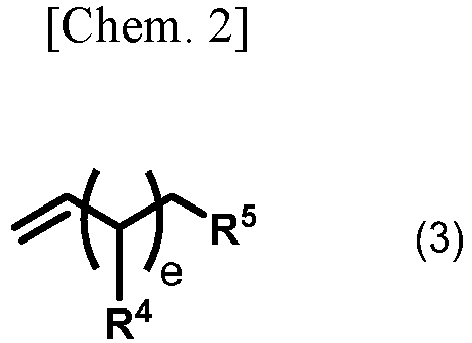
- In the formula, R4 and R5 are each independently a hydrogen atom, an alkyl group, a triorganosilyl group or an organosiloxanyl group of 2 to 4 silicon atoms.
- The alkyl group of R4 and R5 is preferably one having from 1 to 5 carbon atoms. Specific examples include methyl, ethyl, n-propyl and n-butyl groups.
- The triorganosilyl group is exemplified by trialkylsilyl groups, trialkoxysilyl groups, dialkylalkoxysilyl groups and alkyldialkoxysilyl groups. The number of carbon atoms on the alkyl groups and alkoxy groups therein is preferably from 1 to 5, and more preferably from 1 to 3. Trimethylsilyl, triethylsilyl, trimethoxysilyl and triethoxysilyl groups are even more preferred.
- The organosiloxanyl group of 2 to 4 silicon atoms is preferably one in which the number of carbon atoms on the organo group is from 1 to 5. Specific examples include tris(trimethylsiloxy)silyl, pentamethyldisiloxanyl and nonamethyltetrasiloxanyl groups.
- In the formula, the subscript 'e' is an integer from 1 to 20. From the standpoint of compatibility and reactivity, an integer from 3 to 12 is preferred; an integer from 5 to 12 is even more preferred.
- Specific examples of component (D) include linear olefins such as 1-octene, 1-decene, 1-dodecene, 1-tetradecene and 1-hexadecene; and branched olefins such as 3-ethyl-1-octene, 5-ethyl-1-octene, 7-ethyl-1-octene, 3-propyl-1-octene and 3-butyl-1-octene.
- Silane-modified compounds, siloxane-modified compounds and the like of the structural formulas shown below may be suitably used for increasing the compatibility with the polysiloxanes. Here and below, "Me" stands for a methyl group and "Et" stands for an ethyl group.

- Only one type of component (D) may be added, or a plurality of two or more types may be added at the same time. The amount of addition is preferably from 0.05 to 10 parts by weight, and more preferably from 0.05 to 5 parts by weight, per 100 parts by weight of the combined amount of components (A) and (B). At a component (D) content below the above range, the resin may become hard, adversely affecting the display members. At a content greater than the above range, the resin tends to be soft and does little to reinforce the display.
- Where necessary, an adhesive modifier may be added as component (E) to the ultraviolet-curable silicone adhesive composition of the invention. Examples of adhesive modifiers include organic compounds containing at least one from the group of functional groups consisting of (meth)acrylic, carbonyl, epoxy, alkoxysilyl and amide groups per molecule.
- Specific examples of adhesive modifiers containing an alkoxysilyl group include γ-(glycidoxypropyl)trimethoxysilane (trade name: KBM-403, from Shin-Etsu Chemical Co., Ltd.), γ-(methacryloxypropyl)trimethoxysilane (trade name: KBM-503, from Shin-Etsu Chemical Co., Ltd.), and hydrolytic condensation products of these. Further examples include the siloxane compounds of the following structural formulas.

- When component (E) is used, one such ingredient may be added alone, or a plurality of two or more may be added together. The amount of addition per 100 parts by weight of components (A) and (B) combined is preferably from 0.05 to 10 parts by weight, and more preferably from 0.05 to 5 parts by weight. At a component (E) content within this range, a suitable adhesiveness can be imparted.
- A reaction regulator may be optionally added as component (F) so that thickening or gelation do not occur prior to heat curing when preparing the ultraviolet-curable silicone adhesive composition of the invention or when coating it onto a substrate.
- Specific examples of the reaction regulator include 3-methyl-1-butyn-3-ol, 3-methyl-1-pentyn-3-ol, 3,5-dimethyl-1-hexyn-3-ol, 1-ethynylcyclohexanol, ethynylmethyldecylcarbinol, 3-methyl-3-trimethylsiloxy-1-butyne, 3-methyl-3-trimethylsiloxy-1-pentyne, 3,5-dimethyl-3-trimethylsiloxy-1-hexyne, 1-ethynyl-1-trimethylsiloxycyclohexane, bis(2,2-dimethyl-3-butynoxy)dimethylsilane, 1,3,5,7-tetramethyl-1,3,5,7-tetravinylcyclotetrasiloxane and 1,1,3,3-tetramethyl-1,3-divinyldisiloxane. 1-Ethynylcyclohexanol, ethynylmethyldecylcarbinol and 3-methyl-1-butyn-3-ol are preferred.
- When component (F) is used, the content thereof per 100 parts by weight of components (A) and (B) combined is preferably from 0.01 to 2 parts by weight, and more preferably from 0.01 to 0.1 part by weight. Within this range, a reaction-regulating effect is fully exhibited.
- In addition to the above components (A) to (F), the ultraviolet-curable silicone adhesive composition of the invention may include also the other ingredients listed below, insofar as doing so does not detract from the objects of the invention.
- For example, thixotropy regulators such as fumed silica, reinforcing agents such as crystalline silica, antioxidants, light stabilizers, heat resistance enhancers such as metal oxides and metal hydroxides, colorants such as titanium oxide, thermal conductivity-imparting fillers such as alumina and crystalline silica, viscosity modifiers such as non-reactive silicone oils having no reactive functional groups, electrical conductivity-imparting agents such as silver, gold and other metal powders, and pigments and dyes for coloration.
- The ultraviolet-curable silicone adhesive composition of the invention can be suitably used to laminate together, through the inventive adhesive composition, two substrates that make up a laminated body such as an optical device or a display or touch panel. The method for producing the laminated body includes a coating step, an ultraviolet irradiation step, a curing step and a lamination step. The respective steps may be carried out by way of, for example, the following methods.
- In the coating step, the adhesive composition of the invention is coated onto one of the substrates. The coating method is exemplified by techniques that involve coating with a slit coater, dam-and-fill coating and fishbone coating. The coating amount is preferably one that gives an adhesive layer thickness after curing of from 100 to 5,000 µm.
- The substrates with which the ultraviolet-curable silicone adhesive composition of the invention is used are exemplified by composite materials, metal members, plastic members and ceramic members. In particular, substrates employed in such areas as the covering, casting, adhesion and sealing of casings and members in electrical applications, electronic applications, optical applications and the like may be used. The inventive composition can be used also on substrates that have been activated by a known pretreatment step such as primer treatment, plasma treatment or excimer light treatment.
- In the ultraviolet irradiation step, the adhesive composition is irradiated with ultraviolet light. The ultraviolet irradiation method used may be, for example, a method that utilizes a 365 nm UV-LED lamp, a metal halide lamp or the like as the ultraviolet source to irradiate a suitable amount of ultraviolet light.
- Light having a wavelength of preferably between 200 and 500 nm, and more preferably between 200 and 350 nm, is used for the ultraviolet irradiation. From the standpoint of the rate of cure and preventing discoloration, the irradiation temperature is preferably between 20°C and 80°C, the irradiation intensity is preferably from 30 to 2,000 mW/cm2 and the irradiation dose is preferably from 150 to 10,000 mJ/cm2.
- In the curing step, the ultraviolet-irradiated composition is cured. The curing method may be, for example, a technique that forms an adhesive layer by leaving the ultraviolet-irradiated adhesive composition at rest in a predetermined environment and allowing it to cure. The curing temperature of the ultraviolet-curable silicone adhesive composition of the invention is not particularly limited, although curing is preferably effected for a period of from 1 minute to 1 day in an open-air atmosphere at between 20°C and 60°C.
- In the lamination step, the other substrate is superimposed on the adhesive composition layer or adhesive layer to form a laminated body in which the two substrates are laminated together through the adhesive composition layer or adhesive layer. The method of lamination may be, for example, one that sets the adhesive layer/substrate laminate wherein the adhesive is in a liquid to semi-solid state after passing through the coating step, ultraviolet irradiation step and curing step, the adhesive composition layer/substrate laminate following the coating step, or the adhesive composition layer/substrate assembly following the coating step and the ultraviolet irradiation step within a vacuum or atmospheric-pressure laminator, and then superimposes the other substrate on the adhesive composition layer or adhesive layer and laminates them together; when the layer is an adhesive composition layer, the remaining step or steps are carried out to effect curing and form a laminated body.
- To keep curing of the inventive adhesive composition from being inhibited by oxygen and also to enable the curing time from when ultraviolet irradiation is carried out to be changed by the design of the adhesive composition or the heating temperature, the sequence of the coating step, ultraviolet irradiation step, curing step and lamination step can be freely selected and changed according to the structure of the device being manufacturing, such as a flat display or a curved display.
- For example, when used to produce a laminated body having a cover panel and an image display panel, the production method of the invention may begin by coating the ultraviolet-curable silicone adhesive composition of the invention onto the image display panel. Next, using a UV-LED lamp having a wavelength peak at 365 nm, the adhesive composition is irradiated for 30 seconds at 23°C with ultraviolet light having an irradiation intensity, based on 365-nm light, of 100 mW/cm2 to a dose of 3,000 mJ/cm2, after which it is left at rest for 30 minutes in a 23°C environment, allowing the adhesive composition to cure and thus form an adhesive layer. Using a vacuum laminator, the cover panel is then superimposed on the adhesive layer, enabling a laminated body in which the cover panel and the image display panel are laminated together through the adhesive layer to be obtained. Alternatively, following the ultraviolet irradiation step, by using a vacuum laminator to first superimpose the cover panel on the adhesive composition, the image display panel and the cover panel are laminated together through the adhesive composition layer, after which the adhesive composition layer can be cured by leaving it at rest for 30 minutes in a 60°C environment. Or, because the cover panel is transparent, vacuum lamination may be carried out following the coating step, after which ultraviolet irradiation may be carried out through the cover panel to effect the cure. Another possibility is to coat adhesive composition that has already been ultraviolet irradiated onto the image display panel, carry out vacuum lamination with the cover panel, and allow curing to take place.
- Examples and Comparative Examples are given below to more concretely illustrate the invention, although the invention is not limited by these Examples.
- Below, "Me" stands for a methyl group, "Bu" stands for a butyl group, "Ph" stands for a phenyl group and "Vi" stands for a vinyl group. Also, Mw represents the standard polystyrene-equivalent weight-average molecular weight obtained by GPC measurement using a THF solvent.
- (A-1) An organopolysiloxane of average compositional formula (4) below (Mw: 28,000)

- Component (B):
- (B-1) A dimethylsiloxane capped on both ends of the molecular chain with hydrodimethylsiloxy groups and having a kinematic viscosity at 23°C of 17 mm2/s, of formula (5) below
Me2.0H0.1SiO[1.9/2] (5)
- (B-2) A dimethylsiloxane capped on both ends of the molecular chain with hydrodimethylsiloxy groups and having a kinematic viscosity at 23°C of 27 mm2/s, of formula (6) below
Me1.8H0.3SiO[1.9/2] (6)
- (B-3) An organohydrogensiloxane of formula (7) below

- Component (C):
- (C-1) Toluene solution of trimethyl(methylcyclopentadienyl)platinum complex (platinum content, 0.5 wt%)
- Component (D):
- (D-1) 1-Tetradecene (Linealene 14, from Idemitsu Kosan Co., Ltd.)
- (D-2) 8-(1-octenyl)trimethoxysilane (Shin-Etsu Co., Ltd.)
- Comparative Ingredient:
- (D-3) Diallyl bisphenol ether
- Component (E):
- (E-1) The cyclic siloxane compound of formula (8) below

- Other Ingredients:
- Fumed silica (Aerosil NSX-200; average primary particle size, 8 nm; from Nippon Aerosil Co., Ltd.)
- Silicone adhesive compositions were prepared by mixing together the above ingredients in the amounts (parts by weight) shown in Table 1.
- The prepared silicone adhesive compositions were poured into glass Petri dishes and, using a UV-LED lamp having a peak wavelength of 365 nm, each composition was irradiated with ultraviolet light at 23°C in such manner that, based on 365-nm light, the irradiation intensity was 100 mW/cm2 and the dose was 1,500 mJ/cm2.
- Following the completion of irradiation, the composition was left to stand for 24 hours at 23°C in an open-air atmosphere, allowing it to cure.
- The penetration depth of each of the resulting cured materials was measured with a penetrometer (1/4 cone) from Rigosha K.K. by a method based on JIS K 6249.
- Letting the penetration depth immediately after curing be the initial penetration depth, the penetration depths after 500-hour and 1,000-hour heat resistance tests at 95°C were evaluated. The results are shown in Table 1.
- Each composition was poured into a frame of two slide glasses (thickness, 100 µm) with a 460 µm thick spacer in between, and the compositions were cured under the same curing conditions as above.
- The yellowness index of each of the resulting cured materials was measured with a spectrophotometer (Konica Minolta Japan, Inc.) by a method based on ASTM E313.
- Letting the yellowness index immediately after curing be the initial yellowness index, the yellowness indexes after 500-hour and 1,000-hour heat resistance tests at 95°C were evaluated. The results are shown in Table 1.
Table 1 Blending amount (pbw) Example 1 Example 2 Example 3 Comparative Example 1 Comparative Example 2 Comparative Example 3 (A) (A-1) 100 100 100 100 100 100 (B) (B-1) 9.5 9.5 9.5 9.5 4 9.5 (B-2) 2 2 2 0.2 1.3 2 Comparative Ingredient (B-3) 2 2 (C) (C-1) 0.6 0.6 0.6 0.6 0.6 0.6 (D) (D-1) 3 1.5 (D-2) 2.7 1.5 Comparative Ingredient (D-3) 1 1 (E) (E-1) 0.5 0.5 0.5 0.5 0.5 0.5 Others Fumed silica 5 5 5 5 5 5 Si-H groups/alkenyl groups 1.0 1.0 1.0 1.1 1.5 1.0 Initial penetration depth (1/10 mm) 37 40 38 40 41 16 Penetration depth after 500-hour heat resistance test at 95°C (1/10 mm) 28 35 31 28 7 5 Penetration depth after 1,000-hour heat resistance test at 95°C (1/10 mm) 25 30 28 20 5 2 Initial YI -0.19 -0.18 -0.19 -0.18 -0.18 -0.18 YI after 500-hour heat resistance test at 95°C 0.74 0.82 0.77 7.01 9.3 6.5 YI after 1,000-hour heat resistance test at 95°C 0.60 0.72 0.65 11.3 15.1 10.2 - As shown in the results for Examples 1 to 3, the ultraviolet-curable silicone adhesive compositions of the invention gave cured compositions having a low change in hardness and a low resistance to yellowing by heat and having an excellent reliability. On the other hand, in Comparative Examples 1 to 3 which did not use component (D) of the invention, the degree of yellowing after the heat resistance tests was high.
Claims (6)
- An ultraviolet-curable silicone adhesive composition comprising:(A) linear organopolysiloxane represented by average unit formula (1) below
(R1R2 2SiO1/2)2(Ar2SiO2/2)a(R2 2SiO2/2)b (1)
[wherein each R1 independently is an alkenyl group, each R2 independently is a substituted or unsubstituted monovalent saturated hydrocarbon group, each Ar independently is a substituted or unsubstituted aryl group, the subscript 'a' is an integer from 1 to 100, the subscript 'b' is an integer from 1 to 1,000, and a/(a+b) is a number from 0.01 to 0.4],(B) organohydrogenpolysiloxane that has at least two Si-H groups per molecule and is represented by average compositional formula (2) below
R3 cHdSiO(4-c-d)/2 (2)
(wherein each R3 independently is a substituted or unsubstituted monovalent hydrocarbon group, exclusive of aliphatic unsaturated hydrocarbon groups; and 'c' and 'd' are positive numbers that satisfy the conditions 0.7 ≤ c ≤ 2.5, 0.01 ≤ d ≤ 1 and 0.8 ≤ c+d ≤ 2.7),(C) platinum metal catalyst that is activated by light having a wavelength of between 200 and 500 nm, and(D) compound having one terminal alkenyl group per molecule. - Ultraviolet-curable silicone adhesive composition of claim 1, wherein the molar ratio of hydrosilyl groups included in component (B) with respect to the alkenyl groups included in components (A) and (D), expressed as hydrosilyl groups/alkenyl groups, is from 0.5 to 2.
- Ultraviolet-curable silicone adhesive composition of claim 1 or 2, wherein component (C) includes (η5-cyclopentadienyl)trialiphatic platinum compound or bis(β-diketonato)platinum compound.
- Ultraviolet-curable silicone adhesive composition of any one of claims 1 to 3, wherein component (D) includes a compound of formula (3) below

- Ultraviolet-curable silicone adhesive composition of any one of claims 1 to 4, further comprising (E) a compound having at least one selected from the group consisting of (meth)acrylic, carbonyl, epoxy, alkoxysilyl and amide groups per molecule.
- A method for producing a laminated body having a first substrate, a second substrate superimposed on the first substrate, and an intervening adhesive layer obtained using an adhesive composition of any one of claims 1 to 5, which method comprises the steps of:coating the adhesive composition onto a surface of the first substrate;irradiating the adhesive composition with ultraviolet light;curing the adhesive composition to form an adhesive layer; andsuperimposing the second substrate on the adhesive composition layer or adhesive layer and laminating together the first and second substrates through the adhesive composition layer or adhesive layer.
Applications Claiming Priority (2)
| Application Number | Priority Date | Filing Date | Title |
|---|---|---|---|
| JP2018187259A JP7067398B2 (en) | 2018-10-02 | 2018-10-02 | Method for manufacturing UV curable silicone adhesive composition and laminate |
| PCT/JP2019/036736 WO2020071137A1 (en) | 2018-10-02 | 2019-09-19 | Ultraviolet curable silicone adhesive composition and method for producing multilayer body |
Publications (3)
| Publication Number | Publication Date |
|---|---|
| EP3862405A1 true EP3862405A1 (en) | 2021-08-11 |
| EP3862405A4 EP3862405A4 (en) | 2022-06-29 |
| EP3862405B1 EP3862405B1 (en) | 2026-01-28 |
Family
ID=70055513
Family Applications (1)
| Application Number | Title | Priority Date | Filing Date |
|---|---|---|---|
| EP19869753.4A Active EP3862405B1 (en) | 2018-10-02 | 2019-09-19 | Ultraviolet curable silicone adhesive composition and method for producing multilayer body |
Country Status (5)
| Country | Link |
|---|---|
| EP (1) | EP3862405B1 (en) |
| JP (1) | JP7067398B2 (en) |
| CN (1) | CN112752822B (en) |
| TW (1) | TWI816893B (en) |
| WO (1) | WO2020071137A1 (en) |
Cited By (1)
| Publication number | Priority date | Publication date | Assignee | Title |
|---|---|---|---|---|
| KR20250119579A (en) | 2022-12-05 | 2025-08-07 | 다우 실리콘즈 코포레이션 | UV-curable silicone composition |
Families Citing this family (8)
| Publication number | Priority date | Publication date | Assignee | Title |
|---|---|---|---|---|
| WO2022004086A1 (en) * | 2020-07-02 | 2022-01-06 | 富士高分子工業株式会社 | Silicone gel composition and silicone gel sheet |
| WO2022066261A1 (en) * | 2020-09-22 | 2022-03-31 | Dow Silicones Corporation | Curable silicone-(meth)acrylate composition and methods for its preparation and use |
| CN116635755A (en) | 2021-02-02 | 2023-08-22 | 美国陶氏有机硅公司 | Printable silicone composition and method for its preparation and use |
| JP7796490B2 (en) * | 2021-07-16 | 2026-01-09 | 住友化学株式会社 | Polarizing plate and laminate |
| JP7748922B2 (en) * | 2022-08-30 | 2025-10-03 | 信越化学工業株式会社 | UV-curable liquid silicone composition for image display devices, method for laminating image display device components, and image display device |
| US20240170364A1 (en) * | 2022-11-23 | 2024-05-23 | Advanced Semiconductor Engineering, Inc. | Semiconductor package structure |
| JP7717432B2 (en) * | 2023-09-20 | 2025-08-04 | モメンティブ・パフォーマンス・マテリアルズ・ジャパン合同会社 | Thermally conductive silicone composition |
| WO2025225552A1 (en) * | 2024-04-26 | 2025-10-30 | モメンティブ・パフォーマンス・マテリアルズ・ジャパン合同会社 | Ultraviolet-active silicone composition and method for producing adhesive member using same |
Family Cites Families (15)
| Publication number | Priority date | Publication date | Assignee | Title |
|---|---|---|---|---|
| DE2702626A1 (en) * | 1977-01-22 | 1978-07-27 | Bayer Ag | PROCESS FOR PRODUCING NEW HIGH MOLECULAR, SEGMENTED POLYCARBONATE ELASTOMERS AND NEW PROCESSLY OBTAINED POLYCARBONATE ELASTOMERS |
| JPS5434362A (en) * | 1977-08-24 | 1979-03-13 | Shin Etsu Chem Co Ltd | Curable organopolysiloxane composition |
| US6046250A (en) * | 1990-12-13 | 2000-04-04 | 3M Innovative Properties Company | Hydrosilation reaction utilizing a free radical photoinitiator |
| JPH09286971A (en) * | 1996-04-19 | 1997-11-04 | Toray Dow Corning Silicone Co Ltd | Silicone die bonding agent, method for manufacturing semiconductor device, and semiconductor device |
| JP2009220384A (en) | 2008-03-17 | 2009-10-01 | Shin Etsu Chem Co Ltd | Method of forming silicone rubber thin film coating layer and silicone rubber thin film coated article |
| JP5989417B2 (en) | 2012-06-20 | 2016-09-07 | モメンティブ・パフォーマンス・マテリアルズ・ジャパン合同会社 | Ultraviolet curable silicone resin composition and image display device using the same |
| JP5811117B2 (en) | 2013-03-05 | 2015-11-11 | 信越化学工業株式会社 | Method for curing curable silicone composition |
| KR101775476B1 (en) * | 2013-08-09 | 2017-09-06 | 요코하마 고무 가부시키가이샤 | Curable resin composition |
| JP6217590B2 (en) * | 2013-11-05 | 2017-10-25 | 信越化学工業株式会社 | UV-curable adhesive organopolysiloxane composition |
| CN105400486A (en) * | 2014-09-10 | 2016-03-16 | 郝建强 | Ultraviolet ray/wet gas double curing organosilicon resin composition |
| JP6472044B2 (en) | 2015-02-27 | 2019-02-20 | フジコピアン株式会社 | Double-sided adhesive film and protective member for information display screen using the same |
| JP2015131978A (en) * | 2015-04-27 | 2015-07-23 | 信越化学工業株式会社 | Method for improving dynamic fatigue durability of cured silicone rubber |
| JP2017050322A (en) | 2015-08-31 | 2017-03-09 | Jsr株式会社 | Substrate processing method, semiconductor device and manufacturing method thereof |
| CN107880844A (en) * | 2017-12-04 | 2018-04-06 | 东莞市贝特利新材料有限公司 | A kind of photo-thermal dual curable type organosilicon liquid Optical adhesive composition |
| JP6911741B2 (en) | 2017-12-19 | 2021-07-28 | 信越化学工業株式会社 | UV curable resin composition, adhesive and cured product |
-
2018
- 2018-10-02 JP JP2018187259A patent/JP7067398B2/en active Active
-
2019
- 2019-09-19 CN CN201980062284.8A patent/CN112752822B/en active Active
- 2019-09-19 EP EP19869753.4A patent/EP3862405B1/en active Active
- 2019-09-19 WO PCT/JP2019/036736 patent/WO2020071137A1/en not_active Ceased
- 2019-09-27 TW TW108135069A patent/TWI816893B/en active
Cited By (1)
| Publication number | Priority date | Publication date | Assignee | Title |
|---|---|---|---|---|
| KR20250119579A (en) | 2022-12-05 | 2025-08-07 | 다우 실리콘즈 코포레이션 | UV-curable silicone composition |
Also Published As
| Publication number | Publication date |
|---|---|
| EP3862405A4 (en) | 2022-06-29 |
| WO2020071137A1 (en) | 2020-04-09 |
| TW202041634A (en) | 2020-11-16 |
| JP2020055945A (en) | 2020-04-09 |
| EP3862405B1 (en) | 2026-01-28 |
| CN112752822B (en) | 2023-06-09 |
| TWI816893B (en) | 2023-10-01 |
| JP7067398B2 (en) | 2022-05-16 |
| CN112752822A (en) | 2021-05-04 |
Similar Documents
| Publication | Publication Date | Title |
|---|---|---|
| EP3862405B1 (en) | Ultraviolet curable silicone adhesive composition and method for producing multilayer body | |
| JP7053124B2 (en) | Curable silicone composition, its cured product, and optical display | |
| US12110426B2 (en) | Ultraviolet ray-curable silicone adhesive agent composition, and method for producing laminate | |
| TWI724402B (en) | Ultraviolet curing type liquid organopolysiloxane composition for image display device, curing method thereof, method of bonding image display device components, and image display device | |
| KR102257952B1 (en) | Curable polyorganosiloxane composition and use thereof | |
| JP5805348B1 (en) | Addition-curing silicone composition | |
| EP1836260B1 (en) | Bonded composite of silicone resin and epoxy resin and a method for manufacturing thereof | |
| WO2020195443A1 (en) | Production method for layered product | |
| WO2022102622A1 (en) | Ultraviolet-curable organopolysiloxane composition and use therefor | |
| JP2026055279A (en) | Organopolysiloxane compositions, cured products, and laminates | |
| WO2025169587A1 (en) | Ultraviolet curable silicone composition, cured product, laminate, and method for producing laminate | |
| EP4574910A1 (en) | Curable silicone composition, cured product thereof, layered body, and optical device or optical display | |
| WO2024122478A1 (en) | Uv-curable silicone composition and cured product thereof | |
| JP2024033609A (en) | Ultraviolet curable liquid silicone composition for image display device, method for laminating image display device members, and image display device | |
| JP5616127B2 (en) | Modified polyhedral polysiloxane and composition comprising the same | |
| WO2025225552A1 (en) | Ultraviolet-active silicone composition and method for producing adhesive member using same | |
| JP2015074664A (en) | Two-part curable polyorganosiloxane composition and use thereof |
Legal Events
| Date | Code | Title | Description |
|---|---|---|---|
| STAA | Information on the status of an ep patent application or granted ep patent |
Free format text: STATUS: THE INTERNATIONAL PUBLICATION HAS BEEN MADE |
|
| PUAI | Public reference made under article 153(3) epc to a published international application that has entered the european phase |
Free format text: ORIGINAL CODE: 0009012 |
|
| STAA | Information on the status of an ep patent application or granted ep patent |
Free format text: STATUS: REQUEST FOR EXAMINATION WAS MADE |
|
| 17P | Request for examination filed |
Effective date: 20210413 |
|
| AK | Designated contracting states |
Kind code of ref document: A1 Designated state(s): AL AT BE BG CH CY CZ DE DK EE ES FI FR GB GR HR HU IE IS IT LI LT LU LV MC MK MT NL NO PL PT RO RS SE SI SK SM TR |
|
| DAV | Request for validation of the european patent (deleted) | ||
| DAX | Request for extension of the european patent (deleted) | ||
| A4 | Supplementary search report drawn up and despatched |
Effective date: 20220527 |
|
| RIC1 | Information provided on ipc code assigned before grant |
Ipc: C09J 11/06 20060101ALI20220520BHEP Ipc: C09J 183/05 20060101ALI20220520BHEP Ipc: C09J 183/07 20060101AFI20220520BHEP |
|
| GRAP | Despatch of communication of intention to grant a patent |
Free format text: ORIGINAL CODE: EPIDOSNIGR1 |
|
| STAA | Information on the status of an ep patent application or granted ep patent |
Free format text: STATUS: GRANT OF PATENT IS INTENDED |
|
| INTG | Intention to grant announced |
Effective date: 20250915 |
|
| GRAS | Grant fee paid |
Free format text: ORIGINAL CODE: EPIDOSNIGR3 |
|
| GRAA | (expected) grant |
Free format text: ORIGINAL CODE: 0009210 |
|
| STAA | Information on the status of an ep patent application or granted ep patent |
Free format text: STATUS: THE PATENT HAS BEEN GRANTED |
|
| RBV | Designated contracting states (corrected) |
Designated state(s): DE FR |
|
| AK | Designated contracting states |
Kind code of ref document: B1 Designated state(s): DE FR |
|
| REG | Reference to a national code |
Ref country code: DE Ref legal event code: R096 Ref document number: 602019080907 Country of ref document: DE |