EP3859856B1 - Lithium secondary battery - Google Patents
Lithium secondary battery Download PDFInfo
- Publication number
- EP3859856B1 EP3859856B1 EP19865455.0A EP19865455A EP3859856B1 EP 3859856 B1 EP3859856 B1 EP 3859856B1 EP 19865455 A EP19865455 A EP 19865455A EP 3859856 B1 EP3859856 B1 EP 3859856B1
- Authority
- EP
- European Patent Office
- Prior art keywords
- positive electrode
- spacer
- lithium
- negative electrode
- lithium metal
- Prior art date
- Legal status (The legal status is an assumption and is not a legal conclusion. Google has not performed a legal analysis and makes no representation as to the accuracy of the status listed.)
- Active
Links
Images


Classifications
-
- H—ELECTRICITY
- H01—ELECTRIC ELEMENTS
- H01M—PROCESSES OR MEANS, e.g. BATTERIES, FOR THE DIRECT CONVERSION OF CHEMICAL ENERGY INTO ELECTRICAL ENERGY
- H01M10/00—Secondary cells; Manufacture thereof
- H01M10/05—Accumulators with non-aqueous electrolyte
- H01M10/052—Li-accumulators
-
- H—ELECTRICITY
- H01—ELECTRIC ELEMENTS
- H01M—PROCESSES OR MEANS, e.g. BATTERIES, FOR THE DIRECT CONVERSION OF CHEMICAL ENERGY INTO ELECTRICAL ENERGY
- H01M10/00—Secondary cells; Manufacture thereof
- H01M10/05—Accumulators with non-aqueous electrolyte
- H01M10/056—Accumulators with non-aqueous electrolyte characterised by the materials used as electrolytes, e.g. mixed inorganic/organic electrolytes
- H01M10/0564—Accumulators with non-aqueous electrolyte characterised by the materials used as electrolytes, e.g. mixed inorganic/organic electrolytes the electrolyte being constituted of organic materials only
- H01M10/0566—Liquid materials
-
- H—ELECTRICITY
- H01—ELECTRIC ELEMENTS
- H01M—PROCESSES OR MEANS, e.g. BATTERIES, FOR THE DIRECT CONVERSION OF CHEMICAL ENERGY INTO ELECTRICAL ENERGY
- H01M10/00—Secondary cells; Manufacture thereof
- H01M10/05—Accumulators with non-aqueous electrolyte
- H01M10/056—Accumulators with non-aqueous electrolyte characterised by the materials used as electrolytes, e.g. mixed inorganic/organic electrolytes
- H01M10/0564—Accumulators with non-aqueous electrolyte characterised by the materials used as electrolytes, e.g. mixed inorganic/organic electrolytes the electrolyte being constituted of organic materials only
- H01M10/0566—Liquid materials
- H01M10/0568—Liquid materials characterised by the solutes
-
- H—ELECTRICITY
- H01—ELECTRIC ELEMENTS
- H01M—PROCESSES OR MEANS, e.g. BATTERIES, FOR THE DIRECT CONVERSION OF CHEMICAL ENERGY INTO ELECTRICAL ENERGY
- H01M10/00—Secondary cells; Manufacture thereof
- H01M10/05—Accumulators with non-aqueous electrolyte
- H01M10/058—Construction or manufacture
-
- H—ELECTRICITY
- H01—ELECTRIC ELEMENTS
- H01M—PROCESSES OR MEANS, e.g. BATTERIES, FOR THE DIRECT CONVERSION OF CHEMICAL ENERGY INTO ELECTRICAL ENERGY
- H01M4/00—Electrodes
- H01M4/02—Electrodes composed of, or comprising, active material
- H01M4/04—Processes of manufacture in general
- H01M4/0438—Processes of manufacture in general by electrochemical processing
- H01M4/044—Activating, forming or electrochemical attack of the supporting material
- H01M4/0445—Forming after manufacture of the electrode, e.g. first charge, cycling
-
- H—ELECTRICITY
- H01—ELECTRIC ELEMENTS
- H01M—PROCESSES OR MEANS, e.g. BATTERIES, FOR THE DIRECT CONVERSION OF CHEMICAL ENERGY INTO ELECTRICAL ENERGY
- H01M4/00—Electrodes
- H01M4/02—Electrodes composed of, or comprising, active material
- H01M4/13—Electrodes for accumulators with non-aqueous electrolyte, e.g. for lithium-accumulators; Processes of manufacture thereof
- H01M4/131—Electrodes based on mixed oxides or hydroxides, or on mixtures of oxides or hydroxides, e.g. LiCoOx
-
- H—ELECTRICITY
- H01—ELECTRIC ELEMENTS
- H01M—PROCESSES OR MEANS, e.g. BATTERIES, FOR THE DIRECT CONVERSION OF CHEMICAL ENERGY INTO ELECTRICAL ENERGY
- H01M4/00—Electrodes
- H01M4/02—Electrodes composed of, or comprising, active material
- H01M4/13—Electrodes for accumulators with non-aqueous electrolyte, e.g. for lithium-accumulators; Processes of manufacture thereof
- H01M4/134—Electrodes based on metals, Si or alloys
-
- H—ELECTRICITY
- H01—ELECTRIC ELEMENTS
- H01M—PROCESSES OR MEANS, e.g. BATTERIES, FOR THE DIRECT CONVERSION OF CHEMICAL ENERGY INTO ELECTRICAL ENERGY
- H01M50/00—Constructional details or processes of manufacture of the non-active parts of electrochemical cells other than fuel cells, e.g. hybrid cells
- H01M50/40—Separators; Membranes; Diaphragms; Spacing elements inside cells
- H01M50/471—Spacing elements inside cells other than separators, membranes or diaphragms; Manufacturing processes thereof
- H01M50/474—Spacing elements inside cells other than separators, membranes or diaphragms; Manufacturing processes thereof characterised by their position inside the cells
-
- H—ELECTRICITY
- H01—ELECTRIC ELEMENTS
- H01M—PROCESSES OR MEANS, e.g. BATTERIES, FOR THE DIRECT CONVERSION OF CHEMICAL ENERGY INTO ELECTRICAL ENERGY
- H01M50/00—Constructional details or processes of manufacture of the non-active parts of electrochemical cells other than fuel cells, e.g. hybrid cells
- H01M50/40—Separators; Membranes; Diaphragms; Spacing elements inside cells
- H01M50/471—Spacing elements inside cells other than separators, membranes or diaphragms; Manufacturing processes thereof
- H01M50/477—Spacing elements inside cells other than separators, membranes or diaphragms; Manufacturing processes thereof characterised by their shape
-
- H—ELECTRICITY
- H01—ELECTRIC ELEMENTS
- H01M—PROCESSES OR MEANS, e.g. BATTERIES, FOR THE DIRECT CONVERSION OF CHEMICAL ENERGY INTO ELECTRICAL ENERGY
- H01M50/00—Constructional details or processes of manufacture of the non-active parts of electrochemical cells other than fuel cells, e.g. hybrid cells
- H01M50/40—Separators; Membranes; Diaphragms; Spacing elements inside cells
- H01M50/489—Separators, membranes, diaphragms or spacing elements inside the cells, characterised by their physical properties, e.g. swelling degree, hydrophilicity or shut down properties
-
- H—ELECTRICITY
- H01—ELECTRIC ELEMENTS
- H01M—PROCESSES OR MEANS, e.g. BATTERIES, FOR THE DIRECT CONVERSION OF CHEMICAL ENERGY INTO ELECTRICAL ENERGY
- H01M10/00—Secondary cells; Manufacture thereof
- H01M10/05—Accumulators with non-aqueous electrolyte
- H01M10/056—Accumulators with non-aqueous electrolyte characterised by the materials used as electrolytes, e.g. mixed inorganic/organic electrolytes
- H01M10/0564—Accumulators with non-aqueous electrolyte characterised by the materials used as electrolytes, e.g. mixed inorganic/organic electrolytes the electrolyte being constituted of organic materials only
- H01M10/0565—Polymeric materials, e.g. gel-type or solid-type
-
- H—ELECTRICITY
- H01—ELECTRIC ELEMENTS
- H01M—PROCESSES OR MEANS, e.g. BATTERIES, FOR THE DIRECT CONVERSION OF CHEMICAL ENERGY INTO ELECTRICAL ENERGY
- H01M50/00—Constructional details or processes of manufacture of the non-active parts of electrochemical cells other than fuel cells, e.g. hybrid cells
- H01M50/40—Separators; Membranes; Diaphragms; Spacing elements inside cells
- H01M50/409—Separators, membranes or diaphragms characterised by the material
-
- Y—GENERAL TAGGING OF NEW TECHNOLOGICAL DEVELOPMENTS; GENERAL TAGGING OF CROSS-SECTIONAL TECHNOLOGIES SPANNING OVER SEVERAL SECTIONS OF THE IPC; TECHNICAL SUBJECTS COVERED BY FORMER USPC CROSS-REFERENCE ART COLLECTIONS [XRACs] AND DIGESTS
- Y02—TECHNOLOGIES OR APPLICATIONS FOR MITIGATION OR ADAPTATION AGAINST CLIMATE CHANGE
- Y02E—REDUCTION OF GREENHOUSE GAS [GHG] EMISSIONS, RELATED TO ENERGY GENERATION, TRANSMISSION OR DISTRIBUTION
- Y02E60/00—Enabling technologies; Technologies with a potential or indirect contribution to GHG emissions mitigation
- Y02E60/10—Energy storage using batteries
-
- Y—GENERAL TAGGING OF NEW TECHNOLOGICAL DEVELOPMENTS; GENERAL TAGGING OF CROSS-SECTIONAL TECHNOLOGIES SPANNING OVER SEVERAL SECTIONS OF THE IPC; TECHNICAL SUBJECTS COVERED BY FORMER USPC CROSS-REFERENCE ART COLLECTIONS [XRACs] AND DIGESTS
- Y02—TECHNOLOGIES OR APPLICATIONS FOR MITIGATION OR ADAPTATION AGAINST CLIMATE CHANGE
- Y02P—CLIMATE CHANGE MITIGATION TECHNOLOGIES IN THE PRODUCTION OR PROCESSING OF GOODS
- Y02P70/00—Climate change mitigation technologies in the production process for final industrial or consumer products
- Y02P70/50—Manufacturing or production processes characterised by the final manufactured product
Definitions
- the present disclosure relates to a lithium secondary battery using a lithium metal as a negative electrode active material.
- a lithium ion battery is known as a high-capacity non-aqueous electrolyte secondary battery.
- the capacity of the lithium ion battery can be improved by, for example, using graphite and an alloy-type active material, such as a silicon compound, in combination as a negative electrode active material.
- an alloy-type active material such as a silicon compound
- the improvement in capacity of the lithium ion battery is approaching to the limit.
- lithium metal secondary battery As a non-aqueous electrolyte secondary battery superior in capacity to the lithium ion battery, a lithium secondary battery (lithium metal secondary battery) is seen as promising.
- lithium metal deposits on the negative electrode during charge, and the lithium metal dissolves during discharge and are released as lithium ions into the non-aqueous electrolyte.
- Patent Literature 1 related to a lithium secondary battery, in view of suppressing short-circuiting by preventing damage to the separator and abnormal deposition of lithium, thereby to prolong the service life of the battery, discloses providing a buffer gap between the negative or the positive electrode and the separator, so that the lithium deposited on the negative electrode surface can be accommodated therein.
- Patent Literature 1 specifically, discloses forming a buffer gap by providing a spacer at both ends in the width direction of the electrode. In this case, however, it is difficult to control the morphology of lithium metal to be deposited within the buffer gap. The deposited lithium metal tends to be isolated, and the charge and discharge efficiency tends to be reduced. Moreover, the lithium metal, if deposited non-uniformly, causes the pressure between the electrodes to locally increase, and a damage, such as a crack, is likely to occur in the negative electrode current collector.
- the present disclosure relates to a lithium metal secondary battery as specified in the appended claims.
- the lithium secondary battery includes: a positive electrode including a positive electrode current collector, and a positive electrode mixture layer containing a positive electrode active material; a negative electrode including a negative electrode current collector that faces the positive electrode; a separator disposed between the positive electrode and the negative electrode; and a non-aqueous electrolyte having lithium ion conductivity, wherein the positive electrode active material includes a composite oxide containing lithium and a metal M other than lithium, the metal M containing at least a transition metal, lithium metal deposits on the negative electrode during charge, and the lithium metal dissolves from the negative electrode during discharge, the positive electrode current collector has a first length in a first direction D1 and a second length in a second direction D2 intersecting the first direction, the first length being shorter than the second length, a spacer is provided between the positive electrode and the separator so as to form a space for storing the lithium metal, between the positive electrode and the negative electrode, and a straight line
- a lithium secondary battery includes: a positive electrode including a positive electrode current collector, and a positive electrode mixture layer containing a positive electrode active material; a negative electrode including a negative electrode current collector that faces the positive electrode; a separator disposed between the positive electrode and the negative electrode; and a non-aqueous electrolyte having lithium ion conductivity. Lithium metal deposits on the negative electrode during charge, and the lithium metal dissolves from the negative electrode during discharge.
- the positive electrode current collector has a first length in a first direction D1 and a second length in a second direction D2 intersecting the first direction D1, the first length being smaller than the second length.
- the positive electrode current collector is, for example, long rectangular, or belt-shaped.
- the first direction D1 and the second direction D2 form an angle of approximately 90°. For example, the angle may be 88 to 92°.
- the positive electrode active material includes a composite oxide containing lithium and a metal M other than lithium, the metal M including at least a transition metal.
- a composite oxide is hereinafter referred to as a lithium-containing transition metal oxide.
- Lithium contained in the lithium-containing transition metal oxide is released as lithium ions during charge from the positive electrode, and deposits as lithium metal on the negative electrode or the negative electrode current collector. During discharge, the lithium metal dissolves from the negative electrode, and lithium ions are released, which are then absorbed to the composite oxide in the positive electrode.
- the lithium ions involved in charge and discharge are mostly derived from the solute in the non-aqueous electrolyte and the positive electrode active material.
- a molar ratio mLi/mM of a total amount mLi of the lithium present in the positive and negative electrodes to an amount mM of the metal M present in the positive electrode is preferably 1.1 or less.
- a spacer is provided between the positive electrode and the separator so as to form a space for storing the lithium metal, between the positive electrode and the negative electrode.
- a straight line SL is drawn along the first direction D1
- the line is drawable so as to pass through three or more points (preferably 4 or more points, more preferably 5 or more points) of the spacer.
- the straight line SL drawn along the first direction D1 passes through three points of the spacer.
- the spacer may be provided on a surface of the positive electrode current collector, or on a surface of the positive electrode mixture layer supported on the positive electrode current collector and containing the positive electrode active material.
- the deposition morphology of the lithium metal during charge is difficult to control, and lithium metal may deposit non-uniformly on the negative electrode.
- the lithium metal is deposited in a dendritic form, it tends to be isolated during discharge, which is likely to cause a reduction in charge-discharge efficiency.
- the expansion of the negative electrode tends to be severe locally, which is likely to cause a damage, such as a crack, to the negative electrode current collector.
- the spacer is provided between the positive electrode and the separator. Therefore, at least during discharge, a space is easily secured between the positive electrode and the separator. On the other hand, the space is hardly secured between the negative electrode and the separator.
- the lithium metal deposited on the negative electrode surface is constantly subjected to a pressing force from the separator and tends to grow along the surface of the negative electrode, which is thus unlikely to grow in a dendritic form.
- the separator stretches toward the positive electrode with increase in the amount of the deposited lithium metal. This can fill the space formed by the spacer between positive electrode and the separator.
- the straight line SL can be drawn along the first direction D1 so as to pass through three or more points of the spacer.
- the spacer can support the separator and the negative electrode current collector at many points, allowing the whole lithium metal to be subjected to a comparatively uniform pressing force from the separator. Therefore, the lithium metal is more likely to deposit along the surface of the negative electrode.
- the negative electrode current collector is supported by the spacer at many points, the deformation of the negative electrode current collector itself can also be suppressed. Consequently, the load applied to the negative electrode current collector can be significantly reduced.
- the spacer has a height h as measured from a portion having a maximum thickness of the positive electrode.
- the height h is, for example, 15 ⁇ m to 100 ⁇ m, and may be 30 ⁇ m to 60 ⁇ m, in view of securing a necessary minimum space.
- the height h is determined as appropriate depending on the capacity per unit area of the positive electrode.
- the height h is usually measured from the surface of the positive electrode mixture layer supported on the positive electrode current collector.
- the height h may be determined as an average of the values measured at randomly selected 10 points.
- a ratio d/h of a shortest distance d ( ⁇ m) between portions of the spacer adjacent to each other to the height h ( ⁇ m) of the spacer as measured from a portion having a maximum thickness of the positive electrode is, for example, 10 to 800, and may be 40 to 400.
- the ratio d/h within the range above, a sufficient space necessary for storing the lithium metal can be easily secured, and a more uniform pressing force can be applied to the whole lithium metal from the separator.
- the shortest distance d between portions of the spacer adjacent to each other may be determined as an average of the values measured in one site on each of ten straight lines SL drawn at random.
- a ratio s/S of an area s of a positive electrode portion covered with the spacer to the opposing area S is, for example, 0.05 to 0.2 (i.e., 5% to 20%).
- the ratio s/S may satisfy the above range on one surface or both surfaces of the positive electrode.
- a ratio I/L of a length l occupied by the spacer in the straight line SL passing through three or more points of the spacer to the first length L is, for example, 0.05 to 0.2 (5% to 20%). This allows the whole lithium metal to be subjected to a more uniform pressing force from the separator.
- the length I may be determined as an average of the values measured on ten straight lines SL drawn at random.
- the ratio I/L may satisfy the above range on one surface or both surfaces of the positive electrode.
- the spacer may comprise, for example, a plurality of line-shaped protruding portions disposed in stripes along the second direction D2 on a surface of the positive electrode.
- a protruding portion may be disposed at each of both ends in the first direction D1 on the surface of the positive electrode, and additionally disposed along the second direction D2 midway between the both ends (three protruding portions in total).
- the straight line SL can be drawn so as to pass through three points in total of the spacer: two at the both ends and one between the both ends.
- the spacer comprising such a plurality of line-shaped protruding portions can be relatively easily formed on a surface of the positive electrode. Furthermore, in the case of forming a plurality of line-shaped protrusions, it is easy to control the height h, the ratio d/h, the ratio s/S, the ratio I/L, and other parameters.
- FIG. 2 is a schematic plan view of the spacer 400 disposed on a surface of the positive electrode surface 100.
- the spacer 400 comprises line-shaped protruding portions 401 along the second direction D2 provided at both ends in the first direction D1 on the surface of the positive electrode 100 and a line-shaped protruding portion 401 along the second direction D2 provided midway between the both ends.
- the spacer 400 consists of three of the line-shaped protruding portions 401 which are substantially parallel with each other.
- the straight line SL drawn along the first direction D1 passes through three points of the spacer 400.
- being substantially parallel with each other means being in an approximate parallel state, and the line-shaped protruding portions 401 may intersect one another at an angle of, for example, 0° to 20°, or 0° to 10°.
- a space is secured between the positive electrode 100 and the separator 300 by the spacer 400.
- the negative electrode current collector 201 and the separator 300 almost no space is observed.
- a charged state the lithium metal 202 is deposited on the surface of the negative electrode current collector 201.
- the lithium metal 202 is constantly subjected to a pressing force from the separator 300 and is facilitated to grow along the surface of the negative electrode.
- the separator 300 stretches (bulges) toward the positive electrode, gradually filling the space secured by the spacer 400.
- the protruding portion 401 provided midway between the both ends in the first direction D1 plays an important role.
- the spacer 400 can support the negative electrode current collector 201 and the separator 300 at greater points, allowing the lithium metal 202 to be subjected to a more uniform pressing force. This can suppress a local deposition of the lithium metal 202 and facilitate the deposition of lithium metal along the surface of the negative electrode current collector 201, as well as can suppress the deformation of the negative electrode current collector.
- FIG. 3 a schematic cross-sectional view of an essential part of a lithium secondary battery of a reference embodiment is shown in FIG. 3 , in which (a) illustrates the battery in a discharged state, and (b) illustrates the battery in a charged state.
- the essential part of the lithium secondary battery includes the positive electrode 100, the negative electrode 200, the separator 300 interposed between the positive electrode 100 and the negative electrode 200, and the non-aqueous electrolyte (not shown).
- the spacer 400 is interposed between the positive electrode 100 and the separator 300.
- the spacer 400 consists only of the line-shaped protruding portions 401 along the second direction D2 provided respectively at both ends in the first direction D1 on the surface of the positive electrode 100.
- No line-shaped protruding portion 401 is provided midway between the both ends.
- the straight line SL drawn along the first direction D1 passes through only two points of the spacer 400.
- the pressing force from the separator 300 applied in a midway region in the first direction D1 is not sufficient enough, and a local deposition of lithium metal tends to occur in the midway region.
- the stretchability of the separator 300 is limited. Therefore, when the separator 300 is going to bulge greatly toward the positive electrode in the midway region, an excessive stress is applied to the negative electrode current collector 201, and a fatal crack is likely to occur in the negative electrode current collector 201.
- FIG. 4 is a schematic cross-sectional view of an essential part of a lithium secondary battery of another reference embodiment, in which (a) illustrates the battery in a discharged state, and (b) illustrates the battery in a charged state.
- the essential part of the lithium secondary battery includes the positive electrode 100, the negative electrode 200, the separator 300 interposed between the positive electrode 100 and the negative electrode 200, and the non-aqueous electrolyte (not shown).
- the spacer 400 is interposed between the negative electrode current collector 201 and the separator 300.
- the lithium metal 202 in a charged state (b), the lithium metal 202 is not subjected to a sufficient pressing force from the separator 300, and the lithium metal 202 tends to deposit non-uniformly or in a dendritic form.
- the lithium metal 202 when the lithium metal 202 is deposited in a dendritic form, it tends to be isolated during discharge, which is likely to cause a reduction in charge-discharge efficiency. Moreover, as the lithium metal 202 deposited in a dendritic form grows, it may break the separator 300, causing a short-circuit between the positive electrode 100 and the negative electrode 200.
- the positive electrode 100 includes a positive electrode current collector and a positive electrode mixture layer supported on the positive electrode current collector, and the positive electrode active material is contained in the positive electrode mixture layer.
- the height h of the spacer as measured from a portion having a maximum thickness of the positive electrode 100 corresponds to a height from a surface of the positive electrode mixture layer.
- the shortest distance d between portions of the spacer 400 adjacent to each other corresponds to a shortest distance between the adjacent protruding portions 401.
- the area s of a portion covered with the spacer 400 of the positive electrode 100 corresponds to an area of the three protruding portions 401 projected onto the positive electrode 100.
- the length l occupied by the spacer 400 in the straight line SL corresponds to a total (3w) of the widths w in the first direction D1 of the three protruding portions 401.
- FIGS. 5 to 8 show various spacers disposed on the positive electrode surface.
- the spacer 400 comprises a plurality of line-shaped protruding portions 401 disposed in stripes along the second direction D2 on the surface of the positive electrode 100.
- the straight line SL can be drawn so as to pass through the same number of points (seven points in the illustrated example) as that of the protruding portions 401.
- the area s of a portion covered with the spacer 400 of the positive electrode 100 corresponds to an area of the seven protruding portions 401 projected onto the positive electrode 100.
- the length l occupied by the spacer 400 in the straight line SL corresponds to a total (7w) of the widths w in the first direction D1 of the seven protruding portions 401.
- the spacer 400 comprises a plurality of spot-shaped protruding portions 401 disposed so as to be distributed uniformly on the surface of the positive electrode 100.
- the number of the spot-shaped protruding portions 401 that the straight line SL passes through differs depending on where the straight line SL is drawn.
- a straight line SL1 passes through four of the protruding portions 401, and a straight line SL2 passes through five of the protruding portions 401.
- at least one of the straight lines SL should pass through three or more protruding portions.
- the area s of a portion covered with the spacer 400 of the positive electrode 100 corresponds to a total area of the spot-shaped protruding portions 401 projected onto the positive electrode 100.
- the length l occupied by the spacer 400 in the straight line SL corresponds to a product of an average number of protruding portions that each of the straight lines SL drawable in different styles passes through (the average is 4.5 in the illustrated example) and a diameter in the first direction D1 of the spot-shaped protruding portions 401.
- the spacer 400 comprises a continuous form of honeycomb-shaped ribs disposed so as to be distributed uniformly on the surface of the positive electrode 100.
- the number of ribs that the straight line SL passes through differs depending on where the straight line SL is drawn.
- a straight line SL1 passes through the ribs at five points, and a straight line SL2 passes through the ribs at four points.
- the area s of a portion covered with the spacer 400 of the positive electrode 100 corresponds to an area of the continuous form projected onto the positive electrode 100.
- the length l occupied by the spacer 400 in the straight line SL corresponds to a product of an average number of ribs that each of the straight lines SL drawable in different styles passes through (the average is 4.5 in the illustrated example) and a rib width of the continuous form.
- the spacer 400 comprises a plurality of line segment-shaped protruding portions 401 disposed so as to be distributed uniformly on the surface of the positive electrode 100.
- the line segment-shaped protruding portions 401 are arranged so as to intersect alternately along the first direction D1. In this case, too, when a straight line SL is drawn along the first direction D1, the number of the line segment-shaped protruding portions 401 that the straight line SL passes through differs depending on where the straight line SL is drawn.
- a straight line SL1 passes through three or four of the line segment-shaped protruding portions 401
- a straight line SL2 passes through three of the protruding portions 401
- a straight line SL3 passes through two of the protruding portions 401.
- the area s of a portion covered with the spacer 400 of the positive electrode 100 corresponds to a total area of the line segment-shaped protruding portions 401 projected onto the positive electrode 100.
- the length l occupied by the spacer 400 in the straight line SL corresponds to a product of an average number of the protruding portions that each of the straight lines SL drawable in different styles passes through and a width of the protruding portions in a cross section taken along the straight line SL.
- the negative electrode includes a negative electrode current collector.
- lithium metal deposits on a surface of the negative electrode current collector during charge.
- lithium ions contained in the non-aqueous electrolyte receive electrons on the negative electrode current collector during charge and become lithium metal, which deposits on the surface of the negative electrode current collector.
- the lithium metal deposited on the surface of the negative electrode current collector dissolves as lithium ions during discharge in the non-aqueous electrolyte.
- the lithium ions present in the non-aqueous electrolyte may be either derived from a lithium salt added to the non-aqueous electrolyte or supplied from the positive electrode active material during charge, or both.
- the negative electrode current collector is in the form of an electrically conductive sheet.
- the conductive sheet may be a foil, film, and the like.
- the conductive sheet may have a smooth surface.
- the lithium metal derived from the positive electrode tends to uniformly deposit on the conductive sheet during charge.
- the smooth surface means that the conductive sheet has a maximum height roughness Rz of 20 ⁇ m or less.
- the conductive sheet may have a maximum height roughness Rz of 10 ⁇ m or less.
- the maximum height roughness Rz is measured in accordance with JIS B 0601: 2013.
- the negative electrode current collector is made of an electrically conductive material other than lithium metal and lithium alloys.
- the conductive material may be a metal material, such as metal and an alloy.
- the conductive material preferably causes no reaction with lithium. Specifically, a material that forms neither an alloy nor an intermetallic compound with lithium is preferred.
- Such a conductive material is exemplified by copper (Cu), nickel (Ni), iron (Fe), and an alloy of one or more of these metal elements, or graphite having a basal plane predominately exposed on its surface. Examples of the alloy include a copper alloy and stainless steel (SUS). Preferred are copper and/or a copper alloy because of its high electrical conductivity.
- the negative electrode current collector may have any thickness; the thickness is, for example, 5 ⁇ m or more and 300 ⁇ m or less.
- the negative electrode current collector may have a negative electrode mixture layer (not shown) on its surface.
- the negative electrode mixture layer is formed by, for example, applying a paste including a negative electrode active material, such as graphite, to at least part of a surface of the negative electrode current collector.
- the negative electrode mixture layer is formed sufficiently thin so that lithium metal can deposit on the negative electrode.
- the positive electrode active material absorbs and releases lithium ions.
- the positive electrode active material include a lithium-containing transition metal oxide, a transition metal fluoride, a polyanion, a fluorinated polyanion, and a transition metal sulfide. Preferred among them is a lithium-containing transition metal oxide in terms of its low production cost and high average discharge voltage.
- Examples of the transition metal oxide contained in the lithium-containing transition metal oxide include Sc, Ti, V, Cr, Mn, Fe, Co, Ni, Cu, Y, Zr, and W.
- the lithium-containing transition metal oxide may contain one kind or two or more kinds of transition metal elements.
- the transition metal element may be Co, Ni and/or Mn.
- the lithium-containing transition metal oxide can contain one or more kinds of typical elements, as needed. Examples of the typical element includes Mg, Al, Ca, Zn, Ga, Ge, Sn, Sb, Pb, and Bi.
- the typical element may be Al, and the like.
- the lithium-containing transition metal oxide preferably contains Co, Ni and/or Mn as a transition metal element(s) and Al as an optional component and has a rock-salt type crystal structure having a layered structure, in view of achieving a high capacity.
- a molar ratio mLi/mM of a total amount mLi of the lithium present in the positive and negative electrodes to an amount mM of a metal M other than lithium present in the positive electrode is set, for example, 1.1 or less.
- the conductive material is, for example, a carbon material.
- the carbon material include carbon black, acetylene black, Ketjen Black, carbon nanotube, and graphite.
- the binder may be, for example, a fluorocarbon resin, a polyacrylonitrile, a polyimide resin, an acrylic resin, a polyolefin resin, and a rubbery polymer.
- fluorocarbon resin examples include polytetrafluoroethylene and polyvinylidene fluoride.
- the positive electrode mixture layer has a surface having a maximum height roughness Rz of, for example, 10 ⁇ m or less, so that the spacer can be easily disposed on the surface of the positive electrode.
- the maximum height roughness Rz is measured in accordance with JIS B 0601: 2013.
- the positive electrode current collector is in the form of an electrically conductive sheet.
- the conductive sheet may be a foil, film, and the like.
- the positive electrode current collector may be coated with a carbon material.
- the positive electrode current collector may be made of, for example, a metal material, such as Al, Ti, and Fe.
- the metal material may be Al, an Al alloy, Ti, a Ti alloy, a Fe alloy, and the like.
- the Fe alloy may be stainless steel (SUS).
- the positive electrode current collector may have any thickness: the thickness is, for example, 5 ⁇ m or more and 300 ⁇ m or less.
- the spacer may be made of any material.
- the spacer may be made of an electrically conductive material and/or an electrically insulating material.
- the conductive material may be selected as appropriate from those exemplified as the material of the negative electrode current collector or the positive electrode current collector.
- the spacer may be provided by press-working the positive electrode current collector, to form a protruding portion(s).
- an electrically conductive paint may be applied or an electrically conductive tape may be attached to a surface of the positive electrode mixture layer.
- the insulating material is, for example, a resin material.
- the resin material include a polyolefin resin, an acrylic resin, a polyamide resin, a polyimide resin, a silicone resin, and a fluorocarbon resin.
- the resin material may be a cured product of a curable resin, such as an epoxy resin. These resin materials may be mixed with an inorganic filler and the like.
- the spacer can be formed by, for example, attaching a resin adhesive tape to a surface of the positive electrode current collector or the positive electrode mixture layer.
- the spacer may be formed by applying a solution or dispersion including the resin material to a surface of the positive electrode current collector or the positive electrode mixture layer, followed by drying.
- the spacer may be formed by applying a curable resin in a desired shape to a surface of the positive electrode current collector or the positive electrode mixture layer, followed by curing.
- the separator is a porous sheet having ion permeability and electrically insulating properties.
- the porous sheet may be, for example, a microporous thin film, a woven fabric, and a nonwoven fabric.
- the separator is made of any material; the material may be a polymer material. Examples of the polymer material include an olefinic resin, a polyamide resin, and a cellulose. Examples of the olefinic resin include polyethylene, polypropylene, and an ethylene-propylene copolymer.
- the separator may include an additive, if necessary. The additive is, for example, an inorganic filler.
- the non-aqueous electrolyte having lithium ion conductivity includes, for example, a non-aqueous solvent, and lithium ion and an anion dissolved in the non-aqueous solvent.
- the non-aqueous electrolyte may be liquid, and may be gel.
- the liquid non-aqueous electrolyte can be prepared by dissolving a lithium salt in the non-aqueous solvent.
- a lithium salt When the lithium salt is dissolved in the non-aqueous solvent, lithium ion and an anion are produced.
- the gel non-aqueous electrolyte includes a lithium salt and a matrix polymer, or includes a lithium salt, a non-aqueous solvent, and a matrix polymer.
- the matrix polymer is, for example, a polymer material that is gelled by absorbing the non-aqueous solvent. Examples of the polymer material include a fluorocarbon resin, an acrylic resin, and a polyether resin.
- the lithium salt or anion may be any known in the art that is utilized for non-aqueous electrolyte for lithium secondary batteries. Specific examples thereof include: BF 4 - , ClO 4 - , PF 6 - , CF 3 SO 3 - , CF 3 CO 2 - , imide anions, and an anion of an oxalate complex.
- the oxalate complex anion may contain boron and/or phosphorus.
- Examples of the oxalate complex anion include a bis(oxalato)borate anion, BF 2 (C 2 O 4 ) - , PF 4 (C 2 O 4 ) - , and PF 2 (C 2 O 4 ) 2 - .
- the non-aqueous electrolyte may include one of these anions, or two or more kinds thereof.
- the non-aqueous electrolyte preferably includes at least an anion of an oxalate complex.
- the oxalate complex anion interacts with lithium to make lithium metal more likely to deposit uniformly in a fine particulate state. Therefore, a local deposition of lithium metal is unlikely to occur.
- the oxalate complex anion may be used in combination with one or more other anions, for example, PF 6 - and/or imide anions.
- non-aqueous solvent examples include esters, ethers, nitriles, amides, and halogen substituted derivatives of these.
- the non-aqueous electrolyte may contain one of these non-aqueous solvents, or two or more kinds thereof.
- halogen substituted derivatives include fluorides.
- the ester may be, for example, a carbonic ester, a carboxylic acid ester, and the like.
- a cyclic carbonic ester include ethylene carbonate, propylene carbonate, and fluoroethylene carbonate (FEC).
- a chain carbonic ester include dimethyl carbonate (DMC), ethyl methyl carbonate (EMC), and diethyl carbonate.
- DMC dimethyl carbonate
- EMC ethyl methyl carbonate
- diethyl carbonate diethyl carbonate
- Examples of a cyclic carboxylic acid ester include ⁇ -butyrolactone and ⁇ -valerolactone.
- Examples of a chain carboxylic acid ester include ethyl acetate, methyl propionate, and methyl fluoropropionate.
- the ether may be a cyclic or chain ether.
- the cyclic ether include 1,3-dioxolane, 4-methyl-1,3-dioxolane, tetrahydrofuran, and 2-methyltetrahydrofuran.
- the chain ether include 1,2-dimethoxyethane, diethyl ether, ethyl vinyl ether, methyl phenyl ether, benzyl ethyl ether, diphenyl ether, dibenzyl ether, 1,2-diethoxyethane, and diethylene glycol dimethyl ether.
- the lithium salt concentration in the non-aqueous electrolyte is, for example, 0.5 mol/L or more and 3.5 mol/L or less.
- the anion concentration in the non-aqueous electrolyte may be set to 0.5 mol/L or more and 3.5 mol/L or less.
- the oxalate complex anion concentration in the non-aqueous electrolyte may be set to 0.05 mol/L or more and 1 mol/L or less.
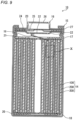
- FIG. 9 is a schematic longitudinal cross-sectional view of a lithium secondary battery 10.
- the lithium secondary battery 10 is a cylindrical battery including a cylindrical battery case, a wound electrode group 14 housed in the battery case, and a non-aqueous electrolyte (not shown).
- the battery case comprises a case main body 15 which is a bottomed cylindrical metal container, and a sealing body 16 sealing an opening of the case main body 15.
- the case main body 15 has an annular step portion 21 formed by partially pressing from outside the sidewall of the case main body in the vicinity of the opening.
- the sealing body 16 is supported on the surface of the step portion 21 on the opening side.
- a gasket 27 is placed, by which the hermeticity of the battery case is secured.
- electrically insulating plates 17 and 18 are placed respectively at both ends of the electrode group 14 in the winding axis direction.
- the sealing body 16 includes a filter 22, a lower valve body 23, an electrically insulating member 24, an upper valve body 25, and a cap 26.
- the cap 26 is disposed outside the case main body 15, and the filter 22 is disposed inside the case main body 15.
- the lower valve body 23 and the upper valve body 25 are connected to each other at the center portion of each, and are interposed by the insulating member 24 at the peripheral portion of each.
- the filter 22 and the lower valve body 23 are connected to each other at the peripheral portion of each.
- the upper valve body 25 and the cap 26 are connected to each other at the peripheral portion of each.
- the lower valve body 23 is provided with an air vent hole.
- the upper valve body 25 bulges toward the cap 26 and spaced away from the lower valve body 23, which breaks the electrical connection between the lower valve body 23 and the upper valve body 25. Furthermore, when the internal-pressure further rises, the upper valve body 25 raptures, to let gas go out though an aperture provided in the cap 26.
- the electrode group 14 includes a positive electrode 100, a negative electrode (negative electrode current collector) 200, and a separator 300.
- the positive electrode 100, the negative electrode 200, and the separator 300 interposed therebetween are all belt-like shaped, and are wound spirally together such that the width direction of each of them is in parallel with the winding axis direction.
- the positive electrode 100 is electrically connected via a positive electrode lead 19 to the cap 26 serving as a positive electrode terminal.
- One end of the positive electrode lead 19 is connected to the positive electrode 100, for example, at somewhere around its center in the longitudinal direction.
- the other end of the positive electrode lead 19 extended from the positive electrode 100 is passed through a through-hole provide in the insulating plate 17 and welded to the inner side surface of the filter 22.
- the negative electrode 200 is electrically connected via a negative electrode lead 20 to the case main body 15 serving as a negative electrode terminal.
- One end of the negative electrode lead 20 is connected to the negative electrode 200, for example, at its end in the longitudinal direction, and the other end thereof is welded to the inner bottom surface of the case main body 15.
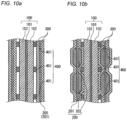
- FIG. 10 is a schematic enlarged view of a region X surrounded by a broken line in FIG. 9 , in which (a) illustrates the battery in a discharged state, and (b) illustrates the battery in a charged state.
- the positive electrode 100 includes a positive electrode current collector 101 and a positive electrode mixture layer 102 (see FIG. 10 ).
- a plurality of spacers 400 are disposed between the positive electrode mixture layer 102 and the separator 300.
- the spacers 400 consist of line-shaped protruding portions 401 provided along a second direction D2 (longitudinal direction) of the positive electrode 100.
- a discharged state no lithium metal is deposited on a surface of a negative electrode current collector 201, and a space is secured between the positive electrode 100 and the separator 300.
- a charged state lithium metal 202 is deposited on the surface of the negative electrode current collector 201 and, under being subjected to a pressing pressure from the separator 300, stored in the space between the positive electrode 100 and the separator 300.
- the negative electrode 200 in a discharged state includes the negative electrode current collector 201, and in a charged state, includes the negative electrode current collector 201 and the lithium metal 202 deposited thereon.
- the lithium metal 202 Since the lithium metal 202 is stored in the space formed between the positive electrode 100 and the separator 300, apparent changes in the volume of the electrode group associated with the deposition of lithium metal during charge-discharge cycles can be reduced. Accordingly, the stress that the negative electrode current collector 201 undergoes can be reduced. Moreover, since the lithium metal 202 stored between the positive electrode 100 and the separator 300 is subjected to a pressure from the separator 300, the lithium metal 202 can deposit in a controlled manner, and an isolation of lithium metal is unlikely to occur. This can suppress the reduction in charge-discharge efficiency.
- the shape and the like of the lithium secondary battery is not limited thereto, and may be selected according to its use and the like from various shapes, such as cylindrical, coin, square, sheet, and flat shapes.
- the electrode group also may be in any form, and may be in the form of a stack.
- the component elements other than the electrode group and the non-aqueous electrolyte of the lithium secondary battery may have any known configuration.
- the lithium secondary battery according to the present disclosure will be described more specifically with reference to Examples and Comparative Examples. It is to be noted, however, the present disclosure is not limited to the following Examples.
Landscapes
- Chemical & Material Sciences (AREA)
- Chemical Kinetics & Catalysis (AREA)
- Electrochemistry (AREA)
- General Chemical & Material Sciences (AREA)
- Engineering & Computer Science (AREA)
- Manufacturing & Machinery (AREA)
- Materials Engineering (AREA)
- Physics & Mathematics (AREA)
- General Physics & Mathematics (AREA)
- Inorganic Chemistry (AREA)
- Condensed Matter Physics & Semiconductors (AREA)
- Secondary Cells (AREA)
- Battery Electrode And Active Subsutance (AREA)
Description
- The present disclosure relates to a lithium secondary battery using a lithium metal as a negative electrode active material.
- A lithium ion battery is known as a high-capacity non-aqueous electrolyte secondary battery. The capacity of the lithium ion battery can be improved by, for example, using graphite and an alloy-type active material, such as a silicon compound, in combination as a negative electrode active material. However, the improvement in capacity of the lithium ion battery is approaching to the limit.
- As a non-aqueous electrolyte secondary battery superior in capacity to the lithium ion battery, a lithium secondary battery (lithium metal secondary battery) is seen as promising. In the lithium secondary battery, lithium metal deposits on the negative electrode during charge, and the lithium metal dissolves during discharge and are released as lithium ions into the non-aqueous electrolyte.
- Patent Literature 1 related to a lithium secondary battery, in view of suppressing short-circuiting by preventing damage to the separator and abnormal deposition of lithium, thereby to prolong the service life of the battery, discloses providing a buffer gap between the negative or the positive electrode and the separator, so that the lithium deposited on the negative electrode surface can be accommodated therein.
- [PTL 1]
Japanese Laid-Open Patent Publication No. H10-12279 - Patent Literature 1, specifically, discloses forming a buffer gap by providing a spacer at both ends in the width direction of the electrode. In this case, however, it is difficult to control the morphology of lithium metal to be deposited within the buffer gap. The deposited lithium metal tends to be isolated, and the charge and discharge efficiency tends to be reduced. Moreover, the lithium metal, if deposited non-uniformly, causes the pressure between the electrodes to locally increase, and a damage, such as a crack, is likely to occur in the negative electrode current collector.
- The present disclosure relates to a lithium metal secondary battery as specified in the appended claims. The lithium secondary battery includes:
a positive electrode including a positive electrode current collector, and a positive electrode mixture layer containing a positive electrode active material; a negative electrode including a negative electrode current collector that faces the positive electrode; a separator disposed between the positive electrode and the negative electrode; and a non-aqueous electrolyte having lithium ion conductivity, wherein the positive electrode active material includes a composite oxide containing lithium and a metal M other than lithium, the metal M containing at least a transition metal, lithium metal deposits on the negative electrode during charge, and the lithium metal dissolves from the negative electrode during discharge, the positive electrode current collector has a first length in a first direction D1 and a second length in a second direction D2 intersecting the first direction, the first length being shorter than the second length, a spacer is provided between the positive electrode and the separator so as to form a space for storing the lithium metal, between the positive electrode and the negative electrode, and a straight line SL is drawable along the first direction D1 so as to pass through three or more points (i.e. protruding portions) of the spacer. - According to the present disclosure, in a lithium secondary battery, it is possible to improve the charge and discharge efficiency and reduce the damage to the negative electrode current collector.
-
- [
FIG. 1 ] A schematic cross-sectional view of an essential part of a lithium secondary battery according to one embodiment of the present disclosure, in which (a) illustrates the battery in a discharged state, and (b) illustrates the battery in a charged state. - [
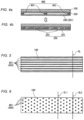
FIG. 2 ] A schematic plan view of a spacer disposed on a surface of a positive electrode. - [
FIG. 3 ] A schematic cross-sectional view of an essential part of a lithium secondary battery of a reference embodiment, in which (a) illustrates the battery in a discharged state, and (b) illustrates the battery in a charged state. - [
FIG. 4 ] A schematic cross-sectional view of an essential part of a lithium secondary battery of another reference embodiment, in which (a) illustrates the battery in a discharged state, and (b) illustrates the battery in a charged state. - [
FIG. 5 ] A schematic plan view of another spacer disposed on the positive electrode surface. - [
FIG. 6 ] A schematic plan view of still another pacer disposed on the positive electrode surface. - [
FIG. 7 ] A schematic plan view of still another spacer disposed on the positive electrode surface. - [
FIG. 8 ] A schematic plan view of still another spacer disposed on the positive electrode surface. - [
FIG. 9 ] A schematic longitudinal cross-sectional view of a lithium secondary battery according to one embodiment of the present disclosure. - [
FIG. 10 ] A schematic enlarged view of an essential part of the lithium secondary battery ofFIG. 9 . - A lithium secondary battery according to the present disclosure includes: a positive electrode including a positive electrode current collector, and a positive electrode mixture layer containing a positive electrode active material; a negative electrode including a negative electrode current collector that faces the positive electrode; a separator disposed between the positive electrode and the negative electrode; and a non-aqueous electrolyte having lithium ion conductivity. Lithium metal deposits on the negative electrode during charge, and the lithium metal dissolves from the negative electrode during discharge. The positive electrode current collector has a first length in a first direction D1 and a second length in a second direction D2 intersecting the first direction D1, the first length being smaller than the second length. The positive electrode current collector is, for example, long rectangular, or belt-shaped. The first direction D1 and the second direction D2 form an angle of approximately 90°. For example, the angle may be 88 to 92°.
- The positive electrode active material includes a composite oxide containing lithium and a metal M other than lithium, the metal M including at least a transition metal. Such a composite oxide is hereinafter referred to as a lithium-containing transition metal oxide. Lithium contained in the lithium-containing transition metal oxide is released as lithium ions during charge from the positive electrode, and deposits as lithium metal on the negative electrode or the negative electrode current collector. During discharge, the lithium metal dissolves from the negative electrode, and lithium ions are released, which are then absorbed to the composite oxide in the positive electrode. In short, the lithium ions involved in charge and discharge are mostly derived from the solute in the non-aqueous electrolyte and the positive electrode active material. Therefore, when the lithium-containing transition metal oxide has, for example, a rock-salt type crystal structure having a layered structure, a molar ratio mLi/mM of a total amount mLi of the lithium present in the positive and negative electrodes to an amount mM of the metal M present in the positive electrode is preferably 1.1 or less.
- Here, a spacer is provided between the positive electrode and the separator so as to form a space for storing the lithium metal, between the positive electrode and the negative electrode. Given that a straight line SL is drawn along the first direction D1, the line is drawable so as to pass through three or more points (preferably 4 or more points, more preferably 5 or more points) of the spacer. When the spacer is provided as above between the positive electrode and the separator, lithium metal is unlikely to deposit non-uniformly or in a dendritic form during discharge, and a local expansion of the negative electrode is suppressed, making a damage, such as a crack, unlikely to occur in the negative electrode current collector. For example, when three protruding portions each line-shaped along the second direction D2 are provided as the spacer in substantially parallel with each other, the straight line SL drawn along the first direction D1 passes through three points of the spacer. The spacer may be provided on a surface of the positive electrode current collector, or on a surface of the positive electrode mixture layer supported on the positive electrode current collector and containing the positive electrode active material.
- On the other hand, in a lithium secondary battery in which the spacer portions are provided only at both ends in the width direction of the electrode, the deposition morphology of the lithium metal during charge is difficult to control, and lithium metal may deposit non-uniformly on the negative electrode. Especially when the lithium metal is deposited in a dendritic form, it tends to be isolated during discharge, which is likely to cause a reduction in charge-discharge efficiency. Moreover, the expansion of the negative electrode tends to be severe locally, which is likely to cause a damage, such as a crack, to the negative electrode current collector.
- In the present disclosure, the spacer is provided between the positive electrode and the separator. Therefore, at least during discharge, a space is easily secured between the positive electrode and the separator. On the other hand, the space is hardly secured between the negative electrode and the separator. Thus, the lithium metal deposited on the negative electrode surface is constantly subjected to a pressing force from the separator and tends to grow along the surface of the negative electrode, which is thus unlikely to grow in a dendritic form. Here, due to its moderate stretchability, the separator stretches toward the positive electrode with increase in the amount of the deposited lithium metal. This can fill the space formed by the spacer between positive electrode and the separator.
- Furthermore, the straight line SL can be drawn along the first direction D1 so as to pass through three or more points of the spacer. This means that the spacer can support the separator and the negative electrode current collector at many points, allowing the whole lithium metal to be subjected to a comparatively uniform pressing force from the separator. Therefore, the lithium metal is more likely to deposit along the surface of the negative electrode. Moreover, since the negative electrode current collector is supported by the spacer at many points, the deformation of the negative electrode current collector itself can also be suppressed. Consequently, the load applied to the negative electrode current collector can be significantly reduced.
- The spacer has a height h as measured from a portion having a maximum thickness of the positive electrode. The height h is, for example, 15 µm to 100 µm, and may be 30 µm to 60 µm, in view of securing a necessary minimum space. The height h is determined as appropriate depending on the capacity per unit area of the positive electrode. Here, the height h is usually measured from the surface of the positive electrode mixture layer supported on the positive electrode current collector. The height h may be determined as an average of the values measured at randomly selected 10 points.
- In the straight line SL passing through three points or more of the spacer, a ratio d/h of a shortest distance d (µm) between portions of the spacer adjacent to each other to the height h (µm) of the spacer as measured from a portion having a maximum thickness of the positive electrode is, for example, 10 to 800, and may be 40 to 400. By controlling the ratio d/h within the range above, a sufficient space necessary for storing the lithium metal can be easily secured, and a more uniform pressing force can be applied to the whole lithium metal from the separator. The shortest distance d between portions of the spacer adjacent to each other may be determined as an average of the values measured in one site on each of ten straight lines SL drawn at random.
- When an opposing area S between the positive electrode and the negative electrode is denoted by S, a ratio s/S of an area s of a positive electrode portion covered with the spacer to the opposing area S is, for example, 0.05 to 0.2 (i.e., 5% to 20%). By controlling the percentage of the area s within the range above, a more uniform pressing force can be applied to the whole lithium metal from the separator, and the resistance to the electrode reaction can be suppressed. The ratio s/S may satisfy the above range on one surface or both surfaces of the positive electrode.
- A ratio I/L of a length l occupied by the spacer in the straight line SL passing through three or more points of the spacer to the first length L is, for example, 0.05 to 0.2 (5% to 20%). This allows the whole lithium metal to be subjected to a more uniform pressing force from the separator. The length I may be determined as an average of the values measured on ten straight lines SL drawn at random. The ratio I/L may satisfy the above range on one surface or both surfaces of the positive electrode.
- The spacer may comprise, for example, a plurality of line-shaped protruding portions disposed in stripes along the second direction D2 on a surface of the positive electrode. For example, a protruding portion may be disposed at each of both ends in the first direction D1 on the surface of the positive electrode, and additionally disposed along the second direction D2 midway between the both ends (three protruding portions in total). In this case, the straight line SL can be drawn so as to pass through three points in total of the spacer: two at the both ends and one between the both ends. The spacer comprising such a plurality of line-shaped protruding portions can be relatively easily formed on a surface of the positive electrode. Furthermore, in the case of forming a plurality of line-shaped protrusions, it is easy to control the height h, the ratio d/h, the ratio s/S, the ratio I/L, and other parameters.
- A description will be given below with reference to the drawings.
-
FIG. 1 is a schematic cross-sectional view of an essential part of a lithium secondary battery according to one embodiment of the present disclosure, in which (a) illustrates the battery in a discharged state, and (b) illustrates the battery in a charged state. The essential part of the lithium secondary battery includes apositive electrode 100, anegative electrode 200, aseparator 300 interposed between thepositive electrode 100 and thenegative electrode 200, and a non-aqueous electrolyte (not shown). Thenegative electrode 200, in a discharged state, includes a negative electrode current collector 201 (seeFIG. 1(a) ), and in a charged state, includes the negative electrodecurrent collector 201 andlithium metal 202 deposited thereon (seeFIG. 1(b) ). Aspacer 400 is interposed between thepositive electrode 100 and theseparator 300. Thespacer 400 provides a space for storing thelithium metal 202, between thepositive electrode 100 and thenegative electrode 200. -
FIG. 2 is a schematic plan view of thespacer 400 disposed on a surface of thepositive electrode surface 100. Thespacer 400 comprises line-shaped protrudingportions 401 along the second direction D2 provided at both ends in the first direction D1 on the surface of thepositive electrode 100 and a line-shaped protrudingportion 401 along the second direction D2 provided midway between the both ends. In short, thespacer 400 consists of three of the line-shaped protrudingportions 401 which are substantially parallel with each other. Thus, the straight line SL drawn along the first direction D1 passes through three points of thespacer 400. Here, being substantially parallel with each other means being in an approximate parallel state, and the line-shaped protrudingportions 401 may intersect one another at an angle of, for example, 0° to 20°, or 0° to 10°. - In a discharged state (a), a space is secured between the
positive electrode 100 and theseparator 300 by thespacer 400. On the other hand, between the negative electrodecurrent collector 201 and theseparator 300, almost no space is observed. In a charged state (b), thelithium metal 202 is deposited on the surface of the negative electrodecurrent collector 201. Thelithium metal 202 is constantly subjected to a pressing force from theseparator 300 and is facilitated to grow along the surface of the negative electrode. With increase in the amount of the depositedlithium metal 202, theseparator 300 stretches (bulges) toward the positive electrode, gradually filling the space secured by thespacer 400. At this time, the protrudingportion 401 provided midway between the both ends in the first direction D1 plays an important role. Specifically, thespacer 400 can support the negative electrodecurrent collector 201 and theseparator 300 at greater points, allowing thelithium metal 202 to be subjected to a more uniform pressing force. This can suppress a local deposition of thelithium metal 202 and facilitate the deposition of lithium metal along the surface of the negative electrodecurrent collector 201, as well as can suppress the deformation of the negative electrode current collector. - On the other hand, a schematic cross-sectional view of an essential part of a lithium secondary battery of a reference embodiment is shown in
FIG. 3 , in which (a) illustrates the battery in a discharged state, and (b) illustrates the battery in a charged state. Again, the essential part of the lithium secondary battery includes thepositive electrode 100, thenegative electrode 200, theseparator 300 interposed between thepositive electrode 100 and thenegative electrode 200, and the non-aqueous electrolyte (not shown). Thespacer 400 is interposed between thepositive electrode 100 and theseparator 300. Here, however, thespacer 400 consists only of the line-shaped protrudingportions 401 along the second direction D2 provided respectively at both ends in the first direction D1 on the surface of thepositive electrode 100. No line-shaped protrudingportion 401 is provided midway between the both ends. Thus, the straight line SL drawn along the first direction D1 passes through only two points of thespacer 400. In this case, in a charged state (b), although thelithium metal 202 is partially subjected to a pressing force from theseparator 300, the pressing force from theseparator 300 applied in a midway region in the first direction D1 is not sufficient enough, and a local deposition of lithium metal tends to occur in the midway region. On the other hand, the stretchability of theseparator 300 is limited. Therefore, when theseparator 300 is going to bulge greatly toward the positive electrode in the midway region, an excessive stress is applied to the negative electrodecurrent collector 201, and a fatal crack is likely to occur in the negative electrodecurrent collector 201. -
FIG. 4 is a schematic cross-sectional view of an essential part of a lithium secondary battery of another reference embodiment, in which (a) illustrates the battery in a discharged state, and (b) illustrates the battery in a charged state. Here, the essential part of the lithium secondary battery includes thepositive electrode 100, thenegative electrode 200, theseparator 300 interposed between thepositive electrode 100 and thenegative electrode 200, and the non-aqueous electrolyte (not shown). Thespacer 400 is interposed between the negative electrodecurrent collector 201 and theseparator 300. In this case, in a charged state (b), thelithium metal 202 is not subjected to a sufficient pressing force from theseparator 300, and thelithium metal 202 tends to deposit non-uniformly or in a dendritic form. Especially when thelithium metal 202 is deposited in a dendritic form, it tends to be isolated during discharge, which is likely to cause a reduction in charge-discharge efficiency. Moreover, as thelithium metal 202 deposited in a dendritic form grows, it may break theseparator 300, causing a short-circuit between thepositive electrode 100 and thenegative electrode 200. - Although not specifically illustrated in
FIGS. 1 and 2 , thepositive electrode 100 includes a positive electrode current collector and a positive electrode mixture layer supported on the positive electrode current collector, and the positive electrode active material is contained in the positive electrode mixture layer. The height h of the spacer as measured from a portion having a maximum thickness of thepositive electrode 100 corresponds to a height from a surface of the positive electrode mixture layer. In the straight line SL, the shortest distance d between portions of thespacer 400 adjacent to each other corresponds to a shortest distance between the adjacent protrudingportions 401. The area s of a portion covered with thespacer 400 of thepositive electrode 100 corresponds to an area of the three protrudingportions 401 projected onto thepositive electrode 100. The length l occupied by thespacer 400 in the straight line SL corresponds to a total (3w) of the widths w in the first direction D1 of the three protrudingportions 401. -
FIGS. 5 to 8 show various spacers disposed on the positive electrode surface. - In
FIG. 5 , thespacer 400 comprises a plurality of line-shaped protrudingportions 401 disposed in stripes along the second direction D2 on the surface of thepositive electrode 100. In this case, the straight line SL can be drawn so as to pass through the same number of points (seven points in the illustrated example) as that of the protrudingportions 401. The area s of a portion covered with thespacer 400 of thepositive electrode 100 corresponds to an area of the seven protrudingportions 401 projected onto thepositive electrode 100. The length l occupied by thespacer 400 in the straight line SL corresponds to a total (7w) of the widths w in the first direction D1 of the seven protrudingportions 401. - In
FIG. 6 , thespacer 400 comprises a plurality of spot-shaped protrudingportions 401 disposed so as to be distributed uniformly on the surface of thepositive electrode 100. In the case of the illustrated example, when a straight line SL is drawn along the first direction D1, the number of the spot-shaped protrudingportions 401 that the straight line SL passes through differs depending on where the straight line SL is drawn. A straight line SL1 passes through four of the protrudingportions 401, and a straight line SL2 passes through five of the protrudingportions 401. In such a case, of a plurality of the straight lines SL drawable in different styles, at least one of the straight lines SL should pass through three or more protruding portions. The area s of a portion covered with thespacer 400 of thepositive electrode 100 corresponds to a total area of the spot-shaped protrudingportions 401 projected onto thepositive electrode 100. The length l occupied by thespacer 400 in the straight line SL corresponds to a product of an average number of protruding portions that each of the straight lines SL drawable in different styles passes through (the average is 4.5 in the illustrated example) and a diameter in the first direction D1 of the spot-shaped protrudingportions 401. - In
FIG. 7 , thespacer 400 comprises a continuous form of honeycomb-shaped ribs disposed so as to be distributed uniformly on the surface of thepositive electrode 100. In this case, too, when a straight line SL is drawn along the first direction D1, the number of ribs that the straight line SL passes through differs depending on where the straight line SL is drawn. A straight line SL1 passes through the ribs at five points, and a straight line SL2 passes through the ribs at four points. The area s of a portion covered with thespacer 400 of thepositive electrode 100 corresponds to an area of the continuous form projected onto thepositive electrode 100. The length l occupied by thespacer 400 in the straight line SL corresponds to a product of an average number of ribs that each of the straight lines SL drawable in different styles passes through (the average is 4.5 in the illustrated example) and a rib width of the continuous form. - In
FIG. 8 , thespacer 400 comprises a plurality of line segment-shaped protrudingportions 401 disposed so as to be distributed uniformly on the surface of thepositive electrode 100. The line segment-shaped protrudingportions 401 are arranged so as to intersect alternately along the first direction D1. In this case, too, when a straight line SL is drawn along the first direction D1, the number of the line segment-shaped protrudingportions 401 that the straight line SL passes through differs depending on where the straight line SL is drawn. For example, a straight line SL1 passes through three or four of the line segment-shaped protrudingportions 401, a straight line SL2 passes through three of the protrudingportions 401, and a straight line SL3 passes through two of the protrudingportions 401. The area s of a portion covered with thespacer 400 of thepositive electrode 100 corresponds to a total area of the line segment-shaped protrudingportions 401 projected onto thepositive electrode 100. The length l occupied by thespacer 400 in the straight line SL corresponds to a product of an average number of the protruding portions that each of the straight lines SL drawable in different styles passes through and a width of the protruding portions in a cross section taken along the straight line SL. - A detailed description will be given below of each component of the lithium secondary battery.
- The negative electrode includes a negative electrode current collector. In the lithium secondary battery, lithium metal deposits on a surface of the negative electrode current collector during charge. Specifically, lithium ions contained in the non-aqueous electrolyte receive electrons on the negative electrode current collector during charge and become lithium metal, which deposits on the surface of the negative electrode current collector. The lithium metal deposited on the surface of the negative electrode current collector dissolves as lithium ions during discharge in the non-aqueous electrolyte. The lithium ions present in the non-aqueous electrolyte may be either derived from a lithium salt added to the non-aqueous electrolyte or supplied from the positive electrode active material during charge, or both.
- The negative electrode current collector is in the form of an electrically conductive sheet. The conductive sheet may be a foil, film, and the like.
- The conductive sheet may have a smooth surface. In this case, the lithium metal derived from the positive electrode tends to uniformly deposit on the conductive sheet during charge. The smooth surface means that the conductive sheet has a maximum height roughness Rz of 20 µm or less. The conductive sheet may have a maximum height roughness Rz of 10 µm or less. The maximum height roughness Rz is measured in accordance with JIS B 0601: 2013.
- The negative electrode current collector (conductive sheet) is made of an electrically conductive material other than lithium metal and lithium alloys. The conductive material may be a metal material, such as metal and an alloy. The conductive material preferably causes no reaction with lithium. Specifically, a material that forms neither an alloy nor an intermetallic compound with lithium is preferred. Such a conductive material is exemplified by copper (Cu), nickel (Ni), iron (Fe), and an alloy of one or more of these metal elements, or graphite having a basal plane predominately exposed on its surface. Examples of the alloy include a copper alloy and stainless steel (SUS). Preferred are copper and/or a copper alloy because of its high electrical conductivity.
- The negative electrode current collector may have any thickness; the thickness is, for example, 5 µm or more and 300 µm or less.
- The negative electrode current collector may have a negative electrode mixture layer (not shown) on its surface. The negative electrode mixture layer is formed by, for example, applying a paste including a negative electrode active material, such as graphite, to at least part of a surface of the negative electrode current collector. In view of achieving a lithium secondary battery superior in capacity to the lithium ion battery, however, the negative electrode mixture layer is formed sufficiently thin so that lithium metal can deposit on the negative electrode.
- The positive electrode includes, for example, a positive electrode current collector and a positive electrode mixture layer supported on the positive electrode current collector. The positive electrode mixture layer contains, for example, a positive electrode active material, an electrically conductive material, and a binder. The positive electrode mixture layer may be formed on one surface or both surfaces of the positive electrode current collector. The positive electrode can be obtained by, for example, applying a positive electrode mixture slurry including a positive electrode active material, an electrically conductive material, and a binder to both surfaces of the positive electrode current collector, followed by drying and then rolling the dry applied film.
- The positive electrode active material absorbs and releases lithium ions. Examples of the positive electrode active material include a lithium-containing transition metal oxide, a transition metal fluoride, a polyanion, a fluorinated polyanion, and a transition metal sulfide. Preferred among them is a lithium-containing transition metal oxide in terms of its low production cost and high average discharge voltage.
- Examples of the transition metal oxide contained in the lithium-containing transition metal oxide include Sc, Ti, V, Cr, Mn, Fe, Co, Ni, Cu, Y, Zr, and W. The lithium-containing transition metal oxide may contain one kind or two or more kinds of transition metal elements. The transition metal element may be Co, Ni and/or Mn. The lithium-containing transition metal oxide can contain one or more kinds of typical elements, as needed. Examples of the typical element includes Mg, Al, Ca, Zn, Ga, Ge, Sn, Sb, Pb, and Bi. The typical element may be Al, and the like.
- The lithium-containing transition metal oxide preferably contains Co, Ni and/or Mn as a transition metal element(s) and Al as an optional component and has a rock-salt type crystal structure having a layered structure, in view of achieving a high capacity. In this case, in the lithium secondary battery, a molar ratio mLi/mM of a total amount mLi of the lithium present in the positive and negative electrodes to an amount mM of a metal M other than lithium present in the positive electrode is set, for example, 1.1 or less.
- The conductive material is, for example, a carbon material. Examples of the carbon material include carbon black, acetylene black, Ketjen Black, carbon nanotube, and graphite.
- The binder may be, for example, a fluorocarbon resin, a polyacrylonitrile, a polyimide resin, an acrylic resin, a polyolefin resin, and a rubbery polymer. Examples of the fluorocarbon resin include polytetrafluoroethylene and polyvinylidene fluoride.
- The positive electrode mixture layer has a surface having a maximum height roughness Rz of, for example, 10 µm or less, so that the spacer can be easily disposed on the surface of the positive electrode. The maximum height roughness Rz is measured in accordance with JIS B 0601: 2013.
- The positive electrode current collector is in the form of an electrically conductive sheet. The conductive sheet may be a foil, film, and the like. The positive electrode current collector may be coated with a carbon material.
- The positive electrode current collector (conductive sheet) may be made of, for example, a metal material, such as Al, Ti, and Fe. The metal material may be Al, an Al alloy, Ti, a Ti alloy, a Fe alloy, and the like. The Fe alloy may be stainless steel (SUS).
- The positive electrode current collector may have any thickness: the thickness is, for example, 5 µm or more and 300 µm or less.
- The spacer may be made of any material. The spacer may be made of an electrically conductive material and/or an electrically insulating material.
- The conductive material may be selected as appropriate from those exemplified as the material of the negative electrode current collector or the positive electrode current collector. The spacer may be provided by press-working the positive electrode current collector, to form a protruding portion(s). Alternatively, an electrically conductive paint may be applied or an electrically conductive tape may be attached to a surface of the positive electrode mixture layer.
- The insulating material is, for example, a resin material. Examples of the resin material include a polyolefin resin, an acrylic resin, a polyamide resin, a polyimide resin, a silicone resin, and a fluorocarbon resin. The resin material may be a cured product of a curable resin, such as an epoxy resin. These resin materials may be mixed with an inorganic filler and the like. The spacer can be formed by, for example, attaching a resin adhesive tape to a surface of the positive electrode current collector or the positive electrode mixture layer. The spacer may be formed by applying a solution or dispersion including the resin material to a surface of the positive electrode current collector or the positive electrode mixture layer, followed by drying. The spacer may be formed by applying a curable resin in a desired shape to a surface of the positive electrode current collector or the positive electrode mixture layer, followed by curing.
- The separator is a porous sheet having ion permeability and electrically insulating properties. The porous sheet may be, for example, a microporous thin film, a woven fabric, and a nonwoven fabric. The separator is made of any material; the material may be a polymer material. Examples of the polymer material include an olefinic resin, a polyamide resin, and a cellulose. Examples of the olefinic resin include polyethylene, polypropylene, and an ethylene-propylene copolymer. The separator may include an additive, if necessary. The additive is, for example, an inorganic filler.
- The non-aqueous electrolyte having lithium ion conductivity includes, for example, a non-aqueous solvent, and lithium ion and an anion dissolved in the non-aqueous solvent. The non-aqueous electrolyte may be liquid, and may be gel.
- The liquid non-aqueous electrolyte can be prepared by dissolving a lithium salt in the non-aqueous solvent. When the lithium salt is dissolved in the non-aqueous solvent, lithium ion and an anion are produced.
- The gel non-aqueous electrolyte includes a lithium salt and a matrix polymer, or includes a lithium salt, a non-aqueous solvent, and a matrix polymer. The matrix polymer is, for example, a polymer material that is gelled by absorbing the non-aqueous solvent. Examples of the polymer material include a fluorocarbon resin, an acrylic resin, and a polyether resin.
- The lithium salt or anion may be any known in the art that is utilized for non-aqueous electrolyte for lithium secondary batteries. Specific examples thereof include: BF4 -, ClO4 -, PF6 -, CF3SO3 -, CF3CO2 -, imide anions, and an anion of an oxalate complex. Examples of the imide anions include N(SO2CF3)2 -, N(CmF2m+1SO2)x(CnF2n+1SO2)y -, where m and n are independently 0 or an integer of 1 or more, x and y are independently 0, 1 or 2, and x+y = 2. The oxalate complex anion may contain boron and/or phosphorus. Examples of the oxalate complex anion include a bis(oxalato)borate anion, BF2(C2O4)-, PF4(C2O4)-, and PF2(C2O4)2 -. The non-aqueous electrolyte may include one of these anions, or two or more kinds thereof.
- In view of suppressing the dendritic deposition of lithium metal, the non-aqueous electrolyte preferably includes at least an anion of an oxalate complex. The oxalate complex anion interacts with lithium to make lithium metal more likely to deposit uniformly in a fine particulate state. Therefore, a local deposition of lithium metal is unlikely to occur. The oxalate complex anion may be used in combination with one or more other anions, for example, PF6 -and/or imide anions.
- Examples of the non-aqueous solvent include esters, ethers, nitriles, amides, and halogen substituted derivatives of these. The non-aqueous electrolyte may contain one of these non-aqueous solvents, or two or more kinds thereof. Examples of the halogen substituted derivatives include fluorides.
- The ester may be, for example, a carbonic ester, a carboxylic acid ester, and the like. Examples of a cyclic carbonic ester include ethylene carbonate, propylene carbonate, and fluoroethylene carbonate (FEC). Examples of a chain carbonic ester include dimethyl carbonate (DMC), ethyl methyl carbonate (EMC), and diethyl carbonate. Examples of a cyclic carboxylic acid ester include γ-butyrolactone and γ-valerolactone. Examples of a chain carboxylic acid ester include ethyl acetate, methyl propionate, and methyl fluoropropionate.
- The ether may be a cyclic or chain ether. Examples of the cyclic ether include 1,3-dioxolane, 4-methyl-1,3-dioxolane, tetrahydrofuran, and 2-methyltetrahydrofuran. Examples of the chain ether include 1,2-dimethoxyethane, diethyl ether, ethyl vinyl ether, methyl phenyl ether, benzyl ethyl ether, diphenyl ether, dibenzyl ether, 1,2-diethoxyethane, and diethylene glycol dimethyl ether.
- The lithium salt concentration in the non-aqueous electrolyte is, for example, 0.5 mol/L or more and 3.5 mol/L or less. The anion concentration in the non-aqueous electrolyte may be set to 0.5 mol/L or more and 3.5 mol/L or less. The oxalate complex anion concentration in the non-aqueous electrolyte may be set to 0.05 mol/L or more and 1 mol/L or less.
- The non-aqueous electrolyte may include an additive. The additive may form a surface film on the negative electrode. When the surface film derived from the additive is formed on the negative electrode, the dendrite formation and growth tend to be suppressed. Examples of the additive include vinylene carbonate, FEC, and vinyl ethyl carbonate (VEC).
- A description will be given below of a configuration of a lithium secondary battery according to the present disclosure with reference to the drawings, with a cylindrical battery having a wound electrode group taken as an example. It is to be noted, however, that the present disclosure is not limited to the following configuration.
-
FIG. 9 is a schematic longitudinal cross-sectional view of a lithiumsecondary battery 10. The lithiumsecondary battery 10 is a cylindrical battery including a cylindrical battery case, awound electrode group 14 housed in the battery case, and a non-aqueous electrolyte (not shown). The battery case comprises a casemain body 15 which is a bottomed cylindrical metal container, and a sealingbody 16 sealing an opening of the casemain body 15. The casemain body 15 has anannular step portion 21 formed by partially pressing from outside the sidewall of the case main body in the vicinity of the opening. The sealingbody 16 is supported on the surface of thestep portion 21 on the opening side. Between the casemain body 15 and the sealingbody 16, agasket 27 is placed, by which the hermeticity of the battery case is secured. Within the casemain body 15, electrically insulatingplates electrode group 14 in the winding axis direction. - The sealing
body 16 includes afilter 22, alower valve body 23, an electrically insulatingmember 24, anupper valve body 25, and acap 26. Thecap 26 is disposed outside the casemain body 15, and thefilter 22 is disposed inside the casemain body 15. Thelower valve body 23 and theupper valve body 25 are connected to each other at the center portion of each, and are interposed by the insulatingmember 24 at the peripheral portion of each. Thefilter 22 and thelower valve body 23 are connected to each other at the peripheral portion of each. Theupper valve body 25 and thecap 26 are connected to each other at the peripheral portion of each. Thelower valve body 23 is provided with an air vent hole. When the internal pressure of the battery case rises due to abnormal heat generation or other events, theupper valve body 25 bulges toward thecap 26 and spaced away from thelower valve body 23, which breaks the electrical connection between thelower valve body 23 and theupper valve body 25. Furthermore, when the internal-pressure further rises, theupper valve body 25 raptures, to let gas go out though an aperture provided in thecap 26. - The
electrode group 14 includes apositive electrode 100, a negative electrode (negative electrode current collector) 200, and aseparator 300. Thepositive electrode 100, thenegative electrode 200, and theseparator 300 interposed therebetween are all belt-like shaped, and are wound spirally together such that the width direction of each of them is in parallel with the winding axis direction. - The
positive electrode 100 is electrically connected via apositive electrode lead 19 to thecap 26 serving as a positive electrode terminal. One end of thepositive electrode lead 19 is connected to thepositive electrode 100, for example, at somewhere around its center in the longitudinal direction. The other end of thepositive electrode lead 19 extended from thepositive electrode 100 is passed through a through-hole provide in the insulatingplate 17 and welded to the inner side surface of thefilter 22. - The
negative electrode 200 is electrically connected via anegative electrode lead 20 to the casemain body 15 serving as a negative electrode terminal. One end of thenegative electrode lead 20 is connected to thenegative electrode 200, for example, at its end in the longitudinal direction, and the other end thereof is welded to the inner bottom surface of the casemain body 15. -
FIG. 10 is a schematic enlarged view of a region X surrounded by a broken line inFIG. 9 , in which (a) illustrates the battery in a discharged state, and (b) illustrates the battery in a charged state. Thepositive electrode 100 includes a positive electrodecurrent collector 101 and a positive electrode mixture layer 102 (seeFIG. 10 ). A plurality ofspacers 400 are disposed between the positiveelectrode mixture layer 102 and theseparator 300. Thespacers 400 consist of line-shaped protrudingportions 401 provided along a second direction D2 (longitudinal direction) of thepositive electrode 100. In a discharged state (a), no lithium metal is deposited on a surface of a negative electrodecurrent collector 201, and a space is secured between thepositive electrode 100 and theseparator 300. On the other hand, in a charged state (b),lithium metal 202 is deposited on the surface of the negative electrodecurrent collector 201 and, under being subjected to a pressing pressure from theseparator 300, stored in the space between thepositive electrode 100 and theseparator 300. In short, thenegative electrode 200 in a discharged state includes the negative electrodecurrent collector 201, and in a charged state, includes the negative electrodecurrent collector 201 and thelithium metal 202 deposited thereon. - Since the
lithium metal 202 is stored in the space formed between thepositive electrode 100 and theseparator 300, apparent changes in the volume of the electrode group associated with the deposition of lithium metal during charge-discharge cycles can be reduced. Accordingly, the stress that the negative electrodecurrent collector 201 undergoes can be reduced. Moreover, since thelithium metal 202 stored between thepositive electrode 100 and theseparator 300 is subjected to a pressure from theseparator 300, thelithium metal 202 can deposit in a controlled manner, and an isolation of lithium metal is unlikely to occur. This can suppress the reduction in charge-discharge efficiency. - Although the illustrated example is a cylindrical lithium secondary battery including a wound electrode group, the shape and the like of the lithium secondary battery is not limited thereto, and may be selected according to its use and the like from various shapes, such as cylindrical, coin, square, sheet, and flat shapes. The electrode group also may be in any form, and may be in the form of a stack. The component elements other than the electrode group and the non-aqueous electrolyte of the lithium secondary battery may have any known configuration.
- The lithium secondary battery according to the present disclosure will be described more specifically with reference to Examples and Comparative Examples. It is to be noted, however, the present disclosure is not limited to the following Examples.
- A lithium-containing transition metal oxide having a layered rock-salt structure and containing Li, Ni, Co, and Al such that the mole ratio of Li to the total of Ni, Co, and Al was 1.0 (NCA; positive electrode active material), acetylene black (AB; conductive material), and polyvinylidene fluoride (PVdF; binder) were mixed in a mass ratio of NCA : AB : PVdF = 95 : 2.5 : 2.5, to which N-methyl-2-pyrrolidone (NMP) was added in an appropriate amount and stirred, to prepare a positive electrode mixture slurry. The prepared positive electrode mixture slurry was applied to both surfaces of an Al foil (positive electrode current collector), and then dried and passed between rolls so that the applied film of the positive electrode mixture is rolled to a certain thickness. Lastly, the resultant stack of the positive electrode current collector and the positive electrode mixture was cut in a predetermined electrode size, to give a positive electrode in which a positive electrode mixture layer is formed on both surfaces of the positive electrode current collector.
- A polyimide ink was applied along the second direction D2 at both ends in the first direction D1 on each of both surfaces of the positive electrode mixture layer and midway between the both ends, and then dried with hot air, to form a spacer consisting of three parallel line-shaped protruding portions formed of a polyimide resin. The polyimide ink was applied using a dispenser.
- A rectangular electrolytic copper foil (thickness: 15 µm) was prepared as a negative electrode current collector.
- Ethylene carbonate (EC) and dimethyl carbonate (DMC) were mixed in a volume ratio of EC : DMC = 30 : 70. To the resultant mixed solvent, LiPF6 and LiBF2(C2O4) were dissolved at a concentration of 1 mol/L and 0.1 mol/L, respectively, to prepare a liquid non-aqueous electrolyte.
- The positive electrode with the spacer formed on both surfaces and the negative electrode current collector were spirally wound in an inert atmosphere with a separator (microporous film) made of polyethylene interposed therebetween, to form an electrode group. Here, the lithium contained in the electrode group was all derived from the positive electrode. Therefore, a molar ratio mLi/mM of a total amount mLi of the lithium present in the positive and negative electrodes to an amount mM of the metal M (here, Ni, Co, and Al) present in the positive electrode was 1.0.
- The electrode group was housed in a pouch-like outer case formed of a laminate sheet having an Al layer, into which the non-aqueous electrolyte was injected. Thereafter, the outer case was sealed, to complete a lithium secondary battery.
- Here, batteries A1 to A5 of Examples 1 to 5 were produced by controlling the width and the height of the protruding portions in the spacer formation process (2). Specifically, the height h of the protruding portions from the positive electrode mixture layer surface, the shortest distance d between the protruding portions adjacent to each other in the first direction D1, the ratio (s/S) of an area s of a portion covered with the spacer of the positive electrode mixture layer to the opposing area S between the positive electrode and the negative electrode, and the ratio (I/L) of the length of the spacer to the first length were controlled to be as shown in Table 1.
- A battery B1 was produced similarly to the battery A4 of Example 4, except that no spacer was formed on the positive electrode mixture layer, and the spacer was formed on both surfaces of the negative electrode current collector, in the regions corresponding to both ends in the first direction D1 of the positive electrode mixture layer and midway between the both ends.
- A battery B2 was produced similarly to the battery A4 of Example 4, except that the protruding portion was formed only at both ends in first direction D1 on both surfaces of the positive electrode mixture layer, and no protruding portion was formed midway between the both ends.
- The obtained batteries were subjected to a charge-discharge test for evaluation.
- In the charge-discharge test, in a 25 °C constant-temperature bath, three batteries each were charged under the conditions below, and after left to stand for 20 min, discharged under the conditions below. This cycle was repeated 25 cycles in total. A ratio (MR25) of a discharge capacity at the 25th cycle to a discharge capacity at the 1st cycle was determined as a capacity retention ratio (%).
- A constant-current charge was performed until the battery voltage reached 4.3 V at a current of 10 mA per unit area (square centimeters) of the electrode, and then a constant-voltage charge was performed at a voltage of 4.3 V until the current value per unit area of the electrode reached 1 mA.
- A constant-current discharge was performed until the battery voltage reached 3.0 V at a current of 10 mA per unit area of the electrode.
- Of the three batteries, the number of batteries (N) in which a cycling failure occurred presumably because of a crack in the negative electrode current collector was determined. When the cycling failure occurred in some of the batteries, the MR25 was determined as an average of the values of the remaining batteries.
[Table 1] Location of spacer Number of protruding portions h (µm) d (mm) d/h s/S l/L MR25 (%) N A1 Positive electrode 3 15 12 800 0.2 0.2 75.7 1 A2 Positive electrode 3 30 12 400 0.05 0.05 68.7 0 A3 Positive electrode 3 30 12 400 0.1 0.1 71.6 0 A4 Positive electrode 3 30 12 400 0.2 0.2 76.9 0 A5 Positive electrode 3 60 12 200 0.2 0.2 82.3 1 B1 Negative electrode 3 30 12 400 0.2 0.2 58.8 2 B2 Positive electrode 2 30 26 867 0.133 0.133 65.7 2 - Of the batteries B1, the battery in which the cycling failure occurred was disassembled to observe the negative electrode current collector. The observation found a large number of cracks running in the first direction, the cracks having the same length as the first length. Of the batteries B2, the battery in which the cycling failure occurred was disassembled to observe the negative electrode current collector. The observation found a large number of cracks running in the first direction, the cracks being slightly shorter than those in the battery B1 but having almost the same length as the first length. In contrast, the observation of the negative electrode current collector taken out from the batteries A1 and A5 found minor cracks, but the cracks were short in length and were not so severe to cause breakage. Furthermore, as compared to the batteries B1 and B2 of Comparative Examples, the batteries in which the protruding portions were provided on the positive electrode (A1 to A5 and B2) generally showed a good MR25 value.
- The lithium secondary battery of the present disclosure is suitably applicable for electronic devices, such as cellular phones, smart phones, and tablet terminals, electric vehicles including hybrids and plug-in hybrids, and home storage battery systems combined with a solar cell.
-
- 10
- lithium secondary battery
- 14
- electrode group
- 15
- case main body
- 16
- sealing body
- 17, 18
- insulating plate
- 19
- positive electrode lead
- 20
- negative electrode lead
- 21
- step portion
- 22
- filter
- 23
- lower valve body
- 24
- insulative member
- 25
- upper valve body
- 26
- cap
- 27
- gasket
- 100
- positive electrode
- 101
- positive electrode current collector
- 102
- positive electrode mixture layer
- 200
- negative electrode
- 201
- negative electrode current collector
- 202
- lithium metal
- 300
- separator
- 400
- spacer
- 401
- protruding portion
Claims (7)
- A lithium metal secondary battery (10), comprising:a positive electrode (100) including a positive electrode current collector (101), and a positive electrode mixture layer (102) containing a positive electrode active material;a negative electrode (200) including a negative electrode current collector (201) that faces the positive electrode;a separator (300) disposed between the positive electrode (100) and the negative electrode (200); anda non-aqueous electrolyte having lithium ion conductivity, whereinthe positive electrode active material (102) includes a composite oxide containing lithium and a metal M other than lithium, the metal M containing at least a transition metal,the lithium metal secondary battery being adapted so that lithium metal (202) deposits on the negative electrode (200) during charge, and the lithium metal (202) dissolves from the negative electrode (200) during discharge,the positive electrode current collector (101) has a first length in a first direction D1 and a second length in a second direction D2 intersecting the first direction, the first length being shorter than the second length,a spacer (400) is provided between the positive electrode (100) and the separator (300) so as to form a space for storing the lithium metal (202), between the positive electrode (100) and the negative electrode (200), andcharacterized in that a straight line SL is drawable along the first direction D1 so as to pass through three or more protruding portions (401) of the spacer (400), and in thatin the straight line SL, a ratio d/h of a shortest distance d between the protruding portions of the spacer (400) adjacent to each other to the height h of the spacer as measured from a portion having a maximum thickness of the positive electrode (100) is 10 to 800.
- The lithium metal secondary battery (10) according to claim 1, wherein the spacer (400) has a height h of 15 µm to 100 µm, the height h being measured from a protruding portion having a maximum thickness of the positive electrode (100).
- The lithium metal secondary battery (10) according to any one of claims 1 to 2, wherein when an opposing area S between the positive electrode (100) and the negative electrode (200) is denoted by S, a ratio of an area s of a positive electrode (100) portion covered with the spacer (400) to the opposing area S is 5% to 20%.
- The lithium metal secondary battery (10) according to any one of claims 1 to 3, wherein a ratio of a length occupied by the spacer (400) in the straight line SL passing through three or more points of the spacer (400) to the first length is 5% to 20%.
- The lithium metal secondary battery (10) according to any one of claims 1 to 4, wherein the spacer (400) comprises a plurality of line-shaped protruding portions (401) disposed in stripes along the second direction D2 on a surface of the positive electrode (100).
- The lithium metal secondary battery (10) according to claim 5, wherein the protruding portions (401) are respectively disposed at both ends in the first direction of the surface of the positive electrode (100) and between the both ends.
- The lithium metal secondary battery (10) according to any one of claims 1 to 6, whereinthe non-aqueous electrolyte contains lithium ion and an anion, andthe anion includes at least an anion of an oxalate complex.
Applications Claiming Priority (2)
| Application Number | Priority Date | Filing Date | Title |
|---|---|---|---|
| JP2018185014 | 2018-09-28 | ||
| PCT/JP2019/029132 WO2020066254A1 (en) | 2018-09-28 | 2019-07-25 | Lithium secondary battery |
Publications (3)
| Publication Number | Publication Date |
|---|---|
| EP3859856A1 EP3859856A1 (en) | 2021-08-04 |
| EP3859856A4 EP3859856A4 (en) | 2021-11-10 |
| EP3859856B1 true EP3859856B1 (en) | 2025-04-30 |
Family
ID=69951837
Family Applications (1)
| Application Number | Title | Priority Date | Filing Date |
|---|---|---|---|
| EP19865455.0A Active EP3859856B1 (en) | 2018-09-28 | 2019-07-25 | Lithium secondary battery |
Country Status (5)
| Country | Link |
|---|---|
| US (1) | US12531231B2 (en) |
| EP (1) | EP3859856B1 (en) |
| JP (1) | JP7329803B2 (en) |
| CN (1) | CN112673504B (en) |
| WO (1) | WO2020066254A1 (en) |
Families Citing this family (36)
| Publication number | Priority date | Publication date | Assignee | Title |
|---|---|---|---|---|
| CN105308772B (en) | 2013-03-15 | 2018-11-16 | 艾诺维克斯公司 | Separator for three-dimensional battery |
| TWI819481B (en) | 2016-11-16 | 2023-10-21 | 美商易諾維公司 | Three-dimensional batteries with compressible cathodes |
| US10256507B1 (en) | 2017-11-15 | 2019-04-09 | Enovix Corporation | Constrained electrode assembly |
| KR102859540B1 (en) | 2017-11-15 | 2025-09-17 | 에노빅스 코오퍼레이션 | Electrode assembly and secondary battery |
| US11211639B2 (en) | 2018-08-06 | 2021-12-28 | Enovix Corporation | Electrode assembly manufacture and device |
| AU2020274205A1 (en) | 2019-05-16 | 2021-12-16 | Enovix Corporation | Electrode assembly, secondary battery, and method of manufacture |
| CN115336076B (en) * | 2020-03-27 | 2026-03-03 | 松下知识产权经营株式会社 | Lithium secondary battery |
| JP7813987B2 (en) * | 2020-08-31 | 2026-02-16 | パナソニックIpマネジメント株式会社 | Lithium secondary battery |
| US20230411792A1 (en) * | 2020-11-18 | 2023-12-21 | Enovix Corporation | Spacers for electrodes, electrode stacks and batteries and systems and methods therefor |
| WO2022114057A1 (en) * | 2020-11-30 | 2022-06-02 | パナソニックIpマネジメント株式会社 | Battery module |
| WO2022181363A1 (en) * | 2021-02-26 | 2022-09-01 | パナソニックIpマネジメント株式会社 | Lithium secondary battery |
| CN117099240A (en) * | 2021-03-30 | 2023-11-21 | 松下知识产权经营株式会社 | Lithium secondary battery |
| JP2024512712A (en) | 2021-03-31 | 2024-03-19 | エノビクス・コーポレイション | Electrode assembly including current limiter, secondary battery having such electrode assembly, and method of testing |
| WO2022212228A1 (en) | 2021-03-31 | 2022-10-06 | Enovix Operations Inc. | Battery assembly with protection layer and methods of manufacturing of such |
| CN117397114A (en) | 2021-03-31 | 2024-01-12 | 艾诺维克斯公司 | Enhancements to electrical interconnection systems for electrochemical cells and systems and methods thereof |
| US20240194951A1 (en) * | 2021-04-20 | 2024-06-13 | Panasonic Intellectual Property Management Co., Ltd. | Lithium secondary battery |
| EP4356464A1 (en) | 2021-06-15 | 2024-04-24 | Enovix Corporation | Spacers for providing protection of electrochemical battery enclosures and systems and methods therefor |
| CN113437354B (en) * | 2021-06-26 | 2022-03-22 | 宁德时代新能源科技股份有限公司 | Electrochemical device and electronic device |
| CN117693860A (en) * | 2021-07-29 | 2024-03-12 | 松下知识产权经营株式会社 | Lithium secondary battery |
| WO2023054151A1 (en) | 2021-09-30 | 2023-04-06 | パナソニックIpマネジメント株式会社 | Lithium secondary battery |
| WO2023054149A1 (en) | 2021-09-30 | 2023-04-06 | パナソニックIpマネジメント株式会社 | Lithium secondary battery |
| WO2023054148A1 (en) | 2021-09-30 | 2023-04-06 | パナソニックIpマネジメント株式会社 | Lithium secondary battery |
| CN118044022A (en) | 2021-09-30 | 2024-05-14 | 松下知识产权经营株式会社 | Lithium secondary battery |
| JPWO2023153447A1 (en) | 2022-02-09 | 2023-08-17 | ||
| EP4535480A4 (en) * | 2022-05-31 | 2025-12-10 | Panasonic Ip Man Co Ltd | Lithium secondary battery and composite member |
| WO2024048136A1 (en) | 2022-08-31 | 2024-03-07 | パナソニックIpマネジメント株式会社 | Lithium secondary battery and composite member |
| US20260058316A1 (en) | 2022-08-31 | 2026-02-26 | Panasonic Intellectual Property Management Co., Ltd. | Lithium secondary battery and composite member |
| JPWO2024070854A1 (en) * | 2022-09-29 | 2024-04-04 | ||
| EP4645510A4 (en) | 2022-12-27 | 2026-04-29 | Panasonic Ip Man Co Ltd | LITHIUM SECONDARY BATTERY AND SEPARATOR |
| CN120419012A (en) | 2022-12-27 | 2025-08-01 | 松下知识产权经营株式会社 | Lithium secondary battery and separator |
| EP4661141A1 (en) | 2023-01-31 | 2025-12-10 | Panasonic Intellectual Property Management Co., Ltd. | Nonaqueous electrolyte secondary battery and separator for nonaqueous electrolyte secondary batteries |
| CN120770086A (en) | 2023-02-28 | 2025-10-10 | 松下知识产权经营株式会社 | lithium secondary batteries |
| EP4734204A4 (en) | 2023-06-22 | 2026-05-06 | Panasonic Ip Man Co Ltd | Lithium secondary battery and composite member |
| CN121753195A (en) | 2023-08-31 | 2026-03-27 | 松下知识产权经营株式会社 | Lithium secondary battery |
| CN121794832A (en) | 2023-08-31 | 2026-04-03 | 松下知识产权经营株式会社 | Lithium secondary battery |
| WO2026048595A1 (en) * | 2024-08-28 | 2026-03-05 | パナソニックIpマネジメント株式会社 | Lithium secondary battery |
Family Cites Families (11)
| Publication number | Priority date | Publication date | Assignee | Title |
|---|---|---|---|---|
| JPS59181587U (en) * | 1983-05-20 | 1984-12-04 | 日立マクセル株式会社 | lithium secondary battery |
| JPH1012279A (en) * | 1996-04-26 | 1998-01-16 | Denso Corp | Metal lithium secondary battery |
| JP4227581B2 (en) * | 1997-01-28 | 2009-02-18 | キヤノン株式会社 | Electrode structure and secondary battery |
| JP2004356047A (en) * | 2003-05-30 | 2004-12-16 | Canon Inc | Lithium secondary battery |
| WO2011114709A1 (en) * | 2010-03-18 | 2011-09-22 | パナソニック株式会社 | Lithium secondary battery |
| JP2012009152A (en) * | 2010-06-22 | 2012-01-12 | Panasonic Corp | Lithium-ion secondary battery |
| JP2013054972A (en) | 2011-09-05 | 2013-03-21 | Sony Corp | Separator, nonaqueous electrolyte battery, battery pack, electronic apparatus, electric vehicle, electricity storage device, and electric power system |
| JP2014199801A (en) * | 2012-12-28 | 2014-10-23 | 株式会社半導体エネルギー研究所 | Nonaqueous secondary battery and separator |
| JP6585337B2 (en) * | 2014-07-11 | 2019-10-02 | 株式会社エンビジョンAescジャパン | Electrical device |
| JP6669506B2 (en) * | 2015-01-26 | 2020-03-18 | 株式会社日本触媒 | Non-aqueous electrolyte and lithium ion secondary battery including the same |
| JP7013773B2 (en) * | 2017-09-29 | 2022-02-01 | 三洋電機株式会社 | Non-aqueous electrolyte secondary battery and its manufacturing method |
-
2019
- 2019-07-25 CN CN201980058839.1A patent/CN112673504B/en active Active
- 2019-07-25 WO PCT/JP2019/029132 patent/WO2020066254A1/en not_active Ceased
- 2019-07-25 EP EP19865455.0A patent/EP3859856B1/en active Active
- 2019-07-25 JP JP2020548055A patent/JP7329803B2/en active Active
- 2019-07-25 US US17/277,448 patent/US12531231B2/en active Active
Also Published As
| Publication number | Publication date |
|---|---|
| CN112673504B (en) | 2024-03-01 |
| JP7329803B2 (en) | 2023-08-21 |
| EP3859856A4 (en) | 2021-11-10 |
| EP3859856A1 (en) | 2021-08-04 |
| US20210265617A1 (en) | 2021-08-26 |
| US12531231B2 (en) | 2026-01-20 |
| CN112673504A (en) | 2021-04-16 |
| WO2020066254A1 (en) | 2020-04-02 |
| JPWO2020066254A1 (en) | 2021-08-30 |
Similar Documents
| Publication | Publication Date | Title |
|---|---|---|
| EP3859856B1 (en) | Lithium secondary battery | |
| US20230187785A1 (en) | Lithium secondary battery | |
| CN115885404B (en) | Lithium secondary battery | |
| JP7289072B2 (en) | lithium secondary battery | |
| US20240128591A1 (en) | Lithium secondary battery | |
| EP3859861A1 (en) | Lithium secondary battery | |
| CN110556541A (en) | Lithium secondary battery | |
| US20260106327A1 (en) | Lithium secondary battery and separator | |
| US20240347864A1 (en) | Lithium secondary battery | |
| EP3576183B1 (en) | Lithium secondary battery | |
| US20240429395A1 (en) | Lithium secondary battery | |
| EP4503244A1 (en) | Secondary battery | |
| KR102831802B1 (en) | Electrodes for high energy density secondary battery and method of manufacturing the same | |
| US20230369639A1 (en) | Lithium secondary battery | |
| EP3576191B1 (en) | Lithium secondary battery | |
| US20230395810A1 (en) | Non-aqueous electrolyte secondary battery | |
| EP4675740A1 (en) | Lithium secondary battery | |
| EP4645511A1 (en) | Lithium secondary battery and separator | |
| EP4645510A1 (en) | Lithium secondary battery and separator | |
| WO2025070578A1 (en) | Secondary battery |
Legal Events
| Date | Code | Title | Description |
|---|---|---|---|
| STAA | Information on the status of an ep patent application or granted ep patent |
Free format text: STATUS: THE INTERNATIONAL PUBLICATION HAS BEEN MADE |
|
| PUAI | Public reference made under article 153(3) epc to a published international application that has entered the european phase |
Free format text: ORIGINAL CODE: 0009012 |
|
| STAA | Information on the status of an ep patent application or granted ep patent |
Free format text: STATUS: REQUEST FOR EXAMINATION WAS MADE |
|
| 17P | Request for examination filed |
Effective date: 20210316 |
|
| AK | Designated contracting states |
Kind code of ref document: A1 Designated state(s): AL AT BE BG CH CY CZ DE DK EE ES FI FR GB GR HR HU IE IS IT LI LT LU LV MC MK MT NL NO PL PT RO RS SE SI SK SM TR |
|
| A4 | Supplementary search report drawn up and despatched |
Effective date: 20211012 |
|
| RIC1 | Information provided on ipc code assigned before grant |
Ipc: H01M 50/409 20210101ALI20211006BHEP Ipc: H01M 50/477 20210101ALI20211006BHEP Ipc: H01M 50/474 20210101ALI20211006BHEP Ipc: H01M 10/0566 20100101ALI20211006BHEP Ipc: H01M 10/0565 20100101ALI20211006BHEP Ipc: H01M 10/058 20100101ALI20211006BHEP Ipc: H01M 10/0568 20100101ALI20211006BHEP Ipc: H01M 4/134 20100101ALI20211006BHEP Ipc: H01M 4/131 20100101ALI20211006BHEP Ipc: H01M 10/052 20100101AFI20211006BHEP |
|
| DAV | Request for validation of the european patent (deleted) | ||
| DAX | Request for extension of the european patent (deleted) | ||
| STAA | Information on the status of an ep patent application or granted ep patent |
Free format text: STATUS: EXAMINATION IS IN PROGRESS |
|
| 17Q | First examination report despatched |
Effective date: 20240318 |
|
| GRAP | Despatch of communication of intention to grant a patent |
Free format text: ORIGINAL CODE: EPIDOSNIGR1 |
|
| STAA | Information on the status of an ep patent application or granted ep patent |
Free format text: STATUS: GRANT OF PATENT IS INTENDED |
|
| RIC1 | Information provided on ipc code assigned before grant |
Ipc: H01M 4/04 20060101ALI20241108BHEP Ipc: H01M 50/489 20210101ALI20241108BHEP Ipc: H01M 50/409 20210101ALI20241108BHEP Ipc: H01M 50/477 20210101ALI20241108BHEP Ipc: H01M 50/474 20210101ALI20241108BHEP Ipc: H01M 10/0566 20100101ALI20241108BHEP Ipc: H01M 10/0565 20100101ALI20241108BHEP Ipc: H01M 10/058 20100101ALI20241108BHEP Ipc: H01M 10/0568 20100101ALI20241108BHEP Ipc: H01M 4/134 20100101ALI20241108BHEP Ipc: H01M 4/131 20100101ALI20241108BHEP Ipc: H01M 10/052 20100101AFI20241108BHEP |
|
| INTG | Intention to grant announced |
Effective date: 20241125 |
|
| P01 | Opt-out of the competence of the unified patent court (upc) registered |
Free format text: CASE NUMBER: APP_6241/2025 Effective date: 20250206 |
|
| GRAS | Grant fee paid |
Free format text: ORIGINAL CODE: EPIDOSNIGR3 |
|
| GRAA | (expected) grant |
Free format text: ORIGINAL CODE: 0009210 |
|
| STAA | Information on the status of an ep patent application or granted ep patent |
Free format text: STATUS: THE PATENT HAS BEEN GRANTED |
|
| AK | Designated contracting states |
Kind code of ref document: B1 Designated state(s): AL AT BE BG CH CY CZ DE DK EE ES FI FR GB GR HR HU IE IS IT LI LT LU LV MC MK MT NL NO PL PT RO RS SE SI SK SM TR |
|
| REG | Reference to a national code |
Ref country code: CH Ref legal event code: EP Ref country code: GB Ref legal event code: FG4D |
|
| REG | Reference to a national code |
Ref country code: IE Ref legal event code: FG4D |
|
| REG | Reference to a national code |
Ref country code: DE Ref legal event code: R096 Ref document number: 602019069446 Country of ref document: DE |
|
| REG | Reference to a national code |
Ref country code: NL Ref legal event code: MP Effective date: 20250430 |
|
| REG | Reference to a national code |
Ref country code: AT Ref legal event code: MK05 Ref document number: 1790933 Country of ref document: AT Kind code of ref document: T Effective date: 20250430 |
|
| PG25 | Lapsed in a contracting state [announced via postgrant information from national office to epo] |
Ref country code: PT Free format text: LAPSE BECAUSE OF FAILURE TO SUBMIT A TRANSLATION OF THE DESCRIPTION OR TO PAY THE FEE WITHIN THE PRESCRIBED TIME-LIMIT Effective date: 20250901 Ref country code: FI Free format text: LAPSE BECAUSE OF FAILURE TO SUBMIT A TRANSLATION OF THE DESCRIPTION OR TO PAY THE FEE WITHIN THE PRESCRIBED TIME-LIMIT Effective date: 20250430 Ref country code: ES Free format text: LAPSE BECAUSE OF FAILURE TO SUBMIT A TRANSLATION OF THE DESCRIPTION OR TO PAY THE FEE WITHIN THE PRESCRIBED TIME-LIMIT Effective date: 20250430 |
|
| PGFP | Annual fee paid to national office [announced via postgrant information from national office to epo] |
Ref country code: DE Payment date: 20250722 Year of fee payment: 7 |
|
| REG | Reference to a national code |
Ref country code: LT Ref legal event code: MG9D |
|
| PG25 | Lapsed in a contracting state [announced via postgrant information from national office to epo] |
Ref country code: NO Free format text: LAPSE BECAUSE OF FAILURE TO SUBMIT A TRANSLATION OF THE DESCRIPTION OR TO PAY THE FEE WITHIN THE PRESCRIBED TIME-LIMIT Effective date: 20250730 Ref country code: GR Free format text: LAPSE BECAUSE OF FAILURE TO SUBMIT A TRANSLATION OF THE DESCRIPTION OR TO PAY THE FEE WITHIN THE PRESCRIBED TIME-LIMIT Effective date: 20250731 |
|
| PG25 | Lapsed in a contracting state [announced via postgrant information from national office to epo] |
Ref country code: PL Free format text: LAPSE BECAUSE OF FAILURE TO SUBMIT A TRANSLATION OF THE DESCRIPTION OR TO PAY THE FEE WITHIN THE PRESCRIBED TIME-LIMIT Effective date: 20250430 Ref country code: NL Free format text: LAPSE BECAUSE OF FAILURE TO SUBMIT A TRANSLATION OF THE DESCRIPTION OR TO PAY THE FEE WITHIN THE PRESCRIBED TIME-LIMIT Effective date: 20250430 |
|
| PG25 | Lapsed in a contracting state [announced via postgrant information from national office to epo] |
Ref country code: BG Free format text: LAPSE BECAUSE OF FAILURE TO SUBMIT A TRANSLATION OF THE DESCRIPTION OR TO PAY THE FEE WITHIN THE PRESCRIBED TIME-LIMIT Effective date: 20250430 |
|
| PGFP | Annual fee paid to national office [announced via postgrant information from national office to epo] |
Ref country code: GB Payment date: 20250722 Year of fee payment: 7 |
|
| PG25 | Lapsed in a contracting state [announced via postgrant information from national office to epo] |
Ref country code: HR Free format text: LAPSE BECAUSE OF FAILURE TO SUBMIT A TRANSLATION OF THE DESCRIPTION OR TO PAY THE FEE WITHIN THE PRESCRIBED TIME-LIMIT Effective date: 20250430 |
|
| PG25 | Lapsed in a contracting state [announced via postgrant information from national office to epo] |
Ref country code: AT Free format text: LAPSE BECAUSE OF FAILURE TO SUBMIT A TRANSLATION OF THE DESCRIPTION OR TO PAY THE FEE WITHIN THE PRESCRIBED TIME-LIMIT Effective date: 20250430 |
|
| PGFP | Annual fee paid to national office [announced via postgrant information from national office to epo] |
Ref country code: FR Payment date: 20250725 Year of fee payment: 7 |
|
| PG25 | Lapsed in a contracting state [announced via postgrant information from national office to epo] |
Ref country code: RS Free format text: LAPSE BECAUSE OF FAILURE TO SUBMIT A TRANSLATION OF THE DESCRIPTION OR TO PAY THE FEE WITHIN THE PRESCRIBED TIME-LIMIT Effective date: 20250731 |
|
| PG25 | Lapsed in a contracting state [announced via postgrant information from national office to epo] |
Ref country code: IS Free format text: LAPSE BECAUSE OF FAILURE TO SUBMIT A TRANSLATION OF THE DESCRIPTION OR TO PAY THE FEE WITHIN THE PRESCRIBED TIME-LIMIT Effective date: 20250830 |
|
| PG25 | Lapsed in a contracting state [announced via postgrant information from national office to epo] |
Ref country code: LV Free format text: LAPSE BECAUSE OF FAILURE TO SUBMIT A TRANSLATION OF THE DESCRIPTION OR TO PAY THE FEE WITHIN THE PRESCRIBED TIME-LIMIT Effective date: 20250430 |
|
| PG25 | Lapsed in a contracting state [announced via postgrant information from national office to epo] |
Ref country code: DK Free format text: LAPSE BECAUSE OF FAILURE TO SUBMIT A TRANSLATION OF THE DESCRIPTION OR TO PAY THE FEE WITHIN THE PRESCRIBED TIME-LIMIT Effective date: 20250430 Ref country code: SM Free format text: LAPSE BECAUSE OF FAILURE TO SUBMIT A TRANSLATION OF THE DESCRIPTION OR TO PAY THE FEE WITHIN THE PRESCRIBED TIME-LIMIT Effective date: 20250430 |
|
| PG25 | Lapsed in a contracting state [announced via postgrant information from national office to epo] |
Ref country code: CZ Free format text: LAPSE BECAUSE OF FAILURE TO SUBMIT A TRANSLATION OF THE DESCRIPTION OR TO PAY THE FEE WITHIN THE PRESCRIBED TIME-LIMIT Effective date: 20250430 |
|
| PG25 | Lapsed in a contracting state [announced via postgrant information from national office to epo] |
Ref country code: EE Free format text: LAPSE BECAUSE OF FAILURE TO SUBMIT A TRANSLATION OF THE DESCRIPTION OR TO PAY THE FEE WITHIN THE PRESCRIBED TIME-LIMIT Effective date: 20250430 |
|
| PG25 | Lapsed in a contracting state [announced via postgrant information from national office to epo] |
Ref country code: RO Free format text: LAPSE BECAUSE OF FAILURE TO SUBMIT A TRANSLATION OF THE DESCRIPTION OR TO PAY THE FEE WITHIN THE PRESCRIBED TIME-LIMIT Effective date: 20250430 Ref country code: SK Free format text: LAPSE BECAUSE OF FAILURE TO SUBMIT A TRANSLATION OF THE DESCRIPTION OR TO PAY THE FEE WITHIN THE PRESCRIBED TIME-LIMIT Effective date: 20250430 |
|
| PG25 | Lapsed in a contracting state [announced via postgrant information from national office to epo] |
Ref country code: IT Free format text: LAPSE BECAUSE OF FAILURE TO SUBMIT A TRANSLATION OF THE DESCRIPTION OR TO PAY THE FEE WITHIN THE PRESCRIBED TIME-LIMIT Effective date: 20250430 |
|
| REG | Reference to a national code |
Ref country code: DE Ref legal event code: R097 Ref document number: 602019069446 Country of ref document: DE |
|
| REG | Reference to a national code |
Ref country code: CH Ref legal event code: H13 Free format text: ST27 STATUS EVENT CODE: U-0-0-H10-H13 (AS PROVIDED BY THE NATIONAL OFFICE) Effective date: 20260224 |
|
| PLBE | No opposition filed within time limit |
Free format text: ORIGINAL CODE: 0009261 |
|
| STAA | Information on the status of an ep patent application or granted ep patent |
Free format text: STATUS: NO OPPOSITION FILED WITHIN TIME LIMIT |
|
| REG | Reference to a national code |
Ref country code: CH Ref legal event code: L10 Free format text: ST27 STATUS EVENT CODE: U-0-0-L10-L00 (AS PROVIDED BY THE NATIONAL OFFICE) Effective date: 20260311 |
|
| PG25 | Lapsed in a contracting state [announced via postgrant information from national office to epo] |
Ref country code: LU Free format text: LAPSE BECAUSE OF NON-PAYMENT OF DUE FEES Effective date: 20250725 |
|
| REG | Reference to a national code |
Ref country code: BE Ref legal event code: MM Effective date: 20250731 |
|
| 26N | No opposition filed |
Effective date: 20260202 |
|
| PG25 | Lapsed in a contracting state [announced via postgrant information from national office to epo] |
Ref country code: BE Free format text: LAPSE BECAUSE OF NON-PAYMENT OF DUE FEES Effective date: 20250731 |
|
| PG25 | Lapsed in a contracting state [announced via postgrant information from national office to epo] |
Ref country code: CH Free format text: LAPSE BECAUSE OF NON-PAYMENT OF DUE FEES Effective date: 20250731 |