EP3859457B1 - Control device - Google Patents
Control device Download PDFInfo
- Publication number
- EP3859457B1 EP3859457B1 EP19867804.7A EP19867804A EP3859457B1 EP 3859457 B1 EP3859457 B1 EP 3859457B1 EP 19867804 A EP19867804 A EP 19867804A EP 3859457 B1 EP3859457 B1 EP 3859457B1
- Authority
- EP
- European Patent Office
- Prior art keywords
- obstacle
- actual
- moving body
- value
- avoided
- Prior art date
- Legal status (The legal status is an assumption and is not a legal conclusion. Google has not performed a legal analysis and makes no representation as to the accuracy of the status listed.)
- Active
Links
Images



Classifications
-
- B—PERFORMING OPERATIONS; TRANSPORTING
- B25—HAND TOOLS; PORTABLE POWER-DRIVEN TOOLS; MANIPULATORS
- B25J—MANIPULATORS; CHAMBERS PROVIDED WITH MANIPULATION DEVICES
- B25J9/00—Program-controlled manipulators
- B25J9/16—Program controls
- B25J9/1674—Program controls characterised by safety, monitoring, diagnostic
- B25J9/1676—Avoiding collision or forbidden zones
-
- G—PHYSICS
- G05—CONTROLLING; REGULATING
- G05D—SYSTEMS FOR CONTROLLING OR REGULATING NON-ELECTRIC VARIABLES
- G05D1/00—Control of position, course, altitude or attitude of land, water, air or space vehicles, e.g. using automatic pilots
- G05D1/02—Control of position or course in two dimensions
- G05D1/021—Control of position or course in two dimensions specially adapted to land vehicles
- G05D1/0212—Control of position or course in two dimensions specially adapted to land vehicles with means for defining a desired trajectory
- G05D1/0223—Control of position or course in two dimensions specially adapted to land vehicles with means for defining a desired trajectory involving speed control of the vehicle
-
- B—PERFORMING OPERATIONS; TRANSPORTING
- B25—HAND TOOLS; PORTABLE POWER-DRIVEN TOOLS; MANIPULATORS
- B25J—MANIPULATORS; CHAMBERS PROVIDED WITH MANIPULATION DEVICES
- B25J9/00—Program-controlled manipulators
- B25J9/16—Program controls
- B25J9/1628—Program controls characterised by the control loop
- B25J9/163—Program controls characterised by the control loop learning, adaptive, model based, rule based expert control
-
- G—PHYSICS
- G01—MEASURING; TESTING
- G01C—MEASURING DISTANCES, LEVELS OR BEARINGS; SURVEYING; NAVIGATION; GYROSCOPIC INSTRUMENTS; PHOTOGRAMMETRY OR VIDEOGRAMMETRY
- G01C21/00—Navigation; Navigational instruments not provided for in groups G01C1/00 - G01C19/00
- G01C21/26—Navigation; Navigational instruments not provided for in groups G01C1/00 - G01C19/00 specially adapted for navigation in a road network
- G01C21/34—Route searching; Route guidance
- G01C21/3453—Special cost functions, i.e. other than distance or default speed limit of road segments
-
- G—PHYSICS
- G05—CONTROLLING; REGULATING
- G05D—SYSTEMS FOR CONTROLLING OR REGULATING NON-ELECTRIC VARIABLES
- G05D1/00—Control of position, course, altitude or attitude of land, water, air or space vehicles, e.g. using automatic pilots
- G05D1/02—Control of position or course in two dimensions
- G05D1/021—Control of position or course in two dimensions specially adapted to land vehicles
- G05D1/0212—Control of position or course in two dimensions specially adapted to land vehicles with means for defining a desired trajectory
- G05D1/0217—Control of position or course in two dimensions specially adapted to land vehicles with means for defining a desired trajectory in accordance with energy consumption, time reduction or distance reduction criteria
-
- G—PHYSICS
- G05—CONTROLLING; REGULATING
- G05D—SYSTEMS FOR CONTROLLING OR REGULATING NON-ELECTRIC VARIABLES
- G05D1/00—Control of position, course, altitude or attitude of land, water, air or space vehicles, e.g. using automatic pilots
- G05D1/02—Control of position or course in two dimensions
- G05D1/021—Control of position or course in two dimensions specially adapted to land vehicles
- G05D1/0231—Control of position or course in two dimensions specially adapted to land vehicles using optical position detecting means
- G05D1/0238—Control of position or course in two dimensions specially adapted to land vehicles using optical position detecting means using obstacle or wall sensors
Definitions
- the present invention relates to a control device which controls a driving device that moves a moving body.
- an evaluation term for not allowing the moving body to approach the obstacle (a penalty term, hereinafter referred to as an obstacle evaluation term) is included for each obstacle (for example, see Japanese Patent Laid-Open No. 2011-186878 and Japanese Patent Laid-Open No. 2014-130495 ).
- GARIMELLA GOWTHAM et al "Robust obstacle avoidance for aerial platforms using adaptive model predictive control", 2017 IEEE, 29 May 2017 proposes a Nonlinear Model Predictive Control (NMPC) optimization technique which incorporates specified uncertainties into the planned trajectories.
- NMPC Nonlinear Model Predictive Control
- the quadrotor trajectories are then computed to avoid obstacles by a required safety margin, expressed as ellipsoid penetration while minimizing control effort and achieving a user-specified goal location. Combining this technique with online model identification results in robust obstacle avoidance behavior.
- the moving body can be moved without colliding with the obstacle.
- the evaluation function including the obstacle evaluation term is simply used, a case in which the collision with the obstacle cannot be avoided suitably may occur, for example, a case in which the moving body comes into a stationary state, or a case in which an obstacle avoidance route of the moving body makes a large detour.
- the present invention is provided by the appended claims.
- the following disclosure serves a better understanding of the present invention.
- any embodiments referred to and not falling within the scope of the appended claims are merely examples useful for the understanding of the invention.
- the present invention is completed in view of the above problems, and aims to provide a control device which can suitably avoid a collision with an obstacle when the moving body is caused to follow with respect to a target trajectory by model prediction control.
- a control device which controls a driving device that moves a moving body includes: an acquisition part that acquires a position of each actual obstacle which may obstruct movement of the moving body along a target trajectory; and a model prediction control part that moves the moving body along the target trajectory by calculating a control input and supplying the control input to the driving device based on a prediction model, determines the presence/absence of an actual obstacle to be avoided according to information from the acquisition part, and uses a standard cost as the stage cost when there is no actual obstacle to be avoided, wherein the control input minimizes a value of an evaluation function including a sum of stage costs in a predicted section of a prescribed time width, and the prediction model is used for predicting the position of the moving body from the control input to the driving device.
- the model prediction control part of the control device includes an obstacle avoidance control means that operates when there are a plurality of actual obstacles to be avoided, decides the position of a virtual obstacle from the positions of the plurality of actual obstacles acquired by the acquisition part so as to be positioned between the plurality of actual obstacles, and calculates the control input that minimizes the evaluation function by using, as the stage cost, the addition result of the standard cost and a virtual obstacle evaluation term for which a prescribed function, which uses, as parameters, at least the position of the virtual obstacle and the position of the moving body, is multiplied by a virtual obstacle weight.
- the control device has a configuration in which a virtual obstacle is assumed to exist and the control input is calculated in a case in which the collision between the moving body and the obstacle cannot be avoided suitably if the evaluation function including the obstacle evaluation term is simply used (a case in which two obstacles exist in a way of clamping the target trajectory, or the like).
- the evaluation function including the obstacle evaluation term is simply used (a case in which two obstacles exist in a way of clamping the target trajectory, or the like).
- the obstacle avoidance control means may be a means that uses, as the stage cost, the addition result of the standard cost, the virtual obstacle evaluation term, and an actual obstacle evaluation term for which the prescribed function is multiplied by the weight for each actual obstacle to be avoided; or may be a means that uses, as the stage cost, the addition result of the standard cost and the virtual obstacle evaluation term.
- a capability of (deciding the value of the virtual obstacle weight in a way that when the operation is started, a calculation result of the virtual obstacle evaluation term at that time point matches the sum of values at that time point of the actual obstacle evaluation terms for which the prescribed function is multiplied by the weight for each actual obstacle to be avoided ) is preferably applied to the obstacle avoidance control means.
- the obstacle avoidance control means may decide the position of the virtual obstacle to a position which is equidistant from the two or three actual obstacles are equal and has the distance shortest to each actual obstacle.
- the model prediction control part further includes a determination means which determines whether or not the moving body comes into a speed reducing state, and the obstacle avoidance control means of the model prediction control part starts the operation when the moving body is determined to come into the speed reducing state under a situation that there are a plurality of actual obstacles to be avoided by the determination means) may be used.
- the determination means for example, the following means can be used: a means which determines that the moving body comes into the speed reducing state when an absolute value of a difference between a current value and a previous value of the minimum value of the evaluation function, or the absolute value of the difference between a current value and a previous value of the position of the moving body is less than a prescribed threshold value; or a means which determines that the moving body comes into the speed reducing state when the absolute value of the difference between the current value and the previous value of the minimum value of the evaluation function, or the absolute value of the difference between the current value and the previous value of the position of the moving body is less than a prescribed threshold value for a prescribed number of times continuously.
- a means may be used which uses as, the prescribed function, a function in which a change rate of the virtual obstacle evaluation term in an arrangement direction of the two actual obstacles is smaller than that in another direction when there are two actual obstacles to be avoided.
- the model prediction control part may take all of the actual obstacles of which the positions are acquired by the acquisition part as the obstacles to be avoided. In addition, when the positions of the plurality of actual obstacles are acquired by the acquisition part, the model prediction control part may calculate, for each of the plurality of actual obstacles, an evaluation value indicating a probability in which a collision with the moving body can occur, and may decide which of the plurality of actual obstacles is the actual obstacle to be avoided based on the evaluation value calculated for each actual obstacle.
- the moving body when the moving body is caused to follow with respect to the target trajectory by the model prediction control, a collision between the moving body and the obstacle can be avoided suitably.
- FIG. 1 shows a use form of a control device 10 according to an embodiment of the present invention
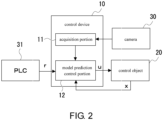
- FIG. 2 shows a schematic configuration of the control device 10 according to the embodiment.
- the control device 10 ( FIG. 1 ) according to the embodiment is a device which is used for respectively controlling, by a model prediction control, a plurality of (one in the diagram) motors 21 driving a specific load device 22 and is generally referred to as a servo amplifier, a servo driver, or the like.
- the load device 22 is an arm of an industrial robot, a carrying device, or the like.
- a part including the plurality of motors 21 controlled by the control device 10 and the load device 22 driven by each of the motors 21 is referred to as a control object 20.
- control device 10 is configured to function as an acquisition part 11 and a model prediction control part 12.
- the acquisition part 11 is a unit which acquires a position (center position) and a size of each actual obstacle existing in the surrounding of a moving body in the control object 20 (a hand of a robot or the like, hereinafter simply referred to as a moving body) by analyzing an imaging result obtained by a camera 30. Moreover, the camera 30 may capture images only in a prescribed range in an advancing direction of the moving body. In addition, the acquisition part 11 may acquire the position and the size only of each actual obstacle existing in the prescribed range in the advancing direction of the moving body (in other words, each actual obstacle to be avoided).
- the model prediction control part 12 is a unit which controls, based on the position and the size of each obstacle acquired by the acquisition part 11 and information from the control object 20 (a position of the moving body and the like), the control object 20 by the model prediction control in order that the moving body avoids each obstacle and moves along a target trajectory instructed from a programmable logic controller ( PLC) 31.
- PLC programmable logic controller
- the control performed by the model prediction control part 12 is the control in which (an input u minimizing a value of an evaluation function J described below is calculated using a prediction model of the control object 20 and based on a state x of the control object to supply to the control object 20).
- J ⁇ x t + T + ⁇ 0 t + T L x ⁇ , u ⁇ d ⁇
- a first term on the right side of Formula 1 denotes a terminal cost
- L in Formula 1 denotes a stage cost.
- T denotes a time width which is previously set as a length of a predicted section in the model prediction control.
- model prediction control part 12 is configured to change the stage cost L used for the calculation of the J value depending on the situation.
- control device 10 is a device which can also move the moving body in a three-dimensional space.
- the moving body is set to be moved on a plane surface for convenience of description.
- the model prediction control part 12 periodically determines the presence/absence of the actual obstacle to be avoided based on the position and the size of each actual obstacle acquired by the acquisition part 11. More specifically, when no position and size of the actual obstacle is acquired by the acquisition part 11 (when there is no actual obstacle), the model prediction control part 12 determines that there is no actual obstacle to be avoided. In addition, when the positions and the sizes of one or more actual obstacles are acquired by the acquisition part 11, based on the position and the size of each actual obstacle, the model prediction control part 12 specifies actual obstacles, which satisfy a condition in which a value of an actual obstacle evaluation term L k defined by the following Formula 2 is equal to or greater than a predetermined value, from the actual obstacles of which the positions and the sizes are acquired by the acquisition part 11.
- the model prediction control part 12 determines that each actual obstacle which has been specified is the actual obstacle to be avoided.
- L k g k exp ⁇ x 1 ⁇ x ok 2 + y 1 ⁇ y ok 2
- a suffix k denotes a number which begins from 1 and is assigned for each actual obstacle that satisfies the above condition.
- x 1 and y 1 denote the position of the moving body (x and y coordinates)
- x ok and y ok denote the position of an actual obstacle k (x and y coordinates).
- g k denotes a value which is decided according to the size of the actual obstacle k.
- the model prediction control part 12 is configured to select three actual obstacles in descending order of values of the actual obstacle evaluation terms and determines that each of the selected actual obstacles is the actual obstacle to be avoided when there are four or more actual obstacles which satisfy the above condition.
- the maximum value of the reference character k is 3.
- the model prediction control part 12 is configured to periodically determine whether or not the moving body comes into a speed reducing state.
- the determination processing may determine that the moving body comes into the speed reducing state when an absolute value of a difference between a current value and a previous value of the position of the moving body is less than a prescribed position threshold value; or may determine that the moving body comes into the speed reducing state when the absolute value of the difference between a current value and a previous value of the minimum value of the calculated J value is less than a prescribed threshold value of the J value.
- the above determination processing may be set to be a processing which determines that the moving body comes into the speed reducing state when the absolute value of the difference between the current value and the previous value of the position of the moving body, or the absolute value of the difference between the current value and the previous value of the minimum value of the J value, is less than a threshold value for a prescribed number of times continuously.
- the model prediction control part 12 periodically determines whether or not the moving body comes into the speed reducing state and periodically determines the presence/absence of the actual obstacle to be avoided, and the model prediction control part 12 also performs a processing of determining which of the first to the third conditions described below is satisfied based on both of the determination results.
- the model prediction control part 12 performs a first model prediction control that is a model prediction control using a standard cost L 0 described below as a stage cost L.
- L 0 1 2 xref ⁇ x T Q xref ⁇ x + u T Ru
- xref denotes a target state amount at a certain time in a predicted section
- x denotes a state amount at the same time
- u denotes a control input at the same time.
- Q denotes a coefficient (weight coefficient) indicating a weight of the state amount in the stage cost
- R denotes a coefficient (weight coefficient) indicating a weight of the control input.
- the model prediction control part 12 performs a second model prediction control which is model prediction control using, as the stage cost L, the following value, that is, a sum of the standard cost L 0 and the actual obstacle evaluation term L k of each actual obstacle.
- kmax in the above formula denotes the total number of the actual obstacles to be avoided ( ⁇ 3 in the embodiment).
- the model prediction control part 12 decides a position which is equidistant from the two or three actual obstacles to be avoided and has the shortest distance to each actual obstacle.
- the model prediction control part 12 calculates a weight g p in which a value of the virtual obstacle evaluation term described below is the sum of the value of the actual obstacle evaluation term of each actual obstacle.
- L p g p exp ⁇ x 1 ⁇ x pk 2 + y 1 ⁇ y pk 2
- x pk and y pk denote the position of the virtual obstacle which is decided (x and y coordinates).
- the model prediction control part 12 calculates the g p according to the following formula by using values V 1 and V 2 of actual obstacle evaluation terms L 1 and L 2 at that time point (in a case in which the moving body is in the current position).
- g p V 1 + V 2 exp x 1 ⁇ x pk 2 + y 1 ⁇ y pk 2
- the model prediction control part 12 starts a third model prediction control which is a model prediction control using a sum of the baseline cost L 0 and a virtual obstacle evaluation term L p as the stage cost L.
- a capability is applied of performing the model prediction control using an evaluation function in which the obstacle evaluation term of each actual obstacle is replaced by the virtual obstacle evaluation term (the third model prediction control) when the moving body comes into the speed reducing state under the situation that there are the plurality of actual obstacles to be avoided.
- the evaluation function including the obstacle evaluation term is simply used, a problem may be generated easily, for example, a problem that the moving body comes into a stationary state, or a problem that an obstacle avoidance route of the moving body makes a large detour.
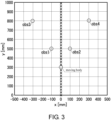
- the third model prediction control as shown by a solid line in FIG. 3 , the moving body can be moved in a form that the above troubles do not occur.
- obs 1 and obs 2 represent actual obstacles to be avoided, and pobs represents a virtual obstacle.
- ⁇ denotes a target position group which predetermines the target trajectory (a command from a PCS 32).
- control device 10 is configured to treat only an actual obstacle having a large value of the obstacle evaluation term as the actual obstacle to be avoided.
- the actual obstacles obs 3 and obs 4 having small values of the obstacle evaluation terms are not treated as the actual obstacles to be avoided. Therefore, as shown in FIG. 5 , even when there are a great number of actual obstacles (obs 1 to obs 4 in the diagram), the avoidance route of the actual obstacle can also be prevented from excessively making a large detour.
- the g p value can be a value (for example, a value which is previously set) smaller than the above value.
- the actual obstacle evaluation term and the virtual obstacle evaluation term may be functions in which the values become greater as the distances to the moving body become shorter (in other words, a probability of the collision with the moving body becomes higher).
- a function different from the above may be used as each evaluation term.
- a function may be used in which a change rate in an arrangement direction of the two actual obstacles is smaller than that in another direction.
- the control device 10 can also be deformed to a device which uses different actual obstacle evaluation terms when selecting an actual obstacle to be an avoided object and when performing actual model prediction control.
- the camera 30 may be a light detection and ranging (LIDAR) or the like, and the control device 10 may be deformed to a device which controls a movement direction of a vehicle.
- LIDAR light detection and ranging
Landscapes
- Engineering & Computer Science (AREA)
- Radar, Positioning & Navigation (AREA)
- Remote Sensing (AREA)
- Physics & Mathematics (AREA)
- Automation & Control Theory (AREA)
- General Physics & Mathematics (AREA)
- Aviation & Aerospace Engineering (AREA)
- Robotics (AREA)
- Mechanical Engineering (AREA)
- Electromagnetism (AREA)
- Control Of Position, Course, Altitude, Or Attitude Of Moving Bodies (AREA)
- Feedback Control In General (AREA)
Description
- The present invention relates to a control device which controls a driving device that moves a moving body.
- In order to move a moving body without colliding with an obstacle, in an evaluation function for deciding a route of the moving body, an evaluation term for not allowing the moving body to approach the obstacle (a penalty term, hereinafter referred to as an obstacle evaluation term) is included for each obstacle (for example, see
Japanese Patent Laid-Open No. 2011-186878 Japanese Patent Laid-Open No. 2014-130495 - GARIMELLA GOWTHAM et al: "Robust obstacle avoidance for aerial platforms using adaptive model predictive control", 2017 IEEE, 29 May 2017 proposes a Nonlinear Model Predictive Control (NMPC) optimization technique which incorporates specified uncertainties into the planned trajectories. At the core of the procedure lies the propagation of model parameter uncertainty and initial state uncertainty as high-confidence ellipsoids in pose space. The quadrotor trajectories are then computed to avoid obstacles by a required safety margin, expressed as ellipsoid penetration while minimizing control effort and achieving a user-specified goal location. Combining this technique with online model identification results in robust obstacle avoidance behavior.
- If the evaluation function including the obstacle evaluation term for each obstacle is used, the moving body can be moved without colliding with the obstacle. However, if the evaluation function including the obstacle evaluation term is simply used, a case in which the collision with the obstacle cannot be avoided suitably may occur, for example, a case in which the moving body comes into a stationary state, or a case in which an obstacle avoidance route of the moving body makes a large detour.
- The present invention is provided by the appended claims. The following disclosure serves a better understanding of the present invention. In the following description, any embodiments referred to and not falling within the scope of the appended claims are merely examples useful for the understanding of the invention. The present invention is completed in view of the above problems, and aims to provide a control device which can suitably avoid a collision with an obstacle when the moving body is caused to follow with respect to a target trajectory by model prediction control.
- In order to achieve the above aim, a control device which controls a driving device that moves a moving body according to an aspect of the present invention includes: an acquisition part that acquires a position of each actual obstacle which may obstruct movement of the moving body along a target trajectory; and a model prediction control part that moves the moving body along the target trajectory by calculating a control input and supplying the control input to the driving device based on a prediction model, determines the presence/absence of an actual obstacle to be avoided according to information from the acquisition part, and uses a standard cost as the stage cost when there is no actual obstacle to be avoided, wherein the control input minimizes a value of an evaluation function including a sum of stage costs in a predicted section of a prescribed time width, and the prediction model is used for predicting the position of the moving body from the control input to the driving device. Besides, the model prediction control part of the control device includes an obstacle avoidance control means that operates when there are a plurality of actual obstacles to be avoided, decides the position of a virtual obstacle from the positions of the plurality of actual obstacles acquired by the acquisition part so as to be positioned between the plurality of actual obstacles, and calculates the control input that minimizes the evaluation function by using, as the stage cost, the addition result of the standard cost and a virtual obstacle evaluation term for which a prescribed function, which uses, as parameters, at least the position of the virtual obstacle and the position of the moving body, is multiplied by a virtual obstacle weight.
- That is, the control device has a configuration in which a virtual obstacle is assumed to exist and the control input is calculated in a case in which the collision between the moving body and the obstacle cannot be avoided suitably if the evaluation function including the obstacle evaluation term is simply used (a case in which two obstacles exist in a way of clamping the target trajectory, or the like). Thus, according to the control device, even in the case in which the collision between the moving body and the obstacle cannot be avoided suitably if the evaluation function including the obstacle evaluation term is simply used, the collision between the moving body and the obstacle can be avoided suitably.
- The obstacle avoidance control means may be a means that uses, as the stage cost, the addition result of the standard cost, the virtual obstacle evaluation term, and an actual obstacle evaluation term for which the prescribed function is multiplied by the weight for each actual obstacle to be avoided; or may be a means that uses, as the stage cost, the addition result of the standard cost and the virtual obstacle evaluation term.
- When the latter means is used as the obstacle avoidance control means, a capability of (deciding the value of the virtual obstacle weight in a way that when the operation is started, a calculation result of the virtual obstacle evaluation term at that time point matches the sum of values at that time point of the actual obstacle evaluation terms for which the prescribed function is multiplied by the weight for each actual obstacle to be avoided ) is preferably applied to the obstacle avoidance control means.
- In addition, when there are two or three actual obstacles to be avoided, the obstacle avoidance control means may decide the position of the virtual obstacle to a position which is equidistant from the two or three actual obstacles are equal and has the distance shortest to each actual obstacle.
- In addition, in the control device, a configuration in which (the model prediction control part further includes a determination means which determines whether or not the moving body comes into a speed reducing state, and the obstacle avoidance control means of the model prediction control part starts the operation when the moving body is determined to come into the speed reducing state under a situation that there are a plurality of actual obstacles to be avoided by the determination means) may be used. Moreover, as the determination means, for example, the following means can be used: a means which determines that the moving body comes into the speed reducing state when an absolute value of a difference between a current value and a previous value of the minimum value of the evaluation function, or the absolute value of the difference between a current value and a previous value of the position of the moving body is less than a prescribed threshold value; or a means which determines that the moving body comes into the speed reducing state when the absolute value of the difference between the current value and the previous value of the minimum value of the evaluation function, or the absolute value of the difference between the current value and the previous value of the position of the moving body is less than a prescribed threshold value for a prescribed number of times continuously.
- In addition, as the obstacle avoidance control means, a means may be used which uses as, the prescribed function, a function in which a change rate of the virtual obstacle evaluation term in an arrangement direction of the two actual obstacles is smaller than that in another direction when there are two actual obstacles to be avoided.
- The model prediction control part may take all of the actual obstacles of which the positions are acquired by the acquisition part as the obstacles to be avoided. In addition, when the positions of the plurality of actual obstacles are acquired by the acquisition part, the model prediction control part may calculate, for each of the plurality of actual obstacles, an evaluation value indicating a probability in which a collision with the moving body can occur, and may decide which of the plurality of actual obstacles is the actual obstacle to be avoided based on the evaluation value calculated for each actual obstacle.
- According to the present invention, when the moving body is caused to follow with respect to the target trajectory by the model prediction control, a collision between the moving body and the obstacle can be avoided suitably.
-
-
FIG. 1 is an illustration diagram of a use form of a control device according to an embodiment of the present invention. -
FIG. 2 is an illustration diagram of a schematic configuration of the control device according to the embodiment. -
FIG. 3 is an illustration diagram of a control result example of the control device according to the embodiment. -
FIG. 4 is an illustration diagram of a capability of the control device according to the embodiment. -
FIG. 5 is an illustration diagram of a control result example of the control device according to the embodiment. - Hereinafter, an embodiment of the present invention is described with reference to the drawings.
-
FIG. 1 shows a use form of acontrol device 10 according to an embodiment of the present invention, andFIG. 2 shows a schematic configuration of thecontrol device 10 according to the embodiment. - The control device 10 (
FIG. 1 ) according to the embodiment is a device which is used for respectively controlling, by a model prediction control, a plurality of (one in the diagram)motors 21 driving aspecific load device 22 and is generally referred to as a servo amplifier, a servo driver, or the like. Moreover, theload device 22 is an arm of an industrial robot, a carrying device, or the like. Hereinafter, a part including the plurality ofmotors 21 controlled by thecontrol device 10 and theload device 22 driven by each of themotors 21 is referred to as acontrol object 20. - As shown in
FIG. 2 , thecontrol device 10 is configured to function as anacquisition part 11 and a modelprediction control part 12. - The
acquisition part 11 is a unit which acquires a position (center position) and a size of each actual obstacle existing in the surrounding of a moving body in the control object 20 (a hand of a robot or the like, hereinafter simply referred to as a moving body) by analyzing an imaging result obtained by acamera 30. Moreover, thecamera 30 may capture images only in a prescribed range in an advancing direction of the moving body. In addition, theacquisition part 11 may acquire the position and the size only of each actual obstacle existing in the prescribed range in the advancing direction of the moving body (in other words, each actual obstacle to be avoided). - The model
prediction control part 12 is a unit which controls, based on the position and the size of each obstacle acquired by theacquisition part 11 and information from the control object 20 (a position of the moving body and the like), thecontrol object 20 by the model prediction control in order that the moving body avoids each obstacle and moves along a target trajectory instructed from a programmable logic controller ( PLC) 31. - The control performed by the model
prediction control part 12 is the control in which ( an input u minimizing a value of an evaluation function J described below is calculated using a prediction model of thecontrol object 20 and based on a state x of the control object to supply to the control object 20).
[Mathematical formula 1]
- Herein, the model
prediction control part 12 is configured to change the stage cost L used for the calculation of the J value depending on the situation. - Taking the above as the premise, hereinafter, a capability of the model
prediction control part 12 is described specifically. Moreover, thecontrol device 10 is a device which can also move the moving body in a three-dimensional space. However, hereinafter, the moving body is set to be moved on a plane surface for convenience of description. - The model
prediction control part 12 periodically determines the presence/absence of the actual obstacle to be avoided based on the position and the size of each actual obstacle acquired by theacquisition part 11. More specifically, when no position and size of the actual obstacle is acquired by the acquisition part 11 (when there is no actual obstacle), the modelprediction control part 12 determines that there is no actual obstacle to be avoided. In addition, when the positions and the sizes of one or more actual obstacles are acquired by theacquisition part 11, based on the position and the size of each actual obstacle, the modelprediction control part 12 specifies actual obstacles, which satisfy a condition in which a value of an actual obstacle evaluation term Lk defined by the following Formula 2 is equal to or greater than a predetermined value, from the actual obstacles of which the positions and the sizes are acquired by theacquisition part 11. Then, the modelprediction control part 12 determines that each actual obstacle which has been specified is the actual obstacle to be avoided.
[Mathematical formula 2]
- Moreover, the model
prediction control part 12 is configured to select three actual obstacles in descending order of values of the actual obstacle evaluation terms and determines that each of the selected actual obstacles is the actual obstacle to be avoided when there are four or more actual obstacles which satisfy the above condition. Thus, the maximum value of the reference character k is 3. - In addition, the model
prediction control part 12 is configured to periodically determine whether or not the moving body comes into a speed reducing state. The determination processing may determine that the moving body comes into the speed reducing state when an absolute value of a difference between a current value and a previous value of the position of the moving body is less than a prescribed position threshold value; or may determine that the moving body comes into the speed reducing state when the absolute value of the difference between a current value and a previous value of the minimum value of the calculated J value is less than a prescribed threshold value of the J value. In addition, in order to prevent erroneous detection, the above determination processing may be set to be a processing which determines that the moving body comes into the speed reducing state when the absolute value of the difference between the current value and the previous value of the position of the moving body, or the absolute value of the difference between the current value and the previous value of the minimum value of the J value, is less than a threshold value for a prescribed number of times continuously. - As described above, the model
prediction control part 12 periodically determines whether or not the moving body comes into the speed reducing state and periodically determines the presence/absence of the actual obstacle to be avoided, and the modelprediction control part 12 also performs a processing of determining which of the first to the third conditions described below is satisfied based on both of the determination results. - First condition: there is no actual obstacle to be avoided.
- Second condition: there are one or more actual obstacles to be avoided, and the third condition is not satisfied.
- Third condition: under a situation that there are a plurality of actual obstacles to be avoided, the moving body comes into a speed reducing state.
- Besides, when the first condition is satisfied (when there is no actual obstacle to be avoided), the model
prediction control part 12 performs a first model prediction control that is a model prediction control using a standard cost L0 described below as a stagecost L. 
- Moreover, xref denotes a target state amount at a certain time in a predicted section, x denotes a state amount at the same time, and u denotes a control input at the same time. In addition, Q denotes a coefficient (weight coefficient) indicating a weight of the state amount in the stage cost, and R denotes a coefficient (weight coefficient) indicating a weight of the control input.
- In addition, when the second condition is satisfied, the model
prediction control part 12 performs a second model prediction control which is model prediction control using, as the stage cost L, the following value, that is, a sum of the standard cost L0 and the actual obstacle evaluation term Lk of each actual obstacle.
- Moreover, kmax in the above formula denotes the total number of the actual obstacles to be avoided (≤ 3 in the embodiment).
- In addition, when the third condition is satisfied, firstly, the model
prediction control part 12 decides a position which is equidistant from the two or three actual obstacles to be avoided and has the shortest distance to each actual obstacle. Next, the modelprediction control part 12 calculates a weight gp in which a value of the virtual obstacle evaluation term described below is the sum of the value of the actual obstacle evaluation term of each actual obstacle.
- Specifically, for example, when there are two actual obstacles to be avoided, the model
prediction control part 12 calculates the gp according to the following formula by using values V1 and V2 of actual obstacle evaluation terms L1 and L2 at that time point (in a case in which the moving body is in the current position).
- Besides, the model
prediction control part 12 starts a third model prediction control which is a model prediction control using a sum of the baseline cost L0 and a virtual obstacle evaluation term Lp as the stage cost L. - As described above, with respect to the
control device 10, a capability is applied of performing the model prediction control using an evaluation function in which the obstacle evaluation term of each actual obstacle is replaced by the virtual obstacle evaluation term (the third model prediction control) when the moving body comes into the speed reducing state under the situation that there are the plurality of actual obstacles to be avoided. In this case, if the evaluation function including the obstacle evaluation term is simply used, a problem may be generated easily, for example, a problem that the moving body comes into a stationary state, or a problem that an obstacle avoidance route of the moving body makes a large detour. Besides, according to the third model prediction control, as shown by a solid line inFIG. 3 , the moving body can be moved in a form that the above troubles do not occur. Moreover, inFIG. 3 ,obs 1 and obs 2 represent actual obstacles to be avoided, and pobs represents a virtual obstacle. In addition, × denotes a target position group which predetermines the target trajectory (a command from a PCS 32). - In addition, the
control device 10 is configured to treat only an actual obstacle having a large value of the obstacle evaluation term as the actual obstacle to be avoided. Thus, for example, as shown inFIG. 4 , even when there are four actual obstacles obs 1 to obs 4, the actual obstacles obs 3 and obs 4 having small values of the obstacle evaluation terms are not treated as the actual obstacles to be avoided. Therefore, as shown inFIG. 5 , even when there are a great number of actual obstacles (obs 1 to obs 4 in the diagram), the avoidance route of the actual obstacle can also be prevented from excessively making a large detour. - With regard to the
control device 10 according to the embodiment described above, various deformations can be made. For example, during the third model prediction control, the following stage cost L may be used.
[Mathematical formula 7]
- Moreover, when the above stage cost L is used, the gp value can be a value (for example, a value which is previously set) smaller than the above value.
- In addition, during the third model prediction control, a calculation may be performed in which each Lk value in the above Formula 3 is set to "0".
- In addition, the actual obstacle evaluation term and the virtual obstacle evaluation term may be functions in which the values become greater as the distances to the moving body become shorter (in other words, a probability of the collision with the moving body becomes higher). Thus, a function different from the above may be used as each evaluation term. In addition, in order to prevent the avoidance trajectory from excessively making a large detour (in order to shorten a period in which the moving body is away from the target trajectory), when there are two actual obstacles to be avoided, as the virtual obstacle evaluation term, a function may be used in which a change rate in an arrangement direction of the two actual obstacles is smaller than that in another direction.
- The
control device 10 can also be deformed to a device which uses different actual obstacle evaluation terms when selecting an actual obstacle to be an avoided object and when performing actual model prediction control. In addition, it is natural that, for example, thecamera 30 may be a light detection and ranging (LIDAR) or the like, and thecontrol device 10 may be deformed to a device which controls a movement direction of a vehicle. -
- 10
- control device
- 11
- acquisition part
- 12
- model prediction control part
- 20
- control object
- 21
- motor
- 22
- load device
- 30
- camera
- 31
- PLC
Claims (9)
- A control device (10) which controls a driving device that moves a moving body, comprising:an acquisition part (11) that acquires a position of each of actual obstacles which may obstruct movement of the moving body along a target trajectory; anda model prediction control part (12) that moves the moving body along the target trajectory by calculating a control input and supplying the control input to the driving device based on a prediction model, determines presence/absence of the actual obstacle to be avoided according to information from the acquisition part, and uses a baseline cost function, containing a weight coefficient Q indicating a weight of the state amount in a stage cost function and a weight coefficient R indicating a weight of the control input, as the stage cost function when there is no actual obstacle to be avoided, wherein the control input minimizes a value of an evaluation function comprising a sum of stage cost function in a predicted trajectory of a prescribed time width, and the prediction model is used for predicting a position of the moving body from the control input to the driving device, andthe control device (10) being characterized in that the model prediction control part (12) comprisesan obstacle avoidance control unit that operates when there are a plurality of the actual obstacles to be avoided, decides a position of an additional obstacle from the positions of the plurality of actual obstacles acquired by the acquisition part so as to be positioned between the plurality of actual obstacles, and calculates the control input that minimizes the evaluation function by using, as the stage cost function, an addition result of the baseline cost function and an additional obstacle evaluation term for which a prescribed function, which uses, as parameters, at least the position of the additional obstacle and the position of the moving body, is multiplied by an additional obstacle weight,when there are two or three actual obstacles to be avoided, the obstacle avoidance control unit decides the position of the additional obstacle to a position which is equidistant from the two or three actual obstacles and has the shortest distance to each of the actual obstacles.
- The control device (10) according to claim 1, characterized in that
the obstacle avoidance control unit uses, as the stage cost function, an addition result of the baseline cost function, the additional obstacle evaluation term, and an actual obstacle evaluation term for which the prescribed function is multiplied by the weight for each of the actual obstacles to be avoided. - The control device (10) according to claim 1, characterized in that
the obstacle avoidance control unit uses, as the stage cost function, an addition result of the baseline cost function and the additional obstacle evaluation term. - The control device (10) according to claim 3, characterized in that
the obstacle avoidance control unit decides a value of the additional obstacle weight in a way that when starting operations, a calculation result of the additional obstacle evaluation term at that time point matches the sum of values at that time point of the actual obstacle evaluation terms for which the prescribed function is multiplied by the weight for each of the actual obstacles to be avoided. - The control device according to any one of claims 1 to 4, characterized in thatthe model prediction control part further comprises a determination unit which determines whether or not the moving body comes into a speed reducing state, andthe obstacle avoidance control unit of the model prediction control part starts operations when the moving body is determined to come into the speed reducing state under a situation that there are the plurality of actual obstacles to be avoided by the determination unit.
- The control device (10) according to claim 5, characterized in that
when an absolute value of a difference between a current value and a previous value of a minimum value of the evaluation function, or an absolute value of a difference between a current value and a previous value of the position of the moving body is less than a prescribed threshold value, the determination unit determines that the moving body comes into the speed reducing state. - The control device (10) according to claim 6, characterized in that
when the absolute value of the difference between the current value and the previous value of the minimum value of the evaluation function, or the absolute value of the difference between the current value and the previous value of the position of the moving body is less than the prescribed threshold value for a prescribed number of times continuously, the determination unit determines that the moving body comes into the speed reducing state. - The control device (10) according to claim 4, characterized in that
When there are two actual obstacles to be avoided, the obstacle avoidance control unit uses, as the prescribed function, a function in which a change rate of the additional obstacle evaluation term in an arrangement direction of the two actual obstacles is smaller than that in another direction. - The control device (10) according to claim 1, characterized in that
when the positions of the plurality of actual obstacles are acquired by the acquisition part, the model prediction control part calculates, for each of the plurality of actual obstacles, an evaluation value indicating a probability in which a collision with the moving body may occur, and decides which of the plurality of actual obstacles is the actual obstacle to be avoided based on the evaluation value calculated for each of the actual obstacles.
Applications Claiming Priority (2)
| Application Number | Priority Date | Filing Date | Title |
|---|---|---|---|
| JP2018182621A JP7070295B2 (en) | 2018-09-27 | 2018-09-27 | Control device |
| PCT/JP2019/038202 WO2020067445A1 (en) | 2018-09-27 | 2019-09-27 | Control device |
Publications (3)
| Publication Number | Publication Date |
|---|---|
| EP3859457A1 EP3859457A1 (en) | 2021-08-04 |
| EP3859457A4 EP3859457A4 (en) | 2022-05-11 |
| EP3859457B1 true EP3859457B1 (en) | 2025-05-14 |
Family
ID=69949835
Family Applications (1)
| Application Number | Title | Priority Date | Filing Date |
|---|---|---|---|
| EP19867804.7A Active EP3859457B1 (en) | 2018-09-27 | 2019-09-27 | Control device |
Country Status (5)
| Country | Link |
|---|---|
| US (1) | US11586215B2 (en) |
| EP (1) | EP3859457B1 (en) |
| JP (1) | JP7070295B2 (en) |
| CN (1) | CN112534376B (en) |
| WO (1) | WO2020067445A1 (en) |
Families Citing this family (3)
| Publication number | Priority date | Publication date | Assignee | Title |
|---|---|---|---|---|
| WO2022044470A1 (en) * | 2020-08-27 | 2022-03-03 | パナソニックIpマネジメント株式会社 | Mobile body control method, mobile body control device, and mobile body |
| CN112346457A (en) * | 2020-11-03 | 2021-02-09 | 智邮开源通信研究院(北京)有限公司 | Control method and device for obstacle avoidance, electronic equipment and readable storage medium |
| CN120702480B (en) * | 2025-08-25 | 2025-11-04 | 天津博诺智创机器人技术有限公司 | A Smart Navigation Method for Robots |
Family Cites Families (13)
| Publication number | Priority date | Publication date | Assignee | Title |
|---|---|---|---|---|
| JP4241673B2 (en) | 2005-06-17 | 2009-03-18 | 本田技研工業株式会社 | Mobile path generation device |
| JP4576445B2 (en) * | 2007-04-12 | 2010-11-10 | パナソニック株式会社 | Autonomous mobile device and program for autonomous mobile device |
| JP5463971B2 (en) | 2010-03-10 | 2014-04-09 | 日産自動車株式会社 | Mobile body travel route generation device |
| WO2012172632A1 (en) * | 2011-06-13 | 2012-12-20 | トヨタ自動車株式会社 | Driving assistance device and driving assistance method |
| JP5930892B2 (en) * | 2011-09-07 | 2016-06-08 | 本田技研工業株式会社 | Contact state estimation device and trajectory generation device |
| JP2014130495A (en) | 2012-12-28 | 2014-07-10 | Mitsubishi Heavy Ind Ltd | Movement control device, movement control method, and program |
| US10002471B2 (en) | 2015-09-30 | 2018-06-19 | Ants Technology (Hk) Limited | Systems and methods for autonomous vehicle navigation |
| CN107168319B (en) * | 2017-06-01 | 2020-07-28 | 同济大学 | Unmanned vehicle obstacle avoidance method based on model predictive control |
| CN107807641B (en) * | 2017-10-25 | 2019-11-19 | 上海思岚科技有限公司 | Method for mobile robot obstacle avoidance |
| CN107885209B (en) * | 2017-11-13 | 2020-08-21 | 浙江工业大学 | An Obstacle Avoidance Method Based on Dynamic Window and Virtual Target Point |
| CN108398960B (en) * | 2018-03-02 | 2021-01-26 | 南京航空航天大学 | Multi-unmanned aerial vehicle cooperative target tracking method for improving combination of APF and segmented Bezier |
| US20190354099A1 (en) * | 2018-05-18 | 2019-11-21 | Qualcomm Incorporated | Augmenting a robotic vehicle with virtual features |
| CN108549407B (en) * | 2018-05-23 | 2020-11-13 | 哈尔滨工业大学(威海) | A Control Algorithm for Multi-UAV Cooperative Formation to Avoid Obstacles |
-
2018
- 2018-09-27 JP JP2018182621A patent/JP7070295B2/en active Active
-
2019
- 2019-09-27 US US17/267,034 patent/US11586215B2/en active Active
- 2019-09-27 WO PCT/JP2019/038202 patent/WO2020067445A1/en not_active Ceased
- 2019-09-27 CN CN201980051236.9A patent/CN112534376B/en active Active
- 2019-09-27 EP EP19867804.7A patent/EP3859457B1/en active Active
Also Published As
| Publication number | Publication date |
|---|---|
| JP7070295B2 (en) | 2022-05-18 |
| CN112534376A (en) | 2021-03-19 |
| CN112534376B (en) | 2024-06-11 |
| US11586215B2 (en) | 2023-02-21 |
| US20210311487A1 (en) | 2021-10-07 |
| JP2020052816A (en) | 2020-04-02 |
| WO2020067445A1 (en) | 2020-04-02 |
| EP3859457A1 (en) | 2021-08-04 |
| EP3859457A4 (en) | 2022-05-11 |
Similar Documents
| Publication | Publication Date | Title |
|---|---|---|
| US10739778B2 (en) | Method and device for controlling a trajectory planning process of an ego-vehicle | |
| EP3859457B1 (en) | Control device | |
| EP3333662B1 (en) | Tele-operated vehicle, and vehicle control device and control method thereof | |
| EP3552901B1 (en) | Apparatus and method for providing safety strategy in vehicle | |
| JP7193656B2 (en) | Control unit and method for recognizing intruding or exiting vehicles | |
| EP2172919A1 (en) | Vehicle travel track estimator | |
| EP2990290A1 (en) | Method and system for post-collision manoeuvre planning and vehicle equipped with such system | |
| US20170039865A1 (en) | Route prediction device | |
| KR102304018B1 (en) | Method, apparatus and computer program for preventing collision of automatic driving vehicle | |
| JPH07104062A (en) | Collision prevention device | |
| CN110111602A (en) | A kind of vehicle collision prewarning method, device and equipment | |
| JP7575514B2 (en) | A support system for dynamic environments. | |
| Bosnak et al. | Efficient time-to-collision estimation for a braking supervision system with lidar | |
| EP3604065B1 (en) | Vehicle travelling control apparatus | |
| US20220001857A1 (en) | Parking assistance device, vehicle, parking assistance method, and non-transitory computer-readable medium | |
| EP3667451A1 (en) | Method and system for controlling a plurality of autonomous vehicles | |
| EP4155858B1 (en) | Guidance control method and apparatus, charging pile and robot | |
| EP4286114A1 (en) | Control device, control system, control method, and program | |
| JP6898645B2 (en) | Automatic steering system | |
| US20230347518A1 (en) | Method of improving a preplanned movement sequence for the control of a robot | |
| US12145627B2 (en) | System and method for predicting the trajectory of a vehicle | |
| EP4033473A1 (en) | Method, system and vehicle for assisting an operator of the vehicle in assessing a traffic situation with shared traffic space | |
| EP3617021B1 (en) | Performing a merging maneuver of an automated vehicle | |
| EP3967564B1 (en) | Method for adjusting the speed of a vehicle | |
| JPH09251320A (en) | Robot collision prevention system |
Legal Events
| Date | Code | Title | Description |
|---|---|---|---|
| STAA | Information on the status of an ep patent application or granted ep patent |
Free format text: STATUS: THE INTERNATIONAL PUBLICATION HAS BEEN MADE |
|
| PUAI | Public reference made under article 153(3) epc to a published international application that has entered the european phase |
Free format text: ORIGINAL CODE: 0009012 |
|
| STAA | Information on the status of an ep patent application or granted ep patent |
Free format text: STATUS: REQUEST FOR EXAMINATION WAS MADE |
|
| 17P | Request for examination filed |
Effective date: 20210203 |
|
| AK | Designated contracting states |
Kind code of ref document: A1 Designated state(s): AL AT BE BG CH CY CZ DE DK EE ES FI FR GB GR HR HU IE IS IT LI LT LU LV MC MK MT NL NO PL PT RO RS SE SI SK SM TR |
|
| DAV | Request for validation of the european patent (deleted) | ||
| DAX | Request for extension of the european patent (deleted) | ||
| A4 | Supplementary search report drawn up and despatched |
Effective date: 20220413 |
|
| RIC1 | Information provided on ipc code assigned before grant |
Ipc: G05B 17/02 20060101ALI20220407BHEP Ipc: G05B 13/04 20060101ALI20220407BHEP Ipc: G05D 1/02 20200101AFI20220407BHEP |
|
| STAA | Information on the status of an ep patent application or granted ep patent |
Free format text: STATUS: EXAMINATION IS IN PROGRESS |
|
| 17Q | First examination report despatched |
Effective date: 20221005 |
|
| REG | Reference to a national code |
Ref country code: DE Ref legal event code: R079 Free format text: PREVIOUS MAIN CLASS: G05B0013040000 Ipc: G05D0001000000 Ref country code: DE Ref legal event code: R079 Ref document number: 602019070071 Country of ref document: DE Free format text: PREVIOUS MAIN CLASS: G05B0013040000 Ipc: G05D0001000000 |
|
| GRAP | Despatch of communication of intention to grant a patent |
Free format text: ORIGINAL CODE: EPIDOSNIGR1 |
|
| STAA | Information on the status of an ep patent application or granted ep patent |
Free format text: STATUS: GRANT OF PATENT IS INTENDED |
|
| RIC1 | Information provided on ipc code assigned before grant |
Ipc: G05D 1/00 20060101AFI20241118BHEP |
|
| INTG | Intention to grant announced |
Effective date: 20241216 |
|
| GRAS | Grant fee paid |
Free format text: ORIGINAL CODE: EPIDOSNIGR3 |
|
| GRAA | (expected) grant |
Free format text: ORIGINAL CODE: 0009210 |
|
| STAA | Information on the status of an ep patent application or granted ep patent |
Free format text: STATUS: THE PATENT HAS BEEN GRANTED |
|
| AK | Designated contracting states |
Kind code of ref document: B1 Designated state(s): AL AT BE BG CH CY CZ DE DK EE ES FI FR GB GR HR HU IE IS IT LI LT LU LV MC MK MT NL NO PL PT RO RS SE SI SK SM TR |
|
| REG | Reference to a national code |
Ref country code: GB Ref legal event code: FG4D |
|
| REG | Reference to a national code |
Ref country code: CH Ref legal event code: EP |
|
| REG | Reference to a national code |
Ref country code: DE Ref legal event code: R096 Ref document number: 602019070071 Country of ref document: DE |
|
| REG | Reference to a national code |
Ref country code: IE Ref legal event code: FG4D |
|
| REG | Reference to a national code |
Ref country code: NL Ref legal event code: MP Effective date: 20250514 |
|
| PG25 | Lapsed in a contracting state [announced via postgrant information from national office to epo] |
Ref country code: FI Free format text: LAPSE BECAUSE OF FAILURE TO SUBMIT A TRANSLATION OF THE DESCRIPTION OR TO PAY THE FEE WITHIN THE PRESCRIBED TIME-LIMIT Effective date: 20250514 Ref country code: PT Free format text: LAPSE BECAUSE OF FAILURE TO SUBMIT A TRANSLATION OF THE DESCRIPTION OR TO PAY THE FEE WITHIN THE PRESCRIBED TIME-LIMIT Effective date: 20250915 Ref country code: ES Free format text: LAPSE BECAUSE OF FAILURE TO SUBMIT A TRANSLATION OF THE DESCRIPTION OR TO PAY THE FEE WITHIN THE PRESCRIBED TIME-LIMIT Effective date: 20250514 |
|
| REG | Reference to a national code |
Ref country code: LT Ref legal event code: MG9D |
|
| PG25 | Lapsed in a contracting state [announced via postgrant information from national office to epo] |
Ref country code: NO Free format text: LAPSE BECAUSE OF FAILURE TO SUBMIT A TRANSLATION OF THE DESCRIPTION OR TO PAY THE FEE WITHIN THE PRESCRIBED TIME-LIMIT Effective date: 20250814 Ref country code: GR Free format text: LAPSE BECAUSE OF FAILURE TO SUBMIT A TRANSLATION OF THE DESCRIPTION OR TO PAY THE FEE WITHIN THE PRESCRIBED TIME-LIMIT Effective date: 20250815 |
|
| PG25 | Lapsed in a contracting state [announced via postgrant information from national office to epo] |
Ref country code: PL Free format text: LAPSE BECAUSE OF FAILURE TO SUBMIT A TRANSLATION OF THE DESCRIPTION OR TO PAY THE FEE WITHIN THE PRESCRIBED TIME-LIMIT Effective date: 20250514 Ref country code: NL Free format text: LAPSE BECAUSE OF FAILURE TO SUBMIT A TRANSLATION OF THE DESCRIPTION OR TO PAY THE FEE WITHIN THE PRESCRIBED TIME-LIMIT Effective date: 20250514 |
|
| REG | Reference to a national code |
Ref country code: AT Ref legal event code: MK05 Ref document number: 1795310 Country of ref document: AT Kind code of ref document: T Effective date: 20250514 |
|
| PG25 | Lapsed in a contracting state [announced via postgrant information from national office to epo] |
Ref country code: BG Free format text: LAPSE BECAUSE OF FAILURE TO SUBMIT A TRANSLATION OF THE DESCRIPTION OR TO PAY THE FEE WITHIN THE PRESCRIBED TIME-LIMIT Effective date: 20250514 |
|
| PG25 | Lapsed in a contracting state [announced via postgrant information from national office to epo] |
Ref country code: HR Free format text: LAPSE BECAUSE OF FAILURE TO SUBMIT A TRANSLATION OF THE DESCRIPTION OR TO PAY THE FEE WITHIN THE PRESCRIBED TIME-LIMIT Effective date: 20250514 |
|
| PG25 | Lapsed in a contracting state [announced via postgrant information from national office to epo] |
Ref country code: AT Free format text: LAPSE BECAUSE OF FAILURE TO SUBMIT A TRANSLATION OF THE DESCRIPTION OR TO PAY THE FEE WITHIN THE PRESCRIBED TIME-LIMIT Effective date: 20250514 |
|
| PG25 | Lapsed in a contracting state [announced via postgrant information from national office to epo] |
Ref country code: RS Free format text: LAPSE BECAUSE OF FAILURE TO SUBMIT A TRANSLATION OF THE DESCRIPTION OR TO PAY THE FEE WITHIN THE PRESCRIBED TIME-LIMIT Effective date: 20250814 |
|
| PG25 | Lapsed in a contracting state [announced via postgrant information from national office to epo] |
Ref country code: IS Free format text: LAPSE BECAUSE OF FAILURE TO SUBMIT A TRANSLATION OF THE DESCRIPTION OR TO PAY THE FEE WITHIN THE PRESCRIBED TIME-LIMIT Effective date: 20250914 |
|
| PG25 | Lapsed in a contracting state [announced via postgrant information from national office to epo] |
Ref country code: LV Free format text: LAPSE BECAUSE OF FAILURE TO SUBMIT A TRANSLATION OF THE DESCRIPTION OR TO PAY THE FEE WITHIN THE PRESCRIBED TIME-LIMIT Effective date: 20250514 |
|
| PGFP | Annual fee paid to national office [announced via postgrant information from national office to epo] |
Ref country code: DE Payment date: 20250929 Year of fee payment: 7 |
|
| PG25 | Lapsed in a contracting state [announced via postgrant information from national office to epo] |
Ref country code: DK Free format text: LAPSE BECAUSE OF FAILURE TO SUBMIT A TRANSLATION OF THE DESCRIPTION OR TO PAY THE FEE WITHIN THE PRESCRIBED TIME-LIMIT Effective date: 20250514 Ref country code: SM Free format text: LAPSE BECAUSE OF FAILURE TO SUBMIT A TRANSLATION OF THE DESCRIPTION OR TO PAY THE FEE WITHIN THE PRESCRIBED TIME-LIMIT Effective date: 20250514 |
|
| PG25 | Lapsed in a contracting state [announced via postgrant information from national office to epo] |
Ref country code: CZ Free format text: LAPSE BECAUSE OF FAILURE TO SUBMIT A TRANSLATION OF THE DESCRIPTION OR TO PAY THE FEE WITHIN THE PRESCRIBED TIME-LIMIT Effective date: 20250514 |
|
| PG25 | Lapsed in a contracting state [announced via postgrant information from national office to epo] |
Ref country code: EE Free format text: LAPSE BECAUSE OF FAILURE TO SUBMIT A TRANSLATION OF THE DESCRIPTION OR TO PAY THE FEE WITHIN THE PRESCRIBED TIME-LIMIT Effective date: 20250514 |
|
| PG25 | Lapsed in a contracting state [announced via postgrant information from national office to epo] |
Ref country code: SK Free format text: LAPSE BECAUSE OF FAILURE TO SUBMIT A TRANSLATION OF THE DESCRIPTION OR TO PAY THE FEE WITHIN THE PRESCRIBED TIME-LIMIT Effective date: 20250514 Ref country code: RO Free format text: LAPSE BECAUSE OF FAILURE TO SUBMIT A TRANSLATION OF THE DESCRIPTION OR TO PAY THE FEE WITHIN THE PRESCRIBED TIME-LIMIT Effective date: 20250514 |
|
| PG25 | Lapsed in a contracting state [announced via postgrant information from national office to epo] |
Ref country code: IT Free format text: LAPSE BECAUSE OF FAILURE TO SUBMIT A TRANSLATION OF THE DESCRIPTION OR TO PAY THE FEE WITHIN THE PRESCRIBED TIME-LIMIT Effective date: 20250514 |
|
| REG | Reference to a national code |
Ref country code: DE Ref legal event code: R097 Ref document number: 602019070071 Country of ref document: DE |
|
| PLBE | No opposition filed within time limit |
Free format text: ORIGINAL CODE: 0009261 |
|
| STAA | Information on the status of an ep patent application or granted ep patent |
Free format text: STATUS: NO OPPOSITION FILED WITHIN TIME LIMIT |
|
| REG | Reference to a national code |
Ref country code: CH Ref legal event code: L10 Free format text: ST27 STATUS EVENT CODE: U-0-0-L10-L00 (AS PROVIDED BY THE NATIONAL OFFICE) Effective date: 20260325 |
|
| 26N | No opposition filed |
Effective date: 20260217 |
|
| REG | Reference to a national code |
Ref country code: CH Ref legal event code: H13 Free format text: ST27 STATUS EVENT CODE: U-0-0-H10-H13 (AS PROVIDED BY THE NATIONAL OFFICE) Effective date: 20260425 |