EP3859002A1 - Novel fructose-4-epimerase and tagatose production method using same - Google Patents
Novel fructose-4-epimerase and tagatose production method using same Download PDFInfo
- Publication number
- EP3859002A1 EP3859002A1 EP19864983.2A EP19864983A EP3859002A1 EP 3859002 A1 EP3859002 A1 EP 3859002A1 EP 19864983 A EP19864983 A EP 19864983A EP 3859002 A1 EP3859002 A1 EP 3859002A1
- Authority
- EP
- European Patent Office
- Prior art keywords
- amino acid
- fructose
- variant
- epimerase
- epimerase variant
- Prior art date
- Legal status (The legal status is an assumption and is not a legal conclusion. Google has not performed a legal analysis and makes no representation as to the accuracy of the status listed.)
- Pending
Links
- BJHIKXHVCXFQLS-PQLUHFTBSA-N keto-D-tagatose Chemical compound OC[C@@H](O)[C@H](O)[C@H](O)C(=O)CO BJHIKXHVCXFQLS-PQLUHFTBSA-N 0.000 title claims abstract description 48
- 238000004519 manufacturing process Methods 0.000 title description 8
- 238000000034 method Methods 0.000 claims abstract description 23
- 235000001014 amino acid Nutrition 0.000 claims description 266
- 229940024606 amino acid Drugs 0.000 claims description 253
- 150000001413 amino acids Chemical group 0.000 claims description 202
- 244000005700 microbiome Species 0.000 claims description 60
- 108091033319 polynucleotide Proteins 0.000 claims description 47
- 102000040430 polynucleotide Human genes 0.000 claims description 47
- 239000002157 polynucleotide Substances 0.000 claims description 47
- AYFVYJQAPQTCCC-UHFFFAOYSA-N Threonine Natural products CC(O)C(N)C(O)=O AYFVYJQAPQTCCC-UHFFFAOYSA-N 0.000 claims description 37
- 239000004473 Threonine Substances 0.000 claims description 37
- DHMQDGOQFOQNFH-UHFFFAOYSA-N Glycine Chemical compound NCC(O)=O DHMQDGOQFOQNFH-UHFFFAOYSA-N 0.000 claims description 34
- RFSUNEUAIZKAJO-ARQDHWQXSA-N Fructose Chemical compound OC[C@H]1O[C@](O)(CO)[C@@H](O)[C@@H]1O RFSUNEUAIZKAJO-ARQDHWQXSA-N 0.000 claims description 32
- 229930091371 Fructose Natural products 0.000 claims description 28
- 239000005715 Fructose Substances 0.000 claims description 28
- 239000013598 vector Substances 0.000 claims description 21
- 239000004471 Glycine Substances 0.000 claims description 18
- MTCFGRXMJLQNBG-UHFFFAOYSA-N Serine Natural products OCC(N)C(O)=O MTCFGRXMJLQNBG-UHFFFAOYSA-N 0.000 claims description 18
- ROHFNLRQFUQHCH-UHFFFAOYSA-N Leucine Natural products CC(C)CC(N)C(O)=O ROHFNLRQFUQHCH-UHFFFAOYSA-N 0.000 claims description 17
- 239000000203 mixture Substances 0.000 claims description 16
- 235000018417 cysteine Nutrition 0.000 claims description 15
- XUJNEKJLAYXESH-UHFFFAOYSA-N cysteine Natural products SCC(N)C(O)=O XUJNEKJLAYXESH-UHFFFAOYSA-N 0.000 claims description 15
- 239000004475 Arginine Substances 0.000 claims description 14
- ROHFNLRQFUQHCH-YFKPBYRVSA-N L-leucine Chemical compound CC(C)C[C@H](N)C(O)=O ROHFNLRQFUQHCH-YFKPBYRVSA-N 0.000 claims description 14
- ODKSFYDXXFIFQN-UHFFFAOYSA-N arginine Natural products OC(=O)C(N)CCCNC(N)=N ODKSFYDXXFIFQN-UHFFFAOYSA-N 0.000 claims description 14
- OUYCCCASQSFEME-UHFFFAOYSA-N tyrosine Natural products OC(=O)C(N)CC1=CC=C(O)C=C1 OUYCCCASQSFEME-UHFFFAOYSA-N 0.000 claims description 14
- OUYCCCASQSFEME-QMMMGPOBSA-N L-tyrosine Chemical compound OC(=O)[C@@H](N)CC1=CC=C(O)C=C1 OUYCCCASQSFEME-QMMMGPOBSA-N 0.000 claims description 13
- KDXKERNSBIXSRK-UHFFFAOYSA-N Lysine Natural products NCCCCC(N)C(O)=O KDXKERNSBIXSRK-UHFFFAOYSA-N 0.000 claims description 10
- 239000004472 Lysine Substances 0.000 claims description 10
- QIVBCDIJIAJPQS-UHFFFAOYSA-N Tryptophan Natural products C1=CC=C2C(CC(N)C(O)=O)=CNC2=C1 QIVBCDIJIAJPQS-UHFFFAOYSA-N 0.000 claims description 9
- KZSNJWFQEVHDMF-BYPYZUCNSA-N L-valine Chemical compound CC(C)[C@H](N)C(O)=O KZSNJWFQEVHDMF-BYPYZUCNSA-N 0.000 claims description 8
- KZSNJWFQEVHDMF-UHFFFAOYSA-N Valine Natural products CC(C)C(N)C(O)=O KZSNJWFQEVHDMF-UHFFFAOYSA-N 0.000 claims description 8
- 230000002378 acidificating effect Effects 0.000 claims description 8
- 239000004474 valine Substances 0.000 claims description 8
- AGPKZVBTJJNPAG-WHFBIAKZSA-N L-isoleucine Chemical compound CC[C@H](C)[C@H](N)C(O)=O AGPKZVBTJJNPAG-WHFBIAKZSA-N 0.000 claims description 7
- COLNVLDHVKWLRT-QMMMGPOBSA-N L-phenylalanine Chemical compound OC(=O)[C@@H](N)CC1=CC=CC=C1 COLNVLDHVKWLRT-QMMMGPOBSA-N 0.000 claims description 7
- QIVBCDIJIAJPQS-VIFPVBQESA-N L-tryptophane Chemical compound C1=CC=C2C(C[C@H](N)C(O)=O)=CNC2=C1 QIVBCDIJIAJPQS-VIFPVBQESA-N 0.000 claims description 7
- AGPKZVBTJJNPAG-UHFFFAOYSA-N isoleucine Natural products CCC(C)C(N)C(O)=O AGPKZVBTJJNPAG-UHFFFAOYSA-N 0.000 claims description 7
- 229960000310 isoleucine Drugs 0.000 claims description 7
- COLNVLDHVKWLRT-UHFFFAOYSA-N phenylalanine Natural products OC(=O)C(N)CC1=CC=CC=C1 COLNVLDHVKWLRT-UHFFFAOYSA-N 0.000 claims description 7
- ONIBWKKTOPOVIA-UHFFFAOYSA-N Proline Natural products OC(=O)C1CCCN1 ONIBWKKTOPOVIA-UHFFFAOYSA-N 0.000 claims description 6
- 235000004279 alanine Nutrition 0.000 claims description 6
- HNDVDQJCIGZPNO-UHFFFAOYSA-N histidine Natural products OC(=O)C(N)CC1=CN=CN1 HNDVDQJCIGZPNO-UHFFFAOYSA-N 0.000 claims description 6
- WHUUTDBJXJRKMK-UHFFFAOYSA-N Glutamic acid Natural products OC(=O)C(N)CCC(O)=O WHUUTDBJXJRKMK-UHFFFAOYSA-N 0.000 claims description 5
- QNAYBMKLOCPYGJ-REOHCLBHSA-N L-alanine Chemical compound C[C@H](N)C(O)=O QNAYBMKLOCPYGJ-REOHCLBHSA-N 0.000 claims description 5
- 235000013922 glutamic acid Nutrition 0.000 claims description 5
- 239000004220 glutamic acid Substances 0.000 claims description 5
- 239000002253 acid Substances 0.000 claims description 3
- 230000000694 effects Effects 0.000 abstract description 65
- 238000006243 chemical reaction Methods 0.000 abstract description 27
- 125000003275 alpha amino acid group Chemical group 0.000 description 117
- 238000006467 substitution reaction Methods 0.000 description 84
- 108090000790 Enzymes Proteins 0.000 description 59
- 102000004190 Enzymes Human genes 0.000 description 58
- 108090000623 proteins and genes Proteins 0.000 description 55
- 102000004169 proteins and genes Human genes 0.000 description 40
- 235000018102 proteins Nutrition 0.000 description 33
- RAXXELZNTBOGNW-UHFFFAOYSA-N imidazole Natural products C1=CNC=N1 RAXXELZNTBOGNW-UHFFFAOYSA-N 0.000 description 27
- 229920001184 polypeptide Polymers 0.000 description 24
- 108090000765 processed proteins & peptides Proteins 0.000 description 24
- 102000004196 processed proteins & peptides Human genes 0.000 description 24
- DCXYFEDJOCDNAF-UHFFFAOYSA-N Asparagine Natural products OC(=O)C(N)CC(N)=O DCXYFEDJOCDNAF-UHFFFAOYSA-N 0.000 description 20
- 235000009582 asparagine Nutrition 0.000 description 20
- 229960001230 asparagine Drugs 0.000 description 20
- DCXYFEDJOCDNAF-REOHCLBHSA-N L-asparagine Chemical compound OC(=O)[C@@H](N)CC(N)=O DCXYFEDJOCDNAF-REOHCLBHSA-N 0.000 description 19
- FAPWRFPIFSIZLT-UHFFFAOYSA-M Sodium chloride Chemical compound [Na+].[Cl-] FAPWRFPIFSIZLT-UHFFFAOYSA-M 0.000 description 18
- 239000007853 buffer solution Substances 0.000 description 15
- 210000004027 cell Anatomy 0.000 description 15
- 238000006345 epimerization reaction Methods 0.000 description 14
- QKNYBSVHEMOAJP-UHFFFAOYSA-N 2-amino-2-(hydroxymethyl)propane-1,3-diol;hydron;chloride Chemical compound Cl.OCC(N)(CO)CO QKNYBSVHEMOAJP-UHFFFAOYSA-N 0.000 description 13
- 150000007523 nucleic acids Chemical class 0.000 description 12
- 108020004414 DNA Proteins 0.000 description 11
- 239000002773 nucleotide Substances 0.000 description 11
- 125000003729 nucleotide group Chemical group 0.000 description 11
- 238000000746 purification Methods 0.000 description 11
- GUBGYTABKSRVRQ-QKKXKWKRSA-N lactose group Chemical group OC1[C@H](O)[C@@H](O)[C@H](O[C@H]2[C@H](O)[C@@H](O)[C@@H](O)[C@H](O2)CO)[C@H](O1)CO GUBGYTABKSRVRQ-QKKXKWKRSA-N 0.000 description 10
- 239000002609 medium Substances 0.000 description 10
- 102000039446 nucleic acids Human genes 0.000 description 10
- 108020004707 nucleic acids Proteins 0.000 description 10
- 239000008101 lactose Substances 0.000 description 9
- SQQMAOCOWKFBNP-UHFFFAOYSA-L manganese(II) sulfate Chemical compound [Mn+2].[O-]S([O-])(=O)=O SQQMAOCOWKFBNP-UHFFFAOYSA-L 0.000 description 9
- 229910000357 manganese(II) sulfate Inorganic materials 0.000 description 9
- 229910052751 metal Inorganic materials 0.000 description 9
- 239000002184 metal Substances 0.000 description 9
- 235000019799 monosodium phosphate Nutrition 0.000 description 9
- 238000002360 preparation method Methods 0.000 description 9
- 239000011780 sodium chloride Substances 0.000 description 9
- AJPJDKMHJJGVTQ-UHFFFAOYSA-M sodium dihydrogen phosphate Chemical compound [Na+].OP(O)([O-])=O AJPJDKMHJJGVTQ-UHFFFAOYSA-M 0.000 description 9
- 229910000162 sodium phosphate Inorganic materials 0.000 description 9
- 108020004705 Codon Proteins 0.000 description 8
- 241000588724 Escherichia coli Species 0.000 description 8
- 241001198387 Escherichia coli BL21(DE3) Species 0.000 description 8
- 241000168442 Kosmotoga olearia Species 0.000 description 8
- 238000002425 crystallisation Methods 0.000 description 8
- 239000007788 liquid Substances 0.000 description 8
- 238000002703 mutagenesis Methods 0.000 description 8
- 231100000350 mutagenesis Toxicity 0.000 description 8
- 230000035772 mutation Effects 0.000 description 8
- 238000011218 seed culture Methods 0.000 description 8
- AFCARXCZXQIEQB-UHFFFAOYSA-N N-[3-oxo-3-(2,4,6,7-tetrahydrotriazolo[4,5-c]pyridin-5-yl)propyl]-2-[[3-(trifluoromethoxy)phenyl]methylamino]pyrimidine-5-carboxamide Chemical compound O=C(CCNC(=O)C=1C=NC(=NC=1)NCC1=CC(=CC=C1)OC(F)(F)F)N1CC2=C(CC1)NN=N2 AFCARXCZXQIEQB-UHFFFAOYSA-N 0.000 description 7
- CZMRCDWAGMRECN-UGDNZRGBSA-N Sucrose Chemical compound O[C@H]1[C@H](O)[C@@H](CO)O[C@@]1(CO)O[C@@H]1[C@H](O)[C@@H](O)[C@H](O)[C@@H](CO)O1 CZMRCDWAGMRECN-UGDNZRGBSA-N 0.000 description 7
- 229930006000 Sucrose Natural products 0.000 description 7
- 230000000295 complement effect Effects 0.000 description 7
- 230000008025 crystallization Effects 0.000 description 7
- 150000003839 salts Chemical class 0.000 description 7
- 238000012216 screening Methods 0.000 description 7
- 239000000758 substrate Substances 0.000 description 7
- 239000005720 sucrose Substances 0.000 description 7
- 108010058071 tagatose 1,6-diphosphate aldolase Proteins 0.000 description 7
- 238000010835 comparative analysis Methods 0.000 description 6
- 238000009396 hybridization Methods 0.000 description 6
- 238000011160 research Methods 0.000 description 6
- 239000006228 supernatant Substances 0.000 description 6
- RFSUNEUAIZKAJO-VRPWFDPXSA-N D-Fructose Natural products OC[C@H]1OC(O)(CO)[C@@H](O)[C@@H]1O RFSUNEUAIZKAJO-VRPWFDPXSA-N 0.000 description 5
- 239000013604 expression vector Substances 0.000 description 5
- 229930182830 galactose Natural products 0.000 description 5
- 239000002994 raw material Substances 0.000 description 5
- 238000000926 separation method Methods 0.000 description 5
- 239000000243 solution Substances 0.000 description 5
- 101710157736 ATP-dependent 6-phosphofructokinase Proteins 0.000 description 4
- 101710200244 ATP-dependent 6-phosphofructokinase isozyme 2 Proteins 0.000 description 4
- RNBGYGVWRKECFJ-OEXCPVAWSA-N D-tagatofuranose 1,6-bisphosphate Chemical compound O[C@@H]1[C@H](O)C(O)(COP(O)(O)=O)O[C@@H]1COP(O)(O)=O RNBGYGVWRKECFJ-OEXCPVAWSA-N 0.000 description 4
- CKLJMWTZIZZHCS-REOHCLBHSA-N L-aspartic acid Chemical compound OC(=O)[C@@H](N)CC(O)=O CKLJMWTZIZZHCS-REOHCLBHSA-N 0.000 description 4
- CSNNHWWHGAXBCP-UHFFFAOYSA-L Magnesium sulfate Chemical compound [Mg+2].[O-][S+2]([O-])([O-])[O-] CSNNHWWHGAXBCP-UHFFFAOYSA-L 0.000 description 4
- 125000000539 amino acid group Chemical group 0.000 description 4
- AVKUERGKIZMTKX-NJBDSQKTSA-N ampicillin Chemical compound C1([C@@H](N)C(=O)N[C@H]2[C@H]3SC([C@@H](N3C2=O)C(O)=O)(C)C)=CC=CC=C1 AVKUERGKIZMTKX-NJBDSQKTSA-N 0.000 description 4
- 229960000723 ampicillin Drugs 0.000 description 4
- 235000003704 aspartic acid Nutrition 0.000 description 4
- OQFSQFPPLPISGP-UHFFFAOYSA-N beta-carboxyaspartic acid Natural products OC(=O)C(N)C(C(O)=O)C(O)=O OQFSQFPPLPISGP-UHFFFAOYSA-N 0.000 description 4
- 230000003115 biocidal effect Effects 0.000 description 4
- 238000012258 culturing Methods 0.000 description 4
- 238000000502 dialysis Methods 0.000 description 4
- -1 glycine (G) Chemical class 0.000 description 4
- 238000003780 insertion Methods 0.000 description 4
- 230000037431 insertion Effects 0.000 description 4
- 239000003550 marker Substances 0.000 description 4
- 239000011159 matrix material Substances 0.000 description 4
- 229910021645 metal ion Inorganic materials 0.000 description 4
- 238000012986 modification Methods 0.000 description 4
- 230000004048 modification Effects 0.000 description 4
- 239000013612 plasmid Substances 0.000 description 4
- 238000003259 recombinant expression Methods 0.000 description 4
- 238000013518 transcription Methods 0.000 description 4
- 230000035897 transcription Effects 0.000 description 4
- WZFUQSJFWNHZHM-UHFFFAOYSA-N 2-[4-[2-(2,3-dihydro-1H-inden-2-ylamino)pyrimidin-5-yl]piperazin-1-yl]-1-(2,4,6,7-tetrahydrotriazolo[4,5-c]pyridin-5-yl)ethanone Chemical compound C1C(CC2=CC=CC=C12)NC1=NC=C(C=N1)N1CCN(CC1)CC(=O)N1CC2=C(CC1)NN=N2 WZFUQSJFWNHZHM-UHFFFAOYSA-N 0.000 description 3
- QTBSBXVTEAMEQO-UHFFFAOYSA-N Acetic acid Chemical compound CC(O)=O QTBSBXVTEAMEQO-UHFFFAOYSA-N 0.000 description 3
- GUBGYTABKSRVRQ-XLOQQCSPSA-N Alpha-Lactose Chemical compound O[C@@H]1[C@@H](O)[C@@H](O)[C@@H](CO)O[C@H]1O[C@@H]1[C@@H](CO)O[C@H](O)[C@H](O)[C@H]1O GUBGYTABKSRVRQ-XLOQQCSPSA-N 0.000 description 3
- 102000014914 Carrier Proteins Human genes 0.000 description 3
- LFQSCWFLJHTTHZ-UHFFFAOYSA-N Ethanol Chemical compound CCO LFQSCWFLJHTTHZ-UHFFFAOYSA-N 0.000 description 3
- PEDCQBHIVMGVHV-UHFFFAOYSA-N Glycerine Chemical compound OCC(O)CO PEDCQBHIVMGVHV-UHFFFAOYSA-N 0.000 description 3
- PXHVJJICTQNCMI-UHFFFAOYSA-N Nickel Chemical compound [Ni] PXHVJJICTQNCMI-UHFFFAOYSA-N 0.000 description 3
- KWYUFKZDYYNOTN-UHFFFAOYSA-M Potassium hydroxide Chemical compound [OH-].[K+] KWYUFKZDYYNOTN-UHFFFAOYSA-M 0.000 description 3
- HEMHJVSKTPXQMS-UHFFFAOYSA-M Sodium hydroxide Chemical compound [OH-].[Na+] HEMHJVSKTPXQMS-UHFFFAOYSA-M 0.000 description 3
- 238000002835 absorbance Methods 0.000 description 3
- 238000001042 affinity chromatography Methods 0.000 description 3
- 108091008324 binding proteins Proteins 0.000 description 3
- 150000001720 carbohydrates Chemical class 0.000 description 3
- 238000012512 characterization method Methods 0.000 description 3
- 230000002759 chromosomal effect Effects 0.000 description 3
- 238000012136 culture method Methods 0.000 description 3
- 238000004042 decolorization Methods 0.000 description 3
- 238000002242 deionisation method Methods 0.000 description 3
- 238000010828 elution Methods 0.000 description 3
- 238000006911 enzymatic reaction Methods 0.000 description 3
- 230000001747 exhibiting effect Effects 0.000 description 3
- 239000000945 filler Substances 0.000 description 3
- 125000001909 leucine group Chemical group [H]N(*)C(C(*)=O)C([H])([H])C(C([H])([H])[H])C([H])([H])[H] 0.000 description 3
- 230000009871 nonspecific binding Effects 0.000 description 3
- 230000001105 regulatory effect Effects 0.000 description 3
- 125000003607 serino group Chemical group [H]N([H])[C@]([H])(C(=O)[*])C(O[H])([H])[H] 0.000 description 3
- 239000000126 substance Substances 0.000 description 3
- 102220482277 tRNA pseudouridine synthase A_I80R_mutation Human genes 0.000 description 3
- 230000001131 transforming effect Effects 0.000 description 3
- LXJXRIRHZLFYRP-VKHMYHEASA-L (R)-2-Hydroxy-3-(phosphonooxy)-propanal Natural products O=C[C@H](O)COP([O-])([O-])=O LXJXRIRHZLFYRP-VKHMYHEASA-L 0.000 description 2
- LDXJRKWFNNFDSA-UHFFFAOYSA-N 2-(2,4,6,7-tetrahydrotriazolo[4,5-c]pyridin-5-yl)-1-[4-[2-[[3-(trifluoromethoxy)phenyl]methylamino]pyrimidin-5-yl]piperazin-1-yl]ethanone Chemical compound C1CN(CC2=NNN=C21)CC(=O)N3CCN(CC3)C4=CN=C(N=C4)NCC5=CC(=CC=C5)OC(F)(F)F LDXJRKWFNNFDSA-UHFFFAOYSA-N 0.000 description 2
- CONKBQPVFMXDOV-QHCPKHFHSA-N 6-[(5S)-5-[[4-[2-(2,3-dihydro-1H-inden-2-ylamino)pyrimidin-5-yl]piperazin-1-yl]methyl]-2-oxo-1,3-oxazolidin-3-yl]-3H-1,3-benzoxazol-2-one Chemical compound C1C(CC2=CC=CC=C12)NC1=NC=C(C=N1)N1CCN(CC1)C[C@H]1CN(C(O1)=O)C1=CC2=C(NC(O2)=O)C=C1 CONKBQPVFMXDOV-QHCPKHFHSA-N 0.000 description 2
- 241001185327 Acidobacteriales Species 0.000 description 2
- QGZKDVFQNNGYKY-UHFFFAOYSA-N Ammonia Chemical compound N QGZKDVFQNNGYKY-UHFFFAOYSA-N 0.000 description 2
- NLXLAEXVIDQMFP-UHFFFAOYSA-N Ammonia chloride Chemical compound [NH4+].[Cl-] NLXLAEXVIDQMFP-UHFFFAOYSA-N 0.000 description 2
- IJGRMHOSHXDMSA-UHFFFAOYSA-N Atomic nitrogen Chemical compound N#N IJGRMHOSHXDMSA-UHFFFAOYSA-N 0.000 description 2
- 241000987688 Caldicellulosiruptor kronotskyensis Species 0.000 description 2
- 241000920564 Caldilinea aerophila Species 0.000 description 2
- 241001115961 Caldithrix abyssi Species 0.000 description 2
- LXJXRIRHZLFYRP-VKHMYHEASA-N D-glyceraldehyde 3-phosphate Chemical compound O=C[C@H](O)COP(O)(O)=O LXJXRIRHZLFYRP-VKHMYHEASA-N 0.000 description 2
- LKDRXBCSQODPBY-OEXCPVAWSA-N D-tagatose Chemical compound OCC1(O)OC[C@@H](O)[C@H](O)[C@@H]1O LKDRXBCSQODPBY-OEXCPVAWSA-N 0.000 description 2
- WQZGKKKJIJFFOK-GASJEMHNSA-N Glucose Natural products OC[C@H]1OC(O)[C@H](O)[C@@H](O)[C@@H]1O WQZGKKKJIJFFOK-GASJEMHNSA-N 0.000 description 2
- 241000241750 Limnochorda pilosa Species 0.000 description 2
- TWRXJAOTZQYOKJ-UHFFFAOYSA-L Magnesium chloride Chemical compound [Mg+2].[Cl-].[Cl-] TWRXJAOTZQYOKJ-UHFFFAOYSA-L 0.000 description 2
- 108091028043 Nucleic acid sequence Proteins 0.000 description 2
- NBIIXXVUZAFLBC-UHFFFAOYSA-N Phosphoric acid Chemical compound OP(O)(O)=O NBIIXXVUZAFLBC-UHFFFAOYSA-N 0.000 description 2
- 241000519582 Pseudoalteromonas sp. Species 0.000 description 2
- 241001148570 Rhodothermus marinus Species 0.000 description 2
- 241001126552 Rhodothermus profundi Species 0.000 description 2
- QAOWNCQODCNURD-UHFFFAOYSA-N Sulfuric acid Chemical compound OS(O)(=O)=O QAOWNCQODCNURD-UHFFFAOYSA-N 0.000 description 2
- 241000059068 Thermanaerothrix daxensis Species 0.000 description 2
- 241000193447 Thermoanaerobacter thermohydrosulfuricus Species 0.000 description 2
- 241000193446 Thermoanaerobacterium thermosaccharolyticum Species 0.000 description 2
- RTAQQCXQSZGOHL-UHFFFAOYSA-N Titanium Chemical compound [Ti] RTAQQCXQSZGOHL-UHFFFAOYSA-N 0.000 description 2
- XSQUKJJJFZCRTK-UHFFFAOYSA-N Urea Chemical compound NC(N)=O XSQUKJJJFZCRTK-UHFFFAOYSA-N 0.000 description 2
- 150000007513 acids Chemical class 0.000 description 2
- OIRDTQYFTABQOQ-KQYNXXCUSA-N adenosine Chemical compound C1=NC=2C(N)=NC=NC=2N1[C@@H]1O[C@H](CO)[C@@H](O)[C@H]1O OIRDTQYFTABQOQ-KQYNXXCUSA-N 0.000 description 2
- BGWGXPAPYGQALX-VANKVMQKSA-N alpha-D-tagatofuranose 6-phosphate Chemical compound OC[C@]1(O)O[C@H](COP(O)(O)=O)[C@H](O)[C@@H]1O BGWGXPAPYGQALX-VANKVMQKSA-N 0.000 description 2
- 238000004458 analytical method Methods 0.000 description 2
- 238000000137 annealing Methods 0.000 description 2
- QVGXLLKOCUKJST-UHFFFAOYSA-N atomic oxygen Chemical compound [O] QVGXLLKOCUKJST-UHFFFAOYSA-N 0.000 description 2
- WQZGKKKJIJFFOK-VFUOTHLCSA-N beta-D-glucose Chemical compound OC[C@H]1O[C@@H](O)[C@H](O)[C@@H](O)[C@@H]1O WQZGKKKJIJFFOK-VFUOTHLCSA-N 0.000 description 2
- 230000027455 binding Effects 0.000 description 2
- 239000000872 buffer Substances 0.000 description 2
- 210000000349 chromosome Anatomy 0.000 description 2
- 238000004590 computer program Methods 0.000 description 2
- 238000010276 construction Methods 0.000 description 2
- 125000000151 cysteine group Chemical group N[C@@H](CS)C(=O)* 0.000 description 2
- OPTASPLRGRRNAP-UHFFFAOYSA-N cytosine Chemical compound NC=1C=CNC(=O)N=1 OPTASPLRGRRNAP-UHFFFAOYSA-N 0.000 description 2
- 238000012217 deletion Methods 0.000 description 2
- 230000037430 deletion Effects 0.000 description 2
- 238000004925 denaturation Methods 0.000 description 2
- 230000036425 denaturation Effects 0.000 description 2
- GNGACRATGGDKBX-UHFFFAOYSA-N dihydroxyacetone phosphate Chemical compound OCC(=O)COP(O)(O)=O GNGACRATGGDKBX-UHFFFAOYSA-N 0.000 description 2
- 238000011156 evaluation Methods 0.000 description 2
- 239000008103 glucose Substances 0.000 description 2
- 125000003630 glycyl group Chemical group [H]N([H])C([H])([H])C(*)=O 0.000 description 2
- UYTPUPDQBNUYGX-UHFFFAOYSA-N guanine Chemical compound O=C1NC(N)=NC2=C1N=CN2 UYTPUPDQBNUYGX-UHFFFAOYSA-N 0.000 description 2
- IPCSVZSSVZVIGE-UHFFFAOYSA-N hexadecanoic acid Chemical compound CCCCCCCCCCCCCCCC(O)=O IPCSVZSSVZVIGE-UHFFFAOYSA-N 0.000 description 2
- BAUYGSIQEAFULO-UHFFFAOYSA-L iron(2+) sulfate (anhydrous) Chemical compound [Fe+2].[O-]S([O-])(=O)=O BAUYGSIQEAFULO-UHFFFAOYSA-L 0.000 description 2
- 239000011777 magnesium Substances 0.000 description 2
- 229910052943 magnesium sulfate Inorganic materials 0.000 description 2
- 235000019341 magnesium sulphate Nutrition 0.000 description 2
- 239000011572 manganese Substances 0.000 description 2
- 230000036438 mutation frequency Effects 0.000 description 2
- 229910052757 nitrogen Inorganic materials 0.000 description 2
- 239000003921 oil Substances 0.000 description 2
- 235000019198 oils Nutrition 0.000 description 2
- 239000001301 oxygen Substances 0.000 description 2
- 229910052760 oxygen Inorganic materials 0.000 description 2
- 239000000546 pharmaceutical excipient Substances 0.000 description 2
- 239000000047 product Substances 0.000 description 2
- 230000009467 reduction Effects 0.000 description 2
- 230000035945 sensitivity Effects 0.000 description 2
- 238000002741 site-directed mutagenesis Methods 0.000 description 2
- 235000019605 sweet taste sensations Nutrition 0.000 description 2
- RWQNBRDOKXIBIV-UHFFFAOYSA-N thymine Chemical compound CC1=CNC(=O)NC1=O RWQNBRDOKXIBIV-UHFFFAOYSA-N 0.000 description 2
- 239000010936 titanium Substances 0.000 description 2
- 229910052719 titanium Inorganic materials 0.000 description 2
- 230000009466 transformation Effects 0.000 description 2
- 238000013519 translation Methods 0.000 description 2
- 125000000430 tryptophan group Chemical class [H]N([H])C(C(=O)O*)C([H])([H])C1=C([H])N([H])C2=C([H])C([H])=C([H])C([H])=C12 0.000 description 2
- 238000005406 washing Methods 0.000 description 2
- 108091032973 (ribonucleotides)n+m Proteins 0.000 description 1
- OHVLMTFVQDZYHP-UHFFFAOYSA-N 1-(2,4,6,7-tetrahydrotriazolo[4,5-c]pyridin-5-yl)-2-[4-[2-[[3-(trifluoromethoxy)phenyl]methylamino]pyrimidin-5-yl]piperazin-1-yl]ethanone Chemical compound N1N=NC=2CN(CCC=21)C(CN1CCN(CC1)C=1C=NC(=NC=1)NCC1=CC(=CC=C1)OC(F)(F)F)=O OHVLMTFVQDZYHP-UHFFFAOYSA-N 0.000 description 1
- HMUNWXXNJPVALC-UHFFFAOYSA-N 1-[4-[2-(2,3-dihydro-1H-inden-2-ylamino)pyrimidin-5-yl]piperazin-1-yl]-2-(2,4,6,7-tetrahydrotriazolo[4,5-c]pyridin-5-yl)ethanone Chemical compound C1C(CC2=CC=CC=C12)NC1=NC=C(C=N1)N1CCN(CC1)C(CN1CC2=C(CC1)NN=N2)=O HMUNWXXNJPVALC-UHFFFAOYSA-N 0.000 description 1
- OWEGMIWEEQEYGQ-UHFFFAOYSA-N 100676-05-9 Natural products OC1C(O)C(O)C(CO)OC1OCC1C(O)C(O)C(O)C(OC2C(OC(O)C(O)C2O)CO)O1 OWEGMIWEEQEYGQ-UHFFFAOYSA-N 0.000 description 1
- VZSRBBMJRBPUNF-UHFFFAOYSA-N 2-(2,3-dihydro-1H-inden-2-ylamino)-N-[3-oxo-3-(2,4,6,7-tetrahydrotriazolo[4,5-c]pyridin-5-yl)propyl]pyrimidine-5-carboxamide Chemical compound C1C(CC2=CC=CC=C12)NC1=NC=C(C=N1)C(=O)NCCC(N1CC2=C(CC1)NN=N2)=O VZSRBBMJRBPUNF-UHFFFAOYSA-N 0.000 description 1
- PAWQVTBBRAZDMG-UHFFFAOYSA-N 2-(3-bromo-2-fluorophenyl)acetic acid Chemical compound OC(=O)CC1=CC=CC(Br)=C1F PAWQVTBBRAZDMG-UHFFFAOYSA-N 0.000 description 1
- JQMFQLVAJGZSQS-UHFFFAOYSA-N 2-[4-[2-(2,3-dihydro-1H-inden-2-ylamino)pyrimidin-5-yl]piperazin-1-yl]-N-(2-oxo-3H-1,3-benzoxazol-6-yl)acetamide Chemical compound C1C(CC2=CC=CC=C12)NC1=NC=C(C=N1)N1CCN(CC1)CC(=O)NC1=CC2=C(NC(O2)=O)C=C1 JQMFQLVAJGZSQS-UHFFFAOYSA-N 0.000 description 1
- IHCCLXNEEPMSIO-UHFFFAOYSA-N 2-[4-[2-(2,3-dihydro-1H-inden-2-ylamino)pyrimidin-5-yl]piperidin-1-yl]-1-(2,4,6,7-tetrahydrotriazolo[4,5-c]pyridin-5-yl)ethanone Chemical compound C1C(CC2=CC=CC=C12)NC1=NC=C(C=N1)C1CCN(CC1)CC(=O)N1CC2=C(CC1)NN=N2 IHCCLXNEEPMSIO-UHFFFAOYSA-N 0.000 description 1
- AEMOLEFTQBMNLQ-UHFFFAOYSA-N 3,4,5,6-tetrahydroxyoxane-2-carboxylic acid Chemical compound OC1OC(C(O)=O)C(O)C(O)C1O AEMOLEFTQBMNLQ-UHFFFAOYSA-N 0.000 description 1
- FWMNVWWHGCHHJJ-SKKKGAJSSA-N 4-amino-1-[(2r)-6-amino-2-[[(2r)-2-[[(2r)-2-[[(2r)-2-amino-3-phenylpropanoyl]amino]-3-phenylpropanoyl]amino]-4-methylpentanoyl]amino]hexanoyl]piperidine-4-carboxylic acid Chemical compound C([C@H](C(=O)N[C@H](CC(C)C)C(=O)N[C@H](CCCCN)C(=O)N1CCC(N)(CC1)C(O)=O)NC(=O)[C@H](N)CC=1C=CC=CC=1)C1=CC=CC=C1 FWMNVWWHGCHHJJ-SKKKGAJSSA-N 0.000 description 1
- DFGKGUXTPFWHIX-UHFFFAOYSA-N 6-[2-[4-[2-(2,3-dihydro-1H-inden-2-ylamino)pyrimidin-5-yl]piperazin-1-yl]acetyl]-3H-1,3-benzoxazol-2-one Chemical compound C1C(CC2=CC=CC=C12)NC1=NC=C(C=N1)N1CCN(CC1)CC(=O)C1=CC2=C(NC(O2)=O)C=C1 DFGKGUXTPFWHIX-UHFFFAOYSA-N 0.000 description 1
- ATRRKUHOCOJYRX-UHFFFAOYSA-N Ammonium bicarbonate Chemical compound [NH4+].OC([O-])=O ATRRKUHOCOJYRX-UHFFFAOYSA-N 0.000 description 1
- 239000004254 Ammonium phosphate Substances 0.000 description 1
- 240000006439 Aspergillus oryzae Species 0.000 description 1
- 235000002247 Aspergillus oryzae Nutrition 0.000 description 1
- 102220561184 Autophagy-related protein 2 homolog A_I80E_mutation Human genes 0.000 description 1
- 244000063299 Bacillus subtilis Species 0.000 description 1
- 235000014469 Bacillus subtilis Nutrition 0.000 description 1
- 241000186146 Brevibacterium Species 0.000 description 1
- 239000002126 C01EB10 - Adenosine Substances 0.000 description 1
- OKTJSMMVPCPJKN-UHFFFAOYSA-N Carbon Chemical compound [C] OKTJSMMVPCPJKN-UHFFFAOYSA-N 0.000 description 1
- 241001672694 Citrus reticulata Species 0.000 description 1
- 108091026890 Coding region Proteins 0.000 description 1
- 241000186216 Corynebacterium Species 0.000 description 1
- 241000186226 Corynebacterium glutamicum Species 0.000 description 1
- 206010059866 Drug resistance Diseases 0.000 description 1
- 241000588698 Erwinia Species 0.000 description 1
- 241000588722 Escherichia Species 0.000 description 1
- 241000620209 Escherichia coli DH5[alpha] Species 0.000 description 1
- XEEYBQQBJWHFJM-UHFFFAOYSA-N Iron Chemical compound [Fe] XEEYBQQBJWHFJM-UHFFFAOYSA-N 0.000 description 1
- 241000824268 Kuma Species 0.000 description 1
- FFEARJCKVFRZRR-BYPYZUCNSA-N L-methionine Chemical compound CSCC[C@H](N)C(O)=O FFEARJCKVFRZRR-BYPYZUCNSA-N 0.000 description 1
- STECJAGHUSJQJN-USLFZFAMSA-N LSM-4015 Chemical compound C1([C@@H](CO)C(=O)OC2C[C@@H]3N([C@H](C2)[C@@H]2[C@H]3O2)C)=CC=CC=C1 STECJAGHUSJQJN-USLFZFAMSA-N 0.000 description 1
- OYHQOLUKZRVURQ-HZJYTTRNSA-N Linoleic acid Chemical compound CCCCC\C=C/C\C=C/CCCCCCCC(O)=O OYHQOLUKZRVURQ-HZJYTTRNSA-N 0.000 description 1
- FYYHWMGAXLPEAU-UHFFFAOYSA-N Magnesium Chemical compound [Mg] FYYHWMGAXLPEAU-UHFFFAOYSA-N 0.000 description 1
- GUBGYTABKSRVRQ-PICCSMPSSA-N Maltose Natural products O[C@@H]1[C@@H](O)[C@H](O)[C@@H](CO)O[C@@H]1O[C@@H]1[C@@H](CO)OC(O)[C@H](O)[C@H]1O GUBGYTABKSRVRQ-PICCSMPSSA-N 0.000 description 1
- 244000070406 Malus silvestris Species 0.000 description 1
- PWHULOQIROXLJO-UHFFFAOYSA-N Manganese Chemical compound [Mn] PWHULOQIROXLJO-UHFFFAOYSA-N 0.000 description 1
- 229910021380 Manganese Chloride Inorganic materials 0.000 description 1
- GLFNIEUTAYBVOC-UHFFFAOYSA-L Manganese chloride Chemical compound Cl[Mn]Cl GLFNIEUTAYBVOC-UHFFFAOYSA-L 0.000 description 1
- 229910021586 Nickel(II) chloride Inorganic materials 0.000 description 1
- 108091034117 Oligonucleotide Proteins 0.000 description 1
- 235000021314 Palmitic acid Nutrition 0.000 description 1
- 235000019483 Peanut oil Nutrition 0.000 description 1
- 239000001888 Peptone Substances 0.000 description 1
- 108010080698 Peptones Proteins 0.000 description 1
- OAICVXFJPJFONN-UHFFFAOYSA-N Phosphorus Chemical compound [P] OAICVXFJPJFONN-UHFFFAOYSA-N 0.000 description 1
- 241000588768 Providencia Species 0.000 description 1
- 102220616560 S-phase kinase-associated protein 2_E33F_mutation Human genes 0.000 description 1
- 241000607720 Serratia Species 0.000 description 1
- 238000002105 Southern blotting Methods 0.000 description 1
- 235000019764 Soybean Meal Nutrition 0.000 description 1
- 229920002472 Starch Polymers 0.000 description 1
- 235000021355 Stearic acid Nutrition 0.000 description 1
- 244000299461 Theobroma cacao Species 0.000 description 1
- 235000005764 Theobroma cacao ssp. cacao Nutrition 0.000 description 1
- 235000005767 Theobroma cacao ssp. sphaerocarpum Nutrition 0.000 description 1
- 241000700605 Viruses Species 0.000 description 1
- 240000008042 Zea mays Species 0.000 description 1
- 235000005824 Zea mays ssp. parviglumis Nutrition 0.000 description 1
- 235000002017 Zea mays subsp mays Nutrition 0.000 description 1
- JLCPHMBAVCMARE-UHFFFAOYSA-N [3-[[3-[[3-[[3-[[3-[[3-[[3-[[3-[[3-[[3-[[3-[[5-(2-amino-6-oxo-1H-purin-9-yl)-3-[[3-[[3-[[3-[[3-[[3-[[5-(2-amino-6-oxo-1H-purin-9-yl)-3-[[5-(2-amino-6-oxo-1H-purin-9-yl)-3-hydroxyoxolan-2-yl]methoxy-hydroxyphosphoryl]oxyoxolan-2-yl]methoxy-hydroxyphosphoryl]oxy-5-(5-methyl-2,4-dioxopyrimidin-1-yl)oxolan-2-yl]methoxy-hydroxyphosphoryl]oxy-5-(6-aminopurin-9-yl)oxolan-2-yl]methoxy-hydroxyphosphoryl]oxy-5-(6-aminopurin-9-yl)oxolan-2-yl]methoxy-hydroxyphosphoryl]oxy-5-(6-aminopurin-9-yl)oxolan-2-yl]methoxy-hydroxyphosphoryl]oxy-5-(6-aminopurin-9-yl)oxolan-2-yl]methoxy-hydroxyphosphoryl]oxyoxolan-2-yl]methoxy-hydroxyphosphoryl]oxy-5-(5-methyl-2,4-dioxopyrimidin-1-yl)oxolan-2-yl]methoxy-hydroxyphosphoryl]oxy-5-(4-amino-2-oxopyrimidin-1-yl)oxolan-2-yl]methoxy-hydroxyphosphoryl]oxy-5-(5-methyl-2,4-dioxopyrimidin-1-yl)oxolan-2-yl]methoxy-hydroxyphosphoryl]oxy-5-(5-methyl-2,4-dioxopyrimidin-1-yl)oxolan-2-yl]methoxy-hydroxyphosphoryl]oxy-5-(6-aminopurin-9-yl)oxolan-2-yl]methoxy-hydroxyphosphoryl]oxy-5-(6-aminopurin-9-yl)oxolan-2-yl]methoxy-hydroxyphosphoryl]oxy-5-(4-amino-2-oxopyrimidin-1-yl)oxolan-2-yl]methoxy-hydroxyphosphoryl]oxy-5-(4-amino-2-oxopyrimidin-1-yl)oxolan-2-yl]methoxy-hydroxyphosphoryl]oxy-5-(4-amino-2-oxopyrimidin-1-yl)oxolan-2-yl]methoxy-hydroxyphosphoryl]oxy-5-(6-aminopurin-9-yl)oxolan-2-yl]methoxy-hydroxyphosphoryl]oxy-5-(4-amino-2-oxopyrimidin-1-yl)oxolan-2-yl]methyl [5-(6-aminopurin-9-yl)-2-(hydroxymethyl)oxolan-3-yl] hydrogen phosphate Polymers Cc1cn(C2CC(OP(O)(=O)OCC3OC(CC3OP(O)(=O)OCC3OC(CC3O)n3cnc4c3nc(N)[nH]c4=O)n3cnc4c3nc(N)[nH]c4=O)C(COP(O)(=O)OC3CC(OC3COP(O)(=O)OC3CC(OC3COP(O)(=O)OC3CC(OC3COP(O)(=O)OC3CC(OC3COP(O)(=O)OC3CC(OC3COP(O)(=O)OC3CC(OC3COP(O)(=O)OC3CC(OC3COP(O)(=O)OC3CC(OC3COP(O)(=O)OC3CC(OC3COP(O)(=O)OC3CC(OC3COP(O)(=O)OC3CC(OC3COP(O)(=O)OC3CC(OC3COP(O)(=O)OC3CC(OC3COP(O)(=O)OC3CC(OC3COP(O)(=O)OC3CC(OC3COP(O)(=O)OC3CC(OC3COP(O)(=O)OC3CC(OC3CO)n3cnc4c(N)ncnc34)n3ccc(N)nc3=O)n3cnc4c(N)ncnc34)n3ccc(N)nc3=O)n3ccc(N)nc3=O)n3ccc(N)nc3=O)n3cnc4c(N)ncnc34)n3cnc4c(N)ncnc34)n3cc(C)c(=O)[nH]c3=O)n3cc(C)c(=O)[nH]c3=O)n3ccc(N)nc3=O)n3cc(C)c(=O)[nH]c3=O)n3cnc4c3nc(N)[nH]c4=O)n3cnc4c(N)ncnc34)n3cnc4c(N)ncnc34)n3cnc4c(N)ncnc34)n3cnc4c(N)ncnc34)O2)c(=O)[nH]c1=O JLCPHMBAVCMARE-UHFFFAOYSA-N 0.000 description 1
- 229960005305 adenosine Drugs 0.000 description 1
- 150000001294 alanine derivatives Chemical class 0.000 description 1
- 150000001298 alcohols Chemical class 0.000 description 1
- 229910000147 aluminium phosphate Inorganic materials 0.000 description 1
- 229910021529 ammonia Inorganic materials 0.000 description 1
- 239000001099 ammonium carbonate Substances 0.000 description 1
- 235000012501 ammonium carbonate Nutrition 0.000 description 1
- 235000019270 ammonium chloride Nutrition 0.000 description 1
- 229910000148 ammonium phosphate Inorganic materials 0.000 description 1
- 235000019289 ammonium phosphates Nutrition 0.000 description 1
- BFNBIHQBYMNNAN-UHFFFAOYSA-N ammonium sulfate Chemical compound N.N.OS(O)(=O)=O BFNBIHQBYMNNAN-UHFFFAOYSA-N 0.000 description 1
- 229910052921 ammonium sulfate Inorganic materials 0.000 description 1
- 235000011130 ammonium sulphate Nutrition 0.000 description 1
- 235000021016 apples Nutrition 0.000 description 1
- 125000000637 arginyl group Chemical group N[C@@H](CCCNC(N)=N)C(=O)* 0.000 description 1
- 238000013528 artificial neural network Methods 0.000 description 1
- 125000000613 asparagine group Chemical group N[C@@H](CC(N)=O)C(=O)* 0.000 description 1
- 150000007514 bases Chemical class 0.000 description 1
- GUBGYTABKSRVRQ-QUYVBRFLSA-N beta-maltose Chemical compound OC[C@H]1O[C@H](O[C@H]2[C@H](O)[C@@H](O)[C@H](O)O[C@@H]2CO)[C@H](O)[C@@H](O)[C@@H]1O GUBGYTABKSRVRQ-QUYVBRFLSA-N 0.000 description 1
- 230000004071 biological effect Effects 0.000 description 1
- 238000010170 biological method Methods 0.000 description 1
- 230000015572 biosynthetic process Effects 0.000 description 1
- 210000004899 c-terminal region Anatomy 0.000 description 1
- 235000001046 cacaotero Nutrition 0.000 description 1
- 229940041514 candida albicans extract Drugs 0.000 description 1
- 239000004202 carbamide Substances 0.000 description 1
- 235000014633 carbohydrates Nutrition 0.000 description 1
- 229910052799 carbon Inorganic materials 0.000 description 1
- 238000006555 catalytic reaction Methods 0.000 description 1
- 150000001768 cations Chemical class 0.000 description 1
- 239000001913 cellulose Substances 0.000 description 1
- 229920002678 cellulose Polymers 0.000 description 1
- 235000010980 cellulose Nutrition 0.000 description 1
- 230000008859 change Effects 0.000 description 1
- 235000013351 cheese Nutrition 0.000 description 1
- 239000003153 chemical reaction reagent Substances 0.000 description 1
- 239000003795 chemical substances by application Substances 0.000 description 1
- 238000004587 chromatography analysis Methods 0.000 description 1
- 239000010941 cobalt Substances 0.000 description 1
- 229910017052 cobalt Inorganic materials 0.000 description 1
- GUTLYIVDDKVIGB-UHFFFAOYSA-N cobalt atom Chemical compound [Co] GUTLYIVDDKVIGB-UHFFFAOYSA-N 0.000 description 1
- KTVIXTQDYHMGHF-UHFFFAOYSA-L cobalt(2+) sulfate Chemical compound [Co+2].[O-]S([O-])(=O)=O KTVIXTQDYHMGHF-UHFFFAOYSA-L 0.000 description 1
- 239000003240 coconut oil Substances 0.000 description 1
- 235000019864 coconut oil Nutrition 0.000 description 1
- 238000004737 colorimetric analysis Methods 0.000 description 1
- 235000009508 confectionery Nutrition 0.000 description 1
- 238000001816 cooling Methods 0.000 description 1
- 235000005822 corn Nutrition 0.000 description 1
- 239000013601 cosmid vector Substances 0.000 description 1
- 150000001945 cysteines Chemical class 0.000 description 1
- 229940104302 cytosine Drugs 0.000 description 1
- 229940127089 cytotoxic agent Drugs 0.000 description 1
- 239000002254 cytotoxic agent Substances 0.000 description 1
- 231100000599 cytotoxic agent Toxicity 0.000 description 1
- HAAZLUGHYHWQIW-KVQBGUIXSA-N dGTP Chemical compound C1=NC=2C(=O)NC(N)=NC=2N1[C@H]1C[C@H](O)[C@@H](COP(O)(=O)OP(O)(=O)OP(O)(O)=O)O1 HAAZLUGHYHWQIW-KVQBGUIXSA-N 0.000 description 1
- MNNHAPBLZZVQHP-UHFFFAOYSA-N diammonium hydrogen phosphate Chemical compound [NH4+].[NH4+].OP([O-])([O-])=O MNNHAPBLZZVQHP-UHFFFAOYSA-N 0.000 description 1
- 235000014113 dietary fatty acids Nutrition 0.000 description 1
- ZPWVASYFFYYZEW-UHFFFAOYSA-L dipotassium hydrogen phosphate Chemical compound [K+].[K+].OP([O-])([O-])=O ZPWVASYFFYYZEW-UHFFFAOYSA-L 0.000 description 1
- 239000002270 dispersing agent Substances 0.000 description 1
- 235000013399 edible fruits Nutrition 0.000 description 1
- 238000001962 electrophoresis Methods 0.000 description 1
- 230000007613 environmental effect Effects 0.000 description 1
- 238000002474 experimental method Methods 0.000 description 1
- 235000019197 fats Nutrition 0.000 description 1
- 229930195729 fatty acid Natural products 0.000 description 1
- 239000000194 fatty acid Substances 0.000 description 1
- 150000004665 fatty acids Chemical class 0.000 description 1
- 235000013305 food Nutrition 0.000 description 1
- 235000003599 food sweetener Nutrition 0.000 description 1
- 238000001640 fractional crystallisation Methods 0.000 description 1
- 239000012634 fragment Substances 0.000 description 1
- BJHIKXHVCXFQLS-UYFOZJQFSA-N fructose group Chemical group OCC(=O)[C@@H](O)[C@H](O)[C@H](O)CO BJHIKXHVCXFQLS-UYFOZJQFSA-N 0.000 description 1
- 239000007789 gas Substances 0.000 description 1
- 230000002068 genetic effect Effects 0.000 description 1
- ZDXPYRJPNDTMRX-UHFFFAOYSA-N glutamine Natural products OC(=O)C(N)CCC(N)=O ZDXPYRJPNDTMRX-UHFFFAOYSA-N 0.000 description 1
- 230000002641 glycemic effect Effects 0.000 description 1
- 239000001963 growth medium Substances 0.000 description 1
- 230000036541 health Effects 0.000 description 1
- 230000007407 health benefit Effects 0.000 description 1
- 238000004128 high performance liquid chromatography Methods 0.000 description 1
- 125000000487 histidyl group Chemical class [H]N([H])C(C(=O)O*)C([H])([H])C1=C([H])N([H])C([H])=N1 0.000 description 1
- 238000002744 homologous recombination Methods 0.000 description 1
- 230000006801 homologous recombination Effects 0.000 description 1
- 230000002209 hydrophobic effect Effects 0.000 description 1
- 230000000977 initiatory effect Effects 0.000 description 1
- 150000002484 inorganic compounds Chemical class 0.000 description 1
- 229910010272 inorganic material Inorganic materials 0.000 description 1
- 230000003834 intracellular effect Effects 0.000 description 1
- 238000004255 ion exchange chromatography Methods 0.000 description 1
- 229910000358 iron sulfate Inorganic materials 0.000 description 1
- 229910000359 iron(II) sulfate Inorganic materials 0.000 description 1
- 239000007951 isotonicity adjuster Substances 0.000 description 1
- 235000020778 linoleic acid Nutrition 0.000 description 1
- OYHQOLUKZRVURQ-IXWMQOLASA-N linoleic acid Natural products CCCCC\C=C/C\C=C\CCCCCCCC(O)=O OYHQOLUKZRVURQ-IXWMQOLASA-N 0.000 description 1
- 125000003588 lysine group Chemical group [H]N([H])C([H])([H])C([H])([H])C([H])([H])C([H])([H])C([H])(N([H])[H])C(*)=O 0.000 description 1
- 229910052749 magnesium Inorganic materials 0.000 description 1
- 229910001629 magnesium chloride Inorganic materials 0.000 description 1
- 229910052748 manganese Inorganic materials 0.000 description 1
- 239000011565 manganese chloride Substances 0.000 description 1
- 235000002867 manganese chloride Nutrition 0.000 description 1
- 235000013372 meat Nutrition 0.000 description 1
- 108020004999 messenger RNA Proteins 0.000 description 1
- 229930182817 methionine Natural products 0.000 description 1
- 235000013336 milk Nutrition 0.000 description 1
- 239000008267 milk Substances 0.000 description 1
- 210000004080 milk Anatomy 0.000 description 1
- 102000035118 modified proteins Human genes 0.000 description 1
- 108091005573 modified proteins Proteins 0.000 description 1
- 235000013379 molasses Nutrition 0.000 description 1
- 239000000178 monomer Substances 0.000 description 1
- 229910000402 monopotassium phosphate Inorganic materials 0.000 description 1
- 235000019796 monopotassium phosphate Nutrition 0.000 description 1
- 150000002772 monosaccharides Chemical class 0.000 description 1
- 239000010413 mother solution Substances 0.000 description 1
- 210000003205 muscle Anatomy 0.000 description 1
- WQEPLUUGTLDZJY-UHFFFAOYSA-N n-Pentadecanoic acid Natural products CCCCCCCCCCCCCCC(O)=O WQEPLUUGTLDZJY-UHFFFAOYSA-N 0.000 description 1
- 235000021096 natural sweeteners Nutrition 0.000 description 1
- 229910052759 nickel Inorganic materials 0.000 description 1
- QMMRZOWCJAIUJA-UHFFFAOYSA-L nickel dichloride Chemical compound Cl[Ni]Cl QMMRZOWCJAIUJA-UHFFFAOYSA-L 0.000 description 1
- LGQLOGILCSXPEA-UHFFFAOYSA-L nickel sulfate Chemical compound [Ni+2].[O-]S([O-])(=O)=O LGQLOGILCSXPEA-UHFFFAOYSA-L 0.000 description 1
- 229910000363 nickel(II) sulfate Inorganic materials 0.000 description 1
- QIQXTHQIDYTFRH-UHFFFAOYSA-N octadecanoic acid Chemical compound CCCCCCCCCCCCCCCCCC(O)=O QIQXTHQIDYTFRH-UHFFFAOYSA-N 0.000 description 1
- OQCDKBAXFALNLD-UHFFFAOYSA-N octadecanoic acid Natural products CCCCCCCC(C)CCCCCCCCC(O)=O OQCDKBAXFALNLD-UHFFFAOYSA-N 0.000 description 1
- 150000007524 organic acids Chemical class 0.000 description 1
- 235000005985 organic acids Nutrition 0.000 description 1
- 239000000312 peanut oil Substances 0.000 description 1
- 235000019319 peptone Nutrition 0.000 description 1
- PJNZPQUBCPKICU-UHFFFAOYSA-N phosphoric acid;potassium Chemical compound [K].OP(O)(O)=O PJNZPQUBCPKICU-UHFFFAOYSA-N 0.000 description 1
- 229910052698 phosphorus Inorganic materials 0.000 description 1
- 239000011574 phosphorus Substances 0.000 description 1
- 230000000704 physical effect Effects 0.000 description 1
- 239000013600 plasmid vector Substances 0.000 description 1
- 229920000642 polymer Polymers 0.000 description 1
- 238000001556 precipitation Methods 0.000 description 1
- 239000003755 preservative agent Substances 0.000 description 1
- 230000002335 preservative effect Effects 0.000 description 1
- 230000008569 process Effects 0.000 description 1
- 238000002708 random mutagenesis Methods 0.000 description 1
- 235000020185 raw untreated milk Nutrition 0.000 description 1
- 108091008146 restriction endonucleases Proteins 0.000 description 1
- 102200050020 rs1554988032 Human genes 0.000 description 1
- 102200063475 rs752746786 Human genes 0.000 description 1
- 102220199171 rs752746786 Human genes 0.000 description 1
- 102220096007 rs876660626 Human genes 0.000 description 1
- 102220115470 rs886039444 Human genes 0.000 description 1
- 239000000523 sample Substances 0.000 description 1
- 238000012163 sequencing technique Methods 0.000 description 1
- 230000037432 silent mutation Effects 0.000 description 1
- 159000000000 sodium salts Chemical class 0.000 description 1
- 238000007614 solvation Methods 0.000 description 1
- 238000001179 sorption measurement Methods 0.000 description 1
- 239000004455 soybean meal Substances 0.000 description 1
- 239000003549 soybean oil Substances 0.000 description 1
- 235000012424 soybean oil Nutrition 0.000 description 1
- 239000003381 stabilizer Substances 0.000 description 1
- 239000008107 starch Substances 0.000 description 1
- 235000019698 starch Nutrition 0.000 description 1
- 239000008117 stearic acid Substances 0.000 description 1
- 235000000346 sugar Nutrition 0.000 description 1
- 150000008163 sugars Chemical class 0.000 description 1
- 235000020238 sunflower seed Nutrition 0.000 description 1
- 239000000375 suspending agent Substances 0.000 description 1
- 239000003765 sweetening agent Substances 0.000 description 1
- 238000003786 synthesis reaction Methods 0.000 description 1
- 238000012360 testing method Methods 0.000 description 1
- 150000003588 threonines Chemical class 0.000 description 1
- 125000000341 threoninyl group Chemical group [H]OC([H])(C([H])([H])[H])C([H])(N([H])[H])C(*)=O 0.000 description 1
- 229940113082 thymine Drugs 0.000 description 1
- 230000002103 transcriptional effect Effects 0.000 description 1
- 238000012546 transfer Methods 0.000 description 1
- 150000003668 tyrosines Chemical class 0.000 description 1
- 241001515965 unidentified phage Species 0.000 description 1
- 238000011144 upstream manufacturing Methods 0.000 description 1
- 235000013343 vitamin Nutrition 0.000 description 1
- 229940088594 vitamin Drugs 0.000 description 1
- 239000011782 vitamin Substances 0.000 description 1
- 229930003231 vitamin Natural products 0.000 description 1
- XLYOFNOQVPJJNP-UHFFFAOYSA-N water Substances O XLYOFNOQVPJJNP-UHFFFAOYSA-N 0.000 description 1
- 239000000080 wetting agent Substances 0.000 description 1
- 239000012138 yeast extract Substances 0.000 description 1
Images


Classifications
-
- C—CHEMISTRY; METALLURGY
- C12—BIOCHEMISTRY; BEER; SPIRITS; WINE; VINEGAR; MICROBIOLOGY; ENZYMOLOGY; MUTATION OR GENETIC ENGINEERING
- C12N—MICROORGANISMS OR ENZYMES; COMPOSITIONS THEREOF; PROPAGATING, PRESERVING, OR MAINTAINING MICROORGANISMS; MUTATION OR GENETIC ENGINEERING; CULTURE MEDIA
- C12N9/00—Enzymes; Proenzymes; Compositions thereof; Processes for preparing, activating, inhibiting, separating or purifying enzymes
- C12N9/90—Isomerases (5.)
-
- C—CHEMISTRY; METALLURGY
- C12—BIOCHEMISTRY; BEER; SPIRITS; WINE; VINEGAR; MICROBIOLOGY; ENZYMOLOGY; MUTATION OR GENETIC ENGINEERING
- C12N—MICROORGANISMS OR ENZYMES; COMPOSITIONS THEREOF; PROPAGATING, PRESERVING, OR MAINTAINING MICROORGANISMS; MUTATION OR GENETIC ENGINEERING; CULTURE MEDIA
- C12N15/00—Mutation or genetic engineering; DNA or RNA concerning genetic engineering, vectors, e.g. plasmids, or their isolation, preparation or purification; Use of hosts therefor
- C12N15/09—Recombinant DNA-technology
- C12N15/11—DNA or RNA fragments; Modified forms thereof; Non-coding nucleic acids having a biological activity
- C12N15/52—Genes encoding for enzymes or proenzymes
-
- C—CHEMISTRY; METALLURGY
- C12—BIOCHEMISTRY; BEER; SPIRITS; WINE; VINEGAR; MICROBIOLOGY; ENZYMOLOGY; MUTATION OR GENETIC ENGINEERING
- C12N—MICROORGANISMS OR ENZYMES; COMPOSITIONS THEREOF; PROPAGATING, PRESERVING, OR MAINTAINING MICROORGANISMS; MUTATION OR GENETIC ENGINEERING; CULTURE MEDIA
- C12N15/00—Mutation or genetic engineering; DNA or RNA concerning genetic engineering, vectors, e.g. plasmids, or their isolation, preparation or purification; Use of hosts therefor
- C12N15/09—Recombinant DNA-technology
- C12N15/63—Introduction of foreign genetic material using vectors; Vectors; Use of hosts therefor; Regulation of expression
- C12N15/70—Vectors or expression systems specially adapted for E. coli
-
- C—CHEMISTRY; METALLURGY
- C12—BIOCHEMISTRY; BEER; SPIRITS; WINE; VINEGAR; MICROBIOLOGY; ENZYMOLOGY; MUTATION OR GENETIC ENGINEERING
- C12N—MICROORGANISMS OR ENZYMES; COMPOSITIONS THEREOF; PROPAGATING, PRESERVING, OR MAINTAINING MICROORGANISMS; MUTATION OR GENETIC ENGINEERING; CULTURE MEDIA
- C12N9/00—Enzymes; Proenzymes; Compositions thereof; Processes for preparing, activating, inhibiting, separating or purifying enzymes
- C12N9/88—Lyases (4.)
-
- C—CHEMISTRY; METALLURGY
- C12—BIOCHEMISTRY; BEER; SPIRITS; WINE; VINEGAR; MICROBIOLOGY; ENZYMOLOGY; MUTATION OR GENETIC ENGINEERING
- C12P—FERMENTATION OR ENZYME-USING PROCESSES TO SYNTHESISE A DESIRED CHEMICAL COMPOUND OR COMPOSITION OR TO SEPARATE OPTICAL ISOMERS FROM A RACEMIC MIXTURE
- C12P19/00—Preparation of compounds containing saccharide radicals
- C12P19/02—Monosaccharides
-
- C—CHEMISTRY; METALLURGY
- C12—BIOCHEMISTRY; BEER; SPIRITS; WINE; VINEGAR; MICROBIOLOGY; ENZYMOLOGY; MUTATION OR GENETIC ENGINEERING
- C12P—FERMENTATION OR ENZYME-USING PROCESSES TO SYNTHESISE A DESIRED CHEMICAL COMPOUND OR COMPOSITION OR TO SEPARATE OPTICAL ISOMERS FROM A RACEMIC MIXTURE
- C12P19/00—Preparation of compounds containing saccharide radicals
- C12P19/24—Preparation of compounds containing saccharide radicals produced by the action of an isomerase, e.g. fructose
-
- C—CHEMISTRY; METALLURGY
- C12—BIOCHEMISTRY; BEER; SPIRITS; WINE; VINEGAR; MICROBIOLOGY; ENZYMOLOGY; MUTATION OR GENETIC ENGINEERING
- C12Y—ENZYMES
- C12Y401/00—Carbon-carbon lyases (4.1)
- C12Y401/02—Aldehyde-lyases (4.1.2)
- C12Y401/0204—Tagatose-bisphosphate aldolase (4.1.2.40)
Definitions
- the present disclosure relates to a fructose-4-epimerase variant having improved conversion activity or stability, and a method of producing tagatose using the same.
- Tagatose has a natural sweet taste hardly distinguishable from sucrose and also has physical properties similar to sucrose.
- Tagatose is a natural sweetener, which is present in a small amount in food such as milk, cheese, cacao, etc., and in sweet fruits such as apples and mandarin.
- Tagatose has a calorie value of 1.5 kcal/g which is one third that of sucrose, and a glycemic index (GI) of 3 which is 5% that of sucrose.
- GI glycemic index
- Tagatose has a sweet taste similar to that of sucrose and various health benefits.
- tagatose may be used as an alternative sweetener capable of satisfying both health and taste when applied to a wide variety of products.
- the present inventors have developed a novel variant protein including one or more amino acid substitutions in an amino acid sequence of SEQ ID NO: 1, and they found that the variant protein has conversion activity identical to that of the wild-type of SEQ ID NO: 1, or has improved conversion activity or stability and improved tagatose productivity, as compared with the wild-type, thereby completing the present disclosure.
- An object of the present disclosure is to provide a fructose-4-epimerase variant including one or more amino acid substitutions in an amino acid sequence of SEQ ID NO: 1.
- Another object of the present disclosure is to provide a polynucleotide encoding the fructose-4-epimerase variant.
- Still another object of the present disclosure is to provide a vector including the polynucleotide.
- Still another object of the present disclosure is to provide a microorganism including the variant.
- Still another object of the present disclosure is to provide a composition for producing tagatose, the composition including one or more of the fructose-4-epimerase variant; the microorganism expressing the variant; or a culture of the microorganism.
- Still another object of the present disclosure is to provide a method of producing tagatose, the method including the step of reacting fructose in the presence of the microorganism; the culture thereof; or the fructose-4-epimerase derived therefrom.
- one aspect of the present disclosure provides a fructose-4-epimerase variant including one or more amino acid substitutions in an amino acid sequence of fructose-4-epimerase.
- another aspect of the present disclosure provides a fructose-4-epimerase variant including one or more amino acid substitutions in an amino acid sequence of SEQ ID NO: 1.
- fructose-4-epimerase is an enzyme having fructose-4-epimerization activity to convert fructose into tagatose by epimerization at C4 position of fructose.
- fructose-4-epimerase may include any enzyme without limitation, as long as it is able to produce tagatose using fructose as a substrate, and it may be used interchangeably with 'D-fructose C4-epimerase'.
- the fructose-4-epimerase may include tagatose bisphosphate aldolase or tagatose-bisphosphate aldolase class II accessory protein belonging to EC 4.1.2.40 in a known database KEGG (Kyoto Encyclopedia of Genes and Genomes), as long as it has activity to convert fructose as a substrate into tagatose.
- the tagatose-bisphosphate aldolase is known as an enzyme that produces glycerone phosphate and D-glyceraldehyde 3-phosphate from D-tagatose 1,6-bisphosphate as a substrate, as in the following [Reaction Scheme 1].
- D-tagatose 1,6-bisphosphate ⁇ > glycerone phosphate + D-glyceraldehyde 3-phosphate
- the fructose-4-epimerase may include tagatose-6-phosphate kinase (EC 2.7.1.144), as long as it has activity to convert fructose as a substrate into tagatose.
- the tagatose-6-phosphate kinase is known as an enzyme that produces ADP and D-tagatose 1,6-bisphosphate from ATP and D-tagatose 6-phosphate as a substrate, as in the following [Reaction Scheme 2].
- ATP + D-tagatose 6-phosphate ⁇ > ADP + D-tagatose 1,6-bisphosphate
- the fructose-4-epimerase, tagatose-bisphosphate aldolase, or tagatose-6-phosphate kinase of the present disclosure may be an enzyme derived from a heat-resistant microorganism or a variant thereof, for example, an enzyme derived from Kosmotoga olearia, Thermanaerothrix daxensis, Rhodothermus profundi, Rhodothermus marinus, Limnochorda pilosa, Caldithrix abyssi, Caldilinea aerophila, Thermoanaerobacter thermohydrosulfuricus, Acidobacteriales bacterium, Caldicellulosiruptor kronotskyensis, Thermoanaerobacterium thermosaccharolyticum, or Pseudoalteromonas sp.
- H103 (SEQ ID NO: 5), Thermanaerothrix daxensis (SEQ ID NO: 7), Acidobacteriales bacterium (SEQ ID NO: 9), Rhodothermus profundi (SEQ ID NO: 11), Rhodothermus marinus (SEQ ID NO: 13), Limnochorda pilosa (SEQ ID NO: 15), Caldithrix abyssi (SEQ ID NO: 17), Caldicellulosiruptor kronotskyensis (SEQ ID NO: 19), Caldilinea aerophila (SEQ ID NO: 21), or Thermoanaerobacter thermohydrosulfuricus (SEQ ID NO: 23), or a variant thereof, but is not limited thereto.
- the fructose-4-epimerase, tagatose-bisphosphate aldolase, or tagatose-6-phosphate kinase may include an amino acid sequence of SEQ ID NO: 1, 3, 5, 7, 9, 11, 13, 15, 17, 19, 21, or 23, or an amino acid sequence having 70% or higher homology or identity, but is not limited thereto. More specifically, the fructose-4-epimerase of the present disclosure may include a polypeptide having at least 60%, 70%, 80%, 85%, 90%, 95%, 96%, 97%, 98%, or 99% homology or identity to the amino acid sequence of SEQ ID NO: 1, 3, 5, 7, 9, 11, 13, 15, 17, 19, 21, or 23.
- an accessory protein having an amino acid sequence having the homology or identity and exhibiting the efficacy corresponding to the above protein is also included in the scope of the present disclosure, although a partial sequence of the amino acid sequence is deleted, modified, substituted, or added.
- SEQ ID NO: 1 means an amino acid sequence having fructose-4-epimerase activity.
- the sequence of SEQ ID NO: 1 may be obtained from a known database, GenBank of NCBI or KEGG (Kyoto Encyclopedia of Genes and Genomes).
- GenBank of NCBI or KEGG Kyoto Encyclopedia of Genes and Genomes
- the sequence may be derived from Kosmotoga olearia, more specifically, a polypeptide/protein including the amino acid sequence of SEQ ID NO: 1, but is not limited thereto.
- a sequence having activity identical to the above amino acid sequence may be included without limitation.
- the amino acid sequence of SEQ ID NO: 1 or an amino acid sequence having 70% or higher homology or identity thereto may be included, but is not limited thereto.
- the amino acid sequence may include the amino acid sequence having SEQ ID NO: 1 and an amino acid sequence having at least 70%, 80%, 85%, 90%, 95%, 96%, 97%, 98%, or 99% or higher homology or identity to SEQ ID NO: 1. Further, it is apparent that a protein having an amino acid sequence having the homology or identity and exhibiting the efficacy corresponding to the above protein is also included in the scope of the present disclosure, although a partial sequence of the amino acid sequence is deleted, modified, substituted, or added.
- the protein may have an activity that is identical or similar to that of a protein consisting of an amino acid sequence of the corresponding SEQ ID NO.
- any proteins having an amino acid sequence with deletion, modification, substitution, conservative substitution, or addition in part of the sequence also can be used in the present disclosure.
- tagatose is, a kind of ketohexose which is a monosaccharide, used interchangeably with "D-tagatose”.
- fructose-4-epimerase variant means a fructose-4-epimerase variant including one or more amino acid substitutions in the amino acid sequence of the polypeptide having fructose-4-epimerase activity.
- the fructose-4-epimerase variant may include one variation, two variations, three variations, four variations, or five variations including substitution of another amino acid for an amino acid at position 124 in the amino acid sequence of SEQ ID NO: 1, but is not limited thereto.
- a fructose-4-epimerase variant including i) substitution of another amino acid for the amino acid at position 124, ii) substitution of another amino acids for amino acids at positions 124 and 390, iii) substitution of another amino acids for amino acids at positions 124 and 97, iv) substitution of another amino acids for amino acids at positions 124 and 97, and further substitution of another amino acid for any one of amino acids at positions 33, 80, 102, 137, 210, 318, and 367, v) substitution of another amino acids for amino acids at positions 124, 97, and 367, and further substitution of another amino acid for any one of amino acids at positions 33, 80, 102, 137, 210, 239, and 318, vi) substitution of another amino acids for amino acids at positions 124, 97, 367, and 33, and further substitution of another amino acid for any one of amino acids at positions 80, 102, 210, and 318, vii) substitution of another amino acids for amino acids at positions
- 'position N' may include position N and an amino acid position corresponding to the position N, specifically, an amino acid position corresponding to any amino acid residue in a mature polypeptide disclosed in a particular amino acid sequence.
- the particular amino acid sequence may be any one of the amino acid sequences of SEQ ID NOS: 1, 3, 5, 7, 9, 11, 13, 15, 17, 19, 21, and 23.
- the amino acid position corresponding to the position N or the amino acid position corresponding to any amino acid residue in the mature polypeptide disclosed in the particular amino acid sequence may be determined using the Needleman-Wunsch algorithm (literature [ Needleman and Wunsch, 1970, J. Mol. Biol. 48: 443-453 ]), specifically, version 5.0.0 or later, as implemented in the Needle program of the EMBOSS package ( EMBOSS: The European Molecular Biology Open Software Suite, literature [Rice et al., 2000, Trends Genet. 16:276-277 ]). Parameters used may be gap open penalty of 10, gap extension penalty of 0.5, and EBLOSUM62 (EMBOSS version of BLOSUM62) substitution matrix.
- Identification of the amino acid residue at the amino acid position corresponding to the position N or at the amino acid position corresponding to any amino acid residue in the mature polypeptide disclosed in the particular amino acid sequence may be determined by alignment of multiple polypeptide sequences using several computer programs including, but not limited to, MUSCLE (multiple sequence comparison by log-expectation; version 3.5 or later; literature [ Edgar, 2004, Nucleic Acids Research 32: 1792-1797 ]), MAFFT (version 6.857 or later; literature [ Katoh and Kuma, 2002, Nucleic Acids Research 30: 3059-3066 ]; literature [ Katoh et al., 2005, Nucleic Acids Research 33: 511-518 ]; literature [ Katoh and Toh, 2007, Bioinformatics 23: 372-374 ]; literature [ Katoh et al., 2009, Methods in Molecular Biology 537: 39-64 ]; literature [ Katoh and Toh, 2010, Bioinformatics 26: 1899-1900 ]), and EMBOSS
- 313: 903-919 may be used to align a sequence of unknown structure with the superfamily models present in the SCOP database. These alignments may in turn be used to generate homology, similarity, or identity models for the polypeptide, and such models may be assessed for accuracy using a variety of tools developed for that purpose.
- the 'other polypeptide' is not limited, as long as it is an amino acid other than the amino acid corresponding to the position.
- 'Amino acids' are classified into four types of acidic, basic, polar (hydrophilic), and nonpolar (hydrophobic) amino acids according to properties of their side chains.
- the variant may be a protein having substitution of one or more amino acids selected from the group consisting of nonpolar amino acids including glycine (G), alanine (A), valine (V), leucine (L), isoleucine (I), methionine (M), phenylalanine (F), tryptophan (W), and proline (P); polar amino acids including serine (S), threonine (T), cysteine (C), tyrosine (Y), aspartic acid (D), and glutamine (Q); acidic amino acids including asparagine (N) and glutamic acid (E); and basic amino acids including lysine (K), arginine (R), and histidine (H) for an amino acid at each position of the amino acid sequence of SEQ ID NO: 1, but is not limited thereto.
- nonpolar amino acids including glycine (G), alanine (A), valine (V), leucine (L), isoleucine (I), methionine (M),
- the variant may have substitution of a polar amino acid or nonpolar amino acid, except threonine (T), for the threonine (T) residue at position 124 from the N-terminus of the fructose-4-epimerase including the amino acid sequence of SEQ ID NO: 1, wherein the polar amino acid or nonpolar amino acid may be selected from the group consisting of tryptophan (W), cysteine (C), and tyrosine (Y), but is not limited thereto.
- T threonine
- T threonine residue at position 124 from the N-terminus of the fructose-4-epimerase including the amino acid sequence of SEQ ID NO: 1, wherein the polar amino acid or nonpolar amino acid may be selected from the group consisting of tryptophan (W), cysteine (C), and tyrosine (Y), but is not limited thereto.
- the variant having substitution of another amino acid for the threonine (T) residue at position 124 from the N-terminus of the fructose-4-epimerase including the amino acid sequence of SEQ ID NO: 1 may have further substitution of a nonpolar amino acid, acidic amino acid, or basic amino acid, except threonine (T), for the amino acid at position 390, wherein the nonpolar amino acid, acidic amino acid, or basic amino acid may be selected from the group consisting of lysine (K), glycine (G), valine (V), leucine (L), histidine (H), aspartic acid (D), isoleucine (I), and arginine (R), but is not limited thereto.
- the variant having substitution of another amino acid for the threonine (T) residue at position 124 from the N-terminus of the fructose-4-epimerase including the amino acid sequence of SEQ ID NO: 1 may have further substitution of a polar amino acid, except asparagine (N), for the amino acid at position 97, wherein the polar amino acid may be tyrosine (Y), but is not limited thereto.
- the variant having substitution of a polar amino acid or nonpolar amino acid, except threonine (T), for the threonine (T) residue at position 124 and substitution of a polar amino acid, except asparagine (N), for the amino acid at position 97 from the N-terminus of the fructose-4-epimerase including the amino acid sequence of SEQ ID NO: 1 may have further substitution of another amino acid for any one amino acid at positions 33, 80, 102, 137, 210, and 318, wherein the another amino acid may be selected from the group consisting of glycine (G), alanine (A), arginine (R), valine (V), leucine (L), isoleucine (I), threonine (T), proline (P), serine (S), tryptophan (W), phenylalanine (F), histidine (H), cysteine (C), tyrosine (Y), lysine (K), aspartic acid (D), and glut
- the variant may have substitution of alanine (A), serine (S), tryptophan (W), glycine (G), phenylalanine (F), or tyrosine (Y) for the amino acid at position 33, substitution of phenylalanine (F), tyrosine (Y), arginine (R), phenylalanine (F), cysteine (C), threonine (T), serine (S), leucine (L), lysine (K), or glutamic acid (E) for the amino acid at position 80, substitution of threonine (T), alanine (A), proline (P), serine (S), leucine (L), isoleucine (I), or tryptophan (W) for the amino acid at position 102, substitution of cysteine (C), glutamic acid (E), glycine (G), arginine (R), or phenylalanine (F) for the amino acid at position 137, substitution of aspartic
- the variant having substitution of a polar amino acid or nonpolar amino acid, except threonine (T), for the threonine (T) residue at position 124, substitution of a polar amino acid, except asparagine (N), for the amino acid at position 97, substitution of a polar amino acid, except threonine (T), for the amino acid at position 210, substitution of a basic amino acid, except threonine (T), for the amino acid at position 390 from the N-terminus of the fructose-4-epimerase including the amino acid sequence of SEQ ID NO: 1 may have further substitution of a nonpolar amino acid, except proline (P), for the amino acid at position 318, wherein the nonpolar amino acid may be glycine (G), but is not limited thereto.
- the variant having substitution of a polar amino acid or nonpolar amino acid, except threonine (T), for the threonine (T) residue at position 124 from the N-terminus of the fructose-4-epimerase including the amino acid sequence of SEQ ID NO: 1 may have further substitution of a polar amino acid, except asparagine (N), for the amino acid at position 97, and substitution of a nonpolar amino acid, except asparagine (N), for the amino acid at position 367, wherein the polar amino acid may be tyrosine (Y) and the nonpolar amino acid may be valine (V), but is not limited thereto.
- the variant having substitution of a polar amino acid or nonpolar amino acid, except threonine (T), for the threonine (T) residue at position 124, substitution of a polar amino acid, except asparagine (N), for the amino acid at position 97, and substitution of a nonpolar amino acid, except asparagine (N), for the amino acid at position 367 from the N-terminus of the fructose-4-epimerase including the amino acid sequence of SEQ ID NO: 1 may have further substitution of a nonpolar amino acid, polar amino acid, or basic amino acid for any one amino acid at positions 102, 137, 210, 239, and 318, wherein the nonpolar amino acid, polar amino acid, or basic amino acid may be selected from the group consisting of leucine (L), cysteine (C), serine (S), lysine (K), and glycine,(G), but is not limited thereto.
- the amino acid at position 102 may be substituted by leucine (L), the amino acid at position 137 may be substituted by cysteine (C), the amino acid at position 210 may be substituted by serine (S), the amino acid at position 239 may be substituted by lysine (K), or the amino acid at position 318 may be substituted by glycine (G), but is not limited thereto.
- the variant having substitution of a polar amino acid or nonpolar amino acid, except threonine (T), for the threonine (T) residue at position 124, substitution of a polar amino acid, except asparagine (N), for the amino acid at position 97, and substitution of a nonpolar amino acid, except asparagine (N), for the amino acid at position 367 from the N-terminus of the fructose-4-epimerase including the amino acid sequence of SEQ ID NO: 1 may have further substitution of a nonpolar amino acid for the amino acid at position 33, wherein the nonpolar amino acid may be arginine (R), but is not limited thereto.
- the variant having substitution of a polar amino acid or nonpolar amino acid, except threonine (T), for the threonine (T) residue at position 124, substitution of a polar amino acid, except asparagine (N), for the amino acid at position 97, substitution of a nonpolar amino acid, except asparagine (N), for the amino acid at position 367, and substitution of a nonpolar amino acid for the amino acid at position 33 from the N-terminus of the fructose-4-epimerase including the amino acid sequence of SEQ ID NO: 1 may have further substitution of a basic amino acid, nonpolar amino acid, or polar amino acid for any one amino acid at positions 80, 102, 210, and 318, wherein the basic amino acid, nonpolar amino acid, or polar amino acid may be selected from the group consisting of arginine (R), leucine (L), serine (S), and glycine (G), but is not limited thereto.
- the amino acid at position 80 may be substituted by arginine (R), the amino acid at position 102 may be substituted by leucine (L), the amino acid at position 210 may be substituted by serine (S), or the amino acid at position 318 may be substituted by glycine (G), but is not limited thereto.
- the variant having substitution of a polar amino acid or nonpolar amino acid, except threonine (T), for the threonine (T) residue at position 124, substitution of a polar amino acid, except asparagine (N), for the amino acid at position 97, and substitution of a nonpolar amino acid, except asparagine (N), for the amino acid at position 367 from the N-terminus of the fructose-4-epimerase including the amino acid sequence of SEQ ID NO: 1 may have further substitution of a basic amino acid for the amino acid at position 80, wherein the basic amino acid may be arginine (R), but is not limited thereto.
- the variant having substitution of a polar amino acid or nonpolar amino acid, except threonine (T), for the threonine (T) residue at position 124, substitution of a polar amino acid, except asparagine (N), for the amino acid at position 97, substitution of a nonpolar amino acid, except asparagine (N), for the amino acid at position 367, and substitution of a basic amino acid for the amino acid at position 80 from the N-terminus of the fructose-4-epimerase including the amino acid sequence of SEQ ID NO: 1 may have further substitution of a nonpolar amino acid or polar amino acid for any one amino acid at positions 102, 137, and 210, wherein the nonpolar amino acid or polar amino acid may be selected from the group consisting of leucine (L), cysteine (C), and serine (S), but is not limited thereto.
- amino acid at position 102 may be substituted by leucine (L), the amino acid at position 137 may be substituted by cysteine (C), or the amino acid at position 210 may be substituted by serine (S), but is not limited thereto.
- the variant having substitution of a polar amino acid or nonpolar amino acid, except threonine (T), for the threonine (T) residue at position 124, substitution of a polar amino acid, except asparagine (N), for the amino acid at position 97, and substitution of a nonpolar amino acid, except asparagine (N), for the amino acid at position 367 from the N-terminus of the fructose-4-epimerase including the amino acid sequence of SEQ ID NO: 1 may have further substitution of a polar amino acid, except threonine (T), for the amino acid at position 210 and substitution of a nonpolar amino acid, except proline (P), for the amino acid at position 318, wherein the polar amino acid may be serine (S) and the nonpolar amino acid may be glycine (G), but is not limited thereto.
- the fructose-4-epimerase variant may include a polypeptide, of which one or more amino acids differ from the recited sequence in conservative substitutions and/or modifications, in addition to substitution of another amino acid for the amino acid at the particular position, while retaining functions or properties of the protein.
- the term "conservative substitution” means substitution of one amino acid with another amino acid that has similar structural and/or chemical properties.
- the variant may have, for example, one or more conservative substitutions while retaining one or more biological activities. The conservative substitution has little or no impact on the activity of a resulting polypeptide
- variants having variation of one or more amino acids in addition to the amino acids at the above-described particular positions may include deletion or addition of amino acids that have minimal influence on properties and a secondary structure of the polypeptide.
- a polypeptide may be conjugated to a signal (or leader) sequence at the N-terminus of the protein, which co-translationally or post-translationally directs transfer of the protein.
- the polypeptide may also be conjugated to other sequence or a linker for identification, purification, or synthesis of the polypeptide.
- the variant includes the above-described variations of SEQ ID NO: 1 and/or amino acids having at least 70%, 80%, 85%, 90%, 95%, 96%, 97%, 98%, or 99% or higher homology or identity to SEQ ID NO: 1 other than the variations and positions of SEQ ID NO: 1.
- the variations of SEQ ID NO: 1 are as described above, and homology or identity thereto may be homology or identity at positions other than the above-described variations.
- the fructose-4-epimerase variant is characterized by having improved conversion activity or stability, as compared with the wild-type.
- conversion activity means conversion into tagatose by epimerizing D-fructose at C4 position.
- stability means having thermal stability of an enzyme having high heat resistance.
- the fructose-4-epimerase variant of SEQ ID NO: 1 is characterized in that its activity to convert into tagatose by epimerizing D-fructose at C4 position and/or thermal stability are/is improved, as compared with the wild-type of SEQ ID NO: 1.
- the fructose-4-epimerase variant of the present disclosure may be an enzyme having high heat resistance.
- the fructose-4-epimerase variant of the present disclosure may exhibit 50% to 100%, 60% to 100%, 70% to 100%, or 75% to 100% activity of the maximum activity at 50°C to 70°C.
- the fructose-4-epimerase variant of the present disclosure may exhibit 80% to 100% or 85% to 100% activity of the maximum activity at 55°C to 60°C, 60°C to 70°C, 55°C, 60°C, or 70°C.
- Another aspect of the present disclosure provides a polynucleotide encoding the fructose-4-epimerase variant, or a vector including the polynucleotide.
- polynucleotide refers to a DNA or RAN strand having a predetermined length or more, which is a long chain polymer of nucleotides formed by linking nucleotide monomers via covalent bonds. More specifically, the polynucleotide refers to a polynucleotide fragment encoding the variant protein.
- the polynucleotide encoding the fructose-4-epimerase variant of the present disclosure may include any polynucleotide sequence without limitation, as long as it is a polynucleotide sequence encoding the fructose-4-epimerase variant of the present disclosure.
- the polynucleotide encoding the fructose-4-epimerase variant of the present disclosure may be a polynucleotide sequence encoding the amino acid sequence, but is not limited thereto.
- a probe which may be produced from a known nucleotide sequence for example, a sequence which hybridizes with a complementary sequence to all or a part of the nucleotide sequence under stringent conditions to encode the fructose-4-epimerase variant may also be included without limitation.
- stringent conditions mean conditions under which specific hybridization between polynucleotides is allowed. Such conditions are described in detail in a literature (e.g., J. Sambrook et al., supra).
- the stringent conditions may include, for example, conditions under which genes having high homology or identity, 70% or higher, 80% or higher, 85% or higher, specifically 90% or higher, more specifically 95% or higher, much more specifically 97% or higher, particularly specifically 99% or higher homology or identity are hybridized with each other and genes having homology or identity lower than the above homology or identity are not hybridized with each other, or ordinary washing conditions of Southern hybridization, i.e., washing once, specifically, twice or three times at a salt concentration and a temperature corresponding to 60°C, 1 ⁇ SSC, 0.1% SDS, specifically, 60°C, 0.1 ⁇ SSC, 0.1% SDS, and more specifically 68°C, 0.1 ⁇ SSC, 0.1% SDS.
- nucleic acids may include not only the substantially similar nucleic acid sequences but also isolated nucleic acid fragments which are complementary to the entire sequence.
- the polynucleotide having homology or identity may be detected using hybridization conditions including the hybridization step at a Tm value of 55°C and the conditions described above. Additionally, the Tm value may be 60°C, 63°C, or 65°C, but is not limited thereto, and may be appropriately controlled by one of ordinary skill in the art according to the purposes.
- the term 'homology' or 'identity' means the degree of relevance between two given amino acid sequences or nucleotide sequences, and may be expressed as a percentage.
- sequence homology or identity of the conserved polynucleotide or polypeptide may be determined by standard alignment algorithms, and may be used with default gap penalties established by the used program. Substantially, homologous or identical sequences may hybridize under moderately or highly stringent conditions such that the full length of the sequence or at least about 50%, 60%, 70%, 80%, or 90% or more of the full-length may hybridize. Also, contemplated are polynucleotides that contain degenerate codons in place of codons in the hybridization.
- Whether or not any two polynucleotide or polypeptide sequences have homology, similarity, or identity may be determined using known computer algorithms such as the "FASTA" program, using, for example, the default parameters as in Pearson et al (1988)[Proc. Natl. Acad. Sci. USA 85]: 2444 ], or determined using the Needleman-Wunsch algorithm ( Needleman and Wunsch, 1970, J. Mol. Biol. 48: 443-453 ) as implemented in the Needle program of the EMBOSS package ( EMBOSS: The European Molecular Biology Open Software Suite, Rice et al., 2000, Trends Genet.
- homology, similarity, or identity of polynucleotides or polypeptides may be determined, for example, by comparing sequence information using a GAP computer program such as Needleman et al. (1970), J Mol Biol.48: 443 , as disclosed in Smith and Waterman, Adv. Appl. Math (1981) 2:482 . Briefly, the GAP program defines similarity as the number of aligned symbols (i.e., nucleotides or amino acids), which are similar, divided by the total number of symbols in the shorter of the two sequences.
- Default parameters for the GAP program may include: (1) a binary comparison matrix (containing a value of 1 for identities and 0 for non-identities) and the weighted comparison matrix of Gribskov et al(1986) Nucl. Acids Res. 14: 6745 , as disclosed in Schwartz and Dayhoff, eds., Atlas Of Protein Sequence And Structure, National Biomedical Research Foundation, pp. 353-358 (1979 ) (or EDNAFULL (EMBOSS version of NCBI NUC4.4) substitution matrix); (2) a penalty of 3.0 for each gap and an additional 0.10 penalty for each symbol in each gap (or gap open penalty of 10, gap extension penalty of 0.5); and (3) no penalty for end gaps. Therefore, as used herein, the term "homology" or "identity" represents relevance between sequences.
- the term "vector” means a DNA construct that includes a nucleotide sequence of a polynucleotide encoding a target variant protein operably linked to an appropriate regulatory sequence to enable expression of the target variant protein in an appropriate host cell.
- the regulatory sequence may include a promoter capable of initiating transcription, any operator sequence for the regulation of such transcription, a sequence of an appropriate mRNA ribosome-binding domain, and a sequence regulating termination of transcription and translation. After the vector is transformed into the appropriate host cell, it may replicate or function independently of the host genome, and may be integrated into the genome itself.
- the vector used in the present disclosure is not particularly limited, as long as it is able to replicate in the host cell, and any vector known in the art may be used.
- Examples of commonly used vectors may include a natural or recombinant plasmid, cosmid, virus, and bacteriophage.
- pWE15, M13, MBL3, MBL4, IXII, ASHII, APII, t10, t11, Charon4A, Charon21A, etc. may be used as a phage vector or cosmid vector.
- pBR type, pUC type, pBluescriptII type, pGEM type, pTZ type, pCL type, pET type, etc. may be used.
- pDZ, pACYC177, pACYC184, pCL, pECCG117, pUC19, pBR322, pMW118, pCC1BAC vector, etc. may be used.
- a polynucleotide encoding a target variant protein in the chromosome may be replaced by a mutated polynucleotide using a vector for intracellular chromosomal insertion.
- the chromosomal insertion of the polynucleotide may be performed by any method known in the art, for example, homologous recombination, but is not limited thereto.
- a selection marker to confirm the chromosomal insertion may be further included.
- the selection marker is to select cells transformed with the vector, that is, to confirm insertion of the desired nucleotide molecule
- the selection marker may include markers providing selectable phenotypes, such as drug resistance, auxotrophy, resistance to cytotoxic agents, or expression of surface-modified proteins. Since only cells expressing the selection marker are able to survive or to show different phenotypes under the environment treated with a selective agent, the transformed cells may be selected.
- the present disclosure provides a microorganism producing tagatose, the microorganism including the variant protein or the polynucleotide encoding the variant protein.
- the microorganism including the variant protein and/or the polynucleotide encoding the variant protein may be a microorganism prepared by transforming with the vector including the polynucleotide encoding the variant protein, but is not limited thereto.
- the term "transformation” means introduction of a vector including a polynucleotide encoding a target protein into a host cell in such a way that the protein encoded by the polynucleotide is expressed in the host cell.
- the transformed polynucleotide may be expressed in the host cell, it may be integrated into and placed in the chromosome of the host cell, or it may exist extrachromosomally, or irrespective thereof.
- the polynucleotide includes DNA and RNA encoding the target protein.
- the polynucleotide may be introduced in any form, as long as it may be introduced into the host cell and expressed therein.
- the polynucleotide may be introduced into the host cell in the form of an expression cassette, which is a gene construct including all elements required for its autonomous expression.
- the expression cassette includes a promoter operably linked to the polynucleotide, transcriptional termination signals, ribosome binding sites, and translation termination signals.
- the expression cassette may be in the form of a self-replicable expression vector.
- the polynucleotide as it is may be introduced into the host cell and operably linked to sequences required for expression in the host cell, but is not limited thereto.
- operably linked means a functional linkage between a promoter sequence which initiates and mediates transcription of the polynucleotide encoding the target variant protein of the present disclosure and the polynucleotide sequence.
- Still another aspect of the present disclosure provides a microorganism including the fructose-4-epimerase variant, the polynucleotide encoding fructose-4-epimerase variant, or the vector including the polynucleotide.
- the microorganism may be a microorganism producing the fructose-4-epimerase variant or tagatose.
- microorganism including the fructose-4-epimerase variant may refer to a recombinant microorganism to express the fructose-4-epimerase variant of the present disclosure.
- the microorganism refers to a host cell or a microorganism which is able to express the variant by including the polynucleotide encoding the fructose-4-epimerase variant or by transforming with the vector including the polynucleotide encoding the fructose-4-epimerase variant.
- the microorganism is specifically a microorganism expressing the fructose-4-epimerase variant including one or more amino acid substitutions in the amino acid sequence of SEQ ID NO: 1, and the microorganism may be a microorganism expressing the variant protein having the fructose-4-epimerase activity, wherein the amino acid substitution is substitution of one or more amino acids at one or more positions from the N-terminus, but is not limited thereto.
- the fructose-4-epimerase variant of the present disclosure may be obtained by transforming a microorganism such as E. coli with DNA expressing the enzyme of the present disclosure or the variant thereof, culturing the microorganism to obtain a culture, disrupting the culture, and then performing purification using a column, etc.
- the microorganism for transformation may include Corynebacterium glutamicum, Aspergillus oryzae, or Bacillus subtilis, in addition to Escherichia coli, but is not limited thereto.
- the microorganism of the present disclosure may include either a prokaryotic microorganism or a eukaryotic microorganism, as long as it is a microorganism capable of producing the fructose-4-epimerase of the present disclosure by including the nucleic acid of the present disclosure or the recombinant vector of the present disclosure.
- the microorganism may include microorganism strains belonging to the genus Escherichia, the genus Erwinia, the genus Serratia, the genus Providencia, the genus Corynebacterium, and the genus Brevibacterium, but is not limited thereto.
- the microorganism of the present disclosure may include any microorganism capable of expressing the fructose-4-epimerase of the present disclosure by various known methods, in addition to introduction of the nucleic acid or the vector.
- the culture of the microorganism of the present disclosure may be produced by culturing, in a medium, the microorganism capable of expressing the fructose-4-epimerase of the present disclosure.
- the "culturing” means that the microorganism is allowed to grow under appropriately controlled environmental conditions.
- the step of culturing the microorganism may be, but is not particularly limited to, carried out by a known batch culture method, continuous culture method, or fed batch culture method.
- a proper pH e.g., pH 5 to 9, specifically pH 6 to 8, and most specifically pH 6.8 may be adjusted using a basic compound (e.g., sodium hydroxide, potassium hydroxide, or ammonia) or an acidic compound (e.g., phosphoric acid or sulfuric acid), but is not particularly limited thereto.
- Oxygen or an oxygen-containing gas mixture may be injected into the culture to maintain aerobic conditions.
- the culture temperature may be maintained from 20°C to 45°C, and specifically, from 25°C to 40°C for about 10 hours to about 160 hours, but is not limited thereto.
- the culture medium to be used may include, as carbon sources, sugars and carbohydrates (e.g., glucose, sucrose, lactose, fructose, maltose, molasse, starch, and cellulose), oil and fat (e.g., soybean oil, sunflower seed oil, peanut oil, and coconut oil), fatty acids (e.g., palmitic acid, stearic acid, and linoleic acid), alcohols (e.g., glycerol and ethanol), and organic acids (e.g., acetic acid) individually or in combination, but is not limited thereto.
- sugars and carbohydrates e.g., glucose, sucrose, lactose, fructose, maltose, molasse, starch, and cellulose
- oil and fat e.g., soybean oil, sunflower seed oil, peanut oil, and coconut oil
- fatty acids e.g., palmitic acid, stearic acid, and linoleic acid
- alcohols e.gly
- Still another aspect of the present disclosure provides a composition for producing tagatose, the composition including the fructose-4-epimerase variant; the microorganism expressing the same; or the culture of the microorganism.
- composition for producing tagatose of the present disclosure may further include fructose.
- composition for producing tagatose of the present disclosure may further include any appropriate excipient commonly used in the corresponding composition for producing tagatose.
- the excipient may include, for example, a preservative, a wetting agent, a dispersing agent, a suspending agent, a buffer, a stabilizer, an isotonic agent, etc., but is not limited thereto.
- the composition for producing tagatose of the present disclosure may further include a metal ion or a metal salt.
- a metal of the metal ion or the metal salt may be a metal containing a divalent cation.
- the metal of the present disclosure may be nickel (Ni), iron (Fe), cobalt (Co), magnesium (Mg), or manganese (Mn).
- the metal salt may be MgSO4, FeSO4, NiSO4, NiCl2, MgCl2, CoSO4, MnCl2, or MnSO4.
- Still another aspect of the present disclosure provides a method of producing tagatose, the method including the step of converting fructose into tagatose by contacting fructose with the fructose-4-epimerase variant; the microorganism including the fructose-4-epimerase variant; or the culture thereof, specifically, a method of producing tagatose from fructose using the fructose-4-epimerase variant as a fructose-4-epimerase.
- the contacting of the present disclosure may be performed under a condition of pH 5.0 to pH 9.0, a temperature condition of 30°C to 80°C, and/or for 0.5 hr to 48 hr.
- the contacting of the present disclosure may be performed under a condition of pH 6.0 to pH 9.0 or pH 7.0 to pH 9.0. Further, the contacting of the present disclosure may be performed under a temperature condition of 35°C to 80°C, 40°C to 80°C, 45°C to 80°C, 50°C to 80°C, 55°C to 80°C, 60°C to 80°C, 30°C to 70°C, 35°C to 70°C, 40°C to 70°C, 45°C to 70°C, 50°C to 70°C, 55°C to 70°C, 60°C to 70°C, 30°C to 65°C, 35°C to 65°C, 40°C to 65°C, 45°C to 65°C, 50°C to 65°C, 55°C to 65°C, 30°C to 60°C, 35°C to 60°C, 40°C to 60°C, 45°C to 60°C, 50°C to 60°C or 55°C to 60°C.
- the contacting of the present disclosure may be performed for 0.5 hr to 36 hr, 0.5 hr to 24 hr, 0.5 hr to 12 hr, 0.5 hr to 6 hr, 1 hr to 48 hr, 1 hr to 36 hr, 1 hr to 24 hr, 1 hr to 12 hr, 1 hr to 6 hr, 3 hr to 48 hr, 3 hr to 36 hr, 3 hr to 24 hr, 3 hr to 12 hr, 3 hr to 6 hr, 6 hr to 48 hr, 6 hr to 36 hr, 6 hr to 24 hr, 6 hr to 12 hr, 12 hr to 48 hr, 12 hr to 36 hr, 12 hr to 24 hr, 18 hr to 48 hr, 18 hr to 48 hr, 18 hr to 36 hr
- the contacting of the present disclosure may be performed in the presence of a metal ion or a metal salt.
- the applicable metal ion or metal salt is the same as described above.
- the production method of the present disclosure may further include the step of separating and/or purifying the produced tagatose.
- the separation and/or purification may be performed using a method commonly used in the art. Non-limiting examples may include dialysis, precipitation, adsorption, electrophoresis, ion exchange chromatography, fractional crystallization, etc.
- the purification may be performed only by a single method or by two or more methods in combination.
- the production method of the present disclosure may further include the step of performing decolorization and/or deionization, before or after the separation and/or purification step(s).
- the step of performing decolorization and/or deionization it is possible to obtain tagatose with higher quality.
- the production method of the present disclosure may further include the step of performing crystallization of tagatose, after the step of converting into tagatose of the present disclosure, performing the separation and/or purification, or performing the decolorization and/or deionization.
- the crystallization may be performed by a crystallization method commonly used.
- the crystallization may be performed by cooling crystallization.
- the production method of the present disclosure may further include the step of concentrating tagatose, before the step of performing crystallization.
- the concentrating may increase the crystallization efficiency.
- the production method of the present disclosure may further include the step of contacting unreacted fructose with the enzyme of the present disclosure, the microorganism expressing the enzyme, or the culture of the microorganism after the step of separation and/or purification, or the step of reusing a crystal-separated mother solution in the step of separation and/or purification after the step of performing the crystallization of the present disclosure, or a combination thereof.
- the additional steps are economically advantageous in that tagatose may be obtained with higher yield and the amount of fructose to be discarded may be reduced
- Example 1 Preparation of recombinant expression vectors and transformants, each including wild-type fructose-4-epimerase gene or improved fructose-4-epimerase gene
- Example 1-1 Preparation of recombinant expression vectors and transformants, each including fructose-4-epimerase wild-type gene
- fructose-4-epimerase Kosmotoga olearia-derived amino acid sequence (SEQ ID NO: 1) and genetic information were obtained to prepare a vector expressible in E. coli and a transformed microorganism (transformant). It was confirmed that the sequence may be used as a fructose-4-epimerase to convert fructose into tagatose ( FIG. 1 ).
- nucleotide sequence of fructose-4-epimerase was selected from nucleotide sequences of Kosmotoga olearia, which is registered in KEGG (Kyoto Encyclopedia of Genes and Genomes). Based on the information of the amino acid sequence (SEQ ID NO: 1) and nucleotide sequence (SEQ ID NO: 2) of Kosmotoga olearia, it was inserted into pBT7-C-His which is a vector expressible in E.coli to synthesize and prepare a recombinant expression vector pBT7-C-His-KO, performed by Bioneer Corp.
- Example 1-2 Preparation of improved fructose-4-epimerase library and Screening of activity-improved variant.
- Random mutation was performed using Kosmotoga olearia- derived fructose-4-epimerase gene as a template to construct a fructose-4-epimerase variant library.
- random mutation was induced using a diversify random mutagenesis kit (ClonTech) to generate 2 to 3 variations per 1000 base pairs in the fructose-4-epimerase gene.
- PCR reaction conditions are shown in the following Tables 1 and 2.
- the gene library encoding the fructose-4-epimerase variant was constructed and inserted into E. coli BL21(DE3).
- E. coli BL21(DE3) having the pBT7-C-His plasmid harboring the fructose-4-epimerase variant gene was seeded in a deep well rack containing 0.2 mL of an LB liquid medium supplemented with an ampicillin antibiotic, and seed-cultured in a shaking incubator at 37°C for 16 hours or longer.
- the culture broth obtained from the seed culture was seeded in a culture deep well rack containing a liquid medium containing LB and lactose which is a protein expression regulator, followed by main culture.
- the seed culture and main culture were performed under conditions of a shaking speed of 180 rpm and 37°C. Next, the culture broth was centrifuged at 4,000 rpm and 4°C for 20 minutes, and then the microorganism was recovered and subjected to an activity test.
- a colorimetric method capable of specifically quantifying D-fructose was used.
- a 70% folin-ciocalteu reagent (SIGMA-ALDRICH) and a substrate reaction solution were mixed at a ratio of 15: 1, and allowed to react at 80°C for 5 minutes.
- OD values were measured at 900 nm to select variants having the activity (conversion of D-fructose into D-tagatose) by comparing the relative activity thereof with that of the wild-type enzyme (SEQ ID NO: 1). Among them, 30 colonies having the highest activity were selected, and sequenced to examine their base sequences.
- the variant microorganisms were seeded in a culture tube containing 5 mL of an LB liquid medium supplemented with an ampicillin antibiotic, and seed-cultured in a shaking incubator at 37°C until absorbance at 600 nm reached 2.0.
- the culture broth obtained from the seed culture was seeded in a culture flask containing a liquid medium containing LB and lactose which is a protein expression regulator, followed by main culture.
- the seed culture and main culture were performed under conditions of a shaking speed of 180 rpm and 37°C.
- the culture broth was centrifuged at 8,000 rpm 4°C for 20 minutes, and then the microorganism was recovered.
- the recovered microorganism was washed with a 50 mM Tris-HCl (pH 8.0) buffer solution twice, and resuspended in a 50 mM NaH2PO4 (pH 8.0) buffer solution containing 10 mM imidazole and 300 mM NaCl.
- the resuspended microorganism was disrupted using a sonicator, and centrifuged at 13,000 rpm and 4°C for 20 minutes to collect only the supernatant.
- the supernatant was purified using His-taq affinity chromatography, and a 50 mM NaH2PO4 (pH 8.0) buffer solution containing 20 mM imidazole and 300 mM NaCl was applied in a 10-fold volume of a filler to remove non-specific binding proteins. Subsequently, 50 mM NaH2PO4 (pH 8.0) buffer solution containing 250 mM imidazole and 300 mM NaCl was further applied to perform elution and purification. Then, dialysis was performed using a 50 mM Tris-HCl (pH 8.0) buffer solution, and the respective purified enzymes were obtained for characterization of the enzymes.
- threonine (T) at position 124 a single-site saturation mutagenesis library having substitution of tryptophan (W), cysteine (C), or tyrosine (Y) for threonine (T) at position 124 was constructed to prepare variant enzymes, and unit activity for the fructose-4-epimerization conversion was measured.
- the recombinant expression vector pBT7-C-His-KO which was prepared for expressing the wild-type enzyme gene in E.coli BL21(DE3) (expressing the recombinant enzyme having 6xHis-tag at the C-terminus of the wild-type) was used as a template for saturation mutagenesis for variant library construction.
- inversed PCR-based saturation mutagenesis was used ( 2014. Anal. Biochem. 449:90-98 ), and in order to minimize screening scales of the constructed variant library (minimize the number of codons introduced for saturation mutagenesis), a mixed primer NDT/VMA/ATG/TGG ( 2012.
- a primer having a total length of 33 bp was constructed using 15 bp residing at the front side, 3 bp to be substituted, and 15 bp residing at the rear side of each site.
- PCR was performed by repeating 30 cycles consisting of denaturing at 94°C for 2 minutes, denaturing at 94°C from 30 seconds, annealing at 60°C for 30 seconds, and extending at 72°C for 10 minutes, followed by elongation at 72°C for 60 minutes.
- variants for each library were randomly selected ( ⁇ 11 variations). Base sequences were analyzed to evaluate amino acid mutation frequency. Based on the analysis results, scales of screening each library were set with sequence coverage of 90% or more ( 2003. Nucleic Acids Res. 15;31:e30 ).
- the saturation mutagenesis library gene prepared in 3-1 was transformed into E. coli BL21(DE3), and each transformed microorganism was seeded in a culture tube containing 5 mL of LB liquid medium containing an ampicillin antibiotic, and seed-cultured in a shaking incubator at 37°C until absorbance at 600 nm reached 2.0.
- the culture broth obtained from the seed culture was seeded in a culture flask containing a liquid medium containing LB and lactose which is a protein expression regulator, followed by main culture.
- the seed culture and main culture were performed under conditions of a shaking speed of 180 rpm and 37°C.
- the culture broth was centrifuged at 8,000 rpm and 4°C for 20 minutes, and then the microorganism was recovered.
- the recovered microorganism was washed with a 50 mM Tris-HCl (pH 8.0) buffer solution twice, and resuspended in a 50 mM NaH2PO4 (pH 8.0) buffer solution containing 10 mM imidazole and 300 mM NaCl.
- the resuspended microorganism was disrupted using a sonicator, and centrifuged at 13,000 rpm and 4°C for 20 minutes to collect only the supernatant.
- the supernatant was purified using His-taq affinity chromatography, and a 50 mM NaH2PO4 (pH 8.0) buffer solution containing 20 mM imidazole and 300 mM NaCl was applied in a 10-fold volume of a filler to remove non-specific binding proteins. Subsequently, 50 mM NaH2PO4 (pH 8.0) buffer solution containing 250 mM imidazole and 300 mM NaCl was further applied to perform elution and purification. Then, dialysis was performed using a 50 mM Tris-HCl (pH 8.0) buffer solution, and the respective purified enzymes were obtained for characterization of the enzymes.
- Example 3-2 To measure the fructose-4-epimerization activity of the recombinant variant enzymes obtained in Example 3-2, 50 mM Tris-HCl (pH 8.0), 3 mM MnSO4, and each 10 mg/mL of the enzymes was added to 30% by weight of fructose, and allowed to react at 60°C for 2 hours. Furthermore, to measure thermal stability of the obtained recombinant variant enzymes, each enzyme purified at a concentration of 10 mg/mL was added and left at 60°C for at least 19 hours and up to 90 hours, and then left on ice for 5 minutes.
- the variant T124W selected in Example 1-2 was used to substitute tyrosine for asparagine at position 97 of Kosmotoga olearia -derived fructose-4-epimerase using particular primers by site-directed mutagenesis.
- N-terminal primer SEQ ID NO: 25: GACCATCTTGGCCCATACCCCTGGAAGGGTCAG
- C-terminal primer SEQ ID NO: 26: CTGACCCTTCCAGGGGTATGGGCCAAGATGGTC
- Dpn I restriction enzyme
- the variant microorganism prepared in Example 4-1 was seeded in a culture tube containing 5 mL of LB liquid medium containing an ampicillin antibiotic, and seed-cultured in a shaking incubator at 37°C until absorbance at 600 nm reached 2.0.
- the culture broth obtained from the seed culture was seeded in a culture flask containing a liquid medium containing LB and lactose which is a protein expression regulator, followed by main culture.
- the seed culture and main culture were performed under conditions of a shaking speed of 180 rpm and 37°C. Next, the culture broth was centrifuged at 8,000 rpm and 4°C for 20 minutes, and then the microorganism was recovered.
- the recovered microorganism was washed with a 50 mM Tris-HCl (pH 8.0) buffer solution twice, and resuspended in a 50 mM NaH2PO4 (pH 8.0) buffer solution containing 10 mM imidazole and 300 mM NaCl.
- the resuspended microorganism was disrupted using a sonicator, and centrifuged at 13,000 rpm and 4°C for 20 minutes to collect only the supernatant.
- the supernatant was purified using His-taq affinity chromatography, and a 50 mM NaH2PO4 (pH 8.0) buffer solution containing 20 mM imidazole and 300 mM NaCl was applied in a 10-fold volume of a filler to remove non-specific binding proteins.
- 50 mM NaH2PO4 (pH 8.0) buffer solution containing 250 mM imidazole and 300 mM NaCl was further applied to perform elution and purification.
- dialysis was performed using a 50 mM Tris-HCl (pH 8.0) buffer solution, and the purified enzymes were obtained for characterization of the enzymes.
- Example 4-3 Preparation and selection of additional recombinant variant enzymes
- 124W variant prepared in Example 1-2 and T124W_N97Y variant prepared in Example 4-1 substitution of tryptophan (W) for threonine (T) at position 124, and substitution of tyrosine (Y) for asparagine (N) at position 97, respectively
- W tryptophan
- T threonine
- Y tyrosine
- N asparagine
- Example 5-2 Comparative evaluation of activity according to number of variations
- each of the enzymes purified at a concentration of 5 mg/mL was added and left at 60°C for at least 19 hours and up to 90 hours, and then left on ice for 5 minutes.
- Each of the enzyme solutions sampled at each time point 50 mM Tris-HCl (pH 8.0), and 3 mM MnSO4 were added to 30% by weight of fructose, and an enzymatic reaction was allowed to measure the residual activity of the enzymes.
- the present inventors transformed into E.coli BL21(DE3) strain to prepare transformants (transformed microorganisms) designated as E. coli BL21(DE3)/CJ_KO_F4E_M3(T124W) and E. coli BL21(DE3)/CJ_KO_F4E_M8(T124W+N97Y), respectively and deposited the transformants on September 19, 2018 at the Korean Culture Center of Microorganisms (KCCM) which is an International Depositary Authority under the provisions of the Budapest Treaty with Accession Nos. KCCM12322P ( E. coli BL21(DE3)/CJ_KO_F4E_M3) and KCCM12327P ( E. coli BL21(DE3)/CJ_KO_F4E_M8), respectively.
- KCCM12322P E. coli BL21(DE3)/CJ_KO_F4E_M3
- KCCM12327P E. coli BL21(DE3)/CJ_KO_F
Landscapes
- Health & Medical Sciences (AREA)
- Life Sciences & Earth Sciences (AREA)
- Genetics & Genomics (AREA)
- Chemical & Material Sciences (AREA)
- Engineering & Computer Science (AREA)
- Organic Chemistry (AREA)
- Zoology (AREA)
- Wood Science & Technology (AREA)
- Bioinformatics & Cheminformatics (AREA)
- General Engineering & Computer Science (AREA)
- Biotechnology (AREA)
- Biomedical Technology (AREA)
- Biochemistry (AREA)
- General Health & Medical Sciences (AREA)
- Microbiology (AREA)
- Molecular Biology (AREA)
- Plant Pathology (AREA)
- Physics & Mathematics (AREA)
- Biophysics (AREA)
- Chemical Kinetics & Catalysis (AREA)
- General Chemical & Material Sciences (AREA)
- Medicinal Chemistry (AREA)
- Enzymes And Modification Thereof (AREA)
- Micro-Organisms Or Cultivation Processes Thereof (AREA)
- Preparation Of Compounds By Using Micro-Organisms (AREA)
Abstract
Description
- The present disclosure relates to a fructose-4-epimerase variant having improved conversion activity or stability, and a method of producing tagatose using the same.
- Tagatose has a natural sweet taste hardly distinguishable from sucrose and also has physical properties similar to sucrose. Tagatose is a natural sweetener, which is present in a small amount in food such as milk, cheese, cacao, etc., and in sweet fruits such as apples and mandarin. Tagatose has a calorie value of 1.5 kcal/g which is one third that of sucrose, and a glycemic index (GI) of 3 which is 5% that of sucrose. Tagatose has a sweet taste similar to that of sucrose and various health benefits. In this regard, tagatose may be used as an alternative sweetener capable of satisfying both health and taste when applied to a wide variety of products.
- Conventional known methods of producing tagatose include a chemical method (a catalytic reaction) and a biological method (an isomerizing enzyme reaction) of using galactose as a main raw material (see
Korean Patent No. 10-0964091 - The present inventors have developed a novel variant protein including one or more amino acid substitutions in an amino acid sequence of SEQ ID NO: 1, and they found that the variant protein has conversion activity identical to that of the wild-type of SEQ ID NO: 1, or has improved conversion activity or stability and improved tagatose productivity, as compared with the wild-type, thereby completing the present disclosure.
- An object of the present disclosure is to provide a fructose-4-epimerase variant including one or more amino acid substitutions in an amino acid sequence of SEQ ID NO: 1.
- Another object of the present disclosure is to provide a polynucleotide encoding the fructose-4-epimerase variant.
- Still another object of the present disclosure is to provide a vector including the polynucleotide.
- Still another object of the present disclosure is to provide a microorganism including the variant.
- Still another object of the present disclosure is to provide a composition for producing tagatose, the composition including one or more of the fructose-4-epimerase variant; the microorganism expressing the variant; or a culture of the microorganism.
- Still another object of the present disclosure is to provide a method of producing tagatose, the method including the step of reacting fructose in the presence of the microorganism; the culture thereof; or the fructose-4-epimerase derived therefrom.
- A fructose-4-epimerase variant of the present disclosure enables industrial scale production of tagatose having excellent characteristics, and converts fructose, which is a common saccharide, into tagatose, thereby exhibiting a high economical effect.
-
-
FIG. 1 shows HPLC chromatography results showing that tagatose-bisphosphate aldolase (KO_F4E) prepared in one embodiment of the present disclosure has fructose-4-epimerase activity; -
FIG. 2 shows results of measuring thermal stability of variants at 60°C over time, wherein the variants have variation of threonine at position 124 prepared in one embodiment of the present disclosure; -
FIG. 3 shows results of measuring degree of activity over time under a temperature condition of 60°C, wherein the activity is fructose-4-epimerization activity of variants prepared in one embodiment of the present disclosure; -
FIG. 4 shows results of measuring thermal stability at 60°C over time, wherein the thermal stability is thermal stability of variants prepared in one embodiment of the present disclosure. - The present disclosure will be described in detail as follows. Meanwhile, each description and embodiment disclosed in this disclosure may also be applied to other descriptions and embodiments. That is, all combinations of various elements disclosed in this disclosure fall within the scope of the present disclosure. Further, the scope of the present disclosure is not limited by the specific description described below.
- To achieve the objects, one aspect of the present disclosure provides a fructose-4-epimerase variant including one or more amino acid substitutions in an amino acid sequence of fructose-4-epimerase.
- To achieve the objects, another aspect of the present disclosure provides a fructose-4-epimerase variant including one or more amino acid substitutions in an amino acid sequence of SEQ ID NO: 1.
- As used herein, the term "fructose-4-epimerase" is an enzyme having fructose-4-epimerization activity to convert fructose into tagatose by epimerization at C4 position of fructose. With respect to the objects of the present disclosure, fructose-4-epimerase may include any enzyme without limitation, as long as it is able to produce tagatose using fructose as a substrate, and it may be used interchangeably with 'D-fructose C4-epimerase'. For example, the fructose-4-epimerase may include tagatose bisphosphate aldolase or tagatose-bisphosphate aldolase class II accessory protein belonging to EC 4.1.2.40 in a known database KEGG (Kyoto Encyclopedia of Genes and Genomes), as long as it has activity to convert fructose as a substrate into tagatose. The tagatose-bisphosphate aldolase is known as an enzyme that produces glycerone phosphate and D-glyceraldehyde 3-phosphate from D-tagatose 1,6-bisphosphate as a substrate, as in the following [Reaction Scheme 1].
[Reaction Scheme 1] D-tagatose 1,6-bisphosphate <=> glycerone phosphate + D-glyceraldehyde 3-phosphate
- For example, the fructose-4-epimerase may include tagatose-6-phosphate kinase (EC 2.7.1.144), as long as it has activity to convert fructose as a substrate into tagatose. The tagatose-6-phosphate kinase is known as an enzyme that produces ADP and D-tagatose 1,6-bisphosphate from ATP and D-tagatose 6-phosphate as a substrate, as in the following [Reaction Scheme 2].
[Reaction Scheme 2] ATP + D-tagatose 6-phosphate <=> ADP + D-tagatose 1,6-bisphosphate
- The activity of fructose-4-epimerase may have a conversion rate of tagatose from fructose as a substrate (conversion rate = tagatose weight /initial fructose weight ∗ 100) of 0.01% or more, specifically 0.1% or more, and more specifically 0.3% or more. Much more specifically, the conversion rate may be in the range of 0.01% to 100% or in the range of 0.1% to 50%.
- The fructose-4-epimerase, tagatose-bisphosphate aldolase, or tagatose-6-phosphate kinase of the present disclosure may be an enzyme derived from a heat-resistant microorganism or a variant thereof, for example, an enzyme derived from Kosmotoga olearia, Thermanaerothrix daxensis, Rhodothermus profundi, Rhodothermus marinus, Limnochorda pilosa, Caldithrix abyssi, Caldilinea aerophila, Thermoanaerobacter thermohydrosulfuricus, Acidobacteriales bacterium, Caldicellulosiruptor kronotskyensis, Thermoanaerobacterium thermosaccharolyticum, or Pseudoalteromonas sp. H103, or a variant thereof, but is not limited thereto, specifically, an enzyme derived from Kosmotoga olearia (SEQ ID NO: 1), Thermoanaerobacterium thermosaccharolyticum (SEQ ID NO: 3), Pseudoalteromonas sp. H103 (SEQ ID NO: 5), Thermanaerothrix daxensis (SEQ ID NO: 7), Acidobacteriales bacterium (SEQ ID NO: 9), Rhodothermus profundi (SEQ ID NO: 11), Rhodothermus marinus (SEQ ID NO: 13), Limnochorda pilosa (SEQ ID NO: 15), Caldithrix abyssi (SEQ ID NO: 17), Caldicellulosiruptor kronotskyensis (SEQ ID NO: 19), Caldilinea aerophila (SEQ ID NO: 21), or Thermoanaerobacter thermohydrosulfuricus (SEQ ID NO: 23), or a variant thereof, but is not limited thereto.
- Specifically, the fructose-4-epimerase, tagatose-bisphosphate aldolase, or tagatose-6-phosphate kinase may include an amino acid sequence of SEQ ID NO: 1, 3, 5, 7, 9, 11, 13, 15, 17, 19, 21, or 23, or an amino acid sequence having 70% or higher homology or identity, but is not limited thereto. More specifically, the fructose-4-epimerase of the present disclosure may include a polypeptide having at least 60%, 70%, 80%, 85%, 90%, 95%, 96%, 97%, 98%, or 99% homology or identity to the amino acid sequence of SEQ ID NO: 1, 3, 5, 7, 9, 11, 13, 15, 17, 19, 21, or 23. Further, it is apparent that an accessory protein having an amino acid sequence having the homology or identity and exhibiting the efficacy corresponding to the above protein is also included in the scope of the present disclosure, although a partial sequence of the amino acid sequence is deleted, modified, substituted, or added.
- In the present disclosure, SEQ ID NO: 1 means an amino acid sequence having fructose-4-epimerase activity. The sequence of SEQ ID NO: 1 may be obtained from a known database, GenBank of NCBI or KEGG (Kyoto Encyclopedia of Genes and Genomes). For example, the sequence may be derived from Kosmotoga olearia, more specifically, a polypeptide/protein including the amino acid sequence of SEQ ID NO: 1, but is not limited thereto. Further, a sequence having activity identical to the above amino acid sequence may be included without limitation. Further, the amino acid sequence of SEQ ID NO: 1 or an amino acid sequence having 70% or higher homology or identity thereto may be included, but is not limited thereto. Specifically, the amino acid sequence may include the amino acid sequence having SEQ ID NO: 1 and an amino acid sequence having at least 70%, 80%, 85%, 90%, 95%, 96%, 97%, 98%, or 99% or higher homology or identity to SEQ ID NO: 1. Further, it is apparent that a protein having an amino acid sequence having the homology or identity and exhibiting the efficacy corresponding to the above protein is also included in the scope of the present disclosure, although a partial sequence of the amino acid sequence is deleted, modified, substituted, or added.
- That is, although described as "a protein having an amino acid sequence of a particular SEQ ID NO" in the present disclosure, the protein may have an activity that is identical or similar to that of a protein consisting of an amino acid sequence of the corresponding SEQ ID NO. In such a case, it is obvious that any proteins having an amino acid sequence with deletion, modification, substitution, conservative substitution, or addition in part of the sequence also can be used in the present disclosure. For example, in the case of having the activity that is the same as or corresponding to that of the modified protein, it does not exclude an addition of a sequence upstream or downstream of the amino acid sequence, which does not alter the function of the protein, a mutation that may occur naturally, a silent mutation thereof, or a conservative constitution, and even when the sequence addition or mutation is present, it obviously belongs to the scope of the present disclosure.
- As used herein, the term "tagatose" is, a kind of ketohexose which is a monosaccharide, used interchangeably with "D-tagatose".
- As used herein, the term "fructose-4-epimerase variant" means a fructose-4-epimerase variant including one or more amino acid substitutions in the amino acid sequence of the polypeptide having fructose-4-epimerase activity.
- The fructose-4-epimerase variant may include one variation, two variations, three variations, four variations, or five variations including substitution of another amino acid for an amino acid at position 124 in the amino acid sequence of SEQ ID NO: 1, but is not limited thereto.
- Specifically, provided is a fructose-4-epimerase variant including i) substitution of another amino acid for the amino acid at position 124, ii) substitution of another amino acids for amino acids at positions 124 and 390, iii) substitution of another amino acids for amino acids at positions 124 and 97, iv) substitution of another amino acids for amino acids at positions 124 and 97, and further substitution of another amino acid for any one of amino acids at positions 33, 80, 102, 137, 210, 318, and 367, v) substitution of another amino acids for amino acids at positions 124, 97, and 367, and further substitution of another amino acid for any one of amino acids at positions 33, 80, 102, 137, 210, 239, and 318, vi) substitution of another amino acids for amino acids at positions 124, 97, 367, and 33, and further substitution of another amino acid for any one of amino acids at positions 80, 102, 210, and 318, vii) substitution of another amino acids for amino acids at positions 124, 97, 367, and 80, and further substitution of another amino acid for any one of amino acids at positions 102, 137, and 210, or viii) substitution of another amino acids for amino acids at positions 124, 97, 367, 210, and 318, but is not limited thereto.
- As used herein, 'position N' may include position N and an amino acid position corresponding to the position N, specifically, an amino acid position corresponding to any amino acid residue in a mature polypeptide disclosed in a particular amino acid sequence. The particular amino acid sequence may be any one of the amino acid sequences of SEQ ID NOS: 1, 3, 5, 7, 9, 11, 13, 15, 17, 19, 21, and 23.
- The amino acid position corresponding to the position N or the amino acid position corresponding to any amino acid residue in the mature polypeptide disclosed in the particular amino acid sequence may be determined using the Needleman-Wunsch algorithm (literature [Needleman and Wunsch, 1970, J. Mol. Biol. 48: 443-453]), specifically, version 5.0.0 or later, as implemented in the Needle program of the EMBOSS package (EMBOSS: The European Molecular Biology Open Software Suite, literature [Rice et al., 2000, Trends Genet. 16:276-277]). Parameters used may be gap open penalty of 10, gap extension penalty of 0.5, and EBLOSUM62 (EMBOSS version of BLOSUM62) substitution matrix.
- Identification of the amino acid residue at the amino acid position corresponding to the position N or at the amino acid position corresponding to any amino acid residue in the mature polypeptide disclosed in the particular amino acid sequence may be determined by alignment of multiple polypeptide sequences using several computer programs including, but not limited to, MUSCLE (multiple sequence comparison by log-expectation; version 3.5 or later; literature [Edgar, 2004, Nucleic Acids Research 32: 1792-1797]), MAFFT (version 6.857 or later; literature [Katoh and Kuma, 2002, Nucleic Acids Research 30: 3059-3066]; literature [Katoh et al., 2005, Nucleic Acids Research 33: 511-518]; literature [Katoh and Toh, 2007, Bioinformatics 23: 372-374]; literature [Katoh et al., 2009, Methods in Molecular Biology 537: 39-64]; literature [Katoh and Toh, 2010, Bioinformatics 26: 1899-1900]), and EMBOSS EMMA employing ClustalW (1.83 or later; literature [Thompson et al., 1994, Nucleic Acids Research 22: 4673-4680]), using their respective default parameters.
- When the other polypeptide has diverged from the mature polypeptide of the particular amino acid sequence such that traditional sequence-based comparison fails to detect their relationship (literature [Lindahl and Elofsson, 2000, J. Mol. Biol. 295: 613-615]), other pairwise sequence comparison algorithms may be used. Greater sensitivity in sequence-based searching may be attained using search programs that utilize probabilistic representations of polypeptide families (profiles) to search databases. For example, PSI-BLAST program generates profiles through an iterative database search process and is capable of detecting remote homologs (literature [Atschul et al., 1997, Nucleic Acids Res. 25: 3389-3402]). Even greater sensitivity may be achieved if the family or superfamily for the polypeptide has one or more representatives in the protein structure databases. Programs such as GenTHREADER (literature [Jones, 1999, J. Mol. Biol. 287: 797-815]; literature [McGuffin and Jones, 2003, Bioinformatics 19: 874-881]) utilize information from a variety of sources (PSI-BLAST, secondary structure prediction, structural alignment profiles, and solvation potentials) as input to a neural network that predicts the structural folding for a query sequence. Similarly, the method of literature [Gough et al., 2000, J. Mol. Biol. 313: 903-919] may be used to align a sequence of unknown structure with the superfamily models present in the SCOP database. These alignments may in turn be used to generate homology, similarity, or identity models for the polypeptide, and such models may be assessed for accuracy using a variety of tools developed for that purpose.
- The 'other polypeptide' is not limited, as long as it is an amino acid other than the amino acid corresponding to the position. 'Amino acids' are classified into four types of acidic, basic, polar (hydrophilic), and nonpolar (hydrophobic) amino acids according to properties of their side chains.
- Specifically, the variant may be a protein having substitution of one or more amino acids selected from the group consisting of nonpolar amino acids including glycine (G), alanine (A), valine (V), leucine (L), isoleucine (I), methionine (M), phenylalanine (F), tryptophan (W), and proline (P); polar amino acids including serine (S), threonine (T), cysteine (C), tyrosine (Y), aspartic acid (D), and glutamine (Q); acidic amino acids including asparagine (N) and glutamic acid (E); and basic amino acids including lysine (K), arginine (R), and histidine (H) for an amino acid at each position of the amino acid sequence of SEQ ID NO: 1, but is not limited thereto.
- Specifically, the variant may have substitution of a polar amino acid or nonpolar amino acid, except threonine (T), for the threonine (T) residue at position 124 from the N-terminus of the fructose-4-epimerase including the amino acid sequence of SEQ ID NO: 1, wherein the polar amino acid or nonpolar amino acid may be selected from the group consisting of tryptophan (W), cysteine (C), and tyrosine (Y), but is not limited thereto.
- The variant having substitution of another amino acid for the threonine (T) residue at position 124 from the N-terminus of the fructose-4-epimerase including the amino acid sequence of SEQ ID NO: 1 may have further substitution of a nonpolar amino acid, acidic amino acid, or basic amino acid, except threonine (T), for the amino acid at position 390, wherein the nonpolar amino acid, acidic amino acid, or basic amino acid may be selected from the group consisting of lysine (K), glycine (G), valine (V), leucine (L), histidine (H), aspartic acid (D), isoleucine (I), and arginine (R), but is not limited thereto.
- The variant having substitution of another amino acid for the threonine (T) residue at position 124 from the N-terminus of the fructose-4-epimerase including the amino acid sequence of SEQ ID NO: 1 may have further substitution of a polar amino acid, except asparagine (N), for the amino acid at position 97, wherein the polar amino acid may be tyrosine (Y), but is not limited thereto.
- The variant having substitution of a polar amino acid or nonpolar amino acid, except threonine (T), for the threonine (T) residue at position 124 and substitution of a polar amino acid, except asparagine (N), for the amino acid at position 97 from the N-terminus of the fructose-4-epimerase including the amino acid sequence of SEQ ID NO: 1 may have further substitution of another amino acid for any one amino acid at
positions 33, 80, 102, 137, 210, and 318, wherein the another amino acid may be selected from the group consisting of glycine (G), alanine (A), arginine (R), valine (V), leucine (L), isoleucine (I), threonine (T), proline (P), serine (S), tryptophan (W), phenylalanine (F), histidine (H), cysteine (C), tyrosine (Y), lysine (K), aspartic acid (D), and glutamic acid (E), but is not limited thereto. Specifically, the variant may have substitution of alanine (A), serine (S), tryptophan (W), glycine (G), phenylalanine (F), or tyrosine (Y) for the amino acid at position 33, substitution of phenylalanine (F), tyrosine (Y), arginine (R), phenylalanine (F), cysteine (C), threonine (T), serine (S), leucine (L), lysine (K), or glutamic acid (E) for the amino acid at position 80, substitution of threonine (T), alanine (A), proline (P), serine (S), leucine (L), isoleucine (I), or tryptophan (W) for the amino acid at position 102, substitution of cysteine (C), glutamic acid (E), glycine (G), arginine (R), or phenylalanine (F) for the amino acid at position 137, substitution of aspartic acid (D), serine (S), lysine (K), valine (V), leucine (L), or glycine (G) for the amino acid at position 210, substitution of histidine (H), glycine (G), isoleucine (I), alanine (A), or cysteine (C) for the amino acid at position 318, but is not limited thereto. The variant having substitution of a polar amino acid or nonpolar amino acid, except threonine (T), for the threonine (T) residue at position 124, substitution of a polar amino acid, except asparagine (N), for the amino acid at position 97, substitution of a polar amino acid, except threonine (T), for the amino acid at position 210, substitution of a basic amino acid, except threonine (T), for the amino acid at position 390 from the N-terminus of the fructose-4-epimerase including the amino acid sequence of SEQ ID NO: 1 may have further substitution of a nonpolar amino acid, except proline (P), for the amino acid at position 318, wherein the nonpolar amino acid may be glycine (G), but is not limited thereto. - The variant having substitution of a polar amino acid or nonpolar amino acid, except threonine (T), for the threonine (T) residue at position 124 from the N-terminus of the fructose-4-epimerase including the amino acid sequence of SEQ ID NO: 1 may have further substitution of a polar amino acid, except asparagine (N), for the amino acid at position 97, and substitution of a nonpolar amino acid, except asparagine (N), for the amino acid at position 367, wherein the polar amino acid may be tyrosine (Y) and the nonpolar amino acid may be valine (V), but is not limited thereto.
- The variant having substitution of a polar amino acid or nonpolar amino acid, except threonine (T), for the threonine (T) residue at position 124, substitution of a polar amino acid, except asparagine (N), for the amino acid at position 97, and substitution of a nonpolar amino acid, except asparagine (N), for the amino acid at position 367 from the N-terminus of the fructose-4-epimerase including the amino acid sequence of SEQ ID NO: 1 may have further substitution of a nonpolar amino acid, polar amino acid, or basic amino acid for any one amino acid at positions 102, 137, 210, 239, and 318, wherein the nonpolar amino acid, polar amino acid, or basic amino acid may be selected from the group consisting of leucine (L), cysteine (C), serine (S), lysine (K), and glycine,(G), but is not limited thereto.
- Specifically, the amino acid at position 102 may be substituted by leucine (L), the amino acid at position 137 may be substituted by cysteine (C), the amino acid at position 210 may be substituted by serine (S), the amino acid at position 239 may be substituted by lysine (K), or the amino acid at position 318 may be substituted by glycine (G), but is not limited thereto.
- The variant having substitution of a polar amino acid or nonpolar amino acid, except threonine (T), for the threonine (T) residue at position 124, substitution of a polar amino acid, except asparagine (N), for the amino acid at position 97, and substitution of a nonpolar amino acid, except asparagine (N), for the amino acid at position 367 from the N-terminus of the fructose-4-epimerase including the amino acid sequence of SEQ ID NO: 1 may have further substitution of a nonpolar amino acid for the amino acid at position 33, wherein the nonpolar amino acid may be arginine (R), but is not limited thereto.
- The variant having substitution of a polar amino acid or nonpolar amino acid, except threonine (T), for the threonine (T) residue at position 124, substitution of a polar amino acid, except asparagine (N), for the amino acid at position 97, substitution of a nonpolar amino acid, except asparagine (N), for the amino acid at position 367, and substitution of a nonpolar amino acid for the amino acid at position 33 from the N-terminus of the fructose-4-epimerase including the amino acid sequence of SEQ ID NO: 1 may have further substitution of a basic amino acid, nonpolar amino acid, or polar amino acid for any one amino acid at
positions 80, 102, 210, and 318, wherein the basic amino acid, nonpolar amino acid, or polar amino acid may be selected from the group consisting of arginine (R), leucine (L), serine (S), and glycine (G), but is not limited thereto. - Specifically, the amino acid at
position 80 may be substituted by arginine (R), the amino acid at position 102 may be substituted by leucine (L), the amino acid at position 210 may be substituted by serine (S), or the amino acid at position 318 may be substituted by glycine (G), but is not limited thereto. - The variant having substitution of a polar amino acid or nonpolar amino acid, except threonine (T), for the threonine (T) residue at position 124, substitution of a polar amino acid, except asparagine (N), for the amino acid at position 97, and substitution of a nonpolar amino acid, except asparagine (N), for the amino acid at position 367 from the N-terminus of the fructose-4-epimerase including the amino acid sequence of SEQ ID NO: 1 may have further substitution of a basic amino acid for the amino acid at
position 80, wherein the basic amino acid may be arginine (R), but is not limited thereto. - The variant having substitution of a polar amino acid or nonpolar amino acid, except threonine (T), for the threonine (T) residue at position 124, substitution of a polar amino acid, except asparagine (N), for the amino acid at position 97, substitution of a nonpolar amino acid, except asparagine (N), for the amino acid at position 367, and substitution of a basic amino acid for the amino acid at
position 80 from the N-terminus of the fructose-4-epimerase including the amino acid sequence of SEQ ID NO: 1 may have further substitution of a nonpolar amino acid or polar amino acid for any one amino acid at positions 102, 137, and 210, wherein the nonpolar amino acid or polar amino acid may be selected from the group consisting of leucine (L), cysteine (C), and serine (S), but is not limited thereto. - Specifically, the amino acid at position 102 may be substituted by leucine (L), the amino acid at position 137 may be substituted by cysteine (C), or the amino acid at position 210 may be substituted by serine (S), but is not limited thereto. The variant having substitution of a polar amino acid or nonpolar amino acid, except threonine (T), for the threonine (T) residue at position 124, substitution of a polar amino acid, except asparagine (N), for the amino acid at position 97, and substitution of a nonpolar amino acid, except asparagine (N), for the amino acid at position 367 from the N-terminus of the fructose-4-epimerase including the amino acid sequence of SEQ ID NO: 1 may have further substitution of a polar amino acid, except threonine (T), for the amino acid at position 210 and substitution of a nonpolar amino acid, except proline (P), for the amino acid at position 318, wherein the polar amino acid may be serine (S) and the nonpolar amino acid may be glycine (G), but is not limited thereto.
- The fructose-4-epimerase variant may include a polypeptide, of which one or more amino acids differ from the recited sequence in conservative substitutions and/or modifications, in addition to substitution of another amino acid for the amino acid at the particular position, while retaining functions or properties of the protein.
- As used herein, the term "conservative substitution" means substitution of one amino acid with another amino acid that has similar structural and/or chemical properties. The variant may have, for example, one or more conservative substitutions while retaining one or more biological activities. The conservative substitution has little or no impact on the activity of a resulting polypeptide
- Further, variants having variation of one or more amino acids in addition to the amino acids at the above-described particular positions may include deletion or addition of amino acids that have minimal influence on properties and a secondary structure of the polypeptide. For example, a polypeptide may be conjugated to a signal (or leader) sequence at the N-terminus of the protein, which co-translationally or post-translationally directs transfer of the protein. The polypeptide may also be conjugated to other sequence or a linker for identification, purification, or synthesis of the polypeptide.
- Further, the variant includes the above-described variations of SEQ ID NO: 1 and/or amino acids having at least 70%, 80%, 85%, 90%, 95%, 96%, 97%, 98%, or 99% or higher homology or identity to SEQ ID NO: 1 other than the variations and positions of SEQ ID NO: 1. The variations of SEQ ID NO: 1 are as described above, and homology or identity thereto may be homology or identity at positions other than the above-described variations.
- With respect to the objects of the present disclosure, the fructose-4-epimerase variant is characterized by having improved conversion activity or stability, as compared with the wild-type.
- The term "conversion activity" means conversion into tagatose by epimerizing D-fructose at C4 position. The term "stability" means having thermal stability of an enzyme having high heat resistance. Specifically, the fructose-4-epimerase variant of SEQ ID NO: 1 is characterized in that its activity to convert into tagatose by epimerizing D-fructose at C4 position and/or thermal stability are/is improved, as compared with the wild-type of SEQ ID NO: 1.
- For example, the fructose-4-epimerase variant of the present disclosure may be an enzyme having high heat resistance. Specifically, the fructose-4-epimerase variant of the present disclosure may exhibit 50% to 100%, 60% to 100%, 70% to 100%, or 75% to 100% activity of the maximum activity at 50°C to 70°C. More specifically, the fructose-4-epimerase variant of the present disclosure may exhibit 80% to 100% or 85% to 100% activity of the maximum activity at 55°C to 60°C, 60°C to 70°C, 55°C, 60°C, or 70°C.
- Another aspect of the present disclosure provides a polynucleotide encoding the fructose-4-epimerase variant, or a vector including the polynucleotide.
- As used herein, the term "polynucleotide" refers to a DNA or RAN strand having a predetermined length or more, which is a long chain polymer of nucleotides formed by linking nucleotide monomers via covalent bonds. More specifically, the polynucleotide refers to a polynucleotide fragment encoding the variant protein.
- The polynucleotide encoding the fructose-4-epimerase variant of the present disclosure may include any polynucleotide sequence without limitation, as long as it is a polynucleotide sequence encoding the fructose-4-epimerase variant of the present disclosure. For example, the polynucleotide encoding the fructose-4-epimerase variant of the present disclosure may be a polynucleotide sequence encoding the amino acid sequence, but is not limited thereto. In the polynucleotide, various modifications may be made in the coding region provided that they do not change the amino acid sequence of the protein, due to codon degeneracy or in consideration of the codons preferred by the organism in which the protein is to be expressed. Therefore, it is apparent that, due to codon degeneracy, a polynucleotide which may be translated into the polypeptide composed of the amino acid sequence or the polypeptide having homology or identity thereto may also be included.
- Further, a probe which may be produced from a known nucleotide sequence, for example, a sequence which hybridizes with a complementary sequence to all or a part of the nucleotide sequence under stringent conditions to encode the fructose-4-epimerase variant may also be included without limitation.
- The term "stringent conditions" mean conditions under which specific hybridization between polynucleotides is allowed. Such conditions are described in detail in a literature (e.g., J. Sambrook et al., supra). For example, the stringent conditions may include, for example, conditions under which genes having high homology or identity, 70% or higher, 80% or higher, 85% or higher, specifically 90% or higher, more specifically 95% or higher, much more specifically 97% or higher, particularly specifically 99% or higher homology or identity are hybridized with each other and genes having homology or identity lower than the above homology or identity are not hybridized with each other, or ordinary washing conditions of Southern hybridization, i.e., washing once, specifically, twice or three times at a salt concentration and a temperature corresponding to 60°C, 1×SSC, 0.1% SDS, specifically, 60°C, 0.1×SSC, 0.1% SDS, and more specifically 68°C, 0.1×SSC, 0.1% SDS.
- Although a mismatch between nucleotides may occur due to the stringency of hybridization, it is required that the two nucleic acids have a complementary sequence. The term "complementary" is used to describe the relationship between nucleotide bases which may hybridize with each other. For example, with regard to DNA, adenosine is complementary to thymine and cytosine is complementary to guanine. Accordingly, the present disclosure may include not only the substantially similar nucleic acid sequences but also isolated nucleic acid fragments which are complementary to the entire sequence.
- Specifically, the polynucleotide having homology or identity may be detected using hybridization conditions including the hybridization step at a Tm value of 55°C and the conditions described above. Additionally, the Tm value may be 60°C, 63°C, or 65°C, but is not limited thereto, and may be appropriately controlled by one of ordinary skill in the art according to the purposes.
- Appropriate stringency for the hybridization of polynucleotides depends on the length and degree of complementarity of the polynucleotides, and the variables are well-known in the art (see Sambrook et al., supra, 9.50-9.51, 11.7-11.8).
- As used herein, the term 'homology' or 'identity' means the degree of relevance between two given amino acid sequences or nucleotide sequences, and may be expressed as a percentage.
- The terms 'homology' and 'identity' may be often used interchangeably.
- The sequence homology or identity of the conserved polynucleotide or polypeptide may be determined by standard alignment algorithms, and may be used with default gap penalties established by the used program. Substantially, homologous or identical sequences may hybridize under moderately or highly stringent conditions such that the full length of the sequence or at least about 50%, 60%, 70%, 80%, or 90% or more of the full-length may hybridize. Also, contemplated are polynucleotides that contain degenerate codons in place of codons in the hybridization.
- Whether or not any two polynucleotide or polypeptide sequences have homology, similarity, or identity may be determined using known computer algorithms such as the "FASTA" program, using, for example, the default parameters as in Pearson et al (1988)[Proc. Natl. Acad. Sci. USA 85]: 2444], or determined using the Needleman-Wunsch algorithm (Needleman and Wunsch, 1970, J. Mol. Biol. 48: 443-453) as implemented in the Needle program of the EMBOSS package (EMBOSS: The European Molecular Biology Open Software Suite, Rice et al., 2000, Trends Genet. 16: 276-277) (version 5.0.0 or later) (including GCG program package (Devereux, J., et al, Nucleic Acids Research 12: 387 (1984)), BLASTP, BLASTN, FASTA (Atschul, [S.] [F.,] [ET AL, J MOLEC BIOL 215]: 403 (1990); Guide to Huge Computers, Martin J. Bishop, [ED.,] Academic Press, San Diego,1994, and [CARILLO ETA/.](1988) SIAM J Applied Math 48: 1073). For example, BLAST of the National Center for Biotechnology Information database, or ClustalW may be used to determine homology, similarity, or identity.
- Homology, similarity, or identity of polynucleotides or polypeptides may be determined, for example, by comparing sequence information using a GAP computer program such as Needleman et al. (1970), J Mol Biol.48: 443, as disclosed in Smith and Waterman, Adv. Appl. Math (1981) 2:482. Briefly, the GAP program defines similarity as the number of aligned symbols (i.e., nucleotides or amino acids), which are similar, divided by the total number of symbols in the shorter of the two sequences. Default parameters for the GAP program may include: (1) a binary comparison matrix (containing a value of 1 for identities and 0 for non-identities) and the weighted comparison matrix of Gribskov et al(1986) Nucl. Acids Res. 14: 6745, as disclosed in Schwartz and Dayhoff, eds., Atlas Of Protein Sequence And Structure, National Biomedical Research Foundation, pp. 353-358 (1979) (or EDNAFULL (EMBOSS version of NCBI NUC4.4) substitution matrix); (2) a penalty of 3.0 for each gap and an additional 0.10 penalty for each symbol in each gap (or gap open penalty of 10, gap extension penalty of 0.5); and (3) no penalty for end gaps. Therefore, as used herein, the term "homology" or "identity" represents relevance between sequences.
- As used herein, the term "vector" means a DNA construct that includes a nucleotide sequence of a polynucleotide encoding a target variant protein operably linked to an appropriate regulatory sequence to enable expression of the target variant protein in an appropriate host cell. The regulatory sequence may include a promoter capable of initiating transcription, any operator sequence for the regulation of such transcription, a sequence of an appropriate mRNA ribosome-binding domain, and a sequence regulating termination of transcription and translation. After the vector is transformed into the appropriate host cell, it may replicate or function independently of the host genome, and may be integrated into the genome itself.
- The vector used in the present disclosure is not particularly limited, as long as it is able to replicate in the host cell, and any vector known in the art may be used. Examples of commonly used vectors may include a natural or recombinant plasmid, cosmid, virus, and bacteriophage. For instance, pWE15, M13, MBL3, MBL4, IXII, ASHII, APII, t10, t11, Charon4A, Charon21A, etc. may be used as a phage vector or cosmid vector. As a plasmid vector, pBR type, pUC type, pBluescriptII type, pGEM type, pTZ type, pCL type, pET type, etc. may be used. Specifically, pDZ, pACYC177, pACYC184, pCL, pECCG117, pUC19, pBR322, pMW118, pCC1BAC vector, etc. may be used.
- For example, a polynucleotide encoding a target variant protein in the chromosome may be replaced by a mutated polynucleotide using a vector for intracellular chromosomal insertion. The chromosomal insertion of the polynucleotide may be performed by any method known in the art, for example, homologous recombination, but is not limited thereto. A selection marker to confirm the chromosomal insertion may be further included. The selection marker is to select cells transformed with the vector, that is, to confirm insertion of the desired nucleotide molecule, and the selection marker may include markers providing selectable phenotypes, such as drug resistance, auxotrophy, resistance to cytotoxic agents, or expression of surface-modified proteins. Since only cells expressing the selection marker are able to survive or to show different phenotypes under the environment treated with a selective agent, the transformed cells may be selected. As still another aspect of the present disclosure, the present disclosure provides a microorganism producing tagatose, the microorganism including the variant protein or the polynucleotide encoding the variant protein. Specifically, the microorganism including the variant protein and/or the polynucleotide encoding the variant protein may be a microorganism prepared by transforming with the vector including the polynucleotide encoding the variant protein, but is not limited thereto.
- As used herein, the term "transformation" means introduction of a vector including a polynucleotide encoding a target protein into a host cell in such a way that the protein encoded by the polynucleotide is expressed in the host cell. As long as the transformed polynucleotide may be expressed in the host cell, it may be integrated into and placed in the chromosome of the host cell, or it may exist extrachromosomally, or irrespective thereof. Further, the polynucleotide includes DNA and RNA encoding the target protein. The polynucleotide may be introduced in any form, as long as it may be introduced into the host cell and expressed therein. For example, the polynucleotide may be introduced into the host cell in the form of an expression cassette, which is a gene construct including all elements required for its autonomous expression. Commonly, the expression cassette includes a promoter operably linked to the polynucleotide, transcriptional termination signals, ribosome binding sites, and translation termination signals. The expression cassette may be in the form of a self-replicable expression vector. Also, the polynucleotide as it is may be introduced into the host cell and operably linked to sequences required for expression in the host cell, but is not limited thereto.
- As used herein, the term "operably linked" means a functional linkage between a promoter sequence which initiates and mediates transcription of the polynucleotide encoding the target variant protein of the present disclosure and the polynucleotide sequence.
- Still another aspect of the present disclosure provides a microorganism including the fructose-4-epimerase variant, the polynucleotide encoding fructose-4-epimerase variant, or the vector including the polynucleotide.
- The microorganism may be a microorganism producing the fructose-4-epimerase variant or tagatose.
- As used herein, the term "microorganism including the fructose-4-epimerase variant" may refer to a recombinant microorganism to express the fructose-4-epimerase variant of the present disclosure. For example, the microorganism refers to a host cell or a microorganism which is able to express the variant by including the polynucleotide encoding the fructose-4-epimerase variant or by transforming with the vector including the polynucleotide encoding the fructose-4-epimerase variant. With respect to the objects of the present disclosure, the microorganism is specifically a microorganism expressing the fructose-4-epimerase variant including one or more amino acid substitutions in the amino acid sequence of SEQ ID NO: 1, and the microorganism may be a microorganism expressing the variant protein having the fructose-4-epimerase activity, wherein the amino acid substitution is substitution of one or more amino acids at one or more positions from the N-terminus, but is not limited thereto.
- The fructose-4-epimerase variant of the present disclosure may be obtained by transforming a microorganism such as E. coli with DNA expressing the enzyme of the present disclosure or the variant thereof, culturing the microorganism to obtain a culture, disrupting the culture, and then performing purification using a column, etc. The microorganism for transformation may include Corynebacterium glutamicum, Aspergillus oryzae, or Bacillus subtilis, in addition to Escherichia coli, but is not limited thereto.
- The microorganism of the present disclosure may include either a prokaryotic microorganism or a eukaryotic microorganism, as long as it is a microorganism capable of producing the fructose-4-epimerase of the present disclosure by including the nucleic acid of the present disclosure or the recombinant vector of the present disclosure. For example, the microorganism may include microorganism strains belonging to the genus Escherichia, the genus Erwinia, the genus Serratia, the genus Providencia, the genus Corynebacterium, and the genus Brevibacterium, but is not limited thereto.
- The microorganism of the present disclosure may include any microorganism capable of expressing the fructose-4-epimerase of the present disclosure by various known methods, in addition to introduction of the nucleic acid or the vector.
- The culture of the microorganism of the present disclosure may be produced by culturing, in a medium, the microorganism capable of expressing the fructose-4-epimerase of the present disclosure.
- In the method, the "culturing" means that the microorganism is allowed to grow under appropriately controlled environmental conditions. The step of culturing the microorganism may be, but is not particularly limited to, carried out by a known batch culture method, continuous culture method, or fed batch culture method. With regard to the culture conditions, a proper pH (e.g.,
pH 5 to 9, specifically pH 6 to 8, and most specifically pH 6.8) may be adjusted using a basic compound (e.g., sodium hydroxide, potassium hydroxide, or ammonia) or an acidic compound (e.g., phosphoric acid or sulfuric acid), but is not particularly limited thereto. Oxygen or an oxygen-containing gas mixture may be injected into the culture to maintain aerobic conditions. The culture temperature may be maintained from 20°C to 45°C, and specifically, from 25°C to 40°C for about 10 hours to about 160 hours, but is not limited thereto. - Furthermore, the culture medium to be used may include, as carbon sources, sugars and carbohydrates (e.g., glucose, sucrose, lactose, fructose, maltose, molasse, starch, and cellulose), oil and fat (e.g., soybean oil, sunflower seed oil, peanut oil, and coconut oil), fatty acids (e.g., palmitic acid, stearic acid, and linoleic acid), alcohols (e.g., glycerol and ethanol), and organic acids (e.g., acetic acid) individually or in combination, but is not limited thereto. As nitrogen sources, nitrogen-containing organic compounds (e.g., peptone, yeast extract, meat broth, malt extract, corn steep liquor, soybean meal, and urea), or inorganic compounds (e.g., ammonium sulfate, ammonium chloride, ammonium phosphate, ammonium carbonate, and ammonium nitrate) may be used individually or in combination, but are not limited thereto. As phosphorus sources, dipotassium hydrogen phosphate, potassium dihydrogen phosphate, and corresponding sodium salts thereof may be used individually or in combination, but are not limited thereto. Further, the medium may include essential growth-stimulating substances including other metal salts (e.g., magnesium sulfate or iron sulfate), amino acids, and vitamins.
- Still another aspect of the present disclosure provides a composition for producing tagatose, the composition including the fructose-4-epimerase variant; the microorganism expressing the same; or the culture of the microorganism.
- The composition for producing tagatose of the present disclosure may further include fructose.
- In addition, the composition for producing tagatose of the present disclosure may further include any appropriate excipient commonly used in the corresponding composition for producing tagatose. The excipient may include, for example, a preservative, a wetting agent, a dispersing agent, a suspending agent, a buffer, a stabilizer, an isotonic agent, etc., but is not limited thereto.
- The composition for producing tagatose of the present disclosure may further include a metal ion or a metal salt. In a specific embodiment, a metal of the metal ion or the metal salt may be a metal containing a divalent cation. Specifically, the metal of the present disclosure may be nickel (Ni), iron (Fe), cobalt (Co), magnesium (Mg), or manganese (Mn). More specifically, the metal salt may be MgSO4, FeSO4, NiSO4, NiCl2, MgCl2, CoSO4, MnCl2, or MnSO4.
- Still another aspect of the present disclosure provides a method of producing tagatose, the method including the step of converting fructose into tagatose by contacting fructose with the fructose-4-epimerase variant; the microorganism including the fructose-4-epimerase variant; or the culture thereof, specifically, a method of producing tagatose from fructose using the fructose-4-epimerase variant as a fructose-4-epimerase.
- For example, the contacting of the present disclosure may be performed under a condition of pH 5.0 to pH 9.0, a temperature condition of 30°C to 80°C, and/or for 0.5 hr to 48 hr.
- Specifically, the contacting of the present disclosure may be performed under a condition of pH 6.0 to pH 9.0 or pH 7.0 to pH 9.0. Further, the contacting of the present disclosure may be performed under a temperature condition of 35°C to 80°C, 40°C to 80°C, 45°C to 80°C, 50°C to 80°C, 55°C to 80°C, 60°C to 80°C, 30°C to 70°C, 35°C to 70°C, 40°C to 70°C, 45°C to 70°C, 50°C to 70°C, 55°C to 70°C, 60°C to 70°C, 30°C to 65°C, 35°C to 65°C, 40°C to 65°C, 45°C to 65°C, 50°C to 65°C, 55°C to 65°C, 30°C to 60°C, 35°C to 60°C, 40°C to 60°C, 45°C to 60°C, 50°C to 60°C or 55°C to 60°C. Further, the contacting of the present disclosure may be performed for 0.5 hr to 36 hr, 0.5 hr to 24 hr, 0.5 hr to 12 hr, 0.5 hr to 6 hr, 1 hr to 48 hr, 1 hr to 36 hr, 1 hr to 24 hr, 1 hr to 12 hr, 1 hr to 6 hr, 3 hr to 48 hr, 3 hr to 36 hr, 3 hr to 24 hr, 3 hr to 12 hr, 3 hr to 6 hr, 6 hr to 48 hr, 6 hr to 36 hr, 6 hr to 24 hr, 6 hr to 12 hr, 12 hr to 48 hr, 12 hr to 36 hr, 12 hr to 24 hr, 18 hr to 48 hr, 18 hr to 36 hr, or 18 hr to 30 hr.
- Further, the contacting of the present disclosure may be performed in the presence of a metal ion or a metal salt. The applicable metal ion or metal salt is the same as described above.
- The production method of the present disclosure may further include the step of separating and/or purifying the produced tagatose. The separation and/or purification may be performed using a method commonly used in the art. Non-limiting examples may include dialysis, precipitation, adsorption, electrophoresis, ion exchange chromatography, fractional crystallization, etc. The purification may be performed only by a single method or by two or more methods in combination.
- In addition, the production method of the present disclosure may further include the step of performing decolorization and/or deionization, before or after the separation and/or purification step(s). By performing the decolorization and/or deionization, it is possible to obtain tagatose with higher quality.
- For another example, the production method of the present disclosure may further include the step of performing crystallization of tagatose, after the step of converting into tagatose of the present disclosure, performing the separation and/or purification, or performing the decolorization and/or deionization. The crystallization may be performed by a crystallization method commonly used. For example, the crystallization may be performed by cooling crystallization.
- Further, the production method of the present disclosure may further include the step of concentrating tagatose, before the step of performing crystallization. The concentrating may increase the crystallization efficiency.
- For another example, the production method of the present disclosure may further include the step of contacting unreacted fructose with the enzyme of the present disclosure, the microorganism expressing the enzyme, or the culture of the microorganism after the step of separation and/or purification, or the step of reusing a crystal-separated mother solution in the step of separation and/or purification after the step of performing the crystallization of the present disclosure, or a combination thereof. The additional steps are economically advantageous in that tagatose may be obtained with higher yield and the amount of fructose to be discarded may be reduced
- Hereinafter, the present disclosure will be described in more detail with reference to Examples. However, these Examples are for the purpose of illustrating the present disclosure, and the scope of the present disclosure is not intended to be limited by these Examples. It will be apparent to those skilled in the art to which the present disclosure pertains.
- To prepare fructose-4-epimerase, Kosmotoga olearia-derived amino acid sequence (SEQ ID NO: 1) and genetic information were obtained to prepare a vector expressible in E. coli and a transformed microorganism (transformant). It was confirmed that the sequence may be used as a fructose-4-epimerase to convert fructose into tagatose (
FIG. 1 ). - In detail, a nucleotide sequence of fructose-4-epimerase was selected from nucleotide sequences of Kosmotoga olearia, which is registered in KEGG (Kyoto Encyclopedia of Genes and Genomes). Based on the information of the amino acid sequence (SEQ ID NO: 1) and nucleotide sequence (SEQ ID NO: 2) of Kosmotoga olearia, it was inserted into pBT7-C-His which is a vector expressible in E.coli to synthesize and prepare a recombinant expression vector pBT7-C-His-KO, performed by Bioneer Corp.
- Random mutation was performed using Kosmotoga olearia-derived fructose-4-epimerase gene as a template to construct a fructose-4-epimerase variant library. In detail, random mutation was induced using a diversify random mutagenesis kit (ClonTech) to generate 2 to 3 variations per 1000 base pairs in the fructose-4-epimerase gene. PCR reaction conditions are shown in the following Tables 1 and 2. The gene library encoding the fructose-4-epimerase variant was constructed and inserted into E. coli BL21(DE3).
[Table 1] Composition of reaction solution Addition amount (µl) PCR Grade Water 36 10X TITANIUM Taq Buffer 5 MnSO4 (8 mM) 4 dGTP (2 mM) 1 50X Diversify dNTP Mix 1 Primer mix 1 Template DNA 1 TITANIUM Taq Polym. 1 [Table 2] Step Temperature (°C) Time (sec) Cycle Initial Denaturation 94 30 1 Denaturation 94 30 25 Annealing/ Extension 68 60 Final Extension 68 60 1 soak 4 - - E. coli BL21(DE3) having the pBT7-C-His plasmid harboring the fructose-4-epimerase variant gene was seeded in a deep well rack containing 0.2 mL of an LB liquid medium supplemented with an ampicillin antibiotic, and seed-cultured in a shaking incubator at 37°C for 16 hours or longer. The culture broth obtained from the seed culture was seeded in a culture deep well rack containing a liquid medium containing LB and lactose which is a protein expression regulator, followed by main culture. The seed culture and main culture were performed under conditions of a shaking speed of 180 rpm and 37°C. Next, the culture broth was centrifuged at 4,000 rpm and 4°C for 20 minutes, and then the microorganism was recovered and subjected to an activity test.
- For high-speed screening of a large amount of the activity-improved variant enzyme from the prepared random mutation library, a colorimetric method capable of specifically quantifying D-fructose was used. In detail, a 70% folin-ciocalteu reagent (SIGMA-ALDRICH) and a substrate reaction solution were mixed at a ratio of 15: 1, and allowed to react at 80°C for 5 minutes. OD values were measured at 900 nm to select variants having the activity (conversion of D-fructose into D-tagatose) by comparing the relative activity thereof with that of the wild-type enzyme (SEQ ID NO: 1). Among them, 30 colonies having the highest activity were selected, and sequenced to examine their base sequences. As a result, variations at
positions 33, 80, 97, 102, 124, 137, 210, 239, 318, 367, and 390 were found. Through random mutation screening, T124W and N97Y which are variants having the most excellent activity were obtained. - To evaluate the relative fructose-4-epimerization activity of the excellent variants obtained in Example 1-2, the variant microorganisms were seeded in a culture tube containing 5 mL of an LB liquid medium supplemented with an ampicillin antibiotic, and seed-cultured in a shaking incubator at 37°C until absorbance at 600 nm reached 2.0. The culture broth obtained from the seed culture was seeded in a culture flask containing a liquid medium containing LB and lactose which is a protein expression regulator, followed by main culture. The seed culture and main culture were performed under conditions of a shaking speed of 180 rpm and 37°C.
- Next, the culture broth was centrifuged at 8,000 rpm 4°C for 20 minutes, and then the microorganism was recovered. The recovered microorganism was washed with a 50 mM Tris-HCl (pH 8.0) buffer solution twice, and resuspended in a 50 mM NaH2PO4 (pH 8.0) buffer solution containing 10 mM imidazole and 300 mM NaCl. The resuspended microorganism was disrupted using a sonicator, and centrifuged at 13,000 rpm and 4°C for 20 minutes to collect only the supernatant. The supernatant was purified using His-taq affinity chromatography, and a 50 mM NaH2PO4 (pH 8.0) buffer solution containing 20 mM imidazole and 300 mM NaCl was applied in a 10-fold volume of a filler to remove non-specific binding proteins. Subsequently, 50 mM NaH2PO4 (pH 8.0) buffer solution containing 250 mM imidazole and 300 mM NaCl was further applied to perform elution and purification. Then, dialysis was performed using a 50 mM Tris-HCl (pH 8.0) buffer solution, and the respective purified enzymes were obtained for characterization of the enzymes.
- To measure the fructose-4-epimerization activity of the obtained purified enzymes, 50 mM Tris-HCl (pH 8.0), 3 mM MnSO4, and each 10 mg/mL of the enzymes was added to 30% by weight of fructose, and allowed to react at 60°C for up to 2 hours. As a result, it was confirmed that the conversion activity of the wild-type (KO) was 8.6%, and the conversion activity of the variant enzyme N97Y was 21.5%, the conversion activity of the variant enzyme T124W was 25.3%. In other words, it was found that the activity of the variant enzymes was increased, as compared with that of the wild-type
- To examine the activity of the enzyme, in which a nonpolar or polar side chain other than threonine was substituted for threonine (T) at position 124 among target positions designed in Example 1-2, a single-site saturation mutagenesis library having substitution of tryptophan (W), cysteine (C), or tyrosine (Y) for threonine (T) at position 124 was constructed to prepare variant enzymes, and unit activity for the fructose-4-epimerization conversion was measured.
- The recombinant expression vector pBT7-C-His-KO which was prepared for expressing the wild-type enzyme gene in E.coli BL21(DE3) (expressing the recombinant enzyme having 6xHis-tag at the C-terminus of the wild-type) was used as a template for saturation mutagenesis for variant library construction. In view of mutation frequency variation and variant yield, etc., inversed PCR-based saturation mutagenesis was used (2014. Anal. Biochem. 449:90-98), and in order to minimize screening scales of the constructed variant library (minimize the number of codons introduced for saturation mutagenesis), a mixed primer NDT/VMA/ATG/TGG (2012. Biotechniques 52:149-158) in which stop codons were excluded and rare codons for E. coli were minimized was designed and used. In detail, a primer having a total length of 33 bp was constructed using 15 bp residing at the front side, 3 bp to be substituted, and 15 bp residing at the rear side of each site. PCR was performed by repeating 30 cycles consisting of denaturing at 94°C for 2 minutes, denaturing at 94°C from 30 seconds, annealing at 60°C for 30 seconds, and extending at 72°C for 10 minutes, followed by elongation at 72°C for 60 minutes. After construction of a saturation mutagenesis library for the selected amino acid sites, variants for each library were randomly selected (<11 variations). Base sequences were analyzed to evaluate amino acid mutation frequency. Based on the analysis results, scales of screening each library were set with sequence coverage of 90% or more (2003. Nucleic Acids Res. 15;31:e30).
- In order to evaluate relative activity of fructose-4-epimerization for a variant enzyme at a single site with improved unit activity and a variant enzyme at multiple sites with combination thereof, the saturation mutagenesis library gene prepared in 3-1 was transformed into E. coli BL21(DE3), and each transformed microorganism was seeded in a culture tube containing 5 mL of LB liquid medium containing an ampicillin antibiotic, and seed-cultured in a shaking incubator at 37°C until absorbance at 600 nm reached 2.0. The culture broth obtained from the seed culture was seeded in a culture flask containing a liquid medium containing LB and lactose which is a protein expression regulator, followed by main culture. The seed culture and main culture were performed under conditions of a shaking speed of 180 rpm and 37°C. Next, the culture broth was centrifuged at 8,000 rpm and 4°C for 20 minutes, and then the microorganism was recovered. The recovered microorganism was washed with a 50 mM Tris-HCl (pH 8.0) buffer solution twice, and resuspended in a 50 mM NaH2PO4 (pH 8.0) buffer solution containing 10 mM imidazole and 300 mM NaCl. The resuspended microorganism was disrupted using a sonicator, and centrifuged at 13,000 rpm and 4°C for 20 minutes to collect only the supernatant. The supernatant was purified using His-taq affinity chromatography, and a 50 mM NaH2PO4 (pH 8.0) buffer solution containing 20 mM imidazole and 300 mM NaCl was applied in a 10-fold volume of a filler to remove non-specific binding proteins. Subsequently, 50 mM NaH2PO4 (pH 8.0) buffer solution containing 250 mM imidazole and 300 mM NaCl was further applied to perform elution and purification. Then, dialysis was performed using a 50 mM Tris-HCl (pH 8.0) buffer solution, and the respective purified enzymes were obtained for characterization of the enzymes.
- To measure the fructose-4-epimerization activity of the recombinant variant enzymes obtained in Example 3-2, 50 mM Tris-HCl (pH 8.0), 3 mM MnSO4, and each 10 mg/mL of the enzymes was added to 30% by weight of fructose, and allowed to react at 60°C for 2 hours. Furthermore, to measure thermal stability of the obtained recombinant variant enzymes, each enzyme purified at a concentration of 10 mg/mL was added and left at 60°C for at least 19 hours and up to 90 hours, and then left on ice for 5 minutes. Each of the enzyme solutions sampled at each time point, 50 mM Tris-HCl (pH 8.0), and 3 mM MnSO4 were added to 30% by weight of fructose, and an enzymatic reaction was allowed to measure residual activity of the enzymes.
- As a result, all the prepared variants showed high conversion rates of up to 2.9 times that of the wild-type. Detailed results are shown in the following Table 3. Furthermore, the results of examining thermal stability showed that the fructose-4-epimerase variants showed reduction in the residual activity at 60°C over time, but the thermal stability was more excellent than that of the wild-type, as shown in
FIG. 2 .[Table 3] Variation site T124W T124C T124Y KO Relative activity (%) 294 245 251 100 - The variant T124W selected in Example 1-2 was used to substitute tyrosine for asparagine at position 97 of Kosmotoga olearia-derived fructose-4-epimerase using particular primers by site-directed mutagenesis.
- An N-terminal primer (SEQ ID NO: 25: GACCATCTTGGCCCATACCCCTGGAAGGGTCAG) and a C-terminal primer (SEQ ID NO: 26: CTGACCCTTCCAGGGGTATGGGCCAAGATGGTC) which are oligonucleotides of two complementary base sequences having mutations were used as primers. A plasmid having a new variation was amplified and synthesized in a tube using DNA in the form of plasmid as a template, and the original template DNA was digested with a restriction enzyme Dpn I, and removed. In other words, the variant DNA selected in Example 1-2, which was used as the template, was DNA isolated from E. coli, which is digested with Dpn I recognizing and cleaving Gm6 ATC, but the variant DNA synthesized in the tube is not cleaved thereby. This was transformed into E. coli DH5alpha to obtain a variant strain. Sequencing analysis of the variant gene was performed to confirm that the variation properly occurred. In other words, T 124W_N97Y variant having the amino acid sequence variation was prepared. This variant was transformed into an expression strain E. coli BL21(DE3) to prepare a recombinant strain.
- The variant microorganism prepared in Example 4-1 was seeded in a culture tube containing 5 mL of LB liquid medium containing an ampicillin antibiotic, and seed-cultured in a shaking incubator at 37°C until absorbance at 600 nm reached 2.0. The culture broth obtained from the seed culture was seeded in a culture flask containing a liquid medium containing LB and lactose which is a protein expression regulator, followed by main culture. The seed culture and main culture were performed under conditions of a shaking speed of 180 rpm and 37°C. Next, the culture broth was centrifuged at 8,000 rpm and 4°C for 20 minutes, and then the microorganism was recovered. The recovered microorganism was washed with a 50 mM Tris-HCl (pH 8.0) buffer solution twice, and resuspended in a 50 mM NaH2PO4 (pH 8.0) buffer solution containing 10 mM imidazole and 300 mM NaCl.
- The resuspended microorganism was disrupted using a sonicator, and centrifuged at 13,000 rpm and 4°C for 20 minutes to collect only the supernatant. The supernatant was purified using His-taq affinity chromatography, and a 50 mM NaH2PO4 (pH 8.0) buffer solution containing 20 mM imidazole and 300 mM NaCl was applied in a 10-fold volume of a filler to remove non-specific binding proteins. Subsequently, 50 mM NaH2PO4 (pH 8.0) buffer solution containing 250 mM imidazole and 300 mM NaCl was further applied to perform elution and purification. Then, dialysis was performed using a 50 mM Tris-HCl (pH 8.0) buffer solution, and the purified enzymes were obtained for characterization of the enzymes.
- To measure the fructose-4-epimerization activity of the obtained recombinant variant enzymes, 50 mM Tris-HCl (pH 8.0), 3 mM MnSO4, and each 2 mg/mL of the enzymes were added to 30% by weight of fructose, and allowed to react at 60°C for 2 hours.
- As a result, all of the prepared variants showed high conversion rates of up to 4 times that of the wild-type. The detailed results are shown in the following Table 4.
[Table 4] 0 30 60 120 WT 0.3 2.1 3.5 5.2 T124W 0.3 7.0 11.3 16.9 T124W_N97Y 0.5 12.0 17.2 22.2 - To examine enzyme activity when various variations were added based on the variation at position 124, the following additional experiment was performed. In detail, 124W variant prepared in Example 1-2 and T124W_N97Y variant prepared in Example 4-1 (substitution of tryptophan (W) for threonine (T) at position 124, and substitution of tyrosine (Y) for asparagine (N) at position 97, respectively) were used to construct a single-site saturation mutagenesis library based on 9 active sites selected through the random mutation library screening in Example 1-2 (at
positions 33, 80, 102, 137, 210, 239, 318, 367, and 390). The variation sites and amino acids having improved unit activity were selected by screening. 63 kinds of variant enzymes with additional variation sites were obtained, as in Table 5. The kind of variation at each site is as in Table 6.[Table 5] Variation site 124 97 239 367 390 33 80 102 137 210 318 Existing sequence T N N N T E I Q D T P M1 W K M2 W G M3 W V M4 W L M5 W H M6 W D M7 W I M8 W R M9 W Y A M10 W Y S M11 W Y W M12 W Y G M13 W Y F M14 W Y Y M15 W Y W M16 W Y Y M17 W Y R M18 W Y F M19 W Y C M20 W Y T M21 W Y S M22 W Y L M23 W Y K M24 W Y E M25 W Y T M26 W Y A M27 W Y S M28 W Y P M29 W Y W M30 W Y L M31 W Y I M32 W Y C M33 W Y E M34 W Y G M35 W Y R M36 W Y F M37 W Y D M38 W Y S M39 W Y K M40 W Y L M41 W Y V M42 W Y G M43 W Y H M44 W Y G M45 W Y I M46 W Y A M47 W Y C M48 W Y V M49 W Y V W M50 W Y V R M51 W Y V L M52 W Y V C M53 W Y V S M54 W Y V G M55 W Y K V M56 W Y V W R M57 W Y V W L M58 W Y V W S M59 W Y V W G M60 W Y V R L M61 W Y V R C M62 W Y V R S M63 W Y V S G [Table 6] Variation site E33 A S W G F Y 180 W Y R F C T S L K E Q102 T A S P W L I D137 C E G R F T210 D S K L V G N239 K P318 H G I A C N367 V T390 K G V L H D I R - To measure the fructose-4-epimerization activity of the recombinant variant enzymes obtained in Example 5, 50 mM Tris-HCl (pH 8.0), 3 mM MnSO4, and each 2 mg/mL of the enzymes were added to 30% by weight of fructose, and allowed to react at 60°C for 2 hours.
- As a result, all of the variants showed increased fructose-4-epimerization activity, as compared with the conversion activity of the wild-type (KO). The detailed results are shown in the following Tables 7 to 9.
[Table 7] Variation site Relative activity (%) KO(WILD) 100 T124W 412 T124W+T390K 604 T124W+T390G 460 T124W+T390V 496 T124W+T390L 452 T124W+T390H 504 T124W+T390D 352 T124W+T390I 432 T124W+T390R 668 [Table 8] Variation site Additional variation Relative activity (%) KO(WILD) 100 T124WN97Y 624 T124WN97Y E33A 797 T124WN97Y E33S 788 T124WN97Y E33W 828 T124WN97Y E33G 779 T124WN97Y E33F 889 T124WN97Y E33Y 810 T124WN97Y I80W 876 T124WN97Y I80Y 736 T124WN97Y I80R 951 T124WN97Y I80F 211 T124WN97Y I80C 205 T124WN97Y I80T 246 T124WN97Y I80S 864 T124WN97Y I80L 876 T124WN97Y I80K 857 T124WN97Y I80E 867 T124WN97Y Q102T 198 T124WN97Y Q102A 572 T124WN97Y Q102S 698 T124WN97Y Q102P 638 T124WN97Y Q102W 620 T124WN97Y Q102L 733 T124WN97Y Q102I 803 T124WN97Y D137C 745 T124WN97Y D137E 618 T124WN97Y D137G 555 T124WN97Y D137R 551 T124WN97Y D137F 580 T124WN97Y T210D 347 T124WN97Y T210S 421 T124WN97Y T210K 370 T124WN97Y T210L 417 T124WN97Y T210V 806 T124WN97Y T210G 870 T124WN97Y P318H 337 T124WN97Y P318G 635 T124WN97Y P318I 479 T124WN97Y P318A 571 T124WN97Y P318C 854 [Table 9] Variation site Additional variation Relative activity (%) KO(WILD) 100 T124WN97YN367V 260.4 T124WN97YN367V E33W 305.2 T124WN97YN367V I80R 312.8 T124WN97YN367V Q102L 418.4 T124WN97YN367V D137C 335.2 T124WN97YN367V T210S 373.2 T124WN97YN367V P318G 322.0 T124WN97YN367VE33W I80R 267.6 T124WN97YN367VE33W Q102L 269.8 T124WN97YN367VE33W T210S 271.3 T124WN97YN367VE33W P318G 274.5 T124WN97YN367VI80R Q102L 272.7 T124WN97YN367VI80R D137C 266.5 T124WN97YN367VI80R T210S 260.3 T124WN97YN367VT210S P318G 269.5 - These results indicate that the variants of the present disclosure have increased fructose-4-epimerization activity, as compared with the wild-type.
- To compare the increase in the conversion rate according to the number of variations from the results of measuring the fructose-4-epimerization activity of the recombinant variant enzymes obtained in Example 5-1, 50 mM Tris-HCl (pH 8.0), 3 mM MnSO4, and each 2 mg/mL of the enzymes were added to 30% by weight of fructose, and allowed to react at 50°C or 60°C for 2 hours.
- As a result, all the variants of the present disclosure have increased fructose-4-epimerization activity, as compared with the wild-type (
FIG. 3 ). - To measure thermal stability of the obtained recombinant variant enzymes, each of the enzymes purified at a concentration of 5 mg/mL was added and left at 60°C for at least 19 hours and up to 90 hours, and then left on ice for 5 minutes. Each of the enzyme solutions sampled at each time point, 50 mM Tris-HCl (pH 8.0), and 3 mM MnSO4 were added to 30% by weight of fructose, and an enzymatic reaction was allowed to measure the residual activity of the enzymes.
- The results of examining thermal stability showed that the fructose-4-epimerase variants showed reduction in the residual activity at 60°C over time, but the thermal stability was more excellent than that of the wild-type, as shown in
FIG. 4 . - The present inventors transformed into E.coli BL21(DE3) strain to prepare transformants (transformed microorganisms) designated as E. coli BL21(DE3)/CJ_KO_F4E_M3(T124W) and E. coli BL21(DE3)/CJ_KO_F4E_M8(T124W+N97Y), respectively and deposited the transformants on September 19, 2018 at the Korean Culture Center of Microorganisms (KCCM) which is an International Depositary Authority under the provisions of the Budapest Treaty with Accession Nos. KCCM12322P (E. coli BL21(DE3)/CJ_KO_F4E_M3) and KCCM12327P (E. coli BL21(DE3)/CJ_KO_F4E_M8), respectively.
- Based on the above description, it will be understood by those skilled in the art that the present disclosure may be implemented in a different specific form without changing the technical spirit or essential characteristics thereof. Therefore, it should be understood that the above embodiment is not limitative, but illustrative in all aspects. The scope of the invention is defined by the appended claims rather than by the description preceding them, and therefore all changes and modifications that fall within metes and bounds of the claims, or equivalents of such metes and bounds are therefore intended to be embraced by the claims.


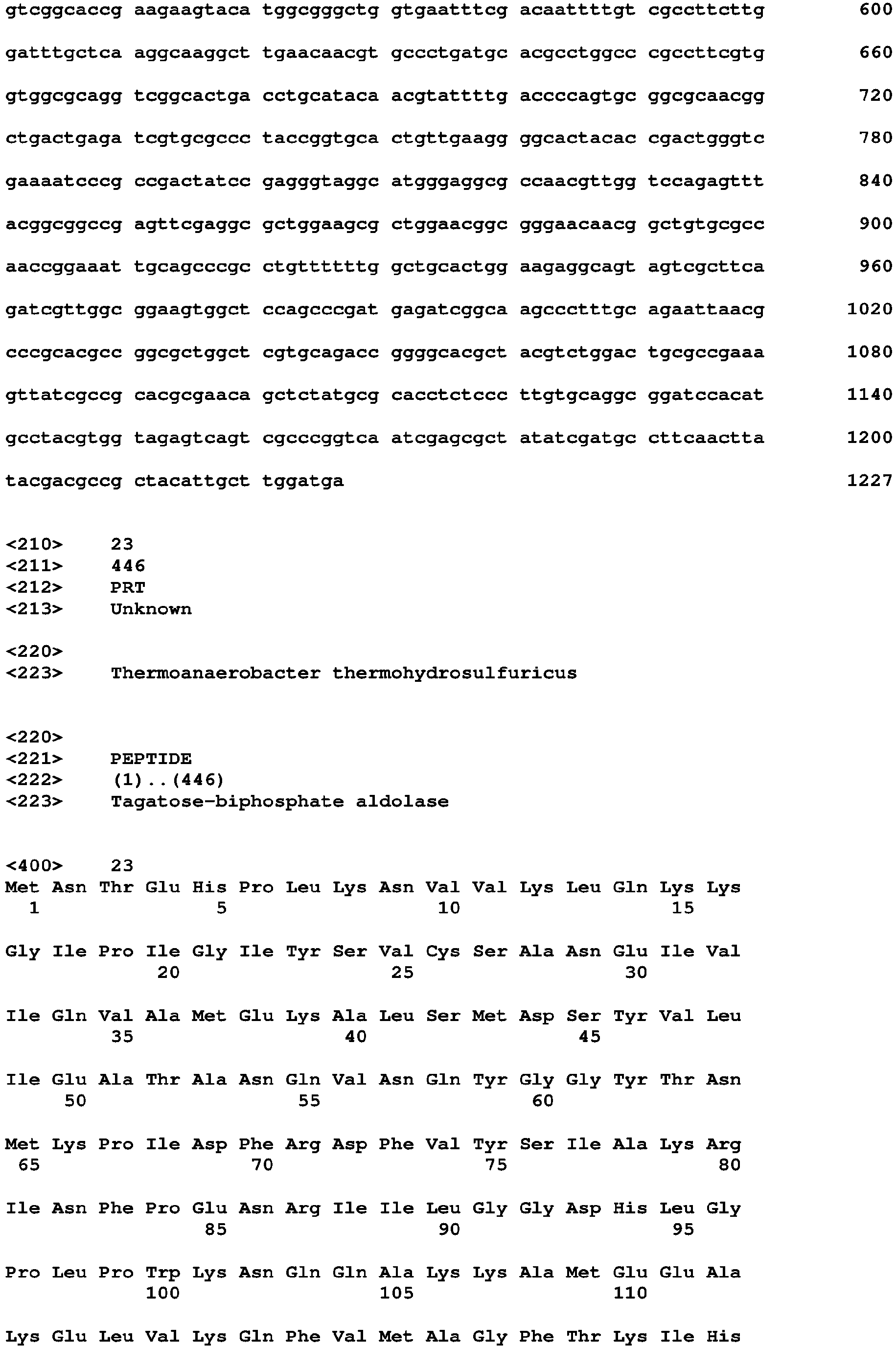


Claims (34)
- A fructose-4-epimerase variant in which the threonine (T) residue at position 124 from the N-terminus of the fructose-4-epimerase comprising the amino acid sequence of SEQ ID NO: 1 is substituted with another amino acid.
- The fructose-4-epimerase variant according to claim 1, wherein the other amino acid is a polar amino acid or a non-polar amino acid excluding threonine (T).
- The fructose-4-epimerase variant according to claim 2, wherein the polar or non-polar amino acid is selected from the group consisting of tryptophan (W), cysteine (C), and tyrosine (Y).
- The fructose-4-epimerase variant according to claim 1, wherein the variant is further substituted with another amino acid for an amino acid corresponding to position 390.
- The fructose-4-epimerase variant according to claim 4, wherein the other amino acid is a non-polar amino acid, an acidic amino acid or a basic amino acid.
- The fructose-4-epimerase variant according to claim 5, wherein the non-polar amino acid, acidic amino acid or basic amino acid is lysine (K), glycine (G), valine (V), leucine (L), histidine (H), asphaltic acid (D), isoleucine (I), and arginine (R).
- The fructose-4-epimerase variant according to claim 1, wherein the variant is further substituted with another amino acid for an amino acid corresponding to position 97.
- The fructose-4-epimerase variant according to claim 7, wherein the other amino acid is tyrosine (Y).
- The method of claim 7, wherein the variant is further substituted with another amino acid for an amino acid corresponding to any one of positions 33, 80, 102, 137, 210, and 318.
- The fructose-4-epimerase variant according to claim 9, wherein the other amino acid is selected from the group consisting of polar amino acids, non-polar amino acids, acidic amino acids and basic amino acids.
- The fructose-4-epimerase variant according to claim 10, wherein the polar amino acid, non-polar amino acid, acidic amino acid and basic amino acid are glycine (G), alanine (A), arginine (R), valine (V), leucine (L), isoleucine (I), and Leonine (T), proline (P), serine (S), tryptophan (W), phenylalanine (F), histidine (H), cysteine (C), tyrosine (Y), lysine (K), asphaltic acid (D)), and glutamic acid (E).
- The fructose-4-epimerase variant according to claim 1 wherein the variant is further substituted with another amino acid for an amino acid corresponding to position 97, and with another amino acid for an amino acid corresponding to position 367.
- The fructose-4-epimerase variant according to claim 12, wherein the other amino acid corresponding to position 97 is tyrosine (Y), and the other amino acid corresponding to position 367 is valine (V).
- The fructose-4-epimerase variant of claim 12, wherein the variant is further substituted with another amino acid for an amino acid corresponding to any one of positions 102, 137, 210, 239 and 318.
- The fructose-4-epimerase variant of claim 14, wherein the other amino acid is selected from the group consisting of non-polar amino acids, polar amino acids, and basic amino acids.
- The fructose-4-epimerase variant of claim 15, wherein the non-polar amino acid, polar amino acid, or basic amino acid is selected from the group consisting of leucine (L), cysteine (C), serine (S), lysine (K), and glycine (G).
- The fructose-4-epimerase variant of claim 12, wherein the variant is further substituted with another amino acid for an amino acid corresponding to position 33.
- The fructose-4-epimerase variant of claim 17, wherein the other amino acid is arginine (R).
- The fructose-4-epimerase variant of claim 17, wherein the variant is additionally substituted with another amino acid for an amino acid corresponding to any one of positions 80, 102, 210, and 318.
- The fructose-4-epimerase variant according to claim 19, wherein the other amino acid is selected from the group consisting of basic amino acids, non-polar amino acids, and polar amino acids.
- The fructose-4-epimerase variant according to claim 20, wherein the basic amino acid, non-polar amino acid, or polar amino acid is selected from the group consisting of arginine (R), leucine (L), serine (S), and glycine (G).
- The fructose-4-epimerase variant according to claim 12, wherein the variant is further substituted with another amino acid for an amino acid corresponding to position 80.
- The fructose-4-epimerase variant of claim 22, wherein the other amino acid is arginine (R).
- The fructose-4-epimerase variant of claim 22, wherein the variant is further substituted with another amino acid for an amino acid corresponding to any one of positions 102, 137, and 210.
- The fructose-4-epimerase variant of claim 24, wherein the other amino acid is a non-polar amino acid or a polar amino acid.
- The fructose-4-epimerase variant of claim 25, wherein the non-polar amino acid or polar amino acid is selected from the group consisting of leucine (L), cysteine (C), and serine (S).
- The fructose-4-epimerase variant of to claim 12, wherein the amino acid corresponding to position 210 is additionally substituted with another amino acid, and the amino acid corresponding to position 318 is substituted with another amino acid.
- The fructose-4-epimerase variant of claim 27, wherein the other amino acid corresponding to position 210 is serine (S), and the other amino acid corresponding to position 318 is glycine (G).
- A polynucleotide encoding the fructose-4-epimerase variant of any one of claims 1 to 28.
- A vector comprising the polynucleotide of claim 29.
- A microorganism comprising the fructose-4-epimerase variant of any one of claims 1 to 28; a polynucleotide encoding the fructose-4-epimerase variant; or a vector including the polynucleotide.
- A composition for producing tagatose, the composition comprising the fructose-4-epimerase variant of any one of claims 1 to 28; a microorganism expressing the fructose-4-epimerase variant; or a culture of the microorganism.
- The composition for producing tagatose according to claim 32, wherein the composition further comprises fructose.
- A method of producing tagatose, the method comprising the step of converting fructose into tagatose by contacting fructose with the fructose-4-epimerase variant of any one of claims 1 to 28; the microorganism including the fructose-4-epimerase variant; or the culture thereof.
Applications Claiming Priority (4)
| Application Number | Priority Date | Filing Date | Title |
|---|---|---|---|
| KR20180116609 | 2018-09-28 | ||
| KR20180117237 | 2018-10-01 | ||
| KR1020190099826A KR102409878B1 (en) | 2018-09-28 | 2019-08-14 | A Novel Fructose C4 epimerases and Preparation Method for producing Tagatose using the same |
| PCT/KR2019/012612 WO2020067781A1 (en) | 2018-09-28 | 2019-09-27 | Novel fructose-4-epimerase and tagatose production method using same |
Publications (2)
| Publication Number | Publication Date |
|---|---|
| EP3859002A1 true EP3859002A1 (en) | 2021-08-04 |
| EP3859002A4 EP3859002A4 (en) | 2022-09-28 |
Family
ID=70275629
Family Applications (3)
| Application Number | Title | Priority Date | Filing Date |
|---|---|---|---|
| EP19864455.1A Pending EP3798311A4 (en) | 2018-09-28 | 2019-09-27 | NOVEL FRUCTOSE-4-EPIMERASE AND METHOD FOR MANUFACTURING TAGATOSE WITH IT |
| EP19864983.2A Pending EP3859002A4 (en) | 2018-09-28 | 2019-09-27 | Novel fructose-4-epimerase and tagatose production method using same |
| EP19864869.3A Pending EP3798312A4 (en) | 2018-09-28 | 2019-09-27 | NOVEL FRUCTOSE-4-EPIMERASE AND METHOD FOR MANUFACTURING TAGATOSE WITH IT |
Family Applications Before (1)
| Application Number | Title | Priority Date | Filing Date |
|---|---|---|---|
| EP19864455.1A Pending EP3798311A4 (en) | 2018-09-28 | 2019-09-27 | NOVEL FRUCTOSE-4-EPIMERASE AND METHOD FOR MANUFACTURING TAGATOSE WITH IT |
Family Applications After (1)
| Application Number | Title | Priority Date | Filing Date |
|---|---|---|---|
| EP19864869.3A Pending EP3798312A4 (en) | 2018-09-28 | 2019-09-27 | NOVEL FRUCTOSE-4-EPIMERASE AND METHOD FOR MANUFACTURING TAGATOSE WITH IT |
Country Status (4)
| Country | Link |
|---|---|
| US (2) | US11884923B2 (en) |
| EP (3) | EP3798311A4 (en) |
| KR (3) | KR102308173B1 (en) |
| CN (1) | CN113272439B (en) |
Families Citing this family (4)
| Publication number | Priority date | Publication date | Assignee | Title |
|---|---|---|---|---|
| KR102328650B1 (en) * | 2018-09-27 | 2021-11-19 | 씨제이제일제당 주식회사 | A Novel Fructose C4 epimerases and Preparation Method for producing Tagatose using the same |
| KR102219195B1 (en) * | 2019-08-14 | 2021-02-24 | 씨제이제일제당 주식회사 | A Novel Fructose C4 epimerases and Preparation Method for producing Tagatose using the same |
| WO2021060751A1 (en) | 2019-09-25 | 2021-04-01 | 주식회사 사피엔반도체 | Pixels and display apparatus comprising same |
| CN116789718A (en) * | 2022-03-18 | 2023-09-22 | 中国科学院天津工业生物技术研究所 | High purity crystalline D-tagatose, compositions comprising same, and methods of making and using |
Family Cites Families (16)
| Publication number | Priority date | Publication date | Assignee | Title |
|---|---|---|---|---|
| WO2004007738A1 (en) * | 2002-07-12 | 2004-01-22 | Tongyang Confectionery Co. | Optimization method for preparation of tagatose by thermostable isomerase isomerase |
| AU2003902253A0 (en) * | 2003-05-12 | 2003-05-29 | The University Of Queensland | Method for increasing product yield |
| EP2195443B1 (en) * | 2007-08-24 | 2015-01-07 | Codexis, Inc. | Improved ketoreductase polypeptides for the stereoselective production of (r)-3-hydroxythiolane |
| KR100964091B1 (en) | 2008-01-28 | 2010-06-16 | 씨제이제일제당 (주) | Method for preparing tagatose using soy oligosaccharides |
| KR101627921B1 (en) * | 2014-07-23 | 2016-06-13 | 건국대학교 산학협력단 | A aldolase mutant and a d-tagatose production method by using the same |
| KR101480422B1 (en) | 2013-07-29 | 2015-01-13 | 건국대학교 산학협력단 | A production method of tagatose from fructose by combinatorial enzyme reactions and composition for production of tagatose |
| WO2015016544A1 (en) * | 2013-07-29 | 2015-02-05 | 건국대학교 산학협력단 | Aldolase, aldolase mutant, and method and composition for producing tagatose by using same |
| KR101636058B1 (en) * | 2013-08-30 | 2016-07-05 | (주)케비젠 | Composition for production of tagatose from fructose using enzyme combination reaction with substrates and uses thereof |
| KR101620904B1 (en) | 2013-10-11 | 2016-05-23 | (주)케비젠 | Composition for production of tagatose from fructose using enzyme combination reaction with substrates and uses thereof |
| KR101638024B1 (en) * | 2014-10-22 | 2016-07-20 | 씨제이제일제당(주) | Composition for preparation of tagatose and manufacturing method for tagatose from fructose |
| KR20170015250A (en) * | 2015-07-29 | 2017-02-08 | 씨제이제일제당 (주) | Hexuronate c4-epimerase variants with improved conversion activity and method for production of d-tagatose using them |
| KR101978464B1 (en) * | 2016-09-07 | 2019-05-14 | 주식회사 삼양사 | D-Fructose-4-epimerase and production of tagatose using the same |
| KR20180111667A (en) * | 2017-03-31 | 2018-10-11 | 씨제이제일제당 (주) | A composition for preparing tagatose and Methods for producing tagatose using The Same |
| EP3604514A4 (en) * | 2017-03-31 | 2021-01-20 | Cj Cheiljedang Corporation | COMPOSITION FOR THE PRODUCTION OF TAGATOSE AND PROCESS FOR THE PRODUCTION OF TAGATOSE USING THE SAME |
| WO2020010260A1 (en) * | 2018-07-03 | 2020-01-09 | Arzeda Corp. | Methods and compositions for preparing tagatose from fructose |
| WO2020067786A1 (en) * | 2018-09-28 | 2020-04-02 | 씨제이제일제당 (주) | Novel fructose-4-epimerase and tagatose production method using same |
-
2019
- 2019-08-14 KR KR1020190099827A patent/KR102308173B1/en active Active
- 2019-08-14 KR KR1020190099828A patent/KR102329311B1/en active Active
- 2019-08-14 KR KR1020190099826A patent/KR102409878B1/en active Active
- 2019-09-27 US US17/252,706 patent/US11884923B2/en active Active
- 2019-09-27 EP EP19864455.1A patent/EP3798311A4/en active Pending
- 2019-09-27 EP EP19864983.2A patent/EP3859002A4/en active Pending
- 2019-09-27 EP EP19864869.3A patent/EP3798312A4/en active Pending
- 2019-09-27 CN CN201980075297.9A patent/CN113272439B/en active Active
- 2019-09-27 US US17/252,705 patent/US11753646B2/en active Active
Also Published As
| Publication number | Publication date |
|---|---|
| EP3798311A4 (en) | 2021-07-21 |
| EP3798312A4 (en) | 2021-07-28 |
| US20210363533A1 (en) | 2021-11-25 |
| KR102329311B1 (en) | 2021-11-23 |
| US20210363532A1 (en) | 2021-11-25 |
| EP3798311A1 (en) | 2021-03-31 |
| KR102308173B1 (en) | 2021-10-06 |
| CN113272439A (en) | 2021-08-17 |
| EP3798312A1 (en) | 2021-03-31 |
| KR20200037070A (en) | 2020-04-08 |
| US11884923B2 (en) | 2024-01-30 |
| CN113272439B (en) | 2023-10-20 |
| US11753646B2 (en) | 2023-09-12 |
| KR102409878B1 (en) | 2022-06-20 |
| KR20200037068A (en) | 2020-04-08 |
| KR20200037069A (en) | 2020-04-08 |
| EP3859002A4 (en) | 2022-09-28 |
Similar Documents
| Publication | Publication Date | Title |
|---|---|---|
| CN112004926B (en) | Variant phosphoribosyl pyrophosphate amidotransferase and method for preparing purine nucleotide using same | |
| US11753646B2 (en) | Fructose-4-epimerase and method of producing tagatose using the same | |
| US20200392478A1 (en) | Novel adenylosuccinate synthetase and method for producing purine nucleotides using the same | |
| EP3647417A2 (en) | Atp phosphoribosyltransferase mutant and l-histidine production method using same | |
| KR102558526B1 (en) | A Novel Fructose C4 epimerases and Preparation Method for producing Tagatose using the same | |
| US12460236B2 (en) | Fructose-4-epimerase and method for preparing tagatose using same | |
| HK40069836A (en) | Novel fructose-4-epimerase and method for preparing tagatose using same | |
| HK40069836B (en) | Novel fructose-4-epimerase and method for preparing tagatose using same | |
| KR20250101915A (en) | A novel phosphoribosyl aminimidazole-succinocarboxamide synthase variant and a method of producing purine nucleotides using the same | |
| HK40035066B (en) | Variant phosphoribosyl pyrophosphate amidotransferase and method of preparing purine nucleotide using the same | |
| HK40035066A (en) | Variant phosphoribosyl pyrophosphate amidotransferase and method of preparing purine nucleotide using the same | |
| TW202540413A (en) | Novel variant glycosyltransferase polypeptide and method of producing steviol glycosides using the same | |
| EP4700120A1 (en) | Novel polypeptide with don-degrading activity | |
| US20240209037A1 (en) | Mutant spot protein and method for producing l-amino acids using same | |
| WO2020067788A1 (en) | Novel fructose-4-epimerase and tagatose production method using same | |
| BR112020001762B1 (en) | VARIANT OF ATP PHOSPHORIBOSYLTRANSFERASE, POLYNUCLEOTIDE, VECTOR, MICROORGANISM OF THE GENRE CORYNEBACTERIUM AND METHOD FOR PRODUCING HISTIDINE USING THE SAME |
Legal Events
| Date | Code | Title | Description |
|---|---|---|---|
| STAA | Information on the status of an ep patent application or granted ep patent |
Free format text: STATUS: THE INTERNATIONAL PUBLICATION HAS BEEN MADE |
|
| PUAI | Public reference made under article 153(3) epc to a published international application that has entered the european phase |
Free format text: ORIGINAL CODE: 0009012 |
|
| STAA | Information on the status of an ep patent application or granted ep patent |
Free format text: STATUS: REQUEST FOR EXAMINATION WAS MADE |
|
| 17P | Request for examination filed |
Effective date: 20210428 |
|
| AK | Designated contracting states |
Kind code of ref document: A1 Designated state(s): AL AT BE BG CH CY CZ DE DK EE ES FI FR GB GR HR HU IE IS IT LI LT LU LV MC MK MT NL NO PL PT RO RS SE SI SK SM TR |
|
| DAV | Request for validation of the european patent (deleted) | ||
| DAX | Request for extension of the european patent (deleted) | ||
| A4 | Supplementary search report drawn up and despatched |
Effective date: 20220830 |
|
| RIC1 | Information provided on ipc code assigned before grant |
Ipc: C12P 19/24 20060101ALI20220824BHEP Ipc: C12N 9/90 20060101ALI20220824BHEP Ipc: C12N 9/88 20060101ALI20220824BHEP Ipc: C12N 15/70 20060101ALI20220824BHEP Ipc: C12N 15/52 20060101ALI20220824BHEP Ipc: C12P 19/02 20060101AFI20220824BHEP |
|
| P01 | Opt-out of the competence of the unified patent court (upc) registered |
Effective date: 20230606 |