EP3854646B1 - Systems and methods for navigating with safe distances - Google Patents
Systems and methods for navigating with safe distances Download PDFInfo
- Publication number
- EP3854646B1 EP3854646B1 EP21156813.4A EP21156813A EP3854646B1 EP 3854646 B1 EP3854646 B1 EP 3854646B1 EP 21156813 A EP21156813 A EP 21156813A EP 3854646 B1 EP3854646 B1 EP 3854646B1
- Authority
- EP
- European Patent Office
- Prior art keywords
- vehicle
- host vehicle
- distance
- target vehicle
- image
- Prior art date
- Legal status (The legal status is an assumption and is not a legal conclusion. Google has not performed a legal analysis and makes no representation as to the accuracy of the status listed.)
- Active
Links
Images











Classifications
-
- B—PERFORMING OPERATIONS; TRANSPORTING
- B60—VEHICLES IN GENERAL
- B60W—CONJOINT CONTROL OF VEHICLE SUB-UNITS OF DIFFERENT TYPE OR DIFFERENT FUNCTION; CONTROL SYSTEMS SPECIALLY ADAPTED FOR HYBRID VEHICLES; ROAD VEHICLE DRIVE CONTROL SYSTEMS FOR PURPOSES NOT RELATED TO THE CONTROL OF A PARTICULAR SUB-UNIT
- B60W30/00—Purposes of road vehicle drive control systems not related to the control of a particular sub-unit, e.g. of systems using conjoint control of vehicle sub-units
- B60W30/08—Active safety systems predicting or avoiding probable or impending collision or attempting to minimise its consequences
- B60W30/095—Predicting travel path or likelihood of collision
- B60W30/0956—Predicting travel path or likelihood of collision the prediction being responsive to traffic or environmental parameters
-
- B—PERFORMING OPERATIONS; TRANSPORTING
- B60—VEHICLES IN GENERAL
- B60W—CONJOINT CONTROL OF VEHICLE SUB-UNITS OF DIFFERENT TYPE OR DIFFERENT FUNCTION; CONTROL SYSTEMS SPECIALLY ADAPTED FOR HYBRID VEHICLES; ROAD VEHICLE DRIVE CONTROL SYSTEMS FOR PURPOSES NOT RELATED TO THE CONTROL OF A PARTICULAR SUB-UNIT
- B60W60/00—Drive control systems specially adapted for autonomous road vehicles
- B60W60/001—Planning or execution of driving tasks
- B60W60/0015—Planning or execution of driving tasks specially adapted for safety
- B60W60/0016—Planning or execution of driving tasks specially adapted for safety of the vehicle or its occupants
-
- B—PERFORMING OPERATIONS; TRANSPORTING
- B60—VEHICLES IN GENERAL
- B60W—CONJOINT CONTROL OF VEHICLE SUB-UNITS OF DIFFERENT TYPE OR DIFFERENT FUNCTION; CONTROL SYSTEMS SPECIALLY ADAPTED FOR HYBRID VEHICLES; ROAD VEHICLE DRIVE CONTROL SYSTEMS FOR PURPOSES NOT RELATED TO THE CONTROL OF A PARTICULAR SUB-UNIT
- B60W10/00—Conjoint control of vehicle sub-units of different type or different function
- B60W10/18—Conjoint control of vehicle sub-units of different type or different function including control of braking systems
-
- B—PERFORMING OPERATIONS; TRANSPORTING
- B60—VEHICLES IN GENERAL
- B60W—CONJOINT CONTROL OF VEHICLE SUB-UNITS OF DIFFERENT TYPE OR DIFFERENT FUNCTION; CONTROL SYSTEMS SPECIALLY ADAPTED FOR HYBRID VEHICLES; ROAD VEHICLE DRIVE CONTROL SYSTEMS FOR PURPOSES NOT RELATED TO THE CONTROL OF A PARTICULAR SUB-UNIT
- B60W10/00—Conjoint control of vehicle sub-units of different type or different function
- B60W10/20—Conjoint control of vehicle sub-units of different type or different function including control of steering systems
-
- B—PERFORMING OPERATIONS; TRANSPORTING
- B60—VEHICLES IN GENERAL
- B60W—CONJOINT CONTROL OF VEHICLE SUB-UNITS OF DIFFERENT TYPE OR DIFFERENT FUNCTION; CONTROL SYSTEMS SPECIALLY ADAPTED FOR HYBRID VEHICLES; ROAD VEHICLE DRIVE CONTROL SYSTEMS FOR PURPOSES NOT RELATED TO THE CONTROL OF A PARTICULAR SUB-UNIT
- B60W30/00—Purposes of road vehicle drive control systems not related to the control of a particular sub-unit, e.g. of systems using conjoint control of vehicle sub-units
- B60W30/08—Active safety systems predicting or avoiding probable or impending collision or attempting to minimise its consequences
- B60W30/09—Taking automatic action to avoid collision, e.g. braking and steering
-
- B—PERFORMING OPERATIONS; TRANSPORTING
- B60—VEHICLES IN GENERAL
- B60W—CONJOINT CONTROL OF VEHICLE SUB-UNITS OF DIFFERENT TYPE OR DIFFERENT FUNCTION; CONTROL SYSTEMS SPECIALLY ADAPTED FOR HYBRID VEHICLES; ROAD VEHICLE DRIVE CONTROL SYSTEMS FOR PURPOSES NOT RELATED TO THE CONTROL OF A PARTICULAR SUB-UNIT
- B60W30/00—Purposes of road vehicle drive control systems not related to the control of a particular sub-unit, e.g. of systems using conjoint control of vehicle sub-units
- B60W30/08—Active safety systems predicting or avoiding probable or impending collision or attempting to minimise its consequences
- B60W30/095—Predicting travel path or likelihood of collision
- B60W30/0953—Predicting travel path or likelihood of collision the prediction being responsive to vehicle dynamic parameters
-
- B—PERFORMING OPERATIONS; TRANSPORTING
- B60—VEHICLES IN GENERAL
- B60W—CONJOINT CONTROL OF VEHICLE SUB-UNITS OF DIFFERENT TYPE OR DIFFERENT FUNCTION; CONTROL SYSTEMS SPECIALLY ADAPTED FOR HYBRID VEHICLES; ROAD VEHICLE DRIVE CONTROL SYSTEMS FOR PURPOSES NOT RELATED TO THE CONTROL OF A PARTICULAR SUB-UNIT
- B60W30/00—Purposes of road vehicle drive control systems not related to the control of a particular sub-unit, e.g. of systems using conjoint control of vehicle sub-units
- B60W30/18—Propelling the vehicle
-
- B—PERFORMING OPERATIONS; TRANSPORTING
- B60—VEHICLES IN GENERAL
- B60W—CONJOINT CONTROL OF VEHICLE SUB-UNITS OF DIFFERENT TYPE OR DIFFERENT FUNCTION; CONTROL SYSTEMS SPECIALLY ADAPTED FOR HYBRID VEHICLES; ROAD VEHICLE DRIVE CONTROL SYSTEMS FOR PURPOSES NOT RELATED TO THE CONTROL OF A PARTICULAR SUB-UNIT
- B60W30/00—Purposes of road vehicle drive control systems not related to the control of a particular sub-unit, e.g. of systems using conjoint control of vehicle sub-units
- B60W30/18—Propelling the vehicle
- B60W30/18009—Propelling the vehicle related to particular drive situations
- B60W30/181—Preparing for stopping
-
- B—PERFORMING OPERATIONS; TRANSPORTING
- B60—VEHICLES IN GENERAL
- B60W—CONJOINT CONTROL OF VEHICLE SUB-UNITS OF DIFFERENT TYPE OR DIFFERENT FUNCTION; CONTROL SYSTEMS SPECIALLY ADAPTED FOR HYBRID VEHICLES; ROAD VEHICLE DRIVE CONTROL SYSTEMS FOR PURPOSES NOT RELATED TO THE CONTROL OF A PARTICULAR SUB-UNIT
- B60W30/00—Purposes of road vehicle drive control systems not related to the control of a particular sub-unit, e.g. of systems using conjoint control of vehicle sub-units
- B60W30/18—Propelling the vehicle
- B60W30/18009—Propelling the vehicle related to particular drive situations
- B60W30/18163—Lane change; Overtaking manoeuvres
-
- B—PERFORMING OPERATIONS; TRANSPORTING
- B60—VEHICLES IN GENERAL
- B60W—CONJOINT CONTROL OF VEHICLE SUB-UNITS OF DIFFERENT TYPE OR DIFFERENT FUNCTION; CONTROL SYSTEMS SPECIALLY ADAPTED FOR HYBRID VEHICLES; ROAD VEHICLE DRIVE CONTROL SYSTEMS FOR PURPOSES NOT RELATED TO THE CONTROL OF A PARTICULAR SUB-UNIT
- B60W40/00—Estimation or calculation of non-directly measurable driving parameters for road vehicle drive control systems not related to the control of a particular sub unit, e.g. by using mathematical models
- B60W40/02—Estimation or calculation of non-directly measurable driving parameters for road vehicle drive control systems not related to the control of a particular sub unit, e.g. by using mathematical models related to ambient conditions
-
- B—PERFORMING OPERATIONS; TRANSPORTING
- B60—VEHICLES IN GENERAL
- B60W—CONJOINT CONTROL OF VEHICLE SUB-UNITS OF DIFFERENT TYPE OR DIFFERENT FUNCTION; CONTROL SYSTEMS SPECIALLY ADAPTED FOR HYBRID VEHICLES; ROAD VEHICLE DRIVE CONTROL SYSTEMS FOR PURPOSES NOT RELATED TO THE CONTROL OF A PARTICULAR SUB-UNIT
- B60W40/00—Estimation or calculation of non-directly measurable driving parameters for road vehicle drive control systems not related to the control of a particular sub unit, e.g. by using mathematical models
- B60W40/10—Estimation or calculation of non-directly measurable driving parameters for road vehicle drive control systems not related to the control of a particular sub unit, e.g. by using mathematical models related to vehicle motion
- B60W40/105—Speed
-
- B—PERFORMING OPERATIONS; TRANSPORTING
- B60—VEHICLES IN GENERAL
- B60W—CONJOINT CONTROL OF VEHICLE SUB-UNITS OF DIFFERENT TYPE OR DIFFERENT FUNCTION; CONTROL SYSTEMS SPECIALLY ADAPTED FOR HYBRID VEHICLES; ROAD VEHICLE DRIVE CONTROL SYSTEMS FOR PURPOSES NOT RELATED TO THE CONTROL OF A PARTICULAR SUB-UNIT
- B60W40/00—Estimation or calculation of non-directly measurable driving parameters for road vehicle drive control systems not related to the control of a particular sub unit, e.g. by using mathematical models
- B60W40/10—Estimation or calculation of non-directly measurable driving parameters for road vehicle drive control systems not related to the control of a particular sub unit, e.g. by using mathematical models related to vehicle motion
- B60W40/107—Longitudinal acceleration
-
- B—PERFORMING OPERATIONS; TRANSPORTING
- B60—VEHICLES IN GENERAL
- B60W—CONJOINT CONTROL OF VEHICLE SUB-UNITS OF DIFFERENT TYPE OR DIFFERENT FUNCTION; CONTROL SYSTEMS SPECIALLY ADAPTED FOR HYBRID VEHICLES; ROAD VEHICLE DRIVE CONTROL SYSTEMS FOR PURPOSES NOT RELATED TO THE CONTROL OF A PARTICULAR SUB-UNIT
- B60W60/00—Drive control systems specially adapted for autonomous road vehicles
- B60W60/001—Planning or execution of driving tasks
-
- B—PERFORMING OPERATIONS; TRANSPORTING
- B60—VEHICLES IN GENERAL
- B60W—CONJOINT CONTROL OF VEHICLE SUB-UNITS OF DIFFERENT TYPE OR DIFFERENT FUNCTION; CONTROL SYSTEMS SPECIALLY ADAPTED FOR HYBRID VEHICLES; ROAD VEHICLE DRIVE CONTROL SYSTEMS FOR PURPOSES NOT RELATED TO THE CONTROL OF A PARTICULAR SUB-UNIT
- B60W60/00—Drive control systems specially adapted for autonomous road vehicles
- B60W60/001—Planning or execution of driving tasks
- B60W60/0015—Planning or execution of driving tasks specially adapted for safety
-
- B—PERFORMING OPERATIONS; TRANSPORTING
- B60—VEHICLES IN GENERAL
- B60W—CONJOINT CONTROL OF VEHICLE SUB-UNITS OF DIFFERENT TYPE OR DIFFERENT FUNCTION; CONTROL SYSTEMS SPECIALLY ADAPTED FOR HYBRID VEHICLES; ROAD VEHICLE DRIVE CONTROL SYSTEMS FOR PURPOSES NOT RELATED TO THE CONTROL OF A PARTICULAR SUB-UNIT
- B60W60/00—Drive control systems specially adapted for autonomous road vehicles
- B60W60/001—Planning or execution of driving tasks
- B60W60/0015—Planning or execution of driving tasks specially adapted for safety
- B60W60/0017—Planning or execution of driving tasks specially adapted for safety of other traffic participants
-
- G—PHYSICS
- G01—MEASURING; TESTING
- G01S—RADIO DIRECTION-FINDING; RADIO NAVIGATION; DETERMINING DISTANCE OR VELOCITY BY USE OF RADIO WAVES; LOCATING OR PRESENCE-DETECTING BY USE OF THE REFLECTION OR RERADIATION OF RADIO WAVES; ANALOGOUS ARRANGEMENTS USING OTHER WAVES
- G01S13/00—Systems using the reflection or reradiation of radio waves, e.g. radar systems; Analogous systems using reflection or reradiation of waves whose nature or wavelength is irrelevant or unspecified
- G01S13/88—Radar or analogous systems specially adapted for specific applications
- G01S13/93—Radar or analogous systems specially adapted for specific applications for anti-collision purposes
- G01S13/931—Radar or analogous systems specially adapted for specific applications for anti-collision purposes of land vehicles
-
- G—PHYSICS
- G05—CONTROLLING; REGULATING
- G05D—SYSTEMS FOR CONTROLLING OR REGULATING NON-ELECTRIC VARIABLES
- G05D1/00—Control of position, course, altitude or attitude of land, water, air or space vehicles, e.g. using automatic pilots
- G05D1/02—Control of position or course in two dimensions
- G05D1/021—Control of position or course in two dimensions specially adapted to land vehicles
- G05D1/0212—Control of position or course in two dimensions specially adapted to land vehicles with means for defining a desired trajectory
- G05D1/0214—Control of position or course in two dimensions specially adapted to land vehicles with means for defining a desired trajectory in accordance with safety or protection criteria, e.g. avoiding hazardous areas
-
- G—PHYSICS
- G05—CONTROLLING; REGULATING
- G05D—SYSTEMS FOR CONTROLLING OR REGULATING NON-ELECTRIC VARIABLES
- G05D1/00—Control of position, course, altitude or attitude of land, water, air or space vehicles, e.g. using automatic pilots
- G05D1/02—Control of position or course in two dimensions
- G05D1/021—Control of position or course in two dimensions specially adapted to land vehicles
- G05D1/0231—Control of position or course in two dimensions specially adapted to land vehicles using optical position detecting means
-
- G—PHYSICS
- G05—CONTROLLING; REGULATING
- G05D—SYSTEMS FOR CONTROLLING OR REGULATING NON-ELECTRIC VARIABLES
- G05D1/00—Control of position, course, altitude or attitude of land, water, air or space vehicles, e.g. using automatic pilots
- G05D1/02—Control of position or course in two dimensions
- G05D1/021—Control of position or course in two dimensions specially adapted to land vehicles
- G05D1/0231—Control of position or course in two dimensions specially adapted to land vehicles using optical position detecting means
- G05D1/0246—Control of position or course in two dimensions specially adapted to land vehicles using optical position detecting means using a video camera in combination with image processing means
-
- G—PHYSICS
- G05—CONTROLLING; REGULATING
- G05D—SYSTEMS FOR CONTROLLING OR REGULATING NON-ELECTRIC VARIABLES
- G05D1/00—Control of position, course, altitude or attitude of land, water, air or space vehicles, e.g. using automatic pilots
- G05D1/20—Control system inputs
- G05D1/24—Arrangements for determining position or orientation
- G05D1/247—Arrangements for determining position or orientation using signals provided by artificial sources external to the vehicle, e.g. navigation beacons
-
- G—PHYSICS
- G05—CONTROLLING; REGULATING
- G05D—SYSTEMS FOR CONTROLLING OR REGULATING NON-ELECTRIC VARIABLES
- G05D1/00—Control of position, course, altitude or attitude of land, water, air or space vehicles, e.g. using automatic pilots
- G05D1/20—Control system inputs
- G05D1/24—Arrangements for determining position or orientation
- G05D1/247—Arrangements for determining position or orientation using signals provided by artificial sources external to the vehicle, e.g. navigation beacons
- G05D1/249—Arrangements for determining position or orientation using signals provided by artificial sources external to the vehicle, e.g. navigation beacons from positioning sensors located off-board the vehicle, e.g. from cameras
-
- G—PHYSICS
- G05—CONTROLLING; REGULATING
- G05D—SYSTEMS FOR CONTROLLING OR REGULATING NON-ELECTRIC VARIABLES
- G05D1/00—Control of position, course, altitude or attitude of land, water, air or space vehicles, e.g. using automatic pilots
- G05D1/60—Intended control result
- G05D1/617—Safety or protection, e.g. defining protection zones around obstacles or avoiding hazards
-
- G—PHYSICS
- G06—COMPUTING OR CALCULATING; COUNTING
- G06T—IMAGE DATA PROCESSING OR GENERATION, IN GENERAL
- G06T7/00—Image analysis
- G06T7/20—Analysis of motion
-
- G—PHYSICS
- G06—COMPUTING OR CALCULATING; COUNTING
- G06T—IMAGE DATA PROCESSING OR GENERATION, IN GENERAL
- G06T7/00—Image analysis
- G06T7/70—Determining position or orientation of objects or cameras
-
- G—PHYSICS
- G06—COMPUTING OR CALCULATING; COUNTING
- G06V—IMAGE OR VIDEO RECOGNITION OR UNDERSTANDING
- G06V20/00—Scenes; Scene-specific elements
- G06V20/50—Context or environment of the image
- G06V20/56—Context or environment of the image exterior to a vehicle by using sensors mounted on the vehicle
- G06V20/58—Recognition of moving objects or obstacles, e.g. vehicles or pedestrians; Recognition of traffic objects, e.g. traffic signs, traffic lights or roads
-
- G—PHYSICS
- G06—COMPUTING OR CALCULATING; COUNTING
- G06V—IMAGE OR VIDEO RECOGNITION OR UNDERSTANDING
- G06V20/00—Scenes; Scene-specific elements
- G06V20/50—Context or environment of the image
- G06V20/56—Context or environment of the image exterior to a vehicle by using sensors mounted on the vehicle
- G06V20/58—Recognition of moving objects or obstacles, e.g. vehicles or pedestrians; Recognition of traffic objects, e.g. traffic signs, traffic lights or roads
- G06V20/584—Recognition of moving objects or obstacles, e.g. vehicles or pedestrians; Recognition of traffic objects, e.g. traffic signs, traffic lights or roads of vehicle lights or traffic lights
-
- G—PHYSICS
- G06—COMPUTING OR CALCULATING; COUNTING
- G06V—IMAGE OR VIDEO RECOGNITION OR UNDERSTANDING
- G06V40/00—Recognition of biometric, human-related or animal-related patterns in image or video data
- G06V40/10—Human or animal bodies, e.g. vehicle occupants or pedestrians; Body parts, e.g. hands
-
- B—PERFORMING OPERATIONS; TRANSPORTING
- B60—VEHICLES IN GENERAL
- B60W—CONJOINT CONTROL OF VEHICLE SUB-UNITS OF DIFFERENT TYPE OR DIFFERENT FUNCTION; CONTROL SYSTEMS SPECIALLY ADAPTED FOR HYBRID VEHICLES; ROAD VEHICLE DRIVE CONTROL SYSTEMS FOR PURPOSES NOT RELATED TO THE CONTROL OF A PARTICULAR SUB-UNIT
- B60W2420/00—Indexing codes relating to the type of sensors based on the principle of their operation
- B60W2420/40—Photo, light or radio wave sensitive means, e.g. infrared sensors
- B60W2420/403—Image sensing, e.g. optical camera
-
- B—PERFORMING OPERATIONS; TRANSPORTING
- B60—VEHICLES IN GENERAL
- B60W—CONJOINT CONTROL OF VEHICLE SUB-UNITS OF DIFFERENT TYPE OR DIFFERENT FUNCTION; CONTROL SYSTEMS SPECIALLY ADAPTED FOR HYBRID VEHICLES; ROAD VEHICLE DRIVE CONTROL SYSTEMS FOR PURPOSES NOT RELATED TO THE CONTROL OF A PARTICULAR SUB-UNIT
- B60W2420/00—Indexing codes relating to the type of sensors based on the principle of their operation
- B60W2420/40—Photo, light or radio wave sensitive means, e.g. infrared sensors
- B60W2420/408—Radar; Laser, e.g. lidar
-
- B—PERFORMING OPERATIONS; TRANSPORTING
- B60—VEHICLES IN GENERAL
- B60W—CONJOINT CONTROL OF VEHICLE SUB-UNITS OF DIFFERENT TYPE OR DIFFERENT FUNCTION; CONTROL SYSTEMS SPECIALLY ADAPTED FOR HYBRID VEHICLES; ROAD VEHICLE DRIVE CONTROL SYSTEMS FOR PURPOSES NOT RELATED TO THE CONTROL OF A PARTICULAR SUB-UNIT
- B60W2510/00—Input parameters relating to a particular sub-units
- B60W2510/18—Braking system
-
- B—PERFORMING OPERATIONS; TRANSPORTING
- B60—VEHICLES IN GENERAL
- B60W—CONJOINT CONTROL OF VEHICLE SUB-UNITS OF DIFFERENT TYPE OR DIFFERENT FUNCTION; CONTROL SYSTEMS SPECIALLY ADAPTED FOR HYBRID VEHICLES; ROAD VEHICLE DRIVE CONTROL SYSTEMS FOR PURPOSES NOT RELATED TO THE CONTROL OF A PARTICULAR SUB-UNIT
- B60W2520/00—Input parameters relating to overall vehicle dynamics
- B60W2520/04—Vehicle stop
-
- B—PERFORMING OPERATIONS; TRANSPORTING
- B60—VEHICLES IN GENERAL
- B60W—CONJOINT CONTROL OF VEHICLE SUB-UNITS OF DIFFERENT TYPE OR DIFFERENT FUNCTION; CONTROL SYSTEMS SPECIALLY ADAPTED FOR HYBRID VEHICLES; ROAD VEHICLE DRIVE CONTROL SYSTEMS FOR PURPOSES NOT RELATED TO THE CONTROL OF A PARTICULAR SUB-UNIT
- B60W2520/00—Input parameters relating to overall vehicle dynamics
- B60W2520/10—Longitudinal speed
-
- B—PERFORMING OPERATIONS; TRANSPORTING
- B60—VEHICLES IN GENERAL
- B60W—CONJOINT CONTROL OF VEHICLE SUB-UNITS OF DIFFERENT TYPE OR DIFFERENT FUNCTION; CONTROL SYSTEMS SPECIALLY ADAPTED FOR HYBRID VEHICLES; ROAD VEHICLE DRIVE CONTROL SYSTEMS FOR PURPOSES NOT RELATED TO THE CONTROL OF A PARTICULAR SUB-UNIT
- B60W2520/00—Input parameters relating to overall vehicle dynamics
- B60W2520/10—Longitudinal speed
- B60W2520/105—Longitudinal acceleration
-
- B—PERFORMING OPERATIONS; TRANSPORTING
- B60—VEHICLES IN GENERAL
- B60W—CONJOINT CONTROL OF VEHICLE SUB-UNITS OF DIFFERENT TYPE OR DIFFERENT FUNCTION; CONTROL SYSTEMS SPECIALLY ADAPTED FOR HYBRID VEHICLES; ROAD VEHICLE DRIVE CONTROL SYSTEMS FOR PURPOSES NOT RELATED TO THE CONTROL OF A PARTICULAR SUB-UNIT
- B60W2520/00—Input parameters relating to overall vehicle dynamics
- B60W2520/12—Lateral speed
-
- B—PERFORMING OPERATIONS; TRANSPORTING
- B60—VEHICLES IN GENERAL
- B60W—CONJOINT CONTROL OF VEHICLE SUB-UNITS OF DIFFERENT TYPE OR DIFFERENT FUNCTION; CONTROL SYSTEMS SPECIALLY ADAPTED FOR HYBRID VEHICLES; ROAD VEHICLE DRIVE CONTROL SYSTEMS FOR PURPOSES NOT RELATED TO THE CONTROL OF A PARTICULAR SUB-UNIT
- B60W2520/00—Input parameters relating to overall vehicle dynamics
- B60W2520/12—Lateral speed
- B60W2520/125—Lateral acceleration
-
- B—PERFORMING OPERATIONS; TRANSPORTING
- B60—VEHICLES IN GENERAL
- B60W—CONJOINT CONTROL OF VEHICLE SUB-UNITS OF DIFFERENT TYPE OR DIFFERENT FUNCTION; CONTROL SYSTEMS SPECIALLY ADAPTED FOR HYBRID VEHICLES; ROAD VEHICLE DRIVE CONTROL SYSTEMS FOR PURPOSES NOT RELATED TO THE CONTROL OF A PARTICULAR SUB-UNIT
- B60W2520/00—Input parameters relating to overall vehicle dynamics
- B60W2520/14—Yaw
-
- B—PERFORMING OPERATIONS; TRANSPORTING
- B60—VEHICLES IN GENERAL
- B60W—CONJOINT CONTROL OF VEHICLE SUB-UNITS OF DIFFERENT TYPE OR DIFFERENT FUNCTION; CONTROL SYSTEMS SPECIALLY ADAPTED FOR HYBRID VEHICLES; ROAD VEHICLE DRIVE CONTROL SYSTEMS FOR PURPOSES NOT RELATED TO THE CONTROL OF A PARTICULAR SUB-UNIT
- B60W2530/00—Input parameters relating to vehicle conditions or values, not covered by groups B60W2510/00 or B60W2520/00
- B60W2530/201—Dimensions of vehicle
-
- B—PERFORMING OPERATIONS; TRANSPORTING
- B60—VEHICLES IN GENERAL
- B60W—CONJOINT CONTROL OF VEHICLE SUB-UNITS OF DIFFERENT TYPE OR DIFFERENT FUNCTION; CONTROL SYSTEMS SPECIALLY ADAPTED FOR HYBRID VEHICLES; ROAD VEHICLE DRIVE CONTROL SYSTEMS FOR PURPOSES NOT RELATED TO THE CONTROL OF A PARTICULAR SUB-UNIT
- B60W2552/00—Input parameters relating to infrastructure
- B60W2552/05—Type of road, e.g. motorways, local streets, paved or unpaved roads
-
- B—PERFORMING OPERATIONS; TRANSPORTING
- B60—VEHICLES IN GENERAL
- B60W—CONJOINT CONTROL OF VEHICLE SUB-UNITS OF DIFFERENT TYPE OR DIFFERENT FUNCTION; CONTROL SYSTEMS SPECIALLY ADAPTED FOR HYBRID VEHICLES; ROAD VEHICLE DRIVE CONTROL SYSTEMS FOR PURPOSES NOT RELATED TO THE CONTROL OF A PARTICULAR SUB-UNIT
- B60W2552/00—Input parameters relating to infrastructure
- B60W2552/45—Pedestrian sidewalk
-
- B—PERFORMING OPERATIONS; TRANSPORTING
- B60—VEHICLES IN GENERAL
- B60W—CONJOINT CONTROL OF VEHICLE SUB-UNITS OF DIFFERENT TYPE OR DIFFERENT FUNCTION; CONTROL SYSTEMS SPECIALLY ADAPTED FOR HYBRID VEHICLES; ROAD VEHICLE DRIVE CONTROL SYSTEMS FOR PURPOSES NOT RELATED TO THE CONTROL OF A PARTICULAR SUB-UNIT
- B60W2552/00—Input parameters relating to infrastructure
- B60W2552/53—Road markings, e.g. lane marker or crosswalk
-
- B—PERFORMING OPERATIONS; TRANSPORTING
- B60—VEHICLES IN GENERAL
- B60W—CONJOINT CONTROL OF VEHICLE SUB-UNITS OF DIFFERENT TYPE OR DIFFERENT FUNCTION; CONTROL SYSTEMS SPECIALLY ADAPTED FOR HYBRID VEHICLES; ROAD VEHICLE DRIVE CONTROL SYSTEMS FOR PURPOSES NOT RELATED TO THE CONTROL OF A PARTICULAR SUB-UNIT
- B60W2554/00—Input parameters relating to objects
- B60W2554/40—Dynamic objects, e.g. animals, windblown objects
- B60W2554/402—Type
-
- B—PERFORMING OPERATIONS; TRANSPORTING
- B60—VEHICLES IN GENERAL
- B60W—CONJOINT CONTROL OF VEHICLE SUB-UNITS OF DIFFERENT TYPE OR DIFFERENT FUNCTION; CONTROL SYSTEMS SPECIALLY ADAPTED FOR HYBRID VEHICLES; ROAD VEHICLE DRIVE CONTROL SYSTEMS FOR PURPOSES NOT RELATED TO THE CONTROL OF A PARTICULAR SUB-UNIT
- B60W2554/00—Input parameters relating to objects
- B60W2554/40—Dynamic objects, e.g. animals, windblown objects
- B60W2554/402—Type
- B60W2554/4029—Pedestrians
-
- B—PERFORMING OPERATIONS; TRANSPORTING
- B60—VEHICLES IN GENERAL
- B60W—CONJOINT CONTROL OF VEHICLE SUB-UNITS OF DIFFERENT TYPE OR DIFFERENT FUNCTION; CONTROL SYSTEMS SPECIALLY ADAPTED FOR HYBRID VEHICLES; ROAD VEHICLE DRIVE CONTROL SYSTEMS FOR PURPOSES NOT RELATED TO THE CONTROL OF A PARTICULAR SUB-UNIT
- B60W2554/00—Input parameters relating to objects
- B60W2554/40—Dynamic objects, e.g. animals, windblown objects
- B60W2554/404—Characteristics
- B60W2554/4041—Position
-
- B—PERFORMING OPERATIONS; TRANSPORTING
- B60—VEHICLES IN GENERAL
- B60W—CONJOINT CONTROL OF VEHICLE SUB-UNITS OF DIFFERENT TYPE OR DIFFERENT FUNCTION; CONTROL SYSTEMS SPECIALLY ADAPTED FOR HYBRID VEHICLES; ROAD VEHICLE DRIVE CONTROL SYSTEMS FOR PURPOSES NOT RELATED TO THE CONTROL OF A PARTICULAR SUB-UNIT
- B60W2554/00—Input parameters relating to objects
- B60W2554/40—Dynamic objects, e.g. animals, windblown objects
- B60W2554/404—Characteristics
- B60W2554/4042—Longitudinal speed
-
- B—PERFORMING OPERATIONS; TRANSPORTING
- B60—VEHICLES IN GENERAL
- B60W—CONJOINT CONTROL OF VEHICLE SUB-UNITS OF DIFFERENT TYPE OR DIFFERENT FUNCTION; CONTROL SYSTEMS SPECIALLY ADAPTED FOR HYBRID VEHICLES; ROAD VEHICLE DRIVE CONTROL SYSTEMS FOR PURPOSES NOT RELATED TO THE CONTROL OF A PARTICULAR SUB-UNIT
- B60W2554/00—Input parameters relating to objects
- B60W2554/40—Dynamic objects, e.g. animals, windblown objects
- B60W2554/404—Characteristics
- B60W2554/4043—Lateral speed
-
- B—PERFORMING OPERATIONS; TRANSPORTING
- B60—VEHICLES IN GENERAL
- B60W—CONJOINT CONTROL OF VEHICLE SUB-UNITS OF DIFFERENT TYPE OR DIFFERENT FUNCTION; CONTROL SYSTEMS SPECIALLY ADAPTED FOR HYBRID VEHICLES; ROAD VEHICLE DRIVE CONTROL SYSTEMS FOR PURPOSES NOT RELATED TO THE CONTROL OF A PARTICULAR SUB-UNIT
- B60W2554/00—Input parameters relating to objects
- B60W2554/40—Dynamic objects, e.g. animals, windblown objects
- B60W2554/404—Characteristics
- B60W2554/4044—Direction of movement, e.g. backwards
-
- B—PERFORMING OPERATIONS; TRANSPORTING
- B60—VEHICLES IN GENERAL
- B60W—CONJOINT CONTROL OF VEHICLE SUB-UNITS OF DIFFERENT TYPE OR DIFFERENT FUNCTION; CONTROL SYSTEMS SPECIALLY ADAPTED FOR HYBRID VEHICLES; ROAD VEHICLE DRIVE CONTROL SYSTEMS FOR PURPOSES NOT RELATED TO THE CONTROL OF A PARTICULAR SUB-UNIT
- B60W2554/00—Input parameters relating to objects
- B60W2554/40—Dynamic objects, e.g. animals, windblown objects
- B60W2554/404—Characteristics
- B60W2554/4045—Intention, e.g. lane change or imminent movement
-
- B—PERFORMING OPERATIONS; TRANSPORTING
- B60—VEHICLES IN GENERAL
- B60W—CONJOINT CONTROL OF VEHICLE SUB-UNITS OF DIFFERENT TYPE OR DIFFERENT FUNCTION; CONTROL SYSTEMS SPECIALLY ADAPTED FOR HYBRID VEHICLES; ROAD VEHICLE DRIVE CONTROL SYSTEMS FOR PURPOSES NOT RELATED TO THE CONTROL OF A PARTICULAR SUB-UNIT
- B60W2554/00—Input parameters relating to objects
- B60W2554/80—Spatial relation or speed relative to objects
-
- B—PERFORMING OPERATIONS; TRANSPORTING
- B60—VEHICLES IN GENERAL
- B60W—CONJOINT CONTROL OF VEHICLE SUB-UNITS OF DIFFERENT TYPE OR DIFFERENT FUNCTION; CONTROL SYSTEMS SPECIALLY ADAPTED FOR HYBRID VEHICLES; ROAD VEHICLE DRIVE CONTROL SYSTEMS FOR PURPOSES NOT RELATED TO THE CONTROL OF A PARTICULAR SUB-UNIT
- B60W2554/00—Input parameters relating to objects
- B60W2554/80—Spatial relation or speed relative to objects
- B60W2554/801—Lateral distance
-
- B—PERFORMING OPERATIONS; TRANSPORTING
- B60—VEHICLES IN GENERAL
- B60W—CONJOINT CONTROL OF VEHICLE SUB-UNITS OF DIFFERENT TYPE OR DIFFERENT FUNCTION; CONTROL SYSTEMS SPECIALLY ADAPTED FOR HYBRID VEHICLES; ROAD VEHICLE DRIVE CONTROL SYSTEMS FOR PURPOSES NOT RELATED TO THE CONTROL OF A PARTICULAR SUB-UNIT
- B60W2554/00—Input parameters relating to objects
- B60W2554/80—Spatial relation or speed relative to objects
- B60W2554/806—Relative heading
-
- B—PERFORMING OPERATIONS; TRANSPORTING
- B60—VEHICLES IN GENERAL
- B60W—CONJOINT CONTROL OF VEHICLE SUB-UNITS OF DIFFERENT TYPE OR DIFFERENT FUNCTION; CONTROL SYSTEMS SPECIALLY ADAPTED FOR HYBRID VEHICLES; ROAD VEHICLE DRIVE CONTROL SYSTEMS FOR PURPOSES NOT RELATED TO THE CONTROL OF A PARTICULAR SUB-UNIT
- B60W2555/00—Input parameters relating to exterior conditions, not covered by groups B60W2552/00, B60W2554/00
- B60W2555/60—Traffic rules, e.g. speed limits or right of way
-
- B—PERFORMING OPERATIONS; TRANSPORTING
- B60—VEHICLES IN GENERAL
- B60W—CONJOINT CONTROL OF VEHICLE SUB-UNITS OF DIFFERENT TYPE OR DIFFERENT FUNCTION; CONTROL SYSTEMS SPECIALLY ADAPTED FOR HYBRID VEHICLES; ROAD VEHICLE DRIVE CONTROL SYSTEMS FOR PURPOSES NOT RELATED TO THE CONTROL OF A PARTICULAR SUB-UNIT
- B60W2720/00—Output or target parameters relating to overall vehicle dynamics
- B60W2720/10—Longitudinal speed
-
- B—PERFORMING OPERATIONS; TRANSPORTING
- B60—VEHICLES IN GENERAL
- B60W—CONJOINT CONTROL OF VEHICLE SUB-UNITS OF DIFFERENT TYPE OR DIFFERENT FUNCTION; CONTROL SYSTEMS SPECIALLY ADAPTED FOR HYBRID VEHICLES; ROAD VEHICLE DRIVE CONTROL SYSTEMS FOR PURPOSES NOT RELATED TO THE CONTROL OF A PARTICULAR SUB-UNIT
- B60W2754/00—Output or target parameters relating to objects
- B60W2754/10—Spatial relation or speed relative to objects
- B60W2754/20—Lateral distance
-
- B—PERFORMING OPERATIONS; TRANSPORTING
- B60—VEHICLES IN GENERAL
- B60W—CONJOINT CONTROL OF VEHICLE SUB-UNITS OF DIFFERENT TYPE OR DIFFERENT FUNCTION; CONTROL SYSTEMS SPECIALLY ADAPTED FOR HYBRID VEHICLES; ROAD VEHICLE DRIVE CONTROL SYSTEMS FOR PURPOSES NOT RELATED TO THE CONTROL OF A PARTICULAR SUB-UNIT
- B60W2754/00—Output or target parameters relating to objects
- B60W2754/10—Spatial relation or speed relative to objects
- B60W2754/30—Longitudinal distance
-
- B—PERFORMING OPERATIONS; TRANSPORTING
- B60—VEHICLES IN GENERAL
- B60Y—INDEXING SCHEME RELATING TO ASPECTS CROSS-CUTTING VEHICLE TECHNOLOGY
- B60Y2300/00—Purposes or special features of road vehicle drive control systems
- B60Y2300/08—Predicting or avoiding probable or impending collision
- B60Y2300/095—Predicting travel path or likelihood of collision
- B60Y2300/0952—Predicting travel path or likelihood of collision the prediction being responsive to vehicle dynamic parameters
-
- B—PERFORMING OPERATIONS; TRANSPORTING
- B60—VEHICLES IN GENERAL
- B60Y—INDEXING SCHEME RELATING TO ASPECTS CROSS-CUTTING VEHICLE TECHNOLOGY
- B60Y2300/00—Purposes or special features of road vehicle drive control systems
- B60Y2300/08—Predicting or avoiding probable or impending collision
- B60Y2300/095—Predicting travel path or likelihood of collision
- B60Y2300/0954—Predicting travel path or likelihood of collision the prediction being responsive to traffic or environmental parameters
-
- B—PERFORMING OPERATIONS; TRANSPORTING
- B60—VEHICLES IN GENERAL
- B60Y—INDEXING SCHEME RELATING TO ASPECTS CROSS-CUTTING VEHICLE TECHNOLOGY
- B60Y2300/00—Purposes or special features of road vehicle drive control systems
- B60Y2300/18—Propelling the vehicle
- B60Y2300/18008—Propelling the vehicle related to particular drive situations
- B60Y2300/18091—Preparing for stopping
-
- G—PHYSICS
- G01—MEASURING; TESTING
- G01S—RADIO DIRECTION-FINDING; RADIO NAVIGATION; DETERMINING DISTANCE OR VELOCITY BY USE OF RADIO WAVES; LOCATING OR PRESENCE-DETECTING BY USE OF THE REFLECTION OR RERADIATION OF RADIO WAVES; ANALOGOUS ARRANGEMENTS USING OTHER WAVES
- G01S13/00—Systems using the reflection or reradiation of radio waves, e.g. radar systems; Analogous systems using reflection or reradiation of waves whose nature or wavelength is irrelevant or unspecified
- G01S13/88—Radar or analogous systems specially adapted for specific applications
- G01S13/93—Radar or analogous systems specially adapted for specific applications for anti-collision purposes
- G01S13/931—Radar or analogous systems specially adapted for specific applications for anti-collision purposes of land vehicles
- G01S2013/9323—Alternative operation using light waves
-
- G—PHYSICS
- G06—COMPUTING OR CALCULATING; COUNTING
- G06T—IMAGE DATA PROCESSING OR GENERATION, IN GENERAL
- G06T2207/00—Indexing scheme for image analysis or image enhancement
- G06T2207/30—Subject of image; Context of image processing
- G06T2207/30196—Human being; Person
-
- G—PHYSICS
- G06—COMPUTING OR CALCULATING; COUNTING
- G06T—IMAGE DATA PROCESSING OR GENERATION, IN GENERAL
- G06T2207/00—Indexing scheme for image analysis or image enhancement
- G06T2207/30—Subject of image; Context of image processing
- G06T2207/30248—Vehicle exterior or interior
- G06T2207/30252—Vehicle exterior; Vicinity of vehicle
- G06T2207/30261—Obstacle
-
- G—PHYSICS
- G06—COMPUTING OR CALCULATING; COUNTING
- G06V—IMAGE OR VIDEO RECOGNITION OR UNDERSTANDING
- G06V2201/00—Indexing scheme relating to image or video recognition or understanding
- G06V2201/07—Target detection
Definitions
- the present invention relates generally to autonomous vehicle navigation. Additionally, the present invention relates to systems and methods for navigating according to potential accident liability constraints.
- an autonomous vehicle may need to take into account a variety of factors and make appropriate decisions based on those factors to safely and accurately reach an intended destination.
- an autonomous vehicle may need to process and interpret visual information (e.g., information captured from a camera), information from radar or lidar, and may also use information obtained from other sources (e.g., from a GPS device, a speed sensor, an accelerometer, a suspension sensor, etc.).
- an autonomous vehicle may also need to identify its location within a particular roadway (e.g., a specific lane within a multi-lane road), navigate alongside other vehicles, avoid obstacles and pedestrians, observe traffic signals and signs, travel from one road to another road at appropriate intersections or interchanges, and respond to any other situation that occurs or develops during the vehicle's operation.
- the navigational system may need to adhere to certain imposed constraints. In some cases, those constraints may relate to interactions between a host vehicle and one or more other objects, such as other vehicles, pedestrians, etc. In other cases, the constraints may relate to liability rules to be followed in implementing one or more navigational actions for a host vehicle.
- the first is a standardization of safety assurance, including requirements that every self-driving car must satisfy to ensure safety, and how those requirements can be verified.
- the second is scalability, as engineering solutions that lead to unleashed costs will not scale to millions of cars and may prevent widespread or even not so widespread adoption of autonomous vehicles.
- US 2018/0204460 discloses a collision mitigation and avoidance system in which a distance offset is determined based on a determined time to collision, a relative lateral distance, and a relative longitudinal distance between the target and a host vehicle. A threat estimation is determined based on the distance offset and a distance threshold. A component of the host vehicle are actuated based on the threat estimation.
- US2017/0297574 discloses a vehicle control system and method for operating a host vehicle based on geographic location.
- the system includes a distance sensor, a location sensor, a user interface, and a controller including an electronic processor and a memory.
- the controller is communicatively coupled to the distance sensor, the location sensor, the speed control, and the user interface, and is configured to receive a distance signal from the distance sensor indicative of a distance between the host vehicle and another vehicle.
- the controller receives a location signal from the location sensor indicative of a location of the host vehicle and a control signal from the user interface indicative of a desired mode of operation of the vehicle control system.
- the controller performs a driver assistance function associated with the desired mode of operation and adjusts a tolerance of the driver assistance function based on the location of the host vehicle.
- One aspect of the present invention provides a method for navigating a host vehicle in accordance with claim 1.
- a further aspect of the present invention provides a system for navigating a host vehicle in accordance with claim 11
- autonomous vehicle refers to a vehicle capable of implementing at least one navigational change without driver input.
- a “navigational change” refers to a change in one or more of steering, braking, or acceleration/deceleration of the vehicle.
- a vehicle need not be fully automatic (e.g., fully operational without a driver or without driver input). Rather, an autonomous vehicle includes those that can operate under driver control during certain time periods and without driver control during other time periods.
- Autonomous vehicles may also include vehicles that control only some aspects of vehicle navigation, such as steering (e.g., to maintain a vehicle course between vehicle lane constraints) or some steering operations under certain circumstances (but not under all circumstances), but may leave other aspects to the driver (e.g., braking or braking under certain circumstances). In some cases, autonomous vehicles may handle some or all aspects of braking, speed control, and/or steering of the vehicle.
- steering e.g., to maintain a vehicle course between vehicle lane constraints
- some steering operations under certain circumstances but may leave other aspects to the driver (e.g., braking or braking under certain circumstances).
- autonomous vehicles may handle some or all aspects of braking, speed control, and/or steering of the vehicle.
- an autonomous vehicle may include a camera and a processing unit that analyzes visual information captured from the environment of the vehicle.
- the visual information may include, for example, images representing components of the transportation infrastructure (e.g., lane markings, traffic signs, traffic lights, etc.) that are observable by drivers and other obstacles (e.g., other vehicles, pedestrians, debris, etc.).
- an autonomous vehicle may also use stored information, such as information that provides a model of the vehicle's environment when navigating.
- the vehicle may use GPS data, sensor data (e.g., from an accelerometer, a speed sensor, a suspension sensor, etc.), and/or other map data to provide information related to its environment while it is traveling, and the vehicle (as well as other vehicles) may use the information to localize itself on the model.
- sensor data e.g., from an accelerometer, a speed sensor, a suspension sensor, etc.
- map data e.g., from an accelerometer, a speed sensor, a suspension sensor, etc.
- Some vehicles can also be capable of communication among them, sharing information, altering the peer vehicle of hazards or changes in the vehicles' surroundings, etc.
- Fig. 1 is a block diagram representation of a system 100 .
- System 100 may include various components depending on the requirements of a particular implementation and may include a processing unit 110, an image acquisition unit 120, a position sensor 130, one or more memory units 140, 150, a map database 160, a user interface 170, and a wireless transceiver 172.
- Processing unit 110 may include one or more processing devices.
- Processing unit 110 may include an applications processor 180, an image processor 190, or any other suitable processing device.
- image acquisition unit 120 may include any number of image acquisition devices and components depending on the requirements of a particular application.
- Image acquisition unit 120 may include one or more image capture devices (e.g., cameras, CCDs, or any other type of image sensor), such as image capture device 122, image capture device 124, and image capture device 126.
- System 100 may also include a data interface 128 communicatively connecting processing unit 110 to image acquisition unit 120.
- data interface 128 may include any wired and/or wireless link or links for transmitting image data acquired by image acquisition unit 120 to processing unit 110.
- Wireless transceiver 172 may include one or more devices configured to exchange transmissions over an air interface to one or more networks (e.g., cellular, the Internet, etc.) by use of a radio frequency, infrared frequency, magnetic field, or an electric field. Wireless transceiver 172 may use any known standard to transmit and/or receive data (e.g., Wi- Fi, Bluetooth ® , Bluetooth Smart, 802.15.4, ZigBee, etc.). Such transmissions can include communications from the host vehicle to one or more remotely located servers.
- networks e.g., cellular, the Internet, etc.
- Wireless transceiver 172 may use any known standard to transmit and/or receive data (e.g., Wi- Fi, Bluetooth ® , Bluetooth Smart, 802.15.4, ZigBee, etc.).
- Such transmissions can include communications from the host vehicle to one or more remotely located servers.
- Such transmissions may also include communications (one-way or two-way) between the host vehicle and one or more target vehicles in an environment of the host vehicle (e.g., to facilitate coordination of navigation of the host vehicle in view of or together with target vehicles in the environment of the host vehicle), or even a broadcast transmission to unspecified recipients in a vicinity of the transmitting vehicle.
- Both applications processor 180 and image processor 190 may include various types of hardware-based processing devices.
- applications processor 180 and image processor 190 may include a microprocessor, preprocessors (such as an image preprocessor), graphics processors, a central processing unit (CPU), support circuits, digital signal processors, integrated circuits, memory, or any other types of devices suitable for running applications and for image processing and analysis.
- Applications processor 180 and/or image processor 190 may include any type of single or multi-core processor, mobile device microcontroller, central processing unit, etc.
- Various processing devices may be used, including, for example, processors available from manufacturers such as Intel ® , AMDO, etc. and may include various architectures (e.g., x86 processor, ARM ® , etc.).
- Applications processor 180 and/or image processor 190 may include any of the EyeQ series of processor chips available from Mobileye ® . These processor designs each include multiple processing units with local memory and instruction sets. Such processors may include video inputs for receiving image data from multiple image sensors and may also include video out capabilities. In one example, the EyeQ2 ® uses 90nm-micron technology operating at 332Mhz.
- the EyeQ2 ® architecture consists of two floating point, hyper-thread 32-bit RISC CPUs (MIPS32 ® 34K ® cores), five Vision Computing Engines (VCE), three Vector Microcode Processors (VMP ® ), Denali 64-bit Mobile DDR Controller, 128-bit internal Sonics Interconnect, dual 16-bit Video input and 18-bit Video output controllers, 16 channels DMA and several peripherals.
- the MIPS34K CPU manages the five VCEs, three VMP TM and the DMA, the second MIPS34K CPU and the multi-channel DMA as well as the other peripherals.
- the five VCEs, three VMP ® and the MIPS34K CPU can perform intensive vision computations required by multi-function bundle applications.
- the EyeQ3 ® which is a third generation processor and is six times more powerful that the EyeQ2 ® , may be used.
- the EyeQ4 ® and/or the the EyeQ5 ® may be used.
- any newer or future EyeQ processing devices may also be used.
- Configuring a processing device such as any of the described EyeQ processors or other controller or microprocessor, to perform certain functions may include programming of computer executable instructions and making those instructions available to the processing device for execution during operation of the processing device.
- Configuring a processing device may include programming the processing device directly with architectural instructions.
- configuring a processing device may include storing executable instructions on a memory that is accessible to the processing device during operation. For example, the processing device may access the memory to obtain and execute the stored instructions during operation.
- the processing device configured to perform the sensing, image analysis, and/or navigational functions disclosed herein represents a specialized hardware-based system in control of multiple hardware based components of a host vehicle.
- FIG. 1 depicts two separate processing devices included in processing unit 110, more or fewer processing devices may be used. For example, a single processing device may be used to accomplish the tasks of applications processor 180 and image processor 190. Alternatively, these tasks may be performed by more than two processing devices. Further, system 100 may include one or more of processing unit 110 without including other components, such as image acquisition unit 120.
- Processing unit 110 may comprise various types of devices.
- processing unit 110 may include various devices, such as a controller, an image preprocessor, a central processing unit (CPU), support circuits, digital signal processors, integrated circuits, memory, or any other types of devices for image processing and analysis.
- the image preprocessor may include a video processor for capturing, digitizing and processing the imagery from the image sensors.
- the CPU may comprise any number of microcontrollers or microprocessors.
- the support circuits may be any number of circuits generally well known in the art, including cache, power supply, clock and input-output circuits.
- the memory may store software that, when executed by the processor, controls the operation of the system.
- the memory may include databases and image processing software.
- the memory may comprise any number of random access memories, read only memories, flash memories, disk drives, optical storage, tape storage, removable storage and other types of storage.
- the memory may be separate from the processing unit 110. In another instance, the memory may be integrated into the processing unit 110.
- Each memory 140, 150 may include software instructions that when executed by a processor (e.g., applications processor 180 and/or image processor 190), may control operation of various aspects of system 100.
- These memory units may include various databases and image processing software, as well as a trained system, such as a neural network, or a deep neural network, for example.
- the memory units may include random access memory, read only memory, flash memory, disk drives, optical storage, tape storage, removable storage and/or any other types of storage.
- Memory units 140, 150 may be separate from the applications processor 180 and/or image processor 190. Alternatively, these memory units may be integrated into applications processor 180 and/or image processor 190.
- Position sensor 130 may include any type of device suitable for determining a location associated with at least one component of system 100.
- position sensor 130 may include a GPS receiver. Such receivers can determine a user position and velocity by processing signals broadcasted by global positioning system satellites. Position information from position sensor 130 may be made available to applications processor 180 and/or image processor 190.
- System 100 may include components such as a speed sensor (e.g., a speedometer) for measuring a speed of vehicle 200.
- System 100 may also include one or more accelerometers (either single axis or multiaxis) for measuring accelerations of vehicle 200 along one or more axes.
- the memory units 140, 150 may include a database, or data organized in any other form, that indication a location of known landmarks.
- Sensory information (such as images, radar signal, depth information from lidar or stereo processing of two or more images) of the environment may be processed together with position information, such as a GPS coordinate, vehicle's ego motion, etc. to determine a current location of the vehicle relative to the known landmarks, and refine the vehicle location.
- position information such as a GPS coordinate, vehicle's ego motion, etc.
- User interface 170 may include any device suitable for providing information to or for receiving inputs from one or more users of system 100.
- user interface 170 may include user input devices, including, for example, a touchscreen, microphone, keyboard, pointer devices, track wheels, cameras, knobs, buttons, etc. With such input devices, a user may be able to provide information inputs or commands to system 100 by typing instructions or information, providing voice commands, selecting menu options on a screen using buttons, pointers, or eye-tracking capabilities, or through any other suitable techniques for communicating information to system 100.
- User interface 170 may be equipped with one or more processing devices configured to provide and receive information to or from a user and process that information for use by, for example, applications processor 180. Such processing devices may execute instructions for recognizing and tracking eye movements, receiving and interpreting voice commands, recognizing and interpreting touches and/or gestures made on a touchscreen, responding to keyboard entries or menu selections, etc. User interface 170 may include a display, speaker, tactile device, and/or any other devices for providing output information to a user.
- Map database 160 may include any type of database for storing map data useful to system 100.
- Map database 160 may include data relating to the position, in a reference coordinate system, of various items, including roads, water features, geographic features, businesses, points of interest, restaurants, gas stations, etc.
- Map database 160 may store not only the locations of such items, but also descriptors relating to those items, including, for example, names associated with any of the stored features.
- Map database 160 may be physically located with other components of system 100. Alternatively or additionally, map database 160 or a portion thereof may be located remotely with respect to other components of system 100 (e.g., processing unit 110).
- map database 160 may be downloaded over a wired or wireless data connection to a network (e.g., over a cellular network and/or the Internet, etc.).
- map database 160 may store a sparse data model including polynomial representations of certain road features (e.g., lane markings) or target trajectories for the host vehicle.
- Map database 160 may also include stored representations of various recognized landmarks that may be used to determine or update a known position of the host vehicle with respect to a target trajectory.
- the landmark representations may include data fields such as landmark type, landmark location, among other potential identifiers.
- Image capture devices 122, 124, and 126 may each include any type of device suitable for capturing at least one image from an environment. Moreover, any number of image capture devices may be used to acquire images for input to the image processor. Some embodiments may include only a single image capture device, while other embodiments may include two, three, or even four or more image capture devices. Image capture devices 122, 124, and 126 will be further described with reference to Figs. 2B-2E , below.
- One or more cameras may be part of a sensing block included on a vehicle.
- Various other sensors may be included in the sensing block, and any or all of the sensors may be relied upon to develop a sensed navigational state of the vehicle.
- other sensors such as RADAR, LIDAR, and acoustic sensors may be included in the sensing block.
- the sensing block may include one or more components configured to communicate and transmit/receive information relating to the environment of the vehicle.
- such components may include wireless transceivers (RF, etc.) that may receive from a source remotely located with respect to the host vehicle sensor based information or any other type of information relating to the environment of the host vehicle.
- RF wireless transceivers
- Such information may include sensor output information, or related information, received from vehicle systems other than the host vehicle.
- Such information may include information received from a remote computing device, a centralized server, etc.
- the cameras may take on many different configurations: single camera units, multiple cameras, camera clusters, long FOV, short FOV, wide angle, fisheye, etc.
- System 100 may be incorporated into various different platforms.
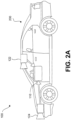
- system 100 may be included on a vehicle 200, as shown in Fig. 2A .
- vehicle 200 may be equipped with a processing unit 110 and any of the other components of system 100, as described above relative to FIG. 1 .
- Vehicle 200 may be equipped with only a single image capture device (e.g., camera), Alternatively, such as those discussed in connection with FIGS. 2B-2E , multiple image capture devices may be used.
- image capture devices 122 and 124 of vehicle 200 as shown in Fig. 2A , may be part of an ADAS (Advanced Driver Assistance Systems) imaging set.
- ADAS Advanced Driver Assistance Systems
- image capture devices included on vehicle 200 as part of the image acquisition unit 120 may be positioned at any suitable location. As shown in Figs. 2A-2E and 3A-3C , image capture device 122 may be located in the vicinity of the rearview mirror. This position may provide a line of sight similar to that of the driver of vehicle 200, which may aid in determining what is and is not visible to the driver. Image capture device 122 may be positioned at any location near the rearview mirror, but placing image capture device 122 on the driver side of the mirror may further aid in obtaining images representative of the driver's field of view and/or line of sight.
- image capture device 124 may be located on or in a bumper of vehicle 200. Such a location may be especially suitable for image capture devices having a wide field of view. The line of sight of bumper-located image capture devices can be different from that of the driver and, therefore, the bumper image capture device and driver may not always see the same objects.
- the image capture devices e.g., image capture devices 122, 124, and 126) may also be located in other locations.
- the image capture devices may be located on or in one or both of the side mirrors of vehicle 200, on the roof of vehicle 200, on the hood of vehicle 200, on the trunk of vehicle 200, on the sides of vehicle 200, mounted on, positioned behind, or positioned in front of any of the windows of vehicle 200, and mounted in or near light fixtures on the front and/or back of vehicle 200, etc.
- vehicle 200 may include various other components of system 100.
- processing unit 110 may be included on vehicle 200 either integrated with or separate from an engine control unit (ECU) of the vehicle.
- vehicle 200 may also be equipped with a position sensor 130, such as a GPS receiver and may also include a map database 160 and memory units 140 and 150.
- wireless transceiver 172 may and/or receive data over one or more networks (e.g., cellular networks, the Internet, etc.). For example, wireless transceiver 172 may upload data collected by system 100 to one or more servers, and download data from the one or more servers. Via wireless transceiver 172, system 100 may receive, for example, periodic or on demand updates to data stored in map database 160, memory 140, and/or memory 150. Similarly, wireless transceiver 172 may upload any data (e.g., images captured by image acquisition unit 120, data received by position sensor 130 or other sensors, vehicle control systems, etc.) from system 100 and/or any data processed by processing unit 110 to the one or more servers.
- networks e.g., cellular networks, the Internet, etc.
- wireless transceiver 172 may upload data collected by system 100 to one or more servers, and download data from the one or more servers. Via wireless transceiver 172, system 100 may receive, for example, periodic or on demand updates to data stored in map database 160, memory
- System 100 may upload data to a server (e.g., to the cloud) based on a privacy level setting.
- system 100 may implement privacy level settings to regulate or limit the types of data (including metadata) sent to the server that may uniquely identify a vehicle and or driver/owner of a vehicle.
- privacy level settings may be set by user via, for example, wireless transceiver 172, be initialized by factory default settings, or by data received by wireless transceiver 172.
- System 100 may upload data according to a "high" privacy level, and under setting a setting, system 100 may transmit data (e.g., location information related to a route, captured images, etc.) without any details about the specific vehicle and/or driver/owner.
- data e.g., location information related to a route, captured images, etc.
- system 100 may not include a vehicle identification number (VIN) or a name of a driver or owner of the vehicle, and may instead transmit data, such as captured images and/or limited location information related to a route.
- VIN vehicle identification number
- system 100 may transmit data to a server according to an "intermediate" privacy level and include additional information not included under a "high” privacy level, such as a make and/or model of a vehicle and/or a vehicle type (e.g., a passenger vehicle, sport utility vehicle, truck, etc.).
- System 100 may upload data according to a "low” privacy level. Under a "low” privacy level setting, system 100 may upload data and include information sufficient to uniquely identify a specific vehicle, owner/driver, and/or a portion or entirely of a route traveled by the vehicle.
- Such "low" privacy level data may include one or more of, for example, a VIN, a driver/owner name, an origination point of a vehicle prior to departure, an intended destination of the vehicle, a make and/or model of the vehicle, a type of the vehicle, etc.
- Fig. 2A is a diagrammatic side view representation of an exemplary vehicle imaging system.
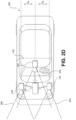
- Fig. 2B is a diagrammatic top view illustration of the vehicle imaging system shown in Fig. 2A .
- the vehicle imaging system may include a vehicle 200 including in its body a system 100 with a first image capture device 122 positioned in the vicinity of the rearview mirror and/or near the driver of vehicle 200, a second image capture device 124 positioned on or in a bumper region (e.g., one of bumper regions 210) of vehicle 200, and a processing unit 110.
- a vehicle 200 including in its body a system 100 with a first image capture device 122 positioned in the vicinity of the rearview mirror and/or near the driver of vehicle 200, a second image capture device 124 positioned on or in a bumper region (e.g., one of bumper regions 210) of vehicle 200, and a processing unit 110.
- a bumper region e.g., one of bumper regions 210
- image capture devices 122 and 124 may both be positioned in the vicinity of the rearview mirror and/or near the driver of vehicle 200. Additionally, while two image capture devices 122 and 124 are shown in Figs. 2B and 2C , it should be understood that other systems may include more than two image capture devices. For example, in the systems shown in Figs. 2D and 2E , first, second, and third image capture devices 122, 124, and 126, are included in the system 100 of vehicle 200.
- image capture device 122 may be positioned in the vicinity of the rearview mirror and/or near the driver of vehicle 200, and image capture devices 124 and 126 may be positioned on or in a bumper region (e.g., one of bumper regions 210) of vehicle 200. And as shown in Fig. 2E , image capture devices 122, 124, and 126 may be positioned in the vicinity of the rearview mirror and/or near the driver seat of vehicle 200. Systems are not limited to any particular number and configuration of the image capture devices, and the image capture devices may be positioned in any appropriate location within and/or on vehicle 200.
- Systems are not limited to vehicles and could be applied in other contexts. It is also to be understood that systems are not limited to a particular type of vehicle 200 and may be applicable to all types of vehicles including automobiles, trucks, trailers, and other types of vehicles.
- the first image capture device 122 may include any suitable type of image capture device.
- Image capture device 122 may include an optical axis.
- the image capture device 122 may include an Aptina M9V024 WVGA sensor with a global shutter.
- image capture device 122 may provide a resolution of 1280x960 pixels and may include a rolling shutter.
- Image capture device 122 may include various optical elements. In some cases, one or more lenses may be included, for example, to provide a desired focal length and field of view for the image capture device.
- Image capture device 122 may be associated with a 6mm lens or a 12mm lens.
- Image capture device 122 may be configured to capture images having a desired field-of-view (FOV) 202, as illustrated in Fig. 2D .
- FOV field-of-view
- image capture device 122 may be configured to have a regular FOV, such as within a range of 40 degrees to 56 degrees, including a 46 degree FOV, 50 degree FOV, 52 degree FOV, or greater.
- image capture device 122 may be configured to have a narrow FOV in the range of 23 to 40 degrees, such as a 28 degree FOV or 36 degree FOV.
- image capture device 122 may be configured to have a wide FOV in the range of 100 to 180 degrees.
- Image capture device 122 may include a wide angle bumper camera or one with up to a 180 degree FOV.
- the first image capture device 122 may acquire a plurality of first images relative to a scene associated with vehicle 200.
- Each of the plurality of first images may be acquired as a series of image scan lines, which may be captured using a rolling shutter.
- Each scan line may include a plurality of pixels.
- the first image capture device 122 may have a scan rate associated with acquisition of each of the first series of image scan lines.
- the scan rate may refer to a rate at which an image sensor can acquire image data associated with each pixel included in a particular scan line.
- Image capture devices 122, 124, and 126 may contain any suitable type and number of image sensors, including CCD sensors or CMOS sensors, for example.
- a CMOS image sensor may be employed along with a rolling shutter, such that each pixel in a row is read one at a time, and scanning of the rows proceeds on a row-by-row basis until an entire image frame has been captured. The rows may be captured sequentially from top to bottom relative to the frame.
- One or more of the image capture devices may constitute a high resolution imager and may have a resolution greater than 5M pixel, 7M pixel, 10M pixel, or greater.
- a rolling shutter may result in pixels in different rows being exposed and captured at different times, which may cause skew and other image artifacts in the captured image frame.
- the image capture device 122 is configured to operate with a global or synchronous shutter, all of the pixels may be exposed for the same amount of time and during a common exposure period.
- the image data in a frame collected from a system employing a global shutter represents a snapshot of the entire FOV (such as FOV 202) at a particular time.
- FOV 202 the entire FOV
- each row in a frame is exposed and data is capture at different times.
- moving objects may appear distorted in an image capture device having a rolling shutter. This phenomenon will be described in greater detail below.
- the second image capture device 124 and the third image capturing device 126 may be any type of image capture device. Like the first image capture device 122, each of image capture devices 124 and 126 may include an optical axis. Each of image capture devices 124 and 126 may include an Aptina M9V024 WVGA sensor with a global shutter. Alternatively, each of image capture devices 124 and 126 may include a rolling shutter. Like image capture device 122, image capture devices 124 and 126 may be configured to include various lenses and optical elements. Lenses associated with image capture devices 124 and 126 may provide FOVs (such as FOVs 204 and 206) that are the same as, or narrower than, a FOV (such as FOV 202) associated with image capture device 122. For example, image capture devices 124 and 126 may have FOVs of 40 degrees, 30 degrees, 26 degrees, 23 degrees, 20 degrees, or less.
- Image capture devices 124 and 126 may acquire a plurality of second and third images relative to a scene associated with vehicle 200. Each of the plurality of second and third images may be acquired as a second and third series of image scan lines, which may be captured using a rolling shutter. Each scan line or row may have a plurality of pixels. Image capture devices 124 and 126 may have second and third scan rates associated with acquisition of each of image scan lines included in the second and third series.
- Each image capture device 122, 124, and 126 may be positioned at any suitable position and orientation relative to vehicle 200. The relative positioning of the image capture devices 122, 124, and 126 may be selected to aid in fusing together the information acquired from the image capture devices. For example, a FOV (such as FOV 204) associated with image capture device 124 may overlap partially or fully with a FOV (such as FOV 202) associated with image capture device 122 and a FOV (such as FOV 206) associated with image capture device 126.
- FOV such as FOV 204
- FOV 206 FOV
- Image capture devices 122, 124, and 126 may be located on vehicle 200 at any suitable relative heights. In one instance, there may be a height difference between the image capture devices 122, 124, and 126, which may provide sufficient parallax information to enable stereo analysis. For example, as shown in Fig. 2A , the two image capture devices 122 and 124 are at different heights. There may also be a lateral displacement difference between image capture devices 122, 124, and 126, giving additional parallax information for stereo analysis by processing unit 110, for example. The difference in the lateral displacement may be denoted by d x , as shown in Figs. 2C and 2D .
- Fore or aft displacement may exist between image capture devices 122, 124, and 126.
- image capture device 122 may be located 0.5 to 2 meters or more behind image capture device 124 and/or image capture device 126. This type of displacement may enable one of the image capture devices to cover potential blind spots of the other image capture device(s).
- Image capture devices 122 may have any suitable resolution capability (e.g., number of pixels associated with the image sensor), and the resolution of the image sensor(s) associated with the image capture device 122 may be higher, lower, or the same as the resolution of the image sensor(s) associated with image capture devices 124 and 126.
- the image sensor(s) associated with image capture device 122 and/or image capture devices 124 and 126 may have a resolution of 640 x 480, 1024 x 768, 1280 x 960, or any other suitable resolution.
- the frame rate (e.g., the rate at which an image capture device acquires a set of pixel data of one image frame before moving on to capture pixel data associated with the next image frame) may be controllable.
- the frame rate associated with image capture device 122 may be higher, lower, or the same as the frame rate associated with image capture devices 124 and 126.
- the frame rate associated with image capture devices 122, 124, and 126 may depend on a variety of factors that may affect the timing of the frame rate.
- one or more of image capture devices 122, 124, and 126 may include a selectable pixel delay period imposed before or after acquisition of image data associated with one or more pixels of an image sensor in image capture device 122, 124, and/or 126.
- image data corresponding to each pixel may be acquired according to a clock rate for the device (e.g., one pixel per clock cycle).
- a clock rate for the device e.g., one pixel per clock cycle.
- one or more of image capture devices 122, 124, and 126 may include a selectable horizontal blanking period imposed before or after acquisition of image data associated with a row of pixels of an image sensor in image capture device 122, 124, and/or 126.
- image capture devices 122, 124, and/or 126 may include a selectable vertical blanking period imposed before or after acquisition of image data associated with an image frame of image capture device 122, 124, and 126.
- timing controls may enable synchronization of frame rates associated with image capture devices 122, 124, and 126, even where the line scan rates of each are different. Additionally, as will be discussed in greater detail below, these selectable timing controls, among other factors (e.g., image sensor resolution, maximum line scan rates, etc.) may enable synchronization of image capture from an area where the FOV of image capture device 122 overlaps with one or more FOVs of image capture devices 124 and 126, even where the field of view of image capture device 122 is different from the FOVs of image capture devices 124 and 126.
- image sensor resolution e.g., maximum line scan rates, etc.
- Frame rate timing in image capture device 122, 124, and 126 may depend on the resolution of the associated image sensors. For example, assuming similar line scan rates for both devices, if one device includes an image sensor having a resolution of 640 x 480 and another device includes an image sensor with a resolution of 1280 x 960, then more time will be required to acquire a frame of image data from the sensor having the higher resolution.
- Another factor that may affect the timing of image data acquisition in image capture devices 122, 124, and 126 is the maximum line scan rate. For example, acquisition of a row of image data from an image sensor included in image capture device 122, 124, and 126 will require some minimum amount of time. Assuming no pixel delay periods are added, this minimum amount of time for acquisition of a row of image data will be related to the maximum line scan rate for a particular device. Devices that offer higher maximum line scan rates have the potential to provide higher frame rates than devices with lower maximum line scan rates.
- One or more of image capture devices 124 and 126 may have a maximum line scan rate that is higher than a maximum line scan rate associated with image capture device 122.
- the maximum line scan rate of image capture device 124 and/or 126 may be 1.25, 1.5, 1.75, or 2 times or more than a maximum line scan rate of image capture device 122.
- image capture devices 122, 124, and 126 may have the same maximum line scan rate, but image capture device 122 may be operated at a scan rate less than or equal to its maximum scan rate.
- the system may be configured such that one or more of image capture devices 124 and 126 operate at a line scan rate that is equal to the line scan rate of image capture device 122.
- the system may be configured such that the line scan rate of image capture device 124 and/or image capture device 126 may be 1.25, 1.5, 1.75, or 2 times or more than the line scan rate of image capture device 122.
- Image capture devices 122, 124, and 126 may be asymmetric. That is, they may include cameras having different fields of view (FOV) and focal lengths.
- the fields of view of image capture devices 122, 124, and 126 may include any desired area relative to an environment of vehicle 200, for example.
- One or more of image capture devices 122, 124, and 126 may be configured to acquire image data from an environment in front of vehicle 200, behind vehicle 200, to the sides of vehicle 200, or combinations thereof.
- each image capture device 122, 124, and/or 126 may be selectable (e.g., by inclusion of appropriate lenses etc.) such that each device acquires images of objects at a desired distance range relative to vehicle 200.
- image capture devices 122, 124, and 126 may acquire images of close-up objects within a few meters from the vehicle.
- Image capture devices 122, 124, and 126 may also be configured to acquire images of objects at ranges more distant from the vehicle (e.g., 25 m, 50 m, 100 m, 150 m, or more).
- the focal lengths of image capture devices 122, 124, and 126 may be selected such that one image capture device (e.g., image capture device 122) can acquire images of objects relatively close to the vehicle (e.g., within 10 m or within 20 m) while the other image capture devices (e.g., image capture devices 124 and 126) can acquire images of more distant objects (e.g., greater than 20 m, 50 m, 100 m, 150 m, etc.) from vehicle 200.
- one image capture device e.g., image capture device 122
- the other image capture devices e.g., image capture devices 124 and 1266
- images of more distant objects e.g., greater than 20 m, 50 m, 100 m, 150 m, etc.
- the FOV of one or more image capture devices 122, 124, and 126 may have a wide angle. For example, it may be advantageous to have a FOV of 140 degrees, especially for image capture devices 122, 124, and 126 that may be used to capture images of the area in the vicinity of vehicle 200.
- image capture device 122 may be used to capture images of the area to the right or left of vehicle 200 and, in such systems, it may be desirable for image capture device 122 to have a wide FOV (e.g., at least 140 degrees).
- the field of view associated with each of image capture devices 122, 124, and 126 may depend on the respective focal lengths. For example, as the focal length increases, the corresponding field of view decreases.
- Image capture devices 122, 124, and 126 may be configured to have any suitable fields of view.
- image capture device 122 may have a horizontal FOV of 46 degrees
- image capture device 124 may have a horizontal FOV of 23 degrees
- image capture device 126 may have a horizontal FOV in between 23 and 46 degrees.
- image capture device 122 may have a horizontal FOV of 52 degrees
- image capture device 124 may have a horizontal FOV of 26 degrees
- image capture device 126 may have a horizontal FOV in between 26 and 52 degrees.
- Thea ratio of the FOV of image capture device 122 to the FOVs of image capture device 124 and/or image capture device 126 may vary from 1.5 to 2.0. Alternatively, this ratio may vary between 1.25 and 2.25.
- System 100 may be configured so that a field of view of image capture device 122 overlaps, at least partially or fully, with a field of view of image capture device 124 and/or image capture device 126.
- System 100 may be configured such that the fields of view of image capture devices 124 and 126, for example, fall within (e.g., are narrower than) and share a common center with the field of view of image capture device 122.
- the image capture devices 122, 124, and 126 may capture adjacent FOVs or may have partial overlap in their FOVs.
- the fields of view of image capture devices 122, 124, and 126 may be aligned such that a center of the narrower FOV image capture devices 124 and/or 126 may be located in a lower half of the field of view of the wider FOV device 122.
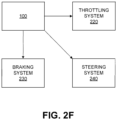
- system 100 may provide control signals to one or more of throttling system 220, braking system 230, and steering system 240 to navigate vehicle 200 (e.g., by causing an acceleration, a turn, a lane shift, etc.). Further, system 100 may receive inputs from one or more of throttling system 220, braking system 230, and steering system 24 indicating operating conditions of vehicle 200 (e.g., speed, whether vehicle 200 is braking and/or turning, etc.). Further details are provided in connection with Figs. 4-7 , below.
- vehicle 200 may also include a user interface 170 for interacting with a driver or a passenger of vehicle 200.
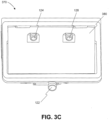
- user interface 170 in a vehicle application may include a touch screen 320, knobs 330, buttons 340, and a microphone 350.
- a driver or passenger of vehicle 200 may also use handles (e.g., located on or near the steering column of vehicle 200 including, for example, turn signal handles), buttons (e.g., located on the steering wheel of vehicle 200), and the like, to interact with system 100.
- Microphone 350 may be positioned adjacent to a rearview mirror 310.
- Image capture device 122 may be located near rearview mirror 310.
- User interface 170 may also include one or more speakers 360 (e.g., speakers of a vehicle audio system).
- system 100 may provide various notifications (e.g., alerts) via speakers 360.
- Figs. 3B-3D are illustrations of an exemplary camera mount 370 configured to be positioned behind a rearview mirror (e.g., rearview mirror 310) and against a vehicle windshield.
- camera mount 370 may include image capture devices 122, 124, and 126.
- Image capture devices 124 and 126 may be positioned behind a glare shield 380, which may be flush against the vehicle windshield and include a composition of film and/or anti-reflective materials.
- glare shield 380 may be positioned such that it aligns against a vehicle windshield having a matching slope.
- Each of image capture devices 122, 124, and 126 may be positioned behind glare shield 380, as depicted, for example, in Fig.
- FIG. 3D is an illustration of camera mount 370 shown in Fig. 3B from a front perspective.
- system 100 can provide a wide range of functionality to analyze the surroundings of vehicle 200 and navigate vehicle 200 in response to the analysis.
- system 100 may provide a variety of features related to autonomous driving and/or driver assist technology.
- system 100 may analyze image data, position data (e.g., GPS location information), map data, speed data, and/or data from sensors included in vehicle 200.
- System 100 may collect the data for analysis from, for example, image acquisition unit 120, position sensor 130, and other sensors. Further, system 100 may analyze the collected data to determine whether or not vehicle 200 should take a certain action, and then automatically take the determined action without human intervention. For example, when vehicle 200 navigates without human intervention, system 100 may automatically control the braking, acceleration, and/or steering of vehicle 200 (e.g., by sending control signals to one or more of throttling system 220, braking system 230, and steering system 240). Further, system 100 may analyze the collected data and issue warnings and/or alerts to vehicle occupants based on the analysis of the collected data. Additional details are provided below.
- system 100 may provide drive assist functionality that uses a multi-camera system.
- the multi-camera system may use one or more cameras facing in the forward direction of a vehicle.
- the multi-camera system may include one or more cameras facing to the side of a vehicle or to the rear of the vehicle.
- system 100 may use a two-camera imaging system, where a first camera and a second camera (e.g., image capture devices 122 and 124) may be positioned at the front and/or the sides of a vehicle (e.g., vehicle 200).
- a first camera and a second camera e.g., image capture devices 122 and 124
- Other camera configurations may be used, and the configurations disclosed herein are examples.
- system 100 may include a configuration of any number of cameras (e.g., one, two, three, four, five, six, seven, eight, etc.)
- system 100 may include "clusters" of cameras.
- a cluster of cameras including any appropriate number of cameras, e.g., one, four, eight, etc.
- system 100 may include multiple clusters of cameras, with each cluster oriented in a particular direction to capture images from a particular region of a vehicle's environment.
- the first camera may have a field of view that is greater than, less than, or partially overlapping with, the field of view of the second camera.
- the first camera may be connected to a first image processor to perform monocular image analysis of images provided by the first camera
- the second camera may be connected to a second image processor to perform monocular image analysis of images provided by the second camera.
- the outputs (e.g., processed information) of the first and second image processors may be combined.
- the second image processor may receive images from both the first camera and second camera to perform stereo analysis.
- system 100 may use a three-camera imaging system where each of the cameras has a different field of view.
- references to monocular image analysis may refer to instances where image analysis is performed based on images captured from a single point of view (e.g., from a single camera).
- Stereo image analysis may refer to instances where image analysis is performed based on two or more images captured with one or more variations of an image capture parameter.
- captured images suitable for performing stereo image analysis may include images captured: from two or more different positions, from different fields of view, using different focal lengths, along with parallax information, etc.
- system 100 may implement a three camera configuration using image capture devices 122-126.
- image capture device 122 may provide a narrow field of view (e.g., 34 degrees, or other values selected from a range of about 20 to 45 degrees, etc.)
- image capture device 124 may provide a wide field of view (e.g., 150 degrees or other values selected from a range of about 100 to about 180 degrees)
- image capture device 126 may provide an intermediate field of view (e.g., 46 degrees or other values selected from a range of about 35 to about 60 degrees).
- Image capture device 126 may act as a main or primary camera.
- Image capture devices 122-126 may be positioned behind rearview mirror 310 and positioned substantially side-by-side (e.g., 6 cm apart). Further, as discussed above, one or more of image capture devices 122-126 may be mounted behind glare shield 380 that is flush with the windshield of vehicle 200. Such shielding may act to minimize the impact of any reflections from inside the car on image capture devices 122-126.
- the wide field of view camera (e.g., image capture device 124 in the above example) may be mounted lower than the narrow and main field of view cameras (e.g., image devices 122 and 126 in the above example).
- This configuration may provide a free line of sight from the wide field of view camera.
- the cameras may be mounted close to the windshield of vehicle 200, and may include polarizers on the cameras to damp reflected light.
- a three camera system may provide certain performance characteristics. For example, some systems may include an ability to validate the detection of objects by one camera based on detection results from another camera.
- processing unit 110 may include, for example, three processing devices (e.g., three EyeQ series of processor chips, as discussed above), with each processing device dedicated to processing images captured by one or more of image capture devices 122-126.
- a first processing device may receive images from both the main camera and the narrow field of view camera, and perform vision processing of the narrow FOV camera to, for example, detect other vehicles, pedestrians, lane marks, traffic signs, traffic lights, and other road objects. Further, the first processing device may calculate a disparity of pixels between the images from the main camera and the narrow camera and create a 3D reconstruction of the environment of vehicle 200. The first processing device may then combine the 3D reconstruction with 3D map data or with 3D information calculated based on information from another camera.
- the second processing device may receive images from the main camera and perform vision processing to detect other vehicles, pedestrians, lane marks, traffic signs, traffic lights, and other road objects. Additionally, the second processing device may calculate a camera displacement and, based on the displacement, calculate a disparity of pixels between successive images and create a 3D reconstruction of the scene (e.g., a structure from motion). The second processing device may send the structure from motion based 3D reconstruction to the first processing device to be combined with the stereo 3D images.
- a 3D reconstruction of the scene e.g., a structure from motion
- the third processing device may receive images from the wide FOV camera and process the images to detect vehicles, pedestrians, lane marks, traffic signs, traffic lights, and other road objects.
- the third processing device may further execute additional processing instructions to analyze images to identify objects moving in the image, such as vehicles changing lanes, pedestrians, etc.
- Having streams of image-based information captured and processed independently may provide an opportunity for providing redundancy in the system.
- redundancy may include, for example, using a first image capture device and the images processed from that device to validate and/or supplement information obtained by capturing and processing image information from at least a second image capture device.
- System 100 may use two image capture devices (e.g., image capture devices 122 and 124) in providing navigation assistance for vehicle 200 and use a third image capture device (e.g., image capture device 126) to provide redundancy and validate the analysis of data received from the other two image capture devices.
- image capture devices 122 and 124 may provide images for stereo analysis by system 100 for navigating vehicle 200
- image capture device 126 may provide images for monocular analysis by system 100 to provide redundancy and validation of information obtained based on images captured from image capture device 122 and/or image capture device 124.
- image capture device 126 (and a corresponding processing device) may be considered to provide a redundant sub-system for providing a check on the analysis derived from image capture devices 122 and 124 (e.g., to provide an automatic emergency braking (AEB) system).
- AEB automatic emergency braking
- redundancy and validation of received data may be supplemented based on information received from one more sensors (e.g., radar, lidar, acoustic sensors, information received from one or more transceivers outside of a vehicle, etc.).
- Fig. 4 is an exemplary functional block diagram of memory 140 and/or 150, which may be stored/programmed with instructions for performing one or more operations. Although the following refers to memory 140, one of skill in the art will recognize that instructions may be stored in memory 140 and/or 150.
- memory 140 may store a monocular image analysis module 402, a stereo image analysis module 404, a velocity and acceleration module 406, and a navigational response module 408.
- Systems are not limited to any particular configuration of memory 140.
- applications processor 180 and/or image processor 190 may execute the instructions stored in any of modules 402-408 included in memory 140.
- processing unit 110 may refer to applications processor 180 and image processor 190 individually or collectively. Accordingly, steps of any of the following processes may be performed by one or more processing devices.
- Monocular image analysis module 402 may store instructions (such as computer vision software) which, when executed by processing unit 110, performs monocular image analysis of a set of images acquired by one of image capture devices 122, 124, and 126. Processing unit 110 may combine information from a set of images with additional sensory information (e.g., information from radar) to perform the monocular image analysis. As described in connection with Figs. 5A-5D below, monocular image analysis module 402 may include instructions for detecting a set of features within the set of images, such as lane markings, vehicles, pedestrians, road signs, highway exit ramps, traffic lights, hazardous objects, and any other feature associated with an environment of a vehicle.
- system 100 may cause one or more navigational responses in vehicle 200, such as a turn, a lane shift, a change in acceleration, and the like, as discussed below in connection with navigational response module 408.
- Monocular image analysis module 402 may store instructions (such as computer vision software) which, when executed by processing unit 110, performs monocular image analysis of a set of images acquired by one of image capture devices 122, 124, and 126. Processing unit 110 may combine information from a set of images with additional sensory information (e.g., information from radar, lidar, etc.) to perform the monocular image analysis. As described in connection with Figs. 5A-5D below, monocular image analysis module 402 may include instructions for detecting a set of features within the set of images, such as lane markings, vehicles, pedestrians, road signs, highway exit ramps, traffic lights, hazardous objects, and any other feature associated with an environment of a vehicle.
- instructions such as computer vision software
- system 100 may cause one or more navigational responses in vehicle 200, such as a turn, a lane shift, a change in acceleration, and the like, as discussed below in connection with determining a navigational response.
- one or more navigational responses in vehicle 200 such as a turn, a lane shift, a change in acceleration, and the like, as discussed below in connection with determining a navigational response.
- Stereo image analysis module 404 may store instructions (such as computer vision software) which, when executed by processing unit 110, performs stereo image analysis of first and second sets of images acquired by a combination of image capture devices selected from any of image capture devices 122, 124, and 126. Processing unit 110 may combine information from the first and second sets of images with additional sensory information (e.g., information from radar) to perform the stereo image analysis.
- stereo image analysis module 404 may include instructions for performing stereo image analysis based on a first set of images acquired by image capture device 124 and a second set of images acquired by image capture device 126. As described in connection with FIG.
- stereo image analysis module 404 may include instructions for detecting a set of features within the first and second sets of images, such as lane markings, vehicles, pedestrians, road signs, highway exit ramps, traffic lights, hazardous objects, and the like. Based on the analysis, processing unit 110 may cause one or more navigational responses in vehicle 200, such as a turn, a lane shift, a change in acceleration, and the like, as discussed below in connection with navigational response module 408. Furthermore, stereo image analysis module 404 may implement techniques associated with a trained system (such as a neural network or a deep neural network) or an untrained system.
- a trained system such as a neural network or a deep neural network
- Velocity and acceleration module 406 may store software configured to analyze data received from one or more computing and electromechanical devices in vehicle 200 that are configured to cause a change in velocity and/or acceleration of vehicle 200.
- processing unit 110 may execute instructions associated with velocity and acceleration module 406 to calculate a target speed for vehicle 200 based on data derived from execution of monocular image analysis module 402 and/or stereo image analysis module 404.
- data may include, for example, a target position, velocity, and/or acceleration, the position and/or speed of vehicle 200 relative to a nearby vehicle, pedestrian, or road object, position information for vehicle 200 relative to lane markings of the road, and the like.
- processing unit 110 may calculate a target speed for vehicle 200 based on sensory input (e.g., information from radar) and input from other systems of vehicle 200, such as throttling system 220, braking system 230, and/or steering system 240 of vehicle 200. Based on the calculated target speed, processing unit 110 may transmit electronic signals to throttling system 220, braking system 230, and/or steering system 240 of vehicle 200 to trigger a change in velocity and/or acceleration by, for example, physically depressing the brake or easing up off the accelerator of vehicle 200.
- sensory input e.g., information from radar
- processing unit 110 may transmit electronic signals to throttling system 220, braking system 230, and/or steering system 240 of vehicle 200 to trigger a change in velocity and/or acceleration by, for example, physically depressing the brake or easing up off the accelerator of vehicle 200.
- Navigational response module 408 may store software executable by processing unit 110 to determine a desired navigational response based on data derived from execution of monocular image analysis module 402 and/or stereo image analysis module 404. Such data may include position and speed information associated with nearby vehicles, pedestrians, and road objects, target position information for vehicle 200, and the like. Additionally, the navigational response may be based (partially or fully) on map data, a predetermined position of vehicle 200, and/or a relative velocity or a relative acceleration between vehicle 200 and one or more objects detected from execution of monocular image analysis module 402 and/or stereo image analysis module 404.
- Navigational response module 408 may also determine a desired navigational response based on sensory input (e.g., information from radar) and inputs from other systems of vehicle 200, such as throttling system 220, braking system 230, and steering system 240 of vehicle 200. Based on the desired navigational response, processing unit 110 may transmit electronic signals to throttling system 220, braking system 230, and steering system 240 of vehicle 200 to trigger a desired navigational response by, for example, turning the steering wheel of vehicle 200 to achieve a rotation of a predetermined angle. Processing unit 110 may use the output of navigational response module 408 (e.g., the desired navigational response) as an input to execution of velocity and acceleration module 406 for calculating a change in speed of vehicle 200.
- sensory input e.g., information from radar
- processing unit 110 may transmit electronic signals to throttling system 220, braking system 230, and steering system 240 of vehicle 200 to trigger a desired navigational response by, for example, turning the steering wheel of vehicle 200 to achieve a
- any of the modules may implement techniques associated with a trained system (such as a neural network or a deep neural network) or an untrained system.
- Fig. 5A is a flowchart showing an exemplary process 500A for causing one or more navigational responses based on monocular image analysis.
- processing unit 110 may receive a plurality of images via data interface 128 between processing unit 110 and image acquisition unit 120.
- a camera included in image acquisition unit 120 such as image capture device 122 having field of view 202 may capture a plurality of images of an area forward of vehicle 200 (or to the sides or rear of a vehicle, for example) and transmit them over a data connection (e.g., digital, wired, USB, wireless, Bluetooth, etc.) to processing unit 110.
- Processing unit 110 may execute monocular image analysis module 402 to analyze the plurality of images at step 520, as described in further detail in connection with Figs. 5B-5D below.
- processing unit 110 may detect a set of features within the set of images, such as lane markings, vehicles, pedestrians, road signs, highway exit ramps, traffic lights, and the like.
- Processing unit 110 may also execute monocular image analysis module 402 to detect various road hazards at step 520, such as, for example, parts of a truck tire, fallen road signs, loose cargo, small animals, and the like.
- Road hazards may vary in structure, shape, size, and color, which may make detection of such hazards more challenging.
- Processing unit 110 may execute monocular image analysis module 402 to perform multi-frame analysis on the plurality of images to detect road hazards. For example, processing unit 110 may estimate camera motion between consecutive image frames and calculate the disparities in pixels between the frames to construct a 3D-map of the road. Processing unit 110 may then use the 3D-map to detect the road surface, as well as hazards existing above the road surface.
- processing unit 110 may execute navigational response module 408 to cause one or more navigational responses in vehicle 200 based on the analysis performed at step 520 and the techniques as described above in connection with Fig. 4 .
- Navigational responses may include, for example, a turn, a lane shift, a change in acceleration, and the like.
- Processing unit 110 may use data derived from execution of velocity and acceleration module 406 to cause the one or more navigational responses. Additionally, multiple navigational responses may occur simultaneously, in sequence, or any combination thereof. For instance, processing unit 110 may cause vehicle 200 to shift one lane over and then accelerate by, for example, sequentially transmitting control signals to steering system 240 and throttling system 220 of vehicle 200. Alternatively, processing unit 110 may cause vehicle 200 to brake while at the same time shifting lanes by, for example, simultaneously transmitting control signals to braking system 230 and steering system 240 of vehicle 200.
- Fig. 5B is a flowchart showing an exemplary process 500B for detecting one or more vehicles and/or pedestrians in a set of images.
- Processing unit 110 may execute monocular image analysis module 402 to implement process 500B.
- processing unit 110 may determine a set of candidate objects representing possible vehicles and/or pedestrians. For example, processing unit 110 may scan one or more images, compare the images to one or more predetermined patterns, and identify within each image possible locations that may contain objects of interest (e.g., vehicles, pedestrians, or portions thereof).
- objects of interest e.g., vehicles, pedestrians, or portions thereof.
- the predetermined patterns may be designed in such a way to achieve a high rate of "false hits" and a low rate of "misses.”
- processing unit 110 may use a low threshold of similarity to predetermined patterns for identifying candidate objects as possible vehicles or pedestrians. Doing so may allow processing unit 110 to reduce the probability of missing (e.g., not identifying) a candidate object representing a vehicle or pedestrian.
- processing unit 110 may filter the set of candidate objects to exclude certain candidates (e.g., irrelevant or less relevant objects) based on classification criteria.
- criteria may be derived from various properties associated with object types stored in a database (e.g., a database stored in memory 140). Properties may include object shape, dimensions, texture, position (e.g., relative to vehicle 200), and the like.
- processing unit 110 may use one or more sets of criteria to reject false candidates from the set of candidate objects.
- processing unit 110 may analyze multiple frames of images to determine whether objects in the set of candidate objects represent vehicles and/or pedestrians. For example, processing unit 110 may track a detected candidate object across consecutive frames and accumulate frame-by-frame data associated with the detected object (e.g., size, position relative to vehicle 200, etc.). Additionally, processing unit 110 may estimate parameters for the detected object and compare the object's frame-by-frame position data to a predicted position.
- processing unit 110 may estimate parameters for the detected object and compare the object's frame-by-frame position data to a predicted position.
- processing unit 110 may construct a set of measurements for the detected objects. Such measurements may include, for example, position, velocity, and acceleration values (relative to vehicle 200) associated with the detected objects. Processing unit 110 may construct the measurements based on estimation techniques using a series of time-based observations such as Kalman filters or linear quadratic estimation (LQE), and/or based on available modeling data for different object types (e.g., cars, trucks, pedestrians, bicycles, road signs, etc.). The Kalman filters may be based on a measurement of an object's scale, where the scale measurement is proportional to a time to collision (e.g., the amount of time for vehicle 200 to reach the object).
- LQE linear quadratic estimation
- processing unit 110 may identify vehicles and pedestrians appearing within the set of captured images and derive information (e.g., position, speed, size) associated with the vehicles and pedestrians. Based on the identification and the derived information, processing unit 110 may cause one or more navigational responses in vehicle 200, as described in connection with FIG. 5A , above.
- information e.g., position, speed, size
- processing unit 110 may perform an optical flow analysis of one or more images to reduce the probabilities of detecting a "false hit" and missing a candidate object that represents a vehicle or pedestrian.
- the optical flow analysis may refer to, for example, analyzing motion patterns relative to vehicle 200 in the one or more images associated with other vehicles and pedestrians, and that are distinct from road surface motion.
- Processing unit 110 may calculate the motion of candidate objects by observing the different positions of the objects across multiple image frames, which are captured at different times.
- Processing unit 110 may use the position and time values as inputs into mathematical models for calculating the motion of the candidate objects.
- optical flow analysis may provide another method of detecting vehicles and pedestrians that are nearby vehicle 200.
- Processing unit 110 may perform optical flow analysis in combination with steps 540-546 to provide redundancy for detecting vehicles and pedestrians and increase the reliability of system 100.
- Fig. 5C is a flowchart showing an exemplary process 500C for detecting road marks and/or lane geometry information in a set of images.
- Processing unit 110 may execute monocular image analysis module 402 to implement process 500C.
- processing unit 110 may detect a set of objects by scanning one or more images. To detect segments of lane markings, lane geometry information, and other pertinent road marks, processing unit 110 may filter the set of objects to exclude those determined to be irrelevant (e.g., minor potholes, small rocks, etc.).
- processing unit 110 may group together the segments detected in step 550 belonging to the same road mark or lane mark. Based on the grouping, processing unit 110 may develop a model to represent the detected segments, such as a mathematical model.
- processing unit 110 may construct a set of measurements associated with the detected segments.
- Processing unit 110 may create a projection of the detected segments from the image plane onto the real-world plane.
- the projection may be characterized using a 3rd-degree polynomial having coefficients corresponding to physical properties such as the position, slope, curvature, and curvature derivative of the detected road.
- processing unit 110 may take into account changes in the road surface, as well as pitch and roll rates associated with vehicle 200.
- processing unit 110 may model the road elevation by analyzing position and motion cues present on the road surface. Further, processing unit 110 may estimate the pitch and roll rates associated with vehicle 200 by tracking a set of feature points in the one or more images.
- processing unit 110 may perform multi-frame analysis by, for example, tracking the detected segments across consecutive image frames and accumulating frame-by-frame data associated with detected segments. As processing unit 110 performs multi-frame analysis, the set of measurements constructed at step 554 may become more reliable and associated with an increasingly higher confidence level. Thus, by performing steps 550-556, processing unit 110 may identify road marks appearing within the set of captured images and derive lane geometry information. Based on the identification and the derived information, processing unit 110 may cause one or more navigational responses in vehicle 200, as described in connection with Fig. 5A , above.
- processing unit 110 may consider additional sources of information to further develop a safety model for vehicle 200 in the context of its surroundings.
- Processing unit 110 may use the safety model to define a context in which system 100 may execute autonomous control of vehicle 200 in a safe manner.
- Processing unit 110 may consider the position and motion of other vehicles, the detected road edges and barriers, and/or general road shape descriptions extracted from map data (such as data from map database 160). By considering additional sources of information, processing unit 110 may provide redundancy for detecting road marks and lane geometry and increase the reliability of system 100.
- Fig. 5D is a flowchart showing an exemplary process 500D for detecting traffic lights in a set of images.
- Processing unit 110 may execute monocular image analysis module 402 to implement process 500D.
- processing unit 110 may scan the set of images and identify objects appearing at locations in the images likely to contain traffic lights. For example, processing unit 110 may filter the identified objects to construct a set of candidate objects, excluding those objects unlikely to correspond to traffic lights. The filtering may be done based on various properties associated with traffic lights, such as shape, dimensions, texture, position (e.g., relative to vehicle 200), and the like. Such properties may be based on multiple examples of traffic lights and traffic control signals and stored in a database. Processing unit 110 may perform multi-frame analysis on the set of candidate objects reflecting possible traffic lights.
- processing unit 110 may track the candidate objects across consecutive image frames, estimate the real-world position of the candidate objects, and filter out those objects that are moving (which are unlikely to be traffic lights). Processing unit 110 may perform color analysis on the candidate objects and identify the relative position of the detected colors appearing inside possible traffic lights.
- processing unit 110 may analyze the geometry of a junction. The analysis may be based on any combination of: (i) the number of lanes detected on either side of vehicle 200, (ii) markings (such as arrow marks) detected on the road, and (iii) descriptions of the junction extracted from map data (such as data from map database 160). Processing unit 110 may conduct the analysis using information derived from execution of monocular analysis module 402. In addition, Processing unit 110 may determine a correspondence between the traffic lights detected at step 560 and the lanes appearing near vehicle 200.
- processing unit 110 may update the confidence level associated with the analyzed junction geometry and the detected traffic lights. For instance, the number of traffic lights estimated to appear at the junction as compared with the number actually appearing at the junction may impact the confidence level. Thus, based on the confidence level, processing unit 110 may delegate control to the driver of vehicle 200 in order to improve safety conditions.
- processing unit 110 may identify traffic lights appearing within the set of captured images and analyze junction geometry information. Based on the identification and the analysis, processing unit 110 may cause one or more navigational responses in vehicle 200, as described in connection with FIG. 5A , above.
- Fig. 5E is a flowchart showing an exemplary process 500E for causing one or more navigational responses in vehicle 200 based on a vehicle path.
- processing unit 110 may construct an initial vehicle path associated with vehicle 200.
- the vehicle path may be represented using a set of points expressed in coordinates (x, z), and the distance d i between two points in the set of points may fall in the range of 1 to 5 meters.
- Processing unit 110 may construct the initial vehicle path using two polynomials, such as left and right road polynomials.
- Processing unit 110 may calculate the geometric midpoint between the two polynomials and offset each point included in the resultant vehicle path by a predetermined offset (e.g., a smart lane offset), if any (an offset of zero may correspond to travel in the middle of a lane).
- the offset may be in a direction perpendicular to a segment between any two points in the vehicle path.
- processing unit 110 may use one polynomial and an estimated lane width to offset each point of the vehicle path by half the estimated lane width plus a predetermined offset (e.g., a smart lane offset).
- processing unit 110 may update the vehicle path constructed at step 570.
- Processing unit 110 may reconstruct the vehicle path constructed at step 570 using a higher resolution, such that the distance d k between two points in the set of points representing the vehicle path is less than the distance d i described above. For example, the distance d k may fall in the range of 0.1 to 0.3 meters.
- Processing unit 110 may reconstruct the vehicle path using a parabolic spline algorithm, which may yield a cumulative distance vector S corresponding to the total length of the vehicle path (i.e., based on the set of points representing the vehicle path).
- processing unit 110 may determine a look-ahead point (expressed in coordinates as ( x l , z l )) based on the updated vehicle path constructed at step 572.
- Processing unit 110 may extract the look-ahead point from the cumulative distance vector S , and the look-ahead point may be associated with a look-ahead distance and look-ahead time.
- the look-ahead distance which may have a lower bound ranging from 10 to 20 meters, may be calculated as the product of the speed of vehicle 200 and the look-ahead time. For example, as the speed of vehicle 200 decreases, the look-ahead distance may also decrease (e.g., until it reaches the lower bound).
- the look-ahead time which may range from 0.5 to 1.5 seconds, may be inversely proportional to the gain of one or more control loops associated with causing a navigational response in vehicle 200, such as the heading error tracking control loop.
- the gain of the heading error tracking control loop may depend on the bandwidth of a yaw rate loop, a steering actuator loop, car lateral dynamics, and the like.
- the higher the gain of the heading error tracking control loop the lower the look-ahead time.
- processing unit 110 may determine a heading error and yaw rate command based on the look-ahead point determined at step 574.
- Processing unit 110 may determine the heading error by calculating the arctangent of the look-ahead point, e.g., arctan ( x l / z l ) .
- Processing unit 110 may determine the yaw rate command as the product of the heading error and a high-level control gain.
- the high-level control gain may be equal to: (2 / look-ahead time), if the look-ahead distance is not at the lower bound. Otherwise, the high-level control gain may be equal to: (2 * speed of vehicle 200 / look-ahead distance).
- Fig. 5F is a flowchart showing an exemplary process 500F for determining whether a leading vehicle is changing lanes.
- processing unit 110 may determine navigation information associated with a leading vehicle (e.g., a vehicle traveling ahead of vehicle 200). For example, processing unit 110 may determine the position, velocity (e.g., direction and speed), and/or acceleration of the leading vehicle, using the techniques described in connection with FIGS. 5A and 5B , above. Processing unit 110 may also determine one or more road polynomials, a look-ahead point (associated with vehicle 200), and/or a snail trail (e.g., a set of points describing a path taken by the leading vehicle), using the techniques described in connection with FIG. 5E , above.
- a leading vehicle e.g., a vehicle traveling ahead of vehicle 200.
- processing unit 110 may determine the position, velocity (e.g., direction and speed), and/or acceleration of the leading vehicle, using the techniques described in connection with FIGS. 5A and 5B , above.
- processing unit 110 may analyze the navigation information determined at step 580.
- Processing unit 110 may calculate the distance between a snail trail and a road polynomial (e.g., along the trail). If the variance of this distance along the trail exceeds a predetermined threshold (for example, 0.1 to 0.2 meters on a straight road, 0.3 to 0.4 meters on a moderately curvy road, and 0.5 to 0.6 meters on a road with sharp curves), processing unit 110 may determine that the leading vehicle is likely changing lanes. In the case where multiple vehicles are detected traveling ahead of vehicle 200, processing unit 110 may compare the snail trails associated with each vehicle. Based on the comparison, processing unit 110 may determine that a vehicle whose snail trail does not match with the snail trails of the other vehicles is likely changing lanes.
- a predetermined threshold for example, 0.1 to 0.2 meters on a straight road, 0.3 to 0.4 meters on a moderately curvy road, and 0.5 to 0.6 meters on a road with sharp curves
- Processing unit 110 may additionally compare the curvature of the snail trail (associated with the leading vehicle) with the expected curvature of the road segment in which the leading vehicle is traveling.
- the expected curvature may be extracted from map data (e.g., data from map database 160), from road polynomials, from other vehicles' snail trails, from prior knowledge about the road, and the like. If the difference in curvature of the snail trail and the expected curvature of the road segment exceeds a predetermined threshold, processing unit 110 may determine that the leading vehicle is likely changing lanes.
- processing unit 110 may compare the leading vehicle's instantaneous position with the look-ahead point (associated with vehicle 200) over a specific period of time (e.g., 0.5 to 1.5 seconds). If the distance between the leading vehicle's instantaneous position and the look-ahead point varies during the specific period of time, and the cumulative sum of variation exceeds a predetermined threshold (for example, 0.3 to 0.4 meters on a straight road, 0.7 to 0.8 meters on a moderately curvy road, and 1.3 to 1.7 meters on a road with sharp curves), processing unit 110 may determine that the leading vehicle is likely changing lanes. Alternatively, processing unit 110 may analyze the geometry of the snail trail by comparing the lateral distance traveled along the trail with the expected curvature of the snail trail.
- a predetermined threshold for example, 0.3 to 0.4 meters on a straight road, 0.7 to 0.8 meters on a moderately curvy road, and 1.3 to 1.7 meters on a road with sharp curves
- the expected radius of curvature may be determined according to the calculation: ( ⁇ z 2 + ⁇ x 2 ) / 2 / ( ⁇ x ), where ⁇ x represents the lateral distance traveled and ⁇ z represents the longitudinal distance traveled. If the difference between the lateral distance traveled and the expected curvature exceeds a predetermined threshold (e.g., 500 to 700 meters), processing unit 110 may determine that the leading vehicle is likely changing lanes. Alternatively, processing unit 110 may analyze the position of the leading vehicle. If the position of the leading vehicle obscures a road polynomial (e.g., the leading vehicle is overlaid on top of the road polynomial), then processing unit 110 may determine that the leading vehicle is likely changing lanes. In the case where the position of the leading vehicle is such that, another vehicle is detected ahead of the leading vehicle and the snail trails of the two vehicles are not parallel, processing unit 110 may determine that the (closer) leading vehicle is likely changing lanes.
- a predetermined threshold e.g. 500 to 700 meters
- processing unit 110 may determine whether or not leading vehicle 200 is changing lanes based on the analysis performed at step 582. For example, processing unit 110 may make the determination based on a weighted average of the individual analyses performed at step 582. Under such a scheme, for example, a decision by processing unit 110 that the leading vehicle is likely changing lanes based on a particular type of analysis may be assigned a value of "1" (and "0" to represent a determination that the leading vehicle is not likely changing lanes). Different analyses performed at step 582 may be assigned different weights, and are not limited to any particular combination of analyses and weights. Furthermore, The analysis may make use of trained system (e.g., a machine learning or deep learning system), which may, for example, estimate a future path ahead of a current location of a vehicle based on an image captured at the current location.
- trained system e.g., a machine learning or deep learning system
- Fig. 6 is a flowchart showing an exemplary process 600 for causing one or more navigational responses based on stereo image analysis.
- processing unit 110 may receive a first and second plurality of images via data interface 128.
- cameras included in image acquisition unit 120 such as image capture devices 122 and 124 having fields of view 202 and 204 may capture a first and second plurality of images of an area forward of vehicle 200 and transmit them over a digital connection (e.g., USB, wireless, Bluetooth, etc.) to processing unit 110.
- Processing unit 110 may receive the first and second plurality of images via two or more data interfaces. Systems are not limited to any particular data interface configurations or protocols.
- processing unit 110 may execute stereo image analysis module 404 to perform stereo image analysis of the first and second plurality of images to create a 3D map of the road in front of the vehicle and detect features within the images, such as lane markings, vehicles, pedestrians, road signs, highway exit ramps, traffic lights, road hazards, and the like.
- Stereo image analysis may be performed in a manner similar to the steps described in connection with FIGS. 5A-5D , above.
- processing unit 110 may execute stereo image analysis module 404 to detect candidate objects (e.g., vehicles, pedestrians, road marks, traffic lights, road hazards, etc.) within the first and second plurality of images, filter out a subset of the candidate objects based on various criteria, and perform multi-frame analysis, construct measurements, and determine a confidence level for the remaining candidate objects.
- processing unit 110 may consider information from both the first and second plurality of images, rather than information from one set of images alone. For example, processing unit 110 may analyze the differences in pixel-level data (or other data subsets from among the two streams of captured images) for a candidate object appearing in both the first and second plurality of images.
- processing unit 110 may estimate a position and/or velocity of a candidate object (e.g., relative to vehicle 200) by observing that the object appears in one of the plurality of images but not the other or relative to other differences that may exist relative to objects appearing in the two image streams.
- position, velocity, and/or acceleration relative to vehicle 200 may be determined based on trajectories, positions, movement characteristics, etc. of features associated with an object appearing in one or both of the image streams.
- processing unit 110 may execute navigational response module 408 to cause one or more navigational responses in vehicle 200 based on the analysis performed at step 620 and the techniques as described above in connection with FIG. 4 .
- Navigational responses may include, for example, a turn, a lane shift, a change in acceleration, a change in velocity, braking, and the like.
- Processing unit 110 may use data derived from execution of velocity and acceleration module 406 to cause the one or more navigational responses. Additionally, multiple navigational responses may occur simultaneously, in sequence, or any combination thereof.
- Fig. 7 is a flowchart showing an exemplary process 700 for causing one or more navigational responses based on an analysis of three sets of.
- processing unit 110 may receive a first, second, and third plurality of images via data interface 128.
- cameras included in image acquisition unit 120 such as image capture devices 122, 124, and 126 having fields of view 202, 204, and 206) may capture a first, second, and third plurality of images of an area forward and/or to the side of vehicle 200 and transmit them over a digital connection (e.g., USB, wireless, Bluetooth, etc.) to processing unit 110.
- Processing unit 110 may receive the first, second, and third plurality of images via three or more data interfaces.
- each of image capture devices 122, 124, 126 may have an associated data interface for communicating data to processing unit 110 and are not limited to any particular data interface configurations or protocols.
- processing unit 110 may analyze the first, second, and third plurality of images to detect features within the images, such as lane markings, vehicles, pedestrians, road signs, highway exit ramps, traffic lights, road hazards, and the like.
- the analysis may be performed in a manner similar to the steps described in connection with Figs. 5A-5D and 6 , above.
- processing unit 110 may perform monocular image analysis (e.g., via execution of monocular image analysis module 402 and based on the steps described in connection with Figs. 5A-5D , above) on each of the first, second, and third plurality of images.
- processing unit 110 may perform stereo image analysis (e.g., via execution of stereo image analysis module 404 and based on the steps described in connection with FIG.
- Processing unit 110 may perform a combination of monocular and stereo image analyses. For example, processing unit 110 may perform monocular image analysis (e.g., via execution of monocular image analysis module 402) on the first plurality of images and stereo image analysis (e.g., via execution of stereo image analysis module 404) on the second and third plurality of images.
- monocular image analysis e.g., via execution of monocular image analysis module 402
- stereo image analysis e.g., via execution of stereo image analysis module 404
- the configuration of image capture devices 122, 124, and 126-including their respective locations and fields of view 202, 204, and 206-may influence the types of analyses conducted on the first, second, and third plurality of images and systems are not limited to a particular configuration of image capture devices 122, 124, and 126, or the types of analyses conducted on the first, second, and third plurality of images.
- Processing unit 110 may perform testing on system 100 based on the images acquired and analyzed at steps 710 and 720. Such testing may provide an indicator of the overall performance of system 100 for certain configurations of image capture devices 122, 124, and 126. For example, processing unit 110 may determine the proportion of "false hits" (e.g., cases where system 100 incorrectly determined the presence of a vehicle or pedestrian) and "misses.”
- processing unit 110 may cause one or more navigational responses in vehicle 200 based on information derived from two of the first, second, and third plurality of images. Selection of two of the first, second, and third plurality of images may depend on various factors, such as, for example, the number, types, and sizes of objects detected in each of the plurality of images. Processing unit 110 may also make the selection based on image quality and resolution, the effective field of view reflected in the images, the number of captured frames, the extent to which one or more objects of interest actually appear in the frames (e.g., the percentage of frames in which an object appears, the proportion of the object that appears in each such frame, etc.), and the like.
- Processing unit 110 may select information derived from two of the first, second, and third plurality of images by determining the extent to which information derived from one image source is consistent with information derived from other image sources. For example, processing unit 110 may combine the processed information derived from each of image capture devices 122, 124, and 126 (whether by monocular analysis, stereo analysis, or any combination of the two) and determine visual indicators (e.g., lane markings, a detected vehicle and its location and/or path, a detected traffic light, etc.) that are consistent across the images captured from each of image capture devices 122, 124, and 126.
- visual indicators e.g., lane markings, a detected vehicle and its location and/or path, a detected traffic light, etc.
- Processing unit 110 may also exclude information that is inconsistent across the captured images (e.g., a vehicle changing lanes, a lane model indicating a vehicle that is too close to vehicle 200, etc.). Thus, processing unit 110 may select information derived from two of the first, second, and third plurality of images based on the determinations of consistent and inconsistent information.
- information that is inconsistent across the captured images e.g., a vehicle changing lanes, a lane model indicating a vehicle that is too close to vehicle 200, etc.
- processing unit 110 may select information derived from two of the first, second, and third plurality of images based on the determinations of consistent and inconsistent information.
- Navigational responses may include, for example, a turn, a lane shift, a change in acceleration, and the like.
- Processing unit 110 may cause the one or more navigational responses based on the analysis performed at step 720 and the techniques as described above in connection with FIG. 4 .
- Processing unit 110 may also use data derived from execution of velocity and acceleration module 406 to cause the one or more navigational responses.
- Processing unit 110 may cause the one or more navigational responses based on a relative position, relative velocity, and/or relative acceleration between vehicle 200 and an object detected within any of the first, second, and third plurality of images. Multiple navigational responses may occur simultaneously, in sequence, or any combination thereof.
- Figs. 50A and 50B provide flowcharts depicting an exemplary process 5000 for maintaining a safe longitudinal distance in accordance with the present invention.
- Process 5000 may be performed by at least one processing device, such as processing unit 110, described above.
- Process 5000 is exemplary, and one of ordinary skill in the art having the benefit of this invention may understand that process 5000 may include additional steps, exclude certain steps, or may be otherwise modified in a manner consistent with this disclosure.
- Process 5000 includes a step 5002 for receiving at least one image representative of an environment of the host vehicle.
- the at least one is received from an image capture device, which may be any image capture device consistent with this disclosure, including image capture device 122.
- the at least one image may be an image obtained from any of a camera, a RADAR, a LIDAR, or any other device from which an image may be obtained, whether optical or otherwise.
- a target vehicle enters a lane in front of a host vehicle, there may be a short period (e.g., a millisecond, 2 milliseconds, 5 milliseconds, etc.) between when the target vehicle maneuvers into the lane and when the imaging device captures (an processes) an image of the target vehicle.
- a short period e.g., a millisecond, 2 milliseconds, 5 milliseconds, etc.
- Process 5000 includes a step 5004 for determining a planned navigational action for the host vehicle.
- the at least one processing device may be programmed to determine a planned navigation action for accomplishing a navigational goal of the host vehicle.
- the navigation action may be determined based on at least one driving policy.
- the planned navigation action and/or the at least one driving policy may be any consistent with the invention, including those discussed above.
- the planned navigation action may include at least one of a lane change maneuver, a merge maneuver, a passing maneuver, a maintain a forward heading maneuver, a parking lot navigation maneuver, or a maintain throttle action.
- Process 5000 includes a step 5006 for analyzing the at least one image to identify a target vehicle in the environment of the host vehicle.
- the at least one image may be an image received from an image capture device, such as image capture device 122.
- the at least one image may be the one or more images received as part of step 5002 of process 5000.
- Process 5000 includes a step 5008 for determining a next-state distance associated with the planned navigation action.
- the processing device may be programmed to determine a next-state distance between the host vehicle and the target vehicle that would result if the planned navigation action was taken. For example, if the planned navigation action is an acceleration of the host vehicle, the next-state distance may be an expected distance between the host vehicle and leading target vehicle in front of the host vehicle after the navigational action is taken.
- Process 5000 includes a step 5010 for determining a host vehicle braking rate, a host vehicle maximum acceleration capability, and a current speed of the host vehicle.
- the factors i.e., the vehicle braking rate, the maximum acceleration capability, and the speed of the host vehicle
- the vehicle braking rate may represent a maximal braking rate associated with the vehicle, or may be a submaximal braking rate, as described above.
- the vehicle braking rate and/or the maximum acceleration capability of the host vehicle may be determined based on, for example, the current speed of the vehicle, road conditions (e.g., a slope of the road, a material of the road, etc.), weather conditions (e.g., snowy, humid, etc.), vehicle conditions (e.g., tire pressure, brake-pad condition, current load of the vehicle, etc.), or the like.
- one or more of the factors may be determined based on an output of one or more sensors.
- a host vehicle may contain an accelerometer, which may provide an output to the processing device, and that output may include a current speed of the host vehicle and/or an acceleration capacity of the host vehicle.
- the processing device may determine a current speed of the host vehicle and use the current speed to determine a current vehicle braking rate and/or a current acceleration capability.
- the vehicle braking rate of a vehicle traveling at a first speed e.g., 15 km/hr
- a second speed e.g., 30 km/hr
- one or more of the vehicle braking rate, the maximum acceleration capability, and/or the speed of the host vehicle may be assumed using a predetermined value.
- the processing device may be configured to assume that the host vehicle has a maximum braking capability corresponding with a predetermined value corresponding with an average (or the worst) maximum braking capability of the type of vehicle associated with the host vehicle.
- each factor may be determined based on external conditions of the road or temporary characteristics of the vehicle.
- the vehicle braking rate of the host vehicle may be determined based on a sensed condition of a road surface.
- the sensed road condition may include a roughness of the road, a slant or slope of the road, the present or absence of a substance or object on the road, whether the road is asphalt, cement, gravel, or another material, or any other condition consistent with the invention.
- the vehicle braking rate of the host vehicle may be determined based on a sensed weather condition.
- the weather condition may include a detection of any precipitation (e.g., rain, sleet, snow, ice, etc.), a weather condition that affects visibility (e.g., fog, smog, smoke, etc.), a weather condition that may affect the handling of the vehicle (e.g., strong winds, high heat, etc.), or any other weather condition that may affect a navigational response of the host vehicle.
- processing device may determine a vehicle braking rate based on whether the host vehicle contains, for example, one passenger or a plurality of passengers, cargo of a significant weight, a trailer, etc.
- Such conditions may be sensed based on analysis of images acquired by onboard cameras (e.g., recognizing snow or water on a roadway, water on a windshield, road surface smoothness, etc.) or may be based on any other suitable sensors.
- sensors may include wheel slip sensors, braking system sensor outputs, receivers of signals transmitted from roadside infrastructure, weather data streamed via a WiFi connection, GPS and/or speedometer outputs, etc.
- the vehicle braking rate and/or the maximum acceleration capability may be determined based on one or more predefined factors.
- a government or industry entity may provide one or more regulations that dictate a vehicle braking rate and/or a maximum acceleration capability that a vehicle or class of vehicles may have and the at least one processor may assume that that the host vehicle has the vehicle braking rate and/or the maximum acceleration capability allowed by the regulations.
- Constraints on the maximum braking and/or maximum acceleration values may also be user-defined (e.g., an occupant of an autonomous vehicle may select one or more vehicle setting that correspond to predetermined maximum allowable braking and acceleration levels), scenario-defined (e.g., based on circumstances at a particular location and/or during a particular navigation scenario), and/or based on observed performance (e.g., based on historical data collected during autonomous navigation and/or navigation by a user).
- user-defined e.g., an occupant of an autonomous vehicle may select one or more vehicle setting that correspond to predetermined maximum allowable braking and acceleration levels
- scenario-defined e.g., based on circumstances at a particular location and/or during a particular navigation scenario
- observed performance e.g., based on historical data collected during autonomous navigation and/or navigation by a user.
- Process 5000 includes a step 5012 for determining a stopping distance for the host vehicle.
- the processing device may be configured to determine a stopping distance for the host vehicle based on the host vehicle braking rate, the host vehicle maximum acceleration capability, and/or the current speed of the host vehicle (e.g., as described in detail above).
- the stopping distance for the host vehicle may be determined by any means consistent with the invention.
- the processing device may use one or more of the formulas discussed in relation with RSS above.
- a stopping distance may be a distance that a host vehicle needs to come to a stop, given its current speed, if the host vehicle were to accelerate at its maximum acceleration capability for period of time before braking at a predetermined braking capability.
- the stopping distance for the host vehicle may include an acceleration distance that corresponds to a distance the host vehicle can travel over a predetermined time period at the current maximum acceleration capability of the host vehicle, starting from the determined current speed of the host vehicle.
- the predetermined time period may be a time period assumed by the processing device.
- a constraint may dictate that the processing device assumes a host vehicle will accelerate for a certain time period (e.g., 0.5 milliseconds, 1 millisecond, 2 milliseconds, 3 milliseconds, 10 milliseconds, etc.).
- the predetermined time period may be a reaction time associated with the host vehicle.
- the predetermined time period may be a delay between the time when a sensor (e.g., an imaging device) of the host vehicle captures an image of a condition that requires a braking response from the host vehicle (e.g., a target vehicle coming into the path of the host vehicle) and the time when the host vehicle begins braking at its vehicle braking rate.
- Such time periods may include processing times associated with analysis of the captured image, planning a navigational response based on one or more processor-implemented driving policies, and implementing the navigational response through control of one or more actuators associated with a steering and/or braking system (among others) of a vehicle.
- the time period associated with the reaction time may be determined or approximated by the processing device. For example, the processing device may monitor the time between receiving an image and determining that a braking response is needed.
- the processing device may determine a mean, median, or mode reaction time associated with a plurality of navigational responses and use the mean, median, or mode reaction time when calculating a stopping distance. For example, after tens, hundreds, or thousands of navigational responses, the processing device may determine that the average time between a sensed event and a navigational response is a particular value (e.g., any real number of milliseconds) and use that value as the reaction time associated with the host vehicle.
- the reaction time used may be vehicle-specific and may include a running average of a measured reaction time for the particular vehicle to various sensed conditions.
- a determined stopping distance may include a minimum distance between the host vehicle and the target vehicle after coming to a complete stop.
- the determined or predetermined minimum distance may correspond with a predetermined separation distance to be maintained between the host vehicle and other vehicles.
- the processing device may be programmed to include a determined or predetermined minimum distance in a calculation of a stopping distance.
- a predetermined separation distance may be at least one meter.
- the determined or predetermined minimum distance may be d min as discussed above.
- Process 5000 includes a step 5014 for determining a current speed of the target vehicle, a target vehicle maximum acceleration capability, and a target vehicle braking rate.
- the at least one processing device may be programmed to determine a current speed of a target vehicle.
- the speed of the target vehicle may be determined based on the speed of the host vehicle.
- one or more sensors on a host vehicle may provide information related to the speed of the host vehicle and an indication of the acceleration or change in direction of a target vehicle in relation to the host vehicle.
- the target vehicle speed may be determined based on analysis of at least one image.
- the at least one image may be, for example, the same image received by the processing device at step 5002 that was used to identify the target vehicle at step 5006.
- a plurality of images may be analyzed to determine a speed of the target vehicle. For example, a first image may depict the target vehicle a first distance from the host vehicle and a second image may depict the target vehicle a second distance from the host vehicle, the processing device may use the change in distance and the time between the first and second images to determine a speed associated with the target vehicle.
- the target vehicle speed may be determined based on analysis of an output from at least one of a LIDAR system or a RADAR system associated with the host vehicle. For example, the processing device may use the speed of the host vehicle and a distance between the host vehicle and the target vehicle (as sensed by, for example, a LIDAR system) to determine a speed of the host vehicle.
- the processing device may be programmed to assume that the current speed of the target vehicle is less than or more than a sensed speed of the target vehicle. For example, if the target vehicle is traveling in front of the host vehicle, the processing device may be programmed to reduce a sensed speed using a predetermined value, a percentage, a formula, or the like. If the processing device determined, based on information from one or more sensors, that a target vehicle is traveling at 100 km/hr, it may adjust the sensed speed by 10% to assume that the vehicle is traveling at 90 km/hr.
- the speed of a target vehicle may be correlated with the braking rate of the target vehicle so assuming a reduced speed of the target vehicle is akin to assuming the target vehicle may stop quicker than it otherwise might (e.g., a target vehicle may stop in a shorter distance if traveling at 90 km/hr than if traveling at 100 km/hr).
- the at least one processing device may be programmed to assume a maximum acceleration capability and/or vehicle braking rate of the target vehicle based on at least one recognized characteristic of the target vehicle.
- the at least one characteristic may be any characteristic that is known to correlate with an acceleration or braking capability or that may correlate with an acceleration or braking capability.
- the recognized characteristic of the target vehicle may include a vehicle type, class, make, model, size, or the like, as described above.
- the processing device may be programmed to recognize the at least one characteristic from information from one or more sensors (e.g., LIDAR, RADAR, imaging devices, etc.).
- the recognized characteristic of the target vehicle may be determined based on analysis of the at least one image.
- the image of the target vehicle may include a text on the exterior of the target vehicle, which may be used to determine a vehicle type, vehicle model, vehicle size, or other characteristic.
- the image of the target vehicle may include other objects that may be used to approximate a vehicle size or other characteristic based on comparison with the other objects. As an example, a large vehicle may appear taller than a speed-limit sign whereas a small vehicle may appear shorter than a speed-limit sign.
- the at least one characteristic of the target vehicle may be determined based on at least one of a LIDAR output or a RADAR output.
- a LIDAR output may include a first distance associated with the distance to the rear bumper of the target vehicle and a second distance associated with a distance to the front bumper (or other area) of the target vehicle, the difference between which may be used to estimate the size of the target vehicle.
- Sizes of target vehicles may also be estimated based on known sizes of imaged features (e.g., brake lights, tires, side view mirrors, etc.). A determination of how an object scales from one image to another may also be used to predict a target vehicle size or range.
- the target vehicle braking rate may correspond to a maximal or submaximal braking rate of the vehicle.
- the target vehicle braking rate or target vehicle maximum acceleration capability may be determined by any means consistent with the invention, including the means described above in step 5010 for the host vehicle.
- the target vehicle braking rate may be determined based on a sensed condition of a road surface, a sensed weather condition, etc.
- the vehicle braking rate may depend on a responsibility or blame characteristic associated with the host vehicle or target vehicle. Accordingly, the host vehicle braking rate may be less than the target vehicle braking rate, or vice versa.
- Process 5000 includes a step 5016 for determining a stopping distance for the target vehicle based on the target vehicle braking rate, the target vehicle maximum acceleration capability, and the current speed of the target vehicle.
- the stopping distance for the target vehicle may be a distance that the target vehicle needs to come to a stop, given its current speed, if the target vehicle were to accelerate at its maximum acceleration capability for period of time before braking at a predetermined braking rate.
- the stopping distance for the target vehicle includes an acceleration distance that corresponds to a distance the target vehicle can travel over a predetermined time period at the current maximum acceleration capability of the target vehicle, starting from the determined current speed of the target vehicle.
- the distance may be determined by any means consistent with the invention, including the means described above in step 5012 with respect to the host vehicle.
- Process 5000 includes a step 5018 for implementing the planned navigational action if the planned navigation action is safe.
- the planned navigation action may be considered safe is when if the determined next-state distance is greater than a sum of the stopping distance for the host vehicle and the stopping distance of the target vehicle. In this circumstance, there will be no collision between the host vehicle and the target vehicle because the stopping distance for both of the vehicles (including the potential distance traveled assuming maximum acceleration during the reactionary period) would allow the vehicles to come to a complete stop before colliding if the navigational action was performed.
- the predetermined minimum distance may be d min and may be predetermined, or determined, by any means consistent with the invention and have any attribute discussed above.
- the predetermined minimum distance may correspond to a predetermined separation distance to be maintained between the host vehicle and other vehicles. For example, a constraint of an autonomous navigation system may dictate that the autonomous vehicle never come within (less than) a specified distance of other vehicles.
- the predetermined separation distance may be a distance of any dimension.
- the predetermined separation distance is at least one meter, two meters, five meters, etc. In some embodiments, the predetermined distance may vary depending upon, for example, the speed at which the host vehicle is traveling, the location of the host vehicle (e.g., an urban road, a rural highway, etc.).
- Programs based on the written description and disclosed methods are within the skill of an experienced developer.
- the various programs or program modules can be created using any of the techniques known to one skilled in the art or can be designed in connection with existing software.
- program sections or program modules can be designed in or by means of .Net Framework, .Net Compact Framework (and related languages, such as Visual Basic, C, etc.), Java, C++, Objective-C, HTML, HTML/AJAX combinations, XML, or HTML with included Java applets.
Landscapes
- Engineering & Computer Science (AREA)
- Automation & Control Theory (AREA)
- Mechanical Engineering (AREA)
- Transportation (AREA)
- Physics & Mathematics (AREA)
- General Physics & Mathematics (AREA)
- Radar, Positioning & Navigation (AREA)
- Remote Sensing (AREA)
- Human Computer Interaction (AREA)
- Aviation & Aerospace Engineering (AREA)
- Mathematical Physics (AREA)
- Theoretical Computer Science (AREA)
- Multimedia (AREA)
- Electromagnetism (AREA)
- Computer Vision & Pattern Recognition (AREA)
- Computer Networks & Wireless Communication (AREA)
- Combustion & Propulsion (AREA)
- Chemical & Material Sciences (AREA)
- Traffic Control Systems (AREA)
- Control Of Driving Devices And Active Controlling Of Vehicle (AREA)
- Lighting Device Outwards From Vehicle And Optical Signal (AREA)
Description
- The present invention relates generally to autonomous vehicle navigation. Additionally, the present invention relates to systems and methods for navigating according to potential accident liability constraints.
- As technology continues to advance, the goal of a fully autonomous vehicle that is capable of navigating on roadways is on the horizon. Autonomous vehicles may need to take into account a variety of factors and make appropriate decisions based on those factors to safely and accurately reach an intended destination. For example, an autonomous vehicle may need to process and interpret visual information (e.g., information captured from a camera), information from radar or lidar, and may also use information obtained from other sources (e.g., from a GPS device, a speed sensor, an accelerometer, a suspension sensor, etc.). At the same time, in order to navigate to a destination, an autonomous vehicle may also need to identify its location within a particular roadway (e.g., a specific lane within a multi-lane road), navigate alongside other vehicles, avoid obstacles and pedestrians, observe traffic signals and signs, travel from one road to another road at appropriate intersections or interchanges, and respond to any other situation that occurs or develops during the vehicle's operation. Moreover, the navigational system may need to adhere to certain imposed constraints. In some cases, those constraints may relate to interactions between a host vehicle and one or more other objects, such as other vehicles, pedestrians, etc. In other cases, the constraints may relate to liability rules to be followed in implementing one or more navigational actions for a host vehicle.
- In the field of autonomous driving, there are two important considerations for viable autonomous vehicle systems. The first is a standardization of safety assurance, including requirements that every self-driving car must satisfy to ensure safety, and how those requirements can be verified. The second is scalability, as engineering solutions that lead to unleashed costs will not scale to millions of cars and may prevent widespread or even not so widespread adoption of autonomous vehicles. Thus, there is a need for an interpretable, mathematical model for safety assurance and a design of a system that adheres to safety assurance requirements while being scalable to millions of cars.
-
US 2018/0204460 discloses a collision mitigation and avoidance system in which a distance offset is determined based on a determined time to collision, a relative lateral distance, and a relative longitudinal distance between the target and a host vehicle. A threat estimation is determined based on the distance offset and a distance threshold. A component of the host vehicle are actuated based on the threat estimation. -
US2017/0297574 discloses a vehicle control system and method for operating a host vehicle based on geographic location. The system includes a distance sensor, a location sensor, a user interface, and a controller including an electronic processor and a memory. The controller is communicatively coupled to the distance sensor, the location sensor, the speed control, and the user interface, and is configured to receive a distance signal from the distance sensor indicative of a distance between the host vehicle and another vehicle. The controller receives a location signal from the location sensor indicative of a location of the host vehicle and a control signal from the user interface indicative of a desired mode of operation of the vehicle control system. The controller performs a driver assistance function associated with the desired mode of operation and adjusts a tolerance of the driver assistance function based on the location of the host vehicle. - One aspect of the present invention provides a method for navigating a host vehicle in accordance with claim 1.
- A further aspect of the present invention provides a system for navigating a host vehicle in accordance with claim 11
- Other aspects of the present invention are the subject of the dependent claims.
- The accompanying drawings, which are incorporated in and constitute a part of this disclosure, illustrate various disclosed embodiments. In the drawings:
-
Fig. 1 is a diagrammatic representation of an exemplary system . -
Fig. 2A is a diagrammatic side view representation of an exemplary vehicle including a system. -
Fig. 2B is a diagrammatic top view representation of the vehicle and system shown inFig. 2A . -
Fig. 2C is a diagrammatic top view representation of another a vehicle including a system. -
Fig. 2D is a diagrammatic top view representation of yet another vehicle including a system. -
Fig. 2E is a diagrammatic top view representation of yet another a vehicle including a system. -
Fig. 2F is a diagrammatic representation of exemplary vehicle control systems. -
Fig. 3A is a diagrammatic representation of an interior of a vehicle including a rearview mirror and a user interface for a vehicle imaging system. -
Fig. 3B is an illustration of an example of a camera mount that is configured to be positioned behind a rearview mirror and against a vehicle windshield. -
Fig. 3C is an illustration of the camera mount shown inFIG. 3B from a different perspective . -
Fig. 3D is an illustration of an example of a camera mount that is configured to be positioned behind a rearview mirror and against a vehicle windshield. -
Fig. 4 is an exemplary block diagram of a memory configured to store instructions for performing one or more operations. -
Fig. 5A is a flowchart showing an exemplary process for causing one or more navigational responses based on monocular image analysis. -
Fig. 5B is a flowchart showing an exemplary process for detecting one or more vehicles and/or pedestrians in a set of images. -
Fig. 5C is a flowchart showing an exemplary process for detecting road marks and/or lane geometry information in a set of images. -
Fig. 5D is a flowchart showing an exemplary process for detecting traffic lights in a set of images . -
Fig. 5E is a flowchart showing an exemplary process for causing one or more navigational responses based on a vehicle path. -
Fig. 5F is a flowchart showing an exemplary process for determining whether a leading vehicle is changing lanes. -
Fig. 6 is a flowchart showing an exemplary process for causing one or more navigational responses based on stereo image analysis. -
Fig. 7 is a flowchart showing an exemplary process a process in line with the invention for causing one or more navigational responses based on an analysis of three sets of images. -
Figs. 8A and8B provide a flowchart depicting an exemplary process for maintaining a safe longitudinal distance. - The following detailed description refers to the accompanying drawings. Wherever possible, the same reference numbers are used in the drawings and the following description to refer to the same or similar parts. While several illustrative embodiments are described herein, modifications, adaptations and other implementations are possible. For example, substitutions, additions or modifications may be made to the components illustrated in the drawings, and the illustrative methods described herein may be modified by substituting, reordering, removing, or adding steps to the disclosed methods. Accordingly, the following detailed description is not limited to the disclosed embodiments and examples. Instead, the proper scope is defined by the appended claims.
- As used throughout this disclosure, the term "autonomous vehicle" refers to a vehicle capable of implementing at least one navigational change without driver input. A "navigational change" refers to a change in one or more of steering, braking, or acceleration/deceleration of the vehicle. To be autonomous, a vehicle need not be fully automatic (e.g., fully operational without a driver or without driver input). Rather, an autonomous vehicle includes those that can operate under driver control during certain time periods and without driver control during other time periods. Autonomous vehicles may also include vehicles that control only some aspects of vehicle navigation, such as steering (e.g., to maintain a vehicle course between vehicle lane constraints) or some steering operations under certain circumstances (but not under all circumstances), but may leave other aspects to the driver (e.g., braking or braking under certain circumstances). In some cases, autonomous vehicles may handle some or all aspects of braking, speed control, and/or steering of the vehicle.
- As human drivers typically rely on visual cues and observations in order to control a vehicle, transportation infrastructures are built accordingly, with lane markings, traffic signs, and traffic lights designed to provide visual information to drivers. In view of these design characteristics of transportation infrastructures, an autonomous vehicle may include a camera and a processing unit that analyzes visual information captured from the environment of the vehicle. The visual information may include, for example, images representing components of the transportation infrastructure (e.g., lane markings, traffic signs, traffic lights, etc.) that are observable by drivers and other obstacles (e.g., other vehicles, pedestrians, debris, etc.). Additionally, an autonomous vehicle may also use stored information, such as information that provides a model of the vehicle's environment when navigating. For example, the vehicle may use GPS data, sensor data (e.g., from an accelerometer, a speed sensor, a suspension sensor, etc.), and/or other map data to provide information related to its environment while it is traveling, and the vehicle (as well as other vehicles) may use the information to localize itself on the model. Some vehicles can also be capable of communication among them, sharing information, altering the peer vehicle of hazards or changes in the vehicles' surroundings, etc.
-
Fig. 1 is a block diagram representation of asystem 100 .System 100 may include various components depending on the requirements of a particular implementation and may include aprocessing unit 110, animage acquisition unit 120, aposition sensor 130, one ormore memory units map database 160, auser interface 170, and awireless transceiver 172.Processing unit 110 may include one or more processing devices.Processing unit 110 may include anapplications processor 180, animage processor 190, or any other suitable processing device. Similarly,image acquisition unit 120 may include any number of image acquisition devices and components depending on the requirements of a particular application.Image acquisition unit 120 may include one or more image capture devices (e.g., cameras, CCDs, or any other type of image sensor), such asimage capture device 122,image capture device 124, andimage capture device 126.System 100 may also include adata interface 128 communicatively connectingprocessing unit 110 to imageacquisition unit 120. For example,data interface 128 may include any wired and/or wireless link or links for transmitting image data acquired byimage acquisition unit 120 toprocessing unit 110. -
Wireless transceiver 172 may include one or more devices configured to exchange transmissions over an air interface to one or more networks (e.g., cellular, the Internet, etc.) by use of a radio frequency, infrared frequency, magnetic field, or an electric field.Wireless transceiver 172 may use any known standard to transmit and/or receive data (e.g., Wi- Fi, Bluetooth®, Bluetooth Smart, 802.15.4, ZigBee, etc.). Such transmissions can include communications from the host vehicle to one or more remotely located servers. Such transmissions may also include communications (one-way or two-way) between the host vehicle and one or more target vehicles in an environment of the host vehicle (e.g., to facilitate coordination of navigation of the host vehicle in view of or together with target vehicles in the environment of the host vehicle), or even a broadcast transmission to unspecified recipients in a vicinity of the transmitting vehicle. - Both
applications processor 180 andimage processor 190 may include various types of hardware-based processing devices. For example, either or both ofapplications processor 180 andimage processor 190 may include a microprocessor, preprocessors (such as an image preprocessor), graphics processors, a central processing unit (CPU), support circuits, digital signal processors, integrated circuits, memory, or any other types of devices suitable for running applications and for image processing and analysis.Applications processor 180 and/orimage processor 190 may include any type of single or multi-core processor, mobile device microcontroller, central processing unit, etc. Various processing devices may be used, including, for example, processors available from manufacturers such as Intel®, AMDO, etc. and may include various architectures (e.g., x86 processor, ARM®, etc.). -
Applications processor 180 and/orimage processor 190 may include any of the EyeQ series of processor chips available from Mobileye®. These processor designs each include multiple processing units with local memory and instruction sets. Such processors may include video inputs for receiving image data from multiple image sensors and may also include video out capabilities. In one example, the EyeQ2® uses 90nm-micron technology operating at 332Mhz. The EyeQ2® architecture consists of two floating point, hyper-thread 32-bit RISC CPUs (MIPS32® 34K® cores), five Vision Computing Engines (VCE), three Vector Microcode Processors (VMP® ), Denali 64-bit Mobile DDR Controller, 128-bit internal Sonics Interconnect, dual 16-bit Video input and 18-bit Video output controllers, 16 channels DMA and several peripherals. The MIPS34K CPU manages the five VCEs, three VMP™ and the DMA, the second MIPS34K CPU and the multi-channel DMA as well as the other peripherals. The five VCEs, three VMP® and the MIPS34K CPU can perform intensive vision computations required by multi-function bundle applications. In another example, the EyeQ3®, which is a third generation processor and is six times more powerful that the EyeQ2®, may be used. In other examples, the EyeQ4® and/or the the EyeQ5® may be used. Of course, any newer or future EyeQ processing devices may also be used. - Any of the processing devices disclosed herein may be configured to perform certain functions. Configuring a processing device, such as any of the described EyeQ processors or other controller or microprocessor, to perform certain functions may include programming of computer executable instructions and making those instructions available to the processing device for execution during operation of the processing device. Configuring a processing device may include programming the processing device directly with architectural instructions. Alternatively, configuring a processing device may include storing executable instructions on a memory that is accessible to the processing device during operation. For example, the processing device may access the memory to obtain and execute the stored instructions during operation. In either case, the processing device configured to perform the sensing, image analysis, and/or navigational functions disclosed herein represents a specialized hardware-based system in control of multiple hardware based components of a host vehicle.
- While
Fig. 1 depicts two separate processing devices included inprocessing unit 110, more or fewer processing devices may be used. For example, a single processing device may be used to accomplish the tasks ofapplications processor 180 andimage processor 190. Alternatively, these tasks may be performed by more than two processing devices. Further,system 100 may include one or more ofprocessing unit 110 without including other components, such asimage acquisition unit 120. -
Processing unit 110 may comprise various types of devices. For example, processingunit 110 may include various devices, such as a controller, an image preprocessor, a central processing unit (CPU), support circuits, digital signal processors, integrated circuits, memory, or any other types of devices for image processing and analysis. The image preprocessor may include a video processor for capturing, digitizing and processing the imagery from the image sensors. The CPU may comprise any number of microcontrollers or microprocessors. The support circuits may be any number of circuits generally well known in the art, including cache, power supply, clock and input-output circuits. The memory may store software that, when executed by the processor, controls the operation of the system. The memory may include databases and image processing software. The memory may comprise any number of random access memories, read only memories, flash memories, disk drives, optical storage, tape storage, removable storage and other types of storage. In one instance, the memory may be separate from theprocessing unit 110. In another instance, the memory may be integrated into theprocessing unit 110. - Each
memory applications processor 180 and/or image processor 190), may control operation of various aspects ofsystem 100. These memory units may include various databases and image processing software, as well as a trained system, such as a neural network, or a deep neural network, for example. The memory units may include random access memory, read only memory, flash memory, disk drives, optical storage, tape storage, removable storage and/or any other types of storage.Memory units applications processor 180 and/orimage processor 190. Alternatively, these memory units may be integrated intoapplications processor 180 and/orimage processor 190. -
Position sensor 130 may include any type of device suitable for determining a location associated with at least one component ofsystem 100. For example,position sensor 130 may include a GPS receiver. Such receivers can determine a user position and velocity by processing signals broadcasted by global positioning system satellites. Position information fromposition sensor 130 may be made available toapplications processor 180 and/orimage processor 190. -
System 100 may include components such as a speed sensor (e.g., a speedometer) for measuring a speed ofvehicle 200.System 100 may also include one or more accelerometers (either single axis or multiaxis) for measuring accelerations ofvehicle 200 along one or more axes. - The
memory units -
User interface 170 may include any device suitable for providing information to or for receiving inputs from one or more users ofsystem 100. In some embodiments,user interface 170 may include user input devices, including, for example, a touchscreen, microphone, keyboard, pointer devices, track wheels, cameras, knobs, buttons, etc. With such input devices, a user may be able to provide information inputs or commands tosystem 100 by typing instructions or information, providing voice commands, selecting menu options on a screen using buttons, pointers, or eye-tracking capabilities, or through any other suitable techniques for communicating information tosystem 100. -
User interface 170 may be equipped with one or more processing devices configured to provide and receive information to or from a user and process that information for use by, for example,applications processor 180. Such processing devices may execute instructions for recognizing and tracking eye movements, receiving and interpreting voice commands, recognizing and interpreting touches and/or gestures made on a touchscreen, responding to keyboard entries or menu selections, etc.User interface 170 may include a display, speaker, tactile device, and/or any other devices for providing output information to a user. -
Map database 160 may include any type of database for storing map data useful tosystem 100.Map database 160 may include data relating to the position, in a reference coordinate system, of various items, including roads, water features, geographic features, businesses, points of interest, restaurants, gas stations, etc.Map database 160 may store not only the locations of such items, but also descriptors relating to those items, including, for example, names associated with any of the stored features.Map database 160 may be physically located with other components ofsystem 100. Alternatively or additionally,map database 160 or a portion thereof may be located remotely with respect to other components of system 100 (e.g., processing unit 110). In such embodiments, information frommap database 160 may be downloaded over a wired or wireless data connection to a network (e.g., over a cellular network and/or the Internet, etc.). In some cases,map database 160 may store a sparse data model including polynomial representations of certain road features (e.g., lane markings) or target trajectories for the host vehicle.Map database 160 may also include stored representations of various recognized landmarks that may be used to determine or update a known position of the host vehicle with respect to a target trajectory. The landmark representations may include data fields such as landmark type, landmark location, among other potential identifiers. -
Image capture devices Image capture devices Figs. 2B-2E , below. - One or more cameras (e.g.,
image capture devices -
System 100, or various components thereof, may be incorporated into various different platforms. For example,system 100 may be included on avehicle 200, as shown inFig. 2A . For example,vehicle 200 may be equipped with aprocessing unit 110 and any of the other components ofsystem 100, as described above relative toFIG. 1 .Vehicle 200 may be equipped with only a single image capture device (e.g., camera), Alternatively, such as those discussed in connection withFIGS. 2B-2E , multiple image capture devices may be used. For example, either ofimage capture devices vehicle 200, as shown inFig. 2A , may be part of an ADAS (Advanced Driver Assistance Systems) imaging set. - The image capture devices included on
vehicle 200 as part of theimage acquisition unit 120 may be positioned at any suitable location. As shown inFigs. 2A-2E and3A-3C ,image capture device 122 may be located in the vicinity of the rearview mirror. This position may provide a line of sight similar to that of the driver ofvehicle 200, which may aid in determining what is and is not visible to the driver.Image capture device 122 may be positioned at any location near the rearview mirror, but placingimage capture device 122 on the driver side of the mirror may further aid in obtaining images representative of the driver's field of view and/or line of sight. - Other locations for the image capture devices of
image acquisition unit 120 may also be used. For example,image capture device 124 may be located on or in a bumper ofvehicle 200. Such a location may be especially suitable for image capture devices having a wide field of view. The line of sight of bumper-located image capture devices can be different from that of the driver and, therefore, the bumper image capture device and driver may not always see the same objects. The image capture devices (e.g.,image capture devices vehicle 200, on the roof ofvehicle 200, on the hood ofvehicle 200, on the trunk ofvehicle 200, on the sides ofvehicle 200, mounted on, positioned behind, or positioned in front of any of the windows ofvehicle 200, and mounted in or near light fixtures on the front and/or back ofvehicle 200, etc. - In addition to image capture devices,
vehicle 200 may include various other components ofsystem 100. For example, processingunit 110 may be included onvehicle 200 either integrated with or separate from an engine control unit (ECU) of the vehicle.Vehicle 200 may also be equipped with aposition sensor 130, such as a GPS receiver and may also include amap database 160 andmemory units - As discussed earlier,
wireless transceiver 172 may and/or receive data over one or more networks (e.g., cellular networks, the Internet, etc.). For example,wireless transceiver 172 may upload data collected bysystem 100 to one or more servers, and download data from the one or more servers. Viawireless transceiver 172,system 100 may receive, for example, periodic or on demand updates to data stored inmap database 160,memory 140, and/ormemory 150. Similarly,wireless transceiver 172 may upload any data (e.g., images captured byimage acquisition unit 120, data received byposition sensor 130 or other sensors, vehicle control systems, etc.) fromsystem 100 and/or any data processed by processingunit 110 to the one or more servers. -
System 100 may upload data to a server (e.g., to the cloud) based on a privacy level setting. For example,system 100 may implement privacy level settings to regulate or limit the types of data (including metadata) sent to the server that may uniquely identify a vehicle and or driver/owner of a vehicle. Such settings may be set by user via, for example,wireless transceiver 172, be initialized by factory default settings, or by data received bywireless transceiver 172. -
System 100 may upload data according to a "high" privacy level, and under setting a setting,system 100 may transmit data (e.g., location information related to a route, captured images, etc.) without any details about the specific vehicle and/or driver/owner. For example, when uploading data according to a "high" privacy setting,system 100 may not include a vehicle identification number (VIN) or a name of a driver or owner of the vehicle, and may instead transmit data, such as captured images and/or limited location information related to a route. - Other privacy levels are contemplated as well. For example,
system 100 may transmit data to a server according to an "intermediate" privacy level and include additional information not included under a "high" privacy level, such as a make and/or model of a vehicle and/or a vehicle type (e.g., a passenger vehicle, sport utility vehicle, truck, etc.).System 100 may upload data according to a "low" privacy level. Under a "low" privacy level setting,system 100 may upload data and include information sufficient to uniquely identify a specific vehicle, owner/driver, and/or a portion or entirely of a route traveled by the vehicle. Such "low" privacy level data may include one or more of, for example, a VIN, a driver/owner name, an origination point of a vehicle prior to departure, an intended destination of the vehicle, a make and/or model of the vehicle, a type of the vehicle, etc. -
Fig. 2A is a diagrammatic side view representation of an exemplary vehicle imaging system.Fig. 2B is a diagrammatic top view illustration of the vehicle imaging system shown inFig. 2A . As illustrated inFig. 2B , the vehicle imaging system may include avehicle 200 including in its body asystem 100 with a firstimage capture device 122 positioned in the vicinity of the rearview mirror and/or near the driver ofvehicle 200, a secondimage capture device 124 positioned on or in a bumper region (e.g., one of bumper regions 210) ofvehicle 200, and aprocessing unit 110. - As illustrated in
Fig. 2C ,image capture devices vehicle 200. Additionally, while twoimage capture devices Figs. 2B and2C , it should be understood that other systems may include more than two image capture devices. For example, in the systems shown inFigs. 2D and2E , first, second, and thirdimage capture devices system 100 ofvehicle 200. - As illustrated in
Fig. 2D ,image capture device 122 may be positioned in the vicinity of the rearview mirror and/or near the driver ofvehicle 200, andimage capture devices vehicle 200. And as shown inFig. 2E ,image capture devices vehicle 200. Systems are not limited to any particular number and configuration of the image capture devices, and the image capture devices may be positioned in any appropriate location within and/or onvehicle 200. - Systems are not limited to vehicles and could be applied in other contexts. It is also to be understood that systems are not limited to a particular type of
vehicle 200 and may be applicable to all types of vehicles including automobiles, trucks, trailers, and other types of vehicles. - The first
image capture device 122 may include any suitable type of image capture device.Image capture device 122 may include an optical axis. In one instance, theimage capture device 122 may include an Aptina M9V024 WVGA sensor with a global shutter. Alternatively,image capture device 122 may provide a resolution of 1280x960 pixels and may include a rolling shutter.Image capture device 122 may include various optical elements. In some cases, one or more lenses may be included, for example, to provide a desired focal length and field of view for the image capture device.Image capture device 122 may be associated with a 6mm lens or a 12mm lens.Image capture device 122 may be configured to capture images having a desired field-of-view (FOV) 202, as illustrated inFig. 2D . For example,image capture device 122 may be configured to have a regular FOV, such as within a range of 40 degrees to 56 degrees, including a 46 degree FOV, 50 degree FOV, 52 degree FOV, or greater. Alternatively,image capture device 122 may be configured to have a narrow FOV in the range of 23 to 40 degrees, such as a 28 degree FOV or 36 degree FOV. In addition,image capture device 122 may be configured to have a wide FOV in the range of 100 to 180 degrees.Image capture device 122 may include a wide angle bumper camera or one with up to a 180 degree FOV.Image capture device 122 may be a 7.2M pixel image capture device with an aspect ratio of about 2:1 (e.g., HxV=3800x1900 pixels) with about 100 degree horizontal FOV. Such an image capture device may be used in place of a three image capture device configuration. Due to significant lens distortion, the vertical FOV of such an image capture device may be significantly less than 50 degrees in implementations in which the image capture device uses a radially symmetric lens. For example, such a lens may not be radially symmetric which would allow for a vertical FOV greater than 50 degrees with 100 degree horizontal FOV. - The first
image capture device 122 may acquire a plurality of first images relative to a scene associated withvehicle 200. Each of the plurality of first images may be acquired as a series of image scan lines, which may be captured using a rolling shutter. Each scan line may include a plurality of pixels. - The first
image capture device 122 may have a scan rate associated with acquisition of each of the first series of image scan lines. The scan rate may refer to a rate at which an image sensor can acquire image data associated with each pixel included in a particular scan line. -
Image capture devices - One or more of the image capture devices (e.g.,
image capture devices - The use of a rolling shutter may result in pixels in different rows being exposed and captured at different times, which may cause skew and other image artifacts in the captured image frame. On the other hand, when the
image capture device 122 is configured to operate with a global or synchronous shutter, all of the pixels may be exposed for the same amount of time and during a common exposure period. As a result, the image data in a frame collected from a system employing a global shutter represents a snapshot of the entire FOV (such as FOV 202) at a particular time. In contrast, in a rolling shutter application, each row in a frame is exposed and data is capture at different times. Thus, moving objects may appear distorted in an image capture device having a rolling shutter. This phenomenon will be described in greater detail below. - The second
image capture device 124 and the thirdimage capturing device 126 may be any type of image capture device. Like the firstimage capture device 122, each ofimage capture devices image capture devices image capture devices image capture device 122,image capture devices image capture devices FOVs 204 and 206) that are the same as, or narrower than, a FOV (such as FOV 202) associated withimage capture device 122. For example,image capture devices -
Image capture devices vehicle 200. Each of the plurality of second and third images may be acquired as a second and third series of image scan lines, which may be captured using a rolling shutter. Each scan line or row may have a plurality of pixels.Image capture devices - Each
image capture device vehicle 200. The relative positioning of theimage capture devices image capture device 124 may overlap partially or fully with a FOV (such as FOV 202) associated withimage capture device 122 and a FOV (such as FOV 206) associated withimage capture device 126. -
Image capture devices vehicle 200 at any suitable relative heights. In one instance, there may be a height difference between theimage capture devices Fig. 2A , the twoimage capture devices image capture devices unit 110, for example. The difference in the lateral displacement may be denoted by dx, as shown inFigs. 2C and2D . Fore or aft displacement (e.g., range displacement) may exist betweenimage capture devices image capture device 122 may be located 0.5 to 2 meters or more behindimage capture device 124 and/orimage capture device 126. This type of displacement may enable one of the image capture devices to cover potential blind spots of the other image capture device(s). -
Image capture devices 122 may have any suitable resolution capability (e.g., number of pixels associated with the image sensor), and the resolution of the image sensor(s) associated with theimage capture device 122 may be higher, lower, or the same as the resolution of the image sensor(s) associated withimage capture devices image capture device 122 and/orimage capture devices - The frame rate (e.g., the rate at which an image capture device acquires a set of pixel data of one image frame before moving on to capture pixel data associated with the next image frame) may be controllable. The frame rate associated with
image capture device 122 may be higher, lower, or the same as the frame rate associated withimage capture devices image capture devices image capture devices image capture device image capture devices image capture device image capture devices image capture device - These timing controls may enable synchronization of frame rates associated with
image capture devices image capture device 122 overlaps with one or more FOVs ofimage capture devices image capture device 122 is different from the FOVs ofimage capture devices - Frame rate timing in
image capture device - Another factor that may affect the timing of image data acquisition in
image capture devices image capture device image capture devices image capture device 122. The maximum line scan rate ofimage capture device 124 and/or 126 may be 1.25, 1.5, 1.75, or 2 times or more than a maximum line scan rate ofimage capture device 122. - Alternatively,
image capture devices image capture device 122 may be operated at a scan rate less than or equal to its maximum scan rate. The system may be configured such that one or more ofimage capture devices image capture device 122. In other instances, the system may be configured such that the line scan rate ofimage capture device 124 and/orimage capture device 126 may be 1.25, 1.5, 1.75, or 2 times or more than the line scan rate ofimage capture device 122. -
Image capture devices image capture devices vehicle 200, for example. One or more ofimage capture devices vehicle 200, behindvehicle 200, to the sides ofvehicle 200, or combinations thereof. - Further, the focal length associated with each
image capture device vehicle 200. For example,image capture devices Image capture devices image capture devices image capture devices 124 and 126) can acquire images of more distant objects (e.g., greater than 20 m, 50 m, 100 m, 150 m, etc.) fromvehicle 200. - The FOV of one or more
image capture devices image capture devices vehicle 200. For example,image capture device 122 may be used to capture images of the area to the right or left ofvehicle 200 and, in such systems, it may be desirable forimage capture device 122 to have a wide FOV (e.g., at least 140 degrees). - The field of view associated with each of
image capture devices -
Image capture devices image capture device 122 may have a horizontal FOV of 46 degrees,image capture device 124 may have a horizontal FOV of 23 degrees, andimage capture device 126 may have a horizontal FOV in between 23 and 46 degrees. In another instance,image capture device 122 may have a horizontal FOV of 52 degrees,image capture device 124 may have a horizontal FOV of 26 degrees, andimage capture device 126 may have a horizontal FOV in between 26 and 52 degrees. Thea ratio of the FOV ofimage capture device 122 to the FOVs ofimage capture device 124 and/orimage capture device 126 may vary from 1.5 to 2.0. Alternatively, this ratio may vary between 1.25 and 2.25. -
System 100 may be configured so that a field of view ofimage capture device 122 overlaps, at least partially or fully, with a field of view ofimage capture device 124 and/orimage capture device 126.System 100 may be configured such that the fields of view ofimage capture devices image capture device 122. Alternatively, theimage capture devices image capture devices image capture devices 124 and/or 126 may be located in a lower half of the field of view of thewider FOV device 122. -
Fig. 2F is a diagrammatic representation of exemplary vehicle control systems. As indicated inFig. 2F ,vehicle 200 may include throttlingsystem 220,braking system 230, andsteering system 240.System 100 may provide inputs (e.g., control signals) to one or more of throttlingsystem 220,braking system 230, andsteering system 240 over one or more data links (e.g., any wired and/or wireless link or links for transmitting data). For example, based on analysis of images acquired byimage capture devices system 100 may provide control signals to one or more of throttlingsystem 220,braking system 230, andsteering system 240 to navigate vehicle 200 (e.g., by causing an acceleration, a turn, a lane shift, etc.). Further,system 100 may receive inputs from one or more of throttlingsystem 220,braking system 230, and steering system 24 indicating operating conditions of vehicle 200 (e.g., speed, whethervehicle 200 is braking and/or turning, etc.). Further details are provided in connection withFigs. 4-7 , below. - As shown in
Fig. 3A ,vehicle 200 may also include auser interface 170 for interacting with a driver or a passenger ofvehicle 200. For example,user interface 170 in a vehicle application may include atouch screen 320,knobs 330,buttons 340, and amicrophone 350. A driver or passenger ofvehicle 200 may also use handles (e.g., located on or near the steering column ofvehicle 200 including, for example, turn signal handles), buttons (e.g., located on the steering wheel of vehicle 200), and the like, to interact withsystem 100.Microphone 350 may be positioned adjacent to arearview mirror 310. Similarly,Image capture device 122 may be located nearrearview mirror 310.User interface 170 may also include one or more speakers 360 (e.g., speakers of a vehicle audio system). For example,system 100 may provide various notifications (e.g., alerts) viaspeakers 360. -
Figs. 3B-3D are illustrations of anexemplary camera mount 370 configured to be positioned behind a rearview mirror (e.g., rearview mirror 310) and against a vehicle windshield. As shown inFig. 3B ,camera mount 370 may includeimage capture devices Image capture devices glare shield 380, which may be flush against the vehicle windshield and include a composition of film and/or anti-reflective materials. For example,glare shield 380 may be positioned such that it aligns against a vehicle windshield having a matching slope. Each ofimage capture devices glare shield 380, as depicted, for example, inFig. 3D . Systems are not limited to any particular configuration ofimage capture devices camera mount 370, andglare shield 380.FIG. 3C is an illustration ofcamera mount 370 shown inFig. 3B from a front perspective. - As will be appreciated by a person skilled in the art having the benefit of this invention, numerous variations and/or modifications may be made to the foregoing. For example, not all components are essential for the operation of
system 100. Further, any component may be located in any appropriate part ofsystem 100 and the components may be rearranged into a variety of configurations while providing the functionality of the above. Therefore, the foregoing configurations are examples and, regardless of the configurations discussed above,system 100 can provide a wide range of functionality to analyze the surroundings ofvehicle 200 and navigatevehicle 200 in response to the analysis. - As discussed below in further detail,
system 100 may provide a variety of features related to autonomous driving and/or driver assist technology. For example,system 100 may analyze image data, position data (e.g., GPS location information), map data, speed data, and/or data from sensors included invehicle 200.System 100 may collect the data for analysis from, for example,image acquisition unit 120,position sensor 130, and other sensors. Further,system 100 may analyze the collected data to determine whether or notvehicle 200 should take a certain action, and then automatically take the determined action without human intervention. For example, whenvehicle 200 navigates without human intervention,system 100 may automatically control the braking, acceleration, and/or steering of vehicle 200 (e.g., by sending control signals to one or more of throttlingsystem 220,braking system 230, and steering system 240). Further,system 100 may analyze the collected data and issue warnings and/or alerts to vehicle occupants based on the analysis of the collected data. Additional details are provided below. - As discussed above,
system 100 may provide drive assist functionality that uses a multi-camera system. The multi-camera system may use one or more cameras facing in the forward direction of a vehicle. Alternatively, the multi-camera system may include one or more cameras facing to the side of a vehicle or to the rear of the vehicle. Thus, for example,system 100 may use a two-camera imaging system, where a first camera and a second camera (e.g.,image capture devices 122 and 124) may be positioned at the front and/or the sides of a vehicle (e.g., vehicle 200). Other camera configurations may be used, and the configurations disclosed herein are examples. For example,system 100 may include a configuration of any number of cameras (e.g., one, two, three, four, five, six, seven, eight, etc.) Furthermore,system 100 may include "clusters" of cameras. For example, a cluster of cameras (including any appropriate number of cameras, e.g., one, four, eight, etc.) may be forward-facing relative to a vehicle, or may be facing any other direction (e.g., reward-facing, side-facing, at an angle, etc.) Accordingly,system 100 may include multiple clusters of cameras, with each cluster oriented in a particular direction to capture images from a particular region of a vehicle's environment. - The first camera may have a field of view that is greater than, less than, or partially overlapping with, the field of view of the second camera. In addition, the first camera may be connected to a first image processor to perform monocular image analysis of images provided by the first camera, and the second camera may be connected to a second image processor to perform monocular image analysis of images provided by the second camera. The outputs (e.g., processed information) of the first and second image processors may be combined. The second image processor may receive images from both the first camera and second camera to perform stereo analysis. Alternatively,
system 100 may use a three-camera imaging system where each of the cameras has a different field of view. Such a system may, therefore, make decisions based on information derived from objects located at varying distances both forward and to the sides of the vehicle. References to monocular image analysis may refer to instances where image analysis is performed based on images captured from a single point of view (e.g., from a single camera). Stereo image analysis may refer to instances where image analysis is performed based on two or more images captured with one or more variations of an image capture parameter. For example, captured images suitable for performing stereo image analysis may include images captured: from two or more different positions, from different fields of view, using different focal lengths, along with parallax information, etc. - For example,
system 100 may implement a three camera configuration using image capture devices 122-126. In such a configuration,image capture device 122 may provide a narrow field of view (e.g., 34 degrees, or other values selected from a range of about 20 to 45 degrees, etc.),image capture device 124 may provide a wide field of view (e.g., 150 degrees or other values selected from a range of about 100 to about 180 degrees), andimage capture device 126 may provide an intermediate field of view (e.g., 46 degrees or other values selected from a range of about 35 to about 60 degrees).Image capture device 126 may act as a main or primary camera. Image capture devices 122-126 may be positioned behindrearview mirror 310 and positioned substantially side-by-side (e.g., 6 cm apart). Further, as discussed above, one or more of image capture devices 122-126 may be mounted behindglare shield 380 that is flush with the windshield ofvehicle 200. Such shielding may act to minimize the impact of any reflections from inside the car on image capture devices 122-126. - As discussed above in connection with
Figs. 3B and3C , the wide field of view camera (e.g.,image capture device 124 in the above example) may be mounted lower than the narrow and main field of view cameras (e.g.,image devices vehicle 200, and may include polarizers on the cameras to damp reflected light. - A three camera system may provide certain performance characteristics. For example, some systems may include an ability to validate the detection of objects by one camera based on detection results from another camera. In the three camera configuration discussed above, processing
unit 110 may include, for example, three processing devices (e.g., three EyeQ series of processor chips, as discussed above), with each processing device dedicated to processing images captured by one or more of image capture devices 122-126. - In a three camera system, a first processing device may receive images from both the main camera and the narrow field of view camera, and perform vision processing of the narrow FOV camera to, for example, detect other vehicles, pedestrians, lane marks, traffic signs, traffic lights, and other road objects. Further, the first processing device may calculate a disparity of pixels between the images from the main camera and the narrow camera and create a 3D reconstruction of the environment of
vehicle 200. The first processing device may then combine the 3D reconstruction with 3D map data or with 3D information calculated based on information from another camera. - The second processing device may receive images from the main camera and perform vision processing to detect other vehicles, pedestrians, lane marks, traffic signs, traffic lights, and other road objects. Additionally, the second processing device may calculate a camera displacement and, based on the displacement, calculate a disparity of pixels between successive images and create a 3D reconstruction of the scene (e.g., a structure from motion). The second processing device may send the structure from motion based 3D reconstruction to the first processing device to be combined with the stereo 3D images.
- The third processing device may receive images from the wide FOV camera and process the images to detect vehicles, pedestrians, lane marks, traffic signs, traffic lights, and other road objects. The third processing device may further execute additional processing instructions to analyze images to identify objects moving in the image, such as vehicles changing lanes, pedestrians, etc.
- Having streams of image-based information captured and processed independently may provide an opportunity for providing redundancy in the system. Such redundancy may include, for example, using a first image capture device and the images processed from that device to validate and/or supplement information obtained by capturing and processing image information from at least a second image capture device.
-
System 100 may use two image capture devices (e.g.,image capture devices 122 and 124) in providing navigation assistance forvehicle 200 and use a third image capture device (e.g., image capture device 126) to provide redundancy and validate the analysis of data received from the other two image capture devices. For example, in such a configuration,image capture devices system 100 for navigatingvehicle 200, whileimage capture device 126 may provide images for monocular analysis bysystem 100 to provide redundancy and validation of information obtained based on images captured fromimage capture device 122 and/orimage capture device 124. That is, image capture device 126 (and a corresponding processing device) may be considered to provide a redundant sub-system for providing a check on the analysis derived fromimage capture devices 122 and 124 (e.g., to provide an automatic emergency braking (AEB) system). Furthermore, redundancy and validation of received data may be supplemented based on information received from one more sensors (e.g., radar, lidar, acoustic sensors, information received from one or more transceivers outside of a vehicle, etc.). - One of skill in the art will recognize that the above camera configurations, camera placements, number of cameras, camera locations, etc., are examples only. These components and others described relative to the overall system may be assembled and used in a variety of different configurations. Further details regarding usage of a multi-camera system to provide driver assist and/or autonomous vehicle functionality follow below.
-
Fig. 4 is an exemplary functional block diagram ofmemory 140 and/or 150, which may be stored/programmed with instructions for performing one or more operations. Although the following refers tomemory 140, one of skill in the art will recognize that instructions may be stored inmemory 140 and/or 150. - As shown in
Fig. 4 ,memory 140 may store a monocularimage analysis module 402, a stereoimage analysis module 404, a velocity andacceleration module 406, and anavigational response module 408. Systems are not limited to any particular configuration ofmemory 140. Further,applications processor 180 and/orimage processor 190 may execute the instructions stored in any of modules 402-408 included inmemory 140. One of skill in the art will understand that references in the following discussions toprocessing unit 110 may refer toapplications processor 180 andimage processor 190 individually or collectively. Accordingly, steps of any of the following processes may be performed by one or more processing devices. - Monocular
image analysis module 402 may store instructions (such as computer vision software) which, when executed by processingunit 110, performs monocular image analysis of a set of images acquired by one ofimage capture devices Processing unit 110 may combine information from a set of images with additional sensory information (e.g., information from radar) to perform the monocular image analysis. As described in connection withFigs. 5A-5D below, monocularimage analysis module 402 may include instructions for detecting a set of features within the set of images, such as lane markings, vehicles, pedestrians, road signs, highway exit ramps, traffic lights, hazardous objects, and any other feature associated with an environment of a vehicle. Based on the analysis, system 100 (e.g., via processing unit 110) may cause one or more navigational responses invehicle 200, such as a turn, a lane shift, a change in acceleration, and the like, as discussed below in connection withnavigational response module 408. - Monocular
image analysis module 402 may store instructions (such as computer vision software) which, when executed by processingunit 110, performs monocular image analysis of a set of images acquired by one ofimage capture devices Processing unit 110 may combine information from a set of images with additional sensory information (e.g., information from radar, lidar, etc.) to perform the monocular image analysis. As described in connection withFigs. 5A-5D below, monocularimage analysis module 402 may include instructions for detecting a set of features within the set of images, such as lane markings, vehicles, pedestrians, road signs, highway exit ramps, traffic lights, hazardous objects, and any other feature associated with an environment of a vehicle. Based on the analysis, system 100 (e.g., via processing unit 110) may cause one or more navigational responses invehicle 200, such as a turn, a lane shift, a change in acceleration, and the like, as discussed below in connection with determining a navigational response. - Stereo
image analysis module 404 may store instructions (such as computer vision software) which, when executed by processingunit 110, performs stereo image analysis of first and second sets of images acquired by a combination of image capture devices selected from any ofimage capture devices Processing unit 110 may combine information from the first and second sets of images with additional sensory information (e.g., information from radar) to perform the stereo image analysis. For example, stereoimage analysis module 404 may include instructions for performing stereo image analysis based on a first set of images acquired byimage capture device 124 and a second set of images acquired byimage capture device 126. As described in connection withFIG. 6 below, stereoimage analysis module 404 may include instructions for detecting a set of features within the first and second sets of images, such as lane markings, vehicles, pedestrians, road signs, highway exit ramps, traffic lights, hazardous objects, and the like. Based on the analysis, processingunit 110 may cause one or more navigational responses invehicle 200, such as a turn, a lane shift, a change in acceleration, and the like, as discussed below in connection withnavigational response module 408. Furthermore, stereoimage analysis module 404 may implement techniques associated with a trained system (such as a neural network or a deep neural network) or an untrained system. - Velocity and
acceleration module 406 may store software configured to analyze data received from one or more computing and electromechanical devices invehicle 200 that are configured to cause a change in velocity and/or acceleration ofvehicle 200. For example, processingunit 110 may execute instructions associated with velocity andacceleration module 406 to calculate a target speed forvehicle 200 based on data derived from execution of monocularimage analysis module 402 and/or stereoimage analysis module 404. Such data may include, for example, a target position, velocity, and/or acceleration, the position and/or speed ofvehicle 200 relative to a nearby vehicle, pedestrian, or road object, position information forvehicle 200 relative to lane markings of the road, and the like. In addition, processingunit 110 may calculate a target speed forvehicle 200 based on sensory input (e.g., information from radar) and input from other systems ofvehicle 200, such asthrottling system 220,braking system 230, and/orsteering system 240 ofvehicle 200. Based on the calculated target speed, processingunit 110 may transmit electronic signals to throttlingsystem 220,braking system 230, and/orsteering system 240 ofvehicle 200 to trigger a change in velocity and/or acceleration by, for example, physically depressing the brake or easing up off the accelerator ofvehicle 200. -
Navigational response module 408 may store software executable by processingunit 110 to determine a desired navigational response based on data derived from execution of monocularimage analysis module 402 and/or stereoimage analysis module 404. Such data may include position and speed information associated with nearby vehicles, pedestrians, and road objects, target position information forvehicle 200, and the like. Additionally, the navigational response may be based (partially or fully) on map data, a predetermined position ofvehicle 200, and/or a relative velocity or a relative acceleration betweenvehicle 200 and one or more objects detected from execution of monocularimage analysis module 402 and/or stereoimage analysis module 404.Navigational response module 408 may also determine a desired navigational response based on sensory input (e.g., information from radar) and inputs from other systems ofvehicle 200, such asthrottling system 220,braking system 230, andsteering system 240 ofvehicle 200. Based on the desired navigational response, processingunit 110 may transmit electronic signals to throttlingsystem 220,braking system 230, andsteering system 240 ofvehicle 200 to trigger a desired navigational response by, for example, turning the steering wheel ofvehicle 200 to achieve a rotation of a predetermined angle.Processing unit 110 may use the output of navigational response module 408 (e.g., the desired navigational response) as an input to execution of velocity andacceleration module 406 for calculating a change in speed ofvehicle 200. - Furthermore, any of the modules (e.g.,
modules -
Fig. 5A is a flowchart showing anexemplary process 500A for causing one or more navigational responses based on monocular image analysis. Atstep 510, processingunit 110 may receive a plurality of images viadata interface 128 betweenprocessing unit 110 andimage acquisition unit 120. For instance, a camera included in image acquisition unit 120 (such asimage capture device 122 having field of view 202) may capture a plurality of images of an area forward of vehicle 200 (or to the sides or rear of a vehicle, for example) and transmit them over a data connection (e.g., digital, wired, USB, wireless, Bluetooth, etc.) toprocessing unit 110.Processing unit 110 may execute monocularimage analysis module 402 to analyze the plurality of images atstep 520, as described in further detail in connection withFigs. 5B-5D below. By performing the analysis, processingunit 110 may detect a set of features within the set of images, such as lane markings, vehicles, pedestrians, road signs, highway exit ramps, traffic lights, and the like. -
Processing unit 110 may also execute monocularimage analysis module 402 to detect various road hazards atstep 520, such as, for example, parts of a truck tire, fallen road signs, loose cargo, small animals, and the like. Road hazards may vary in structure, shape, size, and color, which may make detection of such hazards more challenging.Processing unit 110 may execute monocularimage analysis module 402 to perform multi-frame analysis on the plurality of images to detect road hazards. For example, processingunit 110 may estimate camera motion between consecutive image frames and calculate the disparities in pixels between the frames to construct a 3D-map of the road.Processing unit 110 may then use the 3D-map to detect the road surface, as well as hazards existing above the road surface. - At
step 530, processingunit 110 may executenavigational response module 408 to cause one or more navigational responses invehicle 200 based on the analysis performed atstep 520 and the techniques as described above in connection withFig. 4 . Navigational responses may include, for example, a turn, a lane shift, a change in acceleration, and the like.Processing unit 110 may use data derived from execution of velocity andacceleration module 406 to cause the one or more navigational responses. Additionally, multiple navigational responses may occur simultaneously, in sequence, or any combination thereof. For instance, processingunit 110 may causevehicle 200 to shift one lane over and then accelerate by, for example, sequentially transmitting control signals tosteering system 240 and throttlingsystem 220 ofvehicle 200. Alternatively, processingunit 110 may causevehicle 200 to brake while at the same time shifting lanes by, for example, simultaneously transmitting control signals tobraking system 230 andsteering system 240 ofvehicle 200. -
Fig. 5B is a flowchart showing anexemplary process 500B for detecting one or more vehicles and/or pedestrians in a set of images.Processing unit 110 may execute monocularimage analysis module 402 to implementprocess 500B. Atstep 540, processingunit 110 may determine a set of candidate objects representing possible vehicles and/or pedestrians. For example, processingunit 110 may scan one or more images, compare the images to one or more predetermined patterns, and identify within each image possible locations that may contain objects of interest (e.g., vehicles, pedestrians, or portions thereof). The predetermined patterns may be designed in such a way to achieve a high rate of "false hits" and a low rate of "misses." For example, processingunit 110 may use a low threshold of similarity to predetermined patterns for identifying candidate objects as possible vehicles or pedestrians. Doing so may allow processingunit 110 to reduce the probability of missing (e.g., not identifying) a candidate object representing a vehicle or pedestrian. - At
step 542, processingunit 110 may filter the set of candidate objects to exclude certain candidates (e.g., irrelevant or less relevant objects) based on classification criteria. Such criteria may be derived from various properties associated with object types stored in a database (e.g., a database stored in memory 140). Properties may include object shape, dimensions, texture, position (e.g., relative to vehicle 200), and the like. Thus, processingunit 110 may use one or more sets of criteria to reject false candidates from the set of candidate objects. - At
step 544, processingunit 110 may analyze multiple frames of images to determine whether objects in the set of candidate objects represent vehicles and/or pedestrians. For example, processingunit 110 may track a detected candidate object across consecutive frames and accumulate frame-by-frame data associated with the detected object (e.g., size, position relative tovehicle 200, etc.). Additionally, processingunit 110 may estimate parameters for the detected object and compare the object's frame-by-frame position data to a predicted position. - At
step 546, processingunit 110 may construct a set of measurements for the detected objects. Such measurements may include, for example, position, velocity, and acceleration values (relative to vehicle 200) associated with the detected objects.Processing unit 110 may construct the measurements based on estimation techniques using a series of time-based observations such as Kalman filters or linear quadratic estimation (LQE), and/or based on available modeling data for different object types (e.g., cars, trucks, pedestrians, bicycles, road signs, etc.). The Kalman filters may be based on a measurement of an object's scale, where the scale measurement is proportional to a time to collision (e.g., the amount of time forvehicle 200 to reach the object). Thus, by performing steps 540-546, processingunit 110 may identify vehicles and pedestrians appearing within the set of captured images and derive information (e.g., position, speed, size) associated with the vehicles and pedestrians. Based on the identification and the derived information, processingunit 110 may cause one or more navigational responses invehicle 200, as described in connection withFIG. 5A , above. - At
step 548, processingunit 110 may perform an optical flow analysis of one or more images to reduce the probabilities of detecting a "false hit" and missing a candidate object that represents a vehicle or pedestrian. The optical flow analysis may refer to, for example, analyzing motion patterns relative tovehicle 200 in the one or more images associated with other vehicles and pedestrians, and that are distinct from road surface motion.Processing unit 110 may calculate the motion of candidate objects by observing the different positions of the objects across multiple image frames, which are captured at different times.Processing unit 110 may use the position and time values as inputs into mathematical models for calculating the motion of the candidate objects. Thus, optical flow analysis may provide another method of detecting vehicles and pedestrians that arenearby vehicle 200.Processing unit 110 may perform optical flow analysis in combination with steps 540-546 to provide redundancy for detecting vehicles and pedestrians and increase the reliability ofsystem 100. -
Fig. 5C is a flowchart showing anexemplary process 500C for detecting road marks and/or lane geometry information in a set of images.Processing unit 110 may execute monocularimage analysis module 402 to implementprocess 500C. Atstep 550, processingunit 110 may detect a set of objects by scanning one or more images. To detect segments of lane markings, lane geometry information, and other pertinent road marks, processingunit 110 may filter the set of objects to exclude those determined to be irrelevant (e.g., minor potholes, small rocks, etc.). Atstep 552, processingunit 110 may group together the segments detected instep 550 belonging to the same road mark or lane mark. Based on the grouping, processingunit 110 may develop a model to represent the detected segments, such as a mathematical model. - At
step 554, processingunit 110 may construct a set of measurements associated with the detected segments.Processing unit 110 may create a projection of the detected segments from the image plane onto the real-world plane. The projection may be characterized using a 3rd-degree polynomial having coefficients corresponding to physical properties such as the position, slope, curvature, and curvature derivative of the detected road. In generating the projection, processingunit 110 may take into account changes in the road surface, as well as pitch and roll rates associated withvehicle 200. In addition, processingunit 110 may model the road elevation by analyzing position and motion cues present on the road surface. Further, processingunit 110 may estimate the pitch and roll rates associated withvehicle 200 by tracking a set of feature points in the one or more images. - At
step 556, processingunit 110 may perform multi-frame analysis by, for example, tracking the detected segments across consecutive image frames and accumulating frame-by-frame data associated with detected segments. Asprocessing unit 110 performs multi-frame analysis, the set of measurements constructed atstep 554 may become more reliable and associated with an increasingly higher confidence level. Thus, by performing steps 550-556, processingunit 110 may identify road marks appearing within the set of captured images and derive lane geometry information. Based on the identification and the derived information, processingunit 110 may cause one or more navigational responses invehicle 200, as described in connection withFig. 5A , above. - At
step 558, processingunit 110 may consider additional sources of information to further develop a safety model forvehicle 200 in the context of its surroundings.Processing unit 110 may use the safety model to define a context in whichsystem 100 may execute autonomous control ofvehicle 200 in a safe manner. To develop the safety model,Processing unit 110 may consider the position and motion of other vehicles, the detected road edges and barriers, and/or general road shape descriptions extracted from map data (such as data from map database 160). By considering additional sources of information, processingunit 110 may provide redundancy for detecting road marks and lane geometry and increase the reliability ofsystem 100. -
Fig. 5D is a flowchart showing anexemplary process 500D for detecting traffic lights in a set of images.Processing unit 110 may execute monocularimage analysis module 402 to implementprocess 500D. Atstep 560, processingunit 110 may scan the set of images and identify objects appearing at locations in the images likely to contain traffic lights. For example, processingunit 110 may filter the identified objects to construct a set of candidate objects, excluding those objects unlikely to correspond to traffic lights. The filtering may be done based on various properties associated with traffic lights, such as shape, dimensions, texture, position (e.g., relative to vehicle 200), and the like. Such properties may be based on multiple examples of traffic lights and traffic control signals and stored in a database.Processing unit 110 may perform multi-frame analysis on the set of candidate objects reflecting possible traffic lights. For example, processingunit 110 may track the candidate objects across consecutive image frames, estimate the real-world position of the candidate objects, and filter out those objects that are moving (which are unlikely to be traffic lights).Processing unit 110 may perform color analysis on the candidate objects and identify the relative position of the detected colors appearing inside possible traffic lights. - At
step 562, processingunit 110 may analyze the geometry of a junction. The analysis may be based on any combination of: (i) the number of lanes detected on either side ofvehicle 200, (ii) markings (such as arrow marks) detected on the road, and (iii) descriptions of the junction extracted from map data (such as data from map database 160).Processing unit 110 may conduct the analysis using information derived from execution ofmonocular analysis module 402. In addition,Processing unit 110 may determine a correspondence between the traffic lights detected atstep 560 and the lanes appearing nearvehicle 200. - As
vehicle 200 approaches the junction, atstep 564, processingunit 110 may update the confidence level associated with the analyzed junction geometry and the detected traffic lights. For instance, the number of traffic lights estimated to appear at the junction as compared with the number actually appearing at the junction may impact the confidence level. Thus, based on the confidence level,processing unit 110 may delegate control to the driver ofvehicle 200 in order to improve safety conditions. By performing steps 560-564, processingunit 110 may identify traffic lights appearing within the set of captured images and analyze junction geometry information. Based on the identification and the analysis, processingunit 110 may cause one or more navigational responses invehicle 200, as described in connection withFIG. 5A , above. -
Fig. 5E is a flowchart showing anexemplary process 500E for causing one or more navigational responses invehicle 200 based on a vehicle path. Atstep 570, processingunit 110 may construct an initial vehicle path associated withvehicle 200. The vehicle path may be represented using a set of points expressed in coordinates (x, z), and the distance di between two points in the set of points may fall in the range of 1 to 5 meters.Processing unit 110 may construct the initial vehicle path using two polynomials, such as left and right road polynomials.Processing unit 110 may calculate the geometric midpoint between the two polynomials and offset each point included in the resultant vehicle path by a predetermined offset (e.g., a smart lane offset), if any (an offset of zero may correspond to travel in the middle of a lane). The offset may be in a direction perpendicular to a segment between any two points in the vehicle path. Alternatively, processingunit 110 may use one polynomial and an estimated lane width to offset each point of the vehicle path by half the estimated lane width plus a predetermined offset (e.g., a smart lane offset). - At
step 572, processingunit 110 may update the vehicle path constructed atstep 570.Processing unit 110 may reconstruct the vehicle path constructed atstep 570 using a higher resolution, such that the distance dk between two points in the set of points representing the vehicle path is less than the distance di described above. For example, the distance dk may fall in the range of 0.1 to 0.3 meters.Processing unit 110 may reconstruct the vehicle path using a parabolic spline algorithm, which may yield a cumulative distance vector S corresponding to the total length of the vehicle path (i.e., based on the set of points representing the vehicle path). - At
step 574, processingunit 110 may determine a look-ahead point (expressed in coordinates as (xl , zl )) based on the updated vehicle path constructed atstep 572.Processing unit 110 may extract the look-ahead point from the cumulative distance vector S, and the look-ahead point may be associated with a look-ahead distance and look-ahead time. The look-ahead distance, which may have a lower bound ranging from 10 to 20 meters, may be calculated as the product of the speed ofvehicle 200 and the look-ahead time. For example, as the speed ofvehicle 200 decreases, the look-ahead distance may also decrease (e.g., until it reaches the lower bound). The look-ahead time, which may range from 0.5 to 1.5 seconds, may be inversely proportional to the gain of one or more control loops associated with causing a navigational response invehicle 200, such as the heading error tracking control loop. For example, the gain of the heading error tracking control loop may depend on the bandwidth of a yaw rate loop, a steering actuator loop, car lateral dynamics, and the like. Thus, the higher the gain of the heading error tracking control loop, the lower the look-ahead time. - At
step 576, processingunit 110 may determine a heading error and yaw rate command based on the look-ahead point determined atstep 574.Processing unit 110 may determine the heading error by calculating the arctangent of the look-ahead point, e.g., arctan (xl / zl ).Processing unit 110 may determine the yaw rate command as the product of the heading error and a high-level control gain. The high-level control gain may be equal to: (2 / look-ahead time), if the look-ahead distance is not at the lower bound. Otherwise, the high-level control gain may be equal to: (2 * speed ofvehicle 200 / look-ahead distance). -
Fig. 5F is a flowchart showing anexemplary process 500F for determining whether a leading vehicle is changing lanes. Atstep 580, processingunit 110 may determine navigation information associated with a leading vehicle (e.g., a vehicle traveling ahead of vehicle 200). For example, processingunit 110 may determine the position, velocity (e.g., direction and speed), and/or acceleration of the leading vehicle, using the techniques described in connection withFIGS. 5A and5B , above.Processing unit 110 may also determine one or more road polynomials, a look-ahead point (associated with vehicle 200), and/or a snail trail (e.g., a set of points describing a path taken by the leading vehicle), using the techniques described in connection withFIG. 5E , above. - At
step 582, processingunit 110 may analyze the navigation information determined atstep 580.Processing unit 110 may calculate the distance between a snail trail and a road polynomial (e.g., along the trail). If the variance of this distance along the trail exceeds a predetermined threshold (for example, 0.1 to 0.2 meters on a straight road, 0.3 to 0.4 meters on a moderately curvy road, and 0.5 to 0.6 meters on a road with sharp curves),processing unit 110 may determine that the leading vehicle is likely changing lanes. In the case where multiple vehicles are detected traveling ahead ofvehicle 200, processingunit 110 may compare the snail trails associated with each vehicle. Based on the comparison, processingunit 110 may determine that a vehicle whose snail trail does not match with the snail trails of the other vehicles is likely changing lanes.Processing unit 110 may additionally compare the curvature of the snail trail (associated with the leading vehicle) with the expected curvature of the road segment in which the leading vehicle is traveling. The expected curvature may be extracted from map data (e.g., data from map database 160), from road polynomials, from other vehicles' snail trails, from prior knowledge about the road, and the like. If the difference in curvature of the snail trail and the expected curvature of the road segment exceeds a predetermined threshold, processingunit 110 may determine that the leading vehicle is likely changing lanes. - Alternatively, processing
unit 110 may compare the leading vehicle's instantaneous position with the look-ahead point (associated with vehicle 200) over a specific period of time (e.g., 0.5 to 1.5 seconds). If the distance between the leading vehicle's instantaneous position and the look-ahead point varies during the specific period of time, and the cumulative sum of variation exceeds a predetermined threshold (for example, 0.3 to 0.4 meters on a straight road, 0.7 to 0.8 meters on a moderately curvy road, and 1.3 to 1.7 meters on a road with sharp curves),processing unit 110 may determine that the leading vehicle is likely changing lanes. Alternatively, processingunit 110 may analyze the geometry of the snail trail by comparing the lateral distance traveled along the trail with the expected curvature of the snail trail. The expected radius of curvature may be determined according to the calculation: (δz 2 + δx 2) / 2 / (δx), where δx represents the lateral distance traveled and δz represents the longitudinal distance traveled. If the difference between the lateral distance traveled and the expected curvature exceeds a predetermined threshold (e.g., 500 to 700 meters),processing unit 110 may determine that the leading vehicle is likely changing lanes. Alternatively, processingunit 110 may analyze the position of the leading vehicle. If the position of the leading vehicle obscures a road polynomial (e.g., the leading vehicle is overlaid on top of the road polynomial), then processingunit 110 may determine that the leading vehicle is likely changing lanes. In the case where the position of the leading vehicle is such that, another vehicle is detected ahead of the leading vehicle and the snail trails of the two vehicles are not parallel, processingunit 110 may determine that the (closer) leading vehicle is likely changing lanes. - At
step 584, processingunit 110 may determine whether or not leadingvehicle 200 is changing lanes based on the analysis performed atstep 582. For example, processingunit 110 may make the determination based on a weighted average of the individual analyses performed atstep 582. Under such a scheme, for example, a decision by processingunit 110 that the leading vehicle is likely changing lanes based on a particular type of analysis may be assigned a value of "1" (and "0" to represent a determination that the leading vehicle is not likely changing lanes). Different analyses performed atstep 582 may be assigned different weights, and are not limited to any particular combination of analyses and weights. Furthermore, The analysis may make use of trained system (e.g., a machine learning or deep learning system), which may, for example, estimate a future path ahead of a current location of a vehicle based on an image captured at the current location. -
Fig. 6 is a flowchart showing anexemplary process 600 for causing one or more navigational responses based on stereo image analysis. Atstep 610, processingunit 110 may receive a first and second plurality of images viadata interface 128. For example, cameras included in image acquisition unit 120 (such asimage capture devices view 202 and 204) may capture a first and second plurality of images of an area forward ofvehicle 200 and transmit them over a digital connection (e.g., USB, wireless, Bluetooth, etc.) toprocessing unit 110.Processing unit 110 may receive the first and second plurality of images via two or more data interfaces. Systems are not limited to any particular data interface configurations or protocols. - At
step 620, processingunit 110 may execute stereoimage analysis module 404 to perform stereo image analysis of the first and second plurality of images to create a 3D map of the road in front of the vehicle and detect features within the images, such as lane markings, vehicles, pedestrians, road signs, highway exit ramps, traffic lights, road hazards, and the like. Stereo image analysis may be performed in a manner similar to the steps described in connection withFIGS. 5A-5D , above. For example, processingunit 110 may execute stereoimage analysis module 404 to detect candidate objects (e.g., vehicles, pedestrians, road marks, traffic lights, road hazards, etc.) within the first and second plurality of images, filter out a subset of the candidate objects based on various criteria, and perform multi-frame analysis, construct measurements, and determine a confidence level for the remaining candidate objects. In performing the steps above, processingunit 110 may consider information from both the first and second plurality of images, rather than information from one set of images alone. For example, processingunit 110 may analyze the differences in pixel-level data (or other data subsets from among the two streams of captured images) for a candidate object appearing in both the first and second plurality of images. As another example, processingunit 110 may estimate a position and/or velocity of a candidate object (e.g., relative to vehicle 200) by observing that the object appears in one of the plurality of images but not the other or relative to other differences that may exist relative to objects appearing in the two image streams. For example, position, velocity, and/or acceleration relative tovehicle 200 may be determined based on trajectories, positions, movement characteristics, etc. of features associated with an object appearing in one or both of the image streams. - At
step 630, processingunit 110 may executenavigational response module 408 to cause one or more navigational responses invehicle 200 based on the analysis performed atstep 620 and the techniques as described above in connection withFIG. 4 . Navigational responses may include, for example, a turn, a lane shift, a change in acceleration, a change in velocity, braking, and the like.Processing unit 110 may use data derived from execution of velocity andacceleration module 406 to cause the one or more navigational responses. Additionally, multiple navigational responses may occur simultaneously, in sequence, or any combination thereof. -
Fig. 7 is a flowchart showing anexemplary process 700 for causing one or more navigational responses based on an analysis of three sets of. Atstep 710, processingunit 110 may receive a first, second, and third plurality of images viadata interface 128. For instance, cameras included in image acquisition unit 120 (such asimage capture devices view vehicle 200 and transmit them over a digital connection (e.g., USB, wireless, Bluetooth, etc.) toprocessing unit 110.Processing unit 110 may receive the first, second, and third plurality of images via three or more data interfaces. For example, each ofimage capture devices processing unit 110 and are not limited to any particular data interface configurations or protocols. - At
step 720, processingunit 110 may analyze the first, second, and third plurality of images to detect features within the images, such as lane markings, vehicles, pedestrians, road signs, highway exit ramps, traffic lights, road hazards, and the like. The analysis may be performed in a manner similar to the steps described in connection withFigs. 5A-5D and6 , above. For instance, processingunit 110 may perform monocular image analysis (e.g., via execution of monocularimage analysis module 402 and based on the steps described in connection withFigs. 5A-5D , above) on each of the first, second, and third plurality of images. Alternatively, processingunit 110 may perform stereo image analysis (e.g., via execution of stereoimage analysis module 404 and based on the steps described in connection withFIG. 6 , above) on the first and second plurality of images, the second and third plurality of images, and/or the first and third plurality of images. The processed information corresponding to the analysis of the first, second, and/or third plurality of images may be combined.Processing unit 110 may perform a combination of monocular and stereo image analyses. For example, processingunit 110 may perform monocular image analysis (e.g., via execution of monocular image analysis module 402) on the first plurality of images and stereo image analysis (e.g., via execution of stereo image analysis module 404) on the second and third plurality of images. The configuration ofimage capture devices view image capture devices -
Processing unit 110 may perform testing onsystem 100 based on the images acquired and analyzed atsteps system 100 for certain configurations ofimage capture devices unit 110 may determine the proportion of "false hits" (e.g., cases wheresystem 100 incorrectly determined the presence of a vehicle or pedestrian) and "misses." - At
step 730, processingunit 110 may cause one or more navigational responses invehicle 200 based on information derived from two of the first, second, and third plurality of images. Selection of two of the first, second, and third plurality of images may depend on various factors, such as, for example, the number, types, and sizes of objects detected in each of the plurality of images.Processing unit 110 may also make the selection based on image quality and resolution, the effective field of view reflected in the images, the number of captured frames, the extent to which one or more objects of interest actually appear in the frames (e.g., the percentage of frames in which an object appears, the proportion of the object that appears in each such frame, etc.), and the like. -
Processing unit 110 may select information derived from two of the first, second, and third plurality of images by determining the extent to which information derived from one image source is consistent with information derived from other image sources. For example, processingunit 110 may combine the processed information derived from each ofimage capture devices image capture devices Processing unit 110 may also exclude information that is inconsistent across the captured images (e.g., a vehicle changing lanes, a lane model indicating a vehicle that is too close tovehicle 200, etc.). Thus, processingunit 110 may select information derived from two of the first, second, and third plurality of images based on the determinations of consistent and inconsistent information. - Navigational responses may include, for example, a turn, a lane shift, a change in acceleration, and the like.
Processing unit 110 may cause the one or more navigational responses based on the analysis performed atstep 720 and the techniques as described above in connection withFIG. 4 .Processing unit 110 may also use data derived from execution of velocity andacceleration module 406 to cause the one or more navigational responses.Processing unit 110 may cause the one or more navigational responses based on a relative position, relative velocity, and/or relative acceleration betweenvehicle 200 and an object detected within any of the first, second, and third plurality of images. Multiple navigational responses may occur simultaneously, in sequence, or any combination thereof. - Figs. 50A and 50B provide flowcharts depicting an
exemplary process 5000 for maintaining a safe longitudinal distance in accordance with the present invention.Process 5000 may be performed by at least one processing device, such asprocessing unit 110, described above.Process 5000 is exemplary, and one of ordinary skill in the art having the benefit of this invention may understand thatprocess 5000 may include additional steps, exclude certain steps, or may be otherwise modified in a manner consistent with this disclosure. -
Process 5000 includes astep 5002 for receiving at least one image representative of an environment of the host vehicle. The at least one is received from an image capture device, which may be any image capture device consistent with this disclosure, includingimage capture device 122. In some embodiments, the at least one image may be an image obtained from any of a camera, a RADAR, a LIDAR, or any other device from which an image may be obtained, whether optical or otherwise. There may some period of delay between the time when the image is captured and time when the processing device receives the image. Further, there may a period of delay between the time when an event occurs and the imaging device captures an image of the event. For example, if a target vehicle enters a lane in front of a host vehicle, there may be a short period (e.g., a millisecond, 2 milliseconds, 5 milliseconds, etc.) between when the target vehicle maneuvers into the lane and when the imaging device captures (an processes) an image of the target vehicle. -
Process 5000 includes astep 5004 for determining a planned navigational action for the host vehicle. Consistent with the invention, the at least one processing device may be programmed to determine a planned navigation action for accomplishing a navigational goal of the host vehicle. The navigation action may be determined based on at least one driving policy. The planned navigation action and/or the at least one driving policy may be any consistent with the invention, including those discussed above. For example, the planned navigation action may include at least one of a lane change maneuver, a merge maneuver, a passing maneuver, a maintain a forward heading maneuver, a parking lot navigation maneuver, or a maintain throttle action. -
Process 5000 includes astep 5006 for analyzing the at least one image to identify a target vehicle in the environment of the host vehicle. The at least one image may be an image received from an image capture device, such asimage capture device 122. The at least one image may be the one or more images received as part ofstep 5002 ofprocess 5000. -
Process 5000 includes astep 5008 for determining a next-state distance associated with the planned navigation action. The processing device may be programmed to determine a next-state distance between the host vehicle and the target vehicle that would result if the planned navigation action was taken. For example, if the planned navigation action is an acceleration of the host vehicle, the next-state distance may be an expected distance between the host vehicle and leading target vehicle in front of the host vehicle after the navigational action is taken. -
Process 5000 includes astep 5010 for determining a host vehicle braking rate, a host vehicle maximum acceleration capability, and a current speed of the host vehicle. Each of the factors, (i.e., the vehicle braking rate, the maximum acceleration capability, and the speed of the host vehicle) may be determined by any means consistent with the invention. The vehicle braking rate may represent a maximal braking rate associated with the vehicle, or may be a submaximal braking rate, as described above. In some embodiments, the vehicle braking rate and/or the maximum acceleration capability of the host vehicle may be determined based on, for example, the current speed of the vehicle, road conditions (e.g., a slope of the road, a material of the road, etc.), weather conditions (e.g., snowy, humid, etc.), vehicle conditions (e.g., tire pressure, brake-pad condition, current load of the vehicle, etc.), or the like. In some embodiments, one or more of the factors may be determined based on an output of one or more sensors. For example, a host vehicle may contain an accelerometer, which may provide an output to the processing device, and that output may include a current speed of the host vehicle and/or an acceleration capacity of the host vehicle. In some embodiments, the processing device may determine a current speed of the host vehicle and use the current speed to determine a current vehicle braking rate and/or a current acceleration capability. For example, the vehicle braking rate of a vehicle traveling at a first speed (e.g., 15 km/hr) may be significantly different from the vehicle braking rate of the same vehicle traveling at a second speed (e.g., 30 km/hr). In some embodiments, one or more of the vehicle braking rate, the maximum acceleration capability, and/or the speed of the host vehicle may be assumed using a predetermined value. For example, the processing device may be configured to assume that the host vehicle has a maximum braking capability corresponding with a predetermined value corresponding with an average (or the worst) maximum braking capability of the type of vehicle associated with the host vehicle. In some embodiments, each factor may be determined based on external conditions of the road or temporary characteristics of the vehicle. For example, the vehicle braking rate of the host vehicle may be determined based on a sensed condition of a road surface. In this example, the sensed road condition may include a roughness of the road, a slant or slope of the road, the present or absence of a substance or object on the road, whether the road is asphalt, cement, gravel, or another material, or any other condition consistent with the invention. As another example, the vehicle braking rate of the host vehicle may be determined based on a sensed weather condition. In this example, the weather condition may include a detection of any precipitation (e.g., rain, sleet, snow, ice, etc.), a weather condition that affects visibility (e.g., fog, smog, smoke, etc.), a weather condition that may affect the handling of the vehicle (e.g., strong winds, high heat, etc.), or any other weather condition that may affect a navigational response of the host vehicle. In another example, processing device may determine a vehicle braking rate based on whether the host vehicle contains, for example, one passenger or a plurality of passengers, cargo of a significant weight, a trailer, etc. Such conditions may be sensed based on analysis of images acquired by onboard cameras (e.g., recognizing snow or water on a roadway, water on a windshield, road surface smoothness, etc.) or may be based on any other suitable sensors. Such sensors may include wheel slip sensors, braking system sensor outputs, receivers of signals transmitted from roadside infrastructure, weather data streamed via a WiFi connection, GPS and/or speedometer outputs, etc. - In some embodiments, the vehicle braking rate and/or the maximum acceleration capability may be determined based on one or more predefined factors. For example, a government or industry entity may provide one or more regulations that dictate a vehicle braking rate and/or a maximum acceleration capability that a vehicle or class of vehicles may have and the at least one processor may assume that that the host vehicle has the vehicle braking rate and/or the maximum acceleration capability allowed by the regulations. Constraints on the maximum braking and/or maximum acceleration values may also be user-defined (e.g., an occupant of an autonomous vehicle may select one or more vehicle setting that correspond to predetermined maximum allowable braking and acceleration levels), scenario-defined (e.g., based on circumstances at a particular location and/or during a particular navigation scenario), and/or based on observed performance (e.g., based on historical data collected during autonomous navigation and/or navigation by a user).
-
Process 5000 includes astep 5012 for determining a stopping distance for the host vehicle. Consistent with the invention, the processing device may be configured to determine a stopping distance for the host vehicle based on the host vehicle braking rate, the host vehicle maximum acceleration capability, and/or the current speed of the host vehicle (e.g., as described in detail above). The stopping distance for the host vehicle may be determined by any means consistent with the invention. For example, the processing device may use one or more of the formulas discussed in relation with RSS above. - In some embodiments, a stopping distance may be a distance that a host vehicle needs to come to a stop, given its current speed, if the host vehicle were to accelerate at its maximum acceleration capability for period of time before braking at a predetermined braking capability. For example, the stopping distance for the host vehicle may include an acceleration distance that corresponds to a distance the host vehicle can travel over a predetermined time period at the current maximum acceleration capability of the host vehicle, starting from the determined current speed of the host vehicle. The predetermined time period may be a time period assumed by the processing device. For example, a constraint may dictate that the processing device assumes a host vehicle will accelerate for a certain time period (e.g., 0.5 milliseconds, 1 millisecond, 2 milliseconds, 3 milliseconds, 10 milliseconds, etc.). The predetermined time period may be a reaction time associated with the host vehicle. For example, the predetermined time period may be a delay between the time when a sensor (e.g., an imaging device) of the host vehicle captures an image of a condition that requires a braking response from the host vehicle (e.g., a target vehicle coming into the path of the host vehicle) and the time when the host vehicle begins braking at its vehicle braking rate. Such time periods may include processing times associated with analysis of the captured image, planning a navigational response based on one or more processor-implemented driving policies, and implementing the navigational response through control of one or more actuators associated with a steering and/or braking system (among others) of a vehicle. In this example, it may be assumed that, in a worst-case scenario, the host vehicle accelerates at its maximum acceleration capability for the entirety of the delay period. In some embodiments, the time period associated with the reaction time may be determined or approximated by the processing device. For example, the processing device may monitor the time between receiving an image and determining that a braking response is needed. As another example, the processing device may determine a mean, median, or mode reaction time associated with a plurality of navigational responses and use the mean, median, or mode reaction time when calculating a stopping distance. For example, after tens, hundreds, or thousands of navigational responses, the processing device may determine that the average time between a sensed event and a navigational response is a particular value (e.g., any real number of milliseconds) and use that value as the reaction time associated with the host vehicle. In some cases, the reaction time used may be vehicle-specific and may include a running average of a measured reaction time for the particular vehicle to various sensed conditions.
- Consistent with the invention, a determined stopping distance may include a minimum distance between the host vehicle and the target vehicle after coming to a complete stop. The determined or predetermined minimum distance may correspond with a predetermined separation distance to be maintained between the host vehicle and other vehicles. For example, the processing device may be programmed to include a determined or predetermined minimum distance in a calculation of a stopping distance. For example, a predetermined separation distance may be at least one meter. In this example, the determined or predetermined minimum distance may be dmin as discussed above.
-
Process 5000 includes astep 5014 for determining a current speed of the target vehicle, a target vehicle maximum acceleration capability, and a target vehicle braking rate. Consistent with the invention, the at least one processing device may be programmed to determine a current speed of a target vehicle. In some embodiments, the speed of the target vehicle may be determined based on the speed of the host vehicle. For example, one or more sensors on a host vehicle may provide information related to the speed of the host vehicle and an indication of the acceleration or change in direction of a target vehicle in relation to the host vehicle. In some embodiments, the target vehicle speed may be determined based on analysis of at least one image. The at least one image may be, for example, the same image received by the processing device atstep 5002 that was used to identify the target vehicle atstep 5006. In some embodiments, a plurality of images may be analyzed to determine a speed of the target vehicle. For example, a first image may depict the target vehicle a first distance from the host vehicle and a second image may depict the target vehicle a second distance from the host vehicle, the processing device may use the change in distance and the time between the first and second images to determine a speed associated with the target vehicle. In some embodiments, the target vehicle speed may be determined based on analysis of an output from at least one of a LIDAR system or a RADAR system associated with the host vehicle. For example, the processing device may use the speed of the host vehicle and a distance between the host vehicle and the target vehicle (as sensed by, for example, a LIDAR system) to determine a speed of the host vehicle. - In some embodiments, to account for a worst-case scenario, the processing device may be programmed to assume that the current speed of the target vehicle is less than or more than a sensed speed of the target vehicle. For example, if the target vehicle is traveling in front of the host vehicle, the processing device may be programmed to reduce a sensed speed using a predetermined value, a percentage, a formula, or the like. If the processing device determined, based on information from one or more sensors, that a target vehicle is traveling at 100 km/hr, it may adjust the sensed speed by 10% to assume that the vehicle is traveling at 90 km/hr. The speed of a target vehicle may be correlated with the braking rate of the target vehicle so assuming a reduced speed of the target vehicle is akin to assuming the target vehicle may stop quicker than it otherwise might (e.g., a target vehicle may stop in a shorter distance if traveling at 90 km/hr than if traveling at 100 km/hr).
- Consistent with the invention, the at least one processing device may be programmed to assume a maximum acceleration capability and/or vehicle braking rate of the target vehicle based on at least one recognized characteristic of the target vehicle. The at least one characteristic may be any characteristic that is known to correlate with an acceleration or braking capability or that may correlate with an acceleration or braking capability. In some embodiments, the recognized characteristic of the target vehicle may include a vehicle type, class, make, model, size, or the like, as described above.
- The processing device may be programmed to recognize the at least one characteristic from information from one or more sensors (e.g., LIDAR, RADAR, imaging devices, etc.). In some embodiments, the recognized characteristic of the target vehicle may be determined based on analysis of the at least one image. For example, the image of the target vehicle may include a text on the exterior of the target vehicle, which may be used to determine a vehicle type, vehicle model, vehicle size, or other characteristic. As another example, the image of the target vehicle may include other objects that may be used to approximate a vehicle size or other characteristic based on comparison with the other objects. As an example, a large vehicle may appear taller than a speed-limit sign whereas a small vehicle may appear shorter than a speed-limit sign. In some embodiments, the at least one characteristic of the target vehicle may be determined based on at least one of a LIDAR output or a RADAR output. For example, a LIDAR output may include a first distance associated with the distance to the rear bumper of the target vehicle and a second distance associated with a distance to the front bumper (or other area) of the target vehicle, the difference between which may be used to estimate the size of the target vehicle. Sizes of target vehicles may also be estimated based on known sizes of imaged features (e.g., brake lights, tires, side view mirrors, etc.). A determination of how an object scales from one image to another may also be used to predict a target vehicle size or range.
- As discussed above, the target vehicle braking rate may correspond to a maximal or submaximal braking rate of the vehicle. The target vehicle braking rate or target vehicle maximum acceleration capability may be determined by any means consistent with the invention, including the means described above in
step 5010 for the host vehicle. For example, the target vehicle braking rate may be determined based on a sensed condition of a road surface, a sensed weather condition, etc. In some embodiments, the vehicle braking rate may depend on a responsibility or blame characteristic associated with the host vehicle or target vehicle. Accordingly, the host vehicle braking rate may be less than the target vehicle braking rate, or vice versa. -
Process 5000 includes astep 5016 for determining a stopping distance for the target vehicle based on the target vehicle braking rate, the target vehicle maximum acceleration capability, and the current speed of the target vehicle. The stopping distance for the target vehicle may be a distance that the target vehicle needs to come to a stop, given its current speed, if the target vehicle were to accelerate at its maximum acceleration capability for period of time before braking at a predetermined braking rate. For example, the stopping distance for the target vehicle includes an acceleration distance that corresponds to a distance the target vehicle can travel over a predetermined time period at the current maximum acceleration capability of the target vehicle, starting from the determined current speed of the target vehicle. The distance may be determined by any means consistent with the invention, including the means described above instep 5012 with respect to the host vehicle. -
Process 5000 includes astep 5018 for implementing the planned navigational action if the planned navigation action is safe. For the purposes ofstep 5018, one example of when the planned navigation action may be considered safe is when if the determined next-state distance is greater than a sum of the stopping distance for the host vehicle and the stopping distance of the target vehicle. In this circumstance, there will be no collision between the host vehicle and the target vehicle because the stopping distance for both of the vehicles (including the potential distance traveled assuming maximum acceleration during the reactionary period) would allow the vehicles to come to a complete stop before colliding if the navigational action was performed. - For the purposes of
step 5018, another example of when the planned navigation action may be considered safe is when the determined next-state distance is greater, by at least a predetermined minimum distance, than the sum of the stopping distance for the host vehicle and the stopping distance of the target vehicle. In this embodiment, the predetermined minimum distance may be dmin and may be predetermined, or determined, by any means consistent with the invention and have any attribute discussed above. In some embodiments, the predetermined minimum distance may correspond to a predetermined separation distance to be maintained between the host vehicle and other vehicles. For example, a constraint of an autonomous navigation system may dictate that the autonomous vehicle never come within (less than) a specified distance of other vehicles. The predetermined separation distance may be a distance of any dimension. In some embodiments, the predetermined separation distance is at least one meter, two meters, five meters, etc. In some embodiments, the predetermined distance may vary depending upon, for example, the speed at which the host vehicle is traveling, the location of the host vehicle (e.g., an urban road, a rural highway, etc.). - The foregoing description has been presented for purposes of illustration. It is not exhaustive and is not limited to the precise forms or embodiments disclosed. Modifications and adaptations will be apparent to those skilled in the art from consideration of the specification and practice of the disclosed embodiments. Additionally, although aspects of the disclosed embodiments are described as being stored in memory, one skilled in the art will appreciate that these aspects can also be stored on other types of computer readable media, such as secondary storage devices, for example, hard disks or CD ROM, or other forms of RAM or ROM, USB media, DVD, Blu-ray, 4K Ultra HD Blu-ray, or other optical drive media.
- Computer programs based on the written description and disclosed methods are within the skill of an experienced developer. The various programs or program modules can be created using any of the techniques known to one skilled in the art or can be designed in connection with existing software. For example, program sections or program modules can be designed in or by means of .Net Framework, .Net Compact Framework (and related languages, such as Visual Basic, C, etc.), Java, C++, Objective-C, HTML, HTML/AJAX combinations, XML, or HTML with included Java applets.
- Moreover, while illustrative embodiments have been described herein, the scope of any and all embodiments having equivalent elements, modifications, omissions, combinations (e.g., of aspects across various embodiments), adaptations and/or alterations as would be appreciated by those skilled in the art based on the present disclosure. The examples are to be construed as non-exclusive. Furthermore, the steps of the disclosed methods may be modified in any manner, including by reordering steps and/or inserting steps. It is intended, therefore, that the specification and examples be considered as illustrative only, with a scope being indicated by the following claims.
Claims (15)
- A method (5000) for navigating a host vehicle, the method comprising:receiving (5002), from an image capture device (122, 124,126), at least one image representative of an environment of the host vehicle (200);determining (5004) a planned navigational action for accomplishing a navigational goal of the host vehicle (200);analyzing (5006) the at least one image to identify a target vehicle in the environment of the host vehicle, wherein a direction of travel of the target vehicle is toward the host vehicle (200);determining (5008) a next-state distance between the host vehicle (200) and the target vehicle that would result if the planned navigational action was taken;determining (5010) a host vehicle braking rate, a host vehicle maximum acceleration capability, and a current speed of the host vehicle (200), wherein the host vehicle braking rate corresponds to a maximum braking capability of the host vehicle (200) or a predetermined sub-maximal braking capability of the host vehicle;determining (5012) a stopping distance for the host vehicle (200) based on the host vehicle braking rate, the host vehicle maximum acceleration capability, and the current speed of the host vehicle (200);determining (5014) a current speed of the target vehicle, a target vehicle maximum acceleration capability, and a target vehicle braking rate;determining (5016) a stopping distance for the target vehicle based on the target vehicle braking rate, the target vehicle maximum acceleration capability, and the current speed of the target vehicle; andimplementing (5018) the planned navigational action if the determined next-state distance is greater than a sum of the stopping distance for the host vehicle (200) and the stopping distance of the target vehicle.
- The method (5000) of claim 1, wherein the target vehicle braking rate corresponds to: a maximum braking capability of the target vehicle determined based on at least one characteristic of the target vehicle identified through analysis of the at least one image or a predetermined sub-maximal braking capability of the target vehicle.
- The method (5000) of claim 1, wherein the host vehicle braking rate is less than the target vehicle braking rate.
- The method (5000) of claim 1, wherein the current speed of the target vehicle is determined based on analysis of two or more of the received images representative of the environment of the host vehicle (200).
- The method (5000) of claim 1, wherein the current speed of the target vehicle is determined based on an output of a RADAR unit or a LIDAR unit associated with the host vehicle (200).
- The method (5000) of claim 1, wherein the target vehicle maximum acceleration capability is determined based on at least one characteristic of the target vehicle identified through analysis of the at least one image, preferably wherein the at least one characteristic of the target vehicle includes one or more of a vehicle type, a vehicle size, or a vehicle model.
- The method (5000) of claim 1, wherein the planned navigational action includes at least one of a lane change maneuver, a merge maneuver, a passing maneuver, a maintain forward heading maneuver, a parking lot navigation maneuver, or a maintain throttle action.
- The method (5000) of claim 1, wherein the stopping distance for the host vehicle (200) includes a host vehicle acceleration distance that corresponds to a distance the host vehicle (200) can travel during a host vehicle reaction time at the host vehicle maximum acceleration capability, starting from the determined current speed of the host vehicle (200).
- The method (5000) of claim 1, wherein the stopping distance for the target vehicle includes a target vehicle acceleration distance that corresponds to a distance the target vehicle can travel during a target vehicle reaction time at the target vehicle maximum acceleration capability, starting from the determined current speed of the target vehicle.
- The method of claim 1, wherein at least one of the host vehicle braking rate or the target vehicle braking rate is determined based on a sensed condition of a road surface or is determined based on a sensed weather condition.
- A system for navigating a host vehicle, the system comprising:
at least one processing device (110) programmed to perform a method (5000) in accordance with any preceding claim. - The system of claim 11, wherein the at least one processing device (110) is configured to implement the planned navigational action if the determined next-state distance is greater, by at least a predetermined minimum distance, than the sum of the stopping distance for the host vehicle (200) and the stopping distance of the target vehicle, preferably, wherein the predetermined minimum distance corresponds to a predetermined separation distance to be maintained between the host vehicle (200) and other vehicles.
- The system of claim 11, wherein the at least one processing device (110) is configured to implement the planned navigational action if the determined next-state distance is greater, by a least one meter, than the sum of the stopping distance for the host vehicle (200) and the stopping distance of the target vehicle.
- The method of any of claims 1-10, wherein the planned navigational action is implemented when the determined next-state distance is greater, by at least a predetermined minimum distance, than the sum of the stopping distance for the host vehicle (200) and the stopping distance of the target vehicle, preferably, wherein the predetermined minimum distance corresponds to a predetermined separation distance to be maintained between the host vehicle (200) and other vehicles.
- The method of any of claims 1-10 and 14, wherein the planned navigational action is implemented when the determined next-state distance is greater, by a least one meter, than the sum of the stopping distance for the host vehicle (200) and the stopping distance of the target vehicle.
Applications Claiming Priority (6)
| Application Number | Priority Date | Filing Date | Title |
|---|---|---|---|
| US201862718554P | 2018-08-14 | 2018-08-14 | |
| US201862724355P | 2018-08-29 | 2018-08-29 | |
| US201862772366P | 2018-11-28 | 2018-11-28 | |
| US201862777914P | 2018-12-11 | 2018-12-11 | |
| EP19779091.8A EP3787947B1 (en) | 2018-08-14 | 2019-08-14 | Systems and methods for navigating with safe distances |
| PCT/IB2019/000726 WO2020035728A2 (en) | 2018-08-14 | 2019-08-14 | Systems and methods for navigating with safe distances |
Related Parent Applications (2)
| Application Number | Title | Priority Date | Filing Date |
|---|---|---|---|
| EP19779091.8A Division-Into EP3787947B1 (en) | 2018-08-14 | 2019-08-14 | Systems and methods for navigating with safe distances |
| EP19779091.8A Division EP3787947B1 (en) | 2018-08-14 | 2019-08-14 | Systems and methods for navigating with safe distances |
Publications (4)
| Publication Number | Publication Date |
|---|---|
| EP3854646A2 EP3854646A2 (en) | 2021-07-28 |
| EP3854646A3 EP3854646A3 (en) | 2021-09-22 |
| EP3854646B1 true EP3854646B1 (en) | 2024-05-29 |
| EP3854646B8 EP3854646B8 (en) | 2024-07-17 |
Family
ID=68072846
Family Applications (7)
| Application Number | Title | Priority Date | Filing Date |
|---|---|---|---|
| EP25167759.7A Pending EP4606672A3 (en) | 2018-08-14 | 2019-08-14 | Systems and methods for navigating with safe distances |
| EP21156822.5A Active EP3842304B1 (en) | 2018-08-14 | 2019-08-14 | Systems and methods for navigating with safe distances |
| EP24200665.8A Pending EP4474240A3 (en) | 2018-08-14 | 2019-08-14 | Systems and methods for navigating with safe distances |
| EP21156819.1A Active EP3842303B1 (en) | 2018-08-14 | 2019-08-14 | Systems and methods for navigating with safe distances |
| EP19779091.8A Active EP3787947B1 (en) | 2018-08-14 | 2019-08-14 | Systems and methods for navigating with safe distances |
| EP21156813.4A Active EP3854646B8 (en) | 2018-08-14 | 2019-08-14 | Systems and methods for navigating with safe distances |
| EP25167780.3A Pending EP4596359A3 (en) | 2018-08-14 | 2019-08-14 | SYSTEMS AND METHODS FOR NAVIGATION WITH SAFE DISTANCES |
Family Applications Before (5)
| Application Number | Title | Priority Date | Filing Date |
|---|---|---|---|
| EP25167759.7A Pending EP4606672A3 (en) | 2018-08-14 | 2019-08-14 | Systems and methods for navigating with safe distances |
| EP21156822.5A Active EP3842304B1 (en) | 2018-08-14 | 2019-08-14 | Systems and methods for navigating with safe distances |
| EP24200665.8A Pending EP4474240A3 (en) | 2018-08-14 | 2019-08-14 | Systems and methods for navigating with safe distances |
| EP21156819.1A Active EP3842303B1 (en) | 2018-08-14 | 2019-08-14 | Systems and methods for navigating with safe distances |
| EP19779091.8A Active EP3787947B1 (en) | 2018-08-14 | 2019-08-14 | Systems and methods for navigating with safe distances |
Family Applications After (1)
| Application Number | Title | Priority Date | Filing Date |
|---|---|---|---|
| EP25167780.3A Pending EP4596359A3 (en) | 2018-08-14 | 2019-08-14 | SYSTEMS AND METHODS FOR NAVIGATION WITH SAFE DISTANCES |
Country Status (6)
| Country | Link |
|---|---|
| US (6) | US11840258B2 (en) |
| EP (7) | EP4606672A3 (en) |
| JP (2) | JP7609528B2 (en) |
| KR (1) | KR102867125B1 (en) |
| CN (3) | CN119078812A (en) |
| WO (1) | WO2020035728A2 (en) |
Families Citing this family (207)
| Publication number | Priority date | Publication date | Assignee | Title |
|---|---|---|---|---|
| US9557736B1 (en) * | 2015-04-08 | 2017-01-31 | Google Inc. | Detecting street parked vehicles |
| US10507807B2 (en) * | 2015-04-28 | 2019-12-17 | Mobileye Vision Technologies Ltd. | Systems and methods for causing a vehicle response based on traffic light detection |
| JP6712936B2 (en) * | 2016-09-23 | 2020-06-24 | 株式会社小松製作所 | Work vehicle management system and work vehicle management method |
| DE102017202415A1 (en) * | 2017-02-15 | 2018-08-16 | Bayerische Motoren Werke Aktiengesellschaft | Collision avoidance with cross traffic |
| JP6773215B2 (en) * | 2017-04-14 | 2020-10-21 | 日産自動車株式会社 | Vehicle control method and vehicle control device |
| DE102017208168B4 (en) * | 2017-05-15 | 2024-10-31 | Vitesco Technologies GmbH | Method for operating a control device of a motor vehicle and control device |
| US10007269B1 (en) * | 2017-06-23 | 2018-06-26 | Uber Technologies, Inc. | Collision-avoidance system for autonomous-capable vehicle |
| DE102017220139A1 (en) * | 2017-11-13 | 2019-05-16 | Robert Bosch Gmbh | Method and device for providing a position of at least one object |
| CN117022255A (en) * | 2018-03-20 | 2023-11-10 | 御眼视觉技术有限公司 | Autonomous driving systems, machine-readable storage media and devices for host vehicles |
| WO2019222452A1 (en) * | 2018-05-16 | 2019-11-21 | Burkin Donald | Vehicle messaging system and method of operation thereof |
| US10909866B2 (en) * | 2018-07-20 | 2021-02-02 | Cybernet Systems Corp. | Autonomous transportation system and methods |
| US11326888B2 (en) * | 2018-07-25 | 2022-05-10 | Uatc, Llc | Generation of polar occlusion maps for autonomous vehicles |
| DE102018120198A1 (en) * | 2018-08-20 | 2020-02-20 | Dr. Ing. H.C. F. Porsche Aktiengesellschaft | aircraft |
| EP3626553A1 (en) * | 2018-09-18 | 2020-03-25 | Ningbo Geely Automobile Research & Development Co. Ltd. | Brake performance optimizer |
| KR102637599B1 (en) * | 2018-10-08 | 2024-02-19 | 주식회사 에이치엘클레무브 | Apparatus and Method for Controlling Lane Changing using Vehicle-to-Vehicle Communication and Tendency Information Calculation Apparatus therefor |
| US10627819B1 (en) * | 2018-10-11 | 2020-04-21 | Pony Ai Inc. | On-site notification from autonomous vehicle for traffic safety |
| KR102604821B1 (en) * | 2018-11-09 | 2023-11-20 | 에스케이텔레콤 주식회사 | Apparatus and method for estimating location of vehicle |
| FR3088590B1 (en) * | 2018-11-16 | 2020-10-23 | Psa Automobiles Sa | REGULATING THE SPEED OF A VEHICLE, TAKING INTO ACCOUNT THE DRIVER'S DESIRED IN A BEND |
| JP7271950B2 (en) * | 2019-01-04 | 2023-05-12 | トヨタ自動車株式会社 | vehicle controller |
| DE102019200828A1 (en) * | 2019-01-24 | 2020-07-30 | Robert Bosch Gmbh | Main object selection for an assistance function or automated driving function of a driver assistance or driving system of a motor vehicle |
| FR3093057B1 (en) * | 2019-02-21 | 2021-02-19 | Renault Sas | Method of securing a vehicle. |
| DE102019202578A1 (en) | 2019-02-26 | 2020-08-27 | Volkswagen Aktiengesellschaft | Method for operating a driver information system in an ego vehicle and driver information system |
| DE102019202586A1 (en) | 2019-02-26 | 2020-08-27 | Volkswagen Aktiengesellschaft | Method for operating a driver information system in an ego vehicle and driver information system |
| DE102019202591A1 (en) | 2019-02-26 | 2020-08-27 | Volkswagen Aktiengesellschaft | Method for operating a driver information system in an ego vehicle and driver information system |
| DE102019202587A1 (en) * | 2019-02-26 | 2020-08-27 | Volkswagen Aktiengesellschaft | Method for operating a driver information system in an ego vehicle and driver information system |
| DE102019202576A1 (en) | 2019-02-26 | 2020-08-27 | Volkswagen Aktiengesellschaft | Method for operating a driver information system in an ego vehicle and driver information system |
| DE102019202580A1 (en) | 2019-02-26 | 2020-08-27 | Volkswagen Aktiengesellschaft | Method for operating a driver information system in an ego vehicle and driver information system |
| DE102019202592A1 (en) | 2019-02-26 | 2020-08-27 | Volkswagen Aktiengesellschaft | Method for operating a driver information system in an ego vehicle and driver information system |
| DE102019202585A1 (en) | 2019-02-26 | 2020-08-27 | Volkswagen Aktiengesellschaft | Method for operating a driver information system in an ego vehicle and driver information system |
| GB2582262B (en) | 2019-03-02 | 2022-09-28 | Jaguar Land Rover Ltd | Imaging system and method |
| JP7093738B2 (en) * | 2019-03-08 | 2022-06-30 | 本田技研工業株式会社 | Vehicle control unit |
| JP7261635B2 (en) * | 2019-03-28 | 2023-04-20 | 本田技研工業株式会社 | vehicle controller |
| JP2020164045A (en) * | 2019-03-29 | 2020-10-08 | マツダ株式会社 | Vehicle travel control device |
| WO2020207602A1 (en) * | 2019-04-12 | 2020-10-15 | Volvo Truck Corporation | A method of determining an allowable vehicle state space for an articulated vehicle |
| CN111947673B (en) * | 2019-05-17 | 2022-09-06 | 北京京东振世信息技术有限公司 | Unmanned vehicle path control method, device and system |
| US11798291B2 (en) * | 2019-05-30 | 2023-10-24 | Robert Bosch Gmbh | Redundancy information for object interface for highly and fully automated driving |
| US12288166B2 (en) * | 2019-06-28 | 2025-04-29 | Intel Corporation | Assessment and response mechanism for autonomous systems |
| CN111291658B (en) * | 2019-09-06 | 2021-06-01 | 山东大学 | Virtual reproduction system and method of surrounding rock structure of TBM-mounted tunnel |
| US11537127B2 (en) * | 2019-09-12 | 2022-12-27 | Uatc, Llc | Systems and methods for vehicle motion planning based on uncertainty |
| US20200019177A1 (en) * | 2019-09-24 | 2020-01-16 | Intel Corporation | Cognitive robotic systems and methods with fear based action/reaction |
| US11279349B2 (en) * | 2019-09-26 | 2022-03-22 | Intel Corporation | Safety module, automated driving system, and methods thereof |
| CN114450703B (en) * | 2019-09-30 | 2024-12-13 | 北京航迹科技有限公司 | System and method for predicting pedestrian movement trajectory |
| WO2021070451A1 (en) * | 2019-10-09 | 2021-04-15 | 株式会社Soken | Vehicle control device, vehicle control method, autonomous driving device, and autonomous driving method |
| US11273806B2 (en) * | 2019-10-17 | 2022-03-15 | Ford Global Technologies, Llc | Enhanced collision mitigation |
| US11643073B2 (en) * | 2019-10-24 | 2023-05-09 | Zoox, Inc. | Trajectory modifications based on a collision zone |
| US11420630B2 (en) | 2019-10-24 | 2022-08-23 | Zoox, Inc. | Trajectory modifications based on a collision zone |
| US11499838B2 (en) * | 2019-10-25 | 2022-11-15 | Here Global B.V. | Method, system, and computer program product for providing traffic data |
| US12198476B2 (en) * | 2019-11-06 | 2025-01-14 | Ohio State Innovation Foundation | Systems and methods for vehicle dynamics and powertrain control using multiple horizon optimization |
| CN112818727B (en) * | 2019-11-18 | 2025-08-08 | 深圳引望智能技术有限公司 | Road constraint determination method and device |
| DE102019133680B3 (en) * | 2019-12-10 | 2021-03-04 | Audi Ag | Method and system for performing recuperation |
| US11860634B2 (en) * | 2019-12-12 | 2024-01-02 | Baidu Usa Llc | Lane-attention: predicting vehicles' moving trajectories by learning their attention over lanes |
| WO2021121581A1 (en) * | 2019-12-18 | 2021-06-24 | Volvo Truck Corporation | A method for providing a positive decision signal for a vehicle |
| US11719821B2 (en) | 2020-02-21 | 2023-08-08 | BlueSpace.ai, Inc. | Method for object avoidance during autonomous navigation |
| US11385642B2 (en) | 2020-02-27 | 2022-07-12 | Zoox, Inc. | Perpendicular cut-in training |
| EP4121329B1 (en) * | 2020-03-18 | 2026-02-25 | Electra Vehicles, Inc. | Systems and methods for managing velocity profiles |
| JP7507587B2 (en) * | 2020-03-30 | 2024-06-28 | 本田技研工業株式会社 | Vehicle control device, vehicle control method, and program |
| US12058592B2 (en) * | 2020-05-12 | 2024-08-06 | Qualcomm Incorporated | Vehicle-to-vehicle maneuver sharing and coordinating |
| DE102020112899A1 (en) * | 2020-05-13 | 2021-11-18 | Audi Aktiengesellschaft | Method and system for fully automatic guidance of a motor vehicle and motor vehicle |
| US12236705B1 (en) * | 2020-05-21 | 2025-02-25 | Zoox, Inc. | Pedestrian attribute and gesture detection |
| US12100224B1 (en) * | 2020-05-21 | 2024-09-24 | Zoox, Inc. | Key point detection |
| US20210389138A1 (en) * | 2020-06-15 | 2021-12-16 | Google Llc | Vehicle Communication System for Optimizing Traffic Flow |
| JP7315904B2 (en) * | 2020-06-19 | 2023-07-27 | トヨタ自動車株式会社 | vehicle controller |
| US11481607B2 (en) | 2020-07-01 | 2022-10-25 | International Business Machines Corporation | Forecasting multivariate time series data |
| US11823395B2 (en) * | 2020-07-02 | 2023-11-21 | Magna Electronics Inc. | Vehicular vision system with road contour detection feature |
| FR3112326B1 (en) * | 2020-07-10 | 2022-06-24 | Renault Sas | Method for controlling a motor vehicle equipped with autonomous driving means |
| EP4513379A1 (en) * | 2020-08-04 | 2025-02-26 | Aptiv Technologies AG | Method and system of collecting training data suitable for training an autonomous driving system of a vehicle |
| WO2022043675A2 (en) | 2020-08-24 | 2022-03-03 | Unlikely Artificial Intelligence Limited | A computer implemented method for the automated analysis or use of data |
| US11814075B2 (en) * | 2020-08-26 | 2023-11-14 | Motional Ad Llc | Conditional motion predictions |
| HU231455B1 (en) * | 2020-09-03 | 2023-12-28 | Vie Technology (Europe) Kft. | Method and arrangement for starting automatic emergency braking of a vehicle in an appropriate time and for controlling longitudinal movement |
| KR20220032912A (en) * | 2020-09-08 | 2022-03-15 | 현대모비스 주식회사 | Apparatus for controlling driving of a vehicle and method thereof |
| KR20220052430A (en) * | 2020-10-20 | 2022-04-28 | 현대자동차주식회사 | Apparatus for controlling behavior of autonomous vehicle and method thereof |
| CN112417967B (en) * | 2020-10-22 | 2021-12-14 | 腾讯科技(深圳)有限公司 | Obstacle detection method, obstacle detection device, computer device, and storage medium |
| EP4247680B1 (en) * | 2020-11-19 | 2026-02-18 | Mobileye Vision Technologies Ltd. | Vehicle operation safety model compliance measurement |
| US11738772B1 (en) * | 2020-12-18 | 2023-08-29 | Zoox, Inc. | Object avoidance with perceived safety subgoal |
| CN112650243B (en) * | 2020-12-22 | 2023-10-10 | 北京百度网讯科技有限公司 | Vehicle control methods, devices, electronic equipment and autonomous vehicles |
| WO2022133605A1 (en) * | 2020-12-23 | 2022-06-30 | Tandemlaunch Inc. | System for balancing energy source exploration and observation time of autonomous sensing vehicles |
| JP7633807B2 (en) * | 2020-12-28 | 2025-02-20 | 株式会社Subaru | Vehicle driving control system |
| US11462021B2 (en) * | 2021-01-13 | 2022-10-04 | GM Global Technology Operations LLC | Obstacle detection and notification for motorcycles |
| US12227205B2 (en) | 2021-01-15 | 2025-02-18 | Tusimple, Inc. | Proactive lane change for autonomous vehicles |
| CN112874521B (en) * | 2021-01-22 | 2022-06-14 | 北京罗克维尔斯科技有限公司 | Vehicle follow-up stop control method and device and vehicle |
| US20220237343A1 (en) * | 2021-01-27 | 2022-07-28 | Foretellix Ltd. | Techniques for providing concrete instances in traffic scenarios by a transformation as a constraint satisfaction problem |
| US12030485B2 (en) | 2021-01-28 | 2024-07-09 | Motional Ad Llc | Vehicle operation using maneuver generation |
| US20220234614A1 (en) * | 2021-01-28 | 2022-07-28 | Motional Ad Llc | Sampling-based maneuver realizer |
| US12559128B2 (en) | 2021-02-02 | 2026-02-24 | Toyota Research Institute, Inc. | Systems and methods for updating the parameters of a model predictive controller with learned operational and vehicle parameters generated using simulations and machine learning |
| US11975725B2 (en) * | 2021-02-02 | 2024-05-07 | Toyota Research Institute, Inc. | Systems and methods for updating the parameters of a model predictive controller with learned external parameters generated using simulations and machine learning |
| US12459497B2 (en) | 2021-02-02 | 2025-11-04 | Toyota Research Institute, Inc. | Systems and methods for updating the parameters of a model predictive controller with learned controls parameters generated using simulations and machine learning |
| WO2022168671A1 (en) | 2021-02-03 | 2022-08-11 | 株式会社デンソー | Processing device, processing method, processing program, and processing system |
| DE112022000970T5 (en) | 2021-02-03 | 2023-11-16 | Denso Corporation | PROCESSING APPARATUS, PROCESSING METHOD, PROCESSING PROGRAM AND PROCESSING SYSTEM |
| EP4039557B1 (en) | 2021-02-09 | 2024-07-31 | Aptiv Technologies AG | Trajectory validation for autonomous driving |
| EP4039556B1 (en) | 2021-02-09 | 2024-07-17 | Aptiv Technologies AG | Lateral acceleration control for autonomous driving |
| US11993281B2 (en) | 2021-02-26 | 2024-05-28 | Nissan North America, Inc. | Learning in lane-level route planner |
| CN116917181A (en) * | 2021-03-05 | 2023-10-20 | 株式会社电装 | Treatment methods, treatment systems and treatment procedures |
| EP4056441B1 (en) * | 2021-03-12 | 2026-05-06 | Aptiv Technologies AG | Back propagation planning for adas/ad motion planning and control |
| US12024207B2 (en) * | 2021-03-15 | 2024-07-02 | Ford Global Technologies, Llc | Vehicle autonomous mode operating parameters |
| WO2022197713A1 (en) * | 2021-03-15 | 2022-09-22 | Motional Ad Llc | Brake arbitration |
| EP4063215B1 (en) | 2021-03-26 | 2023-12-20 | Aptiv Technologies Limited | Longitudinal acceleration control for autonomous driving |
| US20220306156A1 (en) * | 2021-03-29 | 2022-09-29 | Nissan North America, Inc. | Route Planner and Decision-Making for Exploration of New Roads to Improve Map |
| US11945441B2 (en) | 2021-03-31 | 2024-04-02 | Nissan North America, Inc. | Explainability and interface design for lane-level route planner |
| CN112937608B (en) * | 2021-03-31 | 2022-06-21 | 吉林大学 | Track prediction-based integrated rolling decision method and device for unmanned vehicle in ice and snow environment and storage medium |
| US20220314792A1 (en) * | 2021-04-06 | 2022-10-06 | Ford Global Technologies, Llc | Vehicle speed limiting |
| EP4071024B1 (en) * | 2021-04-08 | 2025-07-02 | Qualcomm Auto Ltd. | A vehicle control system |
| CN117120315B (en) * | 2021-04-12 | 2024-07-19 | 日产自动车株式会社 | Braking control method and braking control device |
| US11958503B2 (en) * | 2021-04-16 | 2024-04-16 | Motional Ad Llc | Techniques for navigating an autonomous vehicle based on perceived risk |
| KR102457914B1 (en) * | 2021-04-21 | 2022-10-24 | 숭실대학교산학협력단 | Method for combating stop-and-go wave problem using deep reinforcement learning based autonomous vehicles, recording medium and device for performing the method |
| JP7680254B2 (en) * | 2021-04-27 | 2025-05-20 | トヨタ自動車株式会社 | Driving Support Devices |
| EP4330108A4 (en) | 2021-04-30 | 2025-01-01 | Glüxkind Technologies Inc. | Carriage for guided autonomous locomotion |
| JP7505443B2 (en) * | 2021-05-07 | 2024-06-25 | トヨタ自動車株式会社 | Remote monitoring device, remote monitoring system, remote monitoring method, and remote monitoring program |
| DE102021205633A1 (en) * | 2021-06-02 | 2022-12-08 | Zf Friedrichshafen Ag | Vehicle system for performing braking |
| JP7250070B2 (en) * | 2021-06-18 | 2023-03-31 | 本田技研工業株式会社 | WARNING CONTROL DEVICE, MOBILE, WARNING CONTROL METHOD, AND PROGRAM |
| JP7484831B2 (en) * | 2021-07-05 | 2024-05-16 | 株式会社デンソー | Driving control system, driving control device, driving control method, and driving control program |
| US11724739B2 (en) * | 2021-07-22 | 2023-08-15 | GM Global Technology Operations LLC | Vehicle actuation commands to affect transient handling |
| CN113537606B (en) * | 2021-07-22 | 2023-05-30 | 上汽通用五菱汽车股份有限公司 | Accident prediction method, device and computer readable storage medium |
| KR20230015114A (en) * | 2021-07-22 | 2023-01-31 | 삼성전자주식회사 | Method and apparatus for determining the slope of a road using a side camera of a vehicle |
| CN113401144B (en) * | 2021-07-27 | 2022-10-11 | 阿波罗智能技术(北京)有限公司 | Control method, apparatus, device and medium for autonomous vehicle |
| JP7746058B2 (en) * | 2021-07-28 | 2025-09-30 | 株式会社Nttデータオートモビリジェンス研究所 | Simulator, learning device, and vehicle control device |
| US12548311B2 (en) | 2021-08-04 | 2026-02-10 | Motional Ad Llc | Training a neural network using a data set with labels of multiple granularities |
| CN113674245B (en) * | 2021-08-20 | 2023-10-31 | 中汽创智科技有限公司 | Method and device for determining target parking space, electronic equipment and storage medium |
| US12073180B2 (en) | 2021-08-24 | 2024-08-27 | Unlikely Artificial Intelligence Limited | Computer implemented methods for the automated analysis or use of data, including use of a large language model |
| US11989507B2 (en) | 2021-08-24 | 2024-05-21 | Unlikely Artificial Intelligence Limited | Computer implemented methods for the automated analysis or use of data, including use of a large language model |
| US11989527B2 (en) | 2021-08-24 | 2024-05-21 | Unlikely Artificial Intelligence Limited | Computer implemented methods for the automated analysis or use of data, including use of a large language model |
| US11977854B2 (en) | 2021-08-24 | 2024-05-07 | Unlikely Artificial Intelligence Limited | Computer implemented methods for the automated analysis or use of data, including use of a large language model |
| US12067362B2 (en) | 2021-08-24 | 2024-08-20 | Unlikely Artificial Intelligence Limited | Computer implemented methods for the automated analysis or use of data, including use of a large language model |
| FR3126388A1 (en) * | 2021-08-25 | 2023-03-03 | Psa Automobiles Sa | Method and system for managing the guidance of a motor vehicle when approaching a pedestrian crossing |
| CN113744398B (en) * | 2021-09-03 | 2023-04-28 | 电子科技大学 | Map reconstruction fusion method based on laser and microwave cooperation |
| CN113852969B (en) * | 2021-09-14 | 2023-05-26 | 超讯通信股份有限公司 | Terminal scheduling method and device |
| CN113911131A (en) * | 2021-09-24 | 2022-01-11 | 同济大学 | Responsibility sensitive safety model calibration method for human-vehicle conflict in automatic driving environment |
| JP7376547B2 (en) * | 2021-10-12 | 2023-11-08 | 本田技研工業株式会社 | Vehicle control device, vehicle control method, and program |
| JP7324819B2 (en) * | 2021-10-12 | 2023-08-10 | 本田技研工業株式会社 | VEHICLE CONTROL DEVICE, VEHICLE CONTROL METHOD, AND PROGRAM |
| US11794766B2 (en) | 2021-10-14 | 2023-10-24 | Huawei Technologies Co., Ltd. | Systems and methods for prediction-based driver assistance |
| US12136342B2 (en) * | 2021-10-14 | 2024-11-05 | Lear Corporation | Passing assist system |
| JP7442948B2 (en) * | 2021-10-18 | 2024-03-05 | 矢崎総業株式会社 | External display device |
| US12229672B2 (en) * | 2021-10-21 | 2025-02-18 | EMC IP Holding Company LLC | Detecting domain changes with domain classifiers in autonomous vehicles |
| US12172576B2 (en) * | 2021-10-26 | 2024-12-24 | Ford Global Technologies, Llc | System and method for approaching vehicle detection |
| JP7191179B1 (en) * | 2021-10-27 | 2022-12-16 | 三菱電機株式会社 | VEHICLE CONTROL DEVICE, VEHICLE CONTROL SYSTEM, VEHICLE CONTROL METHOD AND VEHICLE CONTROL PROGRAM |
| CN114137524B (en) * | 2021-10-29 | 2025-07-01 | 际络科技(上海)有限公司 | Driving obstacle state estimation method and system based on millimeter wave radar |
| WO2023085468A1 (en) * | 2021-11-12 | 2023-05-19 | 충북대학교 산학협력단 | Vehicle overtaking control method and vehicle overtaking control device supporting same |
| US12030528B2 (en) * | 2021-12-03 | 2024-07-09 | Zoox, Inc. | Vehicle perception system with temporal tracker |
| FR3130232A1 (en) * | 2021-12-09 | 2023-06-16 | Psa Automobiles Sa | Autonomous vehicle speed control after emergency braking |
| FR3130229A1 (en) * | 2021-12-10 | 2023-06-16 | Psa Automobiles Sa | Method and device for trajectory control of an autonomous vehicle |
| US12374125B1 (en) * | 2021-12-17 | 2025-07-29 | Zoox, Inc. | Object destination and trajectory prediction based on semantic features |
| CN120003504A (en) * | 2021-12-29 | 2025-05-16 | 御眼视觉技术有限公司 | Calculate vehicle speed for road curves |
| KR20230102019A (en) * | 2021-12-29 | 2023-07-07 | 팅크웨어(주) | Electronic device for detecting rear side of target vehicle and operating method thereof |
| US12487347B2 (en) | 2021-12-30 | 2025-12-02 | BlueSpace.ai, Inc. | Method for calibrating offsets between doppler-based sensors on a mobile platform |
| KR20230109843A (en) * | 2022-01-14 | 2023-07-21 | 현대자동차주식회사 | Infrastructure, and Vehicles communicating with the infrastructure |
| CN114548335B (en) * | 2022-02-24 | 2022-12-06 | 四川省机场集团有限公司 | Unpowered equipment mileage frequency calculation method and system based on driving domain feature points |
| US12403908B2 (en) * | 2022-03-14 | 2025-09-02 | Garrett Transportation I Inc. | Non-selfish traffic lights passing advisory systems |
| CN116788276A (en) * | 2022-03-15 | 2023-09-22 | 北京图森智途科技有限公司 | Vehicle control method, vehicle and storage medium |
| CN114889635A (en) * | 2022-03-29 | 2022-08-12 | 徐州徐工汽车制造有限公司 | Vehicle automatic driving control system, method, commercial vehicle and storage medium |
| CN119486919A (en) * | 2022-04-06 | 2025-02-18 | 御眼视觉技术有限公司 | Steering limiter for vehicle navigation |
| CN114895295B (en) * | 2022-04-19 | 2023-06-02 | 中国电子科技集团公司第十研究所 | Communication scattered point association acceleration method and system based on K nearest neighbor |
| US12087063B2 (en) * | 2022-04-28 | 2024-09-10 | Toyota Research Institute, Inc. | Systems and methods for detecting traffic lights corresponding to a driving lane |
| US12360247B1 (en) * | 2022-04-29 | 2025-07-15 | Zoox, Inc. | Partial sensor data processing for latency reduction |
| DE102022111538A1 (en) | 2022-05-09 | 2023-11-09 | Daimler Truck AG | Method and device for planning a lane change of a vehicle |
| CN114659525B (en) * | 2022-05-19 | 2022-09-02 | 武汉理工大学 | Three-dimensional ship scene oriented extensible real-time rapid emergency path planning method |
| CN115062926B (en) * | 2022-05-30 | 2025-03-04 | 北京邮电大学 | Method and device for determining congestion relief strategy based on reinforcement learning and digital twin |
| WO2023237486A1 (en) * | 2022-06-07 | 2023-12-14 | Swiss Reinsurance Company Ltd. | Electronic vulnerability detection and measuring system and method for susceptibility or vulnerability of truck fleet to occurring accident events |
| KR20230168859A (en) * | 2022-06-08 | 2023-12-15 | 현대모비스 주식회사 | Vehicle lighting device and method of operating thereof |
| US12366459B2 (en) | 2022-06-09 | 2025-07-22 | AeroCine Ventures, Inc. | Localization processing service and observed scene reconstruction service |
| US12479471B2 (en) * | 2022-06-14 | 2025-11-25 | Motional Ad Llc | Autonomous vehicle yielding |
| US12122370B2 (en) * | 2022-06-15 | 2024-10-22 | Gm Cruise Holdings Llc | Collision detection system for autonomous vehicle |
| CN115140089B (en) * | 2022-06-21 | 2024-08-20 | 重庆长安汽车股份有限公司 | Auxiliary driving method and device for vehicle, vehicle and storage medium |
| EP4303608A1 (en) * | 2022-07-05 | 2024-01-10 | Aptiv Technologies Limited | Radar system for automotive applications |
| EP4303610A1 (en) * | 2022-07-06 | 2024-01-10 | Aptiv Technologies Limited | Radar system for automotive applications |
| CN114872735B (en) * | 2022-07-10 | 2022-10-04 | 成都工业职业技术学院 | Neural network algorithm-based decision-making method and device for automatically-driven logistics vehicles |
| CN114937081B (en) * | 2022-07-20 | 2022-11-18 | 之江实验室 | Internet vehicle position estimation method and device based on independent non-uniform incremental sampling |
| IT202200017958A1 (en) * | 2022-09-01 | 2024-03-01 | Faiveley Transport Italia Spa | Procedure for predicting an expected deceleration of at least one vehicle, and corresponding system |
| US12497041B2 (en) | 2022-10-19 | 2025-12-16 | Garrett Transportation I Inc. | Driver and lead vehicle prediction model |
| FR3141424B1 (en) * | 2022-11-02 | 2024-09-13 | Psa Automobiles Sa | Method and device for controlling the management of alert messages for an adaptive speed regulation system of a vehicle |
| JP7548286B2 (en) * | 2022-11-29 | 2024-09-10 | いすゞ自動車株式会社 | Determination device, determination method, and program |
| DE102022214143A1 (en) * | 2022-12-21 | 2024-06-27 | Robert Bosch Gesellschaft mit beschränkter Haftung | Method for controlling an ego vehicle |
| US12344275B2 (en) * | 2023-01-13 | 2025-07-01 | Woven By Toyota, Inc. | Systems and methods for avoidance of external odors in a vehicle |
| US20240244396A1 (en) * | 2023-01-17 | 2024-07-18 | Dell Products L.P. | Unsupervised programmatic labeling for transitional interval in smart logistics |
| CN115841766B (en) * | 2023-02-22 | 2023-07-04 | 青岛慧拓智能机器有限公司 | Parking spot recommendation method for mining area operation area |
| CN116279504B (en) * | 2023-03-29 | 2025-07-25 | 赛力斯汽车有限公司 | AR-based vehicle speed assist system and method thereof |
| DE102023203279A1 (en) | 2023-04-11 | 2024-10-17 | Robert Bosch Gesellschaft mit beschränkter Haftung | Method and device for accident prevention at a road crossing |
| DE102023203275A1 (en) * | 2023-04-11 | 2024-10-17 | Robert Bosch Gesellschaft mit beschränkter Haftung | Method for evaluating a traffic scene with several road users |
| CN116257069B (en) * | 2023-05-16 | 2023-08-08 | 睿羿科技(长沙)有限公司 | Unmanned vehicle formation decision and speed planning method |
| CN116476808B (en) * | 2023-05-23 | 2025-04-22 | 东风汽车集团股份有限公司 | A lateral control method and control system for improving assisted driving comfort |
| CN116373552B (en) * | 2023-06-05 | 2023-09-08 | 北京博创联动科技有限公司 | Vehicle motion control system based on vehicle-mounted sensor technology |
| US20240419903A1 (en) * | 2023-06-16 | 2024-12-19 | Nvidia Corporation | Processing sensor data using language models in map generation systems and applications |
| US20240420418A1 (en) * | 2023-06-16 | 2024-12-19 | Nvidia Corporation | Using language models in autonomous and semi-autonomous systems and applications |
| US12583456B2 (en) * | 2023-06-23 | 2026-03-24 | GM Global Technology Operations LLC | Probabilistic driving behavior modeling system for a vehicle |
| CN116767241A (en) * | 2023-06-27 | 2023-09-19 | 联创汽车电子有限公司 | Method, system and storage medium for correcting expected acceleration of bicycle |
| US12503107B2 (en) | 2023-07-05 | 2025-12-23 | Ford Global Technologies, Llc | Interaction between host vehicle and target vehicle |
| DE102023206691A1 (en) * | 2023-07-14 | 2025-01-16 | Robert Bosch Gesellschaft mit beschränkter Haftung | Procedure for increasing safety at a crossing facility |
| TWI870950B (en) * | 2023-07-31 | 2025-01-21 | 國立中央大學 | Depth camera capable of measuring the horizontal/ vertical/oblique velocity of an object |
| US12485885B2 (en) * | 2023-08-03 | 2025-12-02 | GM Global Technology Operations LLC | Vehicle lateral positioning on a non-divided road |
| CN119428645B (en) * | 2023-08-03 | 2025-11-21 | 芜湖伯特利智能驾驶有限公司 | EBA deceleration request method and system based on vision and automobile |
| CN116890878A (en) * | 2023-08-08 | 2023-10-17 | 东风汽车股份有限公司 | Automatic driving pedestrian crossing method, device, equipment and storage medium |
| US12485896B2 (en) * | 2023-08-15 | 2025-12-02 | Torc Robotics, Inc. | Optimization function for turn planning |
| US12594945B2 (en) * | 2023-08-28 | 2026-04-07 | Toyota Motor Engineering & Manufacturing North America, Inc. | Detection and remediation of an instability condition in a vehicle-trailer system |
| KR102714686B1 (en) * | 2023-08-30 | 2024-10-11 | (주)오토노머스에이투지 | Method for locating specific autonomous vehicle and computing device using the same |
| CN117429461B (en) * | 2023-09-04 | 2025-10-28 | 北方工业大学 | A traffic decision-making method for autonomous vehicles on urban signal-free roads |
| CN116946162B (en) * | 2023-09-19 | 2023-12-15 | 东南大学 | Intelligent network combined commercial vehicle safe driving decision-making method considering road surface attachment condition |
| CN116968733B (en) * | 2023-09-22 | 2024-02-27 | 国汽(北京)智能网联汽车研究院有限公司 | Vehicle safety risk assessment method and its devices, equipment and media |
| CN117601852B (en) * | 2023-10-30 | 2025-03-04 | 湖南大学苏州研究院 | Emergency obstacle avoidance system based on characteristic human safety and comfort and control method |
| US20250187599A1 (en) * | 2023-12-11 | 2025-06-12 | Torc Robotics, Inc. | Systems and methods for gap selection for lane change situations using ordered analysis results |
| WO2025125849A1 (en) * | 2023-12-12 | 2025-06-19 | Mobileye Vision Technologies Ltd. | Systems and methods for navigating a vehicle using coast control |
| US20250296558A1 (en) * | 2024-03-20 | 2025-09-25 | Janice H. Nickel | Enhanced situational awareness of road objects |
| GB2640656A (en) * | 2024-04-30 | 2025-11-05 | Jaguar Land Rover Ltd | Control system and method for a vehicle |
| GB2640658A (en) * | 2024-04-30 | 2025-11-05 | Jaguar Land Rover Ltd | Control system and method for a vehicle |
| GB2640657A (en) * | 2024-04-30 | 2025-11-05 | Jaguar Land Rover Ltd | Control system and method for a vehicle |
| US20260044158A1 (en) * | 2024-08-12 | 2026-02-12 | Textron Inc. | Vehicle following system |
| WO2026084808A1 (en) * | 2024-10-18 | 2026-04-23 | Qualcomm Incorporated | Velocity estimation distortion correction |
| CN119821448B (en) * | 2025-03-17 | 2025-05-23 | 安徽中科星驰自动驾驶技术有限公司 | A self-driving vehicle detection system and method |
| CN120722904B (en) * | 2025-08-21 | 2025-11-14 | 北京和升达信息安全技术有限公司 | Distributed multi-robot cooperative control method, system and electronic equipment |
| CN121353344B (en) * | 2025-12-19 | 2026-04-10 | 湖南纳雷科技有限公司 | A vehicle-mounted radar target heading angle filtering tracking method and system |
Family Cites Families (174)
| Publication number | Priority date | Publication date | Assignee | Title |
|---|---|---|---|---|
| US3309589A (en) | 1962-11-23 | 1967-03-14 | Electricite Mecanique Et Appli | Electrical device for precisely positioning a remote component |
| US3350882A (en) | 1964-10-06 | 1967-11-07 | Chrysler Corp | Vehicle braking system |
| US7243945B2 (en) | 1992-05-05 | 2007-07-17 | Automotive Technologies International, Inc. | Weight measuring systems and methods for vehicles |
| US7663502B2 (en) | 1992-05-05 | 2010-02-16 | Intelligent Technologies International, Inc. | Asset system control arrangement and method |
| US7415126B2 (en) | 1992-05-05 | 2008-08-19 | Automotive Technologies International Inc. | Occupant sensing system |
| US7164117B2 (en) | 1992-05-05 | 2007-01-16 | Automotive Technologies International, Inc. | Vehicular restraint system control system and method using multiple optical imagers |
| US4610484A (en) | 1983-09-23 | 1986-09-09 | The Boeing Company | Deceleration control brake system |
| US5610815A (en) | 1989-12-11 | 1997-03-11 | Caterpillar Inc. | Integrated vehicle positioning and navigation system, apparatus and method |
| US5390125A (en) | 1990-02-05 | 1995-02-14 | Caterpillar Inc. | Vehicle position determination system and method |
| US5170352A (en) | 1990-05-07 | 1992-12-08 | Fmc Corporation | Multi-purpose autonomous vehicle with path plotting |
| JP3532918B2 (en) | 1991-12-24 | 2004-05-31 | メリター・オートモーティヴ・インコーポレーテッド | Braking force distribution system for multi-axle vehicles considering braking sources other than the basic brake |
| JP3456399B2 (en) | 1998-02-09 | 2003-10-14 | 日産自動車株式会社 | Transmission control device for continuously variable transmission |
| DE19847013A1 (en) * | 1998-10-13 | 2000-04-20 | Bosch Gmbh Robert | Parking assistance system |
| US6719076B1 (en) | 1999-02-08 | 2004-04-13 | Toyota Jidosha Kabushiki Kaisha | Vehicle braked by motor torque and method of controlling the vehicle |
| JP2000285347A (en) | 1999-03-31 | 2000-10-13 | Matsushita Electric Ind Co Ltd | Emergency call method and device and vehicle emergency call system |
| US6737963B2 (en) | 2001-03-30 | 2004-05-18 | Koninklijke Philips Electronics N.V. | Driver tailgating and following aid |
| JP4090726B2 (en) | 2001-11-26 | 2008-05-28 | 横浜ゴム株式会社 | BRAKE CONTROL DEVICE, BRAKE CONTROL METHOD, AND RECORDING MEDIUM |
| US7124027B1 (en) * | 2002-07-11 | 2006-10-17 | Yazaki North America, Inc. | Vehicular collision avoidance system |
| US9950722B2 (en) | 2003-01-06 | 2018-04-24 | General Electric Company | System and method for vehicle control |
| JP3975922B2 (en) * | 2003-01-17 | 2007-09-12 | トヨタ自動車株式会社 | Curve radius estimation device |
| JP4285124B2 (en) | 2003-07-17 | 2009-06-24 | 株式会社アドヴィックス | Maximum road friction force estimation device and brake torque control device |
| US8082101B2 (en) | 2004-04-08 | 2011-12-20 | Mobileye Technologies Ltd. | Collision warning system |
| NO320851B1 (en) | 2004-04-15 | 2006-02-06 | Oddvard Johnsen | Brake control functions based on a control for variations in acceleration values in the horizontal plane of the wheel |
| US7522982B2 (en) | 2004-09-15 | 2009-04-21 | Ford Global Technologies, Llc | Methods and systems for detecting automobile rollover |
| US20070213911A1 (en) | 2006-03-09 | 2007-09-13 | Ford Global Technologies, Llc | Trailbraking |
| US8744689B2 (en) | 2007-07-26 | 2014-06-03 | Hitachi, Ltd. | Drive controlling apparatus for a vehicle |
| JP4416020B2 (en) * | 2007-08-03 | 2010-02-17 | トヨタ自動車株式会社 | Travel plan generator |
| JP4538762B2 (en) * | 2008-05-20 | 2010-09-08 | トヨタ自動車株式会社 | Inter-vehicle distance control device |
| EP2291836B1 (en) * | 2008-05-21 | 2018-09-12 | ADC Automotive Distance Control Systems GmbH | Driver assistance system for preventing a vehicle colliding with pedestrians |
| FR2931984B1 (en) | 2008-06-02 | 2014-12-12 | Airbus France | METHOD AND APPARATUS FOR GENERATING A CONTROLLED SPEED FOR AN AIRCRAFT RUNNING ON THE GROUND WITHIN AN AIRCRAFT CONVOY. |
| DE102008040241A1 (en) * | 2008-07-08 | 2010-01-14 | Robert Bosch Gmbh | Dodge function to avoid collisions |
| DE102008045481A1 (en) | 2008-08-28 | 2009-05-20 | Daimler Ag | Automatic emergency brake action triggering method for e.g. bus, involves implementing driver warning in form of partial brake actions of vehicle with predetermined, continuous increasing partial brake delay |
| JP5410730B2 (en) * | 2008-10-09 | 2014-02-05 | 日立オートモティブシステムズ株式会社 | Automobile external recognition device |
| DE102009000726A1 (en) | 2009-02-09 | 2010-08-12 | Robert Bosch Gmbh | Method and device for operating a steering arrangement of a motor vehicle |
| EP2221581B1 (en) | 2009-02-18 | 2017-07-19 | Harman Becker Automotive Systems GmbH | Method of estimating a propulsion-related operating parameter |
| US8244408B2 (en) | 2009-03-09 | 2012-08-14 | GM Global Technology Operations LLC | Method to assess risk associated with operating an autonomic vehicle control system |
| US8224551B2 (en) * | 2009-03-24 | 2012-07-17 | Bendix Commercial Vehicle Systems Llc | ACC extended mode operation |
| US8676466B2 (en) * | 2009-04-06 | 2014-03-18 | GM Global Technology Operations LLC | Fail-safe speed profiles for cooperative autonomous vehicles |
| US20110190972A1 (en) | 2010-02-02 | 2011-08-04 | Gm Global Technology Operations, Inc. | Grid unlock |
| US8760030B2 (en) | 2010-06-07 | 2014-06-24 | David A. Ross | Flexible rotor sequentially actuated motor/generator |
| JP5494332B2 (en) * | 2010-07-27 | 2014-05-14 | トヨタ自動車株式会社 | Vehicle control system |
| CN103415425B (en) | 2010-12-31 | 2017-02-15 | 通用电气公司 | System and method for controlling a vehicle |
| JP5743576B2 (en) * | 2011-02-02 | 2015-07-01 | スタンレー電気株式会社 | Object detection system |
| CN102393873B (en) * | 2011-06-28 | 2015-08-05 | 河海大学 | A kind of computing method of inland navigation craft navigation safety distance |
| US20130030651A1 (en) * | 2011-07-25 | 2013-01-31 | GM Global Technology Operations LLC | Collision avoidance maneuver through differential braking |
| US9008914B2 (en) | 2011-09-26 | 2015-04-14 | Toyota Jidosha Kabushiki Kaisha | Driving support system for a vehicle |
| US8694222B2 (en) * | 2011-10-26 | 2014-04-08 | GM Global Technology Operations LLC | Collision avoidance system and method of operating the same |
| US8706393B2 (en) | 2012-01-10 | 2014-04-22 | Ford Global Technologies, Llc | Intersection collision avoidance with adaptable vehicle dimensions |
| EP2618108B1 (en) * | 2012-01-19 | 2018-10-17 | Volvo Car Corporation | Driver assisting system |
| KR101703144B1 (en) | 2012-02-09 | 2017-02-06 | 한국전자통신연구원 | Apparatus and method for autonomous driving |
| DE102012002695B4 (en) * | 2012-02-14 | 2024-08-01 | Zf Cv Systems Hannover Gmbh | Procedure for determining an emergency braking situation of a vehicle |
| US9082239B2 (en) | 2012-03-14 | 2015-07-14 | Flextronics Ap, Llc | Intelligent vehicle for assisting vehicle occupants |
| US9349234B2 (en) | 2012-03-14 | 2016-05-24 | Autoconnect Holdings Llc | Vehicle to vehicle social and business communications |
| FR2988507B1 (en) * | 2012-03-23 | 2014-04-25 | Inst Francais Des Sciences Et Technologies Des Transports De Lamenagement Et Des Reseaux | ASSISTANCE SYSTEM FOR A ROAD VEHICLE |
| US9495874B1 (en) * | 2012-04-13 | 2016-11-15 | Google Inc. | Automated system and method for modeling the behavior of vehicles and other agents |
| US20130278441A1 (en) | 2012-04-24 | 2013-10-24 | Zetta Research and Development, LLC - ForC Series | Vehicle proxying |
| DE102012206725A1 (en) | 2012-04-24 | 2013-10-24 | Ford Global Technologies, Llc | Method and device for moving an autonomously moving motor vehicle to a safe state |
| US9989637B2 (en) | 2012-08-03 | 2018-06-05 | Safie Holdings LLC | Portable collision warning apparatus |
| US20160082885A1 (en) | 2012-08-03 | 2016-03-24 | Steve A. Safie | Portable collision warning apparatus |
| SG2013067491A (en) | 2012-09-07 | 2014-04-28 | Agency Science Tech & Res | A receiver for body channel communication and a method of operating a receiver therefrom |
| US8825258B2 (en) * | 2012-11-30 | 2014-09-02 | Google Inc. | Engaging and disengaging for autonomous driving |
| AT513714B1 (en) | 2012-12-12 | 2015-02-15 | Avl List Gmbh | Method for assessing the controllability of a vehicle |
| US8996224B1 (en) * | 2013-03-15 | 2015-03-31 | Google Inc. | Detecting that an autonomous vehicle is in a stuck condition |
| US9751534B2 (en) | 2013-03-15 | 2017-09-05 | Honda Motor Co., Ltd. | System and method for responding to driver state |
| US8849494B1 (en) * | 2013-03-15 | 2014-09-30 | Google Inc. | Data selection by an autonomous vehicle for trajectory modification |
| KR101822249B1 (en) | 2013-03-25 | 2018-01-25 | 제이에스알 가부시끼가이샤 | Electrode active material, electrode, and electricity- storage device |
| DE102013009414A1 (en) | 2013-06-05 | 2014-12-11 | Hengstler Gmbh | Method and device for generating and issuing toll tickets |
| US8874301B1 (en) | 2013-07-09 | 2014-10-28 | Ford Global Technologies, Llc | Autonomous vehicle with driver presence and physiological monitoring |
| US9099006B2 (en) | 2013-08-22 | 2015-08-04 | GM Global Technology Operations LLC | Context-aware threat response arbitration |
| EP2869283B1 (en) * | 2013-10-31 | 2017-08-16 | Inria Institut National de Recherche en Informatique et en Automatique | Method and system of driving assistance for collision avoidance |
| JP5988170B2 (en) * | 2013-11-29 | 2016-09-07 | アイシン精機株式会社 | Vehicle behavior control device and vehicle behavior control system |
| US9656673B2 (en) * | 2013-12-04 | 2017-05-23 | Mobileye Vision Technologies Ltd. | Systems and methods for navigating a vehicle to a default lane |
| US9123250B2 (en) | 2013-12-05 | 2015-09-01 | Elwha Llc | Systems and methods for reporting real-time handling characteristics |
| US20150161894A1 (en) | 2013-12-05 | 2015-06-11 | Elwha Llc | Systems and methods for reporting characteristics of automatic-driving software |
| US20150158495A1 (en) * | 2013-12-05 | 2015-06-11 | Elwha Llc | Systems and methods for reporting characteristics of operator performance |
| US9164507B2 (en) * | 2013-12-06 | 2015-10-20 | Elwha Llc | Systems and methods for modeling driving behavior of vehicles |
| DE102013020435A1 (en) | 2013-12-06 | 2014-06-18 | Daimler Ag | Method for recognizing objects e.g. lorry, in vehicle environment, involves performing rough categorization of objects based on volume and parameters, and performing fine categorization of objects based on to be fine-categorized object |
| DE102013225970A1 (en) * | 2013-12-13 | 2015-06-18 | Continental Teves Ag & Co. Ohg | Method for regulating the driving stability |
| DE102013226599A1 (en) * | 2013-12-19 | 2015-06-25 | Robert Bosch Gmbh | Method and apparatus for adaptive distance and speed control of a motor vehicle |
| DE102014201159A1 (en) * | 2014-01-23 | 2015-07-23 | Robert Bosch Gmbh | Method and device for classifying a behavior of a pedestrian when crossing a roadway of a vehicle and personal protection system of a vehicle |
| CN109884618B (en) | 2014-02-20 | 2023-05-26 | 御眼视觉技术有限公司 | Navigation system for vehicle, vehicle including navigation system and method for navigating vehicle |
| WO2015134311A1 (en) * | 2014-03-03 | 2015-09-11 | Inrix Inc | Traffic obstruction detection |
| WO2015166803A1 (en) | 2014-05-01 | 2015-11-05 | 横浜ゴム株式会社 | Pneumatic tire |
| EP2942251B1 (en) * | 2014-05-08 | 2017-04-05 | Volvo Car Corporation | Method for providing an object prediction representation |
| US9174649B1 (en) | 2014-06-02 | 2015-11-03 | Ford Global Technologies, Llc | Redundancy for automated vehicle operations |
| US9707960B2 (en) * | 2014-07-31 | 2017-07-18 | Waymo Llc | Traffic signal response for autonomous vehicles |
| DE102014215243B4 (en) | 2014-08-01 | 2020-05-07 | Bayerische Motoren Werke Aktiengesellschaft | Robust dead time and dynamic compensation for trajectory sequence control |
| US9767366B1 (en) | 2014-08-06 | 2017-09-19 | Waymo Llc | Using obstacle clearance to measure precise lateral |
| US9731713B2 (en) | 2014-09-10 | 2017-08-15 | Volkswagen Ag | Modifying autonomous vehicle driving by recognizing vehicle characteristics |
| US9925980B2 (en) * | 2014-09-17 | 2018-03-27 | Magna Electronics Inc. | Vehicle collision avoidance system with enhanced pedestrian avoidance |
| US9630318B2 (en) | 2014-10-02 | 2017-04-25 | Brain Corporation | Feature detection apparatus and methods for training of robotic navigation |
| US9248834B1 (en) | 2014-10-02 | 2016-02-02 | Google Inc. | Predicting trajectories of objects based on contextual information |
| WO2016076242A1 (en) | 2014-11-12 | 2016-05-19 | 横浜ゴム株式会社 | Pneumatic tire and vehicle |
| US10050433B2 (en) | 2014-12-11 | 2018-08-14 | General Electric Company | Power generation system and method with resistive braking capability |
| US10337594B2 (en) | 2015-01-13 | 2019-07-02 | Space Systems/Loral, Llc | Incremental deployment device |
| CN111380545B (en) | 2015-02-10 | 2024-11-12 | 御眼视觉技术有限公司 | Method, server, autonomous vehicle and medium for autonomous vehicle navigation |
| EP3705972A1 (en) | 2015-05-13 | 2020-09-09 | Uber Technologies, Inc. | Autonomous vehicle operated with guide assistance |
| US20160357262A1 (en) | 2015-06-05 | 2016-12-08 | Arafat M.A. ANSARI | Smart vehicle |
| US9836056B2 (en) | 2015-06-05 | 2017-12-05 | Bao Tran | Smart vehicle |
| US9711050B2 (en) | 2015-06-05 | 2017-07-18 | Bao Tran | Smart vehicle |
| US20160357187A1 (en) | 2015-06-05 | 2016-12-08 | Arafat M.A. ANSARI | Smart vehicle |
| US9475491B1 (en) * | 2015-06-08 | 2016-10-25 | Toyota Motor Engineering & Manufacturing North America, Inc. | Lane changing for autonomous vehicles |
| US10086699B2 (en) | 2015-06-24 | 2018-10-02 | Nissan North America, Inc. | Vehicle operation assistance information management for autonomous vehicle control operation |
| US9937795B2 (en) | 2015-06-24 | 2018-04-10 | Nissan North America, Inc. | Vehicle operation assistance information management for autonomous vehicle control transfer |
| US9630498B2 (en) | 2015-06-24 | 2017-04-25 | Nissan North America, Inc. | Vehicle operation assistance information management |
| JP2017019421A (en) * | 2015-07-13 | 2017-01-26 | 日立オートモティブシステムズ株式会社 | Peripheral environment recognition device, and peripheral environment recognition program |
| WO2017017490A1 (en) | 2015-07-27 | 2017-02-02 | Volvo Truck Corporation | Abs strategy for hybrid brake actuators |
| JP6776513B2 (en) | 2015-08-19 | 2020-10-28 | ソニー株式会社 | Vehicle control device, vehicle control method, information processing device, and traffic information provision system |
| KR102422933B1 (en) * | 2015-08-26 | 2022-07-21 | 주식회사 에이치엘클레무브 | Sensing apparatus for vehicle and sensing method for vehicle |
| US9604639B2 (en) * | 2015-08-28 | 2017-03-28 | Delphi Technologies, Inc. | Pedestrian-intent-detection for automated vehicles |
| US10099705B2 (en) | 2015-08-31 | 2018-10-16 | Uber Technologies, Inc. | Control system for autonomous-capable vehicles |
| US9849852B1 (en) * | 2015-09-04 | 2017-12-26 | Waymo Llc | Intelligent deployment of safety mechanisms for autonomous vehicles |
| US9958864B2 (en) | 2015-11-04 | 2018-05-01 | Zoox, Inc. | Coordination of dispatching and maintaining fleet of autonomous vehicles |
| US9910441B2 (en) | 2015-11-04 | 2018-03-06 | Zoox, Inc. | Adaptive autonomous vehicle planner logic |
| KR20170054186A (en) | 2015-11-09 | 2017-05-17 | 현대자동차주식회사 | Apparatus for controlling autonomous vehicle and method thereof |
| US9862364B2 (en) * | 2015-12-04 | 2018-01-09 | Waymo Llc | Collision mitigated braking for autonomous vehicles |
| FR3045563B1 (en) | 2015-12-18 | 2018-02-09 | Messier-Bugatti-Dowty | METHOD AND SYSTEM FOR BRAKING CONTROL OF AN AIRCRAFT EQUIPPED WITH A PUSH REVERSING SYSTEM |
| EP3400419B1 (en) * | 2016-01-05 | 2025-08-27 | Mobileye Vision Technologies Ltd. | Trained navigational system with imposed constraints |
| KR102509433B1 (en) * | 2016-01-19 | 2023-03-13 | 주식회사 에이치엘클레무브 | Collision avoidance apparatus and collision avoidance method |
| JP6586380B2 (en) | 2016-03-01 | 2019-10-02 | 富士フイルム株式会社 | Image processing apparatus, image processing method, program, and recording medium |
| WO2017154070A1 (en) * | 2016-03-07 | 2017-09-14 | 本田技研工業株式会社 | Vehicle control device, vehicle control method, and vehicle control program |
| US9645577B1 (en) | 2016-03-23 | 2017-05-09 | nuTonomy Inc. | Facilitating vehicle driving and self-driving |
| US9857795B2 (en) | 2016-03-24 | 2018-01-02 | Honda Motor Co., Ltd. | System and method for trajectory planning for unexpected pedestrians |
| US9701307B1 (en) * | 2016-04-11 | 2017-07-11 | David E. Newman | Systems and methods for hazard mitigation |
| US10112610B2 (en) * | 2016-04-15 | 2018-10-30 | Robert Bosch Gmbh | Regional adjustment for driver assistance functions |
| KR101850392B1 (en) | 2016-05-12 | 2018-04-19 | 엘지전자 주식회사 | Control device mounted on vehicle and method for controlling the same |
| US9989966B2 (en) * | 2016-05-20 | 2018-06-05 | Delphi Technologies, Inc. | Intersection cross-walk navigation system for automated vehicles |
| US10077050B2 (en) | 2016-05-24 | 2018-09-18 | GM Global Technology Operations LLC | Automated driving system for evaluating lane cut-out and method of using the same |
| EP3465371A4 (en) | 2016-05-31 | 2019-12-18 | Peloton Technology Inc. | STATE MACHINE FOR PLATOON REGULATOR |
| US10081357B2 (en) * | 2016-06-23 | 2018-09-25 | Honda Motor Co., Ltd. | Vehicular communications network and methods of use and manufacture thereof |
| US9953535B1 (en) * | 2016-06-27 | 2018-04-24 | Amazon Technologies, Inc. | Annotated virtual track to inform autonomous vehicle control |
| US9988046B2 (en) | 2016-07-26 | 2018-06-05 | Ford Global Technologies, Llc | Enhanced collision avoidance |
| DE102016009760A1 (en) * | 2016-08-11 | 2018-02-15 | Trw Automotive Gmbh | Control system and control method for guiding a motor vehicle along a path |
| KR101946940B1 (en) * | 2016-11-09 | 2019-02-12 | 엘지전자 주식회사 | Vehicle control device mounted on vehicle and method for controlling the vehicle |
| KR102039487B1 (en) * | 2016-11-11 | 2019-11-26 | 엘지전자 주식회사 | Vehicle driving control apparatus and method |
| US10248874B2 (en) * | 2016-11-22 | 2019-04-02 | Ford Global Technologies, Llc | Brake light detection |
| EP3545376A4 (en) * | 2016-11-22 | 2020-07-01 | Amazon Technologies Inc. | METHOD FOR AUTONOMOUS NAVIGATION THROUGH UNCONTROLLED AND CONTROLLED INtersections |
| US10196058B2 (en) * | 2016-11-28 | 2019-02-05 | drive.ai Inc. | Method for influencing entities at a roadway intersection |
| KR102496178B1 (en) | 2016-12-15 | 2023-02-03 | 현대자동차주식회사 | The method for controlling of hydrogen cut-off valve |
| IL288191B2 (en) * | 2016-12-23 | 2023-10-01 | Mobileye Vision Technologies Ltd | A navigation system with forced commitment constraints |
| JP6828428B2 (en) * | 2016-12-27 | 2021-02-10 | 株式会社デンソー | Vehicle collision avoidance support device and vehicle collision avoidance support method |
| US10073464B2 (en) | 2016-12-30 | 2018-09-11 | Bendix Commercial Vehicle Systems Llc | Varying the distance between vehicles in a platoon |
| US10503176B2 (en) | 2016-12-30 | 2019-12-10 | Bendix Commercial Vehicle Systems Llc | Self-ordering of fleet vehicles in a platoon |
| US10403145B2 (en) * | 2017-01-19 | 2019-09-03 | Ford Global Technologies, Llc | Collison mitigation and avoidance |
| US10220850B2 (en) * | 2017-01-30 | 2019-03-05 | GM Global Technology Operations LLC | Vehicle propulsion systems and methods |
| US10509120B2 (en) | 2017-02-16 | 2019-12-17 | GM Global Technology Operations LLC | Lidar-radar relative pose calibration |
| KR102265376B1 (en) | 2017-03-07 | 2021-06-16 | 현대자동차주식회사 | Vehicle and controlling method thereof and autonomous driving system |
| US10699142B2 (en) | 2017-04-20 | 2020-06-30 | GM Global Technology Operations LLC | Systems and methods for traffic signal light detection |
| US10460180B2 (en) | 2017-04-20 | 2019-10-29 | GM Global Technology Operations LLC | Systems and methods for visual classification with region proposals |
| US10409288B2 (en) * | 2017-05-03 | 2019-09-10 | Toyota Research Institute, Inc. | Systems and methods for projecting a location of a nearby object into a map according to a camera image |
| US10507813B2 (en) * | 2017-05-10 | 2019-12-17 | Baidu Usa Llc | Method and system for automated vehicle emergency light control of an autonomous driving vehicle |
| JP7154230B2 (en) | 2017-05-15 | 2022-10-17 | アウスター インコーポレイテッド | Optical Imaging Transmitter with Enhanced Brightness |
| CN113466882B (en) | 2017-07-05 | 2026-03-24 | 奥斯特公司 | Optical ranging device |
| DE102017212020B3 (en) | 2017-07-13 | 2018-05-30 | Carl Zeiss Microscopy Gmbh | Method for in situ preparation and transfer of microscopic samples, computer program product and microscopic sample |
| US10549739B2 (en) | 2017-09-15 | 2020-02-04 | Bendix Commercial Vehicle Systems Llc | Towing vehicle controller using trailer braking strategy and trailer braking control method |
| US10549732B2 (en) | 2017-09-15 | 2020-02-04 | Bendix Commercial Vehicle Systems Llc | Towing vehicle controller using trailer braking strategy and trailer braking control method |
| US10525950B2 (en) | 2017-09-15 | 2020-01-07 | Bendix Commercial Vehicle Systems Llc | Braking controller and method using verification of reported trailer capabilities |
| US10814844B2 (en) | 2017-09-15 | 2020-10-27 | Bendix Commercial Vehicle Systems Llc | Braking controller and method using verification of reported trailer capabilities |
| US10691962B2 (en) | 2017-09-22 | 2020-06-23 | Toyota Motor Engineering & Manufacturing North America, Inc. | Systems and methods for rear signal identification using machine learning |
| US9934440B1 (en) | 2017-10-04 | 2018-04-03 | StradVision, Inc. | Method for monitoring blind spot of monitoring vehicle and blind spot monitor using the same |
| US10782138B2 (en) * | 2017-10-06 | 2020-09-22 | Here Global B.V. | Method, apparatus, and computer program product for pedestrian behavior profile generation |
| US10535138B2 (en) | 2017-11-21 | 2020-01-14 | Zoox, Inc. | Sensor data segmentation |
| US11163309B2 (en) * | 2017-11-30 | 2021-11-02 | Direct Current Capital LLC | Method for autonomous navigation |
| US11340336B2 (en) | 2017-12-07 | 2022-05-24 | Ouster, Inc. | Rotating light ranging system with optical communication uplink and downlink channels |
| US10467907B2 (en) | 2017-12-28 | 2019-11-05 | Bendix Commercial Vehicle Systems Llc | Initialization and safety maintenance strategy for platooning vehicles |
| US11164463B2 (en) | 2017-12-29 | 2021-11-02 | Bendix Commercial Vehicle Systems Llc | Brake performance monitoring for vehicle platooning operation |
| DE112019000065B4 (en) | 2018-02-02 | 2025-01-09 | Nvidia Corporation | SAFETY PROCEDURE ANALYSIS FOR OBSTACLE AVOIDANCE IN AN AUTONOMOUS VEHICLE |
| WO2019157193A1 (en) * | 2018-02-09 | 2019-08-15 | Nvidia Corporation | Controlling autonomous vehicles using safe arrival times |
| CN117022255A (en) | 2018-03-20 | 2023-11-10 | 御眼视觉技术有限公司 | Autonomous driving systems, machine-readable storage media and devices for host vehicles |
| US10807592B2 (en) * | 2018-06-18 | 2020-10-20 | Micron Technology, Inc. | Vehicle navigation using object data received from other vehicles |
| US11454975B2 (en) * | 2018-06-28 | 2022-09-27 | Uatc, Llc | Providing actionable uncertainties in autonomous vehicles |
| US10909866B2 (en) * | 2018-07-20 | 2021-02-02 | Cybernet Systems Corp. | Autonomous transportation system and methods |
| WO2021070451A1 (en) * | 2019-10-09 | 2021-04-15 | 株式会社Soken | Vehicle control device, vehicle control method, autonomous driving device, and autonomous driving method |
| US11623622B2 (en) * | 2019-12-27 | 2023-04-11 | Intel Corporation | System and method for emergency braking |
-
2019
- 2019-08-14 CN CN202411207097.3A patent/CN119078812A/en active Pending
- 2019-08-14 EP EP25167759.7A patent/EP4606672A3/en active Pending
- 2019-08-14 CN CN202511016204.9A patent/CN120863620A/en active Pending
- 2019-08-14 EP EP21156822.5A patent/EP3842304B1/en active Active
- 2019-08-14 JP JP2021507580A patent/JP7609528B2/en active Active
- 2019-08-14 EP EP24200665.8A patent/EP4474240A3/en active Pending
- 2019-08-14 WO PCT/IB2019/000726 patent/WO2020035728A2/en not_active Ceased
- 2019-08-14 KR KR1020217007561A patent/KR102867125B1/en active Active
- 2019-08-14 CN CN201980043159.2A patent/CN112601686B/en active Active
- 2019-08-14 EP EP21156819.1A patent/EP3842303B1/en active Active
- 2019-08-14 EP EP19779091.8A patent/EP3787947B1/en active Active
- 2019-08-14 EP EP21156813.4A patent/EP3854646B8/en active Active
- 2019-08-14 EP EP25167780.3A patent/EP4596359A3/en active Pending
-
2020
- 2020-11-30 US US17/106,746 patent/US11840258B2/en active Active
-
2021
- 2021-02-12 US US17/174,844 patent/US11897508B2/en active Active
- 2021-02-12 US US17/174,937 patent/US12037019B2/en active Active
- 2021-02-12 US US17/174,689 patent/US12037018B2/en active Active
- 2021-03-22 US US17/208,180 patent/US11932277B2/en active Active
-
2024
- 2024-06-21 US US18/750,716 patent/US20250033669A1/en active Pending
- 2024-12-17 JP JP2024220846A patent/JP7808176B2/en active Active
Also Published As
Similar Documents
| Publication | Publication Date | Title |
|---|---|---|
| EP3854646B1 (en) | Systems and methods for navigating with safe distances | |
| US11669102B2 (en) | Navigating a vehicle based on a detected barrier | |
| US12242287B2 (en) | Systems and methods for navigating lane merges and lane splits | |
| EP3548845B1 (en) | Navigation based on vehicle activity | |
| EP3544856B1 (en) | Determining a road surface characteristic | |
| EP3614105B1 (en) | Controlling host vehicle based on detected parked vehicle characteristics | |
| EP3545337B1 (en) | Vehicle navigation based on aligned image and lidar information | |
| EP3742338A1 (en) | Automatic prediction and altruistic response to a vehicle cutting in a lane | |
| US12579676B2 (en) | Ego motion-based online calibration between coordinate systems | |
| WO2021262694A1 (en) | Systems and methods for detecting vehicle wheel slips |
Legal Events
| Date | Code | Title | Description |
|---|---|---|---|
| PUAI | Public reference made under article 153(3) epc to a published international application that has entered the european phase |
Free format text: ORIGINAL CODE: 0009012 |
|
| STAA | Information on the status of an ep patent application or granted ep patent |
Free format text: STATUS: THE APPLICATION HAS BEEN PUBLISHED |
|
| AC | Divisional application: reference to earlier application |
Ref document number: 3787947 Country of ref document: EP Kind code of ref document: P |
|
| AK | Designated contracting states |
Kind code of ref document: A2 Designated state(s): AL AT BE BG CH CY CZ DE DK EE ES FI FR GB GR HR HU IE IS IT LI LT LU LV MC MK MT NL NO PL PT RO RS SE SI SK SM TR |
|
| PUAL | Search report despatched |
Free format text: ORIGINAL CODE: 0009013 |
|
| AK | Designated contracting states |
Kind code of ref document: A3 Designated state(s): AL AT BE BG CH CY CZ DE DK EE ES FI FR GB GR HR HU IE IS IT LI LT LU LV MC MK MT NL NO PL PT RO RS SE SI SK SM TR |
|
| RIC1 | Information provided on ipc code assigned before grant |
Ipc: B60W 60/00 20200101ALI20210813BHEP Ipc: B60W 30/09 20120101ALI20210813BHEP Ipc: B60T 8/86 20060101ALI20210813BHEP Ipc: B60W 50/00 20060101ALI20210813BHEP Ipc: B60W 50/08 20200101ALI20210813BHEP Ipc: B60W 50/12 20120101ALI20210813BHEP Ipc: B60W 30/18 20120101ALI20210813BHEP Ipc: B60W 10/20 20060101ALI20210813BHEP Ipc: B60W 10/18 20120101ALI20210813BHEP Ipc: B60W 10/06 20060101ALI20210813BHEP Ipc: B60W 30/095 20120101AFI20210813BHEP |
|
| STAA | Information on the status of an ep patent application or granted ep patent |
Free format text: STATUS: REQUEST FOR EXAMINATION WAS MADE |
|
| 17P | Request for examination filed |
Effective date: 20220307 |
|
| RBV | Designated contracting states (corrected) |
Designated state(s): AL AT BE BG CH CY CZ DE DK EE ES FI FR GB GR HR HU IE IS IT LI LT LU LV MC MK MT NL NO PL PT RO RS SE SI SK SM TR |
|
| STAA | Information on the status of an ep patent application or granted ep patent |
Free format text: STATUS: EXAMINATION IS IN PROGRESS |
|
| 17Q | First examination report despatched |
Effective date: 20230623 |
|
| P01 | Opt-out of the competence of the unified patent court (upc) registered |
Effective date: 20230705 |
|
| GRAP | Despatch of communication of intention to grant a patent |
Free format text: ORIGINAL CODE: EPIDOSNIGR1 |
|
| STAA | Information on the status of an ep patent application or granted ep patent |
Free format text: STATUS: GRANT OF PATENT IS INTENDED |
|
| GRAS | Grant fee paid |
Free format text: ORIGINAL CODE: EPIDOSNIGR3 |
|
| INTG | Intention to grant announced |
Effective date: 20240326 |
|
| GRAA | (expected) grant |
Free format text: ORIGINAL CODE: 0009210 |
|
| STAA | Information on the status of an ep patent application or granted ep patent |
Free format text: STATUS: THE PATENT HAS BEEN GRANTED |
|
| AC | Divisional application: reference to earlier application |
Ref document number: 3787947 Country of ref document: EP Kind code of ref document: P |
|
| AK | Designated contracting states |
Kind code of ref document: B1 Designated state(s): AL AT BE BG CH CY CZ DE DK EE ES FI FR GB GR HR HU IE IS IT LI LT LU LV MC MK MT NL NO PL PT RO RS SE SI SK SM TR |
|
| REG | Reference to a national code |
Ref country code: CH Ref legal event code: EP |
|
| REG | Reference to a national code |
Ref country code: IE Ref legal event code: FG4D |
|
| REG | Reference to a national code |
Ref country code: DE Ref legal event code: R096 Ref document number: 602019053125 Country of ref document: DE |
|
| REG | Reference to a national code |
Ref country code: CH Ref legal event code: PK Free format text: BERICHTIGUNG B8 |
|
| RAP4 | Party data changed (patent owner data changed or rights of a patent transferred) |
Owner name: MOBILEYE VISION TECHNOLOGIES LTD. |
|
| REG | Reference to a national code |
Ref country code: NL Ref legal event code: FP |
|
| REG | Reference to a national code |
Ref country code: LT Ref legal event code: MG9D |
|
| PG25 | Lapsed in a contracting state [announced via postgrant information from national office to epo] |
Ref country code: IS Free format text: LAPSE BECAUSE OF FAILURE TO SUBMIT A TRANSLATION OF THE DESCRIPTION OR TO PAY THE FEE WITHIN THE PRESCRIBED TIME-LIMIT Effective date: 20240929 |
|
| PG25 | Lapsed in a contracting state [announced via postgrant information from national office to epo] |
Ref country code: BG Free format text: LAPSE BECAUSE OF FAILURE TO SUBMIT A TRANSLATION OF THE DESCRIPTION OR TO PAY THE FEE WITHIN THE PRESCRIBED TIME-LIMIT Effective date: 20240529 |
|
| PG25 | Lapsed in a contracting state [announced via postgrant information from national office to epo] |
Ref country code: FI Free format text: LAPSE BECAUSE OF FAILURE TO SUBMIT A TRANSLATION OF THE DESCRIPTION OR TO PAY THE FEE WITHIN THE PRESCRIBED TIME-LIMIT Effective date: 20240529 Ref country code: HR Free format text: LAPSE BECAUSE OF FAILURE TO SUBMIT A TRANSLATION OF THE DESCRIPTION OR TO PAY THE FEE WITHIN THE PRESCRIBED TIME-LIMIT Effective date: 20240529 |
|
| PG25 | Lapsed in a contracting state [announced via postgrant information from national office to epo] |
Ref country code: GR Free format text: LAPSE BECAUSE OF FAILURE TO SUBMIT A TRANSLATION OF THE DESCRIPTION OR TO PAY THE FEE WITHIN THE PRESCRIBED TIME-LIMIT Effective date: 20240830 |
|
| REG | Reference to a national code |
Ref country code: AT Ref legal event code: MK05 Ref document number: 1690393 Country of ref document: AT Kind code of ref document: T Effective date: 20240529 |
|
| PG25 | Lapsed in a contracting state [announced via postgrant information from national office to epo] |
Ref country code: ES Free format text: LAPSE BECAUSE OF FAILURE TO SUBMIT A TRANSLATION OF THE DESCRIPTION OR TO PAY THE FEE WITHIN THE PRESCRIBED TIME-LIMIT Effective date: 20240529 |
|
| PG25 | Lapsed in a contracting state [announced via postgrant information from national office to epo] |
Ref country code: AT Free format text: LAPSE BECAUSE OF FAILURE TO SUBMIT A TRANSLATION OF THE DESCRIPTION OR TO PAY THE FEE WITHIN THE PRESCRIBED TIME-LIMIT Effective date: 20240529 |
|
| PG25 | Lapsed in a contracting state [announced via postgrant information from national office to epo] |
Ref country code: PL Free format text: LAPSE BECAUSE OF FAILURE TO SUBMIT A TRANSLATION OF THE DESCRIPTION OR TO PAY THE FEE WITHIN THE PRESCRIBED TIME-LIMIT Effective date: 20240529 |
|
| PG25 | Lapsed in a contracting state [announced via postgrant information from national office to epo] |
Ref country code: LV Free format text: LAPSE BECAUSE OF FAILURE TO SUBMIT A TRANSLATION OF THE DESCRIPTION OR TO PAY THE FEE WITHIN THE PRESCRIBED TIME-LIMIT Effective date: 20240529 |
|
| PG25 | Lapsed in a contracting state [announced via postgrant information from national office to epo] |
Ref country code: PL Free format text: LAPSE BECAUSE OF FAILURE TO SUBMIT A TRANSLATION OF THE DESCRIPTION OR TO PAY THE FEE WITHIN THE PRESCRIBED TIME-LIMIT Effective date: 20240529 Ref country code: NO Free format text: LAPSE BECAUSE OF FAILURE TO SUBMIT A TRANSLATION OF THE DESCRIPTION OR TO PAY THE FEE WITHIN THE PRESCRIBED TIME-LIMIT Effective date: 20240829 Ref country code: LV Free format text: LAPSE BECAUSE OF FAILURE TO SUBMIT A TRANSLATION OF THE DESCRIPTION OR TO PAY THE FEE WITHIN THE PRESCRIBED TIME-LIMIT Effective date: 20240529 Ref country code: IS Free format text: LAPSE BECAUSE OF FAILURE TO SUBMIT A TRANSLATION OF THE DESCRIPTION OR TO PAY THE FEE WITHIN THE PRESCRIBED TIME-LIMIT Effective date: 20240929 Ref country code: HR Free format text: LAPSE BECAUSE OF FAILURE TO SUBMIT A TRANSLATION OF THE DESCRIPTION OR TO PAY THE FEE WITHIN THE PRESCRIBED TIME-LIMIT Effective date: 20240529 Ref country code: GR Free format text: LAPSE BECAUSE OF FAILURE TO SUBMIT A TRANSLATION OF THE DESCRIPTION OR TO PAY THE FEE WITHIN THE PRESCRIBED TIME-LIMIT Effective date: 20240830 Ref country code: FI Free format text: LAPSE BECAUSE OF FAILURE TO SUBMIT A TRANSLATION OF THE DESCRIPTION OR TO PAY THE FEE WITHIN THE PRESCRIBED TIME-LIMIT Effective date: 20240529 Ref country code: ES Free format text: LAPSE BECAUSE OF FAILURE TO SUBMIT A TRANSLATION OF THE DESCRIPTION OR TO PAY THE FEE WITHIN THE PRESCRIBED TIME-LIMIT Effective date: 20240529 Ref country code: BG Free format text: LAPSE BECAUSE OF FAILURE TO SUBMIT A TRANSLATION OF THE DESCRIPTION OR TO PAY THE FEE WITHIN THE PRESCRIBED TIME-LIMIT Effective date: 20240529 Ref country code: AT Free format text: LAPSE BECAUSE OF FAILURE TO SUBMIT A TRANSLATION OF THE DESCRIPTION OR TO PAY THE FEE WITHIN THE PRESCRIBED TIME-LIMIT Effective date: 20240529 Ref country code: RS Free format text: LAPSE BECAUSE OF FAILURE TO SUBMIT A TRANSLATION OF THE DESCRIPTION OR TO PAY THE FEE WITHIN THE PRESCRIBED TIME-LIMIT Effective date: 20240829 |
|
| PG25 | Lapsed in a contracting state [announced via postgrant information from national office to epo] |
Ref country code: DK Free format text: LAPSE BECAUSE OF FAILURE TO SUBMIT A TRANSLATION OF THE DESCRIPTION OR TO PAY THE FEE WITHIN THE PRESCRIBED TIME-LIMIT Effective date: 20240529 |
|
| PG25 | Lapsed in a contracting state [announced via postgrant information from national office to epo] |
Ref country code: EE Free format text: LAPSE BECAUSE OF FAILURE TO SUBMIT A TRANSLATION OF THE DESCRIPTION OR TO PAY THE FEE WITHIN THE PRESCRIBED TIME-LIMIT Effective date: 20240529 |
|
| PG25 | Lapsed in a contracting state [announced via postgrant information from national office to epo] |
Ref country code: CZ Free format text: LAPSE BECAUSE OF FAILURE TO SUBMIT A TRANSLATION OF THE DESCRIPTION OR TO PAY THE FEE WITHIN THE PRESCRIBED TIME-LIMIT Effective date: 20240529 |
|
| PG25 | Lapsed in a contracting state [announced via postgrant information from national office to epo] |
Ref country code: RO Free format text: LAPSE BECAUSE OF FAILURE TO SUBMIT A TRANSLATION OF THE DESCRIPTION OR TO PAY THE FEE WITHIN THE PRESCRIBED TIME-LIMIT Effective date: 20240529 Ref country code: SK Free format text: LAPSE BECAUSE OF FAILURE TO SUBMIT A TRANSLATION OF THE DESCRIPTION OR TO PAY THE FEE WITHIN THE PRESCRIBED TIME-LIMIT Effective date: 20240529 |
|
| PG25 | Lapsed in a contracting state [announced via postgrant information from national office to epo] |
Ref country code: SM Free format text: LAPSE BECAUSE OF FAILURE TO SUBMIT A TRANSLATION OF THE DESCRIPTION OR TO PAY THE FEE WITHIN THE PRESCRIBED TIME-LIMIT Effective date: 20240529 |
|
| PG25 | Lapsed in a contracting state [announced via postgrant information from national office to epo] |
Ref country code: SM Free format text: LAPSE BECAUSE OF FAILURE TO SUBMIT A TRANSLATION OF THE DESCRIPTION OR TO PAY THE FEE WITHIN THE PRESCRIBED TIME-LIMIT Effective date: 20240529 Ref country code: SK Free format text: LAPSE BECAUSE OF FAILURE TO SUBMIT A TRANSLATION OF THE DESCRIPTION OR TO PAY THE FEE WITHIN THE PRESCRIBED TIME-LIMIT Effective date: 20240529 Ref country code: RO Free format text: LAPSE BECAUSE OF FAILURE TO SUBMIT A TRANSLATION OF THE DESCRIPTION OR TO PAY THE FEE WITHIN THE PRESCRIBED TIME-LIMIT Effective date: 20240529 Ref country code: EE Free format text: LAPSE BECAUSE OF FAILURE TO SUBMIT A TRANSLATION OF THE DESCRIPTION OR TO PAY THE FEE WITHIN THE PRESCRIBED TIME-LIMIT Effective date: 20240529 Ref country code: DK Free format text: LAPSE BECAUSE OF FAILURE TO SUBMIT A TRANSLATION OF THE DESCRIPTION OR TO PAY THE FEE WITHIN THE PRESCRIBED TIME-LIMIT Effective date: 20240529 Ref country code: CZ Free format text: LAPSE BECAUSE OF FAILURE TO SUBMIT A TRANSLATION OF THE DESCRIPTION OR TO PAY THE FEE WITHIN THE PRESCRIBED TIME-LIMIT Effective date: 20240529 |
|
| PG25 | Lapsed in a contracting state [announced via postgrant information from national office to epo] |
Ref country code: IT Free format text: LAPSE BECAUSE OF FAILURE TO SUBMIT A TRANSLATION OF THE DESCRIPTION OR TO PAY THE FEE WITHIN THE PRESCRIBED TIME-LIMIT Effective date: 20240529 |
|
| REG | Reference to a national code |
Ref country code: DE Ref legal event code: R097 Ref document number: 602019053125 Country of ref document: DE |
|
| REG | Reference to a national code |
Ref country code: CH Ref legal event code: PL |
|
| PLBE | No opposition filed within time limit |
Free format text: ORIGINAL CODE: 0009261 |
|
| STAA | Information on the status of an ep patent application or granted ep patent |
Free format text: STATUS: NO OPPOSITION FILED WITHIN TIME LIMIT |
|
| PG25 | Lapsed in a contracting state [announced via postgrant information from national office to epo] |
Ref country code: LU Free format text: LAPSE BECAUSE OF NON-PAYMENT OF DUE FEES Effective date: 20240814 |
|
| PG25 | Lapsed in a contracting state [announced via postgrant information from national office to epo] |
Ref country code: SI Free format text: LAPSE BECAUSE OF FAILURE TO SUBMIT A TRANSLATION OF THE DESCRIPTION OR TO PAY THE FEE WITHIN THE PRESCRIBED TIME-LIMIT Effective date: 20240529 Ref country code: MC Free format text: LAPSE BECAUSE OF FAILURE TO SUBMIT A TRANSLATION OF THE DESCRIPTION OR TO PAY THE FEE WITHIN THE PRESCRIBED TIME-LIMIT Effective date: 20240529 Ref country code: CH Free format text: LAPSE BECAUSE OF NON-PAYMENT OF DUE FEES Effective date: 20240831 |
|
| 26N | No opposition filed |
Effective date: 20250303 |
|
| REG | Reference to a national code |
Ref country code: BE Ref legal event code: MM Effective date: 20240831 |
|
| PG25 | Lapsed in a contracting state [announced via postgrant information from national office to epo] |
Ref country code: BE Free format text: LAPSE BECAUSE OF NON-PAYMENT OF DUE FEES Effective date: 20240831 |
|
| PG25 | Lapsed in a contracting state [announced via postgrant information from national office to epo] |
Ref country code: FR Free format text: LAPSE BECAUSE OF NON-PAYMENT OF DUE FEES Effective date: 20240831 |
|
| PG25 | Lapsed in a contracting state [announced via postgrant information from national office to epo] |
Ref country code: IE Free format text: LAPSE BECAUSE OF NON-PAYMENT OF DUE FEES Effective date: 20240814 |
|
| PGFP | Annual fee paid to national office [announced via postgrant information from national office to epo] |
Ref country code: NL Payment date: 20250704 Year of fee payment: 7 |
|
| PG25 | Lapsed in a contracting state [announced via postgrant information from national office to epo] |
Ref country code: SE Free format text: LAPSE BECAUSE OF FAILURE TO SUBMIT A TRANSLATION OF THE DESCRIPTION OR TO PAY THE FEE WITHIN THE PRESCRIBED TIME-LIMIT Effective date: 20240529 |
|
| PGFP | Annual fee paid to national office [announced via postgrant information from national office to epo] |
Ref country code: DE Payment date: 20250702 Year of fee payment: 7 |
|
| PGFP | Annual fee paid to national office [announced via postgrant information from national office to epo] |
Ref country code: GB Payment date: 20250703 Year of fee payment: 7 |
|
| PG25 | Lapsed in a contracting state [announced via postgrant information from national office to epo] |
Ref country code: PT Free format text: LAPSE BECAUSE OF NON-PAYMENT OF DUE FEES Effective date: 20240529 |
|
| PG25 | Lapsed in a contracting state [announced via postgrant information from national office to epo] |
Ref country code: CY Free format text: LAPSE BECAUSE OF FAILURE TO SUBMIT A TRANSLATION OF THE DESCRIPTION OR TO PAY THE FEE WITHIN THE PRESCRIBED TIME-LIMIT; INVALID AB INITIO Effective date: 20190814 |
|
| PG25 | Lapsed in a contracting state [announced via postgrant information from national office to epo] |
Ref country code: HU Free format text: LAPSE BECAUSE OF FAILURE TO SUBMIT A TRANSLATION OF THE DESCRIPTION OR TO PAY THE FEE WITHIN THE PRESCRIBED TIME-LIMIT; INVALID AB INITIO Effective date: 20190814 |