EP3854062B1 - Transparente sitzungsmigration zwischen benutzerebenenfunktionen - Google Patents
Transparente sitzungsmigration zwischen benutzerebenenfunktionen Download PDFInfo
- Publication number
- EP3854062B1 EP3854062B1 EP19879126.1A EP19879126A EP3854062B1 EP 3854062 B1 EP3854062 B1 EP 3854062B1 EP 19879126 A EP19879126 A EP 19879126A EP 3854062 B1 EP3854062 B1 EP 3854062B1
- Authority
- EP
- European Patent Office
- Prior art keywords
- upf
- communication session
- path
- data
- node
- Prior art date
- Legal status (The legal status is an assumption and is not a legal conclusion. Google has not performed a legal analysis and makes no representation as to the accuracy of the status listed.)
- Active
Links
Images



Classifications
-
- H—ELECTRICITY
- H04—ELECTRIC COMMUNICATION TECHNIQUE
- H04W—WIRELESS COMMUNICATION NETWORKS
- H04W76/00—Connection management
- H04W76/20—Manipulation of established connections
- H04W76/22—Manipulation of transport tunnels
-
- H—ELECTRICITY
- H04—ELECTRIC COMMUNICATION TECHNIQUE
- H04W—WIRELESS COMMUNICATION NETWORKS
- H04W40/00—Communication routing or communication path finding
- H04W40/34—Modification of an existing route
-
- H—ELECTRICITY
- H04—ELECTRIC COMMUNICATION TECHNIQUE
- H04W—WIRELESS COMMUNICATION NETWORKS
- H04W28/00—Network traffic management; Network resource management
- H04W28/02—Traffic management, e.g. flow control or congestion control
- H04W28/0247—Traffic management, e.g. flow control or congestion control based on conditions of the access network or the infrastructure network
-
- H—ELECTRICITY
- H04—ELECTRIC COMMUNICATION TECHNIQUE
- H04W—WIRELESS COMMUNICATION NETWORKS
- H04W76/00—Connection management
-
- H—ELECTRICITY
- H04—ELECTRIC COMMUNICATION TECHNIQUE
- H04L—TRANSMISSION OF DIGITAL INFORMATION, e.g. TELEGRAPHIC COMMUNICATION
- H04L45/00—Routing or path finding of packets in data switching networks
- H04L45/02—Topology update or discovery
- H04L45/026—Details of "hello" or keep-alive messages
-
- H—ELECTRICITY
- H04—ELECTRIC COMMUNICATION TECHNIQUE
- H04W—WIRELESS COMMUNICATION NETWORKS
- H04W28/00—Network traffic management; Network resource management
- H04W28/02—Traffic management, e.g. flow control or congestion control
- H04W28/08—Load balancing or load distribution
- H04W28/082—Load balancing or load distribution among bearers or channels
-
- H—ELECTRICITY
- H04—ELECTRIC COMMUNICATION TECHNIQUE
- H04W—WIRELESS COMMUNICATION NETWORKS
- H04W76/00—Connection management
- H04W76/10—Connection setup
- H04W76/12—Setup of transport tunnels
Definitions
- the systems, devices, and techniques described herein relate to user plane system migration in mobile networks.
- the systems, devices, and techniques can be implemented in fifth generation (5G) mobile networks to provide intelligent migration of a session from a first user plane function (UPF) to a second UPF.
- 5G fifth generation
- a user device may receive services from a domain or data network (DN) in a communication session via a particular UPF.
- DN domain or data network
- the UPF may cause at least a portion of the services to be delayed from reaching the user device.
- the user device may have to establish an entirely new communication session in order to continue receiving the services.
- various implementations relate to migrating an existing communication session from a first path, which includes a stressed UPF, to a second path, which excludes the stressed UPF.
- the communication session can be migrated in a manner that is transparent to the user device, such that the migration does not interrupt services at the user device.
- a signaling system can initiate the migration of the session from the initial UPF to the replacement UPF.
- a session management function (SMF) determines whether the migration should occur and initiates the migration by signaling the replacement UPF.
- Various implementations represent improvements to the field of networks.
- various implementations efficiently handle UPF failure and UPF overload scenarios, without significantly affecting user experience by migrating existing communication sessions from stressed UPFs to non-stressed UPFs in a manner that is transparent to user devices engaged in the communication sessions.
- gateways, nodes, and components discussed herein can be implemented either as a network element on a dedicated hardware, as a software instance running on a dedicated hardware, or as a virtualized function instantiated on an appropriate platform, such as a cloud infrastructure.
- the term "signaling system” can refer to a system in a network configured to handle control plane data.
- a signaling system can select and/or manage user plane systems that carry data traffic through the network.
- a signaling system can be or include a session management function (SMF).
- SMF session management function
- a signaling system can be or include a packet data network (PDN) gateway-C (PGW-C).
- PDN packet data network gateway-C
- a communication session can refer to an exchange of data between two or more communicating nodes or devices.
- a communication session can be temporary, such that it is established at a first time and ceased at a second time.
- a communication session includes the transfer of user plane data between two or more nodes.
- node can refer to one or more devices that transmit and/or receive data in a network.
- a first node can transmit and/or receive data from a second node.
- network path and “path” can refer to a pathway over which data can be transferred between at least two terminal nodes or devices.
- a path may include one or more intermediary nodes and/or one or more interfaces between the terminal nodes.
- route can refer to an instruction or indication to transfer data along a particular network path. For example, when an entity is connected to a first node via a first interface and to a second node via a second interface, a first route may be an instruction for the entity to transmit data over the first interface to the first node, and a second route may be an instruction for the entity to transmit data over the second interface to the second node.
- the term "migrating" can refer to moving at least a portion of something to a different location. For example, a communication session can be migrated to a particular path by ensuring that the data exchanged in the communication session traverses the particular path rather than a previous path.
- a heartbeat can refer to a repeatedly transmitted and/or received message.
- the repeated message can be transmitted or received by a network node.
- a heartbeat can be a repeated echo request message or a repeated echo response message in a repeated ping operation.
- a heartbeat is expected to be transmitted and/or expected to be received periodically.
- the terms “user equipment (UE),” “user device,” “wireless communication device,” “wireless device,” “communication device,” “mobile device,” and “client device,” can be used interchangeably herein to describe any UE (e.g., the UE 102) that is capable of transmitting/receiving data wirelessly using any suitable wireless communications/data technology, protocol, or standard, such as Global System for Mobile Communications (GSM), Time Division Multiple Access (TDMA), Universal Mobile Telecommunications System (UMTS), Evolution-Data Optimized (EVDO), Long Term Evolution (LTE), Advanced LTE (LTE+), New Radio (NR), Generic Access Network (GAN), Unlicensed Mobile Access (UMA), Code Division Multiple Access (CDMA), Orthogonal Frequency Division Multiple Access (OFDM), General Packet Radio Service (GPRS), Enhanced Data GSM Environment (EDGE), Advanced Mobile Phone System (AMPS), High Speed Packet Access (HSPA), evolved HSPA (HSPA+), Voice over internet protocol (VoIP), VoL
- GSM Global System for Mobile Communications
- the UE 102 can be implemented as any suitable type of computing device configured to communicate over a wired or wireless network, including, without limitation, a mobile phone (e.g., a smart phone), a tablet computer, a laptop computer, a portable digital assistant (PDA), a wearable computer (e.g., electronic/smart glasses, a smart watch, fitness trackers, etc.), an internet-of-things (IoT) device, an in-vehicle (e.g., in-car) computer, and/or any similar mobile device, as well as situated computing devices including, without limitation, a television (smart television), set-top-box (STB), desktop computer, an IoT device, and the like.
- a mobile phone e.g., a smart phone
- PDA portable digital assistant
- wearable computer e.g., electronic/smart glasses, a smart watch, fitness trackers, etc.
- IoT internet-of-things
- in-vehicle e.g
- the RAN 104 may include a Wi-Fi access point (AP).
- AP Wi-Fi access point
- IMS-based services such as the introduction of Wi-Fi calling, which allows users to initiate and receive calls over an available Wi-Fi AP.
- Environments can include any number and type of base stations representing any number and type of macrocells, microcells, picocells, or femtocells, for example, with any type or amount of overlapping coverage or mutually exclusive coverage.
- the SMF 106 can be implemented as a network function including functionality to manage communication sessions by and between UEs, and/or to provide internet protocol (IP) addresses to the UEs.
- IP internet protocol
- the SMF 106 can select a UPF (e.g., the first UPF 108(1) and/or the second UPF 108(2) to provide services to the UE 102 in response to receiving a request from the UE 102, as discussed herein.
- each of the first and second UPFs 108(1) and 108(2) can be implemented as a network function including functionality to control data transfer between the UE 102 and the various components of the network.
- one or both of the first and second UPFs 108(1) and 108(2) can include functionality to act as an anchor point for radio access technology (RAT) handover (e.g., inter and intra), external protocol data unit (PDU) session point of interconnect to a data network (e.g., the internet), packet routing and forwarding, packet inspection and user plane portion of policy rule enforcement, traffic usage reporting, traffic routing, Quality of Service (QoS) handling for user plane (e.g., packet filtering, gating, uplink/downlink rate enforcement), uplink traffic verification, transport level packet marking in the uplink and downlink, downlink packet buffering and downlink data notification triggering, and the like.
- RAT radio access technology
- PDU protocol data unit
- QoS Quality of Service
- user plane e.g., packet filtering, gating, uplink/
- a user can further utilize the UE 102 to communicate with other users and associated UEs via an IP multimedia subsystem (IMS) core (sometimes referred to as the "IMS core network,” the “IMS network,” the “Core Network (CN),” or the “IM CN Subsystem”), which can be at least a portion of the DN 110.
- IMS IP multimedia subsystem
- the IMS core can be maintained and/or operated by one or more service providers, such as one or more wireless carriers (“carriers”), that provide IMS-based services to users who are associated with UEs, such as the UE 102.
- carriers wireless carriers
- a service provider can offer multimedia telephony services that allow a user to call or message other users via the IMS core using his/her UE.
- a user can also utilize an associated UE to receive, provide, or otherwise interact with various different IMS-based services by accessing the IMS core. It is to be appreciated that any number of base stations and/or IMS nodes can be included in the IMS network.
- the UE 102 may transmit a session request 112 to the RAN 104.
- the RAN 104 may forward the session request 112 to the SMF 106.
- the RAN 104 can forward the session request 112 to an application management function (AMF), which can then transmit an indication of the session request 112 to the SMF 106.
- AMF application management function
- the session request 112 may be a request by the UE 102 for services from the DN 110.
- the services can be any of voice services, Internet browsing services, data streaming services, and the like.
- the UE 102 may be requesting a communication session with a destination in the DN 110 or beyond the DN 110.
- the UE 102 may be requesting a voice call with another device connected to, or part of, the DN 110.
- the UE 102 may be requesting to stream a video from a media server in the DN 110.
- FIG. 1 illustrates a call initiated by the UE 102, in some cases, the call may be initiated by the other device connected to, or part of, the DN 110.
- the SMF 106 may transmit a services request 114 to the first UPF 108(1).
- the SMF 106 can transmit the services request 114 over an N4 interface with the first UPF 108(1).
- the first UPF 108(1) may further forward the services request 114 to the DN 110.
- the first UPF 108(1) can transmit the services request 114 over an N6 interface with the DN 110.
- the services request 114 may be a request by the SMF 106 to establish the communication session with the UE 102.
- the services request 114 may specify the UE 102, the first UPF 108(1), the destination of the communication session (e.g., a destination associated with DN 110), or a combination thereof.
- the services request 114 may specify an IP address assigned to the UE 102 and/or routing information indicating that data destined for the IP address assigned to the UE 102 should be transmitted along a particular path (or route) that includes the first UPF 108(1).
- a communication session may be initiated between the UE 102 and the DN 110.
- first data 116 may be transmitted between the UE 102 and the DN 110 by the RAN 104 and the first UPF 108(1).
- the first data 116 is transmitted over a wireless link between the UE 102 and the RAN 104, over an N3 interface between the RAN 104 and the first UPF 108(1), and an N6 interface between the first UPF 108(1) and the DN 110.
- the wireless link, the RAN 104, the N3 interface, the first UPF 108(1), and the N6 interface may be included in a first network path corresponding to the communication session.
- the first data 116 may include uplink data and/or downlink data associated with the communication session.
- the first data 116 may include the services requested by the UE 102 in the session request 112.
- the SMF 106 may receive a stress indication 118 from the first UPF 108(1).
- the stress indication 118 may be received over the N4 interface between the SMF 106 and the first UPF 108(1).
- the stress indication 118 can include one or more irregular heartbeat messages.
- the stress indication 118 may include a heartbeat message that is received later than a receipt time expected by the SMF 106.
- the migration request 120 instructs the second UPF 108(2) to handle data traffic in the existing communication session between the UE 102 and the DN 110.
- the migration request 120 may include, or otherwise indicate, one or more sessions that are to be migrated to the second UPF 108(2). In some cases, these one or more sessions include all sessions that were previously served by the first UPF 108(1).
- the migration request 120 may instruct the second UPF 108(2) to export a revised route to one or more nodes in the existing first path, such as to the RAN 104 and/or the DN 110. In some cases, the migration request 120 may instruct the second UPF 108(2) to export a revised route to at least one node that is preconfigured to transmit data associated with the communication session to the first UPF 108(1).
- the migration request instructs the second UPF to transmit at least one indication of a revised route to at least one of a Radio Access Network, RAN, connected between the UE and the second UPF or the DN, the revised route replacing the first UPF with the second UPF
- the second UPF 108(2) may transmit a first revised route indication 122 to a node in the first path that is connected to the first UPF 108(1).
- this node is the DN 110 itself.
- the first revised route indication 122 may be transmitted over an N6 interface.
- the node is another UPF connected between the first UPF 108(1) and the DN 110, the first revised route indication 122 may be transmitted over an N9 interface.
- the first revised route indication 122 may instruct the node (e.g., the DN 110) to transmit data packets destined for the UE 102 to the second UPF 108(2) rather than the first UPF 108(1).
- a server within the DN 110 may amend an entry of a routing table associated with an IP address of the UE 102.
- the amended entry of the routing table may cause the server to route downlink data packets for the UE 102 to the second UPF 108(2), rather than to the first UPF 108(1).
- the second UPF 108(2) may transmit a second revised route indication 124 to a node in the first path that is connected to the first UPF 108(1).
- this node is the RAN 104 itself.
- the second revised route indication 124 may be transmitted over an N3 interface.
- the second revised route indication 122 may be transmitted over an N9 interface.
- the second revised route indication 124 may instruct the node (e.g., the RAN 104) to transmit data packets from the UE 102 to the second UPF 108(2) rather than the first UPF 108(1).
- the RAN 104 may amend an entry of a routing table associated with an IP address of the UE 102. The amended entry may cause the RAN 104 to route uplink data packets from the UE 102 to the second UPF 108(2), rather than to the first UPF 108(1).
- the first revised route indication 122 and/or the second revised route indication 124 may indicate a route associated with a range of IP addresses associated with communication sessions that should be migrated, wherein the range includes the IP address of the UE 102.
- an IP network associated with the DN 110 and/or the RAN 104 is informed of the migration via the first revised route indication 122.
- second data 126 may be transmitted between the UE 102 and the DN 110.
- the second data 126 may be part of same communication session as the first data 126, such that the communication session is substantially uninterrupted by the migration to the new path including the second UPF 108(2).
- the second data 126 may be transmitted between the UE 102 and the DN 110 by the RAN 104 and the second UPF 108(2).
- the second data 126 is transmitted over a wireless link between the UE 102 and the RAN 104, over an N3 interface between the RAN 104 and the second UPF 108(2), and an N6 interface between the second UPF 108(2) and the DN 110.
- the wireless link, the RAN 104, the N3 interface, the second UPF 108(2), and the N6 interface may be included in a second network path corresponding to the communication session.
- the second data 126 may include uplink data and/or downlink data associated with the communication session.
- the second data 126 may include the services requested by the UE 102.
- the services delivered to the UE 102 may not be noticeably interrupted by the migration of the communication session from the first path to the second path.
- FIG. 2 illustrates an example environment 200 including a user equipment (UE) and various components implementing session migration, as described herein.
- the environment 200 includes the UE 102, the (radio) access network (RAN) 104, the session management function (SMF) 106, the first and second user plane functions (UPFs) 108(1) and 108(2), and the domain or data network (DN), as discussed in connection with FIG. 1 , as well as a network exposure function (NEF) 202, an authentication server function (AUSF) 204, a network resource function (NRF) 206, an access and mobility management function (AMF) 210, a policy control function (PCF) 212, a unified data management (UDM) 214, and an application function (AF) 216.
- NEF network exposure function
- AUSF authentication server function
- AMF access and mobility management function
- PCF policy control function
- UDM unified data management
- AF application function
- a signaling system 218 can include the NEF 202, the AUSF 204, the NRF 206, the AMF 210, the PCF 212, the SMF 196, and the UDM 214. Further, the environment includes n first node(s) 220 connected between the RAN 104 and the first and second UPFs 108(1) and 108(2), as well as m second node(s) 222 connected between the first and second UPFs 108(1) and 108(2) and the DN 110.
- the NEF 202 can be implemented as a network function including functionality to securely expose services and/or capabilities provided by and amongst the various network functions, as discussed herein.
- the NEF 202 receives information from other network functions and can store the received information as structured data using an interface to a data storage network function.
- the AUSF 204 can be implemented as a network function including functionality to provide authentication to various devices in the network.
- the AUSF 204 can request device credentials (e.g., security key(s)), verify that a device is authorized to connect to a network, and/or control access to the network based on the device credentials.
- device credentials e.g., security key(s)
- the NRF 206 can be implemented as a network function including functionality to support service discovery (e.g., receive a network function discovery request and provide information associated with the discovered network function instances to a requesting entity).
- the NRF 206 can receive utilization information, capability information, etc. from various network functions, such as the UPFs 108(1) and 108(2), to provide such utilization information to the other components discussed herein.
- the NRF 206 can select, assign, implement, or otherwise determine network functions to be used in a network based at least in part on utilization information, as discussed herein.
- the AMF 210 can be implemented as a network function including functionality to provide UE-based authentication, authorization, mobility management, etc., to various UEs.
- the AMF 210 can include functionality to terminate a RAN control plane interface between the UE 102 and other functions on the network.
- the AMF 210 can include functionality to perform registration management of the UE 102 in a network, connection management, reachability management, mobility management, access authentication, access authorization, security anchor functionality (e.g., receiving and/or transmitting security keys during registration/authorization), and the like.
- the PCF 212 can be implemented as a network function including functionality to support unified policy framework to govern network behavior, provide policy rules to control plane functions and/or enforce such rules, and/or implement a front end to access subscription information relevant for policy decisions in a data repository.
- the UDM 214 can be implemented as a network function including functionality to process authentication credentials, handle user identification processing, manage registration and/or mobility, manage subscriptions between a UE and a carrier, and/or manage short message service (SMS) data.
- SMS short message service
- the AF 216 can be implemented as a network function including functionality to route traffic to/from applications operating on the network, facilitate accessing the NEF 202, and interact with the policy framework for policy control in connection with the PCF 212.
- the n first node(s) 220 may include one or more network nodes between the RAN 104 and the first UPF 108(1), as well as between the RAN 104 and the second UPF 108(2). In some cases, the n first node(s) 220 include multiple nodes that are connected to each other in series. As used herein, n can be a positive integer. In various examples, each one of the n first node(s) 220 is a UPF that is separate from the first and second UPFs 108(1) and 108(2).
- the n first node(s) 220 may be connected to the RAN 104 by an N3 interface, connected to the first UPF 108(1) by a first N9 interface, and connected to the second UPF 108(2) by a second N9 interface.
- the n first node(s) 220 are omitted from the environment 200, such that the RAN 104 is connected to the first UPF 108(1) via a single (N3) interface and to the second UPF(2) via a single (N3) interface.
- the m second node(s) 222 may include one or more network nodes between the first UPF 108(1) and the DN 110, as well as between the second UPF 108(2) and the DN 110. In some cases, the m second node(s) 222 include multiple nodes that are connected to each other in series. As used herein, m can be a positive integer. In various examples, each one of the m second node(s) 222 is a UPF that is separate from the first and second UPFs 108(1) and 108(2) and is separate from any UPFs included in the n first node(s) 220.
- the m second node(s) 222 may be connected to the first UPF 108(1) by a third N9 interface, connected to the second UPF 108(2) by a fourth N9 interface, and connected to the DN 110 by an N6 interface.
- the m second node(s) are omitted from the environment 200, such that the DN 110 is connected to the first UPF 108(1) via a single (N6) interface and connected to the second UPF 108(2) via a single (N6) interface.
- the signaling system 218 can be implemented as a technology configured to establish a communication session between the UE 102 and the DN 110.
- the RAN 104 transmits a request for services from the UE 102 to the AMF 210.
- the AMF 210 requests the SMF 106 to select a UPF to provide the services between the UE 102 and the DN 110.
- the SMF 106 may initially select the first UPF 108(1) to provide services between the UE 102 and the DN 110.
- services can be transmitted between the UE 102 and the DN 110 over a first path 224, which can include a wireless link between the UE 102 and the RAN 104, the RAN 104, the N3 interface, the n first node(s) 220, the first N9 interface between the n first node(s) 220 and the first UPF 108(1), the first UPF 108(1), the third N9 interface between the first UPF 108(1) and the m second node(s) 222, and the N6 interface.
- a first path 224 can include a wireless link between the UE 102 and the RAN 104, the RAN 104, the N3 interface, the n first node(s) 220, the first N9 interface between the n first node(s) 220 and the first UPF 108(1), the first UPF 108(1), the third N9 interface between the first UPF 108(1) and the m second node(s) 222, and the N6 interface.
- the signaling system 218 can be implemented as a technology configured to migrate a communication session from one UPF to another UPF.
- the SMF 106 may determine that the first UPF 108(1) is stressed while providing services between the UE 102 and the DN 110. In response, the SMF 106 may migrate the communication session from the first UPF 108(1) to the second UPF 108(2).
- the SMF 106 may transmit a migration request (e.g., migration request 120) to the second UPF 108(2), which may cause the second UPF 108(2) to export revised route(s) to nodes in the first path that are connected to the first UPF 108(1).
- the second UPF 108(2) may transmit a revised route to the n first node(s) 220 (e.g., at least one of the n first node(s) 220 that is connected to the first UPF 108(1) via a single interface), which may cause the one first node 220 to transmit data from the UE 102 to the second UPF 108(2) over the second N9 interface, rather than to the first UPF 108(1) over the first N9 interface.
- the n first node(s) 220 may amend or rewrite an entry of a routing table associated with an identification (e.g., an Internet Protocol (IP) address) of the UE 102.
- the second UPF 108(2) may transmit a revised route to the m second node(s) 222 (e.g., at least one of the m second node(s) 222 that is connected to the first UPF 108(1) via a single interface), which may cause the m second node(s) 222 to transmit data destined for the UE 102 to the second UPF 108(2) over the fourth N9 interface, rather than to the first UPF 108(1) over the third N9 interface.
- the m second node(s) 222 may amend or rewrite an entry of a routing table associated with an identification (e.g., the IP address) of the UE 102.
- data corresponding to the communication session may be provided via a second path 226, which may include the wireless link between the UE 102 and the RAN 104, the second N3 interface between the RAN 104 and the second UPF 108(2), the second UPF 108(2), and the second N6 interface between the second UPF 108(2) and the DN 110.
- the migration of the communication session from the first path including the first UPF 108(1) to the second path including the second UPF 108(2) can be performed without interrupting or delaying services provided to the UE 102 in the communication session.
- the devices and network functions illustrated in the environment 200 can be communicatively coupled via one or more control planes which can pass controls and signaling by and between the various components discussed herein.
- the environment 200 can include a plurality of each of the various functions (e.g., the SMF 106 can represent a plurality of SMFs, for example).
- the environment 200 can further include additional functions and is not limited to those represented in FIG. 2 .
- FIGS. 3-5 illustrate example processes in accordance with embodiments of the disclosure. These processes are illustrated as logical flow graphs, each operation of which represents a sequence of operations that can be implemented in hardware, software, or a combination thereof.
- the operations represent computer-executable instructions stored on one or more computer-readable storage media that, when executed by one or more processors, perform the recited operations.
- computer-executable instructions include routines, programs, objects, components, data structures, and the like that perform particular functions or implement particular abstract data types.
- the order in which the operations are described is not intended to be construed as a limitation, and any number of the described operations can be combined in any order and/or in parallel to implement the processes.
- FIG. 3 illustrates a process 300 for migrating a communication session according to the claimed invention.
- Process 300 may be performed by at least one of a session management function (SMF) (e.g., SMF 106) or a signaling system (e.g., signaling system 218), for example.
- SMF session management function
- signaling system e.g., signaling system 2128
- a communication session corresponding to a first path associated with a first user plane function is established.
- the communication session is between a user equipment (UE) and a domain or data network (DN).
- the communication session can include data traversing a first path between the UE and the DN.
- the data may correspond to services exchanged between the UE and the DN.
- the data may include voice services traversing the first path from the DN to the UE.
- the first path includes one or more nodes and multiple interfaces between the UE and the DN.
- the first path includes the first UPF.
- the first UPF may receive and transmit the data as one of the nodes between the UE and the DN.
- the first UPF was initially selected by the SMF to provide services between the UE and the DN.
- the first UPF is determined to be stressed.
- an offload request is received from the first UPF.
- the offload request could be in response to the first UPF determining that it is handling more than a threshold of data traffic.
- 304 includes determining that a periodic heartbeat message received from the first UPF has been delayed or interrupted. For example, a heartbeat message from the first UPF may be received later than an expected time, may never be received, and the like. When the first UPF is stressed, the first UPF may be in danger of disrupting and/or delaying the data exchanged between the UE and the DN in the communication session.
- the communication session is migrated to a second path including a second UPF.
- 306 is performed in response to determining that the first UPF is determined to be stressed at 304.
- multiple communication sessions corresponding to the first path are migrated to the second path.
- 306 includes transmitting a migration request to the second UPF.
- the migration request may instruct the second UPF to transmit at least one indication of a revised route to at least one node in the first path.
- the second UPF is an existing UPF that is connected to a device performing process 300, but unlike the first UPF, is determined to not be stressed.
- the migration request instructs the second UPF to transmit an indication to a node in the first path that is connected to the first UPF.
- the node may be connected to the first UPF by a single interface. In some cases, the node may have forwarded data in the communication session to the first UPF.
- the node is at least one of a third UPF, a radio access network (RAN) connected to the UE, or the DN itself.
- RAN radio access network
- the migration request instructs the second UPF to transmit at least one indication of a revised route to at least one of a Radio Access Network, RAN, connected between the UE and the second UPF or the DN, the revised route replacing the first UPF with the second UPF
- the revised route includes the second UPF.
- an indication of a revised route may instruct a node to transmit data in a communication session to the second UPF.
- the indication may cause the node to transmit data to the second UPF rather than the first UPF, in certain examples.
- the communication session between the UE and the DN may be migrated from the first path (including the stressed first UPF) to a second path (including the non-stressed second UPF).
- the UE may not experience any significant interruptions in the communication session that are due to the stress experienced by the first UPF or due to the migration itself.
- FIG. 4 illustrates a process 400 for migrating a communication session according to implementations of the disclosure.
- Process 400 may be performed by a user plane function (UPF) (e.g., second UPF 108(2)), for example.
- UPF user plane function
- a replacement request is received from a session management function (SMF).
- the migration request may include an instruction to transmit at least one indication of a revised route to at least one network node.
- the migration request may identify an existing communication session including data traversing a first path through the network and/or identify the network node in the first path.
- the migration request includes an indication of a user equipment (UE) associated with the communication session.
- the migration request may include an internet protocol (IP) address of the UE, an IP address of a server in a domain or data network (DN) communicating with the UE in the session, or a combination thereof.
- IP internet protocol
- DN data network
- the network node may be part of a first path over which data in the communication session has previously traversed.
- the network node is a network node that is connected with a stressed, first UPF via a single interface.
- the node is at least one of a third UPF connected to the first UPF via a single N9 interface, a radio access network (RAN) connected to the first UPF via a single N3 interface, or the DN itself connected to the first UPF via a single N6 interface.
- RAN radio access network
- At 404 at least one indication of a revised route is transmitted to the at least one node carrying data in the communication session.
- the node may have forwarded data in the communication session to the first UPF at least prior to 402 and/or 404.
- the revised route includes a device performing the process 400, e.g., the second UPF.
- the at least one indication of the revised route may instruct the node to transmit data in the communication session to the second UPF.
- the indication may cause the node to transmit data to the second UPF rather than the first UPF, in certain examples.
- the indication of the revised route instructs the node to update a routing table managed by the node.
- the indication may instruct the node to update an entry in the routing table that is associated with the communication session.
- the indication includes an identifier of the UE (e.g., an IP address of the UE), an identifier of the DN (e.g., an IP address of one or more servers in the DN), or a combination thereof.
- the node may identify an entry associated with the communication session and amend the entry to indicate that data in the communication session should be forwarded by the node to the second UPF, rather than to the first UPF.
- data in the communication session is received from the at least one node.
- the node routed the data along the revised route in response to receiving the indication of the revised route.
- the data may be destined for the UE or the DN.
- the data is transmitted between the UE and the DN in the communication session.
- the data may be transmitted to another node in the first path between the UE and the DN.
- the node is connected to the first UPF via a single interface.
- the node can be at least one of a fourth UPF, the RAN, or the DN itself.
- the communication session between the UE and the DN may be migrated from the first path (including the stressed, first UPF) to a second path (including the second UPF, which may not be stressed).
- the UE may not experience any significant interruptions in the communication session that are due to stress experienced by the first UPF or due to the migration itself.
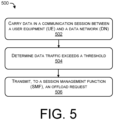
- FIG. 5 illustrates a process 500 for migrating a communication session according to implementations of the disclosure.
- Process 500 may be performed by a network node, such as a user plane function (UPF) (e.g., first UPF 108(1)), for example.
- UPF user plane function
- data in a communication session is carried by a network node between a user equipment (UE) and a domain or data network (DN).
- the data may traverse a network through a first path, which includes one or more nodes and multiple interfaces connecting the nodes.
- the first path includes the device performing the process 500.
- data traffic traversing the network node is determined to exceed a threshold.
- the data traffic may include data outside of the communication session as well as the data in the communication session.
- the data traffic may be associated with various other communication sessions between other UEs and/or other DNs.
- the threshold may be a static threshold or a dynamic threshold.
- an offload request is transmitted by the network node to the SMF.
- the offload request may instruct the SMF to migrate at least a portion of the data traffic to a path that excludes the network node.
- the offload request may instruct the SMF to migrate the communication session to a different network node.
- the SMF may cause migration of the communication session from a first path (including the network node performing process 500) to a second path (excluding the network node performing process 500). Accordingly, interruptions to the communication session as a result of the network node being overloaded can be prevented.
- FIG. 6 illustrates example device(s) 600 to implement session migration, as described herein.
- the device(s) 600 can be implemented as one or more server computers 602, a network element on a dedicated hardware, as a software instance running on a dedicated hardware, or as a virtualized function instantiated on an appropriate platform, such as a cloud infrastructure, and the like. It is to be understood in the context of this disclosure that the device(s) 600 can be implemented as a single device or as a plurality of devices with components and data distributed among them.
- the device(s) 600 comprise a memory 604 storing the session management function (SMF) 104, the first user plane function (UPF) 108(1), the second UPF 108(2), the network exposure function (NEF) 202, the authentication server function (AUSF) 204, the network resource function (NRF) 206, the access and mobility management function (AMF) 208, the unified data management (UDM) 210, the policy control function (PCF) 212, the domain or data network (DN) 214, and the application function (AF) 216, and to provide functionality to the device 600 to facilitate improved user plane system selection based on latency, as described herein.
- the memory 604 may also comprise additional functions and structures that are not explicitly described herein.
- the device 600 includes processor(s) 606, at least one removable storage 608 and at least one non-removable storage 610, input device(s) 612, output device(s) 614, and transceiver(s) 616.
- aspects of the SMF 104, the first and second UPFs 108(1) and 108(2), the NEF 202, the AUSF 204, the NRF 206, the AMF 210, the PCF 212, the UDM 214, the DN 110, and the AF 216 are discussed above with connection with at least FIGS. 1 and 2 .
- these functions comprise aspects of a fifth generation (5G) mobile network.
- 5G fifth generation
- the memory 604 is volatile (such as RAM), non-volatile (such as ROM, flash memory, etc.) or some combination of the two.
- One or more of the SMF 104, the first and second UPFs 108(1) and 108(2), the NEF 202, the AUSF 204, the NRF 206, the AMF 210, the PCF 212, the UDM 214, the DN 110, and the AF 216 stored in the memory 604 can comprise methods, threads, processes, applications or any other sort of executable instructions.
- One or more of the SMF 104, the first and second UPFs 108(1) and 108(2), the NEF 202, the AUSF 204, the NRF 206, the AMF 210, the PCF 212, the UDM 214, the DN 110, and the AF 216 can also include files and databases.
- the processor(s) 606 is a central processing unit (CPU), a graphics processing unit (GPU), or both CPU and GPU, or other processing unit or component known in the art.
- CPU central processing unit
- GPU graphics processing unit
- the processor(s) 606 is a central processing unit (CPU), a graphics processing unit (GPU), or both CPU and GPU, or other processing unit or component known in the art.
- the device 600 also includes additional data storage devices (removable and/or non-removable) such as, for example, magnetic disks, optical disks, or tape. Such additional storage is illustrated in FIG. 6 by removable storage 608 and non-removable storage 610.
- Tangible computer-readable media can include volatile and nonvolatile, removable and non-removable media implemented in any method or technology for storage of information, such as computer readable instructions, data structures, program modules, or other data.
- Memory 604, removable storage 608 and non-removable storage 610 are all examples of computer-readable storage media.
- Computer-readable storage media include, but are not limited to, RAM, ROM, EEPROM, flash memory or other memory technology, CD-ROM, digital versatile discs (DVDs), contentaddressable memory (CAM), or other optical storage, magnetic cassettes, magnetic tape, magnetic disk storage or other magnetic storage devices, or any other medium which can be used to store the desired information and which can be accessed by the device 600. Any such tangible computer-readable media can be part of the device 600.
- the device 600 also can include input device(s) 612, such as a keypad, a cursor control, a touch-sensitive display, voice input device, etc., and output device(s) 614 such as a display, speakers, printers, etc. These devices are well known in the art and need not be discussed at length here.
- input device(s) 612 such as a keypad, a cursor control, a touch-sensitive display, voice input device, etc.
- output device(s) 614 such as a display, speakers, printers, etc.
- the device 600 also includes one or more wired or wireless transceiver(s) 616.
- the transceiver(s) 616 can include a network interface card (NIC), a network adapter, a local area network (LAN) adapter, or a physical, virtual, or logical address to connect to the various base stations or networks contemplated herein, for example, or the various user devices and servers.
- NIC network interface card
- LAN local area network
- MIMO multiple-input/multiple-output
- the transceiver(s) 616 can comprise any sort of wireless transceivers capable of engaging in wireless, radio frequency (RF) communication.
- the transceiver(s) 616 can also include other wireless modems, such as a modem for engaging in Wi-Fi, WiMAX, Bluetooth, or infrared communication.
Landscapes
- Engineering & Computer Science (AREA)
- Computer Networks & Wireless Communication (AREA)
- Signal Processing (AREA)
- Mobile Radio Communication Systems (AREA)
- Computer And Data Communications (AREA)
Claims (12)
- System umfassend:einen oder mehrere Prozessoren;einen Speicher; undeine oder mehrere Komponenten, die in dem Speicher gespeichert und durch den einen oder die mehreren Prozessoren ausführbar sind, um Operationen durchzuführen, umfassend:Aufbauen (302) einer Kommunikationssitzung zwischen einer Benutzereinrichtung, UE, (102) und einem Datennetz, DN, (110), die Kommunikationssitzung umfassend Daten, die einen ersten Pfad zwischen der UE und dem DN durchlaufen, der eine erste Benutzerebenenfunktion, UPF (108(1)), einschließt;Bestimmen (118, 304), dass die erste UPF belastet ist; undals Reaktion auf das Bestimmen, dass die erste UPF belastet ist, Migrieren (120, 306) der Kommunikationssitzung zu einem zweiten Pfad zwischen der UE und dem DN, wobei der zweite Pfad eine zweite UPF (108(2)) einschließt,wobei das Migrieren der Kommunikationssitzung zu dem zweiten Pfad ein Übertragen einer Migrationsanforderung (120) an die zweite UPF (108(2)) umfasst, dadurch gekennzeichnet, dass die Migrationsanforderung die zweite UPF anweist, mindestens eine Angabe (124) einer überarbeiteten Route an mindestens eines von einem Funkzugangsnetz, RAN (104), zu übertragen, das zwischen der UE und der zweiten UPF oder dem DN verbunden ist, wobei die überarbeite Route die erste UPF durch die zweite UPF ersetzt.
- System nach Anspruch 1, wobei das Bestimmen, dass die erste UPF belastet ist, ein Empfangen einer Abladeanforderung von der ersten UPF umfasst.
- System nach Anspruch 1, wobei das Bestimmen, dass die erste UPF belastet ist, das Bestimmen umfasst, dass eine periodische Herzschlagnachricht von der ersten UPF unterbrochen wurde.
- System nach Anspruch 1, wobei die mindestens eine Angabe der überarbeiteten Route das mindestens eine von dem RAN oder das DN anweist, Daten, an die zweite UPF zu übertragen, die mit der Kommunikationssitzung verknüpft sind.
- System nach Anspruch 4, wobei die Migrationsanforderung und die mindestens eine Angabe der überarbeiteten Route eine Internetprotokoll-Adresse (IP-Adresse) der UE identifizieren.
- System nach Anspruch 1, wobei der zweite Pfad ferner eine dritte UPF einschließt, die zwischen der zweiten UPF und dem DN verbunden ist.
- Verfahren, umfassend:Aufbauen einer Kommunikationssitzung zwischen einer Benutzereinrichtung, UE, (102) und einem Datennetz, DN, (110), die Kommunikationssitzung umfassend Daten, die einen ersten Pfad zwischen der UE und dem DN durchlaufen, der eine erste Benutzerebenenfunktion, UPF, einschließt;Bestimmen dass die erste UPF belastet ist; undals Reaktion auf das Bestimmen, dass die erste UPF belastet ist, Migrieren (120) der Kommunikationssitzung zu einem zweiten Pfad zwischen der UE und dem DN, wobei der zweite Pfad eine zweite UPF (108(2)) einschließt,wobei das Migrieren der Kommunikationssitzung zu dem zweiten Pfad das Übertragen einer Migrationsanforderung (120) an die zweite UPF (108(2)) umfasst, dadurch gekennzeichnet, dass die Migrationsanforderung die zweite UPF anweist, mindestens eine Angabe (124) einer überarbeiteten Route an mindestens eines von einem Funkzugangsnetz, RAN (104), zu übertragen, das zwischen der UE und der zweiten UPF oder dem DN verbunden ist, wobei die überarbeite Route die erste UPF durch die zweite UPF ersetzt.
- Verfahren nach Anspruch 7, wobei die mindestens eine Angabe der überarbeiteten Route das mindestens eine von dem RAN oder das DN anweist, Daten, an die zweite UPF zu übertragen, die mit der Kommunikationssitzung verknüpft sind.
- Verfahren nach Anspruch 7, wobei der zweite Pfad ferner eine dritte UPF einschließt, die zwischen der zweiten UPF und dem DN verbunden ist.
- Benutzerebenensystem (108(2)), umfassend:einen oder mehrere Prozessoren (606);einen Speicher (604); undeine oder mehrere Komponenten, die in dem Speicher gespeichert und durch den einen oder die mehreren Prozessoren ausführbar sind, um Operationen durchzuführen, umfassend:Empfangen (402), von einer Sitzungsverwaltungsfunktion, SMF, (104, 106), einer Migrationsanforderung (120), die mindestens einen Knoten in einem ersten Pfad angibt, der erste Daten in einer Kommunikationssitzung zwischen einer Benutzereinrichtung, UE, (102) und einem Datennetz, DN, (110) trägt, wobei der erste Pfad eine belastete Benutzerebenenfunktion, UPF, (108(1)) einschließt, die mit dem mindestens einen Knoten verbunden ist;als Reaktion auf das Empfangen der Migrationsanforderung Übertragen (404) mindestens einer Angabe (112, 124) einer überarbeiteten Route an den mindestens einen Knoten, wobei die überarbeitete Route das Benutzerebenensystem umfasst und die belastete UPF ausschließt; undEmpfangen (406) von zweiten Daten in der Kommunikationssitzung von dem mindestens einen Knoten,wobei der mindestens eine Knoten in dem ersten Pfad ein Funkzugangsnetz, RAN, umfasst, das zwischen der UE und der belasteten UPF oder dem DN verbunden ist.
- Benutzerebenensystem nach Anspruch 10, wobei die Operationen ferner umfassen:Bestimmen (504), dass ein Datenverkehrsniveau einen Schwellenwert überschreitet, das das Benutzerebenensystem durchläuft; undals Reaktion auf das Bestimmen, dass das Datenverkehrsniveau den Schwellenwert überschreitet, Übertragen einer Abladeanforderung an die SMF (106, 506).
- Benutzerebenensystem nach Anspruch 10, wobei der mindestens eine Knoten in dem ersten Pfad eine dritte UPF einschließt, die zwischen der belasteten UPF und dem DN verbunden ist.
Priority Applications (1)
| Application Number | Priority Date | Filing Date | Title |
|---|---|---|---|
| EP24201950.3A EP4465755A3 (de) | 2018-10-29 | 2019-10-14 | Transparente sitzungsmigration zwischen benutzerebenenfunktionen |
Applications Claiming Priority (3)
| Application Number | Priority Date | Filing Date | Title |
|---|---|---|---|
| US201862752172P | 2018-10-29 | 2018-10-29 | |
| US16/363,947 US10813035B2 (en) | 2018-10-29 | 2019-03-25 | Transparent session migration between user plane functions |
| PCT/US2019/056092 WO2020091983A1 (en) | 2018-10-29 | 2019-10-14 | Transparent session migration between user plane functions |
Related Child Applications (2)
| Application Number | Title | Priority Date | Filing Date |
|---|---|---|---|
| EP24201950.3A Division EP4465755A3 (de) | 2018-10-29 | 2019-10-14 | Transparente sitzungsmigration zwischen benutzerebenenfunktionen |
| EP24201950.3A Division-Into EP4465755A3 (de) | 2018-10-29 | 2019-10-14 | Transparente sitzungsmigration zwischen benutzerebenenfunktionen |
Publications (4)
| Publication Number | Publication Date |
|---|---|
| EP3854062A1 EP3854062A1 (de) | 2021-07-28 |
| EP3854062A4 EP3854062A4 (de) | 2022-07-06 |
| EP3854062B1 true EP3854062B1 (de) | 2025-01-08 |
| EP3854062C0 EP3854062C0 (de) | 2025-01-08 |
Family
ID=70325969
Family Applications (2)
| Application Number | Title | Priority Date | Filing Date |
|---|---|---|---|
| EP24201950.3A Pending EP4465755A3 (de) | 2018-10-29 | 2019-10-14 | Transparente sitzungsmigration zwischen benutzerebenenfunktionen |
| EP19879126.1A Active EP3854062B1 (de) | 2018-10-29 | 2019-10-14 | Transparente sitzungsmigration zwischen benutzerebenenfunktionen |
Family Applications Before (1)
| Application Number | Title | Priority Date | Filing Date |
|---|---|---|---|
| EP24201950.3A Pending EP4465755A3 (de) | 2018-10-29 | 2019-10-14 | Transparente sitzungsmigration zwischen benutzerebenenfunktionen |
Country Status (3)
| Country | Link |
|---|---|
| US (3) | US10813035B2 (de) |
| EP (2) | EP4465755A3 (de) |
| WO (1) | WO2020091983A1 (de) |
Families Citing this family (13)
| Publication number | Priority date | Publication date | Assignee | Title |
|---|---|---|---|---|
| US10813035B2 (en) | 2018-10-29 | 2020-10-20 | T-Mobile Usa, Inc. | Transparent session migration between user plane functions |
| CN111194058B (zh) * | 2018-11-14 | 2021-01-12 | 华为技术有限公司 | 下行数据的乱序控制方法及装置 |
| EP3906639B1 (de) * | 2019-01-03 | 2024-04-24 | Telefonaktiebolaget Lm Ericsson (Publ) | Verfahren und vorrichtung zur sitzungsverwaltung |
| WO2022032521A1 (zh) * | 2020-08-12 | 2022-02-17 | 华为技术有限公司 | 基于用户面的控制信令获取方法、装置和系统 |
| CN114531337A (zh) * | 2020-10-31 | 2022-05-24 | 华为技术有限公司 | 一种宽带连接方法及装置 |
| CN114765572A (zh) * | 2020-12-30 | 2022-07-19 | 华为技术有限公司 | 故障处理方法、控制面网元、切换决策网元及相关设备 |
| US11496929B2 (en) * | 2021-04-01 | 2022-11-08 | T-Mobile Usa, Inc. | Methods and systems for selecting a user plane function in a wireless communication network |
| CN115460635B (zh) * | 2021-06-08 | 2024-11-15 | 中国移动通信集团重庆有限公司 | 故障检测方法、装置、设备及计算机存储介质 |
| CN115811767A (zh) * | 2021-09-11 | 2023-03-17 | 华为技术有限公司 | 消息收发方法、信息获取及收发方法、及相关设备 |
| US11765064B1 (en) * | 2022-05-27 | 2023-09-19 | Cisco Technology, Inc. | Network repository function overload protection |
| US12219440B2 (en) | 2022-07-19 | 2025-02-04 | Cisco Technology, Inc. | Signaling optimization for location-based user plane services |
| CN115396489B (zh) * | 2022-08-25 | 2024-08-06 | 中国电信股份有限公司 | Upf容灾方法、装置、电子设备及计算机可读存储介质 |
| CN119255303B (zh) * | 2024-12-03 | 2025-08-01 | 亚信科技(中国)有限公司 | 一种upf过负荷控制处理的方法及相关装置 |
Family Cites Families (7)
| Publication number | Priority date | Publication date | Assignee | Title |
|---|---|---|---|---|
| US10681150B2 (en) * | 2016-03-31 | 2020-06-09 | Huawei Technologies Co., Ltd. | Systems and methods for management plane—control plane interaction in software defined topology management |
| WO2018006017A1 (en) | 2016-07-01 | 2018-01-04 | Idac Holdings, Inc. | Methods for supporting session continuity on per-session basis |
| CN110313197B (zh) | 2017-03-20 | 2022-09-09 | 摩托罗拉移动有限责任公司 | 经由移动数据连接接入本地数据网络 |
| US10779345B2 (en) | 2017-03-20 | 2020-09-15 | Qualcomm Incorporated | User plane relocation techniques in wireless communication systems |
| WO2018174509A1 (en) | 2017-03-20 | 2018-09-27 | Samsung Electronics Co., Ltd. | Method for supporting efficient pdu session activation and deactivation in cellular networks |
| KR102289879B1 (ko) | 2017-03-20 | 2021-08-13 | 삼성전자 주식회사 | 셀룰러망에서 세션의 다양한 ssc 모드 지원을 위한 upf 변경 방안 |
| US10813035B2 (en) | 2018-10-29 | 2020-10-20 | T-Mobile Usa, Inc. | Transparent session migration between user plane functions |
-
2019
- 2019-03-25 US US16/363,947 patent/US10813035B2/en active Active
- 2019-10-14 EP EP24201950.3A patent/EP4465755A3/de active Pending
- 2019-10-14 WO PCT/US2019/056092 patent/WO2020091983A1/en not_active Ceased
- 2019-10-14 EP EP19879126.1A patent/EP3854062B1/de active Active
-
2020
- 2020-10-13 US US17/069,481 patent/US11490318B2/en active Active
-
2022
- 2022-10-31 US US18/051,264 patent/US11871330B2/en active Active
Also Published As
| Publication number | Publication date |
|---|---|
| EP3854062A4 (de) | 2022-07-06 |
| EP4465755A3 (de) | 2025-06-11 |
| US20200137663A1 (en) | 2020-04-30 |
| US20230087004A1 (en) | 2023-03-23 |
| WO2020091983A1 (en) | 2020-05-07 |
| US11490318B2 (en) | 2022-11-01 |
| US20210029617A1 (en) | 2021-01-28 |
| EP4465755A2 (de) | 2024-11-20 |
| EP3854062C0 (de) | 2025-01-08 |
| US10813035B2 (en) | 2020-10-20 |
| US11871330B2 (en) | 2024-01-09 |
| EP3854062A1 (de) | 2021-07-28 |
Similar Documents
| Publication | Publication Date | Title |
|---|---|---|
| US11871330B2 (en) | Transparent session migration between user plane functions | |
| EP3659360B1 (de) | Funktionsauswahl auf der grundlage des auslastungsgrades in 5g-umgebungen | |
| EP3831165B1 (de) | Systemauswahl auf benutzerebene auf basis der latenz | |
| US12016070B2 (en) | Efficient evolved packet system (EPS) fallback | |
| US11265694B2 (en) | Network repository function (NRF) discovery control | |
| US11665212B2 (en) | Timer-initiated fallback | |
| US11284463B2 (en) | Automatically resetting interrupted network connections | |
| US12244435B2 (en) | Policy control function fallback | |
| US20220191758A1 (en) | Optimize release with redirection of user equipment back to fifth generation (5g) network after fallback | |
| US12368653B2 (en) | SMF discoverability management based on connectivity to peer network functions |
Legal Events
| Date | Code | Title | Description |
|---|---|---|---|
| STAA | Information on the status of an ep patent application or granted ep patent |
Free format text: STATUS: THE INTERNATIONAL PUBLICATION HAS BEEN MADE |
|
| PUAI | Public reference made under article 153(3) epc to a published international application that has entered the european phase |
Free format text: ORIGINAL CODE: 0009012 |
|
| STAA | Information on the status of an ep patent application or granted ep patent |
Free format text: STATUS: REQUEST FOR EXAMINATION WAS MADE |
|
| 17P | Request for examination filed |
Effective date: 20210420 |
|
| AK | Designated contracting states |
Kind code of ref document: A1 Designated state(s): AL AT BE BG CH CY CZ DE DK EE ES FI FR GB GR HR HU IE IS IT LI LT LU LV MC MK MT NL NO PL PT RO RS SE SI SK SM TR |
|
| DAV | Request for validation of the european patent (deleted) | ||
| DAX | Request for extension of the european patent (deleted) | ||
| REG | Reference to a national code |
Ref country code: DE Ipc: H04W0028080000 Ref country code: DE Ref legal event code: R079 Ref document number: 602019064727 Country of ref document: DE Free format text: PREVIOUS MAIN CLASS: H04L0029080000 Ipc: H04W0028080000 |
|
| A4 | Supplementary search report drawn up and despatched |
Effective date: 20220602 |
|
| RIC1 | Information provided on ipc code assigned before grant |
Ipc: H04W 76/22 20180101ALI20220527BHEP Ipc: H04W 28/08 20090101AFI20220527BHEP |
|
| GRAP | Despatch of communication of intention to grant a patent |
Free format text: ORIGINAL CODE: EPIDOSNIGR1 |
|
| STAA | Information on the status of an ep patent application or granted ep patent |
Free format text: STATUS: GRANT OF PATENT IS INTENDED |
|
| RIC1 | Information provided on ipc code assigned before grant |
Ipc: H04W 76/22 20180101ALI20240311BHEP Ipc: H04W 28/08 20090101AFI20240311BHEP |
|
| INTG | Intention to grant announced |
Effective date: 20240411 |
|
| GRAJ | Information related to disapproval of communication of intention to grant by the applicant or resumption of examination proceedings by the epo deleted |
Free format text: ORIGINAL CODE: EPIDOSDIGR1 |
|
| STAA | Information on the status of an ep patent application or granted ep patent |
Free format text: STATUS: REQUEST FOR EXAMINATION WAS MADE |
|
| INTC | Intention to grant announced (deleted) | ||
| GRAP | Despatch of communication of intention to grant a patent |
Free format text: ORIGINAL CODE: EPIDOSNIGR1 |
|
| STAA | Information on the status of an ep patent application or granted ep patent |
Free format text: STATUS: GRANT OF PATENT IS INTENDED |
|
| INTG | Intention to grant announced |
Effective date: 20241008 |
|
| GRAS | Grant fee paid |
Free format text: ORIGINAL CODE: EPIDOSNIGR3 |
|
| GRAA | (expected) grant |
Free format text: ORIGINAL CODE: 0009210 |
|
| STAA | Information on the status of an ep patent application or granted ep patent |
Free format text: STATUS: THE PATENT HAS BEEN GRANTED |
|
| AK | Designated contracting states |
Kind code of ref document: B1 Designated state(s): AL AT BE BG CH CY CZ DE DK EE ES FI FR GB GR HR HU IE IS IT LI LT LU LV MC MK MT NL NO PL PT RO RS SE SI SK SM TR |
|
| REG | Reference to a national code |
Ref country code: GB Ref legal event code: FG4D |
|
| REG | Reference to a national code |
Ref country code: CH Ref legal event code: EP |
|
| REG | Reference to a national code |
Ref country code: DE Ref legal event code: R096 Ref document number: 602019064727 Country of ref document: DE |
|
| REG | Reference to a national code |
Ref country code: IE Ref legal event code: FG4D |
|
| U01 | Request for unitary effect filed |
Effective date: 20250127 |
|
| U07 | Unitary effect registered |
Designated state(s): AT BE BG DE DK EE FI FR IT LT LU LV MT NL PT RO SE SI Effective date: 20250131 |
|
| PG25 | Lapsed in a contracting state [announced via postgrant information from national office to epo] |
Ref country code: RS Free format text: LAPSE BECAUSE OF FAILURE TO SUBMIT A TRANSLATION OF THE DESCRIPTION OR TO PAY THE FEE WITHIN THE PRESCRIBED TIME-LIMIT Effective date: 20250408 |
|
| PG25 | Lapsed in a contracting state [announced via postgrant information from national office to epo] |
Ref country code: PL Free format text: LAPSE BECAUSE OF FAILURE TO SUBMIT A TRANSLATION OF THE DESCRIPTION OR TO PAY THE FEE WITHIN THE PRESCRIBED TIME-LIMIT Effective date: 20250108 |
|
| PG25 | Lapsed in a contracting state [announced via postgrant information from national office to epo] |
Ref country code: ES Free format text: LAPSE BECAUSE OF FAILURE TO SUBMIT A TRANSLATION OF THE DESCRIPTION OR TO PAY THE FEE WITHIN THE PRESCRIBED TIME-LIMIT Effective date: 20250108 |
|
| PG25 | Lapsed in a contracting state [announced via postgrant information from national office to epo] |
Ref country code: IS Free format text: LAPSE BECAUSE OF FAILURE TO SUBMIT A TRANSLATION OF THE DESCRIPTION OR TO PAY THE FEE WITHIN THE PRESCRIBED TIME-LIMIT Effective date: 20250508 Ref country code: NO Free format text: LAPSE BECAUSE OF FAILURE TO SUBMIT A TRANSLATION OF THE DESCRIPTION OR TO PAY THE FEE WITHIN THE PRESCRIBED TIME-LIMIT Effective date: 20250408 |
|
| PG25 | Lapsed in a contracting state [announced via postgrant information from national office to epo] |
Ref country code: HR Free format text: LAPSE BECAUSE OF FAILURE TO SUBMIT A TRANSLATION OF THE DESCRIPTION OR TO PAY THE FEE WITHIN THE PRESCRIBED TIME-LIMIT Effective date: 20250108 |
|
| PG25 | Lapsed in a contracting state [announced via postgrant information from national office to epo] |
Ref country code: GR Free format text: LAPSE BECAUSE OF FAILURE TO SUBMIT A TRANSLATION OF THE DESCRIPTION OR TO PAY THE FEE WITHIN THE PRESCRIBED TIME-LIMIT Effective date: 20250409 |
|
| U20 | Renewal fee for the european patent with unitary effect paid |
Year of fee payment: 7 Effective date: 20250805 |
|
| PG25 | Lapsed in a contracting state [announced via postgrant information from national office to epo] |
Ref country code: SM Free format text: LAPSE BECAUSE OF FAILURE TO SUBMIT A TRANSLATION OF THE DESCRIPTION OR TO PAY THE FEE WITHIN THE PRESCRIBED TIME-LIMIT Effective date: 20250108 |
|
| PG25 | Lapsed in a contracting state [announced via postgrant information from national office to epo] |
Ref country code: CZ Free format text: LAPSE BECAUSE OF FAILURE TO SUBMIT A TRANSLATION OF THE DESCRIPTION OR TO PAY THE FEE WITHIN THE PRESCRIBED TIME-LIMIT Effective date: 20250108 |
|
| PG25 | Lapsed in a contracting state [announced via postgrant information from national office to epo] |
Ref country code: SK Free format text: LAPSE BECAUSE OF FAILURE TO SUBMIT A TRANSLATION OF THE DESCRIPTION OR TO PAY THE FEE WITHIN THE PRESCRIBED TIME-LIMIT Effective date: 20250108 |
|
| PLBE | No opposition filed within time limit |
Free format text: ORIGINAL CODE: 0009261 |
|
| STAA | Information on the status of an ep patent application or granted ep patent |
Free format text: STATUS: NO OPPOSITION FILED WITHIN TIME LIMIT |
|
| 26N | No opposition filed |
Effective date: 20251009 |