EP3852167B1 - Battery manufacturing device and manufacturing method of battery - Google Patents
Battery manufacturing device and manufacturing method of battery Download PDFInfo
- Publication number
- EP3852167B1 EP3852167B1 EP20774248.7A EP20774248A EP3852167B1 EP 3852167 B1 EP3852167 B1 EP 3852167B1 EP 20774248 A EP20774248 A EP 20774248A EP 3852167 B1 EP3852167 B1 EP 3852167B1
- Authority
- EP
- European Patent Office
- Prior art keywords
- jig
- top cap
- positive electrode
- battery manufacturing
- electrode tab
- Prior art date
- Legal status (The legal status is an assumption and is not a legal conclusion. Google has not performed a legal analysis and makes no representation as to the accuracy of the status listed.)
- Active
Links
Images



Classifications
-
- B—PERFORMING OPERATIONS; TRANSPORTING
- B21—MECHANICAL METAL-WORKING WITHOUT ESSENTIALLY REMOVING MATERIAL; PUNCHING METAL
- B21D—WORKING OR PROCESSING OF SHEET METAL OR METAL TUBES, RODS OR PROFILES WITHOUT ESSENTIALLY REMOVING MATERIAL; PUNCHING METAL
- B21D5/00—Bending sheet metal along straight lines, e.g. to form simple curves
- B21D5/16—Folding; Pleating
-
- H—ELECTRICITY
- H01—ELECTRIC ELEMENTS
- H01M—PROCESSES OR MEANS, e.g. BATTERIES, FOR THE DIRECT CONVERSION OF CHEMICAL ENERGY INTO ELECTRICAL ENERGY
- H01M10/00—Secondary cells; Manufacture thereof
- H01M10/04—Construction or manufacture in general
- H01M10/0404—Machines for assembling batteries
-
- H—ELECTRICITY
- H01—ELECTRIC ELEMENTS
- H01M—PROCESSES OR MEANS, e.g. BATTERIES, FOR THE DIRECT CONVERSION OF CHEMICAL ENERGY INTO ELECTRICAL ENERGY
- H01M50/00—Constructional details or processes of manufacture of the non-active parts of electrochemical cells other than fuel cells, e.g. hybrid cells
- H01M50/50—Current conducting connections for cells or batteries
- H01M50/528—Fixed electrical connections, i.e. not intended for disconnection
-
- B—PERFORMING OPERATIONS; TRANSPORTING
- B21—MECHANICAL METAL-WORKING WITHOUT ESSENTIALLY REMOVING MATERIAL; PUNCHING METAL
- B21D—WORKING OR PROCESSING OF SHEET METAL OR METAL TUBES, RODS OR PROFILES WITHOUT ESSENTIALLY REMOVING MATERIAL; PUNCHING METAL
- B21D33/00—Special measures in connection with working metal foils, e.g. gold foils
-
- B—PERFORMING OPERATIONS; TRANSPORTING
- B21—MECHANICAL METAL-WORKING WITHOUT ESSENTIALLY REMOVING MATERIAL; PUNCHING METAL
- B21F—WORKING OR PROCESSING OF METAL WIRE
- B21F1/00—Bending wire other than coiling; Straightening wire
- B21F1/004—Bending wire other than coiling; Straightening wire by means of press-type tooling
-
- H—ELECTRICITY
- H01—ELECTRIC ELEMENTS
- H01M—PROCESSES OR MEANS, e.g. BATTERIES, FOR THE DIRECT CONVERSION OF CHEMICAL ENERGY INTO ELECTRICAL ENERGY
- H01M10/00—Secondary cells; Manufacture thereof
- H01M10/04—Construction or manufacture in general
- H01M10/0404—Machines for assembling batteries
- H01M10/0409—Machines for assembling batteries for cells with wound electrodes
-
- H—ELECTRICITY
- H01—ELECTRIC ELEMENTS
- H01M—PROCESSES OR MEANS, e.g. BATTERIES, FOR THE DIRECT CONVERSION OF CHEMICAL ENERGY INTO ELECTRICAL ENERGY
- H01M10/00—Secondary cells; Manufacture thereof
- H01M10/04—Construction or manufacture in general
- H01M10/0422—Cells or battery with cylindrical casing
-
- H—ELECTRICITY
- H01—ELECTRIC ELEMENTS
- H01M—PROCESSES OR MEANS, e.g. BATTERIES, FOR THE DIRECT CONVERSION OF CHEMICAL ENERGY INTO ELECTRICAL ENERGY
- H01M10/00—Secondary cells; Manufacture thereof
- H01M10/04—Construction or manufacture in general
- H01M10/0431—Cells with wound or folded electrodes
-
- H—ELECTRICITY
- H01—ELECTRIC ELEMENTS
- H01M—PROCESSES OR MEANS, e.g. BATTERIES, FOR THE DIRECT CONVERSION OF CHEMICAL ENERGY INTO ELECTRICAL ENERGY
- H01M50/00—Constructional details or processes of manufacture of the non-active parts of electrochemical cells other than fuel cells, e.g. hybrid cells
- H01M50/10—Primary casings; Jackets or wrappings
- H01M50/102—Primary casings; Jackets or wrappings characterised by their shape or physical structure
- H01M50/107—Primary casings; Jackets or wrappings characterised by their shape or physical structure having curved cross-section, e.g. round or elliptic
-
- H—ELECTRICITY
- H01—ELECTRIC ELEMENTS
- H01M—PROCESSES OR MEANS, e.g. BATTERIES, FOR THE DIRECT CONVERSION OF CHEMICAL ENERGY INTO ELECTRICAL ENERGY
- H01M50/00—Constructional details or processes of manufacture of the non-active parts of electrochemical cells other than fuel cells, e.g. hybrid cells
- H01M50/50—Current conducting connections for cells or batteries
- H01M50/531—Electrode connections inside a battery casing
-
- H—ELECTRICITY
- H01—ELECTRIC ELEMENTS
- H01M—PROCESSES OR MEANS, e.g. BATTERIES, FOR THE DIRECT CONVERSION OF CHEMICAL ENERGY INTO ELECTRICAL ENERGY
- H01M50/00—Constructional details or processes of manufacture of the non-active parts of electrochemical cells other than fuel cells, e.g. hybrid cells
- H01M50/50—Current conducting connections for cells or batteries
- H01M50/531—Electrode connections inside a battery casing
- H01M50/533—Electrode connections inside a battery casing characterised by the shape of the leads or tabs
-
- H—ELECTRICITY
- H01—ELECTRIC ELEMENTS
- H01M—PROCESSES OR MEANS, e.g. BATTERIES, FOR THE DIRECT CONVERSION OF CHEMICAL ENERGY INTO ELECTRICAL ENERGY
- H01M50/00—Constructional details or processes of manufacture of the non-active parts of electrochemical cells other than fuel cells, e.g. hybrid cells
- H01M50/50—Current conducting connections for cells or batteries
- H01M50/543—Terminals
- H01M50/545—Terminals formed by the casing of the cells
-
- H—ELECTRICITY
- H01—ELECTRIC ELEMENTS
- H01M—PROCESSES OR MEANS, e.g. BATTERIES, FOR THE DIRECT CONVERSION OF CHEMICAL ENERGY INTO ELECTRICAL ENERGY
- H01M50/00—Constructional details or processes of manufacture of the non-active parts of electrochemical cells other than fuel cells, e.g. hybrid cells
- H01M50/50—Current conducting connections for cells or batteries
- H01M50/543—Terminals
- H01M50/552—Terminals characterised by their shape
- H01M50/559—Terminals adapted for cells having curved cross-section, e.g. round, elliptic or button cells
-
- H—ELECTRICITY
- H01—ELECTRIC ELEMENTS
- H01M—PROCESSES OR MEANS, e.g. BATTERIES, FOR THE DIRECT CONVERSION OF CHEMICAL ENERGY INTO ELECTRICAL ENERGY
- H01M50/00—Constructional details or processes of manufacture of the non-active parts of electrochemical cells other than fuel cells, e.g. hybrid cells
- H01M50/50—Current conducting connections for cells or batteries
- H01M50/543—Terminals
- H01M50/564—Terminals characterised by their manufacturing process
-
- H—ELECTRICITY
- H01—ELECTRIC ELEMENTS
- H01M—PROCESSES OR MEANS, e.g. BATTERIES, FOR THE DIRECT CONVERSION OF CHEMICAL ENERGY INTO ELECTRICAL ENERGY
- H01M4/00—Electrodes
- H01M4/02—Electrodes composed of, or comprising, active material
- H01M2004/026—Electrodes composed of, or comprising, active material characterised by the polarity
- H01M2004/028—Positive electrodes
-
- Y—GENERAL TAGGING OF NEW TECHNOLOGICAL DEVELOPMENTS; GENERAL TAGGING OF CROSS-SECTIONAL TECHNOLOGIES SPANNING OVER SEVERAL SECTIONS OF THE IPC; TECHNICAL SUBJECTS COVERED BY FORMER USPC CROSS-REFERENCE ART COLLECTIONS [XRACs] AND DIGESTS
- Y02—TECHNOLOGIES OR APPLICATIONS FOR MITIGATION OR ADAPTATION AGAINST CLIMATE CHANGE
- Y02E—REDUCTION OF GREENHOUSE GAS [GHG] EMISSIONS, RELATED TO ENERGY GENERATION, TRANSMISSION OR DISTRIBUTION
- Y02E60/00—Enabling technologies; Technologies with a potential or indirect contribution to GHG emissions mitigation
- Y02E60/10—Energy storage using batteries
-
- Y—GENERAL TAGGING OF NEW TECHNOLOGICAL DEVELOPMENTS; GENERAL TAGGING OF CROSS-SECTIONAL TECHNOLOGIES SPANNING OVER SEVERAL SECTIONS OF THE IPC; TECHNICAL SUBJECTS COVERED BY FORMER USPC CROSS-REFERENCE ART COLLECTIONS [XRACs] AND DIGESTS
- Y02—TECHNOLOGIES OR APPLICATIONS FOR MITIGATION OR ADAPTATION AGAINST CLIMATE CHANGE
- Y02P—CLIMATE CHANGE MITIGATION TECHNOLOGIES IN THE PRODUCTION OR PROCESSING OF GOODS
- Y02P70/00—Climate change mitigation technologies in the production process for final industrial or consumer products
- Y02P70/50—Manufacturing or production processes characterised by the final manufactured product
Definitions
- the present disclosure relates to a battery manufacturing device and a manufacturing method of a battery.
- the demand for batteries as energy sources is rapidly increasing as mobile device technology continues to develop and the demand for such mobile devices continues to increase. Accordingly, much research on batteries capable of satisfying various needs has been carried out.
- the demand for lithium secondary batteries, such as lithium ion batteries and lithium ion polymer batteries which have advantages such as high energy density, discharge voltage, and output stability, is very high.
- Secondary batteries may be classified based on the structure of an electrode assembly having a structure in which a positive electrode and a negative electrode are stacked in the state in which a separator is interposed between the positive electrode and the negative electrode.
- the electrode assembly may be configured to have a jelly-roll (wound) type structure in which a long sheet type positive electrode and a long sheet type negative electrode are wound in the state in which a separator is disposed between the positive electrode and the negative electrode or a stacked type structure in which pluralities of positive electrodes and negative electrodes each having a predetermined size are sequentially stacked in the state in which separators are disposed respectively between the positive electrodes and the negative electrodes.
- a stacked/folded type electrode assembly which is a combination of the jelly roll type electrode assembly and the stacked type electrode assembly, having an improved structure in which predetermined numbers of positive electrodes and negative electrodes are sequentially stacked in the state in which separators are disposed respectively between the positive electrodes and the negative electrodes to constitute a unit cell, after which a plurality of unit cells is sequentially folded in the state of having been placed on a separation film.
- Electrodes assemblies are accommodated in a pouch case, a cylindrical can, a prismatic case, etc. depending on the purpose of use to produce a battery.
- the cylindrical battery has the advantages of being easy to manufacture and having a high energy density per weight, and thus, is used as an energy source for various devices ranging from portable computers to electric vehicles.
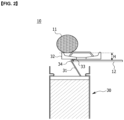
- FIG. 1 is a schematic view showing folding of a positive electrode tab using a conventional device for manufacturing a cylindrical battery pack.
- FIG. 2 is a schematic view showing that a top cap is sandwiched between a jig and a knife in FIG. 1 .
- the conventional cylindrical battery manufacturing device 10 uses a jig 11 and a folding knife 12 to fold a positive electrode tab 31 of a cylindrical battery 30.
- the positive electrode tab 31 is welded to a connection part 33 of the top cap 32.
- the folding knife 12 located on the other side of the top cap 32 is moved in the second direction B to press a folding part 34.
- the jig 11 and the folding knife 12 move in parallel with each other in a state of being spaced apart by a predetermined interval H.
- a battery manufacturing device for manufacturing a cylindrical battery according to claim 1.
- the battery is comprising a positive electrode tab connected to a top cap by folding the positive electrode tab connected to the top cap, the device is comprising: a jig that makes a pendulum swing and presses the positive electrode tab; an adjusting unit that forms a turning radius of the pendulum swing; and a folding knife that presses the folding part of the positive electrode tab.
- the adjusting unit determines a position of a bottom dead center of the jig by adjusting its length.
- the jig makes contact with the top cap at the bottom dead center.
- One side of the adjusting unit may be connected to a fixing unit.
- the other side of the adjusting unit may be connected to the jig.
- the jig can make a pendulum swing around the fixing unit.
- the folding knife may move horizontally to press the folding part of the positive electrode tab.
- the jig may include an elastic member on the surface of the jig.
- the folding knife may be formed of a high-functional resin.
- the high-functional resin may be polyetheretherketone.
- the present disclosure also provides a battery manufacturing method for manufacturing the cylindrical battery using the above-mentioned battery manufacturing device as disclosed in claim 9.
- the method includes electrically connecting the positive electrode tab to the top cap of the cylindrical battery.
- the method includes adjusting a length of an adjusting unit connected to a jig located on one side of the top cap, thereby adjusting a bottom dead center position.
- the method includes subjecting the jig to a pendulum swing to press the top cap.
- the method includes horizontally moving the folding knife located on the other side of the top cap to press the folding part of the positive electrode tab.
- the method further includes increasing a gap between the jig and the folding knife after the jig makes contact with the top cap at the bottom dead center.
- the method may further include fixing one side of the adjusting unit to a fixing unit.
- the method may further include pressing the top cap in a state in which the jig is in contact with the top cap at the bottom dead center.
- the battery manufacturing device includes a jig for making a pendulum swing and an adjusting unit for adjusting the bottom dead center position of the jig, thereby preventing a sandwiching phenomenon of the top cap between the jig and the folding knife.
- FIG. 3 is a schematic view showing a battery manufacturing device according to an embodiment of the present disclosure.
- FIG. 4 is a schematic view showing an operation state of the jig when the battery manufacturing device of FIG. 3 is used.
- the battery manufacturing device 100 includes a jig 101, an adjusting unit 102, and a folding knife 103.
- the jig 101 may be located on one side of the top cap 202 in the cylindrical battery 200, and the folding knife 103 may be located on the other side of the top cap 202. Further, the jig 101 may be connected to the adjusting unit 102.
- the jig 101 is connected to one side of the adjusting unit 102, and the other side of the adjusting unit 102 is connected to the fixing unit 104.
- the jig 101 makes a pendulum swing when pressing the top cap 202.
- the "pendulum swing” means that the jig 101 swings like a pendulum around the fixing unit 104.
- the shape of the jig 101 is not particularly limited, but may be a circular sphere or a cylindrical shape so that a contact surface between the jig 101 and the top cap 202 can be minimized when the jig 101 makes a pendulum swing and presses the top cap 202.
- the positive electrode tab 201 is generally made of a metal material having excellent ductility and has a long band shape compared to the width, it does not require a high pressing force to fold the positive electrode tab 201. Therefore, even if the jig 101 is formed in a circular sphere or a cylindrical shape, it is possible to transmit a sufficient pressing force to fold the positive electrode tab 201 to the positive electrode tab 201. By such a structure, it is possible to minimize a contact surface between the jig 101 and the top cap 202, so that the appearance of the top cap 202 is not damaged when the jig 101 presses the top cap 202.
- the adjusting unit 102 connects the fixing unit 104 and the jig 101 and form a turning radius in which the jig 101 makes a pendulum swing.
- the adjusting unit 102 adjusts the length of the adjusting unit 102 to adjust the position of the bottom dead center L.
- the bottom dead center L means a point closest to the ground in the trajectory where the jig 101 makes a pendulum swing.
- the position where the jig 101 makes contact with the top cap 202 may be determined depending on the position of the bottom dead center L.
- the folding knife 103 horizontally moves along the second direction B shown in FIG. 3 to press the folding part 203 in a state of being in contact with the folding part 203 of the positive electrode tab 201.
- the positive electrode tab 201 can be folded only at the folding part 203.
- the shape of the folding knife 103 is not particularly limited, but as an example, it may be a long band shape compared to the width. Then, in order to prevent the folding part 203 of the positive electrode tab 201 from being damaged by the folding knife 103, the end part of the folding knife 103 making contact with the folding part 203 may be processed into a round shape.
- the folding knife 103 be formed of materials that do not change physically and chemically, even after repeated contact with the electrolyte inside the positive electrode tab 201 and the cylindrical battery 200.
- the folding knife 103 may be formed of a metal such as stainless steel. In this case, since the folding knife 103 has excellent durability, the folding part 203 of the positive electrode tab 201 can be pressed at a predetermined pressure without physical deformation.
- the folding knife 103 may be formed of a high-functional resin such as polyetheretherketone.
- the polyetheretherketone is a semi-crystalline resin that does not dissolve even in an organic solvent, and has excellent chemical resistance as well as high strength, so that the folding part 203 of the positive electrode tab 201 can be pressed at a predetermined pressure.
- the folding knife 103 formed of a high-functional resin it can prevent metal foreign matters generated in the folding process from flowing into the cylindrical battery 200.
- the jig 101 makes contact with the top cap 202 at the bottom dead center (L) and can move in the third direction C according to the pendulum swing trajectory.
- the "third direction” means the opposite direction in which gravity acts on the ground. Because of such a structure, a gap between the jig 101 and the folding knife 103 increases after the jig 101 makes contact with the top cap 202 at the bottom dead center L. Therefore, it is possible to prevent the top cap 202 from being sandwiched between the jig 101 and the folding knife 103.
- the positive electrode tab 201 can be folded at a desired angle in the folding part 203, the positive electrode tab 201 may make contact with a metal can 210 to prevent a short circuit from occurring.
- the jig 101 may include an elastic member 105 on its surface.
- the elastic member 105 can prevent the outer shape of the top cap 202 from being damaged when the jig 101 presses the top cap 202.
- the present disclosure provides a method of manufacturing a cylindrical battery 200 using the battery manufacturing device 100.
- the method includes electrically connecting the positive electrode tab 201 to the top cap 202 of the cylindrical battery 200.
- An operator connects the positive electrode tab 201 to the top cap 202 using resistance welding, laser welding, or the like.
- the method may include connecting one side of the adjusting unit 102 to the fixing unit 104.
- the method includes adjusting the length of the adjusting unit 102 connected to the jig 101 located on one side of the top cap 202, thereby adjusting the position of the bottom dead center L.
- the operator can adjust the position of the bottom dead center L in consideration of the turning radius of the jig 101 and the position of the folding knife 103.
- the method includes subjecting the jig 101 to a pendulum swing to press the top cap 202.
- the operator can appropriately adjust the speed at which the jig 101 moves so as to press the top cap 202 in a state where the jig 101 is in contact with the top cap 202 at the bottom dead center L.
- the operator can prevent the outer shape of the top cap 202 from being deformed by appropriately adjusting the pressure at which the jig 101 presses the top cap 202.
- the method may include pressing the folding part 203 of the positive electrode tab 201 by horizontally moving the folding knife 103 located on the other side of the top cap 202.
- the operator can make the positive electrode tab 201 foldable at the folding part 203 so that the folding knife 103 also reaches the folding part 203.
- the method further includes increasing a gap between the jig 101 and the folding knife 103 after the jig 101 makes contact with the top cap 202 at the bottom dead center L.
Landscapes
- Chemical & Material Sciences (AREA)
- Chemical Kinetics & Catalysis (AREA)
- Electrochemistry (AREA)
- General Chemical & Material Sciences (AREA)
- Engineering & Computer Science (AREA)
- Manufacturing & Machinery (AREA)
- Mechanical Engineering (AREA)
- Secondary Cells (AREA)
- Connection Of Batteries Or Terminals (AREA)
- Primary Cells (AREA)
Description
- This application claims the benefit of
Korean Patent Application No. 10-2019-0032583 filed on March 21, 2019 - The present disclosure relates to a battery manufacturing device and a manufacturing method of a battery.
- As energy prices are increasing due to the depletion of fossil fuels and increasing attention is being paid to environmental pollution, the demand for environmentally-friendly alternative energy sources acts as an essential factor for future life. Thus, research into techniques for generating various kinds of power, such as nuclear energy, solar energy, wind energy, and tidal power, is underway, and power storage apparatuses for more efficient use of the generated energy are also drawing much attention.
- Moreover, the demand for batteries as energy sources is rapidly increasing as mobile device technology continues to develop and the demand for such mobile devices continues to increase. Accordingly, much research on batteries capable of satisfying various needs has been carried out. In particular, in terms of the material for batteries, the demand for lithium secondary batteries, such as lithium ion batteries and lithium ion polymer batteries, which have advantages such as high energy density, discharge voltage, and output stability, is very high.
- Secondary batteries may be classified based on the structure of an electrode assembly having a structure in which a positive electrode and a negative electrode are stacked in the state in which a separator is interposed between the positive electrode and the negative electrode. For example, the electrode assembly may be configured to have a jelly-roll (wound) type structure in which a long sheet type positive electrode and a long sheet type negative electrode are wound in the state in which a separator is disposed between the positive electrode and the negative electrode or a stacked type structure in which pluralities of positive electrodes and negative electrodes each having a predetermined size are sequentially stacked in the state in which separators are disposed respectively between the positive electrodes and the negative electrodes. In recent years, in order to solve problems caused by the jelly-roll type electrode assembly and the stacked type electrode assembly, there has been developed a stacked/folded type electrode assembly, which is a combination of the jelly roll type electrode assembly and the stacked type electrode assembly, having an improved structure in which predetermined numbers of positive electrodes and negative electrodes are sequentially stacked in the state in which separators are disposed respectively between the positive electrodes and the negative electrodes to constitute a unit cell, after which a plurality of unit cells is sequentially folded in the state of having been placed on a separation film.
- These electrode assemblies are accommodated in a pouch case, a cylindrical can, a prismatic case, etc. depending on the purpose of use to produce a battery.
- Among them, the cylindrical battery has the advantages of being easy to manufacture and having a high energy density per weight, and thus, is used as an energy source for various devices ranging from portable computers to electric vehicles.
-
FIG. 1 is a schematic view showing folding of a positive electrode tab using a conventional device for manufacturing a cylindrical battery pack.FIG. 2 is a schematic view showing that a top cap is sandwiched between a jig and a knife inFIG. 1 . - Referring to
FIGS. 1 and2 , the conventional cylindricalbattery manufacturing device 10 uses ajig 11 and afolding knife 12 to fold apositive electrode tab 31 of acylindrical battery 30. Thepositive electrode tab 31 is welded to aconnection part 33 of thetop cap 32. While moving thejig 11 located on one side of thetop cap 32 in the first direction A to press thetop cap 32, thefolding knife 12 located on the other side of thetop cap 32 is moved in the second direction B to press afolding part 34. At this time, thejig 11 and thefolding knife 12 move in parallel with each other in a state of being spaced apart by a predetermined interval H. - However, when the
jig 11 and thefolding knife 12 move in parallel, a sandwiching phenomenon of thetop cap 32 occurs between thejig 11 and thefolding knife 12, which causes problem that not only the outer shape of thecylindrical battery 30 is damaged but also a malfunction of the cylindricalbattery manufacturing device 10 is induced. - Further prior art is described in
CN 103 050 735 B - It is an object of the present disclosure to provide a battery manufacturing device and a manufacturing method of a battery which can minimize damage to an electrode tab and malfunction of a battery manufacturing equipment.
- However, the problem to be solved by the embodiments of the present disclosure is not limited to the above-described problems, and can be variously expanded within the scope of the appended claims.
- According to the invention there is provided a battery manufacturing device for manufacturing a cylindrical battery according to claim 1. The battery is comprising a positive electrode tab connected to a top cap by folding the positive electrode tab connected to the top cap, the device is comprising: a jig that makes a pendulum swing and presses the positive electrode tab; an adjusting unit that forms a turning radius of the pendulum swing; and a folding knife that presses the folding part of the positive electrode tab.
- The adjusting unit determines a position of a bottom dead center of the jig by adjusting its length.
- The jig makes contact with the top cap at the bottom dead center.
- After the jig makes contact with the top cap at the bottom dead center, a gap between the jig and the folding knife is increased.
- One side of the adjusting unit may be connected to a fixing unit.
- The other side of the adjusting unit may be connected to the jig.
- The jig can make a pendulum swing around the fixing unit.
- The folding knife may move horizontally to press the folding part of the positive electrode tab.
- The jig may include an elastic member on the surface of the jig.
- The folding knife may be formed of a high-functional resin.
- The high-functional resin may be polyetheretherketone.
- The present disclosure also provides a battery manufacturing method for manufacturing the cylindrical battery using the above-mentioned battery manufacturing device as disclosed in claim 9.
- The method includes electrically connecting the positive electrode tab to the top cap of the cylindrical battery.
- The method includes adjusting a length of an adjusting unit connected to a jig located on one side of the top cap, thereby adjusting a bottom dead center position.
- The method includes subjecting the jig to a pendulum swing to press the top cap.
- The method includes horizontally moving the folding knife located on the other side of the top cap to press the folding part of the positive electrode tab.
- The method further includes increasing a gap between the jig and the folding knife after the jig makes contact with the top cap at the bottom dead center.
- The method may further include fixing one side of the adjusting unit to a fixing unit.
- The method may further include pressing the top cap in a state in which the jig is in contact with the top cap at the bottom dead center.
- As described above, the battery manufacturing device according to the embodiment of the present disclosure includes a jig for making a pendulum swing and an adjusting unit for adjusting the bottom dead center position of the jig, thereby preventing a sandwiching phenomenon of the top cap between the jig and the folding knife.
-
-
FIG. 1 is a schematic view showing folding of a positive electrode tab using a conventional device for manufacturing a cylindrical battery pack. -
FIG. 2 is a schematic view showing that a top cap is sandwiched between a jig and a knife inFIG. 1 . -
FIG. 3 is a schematic view showing a battery manufacturing device according to an embodiment of the present disclosure. -
FIG. 4 is a schematic view showing an operation state of the jig when the battery manufacturing device ofFIG. 3 is used. - Hereinafter, various embodiments of the present disclosure will be described in detail with reference to the accompanying drawings so that those skilled in the art can easily implement them. The present disclosure may be modified in various different ways, and is not limited to the embodiments set forth herein.
- Further, throughout the specification, when a part is referred to as "including" a certain component, it means that it can further include other components, without excluding the other components, unless otherwise stated.
- Further, throughout the specification, when referring to "horizontal", it means a direction parallel to the ground.
-
FIG. 3 is a schematic view showing a battery manufacturing device according to an embodiment of the present disclosure.FIG. 4 is a schematic view showing an operation state of the jig when the battery manufacturing device ofFIG. 3 is used. - Referring to
FIG. 3 , thebattery manufacturing device 100 includes ajig 101, an adjustingunit 102, and afolding knife 103. Thejig 101 may be located on one side of thetop cap 202 in thecylindrical battery 200, and thefolding knife 103 may be located on the other side of thetop cap 202. Further, thejig 101 may be connected to the adjustingunit 102. - The
jig 101 is connected to one side of the adjustingunit 102, and the other side of the adjustingunit 102 is connected to thefixing unit 104. Thejig 101 makes a pendulum swing when pressing thetop cap 202. Here, the "pendulum swing" means that thejig 101 swings like a pendulum around the fixingunit 104. - The shape of the
jig 101 is not particularly limited, but may be a circular sphere or a cylindrical shape so that a contact surface between thejig 101 and thetop cap 202 can be minimized when thejig 101 makes a pendulum swing and presses thetop cap 202. Since thepositive electrode tab 201 is generally made of a metal material having excellent ductility and has a long band shape compared to the width, it does not require a high pressing force to fold thepositive electrode tab 201. Therefore, even if thejig 101 is formed in a circular sphere or a cylindrical shape, it is possible to transmit a sufficient pressing force to fold thepositive electrode tab 201 to thepositive electrode tab 201. By such a structure, it is possible to minimize a contact surface between thejig 101 and thetop cap 202, so that the appearance of thetop cap 202 is not damaged when thejig 101 presses thetop cap 202. - Referring to
FIG. 4 , the adjustingunit 102 connects the fixingunit 104 and thejig 101 and form a turning radius in which thejig 101 makes a pendulum swing. The adjustingunit 102 adjusts the length of the adjustingunit 102 to adjust the position of the bottom dead center L. Here, the bottom dead center L means a point closest to the ground in the trajectory where thejig 101 makes a pendulum swing. The position where thejig 101 makes contact with thetop cap 202 may be determined depending on the position of the bottom dead center L. - When the
jig 101 makes a pendulum swing and presses thetop cap 202 in a state of being in contact with thetop cap 202 of thecylindrical battery 200, thefolding knife 103 horizontally moves along the second direction B shown inFIG. 3 to press thefolding part 203 in a state of being in contact with thefolding part 203 of thepositive electrode tab 201. By this structure, thepositive electrode tab 201 can be folded only at thefolding part 203. - The shape of the
folding knife 103 is not particularly limited, but as an example, it may be a long band shape compared to the width. Then, in order to prevent thefolding part 203 of thepositive electrode tab 201 from being damaged by thefolding knife 103, the end part of thefolding knife 103 making contact with thefolding part 203 may be processed into a round shape. - The
folding knife 103 be formed of materials that do not change physically and chemically, even after repeated contact with the electrolyte inside thepositive electrode tab 201 and thecylindrical battery 200. As an example, thefolding knife 103 may be formed of a metal such as stainless steel. In this case, since thefolding knife 103 has excellent durability, thefolding part 203 of thepositive electrode tab 201 can be pressed at a predetermined pressure without physical deformation. - In addition, the
folding knife 103 may be formed of a high-functional resin such as polyetheretherketone. The polyetheretherketone is a semi-crystalline resin that does not dissolve even in an organic solvent, and has excellent chemical resistance as well as high strength, so that thefolding part 203 of thepositive electrode tab 201 can be pressed at a predetermined pressure. In addition, when using thefolding knife 103 formed of a high-functional resin, it can prevent metal foreign matters generated in the folding process from flowing into thecylindrical battery 200. - The
jig 101 makes contact with thetop cap 202 at the bottom dead center (L) and can move in the third direction C according to the pendulum swing trajectory. Here, the "third direction" means the opposite direction in which gravity acts on the ground. Because of such a structure, a gap between thejig 101 and thefolding knife 103 increases after thejig 101 makes contact with thetop cap 202 at the bottom dead center L. Therefore, it is possible to prevent thetop cap 202 from being sandwiched between thejig 101 and thefolding knife 103. Moreover, since thepositive electrode tab 201 can be folded at a desired angle in thefolding part 203, thepositive electrode tab 201 may make contact with a metal can 210 to prevent a short circuit from occurring. - The
jig 101 may include anelastic member 105 on its surface. Theelastic member 105 can prevent the outer shape of thetop cap 202 from being damaged when thejig 101 presses thetop cap 202. - The present disclosure provides a method of manufacturing a
cylindrical battery 200 using thebattery manufacturing device 100. - The method includes electrically connecting the
positive electrode tab 201 to thetop cap 202 of thecylindrical battery 200. An operator connects thepositive electrode tab 201 to thetop cap 202 using resistance welding, laser welding, or the like. - And, the method may include connecting one side of the adjusting
unit 102 to the fixingunit 104. - And, the method includes adjusting the length of the adjusting
unit 102 connected to thejig 101 located on one side of thetop cap 202, thereby adjusting the position of the bottom dead center L. The operator can adjust the position of the bottom dead center L in consideration of the turning radius of thejig 101 and the position of thefolding knife 103. - And, the method includes subjecting the
jig 101 to a pendulum swing to press thetop cap 202. The operator can appropriately adjust the speed at which thejig 101 moves so as to press thetop cap 202 in a state where thejig 101 is in contact with thetop cap 202 at the bottom dead center L. In addition, the operator can prevent the outer shape of thetop cap 202 from being deformed by appropriately adjusting the pressure at which thejig 101 presses thetop cap 202. - Further, the method may include pressing the
folding part 203 of thepositive electrode tab 201 by horizontally moving thefolding knife 103 located on the other side of thetop cap 202. When thejig 101 makes a pendulum swing and makes contact with thetop cap 202, the operator can make thepositive electrode tab 201 foldable at thefolding part 203 so that thefolding knife 103 also reaches thefolding part 203. - The method further includes increasing a gap between the
jig 101 and thefolding knife 103 after thejig 101 makes contact with thetop cap 202 at the bottom dead center L. - The exemplary embodiments of the present disclosure have been disclosed for illustrative purposes, the scope of protection is defined by the appended claims.
Claims (11)
- A battery manufacturing device (100) for manufacturing a cylindrical battery (200) comprising a positive electrode tab (201) connected to a top cap (202) by folding the positive electrode tab (201) connected to the top cap (202), characterized in that the battery manufacturing device (100) comprises:a jig (101) that makes a pendulum swing and presses the positive electrode tab (201);an adjusting unit (102) that forms a turning radius of the pendulum swing; anda folding knife (103) that presses the folding part (203) of the positive electrode tab (201),wherein the adjusting unit (102) determines a position of a bottom dead center (L) of the jig (101) by adjusting its length,wherein the jig (101) makes contact with the top cap (202) at the bottom dead center (L), andwherein, after the jig (101) makes contact with the top cap (202) at the bottom dead center (L), a gap between the jig (101) and the folding knife (103) is increased.
- The battery manufacturing device (100) according to claim 1,
wherein one side of the adjusting unit (102) is connected to a fixing unit (104). - The battery manufacturing device (100) according to claim 2,
wherein the other side of the adjusting unit (102) is connected to the jig (101). - The battery manufacturing device (100) according to claim 1,
wherein the jig (101) makes a pendulum swing around the fixing unit (104). - The battery manufacturing device (100) according to claim 1,
wherein the folding knife (103) moves horizontally to press the folding part (203) of the positive electrode tab (201). - The battery manufacturing device (100) according to claim 1,
wherein the jig (101) includes an elastic member (105) on the surface of the jig (101). - The battery manufacturing device (100) according to claim 1,
wherein the folding knife (103) is formed of a high-functional resin. - The battery manufacturing device (100) according to claim 7,
wherein the high-functional resin is polyetheretherketone. - A battery manufacturing method using the battery manufacturing device according to at least one of claims 1 to 8, comprising the steps of:electrically connecting the positive electrode tab (201) to the top cap (202) of a cylindrical battery (200);adjusting a length of an adjusting unit (102) connected to the jig (101) located on one side of the top cap (202) to adjust a bottom dead center (L) position;determining a position of a bottom dead center (L) of the jig (101) by adjusting its length;subjecting the jig (101) to a pendulum swing to press the top cap (202); andhorizontally moving a folding knife (103) located on the other side of the top cap (202) to press a folding part (203) of the positive electrode tab (201);further comprising increasing a gap between the jig (101) and the folding knife (103) after the jig (101) makes contact with the top cap (202) at the bottom dead center (L).
- A battery manufacturing method according to claim 9,
further comprising fixing one side of the adjusting unit (102) to a fixing unit (104). - The battery manufacturing method according to claim 9,
further comprising pressing the top cap (202) in a state in which the jig (101) makes contact with the top cap (202) at the bottom dead center (L).
Applications Claiming Priority (2)
| Application Number | Priority Date | Filing Date | Title |
|---|---|---|---|
| KR1020190032583A KR102474625B1 (en) | 2019-03-21 | 2019-03-21 | Battery manufacturing device and manufacturing method of battery |
| PCT/KR2020/003586 WO2020189994A1 (en) | 2019-03-21 | 2020-03-16 | Battery manufacturing device and manufacturing method for battery |
Publications (3)
| Publication Number | Publication Date |
|---|---|
| EP3852167A1 EP3852167A1 (en) | 2021-07-21 |
| EP3852167A4 EP3852167A4 (en) | 2022-02-09 |
| EP3852167B1 true EP3852167B1 (en) | 2024-05-01 |
Family
ID=72520341
Family Applications (1)
| Application Number | Title | Priority Date | Filing Date |
|---|---|---|---|
| EP20774248.7A Active EP3852167B1 (en) | 2019-03-21 | 2020-03-16 | Battery manufacturing device and manufacturing method of battery |
Country Status (8)
| Country | Link |
|---|---|
| US (1) | US12125962B2 (en) |
| EP (1) | EP3852167B1 (en) |
| KR (1) | KR102474625B1 (en) |
| CN (1) | CN112840505B (en) |
| ES (1) | ES2980963T3 (en) |
| HU (1) | HUE066578T2 (en) |
| PL (1) | PL3852167T3 (en) |
| WO (1) | WO2020189994A1 (en) |
Families Citing this family (4)
| Publication number | Priority date | Publication date | Assignee | Title |
|---|---|---|---|---|
| ES3044121T3 (en) * | 2020-11-03 | 2025-11-26 | Lg Energy Solution Ltd | Apparatus for folding pouch |
| EP4024548A1 (en) * | 2021-01-05 | 2022-07-06 | SK Innovation Co., Ltd. | Method of manufacturing rechargeable battery pouch, apparatus for manufacturing the same, and rechargeable battery manufactured thereby |
| CN219180574U (en) * | 2023-02-03 | 2023-06-13 | 比亚迪股份有限公司 | Battery processing device |
| KR20250090034A (en) * | 2023-12-12 | 2025-06-19 | 주식회사 엘지에너지솔루션 | CBI In-Tab bending device with position measurement unit |
Family Cites Families (16)
| Publication number | Priority date | Publication date | Assignee | Title |
|---|---|---|---|---|
| JPH0935739A (en) | 1995-07-24 | 1997-02-07 | Fuji Photo Film Co Ltd | Cylindrical battery and method of assembling the same |
| JPH10233228A (en) * | 1997-02-17 | 1998-09-02 | Fuji Photo Film Co Ltd | Cylindrical battery and its assembling method |
| JP4057672B2 (en) | 1997-03-21 | 2008-03-05 | 株式会社東芝 | Tabbed component manufacturing equipment |
| JPH11176464A (en) * | 1997-12-09 | 1999-07-02 | Fuji Photo Film Co Ltd | Battery lead folding device |
| JP4507481B2 (en) | 2002-02-20 | 2010-07-21 | パナソニック株式会社 | Square battery and manufacturing method thereof |
| JP2005150073A (en) | 2003-08-28 | 2005-06-09 | Matsushita Electric Ind Co Ltd | Battery and manufacturing method thereof |
| KR101050345B1 (en) * | 2004-09-22 | 2011-07-19 | 삼성에스디아이 주식회사 | Connection lead bending device for protective circuit board |
| KR101318570B1 (en) | 2007-04-27 | 2013-10-16 | 삼성에스디아이 주식회사 | Rechargeable battery and manufacturing method thereof |
| KR101075879B1 (en) | 2007-09-12 | 2011-10-25 | 주식회사 엘지화학 | Process for Preparing Cylindrical Battery to Prevent Deformation of Beading Portion |
| JP2012099317A (en) * | 2010-11-01 | 2012-05-24 | Mitsubishi Heavy Ind Ltd | Battery, and bending device of lead which is component of battery |
| CN103050735B (en) * | 2012-12-27 | 2015-02-25 | 中银(宁波)电池有限公司 | Anode lug bending and sealing body press-in device for cylindrical lithium battery |
| CN203592237U (en) * | 2013-11-25 | 2014-05-14 | 浙江天能能源科技有限公司 | Auxiliary welding device of lithium battery cover caps and electrode lugs |
| KR101731146B1 (en) * | 2014-07-11 | 2017-04-27 | 주식회사 엘지화학 | Forming method of connect portion of plural electrode tab and electrode lead of electrode assembly and secondary battery using the same |
| JP6986827B2 (en) * | 2015-02-12 | 2021-12-22 | 株式会社半導体エネルギー研究所 | Power storage device and electronic equipment |
| CN107810569B (en) * | 2015-06-23 | 2020-02-21 | 株式会社Lg化学 | A method of manufacturing a curved electrode assembly |
| KR102265847B1 (en) * | 2017-03-23 | 2021-06-16 | 주식회사 엘지화학 | Device for Eliminating Gas from Activated Battery Cell |
-
2019
- 2019-03-21 KR KR1020190032583A patent/KR102474625B1/en active Active
-
2020
- 2020-03-16 WO PCT/KR2020/003586 patent/WO2020189994A1/en not_active Ceased
- 2020-03-16 US US17/282,719 patent/US12125962B2/en active Active
- 2020-03-16 ES ES20774248T patent/ES2980963T3/en active Active
- 2020-03-16 HU HUE20774248A patent/HUE066578T2/en unknown
- 2020-03-16 PL PL20774248.7T patent/PL3852167T3/en unknown
- 2020-03-16 EP EP20774248.7A patent/EP3852167B1/en active Active
- 2020-03-16 CN CN202080005620.8A patent/CN112840505B/en active Active
Also Published As
| Publication number | Publication date |
|---|---|
| KR102474625B1 (en) | 2022-12-05 |
| CN112840505A (en) | 2021-05-25 |
| CN112840505B (en) | 2023-02-24 |
| PL3852167T3 (en) | 2024-07-15 |
| KR20200112305A (en) | 2020-10-05 |
| US20220006114A1 (en) | 2022-01-06 |
| HUE066578T2 (en) | 2024-08-28 |
| EP3852167A1 (en) | 2021-07-21 |
| US12125962B2 (en) | 2024-10-22 |
| ES2980963T3 (en) | 2024-10-03 |
| EP3852167A4 (en) | 2022-02-09 |
| WO2020189994A1 (en) | 2020-09-24 |
Similar Documents
| Publication | Publication Date | Title |
|---|---|---|
| EP3852167B1 (en) | Battery manufacturing device and manufacturing method of battery | |
| KR20140022447A (en) | Battery cell of novel structure | |
| US11894511B2 (en) | Cylindrical battery | |
| KR20200059026A (en) | Battery cell manufacturing device and battery cell manufacturing method using the same | |
| KR20140048615A (en) | Press device for jelly roll-secondary battery and fabricating method of secondary battery using the same | |
| US12113235B2 (en) | Cylindrical battery and method for manufacturing the same | |
| US12438240B2 (en) | Cylindrical battery and battery pack including the same | |
| KR20140019241A (en) | Rolling member, rolling device for lithium ion secondary battery of using the same, rolling method of using the same | |
| KR102834416B1 (en) | Apparatus for disassembling cylindrical battery | |
| US20230147539A1 (en) | Cylindrical Battery and Method for Manufacturing the Same | |
| US20210242486A1 (en) | Battery pack manufacturing device and manufacturing method of battery pack | |
| EP3754778A1 (en) | Cylindrical secondary battery comprising piezoelectric element and thermoelectric element | |
| KR101590672B1 (en) | Ultrasonic welding assembly and Fabricating method of secondary battery using the same | |
| KR101590671B1 (en) | Ultrasonic welding assembly and Fabricating method of secondary battery using the same | |
| KR20210067732A (en) | Cylindrical battery and manufacturing method of the same | |
| US20230261266A1 (en) | Electrode assembly and secondary battery including the same | |
| KR102757243B1 (en) | Cylindrical secondary battery and method manufacturing the same | |
| KR102849377B1 (en) | Cylindrical battery and battery pack including the same | |
| CN114467216B (en) | Cylindrical battery and method for manufacturing the same | |
| KR101792602B1 (en) | Battery Cell Having Electrode Assembly with Minimized Number of Reiteration of Current Collector | |
| KR102834334B1 (en) | Apparatus for manufacturing cylindrical battery | |
| KR20140014492A (en) | Rolling device for lithium ion secondary battery | |
| KR20170046512A (en) | Secondary battery | |
| KR20130086484A (en) | Square lithium type cell-roll structrue |
Legal Events
| Date | Code | Title | Description |
|---|---|---|---|
| STAA | Information on the status of an ep patent application or granted ep patent |
Free format text: STATUS: THE INTERNATIONAL PUBLICATION HAS BEEN MADE |
|
| PUAI | Public reference made under article 153(3) epc to a published international application that has entered the european phase |
Free format text: ORIGINAL CODE: 0009012 |
|
| STAA | Information on the status of an ep patent application or granted ep patent |
Free format text: STATUS: REQUEST FOR EXAMINATION WAS MADE |
|
| 17P | Request for examination filed |
Effective date: 20210416 |
|
| AK | Designated contracting states |
Kind code of ref document: A1 Designated state(s): AL AT BE BG CH CY CZ DE DK EE ES FI FR GB GR HR HU IE IS IT LI LT LU LV MC MK MT NL NO PL PT RO RS SE SI SK SM TR |
|
| RAP1 | Party data changed (applicant data changed or rights of an application transferred) |
Owner name: LG ENERGY SOLUTION LTD. |
|
| A4 | Supplementary search report drawn up and despatched |
Effective date: 20220111 |
|
| RIC1 | Information provided on ipc code assigned before grant |
Ipc: H01M 4/02 20060101ALN20220104BHEP Ipc: B21F 1/00 20060101ALI20220104BHEP Ipc: B21D 5/16 20060101ALI20220104BHEP Ipc: H01M 10/04 20060101ALI20220104BHEP Ipc: H01M 50/564 20210101ALI20220104BHEP Ipc: H01M 50/559 20210101ALI20220104BHEP Ipc: H01M 50/545 20210101ALI20220104BHEP Ipc: H01M 50/531 20210101ALI20220104BHEP Ipc: H01M 50/528 20210101ALI20220104BHEP Ipc: H01M 50/107 20210101AFI20220104BHEP |
|
| RAP3 | Party data changed (applicant data changed or rights of an application transferred) |
Owner name: LG ENERGY SOLUTION, LTD. |
|
| DAV | Request for validation of the european patent (deleted) | ||
| DAX | Request for extension of the european patent (deleted) | ||
| REG | Reference to a national code |
Ref country code: DE Ref legal event code: R079 Free format text: PREVIOUS MAIN CLASS: H01M0002220000 Ipc: H01M0050107000 Ref country code: DE Ref legal event code: R079 Ref document number: 602020030232 Country of ref document: DE Free format text: PREVIOUS MAIN CLASS: H01M0002220000 Ipc: H01M0050107000 |
|
| GRAJ | Information related to disapproval of communication of intention to grant by the applicant or resumption of examination proceedings by the epo deleted |
Free format text: ORIGINAL CODE: EPIDOSDIGR1 |
|
| GRAP | Despatch of communication of intention to grant a patent |
Free format text: ORIGINAL CODE: EPIDOSNIGR1 |
|
| GRAP | Despatch of communication of intention to grant a patent |
Free format text: ORIGINAL CODE: EPIDOSNIGR1 |
|
| STAA | Information on the status of an ep patent application or granted ep patent |
Free format text: STATUS: GRANT OF PATENT IS INTENDED |
|
| RIC1 | Information provided on ipc code assigned before grant |
Ipc: H01M 4/02 20060101ALN20231218BHEP Ipc: B21F 1/00 20060101ALI20231218BHEP Ipc: B21D 5/16 20060101ALI20231218BHEP Ipc: H01M 10/04 20060101ALI20231218BHEP Ipc: H01M 50/564 20210101ALI20231218BHEP Ipc: H01M 50/559 20210101ALI20231218BHEP Ipc: H01M 50/545 20210101ALI20231218BHEP Ipc: H01M 50/533 20210101ALI20231218BHEP Ipc: H01M 50/531 20210101ALI20231218BHEP Ipc: H01M 50/528 20210101ALI20231218BHEP Ipc: H01M 50/107 20210101AFI20231218BHEP |
|
| INTG | Intention to grant announced |
Effective date: 20240109 |
|
| P01 | Opt-out of the competence of the unified patent court (upc) registered |
Effective date: 20240202 |
|
| GRAS | Grant fee paid |
Free format text: ORIGINAL CODE: EPIDOSNIGR3 |
|
| GRAA | (expected) grant |
Free format text: ORIGINAL CODE: 0009210 |
|
| STAA | Information on the status of an ep patent application or granted ep patent |
Free format text: STATUS: THE PATENT HAS BEEN GRANTED |
|
| AK | Designated contracting states |
Kind code of ref document: B1 Designated state(s): AL AT BE BG CH CY CZ DE DK EE ES FI FR GB GR HR HU IE IS IT LI LT LU LV MC MK MT NL NO PL PT RO RS SE SI SK SM TR |
|
| REG | Reference to a national code |
Ref country code: GB Ref legal event code: FG4D |
|
| REG | Reference to a national code |
Ref country code: CH Ref legal event code: EP |
|
| REG | Reference to a national code |
Ref country code: IE Ref legal event code: FG4D |
|
| REG | Reference to a national code |
Ref country code: DE Ref legal event code: R096 Ref document number: 602020030232 Country of ref document: DE |
|
| REG | Reference to a national code |
Ref country code: SE Ref legal event code: TRGR |
|
| REG | Reference to a national code |
Ref country code: LT Ref legal event code: MG9D |
|
| REG | Reference to a national code |
Ref country code: HU Ref legal event code: AG4A Ref document number: E066578 Country of ref document: HU |
|
| REG | Reference to a national code |
Ref country code: NL Ref legal event code: MP Effective date: 20240501 |
|
| REG | Reference to a national code |
Ref country code: ES Ref legal event code: FG2A Ref document number: 2980963 Country of ref document: ES Kind code of ref document: T3 Effective date: 20241003 |
|
| PG25 | Lapsed in a contracting state [announced via postgrant information from national office to epo] |
Ref country code: IS Free format text: LAPSE BECAUSE OF FAILURE TO SUBMIT A TRANSLATION OF THE DESCRIPTION OR TO PAY THE FEE WITHIN THE PRESCRIBED TIME-LIMIT Effective date: 20240901 |
|
| PG25 | Lapsed in a contracting state [announced via postgrant information from national office to epo] |
Ref country code: BG Free format text: LAPSE BECAUSE OF FAILURE TO SUBMIT A TRANSLATION OF THE DESCRIPTION OR TO PAY THE FEE WITHIN THE PRESCRIBED TIME-LIMIT Effective date: 20240501 |
|
| PG25 | Lapsed in a contracting state [announced via postgrant information from national office to epo] |
Ref country code: FI Free format text: LAPSE BECAUSE OF FAILURE TO SUBMIT A TRANSLATION OF THE DESCRIPTION OR TO PAY THE FEE WITHIN THE PRESCRIBED TIME-LIMIT Effective date: 20240501 Ref country code: HR Free format text: LAPSE BECAUSE OF FAILURE TO SUBMIT A TRANSLATION OF THE DESCRIPTION OR TO PAY THE FEE WITHIN THE PRESCRIBED TIME-LIMIT Effective date: 20240501 |
|
| PG25 | Lapsed in a contracting state [announced via postgrant information from national office to epo] |
Ref country code: GR Free format text: LAPSE BECAUSE OF FAILURE TO SUBMIT A TRANSLATION OF THE DESCRIPTION OR TO PAY THE FEE WITHIN THE PRESCRIBED TIME-LIMIT Effective date: 20240802 |
|
| PG25 | Lapsed in a contracting state [announced via postgrant information from national office to epo] |
Ref country code: PT Free format text: LAPSE BECAUSE OF FAILURE TO SUBMIT A TRANSLATION OF THE DESCRIPTION OR TO PAY THE FEE WITHIN THE PRESCRIBED TIME-LIMIT Effective date: 20240902 |
|
| REG | Reference to a national code |
Ref country code: AT Ref legal event code: MK05 Ref document number: 1683674 Country of ref document: AT Kind code of ref document: T Effective date: 20240501 |
|
| PG25 | Lapsed in a contracting state [announced via postgrant information from national office to epo] |
Ref country code: NL Free format text: LAPSE BECAUSE OF FAILURE TO SUBMIT A TRANSLATION OF THE DESCRIPTION OR TO PAY THE FEE WITHIN THE PRESCRIBED TIME-LIMIT Effective date: 20240501 |
|
| PG25 | Lapsed in a contracting state [announced via postgrant information from national office to epo] |
Ref country code: AT Free format text: LAPSE BECAUSE OF FAILURE TO SUBMIT A TRANSLATION OF THE DESCRIPTION OR TO PAY THE FEE WITHIN THE PRESCRIBED TIME-LIMIT Effective date: 20240501 |
|
| PG25 | Lapsed in a contracting state [announced via postgrant information from national office to epo] |
Ref country code: LV Free format text: LAPSE BECAUSE OF FAILURE TO SUBMIT A TRANSLATION OF THE DESCRIPTION OR TO PAY THE FEE WITHIN THE PRESCRIBED TIME-LIMIT Effective date: 20240501 |
|
| PG25 | Lapsed in a contracting state [announced via postgrant information from national office to epo] |
Ref country code: PT Free format text: LAPSE BECAUSE OF FAILURE TO SUBMIT A TRANSLATION OF THE DESCRIPTION OR TO PAY THE FEE WITHIN THE PRESCRIBED TIME-LIMIT Effective date: 20240902 Ref country code: NO Free format text: LAPSE BECAUSE OF FAILURE TO SUBMIT A TRANSLATION OF THE DESCRIPTION OR TO PAY THE FEE WITHIN THE PRESCRIBED TIME-LIMIT Effective date: 20240801 Ref country code: NL Free format text: LAPSE BECAUSE OF FAILURE TO SUBMIT A TRANSLATION OF THE DESCRIPTION OR TO PAY THE FEE WITHIN THE PRESCRIBED TIME-LIMIT Effective date: 20240501 Ref country code: LV Free format text: LAPSE BECAUSE OF FAILURE TO SUBMIT A TRANSLATION OF THE DESCRIPTION OR TO PAY THE FEE WITHIN THE PRESCRIBED TIME-LIMIT Effective date: 20240501 Ref country code: IS Free format text: LAPSE BECAUSE OF FAILURE TO SUBMIT A TRANSLATION OF THE DESCRIPTION OR TO PAY THE FEE WITHIN THE PRESCRIBED TIME-LIMIT Effective date: 20240901 Ref country code: HR Free format text: LAPSE BECAUSE OF FAILURE TO SUBMIT A TRANSLATION OF THE DESCRIPTION OR TO PAY THE FEE WITHIN THE PRESCRIBED TIME-LIMIT Effective date: 20240501 Ref country code: GR Free format text: LAPSE BECAUSE OF FAILURE TO SUBMIT A TRANSLATION OF THE DESCRIPTION OR TO PAY THE FEE WITHIN THE PRESCRIBED TIME-LIMIT Effective date: 20240802 Ref country code: FI Free format text: LAPSE BECAUSE OF FAILURE TO SUBMIT A TRANSLATION OF THE DESCRIPTION OR TO PAY THE FEE WITHIN THE PRESCRIBED TIME-LIMIT Effective date: 20240501 Ref country code: BG Free format text: LAPSE BECAUSE OF FAILURE TO SUBMIT A TRANSLATION OF THE DESCRIPTION OR TO PAY THE FEE WITHIN THE PRESCRIBED TIME-LIMIT Effective date: 20240501 Ref country code: AT Free format text: LAPSE BECAUSE OF FAILURE TO SUBMIT A TRANSLATION OF THE DESCRIPTION OR TO PAY THE FEE WITHIN THE PRESCRIBED TIME-LIMIT Effective date: 20240501 Ref country code: RS Free format text: LAPSE BECAUSE OF FAILURE TO SUBMIT A TRANSLATION OF THE DESCRIPTION OR TO PAY THE FEE WITHIN THE PRESCRIBED TIME-LIMIT Effective date: 20240801 |
|
| PG25 | Lapsed in a contracting state [announced via postgrant information from national office to epo] |
Ref country code: DK Free format text: LAPSE BECAUSE OF FAILURE TO SUBMIT A TRANSLATION OF THE DESCRIPTION OR TO PAY THE FEE WITHIN THE PRESCRIBED TIME-LIMIT Effective date: 20240501 |
|
| PG25 | Lapsed in a contracting state [announced via postgrant information from national office to epo] |
Ref country code: EE Free format text: LAPSE BECAUSE OF FAILURE TO SUBMIT A TRANSLATION OF THE DESCRIPTION OR TO PAY THE FEE WITHIN THE PRESCRIBED TIME-LIMIT Effective date: 20240501 |
|
| PG25 | Lapsed in a contracting state [announced via postgrant information from national office to epo] |
Ref country code: CZ Free format text: LAPSE BECAUSE OF FAILURE TO SUBMIT A TRANSLATION OF THE DESCRIPTION OR TO PAY THE FEE WITHIN THE PRESCRIBED TIME-LIMIT Effective date: 20240501 |
|
| PG25 | Lapsed in a contracting state [announced via postgrant information from national office to epo] |
Ref country code: SK Free format text: LAPSE BECAUSE OF FAILURE TO SUBMIT A TRANSLATION OF THE DESCRIPTION OR TO PAY THE FEE WITHIN THE PRESCRIBED TIME-LIMIT Effective date: 20240501 Ref country code: RO Free format text: LAPSE BECAUSE OF FAILURE TO SUBMIT A TRANSLATION OF THE DESCRIPTION OR TO PAY THE FEE WITHIN THE PRESCRIBED TIME-LIMIT Effective date: 20240501 |
|
| PG25 | Lapsed in a contracting state [announced via postgrant information from national office to epo] |
Ref country code: SM Free format text: LAPSE BECAUSE OF FAILURE TO SUBMIT A TRANSLATION OF THE DESCRIPTION OR TO PAY THE FEE WITHIN THE PRESCRIBED TIME-LIMIT Effective date: 20240501 |
|
| PG25 | Lapsed in a contracting state [announced via postgrant information from national office to epo] |
Ref country code: SM Free format text: LAPSE BECAUSE OF FAILURE TO SUBMIT A TRANSLATION OF THE DESCRIPTION OR TO PAY THE FEE WITHIN THE PRESCRIBED TIME-LIMIT Effective date: 20240501 Ref country code: SK Free format text: LAPSE BECAUSE OF FAILURE TO SUBMIT A TRANSLATION OF THE DESCRIPTION OR TO PAY THE FEE WITHIN THE PRESCRIBED TIME-LIMIT Effective date: 20240501 Ref country code: RO Free format text: LAPSE BECAUSE OF FAILURE TO SUBMIT A TRANSLATION OF THE DESCRIPTION OR TO PAY THE FEE WITHIN THE PRESCRIBED TIME-LIMIT Effective date: 20240501 Ref country code: EE Free format text: LAPSE BECAUSE OF FAILURE TO SUBMIT A TRANSLATION OF THE DESCRIPTION OR TO PAY THE FEE WITHIN THE PRESCRIBED TIME-LIMIT Effective date: 20240501 Ref country code: DK Free format text: LAPSE BECAUSE OF FAILURE TO SUBMIT A TRANSLATION OF THE DESCRIPTION OR TO PAY THE FEE WITHIN THE PRESCRIBED TIME-LIMIT Effective date: 20240501 Ref country code: CZ Free format text: LAPSE BECAUSE OF FAILURE TO SUBMIT A TRANSLATION OF THE DESCRIPTION OR TO PAY THE FEE WITHIN THE PRESCRIBED TIME-LIMIT Effective date: 20240501 |
|
| REG | Reference to a national code |
Ref country code: DE Ref legal event code: R097 Ref document number: 602020030232 Country of ref document: DE |
|
| PG25 | Lapsed in a contracting state [announced via postgrant information from national office to epo] |
Ref country code: IT Free format text: LAPSE BECAUSE OF FAILURE TO SUBMIT A TRANSLATION OF THE DESCRIPTION OR TO PAY THE FEE WITHIN THE PRESCRIBED TIME-LIMIT Effective date: 20240501 |
|
| PLBE | No opposition filed within time limit |
Free format text: ORIGINAL CODE: 0009261 |
|
| STAA | Information on the status of an ep patent application or granted ep patent |
Free format text: STATUS: NO OPPOSITION FILED WITHIN TIME LIMIT |
|
| 26N | No opposition filed |
Effective date: 20250204 |
|
| PG25 | Lapsed in a contracting state [announced via postgrant information from national office to epo] |
Ref country code: SI Free format text: LAPSE BECAUSE OF FAILURE TO SUBMIT A TRANSLATION OF THE DESCRIPTION OR TO PAY THE FEE WITHIN THE PRESCRIBED TIME-LIMIT Effective date: 20240501 |
|
| PGFP | Annual fee paid to national office [announced via postgrant information from national office to epo] |
Ref country code: ES Payment date: 20250408 Year of fee payment: 6 |
|
| PG25 | Lapsed in a contracting state [announced via postgrant information from national office to epo] |
Ref country code: MC Free format text: LAPSE BECAUSE OF FAILURE TO SUBMIT A TRANSLATION OF THE DESCRIPTION OR TO PAY THE FEE WITHIN THE PRESCRIBED TIME-LIMIT Effective date: 20240501 |
|
| REG | Reference to a national code |
Ref country code: CH Ref legal event code: H13 Free format text: ST27 STATUS EVENT CODE: U-0-0-H10-H13 (AS PROVIDED BY THE NATIONAL OFFICE) Effective date: 20251024 |
|
| PG25 | Lapsed in a contracting state [announced via postgrant information from national office to epo] |
Ref country code: LU Free format text: LAPSE BECAUSE OF NON-PAYMENT OF DUE FEES Effective date: 20250316 |
|
| PG25 | Lapsed in a contracting state [announced via postgrant information from national office to epo] |
Ref country code: CH Free format text: LAPSE BECAUSE OF NON-PAYMENT OF DUE FEES Effective date: 20250331 |
|
| PG25 | Lapsed in a contracting state [announced via postgrant information from national office to epo] |
Ref country code: IE Free format text: LAPSE BECAUSE OF NON-PAYMENT OF DUE FEES Effective date: 20250316 |
|
| PGFP | Annual fee paid to national office [announced via postgrant information from national office to epo] |
Ref country code: SE Payment date: 20260223 Year of fee payment: 7 |
|
| PGFP | Annual fee paid to national office [announced via postgrant information from national office to epo] |
Ref country code: GB Payment date: 20260224 Year of fee payment: 7 |
|
| PGFP | Annual fee paid to national office [announced via postgrant information from national office to epo] |
Ref country code: DE Payment date: 20260220 Year of fee payment: 7 |
|
| PGFP | Annual fee paid to national office [announced via postgrant information from national office to epo] |
Ref country code: BE Payment date: 20260305 Year of fee payment: 7 |
|
| PGFP | Annual fee paid to national office [announced via postgrant information from national office to epo] |
Ref country code: HU Payment date: 20260310 Year of fee payment: 7 |
|
| PGFP | Annual fee paid to national office [announced via postgrant information from national office to epo] |
Ref country code: FR Payment date: 20260224 Year of fee payment: 7 |
|
| PGFP | Annual fee paid to national office [announced via postgrant information from national office to epo] |
Ref country code: PL Payment date: 20260223 Year of fee payment: 7 |