EP3852017A1 - Elektronische vorrichtung und steuerungsverfahren dafür - Google Patents
Elektronische vorrichtung und steuerungsverfahren dafür Download PDFInfo
- Publication number
- EP3852017A1 EP3852017A1 EP19910158.5A EP19910158A EP3852017A1 EP 3852017 A1 EP3852017 A1 EP 3852017A1 EP 19910158 A EP19910158 A EP 19910158A EP 3852017 A1 EP3852017 A1 EP 3852017A1
- Authority
- EP
- European Patent Office
- Prior art keywords
- function
- layer
- value
- electronic device
- parameter
- Prior art date
- Legal status (The legal status is an assumption and is not a legal conclusion. Google has not performed a legal analysis and makes no representation as to the accuracy of the status listed.)
- Ceased
Links
Images


Classifications
-
- G—PHYSICS
- G06—COMPUTING OR CALCULATING; COUNTING
- G06N—COMPUTING ARRANGEMENTS BASED ON SPECIFIC COMPUTATIONAL MODELS
- G06N3/00—Computing arrangements based on biological models
- G06N3/02—Neural networks
- G06N3/04—Architecture, e.g. interconnection topology
-
- G—PHYSICS
- G06—COMPUTING OR CALCULATING; COUNTING
- G06N—COMPUTING ARRANGEMENTS BASED ON SPECIFIC COMPUTATIONAL MODELS
- G06N3/00—Computing arrangements based on biological models
- G06N3/02—Neural networks
- G06N3/08—Learning methods
- G06N3/082—Learning methods modifying the architecture, e.g. adding, deleting or silencing nodes or connections
-
- G—PHYSICS
- G06—COMPUTING OR CALCULATING; COUNTING
- G06N—COMPUTING ARRANGEMENTS BASED ON SPECIFIC COMPUTATIONAL MODELS
- G06N3/00—Computing arrangements based on biological models
- G06N3/02—Neural networks
- G06N3/04—Architecture, e.g. interconnection topology
- G06N3/045—Combinations of networks
-
- G—PHYSICS
- G06—COMPUTING OR CALCULATING; COUNTING
- G06N—COMPUTING ARRANGEMENTS BASED ON SPECIFIC COMPUTATIONAL MODELS
- G06N3/00—Computing arrangements based on biological models
- G06N3/02—Neural networks
- G06N3/04—Architecture, e.g. interconnection topology
- G06N3/0464—Convolutional networks [CNN, ConvNet]
-
- G—PHYSICS
- G06—COMPUTING OR CALCULATING; COUNTING
- G06N—COMPUTING ARRANGEMENTS BASED ON SPECIFIC COMPUTATIONAL MODELS
- G06N3/00—Computing arrangements based on biological models
- G06N3/02—Neural networks
- G06N3/04—Architecture, e.g. interconnection topology
- G06N3/0495—Quantised networks; Sparse networks; Compressed networks
-
- G—PHYSICS
- G06—COMPUTING OR CALCULATING; COUNTING
- G06N—COMPUTING ARRANGEMENTS BASED ON SPECIFIC COMPUTATIONAL MODELS
- G06N3/00—Computing arrangements based on biological models
- G06N3/02—Neural networks
- G06N3/08—Learning methods
- G06N3/084—Backpropagation, e.g. using gradient descent
-
- G—PHYSICS
- G06—COMPUTING OR CALCULATING; COUNTING
- G06N—COMPUTING ARRANGEMENTS BASED ON SPECIFIC COMPUTATIONAL MODELS
- G06N3/00—Computing arrangements based on biological models
- G06N3/02—Neural networks
- G06N3/08—Learning methods
- G06N3/09—Supervised learning
-
- G—PHYSICS
- G06—COMPUTING OR CALCULATING; COUNTING
- G06N—COMPUTING ARRANGEMENTS BASED ON SPECIFIC COMPUTATIONAL MODELS
- G06N20/00—Machine learning
Definitions
- This disclosure relates to an electronic device and a control method therefor and, more specifically, to an electronic device for performing a function of reducing a size of an artificial neural network by appending a layer including a learnable function to an artificial neural network, and a control method therefor.
- an artificial neural network is widely used in various fields such as machine translation, voice recognition, image classification, or the like. Since the application width of the artificial neural network is gradually widened and a precise computation is required, the size and necessary computation amount of the artificial neural network has been increased exponentially. There is a limit in storing large-sized artificial neural network models on an on-device platform (e.g., a smart phone, an Internet of Things (IoT) device, or the like), and a technology of maintaining accuracy of computation while reducing the size and computational amount of an artificial neural network has been studied and developed.
- An on-device platform e.g., a smart phone, an Internet of Things (IoT) device, or the like
- IoT Internet of Things
- One representative technology is channel pruning to reduce the channel size of a layer of an artificial neural network.
- a soft gating technology where a trained weight having a real number between 0 and 1 is multiplied by each channel and a channel having a small value is eliminated is used.
- the weight has an intermediate value between 0 and 1 and thus the weight learning is not complete so that regularization or annealing algorithms should be additionally applied to the weight.
- An electronic device includes a memory configured to store at least one instruction and a processor connected to the memory and configured to control the electronic device, and the processor, by executing the at least one instruction, may append a second layer including a learnable function to a first layer in an artificial neural network including a plurality of layers, update a parameter value included in the second layer by training the artificial neural network, obtain a function value by inputting the updated parameter value to the learnable function, and update the first layer to a third layer by eliminating at least one channel among a plurality of channels included in the first layer based on the obtained function value.
- a control method of an electronic device may include appending a second layer including a learnable function to a first layer in an artificial neural network including a plurality of layers, updating a parameter value included in the second layer by training the artificial neural network, obtaining a function value by inputting the updated parameter value to the learnable function, and updating the first layer to a third layer by eliminating at least one channel among a plurality of channels included in the first layer based on the obtained function value.
- an electronic device may reduce the size of the artificial neural network and maintain the accuracy of the computation by performing pruning through appending a layer including a learnable function to a layer of the artificial neural network, even without comparing combinations of all channels. Therefore, a user may efficiently utilize a compressed artificial neural network in various fields through an electronic device that performs pruning.
- FIG. 1A is a diagram illustrating a method of controlling an electronic device 100 according to an embodiment.
- the electronic device 100 may store an artificial neural network including a plurality of layers.
- the layer may refer to each step of an artificial neural network.
- the plurality of layers included in the artificial neural network may have a plurality of weight values, and may perform a computation of a layer through a computation result of a previous layer and a computation of a plurality of weights.
- An artificial neural network may be composed of a combination of several layers, and the layer may be represented by a plurality of weights.
- a kernel is a set of weights included in one layer.
- the kernel may be implemented as a tensor, which is a multi-dimensional matrix.
- the channel may refer to the last dimension when the kernel is implemented with a tensor. Thus, the channel may match the last dimension of the tensor representing an output value of a specific layer.
- neural networks include, but are not limited to, a convolutional neural network (CNN), a deep neural network (DNN), a recurrent neural network (RNN), a Restricted Boltzmann Machine (RBM), a Deep Belief Network (DBN), a Bidirectional Recurrent Deep Neural Network (BRDNN), and a Deep Q-Networks. It is understood that the neural network according to various embodiments is not limited to the above-described example, unless specified otherwise.
- CNN convolutional neural network
- DNN deep neural network
- RNN Restricted Boltzmann Machine
- BBN Deep Belief Network
- BBN Bidirectional Recurrent Deep Neural Network
- Deep Q-Networks Deep Q-Networks
- the electronic device 100 may append a second layer including a learnable function 30 to a first layer among a plurality of layers included in the artificial neural network to compress the artificial neural network. According to an embodiment, the electronic device 100 may append a layer including a learnable function to all layers included in an artificial neural network. In another embodiment, when a first layer among a plurality of layers is selected according to a user command, the electronic device 100 may append the second layer to the selected first layer.
- the second layer may include the learnable function 30 and a parameter 20 (W l,1 , W l,2 ... W l,n ).
- the parameter W l,i may denote a parameter for deriving a function value corresponding to the i th channel of the first layer.
- the learnable function 30 may be a function having a non-trivial differential value when the parameter 20 value defined in a real range is input.
- the learnable function 30 may be a function of adding a differential second function into a first function that outputs 0 or 1, and the second function may be a function obtained by multiplying a differential function and a function having a predetermined gradient.
- the first function may be a unit step function and the second function may be a Sawtooth function, but this is merely exemplary, and the second function may be implemented as a differential function of which the range of the output value is limited.
- the electronic device 100 may input an arbitrary parameter value to the learnable function 30 to obtain 0 or 1 which is the same as the output value of the first function.
- the electronic device 100 may obtain a function value 0 by inputting a negative parameter value to the learnable function 30, and may input a positive parameter value to the learnable function 30 to obtain a function value 1.
- This is merely exemplary and the electronic device 100 may obtain a value having a difference within a threshold range with 0 or 1 by inputting a negative or positive parameter value to the learnable function 30.
- a mathematical feature and verification associated with the learnable function 30 will be described in detail with reference to FIG. 4 .
- the electronic device 100 may train the artificial neural network and update the parameter 20 included in the second layer.
- the electronic device 100 may obtain output data 40 of the second layer by multiplying the function value obtained when the parameter 20 is input to the learnable function 30 of the second layer and the output data 10 of the first layer.
- the electronic device 100 may perform a multiplication computation with a function value of 0 by a channel of the output data 10 of the first layer corresponding to the parameter 20 input to the learnable function 30.
- the output data 40 of the second layer may be data of which some of channels 50-1 and 50-2 among the output data 10 of the first layer are masked with zero.
- Output data 10 and 40 of respective layers may be implemented with a tensor of a multi-dimensional matrix, but this is merely exemplary, and may be implemented with various formats (e.g., a vector, or the like).
- the electronic device 100 may generate a loss function associated with a difference between an output value of the artificial neural network based on the output data 40 of the second layer and an output value to be obtained by the electronic device 100 and may obtain a parameter for outputting a minimum function value (i.e., a minimum loss value) of the generated loss function.
- the electronic device 100 may apply a stochastic gradient descent algorithm to a loss function to obtain and update a parameter 20 value with minimized loss value.
- the stochastic gradient descent algorithm is an algorithm capable of obtaining a parameter value for outputting a minimum function value (loss value) in a loss function.
- the electronic device 100 may obtain a parameter value capable of outputting a minimum function value by applying various algorithms (e.g., a momentum algorithm, an adagrad algorithm, an adam algorithm, or the like) to a loss function, as well as a stochastic gradient descent algorithm.
- the electronic device 100 may update a parameter included in the second layer to a parameter that outputs a minimum function value of the loss function.
- the loss function may be a function of adding an additional loss function indicating the size or computational complexity of a layer to be obtained after compression to a loss function to maximize the accuracy of the artificial neural network computation.
- the loss function representing the size of the layer may be computed as the sum of the output values of the learnable function 30 included in the second layer, and the loss function representing the computational complexity of the layer may be computed as multiplication of the sum of the output values of the learnable function 30 included in the second layer by the size of the input value of the first layer.
- the additional loss function may be implemented as a sum of weights of a loss function that represents the size of the layer or computational complexity.
- the electronic device 100 may obtain a function value by inputting the updated parameter 20 into the learnable function 30, and update the first layer to a third layer by eliminating at least one channel among the plurality of channels included in the first layer based on the obtained function value.
- a function value is obtained by inputting W l,i among the parameters to the learnable function 30, the electronic device 100 may identify whether to eliminate the i th channel of the first layer according to the obtained function value (0 or 1). If a function value of 0 is obtained by inputting W l,i among the parameters to the learnable function 30, the electronic device 100 may eliminate the i th channel of the first layer 10.
- Outputting 0 by inputting W l,i among the parameters to the learnable function 30 may mean that the i th channel of the first layer may mean an unimportant channel in the entire computation of the artificial neural network and thus may be eliminated by the electronic device 100.
- the overall size and computation amount of the artificial neural network may be reduced and the accuracy of the computation may be maintained. If a function value of 1 is obtained by inputting W l,i among the parameters to the learnable function 30, the electronic device 100 may maintain the i th channel of the first layer.
- the electronic device 100 may eliminate the second layer and update to a third layer in which at least one channel among the plurality of channels included in the first layer is eliminated, based on the function value.
- this is merely exemplary, and the electronic device 100 may first update the first layer to the third layer and then may eliminate the second layer.
- the electronic device 100 may perform pruning by appending a second layer to the first layer, thereby updating the first layer to the third layer with reduced number of channels.
- the electronic device 100 may eliminate some of channels 60-1 and 60-2 included in the first layer based on the function value output from the learnable function so as to update the first layer to the third layer.
- the electronic device 100 may obtain a function value by inputting the updated parameter 20 value to the learnable function 30, may change a weight of a first kernel based on the obtained function value, and may update the first kernel of the first layer to the second kernel including the changed weight.
- the electronic device 100 may append a second layer having a learnable parameter 50 as much as the number of weights of the kernel of the first layer and train the artificial neural network to update the parameters.
- the electronic device 100 may identify whether to change the weight of the first kernel of the first layer to 0 according to the function value obtained by inputting the updated parameter to the learnable function 30.
- the electronic device 100 may append, to the first layer, a second layer that includes the learnable parameter 20 in a matrix of 3x3x64 format which may correspond to a weight included in the first kernel in 1 to 1 manner.
- the electronic device 100 may update parameters by training an artificial neural network. If the function value obtained by inputting the updated parameter to the learning function 30 is 0, the electronic device 100 may change the weight of the first kernel of the first layer corresponding to the parameter input to the learnable function to 0. For example, if the parameter when outputting a function value of 0 corresponds to the weight of the (3,3,20) position of the first kernel, the electronic device 100 may change the weight of the (3,3,20) position of the first kernel to 0. If the obtained function value is 1, the electronic device 100 may maintain a weight of the first kernel of the first layer corresponding to the parameter input to the learnable function 30 as it is. Therefore, the electronic device 100 may change a portion of the weight of the first kernel of the first layer to 0, thereby reducing the amount of computation of the entire artificial neural network.
- the electronic device 100 may perform pruning by appending the second layer to the first layer, thereby changing a portion of the weight included in the first kernel of the first layer to 0, and updating the first kernel to the second kernel 70 including the changed weight.
- the electronic device 100 may reduce the amount of computation by removing a partial channel of the layer based on the function value obtained by inputting the updated parameter to the learnable function, possibly reducing the amount of computation by changing the weight of the individual kernel of the layer to 0, and lightening the artificial neural network by removing the specific layer.
- the electronic device 100 may eliminate at least one layer among the plurality of layers included in the artificial neural network on the basis of the function value obtained by inputting the updated parameter 20 to the learnable function 30. For example, when the parameter which was input to the learnable function when outputting a function value of 0 corresponds to a first layer, the electronic device 100 may eliminate the first layer of the artificial neural network. When the parameter which was input to the learnable function when outputting the function value of 1 corresponds to the first layer, the electronic device 100 may maintain the first layer of the artificial neural network as it is.
- the electronic device 100 may eliminate some of the plurality of layers by appending the second layer including the learnable function 30 to respective layers included in the artificial neural network. For example, if the function value obtained through the learnable function 30 is 0 and the parameter input to the learnable function 30 corresponds to the first and third layers, the electronic device 100 may lighten the artificial neural network by eliminating the first and third layers.
- FIG. 2A is a schematic diagram of the electronic device 100 according to an embodiment.
- the electronic device 100 may include a memory 110 and a processor 120.
- the configurations shown in FIG. 2A are exemplary for implementing embodiments, and any suitable hardware/software configurations that would be obvious to those skilled in the art may be further included in the electronic device 100.
- the memory 110 may store instructions or data related to at least one other elements of the electronic device 100.
- the memory 110 may be implemented as a nonvolatile memory, a volatile memory, a flash-memory, a hard disk drive (HDD), slid state drive (SSD), or the like.
- the memory 110 may be accessed by the processor 120, and may perform reading, recording, modifying, deleting, updating, or the like, of data by the processor 120.
- the term memory may include the read only memory (ROM), random access memory (RAM) in the processor 120, or a memory card (for example, micro secure digital (SD) card, a memory stick) mounted in the electronic device 100.
- ROM read only memory
- RAM random access memory
- SD micro secure digital
- the memory 110 may store an artificial neural network including a plurality of layers, and may store kernel and parameters included in each layer.
- the memory 110 may store output data of respective layers and output data of the entire artificial neural network.
- the processor 120 may be electrically connected to the memory 110 to control the overall operation and function of the electronic device 100.
- the processor 120 may perform at least one instruction stored in the memory 110 to append a second layer including a learnable function to a first layer of an artificial neural network including a plurality of layers, to update a parameter value included in the second layer by training the artificial neural network, to obtain a function value by inputting the updated parameter value to the learnable function, and update the first layer to the third layer by eliminating at least one channel among the plurality of channels included in the first layer based on the obtained function value.
- the processor 120 may append a layer that includes a learnable function to all layers included in the artificial neural network to reduce the size of the artificial neural network.
- the learnable function is a function of adding a differential second function into a first function outputting 0 or 1, and the second function may be a function obtained by multiplying the differential function by a function having a predetermined gradient. The mathematical feature and verification of the function will be described in detail with reference to FIG. 4 .
- the processor 120 may train an artificial neural network to update a parameter value included in the second layer.
- the processor 120 may obtain output data of the second layer by multiplying the function value of the learnable function included in the second layer and the output data of the first layer by channels. For example, if the parameter included in the second layer is (W l,1 , W l,2 ... W l,n ), the processor 120 may obtain a function value by inputting (W l,1 , W l,2 ... W l,n ) to the learnable function, and may obtain the output data of the second layer by multiplying the obtained function value by the first channel, the second channel,... and the n th channel.
- the processor 120 may generate a loss function based on the obtained output data of the second layer.
- the processor 120 may obtain a parameter value that minimizes a function value (loss value) by applying a stochastic gradient descent algorithm to the loss function, and may update the existing parameter value to the obtained parameter value.
- a stochastic gradient descent algorithm is merely an embodiment, and the electronic device 100 may obtain a parameter value to have a minimum function value by applying various algorithms (e.g., a momentum algorithm, an adagrad algorithm, an adam algorithm, etc.) to a loss function.
- the processor 120 may obtain a function value by inputting the updated parameter value to the learnable function.
- the processor 120 may obtain a function value by inputting the updated parameter value to a learnable function. For example, if the updated parameter value is negative, the processor 120 may input a parameter value, which is a negative function, to obtain a function value of 0. If the updated parameter value is positive, the processor 120 may input a parameter value, which is a positive function, to obtain a function value of 1. However, this is merely exemplary and the processor 120 may input a parameter value, which is a negative number or a positive value, to a learnable function to obtain a value having a difference within a threshold range of 0 or 1, respectively.
- the processor 120 may eliminate at least one channel among the plurality of channels included in the first layer based on the obtained function value to update the first layer to the third layer. If the obtained function value is 0, the processor 120 may eliminate the kernel of the first layer corresponding to the parameter input to the learnable function. For example, when the parameter input when the function value of 0 is obtained is W l,1 , the processor 120 may delete the first channel of the first layer. When the parameter input if the function value of 1 is input is W l,2 , the processor 120 may maintain the second channel of the first layer as it is. The processor 120 may update the first layer to the third layer which eliminates or maintains a channel based on the function value.
- the processor 120 may update the first layer to the third layer by eliminating the second layer and eliminating at least one channel among the plurality of channels included in the first layer based on the function value, but this is merely exemplary and may update the layer to the third layer and then may eliminate the second layer.
- the processor 120 may obtain a function value by inputting the updated parameter value to a learnable function, change a weight of the first kernel of the first layer based on the obtained function value, and update the first kernel of the first layer to the second kernel including the changed weight.
- the processor 120 may change the weight of the first kernel of the first layer corresponding to the parameter input to the learnable function to 0. For example, if the parameter when the function value of 0 is output corresponds to the weight of the (3,3,20) position of the first kernel, the processor 120 may change the weight of the (3,3,20) position of the first kernel to 0.
- the processor 120 may maintain a weight of the (3,3,20) position of the first kernel if the parameter when the function value of 1 is output corresponds to the weight of the (3,3,20) position of the first kernel.
- the processor 120 may be configured as one or a plurality of processors, and the processor 120 may be implemented as a general-use processor such as a central processing unit (CPU), an application processor (AP), a graphics-only processor such as a graphic processing unit (GPU), a vision processing unit (VPU), or the like, or an artificial intelligence (AI)-only processor such as a neural processing unit (NPU).
- a general-use processor such as a central processing unit (CPU), an application processor (AP), a graphics-only processor such as a graphic processing unit (GPU), a vision processing unit (VPU), or the like, or an artificial intelligence (AI)-only processor such as a neural processing unit (NPU).
- CPU central processing unit
- AP application processor
- GPU graphic processing unit
- VPU vision processing unit
- AI artificial intelligence
- NPU neural processing unit
- One or a plurality of processors control to process input data according to a predefined operating rule or AI model stored in the memory 110.
- the predefined operating rule or AI model is made through learning.
- being made through learning may indicate that a predetermined operating rule or an AI model with a desired feature is made by applying a training or learning algorithm to a plurality of training or learning data.
- the learning may be performed in a device itself in which AI according to an embodiment is performed, and may be implemented through a separate device or server/system.
- the learning algorithm is a method for training a predetermined target device (e.g., a robot) using a plurality of learning data to cause the predetermined target device to make a determination or prediction by itself.
- a predetermined target device e.g., a robot
- learning algorithms include supervised learning, unsupervised learning, semi-supervised learning, or reinforcement learning, and the learning algorithm in the disclosure is not limited to the examples described above except when specified.
- FIG. 2B is a block diagram illustrating a configuration of the electronic device 100.
- the electronic device 100 may include the memory 110, the processor 120, the inputter 130, a communicator 140, a display 150, and an audio outputter 160.
- the memory 110 and the processor 120 which were described with reference to FIG. 2A will not be further described to avoid redundancy.
- the inputter 130 may receive various user inputs and deliver the user inputs to the processor 120.
- the inputter 130 may include a touch sensor, a (digital) pen sensor, a pressure sensor, a key, or the like.
- the touch sensor may use, for example, at least one of electrostatic, resistive, infrared, or ultrasonic methods.
- a (digital) pen sensor may, for example, be part of a touch panel or include a separate recognition sheet.
- a user command to select the first layer, among the plurality of layers included in the artificial neural network may be received through the inputter 130 to reduce the number of channels and the user command may be transmitted to the processor 120.
- the communicator 140 may communicate with an external device through various communication methods. Communicatively connecting the communicator 140 with the external device may include communication via a third device (e.g., a relay, a hub, an access point, a server, a gateway, or the like).
- a third device e.g., a relay, a hub, an access point, a server, a gateway, or the like.
- the communicator 140 may include various communication modules to communicate with the external device.
- the communicator 140 may include a wireless communication module, for example, a cellular communication module using at least one of long term evolution (LTE), LTE Advance (LTE-A), code division multiple access (CDMA), wideband CDMA (WCDMA), universal mobile telecommunications system (UMTS), wireless broadband (WiBro), global system for mobile communications (GSM), or the like.
- the wireless communication module may include, for example, wireless fidelity (WiFi), Bluetooth, Bluetooth low energy (BLE), or ZigBee.
- the display 150 may display various information according to the control of the processor 120.
- the display 150 may display an indicator notifying that the first layer is updated to the third layer according to the control of the processor 140.
- the display 150 may be implemented as a touch screen along with a touch panel.
- the embodiment is not limited to the above implementation and the display 150 may be implemented differently according to the type of the electronic device 100.
- the audio outputter 160 may be configured to output various alarm sounds or voice messages as well as various audio data for which various processing operations such as decoding, amplification, noise filtering, or the like, are performed by an audio processor (not shown). In an embodiment, the audio outputter 160 may output an audio signal indicating that the first layer is updated to the third layer.
- the audio outputter 160 may be implemented as the speaker 160, but this is merely exemplary and may be implemented with another output terminal capable of outputting audio data.
- FIG. 3 is a diagram illustrating a learning method of an artificial neural network including a plurality of layers stored in the electronic device 100 according to an embodiment.
- the electronic device 100 may input the input data 310 to a first layer 320 to obtain output data 330.
- the input data 310 may be image data or voice data, but is not limited thereto.
- the output data 330 may be a feature map obtained by performing a convolution operation between the kernel of the first layer 320 and the input data 310.
- the input data 310 and the output data 330 shown in FIG. 3 may be implemented in a tensor of a multi-dimensional matrix format, but the input data 310 and the output data 330 may be implemented in various forms (e.g., vectors, etc.).
- the electronic device 100 may obtain the masked output data 340 by multiplying the function value obtained by inputting the learnable parameter 370 and the output data 330 by respective channels. For example, if the parameter (W l,i ) of the function value to be multiplied by the i th output data is negative, the electronic device 100 may obtain a function value of 0 by inputting a parameter value that is negative to the learnable function, and multiply the obtained function value of 0 by the i th output data.
- the electronic device 100 may obtain a function value of 1 by inputting a parameter value that is positive to the learnable function, and may multiply the obtained function value of 1 by the i th output data.
- the electronic device 100 may multiply the function value 0 or 1 by channels of the output data 330 to obtain the masked output tensor 340.
- the learnable function 380 and the learnable parameter 370 may be included in a second layer appended to the first layer.
- the learnable function 380 may be a function of adding a differential second function to the first function outputting a discretized value such as a value of 0 or 1 or outputting -1 or 1, and the second function may be a function obtained by multiplying a differential function by a function having a predetermined gradient.
- the mathematical feature and verification associated with the learnable function will be described in detail with reference to FIG. 4 .
- the electronic device 100 may obtain a loss function based on the masked output data 340 and apply the stochastic gradient descent algorithm to the loss function to obtain a parameter that enables the function value (loss value) to be minimized. Since a method for obtaining a parameter having a minimum function value in a loss function through a stochastic gradient descent algorithm is a well-known art and a detailed description will be omitted.
- the electronic device 100 may update 360 an existing parameter to a newly obtained parameter.
- the electronic device 100 may obtain the output data by inputting the input data to the first layer, and may obtain the masked output data by multiplying the function value obtained by inputting the obtained and updated parameter 370 to the learnable function included in the second layer by the output data for respective channels.
- the loss function may be obtained based on the masked output data as described above, and a parameter value which minimizes a loss function value by applying a stochastic gradient descent algorithm to the loss function may be obtained.
- the electronic device 100 may update an existing parameter to the obtained parameter.
- the electronic device 100 may learn the artificial neural network and update a parameter value, as shown in FIG. 3 .
- FIG. 4 is a diagram illustrating a learnable function included in a second layer according to an embodiment.
- the learnable function 450 included in the second layer is a function that is obtained by adding the first function 410 outputting 0 or 1 and the differential second function 420.
- the first function 410 may be a unit step function that outputs 0 when inputting a negative parameter value, and outputs 1 when inputting a positive parameter value.
- the embodiment is merely exemplary, and the first function 410 may be implemented with another function that outputs 0 or 1.
- the electronic device 100 may not train a parameter by applying a stochastic gradient descent algorithm utilizing differential to a loss function, since the differential value for the arbitrary parameter value is 0. Accordingly, the second differential function 420 may be added to the unit step function.
- the second function 420 may be a function obtained by multiplying the differential function 430 by a function having a predetermined gradient (or derivative shape) 440.
- the differential function 430 may be implemented as a function having a positive differential value with a limited range of an output value, and may include a Sawtooth function as an embodiment.
- the second function 430 which is a differential function in which the differential function 430 is implemented as a Sawtooth function, is represented by Equation 1.
- S M w M ⁇ w ⁇ M ⁇ w M
- M of Equation 1 represents a predetermined positive integer and a gradient value for arbitrary w (parameter) of Equation 1 is 1.
- the learnable function 450 is defined as b ( M ) ( w;g ) and the function 440 having a predetermined gradient is defined as g ( w ), the learnable function is as Equation 2.
- b M w g b w + s M w ⁇ g w
- the learnable function 450 may output the function value which is the same as the first function or has an error within the threshold range with respect to the arbitrary w (parameter).
- the learnable function may output a gradient value which is identical with the function 440 having a predetermined gradient or a gradient value with an error within the same or threshold range as the function 440 having a predetermined gradient.
- the learnable function 450 may output a function value which is the same as the first function or a function value having an error within the threshold range with respect to an arbitrary w (parameter), and may output a gradient value which is the same as the function 440 having a predetermined gradient or having an error within he threshold range as the function 440 having a predetermined gradient. If a parameter, which is a negative number or a positive number, is input to the learnable function 450, the electronic device 100 may output a function value of 0 or 1, or output a function value in which an error within a range of 0 or 1 and a threshold range is generated. Since the differential value of the learnable function 450 is not 0, the artificial neural network may be trained by applying a stochastic gradient descent method to the artificial neural network to update the parameter value included in the second layer.
- FIG. 5 is a diagram illustrating experimental results related to the electronic device 100, according to an embodiment. Specifically, FIG. 5 is a diagram for comparing an experimental result (compression rate and accuracy of computation after compression and compression) in a manner different from that of the method in which the electronic device 100 compresses the first layer.
- Floating point operations FLOPs are the ratio obtained by dividing the computation amount of the related-art artificial neural network by the computation amount of the artificial neural network which is compressed by appending the learnable second layer. Therefore, the greater the compression ratio, the more the artificial neural network has been compressed.
- FIG. 5 illustrates an experimental result when the electronic device 100 compresses an artificial neural network structure, which is the ResNet-56(v2) in the CIFAR-10 data set in various ways.
- A method denotes compression of an artificial neural network by obtaining a sum of absolute values of weights for respective channels associated with a kernel of a layer included in an artificial neural network, and eliminating a kernel with a smaller sum of absolute values.
- B method denotes compression of an artificial neural network by multiplying each channel of a layer by a trained weight having a real value between 0 and 1 and eliminating a channel with a small value.
- C denotes compression of an artificial neural network according to the control method of the electronic device 100 described above.
- the compression rate of the artificial neural network of (A) method is 1.21 times, but in (C) method, the compression rate is twice.
- the artificial neural network compression ratio is equal to or within an error range with the (C) method, there is a difference in the accuracy of computation after compression of an artificial neural network.
- accuracy drops by 1% point after compression of the artificial neural network
- the accuracy of computation drops by about 0.46%. That is, through the experimental results of FIG. 5A , it may be identified the compression rate of the artificial neural network and accuracy of computation after compression of the method (C) is higher than (A) and (B) methods.
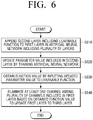
- FIG. 6 is a flow chart illustrating a control method of the electronic device 100 according to an embodiment.
- the electronic device 100 may connect a second layer including a learnable function to a first layer among an artificial neural network including a plurality of layers in operation S610.
- the electronic device 100 may connect a layer including a learnable function to all layers included in the artificial neural network, respectively.
- the electronic device 100 may connect a layer including a learnable function to the selected layer.
- the learnable function is a function that is obtained by adding a first function outputting 0 or 1 to a differential second function
- the second function is a function that is obtained by multiplying a differential function by a function having a predetermined gradient.
- the electronic device 100 may update the parameter value included in the second layer by training the artificial neural network in operation S620.
- the electronic device 100 may obtain output data of the second layer by multiplying the channel-wise function value by output data of the first layer, generate a loss function based on the output data of the second layer, and obtain a parameter to output a minimum function value of the loss function.
- the electronic device 100 may obtain a parameter to output a minimum function value of the loss function by applying a stochastic gradient descent to the loss function and may update the parameter to the obtained parameter.
- the electronic device 100 may obtain a function value by inputting the updated parameter value to the learnable function in operation S630.
- the electronic device 100 may update the first layer to the third layer by eliminating at least one channel among the plurality of channels included in the first layer based on the obtained function value in operation S640.
- the electronic device 100 may obtain a function value 0 by inputting a parameter value that is a negative function to the learnable function, and may eliminate a kernel of the first layer corresponding to the parameter. For example, if a parameter, which is a negative number input to the learnable function, is W l,i , the electronic device 100 may obtain a function value 0 and eliminate the i th channel of the first layer. If the parameter, which is a positive value input to the learnable function, is W l,i , the electronic device 100 may obtain a function value 1 and maintain the i th channel of the first layer as it is.
- the electronic device 100 may eliminate the second layer appended to the first layer and eliminate at least one channel among the plurality of channels included in the first layer based on the function value to obtain the channel pruned third layer from the first layer.
- this is an example and the second layer may be eliminated after updating the first layer to the third layer.
- the term “has,” “may have,” “includes” or “may include” indicates existence of a corresponding feature (e.g., a numerical value, a function, an operation, or a constituent element such as a component), but does not exclude existence of an additional feature.
- the term “A or B,” “at least one of A or/and B,” or “one or more of A or/and B” may include all possible combinations of the items that are enumerated together.
- the term “A or B”, “at least one of A and B”, or “at least one of A or B” may designate (1) at least one A, (2) at least one B, or (3) both at least one A and at least one B.
- first, second, etc. may be used to describe various elements regardless of their order and/or importance and to discriminate one element from other elements, but are not limited to the corresponding elements.
- an element e.g., first element
- another element e.g., second element
- the element may be connected to the other element directly or through still another element (e.g., third element).
- one element e.g., first element
- another element e.g., second element
- there is no element e.g., third element
- the expression “configured to” may be used interchangeably with, for example, “suitable for”, “having the capacity to”, “designed to”, “adapted to”, “made to”, or “capable of'.
- the expression “configured to” does not necessarily mean “specifically designed to” in a hardware sense. Instead, under some circumstances, "a device configured to” may indicate that such a device may perform an operation along with another device or part.
- a processor configured to perform A, B, and C may indicate an exclusive processor (e.g., an embedded processor) to perform the corresponding operation, or a generic-purpose processor (e.g., a central processor (CPU) or application processor (AP)) that may perform the corresponding operations by executing one or more software programs stored in the memory device.
- an exclusive processor e.g., an embedded processor
- a generic-purpose processor e.g., a central processor (CPU) or application processor (AP)
- the electronic device may include, for example, a smartphone, a tablet personal computer (PC), a desktop PC, a laptop PC, a netbook computer, a server, a personal digital assistant (PDA), a medical device, a camera, or a wearable device.
- the electronic device may include at least one of, for example, a television, a refrigerator, air-conditioner, an air purifier, a set top box, a media box (e.g., SAMSUNG HOMESYNC M , APPLE TVTM, or GOOGLE TVTM.
- a term user may refer to a person using an electronic device or a device (e.g., an artificial intelligence electronic device) using the electronic device.
- a device e.g., an artificial intelligence electronic device
- various embodiments of the disclosure may be implemented in software, including instructions stored on machine-readable storage media readable by a machine (e.g., a computer).
- An electronic apparatus including the electronic apparatus 100 and 200, may call instructions from the storage medium and execute the called instruction according to the embodiments of the disclosure.
- the processor may perform a function corresponding to the instructions directly or by using other components under the control of the processor.
- the instructions may include a code generated by a compiler or a code executable by an interpreter.
- a machine-readable storage medium may be provided in the form of a non-transitory storage medium.
- non-transitory only denotes that a storage medium does not include a signal but is tangible, and does not distinguish the case in which data is semi-permanently stored in a storage medium from the case in which data is temporarily stored in a storage medium.
- the method according to the above-described embodiments may be provided as being included in a computer program product.
- the computer program product may be traded as a product between a seller and a consumer.
- the computer program product may be distributed online in the form of machine-readable storage media (e.g., compact disc read only memory (CD-ROM)) or through an application store (e.g., Play Store TM and App Store TM) or distributed online (e.g., downloaded or uploaded) directly between to users (e.g., smartphones).
- an application store e.g., Play Store TM and App Store TM
- distributed online e.g., downloaded or uploaded
- at least a portion of the computer program product may be at least temporarily stored or temporarily generated in a server of the manufacturer, a server of the application store, or a machine-readable storage medium such as memory of a relay server.
- the respective elements (e.g., module or program) of the elements mentioned above may include a single entity or a plurality of entities. Furthermore, at least one element or operation from among the corresponding elements mentioned above may be omitted, or at least one other element or operation may be added. Alternatively or additionally, a plurality of components (e.g., module or program) may be combined to form a single entity. As such, the integrated entity may perform functions of at least one function of an element of each of the plurality of elements in the same manner as or in a similar manner to that performed by the corresponding element from among the plurality of elements before integration.
- the module, a program module, or operations executed by other elements may be executed consecutively, in parallel, repeatedly, or heuristically, or at least some operations may be executed according to a different order, may be omitted, or the other operation may be added thereto.
Landscapes
- Engineering & Computer Science (AREA)
- Theoretical Computer Science (AREA)
- Physics & Mathematics (AREA)
- Data Mining & Analysis (AREA)
- General Health & Medical Sciences (AREA)
- Biomedical Technology (AREA)
- Biophysics (AREA)
- Computational Linguistics (AREA)
- Life Sciences & Earth Sciences (AREA)
- Evolutionary Computation (AREA)
- Artificial Intelligence (AREA)
- Molecular Biology (AREA)
- Computing Systems (AREA)
- General Engineering & Computer Science (AREA)
- General Physics & Mathematics (AREA)
- Mathematical Physics (AREA)
- Software Systems (AREA)
- Health & Medical Sciences (AREA)
- Image Analysis (AREA)
Applications Claiming Priority (3)
| Application Number | Priority Date | Filing Date | Title |
|---|---|---|---|
| US201962793497P | 2019-01-17 | 2019-01-17 | |
| KR1020190118918A KR102898294B1 (ko) | 2019-01-17 | 2019-09-26 | 전자 장치 및 이의 제어 방법 |
| PCT/KR2019/016235 WO2020149511A1 (ko) | 2019-01-17 | 2019-11-25 | 전자 장치 및 이의 제어 방법 |
Publications (2)
| Publication Number | Publication Date |
|---|---|
| EP3852017A1 true EP3852017A1 (de) | 2021-07-21 |
| EP3852017A4 EP3852017A4 (de) | 2021-12-22 |
Family
ID=71893866
Family Applications (1)
| Application Number | Title | Priority Date | Filing Date |
|---|---|---|---|
| EP19910158.5A Ceased EP3852017A4 (de) | 2019-01-17 | 2019-11-25 | Elektronische vorrichtung und steuerungsverfahren dafür |
Country Status (3)
| Country | Link |
|---|---|
| US (1) | US12198032B2 (de) |
| EP (1) | EP3852017A4 (de) |
| KR (1) | KR102898294B1 (de) |
Families Citing this family (9)
| Publication number | Priority date | Publication date | Assignee | Title |
|---|---|---|---|---|
| CN111082893B (zh) * | 2018-10-19 | 2024-04-26 | 华为技术有限公司 | 数据发送的方法及装置 |
| KR102373483B1 (ko) * | 2020-11-19 | 2022-03-11 | 엘아이지넥스원 주식회사 | 딥러닝을 이용한 고속 영상 블러 제거 방법 및 장치 |
| KR102390553B1 (ko) * | 2020-11-24 | 2022-04-27 | 한국과학기술원 | 연합 학습 방법 및 시스템 |
| EP4207009B1 (de) | 2020-12-24 | 2025-12-31 | Samsung Electronics Co., Ltd. | Elektronische vorrichtung und steuerungsverfahren dafür |
| KR20220092247A (ko) * | 2020-12-24 | 2022-07-01 | 삼성전자주식회사 | 전자 장치 및 이의 제어 방법 |
| GB202106969D0 (en) | 2021-05-14 | 2021-06-30 | Samsung Electronics Co Ltd | Method and apparatus for improving model efficiency |
| KR102777883B1 (ko) * | 2021-11-12 | 2025-03-11 | 한국전자통신연구원 | 이산 개체의 가중치 측정 방법 및 장치 |
| US12525227B2 (en) * | 2022-10-17 | 2026-01-13 | Microsoft Technology Licensing, Llc | System and method for spectral pooling in streaming speech processing |
| KR20250134367A (ko) * | 2024-03-04 | 2025-09-11 | 한국과학기술원 | 비디오 연속 학습 방법 및 장치 |
Family Cites Families (40)
| Publication number | Priority date | Publication date | Assignee | Title |
|---|---|---|---|---|
| JPH04195246A (ja) | 1990-09-28 | 1992-07-15 | Olympus Optical Co Ltd | 最適化装置 |
| US7158692B2 (en) | 2001-10-15 | 2007-01-02 | Insightful Corporation | System and method for mining quantitive information from medical images |
| US7016529B2 (en) | 2002-03-15 | 2006-03-21 | Microsoft Corporation | System and method facilitating pattern recognition |
| JP4258268B2 (ja) | 2003-05-09 | 2009-04-30 | Kddi株式会社 | 多層ニューラルネットワーク学習方法 |
| HUP0301368A3 (en) | 2003-05-20 | 2005-09-28 | Amt Advanced Multimedia Techno | Method and equipment for compressing motion picture data |
| CN101414351A (zh) | 2008-11-03 | 2009-04-22 | 章毅 | 一种指纹识别系统及其控制方法 |
| EP2259214B1 (de) | 2009-06-04 | 2013-02-27 | Honda Research Institute Europe GmbH | Implementierung eines neuronalassoziativen Speichers auf Grundlage des nichtlinearen Lernens von diskreten Synapsen |
| JP6274007B2 (ja) | 2014-05-16 | 2018-02-07 | 富士通株式会社 | ルール生成プログラム、情報処理装置、およびルール生成方法 |
| WO2016055939A1 (en) | 2014-10-06 | 2016-04-14 | Brightsource Ics2 Ltd. | Systems and methods for enhancing control system security by detecting anomalies in descriptive characteristics of data |
| WO2016083657A1 (en) | 2014-11-26 | 2016-06-02 | CURIOUS Al OY | Neural network structure and a method thereto |
| US10373054B2 (en) | 2015-04-19 | 2019-08-06 | International Business Machines Corporation | Annealed dropout training of neural networks |
| US11423311B2 (en) | 2015-06-04 | 2022-08-23 | Samsung Electronics Co., Ltd. | Automatic tuning of artificial neural networks |
| US10832120B2 (en) | 2015-12-11 | 2020-11-10 | Baidu Usa Llc | Systems and methods for a multi-core optimized recurrent neural network |
| US11995554B2 (en) | 2016-04-15 | 2024-05-28 | Cambricon Technologies Corporation Limited | Apparatus and methods for backward propagation in neural networks supporting discrete data |
| US10832123B2 (en) | 2016-08-12 | 2020-11-10 | Xilinx Technology Beijing Limited | Compression of deep neural networks with proper use of mask |
| KR102336295B1 (ko) * | 2016-10-04 | 2021-12-09 | 한국전자통신연구원 | 적응적 프루닝 및 가중치 공유를 사용하는 컨볼루션 신경망 시스템 및 그것의 동작 방법 |
| US11321609B2 (en) | 2016-10-19 | 2022-05-03 | Samsung Electronics Co., Ltd | Method and apparatus for neural network quantization |
| US11315018B2 (en) | 2016-10-21 | 2022-04-26 | Nvidia Corporation | Systems and methods for pruning neural networks for resource efficient inference |
| KR102415506B1 (ko) | 2016-10-26 | 2022-07-01 | 삼성전자주식회사 | 뉴럴 네트워크 간소화 방법 및 장치 |
| CN111860826B (zh) | 2016-11-17 | 2024-08-13 | 北京图森智途科技有限公司 | 一种神经网络剪枝方法及装置 |
| KR102061615B1 (ko) | 2016-12-26 | 2020-01-02 | 한국과학기술원 | 인공 신경망 모델에서 메모리 효율성 및 학습 속도 향상을 위한 드롭아웃 방법과 이를 이용한 학습 방법 |
| US20180189950A1 (en) | 2016-12-30 | 2018-07-05 | Google Inc. | Generating structured output predictions using neural networks |
| US20180247156A1 (en) | 2017-02-24 | 2018-08-30 | Xtract Technologies Inc. | Machine learning systems and methods for document matching |
| US10755136B2 (en) | 2017-05-16 | 2020-08-25 | Nec Corporation | Pruning filters for efficient convolutional neural networks for image recognition in vehicles |
| KR102139729B1 (ko) * | 2017-06-09 | 2020-07-31 | 한국과학기술원 | 전자 장치 및 학습 모델의 재학습 방법 |
| US11645508B2 (en) | 2017-06-09 | 2023-05-09 | Korea Advanced Institute Of Science And Technology | Electronic apparatus and method for generating trained model |
| US11321604B2 (en) * | 2017-06-21 | 2022-05-03 | Arm Ltd. | Systems and devices for compressing neural network parameters |
| WO2019074339A1 (ko) * | 2017-10-15 | 2019-04-18 | 알레시오 주식회사 | 신호 변환 시스템 및 신호 변환 방법 |
| KR20220031940A (ko) | 2017-10-16 | 2022-03-14 | 일루미나, 인코포레이티드 | 컨볼루션 신경망(cnn)을 사용하는 비정상 스플라이싱 검출 |
| US11132621B2 (en) | 2017-11-15 | 2021-09-28 | International Business Machines Corporation | Correction of reaction rules databases by active learning |
| US11055320B2 (en) | 2017-12-07 | 2021-07-06 | Zensar Technologies Ltd. | System for mapping employees sentiments and a method thereof |
| US20190197406A1 (en) | 2017-12-22 | 2019-06-27 | Microsoft Technology Licensing, Llc | Neural entropy enhanced machine learning |
| CN110009091B (zh) | 2018-01-05 | 2023-10-31 | 微软技术许可有限责任公司 | 学习网络在等价类空间中的优化 |
| JP6760318B2 (ja) | 2018-03-14 | 2020-09-23 | オムロン株式会社 | 顔画像識別システム、識別器生成装置、識別装置、画像識別システム、及び識別システム |
| US10430690B1 (en) | 2018-04-20 | 2019-10-01 | Sas Institute Inc. | Machine learning predictive labeling system |
| KR102124171B1 (ko) | 2018-10-01 | 2020-06-17 | 인하대학교 산학협력단 | 엔트로피 기반 신경망(Neural Networks) 가지치기 방법 및 시스템 |
| KR102163498B1 (ko) | 2018-12-24 | 2020-10-08 | 아주대학교산학협력단 | 신경망의 프루닝-재훈련 장치 및 방법 |
| US11113532B2 (en) | 2019-04-16 | 2021-09-07 | Lg Electronics Inc. | Artificial intelligence apparatus for recognizing object and method therefor |
| KR20190103084A (ko) | 2019-08-15 | 2019-09-04 | 엘지전자 주식회사 | 지능형 전자 디바이스와 모드 설정 방법 |
| KR102930625B1 (ko) | 2019-08-27 | 2026-02-26 | 엘지전자 주식회사 | 학습 데이터를 생성하는 인공 지능 장치, 인공 지능 서버 및 그 방법 |
-
2019
- 2019-09-26 KR KR1020190118918A patent/KR102898294B1/ko active Active
- 2019-11-25 EP EP19910158.5A patent/EP3852017A4/de not_active Ceased
- 2019-11-25 US US17/286,982 patent/US12198032B2/en active Active
Also Published As
| Publication number | Publication date |
|---|---|
| KR102898294B1 (ko) | 2025-12-12 |
| EP3852017A4 (de) | 2021-12-22 |
| KR20200089588A (ko) | 2020-07-27 |
| US12198032B2 (en) | 2025-01-14 |
| US20210383190A1 (en) | 2021-12-09 |
Similar Documents
| Publication | Publication Date | Title |
|---|---|---|
| US12198032B2 (en) | Electronic device and control method therefor | |
| CN110880036B (zh) | 神经网络压缩方法、装置、计算机设备及存储介质 | |
| CN111523640B (zh) | 神经网络模型的训练方法和装置 | |
| EP3474157A1 (de) | Verfahren zur aktualisierung eines satzerzeugungsmodells und satzerzeugungsvorrichtung | |
| CN110347873A (zh) | 视频分类方法、装置、电子设备及存储介质 | |
| CN111488985A (zh) | 深度神经网络模型压缩训练方法、装置、设备、介质 | |
| CN108229667A (zh) | 基于人工神经网络类别的修剪 | |
| CN108038546A (zh) | 用于压缩神经网络的方法和装置 | |
| CN111797220B (zh) | 对话生成方法、装置、计算机设备和存储介质 | |
| JP6950756B2 (ja) | ニューラルネットワークのランク最適化装置および最適化方法 | |
| CN112687266B (zh) | 语音识别方法、装置、计算机设备和存储介质 | |
| KR102072239B1 (ko) | 매니폴드 제약 조건에 기반한 심층 신경망 압축 방법 및 그 장치 | |
| CN115631396A (zh) | 一种基于知识蒸馏的YOLOv5目标检测方法 | |
| CN116188878A (zh) | 基于神经网络结构微调的图像分类方法、装置和存储介质 | |
| CN116959408A (zh) | 基于扩散过程的文本转语音模型的构建方法及应用 | |
| CN116302551A (zh) | 模型数据处理方法、可读介质和电子设备 | |
| CN113378866A (zh) | 图像分类方法、系统、存储介质及电子设备 | |
| US12175369B2 (en) | Electronic device for key frame analysis and control method thereof | |
| US20240232686A1 (en) | Portion-Specific Model Compression for Optimization of Machine-Learned Models | |
| US20220318512A1 (en) | Electronic device and control method thereof | |
| WO2020149511A1 (ko) | 전자 장치 및 이의 제어 방법 | |
| KR20210148877A (ko) | 전자 장치 및 이의 제어 방법 | |
| KR20250133116A (ko) | 이미지 스타일 변환 방법 | |
| CN115601550B (zh) | 模型确定方法、装置、计算机设备及计算机可读存储介质 | |
| CN113673694B (zh) | 数据处理方法及装置、电子设备和计算机可读存储介质 |
Legal Events
| Date | Code | Title | Description |
|---|---|---|---|
| STAA | Information on the status of an ep patent application or granted ep patent |
Free format text: STATUS: THE INTERNATIONAL PUBLICATION HAS BEEN MADE |
|
| PUAI | Public reference made under article 153(3) epc to a published international application that has entered the european phase |
Free format text: ORIGINAL CODE: 0009012 |
|
| STAA | Information on the status of an ep patent application or granted ep patent |
Free format text: STATUS: REQUEST FOR EXAMINATION WAS MADE |
|
| 17P | Request for examination filed |
Effective date: 20210414 |
|
| AK | Designated contracting states |
Kind code of ref document: A1 Designated state(s): AL AT BE BG CH CY CZ DE DK EE ES FI FR GB GR HR HU IE IS IT LI LT LU LV MC MK MT NL NO PL PT RO RS SE SI SK SM TR |
|
| REG | Reference to a national code |
Ref country code: DE Ref legal event code: R079 Free format text: PREVIOUS MAIN CLASS: G06N0003080000 Ipc: G06N0003040000 |
|
| A4 | Supplementary search report drawn up and despatched |
Effective date: 20211119 |
|
| RIC1 | Information provided on ipc code assigned before grant |
Ipc: G06N 3/08 20060101ALI20211115BHEP Ipc: G06N 3/04 20060101AFI20211115BHEP |
|
| DAV | Request for validation of the european patent (deleted) | ||
| DAX | Request for extension of the european patent (deleted) | ||
| STAA | Information on the status of an ep patent application or granted ep patent |
Free format text: STATUS: EXAMINATION IS IN PROGRESS |
|
| 17Q | First examination report despatched |
Effective date: 20230616 |
|
| REG | Reference to a national code |
Ref country code: DE Ref legal event code: R003 |
|
| STAA | Information on the status of an ep patent application or granted ep patent |
Free format text: STATUS: THE APPLICATION HAS BEEN REFUSED |
|
| 18R | Application refused |
Effective date: 20250117 |