EP3848106A1 - Alkylation product separation method, alkylation reaction and separation method, and related apparatus - Google Patents
Alkylation product separation method, alkylation reaction and separation method, and related apparatus Download PDFInfo
- Publication number
- EP3848106A1 EP3848106A1 EP19858166.2A EP19858166A EP3848106A1 EP 3848106 A1 EP3848106 A1 EP 3848106A1 EP 19858166 A EP19858166 A EP 19858166A EP 3848106 A1 EP3848106 A1 EP 3848106A1
- Authority
- EP
- European Patent Office
- Prior art keywords
- column
- alkylation
- pressure
- heat
- pressure fractionating
- Prior art date
- Legal status (The legal status is an assumption and is not a legal conclusion. Google has not performed a legal analysis and makes no representation as to the accuracy of the status listed.)
- Granted
Links
Images
Classifications
-
- B—PERFORMING OPERATIONS; TRANSPORTING
- B01—PHYSICAL OR CHEMICAL PROCESSES OR APPARATUS IN GENERAL
- B01D—SEPARATION
- B01D3/00—Distillation or related exchange processes in which liquids are contacted with gaseous media, e.g. stripping
- B01D3/14—Fractional distillation or use of a fractionation or rectification column
- B01D3/143—Fractional distillation or use of a fractionation or rectification column by two or more of a fractionation, separation or rectification step
- B01D3/148—Fractional distillation or use of a fractionation or rectification column by two or more of a fractionation, separation or rectification step in combination with at least one evaporator
-
- B—PERFORMING OPERATIONS; TRANSPORTING
- B01—PHYSICAL OR CHEMICAL PROCESSES OR APPARATUS IN GENERAL
- B01D—SEPARATION
- B01D3/00—Distillation or related exchange processes in which liquids are contacted with gaseous media, e.g. stripping
- B01D3/14—Fractional distillation or use of a fractionation or rectification column
- B01D3/143—Fractional distillation or use of a fractionation or rectification column by two or more of a fractionation, separation or rectification step
-
- B—PERFORMING OPERATIONS; TRANSPORTING
- B01—PHYSICAL OR CHEMICAL PROCESSES OR APPARATUS IN GENERAL
- B01D—SEPARATION
- B01D3/00—Distillation or related exchange processes in which liquids are contacted with gaseous media, e.g. stripping
- B01D3/007—Energy recuperation; Heat pumps
-
- B—PERFORMING OPERATIONS; TRANSPORTING
- B01—PHYSICAL OR CHEMICAL PROCESSES OR APPARATUS IN GENERAL
- B01J—CHEMICAL OR PHYSICAL PROCESSES, e.g. CATALYSIS OR COLLOID CHEMISTRY; THEIR RELEVANT APPARATUS
- B01J19/00—Chemical, physical or physico-chemical processes in general; Their relevant apparatus
- B01J19/0006—Controlling or regulating processes
-
- C—CHEMISTRY; METALLURGY
- C07—ORGANIC CHEMISTRY
- C07C—ACYCLIC OR CARBOCYCLIC COMPOUNDS
- C07C2/00—Preparation of hydrocarbons from hydrocarbons containing a smaller number of carbon atoms
- C07C2/54—Preparation of hydrocarbons from hydrocarbons containing a smaller number of carbon atoms by addition of unsaturated hydrocarbons to saturated hydrocarbons or to hydrocarbons containing a six-membered aromatic ring with no unsaturation outside the aromatic ring
- C07C2/56—Addition to acyclic hydrocarbons
- C07C2/58—Catalytic processes
-
- C—CHEMISTRY; METALLURGY
- C07—ORGANIC CHEMISTRY
- C07C—ACYCLIC OR CARBOCYCLIC COMPOUNDS
- C07C2/00—Preparation of hydrocarbons from hydrocarbons containing a smaller number of carbon atoms
- C07C2/54—Preparation of hydrocarbons from hydrocarbons containing a smaller number of carbon atoms by addition of unsaturated hydrocarbons to saturated hydrocarbons or to hydrocarbons containing a six-membered aromatic ring with no unsaturation outside the aromatic ring
- C07C2/56—Addition to acyclic hydrocarbons
- C07C2/58—Catalytic processes
- C07C2/62—Catalytic processes with acids
-
- C—CHEMISTRY; METALLURGY
- C07—ORGANIC CHEMISTRY
- C07C—ACYCLIC OR CARBOCYCLIC COMPOUNDS
- C07C7/00—Purification; Separation; Use of additives
- C07C7/04—Purification; Separation; Use of additives by distillation
-
- C—CHEMISTRY; METALLURGY
- C10—PETROLEUM, GAS OR COKE INDUSTRIES; TECHNICAL GASES CONTAINING CARBON MONOXIDE; FUELS; LUBRICANTS; PEAT
- C10G—CRACKING HYDROCARBON OILS; PRODUCTION OF LIQUID HYDROCARBON MIXTURES, e.g. BY DESTRUCTIVE HYDROGENATION, OLIGOMERISATION, POLYMERISATION; RECOVERY OF HYDROCARBON OILS FROM OIL-SHALE, OIL-SAND, OR GASES; REFINING MIXTURES MAINLY CONSISTING OF HYDROCARBONS; REFORMING OF NAPHTHA; MINERAL WAXES
- C10G29/00—Refining of hydrocarbon oils, in the absence of hydrogen, with other chemicals
- C10G29/20—Organic compounds not containing metal atoms
- C10G29/205—Organic compounds not containing metal atoms by reaction with hydrocarbons added to the hydrocarbon oil
-
- C—CHEMISTRY; METALLURGY
- C10—PETROLEUM, GAS OR COKE INDUSTRIES; TECHNICAL GASES CONTAINING CARBON MONOXIDE; FUELS; LUBRICANTS; PEAT
- C10G—CRACKING HYDROCARBON OILS; PRODUCTION OF LIQUID HYDROCARBON MIXTURES, e.g. BY DESTRUCTIVE HYDROGENATION, OLIGOMERISATION, POLYMERISATION; RECOVERY OF HYDROCARBON OILS FROM OIL-SHALE, OIL-SAND, OR GASES; REFINING MIXTURES MAINLY CONSISTING OF HYDROCARBONS; REFORMING OF NAPHTHA; MINERAL WAXES
- C10G57/00—Treatment of hydrocarbon oils, in the absence of hydrogen, by at least one cracking process or refining process and at least one other conversion process
- C10G57/005—Treatment of hydrocarbon oils, in the absence of hydrogen, by at least one cracking process or refining process and at least one other conversion process with alkylation
-
- C—CHEMISTRY; METALLURGY
- C10—PETROLEUM, GAS OR COKE INDUSTRIES; TECHNICAL GASES CONTAINING CARBON MONOXIDE; FUELS; LUBRICANTS; PEAT
- C10G—CRACKING HYDROCARBON OILS; PRODUCTION OF LIQUID HYDROCARBON MIXTURES, e.g. BY DESTRUCTIVE HYDROGENATION, OLIGOMERISATION, POLYMERISATION; RECOVERY OF HYDROCARBON OILS FROM OIL-SHALE, OIL-SAND, OR GASES; REFINING MIXTURES MAINLY CONSISTING OF HYDROCARBONS; REFORMING OF NAPHTHA; MINERAL WAXES
- C10G7/00—Distillation of hydrocarbon oils
-
- B—PERFORMING OPERATIONS; TRANSPORTING
- B01—PHYSICAL OR CHEMICAL PROCESSES OR APPARATUS IN GENERAL
- B01J—CHEMICAL OR PHYSICAL PROCESSES, e.g. CATALYSIS OR COLLOID CHEMISTRY; THEIR RELEVANT APPARATUS
- B01J2219/00—Chemical, physical or physico-chemical processes in general; Their relevant apparatus
- B01J2219/00049—Controlling or regulating processes
- B01J2219/00162—Controlling or regulating processes controlling the pressure
-
- C—CHEMISTRY; METALLURGY
- C07—ORGANIC CHEMISTRY
- C07C—ACYCLIC OR CARBOCYCLIC COMPOUNDS
- C07C2527/00—Catalysts comprising the elements or compounds of halogens, sulfur, selenium, tellurium, phosphorus or nitrogen; Catalysts comprising carbon compounds
- C07C2527/02—Sulfur, selenium or tellurium; Compounds thereof
- C07C2527/053—Sulfates or other compounds comprising the anion (SnO3n+1)2-
- C07C2527/054—Sulfuric acid or other acids with the formula H2Sn03n+1
-
- C—CHEMISTRY; METALLURGY
- C07—ORGANIC CHEMISTRY
- C07C—ACYCLIC OR CARBOCYCLIC COMPOUNDS
- C07C2529/00—Catalysts comprising molecular sieves
- C07C2529/04—Catalysts comprising molecular sieves having base-exchange properties, e.g. crystalline zeolites, pillared clays
- C07C2529/06—Crystalline aluminosilicate zeolites; Isomorphous compounds thereof
- C07C2529/08—Crystalline aluminosilicate zeolites; Isomorphous compounds thereof of the faujasite type, e.g. type X or Y
-
- C—CHEMISTRY; METALLURGY
- C10—PETROLEUM, GAS OR COKE INDUSTRIES; TECHNICAL GASES CONTAINING CARBON MONOXIDE; FUELS; LUBRICANTS; PEAT
- C10G—CRACKING HYDROCARBON OILS; PRODUCTION OF LIQUID HYDROCARBON MIXTURES, e.g. BY DESTRUCTIVE HYDROGENATION, OLIGOMERISATION, POLYMERISATION; RECOVERY OF HYDROCARBON OILS FROM OIL-SHALE, OIL-SAND, OR GASES; REFINING MIXTURES MAINLY CONSISTING OF HYDROCARBONS; REFORMING OF NAPHTHA; MINERAL WAXES
- C10G2300/00—Aspects relating to hydrocarbon processing covered by groups C10G1/00 - C10G99/00
- C10G2300/10—Feedstock materials
- C10G2300/1081—Alkanes
-
- C—CHEMISTRY; METALLURGY
- C10—PETROLEUM, GAS OR COKE INDUSTRIES; TECHNICAL GASES CONTAINING CARBON MONOXIDE; FUELS; LUBRICANTS; PEAT
- C10G—CRACKING HYDROCARBON OILS; PRODUCTION OF LIQUID HYDROCARBON MIXTURES, e.g. BY DESTRUCTIVE HYDROGENATION, OLIGOMERISATION, POLYMERISATION; RECOVERY OF HYDROCARBON OILS FROM OIL-SHALE, OIL-SAND, OR GASES; REFINING MIXTURES MAINLY CONSISTING OF HYDROCARBONS; REFORMING OF NAPHTHA; MINERAL WAXES
- C10G2300/00—Aspects relating to hydrocarbon processing covered by groups C10G1/00 - C10G99/00
- C10G2300/10—Feedstock materials
- C10G2300/1088—Olefins
- C10G2300/1092—C2-C4 olefins
-
- C—CHEMISTRY; METALLURGY
- C10—PETROLEUM, GAS OR COKE INDUSTRIES; TECHNICAL GASES CONTAINING CARBON MONOXIDE; FUELS; LUBRICANTS; PEAT
- C10G—CRACKING HYDROCARBON OILS; PRODUCTION OF LIQUID HYDROCARBON MIXTURES, e.g. BY DESTRUCTIVE HYDROGENATION, OLIGOMERISATION, POLYMERISATION; RECOVERY OF HYDROCARBON OILS FROM OIL-SHALE, OIL-SAND, OR GASES; REFINING MIXTURES MAINLY CONSISTING OF HYDROCARBONS; REFORMING OF NAPHTHA; MINERAL WAXES
- C10G2300/00—Aspects relating to hydrocarbon processing covered by groups C10G1/00 - C10G99/00
- C10G2300/40—Characteristics of the process deviating from typical ways of processing
- C10G2300/4006—Temperature
-
- C—CHEMISTRY; METALLURGY
- C10—PETROLEUM, GAS OR COKE INDUSTRIES; TECHNICAL GASES CONTAINING CARBON MONOXIDE; FUELS; LUBRICANTS; PEAT
- C10G—CRACKING HYDROCARBON OILS; PRODUCTION OF LIQUID HYDROCARBON MIXTURES, e.g. BY DESTRUCTIVE HYDROGENATION, OLIGOMERISATION, POLYMERISATION; RECOVERY OF HYDROCARBON OILS FROM OIL-SHALE, OIL-SAND, OR GASES; REFINING MIXTURES MAINLY CONSISTING OF HYDROCARBONS; REFORMING OF NAPHTHA; MINERAL WAXES
- C10G2300/00—Aspects relating to hydrocarbon processing covered by groups C10G1/00 - C10G99/00
- C10G2300/40—Characteristics of the process deviating from typical ways of processing
- C10G2300/4012—Pressure
-
- Y—GENERAL TAGGING OF NEW TECHNOLOGICAL DEVELOPMENTS; GENERAL TAGGING OF CROSS-SECTIONAL TECHNOLOGIES SPANNING OVER SEVERAL SECTIONS OF THE IPC; TECHNICAL SUBJECTS COVERED BY FORMER USPC CROSS-REFERENCE ART COLLECTIONS [XRACs] AND DIGESTS
- Y02—TECHNOLOGIES OR APPLICATIONS FOR MITIGATION OR ADAPTATION AGAINST CLIMATE CHANGE
- Y02P—CLIMATE CHANGE MITIGATION TECHNOLOGIES IN THE PRODUCTION OR PROCESSING OF GOODS
- Y02P20/00—Technologies relating to chemical industry
- Y02P20/50—Improvements relating to the production of bulk chemicals
Definitions
- the present invention relates to a process for separating a mixture and a separation apparatus, in particular to a process for separating an alkylation product of low-carbon alkene and alkane and a separation apparatus.
- An alkylation oil is a clean high-octane gasoline blending component. Under the action of a strong acid, an isoalkane (mainly isobutane) and an alkene (C3-C5 alkene) react to generate an alkylation oil mainly composed of isooctane.
- Alkylation technology can be divided into liquid acid alkylation and solid acid alkylation according to the catalyst form. The alkylation reaction of alkenes and alkanes is very complicated, the main reaction is the addition reaction of alkenes and alkanes, but various side reactions also occur at the same time, mainly including the superposition of alkenes, the cracking of macromolecules and the like.
- the external alkane/alkene ratio of the reactor feed is about 7-10, and the internal ratio is as high as several hundreds or even thousands;
- the hydrofluoric acid process also has a large isobutane recycle, with an external isobutane/alkene ratio of about 5-20, depending on the selected reactor configuration; for the solid acid alkylation technique, higher external and internal ratios are used, and the solid acid alkylation processes disclosed in US5986158 and US7875754 require using the external ratios of at least 5:1, preferably 16-32:1.
- the result of using a higher external ratio is a very low proportion of the alkylation oil in the stream from the reactor outlet: for the liquid acid process, the proportion of the alkylation oil to the inlet of the main fractionating column is about 10%-30%, and for the solid acid process, that proportion is even lower, typically less than 10%.
- the large isobutane recycle results in the high energy consumption in the main fractionating column, which is also the most significant cause for the higher energy consumption in the alkylation process .
- the energy consumption of the liquid acid process is about 100kgEo/ton alkylation oil
- the energy consumption of the solid acid process is as high as 200kgEo/ton alkylation oil.
- At least 80% of all energy consumption is used in the separation process of the alkylation oil and the recycled isobutane in the product, and the energy consumption is mainly caused by the fact that the condensation low-temperature heat of a large amount of low-carbon hydrocarbons cannot be effectively recovered and utilized.
- the technical problem to be solved by the present invention is to provide a process and an apparatus for separating an alkylation product of low-carbon alkenes and alkanes, which can improve the heat utilization efficiency and remarkably reduce the energy consumption in the separation process of the alkylation product.
- a process for separating an alkylation product wherein a liquid phase alkylation product from an alkylation reaction unit is introduced into a first heat-exchanger directly or after being pressurized with a pressure pump and heat-exchanged with a vapor phase stream from the column top of a high-pressure fractionating column, then introduced into a second heat-exchanger and further heated to 100°C-150°C, then introduced into the high-pressure fractionating column and subjected to fractionation under a condition of 2.0MPa-4.0MPa, the vapor phase stream from the column top of the high-pressure fractionating column is heat-exchanged with the liquid phase alkylation product to be separated, a liquid phase stream from the column bottom of the high-pressure fractionating column is introduced into a low-pressure fractionating column and subjected to fractionation under a condition of 0.2MPa-1.0MPa, a low-carbon alkane is obtained from the column top of the low-pressure fractionating colum, and a liquid phase stream obtained from the column bottom of the low-pressure
- An alkylation reaction and separation process comprises: (1) an alkylation raw material is contacted with an acidic catalyst in an alkylation reaction unit to perform an alkylation reaction, and the material after the reaction is discharged as an alkylation product out of the alkylation reaction unit; (2) the liquid phase alkylation product from the alkylation reaction unit is introduced into a first heat-exchanger directly or after being pressurized with a pressure pump and heat-exchanged with a vapor phase stream from the column top of a high-pressure fractionating column, then introduced into a second heat-exchanger and further heated to 100°C-150°C, then introduced into the high-pressure fractionating column and subjected to fractionation under a condition of 2.0MPa-4.0MPa, the vapor phase stream from the column top of the high-pressure fractionating column is heat-exchanged with the liquid phase alkylation product to be separated, a liquid phase stream from the column bottom of the high-pressure fractionating column is introduced into a low-pressure fractionating column and subjected to fractionation under
- An apparatus for separating an alkylation product comprises a pressure pump, a first heat-exchanger, a second heat-exchanger, a high-pressure fractionating column and a low-pressure fractionating column which are sequentially connected in series, wherein an inlet of the pressure pump is provided with a stream to be separated, an outlet of the pressure pump is communicated with the first heat-exchanger, an outlet of the second heat-exchanger is communicated with an inlet of the raw material for the high-pressure fractionating column, an outlet of the column bottom stream for the high-pressure fractionating column is communicated with an inlet of the raw material for the low-pressure fractionating column, an outlet of the column top stream for the high-pressure fractionating column is communicated with an inlet of the hotter fluid medium for the first heat-exchanger, an outlet of the hotter fluid medium for the first heat-exchanger is communicated with an inlet of the column top reflux for the high-pressure fractionating column, specially, an outlet of the hotter fluid medium for the first heat-exchanger,
- 1 - pipeline for the alkylation raw material 1 - alkylation raw material
- 2 - alkylation reaction unit 3 - pipeline for the alkylation product
- 4 - liquid phase pressure pump 5 - first heat-exchanger
- 6 - second heat-exchanger 7 - high-pressure fractionating column
- 12 - low-pressure fractionating column 8 9, 10, 11, 13, 14 - pipelines.
- the pressure is expressed as gauge pressure; the operating pressure of the column is expressed as the column top pressure.
- the alkylation reaction refers to that an alkane (e.g. an alkane having 3-5 carbon atoms) is reacted with an alkene (e.g. an alkene having 3-5 carbon atoms) under pressure in the presence of a catalyst to form an alkane (particularly an isoalkane) having a longer chain, and the alkylation product is present in the state of liquid phase.
- a catalyst e.g. an alkene having 3-5 carbon atoms
- the alkylation product is present in the state of liquid phase.
- a solid or liquid catalyst is used in the alkylation reaction unit.
- the alkylation reaction product may exit the alkylation reactor and directly go to a subsequent separating unit.
- the alkylation reaction unit further comprises an acid removal operation, and the acid-removed alkylation reaction product exits the alkylation reaction unit and goes to a subsequent separating unit.
- the alkylation reaction and the acid removal process and the associated apparatuses in the alkylation reaction unit are known in the art.
- the liquid phase alkylation product comprises unreacted C3-C5 alkanes (mass fraction: greater than 50%, for example 50-90%, 50-95%, or 50-99%), a small amount of the remaining alkenes (mass fraction: less than 10%, less than 9%, less than 8%, less than 7%, less than 6%, less than 5%, less than 4%, less than 3%, less than 2%, less than 1%), and a mixture having a distillation range of about 25°C-about 220°C, especially about 25°C-about 180°C as the product (mass fraction: 1%-40%).
- the liquid phase alkylation product can contain 5%-15% of the mixture having a distillation range of about 25°C-about 220°C, especially about 25°C-about 180°C as the product; and in the case of the liquid catalyst, the liquid phase alkylation product can contain 10%-30% of the mixture having a distillation range of about 25°C-about 220°C, especially about 25°C-about 180°C as the product.
- the low-carbon alkane refers to C3-C5 hydrocarbons with isoalkanes (for example isobutane) as the main component, wherein the content of isoalkanes is higher than 50%, 60% or more, 70% or more, 80% or more, 90% or more, 95% or more, 96% or more, 97% or more, 98% or more, 99% or more, based on the total weight of the low-carbon alkane, and the low-carbon alkane also comprises other C3-C5 alkanes and alkenes.
- isoalkanes for example isobutane
- the alkylation oil product refers to a mixture having a distillation range of about 25°C-about 220°C, especially about 25°C-about 180°C.
- the alkylation oil product is mainly composed of isoalkanes, which comprise greater than 80%, and has an alkene content of less than 2%, and an isooctane content of greater than 50%.
- the fractionating column comprises a feed inlet, a rectifying section, a stripping section, a column top condenser, a column bottom reboiler, an optional inter-condenser, and an optional inter-reboiler.
- the flash column refers to such a fractionating column, which does not include the stripping section and the reboiler of a general fractionating column, and more particularly, which does not include the stripping section, the column bottom reboiler, the inter-condenser, and the inter-reboiler of a general fractionating column, but includes the feed inlet, the rectifying section, and the column top condenser of a general fractionating column.
- the alkylation raw material refer to C3-C5 alkanes and C3-C5 alkenes, wherein the molar ratio of alkane to alkene is 5-30:1, for example 5-15:1 or 8-20:1.
- the present invention provides a process for separating an alkylation product, wherein said process comprises: a liquid phase alkylation product from an alkylation reaction unit is introduced into a first heat-exchanger directly or after being pressurized with a pressure pump and heat-exchanged with a vapor phase stream from the column top of a high-pressure fractionating column, then introduced into a second heat-exchanger and further heated to 100°C-150°C, then introduced into the high-pressure fractionating column and subjected to fractionation under a condition of 2.0MPa-4.
- the vapor phase stream from the column top of the high-pressure fractionating column is heat-exchanged with the liquid phase alkylation product to be separated, a liquid phase stream from the column bottom of the high-pressure fractionating column is introduced into a low-pressure fractionating column and subjected to fractionation under a condition of 0.2MPa-1.0MPa, and a low-carbon alkane is obtained from the column top of the low-pressure fractionating colum, and a liquid phase stream obtained from the column bottom of the low-pressure fractionating colum is an alkylation oil product.
- the high-pressure fractionating column is a flash column. In the flash column, there is provided with a filler having a certain height or column plate(s), a reflux configuration is provided at the column top, and no reboiler is provided at the column bottom.
- the low-pressure fractionating column is a conventional packed column or a conventional plate column, a reflux configuration is provided at the column top, and a reboiler is provided at the column bottom.
- the liquid phase alkylation product to be separated has a temperature of 0°C-100°C, more preferably 0°C-50°C and a pressure of 0.1MPa-4.0MPa, more preferably 0.1MPa-2.0MPa.
- the high-pressure fractionating column has an operating temperature of 90°C-150°C, and a column top reflux ratio of 0.1-2.0.
- the high-pressure fractionating column has a column top vapor-phase temperature of 90°C-150°C or 100°C-150°C, a column bottom liquid phase temperature of 90°C-150°C or 100°C-150°C, a column top reflux ratio of 0.1-2.0, a column top recovery ratio of 0.5-0.9 (for example 0.7-0.75), and an operating pressure of 0.1MPa-4.0MPa (for example 2.0MPa-4.0MPa, still further 2.0MPa-2.8MPa), wherein the column bottom liquid phase temperature is higher than the column top vapor-phase temperature.
- the low-pressure fractionating column has a column top temperature of 30°C-60°C, a column bottom temperature of 100°C-180°C, and a column top reflux ratio of 0.5-5.0.
- the low-pressure fractionating column has a column top temperature of 20°C-80°C (for example 30°C-60°C), a column bottom temperature of 100°C-180°C, a column top reflux ratio of 0.5-5.0 (for example 1), and an operating pressure of 0.2MPa-1.0MPa (for example 0.5MPa-0.6MPa) .
- the temperature difference between the liquid phase alkylation product to be separated and the vapor phase stream from the column top of the high-pressure fractionating column is greater than 10°C, more preferably greater than 30°C.
- the liquid phase alkylation product pressurized by the pump has a pressure of 2.0MPa-4.0MPa.
- the liquid phase alkylation product after being heated by the heat-exchanging with the first heat-exchanger and the second heat-exchanger, the liquid phase alkylation product has a temperature of 100°C-150°C, and a vapor-phase fraction of 0.3-1.0.
- the pressure pump is a liquid phase pump, preferably a pipe-type pump, more preferably a liquid phase centrifugal pump.
- the vapor phase stream from the high-pressure fractionating column which is heat-exchanged in the first heat-exchanger, is wholly condensed into the liquid phase, the condensed liquid phase, in one part, returns to the column top of the high-pressure fractionating column as reflux, and in the other part, returns to the alkylation reaction unit, the low carbon alkane from the column top of the low-pressure fractionating colum returns to the alkylation reaction unit.
- the alkylation product to be separated and the vapor-phase stream from the high-pressure flash column are heat-exchanged in the first heat-exchanger, preferably in the manner of the cross-flow heat-exchanging, and the heat-exchanged alkylation product to be separated has a temperature of 90-140°C.
- all heat-exchangers are in the manner of the cross-flow heat-exchanging.
- the operating pressure of the high-pressure fractionating column is higher than the operating pressure of the low-pressure fractionating column by 1-3MPa, for example, 1-2MPa, for example greater than 1MPa and less than 2MPa.
- the present invention provides an alkylation reaction and separation process, wherein said process comprises: (1) an alkylation raw material is contacted with an acidic catalyst in an alkylation reaction unit to perform an alkylation reaction, and the material after the reaction is discharged as an alkylation product out of the alkylation reaction unit; (2) the liquid phase alkylation product from the alkylation reaction unit is introduced into a first heat-exchanger directly or after being pressurized with a pressure pump and heat-exchanged with a vapor phase stream from the column top of a high-pressure fractionating column, then introduced into a second heat-exchanger and further heated to 100°C-150°C, then introduced into the high-pressure fractionating column and subjected to fractionation under a condition of 2.0MPa-4.
- the vapor phase stream from the column top of the high-pressure fractionating column is heat-exchanged with the liquid phase alkylation product to be separated, a liquid phase stream from the column bottom of the high-pressure fractionating column is introduced into a low-pressure fractionating column and subjected to fractionation under a condition of 0.2MPa-1.0MPa, and a low-carbon alkane is obtained from the column top of the low-pressure fractionating colum, and a liquid phase stream obtained from the column bottom of the low-pressure fractionating colum is an alkylation oil product.
- the high-pressure fractionating column is a flash column.
- the alkylation catalyst can be a liquid acid catalyst or a solid acid catalyst.
- a solid acid catalyst is used in the alkylation reaction unit, and the solid acid catalyst is one or more of a loaded heteropoly acid catalyst, a loaded or unloaded heteropoly acid salt catalyst, a loaded or unloaded molecular sieve catalyst, a super acid catalyst, an ion exchange resin and an acid-treated oxide catalyst.
- the alkylation reaction condition in which the solid acid is used as the catalyst is: the reaction temperature is 50°C-100°C, the absolute reaction pressure is 1.0MPa-6.0MPa, and the external alkane/alkene ratio is 8-30:1.
- the temperature of the mixed reaction product to be separated is 0-100°C.
- a liquid acid catalyst is used in the alkylation reaction unit, and the liquid acid catalyst is selected from any of sulfuric acid, hydrofluoric acid and an ionic liquid.
- the alkylation reaction condition in which the liquid acid is used as the catalyst is: the reaction temperature is 0°C-50°C, the absolute reaction pressure is 0.1-1.0MPa, and the external alkane/alkene ratio is 5-15:1.
- the temperature of the mixed reaction product to be separated is 0°C-50°C.
- the mass fraction of the alkylation oil product in the alkylation product is 1%-40% (for example 5%-15% or 10%-30%), and the remaining components are unreacted low-carbon alkanes and others.
- the mixed reaction product to be separated is pressurized through a pressure pump, then successively heat-exchanged through the first heat-exchanger and further heated through the second heat-exchanger, and then introduced into the high-pressure flash column.
- the heated stream that is introduced into the high-pressure flash column has a vapor phase fraction of 0.3-1.0.
- the high-pressure flash column has an operating pressure of 2.0MPa-4.0MPa and an operating temperature of 100°C-150°C, and a condensation reflux configuration is provided at the column top with a reflux ratio of 0.1-2.0.
- the vapor phase stream from the column top of the high-pressure flash column is heat-exchanged with the mixed reaction product to be separated and is wholly condensed into the liquid phase, so that the recovery and utilization of latent heat is realized.
- the liquefied stream in one part, returns to the column top of the high-pressure flash column as reflux, and in the other part, directly mixed and heat-exchanged with the stream to the reactor inlet, thereby greatly increasing the heat utilization and the heat-exchanging efficiency.
- the stream from the column bottom of the high-pressure flash column is introduced into the low-pressure fractionating column for separating the alkylation oil and the remaining low-carbon alkanes, wherein it is preferable that the operating pressure of the low-pressure fractionating column is 0.2MPa-1.0MPa, the column top reflux ratio is 0.5-5.0, the column top temperature is 20°C-80°C, and the column bottom temperature is 100°C-180°C.
- the streams from the column top of the high-pressure flash column and the column top of the low-pressure fractionating column return to the reactor inlet, and are mixed with the fresh feed, heated-exchanged, and then introduced into the reactor for the alkylation reaction.
- the present invention provides an apparatus for separating an alkylation product, which comprises an (optional) pressure pump, a first heat-exchanger, a second heat-exchanger, a high-pressure fractionating column and a low-pressure fractionating column, which are sequentially connected in series, wherein an inlet of the pressure pump is provided with a stream to be separated, an outlet of the pressure pump is communicated with the first heat-exchanger, an outlet of the second heat-exchanger is communicated with an inlet of the raw material for the high-pressure fractionating column, an outlet of the column bottom stream for the high-pressure fractionating column is communicated with an inlet of the raw material for the low-pressure fractionating column, an outlet of the column top stream for the high-pressure fractionating column is communicated with an inlet of the hotter fluid medium for the first heat-exchanger, and an outlet of the hotter fluid medium for the first heat-exchanger is communicated with an inlet of the column top reflux for the high-pressure fractionating column;
- the high-pressure fractionating column is a flash column.
- the present invention provides an alkylation reaction and separation apparatus, comprising an alkylation reaction unit and the apparatus for separating an alkylation product mentioned in the above Section 4, wherein an outlet of the alkylation reaction unit is communicated with an inlet of the pressure pump or the first heat-exchanger of the apparatus for separating an alkylation product, and the alkylation reaction unit is a liquid acid alkylation reaction unit or a solid acid alkylation reaction unit.
- the alkylation reaction unit is a liquid acid alkylation reaction unit.
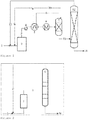
- Figure 1 is a schematic flow diagram of the alkylation reaction and separation process provided by the present invention. As shown in Figure 1 , a fresh alkylation raw material 1 is mixed with recycled streams 9 and 13 in a certain proportion, and the resulting mixture is heat-exchanged to the temperature required by the reaction and then introduced into an alkylation reactor 2 to perform the reaction.
- a stream 3 from the reactor outlet is subjected to the pressure adjustment with a liquid phase pressure pump 4, heat-exchanged with a stream 8 from the column top of the high-pressure flash column 7 through an interior heat-exchanger 5, then heated to a certain temperature through an external heater 6, introduced into the high-pressure flash column 7, and subjected to the separation of vapour and liquid phases in the flash column 7.
- the vapor-phase stream 8 from the column top is heat-exchanged with the stream 3 from the reactor outlet through the interior heat-exchanger 5 and wholly condensed into liquid phase.
- the condensed liquid phase 9 returns to the reactor inlet and is directly mixed with the raw material 1 and the the recycled stream 13, the resulting mixture is heat-exchanged and introduced into the reactor 2 for the further reaction; and in the other part, the liquid phase 10 returns to the top of the high-pressure flash column 7 as reflux in order to control the content of the alkylation oil in the stream 9 recovered from the column top.
- a stream 11 from the column bottom of the high-pressure flash column is introduced into the a low-pressure fractionating column 12 for the separation of the alkylation oil and the low-carbon alkane, wherein the low-carbon alkane 13 recovered from the column top is recycled, and the alkylation oil 14 from the column bottom exits the apparatus.
- C4 alkanes and alkenes were subjected to the alkylation reaction in the presence of a liquid acid catalyst.
- a concentrated sulfuric acid with a concentration of 96wt% was used as the catalyst.
- An isoalkane in the alkylation raw material was mainly composed of isobutane and commercially available from Beijing Huayuan Gas Chemical Industry Co., Ltd, and its composition was listed in Table 1; and a C4 residue after ether removal, obtained from an MTBE apparatus of Refinery Division, Sinopec Yanshan Petrochemical Co., Ltd., was used as the alkene raw material, and its composition was listed in Table 1.
- the alkylation reaction temperature was 5°C
- the reaction pressure was 0.6MPa
- the external alkane/alkene ratio was 8:1.
- the alkylation product from the outlet of the alkylation reactor had a temperature of 5°C and a pressure of 0.6MPa, and was subjected to the acid removal and then directly introduced into the low-pressure fractionating column for the separation of the alkylation oil and the C4 stream.
- the content of the alkylation oil in the stream to be separated was 20%, and the rest was the unreacted isobutane and n-butane.
- the low-pressure fractionating column was run at an operating pressure of 0.5MPa, a column top temperature of 47°C, a column bottom temperature of 145°C, and a reflux ratio of 1.0.
- Example 1 illustrates the effect of the process for separating an alkylation product provided by the present invention.
- the system and process for separating the alkylation product described in the present invention was used, and the specific operating conditions were as follows: the outlet temperature of the external heater was 145°C, the vapor-phase fraction was 0.5, the high-pressure flash column was run at an operating pressure of 2.0MPa, a column top vapor-phase temperature of 104°C, a reflux ratio of 0.7, a column top recovery ratio (the ratio of the distillate amount at the column top to the feed amount) of 0.4, and a column bottom liquid phase temperature of 120°C.
- the column top vapor-phase was cooled to 23°C after being heat-exchanged with the stream from the reactor outlet and condensed into the whole liquid phase.
- the stream from the column bottom of the high-pressure flash column was introduced into the low-pressure fractionating column for the separation of the alkylation oil and the C4 stream, the column top pressure of the low-pressure fractionating column was 0.48MPa, the column top temperature was 45°C, the column bottom temperature was 143°C, and the reflux ratio was 1.0.
- the alkylation raw material was identical to that of Comparative Example 1, the used catalyst was a loaded molecular sieve catalyst obtained as follows: a NaY type molecular sieve (produced by Sinopec Catalyst Division) with an FAU structure was subjected to the sodium-removal modification on the molecular sieve through the steps of ammonium-exchanging and the like, and then subjected to the loading of platinum on the catalyst by an ion-exchanging method, wherein the metal content was 0.3wt%; finally, the obtained platinum-loaded molecular sieve and alumina were uniformly mixed in a ratio of 70:30, and the mixture was further dried and calcined to prepare a strip-shaped catalyst.
- a NaY type molecular sieve produced by Sinopec Catalyst Division
- the alkylation reaction was carried out at a temperature of 60°C, a pressure of 3.1MPa and an external alkane/alkene ratio of 25:1.
- the content of the alkylation oil in the stream from the outlet of the alkylation reactor was 5.6% with the remainder being the unreacted isobutane and n-butane.
- the stream from the outlet of the alkylation reactor was directly introduced into the low-pressure fractionating column for the separation of the alkylation oil and the C4 stream, and the low-pressure fractionating column was run at a column top pressure of 0.6MPa, a column top temperature of 53°C, a column bottom temperature of 159°C, and a reflux ratio of 1.0.
- Example 2 illustrates the effect of the process for separating an alkylation product provided by the present invention.
- the process for separating an alkylation product according to the present invention was used, the outlet pressure of the alkylation reactor was 3.0MPa, and the pressure of the high-pressure flash column was 2.9MPa, therefore no pressure pump was neccesarily disposed between them.
- the outlet temperature of the first heat-exchanger was 115°C
- the outlet temperature of the second heat-exchanger was 135°C
- the vapor-phase fraction of the stream to be separated was 0.9
- the high-pressure flash column was run at an operating pressure of 2.9MPa, a column top vapor-phase temperature of 129°C, a reflux ratio of 0.4, a column top recovery ratio of 0.75, and a column bottom liquid phase temperature of 134°C.
- the vapor-phase from the column top of the flash column was cooled to 120°C after being heat-exchanged with the stream from the reactor outlet and condensed into the whole liquid phase .
- the stream from the column bottom of the high-pressure flash column was introduced into the low-pressure fractionating column for the separation of the alkylation oil and the C4 stream, and the low-pressure fractionating column was operated and controlled under the same conditions as those in Comparative Example 2.
- the properties of the feed and the product of the low-pressure fractionating column were shown in Table 2, and the main fractionation energy consumption comparison was shown in Table 3.
- Table 1 Properties of the reaction raw materials Component Mass Fraction (%) Isoalkane Propane 1.7 Isobutane 95.2 n-butane 2.0 Butene 1.1 C4 residue after ether removal n-butene and iso-butene 0.94 n-butane 4.96 Cis-2-butene 24.57 Trans-2-butene 12.33 Isobutane 57.20
- Table 2 Properties of the feed and the product of the low-pressure fractionating column Item Comparative Example 1 Example 1 Comparative Example 2 Example 2 Content of Feedstock Oil, % 20.0 5.6 Content of the oil introduced into the column, % 20.0 35.4 5.6 13.0 D86 of alkylation oil IBP 25.9 25.1 24.8 24.5 10 56.8 58.5 58.2 60.7 30 99.1 100.3 99.8 102.9 50 104.8 105.5 105.2 108.5 70 113.7 114.2 113.9 116.2 90 126.5 127.3 126.8 135.0 FBP 180.5 180.9 180.7 182.6
- Table 3 Separat
Landscapes
- Chemical & Material Sciences (AREA)
- Organic Chemistry (AREA)
- Chemical Kinetics & Catalysis (AREA)
- Oil, Petroleum & Natural Gas (AREA)
- Engineering & Computer Science (AREA)
- General Chemical & Material Sciences (AREA)
- Analytical Chemistry (AREA)
- Water Supply & Treatment (AREA)
- Organic Low-Molecular-Weight Compounds And Preparation Thereof (AREA)
- Low-Molecular Organic Synthesis Reactions Using Catalysts (AREA)
Abstract
Description
- The present application claims the priority to
chinese patent application 201811039325.5 filed on September 6, 2018 - The present invention relates to a process for separating a mixture and a separation apparatus, in particular to a process for separating an alkylation product of low-carbon alkene and alkane and a separation apparatus.
- An alkylation oil is a clean high-octane gasoline blending component. Under the action of a strong acid, an isoalkane (mainly isobutane) and an alkene (C3-C5 alkene) react to generate an alkylation oil mainly composed of isooctane. Alkylation technology can be divided into liquid acid alkylation and solid acid alkylation according to the catalyst form. The alkylation reaction of alkenes and alkanes is very complicated, the main reaction is the addition reaction of alkenes and alkanes, but various side reactions also occur at the same time, mainly including the superposition of alkenes, the cracking of macromolecules and the like. In order to increase the concentration of the reactant isobutane and to suppress the occurrence of side reactions such as the superposition of alkenes, it is necessary to maintain a high alkane/alkene ratio in the reaction system. In the sulfuric acid alkylation process currently used in industry, the external alkane/alkene ratio of the reactor feed is about 7-10, and the internal ratio is as high as several hundreds or even thousands; the hydrofluoric acid process also has a large isobutane recycle, with an external isobutane/alkene ratio of about 5-20, depending on the selected reactor configuration; for the solid acid alkylation technique, higher external and internal ratios are used, and the solid acid alkylation processes disclosed in
US5986158 andUS7875754 require using the external ratios of at least 5:1, preferably 16-32:1. The result of using a higher external ratio is a very low proportion of the alkylation oil in the stream from the reactor outlet: for the liquid acid process, the proportion of the alkylation oil to the inlet of the main fractionating column is about 10%-30%, and for the solid acid process, that proportion is even lower, typically less than 10%. The large isobutane recycle results in the high energy consumption in the main fractionating column, which is also the most significant cause for the higher energy consumption in the alkylation process . In the prior art, the energy consumption of the liquid acid process is about 100kgEo/ton alkylation oil, and the energy consumption of the solid acid process is as high as 200kgEo/ton alkylation oil. At least 80% of all energy consumption is used in the separation process of the alkylation oil and the recycled isobutane in the product, and the energy consumption is mainly caused by the fact that the condensation low-temperature heat of a large amount of low-carbon hydrocarbons cannot be effectively recovered and utilized. - The technical problem to be solved by the present invention is to provide a process and an apparatus for separating an alkylation product of low-carbon alkenes and alkanes, which can improve the heat utilization efficiency and remarkably reduce the energy consumption in the separation process of the alkylation product. A process for separating an alkylation product, wherein a liquid phase alkylation product from an alkylation reaction unit is introduced into a first heat-exchanger directly or after being pressurized with a pressure pump and heat-exchanged with a vapor phase stream from the column top of a high-pressure fractionating column, then introduced into a second heat-exchanger and further heated to 100°C-150°C, then introduced into the high-pressure fractionating column and subjected to fractionation under a condition of 2.0MPa-4.0MPa, the vapor phase stream from the column top of the high-pressure fractionating column is heat-exchanged with the liquid phase alkylation product to be separated, a liquid phase stream from the column bottom of the high-pressure fractionating column is introduced into a low-pressure fractionating column and subjected to fractionation under a condition of 0.2MPa-1.0MPa, a low-carbon alkane is obtained from the column top of the low-pressure fractionating colum, and a liquid phase stream obtained from the column bottom of the low-pressure fractionating colum is an alkylation oil product, wherein the high-pressure fractionating column is preferably a flash column.
- An alkylation reaction and separation process comprises: (1) an alkylation raw material is contacted with an acidic catalyst in an alkylation reaction unit to perform an alkylation reaction, and the material after the reaction is discharged as an alkylation product out of the alkylation reaction unit; (2) the liquid phase alkylation product from the alkylation reaction unit is introduced into a first heat-exchanger directly or after being pressurized with a pressure pump and heat-exchanged with a vapor phase stream from the column top of a high-pressure fractionating column, then introduced into a second heat-exchanger and further heated to 100°C-150°C, then introduced into the high-pressure fractionating column and subjected to fractionation under a condition of 2.0MPa-4.0MPa, the vapor phase stream from the column top of the high-pressure fractionating column is heat-exchanged with the liquid phase alkylation product to be separated, a liquid phase stream from the column bottom of the high-pressure fractionating column is introduced into a low-pressure fractionating column and subjected to fractionation under a condition of 0.2MPa-1.0MPa, a low-carbon alkane is obtained from the column top of the low-pressure fractionating colum, and a liquid phase stream obtained from the column bottom of the low-pressure fractionating colum is an alkylation oil product. An apparatus for separating an alkylation product comprises a pressure pump, a first heat-exchanger, a second heat-exchanger, a high-pressure fractionating column and a low-pressure fractionating column which are sequentially connected in series, wherein an inlet of the pressure pump is provided with a stream to be separated, an outlet of the pressure pump is communicated with the first heat-exchanger, an outlet of the second heat-exchanger is communicated with an inlet of the raw material for the high-pressure fractionating column, an outlet of the column bottom stream for the high-pressure fractionating column is communicated with an inlet of the raw material for the low-pressure fractionating column, an outlet of the column top stream for the high-pressure fractionating column is communicated with an inlet of the hotter fluid medium for the first heat-exchanger, an outlet of the hotter fluid medium for the first heat-exchanger is communicated with an inlet of the column top reflux for the high-pressure fractionating column, specially, an outlet of the hotter fluid medium for the first heat-exchanger, in one part, is communicated with an inlet of the column top reflux for the high-pressure fractionating column and in the other part, returns to an inlet of an alkylation reactor.
- The process and the apparatus for separating an alkylation product provided by the present invention have the following beneficial effects:
- (1) Aiming at the characteristics of the large proportion and the low condensation potential temperature of the recycled stream in the alkylation product, the potential temperature of the recycled stream is increased by using a high-pressure flash evaporation method, and the heat is recovered by heat-exchanging with the alkylation product to be separated, thereby the aims of saving energy and reducing consumption are fulfilled;
- (2) A large part of the recycled stream is firstly separated through a high-pressure fractionating column, so that concentrating the alkylation oil in a low-pressure fractionating column is realized, the total amount of the vapor-phase in the fractionating column is reduced, the improvement of the operation reasonability of the low-pressure fractionating column is facilitated, and the structure size of the unit equipment is greatly reduced.
- (3) The equipments for the high-pressure fractionation and the low-pressure fractionation are simple, the operation difficulty is small, the control is easy, and the energy-saving effect is prominent.
- (4) The technical solution of the present invention is particularly suitable for the separation of the alkylation reaction product obtained by using a liquid acid catalyst.
-
-
Figure 1 is a schematic flow diagram for the process for separating an alkylation product provided by the present invention. -
Figure 2 is a schematic flow diagram for the process for separating an alkylation product used in Comparative Examples 1 and 2. - In said
figures: 1 - pipeline for the alkylation raw material, 2 - alkylation reaction unit, 3 - pipeline for the alkylation product, 4 - liquid phase pressure pump, 5 - first heat-exchanger, 6 - second heat-exchanger, 7 - high-pressure fractionating column, 12 - low-pressure fractionating column, 8, 9, 10, 11, 13, 14 - pipelines. - The specific embodiments of the present invention will be described in detail below with reference to the accompanying drawings. It should be understood that the specific embodiments described herein are only used to illustrate and explain the present invention and are not intended to limit the present invention.
- Unless defined otherwise, all technical and scientific terms used herein have the same meanings as commonly understood by those skilled in the art to which this invention belongs. In case of conflict, the present specification, including definitions, will control.
- In the present invention, the pressure is expressed as gauge pressure; the operating pressure of the column is expressed as the column top pressure.
- According to the present invention, the alkylation reaction refers to that an alkane (e.g. an alkane having 3-5 carbon atoms) is reacted with an alkene (e.g. an alkene having 3-5 carbon atoms) under pressure in the presence of a catalyst to form an alkane (particularly an isoalkane) having a longer chain, and the alkylation product is present in the state of liquid phase. In the alkylation reaction unit, a solid or liquid catalyst is used. In the case of a solid catalyst, the alkylation reaction product may exit the alkylation reactor and directly go to a subsequent separating unit. In the case of a liquid catalyst, the alkylation reaction unit further comprises an acid removal operation, and the acid-removed alkylation reaction product exits the alkylation reaction unit and goes to a subsequent separating unit. The alkylation reaction and the acid removal process and the associated apparatuses in the alkylation reaction unit are known in the art.
- According to the present invention, the liquid phase alkylation product comprises unreacted C3-C5 alkanes (mass fraction: greater than 50%, for example 50-90%, 50-95%, or 50-99%), a small amount of the remaining alkenes (mass fraction: less than 10%, less than 9%, less than 8%, less than 7%, less than 6%, less than 5%, less than 4%, less than 3%, less than 2%, less than 1%), and a mixture having a distillation range of about 25°C-about 220°C, especially about 25°C-about 180°C as the product (mass fraction: 1%-40%). In the case of the solid catalyst, the liquid phase alkylation product can contain 5%-15% of the mixture having a distillation range of about 25°C-about 220°C, especially about 25°C-about 180°C as the product; and in the case of the liquid catalyst, the liquid phase alkylation product can contain 10%-30% of the mixture having a distillation range of about 25°C-about 220°C, especially about 25°C-about 180°C as the product.
- In the present invention, the low-carbon alkane refers to C3-C5 hydrocarbons with isoalkanes (for example isobutane) as the main component, wherein the content of isoalkanes is higher than 50%, 60% or more, 70% or more, 80% or more, 90% or more, 95% or more, 96% or more, 97% or more, 98% or more, 99% or more, based on the total weight of the low-carbon alkane, and the low-carbon alkane also comprises other C3-C5 alkanes and alkenes.
- In the present invention, the alkylation oil product refers to a mixture having a distillation range of about 25°C-about 220°C, especially about 25°C-about 180°C. The alkylation oil product is mainly composed of isoalkanes, which comprise greater than 80%, and has an alkene content of less than 2%, and an isooctane content of greater than 50%.
- In the present invention, the fractionating column comprises a feed inlet, a rectifying section, a stripping section, a column top condenser, a column bottom reboiler, an optional inter-condenser, and an optional inter-reboiler.
- In the present invention, the flash column refers to such a fractionating column, which does not include the stripping section and the reboiler of a general fractionating column, and more particularly, which does not include the stripping section, the column bottom reboiler, the inter-condenser, and the inter-reboiler of a general fractionating column, but includes the feed inlet, the rectifying section, and the column top condenser of a general fractionating column.
- In the present invention, the alkylation raw material refer to C3-C5 alkanes and C3-C5 alkenes, wherein the molar ratio of alkane to alkene is 5-30:1, for example 5-15:1 or 8-20:1.
- In a basic embodiment of this section, the present invention provides a process for separating an alkylation product, wherein said process comprises: a liquid phase alkylation product from an alkylation reaction unit is introduced into a first heat-exchanger directly or after being pressurized with a pressure pump and heat-exchanged with a vapor phase stream from the column top of a high-pressure fractionating column, then introduced into a second heat-exchanger and further heated to 100°C-150°C, then introduced into the high-pressure fractionating column and subjected to fractionation under a condition of 2.0MPa-4. 0MPa, the vapor phase stream from the column top of the high-pressure fractionating column is heat-exchanged with the liquid phase alkylation product to be separated, a liquid phase stream from the column bottom of the high-pressure fractionating column is introduced into a low-pressure fractionating column and subjected to fractionation under a condition of 0.2MPa-1.0MPa, and a low-carbon alkane is obtained from the column top of the low-pressure fractionating colum, and a liquid phase stream obtained from the column bottom of the low-pressure fractionating colum is an alkylation oil product. In one embodiment in combination with one or more of the embodiments mentioned in this section, the high-pressure fractionating column is a flash column. In the flash column, there is provided with a filler having a certain height or column plate(s), a reflux configuration is provided at the column top, and no reboiler is provided at the column bottom.
- In one embodiment in combination with one or more of the embodiments mentioned in this section, the low-pressure fractionating column is a conventional packed column or a conventional plate column, a reflux configuration is provided at the column top, and a reboiler is provided at the column bottom. In one embodiment in combination with one or more of the embodiments mentioned in this section, the liquid phase alkylation product to be separated has a temperature of 0°C-100°C, more preferably 0°C-50°C and a pressure of 0.1MPa-4.0MPa, more preferably 0.1MPa-2.0MPa.
- In one embodiment in combination with one or more of the embodiments mentioned in this section, the high-pressure fractionating column has an operating temperature of 90°C-150°C, and a column top reflux ratio of 0.1-2.0.
- In one embodiment in combination with one or more of the embodiments mentioned in this section, the high-pressure fractionating column has a column top vapor-phase temperature of 90°C-150°C or 100°C-150°C, a column bottom liquid phase temperature of 90°C-150°C or 100°C-150°C, a column top reflux ratio of 0.1-2.0, a column top recovery ratio of 0.5-0.9 (for example 0.7-0.75), and an operating pressure of 0.1MPa-4.0MPa (for example 2.0MPa-4.0MPa, still further 2.0MPa-2.8MPa), wherein the column bottom liquid phase temperature is higher than the column top vapor-phase temperature.
- In one embodiment in combination with one or more of the embodiments mentioned in this section, the low-pressure fractionating column has a column top temperature of 30°C-60°C, a column bottom temperature of 100°C-180°C, and a column top reflux ratio of 0.5-5.0.
- In one embodiment in combination with one or more of the embodiments mentioned in this section, the low-pressure fractionating column has a column top temperature of 20°C-80°C (for example 30°C-60°C), a column bottom temperature of 100°C-180°C, a column top reflux ratio of 0.5-5.0 (for example 1), and an operating pressure of 0.2MPa-1.0MPa (for example 0.5MPa-0.6MPa) .
- In one embodiment in combination with one or more of the embodiments mentioned in this section, the temperature difference between the liquid phase alkylation product to be separated and the vapor phase stream from the column top of the high-pressure fractionating column is greater than 10°C, more preferably greater than 30°C.
- In one embodiment in combination with one or more of the embodiments mentioned in this section, the liquid phase alkylation product pressurized by the pump has a pressure of 2.0MPa-4.0MPa.
- In one embodiment in combination with one or more of the embodiments mentioned in this section, after being heated by the heat-exchanging with the first heat-exchanger and the second heat-exchanger, the liquid phase alkylation product has a temperature of 100°C-150°C, and a vapor-phase fraction of 0.3-1.0.
- In one embodiment in combination with one or more of the embodiments mentioned in this section, the pressure pump is a liquid phase pump, preferably a pipe-type pump, more preferably a liquid phase centrifugal pump.
- In one embodiment in combination with one or more of the embodiments mentioned in this section, the vapor phase stream from the high-pressure fractionating column, which is heat-exchanged in the first heat-exchanger, is wholly condensed into the liquid phase, the condensed liquid phase, in one part, returns to the column top of the high-pressure fractionating column as reflux, and in the other part, returns to the alkylation reaction unit, the low carbon alkane from the column top of the low-pressure fractionating colum returns to the alkylation reaction unit. In one embodiment in combination with one or more of the embodiments mentioned in this section, the alkylation product to be separated and the vapor-phase stream from the high-pressure flash column are heat-exchanged in the first heat-exchanger, preferably in the manner of the cross-flow heat-exchanging, and the heat-exchanged alkylation product to be separated has a temperature of 90-140°C.
- In one embodiment in combination with one or more of the embodiments mentioned in this section, all heat-exchangers are in the manner of the cross-flow heat-exchanging.
- In one embodiment in combination with one or more of the embodiments mentioned in this section, the operating pressure of the high-pressure fractionating column is higher than the operating pressure of the low-pressure fractionating column by 1-3MPa, for example, 1-2MPa, for example greater than 1MPa and less than 2MPa.
- In a basic embodiment of this section, the present invention provides an alkylation reaction and separation process, wherein said process comprises: (1) an alkylation raw material is contacted with an acidic catalyst in an alkylation reaction unit to perform an alkylation reaction, and the material after the reaction is discharged as an alkylation product out of the alkylation reaction unit; (2) the liquid phase alkylation product from the alkylation reaction unit is introduced into a first heat-exchanger directly or after being pressurized with a pressure pump and heat-exchanged with a vapor phase stream from the column top of a high-pressure fractionating column, then introduced into a second heat-exchanger and further heated to 100°C-150°C, then introduced into the high-pressure fractionating column and subjected to fractionation under a condition of 2.0MPa-4. 0MPa, the vapor phase stream from the column top of the high-pressure fractionating column is heat-exchanged with the liquid phase alkylation product to be separated, a liquid phase stream from the column bottom of the high-pressure fractionating column is introduced into a low-pressure fractionating column and subjected to fractionation under a condition of 0.2MPa-1.0MPa, and a low-carbon alkane is obtained from the column top of the low-pressure fractionating colum, and a liquid phase stream obtained from the column bottom of the low-pressure fractionating colum is an alkylation oil product. One or more of the embodiments mentioned in the
above Section 2 may be used in any of the embodiments mentioned inSection 3 to form a new technical solution. For example, it is preferable that the high-pressure fractionating column is a flash column. - In one embodiment in combination with one or more of the embodiments mentioned in this section, the alkylation catalyst can be a liquid acid catalyst or a solid acid catalyst.
- In one embodiment in combination with one or more of the embodiments mentioned in this section, a solid acid catalyst is used in the alkylation reaction unit, and the solid acid catalyst is one or more of a loaded heteropoly acid catalyst, a loaded or unloaded heteropoly acid salt catalyst, a loaded or unloaded molecular sieve catalyst, a super acid catalyst, an ion exchange resin and an acid-treated oxide catalyst. The alkylation reaction condition in which the solid acid is used as the catalyst is: the reaction temperature is 50°C-100°C, the absolute reaction pressure is 1.0MPa-6.0MPa, and the external alkane/alkene ratio is 8-30:1. The temperature of the mixed reaction product to be separated is 0-100°C.
- In one embodiment in combination with one or more of the embodiments mentioned in this section, a liquid acid catalyst is used in the alkylation reaction unit, and the liquid acid catalyst is selected from any of sulfuric acid, hydrofluoric acid and an ionic liquid. The alkylation reaction condition in which the liquid acid is used as the catalyst is: the reaction temperature is 0°C-50°C, the absolute reaction pressure is 0.1-1.0MPa, and the external alkane/alkene ratio is 5-15:1. The temperature of the mixed reaction product to be separated is 0°C-50°C.
- In one embodiment in combination with one or more of the embodiments mentioned in this section, the mass fraction of the alkylation oil product in the alkylation product is 1%-40% (for example 5%-15% or 10%-30%), and the remaining components are unreacted low-carbon alkanes and others.
- In one embodiment in combination with one or more of the embodiments mentioned in this section, the mixed reaction product to be separated is pressurized through a pressure pump, then successively heat-exchanged through the first heat-exchanger and further heated through the second heat-exchanger, and then introduced into the high-pressure flash column. The heated stream that is introduced into the high-pressure flash column has a vapor phase fraction of 0.3-1.0.
- In one embodiment in combination with one or more of the embodiments mentioned in this section, the high-pressure flash column has an operating pressure of 2.0MPa-4.0MPa and an operating temperature of 100°C-150°C, and a condensation reflux configuration is provided at the column top with a reflux ratio of 0.1-2.0. The vapor phase stream from the column top of the high-pressure flash column is heat-exchanged with the mixed reaction product to be separated and is wholly condensed into the liquid phase, so that the recovery and utilization of latent heat is realized. The liquefied stream, in one part, returns to the column top of the high-pressure flash column as reflux, and in the other part, directly mixed and heat-exchanged with the stream to the reactor inlet, thereby greatly increasing the heat utilization and the heat-exchanging efficiency.
- In one embodiment in combination with one or more of the embodiments mentioned in this section, the stream from the column bottom of the high-pressure flash column is introduced into the low-pressure fractionating column for separating the alkylation oil and the remaining low-carbon alkanes, wherein it is preferable that the operating pressure of the low-pressure fractionating column is 0.2MPa-1.0MPa, the column top reflux ratio is 0.5-5.0, the column top temperature is 20°C-80°C, and the column bottom temperature is 100°C-180°C.
- In one embodiment in combination with one or more of the embodiments mentioned in this section, the streams from the column top of the high-pressure flash column and the column top of the low-pressure fractionating column return to the reactor inlet, and are mixed with the fresh feed, heated-exchanged, and then introduced into the reactor for the alkylation reaction.
- In a basic embodiment of this section, the present invention provides an apparatus for separating an alkylation product, which comprises an (optional) pressure pump, a first heat-exchanger, a second heat-exchanger, a high-pressure fractionating column and a low-pressure fractionating column, which are sequentially connected in series, wherein an inlet of the pressure pump is provided with a stream to be separated, an outlet of the pressure pump is communicated with the first heat-exchanger, an outlet of the second heat-exchanger is communicated with an inlet of the raw material for the high-pressure fractionating column, an outlet of the column bottom stream for the high-pressure fractionating column is communicated with an inlet of the raw material for the low-pressure fractionating column, an outlet of the column top stream for the high-pressure fractionating column is communicated with an inlet of the hotter fluid medium for the first heat-exchanger, and an outlet of the hotter fluid medium for the first heat-exchanger is communicated with an inlet of the column top reflux for the high-pressure fractionating column; or the stream to be separated is directly introduced into the first heat-exchanger, an outlet of the second heat-exchanger is communicated with an inlet of the raw material for the high-pressure fractionating column, an outlet of the column bottom stream for the high-pressure fractionating column is communicated with an inlet of the raw material for the low-pressure fractionating column, an outlet of the column top stream for the high-pressure fractionating column is communicated with an inlet of the hotter fluid medium for the first heat-exchanger, and an outlet of the hotter fluid medium for the first heat-exchanger is communicated with an inlet of the column top reflux for the high-pressure fractionating column.
- One or more of the embodiments mentioned in the
above Section 2 may be used in any of the embodiments mentioned inSection 4 to form a new technical solution. For example, it is preferable that the high-pressure fractionating column is a flash column. - In a basic embodiment of this section, the present invention provides an alkylation reaction and separation apparatus, comprising an alkylation reaction unit and the apparatus for separating an alkylation product mentioned in the
above Section 4, wherein an outlet of the alkylation reaction unit is communicated with an inlet of the pressure pump or the first heat-exchanger of the apparatus for separating an alkylation product, and the alkylation reaction unit is a liquid acid alkylation reaction unit or a solid acid alkylation reaction unit. Preferably, the alkylation reaction unit is a liquid acid alkylation reaction unit. - The process of the present invention is described in detail below with reference to the accompanying drawings.
Figure 1 is a schematic flow diagram of the alkylation reaction and separation process provided by the present invention. As shown inFigure 1 , a fresh alkylation raw material 1 is mixed withrecycled streams alkylation reactor 2 to perform the reaction. Astream 3 from the reactor outlet is subjected to the pressure adjustment with a liquidphase pressure pump 4, heat-exchanged with astream 8 from the column top of the high-pressure flash column 7 through an interior heat-exchanger 5, then heated to a certain temperature through an external heater 6, introduced into the high-pressure flash column 7, and subjected to the separation of vapour and liquid phases in the flash column 7. The vapor-phase stream 8 from the column top is heat-exchanged with thestream 3 from the reactor outlet through the interior heat-exchanger 5 and wholly condensed into liquid phase. In one part, the condensedliquid phase 9 returns to the reactor inlet and is directly mixed with the raw material 1 and the therecycled stream 13, the resulting mixture is heat-exchanged and introduced into thereactor 2 for the further reaction; and in the other part, theliquid phase 10 returns to the top of the high-pressure flash column 7 as reflux in order to control the content of the alkylation oil in thestream 9 recovered from the column top. Astream 11 from the column bottom of the high-pressure flash column is introduced into the a low-pressure fractionating column 12 for the separation of the alkylation oil and the low-carbon alkane, wherein the low-carbon alkane 13 recovered from the column top is recycled, and thealkylation oil 14 from the column bottom exits the apparatus. - The present invention will be further described below in conjunction with specific examples, but the present invention is not limited thereby.
- The schematic flow diagram of Comparative Example 1 is shown in
Figure 2 . - In the alkylation reaction unit, C4 alkanes and alkenes were subjected to the alkylation reaction in the presence of a liquid acid catalyst. A concentrated sulfuric acid with a concentration of 96wt% was used as the catalyst. An isoalkane in the alkylation raw material was mainly composed of isobutane and commercially available from Beijing Huayuan Gas Chemical Industry Co., Ltd, and its composition was listed in Table 1; and a C4 residue after ether removal, obtained from an MTBE apparatus of Refinery Division, Sinopec Yanshan Petrochemical Co., Ltd., was used as the alkene raw material, and its composition was listed in Table 1. The alkylation reaction temperature was 5°C, the reaction pressure was 0.6MPa, and the external alkane/alkene ratio was 8:1.
- The alkylation product from the outlet of the alkylation reactor had a temperature of 5°C and a pressure of 0.6MPa, and was subjected to the acid removal and then directly introduced into the low-pressure fractionating column for the separation of the alkylation oil and the C4 stream. The content of the alkylation oil in the stream to be separated was 20%, and the rest was the unreacted isobutane and n-butane. The low-pressure fractionating column was run at an operating pressure of 0.5MPa, a column top temperature of 47°C, a column bottom temperature of 145°C, and a reflux ratio of 1.0.
- The properties of the feed and the product of the low-pressure fractionating column were shown in Table 2, and the main fractionation energy consumption comparison was shown in Table 3.
- Example 1 illustrates the effect of the process for separating an alkylation product provided by the present invention.
- The reaction and separation flow shown in
Figure 1 was used, the alkylation reaction unit was identical to that in Comparative Example 1, and the stream to be separated, i.e. the alkylation product obtained from the alkylation reactor was identical to that in Comparative Example 1. - The system and process for separating the alkylation product described in the present invention was used, and the specific operating conditions were as follows: the outlet temperature of the external heater was 145°C, the vapor-phase fraction was 0.5, the high-pressure flash column was run at an operating pressure of 2.0MPa, a column top vapor-phase temperature of 104°C, a reflux ratio of 0.7, a column top recovery ratio (the ratio of the distillate amount at the column top to the feed amount) of 0.4, and a column bottom liquid phase temperature of 120°C. The column top vapor-phase was cooled to 23°C after being heat-exchanged with the stream from the reactor outlet and condensed into the whole liquid phase. The stream from the column bottom of the high-pressure flash column was introduced into the low-pressure fractionating column for the separation of the alkylation oil and the C4 stream, the column top pressure of the low-pressure fractionating column was 0.48MPa, the column top temperature was 45°C, the column bottom temperature was 143°C, and the reflux ratio was 1.0.
- The schematic flow diagram of Comparative Example 2 is shown in
Figure 2 . - In the alkylation reaction unit, C4 alkanes and alkenes were subjected to the alkylation reaction in the presence of a solid acid catalyst. The alkylation raw material was identical to that of Comparative Example 1, the used catalyst was a loaded molecular sieve catalyst obtained as follows: a NaY type molecular sieve (produced by Sinopec Catalyst Division) with an FAU structure was subjected to the sodium-removal modification on the molecular sieve through the steps of ammonium-exchanging and the like, and then subjected to the loading of platinum on the catalyst by an ion-exchanging method, wherein the metal content was 0.3wt%; finally, the obtained platinum-loaded molecular sieve and alumina were uniformly mixed in a ratio of 70:30, and the mixture was further dried and calcined to prepare a strip-shaped catalyst. The alkylation reaction was carried out at a temperature of 60°C, a pressure of 3.1MPa and an external alkane/alkene ratio of 25:1. The content of the alkylation oil in the stream from the outlet of the alkylation reactor was 5.6% with the remainder being the unreacted isobutane and n-butane.
- The stream from the outlet of the alkylation reactor was directly introduced into the low-pressure fractionating column for the separation of the alkylation oil and the C4 stream, and the low-pressure fractionating column was run at a column top pressure of 0.6MPa, a column top temperature of 53°C, a column bottom temperature of 159°C, and a reflux ratio of 1.0.
- The properties of the feed and the product of the low-pressure fractionating column were shown in Table 2, and the main fractionation energy consumption comparison was shown in Table 3.
- Example 2 illustrates the effect of the process for separating an alkylation product provided by the present invention.
- The reaction and separation flow shown in
Figure 1 was used, the alkylation reaction unit was identical to that in Comparative Example 2, and the stream to be separated, i.e. the alkylation product obtained from the alkylation reactor was identical to that in Comparative Example 2. - The process for separating an alkylation product according to the present invention was used, the outlet pressure of the alkylation reactor was 3.0MPa, and the pressure of the high-pressure flash column was 2.9MPa, therefore no pressure pump was neccesarily disposed between them. The outlet temperature of the first heat-exchanger was 115°C, the outlet temperature of the second heat-exchanger was 135°C, the vapor-phase fraction of the stream to be separated was 0.9, the high-pressure flash column was run at an operating pressure of 2.9MPa, a column top vapor-phase temperature of 129°C, a reflux ratio of 0.4, a column top recovery ratio of 0.75, and a column bottom liquid phase temperature of 134°C. The vapor-phase from the column top of the flash column was cooled to 120°C after being heat-exchanged with the stream from the reactor outlet and condensed into the whole liquid phase . The stream from the column bottom of the high-pressure flash column was introduced into the low-pressure fractionating column for the separation of the alkylation oil and the C4 stream, and the low-pressure fractionating column was operated and controlled under the same conditions as those in Comparative Example 2. The properties of the feed and the product of the low-pressure fractionating column were shown in Table 2, and the main fractionation energy consumption comparison was shown in Table 3.
Table 1: Properties of the reaction raw materials Component Mass Fraction (%) Isoalkane Propane 1.7 Isobutane 95.2 n-butane 2.0 Butene 1.1 C4 residue after ether removal n-butene and iso-butene 0.94 n-butane 4.96 Cis-2-butene 24.57 Trans-2-butene 12.33 Isobutane 57.20 Table 2: Properties of the feed and the product of the low-pressure fractionating column Item Comparative Example 1 Example 1 Comparative Example 2 Example 2 Content of Feedstock Oil, % 20.0 5.6 Content of the oil introduced into the column, % 20.0 35.4 5.6 13.0 D86 of alkylation oil IBP 25.9 25.1 24.8 24.5 10 56.8 58.5 58.2 60.7 30 99.1 100.3 99.8 102.9 50 104.8 105.5 105.2 108.5 70 113.7 114.2 113.9 116.2 90 126.5 127.3 126.8 135.0 FBP 180.5 180.9 180.7 182.6 Table 3: Separation Energy Consumption Comparison Heat Consumption MJ/t Alkylation Oil External Heater Reboiler of Fractionating Column Total Reduced Steam Consumption % Comparative Example 1 0 3207 3207 - Example 1 852 839 1691 47.3 Comparative Example 2 0 10196 10196 - Example 2 3490 1666 5156 49.4
Claims (15)
- A process for separating an alkylation product, which is characterized in that a liquid phase alkylation product from an alkylation reaction unit is introduced into a first heat-exchanger directly or after being pressurized with a pressure pump and heat-exchanged with a vapor phase stream from the column top of a high-pressure fractionating column, then introduced into a second heat-exchanger and further heated to 100°C-150°C, then introduced into the high-pressure fractionating column and subjected to fractionation under a condition of 2.0MPa-4. 0MPa, the vapor phase stream from the column top of the high-pressure fractionating column is heat-exchanged with the liquid phase alkylation product to be separated, a liquid phase stream from the column bottom of the high-pressure fractionating column is introduced into a low-pressure fractionating column and subjected to fractionation under a condition of 0.2MPa-1.0MPa, a low-carbon alkane is obtained from the column top of the low-pressure fractionating colum, and a liquid phase stream obtained from the column bottom of the low-pressure fractionating colum is an alkylation oil product.
- The process for separating an alkylation product according to claim 1, which is characterized in that the high-pressure fractionating column is a flash column.
- The process for separating an alkylation product according to any of the above-mentioned claims, which is characterized in that the liquid phase alkylation product to be separated has a temperature of 0°C-100°C and a pressure of 0.1MPa-4.0MPa; the high-pressure fractionating column has an operating temperature of 90°C-150°C and a column top reflux ratio of 0.1-2.0; the low-pressure fractionating column has a column top temperature of 30°C-60°C, a column bottom temperature of 100°C-180°C and a column top reflux ratio of 0.5-5.0; and the temperature difference between the liquid phase alkylation product to be separated and the vapor phase stream from the column top of the high-pressure fractionating column is greater than 10°C.
- The process for separating an alkylation product according to any of the above-mentioned claims, which is characterized in that the liquid phase alkylation product to be separated has a temperature of 0°C-50°C and a pressure of 0.1MPa-2.0MPa; and the temperature difference between the liquid phase alkylation product to be separated and the vapor phase stream from the column top of the high-pressure fractionating column is greater than 30°C.
- The process for separating an alkylation product according to any of the above-mentioned claims, which is characterized in that the liquid phase alkylation product pressurized by the pressure pump has a pressure of 2.0MPa-4.0MPa.
- The process for separating an alkylation product according to any of the above-mentioned claims, which is characterized in that the liquid phase alkylation product, which is heated by the heat-exchanging with the first heat-exchanger and the second heat-exchanger, has a temperature of 100°C-150°C and an vapor-phase fraction of 0.3-1.0.
- The process for separating an alkylation product according to any of the above-mentioned claims, which is characterized in that the pressure pump is a liquid phase centrifugal pump.
- The process for separating an alkylation product according to any of the above-mentioned claims, which is characterized in that the vapor phase stream from the high-pressure fractionating column, which is heat-exchanged in the first heat-exchanger, is wholly condensed as liquid phase, and the condensed liquid phase, in one part, returns as reflux to the column top of the high-pressure fractionating column, and in the other part, returns to the alkylation reaction unit, and the low-carbon alkane from the low-pressure fractionating column returns to the alkylation reaction unit.
- An alkylation reaction and separation process, which is characterized in that (1) an alkylation raw material is contacted with an acidic catalyst in an alkylation reaction unit to perform an alkylation reaction, and the material after the reaction is discharged as an alkylation product out of the alkylation reaction unit; (2) the liquid phase alkylation product from the alkylation reaction unit is introduced into a first heat-exchanger directly or after being pressurized with a pressure pump and heat-exchanged with a vapor phase stream from the column top of a high-pressure fractionating column, then introduced into a second heat-exchanger and further heated to 100°C-150°C, then introduced into the high-pressure fractionating column and subjected to fractionation under a condition of 2.0MPa-4.0MPa, the vapor phase stream from the column top of the high-pressure fractionating column is heat-exchanged with the liquid phase alkylation product to be separated, a liquid phase stream from the column bottom of the high-pressure fractionating column is introduced into a low-pressure fractionating column and subjected to fractionation under a condition of 0.2MPa-1.0MPa, a low-carbon alkane is obtained from the column top of the low-pressure fractionating colum, and a liquid phase stream obtained from the column bottom of the low-pressure fractionating colum is an alkylation oil product.
- The alkylation reaction and separation process according to claim 9, which is characterized in that the high-pressure fractionating column is a flash column.
- The alkylation reaction and separation process according to any of claims 9-10, which is characterized in that the alkylation catalyst is a liquid acid catalyst, which is selected from any of sulfuric acid, hydrofluoric acid and an ionic liquid.
- The alkylation reaction and separation process according to any of claims 9-11, which is characterized in that the alkylation reaction condition comprises: the reaction temperature is 0°C-50°C, the absolute reaction pressure is 0.1-1.0MPa, and the external alkane/alkene ratio is 5-15:1.
- An apparatus for separating an alkylation product, which is characterized in that it comprises a pressure pump, a first heat-exchanger, a second heat-exchanger, a high-pressure fractionating column and a low-pressure fractionating column which are sequentially connected in series, wherein an inlet of the pressure pump is provided with a stream to be separated, an outlet of the pressure pump is communicated with the first heat-exchanger, an outlet of the second heat-exchanger is communicated with an inlet of the raw material for the high-pressure fractionating column, an outlet of the column bottom stream for the high-pressure fractionating column is communicated with an inlet of the raw material for the low-pressure fractionating column, an outlet of the column top stream for the high-pressure fractionating column is communicated with an inlet of the hotter fluid medium for the first heat-exchanger, and an outlet of the hotter fluid medium for the first heat-exchanger is communicated with an inlet of the column top reflux for the high-pressure fractionating column.
- The apparatus for separating an alkylation product according to claim 13, which is characterized in that the high-pressure fractionating column is a flash column.
- An alkylation reaction and separation apparatus, which is characterized in that it comprises an alkylation reaction unit and the apparatus for separating an alkylation product according to claim 13 or 14, wherein an outlet of the alkylation reaction unit is communicated with an inlet of the pressure pump of the apparatus for separating an alkylation product, and the alkylation reaction unit is a liquid acid alkylation reaction unit or a solid acid alkylation reaction unit.
Applications Claiming Priority (2)
| Application Number | Priority Date | Filing Date | Title |
|---|---|---|---|
| CN201811039325.5A CN110876854B (en) | 2018-09-06 | 2018-09-06 | Separation method of low-carbon olefin and alkane alkylation product, separation method and device for low-carbon olefin and alkane alkylation reaction |
| PCT/CN2019/104629 WO2020048519A1 (en) | 2018-09-06 | 2019-09-06 | Alkylation product separation method, alkylation reaction and separation method, and related apparatus |
Publications (3)
| Publication Number | Publication Date |
|---|---|
| EP3848106A1 true EP3848106A1 (en) | 2021-07-14 |
| EP3848106A4 EP3848106A4 (en) | 2022-04-20 |
| EP3848106B1 EP3848106B1 (en) | 2023-12-27 |
Family
ID=69722996
Family Applications (1)
| Application Number | Title | Priority Date | Filing Date |
|---|---|---|---|
| EP19858166.2A Active EP3848106B1 (en) | 2018-09-06 | 2019-09-06 | Alkylation product separation method, alkylation reaction and separation method, and related apparatus |
Country Status (6)
| Country | Link |
|---|---|
| US (1) | US11759726B2 (en) |
| EP (1) | EP3848106B1 (en) |
| CN (1) | CN110876854B (en) |
| CA (1) | CA3111990A1 (en) |
| TW (1) | TWI851597B (en) |
| WO (1) | WO2020048519A1 (en) |
Families Citing this family (2)
| Publication number | Priority date | Publication date | Assignee | Title |
|---|---|---|---|---|
| CN112391198B (en) * | 2020-10-30 | 2022-04-01 | 中国科学院山西煤炭化学研究所 | Method for continuously separating high-purity n-alkane |
| CN114307536B (en) * | 2022-03-02 | 2022-06-07 | 山东神驰石化有限公司 | N-butane and iso-butane separating tower in n-butane isomerization |
Family Cites Families (18)
| Publication number | Priority date | Publication date | Assignee | Title |
|---|---|---|---|---|
| US4311866A (en) | 1979-09-07 | 1982-01-19 | Phillips Petroleum Company | Separation of products of HF alkylation |
| US5900518A (en) * | 1996-10-30 | 1999-05-04 | Fina Technology, Inc. | Heat integration in alkylation/transalkylation process |
| WO1998023560A1 (en) | 1996-11-27 | 1998-06-04 | Akzo Nobel N.V. | Process for alkylating hydrocarbons |
| US7875754B2 (en) | 2006-07-27 | 2011-01-25 | Lummus Technology Inc. | Method of improving alkylate yield in an alkylation reaction |
| US7525003B2 (en) | 2007-05-23 | 2009-04-28 | Uop Llc | Process for producing ethylbenzene |
| CN201753330U (en) * | 2010-06-09 | 2011-03-02 | 中国石油化工集团公司 | Energy-saving alkylate product treatment device |
| US20130066130A1 (en) * | 2011-09-12 | 2013-03-14 | Chevron U.S.A. Inc. | Ionic liquid catalyzed alkylation processes & systems |
| US8920755B2 (en) * | 2011-09-12 | 2014-12-30 | Chevron U.S.A. Inc. | Conversion of HF alkylation units for ionic liquid catalyzed alkylation processes |
| CN203976664U (en) * | 2014-06-16 | 2014-12-03 | 中国石油化工股份有限公司 | A kind of system for impure low-carbon alkene alkylated reaction |
| CN105233784B (en) * | 2014-07-07 | 2017-05-24 | 中石化洛阳工程有限公司 | Alkylation reactor and alkylation method |
| US9522859B2 (en) | 2014-12-11 | 2016-12-20 | Uop Llc | Methods for recovering ionic liquid fines from a process stream |
| CN106634657B (en) | 2015-08-19 | 2020-10-16 | 东莞市佳佑电子有限公司 | A kind of composite material with anti-electromagnetic radiation and high thermal conductivity and preparation method thereof |
| CN106554839A (en) * | 2015-09-29 | 2017-04-05 | 中国石油化工股份有限公司 | The method for removing hydrogen sulfide and mercaptan in liquefied petroleum gas using fixed bed reactors simultaneously |
| CN106220536A (en) | 2016-08-31 | 2016-12-14 | 烟台国邦化工机械科技有限公司 | A kind of novel distillation method |
| CN106631657B (en) * | 2016-12-13 | 2017-09-19 | 联力环保新能源股份有限公司 | A kind of production line that isooctane is prepared with iso-butane, butene alkylation |
| CN108211405B (en) | 2016-12-21 | 2024-03-12 | 中国石油化工股份有限公司 | Alkylation reaction device and alkylation reaction separation method |
| CN206927855U (en) | 2017-06-01 | 2018-01-26 | 濮阳市盛源石油化工(集团)有限公司 | A kind of sulfuric acid process is alkylated process units |
| CN108059974A (en) * | 2017-12-26 | 2018-05-22 | 山东汇丰石化集团有限公司 | The preparation method and preparation system of a kind of aviation kerosine |
-
2018
- 2018-09-06 CN CN201811039325.5A patent/CN110876854B/en active Active
-
2019
- 2019-09-06 WO PCT/CN2019/104629 patent/WO2020048519A1/en not_active Ceased
- 2019-09-06 CA CA3111990A patent/CA3111990A1/en active Pending
- 2019-09-06 US US17/274,364 patent/US11759726B2/en active Active
- 2019-09-06 EP EP19858166.2A patent/EP3848106B1/en active Active
- 2019-09-06 TW TW108132157A patent/TWI851597B/en active
Also Published As
| Publication number | Publication date |
|---|---|
| EP3848106B1 (en) | 2023-12-27 |
| CA3111990A1 (en) | 2020-03-12 |
| CN110876854A (en) | 2020-03-13 |
| US11759726B2 (en) | 2023-09-19 |
| EP3848106A4 (en) | 2022-04-20 |
| TWI851597B (en) | 2024-08-11 |
| CN110876854B (en) | 2021-05-14 |
| TW202020128A (en) | 2020-06-01 |
| WO2020048519A1 (en) | 2020-03-12 |
| US20210322893A1 (en) | 2021-10-21 |
Similar Documents
| Publication | Publication Date | Title |
|---|---|---|
| EP3848105B1 (en) | Separation method for alkylation products, alkylation reaction and separation method and related device | |
| CN207627960U (en) | Alkylation reaction product separator and alkylated reaction device | |
| CN85106368A (en) | Dehydrocyclodimerizaprocess process | |
| EP3848106B1 (en) | Alkylation product separation method, alkylation reaction and separation method, and related apparatus | |
| CN108211403A (en) | Alkylation reaction product separator and separation method | |
| RU2139844C1 (en) | Method of preparing aromatic hydrocarbons from casting-head gas | |
| CN104892339A (en) | Method for preparing n-butane by using iso-butane | |
| JP3138835B2 (en) | Separation method of butane and butene by extractive distillation | |
| US12234415B2 (en) | Naphtha catalytic cracking process | |
| CN106927989B (en) | Process method for improving alkylation reaction efficiency and reducing product separation energy consumption | |
| CN108929188A (en) | From mixing C4The method of separation of extractive distillation butane and butylene in hydrocarbon raw material | |
| CN114085682B (en) | Sulfuric acid alkylation reaction method and device and heat extraction method for sulfuric acid alkylation reaction | |
| KR20170095304A (en) | Process for conversion of light aliphatic hydrocarbons to aromatics | |
| US2486543A (en) | Treatment of normally gaseous hydrocarbons | |
| US3150199A (en) | Separation of hydrocarbons | |
| RU2708621C1 (en) | Method of producing high-octane gasoline fractions and aromatic hydrocarbons | |
| RU2708620C1 (en) | Method of producing high-octane gasoline fractions and aromatic hydrocarbons | |
| CN113024339A (en) | Production process for reducing liquid carried in hydrocarbon tail gas of ethylbenzene device | |
| CN223233339U (en) | Mixed light hydrocarbon alkane-alkene separation system | |
| JPS58110524A (en) | Isomerization of light olefinic hydrocarbon | |
| CN119735484A (en) | Mixed light hydrocarbon alkane-alkene separation method | |
| SU825470A1 (en) | Method of cleaning technological equipment from copper deposits | |
| CN116239438A (en) | A kind of carbon tetraalkane normalization reaction device and method | |
| CN115710153A (en) | Carbon four-alkyne hydrogenation method and device | |
| CN107304153A (en) | It is a kind of to be hydrogenated with the device and method that iso-butane is prepared with isomerization |
Legal Events
| Date | Code | Title | Description |
|---|---|---|---|
| STAA | Information on the status of an ep patent application or granted ep patent |
Free format text: STATUS: THE INTERNATIONAL PUBLICATION HAS BEEN MADE |
|
| PUAI | Public reference made under article 153(3) epc to a published international application that has entered the european phase |
Free format text: ORIGINAL CODE: 0009012 |
|
| STAA | Information on the status of an ep patent application or granted ep patent |
Free format text: STATUS: REQUEST FOR EXAMINATION WAS MADE |
|
| 17P | Request for examination filed |
Effective date: 20210309 |
|
| AK | Designated contracting states |
Kind code of ref document: A1 Designated state(s): AL AT BE BG CH CY CZ DE DK EE ES FI FR GB GR HR HU IE IS IT LI LT LU LV MC MK MT NL NO PL PT RO RS SE SI SK SM TR |
|
| DAV | Request for validation of the european patent (deleted) | ||
| DAX | Request for extension of the european patent (deleted) | ||
| A4 | Supplementary search report drawn up and despatched |
Effective date: 20220322 |
|
| RIC1 | Information provided on ipc code assigned before grant |
Ipc: C07C 7/04 20060101ALI20220316BHEP Ipc: C10G 50/00 20060101ALI20220316BHEP Ipc: B01D 3/14 20060101AFI20220316BHEP |
|
| STAA | Information on the status of an ep patent application or granted ep patent |
Free format text: STATUS: EXAMINATION IS IN PROGRESS |
|
| 17Q | First examination report despatched |
Effective date: 20221214 |
|
| GRAP | Despatch of communication of intention to grant a patent |
Free format text: ORIGINAL CODE: EPIDOSNIGR1 |
|
| STAA | Information on the status of an ep patent application or granted ep patent |
Free format text: STATUS: GRANT OF PATENT IS INTENDED |
|
| INTG | Intention to grant announced |
Effective date: 20230721 |
|
| GRAS | Grant fee paid |
Free format text: ORIGINAL CODE: EPIDOSNIGR3 |
|
| GRAA | (expected) grant |
Free format text: ORIGINAL CODE: 0009210 |
|
| STAA | Information on the status of an ep patent application or granted ep patent |
Free format text: STATUS: THE PATENT HAS BEEN GRANTED |
|
| AK | Designated contracting states |
Kind code of ref document: B1 Designated state(s): AL AT BE BG CH CY CZ DE DK EE ES FI FR GB GR HR HU IE IS IT LI LT LU LV MC MK MT NL NO PL PT RO RS SE SI SK SM TR |
|
| P01 | Opt-out of the competence of the unified patent court (upc) registered |
Effective date: 20231117 |
|
| REG | Reference to a national code |
Ref country code: GB Ref legal event code: FG4D |
|
| REG | Reference to a national code |
Ref country code: CH Ref legal event code: EP |
|
| REG | Reference to a national code |
Ref country code: DE Ref legal event code: R096 Ref document number: 602019044211 Country of ref document: DE |
|
| REG | Reference to a national code |
Ref country code: IE Ref legal event code: FG4D |
|
| PG25 | Lapsed in a contracting state [announced via postgrant information from national office to epo] |
Ref country code: GR Free format text: LAPSE BECAUSE OF FAILURE TO SUBMIT A TRANSLATION OF THE DESCRIPTION OR TO PAY THE FEE WITHIN THE PRESCRIBED TIME-LIMIT Effective date: 20240328 |
|
| REG | Reference to a national code |
Ref country code: LT Ref legal event code: MG9D |
|
| PG25 | Lapsed in a contracting state [announced via postgrant information from national office to epo] |
Ref country code: LT Free format text: LAPSE BECAUSE OF FAILURE TO SUBMIT A TRANSLATION OF THE DESCRIPTION OR TO PAY THE FEE WITHIN THE PRESCRIBED TIME-LIMIT Effective date: 20231227 |
|
| PG25 | Lapsed in a contracting state [announced via postgrant information from national office to epo] |
Ref country code: ES Free format text: LAPSE BECAUSE OF FAILURE TO SUBMIT A TRANSLATION OF THE DESCRIPTION OR TO PAY THE FEE WITHIN THE PRESCRIBED TIME-LIMIT Effective date: 20231227 |
|
| PG25 | Lapsed in a contracting state [announced via postgrant information from national office to epo] |
Ref country code: LT Free format text: LAPSE BECAUSE OF FAILURE TO SUBMIT A TRANSLATION OF THE DESCRIPTION OR TO PAY THE FEE WITHIN THE PRESCRIBED TIME-LIMIT Effective date: 20231227 Ref country code: GR Free format text: LAPSE BECAUSE OF FAILURE TO SUBMIT A TRANSLATION OF THE DESCRIPTION OR TO PAY THE FEE WITHIN THE PRESCRIBED TIME-LIMIT Effective date: 20240328 Ref country code: FI Free format text: LAPSE BECAUSE OF FAILURE TO SUBMIT A TRANSLATION OF THE DESCRIPTION OR TO PAY THE FEE WITHIN THE PRESCRIBED TIME-LIMIT Effective date: 20231227 Ref country code: ES Free format text: LAPSE BECAUSE OF FAILURE TO SUBMIT A TRANSLATION OF THE DESCRIPTION OR TO PAY THE FEE WITHIN THE PRESCRIBED TIME-LIMIT Effective date: 20231227 Ref country code: BG Free format text: LAPSE BECAUSE OF FAILURE TO SUBMIT A TRANSLATION OF THE DESCRIPTION OR TO PAY THE FEE WITHIN THE PRESCRIBED TIME-LIMIT Effective date: 20240327 |
|
| REG | Reference to a national code |
Ref country code: NL Ref legal event code: MP Effective date: 20231227 |
|
| REG | Reference to a national code |
Ref country code: AT Ref legal event code: MK05 Ref document number: 1644008 Country of ref document: AT Kind code of ref document: T Effective date: 20231227 |
|
| PG25 | Lapsed in a contracting state [announced via postgrant information from national office to epo] |
Ref country code: NL Free format text: LAPSE BECAUSE OF FAILURE TO SUBMIT A TRANSLATION OF THE DESCRIPTION OR TO PAY THE FEE WITHIN THE PRESCRIBED TIME-LIMIT Effective date: 20231227 |
|
| PG25 | Lapsed in a contracting state [announced via postgrant information from national office to epo] |
Ref country code: SE Free format text: LAPSE BECAUSE OF FAILURE TO SUBMIT A TRANSLATION OF THE DESCRIPTION OR TO PAY THE FEE WITHIN THE PRESCRIBED TIME-LIMIT Effective date: 20231227 Ref country code: RS Free format text: LAPSE BECAUSE OF FAILURE TO SUBMIT A TRANSLATION OF THE DESCRIPTION OR TO PAY THE FEE WITHIN THE PRESCRIBED TIME-LIMIT Effective date: 20231227 Ref country code: NO Free format text: LAPSE BECAUSE OF FAILURE TO SUBMIT A TRANSLATION OF THE DESCRIPTION OR TO PAY THE FEE WITHIN THE PRESCRIBED TIME-LIMIT Effective date: 20240327 Ref country code: NL Free format text: LAPSE BECAUSE OF FAILURE TO SUBMIT A TRANSLATION OF THE DESCRIPTION OR TO PAY THE FEE WITHIN THE PRESCRIBED TIME-LIMIT Effective date: 20231227 Ref country code: LV Free format text: LAPSE BECAUSE OF FAILURE TO SUBMIT A TRANSLATION OF THE DESCRIPTION OR TO PAY THE FEE WITHIN THE PRESCRIBED TIME-LIMIT Effective date: 20231227 Ref country code: HR Free format text: LAPSE BECAUSE OF FAILURE TO SUBMIT A TRANSLATION OF THE DESCRIPTION OR TO PAY THE FEE WITHIN THE PRESCRIBED TIME-LIMIT Effective date: 20231227 |
|
| PG25 | Lapsed in a contracting state [announced via postgrant information from national office to epo] |
Ref country code: IS Free format text: LAPSE BECAUSE OF FAILURE TO SUBMIT A TRANSLATION OF THE DESCRIPTION OR TO PAY THE FEE WITHIN THE PRESCRIBED TIME-LIMIT Effective date: 20240427 |
|
| PG25 | Lapsed in a contracting state [announced via postgrant information from national office to epo] |
Ref country code: CZ Free format text: LAPSE BECAUSE OF FAILURE TO SUBMIT A TRANSLATION OF THE DESCRIPTION OR TO PAY THE FEE WITHIN THE PRESCRIBED TIME-LIMIT Effective date: 20231227 Ref country code: AT Free format text: LAPSE BECAUSE OF FAILURE TO SUBMIT A TRANSLATION OF THE DESCRIPTION OR TO PAY THE FEE WITHIN THE PRESCRIBED TIME-LIMIT Effective date: 20231227 |
|
| PG25 | Lapsed in a contracting state [announced via postgrant information from national office to epo] |
Ref country code: SK Free format text: LAPSE BECAUSE OF FAILURE TO SUBMIT A TRANSLATION OF THE DESCRIPTION OR TO PAY THE FEE WITHIN THE PRESCRIBED TIME-LIMIT Effective date: 20231227 |
|
| PG25 | Lapsed in a contracting state [announced via postgrant information from national office to epo] |
Ref country code: SM Free format text: LAPSE BECAUSE OF FAILURE TO SUBMIT A TRANSLATION OF THE DESCRIPTION OR TO PAY THE FEE WITHIN THE PRESCRIBED TIME-LIMIT Effective date: 20231227 Ref country code: SK Free format text: LAPSE BECAUSE OF FAILURE TO SUBMIT A TRANSLATION OF THE DESCRIPTION OR TO PAY THE FEE WITHIN THE PRESCRIBED TIME-LIMIT Effective date: 20231227 Ref country code: RO Free format text: LAPSE BECAUSE OF FAILURE TO SUBMIT A TRANSLATION OF THE DESCRIPTION OR TO PAY THE FEE WITHIN THE PRESCRIBED TIME-LIMIT Effective date: 20231227 Ref country code: IT Free format text: LAPSE BECAUSE OF FAILURE TO SUBMIT A TRANSLATION OF THE DESCRIPTION OR TO PAY THE FEE WITHIN THE PRESCRIBED TIME-LIMIT Effective date: 20231227 Ref country code: IS Free format text: LAPSE BECAUSE OF FAILURE TO SUBMIT A TRANSLATION OF THE DESCRIPTION OR TO PAY THE FEE WITHIN THE PRESCRIBED TIME-LIMIT Effective date: 20240427 Ref country code: EE Free format text: LAPSE BECAUSE OF FAILURE TO SUBMIT A TRANSLATION OF THE DESCRIPTION OR TO PAY THE FEE WITHIN THE PRESCRIBED TIME-LIMIT Effective date: 20231227 Ref country code: CZ Free format text: LAPSE BECAUSE OF FAILURE TO SUBMIT A TRANSLATION OF THE DESCRIPTION OR TO PAY THE FEE WITHIN THE PRESCRIBED TIME-LIMIT Effective date: 20231227 Ref country code: AT Free format text: LAPSE BECAUSE OF FAILURE TO SUBMIT A TRANSLATION OF THE DESCRIPTION OR TO PAY THE FEE WITHIN THE PRESCRIBED TIME-LIMIT Effective date: 20231227 |
|
| PG25 | Lapsed in a contracting state [announced via postgrant information from national office to epo] |
Ref country code: PL Free format text: LAPSE BECAUSE OF FAILURE TO SUBMIT A TRANSLATION OF THE DESCRIPTION OR TO PAY THE FEE WITHIN THE PRESCRIBED TIME-LIMIT Effective date: 20231227 Ref country code: PT Free format text: LAPSE BECAUSE OF FAILURE TO SUBMIT A TRANSLATION OF THE DESCRIPTION OR TO PAY THE FEE WITHIN THE PRESCRIBED TIME-LIMIT Effective date: 20240429 |
|
| PG25 | Lapsed in a contracting state [announced via postgrant information from national office to epo] |
Ref country code: PT Free format text: LAPSE BECAUSE OF FAILURE TO SUBMIT A TRANSLATION OF THE DESCRIPTION OR TO PAY THE FEE WITHIN THE PRESCRIBED TIME-LIMIT Effective date: 20240429 Ref country code: PL Free format text: LAPSE BECAUSE OF FAILURE TO SUBMIT A TRANSLATION OF THE DESCRIPTION OR TO PAY THE FEE WITHIN THE PRESCRIBED TIME-LIMIT Effective date: 20231227 |
|
| REG | Reference to a national code |
Ref country code: DE Ref legal event code: R097 Ref document number: 602019044211 Country of ref document: DE |
|
| PG25 | Lapsed in a contracting state [announced via postgrant information from national office to epo] |
Ref country code: DK Free format text: LAPSE BECAUSE OF FAILURE TO SUBMIT A TRANSLATION OF THE DESCRIPTION OR TO PAY THE FEE WITHIN THE PRESCRIBED TIME-LIMIT Effective date: 20231227 |
|
| PG25 | Lapsed in a contracting state [announced via postgrant information from national office to epo] |
Ref country code: DK Free format text: LAPSE BECAUSE OF FAILURE TO SUBMIT A TRANSLATION OF THE DESCRIPTION OR TO PAY THE FEE WITHIN THE PRESCRIBED TIME-LIMIT Effective date: 20231227 |
|
| PLBE | No opposition filed within time limit |
Free format text: ORIGINAL CODE: 0009261 |
|
| STAA | Information on the status of an ep patent application or granted ep patent |
Free format text: STATUS: NO OPPOSITION FILED WITHIN TIME LIMIT |
|
| 26N | No opposition filed |
Effective date: 20240930 |
|
| PG25 | Lapsed in a contracting state [announced via postgrant information from national office to epo] |
Ref country code: MC Free format text: LAPSE BECAUSE OF FAILURE TO SUBMIT A TRANSLATION OF THE DESCRIPTION OR TO PAY THE FEE WITHIN THE PRESCRIBED TIME-LIMIT Effective date: 20231227 Ref country code: SI Free format text: LAPSE BECAUSE OF FAILURE TO SUBMIT A TRANSLATION OF THE DESCRIPTION OR TO PAY THE FEE WITHIN THE PRESCRIBED TIME-LIMIT Effective date: 20231227 |
|
| REG | Reference to a national code |
Ref country code: CH Ref legal event code: PL |
|
| PG25 | Lapsed in a contracting state [announced via postgrant information from national office to epo] |
Ref country code: LU Free format text: LAPSE BECAUSE OF NON-PAYMENT OF DUE FEES Effective date: 20240906 |
|
| REG | Reference to a national code |
Ref country code: BE Ref legal event code: MM Effective date: 20240930 |
|
| PG25 | Lapsed in a contracting state [announced via postgrant information from national office to epo] |
Ref country code: BE Free format text: LAPSE BECAUSE OF NON-PAYMENT OF DUE FEES Effective date: 20240930 |
|
| PG25 | Lapsed in a contracting state [announced via postgrant information from national office to epo] |
Ref country code: FR Free format text: LAPSE BECAUSE OF NON-PAYMENT OF DUE FEES Effective date: 20240930 |
|
| PG25 | Lapsed in a contracting state [announced via postgrant information from national office to epo] |
Ref country code: CH Free format text: LAPSE BECAUSE OF NON-PAYMENT OF DUE FEES Effective date: 20240930 |
|
| PG25 | Lapsed in a contracting state [announced via postgrant information from national office to epo] |
Ref country code: IE Free format text: LAPSE BECAUSE OF NON-PAYMENT OF DUE FEES Effective date: 20240906 |
|
| PGFP | Annual fee paid to national office [announced via postgrant information from national office to epo] |
Ref country code: DE Payment date: 20250702 Year of fee payment: 7 |
|
| PGFP | Annual fee paid to national office [announced via postgrant information from national office to epo] |
Ref country code: GB Payment date: 20250703 Year of fee payment: 7 |
|
| PG25 | Lapsed in a contracting state [announced via postgrant information from national office to epo] |
Ref country code: CY Free format text: LAPSE BECAUSE OF FAILURE TO SUBMIT A TRANSLATION OF THE DESCRIPTION OR TO PAY THE FEE WITHIN THE PRESCRIBED TIME-LIMIT; INVALID AB INITIO Effective date: 20190906 |
|
| PG25 | Lapsed in a contracting state [announced via postgrant information from national office to epo] |
Ref country code: HU Free format text: LAPSE BECAUSE OF FAILURE TO SUBMIT A TRANSLATION OF THE DESCRIPTION OR TO PAY THE FEE WITHIN THE PRESCRIBED TIME-LIMIT; INVALID AB INITIO Effective date: 20190906 |
|
| PG25 | Lapsed in a contracting state [announced via postgrant information from national office to epo] |
Ref country code: TR Free format text: LAPSE BECAUSE OF FAILURE TO SUBMIT A TRANSLATION OF THE DESCRIPTION OR TO PAY THE FEE WITHIN THE PRESCRIBED TIME-LIMIT Effective date: 20231227 |