EP3847921A1 - Fastener member - Google Patents
Fastener member Download PDFInfo
- Publication number
- EP3847921A1 EP3847921A1 EP18932926.1A EP18932926A EP3847921A1 EP 3847921 A1 EP3847921 A1 EP 3847921A1 EP 18932926 A EP18932926 A EP 18932926A EP 3847921 A1 EP3847921 A1 EP 3847921A1
- Authority
- EP
- European Patent Office
- Prior art keywords
- porosity
- fastener member
- oxide coating
- copper oxide
- fastener
- Prior art date
- Legal status (The legal status is an assumption and is not a legal conclusion. Google has not performed a legal analysis and makes no representation as to the accuracy of the status listed.)
- Granted
Links
Images

Classifications
-
- C—CHEMISTRY; METALLURGY
- C23—COATING METALLIC MATERIAL; COATING MATERIAL WITH METALLIC MATERIAL; CHEMICAL SURFACE TREATMENT; DIFFUSION TREATMENT OF METALLIC MATERIAL; COATING BY VACUUM EVAPORATION, BY SPUTTERING, BY ION IMPLANTATION OR BY CHEMICAL VAPOUR DEPOSITION, IN GENERAL; INHIBITING CORROSION OF METALLIC MATERIAL OR INCRUSTATION IN GENERAL
- C23C—COATING METALLIC MATERIAL; COATING MATERIAL WITH METALLIC MATERIAL; SURFACE TREATMENT OF METALLIC MATERIAL BY DIFFUSION INTO THE SURFACE, BY CHEMICAL CONVERSION OR SUBSTITUTION; COATING BY VACUUM EVAPORATION, BY SPUTTERING, BY ION IMPLANTATION OR BY CHEMICAL VAPOUR DEPOSITION, IN GENERAL
- C23C22/00—Chemical surface treatment of metallic material by reaction of the surface with a reactive liquid, leaving reaction products of surface material in the coating, e.g. conversion coatings, passivation of metals
- C23C22/05—Chemical surface treatment of metallic material by reaction of the surface with a reactive liquid, leaving reaction products of surface material in the coating, e.g. conversion coatings, passivation of metals using aqueous solutions
- C23C22/60—Chemical surface treatment of metallic material by reaction of the surface with a reactive liquid, leaving reaction products of surface material in the coating, e.g. conversion coatings, passivation of metals using aqueous solutions using alkaline aqueous solutions with pH greater than 8
- C23C22/63—Treatment of copper or alloys based thereon
-
- C—CHEMISTRY; METALLURGY
- C23—COATING METALLIC MATERIAL; COATING MATERIAL WITH METALLIC MATERIAL; CHEMICAL SURFACE TREATMENT; DIFFUSION TREATMENT OF METALLIC MATERIAL; COATING BY VACUUM EVAPORATION, BY SPUTTERING, BY ION IMPLANTATION OR BY CHEMICAL VAPOUR DEPOSITION, IN GENERAL; INHIBITING CORROSION OF METALLIC MATERIAL OR INCRUSTATION IN GENERAL
- C23C—COATING METALLIC MATERIAL; COATING MATERIAL WITH METALLIC MATERIAL; SURFACE TREATMENT OF METALLIC MATERIAL BY DIFFUSION INTO THE SURFACE, BY CHEMICAL CONVERSION OR SUBSTITUTION; COATING BY VACUUM EVAPORATION, BY SPUTTERING, BY ION IMPLANTATION OR BY CHEMICAL VAPOUR DEPOSITION, IN GENERAL
- C23C22/00—Chemical surface treatment of metallic material by reaction of the surface with a reactive liquid, leaving reaction products of surface material in the coating, e.g. conversion coatings, passivation of metals
- C23C22/05—Chemical surface treatment of metallic material by reaction of the surface with a reactive liquid, leaving reaction products of surface material in the coating, e.g. conversion coatings, passivation of metals using aqueous solutions
- C23C22/06—Chemical surface treatment of metallic material by reaction of the surface with a reactive liquid, leaving reaction products of surface material in the coating, e.g. conversion coatings, passivation of metals using aqueous solutions using aqueous acidic solutions with pH less than 6
- C23C22/48—Chemical surface treatment of metallic material by reaction of the surface with a reactive liquid, leaving reaction products of surface material in the coating, e.g. conversion coatings, passivation of metals using aqueous solutions using aqueous acidic solutions with pH less than 6 not containing phosphates, hexavalent chromium compounds, fluorides or complex fluorides, molybdates, tungstates, vanadates or oxalates
- C23C22/52—Treatment of copper or alloys based thereon
-
- A—HUMAN NECESSITIES
- A44—HABERDASHERY; JEWELLERY
- A44B—BUTTONS, PINS, BUCKLES, SLIDE FASTENERS, OR THE LIKE
- A44B19/00—Slide fasteners
- A44B19/24—Details
-
- C—CHEMISTRY; METALLURGY
- C22—METALLURGY; FERROUS OR NON-FERROUS ALLOYS; TREATMENT OF ALLOYS OR NON-FERROUS METALS
- C22C—ALLOYS
- C22C9/00—Alloys based on copper
- C22C9/04—Alloys based on copper with zinc as the next major constituent
-
- A—HUMAN NECESSITIES
- A44—HABERDASHERY; JEWELLERY
- A44B—BUTTONS, PINS, BUCKLES, SLIDE FASTENERS, OR THE LIKE
- A44B19/00—Slide fasteners
- A44B19/42—Making by processes not fully provided for in one other class, e.g. B21D53/50, B21F45/18, B22D17/16, B29D5/00
- A44B19/44—Securing metal interlocking members to ready-made stringer tapes
Definitions
- the present invention relates to a fastener member having a copper alloy as a base material.
- the present invention also relates to a fastener provided with a fastener member having a copper alloy as a base material.
- copper alloy fasteners examples: Japanese Patent Application Publication No. 2003-183750 , Japanese Patent Application Publication No. 2002-285264 ) in which a copper alloy containing zinc such as brass, red brass, and nickel silver (hereinafter, also referred to as "Cu-Zn-based alloy") is used for a component (for example, a row of elements that are engaging parts, a slider for controlling the engagement and separation of element rows to open and close the fastener, or the like).
- Zinc is an alloying element commonly added to copper alloy fasteners because it has the effect of increasing the strength, hardness, and uniform deformation amount of the alloy due to solid solution.
- Japanese Patent Application Publication No. 2000-248375 discloses a chemical conversion treatment method for forming a black coating having a matte black appearance and a light-shielding property by growing a velvety copper oxide crystal coating.
- a cylindrical brass component was subjected to alkaline degreasing, dezincification treatment, and black dyeing treatment (Ebonol treatment).
- Japanese Patent Application Publication No. 2004-292898 discloses a method for producing a low-reflection material by anodizing a material formed from copper or a material having a copper-coated surface in an aqueous sodium hydroxide solution to form a divalent copper oxide coating.
- Japanese Patent Application Publication No. H11-189881 proposes blackening composition, comprising:
- Japanese Patent Application Publication No. H09-143753 discloses a fin for a heat exchanger characterized in that it is formed by subjecting the surface of a copper plate to a chemical conversion to form a cupric oxide coating thereon by a blackening copper oxidation method. Specifically, it is disclosed that by boiling in an aqueous solution of 5% sodium hydroxide and 1% potassium persulfate at a temperature of 100 ° C. or higher for about 3 to 15 minutes, a cupric oxide coating having a thickness of 1 to 3 ⁇ m was formed on the surface of the copper plate.
- Japanese Patent Application Publication No. 2003-510466 and Japanese Patent Application Publication No. 2010-229555 discloses a technique for forming an inorganic coating layer of crystalline copper (I) oxide (cuprous oxide, Cu 2 O) on the surface of a copper or copper-based alloy member by an anodization method.
- I crystalline copper
- Cu 2 O crystalline copper
- red copper was anodized to obtain an appearance of dark brown, brown, or deep black tone.
- Japanese Patent Application Publication No. 2009-218368 discloses an invention for the purpose of providing a surface treatment method (surface blackening treatment method) for printed wiring boards that is highly productive, allowing reduction of running costs, and is easy to handle and maintain.
- one object of the present invention is to provide a black metal fastener member that can be manufactured at low cost. Further, in another embodiment, an object of the present invention is to provide a fastener comprising such a metal fastener member.
- the fastener member comprises a base material made of a copper alloy containing Zn at a concentration of 30% by mass or more and 43% by mass or less.
- the zinc concentration in the copper alloy is preferably 32% by mass or more, and more preferably 34% by mass or more.
- the zinc concentration in the copper alloy is preferably 43% by mass or less, and more preferably 41% by mass or less.
- the copper alloy constituting the base material may contain a third element other than copper and zinc, for example, one or more of Sn, Al, Si, Fe, Ni, Mn, Mg and Pb. Among these it is preferable to contain Mn from the viewpoint of suppressing cracking over time. From the viewpoint of reducing the material cost, the total concentration of the third element(s) other than copper and zinc is preferably 10% by mass or less, more preferably 5% by mass or less, and even more preferably 1% by mass or less. From the viewpoint of suppressing cracking over time, it is preferable to contain one or more of Sn, Al, Si, Fe, Ni, Mn, Mg and Pb in a total amount of 0.1% by mass or more, more preferably 0.3% by mass or more. In particular, Mn is preferably contained in an amount of 0.1% by mass or more, and more preferably 0.3% by mass or more. Other than copper and zinc, the copper alloy constituting the base material may not contain other elements except for inevitable impurities.
- the fastener member according to the present invention comprises a base made of a copper alloy containing Zn at a concentration of 30% by mass or more and 43% by mass or less, and the balance being Cu and inevitable impurities. Therefore, in one embodiment, the fastener member according to the present invention comprises a base made of a copper alloy containing Zn at a concentration of 30% by mass or more and 43% by mass or less, and one or more of Sn, Al, Si, Fe, Ni, Mn, Mg and Pb in a total of 0.1% by mass or more and 10% by mass or less, and the balance being Cu and inevitable impurities.
- Inevitable impurities refer to impurities that are present in the raw material or are inevitably mixed in the manufacturing process, and are originally unnecessary, but they are allowed because they are in trace amounts and do not affect the characteristics.
- the content of each impurity element allowed as an inevitable impurity is normally 0.1% by mass or less, preferably 0.05% by mass or less.
- the fastener member comprises a black copper oxide coating covering at least a part of the base material.
- the black copper oxide coating may cover 60% or more, or 80% or more, or 95% or more, or the entire of the surface area of the base material.
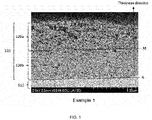
- FIG. 1 shows an example of a cross-sectional photograph of a black copper oxide coating 120 including a boundary with a base material 110 for the fastener member (element) according to Example 1 described later.
- An approximation straight line A with respect to the boundary line between the base material 110 and the black copper oxide coating 120 is drawn on the SEM photograph, and the direction orthogonal to the approximation straight line A is defined as the thickness direction of the black copper oxide coating 120.
- the approximation straight line A can be obtained by plotting the coordinates of a number of points forming the boundary line on an orthogonal coordinate system and using the least squares method.
- the thickness of the black copper oxide coating 120 from the approximation straight line A is measured at 24 points along the approximation straight line A at intervals of 0.1 ⁇ m, and the average thickness of the black copper oxide coating 120 in the SEM photograph is calculated.
- a straight line M parallel to the approximation straight line A and having a distance from the approximation straight line A equal to 1/2 of the average thickness is drawn on the SEM photograph, and this is set as the center of the thickness.
- the portion of the black copper oxide coating on the outer side (surface side) of the straight line M is defined as the upper layer 120a of the black copper oxide coating, and the portion of the black copper oxide coating on the inner side (base material side) of the straight line M is defined as the lower layer 120b of the black copper oxide coating.
- the difference between the porosity of the lower layer and that of the upper layer is more preferably 10% or more, more preferably 15% or more, and even more preferably 20% or more.
- the upper limit for the difference between the porosity of the lower layer and that of the upper layer is not particularly limited, but it is normally 30% or less, and typically 25% or less.
- the porosity of the upper layer is preferably 14% or more, more preferably 18% or more, more preferably 20% or more, even more preferably 22%, and most preferably 25% or more, from the viewpoint of increasing the blackness of the black copper oxide coating.
- the porosity of the upper layer is preferably 40% or less, more preferably 35% or less, and even more preferably 30% or less, from the viewpoint of preventing color migration.
- the porosity of the lower layer is preferably 12% or less, more preferably 10% or less, even more preferably 8% or less, and most preferably 6% or less, from the viewpoint of improving the adhesion to the base material.
- the lower limit of the porosity of the lower layer is not particularly limited, but it is normally 2% or more, and typically 4% or more.
- the porosity of the upper layer and the lower layer is determined by the following procedure, respectively.
- the highest brightness portion is defined as the brightness 255
- the lowest brightness portion is defined as the brightness 0, and binarization to black and white is made with the boundary at brightness 128.
- the number of black (void) and white (mainly oxide) pixels in the binarized image is measured in the upper and lower layers, respectively, and the ratio of the number of black pixels to the total number of pixels (total number of black and white pixels) is calculated for the upper layer and the lower layer, respectively, and thus defined as the porosity of the upper layer and the lower layer, respectively.
- the porosity is determined by using SEM photographs for 10 or more arbitrary fields of view, and the average value thereof is defined as the measured value.
- a surface of the black copper oxide coating may have color coordinates in a CIELAB color space defined by JIS Z8781-4 (2013) with a CIELAB color difference ( ⁇ E*ab) of 7 or less, or 5 or less, or 3 or less from color coordinates (50, 1, -3).
- the thickness of the black copper oxide coating is not particularly limited. However, from the viewpoint of deepening the blackness, it is preferably 0.4 ⁇ m or more, more preferably 0.7 ⁇ m or more, and even more preferably 1.0 ⁇ m or more. Further, the thickness of the black copper oxide coating is preferably 4.0 ⁇ m or less, more preferably 3.0 ⁇ m or less, and even more preferably 2.0 ⁇ m or less from the viewpoint of preventing color migration.
- the average thickness of the black copper oxide coating in each field of view is obtained by measuring 24 points at intervals of 0.1 ⁇ m along the approximation straight line A, and this procedure is performed for 10 or more arbitrary fields of view, and the average value of the 10 or more fields of view is defined as the measured value.
- the metal fastener member can be formed, for example, by appropriately combining melt casting and cold working.
- An element for a slide fastener, which is a typical application of a metal fastener member, will be described as an example.
- the alloy components constituting the base material are mixed and melted, and then a wire is produced by continuous casting. After removing the unevenness of the surface of the obtained wire by a method such as peeling, the wire is drawn. Then, it is annealed to restore workability. After that, a continuous deformed wire having a substantially Y-shaped cross-section is produced while applying working strain by cold rolling. In this process, work hardening progresses according to the alloy composition, and the material strength increases.
- various cold working such as cutting, pressing, bending, and caulking are performed to plant the fastener elements on a fastener tape.
- the blackening treatment of the fastener member may be performed after forming it into the final shape of the fastener member, or may be performed in the middle of cold working after melt casting.
- the blackening treatment of the fastener member can be performed by a chemical conversion treatment for forming a black copper oxide coating on the surface of the base material of the fastener member.
- the chemical conversion treatment can be carried out in the order of degreasing step ⁇ aqueous washing step ⁇ blackening step ⁇ aqueous washing step ⁇ drying step.
- a blackening liquid containing an oxidizing agent and an alkaline agent can be used.
- the oxidizing agent include sodium hypochlorite, sodium chlorite, sodium chlorate, potassium hypochlorite, potassium chlorite, and potassium chlorate.
- One type of oxidizing agent may be used, or two or more types may be used in combination.
- the alkaline agent examples include sodium hydroxide and potassium hydroxide.
- One type of alkaline agent may be used, or two or more types may be used in combination.
- the blackening liquid is preferably heated in the range of 40 to 100 °C from the viewpoint of promoting the reaction. When blackening the surface of a Cu-Zn-based alloy having a high zinc concentration, it is important to adjust the concentration of the oxidizing agent and the alkaline agent in the blackening liquid.
- the role of the oxidizing agent and the alkaline agent is considered as follows.
- the oxidizing agent affects the rate of oxide formation, and the higher the concentration is, the faster the rate of oxidation becomes.
- the alkaline agent affects the rate of dezincification in the depth direction, and the higher the concentration is, the faster the rate of dezincification becomes. Therefore, if the alkaline agent concentration is high, the porosity of both the upper layer and the lower layer tends to be high, but if the oxidizing agent concentration is high at the same time, the oxidation reaction proceeds before sufficient dezincification occurs, so that the porosity of the lower layer is likely to be low.
- the concentration of the oxidizing agent and the concentration of the alkaline agent depend on the types of the oxidizing agent and the alkaline agent, but for instance, the concentration of the oxidizing agent in the blackening liquid is preferably adjusted in the range of 0.001 to 1 mol / L. Further, the concentration of the alkaline agent in the blackening liquid is preferably adjusted in the range of 1.0 to 5.0 mol / L, and more preferably adjusted in the range of 2.0 to 4.0 mol / L.
- One or more other surface treatments may be further applied to the black copper oxide coating.
- a black paint such as black lacquer may be applied, or a surface treatment such as an anti-rust treatment may be applied.
- fastener member according to the present invention examples include, but are not limited to, an element, a slider, a top stopper, and a bottom stopper for a slide fastener.
- the fastener member according to the present invention is not limited to slide fasteners, and can also be applied as a member for snap fasteners and other metal fasteners.
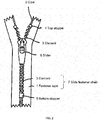
- FIG. 2 is a schematic view of a slide fastener. As shown in FIG.
- the slide fastener comprises a pair of fastener tapes 1 having a core 2 formed along one side edge, elements 3 caulked and fixed (attached) to the core 2 of the fastener tape 1 at predetermined intervals, a top stopper 4 and a bottom stopper 5 caulked and fixed to the core 2 of the fastener tape 1 at the top and bottom ends of the elements 3, and a slider 6 arranged between a pair of opposing elements 3 and slidable in the vertical direction for engaging and disengaging the elements 3.
- a state in which the elements 3 are attached to the core 2 of one fastener tape 1 is referred to as a slide fastener stringer, and a state in which the elements 3 attached to the core 2 of a pair of fastener tapes 1 are engaged is referred to as a slide fastener chain 7.
- the slider 6 shown in FIG. 2 is obtained by press working a lengthy body having a plate-shaped body and a rectangular cross-section in multiple stages, cutting at predetermined intervals to produce a slider body, and attaching a spring and a pull tab as necessary.
- the pull tab is obtained by punching from a plate-shaped body having a rectangular cross-section into a predetermined shape, caulking and fixing to the slider body.
- the bottom stopper 5 may be a separable bottom end stop assembly composed of a first plug member, a second plug member, and a socket member so that the pair of slide fastener chains can be separated by a detaching operation of the slider.
- FIG. 3 is a drawing showing a method of manufacturing the elements 3, the top stopper 4 and the bottom stopper 5 of the slide fastener shown in FIG. 2 and a method of attaching them to the core 2 of the fastener tape 1.
- the elements 3 are attached to the core 2 of the fastener tape 1 by cutting a deformed wire 8 having a substantially Y-shaped cross-section at predetermined dimensions and then press-molding to form an engagement head 9, and then by caulking both leg portions 10.
- the top stopper 4 is attached by cutting a rectangular wire 11 having a rectangular cross-section (flat wire) at predetermined dimensions, forming into a substantially U-shaped cross-section by bending, and then by caulking to the core 2 of the fastener tape 1.
- the bottom stopper 5 is attached by cutting a deformed wire 12 having a substantially X-shaped cross-section at predetermined dimensions, and then caulking to the core 2 of the fastener tape 1.
- the elements 3, the top and bottom stoppers 4 and 5 are shown to be attached to the fastener tape 1 at the same time, but in reality, the elements 3 are continuously attached to the fastener tape 1 to firstly prepare the fastener chain, and the predetermined top and bottom stoppers 4 or 5 are attached in close proximity to the elements 3 at both ends of the fastener chain.
- the slide fastener can be attached to various articles and particularly functions as an opening/closing tool.
- the article to which the slide fastener is attached is not particularly limited, and examples thereof include daily necessities such as clothing, bags, shoes and miscellaneous goods, as well as industrial items such as water storage tanks, fishing nets and space suits.
- the slide fastener chain produced above was subjected to a blackening step after alkaline degreasing and washing with water.
- the blackening step was carried out by immersing the slide fastener chain in a blackening liquid at 80 °C containing an oxidizing agent and an alkaline agent for 5 minutes while the slide fastener chain was transported roll-to-roll.
- the blackening step by changing the concentrations (mol/L) of the oxidizing agent and the alkaline agent in the blackening liquid according to the test numbers shown in Table 1-1, the porosity of the upper layer and the lower layer of the copper oxide coating was changed. Then, the slide fastener chain was washed with water and dried while being transported roll-to-roll.
- a* and b* represent color tones, where a* represents magenta-green tone ("+” is closer to magenta, and "-” is closer to green), and b* represents yellow-blue tone ("+” is closer to yellow, and "-” is closer to blue).
- L* represents lightness, and the larger the value is, the higher the glossiness is.
- the thickness and porosity of the copper oxide coating were measured by the method described above.
- the cutting of the element for exposing the cross-section of the copper oxide coating was carried out by embedding it in a resin, mechanically polishing the element, and performing an ion milling process (CP process).
- the cross-sectional observation of the copper oxide coating was carried out using a scanning electron microscope (SEM) (model S-4800 available from Hitachi High-Technologies Corporation) at a pressurizing voltage of 2 kV, a probe current of 15 ⁇ A, and a working distance (WD) of about 2 mm.
- SEM scanning electron microscope
- JTrim JTrim, a free software. The results are shown in Table 1-2.
- the adhesion of the copper oxide coating was evaluated according to the following criteria by visually observing 10 arbitrary continuous elements of the fastener chain from one side after the blackening treatment over a total area of 25 mm 2 .
- Example 1 Example 2 and Comparative Example 1 having similar alloy compositions are compared.
- Comparative Example 1 the concentration of the alkaline agent was high, but the concentration of the oxidizing agent was too high, so that the porosity of both the upper layer and the lower layer was low. Therefore, although the adhesion was good, the blackening was insufficient.
- the alkaline agent concentration was slightly lower and the oxidizing agent concentration was slightly lower, so that the low porosity of the lower layer and the high porosity of the upper layer were achieved at the same time. As a result, a black copper oxide coating having excellent adhesion was obtained.
- Example 2 in which the oxidizing agent concentration was further lowered, the porosity of the lower layer was higher than the porosity of the upper layer, so that blackening was achieved, but the adhesion was lowered.
- Example 3 and Example 4 having similar alloy compositions are compared.
- the porosity of the lower layer was low and the porosity of the upper layer was high because the concentrations of the alkaline agent and the oxidizing agent were properly balanced.
- a black copper oxide coating having excellent adhesion was obtained.
- Example 4 since the concentration of the oxidizing agent was low, the porosity of the lower layer was increased, so that blackening was achieved, but the adhesion was lowered.
- Comparative Example 2 and Comparative Example 3 having similar alloy compositions are compared. Both used copper-zinc alloys with a low zinc concentration of 15% by mass. Therefore, the structure of the formed copper oxide was different from that of Examples 1, 2, 3, 4 and Comparative Example 1, and even if the porosity of the upper layer and the porosity of the lower layer changed, the degree of blackness was not affected and there was almost no change in adhesion.
Landscapes
- Chemical & Material Sciences (AREA)
- Engineering & Computer Science (AREA)
- Materials Engineering (AREA)
- Mechanical Engineering (AREA)
- Metallurgy (AREA)
- Organic Chemistry (AREA)
- General Chemical & Material Sciences (AREA)
- Chemical Kinetics & Catalysis (AREA)
- Slide Fasteners (AREA)
- Chemical Treatment Of Metals (AREA)
Abstract
Description
- The present invention relates to a fastener member having a copper alloy as a base material. The present invention also relates to a fastener provided with a fastener member having a copper alloy as a base material.
- Among the fastener products, there are copper alloy fasteners (examples:
Japanese Patent Application Publication No. 2003-183750 Japanese Patent Application Publication No. 2002-285264 - On the other hand, a technique for blackening the surface of copper and copper alloys is known.
Japanese Patent Application Publication No. 2000-248375 -
Japanese Patent Application Publication No. 2004-292898 -
Japanese Patent Application Publication No. H11-189881 - (A) at least one selected from basic copper carbonate, copper hydroxide, copper (II) oxide or tetraammine copper (II) salt represented by
Formula 1;
[Cu (NH3)4 X2 (in the formula, X is a monovalent anion consisting of OH, Cl, NO3, NCS, Cu (I) Cl2, 1/2 SO4, HCO3, 1/2 CO3) ...Formula 1 - (B) at least one selected from aqueous ammonia, ammonia gas, liquid ammonia, ammonium carbonate, and ammonium hydrogen carbonate;
- (C) water as a residue;
- In the embodiments of the invention of the literature, it is described that a component obtained by cutting a C3604 brass rod into a spherical shape having a diameter (ϕ) of 20 mm was blackened.
-
Japanese Patent Application Publication No. H09-143753 -
Japanese Patent Application Publication No. 2003-510466 Japanese Patent Application Publication No. 2010-229555 -
Japanese Patent Application Publication No. 2009-218368 -
- [Patent Literature 1]
Japanese Patent Application Publication No. 2003-183750 - [Patent Literature 2]
Japanese Patent Application Publication No. 2002-285264 - [Patent Literature 3]
Japanese Patent Application Publication No. 2000-248375 - [Patent Literature 4]
Japanese Patent Application Publication No. 2004-292898 - [Patent Literature 5]
Japanese Patent Application Publication No. H11-189881 - [Patent Literature 6]
Japanese Patent Application Publication No. H09-143753 - [Patent Literature 7]
Japanese Patent Application Publication No. 2003-510466 - [Patent Literature 8]
Japanese Patent Application Publication No. 2010-229555 - [Patent Literature 9]
Japanese Patent Application Publication No. 2009-218368 - In recent years, as users' preferences have diversified, metal fastener members having a wide variety of color tones have been demanded. On the other hand, the demand from users for cost reduction has been becoming stricter year by year, and it is desirable to be able to provide a metal fastener member having a desired color tone at low cost. Under such circumstances, in order to widen the color variation of the fastener member to the users, it would be advantageous to develop a technology capable of providing a black metal fastener member at low cost.
- The present invention has been created in view of the above circumstances, and in one embodiment, one object of the present invention is to provide a black metal fastener member that can be manufactured at low cost. Further, in another embodiment, an object of the present invention is to provide a fastener comprising such a metal fastener member.
- As far as the present inventors know, there is no precedents in the prior art in which a Cu-Zn-based alloy having a high zinc concentration of 30% by mass or more is used as a base material for a fastener member and the surface thereof is blackened. It is considered that one of the reasons is that in a Cu-Zn-based alloy, the cold workability decreases as the zinc concentration is increased.
- However, zinc is excellent in economy because it is less expensive than copper. Therefore, it is advantageous to use a Cu-Zn-based alloy in which the amount of zinc added is significantly increased as the base material in order to reduce the cost. The present inventors have found that a black metal fastener member, which is less expensive than ever, can be obtained by preferentially promoting a high zinc concentration of the fastener member while accepting the above-mentioned disadvantages. The present invention has been completed based on the above technical idea, and is exemplified as below.
-
- [1] A fastener member, comprising a base material made of a copper alloy containing zinc at a concentration of 30% by mass or more and 43% by mass or less, and a black copper oxide coating covering at least a part of the base material.
- [2] The fastener member according to [1], wherein when the black copper oxide coating is divided into a lower layer below a center of thickness and an upper layer above the center of thickness, a porosity of the lower layer is smaller than that of the upper layer.
- [3] The fastener member according to [2], wherein a difference between the porosity of the lower layer and that of the upper layer is 10% or more.
- [4] The fastener member according to [2], wherein a difference between the porosity of the lower layer and that of the upper layer is 20% or more.
- [5] The fastener member according to any one of [2] to [4], wherein the porosity of the upper layer is 14% or more.
- [6] The fastener member according to [5], wherein the porosity of the upper layer is 20% or more.
- [7] The fastener member according to any one of [2] to [6], wherein the porosity of the lower layer is 12% or less.
- [8] The fastener member according to [7], wherein the porosity of the lower layer is 8% or less.
- [9] The fastener member according to any one of [1] to [8], wherein a surface of the black copper oxide coating has color coordinates in a CIELAB color space defined by JIS Z8781-4 (2013) with a CIELAB color difference (ΔE * ab) of 7 or less from color coordinates (50, 1, -3).
- [10] The fastener member according to any one of [1] to [9], wherein a thickness of the black copper oxide coating is 0.4 to 4.0 µm.
- [11] A fastener comprising the fastener member according to any one of [1] to [10].
- [12] An article comprising the fastener according to [11].
- According to one embodiment of the present invention, it is possible to provide a black metal fastener member at low cost.
-
-
FIG. 1 is an example of a cross-sectional photograph of a black copper oxide coating including a boundary with a base material in a fastener member (element) according to Example 1 -
FIG. 2 is a schematic view of a slide fastener. -
FIG. 3 is a diagram illustrating a method of attaching a bottom stopper, a top stopper, and elements to a fastener tape. - Hereinafter, embodiments of the present invention will be described in detail with reference to the figures. However, the present invention is not limited to these embodiments.
- In one embodiment according to the present invention, the fastener member comprises a base material made of a copper alloy containing Zn at a concentration of 30% by mass or more and 43% by mass or less. In order to further enhance the effect of reducing the material cost, the zinc concentration in the copper alloy is preferably 32% by mass or more, and more preferably 34% by mass or more. In addition, from the viewpoint of molding processability, the zinc concentration in the copper alloy is preferably 43% by mass or less, and more preferably 41% by mass or less.
- The copper alloy constituting the base material may contain a third element other than copper and zinc, for example, one or more of Sn, Al, Si, Fe, Ni, Mn, Mg and Pb. Among these it is preferable to contain Mn from the viewpoint of suppressing cracking over time. From the viewpoint of reducing the material cost, the total concentration of the third element(s) other than copper and zinc is preferably 10% by mass or less, more preferably 5% by mass or less, and even more preferably 1% by mass or less. From the viewpoint of suppressing cracking over time, it is preferable to contain one or more of Sn, Al, Si, Fe, Ni, Mn, Mg and Pb in a total amount of 0.1% by mass or more, more preferably 0.3% by mass or more. In particular, Mn is preferably contained in an amount of 0.1% by mass or more, and more preferably 0.3% by mass or more. Other than copper and zinc, the copper alloy constituting the base material may not contain other elements except for inevitable impurities.
- Therefore, in one embodiment, the fastener member according to the present invention comprises a base made of a copper alloy containing Zn at a concentration of 30% by mass or more and 43% by mass or less, and the balance being Cu and inevitable impurities. Therefore, in one embodiment, the fastener member according to the present invention comprises a base made of a copper alloy containing Zn at a concentration of 30% by mass or more and 43% by mass or less, and one or more of Sn, Al, Si, Fe, Ni, Mn, Mg and Pb in a total of 0.1% by mass or more and 10% by mass or less, and the balance being Cu and inevitable impurities.
- Inevitable impurities refer to impurities that are present in the raw material or are inevitably mixed in the manufacturing process, and are originally unnecessary, but they are allowed because they are in trace amounts and do not affect the characteristics. In the present invention, the content of each impurity element allowed as an inevitable impurity is normally 0.1% by mass or less, preferably 0.05% by mass or less.
- In one embodiment according to the present invention, the fastener member comprises a black copper oxide coating covering at least a part of the base material. The black copper oxide coating may cover 60% or more, or 80% or more, or 95% or more, or the entire of the surface area of the base material.
- When blackening the surface of a Cu-Zn alloy having a high zinc concentration, it is desirable to pay attention to the porosity that did not need to be considered when blackening the surface of a Cu-Zn alloy having a low zinc concentration. Controlling the porosity is effective in achieving both the blackness of the black copper oxide coating and the adhesion of the black copper oxide coating to the base material. Specifically, when the black copper oxide coating is divided into a lower layer below a center of thickness and an upper layer above the center of thickness of the black copper oxide coating, it is preferable that a porosity of the lower layer be smaller than a porosity of the upper layer. In the upper layer, the higher the porosity is, the more the reflection is suppressed by the scattering of light and the blackness increases, while in the lower layer, the lower the porosity is, the stronger the adhesion to the base material becomes.
- A method for measuring the porosity of the upper layer and the lower layer of the black copper oxide coating will be described. First, a cross section in the direction perpendicular to the surface of the black copper oxide coating is cut out from the fastener member as the object of measurement, and the cross-section of the black copper oxide coating including the boundary with the base material is observed with a scanning electron microscope (SEM) at a magnification of 50,000.
FIG. 1 shows an example of a cross-sectional photograph of a blackcopper oxide coating 120 including a boundary with abase material 110 for the fastener member (element) according to Example 1 described later. An approximation straight line A with respect to the boundary line between thebase material 110 and the blackcopper oxide coating 120 is drawn on the SEM photograph, and the direction orthogonal to the approximation straight line A is defined as the thickness direction of the blackcopper oxide coating 120. The approximation straight line A can be obtained by plotting the coordinates of a number of points forming the boundary line on an orthogonal coordinate system and using the least squares method. - Next, on the SEM photograph, the thickness of the black
copper oxide coating 120 from the approximation straight line A is measured at 24 points along the approximation straight line A at intervals of 0.1 µm, and the average thickness of the blackcopper oxide coating 120 in the SEM photograph is calculated. Next, a straight line M parallel to the approximation straight line A and having a distance from the approximation straight line A equal to 1/2 of the average thickness is drawn on the SEM photograph, and this is set as the center of the thickness. The portion of the black copper oxide coating on the outer side (surface side) of the straight line M is defined as theupper layer 120a of the black copper oxide coating, and the portion of the black copper oxide coating on the inner side (base material side) of the straight line M is defined as thelower layer 120b of the black copper oxide coating. - Where it is preferable to make the porosity of the lower layer smaller than that of the upper layer, in order to achieve both the blackness of the black copper oxide coating and the adhesion of the black copper oxide coating to the base material, the difference between the porosity of the lower layer and that of the upper layer is more preferably 10% or more, more preferably 15% or more, and even more preferably 20% or more. The upper limit for the difference between the porosity of the lower layer and that of the upper layer is not particularly limited, but it is normally 30% or less, and typically 25% or less.
- The porosity of the upper layer is preferably 14% or more, more preferably 18% or more, more preferably 20% or more, even more preferably 22%, and most preferably 25% or more, from the viewpoint of increasing the blackness of the black copper oxide coating. However, the porosity of the upper layer is preferably 40% or less, more preferably 35% or less, and even more preferably 30% or less, from the viewpoint of preventing color migration.
- Further, the porosity of the lower layer is preferably 12% or less, more preferably 10% or less, even more preferably 8% or less, and most preferably 6% or less, from the viewpoint of improving the adhesion to the base material. The lower limit of the porosity of the lower layer is not particularly limited, but it is normally 2% or more, and typically 4% or more.
- The porosity of the upper layer and the lower layer is determined by the following procedure, respectively. On the SEM photograph, the highest brightness portion is defined as the brightness 255, the lowest brightness portion is defined as the brightness 0, and binarization to black and white is made with the boundary at brightness 128. The number of black (void) and white (mainly oxide) pixels in the binarized image is measured in the upper and lower layers, respectively, and the ratio of the number of black pixels to the total number of pixels (total number of black and white pixels) is calculated for the upper layer and the lower layer, respectively, and thus defined as the porosity of the upper layer and the lower layer, respectively. The porosity is determined by using SEM photographs for 10 or more arbitrary fields of view, and the average value thereof is defined as the measured value.
- In one embodiment of the fastener member according to the present invention, a surface of the black copper oxide coating may have color coordinates in a CIELAB color space defined by JIS Z8781-4 (2013) with a CIELAB color difference (ΔE*ab) of 7 or less, or 5 or less, or 3 or less from color coordinates (50, 1, -3).
- The thickness of the black copper oxide coating is not particularly limited. However, from the viewpoint of deepening the blackness, it is preferably 0.4 µm or more, more preferably 0.7 µm or more, and even more preferably 1.0 µm or more. Further, the thickness of the black copper oxide coating is preferably 4.0 µm or less, more preferably 3.0 µm or less, and even more preferably 2.0 µm or less from the viewpoint of preventing color migration.
- Regarding the thickness of the black copper oxide coating, in accordance with the method described above, the average thickness of the black copper oxide coating in each field of view is obtained by measuring 24 points at intervals of 0.1 µm along the approximation straight line A, and this procedure is performed for 10 or more arbitrary fields of view, and the average value of the 10 or more fields of view is defined as the measured value.
- The metal fastener member can be formed, for example, by appropriately combining melt casting and cold working. An element for a slide fastener, which is a typical application of a metal fastener member, will be described as an example. First, the alloy components constituting the base material are mixed and melted, and then a wire is produced by continuous casting. After removing the unevenness of the surface of the obtained wire by a method such as peeling, the wire is drawn. Then, it is annealed to restore workability. After that, a continuous deformed wire having a substantially Y-shaped cross-section is produced while applying working strain by cold rolling. In this process, work hardening progresses according to the alloy composition, and the material strength increases. After that, various cold working such as cutting, pressing, bending, and caulking are performed to plant the fastener elements on a fastener tape. The blackening treatment of the fastener member may be performed after forming it into the final shape of the fastener member, or may be performed in the middle of cold working after melt casting.
- The blackening treatment of the fastener member can be performed by a chemical conversion treatment for forming a black copper oxide coating on the surface of the base material of the fastener member. For example, the chemical conversion treatment can be carried out in the order of degreasing step → aqueous washing step → blackening step → aqueous washing step → drying step. In the blackening step, a blackening liquid containing an oxidizing agent and an alkaline agent can be used. Examples of the oxidizing agent include sodium hypochlorite, sodium chlorite, sodium chlorate, potassium hypochlorite, potassium chlorite, and potassium chlorate. One type of oxidizing agent may be used, or two or more types may be used in combination. Examples of the alkaline agent include sodium hydroxide and potassium hydroxide. One type of alkaline agent may be used, or two or more types may be used in combination. The blackening liquid is preferably heated in the range of 40 to 100 °C from the viewpoint of promoting the reaction. When blackening the surface of a Cu-Zn-based alloy having a high zinc concentration, it is important to adjust the concentration of the oxidizing agent and the alkaline agent in the blackening liquid. By adjusting the concentration of the oxidizing agent and the alkaline agent and controlling the oxidation rate and dezincification rate, it is possible to obtain a coating having a high porosity in the upper layer and a low porosity in the lower layer, and it is possible to form a black copper oxide coating having excellent adhesion.
- Although it is not intended to limit the present invention to any theory, the role of the oxidizing agent and the alkaline agent is considered as follows. The oxidizing agent affects the rate of oxide formation, and the higher the concentration is, the faster the rate of oxidation becomes. In addition, the alkaline agent affects the rate of dezincification in the depth direction, and the higher the concentration is, the faster the rate of dezincification becomes. Therefore, if the alkaline agent concentration is high, the porosity of both the upper layer and the lower layer tends to be high, but if the oxidizing agent concentration is high at the same time, the oxidation reaction proceeds before sufficient dezincification occurs, so that the porosity of the lower layer is likely to be low. As a result, a black copper oxide coating having a low porosity in the lower layer and a high porosity in the upper layer can be obtained. The concentration of the oxidizing agent and the concentration of the alkaline agent depend on the types of the oxidizing agent and the alkaline agent, but for instance, the concentration of the oxidizing agent in the blackening liquid is preferably adjusted in the range of 0.001 to 1 mol / L. Further, the concentration of the alkaline agent in the blackening liquid is preferably adjusted in the range of 1.0 to 5.0 mol / L, and more preferably adjusted in the range of 2.0 to 4.0 mol / L.
- One or more other surface treatments may be further applied to the black copper oxide coating. For example, a black paint such as black lacquer may be applied, or a surface treatment such as an anti-rust treatment may be applied.
- Examples of the fastener member according to the present invention include, but are not limited to, an element, a slider, a top stopper, and a bottom stopper for a slide fastener. The fastener member according to the present invention is not limited to slide fasteners, and can also be applied as a member for snap fasteners and other metal fasteners.
- An example of a slide fastener provided with an element, a slider, a top stopper and a bottom stopper as the fastener member according to the present invention will be specifically described with reference to the figures.
FIG. 2 is a schematic view of a slide fastener. As shown inFIG. 2 , the slide fastener comprises a pair offastener tapes 1 having acore 2 formed along one side edge,elements 3 caulked and fixed (attached) to thecore 2 of thefastener tape 1 at predetermined intervals, atop stopper 4 and abottom stopper 5 caulked and fixed to thecore 2 of thefastener tape 1 at the top and bottom ends of theelements 3, and aslider 6 arranged between a pair of opposingelements 3 and slidable in the vertical direction for engaging and disengaging theelements 3. It is noted that a state in which theelements 3 are attached to thecore 2 of onefastener tape 1 is referred to as a slide fastener stringer, and a state in which theelements 3 attached to thecore 2 of a pair offastener tapes 1 are engaged is referred to as aslide fastener chain 7. - Further, although not shown in the figure, the
slider 6 shown inFIG. 2 is obtained by press working a lengthy body having a plate-shaped body and a rectangular cross-section in multiple stages, cutting at predetermined intervals to produce a slider body, and attaching a spring and a pull tab as necessary. Further, the pull tab is obtained by punching from a plate-shaped body having a rectangular cross-section into a predetermined shape, caulking and fixing to the slider body. In addition, thebottom stopper 5 may be a separable bottom end stop assembly composed of a first plug member, a second plug member, and a socket member so that the pair of slide fastener chains can be separated by a detaching operation of the slider. -
FIG. 3 is a drawing showing a method of manufacturing theelements 3, thetop stopper 4 and thebottom stopper 5 of the slide fastener shown inFIG. 2 and a method of attaching them to thecore 2 of thefastener tape 1. As shown in the figure, theelements 3 are attached to thecore 2 of thefastener tape 1 by cutting adeformed wire 8 having a substantially Y-shaped cross-section at predetermined dimensions and then press-molding to form anengagement head 9, and then by caulking bothleg portions 10. - The
top stopper 4 is attached by cutting arectangular wire 11 having a rectangular cross-section (flat wire) at predetermined dimensions, forming into a substantially U-shaped cross-section by bending, and then by caulking to thecore 2 of thefastener tape 1. Thebottom stopper 5 is attached by cutting adeformed wire 12 having a substantially X-shaped cross-section at predetermined dimensions, and then caulking to thecore 2 of thefastener tape 1. - In the figure, the
elements 3, the top andbottom stoppers fastener tape 1 at the same time, but in reality, theelements 3 are continuously attached to thefastener tape 1 to firstly prepare the fastener chain, and the predetermined top andbottom stoppers elements 3 at both ends of the fastener chain. - The slide fastener can be attached to various articles and particularly functions as an opening/closing tool. The article to which the slide fastener is attached is not particularly limited, and examples thereof include daily necessities such as clothing, bags, shoes and miscellaneous goods, as well as industrial items such as water storage tanks, fishing nets and space suits.
- Examples of the present invention will be described below, but these are provided for a better understanding of the present invention and its advantages, and are not intended to limit the present invention.
- Cu (purity 99.99% by mass or more) and Zn (purity 99.9% by mass or more) were used as raw materials. These raw materials were mixed so as to have each alloy composition according to the test number shown in Table 1-1 and melted in a continuous casting apparatus, and then a continuous wire was produced by continuous casting. The obtained continuous wire was drawn. Next, annealing was performed at 500 °C for 1 hour in a reducing atmosphere containing about 10 mass ppm of oxygen to restore cold workability, and then cold rolling was performed to produce a continuous deformed wire having a substantially Y-shaped cross-section. After that, various cold working such as cutting, pressing, bending, and caulking were performed to obtain an element shape of "5R" size specified in the YKK Corporation catalog "FASTENING Senka (issued in February 2009)". Next, these were attached to a polyester fastener tape to prepare a slide fastener stringer, and further, the opposing elements of a pair of slide fastener stringers were engagaed with each other to produce a slide fastener chain.
- The slide fastener chain produced above was subjected to a blackening step after alkaline degreasing and washing with water. The blackening step was carried out by immersing the slide fastener chain in a blackening liquid at 80 °C containing an oxidizing agent and an alkaline agent for 5 minutes while the slide fastener chain was transported roll-to-roll. In the blackening step, by changing the concentrations (mol/L) of the oxidizing agent and the alkaline agent in the blackening liquid according to the test numbers shown in Table 1-1, the porosity of the upper layer and the lower layer of the copper oxide coating was changed. Then, the slide fastener chain was washed with water and dried while being transported roll-to-roll.
- After the blackening treatment, the color of the copper oxide coating formed on the element surface of the slide fastener chain of each test example was visually observed. The results are shown in Table 1-2.
- After the blackening treatment, an arbitrary element was removed from the slide fastener chain of each test example. By the method described above, the color coordinates in the CIELAB color space defined by JIS Z8781-4 (2013) of the surface of the copper oxide coating of the element were measured. As the color difference meter, CR-300 available from Minolta Co., Ltd. was used. The measurement conditions were 0 to 40 °C and 85% RH or less. A pulse xenon lamp was used as the light source. The measurement results are shown in Table 1-2 as the CIELAB color difference (ΔE*ab) with respect to the color coordinates (50, 1, -3) as the reference for black. In addition, a* and b* represent color tones, where a* represents magenta-green tone ("+" is closer to magenta, and "-" is closer to green), and b* represents yellow-blue tone ("+" is closer to yellow, and "-" is closer to blue). L* represents lightness, and the larger the value is, the higher the glossiness is.
- For the element of each test example whose color coordinates were measured, the thickness and porosity of the copper oxide coating were measured by the method described above. The cutting of the element for exposing the cross-section of the copper oxide coating was carried out by embedding it in a resin, mechanically polishing the element, and performing an ion milling process (CP process). The cross-sectional observation of the copper oxide coating was carried out using a scanning electron microscope (SEM) (model S-4800 available from Hitachi High-Technologies Corporation) at a pressurizing voltage of 2 kV, a probe current of 15 µA, and a working distance (WD) of about 2 mm. The binarization process for measuring the porosity was performed by JTrim, a free software. The results are shown in Table 1-2.
- The adhesion of the copper oxide coating was evaluated according to the following criteria by visually observing 10 arbitrary continuous elements of the fastener chain from one side after the blackening treatment over a total area of 25 mm2.
- A: No peeled locations of the copper oxide coating was confirmed.
- B: 1 to 10 peeled locations of the copper oxide coating were confirmed.
- C: More than 10 peeled locations of the copper oxide coating were observed.
- Example 1, Example 2 and Comparative Example 1 having similar alloy compositions are compared. In Comparative Example 1, the concentration of the alkaline agent was high, but the concentration of the oxidizing agent was too high, so that the porosity of both the upper layer and the lower layer was low. Therefore, although the adhesion was good, the blackening was insufficient. On the other hand, in Example 1, the alkaline agent concentration was slightly lower and the oxidizing agent concentration was slightly lower, so that the low porosity of the lower layer and the high porosity of the upper layer were achieved at the same time. As a result, a black copper oxide coating having excellent adhesion was obtained. In Example 2 in which the oxidizing agent concentration was further lowered, the porosity of the lower layer was higher than the porosity of the upper layer, so that blackening was achieved, but the adhesion was lowered.
- Example 3 and Example 4 having similar alloy compositions are compared. In Example 3, the porosity of the lower layer was low and the porosity of the upper layer was high because the concentrations of the alkaline agent and the oxidizing agent were properly balanced. As a result, a black copper oxide coating having excellent adhesion was obtained. On the other hand, in Example 4, since the concentration of the oxidizing agent was low, the porosity of the lower layer was increased, so that blackening was achieved, but the adhesion was lowered.
- Comparative Example 2 and Comparative Example 3 having similar alloy compositions are compared. Both used copper-zinc alloys with a low zinc concentration of 15% by mass. Therefore, the structure of the formed copper oxide was different from that of Examples 1, 2, 3, 4 and Comparative Example 1, and even if the porosity of the upper layer and the porosity of the lower layer changed, the degree of blackness was not affected and there was almost no change in adhesion.
-
- 1 Fastener tape
- 2 Core
- 3 Element
- 4 Top stopper
- 5 Bottom stopper
- 6 Slider
- 7 Slide fastener chain
- 8 Deformed wire with a substantially Y-shaped cross-section
- 9 Engagement head
- 10 Leg portion
- 11 Rectangular wire
- 12 Deformed wire with an approximately X-shaped cross-section
- 110 Base material
- 120 Black copper oxide coating
| Test number | Alloy composition | Oxidizing agent concentration (mol/L) | Alkaline agent concentration (mol/L) |
| Example 1 | Zn: 39.2 masss%, Cu: 59.9 masss%, Mn 0.9mass% | 0.78 | 3.5 |
| Example 2 | Zn: 39.2 masss%, Cu: 59.9 masss%, Mn 0.9mass% | 0.24 | 3.5 |
| Example 3 | Zn: 35 masss%, Cu: 65 masss% | 0.45 | 2.5 |
| Example 4 | Zn: 35 masss%, Cu: 65 masss% | 0.25 | 2.5 |
| Comparative Example 1 | Zn: 39.2 masss%, Cu: 59.9 masss%, Mn 0.9mass% | 0.96 | 3.76 |
| Comparative Example 2 | Zn: 15 masss%, Cu: 85 masss% | 0.32 | 1.88 |
| Comparative Example 3 | Zn: 15 masss%, Cu: 85 masss% | 0.45 | 2.5 |
| Copper oxide coating | Color evaluation | ||||||
| Test number | Upper layer porosity (%) | Lower layer porosity | Difference of porosity (%) | Thickness (µm) | Visual color | CIELAB color difference (ΔE * ab) | Adhesion |
| Example 1 | 26.3 | 5.7 | 20.6 | 1.23 | Black | 7 or less | A |
| Example 2 | 18.7 | 20.7 | -2 | 1.09 | Black | 7 or less | B |
| Example 3 | 27.2 | 4.9 | 22.3 | 1.05 | Black | 7 or less | A |
| Example 4 | 15.4 | 34.7 | -19.3 | 1.1 | Black | 7 or less | C |
| Comparative Example 1 | 13.0 | 0.6 | 12.4 | 0.3 | Red | 8 or more | A |
| Comparative Example 2 | 13.2 | 7.8 | 5.4 | 1 .05 | Black | 7 or less | A |
| Comparative Example 3 | 9.6 | 10.4 | -0.8 | 1.22 | Black | 7 or less | A |
Claims (12)
- A fastener member, comprising a base material made of a copper alloy containing zinc at a concentration of 30% by mass or more and 43% by mass or less, and a black copper oxide coating covering at least a part of the base material.
- The fastener member according to claim 1, wherein when the black copper oxide coating is divided into a lower layer below a center of thickness and an upper layer above the center of thickness, a porosity of the lower layer is smaller than that of the upper layer.
- The fastener member according to claim 2, wherein a difference between the porosity of the lower layer and that of the upper layer is 10% or more.
- The fastener member according to claim 2, wherein a difference between the porosity of the lower layer and that of the upper layer is 20% or more.
- The fastener member according to any one of claims 2 to 4, wherein the porosity of the upper layer is 14% or more.
- The fastener member according to claim 5, wherein the porosity of the upper layer is 20% or more.
- The fastener member according to any one of claims 2 to 6, wherein the porosity of the lower layer is 12% or less.
- The fastener member according to claim 7, wherein the porosity of the lower layer is 8% or less.
- The fastener member according to any one of claims 1 to 8, wherein a surface of the black copper oxide coating has color coordinates in a CIELAB color space defined by JIS Z8781-4 (2013) with a CIELAB color difference (ΔE*ab) of 7 or less from color coordinates (50, 1, -3).
- The fastener member according to any one of claims 1 to 9, wherein a thickness of the black copper oxide coating is 0.4 to 4.0 µm.
- A fastener comprising the fastener member according to any one of claims 1 to 10.
- An article comprising the fastener according to claim 11.
Applications Claiming Priority (1)
| Application Number | Priority Date | Filing Date | Title |
|---|---|---|---|
| PCT/JP2018/033085 WO2020049695A1 (en) | 2018-09-06 | 2018-09-06 | Fastener member |
Publications (3)
| Publication Number | Publication Date |
|---|---|
| EP3847921A1 true EP3847921A1 (en) | 2021-07-14 |
| EP3847921A4 EP3847921A4 (en) | 2022-03-30 |
| EP3847921B1 EP3847921B1 (en) | 2025-06-04 |
Family
ID=69188995
Family Applications (1)
| Application Number | Title | Priority Date | Filing Date |
|---|---|---|---|
| EP18932926.1A Active EP3847921B1 (en) | 2018-09-06 | 2018-09-06 | Fastener member |
Country Status (6)
| Country | Link |
|---|---|
| US (1) | US12188131B2 (en) |
| EP (1) | EP3847921B1 (en) |
| JP (1) | JP7106655B2 (en) |
| CN (1) | CN112601473B (en) |
| TW (1) | TWI676433B (en) |
| WO (1) | WO2020049695A1 (en) |
Families Citing this family (1)
| Publication number | Priority date | Publication date | Assignee | Title |
|---|---|---|---|---|
| JP7489661B2 (en) | 2020-07-06 | 2024-05-24 | Ykk株式会社 | Aluminum alloy fastening member, fastener chain, and method for manufacturing an aluminum alloy fastening member |
Family Cites Families (25)
| Publication number | Priority date | Publication date | Assignee | Title |
|---|---|---|---|---|
| US2364993A (en) | 1942-12-29 | 1944-12-12 | Walter R Meyer | Process for blackening copper or copper alloy surfaces |
| US2460896A (en) * | 1944-08-19 | 1949-02-08 | Enthone | Composition for blackening copper and copper alloy surfaces |
| US2460898A (en) * | 1944-11-04 | 1949-02-08 | Enthone | Process and composition for coloring copper and copper alloy surfaces |
| GB8333752D0 (en) * | 1983-12-19 | 1984-01-25 | Thorpe J E | Matte surface on metal layer |
| JPH09143753A (en) | 1995-11-17 | 1997-06-03 | Hitachi Plant Eng & Constr Co Ltd | Fins for heat exchangers |
| JPH10158891A (en) * | 1996-12-05 | 1998-06-16 | Nippon Light Metal Co Ltd | Black aluminum material and method of coloring aluminum material |
| JPH11189881A (en) | 1997-12-24 | 1999-07-13 | Olympus Optical Co Ltd | Blackening treated composition and blackening treating method |
| JP2000248375A (en) | 1999-02-26 | 2000-09-12 | Olympus Optical Co Ltd | Chemical conversion treatment method for black film for shading optical parts |
| HU224454B1 (en) | 1999-09-29 | 2005-09-28 | Europa Metalli S.P.A. | An electrochemical method for forming an inorganic covering layer on a surface of a copper material |
| JP2002285264A (en) | 2001-03-27 | 2002-10-03 | Ykk Corp | Copper alloy for slide fastener |
| JP2003113454A (en) | 2001-10-05 | 2003-04-18 | Ykk Corp | Method for producing nickel-free white copper alloy and nickel-free white copper alloy |
| JP3713233B2 (en) | 2001-12-14 | 2005-11-09 | Ykk株式会社 | Copper alloy for slide fasteners with excellent continuous castability |
| JP3968433B2 (en) | 2003-03-27 | 2007-08-29 | 独立行政法人物質・材料研究機構 | Low reflection material and method for producing the same |
| JP4870699B2 (en) | 2008-03-10 | 2012-02-08 | 日立ビアメカニクス株式会社 | Copper surface treatment method and printed wiring board surface treatment method |
| US20120297583A1 (en) * | 2009-12-25 | 2012-11-29 | Ykk Corporation | Zipper Component and Slide Zipper, and Method for Producing Zipper Component |
| KR101502246B1 (en) | 2010-07-05 | 2015-03-12 | 와이케이케이 가부시끼가이샤 | Fastener element and process for producing fastener element |
| JP5520151B2 (en) | 2010-07-12 | 2014-06-11 | カッパエンメエ イタリー ソシエタ ペル アチオニ | Electrochemical method for forming an inorganic coating on the surface of a copper material |
| JP6073155B2 (en) * | 2012-06-11 | 2017-02-01 | 株式会社神戸製鋼所 | Thin black metal sheet |
| WO2016103505A1 (en) * | 2014-12-26 | 2016-06-30 | Ykk株式会社 | Metallic fastener member having light gold color, and fastener equipped therewith |
| JP3197413U (en) | 2015-02-24 | 2015-05-14 | Ykk株式会社 | Metallic fastener member having lemon gold color and fastener having the same |
| WO2017006402A1 (en) * | 2015-07-03 | 2017-01-12 | Ykk株式会社 | Fastener chain with rows of copper alloy elements and slide fastener |
| CN105803438B (en) | 2016-05-04 | 2018-08-07 | 深圳市联星服装辅料有限公司 | A kind of ferrous metal slide fastener and preparation method thereof |
| CN110234782B (en) * | 2017-01-31 | 2021-12-17 | Ykk株式会社 | Object having metal surface, color tone processing method thereof, and gas phase oxidation apparatus |
| CN107400403A (en) * | 2017-06-28 | 2017-11-28 | 浙江伟星实业发展股份有限公司 | A kind of Summoning slide fastener of changeable colour and preparation method thereof |
| JP3214550U (en) | 2017-10-27 | 2018-01-25 | Ykk株式会社 | Slide fastener |
-
2018
- 2018-09-06 CN CN201880096723.2A patent/CN112601473B/en active Active
- 2018-09-06 WO PCT/JP2018/033085 patent/WO2020049695A1/en not_active Ceased
- 2018-09-06 US US17/271,267 patent/US12188131B2/en active Active
- 2018-09-06 EP EP18932926.1A patent/EP3847921B1/en active Active
- 2018-09-06 JP JP2020540954A patent/JP7106655B2/en active Active
-
2019
- 2019-01-17 TW TW108101797A patent/TWI676433B/en active
Also Published As
| Publication number | Publication date |
|---|---|
| WO2020049695A1 (en) | 2020-03-12 |
| CN112601473B (en) | 2023-02-03 |
| TWI676433B (en) | 2019-11-11 |
| TW202010429A (en) | 2020-03-16 |
| JP7106655B2 (en) | 2022-07-26 |
| CN112601473A (en) | 2021-04-02 |
| EP3847921A4 (en) | 2022-03-30 |
| US20210388505A1 (en) | 2021-12-16 |
| EP3847921B1 (en) | 2025-06-04 |
| US12188131B2 (en) | 2025-01-07 |
| JPWO2020049695A1 (en) | 2021-08-12 |
Similar Documents
| Publication | Publication Date | Title |
|---|---|---|
| EP2620275B1 (en) | Tin-plated copper-alloy material for terminal and method for producing the same | |
| CN101318390B (en) | Remelting plating Sn material and electronic component using the same | |
| JP5490144B2 (en) | Fastener components and slide fasteners | |
| DE10125586A1 (en) | Copper alloy used in electrical and electronic components e.g. semiconductor conductor frames contains alloying additions of nickel, iron, phosphorous and zinc | |
| US8524376B2 (en) | Heat-resistant Sn-plated Cu-Zn alloy strip with suppressed whiskering | |
| CN105908010A (en) | Metal slide fastener component and slide fastener with same | |
| CN112111735A (en) | Aluminum alloy fastening member and method for manufacturing aluminum alloy fastening member | |
| TWI578931B (en) | Zipper with zippers and the use of its zipper | |
| US10161019B2 (en) | Metallic fastener member having light gold color, and fastener provided therewith | |
| KR102409091B1 (en) | titanium material | |
| EP1449931A1 (en) | Aluminium alloy with excellent decorativeness | |
| KR102178027B1 (en) | Absence of slide fasteners or buttons made of plated aluminum or aluminum alloy | |
| EP3847921B1 (en) | Fastener member | |
| DE112015006299T5 (en) | Metal closure and closure with it | |
| KR20240121247A (en) | Copper alloy material and method for producing copper alloy material | |
| US12351895B2 (en) | Aluminum alloy fastening member, fastener chain and method for producing aluminum alloy fastening member | |
| CN206284511U (en) | Long zipper chains and zippers with copper alloy chain elements | |
| HK1064712A (en) | Aluminum alloy with excellent decorativeness |
Legal Events
| Date | Code | Title | Description |
|---|---|---|---|
| STAA | Information on the status of an ep patent application or granted ep patent |
Free format text: STATUS: THE INTERNATIONAL PUBLICATION HAS BEEN MADE |
|
| PUAI | Public reference made under article 153(3) epc to a published international application that has entered the european phase |
Free format text: ORIGINAL CODE: 0009012 |
|
| STAA | Information on the status of an ep patent application or granted ep patent |
Free format text: STATUS: REQUEST FOR EXAMINATION WAS MADE |
|
| 17P | Request for examination filed |
Effective date: 20210304 |
|
| AK | Designated contracting states |
Kind code of ref document: A1 Designated state(s): AL AT BE BG CH CY CZ DE DK EE ES FI FR GB GR HR HU IE IS IT LI LT LU LV MC MK MT NL NO PL PT RO RS SE SI SK SM TR |
|
| DAV | Request for validation of the european patent (deleted) | ||
| DAX | Request for extension of the european patent (deleted) | ||
| A4 | Supplementary search report drawn up and despatched |
Effective date: 20220302 |
|
| RIC1 | Information provided on ipc code assigned before grant |
Ipc: A44B 19/44 20060101ALN20220224BHEP Ipc: C22C 9/04 20060101ALI20220224BHEP Ipc: C23C 22/63 20060101ALI20220224BHEP Ipc: A44B 19/00 20060101AFI20220224BHEP |
|
| STAA | Information on the status of an ep patent application or granted ep patent |
Free format text: STATUS: EXAMINATION IS IN PROGRESS |
|
| 17Q | First examination report despatched |
Effective date: 20231121 |
|
| GRAP | Despatch of communication of intention to grant a patent |
Free format text: ORIGINAL CODE: EPIDOSNIGR1 |
|
| STAA | Information on the status of an ep patent application or granted ep patent |
Free format text: STATUS: GRANT OF PATENT IS INTENDED |
|
| RIC1 | Information provided on ipc code assigned before grant |
Ipc: A44B 19/44 20060101ALN20250213BHEP Ipc: C22C 9/04 20060101ALI20250213BHEP Ipc: C23C 22/63 20060101ALI20250213BHEP Ipc: A44B 19/00 20060101AFI20250213BHEP |
|
| RIC1 | Information provided on ipc code assigned before grant |
Ipc: C22C 9/04 20060101ALI20250219BHEP Ipc: C23C 22/63 20060101ALI20250219BHEP Ipc: A44B 19/00 20060101AFI20250219BHEP Ipc: A44B 19/44 20060101ALN20250219BHEP |
|
| INTG | Intention to grant announced |
Effective date: 20250304 |
|
| RIN1 | Information on inventor provided before grant (corrected) |
Inventor name: HASEGAWA, ITARU Inventor name: YARINO, KENTARO |
|
| GRAS | Grant fee paid |
Free format text: ORIGINAL CODE: EPIDOSNIGR3 |
|
| GRAA | (expected) grant |
Free format text: ORIGINAL CODE: 0009210 |
|
| STAA | Information on the status of an ep patent application or granted ep patent |
Free format text: STATUS: THE PATENT HAS BEEN GRANTED |
|
| AK | Designated contracting states |
Kind code of ref document: B1 Designated state(s): AL AT BE BG CH CY CZ DE DK EE ES FI FR GB GR HR HU IE IS IT LI LT LU LV MC MK MT NL NO PL PT RO RS SE SI SK SM TR |
|
| REG | Reference to a national code |
Ref country code: GB Ref legal event code: FG4D |
|
| REG | Reference to a national code |
Ref country code: CH Ref legal event code: EP |
|
| REG | Reference to a national code |
Ref country code: DE Ref legal event code: R096 Ref document number: 602018082494 Country of ref document: DE |
|
| REG | Reference to a national code |
Ref country code: IE Ref legal event code: FG4D |
|
| REG | Reference to a national code |
Ref country code: NL Ref legal event code: MP Effective date: 20250604 |
|
| PG25 | Lapsed in a contracting state [announced via postgrant information from national office to epo] |
Ref country code: FI Free format text: LAPSE BECAUSE OF FAILURE TO SUBMIT A TRANSLATION OF THE DESCRIPTION OR TO PAY THE FEE WITHIN THE PRESCRIBED TIME-LIMIT Effective date: 20250604 Ref country code: ES Free format text: LAPSE BECAUSE OF FAILURE TO SUBMIT A TRANSLATION OF THE DESCRIPTION OR TO PAY THE FEE WITHIN THE PRESCRIBED TIME-LIMIT Effective date: 20250604 |
|
| REG | Reference to a national code |
Ref country code: LT Ref legal event code: MG9D |
|
| PG25 | Lapsed in a contracting state [announced via postgrant information from national office to epo] |
Ref country code: GR Free format text: LAPSE BECAUSE OF FAILURE TO SUBMIT A TRANSLATION OF THE DESCRIPTION OR TO PAY THE FEE WITHIN THE PRESCRIBED TIME-LIMIT Effective date: 20250905 Ref country code: NO Free format text: LAPSE BECAUSE OF FAILURE TO SUBMIT A TRANSLATION OF THE DESCRIPTION OR TO PAY THE FEE WITHIN THE PRESCRIBED TIME-LIMIT Effective date: 20250904 |
|
| PG25 | Lapsed in a contracting state [announced via postgrant information from national office to epo] |
Ref country code: PL Free format text: LAPSE BECAUSE OF FAILURE TO SUBMIT A TRANSLATION OF THE DESCRIPTION OR TO PAY THE FEE WITHIN THE PRESCRIBED TIME-LIMIT Effective date: 20250604 |
|
| PGFP | Annual fee paid to national office [announced via postgrant information from national office to epo] |
Ref country code: IT Payment date: 20250725 Year of fee payment: 8 |
|
| PG25 | Lapsed in a contracting state [announced via postgrant information from national office to epo] |
Ref country code: BG Free format text: LAPSE BECAUSE OF FAILURE TO SUBMIT A TRANSLATION OF THE DESCRIPTION OR TO PAY THE FEE WITHIN THE PRESCRIBED TIME-LIMIT Effective date: 20250604 |
|
| PG25 | Lapsed in a contracting state [announced via postgrant information from national office to epo] |
Ref country code: HR Free format text: LAPSE BECAUSE OF FAILURE TO SUBMIT A TRANSLATION OF THE DESCRIPTION OR TO PAY THE FEE WITHIN THE PRESCRIBED TIME-LIMIT Effective date: 20250604 |
|
| PG25 | Lapsed in a contracting state [announced via postgrant information from national office to epo] |
Ref country code: RS Free format text: LAPSE BECAUSE OF FAILURE TO SUBMIT A TRANSLATION OF THE DESCRIPTION OR TO PAY THE FEE WITHIN THE PRESCRIBED TIME-LIMIT Effective date: 20250904 |
|
| PG25 | Lapsed in a contracting state [announced via postgrant information from national office to epo] |
Ref country code: LV Free format text: LAPSE BECAUSE OF FAILURE TO SUBMIT A TRANSLATION OF THE DESCRIPTION OR TO PAY THE FEE WITHIN THE PRESCRIBED TIME-LIMIT Effective date: 20250604 |
|
| PG25 | Lapsed in a contracting state [announced via postgrant information from national office to epo] |
Ref country code: NL Free format text: LAPSE BECAUSE OF FAILURE TO SUBMIT A TRANSLATION OF THE DESCRIPTION OR TO PAY THE FEE WITHIN THE PRESCRIBED TIME-LIMIT Effective date: 20250604 |
|
| PG25 | Lapsed in a contracting state [announced via postgrant information from national office to epo] |
Ref country code: PT Free format text: LAPSE BECAUSE OF FAILURE TO SUBMIT A TRANSLATION OF THE DESCRIPTION OR TO PAY THE FEE WITHIN THE PRESCRIBED TIME-LIMIT Effective date: 20251006 |
|
| REG | Reference to a national code |
Ref country code: AT Ref legal event code: MK05 Ref document number: 1799474 Country of ref document: AT Kind code of ref document: T Effective date: 20250604 |
|
| PG25 | Lapsed in a contracting state [announced via postgrant information from national office to epo] |
Ref country code: IS Free format text: LAPSE BECAUSE OF FAILURE TO SUBMIT A TRANSLATION OF THE DESCRIPTION OR TO PAY THE FEE WITHIN THE PRESCRIBED TIME-LIMIT Effective date: 20251004 |
|
| PG25 | Lapsed in a contracting state [announced via postgrant information from national office to epo] |
Ref country code: AT Free format text: LAPSE BECAUSE OF FAILURE TO SUBMIT A TRANSLATION OF THE DESCRIPTION OR TO PAY THE FEE WITHIN THE PRESCRIBED TIME-LIMIT Effective date: 20250604 Ref country code: SM Free format text: LAPSE BECAUSE OF FAILURE TO SUBMIT A TRANSLATION OF THE DESCRIPTION OR TO PAY THE FEE WITHIN THE PRESCRIBED TIME-LIMIT Effective date: 20250604 |
|
| PG25 | Lapsed in a contracting state [announced via postgrant information from national office to epo] |
Ref country code: CZ Free format text: LAPSE BECAUSE OF FAILURE TO SUBMIT A TRANSLATION OF THE DESCRIPTION OR TO PAY THE FEE WITHIN THE PRESCRIBED TIME-LIMIT Effective date: 20250604 |
|
| PG25 | Lapsed in a contracting state [announced via postgrant information from national office to epo] |
Ref country code: EE Free format text: LAPSE BECAUSE OF FAILURE TO SUBMIT A TRANSLATION OF THE DESCRIPTION OR TO PAY THE FEE WITHIN THE PRESCRIBED TIME-LIMIT Effective date: 20250604 |
|
| PG25 | Lapsed in a contracting state [announced via postgrant information from national office to epo] |
Ref country code: RO Free format text: LAPSE BECAUSE OF FAILURE TO SUBMIT A TRANSLATION OF THE DESCRIPTION OR TO PAY THE FEE WITHIN THE PRESCRIBED TIME-LIMIT Effective date: 20250604 Ref country code: SK Free format text: LAPSE BECAUSE OF FAILURE TO SUBMIT A TRANSLATION OF THE DESCRIPTION OR TO PAY THE FEE WITHIN THE PRESCRIBED TIME-LIMIT Effective date: 20250604 |
|
| REG | Reference to a national code |
Ref country code: DE Ref legal event code: R097 Ref document number: 602018082494 Country of ref document: DE |
|
| REG | Reference to a national code |
Ref country code: DE Ref legal event code: R119 Ref document number: 602018082494 Country of ref document: DE |
|
| PLBE | No opposition filed within time limit |
Free format text: ORIGINAL CODE: 0009261 |
|
| STAA | Information on the status of an ep patent application or granted ep patent |
Free format text: STATUS: NO OPPOSITION FILED WITHIN TIME LIMIT |
|
| PG25 | Lapsed in a contracting state [announced via postgrant information from national office to epo] |
Ref country code: DK Free format text: LAPSE BECAUSE OF FAILURE TO SUBMIT A TRANSLATION OF THE DESCRIPTION OR TO PAY THE FEE WITHIN THE PRESCRIBED TIME-LIMIT Effective date: 20250604 |
|
| REG | Reference to a national code |
Ref country code: CH Ref legal event code: L10 Free format text: ST27 STATUS EVENT CODE: U-0-0-L10-L00 (AS PROVIDED BY THE NATIONAL OFFICE) Effective date: 20260416 |
|
| REG | Reference to a national code |
Ref country code: CH Ref legal event code: H13 Free format text: ST27 STATUS EVENT CODE: U-0-0-H10-H13 (AS PROVIDED BY THE NATIONAL OFFICE) Effective date: 20260504 |
|
| 26N | No opposition filed |
Effective date: 20260305 |
|
| PG25 | Lapsed in a contracting state [announced via postgrant information from national office to epo] |
Ref country code: LU Free format text: LAPSE BECAUSE OF NON-PAYMENT OF DUE FEES Effective date: 20250906 |
|
| GBPC | Gb: european patent ceased through non-payment of renewal fee |
Effective date: 20250906 |
|
| REG | Reference to a national code |
Ref country code: BE Ref legal event code: MM Effective date: 20250930 |
|
| PG25 | Lapsed in a contracting state [announced via postgrant information from national office to epo] |
Ref country code: LT Free format text: LAPSE BECAUSE OF FAILURE TO SUBMIT A TRANSLATION OF THE DESCRIPTION OR TO PAY THE FEE WITHIN THE PRESCRIBED TIME-LIMIT Effective date: 20250604 |
|
| PG25 | Lapsed in a contracting state [announced via postgrant information from national office to epo] |
Ref country code: MC Free format text: LAPSE BECAUSE OF FAILURE TO SUBMIT A TRANSLATION OF THE DESCRIPTION OR TO PAY THE FEE WITHIN THE PRESCRIBED TIME-LIMIT Effective date: 20250604 |
|
| PG25 | Lapsed in a contracting state [announced via postgrant information from national office to epo] |
Ref country code: GB Free format text: LAPSE BECAUSE OF NON-PAYMENT OF DUE FEES Effective date: 20250906 |
|
| PG25 | Lapsed in a contracting state [announced via postgrant information from national office to epo] |
Ref country code: DE Free format text: LAPSE BECAUSE OF NON-PAYMENT OF DUE FEES Effective date: 20260401 |
|
| PG25 | Lapsed in a contracting state [announced via postgrant information from national office to epo] |
Ref country code: CH Free format text: LAPSE BECAUSE OF NON-PAYMENT OF DUE FEES Effective date: 20250930 Ref country code: IE Free format text: LAPSE BECAUSE OF NON-PAYMENT OF DUE FEES Effective date: 20250906 Ref country code: BE Free format text: LAPSE BECAUSE OF NON-PAYMENT OF DUE FEES Effective date: 20250930 |
|
| PG25 | Lapsed in a contracting state [announced via postgrant information from national office to epo] |
Ref country code: FR Free format text: LAPSE BECAUSE OF NON-PAYMENT OF DUE FEES Effective date: 20250930 |
|
| PG25 | Lapsed in a contracting state [announced via postgrant information from national office to epo] |
Ref country code: SE Free format text: LAPSE BECAUSE OF FAILURE TO SUBMIT A TRANSLATION OF THE DESCRIPTION OR TO PAY THE FEE WITHIN THE PRESCRIBED TIME-LIMIT Effective date: 20250604 |