EP3847488B1 - Mehrschichtiger reflektierender polarisator mit kristallinen schichten mit niedrigem index - Google Patents
Mehrschichtiger reflektierender polarisator mit kristallinen schichten mit niedrigem index Download PDFInfo
- Publication number
- EP3847488B1 EP3847488B1 EP19783648.9A EP19783648A EP3847488B1 EP 3847488 B1 EP3847488 B1 EP 3847488B1 EP 19783648 A EP19783648 A EP 19783648A EP 3847488 B1 EP3847488 B1 EP 3847488B1
- Authority
- EP
- European Patent Office
- Prior art keywords
- reflective polarizer
- multilayer reflective
- polymer layers
- layers
- optical
- Prior art date
- Legal status (The legal status is an assumption and is not a legal conclusion. Google has not performed a legal analysis and makes no representation as to the accuracy of the status listed.)
- Active
Links
Images


Classifications
-
- G—PHYSICS
- G02—OPTICS
- G02B—OPTICAL ELEMENTS, SYSTEMS OR APPARATUS
- G02B5/00—Optical elements other than lenses
- G02B5/30—Polarising elements
- G02B5/3025—Polarisers, i.e. arrangements capable of producing a definite output polarisation state from an unpolarised input state
- G02B5/3033—Polarisers, i.e. arrangements capable of producing a definite output polarisation state from an unpolarised input state in the form of a thin sheet or foil, e.g. Polaroid
- G02B5/3041—Polarisers, i.e. arrangements capable of producing a definite output polarisation state from an unpolarised input state in the form of a thin sheet or foil, e.g. Polaroid comprising multiple thin layers, e.g. multilayer stacks
- G02B5/305—Polarisers, i.e. arrangements capable of producing a definite output polarisation state from an unpolarised input state in the form of a thin sheet or foil, e.g. Polaroid comprising multiple thin layers, e.g. multilayer stacks including organic materials, e.g. polymeric layers
-
- B—PERFORMING OPERATIONS; TRANSPORTING
- B32—LAYERED PRODUCTS
- B32B—LAYERED PRODUCTS, i.e. PRODUCTS BUILT-UP OF STRATA OF FLAT OR NON-FLAT, e.g. CELLULAR OR HONEYCOMB, FORM
- B32B17/00—Layered products essentially comprising sheet glass, or glass, slag, or like fibres
- B32B17/06—Layered products essentially comprising sheet glass, or glass, slag, or like fibres comprising glass as the main or only constituent of a layer, next to another layer of a specific material
- B32B17/10—Layered products essentially comprising sheet glass, or glass, slag, or like fibres comprising glass as the main or only constituent of a layer, next to another layer of a specific material of synthetic resin
-
- B—PERFORMING OPERATIONS; TRANSPORTING
- B32—LAYERED PRODUCTS
- B32B—LAYERED PRODUCTS, i.e. PRODUCTS BUILT-UP OF STRATA OF FLAT OR NON-FLAT, e.g. CELLULAR OR HONEYCOMB, FORM
- B32B7/00—Layered products characterised by the relation between layers; Layered products characterised by the relative orientation of features between layers, or by the relative values of a measurable parameter between layers, i.e. products comprising layers having different physical, chemical or physicochemical properties; Layered products characterised by the interconnection of layers
- B32B7/02—Physical, chemical or physicochemical properties
- B32B7/023—Optical properties
-
- B—PERFORMING OPERATIONS; TRANSPORTING
- B60—VEHICLES IN GENERAL
- B60J—WINDOWS, WINDSCREENS, NON-FIXED ROOFS, DOORS, OR SIMILAR DEVICES FOR VEHICLES; REMOVABLE EXTERNAL PROTECTIVE COVERINGS SPECIALLY ADAPTED FOR VEHICLES
- B60J3/00—Antiglare equipment associated with windows or windscreens; Sun visors for vehicles
- B60J3/06—Antiglare equipment associated with windows or windscreens; Sun visors for vehicles using polarising effect
-
- G—PHYSICS
- G02—OPTICS
- G02B—OPTICAL ELEMENTS, SYSTEMS OR APPARATUS
- G02B1/00—Optical elements characterised by the material of which they are made; Optical coatings for optical elements
- G02B1/04—Optical elements characterised by the material of which they are made; Optical coatings for optical elements made of organic materials, e.g. plastics
-
- G—PHYSICS
- G02—OPTICS
- G02B—OPTICAL ELEMENTS, SYSTEMS OR APPARATUS
- G02B5/00—Optical elements other than lenses
- G02B5/30—Polarising elements
- G02B5/3016—Polarising elements involving passive liquid crystal elements
-
- G—PHYSICS
- G02—OPTICS
- G02B—OPTICAL ELEMENTS, SYSTEMS OR APPARATUS
- G02B5/00—Optical elements other than lenses
- G02B5/30—Polarising elements
- G02B5/3083—Birefringent or phase retarding elements
-
- C—CHEMISTRY; METALLURGY
- C09—DYES; PAINTS; POLISHES; NATURAL RESINS; ADHESIVES; COMPOSITIONS NOT OTHERWISE PROVIDED FOR; APPLICATIONS OF MATERIALS NOT OTHERWISE PROVIDED FOR
- C09K—MATERIALS FOR MISCELLANEOUS APPLICATIONS, NOT PROVIDED FOR ELSEWHERE
- C09K2323/00—Functional layers of liquid crystal optical display excluding electroactive liquid crystal layer characterised by chemical composition
- C09K2323/03—Viewing layer characterised by chemical composition
-
- C—CHEMISTRY; METALLURGY
- C09—DYES; PAINTS; POLISHES; NATURAL RESINS; ADHESIVES; COMPOSITIONS NOT OTHERWISE PROVIDED FOR; APPLICATIONS OF MATERIALS NOT OTHERWISE PROVIDED FOR
- C09K—MATERIALS FOR MISCELLANEOUS APPLICATIONS, NOT PROVIDED FOR ELSEWHERE
- C09K2323/00—Functional layers of liquid crystal optical display excluding electroactive liquid crystal layer characterised by chemical composition
- C09K2323/03—Viewing layer characterised by chemical composition
- C09K2323/031—Polarizer or dye
Definitions
- Multilayer reflective polarizes are optical films generally formed of alternating polymer layers, oriented such that the difference in refractive indices between the alternating polymer layers cause light of one orthogonal polarization to be substantially reflected, while the other is substantially transmitted.
- the multilayer reflective polarizer can polarize light over a desired range of visible and infrared wavelengths.
- WO2012005879A1 describes an optical stack comprising alternating layers of birefringent and isotropic materials.
- US 5,360,659 A describes a two-component infrared reflecting film having six alternating layers of two components A and B, layer A and B having an optical thickness ratio of 7:1.
- WO 2009/014926 A1 describes thermoformable polycarbonate/polyester compositions for molded articles.
- US 2003/072931 A1 describes multilayer optical films with layers of high and low refractive index having a glass transition temperature of less than 30°C.
- US 3,610,729 A describes a linear polarizer comprising alternate layers of birefringent material. The layers may have a difference in birefringence of about 0.1, one positive and one negative.
- the polarizer transmits linear polarized light in a first direction and reflects linear polarized light in a second direction orthogonal to the first direction.
- the present description relates to a multilayer reflective polarizer according to claim 1.
- Multilayer optical films i.e., films that provide desirable transmission and/or reflection properties at least partially by an arrangement of microlayers of differing refractive index. It has been known to make such multilayer optical films by depositing a sequence of inorganic materials in optically thin layers ("microlayers") on a substrate in a vacuum chamber. Inorganic multilayer optical films are described, for example, in textbooks by H. A. Macleod, Thin-Film Optical Filters, 2nd Ed., Macmillan Publishing Co. (1986 ) and by A. Thelan, Design of Optical Interference Filters, McGraw-Hill, Inc. (1989 ).
- Multilayer optical films have also been demonstrated by coextrusion of alternating polymer layers. See, e.g., U.S. Patents 3,610,729 (Rogers ), 4,446,305 (Rogers et al. ), 4,540,623 (Im et al. ), 5,448,404 (Schrenk et al. ), and 5,882,774 (Jonza et al. ).
- polymer materials are used predominantly or exclusively in the makeup of the individual layers. Such films are compatible with high volume manufacturing processes and can be made in large sheets and roll goods.
- a multilayer optical film includes individual microlayers having different refractive index characteristics so that some light is reflected at interfaces between adjacent microlayers.
- the microlayers are sufficiently thin so that light reflected at a plurality of the interfaces undergoes constructive or destructive interference in order to give the multilayer optical film the desired reflective or transmissive properties.
- each microlayer For multilayer optical films designed to reflect light at ultraviolet, visible, or near-infrared wavelengths, each microlayer generally has an optical thickness (a physical thickness multiplied by refractive index) of less than about 1 ⁇ m. Thicker layers may be included, such as skin layers at the outer surfaces of the multilayer optical film, or protective boundary layers (PBLs) disposed within the multilayer optical films, that separate coherent groupings (referred to herein as "packets") of microlayers.
- PBLs protective boundary layers
- birefringent polymers for polarizing applications, e.g., for reflective polarizers, at least some of the optical layers are formed using birefringent polymers, in which the polymer's index of refraction has differing values along orthogonal Cartesian axes of the polymer.
- birefringent polymer microlayers have their orthogonal Cartesian axes defined by the normal to the layer plane (z-axis), with the x-axis and y-axis lying within the layer plane. Birefringent polymers can also be used in non-polarizing applications.
- Other layer arrangements such as multilayer optical films having 2-microlayer optical repeat units whose f-ratio is different from 50%, or films whose optical repeat units include more than two microlayers, are also known.
- These optical repeat unit designs can be configured to reduce or to increase certain higher-order reflections. See, e.g., U.S. Patent Nos. 5,360,659 (Arends et al.
- Thickness gradients along a thickness axis of the film can be used to provide a widened reflection band, such as a reflection band that extends over the entire human visible region and into the near infrared so that as the band shifts to shorter wavelengths at oblique incidence angles the microlayer stack continues to reflect over the entire visible spectrum.
- Thickness gradients tailored to sharpen band edges, i.e., the wavelength transition between high reflection and high transmission, are discussed in U.S. Patent 6,157,490 (Wheatley et al. ).
- multilayer optical films and related designs and constructions are discussed in U.S. Patents 5,882,774 (Jonza et al. ) and 6,531,230 (Weber et al. ), PCT Publications WO 95/17303 (Ouderkirk et al. ) and WO 99/39224 (Ouderkirk et al. ), and the publication entitled " Giant Birefringent Optics in Multilayer Polymer Mirrors", Science, Vol. 287, March 2000 (Weber et al.).
- the multilayer optical films and related articles can include additional layers and coatings selected for their optical, mechanical, and/or chemical properties.
- a UV absorbing layer can be added at the incident side of the film to protect components from degradation caused by UV light.
- the multilayer optical films can be attached to mechanically reinforcing layers using a UV-curable acrylate adhesive or other suitable material.
- Such reinforcing layers may comprise polymers such as PET or polycarbonate, and may also include structured surfaces that provide optical function such as light diffusion or collimation, e.g. by the use of beads or prisms.
- Additional layers and coatings can also include scratch resistant layers, tear resistant layers, and stiffening agents. See, e.g., U.S. Patent 6,368,699 (Gilbert et al. ). Methods and devices for making multilayer optical films are discussed in U.S. Patent 6,783,349 (Neavin et al. ).
- the reflective and transmissive properties of multilayer optical film are a function of the refractive indices of the respective microlayers and the thicknesses and thickness distribution of the microlayers.
- Each microlayer can be characterized at least in localized positions in the film by in-plane refractive indices n x , n y , and a refractive index n z associated with a thickness axis of the film. These indices represent the refractive index of the subject material for light polarized along mutually orthogonal x-, y-, and z-axes, respectively.
- the x-, y-, and z- axes are assumed to be local Cartesian coordinates applicable to any point of interest on a multilayer optical film, in which the microlayers extend parallel to the x-y plane, and wherein the x-axis is oriented within the plane of the film to maximize the magnitude of ⁇ n x .
- the magnitude of ⁇ n y can be equal to or less than-but not greater than-the magnitude of ⁇ n x .
- the selection of which material layer to begin with in calculating the differences ⁇ n x , ⁇ n y , ⁇ n z is dictated by requiring that ⁇ n x be non-negative.
- the refractive indices are controlled by judicious materials selection and processing conditions.
- a conventional multilayer film is made by co-extrusion of a large number, e.g. tens or hundreds of layers of two alternating polymers A, B, possibly followed by passing the multilayer extrudate through one or more multiplication die, and then stretching or otherwise orienting the extrudate to form a final film.
- the resulting film is typically composed of many of individual microlayers-hundreds or many hundreds-whose thicknesses and refractive indices are tailored to provide one or more reflection bands in desired region(s) of the spectrum, such as in the visible or near infrared.
- adjacent microlayers typically exhibit a difference in refractive index ( ⁇ n x ) for light polarized along the x-axis of at least 0.04.
- materials are selected such that the difference in refractive index for light polarized along the x-axis is as high as possible after orientation. If reflectivity is desired for two orthogonal polarizations, then the adjacent microlayers also can be made to exhibit a difference in refractive index ( ⁇ n y ) for light polarized along the y-axis of at least 0.04.
- the '774 (Jonza et al.) patent referenced above describes, among other things, how the refractive index difference ( ⁇ n z ) between adjacent microlayers for light polarized along the z-axis can be tailored to achieve desirable reflectivity properties for the p-polarization component of obliquely incident light.
- the z-index mismatch ⁇ n z between microlayers can be controlled to be substantially less than the maximum in-plane refractive index difference ⁇ n x , such that ⁇ n z ⁇ 0.5* ⁇ n x , or ⁇ n z ⁇ 0.25 * ⁇ n x .
- a zero or near zero magnitude z-index mismatch yields interfaces between microlayers whose reflectivity for p-polarized light is constant or near constant as a function of incidence angle.
- the z-index mismatch ⁇ n z can be controlled to have the opposite polarity compared to the in-plane index difference ⁇ n x , i.e. ⁇ n z ⁇ 0. This condition yields interfaces whose reflectivity for p-polarized light increases with increasing angles of incidence, as is the case for s-polarized light.
- the '774 (Jonza et al.) patent also discusses certain design considerations relating to multilayer optical films configured as polarizers, referred to as multilayer reflecting or reflective polarizers.
- the ideal reflecting polarizer has high reflectance along one axis (the "extinction” or “block” axis) and zero reflectance along the other axis (the “transmission” or “pass” axis).
- light whose polarization state is substantially aligned with the pass axis or transmission axis is referred to as pass light and light whose polarization state is substantially aligned with the block axis or extinction axis is referred to as block light.
- pass light at 60° incidence is measured in p-polarized pass light. If some reflectivity occurs along the transmission axis, the efficiency of the polarizer at off-normal angles may be reduced, and if the reflectivity is different for various wavelengths, color may be introduced into the transmitted light. Furthermore, exact matching of the two y indices and the two z indices may not be possible in some multilayer systems, and if the z-axis indices are not matched, introduction of a slight mismatch may be desired for in-plane indices n1y and n2y.
- the y-index mismatch to have the same sign as the z-index mismatch, a Brewster effect is produced at the interfaces of the microlayers, to minimize off-axis reflectivity, and therefore off-axis color, along the transmission axis of the multilayer reflecting polarizer.
- Reflective polarizers are often used in visual display systems such as liquid crystal displays. These systems-now found in a wide variety of electronic devices such as mobile phones, computers including tablets, notebooks, and subnotebooks, and some flat panel TVs-use a liquid crystal (LC) panel illuminated from behind with an extended area backlight.
- the reflective polarizer is placed over or otherwise incorporated into the backlight to transmit light of a polarization state useable by the LC panel from the backlight to the LC panel.
- multilayer reflective polarizers may be useful in automotive applications.
- multilayer reflective polarizers may be used on or near at least a portion of a vehicle windshield. This application differs significantly from traditional liquid crystal display applications, because-for safety reasons-a driver should still be able to observe the road or surrounding environment through the multilayer reflective polarizer. Further, other drivers should not be dazzled or have their vision impaired by a bright reflection off the driver's windshield. The highly reflective (for one polarization state), high performance traditional reflective polarizer will not meet these requirements.
- reflective polarizers are sensitive to the processing and environmental exposure involved in automotive assembly and general use.
- reflective polarizers may be used with, processed with, or laminated to polyvinyl butyral (PVB) for safety glass shatter resistance.
- PVB polyvinyl butyral
- a component of the PVB-based material can penetrate and degrade conventionally made and designed reflective polarizers under the high-temperature processing used to form laminated windshield components.
- PEN polyethylene naphthalates
- NDC dimethyl-2,6-naphthalenedicarboxylate
- reflective polarizers described herein do not include polyethylene naphthalate. In some embodiments, reflective polarizers described herein do not contain naphthalene-2,6-dicarboxylic acid. In some embodiments, reflective polarizers described herein do not have a refractive index in any layer, along any direction, greater than 1.7, measured at 550 nm.
- Multilayer optical films are typically formed from alternating layers of two different polymers.
- One layer is a layer capable of developing birefringence when oriented. Because almost all polymers used in the formation of multilayer optical films increase in refractive index when stretched, this layer is also typically known as the high index layer (or "high index optics" or HIO).
- the other layer of the alternating polymer layers is typically an isotropic layer, equal or less than the indices of refraction of the high index layer. For this reason, this layer is typically referred to as the low index layer (or “low index optics" or LIO).
- the high index layer is crystalline or semi-crystalline, while the low index layer is amorphous.
- each of the high index layers and the low index layers has an in-plane birefringence of at least 0.01.
- the difference between the high index layers and the low index layers is at least 0.04, but along a second, orthogonal in-plane direction, the difference is less than 0.04.
- certain multilayer optical films may have similar birefringent properties; however, these films were subsequently subject to a heat setting process that minimized the birefringence in at least one of the layers (typically the low index, or isotropic layer) in order to maximize the block axis (stretch axis) reflectivity, meaning the final film (i.e., the film in roll form or the converted film with at least four edges) did not exhibit these properties.
- the high index layers are selected to be polyethylene terephthalate (PET) and the low index layers are selected to be a copolyester of polyethylene terephthalate with cyclohexane dimethanol used as a glycol modifier (PETG, such as available from Eastman Chemicals, Knoxville, Tenn.).
- PET polyethylene terephthalate
- PETG glycol modifier
- the high index layers are selected to be PET and the low index layers are selected to be a 50:50 blend of PETG and PCTG (also a polyethylene terephthalate with cyclohexane dimethanol as a glycol modifier, but with twice the modifier as for PETG, available from Eastman Chemicals, Knoxville, Tenn.).
- the high index layers are selected to be PET and the low index layers are selected to be a 33:33:33 blend of PETG, PCTG, and an "80:20" copolyester having 40 mol% terephthalic acid, 10 mol% isophthalic acid, 49.75 mol% ethylene glycol, and 0.25 mol% trimethyl propanol.
- copolyesters may be useful as or in low index layers described herein.
- Reflective polarizers including materials such as the exemplary sets above surprisingly exhibit better inhibition of haze after high temperature exposure, due to the crystallization being developed gradually during processing rather than spontaneously (with accompanying larger crystal sites) during exposure to radiation or heat. Further, cosmetic and appearance issues such as microwrinkle or delamination appear to occur significantly less frequently with the crystalline materials combinations exemplified herein.
- Shrinkage-particularly along the direction of greatest stretch- may be larger than conventional reflective polarizers.
- the amount of shrinkage can be controlled by a heat setting step, and in the manufacturing and assembly processes for automotive, a certain amount of shrinkage is desired.
- reflective polarizers for automotive applications may include or be laminated to an automotive window film-that is, a film that reflects infrared light without substantially reflecting light in the visible spectrum.
- Automotive window films such as those available from 3M Company, are typically alternating layers of PET and a co-poly(methyl methacrylate) (PMMA). Because the shrinkage is similar between the two films, laminates of the two films have a low tendency to wrinkle or warp after temperature changes.
- Reflective polarizers with crystallinity in both the high index and the low index layers also perform better with respect to chemical resistance and permeability (edge ingress) of other materials.
- Reflective polarizers described herein also may have an f-ratio that is higher than 0.5.
- the f-ratio may be greater than 0.55, greater than 0.6, greater than 0.65, greater than 0.7, greater than 0.75, greater than 0.8 or even greater than 0.85.
- the shift in f-ratio higher than 0.5 dampens the first order reflection bands of the multilayer reflective polarizer in favor of higher order reflection bands, effectively reducing the reflectivity of the polarizer for the designed wavelength range.
- Similar optical effects are observed for f-ratios lower than 0.5; for example, f-ratios less than 0.45, less than 0.4, less than 0.35, less than 0.3, less than 0.25, less than 0.2, or even less than 0.15.
- Reflective polarizers described herein may have more than 100 layers, more than 150 layers, more than 200 layers, more than 250 layers, or even more than 300 layers.
- Reflective polarizers described herein may have resistance to haze even after exposure to heat.
- reflective polarizers may not have more than 1% haze when measured after 100 hours' exposure to 85 °C, 95 °C, or even 105 °C.
- reflective polarizers may have not more than 2% haze after 100 hours' exposure to 105 °C or even 120 °C.
- reflective polarizers may have no more than 3% or 3.5% haze after 100 hours' exposure to 120°C.
- the transmission of these reflective polarizers may not be affected by even a short exposure to extreme heat, such as in an annealing step.
- the transmission spectrum from 400 nm to 800 nm drops by no more than 10% or even no more than 5% after a 232 °C (450 °F) for 30 seconds annealing step.
- Reflective polarizers as described herein are useful for automotive applications, but can also be used or suitable for certain polarizing beam splitter / view combiner applications. For example, for certain augmented reality displays or display devices, a generated and projected image may be superimposed over a wearer's frame of view. Many of the advantages that may be suitable for, for example, a heads up display for automotive applications, may be similarly desirable in these augmented reality applications. Reflective polarizers as described herein are also useful in architectural applications (both exterior and interior windows) and industrial window and glass applications. In some architectural application, reflective polarizers as described herein may configured so that they prevent viewing of a polarized display surface (such as a television or a laptop computer) from outside the room.
- a polarized display surface such as a television or a laptop computer
- the multilayer reflective polarizer may be configured such that it will reflect light polarized parallel to a road surface to reduce perceived glare off the road surface, or perpendicularly to a road surface as to be viewable with polarized sunglasses.
- a birefringent reflective polariser not according to the invention, was prepared as follows. Two polymers were used for the optical layers.
- the first polymer (first optical layers) was EASTAPAK PET 7352 available from Eastman Chemicals (Knoxville, TN).
- the second polymer (second optical layers) was polyethylene terephthalate glycol (PETG) GN071 from Eastman Chemicals.
- the ratio of the feed rate of the first polymer to the second polymer was chosen to make the optical layers have a f-ratio of 0.75.
- the polymer used for the skin layers was EASTAPAK PET 7352.
- the materials were fed from separate extruders to a multilayer coextrusion feedblock, in which they were assembled into a packet of 275 alternating optical layers, plus a thicker protective boundary layer of the first optical layers, on each side, for a total of 277 layers.
- the skin layers of the second optical layer material were added to both sides of the construction in a manifold specific to that purpose, resulting in a final construction having 279 layers.
- the multilayer melt was then cast through a film die onto a chill roll, in the conventional manner for polyester films, upon which it was quenched.
- the cast web was then stretched in a commercial scale linear tenter at a draw ratio approximately 6:1 and a temperature of 225F in the stretching section.
- the heat set section had a temperature of 350F.
- the layer thickness profile is shown in FIG. 1 .
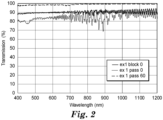
- the layer profile, first polymer and second polymer materials, and chosen process conditions led to the resulting pass and block state transmission spectra shown in FIG. 2 .
- This film has a resulting physical thickness as measured by a capacitance gauge of approximately 29.2um.
- the shrinkage measured at 302F was 2.1%in the machine direction (MD) of the coextrusion equipment and 1.9% in the transverse direction (TD) of the coextrusion equipment.
- the shrinkage of the film was measured by heating a 1 inch by 9 inch strip of film to the desired temperature and measuring the shrinkage in the long direction of the sample after 15 minutes. The sample is under negligible tension sufficient to keep the film flat during the test. For some end use applications the film would have nearly identical shrinkage for the orthogonal directions.
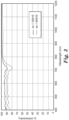
- the film of example 1 was then put in a frame to restrict shrinkage and heat treated in an oven of 450 degrees F for 30 seconds. This heat treatment presumably provides sufficient annealing to remove residual crystallinity in the low index layer. As such, comparing transmission spectrum from before and after this stress exposure is expected to indicate the changes in residual crystallinity in the low index layer.
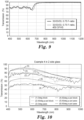
- the transmission of p-pol block state at 60 degrees before and after the stress exposure are shown in FIG. 3 .
- a birefringent reflective polariser not according to the invention, was prepared as follows. Two polymers were used for the optical layers.
- the first polymer (first optical layers) was EASTAPAK PET 7352 available from Eastman Chemicals.
- the second polymer (second optical layers) was a 50:50 weight percent blend of polyethylene terephthalate glycol (PETG) GN071 from Eastman and VM318D PCTg from Eastman.
- the ratio of the feed rate of the first polymer to the second polymer was chosen to make the optical layers have a f-ratio of 0.65.
- the polymer used for the skin layers was EASTAPAK PET 7352.
- the materials were fed from separate extruders to a multilayer coextrusion feedblock, in which they were assembled into a packet of 275 alternating optical layers, plus a thicker protective boundary layer of the first optical layers, on each side, for a total of 277 layers.
- the skin layers of the second optical layer material were added to each side of the construction in a manifold specific to that purpose, resulting in a final construction having 279 layers.
- the multilayer melt was then cast through a film die onto a chill roll, in the conventional manner for polyester films, upon which it was quenched.
- the cast web was then stretched in a commercial scale linear tenter at a draw ratio approximately 6:1 and a temperature of 225F in the stretching section.
- the heat set section had a temperature of 350F.
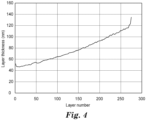
- the layer thickness profile is shown in FIG. 4 .
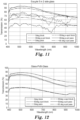
- the layer profile, first polymer and second polymer materials, and chosen process conditions led to the resulting pass and block state transmission spectra shown below in FIG. 5 .
- This film has a resulting physical thickness as measured by a capacitance gauge of approximately 26.9um.
- the shrinkage measured at 302F was 2.3% MD and 2.4% TD. For some end use applications the film would have nearly identical shrinkage for the orthogonal directions.
- example 2 the film of example 2 was then put in a frame to restrict shrinkage and heat treated in an oven of 450 degrees F for 30 seconds for a heat treatment.
- the transmission of p-pol block state at 60 degrees before and after heat treatment are shown in FIG. 6 .
- a birefringent reflective polarizer was prepared as follows. Two polymers were used for the optical layers. The first polymer (first optical layers) was EASTAPAK PET 7352 available from Eastman Chemicals. The second polymer (second optical layers) was a 33:33:33 blend of Polyethylene Terephthalate Glycol (PETG) GN071 from Eastman, VM318D PCTG from Eastman Chemicals (Knoxville, TN), and 80:20 CoPET. The 80:20 CoPET is as pelletized an amorphous copolyester including of a molar ratio of the following:
- the ratio of the feed rate of the first polymer to the second polymer was chosen to make the optical layers have a f-ratio of 0.65.
- the polymer used for the skin layers was EASTAPAK PET 7352.
- the materials were fed from separate extruders to a multilayer coextrusion feedblock, in which they were assembled into a packet of 275 alternating optical layers, plus a thicker protective boundary layer of the first optical layers, on each side, for a total of 277 layers.
- the skin layers of the second optical layer material were added to both sides of the construction in a manifold specific to that purpose, resulting in a final construction having 279 layers.
- the multilayer melt was then cast through a film die onto a chill roll, in the conventional manner for polyester films, upon which it was quenched.
- the cast web was then stretched in a commercial scale linear tenter at a draw ratio approximately 6:1 and a temperature of 225F in the stretching section.
- the heat set section had a temperature of 350F.
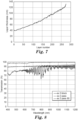
- the layer thickness profile is shown in FIG. 7 .
- the layer profile, first polymer and second polymer materials, and chosen process conditions led to the resulting pass and block state transmission spectra shown in FIG. 8 .
- This film has a resulting physical thickness as measured by a capacitance gauge of approximately 28.2 ⁇ m
- the film of example 3 was then put in a frame to restrict shrinkage and heat treated in an oven of 450 degrees F for 30 seconds for a heat treatment.
- the transmission of p-pol block state at 60 degrees before and after thermal stress are shown in FIG. 9 .
- the lack of evidence for shift after the heat treatment for example 3 indicates negligible shift in crystallinity state of low index layer and seems to correlate to improved thermal robustness of resulting multi-layer films.
- the films of examples 1-3 were evaluated for refractive indices of each layer.
- the PET layer was measured directly on the outer film surface by Metricon.
- the refractive indices of the LIO layer were calculated by matching transmission measurements of the film to transmission calculations by 4x4 Berriman optical stack code. In each of the examples, significant birefringence exists in the LIO layers, implying significant crystallinity present.
- Example LIO material fratio PET measured LIO calculated nx ny nz nx ny nz example 1 PETg LIO 0.75 1.693 1.578 1.520 1.648 1.578 1.530 example 2 50:50 PCTg:PETg LIO 0.65 1.694 1.578 1.515 1.621 1.573 1.558 example 3 33:33:33 PETg:PCTg:80-20 0.75 1.682 1.554 1.535 1.620 1.573 1.582
- Examples 4-6 were made with a similar process to examples 1-3, but with the following differences: Table 2 LIO material f ratio PET measured nx ny nz example 4 PETg LIO 0.5 1.692 1.577 1.52 example 5 PETg LIO 0.5 1.694 1.58 1.52 example 6 33:33:33 PETg:PCTg:80-20 0.55 1.694 1.579 1.515
- Examples 1-6 were stretched with a conventional linear tenter process.
- Examples 7-9 were made with similar extrusion conditions to examples 1-6 except were stretched with the following parabolic tenter process as described in the Invited Paper 45.1, authored by Denker et al., entitled “Advanced Polarizer Film for Improved Performance of Liquid Crystal Displays," presented at Society for Information Displays (SID) International Conference in San Francisco, Calif., Jun. 4-9, 2006 or at temperatures and draw ratios similar to those described in 20070047080 A1 (Stover et al ).
- the example films were aged at elevated temperatures in ovens from 85C, 95C and 100C.
- the haze was measured after 100 and 1000 hours and compared to room temperature aged films (RT); these results are listed in tables 4 and 5 respectively.
- RT room temperature aged films
- Table 4 measured haze [%] after 100 hours thermal exposure RT 85C 95C 105C example 1 0.143 0.017 0.053 1.140 example 2 0.073 0.030 0.043 0.653 example 3 0.163 0.097 0.057 0.397 example 4 0.330 0.473 0.587 0.267 example 6 0.047 0.143 0.113 0.787 example 7 0.107 0.123 0.107 1.640 example 8 0.160 0.080 0.373 1.073 example 9 0.253 0.823 0.267 0.450
- Table 5 measured haze [%] after 1000 hours thermal exposure RT 85C 95C 105C example 1 0.05 0.25 1.11 1.68 example 2 0.10 0.56 0.57 1.45 example 3 0.07 0.49 0.74 1.29 example 4 0.41 0.60 0.80 1.75 example 6 0.05 0.69 0.97 2.27 example 7 0.09 0.89 1.44 1.71 example 8 0.25 0.40 0.82 0.86 example 9 0.51 0.87 1.48 2.92
Landscapes
- Physics & Mathematics (AREA)
- General Physics & Mathematics (AREA)
- Optics & Photonics (AREA)
- Chemical & Material Sciences (AREA)
- Crystallography & Structural Chemistry (AREA)
- Engineering & Computer Science (AREA)
- Mechanical Engineering (AREA)
- Polarising Elements (AREA)
- Laminated Bodies (AREA)
- Optical Filters (AREA)
Claims (13)
- Ein mehrschichtiger reflektierender Polarisator, aufweisend:eine Mehrzahl von abwechselnden ersten Polymerschichten und zweiten Polymerschichten;wobei jede der ersten Polymerschichten und der zweiten Polymerschichten eine Doppelbrechung in einer Ebene von mindestens 0,01 vorweist;wobei jede der ersten Polymerschichten und der zweiten Polymerschichten Kristallinität zeigt;wobei für mindestens eine Richtung in der Ebene der Unterschied in einem Brechungsindex zwischen jeder der ersten Polymerschichten und der zweiten Polymerschichten mindestens 0,04 beträgt;wobei für eine zweite Richtung in der Ebene, die orthogonal zu der mindestens einen Richtung in der Ebene ist, der Unterschied in dem Brechungsindex zwischen jeder der ersten Polymerschichten und der zweiten Polymerschichten weniger als 0,04 beträgt;wobei der mehrschichtige reflektierende Polarisator mindestens vier Kanten vorweist;wobei kein Brechungsindex für die ersten oder die zweiten Polymerschichten, gemessen bei 550 nm, größer als 1,7 ist; undwobei die ersten Polymerschichten Polyethylenterephthalat einschließen und wobei die zweiten Polymerschichten ein glykolmodifiziertes Co(polyethylenterephthalat) einschließen.
- Der mehrschichtige reflektierende Polarisator nach Anspruch 1, wobei ein f-Verhältnis des mehrschichtigen reflektierenden Polarisators, das als ein Verhältnis einer durchschnittlichen optischen Dicke der ersten Polymerschichten zu der gesamten optischen Dicke sowohl der ersten Polymerschichten als auch der zweiten Polymerschichten definiert ist, mindestens 0,55 beträgt.
- Der mehrschichtige reflektierende Polarisator nach Anspruch 2, wobei das f-Verhältnis mindestens 0,65 beträgt.
- Der mehrschichtige reflektierende Polarisator nach Anspruch 2, wobei das f-Verhältnis mindestens 0,75 beträgt.
- Ein Optisches Laminat, aufweisend:einen mehrschichtigen reflektierenden Polarisator nach Anspruch 1; undeine Spiegelfolie, die auf den mehrschichtigen reflektierenden Polarisator laminiert ist;wobei die Spiegelfolie weniger als 20 % von sichtbarem Licht und mindestens 80 % von Licht von 900 bis 1200 nm reflektiert.
- Ein Autoglaslaminat, aufweisend eine Autoglasschicht und das optische Laminat nach Anspruch 5.
- Ein Glaslaminat, aufweisend:einen mehrschichtigen reflektierenden Polarisator nach Anspruch 1; undeine Glasschicht;wobei der mehrschichtige reflektierende Polarisator auf die Glasschicht laminiert ist.
- Das Glaslaminat nach Anspruch 7, wobei die Glasschicht eine Autoglasschicht ist und der mehrschichtige reflektierende Polarisator konfiguriert ist, um senkrecht zu einer Straßenoberfläche polarisiertes Licht zu reflektieren, um mit polarisierten Sonnenbrillen sichtbar zu sein.
- Das Glaslaminat nach Anspruch 7, wobei die Glasschicht eine Autoglasschicht ist und der mehrschichtige reflektierende Polarisator konfiguriert ist, um parallel zu einer Straßenoberfläche polarisiertes Licht zu reflektieren, um eine wahrgenommene Blendung durch die Straßenoberfläche zu verringern.
- Der mehrschichtige reflektierende Polarisator nach Anspruch 1, ferner aufweisend mindestens eine nichtoptische Schicht, wobei die mindestens eine nichtoptische Schicht eine Hautschicht oder eine schützende Grenzschicht ist.
- Der mehrschichtige reflektierende Polarisator nach Anspruch 10, wobei jede der mindestens einen nichtoptischen Schicht Kristallinität zeigt.
- Der mehrschichtige reflektierende Polarisator nach Anspruch 1, wobei der mehrschichtige reflektierende Polarisator keine nichtoptischen Schutzgrenzschichten innerhalb der Mehrzahl von abwechselnden ersten Polymerschichten und zweiten Polymerschichten einschließt.
- Der mehrschichtige reflektierende Polarisator nach Anspruch 1, wobei der mehrschichtige reflektierende Polarisator keine nichtoptischen Hautschichten angrenzend an der Mehrzahl von abwechselnden ersten Polymerschichten und zweiten Polymerschichten einschließt.
Applications Claiming Priority (2)
| Application Number | Priority Date | Filing Date | Title |
|---|---|---|---|
| US201862727947P | 2018-09-06 | 2018-09-06 | |
| PCT/IB2019/057289 WO2020049424A1 (en) | 2018-09-06 | 2019-08-29 | Multilayer reflective polarizer with crystalline low index layers |
Publications (2)
| Publication Number | Publication Date |
|---|---|
| EP3847488A1 EP3847488A1 (de) | 2021-07-14 |
| EP3847488B1 true EP3847488B1 (de) | 2025-01-22 |
Family
ID=68165626
Family Applications (1)
| Application Number | Title | Priority Date | Filing Date |
|---|---|---|---|
| EP19783648.9A Active EP3847488B1 (de) | 2018-09-06 | 2019-08-29 | Mehrschichtiger reflektierender polarisator mit kristallinen schichten mit niedrigem index |
Country Status (7)
| Country | Link |
|---|---|
| US (2) | US12019258B2 (de) |
| EP (1) | EP3847488B1 (de) |
| JP (2) | JP7716975B2 (de) |
| KR (1) | KR20210055045A (de) |
| CN (1) | CN112654905B (de) |
| TW (1) | TW202031504A (de) |
| WO (1) | WO2020049424A1 (de) |
Families Citing this family (4)
| Publication number | Priority date | Publication date | Assignee | Title |
|---|---|---|---|---|
| US12117636B2 (en) | 2019-04-03 | 2024-10-15 | 3M Innovative Properties Company | Optical film and glass laminate |
| US12554055B2 (en) | 2021-08-19 | 2026-02-17 | 3M Innovative Properties Company | Reflective polarizer, windshield, integral optical construction and method for making integral optical construction |
| CN121419885A (zh) * | 2023-06-30 | 2026-01-27 | 3M创新有限公司 | 多层光学膜 |
| WO2026009115A1 (en) * | 2024-07-02 | 2026-01-08 | 3M Innovative Properties Company | Reflective polarizer, backlight, and display system |
Citations (1)
| Publication number | Priority date | Publication date | Assignee | Title |
|---|---|---|---|---|
| US3610729A (en) * | 1969-06-18 | 1971-10-05 | Polaroid Corp | Multilayered light polarizer |
Family Cites Families (25)
| Publication number | Priority date | Publication date | Assignee | Title |
|---|---|---|---|---|
| US4446305A (en) | 1981-03-02 | 1984-05-01 | Polaroid Corporation | Optical device including birefringent polymer |
| US4540623A (en) | 1983-10-14 | 1985-09-10 | The Dow Chemical Company | Coextruded multi-layered articles |
| US5103337A (en) | 1990-07-24 | 1992-04-07 | The Dow Chemical Company | Infrared reflective optical interference film |
| AU5322594A (en) | 1992-10-29 | 1994-05-24 | Dow Chemical Company, The | Formable reflective multilayer body |
| US5360659A (en) | 1993-05-24 | 1994-11-01 | The Dow Chemical Company | Two component infrared reflecting film |
| EP0735952B1 (de) | 1993-12-21 | 2000-03-22 | Minnesota Mining And Manufacturing Company | Mehrschichtiger optischer film |
| US5882774A (en) | 1993-12-21 | 1999-03-16 | Minnesota Mining And Manufacturing Company | Optical film |
| BR9609392A (pt) | 1995-06-26 | 1999-05-18 | Minnesota Mining & Mfg | Dispositivo de multicamadas transparente |
| CN1106937C (zh) | 1995-06-26 | 2003-04-30 | 美国3M公司 | 带有附加涂层或附加层的多层聚合物薄膜 |
| US6045894A (en) * | 1998-01-13 | 2000-04-04 | 3M Innovative Properties Company | Clear to colored security film |
| US6157490A (en) | 1998-01-13 | 2000-12-05 | 3M Innovative Properties Company | Optical film with sharpened bandedge |
| US6808658B2 (en) | 1998-01-13 | 2004-10-26 | 3M Innovative Properties Company | Method for making texture multilayer optical films |
| US6531230B1 (en) | 1998-01-13 | 2003-03-11 | 3M Innovative Properties Company | Color shifting film |
| KR100603876B1 (ko) | 1998-01-28 | 2006-07-24 | 미네소타 마이닝 앤드 매뉴팩춰링 캄파니 | 적외선 간섭 필터 |
| US6449093B2 (en) * | 1999-10-12 | 2002-09-10 | 3M Innovative Properties Company | Optical bodies made with a birefringent polymer |
| US7052762B2 (en) | 2001-05-24 | 2006-05-30 | 3M Innovative Properties Company | Low Tg multilayer optical films |
| US6952312B2 (en) * | 2002-12-31 | 2005-10-04 | 3M Innovative Properties Company | Head-up display with polarized light source and wide-angle p-polarization reflective polarizer |
| US20070047080A1 (en) | 2005-08-31 | 2007-03-01 | 3M Innovative Properties Company | Methods of producing multilayer reflective polarizer |
| US7687577B2 (en) | 2007-07-25 | 2010-03-30 | Sabic Innovative Plastics Ip B.V. | Thermoformable polycarbonate/polyester compositions and uses |
| MY163688A (en) * | 2008-03-31 | 2017-10-13 | 3M Innovative Properties Co | Low layer count reflective polarizer with optimized gain |
| JP5482380B2 (ja) | 2010-03-31 | 2014-05-07 | 東レ株式会社 | フィルムおよび偏光反射体ならびにその製造方法。 |
| US9069136B2 (en) | 2010-06-30 | 2015-06-30 | 3M Innovative Properties Company | Optical stack having birefringent layer of optically symmetrical crystallites |
| US9739912B2 (en) * | 2013-11-19 | 2017-08-22 | 3M Innovative Properties Company | Multilayer polymeric reflector |
| KR102447243B1 (ko) * | 2016-07-13 | 2022-09-23 | 쓰리엠 이노베이티브 프로퍼티즈 컴파니 | 광학 필름 |
| US20200355859A1 (en) | 2018-01-26 | 2020-11-12 | 3M Innovative Properties Company | Multilayer Reflective Polarizer with Crystalline Low Index Layers |
-
2019
- 2019-08-29 EP EP19783648.9A patent/EP3847488B1/de active Active
- 2019-08-29 CN CN201980058149.6A patent/CN112654905B/zh active Active
- 2019-08-29 US US17/273,047 patent/US12019258B2/en active Active
- 2019-08-29 WO PCT/IB2019/057289 patent/WO2020049424A1/en not_active Ceased
- 2019-08-29 KR KR1020217006628A patent/KR20210055045A/ko not_active Withdrawn
- 2019-08-29 JP JP2021512637A patent/JP7716975B2/ja active Active
- 2019-09-05 TW TW108131992A patent/TW202031504A/zh unknown
-
2024
- 2024-02-22 JP JP2024025082A patent/JP7745676B2/ja active Active
- 2024-05-16 US US18/666,258 patent/US20240302583A1/en active Pending
Patent Citations (1)
| Publication number | Priority date | Publication date | Assignee | Title |
|---|---|---|---|---|
| US3610729A (en) * | 1969-06-18 | 1971-10-05 | Polaroid Corp | Multilayered light polarizer |
Also Published As
| Publication number | Publication date |
|---|---|
| JP7745676B2 (ja) | 2025-09-29 |
| CN112654905A (zh) | 2021-04-13 |
| KR20210055045A (ko) | 2021-05-14 |
| JP2024056995A (ja) | 2024-04-23 |
| EP3847488A1 (de) | 2021-07-14 |
| WO2020049424A1 (en) | 2020-03-12 |
| US20240302583A1 (en) | 2024-09-12 |
| CN112654905B (zh) | 2022-11-29 |
| JP7716975B2 (ja) | 2025-08-01 |
| JP2022500689A (ja) | 2022-01-04 |
| US12019258B2 (en) | 2024-06-25 |
| US20210325587A1 (en) | 2021-10-21 |
| TW202031504A (zh) | 2020-09-01 |
Similar Documents
| Publication | Publication Date | Title |
|---|---|---|
| US20200355859A1 (en) | Multilayer Reflective Polarizer with Crystalline Low Index Layers | |
| US20250231332A1 (en) | Optical film including infrared reflector and multilayer reflective polarizer with crystalline low index layers | |
| EP0736187B1 (de) | Optischer polarisator | |
| US20240302583A1 (en) | Multilayer optical film with crystalline low index layers | |
| US6565982B1 (en) | Transparent multilayer device | |
| KR102227059B1 (ko) | 다층 반사 편광기 | |
| EP3899610B1 (de) | Optischer stapel | |
| EP1047959A1 (de) | Antireflektierende polymeranordnungen und herstellung derselben |
Legal Events
| Date | Code | Title | Description |
|---|---|---|---|
| STAA | Information on the status of an ep patent application or granted ep patent |
Free format text: STATUS: UNKNOWN |
|
| STAA | Information on the status of an ep patent application or granted ep patent |
Free format text: STATUS: THE INTERNATIONAL PUBLICATION HAS BEEN MADE |
|
| PUAI | Public reference made under article 153(3) epc to a published international application that has entered the european phase |
Free format text: ORIGINAL CODE: 0009012 |
|
| STAA | Information on the status of an ep patent application or granted ep patent |
Free format text: STATUS: REQUEST FOR EXAMINATION WAS MADE |
|
| 17P | Request for examination filed |
Effective date: 20210304 |
|
| AK | Designated contracting states |
Kind code of ref document: A1 Designated state(s): AL AT BE BG CH CY CZ DE DK EE ES FI FR GB GR HR HU IE IS IT LI LT LU LV MC MK MT NL NO PL PT RO RS SE SI SK SM TR |
|
| DAV | Request for validation of the european patent (deleted) | ||
| DAX | Request for extension of the european patent (deleted) | ||
| STAA | Information on the status of an ep patent application or granted ep patent |
Free format text: STATUS: EXAMINATION IS IN PROGRESS |
|
| 17Q | First examination report despatched |
Effective date: 20230914 |
|
| GRAP | Despatch of communication of intention to grant a patent |
Free format text: ORIGINAL CODE: EPIDOSNIGR1 |
|
| STAA | Information on the status of an ep patent application or granted ep patent |
Free format text: STATUS: GRANT OF PATENT IS INTENDED |
|
| INTG | Intention to grant announced |
Effective date: 20240903 |
|
| P01 | Opt-out of the competence of the unified patent court (upc) registered |
Free format text: CASE NUMBER: APP_54808/2024 Effective date: 20241004 |
|
| GRAS | Grant fee paid |
Free format text: ORIGINAL CODE: EPIDOSNIGR3 |
|
| GRAA | (expected) grant |
Free format text: ORIGINAL CODE: 0009210 |
|
| STAA | Information on the status of an ep patent application or granted ep patent |
Free format text: STATUS: THE PATENT HAS BEEN GRANTED |
|
| AK | Designated contracting states |
Kind code of ref document: B1 Designated state(s): AL AT BE BG CH CY CZ DE DK EE ES FI FR GB GR HR HU IE IS IT LI LT LU LV MC MK MT NL NO PL PT RO RS SE SI SK SM TR |
|
| REG | Reference to a national code |
Ref country code: GB Ref legal event code: FG4D |
|
| REG | Reference to a national code |
Ref country code: CH Ref legal event code: EP |
|
| REG | Reference to a national code |
Ref country code: IE Ref legal event code: FG4D |
|
| REG | Reference to a national code |
Ref country code: DE Ref legal event code: R096 Ref document number: 602019065140 Country of ref document: DE |
|
| REG | Reference to a national code |
Ref country code: NL Ref legal event code: MP Effective date: 20250122 |
|
| PG25 | Lapsed in a contracting state [announced via postgrant information from national office to epo] |
Ref country code: NL Free format text: LAPSE BECAUSE OF FAILURE TO SUBMIT A TRANSLATION OF THE DESCRIPTION OR TO PAY THE FEE WITHIN THE PRESCRIBED TIME-LIMIT Effective date: 20250122 |
|
| PG25 | Lapsed in a contracting state [announced via postgrant information from national office to epo] |
Ref country code: RS Free format text: LAPSE BECAUSE OF FAILURE TO SUBMIT A TRANSLATION OF THE DESCRIPTION OR TO PAY THE FEE WITHIN THE PRESCRIBED TIME-LIMIT Effective date: 20250422 |
|
| PG25 | Lapsed in a contracting state [announced via postgrant information from national office to epo] |
Ref country code: FI Free format text: LAPSE BECAUSE OF FAILURE TO SUBMIT A TRANSLATION OF THE DESCRIPTION OR TO PAY THE FEE WITHIN THE PRESCRIBED TIME-LIMIT Effective date: 20250122 |
|
| PG25 | Lapsed in a contracting state [announced via postgrant information from national office to epo] |
Ref country code: PL Free format text: LAPSE BECAUSE OF FAILURE TO SUBMIT A TRANSLATION OF THE DESCRIPTION OR TO PAY THE FEE WITHIN THE PRESCRIBED TIME-LIMIT Effective date: 20250122 |
|
| PG25 | Lapsed in a contracting state [announced via postgrant information from national office to epo] |
Ref country code: ES Free format text: LAPSE BECAUSE OF FAILURE TO SUBMIT A TRANSLATION OF THE DESCRIPTION OR TO PAY THE FEE WITHIN THE PRESCRIBED TIME-LIMIT Effective date: 20250122 |
|
| REG | Reference to a national code |
Ref country code: LT Ref legal event code: MG9D |
|
| PG25 | Lapsed in a contracting state [announced via postgrant information from national office to epo] |
Ref country code: IS Free format text: LAPSE BECAUSE OF FAILURE TO SUBMIT A TRANSLATION OF THE DESCRIPTION OR TO PAY THE FEE WITHIN THE PRESCRIBED TIME-LIMIT Effective date: 20250522 Ref country code: NO Free format text: LAPSE BECAUSE OF FAILURE TO SUBMIT A TRANSLATION OF THE DESCRIPTION OR TO PAY THE FEE WITHIN THE PRESCRIBED TIME-LIMIT Effective date: 20250422 |
|
| REG | Reference to a national code |
Ref country code: AT Ref legal event code: MK05 Ref document number: 1761875 Country of ref document: AT Kind code of ref document: T Effective date: 20250122 |
|
| PG25 | Lapsed in a contracting state [announced via postgrant information from national office to epo] |
Ref country code: HR Free format text: LAPSE BECAUSE OF FAILURE TO SUBMIT A TRANSLATION OF THE DESCRIPTION OR TO PAY THE FEE WITHIN THE PRESCRIBED TIME-LIMIT Effective date: 20250122 |
|
| PG25 | Lapsed in a contracting state [announced via postgrant information from national office to epo] |
Ref country code: LV Free format text: LAPSE BECAUSE OF FAILURE TO SUBMIT A TRANSLATION OF THE DESCRIPTION OR TO PAY THE FEE WITHIN THE PRESCRIBED TIME-LIMIT Effective date: 20250122 Ref country code: PT Free format text: LAPSE BECAUSE OF FAILURE TO SUBMIT A TRANSLATION OF THE DESCRIPTION OR TO PAY THE FEE WITHIN THE PRESCRIBED TIME-LIMIT Effective date: 20250522 |
|
| PG25 | Lapsed in a contracting state [announced via postgrant information from national office to epo] |
Ref country code: GR Free format text: LAPSE BECAUSE OF FAILURE TO SUBMIT A TRANSLATION OF THE DESCRIPTION OR TO PAY THE FEE WITHIN THE PRESCRIBED TIME-LIMIT Effective date: 20250423 Ref country code: BG Free format text: LAPSE BECAUSE OF FAILURE TO SUBMIT A TRANSLATION OF THE DESCRIPTION OR TO PAY THE FEE WITHIN THE PRESCRIBED TIME-LIMIT Effective date: 20250122 |
|
| PG25 | Lapsed in a contracting state [announced via postgrant information from national office to epo] |
Ref country code: AT Free format text: LAPSE BECAUSE OF FAILURE TO SUBMIT A TRANSLATION OF THE DESCRIPTION OR TO PAY THE FEE WITHIN THE PRESCRIBED TIME-LIMIT Effective date: 20250122 |
|
| PG25 | Lapsed in a contracting state [announced via postgrant information from national office to epo] |
Ref country code: SE Free format text: LAPSE BECAUSE OF FAILURE TO SUBMIT A TRANSLATION OF THE DESCRIPTION OR TO PAY THE FEE WITHIN THE PRESCRIBED TIME-LIMIT Effective date: 20250122 |
|
| PG25 | Lapsed in a contracting state [announced via postgrant information from national office to epo] |
Ref country code: SM Free format text: LAPSE BECAUSE OF FAILURE TO SUBMIT A TRANSLATION OF THE DESCRIPTION OR TO PAY THE FEE WITHIN THE PRESCRIBED TIME-LIMIT Effective date: 20250122 |
|
| PG25 | Lapsed in a contracting state [announced via postgrant information from national office to epo] |
Ref country code: DK Free format text: LAPSE BECAUSE OF FAILURE TO SUBMIT A TRANSLATION OF THE DESCRIPTION OR TO PAY THE FEE WITHIN THE PRESCRIBED TIME-LIMIT Effective date: 20250122 |
|
| PGFP | Annual fee paid to national office [announced via postgrant information from national office to epo] |
Ref country code: DE Payment date: 20250724 Year of fee payment: 7 |
|
| PG25 | Lapsed in a contracting state [announced via postgrant information from national office to epo] |
Ref country code: IT Free format text: LAPSE BECAUSE OF FAILURE TO SUBMIT A TRANSLATION OF THE DESCRIPTION OR TO PAY THE FEE WITHIN THE PRESCRIBED TIME-LIMIT Effective date: 20250122 |
|
| PG25 | Lapsed in a contracting state [announced via postgrant information from national office to epo] |
Ref country code: EE Free format text: LAPSE BECAUSE OF FAILURE TO SUBMIT A TRANSLATION OF THE DESCRIPTION OR TO PAY THE FEE WITHIN THE PRESCRIBED TIME-LIMIT Effective date: 20250122 Ref country code: CZ Free format text: LAPSE BECAUSE OF FAILURE TO SUBMIT A TRANSLATION OF THE DESCRIPTION OR TO PAY THE FEE WITHIN THE PRESCRIBED TIME-LIMIT Effective date: 20250122 |
|
| REG | Reference to a national code |
Ref country code: DE Ref legal event code: R097 Ref document number: 602019065140 Country of ref document: DE |
|
| PG25 | Lapsed in a contracting state [announced via postgrant information from national office to epo] |
Ref country code: RO Free format text: LAPSE BECAUSE OF FAILURE TO SUBMIT A TRANSLATION OF THE DESCRIPTION OR TO PAY THE FEE WITHIN THE PRESCRIBED TIME-LIMIT Effective date: 20250122 |
|
| PG25 | Lapsed in a contracting state [announced via postgrant information from national office to epo] |
Ref country code: SK Free format text: LAPSE BECAUSE OF FAILURE TO SUBMIT A TRANSLATION OF THE DESCRIPTION OR TO PAY THE FEE WITHIN THE PRESCRIBED TIME-LIMIT Effective date: 20250122 |
|
| PLBE | No opposition filed within time limit |
Free format text: ORIGINAL CODE: 0009261 |
|
| STAA | Information on the status of an ep patent application or granted ep patent |
Free format text: STATUS: NO OPPOSITION FILED WITHIN TIME LIMIT |
|
| REG | Reference to a national code |
Ref country code: CH Ref legal event code: L10 Free format text: ST27 STATUS EVENT CODE: U-0-0-L10-L00 (AS PROVIDED BY THE NATIONAL OFFICE) Effective date: 20251203 |
|
| 26N | No opposition filed |
Effective date: 20251023 |
|
| REG | Reference to a national code |
Ref country code: CH Ref legal event code: H13 Free format text: ST27 STATUS EVENT CODE: U-0-0-H10-H13 (AS PROVIDED BY THE NATIONAL OFFICE) Effective date: 20260324 |