EP3846325B1 - Motor and electric vehicle including the same - Google Patents
Motor and electric vehicle including the same Download PDFInfo
- Publication number
- EP3846325B1 EP3846325B1 EP20178200.0A EP20178200A EP3846325B1 EP 3846325 B1 EP3846325 B1 EP 3846325B1 EP 20178200 A EP20178200 A EP 20178200A EP 3846325 B1 EP3846325 B1 EP 3846325B1
- Authority
- EP
- European Patent Office
- Prior art keywords
- stator
- motor
- support element
- rotor
- shield
- Prior art date
- Legal status (The legal status is an assumption and is not a legal conclusion. Google has not performed a legal analysis and makes no representation as to the accuracy of the status listed.)
- Active
Links
Images



Classifications
-
- H—ELECTRICITY
- H02—GENERATION; CONVERSION OR DISTRIBUTION OF ELECTRIC POWER
- H02K—DYNAMO-ELECTRIC MACHINES
- H02K11/00—Structural association of dynamo-electric machines with electric components or with devices for shielding, monitoring or protection
- H02K11/01—Structural association of dynamo-electric machines with electric components or with devices for shielding, monitoring or protection for shielding from electromagnetic fields, i.e. structural association with shields
-
- H—ELECTRICITY
- H02—GENERATION; CONVERSION OR DISTRIBUTION OF ELECTRIC POWER
- H02K—DYNAMO-ELECTRIC MACHINES
- H02K11/00—Structural association of dynamo-electric machines with electric components or with devices for shielding, monitoring or protection
- H02K11/01—Structural association of dynamo-electric machines with electric components or with devices for shielding, monitoring or protection for shielding from electromagnetic fields, i.e. structural association with shields
- H02K11/014—Shields associated with stationary parts, e.g. stator cores
-
- H—ELECTRICITY
- H02—GENERATION; CONVERSION OR DISTRIBUTION OF ELECTRIC POWER
- H02K—DYNAMO-ELECTRIC MACHINES
- H02K21/00—Synchronous motors having permanent magnets; Synchronous generators having permanent magnets
- H02K21/02—Details
- H02K21/021—Means for mechanical adjustment of the excitation flux
- H02K21/028—Means for mechanical adjustment of the excitation flux by modifying the magnetic circuit within the field or the armature, e.g. by using shunts, by adjusting the magnets position, by vectorial combination of field or armature sections
-
- B—PERFORMING OPERATIONS; TRANSPORTING
- B60—VEHICLES IN GENERAL
- B60K—ARRANGEMENT OR MOUNTING OF PROPULSION UNITS OR OF TRANSMISSIONS IN VEHICLES; ARRANGEMENT OR MOUNTING OF PLURAL DIVERSE PRIME-MOVERS IN VEHICLES; AUXILIARY DRIVES FOR VEHICLES; INSTRUMENTATION OR DASHBOARDS FOR VEHICLES; ARRANGEMENTS IN CONNECTION WITH COOLING, AIR INTAKE, GAS EXHAUST OR FUEL SUPPLY OF PROPULSION UNITS IN VEHICLES
- B60K1/00—Arrangement or mounting of electrical propulsion units
- B60K1/04—Arrangement or mounting of electrical propulsion units of the electric storage means for propulsion
-
- B—PERFORMING OPERATIONS; TRANSPORTING
- B60—VEHICLES IN GENERAL
- B60L—PROPULSION OF ELECTRICALLY-PROPELLED VEHICLES; SUPPLYING ELECTRIC POWER FOR AUXILIARY EQUIPMENT OF ELECTRICALLY-PROPELLED VEHICLES; ELECTRODYNAMIC BRAKE SYSTEMS FOR VEHICLES IN GENERAL; MAGNETIC SUSPENSION OR LEVITATION FOR VEHICLES; MONITORING OPERATING VARIABLES OF ELECTRICALLY-PROPELLED VEHICLES; ELECTRIC SAFETY DEVICES FOR ELECTRICALLY-PROPELLED VEHICLES
- B60L50/00—Electric propulsion with power supplied within the vehicle
- B60L50/50—Electric propulsion with power supplied within the vehicle using propulsion power supplied by batteries or fuel cells
- B60L50/60—Electric propulsion with power supplied within the vehicle using propulsion power supplied by batteries or fuel cells using power supplied by batteries
-
- B—PERFORMING OPERATIONS; TRANSPORTING
- B60—VEHICLES IN GENERAL
- B60L—PROPULSION OF ELECTRICALLY-PROPELLED VEHICLES; SUPPLYING ELECTRIC POWER FOR AUXILIARY EQUIPMENT OF ELECTRICALLY-PROPELLED VEHICLES; ELECTRODYNAMIC BRAKE SYSTEMS FOR VEHICLES IN GENERAL; MAGNETIC SUSPENSION OR LEVITATION FOR VEHICLES; MONITORING OPERATING VARIABLES OF ELECTRICALLY-PROPELLED VEHICLES; ELECTRIC SAFETY DEVICES FOR ELECTRICALLY-PROPELLED VEHICLES
- B60L7/00—Electrodynamic brake systems for vehicles in general
- B60L7/10—Dynamic electric regenerative braking
-
- H—ELECTRICITY
- H02—GENERATION; CONVERSION OR DISTRIBUTION OF ELECTRIC POWER
- H02K—DYNAMO-ELECTRIC MACHINES
- H02K1/00—Details of the magnetic circuit
- H02K1/06—Details of the magnetic circuit characterised by the shape, form or construction
- H02K1/12—Stationary parts of the magnetic circuit
-
- H—ELECTRICITY
- H02—GENERATION; CONVERSION OR DISTRIBUTION OF ELECTRIC POWER
- H02K—DYNAMO-ELECTRIC MACHINES
- H02K1/00—Details of the magnetic circuit
- H02K1/06—Details of the magnetic circuit characterised by the shape, form or construction
- H02K1/12—Stationary parts of the magnetic circuit
- H02K1/16—Stator cores with slots for windings
-
- H—ELECTRICITY
- H02—GENERATION; CONVERSION OR DISTRIBUTION OF ELECTRIC POWER
- H02K—DYNAMO-ELECTRIC MACHINES
- H02K1/00—Details of the magnetic circuit
- H02K1/06—Details of the magnetic circuit characterised by the shape, form or construction
- H02K1/12—Stationary parts of the magnetic circuit
- H02K1/18—Means for mounting or fastening magnetic stationary parts on to, or to, the stator structures
-
- H—ELECTRICITY
- H02—GENERATION; CONVERSION OR DISTRIBUTION OF ELECTRIC POWER
- H02K—DYNAMO-ELECTRIC MACHINES
- H02K1/00—Details of the magnetic circuit
- H02K1/06—Details of the magnetic circuit characterised by the shape, form or construction
- H02K1/22—Rotating parts of the magnetic circuit
-
- H—ELECTRICITY
- H02—GENERATION; CONVERSION OR DISTRIBUTION OF ELECTRIC POWER
- H02K—DYNAMO-ELECTRIC MACHINES
- H02K21/00—Synchronous motors having permanent magnets; Synchronous generators having permanent magnets
- H02K21/12—Synchronous motors having permanent magnets; Synchronous generators having permanent magnets with stationary armatures and rotating magnets
- H02K21/14—Synchronous motors having permanent magnets; Synchronous generators having permanent magnets with stationary armatures and rotating magnets with magnets rotating within the armatures
-
- H—ELECTRICITY
- H02—GENERATION; CONVERSION OR DISTRIBUTION OF ELECTRIC POWER
- H02K—DYNAMO-ELECTRIC MACHINES
- H02K3/00—Details of windings
- H02K3/46—Fastening of windings on the stator or rotor structure
- H02K3/48—Fastening of windings on the stator or rotor structure in slots
- H02K3/487—Slot-closing devices
-
- H—ELECTRICITY
- H02—GENERATION; CONVERSION OR DISTRIBUTION OF ELECTRIC POWER
- H02K—DYNAMO-ELECTRIC MACHINES
- H02K5/00—Casings; Enclosures; Supports
- H02K5/24—Casings; Enclosures; Supports specially adapted for suppression or reduction of noise or vibrations
-
- B—PERFORMING OPERATIONS; TRANSPORTING
- B60—VEHICLES IN GENERAL
- B60L—PROPULSION OF ELECTRICALLY-PROPELLED VEHICLES; SUPPLYING ELECTRIC POWER FOR AUXILIARY EQUIPMENT OF ELECTRICALLY-PROPELLED VEHICLES; ELECTRODYNAMIC BRAKE SYSTEMS FOR VEHICLES IN GENERAL; MAGNETIC SUSPENSION OR LEVITATION FOR VEHICLES; MONITORING OPERATING VARIABLES OF ELECTRICALLY-PROPELLED VEHICLES; ELECTRIC SAFETY DEVICES FOR ELECTRICALLY-PROPELLED VEHICLES
- B60L2220/00—Electrical machine types; Structures or applications thereof
- B60L2220/10—Electrical machine types
-
- B—PERFORMING OPERATIONS; TRANSPORTING
- B60—VEHICLES IN GENERAL
- B60Y—INDEXING SCHEME RELATING TO ASPECTS CROSS-CUTTING VEHICLE TECHNOLOGY
- B60Y2200/00—Type of vehicle
- B60Y2200/90—Vehicles comprising electric prime movers
- B60Y2200/91—Electric vehicles
-
- H—ELECTRICITY
- H02—GENERATION; CONVERSION OR DISTRIBUTION OF ELECTRIC POWER
- H02K—DYNAMO-ELECTRIC MACHINES
- H02K2201/00—Specific aspects not provided for in the other groups of this subclass relating to the magnetic circuits
- H02K2201/03—Machines characterised by aspects of the air-gap between rotor and stator
-
- H—ELECTRICITY
- H02—GENERATION; CONVERSION OR DISTRIBUTION OF ELECTRIC POWER
- H02K—DYNAMO-ELECTRIC MACHINES
- H02K2213/00—Specific aspects, not otherwise provided for and not covered by codes H02K2201/00 - H02K2211/00
- H02K2213/09—Machines characterised by the presence of elements which are subject to variation, e.g. adjustable bearings, reconfigurable windings, variable pitch ventilators
-
- Y—GENERAL TAGGING OF NEW TECHNOLOGICAL DEVELOPMENTS; GENERAL TAGGING OF CROSS-SECTIONAL TECHNOLOGIES SPANNING OVER SEVERAL SECTIONS OF THE IPC; TECHNICAL SUBJECTS COVERED BY FORMER USPC CROSS-REFERENCE ART COLLECTIONS [XRACs] AND DIGESTS
- Y02—TECHNOLOGIES OR APPLICATIONS FOR MITIGATION OR ADAPTATION AGAINST CLIMATE CHANGE
- Y02T—CLIMATE CHANGE MITIGATION TECHNOLOGIES RELATED TO TRANSPORTATION
- Y02T10/00—Road transport of goods or passengers
- Y02T10/60—Other road transportation technologies with climate change mitigation effect
- Y02T10/64—Electric machine technologies in electromobility
-
- Y—GENERAL TAGGING OF NEW TECHNOLOGICAL DEVELOPMENTS; GENERAL TAGGING OF CROSS-SECTIONAL TECHNOLOGIES SPANNING OVER SEVERAL SECTIONS OF THE IPC; TECHNICAL SUBJECTS COVERED BY FORMER USPC CROSS-REFERENCE ART COLLECTIONS [XRACs] AND DIGESTS
- Y02—TECHNOLOGIES OR APPLICATIONS FOR MITIGATION OR ADAPTATION AGAINST CLIMATE CHANGE
- Y02T—CLIMATE CHANGE MITIGATION TECHNOLOGIES RELATED TO TRANSPORTATION
- Y02T10/00—Road transport of goods or passengers
- Y02T10/60—Other road transportation technologies with climate change mitigation effect
- Y02T10/70—Energy storage systems for electromobility, e.g. batteries
Definitions
- This disclosure relates to a motor and an electric vehicle including the motor.
- a motor is a power device that generates a rotational force using electric power and is widely used in various fields such as a fan, a washing machine drum, and a drone blade.
- the motor may include a stator and a rotor that rotates relative to the stator.
- the stator may include a winding coil. When a current is applied to the winding coil, a magnetic field may be formed around the stator. Due to the magnetic field, the rotor may rotate relative to the stator, thereby generating power.
- the traveling distance corresponding to the inertia driving may be reduced in response to the regenerative torque being generated.
- the regenerative braking may occur so that a driving speed decreases irrespective of the user's driving intention.
- unnecessary energy recycling due to the frequent generation of the driving torque and the regenerative torque may reduce fuel efficiency and maximum movable distance of the electric vehicle.
- a drag phenomenon in which a body of a driver is dragged in a direction opposite to a driving direction may occur, which may cause an uncomfortableness (e.g., jerk) of the driver and degrades a drivability during the driving.
- EP 3 484 031 A1 relates to a permanent magnet electrical machine.
- EP 1 220 427 A2 relates to magnetic flux control means for a permanent-magnet motor-generator that is comprised of a rotor of permanent-magnet pieces supported for rotation in a stator housing.
- US 2015/130390 A1 relates to motors in which both the rotor component and the stator component have winding arrangements.
- US 2008/238220 A1 relates to a method of making a permanent magnet machine more fault-tolerant.
- a damper or clutch may be installed in an electric vehicle.
- the installation of the damper or clutch may result in space waste and an increase in manufacturing costs.
- control technologies that restrict a driving torque change rate or generate a damping force in a reversed direction of vibration generated when regenerative braking occurs may require a considerably precise design and, under a certain condition, deteriorate a torque responsiveness.
- An aspect of the present disclosure provides a motor to solve a problem caused by the regenerative braking or a counter electromotive force generated due to inertia driving in a mechanical manner, and an apparatus including the motor.
- a motor including a shield member that screens a magnetic field between a stator and a rotor, and a moving member that controls a position of the shield member based on an electromagnetic interaction with the stator such that screening of the magnetic field is selectively performed.
- first, second, etc. may be used to describe various components, but the components are not limited by such terms. The terms are used only for the purpose of distinguishing one component from other components.
- a singular expression can include a plural expression as long as it does not have an apparently different meaning in context.
- FIG. 1 is an exploded perspective view illustrating a motor according to at least one example embodiment of the present disclosure.
- FIG. 2 is a perspective view illustrating a structure of a motor according to at least one example embodiment of the present disclosure.
- a motor 10 may generate a rotational torque by receiving electric power from a battery, thereby converting electric energy into power energy.
- the motor 10 may be mounted on an electric vehicle (e.g., an electric kickboard, an electric bicycle, an electric scooter, a hybrid electric vehicle (HEV), a battery electric vehicle (BEV), etc.) and rotate wheels of the electric vehicle while the motor 10 is driven.
- an electric vehicle e.g., an electric kickboard, an electric bicycle, an electric scooter, a hybrid electric vehicle (HEV), a battery electric vehicle (BEV), etc.
- the motor 10 includes a stator 300 and a rotor 400.
- the rotor 400 (e.g., a rotator) may be disposed to be rotatable relative to the stator 300 (e.g., a stationary core) based on an electromagnetic interaction with the stator 300.
- the stator 300 may include a winding coil. When a current is applied to the winding coil, a magnetic field may be formed around the stator 300.
- the rotor 400 may be driven in one direction, for example, a clockwise direction or a counterclockwise direction by the magnetic field around the stator 300.
- the rotor 400 may be disposed inside the stator 300 to rotate relative to the stator 300.
- embodiments are not limited to such structure of the motor 10, and various structures such as a structure in which the stator 300 is disposed inside the rotor 400 or a structure in which the rotor 400 faces the stator 300 are applicable here.
- the motor 10 may further include a shield member 140.
- the shield member 140 may screen a magnetic field between the stator 300 and the rotor 400.
- the shield member 140 may include a magnetic shielding material that reduces an influence of external magnetic fields.
- the shield member 140 may be formed of a high permeability alloy such as a magnetic material, permalloy, silicon steel, and the like.
- the shield member 140 may include a plurality of shield elements extending in an axial direction (e.g., +z direction) of the motor 10.
- the plurality of shield elements included in the shield member 140 may be arranged between the stator 300 and the rotor 400 to be spaced apart from one another.
- the shield elements may have a shape of a bar extending in the axial direction of the motor.
- the shield elements are arranged to be spaced at equal intervals in a circumferential direction of the motor 10 so as to form a shape of a cage.
- the shield elements may be axially or longitudinally greater in length than the stator 300 and the rotor 400. Both ends of the shield elements may be connected to a support element 120 of a moving member 200 and supported by the support element 120 outside of the stator 300 and the rotor 400.
- a number of the shield elements may be set to be equal to a number of slots 310 (refer to FIG. 4A ) formed in the stator 300 such that the shield elements respectively correspond to the slots 310.
- Each of the shield elements may be disposed on an inner side of an end portion of each of the slots 310 in which a coil of the stator 300 is wound. That is, the shield elements are arranged between the winding coil of the stator 300 and the rotor 400 to restrict an electromagnetic interaction between the coil of the stator 300 and the rotor 400.
- a circumferential width of the shield element may be less than a width of the end portion of the slot 310 formed in the stator 300.
- the shield member 140 may be disposed to be inserted into or released from a receiving groove 315 (refer to FIG. 4A ) prepared in the end portion of the slot 310.
- the motor 10 may further include the moving member 200 to control a position of the shield member 140.
- the moving member 200 will be described with reference to FIG. 3 .
- FIG. 3 is a cross-sectional view illustrating an operation of a motor according to at least one example embodiment of the present disclosure.
- the moving member 200 includes the support element 120, a magnetic element 240, and an elastic element 220.
- the support element 120 may be connected to the shield member 140 to change a position of the shield member 140 using power of the moving member 200.
- the support element 120 may have a ring shape to be connected to the shield elements of the shield member 140.
- the support element 120 may be provided at a position between the stator 300 and the rotor 400 in both end portions in an axial direction of the stator 300 and the rotor 400.
- an outer diameter of the support element 120 may be greater than an outer diameter of the rotor 400 and less than an outer diameter of the stator 300.
- Both end portions (e.g., a front end portion and a rear end portion) of each of the shield elements of the shield member 140 may be fixed to the support element 120. Also, the shield elements of the shield member 140 may be arranged to be spaced at preset intervals in the circumferential direction of the support element 120.
- the support element 120 may be disposed at each of a front end portion and a rear end portion of the shield member 140 (the plurality of shield elements).
- the support element 120 may support the shield member 140 at both end portions such that a position and an arrangement of the shield member 140 are maintained.
- the support element 120 may be disposed to be rotatable based on a rotation axis of the motor 10 (for example, the rotor 400) so as to integrally rotate with the shield member 140.
- the magnetic element 240 and the elastic element 220 may be located on one side of the support element 120.
- the magnetic element 240 may be fixed to one side of an outer surface of the support element 120 having the ring shape to provide a rotational force to the support element 120.
- the magnetic element 240 may move the support element 120 and the shield member 140 based on an electromagnetic interaction with the stator 300.
- the magnetic element 240 may generate a rotational force F2 in one direction (e.g., a clockwise direction or a counterclockwise direction) based on a magnetic field formed in response to a current being applied to the coil wound in the stator 300.
- a shape and size of the magnetic element 240 and the number of the magnetic element 240 are not limited as illustrated in FIGS. 1 and 2 .
- Various shapes, sizes, and numbers of the magnetic elements 240 by which the magnetic element 240 is able to generate the electromagnetic interaction with the stator 300 (e.g., the winding coil of the stator 300) to rotate the support element 120 and the shield member 140 may apply here.
- the magnetic element 240 may generate attraction with the slots sequentially in the circumferential direction by a 3-phase AC power applied through the coil wound in the respective slots 310 of the stator 300. As illustrated in FIG. 3 , the magnetic element 240 may sequentially generate attraction with the slots 310 indicated by reference numerals 1, 2, 3, 1', and 2'. Through this, the magnetic element 240 may generate the rotational force F2 in the circumferential direction with respect to the support element 120. The support element 120 and the shield member 140 may be rotated by the rotational force F2 in a first direction in which the rotational force F2 acts.
- the elastic element 220 may be compressed when the support element 120 is rotated by the magnetic element 240. In this instance, the elastic element 220 may generate a compression restoring force F1 in a direction opposite to a rotation direction of the support element 120. By the compression restoring force F1, the support element 120 and the shield member 140 may rotate in a second direction opposite to the first direction.
- the elastic element 220 may be interposed between a first protrusion 325 formed in the stator 300 and a second protrusion 125 formed in the support element 120.
- the elastic element 220 may include, for example, a spring. One end of the elastic element 220 may be fixed to the first protrusion 325 and the other end of the elastic element 220 may be fixed to the second protrusion 125.
- the elastic element 220 may be pressurized by the second protrusion 125 in the first direction when the support element 120 rotates relative to the stator 300 in the first direction, so as to be compressed. Also, according to the elastic element 220 being compressed, the compression restoring force F1 may be generated in the second direction opposite to a direction in which the elastic element 220 is compressed.
- the rotational force F2 based on the attraction between the magnetic element 240 and the stator 300 may be greater than the compression restoring force F1 of the elastic element 220.
- the support element 120 may partially rotate in the first direction based on the rotational force F2 by the magnetic element 240 in a state in which the rotor 400 is driven by the magnetic field formed in the stator 300.
- the support element 120 may partially rotate in the second direction based on the compression restoring force F1 by the elastic element 220.
- the support element 120 may move the shield member 140 by a predetermined distance based on the rotating. For example, the support element 120 may rotate by a distance corresponding to a half of an interval between neighboring shield elements.
- the shield elements may be arranged to be spaced at equal intervals in the circumferential direction. A degree to which the support element 120 rotates may be determined based on the number of shield elements included in the shield member 140.
- the support element 120 may rotate in the first direction or the second direction by an angle corresponding to "180°/(the number of the slots 310 of the stator 300)" or "180°/(the number of shield elements)."
- the motor 10 may further include end rings 500 located at both end portions in the axial direction of the motor 10.
- the end rings 500 may prevent the rotor 400 and the moving member 200 from being deviated.
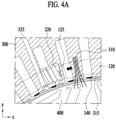
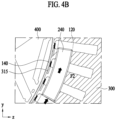
- FIGS. 4A and 4B are views illustrating a motor in which a magnetic field is not screened between a stator and a motor according to at least one example embodiment of the present disclosure.
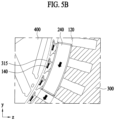
- FIGS. 5A and 5B are views illustrating a motor in which a magnetic field is screened between a stator and a motor according to at least one example embodiment of the present disclosure.
- the motor 10 may selectively screen a magnetic field flow between the stator 300 and the rotor 400 using the shield member 140.
- the shield member 140 may be fixed to the support element 120 to integrally move with the support element 120 when the support element 120 moves. Based on the moving of the support element 120, the shield member 140 may screen a magnetic field flow between the rotor 400 and the slot 310 in which a coil (not shown) is wound in the stator 300 as illustrated in FIG. 4A or not screen the magnetic field flow as illustrated in FIG. 5A .
- the stator 300 may include receiving grooves 315 into which the plurality of shield elements of the shield member 140 are respectively inserted according to the moving of the support element 120.
- the receiving groove 315 may be formed on one side of an end portion of the slot 310 adjacent to the rotor 400.
- the support element 120 and the shield member 140 may receive the rotational force F2 in the first direction due to an electromagnetic interaction between the magnetic element 240 and the stator 300. Accordingly, the shield member 140 may move relative to the stator 300 in the first direction, so that each of the shield elements is located outside the receiving groove 315.
- the magnetic field may be transmitted from coils wound in the slots 310 to the rotor 400 without interruption or intervention.
- the rotor 400 may rotate based on an electromagnetic interaction with the stator 300.
- the support element 120 and the shield member 140 may move in the second direction opposite to the first direction by the compression restoring force F1 of the elastic element 220. Accordingly, the shield elements of the shield member 140 may be respectively inserted into the receiving groove 315 of the stator 300.
- the magnetic field flow between the stator 300 and the rotor 400 may be screened or interrupted. For example, even when the rotor 400 rotates by an inertial force, the electromagnetic interaction between the stator 300 and the rotor 400 may not occur or may occur minimally.
- the elastic element 220 may connect the first protrusion 325 of the stator 300 and the second protrusion 125 of the support element 120 and is compressed or released when the support element 120 moves relative to the stator 300.
- the shield member 140 may rotate in the first direction or the second direction by an angle corresponding to a predetermined angle or a predetermined distance based on a rotation of the support element 120.
- the shield member 140 may partially rotate in the first direction or the second direction by an angle corresponding to "180°/(the number of the slots 310 of the stator 300)" or "180°/(the number of shield elements)."
- a further movement exceeding the predetermined distance or the predetermined angle may be restricted by an outer surface of a neighboring slot.
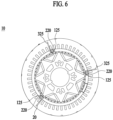
- FIG. 6 is a cross-sectional view illustrating a motor according to at least one example embodiment of the present disclosure.
- the motor 10 may include a plurality of elastic elements 220 as the moving member 200.
- the plurality of elastic elements 220 may be arranged to be spaced at equal intervals in the circumferential direction of the support element 120. Likewise, a plurality of first protrusions 325 may be provided in the stator 300 and a plurality of second protrusions 125 may be provided in the support element 120.
- the moving member 200 may guide a position of the shield member 140 with increased stability.
- the magnetic element 240 and the elastic element 220 may be provided as plural forms in the support element 120 disposed at each of the front end portion and the rear end portion of the shield member 140.
- the motor 10 may be provided in, for example, an electric vehicle.
- the electric vehicle may include a battery to supply power to the motor 10.
- the electric vehicle may use the motor 10 including the shield member 140 to selectively screen a magnetic field between the stator 300 and the rotor 400 only when the electric vehicle is driven by inertia. Through this, the electric vehicle may prevent an overcharging of the battery or a user from feeling uncomfortableness during driving due to an occurrence of unintentional regenerative braking, and may minimize a generation of a counter electromotive force.
- a motor with increased energy efficiency by applying a structure in which an electromagnetic interaction between a rotor and a stator occurs as intended during driving by an internal force and the electromagnetic interaction is restricted during driving by an external force.
- an electric vehicle equipped with the motor it is possible to provide an electric vehicle equipped with the motor to extend a maximum driving distance and improve a drivability during driving.
Landscapes
- Engineering & Computer Science (AREA)
- Power Engineering (AREA)
- Transportation (AREA)
- Mechanical Engineering (AREA)
- Physics & Mathematics (AREA)
- Electromagnetism (AREA)
- Life Sciences & Earth Sciences (AREA)
- Sustainable Development (AREA)
- Sustainable Energy (AREA)
- Chemical & Material Sciences (AREA)
- Combustion & Propulsion (AREA)
- Motor Or Generator Frames (AREA)
- Electric Propulsion And Braking For Vehicles (AREA)
- Iron Core Of Rotating Electric Machines (AREA)
Description
- This application claims the benefit of
Korean Patent Application No. 10-2019-0178791, filed on December 31, 2019 - This disclosure relates to a motor and an electric vehicle including the motor.
- A motor is a power device that generates a rotational force using electric power and is widely used in various fields such as a fan, a washing machine drum, and a drone blade.
- The motor may include a stator and a rotor that rotates relative to the stator. The stator may include a winding coil. When a current is applied to the winding coil, a magnetic field may be formed around the stator. Due to the magnetic field, the rotor may rotate relative to the stator, thereby generating power.
- Meanwhile, for various types of electric vehicles (e.g., an electric kickboard, an electric bicycle, an electric scooter, a hybrid electric vehicle (HEV), a battery electric vehicle (BEV), etc.) using the motor as a power source, when the motor is driven by inertia as in a case in which the electric vehicle runs elastically by inertia or travels downhill, a regenerative braking charging function that recovers energy through a regenerative torque and charges the battery is taken in consideration.
- However, since the regenerative torque and a traveling distance are in a mutually opposite relationship, the traveling distance corresponding to the inertia driving may be reduced in response to the regenerative torque being generated. For example, even when the inertia driving is intended at a constant speed, the regenerative braking may occur so that a driving speed decreases irrespective of the user's driving intention. As a result, unnecessary energy recycling due to the frequent generation of the driving torque and the regenerative torque may reduce fuel efficiency and maximum movable distance of the electric vehicle.
- Also, when the regenerative braking occurs, a drag phenomenon in which a body of a driver is dragged in a direction opposite to a driving direction may occur, which may cause an uncomfortableness (e.g., jerk) of the driver and degrades a drivability during the driving.
- In addition to the aforementioned cases, when a rotor of the motor rotates by inertia in an electronic device (e.g., a washing machine) including the motor, an unintended counter electromotive force may be generated, which may reduce an energy efficiency.
-
US 2004/251765 discloses an electrical machine of the prior art. -
EP 3 484 031 A1 -
EP 1 220 427 A2 relates to magnetic flux control means for a permanent-magnet motor-generator that is comprised of a rotor of permanent-magnet pieces supported for rotation in a stator housing. -
US 2015/130390 A1 relates to motors in which both the rotor component and the stator component have winding arrangements. -
US 2008/238220 A1 relates to a method of making a permanent magnet machine more fault-tolerant. - To solve the aforementioned issues, a damper or clutch may be installed in an electric vehicle. However, in this case, the installation of the damper or clutch may result in space waste and an increase in manufacturing costs.
- Also, control technologies that restrict a driving torque change rate or generate a damping force in a reversed direction of vibration generated when regenerative braking occurs may require a considerably precise design and, under a certain condition, deteriorate a torque responsiveness.
- An aspect of the present disclosure provides a motor to solve a problem caused by the regenerative braking or a counter electromotive force generated due to inertia driving in a mechanical manner, and an apparatus including the motor.
- According to an aspect, there is provided a motor including a shield member that screens a magnetic field between a stator and a rotor, and a moving member that controls a position of the shield member based on an electromagnetic interaction with the stator such that screening of the magnetic field is selectively performed.
- The invention is specified by the independent claims. Preferred embodiments are defined by the dependent claims.
- The above and other aspects, features, and advantages of certain embodiments will be more apparent from the following detailed description taken in conjunction with the accompanying drawings, in which:
-
FIG. 1 is an exploded perspective view illustrating a motor according to at least one example embodiment of the present disclosure; -
FIG. 2 is a perspective view illustrating a structure of a motor according to at least one example embodiment of the present disclosure; -
FIG. 3 is a cross-sectional view illustrating an operation of a motor according to at least one example embodiment of the present disclosure; -
FIGS. 4A and4B are views illustrating a motor in which a magnetic field is not screened between a stator and a motor according to at least one example embodiment of the present disclosure; -
FIGS. 5A and5B are views illustrating a motor in which a magnetic field is screened between a stator and a motor according to at least one example embodiment of the present disclosure; and -
FIG. 6 is a cross-sectional view illustrating a motor according to at least one example embodiment of the present disclosure. - Hereinafter, preferred embodiments of the present disclosure will be described in detail with reference to the accompanying drawings, and the same or similar elements are designated with the same numeral references regardless of the numerals in the drawings and their redundant description will be omitted. A suffix "module" or "unit" used for constituent elements disclosed in the following description is merely intended for easy description of the specification, and the suffix itself does not give any special meaning or function. In describing the present disclosure, moreover, the detailed description will be omitted when a specific description for publicly known technologies to which the invention pertains is judged to obscure the gist of the present disclosure. Also, it should be noted that the accompanying drawings are merely illustrated to easily explain the concept of the invention, and therefore, they should not be construed to limit the technological concept disclosed herein by the accompanying drawings.
- The terms "first," "second," etc. may be used to describe various components, but the components are not limited by such terms. The terms are used only for the purpose of distinguishing one component from other components.
- When an arbitrary component is described as "being connected to" or "being linked to" another component, this should be understood to mean that still another component(s) may exist between them, although the arbitrary component may be directly connected to, or linked to, the corresponding other component. In contrast, when an arbitrary component is described as "being directly connected to" or "being directly linked to" another component, this should be understood to mean that no component exists between them.
- A singular expression can include a plural expression as long as it does not have an apparently different meaning in context.
- In the present application, the terms "include" and "have" should be understood to be intended to designate that illustrated features, numbers, steps, operations, components, parts or combinations thereof exist and not to preclude the existence of one or more different features, numbers, steps, operations, components, parts or combinations thereof, or the possibility of the addition thereof.
-
FIG. 1 is an exploded perspective view illustrating a motor according to at least one example embodiment of the present disclosure.FIG. 2 is a perspective view illustrating a structure of a motor according to at least one example embodiment of the present disclosure. - According to at least one example embodiment, a
motor 10 may generate a rotational torque by receiving electric power from a battery, thereby converting electric energy into power energy. Themotor 10 may be mounted on an electric vehicle (e.g., an electric kickboard, an electric bicycle, an electric scooter, a hybrid electric vehicle (HEV), a battery electric vehicle (BEV), etc.) and rotate wheels of the electric vehicle while themotor 10 is driven. - Referring to
FIGS. 1 and2 , themotor 10 includes astator 300 and arotor 400. - The rotor 400 (e.g., a rotator) may be disposed to be rotatable relative to the stator 300 (e.g., a stationary core) based on an electromagnetic interaction with the
stator 300. - The
stator 300 may include a winding coil. When a current is applied to the winding coil, a magnetic field may be formed around thestator 300. Therotor 400 may be driven in one direction, for example, a clockwise direction or a counterclockwise direction by the magnetic field around thestator 300. - For example, the
rotor 400 may be disposed inside thestator 300 to rotate relative to thestator 300. However, embodiments are not limited to such structure of themotor 10, and various structures such as a structure in which thestator 300 is disposed inside therotor 400 or a structure in which therotor 400 faces thestator 300 are applicable here. - According to at least one example embodiment, the
motor 10 may further include ashield member 140. - The
shield member 140 may screen a magnetic field between thestator 300 and therotor 400. Theshield member 140 may include a magnetic shielding material that reduces an influence of external magnetic fields. For example, theshield member 140 may be formed of a high permeability alloy such as a magnetic material, permalloy, silicon steel, and the like. - As illustrated in
FIG. 1 , theshield member 140 may include a plurality of shield elements extending in an axial direction (e.g., +z direction) of themotor 10. - The plurality of shield elements included in the
shield member 140 may be arranged between thestator 300 and therotor 400 to be spaced apart from one another. For example, the shield elements may have a shape of a bar extending in the axial direction of the motor. Also, the shield elements are arranged to be spaced at equal intervals in a circumferential direction of themotor 10 so as to form a shape of a cage. - The shield elements may be axially or longitudinally greater in length than the
stator 300 and therotor 400. Both ends of the shield elements may be connected to asupport element 120 of a movingmember 200 and supported by thesupport element 120 outside of thestator 300 and therotor 400. - For example, a number of the shield elements may be set to be equal to a number of slots 310 (refer to
FIG. 4A ) formed in thestator 300 such that the shield elements respectively correspond to theslots 310. Each of the shield elements may be disposed on an inner side of an end portion of each of theslots 310 in which a coil of thestator 300 is wound. That is, the shield elements are arranged between the winding coil of thestator 300 and therotor 400 to restrict an electromagnetic interaction between the coil of thestator 300 and therotor 400. A circumferential width of the shield element may be less than a width of the end portion of theslot 310 formed in thestator 300. For example, theshield member 140 may be disposed to be inserted into or released from a receiving groove 315 (refer toFIG. 4A ) prepared in the end portion of theslot 310. - According to at least one example embodiment, the
motor 10 may further include the movingmember 200 to control a position of theshield member 140. Hereinafter, an operation of the movingmember 200 will be described with reference toFIG. 3 . -
FIG. 3 is a cross-sectional view illustrating an operation of a motor according to at least one example embodiment of the present disclosure. - According to at least one example embodiment, the moving
member 200 includes thesupport element 120, amagnetic element 240, and anelastic element 220. - The
support element 120 may be connected to theshield member 140 to change a position of theshield member 140 using power of the movingmember 200. For example, thesupport element 120 may have a ring shape to be connected to the shield elements of theshield member 140. Also, thesupport element 120 may be provided at a position between thestator 300 and therotor 400 in both end portions in an axial direction of thestator 300 and therotor 400. For example, an outer diameter of thesupport element 120 may be greater than an outer diameter of therotor 400 and less than an outer diameter of thestator 300. - Both end portions (e.g., a front end portion and a rear end portion) of each of the shield elements of the
shield member 140 may be fixed to thesupport element 120. Also, the shield elements of theshield member 140 may be arranged to be spaced at preset intervals in the circumferential direction of thesupport element 120. - The
support element 120 may be disposed at each of a front end portion and a rear end portion of the shield member 140 (the plurality of shield elements). Thesupport element 120 may support theshield member 140 at both end portions such that a position and an arrangement of theshield member 140 are maintained. Also, thesupport element 120 may be disposed to be rotatable based on a rotation axis of the motor 10 (for example, the rotor 400) so as to integrally rotate with theshield member 140. - The
magnetic element 240 and theelastic element 220 may be located on one side of thesupport element 120. For example, themagnetic element 240 may be fixed to one side of an outer surface of thesupport element 120 having the ring shape to provide a rotational force to thesupport element 120. - The
magnetic element 240 may move thesupport element 120 and theshield member 140 based on an electromagnetic interaction with thestator 300. For example, themagnetic element 240 may generate a rotational force F2 in one direction (e.g., a clockwise direction or a counterclockwise direction) based on a magnetic field formed in response to a current being applied to the coil wound in thestator 300. - A shape and size of the
magnetic element 240 and the number of themagnetic element 240 are not limited as illustrated inFIGS. 1 and2 . Various shapes, sizes, and numbers of themagnetic elements 240 by which themagnetic element 240 is able to generate the electromagnetic interaction with the stator 300 (e.g., the winding coil of the stator 300) to rotate thesupport element 120 and theshield member 140 may apply here. - For example, the
magnetic element 240 may generate attraction with the slots sequentially in the circumferential direction by a 3-phase AC power applied through the coil wound in therespective slots 310 of thestator 300. As illustrated inFIG. 3 , themagnetic element 240 may sequentially generate attraction with theslots 310 indicated byreference numerals magnetic element 240 may generate the rotational force F2 in the circumferential direction with respect to thesupport element 120. Thesupport element 120 and theshield member 140 may be rotated by the rotational force F2 in a first direction in which the rotational force F2 acts. - The
elastic element 220 may be compressed when thesupport element 120 is rotated by themagnetic element 240. In this instance, theelastic element 220 may generate a compression restoring force F1 in a direction opposite to a rotation direction of thesupport element 120. By the compression restoring force F1, thesupport element 120 and theshield member 140 may rotate in a second direction opposite to the first direction. - The
elastic element 220 may be interposed between afirst protrusion 325 formed in thestator 300 and asecond protrusion 125 formed in thesupport element 120. Theelastic element 220 may include, for example, a spring. One end of theelastic element 220 may be fixed to thefirst protrusion 325 and the other end of theelastic element 220 may be fixed to thesecond protrusion 125. - The
elastic element 220 may be pressurized by thesecond protrusion 125 in the first direction when thesupport element 120 rotates relative to thestator 300 in the first direction, so as to be compressed. Also, according to theelastic element 220 being compressed, the compression restoring force F1 may be generated in the second direction opposite to a direction in which theelastic element 220 is compressed. - In the
motor 10, the rotational force F2 based on the attraction between themagnetic element 240 and thestator 300 may be greater than the compression restoring force F1 of theelastic element 220. - The
support element 120 may partially rotate in the first direction based on the rotational force F2 by themagnetic element 240 in a state in which therotor 400 is driven by the magnetic field formed in thestator 300. - Also, in a state in which the magnetic field is not formed in the
stator 300 and therotor 400 is not driven, thesupport element 120 may partially rotate in the second direction based on the compression restoring force F1 by theelastic element 220. - The
support element 120 may move theshield member 140 by a predetermined distance based on the rotating. For example, thesupport element 120 may rotate by a distance corresponding to a half of an interval between neighboring shield elements. The shield elements may be arranged to be spaced at equal intervals in the circumferential direction. A degree to which thesupport element 120 rotates may be determined based on the number of shield elements included in theshield member 140. - For example, the
support element 120 may rotate in the first direction or the second direction by an angle corresponding to "180°/(the number of theslots 310 of the stator 300)" or "180°/(the number of shield elements)." - The
motor 10 may further include end rings 500 located at both end portions in the axial direction of themotor 10. The end rings 500 may prevent therotor 400 and the movingmember 200 from being deviated. -
FIGS. 4A and4B are views illustrating a motor in which a magnetic field is not screened between a stator and a motor according to at least one example embodiment of the present disclosure.FIGS. 5A and5B are views illustrating a motor in which a magnetic field is screened between a stator and a motor according to at least one example embodiment of the present disclosure. - Referring to
FIGS. 4A through 4B , themotor 10 may selectively screen a magnetic field flow between thestator 300 and therotor 400 using theshield member 140. - The
shield member 140 may be fixed to thesupport element 120 to integrally move with thesupport element 120 when thesupport element 120 moves. Based on the moving of thesupport element 120, theshield member 140 may screen a magnetic field flow between therotor 400 and theslot 310 in which a coil (not shown) is wound in thestator 300 as illustrated inFIG. 4A or not screen the magnetic field flow as illustrated inFIG. 5A . - The
stator 300 may include receivinggrooves 315 into which the plurality of shield elements of theshield member 140 are respectively inserted according to the moving of thesupport element 120. For example, the receivinggroove 315 may be formed on one side of an end portion of theslot 310 adjacent to therotor 400. - Referring to
FIGS. 4A and4B , in a state in which themotor 10 is driven and a current is applied to a coil of thestator 300, thesupport element 120 and theshield member 140 may receive the rotational force F2 in the first direction due to an electromagnetic interaction between themagnetic element 240 and thestator 300. Accordingly, theshield member 140 may move relative to thestator 300 in the first direction, so that each of the shield elements is located outside the receivinggroove 315. - When the
shield member 140 is located outside the receivinggroove 315, the magnetic field may be transmitted from coils wound in theslots 310 to therotor 400 without interruption or intervention. Therotor 400 may rotate based on an electromagnetic interaction with thestator 300. - Referring to
FIGS. 5A and5B , in a state in which the driving of themotor 10 is suspended and the current is not applied to the coil of thestator 300, thesupport element 120 and theshield member 140 may move in the second direction opposite to the first direction by the compression restoring force F1 of theelastic element 220. Accordingly, the shield elements of theshield member 140 may be respectively inserted into the receivinggroove 315 of thestator 300. - When the
shield member 140 is located inside the receivinggroove 315, the magnetic field flow between thestator 300 and therotor 400 may be screened or interrupted. For example, even when therotor 400 rotates by an inertial force, the electromagnetic interaction between thestator 300 and therotor 400 may not occur or may occur minimally. - The
elastic element 220 may connect thefirst protrusion 325 of thestator 300 and thesecond protrusion 125 of thesupport element 120 and is compressed or released when thesupport element 120 moves relative to thestator 300. - According to at least one example embodiment, the
shield member 140 may rotate in the first direction or the second direction by an angle corresponding to a predetermined angle or a predetermined distance based on a rotation of thesupport element 120. For example, theshield member 140 may partially rotate in the first direction or the second direction by an angle corresponding to "180°/(the number of theslots 310 of the stator 300)" or "180°/(the number of shield elements)." - When the
shield member 140 rotates in the first direction and is located outside the receivinggroove 315 as illustrated inFIG. 4A , a further movement exceeding the predetermined distance or the predetermined angle may be restricted by an outer surface of a neighboring slot. - When the
shield member 140 rotates in the second direction and is located inside the receivinggroove 315 as illustrated inFIG. 5A , a further movement exceeding the predetermined distance or the predetermined angle may be restricted since only a movement corresponding to a length of the receivinggroove 315 or less is allowed. -
FIG. 6 is a cross-sectional view illustrating a motor according to at least one example embodiment of the present disclosure. - Referring to
FIG. 6 , themotor 10 may include a plurality ofelastic elements 220 as the movingmember 200. - The plurality of
elastic elements 220 may be arranged to be spaced at equal intervals in the circumferential direction of thesupport element 120. Likewise, a plurality offirst protrusions 325 may be provided in thestator 300 and a plurality ofsecond protrusions 125 may be provided in thesupport element 120. - As illustrated in
FIG. 6 , by using the plurality ofelastic elements 220, the movingmember 200 may guide a position of theshield member 140 with increased stability. - Although not shown, the
magnetic element 240 and theelastic element 220 may be provided as plural forms in thesupport element 120 disposed at each of the front end portion and the rear end portion of theshield member 140. - According to at least one example embodiment, the
motor 10 may be provided in, for example, an electric vehicle. The electric vehicle may include a battery to supply power to themotor 10. - The electric vehicle may use the
motor 10 including theshield member 140 to selectively screen a magnetic field between thestator 300 and therotor 400 only when the electric vehicle is driven by inertia. Through this, the electric vehicle may prevent an overcharging of the battery or a user from feeling uncomfortableness during driving due to an occurrence of unintentional regenerative braking, and may minimize a generation of a counter electromotive force. - According to at least one example embodiment, it is possible to provide a motor with increased energy efficiency by applying a structure in which an electromagnetic interaction between a rotor and a stator occurs as intended during driving by an internal force and the electromagnetic interaction is restricted during driving by an external force.
- Further, according to at least one example embodiment, it is possible to provide an electric vehicle equipped with the motor to extend a maximum driving distance and improve a drivability during driving.
- It is apparent to those skilled in the art that the present disclosure may be materialized in other specific forms without departing from the essential characteristics of the present disclosure.
- The detailed description should not be construed as being limitative from all aspects, but should be construed as being illustrative. The scope of the present disclosure should be determined by reasonable analysis of the attached claims, and all changes within the equivalent range of the present disclosure are included in the scope of the present disclosure.
Claims (14)
- A motor (10) comprising:a stator (300);a rotor (400) configured to rotate inside the stator (300) in response to an electromagnetic interaction with the stator (300);wherein the motor (10) further comprises:a shield member (140) comprising a plurality of shield elements configured to screen a magnetic field between the stator (300) and the rotor (400); anda moving member (200) configured to control a position of the shield member (140) in response to an electromagnetic interaction with the stator (300) such that screening of the magnetic field is configured to be selectively performed,characterised in that the moving member (200) comprises:a support element (120) configured to integrally rotate with the shield member (140),a magnetic element (240) disposed on one side of the support element (120) and rotating the support element (120) in a first direction in response to an electromagnetic interaction with the stator (300) andan elastic element (220) disposed on the other side of the support element (120) and rotating the support element (120) in a second direction opposite to the first direction in response to a compression restoring force.
- The motor (10) of claim 1, wherein the stator (300) comprises a plurality of receiving grooves (315) into which the plurality of shield elements is inserted, and
the moving member (200) is further configured to position the shield elements inside the receiving grooves (315) or outside the receiving grooves (315) in response to the electromagnetic interaction with the stator (300). - The motor (10) of claim 2, wherein the shield member (140) is configured to screen a magnetic field flow between the stator (300) and the rotor (400) when the shield elements are located inside the receiving grooves (315), and is configured not to screen the magnetic field flow between the stator (300) and the rotor (400) when the shield elements are located outside the receiving grooves (315).
- The motor (10) of any one of the preceding claims , wherein the plurality of shield elements is spaced between the stator (300) and the rotor (400) at equal intervals in a circumferential direction..
- The motor (10) of any one of the preceding claims, wherein the elastic element (220) is interposed between a first protrusion (325) formed in the stator (300) and a second protrusion (125) formed in the support element (120), and compressed by the first protrusion (325) of the stator (300) and the second protrusion (125) of the support element (120) when the support element (120) rotates in the first direction.
- The motor (10) of claim 5, wherein when the electromagnetic interaction between the stator (300) and the magnetic element (240) does not occur, the support element (120) rotates in the second direction based on the compression restoring force from the elastic element (220).
- The motor (10) of claim 6, insofar as dependent upon claim 2, wherein the shield member (140) is further configured to screen the magnetic field between the stator (300) and the rotor (400) in response to the shield elements being located inside the receiving grooves (315) when the support element (120) rotates in the second direction based on the compression restoring force from the magnetic element (240).
- The motor (10) of any one of claims 5 to 7, insofar as dependent upon claim 2, wherein the shield member (140) is further configured not to screen a magnetic field flow between the stator (300) and the rotor (400) in response to the shield elements being located outside the receiving grooves (315) when the support element (120) rotates in the first direction in response to the electromagnetic interaction between the stator (300) and the magnetic element (240).
- A vehicle comprising:a battery; anda motor (10) configured to generate a rotational torque by receiving electric power from the battery,wherein the motor (10) is a motor according to claim 1.
- The vehicle of claim 9, wherein the moving member (200) comprises:
wherein the magnetic element (240) is configured to generate an electromagnetic interaction with the stator (300) when the rotor (400) rotates in response to the electromagnetic interaction between the stator (300) and the rotor (400). - The vehicle of claim 10, wherein when the electromagnetic interaction between the stator (300) and the magnetic element (240) occurs, the shield member (140) is formed in the stator (300) so as not to screen a magnetic field flow between the stator (300) and the rotor (400).
- The vehicle of claim 10 or 11, wherein the shield member (140) comprises a plurality of shield elements spaced between the stator (300) and the rotor (400) at equal intervals in a circumferential direction, and
the support element (120) is positioned at both end portions in axial direction of the plurality of shield elements to integrally rotate with the shield elements. - The vehicle of any one of claims 10 to 12, wherein the support element (120) is rotated a predetermined distance by the magnetic element (240) or the elastic element (220) in a clockwise direction or a counterclockwise direction.
- The vehicle of any one of claims 10 to 13, wherein the support element (120) is rotated by at least one of the magnetic element (240) or the elastic element (220) in the clockwise direction or in the counterclockwise direction at an interval at which the plurality of shield elements is arranged.
Applications Claiming Priority (1)
| Application Number | Priority Date | Filing Date | Title |
|---|---|---|---|
| KR1020190178791A KR102736177B1 (en) | 2019-12-31 | 2019-12-31 | Motor and electric vehicle including the same |
Publications (2)
| Publication Number | Publication Date |
|---|---|
| EP3846325A1 EP3846325A1 (en) | 2021-07-07 |
| EP3846325B1 true EP3846325B1 (en) | 2023-11-15 |
Family
ID=70977774
Family Applications (1)
| Application Number | Title | Priority Date | Filing Date |
|---|---|---|---|
| EP20178200.0A Active EP3846325B1 (en) | 2019-12-31 | 2020-06-04 | Motor and electric vehicle including the same |
Country Status (4)
| Country | Link |
|---|---|
| US (1) | US11606007B2 (en) |
| EP (1) | EP3846325B1 (en) |
| KR (1) | KR102736177B1 (en) |
| CN (1) | CN113067435B (en) |
Families Citing this family (1)
| Publication number | Priority date | Publication date | Assignee | Title |
|---|---|---|---|---|
| CN118457272B (en) * | 2024-07-11 | 2024-12-10 | 比亚迪股份有限公司 | Electric drive assembly, vehicle control method, and vehicle |
Family Cites Families (20)
| Publication number | Priority date | Publication date | Assignee | Title |
|---|---|---|---|---|
| US4190794A (en) * | 1978-03-20 | 1980-02-26 | Kreso Mikulic | Alternating current motor with adjustable output torque by means of adjustable magnetic bars |
| JP2000261988A (en) | 1999-03-12 | 2000-09-22 | Isuzu Ceramics Res Inst Co Ltd | Motors and generators that prevent cogging and reduce torque at high speeds |
| US6700242B2 (en) * | 2000-12-28 | 2004-03-02 | Hideo Kawamura | Magnetic flux controls for permanent-magnet motor-generator |
| US7253548B2 (en) | 2003-06-16 | 2007-08-07 | Pratt & Whitney Canada Corp. | Method and apparatus for controlling an electric machine |
| US7902700B1 (en) * | 2006-04-03 | 2011-03-08 | Gabrys Christopher W | Low harmonic loss brushless motor |
| US7605504B2 (en) | 2007-03-28 | 2009-10-20 | General Electric Company | Fault-tolerant permanent magnet machine with reconfigurable stator core slot flux paths |
| DE102012215106A1 (en) * | 2012-08-24 | 2014-02-27 | Siemens Aktiengesellschaft | Device for braking a rotating shaft of an arrangement and arrangement with such a device |
| US9130433B2 (en) | 2013-11-14 | 2015-09-08 | Arm Limited | Electronically controlled universal motor |
| CN106165266B (en) * | 2014-10-10 | 2019-01-08 | 株式会社安川电机 | Motors and motor encoders |
| US10199254B2 (en) | 2015-05-12 | 2019-02-05 | Nexperia B.V. | Method and system for transferring semiconductor devices from a wafer to a carrier structure |
| DE102015211644B4 (en) * | 2015-06-24 | 2026-02-19 | Bayerische Motoren Werke Aktiengesellschaft | Improved electromagnetic compatibility of a drive system for an electrically powered vehicle |
| US10574118B2 (en) | 2016-04-05 | 2020-02-25 | Denso Corporation | Rotating electric machine |
| US10516305B2 (en) | 2017-05-23 | 2019-12-24 | Ford Global Technologies, Llc | Variable flux bridge for rotor of an electric machine |
| DE102017210675A1 (en) * | 2017-06-26 | 2018-12-27 | Bayerische Motoren Werke Aktiengesellschaft | Electric motor assembly |
| TWI722450B (en) * | 2017-08-16 | 2021-03-21 | 美商愛康運動與健康公司 | System for opposing axial impact loading in a motor |
| GB201718452D0 (en) * | 2017-11-08 | 2017-12-20 | Rolls Royce Plc | Permanent magnet electrical machine |
| US10541578B2 (en) | 2018-01-02 | 2020-01-21 | GM Global Technology Operations LLC | Permanent magnet electric machine with moveable flux-shunting elements |
| CN110022049A (en) * | 2018-01-06 | 2019-07-16 | 李怀金 | Magnetic perPETual motion machine |
| US11005320B2 (en) | 2018-05-04 | 2021-05-11 | Ford Global Technologies, Llc | Variable flux bridge for rotor of an electric machine |
| CN109768634A (en) * | 2019-04-01 | 2019-05-17 | 余谦 | A method of enhancing motor outputting torsion |
-
2019
- 2019-12-31 KR KR1020190178791A patent/KR102736177B1/en active Active
-
2020
- 2020-04-10 US US16/846,212 patent/US11606007B2/en active Active
- 2020-06-04 EP EP20178200.0A patent/EP3846325B1/en active Active
- 2020-07-03 CN CN202010630588.4A patent/CN113067435B/en active Active
Also Published As
| Publication number | Publication date |
|---|---|
| US20210203211A1 (en) | 2021-07-01 |
| KR20210085589A (en) | 2021-07-08 |
| US11606007B2 (en) | 2023-03-14 |
| CN113067435B (en) | 2024-02-20 |
| KR102736177B1 (en) | 2024-11-28 |
| CN113067435A (en) | 2021-07-02 |
| EP3846325A1 (en) | 2021-07-07 |
Similar Documents
| Publication | Publication Date | Title |
|---|---|---|
| US7462968B2 (en) | Electric wheel | |
| JP4013487B2 (en) | Rotating electric machine and vehicle equipped with the same | |
| JP4449035B2 (en) | Permanent magnet rotating electric machine for electric vehicles | |
| US20090001831A1 (en) | Axial Field Electric Motor and Method | |
| EP2053722A2 (en) | Electrical machine and vehicle drive equipped with the same | |
| US6724115B2 (en) | High electrical and mechanical response structure of motor-generator | |
| JP6327474B2 (en) | Outer rotor type variable field motor | |
| CN101874338B (en) | Flux shunt control rotary electric machine system | |
| KR20110021749A (en) | Power generator | |
| EP2696485B1 (en) | Electric rotating machine | |
| WO2017090159A1 (en) | Rotary electric machine | |
| JP5323592B2 (en) | Permanent magnet rotating electric machine and electric vehicle using the same | |
| JP5612632B2 (en) | Permanent magnet rotating electric machine | |
| EP3846325B1 (en) | Motor and electric vehicle including the same | |
| KR101331696B1 (en) | Apparatus of Driving Wheels for in-wheel System | |
| CN106143118B (en) | A kind of automobile with disc type wheel hub motor | |
| JP2002136012A (en) | Permanent magnet type rotating electric machine | |
| JP2013046430A (en) | Rotor structure of rotary electric machine | |
| EP3487052A1 (en) | Motor and brake disc thereof, hub motor, and vehicle having a disc hub motor | |
| KR20130062805A (en) | Variable flux appataus for motor rotor | |
| JP6088465B2 (en) | Drive unit | |
| KR101515200B1 (en) | Ac generator for vehicle | |
| JP2025165339A (en) | Variable field rotor | |
| Cho | Axial Field Electric Motor and Method | |
| WO2016042668A1 (en) | Vehicle braking system and vehicle |
Legal Events
| Date | Code | Title | Description |
|---|---|---|---|
| STAA | Information on the status of an ep patent application or granted ep patent |
Free format text: STATUS: REQUEST FOR EXAMINATION WAS MADE |
|
| PUAI | Public reference made under article 153(3) epc to a published international application that has entered the european phase |
Free format text: ORIGINAL CODE: 0009012 |
|
| 17P | Request for examination filed |
Effective date: 20200704 |
|
| AK | Designated contracting states |
Kind code of ref document: A1 Designated state(s): AL AT BE BG CH CY CZ DE DK EE ES FI FR GB GR HR HU IE IS IT LI LT LU LV MC MK MT NL NO PL PT RO RS SE SI SK SM TR |
|
| RAP1 | Party data changed (applicant data changed or rights of an application transferred) |
Owner name: LG MAGNA E-POWERTRAIN CO., LTD. |
|
| STAA | Information on the status of an ep patent application or granted ep patent |
Free format text: STATUS: EXAMINATION IS IN PROGRESS |
|
| 17Q | First examination report despatched |
Effective date: 20220801 |
|
| GRAP | Despatch of communication of intention to grant a patent |
Free format text: ORIGINAL CODE: EPIDOSNIGR1 |
|
| STAA | Information on the status of an ep patent application or granted ep patent |
Free format text: STATUS: GRANT OF PATENT IS INTENDED |
|
| INTG | Intention to grant announced |
Effective date: 20230718 |
|
| GRAS | Grant fee paid |
Free format text: ORIGINAL CODE: EPIDOSNIGR3 |
|
| GRAA | (expected) grant |
Free format text: ORIGINAL CODE: 0009210 |
|
| STAA | Information on the status of an ep patent application or granted ep patent |
Free format text: STATUS: THE PATENT HAS BEEN GRANTED |
|
| AK | Designated contracting states |
Kind code of ref document: B1 Designated state(s): AL AT BE BG CH CY CZ DE DK EE ES FI FR GB GR HR HU IE IS IT LI LT LU LV MC MK MT NL NO PL PT RO RS SE SI SK SM TR |
|
| REG | Reference to a national code |
Ref country code: CH Ref legal event code: EP Ref country code: GB Ref legal event code: FG4D |
|
| REG | Reference to a national code |
Ref country code: DE Ref legal event code: R096 Ref document number: 602020020966 Country of ref document: DE |
|
| REG | Reference to a national code |
Ref country code: IE Ref legal event code: FG4D |
|
| REG | Reference to a national code |
Ref country code: LT Ref legal event code: MG9D |
|
| REG | Reference to a national code |
Ref country code: NL Ref legal event code: MP Effective date: 20231115 |
|
| PG25 | Lapsed in a contracting state [announced via postgrant information from national office to epo] |
Ref country code: GR Free format text: LAPSE BECAUSE OF FAILURE TO SUBMIT A TRANSLATION OF THE DESCRIPTION OR TO PAY THE FEE WITHIN THE PRESCRIBED TIME-LIMIT Effective date: 20240216 |
|
| PG25 | Lapsed in a contracting state [announced via postgrant information from national office to epo] |
Ref country code: IS Free format text: LAPSE BECAUSE OF FAILURE TO SUBMIT A TRANSLATION OF THE DESCRIPTION OR TO PAY THE FEE WITHIN THE PRESCRIBED TIME-LIMIT Effective date: 20240315 |
|
| PG25 | Lapsed in a contracting state [announced via postgrant information from national office to epo] |
Ref country code: LT Free format text: LAPSE BECAUSE OF FAILURE TO SUBMIT A TRANSLATION OF THE DESCRIPTION OR TO PAY THE FEE WITHIN THE PRESCRIBED TIME-LIMIT Effective date: 20231115 |
|
| REG | Reference to a national code |
Ref country code: AT Ref legal event code: MK05 Ref document number: 1632674 Country of ref document: AT Kind code of ref document: T Effective date: 20231115 |
|
| PG25 | Lapsed in a contracting state [announced via postgrant information from national office to epo] |
Ref country code: NL Free format text: LAPSE BECAUSE OF FAILURE TO SUBMIT A TRANSLATION OF THE DESCRIPTION OR TO PAY THE FEE WITHIN THE PRESCRIBED TIME-LIMIT Effective date: 20231115 |
|
| PG25 | Lapsed in a contracting state [announced via postgrant information from national office to epo] |
Ref country code: AT Free format text: LAPSE BECAUSE OF FAILURE TO SUBMIT A TRANSLATION OF THE DESCRIPTION OR TO PAY THE FEE WITHIN THE PRESCRIBED TIME-LIMIT Effective date: 20231115 |
|
| PG25 | Lapsed in a contracting state [announced via postgrant information from national office to epo] |
Ref country code: ES Free format text: LAPSE BECAUSE OF FAILURE TO SUBMIT A TRANSLATION OF THE DESCRIPTION OR TO PAY THE FEE WITHIN THE PRESCRIBED TIME-LIMIT Effective date: 20231115 |
|
| PG25 | Lapsed in a contracting state [announced via postgrant information from national office to epo] |
Ref country code: NL Free format text: LAPSE BECAUSE OF FAILURE TO SUBMIT A TRANSLATION OF THE DESCRIPTION OR TO PAY THE FEE WITHIN THE PRESCRIBED TIME-LIMIT Effective date: 20231115 Ref country code: LT Free format text: LAPSE BECAUSE OF FAILURE TO SUBMIT A TRANSLATION OF THE DESCRIPTION OR TO PAY THE FEE WITHIN THE PRESCRIBED TIME-LIMIT Effective date: 20231115 Ref country code: IS Free format text: LAPSE BECAUSE OF FAILURE TO SUBMIT A TRANSLATION OF THE DESCRIPTION OR TO PAY THE FEE WITHIN THE PRESCRIBED TIME-LIMIT Effective date: 20240315 Ref country code: GR Free format text: LAPSE BECAUSE OF FAILURE TO SUBMIT A TRANSLATION OF THE DESCRIPTION OR TO PAY THE FEE WITHIN THE PRESCRIBED TIME-LIMIT Effective date: 20240216 Ref country code: ES Free format text: LAPSE BECAUSE OF FAILURE TO SUBMIT A TRANSLATION OF THE DESCRIPTION OR TO PAY THE FEE WITHIN THE PRESCRIBED TIME-LIMIT Effective date: 20231115 Ref country code: BG Free format text: LAPSE BECAUSE OF FAILURE TO SUBMIT A TRANSLATION OF THE DESCRIPTION OR TO PAY THE FEE WITHIN THE PRESCRIBED TIME-LIMIT Effective date: 20240215 Ref country code: AT Free format text: LAPSE BECAUSE OF FAILURE TO SUBMIT A TRANSLATION OF THE DESCRIPTION OR TO PAY THE FEE WITHIN THE PRESCRIBED TIME-LIMIT Effective date: 20231115 Ref country code: PT Free format text: LAPSE BECAUSE OF FAILURE TO SUBMIT A TRANSLATION OF THE DESCRIPTION OR TO PAY THE FEE WITHIN THE PRESCRIBED TIME-LIMIT Effective date: 20240315 |
|
| PG25 | Lapsed in a contracting state [announced via postgrant information from national office to epo] |
Ref country code: SE Free format text: LAPSE BECAUSE OF FAILURE TO SUBMIT A TRANSLATION OF THE DESCRIPTION OR TO PAY THE FEE WITHIN THE PRESCRIBED TIME-LIMIT Effective date: 20231115 Ref country code: RS Free format text: LAPSE BECAUSE OF FAILURE TO SUBMIT A TRANSLATION OF THE DESCRIPTION OR TO PAY THE FEE WITHIN THE PRESCRIBED TIME-LIMIT Effective date: 20231115 Ref country code: PL Free format text: LAPSE BECAUSE OF FAILURE TO SUBMIT A TRANSLATION OF THE DESCRIPTION OR TO PAY THE FEE WITHIN THE PRESCRIBED TIME-LIMIT Effective date: 20231115 Ref country code: NO Free format text: LAPSE BECAUSE OF FAILURE TO SUBMIT A TRANSLATION OF THE DESCRIPTION OR TO PAY THE FEE WITHIN THE PRESCRIBED TIME-LIMIT Effective date: 20240215 Ref country code: LV Free format text: LAPSE BECAUSE OF FAILURE TO SUBMIT A TRANSLATION OF THE DESCRIPTION OR TO PAY THE FEE WITHIN THE PRESCRIBED TIME-LIMIT Effective date: 20231115 Ref country code: HR Free format text: LAPSE BECAUSE OF FAILURE TO SUBMIT A TRANSLATION OF THE DESCRIPTION OR TO PAY THE FEE WITHIN THE PRESCRIBED TIME-LIMIT Effective date: 20231115 |
|
| PG25 | Lapsed in a contracting state [announced via postgrant information from national office to epo] |
Ref country code: DK Free format text: LAPSE BECAUSE OF FAILURE TO SUBMIT A TRANSLATION OF THE DESCRIPTION OR TO PAY THE FEE WITHIN THE PRESCRIBED TIME-LIMIT Effective date: 20231115 |
|
| PG25 | Lapsed in a contracting state [announced via postgrant information from national office to epo] |
Ref country code: CZ Free format text: LAPSE BECAUSE OF FAILURE TO SUBMIT A TRANSLATION OF THE DESCRIPTION OR TO PAY THE FEE WITHIN THE PRESCRIBED TIME-LIMIT Effective date: 20231115 |
|
| PG25 | Lapsed in a contracting state [announced via postgrant information from national office to epo] |
Ref country code: SK Free format text: LAPSE BECAUSE OF FAILURE TO SUBMIT A TRANSLATION OF THE DESCRIPTION OR TO PAY THE FEE WITHIN THE PRESCRIBED TIME-LIMIT Effective date: 20231115 |
|
| PG25 | Lapsed in a contracting state [announced via postgrant information from national office to epo] |
Ref country code: SM Free format text: LAPSE BECAUSE OF FAILURE TO SUBMIT A TRANSLATION OF THE DESCRIPTION OR TO PAY THE FEE WITHIN THE PRESCRIBED TIME-LIMIT Effective date: 20231115 Ref country code: SK Free format text: LAPSE BECAUSE OF FAILURE TO SUBMIT A TRANSLATION OF THE DESCRIPTION OR TO PAY THE FEE WITHIN THE PRESCRIBED TIME-LIMIT Effective date: 20231115 Ref country code: RO Free format text: LAPSE BECAUSE OF FAILURE TO SUBMIT A TRANSLATION OF THE DESCRIPTION OR TO PAY THE FEE WITHIN THE PRESCRIBED TIME-LIMIT Effective date: 20231115 Ref country code: IT Free format text: LAPSE BECAUSE OF FAILURE TO SUBMIT A TRANSLATION OF THE DESCRIPTION OR TO PAY THE FEE WITHIN THE PRESCRIBED TIME-LIMIT Effective date: 20231115 Ref country code: EE Free format text: LAPSE BECAUSE OF FAILURE TO SUBMIT A TRANSLATION OF THE DESCRIPTION OR TO PAY THE FEE WITHIN THE PRESCRIBED TIME-LIMIT Effective date: 20231115 Ref country code: DK Free format text: LAPSE BECAUSE OF FAILURE TO SUBMIT A TRANSLATION OF THE DESCRIPTION OR TO PAY THE FEE WITHIN THE PRESCRIBED TIME-LIMIT Effective date: 20231115 Ref country code: CZ Free format text: LAPSE BECAUSE OF FAILURE TO SUBMIT A TRANSLATION OF THE DESCRIPTION OR TO PAY THE FEE WITHIN THE PRESCRIBED TIME-LIMIT Effective date: 20231115 |
|
| REG | Reference to a national code |
Ref country code: DE Ref legal event code: R097 Ref document number: 602020020966 Country of ref document: DE |
|
| PLBE | No opposition filed within time limit |
Free format text: ORIGINAL CODE: 0009261 |
|
| STAA | Information on the status of an ep patent application or granted ep patent |
Free format text: STATUS: NO OPPOSITION FILED WITHIN TIME LIMIT |
|
| 26N | No opposition filed |
Effective date: 20240819 |
|
| PG25 | Lapsed in a contracting state [announced via postgrant information from national office to epo] |
Ref country code: SI Free format text: LAPSE BECAUSE OF FAILURE TO SUBMIT A TRANSLATION OF THE DESCRIPTION OR TO PAY THE FEE WITHIN THE PRESCRIBED TIME-LIMIT Effective date: 20231115 |
|
| PG25 | Lapsed in a contracting state [announced via postgrant information from national office to epo] |
Ref country code: SI Free format text: LAPSE BECAUSE OF FAILURE TO SUBMIT A TRANSLATION OF THE DESCRIPTION OR TO PAY THE FEE WITHIN THE PRESCRIBED TIME-LIMIT Effective date: 20231115 |
|
| PG25 | Lapsed in a contracting state [announced via postgrant information from national office to epo] |
Ref country code: MC Free format text: LAPSE BECAUSE OF FAILURE TO SUBMIT A TRANSLATION OF THE DESCRIPTION OR TO PAY THE FEE WITHIN THE PRESCRIBED TIME-LIMIT Effective date: 20231115 |
|
| REG | Reference to a national code |
Ref country code: CH Ref legal event code: PL |
|
| PG25 | Lapsed in a contracting state [announced via postgrant information from national office to epo] |
Ref country code: LU Free format text: LAPSE BECAUSE OF NON-PAYMENT OF DUE FEES Effective date: 20240604 |
|
| PG25 | Lapsed in a contracting state [announced via postgrant information from national office to epo] |
Ref country code: IE Free format text: LAPSE BECAUSE OF NON-PAYMENT OF DUE FEES Effective date: 20240604 |
|
| PG25 | Lapsed in a contracting state [announced via postgrant information from national office to epo] |
Ref country code: BE Free format text: LAPSE BECAUSE OF NON-PAYMENT OF DUE FEES Effective date: 20240630 Ref country code: CH Free format text: LAPSE BECAUSE OF NON-PAYMENT OF DUE FEES Effective date: 20240630 |
|
| PG25 | Lapsed in a contracting state [announced via postgrant information from national office to epo] |
Ref country code: FR Free format text: LAPSE BECAUSE OF NON-PAYMENT OF DUE FEES Effective date: 20240630 |
|
| REG | Reference to a national code |
Ref country code: BE Ref legal event code: MM Effective date: 20240630 |
|
| PGFP | Annual fee paid to national office [announced via postgrant information from national office to epo] |
Ref country code: DE Payment date: 20250508 Year of fee payment: 6 |
|
| PGFP | Annual fee paid to national office [announced via postgrant information from national office to epo] |
Ref country code: GB Payment date: 20250508 Year of fee payment: 6 |
|
| PG25 | Lapsed in a contracting state [announced via postgrant information from national office to epo] |
Ref country code: FI Free format text: LAPSE BECAUSE OF FAILURE TO SUBMIT A TRANSLATION OF THE DESCRIPTION OR TO PAY THE FEE WITHIN THE PRESCRIBED TIME-LIMIT Effective date: 20231115 |
|
| PG25 | Lapsed in a contracting state [announced via postgrant information from national office to epo] |
Ref country code: CY Free format text: LAPSE BECAUSE OF FAILURE TO SUBMIT A TRANSLATION OF THE DESCRIPTION OR TO PAY THE FEE WITHIN THE PRESCRIBED TIME-LIMIT; INVALID AB INITIO Effective date: 20200604 |
|
| PG25 | Lapsed in a contracting state [announced via postgrant information from national office to epo] |
Ref country code: HU Free format text: LAPSE BECAUSE OF FAILURE TO SUBMIT A TRANSLATION OF THE DESCRIPTION OR TO PAY THE FEE WITHIN THE PRESCRIBED TIME-LIMIT; INVALID AB INITIO Effective date: 20200604 |