EP3845806A1 - Stoker furnace - Google Patents
Stoker furnace Download PDFInfo
- Publication number
- EP3845806A1 EP3845806A1 EP18931954.4A EP18931954A EP3845806A1 EP 3845806 A1 EP3845806 A1 EP 3845806A1 EP 18931954 A EP18931954 A EP 18931954A EP 3845806 A1 EP3845806 A1 EP 3845806A1
- Authority
- EP
- European Patent Office
- Prior art keywords
- combustion stage
- stage
- combustion
- fire grate
- post
- Prior art date
- Legal status (The legal status is an assumption and is not a legal conclusion. Google has not performed a legal analysis and makes no representation as to the accuracy of the status listed.)
- Granted
Links
Images



Classifications
-
- F—MECHANICAL ENGINEERING; LIGHTING; HEATING; WEAPONS; BLASTING
- F23—COMBUSTION APPARATUS; COMBUSTION PROCESSES
- F23G—CREMATION FURNACES; CONSUMING WASTE PRODUCTS BY COMBUSTION
- F23G5/00—Incineration of waste; Incinerator constructions; Details, accessories or control therefor
- F23G5/02—Incineration of waste; Incinerator constructions; Details, accessories or control therefor with pretreatment
- F23G5/04—Incineration of waste; Incinerator constructions; Details, accessories or control therefor with pretreatment drying
- F23G5/05—Incineration of waste; Incinerator constructions; Details, accessories or control therefor with pretreatment drying using drying grates
-
- F—MECHANICAL ENGINEERING; LIGHTING; HEATING; WEAPONS; BLASTING
- F23—COMBUSTION APPARATUS; COMBUSTION PROCESSES
- F23G—CREMATION FURNACES; CONSUMING WASTE PRODUCTS BY COMBUSTION
- F23G5/00—Incineration of waste; Incinerator constructions; Details, accessories or control therefor
- F23G5/44—Details; Accessories
-
- F—MECHANICAL ENGINEERING; LIGHTING; HEATING; WEAPONS; BLASTING
- F23—COMBUSTION APPARATUS; COMBUSTION PROCESSES
- F23G—CREMATION FURNACES; CONSUMING WASTE PRODUCTS BY COMBUSTION
- F23G5/00—Incineration of waste; Incinerator constructions; Details, accessories or control therefor
- F23G5/002—Incineration of waste; Incinerator constructions; Details, accessories or control therefor characterised by their grates
-
- F—MECHANICAL ENGINEERING; LIGHTING; HEATING; WEAPONS; BLASTING
- F23—COMBUSTION APPARATUS; COMBUSTION PROCESSES
- F23G—CREMATION FURNACES; CONSUMING WASTE PRODUCTS BY COMBUSTION
- F23G5/00—Incineration of waste; Incinerator constructions; Details, accessories or control therefor
- F23G5/50—Control or safety arrangements
-
- F—MECHANICAL ENGINEERING; LIGHTING; HEATING; WEAPONS; BLASTING
- F23—COMBUSTION APPARATUS; COMBUSTION PROCESSES
- F23H—GRATES; CLEANING OR RAKING GRATES
- F23H7/00—Inclined or stepped grates
- F23H7/06—Inclined or stepped grates with movable bars disposed parallel to direction of fuel feeding
- F23H7/08—Inclined or stepped grates with movable bars disposed parallel to direction of fuel feeding reciprocating along their axes
Definitions
- the present invention relates to a stoker furnace.
- a stoker furnace capable of efficiently incinerating a large amount of material to be incinerated without separation is known as an incinerator for incinerating incineration object such as waste.
- an incinerator for incinerating incineration object such as waste.
- a stoker furnace a stoker furnace in which the stoker is configured as a stepped type, and which is equipped with a drying stage, a combustion stage, and a post-combustion stage performing each of the functions of drying, combustion, and post-combustion is known.
- the inclination angle of the stoker may be inclined so that a downstream side in a conveying direction of an installation surface of all the stages of the drying stage, the combustion stage, and the post-combustion stage is directed downward.
- the drying stage is simply referred to as being directed downward (the same also applies to the combustion stage and the post-combustion stage).
- Patent Document 3 there is a configuration in which the drying stage is inclined downward, and the combustion stage and the post-combustion stage are disposed horizontally
- Patent Document 4 there is a configuration in which the drying stage and the combustion stage are inclined downward and the downstream side in the conveying direction of the installation surface of the post-combustion stage is inclined upward
- Patent Document 5 there is a configuration in which all the stages are inclined upward.
- the combustion stage is simply referred to as being directed upward (the same also applies to the case of the drying stage and the post-combustion stage).
- Patent Document 6 discloses, in a stoker in which all the stages are inclined upward, a technique in which movable fire grates of a drying stage, a combustion stage, and a post-combustion stage are driven with different driving devices to control the combustion completion position of the incineration object.
- incineration object with various properties may be input to a stoker furnace, but an incineration object which is a slippery material or in a form that readily rolls such as a boll shape, or incineration object with a high moisture content (including large amount of water) may be difficult to incinerate in the same stoker furnace as that used for other incineration objects in any stoker furnace.
- a burn out point may exceed a target burn out point which is set by the stoker furnace, and there may be a problem that a combustion residue of the incineration object easily occurs.
- An object of the present invention is to provide a stoker furnace capable of continuously charging the incineration object regardless of the properties of the incineration object and capable of eliminating combustion residue of the incineration obj ect.
- a stoker furnace which is configured to feed an incineration object from a feeder, and perform each of drying, combustion and post-combustion, while sequentially conveying the incineration object, into a drying stage, a combustion stage and a post-combustion stage, which include a plurality of fixed fire grates and a plurality of movable fire grates, the stoker furnace including: a burn out point detection device configured to obtain a detection signal corresponding to a position of a burn out point of the incineration object; a first driving device configured to drive the movable fire grate of the drying stage; a second driving device configured to drive the movable fire grate of the combustion stage; a third driving device configured to drive the movable fire grate of the post-combustion stage; and a control device configured to control the first driving device, the second driving device, and the third driving device, wherein the drying stage is disposed to be inclined so that a downstream side in the conveying direction is
- the control device is configured to receive the detection signal, and control the second driving device and the third driving device so that, when a position of the burn out point corresponding to the detection signal acquired by the burn out point detection device does not exceed a target burn out point, the driving speeds of the movable fire grate of the combustion stage and the movable fire grate of the post-combustion stage are not changed, and when the position of the burn out point corresponding to the detection signal is located on the downstream side of the target burn out point in the conveying direction, the driving speed of the movable fire grate of the post-combustion stage is slower than the driving speed of the movable fire grate of the combustion stage.
- the incineration object due to the downward slope of the drying stage, it is possible to convey the incineration object of any property to the combustion stage without any delay, and due to the upward slope of the combustion stage and the post-combustion stage, the incineration object does not easily slide down or roll down after the combustion stage and is sufficiently combusted and conveyed.
- the layer of the incineration object can be kept on the combustion stage side.
- the thickness of the layer of the incineration object on the combustion stage is maintained, and the fire grate of the combustion stage can be protected.
- the incineration object can be incinerated continuously to a greater degree. That is, the incineration object can be incinerated without impacting other incineration objects due to the step difference.
- the fixed fire grate and the movable fire grate may be disposed to be inclined so that the downstream side in the conveying direction faces upward with respect to installation surfaces of the drying stage, the combustion stage, and the post-combustion stages.
- At least some of the plurality of movable fire grates of the combustion stage may be a fire grate with a protrusion in which a protrusion is provided at a distal end.
- the burn out point detection device may be a thermocouple installed on a fire grate surface of at least one of the combustion stage and the post-combustion stage.
- thermocouple as a burn out point detection device that acquires a detection signal corresponding to the burn out point, it is possible to set the position of the burn out point with a more inexpensive configuration.
- the burn out point detection device may be an imaging device that detects a temperature distribution of the combustion stage or the post-combustion stage.
- the position of the burn out point can be more accurately set by adopting the imaging device as the burn out point detection device that acquires the detection signal corresponding to the burn out point.
- the stoker furnace may further have a first wind box disposed corresponding to the drying stage; a first pressure measuring device configured to output a first pressure signal corresponding to the pressure or pressure change of the first wind box; a second wind box disposed corresponding to the combustion stage; a second pressure measuring device configured to output a second pressure signal corresponding to the pressure or pressure change of the second wind box; and a drying stage temperature measuring device installed in the drying stage to output a temperature signal corresponding to the temperature or temperature change of the drying stage, wherein the control device is configured to receive the temperature signal, the first pressure signal and the second pressure signal, and perform a control such that, when the pressure or the pressure change corresponding to the first pressure signal is equal to or greater than a first threshold value, the pressure or the pressure change corresponding to the second pressure signal is less than a second threshold value, and the temperature or the temperature change corresponding to the temperature signal is equal to or greater than a third threshold value, the driving speed of the movable fire grate of the drying stage is increased, and when the pressure or the
- the present invention it is possible to continuously charge the incineration object regardless of the properties of the incineration object, and it is possible to eliminate the combustion residue of the incineration object.
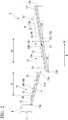
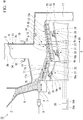
- the stoker furnace of the present embodiment is a stoker furnace for combustion of incineration object such as waste, and, as shown in Fig. 1 , includes a hopper 2 for temporarily storing an incineration object B, an incineration furnace 3 for combusting the incineration object B, a feeder 4 for feeding the incineration object B to the incineration furnace 3, a stoker 5 (including fire grates 15 and 16 of a drying stage 11, a combustion stage 12, and a post-combustion stage 13) provided on a bottom side of the incineration furnace 3, and wind boxes 6a, 6b and 6c provided below the stoker 5.
- a hopper 2 for temporarily storing an incineration object B
- an incineration furnace 3 for combusting the incineration object B
- a feeder 4 for feeding the incineration object B to the incineration furnace 3
- a stoker 5 including fire grates 15 and 16 of a drying stage 11, a combustion stage 12, and a post-combus
- the feeder 4 pushes the incineration object B continuously fed onto a feed table 7 via hopper 2 into the incinerator 3.
- the feeder 4 is reciprocated on the feed table 7 by a feeder driving device 8 with a predetermined stroke.
- the incineration furnace 3 is provided above the stoker 5 and has a combustion chamber 9 including a primary combustion chamber and a secondary combustion chamber.
- a blower 10 for feeding secondary air to the combustion chamber 9 is connected to the incineration furnace 3.
- the stoker 5 is a combustion device in which the fire grates 15 and 16 are arranged in a stepwise manner.
- the incineration object B is combusted on the stoker 5.
- a direction in which the incineration object B is conveyed is referred to as a conveying direction D.
- the incineration object B is conveyed on the stoker 5 in the conveying direction D.
- a right side is a downstream side D1 in the conveying direction.
- a surface on which the fire grates 15 and 16 are attached is referred to as an installation surface, and an angle on the conveying direction D formed by a horizontal surface and the installation surface centered on the upstream end portions (11b, 12b and 13b) of the drying stage 11, the combustion stage 12 or the post-combustion stage 13 is referred to as a stoker inclination angle (an installation angle).
- the stoker inclination angle When the downstream side D1 in the conveying direction of the installation surface is directed upward from the horizontal plane, the stoker inclination angle is set to a positive value, and when the downstream side D1 in the conveying direction of the installation surface is directed downward from the horizontal plane, the stoker inclination angle will be described to be set to a negative value.
- the stoker 5 has, in order from the upstream side in the conveying direction of the incineration object B, a drying stage 11 for drying the incineration object B, a combustion stage 12 for incinerating the incineration object B, and a post-combustion stage 13 for completely incinerating (post-combustion) unburnt components.
- drying, combustion, and post-combustion are performed, while sequentially conveying the incineration object B in the drying stage 11, the combustion stage 12, and the post-combustion stage 13.
- the stoker furnace 1 includes a first wind box 6a that feeds primary air sent by a blower (not shown) to the drying stage 11, a second wind box 6b that feeds the primary air to the combustion stage 12, and a third wind box 6c that feeds primary air to the post-combustion stage 13.
- the drying stage 11, the combustion stage 12, and the post-combustion stage 13 have a plurality of fixed fire grates 15 and a plurality of movable fire grates 16.
- the fixed fire grates 15 and the movable fire grates 16 are alternately arranged in the conveying direction D.
- the movable fire grate 16 reciprocates in the conveying direction D of the incineration object B.
- the incineration object B on the stoker 5 is conveyed and stirred by the reciprocating motion of the movable fire grate 16. That is, lower layer portions of the incineration objects B are moved and replaced with upper layer portions.
- the drying stage 11 receives the incineration object B that is pushed out by the feeder 4 and fallen into the incinerator 3, evaporates the moisture in the incineration object B and partially thermally decomposes the incineration object B.
- the combustion stage 12 ignites the incineration object B dried in the drying stage 11, using the primary air fed from the second wind box 6b and combusts the volatile matter and the fixed carbon content.
- the post-combustion stage 13 combusts unburnt components such as the fixed carbon content having passed through without being sufficiently combusted in the combustion stage 12 until the unburnt components are completely ashed.
- An ash outlet 17 is provided at the outlet of the post-combustion stage 13. The ash is discharged from the incineration furnace 3 through the ash outlet 17.
- the stoker furnace 1 includes a first driving device 18a for driving the movable fire grate 16 of the drying stage 11, a second driving device 18b for driving the movable fire grate 16 of the combustion stage 12, and a third driving device 18c for driving the movable fire grate 16 of the post-combustion stage 13.
- the first driving device 18a, the second driving device 18b, and the third driving device 18c are controlled by the control device 30.
- the driving devices 18a, 18b and 18c are attached to a beam 19 provided on the stoker 5.
- the driving devices 18a, 18b and 18c have a hydraulic cylinder 20 attached to the beam 19, an arm 21 operated by the hydraulic cylinder 20, and a beam 22 connected to a distal end of the arm 21.
- the beam 22 and the movable fire grates 16 are connected to each other via a bracket 23.
- the arm 21 is operated by expansion and contraction of the rod of the hydraulic cylinder 20.
- the beam 22 configured to move along each of the installation surfaces 11a, 12a and 13a of the stoker 5 moves, and the movable fire grates 16 connected to the beam 22 are driven.
- the hydraulic cylinder 20 may be used as the driving devices 18a, 18b and 18c, there is no limitation thereto, and for example, a hydraulic motor, an electrical cylinder, a conductive linear motor, or the like can be adopted. Further, the forms of the driving devices 18a, 18b and 18c are not limited to that of the above-described embodiment, and any form may be adopted as long as the movable fire grate 16 can be made to reciprocate. For example, instead of disposing the arm 21, the beam 22 and the hydraulic cylinder 20 may be connected directly to each other and driven.
- control device 30 can set the driving speed of the movable fire grates 16 in the drying stage 11, the combustion stage 12, and the post-combustion stage 13 to the same speed or to different speeds in the drying stage 11, the combustion stage 12, and the post-combustion stage 13.
- the fixed fire grate 15 and the movable fire grate 16 are disposed such that the downstream side D1 in the conveying direction is directed upward with respect to the installation surfaces 11a, 12a and 13a of the drying stage 11, the combustion stage 12, and the post-combustion stage 13.
- Some of the movable fire grates 16 of the drying stage 11 may be fire grates with a protrusion 16P (others are normal fire grates as will be described later).
- the movable fire grate 16 in the range R1 of 50% to 80% from the downstream side D1 in the conveying direction is the fire grate with a protrusion 16P.
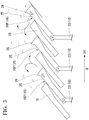
- the fire grate with protrusion 16P has a plate-like fire grate body 25, and a triangular protrusion 26 provided at the distal end of the fire grate body 25.
- the protrusion 26 protrudes upward from the upper surface of the fire grate body 25.
- the shape of the protrusion 26 is not limited thereto, and it may be, for example, a trapezoidal shape or a round shape.
- the fixed fire grate 15 of Fig. 3 is a fire grate with no protrusion on the upper surface of its distal end, and this shape is called a normal fire grate.
- the movable fire grate 16 is defined as the fire grate with protrusion 16P, but there is no limitation thereto, and both of the movable fire grate 16 and the fixed fire grate 15 may be a fire grate with a protrusion.
- the range in which the fire grate with protrusion 16P is provided is not limited to the above-mentioned range, and for example, the fire grate with protrusion 16P may be used for all the fire grates of the drying stage 11.
- a normal fire grate may be adopted for all the fire grates (the fixed fire grate 15 and the movable fire grate 16) in the drying stage 11.
- a part of the movable fire grates 16 of the combustion stage 12 is the fire grate with protrusion 16P.
- the movable fire grate 16 in the range R2 of 50% to 80% from the downstream side in the conveying direction is the fire grate with protrusion 16P.
- the other movable fire grate 16 of the combustion stage 12 is a normal fire grate.
- both the movable fire grate 16 and the fixed fire grate 15 may be the fire grate with protrusion 16P, depending on the properties and types of the incineration object B, and all the fire grates (the fixed fire grate 15 and the movable fire grate 16) may be used as the normal fire grate.
- both the movable fire grate 16 and the fixed fire grate 15 are shown as the normal fire grates in Fig. 2 , but as with the drying stage 11 and the combustion stage 12, the fire grate with protrusion 16P may be adopted.
- the drying stage 11 of the stoker 5 of the present embodiment is disposed downward. That is, an installation surface 11a of the drying stage 11 is inclined so that the downstream side D1 in the conveying direction is lower down.
- a stoker inclination angle ⁇ 1 of the drying stage 11 which is an angle between a horizontal plane centered on the end portion 11b on the upstream side of the drying stage 11 and the conveying direction side of the installation surface 11a, is an angle between -15° (minus 15°) and -25° (minus 25°).
- the combustion stage 12 of the stoker 5 of the present embodiment is disposed upward. That is, the installation surface 12a of the combustion stage 12 is inclined so that the downstream side D1 in the conveying direction becomes higher.
- a stoker inclination angle ⁇ 2 of the combustion stage 12 which is an angle between the horizontal plane centered on the upstream end portion 12b of the combustion stage 12 and the conveying direction side of the installation surface 12a, is an angle between +5° (plus 5°) and +15° (plus 15°), preferably an angle between +8° (plus 8°) and +12° (plus 12°).
- the post-combustion stage 13 of the stoker 5 of the present embodiment is disposed upward. That is, the installation surface 13a of the post-combustion stage 13 is inclined so that the downstream side D1 in the conveying direction becomes higher.
- the stoker inclination angle ⁇ 3 of the post-combustion stage 13, which is the angle between the horizontal plane centered on the upstream end portion 13b of the post-combustion stage 13 and the conveying direction side of the installation surface 13a, is the same as the stoker angle ⁇ 2 of the combustion stage 12.
- the stoker inclination angle ⁇ 3 of the post-combustion stage 13, which is the angle between the horizontal plane centered on the upstream end portion 13b of the post-combustion stage 13 and the conveying direction side of the installation surface 13a is an angle between +5° (plus 5°) and +15° (plus 15°), preferably an angle between +8° (plus 8°) and +12° (plus 12°).
- a step (a drop wall) 27 is formed between the drying stage 11 and the combustion stage 12.
- the downstream end portion 11c of the drying stage 11 in the conveying direction is formed to be higher in the vertical direction than the upstream end portion 12b of the combustion stage 12 in the conveying direction.
- the combustion stage 12 and the post-combustion stage 13 are continuously connected to each other.
- the combustion stage 12 and the post-combustion stage 13 are formed such that the downstream end portion 12c of the combustion stage 12 in the conveying direction and the upstream end portion 13b of the post-combustion stage 13 in the conveying direction are located at the same height. Therefore, the downstream end portion 13c of the post-combustion stage 13 in the conveying direction is disposed to be higher in the vertical direction than the downstream end portion 12c of the combustion stage 12 in the conveying direction.
- the function of the drying stage 11 is to efficiently dry the moisture in the incineration object B by the radiant heat from the flame above the incineration object B of the combustion stage 12 and the sensible heat of the primary air from the lower part of the fire grate.
- the radiation heat from the flame has a higher contribution to the drying than the sensible heat of the primary air, and the drying of the upper layer portion of the incineration object B easily proceeds.
- the drying speed is improved by moving the lower layer portion of the incineration object B upward by a stirring operation of the fire grate and replacing the lower layer portion with the upper layer portion.
- an absolute value of the stoker inclination angle is larger than an angle of repose of the incineration object B, since the incineration object B collapses under its own weight and a layer of the incineration object B is not formed, the stoker 5 does not work properly.
- the absolute value of the stoker inclination angle is smaller than the angle of repose of the incineration object B, the stoker does not work properly, but the movement of the incineration object B due to gravity (movement due to its own weight) decreases. Further, when the installation surface is directed upward, that is, when the stoker inclination angle is inclined at a positive value (plus value), the gravity acts in a direction of pushing back the incineration object B from the conveying direction.
- the optimum stoker inclination angle differs depending on the amount of incineration object B to be charged and the moisture content of the incineration object B.
- the description will be provided on the assumption that a case in which the amount of the incineration object B to be charged is high and the moisture content is high (the amount of moisture is large) is a case in which the load of the charged incineration object is large.
- a case in which the amount of incineration object B to be charged is small and the moisture content is low is assumed to be a case in which the load of the charged incineration target is small.
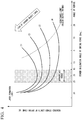
- Fig. 4 shows a graph in which a horizontal axis represents a stoker inclination angle of the drying stage 11, a vertical axis represents a required stoker length of the drying stage 11, and in order from a case (1) in which the load of the charged incineration object is the largest to a case (4) in which the load of the charged incineration object is the smallest, a relationship between the stoker inclination angle of the drying stage 11 and the required stoker length of the drying stage 11 is plotted.
- the required stoker length is a distance at which 95% of the moisture of the charged incineration object B is dried.
- "Angle of repose” on the horizontal axis represents the angle of repose of the incineration object B.
- the stoker inclination angle of -30° is the limit for forming the layer of the incineration object B.
- the required stoker length decreases as the stoker inclination angle gets loose.
- the required stoker length gradually becomes longer. This is because when the stoker inclination angle becomes a positive value, the installation surface is directed upward and the conveying speed becomes slower, and as a result, the layer of the incineration object B becomes thick and drying of the incineration object B of the lower layer becomes difficult.
- the stoker inclination angle of the optimum drying stage 11 at which the incineration object B can be properly processed and the stoker length can be set to be shortest has an appropriate range of an angle between -15° (minus 15°) and -25° (minus 25°) corresponding to the stoker length near the lowermost point of curve of (1). Further, the optimum value is -20° (minus 20°).
- the function of the combustion stage 12 is to maintain the temperature of the layer of the incineration object B by radiant heat from the flame and self-combustion heat, and perform generation acceleration of the combustible gas by thermal decomposition of the volatile matter, and combustion of the fixed carbon that is left after thermal decomposition.
- the required stoker length of the combustion stage 12 is determined by the time required for combustion of the fixed carbon.
- Fig. 5 shows a graph in which, in a case in which the stoker inclination angle of the drying stage 11 is set in the appropriate range as described above, a horizontal axis represents the stoker inclination angle of the combustion stage, a vertical axis represents the required stoker length of the combustion stage, and in order from the case (1) in which load of the charged incineration object is the largest to the case (4) in which load of the charged incineration object is the smallest, a relationship between the stoker inclination angle of the combustion stage and the required stoker length of the combustion stage is plotted.
- the required stoker length of the combustion stage is the distance at which 95% of the combustible content volatilizes or combusts.
- the stoker inclination angle of -30° is the limit of forming the layer of the incineration object B.
- the required stoker length decreases as the angle becomes loose.
- the appropriate range of the stoker inclination angle can be set to the range surrounded by the one-dot chain line shown in Fig. 5 .
- Fig. 6 is a graph in which a horizontal axis represents the stoker inclination angle of the combustion stage 12, a vertical axis represents the stoker length required for both the drying stage 11 and the combustion stage 12, and in order from the case (1) in which the load of the incineration object B to be charged is the largest to the case (4) in which the load of the incineration object B to be charged is the smallest, a relationship between the stoker inclination angle of the combustion stage 12 and the stoker length required for both the drying stage 11 and the combustion stage 12 is plotted.
- the stoker inclination angle of the drying stage 11 is set to an optimum value of -20° (minus 20°).
- the appropriate range of the stoker inclination angle of the combustion stage 12 is an angle between +5° (plus 5°) and +15° (plus 15°), more specifically, an angle between +8° (plus 8°) and +12° (plus 12°). Further, in the case in which the stoker inclination angle of the drying stage 11 is the optimum value of -20° (minus 20°), the optimum value of the stoker inclination angle of the combustion stage 12 is +10° (plus 10°).
- the required stoker lengths of the drying stage 11 and the combustion stage 12 can be made as short as possible by setting the respective stoker inclination angles to appropriate ranges, particularly optimum values, even if the post-combustion stage 13 is included, it is possible to provide a stoker furnace of a relatively small size and low cost.
- the burn out point P is a point at which the combustion accompanying the flame of the incineration object B on the stoker 5 is substantially completed.
- the stoker furnace 1 of the present embodiment has the function of changing the driving speed (a moving speed) of the movable fire grate 16 of each stage (the drying stage 11, the combustion stage 12, and the post-combustion stage 13), depending on the burn out point P of the incineration object B.
- a target burn out point Pt which is an ideal burn out point, is set on the downstream side of the center of the combustion stage 12 as seen in the conveying direction D.
- the target burn out point Pt is set on the combustion stage 12. If the position of the burn out point P is on the upstream side in the conveying direction with respect to the target burn out point Pt, the length of the layer of the incineration object B in the conveying direction D becomes short, and there is a possibility that combustion may not be efficient.
- the position of the burn out point P is on the downstream side in the conveying direction with respect to the target burn out point Pt, the length of the layer of the incineration object B in the conveying direction D becomes long, and there is a possibility that combustion residue of the incineration object B may occur.
- thermocouple 31 which is a burn out point detection device, is installed on the surface of the fixed fire grate 15 or the movable fire grate 16 in the vicinity of the target burn out point Pt in the fire grate of the combustion stage 12.
- the thermocouple 31 measures the temperature of the fire grate that varies as the incineration object B on the stoker 5 combusts. The measured temperature becomes a detection signal corresponding to the position of the burn out point P of the incineration object B.
- the control device 30 includes a burn out point estimation unit 30a which estimates the position of the burn out point P corresponding to the fire grate temperature T (detection signal) measured by the thermocouple 31, and a driving device control unit 30b which controls the driving devices 18a, 18b and 18c on the basis of the position of the burn out point P estimated by the burn out point estimation unit 30a.
- the inventors have found that there is a correlation between the fire grate temperature T of the combustion stage 12 and the position of the burn out point P.
- the inventors have found that, if the target burn out point Pt as shown in Fig. 2 is set, when the fire grate temperature T is T1°C, the burn out point P coincides with the target burn out point Pt, when the fire grate temperature T is lower than T1°C, the burn out point P is located on the upstream side of the target burnout point Pt in the conveying direction, and when the fire grate temperature T is higher than T1°C, the burn out point P can be determined to be located on the downstream side of the target burn out point Pt in the conveying direction.
- the inventors have found that the layer of the incineration object B can be deposited to be closer to the combustion stage 12 side, by setting the driving speed of the movable fire grate 16 of the post-combustion stage 13 to be slower than the driving speed of the movable fire grate 16 of the combustion stage 12. That is, by slowing the driving speed of the movable fire grate 16 of the post-combustion stage 13, it was found that the layer of the incineration object B remains on the combustion stage 12 side rather than the post-combustion stage 13.
- the burn out point estimation unit 30a estimates the position of the burn out point P on the basis of the fire grate temperature T of the combustion stage 12 measured by the thermocouple 31.
- the burn out point estimation unit 30a determines that when the fire grate temperature T is T1°C, which is a threshold value, the burn out point P coincides with the target burn out point Pt, when the fire grate temperature T is lower than T1°C, the burn out point P is located on the upstream side of the target burn out point Pt in the conveying direction, and when the fire grate temperature T is higher than T1°C, the burn out point P is located on the downstream side of the target burn out point Pt in the conveying direction.
- T1°C which is a threshold value
- the control device 30 drives the movable fire grate 16 of each of the drying stage 11, the combustion stage 12, and the post-combustion stage 13 at a predetermined driving speed (a predetermined speed).
- a predetermined speed of the movable fire grate 16 of the drying stage 11 is defined as a first driving speed VI
- a predetermined speed of the movable fire grate 16 of the combustion stage 12 is defined as a second driving speed V2
- a predetermined speed of the movable fire grate 16 of the post-combustion stage 13 is defined as a third driving speed V3, the values of V1, V2, and V3 are appropriately set depending on the properties of the incineration object B.
- V1 ⁇ V2 ⁇ V3 V3
- V1 ⁇ V2 ⁇ V3 V3
- V1 ⁇ V2 ⁇ V3 V3
- V2 is a driving speed that is about one round trip in 100 seconds.
- the driving speed is set depending on the properties of the incineration object B as described above, this speed is merely an example, and the present invention is not limited thereto.
- the driving device control unit 30b of the control device 30 controls the second driving device 18b and the third driving device 18c so as not to change the driving speed of the movable fire grate 16 of the combustions stage 12 and the movable fire grate 16 of the post-combustion stage 13 when the burn out point P is located at the same position as the target burn out point Pt or when the burn out point P is located on the upstream side of the target burn out point Pt in the conveying direction. Therefore, the movable fire grate 16 of the combustion stage 12 is driven while maintaining the second driving speed V2 which is the predetermined speed, and the movable fire grate 16 of the post-combustion stage 13 is driven while maintaining the third driving speed V3 which is the predetermined speed. That is, each movable fire grate 16 of the combustion stage 12 and the post-combustion stage 13 continues to be driven at the same driving speed as before.
- the driving device control unit 30b controls the second driving device 18b and the third driving device 18c such that the driving speed of the movable fire grate 16 of the post-combustion stage 13 is driven at a driving speed slower than the driving speed of the movable fire grate 16 of the combustion stage 12 when the burn out point P is located downstream of the target burn out point Pt in the conveying direction.
- the driving device control unit 30b controls the third driving device 18c, for example, so that the driving speed of the movable fire grate 16 of the post-combustion stage 13 is further lower than V3.
- the driving device control unit 30b controls the driving speed of the movable fire grate 16 of the post-combustion stage 13 to be slower than usual.
- the driving speed of the movable fire grate 16 of the post-combustion stage 13 can be set to 30% to 80% of the driving speed of the movable fire grate 16 of the combustion stage 12.
- the layer of the incineration object B is formed as indicated by the solid line Ba, stirring is effectively performed in the combustion stage 12 by the fire grate with protrusion 16P, and consequentially, it is possible to not only gain time to hold the incineration object B on the combustion stage 12 but also combustion is effectively performed. Therefore, it is possible to reduce the incineration residue of the incineration object B discharged from the post-combustion stage 13.
- the drying stage 11 since the drying stage 11 is inclined downward, it is possible to convey the incineration object B of any property to the combustion stage 12 without any delay, and since the combustion stage 12 and the post-combustion stage 13 are inclined upward, the incineration object B is combusted and conveyed sufficiently without easily sliding down or rolling down to the downstream side of the combustion stage 12.
- the incineration object B rolling down the drying stage 11 has a strong momentum and passes through the combustion stage 12 with its momentum, the incineration object B stops at least in the post-combustion stage 13 and is not discharged from the post-combustion stage 13. Further, since the post-combustion stage 13 and the combustion stage 12 are continuously connected to each other without a step, even if the incineration object B which is not sufficiently combusted up to the post-combustion stage 13 advances by rolling or the like, the incineration object B returns to the combustion stage 12 by its own weight, and combustion can be performed. That is, it is possible to minimize the discharge of incompletely combusted incineration object B as much as possible.
- the layer of the incineration object B can be retained on the combustion stage 12 side.
- the thickness of the layer of the incineration object B on the combustion stage 12 is maintained, and the fire grate of the combustion stage 12 can be protected.
- the fire grates 15 and 16 are protected by the layer of the incineration object B, and the processed object can be conveyed in the conveying direction D.
- thermocouple 31 as the burn out point detection device for acquiring the detection signal corresponding to the burn out point P, it is possible to set the position of the burn out point P with a more inexpensive configuration.
- the position of the burn out point P corresponds to the fire grate temperature T measured by the thermocouple 31 disposed in the fire grate of the combustion stage 12, but the embodiment is not limited thereto.
- a configuration in which the temperature change (change speed) of the fire grate temperature T measured by the thermocouple 31 is monitored and the position of the burn out point P is estimated on the basis of the temperature change of the fire grate temperature T may be adopted.
- thermocouple 31 is installed in the combustion stage 12, but it is not limited thereto, and the thermocouple may be installed in at least one of the combustion stage 12 and the post-combustion stage 13.
- the thermocouple 31 is installed in the combustion stage 12
- the downstream side of the combustion stage 12 is desirable
- the thermocouple 31 is installed in the post-combustion stage 13
- the upstream side of the post-combustion stage 13 is desirable.
- thermocouples as the burn out point detection device may be adopted. That is, a thermocouple may be disposed, for example, on the upstream side of the combustion stage 12, the downstream side of the combustion stage 12, the upstream side of the post-combustion stage 13, and the downstream side of the post-combustion stage 13, respectively.
- thermocouples By disposing a plurality of thermocouples, the position of the burn out point P can be more accurately estimated.
- thermocouples are not limited to this, and can be appropriately changed according to the size and cost of the stoker 5. Further, a plurality of thermocouples may be disposed in the direction of the depth of the page of Fig. 1 .
- the stoker furnace of the present embodiment has a drying stage temperature measuring device (the drying stage temperature measuring device includes, for example, a drying stage thermocouple 32) which measures the fire grate temperature Td of the drying stage 11 and outputs a temperature signal corresponding thereto to the control device 30B, a first pressure measuring device 33a which measures a pressure PR1 in the first wind box 6a disposed below the drying stage 11 and outputs a first pressure signal corresponding thereto to the control device 30B, and a second pressure measuring device 33b which measures a pressure PR2 in the second wind box 6b disposed below the combustion stage 12 and outputs a second pressure signal corresponding thereto to the control device 30B.
- the drying stage thermocouple 32 is desirably installed on the surface of the fixed fire grate 15 or the movable fire grate 16 of the drying stage 11 on the downstream side of the center of the drying stage 11 as seen in the conveying direction D.
- the control device 30B of the present embodiment controls the driving speed of the movable fire grate 16 of the drying stage 11, in addition to the driving speed of the movable fire grate 16 of the combustion stage 12 and the driving speed of the movable fire grate 16 of the post-combustion stage 13, on the basis of the fire grate temperatures T and Td and the pressures PR1 and PR2.
- the control device 30B of the present embodiment sets a threshold value (a first threshold value corresponding to the first wind box 6a, and a second threshold value corresponding to the second wind box 6b) with respect to the pressure in the wind box.
- the threshold value is set on the basis of the thickness of the incineration object B deposited on the stoker on the wind box. Further, depending on the properties of the incineration object B, in some cases, the first threshold value and the second threshold value may be set to the same value, or may be set to values different from each other.
- the control device 30 determines that the layer thickness of the incineration object B is excessive.
- the pressure PR2 in the second wind box 6b is less than the threshold value (the second threshold value)
- the threshold value the second threshold value
- the fire grate temperature Td of the drying stage 11 is equal to or higher than the predetermined temperature (the third threshold value)
- the layer thickness of the incineration object B on the drying stage 11 is thick and combustion of the incineration object B is performed in the drying stage 11.
- control device 30B first performs a control to drive the movable fire grate of the drying stage 11 at a predetermined speed V1.
- control device 30B performs the same control as that of the stoker furnace 1 of the first embodiment, and when the pressure PR1 in the first wind box 6a is equal to or higher than a threshold value (the first threshold value), the pressure PR2 in the second wind box 6b is less than the threshold value (the second threshold value), and the fire grate temperature Td of the drying stage 11 is equal to or higher than the predetermined temperature (the third threshold value), the control device 30B performs a control to set the driving speed of the movable fire grate 16 of the drying stage 11 to be faster than the predetermined speed V1.
- a threshold value the first threshold value
- the pressure PR2 in the second wind box 6b is less than the threshold value (the second threshold value)
- the fire grate temperature Td of the drying stage 11 is equal to or higher than the predetermined temperature (the third threshold value
- the layer of the incineration object B in the drying stage 11 become thick, and the incineration object B is combusted in the drying stage 11, the incineration object B of the drying stage 11 is moved to the combustion stage 12 at an early stage.
- the control device 30 performs a control to set the driving speed of the movable fire grate 16 of the drying stage 11 to be slower than the predetermined speed V1.
- control device 30B performs the control, by comparing the pressures PR1 and PR2 with the threshold values corresponding thereto, respectively, but the present invention is not limited thereto.
- control device 30B may be configured to monitor and control the pressure change (change speed) of the pressures PR1 and PR2.
- control device 30B may be configured to monitor and control the temperature change (change speed) of the fire grate temperature Td of the drying stage 11.
- the first pressure signal is defined as a signal corresponding to the pressure change of the pressure PR1
- the second pressure signal is defined as a signal corresponding to the pressure change of the pressure PR2
- the temperature signal is defined as a signal corresponding to the temperature change of the fire grate temperature Td
- the first threshold value, the second threshold value, and the third threshold value may be set correspondingly.
- the stoker furnace 1C is provided with, as a burn out point detection device, an imaging device 34 installed above the post-combustion stage 13, more specifically, on the ceiling of the furnace.
- the imaging device 34 is a camera or a sensor capable of detecting a temperature distribution.
- the temperature distribution on the downstream side of the combustion stage 12 or the upstream side of the post-combustion stage 13 detected by the imaging device 34 is a detection signal corresponding to the position of the burn out point P of the incineration object B.
- the burn out point estimation unit 30a of the control device estimates the position of the burn out point P, on the basis of the temperature distribution detected by the imaging device 34.
- the driving device control unit 30b controls the second driving device 18b and the third driving device 18c such that the movable fire grate 16 of the combustion stage 12 and the movable fire grate 16 of the combustion stage 13 are driven at the same driving speed, when the burn out point P is located at the same position as the target burn out point Pt or when the burn out point P is located on the upstream side of the target burn out point Pt in the conveying direction.
- the driving device control unit 30b controls the second driving device 18b and the third driving device 18c such that the driving speed of the movable fire grate 16 of the post-combustion stage 13 is driven at a driving speed slower than the driving speed of the movable fire grate 16 of the combustion stage 12, as in the first embodiment, when the position of the burn out point P is located on the downstream side of the target burn out point Pt in the conveying direction.
- the position of the burn out point P can be more accurately estimated, by grasping the temperature distribution on the stoker 5.
- the distal ends of the fire grate 15 and 16 are disposed to face the downstream side D1 in the conveying direction.
- the present invention is not limited thereto.
- the distal ends of the fire grates 15 and 16 of the drying stage 11 may be disposed to face the upstream side in the conveying direction.
- the position of the burn out point P may be estimated using both the thermocouple and the imaging device.
- a combination of the first embodiment or the second embodiment and the third embodiment may be adopted.
Landscapes
- Engineering & Computer Science (AREA)
- Mechanical Engineering (AREA)
- General Engineering & Computer Science (AREA)
- Chemical & Material Sciences (AREA)
- Combustion & Propulsion (AREA)
- Incineration Of Waste (AREA)
Abstract
Description
- The present invention relates to a stoker furnace.
- Priority is claimed on
Japanese Patent Application No. 2018-161817, filed on August 30, 2018 - A stoker furnace capable of efficiently incinerating a large amount of material to be incinerated without separation is known as an incinerator for incinerating incineration object such as waste. As a stoker furnace, a stoker furnace in which the stoker is configured as a stepped type, and which is equipped with a drying stage, a combustion stage, and a post-combustion stage performing each of the functions of drying, combustion, and post-combustion is known.
- In order to reliably combust the incineration object, an inclination angle of the stoker has been studied. As described in
Patent Documents - Further, as described in
Patent Document 3, there is a configuration in which the drying stage is inclined downward, and the combustion stage and the post-combustion stage are disposed horizontally, as described inPatent Document 4, there is a configuration in which the drying stage and the combustion stage are inclined downward and the downstream side in the conveying direction of the installation surface of the post-combustion stage is inclined upward, and as described inPatent Document 5, there is a configuration in which all the stages are inclined upward. For example, when the downstream side in the conveying direction of the installation surface of the combustion stage is directed upward, the combustion stage is simply referred to as being directed upward (the same also applies to the case of the drying stage and the post-combustion stage). - Further,
Patent Document 6 discloses, in a stoker in which all the stages are inclined upward, a technique in which movable fire grates of a drying stage, a combustion stage, and a post-combustion stage are driven with different driving devices to control the combustion completion position of the incineration object. -
- [Patent Document 1]
Japanese Unexamined Patent Application, First Publication No. H6-265125 - [Patent Document 2]
Japanese Unexamined Patent Application, First Publication No. S59-86814 - [Patent Document 3]
Japanese Unexamined Utility Model Application, First Publication No. H6-84140 - [Patent Document 4]
Japanese Examined Patent Publication, Second Publication No. S57-12053 - [Patent Document 5]
Japanese Unexamined Utility Model Application, First Publication No. S57-127129 - [Patent Document 6]
Japanese Unexamined Patent Application, First Publication No. H3-28618 - Incidentally, incineration object with various properties (materials, forms, and moisture contents) may be input to a stoker furnace, but an incineration object which is a slippery material or in a form that readily rolls such as a boll shape, or incineration object with a high moisture content (including large amount of water) may be difficult to incinerate in the same stoker furnace as that used for other incineration objects in any stoker furnace.
- In addition, when an incineration object of a slippery material or a shape that is easy to roll such as a ball shape, or incineration object with a high moisture content is incinerated, in some cases, a burn out point may exceed a target burn out point which is set by the stoker furnace, and there may be a problem that a combustion residue of the incineration object easily occurs.
- That is, in the stoker furnaces described in
Patent Documents - Further, in the stoker furnaces described in
Patent Documents - An object of the present invention is to provide a stoker furnace capable of continuously charging the incineration object regardless of the properties of the incineration object and capable of eliminating combustion residue of the incineration obj ect.
- According to the present invention, there is provided a stoker furnace which is configured to feed an incineration object from a feeder, and perform each of drying, combustion and post-combustion, while sequentially conveying the incineration object, into a drying stage, a combustion stage and a post-combustion stage, which include a plurality of fixed fire grates and a plurality of movable fire grates, the stoker furnace including: a burn out point detection device configured to obtain a detection signal corresponding to a position of a burn out point of the incineration object; a first driving device configured to drive the movable fire grate of the drying stage; a second driving device configured to drive the movable fire grate of the combustion stage; a third driving device configured to drive the movable fire grate of the post-combustion stage; and a control device configured to control the first driving device, the second driving device, and the third driving device, wherein the drying stage is disposed to be inclined so that a downstream side in the conveying direction is directed downward, the combustion stage is connected to the drying stage and is disposed to be inclined so that the downstream side in the conveying direction faces upward, and the post-combustion stage is continuously connected to the combustion stage without a step, and is disposed to be inclined so that the downstream side in the conveying direction faces upward. The control device is configured to receive the detection signal, and control the second driving device and the third driving device so that, when a position of the burn out point corresponding to the detection signal acquired by the burn out point detection device does not exceed a target burn out point, the driving speeds of the movable fire grate of the combustion stage and the movable fire grate of the post-combustion stage are not changed, and when the position of the burn out point corresponding to the detection signal is located on the downstream side of the target burn out point in the conveying direction, the driving speed of the movable fire grate of the post-combustion stage is slower than the driving speed of the movable fire grate of the combustion stage.
- According to such a configuration, due to the downward slope of the drying stage, it is possible to convey the incineration object of any property to the combustion stage without any delay, and due to the upward slope of the combustion stage and the post-combustion stage, the incineration object does not easily slide down or roll down after the combustion stage and is sufficiently combusted and conveyed.
- As a result, regardless of the properties of the incineration object, it is possible to continuously inject the incineration object, and it is possible to eliminate the combustion residue of the incineration object.
- Further, when the burn out point is located on the downstream side of the target burn out point in the conveying direction, by slowing the driving speed of the movable fire grate of the post-combustion stage, the layer of the incineration object can be kept on the combustion stage side. As a result, the thickness of the layer of the incineration object on the combustion stage is maintained, and the fire grate of the combustion stage can be protected.
- Further, since the combustion stage and the post-combustion stage are continuously connected to each other without a step, the incineration object can be incinerated continuously to a greater degree. That is, the incineration object can be incinerated without impacting other incineration objects due to the step difference.
- In the stoker furnace, the fixed fire grate and the movable fire grate may be disposed to be inclined so that the downstream side in the conveying direction faces upward with respect to installation surfaces of the drying stage, the combustion stage, and the post-combustion stages.
- Further, in the stoker furnace, at least some of the plurality of movable fire grates of the combustion stage may be a fire grate with a protrusion in which a protrusion is provided at a distal end.
- With such a configuration, it is possible to improve the stirring effect of the incineration object when the movable fire grate reciprocates.
- In the stoker furnace, the burn out point detection device may be a thermocouple installed on a fire grate surface of at least one of the combustion stage and the post-combustion stage.
- According to such a configuration, by adopting a thermocouple as a burn out point detection device that acquires a detection signal corresponding to the burn out point, it is possible to set the position of the burn out point with a more inexpensive configuration.
- In the stoker furnace, the burn out point detection device may be an imaging device that detects a temperature distribution of the combustion stage or the post-combustion stage.
- According to such a configuration, the position of the burn out point can be more accurately set by adopting the imaging device as the burn out point detection device that acquires the detection signal corresponding to the burn out point.
- The stoker furnace may further have a first wind box disposed corresponding to the drying stage; a first pressure measuring device configured to output a first pressure signal corresponding to the pressure or pressure change of the first wind box; a second wind box disposed corresponding to the combustion stage; a second pressure measuring device configured to output a second pressure signal corresponding to the pressure or pressure change of the second wind box; and a drying stage temperature measuring device installed in the drying stage to output a temperature signal corresponding to the temperature or temperature change of the drying stage, wherein the control device is configured to receive the temperature signal, the first pressure signal and the second pressure signal, and perform a control such that, when the pressure or the pressure change corresponding to the first pressure signal is equal to or greater than a first threshold value, the pressure or the pressure change corresponding to the second pressure signal is less than a second threshold value, and the temperature or the temperature change corresponding to the temperature signal is equal to or greater than a third threshold value, the driving speed of the movable fire grate of the drying stage is increased, and when the pressure or the pressure change corresponding to the first pressure signal is less than the first threshold value, the pressure or the pressure change corresponding to the second pressure signal is equal to or greater than the second threshold value, and the temperature or the temperature change corresponding to the temperature signal is less than the third threshold value, the driving speed of the movable fire grate of the drying stage is decreased.
- According to the present invention, it is possible to continuously charge the incineration object regardless of the properties of the incineration object, and it is possible to eliminate the combustion residue of the incineration object.
-
-
Fig. 1 is a schematic configuration diagram of a stoker furnace of a first embodiment of the present invention. -
Fig. 2 is a view showing a stoker inclination angle of the stoker furnace of the first embodiment of the present invention. -
Fig. 3 is a side view showing a fire grate shape of the stoker furnace of the first embodiment of the present invention. -
Fig. 4 is a graph showing an appropriate range of the stoker inclination angle of a drying stage. -
Fig. 5 is a graph showing an appropriate range of the stoker inclination angle of a combustion stage. -
Fig. 6 is a graph showing an appropriate range of the stoker inclination angle of the combustion stage when considering both the drying stage and the combustion stage. -
Fig. 7 is a view showing a shape of a layer of an incineration object when a driving speed of a movable fire grate of a post-combustion stage is made slow. -
Fig. 8 is a schematic configuration diagram of a stoker furnace of a second embodiment of the present invention. -
Fig. 9 is a schematic configuration diagram of a stoker furnace of a third embodiment of the present invention. - Hereinafter, a stoker furnace of a first embodiment of the present invention will be described in detail with reference to the drawings.
- The stoker furnace of the present embodiment is a stoker furnace for combustion of incineration object such as waste, and, as shown in
Fig. 1 , includes ahopper 2 for temporarily storing an incineration object B, anincineration furnace 3 for combusting the incineration object B, afeeder 4 for feeding the incineration object B to theincineration furnace 3, a stoker 5 (includingfire grates drying stage 11, acombustion stage 12, and a post-combustion stage 13) provided on a bottom side of theincineration furnace 3, andwind boxes stoker 5. - The
feeder 4 pushes the incineration object B continuously fed onto a feed table 7 viahopper 2 into theincinerator 3. Thefeeder 4 is reciprocated on the feed table 7 by afeeder driving device 8 with a predetermined stroke. - The
incineration furnace 3 is provided above thestoker 5 and has acombustion chamber 9 including a primary combustion chamber and a secondary combustion chamber. Ablower 10 for feeding secondary air to thecombustion chamber 9 is connected to theincineration furnace 3. - The
stoker 5 is a combustion device in which the fire grates 15 and 16 are arranged in a stepwise manner. The incineration object B is combusted on thestoker 5. - Hereinafter, a direction in which the incineration object B is conveyed is referred to as a conveying direction D. The incineration object B is conveyed on the
stoker 5 in the conveying direction D. InFigs. 1 ,2 and3 , a right side is a downstream side D1 in the conveying direction. Further, a surface on which the fire grates 15 and 16 are attached is referred to as an installation surface, and an angle on the conveying direction D formed by a horizontal surface and the installation surface centered on the upstream end portions (11b, 12b and 13b) of the dryingstage 11, thecombustion stage 12 or thepost-combustion stage 13 is referred to as a stoker inclination angle (an installation angle). When the downstream side D1 in the conveying direction of the installation surface is directed upward from the horizontal plane, the stoker inclination angle is set to a positive value, and when the downstream side D1 in the conveying direction of the installation surface is directed downward from the horizontal plane, the stoker inclination angle will be described to be set to a negative value. - The
stoker 5 has, in order from the upstream side in the conveying direction of the incineration object B, a dryingstage 11 for drying the incineration object B, acombustion stage 12 for incinerating the incineration object B, and apost-combustion stage 13 for completely incinerating (post-combustion) unburnt components. In thestoker 5, drying, combustion, and post-combustion are performed, while sequentially conveying the incineration object B in the dryingstage 11, thecombustion stage 12, and thepost-combustion stage 13. - The
stoker furnace 1 includes afirst wind box 6a that feeds primary air sent by a blower (not shown) to the dryingstage 11, asecond wind box 6b that feeds the primary air to thecombustion stage 12, and athird wind box 6c that feeds primary air to thepost-combustion stage 13. - The drying
stage 11, thecombustion stage 12, and thepost-combustion stage 13 have a plurality of fixed fire grates 15 and a plurality of movable fire grates 16. - The fixed fire grates 15 and the movable fire grates 16 are alternately arranged in the conveying direction D. The
movable fire grate 16 reciprocates in the conveying direction D of the incineration object B. The incineration object B on thestoker 5 is conveyed and stirred by the reciprocating motion of themovable fire grate 16. That is, lower layer portions of the incineration objects B are moved and replaced with upper layer portions. - The drying
stage 11 receives the incineration object B that is pushed out by thefeeder 4 and fallen into theincinerator 3, evaporates the moisture in the incineration object B and partially thermally decomposes the incineration object B. Thecombustion stage 12 ignites the incineration object B dried in the dryingstage 11, using the primary air fed from thesecond wind box 6b and combusts the volatile matter and the fixed carbon content. Thepost-combustion stage 13 combusts unburnt components such as the fixed carbon content having passed through without being sufficiently combusted in thecombustion stage 12 until the unburnt components are completely ashed. - An
ash outlet 17 is provided at the outlet of thepost-combustion stage 13. The ash is discharged from theincineration furnace 3 through theash outlet 17. - The
stoker furnace 1 includes afirst driving device 18a for driving themovable fire grate 16 of the dryingstage 11, asecond driving device 18b for driving themovable fire grate 16 of thecombustion stage 12, and athird driving device 18c for driving themovable fire grate 16 of thepost-combustion stage 13. Thefirst driving device 18a, thesecond driving device 18b, and thethird driving device 18c are controlled by thecontrol device 30. - The
driving devices beam 19 provided on thestoker 5. Thedriving devices hydraulic cylinder 20 attached to thebeam 19, anarm 21 operated by thehydraulic cylinder 20, and abeam 22 connected to a distal end of thearm 21. Thebeam 22 and the movable fire grates 16 are connected to each other via abracket 23. - According to the
driving devices arm 21 is operated by expansion and contraction of the rod of thehydraulic cylinder 20. With the operation of thearm 21, thebeam 22 configured to move along each of theinstallation surfaces stoker 5 moves, and the movable fire grates 16 connected to thebeam 22 are driven. - Although the
hydraulic cylinder 20 may be used as thedriving devices driving devices movable fire grate 16 can be made to reciprocate. For example, instead of disposing thearm 21, thebeam 22 and thehydraulic cylinder 20 may be connected directly to each other and driven. - In the
stoker furnace 1 of this embodiment, thecontrol device 30 can set the driving speed of the movable fire grates 16 in the dryingstage 11, thecombustion stage 12, and thepost-combustion stage 13 to the same speed or to different speeds in the dryingstage 11, thecombustion stage 12, and thepost-combustion stage 13. - As shown in
Figs. 2 and3 , the fixedfire grate 15 and themovable fire grate 16 are disposed such that the downstream side D1 in the conveying direction is directed upward with respect to theinstallation surfaces stage 11, thecombustion stage 12, and thepost-combustion stage 13. - Some of the movable fire grates 16 of the drying
stage 11 may be fire grates with aprotrusion 16P (others are normal fire grates as will be described later). As shown inFig. 2 , in the length of the dryingstage 11 in the conveying direction D, themovable fire grate 16 in the range R1 of 50% to 80% from the downstream side D1 in the conveying direction is the fire grate with aprotrusion 16P. By using the fire grate with aprotrusion 16P, it is possible to improve the stirring power. - As shown in
Fig. 3 , the fire grate withprotrusion 16P has a plate-likefire grate body 25, and atriangular protrusion 26 provided at the distal end of thefire grate body 25. Theprotrusion 26 protrudes upward from the upper surface of thefire grate body 25. The shape of theprotrusion 26 is not limited thereto, and it may be, for example, a trapezoidal shape or a round shape. - Here, the fixed
fire grate 15 ofFig. 3 is a fire grate with no protrusion on the upper surface of its distal end, and this shape is called a normal fire grate. - In the present embodiment, only the
movable fire grate 16 is defined as the fire grate withprotrusion 16P, but there is no limitation thereto, and both of themovable fire grate 16 and the fixedfire grate 15 may be a fire grate with a protrusion. - Further, the range in which the fire grate with
protrusion 16P is provided is not limited to the above-mentioned range, and for example, the fire grate withprotrusion 16P may be used for all the fire grates of the dryingstage 11. - Furthermore, depending on the properties or types of the incineration object B, a normal fire grate may be adopted for all the fire grates (the fixed
fire grate 15 and the movable fire grate 16) in the dryingstage 11. - As in the drying
stage 11, a part of the movable fire grates 16 of thecombustion stage 12 is the fire grate withprotrusion 16P. Specifically, in the length of thecombustion stage 12 in the conveying direction D, themovable fire grate 16 in the range R2 of 50% to 80% from the downstream side in the conveying direction is the fire grate withprotrusion 16P. The othermovable fire grate 16 of thecombustion stage 12 is a normal fire grate. As in the dryingstage 11, both themovable fire grate 16 and the fixedfire grate 15 may be the fire grate withprotrusion 16P, depending on the properties and types of the incineration object B, and all the fire grates (the fixedfire grate 15 and the movable fire grate 16) may be used as the normal fire grate. - In the fire grate of the
post-combustion stage 13, both themovable fire grate 16 and the fixedfire grate 15 are shown as the normal fire grates inFig. 2 , but as with the dryingstage 11 and thecombustion stage 12, the fire grate withprotrusion 16P may be adopted. - Next, a stoker inclination angle (an installation angle) of the drying
stage 11, thecombustion stage 12, and thepost-combustion stage 13 will be described. - As shown in
Fig. 2 , the dryingstage 11 of thestoker 5 of the present embodiment is disposed downward. That is, aninstallation surface 11a of the dryingstage 11 is inclined so that the downstream side D1 in the conveying direction is lower down. Specifically, a stoker inclination angle θ1 of the dryingstage 11, which is an angle between a horizontal plane centered on theend portion 11b on the upstream side of the dryingstage 11 and the conveying direction side of theinstallation surface 11a, is an angle between -15° (minus 15°) and -25° (minus 25°). - The
combustion stage 12 of thestoker 5 of the present embodiment is disposed upward. That is, theinstallation surface 12a of thecombustion stage 12 is inclined so that the downstream side D1 in the conveying direction becomes higher. Specifically, a stoker inclination angle θ2 of thecombustion stage 12, which is an angle between the horizontal plane centered on theupstream end portion 12b of thecombustion stage 12 and the conveying direction side of theinstallation surface 12a, is an angle between +5° (plus 5°) and +15° (plus 15°), preferably an angle between +8° (plus 8°) and +12° (plus 12°). - The
post-combustion stage 13 of thestoker 5 of the present embodiment is disposed upward. That is, theinstallation surface 13a of thepost-combustion stage 13 is inclined so that the downstream side D1 in the conveying direction becomes higher. - The stoker inclination angle θ3 of the
post-combustion stage 13, which is the angle between the horizontal plane centered on theupstream end portion 13b of thepost-combustion stage 13 and the conveying direction side of theinstallation surface 13a, is the same as the stoker angle θ2 of thecombustion stage 12. Specifically, the stoker inclination angle θ3 of thepost-combustion stage 13, which is the angle between the horizontal plane centered on theupstream end portion 13b of thepost-combustion stage 13 and the conveying direction side of theinstallation surface 13a, is an angle between +5° (plus 5°) and +15° (plus 15°), preferably an angle between +8° (plus 8°) and +12° (plus 12°). - As well, the stoker inclination angle θ3 of the
post-combustion stage 13 may be θ2 ≠ θ3 or may be θ2 = θ3. - A step (a drop wall) 27 is formed between the drying
stage 11 and thecombustion stage 12. Thedownstream end portion 11c of the dryingstage 11 in the conveying direction is formed to be higher in the vertical direction than theupstream end portion 12b of thecombustion stage 12 in the conveying direction. - There is no step (a drop wall) between the
combustion stage 12 and thepost-combustion stage 13. That is, thecombustion stage 12 and thepost-combustion stage 13 are continuously connected to each other. In other words, thecombustion stage 12 and thepost-combustion stage 13 are formed such that thedownstream end portion 12c of thecombustion stage 12 in the conveying direction and theupstream end portion 13b of thepost-combustion stage 13 in the conveying direction are located at the same height. Therefore, thedownstream end portion 13c of thepost-combustion stage 13 in the conveying direction is disposed to be higher in the vertical direction than thedownstream end portion 12c of thecombustion stage 12 in the conveying direction. - Next, the reason why the stoker inclination angle of the drying
stage 11 is set to an angle between -15° (minus 15°) and -25° (minus 25°) will be described. - The function of the drying
stage 11 is to efficiently dry the moisture in the incineration object B by the radiant heat from the flame above the incineration object B of thecombustion stage 12 and the sensible heat of the primary air from the lower part of the fire grate. - Here, the radiation heat from the flame has a higher contribution to the drying than the sensible heat of the primary air, and the drying of the upper layer portion of the incineration object B easily proceeds.
- For this reason, the drying speed is improved by moving the lower layer portion of the incineration object B upward by a stirring operation of the fire grate and replacing the lower layer portion with the upper layer portion.
- However, even if the stirring operation is performed, since the incineration object B is not basically combusted in the drying
stage 11, it is necessary to secure a length enough for moisture evaporation to sufficiently proceed. As the length increases, the size of the incinerator increases, and the cost also increases. Thus, it is required to make the stoker length as short as possible. - If an absolute value of the stoker inclination angle is larger than an angle of repose of the incineration object B, since the incineration object B collapses under its own weight and a layer of the incineration object B is not formed, the
stoker 5 does not work properly. On the other hand, if the absolute value of the stoker inclination angle is smaller than the angle of repose of the incineration object B, the stoker does not work properly, but the movement of the incineration object B due to gravity (movement due to its own weight) decreases. Further, when the installation surface is directed upward, that is, when the stoker inclination angle is inclined at a positive value (plus value), the gravity acts in a direction of pushing back the incineration object B from the conveying direction. - When the conveying amount of the incineration object B due to the
stoker 5 is less than the charged amount of the incineration object B, the conveyance limit is reached and processing becomes impossible. - The optimum stoker inclination angle differs depending on the amount of incineration object B to be charged and the moisture content of the incineration object B. Here, the description will be provided on the assumption that a case in which the amount of the incineration object B to be charged is high and the moisture content is high (the amount of moisture is large) is a case in which the load of the charged incineration object is large. On the contrary, a case in which the amount of incineration object B to be charged is small and the moisture content is low is assumed to be a case in which the load of the charged incineration target is small.
-
Fig. 4 shows a graph in which a horizontal axis represents a stoker inclination angle of the dryingstage 11, a vertical axis represents a required stoker length of the dryingstage 11, and in order from a case (1) in which the load of the charged incineration object is the largest to a case (4) in which the load of the charged incineration object is the smallest, a relationship between the stoker inclination angle of the dryingstage 11 and the required stoker length of the dryingstage 11 is plotted. - Here, the required stoker length is a distance at which 95% of the moisture of the charged incineration object B is dried. "Angle of repose" on the horizontal axis represents the angle of repose of the incineration object B.
- As shown in the graph of
Fig. 4 , the stoker inclination angle of -30° is the limit for forming the layer of the incineration object B. With respect to the stoker inclination angle of the layer formation limit, the required stoker length decreases as the stoker inclination angle gets loose. However, when the stoker inclination angle turns to a positive value, the required stoker length gradually becomes longer. This is because when the stoker inclination angle becomes a positive value, the installation surface is directed upward and the conveying speed becomes slower, and as a result, the layer of the incineration object B becomes thick and drying of the incineration object B of the lower layer becomes difficult. - It is noted that, from the four cases from the case (1) in which the load of the incineration object B to be charged is the largest to the case (4) in which the load of the incineration object B to be charged is the smallest, no matter what property or quantity of the incineration object B is, the stoker inclination angle of the
optimum drying stage 11 at which the incineration object B can be properly processed and the stoker length can be set to be shortest has an appropriate range of an angle between -15° (minus 15°) and -25° (minus 25°) corresponding to the stoker length near the lowermost point of curve of (1). Further, the optimum value is -20° (minus 20°). - Next, in the case in which the stoker inclination angle of the drying
stage 11 is set to be within the appropriate range as described above, the reason why it is appropriate to make the stoker inclination angle of thecombustion stage 12 between +8° (plus 8°) and +12° (plus 12°) will be explained. - The function of the
combustion stage 12 is to maintain the temperature of the layer of the incineration object B by radiant heat from the flame and self-combustion heat, and perform generation acceleration of the combustible gas by thermal decomposition of the volatile matter, and combustion of the fixed carbon that is left after thermal decomposition. - Here, since the time required for combustion of the fixed carbon is longer than the time required for volatilization of the volatile combustible gas, the required stoker length of the
combustion stage 12 is determined by the time required for combustion of the fixed carbon. -
Fig. 5 shows a graph in which, in a case in which the stoker inclination angle of the dryingstage 11 is set in the appropriate range as described above, a horizontal axis represents the stoker inclination angle of the combustion stage, a vertical axis represents the required stoker length of the combustion stage, and in order from the case (1) in which load of the charged incineration object is the largest to the case (4) in which load of the charged incineration object is the smallest, a relationship between the stoker inclination angle of the combustion stage and the required stoker length of the combustion stage is plotted. Here, the required stoker length of the combustion stage is the distance at which 95% of the combustible content volatilizes or combusts. - As shown in
Fig. 5 , the stoker inclination angle of -30° is the limit of forming the layer of the incineration object B. For the stoker inclination angle of the layer formation limit, the required stoker length decreases as the angle becomes loose. Considering the conveyance limit, the appropriate range of the stoker inclination angle can be set to the range surrounded by the one-dot chain line shown inFig. 5 . - Even when the load of the charged incineration object is large in the drying
stage 11, since the dryingstage 11 has the stoker inclination angle within the appropriate range, the water content reduction and the volume reduction of the waste are accelerated. Therefore, for example, even if the load corresponds to (1) in the dryingstage 11, since the load changes to those corresponding to (3) and (4) in thecombustion stage 12, the larger stoker inclination angle can be adopted in thecombustion stage 12. That is, since the combustion stage can be directed upward, it is possible to secure the retention time required for combustion of fixed carbon, and the stoker length can be further shortened. -
Fig. 6 is a graph in which a horizontal axis represents the stoker inclination angle of thecombustion stage 12, a vertical axis represents the stoker length required for both the dryingstage 11 and thecombustion stage 12, and in order from the case (1) in which the load of the incineration object B to be charged is the largest to the case (4) in which the load of the incineration object B to be charged is the smallest, a relationship between the stoker inclination angle of thecombustion stage 12 and the stoker length required for both the dryingstage 11 and thecombustion stage 12 is plotted. Here, the stoker inclination angle of the dryingstage 11 is set to an optimum value of -20° (minus 20°). - As shown in
Fig. 6 , when considering the conveyance limit, the appropriate range of the stoker inclination angle of thecombustion stage 12 is an angle between +5° (plus 5°) and +15° (plus 15°), more specifically, an angle between +8° (plus 8°) and +12° (plus 12°). Further, in the case in which the stoker inclination angle of the dryingstage 11 is the optimum value of -20° (minus 20°), the optimum value of the stoker inclination angle of thecombustion stage 12 is +10° (plus 10°). - Since the required stoker lengths of the drying
stage 11 and thecombustion stage 12 can be made as short as possible by setting the respective stoker inclination angles to appropriate ranges, particularly optimum values, even if thepost-combustion stage 13 is included, it is possible to provide a stoker furnace of a relatively small size and low cost. - As well, the stoker inclination angle θ3 of the
post-combustion stage 13 may be θ2 ≠ θ3 or may be θ2 = θ3 within the same angle range as the stoker inclination angle θ2 of the above-describedcombustion stage 12. - Next, the control of the
driving devices control device 30 will be described. The burn out point P is a point at which the combustion accompanying the flame of the incineration object B on thestoker 5 is substantially completed. - The
stoker furnace 1 of the present embodiment has the function of changing the driving speed (a moving speed) of themovable fire grate 16 of each stage (the dryingstage 11, thecombustion stage 12, and the post-combustion stage 13), depending on the burn out point P of the incineration object B. - As shown in
Fig. 2 , in thestoker furnace 1, a target burn out point Pt, which is an ideal burn out point, is set on the downstream side of the center of thecombustion stage 12 as seen in the conveying direction D. Here, the target burn out point Pt is set on thecombustion stage 12. If the position of the burn out point P is on the upstream side in the conveying direction with respect to the target burn out point Pt, the length of the layer of the incineration object B in the conveying direction D becomes short, and there is a possibility that combustion may not be efficient. If the position of the burn out point P is on the downstream side in the conveying direction with respect to the target burn out point Pt, the length of the layer of the incineration object B in the conveying direction D becomes long, and there is a possibility that combustion residue of the incineration object B may occur. - A
thermocouple 31, which is a burn out point detection device, is installed on the surface of the fixedfire grate 15 or themovable fire grate 16 in the vicinity of the target burn out point Pt in the fire grate of thecombustion stage 12. Thethermocouple 31 measures the temperature of the fire grate that varies as the incineration object B on thestoker 5 combusts. The measured temperature becomes a detection signal corresponding to the position of the burn out point P of the incineration object B. - The
control device 30 includes a burn outpoint estimation unit 30a which estimates the position of the burn out point P corresponding to the fire grate temperature T (detection signal) measured by thethermocouple 31, and a drivingdevice control unit 30b which controls thedriving devices point estimation unit 30a. - The inventors have found that there is a correlation between the fire grate temperature T of the
combustion stage 12 and the position of the burn out point P. - For example, the inventors have found that, if the target burn out point Pt as shown in
Fig. 2 is set, when the fire grate temperature T is T1°C, the burn out point P coincides with the target burn out point Pt, when the fire grate temperature T is lower than T1°C, the burn out point P is located on the upstream side of the target burnout point Pt in the conveying direction, and when the fire grate temperature T is higher than T1°C, the burn out point P can be determined to be located on the downstream side of the target burn out point Pt in the conveying direction. - In addition, the inventors have found that the layer of the incineration object B can be deposited to be closer to the
combustion stage 12 side, by setting the driving speed of themovable fire grate 16 of thepost-combustion stage 13 to be slower than the driving speed of themovable fire grate 16 of thecombustion stage 12. That is, by slowing the driving speed of themovable fire grate 16 of thepost-combustion stage 13, it was found that the layer of the incineration object B remains on thecombustion stage 12 side rather than thepost-combustion stage 13. - The burn out
point estimation unit 30a estimates the position of the burn out point P on the basis of the fire grate temperature T of thecombustion stage 12 measured by thethermocouple 31. The burn outpoint estimation unit 30a determines that when the fire grate temperature T is T1°C, which is a threshold value, the burn out point P coincides with the target burn out point Pt, when the fire grate temperature T is lower than T1°C, the burn out point P is located on the upstream side of the target burn out point Pt in the conveying direction, and when the fire grate temperature T is higher than T1°C, the burn out point P is located on the downstream side of the target burn out point Pt in the conveying direction. - First, the
control device 30 drives themovable fire grate 16 of each of the dryingstage 11, thecombustion stage 12, and thepost-combustion stage 13 at a predetermined driving speed (a predetermined speed). When a predetermined speed of themovable fire grate 16 of the dryingstage 11 is defined as a first driving speed VI, a predetermined speed of themovable fire grate 16 of thecombustion stage 12 is defined as a second driving speed V2, and a predetermined speed of themovable fire grate 16 of thepost-combustion stage 13 is defined as a third driving speed V3, the values of V1, V2, and V3 are appropriately set depending on the properties of the incineration object B. Therefore, depending on the properties of the incineration object B, there are also a case in which V1 = V2 = V3, and there is also a case in which V1 ≠ V2 ≠ V3. In the present embodiment, in many cases, there is a case in which V1 < V2 ≒ V3 is set. Also, V2 is a driving speed that is about one round trip in 100 seconds. However, since the driving speed is set depending on the properties of the incineration object B as described above, this speed is merely an example, and the present invention is not limited thereto. - The driving
device control unit 30b of thecontrol device 30 controls thesecond driving device 18b and thethird driving device 18c so as not to change the driving speed of themovable fire grate 16 of thecombustions stage 12 and themovable fire grate 16 of thepost-combustion stage 13 when the burn out point P is located at the same position as the target burn out point Pt or when the burn out point P is located on the upstream side of the target burn out point Pt in the conveying direction. Therefore, themovable fire grate 16 of thecombustion stage 12 is driven while maintaining the second driving speed V2 which is the predetermined speed, and themovable fire grate 16 of thepost-combustion stage 13 is driven while maintaining the third driving speed V3 which is the predetermined speed. That is, eachmovable fire grate 16 of thecombustion stage 12 and thepost-combustion stage 13 continues to be driven at the same driving speed as before. - The driving
device control unit 30b controls thesecond driving device 18b and thethird driving device 18c such that the driving speed of themovable fire grate 16 of thepost-combustion stage 13 is driven at a driving speed slower than the driving speed of themovable fire grate 16 of thecombustion stage 12 when the burn out point P is located downstream of the target burn out point Pt in the conveying direction. - In the case of V2 > V3, that is, when the
movable fire grate 16 of thepost-combustion stage 13 is originally driven at a driving speed slower than the driving speed of themovable fire grate 16 of thecombustion stage 12, the drivingdevice control unit 30b controls thethird driving device 18c, for example, so that the driving speed of themovable fire grate 16 of thepost-combustion stage 13 is further lower than V3. In other words, the drivingdevice control unit 30b controls the driving speed of themovable fire grate 16 of thepost-combustion stage 13 to be slower than usual. - The driving speed of the
movable fire grate 16 of thepost-combustion stage 13 can be set to 30% to 80% of the driving speed of themovable fire grate 16 of thecombustion stage 12. - According to the prior estimation performed by the inventors, by setting the driving speed of the
movable fire grate 16 of thepost-combustion stage 13 to be slower than the driving speed of themovable fire grate 16 of thecombustion stage 12, it was thought that a layer of incineration object B was deposited as indicated by an one-dot chain line Be inFig. 7 , but it was found by simulation that the layer of the incineration object B was deposited as indicated by a solid line Ba. - Since the layer of the incineration object B is formed as indicated by the solid line Ba, stirring is effectively performed in the
combustion stage 12 by the fire grate withprotrusion 16P, and consequentially, it is possible to not only gain time to hold the incineration object B on thecombustion stage 12 but also combustion is effectively performed. Therefore, it is possible to reduce the incineration residue of the incineration object B discharged from thepost-combustion stage 13. - According to the above embodiment, since the drying
stage 11 is inclined downward, it is possible to convey the incineration object B of any property to thecombustion stage 12 without any delay, and since thecombustion stage 12 and thepost-combustion stage 13 are inclined upward, the incineration object B is combusted and conveyed sufficiently without easily sliding down or rolling down to the downstream side of thecombustion stage 12. - That is, in the case of an incineration object B of a slippery material or a shape which readily rolls, since the incineration object B is conveyed early to the
combustion stage 12 by rolling over the dryingstage 11 or the like, there is a possibility that the dryingstage 11 cannot dry the incineration object B thoroughly. However, since thecombustion stage 12 and thepost-combustion stage 13 are inclined upward, the incineration object B rolling and falling down the dryingstage 11 does not further roll down thecombustion stage 12 and thepost-combustion stage 13, but is always sufficiently dried and incinerated in thecombustion stage 12. Since the incineration object B having a high water content is conveyed to thecombustion stage 12 while being dried without staying in the dryingstage 11, similarly, the incineration object B is always sufficiently incinerated in thecombustion stage 12. - As a result, it is possible to continuously charge the incineration object B regardless of the properties of the incineration object B, and it is possible to eliminate the combustion residue of the incineration object B.
- Even if the incineration object B rolling down the drying
stage 11 has a strong momentum and passes through thecombustion stage 12 with its momentum, the incineration object B stops at least in thepost-combustion stage 13 and is not discharged from thepost-combustion stage 13. Further, since thepost-combustion stage 13 and thecombustion stage 12 are continuously connected to each other without a step, even if the incineration object B which is not sufficiently combusted up to thepost-combustion stage 13 advances by rolling or the like, the incineration object B returns to thecombustion stage 12 by its own weight, and combustion can be performed. That is, it is possible to minimize the discharge of incompletely combusted incineration object B as much as possible. - Further, when the burn out point P is located on the downstream side of the target burn out point Pt in the conveying direction, by setting the driving speed of the
movable fire grate 16 of thepost-combustion stage 13 to be slower than the driving speed of themovable fire grate 16 of thecombustion stage 12, the layer of the incineration object B can be retained on thecombustion stage 12 side. As a result, the thickness of the layer of the incineration object B on thecombustion stage 12 is maintained, and the fire grate of thecombustion stage 12 can be protected. - Further, by maintaining the thickness of the layer of the incineration object B, even when a processed material larger than the assumed value is charged, the fire grates 15 and 16 are protected by the layer of the incineration object B, and the processed object can be conveyed in the conveying direction D.
- Further, by adopting the
thermocouple 31 as the burn out point detection device for acquiring the detection signal corresponding to the burn out point P, it is possible to set the position of the burn out point P with a more inexpensive configuration. - In the above embodiment, the position of the burn out point P corresponds to the fire grate temperature T measured by the
thermocouple 31 disposed in the fire grate of thecombustion stage 12, but the embodiment is not limited thereto. For example, a configuration in which the temperature change (change speed) of the fire grate temperature T measured by thethermocouple 31 is monitored and the position of the burn out point P is estimated on the basis of the temperature change of the fire grate temperature T may be adopted. - Further, in the above-described embodiment, the
thermocouple 31 is installed in thecombustion stage 12, but it is not limited thereto, and the thermocouple may be installed in at least one of thecombustion stage 12 and thepost-combustion stage 13. When thethermocouple 31 is installed in thecombustion stage 12, the downstream side of thecombustion stage 12 is desirable, and when thethermocouple 31 is installed in thepost-combustion stage 13, the upstream side of thepost-combustion stage 13 is desirable. - In addition, a configuration including a plurality of thermocouples as the burn out point detection device may be adopted. That is, a thermocouple may be disposed, for example, on the upstream side of the
combustion stage 12, the downstream side of thecombustion stage 12, the upstream side of thepost-combustion stage 13, and the downstream side of thepost-combustion stage 13, respectively. - In this manner, by disposing a plurality of thermocouples, the position of the burn out point P can be more accurately estimated.
- The number of thermocouples is not limited to this, and can be appropriately changed according to the size and cost of the
stoker 5. Further, a plurality of thermocouples may be disposed in the direction of the depth of the page ofFig. 1 . - Hereinafter, a stoker furnace according to a second embodiment of the present invention will be described in detail with reference to the drawings. In this embodiment, differences from the above-described first embodiment will be mainly described, and description of similar portions will not be provided.
- As shown in
Fig. 8 , the stoker furnace of the present embodiment has a drying stage temperature measuring device (the drying stage temperature measuring device includes, for example, a drying stage thermocouple 32) which measures the fire grate temperature Td of the dryingstage 11 and outputs a temperature signal corresponding thereto to thecontrol device 30B, a firstpressure measuring device 33a which measures a pressure PR1 in thefirst wind box 6a disposed below the dryingstage 11 and outputs a first pressure signal corresponding thereto to thecontrol device 30B, and a secondpressure measuring device 33b which measures a pressure PR2 in thesecond wind box 6b disposed below thecombustion stage 12 and outputs a second pressure signal corresponding thereto to thecontrol device 30B. The dryingstage thermocouple 32 is desirably installed on the surface of the fixedfire grate 15 or themovable fire grate 16 of the dryingstage 11 on the downstream side of the center of the dryingstage 11 as seen in the conveying direction D. - The
control device 30B of the present embodiment controls the driving speed of themovable fire grate 16 of the dryingstage 11, in addition to the driving speed of themovable fire grate 16 of thecombustion stage 12 and the driving speed of themovable fire grate 16 of thepost-combustion stage 13, on the basis of the fire grate temperatures T and Td and the pressures PR1 and PR2. - The
control device 30B of the present embodiment sets a threshold value (a first threshold value corresponding to thefirst wind box 6a, and a second threshold value corresponding to thesecond wind box 6b) with respect to the pressure in the wind box. The threshold value is set on the basis of the thickness of the incineration object B deposited on the stoker on the wind box. Further, depending on the properties of the incineration object B, in some cases, the first threshold value and the second threshold value may be set to the same value, or may be set to values different from each other. When the pressure in the wind box is equal to or higher than the threshold value, thecontrol device 30 determines that the layer thickness of the incineration object B is excessive. - Therefore, when the pressure PR2 in the
second wind box 6b is less than the threshold value (the second threshold value), it is possible to determine that the layer of the incineration object B on thecombustion stage 12 is thin and the processing capacity of thecombustion stage 12 has a margin. On the other hand, when the pressure PR1 of thefirst wind box 6a is equal to or higher than the threshold value (the first threshold value) and the fire grate temperature Td of the dryingstage 11 is equal to or higher than the predetermined temperature (the third threshold value), it is possible to determine that the layer thickness of the incineration object B on the dryingstage 11 is thick and combustion of the incineration object B is performed in the dryingstage 11. - As in the first embodiment, the
control device 30B first performs a control to drive the movable fire grate of the dryingstage 11 at a predetermined speed V1. - Further, the
control device 30B performs the same control as that of thestoker furnace 1 of the first embodiment, and when the pressure PR1 in thefirst wind box 6a is equal to or higher than a threshold value (the first threshold value), the pressure PR2 in thesecond wind box 6b is less than the threshold value (the second threshold value), and the fire grate temperature Td of the dryingstage 11 is equal to or higher than the predetermined temperature (the third threshold value), thecontrol device 30B performs a control to set the driving speed of themovable fire grate 16 of the dryingstage 11 to be faster than the predetermined speed V1. That is, when there is a margin in the processing capacity of thecombustion stage 12, the layer of the incineration object B in the dryingstage 11 become thick, and the incineration object B is combusted in the dryingstage 11, the incineration object B of the dryingstage 11 is moved to thecombustion stage 12 at an early stage. - Further, when the pressure PR1 in the
first wind box 6a is less than the threshold value (the first threshold value), the pressure PR2 in thesecond wind box 6b is equal to or higher than the threshold value (the second threshold value), and the fire grate temperature Td of the fire grate of the dryingstage 11 is less than the predetermined temperature (the third threshold value), thecontrol device 30 performs a control to set the driving speed of themovable fire grate 16 of the dryingstage 11 to be slower than the predetermined speed V1. That is, when a large amount of the incineration object B is accumulated in thecombustion stage 12, and meanwhile the amount of the incineration object B in the dryingstage 11 is small and there is a margin in the processing capacity, movement of the incineration object B from the dryingstage 11 to thecombustion stage 12 is slowed down. - According to the above embodiment, by adjusting the driving speed of the
movable fire grate 16 of the dryingstage 11 on the basis of the thickness of the layer of the incineration object B, it is possible to improve the processing balance of the incineration object B in the dryingstage 11, thecombustion stage 12, and thepost-combustion stage 13. - In the above embodiment, the
control device 30B performs the control, by comparing the pressures PR1 and PR2 with the threshold values corresponding thereto, respectively, but the present invention is not limited thereto. For example, thecontrol device 30B may be configured to monitor and control the pressure change (change speed) of the pressures PR1 and PR2. Further, thecontrol device 30B may be configured to monitor and control the temperature change (change speed) of the fire grate temperature Td of the dryingstage 11. In this case, the first pressure signal is defined as a signal corresponding to the pressure change of the pressure PR1, the second pressure signal is defined as a signal corresponding to the pressure change of the pressure PR2, the temperature signal is defined as a signal corresponding to the temperature change of the fire grate temperature Td, and the first threshold value, the second threshold value, and the third threshold value may be set correspondingly. - Hereinafter, a stoker furnace according to a third embodiment of the present invention will be described in detail with reference to the drawings. In this embodiment, differences from the above-described first embodiment will be mainly described, and a description of similar portions will not be provided.
- As shown in
Fig. 9 , the stoker furnace 1C according to the present embodiment is provided with, as a burn out point detection device, animaging device 34 installed above thepost-combustion stage 13, more specifically, on the ceiling of the furnace. - The
imaging device 34 is a camera or a sensor capable of detecting a temperature distribution. - The temperature distribution on the downstream side of the
combustion stage 12 or the upstream side of thepost-combustion stage 13 detected by theimaging device 34 is a detection signal corresponding to the position of the burn out point P of the incineration object B. - The burn out
point estimation unit 30a of the control device estimates the position of the burn out point P, on the basis of the temperature distribution detected by theimaging device 34. - The driving
device control unit 30b controls thesecond driving device 18b and thethird driving device 18c such that themovable fire grate 16 of thecombustion stage 12 and themovable fire grate 16 of thecombustion stage 13 are driven at the same driving speed, when the burn out point P is located at the same position as the target burn out point Pt or when the burn out point P is located on the upstream side of the target burn out point Pt in the conveying direction. - The driving
device control unit 30b controls thesecond driving device 18b and thethird driving device 18c such that the driving speed of themovable fire grate 16 of thepost-combustion stage 13 is driven at a driving speed slower than the driving speed of themovable fire grate 16 of thecombustion stage 12, as in the first embodiment, when the position of the burn out point P is located on the downstream side of the target burn out point Pt in the conveying direction. - According to the above embodiment, the position of the burn out point P can be more accurately estimated, by grasping the temperature distribution on the
stoker 5. - Although the embodiments of the present invention have been described in detail with reference to the drawings, the specific configuration is not limited to this embodiment, and design changes and the like within the scope not deviating from the gist of the present invention are included.
- In the above embodiment, the distal ends of the
fire grate stage 11 may be disposed to face the upstream side in the conveying direction. - In addition to using one of the thermocouple and the imaging device as the burn out point detection device, the position of the burn out point P may be estimated using both the thermocouple and the imaging device. For example, a combination of the first embodiment or the second embodiment and the third embodiment may be adopted.
-
- 1 Stoker furnace
- 2 Hopper
- 3 Incineration furnace
- 4 Feeder
- 5 Stoker
- 6a First wind box
- 6b Second wind box
- 6c Third wind box
- 7 Feed table
- 8 Feeder driving device
- 9 Combustion chamber
- 10 Secondary air supply nozzle
- 11 Drying stage
- 11a Installation surface of drying stage
- 12 Combustion stage
- 12a Installation surface of combustion stage
- 13 Post-combustion stage
- 13a Installation surface of post-combustion stage
- 15 Fixed fire grate
- 16 Movable fire grate
- 16P Fire grate with protrusion
- 17 Ash outlet
- 18 Driving device
- 18a First driving device
- 18b Second driving device
- 18c Third driving device
- 19 Beam
- 20 Hydraulic cylinder
- 21 Arm
- 22 Beam
- 23 Bracket
- 25 Fire grate body
- 26 Protrusion
- 27 Step (drop wall)
- 30 Control device
- 31 Thermocouple (burn out point detection device)
- 32 Drying stage thermocouple
- 33a First pressure measuring device
- 33b Second pressure measuring device
- 34 Imaging device (burn out point detection device)
- B Incineration object
- D Conveying direction
- D1 Downstream side in conveying direction
- P Burn out point
- θ1, θ2, θ3 Stoker inclination angle
Claims (6)
- A stoker furnace which is configured to feed an incineration object from a feeder, and perform each of drying, combustion and post-combustion, while sequentially conveying the incineration object, in a drying stage, a combustion stage and a post-combustion stage, which include a plurality of fixed fire grates and a plurality of movable fire grates, the stoker furnace comprising:a burn out point detection device configured to obtain a detection signal corresponding to a position of a burn out point of the incineration object;a first driving device configured to drive the movable fire grate of the drying stage;a second driving device configured to drive the movable fire grate of the combustion stage;a third driving device configured to drive the movable fire grate of the post-combustion stage; anda control device configured to control the first driving device, the second driving device, and the third driving device,wherein the drying stage is disposed to be inclined so that a downstream side in the conveying direction is directed downward,the combustion stage is connected to the drying stage and is disposed to be inclined so that the downstream side in the conveying direction faces upward,the post-combustion stage is continuously connected to the combustion stage without a step and is disposed to be inclined so that the downstream side in the conveying direction faces upward, andthe control device is configured to receive the detection signal, and control the second driving device and the third driving device so that, when a position of the burn out point corresponding to the detection signal acquired by the burn out point detection device does not exceed a target burn out point, the driving speeds of the movable fire grate of the combustion stage and the movable fire grate of the post-combustion stage are not changed, and when the position of the burn out point corresponding to the detection signal is located on the downstream side of the target burn out point in the conveying direction, the driving speed of the movable fire grate of the post-combustion stage is slower than the driving speed of the movable fire grate of the combustion stage.
- The stoker furnace according to claim 1, wherein the fixed fire grate and the movable fire grate are disposed to be inclined so that the downstream side in the conveying direction faces upward with respect to installation surfaces of the drying stage, the combustion stage, and the post-combustion stages.
- The stoker furnace according to claim 2, wherein at least a part of the plurality of movable fire grates of the combustion stage is a fire grate with a protrusion in which a protrusion is provided at a distal end.
- The stoker furnace according to any one of claims 1 to 3, wherein the burn out point detection device is a thermocouple installed in at least one of the combustion stage and the post-combustion stage.
- The stoker furnace according to any one of claims 1 to 3, wherein the burn out point detection device is an imaging device which detects a temperature distribution of the combustion stage or the post-combustion stage.
- The stoker furnace according to claim 4 or 5, further comprising:a first wind box disposed corresponding to the drying stage;a first pressure measuring device configured to output a first pressure signal corresponding to the pressure or pressure change of the first wind box;a second wind box disposed corresponding to the combustion stage;a second pressure measuring device configured to output a second pressure signal corresponding to the pressure or pressure change of the second wind box; anda drying stage temperature measuring device installed in the drying stage to output a temperature signal corresponding to the temperature or temperature change of the drying stage,wherein the control device is configured to receive the temperature signal, the first pressure signal and the second pressure signal, and perform a control such that, when the pressure or the pressure change corresponding to the first pressure signal is equal to or greater than a first threshold value, the pressure or the pressure change corresponding to the second pressure signal is less than a second threshold value, and the temperature or the temperature change corresponding to the temperature signal is equal to or greater than a third threshold value, the driving speed of the movable fire grate of the drying stage is increased, and when the pressure or the pressure change corresponding to the first pressure signal or is less than the first threshold value, the pressure or the pressure change corresponding to the second pressure signal is equal to or greater than the second threshold value, and the temperature or the temperature change corresponding to the temperature signal is less than the third threshold value, the driving speed of the movable fire grate of the drying stage is decreased.
Applications Claiming Priority (2)
| Application Number | Priority Date | Filing Date | Title |
|---|---|---|---|
| JP2018161817A JP6450987B1 (en) | 2018-08-30 | 2018-08-30 | Stalker furnace |
| PCT/JP2018/039867 WO2020044577A1 (en) | 2018-08-30 | 2018-10-26 | Stoker furnace |
Publications (3)
| Publication Number | Publication Date |
|---|---|
| EP3845806A1 true EP3845806A1 (en) | 2021-07-07 |
| EP3845806A4 EP3845806A4 (en) | 2022-06-08 |
| EP3845806B1 EP3845806B1 (en) | 2024-07-17 |
Family
ID=65020380
Family Applications (1)
| Application Number | Title | Priority Date | Filing Date |
|---|---|---|---|
| EP18931954.4A Active EP3845806B1 (en) | 2018-08-30 | 2018-10-26 | Stoker furnace |
Country Status (13)
| Country | Link |
|---|---|
| EP (1) | EP3845806B1 (en) |
| JP (1) | JP6450987B1 (en) |
| KR (1) | KR102318973B1 (en) |
| CN (1) | CN111133251B (en) |
| BR (1) | BR112020008004B1 (en) |
| DK (1) | DK3845806T3 (en) |
| MY (1) | MY199411A (en) |
| PH (1) | PH12020550227A1 (en) |
| PL (1) | PL3845806T3 (en) |
| RU (1) | RU2731612C1 (en) |
| SG (1) | SG11202003129PA (en) |
| TW (1) | TWI697644B (en) |
| WO (1) | WO2020044577A1 (en) |
Cited By (1)
| Publication number | Priority date | Publication date | Assignee | Title |
|---|---|---|---|---|
| DE102022107219A1 (en) | 2022-03-28 | 2023-09-28 | Hitachi Zosen Inova Steinmüller GmbH | Method for operating a moving grate and moving grate |
Families Citing this family (3)
| Publication number | Priority date | Publication date | Assignee | Title |
|---|---|---|---|---|
| KR102475048B1 (en) * | 2020-12-22 | 2022-12-07 | 지엔원에너지(주) | Stocker type incinerator and control method thereof |
| KR102574488B1 (en) * | 2021-03-23 | 2023-09-04 | 재단법인 포항산업과학연구원 | Appararus and method of controlling operation of incinerator for combustion stabilizaion |
| CN114060826B (en) * | 2021-11-23 | 2024-05-28 | 浦湘生物能源股份有限公司 | Automatic incineration control method and control system for incinerator |
Family Cites Families (20)
| Publication number | Priority date | Publication date | Assignee | Title |
|---|---|---|---|---|
| DE2338370C3 (en) | 1973-07-28 | 1978-09-21 | Johannes Josef Dr.-Ing. Martin | Firing with three individual grids arranged one behind the other |
| CH567230A5 (en) * | 1973-10-08 | 1975-09-30 | Kuenstler Hans | |
| SU855345A1 (en) * | 1979-08-03 | 1981-08-15 | Ордена Трудового Красного Знамени Академия Коммунального Хозяйства Им.К.Д.Памфилова | Icinerator |
| JPS5986814A (en) | 1982-11-10 | 1984-05-19 | Sanki Eng Co Ltd | Control method for automatic combustion of refuse incinerator |
| SU1441136A1 (en) * | 1986-11-24 | 1988-11-30 | Предприятие П/Я А-3513 | Furnace for burning up solid domestic and industrial waste |
| JP2843864B2 (en) | 1989-02-23 | 1999-01-06 | 株式会社 荏原製作所 | Combustion control method for incinerator |
| JPH05141640A (en) * | 1991-11-19 | 1993-06-08 | Kubota Corp | Combustion control device for incinerator |
| JPH06265125A (en) | 1993-03-15 | 1994-09-20 | Unitika Ltd | Grid of dust incinerator |
| JPH0684140U (en) | 1993-04-23 | 1994-12-02 | 株式会社クボタ | Garbage incinerator |
| JP2735766B2 (en) * | 1993-06-03 | 1998-04-02 | 株式会社クボタ | Garbage incinerator |
| JPH08285241A (en) * | 1995-04-11 | 1996-11-01 | Kubota Corp | Garbage incinerator |
| JP3669779B2 (en) * | 1996-08-02 | 2005-07-13 | 株式会社クボタ | Combustion control device for garbage incinerator |
| JP3099229B2 (en) * | 1997-07-16 | 2000-10-16 | 住友重機械工業株式会社 | Waste transfer control system for horizontal stoker type waste incinerator |
| JP4184291B2 (en) * | 2004-01-29 | 2008-11-19 | 株式会社タクマ | Combustion method of garbage by stoker type incinerator |
| TW200829835A (en) * | 2006-09-04 | 2008-07-16 | Mitsubishi Heavy Ind Ltd | Stoker type incinerator and its combustion control method |
| JP5013808B2 (en) * | 2006-10-13 | 2012-08-29 | 三菱重工環境・化学エンジニアリング株式会社 | Combustion control device for stoker-type incinerator |
| CN101101122B (en) * | 2007-08-01 | 2010-10-13 | 重庆科技学院 | Composite grate incinerator primary air supply device |
| CN201096345Y (en) * | 2007-08-02 | 2008-08-06 | 重庆科技学院 | Multi-column segmental drive compound waste incinerator |
| JP2018161817A (en) | 2017-03-27 | 2018-10-18 | セイコーエプソン株式会社 | Recording device |
| JP6397107B1 (en) * | 2017-10-17 | 2018-09-26 | 三菱重工環境・化学エンジニアリング株式会社 | Stoker furnace for burning incinerated materials such as garbage |
-
2018
- 2018-08-30 JP JP2018161817A patent/JP6450987B1/en active Active
- 2018-10-26 BR BR112020008004-7A patent/BR112020008004B1/en active IP Right Grant
- 2018-10-26 DK DK18931954.4T patent/DK3845806T3/en active
- 2018-10-26 RU RU2020114364A patent/RU2731612C1/en active
- 2018-10-26 SG SG11202003129PA patent/SG11202003129PA/en unknown
- 2018-10-26 KR KR1020217008829A patent/KR102318973B1/en active Active
- 2018-10-26 WO PCT/JP2018/039867 patent/WO2020044577A1/en not_active Ceased
- 2018-10-26 MY MYPI2020001791A patent/MY199411A/en unknown
- 2018-10-26 EP EP18931954.4A patent/EP3845806B1/en active Active
- 2018-10-26 PL PL18931954.4T patent/PL3845806T3/en unknown
- 2018-10-26 CN CN201880002956.1A patent/CN111133251B/en active Active
-
2019
- 2019-06-28 TW TW108122842A patent/TWI697644B/en active
-
2020
- 2020-04-06 PH PH12020550227A patent/PH12020550227A1/en unknown
Cited By (2)
| Publication number | Priority date | Publication date | Assignee | Title |
|---|---|---|---|---|
| DE102022107219A1 (en) | 2022-03-28 | 2023-09-28 | Hitachi Zosen Inova Steinmüller GmbH | Method for operating a moving grate and moving grate |
| EP4253839A1 (en) | 2022-03-28 | 2023-10-04 | Hitachi Zosen Inova Steinmüller GmbH | Method for operating a grate and grate |
Also Published As
| Publication number | Publication date |
|---|---|
| EP3845806A4 (en) | 2022-06-08 |
| SG11202003129PA (en) | 2020-07-29 |
| MY199411A (en) | 2023-10-26 |
| TWI697644B (en) | 2020-07-01 |
| EP3845806B1 (en) | 2024-07-17 |
| RU2731612C1 (en) | 2020-09-07 |
| BR112020008004A2 (en) | 2020-08-18 |
| KR102318973B1 (en) | 2021-10-28 |
| PL3845806T3 (en) | 2024-10-07 |
| JP2020034232A (en) | 2020-03-05 |
| KR20210040158A (en) | 2021-04-12 |
| CN111133251A (en) | 2020-05-08 |
| DK3845806T3 (en) | 2024-09-30 |
| TW202009419A (en) | 2020-03-01 |
| CN111133251B (en) | 2021-01-12 |
| WO2020044577A1 (en) | 2020-03-05 |
| JP6450987B1 (en) | 2019-01-16 |
| BR112020008004B1 (en) | 2021-02-17 |
| PH12020550227A1 (en) | 2021-02-08 |
Similar Documents
| Publication | Publication Date | Title |
|---|---|---|
| EP3845806B1 (en) | Stoker furnace | |
| EP3699490B1 (en) | Stoker furnace for burning material to be incinerated | |
| EP3845805B1 (en) | Stoker furnace | |
| EP3734155B1 (en) | Stoker-furnace sealing device and stoker furnace | |
| JP5976337B2 (en) | Incineration equipment and incineration equipment control method | |
| JP6481231B1 (en) | Stalker furnace | |
| JP3219379U (en) | Stalker furnace | |
| JP2019199991A (en) | Waste incinerator and waste incineration method | |
| JP2016156579A (en) | Waste incinerator device |
Legal Events
| Date | Code | Title | Description |
|---|---|---|---|
| STAA | Information on the status of an ep patent application or granted ep patent |
Free format text: STATUS: THE INTERNATIONAL PUBLICATION HAS BEEN MADE |
|
| STAA | Information on the status of an ep patent application or granted ep patent |
Free format text: STATUS: REQUEST FOR EXAMINATION WAS MADE |
|
| PUAI | Public reference made under article 153(3) epc to a published international application that has entered the european phase |
Free format text: ORIGINAL CODE: 0009012 |
|
| 17P | Request for examination filed |
Effective date: 20200406 |
|
| AK | Designated contracting states |
Kind code of ref document: A1 Designated state(s): AL AT BE BG CH CY CZ DE DK EE ES FI FR GB GR HR HU IE IS IT LI LT LU LV MC MK MT NL NO PL PT RO RS SE SI SK SM TR |
|
| DAV | Request for validation of the european patent (deleted) | ||
| DAX | Request for extension of the european patent (deleted) | ||
| A4 | Supplementary search report drawn up and despatched |
Effective date: 20220510 |
|
| RIC1 | Information provided on ipc code assigned before grant |
Ipc: F23H 7/08 20060101ALI20220503BHEP Ipc: F23G 5/50 20060101ALI20220503BHEP Ipc: F23G 5/00 20060101AFI20220503BHEP |
|
| GRAP | Despatch of communication of intention to grant a patent |
Free format text: ORIGINAL CODE: EPIDOSNIGR1 |
|
| STAA | Information on the status of an ep patent application or granted ep patent |
Free format text: STATUS: GRANT OF PATENT IS INTENDED |
|
| INTG | Intention to grant announced |
Effective date: 20240212 |
|
| P01 | Opt-out of the competence of the unified patent court (upc) registered |
Effective date: 20240421 |
|
| GRAS | Grant fee paid |
Free format text: ORIGINAL CODE: EPIDOSNIGR3 |
|
| GRAA | (expected) grant |
Free format text: ORIGINAL CODE: 0009210 |
|
| STAA | Information on the status of an ep patent application or granted ep patent |
Free format text: STATUS: THE PATENT HAS BEEN GRANTED |
|
| AK | Designated contracting states |
Kind code of ref document: B1 Designated state(s): AL AT BE BG CH CY CZ DE DK EE ES FI FR GB GR HR HU IE IS IT LI LT LU LV MC MK MT NL NO PL PT RO RS SE SI SK SM TR |
|
| REG | Reference to a national code |
Ref country code: CH Ref legal event code: EP |
|
| REG | Reference to a national code |
Ref country code: DE Ref legal event code: R096 Ref document number: 602018072048 Country of ref document: DE |
|
| REG | Reference to a national code |
Ref country code: IE Ref legal event code: FG4D Ref country code: NL Ref legal event code: FP |
|
| REG | Reference to a national code |
Ref country code: DK Ref legal event code: T3 Effective date: 20240927 |
|
| REG | Reference to a national code |
Ref country code: LT Ref legal event code: MG9D |
|
| PG25 | Lapsed in a contracting state [announced via postgrant information from national office to epo] |
Ref country code: PT Free format text: LAPSE BECAUSE OF FAILURE TO SUBMIT A TRANSLATION OF THE DESCRIPTION OR TO PAY THE FEE WITHIN THE PRESCRIBED TIME-LIMIT Effective date: 20241118 |
|
| REG | Reference to a national code |
Ref country code: AT Ref legal event code: MK05 Ref document number: 1704461 Country of ref document: AT Kind code of ref document: T Effective date: 20240717 |
|
| PG25 | Lapsed in a contracting state [announced via postgrant information from national office to epo] |
Ref country code: PT Free format text: LAPSE BECAUSE OF FAILURE TO SUBMIT A TRANSLATION OF THE DESCRIPTION OR TO PAY THE FEE WITHIN THE PRESCRIBED TIME-LIMIT Effective date: 20241118 |
|
| PGFP | Annual fee paid to national office [announced via postgrant information from national office to epo] |
Ref country code: NO Payment date: 20241022 Year of fee payment: 7 |
|
| PGFP | Annual fee paid to national office [announced via postgrant information from national office to epo] |
Ref country code: DK Payment date: 20241023 Year of fee payment: 7 |
|
| PG25 | Lapsed in a contracting state [announced via postgrant information from national office to epo] |
Ref country code: GR Free format text: LAPSE BECAUSE OF FAILURE TO SUBMIT A TRANSLATION OF THE DESCRIPTION OR TO PAY THE FEE WITHIN THE PRESCRIBED TIME-LIMIT Effective date: 20241018 Ref country code: FI Free format text: LAPSE BECAUSE OF FAILURE TO SUBMIT A TRANSLATION OF THE DESCRIPTION OR TO PAY THE FEE WITHIN THE PRESCRIBED TIME-LIMIT Effective date: 20240717 |
|
| PG25 | Lapsed in a contracting state [announced via postgrant information from national office to epo] |
Ref country code: BG Free format text: LAPSE BECAUSE OF FAILURE TO SUBMIT A TRANSLATION OF THE DESCRIPTION OR TO PAY THE FEE WITHIN THE PRESCRIBED TIME-LIMIT Effective date: 20240717 |
|
| PG25 | Lapsed in a contracting state [announced via postgrant information from national office to epo] |
Ref country code: LV Free format text: LAPSE BECAUSE OF FAILURE TO SUBMIT A TRANSLATION OF THE DESCRIPTION OR TO PAY THE FEE WITHIN THE PRESCRIBED TIME-LIMIT Effective date: 20240717 |
|
| PG25 | Lapsed in a contracting state [announced via postgrant information from national office to epo] |
Ref country code: IS Free format text: LAPSE BECAUSE OF FAILURE TO SUBMIT A TRANSLATION OF THE DESCRIPTION OR TO PAY THE FEE WITHIN THE PRESCRIBED TIME-LIMIT Effective date: 20241117 Ref country code: AT Free format text: LAPSE BECAUSE OF FAILURE TO SUBMIT A TRANSLATION OF THE DESCRIPTION OR TO PAY THE FEE WITHIN THE PRESCRIBED TIME-LIMIT Effective date: 20240717 |
|
| PG25 | Lapsed in a contracting state [announced via postgrant information from national office to epo] |
Ref country code: HR Free format text: LAPSE BECAUSE OF FAILURE TO SUBMIT A TRANSLATION OF THE DESCRIPTION OR TO PAY THE FEE WITHIN THE PRESCRIBED TIME-LIMIT Effective date: 20240717 |
|
| PG25 | Lapsed in a contracting state [announced via postgrant information from national office to epo] |
Ref country code: ES Free format text: LAPSE BECAUSE OF FAILURE TO SUBMIT A TRANSLATION OF THE DESCRIPTION OR TO PAY THE FEE WITHIN THE PRESCRIBED TIME-LIMIT Effective date: 20240717 Ref country code: RS Free format text: LAPSE BECAUSE OF FAILURE TO SUBMIT A TRANSLATION OF THE DESCRIPTION OR TO PAY THE FEE WITHIN THE PRESCRIBED TIME-LIMIT Effective date: 20241017 |
|
| PG25 | Lapsed in a contracting state [announced via postgrant information from national office to epo] |
Ref country code: RS Free format text: LAPSE BECAUSE OF FAILURE TO SUBMIT A TRANSLATION OF THE DESCRIPTION OR TO PAY THE FEE WITHIN THE PRESCRIBED TIME-LIMIT Effective date: 20241017 Ref country code: LV Free format text: LAPSE BECAUSE OF FAILURE TO SUBMIT A TRANSLATION OF THE DESCRIPTION OR TO PAY THE FEE WITHIN THE PRESCRIBED TIME-LIMIT Effective date: 20240717 Ref country code: IS Free format text: LAPSE BECAUSE OF FAILURE TO SUBMIT A TRANSLATION OF THE DESCRIPTION OR TO PAY THE FEE WITHIN THE PRESCRIBED TIME-LIMIT Effective date: 20241117 Ref country code: HR Free format text: LAPSE BECAUSE OF FAILURE TO SUBMIT A TRANSLATION OF THE DESCRIPTION OR TO PAY THE FEE WITHIN THE PRESCRIBED TIME-LIMIT Effective date: 20240717 Ref country code: GR Free format text: LAPSE BECAUSE OF FAILURE TO SUBMIT A TRANSLATION OF THE DESCRIPTION OR TO PAY THE FEE WITHIN THE PRESCRIBED TIME-LIMIT Effective date: 20241018 Ref country code: FI Free format text: LAPSE BECAUSE OF FAILURE TO SUBMIT A TRANSLATION OF THE DESCRIPTION OR TO PAY THE FEE WITHIN THE PRESCRIBED TIME-LIMIT Effective date: 20240717 Ref country code: ES Free format text: LAPSE BECAUSE OF FAILURE TO SUBMIT A TRANSLATION OF THE DESCRIPTION OR TO PAY THE FEE WITHIN THE PRESCRIBED TIME-LIMIT Effective date: 20240717 Ref country code: BG Free format text: LAPSE BECAUSE OF FAILURE TO SUBMIT A TRANSLATION OF THE DESCRIPTION OR TO PAY THE FEE WITHIN THE PRESCRIBED TIME-LIMIT Effective date: 20240717 Ref country code: AT Free format text: LAPSE BECAUSE OF FAILURE TO SUBMIT A TRANSLATION OF THE DESCRIPTION OR TO PAY THE FEE WITHIN THE PRESCRIBED TIME-LIMIT Effective date: 20240717 |
|
| PGFP | Annual fee paid to national office [announced via postgrant information from national office to epo] |
Ref country code: CH Payment date: 20241101 Year of fee payment: 7 |
|
| PG25 | Lapsed in a contracting state [announced via postgrant information from national office to epo] |
Ref country code: SM Free format text: LAPSE BECAUSE OF FAILURE TO SUBMIT A TRANSLATION OF THE DESCRIPTION OR TO PAY THE FEE WITHIN THE PRESCRIBED TIME-LIMIT Effective date: 20240717 Ref country code: RO Free format text: LAPSE BECAUSE OF FAILURE TO SUBMIT A TRANSLATION OF THE DESCRIPTION OR TO PAY THE FEE WITHIN THE PRESCRIBED TIME-LIMIT Effective date: 20240717 |
|
| REG | Reference to a national code |
Ref country code: DE Ref legal event code: R097 Ref document number: 602018072048 Country of ref document: DE |
|
| PG25 | Lapsed in a contracting state [announced via postgrant information from national office to epo] |
Ref country code: EE Free format text: LAPSE BECAUSE OF FAILURE TO SUBMIT A TRANSLATION OF THE DESCRIPTION OR TO PAY THE FEE WITHIN THE PRESCRIBED TIME-LIMIT Effective date: 20240717 |
|
| PG25 | Lapsed in a contracting state [announced via postgrant information from national office to epo] |
Ref country code: CZ Free format text: LAPSE BECAUSE OF FAILURE TO SUBMIT A TRANSLATION OF THE DESCRIPTION OR TO PAY THE FEE WITHIN THE PRESCRIBED TIME-LIMIT Effective date: 20240717 |
|
| PG25 | Lapsed in a contracting state [announced via postgrant information from national office to epo] |
Ref country code: SK Free format text: LAPSE BECAUSE OF FAILURE TO SUBMIT A TRANSLATION OF THE DESCRIPTION OR TO PAY THE FEE WITHIN THE PRESCRIBED TIME-LIMIT Effective date: 20240717 |
|
| PLBE | No opposition filed within time limit |
Free format text: ORIGINAL CODE: 0009261 |
|
| STAA | Information on the status of an ep patent application or granted ep patent |
Free format text: STATUS: NO OPPOSITION FILED WITHIN TIME LIMIT |
|
| 26N | No opposition filed |
Effective date: 20250422 |
|
| PG25 | Lapsed in a contracting state [announced via postgrant information from national office to epo] |
Ref country code: MC Free format text: LAPSE BECAUSE OF FAILURE TO SUBMIT A TRANSLATION OF THE DESCRIPTION OR TO PAY THE FEE WITHIN THE PRESCRIBED TIME-LIMIT Effective date: 20240717 |
|
| PG25 | Lapsed in a contracting state [announced via postgrant information from national office to epo] |
Ref country code: LU Free format text: LAPSE BECAUSE OF NON-PAYMENT OF DUE FEES Effective date: 20241026 |
|
| PG25 | Lapsed in a contracting state [announced via postgrant information from national office to epo] |
Ref country code: SE Free format text: LAPSE BECAUSE OF FAILURE TO SUBMIT A TRANSLATION OF THE DESCRIPTION OR TO PAY THE FEE WITHIN THE PRESCRIBED TIME-LIMIT Effective date: 20240717 |
|
| PGFP | Annual fee paid to national office [announced via postgrant information from national office to epo] |
Ref country code: NL Payment date: 20250912 Year of fee payment: 8 Ref country code: PL Payment date: 20250916 Year of fee payment: 8 |
|
| PGFP | Annual fee paid to national office [announced via postgrant information from national office to epo] |
Ref country code: GB Payment date: 20250904 Year of fee payment: 8 Ref country code: BE Payment date: 20250917 Year of fee payment: 8 |
|
| PGFP | Annual fee paid to national office [announced via postgrant information from national office to epo] |
Ref country code: FR Payment date: 20250908 Year of fee payment: 8 |
|
| PG25 | Lapsed in a contracting state [announced via postgrant information from national office to epo] |
Ref country code: IE Free format text: LAPSE BECAUSE OF NON-PAYMENT OF DUE FEES Effective date: 20241026 |
|
| PGFP | Annual fee paid to national office [announced via postgrant information from national office to epo] |
Ref country code: DE Payment date: 20250902 Year of fee payment: 8 |
|
| PGFP | Annual fee paid to national office [announced via postgrant information from national office to epo] |
Ref country code: TR Payment date: 20251016 Year of fee payment: 8 |
|
| PG25 | Lapsed in a contracting state [announced via postgrant information from national office to epo] |
Ref country code: IT Free format text: LAPSE BECAUSE OF FAILURE TO SUBMIT A TRANSLATION OF THE DESCRIPTION OR TO PAY THE FEE WITHIN THE PRESCRIBED TIME-LIMIT Effective date: 20240717 Ref country code: CY Free format text: LAPSE BECAUSE OF FAILURE TO SUBMIT A TRANSLATION OF THE DESCRIPTION OR TO PAY THE FEE WITHIN THE PRESCRIBED TIME-LIMIT; INVALID AB INITIO Effective date: 20181026 |