EP3845739B1 - Balancing systems and methods for an engine of an aircraft - Google Patents
Balancing systems and methods for an engine of an aircraft Download PDFInfo
- Publication number
- EP3845739B1 EP3845739B1 EP20203568.9A EP20203568A EP3845739B1 EP 3845739 B1 EP3845739 B1 EP 3845739B1 EP 20203568 A EP20203568 A EP 20203568A EP 3845739 B1 EP3845739 B1 EP 3845739B1
- Authority
- EP
- European Patent Office
- Prior art keywords
- fan blades
- electromagnets
- engine
- housing
- balancing
- Prior art date
- Legal status (The legal status is an assumption and is not a legal conclusion. Google has not performed a legal analysis and makes no representation as to the accuracy of the status listed.)
- Active
Links
Images

Classifications
-
- F—MECHANICAL ENGINEERING; LIGHTING; HEATING; WEAPONS; BLASTING
- F01—MACHINES OR ENGINES IN GENERAL; ENGINE PLANTS IN GENERAL; STEAM ENGINES
- F01D—NON-POSITIVE DISPLACEMENT MACHINES OR ENGINES, e.g. STEAM TURBINES
- F01D5/00—Blades; Blade-carrying members; Heating, heat-insulating, cooling or antivibration means on the blades or the members
- F01D5/12—Blades
- F01D5/26—Antivibration means not restricted to blade form or construction or to blade-to-blade connections or to the use of particular materials
-
- F—MECHANICAL ENGINEERING; LIGHTING; HEATING; WEAPONS; BLASTING
- F01—MACHINES OR ENGINES IN GENERAL; ENGINE PLANTS IN GENERAL; STEAM ENGINES
- F01D—NON-POSITIVE DISPLACEMENT MACHINES OR ENGINES, e.g. STEAM TURBINES
- F01D5/00—Blades; Blade-carrying members; Heating, heat-insulating, cooling or antivibration means on the blades or the members
- F01D5/02—Blade-carrying members, e.g. rotors
- F01D5/027—Arrangements for balancing
-
- F—MECHANICAL ENGINEERING; LIGHTING; HEATING; WEAPONS; BLASTING
- F02—COMBUSTION ENGINES; HOT-GAS OR COMBUSTION-PRODUCT ENGINE PLANTS
- F02C—GAS-TURBINE PLANTS; AIR INTAKES FOR JET-PROPULSION PLANTS; CONTROLLING FUEL SUPPLY IN AIR-BREATHING JET-PROPULSION PLANTS
- F02C3/00—Gas-turbine plants characterised by the use of combustion products as the working fluid
- F02C3/04—Gas-turbine plants characterised by the use of combustion products as the working fluid having a turbine driving a compressor
-
- B—PERFORMING OPERATIONS; TRANSPORTING
- B64—AIRCRAFT; AVIATION; COSMONAUTICS
- B64D—EQUIPMENT FOR FITTING IN OR TO AIRCRAFT; FLIGHT SUITS; PARACHUTES; ARRANGEMENT OR MOUNTING OF POWER PLANTS OR PROPULSION TRANSMISSIONS IN AIRCRAFT
- B64D27/00—Arrangement or mounting of power plants in aircraft; Aircraft characterised by the type or position of power plants
- B64D27/02—Aircraft characterised by the type or position of power plants
-
- B—PERFORMING OPERATIONS; TRANSPORTING
- B64—AIRCRAFT; AVIATION; COSMONAUTICS
- B64D—EQUIPMENT FOR FITTING IN OR TO AIRCRAFT; FLIGHT SUITS; PARACHUTES; ARRANGEMENT OR MOUNTING OF POWER PLANTS OR PROPULSION TRANSMISSIONS IN AIRCRAFT
- B64D31/00—Power plant control systems; Arrangement of power plant control systems in aircraft
-
- F—MECHANICAL ENGINEERING; LIGHTING; HEATING; WEAPONS; BLASTING
- F01—MACHINES OR ENGINES IN GENERAL; ENGINE PLANTS IN GENERAL; STEAM ENGINES
- F01D—NON-POSITIVE DISPLACEMENT MACHINES OR ENGINES, e.g. STEAM TURBINES
- F01D21/00—Shutting-down of machines or engines, e.g. in emergency; Regulating, controlling, or safety means not otherwise provided for
- F01D21/003—Arrangements for testing or measuring
-
- F—MECHANICAL ENGINEERING; LIGHTING; HEATING; WEAPONS; BLASTING
- F01—MACHINES OR ENGINES IN GENERAL; ENGINE PLANTS IN GENERAL; STEAM ENGINES
- F01D—NON-POSITIVE DISPLACEMENT MACHINES OR ENGINES, e.g. STEAM TURBINES
- F01D21/00—Shutting-down of machines or engines, e.g. in emergency; Regulating, controlling, or safety means not otherwise provided for
- F01D21/04—Shutting-down of machines or engines, e.g. in emergency; Regulating, controlling, or safety means not otherwise provided for responsive to undesired position of rotor relative to stator or to breaking-off of a part of the rotor, e.g. indicating such position
- F01D21/045—Shutting-down of machines or engines, e.g. in emergency; Regulating, controlling, or safety means not otherwise provided for responsive to undesired position of rotor relative to stator or to breaking-off of a part of the rotor, e.g. indicating such position special arrangements in stators or in rotors dealing with breaking-off of part of rotor
-
- F—MECHANICAL ENGINEERING; LIGHTING; HEATING; WEAPONS; BLASTING
- F01—MACHINES OR ENGINES IN GENERAL; ENGINE PLANTS IN GENERAL; STEAM ENGINES
- F01D—NON-POSITIVE DISPLACEMENT MACHINES OR ENGINES, e.g. STEAM TURBINES
- F01D25/00—Component parts, details, or accessories, not provided for in, or of interest apart from, other groups
-
- F—MECHANICAL ENGINEERING; LIGHTING; HEATING; WEAPONS; BLASTING
- F01—MACHINES OR ENGINES IN GENERAL; ENGINE PLANTS IN GENERAL; STEAM ENGINES
- F01D—NON-POSITIVE DISPLACEMENT MACHINES OR ENGINES, e.g. STEAM TURBINES
- F01D25/00—Component parts, details, or accessories, not provided for in, or of interest apart from, other groups
- F01D25/04—Antivibration arrangements
- F01D25/06—Antivibration arrangements for preventing blade vibration
-
- F—MECHANICAL ENGINEERING; LIGHTING; HEATING; WEAPONS; BLASTING
- F02—COMBUSTION ENGINES; HOT-GAS OR COMBUSTION-PRODUCT ENGINE PLANTS
- F02C—GAS-TURBINE PLANTS; AIR INTAKES FOR JET-PROPULSION PLANTS; CONTROLLING FUEL SUPPLY IN AIR-BREATHING JET-PROPULSION PLANTS
- F02C7/00—Features, components parts, details or accessories, not provided for in, or of interest apart form groups F02C1/00 - F02C6/00; Air intakes for jet-propulsion plants
-
- F—MECHANICAL ENGINEERING; LIGHTING; HEATING; WEAPONS; BLASTING
- F05—INDEXING SCHEMES RELATING TO ENGINES OR PUMPS IN VARIOUS SUBCLASSES OF CLASSES F01-F04
- F05D—INDEXING SCHEME FOR ASPECTS RELATING TO NON-POSITIVE-DISPLACEMENT MACHINES OR ENGINES, GAS-TURBINES OR JET-PROPULSION PLANTS
- F05D2220/00—Application
- F05D2220/30—Application in turbines
- F05D2220/36—Application in turbines specially adapted for the fan of turbofan engines
-
- F—MECHANICAL ENGINEERING; LIGHTING; HEATING; WEAPONS; BLASTING
- F05—INDEXING SCHEMES RELATING TO ENGINES OR PUMPS IN VARIOUS SUBCLASSES OF CLASSES F01-F04
- F05D—INDEXING SCHEME FOR ASPECTS RELATING TO NON-POSITIVE-DISPLACEMENT MACHINES OR ENGINES, GAS-TURBINES OR JET-PROPULSION PLANTS
- F05D2240/00—Components
- F05D2240/20—Rotors
- F05D2240/24—Rotors for turbines
- F05D2240/242—Rotors for turbines of reaction type
-
- Y—GENERAL TAGGING OF NEW TECHNOLOGICAL DEVELOPMENTS; GENERAL TAGGING OF CROSS-SECTIONAL TECHNOLOGIES SPANNING OVER SEVERAL SECTIONS OF THE IPC; TECHNICAL SUBJECTS COVERED BY FORMER USPC CROSS-REFERENCE ART COLLECTIONS [XRACs] AND DIGESTS
- Y02—TECHNOLOGIES OR APPLICATIONS FOR MITIGATION OR ADAPTATION AGAINST CLIMATE CHANGE
- Y02T—CLIMATE CHANGE MITIGATION TECHNOLOGIES RELATED TO TRANSPORTATION
- Y02T50/00—Aeronautics or air transport
- Y02T50/60—Efficient propulsion technologies, e.g. for aircraft
Definitions
- Embodiments of the present disclosure generally relate to systems and methods for mitigating engine imbalance, such as within an engine of an aircraft.
- Various aircraft include propulsion systems, such as two or more engines.
- the engines are turbofan engines that include a plurality of fan blades coupled to an engine core.
- the engines typically include gas turbine engine fan blade containment (GTEFBC) systems.
- GTEFBC gas turbine engine fan blade containment
- a fan blade may dislodge or otherwise break (that is, a fan blade out event).
- a GTEFBC system prevents a portion of the fan blade from being ejected through the fan casing of the engine.
- the engine may become imbalanced.
- a fragmented portion of a fan blade may cause a mass imbalance within the engine, as the mass of the fragmented portion may no longer be present within the engine, and/or may not be located where intended.
- the engine may oscillate or vibrate due to the mass imbalance.
- the oscillation or vibration of the engine may, in turn, be translated to other portions of the aircraft, such as a wing to which the engine is secured.
- a controllable magneto-rheological device includes an annular cylinder formed by inner and outer walls connected at first and second opposing ends and forming an inner shaft configured to receive an operational component of an engine, generator or other device including one or more rotating structures.
- a magneto-rheological fluid is provided to fill a volume between the inner and outer walls of the annular cylinder.
- a plurality of electro-magnetic coils are positioned around the outer wall of the annular cylinder.
- One or more current controllers are coupled to the plurality of electro-magnetic coils for introducing a current through each of the electro-magnetic coils and corresponding magnetic flux through the magneto-rheological fluid.
- a level of current provided to each of the plurality of electro-magnetic coils directly affects the viscosity of the magneto-rheological fluid and tints the stiffness and damping levels of the controllable magneto-rheological device.
- a balancing system for an engine of an aircraft, the balancing system comprising a housing retaining a magnetorheological fluid including magnetic particles within a carrier fluid; electromagnets coupled to the housing, wherein the electromagnets are associated with fan blades of the engine, wherein the housing is configured to rotate at the same angular velocity as the fan blades so that a radial alignment between the fan blades and the electromagnets is maintained; and a balancing control unit in communication with the electromagnets and sensors of the fan blades, wherein the balancing control unit is configured to receive presence signals from the sensors of the fan blades, maintain the electromagnets in deactivated states when the presence signals from the sensors of all the fan blades are detected, and activate one or more of the electromagnets when one or more of the presence signals are not detected, wherein the one or more electromagnets that are activated attract the magnetic particles to compensate for missing mass of at least one of the fan blades, thereby maintaining balance of mass within the engine.
- a balancing method for an engine of an aircraft comprising retaining, within a housing, a magnetorheological fluid including magnetic particles within a carrier fluid; coupling electromagnets to the housing; associating the electromagnets with fan blades of the engine; and communicatively coupling a balancing control unit with the electromagnets and sensors of the fan blades; the method further comprising receiving, by the balancing control unit, presence signals from the sensors of the fan blades; maintaining the electromagnets in deactivated states when the presence signals from the sensors of all the fan blades are detected; activating one or more of the electromagnets when one or more of the presence signals are not detected; and attracting, by the one or more electromagnets that are activated, the magnetic particles to compensate for missing mass of at least one of the fan blades thereby maintaining balance of mass within the engine; the method further comprising wherein the housing is configured to rotate at the same angular velocity as the fan blades so that a radi
- Certain embodiments of the present disclosure provide a balancing system for an engine of an aircraft.
- the balancing system is configured to compensate for an engine imbalance that occurs when a fan blade out event occurs.
- the balancing system includes a housing, such as formed as a torus that contains a magnetorheological fluid.
- a fan blade out event occurs, an electromagnet proximate the missing fan blade is activated (such as through electrical activation), thereby causing magnetic particles within the fluid to be drawn to the radial location of the missing fan blade.
- Certain embodiments of the present disclosure provide a system for mitigating an engine imbalance.
- the system includes a housing formed as a torus that retains a magnetorheological fluid.
- a plurality of electromagnets are coupled to an external surface of the housing.
- a balancing control unit is in communication with the electromagnets.
- the balancing control unit is configured to identify a fan blade out event (such as via sensors coupled to the fan blades), and activate at least one of the electromagnets disposed adjacent to the identified blade out event, thereby attracting magnetic particles within the fluid to compensate for the mass of the missing fan blade.
- the engine includes a fan.
- Rotation of the housing of the proposed device is coupled to rotation of the fan.
- the fan and the housing are configured to rotate at the same rotational speed.
- the fan includes n blades and the housing include n electromagnets that correspond to the n blades.
- a mass of the magnetic particles within the magnetorheological fluid is equal to a mass of a single fan blade.
- the system also includes a plurality of sensors.
- Each fan blade includes at least one of the plurality of sensors.
- the balancing control unit is configured to receive an input from each of the plurality of sensors, and identify the fan blade out event based upon the received inputs.
- a shaft is coupled between the engine and the housing.
- the shaft is configured to rotate the housing at the same rotational speed as the engine.
- the system includes a motor that rotates the housing at the same rotational speed as the engine fan. The viscosity of the magnetorheological fluid inside the device housing assures that the magnetic particles rotate inside the housing at the same radial velocity as the fan blades.
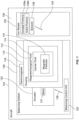
- FIG. 1 is a schematic block diagram of a balancing system 100 for an engine 102 of an aircraft 104, according to an embodiment of the present disclosure.
- the aircraft 104 may include more than one engine 102.
- the engine 102 includes a plurality of fan blades 106.
- each fan 106 includes a dovetail portion 106a that is formed unitarily with an airfoil portion 106b.
- sensors 108 are coupled to the fan blades 106.
- each fan blade 106 may include a sensor 108.
- a sensor 108 may be embedded within an airfoil portion 106b of a fan blade 106.
- a sensor is 108 secured to an outer surface of an airfoil portion 106b of a fan blade 106.
- the sensor 108 is a current-sensing wire.
- the sensor 108 is a voltage-sensing wire. The sensors 108 output presence signals that indicate the presence of the fan blades within the engine 102.
- a sensor 108 of the fan blade 106 detects a current or voltage and outputs a corresponding signal that indicates the presence of the fan blade 106 within the engine 102. In the event of a fan blade out event, the sensor 108 no longer detects a current or voltage, and therefore no longer outputs a presence signal.
- the balancing system 100 includes a housing 110, which may be formed of a torus.
- the housing 110 retains a magnetorheological fluid 112.
- the magnetorheological fluid 112 includes a carrier fluid 114, such as an oil, and magnetic particles 116 within the carrier fluid 114.
- the magnetic particles 116 may be spheres, ellipsoids, or the like that are suspended within the carrier fluid 114.
- the mass of the magnetic particles 116 is equal to a mass of an airfoil portion 106b of one fan blade 106.
- the magnetic particles 116 are drawn to the location of a missing fan blade 106 (such as a missing airfoil portion 106b of the fan blade 106), thereby compensating for the lost mass of the airfoil portion 106b of the fan blade 106 and maintaining balance of mass within the engine 102.
- the mass of the magnetic particles 116 is equal to the mass of one and a half airfoil portions 106b. It has been found through testing that when one fan blade 106 fragments from the engine 102, a half of another fan blade 106 may also fragment from the engine 102. In at least one other embodiment, the mass of the magnetic particles 116 may be greater or less than one airfoil portion 106b, or one and a half airfoil portions 106.
- Electromagnets 118 are coupled to an exterior of the housing 110.
- the electromagnets 118 correspond to the number of fan blades 106 of the engine 102.
- the electromagnets 118 are configured to be selectively deactivated (such as through no electrical current flowing thereto), and activated (such as through electrical current flowing thereto).
- the electromagnets 118 are radially aligned with the fan blades 106. That is, each electromagnet 118 is radially aligned with an associated fan blade 106.
- the housing 110 is configured to rotate at the same angular velocity as the fan blades 106 so that the radial alignment between the fan blades 106 and the electromagnets 118 is maintained.
- an actuator 120 is operatively coupled to the housing 110.
- the actuator 120 is a motor or engine that rotates the housing 110 along with the engine 102 to maintain the radial alignment between the electromagnets 118 and the associated fan blades 106.
- the actuator 120 is an electric motor. It has been found that an electric motor provides a relatively light actuator as compared to mechanical linkages. As such, the electric motor may add less weight to the aircraft 104 than complex mechanical linkages, thereby increasing fuel economy of the aircraft 104.
- the actuator 120 is a linkage that mechanically links the rotation of the fan blades 106 to the rotation of the housing 110.
- the linkage may be or include a shaft that is coupled between the engine 102 and the housing 110, such as through an accessory gearbox, connecting brackets, spars, ribs, fasteners, and/or the like, such that rotation of the engine 102 also results in rotation of the housing 110.
- the balancing system 100 also includes a balancing control unit 122, which may be onboard the aircraft 104.
- the balancing control unit 122 may be coupled to the engine 102 or proximate to the engine 102.
- the balancing control unit 122 may be within a flight deck of the aircraft 104.
- the balancing control unit 122 is in communication with the electromagnets 118 and the sensors 108, such as through wireless connections.
- housing 110 is rotated along with the fan blades 106 via the actuator 120 so that the electromagnets 118 maintain radial alignment with associated fan blades 106.
- the balancing control unit 122 receives the presence signals 124 from the sensors 108 of the fan blades 106.
- the balancing control unit 122 detects the presence of all the fan blades 106 through the presence signals 124. If the balancing control unit 122 detects all the presence signals 124 from all the sensors 108 of the fan blades 106, the balancing control unit 122 refrains from activating any of the electromagnets 118. That is, the balancing control unit 122 maintains the electromagnets 118 in a deactivated state.
- the balancing control unit 122 determines the absence of at least one presence signal 124 (thereby indicating loss of communication with a sensor 108 that is configured to output the presence signal)
- the balancing control unit 122 determines that the fan blade 106 (or portion thereof, such as the airfoil portion 106b) associated with the sensor 108 that is configured to output the presence signal 124 is no longer present (that is, a fan blade out event). Accordingly, the balancing control unit 122 outputs the activation signal 126 to the electromagnet 118 associated with the missing fan blade 106 (or portion thereof, such as the airfoil portion 106b).
- the activation signal 126 activates the electromagnet 118 associated with the missing fan blade 106 (or portion thereof, such as the airfoil portion 106b). Upon activation, the electromagnet 118 attracts the magnetic particles 116 to the radial location of the activated electromagnet 118. As such, the magnetic particles 116 are drawn to the radial location of the activated electromagnet 118.
- the mass of the magnetic particles 116 equals the mass of the missing fan blade 106 (or portion thereof, such as the airfoil portion 106b) associated with the activated electromagnet 118, the mass of the magnetic particles 116 replaces the missing mass of the fan blade 106 (or portion thereof, such as the airfoil portion 106b), thereby maintaining balance of mass within the engine 102.
- the mass of the magnetic particles 116 may be greater than a mass of one fan blade 106, or portion thereof, such as the airfoil portion 106b.
- the balancing control unit 122 outputs the activation signals 126, which controls current to the electromagnets 118 to control magnetic attraction of the magnetic particles 116.
- masses of the magnetic particles 116 may be controlled to be drawn to the locations of the missing airfoil portions 106b and/or portions thereof.
- the balancing system 100 for the engine 102 of the aircraft 104 includes the housing 110 retaining the magnetorheological fluid 112 including the magnetic particles 116 within the carrier fluid 114.
- the electromagnets 118 are coupled to the housing 110 (such as exterior portion thereof).
- the electromagnets 118 are associated with the fan blades 106 of the engine 102.
- each electromagnet 118 is radially aligned with an associated fan blade 106.
- the radial alignment is maintained by the housing 110 rotating along with the fan blades 106.
- the balancing control unit 122 is in communication with the electromagnets 118 and the sensors 108 of the fan blades 106, such as via wireless coupling.
- the balancing control unit 122 is configured to receive the presence signals 124 from the sensors 108 of the fan blades 106, maintain the electromagnets 118 in deactivated states when the presence signals 124 from the sensors 108 of all the fan blades 106 are detected and accounted for, activate one or more of the electromagnets 118 when one or more of the presence signals 124 are not detected. Accordingly, the electromagnet(s) 118 attract(s) the magnetic particles 116 to compensate for missing mass of at least one of the airfoil portions 106b of the fan blades 106.
- control unit central processing unit
- unit unit
- CPU central processing unit
- ASIC application specific integrated circuits
- balancing control unit 122 may be or include one or more processors that are configured to control operation thereof, as described herein.
- the balancing control unit 122 is configured to execute a set of instructions that are stored in one or more data storage units or elements (such as one or more memories), in order to process data.
- the balancing control unit 122 may include or be coupled to one or more memories.
- the data storage units may also store data or other information as desired or needed.
- the data storage units may be in the form of an information source or a physical memory element within a processing machine.
- the set of instructions may include various commands that instruct the balancing control unit 122 as a processing machine to perform specific operations such as the methods and processes of the various embodiments of the subject matter described herein.
- the set of instructions may be in the form of a software program.
- the software may be in various forms such as system software or application software. Further, the software may be in the form of a collection of separate programs, a program subset within a larger program or a portion of a program.
- the software may also include modular programming in the form of object-oriented programming.
- the processing of input data by the processing machine may be in response to user commands, or in response to results of previous processing, or in response to a request made by another processing machine.
- the diagrams of embodiments herein may illustrate one or more control or processing units, such as the balancing control unit 122.
- the processing or control units may represent circuits, circuitry, or portions thereof that may be implemented as hardware with associated instructions (e.g., software stored on a tangible and non-transitory computer readable storage medium, such as a computer hard drive, ROM, RAM, or the like) that perform the operations described herein.
- the hardware may include state machine circuitry hardwired to perform the functions described herein.
- the hardware may include electronic circuits that include and/or are connected to one or more logic-based devices, such as microprocessors, processors, controllers, or the like.
- the balancing control unit 122 may represent processing circuitry such as one or more of a field programmable gate array (FPGA), application specific integrated circuit (ASIC), microprocessor(s), and/or the like.
- the circuits in various embodiments may be configured to execute one or more algorithms to perform functions described herein.
- the one or more algorithms may include aspects of embodiments disclosed herein, whether or not expressly identified in a flowchart or a method.
- the terms "software” and “firmware” are interchangeable, and include any computer program stored in a data storage unit (for example, one or more memories) for execution by a computer, including RAM memory, ROM memory, EPROM memory, EEPROM memory, and non-volatile RAM (NVRAM) memory.
- a data storage unit for example, one or more memories
- NVRAM non-volatile RAM
- the above data storage unit types are exemplary only, and are thus not limiting as to the types of memory usable for storage of a computer program.
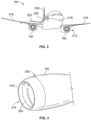
- FIG. 2 illustrates a front perspective view of the aircraft 104, according to an exemplary embodiment of the present disclosure.
- the aircraft 104 includes a propulsion system 212 that includes two engines 102, for example.
- the propulsion system 212 may include more engines 102 than shown.
- the engines 102 are carried by wings 216 of the aircraft 104.
- the engines 102 are carried by a fuselage 218 and/or an empennage 220.
- the empennage 220 may also support horizontal stabilizers 222 and a vertical stabilizer 224.
- the fuselage 218 of the aircraft 104 defines an internal cabin, including a flight deck.
- Figure 3 illustrates a lateral perspective view of an engine 102, according to an embodiment of the present disclosure.
- the engine 102 is a gas turbine engine having a case 300 that includes an engine inlet 314.
- the engine inlet 314 may include a leading edge 316 and an inner barrel section 320 located aft of the leading edge 316 of the engine inlet 314.
- the inner barrel section 320 may provide a boundary surface or wall for directing airflow (not shown) entering the engine inlet 314 and passing through the engine 102.
- the inner barrel section 320 may be located in relatively close proximity to one or more fan blades (not shown in Figure 3 ).
- the inner barrel section 320 may also be configured to serve as an acoustic structure having a plurality of perforations in an inner face sheet of the inner barrel section 320 for absorbing noise generated by the rotating fan blades and/or noise generated by the airflow entering the engine inlet 314 and passing through the engine 102.
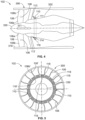
- FIG. 4 illustrates a transverse cross-sectional view of the engine 102, according to an embodiment of the present disclosure.
- the engine 102 includes the fan blades 106 coupled to an engine core 330.
- Each fan blade 106 includes a dovetail 106a and an airfoil 106b that is formed unitarily with the dovetail portion 106a.
- Each fan blade 106 further includes a sensor 108, that in the exemplary embodiment, is coupled to, or embedded within, the airfoil 106b.
- a shroud or inner wall 332 is positioned around the engine core 330.
- the housing 110 is secured around the exterior of the inner wall 332. This particular location allows for a low weight compact device design, while protecting the device from the ejected fan blade airfoil. However, it should be realized that this is an exemplary embodiment, and that the device can be placed anywhere on the engine, as long as the device has same rotational axis as the fan blades.
- the housing 110 is formed as a torus 111 that defines an interior tubular chamber 113 that retains the magnetorheological fluid 112. As described with respect to Figure 1 , the housing 110 rotates at the same angular velocity as the fan blades 106, such as via the actuator 120 (shown in Figure 1 ).
- the actuator 120 includes a separate and distinct electric motor 121 operatively coupled to the housing 110.
- the actuator 120 may be the engine core 330, which may be coupled to the housing 110 through, for example, a drive shaft coupled to the accessory gearbox using one or more connecting linkages.
- the actuator 120 may be one or more linkages that connect the housing 110 to the fan rotor shaft 331.
- FIG. 5 illustrates a rear view of the engine 102, according to an embodiment of the present disclosure.
- the electromagnets 118 include coils 119 wrapped around an outer portion of the housing 110. Each electromagnet 118 is radially aligned with and corresponds to an associated fan blade 106.
- the balancing control unit 122 in the event the balancing control unit 122 no longer detects a presence signal 124 from a sensor 108 of the fan blade 106', the balancing control unit 122 outputs an activation signal 126 to the electromagnet 118' associated with the fan blade 106' (determined as missing).
- the activation signal 126 activates the electromagnet 118, such as through electric current.
- the electromagnet 118 is activated, the magnetic particles 116 of the magnetorheological fluid 112 are attracted and drawn to the electromagnet 118, thereby providing mass equal to the missing airfoil portion 106b' of a fan blade 106' at the radial position of the missing fan blade 106'. In this manner, the balancing system 100 ensures mass balance within the engine 102.
- FIG. 6 is a flow chart of a balancing method for an engine of an aircraft, according to an embodiment of the present disclosure.
- the balancing control unit 122 receives the presence signals 124 from the sensors 108 of the fan blades 106.
- the balancing control unit 122 determines if all the fan blades 106 are detected. For example, if presence signals 124 are received from all of the sensors 108 of the fan blades 106, the balancing control unit 122 determines that all the fan blades 106 are detected, and are therefore present within the engine 102. If all the fan blades 106 are detected at 402, the method proceeds to 404, in which the balancing control unit 122 maintains the electromagnets 118 in a deactivated state.
- the method proceeds to 406, at which the balancing control unit 122 activates the electromagnet(s) 118 associated with the missing fan blade(s) 106. Consequently, at 408, the magnetic particles 116 of the magnetorheological fluid 112 within the housing 110 are drawn to the activated electromagnet(s) 118, thereby compensating, at 410, for the missing mass of the fan blade(s) 106.
- embodiments of the present disclosure provide systems and methods for maintaining mass balance within an engine of an aircraft. Further, embodiments of the present disclosure provide systems and methods for maintaining engine balance in the event a fan blade fragments during operation of the engine.
- a structure, limitation, or element that is "configured to” perform a task or operation is particularly structurally formed, constructed, or adapted in a manner corresponding to the task or operation.
- an object that is merely capable of being modified to perform the task or operation is not “configured to” perform the task or operation as used herein.
Landscapes
- Engineering & Computer Science (AREA)
- Mechanical Engineering (AREA)
- General Engineering & Computer Science (AREA)
- Chemical & Material Sciences (AREA)
- Combustion & Propulsion (AREA)
- Aviation & Aerospace Engineering (AREA)
- Structures Of Non-Positive Displacement Pumps (AREA)
Description
- Embodiments of the present disclosure generally relate to systems and methods for mitigating engine imbalance, such as within an engine of an aircraft.
- Various aircraft include propulsion systems, such as two or more engines. For example, the engines are turbofan engines that include a plurality of fan blades coupled to an engine core.
- The engines typically include gas turbine engine fan blade containment (GTEFBC) systems. During operation, a fan blade may dislodge or otherwise break (that is, a fan blade out event). In such an event, a GTEFBC system prevents a portion of the fan blade from being ejected through the fan casing of the engine.
- During a fan blade out event, the engine may become imbalanced. In particular, a fragmented portion of a fan blade may cause a mass imbalance within the engine, as the mass of the fragmented portion may no longer be present within the engine, and/or may not be located where intended. Accordingly, the engine may oscillate or vibrate due to the mass imbalance. The oscillation or vibration of the engine may, in turn, be translated to other portions of the aircraft, such as a wing to which the engine is secured.
- Document
US 2018/0128342 A1 , according to its abstract, states a controllable magneto-rheological device includes an annular cylinder formed by inner and outer walls connected at first and second opposing ends and forming an inner shaft configured to receive an operational component of an engine, generator or other device including one or more rotating structures. A magneto-rheological fluid is provided to fill a volume between the inner and outer walls of the annular cylinder. A plurality of electro-magnetic coils are positioned around the outer wall of the annular cylinder. One or more current controllers are coupled to the plurality of electro-magnetic coils for introducing a current through each of the electro-magnetic coils and corresponding magnetic flux through the magneto-rheological fluid. A level of current provided to each of the plurality of electro-magnetic coils directly affects the viscosity of the magneto-rheological fluid and tints the stiffness and damping levels of the controllable magneto-rheological device. - A need exists for a system and a method for maintaining mass balance within an engine of an aircraft. Further, a need exists for a system and a method for maintaining engine balance in the event a fan blade fragments during operation of the engine.
- There is provided a balancing system for an engine of an aircraft, the balancing system comprising a housing retaining a magnetorheological fluid including magnetic particles within a carrier fluid; electromagnets coupled to the housing, wherein the electromagnets are associated with fan blades of the engine, wherein the housing is configured to rotate at the same angular velocity as the fan blades so that a radial alignment between the fan blades and the electromagnets is maintained; and a balancing control unit in communication with the electromagnets and sensors of the fan blades, wherein the balancing control unit is configured to receive presence signals from the sensors of the fan blades, maintain the electromagnets in deactivated states when the presence signals from the sensors of all the fan blades are detected, and activate one or more of the electromagnets when one or more of the presence signals are not detected, wherein the one or more electromagnets that are activated attract the magnetic particles to compensate for missing mass of at least one of the fan blades, thereby maintaining balance of mass within the engine.
- Further, there is provided a balancing method for an engine of an aircraft, the balancing method comprising retaining, within a housing, a magnetorheological fluid including magnetic particles within a carrier fluid; coupling electromagnets to the housing; associating the electromagnets with fan blades of the engine; and communicatively coupling a balancing control unit with the electromagnets and sensors of the fan blades; the method further comprising receiving, by the balancing control unit, presence signals from the sensors of the fan blades; maintaining the electromagnets in deactivated states when the presence signals from the sensors of all the fan blades are detected; activating one or more of the electromagnets when one or more of the presence signals are not detected; and attracting, by the one or more electromagnets that are activated, the magnetic particles to compensate for missing mass of at least one of the fan blades thereby maintaining balance of mass within the engine; the method further comprising wherein the housing is configured to rotate at the same angular velocity as the fan blades so that a radial alignment between the fan blades and the electromagnets is maintained.
-
-
Figure 1 is a schematic block diagram of a balancing system for an engine of an aircraft, according to an embodiment of the present disclosure. -
Figure 2 illustrates a front perspective view of an aircraft, according to an exemplary embodiment of the present disclosure. -
Figure 3 illustrates a lateral perspective view of an engine, according to an embodiment of the present disclosure. -
Figure 4 illustrates a transverse cross-sectional view of the engine, according to an embodiment of the present disclosure. -
Figure 5 illustrates a rear view of the engine, according to an embodiment of the present disclosure. -
Figure 6 is a flow chart of a balancing method for an engine of an aircraft, according to an embodiment of the present disclosure. - The foregoing summary, as well as the following detailed description of certain embodiments will be better understood when read in conjunction with the appended drawings. As used herein, an element or step recited in the singular and preceded by the word "a" or "an" should be understood as not necessarily excluding the plural of the elements or steps. Further, references to "one embodiment" are not intended to be interpreted as excluding the existence of additional embodiments that also incorporate the recited features. Moreover, unless explicitly stated to the contrary, embodiments "comprising" or "having" an element or a plurality of elements having a particular condition may include additional elements not having that condition.
- Certain embodiments of the present disclosure provide a balancing system for an engine of an aircraft. The balancing system is configured to compensate for an engine imbalance that occurs when a fan blade out event occurs. In at least one embodiment, the balancing system includes a housing, such as formed as a torus that contains a magnetorheological fluid. When a fan blade out event occurs, an electromagnet proximate the missing fan blade is activated (such as through electrical activation), thereby causing magnetic particles within the fluid to be drawn to the radial location of the missing fan blade.
- Certain embodiments of the present disclosure provide a system for mitigating an engine imbalance. The system includes a housing formed as a torus that retains a magnetorheological fluid. A plurality of electromagnets are coupled to an external surface of the housing. A balancing control unit is in communication with the electromagnets. The balancing control unit is configured to identify a fan blade out event (such as via sensors coupled to the fan blades), and activate at least one of the electromagnets disposed adjacent to the identified blade out event, thereby attracting magnetic particles within the fluid to compensate for the mass of the missing fan blade.
- In at least one embodiment, the engine includes a fan. Rotation of the housing of the proposed device is coupled to rotation of the fan. The fan and the housing are configured to rotate at the same rotational speed. The fan includes n blades and the housing include n electromagnets that correspond to the n blades. In at least one embodiment, a mass of the magnetic particles within the magnetorheological fluid is equal to a mass of a single fan blade.
- In at least one embodiment, the system also includes a plurality of sensors. Each fan blade includes at least one of the plurality of sensors. The balancing control unit is configured to receive an input from each of the plurality of sensors, and identify the fan blade out event based upon the received inputs.
- In at least one embodiment, a shaft is coupled between the engine and the housing. The shaft is configured to rotate the housing at the same rotational speed as the engine. As another example, the system includes a motor that rotates the housing at the same rotational speed as the engine fan. The viscosity of the magnetorheological fluid inside the device housing assures that the magnetic particles rotate inside the housing at the same radial velocity as the fan blades.
-
Figure 1 is a schematic block diagram of abalancing system 100 for anengine 102 of anaircraft 104, according to an embodiment of the present disclosure. Theaircraft 104 may include more than oneengine 102. Theengine 102 includes a plurality offan blades 106. In an exemplary embodiment, eachfan 106 includes adovetail portion 106a that is formed unitarily with anairfoil portion 106b. - In at least one embodiment,
sensors 108 are coupled to thefan blades 106. For example, eachfan blade 106 may include asensor 108. As an example, asensor 108 may be embedded within anairfoil portion 106b of afan blade 106. As another example, a sensor is 108 secured to an outer surface of anairfoil portion 106b of afan blade 106. In at least one embodiment, thesensor 108 is a current-sensing wire. As another example, thesensor 108 is a voltage-sensing wire. Thesensors 108 output presence signals that indicate the presence of the fan blades within theengine 102. For example, when thefan blade 106 is operationally secured within theengine 102, asensor 108 of thefan blade 106 detects a current or voltage and outputs a corresponding signal that indicates the presence of thefan blade 106 within theengine 102. In the event of a fan blade out event, thesensor 108 no longer detects a current or voltage, and therefore no longer outputs a presence signal. - The
balancing system 100 includes ahousing 110, which may be formed of a torus. Thehousing 110 retains amagnetorheological fluid 112. Themagnetorheological fluid 112 includes acarrier fluid 114, such as an oil, andmagnetic particles 116 within thecarrier fluid 114. Themagnetic particles 116 may be spheres, ellipsoids, or the like that are suspended within thecarrier fluid 114. In at least one embodiment, the mass of themagnetic particles 116 is equal to a mass of anairfoil portion 106b of onefan blade 106. As explained herein, in the event of a fan blade out event, themagnetic particles 116 are drawn to the location of a missing fan blade 106 (such as a missingairfoil portion 106b of the fan blade 106), thereby compensating for the lost mass of theairfoil portion 106b of thefan blade 106 and maintaining balance of mass within theengine 102. - In at least one other embodiment, the mass of the
magnetic particles 116 is equal to the mass of one and ahalf airfoil portions 106b. It has been found through testing that when onefan blade 106 fragments from theengine 102, a half of anotherfan blade 106 may also fragment from theengine 102. In at least one other embodiment, the mass of themagnetic particles 116 may be greater or less than oneairfoil portion 106b, or one and ahalf airfoil portions 106. -
Electromagnets 118 are coupled to an exterior of thehousing 110. In at least one embodiment, theelectromagnets 118 correspond to the number offan blades 106 of theengine 102. Theelectromagnets 118 are configured to be selectively deactivated (such as through no electrical current flowing thereto), and activated (such as through electrical current flowing thereto). Theelectromagnets 118 are radially aligned with thefan blades 106. That is, eachelectromagnet 118 is radially aligned with an associatedfan blade 106. Thehousing 110 is configured to rotate at the same angular velocity as thefan blades 106 so that the radial alignment between thefan blades 106 and theelectromagnets 118 is maintained. - As such, an
actuator 120 is operatively coupled to thehousing 110. In at least one embodiment, theactuator 120 is a motor or engine that rotates thehousing 110 along with theengine 102 to maintain the radial alignment between theelectromagnets 118 and the associatedfan blades 106. As an example, theactuator 120 is an electric motor. It has been found that an electric motor provides a relatively light actuator as compared to mechanical linkages. As such, the electric motor may add less weight to theaircraft 104 than complex mechanical linkages, thereby increasing fuel economy of theaircraft 104. As another example, theactuator 120 is a linkage that mechanically links the rotation of thefan blades 106 to the rotation of thehousing 110. In such an embodiment, the linkage may be or include a shaft that is coupled between theengine 102 and thehousing 110, such as through an accessory gearbox, connecting brackets, spars, ribs, fasteners, and/or the like, such that rotation of theengine 102 also results in rotation of thehousing 110. - The
balancing system 100 also includes a balancingcontrol unit 122, which may be onboard theaircraft 104. For example, the balancingcontrol unit 122 may be coupled to theengine 102 or proximate to theengine 102. As another example, the balancingcontrol unit 122 may be within a flight deck of theaircraft 104. The balancingcontrol unit 122 is in communication with theelectromagnets 118 and thesensors 108, such as through wireless connections. - In operation,
housing 110 is rotated along with thefan blades 106 via theactuator 120 so that theelectromagnets 118 maintain radial alignment with associatedfan blades 106. During this time, the balancingcontrol unit 122 receives the presence signals 124 from thesensors 108 of thefan blades 106. The balancingcontrol unit 122 detects the presence of all thefan blades 106 through the presence signals 124. If the balancingcontrol unit 122 detects all the presence signals 124 from all thesensors 108 of thefan blades 106, the balancingcontrol unit 122 refrains from activating any of theelectromagnets 118. That is, the balancingcontrol unit 122 maintains theelectromagnets 118 in a deactivated state. - If, however, the balancing
control unit 122 determines the absence of at least one presence signal 124 (thereby indicating loss of communication with asensor 108 that is configured to output the presence signal), the balancingcontrol unit 122 determines that the fan blade 106 (or portion thereof, such as theairfoil portion 106b) associated with thesensor 108 that is configured to output thepresence signal 124 is no longer present (that is, a fan blade out event). Accordingly, the balancingcontrol unit 122 outputs theactivation signal 126 to theelectromagnet 118 associated with the missing fan blade 106 (or portion thereof, such as theairfoil portion 106b). Theactivation signal 126 activates theelectromagnet 118 associated with the missing fan blade 106 (or portion thereof, such as theairfoil portion 106b). Upon activation, theelectromagnet 118 attracts themagnetic particles 116 to the radial location of the activatedelectromagnet 118. As such, themagnetic particles 116 are drawn to the radial location of the activatedelectromagnet 118. Because the mass of themagnetic particles 116 equals the mass of the missing fan blade 106 (or portion thereof, such as theairfoil portion 106b) associated with the activatedelectromagnet 118, the mass of themagnetic particles 116 replaces the missing mass of the fan blade 106 (or portion thereof, such as theairfoil portion 106b), thereby maintaining balance of mass within theengine 102. - Further, the mass of the
magnetic particles 116 may be greater than a mass of onefan blade 106, or portion thereof, such as theairfoil portion 106b. In such an embodiment, ifmultiple airfoil portions 106b are missing, or a portion thereof, the balancingcontrol unit 122 outputs the activation signals 126, which controls current to theelectromagnets 118 to control magnetic attraction of themagnetic particles 116. As such, masses of themagnetic particles 116 may be controlled to be drawn to the locations of themissing airfoil portions 106b and/or portions thereof. - As described, the
balancing system 100 for theengine 102 of theaircraft 104 includes thehousing 110 retaining themagnetorheological fluid 112 including themagnetic particles 116 within thecarrier fluid 114. Theelectromagnets 118 are coupled to the housing 110 (such as exterior portion thereof). Theelectromagnets 118 are associated with thefan blades 106 of theengine 102. For example, eachelectromagnet 118 is radially aligned with an associatedfan blade 106. The radial alignment is maintained by thehousing 110 rotating along with thefan blades 106. The balancingcontrol unit 122 is in communication with theelectromagnets 118 and thesensors 108 of thefan blades 106, such as via wireless coupling. In at least one embodiment, the balancingcontrol unit 122 is configured to receive the presence signals 124 from thesensors 108 of thefan blades 106, maintain theelectromagnets 118 in deactivated states when the presence signals 124 from thesensors 108 of all thefan blades 106 are detected and accounted for, activate one or more of theelectromagnets 118 when one or more of the presence signals 124 are not detected. Accordingly, the electromagnet(s) 118 attract(s) themagnetic particles 116 to compensate for missing mass of at least one of theairfoil portions 106b of thefan blades 106. - As used herein, the term "control unit," "central processing unit," "unit," "CPU," "computer," or the like may include any processor-based or microprocessor-based system including systems using microcontrollers, reduced instruction set computers (RISC), application specific integrated circuits (ASICs), logic circuits, and any other circuit or processor including hardware, software, or a combination thereof capable of executing the functions described herein. Such are exemplary only, and are thus not intended to limit in any way the definition and/or meaning of such terms. For example, the balancing
control unit 122 may be or include one or more processors that are configured to control operation thereof, as described herein. - The balancing
control unit 122 is configured to execute a set of instructions that are stored in one or more data storage units or elements (such as one or more memories), in order to process data. For example, the balancingcontrol unit 122 may include or be coupled to one or more memories. The data storage units may also store data or other information as desired or needed. The data storage units may be in the form of an information source or a physical memory element within a processing machine. - The set of instructions may include various commands that instruct the
balancing control unit 122 as a processing machine to perform specific operations such as the methods and processes of the various embodiments of the subject matter described herein. The set of instructions may be in the form of a software program. The software may be in various forms such as system software or application software. Further, the software may be in the form of a collection of separate programs, a program subset within a larger program or a portion of a program. The software may also include modular programming in the form of object-oriented programming. The processing of input data by the processing machine may be in response to user commands, or in response to results of previous processing, or in response to a request made by another processing machine. - The diagrams of embodiments herein may illustrate one or more control or processing units, such as the balancing
control unit 122. It is to be understood that the processing or control units may represent circuits, circuitry, or portions thereof that may be implemented as hardware with associated instructions (e.g., software stored on a tangible and non-transitory computer readable storage medium, such as a computer hard drive, ROM, RAM, or the like) that perform the operations described herein. The hardware may include state machine circuitry hardwired to perform the functions described herein. Optionally, the hardware may include electronic circuits that include and/or are connected to one or more logic-based devices, such as microprocessors, processors, controllers, or the like. Optionally, the balancingcontrol unit 122 may represent processing circuitry such as one or more of a field programmable gate array (FPGA), application specific integrated circuit (ASIC), microprocessor(s), and/or the like. The circuits in various embodiments may be configured to execute one or more algorithms to perform functions described herein. The one or more algorithms may include aspects of embodiments disclosed herein, whether or not expressly identified in a flowchart or a method. - As used herein, the terms "software" and "firmware" are interchangeable, and include any computer program stored in a data storage unit (for example, one or more memories) for execution by a computer, including RAM memory, ROM memory, EPROM memory, EEPROM memory, and non-volatile RAM (NVRAM) memory. The above data storage unit types are exemplary only, and are thus not limiting as to the types of memory usable for storage of a computer program.
-
Figure 2 illustrates a front perspective view of theaircraft 104, according to an exemplary embodiment of the present disclosure. Theaircraft 104 includes apropulsion system 212 that includes twoengines 102, for example. Optionally, thepropulsion system 212 may includemore engines 102 than shown. Theengines 102 are carried bywings 216 of theaircraft 104. In other embodiments, theengines 102 are carried by afuselage 218 and/or anempennage 220. Theempennage 220 may also supporthorizontal stabilizers 222 and avertical stabilizer 224. Thefuselage 218 of theaircraft 104 defines an internal cabin, including a flight deck. -
Figure 3 illustrates a lateral perspective view of anengine 102, according to an embodiment of the present disclosure. In at least one embodiment, theengine 102 is a gas turbine engine having acase 300 that includes anengine inlet 314. Theengine inlet 314 may include aleading edge 316 and aninner barrel section 320 located aft of theleading edge 316 of theengine inlet 314. Theinner barrel section 320 may provide a boundary surface or wall for directing airflow (not shown) entering theengine inlet 314 and passing through theengine 102. Theinner barrel section 320 may be located in relatively close proximity to one or more fan blades (not shown inFigure 3 ). In this regard, theinner barrel section 320 may also be configured to serve as an acoustic structure having a plurality of perforations in an inner face sheet of theinner barrel section 320 for absorbing noise generated by the rotating fan blades and/or noise generated by the airflow entering theengine inlet 314 and passing through theengine 102. -
Figure 4 illustrates a transverse cross-sectional view of theengine 102, according to an embodiment of the present disclosure. Theengine 102 includes thefan blades 106 coupled to anengine core 330. Eachfan blade 106 includes adovetail 106a and anairfoil 106b that is formed unitarily with thedovetail portion 106a. Eachfan blade 106 further includes asensor 108, that in the exemplary embodiment, is coupled to, or embedded within, theairfoil 106b. A shroud orinner wall 332 is positioned around theengine core 330. - As shown, in at least one embodiment, the
housing 110 is secured around the exterior of theinner wall 332. This particular location allows for a low weight compact device design, while protecting the device from the ejected fan blade airfoil. However, it should be realized that this is an exemplary embodiment, and that the device can be placed anywhere on the engine, as long as the device has same rotational axis as the fan blades. Thehousing 110 is formed as atorus 111 that defines an interiortubular chamber 113 that retains themagnetorheological fluid 112. As described with respect toFigure 1 , thehousing 110 rotates at the same angular velocity as thefan blades 106, such as via the actuator 120 (shown inFigure 1 ). In at least one embodiment, theactuator 120 includes a separate and distinctelectric motor 121 operatively coupled to thehousing 110. In at least one other embodiment, theactuator 120 may be theengine core 330, which may be coupled to thehousing 110 through, for example, a drive shaft coupled to the accessory gearbox using one or more connecting linkages. As another example, theactuator 120 may be one or more linkages that connect thehousing 110 to thefan rotor shaft 331. -
Figure 5 illustrates a rear view of theengine 102, according to an embodiment of the present disclosure. In at least one embodiment, theelectromagnets 118 includecoils 119 wrapped around an outer portion of thehousing 110. Eachelectromagnet 118 is radially aligned with and corresponds to an associatedfan blade 106. - Referring to
Figures 1 and5 , in the event the balancingcontrol unit 122 no longer detects apresence signal 124 from asensor 108 of the fan blade 106', the balancingcontrol unit 122 outputs anactivation signal 126 to the electromagnet 118' associated with the fan blade 106' (determined as missing). Theactivation signal 126 activates theelectromagnet 118, such as through electric current. As theelectromagnet 118 is activated, themagnetic particles 116 of themagnetorheological fluid 112 are attracted and drawn to theelectromagnet 118, thereby providing mass equal to themissing airfoil portion 106b' of a fan blade 106' at the radial position of the missing fan blade 106'. In this manner, thebalancing system 100 ensures mass balance within theengine 102. -
Figure 6 is a flow chart of a balancing method for an engine of an aircraft, according to an embodiment of the present disclosure. Referring toFigures 1 and6 , at 400, the balancingcontrol unit 122 receives the presence signals 124 from thesensors 108 of thefan blades 106. - At 402, the balancing
control unit 122 determines if all thefan blades 106 are detected. For example, if presence signals 124 are received from all of thesensors 108 of thefan blades 106, the balancingcontrol unit 122 determines that all thefan blades 106 are detected, and are therefore present within theengine 102. If all thefan blades 106 are detected at 402, the method proceeds to 404, in which thebalancing control unit 122 maintains theelectromagnets 118 in a deactivated state. - If, however, all the
fan blades 106 are not detected at 402, the method proceeds to 406, at which thebalancing control unit 122 activates the electromagnet(s) 118 associated with the missing fan blade(s) 106. Consequently, at 408, themagnetic particles 116 of themagnetorheological fluid 112 within thehousing 110 are drawn to the activated electromagnet(s) 118, thereby compensating, at 410, for the missing mass of the fan blade(s) 106. - As described herein, embodiments of the present disclosure provide systems and methods for maintaining mass balance within an engine of an aircraft. Further, embodiments of the present disclosure provide systems and methods for maintaining engine balance in the event a fan blade fragments during operation of the engine.
- While various spatial and directional terms, such as top, bottom, lower, mid, lateral, horizontal, vertical, front and the like may be used to describe embodiments of the present disclosure, it is understood that such terms are merely used with respect to the orientations shown in the drawings. The orientations may be inverted, rotated, or otherwise changed, such that an upper portion is a lower portion, and vice versa, horizontal becomes vertical, and the like.
- As used herein, a structure, limitation, or element that is "configured to" perform a task or operation is particularly structurally formed, constructed, or adapted in a manner corresponding to the task or operation. For purposes of clarity and the avoidance of doubt, an object that is merely capable of being modified to perform the task or operation is not "configured to" perform the task or operation as used herein.
- It is to be understood that the above description is intended to be illustrative, and not restrictive. For example, the above-described embodiments (and/or aspects thereof) may be used in combination with each other. In addition, many modifications may be made to adapt a particular situation or material to the teachings of the various embodiments of the disclosure without departing from the scope of the claims.
- While the dimensions and types of materials described herein are intended to define the parameters of the various embodiments of the disclosure, the embodiments are by no means limiting and are exemplary embodiments. Many other embodiments will be apparent to those of skill in the art upon reviewing the above description. The scope of the various embodiments of the disclosure should, therefore, be determined with reference to the appended claims, along with the full scope of equivalents to which such claims are entitled. In the appended claims, the terms "including" and "in which" are used as the plain-English equivalents of the respective terms "comprising" and "wherein." Moreover, the terms "first," "second," and "third," etc. are used merely as labels, and are not intended to impose numerical requirements on their objects.
- This written description uses examples to disclose the various embodiments of the disclosure, including the best mode, and also to enable any person skilled in the art to practice the various embodiments of the disclosure, including making and using any devices or systems and performing any incorporated methods. The patentable scope of the various embodiments of the disclosure is defined by the claims, and may include other examples that occur to those skilled in the art. Such other examples are intended to be within the scope of the claims if the examples have structural elements that do not differ from the literal language of the claims, or if the examples include equivalent structural elements with insubstantial differences from the literal language of the claims.
Claims (13)
- A balancing system (100) for an engine (102) of an aircraft (104), the balancing system (100) comprising:a housing (110) retaining a magnetorheological fluid (112) including magnetic particles within a carrier fluid (114);electromagnets (118) coupled to the housing (110), wherein the electromagnets (118) are associated with fan blades (106) of the engine (102), wherein the housing (110) is configured to rotate at the same angular velocity as the fan blades (106) so that a radial alignment between the fan blades (106) and the electromagnets (118) is maintained; anda balancing control unit (122) in communication with the electromagnets (118) and sensors (108) of the fan blades (106), wherein the balancing control unit (122) is configured to:receive presence signals (124) from the sensors (108) of the fan blades (106),maintain the electromagnets (118) in deactivated states when the presence signals (124) from the sensors (108) of all the fan blades (106) are detected, andactivate one or more of the electromagnets (118) when one or more of the presence signals (124) are not detected, wherein the one or more electromagnets (118) that are activated attract the magnetic particles to compensate for missing mass of at least one of the fan blades (106) thereby maintaining balance of mass within the engine (102).
- The balancing system (100) of claim 1, wherein the housing (110) is formed as a torus (111) defining an interior tubular chamber (113) that retains the magnetorheological fluid (112).
- The balancing system (100) of claim 1 or 2, wherein a mass of the magnetic particles is equal to a mass of at least one of the fan blades (106).
- The balancing system (100) of any of claims 1 to 3, wherein a number of electromagnets (118) corresponds to a number of the fan blades (106).
- The balancing system (100) of any of claims 1 to 4, wherein the electromagnets (118) are radially aligned with the fan blades (106), and wherein each of the electromagnets (118) is radially aligned with a respective one of the fan blades (106).
- The balancing system (100) of any of claims 1 to 5, further comprising an actuator operatively coupled to the housing (110), wherein the actuator rotates the housing (110).
- The balancing system (100) of claim 6, wherein the actuator comprises an electric motor (121).
- An aircraft (104) including the balancing system (100) according to any of claims 1 to 7.
- A balancing method for an engine (102) of an aircraft (104), the balancing method comprising:retaining, within a housing (110), a magnetorheological fluid (112) including magnetic particles within a carrier fluid (114);coupling electromagnets (118) to the housing (110);associating the electromagnets (118) with fan blades (106) of the engine (102); andcommunicatively coupling a balancing control unit (122) with the electromagnets (118) and sensors (108) of the fan blades (106);the method further comprising:receiving, by the balancing control unit (122), presence signals from the sensors (108) of the fan blades (106);maintaining the electromagnets (118) in deactivated states when the presence signals from the sensors (108) of all the fan blades (106) are detected;activating one or more of the electromagnets (118) when one or more of the presence signals are not detected; andattracting, by the one or more electromagnets (118) that are activated, the magnetic particles (116) to compensate for missing mass of at least one of the fan blades (106) thereby maintaining balance of mass within the engine;the method further comprising:
rotating the housing (110) at the same angular velocity as the fan blades (106) so that a radial alignment between the fan blades (106) and the electromagnets (118) is maintained. - The balancing method of claim 9, further comprising forming the housing (110) as a torus (111) defining an interior tubular chamber (113) that retains the magnetorheological fluid (112).
- The balancing method of claim 9 or 10, wherein a mass of the magnetic particles (116) is equal to a mass of at least one of the fan blades (106).
- The balancing method of any of claims 9 to 11, wherein said associating comprises radially aligning the electromagnets (118) with the fan blades (106), and wherein each of the electromagnets (118) is radially aligned with a respective one of the fan blades (106).
- The balancing method of any of claims 9 to 12, further comprising operatively coupling an actuator to the housing (110), wherein said rotating is by the actuator.
Applications Claiming Priority (1)
| Application Number | Priority Date | Filing Date | Title |
|---|---|---|---|
| US16/732,580 US11261740B2 (en) | 2020-01-02 | 2020-01-02 | Balancing systems and methods for an engine of an aircraft |
Publications (2)
| Publication Number | Publication Date |
|---|---|
| EP3845739A1 EP3845739A1 (en) | 2021-07-07 |
| EP3845739B1 true EP3845739B1 (en) | 2024-08-07 |
Family
ID=73014297
Family Applications (1)
| Application Number | Title | Priority Date | Filing Date |
|---|---|---|---|
| EP20203568.9A Active EP3845739B1 (en) | 2020-01-02 | 2020-10-23 | Balancing systems and methods for an engine of an aircraft |
Country Status (3)
| Country | Link |
|---|---|
| US (1) | US11261740B2 (en) |
| EP (1) | EP3845739B1 (en) |
| CN (1) | CN113062797B (en) |
Families Citing this family (1)
| Publication number | Priority date | Publication date | Assignee | Title |
|---|---|---|---|---|
| US12297748B2 (en) * | 2023-03-20 | 2025-05-13 | Pratt & Whitney Canada Corp. | System and method of performing fan trim balancing |
Family Cites Families (11)
| Publication number | Priority date | Publication date | Assignee | Title |
|---|---|---|---|---|
| US5082421A (en) * | 1986-04-28 | 1992-01-21 | Rolls-Royce Plc | Active control of unsteady motion phenomena in turbomachinery |
| GB2319812A (en) * | 1996-10-15 | 1998-06-03 | Balfan Corp | In-flight balancing of fan on turbofan jet engine |
| FR2817912B1 (en) * | 2000-12-07 | 2003-01-17 | Hispano Suiza Sa | REDUCER TAKING OVER THE AXIAL EFFORTS GENERATED BY THE BLOWER OF A TURBO-JET |
| US10119412B2 (en) | 2013-03-13 | 2018-11-06 | United Technologies Corporation | Turbine engine adaptive low leakage air seal |
| FR3004748B1 (en) * | 2013-04-19 | 2015-04-10 | Snecma | AIRCRAFT ENGINE BLADE OR BLADE AND METHOD AND SYSTEM FOR CONTROLLING DEFECTS IN COMPOSITES BY PARTICLES HAVING FERROMAGNETIC PROPERTIES |
| US10465557B2 (en) | 2015-09-01 | 2019-11-05 | Rolls-Royce North American Technologies, Inc. | Magnetic squeeze film damper system for a gas turbine engine |
| US10240909B2 (en) * | 2016-10-17 | 2019-03-26 | The Boeing Company | Three-dimensional gap measurement systems and methods |
| US11002335B2 (en) * | 2016-11-08 | 2021-05-11 | General Electric Company | Controllable magneto-rheological device for gas turbine engine |
| US10822965B2 (en) * | 2018-03-26 | 2020-11-03 | General Electric Company | Active airfoil vibration control |
| CN209398455U (en) | 2018-12-05 | 2019-09-17 | 中国航发商用航空发动机有限责任公司 | A kind of aero-engine and its blade |
| US10954932B2 (en) * | 2019-03-05 | 2021-03-23 | Tung Thanh NGUYEN | Electromagnetic cooling fan |
-
2020
- 2020-01-02 US US16/732,580 patent/US11261740B2/en active Active
- 2020-10-23 EP EP20203568.9A patent/EP3845739B1/en active Active
- 2020-11-09 CN CN202011242056.XA patent/CN113062797B/en active Active
Also Published As
| Publication number | Publication date |
|---|---|
| US20210207485A1 (en) | 2021-07-08 |
| EP3845739A1 (en) | 2021-07-07 |
| CN113062797A (en) | 2021-07-02 |
| CN113062797B (en) | 2025-01-24 |
| US11261740B2 (en) | 2022-03-01 |
Similar Documents
| Publication | Publication Date | Title |
|---|---|---|
| US6195982B1 (en) | Apparatus and method of active flutter control | |
| US8075249B2 (en) | System and a method for dynamically balancing a blade | |
| EP3093440A1 (en) | Fan blade vibration monitoring and control system and method | |
| CN105986907A (en) | Gas turbine engine health determination | |
| EP3845739B1 (en) | Balancing systems and methods for an engine of an aircraft | |
| WO2016054171A1 (en) | Rotor speed management | |
| US5230603A (en) | Control of flow instabilities in turbomachines | |
| EP3001560A2 (en) | System and methods for reducing noise in an air moving system | |
| EP3333082A1 (en) | Thrust measuring device for a propulsion system | |
| EP2873813A1 (en) | Gas turbine engine turbine blade tip active clearance control system and method | |
| EP3293385A1 (en) | Gas turbine engine with progressive stall recovery | |
| EP2728126A1 (en) | System for mitigating overspeeding of a turbine engine | |
| CN110821571A (en) | Damping device for damping shaft vibrations | |
| US10822965B2 (en) | Active airfoil vibration control | |
| US12421864B2 (en) | Controlling excitation loads associated with open rotor aeronautical engines | |
| US12491988B2 (en) | Controlling excitation loads associated with open rotor aeronautical engines | |
| CN114909216A (en) | Active compressor stall recovery | |
| EP3241987B1 (en) | Rotor balancing | |
| US20140260323A1 (en) | Gas turbine engine and active balancing system | |
| CN113418709A (en) | Cartridge container holding test device and design method thereof | |
| EP3889035B1 (en) | Motor-integrated fluid machine and vertical take-off and landing machine | |
| US20250179964A1 (en) | Variable bleed valve assemblies | |
| EP3090952B1 (en) | Engine nacelle | |
| CN107531321B (en) | Sound-damping device for an aircraft | |
| CN111985046A (en) | Modularly formed component |
Legal Events
| Date | Code | Title | Description |
|---|---|---|---|
| PUAI | Public reference made under article 153(3) epc to a published international application that has entered the european phase |
Free format text: ORIGINAL CODE: 0009012 |
|
| STAA | Information on the status of an ep patent application or granted ep patent |
Free format text: STATUS: THE APPLICATION HAS BEEN PUBLISHED |
|
| AK | Designated contracting states |
Kind code of ref document: A1 Designated state(s): AL AT BE BG CH CY CZ DE DK EE ES FI FR GB GR HR HU IE IS IT LI LT LU LV MC MK MT NL NO PL PT RO RS SE SI SK SM TR |
|
| STAA | Information on the status of an ep patent application or granted ep patent |
Free format text: STATUS: REQUEST FOR EXAMINATION WAS MADE |
|
| 17P | Request for examination filed |
Effective date: 20211118 |
|
| RBV | Designated contracting states (corrected) |
Designated state(s): AL AT BE BG CH CY CZ DE DK EE ES FI FR GB GR HR HU IE IS IT LI LT LU LV MC MK MT NL NO PL PT RO RS SE SI SK SM TR |
|
| RAP3 | Party data changed (applicant data changed or rights of an application transferred) |
Owner name: THE BOEING COMPANY |
|
| STAA | Information on the status of an ep patent application or granted ep patent |
Free format text: STATUS: EXAMINATION IS IN PROGRESS |
|
| 17Q | First examination report despatched |
Effective date: 20230619 |
|
| GRAP | Despatch of communication of intention to grant a patent |
Free format text: ORIGINAL CODE: EPIDOSNIGR1 |
|
| STAA | Information on the status of an ep patent application or granted ep patent |
Free format text: STATUS: GRANT OF PATENT IS INTENDED |
|
| INTG | Intention to grant announced |
Effective date: 20240322 |
|
| GRAS | Grant fee paid |
Free format text: ORIGINAL CODE: EPIDOSNIGR3 |
|
| GRAA | (expected) grant |
Free format text: ORIGINAL CODE: 0009210 |
|
| STAA | Information on the status of an ep patent application or granted ep patent |
Free format text: STATUS: THE PATENT HAS BEEN GRANTED |
|
| P01 | Opt-out of the competence of the unified patent court (upc) registered |
Free format text: CASE NUMBER: APP_33065/2024 Effective date: 20240603 |
|
| AK | Designated contracting states |
Kind code of ref document: B1 Designated state(s): AL AT BE BG CH CY CZ DE DK EE ES FI FR GB GR HR HU IE IS IT LI LT LU LV MC MK MT NL NO PL PT RO RS SE SI SK SM TR |
|
| REG | Reference to a national code |
Ref country code: GB Ref legal event code: FG4D |
|
| REG | Reference to a national code |
Ref country code: CH Ref legal event code: EP |
|
| REG | Reference to a national code |
Ref country code: IE Ref legal event code: FG4D |
|
| REG | Reference to a national code |
Ref country code: DE Ref legal event code: R096 Ref document number: 602020035210 Country of ref document: DE |
|
| REG | Reference to a national code |
Ref country code: LT Ref legal event code: MG9D |
|
| REG | Reference to a national code |
Ref country code: NL Ref legal event code: MP Effective date: 20240807 |
|
| PG25 | Lapsed in a contracting state [announced via postgrant information from national office to epo] |
Ref country code: NO Free format text: LAPSE BECAUSE OF FAILURE TO SUBMIT A TRANSLATION OF THE DESCRIPTION OR TO PAY THE FEE WITHIN THE PRESCRIBED TIME-LIMIT Effective date: 20241107 |
|
| REG | Reference to a national code |
Ref country code: AT Ref legal event code: MK05 Ref document number: 1711146 Country of ref document: AT Kind code of ref document: T Effective date: 20240807 |
|
| PG25 | Lapsed in a contracting state [announced via postgrant information from national office to epo] |
Ref country code: GR Free format text: LAPSE BECAUSE OF FAILURE TO SUBMIT A TRANSLATION OF THE DESCRIPTION OR TO PAY THE FEE WITHIN THE PRESCRIBED TIME-LIMIT Effective date: 20241108 Ref country code: FI Free format text: LAPSE BECAUSE OF FAILURE TO SUBMIT A TRANSLATION OF THE DESCRIPTION OR TO PAY THE FEE WITHIN THE PRESCRIBED TIME-LIMIT Effective date: 20240807 Ref country code: NL Free format text: LAPSE BECAUSE OF FAILURE TO SUBMIT A TRANSLATION OF THE DESCRIPTION OR TO PAY THE FEE WITHIN THE PRESCRIBED TIME-LIMIT Effective date: 20240807 Ref country code: PT Free format text: LAPSE BECAUSE OF FAILURE TO SUBMIT A TRANSLATION OF THE DESCRIPTION OR TO PAY THE FEE WITHIN THE PRESCRIBED TIME-LIMIT Effective date: 20241209 Ref country code: PL Free format text: LAPSE BECAUSE OF FAILURE TO SUBMIT A TRANSLATION OF THE DESCRIPTION OR TO PAY THE FEE WITHIN THE PRESCRIBED TIME-LIMIT Effective date: 20240807 |
|
| PG25 | Lapsed in a contracting state [announced via postgrant information from national office to epo] |
Ref country code: BG Free format text: LAPSE BECAUSE OF FAILURE TO SUBMIT A TRANSLATION OF THE DESCRIPTION OR TO PAY THE FEE WITHIN THE PRESCRIBED TIME-LIMIT Effective date: 20240807 |
|
| PG25 | Lapsed in a contracting state [announced via postgrant information from national office to epo] |
Ref country code: LV Free format text: LAPSE BECAUSE OF FAILURE TO SUBMIT A TRANSLATION OF THE DESCRIPTION OR TO PAY THE FEE WITHIN THE PRESCRIBED TIME-LIMIT Effective date: 20240807 |
|
| PG25 | Lapsed in a contracting state [announced via postgrant information from national office to epo] |
Ref country code: IS Free format text: LAPSE BECAUSE OF FAILURE TO SUBMIT A TRANSLATION OF THE DESCRIPTION OR TO PAY THE FEE WITHIN THE PRESCRIBED TIME-LIMIT Effective date: 20241207 Ref country code: AT Free format text: LAPSE BECAUSE OF FAILURE TO SUBMIT A TRANSLATION OF THE DESCRIPTION OR TO PAY THE FEE WITHIN THE PRESCRIBED TIME-LIMIT Effective date: 20240807 |
|
| PG25 | Lapsed in a contracting state [announced via postgrant information from national office to epo] |
Ref country code: HR Free format text: LAPSE BECAUSE OF FAILURE TO SUBMIT A TRANSLATION OF THE DESCRIPTION OR TO PAY THE FEE WITHIN THE PRESCRIBED TIME-LIMIT Effective date: 20240807 |
|
| PG25 | Lapsed in a contracting state [announced via postgrant information from national office to epo] |
Ref country code: RS Free format text: LAPSE BECAUSE OF FAILURE TO SUBMIT A TRANSLATION OF THE DESCRIPTION OR TO PAY THE FEE WITHIN THE PRESCRIBED TIME-LIMIT Effective date: 20241107 Ref country code: ES Free format text: LAPSE BECAUSE OF FAILURE TO SUBMIT A TRANSLATION OF THE DESCRIPTION OR TO PAY THE FEE WITHIN THE PRESCRIBED TIME-LIMIT Effective date: 20240807 |
|
| PG25 | Lapsed in a contracting state [announced via postgrant information from national office to epo] |
Ref country code: RS Free format text: LAPSE BECAUSE OF FAILURE TO SUBMIT A TRANSLATION OF THE DESCRIPTION OR TO PAY THE FEE WITHIN THE PRESCRIBED TIME-LIMIT Effective date: 20241107 Ref country code: PT Free format text: LAPSE BECAUSE OF FAILURE TO SUBMIT A TRANSLATION OF THE DESCRIPTION OR TO PAY THE FEE WITHIN THE PRESCRIBED TIME-LIMIT Effective date: 20241209 Ref country code: PL Free format text: LAPSE BECAUSE OF FAILURE TO SUBMIT A TRANSLATION OF THE DESCRIPTION OR TO PAY THE FEE WITHIN THE PRESCRIBED TIME-LIMIT Effective date: 20240807 Ref country code: NO Free format text: LAPSE BECAUSE OF FAILURE TO SUBMIT A TRANSLATION OF THE DESCRIPTION OR TO PAY THE FEE WITHIN THE PRESCRIBED TIME-LIMIT Effective date: 20241107 Ref country code: NL Free format text: LAPSE BECAUSE OF FAILURE TO SUBMIT A TRANSLATION OF THE DESCRIPTION OR TO PAY THE FEE WITHIN THE PRESCRIBED TIME-LIMIT Effective date: 20240807 Ref country code: LV Free format text: LAPSE BECAUSE OF FAILURE TO SUBMIT A TRANSLATION OF THE DESCRIPTION OR TO PAY THE FEE WITHIN THE PRESCRIBED TIME-LIMIT Effective date: 20240807 Ref country code: IS Free format text: LAPSE BECAUSE OF FAILURE TO SUBMIT A TRANSLATION OF THE DESCRIPTION OR TO PAY THE FEE WITHIN THE PRESCRIBED TIME-LIMIT Effective date: 20241207 Ref country code: HR Free format text: LAPSE BECAUSE OF FAILURE TO SUBMIT A TRANSLATION OF THE DESCRIPTION OR TO PAY THE FEE WITHIN THE PRESCRIBED TIME-LIMIT Effective date: 20240807 Ref country code: GR Free format text: LAPSE BECAUSE OF FAILURE TO SUBMIT A TRANSLATION OF THE DESCRIPTION OR TO PAY THE FEE WITHIN THE PRESCRIBED TIME-LIMIT Effective date: 20241108 Ref country code: FI Free format text: LAPSE BECAUSE OF FAILURE TO SUBMIT A TRANSLATION OF THE DESCRIPTION OR TO PAY THE FEE WITHIN THE PRESCRIBED TIME-LIMIT Effective date: 20240807 Ref country code: ES Free format text: LAPSE BECAUSE OF FAILURE TO SUBMIT A TRANSLATION OF THE DESCRIPTION OR TO PAY THE FEE WITHIN THE PRESCRIBED TIME-LIMIT Effective date: 20240807 Ref country code: BG Free format text: LAPSE BECAUSE OF FAILURE TO SUBMIT A TRANSLATION OF THE DESCRIPTION OR TO PAY THE FEE WITHIN THE PRESCRIBED TIME-LIMIT Effective date: 20240807 Ref country code: AT Free format text: LAPSE BECAUSE OF FAILURE TO SUBMIT A TRANSLATION OF THE DESCRIPTION OR TO PAY THE FEE WITHIN THE PRESCRIBED TIME-LIMIT Effective date: 20240807 |
|
| PG25 | Lapsed in a contracting state [announced via postgrant information from national office to epo] |
Ref country code: SM Free format text: LAPSE BECAUSE OF FAILURE TO SUBMIT A TRANSLATION OF THE DESCRIPTION OR TO PAY THE FEE WITHIN THE PRESCRIBED TIME-LIMIT Effective date: 20240807 Ref country code: DK Free format text: LAPSE BECAUSE OF FAILURE TO SUBMIT A TRANSLATION OF THE DESCRIPTION OR TO PAY THE FEE WITHIN THE PRESCRIBED TIME-LIMIT Effective date: 20240807 |
|
| PG25 | Lapsed in a contracting state [announced via postgrant information from national office to epo] |
Ref country code: EE Free format text: LAPSE BECAUSE OF FAILURE TO SUBMIT A TRANSLATION OF THE DESCRIPTION OR TO PAY THE FEE WITHIN THE PRESCRIBED TIME-LIMIT Effective date: 20240807 |
|
| PG25 | Lapsed in a contracting state [announced via postgrant information from national office to epo] |
Ref country code: CZ Free format text: LAPSE BECAUSE OF FAILURE TO SUBMIT A TRANSLATION OF THE DESCRIPTION OR TO PAY THE FEE WITHIN THE PRESCRIBED TIME-LIMIT Effective date: 20240807 |
|
| PG25 | Lapsed in a contracting state [announced via postgrant information from national office to epo] |
Ref country code: SK Free format text: LAPSE BECAUSE OF FAILURE TO SUBMIT A TRANSLATION OF THE DESCRIPTION OR TO PAY THE FEE WITHIN THE PRESCRIBED TIME-LIMIT Effective date: 20240807 |
|
| REG | Reference to a national code |
Ref country code: DE Ref legal event code: R119 Ref document number: 602020035210 Country of ref document: DE |
|
| REG | Reference to a national code |
Ref country code: CH Ref legal event code: PL |
|
| PLBE | No opposition filed within time limit |
Free format text: ORIGINAL CODE: 0009261 |
|
| STAA | Information on the status of an ep patent application or granted ep patent |
Free format text: STATUS: NO OPPOSITION FILED WITHIN TIME LIMIT |
|
| PG25 | Lapsed in a contracting state [announced via postgrant information from national office to epo] |
Ref country code: MC Free format text: LAPSE BECAUSE OF FAILURE TO SUBMIT A TRANSLATION OF THE DESCRIPTION OR TO PAY THE FEE WITHIN THE PRESCRIBED TIME-LIMIT Effective date: 20240807 |
|
| PG25 | Lapsed in a contracting state [announced via postgrant information from national office to epo] |
Ref country code: DE Free format text: LAPSE BECAUSE OF NON-PAYMENT OF DUE FEES Effective date: 20250501 |
|
| PG25 | Lapsed in a contracting state [announced via postgrant information from national office to epo] |
Ref country code: LU Free format text: LAPSE BECAUSE OF NON-PAYMENT OF DUE FEES Effective date: 20241023 Ref country code: BE Free format text: LAPSE BECAUSE OF NON-PAYMENT OF DUE FEES Effective date: 20241031 |
|
| 26N | No opposition filed |
Effective date: 20250508 |
|
| PG25 | Lapsed in a contracting state [announced via postgrant information from national office to epo] |
Ref country code: FR Free format text: LAPSE BECAUSE OF NON-PAYMENT OF DUE FEES Effective date: 20241031 |
|
| GBPC | Gb: european patent ceased through non-payment of renewal fee |
Effective date: 20241107 |
|
| PG25 | Lapsed in a contracting state [announced via postgrant information from national office to epo] |
Ref country code: CH Free format text: LAPSE BECAUSE OF NON-PAYMENT OF DUE FEES Effective date: 20241031 |
|
| REG | Reference to a national code |
Ref country code: BE Ref legal event code: MM Effective date: 20241031 |
|
| PG25 | Lapsed in a contracting state [announced via postgrant information from national office to epo] |
Ref country code: SE Free format text: LAPSE BECAUSE OF FAILURE TO SUBMIT A TRANSLATION OF THE DESCRIPTION OR TO PAY THE FEE WITHIN THE PRESCRIBED TIME-LIMIT Effective date: 20240807 |
|
| PG25 | Lapsed in a contracting state [announced via postgrant information from national office to epo] |
Ref country code: GB Free format text: LAPSE BECAUSE OF NON-PAYMENT OF DUE FEES Effective date: 20241107 |
|
| PG25 | Lapsed in a contracting state [announced via postgrant information from national office to epo] |
Ref country code: IE Free format text: LAPSE BECAUSE OF NON-PAYMENT OF DUE FEES Effective date: 20241023 |
|
| PG25 | Lapsed in a contracting state [announced via postgrant information from national office to epo] |
Ref country code: RO Free format text: LAPSE BECAUSE OF FAILURE TO SUBMIT A TRANSLATION OF THE DESCRIPTION OR TO PAY THE FEE WITHIN THE PRESCRIBED TIME-LIMIT Effective date: 20240807 |
|
| PG25 | Lapsed in a contracting state [announced via postgrant information from national office to epo] |
Ref country code: CY Free format text: LAPSE BECAUSE OF FAILURE TO SUBMIT A TRANSLATION OF THE DESCRIPTION OR TO PAY THE FEE WITHIN THE PRESCRIBED TIME-LIMIT; INVALID AB INITIO Effective date: 20201023 Ref country code: IT Free format text: LAPSE BECAUSE OF FAILURE TO SUBMIT A TRANSLATION OF THE DESCRIPTION OR TO PAY THE FEE WITHIN THE PRESCRIBED TIME-LIMIT Effective date: 20240807 |
|
| PG25 | Lapsed in a contracting state [announced via postgrant information from national office to epo] |
Ref country code: HU Free format text: LAPSE BECAUSE OF FAILURE TO SUBMIT A TRANSLATION OF THE DESCRIPTION OR TO PAY THE FEE WITHIN THE PRESCRIBED TIME-LIMIT; INVALID AB INITIO Effective date: 20201023 |