EP3841018B1 - Aircraft seat with ergonomic sleep comforter - Google Patents
Aircraft seat with ergonomic sleep comforter Download PDFInfo
- Publication number
- EP3841018B1 EP3841018B1 EP19762661.7A EP19762661A EP3841018B1 EP 3841018 B1 EP3841018 B1 EP 3841018B1 EP 19762661 A EP19762661 A EP 19762661A EP 3841018 B1 EP3841018 B1 EP 3841018B1
- Authority
- EP
- European Patent Office
- Prior art keywords
- aircraft seat
- coupled
- flexible body
- seatpan
- ratchet
- Prior art date
- Legal status (The legal status is an assumption and is not a legal conclusion. Google has not performed a legal analysis and makes no representation as to the accuracy of the status listed.)
- Active
Links
Images


Classifications
-
- B—PERFORMING OPERATIONS; TRANSPORTING
- B64—AIRCRAFT; AVIATION; COSMONAUTICS
- B64D—EQUIPMENT FOR FITTING IN OR TO AIRCRAFT; FLIGHT SUITS; PARACHUTES; ARRANGEMENT OR MOUNTING OF POWER PLANTS OR PROPULSION TRANSMISSIONS IN AIRCRAFT
- B64D11/00—Passenger or crew accommodation; Flight-deck installations not otherwise provided for
- B64D11/06—Arrangements of seats, or adaptations or details specially adapted for aircraft seats
- B64D11/0647—Seats characterised by special upholstery or cushioning features
-
- A—HUMAN NECESSITIES
- A47—FURNITURE; DOMESTIC ARTICLES OR APPLIANCES; COFFEE MILLS; SPICE MILLS; SUCTION CLEANERS IN GENERAL
- A47C—CHAIRS; SOFAS; BEDS
- A47C31/00—Details or accessories for chairs, beds, or the like, not provided for in other groups of this subclass, e.g. upholstery fasteners, mattress protectors, stretching devices for mattress nets
- A47C31/10—Loose or removable furniture covers
- A47C31/11—Loose or removable furniture covers for chairs
-
- A—HUMAN NECESSITIES
- A47—FURNITURE; DOMESTIC ARTICLES OR APPLIANCES; COFFEE MILLS; SPICE MILLS; SUCTION CLEANERS IN GENERAL
- A47C—CHAIRS; SOFAS; BEDS
- A47C7/00—Parts, details, or accessories of chairs or stools
- A47C7/02—Seat parts
- A47C7/021—Detachable or loose seat cushions
-
- A—HUMAN NECESSITIES
- A47—FURNITURE; DOMESTIC ARTICLES OR APPLIANCES; COFFEE MILLS; SPICE MILLS; SUCTION CLEANERS IN GENERAL
- A47C—CHAIRS; SOFAS; BEDS
- A47C7/00—Parts, details, or accessories of chairs or stools
- A47C7/02—Seat parts
- A47C7/14—Seat parts of adjustable shape; elastically mounted ; adaptable to a user contour or ergonomic seating positions
-
- B—PERFORMING OPERATIONS; TRANSPORTING
- B60—VEHICLES IN GENERAL
- B60N—SEATS SPECIALLY ADAPTED FOR VEHICLES; VEHICLE PASSENGER ACCOMMODATION NOT OTHERWISE PROVIDED FOR
- B60N2/00—Seats specially adapted for vehicles; Arrangement or mounting of seats in vehicles
- B60N2/58—Seat coverings
- B60N2/60—Removable protective coverings
- B60N2/6018—Removable protective coverings attachments thereof
-
- B—PERFORMING OPERATIONS; TRANSPORTING
- B64—AIRCRAFT; AVIATION; COSMONAUTICS
- B64D—EQUIPMENT FOR FITTING IN OR TO AIRCRAFT; FLIGHT SUITS; PARACHUTES; ARRANGEMENT OR MOUNTING OF POWER PLANTS OR PROPULSION TRANSMISSIONS IN AIRCRAFT
- B64D11/00—Passenger or crew accommodation; Flight-deck installations not otherwise provided for
- B64D11/06—Arrangements of seats, or adaptations or details specially adapted for aircraft seats
- B64D11/0639—Arrangements of seats, or adaptations or details specially adapted for aircraft seats with features for adjustment or converting of seats
-
- B—PERFORMING OPERATIONS; TRANSPORTING
- B64—AIRCRAFT; AVIATION; COSMONAUTICS
- B64D—EQUIPMENT FOR FITTING IN OR TO AIRCRAFT; FLIGHT SUITS; PARACHUTES; ARRANGEMENT OR MOUNTING OF POWER PLANTS OR PROPULSION TRANSMISSIONS IN AIRCRAFT
- B64D11/00—Passenger or crew accommodation; Flight-deck installations not otherwise provided for
- B64D11/06—Arrangements of seats, or adaptations or details specially adapted for aircraft seats
- B64D11/0639—Arrangements of seats, or adaptations or details specially adapted for aircraft seats with features for adjustment or converting of seats
- B64D11/064—Adjustable inclination or position of seats
-
- B—PERFORMING OPERATIONS; TRANSPORTING
- B64—AIRCRAFT; AVIATION; COSMONAUTICS
- B64D—EQUIPMENT FOR FITTING IN OR TO AIRCRAFT; FLIGHT SUITS; PARACHUTES; ARRANGEMENT OR MOUNTING OF POWER PLANTS OR PROPULSION TRANSMISSIONS IN AIRCRAFT
- B64D11/00—Passenger or crew accommodation; Flight-deck installations not otherwise provided for
- B64D11/06—Arrangements of seats, or adaptations or details specially adapted for aircraft seats
- B64D11/0639—Arrangements of seats, or adaptations or details specially adapted for aircraft seats with features for adjustment or converting of seats
- B64D11/0641—Seats convertible into beds
-
- B—PERFORMING OPERATIONS; TRANSPORTING
- B64—AIRCRAFT; AVIATION; COSMONAUTICS
- B64D—EQUIPMENT FOR FITTING IN OR TO AIRCRAFT; FLIGHT SUITS; PARACHUTES; ARRANGEMENT OR MOUNTING OF POWER PLANTS OR PROPULSION TRANSMISSIONS IN AIRCRAFT
- B64D11/00—Passenger or crew accommodation; Flight-deck installations not otherwise provided for
- B64D11/06—Arrangements of seats, or adaptations or details specially adapted for aircraft seats
- B64D11/0639—Arrangements of seats, or adaptations or details specially adapted for aircraft seats with features for adjustment or converting of seats
- B64D11/0643—Adjustable foot or leg rests
Definitions
- Aircraft seats such as aircrafts seats in economy cabins of an aircraft, may not provide aircraft passengers with a comfortable sleeping posture due to limited reclining ranges and a lack of support. This discomfort may, for example, prevent a passenger from sleeping on a flight. Improved comfort in aircraft and vehicle seats is discussed in US 1 985 222 , US 6,382,720 , CN 107 757 439 , US 2010/109387 and US 2008/048067 .
- inventive concepts disclosed herein are directed to an aircraft seat as defined by claim 1.
- inventive concepts are not limited in their application to the details of construction and the arrangement of the components or steps or methodologies set forth in the following description or illustrated in the drawings.
- inventive concepts disclosed herein may be practiced without these specific details.
- well-known features may not be described in detail to avoid unnecessarily complicating the instant disclosure.
- inventive concepts disclosed herein are capable of other embodiments or of being practiced or carried out in various ways. Also, it is to be understood that the phraseology and terminology employed herein is for the purpose of description and should not be regarded as limiting.
- a letter following a reference numeral is intended to reference an embodiment of the feature or element that may be similar, but not necessarily identical, to a previously described element or feature bearing the same reference numeral (e.g., 1, 1a, 1b).
- reference numeral e.g. 1, 1a, 1b
- Such shorthand notations are used for purposes of convenience only, and should not be construed to limit the inventive concepts disclosed herein in any way unless expressly stated to the contrary.
- any reference to "one embodiment,” or “some embodiments” means that a particular element, feature, structure, or characteristic described in connection with the embodiment is included in at least one embodiment of the inventive concepts disclosed herein.
- the appearances of the phrase “in some embodiments” in various places in the specification are not necessarily all referring to the same embodiment, and embodiments of the inventive concepts disclosed may include one or more of the features expressly described or inherently present herein, or any combination or subcombination of two or more such features, along with any other features which may not necessarily be expressly described or inherently present in the instant disclosure.
- embodiments of the inventive concepts disclosed herein are directed to an aircraft seat assembly 10 including an aircraft seat 24 and a sleep comforter 20.
- the sleep comforter 20 is coupled to the aircraft seat 24 and extends over a seating area of the aircraft seat 24 in order to enhance user comfort.
- the sleep comforter 20 is movable between a retracted position, in which the sleep comforter 20 rests upon or is adjacent to the aircraft seat 24, and an extended position, in which the sleep comforter 20 is tensioned so as to extend away or be spaced apart from the aircraft seat 24.
- a plurality of positions are available between the retracted position and the extended position to facilitate infinite position adjustment (e.g., to accommodate passenger preference and comfort, among other things).
- the sleep comforter 20 includes a flexible body 32 and a body tensioning mechanism 36 including a ratchet mechanism 40 for applying a tension to the flexible body 32.
- a sleep comforter includes a flexible body and a motorized body tensioning mechanism for applying a tension to the flexible body.
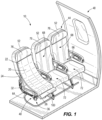
- FIG. 1 illustrates an aircraft seating arrangement 44 disposed within an aircraft 48 according to one embodiment.
- the aircraft seating arrangement 44 includes three aircraft seats 52.
- Each aircraft seat 52 includes a frame 64 fixedly coupled to at least a floor surface of the aircraft 48.
- the aircraft seat 52 includes a backrest portion 68 and a seatpan portion 72 supported by the frame 64.
- the backrest portion 68 is angled relative to the seatpan portion 72.
- the backrest portion 68 and the seatpan portion 72 collectively define a seating area 66.
- the seatpan portion 72 extends approximately parallel to the floor surface of the aircraft 48 and is fixed in position.
- the backrest portion 68 includes a headrest 76 and is pivotally coupled the frame 64 such that the aircraft seat 52 is movable between an upright or taxi-takeoff and landing (TTOL) position (e.g., seat 52 on the right in FIG. 1 ) and a reclined position (e.g., seat 52 on the left in FIG. 1 ).
- TTOL taxi-takeoff and landing
- the backrest portion 68 in the TTOL position, is angled by approximately 90 to 110 degrees relative to the seatpan portion 72. In one embodiment, the backrest portion 68 is angled by approximately 103 degrees relative to the seatpan portion 72 in the TTOL position. In some embodiments, in the reclined position, the backrest portion 68 is angled by approximately 110 to 130 degrees relative to the seatpan portion 72. In one embodiment, the backrest portion 68 is angled by approximately 120 degrees relative to the seatpan portion 72 in the reclined position.
- the sleep comforter 20 is coupled to the aircraft seat 52 and extends over the seating area 66. More specifically, a first end 22 of the sleep comforter 20 is coupled to the aircraft seat 52 on or near the backrest portion 68 adjacent to the headrest 76, and a second end 26 of the sleep comforter 20 is coupled to the frame 64 of the aircraft seat 52 adjacent the seatpan portion 72.
- the sleep comforter 20 is movable between the retracted position (e.g., middle seat 52 shown in FIG. 1 ) and the extended position (e.g., left seat 52 shown in FIG. 1 ).
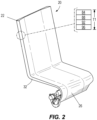
- the sleep comforter 20 includes the flexible body 32, the body tensioning mechanism 36, and a body return mechanism 80.
- the flexible body 32 has a layered construction and includes a fabric layer 84, a fire retardant layer 88, a foam layer 92, and a nylon layer 96.
- the fabric layer 84 forms a user contact surface or outer surface facing away from the seating area 66.
- the nylon layer 96 forms a seat contact surface and faces the seating area 66.
- the fabric layer 84 may be any fabric or material, such as aerospace grade fabric, that provides a comfortable surface for user support.
- the foam layer 92 may be any cushion, padding, or foam that enhances the support and comfort provided by the sleep comforter 20.
- the nylon layer 96 may be nylon or any other similar material capable of sustaining loads under tension. In one embodiment, this type of construction leads to a sleep comforter 20 having a thickness T1 between approximately 0.5 inches to 2.5 inches (12.7 to 62.5 mm).
- the layered construction of the sleep comforter 20 may be altered to add additional layers, remove layers, or substitute other materials in place of another layer.
- the sleep comforter 20 may include two or more foam layers or two or more nylon layers in addition to or in place of the other layers described above.
- the aircraft seat 52 may include an adjustable thigh support 100 pivotally coupled to the frame 64 adjacent the seatpan portion 72.
- the adjustable thigh support 100 may be actuated by a user to move between an active position (e.g., FIG. 7 ) and an inactive position where the adjustable thigh support 100 is pivoted underneath the seatpan portion 72.
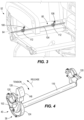
- the body return mechanism 80 includes a rod 104 (e.g., an elongated member), which is mounted on the frame 64 of the aircraft seat 52, and a pair of extendable coupling members 108 supported on the rod 104 and biased into a retracted position by biasing members 112 (e.g., springs such as constant torque springs).
- biasing members 112 e.g., springs such as constant torque springs.
- the rod 104 is mounted on the frame 64 adjacent the intersection of the backrest portion 68 and the seatpan portion 72 (e.g., at or near a junction of the backrest portion 68 and the seatpan portion 72).
- the extendable coupling members 108 are coupled to the flexible body 32 (e.g., via hook and loop fasteners, snap fasteners, integral formation, etc.) and are movable between a retracted rest position and an extended position. In operation, the biasing members 112 act to pull the flexible body 32 towards and into contact with and/or adjacent to the seating area 66.
- the body tensioning mechanism 36 includes a roller 116 rotatably supported between a pair of clamps 120.
- the roller 116 is coupled to the flexible body 32 in order to spool and unspool the flexible body 32 about the roller 116 as the roller 116 is rotated.
- the clamps 120 couple the body tensioning mechanism 36 to the aircraft seat 52.
- a ratchet mechanism 40 is coupled to, or in the alternative, formed as a part of, one or both of the clamps 120.
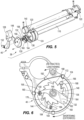
- the ratchet mechanism 40 includes a housing 124 having a cover plate 130, an actuator 128 pivotally supported on the housing 124, a pivotal link 132 supported within the housing 124, a ratchet pawl 136 supported within the housing 124, a ratchet gear 140 supported within the housing 124, and a locking pawl 144 supported within the housing 124.
- the actuator 128 is biased (e.g., by a spring such as a leaf spring) into a neutral position, and includes a user engagement lever 148 on one side of a pivot pin 146 and an operating arm 152 on an opposite side of the pivot pin 146.
- the pivotal link 132 is supported on the pivot pin 146 and includes a locking pawl engagement end 156 and a ratchet pawl engagement end 160 disposed on opposite sides of the pivot pin 146.
- the ratchet pawl 136 includes a coupling end 164 and a ratchet end 168 having a locking protrusion 172 that is engageable with the ratchet gear 140.
- the locking pawl 144 includes a locking protrusion 176 and a link engaging surface 180 disposed on one side of a pivot pin 150.
- the locking pawl 144 is biased towards the ratchet gear 140.
- the ratchet gear 140 includes a plurality of teeth 184 engageable with the ratchet pawl 136 and the locking pawl 144. Each tooth 184 includes a camming surface 188 and a locking surface 192.
- the actuator 128 is coupled to the pivotal link 132 via a floating pin connection 158 on the locking pawl engagement end 156 of the pivotal link 132.
- the pivotal link 132 is also coupled to the ratchet pawl 136 via a floating pin connection 162 between the ratchet pawl 136 and the pivotal link 132 on the ratchet pawl engagement end 160 of the pivotal link 132. In this way, the actuator 128 is operatively coupled to the ratchet pawl 136.
- the pivotal link 132 is also engageable with the locking pawl 144 via user actuated contact between the locking pawl engagement end 156 and the link engaging surface 180 of the locking pawl 144.
- both the locking pawl 144 and the ratchet pawl 136 selectively engage the ratchet gear 140 via contact between the locking surfaces 192 of the teeth 184 and the locking protrusion 176 of the locking pawl 144 and the locking protrusion 172 of the ratchet pawl 136.
- the ratchet gear 140 is fixedly coupled to the roller 116 and rotatable about the pivot pin 146, such that rotation of the ratchet gear 140 causes rotation of the roller 116.
- the actuator 128 is movable by the user to pivot in a tensioning direction (clockwise with respect to FIG. 4 ) to rotate the roller 116 in a shortening direction, causing an effective shortening of the flexible body 32 via spooling of the flexible body 32 about the roller 116. That is, a length of the flexible body 32 that extends over the seating area 66-or effective length-is shortened and a tension in the flexible body 32 is created.
- the actuator 128 is also movable in a release direction (counterclockwise with respect to FIG. 4 ) to permit rotation of the roller 116 in a lengthening direction, causing lengthening of the flexible body 32 via unspooling of the flexible body 32 from the roller 116. That is, the effective length of the flexible body 32 is lengthened and a tension in the flexible body 32 is released.
- the actuator 128 is moved via a force applied by the user to the user engagement lever 148 in either direction against the neutral bias of the actuator 128.
- the actuator 128 During movement of the flexible body 32 towards the extended position, the actuator 128 is displaced by a user in the tensioning direction.
- the actuator 128 pivots about the pivot pin 146 to displace the operating arm 152 in the clockwise direction shown in FIG. 6 .
- this rotation causes the pivotal link 132 to rotate about the pivot pin 146 in a clockwise direction (e.g., such that the locking pawl engagement end 156 moves upward with respect to the position shown in FIG. 6 and the ratchet pawl engagement end 160 moves downward with respect to the position shown in FIG. 6 ).
- This movement of the pivotal link 132 moves the ratchet pawl 136 in the clockwise direction.
- the locking protrusion 176 of the locking pawl 144 will engage one of the locking surfaces 192 of the teeth to prevent rotation of the ratchet gear 140-and therefore the roller 116-in the lengthening direction.
- the biasing force of the body return mechanism 80 acts to pull the flexible body 32 toward the retracted position. This force also acts on the roller 116 via the connection between the flexible body 32 and the roller 116. As such, the roller 116 has a torque-supplied by the body return mechanism 80 via the flexible body 32-acting to rotate the roller 116 in the lengthening direction. To halt this rotation during movement of the flexible body 32 towards the extended position, the locking pawl 144 is biased into a locked position where the locking protrusion 176 of the locking pawl 144 engages the teeth of the ratchet gear 140 to prevent rotation of the ratchet gear 140 in the lengthening direction.
- the ratchet gear 140 and roller 116 remain in the same rotational position via the engagement of the locking pawl 144 and the teeth 184, while the locking protrusion 172 of the ratchet pawl 136 cams over the camming surfaces 188 of the teeth 184 as the actuator 128 returns to the neutral position.
- a user may then selectively and incrementally actuate the actuator 128 to tension the flexible body 32, as described above, to achieve a range of positions between the retracted position ( FIG. 7 ) and the extended position ( FIG. 8 ) to, for example, allow the user to tension the flexible body 32 to a desired level based on user preference.
- the actuator 128 pivots about the pivot pin 146 to displace the operating arm 152 of the pivotal link 132 in a counterclockwise direction with respect to FIG. 6 .
- This movement causes the locking pawl engagement end 156 to engage the link engaging surface 180 of the locking pawl 144 thereby forcing the locking pawl 144 away from and out of engagement with the ratchet gear 140.
- the movement of the pivotal link 132 causes the ratchet pawl 136 to displace in the counterclockwise direction.
- the ratchet mechanism 40 includes a release button 300.
- the release button 300 may be coupled to the aircraft seat 24 ( FIG. 7 ). In another embodiment, the release button 300 may be coupled to the actuator 128, the housing 124, or the clamps 120.
- the release button 300 is operatively coupled to the ratchet mechanism 40 to permit free rotation of the roller 116. For example, actuation of the release button 300 may cause the locking pawl 144 and the ratchet pawl 136 to disengage from the ratchet gear 140 to permit free rotation of the roller 116.
- the release button 300 may be included in addition to the actuator 128 that is movable in the release direction or, in the alternative, may be included with an actuator that is not movable in the release direction such that the release button 300 is the only release mechanism.
- the body tensioning mechanism 36a includes a motor 200, such as an electric servomotor or stepper motor, to effectuate rotation of the roller 116.
- the body tensioning mechanism 36a further includes a user interface 204 (e.g., a touch screen including virtual buttons, a button, a switch, a knob, etc.) that receives user input and provides the input to a controller 208.
- the controller 208 includes at least a memory 212 storing software instructions and a processor 216 for carrying out software-based instructions stored in the memory 212.
- the controller 208 receives user input to determine a set of instructions stored in the memory 212 to carry out in the processor 216 to provide an output signal to the motor 200.
- the output signal may be, for example, a signal causing the motor 200 to rotate the roller 116 in the tensioning direction or a signal causing the motor 200 to rotate in the release direction.
- the motor 200 may be coupled to the roller 116 via, for example, a ratchet mechanism to prevent rotation based on the bias provided by the body return mechanism 80. In another embodiment, the motor 200 may be held in a locked position after each successive rotation such that a ratchet mechanism 40 is unnecessary.
- the sleep comforter 20 acts as an adjustable back support to enhance user comfort.
- the user may operate the body tensioning mechanism 36 to incrementally move the flexible body 32 between the retracted position, in which the flexible body 32 is held in contact with the seating area 66, and an extended position, in which the flexible body 32 is under tension and can support a user in a comfortable posture.
- the sleep comforter 20 may be integrally incorporated into an aircraft seat or may be retrofitted on to an existing aircraft seat.
Landscapes
- Engineering & Computer Science (AREA)
- Aviation & Aerospace Engineering (AREA)
- Transportation (AREA)
- Mechanical Engineering (AREA)
- Chairs For Special Purposes, Such As Reclining Chairs (AREA)
- Seats For Vehicles (AREA)
Description
- Aircraft seats, such as aircrafts seats in economy cabins of an aircraft, may not provide aircraft passengers with a comfortable sleeping posture due to limited reclining ranges and a lack of support. This discomfort may, for example, prevent a passenger from sleeping on a flight. Improved comfort in aircraft and vehicle seats is discussed in
US 1 985 222 ,US 6,382,720 ,CN 107 757 439 ,US 2010/109387 andUS 2008/048067 . - In one aspect, the inventive concepts disclosed herein are directed to an aircraft seat as defined by
claim 1. - Implementations of the inventive concepts disclosed herein may be better understood when consideration is given to the following detailed description thereof. Such description makes reference to the included drawings, which are not necessarily to scale, and in which some features may be exaggerated and some features may be omitted or may be represented schematically in the interest of clarity. Like reference numerals in the drawings may represent and refer to the same or similar element, feature, or function. In the drawings:
-
FIG. 1 is a perspective view of a seating arrangement for an aircraft having a plurality of seating units according to the inventive concepts disclosed herein. -
FIG. 2 is a perspective view of a sleep comforter of the seating units ofFIG. 1 according to the inventive concepts disclosed herein. -
FIG. 3 is a perspective view of a body return mechanism of the sleep comforter ofFIG. 2 according to the inventive concepts disclosed herein. -
FIG. 4 is a perspective view of a body tensioning mechanism of the sleep comforter ofFIG. 2 according to the inventive concepts disclosed herein. -
FIG. 5 is an exploded view of the body tensioning mechanism ofFIG. 4 according to the inventive concepts disclosed herein. -
FIG. 6 is a side view of a ratchet assembly of the body tensioning mechanism ofFIG. 4 according to the inventive concepts disclosed herein. -
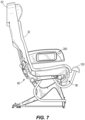
FIG. 7 is a side view of an aircraft seat including a sleep comforter in a retracted position according to the inventive concepts disclosed herein. -
FIG. 8 is a side view of the aircraft seat ofFIG. 7 including the sleep comforter in an extended position according to the inventive concepts disclosed herein. -
FIG. 9 is a schematic diagram of a motorized body tensioning mechanism according to the invention concepts disclosed herein. - Before explaining at least one embodiment of the inventive concepts disclosed herein in detail, it is to be understood that the inventive concepts are not limited in their application to the details of construction and the arrangement of the components or steps or methodologies set forth in the following description or illustrated in the drawings. In the following detailed description of embodiments of the instant inventive concepts, numerous specific details are set forth in order to provide a more thorough understanding of the inventive concepts. However, it will be apparent to one of ordinary skill in the art having the benefit of the instant disclosure that the inventive concepts disclosed herein may be practiced without these specific details. In other instances, well-known features may not be described in detail to avoid unnecessarily complicating the instant disclosure. The inventive concepts disclosed herein are capable of other embodiments or of being practiced or carried out in various ways. Also, it is to be understood that the phraseology and terminology employed herein is for the purpose of description and should not be regarded as limiting.
- As used herein a letter following a reference numeral is intended to reference an embodiment of the feature or element that may be similar, but not necessarily identical, to a previously described element or feature bearing the same reference numeral (e.g., 1, 1a, 1b). Such shorthand notations are used for purposes of convenience only, and should not be construed to limit the inventive concepts disclosed herein in any way unless expressly stated to the contrary.
- Further, unless expressly stated to the contrary, "or" refers to an inclusive or and not to an exclusive or. For example, a condition A or B is satisfied by anyone of the following: A is true (or present) and B is false (or not present), A is false (or not present) and B is true (or present), and both A and B are true (or present).
- In addition, use of the "a" or "an" are employed to describe elements and components of embodiments of the instant inventive concepts. This is done merely for convenience and to give a general sense of the inventive concepts, and "a' and "an" are intended to include one or at least one and the singular also includes the plural unless it is obvious that it is meant otherwise.
- Finally, as used herein any reference to "one embodiment," or "some embodiments" means that a particular element, feature, structure, or characteristic described in connection with the embodiment is included in at least one embodiment of the inventive concepts disclosed herein. The appearances of the phrase "in some embodiments" in various places in the specification are not necessarily all referring to the same embodiment, and embodiments of the inventive concepts disclosed may include one or more of the features expressly described or inherently present herein, or any combination or subcombination of two or more such features, along with any other features which may not necessarily be expressly described or inherently present in the instant disclosure.
- Broadly, embodiments of the inventive concepts disclosed herein are directed to an
aircraft seat assembly 10 including anaircraft seat 24 and asleep comforter 20. Thesleep comforter 20 is coupled to theaircraft seat 24 and extends over a seating area of theaircraft seat 24 in order to enhance user comfort. Thesleep comforter 20 is movable between a retracted position, in which thesleep comforter 20 rests upon or is adjacent to theaircraft seat 24, and an extended position, in which thesleep comforter 20 is tensioned so as to extend away or be spaced apart from theaircraft seat 24. A plurality of positions are available between the retracted position and the extended position to facilitate infinite position adjustment (e.g., to accommodate passenger preference and comfort, among other things). In some embodiments, thesleep comforter 20 includes aflexible body 32 and abody tensioning mechanism 36 including aratchet mechanism 40 for applying a tension to theflexible body 32. In other embodiments, a sleep comforter includes a flexible body and a motorized body tensioning mechanism for applying a tension to the flexible body. -
FIG. 1 illustrates anaircraft seating arrangement 44 disposed within anaircraft 48 according to one embodiment. Theaircraft seating arrangement 44 includes threeaircraft seats 52. Eachaircraft seat 52 includes aframe 64 fixedly coupled to at least a floor surface of theaircraft 48. Theaircraft seat 52 includes abackrest portion 68 and aseatpan portion 72 supported by theframe 64. Thebackrest portion 68 is angled relative to theseatpan portion 72. Thebackrest portion 68 and theseatpan portion 72 collectively define aseating area 66. As seen inFIG. 1 , theseatpan portion 72 extends approximately parallel to the floor surface of theaircraft 48 and is fixed in position. Thebackrest portion 68 includes aheadrest 76 and is pivotally coupled theframe 64 such that theaircraft seat 52 is movable between an upright or taxi-takeoff and landing (TTOL) position (e.g.,seat 52 on the right inFIG. 1 ) and a reclined position (e.g.,seat 52 on the left inFIG. 1 ). In some embodiments, in the TTOL position, thebackrest portion 68 is angled by approximately 90 to 110 degrees relative to theseatpan portion 72. In one embodiment, thebackrest portion 68 is angled by approximately 103 degrees relative to theseatpan portion 72 in the TTOL position. In some embodiments, in the reclined position, thebackrest portion 68 is angled by approximately 110 to 130 degrees relative to theseatpan portion 72. In one embodiment, thebackrest portion 68 is angled by approximately 120 degrees relative to theseatpan portion 72 in the reclined position. - With continued reference to
FIG. 1 , thesleep comforter 20 is coupled to theaircraft seat 52 and extends over theseating area 66. More specifically, afirst end 22 of thesleep comforter 20 is coupled to theaircraft seat 52 on or near thebackrest portion 68 adjacent to theheadrest 76, and asecond end 26 of thesleep comforter 20 is coupled to theframe 64 of theaircraft seat 52 adjacent theseatpan portion 72. Thesleep comforter 20 is movable between the retracted position (e.g.,middle seat 52 shown inFIG. 1 ) and the extended position (e.g.,left seat 52 shown inFIG. 1 ). - With reference to
FIGS. 2-4 , thesleep comforter 20 includes theflexible body 32, thebody tensioning mechanism 36, and abody return mechanism 80. In the illustrated embodiment, theflexible body 32 has a layered construction and includes afabric layer 84, a fireretardant layer 88, afoam layer 92, and anylon layer 96. Thefabric layer 84 forms a user contact surface or outer surface facing away from theseating area 66. Thenylon layer 96 forms a seat contact surface and faces theseating area 66. Thefabric layer 84 may be any fabric or material, such as aerospace grade fabric, that provides a comfortable surface for user support. Thefoam layer 92 may be any cushion, padding, or foam that enhances the support and comfort provided by thesleep comforter 20. Thenylon layer 96 may be nylon or any other similar material capable of sustaining loads under tension. In one embodiment, this type of construction leads to asleep comforter 20 having a thickness T1 between approximately 0.5 inches to 2.5 inches (12.7 to 62.5 mm). - In other embodiments, the layered construction of the
sleep comforter 20 may be altered to add additional layers, remove layers, or substitute other materials in place of another layer. For example, thesleep comforter 20 may include two or more foam layers or two or more nylon layers in addition to or in place of the other layers described above. - In one embodiment, the
aircraft seat 52 may include anadjustable thigh support 100 pivotally coupled to theframe 64 adjacent theseatpan portion 72. Theadjustable thigh support 100 may be actuated by a user to move between an active position (e.g.,FIG. 7 ) and an inactive position where theadjustable thigh support 100 is pivoted underneath theseatpan portion 72. - With reference to
FIG. 3 , thebody return mechanism 80 includes a rod 104 (e.g., an elongated member), which is mounted on theframe 64 of theaircraft seat 52, and a pair ofextendable coupling members 108 supported on therod 104 and biased into a retracted position by biasing members 112 (e.g., springs such as constant torque springs). As shown inFIG. 3 , therod 104 is mounted on theframe 64 adjacent the intersection of thebackrest portion 68 and the seatpan portion 72 (e.g., at or near a junction of thebackrest portion 68 and the seatpan portion 72). Theextendable coupling members 108 are coupled to the flexible body 32 (e.g., via hook and loop fasteners, snap fasteners, integral formation, etc.) and are movable between a retracted rest position and an extended position. In operation, the biasingmembers 112 act to pull theflexible body 32 towards and into contact with and/or adjacent to theseating area 66. - With reference to
FIGS. 4-6 , thebody tensioning mechanism 36 is shown according to one embodiment. Thebody tensioning mechanism 36 includes aroller 116 rotatably supported between a pair ofclamps 120. Theroller 116 is coupled to theflexible body 32 in order to spool and unspool theflexible body 32 about theroller 116 as theroller 116 is rotated. Theclamps 120 couple thebody tensioning mechanism 36 to theaircraft seat 52. Aratchet mechanism 40 is coupled to, or in the alternative, formed as a part of, one or both of theclamps 120. Theratchet mechanism 40 includes ahousing 124 having acover plate 130, anactuator 128 pivotally supported on thehousing 124, apivotal link 132 supported within thehousing 124, aratchet pawl 136 supported within thehousing 124, aratchet gear 140 supported within thehousing 124, and a lockingpawl 144 supported within thehousing 124. Theactuator 128 is biased (e.g., by a spring such as a leaf spring) into a neutral position, and includes auser engagement lever 148 on one side of apivot pin 146 and anoperating arm 152 on an opposite side of thepivot pin 146. Thepivotal link 132 is supported on thepivot pin 146 and includes a lockingpawl engagement end 156 and a ratchetpawl engagement end 160 disposed on opposite sides of thepivot pin 146. Theratchet pawl 136 includes acoupling end 164 and aratchet end 168 having a lockingprotrusion 172 that is engageable with theratchet gear 140. The lockingpawl 144 includes a lockingprotrusion 176 and alink engaging surface 180 disposed on one side of apivot pin 150. The lockingpawl 144 is biased towards theratchet gear 140. Theratchet gear 140 includes a plurality ofteeth 184 engageable with theratchet pawl 136 and the lockingpawl 144. Eachtooth 184 includes acamming surface 188 and alocking surface 192. - With continued reference to
FIGS. 4-6 , theactuator 128 is coupled to thepivotal link 132 via a floatingpin connection 158 on the lockingpawl engagement end 156 of thepivotal link 132. Thepivotal link 132 is also coupled to theratchet pawl 136 via a floatingpin connection 162 between theratchet pawl 136 and thepivotal link 132 on the ratchetpawl engagement end 160 of thepivotal link 132. In this way, theactuator 128 is operatively coupled to theratchet pawl 136. - The
pivotal link 132 is also engageable with the lockingpawl 144 via user actuated contact between the lockingpawl engagement end 156 and thelink engaging surface 180 of the lockingpawl 144. As seen inFIG. 6 , both the lockingpawl 144 and theratchet pawl 136 selectively engage theratchet gear 140 via contact between the lockingsurfaces 192 of theteeth 184 and the lockingprotrusion 176 of the lockingpawl 144 and the lockingprotrusion 172 of theratchet pawl 136. Theratchet gear 140 is fixedly coupled to theroller 116 and rotatable about thepivot pin 146, such that rotation of theratchet gear 140 causes rotation of theroller 116. - In operation, the
actuator 128 is movable by the user to pivot in a tensioning direction (clockwise with respect toFIG. 4 ) to rotate theroller 116 in a shortening direction, causing an effective shortening of theflexible body 32 via spooling of theflexible body 32 about theroller 116. That is, a length of theflexible body 32 that extends over the seating area 66-or effective length-is shortened and a tension in theflexible body 32 is created. Theactuator 128 is also movable in a release direction (counterclockwise with respect toFIG. 4 ) to permit rotation of theroller 116 in a lengthening direction, causing lengthening of theflexible body 32 via unspooling of theflexible body 32 from theroller 116. That is, the effective length of theflexible body 32 is lengthened and a tension in theflexible body 32 is released. Theactuator 128 is moved via a force applied by the user to theuser engagement lever 148 in either direction against the neutral bias of theactuator 128. - During movement of the
flexible body 32 towards the extended position, theactuator 128 is displaced by a user in the tensioning direction. Theactuator 128 pivots about thepivot pin 146 to displace theoperating arm 152 in the clockwise direction shown inFIG. 6 . Due to the floating pin connection between the actuator 128 and thepivotal link 132, this rotation causes thepivotal link 132 to rotate about thepivot pin 146 in a clockwise direction (e.g., such that the lockingpawl engagement end 156 moves upward with respect to the position shown inFIG. 6 and the ratchetpawl engagement end 160 moves downward with respect to the position shown inFIG. 6 ). This movement of thepivotal link 132 moves theratchet pawl 136 in the clockwise direction. Engagement of the lockingprotrusion 172 of theratchet pawl 136 and theteeth 184 of theratchet gear 140 causes a corresponding rotation of theratchet gear 140 in the shortening direction. Rotation in the shortening direction causes the lockingpawl 144 to cam over theteeth 184 as theratchet gear 140 rotates to permit rotation of theratchet gear 140. As such, the application of force on theactuator 128 in the tensioning direction drives theratchet mechanism 40, causing rotation of theroller 116 in the shortening direction. This in turn results in spooling of theflexible body 32 about theroller 116 to shorten an effective length of theflexible body 32, thereby creating tension in theflexible body 32. When theactuator 128 reaches a limit (e.g., a physically defined movement limit or a limit defined by the user), the lockingprotrusion 176 of the lockingpawl 144 will engage one of the locking surfaces 192 of the teeth to prevent rotation of the ratchet gear 140-and therefore the roller 116-in the lengthening direction. - The biasing force of the
body return mechanism 80 acts to pull theflexible body 32 toward the retracted position. This force also acts on theroller 116 via the connection between theflexible body 32 and theroller 116. As such, theroller 116 has a torque-supplied by thebody return mechanism 80 via the flexible body 32-acting to rotate theroller 116 in the lengthening direction. To halt this rotation during movement of theflexible body 32 towards the extended position, the lockingpawl 144 is biased into a locked position where the lockingprotrusion 176 of the lockingpawl 144 engages the teeth of theratchet gear 140 to prevent rotation of theratchet gear 140 in the lengthening direction. When theactuator 128 is released and returned to the neutral position, theratchet gear 140 androller 116 remain in the same rotational position via the engagement of the lockingpawl 144 and theteeth 184, while the lockingprotrusion 172 of theratchet pawl 136 cams over the camming surfaces 188 of theteeth 184 as theactuator 128 returns to the neutral position. A user may then selectively and incrementally actuate theactuator 128 to tension theflexible body 32, as described above, to achieve a range of positions between the retracted position (FIG. 7 ) and the extended position (FIG. 8 ) to, for example, allow the user to tension theflexible body 32 to a desired level based on user preference. - When a user actuates the
actuator 128 in the release direction, theactuator 128 pivots about thepivot pin 146 to displace theoperating arm 152 of thepivotal link 132 in a counterclockwise direction with respect toFIG. 6 . This movement causes the lockingpawl engagement end 156 to engage thelink engaging surface 180 of the lockingpawl 144 thereby forcing the lockingpawl 144 away from and out of engagement with theratchet gear 140. At the same time, the movement of thepivotal link 132 causes theratchet pawl 136 to displace in the counterclockwise direction. This movement results in theratchet pawl 136 engaging and camming over apin 196 to release engagement between theratchet pawl 136 and theratchet gear 140. With the lockingpawl 144 and theratchet pawl 136 disengaged from theratchet gear 140, theratchet gear 140 androller 116 are free to rotate. Theratchet gear 140 androller 116 will rotate in the lengthening direction as a result of theflexible body 32 being biased by thebody return mechanism 80 to the retracted position.Actuator 128 may then be returned to the neutral position. - In one embodiment, the
ratchet mechanism 40 includes arelease button 300. Therelease button 300 may be coupled to the aircraft seat 24 (FIG. 7 ). In another embodiment, therelease button 300 may be coupled to theactuator 128, thehousing 124, or theclamps 120. Therelease button 300 is operatively coupled to theratchet mechanism 40 to permit free rotation of theroller 116. For example, actuation of therelease button 300 may cause the lockingpawl 144 and theratchet pawl 136 to disengage from theratchet gear 140 to permit free rotation of theroller 116. Therelease button 300 may be included in addition to theactuator 128 that is movable in the release direction or, in the alternative, may be included with an actuator that is not movable in the release direction such that therelease button 300 is the only release mechanism. - With reference to
FIG. 9 , an alternate embodiment of a body tensioning mechanism is illustrated. In this embodiment, thebody tensioning mechanism 36a includes amotor 200, such as an electric servomotor or stepper motor, to effectuate rotation of theroller 116. In this embodiment, thebody tensioning mechanism 36a further includes a user interface 204 (e.g., a touch screen including virtual buttons, a button, a switch, a knob, etc.) that receives user input and provides the input to acontroller 208. Thecontroller 208 includes at least amemory 212 storing software instructions and aprocessor 216 for carrying out software-based instructions stored in thememory 212. In one example, thecontroller 208 receives user input to determine a set of instructions stored in thememory 212 to carry out in theprocessor 216 to provide an output signal to themotor 200. The output signal may be, for example, a signal causing themotor 200 to rotate theroller 116 in the tensioning direction or a signal causing themotor 200 to rotate in the release direction. Themotor 200 may be coupled to theroller 116 via, for example, a ratchet mechanism to prevent rotation based on the bias provided by thebody return mechanism 80. In another embodiment, themotor 200 may be held in a locked position after each successive rotation such that aratchet mechanism 40 is unnecessary. - As described in the embodiments above, the
sleep comforter 20 acts as an adjustable back support to enhance user comfort. The user may operate thebody tensioning mechanism 36 to incrementally move theflexible body 32 between the retracted position, in which theflexible body 32 is held in contact with theseating area 66, and an extended position, in which theflexible body 32 is under tension and can support a user in a comfortable posture. - Based on the foregoing, it should be clear that the
sleep comforter 20 may be integrally incorporated into an aircraft seat or may be retrofitted on to an existing aircraft seat. - From the above description, it is clear that the inventive concepts disclosed herein are well adapted to carry out the objects and to attain the advantages mentioned herein as well as those inherent in the inventive concepts disclosed herein. While presently preferred embodiments of the inventive concepts disclosed herein have been described for purposes of this disclosure, it will be understood that numerous changes may be made as far as they remain within the scope of the invention as defined by the claims.
Claims (11)
- An aircraft seat (52) comprising:a seatpan portion (72);a backrest portion (68) coupled to the seatpan portion;a frame (64) supporting the backrest portion (68) and the seatpan portion (72); anda sleep comforter (20) including:a flexible body (32) configured to extend over the backrest portion and the seatpan portion, the flexible body being movable between a retracted position adjacent the backrest portion and the seatpan portion, and an extended position spaced apart from at least a portion of the seatpan portion and at least a portion of the backrest portion;a body tensioning mechanism (36) including an actuator (128) operatively coupled to a rotatable roller (116), the roller being coupled to an end of the flexible body, the body tensioning mechanism being configured to move the flexible body from the retracted position to the extended position; anda body return mechanism (80) coupled to the flexible body, the body return mechanism including biasing members (112) configured to bias the flexible body towards the retracted position;wherein the body return mechanism comprises a rod (104) mounted on the frame;characterized in that the body return mechanism further comprises a pair of extendable coupling members (108) supported on the rod and biased into the retracted position by the biasing members (112); wherein the extendable coupling members are coupled to the flexible body.
- The aircraft seat of claim 1, wherein the body tensioning mechanism further includes a ratchet device (40) coupled to the actuator.
- The aircraft seat of claim 2, wherein the ratchet device includes a ratchet pawl (136) operatively coupled to the actuator, a ratchet gear (140) coupled to the roller and operatively engaged with the ratchet pawl, and a locking pawl (144) engageable with the ratchet gear.
- The aircraft seat of claim 3, wherein the actuator (128) is operable to move in a first direction to drive rotation of the roller and ratchet gear via engagement between the ratchet pawl and the ratchet gear, and wherein the actuator is operable to move in a second direction to disengage the locking pawl from the ratchet gear to allow free rotation of the ratchet gear and roller.
- The aircraft seat of any preceding claim, wherein the body tensioning mechanism is coupled to the frame adjacent the seatpan portion.
- The aircraft seat of any preceding claim, wherein the body return mechanism is disposed between the backrest portion and the seatpan portion.
- The aircraft seat of any preceding claim, wherein the flexible body is coupled to the backrest portion of the aircraft seat adjacent to a headrest disposed on the backrest portion.
- The aircraft seat of any preceding claim, wherein the rod is mounted on the frame adjacent to an intersection of the backrest portion and the seat pan portion.
- The aircraft seat of any preceding claim, wherein the extendable coupling members are movable between a retracted rest position and an extended position.
- The aircraft seat of any preceding claim, wherein the biasing members act to pull the flexible body towards and adjacent to the seating area.
- The aircraft seat any preceding claim, wherein the biasing members act to pull the flexible body towards and into contact with the seating area.
Applications Claiming Priority (2)
| Application Number | Priority Date | Filing Date | Title |
|---|---|---|---|
| US16/110,177 US10696411B2 (en) | 2018-08-23 | 2018-08-23 | Aircraft seat with ergonomic sleep comforter |
| PCT/US2019/047748 WO2020041616A1 (en) | 2018-08-23 | 2019-08-22 | Aircraft seat with ergonomic sleep comforter |
Publications (2)
| Publication Number | Publication Date |
|---|---|
| EP3841018A1 EP3841018A1 (en) | 2021-06-30 |
| EP3841018B1 true EP3841018B1 (en) | 2024-04-17 |
Family
ID=67841295
Family Applications (1)
| Application Number | Title | Priority Date | Filing Date |
|---|---|---|---|
| EP19762661.7A Active EP3841018B1 (en) | 2018-08-23 | 2019-08-22 | Aircraft seat with ergonomic sleep comforter |
Country Status (4)
| Country | Link |
|---|---|
| US (1) | US10696411B2 (en) |
| EP (1) | EP3841018B1 (en) |
| CN (1) | CN113195360B (en) |
| WO (1) | WO2020041616A1 (en) |
Families Citing this family (2)
| Publication number | Priority date | Publication date | Assignee | Title |
|---|---|---|---|---|
| US20220072978A1 (en) * | 2020-09-04 | 2022-03-10 | Faurecia Automotive Seating, Llc | Multi-position vehicle seat |
| DE102022129527A1 (en) * | 2022-11-08 | 2024-05-08 | Zim Aircraft Seating Gmbh | Passenger seat |
Citations (4)
| Publication number | Priority date | Publication date | Assignee | Title |
|---|---|---|---|---|
| US4790592A (en) * | 1987-05-11 | 1988-12-13 | Itt Corporation | Automobile seat having retractable protective covering |
| US6659552B2 (en) * | 2001-03-08 | 2003-12-09 | Robert R. Duncan | Inflatable aircraft seat cushion |
| EP3385117A1 (en) * | 2017-04-03 | 2018-10-10 | Direction and Design Limited (t/a Tangerine) | Occupant support device for a seat |
| WO2019141705A1 (en) * | 2018-01-17 | 2019-07-25 | Bayerische Motoren Werke Aktiengesellschaft | Seat, particularly vehicle seat |
Family Cites Families (31)
| Publication number | Priority date | Publication date | Assignee | Title |
|---|---|---|---|---|
| US1985222A (en) * | 1933-12-01 | 1934-12-18 | James W Menhall | Protective covering for automobile seats |
| US2860691A (en) | 1955-02-24 | 1958-11-18 | Orville S Caesar | Reclining chair for passenger vehicles |
| GB1337679A (en) * | 1971-03-04 | 1973-11-21 | Irvin Great Britain Ltd | Ratchet tensioners |
| GB1402556A (en) * | 1971-08-05 | 1975-08-13 | Youngflex Sa | Seats |
| FR2674485B1 (en) * | 1991-03-28 | 1993-07-09 | Faure Bertrand Automobile | IMPROVEMENTS ON VEHICLE SEAT RECORDS. |
| FR2722962B1 (en) * | 1994-07-29 | 1996-09-27 | Jean Paul Valentin Atel | IMPROVEMENT FOR A SEAT CONSTITUTED BY AN ADDITIONAL DEVICE FOR IMPROVING COMFORT |
| GB2321436B (en) * | 1997-01-24 | 2000-12-20 | Autoliv Dev | Improvements in or relating to a safety device in a motor vehicle |
| DE60117923T2 (en) * | 2000-01-14 | 2006-09-14 | BE Aerospace, Inc., Wellington | Passenger seat with variable seat |
| US6382720B1 (en) * | 2001-02-23 | 2002-05-07 | Alex Franklin | Retractable seat covering |
| JP3918128B2 (en) * | 2002-05-31 | 2007-05-23 | テイ・エス テック株式会社 | Seat cover assembly assist machine |
| DE202004002569U1 (en) * | 2004-02-19 | 2005-07-07 | Schwarzbich, Jörg | lumbar support |
| DE102004044235A1 (en) * | 2004-09-14 | 2006-03-30 | Recaro Aircraft Seating Gmbh & Co. Kg | Passenger seat, in particular passenger seat |
| JP4856911B2 (en) * | 2005-08-18 | 2012-01-18 | 株式会社イトーキ | Chair with backrest |
| DE202006015822U1 (en) * | 2006-10-16 | 2007-03-15 | Ballendat, Martin | Chair back and chair hereby |
| US7607732B2 (en) * | 2007-06-22 | 2009-10-27 | B/E Aerospace, Inc. | One-piece dress cover for aircraft seat |
| KR20080025030A (en) * | 2007-07-12 | 2008-03-19 | 웬진 우 | Chair with flexible backrest |
| DE102008036630A1 (en) * | 2007-10-26 | 2009-04-30 | C. Rob. Hammerstein Gmbh & Co. Kg | Foldable motor vehicle seat with a hinge fitting |
| DE102008051603A1 (en) * | 2008-10-14 | 2010-04-15 | Lufthansa Technik Ag | Seat for a transport |
| DE102009055831B4 (en) * | 2009-11-26 | 2019-10-31 | GM Global Technology Operations LLC (n. d. Ges. d. Staates Delaware) | requires seat |
| DE102010014985A1 (en) * | 2010-04-14 | 2011-10-20 | Daimler Ag | Motor vehicle with a variable seat back |
| FR2966706B1 (en) * | 2010-10-27 | 2013-06-21 | Benoit Gauchon | FLEXIBLE SEAT WITH SINGLE FILE FASTENING POINT. |
| IT1404006B1 (en) * | 2011-02-17 | 2013-11-08 | Cortellazzi | SEAT COVERS AND / OR BACK COVERS FOR VEHICLES SEATS |
| EP2720578A4 (en) * | 2011-06-20 | 2014-12-17 | Magna Seating Inc | Disc recliner with internal leaf springs |
| JP5951960B2 (en) * | 2011-10-28 | 2016-07-13 | 株式会社岡村製作所 | Tensile structure |
| JP5801183B2 (en) * | 2011-12-27 | 2015-10-28 | トヨタ紡織株式会社 | Vehicle seat |
| CN103847538B (en) * | 2012-11-30 | 2017-11-10 | 提爱思科技股份有限公司 | Vehicle seat |
| GB2530554A (en) * | 2014-09-26 | 2016-03-30 | Bombardier Inc | Aircraft seat |
| US9796308B2 (en) * | 2015-05-05 | 2017-10-24 | Ami Industries, Inc. | Flexible lumbar support of aircraft seat |
| CN205168262U (en) * | 2015-12-11 | 2016-04-20 | 重庆春辉科技有限公司 | A seat cover subassembly for back seat chair |
| US10391901B2 (en) * | 2017-02-14 | 2019-08-27 | Denso International America, Inc. | Passive seat ventilation system |
| CN107757439A (en) | 2017-09-22 | 2018-03-06 | 黄增 | Automobile-used hammock type chair set |
-
2018
- 2018-08-23 US US16/110,177 patent/US10696411B2/en active Active
-
2019
- 2019-08-22 CN CN201980063904.XA patent/CN113195360B/en active Active
- 2019-08-22 WO PCT/US2019/047748 patent/WO2020041616A1/en not_active Ceased
- 2019-08-22 EP EP19762661.7A patent/EP3841018B1/en active Active
Patent Citations (4)
| Publication number | Priority date | Publication date | Assignee | Title |
|---|---|---|---|---|
| US4790592A (en) * | 1987-05-11 | 1988-12-13 | Itt Corporation | Automobile seat having retractable protective covering |
| US6659552B2 (en) * | 2001-03-08 | 2003-12-09 | Robert R. Duncan | Inflatable aircraft seat cushion |
| EP3385117A1 (en) * | 2017-04-03 | 2018-10-10 | Direction and Design Limited (t/a Tangerine) | Occupant support device for a seat |
| WO2019141705A1 (en) * | 2018-01-17 | 2019-07-25 | Bayerische Motoren Werke Aktiengesellschaft | Seat, particularly vehicle seat |
Also Published As
| Publication number | Publication date |
|---|---|
| US10696411B2 (en) | 2020-06-30 |
| CN113195360B (en) | 2023-10-27 |
| WO2020041616A1 (en) | 2020-02-27 |
| US20200062404A1 (en) | 2020-02-27 |
| CN113195360A (en) | 2021-07-30 |
| EP3841018A1 (en) | 2021-06-30 |
Similar Documents
| Publication | Publication Date | Title |
|---|---|---|
| KR101391477B1 (en) | recliner mechanism | |
| US9616784B2 (en) | Vehicle seat | |
| US11351891B2 (en) | System comprising a vehicle seat with tilting backrest | |
| CN101959715B (en) | Stowable vehicle seat | |
| US9481277B1 (en) | Adjustable headrest | |
| US10973333B2 (en) | Stadium seat having a split back recliner and a vehicle including a stadium seat having a split back recliner | |
| US20070090673A1 (en) | Seating area adjuster | |
| JP6477215B2 (en) | Vehicle seat | |
| US20120132026A1 (en) | Vehicle seat | |
| US10737603B2 (en) | Headrest assembly | |
| US10696411B2 (en) | Aircraft seat with ergonomic sleep comforter | |
| US8079645B2 (en) | Force multiplier device for furniture member adjustment | |
| JP2009101856A (en) | Tilt mechanism built-in suspension mechanism | |
| US20250368335A1 (en) | Seat armrest locking mechanism | |
| KR101423774B1 (en) | Seatback interlocking type automatic arm rest device | |
| JP2019077223A (en) | Vehicle seat | |
| JP2009262803A (en) | Vehicular seat | |
| US8052214B2 (en) | Seat structure | |
| KR20240012114A (en) | Rear seat for vehicle | |
| JP4834730B2 (en) | Armchair with telescopic legrest | |
| KR101679688B1 (en) | Arm-rest tilting apparatus for vehicle | |
| JPS6026523B2 (en) | Seat reclining device | |
| JP5691774B2 (en) | Vehicle seat | |
| US10675995B2 (en) | Vehicle seat comprising a latching device and an additional control device | |
| US20260020677A1 (en) | Seat armrest locking mechanism |
Legal Events
| Date | Code | Title | Description |
|---|---|---|---|
| STAA | Information on the status of an ep patent application or granted ep patent |
Free format text: STATUS: UNKNOWN |
|
| STAA | Information on the status of an ep patent application or granted ep patent |
Free format text: STATUS: THE INTERNATIONAL PUBLICATION HAS BEEN MADE |
|
| PUAI | Public reference made under article 153(3) epc to a published international application that has entered the european phase |
Free format text: ORIGINAL CODE: 0009012 |
|
| STAA | Information on the status of an ep patent application or granted ep patent |
Free format text: STATUS: REQUEST FOR EXAMINATION WAS MADE |
|
| 17P | Request for examination filed |
Effective date: 20210323 |
|
| AK | Designated contracting states |
Kind code of ref document: A1 Designated state(s): AL AT BE BG CH CY CZ DE DK EE ES FI FR GB GR HR HU IE IS IT LI LT LU LV MC MK MT NL NO PL PT RO RS SE SI SK SM TR |
|
| DAV | Request for validation of the european patent (deleted) | ||
| DAX | Request for extension of the european patent (deleted) | ||
| STAA | Information on the status of an ep patent application or granted ep patent |
Free format text: STATUS: EXAMINATION IS IN PROGRESS |
|
| 17Q | First examination report despatched |
Effective date: 20221124 |
|
| P01 | Opt-out of the competence of the unified patent court (upc) registered |
Effective date: 20230922 |
|
| GRAP | Despatch of communication of intention to grant a patent |
Free format text: ORIGINAL CODE: EPIDOSNIGR1 |
|
| STAA | Information on the status of an ep patent application or granted ep patent |
Free format text: STATUS: GRANT OF PATENT IS INTENDED |
|
| INTG | Intention to grant announced |
Effective date: 20231128 |
|
| GRAS | Grant fee paid |
Free format text: ORIGINAL CODE: EPIDOSNIGR3 |
|
| GRAA | (expected) grant |
Free format text: ORIGINAL CODE: 0009210 |
|
| STAA | Information on the status of an ep patent application or granted ep patent |
Free format text: STATUS: THE PATENT HAS BEEN GRANTED |
|
| AK | Designated contracting states |
Kind code of ref document: B1 Designated state(s): AL AT BE BG CH CY CZ DE DK EE ES FI FR GB GR HR HU IE IS IT LI LT LU LV MC MK MT NL NO PL PT RO RS SE SI SK SM TR |
|
| REG | Reference to a national code |
Ref country code: GB Ref legal event code: FG4D |
|
| REG | Reference to a national code |
Ref country code: CH Ref legal event code: EP |
|
| REG | Reference to a national code |
Ref country code: IE Ref legal event code: FG4D Ref country code: DE Ref legal event code: R096 Ref document number: 602019050470 Country of ref document: DE |
|
| REG | Reference to a national code |
Ref country code: LT Ref legal event code: MG9D |
|
| REG | Reference to a national code |
Ref country code: NL Ref legal event code: MP Effective date: 20240417 |
|
| REG | Reference to a national code |
Ref country code: AT Ref legal event code: MK05 Ref document number: 1677037 Country of ref document: AT Kind code of ref document: T Effective date: 20240417 |
|
| PG25 | Lapsed in a contracting state [announced via postgrant information from national office to epo] |
Ref country code: NL Free format text: LAPSE BECAUSE OF FAILURE TO SUBMIT A TRANSLATION OF THE DESCRIPTION OR TO PAY THE FEE WITHIN THE PRESCRIBED TIME-LIMIT Effective date: 20240417 |
|
| PG25 | Lapsed in a contracting state [announced via postgrant information from national office to epo] |
Ref country code: NL Free format text: LAPSE BECAUSE OF FAILURE TO SUBMIT A TRANSLATION OF THE DESCRIPTION OR TO PAY THE FEE WITHIN THE PRESCRIBED TIME-LIMIT Effective date: 20240417 |
|
| PG25 | Lapsed in a contracting state [announced via postgrant information from national office to epo] |
Ref country code: IS Free format text: LAPSE BECAUSE OF FAILURE TO SUBMIT A TRANSLATION OF THE DESCRIPTION OR TO PAY THE FEE WITHIN THE PRESCRIBED TIME-LIMIT Effective date: 20240817 |
|
| PG25 | Lapsed in a contracting state [announced via postgrant information from national office to epo] |
Ref country code: BG Free format text: LAPSE BECAUSE OF FAILURE TO SUBMIT A TRANSLATION OF THE DESCRIPTION OR TO PAY THE FEE WITHIN THE PRESCRIBED TIME-LIMIT Effective date: 20240417 |
|
| PG25 | Lapsed in a contracting state [announced via postgrant information from national office to epo] |
Ref country code: HR Free format text: LAPSE BECAUSE OF FAILURE TO SUBMIT A TRANSLATION OF THE DESCRIPTION OR TO PAY THE FEE WITHIN THE PRESCRIBED TIME-LIMIT Effective date: 20240417 Ref country code: FI Free format text: LAPSE BECAUSE OF FAILURE TO SUBMIT A TRANSLATION OF THE DESCRIPTION OR TO PAY THE FEE WITHIN THE PRESCRIBED TIME-LIMIT Effective date: 20240417 |
|
| PG25 | Lapsed in a contracting state [announced via postgrant information from national office to epo] |
Ref country code: GR Free format text: LAPSE BECAUSE OF FAILURE TO SUBMIT A TRANSLATION OF THE DESCRIPTION OR TO PAY THE FEE WITHIN THE PRESCRIBED TIME-LIMIT Effective date: 20240718 |
|
| PG25 | Lapsed in a contracting state [announced via postgrant information from national office to epo] |
Ref country code: PT Free format text: LAPSE BECAUSE OF FAILURE TO SUBMIT A TRANSLATION OF THE DESCRIPTION OR TO PAY THE FEE WITHIN THE PRESCRIBED TIME-LIMIT Effective date: 20240819 |
|
| PG25 | Lapsed in a contracting state [announced via postgrant information from national office to epo] |
Ref country code: ES Free format text: LAPSE BECAUSE OF FAILURE TO SUBMIT A TRANSLATION OF THE DESCRIPTION OR TO PAY THE FEE WITHIN THE PRESCRIBED TIME-LIMIT Effective date: 20240417 |
|
| PG25 | Lapsed in a contracting state [announced via postgrant information from national office to epo] |
Ref country code: AT Free format text: LAPSE BECAUSE OF FAILURE TO SUBMIT A TRANSLATION OF THE DESCRIPTION OR TO PAY THE FEE WITHIN THE PRESCRIBED TIME-LIMIT Effective date: 20240417 |
|
| PG25 | Lapsed in a contracting state [announced via postgrant information from national office to epo] |
Ref country code: PL Free format text: LAPSE BECAUSE OF FAILURE TO SUBMIT A TRANSLATION OF THE DESCRIPTION OR TO PAY THE FEE WITHIN THE PRESCRIBED TIME-LIMIT Effective date: 20240417 |
|
| PG25 | Lapsed in a contracting state [announced via postgrant information from national office to epo] |
Ref country code: LV Free format text: LAPSE BECAUSE OF FAILURE TO SUBMIT A TRANSLATION OF THE DESCRIPTION OR TO PAY THE FEE WITHIN THE PRESCRIBED TIME-LIMIT Effective date: 20240417 |
|
| PG25 | Lapsed in a contracting state [announced via postgrant information from national office to epo] |
Ref country code: PT Free format text: LAPSE BECAUSE OF FAILURE TO SUBMIT A TRANSLATION OF THE DESCRIPTION OR TO PAY THE FEE WITHIN THE PRESCRIBED TIME-LIMIT Effective date: 20240819 Ref country code: PL Free format text: LAPSE BECAUSE OF FAILURE TO SUBMIT A TRANSLATION OF THE DESCRIPTION OR TO PAY THE FEE WITHIN THE PRESCRIBED TIME-LIMIT Effective date: 20240417 Ref country code: NO Free format text: LAPSE BECAUSE OF FAILURE TO SUBMIT A TRANSLATION OF THE DESCRIPTION OR TO PAY THE FEE WITHIN THE PRESCRIBED TIME-LIMIT Effective date: 20240717 Ref country code: LV Free format text: LAPSE BECAUSE OF FAILURE TO SUBMIT A TRANSLATION OF THE DESCRIPTION OR TO PAY THE FEE WITHIN THE PRESCRIBED TIME-LIMIT Effective date: 20240417 Ref country code: IS Free format text: LAPSE BECAUSE OF FAILURE TO SUBMIT A TRANSLATION OF THE DESCRIPTION OR TO PAY THE FEE WITHIN THE PRESCRIBED TIME-LIMIT Effective date: 20240817 Ref country code: HR Free format text: LAPSE BECAUSE OF FAILURE TO SUBMIT A TRANSLATION OF THE DESCRIPTION OR TO PAY THE FEE WITHIN THE PRESCRIBED TIME-LIMIT Effective date: 20240417 Ref country code: GR Free format text: LAPSE BECAUSE OF FAILURE TO SUBMIT A TRANSLATION OF THE DESCRIPTION OR TO PAY THE FEE WITHIN THE PRESCRIBED TIME-LIMIT Effective date: 20240718 Ref country code: FI Free format text: LAPSE BECAUSE OF FAILURE TO SUBMIT A TRANSLATION OF THE DESCRIPTION OR TO PAY THE FEE WITHIN THE PRESCRIBED TIME-LIMIT Effective date: 20240417 Ref country code: ES Free format text: LAPSE BECAUSE OF FAILURE TO SUBMIT A TRANSLATION OF THE DESCRIPTION OR TO PAY THE FEE WITHIN THE PRESCRIBED TIME-LIMIT Effective date: 20240417 Ref country code: BG Free format text: LAPSE BECAUSE OF FAILURE TO SUBMIT A TRANSLATION OF THE DESCRIPTION OR TO PAY THE FEE WITHIN THE PRESCRIBED TIME-LIMIT Effective date: 20240417 Ref country code: AT Free format text: LAPSE BECAUSE OF FAILURE TO SUBMIT A TRANSLATION OF THE DESCRIPTION OR TO PAY THE FEE WITHIN THE PRESCRIBED TIME-LIMIT Effective date: 20240417 Ref country code: RS Free format text: LAPSE BECAUSE OF FAILURE TO SUBMIT A TRANSLATION OF THE DESCRIPTION OR TO PAY THE FEE WITHIN THE PRESCRIBED TIME-LIMIT Effective date: 20240717 |
|
| PG25 | Lapsed in a contracting state [announced via postgrant information from national office to epo] |
Ref country code: DK Free format text: LAPSE BECAUSE OF FAILURE TO SUBMIT A TRANSLATION OF THE DESCRIPTION OR TO PAY THE FEE WITHIN THE PRESCRIBED TIME-LIMIT Effective date: 20240417 |
|
| REG | Reference to a national code |
Ref country code: DE Ref legal event code: R097 Ref document number: 602019050470 Country of ref document: DE |
|
| PG25 | Lapsed in a contracting state [announced via postgrant information from national office to epo] |
Ref country code: EE Free format text: LAPSE BECAUSE OF FAILURE TO SUBMIT A TRANSLATION OF THE DESCRIPTION OR TO PAY THE FEE WITHIN THE PRESCRIBED TIME-LIMIT Effective date: 20240417 |
|
| PG25 | Lapsed in a contracting state [announced via postgrant information from national office to epo] |
Ref country code: CZ Free format text: LAPSE BECAUSE OF FAILURE TO SUBMIT A TRANSLATION OF THE DESCRIPTION OR TO PAY THE FEE WITHIN THE PRESCRIBED TIME-LIMIT Effective date: 20240417 |
|
| PG25 | Lapsed in a contracting state [announced via postgrant information from national office to epo] |
Ref country code: SK Free format text: LAPSE BECAUSE OF FAILURE TO SUBMIT A TRANSLATION OF THE DESCRIPTION OR TO PAY THE FEE WITHIN THE PRESCRIBED TIME-LIMIT Effective date: 20240417 Ref country code: RO Free format text: LAPSE BECAUSE OF FAILURE TO SUBMIT A TRANSLATION OF THE DESCRIPTION OR TO PAY THE FEE WITHIN THE PRESCRIBED TIME-LIMIT Effective date: 20240417 |
|
| PG25 | Lapsed in a contracting state [announced via postgrant information from national office to epo] |
Ref country code: SM Free format text: LAPSE BECAUSE OF FAILURE TO SUBMIT A TRANSLATION OF THE DESCRIPTION OR TO PAY THE FEE WITHIN THE PRESCRIBED TIME-LIMIT Effective date: 20240417 |
|
| PG25 | Lapsed in a contracting state [announced via postgrant information from national office to epo] |
Ref country code: SM Free format text: LAPSE BECAUSE OF FAILURE TO SUBMIT A TRANSLATION OF THE DESCRIPTION OR TO PAY THE FEE WITHIN THE PRESCRIBED TIME-LIMIT Effective date: 20240417 Ref country code: SK Free format text: LAPSE BECAUSE OF FAILURE TO SUBMIT A TRANSLATION OF THE DESCRIPTION OR TO PAY THE FEE WITHIN THE PRESCRIBED TIME-LIMIT Effective date: 20240417 Ref country code: RO Free format text: LAPSE BECAUSE OF FAILURE TO SUBMIT A TRANSLATION OF THE DESCRIPTION OR TO PAY THE FEE WITHIN THE PRESCRIBED TIME-LIMIT Effective date: 20240417 Ref country code: EE Free format text: LAPSE BECAUSE OF FAILURE TO SUBMIT A TRANSLATION OF THE DESCRIPTION OR TO PAY THE FEE WITHIN THE PRESCRIBED TIME-LIMIT Effective date: 20240417 Ref country code: DK Free format text: LAPSE BECAUSE OF FAILURE TO SUBMIT A TRANSLATION OF THE DESCRIPTION OR TO PAY THE FEE WITHIN THE PRESCRIBED TIME-LIMIT Effective date: 20240417 Ref country code: CZ Free format text: LAPSE BECAUSE OF FAILURE TO SUBMIT A TRANSLATION OF THE DESCRIPTION OR TO PAY THE FEE WITHIN THE PRESCRIBED TIME-LIMIT Effective date: 20240417 |
|
| PG25 | Lapsed in a contracting state [announced via postgrant information from national office to epo] |
Ref country code: IT Free format text: LAPSE BECAUSE OF FAILURE TO SUBMIT A TRANSLATION OF THE DESCRIPTION OR TO PAY THE FEE WITHIN THE PRESCRIBED TIME-LIMIT Effective date: 20240417 |
|
| PLBE | No opposition filed within time limit |
Free format text: ORIGINAL CODE: 0009261 |
|
| STAA | Information on the status of an ep patent application or granted ep patent |
Free format text: STATUS: NO OPPOSITION FILED WITHIN TIME LIMIT |
|
| 26N | No opposition filed |
Effective date: 20250120 |
|
| REG | Reference to a national code |
Ref country code: CH Ref legal event code: PL |
|
| PG25 | Lapsed in a contracting state [announced via postgrant information from national office to epo] |
Ref country code: LU Free format text: LAPSE BECAUSE OF NON-PAYMENT OF DUE FEES Effective date: 20240822 |
|
| PG25 | Lapsed in a contracting state [announced via postgrant information from national office to epo] |
Ref country code: MC Free format text: LAPSE BECAUSE OF FAILURE TO SUBMIT A TRANSLATION OF THE DESCRIPTION OR TO PAY THE FEE WITHIN THE PRESCRIBED TIME-LIMIT Effective date: 20240417 Ref country code: SI Free format text: LAPSE BECAUSE OF FAILURE TO SUBMIT A TRANSLATION OF THE DESCRIPTION OR TO PAY THE FEE WITHIN THE PRESCRIBED TIME-LIMIT Effective date: 20240417 Ref country code: CH Free format text: LAPSE BECAUSE OF NON-PAYMENT OF DUE FEES Effective date: 20240831 |
|
| REG | Reference to a national code |
Ref country code: BE Ref legal event code: MM Effective date: 20240831 |
|
| PG25 | Lapsed in a contracting state [announced via postgrant information from national office to epo] |
Ref country code: BE Free format text: LAPSE BECAUSE OF NON-PAYMENT OF DUE FEES Effective date: 20240831 |
|
| PG25 | Lapsed in a contracting state [announced via postgrant information from national office to epo] |
Ref country code: IE Free format text: LAPSE BECAUSE OF NON-PAYMENT OF DUE FEES Effective date: 20240822 |
|
| PG25 | Lapsed in a contracting state [announced via postgrant information from national office to epo] |
Ref country code: SE Free format text: LAPSE BECAUSE OF FAILURE TO SUBMIT A TRANSLATION OF THE DESCRIPTION OR TO PAY THE FEE WITHIN THE PRESCRIBED TIME-LIMIT Effective date: 20240417 |
|
| PGFP | Annual fee paid to national office [announced via postgrant information from national office to epo] |
Ref country code: DE Payment date: 20250724 Year of fee payment: 7 |
|
| PGFP | Annual fee paid to national office [announced via postgrant information from national office to epo] |
Ref country code: GB Payment date: 20250724 Year of fee payment: 7 |
|
| PGFP | Annual fee paid to national office [announced via postgrant information from national office to epo] |
Ref country code: FR Payment date: 20250723 Year of fee payment: 7 |
|
| PG25 | Lapsed in a contracting state [announced via postgrant information from national office to epo] |
Ref country code: CY Free format text: LAPSE BECAUSE OF FAILURE TO SUBMIT A TRANSLATION OF THE DESCRIPTION OR TO PAY THE FEE WITHIN THE PRESCRIBED TIME-LIMIT; INVALID AB INITIO Effective date: 20190822 |
|
| PG25 | Lapsed in a contracting state [announced via postgrant information from national office to epo] |
Ref country code: HU Free format text: LAPSE BECAUSE OF FAILURE TO SUBMIT A TRANSLATION OF THE DESCRIPTION OR TO PAY THE FEE WITHIN THE PRESCRIBED TIME-LIMIT; INVALID AB INITIO Effective date: 20190822 |