EP3840829B1 - Electrically passive low-level light therapy system and methods incorporating same - Google Patents
Electrically passive low-level light therapy system and methods incorporating same Download PDFInfo
- Publication number
- EP3840829B1 EP3840829B1 EP19851291.5A EP19851291A EP3840829B1 EP 3840829 B1 EP3840829 B1 EP 3840829B1 EP 19851291 A EP19851291 A EP 19851291A EP 3840829 B1 EP3840829 B1 EP 3840829B1
- Authority
- EP
- European Patent Office
- Prior art keywords
- light
- light therapy
- apparel
- emission spectrum
- dye
- Prior art date
- Legal status (The legal status is an assumption and is not a legal conclusion. Google has not performed a legal analysis and makes no representation as to the accuracy of the status listed.)
- Active
Links
Images






Classifications
-
- A—HUMAN NECESSITIES
- A61—MEDICAL OR VETERINARY SCIENCE; HYGIENE
- A61N—ELECTROTHERAPY; MAGNETOTHERAPY; RADIATION THERAPY; ULTRASOUND THERAPY
- A61N5/00—Radiation therapy
- A61N5/06—Radiation therapy using light
- A61N5/0613—Apparatus adapted for a specific treatment
- A61N5/0616—Skin treatment other than tanning
-
- A—HUMAN NECESSITIES
- A01—AGRICULTURE; FORESTRY; ANIMAL HUSBANDRY; HUNTING; TRAPPING; FISHING
- A01K—ANIMAL HUSBANDRY; AVICULTURE; APICULTURE; PISCICULTURE; FISHING; REARING OR BREEDING ANIMALS, NOT OTHERWISE PROVIDED FOR; NEW BREEDS OF ANIMALS
- A01K13/00—Devices for grooming or caring of animals, e.g. curry-combs; Fetlock rings; Tail-holders; Devices for preventing crib-biting; Washing devices; Protection against weather conditions or insects
- A01K13/006—Protective coverings
-
- A—HUMAN NECESSITIES
- A61—MEDICAL OR VETERINARY SCIENCE; HYGIENE
- A61B—DIAGNOSIS; SURGERY; IDENTIFICATION
- A61B5/00—Measuring for diagnostic purposes; Identification of persons
- A61B5/68—Arrangements of detecting, measuring or recording means, e.g. sensors, in relation to patient
- A61B5/6801—Arrangements of detecting, measuring or recording means, e.g. sensors, in relation to patient specially adapted to be attached to or worn on the body surface
- A61B5/6802—Sensor mounted on worn items
- A61B5/6803—Head-worn items, e.g. helmets, masks, headphones or goggles
-
- A—HUMAN NECESSITIES
- A61—MEDICAL OR VETERINARY SCIENCE; HYGIENE
- A61B—DIAGNOSIS; SURGERY; IDENTIFICATION
- A61B5/00—Measuring for diagnostic purposes; Identification of persons
- A61B5/68—Arrangements of detecting, measuring or recording means, e.g. sensors, in relation to patient
- A61B5/6801—Arrangements of detecting, measuring or recording means, e.g. sensors, in relation to patient specially adapted to be attached to or worn on the body surface
- A61B5/6802—Sensor mounted on worn items
- A61B5/6804—Garments; Clothes
-
- A—HUMAN NECESSITIES
- A61—MEDICAL OR VETERINARY SCIENCE; HYGIENE
- A61N—ELECTROTHERAPY; MAGNETOTHERAPY; RADIATION THERAPY; ULTRASOUND THERAPY
- A61N5/00—Radiation therapy
- A61N5/06—Radiation therapy using light
- A61N2005/063—Radiation therapy using light comprising light transmitting means, e.g. optical fibres
-
- A—HUMAN NECESSITIES
- A61—MEDICAL OR VETERINARY SCIENCE; HYGIENE
- A61N—ELECTROTHERAPY; MAGNETOTHERAPY; RADIATION THERAPY; ULTRASOUND THERAPY
- A61N5/00—Radiation therapy
- A61N5/06—Radiation therapy using light
- A61N2005/0635—Radiation therapy using light characterised by the body area to be irradiated
- A61N2005/0636—Irradiating the whole body
- A61N2005/0637—Irradiating the whole body in a horizontal position
-
- A—HUMAN NECESSITIES
- A61—MEDICAL OR VETERINARY SCIENCE; HYGIENE
- A61N—ELECTROTHERAPY; MAGNETOTHERAPY; RADIATION THERAPY; ULTRASOUND THERAPY
- A61N5/00—Radiation therapy
- A61N5/06—Radiation therapy using light
- A61N2005/0635—Radiation therapy using light characterised by the body area to be irradiated
- A61N2005/0643—Applicators, probes irradiating specific body areas in close proximity
- A61N2005/0645—Applicators worn by the patient
- A61N2005/0647—Applicators worn by the patient the applicator adapted to be worn on the head
-
- A—HUMAN NECESSITIES
- A61—MEDICAL OR VETERINARY SCIENCE; HYGIENE
- A61N—ELECTROTHERAPY; MAGNETOTHERAPY; RADIATION THERAPY; ULTRASOUND THERAPY
- A61N5/00—Radiation therapy
- A61N5/06—Radiation therapy using light
- A61N2005/065—Light sources therefor
- A61N2005/0651—Diodes
-
- A—HUMAN NECESSITIES
- A61—MEDICAL OR VETERINARY SCIENCE; HYGIENE
- A61N—ELECTROTHERAPY; MAGNETOTHERAPY; RADIATION THERAPY; ULTRASOUND THERAPY
- A61N5/00—Radiation therapy
- A61N5/06—Radiation therapy using light
- A61N2005/065—Light sources therefor
- A61N2005/0651—Diodes
- A61N2005/0652—Arrays of diodes
-
- A—HUMAN NECESSITIES
- A61—MEDICAL OR VETERINARY SCIENCE; HYGIENE
- A61N—ELECTROTHERAPY; MAGNETOTHERAPY; RADIATION THERAPY; ULTRASOUND THERAPY
- A61N5/00—Radiation therapy
- A61N5/06—Radiation therapy using light
- A61N2005/065—Light sources therefor
- A61N2005/0656—Chemical light sources
-
- A—HUMAN NECESSITIES
- A61—MEDICAL OR VETERINARY SCIENCE; HYGIENE
- A61N—ELECTROTHERAPY; MAGNETOTHERAPY; RADIATION THERAPY; ULTRASOUND THERAPY
- A61N5/00—Radiation therapy
- A61N5/06—Radiation therapy using light
- A61N2005/0658—Radiation therapy using light characterised by the wavelength of light used
- A61N2005/0659—Radiation therapy using light characterised by the wavelength of light used infrared
-
- A—HUMAN NECESSITIES
- A61—MEDICAL OR VETERINARY SCIENCE; HYGIENE
- A61N—ELECTROTHERAPY; MAGNETOTHERAPY; RADIATION THERAPY; ULTRASOUND THERAPY
- A61N5/00—Radiation therapy
- A61N5/06—Radiation therapy using light
- A61N2005/0658—Radiation therapy using light characterised by the wavelength of light used
- A61N2005/0661—Radiation therapy using light characterised by the wavelength of light used ultraviolet
-
- A—HUMAN NECESSITIES
- A61—MEDICAL OR VETERINARY SCIENCE; HYGIENE
- A61N—ELECTROTHERAPY; MAGNETOTHERAPY; RADIATION THERAPY; ULTRASOUND THERAPY
- A61N5/00—Radiation therapy
- A61N5/06—Radiation therapy using light
- A61N2005/0658—Radiation therapy using light characterised by the wavelength of light used
- A61N2005/0662—Visible light
-
- Y—GENERAL TAGGING OF NEW TECHNOLOGICAL DEVELOPMENTS; GENERAL TAGGING OF CROSS-SECTIONAL TECHNOLOGIES SPANNING OVER SEVERAL SECTIONS OF THE IPC; TECHNICAL SUBJECTS COVERED BY FORMER USPC CROSS-REFERENCE ART COLLECTIONS [XRACs] AND DIGESTS
- Y02—TECHNOLOGIES OR APPLICATIONS FOR MITIGATION OR ADAPTATION AGAINST CLIMATE CHANGE
- Y02E—REDUCTION OF GREENHOUSE GAS [GHG] EMISSIONS, RELATED TO ENERGY GENERATION, TRANSMISSION OR DISTRIBUTION
- Y02E10/00—Energy generation through renewable energy sources
- Y02E10/50—Photovoltaic [PV] energy
- Y02E10/52—PV systems with concentrators
Definitions
- the present invention relates to a low-level light therapy system having an article of apparel that emits light in the visible/near infrared spectrum without using an electrical power source and a wearer of the article of apparel is exposed to the emitted light, and to systems and sub-systems that include the article of apparel.
- the emitted light in the visible/near infrared spectrum has a therapeutic effect and is useful in low-level light therapy methods.
- the present disclosure also relates to an article of apparel and other textile-based structures that emits light in the visible/near infrared spectrum per se, such as clothing, footwear, head covering, athletic gear, and bedding and towels.
- Light can affect the growth and metabolism of organisms (ranging from simple unicellular microorganisms to multi-cellular plants and mammals) and can produce a variety of beneficial therapeutic effects. Examples of well-known physiological effects are photosynthesis in plants and vitamin D production in mammals.
- UV ultraviolet
- Photo-biomodulation an example biochemical mechanism that relates to mitochondrial cytochrome c oxidase (an endogenous photoreceptor), uses low power light - especially in the visible red to near infrared (NIR) wavelengths range - to affect the activity of one or more endogenous enzyme photoreceptors.
- NIR near infrared
- wavelengths of light used in photo-biomodulation are matched to the absorption spectra of photosensitive reagents, and therapeutic effects arise as a result of the energy absorbed in mammalian tissue.
- Visible red and NIR wavelengths are especially effective because they can penetrate deep into mammalian tissue and are primarily absorbed by hemoglobin and melanin.
- ultraviolet light only penetrates into the surface of mammalian tissue, is primarily absorbed by DNA and proteins, and tends to be carcinogenic and mutagenic.
- the present invention is directed to low-level light therapy system(s) with an electrically passive, article of apparel that absorbs an incident spectrum including one or more of a UV wavelength, a visible wavelength, and a near infrared wavelength and emits light having an emission spectrum including visible light radiation and near infrared radiation.
- Light is emitted from a textile material consisting of a network of yarns (as well as the article of apparel incorporating such textile material) that emits light having an emission spectrum including visible light radiation and near infrared radiation in a direction toward a body of a person or any other mammalian species (such as a dog, a cat, or a horse) and, in particular, toward mammalian tissue such as human skin, where it imparts a therapeutic effect.
- An exemplary embodiment of a low-level light therapy system comprises an article of apparel that absorbs an incident spectrum including one or more of a UV wavelength, a visible wavelength, and a near infrared wavelength and emits light having an emission spectrum including one or more of visible light radiation and near infrared radiation.
- the article of apparel is electrically passive, and the light having an emission spectrum including one or more of visible light radiation and near infrared radiation is emitted from the article of apparel in a direction toward a body of a person or any other mammalian species (such as a dog, a cat, or a horse) wearing the article of apparel.
- An exemplary embodiment of a low-level light therapy sub-system comprises a textile material that absorbs an incident spectrum including one or more of a UV wavelength, a visible wavelength, and a near infrared wavelength and emits light having an emission spectrum including one or more of visible light radiation and near infrared radiation.
- the textile material is electrically passive, and the light having an emission spectrum including one or more of visible light radiation and near infrared radiation is emitted from the textile material in a direction toward a body of a person or any other mammalian species (such as a dog, a cat, or a horse).
- An exemplary embodiment of a method of treating soft tissue in need thereof comprises exposing said tissue to the emission spectrum of the low-level light therapy system or light therapy sub-system.
- An exemplary embodiment of a low-level light therapy method comprises exposing soft tissue to the emission spectrum of the low-level light therapy system or light therapy sub-system.
- An exemplary embodiment of a method of manufacture comprises mixing a first textile grade, polymeric host material and at least one of a first fluorescent component and a second fluorescent component using extrusion techniques to form a masterbatch, wherein a concentration of the fluorescent component in the masterbatch is 2% to 20%, mixing the masterbatch with a volume of a second textile grade, polymeric host material to produce a feedstock in which a total amount of fluorescent component in the feedstock is 0.01 wt.% to 1 wt.%, processing the feedstock into flat yarn, and processing the flat yarn by texturing to form a textured yarn or by cutting to form a staple yarn.
- the first fluorescent component has a quantum efficiency of more than 90% for emission at visible wavelengths and the second fluorescent component has a quantum efficiency of more than 50% for emission at near infrared wavelengths, and when exposed to visible light, the textured yarn or staple yarn emits radiation having an emission spectrum including at least one peak in a range of 600 nm to 1200 nm.
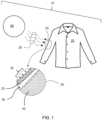
- FIG. 1 shows a low-level light therapy system 10 that that absorbs an incident spectrum including one or more of a UV wavelength, a visible wavelength, and a near infrared wavelength and emits light having an emission spectrum including visible light radiation and near infrared radiation.
- an article of apparel 20 absorbs an incident spectrum 30 and emits light 40 in a direction toward a body 50 of a person wearing the article of apparel 20 (see magnified view 25 showing light 40 having an emission spectrum including one or more of visible light radiation and near infrared radiation is emitted from the article of apparel 20 in a direction toward a body 50 of a person wearing the article of apparel 20).
- the incident spectrum 30 includes one or more of a UV wavelength (meaning radiation having wavelengths of 200 to 400 nm), a visible wavelength (meaning radiation having wavelengths of 400 to 700 nm), and a near infrared wavelength (meaning radiation having wavelengths of 700 to 1200 nm).
- the incident spectrum 30 originates in a source 60 that is external to the article of apparel 20.
- the source 60 is a source of natural light and can include the sun, whether or not directly incident on the article of apparel 20.
- the source 60 is an artificial source of a spectrum that replicates some or all of the spectrum emitted by the sun.
- the incident spectrum 30 from the source 60 can be filtered or otherwise directed and/or concentrated or moderated prior to the incident spectrum interacting with the article of apparel 20.
- the article of apparel 20 absorbs at least a portion of the incident spectrum 30 and emits light 40 having an emission spectrum including one or more of visible light radiation (meaning radiation having wavelengths of 400 to 700 nm) and near infrared radiation (meaning radiation having wavelengths of 700 to 1200 nm).
- the emission spectrum includes at least one peak in a range of 600 nm to 1200 nm.
- the emission spectrum includes one or more of a first peak between 700 nm and 800 nm with a full width at half maximum (FWHM) of 80 nm to 200 nm, alternatively 100 nm to 150 nm, and a second peak between 800 nm and 900 nm with a full width at half maximum (FWHM) of 80 nm to 200 nm, alternatively 100 nm to 150 nm.
- FWHM full width at half maximum
- the process of absorption 100 of at least a portion of the incident spectrum 30 includes incident radiation 110 interacting with a portion of the article of apparel 20 resulting in an electron be raised from a ground state 120 to an excited state 130.
- the process of emitting light (or emission) 140 includes the electron in the excited state 130' returns to the ground state 120' accompanied by emitted light 150.
- the article of apparel 20 is electrically passive, meaning the article of apparel 20 does not directly utilize an external source of power and it requires a light source as the source of the incident spectrum 30 itself to emit the light 40 having the emission spectrum including one or more of visible light radiation and near infrared radiation.
- the source 60 can be the sun and the article of apparel has no external source of power; accordingly, only the energy in the incident spectrum 30 is provided to the low-level light therapy system 10.
- the source 60 can be an electrically powered light source, such as a light bulb, providing a full spectrum that includes at least some wavelengths of 390 to 1200 nm and the article of apparel has no external source of power; accordingly, only the energy in the incident spectrum 30 is provided to the low-level light therapy system 10.
- the source 60 can be an electrically powered light source, such as a light emitting diode (LED) with a spectrum that includes at least some wavelengths in the range of 200 to 1200 nm and the article of apparel has no external source of power; accordingly, only the energy in the incident spectrum 30 is provided to the low-level light therapy system 10.
- LED light emitting diode
- FIG. 3A is a magnified, schematic illustration depicting a portion 200 of an article of apparel 20 absorbing at least a portion of incident spectrum 30 that includes one or more of a UV wavelength, a visible wavelength, and a near infrared wavelength and emitting light 40 having an emission spectrum including one or more of visible light radiation and near infrared radiation.
- the portion 200 of the article of apparel 20 includes one or more yarns 210.
- An individual yarn 210 is schematically depicted in FIG. 3B .
- Yarn 210 includes a textile grade, polymeric host material 220 and one or more fluorescent components 230.
- Incident spectrum 30 interacts with the yarn 210 (resulting in an electron being raised from a ground state to an excited state as previously described with reference to FIG.
- the emission spectrum is emitted from a plurality of locations along a length (L) of the yarns 210.
- the yarns may be included in an article of apparel as a discrete yarn or a plurality of discrete yarns incorporated into a textile material, or as a plurality of similar or dissimilar yarns combined to form a network of yarns.
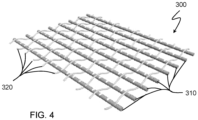
- FIG. 4 is a schematic drawing of a network of yarns 300.
- the network of yarns 300 includes a plurality of a first yarn type 310 and a plurality of a second yarn type 320.
- the different yarn types can be incorporated into the textile material in any suitable manner; for example, the weft yarns can be of a first yarn type and the warp yarns can be of a second yarn type.
- Either of the weft yarns or the warp yarns or both can be yarns that absorb an incident spectrum including one or more of a UV wavelength, a visible wavelength, and a near infrared wavelength and emits light having an emission spectrum including one or more of visible light radiation and near infrared radiation.
- any, a subset, or all of the yarns in the network of yarns 300 can be yarns that absorb an incident spectrum including one or more of a UV wavelength, a visible wavelength, and a near infrared wavelength and emits light having an emission spectrum including one or more of visible light radiation and near infrared radiation.
- the network of yarns can incorporate one or more yarn types that absorb an incident spectrum including one or more of a UV wavelength, a visible wavelength, and a near infrared wavelength and emits light having an emission spectrum including one or more of visible light radiation and near infrared radiation, where different yarn types absorb different wavelengths from the incident spectrum and/or emit an emission spectrum with different wavelengths.
- the network of yarns can have any woven character and/or any knitted character.
- FIG. 5 illustrates an example of woven character 350, in which yarns are assembled in parallel using weaving, and an example of knitted character 360, in which yarns are knitted into a fabric.
- Other examples shown in FIG. 5 include twilled 370, plain dutch weave 380, and twilled dutch weave 390, but any woven or knitted character can be utilized in the low-level light therapy systems disclosed herein.
- the yarns can be in any suitable form.
- the yarns can be monofilament or multifilament, staple or continuous.
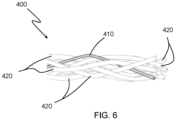
- FIG. 6 is a schematic drawing of a multifilament yarn 400.
- the multifilament yarn 400 includes at least one of a first filament type 410 and a plurality of a second filament type 420.
- the different filament types can be incorporated into the textile material in any suitable manner.
- the first filament type 410 absorbs an incident spectrum including one or more of a UV wavelength, a visible wavelength, and a near infrared wavelength and emits light having an emission spectrum including one or more of visible light radiation and near infrared radiation.
- first filament type 410 can be incorporated into the multifilament yarn 400.
- a majority of the filaments in the multifilament yarn 400 can be of such a first filament type 410.
- any, a subset, or all of the filaments in the multifilament yarn 400 can be of a type that absorb an incident spectrum including one or more of a UV wavelength, a visible wavelength, and a near infrared wavelength and emits light having an emission spectrum including one or more of visible light radiation and near infrared radiation.
- the multifilament yarn 400 can incorporate one or more filament types each of which absorb an incident spectrum including one or more of a UV wavelength, a visible wavelength, and a near infrared wavelength and emits light having an emission spectrum including one or more of visible light radiation and near infrared radiation, where different first filament types 420 absorb different wavelengths from the incident spectrum and/or emit an emission spectrum with different wavelengths.
- the yarns can be staple or multi-filament, where staple refers to fiber of discrete length and multi-filament refers to a continuous fiber.
- the yarns may be composite yarns with desired properties and aesthetics resulting from, for example, yarn mixes (mixed colors, mixed deniers, mixed cross-sections, mixed bicomponent/homofilament, etc.).
- the yarns may be textured by, for example, forming crimps, loops, coils, or crinkles in the filaments, which affects the behavior and hand of textile materials made from them.
- the yarns include a textile grade, polymeric host material 220.
- Suitable textile grade, polymeric host material 220 includes a homopolymer or a copolymer or a long-chain polymer selected from the group consisting of polyesters, polyamides, olefins, acrylics, poly(methyl methacrylate) (PMMA), polylactic acid (PLA), and polycarbonates.
- the textile grade, polymeric host material has an intrinsic viscosity (IV) in a range of 0.5 to 1.0 dL/g.
- the yarns also include one or more fluorescent components.
- Example fluorescent components include one or more of a dye and a quantum dot.
- the fluorescent component is characterized by having either or both an emission spectrum including visible light radiation having a quantum efficiency of 90% and above, and an emission spectrum in the near infrared range having a quantum efficiency of 50% and above.
- the fluorescent component is a dye
- the dye includes one or more of a perylene dye, a cyanine dye, a rhodamine dye, a coumarine dye, a dye belonging to the class of anthrapyridone dyes, thioxanthene dyes and thioindigoid dyes, or mixtures thereof.
- the amount of fluorescent components in the textile grade, polymeric host material is in the range of 0.01 weight % (wt.%) to 1 wt.%.
- the amount of fluorescent components in the textile grade, polymeric host material is in the range of 0.01 wt.% to 0.1 wt.%, or is in the range of 0.05 wt.%, 0.10 wt.%, 0.15 wt.% or 0.20 wt.% to 0.10 wt.%, 0.25 wt.%, or 0.50 wt.%.
- 0.015 wt.% of a red anthrapyridone fluorescent dye was used, a combination of 0.025 wt.% of a perylene fluorescent dye and 0.06 wt.% of a cyanine fluorescent dye (which is a near infrared dye) was used, or a combination of 0.045 wt.% of a fluorescent dye called Vat Violet 3, which belongs to the class of thioindigoid dyes, and 0.045 wt.% of a cyanine fluorescent dye (which is a near infrared dye) was used.
- the amount of titanium dioxide (TiO 2 ) included in the yarns is minimized.
- the amount of titanium dioxide is less than 2.0 wt.%, alternatively less than 1.0 wt.%. It is preferred that there be no titanium dioxide in the yarns, i.e., that the yarns are titanium dioxide free.
- Individual yarns can be any desired cross-section.
- individual monofilament yarn can have a circular cross-section and be, for example, on the order of 10 microns in diameter.
- individual monofilament yarn can have a multilobal cross section, such as a trilobal cross section, and be, for example, on the order of 10 microns in diameter.
- Multifilament yarn can be of any type, including FFT (false twist textured) or AJT (air jet textured).
- the yarns and fabrics or textile materials incorporating the yarns can be manufactured using suitable methods.
- a first textile grade, polymeric host material and at least one of a first fluorescent component and a second fluorescent component can be mixed using extrusion techniques to form a masterbatch.
- the masterbatch has a concentration of the fluorescent component of 2% to 20%.
- the masterbatch is then mixed with a volume of a second textile grade, polymeric host material to produce a feedstock in which a total amount of fluorescent component in the feedstock is 0.01 wt.% to 1 wt.%, alternatively in the range of 0.05 wt.%, 0.10 wt.%, 0.15 wt. % or 0.20 wt.% to 0.10 wt.%, 0.25 wt.%, or 0.50 wt.%.
- the feedstock is then processed into flat yarn.
- An example technique for processing the feedstock into flat yarn is melt spinning. But other techniques can be used, such as wet spinning or dry spinning.
- the flat yarn can be further processed by texturing to form a textured yarn or by cutting to form a staple yarn. Texturing the yarn helps to ensure light is emitted from the side surface along the length of the yarns (as described earlier with reference to FIG. 3B ). As discloses elsewhere herein, when exposed to visible light, the textured yarn or staple yarn emits radiation having an emission spectrum including at least one peak in a range of 600 nm to 1200 nm. Texturing also serves secondary purposes including creating a softer and better touch ("hand feel") and improving moisture control.
- Suitable textile grade, polymeric host materials and fluorescent components can be any such materials and components disclosed elsewhere herein.
- the textile grade, polymeric host material has an intrinsic viscosity (IV) in a range of 0.5 to 1.0 dL/g.
- IV intrinsic viscosity
- the first textile grade, polymeric host material and the second textile grade, polymeric host material are the same, i.e., compositionally identical.
- the first textile grade, polymeric host material and the second textile grade, polymeric host material are of a same type of polymer, e.g., are both polyesters, polyamides, olefins, acrylics, PMMA, PLA, or polycarbonates.
- the first textile grade, polymeric host material and the second textile grade, polymeric host material are not the same, i.e., not compositionally identical, it is preferable that the first textile grade, polymeric host material has a higher intrinsic viscosity (IV) than the second textile grade, polymeric host material.
- the fluorescent components include one or more of a dye and a quantum dot and, when the fluorescent component is a dye, the dye includes one or more of a perylene dye, a cyanine dye, a rhodamine dye, a coumarine dye, a dye belonging to the class of anthrapyridone dyes, thioxanthene dyes and thioindigoid dyes, or mixtures thereof.
- the first fluorescent component has a quantum efficiency of more than 90% for emission at visible wavelengths and the second fluorescent component has a quantum efficiency of more than 50% for emission at near infrared wavelengths.
- the optically clear, polymeric host material can be processed using conventional pretreatment, drying and crystallization techniques.
- the manufactured textured yarn or staple yarn can be further manufactured into fabrics or textile materials or an article of apparel using suitable methods known in the textile industry.
- the fluorescent components emit light at visible or near infrared wavelengths.
- the fluorescent components transform part of the wideband incident ambient light into narrow band light with the precise wavelengths that studies have shown to have wellness and therapeutic benefits such as for hair regrowth, weight loss, muscle toning, skin rejuvenation, and several other treatments.
- the following Table 1 presents effective wavelengths for Low Level Light Therapy (“LLLT”) for certain applications.
- LLLT Low Level Light Therapy
- the Bunsen-Roscoe law (reciprocity law) states that the quantity of the reaction of a photochemical reaction is proportional to the product of light irradiance and exposure time. Most photo-biomodulation effects are cumulative and research has shown that positive results depend on the administered dose of light rather than the intensity alone. In other words, the same dose (and same effect) can be provided by a high intensity of light in a short time or a low intensity of light in a long time. Accordingly, the low-level light therapy systems disclosed herein can be used in methods of treating soft tissue and as a low-level light therapy method in which soft tissue is exposed to the emission spectrum of the low-level light therapy system.
- the fluorescent components utilized in the yarns that are incorporated into the article of apparel and/or the textile material that are part of the low-level light therapy system and/or sub-systems are selected to produce an emission spectrum that includes one or more of the effective wavelengths set forth in Table 1.
- the time exposure to an emission spectrum that includes one or more of the effective wavelengths may be much longer than the typical time exposure involved in conventional low-level light therapy (such as conventional light therapy using LEDs and laser sources). Because the time of exposure can be longer using the structures disclosed herein, the intensity of the emission spectrum that includes one or more of the effective wavelengths emitted from such structures does not need to be high to provide an effective light dosage.
- Low-level light therapy systems disclosed herein can be used to apply light therapy to contribute to a wide range of therapeutic effects at the molecular, cellular, psychosomatic, psychological and tissue levels.
- LLLT Low Level Light Therapy
- Common applications of LLLT are wound healing, pain management, inflammation and restoration of function, treatment of skin disease and skin rejuvenation, hair loss and hair regrowth, chronic ulcers and chronic pain syndromes like headaches, dermatology (for example, LLLT was approved by the Food and Drug Administration in 2007 for the treatment of mild to moderate male pattern hair loss), acne therapy, and photo-rejuvenation (to reverse the process of sun-induced aging and environmental damage to skin).
- low-level used in conjunction with “low-level light therapy” and “LLLT” refers to light sources having a power density output that is less than or equal to 100 mW/cm 2 . These low level light sources can provide enhanced cellular function as therapeutic effect through the physiological effect of photo-biomodulation. Given their low power density, low-level light therapy is not used for surgery or tissue ablation due to the low power density employed. In contrast, light sources with output power density larger than 100 mW/cm 2 are called high-level light (“HLL"). High-level light sources cause a photothermal physiological effect and cellular destruction, and, given their high power density, these high-level light sources are used for surgery and ablation.
- HLL high-level light
- the emitted light mimics the absorption spectrum of the molecules that are absorbing the light, and the wavelengths that are strongly absorbed can also enable a photobiological response.
- visible light can affect the human immune system response through the skin. Skin is naturally exposed to light more than other organs and responds well to red and near infrared wavelengths.
- an emission spectrum that includes visible light, and preferably red and near infrared wavelengths can penetrate epidermal and dermal layers to a depth of 2-3 mm and directly interact with circulating lymphocytes to modulate immune system function.
- mitochondria which have absorption peaks in the red and near infrared regions of the electromagnetic spectrum
- nitric oxide synthesizes nitric oxide (NO) in response to light therapy by neuronal nitric oxide synthase and this nitric oxide then contributes to regulating respiration by competitive binding to the oxygen binding of cytochrome c oxidase to thereby affect cell metabolism.
- emitted light in the visible light range can penetrate epidermal and dermal layers and directly interact with circulating lymphocytes to modulate the immune function (resulting in enhanced phagocyte activity of monocytes and granulocytes and the proliferation of other human cells). Visible light is also the most powerful external regulator of the circadian response.
- emitted light having red and infrared wavelengths can been used for a variety of therapeutic applications, including: healing wounds, treating mouth sores caused by radiation and chemotherapy, re-growing hair, recovering from cosmetic surgery, treating injuries to joints and soft tissue, reducing the inflammatory pain of arthritis, and carpal tunnel syndrome, among others.
- Emitted light having red wavelengths can be used to stimulate the regrowth of nerve cells.
- Emitted light having red and infrared wavelengths helps with blood circulation and natural healing by stimulating DNA synthesis in human peripheral blood lymphocytes but also induces a change in the cytokine content in the blood. These wavelengths of light penetrate skin cells stimulating production of antioxidants, reducing cellular stress and increasing cellular energy in the form of adenosine triphosphate (ATP).
- ATP adenosine triphosphate
- emitted light having long infrared wavelengths allow for deeper tissue penetration than visible wavelengths.
- Near infrared light 600-1200 nm
- emitted light having visible and infrared wavelengths can penetrate the circulating blood, suggesting such low-level light therapy systems can be used to apply light therapy for blood related therapeutic effects.
- penetration depths disclosed herein can be contingent on tissue type, pigmentation and foreign substances on the skin surface but, nonetheless, can be generally understood to have the following characteristics: visible light in the blue-green range (475-545 nm) can penetrate twice as far as ultraviolet (UV) light (150-380 nm), while red and near Infrared (NIR) light (600-1200 nm) can penetrate more than ten times as far as UV light. Emitted light with a wavelength between 600 and 1200 nm constitutes the so-called therapeutic window because these wavelengths can penetrate into the subcutaneous tissue without significant absorption by water.
- UV ultraviolet
- NIR near Infrared
- the low-level light therapy system can be embodied in any suitable article of apparel.
- Such apparel can be made with yarns that are embedded with fluorescent components (dyes and/or quantum dots).
- the fluorescent components can emit light at visible or near infrared wavelengths and transform part of the wideband incident ambient light into narrow band light with the precise wavelengths that studies have shown to have wellness and therapeutic benefits such as for hair regrowth, weight loss, muscle toning, skin rejuvenation, and several other treatments as disclosed herein.
- the article of apparel can be clothing, such as a shirt 500, a pant 510, a short, a sock.
- suitable articles of clothing include a footwear 520, a hand covering, such as glove 530, a wrist band, a head band, and a head covering, which incudes, for example, a hat 540, a scarf, or a helmet.
- suitable articles of clothing include athletic gear such as work out clothing 600 and uniforms.
- the low-level light therapy system can be embodied in all or a portion of any suitable article of apparel, such as an arm sleeve, a calf sleeve, an arm band 610, or bandage material.
- the low-level light therapy system can also be embodied in all or a portion of any suitable article of apparel 620 used for other mammals, such as dogs, cats or horses.
- the low-level light therapy system can be incorporated into bedding or a towel.
- This area can be the entire article of apparel or can be a plurality of discreet areas within the article of apparel.
- the plurality of discreet areas can be located within the article of apparel to correspond to discreet body parts. For example, where the article of apparel is a shirt, the plurality of discreet areas can be located within the shirt to correspond to the discreet body parts of any one or more of a shoulder, an elbow, a bicep, a tricep, etc.
- the plurality of discreet areas can be located within the pant or a short to correspond to the discreet body parts of any one or more of a knee, a hip, a quadriceps, a hamstring, etc.
- the article of apparel is a headgear
- the plurality of discreet areas can be located within the headgear to correspond to the discreet body parts of any one or more of a forehead, a crown, a temple, etc.
- the structure and methods and principles disclosed herein can be similarly applied to other textile-based objects, such as bedding and towels, and sun shade structures.
- the textile-based objects can absorb an incident spectrum and, when the textile-based object is oriented toward a body of a person, can emit light in a direction toward the body of that person.
- bedding and towels that can mean a person swaddled, draped, or cloaked in the textile-based object can receive the light emitted from the textile-based object
- sun shade structures that can mean a person sitting underneath or in the shade of such a structure can receive the light emitted from the textile-based object.
- the textile materials may be implemented in conjunction with other existing special performance textile technologies, like geotextiles, nanotechnology textiles, push/pull fabric constructions, phase change material (PCM) textiles, temperature/humidity gradient textiles, etc., designed for applications like moisture management, waterproofing, comfort cooling, and comfort heating.
- Functional finishes and coatings for antimicrobial, antistatic, crease-resistance, flame-resistance, water and oil repellency, waterproofing, etc. are all also compatible with the textile materials and can provide additional properties without affecting the performance of the textile materials, as well as articles of apparel comprising such textile materials, themselves.
- a secondary property of the articles of apparel is a "shading" effect whereby the yarns/fabric do not heat up under the sun as much as would conventionally be expected because the use of fluorescent components with high quantum efficiency results in yarns that release most of the absorbed energy via the production of therapeutic emitted light and is not retained as heat-producing energy.
- An additional secondary effect is extra protection against short wavelengths having damaging effect on the human skin, which occurs by converting the energy in the potentially damaging, short wavelengths into energy at more useful, less damaging, and/or therapeutic emitted light wavelengths.
- the PET is "super bright," i.e., it contains 0.00% titanium dioxide.
- the yarn includes 0.015 wt.% of a red anthrapyridone fluorescent dye called “solvent red dye 149" that is distributed homogenously in the PET polymeric host material.
- the fabric was stretched taut and, in separate experiments, exposed to a first spectrum (700 in FIG. 11A ) containing blue light with a peak (705 in FIG. 11A ) at 450 nm and exposed to a second spectrum (710 in FIG. 11B ) containing green light with a peak (715 in FIG. 11B ) at 525 nm.
- FIG. 11A shows that the fabric exposed to the first spectrum 700 emits a spectrum of red light with a peak (725 in FIG. 11A ) at 670 nm and a full width at half maximum (FWHM) of about 85 nm.
- FIG. 11B shows that the fabric exposed to the second spectrum 710 also emits a spectrum of red light with a peak (725 in FIG. 11B ) at 670 nm and a full width at half maximum (FWHM) of about 82.5 nm.
- the peak of 670 nm for the emitted light is a therapeutic wavelength within the health and performance window.
- the peak wavelength in the emitted spectrum is independent of the incident spectrum 700,710 (as both a peak at 450 nm and a peak at 525 nm in the incident spectra 700,710 resulted in an emission spectrum with a peak at 670 nm).
- the first spectrum 700 containing incident blue light with a peak at 450 nm was approximately double the magnitude of the second spectrum 710 containing incident green light with a peak at 525 nm
- the emission peak at 670 nm for the emitted spectrum in each experiment had approximately the same magnitude.
- the PET is "super bright," i.e., it contains 0.00% titanium dioxide.
- the yarn includes 0.025 wt.% of a perylene fluorescent dye and 0.06 wt.% of a cyanine fluorescent dye (which is a near infrared dye), both of which are distributed homogenously in the PET polymeric host material.
- the fabric was stretched taut and, in separate experiments, exposed to a first spectrum (750 in FIG. 12A ) containing blue light with a peak (755 in FIG. 12A ) at 390 nm, exposed to a second spectrum (760 in FIG.
- FIG. 12A shows that the fabric exposed to the first spectrum 750 emits a spectrum of near infrared (NIR) light with a peak (780 in FIG. 12A ) at 756 nm and a full width at half maximum (FWHM) of about 85 nm.
- FIG. 12B shows that the fabric exposed to the second spectrum 760 also emits a spectrum of NIR light with a peak (785 in FIG. 12B ) at 756 nm and a full width at half maximum (FWHM) of about 86 nm.
- FIG. 12C shows that the fabric exposed to the third spectrum 770 also emits a spectrum of NIR light with a peak (790 in FIG. 12C ) at 745 nm and a full width at half maximum (FWHM) of about 103 nm.
- the peak of 750 ⁇ 6 nm for the emitted light is a therapeutic wavelength within the health and performance window.
- the PET is "super bright," i.e., it contains 0.00% titanium dioxide.
- the yarn includes 0.045 wt.% of a fluorescent dye called Vat Violet 3, which belongs to the class of thioindigoid dyes, and 0.045 wt.% of a cyanine fluorescent dye (which is a near infrared dye), both of which are distributed homogenously in the PET polymeric host material.
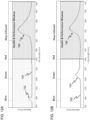
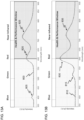
- the fabric was stretched taut and, in separate experiments, exposed to a first spectrum (800 in FIG. 13A ) containing blue light with a peak (805 in FIG. 13A ) at 400 nm, and exposed to a second spectrum (810 in FIG. 13B ) containing green light with a peak (815 in FIG. 13B ) at 525 nm.
- FIG. 13A shows that the fabric exposed to the first spectrum 800 emits a spectrum with two peaks - a first peak (820 in FIG. 13A ) at 600 nm and a full width at half maximum (FWHM) of about 75 nm and a second peak (825 in FIG. 13A ) at 730 nm and a full width at half maximum (FWHM) of about 113 nm.
- the first peak 820 is a red emission peak and the second peak 825 is a NIR emission peak.
- FIG. 13B shows that the fabric exposed to the second spectrum 810 emits a spectrum of with two peaks - a first peak (830 in FIG. 13B ) at 600 nm and a full width at half maximum (FWHM) of about 75 nm and a second peak (835 in FIG. 13B ) at 730 nm and a full width at half maximum (FWHM) of about 125 nm.
- the first peak 830 is a red emission peak and the second peak 835 is a NIR emission peak.
- FIGS. 11A-B , 12A-C , and 13A-B are presented graphically as arbitrary units of intensity versus wavelength in nm and, in each graph, intensity (arbitrary units) on the y-axis ranges from zero to 10000 arbitrary units and wavelength on the x-axis ranges from 350 nm to 900 nm.
Landscapes
- Health & Medical Sciences (AREA)
- Life Sciences & Earth Sciences (AREA)
- Biomedical Technology (AREA)
- Engineering & Computer Science (AREA)
- Veterinary Medicine (AREA)
- General Health & Medical Sciences (AREA)
- Public Health (AREA)
- Biophysics (AREA)
- Animal Behavior & Ethology (AREA)
- Pathology (AREA)
- Radiology & Medical Imaging (AREA)
- Nuclear Medicine, Radiotherapy & Molecular Imaging (AREA)
- Environmental Sciences (AREA)
- Molecular Biology (AREA)
- Physics & Mathematics (AREA)
- Heart & Thoracic Surgery (AREA)
- Medical Informatics (AREA)
- Surgery (AREA)
- Biodiversity & Conservation Biology (AREA)
- Zoology (AREA)
- Animal Husbandry (AREA)
- Radiation-Therapy Devices (AREA)
- Artificial Filaments (AREA)
Applications Claiming Priority (3)
| Application Number | Priority Date | Filing Date | Title |
|---|---|---|---|
| US201862720544P | 2018-08-21 | 2018-08-21 | |
| US16/127,463 US10322297B1 (en) | 2018-08-21 | 2018-09-11 | Electrically passive low-level light therapy system and methods incorporating same |
| PCT/US2019/047511 WO2020041476A1 (en) | 2018-08-21 | 2019-08-21 | Electrically passive low-level light therapy system and methods incorporating same |
Publications (4)
| Publication Number | Publication Date |
|---|---|
| EP3840829A1 EP3840829A1 (en) | 2021-06-30 |
| EP3840829A4 EP3840829A4 (en) | 2022-06-08 |
| EP3840829C0 EP3840829C0 (en) | 2024-01-17 |
| EP3840829B1 true EP3840829B1 (en) | 2024-01-17 |
Family
ID=66825864
Family Applications (1)
| Application Number | Title | Priority Date | Filing Date |
|---|---|---|---|
| EP19851291.5A Active EP3840829B1 (en) | 2018-08-21 | 2019-08-21 | Electrically passive low-level light therapy system and methods incorporating same |
Country Status (8)
| Country | Link |
|---|---|
| US (2) | US10322297B1 (enExample) |
| EP (1) | EP3840829B1 (enExample) |
| JP (1) | JP7285025B2 (enExample) |
| KR (1) | KR20210049808A (enExample) |
| CN (1) | CN112770809A (enExample) |
| AU (1) | AU2019324157B2 (enExample) |
| MX (1) | MX388875B (enExample) |
| WO (1) | WO2020041476A1 (enExample) |
Families Citing this family (8)
| Publication number | Priority date | Publication date | Assignee | Title |
|---|---|---|---|---|
| ES2954997T3 (es) * | 2017-10-26 | 2023-11-28 | Medi Gmbh & Co Kg | Ayuda médica, en particular ortopédica |
| US11606914B2 (en) | 2018-03-24 | 2023-03-21 | Suntracker Technologies Ltd. | Fiber-optic sheet lighting |
| US10322297B1 (en) * | 2018-08-21 | 2019-06-18 | Lumia Group, LLC | Electrically passive low-level light therapy system and methods incorporating same |
| US11129429B2 (en) * | 2018-08-21 | 2021-09-28 | Lumia Group, LLC | Textile materials with spontaneous emission and methods of UV protection, shading, warming, and other applications using same |
| US20230073172A1 (en) * | 2020-02-21 | 2023-03-09 | Zachary BOLDUC | Phototherapy devices and methods |
| US12654028B2 (en) | 2023-01-26 | 2026-06-16 | Suninlyf Bio Inc. | Anti-infective and therapeutic electromagnetic emission methods and devices |
| US12377286B2 (en) | 2023-01-26 | 2025-08-05 | Suninlyf Bio Inc. | Anti-infective and therapeutic electromagnetic emission methods and devices |
| CN113398483A (zh) * | 2021-06-18 | 2021-09-17 | 福州大学 | 量子点红外线发射装置 |
Citations (1)
| Publication number | Priority date | Publication date | Assignee | Title |
|---|---|---|---|---|
| EP2443275B1 (en) * | 2009-06-15 | 2016-06-29 | Lenzing AG | Ultraviolet protective fabrics based on man-made cellulosic fibres |
Family Cites Families (27)
| Publication number | Priority date | Publication date | Assignee | Title |
|---|---|---|---|---|
| GB634113A (en) | 1946-03-11 | 1950-03-15 | Elwyn George Berrien Riley | Improvements in light therapy apparatus and irradiating medium |
| JPS6392720A (ja) | 1986-10-03 | 1988-04-23 | Nobuhide Maeda | 遠赤外線放射性芯鞘型複合繊維 |
| GB2357515B (en) | 1998-07-29 | 2003-04-09 | Univ Napier | Displays |
| CA2489673A1 (en) * | 2003-12-09 | 2005-06-09 | Medx Health Corp. | Shape-adaptable and spectral-selective distributed light sources using passive host medium |
| US20060041039A1 (en) | 2004-08-20 | 2006-02-23 | Gyorgyi Fenyvesi | Fluorescent poly(alkylene terephthalate) compositions |
| US20070016173A1 (en) | 2005-07-14 | 2007-01-18 | Michael Kreindel | Protective material, clothing item and method of protection |
| WO2008039671A2 (en) | 2006-09-19 | 2008-04-03 | Invista Technologies S.A.R.L. | Polyamide composition with improved heat stability and whiteness |
| US20090143516A1 (en) | 2007-11-30 | 2009-06-04 | Macdonald John Gavin | Thermochromic responsive elastic polymer substrate |
| US7841714B2 (en) | 2008-02-07 | 2010-11-30 | Quantum Modulation Scientific Inc. | Retinal melatonin suppressor |
| WO2009154473A2 (en) | 2008-06-19 | 2009-12-23 | Renewable Energy Corporation Asa | Coating for thin-film solar cells |
| IL193701A (en) | 2008-08-26 | 2015-01-29 | Renata Reisfeld | Luminescent solar concentration |
| DE102008052043A1 (de) | 2008-10-16 | 2010-04-22 | Fraunhofer-Gesellschaft zur Förderung der angewandten Forschung e.V. | Fluoreszenz-Kollektor und dessen Verwendung |
| WO2011024818A1 (ja) | 2009-08-26 | 2011-03-03 | 三菱化学株式会社 | 白色半導体発光装置 |
| FI20095967A7 (fi) | 2009-09-18 | 2011-03-19 | Valoya Oy | Valaisinsovitelma |
| KR101077990B1 (ko) | 2010-02-12 | 2011-10-31 | 삼성엘이디 주식회사 | 형광체, 발광장치, 면광원장치, 디스플레이 장치 및 조명장치 |
| US20110284729A1 (en) | 2010-05-11 | 2011-11-24 | University Of Central Florida Research Foundation, Inc. | Systems and Methods for Harvesting Optical Energy |
| WO2013052927A2 (en) | 2011-10-07 | 2013-04-11 | Svaya Nanotechnologies, Inc. | Broadband solar control film |
| HK1208807A1 (en) | 2012-09-14 | 2016-03-18 | 克洛克斯科技公司 | Chromophore combinations for biophotonic uses |
| US9295855B2 (en) | 2013-03-15 | 2016-03-29 | Gary W. Jones | Ambient spectrum light conversion device |
| WO2014154595A1 (en) * | 2013-03-26 | 2014-10-02 | INSERM (Institut National de la Santé et de la Recherche Médicale) | Medical device, its preparation method and applications thereof |
| US20150177423A1 (en) * | 2013-12-22 | 2015-06-25 | Lumia Group | Opto textile |
| RU2017117187A (ru) | 2014-10-31 | 2018-11-30 | Клокс Текнолоджиз Инк. | Фотоактивируемые волокна и тканые материалы |
| KR102477353B1 (ko) | 2015-08-06 | 2022-12-16 | 삼성전자주식회사 | 적색 형광체, 백색 발광장치 및 조명 장치 |
| CN105561479B (zh) | 2015-12-01 | 2017-11-21 | 苏州星烁纳米科技有限公司 | 量子点应用于理疗、保健以及美容 |
| EP3463467A4 (en) * | 2016-05-23 | 2020-01-01 | Orphaderm Limited | BIOPHOTONIC COMPOSITIONS WITH A CHROMOPHOR FROM A MUSHROOM |
| US10322297B1 (en) * | 2018-08-21 | 2019-06-18 | Lumia Group, LLC | Electrically passive low-level light therapy system and methods incorporating same |
| US11129429B2 (en) | 2018-08-21 | 2021-09-28 | Lumia Group, LLC | Textile materials with spontaneous emission and methods of UV protection, shading, warming, and other applications using same |
-
2018
- 2018-09-11 US US16/127,463 patent/US10322297B1/en active Active
-
2019
- 2019-08-21 AU AU2019324157A patent/AU2019324157B2/en active Active
- 2019-08-21 KR KR1020217005398A patent/KR20210049808A/ko not_active Ceased
- 2019-08-21 MX MX2021002040A patent/MX388875B/es unknown
- 2019-08-21 JP JP2021533382A patent/JP7285025B2/ja active Active
- 2019-08-21 CN CN201980054354.5A patent/CN112770809A/zh not_active Withdrawn
- 2019-08-21 EP EP19851291.5A patent/EP3840829B1/en active Active
- 2019-08-21 US US17/267,953 patent/US11998759B2/en active Active
- 2019-08-21 WO PCT/US2019/047511 patent/WO2020041476A1/en not_active Ceased
Patent Citations (1)
| Publication number | Priority date | Publication date | Assignee | Title |
|---|---|---|---|---|
| EP2443275B1 (en) * | 2009-06-15 | 2016-06-29 | Lenzing AG | Ultraviolet protective fabrics based on man-made cellulosic fibres |
Also Published As
| Publication number | Publication date |
|---|---|
| WO2020041476A1 (en) | 2020-02-27 |
| US11998759B2 (en) | 2024-06-04 |
| AU2019324157B2 (en) | 2021-09-23 |
| JP7285025B2 (ja) | 2023-06-01 |
| MX388875B (es) | 2025-03-20 |
| US10322297B1 (en) | 2019-06-18 |
| AU2019324157A1 (en) | 2021-03-11 |
| MX2021002040A (es) | 2021-12-16 |
| CA3108722A1 (en) | 2020-02-27 |
| CN112770809A (zh) | 2021-05-07 |
| EP3840829C0 (en) | 2024-01-17 |
| KR20210049808A (ko) | 2021-05-06 |
| EP3840829A1 (en) | 2021-06-30 |
| EP3840829A4 (en) | 2022-06-08 |
| JP2021534334A (ja) | 2021-12-09 |
| US20210187318A1 (en) | 2021-06-24 |
Similar Documents
| Publication | Publication Date | Title |
|---|---|---|
| US11998759B2 (en) | Electrically passive low-level light therapy system and methods incorporating same | |
| US20150177423A1 (en) | Opto textile | |
| KR101320279B1 (ko) | 중합체 조성물, 중합체 조성물의 제조 방법, 상기 중합체 조성물 기재의 물품, 및 상기 물품의 용도 | |
| KR100740730B1 (ko) | 중합체 섬유 조성물 및 방법 | |
| CN106975157A (zh) | 用于生物医疗及美容的光动力柔性光纤织物 | |
| US8084377B2 (en) | Protective material, clothing item and method of protection | |
| US11129429B2 (en) | Textile materials with spontaneous emission and methods of UV protection, shading, warming, and other applications using same | |
| JP2021534334A5 (enExample) | ||
| CA3108722C (en) | Electrically passive low-level light therapy system and methods incorporating same | |
| EP1818077A1 (de) | Vorrichtung für die Lichtbehandlung der Haut | |
| KR102722684B1 (ko) | 근적외선을 이용한 모발 촉진기 | |
| KR102481238B1 (ko) | 발바닥 부착용 기능성 패치 및 그의 제조방법 | |
| BRPI0805782A2 (pt) | bioceramica nanomÉtrica emissora de radiaÇço infravermelho incorporada em polimeros e artigo tÊxtil | |
| US12582833B2 (en) | Wearable fabric for photo-stimulating a biological system | |
| KR102242069B1 (ko) | 근적외선을 방출하는 복합체 및 섬유의 제조방법 | |
| EP2479339A1 (en) | Textile yarn radiating far rays and manufacturing methods thereof | |
| BR102024014491A2 (pt) | Vestuário desportivo dotado de fotons para uso clinico | |
| Sen | Body-Capable Phototherapy Device | |
| KR200180714Y1 (ko) | 세라믹볼이 갖추어진 모자 | |
| KR20230029041A (ko) | 항균성을 가지고 흡한속건사로 제직된 양말의 제조방법, 및 항균성을 가지고 흡한속건사로 제직된 양말의 제조방법에 의해 제조된 양말 | |
| WO2019006528A1 (pt) | Capacete de led com transportador de luz do diodo para o couro cabeludo | |
| WRITER et al. | LED Therapy in Treating Androgenetic Alopecia |
Legal Events
| Date | Code | Title | Description |
|---|---|---|---|
| STAA | Information on the status of an ep patent application or granted ep patent |
Free format text: STATUS: THE INTERNATIONAL PUBLICATION HAS BEEN MADE |
|
| PUAI | Public reference made under article 153(3) epc to a published international application that has entered the european phase |
Free format text: ORIGINAL CODE: 0009012 |
|
| STAA | Information on the status of an ep patent application or granted ep patent |
Free format text: STATUS: REQUEST FOR EXAMINATION WAS MADE |
|
| 17P | Request for examination filed |
Effective date: 20210218 |
|
| AK | Designated contracting states |
Kind code of ref document: A1 Designated state(s): AL AT BE BG CH CY CZ DE DK EE ES FI FR GB GR HR HU IE IS IT LI LT LU LV MC MK MT NL NO PL PT RO RS SE SI SK SM TR |
|
| DAV | Request for validation of the european patent (deleted) | ||
| DAX | Request for extension of the european patent (deleted) | ||
| REG | Reference to a national code |
Free format text: PREVIOUS MAIN CLASS: A61N0005060000 Ref country code: DE Ref legal event code: R079 Ref document number: 602019045334 Country of ref document: DE Free format text: PREVIOUS MAIN CLASS: A61N0005060000 Ipc: A41D0031040000 |
|
| A4 | Supplementary search report drawn up and despatched |
Effective date: 20220511 |
|
| RIC1 | Information provided on ipc code assigned before grant |
Ipc: A61N 5/06 20060101ALI20220505BHEP Ipc: D06P 1/60 20060101ALI20220505BHEP Ipc: D06P 1/44 20060101ALI20220505BHEP Ipc: D01F 1/10 20060101ALI20220505BHEP Ipc: D01F 1/06 20060101ALI20220505BHEP Ipc: D01F 1/04 20060101ALI20220505BHEP Ipc: A41D 31/32 20190101ALI20220505BHEP Ipc: A41D 31/06 20190101ALI20220505BHEP Ipc: A41D 31/04 20190101AFI20220505BHEP |
|
| GRAP | Despatch of communication of intention to grant a patent |
Free format text: ORIGINAL CODE: EPIDOSNIGR1 |
|
| STAA | Information on the status of an ep patent application or granted ep patent |
Free format text: STATUS: GRANT OF PATENT IS INTENDED |
|
| INTG | Intention to grant announced |
Effective date: 20230919 |
|
| GRAS | Grant fee paid |
Free format text: ORIGINAL CODE: EPIDOSNIGR3 |
|
| GRAA | (expected) grant |
Free format text: ORIGINAL CODE: 0009210 |
|
| STAA | Information on the status of an ep patent application or granted ep patent |
Free format text: STATUS: THE PATENT HAS BEEN GRANTED |
|
| AK | Designated contracting states |
Kind code of ref document: B1 Designated state(s): AL AT BE BG CH CY CZ DE DK EE ES FI FR GB GR HR HU IE IS IT LI LT LU LV MC MK MT NL NO PL PT RO RS SE SI SK SM TR |
|
| REG | Reference to a national code |
Ref country code: GB Ref legal event code: FG4D |
|
| REG | Reference to a national code |
Ref country code: CH Ref legal event code: EP |
|
| REG | Reference to a national code |
Ref country code: DE Ref legal event code: R096 Ref document number: 602019045334 Country of ref document: DE |
|
| REG | Reference to a national code |
Ref country code: IE Ref legal event code: FG4D |
|
| U01 | Request for unitary effect filed |
Effective date: 20240119 |
|
| U07 | Unitary effect registered |
Designated state(s): AT BE BG DE DK EE FI FR IT LT LU LV MT NL PT SE SI Effective date: 20240129 |
|
| PG25 | Lapsed in a contracting state [announced via postgrant information from national office to epo] |
Ref country code: IS Free format text: LAPSE BECAUSE OF FAILURE TO SUBMIT A TRANSLATION OF THE DESCRIPTION OR TO PAY THE FEE WITHIN THE PRESCRIBED TIME-LIMIT Effective date: 20240517 |
|
| PG25 | Lapsed in a contracting state [announced via postgrant information from national office to epo] |
Ref country code: GR Free format text: LAPSE BECAUSE OF FAILURE TO SUBMIT A TRANSLATION OF THE DESCRIPTION OR TO PAY THE FEE WITHIN THE PRESCRIBED TIME-LIMIT Effective date: 20240418 |
|
| PG25 | Lapsed in a contracting state [announced via postgrant information from national office to epo] |
Ref country code: HR Free format text: LAPSE BECAUSE OF FAILURE TO SUBMIT A TRANSLATION OF THE DESCRIPTION OR TO PAY THE FEE WITHIN THE PRESCRIBED TIME-LIMIT Effective date: 20240117 Ref country code: RS Free format text: LAPSE BECAUSE OF FAILURE TO SUBMIT A TRANSLATION OF THE DESCRIPTION OR TO PAY THE FEE WITHIN THE PRESCRIBED TIME-LIMIT Effective date: 20240417 |
|
| PG25 | Lapsed in a contracting state [announced via postgrant information from national office to epo] |
Ref country code: ES Free format text: LAPSE BECAUSE OF FAILURE TO SUBMIT A TRANSLATION OF THE DESCRIPTION OR TO PAY THE FEE WITHIN THE PRESCRIBED TIME-LIMIT Effective date: 20240117 |
|
| PG25 | Lapsed in a contracting state [announced via postgrant information from national office to epo] |
Ref country code: RS Free format text: LAPSE BECAUSE OF FAILURE TO SUBMIT A TRANSLATION OF THE DESCRIPTION OR TO PAY THE FEE WITHIN THE PRESCRIBED TIME-LIMIT Effective date: 20240417 Ref country code: NO Free format text: LAPSE BECAUSE OF FAILURE TO SUBMIT A TRANSLATION OF THE DESCRIPTION OR TO PAY THE FEE WITHIN THE PRESCRIBED TIME-LIMIT Effective date: 20240417 Ref country code: IS Free format text: LAPSE BECAUSE OF FAILURE TO SUBMIT A TRANSLATION OF THE DESCRIPTION OR TO PAY THE FEE WITHIN THE PRESCRIBED TIME-LIMIT Effective date: 20240517 Ref country code: HR Free format text: LAPSE BECAUSE OF FAILURE TO SUBMIT A TRANSLATION OF THE DESCRIPTION OR TO PAY THE FEE WITHIN THE PRESCRIBED TIME-LIMIT Effective date: 20240117 Ref country code: GR Free format text: LAPSE BECAUSE OF FAILURE TO SUBMIT A TRANSLATION OF THE DESCRIPTION OR TO PAY THE FEE WITHIN THE PRESCRIBED TIME-LIMIT Effective date: 20240418 Ref country code: ES Free format text: LAPSE BECAUSE OF FAILURE TO SUBMIT A TRANSLATION OF THE DESCRIPTION OR TO PAY THE FEE WITHIN THE PRESCRIBED TIME-LIMIT Effective date: 20240117 |
|
| PG25 | Lapsed in a contracting state [announced via postgrant information from national office to epo] |
Ref country code: PL Free format text: LAPSE BECAUSE OF FAILURE TO SUBMIT A TRANSLATION OF THE DESCRIPTION OR TO PAY THE FEE WITHIN THE PRESCRIBED TIME-LIMIT Effective date: 20240117 |
|
| PG25 | Lapsed in a contracting state [announced via postgrant information from national office to epo] |
Ref country code: PL Free format text: LAPSE BECAUSE OF FAILURE TO SUBMIT A TRANSLATION OF THE DESCRIPTION OR TO PAY THE FEE WITHIN THE PRESCRIBED TIME-LIMIT Effective date: 20240117 |
|
| U20 | Renewal fee for the european patent with unitary effect paid |
Year of fee payment: 6 Effective date: 20240815 |
|
| PG25 | Lapsed in a contracting state [announced via postgrant information from national office to epo] |
Ref country code: SM Free format text: LAPSE BECAUSE OF FAILURE TO SUBMIT A TRANSLATION OF THE DESCRIPTION OR TO PAY THE FEE WITHIN THE PRESCRIBED TIME-LIMIT Effective date: 20240117 |
|
| REG | Reference to a national code |
Ref country code: DE Ref legal event code: R097 Ref document number: 602019045334 Country of ref document: DE |
|
| PG25 | Lapsed in a contracting state [announced via postgrant information from national office to epo] |
Ref country code: CZ Free format text: LAPSE BECAUSE OF FAILURE TO SUBMIT A TRANSLATION OF THE DESCRIPTION OR TO PAY THE FEE WITHIN THE PRESCRIBED TIME-LIMIT Effective date: 20240117 |
|
| PG25 | Lapsed in a contracting state [announced via postgrant information from national office to epo] |
Ref country code: SK Free format text: LAPSE BECAUSE OF FAILURE TO SUBMIT A TRANSLATION OF THE DESCRIPTION OR TO PAY THE FEE WITHIN THE PRESCRIBED TIME-LIMIT Effective date: 20240117 |
|
| PG25 | Lapsed in a contracting state [announced via postgrant information from national office to epo] |
Ref country code: SM Free format text: LAPSE BECAUSE OF FAILURE TO SUBMIT A TRANSLATION OF THE DESCRIPTION OR TO PAY THE FEE WITHIN THE PRESCRIBED TIME-LIMIT Effective date: 20240117 Ref country code: SK Free format text: LAPSE BECAUSE OF FAILURE TO SUBMIT A TRANSLATION OF THE DESCRIPTION OR TO PAY THE FEE WITHIN THE PRESCRIBED TIME-LIMIT Effective date: 20240117 Ref country code: RO Free format text: LAPSE BECAUSE OF FAILURE TO SUBMIT A TRANSLATION OF THE DESCRIPTION OR TO PAY THE FEE WITHIN THE PRESCRIBED TIME-LIMIT Effective date: 20240117 Ref country code: CZ Free format text: LAPSE BECAUSE OF FAILURE TO SUBMIT A TRANSLATION OF THE DESCRIPTION OR TO PAY THE FEE WITHIN THE PRESCRIBED TIME-LIMIT Effective date: 20240117 |
|
| PLBE | No opposition filed within time limit |
Free format text: ORIGINAL CODE: 0009261 |
|
| STAA | Information on the status of an ep patent application or granted ep patent |
Free format text: STATUS: NO OPPOSITION FILED WITHIN TIME LIMIT |
|
| 26N | No opposition filed |
Effective date: 20241018 |
|
| REG | Reference to a national code |
Ref country code: CH Ref legal event code: PL |
|
| GBPC | Gb: european patent ceased through non-payment of renewal fee |
Effective date: 20240821 |
|
| PG25 | Lapsed in a contracting state [announced via postgrant information from national office to epo] |
Ref country code: MC Free format text: LAPSE BECAUSE OF FAILURE TO SUBMIT A TRANSLATION OF THE DESCRIPTION OR TO PAY THE FEE WITHIN THE PRESCRIBED TIME-LIMIT Effective date: 20240117 Ref country code: CH Free format text: LAPSE BECAUSE OF NON-PAYMENT OF DUE FEES Effective date: 20240831 |
|
| PG25 | Lapsed in a contracting state [announced via postgrant information from national office to epo] |
Ref country code: GB Free format text: LAPSE BECAUSE OF NON-PAYMENT OF DUE FEES Effective date: 20240821 |
|
| PG25 | Lapsed in a contracting state [announced via postgrant information from national office to epo] |
Ref country code: IE Free format text: LAPSE BECAUSE OF NON-PAYMENT OF DUE FEES Effective date: 20240821 |
|
| U20 | Renewal fee for the european patent with unitary effect paid |
Year of fee payment: 7 Effective date: 20250815 |
|
| PG25 | Lapsed in a contracting state [announced via postgrant information from national office to epo] |
Ref country code: CY Free format text: LAPSE BECAUSE OF FAILURE TO SUBMIT A TRANSLATION OF THE DESCRIPTION OR TO PAY THE FEE WITHIN THE PRESCRIBED TIME-LIMIT; INVALID AB INITIO Effective date: 20190821 |
|
| PG25 | Lapsed in a contracting state [announced via postgrant information from national office to epo] |
Ref country code: HU Free format text: LAPSE BECAUSE OF FAILURE TO SUBMIT A TRANSLATION OF THE DESCRIPTION OR TO PAY THE FEE WITHIN THE PRESCRIBED TIME-LIMIT; INVALID AB INITIO Effective date: 20190821 |
|
| PG25 | Lapsed in a contracting state [announced via postgrant information from national office to epo] |
Ref country code: TR Free format text: LAPSE BECAUSE OF FAILURE TO SUBMIT A TRANSLATION OF THE DESCRIPTION OR TO PAY THE FEE WITHIN THE PRESCRIBED TIME-LIMIT Effective date: 20240117 |
|
| U20 | Renewal fee for the european patent with unitary effect paid |
Year of fee payment: 8 Effective date: 20260818 |