EP3840407A1 - Zusammenklappbarer kopfhörer - Google Patents
Zusammenklappbarer kopfhörer Download PDFInfo
- Publication number
- EP3840407A1 EP3840407A1 EP20215065.2A EP20215065A EP3840407A1 EP 3840407 A1 EP3840407 A1 EP 3840407A1 EP 20215065 A EP20215065 A EP 20215065A EP 3840407 A1 EP3840407 A1 EP 3840407A1
- Authority
- EP
- European Patent Office
- Prior art keywords
- headphone
- headband
- pivot
- earpieces
- joint
- Prior art date
- Legal status (The legal status is an assumption and is not a legal conclusion. Google has not performed a legal analysis and makes no representation as to the accuracy of the status listed.)
- Granted
Links
Images



Classifications
-
- H—ELECTRICITY
- H04—ELECTRIC COMMUNICATION TECHNIQUE
- H04R—LOUDSPEAKERS, MICROPHONES, GRAMOPHONE PICK-UPS OR LIKE ACOUSTIC ELECTROMECHANICAL TRANSDUCERS; ELECTRIC HEARING AIDS; PUBLIC ADDRESS SYSTEMS
- H04R1/00—Details of transducers, loudspeakers or microphones
- H04R1/10—Earpieces; Attachments therefor ; Earphones; Monophonic headphones
- H04R1/1058—Manufacture or assembly
- H04R1/1066—Constructional aspects of the interconnection between earpiece and earpiece support
-
- H—ELECTRICITY
- H04—ELECTRIC COMMUNICATION TECHNIQUE
- H04R—LOUDSPEAKERS, MICROPHONES, GRAMOPHONE PICK-UPS OR LIKE ACOUSTIC ELECTROMECHANICAL TRANSDUCERS; ELECTRIC HEARING AIDS; PUBLIC ADDRESS SYSTEMS
- H04R1/00—Details of transducers, loudspeakers or microphones
- H04R1/10—Earpieces; Attachments therefor ; Earphones; Monophonic headphones
- H04R1/1008—Earpieces of the supra-aural or circum-aural type
-
- H—ELECTRICITY
- H04—ELECTRIC COMMUNICATION TECHNIQUE
- H04R—LOUDSPEAKERS, MICROPHONES, GRAMOPHONE PICK-UPS OR LIKE ACOUSTIC ELECTROMECHANICAL TRANSDUCERS; ELECTRIC HEARING AIDS; PUBLIC ADDRESS SYSTEMS
- H04R1/00—Details of transducers, loudspeakers or microphones
- H04R1/10—Earpieces; Attachments therefor ; Earphones; Monophonic headphones
- H04R1/1041—Mechanical or electronic switches, or control elements
-
- H—ELECTRICITY
- H04—ELECTRIC COMMUNICATION TECHNIQUE
- H04R—LOUDSPEAKERS, MICROPHONES, GRAMOPHONE PICK-UPS OR LIKE ACOUSTIC ELECTROMECHANICAL TRANSDUCERS; ELECTRIC HEARING AIDS; PUBLIC ADDRESS SYSTEMS
- H04R5/00—Stereophonic arrangements
- H04R5/033—Headphones for stereophonic communication
- H04R5/0335—Earpiece support, e.g. headbands or neckrests
Definitions
- the present disclosure generally pertains to the field of headphones, and in particular to a headphone that is comfortable and sturdy yet easy to transport.
- Headphones are commonly used for media consumption as well as for communication. Generally, a headphone should be comfortable when worn and transportable when not in use. For the latter reason, a headphone is preferably easily and quickly collapsible to a compact and protected form, preferably not requiring a transport packaging. At the same time, a headphone should be long lasting and easy to manufacture.
- US20120140973A1 discloses a headphone that may be collapsed to form a short cylindrical structure that resembles a hockey puck.
- the headphone includes pivot joints which allow the earpieces to rotate in a first direction that is perpendicular the user's head at the position where the pivot joints are located when the headphone is worn.
- US20040213428A1 discloses a headphone including two pivot joints having pivot axes that intersect one another.
- EP1587342A2 and US20120275615A1 disclose headphones including hinge joints allowing the earpieces to articulate with respect to the headband and pivot joints allowing the earpieces to rotate.
- a general object of embodiments of this disclosure to provide a headphone that obviates or at least mitigates the disadvantages of the prior art headphones.
- a headphone comprising earpieces comprising inner sides facing the head of a user when the headphone is worn, a headband, and joint structures connecting the earpieces to the headband, each joint structure comprising a hinge joint and a pivot j oint, wherein the hinge joints connect the earpieces to the headband via the pivot joints, and each hinge joint comprises a hinge axis and each pivot joint comprises a pivot axis, the hinge axes being non-parallel to the pivot axes, and wherein the headphone is collapsible to a collapsed configuration where said inner sides are arranged essentially in parallel with the headband and facing each other.
- the headphone being collapsible so that the inner sides are arranged essentially in parallel with the headband and facing each other, closely against each other, and adjacent each other, a particularly compact collapsed configuration is achieved.
- the inner sides of earpieces are generally flat, and bringing these flat surfaces to face each other entails efficient use of space, as well as protecting the inner sides from mechanical damage and travel dust, while not requiring a travel packaging.
- the fact that the inner sides are arranged essentially in parallel with the headband brings the advantage that headband provides mechanical protection to the earpieces and also makes the collapsible configuration more compact.
- the headphone is easy and quickly to collapse as the user simply needs to bring the inner sides together and then rotate to align with the headband. Alternatively, the user may select to first align he earpieces with the headband and subsequently bring the inner sides thereof to face one another. Similarly, the headphone is very easy to erect from the collapsed configuration.
- the hinge joint is arranged to fold the pivot joint and thus the earpieces therewith.
- the joint structures as described above provide a headphone that is comfortable, sturdy and comfortly fits a variety of users.
- sturdy in this connection meant that the headphone is not flimsy in a manner making it difficult to handle or fragile such that the user may by accident damage e.g. a joint when folding or erecting the headphone.
- the joint structures In order to be collapsed to the collapsible configuration, the joint structures should be configured to allow the earpieces to be folded in against the headband, and then rotated to face each other.
- the respective hinge axis may be perpendicular to the respective pivot axis in each joint structure, or these axes may be arranged at a substantial angle with respect to each other, such as at least 60 degrees.
- the hinge joints allow the respective pivot joints and earpieces, which are carried by the pivot joints, to fold around the hinge axes towards the headband until the earpieces are positioned adjacent the headband.
- the headphone is very compact in the collapsed configuration, and in addition the headband provides mechanical protection to the earpieces.
- the headband may be curved.
- the headband may have the general form of a curved beam.
- the headband does not comprise any linkage or similar that allows the headband as such to be collapsed.
- the pivot joints allow the respective earpieces to rotate around the pivot axes up to but not exceeding a maximum pivot angle in both rotational directions around a neutral rotational position in which the pivot angle equals 0 degrees.
- the earpieces can be rotated up to the same absolute maximum pivot angle in both rotational directions.
- cable wear can be reduced, thus prolonging the life of the headphone since cables provided between the earpieces and the headband are subject to less strain.
- a limited pivot angle also makes the headphone easier to collapse and to use, as there is a reduced tendency of the earpieces being turned in the wrong direction.
- Allowing the earpieces to rotate a maximum pivot angle in both rotational directions eliminates the risk that the user inadvertently tries to collapse or erect the headphone in the wrong direction.
- the headphone can be brought to the collapsed configuration no matter in which rotational direction the respective earpieces are rotated to bring them to face one another.
- a maximum pivot angle of 90 degrees would be sufficient for rotating the respective earpieces such that they face one another.
- a most preferred maximum pivot angle may be 120 degrees, while other embodiments allow 150 degrees or up to 180 degrees.
- the form of the headband and earpieces together with the movement allowed by the hinge joints and the pivot joints are selected such that there is essentially no gap between the headband and the earpieces in the collapsed configuration, for example no gap that exceeds the headband thickness, or even half thereof.
- the two earpieces fill essentially the entire area inside the curved headband.
- the earpieces may cross one another as they are aligned with respective crossing axes due to the folding around the hinge axes.
- the height of the headband essentially corresponds to the height of the earpieces in the collapsed configuration, which brings a compact collapsed configuration with an effective use of space.
- the height can be defined as the distance from the central point of the headband to a midpoint of its respective ends.
- the joint structures are of equal shape, which reduces, the number of unique parts required which facilities manufacturing.
- These two, left and right, joint structures may be of equal shape which means that the same component can be used on both sides, where applicable with different markings (e.g. L and R).
- the respective joint structure is configured so as to prevent rotation of the earpiece around a transverse axis to the headband in the area of the joint structure, which can be achieved by configuring the joint structure such that the pivot axis is arranged at an angle of at least 30 degrees with respect said transverse axis.
- This brings a particularly sturdy headphone as such rotation might impair the usability.
- the rotation should in particular be prevented when the headphones are worn, i.e. when the hinge joints are unfolded.
- the joint structures are preferably configured such that the pivot axis is arranged at an angle ⁇ of at least 30 degrees with respect to the transverse axis.
- a left half of the headband and a left earpiece are of equal shape as a right half of the headband and a right earpiece. This reduces the number of unique parts required which facilities manufacturing, and also allows the user to put the headphone on, for example to take a call, without having to consider which earpiece is left and which is right. The headphone will fit both ways.
- the headphone is configured such as to remain in the collapsed configuration. This is beneficial for transport and storage, and reduces the need for a transport packaging.
- the user may fold the headphone to the collapsed configuration and the headphone will remain collapsed until actively erected by the user.
- the interlock that keeps the headphone in the collapsed configuration may be obtained by configuring the headphone such that the headband is warped in the collapsed configuration.
- warped means that the headband is slightly twisted due to a torque experienced by the headband in the collapsed configuration, due to the design of the headphone. Since a headband is resilient it will strive to return to the unwarped condition and this causes the earpieces to be pressed against each other which results in the interlock.
- the headphone is configured such that the inner sides rest against each other in the collapsed configuration, and the inner sides may be pressed against each other.
- the headphone comprises telescoping joints allowing the length of the headband to be adjusted. In this way, the headphone can be further adjusted to fit different users.
- the headphone is configured such that the telescoping joints can be arranged in a fully retracted position in the collapsed configuration of the headphone, which brings a compact headphone wind the telescoping joints protected from mechanical damage.
- the headphone comprises earpiece support structures connecting the joint structures to the earpieces, each earpiece support structure comprising an earpiece joint.
- the headphone can be further adjusted to fit different users.
- the respective earpiece joint preferably allows the earpieces to be rotated or swivelled around an earpiece joint axis that runs in parallel with the corresponding hinge axis, the earpiece joint can therefore be denoted earpiece pivot joint.
- the earpiece support structures are yoke shaped and each comprise two earpiece pivot joints.
- a sturdy and long lasting design is achieved which allows the earpieces to easily rotate, also under influence of a side force, around the earpiece joint axis to comfortly fit the head of the user when worn.
- a control device such as a function button
- a control device is integrated in an earpiece joint.
- By integrating the control device in an earpiece joint there is further no need for a control device opening or similar mounting arrangement in the surface of the earpiece. This simplifies the design of equally shaped right and left earpieces.
- a control device integrated in an earpiece joint may be better positioned no to be activated, e.g. pushed in unintentionally.
- the headphone comprises two planes of symmetry.
- Figures 1-6 and 10-11 show a headphone 1 with a left earpiece 2a and a right earpiece 2b, and figures 7-9 are enlarged sections of a part of the headphone 1.
- the earpieces 2a, 2b have inner sides 3a, 3b that are adapted to face the head of a used when the headphone 1 is worn by the user.
- the inner sides 3a, 3b can alternatively be termed sound emitting sides.
- the inner sides 3a, 3b are furnished with earpiece cushions or so called ear pads in order to provide good wearing comfort.
- the earpieces may be of the over-ear type, as shown herein, or of the on-ear type (not shown).
- the earpieces 2a, 2b are connected to a curved headband 4 via joint structures 5a, 5b.
- Said headband 4 may be provided with a headband cushion (not shown), especially in the central portion thereof.
- the joint structures 5a, 5b comprise hinge joints 6a, 6b and pivot joints 7a, 7b.
- the hinge joints 6a, 6b connect the pivot joints 7a, 7b to the headband 4, more precisely to the headband ends 4a, 4b.
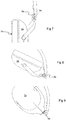
- the hinge joints 6a, 6b provide rotation around a hinge axis 8a, 8b, as is illustrated particularly in figures 7 and 8 .
- the hinge axis 8a runs normal to the plane of the figures 7 and 8 and is illustrated by a circled cross.
- the pivot joints 7a, 7b may be folded into the interior of the curved headband 4, or in other words be folded inside the curved headband 4.
- the earpieces 2a, 2b are carried by the pivot joints 7a, 7b and therefore also the earpieces 2a, 2b are folded inside the curved headband 4 by means of the hinge joints 6a, 6b.
- the earpieces 2a, 2b can be folded inside the curved headband 4 to lie against the headband 4.
- the hinge joints 6a, 6b allow the pivot joints 7a, 7b and the earpieces 2a, 2b to be folded around the respective hinge axis 8a, 8b which axes 8a, 8b in the illustrated example are perpendicular to a headband plane 19.
- the left earpiece 2a may be folded around a left hinge axis 8a and the right earpiece 2b may be folded around a right hinge axis 8b.
- the hinge joints 6a, 6b allow the pivot joints 7a, 7b and the earpieces 2a, 2b to fold in the headband plane 19.
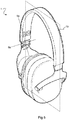
- the headband plane 19 is illustrated by as a dashed parallelogram in figure 5 .
- the headband 19 is an elongated structure with a longitudinal axis arranged in the headband plane 19.
- the pivot joints 7a, 7b allow the earpieces 2a, 2b to rotate around a respective pivot axis 9a, 9b, which in the illustrated example lie in the headband plane 19.
- the left hinge axis 8a is non-parallel to the left pivot axis 9a.
- the right hinge axis 8b is non-parallel to the right pivot axis 9b.
- the alignment of the hinge axes 8a, 8b and the pivot axes 9a, 9b is clearly illustrated in figures 6-9 .
- the hinge axes 8a, 8b and the pivot axes 9a, 9b are perpendicular to one another, the angle should in similar embodiments be at least 60 degrees, preferably at least 80 degrees.
- the hinge axes 8a, 8b are and the pivot axes 9a, 9b as shown are perpendicular to one another no matter how the earpieces 2a, 2b are rotated around the pivot joints 7a, 7b or folded around the hinge joints 6a, 6b.
- the hinge axes 8a, 8b run perpendicular to the headband plane 19 whereas the pivot axes 9a, 9b run in parallel with the headband plane 19, and in the exemplified embodiment even in the headband plane 19.
- the hinge joints 6a, 6b comprise two cooperating hinge joint elements, the first one in the exemplified embodiment being arranged perpendicular to the headband plane 19 in form of a hinge joint pin.
- the second hinge joint element is a hinge joint cylinder that is journalled around the hinge joint pin and thus also arranged perpendicular to the headband plane 19, see for example figure 5 .
- the pivot joints 7a, 7b comprise two cooperating pivot joint elements, the first one in the exemplified embodiment being arranged in the headband plane 19 in form of a pivot joint pin.
- the second pivot joint element is a pivot joint pin orifice. More precisely, the pivot joint pin orifice is a hole in which the pivot joint pin is journalled.
- the second hinge joint element is formed in one integral piece with the pivot joint pin, as is most clearly shown in figure 1 .
- the pivot joint pin orifice is in the exemplified embodiment comprised in the earpiece support structure 13a, 13b described below.
- the respective earpiece 2a, 2b is prevented from rotation around an axis 12a, 12b that is normal to the headband 4.
- Such an axis may also be termed a transverse axis 12a, 12b to the headband 1.
- the joint structures 5a, 5b are configured such that, when the headphone 1 is in the erected configuration, the pivot axes 9a, 9b of the pivot joints 7a, 7b are arranged at an angle with respect to the headband section where the joint structures 5a, 5b are positioned.
- the pivot axes 9a, 9b are arranged at an angle, denoted ⁇ in figure 3 , with respect to said transverse axes 12a, 12b.
- the pivot axes 9a, 9b are arranged at an angle ⁇ of 55 degrees with respect to the transverse axes 12a, 12b.
- the earpieces 2a, 2b are prevented from rotation around the transverse axis 12a, 12b.
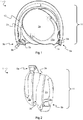
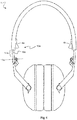
- Figures 1 and 2 illustrate the headphone 1 in a collapsed configuration or storage configuration.
- the inner sides 3a, 3b of the earpieces 2a, 2b face each other.
- the earpieces 2a, 2b are rotated approximately a quarter turn in the collapsed configuration.
- the inner sides 3a, 3b may rest against each other and preferably be slightly pressed towards each other.
- the headphone 1 may be configured such that the earpieces 2a, 2b remain the collapsed configuration, such that the headphone stays in the collapsed configuration in the absence of external influence.
- the earpieces 2a, 2b, more precisely the inner sides 3a, 3b thereof, lie essentially in the headband plane 19 in the collapsed configuration. In other words, the earpieces 2a, 2b, and thus the inner sides 3a, 3b thereof, are arranged essentially in parallel with the headband.
- Figure 6 illustrates a part of a procedure of folding the headphone 1 from the erected configuration to the collapsed configuration. These configurations may also be termed listening or worn configuration and storage configuration, respectively.
- the respective earpieces 2a, 2b have been rotated 90 degrees around the respective pivot axis 9a, 9b to face each other and be in parallel with the headband 4.
- the rotation of the right earpiece 2b is illustrated by the small curved double arrow around the right pivot axis 9b.
- the headphone 1 may be stored in this configuration, even though not as compact as the collapsed configuration shown in figures 1 and 2 .
- the next step towards the collapsed configuration is to fold the respective earpiece 2a, 2b around the respective hinge axes 8a, 8b, as is illustrates by the two larger curved double arrows.
- the earpieces 2a, 2b may be folded until they are positioned adjacent the headband 4, as is illustrated in figure 1 .
- FIG. 1 shows an exaggerated gap 10 between the headband 4 and the earpieces 2a, 2b.
- the dimension of any gap 10 in a direction transverse to the headband 4 does not exceed the thickness, or even half the thickness, of the headband 4 in the same direction.
- Figure 1 and figure 2 illustrate that the height 11 of the headband 4 essentially corresponds to the dimension of the earpieces 2a, 2b in the collapsed configuration.
- the headband height 11 and the earpiece 2a, 2b dimension are here measured along a height axis running through the middle of the headband 4 and through a point located equally distanced between the respective headband ends 4a, 4b.
- the height 11 of the headband 4 is the distance from the central point of the headband 4 to a midpoint between the ends 4a, 4b of the headband in the headband plane 19.
- the ends 4a, 4b of the headband 4 are where the hinge joints 6a, 6b are located.
- the dimension of the oblong earpieces 2a, 2b as measured along the height axis is shorter than the dimension of the oblong earpieces 2a, 2b along their longitudinal axes as the earpieces 2a, 2b are folded around the hinge joints 6a, 6b and thus oblique to said axis.
- Figure 10 shows the headphone 1 with the left earpiece 2a rotated a pivot angle of 90 degrees around the pivot axis 9a of the left pivot joint 7a.
- the pivot angle is 0 degrees as the earpieces 2a, 2b are in their neutral rotational positions. In the neutral rotational positions the earpieces 2a, 2b, more particularly the inner sides 3a, 3b thereof, are perpendicular to the headband plane 19.
- the right earpiece 2b is rotated a pivot angle of 90 degrees in the opposite direction, as seen in the plan view, compared to the left earpiece 2a.
- the pivot joints 7a, 7b allow each earpiece 2a, 2b to be rotated 90 degrees in both rotational directions.
- the pivot joints 7a, 7b may be configured to allow the respective earpieces 2a, 2b to rotate up to but not exceeding a maximum pivot angle in both rotational directions around the neutral rotational position.
- the maximum pivot angle may be 90 degrees, which would correspond to what is shown in figures 10 and 11 if these illustrated the maximum allowed rotations of the earpieces.
- a maximum pivot angle of 90 degrees is preferred as it provides a headphone 1 that can be collapsed to the above-described collapsed configuration while the cable wear is minimised.
- a greater maximum pivot angle may be beneficial for collapsing the headphone into the collapsed configuration.
- a maximum pivot angle of 120 degrees may be preferred over 90 degrees. However, maximum pivot angles of up to 150 or even 180 degrees are adequate.
- the headband 4 may be furnished with telescoping joints 16a, 16b comprising telescoping joint elements 18a, 18b linearly movable within the headband 4 at the headband ends 4a, 4b.
- a first end of the respective telescoping joint element 18, 18b is configured to be inserted into a corresponding channel in the headband 4 though an opening at the headband end 4a, 4b.
- a second end of the respective telescoping joint element 18, 18b carries the joint structures 5a, 5b. More precisely, the second end of the respective telescoping joint element 18, 18b is connected to the hinge joint 6a, 6b.
- the telescoping joints allow adjustment of the length of the headband 4 by extending and retracting the headband 4 to fit the headphone 1 to a user's head size.
- the headphone is preferably designed such that the telescoping joints 16a, 16b are arranged in the retracted condition when the headphone is in the collapsed configuration, as is shown in figure 1 . This results in a compact collapsed configuration with the telescoping joint elements 18a, 18b protected from mechanical damage and other wear.
- the headphone 1 of the exemplified embodiment comprises two planes of symmetry.
- the headband plane 19 is a plane of symmetry.
- a plane of symmetry can be drawn perpendicular to the headband plane 19, equally distanced from the two earpieces 2a, 2b.
- One half of the headband 4 and a first earpiece 2a is equally shaped as the other half of the headband 4 and a second earpiece 2b.
- the joint structures 5a, 5b are of equal shapes.
- labelling L and R
- control buttons openings for power/signal cables and microphones need be disregarded.
- the headband 4 may be slightly warped as is illustrated in figure 2 .
- the inner sides 3a, 3b are arranged in parallel with the headband 4, but rather essentially in parallel with the headband 4.
- Adhering to the earlier definition of the headband plane 19, the headband plane may be warped in the collapsed configuration.
- Another reason for stating that the inner sides 3a, 3b are arranged essentially in parallel, and not in parallel, with the headband in the collapsed configuration is that the pivot joints 7a, 7b may allow the earpiece 2a, 2b to be slightly rotated out of the headband plane 19 when in the collapsed configuration.
- the degree to which the headband is warped when in the collapsed configuration will depend on the overall design of the headphone 1 such as the thickness of the earpiece 2a, 2b cushions and the design of the joint structures 5a, 5b. It may be preferred to design the headphone 1 such that the headband 4 is warped in the collapsed configuration ( figure 2 ) as this may help the headphone stay or remain in the collapsed configuration.
- the warp of the headband 4 may cause the earpieces 2a, 2b to interlock and remain the in the collapsed configuration. In the collapsed configuration, the earpieces 2a, 2b may be urged or pressed against each other thanks to the headband 4 being warped.
- the headband 4 is made from a flexible and resilient material.
- the headband 4 does not comprise any linkage or similar that allows the headband 4 as such to be collapsed.
- the headband 4 maintains its general form of a curved beam also in the collapsed configuration of the headphone 1, but the radius of curvature of the headband 4 may be decreased.
- Earpiece support structures 13a, 13b may be provided to connect the joint structures 5a, 5b to the earpieces 2a, 2b as is illustrated in the exemplified embodiment. More precisely, the earpiece support structures 13a, 13b connect the pivot joints 7a, 7b to the earpieces 2a, 2b. One end of the respective earpiece support structure 13a, 13b is connected to the respective pivot joint 7a, 7b and the other end is connected to the earpiece 2a, 2b.
- the earpiece support structures 13a, 13b may be yoke shaped, as is shown in the figures.
- the respective earpiece 2a, 2b is attached to an earpiece support structure 13a, 13b by means of two earpiece pivot joints 14a, 14b that allow to earpieces 2a, 2b to swivel, as is indicated by the double arrow in figure 3 , and help the headphone 1 fit various head sizes and shapes.
- said swivelling of the earpieces 2a, 2b can align their inner sides 3a, 3b to lie flat against the head of a user while the flexible headband 4 is adjusted to the size of the head.
- the earpieces 2a, 2b may have a circular form as seen from the respective inner side 3a, 3b.
- the earpieces 2a, 2b have an oblong form as seen from the respective inner side 3a, 3b as is clear from e.g. figures 10 and 11 .
- the oblong form fits the shape of the ear of a user.
- Figure 3 discloses a headphone 1 with a control device 15b, such as a function button, integrated in an earpiece joint 14b.
- the control device 15b may be a push button.
- the earpiece joint 14b supports the earpiece 2b and connects the earpiece 2b to the headband 4 of the headphone 1.
- the control device 15b is integrated in the earpiece joint 14b.
- the control device 15b is a push button 15b that is integrated in the earpiece pivot joint 14b, the push button 15b being smaller than the outer dimension of the earpiece pivot joint 14b.
- the push button 15b is resiliently linearly movable in the direction of the earpiece pivot joint axis.
- the headphone 1 with the control device 15b may correspond to the one described with reference to figures 1-11 .
- the earpiece joint 14b is located away from the outer surface of the earpiece 2b, whereby there is less risk that the control device 15b is activated by mistake e.g. by the user leaning the head towards an object and thus bringing the outer surface of the earpiece 2a, 2b, which outer surface is opposite the earpiece inner side 3a, 3b, in contact with the object.
- the earpiece joint 14b is located on a lateral side of the earpiece 2a, 2b and thus directed approximately 90 degrees away from the surface of the head of the user when the headphone 1 is worn.
Landscapes
- Engineering & Computer Science (AREA)
- Physics & Mathematics (AREA)
- Acoustics & Sound (AREA)
- Signal Processing (AREA)
- Manufacturing & Machinery (AREA)
- Headphones And Earphones (AREA)
Applications Claiming Priority (1)
| Application Number | Priority Date | Filing Date | Title |
|---|---|---|---|
| SE1951528A SE544200C2 (en) | 2019-12-20 | 2019-12-20 | Collapsible headphone |
Publications (2)
| Publication Number | Publication Date |
|---|---|
| EP3840407A1 true EP3840407A1 (de) | 2021-06-23 |
| EP3840407B1 EP3840407B1 (de) | 2026-08-19 |
Family
ID=73855377
Family Applications (1)
| Application Number | Title | Priority Date | Filing Date |
|---|---|---|---|
| EP20215065.2A Active EP3840407B1 (de) | 2019-12-20 | 2020-12-17 | Zusammenklappbarer kopfhörer |
Country Status (3)
| Country | Link |
|---|---|
| US (1) | US11368781B2 (de) |
| EP (1) | EP3840407B1 (de) |
| SE (1) | SE544200C2 (de) |
Families Citing this family (8)
| Publication number | Priority date | Publication date | Assignee | Title |
|---|---|---|---|---|
| JP7643040B2 (ja) * | 2020-12-28 | 2025-03-11 | カシオ計算機株式会社 | スピーカ装置及びフード型スピーカ装置 |
| USD1010610S1 (en) * | 2022-01-19 | 2024-01-09 | Transound Electronics Co., Ltd. | Headset |
| USD1019599S1 (en) * | 2022-05-19 | 2024-03-26 | Dan Wang | Headphone |
| USD1053843S1 (en) * | 2022-05-27 | 2024-12-10 | Focusrite Audio Engineering Limited | Headphones |
| EP4533816A1 (de) * | 2022-05-30 | 2025-04-09 | GN Hearing A/S | Hörgerät |
| US12302050B2 (en) * | 2022-08-05 | 2025-05-13 | Bose Corporation | Headphones |
| US20240171897A1 (en) * | 2022-11-22 | 2024-05-23 | Justin Lee | Adjustable and Retractable Headset For Enhanced Hearing Experience |
| USD1137187S1 (en) * | 2024-05-22 | 2026-07-28 | Adam Audio GmBH | Headphone |
Citations (6)
| Publication number | Priority date | Publication date | Assignee | Title |
|---|---|---|---|---|
| EP1443799A2 (de) * | 2003-01-31 | 2004-08-04 | AKG Acoustics GmbH | Kopfhörer |
| EP1587342A2 (de) | 2004-03-29 | 2005-10-19 | Bose Corporation | Kopfhörer mit aktiver Rauschverminderung |
| US20120140973A1 (en) | 2010-12-02 | 2012-06-07 | Robert Olodort | Collapsible headphone |
| CN202435579U (zh) * | 2012-01-13 | 2012-09-12 | 周九思 | 折叠式头戴耳机 |
| US20120275615A1 (en) | 2010-01-06 | 2012-11-01 | Skullcandy, Inc. | Dj mixing headphones |
| US20190320255A1 (en) * | 2018-04-14 | 2019-10-17 | Zach Cranfield | Length-Adjustable Collapsing Headband |
Family Cites Families (14)
| Publication number | Priority date | Publication date | Assignee | Title |
|---|---|---|---|---|
| JPS60153088U (ja) * | 1984-03-22 | 1985-10-12 | パイオニア株式会社 | ヘツドフオン |
| US5293647A (en) * | 1991-08-19 | 1994-03-15 | Michael Mirmilshteyn | Multi-adjustable headset |
| AT414198B (de) * | 2003-01-31 | 2006-10-15 | Akg Acoustics Gmbh | Kopfhörer |
| US6993143B2 (en) * | 2003-09-08 | 2006-01-31 | Brookstone Purchasing, Inc | Foldable headphones |
| KR101362334B1 (ko) * | 2007-08-09 | 2014-02-12 | 삼성전자주식회사 | 외부 스피커로 사용 가능한 헤드셋 및 헤드셋의 스피커출력 조정 방법 |
| US8055006B2 (en) * | 2008-06-23 | 2011-11-08 | Koss Corporation | Soft-opening hinge and headphone including same |
| JP2010166258A (ja) * | 2009-01-14 | 2010-07-29 | Sony Corp | ヘッドホン及びイヤマフ |
| US9301039B2 (en) * | 2010-01-04 | 2016-03-29 | Apple Inc. | Headphone |
| JP5799650B2 (ja) * | 2011-08-11 | 2015-10-28 | ソニー株式会社 | ヘッドホン装置 |
| US20140341415A1 (en) * | 2012-12-13 | 2014-11-20 | Michael Zachary Camello | Internal-External Speaker Headphones that Transform Into a Portable Sound System |
| US20140241561A1 (en) * | 2013-02-28 | 2014-08-28 | Kem Hongkong Limited | Headphones |
| US9522086B2 (en) * | 2015-01-06 | 2016-12-20 | Honeywell International Inc. | Headband folding mechanism allowing two axis folding directions |
| EP3244629A1 (de) * | 2016-05-10 | 2017-11-15 | Alpine Electronics, Inc. | Faltbarer kopfhörer und verfahren zum falten des faltbaren kopfhörers |
| US10764672B2 (en) * | 2017-12-29 | 2020-09-01 | Mrspeakers, Llc | Over-ear headphone with hinge-free headband |
-
2019
- 2019-12-20 SE SE1951528A patent/SE544200C2/en unknown
-
2020
- 2020-12-14 US US17/121,424 patent/US11368781B2/en active Active
- 2020-12-17 EP EP20215065.2A patent/EP3840407B1/de active Active
Patent Citations (7)
| Publication number | Priority date | Publication date | Assignee | Title |
|---|---|---|---|---|
| EP1443799A2 (de) * | 2003-01-31 | 2004-08-04 | AKG Acoustics GmbH | Kopfhörer |
| US20040213428A1 (en) | 2003-01-31 | 2004-10-28 | Hugo Lenhard-Backhaus | Headphone |
| EP1587342A2 (de) | 2004-03-29 | 2005-10-19 | Bose Corporation | Kopfhörer mit aktiver Rauschverminderung |
| US20120275615A1 (en) | 2010-01-06 | 2012-11-01 | Skullcandy, Inc. | Dj mixing headphones |
| US20120140973A1 (en) | 2010-12-02 | 2012-06-07 | Robert Olodort | Collapsible headphone |
| CN202435579U (zh) * | 2012-01-13 | 2012-09-12 | 周九思 | 折叠式头戴耳机 |
| US20190320255A1 (en) * | 2018-04-14 | 2019-10-17 | Zach Cranfield | Length-Adjustable Collapsing Headband |
Also Published As
| Publication number | Publication date |
|---|---|
| US11368781B2 (en) | 2022-06-21 |
| SE544200C2 (en) | 2022-03-01 |
| SE1951528A1 (en) | 2021-06-21 |
| US20210195313A1 (en) | 2021-06-24 |
| EP3840407B1 (de) | 2026-08-19 |
Similar Documents
| Publication | Publication Date | Title |
|---|---|---|
| US11368781B2 (en) | Collapsible headphone | |
| US7292703B2 (en) | Headphones | |
| US8363877B2 (en) | Headphones and earmuffs | |
| ES2230686T3 (es) | Conjunto de casco telefonico. | |
| JP3984594B2 (ja) | ヘッドホン | |
| JP3984595B2 (ja) | ヘッドホン | |
| US20050053255A1 (en) | Foldable headphones | |
| WO2010038299A1 (ja) | ヘッドホン | |
| US20120140973A1 (en) | Collapsible headphone | |
| US10129632B2 (en) | Headphone | |
| US10638215B2 (en) | Headphone joint | |
| CA2269137A1 (en) | Folding eye glass frames with length adjustable temples | |
| US20250168565A1 (en) | Headband and headphones | |
| KR20190114863A (ko) | 디스플레이 폴딩형 휴대단말기 | |
| GB2103902A (en) | Head bands for headphones | |
| US10334352B2 (en) | Headphone pivot joint | |
| EP0269550A2 (de) | Gelenk für Mikrophonträger | |
| EP4152766A1 (de) | Modulare kopfhöreranordnung | |
| US11874709B2 (en) | Electronic device and rotating shaft mechanism thereof | |
| US20240348965A1 (en) | Headband and headphones | |
| US12585126B2 (en) | Electronic device and rotating shaft mechanism thereof | |
| KR101312050B1 (ko) | 헤드폰 | |
| US10085085B2 (en) | Headphone | |
| CN218103459U (zh) | 一种头带及耳机 | |
| JP5629354B2 (ja) | ヘッドホン |
Legal Events
| Date | Code | Title | Description |
|---|---|---|---|
| PUAI | Public reference made under article 153(3) epc to a published international application that has entered the european phase |
Free format text: ORIGINAL CODE: 0009012 |
|
| STAA | Information on the status of an ep patent application or granted ep patent |
Free format text: STATUS: THE APPLICATION HAS BEEN PUBLISHED |
|
| AK | Designated contracting states |
Kind code of ref document: A1 Designated state(s): AL AT BE BG CH CY CZ DE DK EE ES FI FR GB GR HR HU IE IS IT LI LT LU LV MC MK MT NL NO PL PT RO RS SE SI SK SM TR |
|
| STAA | Information on the status of an ep patent application or granted ep patent |
Free format text: STATUS: REQUEST FOR EXAMINATION WAS MADE |
|
| 17P | Request for examination filed |
Effective date: 20220208 |
|
| RBV | Designated contracting states (corrected) |
Designated state(s): AL AT BE BG CH CY CZ DE DK EE ES FI FR GB GR HR HU IE IS IT LI LT LU LV MC MK MT NL NO PL PT RO RS SE SI SK SM TR |
|
| STAA | Information on the status of an ep patent application or granted ep patent |
Free format text: STATUS: EXAMINATION IS IN PROGRESS |
|
| 17Q | First examination report despatched |
Effective date: 20230313 |
|
| RAP3 | Party data changed (applicant data changed or rights of an application transferred) |
Owner name: MARSHALL GROUP AB (PUBL) |
|
| GRAP | Despatch of communication of intention to grant a patent |
Free format text: ORIGINAL CODE: EPIDOSNIGR1 |
|
| STAA | Information on the status of an ep patent application or granted ep patent |
Free format text: STATUS: GRANT OF PATENT IS INTENDED |
|
| INTG | Intention to grant announced |
Effective date: 20260213 |
|
| GRAJ | Information related to disapproval of communication of intention to grant by the applicant or resumption of examination proceedings by the epo deleted |
Free format text: ORIGINAL CODE: EPIDOSDIGR1 |
|
| STAA | Information on the status of an ep patent application or granted ep patent |
Free format text: STATUS: EXAMINATION IS IN PROGRESS |
|
| GRAP | Despatch of communication of intention to grant a patent |
Free format text: ORIGINAL CODE: EPIDOSNIGR1 |
|
| STAA | Information on the status of an ep patent application or granted ep patent |
Free format text: STATUS: GRANT OF PATENT IS INTENDED |
|
| INTC | Intention to grant announced (deleted) | ||
| GRAS | Grant fee paid |
Free format text: ORIGINAL CODE: EPIDOSNIGR3 |
|
| GRAA | (expected) grant |
Free format text: ORIGINAL CODE: 0009210 |
|
| STAA | Information on the status of an ep patent application or granted ep patent |
Free format text: STATUS: THE PATENT HAS BEEN GRANTED |
|
| INTG | Intention to grant announced |
Effective date: 20260624 |