EP3836147B1 - Schätzung der zyklusschliessung von relativen bindungsaffinitäten und fehlern - Google Patents
Schätzung der zyklusschliessung von relativen bindungsaffinitäten und fehlern Download PDFInfo
- Publication number
- EP3836147B1 EP3836147B1 EP20206513.2A EP20206513A EP3836147B1 EP 3836147 B1 EP3836147 B1 EP 3836147B1 EP 20206513 A EP20206513 A EP 20206513A EP 3836147 B1 EP3836147 B1 EP 3836147B1
- Authority
- EP
- European Patent Office
- Prior art keywords
- free energy
- fep
- ligands
- binding
- cycle
- Prior art date
- Legal status (The legal status is an assumption and is not a legal conclusion. Google has not performed a legal analysis and makes no representation as to the accuracy of the status listed.)
- Active
Links
Images






Classifications
-
- G—PHYSICS
- G06—COMPUTING OR CALCULATING; COUNTING
- G06N—COMPUTING ARRANGEMENTS BASED ON SPECIFIC COMPUTATIONAL MODELS
- G06N7/00—Computing arrangements based on specific mathematical models
- G06N7/01—Probabilistic graphical models, e.g. probabilistic networks
-
- G—PHYSICS
- G16—INFORMATION AND COMMUNICATION TECHNOLOGY [ICT] SPECIALLY ADAPTED FOR SPECIFIC APPLICATION FIELDS
- G16B—BIOINFORMATICS, i.e. INFORMATION AND COMMUNICATION TECHNOLOGY [ICT] SPECIALLY ADAPTED FOR GENETIC OR PROTEIN-RELATED DATA PROCESSING IN COMPUTATIONAL MOLECULAR BIOLOGY
- G16B15/00—ICT specially adapted for analysing two-dimensional [2D] or three-dimensional [3D] molecular structures, e.g. structural or functional relations or structure alignment
-
- G—PHYSICS
- G16—INFORMATION AND COMMUNICATION TECHNOLOGY [ICT] SPECIALLY ADAPTED FOR SPECIFIC APPLICATION FIELDS
- G16B—BIOINFORMATICS, i.e. INFORMATION AND COMMUNICATION TECHNOLOGY [ICT] SPECIALLY ADAPTED FOR GENETIC OR PROTEIN-RELATED DATA PROCESSING IN COMPUTATIONAL MOLECULAR BIOLOGY
- G16B15/00—ICT specially adapted for analysing two-dimensional [2D] or three-dimensional [3D] molecular structures, e.g. structural or functional relations or structure alignment
- G16B15/30—Drug targeting using structural data; Docking or binding prediction
-
- G—PHYSICS
- G16—INFORMATION AND COMMUNICATION TECHNOLOGY [ICT] SPECIALLY ADAPTED FOR SPECIFIC APPLICATION FIELDS
- G16B—BIOINFORMATICS, i.e. INFORMATION AND COMMUNICATION TECHNOLOGY [ICT] SPECIALLY ADAPTED FOR GENETIC OR PROTEIN-RELATED DATA PROCESSING IN COMPUTATIONAL MOLECULAR BIOLOGY
- G16B40/00—ICT specially adapted for biostatistics; ICT specially adapted for bioinformatics-related machine learning or data mining, e.g. knowledge discovery or pattern finding
- G16B40/20—Supervised data analysis
-
- G—PHYSICS
- G16—INFORMATION AND COMMUNICATION TECHNOLOGY [ICT] SPECIALLY ADAPTED FOR SPECIFIC APPLICATION FIELDS
- G16C—COMPUTATIONAL CHEMISTRY; CHEMOINFORMATICS; COMPUTATIONAL MATERIALS SCIENCE
- G16C20/00—Chemoinformatics, i.e. ICT specially adapted for the handling of physicochemical or structural data of chemical particles, elements, compounds or mixtures
- G16C20/50—Molecular design, e.g. of drugs
-
- G—PHYSICS
- G16—INFORMATION AND COMMUNICATION TECHNOLOGY [ICT] SPECIALLY ADAPTED FOR SPECIFIC APPLICATION FIELDS
- G16C—COMPUTATIONAL CHEMISTRY; CHEMOINFORMATICS; COMPUTATIONAL MATERIALS SCIENCE
- G16C20/00—Chemoinformatics, i.e. ICT specially adapted for the handling of physicochemical or structural data of chemical particles, elements, compounds or mixtures
- G16C20/70—Machine learning, data mining or chemometrics
Definitions
- This invention is in the general field of bioinformatics, more specifically estimating or calculating relative receptor/ligand binding affinities and their errors.
- free energy calculations such as TI, FEP, lambda dynamics, alchemical OSRW, etc-generally provide a thermodynamically complete description of the binding event and, at least in theory, yield accurate predictions within the limits of the force field used and complete sampling of the phase space.
- practical application of free energy calculations in industrial contexts may be limited by the large computational resources required, particularly when sampling of multiple conformations, the timescales needed to impact live projects, and the need for a robust and meaningful approach to determine the sampling error associated with such free energy calculations. 4,11,12
- One aspect of the invention generally features a computer-implemented method of determining relative strength of binding between a receptor and individual members of a set ligands to form complexes between individual ligand set members and the receptor.
- the method includes a computer-implemented determination of multiple relative binding free energy differences for a set of ligand pairs forming at least one closed cycle, and a computer implemented determination of hysteresis magnitude about each closed thermodynamic cycle.
- the method includes,
- the step of estimating the error comprises computer-implemented analysis of binding free energy differences between ligands along legs of more than one closed thermodynamic cycle, and computer implemented determination of hysteresis magnitude about each of closed thermodynamic cycles.
- the receptor is a protein; the ligands are congeneric; a Gaussian distribution is assumed in the construction of the probabilistic model of the observed hysteresis in step a.; the error distribution associated with the free energy simulations in step a. is assumed to be uniform; the error distribution is assumed to be additive with the Bennett error in step a.
- the connectivity of the closed thermodynamic cycles is represented as a graph or as a matrix.
- the probablisitic determination can be done by various methods, including without limitation, graph theoretical methods, matrix algebra methods, Bayesian methods, Maximum likelihood methods.
- aspects of the invention feature a computer readable medium comprising tangible non-transitory instructions for performing the above-described methods, and a general purpose graphics processing unit with non-transitory computer readable instructions for performing those methods.
- CDK2 is a member of the CDK family performing various functions in the regulation of the cell proliferation and the RNA polymerase II transcription cycles. CDK2 has also been identified as an important drug target for tumor-selective therapeutic strategies. 17,18
- Relative binding affinities calculated with the invention using Cycle Closure are highly correlated with the experimental data, and a meaningful error bar is produced indicating the convergence of the calculations.
- the method builds up cycle closures in relative free energy calculations as has been done by several other groups, 10,20,21 then from this input, the method determines the consistency and reliability of the relative free energy calculations by assessing how much the sum of the calculated free energy changes for each closed thermodynamic cycle deviates from the theoretical value of 0.
- the method yields reliable predictions of the relative free energies from the multiple free energy estimates obtained by way of the cycle closure relative free energy calculations, as well as the expected error bounds associated with those calculations, as well as mechanism to flag relative free energy calculations that have systematic errors.
- the errors in relative free energy calculations compared to experimental values can be separated into two categories: the systematic error coming from the difference of the force field used in simulation compared to the true potential energy surface of the system, and the error coming from the nonconvergence, either due to randomly or systematically incomplete sampling of the phase space, or from the free energy estimator itself, eg TI versus FEP, etc.
- the calculated free energies have a distribution.
- F ji ) denotes the distribution of the calculated free energy E ji .
- F ji ) can in principle be any kind of distributions, such as the Gaussian distribution, Lorentz distribution, uniform distribution, delta distribution and so on.
- This method predicts the free energy difference from ligand L i to ligand L j and the associated error for the prediction based on the distribution P ( E ji
- the prediction can be done using many different methods, for example, the maximum likelihood method, which maximizes the probability of the observation; the Bayesian statistics method, which optimizes the parameters based on the calculated free energies and so on.
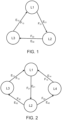
- the most likely values of F 21 , F 32 and F 13 are the set of values that maximize the above likelihood.
- the above estimators have no systematic bias, and there will be substantially no discrepancy between the free energy predictions from different paths.
- the method interprets the above estimators as the weighted average from the two paths. For example, the free energy difference between ligand L 1 and L 2 , F 21 , can be estimated from E 21 , or from -( E 32 + E 13 ), and the best estimator is a weighted average of the two predictions. The smaller the standard deviation for the computed free energy difference along the path is, the large the weight to the best estimator, and vice versa.
- the hysteresis of the cycle closure itself provides an estimate of the error associated with each free energy prediction.
- the free energies and the associated errors that the method estimates are the optimal estimates based on all the information gained from relative free energy calculations. If the underlying force field in the calculations has systematic bias, the perfectly converged relative free energy calculation results may still deviate from the experimental measured values, which is something that cannot be corrected based on the above analysis.
- the method before running the FEP calculation, the method has an estimate of the distribution (the prior distribution) of the free energy difference between the two ligands, P prior ( F ji ), and after it runs the FEP calculation it adjusts the distribution based on the calculated result from FEP (the posterior distribution P post F ji
- the method performs FEP calculations forming a closed cycle, with the calculated free energy difference F 21 , E 32 and E 13 .
- the posterior distribution of ( F 21 , F 32 , F 13 ) is : P post F 21 , F 32 , F 13
- E 21 , E 32 , E 13 1 2 ⁇ ⁇ 2 / 3 exp ⁇ E 21 ⁇ F 21 2 2 ⁇ 2 ⁇ E 32 ⁇ F 32 2 2 ⁇ 2 ⁇ E 13 ⁇ F 13 2 2 ⁇ 2 ⁇ ⁇ + ⁇ dF 21 ⁇ ⁇ ⁇ + ⁇ dF 32 ⁇ ⁇ ⁇ + ⁇ dF 13 1 2 ⁇ ⁇ 2 / 3 exp ⁇ E 21 ⁇ F 21 2 2 ⁇ 2 ⁇ E 32 ⁇ F 32 2 2 ⁇ 2 ⁇ E 13 ⁇ F 13 2 2 ⁇ 2 P post F 21 , F
- the method For a set of L ligands, the method performs N relative free energy calculations which connect all the ligands with cycle closure(s).
- the particular embodiment of the invention described in this section yields the best predictions of the relative free energies among the ligands and the error bars associated with the predictions.
- the input is the N calculated free energy differences between the N pairs of ligand with relative free energy simulations performed
- the output of is the N predicted relative free energy differences and the associated error bars between the N pairs of ligands for which the relative free energy simulations were performed, and also the relative free energy differences between any pairs of ligands in the set and their associated error bars.
- the predicted relative free energies have no hysteresis, meaning the predicted relative free energy difference between any two ligands is independent of the paths connecting them, and thus are internally consistent.
- Step 1 List the calculated free energies for all the relative binding free energy calculations performed, and their corresponding initial and final ligands.
- E i is the relative free energy simulation calculated free energy for the ith relative binding free energy calculation.
- the initial and final ligand for this relative binding free energy calculation is L j and L k . This is the input of the program.
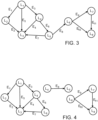
- Step 2 List all the closed cycles in the relative binding free energy calculation paths and build up the Cycle Closure Connectivity Matrix (C3M) for the whole graph.
- C3M Cycle Closure Connectivity Matrix
- the method searches through all the ligand pairs and find all those pairs that form a closed cycle and convert this information into the connectivity matrix.
- the method lists all the closed cycles in the ligand pair paths, and all the restrains.
- M ji M G is a M ⁇ N matrix and each row of the matrix represent a restrain equation for a closed cycle.
- M G to denote the Cycle Closure Connectivity Matrix (C3M) of the whole graph.
- M G 1 1 ⁇ 1 1 1 ⁇ 1 1 ⁇ 1 ⁇ 1 1 1 ⁇ 1 ⁇ 1 ⁇ 1 1 ⁇ 1 ⁇ 1 1 ⁇ 1 ⁇ 1 1 ⁇ 1 ⁇ 1 1 ⁇ 11 columns
- Step 3 Decompose the whole graph into independent subgraphs.
- the predicted relative free energies among a subset of ligands are independent from the predicted relative free energies among the other subset of ligands.
- the predicted relative free energies among the set of ligands [1,2,3,4,5] are independent from the relative free energies among the set of ligands [6,7,8] because there is no closed cycle connecting the two subgraphs.
- the whole graph is decomposed into each independent subgraph, and then each independent subgraph is solved sequentially.
- each list contains the column number of the nonzero elements of each row of the C3M matrix.
- the set which contains the M lists generated in this step the raw list is called set S r .
- Step 3b Iterate through the second list to the last list in the raw list set S r , and compare the elements contained in L j where j ⁇ ⁇ 2, 3,... m ⁇ with the elements in the first list L 1 . If they contain a common element (or a few elements), then merge all the elements in L j into the first list L 1 , and delete L j from the raw list set; if they don't have any comment element, keep the list L j in the raw list set.
- L 2 , L 4 , L 5 , L 6 contain common element(s) with L 1 , so those lists are deleted in this step, and their elements are merged into L 1 .
- Step 3c Repeat step 3b for those lists that have not been deleted in step 3b and merge the elements into L 1 if they contain common elements with L 1 . Repeat this step until no more lists can be deleted.
- Step 3e After step 3d, if there are more than one lists left in the raw list set, repeat step 3b to step 3d until there is only one list left.
- Step 3f Move the last list in the raw list set S r into the final list set S f . After this step, there are several lists in the final list set, and no list left in the raw list set. The lists in the final list sets do not contain any common elements.
- Step 3g Iterate through column number 1 to N. If the column number is in any list in the final list set, skip it, otherwise, add a list which contains only that column number into the final list set.
- the final list set contains several lists, and there is no common element between any of the lists.
- the column number 1 to N is in one and only one of the lists in the final list set.
- each independent subgraph contains the edges with the edges numbers listed in each list of the final list set S f . These independent subgraphs do not have a shared edge, but they may have shared vertexes.
- the whole graph is decomposed into 3 independent subgraphs.
- the first subgraph contains 7 binding free energy calculation paths [E1, E2, E3, E4, E5, E6, E7]
- the second subgraph contains 3 relative binding free energy calculation paths [E9, E10, E11]
- the third subgraph contains 1 relative binding free energy calculation path [E8].
- Step 4 Get the C3M for each independent subgraph M S .
- Step 3 the whole connectivity graph is already decomposed into independent subgraphs, and the edges numbers of each subgraph is stored in the list in the final list set. In this step we get to get the C3M for each independent subgraph.
- the whole graph is decomposed into independent subgraphs, and the C3M of the whole graph, M G , is also decomposed into C3M for each independent subgraph, M S i .
- each row in M S i represents a closed cycle in the path
- the connectivity matrix M S i for some independent subgraph may contain zero elements, meaning there is no closed cycle in that subgraph.
- Step 5 Reduce the C3M for each subgraph M S into independent matrix M SR
- M SR i is obtained for each subgraph.
- the M SR i only contains independent row vectors, meaning only independent closed cycles are listed in the matrix.
- M SR 1 1 1 ⁇ 1 1 1 ⁇ 1 1 ⁇ 1 ⁇ 1 ⁇ 1
- the M SR for each subgraph is not unique, but the number of rows in M SR is independent on the order of rows and on the algorithm to do the reduction.
- the reduced cycle closure connectivity matrix M SR is obtained for each independent subgraph.
- the M SR only contain independent cycles in each subgraph. In the following we will solve the cycle closure equation for each independent subgraph.
- Step 6 Solve the cycle closure equation for each independent subgraph.
- This step produces, for each subgraph, a set of optimal estimates of free energies for the N i pairs of ligands with no hysteresis, and it also maximizes the probability.
- Case b There are m independent closed cycles in the subgraph.
- M ji T is the transpose of M ji .
- Step 7 Get the error estimates for each possible relative binding free energy calculation path
- the sum of the relative free energy calculations along a closed cycle is Gaussian distributed with standard deviation n s where n is the number of members on the closed cycle.
- the error for each calculated difference between a pair of ligands on this closed cycle is ⁇ n , where ⁇ is the hysteresis of the closed cycle.
- Step 8 Report the estimate of the free energy difference between any pairs of ligands in the set and their associated error bars
- the free energy estimates and errors are only calculated for those pairs of ligands where free energy calculations are not performed (not directly connected in the graph).
- the free energy estimates and errors for those pairs of ligands where free energy calculations are performed are calculated in previous steps.
- the matrix algebra formulation in the preceding section is only a particular embodiment of the invention, and can be readily generalized in a number of ways, including assuming the most probable error of the legs of the pathway is additive with the Bennett error, the Bootstrap error, or both. Likewise it might be generalized to use other distributions aside from the Gaussian distribution, such as without limitation, the Lorentz, Levy, or Rayleigh, delta and uniform distributions.
- the invention improves the accuracy and reliability of relative free energy calculations (for example explicit solvent model calculations). Such accuracy is particularly difficult to achieve if the protein residues surrounding the binding pocket move significantly when different ligands bind, or the two ligands adopt different binding modes or manifest one or more degenerate binding modes. 4,11,19 In such cases, sampling all relevant conformations improves the accuracy of estimates of the free energy difference, yet the transition times to interchange between the different conformations may be too large to be accessible on the time scale of most FEP/MD simulation lengths.
- FEP/REST a recently developed relative free energy calculation method
- FEP/REST introduced by Wang et al, 12 incorporates the enhanced sampling method, REST, into FEP calculations through an efficient ⁇ -hopping protocol, to sample relevant local structural rearrangements in relative protein-ligand binding affinity calculations within easily accessible simulation times.
- REST enhanced sampling method
- FEP involves calculating the free energy difference between two systems by alchemically transforming between the systems in a series of discrete steps represented by ⁇ values, where ⁇ varies from 0 for the initial state to 1 for the final state.
- FEP/REST modifies the potential energy for a localized region surrounding the binding pocket (which we call the 'hot' region) which may include protein residues as well as the ligand.
- the potential energy for the localized region is scaled by a factor less than 1. In this way, energy barriers are lowered, enabling the efficient sampling of the different conformations in these intermediate ⁇ windows, and the different conformations are propagated to the end states through the Hamiltonian replica exchange method.
- the 'hot' region for REST enhanced sampling is configured here to include the ligand functioned group mutated in the SAR studies. If the ligand functional group is attached to an aromatic ring, the aromatic ring is also included in the 'hot' region, allowing the ring to flip through REST enhanced sampling.
- the effective temperature profile for REST 'hot' region is calculated according to equation 9 of reference 26 24 , setting the expected acceptance ratio of replica exchange to be 0.3, an optimal value reflecting the trade-offs between the number of replicas needed and exchange efficiency. A total of 12 ⁇ windows are used for the both normal FEP and FEP/REST calculations.
- the electrostatic interactions that are unique to the initial state were turned off before the Lennard-Jones (LJ) interactions, and the LJ interactions that are unique for the final state were turned on before the electrostatic interactions.
- the bonded interactions are smoothly turned from the initial state to the final state.
- the core of the LJ interactions was softened to avoid the singularities and instabilities in the simulations. 25
- the benzene ring on which substituents were varied in the SAR studies, 16 are included in the 'hot' region, and the highest effective temperature with a total of 12 ⁇ windows achieved is roughly 900K.
- the ligand functional group mutation module implemented in Desmond 26,27 was used to set up the calculations.
- the OPLS2005 force field 29,30 was used for the proteins and the ligands along with the SPC 31 water model.
- the starting structures for the simulations were taken from the PDB structures with IDs 1h1q, 1h1r, 1h1s, 1oiu, 1oi9, and 1oiy. 16 Whenever multiple conformations were present in the PDB, we selected the first conformation for use in the simulations.
- the protein was prepared using the Protein Preparation Wizard 32,33 during which the protonation states were assigned assuming a pH of 7.0. 34 Cyclin A was retained with CDK2 and treated as part of the receptor for all calculations.
- the methods discussed herein are performed by a computer system programmed to perform those steps.
- the system includes computer(s) 110, data stores 120 and program modules 130.
- the computer instructions are stored in one or more non-transient computer-readable media.
- Figure 16 shows steps in the method including a listing of calculated free energies for all the free energy calculation paths (302), listing all closed cycles and building cycle closure connectivity matrix (304) and decomposition the entire graph into independent subgraphs (306).
- the FEP/MD and the FEP/REST results for the relative binding free energy calculation paths among the ligand with crystal structures are given in Table 1.
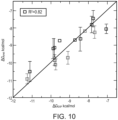
- the correlation of the predictions with experimental binding affinity data is displayed in Figure 6 .
- FEP/MD predicts that the five compounds (excluding the reference compound 1h1q) have almost the same binding affinities, resulting in an R 2 value of 0.32.
- Figure 8 displays the binding mode found in the crystal structure and the alternative binding mode sampled in the FEP/REST calculation.
- the sulfonamide group makes two hydrogen bonds (HB) with Asp86: one with the backbone and another with the side chain.
- the sulfonamide group rotates about 120° around the CS bond relative to the crystal structure.
- the protein residues surrounding the binding pocket particularly Gln85 and Asp86, rearrange accordingly and two hydrogen bonds are formed between the sulfonamide group and the protein residues: one with the Asp86 side chain and the other with the Gln85 side chain.
- the B factors of these few residues surrounding the binding pocket and the ligand in the X-ray crystallography indicate these groups are quite mobile. 16 Therefore, it is quite possible that the ligand can switch between the two binding modes in solution. In the FEP/REST simulation trajectory, the occupancy ratio between the binding mode observed crystallographically and the alternative binding mode is roughly 60:40, in favor of the crystallographically determined mode.
- Cycle closures are constructed in the paths for these ligands ( Figure 9 ), and the hysteresis of the cycle closures are all less than 1.0 kcal/mol, indicating the calculations are highly converged.
- the final predicted relative binding affinities by way of this particular embodiment of the invention are reported in Table 5.
- the errors associated with the free energy predictions are also reported in Table 5.
- the correlation between the predicted relative binding affinities and the experimental data for the whole set of ligands (6 ligands with crystal structure and the 10 ligands without crystal structure) is displayed in Figure 10 .
- the method can be applied in multiple embodiments to the recently developed free energy calculation FEP/REST method as well as the more routinely used FEP/MD free energy calculation method to calculate the relative binding affinities between a series of congeneric ligands binding to the CDK2-cyclin A receptor.
- the invention facilitated comparisons between FEP/REST and FEP/MD free energy calculation predictions. While the more routine FEP/MD method performed poorly in rank-ordering the relative binding affinities for the six ligands with crystal structure, the invention provided value indicating the error associated with the FEP/MD predictions was high. In contrast, he FEP/REST calculated relative binding affinities were in excellent agreement with the experimental data, and shown to be converged by application of the invention.
- Application of the invention to relative free calculations performed by way of FEP/REST method on a larger data set that includes 10 ligands without crystal structures further verified the invention's ability to correctly rank order the relative binding affinities of congeneric ligands.
- the invention provides a means of assessing the consistency and reliability of free energy calculations using information derived from cycle closure calculations associated with any type of relative free energy calculation procedure. This invention provides clear criteria by which to judge the consistency and reliability of the predictions, as well as optimal estimates of the free energies with well-formed error bounds.
- Application of this invention to the CDK2-cyclin A series indicates our predictions using FEP/REST relative free energy calculations are highly reliable, which is also demonstrated by the excellent agreement of the predictions with the experimental data. Likewise the invention properly determined the FEP/MD predictions are less reliable.
- the cycle closure estimates can not correct the systematic errors in the force field of the simulations. So, the predicted binding affinities for two of the ligands (ligand 12 and 13) deviates by more than 1.5 kcal/mol compared to experimental values. The deviations may either due to the error in the force field, or in the uncertainties in the experimental measurements. The overall correlation between the predicted results and the experimental values is very good, though.
- FEP/REST simulations are performed for a subset of ligands binding to BACE receptor with two independent cycle closures in the raltive binding free enery calculation paths (Shown in Figure 12 ).
- the ligand numbers for the subset of ligands are [4j, 4o, 4p, 17d, 17g, 17h], and the 7 FEP/REST results for the 7 relative binding free energy calculation paths are listed in the Table 8.
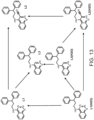
- the relative binding affinities between 3 ligands binding to scytalone dehydratase with and without water bound in the active site are calculated using FEP/MC. 39
- the relative binding free energy calculation paths for these simulations with 4 independent cycle closures are displayed in Fig 13 .
- the calculated binding affinities for the relative binding free energy calculations are reported in Table 10.
- the hysteresis of the cycle [L1(H2O), L2(H2O), L3(H2O)] is 4.3 kcal/mol, much larger than 1.4 kcal/mol, indicating these calculations are not converged, and the calculated binding affinities inside this cycle also have large deviations from the experimental data.
- the hysteresis is 1.5 kcal/mol, larger than 1.4 kcal/mol, indicating these calculations are not reliable either.
- the relative binding free energies between a united atom methane and model enclosures with and without charge are calculated using test particle insertion method. 40
- the free energies of charging the model enclosure with and without the bound methane is also calculated using FEP/MD sampling.
- the relative binding free energy calculation paths form a closed cycle ( Figure 14 ) and the associated free energies for each edge on the cycle is reported in there.
- Table 1 The FEP/MD and FEP/REST predicted relative binding free energies for the five ligands with crystal structures compared to the reference ligand 1h1q.
- the results for the three relative binding free energy calculation paths forming 3 cycle closures for the 6 ligands with crystal structures are also include in the table.
- the errors for the calculated free energies using BAR analytical error estimation are also included in the table.
- the FEP/MD predicted results have large deviations from the experimental data for ligands 1h1r and 1h1s ( bold in the table), while the FEP/REST predicted results all agree well with the experimental data. Free energies are reported in kcal/mol unit.
- M denotes the united atom methane
- P denotes the hydrophobic plates
- CP denotes the charged plates
- MP denotes the hydrophobic plates bound with the united atom methane
- MCP denotes the charged plates bound with the united atom methane.
Landscapes
- Engineering & Computer Science (AREA)
- Physics & Mathematics (AREA)
- Life Sciences & Earth Sciences (AREA)
- Spectroscopy & Molecular Physics (AREA)
- Bioinformatics & Cheminformatics (AREA)
- Health & Medical Sciences (AREA)
- Chemical & Material Sciences (AREA)
- Theoretical Computer Science (AREA)
- Bioinformatics & Computational Biology (AREA)
- General Health & Medical Sciences (AREA)
- Medical Informatics (AREA)
- Crystallography & Structural Chemistry (AREA)
- Biophysics (AREA)
- Biotechnology (AREA)
- Evolutionary Biology (AREA)
- Pharmacology & Pharmacy (AREA)
- Medicinal Chemistry (AREA)
- Data Mining & Analysis (AREA)
- Computing Systems (AREA)
- Artificial Intelligence (AREA)
- Evolutionary Computation (AREA)
- Software Systems (AREA)
- General Physics & Mathematics (AREA)
- Mathematical Analysis (AREA)
- Computer Vision & Pattern Recognition (AREA)
- Algebra (AREA)
- Mathematical Optimization (AREA)
- Pure & Applied Mathematics (AREA)
- General Engineering & Computer Science (AREA)
- Mathematical Physics (AREA)
- Computational Mathematics (AREA)
- Bioethics (AREA)
- Probability & Statistics with Applications (AREA)
- Databases & Information Systems (AREA)
- Epidemiology (AREA)
- Public Health (AREA)
- Management, Administration, Business Operations System, And Electronic Commerce (AREA)
- Medicines That Contain Protein Lipid Enzymes And Other Medicines (AREA)
- Apparatus For Radiation Diagnosis (AREA)
- Investigating Strength Of Materials By Application Of Mechanical Stress (AREA)
Claims (14)
- Computerimplementiertes Verfahren zur Bestimmung der relativen Stärke der Bindung zwischen einem Rezeptor und individuellen Mitgliedern eines Satzes von Liganden zur Bildung von Komplexen zwischen individuellen Mitgliedern des Ligandensatzes und dem Rezeptor, wobei das Verfahren eine computerimplementierte Bestimmung von mehrfachen relativen Differenzen der freien Bindungsenergie für einen Satz von Ligandenpaaren, die mindestens einen geschlossenen Kreisprozess bilden, und eine computerimplementierte Bestimmung des Hysteresebetrags um jeden geschlossenen thermodynamischen Kreisprozess umfasst und Folgendes beinhaltet:a. eine computerimplementierte probabilistische Bestimmung der Differenzen der freien Energie und der Fehlerverteilungen über diese Differenzen der freien Energie entlang jeder der Schenkel des geschlossenen thermodynamischen Kreisprozesses, die probabilistisch zu dem für die geschlossenen thermodynamischen Kreisprozesse beobachteten Hysteresewert führen;b. eine computerimplementierte Bestimmung der wahrscheinlichsten freien Energiedifferenz für jeden Schenkel des geschlossenen thermodynamischen Kreisprozesses, der in dem in a. bestimmten probabilistischen Modell enthalten ist;c. eine computerimplementierte Bestimmung des wahrscheinlichsten Fehlers, der mit der wahrscheinlichsten Differenz der freien Bindungsenergie für jedes Ligandenpaar entlang jedes Schenkels im geschlossenen thermodynamischen Kreisprozess verbunden ist, aus der probabilistischen Bestimmung in b.;d. eine computerimplementierte Ausgabe von Werten, die die relativen freien Bindungsenergien und Fehler in c. darstellen, an einen Computerbenutzer,wobei die Schritte c. und d. das Bestimmen eines Satzes von freien Energiewerten für jeden Schenkel beinhalten, der die Funktion

mit der Randbedingung minimiert:Σ i Fi = 0 wobei Ei die berechnete freie Energiedifferenz für einen bestimmten Schenkel i ist; Fi die theoretische freie Energiedifferenz für einen bestimmten Schenkel i ist; und σ_i die Standardabweichung der berechneten freien Energiedifferenzen für Schenkel i ist, und wobei die Summe der theoretischen freien Energiedifferenzen für alle geschlossenen Kreisprozesse 0 ist. - Verfahren nach Anspruch 1, bei dem der Schritt des Schätzens des Fehlers eine computerimplementierte Analyse der Differenzen der freien Bindungsenergie zwischen Liganden entlang der Schenkel von mehr als einem geschlossenen thermodynamischen Kreisprozess und eine computerimplementierte Bestimmung des Hysteresebetrags über jeden der geschlossenen thermodynamischen Kreisprozesse umfasst.
- Verfahren nach Anspruch 1, wobei die Liganden artverwandt sind.
- Verfahren nach Anspruch 1, wobei zum Aufbau des probabilistischen Modells der beobachteten Hysterese in Schritt 1a eine Gauß-Verteilung angenommen wird.
- Verfahren nach Anspruch 1, wobei die mit den Simulationen der freien Energie assoziierte Fehlerverteilung in Schritt 1a als einheitlich angenommen wird.
- Verfahren nach Anspruch 1, wobei die mit den Simulationen der freien Energie assoziierte Fehlerverteilung in Schritt 1a als additiv mit dem Bennett-Fehler angenommen wird.
- Verfahren nach Anspruch 1, wobei die Konnektivität der geschlossenen thermodynamischen Kreisprozesse als Graph dargestellt wird.
- Verfahren nach Anspruch 1, wobei die Konnektivität der geschlossenen thermodynamischen Kreisprozesse als Matrix dargestellt wird.
- Verfahren nach Anspruch 1, wobei die probabilistische Bestimmung die Durchführung graphentheoretischer Verfahren umfasst.
- Verfahren nach Anspruch 1, wobei die probabilistische Bestimmung die Durchführung von Matrixalgebraverfahren umfasst.
- Verfahren nach Anspruch 1, wobei die probabilistische Bestimmung die Durchführung von Bayes'schen Verfahren umfasst.
- Verfahren nach Anspruch 1, wobei die probabilistische Bestimmung die Durchführung von Maximalwahrscheinlichkeitsverfahren umfasst.
- Computerlesbares Speichermedium, das greifbare, nichtflüchtige, darauf gespeicherte Anweisungen umfasst, die von einer Verarbeitungsvorrichtung ausführbar sind und bei einer solchen Ausführung die Verarbeitungsvorrichtung veranlassen, die Schritte des Verfahrens nach einem der Ansprüche 1 bis 12 auszuführen.
- Computersystem, das mit nichtflüchtigen, computerlesbaren Anweisungen programmiert und ausgebildet ist, um die Schritte des Verfahrens nach einem der Ansprüche 1 bis 12 auszuführen.
Applications Claiming Priority (3)
| Application Number | Priority Date | Filing Date | Title |
|---|---|---|---|
| US13/840,039 US20140278295A1 (en) | 2013-03-15 | 2013-03-15 | Cycle Closure Estimation of Relative Binding Affinities and Errors |
| PCT/US2014/025425 WO2014151310A2 (en) | 2013-03-15 | 2014-03-13 | Cycle closure estimation of relative binding affinities and errors |
| EP14769374.1A EP2972311B1 (de) | 2013-03-15 | 2014-03-13 | Schätzung der zyklusschliessung von relativen bindungsaffinitäten und fehlern |
Related Parent Applications (1)
| Application Number | Title | Priority Date | Filing Date |
|---|---|---|---|
| EP14769374.1A Division EP2972311B1 (de) | 2013-03-15 | 2014-03-13 | Schätzung der zyklusschliessung von relativen bindungsaffinitäten und fehlern |
Publications (2)
| Publication Number | Publication Date |
|---|---|
| EP3836147A1 EP3836147A1 (de) | 2021-06-16 |
| EP3836147B1 true EP3836147B1 (de) | 2024-10-09 |
Family
ID=51531746
Family Applications (2)
| Application Number | Title | Priority Date | Filing Date |
|---|---|---|---|
| EP20206513.2A Active EP3836147B1 (de) | 2013-03-15 | 2014-03-13 | Schätzung der zyklusschliessung von relativen bindungsaffinitäten und fehlern |
| EP14769374.1A Active EP2972311B1 (de) | 2013-03-15 | 2014-03-13 | Schätzung der zyklusschliessung von relativen bindungsaffinitäten und fehlern |
Family Applications After (1)
| Application Number | Title | Priority Date | Filing Date |
|---|---|---|---|
| EP14769374.1A Active EP2972311B1 (de) | 2013-03-15 | 2014-03-13 | Schätzung der zyklusschliessung von relativen bindungsaffinitäten und fehlern |
Country Status (6)
| Country | Link |
|---|---|
| US (3) | US20140278295A1 (de) |
| EP (2) | EP3836147B1 (de) |
| JP (1) | JP6441301B2 (de) |
| DK (2) | DK2972311T3 (de) |
| ES (2) | ES2853348T3 (de) |
| WO (1) | WO2014151310A2 (de) |
Families Citing this family (5)
| Publication number | Priority date | Publication date | Assignee | Title |
|---|---|---|---|---|
| CN107027140A (zh) * | 2017-03-27 | 2017-08-08 | 武汉虹信通信技术有限责任公司 | 一种lte中各协议层用户实例一致性维护方法 |
| WO2021031545A1 (zh) * | 2020-02-25 | 2021-02-25 | 深圳晶泰科技有限公司 | 一种用于异构集群环境中的自由能微扰计算调度方法 |
| CN111341391B (zh) * | 2020-02-25 | 2023-12-01 | 深圳晶泰科技有限公司 | 一种用于异构集群环境中的自由能微扰计算调度方法 |
| US11568961B2 (en) * | 2020-12-16 | 2023-01-31 | Ro5 Inc. | System and method for accelerating FEP methods using a 3D-restricted variational autoencoder |
| CN114446411B (zh) * | 2021-12-31 | 2025-06-06 | 深圳晶泰科技有限公司 | 增强采样方法及计算复合物的结合自由能的方法 |
Family Cites Families (12)
| Publication number | Priority date | Publication date | Assignee | Title |
|---|---|---|---|---|
| US5854992A (en) * | 1996-09-26 | 1998-12-29 | President And Fellows Of Harvard College | System and method for structure-based drug design that includes accurate prediction of binding free energy |
| US6560542B1 (en) * | 2000-01-24 | 2003-05-06 | The Cielo Institute | Algorithmic design of peptides for binding and/or modulation of the functions of receptors and/or other proteins |
| WO2003081211A2 (en) * | 2002-03-19 | 2003-10-02 | Cengent Therapeutics, Inc. | Discrete bayesian analysis of data |
| WO2005017807A2 (en) * | 2003-08-13 | 2005-02-24 | Iconix Pharmaceuticals, Inc. | Apparatus and method for classifying multi-dimensional biological data |
| WO2005038618A2 (en) * | 2003-10-14 | 2005-04-28 | Verseon | Lead molecule cross-reaction prediction and optimization system |
| EP2004837A4 (de) * | 2006-03-15 | 2009-12-23 | Univ Illinois | Neutralisierungsmittel für bakterielle toxine |
| US8140268B2 (en) * | 2006-03-31 | 2012-03-20 | Verachem, Llc | Computational method for drug discovery and receptor design |
| US7756674B2 (en) | 2007-08-03 | 2010-07-13 | The Trustees Of Columbia University In The City Of New York | Methods of calculating differences of binding affinities between congeneric pairs of ligands by way of a displaced solvent functional |
| CA2782547A1 (en) * | 2009-12-02 | 2011-06-09 | The Johns Hopkins University | Method for incorporating internal polar and ionizable groups in proteins |
| WO2012109383A2 (en) * | 2011-02-08 | 2012-08-16 | University Of Louisville Research Foundation, Inc. | Method of determining protein binding characteristics of a drug candidate |
| US9858395B2 (en) * | 2011-05-23 | 2018-01-02 | Schrodinger, Llc | Binding affinity scoring with penalty for breaking conjugation between aromatic ligand groups |
| EP2718464A1 (de) * | 2011-06-06 | 2014-04-16 | Imperial Innovations Limited | Verfahren zur vorhersage der bindungsaffinität von tspo-kontrastmitteln an tspo |
-
2013
- 2013-03-15 US US13/840,039 patent/US20140278295A1/en not_active Abandoned
-
2014
- 2014-03-13 ES ES14769374T patent/ES2853348T3/es active Active
- 2014-03-13 EP EP20206513.2A patent/EP3836147B1/de active Active
- 2014-03-13 WO PCT/US2014/025425 patent/WO2014151310A2/en not_active Ceased
- 2014-03-13 JP JP2016501847A patent/JP6441301B2/ja active Active
- 2014-03-13 ES ES20206513T patent/ES2996703T3/es active Active
- 2014-03-13 DK DK14769374.1T patent/DK2972311T3/da active
- 2014-03-13 EP EP14769374.1A patent/EP2972311B1/de active Active
- 2014-03-13 DK DK20206513.2T patent/DK3836147T3/da active
-
2018
- 2018-07-25 US US16/045,366 patent/US20190026423A1/en not_active Abandoned
-
2024
- 2024-05-16 US US18/666,204 patent/US20250356945A1/en active Pending
Non-Patent Citations (1)
| Title |
|---|
| ANDREW POHORILLE ET AL: "A Bayesian Approach to Calculating Free Energies in Chemical and Biological Systems", AIP CONFERENCE PROCEEDINGS, vol. 872, 1 January 2006 (2006-01-01), NEW YORK, US, pages 23 - 30, XP055692870, ISSN: 0094-243X, DOI: 10.1063/1.2423257 * |
Also Published As
| Publication number | Publication date |
|---|---|
| DK2972311T3 (da) | 2021-02-08 |
| EP2972311A4 (de) | 2016-11-30 |
| US20250356945A1 (en) | 2025-11-20 |
| ES2996703T3 (en) | 2025-02-13 |
| EP3836147A1 (de) | 2021-06-16 |
| EP2972311B1 (de) | 2020-11-11 |
| US20190026423A1 (en) | 2019-01-24 |
| EP2972311A2 (de) | 2016-01-20 |
| JP6441301B2 (ja) | 2018-12-19 |
| ES2853348T3 (es) | 2021-09-15 |
| WO2014151310A2 (en) | 2014-09-25 |
| WO2014151310A3 (en) | 2014-11-13 |
| JP2016515273A (ja) | 2016-05-26 |
| DK3836147T3 (da) | 2025-01-02 |
| US20140278295A1 (en) | 2014-09-18 |
Similar Documents
| Publication | Publication Date | Title |
|---|---|---|
| Chen et al. | Accurate calculation of relative binding free energies between ligands with different net charges | |
| US20250356945A1 (en) | Structure-based drug design for protein binding | |
| Gromiha et al. | Comparison between long-range interactions and contact order in determining the folding rate of two-state proteins: application of long-range order to folding rate prediction | |
| Zheng et al. | Practically efficient and robust free energy calculations: Double-integration orthogonal space tempering | |
| Carvalho Martins et al. | PyAutoFEP: An automated free energy perturbation workflow for GROMACS integrating enhanced sampling methods | |
| Lee et al. | Constant pH molecular dynamics in explicit solvent with enveloping distribution sampling and Hamiltonian exchange | |
| Lagardere et al. | Pushing the limits of multiple-time-step strategies for polarizable point dipole molecular dynamics | |
| Wu et al. | Alchemical transfer approach to absolute binding free energy estimation | |
| Shee et al. | Chemical transformations approaching chemical accuracy via correlated sampling in auxiliary-field quantum Monte Carlo | |
| Plé et al. | A foundation model for accurate atomistic simulations in drug design | |
| Tanimoto et al. | Effect of molecular orientational correlations on solvation free energy computed by reference interaction site model theory | |
| Wang et al. | BAR-based optimum adaptive sampling regime for variance minimization in alchemical transformation: the nonequilibrium stratification | |
| Miriyala et al. | Testing semiempirical quantum mechanical methods on a data set of interaction energies mapping repulsive contacts in organic molecules | |
| Wang et al. | Predicting relative binding affinity using nonequilibrium QM/MM simulations | |
| Devaurs et al. | Coarse-grained conformational sampling of protein structure improves the fit to experimental hydrogen-exchange data | |
| Katzberger et al. | Implicit solvent approach based on generalized Born and transferable graph neural networks for molecular dynamics simulations | |
| Hayes et al. | Addressing intersite coupling unlocks large combinatorial chemical spaces for alchemical free energy methods | |
| Condic-Jurkic et al. | The protonation states of the active-site histidines in (6–4) photolyase | |
| Min et al. | Practically efficient QM/MM alchemical free energy simulations: The orthogonal space random walk strategy | |
| de Ruiter et al. | Optimization of alchemical pathways using extended thermodynamic integration | |
| Abreu et al. | Molecular Dynamics with Very Large Time Steps for the Calculation of Solvation Free Energies | |
| Liu et al. | Divide-and-Conquer ABFE: Improving Free Energy Calculations by Enhancing Water Sampling | |
| Zheng et al. | Recovering kinetics from a simplified protein folding model using replica exchange simulations: a kinetic network and effective stochastic dynamics | |
| Li et al. | General quantum alchemical free energy simulations via hamiltonian interpolation | |
| Gonzalez et al. | Molecular Environment-Specific Atomic Charges Improve Binding Affinity Predictions of SAMPL5 Host–Guest Systems |
Legal Events
| Date | Code | Title | Description |
|---|---|---|---|
| PUAI | Public reference made under article 153(3) epc to a published international application that has entered the european phase |
Free format text: ORIGINAL CODE: 0009012 |
|
| STAA | Information on the status of an ep patent application or granted ep patent |
Free format text: STATUS: REQUEST FOR EXAMINATION WAS MADE |
|
| 17P | Request for examination filed |
Effective date: 20210127 |
|
| AC | Divisional application: reference to earlier application |
Ref document number: 2972311 Country of ref document: EP Kind code of ref document: P |
|
| AK | Designated contracting states |
Kind code of ref document: A1 Designated state(s): AL AT BE BG CH CY CZ DE DK EE ES FI FR GB GR HR HU IE IS IT LI LT LU LV MC MK MT NL NO PL PT RO RS SE SI SK SM TR |
|
| GRAP | Despatch of communication of intention to grant a patent |
Free format text: ORIGINAL CODE: EPIDOSNIGR1 |
|
| STAA | Information on the status of an ep patent application or granted ep patent |
Free format text: STATUS: GRANT OF PATENT IS INTENDED |
|
| RIC1 | Information provided on ipc code assigned before grant |
Ipc: G16C 20/70 20190101ALN20240424BHEP Ipc: G16C 20/50 20190101ALI20240424BHEP Ipc: G16B 15/30 20190101AFI20240424BHEP |
|
| INTG | Intention to grant announced |
Effective date: 20240516 |
|
| GRAS | Grant fee paid |
Free format text: ORIGINAL CODE: EPIDOSNIGR3 |
|
| GRAA | (expected) grant |
Free format text: ORIGINAL CODE: 0009210 |
|
| STAA | Information on the status of an ep patent application or granted ep patent |
Free format text: STATUS: THE PATENT HAS BEEN GRANTED |
|
| AC | Divisional application: reference to earlier application |
Ref document number: 2972311 Country of ref document: EP Kind code of ref document: P |
|
| AK | Designated contracting states |
Kind code of ref document: B1 Designated state(s): AL AT BE BG CH CY CZ DE DK EE ES FI FR GB GR HR HU IE IS IT LI LT LU LV MC MK MT NL NO PL PT RO RS SE SI SK SM TR |
|
| REG | Reference to a national code |
Ref country code: CH Ref legal event code: EP |
|
| REG | Reference to a national code |
Ref country code: DE Ref legal event code: R096 Ref document number: 602014091017 Country of ref document: DE |
|
| REG | Reference to a national code |
Ref country code: IE Ref legal event code: FG4D |
|
| P01 | Opt-out of the competence of the unified patent court (upc) registered |
Free format text: CASE NUMBER: APP_56659/2024 Effective date: 20241017 |
|
| REG | Reference to a national code |
Ref country code: DK Ref legal event code: T3 Effective date: 20241217 |
|
| REG | Reference to a national code |
Ref country code: LT Ref legal event code: MG9D |
|
| REG | Reference to a national code |
Ref country code: NL Ref legal event code: MP Effective date: 20241009 |
|
| REG | Reference to a national code |
Ref country code: ES Ref legal event code: FG2A Ref document number: 2996703 Country of ref document: ES Kind code of ref document: T3 Effective date: 20250213 |
|
| REG | Reference to a national code |
Ref country code: AT Ref legal event code: MK05 Ref document number: 1731491 Country of ref document: AT Kind code of ref document: T Effective date: 20241009 |
|
| PG25 | Lapsed in a contracting state [announced via postgrant information from national office to epo] |
Ref country code: NL Free format text: LAPSE BECAUSE OF FAILURE TO SUBMIT A TRANSLATION OF THE DESCRIPTION OR TO PAY THE FEE WITHIN THE PRESCRIBED TIME-LIMIT Effective date: 20241009 |
|
| PG25 | Lapsed in a contracting state [announced via postgrant information from national office to epo] |
Ref country code: NL Free format text: LAPSE BECAUSE OF FAILURE TO SUBMIT A TRANSLATION OF THE DESCRIPTION OR TO PAY THE FEE WITHIN THE PRESCRIBED TIME-LIMIT Effective date: 20241009 |
|
| PG25 | Lapsed in a contracting state [announced via postgrant information from national office to epo] |
Ref country code: HR Free format text: LAPSE BECAUSE OF FAILURE TO SUBMIT A TRANSLATION OF THE DESCRIPTION OR TO PAY THE FEE WITHIN THE PRESCRIBED TIME-LIMIT Effective date: 20241009 Ref country code: PT Free format text: LAPSE BECAUSE OF FAILURE TO SUBMIT A TRANSLATION OF THE DESCRIPTION OR TO PAY THE FEE WITHIN THE PRESCRIBED TIME-LIMIT Effective date: 20250210 Ref country code: IS Free format text: LAPSE BECAUSE OF FAILURE TO SUBMIT A TRANSLATION OF THE DESCRIPTION OR TO PAY THE FEE WITHIN THE PRESCRIBED TIME-LIMIT Effective date: 20250209 |
|
| PG25 | Lapsed in a contracting state [announced via postgrant information from national office to epo] |
Ref country code: FI Free format text: LAPSE BECAUSE OF FAILURE TO SUBMIT A TRANSLATION OF THE DESCRIPTION OR TO PAY THE FEE WITHIN THE PRESCRIBED TIME-LIMIT Effective date: 20241009 |
|
| PG25 | Lapsed in a contracting state [announced via postgrant information from national office to epo] |
Ref country code: BG Free format text: LAPSE BECAUSE OF FAILURE TO SUBMIT A TRANSLATION OF THE DESCRIPTION OR TO PAY THE FEE WITHIN THE PRESCRIBED TIME-LIMIT Effective date: 20241009 |
|
| PG25 | Lapsed in a contracting state [announced via postgrant information from national office to epo] |
Ref country code: NO Free format text: LAPSE BECAUSE OF FAILURE TO SUBMIT A TRANSLATION OF THE DESCRIPTION OR TO PAY THE FEE WITHIN THE PRESCRIBED TIME-LIMIT Effective date: 20250109 |
|
| PG25 | Lapsed in a contracting state [announced via postgrant information from national office to epo] |
Ref country code: LV Free format text: LAPSE BECAUSE OF FAILURE TO SUBMIT A TRANSLATION OF THE DESCRIPTION OR TO PAY THE FEE WITHIN THE PRESCRIBED TIME-LIMIT Effective date: 20241009 Ref country code: AT Free format text: LAPSE BECAUSE OF FAILURE TO SUBMIT A TRANSLATION OF THE DESCRIPTION OR TO PAY THE FEE WITHIN THE PRESCRIBED TIME-LIMIT Effective date: 20241009 Ref country code: GR Free format text: LAPSE BECAUSE OF FAILURE TO SUBMIT A TRANSLATION OF THE DESCRIPTION OR TO PAY THE FEE WITHIN THE PRESCRIBED TIME-LIMIT Effective date: 20250110 |
|
| PG25 | Lapsed in a contracting state [announced via postgrant information from national office to epo] |
Ref country code: PL Free format text: LAPSE BECAUSE OF FAILURE TO SUBMIT A TRANSLATION OF THE DESCRIPTION OR TO PAY THE FEE WITHIN THE PRESCRIBED TIME-LIMIT Effective date: 20241009 |
|
| PG25 | Lapsed in a contracting state [announced via postgrant information from national office to epo] |
Ref country code: RS Free format text: LAPSE BECAUSE OF FAILURE TO SUBMIT A TRANSLATION OF THE DESCRIPTION OR TO PAY THE FEE WITHIN THE PRESCRIBED TIME-LIMIT Effective date: 20250109 |
|
| PG25 | Lapsed in a contracting state [announced via postgrant information from national office to epo] |
Ref country code: SM Free format text: LAPSE BECAUSE OF FAILURE TO SUBMIT A TRANSLATION OF THE DESCRIPTION OR TO PAY THE FEE WITHIN THE PRESCRIBED TIME-LIMIT Effective date: 20241009 |
|
| PGFP | Annual fee paid to national office [announced via postgrant information from national office to epo] |
Ref country code: ES Payment date: 20250408 Year of fee payment: 12 |
|
| REG | Reference to a national code |
Ref country code: DE Ref legal event code: R097 Ref document number: 602014091017 Country of ref document: DE |
|
| PG25 | Lapsed in a contracting state [announced via postgrant information from national office to epo] |
Ref country code: EE Free format text: LAPSE BECAUSE OF FAILURE TO SUBMIT A TRANSLATION OF THE DESCRIPTION OR TO PAY THE FEE WITHIN THE PRESCRIBED TIME-LIMIT Effective date: 20241009 |
|
| PGFP | Annual fee paid to national office [announced via postgrant information from national office to epo] |
Ref country code: CH Payment date: 20250401 Year of fee payment: 12 |
|
| PG25 | Lapsed in a contracting state [announced via postgrant information from national office to epo] |
Ref country code: RO Free format text: LAPSE BECAUSE OF FAILURE TO SUBMIT A TRANSLATION OF THE DESCRIPTION OR TO PAY THE FEE WITHIN THE PRESCRIBED TIME-LIMIT Effective date: 20241009 |
|
| PG25 | Lapsed in a contracting state [announced via postgrant information from national office to epo] |
Ref country code: SK Free format text: LAPSE BECAUSE OF FAILURE TO SUBMIT A TRANSLATION OF THE DESCRIPTION OR TO PAY THE FEE WITHIN THE PRESCRIBED TIME-LIMIT Effective date: 20241009 |
|
| PG25 | Lapsed in a contracting state [announced via postgrant information from national office to epo] |
Ref country code: CZ Free format text: LAPSE BECAUSE OF FAILURE TO SUBMIT A TRANSLATION OF THE DESCRIPTION OR TO PAY THE FEE WITHIN THE PRESCRIBED TIME-LIMIT Effective date: 20241009 |
|
| PLBE | No opposition filed within time limit |
Free format text: ORIGINAL CODE: 0009261 |
|
| STAA | Information on the status of an ep patent application or granted ep patent |
Free format text: STATUS: NO OPPOSITION FILED WITHIN TIME LIMIT |
|
| PG25 | Lapsed in a contracting state [announced via postgrant information from national office to epo] |
Ref country code: SE Free format text: LAPSE BECAUSE OF FAILURE TO SUBMIT A TRANSLATION OF THE DESCRIPTION OR TO PAY THE FEE WITHIN THE PRESCRIBED TIME-LIMIT Effective date: 20241009 |
|
| 26N | No opposition filed |
Effective date: 20250710 |
|
| PG25 | Lapsed in a contracting state [announced via postgrant information from national office to epo] |
Ref country code: MC Free format text: LAPSE BECAUSE OF FAILURE TO SUBMIT A TRANSLATION OF THE DESCRIPTION OR TO PAY THE FEE WITHIN THE PRESCRIBED TIME-LIMIT Effective date: 20241009 |
|
| PG25 | Lapsed in a contracting state [announced via postgrant information from national office to epo] |
Ref country code: LU Free format text: LAPSE BECAUSE OF NON-PAYMENT OF DUE FEES Effective date: 20250313 |
|
| REG | Reference to a national code |
Ref country code: BE Ref legal event code: MM Effective date: 20250331 |
|
| PG25 | Lapsed in a contracting state [announced via postgrant information from national office to epo] |
Ref country code: BE Free format text: LAPSE BECAUSE OF NON-PAYMENT OF DUE FEES Effective date: 20250331 |
|
| PG25 | Lapsed in a contracting state [announced via postgrant information from national office to epo] |
Ref country code: IE Free format text: LAPSE BECAUSE OF NON-PAYMENT OF DUE FEES Effective date: 20250313 |
|
| REG | Reference to a national code |
Ref country code: CH Ref legal event code: U11 Free format text: ST27 STATUS EVENT CODE: U-0-0-U10-U11 (AS PROVIDED BY THE NATIONAL OFFICE) Effective date: 20260401 |
|
| PGFP | Annual fee paid to national office [announced via postgrant information from national office to epo] |
Ref country code: GB Payment date: 20260303 Year of fee payment: 13 |
|
| PGFP | Annual fee paid to national office [announced via postgrant information from national office to epo] |
Ref country code: DE Payment date: 20260225 Year of fee payment: 13 Ref country code: DK Payment date: 20260313 Year of fee payment: 13 |
|
| PGFP | Annual fee paid to national office [announced via postgrant information from national office to epo] |
Ref country code: IT Payment date: 20260226 Year of fee payment: 13 |
|
| PGFP | Annual fee paid to national office [announced via postgrant information from national office to epo] |
Ref country code: FR Payment date: 20260223 Year of fee payment: 13 |