EP3835366B1 - Thermosetting resin composition comprising flame retardant including aromatic phosphoric acid ester and cured material - Google Patents
Thermosetting resin composition comprising flame retardant including aromatic phosphoric acid ester and cured material Download PDFInfo
- Publication number
- EP3835366B1 EP3835366B1 EP19847820.8A EP19847820A EP3835366B1 EP 3835366 B1 EP3835366 B1 EP 3835366B1 EP 19847820 A EP19847820 A EP 19847820A EP 3835366 B1 EP3835366 B1 EP 3835366B1
- Authority
- EP
- European Patent Office
- Prior art keywords
- group
- thermosetting resin
- phosphoric acid
- acid ester
- resin composition
- Prior art date
- Legal status (The legal status is an assumption and is not a legal conclusion. Google has not performed a legal analysis and makes no representation as to the accuracy of the status listed.)
- Active
Links
Images


Classifications
-
- C—CHEMISTRY; METALLURGY
- C07—ORGANIC CHEMISTRY
- C07F—ACYCLIC, CARBOCYCLIC OR HETEROCYCLIC COMPOUNDS CONTAINING ELEMENTS OTHER THAN CARBON, HYDROGEN, HALOGEN, OXYGEN, NITROGEN, SULFUR, SELENIUM OR TELLURIUM
- C07F9/00—Compounds containing elements of Groups 5 or 15 of the Periodic Table
- C07F9/02—Phosphorus compounds
- C07F9/06—Phosphorus compounds without P—C bonds
- C07F9/08—Esters of oxyacids of phosphorus
- C07F9/09—Esters of phosphoric acids
- C07F9/094—Esters of phosphoric acids with arylalkanols
-
- C—CHEMISTRY; METALLURGY
- C09—DYES; PAINTS; POLISHES; NATURAL RESINS; ADHESIVES; COMPOSITIONS NOT OTHERWISE PROVIDED FOR; APPLICATIONS OF MATERIALS NOT OTHERWISE PROVIDED FOR
- C09K—MATERIALS FOR MISCELLANEOUS APPLICATIONS, NOT PROVIDED FOR ELSEWHERE
- C09K21/00—Fireproofing materials
- C09K21/06—Organic materials
- C09K21/12—Organic materials containing phosphorus
-
- B—PERFORMING OPERATIONS; TRANSPORTING
- B32—LAYERED PRODUCTS
- B32B—LAYERED PRODUCTS, i.e. PRODUCTS BUILT-UP OF STRATA OF FLAT OR NON-FLAT, e.g. CELLULAR OR HONEYCOMB, FORM
- B32B27/00—Layered products comprising a layer of synthetic resin
- B32B27/18—Layered products comprising a layer of synthetic resin characterised by the use of special additives
- B32B27/20—Layered products comprising a layer of synthetic resin characterised by the use of special additives using fillers, pigments, thixotroping agents
-
- B—PERFORMING OPERATIONS; TRANSPORTING
- B32—LAYERED PRODUCTS
- B32B—LAYERED PRODUCTS, i.e. PRODUCTS BUILT-UP OF STRATA OF FLAT OR NON-FLAT, e.g. CELLULAR OR HONEYCOMB, FORM
- B32B5/00—Layered products characterised by the non- homogeneity or physical structure, i.e. comprising a fibrous, filamentary, particulate or foam layer; Layered products characterised by having a layer differing constitutionally or physically in different parts
- B32B5/02—Layered products characterised by the non- homogeneity or physical structure, i.e. comprising a fibrous, filamentary, particulate or foam layer; Layered products characterised by having a layer differing constitutionally or physically in different parts characterised by structural features of a fibrous or filamentary layer
- B32B5/022—Non-woven fabric
-
- B—PERFORMING OPERATIONS; TRANSPORTING
- B32—LAYERED PRODUCTS
- B32B—LAYERED PRODUCTS, i.e. PRODUCTS BUILT-UP OF STRATA OF FLAT OR NON-FLAT, e.g. CELLULAR OR HONEYCOMB, FORM
- B32B5/00—Layered products characterised by the non- homogeneity or physical structure, i.e. comprising a fibrous, filamentary, particulate or foam layer; Layered products characterised by having a layer differing constitutionally or physically in different parts
- B32B5/02—Layered products characterised by the non- homogeneity or physical structure, i.e. comprising a fibrous, filamentary, particulate or foam layer; Layered products characterised by having a layer differing constitutionally or physically in different parts characterised by structural features of a fibrous or filamentary layer
- B32B5/024—Woven fabric
-
- B—PERFORMING OPERATIONS; TRANSPORTING
- B32—LAYERED PRODUCTS
- B32B—LAYERED PRODUCTS, i.e. PRODUCTS BUILT-UP OF STRATA OF FLAT OR NON-FLAT, e.g. CELLULAR OR HONEYCOMB, FORM
- B32B5/00—Layered products characterised by the non- homogeneity or physical structure, i.e. comprising a fibrous, filamentary, particulate or foam layer; Layered products characterised by having a layer differing constitutionally or physically in different parts
- B32B5/22—Layered products characterised by the non- homogeneity or physical structure, i.e. comprising a fibrous, filamentary, particulate or foam layer; Layered products characterised by having a layer differing constitutionally or physically in different parts characterised by the presence of two or more layers which are next to each other and are fibrous, filamentary, formed of particles or foamed
- B32B5/24—Layered products characterised by the non- homogeneity or physical structure, i.e. comprising a fibrous, filamentary, particulate or foam layer; Layered products characterised by having a layer differing constitutionally or physically in different parts characterised by the presence of two or more layers which are next to each other and are fibrous, filamentary, formed of particles or foamed one layer being a fibrous or filamentary layer
- B32B5/26—Layered products characterised by the non- homogeneity or physical structure, i.e. comprising a fibrous, filamentary, particulate or foam layer; Layered products characterised by having a layer differing constitutionally or physically in different parts characterised by the presence of two or more layers which are next to each other and are fibrous, filamentary, formed of particles or foamed one layer being a fibrous or filamentary layer another layer next to it also being fibrous or filamentary
-
- C—CHEMISTRY; METALLURGY
- C07—ORGANIC CHEMISTRY
- C07F—ACYCLIC, CARBOCYCLIC OR HETEROCYCLIC COMPOUNDS CONTAINING ELEMENTS OTHER THAN CARBON, HYDROGEN, HALOGEN, OXYGEN, NITROGEN, SULFUR, SELENIUM OR TELLURIUM
- C07F9/00—Compounds containing elements of Groups 5 or 15 of the Periodic Table
- C07F9/02—Phosphorus compounds
- C07F9/06—Phosphorus compounds without P—C bonds
- C07F9/08—Esters of oxyacids of phosphorus
- C07F9/09—Esters of phosphoric acids
- C07F9/095—Compounds containing the structure P(=O)-O-acyl, P(=O)-O-heteroatom, P(=O)-O-CN
-
- C—CHEMISTRY; METALLURGY
- C08—ORGANIC MACROMOLECULAR COMPOUNDS; THEIR PREPARATION OR CHEMICAL WORKING-UP; COMPOSITIONS BASED THEREON
- C08J—WORKING-UP; GENERAL PROCESSES OF COMPOUNDING; AFTER-TREATMENT NOT COVERED BY SUBCLASSES C08B, C08C, C08F, C08G or C08H
- C08J5/00—Manufacture of articles or shaped materials containing macromolecular substances
- C08J5/24—Impregnating materials with prepolymers which can be polymerised in situ, e.g. manufacture of prepregs
-
- C—CHEMISTRY; METALLURGY
- C08—ORGANIC MACROMOLECULAR COMPOUNDS; THEIR PREPARATION OR CHEMICAL WORKING-UP; COMPOSITIONS BASED THEREON
- C08J—WORKING-UP; GENERAL PROCESSES OF COMPOUNDING; AFTER-TREATMENT NOT COVERED BY SUBCLASSES C08B, C08C, C08F, C08G or C08H
- C08J5/00—Manufacture of articles or shaped materials containing macromolecular substances
- C08J5/24—Impregnating materials with prepolymers which can be polymerised in situ, e.g. manufacture of prepregs
- C08J5/249—Impregnating materials with prepolymers which can be polymerised in situ, e.g. manufacture of prepregs characterised by the additives used in the prepolymer mixture
-
- C—CHEMISTRY; METALLURGY
- C08—ORGANIC MACROMOLECULAR COMPOUNDS; THEIR PREPARATION OR CHEMICAL WORKING-UP; COMPOSITIONS BASED THEREON
- C08K—Use of inorganic or non-macromolecular organic substances as compounding ingredients
- C08K5/00—Use of organic ingredients
- C08K5/0008—Organic ingredients according to more than one of the "one dot" groups of C08K5/01 - C08K5/59
- C08K5/0066—Flame-proofing or flame-retarding additives
-
- C—CHEMISTRY; METALLURGY
- C08—ORGANIC MACROMOLECULAR COMPOUNDS; THEIR PREPARATION OR CHEMICAL WORKING-UP; COMPOSITIONS BASED THEREON
- C08K—Use of inorganic or non-macromolecular organic substances as compounding ingredients
- C08K5/00—Use of organic ingredients
- C08K5/49—Phosphorus-containing compounds
- C08K5/51—Phosphorus bound to oxygen
- C08K5/52—Phosphorus bound to oxygen only
- C08K5/521—Esters of phosphoric acids, e.g. of H3PO4
- C08K5/523—Esters of phosphoric acids, e.g. of H3PO4 with hydroxyaryl compounds
-
- C—CHEMISTRY; METALLURGY
- C08—ORGANIC MACROMOLECULAR COMPOUNDS; THEIR PREPARATION OR CHEMICAL WORKING-UP; COMPOSITIONS BASED THEREON
- C08L—COMPOSITIONS OF MACROMOLECULAR COMPOUNDS
- C08L63/00—Compositions of epoxy resins; Compositions of derivatives of epoxy resins
-
- H—ELECTRICITY
- H05—ELECTRIC TECHNIQUES NOT OTHERWISE PROVIDED FOR
- H05K—PRINTED CIRCUITS; CASINGS OR CONSTRUCTIONAL DETAILS OF ELECTRIC APPARATUS; MANUFACTURE OF ASSEMBLAGES OF ELECTRICAL COMPONENTS
- H05K1/00—Printed circuits
- H05K1/02—Details
- H05K1/03—Use of materials for the substrate
- H05K1/0313—Organic insulating material
- H05K1/0353—Organic insulating material consisting of two or more materials, e.g. two or more polymers, polymer + filler, + reinforcement
- H05K1/0373—Organic insulating material consisting of two or more materials, e.g. two or more polymers, polymer + filler, + reinforcement containing additives, e.g. fillers
-
- B—PERFORMING OPERATIONS; TRANSPORTING
- B32—LAYERED PRODUCTS
- B32B—LAYERED PRODUCTS, i.e. PRODUCTS BUILT-UP OF STRATA OF FLAT OR NON-FLAT, e.g. CELLULAR OR HONEYCOMB, FORM
- B32B2250/00—Layers arrangement
- B32B2250/20—All layers being fibrous or filamentary
-
- B—PERFORMING OPERATIONS; TRANSPORTING
- B32—LAYERED PRODUCTS
- B32B—LAYERED PRODUCTS, i.e. PRODUCTS BUILT-UP OF STRATA OF FLAT OR NON-FLAT, e.g. CELLULAR OR HONEYCOMB, FORM
- B32B2255/00—Coating on the layer surface
- B32B2255/02—Coating on the layer surface on fibrous or filamentary layer
-
- B—PERFORMING OPERATIONS; TRANSPORTING
- B32—LAYERED PRODUCTS
- B32B—LAYERED PRODUCTS, i.e. PRODUCTS BUILT-UP OF STRATA OF FLAT OR NON-FLAT, e.g. CELLULAR OR HONEYCOMB, FORM
- B32B2255/00—Coating on the layer surface
- B32B2255/26—Polymeric coating
-
- B—PERFORMING OPERATIONS; TRANSPORTING
- B32—LAYERED PRODUCTS
- B32B—LAYERED PRODUCTS, i.e. PRODUCTS BUILT-UP OF STRATA OF FLAT OR NON-FLAT, e.g. CELLULAR OR HONEYCOMB, FORM
- B32B2260/00—Layered product comprising an impregnated, embedded, or bonded layer wherein the layer comprises an impregnation, embedding, or binder material
- B32B2260/02—Composition of the impregnated, bonded or embedded layer
- B32B2260/021—Fibrous or filamentary layer
-
- B—PERFORMING OPERATIONS; TRANSPORTING
- B32—LAYERED PRODUCTS
- B32B—LAYERED PRODUCTS, i.e. PRODUCTS BUILT-UP OF STRATA OF FLAT OR NON-FLAT, e.g. CELLULAR OR HONEYCOMB, FORM
- B32B2260/00—Layered product comprising an impregnated, embedded, or bonded layer wherein the layer comprises an impregnation, embedding, or binder material
- B32B2260/04—Impregnation, embedding, or binder material
- B32B2260/046—Synthetic resin
-
- B—PERFORMING OPERATIONS; TRANSPORTING
- B32—LAYERED PRODUCTS
- B32B—LAYERED PRODUCTS, i.e. PRODUCTS BUILT-UP OF STRATA OF FLAT OR NON-FLAT, e.g. CELLULAR OR HONEYCOMB, FORM
- B32B2262/00—Composition or structural features of fibres which form a fibrous or filamentary layer or are present as additives
- B32B2262/02—Synthetic macromolecular fibres
-
- B—PERFORMING OPERATIONS; TRANSPORTING
- B32—LAYERED PRODUCTS
- B32B—LAYERED PRODUCTS, i.e. PRODUCTS BUILT-UP OF STRATA OF FLAT OR NON-FLAT, e.g. CELLULAR OR HONEYCOMB, FORM
- B32B2262/00—Composition or structural features of fibres which form a fibrous or filamentary layer or are present as additives
- B32B2262/02—Synthetic macromolecular fibres
- B32B2262/0261—Polyamide fibres
-
- B—PERFORMING OPERATIONS; TRANSPORTING
- B32—LAYERED PRODUCTS
- B32B—LAYERED PRODUCTS, i.e. PRODUCTS BUILT-UP OF STRATA OF FLAT OR NON-FLAT, e.g. CELLULAR OR HONEYCOMB, FORM
- B32B2262/00—Composition or structural features of fibres which form a fibrous or filamentary layer or are present as additives
- B32B2262/02—Synthetic macromolecular fibres
- B32B2262/0276—Polyester fibres
-
- B—PERFORMING OPERATIONS; TRANSPORTING
- B32—LAYERED PRODUCTS
- B32B—LAYERED PRODUCTS, i.e. PRODUCTS BUILT-UP OF STRATA OF FLAT OR NON-FLAT, e.g. CELLULAR OR HONEYCOMB, FORM
- B32B2262/00—Composition or structural features of fibres which form a fibrous or filamentary layer or are present as additives
- B32B2262/10—Inorganic fibres
-
- B—PERFORMING OPERATIONS; TRANSPORTING
- B32—LAYERED PRODUCTS
- B32B—LAYERED PRODUCTS, i.e. PRODUCTS BUILT-UP OF STRATA OF FLAT OR NON-FLAT, e.g. CELLULAR OR HONEYCOMB, FORM
- B32B2262/00—Composition or structural features of fibres which form a fibrous or filamentary layer or are present as additives
- B32B2262/10—Inorganic fibres
- B32B2262/101—Glass fibres
-
- B—PERFORMING OPERATIONS; TRANSPORTING
- B32—LAYERED PRODUCTS
- B32B—LAYERED PRODUCTS, i.e. PRODUCTS BUILT-UP OF STRATA OF FLAT OR NON-FLAT, e.g. CELLULAR OR HONEYCOMB, FORM
- B32B2305/00—Condition, form or state of the layers or laminate
- B32B2305/07—Parts immersed or impregnated in a matrix
- B32B2305/076—Prepregs
-
- B—PERFORMING OPERATIONS; TRANSPORTING
- B32—LAYERED PRODUCTS
- B32B—LAYERED PRODUCTS, i.e. PRODUCTS BUILT-UP OF STRATA OF FLAT OR NON-FLAT, e.g. CELLULAR OR HONEYCOMB, FORM
- B32B2307/00—Properties of the layers or laminate
- B32B2307/30—Properties of the layers or laminate having particular thermal properties
- B32B2307/306—Resistant to heat
- B32B2307/3065—Flame resistant or retardant, fire resistant or retardant
-
- B—PERFORMING OPERATIONS; TRANSPORTING
- B32—LAYERED PRODUCTS
- B32B—LAYERED PRODUCTS, i.e. PRODUCTS BUILT-UP OF STRATA OF FLAT OR NON-FLAT, e.g. CELLULAR OR HONEYCOMB, FORM
- B32B2457/00—Electrical equipment
- B32B2457/08—PCBs, i.e. printed circuit boards
-
- C—CHEMISTRY; METALLURGY
- C08—ORGANIC MACROMOLECULAR COMPOUNDS; THEIR PREPARATION OR CHEMICAL WORKING-UP; COMPOSITIONS BASED THEREON
- C08J—WORKING-UP; GENERAL PROCESSES OF COMPOUNDING; AFTER-TREATMENT NOT COVERED BY SUBCLASSES C08B, C08C, C08F, C08G or C08H
- C08J2363/00—Characterised by the use of epoxy resins; Derivatives of epoxy resins
-
- H—ELECTRICITY
- H05—ELECTRIC TECHNIQUES NOT OTHERWISE PROVIDED FOR
- H05K—PRINTED CIRCUITS; CASINGS OR CONSTRUCTIONAL DETAILS OF ELECTRIC APPARATUS; MANUFACTURE OF ASSEMBLAGES OF ELECTRICAL COMPONENTS
- H05K1/00—Printed circuits
- H05K1/02—Details
- H05K1/03—Use of materials for the substrate
- H05K1/0313—Organic insulating material
- H05K1/0353—Organic insulating material consisting of two or more materials, e.g. two or more polymers, polymer + filler, + reinforcement
- H05K1/0366—Organic insulating material consisting of two or more materials, e.g. two or more polymers, polymer + filler, + reinforcement reinforced, e.g. by fibres, fabrics
-
- H—ELECTRICITY
- H05—ELECTRIC TECHNIQUES NOT OTHERWISE PROVIDED FOR
- H05K—PRINTED CIRCUITS; CASINGS OR CONSTRUCTIONAL DETAILS OF ELECTRIC APPARATUS; MANUFACTURE OF ASSEMBLAGES OF ELECTRICAL COMPONENTS
- H05K2201/00—Indexing scheme relating to printed circuits covered by H05K1/00
- H05K2201/01—Dielectrics
- H05K2201/0104—Properties and characteristics in general
- H05K2201/012—Flame-retardant; Preventing of inflammation
Definitions
- the present invention relates to a thermosetting resin composition including an aromatic phosphoric acid ester as flame retardant, a cured material (thermoset article) of the composition, and an application of the thermoset article.
- thermosetting resin such as an epoxy resin
- the thermosetting resin has excellent characteristics and has been traditionally used.
- the materials for the laminate sheet are required to have various characteristics depending upon its use, use conditions, and so forth; and one of the characteristics required is flame retardancy.
- Patent Document 1 Japanese Unexamined Patent Application Publication No. 2004-051907
- the materials for the laminate sheet were required to have higher heat resistance. Since the traditionally-used condensed phosphoric acid ester reduced a glass-transition temperature of a thermoset resin article, the condensed phosphoric acid ester had a problem of not being able to meet sufficient performance as the laminate sheet.
- Patent Document 2 Japanese Unexamined Patent Application Publication No. 2002-284963
- Patent Document 2 Japanese Unexamined Patent Application Publication No. 2002-284963
- the phosphinate is insoluble in a solvent that is commonly used to prepare the laminate sheet (prepreg), and thus does not disperse well in a resin, with the result that the phosphinate has a problem of not being able to stably impart flame retardancy to the resin.
- phosphorus-type flame retardant soluble in the solvent that is commonly used to prepare the laminate sheet there may be mentioned 9,10-dihydro-9-oxa-10-phosphaphenanthrene-10-oxide (DOPO) and its modified compounds as disclosed in Japanese Unexamined Patent Application Publication No. 2013-177599 (Patent Document 3) and phosphazene compounds as disclosed in Japanese Unexamined Patent Application Publication No. 2006-117723 (Patent Document 4); and these compounds are actually used.
- DOPO 9,10-dihydro-9-oxa-10-phosphaphenanthrene-10-oxide
- Patent Document 5 discloses a phosphorus-type flame retardant-containing thermoset resin article that is excellent in flame retardancy and heat resistance and is capable of suppressing an increase in permittivity and dielectric tangent.
- the thermoset resin article of Patent Document 5 is characterized by containing a specific polyphenylene ether derivative, while the thermoset resin article of Patent Document 6 is characterized by containing a specific epoxy compound. Namely, the flame retardants themselves are not featured in these documents; and further improvement in the performance of the phosphorus-type flame retardant-containing laminate sheet is desired.
- Patent Document 7 relates to thermosetting compositions.
- Patent Document 8 discloses flame retardants as those used in the the present invention.
- the present invention has an object of providing a thermosetting resin composition including a flame retardant, a thermoset article of the composition, and an application of the thermoset article, the flame retardant having the following features: soluble in a solvent that is commonly used to prepare the thermoset resin article; capable of imparting sufficient flame retardancy to the thermoset resin article even without containing any halogen; and capable of suppressing an elevation in permittivity and dielectric tangent and a decrease in heat resistance.
- an aromatic phosphoric acid ester having a bisphenol structure having a specific aliphatic ring in a cross-linked structure can achieve the above object, and completed the present invention.
- the present invention provides a thermosetting resin containing an aromatic phosphoric acid ester represented by the general formula (I): wherein R 1 to R 4 each independently represent a hydrogen atom, a C 1-4 alkyl group, or a C 1-4 alkoxy group; R 5 , R 6 , and R 9 each independently represent a Ci-io alkyl group or a Ci-io alkoxy group; R 7 and R 8 each independently represent a C 1-4 alkyl group or a C 1-4 alkoxy group; n represents an integer of 1 to 10; n 1 and n 2 each independently represent an integer of 0 to 3; m 1 and m 2 each independently represent an integer of 0 to 4; p represents an integer of 0 to 26; and k represents an integer of 1 to 12; and when p is 2 or more, any two substituents R 9 may be bonded to each other, and may be bonded to a carbon atom(s) of a ring to which the above substituents R 9 are bonded,
- the present invention provides a thermosetting resin composition containing the above-described flame retardant for thermosetting resin and a thermosetting resin, and further provides a thermoset resin article formed by curing the thermosetting resin composition.
- the present invention also provides a prepreg containing the above-described thermosetting resin composition.
- the present invention further provides a laminate sheet prepared using the above-described prepreg, and also provides a printed wiring board prepared using the above-described prepreg or the above-described laminate sheet.
- the present invention can provide an organic phosphorus-type flame retardant for thermosetting resin, a thermosetting resin composition containing the flame retardant, a thermoset article containing the composition, and an application of the thermoset article, the flame retardant having the following features: soluble in a solvent that is commonly used to prepare the thermoset resin article; capable of imparting sufficient flame retardancy to the thermoset resin article even without containing any halogen; and capable of suppressing a rise in permittivity and dielectric tangent and a reduction in heat resistance.
- thermosetting resin of the present invention exhibits the above advantageous effects more if any one of the following conditions (1) to (4) is satisfied:
- thermosetting resin composition of the present invention exhibits the above advantageous effects more if either one of the following conditions (5) and (6) is satisfied:
- a flame retardant for thermosetting resin is characterized by comprising an aromatic phosphoric acid ester represented by the general formula (I): wherein R 1 to R 4 each independently represent a hydrogen atom, a C 1-4 alkyl group, or a C 1-4 alkoxy group; R 5 , R 6 , and R 9 each independently represent a C 1-10 alkyl group or a C 1-10 alkoxy group; R 7 and R 8 each independently represent a C 1-4 alkyl group or a C 1-4 alkoxy group; n represents an integer of 1 to 10; n 1 and n 2 each independently represent an integer of 0 to 3; m 1 and m 2 each independently represent an integer of 0 to 4; p represents an integer of 0 to 26; and k represents an integer of 1 to 12; and when p is 2 or more, any two substituents R 9 may be bonded to each other, and may be bonded to a carbon atom(s) of a ring to which the above substituents R 9 are bonded,
- the substituents R 1 to R 4 in the general formula (I) represent the hydrogen atom; the C 1-4 alkyl group, preferably a C 1-3 alkyl group, and more preferably a C 1-2 alkyl group; or the C 1-4 alkoxy group, preferably a C 1-3 alkoxy group, and more preferably a C 1-2 alkoxy group.
- the substituents R 1 to R 4 representing the hydrogen atom or the alkyl or the alkoxy group whose carbon number falls within the above-mentioned ranges make it possible to provide the aromatic phosphoric acid ester that is capable of imparting excellent flame retardancy and dielectric property to a thermoset resin article, and also make it possible to relatively easily synthesize the aromatic phosphoric acid ester.
- the substituents R 1 to R 4 represent the hydrogen atom, the alkyl group having the specific carbon number, or the alkoxy group having the specific carbon number; however, it is preferable that the substituents should represent the hydrogen atom or the alkyl group, and it is more preferable that the substituents should represent the alkyl group.
- the C 1-4 alkyl group may be linear or branched; and examples of the C 1-4 alkyl group include a methyl group, an ethyl group, an n-propyl group, an isopropyl group, an n-butyl group, an isobutyl group, and a tert-butyl group.
- the methyl group, the ethyl group, the n-propyl group, and the isopropyl group are preferable; and the methyl group and the ethyl group are particularly preferable.
- the C 1-4 alkoxy group may be linear or branched; and examples of the C 1-4 alkoxy group include a methoxy group, an ethoxy group, an n-propoxy group, an isopropoxy group, an n-butoxy group, an isobutoxy group, and a tert-butoxy group.
- the methoxy group, the ethoxy group, the n-propoxy group, and the isopropoxy group are preferable; and the methoxy group and the ethoxy group are particularly preferable.
- the substituents R 5 , R 6 , and R 9 in the general formula (I) represent the Ci-io alkyl group, preferably a C 1-6 alkyl group, and more preferably a C 1-4 alkyl group, or represent the C 1-10 alkoxy group, preferably a C 1-6 alkoxy group, and more preferably a C 1-4 alkoxy group. If the carbon number falls within the above-mentioned ranges, the aromatic phosphoric acid ester can be obtained that is capable of imparting excellent flame retardancy to the thermoset resin article.
- the Ci-io alkyl group may be linear or branched; and examples of the Ci-io alkyl group include a methyl group, an ethyl group, an n-propyl group, an isopropyl group, an n-butyl group, an isobutyl group, a tert-butyl group, an n-pentyl group, an isopentyl group, a 2-methylbutyl group, a 1-methylbutyl group, a 1,2-dimethylpropyl group, a neopentyl group (2,2-dimethylpropyl group), a tert-pentyl group (1, 1-dimethylpropyl group), an n-hexyl group, an isohexyl group, a 1-methylpentyl group, a 2-methylpentyl group, a 3-methylpentyl group, a 1-ethylbutyl group, a 2-ethylbutyl group,
- the C 1-10 alkoxyl group may be linear or branched; and examples of the Ci-io alkoxyl group include a methoxy group, an ethoxy group, an n-propoxy group, an isopropoxy group, an n-butoxy group, an isobutoxy group, a tert-butoxy group, an n-pentyloxy group, an isopentyloxy group, a 2-methylbutoxy group, a 1-methylbutoxy group, a 1,2-dimethylpropoxy group, a neopentyloxy group (2,2-dimethylpropoxy group), a tert-pentyloxy group (1,1-dimethylpropoxy group), an n-hexyloxy group, an isohexyloxy group, a 1-methylpentyloxy group, a 2-methylpentyloxy group, a 3-methylpentyloxy group, a 1-ethylbutoxy group, a 2-ethylbutoxy group, a
- the substituents R 7 and R 8 in the general formula (I) represent the C 1-4 alkyl group, preferably a C 1-3 alkyl group, and more preferably a C 1-2 alkyl group; or the C 1-4 alkoxy group, preferably a C 1-3 alkoxy group, and more preferably a C 1-2 alkoxy group. If the carbon number falls within the above-mentioned ranges, the aromatic phosphoric acid ester can be obtained that is capable of imparting excellent flame retardancy and dielectric property to the thermoset resin article, and can be relatively easily synthesized.
- the C 1-4 alkyl group may be linear or branched; and examples of the C 1-4 alkyl group include a methyl group, an ethyl group, an n-propyl group, an isopropyl group, an n-butyl group, an isobutyl group, and a tert-butyl group.
- the methyl group, the ethyl group, the n-propyl group, and the isopropyl group are preferable; and the methyl group and the ethyl group are particularly preferable.
- the C 1-4 alkoxy group may be linear or branched; and examples of the C 1-4 alkoxy group include a methoxy group, an ethoxy group, an n-propoxy group, an isopropoxy group, an n-butoxy group, an isobutoxy group, and a tert-butoxy group.
- the methoxy group, the ethoxy group, the n-propoxy group, and the isopropoxy group are preferable; and the methoxy group and the ethoxy group are particularly preferable.
- Two types of the groups from among the alkyl groups and the alkoxy groups may be present in a single molecule; or only one type of the group from among the alkyl groups and the alkoxy groups may be present; however, it is particularly preferable that only the alkyl group should be present.
- the aromatic phosphoric acid ester having the indexes that fall within the above-mentioned ranges is capable of imparting excellent dielectric property and high heat resistance and flame retardancy to the thermoset resin article to which the aromatic phosphoric acid ester is added.
- any two substituents R 9 may be bonded to each other, and may be bonded to a carbon atom(s) of a ring to which the above substituents R 9 are bonded, forming another ring
- the general formula (I) means that a structure such as the one shown below may be formed: wherein R 9 , p, and k are as defined in the general formula (I).
- the aromatic phosphoric acid ester to be contained in the flame retardant of the present invention should comprise main components whose indexes fall within the above-mentioned ranges; however, the aromatic phosphoric acid ester may be a mixture of the components whose indexes are different.
- the aromatic phosphoric acid ester may, however, contain the components whose indexes fall outside the above-mentioned ranges, as long as the components do not hinder the advantageous effects of the present invention.
- aromatic phosphoric acid ester there may be mentioned as follows: a compound represented by the following general formula (II) derived from the general formula (I) wherein n represents 1, p represents an integer of 0 to 10, and k represents 4:
- aromatic phosphoric acid ester there may be mentioned aromatic phosphoric acid esters 1 to 4 having the following structural formulas; and any compound selected from these compounds can be suitably used for the present invention.
- aromatic phosphoric acid esters 1, 3, and 4 are preferable; the aromatic phosphoric acid esters 1 and 4 are more preferable; and the aromatic phosphoric acid ester 1 is particularly preferable, in terms of production costs.
- the flame retardant is synthesized by a commonly-known method with use of corresponding phenols, bisphenols, and phosphorus oxychloride as materials.
- an intended aromatic phosphoric acid ester may be obtained as follows:
- thermosetting resin composition of the present invention is characterized by containing the above-described flame retardant for thermosetting resin and a thermosetting resin.
- thermosetting resin composition of the present invention may contain a curing agent, a curing accelerator, and other additives; and the thermosetting resin composition of the present invention means a mixture of these components before the components cure.
- thermosetting resin to which the flame retardancy is to be imparted is not particularly limited, as long as the resin has thermosetting property; and examples of the thermosetting resin include an epoxy resin, an unsaturated polyester resin, a vinylester resin, a diallyl phthalate resin, a maleimide resin, a cyanic ester resin, a phenolic resin, a melamine resin, and a polyurethane resin.
- the epoxy resin is particularly preferable because a thermoset article thereof excels in mechanical and electrical properties.
- the epoxy resin there may be mentioned compounds having a plurality of epoxy groups in molecules thereof; and specific examples of the epoxy resin include bisphenol-type epoxy resins, novolac-type epoxy resins, aliphatic chain epoxy resins, epoxidized polybutadienes, glycidyl ester-type epoxy resins, and glycidyl amine-type epoxy resins.
- the bisphenol-type epoxy resins such as a bisphenol A-type epoxy resin, a bisphenol F-type epoxy resin, and a bisphenol S-type epoxy resin
- the novolac-type epoxy resins such as a cresol novolac-type epoxy resin, a bisphenol-A novolac-type epoxy resin, and a salicylaldehyde phenol novolac-type epoxy resin.
- the bisphenol A-type epoxy resin, the bisphenol-A novolac-type epoxy resin, the cresol novolac-type epoxy resin, and the salicylaldehyde phenol novolac-type epoxy resin are particularly preferable.
- the above-mentioned resins can be used independently or in combination of two or more kinds thereof.
- the unsaturated polyester resin is a compound that is obtained by an esterification reaction between a polyol, such as ethylene glycol, propylene glycol, diethylene glycol, or hydrogenated bisphenol-A hydride, and an unsaturated polybasic acid, such as maleic acid, fumaric acid, or itaconic acid, or a saturated polybasic acid, such as adipic acid or phthalic acid; and the compound has a plurality of ester bonds and radical polymerization unsaturated bonds in molecules thereof.
- a polyol such as ethylene glycol, propylene glycol, diethylene glycol, or hydrogenated bisphenol-A hydride
- an unsaturated polybasic acid such as maleic acid, fumaric acid, or itaconic acid, or a saturated polybasic acid, such as adipic acid or phthalic acid
- the compound has a plurality of ester bonds and radical polymerization unsaturated bonds in molecules thereof.
- the vinylester resin is a compound that is obtained by reaction between a compound having a plurality of epoxy groups in molecules thereof, such as a bisphenol A-type epoxy resin or a novolac-type epoxy resin, and acrylic acid or methacrylic acid, and has a plurality of acryloyl groups or methacryloyl groups in molecules thereof.
- the diallyl phthalate resin is generally formed of a mixture of a diallyl phthalate prepolymer, which is pre-polymerized diallyl phthalate, and a diallyl phthalate monomer.
- the diallyl phthalate prepolymer and the diallyl phthalate may be in the ortho position, the iso position, or the para position.
- any of the unsaturated polyester resin, the vinylester resin, and the diallyl phthalate resin may be used in combination with a co-reactant and/or a curing catalyst.
- the co-reactant may be a compound having a radical polymerization unsaturated bond; and examples of the co-reactant include styrene, divinylbenzene, and (meth)acrylate ester.
- the curing catalyst to be used in the unsaturated polyester resin examples include the vinylester resin, and the diallyl phthalate resin, there may be mentioned organic peroxides.
- a curing auxiliary agent may also be used with the curing catalyst; and as examples of the curing auxiliary agent there may be mentioned transition metal organic acid salts, such as cobalt and vanadium, and tertiary amines, such as dimethylaniline and dimethylaminopyridine.
- transition metal organic acid salts such as cobalt and vanadium
- tertiary amines such as dimethylaniline and dimethylaminopyridine.
- the maleimide resin is a compound having a plurality of maleimide groups in molecules thereof; and as an example of the maleimide resin there may be mentioned methylenebis-p-phenylenedimaleimide.
- the maleimide compound may be used in combination with a co-reactant and/or a curing catalyst.
- a co-reactant there may be mentioned compounds having a functional group, such as an alkenyl group, an epoxy group, an amino group, a phenolic hydroxyl group, or a cyanate group
- strongly basic compounds such as imidazole derivatives and diazabicyclooctane.
- the cyanic ester resin is a cyanic ester containing a polyphenol, such as bisphenol A, bisphenol F, or novolac.
- the cyanic ester resin may be used in combination with a complex containing a transition metal, such as cobalt, copper, zinc, or manganese, as a curing catalyst.
- the curing catalyst is useful in lowering a curing temperature of the cyanic ester resin.
- thermosetting resins may also be used in combination as needed basis.
- the maleimide resin, the cyanic ester resin, and the epoxy resin can be used in combination.
- thermosetting resin composition including the epoxy resin is blended with the curing agent.
- curing agents include multifunctional phenols such as dicyandiamide, diaminodiphenylmethane, diaminodiphenylsulfone, phthalic anhydride, pyromellitic anhydride, phenol novolac, and cresol novolac. These multifunctional phenols may be used independently or in combination of two or more kinds thereof.
- the curing accelerator may be blended in order to accelerate the curing of the thermosetting resin composition; and as long as the curing accelerator does not hinder the advantageous effects of the present invention, a kind and a blending amount thereof are not particularly limited.
- curing accelerator there may be mentioned imidazole-type compounds, organic phosphorus-type compounds, tertiary amines, and quaternary ammonium salts; and these curing accelerators may be used independently or in combination of two or more kinds thereof.
- thermosetting resin composition it is usually desirable that the flame retardant for thermosetting resin of the present invention should be contained in the thermosetting resin composition within a range of 1 to 50% by mass.
- the flame retardant for thermosetting resin with the content in the above range is capable of imparting excellent flame retardancy to the thermoset resin article and is capable of providing the thermoset resin article with excellent heat resistance and dielectric property.
- the content of the flame retardant is less than 1% by mass, as it may not be possible to impart physical properties sufficiently, such as the flame retardancy, to the thermoset resin article. Meanwhile, it is not desirable if the content of the flame retardant exceeds 50% by mass, as it may be possible to deteriorate physical properties, particularly mechanical properties, of the thermoset resin article itself.
- the content of the flame retardant is more preferably 5 to 35% by mass and particularly preferably 10 to 30% by mass.
- the specific contents (% by mass) of the flame retardant in the thermosetting resin composition are, for example, 1, 5, 8, 10, 11, 12, 13, 14, 15, 16, 17, 18, 19, 20, 21, 22, 23, 24, 25, 26, 27, 28, 29, 30, 32, 35, 40, 45, and 50.
- thermosetting resin composition of the present invention may contain additional components, which are usually added to resins, as long as the advantageous effects of the present invention are not impaired by the additional components.
- additional components there may be mentioned resin materials, such as commonly-known thermoplastic resins and elastomers, inorganic fillers, coupling agents, antioxidants, thermostabilizers, antistatic agents, ultraviolet absorbers, pigments, coloring agents, and lubricants; and these additional components may be used independently or in combination of two or more kinds thereof.
- thermosetting resin composition of the present invention may be prepared by any commonly-known method with use of the flame retardant for thermosetting resin and the thermosetting resin described above and the other components as needed.
- thermoset resin article of the present invention is made by curing the above thermosetting resin composition by a commonly-known method.
- a prepreg of the present invention contains the thermosetting resin composition of the present invention and can be prepared by a commonly-known method with use of the thermosetting resin composition of the present invention and a commonly-known base material.
- the prepreg of the present invention can be prepared by impregnating the base material with the thermosetting resin composition of the present invention, which has been dissolved in a solvent, or by applying this thermosetting resin composition to the base material, and then by drying the thermosetting resin composition-impregnated base material or the thermosetting resin composition-coated base material.
- the base material is not particularly limited, as long as the base material can be impregnated with the thermosetting resin composition of the present invention, which has been dissolved in the solvent, or can be covered with this thermosetting resin composition.
- the base material may be any commonly-known material that is used for various printed wiring board materials; and examples of the base material include inorganic fibers except glass, such as glass fibers and quartz; organic fibers, such as polyimide, polyamide, and polyester; and woven cloth, such as liquid crystalline polyester.
- the base material may be in any form, for example, woven cloth, such as plain weave, twill weave, or hybrid cloth, or non-woven cloth.
- the solvent is not particularly limited, as long as the solvent allows the thermosetting resin composition of the present invention to be dissolved therein; and examples of the solvent include ethers, such as ethylene glycol monomethyl ether and propylene glycol monomethyl ether; ketones, such as acetone, diethyl ketone, and methyl ethyl ketone (MEK); and aromatics, such as benzene and toluene.
- ethers such as ethylene glycol monomethyl ether and propylene glycol monomethyl ether
- ketones such as acetone, diethyl ketone, and methyl ethyl ketone (MEK)
- aromatics such as benzene and toluene.
- a laminate sheet of the present invention is prepared using the prepreg of the present invention and can be prepared by a commonly-known method.
- the prepreg and other base materials to be used as needed are laminated, forming a laminate; and the laminate is heated under pressure and cured, forming the laminate with a desired size and shape.
- a printed wiring board of the present invention is prepared by using the prepreg or the laminate sheet of the present invention, and can be prepared by a commonly-known method.
- Aromatic phosphoric acid esters obtained by Synthesis Examples were identified with use of the following measuring device ( 1 H-NMR) and under the following condition.
- thermoset resin articles obtained by Examples and Comparative Examples were evaluated by the following method with use of the following measuring device and under the following condition.
- thermoset resin articles each was measured by a differential scanning calorimeter (model: DSC6220, manufactured by Seiko Instruments Inc.).
- the glass-transition temperature was defined as a temperature at which ⁇ DSC between room temperature and 200°C is at its maximum if the temperature rises at a rate of 10°C/min.
- a 2-liter capacity four-necked flask equipped with a stirrer, a thermometer, and a hydrochloric acid collecting device (condenser connected with a water scrubber) was filled with 767 g of phosphorus oxychloride, 1,200 g of 2,6-xylenol, 140 g of xylene as a solvent, and 6.2 g of magnesium chloride as a catalyst.
- the resulting mixed solution was gradually heated to a temperature of 160°C over about 3 hours while stirred and was allowed for a reaction, and hydrogen chloride (hydrochloric acid gas) produced from the reaction was collected with the water scrubber. Thereafter, a pressure in the flask was gradually reduced to 20 kPa at the same temperature (160°C); and xylene, unreacted phosphorus oxychloride and 2,6-xylenol, and hydrogen chloride as a byproduct were removed, obtaining 1,700 g of the reaction mixture mainly containing dixylylphosphorochloridate represented by the following structural formula. A content rate of chlorine in the reaction mixture was 10.9% by mass.
- a two-liter capacity four-necked flask equipped with a stirrer, a thermometer, a dropping funnel, and a condenser was filled with 460 g of the dixylylphosphorochloridate obtained in Synthesis Example 1, 196 g of bisphenol 1, 540 g of toluene as a solvent, and 140 g of tetrahydrofuran.
- the dropping funnel was filled with 151 g of triethylamine as a hydrogen halide scavenger.
- the mixed solution in the four-necked flask was heated to a temperature of 65°C while stirred; and the triethylamine in the dropping funnel was dropped into the mixed solution over 1 hour and 30 minutes while the same temperature (65°C) was maintained. After the dropping was completed, the resulting mixed solution was stirred for 2 hours at the same temperature (65°C), obtaining a reaction product.
- the reaction product thereby obtained was washed with dilute hydrochloric acid and water, and was neutralized and washed with a sodium hydroxide aqueous solution, and then was washed again with water. After that, the reaction product was heated to a temperature of 110°C; and the pressure was reduced to 1 kPa, collecting water, toluene, and tetrahydrofuran. Further, under the reduced pressure of 1 kPa, the reaction product was subjected to steam distillation at a temperature of 110°C, removing low-boiling components; and the reaction product was cooled to room temperature, thereby obtaining 553 g of a pale yellow transparent glassy solid.
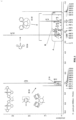
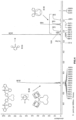
- H number in FIGS. 1 to 3 and in FIG. 4 to be shown below indicates the number of hydrogen atoms.
- “H 20” represents twenty (20) hydrogen atoms.
- Test Example 1 evaluation of flame retardants for thermosetting resin in thermoset epoxy resin articles
- the epoxy resin and the flame retardant were mixed at a blending ratio shown in Table 1, and were evenly dissolved while heated at a temperature of 150°C.
- the curing agent and the curing accelerator were added at a blending ratio shown in Table 1; and the resulting mixture was evenly mixed.
- the liquid resin composition thereby obtained was poured into a 3.2 mm-thick mold, and was heated at a temperature of 120°C for 2 hours and then at a temperature of 170°C for 5 hours, obtaining a thermoset epoxy resin article for evaluation.
- thermoset epoxy resin articles thereby obtained were evaluated for their flame retardancy, dielectric property, and a glass-transition temperature by the above-described methods.
- thermoset epoxy resin article for evaluation without containing a flame retardant was also prepared and evaluated in the same manner (see Comparative Example 7: blank). Evaluation results of the blank-especially the flame retardancy (oxygen index)-are considered comparative criteria for evaluating the flame retardants blended in the thermoset epoxy resin articles.
- Test Example 2 evaluation of flame retardants for thermosetting resin
- Flame retardants FR1 to FR4 as the flame retardants for thermosetting resin were evaluated for solvent solubility by the above method.
- the flame retardants such as FR1 and FR2 are more readily dispersed in the thermoset resin article than the traditionally-known phosphorus-type flame retardants, such as FR3 to FR5, and are capable of allowing the thermoset resin article to successfully have both the dielectric property and the heat resistance.
Landscapes
- Chemical & Material Sciences (AREA)
- Organic Chemistry (AREA)
- Engineering & Computer Science (AREA)
- Health & Medical Sciences (AREA)
- Medicinal Chemistry (AREA)
- Polymers & Plastics (AREA)
- Chemical Kinetics & Catalysis (AREA)
- Materials Engineering (AREA)
- Manufacturing & Machinery (AREA)
- Molecular Biology (AREA)
- Microelectronics & Electronic Packaging (AREA)
- Life Sciences & Earth Sciences (AREA)
- Biochemistry (AREA)
- General Health & Medical Sciences (AREA)
- Textile Engineering (AREA)
- Crystallography & Structural Chemistry (AREA)
- Compositions Of Macromolecular Compounds (AREA)
- Epoxy Resins (AREA)
- Laminated Bodies (AREA)
- Reinforced Plastic Materials (AREA)
Description
- The present invention relates to a thermosetting resin composition including an aromatic phosphoric acid ester as flame retardant, a cured material (thermoset article) of the composition, and an application of the thermoset article.
- In computers, cameras, mobile telephones, liquid crystal displays (LCD), TFT displays, and other electronic devices, a laminate sheet is used that is made of various materials, such as a synthetic resin (thermosetting resin or thermoplastic resin). Of these materials, the thermosetting resin, such as an epoxy resin, has excellent characteristics and has been traditionally used.
- The materials for the laminate sheet are required to have various characteristics depending upon its use, use conditions, and so forth; and one of the characteristics required is flame retardancy.
- In general, how to impart flame retardancy to a resin material is to allow a resin to contain a halogen compound, such as a bromine-type flame retardant (namely, to add the halogen compound to the resin). In recent years, however, a halogen-free laminate sheet that is unlikely to generate any harmful gas during burning has been required with consideration for the human body and the natural environment.
- To accommodate such a demand, there is a way to allow a resin to contain a halogen-free phosphorus-type flame retardant (namely, to add the halogen-free phosphorus-type flame retardant to the resin).
- Various studies have been conducted on phosphorus-type flame retardants, for example, a condensed phosphoric acid ester as disclosed in
Japanese Unexamined Patent Application Publication No. 2004-051907 - Considering the above problem, another approach was taken such that phosphinate as disclosed in
Japanese Unexamined Patent Application Publication No. 2002-284963 - As examples of the phosphorus-type flame retardant soluble in the solvent that is commonly used to prepare the laminate sheet (prepreg), there may be mentioned 9,10-dihydro-9-oxa-10-phosphaphenanthrene-10-oxide (DOPO) and its modified compounds as disclosed in
Japanese Unexamined Patent Application Publication No. 2013-177599 Japanese Unexamined Patent Application Publication No. 2006-117723 - In recent years, due to highly-developed communication networks, the amount of information circulating in society is increasing at an accelerated rate. Therefore, the information processing of various electronic devices is getting faster; and frequencies of electrical signals are getting higher, with the result that the laminate sheet is required to have lower inductance in order to reduce any signal transmission loss. The DOPO of Patent Document 3 and the phosphazene compounds of Patent Document 4 tend to elevate permittivity and dielectric tangent of the laminate sheet, giving a challenge to be solved.
-
PCT International Publication No. WO 2016/175325 (Patent Document 5) andU.S. Patent Publication No. 2016/0024304 (Patent Document 6) disclose a phosphorus-type flame retardant-containing thermoset resin article that is excellent in flame retardancy and heat resistance and is capable of suppressing an increase in permittivity and dielectric tangent. The thermoset resin article of Patent Document 5 is characterized by containing a specific polyphenylene ether derivative, while the thermoset resin article of Patent Document 6 is characterized by containing a specific epoxy compound. Namely, the flame retardants themselves are not featured in these documents; and further improvement in the performance of the phosphorus-type flame retardant-containing laminate sheet is desired. Patent Document 7 relates to thermosetting compositions. Patent Document 8 discloses flame retardants as those used in the the present invention. -
- Patent Document 1:
Japanese Unexamined Patent Application Publication No. 2004-051907 - Patent Document 2:
Japanese Unexamined Patent Application Publication No. 2002-284963 - Patent Document 3:
Japanese Unexamined Patent Application Publication No. 2013-177599 - Patent Document 4:
Japanese Unexamined Patent Application Publication No. 2006-117723 - Patent Document 5:
PCT International Publication No. WO 2016/175325 - Patent Document 6:
U.S. Patent Publication No. 2016/0024304 - Patent Document 7:
WO 2017/094489 A1 - Patent Document 8:
WO 02/055526 A1 - The present invention has an object of providing a thermosetting resin composition including a flame retardant, a thermoset article of the composition, and an application of the thermoset article, the flame retardant having the following features: soluble in a solvent that is commonly used to prepare the thermoset resin article; capable of imparting sufficient flame retardancy to the thermoset resin article even without containing any halogen; and capable of suppressing an elevation in permittivity and dielectric tangent and a decrease in heat resistance.
- As a result of diligent research to achieve the above object, the inventor of the present invention found that an aromatic phosphoric acid ester having a bisphenol structure having a specific aliphatic ring in a cross-linked structure can achieve the above object, and completed the present invention.
- The present invention provides a thermosetting resin containing an aromatic phosphoric acid ester represented by the general formula (I):

- The present invention provides a thermosetting resin composition containing the above-described flame retardant for thermosetting resin and a thermosetting resin, and further provides a thermoset resin article formed by curing the thermosetting resin composition.
- The present invention also provides a prepreg containing the above-described thermosetting resin composition.
- The present invention further provides a laminate sheet prepared using the above-described prepreg, and also provides a printed wiring board prepared using the above-described prepreg or the above-described laminate sheet.
- The present invention can provide an organic phosphorus-type flame retardant for thermosetting resin, a thermosetting resin composition containing the flame retardant, a thermoset article containing the composition, and an application of the thermoset article, the flame retardant having the following features: soluble in a solvent that is commonly used to prepare the thermoset resin article; capable of imparting sufficient flame retardancy to the thermoset resin article even without containing any halogen; and capable of suppressing a rise in permittivity and dielectric tangent and a reduction in heat resistance.
- The thermosetting resin of the present invention exhibits the above advantageous effects more if any one of the following conditions (1) to (4) is satisfied:
- (1) The aromatic phosphoric acid ester is represented by the general formula (I) wherein R1 to R4 each independently represent a C1-4 alkyl group or a C1-4 alkoxy group.
- (2) The aromatic phosphoric acid ester is represented by the general formula (I) wherein n represents 1, p represents an integer of 0 to 10, and k represents 4.
- (3) The aromatic phosphoric acid ester is represented by the general formula (I) wherein n represents 1, p represents an integer of 0 to 22, and k represents 10.
- (4) The aromatic phosphoric acid ester is any of aromatic
phosphoric acid esters 1 to 4 described in Embodiments. - The thermosetting resin composition of the present invention exhibits the above advantageous effects more if either one of the following conditions (5) and (6) is satisfied:
- (5) The thermosetting resin is an epoxy resin.
- (6) The flame retardant for thermosetting resin of 1 to 50% by mass is contained in the thermosetting resin composition.
-
-
FIG. 1 shows a 1H-NMR chart of aromaticphosphoric acid ester 1 of Synthesis Example 2. -
FIG. 2 shows an enlarged view of a region A ofFIG. 1 . -
FIG. 3 shows an enlarged view of a region B ofFIG. 1 . -
FIG. 4 shows a 1H-NMR chart of aromatic phosphoric acid ester 4 of Synthesis Example 3. - A flame retardant for thermosetting resin is characterized by comprising an aromatic phosphoric acid ester represented by the general formula (I):

- The substituents R1 to R4 in the general formula (I) represent the hydrogen atom; the C1-4 alkyl group, preferably a C1-3 alkyl group, and more preferably a C1-2 alkyl group; or the C1-4 alkoxy group, preferably a C1-3 alkoxy group, and more preferably a C1-2 alkoxy group. The substituents R1 to R4 representing the hydrogen atom or the alkyl or the alkoxy group whose carbon number falls within the above-mentioned ranges make it possible to provide the aromatic phosphoric acid ester that is capable of imparting excellent flame retardancy and dielectric property to a thermoset resin article, and also make it possible to relatively easily synthesize the aromatic phosphoric acid ester.
- As described above, the substituents R1 to R4 represent the hydrogen atom, the alkyl group having the specific carbon number, or the alkoxy group having the specific carbon number; however, it is preferable that the substituents should represent the hydrogen atom or the alkyl group, and it is more preferable that the substituents should represent the alkyl group.
- The C1-4 alkyl group may be linear or branched; and examples of the C1-4 alkyl group include a methyl group, an ethyl group, an n-propyl group, an isopropyl group, an n-butyl group, an isobutyl group, and a tert-butyl group.
- Of the above-listed alkyl groups, the methyl group, the ethyl group, the n-propyl group, and the isopropyl group are preferable; and the methyl group and the ethyl group are particularly preferable.
- The C1-4 alkoxy group may be linear or branched; and examples of the C1-4 alkoxy group include a methoxy group, an ethoxy group, an n-propoxy group, an isopropoxy group, an n-butoxy group, an isobutoxy group, and a tert-butoxy group.
- Of the above-listed alkoxy groups, the methoxy group, the ethoxy group, the n-propoxy group, and the isopropoxy group are preferable; and the methoxy group and the ethoxy group are particularly preferable.
- The substituents R5, R6, and R9 in the general formula (I) represent the Ci-io alkyl group, preferably a C1-6 alkyl group, and more preferably a C1-4 alkyl group, or represent the C1-10 alkoxy group, preferably a C1-6 alkoxy group, and more preferably a C1-4 alkoxy group. If the carbon number falls within the above-mentioned ranges, the aromatic phosphoric acid ester can be obtained that is capable of imparting excellent flame retardancy to the thermoset resin article.
- The Ci-io alkyl group may be linear or branched; and examples of the Ci-io alkyl group include a methyl group, an ethyl group, an n-propyl group, an isopropyl group, an n-butyl group, an isobutyl group, a tert-butyl group, an n-pentyl group, an isopentyl group, a 2-methylbutyl group, a 1-methylbutyl group, a 1,2-dimethylpropyl group, a neopentyl group (2,2-dimethylpropyl group), a tert-pentyl group (1, 1-dimethylpropyl group), an n-hexyl group, an isohexyl group, a 1-methylpentyl group, a 2-methylpentyl group, a 3-methylpentyl group, a 1-ethylbutyl group, a 2-ethylbutyl group, a 1,1-dimethylbutyl group, a 1,2-dimethylbutyl group, a 1,3-dimethylbutyl group, a 2,2-dimethylbutyl group, a 2,3-dimethylbutyl group, a 1-ethyl-1-methylpropyl group, a 1-ethyl-2-methylpropyl group, an n-heptyl group, an isoheptyl group, a 1-methylhexyl group, a 2-methylhexyl group, a 3-methylhexyl group, a 4-methylhexyl group, a 1-ethylpentyl group, a 2-ethylpentyl group, a 3-ethylpentyl group, a 1-propylbutyl group, a 1,1-dimethylpentyl group, a 1,2-dimethylpentyl group, a 1,3-dimethylpentyl group, a 1,4-dimethylpentyl group, a 1-ethyl-1-methylbutyl group, a 1-ethyl-2-methylbutyl group, a 1-ethyl-3-methylbutyl group, a 2-ethyl-1-methylbutyl group, a 2-ethyl-2-methylbutyl group, a 2-ethyl-3-methylbutyl group, a 1,1-diethylpropyl group, an n-octyl group, an isooctyl group, a 1-methylheptyl group, a 2-methylheptyl group, a 3-methylheptyl group, a 4-methylheptyl group, a 5-methylheptyl group, a 1-ethylhexyl group, a 2-ethylhexyl group, a 3-ethylhexyl group, a 4-ethylhexyl group, a 1-propylheptyl group, a 2-propylheptyl group, a nonyl group, and a decyl group.
- Of the above-listed C1-10 alkyl groups, the following are preferable: the methyl group, the ethyl group, the n-propyl group, the isopropyl group, the n-butyl group, the isobutyl group, the tert-butyl group, the n-pentyl group, the isopentyl group, the 2-methylbutyl group, the 1-methylbutyl group, the 1,2-dimethylpropyl group, the neopentyl group (2,2-dimethylpropyl group), the tert-pentyl group (1,1-dimethylpropyl group), the n-hexyl group, the isohexyl group, the 1-methylpentyl group, the 2-methylpentyl group, the 3-methylpentyl group, the 1-ethylbutyl group, the 2-ethylbutyl group, the 1,1-dimethylbutyl group, the 1,2-dimethylbutyl group, the 1,3-dimethylbutyl group, the 2,2-dimethylbutyl group, the 2,3-dimethylbutyl group, the 1-ethyl-1-methylpropyl group, and the 1-ethyl-2-methylpropyl group; and the following are particularly preferable: the methyl group, the ethyl group, the n-propyl group, the isopropyl group, the n-butyl group, the isobutyl group, and the tert-butyl group.
- The C1-10 alkoxyl group may be linear or branched; and examples of the Ci-io alkoxyl group include a methoxy group, an ethoxy group, an n-propoxy group, an isopropoxy group, an n-butoxy group, an isobutoxy group, a tert-butoxy group, an n-pentyloxy group, an isopentyloxy group, a 2-methylbutoxy group, a 1-methylbutoxy group, a 1,2-dimethylpropoxy group, a neopentyloxy group (2,2-dimethylpropoxy group), a tert-pentyloxy group (1,1-dimethylpropoxy group), an n-hexyloxy group, an isohexyloxy group, a 1-methylpentyloxy group, a 2-methylpentyloxy group, a 3-methylpentyloxy group, a 1-ethylbutoxy group, a 2-ethylbutoxy group, a 1,1-dimethylbutoxy group, a 1,2-dimethylbutoxy group, a 1,3-dimethylbutoxy group, a 2,2-dimethylbutoxy group, a 2,3-dimethylbutoxy group, a 1-ethyl-1-methylpropoxy group, a 1-ethyl-2-methylpropoxy group, an n-heptyloxy group, an isoheptyloxy group, a 1-methylhexyloxy group, a 2-methylhexyloxy group, a 3-methylhexyloxy group, a 4-methylhexyloxy group, a 1-ethylpentyloxy group, a 2-ethylpentyloxy group, a 3-ethylpentyloxy group, a 1-propylbutoxy group, a 1,1-dimethylpentyloxy group, a 1,2-dimethylpentyloxy group, a 1,3-dimethylpentyloxy group, a 1,4-dimethylpentyloxy group, a 1-ethyl-1-methylbutoxy group, a 1-ethyl-2-methylbutoxy group, a 1-ethyl-3-methylbutoxy group, a 2-ethyl-1-methylbutoxy group, a 2-ethyl-2-methylbutoxy group, a 2-ethyl-3-methylbutoxy group, a 1,1-diethylpropoxy group, an n-octyloxy group, an isooctyloxy group, a 1-methylheptyloxy group, a 2-methylheptyloxy group, a 3-methylheptyloxy group, a 4-methylheptyloxy group, a 5-methylheptyloxy group, a 1-ethylhexyloxy group, a 2-ethylhexyloxy group, a 3-ethylhexyloxy group, a 4-ethylhexyloxy group, a 1-propylheptyloxy group, a 2-propylheptyloxy group, a nonyloxy group, and a decyloxy group.
- Of the above-listed C1-10 alkoxy groups, the following are preferable: the methoxy group, the ethoxy group, the n-propoxy group, the isopropoxy group, the n-butoxy group, the isobutoxy group, the tert-butoxy group, the n-pentyloxy group, the isopentyloxy group, the 2-methylbutoxy group, the 1-methylbutoxy group, the 1,2-dimethylpropoxy group, the neopentyloxy group (2,2-dimethylpropoxy group), the tert-pentyloxy group (1, 1-dimethylpropoxy group), the n-hexyloxy group, the isohexyloxy group, the 1-methylpentyloxy group, the 2-methylpentyloxy group, the 3-methylpentyloxy group, the 1-ethylbutoxy group, the 2-ethylbutoxy group, the 1, 1-dimethylbutoxy group, the 1,2-dimethylbutoxy group, the 1,3-dimethylbutoxy group, the 2,2-dimethylbutoxy group, the 2,3-dimethylbutoxy group, the 1-ethyl-1-methylpropoxy group, and the 1-ethyl-2-methylpropoxy group; and the following are particularly preferable: the methoxy group, the ethoxy group, the n-propoxy group, the isopropoxy group, the n-butoxy group, the isobutoxy group, and the tert-butoxy group.
- The substituents R7 and R8 in the general formula (I) represent the C1-4 alkyl group, preferably a C1-3 alkyl group, and more preferably a C1-2 alkyl group; or the C1-4 alkoxy group, preferably a C1-3 alkoxy group, and more preferably a C1-2 alkoxy group. If the carbon number falls within the above-mentioned ranges, the aromatic phosphoric acid ester can be obtained that is capable of imparting excellent flame retardancy and dielectric property to the thermoset resin article, and can be relatively easily synthesized.
- The C1-4 alkyl group may be linear or branched; and examples of the C1-4 alkyl group include a methyl group, an ethyl group, an n-propyl group, an isopropyl group, an n-butyl group, an isobutyl group, and a tert-butyl group.
- Of the above-listed alkyl groups, the methyl group, the ethyl group, the n-propyl group, and the isopropyl group are preferable; and the methyl group and the ethyl group are particularly preferable.
- The C1-4 alkoxy group may be linear or branched; and examples of the C1-4 alkoxy group include a methoxy group, an ethoxy group, an n-propoxy group, an isopropoxy group, an n-butoxy group, an isobutoxy group, and a tert-butoxy group.
- Of the above-listed alkoxy groups, the methoxy group, the ethoxy group, the n-propoxy group, and the isopropoxy group are preferable; and the methoxy group and the ethoxy group are particularly preferable.
- Two types of the groups from among the alkyl groups and the alkoxy groups may be present in a single molecule; or only one type of the group from among the alkyl groups and the alkoxy groups may be present; however, it is particularly preferable that only the alkyl group should be present.
- Indexes in the general formula (I) are as follows.
- n represents an integer of 1 to 10, preferably 1 to 5, more preferably 1 to 3, and further preferably 1.
- n1 and n2 each independently represent an integer of 0 to 3, preferably 0 or 1, and more preferably 0.
- m1 and m2 each independently represent an integer of 0 to 4, preferably 0 to 2, and more preferably 0.
- p represents an integer of 0 to 26, preferably 0 to 22, more preferably 0 to 10, further preferably 0 to 5, and particularly preferably 0 to 3.
- k represents an integer of 1 to 12, preferably 3 to 10, and more preferably 4 or 10.
- The aromatic phosphoric acid ester having the indexes that fall within the above-mentioned ranges is capable of imparting excellent dielectric property and high heat resistance and flame retardancy to the thermoset resin article to which the aromatic phosphoric acid ester is added.
- The definition "when p is 2 or more, any two substituents R9 may be bonded to each other, and may be bonded to a carbon atom(s) of a ring to which the above substituents R9 are bonded, forming another ring" regarding the general formula (I) means that a structure such as the one shown below may be formed:

- As a specific example there may be mentioned a structure represented by the following formula:

- It is desirable that the aromatic phosphoric acid ester to be contained in the flame retardant of the present invention should comprise main components whose indexes fall within the above-mentioned ranges; however, the aromatic phosphoric acid ester may be a mixture of the components whose indexes are different. The aromatic phosphoric acid ester may, however, contain the components whose indexes fall outside the above-mentioned ranges, as long as the components do not hinder the advantageous effects of the present invention.
- As desirable examples of the aromatic phosphoric acid ester there may be mentioned as follows: a compound represented by the following general formula (II) derived from the general formula (I) wherein n represents 1, p represents an integer of 0 to 10, and k represents 4:

- wherein R1 to R9, n1, n2, m1, and m2 are as defined in the general formula (I); and q represents an integer of 0 to 10, preferably 0 to 5, and more preferably 0 to 3; and
- a compound represented by the following general formula (III) derived from the general formula (I) wherein n represents 1, p represents an integer of 0 to 22, and k represents 10:

- wherein R1 to R9, n1, n2, m1, and m2 are as defined in the general formula (I); and r represents an integer of 0 to 22, preferably 0 to 10, more preferably 0 to 5, particularly preferably 0 to 3, and most preferably 0.
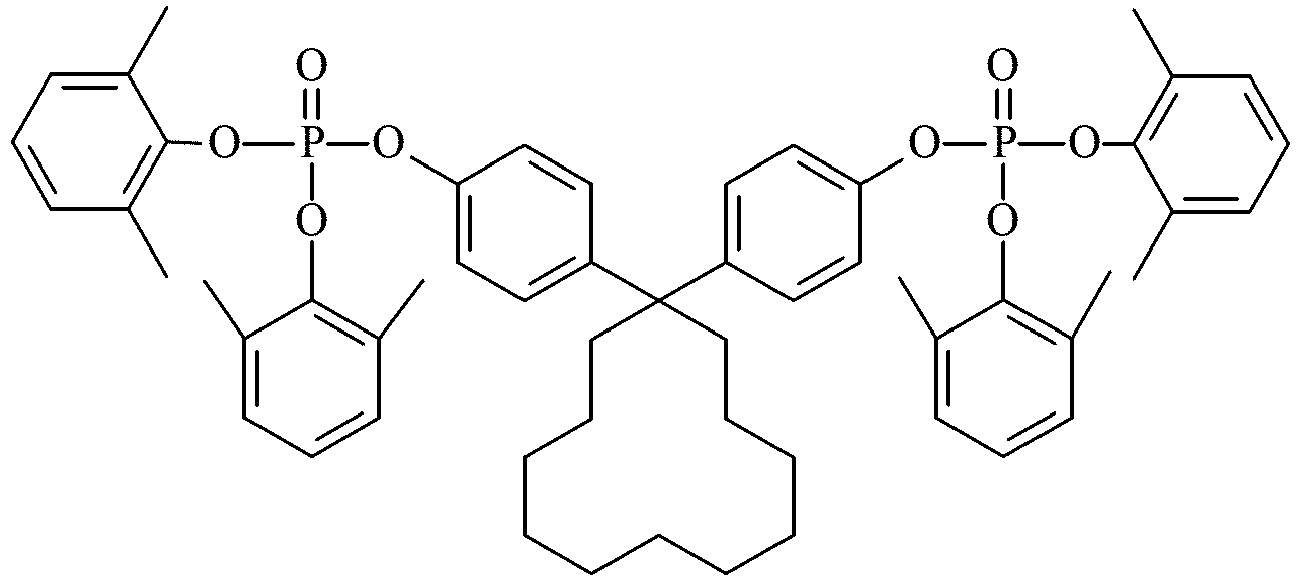
- As specific examples of the aromatic phosphoric acid ester there may be mentioned aromatic
phosphoric acid esters 1 to 4 having the following structural formulas; and any compound selected from these compounds can be suitably used for the present invention. Of these compounds, the aromaticphosphoric acid esters 1, 3, and 4 are preferable; the aromaticphosphoric acid esters 1 and 4 are more preferable; and the aromaticphosphoric acid ester 1 is particularly preferable, in terms of production costs. - Aromatic Phosphoric Acid Ester 1:

- Aromatic Phosphoric Acid Ester 2:

- Aromatic Phosphoric Acid Ester 3:

- Aromatic Phosphoric Acid Ester 4:
- The flame retardant is synthesized by a commonly-known method with use of corresponding phenols, bisphenols, and phosphorus oxychloride as materials.
- For example, an intended aromatic phosphoric acid ester may be obtained as follows:
- a phenol represented by the general formula (IV):

- wherein R1, R2, R5, and n1 are as defined in the general formula (I) and phosphorus oxychloride are subjected to a dehydrochlorination reaction in the presence of a Lewis acid catalyst, such as aluminum chloride or magnesium chloride, obtaining a diester compound represented by the general formula (V):

- wherein R1, R2, R5, and n1 are as defined in the general formula (I); and the diester compound thereby obtained and a bisphenol compound represented by the general formula (VI):

- wherein R7, R8, R9, m1, m2, p, and k are as defined in the general formula (I) are subjected to a dehydrochlorination reaction in the presence of a Lewis acid catalyst or to an esterification reaction using a hydrogen chloride scavenger, such as pyridine, triethylamine, or tributylamine, obtaining an intended aromatic phosphoric acid ester; or
- the bisphenol represented by the general formula (VI) and phosphorus oxychloride are subjected to a dehydrochlorination reaction in the presence of a Lewis acid catalyst or to an esterification reaction using a hydrogen chloride scavenger, such as pyridine, triethylamine, or tributylamine, obtaining a phosphorus compound represented by the general formula (VII):

- wherein R7, R8, R9, m1, m2, p, and k are as defined in the general formula (I); and
- the phosphorus compound thereby obtained and the phenol represented by the above-mentioned general formula (IV) are subjected to a dehydrochlorination reaction in the presence of a Lewis acid catalyst or to an esterification reaction using a hydrogen chloride scavenger, such as pyridine, triethylamine, or tributylamine, obtaining an intended aromatic phosphoric acid ester.
- A thermosetting resin composition of the present invention is characterized by containing the above-described flame retardant for thermosetting resin and a thermosetting resin.
- If necessary, the thermosetting resin composition of the present invention may contain a curing agent, a curing accelerator, and other additives; and the thermosetting resin composition of the present invention means a mixture of these components before the components cure.
- The thermosetting resin to which the flame retardancy is to be imparted is not particularly limited, as long as the resin has thermosetting property; and examples of the thermosetting resin include an epoxy resin, an unsaturated polyester resin, a vinylester resin, a diallyl phthalate resin, a maleimide resin, a cyanic ester resin, a phenolic resin, a melamine resin, and a polyurethane resin. Of these resins, the epoxy resin is particularly preferable because a thermoset article thereof excels in mechanical and electrical properties.
- As examples of the epoxy resin there may be mentioned compounds having a plurality of epoxy groups in molecules thereof; and specific examples of the epoxy resin include bisphenol-type epoxy resins, novolac-type epoxy resins, aliphatic chain epoxy resins, epoxidized polybutadienes, glycidyl ester-type epoxy resins, and glycidyl amine-type epoxy resins.
- Of these epoxy resins, the following are preferable: the bisphenol-type epoxy resins, such as a bisphenol A-type epoxy resin, a bisphenol F-type epoxy resin, and a bisphenol S-type epoxy resin; and the novolac-type epoxy resins, such as a cresol novolac-type epoxy resin, a bisphenol-A novolac-type epoxy resin, and a salicylaldehyde phenol novolac-type epoxy resin. From the viewpoint of improvement in the heat resistance, the bisphenol A-type epoxy resin, the bisphenol-A novolac-type epoxy resin, the cresol novolac-type epoxy resin, and the salicylaldehyde phenol novolac-type epoxy resin are particularly preferable.
- The above-mentioned resins can be used independently or in combination of two or more kinds thereof.
- The unsaturated polyester resin is a compound that is obtained by an esterification reaction between a polyol, such as ethylene glycol, propylene glycol, diethylene glycol, or hydrogenated bisphenol-A hydride, and an unsaturated polybasic acid, such as maleic acid, fumaric acid, or itaconic acid, or a saturated polybasic acid, such as adipic acid or phthalic acid; and the compound has a plurality of ester bonds and radical polymerization unsaturated bonds in molecules thereof.
- The vinylester resin is a compound that is obtained by reaction between a compound having a plurality of epoxy groups in molecules thereof, such as a bisphenol A-type epoxy resin or a novolac-type epoxy resin, and acrylic acid or methacrylic acid, and has a plurality of acryloyl groups or methacryloyl groups in molecules thereof.
- The diallyl phthalate resin is generally formed of a mixture of a diallyl phthalate prepolymer, which is pre-polymerized diallyl phthalate, and a diallyl phthalate monomer. The diallyl phthalate prepolymer and the diallyl phthalate may be in the ortho position, the iso position, or the para position.
- Any of the unsaturated polyester resin, the vinylester resin, and the diallyl phthalate resin may be used in combination with a co-reactant and/or a curing catalyst. The co-reactant may be a compound having a radical polymerization unsaturated bond; and examples of the co-reactant include styrene, divinylbenzene, and (meth)acrylate ester.
- As examples of the curing catalyst to be used in the unsaturated polyester resin, the vinylester resin, and the diallyl phthalate resin, there may be mentioned organic peroxides.
- A curing auxiliary agent may also be used with the curing catalyst; and as examples of the curing auxiliary agent there may be mentioned transition metal organic acid salts, such as cobalt and vanadium, and tertiary amines, such as dimethylaniline and dimethylaminopyridine.
- The maleimide resin is a compound having a plurality of maleimide groups in molecules thereof; and as an example of the maleimide resin there may be mentioned methylenebis-p-phenylenedimaleimide. The maleimide compound may be used in combination with a co-reactant and/or a curing catalyst. As examples of the co-reactant there may be mentioned compounds having a functional group, such as an alkenyl group, an epoxy group, an amino group, a phenolic hydroxyl group, or a cyanate group; and as examples of the curing catalyst there may be mentioned strongly basic compounds, such as imidazole derivatives and diazabicyclooctane.
- The cyanic ester resin is a cyanic ester containing a polyphenol, such as bisphenol A, bisphenol F, or novolac. The cyanic ester resin may be used in combination with a complex containing a transition metal, such as cobalt, copper, zinc, or manganese, as a curing catalyst. The curing catalyst is useful in lowering a curing temperature of the cyanic ester resin.
- These thermosetting resins may also be used in combination as needed basis. For example, the maleimide resin, the cyanic ester resin, and the epoxy resin can be used in combination.
- If the epoxy resin is used as the thermosetting resin, the thermosetting resin composition including the epoxy resin is blended with the curing agent.
- A variety of traditionally-known curing agents may be used; and examples of the curing agents include multifunctional phenols such as dicyandiamide, diaminodiphenylmethane, diaminodiphenylsulfone, phthalic anhydride, pyromellitic anhydride, phenol novolac, and cresol novolac. These multifunctional phenols may be used independently or in combination of two or more kinds thereof.
- The curing accelerator may be blended in order to accelerate the curing of the thermosetting resin composition; and as long as the curing accelerator does not hinder the advantageous effects of the present invention, a kind and a blending amount thereof are not particularly limited.
- As examples of the curing accelerator there may be mentioned imidazole-type compounds, organic phosphorus-type compounds, tertiary amines, and quaternary ammonium salts; and these curing accelerators may be used independently or in combination of two or more kinds thereof.
- It is usually desirable that the flame retardant for thermosetting resin of the present invention should be contained in the thermosetting resin composition within a range of 1 to 50% by mass.
- The flame retardant for thermosetting resin with the content in the above range is capable of imparting excellent flame retardancy to the thermoset resin article and is capable of providing the thermoset resin article with excellent heat resistance and dielectric property.
- It is not desirable if the content of the flame retardant is less than 1% by mass, as it may not be possible to impart physical properties sufficiently, such as the flame retardancy, to the thermoset resin article. Meanwhile, it is not desirable if the content of the flame retardant exceeds 50% by mass, as it may be possible to deteriorate physical properties, particularly mechanical properties, of the thermoset resin article itself.
- The content of the flame retardant is more preferably 5 to 35% by mass and particularly preferably 10 to 30% by mass.
- The specific contents (% by mass) of the flame retardant in the thermosetting resin composition are, for example, 1, 5, 8, 10, 11, 12, 13, 14, 15, 16, 17, 18, 19, 20, 21, 22, 23, 24, 25, 26, 27, 28, 29, 30, 32, 35, 40, 45, and 50.
- The thermosetting resin composition of the present invention may contain additional components, which are usually added to resins, as long as the advantageous effects of the present invention are not impaired by the additional components. As examples of the additional components there may be mentioned resin materials, such as commonly-known thermoplastic resins and elastomers, inorganic fillers, coupling agents, antioxidants, thermostabilizers, antistatic agents, ultraviolet absorbers, pigments, coloring agents, and lubricants; and these additional components may be used independently or in combination of two or more kinds thereof.
- The thermosetting resin composition of the present invention may be prepared by any commonly-known method with use of the flame retardant for thermosetting resin and the thermosetting resin described above and the other components as needed.
- Specifically, Examples will go into detail about examples using the epoxy resin.
- The thermoset resin article of the present invention is made by curing the above thermosetting resin composition by a commonly-known method.
- The specific method will be detailed in Examples using the epoxy resin.
- A prepreg of the present invention contains the thermosetting resin composition of the present invention and can be prepared by a commonly-known method with use of the thermosetting resin composition of the present invention and a commonly-known base material.
- For example, the prepreg of the present invention can be prepared by impregnating the base material with the thermosetting resin composition of the present invention, which has been dissolved in a solvent, or by applying this thermosetting resin composition to the base material, and then by drying the thermosetting resin composition-impregnated base material or the thermosetting resin composition-coated base material.
- The base material is not particularly limited, as long as the base material can be impregnated with the thermosetting resin composition of the present invention, which has been dissolved in the solvent, or can be covered with this thermosetting resin composition. The base material may be any commonly-known material that is used for various printed wiring board materials; and examples of the base material include inorganic fibers except glass, such as glass fibers and quartz; organic fibers, such as polyimide, polyamide, and polyester; and woven cloth, such as liquid crystalline polyester.
- The base material may be in any form, for example, woven cloth, such as plain weave, twill weave, or hybrid cloth, or non-woven cloth.
- The solvent is not particularly limited, as long as the solvent allows the thermosetting resin composition of the present invention to be dissolved therein; and examples of the solvent include ethers, such as ethylene glycol monomethyl ether and propylene glycol monomethyl ether; ketones, such as acetone, diethyl ketone, and methyl ethyl ketone (MEK); and aromatics, such as benzene and toluene.
- A laminate sheet of the present invention is prepared using the prepreg of the present invention and can be prepared by a commonly-known method. For example, the prepreg and other base materials to be used as needed are laminated, forming a laminate; and the laminate is heated under pressure and cured, forming the laminate with a desired size and shape.
- A printed wiring board of the present invention is prepared by using the prepreg or the laminate sheet of the present invention, and can be prepared by a commonly-known method.
- The present invention will be described in detail by way of Synthesis Examples and Test Examples (Examples and Comparative Examples) below; however, the scope of the present invention is not limited to these Examples in the Test Examples.
- Aromatic phosphoric acid esters obtained by Synthesis Examples were identified with use of the following measuring device (1H-NMR) and under the following condition.
- Measuring device: 1H-NMR (model: JNM-ECS-400) manufactured by JEOL Ltd.
- Solvent: CDCl3
- The thermoset resin articles obtained by Examples and Comparative Examples were evaluated by the following method with use of the following measuring device and under the following condition.
-
- Test method: according to K7201-2 (test method for flammability based on oxygen index (LOI value)) of JIS standards
- Test piece: 1/8 inch (3.2 mm) in thickness
- Measuring device: flammability tester (model: ON-1) manufactured by Suga Test Instruments Co., Ltd.
- Permittivity and dielectric tangent of the evaluative thermoset resin articles each were measured at 1 GHz by an impedance analyzer (model: E4991A, manufactured by Agilent Technologies Japan, Ltd.).
- A glass-transition temperature of the thermoset resin articles each was measured by a differential scanning calorimeter (model: DSC6220, manufactured by Seiko Instruments Inc.). The glass-transition temperature was defined as a temperature at which ΔDSC between room temperature and 200°C is at its maximum if the temperature rises at a rate of 10°C/min.
- 5 g of a flame retardant was added repeatedly to 100 mL of the following respective solvents at a temperature of 20°C until the undissolved flame retardant was detected; and a largest amount of the flame retardant dissolved was measured. This largest amount was considered to be solvent solubility.
- Solvents: toluene, methyl ethyl ketone (MEK), and propylene glycol monomethyl ether (PM)
- In Synthesis Examples, the following compounds were used as materials:
- 2,6-Xylenol (manufactured by Tokyo Chemical Industry Co., Ltd.)
- Phosphorus oxychloride (manufactured by Tokyo Chemical Industry Co., Ltd.)
- 3,3,5-trimethyl-1, 1-bis(4-hydroxyphenyl)cyclohexane (product name: BisP-HTG, manufactured by Honshu Chemical Industry Co., Ltd. and represented by the following structural formula):

- 1,1-bis(4-hydroxyphenyl)cyclododecane (product name: BisP-CDE, manufactured by Honshu Chemical Industry Co., Ltd. and represented by the following structural formula):
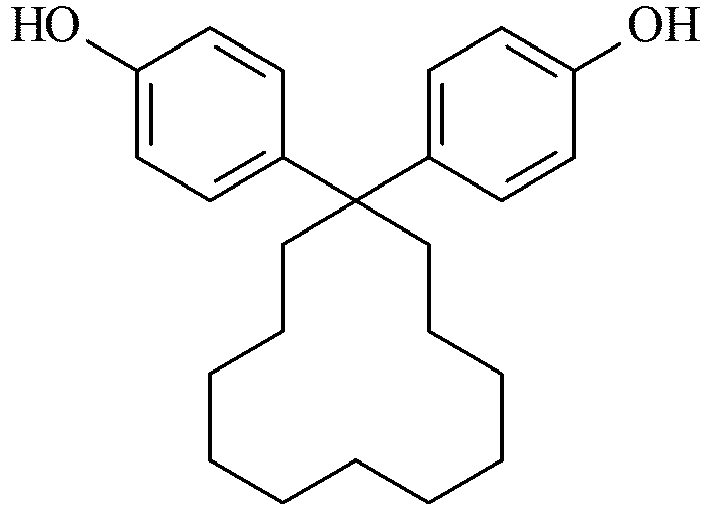
- In Test Examples, the following compounds were used as materials:
- Epoxy resin (product name: jER828, manufactured by Mitsubishi Chemical Corporation)
- Curing agent (product name: RIKACID MH-700, manufactured by New Japan Chemical Co., Ltd.)
- Curing accelerator (product name:
2,4,6-tris(dimethylaminomethyl)phenol, manufactured by Tokyo Chemical Industry Co., Ltd.) -
- FR1: aromatic
phosphoric acid ester 1 - FR2: aromatic phosphoric acid ester 4
- FR3: 1,3-phenylenebis(di-2,6-xylyl phosphate) (product name: PX-200, manufactured by Daihachi Chemical Industry Co., Ltd.)
- FR4: cyclophosphazene oligomer (product name: SPB-100, having 13% by mass of phosphorus and manufactured by Otsuka Chemical Co., Ltd.)
- FR5: 9,10-dihydro-9-oxa-10-phosphaphenanthrene-10-oxide (product name: HCA, manufactured by Sanko Co.,Ltd.)
- A 2-liter capacity four-necked flask equipped with a stirrer, a thermometer, and a hydrochloric acid collecting device (condenser connected with a water scrubber) was filled with 767 g of phosphorus oxychloride, 1,200 g of 2,6-xylenol, 140 g of xylene as a solvent, and 6.2 g of magnesium chloride as a catalyst.
- The resulting mixed solution was gradually heated to a temperature of 160°C over about 3 hours while stirred and was allowed for a reaction, and hydrogen chloride (hydrochloric acid gas) produced from the reaction was collected with the water scrubber. Thereafter, a pressure in the flask was gradually reduced to 20 kPa at the same temperature (160°C); and xylene, unreacted phosphorus oxychloride and 2,6-xylenol, and hydrogen chloride as a byproduct were removed, obtaining 1,700 g of the reaction mixture mainly containing dixylylphosphorochloridate represented by the following structural formula. A content rate of chlorine in the reaction mixture was 10.9% by mass.

- A two-liter capacity four-necked flask equipped with a stirrer, a thermometer, a dropping funnel, and a condenser was filled with 460 g of the dixylylphosphorochloridate obtained in Synthesis Example 1, 196 g of
bisphenol 1, 540 g of toluene as a solvent, and 140 g of tetrahydrofuran. The dropping funnel was filled with 151 g of triethylamine as a hydrogen halide scavenger. - The mixed solution in the four-necked flask was heated to a temperature of 65°C while stirred; and the triethylamine in the dropping funnel was dropped into the mixed solution over 1 hour and 30 minutes while the same temperature (65°C) was maintained. After the dropping was completed, the resulting mixed solution was stirred for 2 hours at the same temperature (65°C), obtaining a reaction product.
- The reaction product thereby obtained was washed with dilute hydrochloric acid and water, and was neutralized and washed with a sodium hydroxide aqueous solution, and then was washed again with water. After that, the reaction product was heated to a temperature of 110°C; and the pressure was reduced to 1 kPa, collecting water, toluene, and tetrahydrofuran. Further, under the reduced pressure of 1 kPa, the reaction product was subjected to steam distillation at a temperature of 110°C, removing low-boiling components; and the reaction product was cooled to room temperature, thereby obtaining 553 g of a pale yellow transparent glassy solid.
- It was confirmed by 1H-NMR that the product thereby obtained contained, as a main component, aromatic
phosphoric acid ester 1 represented by the following structural formula. A 1H-NMR chart is shown inFIGS. 1 to 3 . - The term "H number" in
FIGS. 1 to 3 and inFIG. 4 to be shown below indicates the number of hydrogen atoms. For example, "H 20" represents twenty (20) hydrogen atoms.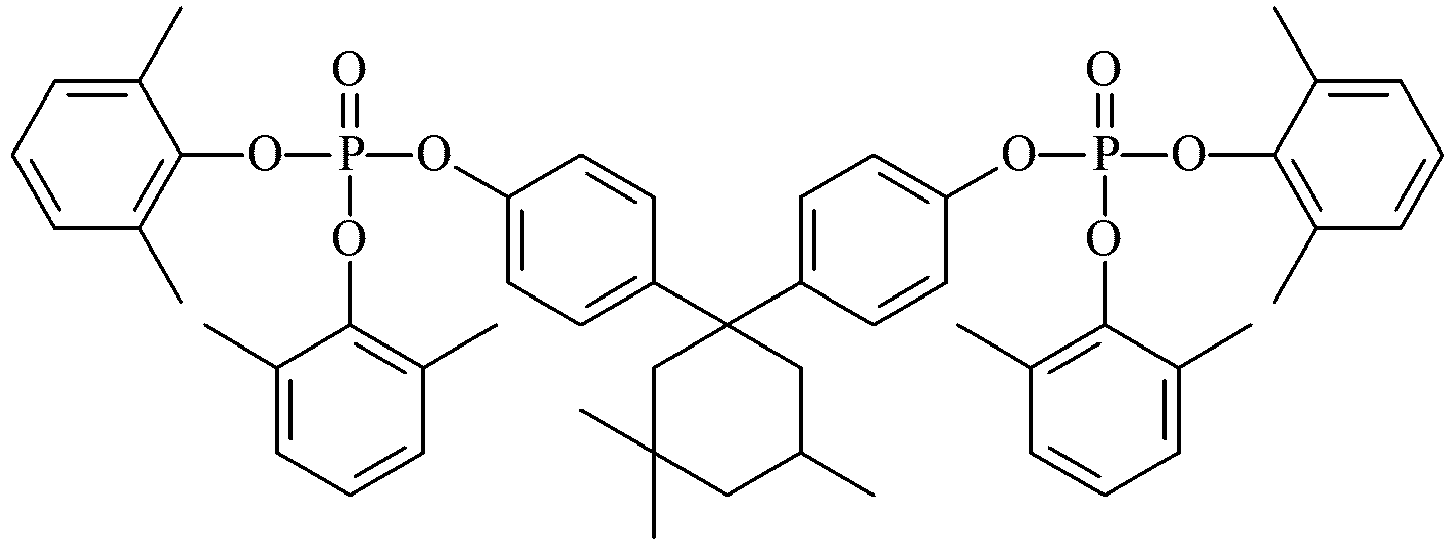
- 569 g of a pale yellow transparent glassy solid was obtained in the same manner as in Synthesis Example 2, except that 216 g of bisphenol 2 was used instead of
bisphenol 1. - It was confirmed by 1H-NMR that the product thereby obtained contained, as a main component, aromatic phosphoric acid ester 4 represented by the following structural formula. A 1H-NMR chart is shown in
FIG. 4 .
- The epoxy resin and the flame retardant were mixed at a blending ratio shown in Table 1, and were evenly dissolved while heated at a temperature of 150°C. To the mixture, the curing agent and the curing accelerator were added at a blending ratio shown in Table 1; and the resulting mixture was evenly mixed. After that, the liquid resin composition thereby obtained was poured into a 3.2 mm-thick mold, and was heated at a temperature of 120°C for 2 hours and then at a temperature of 170°C for 5 hours, obtaining a thermoset epoxy resin article for evaluation.
- The thermoset epoxy resin articles thereby obtained were evaluated for their flame retardancy, dielectric property, and a glass-transition temperature by the above-described methods.
- A thermoset epoxy resin article for evaluation without containing a flame retardant was also prepared and evaluated in the same manner (see Comparative Example 7: blank). Evaluation results of the blank-especially the flame retardancy (oxygen index)-are considered comparative criteria for evaluating the flame retardants blended in the thermoset epoxy resin articles.
- The results obtained by the measurements are shown in Tables 1 and 2.
TABLE 1 Ex 1Ex 2 Ex 3 Comp Ex 1Comp Ex 2 Comp Ex 3 Comp Ex 4 Comp Ex 5 Comp Ex 6 Comp Ex 7 (blank) Materials* Epoxy resin 53.1 53.1 53.1 53.1 53.1 57.9 53.1 53.1 53.1 53.1 Curing agent 46.9 46.9 46.9 46.9 46.9 42.1 46.9 46.9 35.9 46.9 Curing accelerator 0.5 0.5 0.5 0.5 0.5 0.5 0.5 0.5 0.5 0.5 Flame retardants FR1 27.3 - - - - - - - - - FR2 - 29 27.3 - - - - - - - FR3 - - - 20 - - 27.3 - - - FR4 - - - - 13 - - 27.3 - - FR5 - - - - - 11.7 - - 27.3 - Phosphorus content** (% by mass) 1.5 1.5 1.4 1.5 1.5 1.5 1.9 2.8 3.1 0 Evaluation Flame retardancy (oxygen index: LOI value) 34.2 32.5 33.3 34.6 32.9 36.4 35.5 21.9 31.1 19.7 Permittivity (1 GHz) 2.64 2.73 2.92 2.74 2.80 2.89 2.91 3.06 3.14 2.78 Dielectric tangent (1 GHz, × 10-3) 6.6 6.6 6.7 6.4 8.6 10.1 5.8 8.2 9.2 9.1 Glass-transition temp (°C) 118.7 121.7 123.0 107.6 125.1 114.6 102.8 108.9 103.1 154.4 * A unit of the blending ratio of the materials is part by mass.
** The phosphorus content is a theoretical value of the phosphorus content in each thermosetting resin composition. - Flame retardants FR1 to FR4 as the flame retardants for thermosetting resin were evaluated for solvent solubility by the above method.
- The results obtained are shown in Table 2.
TABLE 2 Solvent solubility (g/ 100 mL) Toluene MEK PM FR1 140 135 85 FR2 130 50 10 FR3 75 55 10 FR4 30 35 < 5 FR5 < 5 5 15 - The following are found from the results shown in Tables 1 and 2:
- (1) The thermoset resin articles (Examples 1 to 3) blended with the flame retardant of the present invention (FR1 or FR2) clearly have the flame retardancy imparted thereto.
- (2) The following are found from the tests (Examples 1 and 2 and Comparative Examples 1 to 3) for the thermosetting resin compositions respectively containing the flame retardants of the present invention (FR1 and FR2) and the traditionally-known phosphorus-type flame retardants (FR3 to FR5), all of which having a certain phosphorus content:
- The thermoset resin articles respectively blended with FR1, FR2, and FR3 do not have a significant difference in the dielectric property; however, the thermoset resin article (Example 1 or 2) blended with FR1 or FR2 inhibits a decrease in heat resistance of the thermoset resin article more than the thermoset resin article (Comparative Example 1) blended with FR3 even though the former have the higher amount of the flame retardant.
- The thermoset resin article (Example 1 or 2) blended with FR1 or FR2 is superior in dielectric property to the thermoset resin article blended with FR4 or FR5 (Comparative Example 2 or 3).
- (3) The flame retardants of the present invention (FR1 and FR2) are superior in solvent solubility to the traditionally-known phosphorus-type flame retardants (FR4 and FR5), and are more readily uniformly dispersed in the thermoset resin article at the time of the preparation of the laminate sheet.
- (4) The following are found from the tests (Examples 1 and 3 and Comparative Examples 4 to 6) for the flame retardants of the present invention (FR1 and FR2) and the traditionally-known phosphorus-type flame retardants (FR3 to FR5), all of which having a certain blend amount:
- The thermoset resin articles respectively blended with FR1, FR2, and FR3 do not have a significant difference in the dielectric property; however, the thermoset resin article (Comparative Example 4) blended with FR3 is significantly lower in heat resistance than the thermoset resin article blended with FR1 or FR2 (Example 1 or 3).
- The thermoset resin article (Comparative Example 5 or 6) blended with FR4 or FR5 tends to be higher in permittivity and dielectric tangent than the thermoset resin article (Example 1 or 3) blended with FR1 or FR2, and is significantly lower in heat resistance than the latter.
- From the above, it is realized that the flame retardants such as FR1 and FR2, are more readily dispersed in the thermoset resin article than the traditionally-known phosphorus-type flame retardants, such as FR3 to FR5, and are capable of allowing the thermoset resin article to successfully have both the dielectric property and the heat resistance.
Claims (11)
- A thermosetting resin composition containing a flame retardant for thermosetting resin containing an aromatic phosphoric acid ester represented by the general formula (I):

- The thermosetting resin composition according to claim 1, wherein the thermosetting resin is an epoxy resin.
- The thermosetting resin composition according to one or more of the preceding claims, wherein the flame retardant for thermosetting resin of 1 to 50% by mass is contained in the thermosetting resin composition.
- The thermosetting resin composition according to one or more of the preceding claims, wherein the aromatic phosphoric acid ester is represented by the general formula (I) wherein R1 to R4 each independently represent the C1-4 alkyl group or the C1-4 alkoxy group.
- The thermosetting resin composition according to one or more of the preceding claims, wherein the aromatic phosphoric acid ester is represented by the general formula (I) wherein n represents 1, p represents an integer of 0 to 10, and k represents 4.
- The thermosetting resin composition according to one or more of the preceding claims, wherein the aromatic phosphoric acid ester is represented by the general formula (I) wherein n represents 1, p represents an integer of 0 to 22, and k represents 10
- The thermosetting resin composition according to one or more of the preceding claims, wherein the aromatic phosphoric acid ester is:aromatic phosphoric acid ester 1 represented by the following formula:
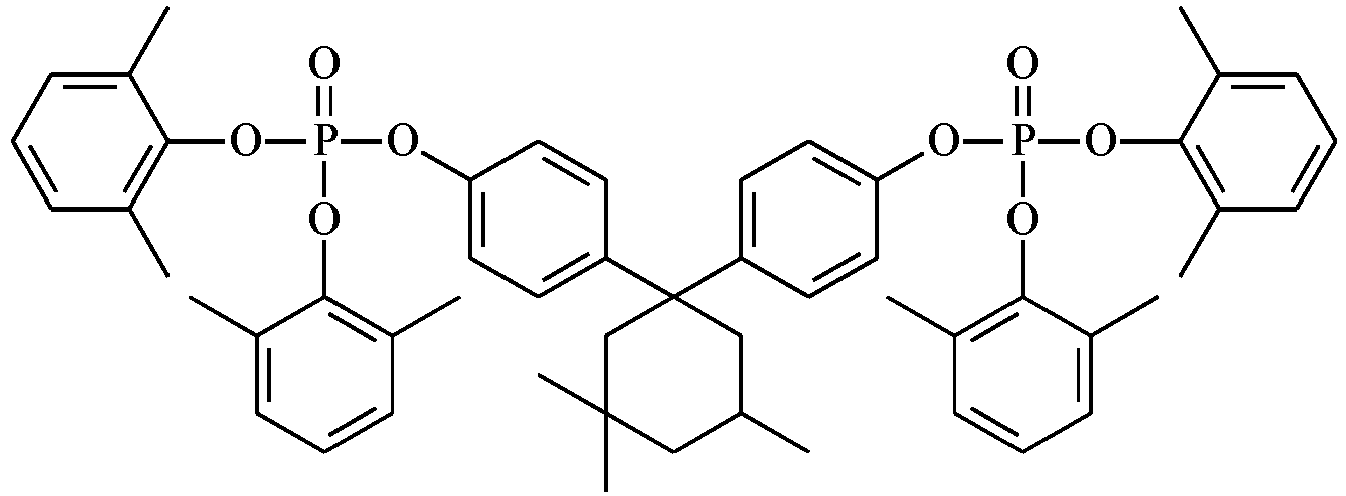 aromatic phosphoric acid ester 2 represented by the following formula:
 aromatic phosphoric acid ester 3 represented by the following formula:
 aromatic phosphoric acid ester 4 represented by the following formula:
- A thermoset resin article formed by curing the thermosetting resin composition according to a one or more of the preceding claims.
- A prepreg containing the thermosetting resin composition according to one or more of the preceding claims.
- A laminate sheet prepared using the prepreg according to claim 9.
- A printed wiring board prepared using the prepreg according to claim 9 or the laminate sheet according to claim 10.
Applications Claiming Priority (2)
| Application Number | Priority Date | Filing Date | Title |
|---|---|---|---|
| JP2018147674 | 2018-08-06 | ||
| PCT/JP2019/023119 WO2020031495A1 (en) | 2018-08-06 | 2019-06-11 | Flame retardant for thermosetting resin including aromatic phosphoric acid ester, thermosetting resin composition including same, and cured material and application of same |
Publications (3)
| Publication Number | Publication Date |
|---|---|
| EP3835366A1 EP3835366A1 (en) | 2021-06-16 |
| EP3835366A4 EP3835366A4 (en) | 2022-05-04 |
| EP3835366B1 true EP3835366B1 (en) | 2023-05-03 |
Family
ID=69414653
Family Applications (1)
| Application Number | Title | Priority Date | Filing Date |
|---|---|---|---|
| EP19847820.8A Active EP3835366B1 (en) | 2018-08-06 | 2019-06-11 | Thermosetting resin composition comprising flame retardant including aromatic phosphoric acid ester and cured material |
Country Status (7)
| Country | Link |
|---|---|
| US (1) | US11965126B2 (en) |
| EP (1) | EP3835366B1 (en) |
| JP (1) | JP7269665B2 (en) |
| KR (1) | KR102744775B1 (en) |
| CN (1) | CN112533995B (en) |
| TW (1) | TWI860296B (en) |
| WO (1) | WO2020031495A1 (en) |
Families Citing this family (6)
| Publication number | Priority date | Publication date | Assignee | Title |
|---|---|---|---|---|
| JP7172905B2 (en) * | 2019-07-30 | 2022-11-16 | 味の素株式会社 | Epoxy resin composition, cured epoxy resin composition, resin sheet, printed wiring board and semiconductor device |
| CN117440975A (en) * | 2021-06-08 | 2024-01-23 | 松下知识产权经营株式会社 | Resin composition, prepreg, resin-coated film, resin-coated metal foil, metal foil-clad laminate, and wiring board |
| WO2023276721A1 (en) * | 2021-06-28 | 2023-01-05 | 大八化学工業株式会社 | Dielectric characteristics improver for thermoplastic resin, thermoplastic resin composition including same, method for improving dielectric characteristics of thermoplastic resin, and use for aromatic phosphate ester for said method |
| TW202337949A (en) * | 2022-01-17 | 2023-10-01 | 日商東洋紡Mc股份有限公司 | Adhesive composition, adhesive sheet, electromagnetic-wave shielding film, laminate, and printed wiring board |
| KR20240157649A (en) * | 2022-03-01 | 2024-11-01 | 미쯔비시 가스 케미칼 컴파니, 인코포레이티드 | Polyimide resin composition and molded body |
| US20250206915A1 (en) * | 2022-03-31 | 2025-06-26 | Mitsubishi Gas Chemical Company, Inc. | Resin composition, prepreg, resin sheet, laminate, metal foil-clad laminate, and printed wiring board |
Family Cites Families (20)
| Publication number | Priority date | Publication date | Assignee | Title |
|---|---|---|---|---|
| GB1564708A (en) * | 1976-01-16 | 1980-04-10 | Ici Ltd | Linear polyester compositions and products which contain phenol phosphates as flame retardant additives |
| JPS5755947A (en) | 1980-09-20 | 1982-04-03 | Adeka Argus Chem Co Ltd | Stabilized halogen-containing resin composition |
| AU2001288119A1 (en) * | 2000-09-25 | 2002-04-02 | Hitachi Chemical Co. Ltd. | Epoxy resin molding material for sealing |
| DE10100591A1 (en) * | 2001-01-09 | 2002-07-11 | Bayer Ag | Phosphorus-containing flame retardant and flame-retardant thermoplastic molding compounds |
| JP2002284963A (en) | 2001-03-26 | 2002-10-03 | Nippon Kayaku Co Ltd | Flame-retardant epoxy resin composition and use thereof |
| DE10213431A1 (en) | 2002-03-26 | 2003-10-09 | Bayer Ag | Impact-modified polymer composition |
| JP2004051907A (en) | 2002-07-24 | 2004-02-19 | Kyocera Chemical Corp | Halogen-free flame retardant epoxy resin composition, and prepreg, laminated board, copper-clad laminated board and printed circuit board containing the same |
| JP2006117723A (en) | 2004-10-19 | 2006-05-11 | Asahi Kasei Chemicals Corp | Phosphazene mixture and resin composition thereof |
| TW200639213A (en) * | 2005-04-15 | 2006-11-16 | Dainippon Ink & Chemicals | Epoxy resin composition, cured article, semiconductor encapsulating material, novel epoxy resin, novel polyhydric compound and method of manufacturing the same |
| DE102006012988A1 (en) | 2006-03-22 | 2007-09-27 | Bayer Materialscience Ag | Flame-retardant toughened polycarbonate compositions |
| DE102006012990A1 (en) | 2006-03-22 | 2007-09-27 | Bayer Materialscience Ag | Flame-retardant toughened polycarbonate compositions |
| JP5713045B2 (en) | 2013-04-15 | 2015-05-07 | Dic株式会社 | Epoxy resin composition, cured product thereof, and printed wiring board |
| CN105331053B (en) | 2014-07-22 | 2017-12-05 | 广东生益科技股份有限公司 | A kind of halogen-free resin composition and use its prepreg and laminate for printed circuits |
| JP2016060881A (en) * | 2014-09-19 | 2016-04-25 | 日立化成株式会社 | Resin composition for interlayer insulation layer, resin film for interlayer insulation layer and multilayer printed board |
| WO2016099922A2 (en) * | 2014-12-19 | 2016-06-23 | Henkel IP & Holding GmbH | Resins and compositions for high temperature applications |
| WO2016175325A1 (en) | 2015-04-30 | 2016-11-03 | 日立化成株式会社 | Thermosetting resin composition, prepreg, laminate and multilayer printed wiring board |
| JP6705447B2 (en) * | 2015-04-30 | 2020-06-03 | 日立化成株式会社 | Resin composition, prepreg, laminated board and multilayer printed wiring board |
| WO2016194927A1 (en) * | 2015-06-02 | 2016-12-08 | 日立化成株式会社 | Thermosetting resin composition, prepreg, laminate, and printed circuit board |
| JP6675183B2 (en) * | 2015-11-30 | 2020-04-01 | ナミックス株式会社 | Thermosetting resin composition, thermosetting resin film, printed wiring board, and semiconductor device |
| US11459446B2 (en) | 2018-02-16 | 2022-10-04 | Daihachi Chemical Industry Co., Ltd. | Flame retardant containing aromatic phosphoric acid ester, and thermoplastic resin composition containing same |
-
2019
- 2019-06-11 EP EP19847820.8A patent/EP3835366B1/en active Active
- 2019-06-11 CN CN201980051508.5A patent/CN112533995B/en active Active
- 2019-06-11 WO PCT/JP2019/023119 patent/WO2020031495A1/en not_active Ceased
- 2019-06-11 JP JP2020536351A patent/JP7269665B2/en active Active
- 2019-06-11 US US17/263,965 patent/US11965126B2/en active Active
- 2019-06-11 KR KR1020217004804A patent/KR102744775B1/en active Active
- 2019-07-31 TW TW108127136A patent/TWI860296B/en active
Also Published As
| Publication number | Publication date |
|---|---|
| US20210309917A1 (en) | 2021-10-07 |
| WO2020031495A1 (en) | 2020-02-13 |
| KR20210040388A (en) | 2021-04-13 |
| CN112533995A (en) | 2021-03-19 |
| CN112533995B (en) | 2022-07-08 |
| TWI860296B (en) | 2024-11-01 |
| JPWO2020031495A1 (en) | 2021-09-02 |
| EP3835366A1 (en) | 2021-06-16 |
| JP7269665B2 (en) | 2023-05-09 |
| US11965126B2 (en) | 2024-04-23 |
| EP3835366A4 (en) | 2022-05-04 |
| TW202018069A (en) | 2020-05-16 |
| KR102744775B1 (en) | 2024-12-18 |
Similar Documents
| Publication | Publication Date | Title |
|---|---|---|
| EP3835366B1 (en) | Thermosetting resin composition comprising flame retardant including aromatic phosphoric acid ester and cured material | |
| KR101671877B1 (en) | Resin Composition, Copper Clad Laminate and Printed Circuit Board Using Same | |
| US6291626B1 (en) | Phosphorus-containing dihydric phenol or naphthol-advanced epoxy resin or cured | |
| TWI555754B (en) | Manufacture of advanced epoxy resins and their high tg thermosets for electronic applications | |
| KR101849833B1 (en) | Epoxy resin composition, and, prepreg and copper clad laminate manufactured using the composition | |
| EP2546258A1 (en) | Novel phosphorus-containing compounds and their preparing process and use | |
| TWI397541B (en) | Method for preparing flame retardant polyepoxy compound | |
| JP2013023517A (en) | Polyphenylene ether resin composition, resin varnish, prepreg, metal-clad laminate, and printed wiring board | |
| JP5245199B2 (en) | Epoxy resin composition, cured product thereof, novel epoxy resin, production method thereof, and novel phenol resin | |
| KR101813527B1 (en) | Phosphorus epoxy compound and method for preparing the same, epoxy composition comprising the same | |
| JP5925228B2 (en) | Halogen-free, flame-retardant and high glass transition temperature phenolic resin curing agent and method for producing the same | |
| KR102230098B1 (en) | Epoxy resin composition and cured product thereof | |
| EP3263576A1 (en) | Phosphazene compound containing ester group, preparation method and use thereof | |
| JP6327432B2 (en) | Resin composition, prepreg, metal-clad laminate, and printed wiring board | |
| JP5190910B2 (en) | Cyanato group-containing cyclic phosphinate compound and method for producing the same | |
| TW202130733A (en) | Epoxy resin composition, prepreg, laminate, printed circuit board, and cured product | |
| JP2661109B2 (en) | Flame retardant phenolic resin composition | |
| CN112409572A (en) | Phosphorus-containing flame-retardant low-thermal-expansion-coefficient epoxy resin, preparation method thereof, related intermediate product and application | |
| KR20170100111A (en) | Phosphorus epoxy compound and method for preparing the same, epoxy composition comprising the same | |
| KR20250085709A (en) | Phosphorus-containing polycyclic aromatic hydroxy compound, curable resin composition comprising the phosphorus-containing polycyclic aromatic hydroxy compound, and method for producing the phosphorus-containing polycyclic aromatic hydroxy compound | |
| KR20180009556A (en) | Flame retardant compound and composition comprising the same having excellent in flame retardancy and electrical properties |
Legal Events
| Date | Code | Title | Description |
|---|---|---|---|
| STAA | Information on the status of an ep patent application or granted ep patent |
Free format text: STATUS: THE INTERNATIONAL PUBLICATION HAS BEEN MADE |
|
| PUAI | Public reference made under article 153(3) epc to a published international application that has entered the european phase |
Free format text: ORIGINAL CODE: 0009012 |
|
| STAA | Information on the status of an ep patent application or granted ep patent |
Free format text: STATUS: REQUEST FOR EXAMINATION WAS MADE |
|
| 17P | Request for examination filed |
Effective date: 20210302 |
|
| AK | Designated contracting states |
Kind code of ref document: A1 Designated state(s): AL AT BE BG CH CY CZ DE DK EE ES FI FR GB GR HR HU IE IS IT LI LT LU LV MC MK MT NL NO PL PT RO RS SE SI SK SM TR |
|
| A4 | Supplementary search report drawn up and despatched |
Effective date: 20220407 |
|
| RIC1 | Information provided on ipc code assigned before grant |
Ipc: C09K 21/12 20060101ALI20220401BHEP Ipc: H05K 1/03 20060101ALI20220401BHEP Ipc: C08K 5/523 20060101ALI20220401BHEP Ipc: C08J 5/24 20060101ALI20220401BHEP Ipc: C07F 9/09 20060101ALI20220401BHEP Ipc: B32B 27/18 20060101ALI20220401BHEP Ipc: B32B 5/28 20060101ALI20220401BHEP Ipc: C08L 101/00 20060101AFI20220401BHEP |
|
| RIC1 | Information provided on ipc code assigned before grant |
Ipc: C09K 21/12 20060101ALI20221223BHEP Ipc: H05K 1/03 20060101ALI20221223BHEP Ipc: C08K 5/523 20060101ALI20221223BHEP Ipc: C08J 5/24 20060101ALI20221223BHEP Ipc: C07F 9/09 20060101ALI20221223BHEP Ipc: B32B 27/18 20060101ALI20221223BHEP Ipc: B32B 5/28 20060101ALI20221223BHEP Ipc: C08L 101/00 20060101AFI20221223BHEP |
|
| GRAP | Despatch of communication of intention to grant a patent |
Free format text: ORIGINAL CODE: EPIDOSNIGR1 |
|
| STAA | Information on the status of an ep patent application or granted ep patent |
Free format text: STATUS: GRANT OF PATENT IS INTENDED |
|
| INTG | Intention to grant announced |
Effective date: 20230206 |
|
| GRAS | Grant fee paid |
Free format text: ORIGINAL CODE: EPIDOSNIGR3 |
|
| GRAA | (expected) grant |
Free format text: ORIGINAL CODE: 0009210 |
|
| STAA | Information on the status of an ep patent application or granted ep patent |
Free format text: STATUS: THE PATENT HAS BEEN GRANTED |
|
| AK | Designated contracting states |
Kind code of ref document: B1 Designated state(s): AL AT BE BG CH CY CZ DE DK EE ES FI FR GB GR HR HU IE IS IT LI LT LU LV MC MK MT NL NO PL PT RO RS SE SI SK SM TR |
|
| REG | Reference to a national code |
Ref country code: GB Ref legal event code: FG4D |
|
| REG | Reference to a national code |
Ref country code: DE Ref legal event code: R096 Ref document number: 602019028510 Country of ref document: DE |
|
| REG | Reference to a national code |
Ref country code: AT Ref legal event code: REF Ref document number: 1564591 Country of ref document: AT Kind code of ref document: T Effective date: 20230515 Ref country code: CH Ref legal event code: EP |
|
| REG | Reference to a national code |
Ref country code: IE Ref legal event code: FG4D |
|
| REG | Reference to a national code |
Ref country code: LT Ref legal event code: MG9D |
|
| REG | Reference to a national code |
Ref country code: NL Ref legal event code: MP Effective date: 20230503 |
|
| REG | Reference to a national code |
Ref country code: AT Ref legal event code: MK05 Ref document number: 1564591 Country of ref document: AT Kind code of ref document: T Effective date: 20230503 |
|
| PG25 | Lapsed in a contracting state [announced via postgrant information from national office to epo] |
Ref country code: SE Free format text: LAPSE BECAUSE OF FAILURE TO SUBMIT A TRANSLATION OF THE DESCRIPTION OR TO PAY THE FEE WITHIN THE PRESCRIBED TIME-LIMIT Effective date: 20230503 Ref country code: PT Free format text: LAPSE BECAUSE OF FAILURE TO SUBMIT A TRANSLATION OF THE DESCRIPTION OR TO PAY THE FEE WITHIN THE PRESCRIBED TIME-LIMIT Effective date: 20230904 Ref country code: NO Free format text: LAPSE BECAUSE OF FAILURE TO SUBMIT A TRANSLATION OF THE DESCRIPTION OR TO PAY THE FEE WITHIN THE PRESCRIBED TIME-LIMIT Effective date: 20230803 Ref country code: NL Free format text: LAPSE BECAUSE OF FAILURE TO SUBMIT A TRANSLATION OF THE DESCRIPTION OR TO PAY THE FEE WITHIN THE PRESCRIBED TIME-LIMIT Effective date: 20230503 Ref country code: ES Free format text: LAPSE BECAUSE OF FAILURE TO SUBMIT A TRANSLATION OF THE DESCRIPTION OR TO PAY THE FEE WITHIN THE PRESCRIBED TIME-LIMIT Effective date: 20230503 Ref country code: AT Free format text: LAPSE BECAUSE OF FAILURE TO SUBMIT A TRANSLATION OF THE DESCRIPTION OR TO PAY THE FEE WITHIN THE PRESCRIBED TIME-LIMIT Effective date: 20230503 |
|
| PG25 | Lapsed in a contracting state [announced via postgrant information from national office to epo] |
Ref country code: RS Free format text: LAPSE BECAUSE OF FAILURE TO SUBMIT A TRANSLATION OF THE DESCRIPTION OR TO PAY THE FEE WITHIN THE PRESCRIBED TIME-LIMIT Effective date: 20230503 Ref country code: PL Free format text: LAPSE BECAUSE OF FAILURE TO SUBMIT A TRANSLATION OF THE DESCRIPTION OR TO PAY THE FEE WITHIN THE PRESCRIBED TIME-LIMIT Effective date: 20230503 Ref country code: LV Free format text: LAPSE BECAUSE OF FAILURE TO SUBMIT A TRANSLATION OF THE DESCRIPTION OR TO PAY THE FEE WITHIN THE PRESCRIBED TIME-LIMIT Effective date: 20230503 Ref country code: LT Free format text: LAPSE BECAUSE OF FAILURE TO SUBMIT A TRANSLATION OF THE DESCRIPTION OR TO PAY THE FEE WITHIN THE PRESCRIBED TIME-LIMIT Effective date: 20230503 Ref country code: IS Free format text: LAPSE BECAUSE OF FAILURE TO SUBMIT A TRANSLATION OF THE DESCRIPTION OR TO PAY THE FEE WITHIN THE PRESCRIBED TIME-LIMIT Effective date: 20230903 Ref country code: HR Free format text: LAPSE BECAUSE OF FAILURE TO SUBMIT A TRANSLATION OF THE DESCRIPTION OR TO PAY THE FEE WITHIN THE PRESCRIBED TIME-LIMIT Effective date: 20230503 Ref country code: GR Free format text: LAPSE BECAUSE OF FAILURE TO SUBMIT A TRANSLATION OF THE DESCRIPTION OR TO PAY THE FEE WITHIN THE PRESCRIBED TIME-LIMIT Effective date: 20230804 |
|
| PG25 | Lapsed in a contracting state [announced via postgrant information from national office to epo] |
Ref country code: FI Free format text: LAPSE BECAUSE OF FAILURE TO SUBMIT A TRANSLATION OF THE DESCRIPTION OR TO PAY THE FEE WITHIN THE PRESCRIBED TIME-LIMIT Effective date: 20230503 |
|
| PG25 | Lapsed in a contracting state [announced via postgrant information from national office to epo] |
Ref country code: SK Free format text: LAPSE BECAUSE OF FAILURE TO SUBMIT A TRANSLATION OF THE DESCRIPTION OR TO PAY THE FEE WITHIN THE PRESCRIBED TIME-LIMIT Effective date: 20230503 |
|
| PG25 | Lapsed in a contracting state [announced via postgrant information from national office to epo] |
Ref country code: SM Free format text: LAPSE BECAUSE OF FAILURE TO SUBMIT A TRANSLATION OF THE DESCRIPTION OR TO PAY THE FEE WITHIN THE PRESCRIBED TIME-LIMIT Effective date: 20230503 Ref country code: SK Free format text: LAPSE BECAUSE OF FAILURE TO SUBMIT A TRANSLATION OF THE DESCRIPTION OR TO PAY THE FEE WITHIN THE PRESCRIBED TIME-LIMIT Effective date: 20230503 Ref country code: RO Free format text: LAPSE BECAUSE OF FAILURE TO SUBMIT A TRANSLATION OF THE DESCRIPTION OR TO PAY THE FEE WITHIN THE PRESCRIBED TIME-LIMIT Effective date: 20230503 Ref country code: EE Free format text: LAPSE BECAUSE OF FAILURE TO SUBMIT A TRANSLATION OF THE DESCRIPTION OR TO PAY THE FEE WITHIN THE PRESCRIBED TIME-LIMIT Effective date: 20230503 Ref country code: DK Free format text: LAPSE BECAUSE OF FAILURE TO SUBMIT A TRANSLATION OF THE DESCRIPTION OR TO PAY THE FEE WITHIN THE PRESCRIBED TIME-LIMIT Effective date: 20230503 Ref country code: CZ Free format text: LAPSE BECAUSE OF FAILURE TO SUBMIT A TRANSLATION OF THE DESCRIPTION OR TO PAY THE FEE WITHIN THE PRESCRIBED TIME-LIMIT Effective date: 20230503 |
|
| REG | Reference to a national code |
Ref country code: CH Ref legal event code: PL |
|
| REG | Reference to a national code |
Ref country code: DE Ref legal event code: R097 Ref document number: 602019028510 Country of ref document: DE |
|
| REG | Reference to a national code |
Ref country code: BE Ref legal event code: MM Effective date: 20230630 |
|
| PG25 | Lapsed in a contracting state [announced via postgrant information from national office to epo] |
Ref country code: MC Free format text: LAPSE BECAUSE OF FAILURE TO SUBMIT A TRANSLATION OF THE DESCRIPTION OR TO PAY THE FEE WITHIN THE PRESCRIBED TIME-LIMIT Effective date: 20230503 |
|
| PG25 | Lapsed in a contracting state [announced via postgrant information from national office to epo] |
Ref country code: MC Free format text: LAPSE BECAUSE OF FAILURE TO SUBMIT A TRANSLATION OF THE DESCRIPTION OR TO PAY THE FEE WITHIN THE PRESCRIBED TIME-LIMIT Effective date: 20230503 |
|
| PG25 | Lapsed in a contracting state [announced via postgrant information from national office to epo] |
Ref country code: LU Free format text: LAPSE BECAUSE OF NON-PAYMENT OF DUE FEES Effective date: 20230611 |
|
| PLBE | No opposition filed within time limit |
Free format text: ORIGINAL CODE: 0009261 |
|
| STAA | Information on the status of an ep patent application or granted ep patent |
Free format text: STATUS: NO OPPOSITION FILED WITHIN TIME LIMIT |
|
| REG | Reference to a national code |
Ref country code: IE Ref legal event code: MM4A |
|
| PG25 | Lapsed in a contracting state [announced via postgrant information from national office to epo] |
Ref country code: LU Free format text: LAPSE BECAUSE OF NON-PAYMENT OF DUE FEES Effective date: 20230611 |
|
| 26N | No opposition filed |
Effective date: 20240206 |
|
| PG25 | Lapsed in a contracting state [announced via postgrant information from national office to epo] |
Ref country code: IE Free format text: LAPSE BECAUSE OF NON-PAYMENT OF DUE FEES Effective date: 20230611 |
|
| GBPC | Gb: european patent ceased through non-payment of renewal fee |
Effective date: 20230803 |
|
| PG25 | Lapsed in a contracting state [announced via postgrant information from national office to epo] |
Ref country code: IE Free format text: LAPSE BECAUSE OF NON-PAYMENT OF DUE FEES Effective date: 20230611 Ref country code: CH Free format text: LAPSE BECAUSE OF NON-PAYMENT OF DUE FEES Effective date: 20230630 |
|
| PG25 | Lapsed in a contracting state [announced via postgrant information from national office to epo] |
Ref country code: SI Free format text: LAPSE BECAUSE OF FAILURE TO SUBMIT A TRANSLATION OF THE DESCRIPTION OR TO PAY THE FEE WITHIN THE PRESCRIBED TIME-LIMIT Effective date: 20230503 |
|
| PG25 | Lapsed in a contracting state [announced via postgrant information from national office to epo] |
Ref country code: SI Free format text: LAPSE BECAUSE OF FAILURE TO SUBMIT A TRANSLATION OF THE DESCRIPTION OR TO PAY THE FEE WITHIN THE PRESCRIBED TIME-LIMIT Effective date: 20230503 Ref country code: IT Free format text: LAPSE BECAUSE OF FAILURE TO SUBMIT A TRANSLATION OF THE DESCRIPTION OR TO PAY THE FEE WITHIN THE PRESCRIBED TIME-LIMIT Effective date: 20230503 Ref country code: FR Free format text: LAPSE BECAUSE OF NON-PAYMENT OF DUE FEES Effective date: 20230703 Ref country code: BE Free format text: LAPSE BECAUSE OF NON-PAYMENT OF DUE FEES Effective date: 20230630 |
|
| PG25 | Lapsed in a contracting state [announced via postgrant information from national office to epo] |
Ref country code: GB Free format text: LAPSE BECAUSE OF NON-PAYMENT OF DUE FEES Effective date: 20230803 |
|
| PG25 | Lapsed in a contracting state [announced via postgrant information from national office to epo] |
Ref country code: GB Free format text: LAPSE BECAUSE OF NON-PAYMENT OF DUE FEES Effective date: 20230803 |
|
| PG25 | Lapsed in a contracting state [announced via postgrant information from national office to epo] |
Ref country code: BG Free format text: LAPSE BECAUSE OF FAILURE TO SUBMIT A TRANSLATION OF THE DESCRIPTION OR TO PAY THE FEE WITHIN THE PRESCRIBED TIME-LIMIT Effective date: 20230503 |
|
| PG25 | Lapsed in a contracting state [announced via postgrant information from national office to epo] |
Ref country code: BG Free format text: LAPSE BECAUSE OF FAILURE TO SUBMIT A TRANSLATION OF THE DESCRIPTION OR TO PAY THE FEE WITHIN THE PRESCRIBED TIME-LIMIT Effective date: 20230503 |
|
| PGFP | Annual fee paid to national office [announced via postgrant information from national office to epo] |
Ref country code: DE Payment date: 20250619 Year of fee payment: 7 |
|
| PG25 | Lapsed in a contracting state [announced via postgrant information from national office to epo] |
Ref country code: CY Free format text: LAPSE BECAUSE OF FAILURE TO SUBMIT A TRANSLATION OF THE DESCRIPTION OR TO PAY THE FEE WITHIN THE PRESCRIBED TIME-LIMIT; INVALID AB INITIO Effective date: 20190611 |
|
| PG25 | Lapsed in a contracting state [announced via postgrant information from national office to epo] |
Ref country code: HU Free format text: LAPSE BECAUSE OF FAILURE TO SUBMIT A TRANSLATION OF THE DESCRIPTION OR TO PAY THE FEE WITHIN THE PRESCRIBED TIME-LIMIT; INVALID AB INITIO Effective date: 20190611 |
|
| PG25 | Lapsed in a contracting state [announced via postgrant information from national office to epo] |
Ref country code: TR Free format text: LAPSE BECAUSE OF FAILURE TO SUBMIT A TRANSLATION OF THE DESCRIPTION OR TO PAY THE FEE WITHIN THE PRESCRIBED TIME-LIMIT Effective date: 20230503 |