EP3828989B1 - Metal-air battery and method of manufacturing the metal-air battery - Google Patents
Metal-air battery and method of manufacturing the metal-air battery Download PDFInfo
- Publication number
- EP3828989B1 EP3828989B1 EP20209270.6A EP20209270A EP3828989B1 EP 3828989 B1 EP3828989 B1 EP 3828989B1 EP 20209270 A EP20209270 A EP 20209270A EP 3828989 B1 EP3828989 B1 EP 3828989B1
- Authority
- EP
- European Patent Office
- Prior art keywords
- layer
- cathode
- metal
- solid electrolyte
- air battery
- Prior art date
- Legal status (The legal status is an assumption and is not a legal conclusion. Google has not performed a legal analysis and makes no representation as to the accuracy of the status listed.)
- Active
Links
Images





Classifications
-
- H—ELECTRICITY
- H01—ELECTRIC ELEMENTS
- H01M—PROCESSES OR MEANS, e.g. BATTERIES, FOR THE DIRECT CONVERSION OF CHEMICAL ENERGY INTO ELECTRICAL ENERGY
- H01M12/00—Hybrid cells; Manufacture thereof
- H01M12/08—Hybrid cells; Manufacture thereof composed of a half-cell of a fuel-cell type and a half-cell of the secondary-cell type
-
- H—ELECTRICITY
- H01—ELECTRIC ELEMENTS
- H01M—PROCESSES OR MEANS, e.g. BATTERIES, FOR THE DIRECT CONVERSION OF CHEMICAL ENERGY INTO ELECTRICAL ENERGY
- H01M12/00—Hybrid cells; Manufacture thereof
- H01M12/04—Hybrid cells; Manufacture thereof composed of a half-cell of the fuel-cell type and of a half-cell of the primary-cell type
- H01M12/06—Hybrid cells; Manufacture thereof composed of a half-cell of the fuel-cell type and of a half-cell of the primary-cell type with one metallic and one gaseous electrode
-
- H—ELECTRICITY
- H01—ELECTRIC ELEMENTS
- H01M—PROCESSES OR MEANS, e.g. BATTERIES, FOR THE DIRECT CONVERSION OF CHEMICAL ENERGY INTO ELECTRICAL ENERGY
- H01M10/00—Secondary cells; Manufacture thereof
- H01M10/05—Accumulators with non-aqueous electrolyte
- H01M10/056—Accumulators with non-aqueous electrolyte characterised by the materials used as electrolytes, e.g. mixed inorganic/organic electrolytes
- H01M10/0561—Accumulators with non-aqueous electrolyte characterised by the materials used as electrolytes, e.g. mixed inorganic/organic electrolytes the electrolyte being constituted of inorganic materials only
- H01M10/0562—Solid materials
-
- H—ELECTRICITY
- H01—ELECTRIC ELEMENTS
- H01M—PROCESSES OR MEANS, e.g. BATTERIES, FOR THE DIRECT CONVERSION OF CHEMICAL ENERGY INTO ELECTRICAL ENERGY
- H01M4/00—Electrodes
- H01M4/86—Inert electrodes with catalytic activity, e.g. for fuel cells
- H01M4/8605—Porous electrodes
-
- H—ELECTRICITY
- H01—ELECTRIC ELEMENTS
- H01M—PROCESSES OR MEANS, e.g. BATTERIES, FOR THE DIRECT CONVERSION OF CHEMICAL ENERGY INTO ELECTRICAL ENERGY
- H01M4/00—Electrodes
- H01M4/86—Inert electrodes with catalytic activity, e.g. for fuel cells
- H01M4/8663—Selection of inactive substances as ingredients for catalytic active masses, e.g. binders, fillers
- H01M4/8668—Binders
-
- H—ELECTRICITY
- H01—ELECTRIC ELEMENTS
- H01M—PROCESSES OR MEANS, e.g. BATTERIES, FOR THE DIRECT CONVERSION OF CHEMICAL ENERGY INTO ELECTRICAL ENERGY
- H01M4/00—Electrodes
- H01M4/86—Inert electrodes with catalytic activity, e.g. for fuel cells
- H01M4/90—Selection of catalytic material
- H01M4/9016—Oxides, hydroxides or oxygenated metallic salts
-
- H—ELECTRICITY
- H01—ELECTRIC ELEMENTS
- H01M—PROCESSES OR MEANS, e.g. BATTERIES, FOR THE DIRECT CONVERSION OF CHEMICAL ENERGY INTO ELECTRICAL ENERGY
- H01M8/00—Fuel cells; Manufacture thereof
- H01M8/02—Details
- H01M8/0202—Collectors; Separators, e.g. bipolar separators; Interconnectors
- H01M8/023—Porous and characterised by the material
-
- H—ELECTRICITY
- H01—ELECTRIC ELEMENTS
- H01M—PROCESSES OR MEANS, e.g. BATTERIES, FOR THE DIRECT CONVERSION OF CHEMICAL ENERGY INTO ELECTRICAL ENERGY
- H01M4/00—Electrodes
- H01M4/02—Electrodes composed of, or comprising, active material
- H01M2004/026—Electrodes composed of, or comprising, active material characterised by the polarity
- H01M2004/028—Positive electrodes
-
- H—ELECTRICITY
- H01—ELECTRIC ELEMENTS
- H01M—PROCESSES OR MEANS, e.g. BATTERIES, FOR THE DIRECT CONVERSION OF CHEMICAL ENERGY INTO ELECTRICAL ENERGY
- H01M4/00—Electrodes
- H01M4/86—Inert electrodes with catalytic activity, e.g. for fuel cells
- H01M2004/8678—Inert electrodes with catalytic activity, e.g. for fuel cells characterised by the polarity
- H01M2004/8689—Positive electrodes
-
- H—ELECTRICITY
- H01—ELECTRIC ELEMENTS
- H01M—PROCESSES OR MEANS, e.g. BATTERIES, FOR THE DIRECT CONVERSION OF CHEMICAL ENERGY INTO ELECTRICAL ENERGY
- H01M2300/00—Electrolytes
- H01M2300/0017—Non-aqueous electrolytes
- H01M2300/0065—Solid electrolytes
- H01M2300/0068—Solid electrolytes inorganic
-
- H—ELECTRICITY
- H01—ELECTRIC ELEMENTS
- H01M—PROCESSES OR MEANS, e.g. BATTERIES, FOR THE DIRECT CONVERSION OF CHEMICAL ENERGY INTO ELECTRICAL ENERGY
- H01M2300/00—Electrolytes
- H01M2300/0017—Non-aqueous electrolytes
- H01M2300/0065—Solid electrolytes
- H01M2300/0068—Solid electrolytes inorganic
- H01M2300/0071—Oxides
-
- Y—GENERAL TAGGING OF NEW TECHNOLOGICAL DEVELOPMENTS; GENERAL TAGGING OF CROSS-SECTIONAL TECHNOLOGIES SPANNING OVER SEVERAL SECTIONS OF THE IPC; TECHNICAL SUBJECTS COVERED BY FORMER USPC CROSS-REFERENCE ART COLLECTIONS [XRACs] AND DIGESTS
- Y02—TECHNOLOGIES OR APPLICATIONS FOR MITIGATION OR ADAPTATION AGAINST CLIMATE CHANGE
- Y02E—REDUCTION OF GREENHOUSE GAS [GHG] EMISSIONS, RELATED TO ENERGY GENERATION, TRANSMISSION OR DISTRIBUTION
- Y02E60/00—Enabling technologies; Technologies with a potential or indirect contribution to GHG emissions mitigation
- Y02E60/10—Energy storage using batteries
-
- Y—GENERAL TAGGING OF NEW TECHNOLOGICAL DEVELOPMENTS; GENERAL TAGGING OF CROSS-SECTIONAL TECHNOLOGIES SPANNING OVER SEVERAL SECTIONS OF THE IPC; TECHNICAL SUBJECTS COVERED BY FORMER USPC CROSS-REFERENCE ART COLLECTIONS [XRACs] AND DIGESTS
- Y02—TECHNOLOGIES OR APPLICATIONS FOR MITIGATION OR ADAPTATION AGAINST CLIMATE CHANGE
- Y02E—REDUCTION OF GREENHOUSE GAS [GHG] EMISSIONS, RELATED TO ENERGY GENERATION, TRANSMISSION OR DISTRIBUTION
- Y02E60/00—Enabling technologies; Technologies with a potential or indirect contribution to GHG emissions mitigation
- Y02E60/30—Hydrogen technology
- Y02E60/50—Fuel cells
Definitions
- the present disclosure relates to a secondary battery, and more particularly, to a metal-air battery.
- a metal-air battery includes an anode capable of absorbing and releasing ions and a cathode that uses oxygen in the air as an active material. Reduction and oxidation reactions of oxygen occur in the cathode, and oxidation and reduction reactions of a metal occur in the anode. Chemical energy generated during the oxidation and reduction reactions of the metal is converted into electrical energy to then be extracted.
- the metal-air battery absorbs oxygen during discharge and releases oxygen during charge.
- a specific energy of the battery may be greatly increased.
- the metal-air battery may have specific energy several times higher than an existing lithium ion battery.
- the cathode has an electron transport path and an ion transport path, and a capacity or performance of the metal-air battery may be significantly influenced by the cathode material and a configuration of the cathode or air electrode.
- the cathode material may be porous, e.g., have a void structure, and bonding between particles in the cathode may be weakened, resulting in deformation of the cathode material. Deformation of the cathode may cause reduced performance and a shortened life span in the metal-air battery. Thus there remains a need for improved metal-air battery materials.
- US 2018/0114977 A1 discloses electrochemical devices and methods for making electrochemical devices such as metal infiltrated electrodes for solid state lithium ion and lithium metal batteries.
- US 2016/0064785 A1 discloses a lithium air battery including a composite cathode including a porous material and a first solid electrolyte, a lithium metal anode, an oxygen blocking layer, and a cathode interlayer including a lithium ion conducting second solid electrolyte.
- US 2020/0212451 A1 discloses a cathode configured to use oxygen as a cathode active material comprising a conductive layer including an electronic conductor, wherein the conductive layer is free of pores.
- a metal-air battery having excellent charge and discharge characteristics.
- a metal-air battery capable of preventing deformation of a cathode.
- a metal-air battery is provided in accordance with claim 1.
- the bonding layer may include at least one of Pt, Au, Mn, Co, Ni, Cr, V, Fe, Pb, or Sn.
- a thickness of the bonding layer may be 10 nanometers (nm) or less.
- the cathode layer may be porous.
- a porosity of the cathode layer may be 90 volume percent (vol%) or less, based on a total volume of the cathode layer.
- a specific surface area of the cathode layer may be 1 square meter per gram (m 2 /g) or more, based on a total specific surface area of the cathode layer.
- the solid electrolyte layer may include at least one compound having a NASICON structure, a garnet structure, or a perovskite structure.
- the solid electrolyte layer may include at least one of Li 1+a Al a Ti 2-a (PO 4 ) 3 (LATP) wherein 0 ⁇ a ⁇ 1, Li a La 3 Zr 2 O 12 (LLZO) wherein 5 ⁇ a ⁇ 9, or La 0.55 Li 0.35 TiO 3 (LLTO).
- LATP Li 1+a Al a Ti 2-a
- LLZO Li a La 3 Zr 2 O 12
- LLTO La 0.55 Li 0.35 TiO 3
- the metal-air battery may further include a gas diffusion layer on at least one surface of the cathode layer.
- the cathode layer may not include an organic electrolyte.
- the metal oxide composite layer may be in the shape of a plate.
- the heat-treating may include heat-treating at a temperature of 500 °C to 800 °C.
- the heat-treating may bond the electrically conductive metal oxide to the bonding layer.
- a melting point of the bonding layer may be between 230 °C and about 1910 °C.
- the bonding layer may include at least one of Pt, Au, Mn, Co, Ni, Cr, V, Fe, Pb, or Sn.
- a thickness of the bonding layer may be 10 nanometers (nm) or less.
- the solid electrolyte layer may have at least one compound having a NASICON structure, a garnet structure, or a perovskite structure.
- the solid electrolyte layer may include at least one of Li 1+a Al a Ti 2-a (PO 4 ) 3 (LATP) wherein 0 ⁇ a ⁇ 1, Li a La 3 Zr 2 O 12 (LLZO) wherein 5 ⁇ a ⁇ 9, or La 0.55 Li 0.35 TiO 3 (LLTO).
- LATP Li 1+a Al a Ti 2-a
- LLZO Li a La 3 Zr 2 O 12
- LLTO La 0.55 Li 0.35 TiO 3
- the method may further include disposing a gas diffusion layer on at least one surface of the cathode layer.
- FIG. 1 is a cross-sectional view schematically illustrating an embodiment of a metal-air battery.
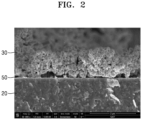
- FIG. 2 is a SEM image of an embodiment of a cathode layer, a solid electrolyte layer, and a bonding layer.
- the metal-air battery comprises an anode layer 10 comprising a metal; and a cathode layer 30 spaced apart from the anode layer 10.
- the cathode layer 30 comprises an electronically conductive metal oxide 31.
- a solid electrolyte layer 20 is disposed between the anode layer 10 and the cathode layer 30.
- a bonding layer 50 that may bond the electrically conductive metal oxide 31 to the solid electrolyte layer 20, is disposed between the solid electrolyte layer 20 and the cathode layer 30.
- the cathode layer 30 comprises the electrically conductive metal oxide 31.
- the metal-air battery may further include a gas diffusion layer 40 in contact with at least one surface of the cathode layer 30.
- the gas diffusion layer 40 may supply oxygen (O 2 ) to the cathode layer 30.
- the cathode layer 30 may further comprise a cathode catalyst, and may be a "cathode catalyst layer.”
- a cathode layer further comprising a catalyst may be referred to as a "cathode.”
- the cathode layer 30 and the gas diffusion layer 40 may be configured as a "cathode portion.”
- the cathode portion of the metal-air battery comprises the cathode layer 30, and optionally, may further include the gas diffusion layer 40.
- the anode layer 10 may include a material capable of absorbing and releasing metal ions.
- the material may include, for example, lithium (Li), sodium (Na), zinc (Zn), potassium (K), calcium (Ca), magnesium (Mg), iron (Fe), aluminum (Al), or an alloy thereof.
- the anode layer 10 may include lithium (Li).
- the anode layer 10 may include at least one of lithium, a lithium-based alloy, or a lithium intercalation compound.
- the metal-air battery may be referred to as a "lithium-air battery".
- the solid electrolyte layer 20 may include an inorganic material containing a lithium ion conductive glass, a crystalline lithium ion conductive ceramic or glass-ceramic, or a combination thereof.
- the solid electrolyte layer 20 may include Li 1+a Al a Ti 2-a (PO 4 ) 3 (LATP) (0 ⁇ a ⁇ 1) having a NASICON structure, e.g., a material isostructural with NASICON, i.e., Na 1+x Zr 2 Si x P 3-x O 12 , 0 ⁇ x ⁇ 3.
- the solid electrolyte layer 20 includes a material having a NASICON structure
- moisture may be present in the cathode layer 30 because an aqueous electrolyte material 33 is included in the cathode layer 30, and while not wanting to be bound by theory, it is understood that the moisture does not pass through the solid electrolyte layer 20, and thus, the solid electrolyte layer 20 may serve as a protective film that prevents the moisture included in the aqueous electrolyte material 33 from directly reacting with lithium included in the anode layer 10.
- ionic conductivity of the solid electrolyte layer 20 that includes the material having the NASICON structure may be improved more than ion conductivity of the solid electrolyte layer 20 having another structure.
- the ion conductivity may also be improved when the solid electrolyte layer 20 includes a compound having a garnet structure, e.g., Li a La 3 Zr 2 O 12 (LLZO) (5 ⁇ a ⁇ 9), or having a perovskite structure, e.g., La 0.55 Li 0.35 TiO 3 (LLTO).
- the solid electrolyte layer 20 may also include a material having a layered rock salt crystal structure, or a material having an argyrodite crystal structure.
- the solid electrolyte layer 20 may further include a polymer solid electrolyte component, e.g., in addition to a glass-ceramic component.
- the polymer solid electrolyte may be a lithium salt-doped polyethylene oxide.
- the lithium salt may comprise at least one of LiBF 4 , LiPF 6 , LiSbF 6 , LiAsF 6 , LiClO 4 , LiCF 3 SO 3 , LiN(SO 2 CF 3 ) 2 , LiN(SO 2 C 2 F 5 ) 2 , LiC(SO 2 CF 3 ) 3 , LiN(SO 3 CF 3 ) 2 , LiC 4 F 9 SO 3 , or LiAlCl 4 .
- the cathode layer 30 may be an air electrode, and may be configured to use oxygen (O 2 ) in the air as an active material.
- the electrically conductive metal oxide 31 may provide a path for migration of electrons, e.g., electron transport, and the metal oxide 31 may comprise a material having suitable electronic conductivity.
- the electrically conductive metal oxide 31 is at least one of RuO 2 , InSnO, IrO, OsO 2 , RhO 2 , Ce x O y wherein 0 ⁇ x ⁇ 2 and 0 ⁇ y ⁇ 3, W x O y wherein 0 ⁇ x ⁇ 2 and 0 ⁇ y ⁇ 3, NbO, Eu 2 O 3 , Ti x O y wherein 0 ⁇ x ⁇ 2 and 0 ⁇ y ⁇ 3, Mn 2 O 3 , or PbO 2 .
- the electrically conductive metal oxide may include other suitable materials.
- the electrically conductive metal oxide may have an electronic conductivity of about 1.0 ⁇ 10 -6 Siemens per centimeter (S/cm) to about 1.0 ⁇ 10 1 S/cm, about 2.0 ⁇ 10 -6 S/cm to about 1.0 ⁇ 10 1 S/cm, about 2.0 ⁇ 10 -6 S/cm to about 5.0 S/cm, about 4.0 ⁇ 10 -6 S/cm to about 5.0 S/cm, about 4.0 ⁇ 10 -6 S/cm to about 1.0 S/cm, about 5.0 ⁇ 10 -6 S/cm to about 1.0 S/cm, about 1.0 ⁇ 10 -5 S/cm to about 1.0 S/cm, about 2.0 ⁇ 10 -5 S/cm to about 1.0 S/cm, about 4.0 ⁇ 10 -5 S/cm to about 1.0 S/cm, about 5.0 ⁇ 10 -5 S/cm to about 1.0 S/cm, about 1.0 ⁇ 10 -4 S/cm to about 1.0 S/cm, about 2.0 ⁇ 10 -4 S/cm
- the electronic conductivity may be determined by an eddy current method or a kelvin bridge method.
- the electrical conductivity can be determined according to ASTM B-193, "Standard Test Method for Resistivity of Electrical Conductor Materials," e.g., at 20 °C, or according to ASTM E-1004, "Standard Test Method for Determining Electrical Conductivity Using the Electromagnetic (Eddy-Current) Method," e.g., at 20 °C. Additional details may be determined by one of skill in the art without undue experimentation.
- the electronic conductivity may be determined by an eddy current method or a kelvin bridge method.
- the electrical conductivity can be determined according to ASTM B-193, "Standard Test Method for Resistivity of Electrical Conductor Materials," e.g., at 20 °C, or according to ASTM E-1004, “Standard Test Method for Determining Electrical Conductivity Using the Electromagnetic (Eddy-Current) Method," e.g., at 20 °C. Additional details may be determined by one of skill in the art without undue experimentation.
- the cathode layer 30 may further include an aqueous electrolyte material 33 that may provide suitable ion conductivity.
- the electrolyte comprises a suitable salt, and may comprise at least one of an alkali metal, e.g., Li + or an alkaline earth metal.
- the alkali metal may be at least one of lithium (Li), sodium (Na), potassium (K), rubidium (Rb), cesium (Cs), or francium (Fr).
- the alkaline earth metal may be at least one of beryllium (Be), magnesium (Mg), calcium (Ca), strontium (Sr), barium (Ba), or radium (Ra).
- the aqueous electrolyte material may comprise at least one of a mono- or polyprotic organic acid salt, a substituted carboxylic acid, a carboxylic acid derivative, a lactone, an ester of an inorganic acid, a sulfur containing organic acid, a phenol, an inorganic neutral or acid salt, an amphoteric hydroxide, an onium salt, a halide, a sulfide, a sulfate, a nitrate, or a carbonate of an alkali metal or alkaline earth metal.
- the salt may comprise at least one of LiBr, LiCl, NaBr, NaCl, zinc nitrate, magnesium nitrate, lithium dihydrogen phosphate, or lithium hydrogen selenite.
- the aqueous electrolyte material 33 may be an aqueous solution including water vapor (H 2 O) or water vapor (H 2 O) and at least one of Li 2 SO 4 , NH 4 Cl, LiCl, or lithium bis(pentafluoroethansulfonyl)imide (LiBETI).
- a concentration of the salt in the aqueous electrolyte material may be about 0.01 molar (M) to about 1 M, for example, about 0.02 M to about 0.9 M, or about 0.04 M to about 0.7 M, or about 0.08 M to about 0.5 M.
- the aqueous electrolyte material 33 may be disposed on the bonding layer 50, and may be in the form of droplets comprising water and the salt.
- the cathode layer 30 may be an electrode that does not comprise an organic electrolyte, that is, may be an organic electrolyte-free electrode.
- An electrode can be determined to be an organic electrolyte-free electrode when an organic electrolyte cannot be detected when the electrolyte is analyzed by Fourier-transform infrared spectroscopy (FT-IR).
- Electrochemical Reaction 1 may occur in the cathode portion during discharge. Electrochemical Reaction 1 4Li + (dis.) + O 2 (dis.) + 2H 2 O (dis.) + 4e - ⁇ 4LiOH (solid)
- Lithium ions (Li + ) provided from the anode layer 10 and oxygen (O 2 ) provided from atmosphere (air) may combine (react) with electrons (e - ) on a surface of the cathode layer 30 to generate LiOH, which is a solid.
- the electrically conductive metal oxide 31 and the aqueous electrolyte material 33, which are included in the cathode layer 30, may provide for electron transport, e.g., a migration path for electrons (e - ), and ion transport, e.g., a migration path for lithium ions (Li + ).
- LiOH may be generated and is an example of a reaction product. During charge, the discharge reaction may be reversed.
- the cathode layer 30 may be configured to comprise an empty space, e.g., a pore or a void. Accordingly, the cathode layer 30 may include a void, e.g. an air gap or a pore. A plurality of voids may be randomly arranged in the cathode layer 30.
- the cathode layer 30 may include the electrically conductive metal oxide 31, and the electrically conductive metal oxide 31 may include a plurality of particles as illustrated in FIG. 1 . A plurality of voids may be randomly disposed between the plurality of particles of the electrically conductive metal oxide 31.
- the void in the cathode layer 30 may be a space in which a reaction product is formed, and at the same time, may provide a path through which gas (oxygen) moves.
- gas oxygen
- the porosity of the cathode layer 30 may be, for example, 90 volume percent (vol%) or less, based on total volume of the cathode layer.
- the porosity may be greater than 0 vol% to less than or equal to 90 vol%, about 10 vol% to about 80 vol%, about 20 vol% to about 70 vol%, or about 30 vol% to about 60 vol%, based on total volume of the cathode layer.
- the reaction area of the battery increases as the specific surface area of the cathode layer 30 increases. When the reaction area of the battery increases, the capacity may be increased and the energy density may be increased.
- the specific surface area of the cathode layer 30 may be, for example, 1 square meter per gram (m 2 /g) or more.
- the specific surface area may be 1 square meter per gram (m 2 /g) to about 1000 m 2 /g, about 1.5 m 2 /g to about 500 m 2 /g, about 2 m 2 /g to about 100 m 2 /g, about 5 m 2 /g to about 50 m 2 /g, or about 7 m 2 /g to about 25 m 2 /g.
- the specific surface area may be determined by using nitrogen isotherms. See, for example, E. P. Barrett, L. G. Joyner, P. P. Halenda, "The determination of pore volume and area distributions in porous substances. I. Computations from nitrogen isotherms," J. Am. Chem. Soc. (1951), 73, 373-380 .
- the cathode layer 30 may be porous, and the electrically conductive metal oxide 31 included in the cathode layer 30 may comprise a plurality of particles to form the void.
- the electrically conductive metal oxide 31 is formed of the plurality of particles and the plurality of particles are combined together, a connection between the plurality of particles may be weak, and thereby, an electrode form of the cathode layer 30 may be difficult to maintain in the process of charge and discharge. Due to this weak connection, separation and peeling may occur between the cathode layer 30 and the solid electrolyte layer 20, which may weaken charge and discharge characteristics of the metal-air battery.
- the bonding layer 50 is a bonding member that is disposed between the cathode layer 30 and the solid electrolyte layer 20 to bond the cathode layer 30 to the solid electrolyte layer 20.
- the bonding layer 50 has a melting point lower than a melting point and/or sublimation point (e.g., at 1 atmosphere) of the cathode layer 30. Accordingly, in the process of sintering the bonding layer 50 disposed between the solid electrolyte layer 20 and the electrically conductive metal oxide 31, only the bonding layer 50 may be melted, without a change, e.g., to the form or composition, of the electrically conductive metal oxide 31.
- the bonding layer 50 may bond the electrically conductive metal oxide 31 to the solid electrolyte layer 20, as illustrated in FIG. 2 .
- a more detailed process of bonding the electrically conductive metal oxide 31 to the solid electrolyte layer 20 by using the bonding layer 50 is described with reference to FIGS. 3A to 3E .
- the bonding layer 50 may include a material having electronic conductivity, for example, at least one of Pt, Au, Mn, Co, Ni, Cr, V, Fe, Pb, or Sn.
- a thickness of the bonding layer 50 according to an example may be 10 nm or less, and thus, the specific surface area may be increased.
- a portion of the electrically conductive metal oxide 31 may be disposed to be in contact with the bonding layer 50, and the gas diffusion layer 40 may be disposed on the other surface of the cathode layer comprising the electrically conductive metal oxide 31.
- the gas diffusion layer 40 may absorb oxygen and carbon dioxide in the atmosphere and provide the same to the cathode layer 30.
- the gas diffusion layer 40 may have a porous structure to smoothly diffuse oxygen and carbon dioxide.
- the gas diffusion layer 40 may comprise at least one of carbon paper, carbon cloth, carbon felt including carbon fiber, sponge-like foam metal, or a metal fiber mat.
- the gas diffusion layer 40 may comprise a flexible porous material, which is not conductive, such as a nonwoven fabric.
- the cathode layer 30 may have a porous structure or other suitable structure and may perform as the gas diffusion layer and the cathode layer.
- the gas diffusion layer 40 may be omitted if desired.
- an anode current collector in contact with the anode layer 10 may be further provided.
- the anode current collector may be provided on a bottom surface of the anode layer 10. Accordingly, the anode layer 10 may be disposed between the anode current collector and the solid electrolyte layer 20.
- the anode current collector may include, for example, copper (Cu), stainless steel (SUS), silver (Ag), magnesium (Mg), or other suitable conductor.
- a cathode current collector in contact with the gas diffusion layer 40 may be further provided.
- a cathode current collector may be provided on an upper surface of the gas diffusion layer 40. Accordingly, the gas diffusion layer 40 may be disposed between the cathode current collector and the cathode layer 30.
- the cathode current collector may include, for example, stainless steel (SUS) or a porous carbon material.
- SUS stainless steel
- the SUS may have a mesh structure for permeation of air (gas).
- the material of the cathode current collector is not limited to SUS, and may be another suitable material, e.g., aluminum.
- the cathode current collector may be in contact with the cathode layer 30.
- the anode portion may comprise the anode current collector, and similarly, the cathode portion may comprise the cathode current collector.
- FIGS. 3A to 3E are cross-sectional views schematically illustrating an embodiment of a method of manufacturing the metal-air battery.
- the solid electrolyte layer 20 may be provided.
- the solid electrolyte layer 20 may be provided in a flat plate shape, e.g., in the form of a film or layer.
- the solid electrolyte layer 20 may comprise at least one of a compound having a NASICON structure, e.g., Li 1+a Al a Ti 2-a (PO 4 ) 3 (LATP) (0 ⁇ a ⁇ 1), a compound having a garnet structure, e.g., Li a La 3 Zr 2 O 12 (LLZO) (5 ⁇ a ⁇ 9) , or a compound having a perovskite structure, e.g., La 0.55 Li 0.35 TiO 3 (LLTO).
- a compound having a NASICON structure e.g., Li 1+a Al a Ti 2-a (PO 4 ) 3 (LATP) (0 ⁇ a ⁇ 1)
- a compound having a garnet structure e.g., Li a La 3 Zr 2 O 12 (LLZO
- an upper surface of the solid electrolyte layer 20 may be coated with the bonding layer 50.
- the upper surface of the solid electrolyte layer 20 may be coated with the bonding layer 50 by using a sputtering method.
- the bonding layer 50 may include at least one of Pt, Au, Mn, Co, Ni, Cr, V, Fe, Pb, or Sn.
- a metal oxide composite layer 60 including the electrically conductive metal oxide 31 may be disposed on an upper surface of the bonding layer 50.
- the electrically conductive metal oxide composite layer 60 may be formed in a thin plate shape, e.g., as a layer, and include the electrically conductive metal oxide 31 and a binder (not illustrated).
- the metal oxide composite layer 60 may be a product of coating a mixture comprising the electrically conductive metal oxide 31.
- the mixture comprising the electrically conductive metal oxide may be formed by mixing and grinding the electrically conductive metal oxide 31 and the binder (not illustrated), for example, ruthenium oxide (RuO 2 ) and 30 weight percent (wt%) polyvinyl butyral for approximately 1 hour using a mixer, and thereafter, the electrically conductive metal oxide 31 and binder slurry may be bar-coated and dried to provide the metal oxide composite layer 60 having a thin plate shape.
- the electrically conductive metal oxide 31 and the binder for example, ruthenium oxide (RuO 2 ) and 30 weight percent (wt%) polyvinyl butyral for approximately 1 hour using a mixer, and thereafter, the electrically conductive metal oxide 31 and binder slurry may be bar-coated and dried to provide the metal oxide composite layer 60 having a thin plate shape.
- the metal oxide composite layer 60 may be disposed on an upper surface of the bonding layer 50.
- the metal oxide composite layer 60 may be supported by the bonding layer 50 by using a material capable of applying a predetermined force, for example, ethyl alcohol.
- the solid electrolyte layer 20, the bonding layer 50, and the metal oxide composite layer 60 may be heat-treated at a predetermined temperature.
- a composite of the solid electrolyte layer 20, the bonding layer 50, and the metal oxide composite layer 60 may be disposed in a furnace 70, which may be heat-treated at a predetermined temperature.
- the composite of the solid electrolyte layer 20, the bonding layer 50, and the metal oxide composite layer 60 may have a temperature lower than a predetermined temperature, for example, a melting point and/or sublimation point (at 1 atmosphere) of the electrically conductive metal oxide 31 included in the metal oxide composite layer 60, and may be heat to a temperature higher than the melting point of the material included in the bonding layer 50.
- an internal temperature of the furnace 70 may be 500 °C to 800 °C, and the temperature range is not limited thereto.
- the temperature of the heat-treatment may be about 525 °C to about 775 °C, about 550 °C to about 750 °C, about 575 °C to about 725 °C, or about 600 °C to about 700 °C.
- the heat-treatment may be for a predetermined amount of time, e.g. for about 1 hour to about 24 hours, for about 2 hours to about 20 hours, for about 4 hours to about 16 hours, or for about 6 hours to about 12 hours.
- the bonding layer 50, and the metal oxide composite layer 60 When the composite of the solid electrolyte layer 20, the bonding layer 50, and the metal oxide composite layer 60 is heat-treated, a binder (not illustrated) included in the metal oxide composite layer 60 may be removed. In addition, a material included in the bonding layer 50 may be melted. In an aspect, because the melting point and/or sublimation point (at 1 atmosphere) of the electrically conductive metal oxide 31 may be greater than the melting point of the bonding layer 50, the metal oxide 31 may not be melted. As the bonding layer 50 is melted, a portion of the electrically conductive metal oxide 31 included in the metal oxide composite layer 60 is buried into the bonding layers 50, and thus, the bonding layer 50 may bond the electrically conductive metal oxide 31 to the solid electrolyte layer 20.
- the anode layer 10 may be disposed on a lower surface of the solid electrolyte layer 20.
- the anode layer 10 may be a lithium metal layer, but the anode layer is not limited thereto, and any other suitable anode material may be used.
- FIG. 4 is a cross-sectional view illustrating a comparative example of the metal-air battery.
- FIG. 5A is an SEM image of an embodiment of the cathode.
- FIG. 5B is an SEM image of a comparative example of the cathode.
- a metal-air battery according to the comparative example may include the anode layer 10 including a metal and the cathode layer 30 spaced apart from the anode layer 10.
- the cathode layer 30 may include the electrically conductive metal oxide 31.
- the solid electrolyte layer 20 may be disposed between the anode layer 10 and the cathode layer 30.
- the metal-air battery may further include the gas diffusion layer 40 in contact with at least one surface of the cathode layer 30.
- the metal-air battery according to the comparative example as illustrated in FIG. 4 does not include a bonding layer 50 capable of bonding the electrically conductive metal oxide 31 to the solid electrolyte layer 20.
- the solid electrolyte layer 20 may comprise, e.g. an LATP material, and an electrically conductive metal oxide 31, e.g., ruthenium oxide (RuO 2 ), e.g., in the form of nano powder, may be disposed on an upper portion of the solid electrolyte layer 20.
- an electrically conductive metal oxide 31 e.g., ruthenium oxide (RuO 2 )
- the amount of electrode loading may increase to about 0.8 milligrams per square centimeter (mg/cm 2 ).
- Platinum (Pt) may be coated on the upper surface of the solid electrolyte layer 20 at a predetermined thickness, for example, a thickness of about 7 nanometers (nm) as the bonding layer 50.
- an electrode comprising the electrically conductive metal oxide 31 may be maintained as illustrated in FIG. 5A .
- electrical conductivity may be increased, and the charge and discharge characteristics may also be improved.
- the solid electrolyte layer 20 may include, e.g. an LATP material, and an electrically conductive metal oxide 31, e.g. ruthenium oxide (RuO 2 ) in the form of nano powder, disposed on an upper portion of the solid electrolyte layer 20.
- an electrically conductive metal oxide 31 e.g. ruthenium oxide (RuO 2 )
- the amount of electrode loading may increase to about 0.8 mg/cm 2 .
- the electrode formed from the electrically conductive metal oxide 31 may be damaged, as illustrated in FIG. 5B .
- a metal-air battery comprising an electrode formed without a separate bonding layer has decreased electrical conductivity, and reduced charge and discharge capability .
- FIG. 6A is a cross-sectional view illustrating an embodiment of a configuration of a metal-air battery.
- FIG. 6B is a cross-sectional view illustrating a comparative example of a configuration of a metal-air battery.
- the configuration may be an experimental structure for evaluating performance of the metal-air battery.
- the metal-air battery is in the form of a coin cell.
- Elements of the battery may be provided in a case 180 having a plurality of open regions H1.
- a support structure 110 may be provided on a lower surface of the case 180.
- the support structure 110 may include, for example, a spacer and a spring member.
- the anode layer 10 comprising a metal may be provided on the support structure 110.
- the solid electrolyte layer 20 may be provided on the anode layer 10.
- the bonding layer 50 may be disposed on an upper portion of the solid electrolyte layer 20.
- the cathode layer 30 comprising the electrically conductive metal oxide 31 may be disposed on an upper portion of the bonding layer 50.
- the bonding layer 50 is not disposed between the solid electrolyte layer 20 and the cathode layer 30.
- the cathode layer 30 in an embodiment and in a comparative example may have a structure including a plurality of voids.
- An electrically conductive material layer (hereinafter “conductive layer”) 160 may be provided on the cathode layer 30, and a gas diffusion layer 40 may be provided on the conductive layer 160.
- the gas diffusion layer 40 may be disposed adjacent to the plurality of opening regions H1 to supply external air to the cathode layer 30.
- the anode layer 10 may include Li
- the solid electrolyte layer 20 may include lithium aluminum titanium phosphate (LATP), which is a solid electrolyte.
- LATP lithium aluminum titanium phosphate
- the LATP may be Li 1+x Al x Ti 2-x (PO 4 ) 3 , where x may be about 0.3.
- the cathode layer 30 may include ruthenium oxide (RuO 2 ) as the electrically conductive metal oxide 31.
- the conductive layer 160 may include at least one of Au, Ag, Pd, or Pt, for example.
- a bonding layer comprising platinum (Pt) may be disposed between the cathode layer 30 and the solid electrolyte layer 20.
- the metal-air battery described in FIGS. 6A and 6B were analyzed to confirm whether or not oxygen (O 2 ) in the atmosphere is reduced/oxidized on a surface of the cathode layer 30.
- O 2 oxygen
- characteristics were evaluated in oxygen (O 2 ) atmosphere and in a water vapor (H 2 O) atmosphere.
- water vapor (H 2 O) may be used to provide water to the aqueous electrolyte material.
- the cycling characteristics of the metal-air battery according to an example and according to a comparative example were evaluated by repeatedly performing charge and discharge cycles on the metal-air batteries.
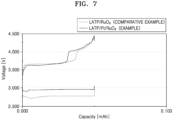
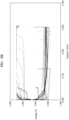
- FIGS. 7 , 8A , and 8B are graphs, according to an example and a comparative example, illustrating voltage (V) versus charge capacity (milliampere hours, mAh) for metal-air batteries.
- FIG. 9 is a graph, according to an example and a comparative example, illustrating capacity (mAh) versus number of charge and discharge cycles (-).
- the graphs of FIGS. 7 to 9 are graphs, according to an example and a comparative example, obtained using a COMSOL analysis program.
- COMSOL Multiphysics is a cross-platform finite element analysis, solver and multiphysics simulation software. The analysis used to generate the graphs shown in FIGS 7 to 9 assumed for the Example that the bonding layer 50 is disposed between the solid electrolyte layer 20 and the cathode layer 30, and assume, for the Comparative Example, that the bonding layer 50 is not disposed between the solid electrolyte layer 20 and the cathode layer 30.
- the metal-air battery when the metal-air battery, according to an example and a comparative example, were charged and discharged once to 0.3 mAh at 0.02 mA/cm 2 .
- the discharge potential is 2.9 V
- the Comparative Example in which the bonding layer 50 is not disposed between the solid electrolyte layer 20 and the cathode layer 30, the discharge potential is reduced to 2.75 V.
- FIGS. 8A and 8B the capacity of a metal-air battery, according to an example and a comparative example, are illustrated after a plurality of charge and discharge cycles.
- the bonding layer 50 is disposed between the solid electrolyte layer 20 and the cathode layer 30
- a uniform potential is provided throughout the charge and discharge cycles
- an overvoltage continuously increases.
- the capacity of a metal-air battery is illustrated after a plurality of charge and discharge cycles up to a predetermined discharge voltage.
- the bonding layer 50 is disposed between the solid electrolyte layer 20 and the cathode layer 30, it may be confirmed that the charge and discharge are performed with a uniform discharge potential up to a total of 89 times, while in the Comparative Example in which the bonding layer 50 is not disposed between the solid electrolyte layer 20 and the cathode layer 30, it may be confirmed that the charge and discharge are performed up to 52 times.
- the bonding layer 50 is disposed between the solid electrolyte layer 20 and the cathode layer 30, overvoltage may be reduced and reproducibility and charge capacity may be improved.
- a metal-air battery will be prepared using Li 1.3 Al 0.3 Ti 1.7 (PO 4 ) 3 as a solid electrolyte layer.
- a metal oxide composite layer will be formed by mixing and grinding ruthenium oxide (RuO 2 ) and polyvinyl butyral (30 wt%), for approximately 1 hour using a mixer, and thereafter, the slurry will be bar-coated and dried to form a metal oxide composite layer.
- the metal oxide composite layer will be disposed on an upper portion of the solid electrolyte layer to provide a cathode in the battery.
- the electrode loading will be about 0.8 mg/cm 2 .
- the cathode in the battery will be damaged during charge and discharge cycles.
- a metal air-battery will prepared in the same manner as the Comparative Example, except that a separate bonding layer will be disposed between the solid electrolyte layer and the metal oxide composite layer. 7 nm of platinum will be coated on the upper surface of the solid electrolyte layer as the bonding layer.
- the metal oxide composite layer (RuO 2 ) and the bonding layer will be sintered at 800 °C for 4 hours. The electrode loading will be about 0.8 mg/cm 2 .
- the efficiency of a metal-air battery may be improved when the bonding layer 50 is disposed between the solid electrolyte layer 20 and the cathode layer 30, because damage of the cathode layer 30 is reduced, and electrical conductivity is increased between the electrically conductive metal oxides 31 included in the cathode layer 30, which reduces an overpotential effect.
- the cathode of the metal-air battery according to an example in which the bonding layer 50 is disposed between the solid electrolyte layer 20 and the cathode layer 30 may improve performance and extend the life of the battery.
Landscapes
- Chemical & Material Sciences (AREA)
- Chemical Kinetics & Catalysis (AREA)
- Electrochemistry (AREA)
- General Chemical & Material Sciences (AREA)
- Engineering & Computer Science (AREA)
- Manufacturing & Machinery (AREA)
- Materials Engineering (AREA)
- Condensed Matter Physics & Semiconductors (AREA)
- Physics & Mathematics (AREA)
- General Physics & Mathematics (AREA)
- Inorganic Chemistry (AREA)
- Life Sciences & Earth Sciences (AREA)
- Sustainable Development (AREA)
- Sustainable Energy (AREA)
- Hybrid Cells (AREA)
- Inert Electrodes (AREA)
Description
- The present disclosure relates to a secondary battery, and more particularly, to a metal-air battery.
- A metal-air battery includes an anode capable of absorbing and releasing ions and a cathode that uses oxygen in the air as an active material. Reduction and oxidation reactions of oxygen occur in the cathode, and oxidation and reduction reactions of a metal occur in the anode. Chemical energy generated during the oxidation and reduction reactions of the metal is converted into electrical energy to then be extracted. For example, the metal-air battery absorbs oxygen during discharge and releases oxygen during charge. When the metal-air battery uses oxygen from air, a specific energy of the battery may be greatly increased. For example, the metal-air battery may have specific energy several times higher than an existing lithium ion battery.
- In a metal-air battery, the cathode has an electron transport path and an ion transport path, and a capacity or performance of the metal-air battery may be significantly influenced by the cathode material and a configuration of the cathode or air electrode. The cathode material may be porous, e.g., have a void structure, and bonding between particles in the cathode may be weakened, resulting in deformation of the cathode material. Deformation of the cathode may cause reduced performance and a shortened life span in the metal-air battery. Thus there remains a need for improved metal-air battery materials.
-
US 2018/0114977 A1 discloses electrochemical devices and methods for making electrochemical devices such as metal infiltrated electrodes for solid state lithium ion and lithium metal batteries. - Christensen et al. (J. Electrochem. Soc. 2011, 159, 2, R1-R30) have discussed the challenges to developing robust, high-energy lithium air batteries.
-
US 2016/0064785 A1 discloses a lithium air battery including a composite cathode including a porous material and a first solid electrolyte, a lithium metal anode, an oxygen blocking layer, and a cathode interlayer including a lithium ion conducting second solid electrolyte. -
US 2020/0212451 A1 discloses a cathode configured to use oxygen as a cathode active material comprising a conductive layer including an electronic conductor, wherein the conductive layer is free of pores. - Provided is a metal-air battery having excellent charge and discharge characteristics.
- Provided is a metal-air battery capable of preventing deformation of a cathode.
- Additional aspects will be set forth in part in the description which follows and, in part, will be apparent from the description.
- According to an aspect, a metal-air battery is provided in accordance with claim 1.
- The bonding layer may include at least one of Pt, Au, Mn, Co, Ni, Cr, V, Fe, Pb, or Sn.
- A thickness of the bonding layer may be 10 nanometers (nm) or less.
- The cathode layer may be porous.
- A porosity of the cathode layer may be 90 volume percent (vol%) or less, based on a total volume of the cathode layer.
- A specific surface area of the cathode layer may be 1 square meter per gram (m2/g) or more, based on a total specific surface area of the cathode layer.
- The solid electrolyte layer may include at least one compound having a NASICON structure, a garnet structure, or a perovskite structure.
- The solid electrolyte layer may include at least one of Li1+aAlaTi2-a(PO4)3 (LATP) wherein 0≤a≤1, LiaLa3Zr2O12 (LLZO) wherein 5≤a≤9, or La0.55Li0.35TiO3 (LLTO).
- The metal-air battery may further include a gas diffusion layer on at least one surface of the cathode layer.
- The cathode layer may not include an organic electrolyte.
- According to another aspect, there is provided a method of manufacturing a metal-air battery in accordance with claim 8.
- The metal oxide composite layer may be in the shape of a plate.
- The heat-treating may include heat-treating at a temperature of 500 °C to 800 °C.
- The heat-treating may bond the electrically conductive metal oxide to the bonding layer.
- A melting point of the bonding layer may be between 230 °C and about 1910 °C.
- The bonding layer may include at least one of Pt, Au, Mn, Co, Ni, Cr, V, Fe, Pb, or Sn.
- A thickness of the bonding layer may be 10 nanometers (nm) or less.
- The solid electrolyte layer may have at least one compound having a NASICON structure, a garnet structure, or a perovskite structure.
- The solid electrolyte layer may include at least one of Li1+aAlaTi2-a(PO4)3 (LATP) wherein 0≤a≤1, LiaLa3Zr2O12 (LLZO) wherein 5≤a≤9, or La0.55Li0.35TiO3 (LLTO).
- The method may further include disposing a gas diffusion layer on at least one surface of the cathode layer.
- The above and other aspects, features, and advantages of certain embodiments of the disclosure will be more apparent from the following description taken in conjunction with the accompanying drawings, in which:
-
FIG. 1 is a cross-sectional view schematically illustrating an embodiment of a metal-air battery; -
FIG. 2 is a SEM image of an embodiment of a cathode layer, a solid electrolyte layer, and a bonding layer; -
FIGS. 3A to 3E are cross-sectional views schematically illustrating an embodiment of a method of manufacturing a metal-air battery; -
FIG. 4 is a cross-sectional view illustrating a comparative example of a metal-air battery; -
FIG. 5A is an SEM image of an embodiment of a cathode; -
FIG. 5B is a SEM image of a comparative example of a cathode; -
FIG. 6A is a cross-sectional view schematically illustrating an embodiment of a configuration of a metal-air battery; -
FIG. 6B is a cross-sectional view schematically illustrating a comparative example of a configuration of a metal-air battery; and -
FIGS. 7 ,8A , and8B are each a graph of voltage (Volts, V) vs capacity (milliampere hours, mAh) illustrating charge and discharge simulation results for an Example and a Comparative Example metal-air batteries. -
FIG. 9 is a graph of capacity (mAh) versus number of charge and discharge cycles for the Example and the Comparative Example. - The regions illustrated in the figures are schematic in nature and their shapes are not intended to illustrate the precise shape of a region and are not intended to limit the scope of the present claims.
- Hereinafter, a metal-air battery according to an embodiment will be described in further detail with reference to the accompanying drawings. Widths and thicknesses of layers or regions illustrated in the accompanying drawings may be exaggerated for the sake of clarity. Like reference numerals refer to like elements throughout.
-
FIG. 1 is a cross-sectional view schematically illustrating an embodiment of a metal-air battery.FIG. 2 is a SEM image of an embodiment of a cathode layer, a solid electrolyte layer, and a bonding layer. - Referring to
FIG. 1 , the metal-air battery comprises ananode layer 10 comprising a metal; and acathode layer 30 spaced apart from theanode layer 10. Thecathode layer 30 comprises an electronicallyconductive metal oxide 31. Asolid electrolyte layer 20 is disposed between theanode layer 10 and thecathode layer 30. Abonding layer 50 that may bond the electricallyconductive metal oxide 31 to thesolid electrolyte layer 20, is disposed between thesolid electrolyte layer 20 and thecathode layer 30. Thecathode layer 30 comprises the electricallyconductive metal oxide 31. The metal-air battery may further include agas diffusion layer 40 in contact with at least one surface of thecathode layer 30. Thegas diffusion layer 40 may supply oxygen (O2) to thecathode layer 30. Thecathode layer 30 may further comprise a cathode catalyst, and may be a "cathode catalyst layer." A cathode layer further comprising a catalyst may be referred to as a "cathode." Thecathode layer 30 and thegas diffusion layer 40 may be configured as a "cathode portion." In an aspect, the cathode portion of the metal-air battery comprises thecathode layer 30, and optionally, may further include thegas diffusion layer 40. - The
anode layer 10 may include a material capable of absorbing and releasing metal ions. The material may include, for example, lithium (Li), sodium (Na), zinc (Zn), potassium (K), calcium (Ca), magnesium (Mg), iron (Fe), aluminum (Al), or an alloy thereof. For example, theanode layer 10 may include lithium (Li). Theanode layer 10 may include at least one of lithium, a lithium-based alloy, or a lithium intercalation compound. When theanode layer 10 includes lithium, the metal-air battery may be referred to as a "lithium-air battery". - The
solid electrolyte layer 20 may include an inorganic material containing a lithium ion conductive glass, a crystalline lithium ion conductive ceramic or glass-ceramic, or a combination thereof. For example, thesolid electrolyte layer 20 may include Li1+aAlaTi2-a(PO4)3 (LATP) (0≤a≤1) having a NASICON structure, e.g., a material isostructural with NASICON, i.e., Na1+xZr2SixP3-xO12, 0<x<3. For example, in an aspect wherein thesolid electrolyte layer 20 includes a material having a NASICON structure, although moisture may be present in thecathode layer 30 because anaqueous electrolyte material 33 is included in thecathode layer 30, and while not wanting to be bound by theory, it is understood that the moisture does not pass through thesolid electrolyte layer 20, and thus, thesolid electrolyte layer 20 may serve as a protective film that prevents the moisture included in theaqueous electrolyte material 33 from directly reacting with lithium included in theanode layer 10. In addition, and while not wanting to be bound by theory, it is understood that ionic conductivity of thesolid electrolyte layer 20 that includes the material having the NASICON structure may be improved more than ion conductivity of thesolid electrolyte layer 20 having another structure. The ion conductivity may also be improved when thesolid electrolyte layer 20 includes a compound having a garnet structure, e.g., LiaLa3Zr2O12 (LLZO) (5≤a≤9), or having a perovskite structure, e.g., La0.55Li0.35TiO3 (LLTO). In addition, thesolid electrolyte layer 20 may also include a material having a layered rock salt crystal structure, or a material having an argyrodite crystal structure. In addition, thesolid electrolyte layer 20 may further include a polymer solid electrolyte component, e.g., in addition to a glass-ceramic component. The polymer solid electrolyte may be a lithium salt-doped polyethylene oxide. The lithium salt may comprise at least one of LiBF4, LiPF6, LiSbF6, LiAsF6, LiClO4, LiCF3SO3, LiN(SO2CF3)2, LiN(SO2C2F5)2, LiC(SO2CF3)3, LiN(SO3CF3)2, LiC4F9SO3, or LiAlCl4. Thecathode layer 30 may be an air electrode, and may be configured to use oxygen (O2) in the air as an active material. For an electrochemical reaction of metal ions provided from theanode layer 10 and gas (e.g., oxygen from the air) provided to thecathode layer 30, the electricallyconductive metal oxide 31 may provide a path for migration of electrons, e.g., electron transport, and themetal oxide 31 may comprise a material having suitable electronic conductivity. The electricallyconductive metal oxide 31 is at least one of RuO2, InSnO, IrO, OsO2, RhO2, CexOy wherein 0≤x≤2 and 0≤y≤3, WxOy wherein 0≤x≤2 and 0≤y≤3, NbO, Eu2O3, TixOy wherein 0≤x≤2 and 0≤y≤3, Mn2O3, or PbO2. The electrically conductive metal oxide may include other suitable materials. - The electrically conductive metal oxide may have an electronic conductivity of about 1.0×10⁻⁶ Siemens per centimeter (S/cm) to about 1.0×101 S/cm, about 2.0×10⁻⁶ S/cm to about 1.0×101 S/cm, about 2.0×10⁻⁶ S/cm to about 5.0 S/cm, about 4.0×10⁻⁶ S/cm to about 5.0 S/cm, about 4.0×10⁻⁶ S/cm to about 1.0 S/cm, about 5.0×10⁻⁶ S/cm to about 1.0 S/cm, about 1.0×10⁻⁵ S/cm to about 1.0 S/cm, about 2.0×10⁻⁵ S/cm to about 1.0 S/cm, about 4.0×10⁻⁵ S/cm to about 1.0 S/cm, about 5.0×10⁻⁵ S/cm to about 1.0 S/cm, about 1.0×10⁻⁴ S/cm to about 1.0 S/cm, about 2.0×10⁻⁴ S/cm to about 1.0 S/cm, about 2.0×10⁻⁴ S/cm to about 5.0×10⁻¹ S/cm, or about 2.0×10⁻⁴ S/cm to about 1.0×10⁻¹ S/cm. The electronic conductivity may be determined by an eddy current method or a kelvin bridge method. The electrical conductivity can be determined according to ASTM B-193, "Standard Test Method for Resistivity of Electrical Conductor Materials," e.g., at 20 °C, or according to ASTM E-1004, "Standard Test Method for Determining Electrical Conductivity Using the Electromagnetic (Eddy-Current) Method," e.g., at 20 °C. Additional details may be determined by one of skill in the art without undue experimentation. The electronic conductivity may be determined by an eddy current method or a kelvin bridge method. The electrical conductivity can be determined according to ASTM B-193, "Standard Test Method for Resistivity of Electrical Conductor Materials," e.g., at 20 °C, or according to ASTM E-1004, "Standard Test Method for Determining Electrical Conductivity Using the Electromagnetic (Eddy-Current) Method," e.g., at 20 °C. Additional details may be determined by one of skill in the art without undue experimentation.
- For example, the
cathode layer 30 may further include anaqueous electrolyte material 33 that may provide suitable ion conductivity. - The electrolyte comprises a suitable salt, and may comprise at least one of an alkali metal, e.g., Li+ or an alkaline earth metal. The alkali metal may be at least one of lithium (Li), sodium (Na), potassium (K), rubidium (Rb), cesium (Cs), or francium (Fr). The alkaline earth metal may be at least one of beryllium (Be), magnesium (Mg), calcium (Ca), strontium (Sr), barium (Ba), or radium (Ra).
- The aqueous electrolyte material may comprise at least one of a mono- or polyprotic organic acid salt, a substituted carboxylic acid, a carboxylic acid derivative, a lactone, an ester of an inorganic acid, a sulfur containing organic acid, a phenol, an inorganic neutral or acid salt, an amphoteric hydroxide, an onium salt, a halide, a sulfide, a sulfate, a nitrate, or a carbonate of an alkali metal or alkaline earth metal. For example, the salt may comprise at least one of LiBr, LiCl, NaBr, NaCl, zinc nitrate, magnesium nitrate, lithium dihydrogen phosphate, or lithium hydrogen selenite. The
aqueous electrolyte material 33 may be an aqueous solution including water vapor (H2O) or water vapor (H2O) and at least one of Li2SO4, NH4Cl, LiCl, or lithium bis(pentafluoroethansulfonyl)imide (LiBETI). - A concentration of the salt in the aqueous electrolyte material may be about 0.01 molar (M) to about 1 M, for example, about 0.02 M to about 0.9 M, or about 0.04 M to about 0.7 M, or about 0.08 M to about 0.5 M.
- As illustrated in
FIG. 1 , theaqueous electrolyte material 33 may be disposed on thebonding layer 50, and may be in the form of droplets comprising water and the salt. In an aspect, thecathode layer 30 may be an electrode that does not comprise an organic electrolyte, that is, may be an organic electrolyte-free electrode. An electrode can be determined to be an organic electrolyte-free electrode when an organic electrolyte cannot be detected when the electrolyte is analyzed by Fourier-transform infrared spectroscopy (FT-IR). - When the metal-air battery according to an embodiment is a lithium-air battery, the Electrochemical Reaction 1 may occur in the cathode portion during discharge.
Electrochemical Reaction 1 4Li+ (dis.) + O2 (dis.) + 2H2O (dis.) + 4e- → 4LiOH (solid)
- Lithium ions (Li+) provided from the
anode layer 10 and oxygen (O2) provided from atmosphere (air) may combine (react) with electrons (e-) on a surface of thecathode layer 30 to generate LiOH, which is a solid. The electricallyconductive metal oxide 31 and theaqueous electrolyte material 33, which are included in thecathode layer 30, may provide for electron transport, e.g., a migration path for electrons (e-), and ion transport, e.g., a migration path for lithium ions (Li+). LiOH may be generated and is an example of a reaction product. During charge, the discharge reaction may be reversed. - In order for oxygen (O2) provided from the atmosphere (air) to combine (react) with an electron (e-) on the surface of the
cathode layer 30, thecathode layer 30 according to an example may be configured to comprise an empty space, e.g., a pore or a void. Accordingly, thecathode layer 30 may include a void, e.g. an air gap or a pore. A plurality of voids may be randomly arranged in thecathode layer 30. Thecathode layer 30 according to an embodiment may include the electricallyconductive metal oxide 31, and the electricallyconductive metal oxide 31 may include a plurality of particles as illustrated inFIG. 1 . A plurality of voids may be randomly disposed between the plurality of particles of the electricallyconductive metal oxide 31. - The void in the
cathode layer 30 may be a space in which a reaction product is formed, and at the same time, may provide a path through which gas (oxygen) moves. When the void is not filled with an electrolyte and is left empty or is only partially filled, the gas (oxygen) may be supplied with improved homogeneity. - Because the reaction area of the battery increases as a porosity of the
cathode layer 30 increases, a capacity may be increased and an energy density may be increased. The porosity of thecathode layer 30 may be, for example, 90 volume percent (vol%) or less, based on total volume of the cathode layer. The porosity may be greater than 0 vol% to less than or equal to 90 vol%, about 10 vol% to about 80 vol%, about 20 vol% to about 70 vol%, or about 30 vol% to about 60 vol%, based on total volume of the cathode layer. In addition, the reaction area of the battery increases as the specific surface area of thecathode layer 30 increases. When the reaction area of the battery increases, the capacity may be increased and the energy density may be increased. The specific surface area of thecathode layer 30 may be, for example, 1 square meter per gram (m2/g) or more. The specific surface area may be 1 square meter per gram (m2/g) to about 1000 m2/g, about 1.5 m2/g to about 500 m2/g, about 2 m2/g to about 100 m2/g, about 5 m2/g to about 50 m2/g, or about 7 m2/g to about 25 m2/g. The specific surface area may be determined by using nitrogen isotherms. See, for example, E. P. Barrett, L. G. Joyner, P. P. Halenda, "The determination of pore volume and area distributions in porous substances. I. Computations from nitrogen isotherms," J. Am. Chem. Soc. (1951), 73, 373-380. - The
cathode layer 30 may be porous, and the electricallyconductive metal oxide 31 included in thecathode layer 30 may comprise a plurality of particles to form the void. When the electricallyconductive metal oxide 31 is formed of the plurality of particles and the plurality of particles are combined together, a connection between the plurality of particles may be weak, and thereby, an electrode form of thecathode layer 30 may be difficult to maintain in the process of charge and discharge. Due to this weak connection, separation and peeling may occur between thecathode layer 30 and thesolid electrolyte layer 20, which may weaken charge and discharge characteristics of the metal-air battery. - The
bonding layer 50 is a bonding member that is disposed between thecathode layer 30 and thesolid electrolyte layer 20 to bond thecathode layer 30 to thesolid electrolyte layer 20. Thebonding layer 50 has a melting point lower than a melting point and/or sublimation point (e.g., at 1 atmosphere) of thecathode layer 30. Accordingly, in the process of sintering thebonding layer 50 disposed between thesolid electrolyte layer 20 and the electricallyconductive metal oxide 31, only thebonding layer 50 may be melted, without a change, e.g., to the form or composition, of the electricallyconductive metal oxide 31. In the process of cooling themolten bonding layer 50, thebonding layer 50 may bond the electricallyconductive metal oxide 31 to thesolid electrolyte layer 20, as illustrated inFIG. 2 . A more detailed process of bonding the electricallyconductive metal oxide 31 to thesolid electrolyte layer 20 by using thebonding layer 50 is described with reference toFIGS. 3A to 3E . - The
bonding layer 50 according to an example may include a material having electronic conductivity, for example, at least one of Pt, Au, Mn, Co, Ni, Cr, V, Fe, Pb, or Sn. In addition, a thickness of thebonding layer 50 according to an example may be 10 nm or less, and thus, the specific surface area may be increased. As is further described above, a portion of the electricallyconductive metal oxide 31 may be disposed to be in contact with thebonding layer 50, and thegas diffusion layer 40 may be disposed on the other surface of the cathode layer comprising the electricallyconductive metal oxide 31. - The
gas diffusion layer 40 may absorb oxygen and carbon dioxide in the atmosphere and provide the same to thecathode layer 30. Thegas diffusion layer 40 may have a porous structure to smoothly diffuse oxygen and carbon dioxide. For example, thegas diffusion layer 40 may comprise at least one of carbon paper, carbon cloth, carbon felt including carbon fiber, sponge-like foam metal, or a metal fiber mat. In addition, thegas diffusion layer 40 may comprise a flexible porous material, which is not conductive, such as a nonwoven fabric. Thecathode layer 30 may have a porous structure or other suitable structure and may perform as the gas diffusion layer and the cathode layer. Thegas diffusion layer 40 may be omitted if desired. - Although not illustrated in
FIG. 1 , an anode current collector in contact with theanode layer 10 may be further provided. The anode current collector may be provided on a bottom surface of theanode layer 10. Accordingly, theanode layer 10 may be disposed between the anode current collector and thesolid electrolyte layer 20. The anode current collector may include, for example, copper (Cu), stainless steel (SUS), silver (Ag), magnesium (Mg), or other suitable conductor. In addition, a cathode current collector in contact with thegas diffusion layer 40 may be further provided. A cathode current collector may be provided on an upper surface of thegas diffusion layer 40. Accordingly, thegas diffusion layer 40 may be disposed between the cathode current collector and thecathode layer 30. The cathode current collector may include, for example, stainless steel (SUS) or a porous carbon material. When the cathode current collector includes SUS, the SUS may have a mesh structure for permeation of air (gas). The material of the cathode current collector is not limited to SUS, and may be another suitable material, e.g., aluminum. When thegas diffusion layer 40 is not used, the cathode current collector may be in contact with thecathode layer 30. The anode portion may comprise the anode current collector, and similarly, the cathode portion may comprise the cathode current collector. -
FIGS. 3A to 3E are cross-sectional views schematically illustrating an embodiment of a method of manufacturing the metal-air battery. - Referring to
FIG. 3A , according to an embodiment, thesolid electrolyte layer 20 may be provided. For example, thesolid electrolyte layer 20 may be provided in a flat plate shape, e.g., in the form of a film or layer. In addition, thesolid electrolyte layer 20 may comprise at least one of a compound having a NASICON structure, e.g., Li1+aAlaTi2-a(PO4)3 (LATP) (0≤a≤1), a compound having a garnet structure, e.g., LiaLa3Zr2O12 (LLZO) (5≤a≤9) , or a compound having a perovskite structure, e.g., La0.55Li0.35TiO3 (LLTO). - Referring to
FIG. 3B , according to an embodiment, an upper surface of thesolid electrolyte layer 20 may be coated with thebonding layer 50. For example, the upper surface of thesolid electrolyte layer 20 may be coated with thebonding layer 50 by using a sputtering method. At this time, thebonding layer 50 may include at least one of Pt, Au, Mn, Co, Ni, Cr, V, Fe, Pb, or Sn. - Referring to
FIG. 3C , a metaloxide composite layer 60 including the electricallyconductive metal oxide 31 may be disposed on an upper surface of thebonding layer 50. For example, the electrically conductive metaloxide composite layer 60 may be formed in a thin plate shape, e.g., as a layer, and include the electricallyconductive metal oxide 31 and a binder (not illustrated). For example, the metaloxide composite layer 60 may be a product of coating a mixture comprising the electricallyconductive metal oxide 31. The mixture comprising the electrically conductive metal oxide may be formed by mixing and grinding the electricallyconductive metal oxide 31 and the binder (not illustrated), for example, ruthenium oxide (RuO2) and 30 weight percent (wt%) polyvinyl butyral for approximately 1 hour using a mixer, and thereafter, the electricallyconductive metal oxide 31 and binder slurry may be bar-coated and dried to provide the metaloxide composite layer 60 having a thin plate shape. - According to an embodiment, the metal
oxide composite layer 60 may be disposed on an upper surface of thebonding layer 50. The metaloxide composite layer 60 may be supported by thebonding layer 50 by using a material capable of applying a predetermined force, for example, ethyl alcohol. - Referring to
FIG. 3D , thesolid electrolyte layer 20, thebonding layer 50, and the metaloxide composite layer 60 may be heat-treated at a predetermined temperature. For example, a composite of thesolid electrolyte layer 20, thebonding layer 50, and the metaloxide composite layer 60 may be disposed in afurnace 70, which may be heat-treated at a predetermined temperature. The composite of thesolid electrolyte layer 20, thebonding layer 50, and the metaloxide composite layer 60 may have a temperature lower than a predetermined temperature, for example, a melting point and/or sublimation point (at 1 atmosphere) of the electricallyconductive metal oxide 31 included in the metaloxide composite layer 60, and may be heat to a temperature higher than the melting point of the material included in thebonding layer 50. For example, an internal temperature of thefurnace 70 may be 500 °C to 800 °C, and the temperature range is not limited thereto. The temperature of the heat-treatment may be about 525 °C to about 775 °C, about 550 °C to about 750 °C, about 575 °C to about 725 °C, or about 600 °C to about 700 °C. The heat-treatment may be for a predetermined amount of time, e.g. for about 1 hour to about 24 hours, for about 2 hours to about 20 hours, for about 4 hours to about 16 hours, or for about 6 hours to about 12 hours. - When the composite of the
solid electrolyte layer 20, thebonding layer 50, and the metaloxide composite layer 60 is heat-treated, a binder (not illustrated) included in the metaloxide composite layer 60 may be removed. In addition, a material included in thebonding layer 50 may be melted. In an aspect, because the melting point and/or sublimation point (at 1 atmosphere) of the electricallyconductive metal oxide 31 may be greater than the melting point of thebonding layer 50, themetal oxide 31 may not be melted. As thebonding layer 50 is melted, a portion of the electricallyconductive metal oxide 31 included in the metaloxide composite layer 60 is buried into the bonding layers 50, and thus, thebonding layer 50 may bond the electricallyconductive metal oxide 31 to thesolid electrolyte layer 20. - Referring to
FIG. 3E , theanode layer 10 may be disposed on a lower surface of thesolid electrolyte layer 20. For example, theanode layer 10 may be a lithium metal layer, but the anode layer is not limited thereto, and any other suitable anode material may be used. -
FIG. 4 is a cross-sectional view illustrating a comparative example of the metal-air battery.FIG. 5A is an SEM image of an embodiment of the cathode.FIG. 5B is an SEM image of a comparative example of the cathode. - Referring to
FIG. 4 , a metal-air battery according to the comparative example may include theanode layer 10 including a metal and thecathode layer 30 spaced apart from theanode layer 10. Thecathode layer 30 may include the electricallyconductive metal oxide 31. Thesolid electrolyte layer 20 may be disposed between theanode layer 10 and thecathode layer 30. The metal-air battery may further include thegas diffusion layer 40 in contact with at least one surface of thecathode layer 30. The metal-air battery according to the comparative example as illustrated inFIG. 4 does not include abonding layer 50 capable of bonding the electricallyconductive metal oxide 31 to thesolid electrolyte layer 20. - In the metal-air battery according to an embodiment, the
solid electrolyte layer 20 may comprise, e.g. an LATP material, and an electricallyconductive metal oxide 31, e.g., ruthenium oxide (RuO2), e.g., in the form of nano powder, may be disposed on an upper portion of thesolid electrolyte layer 20. When the electricallyconductive metal oxide 31 is ruthenium oxide (RuO2), the amount of electrode loading may increase to about 0.8 milligrams per square centimeter (mg/cm2). Platinum (Pt) may be coated on the upper surface of thesolid electrolyte layer 20 at a predetermined thickness, for example, a thickness of about 7 nanometers (nm) as thebonding layer 50. When the electricallyconductive metal oxide 31 and thebonding layer 50 described above are sintered at 800 °C for about 4 hours, an electrode comprising the electricallyconductive metal oxide 31 may be maintained as illustrated inFIG. 5A . In a metal-air battery, comprising this electrode, electrical conductivity may be increased, and the charge and discharge characteristics may also be improved. - In the metal-air battery according to a comparative example, the
solid electrolyte layer 20 may include, e.g. an LATP material, and an electricallyconductive metal oxide 31, e.g. ruthenium oxide (RuO2) in the form of nano powder, disposed on an upper portion of thesolid electrolyte layer 20. When the electricallyconductive metal oxide 31 is ruthenium oxide (RuO2) the amount of electrode loading may increase to about 0.8 mg/cm2. However, when a separate bonding layer is not disposed between thesolid electrolyte layer 20 and the electricallyconductive metal oxide 31, the electrode formed from the electricallyconductive metal oxide 31 may be damaged, as illustrated inFIG. 5B . In the comparative example, a metal-air battery comprising an electrode formed without a separate bonding layer has decreased electrical conductivity, and reduced charge and discharge capability . -
Fig. 6A is a cross-sectional view illustrating an embodiment of a configuration of a metal-air battery.FIG. 6B is a cross-sectional view illustrating a comparative example of a configuration of a metal-air battery. The configuration may be an experimental structure for evaluating performance of the metal-air battery. - Referring to
FIGS. 6A and 6B , the metal-air battery, according to an embodiment and a comparative example, is in the form of a coin cell. Elements of the battery may be provided in acase 180 having a plurality of open regions H1. Asupport structure 110 may be provided on a lower surface of thecase 180. Thesupport structure 110 may include, for example, a spacer and a spring member. Theanode layer 10 comprising a metal may be provided on thesupport structure 110. Thesolid electrolyte layer 20 may be provided on theanode layer 10. - In an embodiment, the
bonding layer 50 may be disposed on an upper portion of thesolid electrolyte layer 20. Thecathode layer 30 comprising the electricallyconductive metal oxide 31 may be disposed on an upper portion of thebonding layer 50. In a comparative example, as illustrated inFIG. 6B , thebonding layer 50 is not disposed between thesolid electrolyte layer 20 and thecathode layer 30. - The
cathode layer 30 in an embodiment and in a comparative example may have a structure including a plurality of voids. An electrically conductive material layer (hereinafter "conductive layer") 160 may be provided on thecathode layer 30, and agas diffusion layer 40 may be provided on theconductive layer 160. Thegas diffusion layer 40 may be disposed adjacent to the plurality of opening regions H1 to supply external air to thecathode layer 30. - As an example, the
anode layer 10 may include Li, and thesolid electrolyte layer 20 may include lithium aluminum titanium phosphate (LATP), which is a solid electrolyte. The LATP may be Li1+xAlxTi2-x(PO4)3, where x may be about 0.3. Thecathode layer 30 may include ruthenium oxide (RuO2) as the electricallyconductive metal oxide 31. Theconductive layer 160 may include at least one of Au, Ag, Pd, or Pt, for example. A bonding layer comprising platinum (Pt) may be disposed between thecathode layer 30 and thesolid electrolyte layer 20. - The metal-air battery described in
FIGS. 6A and 6B , were analyzed to confirm whether or not oxygen (O2) in the atmosphere is reduced/oxidized on a surface of thecathode layer 30. In the analysis, characteristics were evaluated in oxygen (O2) atmosphere and in a water vapor (H2O) atmosphere. Here, water vapor (H2O) may be used to provide water to the aqueous electrolyte material. The cycling characteristics of the metal-air battery according to an example and according to a comparative example were evaluated by repeatedly performing charge and discharge cycles on the metal-air batteries. -
FIGS. 7 ,8A , and8B are graphs, according to an example and a comparative example, illustrating voltage (V) versus charge capacity (milliampere hours, mAh) for metal-air batteries.FIG. 9 is a graph, according to an example and a comparative example, illustrating capacity (mAh) versus number of charge and discharge cycles (-). - The graphs of
FIGS. 7 to 9 are graphs, according to an example and a comparative example, obtained using a COMSOL analysis program. COMSOL Multiphysics is a cross-platform finite element analysis, solver and multiphysics simulation software. The analysis used to generate the graphs shown inFIGS 7 to 9 assumed for the Example that thebonding layer 50 is disposed between thesolid electrolyte layer 20 and thecathode layer 30, and assume, for the Comparative Example, that thebonding layer 50 is not disposed between thesolid electrolyte layer 20 and thecathode layer 30. - Referring to
FIG. 7 , when the metal-air battery, according to an example and a comparative example, were charged and discharged once to 0.3 mAh at 0.02 mA/cm2. In an example in which thebonding layer 50 is disposed between thesolid electrolyte layer 20 and thecathode layer 30, the discharge potential is 2.9 V, while in the Comparative Example in which thebonding layer 50 is not disposed between thesolid electrolyte layer 20 and thecathode layer 30, the discharge potential is reduced to 2.75 V. - Referring to
FIGS. 8A and8B , the capacity of a metal-air battery, according to an example and a comparative example, are illustrated after a plurality of charge and discharge cycles. In the example in which thebonding layer 50 is disposed between thesolid electrolyte layer 20 and thecathode layer 30, a uniform potential is provided throughout the charge and discharge cycles, while in the comparative example in which the bonding layer is not disposed between thesolid electrolyte layer 20 and thecathode layer 30, an overvoltage continuously increases. - Referring to
FIG. 9 , the capacity of a metal-air battery, according to an example and a comparative example, is illustrated after a plurality of charge and discharge cycles up to a predetermined discharge voltage. In an example in which thebonding layer 50 is disposed between thesolid electrolyte layer 20 and thecathode layer 30, it may be confirmed that the charge and discharge are performed with a uniform discharge potential up to a total of 89 times, while in the Comparative Example in which thebonding layer 50 is not disposed between thesolid electrolyte layer 20 and thecathode layer 30, it may be confirmed that the charge and discharge are performed up to 52 times. - In an example in which the
bonding layer 50 is disposed between thesolid electrolyte layer 20 and thecathode layer 30, overvoltage may be reduced and reproducibility and charge capacity may be improved. - A metal-air battery will be prepared using Li1.3Al0.3Ti1.7(PO4)3 as a solid electrolyte layer. A metal oxide composite layer will be formed by mixing and grinding ruthenium oxide (RuO2) and polyvinyl butyral (30 wt%), for approximately 1 hour using a mixer, and thereafter, the slurry will be bar-coated and dried to form a metal oxide composite layer. The metal oxide composite layer will be disposed on an upper portion of the solid electrolyte layer to provide a cathode in the battery. The electrode loading will be about 0.8 mg/cm2. The cathode in the battery will be damaged during charge and discharge cycles.
- A metal air-battery will prepared in the same manner as the Comparative Example, except that a separate bonding layer will be disposed between the solid electrolyte layer and the metal oxide composite layer. 7 nm of platinum will be coated on the upper surface of the solid electrolyte layer as the bonding layer. The metal oxide composite layer (RuO2) and the bonding layer will be sintered at 800 °C for 4 hours. The electrode loading will be about 0.8 mg/cm2.
- Without wishing to be bound by theory, it is understood that the efficiency of a metal-air battery may be improved when the
bonding layer 50 is disposed between thesolid electrolyte layer 20 and thecathode layer 30, because damage of thecathode layer 30 is reduced, and electrical conductivity is increased between the electricallyconductive metal oxides 31 included in thecathode layer 30, which reduces an overpotential effect. Accordingly, the cathode of the metal-air battery according to an example in which thebonding layer 50 is disposed between thesolid electrolyte layer 20 and thecathode layer 30 may improve performance and extend the life of the battery.
Claims (13)
- A metal-air battery comprising:an anode layer (10) comprising a metal;a cathode layer (30) comprising an electrically conductive metal oxide (31);a solid electrolyte layer (20) between the anode layer and the cathode layer; anda bonding layer (50) having a melting point lower than a melting point of the cathode layer, disposed between the cathode layer and the solid electrolyte layer, and bonding the cathode layer to the solid electrolyte layer; andwherein the electrically conductive metal oxide is at least one of RuO2, indium tin oxide, IrO2, OsO2, RhO2, CexOy wherein 0<x≤2 and 0<y≤3, WxOy wherein 0<x≤2 and 0<y≤3, NbO, Eu2O3, TixOy wherein 0<x≤2 and 0<y≤3, Mn2O3, or PbO2.
- The metal-air battery of claim 1, wherein the bonding layer comprises at least one of Pt, Au, Mn, Co, Ni, Cr, V, Fe, Pb, or Sn.
- The metal-air battery of claim 1 or 2, wherein a thickness of the bonding layer is 10 nanometers or less.
- The metal-air battery of any of claims 1-3, wherein the cathode layer is porous.
- The metal-air battery of any of claims 1-4, wherein a porosity of the cathode layer is 90 volume percent or less, based on a total volume of the cathode layer; and/or
wherein a specific surface area of the cathode layer is 1 square meter per gram or more, based on a total specific surface area of the cathode layer. - The metal-air battery of any of claims 1-5, wherein the solid electrolyte layer comprises at least one compound having a NASICON structure, a garnet structure, or a perovskite structure;
preferably wherein the compound is at least one of Li1+aAlaTi2-a(PO4)3 wherein 0≤a≤1, LiaLa3Zr2O12 wherein 5≤a≤9, or La0.55L10.35TiO3. - The metal-air battery of any of claims 1-6, further comprising:
a gas diffusion layer (40) on at least one surface of the cathode layer; and/or wherein the cathode layer does not comprise an organic electrolyte. - A method of manufacturing a metal-air battery, the method comprising:providing a solid electrolyte layer;coating a surface of the solid electrolyte layer with a bonding layer;disposing a metal oxide composite layer (60) on a surface of the bonding layer;heat-treating the solid electrolyte layer comprising the bonding layer and the metal oxide composite layer; anddisposing an anode layer on a surface of the solid electrolyte layer to manufacture a metal-air battery;wherein the metal oxide composite layer comprises an electrically conductive metal oxide and a binder; andwherein the conductive metal oxide comprises at least one of RuO2, indium tin oxide, IrO, OsO2, RhO2, CexOy wherein 0≤x≤2 and 0≤y≤3, WxOy wherein 0≤x≤2 and 0≤y≤3, NbO, Eu2O3, TixOy wherein 0≤x≤2 and 0≤y≤3, Mn2O3, or PbO2.
- The method of claim 8, wherein the metal oxide composite layer is in the shape of a plate.
- The method of claim 8 or 9, wherein the heat-treating comprises heat-treating at a temperature of 500 °C to 800 °C;
preferably wherein, the heat-treating bonds the electrically conductive metal oxide to the bonding layer. - The method of any of claims 8-10, wherein a melting point of the bonding layer is lower than a melting point of the metal oxide; and/orwherein the bonding layer comprises at least one of Pt, Au, Mn, Co, Ni, Cr, V, Fe, Pb, or Sn; and/orwherein a thickness of the bonding layer is 10 nanometers or less.
- The method of any of claims 8-11, wherein the solid electrolyte layer comprises at least one compound having a NASICON structure, a garnet structure, or a perovskite structure;
preferably wherein the compound is at least one of Li1+aAlaTi2-a(PO4)3 wherein 0≤a≤ 1, LiaLa3Zr2O12 wherein 5≤a≤9, or La0.55Li0.35TiO3. - The method of any of claims 8-12, further comprising:
disposing a gas diffusion layer on at least one surface of the cathode layer.
Applications Claiming Priority (1)
| Application Number | Priority Date | Filing Date | Title |
|---|---|---|---|
| KR1020190157677A KR102909208B1 (en) | 2019-11-29 | 2019-11-29 | Metal-air battery |
Publications (2)
| Publication Number | Publication Date |
|---|---|
| EP3828989A1 EP3828989A1 (en) | 2021-06-02 |
| EP3828989B1 true EP3828989B1 (en) | 2023-10-25 |
Family
ID=73544079
Family Applications (1)
| Application Number | Title | Priority Date | Filing Date |
|---|---|---|---|
| EP20209270.6A Active EP3828989B1 (en) | 2019-11-29 | 2020-11-23 | Metal-air battery and method of manufacturing the metal-air battery |
Country Status (4)
| Country | Link |
|---|---|
| US (1) | US11677112B2 (en) |
| EP (1) | EP3828989B1 (en) |
| KR (1) | KR102909208B1 (en) |
| CN (1) | CN112886101B (en) |
Families Citing this family (2)
| Publication number | Priority date | Publication date | Assignee | Title |
|---|---|---|---|---|
| JP7714491B2 (en) * | 2022-03-16 | 2025-07-29 | 株式会社東芝 | air battery |
| WO2024187308A1 (en) * | 2023-03-10 | 2024-09-19 | 宁德新能源科技有限公司 | Secondary battery and electronic device |
Family Cites Families (21)
| Publication number | Priority date | Publication date | Assignee | Title |
|---|---|---|---|---|
| JP5325017B2 (en) * | 2008-08-27 | 2013-10-23 | 日本碍子株式会社 | Solid oxide fuel cell and assembly method thereof |
| WO2010123269A2 (en) | 2009-04-21 | 2010-10-28 | 주식회사 엘지화학 | Additive to be added to an electrochemical device to improve safety |
| JP2011243324A (en) | 2010-05-14 | 2011-12-01 | National Institute Of Advanced Industrial & Technology | Lithium-air cell utilizing corrosion of metal |
| EP2608298B1 (en) | 2011-12-22 | 2018-07-04 | Umicore AG & Co. KG | Electro-catalyst for fuel cells and method for its production |
| JP5942549B2 (en) * | 2012-04-02 | 2016-06-29 | ソニー株式会社 | Air battery, method of using air battery, and electronic device |
| JP5755624B2 (en) * | 2012-10-15 | 2015-07-29 | トヨタ自動車株式会社 | Air electrode for air battery and air battery |
| JP6199028B2 (en) * | 2012-12-18 | 2017-09-20 | 日本協能電子株式会社 | Air magnesium battery |
| KR101548679B1 (en) * | 2013-11-19 | 2015-09-01 | 한양대학교 산학협력단 | Positive electrode for lithium air battery, and lithium air battery employing the same |
| KR102280684B1 (en) | 2014-08-27 | 2021-07-22 | 삼성전자주식회사 | Lithium air battery and preparation method thereof |
| JP2016091995A (en) * | 2014-10-30 | 2016-05-23 | 株式会社デンソー | Lithium air battery and lithium air battery device |
| KR101790840B1 (en) | 2015-01-21 | 2017-10-26 | 주식회사 엘지화학 | Lithium air battery |
| KR102024893B1 (en) | 2015-12-15 | 2019-09-24 | 주식회사 엘지화학 | Solid electrolyte with ionic conducting coating layer, and lithium secondary battery comprising thereof |
| JP2017111954A (en) | 2015-12-16 | 2017-06-22 | セイコーエプソン株式会社 | Metal oxide film forming composition, positive electrode composite, positive electrode composite manufacturing method, battery, and battery manufacturing method |
| JP6852886B2 (en) | 2016-03-28 | 2021-03-31 | 国立大学法人九州大学 | Core-shell carrier for electrode material, its manufacturing method, and electrode material |
| US10903484B2 (en) | 2016-10-26 | 2021-01-26 | The Regents Of The University Of Michigan | Metal infiltrated electrodes for solid state batteries |
| US10985373B2 (en) * | 2017-02-27 | 2021-04-20 | Global Graphene Group, Inc. | Lithium battery cathode and method of manufacturing |
| EP3404757B1 (en) * | 2017-05-15 | 2019-12-04 | Samsung Electronics Co., Ltd. | Metal-air battery including a gas diffusion layer and method of manufacturing the same |
| KR102452946B1 (en) * | 2017-07-26 | 2022-10-11 | 삼성전자주식회사 | Gas diffusion layer for metal air battery, metal air battery and method of manufacturing the same |
| KR102682126B1 (en) | 2017-08-04 | 2024-07-08 | 삼성전자주식회사 | Solid electrolyte, preparing method thereof, and lithium battery comprising the solid electrolyte |
| US11476522B2 (en) * | 2017-11-15 | 2022-10-18 | Samsung Electronics Co., Ltd. | Metal-air battery |
| KR20200084232A (en) | 2019-01-02 | 2020-07-10 | 삼성전자주식회사 | Cathode and Lithium air battery comprising cathode and Preparing method thereof |
-
2019
- 2019-11-29 KR KR1020190157677A patent/KR102909208B1/en active Active
-
2020
- 2020-09-11 US US17/017,913 patent/US11677112B2/en active Active
- 2020-11-23 EP EP20209270.6A patent/EP3828989B1/en active Active
- 2020-11-27 CN CN202011358579.0A patent/CN112886101B/en active Active
Also Published As
| Publication number | Publication date |
|---|---|
| CN112886101A (en) | 2021-06-01 |
| US20210167449A1 (en) | 2021-06-03 |
| EP3828989A1 (en) | 2021-06-02 |
| US11677112B2 (en) | 2023-06-13 |
| KR20210067753A (en) | 2021-06-08 |
| KR102909208B1 (en) | 2026-01-06 |
| CN112886101B (en) | 2025-08-26 |
Similar Documents
| Publication | Publication Date | Title |
|---|---|---|
| EP2683005B1 (en) | Solid ionic conductor, solid electrolyte including the same, lithium battery including said solid electrolyte, and method of manufacturing said lithium battery | |
| JP5091482B2 (en) | Aqueous active metal electrochemical cell and system | |
| KR102155696B1 (en) | Composite membrane, preparing method thereof, and lithium air battery including the same | |
| JP2020522854A (en) | Method for suppressing the propagation of metals in solid electrolytes | |
| US12362382B2 (en) | Solid electrolyte, method of preparing the same, lithium-air battery including the solid electrolyte, and electrochemical device including the solid electrolyte | |
| CN108028392B (en) | Positive electrode for lithium-air battery having side reaction preventing layer partially incorporating metal catalyst, lithium-air battery having the same, and method for manufacturing the same | |
| US11949095B2 (en) | Composite solid electrolyte, electrochemical cell including the same, and method of preparing the composite solid electrolyte | |
| KR20150093049A (en) | Positive electrode for lithium air battery, and lithium air battery comprising the same | |
| CN117954575A (en) | Anode, solid-state secondary battery, and method for preparing the solid-state secondary battery | |
| EP3828989B1 (en) | Metal-air battery and method of manufacturing the metal-air battery | |
| Brousse et al. | Metal oxide anodes for Li-ion batteries | |
| US11764364B2 (en) | Cathode, lithium-air battery comprising the same, and method of preparing the cathode | |
| KR20160149510A (en) | Metal-air battery | |
| US11631914B2 (en) | Solid electrolyte, preparation method thereof, lithium air battery including the same, and electrochemical device including the same | |
| US11909028B2 (en) | Cathode for metal-air battery, preparing method thereof, and metal-air battery comprising the same | |
| EP3893294B1 (en) | Positive electrode having excellent alkali resistance, method of manufacturing the same, and metal-air battery and electrochemical device including the positive electrode | |
| KR20210068965A (en) | Solid electrolyte, preparation method thereof, metal air battery including the solid electrolyte, and electrochemical device including the solid electrolyte | |
| KR20200084689A (en) | Conductive array, Composite membrane including the conductive array, Lithium battery including the composite membrane and Preparation method of the conductive array | |
| US12362386B2 (en) | Solid electrolyte, preparation method thereof, lithium air battery including the solid electrolyte, and electrochemical device including the solid electrolyte | |
| US20200194802A1 (en) | Mixed conductor, electrochemical device including the same, and method of preparing mixed conductor | |
| KR20210051537A (en) | Cathode and Metal-air battery comprising cathode | |
| EP3855540B1 (en) | Cathode including base-resistant compound and lithium-air battery including the same | |
| KR20210068292A (en) | Solid electrolyte, preparation method thereof, lithium air battery including the solid electrolyte, and electrochemical device including the solid electrolyte | |
| KR20210075808A (en) | Solid electrolyte, preparation method thereof, metal air battery including the solid electrolyte, and electrochemical device including the solid electrolyte |
Legal Events
| Date | Code | Title | Description |
|---|---|---|---|
| PUAI | Public reference made under article 153(3) epc to a published international application that has entered the european phase |
Free format text: ORIGINAL CODE: 0009012 |
|
| STAA | Information on the status of an ep patent application or granted ep patent |
Free format text: STATUS: THE APPLICATION HAS BEEN PUBLISHED |
|
| AK | Designated contracting states |
Kind code of ref document: A1 Designated state(s): AL AT BE BG CH CY CZ DE DK EE ES FI FR GB GR HR HU IE IS IT LI LT LU LV MC MK MT NL NO PL PT RO RS SE SI SK SM TR |
|
| STAA | Information on the status of an ep patent application or granted ep patent |
Free format text: STATUS: REQUEST FOR EXAMINATION WAS MADE |
|
| 17P | Request for examination filed |
Effective date: 20211117 |
|
| RBV | Designated contracting states (corrected) |
Designated state(s): AL AT BE BG CH CY CZ DE DK EE ES FI FR GB GR HR HU IE IS IT LI LT LU LV MC MK MT NL NO PL PT RO RS SE SI SK SM TR |
|
| STAA | Information on the status of an ep patent application or granted ep patent |
Free format text: STATUS: EXAMINATION IS IN PROGRESS |
|
| 17Q | First examination report despatched |
Effective date: 20221208 |
|
| GRAP | Despatch of communication of intention to grant a patent |
Free format text: ORIGINAL CODE: EPIDOSNIGR1 |
|
| STAA | Information on the status of an ep patent application or granted ep patent |
Free format text: STATUS: GRANT OF PATENT IS INTENDED |
|
| RIC1 | Information provided on ipc code assigned before grant |
Ipc: H01M 4/02 20060101ALN20230427BHEP Ipc: H01M 4/86 20060101ALN20230427BHEP Ipc: H01M 4/90 20060101ALI20230427BHEP Ipc: H01M 12/06 20060101AFI20230427BHEP |
|
| RIC1 | Information provided on ipc code assigned before grant |
Ipc: H01M 4/02 20060101ALN20230503BHEP Ipc: H01M 4/86 20060101ALN20230503BHEP Ipc: H01M 4/90 20060101ALI20230503BHEP Ipc: H01M 12/06 20060101AFI20230503BHEP |
|
| INTG | Intention to grant announced |
Effective date: 20230523 |
|
| P01 | Opt-out of the competence of the unified patent court (upc) registered |
Effective date: 20230530 |
|
| GRAS | Grant fee paid |
Free format text: ORIGINAL CODE: EPIDOSNIGR3 |
|
| GRAA | (expected) grant |
Free format text: ORIGINAL CODE: 0009210 |
|
| STAA | Information on the status of an ep patent application or granted ep patent |
Free format text: STATUS: THE PATENT HAS BEEN GRANTED |
|
| AK | Designated contracting states |
Kind code of ref document: B1 Designated state(s): AL AT BE BG CH CY CZ DE DK EE ES FI FR GB GR HR HU IE IS IT LI LT LU LV MC MK MT NL NO PL PT RO RS SE SI SK SM TR |
|
| REG | Reference to a national code |
Ref country code: GB Ref legal event code: FG4D |
|
| REG | Reference to a national code |
Ref country code: CH Ref legal event code: EP |
|
| REG | Reference to a national code |
Ref country code: DE Ref legal event code: R096 Ref document number: 602020019755 Country of ref document: DE |
|
| REG | Reference to a national code |
Ref country code: IE Ref legal event code: FG4D |
|
| REG | Reference to a national code |
Ref country code: LT Ref legal event code: MG9D |
|
| REG | Reference to a national code |
Ref country code: NL Ref legal event code: MP Effective date: 20231025 |
|
| REG | Reference to a national code |
Ref country code: AT Ref legal event code: MK05 Ref document number: 1625606 Country of ref document: AT Kind code of ref document: T Effective date: 20231025 |
|
| PG25 | Lapsed in a contracting state [announced via postgrant information from national office to epo] |
Ref country code: NL Free format text: LAPSE BECAUSE OF FAILURE TO SUBMIT A TRANSLATION OF THE DESCRIPTION OR TO PAY THE FEE WITHIN THE PRESCRIBED TIME-LIMIT Effective date: 20231025 |
|
| PG25 | Lapsed in a contracting state [announced via postgrant information from national office to epo] |
Ref country code: GR Free format text: LAPSE BECAUSE OF FAILURE TO SUBMIT A TRANSLATION OF THE DESCRIPTION OR TO PAY THE FEE WITHIN THE PRESCRIBED TIME-LIMIT Effective date: 20240126 |
|
| PG25 | Lapsed in a contracting state [announced via postgrant information from national office to epo] |
Ref country code: IS Free format text: LAPSE BECAUSE OF FAILURE TO SUBMIT A TRANSLATION OF THE DESCRIPTION OR TO PAY THE FEE WITHIN THE PRESCRIBED TIME-LIMIT Effective date: 20240225 |
|
| PG25 | Lapsed in a contracting state [announced via postgrant information from national office to epo] |
Ref country code: LT Free format text: LAPSE BECAUSE OF FAILURE TO SUBMIT A TRANSLATION OF THE DESCRIPTION OR TO PAY THE FEE WITHIN THE PRESCRIBED TIME-LIMIT Effective date: 20231025 |
|
| PG25 | Lapsed in a contracting state [announced via postgrant information from national office to epo] |
Ref country code: AT Free format text: LAPSE BECAUSE OF FAILURE TO SUBMIT A TRANSLATION OF THE DESCRIPTION OR TO PAY THE FEE WITHIN THE PRESCRIBED TIME-LIMIT Effective date: 20231025 |
|
| PG25 | Lapsed in a contracting state [announced via postgrant information from national office to epo] |
Ref country code: ES Free format text: LAPSE BECAUSE OF FAILURE TO SUBMIT A TRANSLATION OF THE DESCRIPTION OR TO PAY THE FEE WITHIN THE PRESCRIBED TIME-LIMIT Effective date: 20231025 |
|
| PG25 | Lapsed in a contracting state [announced via postgrant information from national office to epo] |
Ref country code: LT Free format text: LAPSE BECAUSE OF FAILURE TO SUBMIT A TRANSLATION OF THE DESCRIPTION OR TO PAY THE FEE WITHIN THE PRESCRIBED TIME-LIMIT Effective date: 20231025 Ref country code: IS Free format text: LAPSE BECAUSE OF FAILURE TO SUBMIT A TRANSLATION OF THE DESCRIPTION OR TO PAY THE FEE WITHIN THE PRESCRIBED TIME-LIMIT Effective date: 20240225 Ref country code: GR Free format text: LAPSE BECAUSE OF FAILURE TO SUBMIT A TRANSLATION OF THE DESCRIPTION OR TO PAY THE FEE WITHIN THE PRESCRIBED TIME-LIMIT Effective date: 20240126 Ref country code: ES Free format text: LAPSE BECAUSE OF FAILURE TO SUBMIT A TRANSLATION OF THE DESCRIPTION OR TO PAY THE FEE WITHIN THE PRESCRIBED TIME-LIMIT Effective date: 20231025 Ref country code: BG Free format text: LAPSE BECAUSE OF FAILURE TO SUBMIT A TRANSLATION OF THE DESCRIPTION OR TO PAY THE FEE WITHIN THE PRESCRIBED TIME-LIMIT Effective date: 20240125 Ref country code: AT Free format text: LAPSE BECAUSE OF FAILURE TO SUBMIT A TRANSLATION OF THE DESCRIPTION OR TO PAY THE FEE WITHIN THE PRESCRIBED TIME-LIMIT Effective date: 20231025 Ref country code: PT Free format text: LAPSE BECAUSE OF FAILURE TO SUBMIT A TRANSLATION OF THE DESCRIPTION OR TO PAY THE FEE WITHIN THE PRESCRIBED TIME-LIMIT Effective date: 20240226 |
|
| PG25 | Lapsed in a contracting state [announced via postgrant information from national office to epo] |
Ref country code: SE Free format text: LAPSE BECAUSE OF FAILURE TO SUBMIT A TRANSLATION OF THE DESCRIPTION OR TO PAY THE FEE WITHIN THE PRESCRIBED TIME-LIMIT Effective date: 20231025 Ref country code: RS Free format text: LAPSE BECAUSE OF FAILURE TO SUBMIT A TRANSLATION OF THE DESCRIPTION OR TO PAY THE FEE WITHIN THE PRESCRIBED TIME-LIMIT Effective date: 20231025 Ref country code: PL Free format text: LAPSE BECAUSE OF FAILURE TO SUBMIT A TRANSLATION OF THE DESCRIPTION OR TO PAY THE FEE WITHIN THE PRESCRIBED TIME-LIMIT Effective date: 20231025 Ref country code: NO Free format text: LAPSE BECAUSE OF FAILURE TO SUBMIT A TRANSLATION OF THE DESCRIPTION OR TO PAY THE FEE WITHIN THE PRESCRIBED TIME-LIMIT Effective date: 20240125 Ref country code: LV Free format text: LAPSE BECAUSE OF FAILURE TO SUBMIT A TRANSLATION OF THE DESCRIPTION OR TO PAY THE FEE WITHIN THE PRESCRIBED TIME-LIMIT Effective date: 20231025 Ref country code: HR Free format text: LAPSE BECAUSE OF FAILURE TO SUBMIT A TRANSLATION OF THE DESCRIPTION OR TO PAY THE FEE WITHIN THE PRESCRIBED TIME-LIMIT Effective date: 20231025 |
|
| REG | Reference to a national code |
Ref country code: CH Ref legal event code: PL |
|
| PG25 | Lapsed in a contracting state [announced via postgrant information from national office to epo] |
Ref country code: DK Free format text: LAPSE BECAUSE OF FAILURE TO SUBMIT A TRANSLATION OF THE DESCRIPTION OR TO PAY THE FEE WITHIN THE PRESCRIBED TIME-LIMIT Effective date: 20231025 |
|
| PG25 | Lapsed in a contracting state [announced via postgrant information from national office to epo] |
Ref country code: LU Free format text: LAPSE BECAUSE OF NON-PAYMENT OF DUE FEES Effective date: 20231123 |
|
| PG25 | Lapsed in a contracting state [announced via postgrant information from national office to epo] |
Ref country code: CH Free format text: LAPSE BECAUSE OF NON-PAYMENT OF DUE FEES Effective date: 20231130 |
|
| PG25 | Lapsed in a contracting state [announced via postgrant information from national office to epo] |
Ref country code: CZ Free format text: LAPSE BECAUSE OF FAILURE TO SUBMIT A TRANSLATION OF THE DESCRIPTION OR TO PAY THE FEE WITHIN THE PRESCRIBED TIME-LIMIT Effective date: 20231025 |
|
| REG | Reference to a national code |
Ref country code: DE Ref legal event code: R097 Ref document number: 602020019755 Country of ref document: DE |
|
| PG25 | Lapsed in a contracting state [announced via postgrant information from national office to epo] |
Ref country code: SK Free format text: LAPSE BECAUSE OF FAILURE TO SUBMIT A TRANSLATION OF THE DESCRIPTION OR TO PAY THE FEE WITHIN THE PRESCRIBED TIME-LIMIT Effective date: 20231025 |
|
| PG25 | Lapsed in a contracting state [announced via postgrant information from national office to epo] |
Ref country code: SM Free format text: LAPSE BECAUSE OF FAILURE TO SUBMIT A TRANSLATION OF THE DESCRIPTION OR TO PAY THE FEE WITHIN THE PRESCRIBED TIME-LIMIT Effective date: 20231025 Ref country code: SK Free format text: LAPSE BECAUSE OF FAILURE TO SUBMIT A TRANSLATION OF THE DESCRIPTION OR TO PAY THE FEE WITHIN THE PRESCRIBED TIME-LIMIT Effective date: 20231025 Ref country code: RO Free format text: LAPSE BECAUSE OF FAILURE TO SUBMIT A TRANSLATION OF THE DESCRIPTION OR TO PAY THE FEE WITHIN THE PRESCRIBED TIME-LIMIT Effective date: 20231025 Ref country code: LU Free format text: LAPSE BECAUSE OF NON-PAYMENT OF DUE FEES Effective date: 20231123 Ref country code: IT Free format text: LAPSE BECAUSE OF FAILURE TO SUBMIT A TRANSLATION OF THE DESCRIPTION OR TO PAY THE FEE WITHIN THE PRESCRIBED TIME-LIMIT Effective date: 20231025 Ref country code: EE Free format text: LAPSE BECAUSE OF FAILURE TO SUBMIT A TRANSLATION OF THE DESCRIPTION OR TO PAY THE FEE WITHIN THE PRESCRIBED TIME-LIMIT Effective date: 20231025 Ref country code: DK Free format text: LAPSE BECAUSE OF FAILURE TO SUBMIT A TRANSLATION OF THE DESCRIPTION OR TO PAY THE FEE WITHIN THE PRESCRIBED TIME-LIMIT Effective date: 20231025 Ref country code: CZ Free format text: LAPSE BECAUSE OF FAILURE TO SUBMIT A TRANSLATION OF THE DESCRIPTION OR TO PAY THE FEE WITHIN THE PRESCRIBED TIME-LIMIT Effective date: 20231025 Ref country code: CH Free format text: LAPSE BECAUSE OF NON-PAYMENT OF DUE FEES Effective date: 20231130 |
|
| REG | Reference to a national code |
Ref country code: BE Ref legal event code: MM Effective date: 20231130 |
|
| PG25 | Lapsed in a contracting state [announced via postgrant information from national office to epo] |
Ref country code: MC Free format text: LAPSE BECAUSE OF FAILURE TO SUBMIT A TRANSLATION OF THE DESCRIPTION OR TO PAY THE FEE WITHIN THE PRESCRIBED TIME-LIMIT Effective date: 20231025 |
|
| PG25 | Lapsed in a contracting state [announced via postgrant information from national office to epo] |
Ref country code: MC Free format text: LAPSE BECAUSE OF FAILURE TO SUBMIT A TRANSLATION OF THE DESCRIPTION OR TO PAY THE FEE WITHIN THE PRESCRIBED TIME-LIMIT Effective date: 20231025 |
|
| PLBE | No opposition filed within time limit |
Free format text: ORIGINAL CODE: 0009261 |
|
| STAA | Information on the status of an ep patent application or granted ep patent |
Free format text: STATUS: NO OPPOSITION FILED WITHIN TIME LIMIT |
|
| REG | Reference to a national code |
Ref country code: IE Ref legal event code: MM4A |
|
| 26N | No opposition filed |
Effective date: 20240726 |
|
| PG25 | Lapsed in a contracting state [announced via postgrant information from national office to epo] |
Ref country code: IE Free format text: LAPSE BECAUSE OF NON-PAYMENT OF DUE FEES Effective date: 20231123 |
|
| PG25 | Lapsed in a contracting state [announced via postgrant information from national office to epo] |
Ref country code: BE Free format text: LAPSE BECAUSE OF NON-PAYMENT OF DUE FEES Effective date: 20231130 |
|
| PG25 | Lapsed in a contracting state [announced via postgrant information from national office to epo] |
Ref country code: SI Free format text: LAPSE BECAUSE OF FAILURE TO SUBMIT A TRANSLATION OF THE DESCRIPTION OR TO PAY THE FEE WITHIN THE PRESCRIBED TIME-LIMIT Effective date: 20231025 |
|
| PG25 | Lapsed in a contracting state [announced via postgrant information from national office to epo] |
Ref country code: SI Free format text: LAPSE BECAUSE OF FAILURE TO SUBMIT A TRANSLATION OF THE DESCRIPTION OR TO PAY THE FEE WITHIN THE PRESCRIBED TIME-LIMIT Effective date: 20231025 Ref country code: IE Free format text: LAPSE BECAUSE OF NON-PAYMENT OF DUE FEES Effective date: 20231123 Ref country code: BE Free format text: LAPSE BECAUSE OF NON-PAYMENT OF DUE FEES Effective date: 20231130 |
|
| PG25 | Lapsed in a contracting state [announced via postgrant information from national office to epo] |
Ref country code: FI Free format text: LAPSE BECAUSE OF FAILURE TO SUBMIT A TRANSLATION OF THE DESCRIPTION OR TO PAY THE FEE WITHIN THE PRESCRIBED TIME-LIMIT Effective date: 20231025 |
|
| PG25 | Lapsed in a contracting state [announced via postgrant information from national office to epo] |
Ref country code: CY Free format text: LAPSE BECAUSE OF FAILURE TO SUBMIT A TRANSLATION OF THE DESCRIPTION OR TO PAY THE FEE WITHIN THE PRESCRIBED TIME-LIMIT; INVALID AB INITIO Effective date: 20201123 |
|
| PG25 | Lapsed in a contracting state [announced via postgrant information from national office to epo] |
Ref country code: HU Free format text: LAPSE BECAUSE OF FAILURE TO SUBMIT A TRANSLATION OF THE DESCRIPTION OR TO PAY THE FEE WITHIN THE PRESCRIBED TIME-LIMIT; INVALID AB INITIO Effective date: 20201123 |
|
| PG25 | Lapsed in a contracting state [announced via postgrant information from national office to epo] |
Ref country code: TR Free format text: LAPSE BECAUSE OF FAILURE TO SUBMIT A TRANSLATION OF THE DESCRIPTION OR TO PAY THE FEE WITHIN THE PRESCRIBED TIME-LIMIT Effective date: 20231025 |
|
| PGFP | Annual fee paid to national office [announced via postgrant information from national office to epo] |
Ref country code: DE Payment date: 20251022 Year of fee payment: 6 |
|
| PGFP | Annual fee paid to national office [announced via postgrant information from national office to epo] |
Ref country code: GB Payment date: 20251016 Year of fee payment: 6 |
|
| PGFP | Annual fee paid to national office [announced via postgrant information from national office to epo] |
Ref country code: FR Payment date: 20251023 Year of fee payment: 6 |