EP3828879B1 - Rauschunterdrückungssystem und signalverarbeitungsverfahren für eine ohrmontierbare wiedergabevorrichtung - Google Patents
Rauschunterdrückungssystem und signalverarbeitungsverfahren für eine ohrmontierbare wiedergabevorrichtung Download PDFInfo
- Publication number
- EP3828879B1 EP3828879B1 EP19212145.7A EP19212145A EP3828879B1 EP 3828879 B1 EP3828879 B1 EP 3828879B1 EP 19212145 A EP19212145 A EP 19212145A EP 3828879 B1 EP3828879 B1 EP 3828879B1
- Authority
- EP
- European Patent Office
- Prior art keywords
- filter
- sub
- filters
- noise
- mic
- Prior art date
- Legal status (The legal status is an assumption and is not a legal conclusion. Google has not performed a legal analysis and makes no representation as to the accuracy of the status listed.)
- Active
Links
Images


Classifications
-
- G—PHYSICS
- G10—MUSICAL INSTRUMENTS; ACOUSTICS
- G10K—SOUND-PRODUCING DEVICES; METHODS OR DEVICES FOR PROTECTING AGAINST, OR FOR DAMPING, NOISE OR OTHER ACOUSTIC WAVES IN GENERAL; ACOUSTICS NOT OTHERWISE PROVIDED FOR
- G10K11/00—Methods or devices for transmitting, conducting or directing sound in general; Methods or devices for protecting against, or for damping, noise or other acoustic waves in general
- G10K11/16—Methods or devices for protecting against, or for damping, noise or other acoustic waves in general
- G10K11/175—Methods or devices for protecting against, or for damping, noise or other acoustic waves in general using interference effects; Masking sound
- G10K11/178—Methods or devices for protecting against, or for damping, noise or other acoustic waves in general using interference effects; Masking sound by electro-acoustically regenerating the original acoustic waves in anti-phase
- G10K11/1785—Methods, e.g. algorithms; Devices
- G10K11/17853—Methods, e.g. algorithms; Devices of the filter
- G10K11/17854—Methods, e.g. algorithms; Devices of the filter the filter being an adaptive filter
-
- G—PHYSICS
- G10—MUSICAL INSTRUMENTS; ACOUSTICS
- G10K—SOUND-PRODUCING DEVICES; METHODS OR DEVICES FOR PROTECTING AGAINST, OR FOR DAMPING, NOISE OR OTHER ACOUSTIC WAVES IN GENERAL; ACOUSTICS NOT OTHERWISE PROVIDED FOR
- G10K11/00—Methods or devices for transmitting, conducting or directing sound in general; Methods or devices for protecting against, or for damping, noise or other acoustic waves in general
- G10K11/16—Methods or devices for protecting against, or for damping, noise or other acoustic waves in general
- G10K11/175—Methods or devices for protecting against, or for damping, noise or other acoustic waves in general using interference effects; Masking sound
- G10K11/178—Methods or devices for protecting against, or for damping, noise or other acoustic waves in general using interference effects; Masking sound by electro-acoustically regenerating the original acoustic waves in anti-phase
- G10K11/1787—General system configurations
- G10K11/17879—General system configurations using both a reference signal and an error signal
-
- G—PHYSICS
- G10—MUSICAL INSTRUMENTS; ACOUSTICS
- G10K—SOUND-PRODUCING DEVICES; METHODS OR DEVICES FOR PROTECTING AGAINST, OR FOR DAMPING, NOISE OR OTHER ACOUSTIC WAVES IN GENERAL; ACOUSTICS NOT OTHERWISE PROVIDED FOR
- G10K11/00—Methods or devices for transmitting, conducting or directing sound in general; Methods or devices for protecting against, or for damping, noise or other acoustic waves in general
- G10K11/16—Methods or devices for protecting against, or for damping, noise or other acoustic waves in general
- G10K11/175—Methods or devices for protecting against, or for damping, noise or other acoustic waves in general using interference effects; Masking sound
- G10K11/178—Methods or devices for protecting against, or for damping, noise or other acoustic waves in general using interference effects; Masking sound by electro-acoustically regenerating the original acoustic waves in anti-phase
- G10K11/1787—General system configurations
- G10K11/17879—General system configurations using both a reference signal and an error signal
- G10K11/17881—General system configurations using both a reference signal and an error signal the reference signal being an acoustic signal, e.g. recorded with a microphone
-
- H—ELECTRICITY
- H04—ELECTRIC COMMUNICATION TECHNIQUE
- H04R—LOUDSPEAKERS, MICROPHONES, GRAMOPHONE PICK-UPS OR LIKE ACOUSTIC ELECTROMECHANICAL TRANSDUCERS; ELECTRIC HEARING AIDS; PUBLIC ADDRESS SYSTEMS
- H04R1/00—Details of transducers, loudspeakers or microphones
- H04R1/10—Earpieces; Attachments therefor ; Earphones; Monophonic headphones
- H04R1/1083—Reduction of ambient noise
-
- H—ELECTRICITY
- H04—ELECTRIC COMMUNICATION TECHNIQUE
- H04R—LOUDSPEAKERS, MICROPHONES, GRAMOPHONE PICK-UPS OR LIKE ACOUSTIC ELECTROMECHANICAL TRANSDUCERS; ELECTRIC HEARING AIDS; PUBLIC ADDRESS SYSTEMS
- H04R3/00—Circuits for transducers
- H04R3/005—Circuits for transducers for combining the signals of two or more microphones
-
- H—ELECTRICITY
- H04—ELECTRIC COMMUNICATION TECHNIQUE
- H04R—LOUDSPEAKERS, MICROPHONES, GRAMOPHONE PICK-UPS OR LIKE ACOUSTIC ELECTROMECHANICAL TRANSDUCERS; ELECTRIC HEARING AIDS; PUBLIC ADDRESS SYSTEMS
- H04R2460/00—Details of hearing devices, i.e. of ear- or headphones covered by H04R1/10 or H04R5/033 but not provided for in any of their subgroups, or of hearing aids covered by H04R25/00 but not provided for in any of its subgroups
- H04R2460/01—Hearing devices using active noise cancellation
-
- H—ELECTRICITY
- H04—ELECTRIC COMMUNICATION TECHNIQUE
- H04R—LOUDSPEAKERS, MICROPHONES, GRAMOPHONE PICK-UPS OR LIKE ACOUSTIC ELECTROMECHANICAL TRANSDUCERS; ELECTRIC HEARING AIDS; PUBLIC ADDRESS SYSTEMS
- H04R2499/00—Aspects covered by H04R or H04S not otherwise provided for in their subgroups
- H04R2499/10—General applications
- H04R2499/11—Transducers incorporated or for use in hand-held devices, e.g. mobile phones, PDA's, camera's
Definitions
- the present disclosure relates to a noise cancellation system and to a signal processing method, each for an ear-mountable playback device, e.g. a headphone, comprising a speaker, a feedforward microphone and an error microphone.
- ANC noise cancellation techniques
- active noise cancellation or ambient noise cancellation both abbreviated with ANC.
- ANC generally makes use of recording ambient noise that is processed for generating an anti-noise signal, which is then combined with a useful audio signal to be played over a speaker of the headphone.
- ANC can also be employed in other audio devices like handsets or mobile phones.
- Various ANC approaches make use of feedback, FB, microphones, feedforward, FF, microphones or a combination of feedback and feedforward microphones.
- filter parameters of respective ANC filters are e.g. tuned during production of an ANC headphone, for example with a calibration measurement, or by continuously adapting all filter parameters during operation of the ANC headphone.
- Document US 5,652,799 A discloses an active control system for attenuating tonal noise in a defined region.
- the system includes sensors for generating signals indicative of the residual noise in the region after attenuation and the uncontrolled sound affecting the region, signal processing circuit for processing the generated signals differently depending on the tonal content thereof, an adaptive filter, a transducer for producing tonal-noise-attenuating disturbance and one or more narrow-band filters whose outputs are fed to the adaptive filter.
- These narrow-band filters can be fixed or tunable so that the center frequencies can be adjusted to correspond to the frequencies of the tones to be cancelled and their bandwidth adjusted to include these tonal noises.
- An objective to be achieved is to provide an improved concept for improving ANC performance in a feedforward part of an ANC system.
- the rear face of the driver may be enclosed by a rear volume.
- ANC headphones can have a microphone on the outer shell directly coupled to the ambient environment that detects a negligible quantity of the driver signal.
- This microphone's signal is processed via a feedforward filter and the signal is played out of the driver creating an anti-noise signal that is largely opposite in phase and equal in amplitude to with the noise signal at the ear, thereby implementing FF ANC.
- An attenuation achieved is typically about 20 dB across a frequency band from 100 Hz to 1 kHz.
- the ideal filter shape can be calculated with the measurements of the three transfer functions as described above. This is commonly referred to as the FF target. Therefore, if the filter differs from the FF target, then noise cancellation is reduced.
- the aim for good FF ANC is to match the filter, F to the FF target as well as possible.
- ANC headphones may also have a microphone mounted in close proximity to the driver which detects sound from the ambient environment and the driver itself.
- the filter should match the FF target to a high level of accuracy. It has been found that, if the filter phase has a perfect match, the filter amplitude must match within 0.8 dB or, if the filter amplitude has a perfect match, the filter phase must be within 5 degrees.
- a typical FF target contains several highly damped and difficult to characterise resonances based on the driver response and its acoustic load and the propagation of sound through the headphones into the ear. These resonances are prone to change based on the points above. Therefore a fixed FF filter cannot compensate for these, even if it has a very high order, as it will only be appropriate for one headphone unit, when worn in a specific way by the same person. This means that any small changes to the FF target and the FF filter would no longer be optimal.
- the improved concept is based on the idea of an adaption process of a two-stage filter chain.
- the first stage is an adaption of a coarse filter which compensates for large changes in FF Target
- the second is a fine adaption to adapt an additional high resolution filter or fine filter arranged in series or parallel to the coarse filter and that is severely constrained to have a small effect on the overall filter chain.
- the fine filter has the effect of refining the overall filter response to reduce the gain and phase error between the filter and the acoustics to increase the FF ANC up to 40 dB or more in the bandwidth already dictated by the driver and processor speed.
- the fine filter is formed of a set of sub-filters, each of the sub-filters having a predefined frequency range.
- the predefined frequency range of each of the sub-filters may be adjacent to or at least partially overlap with the predefined frequency range of at least one other sub-filter of the set of sub-filters.
- the sub-filters may be connected serially or in parallel.
- an effective overall frequency range can be achieved with the fine filter being a continuous frequency range.
- the effective frequency range is chosen to have an optimum effect of refining the filter response of the filter chain.
- limits of the limited adaption comprise the predefined frequency ranges of the sub-filters, a gain limit and a Q factor limit.
- limits may not directly be on the frequency gains or Q factors, but they could be directly on the poles/zeros of the sub-filters or their coefficients, such that they have the effect of indirectly limiting the frequency, gain or Q factor.
- the ear-mountable playback device has a speaker, a feedforward microphone configured to predominantly sense ambient sound, and an error microphone configured to sense ambient sound and sound being output from the speaker.
- the noise cancellation system comprises the filter chain for coupling the feedforward microphone to the speaker, the filter chain comprising a series connection or parallel connection of the coarse filter and the fine filter.
- the noise cancellation system further comprises a noise control processor, which is configured to calculate an error signal based on a first noise signal sensed by the feedforward microphone and on a second noise signal sensed by the error microphone.
- the noise control processor is further configured to perform an adaption, e.g.
- a coarse adaptation of coarse filter parameters of the coarse filter based on the error signal and to perform a limited adaption of fine filter parameters of each of the sub-filters based on the error signal, wherein limits of the limited adaption comprise the predefined frequency ranges of the sub-filters, a gain limit and a Q factor limit.
- At least one of the sub-filters is a biquad filter or a second order IIR filter.
- all sub-filters are implemented the same way.
- Biquad filters or other second order IIR filters can be implemented in a signal processor with little effort.
- such filters can be parameterized with five or six filter parameters each, which reduces the effort during adaption in terms of calculation effort and stability tracking. In particular, limiting the parameters in the course of the limited adaptation can reduce the effort in terms of calculations needed during adaption.
- the set of sub-filters comprises between six and twelve sub-filters, e.g. between eight and ten sub-filters. For example, given a limited overall frequency range of the fine filter, this allows to have small predefined frequency ranges for the sub-filters, resulting in a high resolution for refining the overall filter response of the filter chain.
- an effective overall frequency range of the fine filter is from 80 Hz to 2000 Hz, e.g. from 80 Hz to 1000 Hz. Such frequency ranges have been found to have a good impact on the overall frequency response of the filter chain.
- the limited adaption of the sub-filters may comprise directly adapting the fine filter parameters of at least one of the sub-filters and checking the limits of the limited adaption for the adapted fine filter parameters.
- the error signal calculated from the first and the second noise signal may represent a normalized measure of the residual ambient noise at the ear, e.g. by calculating a ratio between the residual noise at the ear and the ambient noise as measured by the feedforward microphone, a measure of noise cancellation performance can be achieved.
- a measure of noise cancellation performance can be achieved.
- other ways of calculation are not excluded. This can be used to steer the adaptive algorithm.
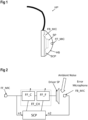
- a noise control processor SCP is located within the headphone HP for performing various kinds of signal processing operations, examples of which will be described within the disclosure below.
- the noise control processor SCP may also be placed outside the headphone HP, e.g. in an external device located in a mobile handset or phone or within a cable of the headphone HP.
- the sound being output from the speaker SP combines with ambient noise and is recorded as a second noise signal n2 that includes the remaining portion of the ambient noise after ANC.
- the first and the second noise signals n1, n2 are used by the noise control processor SCP for calculating an error signal, which is then used for adjusting a filter response of the feedforward filter chain FF_CH, in particular by adjusting the coarse filter FF_C and the fine filter FF_F separately.
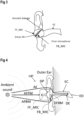
- Figure 3 shows an example representation of a "leaky” type earphone, i.e. an earphone featuring some acoustic leakage between the ambient environment and the ear canal EC.
- acoustic leakage a sound path between the ambient environment and the ear canal EC exists, denoted as "acoustic leakage" in the drawing.
- the headphone HP has a front volume which is directly acoustically coupled to the ear canal volume of a user, the driver or speaker SP which faces into the front volume and a rear volume which surrounds the rear face of the driver SP.
- the rear volume may have a vent with an acoustic resistor to allow some pressure relief from the rear of the driver SP.
- the front volume may also have a vent with an acoustic resistor to allow some pressure relief at the front of the driver SP.
- An ear cushion may surround the front face of the driver SP and makes up part of the front volume.
- the headphone In normal operation the headphone is placed on a user's head such that a complete or partial seal is made between the ear cushion and the user's head, thereby at least in part acoustically coupling the front volume to the ear canal volume.
- a third acoustic transfer function AE represents the acoustic sound path between the ambient sound source and the eardrum ED through the user's ear canal EC, and may be called an ambient-to-ear response function.
- a fourth acoustic transfer function AFBM represents the acoustic sound path between the ambient sound source and the feedback noise microphone FB_MIC, and may be called an ambient-to-feedback response function.
- a fifth acoustic transfer function AFFM represents the acoustic sound path between the ambient sound source and the feedforward microphone FF_MIC, and may be called an ambient-to-feedforward response function.
- Response functions or transfer functions of the headphone HP in particular between the microphones FB_MIC and FF_MIC and the speaker SP, can be used with a feedback filter function B and feedforward filter function F, which may be parameterized as noise cancellation filters during operation.
- the headphone HP as an example of the ear-mountable playback device may be embodied with both the microphones FB_MIC and FF_MIC being active or enabled such that hybrid ANC can be performed, or as an FF ANC device, where the feedforward microphone FF_MIC is active and the error or feedback noise microphone FB_MIC is active only as the error microphone but is not used for FB ANC purposes.
- processing of the microphone signals in order to perform ANC may be implemented in a processor located within the headphone or other ear-mountable playback device or externally from the headphone in a dedicated processing unit.
- the processor or processing unit may be called a noise control processor. If the processing unit is integrated into the playback device, the playback device itself may form a noise cancellation enabled audio system. If processing is performed externally, the external device or processor together with the playback device may form the noise cancellation enabled audio system. For example, processing may be performed in a mobile device like a mobile phone or a mobile audio player, to which the headphone is connected with or without wires.
- the system is formed by a mobile device like a mobile phone MP that includes the playback device with speaker SP, error microphone FB_MIC, ambient noise or feedforward microphone FF_MIC and a noise control processor SCP for performing inter alia ANC and/or other signal processing during operation.
- a mobile device like a mobile phone MP that includes the playback device with speaker SP, error microphone FB_MIC, ambient noise or feedforward microphone FF_MIC and a noise control processor SCP for performing inter alia ANC and/or other signal processing during operation.
- a headphone HP e.g. like that shown in Figure 1 or Figure 4
- a headphone HP can be connected to the mobile phone MP wherein signals from the microphones FB_MIC, FF_MIC are transmitted from the headphone to the mobile phone MP, in particular the mobile phone's processor PROC for generating the audio signal to be played over the headphone's speaker.
- ANC is performed with the internal components, i.e. speaker and microphones, of the mobile phone or with the speaker and microphones of the headphone, thereby using different sets of filter parameters in each case.
- the coarse filter FF_C may be formed of 4 to 10 of such second order IIR filters, e.g. 6 to 8.
- the matching of the coarse adaptive filter FF_C to the acoustic transfer function is such that after adaption, its amplitude error is e.g. less than 1 dB and its phase error is less than 8 degrees in a designated FF ANC bandwidth.
- the coarse filter may be adapted conventionally by adapting coefficients of the filter, or it may be adapted by adapting several parameters such as the gain and a low pass cut-off frequency. These parameters can then be converted into coefficients and written to the filter.
- the coarse filter could be adapted by implementing ams application EP 17189001.5 , whereby a resultant coarse filter response is created by the interpolation of two or more parallel filters.
- the noise control processor SCP may be configured to interpolate between a high leak and a low leak filter depending on a leakage condition as detailed in the mentioned ams application.
- the fine filter FF_F is formed of a set of sub-filters, which e.g. are connected serially.
- Each of the sub-filters BQ_1, BQ_2, ..., BQ N has a predefined frequency range, wherein the predefined frequency range of each of the sub-filters BQ_1, BQ_2, ..., BQ_N at least partially overlaps with the predefined frequency range of at least one other sub-filter of the set of sub-filters.
- the fine filter FF_F is formed of peak and/or notch stages, each represented by a single biquad or second order IIR filter, which e.g.
- the set of sub-filters may comprise between six and twelve sub-filters, e.g. between eight and ten sub-filters.
- An effective overall frequency range of the fine filter FF_F may be from 80 Hz to 2000 Hz, e.g. from 80 Hz to 1000 Hz.
- FIG. 7 an overall frequency range of an example implementation of a fine filter FF_F with eight sub-filters is shown, formed by the single predefined frequency ranges of each of the sub-filters marked by a black box. It can be seen that in this example there is a 50 % overlap of each sub-filter with a neighboring sub-filter with respect to the frequency range. However, a smaller or greater overlap is still possible.
- the noise control processor SCP not only performs an adaptation of the coarse filter parameters of the coarse filter FF_C based on the error signal but also, e.g. subsequently, of the fine filter FF_F.
- the noise control processor performs a limited adaptation of fine filter parameters of each of the sub-filters BQ_1, BQ_2, ..., BQ_N based on the error signal.
- Limits of the limited adaptation comprise the predefined frequency ranges of the sub-filters, a gain limit and a Q factor limit.
- the sub-filters are implemented with peak and/or notch stages which are limited for example to have a maximum gain of +/- 1 dB. This approximately results in a maximum gain factor of 1.26 and a minimum gain factor of 0.79.
- a Q factor may be limited to between 0.1 and 2, for example.
- a center frequency of each sub-filter may be limited to the predefined frequency range, for example.
- adaptation of the fine filter FF_F can either happen conventionally, for example with a filtered-u LMS algorithm to adapt the IIR coefficients with a check and limit on the resultant response of each sub-filter, or the LMS loop can adapt poles and zeros, again with a check and limit on the poles and zeros or the resultant response, or the LMS loop can adapt the fine filter parameters, i.e. gain, Q factor and frequency of each sub-filter within a set range for a predefined topology.
- the noise control processor SCP adapts the coefficient of each of the adaptive sub-filters, in particular separately, while placing equivalent constraints upon them for gain, Q factor, center frequency and shape. This will be described in greater detail in the following.
- filter coefficients of an associated second order IIR filter can be calculated, with F S being the sampling frequency and A and alpha being intermediate parameters.
- ⁇ 0 is the normalized center frequency.
- alpha sin ⁇ 0 2 ⁇ Q
- ⁇ 0 2 ⁇ ⁇ ⁇ f 0 F s .
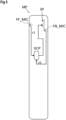
- FIG. 9 a block diagram of a further example adaptive ANC system is shown, which is based on the implementation shown in Figure 2 .
- an FB ANC is implemented employing a feedback noise filter FB_B coupling the error microphone FB_MIC to the speaker SP.
- Such a hybrid ANC approach in conjunction with the adaptive filter chain FF_CH may achieve an ANC performance of about 60 dB.
Landscapes
- Physics & Mathematics (AREA)
- Engineering & Computer Science (AREA)
- Acoustics & Sound (AREA)
- Multimedia (AREA)
- Signal Processing (AREA)
- Health & Medical Sciences (AREA)
- General Health & Medical Sciences (AREA)
- Otolaryngology (AREA)
- Soundproofing, Sound Blocking, And Sound Damping (AREA)
Claims (15)
- Geräuschunterdrückungssystem, das eingerichtet ist, um in einer am Ohr montierbaren Wiedergabevorrichtung (HP) installiert zu werden, die einen Lautsprecher (SP), ein Vorwärtsmikrofon (FF_MIC), das eingerichtet ist, um vorwiegend Umgebungsgeräusche zu erfassen, und ein Fehlermikrofon (FB_MIC) aufweist, das eingerichtet ist, um Umgebungsgeräusche und Geräusche zu erfassen, die von dem Lautsprecher (SP) ausgegeben werden, wobei das Geräuschunterdrückungssystem Folgendes umfasst- eine Filterkette (FF_CH) zum Koppeln des Vorwärtsmikrofons (FF_MIC) mit dem Lautsprecher (SP), die so eingerichtet ist, dass sie ein Anti-Rausch-Signal erzeugt, das über den Lautsprecher (SP) ausgegeben wird, wobei die Filterkette (FF_CH) eine Reihenschaltung oder Parallelschaltung eines Grobfilters (FF_C) und eines Feinfilters (FF_F) umfasst; und- einen Geräuschkontrollprozessor (SCP);wobei- der Feinfilter (FF_F) aus einem Satz von Unterfiltern gebildet ist;- jedes der Unterfilter einen vordefinierten Frequenzbereich hat;- der vordefinierte Frequenzbereich eines jeden der Unterfilter zusammen einen effektiven Gesamtfrequenzbereich des Feinfilters (FF_F) bildet; und- der Geräuschkontrollprozessor (SCP) eingerichtet ist,- ein Fehlersignal zu berechnen;- eine Anpassung von Grobfilterparametern des Grobfilters (FF_C) auf der Grundlage des Fehlersignals durchzuführen; und- eine begrenzte Anpassung von Feinfilterparametern jedes der Unterfilter auf der Grundlage des Fehlersignals durchzuführen, wobei Grenzen der begrenzten Anpassung die vordefinierten Frequenzbereiche der Unterfilter umfassen;wobei das Rauschunterdrückungssystem dadurch gekennzeichnet ist, dass:- das Fehlersignal auf der Grundlage eines ersten Rauschsignals, das von dem Vorwärtsmikrofon (FF_MIC) erfasst wird, und auf der Grundlage eines zweiten Rauschsignals, das von dem Fehlermikrofon (FB_MIC) erfasst wird, berechnet wird; und- die begrenzte Anpassung von Feinfilterparametern jedes der Unterfilter eine Verstärkungsgrenze umfasst, die eingerichtet ist, einen Verstärkungsbereich des jeweiligen Unterfilters zu begrenzen, und eine Q-Faktor-Grenze, die eingerichtet ist, einen Q-Faktor-Bereich des jeweiligen Unterfilters zu begrenzen.
- Geräuschunterdrückungssystem nach Anspruch 1,
wobei der vordefinierte Frequenzbereich jedes der Unterfilter an den vordefinierten Frequenzbereich mindestens eines anderen Unterfilters des Satzes von Unterfiltern angrenzt oder sich zumindest teilweise mit diesem überlappt. - Geräuschunterdrückungssystem nach Anspruch 1 oder 2, wobei der Satz von Unterfiltern zwischen 6 und 12 Unterfiltern, insbesondere zwischen 8 und 10 Unterfiltern, umfasst.
- Geräuschunterdrückungssystem nach einem der Ansprüche 1 bis 3, wobei der effektive Gesamtfrequenzbereich des Feinfilters (FF_F) von 80 Hz bis 2000 Hz, insbesondere von 80 Hz bis 1000 Hz, beträgt.
- Geräuschunterdrückungssystem nach einem der Ansprüche 1 bis 4, wobei jeder Unterfilter ein Spitzenwertfilter oder ein Kerbfilter ist.
- Geräuschunterdrückungssystem nach einem der Ansprüche 1 bis 5, wobei jeder Unterfilter ein Minimalphasenfilter ist.
- Geräuschunterdrückungssystem nach einem der Ansprüche 1 bis 6, wobei die begrenzte Anpassung der Unterfilter auf einem Fehlerminimierungsalgorithmus, insbesondere einem kleinsten quadratischen Mittelwert-Algorithmus (LMS-Algorithmus), basiert.
- Geräuschunterdrückungssystem nach einem der Ansprüche 1 bis 7, wobei die begrenzte Anpassung der Subfilter eine Anpassung einer Verstärkung, einer Mittenfrequenz und eines Q-Faktors von mindestens einem der Unterfilter umfasst.
- Geräuschunterdrückungssystem nach einem der Ansprüche 1 bis 8, wobei die begrenzte Anpassung der Unterfilter die direkte Anpassung der Feinfilterparameter von mindestens einem der Unterfilter und die Überprüfung der Grenzen der begrenzten Anpassung für die angepassten Feinfilterparameter umfasst.
- Geräuschunterdrückungssystem nach einem der Ansprüche 1 bis 9, wobei der Geräuschkontrollprozessor (SCP) eingerichtet ist, die Grobanpassung vor der begrenzten Anpassung oder mit einer anderen Anpassungsrate als der begrenzten Anpassung durchzuführen.
- Geräuschunterdrückungssystem nach einem der Ansprüche 1 bis 10, wobei der Geräuschkontrollprozessor (SCP) eingerichtet ist, um die Grobanpassung durch Anpassen eines Verstärkungsfaktors und/oder einer Grenzfrequenz des Grobfilters (FF_C) durchzuführen.
- Geräuschunterdrückungssystem nach einem der Ansprüche 1 bis 11, ferner umfassend ein Rückkopplungsgeräuschfilter (FB_B), das das Fehlermikrofon (FB_MIC) mit dem Lautsprecher (SP) koppelt.
- Ohrmontierbare Wiedergabevorrichtung, insbesondere Kopfhörer (HP) oder Handapparat, umfassend ein Geräuschunterdrückungssystem nach einem der vorhergehenden Ansprüche, den Lautsprecher (SP), das Vorwärtsmikrofon (FF_MIC) und das Fehlermikrofon (FB_MIC), das in der Nähe des Lautsprechers (SP) angeordnet ist.
- Audio-Abspielgerät umfassend ein Geräuschunterdrückungssystem nach einem der Ansprüche 1 bis 12.
- Signalverarbeitungsverfahren für eine am Ohr montierbare Wiedergabevorrichtung (HP) mit einem Lautsprecher (SP), einem Vorwärtsmikrofon (FF_MIC), das eingerichtet ist, um vorwiegend Umgebungsgeräusche zu erfassen, einem Fehlermikrofon (FB_MIC), das eingerichtet ist, um Umgebungsgeräusche und Geräusche, die von dem Lautsprecher (SP) ausgegeben werden, zu erfassen, und einem Geräuschkontrollprozessor (SCP), wobei das Vorwärtsmikrofon (FF_MIC) mit dem Lautsprecher (SP) über eine Filterkette (FF_CH) gekoppelt ist, die eingerichtet ist, um ein Anti-Rauschsignal zu erzeugen, das über den Lautsprecher (SP) ausgegeben wird, die Filterkette (FF_CH) eine Reihenschaltung oder Parallelschaltung eines Grobfilters (FF_C) und eines Feinfilters (FF_F) umfasst, wobei das Feinfilter (FF_F) aus einem Satz von Unterfiltern gebildet ist, jedes der Unterfilter einen vordefinierten Frequenzbereich aufweist und der vordefinierte Frequenzbereich jedes der Unterfilter zusammen einen effektiven Gesamtfrequenzbereich des Feinfilters (FF_F) bildet, wobei das Verfahren umfasst- Berechnen eines Fehlersignals durch den Geräuschkontrollprozessor;- Durchführen, durch den Geräuschkontrollprozessor, einer Anpassung von Grobfilterparametern des Grobfilters (FF_C) basierend auf dem Fehlersignal; und- Durchführen, durch den Geräuschkontrollprozessor, einer begrenzten Anpassung von Feinfilterparametern jedes der Unterfilter, basierend auf dem Fehlersignal, wobei Grenzen der begrenzten Anpassung die vordefinierten Frequenzbereiche der Unterfilter umfassen;wobei das Signalverarbeitungsverfahren dadurch gekennzeichnet ist, dass:- das Fehlersignal auf der Grundlage eines ersten Rauschsignals berechnet wird, das von dem Vorwärtsmikrofon (FF MIC) erfasst wird, und auf der Grundlage eines zweiten Rauschsignals, das von dem Fehlermikrofon (FB MIC) erfasst wird;- die begrenzte Anpassung von Feinfilterparametern jedes der Unterfilter eine Verstärkungsgrenze umfasst, die eingerichtet ist, einen Verstärkungsbereich des jeweiligen Unterfilters zu begrenzen, und eine Q-Faktor-Grenze, die eingerichtet ist, einen Q-Faktor-Bereich des jeweiligen Unterfilters zu begrenzen.
Priority Applications (4)
| Application Number | Priority Date | Filing Date | Title |
|---|---|---|---|
| EP19212145.7A EP3828879B1 (de) | 2019-11-28 | 2019-11-28 | Rauschunterdrückungssystem und signalverarbeitungsverfahren für eine ohrmontierbare wiedergabevorrichtung |
| US17/780,733 US12002447B2 (en) | 2019-11-28 | 2020-11-18 | Noise cancellation system and signal processing method for an ear-mountable playback device |
| CN202080082462.6A CN114787911B (zh) | 2019-11-28 | 2020-11-18 | 耳戴式播放设备的噪声消除系统和信号处理方法 |
| PCT/EP2020/082480 WO2021104957A1 (en) | 2019-11-28 | 2020-11-18 | Noise cancellation system and signal processing method for an ear-mountable playback device |
Applications Claiming Priority (1)
| Application Number | Priority Date | Filing Date | Title |
|---|---|---|---|
| EP19212145.7A EP3828879B1 (de) | 2019-11-28 | 2019-11-28 | Rauschunterdrückungssystem und signalverarbeitungsverfahren für eine ohrmontierbare wiedergabevorrichtung |
Publications (2)
| Publication Number | Publication Date |
|---|---|
| EP3828879A1 EP3828879A1 (de) | 2021-06-02 |
| EP3828879B1 true EP3828879B1 (de) | 2025-02-26 |
Family
ID=68731851
Family Applications (1)
| Application Number | Title | Priority Date | Filing Date |
|---|---|---|---|
| EP19212145.7A Active EP3828879B1 (de) | 2019-11-28 | 2019-11-28 | Rauschunterdrückungssystem und signalverarbeitungsverfahren für eine ohrmontierbare wiedergabevorrichtung |
Country Status (4)
| Country | Link |
|---|---|
| US (1) | US12002447B2 (de) |
| EP (1) | EP3828879B1 (de) |
| CN (1) | CN114787911B (de) |
| WO (1) | WO2021104957A1 (de) |
Families Citing this family (6)
| Publication number | Priority date | Publication date | Assignee | Title |
|---|---|---|---|---|
| EP3644307A1 (de) * | 2018-10-23 | 2020-04-29 | AMS Sensors UK Limited | Abstimmungsverfahren, herstellungsverfahren, computerlesbares speichermedium und abstimmungssystem |
| CN113453117B (zh) * | 2021-08-16 | 2022-08-30 | 英华达(上海)科技有限公司 | 无线蓝牙子母耳机及其控制方法 |
| US11457304B1 (en) * | 2021-12-27 | 2022-09-27 | Bose Corporation | Headphone audio controller |
| CN114554346B (zh) * | 2022-02-24 | 2022-11-22 | 潍坊歌尔电子有限公司 | Anc参数的自适应调整方法、设备及存储介质 |
| CN115620696A (zh) * | 2022-06-29 | 2023-01-17 | 一汽奔腾轿车有限公司 | 一种车载全息降噪空调系统、方法及存储介质 |
| US11664004B1 (en) * | 2022-11-09 | 2023-05-30 | Gulfstream Aerospace Corporation | Active noise cancellation of tonal noise by manipulating characteristic acoustic modes |
Family Cites Families (17)
| Publication number | Priority date | Publication date | Assignee | Title |
|---|---|---|---|---|
| US4494074A (en) | 1982-04-28 | 1985-01-15 | Bose Corporation | Feedback control |
| US5138664A (en) | 1989-03-25 | 1992-08-11 | Sony Corporation | Noise reducing device |
| US5652799A (en) * | 1994-06-06 | 1997-07-29 | Noise Cancellation Technologies, Inc. | Noise reducing system |
| JP5572698B2 (ja) * | 2009-05-11 | 2014-08-13 | コーニンクレッカ フィリップス エヌ ヴェ | オーディオノイズのキャンセリング |
| US8737636B2 (en) * | 2009-07-10 | 2014-05-27 | Qualcomm Incorporated | Systems, methods, apparatus, and computer-readable media for adaptive active noise cancellation |
| US9053697B2 (en) * | 2010-06-01 | 2015-06-09 | Qualcomm Incorporated | Systems, methods, devices, apparatus, and computer program products for audio equalization |
| US8718291B2 (en) * | 2011-01-05 | 2014-05-06 | Cambridge Silicon Radio Limited | ANC for BT headphones |
| US8693700B2 (en) | 2011-03-31 | 2014-04-08 | Bose Corporation | Adaptive feed-forward noise reduction |
| US9076431B2 (en) | 2011-06-03 | 2015-07-07 | Cirrus Logic, Inc. | Filter architecture for an adaptive noise canceler in a personal audio device |
| US8948407B2 (en) * | 2011-06-03 | 2015-02-03 | Cirrus Logic, Inc. | Bandlimiting anti-noise in personal audio devices having adaptive noise cancellation (ANC) |
| US20130259253A1 (en) * | 2012-03-29 | 2013-10-03 | Rogerio Guedes Alves | Controllers for active noise control systems |
| EP2667379B1 (de) * | 2012-05-21 | 2018-07-25 | Harman Becker Automotive Systems GmbH | Aktive Rauschunterdrückung |
| US9704471B1 (en) * | 2016-03-30 | 2017-07-11 | Bose Corporation | Adaptive modeling of secondary path in an active noise control system |
| WO2017217106A1 (ja) * | 2016-06-13 | 2017-12-21 | ソニー株式会社 | 音響処理装置、音響処理方法及びコンピュータプログラム |
| EP3451327B1 (de) * | 2017-09-01 | 2023-01-25 | ams AG | Rauschunterdrückungssystem, rauschunterdrückungskopfhörer und rauschunterdrückungsverfahren |
| EP3486896B1 (de) * | 2017-11-16 | 2023-08-23 | ams AG | Rauschunterdrückungssystem und signalverarbeitungsverfahren |
| US10565979B1 (en) * | 2018-10-16 | 2020-02-18 | Harman International Industries, Incorporated | Concurrent noise cancelation systems with harmonic filtering |
-
2019
- 2019-11-28 EP EP19212145.7A patent/EP3828879B1/de active Active
-
2020
- 2020-11-18 CN CN202080082462.6A patent/CN114787911B/zh active Active
- 2020-11-18 US US17/780,733 patent/US12002447B2/en active Active
- 2020-11-18 WO PCT/EP2020/082480 patent/WO2021104957A1/en not_active Ceased
Also Published As
| Publication number | Publication date |
|---|---|
| EP3828879A1 (de) | 2021-06-02 |
| CN114787911A (zh) | 2022-07-22 |
| WO2021104957A1 (en) | 2021-06-03 |
| US12002447B2 (en) | 2024-06-04 |
| US20220415300A1 (en) | 2022-12-29 |
| CN114787911B (zh) | 2025-09-09 |
Similar Documents
| Publication | Publication Date | Title |
|---|---|---|
| EP3828879B1 (de) | Rauschunterdrückungssystem und signalverarbeitungsverfahren für eine ohrmontierbare wiedergabevorrichtung | |
| US10937408B2 (en) | Noise cancellation system, noise cancellation headphone and noise cancellation method | |
| US8693700B2 (en) | Adaptive feed-forward noise reduction | |
| US8948409B2 (en) | Audio headset with active noise control of the non-adaptive type for listening to an audio music source and/or for “hands-free” telephony functions | |
| EP3799031B1 (de) | Audiosystem und signalverarbeitungsverfahren für eine ohrmontierbare wiedergabevorrichtung | |
| EP2362381A1 (de) | System zur aktiven Rauschunterdrückung | |
| GB2465064A (en) | Active noise cancellation system with split digital filter | |
| US11355096B1 (en) | Adaptive feedback processing for consistent headphone acoustic noise cancellation | |
| US12293754B2 (en) | Active noise control method and system for headphone | |
| US11264004B2 (en) | Parallel noise cancellation filters | |
| US10692483B1 (en) | Active noise cancellation device and earphone having acoustic filter | |
| US11678105B2 (en) | Noise canceling headphones | |
| US12513449B2 (en) | Noise canceling audio headset | |
| US12462784B2 (en) | Audio processing device | |
| US12548544B1 (en) | Feedforward and feedback headphone acoustic noise cancellation |
Legal Events
| Date | Code | Title | Description |
|---|---|---|---|
| PUAI | Public reference made under article 153(3) epc to a published international application that has entered the european phase |
Free format text: ORIGINAL CODE: 0009012 |
|
| STAA | Information on the status of an ep patent application or granted ep patent |
Free format text: STATUS: THE APPLICATION HAS BEEN PUBLISHED |
|
| AK | Designated contracting states |
Kind code of ref document: A1 Designated state(s): AL AT BE BG CH CY CZ DE DK EE ES FI FR GB GR HR HU IE IS IT LI LT LU LV MC MK MT NL NO PL PT RO RS SE SI SK SM TR |
|
| STAA | Information on the status of an ep patent application or granted ep patent |
Free format text: STATUS: REQUEST FOR EXAMINATION WAS MADE |
|
| 17P | Request for examination filed |
Effective date: 20211125 |
|
| RBV | Designated contracting states (corrected) |
Designated state(s): AL AT BE BG CH CY CZ DE DK EE ES FI FR GB GR HR HU IE IS IT LI LT LU LV MC MK MT NL NO PL PT RO RS SE SI SK SM TR |
|
| STAA | Information on the status of an ep patent application or granted ep patent |
Free format text: STATUS: EXAMINATION IS IN PROGRESS |
|
| 17Q | First examination report despatched |
Effective date: 20220901 |
|
| P01 | Opt-out of the competence of the unified patent court (upc) registered |
Effective date: 20230724 |
|
| REG | Reference to a national code |
Ref country code: DE Ref legal event code: R079 Ref country code: DE Ref legal event code: R079 Ref document number: 602019066426 Country of ref document: DE Free format text: PREVIOUS MAIN CLASS: G10K0011178000 Ipc: H04R0003000000 |
|
| GRAP | Despatch of communication of intention to grant a patent |
Free format text: ORIGINAL CODE: EPIDOSNIGR1 |
|
| STAA | Information on the status of an ep patent application or granted ep patent |
Free format text: STATUS: GRANT OF PATENT IS INTENDED |
|
| RIC1 | Information provided on ipc code assigned before grant |
Ipc: H04R 1/10 20060101ALI20240923BHEP Ipc: G10K 11/178 20060101ALI20240923BHEP Ipc: H04R 3/00 20060101AFI20240923BHEP |
|
| RAP3 | Party data changed (applicant data changed or rights of an application transferred) |
Owner name: AMS AG |
|
| INTG | Intention to grant announced |
Effective date: 20241017 |
|
| GRAS | Grant fee paid |
Free format text: ORIGINAL CODE: EPIDOSNIGR3 |
|
| GRAA | (expected) grant |
Free format text: ORIGINAL CODE: 0009210 |
|
| STAA | Information on the status of an ep patent application or granted ep patent |
Free format text: STATUS: THE PATENT HAS BEEN GRANTED |
|
| AK | Designated contracting states |
Kind code of ref document: B1 Designated state(s): AL AT BE BG CH CY CZ DE DK EE ES FI FR GB GR HR HU IE IS IT LI LT LU LV MC MK MT NL NO PL PT RO RS SE SI SK SM TR |
|
| REG | Reference to a national code |
Ref country code: GB Ref legal event code: FG4D |
|
| REG | Reference to a national code |
Ref country code: CH Ref legal event code: EP |
|
| REG | Reference to a national code |
Ref country code: DE Ref legal event code: R096 Ref document number: 602019066426 Country of ref document: DE |
|
| REG | Reference to a national code |
Ref country code: IE Ref legal event code: FG4D |
|
| REG | Reference to a national code |
Ref country code: NL Ref legal event code: MP Effective date: 20250226 |
|
| PG25 | Lapsed in a contracting state [announced via postgrant information from national office to epo] |
Ref country code: RS Free format text: LAPSE BECAUSE OF FAILURE TO SUBMIT A TRANSLATION OF THE DESCRIPTION OR TO PAY THE FEE WITHIN THE PRESCRIBED TIME-LIMIT Effective date: 20250526 |
|
| PG25 | Lapsed in a contracting state [announced via postgrant information from national office to epo] |
Ref country code: FI Free format text: LAPSE BECAUSE OF FAILURE TO SUBMIT A TRANSLATION OF THE DESCRIPTION OR TO PAY THE FEE WITHIN THE PRESCRIBED TIME-LIMIT Effective date: 20250226 |
|
| PG25 | Lapsed in a contracting state [announced via postgrant information from national office to epo] |
Ref country code: PL Free format text: LAPSE BECAUSE OF FAILURE TO SUBMIT A TRANSLATION OF THE DESCRIPTION OR TO PAY THE FEE WITHIN THE PRESCRIBED TIME-LIMIT Effective date: 20250226 |
|
| PG25 | Lapsed in a contracting state [announced via postgrant information from national office to epo] |
Ref country code: ES Free format text: LAPSE BECAUSE OF FAILURE TO SUBMIT A TRANSLATION OF THE DESCRIPTION OR TO PAY THE FEE WITHIN THE PRESCRIBED TIME-LIMIT Effective date: 20250226 |
|
| REG | Reference to a national code |
Ref country code: LT Ref legal event code: MG9D |
|
| PG25 | Lapsed in a contracting state [announced via postgrant information from national office to epo] |
Ref country code: IS Free format text: LAPSE BECAUSE OF FAILURE TO SUBMIT A TRANSLATION OF THE DESCRIPTION OR TO PAY THE FEE WITHIN THE PRESCRIBED TIME-LIMIT Effective date: 20250626 Ref country code: NO Free format text: LAPSE BECAUSE OF FAILURE TO SUBMIT A TRANSLATION OF THE DESCRIPTION OR TO PAY THE FEE WITHIN THE PRESCRIBED TIME-LIMIT Effective date: 20250526 |
|
| PG25 | Lapsed in a contracting state [announced via postgrant information from national office to epo] |
Ref country code: NL Free format text: LAPSE BECAUSE OF FAILURE TO SUBMIT A TRANSLATION OF THE DESCRIPTION OR TO PAY THE FEE WITHIN THE PRESCRIBED TIME-LIMIT Effective date: 20250226 |
|
| PG25 | Lapsed in a contracting state [announced via postgrant information from national office to epo] |
Ref country code: HR Free format text: LAPSE BECAUSE OF FAILURE TO SUBMIT A TRANSLATION OF THE DESCRIPTION OR TO PAY THE FEE WITHIN THE PRESCRIBED TIME-LIMIT Effective date: 20250226 |
|
| PG25 | Lapsed in a contracting state [announced via postgrant information from national office to epo] |
Ref country code: LV Free format text: LAPSE BECAUSE OF FAILURE TO SUBMIT A TRANSLATION OF THE DESCRIPTION OR TO PAY THE FEE WITHIN THE PRESCRIBED TIME-LIMIT Effective date: 20250226 Ref country code: PT Free format text: LAPSE BECAUSE OF FAILURE TO SUBMIT A TRANSLATION OF THE DESCRIPTION OR TO PAY THE FEE WITHIN THE PRESCRIBED TIME-LIMIT Effective date: 20250626 |
|
| PG25 | Lapsed in a contracting state [announced via postgrant information from national office to epo] |
Ref country code: GR Free format text: LAPSE BECAUSE OF FAILURE TO SUBMIT A TRANSLATION OF THE DESCRIPTION OR TO PAY THE FEE WITHIN THE PRESCRIBED TIME-LIMIT Effective date: 20250527 Ref country code: BG Free format text: LAPSE BECAUSE OF FAILURE TO SUBMIT A TRANSLATION OF THE DESCRIPTION OR TO PAY THE FEE WITHIN THE PRESCRIBED TIME-LIMIT Effective date: 20250226 |
|
| REG | Reference to a national code |
Ref country code: AT Ref legal event code: MK05 Ref document number: 1771840 Country of ref document: AT Kind code of ref document: T Effective date: 20250226 |
|
| PG25 | Lapsed in a contracting state [announced via postgrant information from national office to epo] |
Ref country code: SE Free format text: LAPSE BECAUSE OF FAILURE TO SUBMIT A TRANSLATION OF THE DESCRIPTION OR TO PAY THE FEE WITHIN THE PRESCRIBED TIME-LIMIT Effective date: 20250226 |
|
| PG25 | Lapsed in a contracting state [announced via postgrant information from national office to epo] |
Ref country code: SM Free format text: LAPSE BECAUSE OF FAILURE TO SUBMIT A TRANSLATION OF THE DESCRIPTION OR TO PAY THE FEE WITHIN THE PRESCRIBED TIME-LIMIT Effective date: 20250226 |
|
| PG25 | Lapsed in a contracting state [announced via postgrant information from national office to epo] |
Ref country code: DK Free format text: LAPSE BECAUSE OF FAILURE TO SUBMIT A TRANSLATION OF THE DESCRIPTION OR TO PAY THE FEE WITHIN THE PRESCRIBED TIME-LIMIT Effective date: 20250226 |
|
| PG25 | Lapsed in a contracting state [announced via postgrant information from national office to epo] |
Ref country code: IT Free format text: LAPSE BECAUSE OF FAILURE TO SUBMIT A TRANSLATION OF THE DESCRIPTION OR TO PAY THE FEE WITHIN THE PRESCRIBED TIME-LIMIT Effective date: 20250226 |
|
| PG25 | Lapsed in a contracting state [announced via postgrant information from national office to epo] |
Ref country code: AT Free format text: LAPSE BECAUSE OF FAILURE TO SUBMIT A TRANSLATION OF THE DESCRIPTION OR TO PAY THE FEE WITHIN THE PRESCRIBED TIME-LIMIT Effective date: 20250226 |
|
| PG25 | Lapsed in a contracting state [announced via postgrant information from national office to epo] |
Ref country code: CZ Free format text: LAPSE BECAUSE OF FAILURE TO SUBMIT A TRANSLATION OF THE DESCRIPTION OR TO PAY THE FEE WITHIN THE PRESCRIBED TIME-LIMIT Effective date: 20250226 Ref country code: EE Free format text: LAPSE BECAUSE OF FAILURE TO SUBMIT A TRANSLATION OF THE DESCRIPTION OR TO PAY THE FEE WITHIN THE PRESCRIBED TIME-LIMIT Effective date: 20250226 |
|
| PG25 | Lapsed in a contracting state [announced via postgrant information from national office to epo] |
Ref country code: RO Free format text: LAPSE BECAUSE OF FAILURE TO SUBMIT A TRANSLATION OF THE DESCRIPTION OR TO PAY THE FEE WITHIN THE PRESCRIBED TIME-LIMIT Effective date: 20250226 |
|
| PG25 | Lapsed in a contracting state [announced via postgrant information from national office to epo] |
Ref country code: SK Free format text: LAPSE BECAUSE OF FAILURE TO SUBMIT A TRANSLATION OF THE DESCRIPTION OR TO PAY THE FEE WITHIN THE PRESCRIBED TIME-LIMIT Effective date: 20250226 |
|
| REG | Reference to a national code |
Ref country code: DE Ref legal event code: R097 Ref document number: 602019066426 Country of ref document: DE |
|
| PLBE | No opposition filed within time limit |
Free format text: ORIGINAL CODE: 0009261 |
|
| STAA | Information on the status of an ep patent application or granted ep patent |
Free format text: STATUS: NO OPPOSITION FILED WITHIN TIME LIMIT |
|
| PGFP | Annual fee paid to national office [announced via postgrant information from national office to epo] |
Ref country code: DE Payment date: 20251119 Year of fee payment: 7 |
|
| PGFP | Annual fee paid to national office [announced via postgrant information from national office to epo] |
Ref country code: FR Payment date: 20251126 Year of fee payment: 7 |
|
| 26N | No opposition filed |
Effective date: 20251127 |